

Submitted:
08 August 2024
Posted:
12 August 2024
You are already at the latest version
Abstract
In a constantly transforming retail financial sector, TCS has established a strategic alliance with Cencosud Scotiabank, expanding its role beyond consultancy to become an essential partner in the journey of growth and transformation. This collaboration reflects a shared commitment to advancing together in the competitive world of retail financial services, driving significant strategic change at Cencosud Scotiabank. As part of this effort, TCS has co-designed a series of practical workshops aimed at fostering and expanding the culture of innovation within the organization. These practical workshops are fundamental in the transformation process, providing deep and practical learning that serves as a solid foundation for the desired change. Each workshop session, carefully designed and executed according to an innovation playbook, aligns visual thinking tools with practical techniques to ensure smooth and effective execution of the work. The goal of these efforts is twofold: on the one hand, to strengthen the culture of innovation at Cencosud Scotiabank through collaboration; on the other, to firmly center the organization around the customer. The workshops are not just meetings; rather, they are collaborative spaces where creativity, deep user understanding, and agility converge to shape innovative solutions.
Keywords:
agile
; innovation
; lean
; culture
; Co-creation
; Design Thinking
; customer-centricity
1. Introduction
In a rapidly evolving retail financial sector [1,2], TCS has forged a strategic alliance with Cencosud Scotiabank, not only providing consultancy but also becoming a key partner in their process of transformation and growth. This collaboration is a joint commitment where TCS supports Cencosud Scotiabank in their development and strategic change, advancing together in the competitive world of financial services [2,3,4]. As part of this effort, TCS has conducted a series of practical workshops aimed at driving and expanding the culture of innovation within the organization [5].
In this path of transformation, practical workshops emerge as cornerstones, establishing deep and practical learning that serves as a solid foundation for the desired transformation. Each workshop session, carefully designed and executed, is the result of an innovation playbook. This compendium is our work map, aligning visual thinking tools with pragmatic techniques to ensure impeccable execution and workflow [6,7].
Our purpose is dual: on the one hand, we aspire to help Cencosud Scotiabank drive a culture of innovation intertwined with genuine collaboration and, on the other, to anchor an unwavering orientation towards the center of all prosperous business: the customer [8,9]. The workshops we design and carry out are more than meetings; they are collaborative environments where creativity, detailed user understanding, and agility converge to shape innovative solutions [6,10].
By immersing in these Design Thinking workshops, each participant, each team, and each leader of Cencosud Scotiabank becomes an agent of change, equipped with a new vision and powerful tools to pilot the organization towards an era marked by agility and innovation that truly resonates with customer needs [5,8,10]. This is more than a simple improvement in customer service or operational efficiency; it is part of the process of cultural and strategic transformation, a solid foundation for a virtuous and inexhaustible cycle of meaningful growth [5,8,11].
Design thinking is a discipline that uses the designerâs sensibility and methods to match peopleâs needs with what is technologically feasible and what a viable business strategy can convert into customer value and market opportunity. - Tim Brown.
2. Motivation
The financial sector, particularly within the retail financial industry, often seen as traditional and conservative to adapt, now faces a decisive moment of change [2,3]. Technological advancement, evolving customer expectations, and the emergence of disruptive competitors demand constant reinvention [2,4]. In this volatile environment, financial services companies must not only adapt but also anticipate and lead change to stay relevant [2,4].
Recognizing this need, the Design Thinking workshops have been designed to address and mitigate these pressures [5,6]. These meetings are not mere brainstorming sessions but idea laboratories where collaboration and creativity meet the service of real business challenges [5]. Through these workshops, we seek to instill a mindset that places the customer at the center of all activities, thus driving a true transformation towards a customer-centric culture [12,13,14].
These workshops are vital as they break the rigidity of the vertical corporate structure, fostering a horizontal and collaborative work environment that challenges the conventional logic of the retail financial sector [15,16]. By facing real business problems, each team has the opportunity to apply Design Thinking in a practical and tangible way. Besides generating innovative solutions, this approach promotes a culture of collaboration and openness, fundamental elements for adaptation and growth in the sector [5,8,16].
The purpose of incorporating Design Thinking in our strategy is not simply to improve customer service or increase operational efficiency. More deeply, it is a commitment to transform the organizational culture, making it more agile, responsive, and above all, aligned with the needs and desires of our customers [13,14]. These workshops are just the beginning of what we hope will be a continuous evolution towards service excellence and product innovation [8,11,17], a path we consider essential for a future of sustained growth [5,8].
Through innovation, we aim to work with a clear purpose and generate tangible impact in people’s lives.
3. Development of Workshops
The Design Thinking workshops we have implemented in the retail financial services sector represent a break from conventional corporate training methods. These sessions, guided by a TCS agility coach and Cencosud Scotiabank facilitators, are designed to be 100% practical, where each participant actively engages in the learning process, ceasing to be a mere receiver of knowledge [18].
Using advanced techniques such as project-based learning and the "learning by doing" approach, the coach and facilitators have transformed the workshops into a true innovation laboratory [7,19]. Following Sharon Bowman’s methodology of teaching from the back of the room, the coach subtly guides the teams, allowing learning to flow organically and emerging solutions to be the result of genuine collaboration among participants [18].
Designers do not try to find a solution until they have determined the real problem, and even then, instead of solving that problem, they stop to consider a wide range of possible solutions. Only at this point do they begin to converge on their purpose. We call this process Design Thinking. - Don Norman.
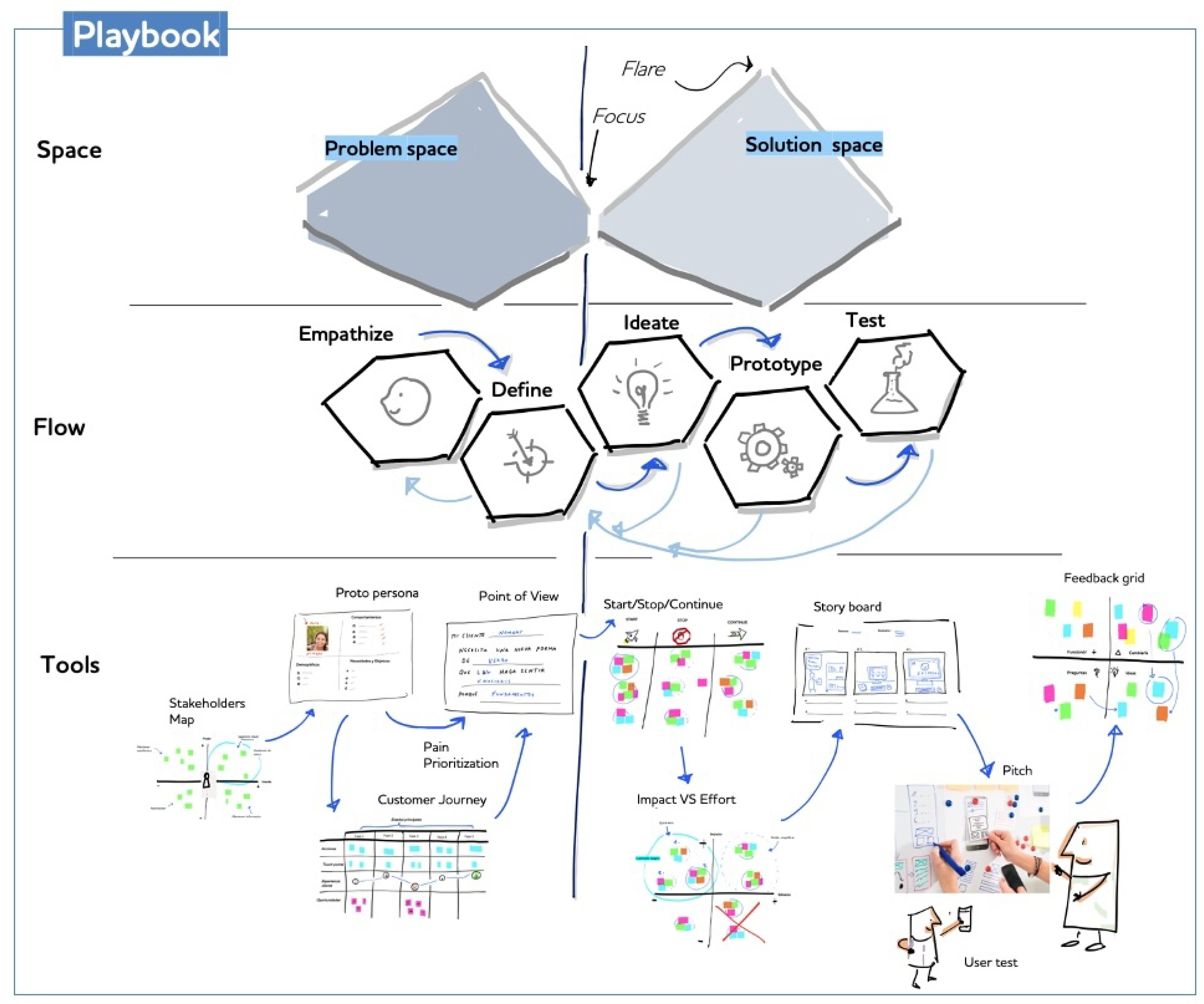
Each stage of this intellectual and practical journey, from empathy to testing, has been guided by the Playbook, ensuring that the essence of our knowledge and skills are in sync with market needs and rhythms. Through the meticulous application of each tool and technique, participants have transitioned from intuitive understanding of the stakeholder map to concrete validation in user tests, becoming true protagonists of change.
Figure 1.
Playbook designed for Design Thinking Workshops.
3.1. Playbook for Innovation
- (1)
- Empathize: In the initial stage, teams used tools such as the stakeholder map and proto-personas to deeply immerse themselves in the needs and contexts of the customers. This phase was crucial for establishing a solid foundation of empathy, understanding not only what customers need but also why they need it.
- (2)
- Define: Subsequently, using the Point of View (PoV) technique, participants clearly defined the identified problems. This stage was essential for transforming empathetic understanding into a defined focus that would guide the subsequent phases of ideation and prototyping.
- (3)
- Ideate: During the ideation phase, tools like Start/Stop/Continue and the Impact vs. Effort Matrix helped teams generate creative and viable ideas. These tools facilitated the prioritization of solutions based on their potential impact and feasibility of implementation, ensuring that the selected ideas offered maximum benefits with reasonable effort.
- (4)
- Prototype: In the prototyping stage, techniques such as Storyboarding and Bodystorming allowed teams to visualize and experiment with their ideas tangibly. While this phase helped concretize the proposed solutions, it also allowed for the identification and addressing of potential challenges in a controlled environment.
- (5)
- Test: Finally, the testing stage, using tools like the Pitch and the Feedback Grid, provided teams with the opportunity to present their prototypes and collect valuable feedback. This feedback was essential for iterating and refining the solutions, preparing them for potential real-world implementation.
Did you ask your customer about this?. - Mark Stickdorn.
The development of these workshops has demonstrated that experiential learning and active teaching are not only possible in a corporate environment but also extraordinarily effective [18,20,21]. The workshops provided participants with a comprehensive experience in Design Thinking, which included both the acquisition of theoretical knowledge and the practical application of these principles in real situations, preparing them to be agents of change within the organization and leaders in customer-centered innovation [11,16,20].
4. Preparing for the Future
Embarking on the implementation of Design Thinking workshops, we are planting the seeds for a future harvest of competitive advantages and business value. This is just the prelude to a strategic movement that drives and strengthens a customer-centered culture, where every business interaction and decision implicitly carries the user’s perspective [5,14,20].
Although tangible results are still on the horizon, the potential of what we are building promises to reshape daily practices and even the very essence of the organization.
“It is important for us to continue growing and standing out for our ability to have an effective working methodology that allows us to continue developing collaborative, effective, and agile skills.On the other hand, as we continue to develop skills to understand our customers’ needs and generate relevant and creative solutions, that is, truly putting ourselves in their shoes, we will continue to stand out in our service and quality of care and thus continue growing as a company.”—Valentina Lastra
Organizational Development Manager.—Cencosud Scotiabank
4.1. Innovation as an Operational Standard
Change begins with the introduction of new tools and techniques, but its depth is measured by the shift in thinking and perception of challenges and opportunities. The workshops are incubators of an innovative culture, testing empathy, precision in problem definition, creativity in ideation, speed in prototyping, and effectiveness in iterative testing. Participants are beginning to apply these approaches in their daily operations, building a solid foundation for a culture that adapts and thrives on change.
4.2. Barrier-Free Collaboration
With collaboration as a pillar, we are breaking down hierarchical barriers and fostering a space where communication flows and every voice can be heard. These workshops become a forum where each participant can contribute, creating synergy essential for developing solutions that fit the customers’ purpose.
“The workshops are positively impacting the culture and our way of working. Now, with Design Thinking, teams are implementing practices that make us more agile and innovative, always focusing on creating significant and lasting value for our customers.”—Heidy Liberona
Talent Development—Cencosud Scotiabank
4.3. Deepening Customer Understanding
The workshops have revitalized our understanding of what customers truly need, teaching us to listen without prejudice, observe their reality, and learn from it. By setting aside assumptions and embracing validation through real data, this fresh approach improves the relevance of what we offer and ensures that our actions are truly synchronized with market demands.
4.4. Embracing Change
Beyond immediate benefits, these workshops are a platform for future preparation. In a rapidly evolving business environment, the ability to adapt and respond with agility becomes an invaluable asset. We are equipping people with the skills to continuously innovate and adapt, preparing the organization not only for business continuity but also to thrive in the competitive landscape that awaits us.
“We are leading cultural and methodological transformation by focusing on agility and innovation. The active participation of our leaders is crucial to scaling this culture throughout the organization and ensuring a positive and sustainable impact.”—Ariel Espinoza
Chief Information Officer—Cencosud Scotiabank
Although we are still in the early stages of this initiative, the direction is clear: each Design Thinking workshop is a step towards creating a dynamic, agile company deeply aligned with its customers [8,20], a company that grows and evolves with purpose and meaning, making a real difference in people’s lives.
Thinking like a designer can transform the way you develop products, services, processes, and even strategy. - Tim Brown.
5. The Price of Not Changing
Stagnation and lack of innovation corrode any organization; from the Cencosud Scotiabank agility office, we are clear that to be innovative in our industry, we need an organizational culture that promotes creativity. This can only bear fruit when it takes into account the vision of multiple individuals who, with their perspective on reality, contribute to generating creative solutions of greater value. These workshops allow us to unite people from different areas of our company to pursue this goal.
The improvement in efficiency is also one of the benefits that Design Thinking brings us. By relying on the generation of prototypes, it eliminates waste associated with developing complete products that ultimately do not achieve the expected results in the market. Similarly, a tested prototype provides a clearer vision that facilitates the teams responsible for generating products to have a better understanding of what is sought.
The big question of our time is not ’Can it be built?’ but ’Should it be built?’ This is the rare moment in history when our future prosperity depends on the quality of our collective imaginations. - Eric Ries.
Design Thinking is a process that allows us to question whether we should really build a product, providing tools to generate prototypes that we can test with real customers. This helps us to timely evaluate the possible impact on their daily lives and eliminate assumptions about what our customers really want. By obtaining firsthand what they need and want, we can identify what works or doesn’t, allowing us to deliver a better product each time.
“Our strategic alliance with Cencosud Scotiabank allows us to be more than consultants; we become true partners, facilitating our assets and experience in the service of their transformation.”—Marian Tupper
Business Relationship Manager—Tata Consultancy Services (TCS)
6. Discussion
The essence of innovation lies in experimentation and understanding.
In the landscape of innovation, experimentation is not just a tool; it is a compass that guides us through the chaos of assumptions towards the true north of customer needs [22]. The accompanying graph eloquently illustrates this journey: the intertwining of what we believe customers need with what they actually require is more than a design exercise; it is an intentional process of discovery and understanding.
Figure 2.
Visualization of gaps in the value creation process.
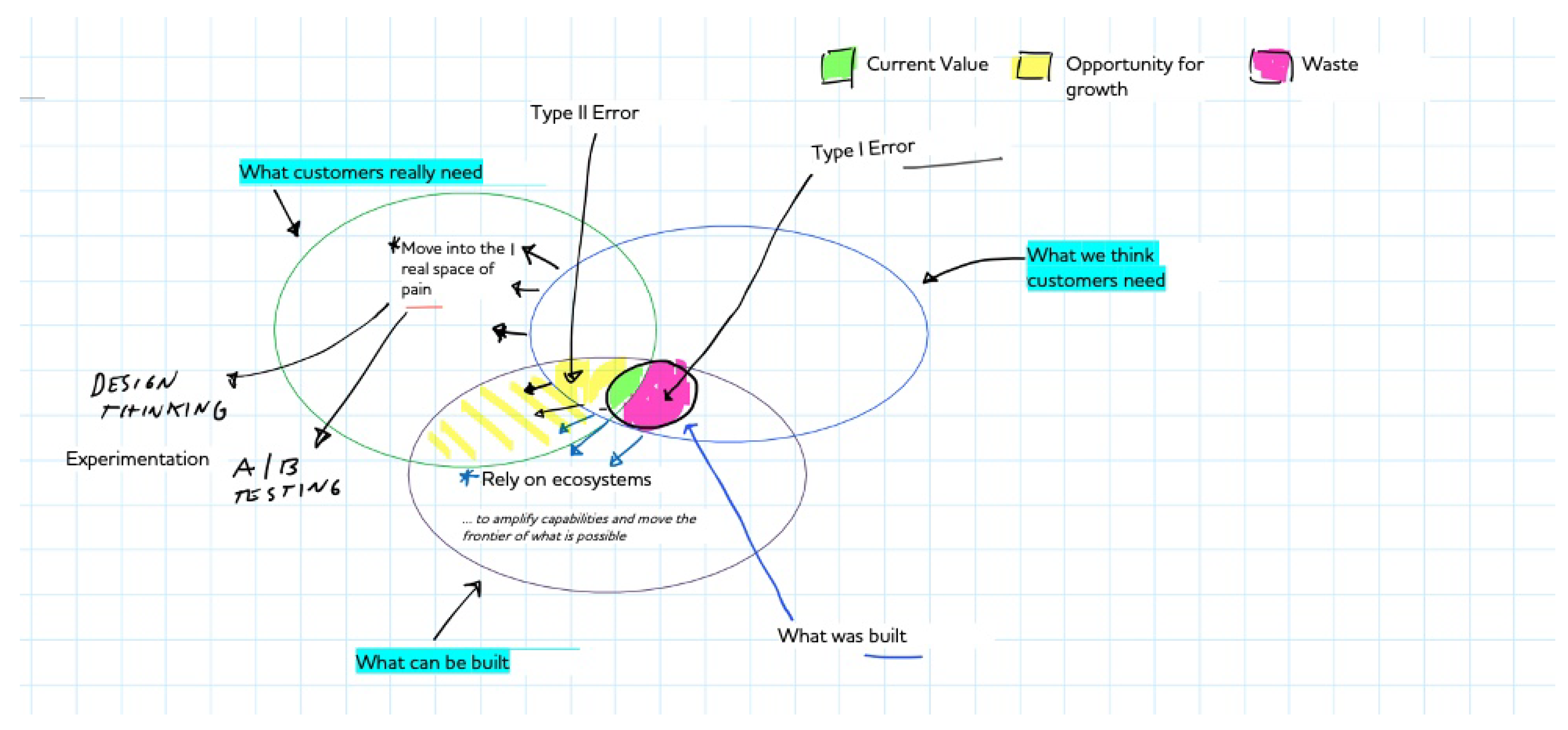
This image shows us how, through experimentation, we deliberately move towards the authentic pain points of the customer, where what is desirable aligns with what is feasible [23]. By relying on ecosystems that expand our building capacity, we push the boundaries of what is possible, and in the process, transform innovation from a static concept to a dynamic phenomenon of value creation.
Innovation is not just about creating new products or technologies; it is a profound commitment to learning about our customers. By identifying their tasks, pains, and desires, we equip ourselves with the ability to test ideas and gather evidence that reduces risks and uncertainties. This learning process becomes the heart of any successful innovation strategy [24].
It is also crucial to recognize when to discard ideas that, despite their initial shine, do not withstand the test of reality. The additional investment of time and resources is only justified when we have concrete evidence that it is a relevant and pertinent problem and that the proposed solutions will work. This strategic discipline differentiates a company that plays at innovation from one that truly leads it [16].
We do not start by simply creating new products or technologies. Our investments are triggered when we identify that customers face real problems, show a willingness to pay for solutions, and when it is feasible to build a robust and sustainable business model to support these solutions. It is at this intersection of need and feasibility where true innovation unfolds, not merely satisfying market expectations but profoundly redefining them to generate a transformative impact on people’s lives.
Reflection
Developing a high-frequency experimentation culture within organizations acts as effective insurance against irrelevance.
The more you experiment, the more you learn. The more you learn, the more you grow.
Author Contributions
Conceptualization, R.M.D. and M.L.F.; Formal analysis, R.M.D. and M.L.F.; Methodology, R.M.D.; Project administration, R.M.D. and M.L.F.; Resources, R.M.D. and M.L.F.; Software, R.M.D.; Supervision, R.M.D.; Validation, R.M.D. and M.L.F.; Writing—original draft, R.M.D. and M.L.F.; Writing—review and editing, R.M.D. and M.L.F. All authors have read and agreed to the published version of the manuscript.
Funding
The graphs are a visual facilitation courtesy of Roberto Moraga-Díaz.
Acknowledgments
R.M.D.: I would like to express my deepest gratitude to Cencosud Scotiabank for providing me with the valuable opportunity to lead and facilitate experiential learning sessions. I am especially grateful to María a Laguna, Heidy Liberona, and Valentina Lastra for their continuous support and for fostering learning as a discovery process within the organization. I highlight the support and motivation of the facilitators’ team. Their commitment fostered an environment of discovery and growth, enriching the experience for all participants. I wish to extend my gratitude to Tata Consultancy Services, in particular to Marian Tupper, Osvaldo Varallo, and Ottmann Muoz from the TCS Chile team, their dedication and expertise have been fundamental to the success of this project. Finally, I would like to thank Jorge Abad, Head of Agility for TCS Latam, for his continuous support and guidance on this transformative journey.
Conflicts of Interest
No conflicting interests were disclosed.
References
- Thakur, D.; Anyanwu, K.; Sankaranarayanan, M. Building a Digital-only Bank: One Block at a Time. TCS 2021, 1.
- King, B. Bank 4.0: Banking Everywhere, Never at a Bank; Marshall Cavendish International, 2018.
- Rogers, D. Digital Transformation Playbook: Rethink Your Business for the Digital Age; Columbia University Press, 2016.
- Magapu, R.; Sankaranarayanan, S. Fending Off the FinTechs: How Agile Financial Services Firms are Transforming Their Businesses. TCS 2018, 1.
- TCS. Design Thinking Unlocks Enterprise Creativity. TCS 2018, 1.
- Pace, T. Design Thinking & Innovation at Pace Portâ¢. TCS 2021, 1.
- Gray, D.; Brown, S.; Macanufo, J. Gamestorming: A playbook for innovators, rulebreakers, and changemakers; O’Reilly Media, 2010ors, rulebreakers, and changemakers; O’Reilly Media, 2010.
- Denning, S. The age of agile: How smart companies are transforming the way work gets done; Amacom, 2018.
- Pai, A. The Five Design Thinking Elements for the Digital Customer Experience. TCS 2021, 1.
- Pace, T. TCS Agile Innovation Cloud (AIC). TCS 2022, 1.
- Kotter, J. Accelerate: Building Strategic Agility for a Faster-Moving World; Harvard Business School Press, 2014.
- Liedtka, J. Perspective: linking design thinking with innovation outcomes through cognitive bias reduction. Journal of Product Innovation Management 2015, 32, 925–938. [CrossRef]
- Buchanan, R. Wicked Problems in Design Thinking. The MIT Press Stable 1992, 8, 5–21.
- Brown, T. Design thinking. Harvard Business Review 2008, 86, 84–92.
- Snyder, K.; Ingelsson, P.; Bäckström, I. Using design thinking to support value-based leadership for sustainable quality development. Business Process Management Journal 2018, 24, 1289–1301. [CrossRef]
- Ries, E. The Lean Startup: How Today’s Entrepreneurs Use Continuous Innovation to Create Radically Successful Businesses; Currency, 2011.
- Punyakoti, S. Moving from Transactions to Journeys. TCS 2021, 1.
- Bowman, S. Training from the back of the room: 65 ways to step aside and let them learn; Pfeiffer, 2008.
- Markham, T. Project-based learning: A handbook for middle and high school teachers; Buck Institute for Education, 2011.
- Kolko, J. Design thinking comes of age. Harvard Business Review 2015, 93, 66–71.
- Chen, S.; Benedicktus, R.; Kim, Y.; Shih, E. Teaching design thinking in marketing: linking product design and marketing strategy in a product development class. Journal of Marketing Education 2018, 40, 176–187. [CrossRef]
- Hamel, G.; Zanini, M. The Power of Experimentation. Innovations: Technology, Governance, Globalization 2023, 13, 52–58. [CrossRef]
- Osterwalder, A. Do you understand what customers want and can you build it? Strategyzer 2018, 1.
- Stickdorn, M.; Lawrence, A.; Hormess, M.; Schneider, J. This is service design doing: Applying service design thinking in the real world; O’Reilly Media, 2018.
Disclaimer/Publisher’s Note: The statements, opinions and data contained in all publications are solely those of the individual author(s) and contributor(s) and not of MDPI and/or the editor(s). MDPI and/or the editor(s) disclaim responsibility for any injury to people or property resulting from any ideas, methods, instructions or products referred to in the content. |
© 2024 by the authors. Licensee MDPI, Basel, Switzerland. This article is an open access article distributed under the terms and conditions of the Creative Commons Attribution (CC BY) license (http://creativecommons.org/licenses/by/4.0/).
Copyright: This open access article is published under a Creative Commons CC BY 4.0 license, which permit the free download, distribution, and reuse, provided that the author and preprint are cited in any reuse.


