

Submitted:
06 August 2024
Posted:
07 August 2024
You are already at the latest version
Abstract
Energy demand flexibility is important to balance supply and demand in energy systems based on renewables. However, attempts to steer the timing of energy demand seem to overlook how energy practices are influenced by the wider network of things and technologies in homes. Based on photos from house visits, this paper demonstrates the importance of various material relations for the timing of energy practices to assess the potential of flexible energy demand. The study focuses on the practices of washing clothes and charging batteries using three locations of material energy flexibility; embedded flexibility refers to built-in functions, connected flexibility lies in the interplay between technologies and objects, and networked flexibility situated in systems of things, including energy infrastructure, house layout, and matter. The results show how material relations challenge energy flexibility, for example, when devices compete over plugs, stuff is in the way, and convenience is prioritized. The study suggests that the flexibility of an appliance is viewed in a wider network of things, technologies, and infrastructures, including battery capacities, and that policy pays more attention to energy flexibility in the context of material networks and that energy flexibility risks being overlooked in demands for convenience and comfort.
Keywords:
Energy demand
; Energy Flexibility
; Energy Consumption
; Material Relations
1. Introduction
The temporal patterns of energy consumption have gotten increased attention in recent years. Especially, flexibility in energy consumption has been promoted to balance intermittent energy production with energy demand load (Sioshansi, 2021; Smale et al., 2017; Torriti, 2015; Walker, 2021). However, efforts to change the timing of energy demand seem to overestimate the ability to manage and steer everyday energy practices, for example relying on tools such as dynamic pricing, where tariffs in different ways reflect temporal rhythms of energy production (Faruqui, 2010; Smale et al., 2017; Torriti, 2015), smart home control, where demand is monitored or automated (Hargreaves and Wilson, 2017; Larsen and Gram-Hanssen, 2020; Powells et al., 2014), or different forms of feedback (Foulds et al., 2017; Hargreaves et al., 2013, 2010; Martin, 2020; McKenna et al., 2017). Such energy demand side management (DSM) seems to ignore that energy is consumed in the course of accomplishing practices (Shove and Walker, 2014; Warde, 2005), and the stability and fixity in the rhythms of everyday activities, such as watching TV, cleaning, cooking, and doing laundry (Blue et al., 2020; Walker, 2021) risk being underestimated. Further, the material dimension of the temporality of energy practices seems largely overlooked, although material co-constitution of practice temporalities is demonstrated to be important to the development of practices like doing laundry and keeping warm (Spurling, 2021).
This paper demonstrates how materiality shapes the temporality of energy practices by exemplifying ways materials shape the flexibility or fixity of charging batteries and washing laundry. In doing so, this paper contributes to existing literature in two ways. First, the energy flexibility of everyday practices is found to relate to various aspects of everyday life such as institutional rhythms (Blue, 2019) and the temporal organization and intensity of everyday activities (Anderson, 2016; Friis and Christensen, 2016, 2016; Jalas, 2005; Jalas and Juntunen, 2015; Jalas and Rinkinen, 2013; Southerton, 2020, 2009, 2003; Walker, 2014), as well as energy provision and prosumption (Gram-Hanssen et al., 2020; Hansen et al., 2019; Khalid et al., 2019; Kubli et al., 2018). However, despite this rich literature, the understanding of how material relations shape energy flexibility is largely missing in current energy research and policy (Rinkinen et al., 2020, p. 86). Although some studies touch upon the role of materiality for flexibility of practices, for example, how “[...] energy forms do value ‘work’ in repeating, rhythmic patterns” (Walker, 2021), there is a need to better understand how material relations shape the temporality of everyday practices, and thereby energy demand flexibility.
Second, using photos of things, technologies, and material settings from 10 household visits, we apply an approach inspired by principles of object interviews (Holmes, 2020) and of ‘following the thing’ (Evans, 2020). In this way, we demonstrate how to analyze materials as being integral to practice temporalities by focusing on the material co-constitution of practice temporalities (Spurling, 2021). This means that we investigate the photos as a source of documentation of everyday life (Cleland and MacLeod, 2021; Latour, 1987). The photos are supplemented with interviews with the 10 Danish households with dynamic electricity retail tariffs and field notes.
We chose practices of charging batteries and washing laundry as cases because they hold the potential for energy flexibility, such as load-shifting and peak shaving (Khalid et al., 2019), and because they were very present in the photos taken during the house visits. Using these two cases, we describe three locations of material energy flexibility in everyday practices. First, the design or built-in functions of technologies provide embedded flexibility, for example when timer-functions can time-shift start. Second, the interlinkage of technologies and things in related energy practices provides connected flexibility, for example by considering the relation between charger and battery. Third, the wider systems of things, technologies, and matter used in complexes of energy practices provide networked flexibility, for example by considering the interplay of electricity infrastructure, house layout, technologies, and energy.
This study contributes with nuanced descriptions of how systems and networks of appliances and things provide energy demand flexibility. It illustrates how technology alone is not sufficient to assess the potential for energy flexibility in everyday practices. Rather, the potential for flexibility of energy demand must consider the connectedness with other appliances and other practices related to the specific energy use. Especially, the study visualizes how seemingly unassociated materials might influence the flexibility of energy practices, for example, the material relation to house layout and stuff. In addition, the paper suggests a framework that distinguishes the location of energy flexibility in three forms of material relations: embedded, connected, and networked.
The paper starts by presenting the main themes in this study in the form of energy, material relations, and socio-temporal rhythms. Then follows a section presenting methods and data, then the analysis, and finally, a discussion and conclusion.
2. Background
This paper builds on the assumption that to understand the temporality of energy demand, we need to understand the temporality of energy practices, for example, framed as socio-temporal rhythms of energy practices (Southerton, 2020) or the rhythmic patterns of energy as matter used in energy practices (Walker, 2021). In this section, we describe ways to understand how material relations shape the temporality, or specifically the flexibility, of energy practices.
Around 20 years ago, turns towards social practices (from individual behavior) and mundane aspects of consumption (from more conspicuous forms) simultaneously set new directions for consumption research (Reckwitz, 2002a; Schatzki et al., 2001; Shove and Warde, 2002; Warde, 2005), and especially energy consumption research were set to go in a new direction (Wilhite et al., 2000). This new direction focusing on mundane consumption practices rather than expressive individual consumers also included innovative ideas on the role of materiality in the performance of social practices (Reckwitz, 2002b; Shove and Pantzar, 2005). Building on Latour’s (Latour, 1993) ideas of separating the human (culture) from the non-human (nature) and Schatzki’s account of ‘theory of social practices’ (Schatzki, 1996), emphasizing the performance of practices, Reckwitz (2002a) conceptualized how materiality are components in practices, and emphasized the role of materiality as it is applied and handled in practices, rather than how materiality could be viewed as a symbol. These three trends (materiality, mundane, and practice) became especially popular in energy demand research (Gram-Hanssen, 2011; Shove and Walker, 2014), often with a specific interest in infrastructures as networks of things (Coutard and Shove, 2019; Jacobsen and Hansen, 2021; Shove et al., 2015). Moreover, understanding the change and reproduction of practices entails considering a wider nexus or complex of practices (Blue, 2019; Hui et al., 2016). This suggests that patterns of energy consumption or individual performances of practices result from the interconnection of multiple practices, including how practices connect over time (see 2.3) and according to material arrangement (see 2.2.). The so-called social practice theory (SPT) has also proved valuable to understanding energy flexibility, for example in the way that multiple interactions and interconnectedness between practices means that “[energy] flexibility is an emergent feature of complexes of practices” (Blue et al., 2020, p. 14).
According to SPT, material arrangements, or material relations, enable or restrict ways of performing energy practices, thereby consuming energy. Studying the impact of materials on neighborhoods, Maller et al. (2016) distinguish between ‘natural’ materials, such as trees, parks, and weather, and ‘built’ materials, referring to human-made infrastructure, such as lights, roads, and paths. Another distinction is between materiality having a background role, such as infrastructures and buildings, and materiality directly mobilized in practices (Rinkinen et al., 2015). This distinction opens how things can move from background to foreground and back again, like for example with removable heating stoves (Rinkinen et al., 2015). This is further exemplified by Rinkinen et al. (2020: 32) as three roles of materiality; first, in the form of resources that “[...] are used up or transformed in the course of doing practices”, second, when materiality “[...] figure as instruments or artifacts that are interacted with directly” in practices or when “[...] devices and appliances are mobilized in practice”, third, as wider systems of infrastructure that “[...] are necessary arrangement that exist in the background”, where materiality “[...] enable many practices at once”.
To further understand how such material arrangement of practices shapes the temporal organization of everyday energy consumption, Spurling (2021) demonstrates that “[...] materiality and temporality are intimately connected and mutually shaping”. She points to three material-temporal relationships. First, pre-practice conversion of spaces, technologies, and matter (e.g., water and energy) refers to the practical effort of organizing materials into new or immediate arrangements for a practice, exemplified by the rearranging of a twin-tub washing machine to do laundry. Second, conversion lag refers to the time lag between human intervention and effect, for example, the time switching on a heater to its effect in terms of hot water. Third, coordination refers to the organization of materials and people in practices, for example when doing laundry requires frequent interaction, and therefore, the presence of a practitioner. Further, Spurling (2021) also emphasizes the importance of the layout of the house and the capacity of the infrastructure providing matter, such as energy and water, to energy practices.
Another approach to conceptualizing practices within temporal material relations is proposed by Hui and Walker (2018). Focusing on how energy demand emerges from connected practices, for example, following in sequence, they suggest that practices, such as reading, cooking dinner, and drinking coffee, are anchored in doing-places and doing-paths within a particular setting. Using the practice of cooking dinner as an example, a stove and fridge are anchors for doing-places, the kitchen floor and counters are anchors for doing-paths, and the kitchen is the setting. This perspective highlights how practices are situated in complex relationships with multiple practices and material arrangements.
Finally, comparing time diaries from the 1930s with everyday temporal rhythms of society 70 years later, Southerton (2020) identifies a shift from strong collective to individualized timing of everyday activities, which tends to put time pressure on households to micro-coordinate daily activities. Inspired by Adam (1994) and Zerubavel (1985) among others, Southerton (2020) identifies dimensions of socio-temporal rhythms to understand the temporality of energy practices. For example, timing refers to when an activity takes place, periodicity and frequency refer to how often a recurring activity takes place, and, sequence or synchronization refers to the order of activities.
To sum up, various forms of material relations shape the temporality of energy practices, for example, related to when (timing), how often (frequency), and how long (duration) a practice is performed. Building on the existing frameworks, this study illustrates three locations of flexibility in terms of how materiality shapes energy practices. First, embedded flexibility refers to how functions or capacities enabling flexibility are built into the design of a technology, such as batteries and timers, and thereby have the potential to provide energy flexibility. This builds on the status of materials as handled and directly mobilized in practices (Reckwitz, 2002b; Rinkinen et al., 2020). Second, connected flexibility refers to the potential for energy flexibility situated between more objects or things, such as the connection between a charger and the technology being charged. This adds to the directly mobilized materials that are connected with other materials, for example, exemplified by the relation between textile, detergent, and washing machine (Shove, 2003). Third, networked flexibility incorporates wider material arrangements, such as systems of infrastructure that work in the background (Rinkinen et al., 2020), which includes matter, spaces, and building layout (Hui and Walker, 2018; Maller et al., 2016; Spurling, 2021). This also refers to how complexes of practices share materiality of different forms (Blue et al., 2020; Hui et al., 2016). From previous studies, these three locations of flexibility in energy practices appear important to understand energy demand flexibility, but the question is how this might look in everyday life, and this study aims to illustrate this and relate it to the potential for energy flexibility.
3. Methods and Data
This study is based on 10 household visits that combined interviews with household members, field notes, and photos of things. All visits were conducted in Denmark in the period between 6 September 2021 and 22 December 2021 and covered all six Danish regions in Denmark. The interviews took on average one and a half hours, including a house tour and photographing. The house visits represented ages from 32 to 77 with most households being older than 60 years old. Appendix 1 shows a table with an overview of all households and informants in the study.
The informants were recruited via customer service of two Danish electricity retailers, and in total, 16 households were contacted. Because this recruiting procedure was not successful, to begin with, the sample was added to two informants recruited via Twitter and personal relations. The informants were chosen based on their electricity product; they needed to have dynamic electricity pricing products, such as Time-of-Use. However, one household turned out not to have such a product after all. The households were given a voucher as thanks for their participation and a document with information about the project and their rights and options as informants.
Three authors participated in the visits, two authors contributed to transcribing, and all four authors participated in coding and analyzing data. All interviews were transcribed and coded in NVivo together with field notes.
The interviews were mostly about everyday routines, the timing of everyday activities, electricity pricing schemes, and energy consumption. The field notes included short reports about the visits, for example, to describe the atmosphere and impressions from the homes. The interview guide was structured around two main themes: first, timing and flexibility in everyday practices, and second, dynamic electricity pricing. The questions were inspired by previous studies on the importance of dynamic electricity pricing (Nicholls and Strengers, 2015; Powells et al., 2014; Strengers, 2019, 2012), and aspects of the temporality of everyday practices were predominantly inspired by the works of Southerton (2020). Finally, object interviews Holmes (Holmes, 2020) inspired the photographing during the visits, for example by trying to take the perspective of the object in everyday practices, which relates to how an approach of ‘following the thing’ can contribute to understanding the consumption process of appropriation and appreciation (Evans, 2020).
The photographs were only targeted material objects. We focused on electricity consumption and everyday routines, although we also tried to capture a broad representation of the technologies and things in the homes. Among other things, the photographs showed white goods (e.g., freezer, refrigerator, and dishwasher), entertainment devices (e.g., speaker, TV, and game console), and devices for everyday chores (e.g., vacuum cleaner, microwave, and hairdryer). One home was set up with smart technology and another had extensive gaming equipment. However, activities related to charging and washing clothes appeared especially noticeable during the household visits, and therefore, we chose to focus on these in this study.
The photos were taken by the interviewers only. In most cases, we were two interviewers, which meant that one was responsible for taking pictures and another one for interviewing. The number of photos taken varied from 13 to 62, with an average of around 35, which depended on the specific situation, for example, whether there were more interviewers and to which degree the households were comfortable with photographs. After the house visits, we sent the photos to the informants and asked for permission to use them in publications. One informant used this option to reject the usage of some photos taken during the house visit. In the cases where the photos showed people, we blurred the faces, so that these were unidentifiable.
To start with, we labeled each photo with the number linking these back to the specific household visit. The initial analysis consisted of coding them into themes reflecting everyday practices, such as washing clothes and sleeping. After this, we recorded the pictures according to different locations of energy flexibility, which we identified based on the initial analysis. Finally, we combined the two steps to identify practices (of energy flexibility) within different locations of flexibility (embedded, connected, and networked). We did not use any software to analyze or code the photos. However, for the initial analysis, we presented the pictures on a large screen for a joint discussion of the relevant coding with the researchers involved in this study.
Our approach to analyzing the photos was inspired by object interviews (Holmes, 2020) and how photos as data become objects of memory of snapshots of material relations from everyday life at a particular time (Cleland and MacLeod, 2021).
4. Findings
This analysis is based on photos taken during 10 household visits. To supplement these, interview data and field notes from the household visits act as background information. During the household visits, especially two everyday practices appeared interesting for analyzing energy flexibility and material relations. These were practices of charging batteries and washing clothes, which are also deemed important for energy demand flexibility (e.g., (Anderson, 2016; Friis and Christensen, 2016; Khalid et al., 2019). Moreover, washing and charging are interesting case studies of the ordering of time because they refer to very different practices. Practices of washing clothes have a long history, where especially the domestic washing machine has reconfigured norms of convenience and cleanliness (Shove, 2003), whereas EV charging is a relatively new practice entering the organization of daily life (Friis and Christensen, 2016), often involving battery storage of various kind (Pink, 2022).
4.1. Charging Batteries
Several activities are related to charging, for example, putting appliances to charge or setting up automatic charging. Here, we frame this as energy practices involving these activities of charging, and to specify, this involves temporal dimensions of commuting and car use (Ramirez-Mendiola et al., 2022) as well as the sporadic or organized charging of appliances, smartphones, and other types of batteries. As batteries move with things and people, they leak into devices, infrastructure, and everyday activities, such as routines, rhythms, and experiences (Pink, 2022).
4.1.1. Connected Flexibility of Plug-In Hybrid Car Charging
We visited three households with plug-in hybrid cars, which included an Opel Corsa-e and a Ford Kuga. Using the Ford Kuga as an example of a charging practice, this has an estimated charging time of 3-3.5 hours, when charging using an EV Home Charger, according to Ford (www.ford.co.uk), and in the interview with the MJ2 household, the husband also stated that it normally took about 3.5 hours to charge. The household paid by subscription, which according to them meant that they used the electric charging as much as possible. However, occasionally, they also charge the hybrid vehicle at the shopping mall.
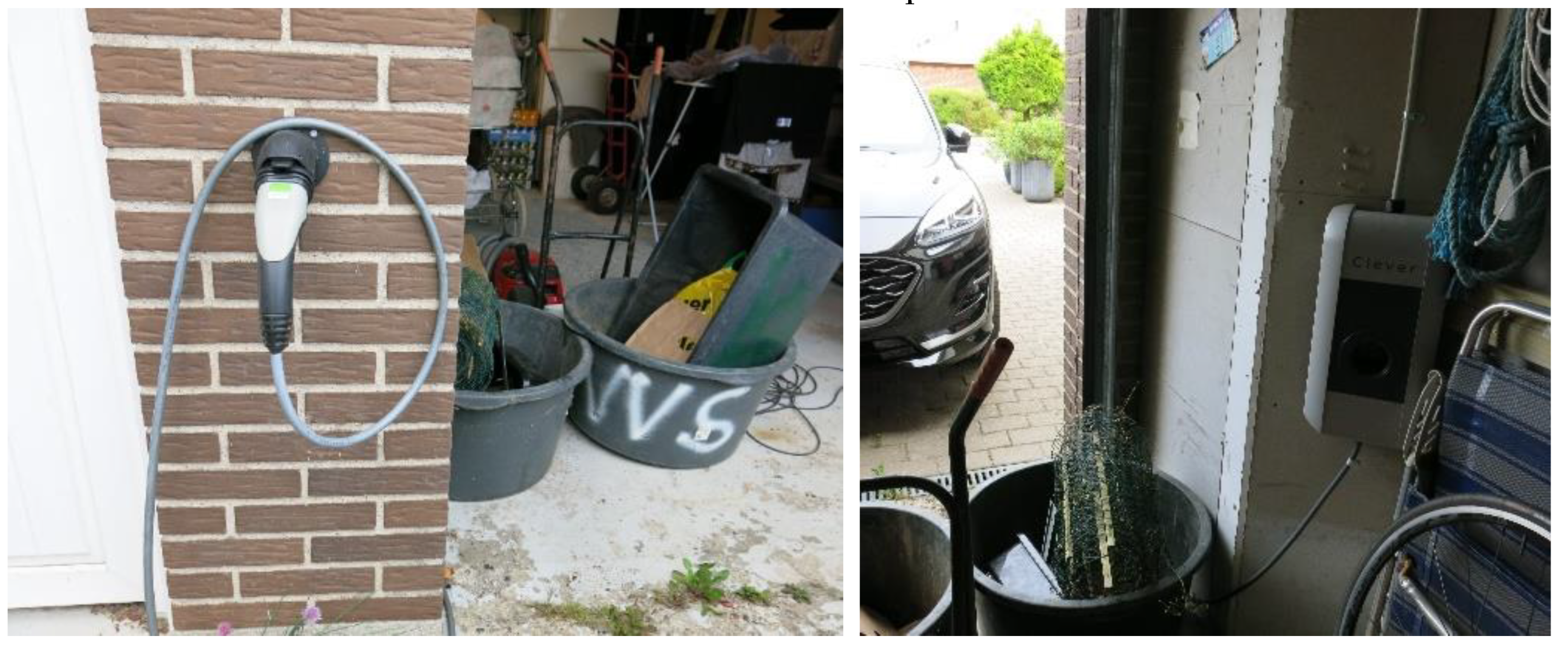
The charger was placed outside, where the car was parked in this picture, which seems to be routine and also seems convenient, and the household described the charging as easy. However, focusing on the material relations, it was striking how many objects surrounded the charging box, which was situated in the carport. Pictures 1 and 2 show how the area of the charging practice was filled with various stuff that was not related to the actual practice.
Picture 1 and 2.
Hybrid vehicle charging inside and outside of a carport attached to the house (MJ2).
Picture 1 and 2.
Hybrid vehicle charging inside and outside of a carport attached to the house (MJ2).
Another example of a household with a plug-in hybrid vehicle appeared very different. Pictures 3 and 4, illustrate a very organized material environment for charging with no material obstacles, and the car is placed inside a parking facility. An interesting detail is that the cable had a small hook close to the charging box so that it did not touch the floor and could be extended if necessary. According to the main user, this hybrid car was set to start at midnight following a stable and organized routine. Therefore, it was plugged in when it was parked at home so that charging would start automatically. From the interviews, it seemed that the car was used primarily for commuting to work during the day.
Picture 3 and 4.
Hybrid vehicle charging in a basement parking facility of the apartment complex (NJ2).
Picture 3 and 4.
Hybrid vehicle charging in a basement parking facility of the apartment complex (NJ2).
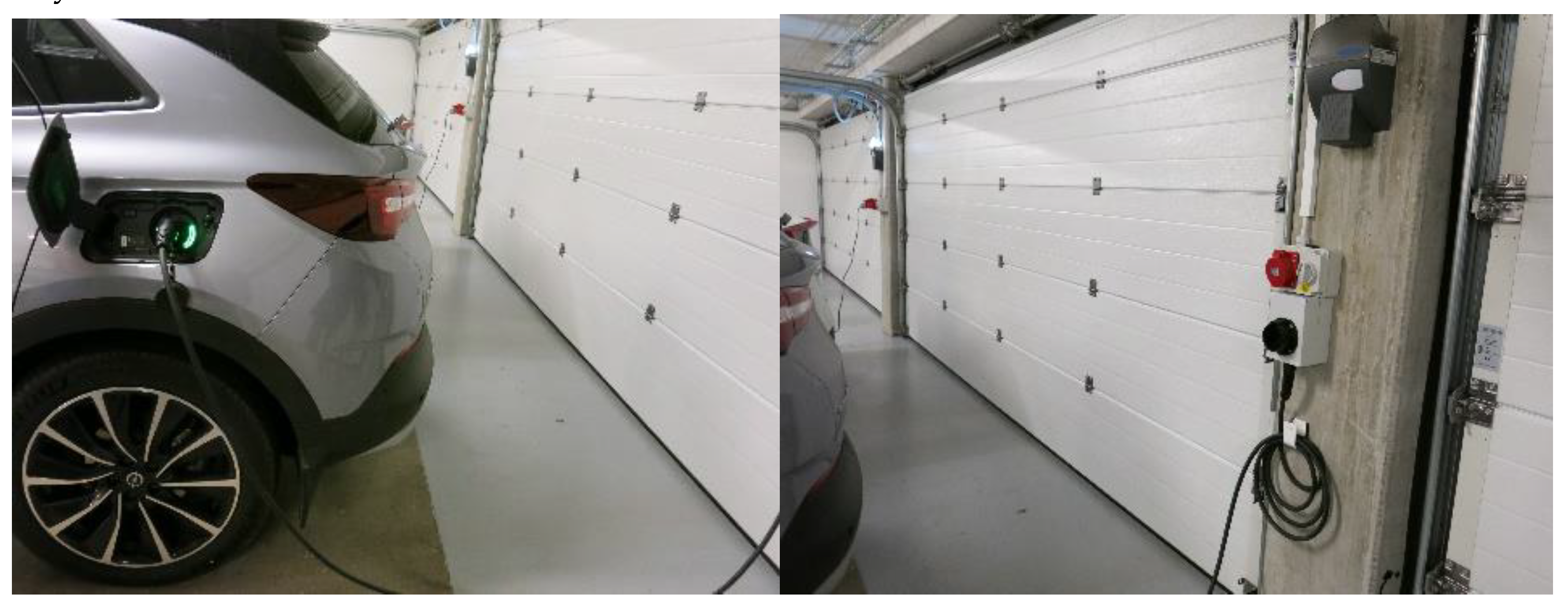
Although these two examples appeared very different, the flexibility of energy demand seemed located in the connection between the vehicle, the charger box, and the cable connecting these. This seemed convenient and unproblematic. However, in the first example (MJ2), the materials close to the charging box connected charging to many other practices, for example, gardening and house maintenance. This was contrary to the second example (NJ2), where the material setting was only dedicated to the materials directly related to charging. This meant that the charging practice happened in a tidy and organized place, leaving no material obstacles to hinder the flexibility of the charging practice.
4.1.2. Stuff in the Way of Flexibility of Mobile Charging
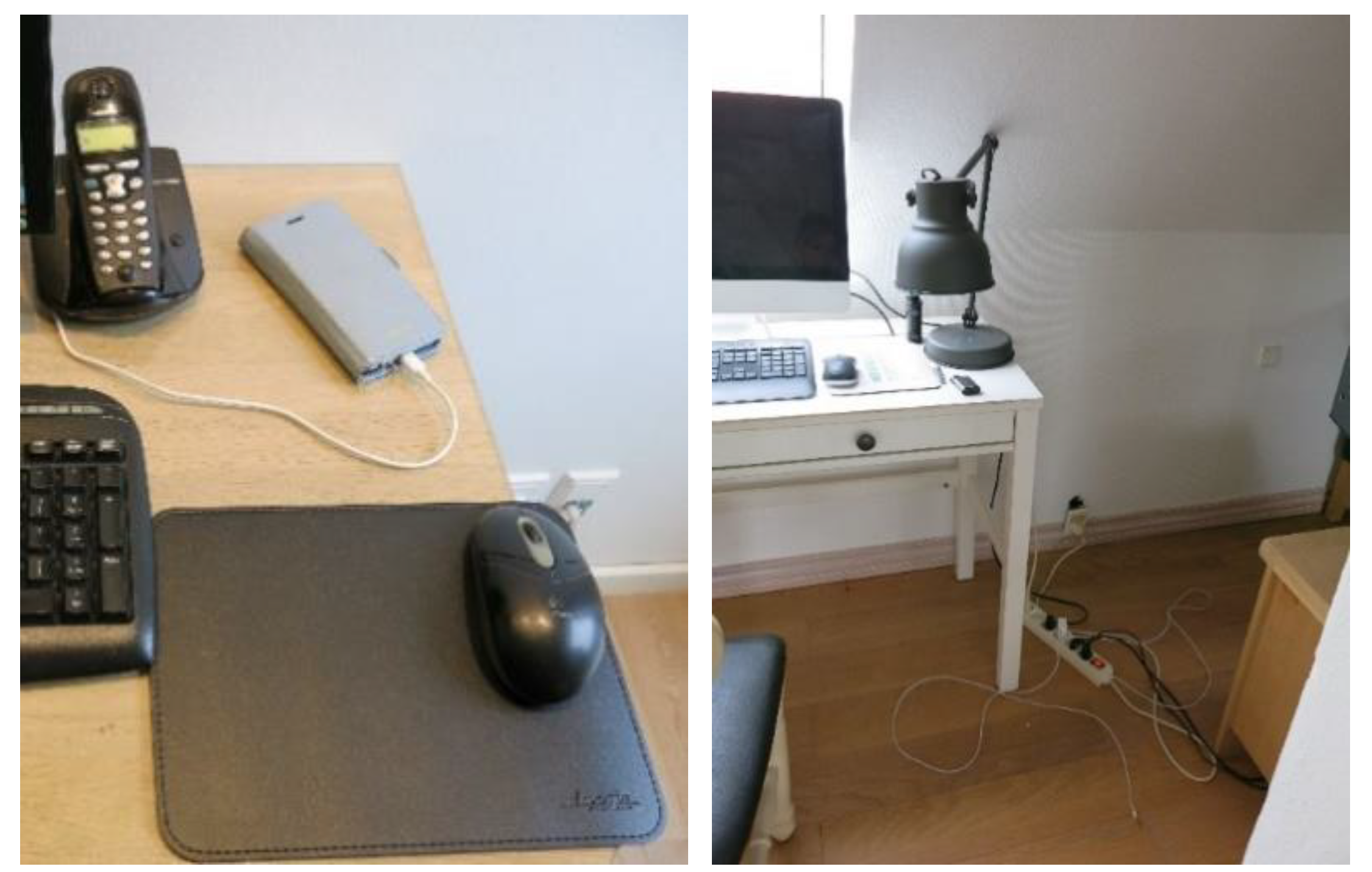
During the house visits, we captured a lot of appliances and devices with batteries, but perhaps the most frequent were smartphones and connected charging equipment. This is not surprising as smartphones are estimated to be found in 9 out of 10 Danish homes (Hohnen and Hansen, 2022). Pictures 5-9 illustrate how the charging of smartphones was situated in different material settings with various material relations. In pictures 5 and 6, the smartphone was set to charge at a form of workstation next to permanently placed technologies such as fixed-line phones and PCs. In picture 5, the charger is neatly placed next to the computer keyboard and mouse, whereas in picture 6, the charger is placed on the floor together with other chargers and cords. In both situations the flexibility of charging seems related to the use of the computer, but with different forms of organization of the material arrangement around charging. Charging from the power strip gives the option of turning off the power of the power strip itself and relocating the charger if it is needed elsewhere.
Picture 5 and 6.
Smartphone charging in connection to computer desk (NJ2 and MJ1).
Picture 7, 8, and 9.
Smartphone chargers and charging (SL1, SJ1, and MJ3).
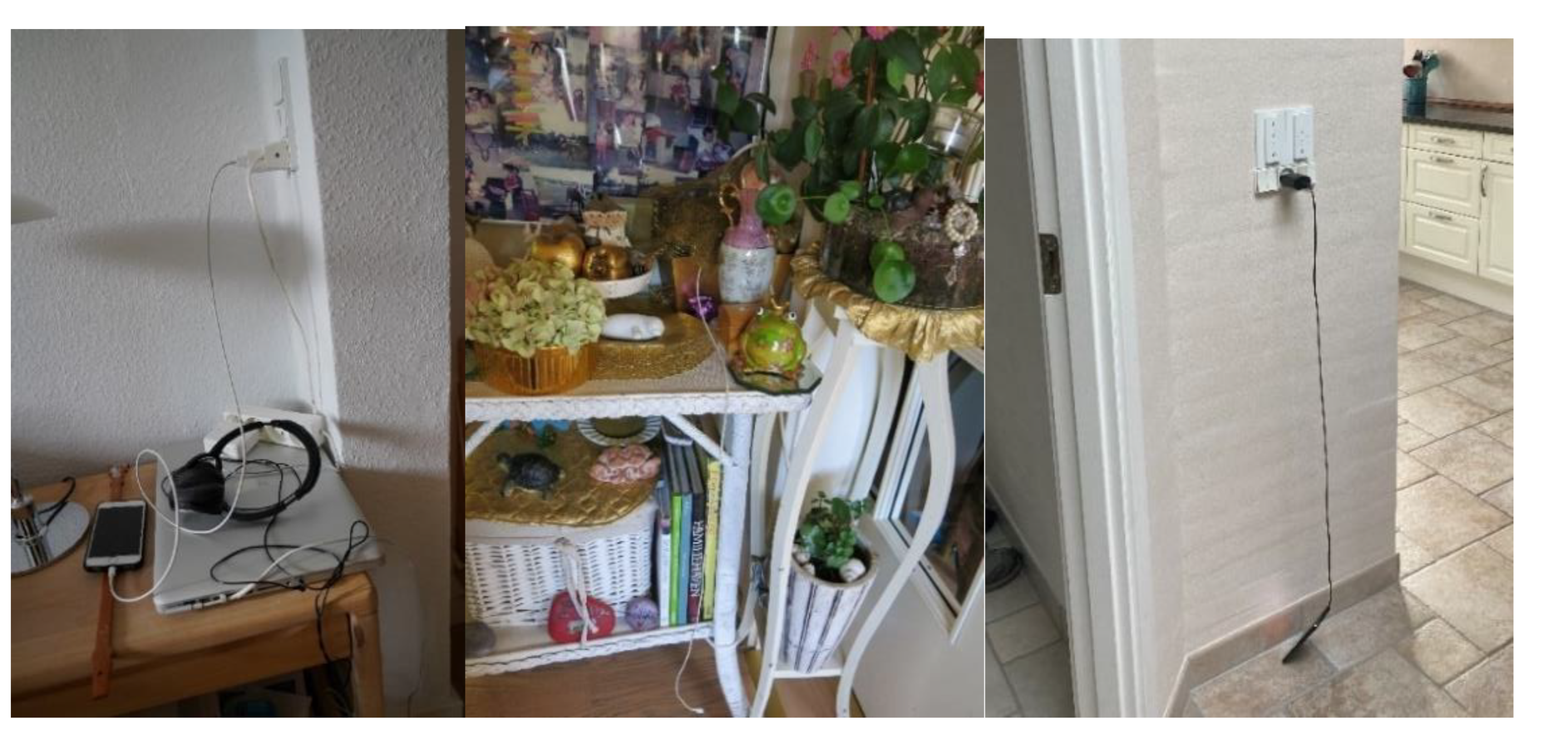
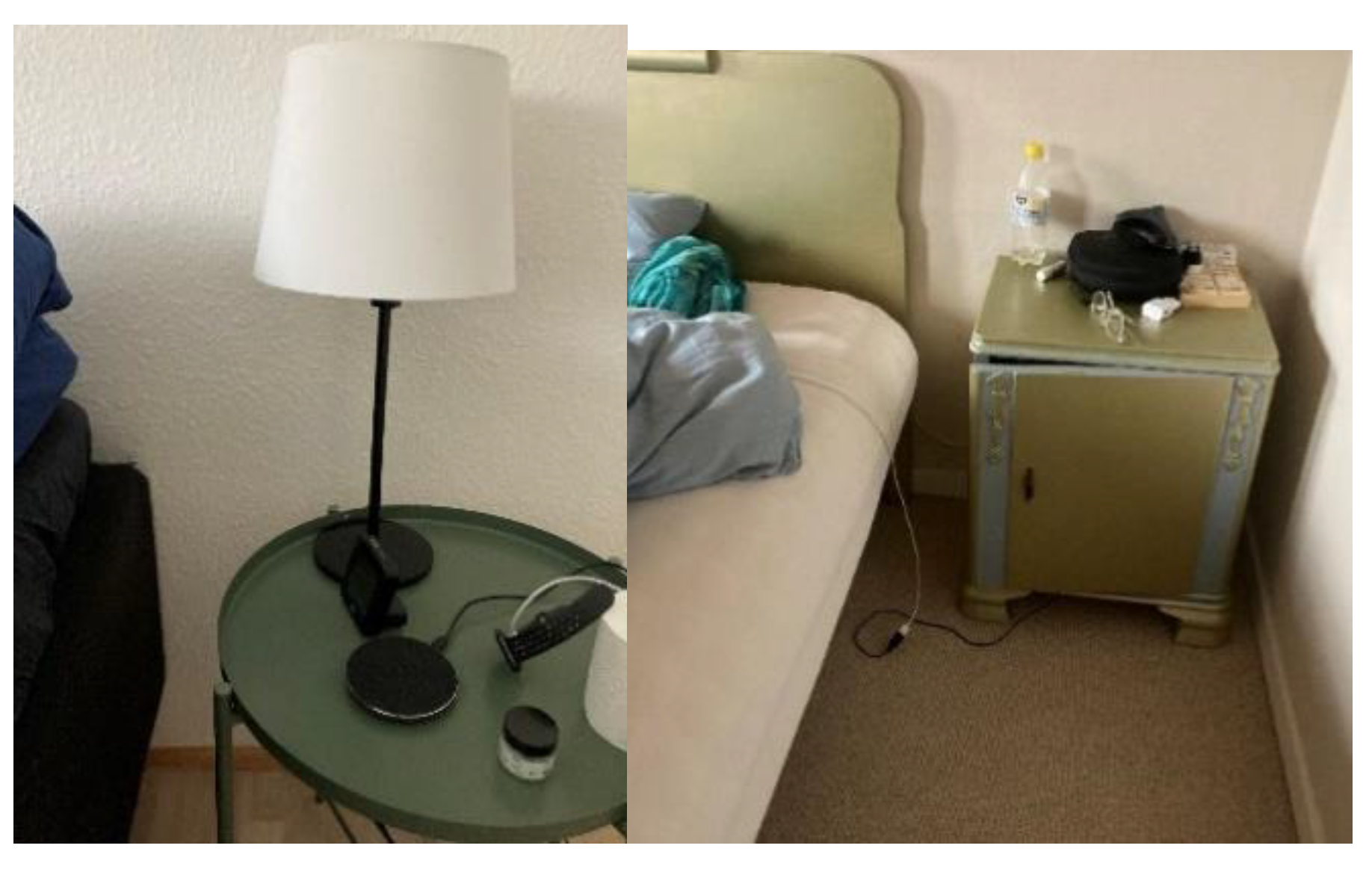
In picture 7, the charging of the smartphone was also close to a computer in the form of a portable PC, which also needed charging. In this case, the flexibility of charging potentially conflicts with the charging of other devices because the smartphone charger might ‘compete’ over the same plug with other forms of chargers. In picture 8, the charger for the smartphone ‘competed’ with a lot of stuff including decorations and flowers, which appeared to block the interaction with the power socket. Picture 9 illustrates how the length of the charging cable makes the charging of the smartphone rather ‘uncomfortable’. Taking the perspective of the charger, it appears less exposed in picture 5, where it is placed next to a PC, and more exposed in pictures 6 and 7, where it competes with other electronic devices over power sockets. These examples illustrate how the effort of charging, and thereby energy flexibility, might be influenced by the placement of the socket, placement of other appliances, and other stuff in addition to the equipment for charging, such as the length of the cable. From these examples, charging smartphones seems rather unrhythmic, but still connected to other practices and other devices. However, connecting charging with other stable and rhythmic practices was especially apparent in several homes, where the smartphone charger was placed next to the bed. In these cases, the material relations around charging were closely connected to the temporal aspects of sleeping, including the synchronization and timing of bedtime, the duration of sleep, and not least the periodicity of sleeping at home. Picture 10 shows how wireless charging can be an extra convenient way of accommodating the charging of a smartphone with sleeping, and maybe using the smartphone as an alarm clock. Picture 11 illustrates how the charger and cord might occupy space alongside other things related to practices of sleeping, such as books, reading glasses, and a bottle of water. An interesting detail is that the cord has an extension, presumably so that it has better reach to the bed.
Picture 10 and 11.
Smartphone charging next to bed (NJ4 and MJ3).
For charging other appliances than smartphones, we found similar examples of material relations to other stuff and practices. Pictures 11, 12, and 13 illustrate examples where charging was placed according to specific practices. In picture 11, charging batteries for equipment used for hunting were placed next to hunting trophies. In picture 12, a smartwatch was charged next to the favorite spot on the couch in the living room, according to the user of the watch, and in picture 13, the tablet was charged next to the favorite (rocking) chair used for gaming.
Picture 11, 12, and 13.
Charging of rechargeable batteries (SJ1), smartwatch (NJ3), and tablet (NJ4).
Picture 11, 12, and 13.
Charging of rechargeable batteries (SJ1), smartwatch (NJ3), and tablet (NJ4).
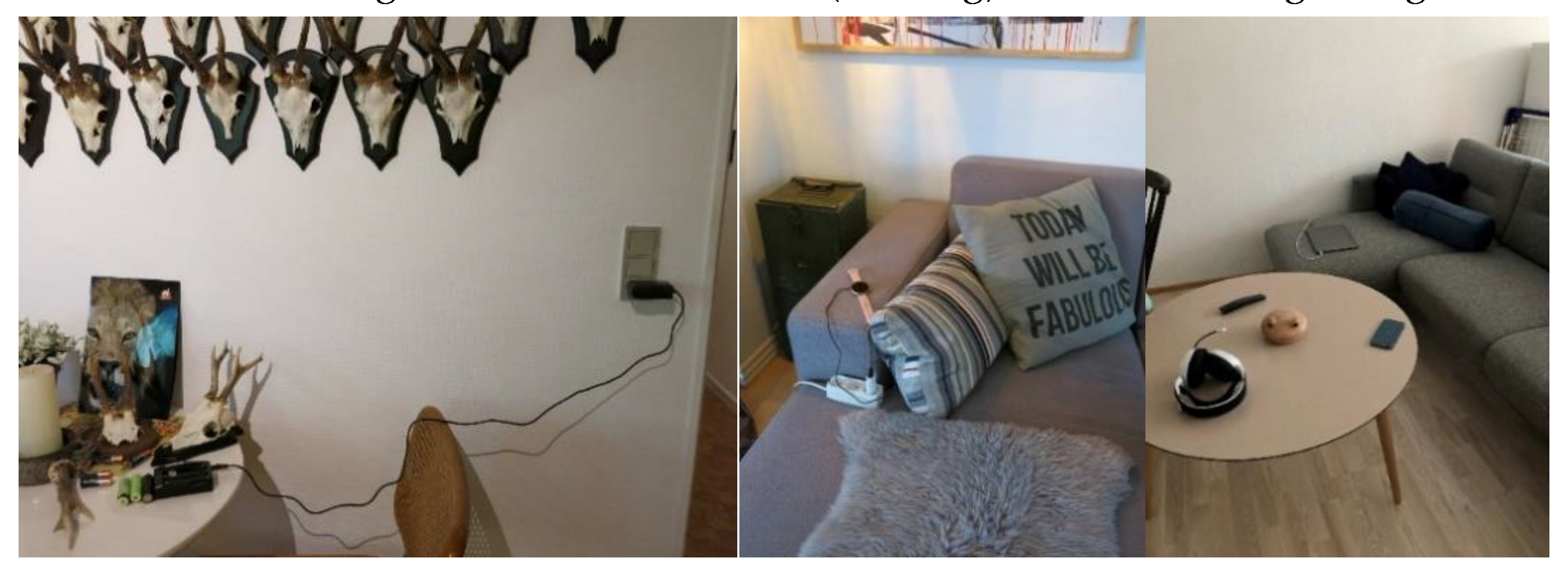
It appears important how charging or chargers are placed close to practices related to the use of the appliance. Cables often need to literally be flexible to find ways through things and accommodate other practices. The location of energy flexibility seemed to relate to several objects, such as furniture, pillows, tables, sockets, and lamps, and the location and temporal flexibility of these.
4.1.3. Energy Flexibility Hiding in a Box
The examples of charging smartphones and other devices illustrate how charging connects to other practices. However, charging also very much depends on the wider infrastructure of things and the capacity for electricity supply in the homes. Starting with capacity, an important material feature of the flexibility of charging practices was the location and number of sockets in the homes and specific rooms. The location and number seemed to depend on the time of building the houses or apartments. An illustrative example was an apartment with several power sockets placed close to the ceiling, making interaction with them difficult, whereas in other cases, the number of power sockets was limited making extensions, such as power strips advantageous. However, it is not only the infrastructure of the house or apartment, which connects to wider energy systems, that is important. The ‘micro’ infrastructure inside the house, which the household makes and accommodates to their energy practices is also important. A good example of this was the charging box in picture 14. Functioning as a charging station, it was conveniently placed in the middle of the house on the main ‘route’ from rooms to kitchen. In this case, the material relations between the specific charger, the energy supply and power sockets, and the layout of the house accommodate the activity of the house and thereby potentially also the temporal patterns of everyday practices.
Picture 14 and 15.
Charging box (MJ2) and box with cords, power strips, and various equipment (NJ4).
Picture 14 and 15.
Charging box (MJ2) and box with cords, power strips, and various equipment (NJ4).
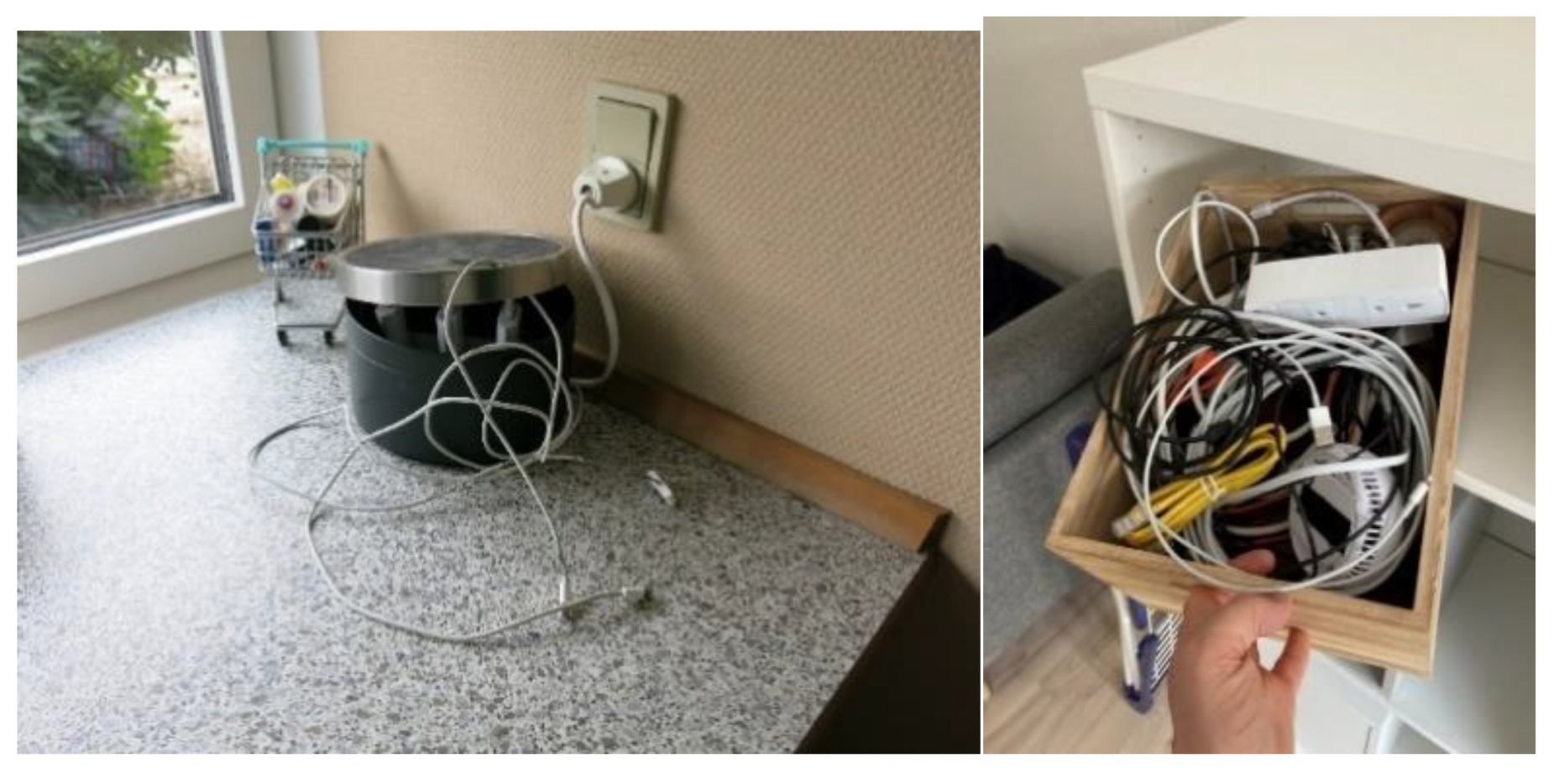
We found several examples of unused cords, chargers, and other types of electric equipment stored in boxes as shown in picture 15. This might also influence the easy access and energy flexibility of charging appliances or in general to use of energy. We found a few examples of plug timers, but these were not in use and were put aside. These could provide a better basis for energy flexibility, for example in connection with a charging box (picture 14) or power strip (picture 6).
4.2. Washing Laundry
In this analysis, washing practices cover activities of cleaning and preparing laundry for use. This involves activities of loading and starting a washing machine or tumble dryer as well as organizing laundry before and after washing. The temporality of such washing practices has historically been shaped by changes in society, for example, a shift in laundry activities from mid-week morning to early weekday and Sunday morning related to changes in (female) labor market participation (Anderson, 2016). Also, the norms for cleanliness over time have shaped what has been perceived as laundry, and thereby the demand for washing clothes (Hitchings et al., 2018; Jack, 2022), as well as the access to infrastructure and resources shape cleanliness practices (Jack et al., 2020). Generally, washing practices are something that takes up physical space in everyday life (Spurling, 2021), and the practices involved are important for the timing of energy demand (Torriti, 2017), for example as activities of pilling up, washing, and then drying laundry has inherent temporal sequences and involves material transformations (Blue et al., 2020).
4.4.1. Give Flexibility some Space
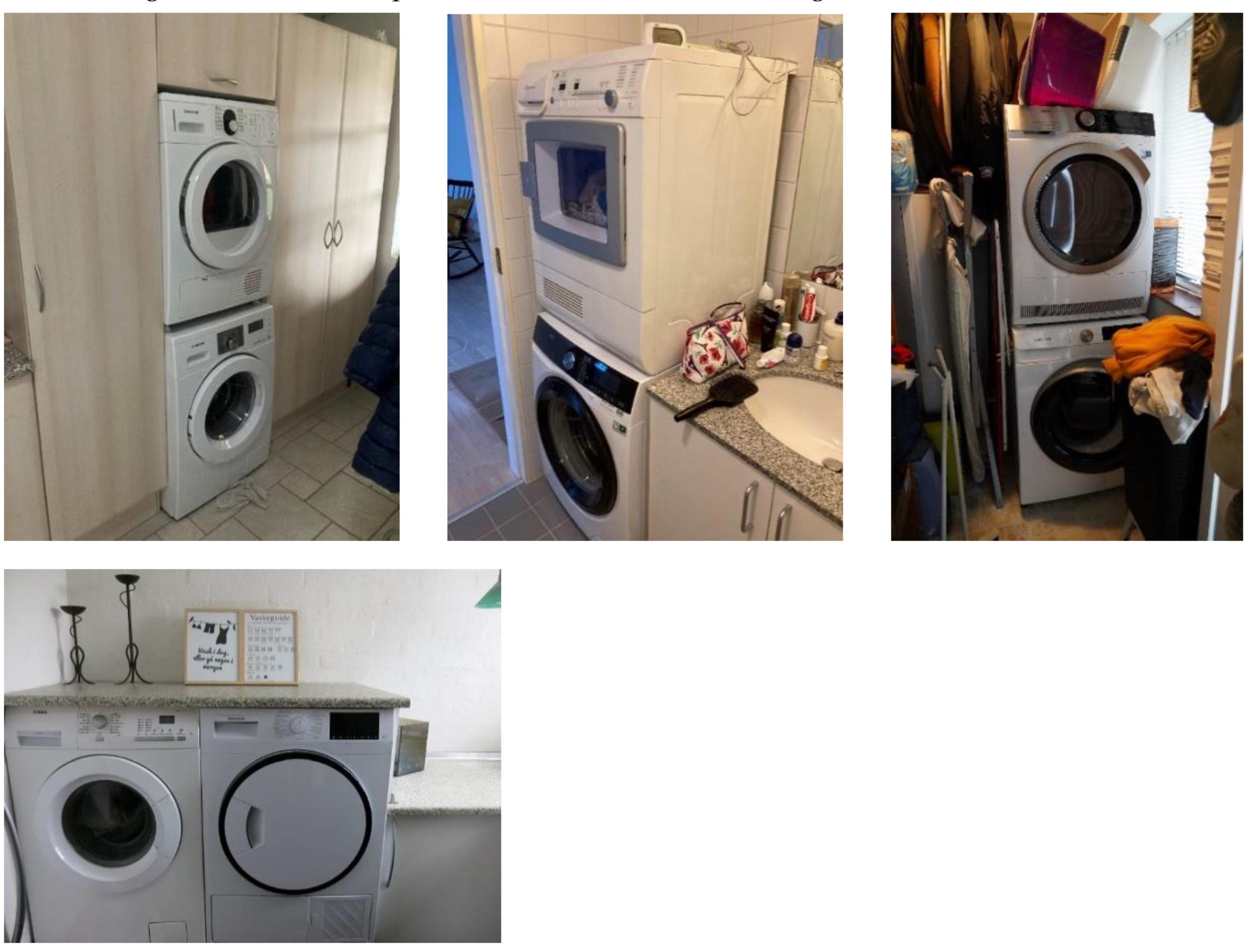
Laundry practices were present in the homes we visited primarily in the form of washing machines and tumble dryers, which most often were stacked or standing next to one another (pictures 16-19). This connection between the washing machine and tumble dryer seems convenient for the synchronization of the process of washing and drying laundry. In other words, it makes it easy to dry clothes effectively right after washing rather than the alternative of using a drying rack. In the interviews, we got various glimpses into what these practices could also entail, for example, the sensory experience of air-dried clothes (SL1).
Focusing on the material relations, it was clear how laundry practices were designed and set up for convenience and effectiveness, exemplified by picture 16, where these are part of built-in closets, and picture 17, where these are placed in the bathroom. Picture 18 shows an exception, where the washing machine and tumble dryer seem cramped into a smaller room with a lot of other stuff surrounding them. In addition, picture 19 shows how these white goods act as a table for decorations.
Picture 16, 17, 18, and 19.
The washing machine and tumble dryer are stacked (MJ3, NJ4, and SL1) and placed next to each other (NJ3).
Picture 16, 17, 18, and 19.
The washing machine and tumble dryer are stacked (MJ3, NJ4, and SL1) and placed next to each other (NJ3).
4.4.2. Organizing and Laminated Flexibility
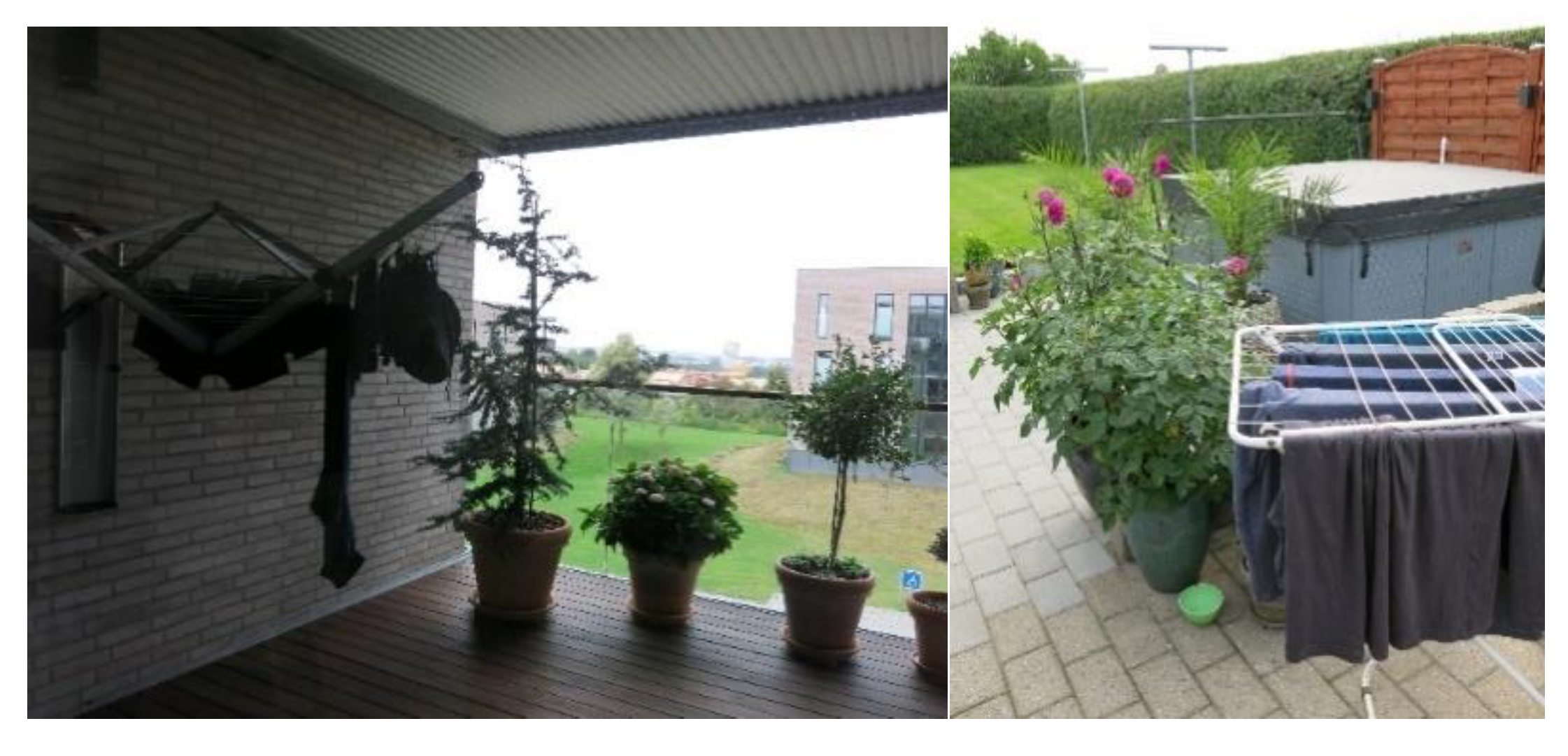
The alternative for drying wet laundry in a tumble dryer is to use a drying rack, preferably outside. In one newer apartment, there was an example of a drying rack that was built into the wall on a large balcony (picture 20). As seen in picture 20, it seemed to be frequently used although there was also a tumble dryer in the home. Moreover, the layout of the apartment made it convenient to carry wet laundry from the washing machine to the drying rack on the balcony, primarily because there were not many things blocking the way, but also because the apartment was relatively small, and the walk from the bathroom, with washing machine, to balcony was relatively short. This was not the case for the home shown in picture 21, where the passage from the washing machine to the terrasse was short but filled with furniture, and several doors needed to be opened on the way. In other words, the wet clothes had a harder journey from the washing machine to the drying rack.
Another temporal aspect of this is that the clothes need to be hung to dry rather quickly. This is the case for the tumble dryer as well as the drying rack. After this, the clothes lie relatively safe in the tumble dryer, and in several homes, the clothes seemed to stay in the tumble dryer for a while (see picture 16), in one case described as several days. The clothes on the outdoor drying rack are naturally more exposed to changing weather, adding to the inconvenience of this solution. This is of course the same with the use of a tumble dryer. can be done effectively Compared to using the tumble dryer, the
Picture 20 and 21.
A drying rack integrated into the wall on a balcony of an apartment (NJ2) and a free-standing drying rack (MJ2).
Picture 20 and 21.
A drying rack integrated into the wall on a balcony of an apartment (NJ2) and a free-standing drying rack (MJ2).
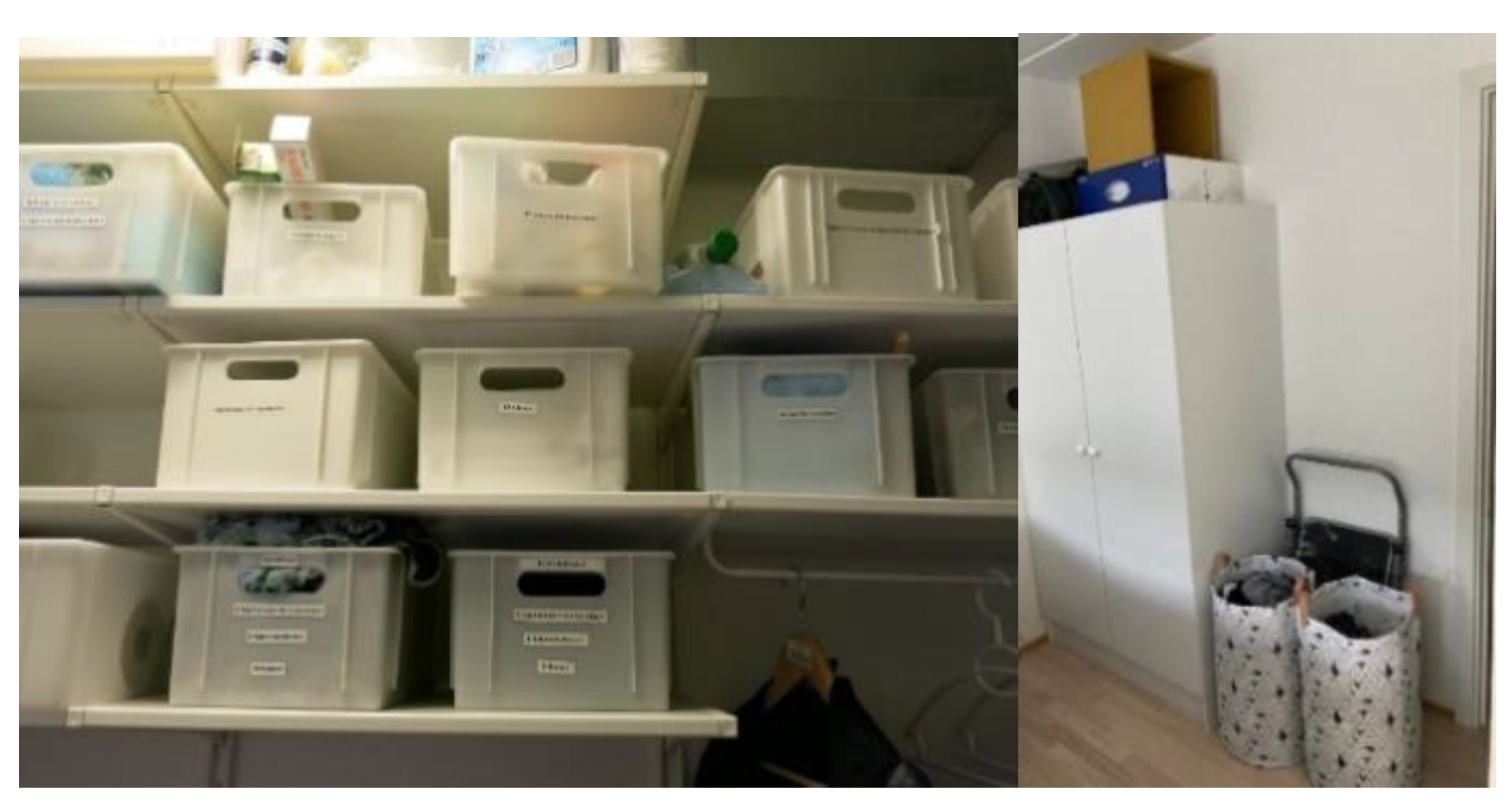
Following the journey of laundry, such as clothes and towels, we miss the stages before and after washing and drying, namely the organization of unwashed and washed laundry. We found a lot of variety in these processes, and pictures 22 and 23 show some of the more organized solutions. Especially picture 22 is a clear example of using material relations to organize washed laundry. The different boxes contained various stuff, like baking paper that sticks out in the picture, but also different forms of towels, and each box was given a label. In this sense, the material relations between label, box, and towel (or other stuff) in combination provide the organization related to practices such as laundering. Picture 23 shows two containers for unwashed laundry, which separate different sorts, for example, this can be used to separate laundry for a gentle wash.
Picture 22 and 23.
Towels and other things are stored in laminated boxes (NJ2) and laundry is sorted in two containers (NJ4).
Picture 22 and 23.
Towels and other things are stored in laminated boxes (NJ2) and laundry is sorted in two containers (NJ4).
The temporal flexibility of washing and drying clothes seems strengthened by the proximity of the washing machine and tumble dryer. Moreover, space and house layout seemed important to the flexibility of practices related to washing clothes. This included room for a washing machine and tumble dryer, but also for storing and organizing clothes.
5. Discussion
Analyzing photos of material relations from 10 household visits underpinned the importance of networks of things, technologies, and infrastructure for the flexibility and fixity of battery charging and washing clothes. Based on the analysis, we would like to highlight four indications from the analysis. First, comparing two examples of charging a hybrid vehicle, the analysis showed that the practice of charging primarily involves the connection between the charging box and the car, but that the surrounding material setting seems important for the temporal flexibility of the practice. In this way, tools and stuff used for other practices, like gardening, could potentially hinder energy flexibility. Second, the proximity of things seems essential to the energy flexibility of practices, for example, bed and charger link practices of sleeping and charging, and proximity of objects might provide stronger energy flexibility of the practices. This, for example, makes the location of the tumble dryer and washing machine important, as well as the house layout and size become important to energy flexibility. Third, devices were found to compete over space, power sockets, and ultimately time. For example, we found some devices put in ‘uncomfortable’ positions and places, illustrated by chargers hanging from, or stretching to reach, a power socket and cords and timers put away in boxes. Fourth, materials that are best described as stuff seem to occupy much space in key locations and thereby potentially obstruct or hinder the flexibility of energy practice, for example, if decorations and plants block for chargers.
Like previous literature (Blue, 2019; Blue et al., 2020; Hui et al., 2016), we found that the timing and flexibility of practices of charging and laundry rely on several other interconnected practices, and thereby also on multiple material relations, including infrastructures, technologies, and matter. Continuing the examples above, the flexibility of energy used for washing and drying laundry also needs to consider the relations to other materials, such as clothes or fabrics, as well as the layout and decoration of the home, and the complex of practices related to these materials, for example, shopping and working. As pointed out in other studies as well (Powells et al., 2014; Spurling, 2021), the question of capacity is important for networked material flexibility, especially for charging appliances, the number of power sockets, the placement of chargers, cords, and other things, seems important for flexibility in energy use.
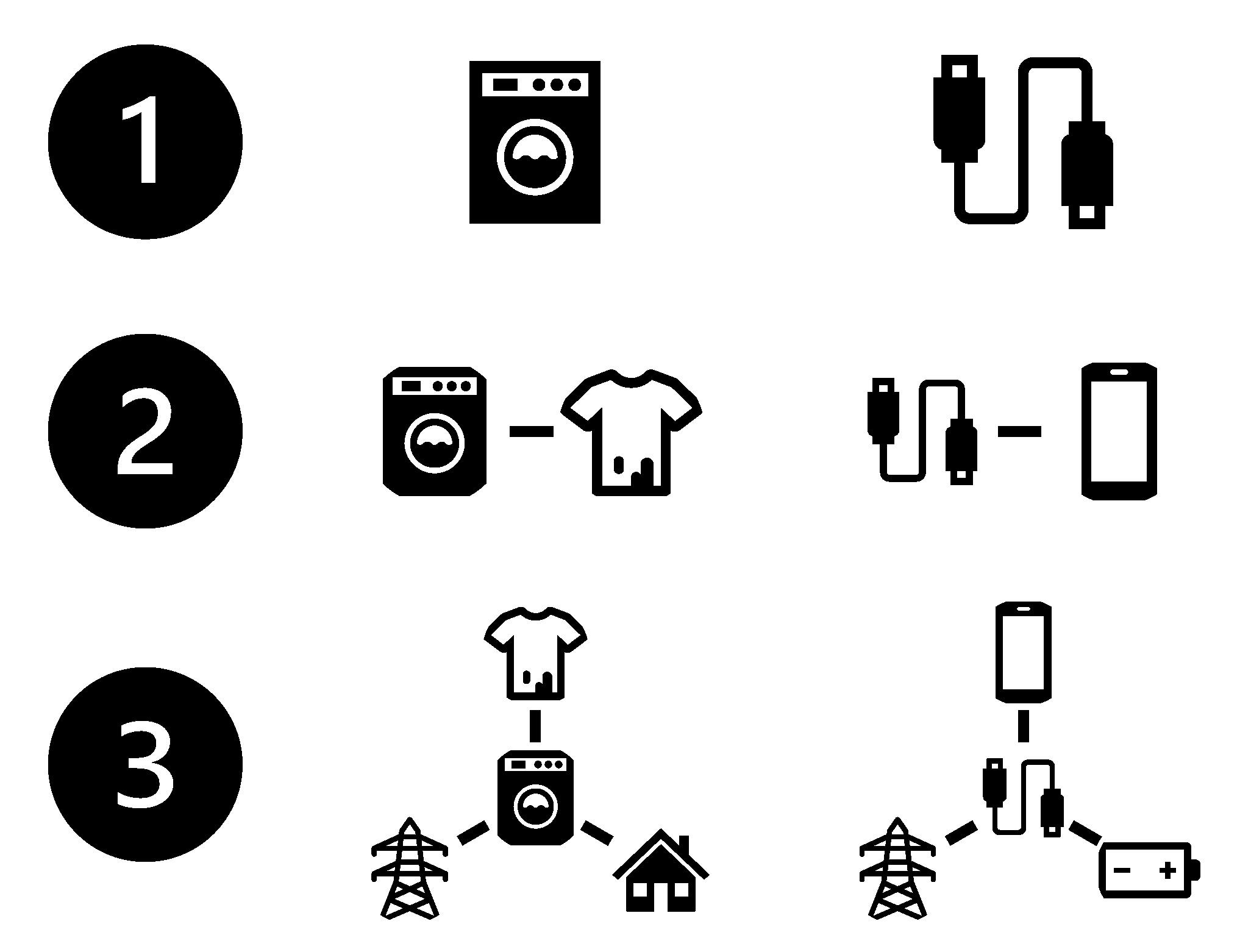
Inspired by literature on socio-temporal rhythms related to material relations, the analysis focused on three locations of the flexibility of energy practices, illustrated in Figure 1. First, flexibility can be seen as embedded in the design or built-in functions of technologies. Second, flexibility might lie in connected and interlinked materials and thereby the temporal organization of related practices. Third, flexibility might be located in networked material relations and situated in systems of things, technologies, and matters.
Using this framework, we would argue that functions designed to provide embedded flexibility, such as timers, need to be viewed in connection to other devices, and related practices, as well as in networks of things, technologies, and infrastructures, and perhaps also the complex of practices that this infrastructure enables in the home.
Considering Spurling's (2021) conceptualization of material-temporal relationships, it seems that meanings of convenience and comfort tend to overrule energy flexibility. Conversion lag and coordination of humans and materials seemed to favor convenience over energy flexibility, which, in this study, might be explained by the house size and capacity of the infrastructure that left an abundance of room for the simultaneous display of practices. Also, the pre-practice conversion of spaces, technologies, and matter appeared unnecessary. We found some indications of moving drying racks in the pre-practice conversion of drying clothes, but in most cases, as stated above, the tumble dryer was (conveniently) stacked on top of the washing machine. However, on the other side, we found examples of stuff like decorations and flowers that blocked the use of technologies, best exemplified with chargers hiding behind plants, which needed a pre-practice conversion before use.
The analysis focused on charging practices and laundry practices, but in the house visits, we found several examples of similar material relations in other everyday practices, for example, related to socializing, cleaning, and leisure activities. The flexibility of these other practices could be as relevant to explore in connection to material relations, and these might elucidate other insights and nuances.
6. Conclusion and Policy Implications
Material relations are found to be important to the flexibility of household energy demand, and this study provides examples of how energy flexibility is challenged by material relations, for example when devices compete over plugs, stuff is in its way, and convenience is prioritized over flexibility. Thus, the flexibility of energy practices must be viewed in networks of materials, including infrastructure, house layout, and furniture, and in the complex of practices that this network enables.
Therefore, policy makers and energy suppliers must consider that a single technology’s function, efficiency, or quality do not provide energy demand flexibility in isolation. Although these might be designed to time-shift energy demand, for example like timers in a washing machine, the potential for flexibility of energy demand must consider the connectedness with other appliances and other practices related to the specific energy use. Moreover, material relations might influence energy demand flexibility in hidden ways. This means that inconspicuous barriers might influence the flexibility of practices, for example, the placement of chargers, appliances, or things, as well as the capacity, space, and interior layout of houses.
Technologies and devices might be designed for flexibility and efficiency, but they are at the same time designed for convenience and comfort. Based on this analysis, it seems that convenience and comfort, in the end, overrules energy flexibility. However, it is not unlikely for convenience and flexibility to coincide. One example could be the stacked washing machine and tumble dryer, which likely increase the tempo of activities of washing laundry, and thereby demonstrate temporal reorganization of practices. Another example is a smartphone charger located next to the bed. These examples suggest that the proximity of materials of interconnected practices, such as washing and drying clothes or charging and sleeping, might provide convenience while facilitating flexibility by enabling changes in the temporal organization via material relations.
Finally, the three ways material relations matter to energy demand flexibility presented in this paper (embedded, connected, and networked) might be a useful framework for future operationalization and analysis of the material dimensions of energy demand flexibility, for example alongside conceptualizations of temporal dimensions of practices related to materiality (Spurling, 2021). Future research might also further develop research designs around ‘object interviews’ (Holmes, 2020).
Acknowledgment
The funding program ELFORSK 2020 funded the research with project number 352-010. Thanks to Signe Rudå for important contributions to data curation and inputs to analysis.
Declaration of interests
☒ The authors declare that they have no known competing financial interests or personal relationships that could have appeared to influence the work reported in this paper. ☐ The authors declare the following financial interests/personal relationships which may be considered as potential competing interests:
Appendix

Table 1.
Overview of informants and house visits. All informants have been given other names.
| Code | Pseudonym (age) | Danish region | Housing | Family | Extra information |
|---|---|---|---|---|---|
| MJ1 | Magne (57) | Central | Rented room in farmhouse | He lives alone but shares a house with his landlord. He has adult children. |
|
| MJ2 | Michael (51) and Maren (55) | Central | Single-family dwelling | They have a daughter a grandson and a dog. | Hybrid car. Several smart home technologies. |
| MJ3 | Mette (51) and Morten (60) | Central | Single-family dwelling | Morten has an adult child from a previous marriage. | Roof PVs from 2011. Hybrid car. |
| NJ1 | Nikolaj (37) | Northern | Single-family dwelling | Married to Nikoline (38). Son (10) and daughter (8). |
|
| NJ2 | Nina (NA) and Niels (65) | Northern | Apartment | They have a daughter (29), who lives nearby. | Hybrid car |
| NJ3 | Nicklas (32) and Nikita (33) | Northern | Single-family dwelling | They have a dog. | Roof PVs. |
| NJ4 | Noa (35) | Northern | Apartment | He lives alone and has a girlfriend living nearby. | |
| CO1 | Sabine (31) | Capital | Apartment | She lives alone. | |
| SJ1 | Sylvester (70) and Sybille (68) | Southern | Farmhouse | They have adult children grandchildren and a dog. | Roof PVs. |
| SL1 | Solvej (65) and Sami (77) | Zealand | Terraced house | They have an adult son, who lives abroad. |
References
- Adam, B. , 1994. Time and Social Theory. Polity Press.
- Anderson, B. , 2016. Laundry, energy and time: Insights from 20 years of time-use diary data in the United Kingdom. Energy Research & Social Science 22, 125–136. [CrossRef]
- Blue, S. , 2019. Institutional rhythms: Combining practice theory and rhythmanalysis to conceptualise processes of institutionalisation. Time & Society 28, 922–950. [CrossRef]
- Blue, S. , Shove, E., Forman, P., 2020. Conceptualising flexibility: Challenging representations of time and society in the energy sector*. Time & Society 0961463X20905479. [CrossRef]
- Cleland, J. , MacLeod, A., 2021. The visual vernacular: embracing photographs in research. Perspect Med Educ 10, 230–237. [CrossRef]
- Coutard, O. , Shove, E., 2019. Infrastructures, Practices and the Dynamics of Demand, in: Infrastructures in Practice - The Dynamics of Demand in Networked Societies. Routledge, New York.
- Evans, D.M., 2020. After Practice? Material Semiotic Approaches to Consumption and Economy. Cultural Sociology 1749975520923521. [CrossRef]
- Faruqui, A. , 2010. The Ethics of Dynamic Pricing. The Electricity Journal 23, 13–27. [CrossRef]
- Foulds, C. , Robison, R.A.V., Macrorie, R., 2017. Energy monitoring as a practice: Investigating use of the iMeasure online energy feedback tool. Energy Policy 104, 194–202. [CrossRef]
- Friis, F. , Christensen, T.H., 2016. The challenge of time shifting energy demand practices: Insights from Denmark. Energy Research & Social Science 19, 124–133. [CrossRef]
- Gram-Hanssen, K. , 2011. Understanding change and continuity in residential energy consumption. Journal of Consumer Culture 11, 61–78. [CrossRef]
- Gram-Hanssen, K. , Hansen, A.R., Mechlenborg, M., 2020. Danish PV Prosumers’ Time-Shifting of Energy-Consuming Everyday Practices. Sustainability 12, 4121.
- Hansen, A.R. , Friis, F., Jacobsen, M.H., Gram-Hanssen, K., 2019. Three forms of energy prosumer engagement and their impact on time-shifting electricity consumption, in: ECEEE 2019 Summer Study Proceedings. Presented at the ECEEE Summer Study.
- Hargreaves, T. , Nye, M., Burgess, J., 2013. Keeping energy visible? Exploring how householders interact with feedback from smart energy monitors in the longer term. Energy Policy, Special Section: Transition Pathways to a Low Carbon Economy 52, 126–134. [CrossRef]
- Hargreaves, T. , Nye, M., Burgess, J., 2010. Making energy visible: A qualitative field study of how householders interact with feedback from smart energy monitors. Energy Policy 38, 6111–6119. [CrossRef]
- Hargreaves, T. , Wilson, C., 2017. Smart homes and their users. Springer.
- Hitchings, R. , Browne, A., Jack, T., 2018. Should there be more showers at the summer music festival? Studying the contextual dependence of resource consuming conventions and lessons for sustainable tourism. Journal of Sustainable Tourism 26, 496–514.
- Hohnen, P. , Hansen, A.R., 2022. Forbrug og gæld, in: Greve, B., Jørgensen, A., Larsen, J.E. (Eds.), Det danske samfund : Centrale idéer og principper. Hans Reitzels Forlag, København, pp. 401–429.
- Holmes, H. , 2020. Material relationships: Object interviews as a means of studying everyday life, Mundane Methods. Manchester University Press.
- Hui, A. , Schatzki, T., Shove, E. (Eds.), 2016. The Nexus of Practices: Connections, constellations, practitioners. Routledge, London. [CrossRef]
- Hui, A. , Walker, G., 2018. Concepts and methodologies for a new relational geography of energy demand: Social practices, doing-places and settings. Energy Research & Social Science, Spatial Adventures in Energy Studies: 36, 21–29. [CrossRef]
- Jack, T. , 2022. Sovereign dupes? Representations, conventions and (un)sustainable consumption. Journal of Consumer Culture 22, 331–358. [CrossRef]
- Jack, T. , Anantharaman, M., Browne, A.L., 2020. ‘Without cleanliness we can’t lead the life, no?’ Cleanliness practices, (in)accessible infrastructures, social (im)mobility and (un)sustainable consumption in Mysore, India. Social & Cultural Geography 0, 1–22. [CrossRef]
- Jacobsen, M.H. , Hansen, A.R., 2021. (Re)introducing embodied practical understanding to the sociology of sustainable consumption. Journal of Consumer Culture 21, 747–763. [CrossRef]
- Jalas, M. , 2005. The Everyday Life Context of Increasing Energy Demands: Time Use Survey Data in a Decomposition Analysis. Journal of Industrial Ecology 9, 129–145. [CrossRef]
- Jalas, M. , Juntunen, J.K., 2015. Energy intensive lifestyles: Time use, the activity patterns of consumers, and related energy demands in Finland. Ecological Economics 113, 51–59. [CrossRef]
- Jalas, M. , Rinkinen, J., 2013. Stacking wood and staying warm: Time, temporality and housework around domestic heating systems. Journal of Consumer Culture 16, 43–60. [CrossRef]
- Khalid, R. , Christensen, T.H., Gram-Hanssen, K., Friis, F., 2019. Time-shifting laundry practices in a smart grid perspective: a cross-cultural analysis of Pakistani and Danish middle-class households. Energy Efficiency. [CrossRef]
- Kubli, M. , Loock, M., Wüstenhagen, R., 2018. The flexible prosumer: Measuring the willingness to co-create distributed flexibility. Energy Policy 114, 540–548. [CrossRef]
- Larsen, S.P.A.K. , Gram-Hanssen, K., 2020. When Space Heating Becomes Digitalized: Investigating Competencies for Controlling Smart Home Technology in the Energy-Efficient Home. Sustainability 12, 6031. [CrossRef]
- Latour, B. , 1993. We Have Never Been Modern. Harvard University Press.
- Latour, B. , 1987. Science in action: how to follow scientists and engineers through society. Harvard University Press, Cambridge, Mass.
- Maller, C. , Nicholls, L., Strengers, Y., 2016. Understanding the materiality of neighbourhoods in ‘healthy practices’: Outdoor exercise practices in a new master-planned estate. Urban Policy and Research 34, 55–72.
- Martin, R. , 2020. Making sense of renewable energy: Practical knowledge, sensory feedback and household understandings in a Scottish island microgrid. Energy Research & Social Science 66, 101501. [CrossRef]
- McKenna, E. , Higginson, S., Grunewald, P., Darby, S.J., 2017. Simulating residential demand response: Improving socio-technical assumptions in activity-based models of energy demand. Energy Efficiency 1–15. [CrossRef]
- Nicholls, L. , Strengers, Y., 2015. Peak demand and the ‘family peak’ period in Australia: Understanding practice (in)flexibility in households with children. Energy Research & Social Science, Special Issue on Smart Grids and the Social Sciences 9, 116–124. [CrossRef]
- Pink, S. , 2022. The gender of smart charging 3, 488–502. [CrossRef]
- Powells, G. , Bulkeley, H., Bell, S., Judson, E., 2014. Peak electricity demand and the flexibility of everyday life. Geoforum 55, 43–52. [CrossRef]
- Ramirez-Mendiola, J.L. , Mattioli, G., Anable, J., Torriti, J., 2022. I’m coming home (to charge): The relation between commuting practices and peak energy demand in the United Kingdom. Energy Research & Social Science 88, 102502. [CrossRef]
- Reckwitz, A. , 2002a. Toward a Theory of Social Practices A Development in Culturalist Theorizing. European Journal of Social Theory 5, 243–263. [CrossRef]
- Reckwitz, A. , 2002b. The Status of the “Material” in Theories of Culture: From “Social Structure” to “Artefacts.” Journal for the Theory of Social Behaviour 32, 195–217. [CrossRef]
- Rinkinen, J. , Jalas, M., Shove, E., 2015. Object Relations in Accounts of Everyday Life. Sociology 49, 870–885. [CrossRef]
- Rinkinen, J. , Shove, E., Marsden, G., 2020. Conceptualising Demand: A Distinctive Approach to Consumption and Practice. Routledge.
- Schatzki, T.R. , 1996. Social Practices: A Wittgensteinian Approach to Human Activity and the Social. Cambridge University Press, the transformation of household consumption practices in Kerala.
- Schatzki, T.R. , Knorr-Cetina, K., Savigny, E. von, 2001. The Practice Turn in Contemporary Theory. Routledge, London; New York.
- Shove, E. , 2003. Converging Conventions of Comfort, Cleanliness and Convenience. Journal of Consumer Policy 26, 395–418. [CrossRef]
- Shove, E. , Pantzar, M., 2005. Consumers, Producers and Practices Understanding the invention and reinvention of Nordic walking. Journal of Consumer Culture 5, 43–64. [CrossRef]
- Shove, E. , Walker, G., 2014. What Is Energy For? Social Practice and Energy Demand. Theory Culture Society 31, 41–58. [CrossRef]
- Shove, E. , Warde, A., 2002. Inconspicuous Consumption: The Sociology of Consumption, Lifestyles, and the Environment, in: Dunlap, R.E., Buttel, F.H., Dickens, P., Gijswijt, A. (Eds.), Sociological Theory and the Environment: Classical Foundations, Contemporary Insights. Rowman & Littlefield Publishers, pp. 230–251.
- Shove, E. , Watson, M., Spurling, N., 2015. Conceptualizing connections: Energy demand, infrastructures and social practices. European Journal of Social Theory 18, 274–287. [CrossRef]
- Sioshansi, F. (Ed.) , 2021. Introduction, in: Variable Generation, Flexible Demand. Academic Press, London; San Diego, pp. xxxvii–liv. [CrossRef]
- Smale, R. , van Vliet, B., Spaargaren, G., 2017. When social practices meet smart grids: Flexibility, grid management, and domestic consumption in The Netherlands. Energy Research & Social Science 34, 132–140. [CrossRef]
- Southerton, D. , 2020. Time, Consumption and the Coordination of Everyday Life, Consumption and Public Life. Palgrave Macmillan UK. [CrossRef]
- Southerton, D. , 2009. Re-ordering Temporal Rhythms, in: Shove, E., Trentmann, F., Wilk, R. (Eds.), Time, Consumption and Everyday Life: Practice, Materiality and Culture. Berg, Oxford, pp. 49–66.
- Southerton, D. , 2003. `Squeezing Time’ Allocating Practices, Coordinating Networks and Scheduling Society. Time Society 12, 5–25. [CrossRef]
- Spurling, N. , 2021. Matters of time: Materiality and the changing temporal organisation of everyday energy consumption. Journal of Consumer Culture 21, 146–163. [CrossRef]
- Strengers, Y. , 2019. Prices as instruments of demand management : Interpreting the signals, in: Shove, E., Trentmann, F. (Eds.), Infrastructures in Practice - The Dynamics of Demand in Networked Societies. pp. 184–197. [CrossRef]
- Strengers, Y. , 2012. Peak electricity demand and social practice theories: Reframing the role of change agents in the energy sector. Energy Policy 44, 226–234. [CrossRef]
- Torriti, J. , 2017. Understanding the timing of energy demand through time use data: Time of the day dependence of social practices. Energy Research & Social Science 25, 37–47. [CrossRef]
- Torriti, J. , 2015. Peak Energy Demand and Demand Side Response. Routledge, London and New York. [CrossRef]
- Walker, G. , 2021. Energy and Rhythm: Rhythmanalysis for a Low Carbon Future. Rowman & Littlefield, New York and London.
- Walker, G. , 2014. The dynamics of energy demand: Change, rhythm and synchronicity. Energy Research & Social Science 1, 49–55. [CrossRef]
- Warde, A. , 2005. Consumption and theories of practice. Journal of consumer culture 5, 131–153.
- Wilhite, H. , Shove, E., Lutzenhiser, L., Kempton, W., 2000. The legacy of twenty years of energy demand management: we know more about individual behaviour but next to nothing about demand, in: Society, Behaviour, and Climate Change Mitigation. Springer, Dordrecht, pp. 109–126.
- Zerubavel, E. , 1985. Hidden Rhythms: Schedules and Calendars in Social Life. University of California Press.
Figure 1.
Three locations of flexibility of energy practices. .
Disclaimer/Publisher’s Note: The statements, opinions and data contained in all publications are solely those of the individual author(s) and contributor(s) and not of MDPI and/or the editor(s). MDPI and/or the editor(s) disclaim responsibility for any injury to people or property resulting from any ideas, methods, instructions or products referred to in the content. |
© 2024 by the authors. Licensee MDPI, Basel, Switzerland. This article is an open access article distributed under the terms and conditions of the Creative Commons Attribution (CC BY) license (http://creativecommons.org/licenses/by/4.0/).
Copyright: This open access article is published under a Creative Commons CC BY 4.0 license, which permit the free download, distribution, and reuse, provided that the author and preprint are cited in any reuse.


