

Submitted:
06 August 2024
Posted:
07 August 2024
You are already at the latest version
Abstract
Background: IoT and Big Data are newer technologies that can provide substantial support for healthcare systems and help overcome their shortcomings. The aim of this paper was to analyze literature production descriptively, thematically, and chronologically from an interdisciplinary perspective in a holistic way to identify the most prolific research entities and themes. Methods: The synthetic knowledge synthesis qualitatively and quantitatively analyzes the production of literature through a combination of descriptive bibliometrics, bibliometric mapping and content analysis. For this analysis the Scopus bibliometric database was used. Results: In the Scopus database, 2272 publications were found, which were published between 1985 and June 10, 2024. The first article in this field was published in 1985. Until 2012 the production of literature was steady increasing, after that exponential growth began, which reached its peak in 2023. The most productive countries were the USA, India, China, the United Kingdom, South Korea, Germany and Italy. The content analysis resulted in 8 themes (four from the perspective of computer science and four from the perspective of medicine) and 21 thematic concepts (eight from the perspective of computer science and 13 from the perspective of medicine). Conclusions: The results show that IoT and Big Data have become key technologies in preventive health. The study outcomes might represent a starting point for the further development of research that combines multidisciplinary aspects of healthcare.
Keywords:
Internet of Things
; Big Data
; preventive healthcare
; epidemiology
; bibliometric
1. Introduction
The COVID-19 pandemic once again exposed the shortcomings of traditional healthcare systems in coping with sudden, unpredictable situations. Major technologies that can support healthcare systems in such crises as well as in routine work are smart and connected wearables (Internet of Things - IoT), which can collect context-oriented data related to patient physical, behavioural, and psychological health and big data analytics, which can mine collected data in real-time, extracting knowledge and making predictions/inferences enabling health professionals and decision maker to improve the healthcare system and their services [1,2,3,4,5].
Some recent review papers [3,6,7,8] and bibliometric studies [9,10,11] on the use of IoT or Big data analysis in healthcare have already been published, but none of them didn’t focus on predictive medicine/healthcare. Additionally, review synthesis outcomes were based on the analysis of small samples of publications, thus not giving a comprehensive and holistic insight into the field. Additionally, traditional bibliometric studies have already published just quantitative aspects of the research, lacking the formal qualitative analysis, thus missing the insight into prolific themes, topics, concepts, maturity of the research, and identification of the core sources of information based on bibliometric laws. Furthermore, most publications didn’t analyze IoT and data concurrently, overlooking the integrative effect.
To fill this gap, our study aims to inform the research community and practicing medical and healthcare professionals to improve their understanding of this fast-growing and highly innovative area. It can also inform novice researchers, health institution managers, and patients lacking this specific domain knowledge to develop a perspective on essential research dimensions and possible fields of practical use. Finally, the study might inform and catalyze further research and serve as a starting point for more formal knowledge and evidence synthesis approaches. To achieve this aim, our objective is to answer the following research questions:
- What are the volume and dynamics of the research on using IoT and Big Data in preventive medicine?
- How is the research geographically distributed?
- Which are the core and most prolific information sources that first inform the scientific community and second enable the community to present its research results?
- Which funding bodies are the most productive?
- What are the most prolific research themes, concepts, and future directions?
- How did the research themes envolve historically?
- What are the possible research gaps?
2. Materials and Methods
The research landscape of IoT and Big-data employment in preventive medicine was induced by Synthetic Knowledge Synthesis (SKS) [12]. SKS was developed to face new challenges in synthesizing research evidence due to exponential rates of knowledge development and the digital revolution. SKS triangulates quantitative and qualitative knowledge synthesis by combining descriptive bibliometrics, bibliometric mapping, and content analysis. SKS overcomes some weaknesses of traditional knowledge synthesis approaches by reducing needed resources and automating part of the synthesis. As such, it can synthesize thousands or even ten thousand publications, solving the sampling issue and increasing reproducibility [13,14]. Furthermore, triangulation used in SKS provides a more complete picture of the phenomena in question. It helps to increase the validity, credibility, dependability, confirmability, and transferability (ecological validity) of research synthesis [15]. To further increase the study's validity and reduce bias, we performed the content analysis from two perspectives: medical and computer science. SKS was executed with the algorithm below:
- Research publications were harvested from the Scopus bibliographic database using the search string TITLE-ABS-KEY (( "internet of things" OR iot OR big-data) AND prevent*) AND (LIMIT-TO (SUBJAREA,"MEDI") OR LIMIT-TO (SUBJAREA,"HEAL") OR LIMIT-TO (SUBJAREA,"NURS")).
- Descriptive bibliometric analysis was performed using Scopus’s built-in functionality and the Bibliometrics software [16].
- Author keywords were used as meaningful units of information in content analysis. First, bibliometric mapping was performed using VOSViewer [6]. Next, using content analysis on the most popular authors' keywords, the node size, links, and proximity between author keywords in individual clusters and their borders presented in the bibliometric map were analyzed from the medical and computer science viewpoints to form categories, identify concepts and name the research theme.
- Next, the representative themes and subcategories' author keywords/terms were applied to form search strings to locate relevant publications associated with describing categories and themes' scope.
Scopus (Elsevier, The Netherlands) was used as the bibliographic database. Scopus is the largest abstract and citation database of the reviewed research literature. They were providing powerful analytics services and enabling 20,000 records to be exported simultaneously. The search query was constructed using the recommendation provided by Farooq et al. [20], namely, analyzing and synthesizing search strategies already used in related review papers. The search was performed on June 10th, 2024. Zipf's law was used to calculate the number of relevant keywords to be used in SKS, and Bradford’s law was used to calculate the number of core journals [21].
3. Results and Discussion
3.1. Descriptive and Production Bibliometrics
3.1.1. Volume of Research
The search resulted in 2272 publications. There were 971 articles. 669 conference papers, 363 reviews, 159 book chapters, and 110 other types of publications containing 6195 author keywords. They were published by 9770 authors affiliated with 2446 institutions from 72 countries in 1165 source titles. The average number of co-authors was 5.2 authors; 166 publications were single-authored, and 21.4% of publications were international. On average, a publication received 15.11 citations. During the period 1985-2015, 29 countries contributed to the research; in the period 2016-2000, 40 countries; and in 2021-2024, 71 countries.
3.1.2. The Dynamics of the Research Literature Production
The first paper was published in 1985, and after that, the production was very sparse till 2012, when the exponential growth began, reaching its peak in 2023 with 438 publications (Figure 1). The number of conference papers is still exhibiting a positive trend. However, the number of articles, reviews, and book chapters has declined. The annual growth in the number of publications is 9.5%.
3.1.3. Prolific Information Sources
A total of 1165 source titles have published articles on IoT and Big data in preventive health care. Based on Bradford’s Law, 108 source titles are included in the core zone according to their productivity. The large number of core zone journals indicates that the maturity of the research area is still progressing and that archival journals have not yet been established. The 10 most productive source titles are listed in Table 1.
The H-index of the above source titles lies between 26 and 197, and the SJR (Scopus Journal Rank) is between 0.15 and 2.02, placing most of the source titles into the Q1 category, indicating the high quality of prolific information sources. However, the five top cited papers (Table 2) have not been published in the most prolific source titles, except for the most cited paper in Q1 journals, with mostly higher than most productive source title SJRs. All five of those journals belong to the core zone journals.
3.1.4. Geographical Distribution of Research
The most productive countries publishing more than 100 publications were the United States (n=477), followed by India (n=445), China (n=388), the United Kingdom (n=179), South Korea (n=131), Germany (n=114), and Italy (n=109). The ranking of scientific production is comparable with the Scimago Country Rankings (Elsevier, Amsterdam, Netherlands), where China, the United States, and India are the three first-ranked in Computer science and the United States, China, and the United Kingdom in medicine. Other top productive countries are among the 11 most productive in both categories. All top productive countries are also members of G20 [22]. The United States, China, and the United Kingdom also prevail among the most productive institutions; among the first 20, 19 are from those three countries.
The most cooperative countries (Figure 2) are The United States, Canada, The United Kingdom, Australia, and Germany, with 28, 27, 26, 26, and 24 co-authors-based cooperation links, respectively. The strongest cooperation exists between The United States and Canada; Australia and The United Kingdom; The United Kingdom, Germany, Netherlands, and Sweden; and India, The United States, and Malaysia. The cooperation indicates the regional/cultural concentration of research, which should be overcome in the future to enable the translation of global preventive healthcare knowledge to less developed regions and enable regional researchers to contribute to the development of worldwide knowledge and share unique datasets, specialized equipment, regional knowledge, and distinct research environments.
The United States, Canada, Denmark, and Sweden have, on average, the oldest publications, and Belgium, Russian Federation, India, Japan, Hong Kong, Malaysia, Pakistan, and Saudi Arabia are the youngest, indicating countries where preventive health care research has started and where more focus to it has been gained lately.
The eight most productive institutions publishing more than 20 publications are Harvard Medical School (n=35), University of Oxford (n=26), Peking University (n=24), University of Toronto (n=24), Harvard T.H. Chan School of Public Health (n=23), Standford University (n=22), Brigham and Women's Hospital (n=22) and Chinese Center for Disease Control and Prevention (n=22).
3.1.5. Most Prolific Funding Bodies
Another important indicator of the research state of a scientific field/sub-field is the rate of research funding [23]. Our analysis showed that 37.0% of publications were funded, notably more than in many other fields [18]; however, less than in broadly comparable subfields, namely the use of AI in pediatrics, where 47.4% [24] and the use of AI in software engineering where 41.1% [25] were funded. The most productive funding sponsors, funding more than 20 publications, were the National Natural Science Foundation of China (n=96), the National Institutes of Health, USA (n=85), the Horizon 2020 Framework Programme, EU (n=28), National Key Research and Development Program of China (n=28), National Research Foundation of Korea (n=23), and National Science Foundation, USA (n=22). As expected, the majority of the most productive funding sponsors are from China and the United States of America. That is not surprising, considering that the USA is one of the countries spending the most on preventive health care [26], and China recently implemented a comprehensive health system reform with strong political and financial support [27].
3.2. Most Prolific Research Themes
Content analysis was performed using SKS Steps 3 and 4 and VOSViewer software, version 1.6.20 (Leiden University, Leiden, The Netherlands). According to Zipf's law, 79 authors' keywords are relevant enough to be used in SKS and, respectively, in content analysis, meaning that all keywords occurring ten or more times were included in the analysis. The author's keyword landscape is shown in Figure 3, and the synthesis of the results is shown in Table 3. Content analysis resulted in 8 themes (four from a computer science viewpoint and four from a medical point of view) and 21 Concepts (eight from a computer science viewpoint and 13 from a medical point of view).
The role of artificial intelligence in personal, precision, and preventive medicine / The role of AI in personalized medicine (genetics, genomics) in the field of the most common diseases of the modern population (cardiovascular diseases, dementia, obesity, asthma, sars-cov2, cancer)
The use of artificial intelligence and Omics in personalized and precision medicine according to health policies
3 PM (Precision, preventive and personalized) medicine, in combination with omics, environmental data, and big data analytics, is one of the emerging approaches in modern public health, with vast implications for future health policy formulation [28]. It emerged as a response to epidemics of non-communicable diseases and suboptimal but still reversible health conditions [29], for example, sleep disorders [30], kidney injury, and diabetes [31].
The use of machine learning in risk prediction
Big data and machine learning have been used to predict the risk [32] of various diseases like stroke [33], coronary artery diseases [34,35], diabetes [36], COVID-19 [37], Breast cancer [38], and suicide [39]. Likewise, they were used in occupational medicine.
The role of personalized medicine in chronic disease management
The use of AI and big data in combination with mobile health has significantly increased and showed promise that it can considerably assist individuals and healthcare professionals in managing and preventing chronic diseases in the scope of a person-centered paradigm [40,41].
Use of AI in the genetics and genomics of cardiovascular diseases, cancer, dementia, obesity, asthma
Pathogenetic processes are most often the result of interactions between various environmental and genetic factors. The use of AI, based on available biological and clinical data sets, can contribute to greater accuracy in predicting the risk of developing the most common chronic diseases in a given person [42]. In addition, it is also widely used to aid in the diagnosis and prognosis of diseases, the optimization of treatment, and the development of new drugs [43]. In the pathophysiology of the diseases above, AI relies mainly on the emerging fields of molecular biology (genomics, glycomics, proteomics, lipidomics, and transcriptomics) [44].
Investigating an individual's risk for the most common chronic diseases
AI is essential for researching an individual's risk of developing chronic diseases. It refers to the network formed by the physical environment, human factors, technological devices, and health care quality. Studies show that AI is a promising tool for increasing patient safety, identifying and analyzing disease risk, and identifying errors in the clinical environment. However, it still requires human supervision and cannot fully replace the skills of clinical staff [45]. The strength of AI in risk identification is its ability to accurately and efficiently analyze vast amounts of data [46]. At the same time, AI serves as a critical tool to improve communication with patients and is part of supporting applications in the field of healthcare [47].
Use of AI in Sars-Cov2 management
Digital technologies utilizing smartphone sensors have been widely deployed to support the response to COVID-19, focusing on cooperation between big data analysts, telecoms, and public health authorities [48] to promote healthy lifestyles among the elderly [49], COVID-19 diagnosing management [50] and vaccination [51] and to enhance surveillance of zoonotic diseases [52].
The role of big data in public health/ The role of big data and databases in public health, especially in the field of prevention, epidemiology, and surveillance
Big data mining of social media and electronic health records used in epidemiology, predictive analysis, and prevention
Big data mining of real-world data [53,54,55] has been increasingly utilized in predictive epidemiology to manage epidemics [56], urban epidemiology control [57], or predicting Hospital-Induced-Delirium [58]
Big data analysis in public health surveillance
Digital epidemiology emerged as a novel discipline that employs Big Data Analytics and IoT to enhance traditional surveillance [59]. In addition to COVID.19 it has been used in response to infectious diseases in Bangladesh [60] and urban epidemiology control [57]. Influenza trend surveillance [61] and zoonotic disease response [52].
Use of big data and databases in the field of public health
AI has gained importance in public health and covers essential points: detection of diseases at an early stage of development, interpretation of disease progression, optimization of treatment regimens, and research into newer intervention strategies [62]. At the same time, big data analysis in public health involves collecting, processing, and analyzing large-scale data sets from heterogeneous sources, including electronic health records, social media, and portable devices. The latter provides insight into disease patterns, risk factors, health care, and population health trends [63]. At the same time, big data analysis [64]enables real-time monitoring of disease incidence, spread, and transmission patterns [64]; analyzing data from social media and mobile health applications provides insights into health-related behaviors and attitudes of residents. By understanding the population's health behaviors, policymakers can more easily design targeted health promotion campaigns [53,65].
Use of databases in epidemiology
AI and the databases based on it play an essential role in diagnosing and treating diseases and making it easier to control them during a pandemic. Databases are critical for epidemiology, as they enable the rapid control of infectious diseases, help implement and assess trends, track the source of infection and treatment of diseases, and develop vaccines and drugs [66]. This is important because the epidemiological picture of the disease is crucial for studying the distribution, pathogenesis, and spread of the disease [67]. At the same time, the databases enable the identification of demographic, environmental, genetic, and behavioral risk factors and help to develop predictive models for the assessment of the probability of an individual developing the disease [68,69].
Planning and researching prevention and survival in COVID-19
AI-enabled more effective disease control and prevention in the COVID-19 pandemic [66] based on passive (existing epidemiological data on the disease) and active surveillance (specific search for information on the disease) [70]. The information gathered through surveillance improved the efficiency and effectiveness of health services [71].
The role of IoT, Cloud Computing, deep learning, and blockchain in secure and safe healthcare/ The role of IoT and deep learning in security and privacy of healthcare
IoT, Cloud Computing, deep learning, and blockchain in secure and safe healthcare
Blockchain, mobile health, the Internet of Things, and other recent ICT technologies have been used to determine safe COVID-19 vaccination strategy, safe management of vaccination and provide safe and transparent vaccination certificates postvaccination surveillance [51,72] and to develop safe, dependable, and efficient Healthcare 4.0 applications [73].
Application of deep learning and IoT in healthcare
The primary task of IOT in healthcare is to make patients' lives easier by monitoring their health status. This facilitates the decisions of their attending physician [74]. IoT offers a wide range of applications in healthcare, including remote monitoring of the patient's health status, tracking of patient treatments, and administration of medication to patients [75,76]. In addition, IoT represents an important area of progress in nursing homes [77] and has great potential for improving the quality of health services and reducing costs based on early detection and prevention of diseases [78,79].
Security and privacy of IoT and deep learning
IOT-based deep learning is essential in bio- and medical informatics, as it enables the analysis and interpretation of large amounts of complex and diverse data in real-time. This can increase the efficiency of healthcare. Deep learning applications include diagnostics, treatment recommendations, clinical decision support, and new drug discovery [80].
Security and privacy IOT and AI applications are essential in disease self-management and remote patient health monitoring [81,82].
Sensitivity of the sensors for the acquisition of IoT
IoT can introduce new services and solutions in various applications [83,84]. This is possible through smart sensors that can assess the population's health. These have gradually emerged in public health as multiplexed biosensors and data acquisition systems with flexible substrate and body attachments for improved wearability, portability, and reliability. These sensors have the potential for early detection, diagnosis, and management of diseases. They enable real-time assessment of abnormal conditions of physical or chemical components in the human body [85].
Importance of sensors for deep learning
IoT and related deep learning refer to sensors that collect crucial patient health data. Various sensors are used to monitor health, including sensors for blood pressure, pulse, oxygen level, airflow, patient position, muscle and heart activity [86], breathing patterns, and glucose level [87]. This technology allows remote monitoring of patients in medical institutions and their home environment, thereby improving the quality of medical care and reducing costs [86]. In medical applications, sensors as part of machine learning were important in recognizing and assessing diseases (epilepsy, dementia, autism, stroke, depression, sudden cardiac arrest, Parkinson's disease [88]. As an integral part of IoT, medical sensors are the foundation of wireless sensor networks (WSN). Using them, healthcare professionals can continuously monitor patients' vital functions [87].
The role of digital health in monitoring and Telemedicine/ The role of ethics in telemedicine and digital health
Mobile health and wearable devices in monitoring mental health
The concept of intelligent health (iHealth) in mental healthcare integrates AI and Big Data analytics [89]. It was introduced in community mental health services [90], preventive mental health care [91], student mental health care prediction [92], or management of mental well-being [93].
Digital health use in telemedicine
COVID-19 has transformed the global healthcare infrastructure and triggered the transformation of healthcare into digital healthcare encompassing AI, Big data, telemedicine, robotics, IoMT, federated learning, computer vision and audition, blockchain, cloud and fog computing, and various other ICT technologies [40,94,95]. Recently, IoT and Big data Analytics augmented telemedicine has been used in the management of chronic obstructive pulmonary disease [96], sleep medicine [30], transgender healthcare services [97], and cardiac arrhythmia [98].
Ethical aspects of Digital Health and Telemedicine
Digitization is a global phenomenon that permeates professional and private life [99]. It lists three levels of e-health services: 1. general online services (provide advice, information, and guidance on health and social services), 2. various ordering services in social and health care (tracking personal data), and 3. digitized services (various video conferencing and remote services in education, diagnosis and provision of medical care). Telemedicine and e-health are the main e-environments in digitized healthcare [100]. [101]Kaplan the variety of newly introduced telemedicine services is an ongoing natural experiment, which also brings with it questions of legal and ethical aspects, such as the issue of privacy, accuracy, security, responsibility, availability, and transparency of data [102] and patient consent [63,103].
Data monitoring for eHealth
The expansion of knowledge and technical possibilities has brought greater digitization and automation of data exchange in health systems [104]. E-health technology, together with AI, has integrated with already existing health information and communication systems (electronic health records), which has brought many advantages: privacy, accuracy, security, responsibility, availability, and transparency of data [104]. These include, among others, improved interoperability [105], the possibility of data re-use [106], and improved decision support [107]. E-health has specifically developed technologically and enables the facilitation of health provision care at the patient's home, thereby moving away from traditional hospital environments using secure data collection [108].
Ethical aspects of monitoring an individual's mental health
Social concepts about what data is public and private, or medical and non-medical, do not have a precise boundary. Recommending the use of digital technology to patients with mental illness may inadvertently cause harm. [109]. E-mental health presents more opportunities in mental health care, especially in pandemic situations. However, its effectiveness and efficiency must be evaluated for its inclusion in the health service system as part of routine mental health care [110]. AI can offer innovative means to support the management of mental health problems and improve its quality [111]. The ethical issue of AI in the field of mental health mainly involves data ownership and obtaining informed consent from patients [112].
3.3. Timeline of the Recent Research and Seminal Publications
Among the seminal papers, the first that should be mentioned is the Lebniz paper published in 1671, in which he develops ideas regarding the development of new medical knowledge using an empirical and experimental approach and discusses public health [113]. The following two influential papers, published about 350 years later, in 1920 and 1953, dealt with public health [114] and observation and experimentation in medicine [115]. The two remaining seminal papers deal with epidemics analysis, first presenting its mathematical theory [116] and the second, published in 2019, on employing computer science and informatics in preventive medicine to detect influenza epidemics [117].
Historically (Figure 4), the use of big data and IoT in preventive medicine started with more traditional ICT technologies like data mining/science, Internet, Twitter, mobile health, telemedicine, personalized medicine, and genomics in managing chronic diseases. In the next phase, cloud and fog computing, data mining/science, natural language processing, and more advanced social media were used for predictive analytics, management of incestuous diseases, preventive medicine, epidemiology, and similar. In the most recent period, digital health and advanced sensors and AI and machine learning are used in health policy-making, epidemic prevention, prognosis, and surveillance.
3.4. Hot Topics and Future Research Directions
Some interesting hot spots were identified by comparing different time slices in the research landscape. The Internet of Medical Things is used in occupational safety monitoring [118], in rapid diagnostic of viral respiratory infections [119], and in precision medicine [120]. In combination with federated learning, it is used for handling privacy-sensitive medical data [121], analyzing wireless long-tailed data [95], and smart healthcare [122]. IoT and Big data collected from smartphones in combination with machine learning and AI are used to improve the management, diagnosis, and treatment of high-prevalence diseases like hypertension [123], dementia and cognitive impairment [124] or sleep disorders [125], trends analysis [126], injury prevention [127] and how to solve privacy [128] and safety issues [129].
3.5. Research Gaps and Challenges
The heterogeneous nature of equipment and devices involved in the use of Bigdata and IoT in preventive medicine [130] posed several challenges:
- Cyber security threats and managing trust: Healthcare data poses excellent security and privacy risks, but adding IoT and big data significantly increases the risk of exposure [131].
- Regulatory challenges: Clinical-grade medical devices need approval and clearance from various regulators, which can present new challenges for the regulatory and legislative bodies [132].
- Interoperability of data and Standardization issues: To obtain meaningful and clinically relevant decisions from data collected from the various IoMT devices, all IoMT devices and big data algorithms must be interoperable [133].
- High infrastructure costs: IoT and big data software/hardware systems require a high initial investment that might act as a barrier to IoMT [134].
- Strain on Existing Networks: Many current health institutions' networks are neither secure nor robust enough to operate the new IoMT/big data platforms [135]
- Scale: While IoMT/big data is becoming increasingly popular in preventive medicine, ensuring future growth scalability and broader adoption might be problematic [136].
3.6. Study Strengths and Limitations
This article brings particular strengths and limitations. The first strength is that the article is based on the Scopus database, one of the largest databases of peer-reviewed literature and offers a more extended period of published literature. At the same time, the article combines the computer and medical aspects of IoT and big data in preventive medicine, with its findings significantly contributing to the application of this knowledge in practice. Another strength of the article is the use of SKS, considered a proven knowledge synthesis method and offers a holistic view of knowledge development's thematic, spatial, and historical aspects.
On the other hand, the article also has certain limitations, of which we must mention the qualitative and consequently subjective interpretation of the results obtained with SKS. One of the limitations is that only the Scopus database was included in the study, so there is a possibility that part of the literature in the field under consideration was not considered.
4. Conclusions
Our study presented a holistic and interdisciplinary synthesis of the evidence published in the research literature regarding the use of IoT and BigData in preventive healthcare. The field of preventive healthcare has recently experienced strong and fast development. Big data health databases, especially electronic health records, provide a wide range of data about patients and diseases and provide a basis for health policymakers. Especially epidemiology, where the monitoring and prediction of infectious diseases require fast, reliable, and concrete decisions based on information stored in various health and health-related databases, social media, and other evidence that can be supported with deep learning and IoT. Medical sensors and wearable devices are an integral part of the IoT, enabling continuous monitoring of patient functions and their treatment remotely. As shown in our paper, IoT, Big data, and machine learning under the umbrella of artificial intelligence can support decision-making in personalized and precision medicine, risk prediction in both treatment and risk takings of populations and individual patients, genomic and other omics, chronic diseases management, epidemics prediction and management, and public health surveillance and monitoring. From the information technology point of view, the Internet of Medical Things, Cloud computing fog computing, and deep learning are prevailing technologies. At the same time, it is good to notice that much research also deals with the security, privacy, and ethical problems associated with using advanced information technologies in healthcare.
Funding
This research received no external funding.
Institutional Review Board Statement
Not applicable.
Informed Consent Statement
Not applicable.
Data Availability Statement
No new data were created or analyzed in this study. Data sharing is not applicable to this article.
Conflicts of Interest
The authors declare no conflicts of interest.
References
- Li, W.; Chai, Y.; Khan, F.; Jan, S.R.U.; Verma, S.; Menon, V.G.; Kavita; Li, X. A Comprehensive Survey on Machine Learning-Based Big Data Analytics for IoT-Enabled Smart Healthcare System. Mobile Netw Appl 2021, 26, 234–252. [Google Scholar] [CrossRef]
- Kaur, K.; Verma, S.; Bansal, A. IOT Big Data Analytics in Healthcare: Benefits and Challenges. In Proceedings of the 2021 6th International Conference on Signal Processing, Computing and Control (ISPCC); October 2021; pp. 176–181. [Google Scholar] [CrossRef]
- Ahmad, H.F.; Rafique, W.; Rasool, R.U.; Alhumam, A.; Anwar, Z.; Qadir, J. Leveraging 6G, Extended Reality, and IoT Big Data Analytics for Healthcare: A Review. Computer Science Review 2023, 48, 100558. [Google Scholar] [CrossRef]
- Integration of IoT, Big Data, and Cloud Computing Technologies | 1 | T. Available online: https://www.taylorfrancis.com/chapters/edit/10.1201/9781003298335-1/integration-iot-big-data-cloud-computing-technologies-sita-rani-pankaj-bhambri-aman-kataria (accessed on 16 July 2024).
- Pulimamidi, R. To Enhance Customer (or Patient) Experience Based on IoT Analytical Study through Technology (IT) Transformation for E-Healthcare. Measurement: Sensors 2024, 33, 101087. [Google Scholar] [CrossRef]
- Yang, X.; Huang, K.; Yang, D.; Zhao, W.; Zhou, X. Biomedical Big Data Technologies, Applications, and Challenges for Precision Medicine: A Review. Global Challenges 2024, 8, 2300163. [Google Scholar] [CrossRef] [PubMed]
- Shafi, I.; Din, S.; Farooq, S.; Díez, I. de la T.; Breñosa, J.; Espinosa, J.C.M.; Ashraf, I. Design and Development of Patient Health Tracking, Monitoring and Big Data Storage Using Internet of Things and Real Time Cloud Computing. PLOS ONE 2024, 19, e0298582. [Google Scholar] [CrossRef] [PubMed]
- Putra, K.T.; Arrayyan, A.Z.; Hayati, N.; Firdaus; Damarjati, C. ; Bakar, A.; Chen, H.-C. A Review on the Application of Internet of Medical Things in Wearable Personal Health Monitoring: A Cloud-Edge Artificial Intelligence Approach. IEEE Access 2024, 12, 21437–21452. [Google Scholar] [CrossRef]
- Bai, X.; Duan, J.; Li, B.; Fu, S.; Yin, W.; Yang, Z.; Qu, Z. Global Quantitative Analysis and Visualization of Big Data and Medical Devices Based on Bibliometrics. Expert Systems with Applications 2024, 254, 124398. [Google Scholar] [CrossRef]
- Nguyen, H.-S.; Danh, H.-C.; Ma, Q.-P.; Mesicek, J.; Hajnys, J.; Pagac, M.; Petru, J. A Bibliometrics Analysis of Medical Internet of Things for Modern Healthcare. Electronics 2023, 12, 4586. [Google Scholar] [CrossRef]
- Reshi, A.; Shah, A.; Shafi, S.; Qadri, M.H. Big Data in Healthcare - A Comprehensive Bibliometric Analysis of Current Research Trends. Scalable Computing: Practice and Experience 2023, 24, 531–549. [Google Scholar] [CrossRef]
- Kokol, P. Synthetic Knowledge Synthesis in Hospital Libraries. Journal of Hospital Librarianship 2023, 0, 1–8. [Google Scholar] [CrossRef]
- Železnik, U.; Kokol, P.; Starc, J.; Železnik, D.; Završnik, J.; Vošner, H.B. Research Trends in Motivation and Weight Loss: A Bibliometric-Based Review. Healthcare 2023, 11, 3086. [Google Scholar] [CrossRef] [PubMed]
- Markoulli, M.P.; Lee, C.I.S.G.; Byington, E.; Felps, W.A. Mapping Human Resource Management: Reviewing the Field and Charting Future Directions. Human Resource Management Review 2017, 27, 367–396. [Google Scholar] [CrossRef]
- Moon, M.D. Triangulation: A Method to Increase Validity, Reliability, and Legitimation in Clinical Research. Journal of Emergency Nursing 2019, 45, 103–105. [Google Scholar] [CrossRef]
- Aria, M.; Cuccurullo, C. Bibliometrix: An R-Tool for Comprehensive Science Mapping Analysis. Journal of Informetrics 2017, 11, 959–975. [Google Scholar] [CrossRef]
- Haunschild, R.; Bornmann, L. Reference Publication Year Spectroscopy (RPYS) in Practice: A Software Tutorial. Scientometrics 2022, 127, 7253–7271. [Google Scholar] [CrossRef]
- Kokol, P.; Vošner, H.B.; Završnik, J. Knowledge Development in Artificial Intelligence Use in Paediatrics. Knowledge 2022, 2, 185–190. [Google Scholar] [CrossRef]
- Kokol, P.; Završnik, J.; Vošner, H.B. Bibliographic-Based Identification of Hot Future Research Topics: An Opportunity for Hospital Librarianship. Journal of Hospital Librarianship 2018, 18, 315–322. [Google Scholar] [CrossRef]
- Farooq, U.; Nasir, A.; Khan, K.I. An Assessment of the Quality of the Search Strategy: A Case of Bibliometric Studies Published in Business and Economics. Scientometrics 2023, 128, 4855–4874. [Google Scholar] [CrossRef]
- Xie, H.; Wang, S.; Niu, D.; Yang, C.; Bai, H.; Lei, T.; Liu, H. A Bibliometric Analysis of the Research Landscape on Vascular Normalization in Cancer. Heliyon 2024, 10. [Google Scholar] [CrossRef] [PubMed]
- G20. Wikipedia 2024.
- Kokol, P. Discrepancies among Scopus and Web of Science, Coverage of Funding Information in Medical Journal Articles: A Follow-up Study. Journal of the Medical Library Association 2023, 111, 703–709. [Google Scholar] [CrossRef]
- Završnik, J.; Kokol, P.; Žlahtič, B.; Blažun Vošner, H. Artificial Intelligence and Pediatrics: Synthetic Knowledge Synthesis. Electronics 2024, 13, 512. [Google Scholar] [CrossRef]
- Kokol, P. The Use of AI in Software Engineering: A Synthetic Knowledge Synthesis of the Recent Research Literature. Information 2024, 15, 354. [Google Scholar] [CrossRef]
- Gellner, M.D.B. Which Countries Are Spending the Most on Preventive Care? Available online: https://www.healthcarebusinessinternational.com/which-countries-are-spending-the-most-on-preventive-care/ (accessed on 10 July 2024).
- Meng, Q. Strengthening Public Health Systems in China. The Lancet Public Health 2022, 7, e987–e988. [Google Scholar] [CrossRef]
- Muharremi, G.; Meçani, R.; Muka, T. The Buzz Surrounding Precision Medicine: The Imperative of Incorporating It into Evidence-Based Medical Practice. Journal of Personalized Medicine 2024, 14. [Google Scholar] [CrossRef]
- Hirai, H.; Okazaki, K.; Ohira, T.; Maeda, M.; Sakai, A.; Nakano, H.; Hayashi, F.; Nagao, M.; Harigane, M.; Takahashi, A.; et al. Suboptimal Diabetic Control and Psychological Burden after the Triple Disaster in Japan: The Fukushima Health Management Survey. BMJ Open Diabetes Res Care 2021, 9. [Google Scholar] [CrossRef]
- Richter, K.; Gjorgov, N.; Bajraktarov, S. Predictive, Preventive, and Personalized Approach in Sleep Medicine. Advances in Predictive, Preventive and Personalised Medicine 2023, 17, 243–260. [Google Scholar] [CrossRef]
- Chung, W.K.; Erion, K.; Florez, J.C.; Hattersley, A.T.; Hivert, M.-F.; Lee, C.G.; McCarthy, M.I.; Nolan, J.J.; Norris, J.M.; Pearson, E.R.; et al. Precision Medicine in Diabetes: A Consensus Report from the American Diabetes Association (ADA) and the European Association for the Study of Diabetes (EASD). Diabetes Care 2020, 43, 1617–1635. [Google Scholar] [CrossRef]
- Stoitsis, G.; Papakonstantinou, M.; Karvounis, M.; Manouselis, N. The Role of Big Data and Artificial Intelligence in Food Risk Assessment and Prediction. In Present Knowledge in Food Safety: A Risk-Based Approach through the Food Chain; 2022; pp. 1032–1044. [CrossRef]
- Yang, Y.; Zheng, J.; Du, Z.; Li, Y.; Cai, Y. Accurate Prediction of Stroke for Hypertensive Patients Based on Medical Big Data and Machine Learning Algorithms: Retrospective Study. JMIR Medical Informatics 2021, 9. [Google Scholar] [CrossRef]
- Vilne, B.; Ķibilds, J.; Siksna, I.; Lazda, I.; Valciņa, O.; Krūmiņa, A. Could Artificial Intelligence/Machine Learning and Inclusion of Diet-Gut Microbiome Interactions Improve Disease Risk Prediction? Case Study: Coronary Artery Disease. Frontiers in Microbiology 2022, 13. [Google Scholar] [CrossRef]
- Burugadda, V.R.; Dutt, V. ; Mamta; Vyas, N. Personalized Cardiovascular Disease Risk Prediction Using Random Forest: An Optimized Approach.; 2023; pp. 226–232. [CrossRef]
- Jiang, L.; Xia, Z.; Zhu, R.; Gong, H.; Wang, J.; Li, J.; Wang, L. Diabetes Risk Prediction Model Based on Community Follow-up Data Using Machine Learning. Preventive Medicine Reports 2023, 35. [Google Scholar] [CrossRef] [PubMed]
- Cen, X.; Wang, F.; Huang, X.; Jovic, D.; Dubee, F.; Yang, H.; Li, Y. Towards Precision Medicine: Omics Approach for COVID-19. Biosafety and Health 2023, 5, 78–88. [Google Scholar] [CrossRef] [PubMed]
- Sutherland, S.M. Electronic Health Record–Enabled Big-Data Approaches to Nephrotoxin-Associated Acute Kidney Injury Risk Prediction. Pharmacotherapy 2018, 38, 804–812. [Google Scholar] [CrossRef]
- Burke, T.A.; Ammerman, B.A.; Jacobucci, R. The Use of Machine Learning in the Study of Suicidal and Non-Suicidal Self-Injurious Thoughts and Behaviors: A Systematic Review. Journal of Affective Disorders 2019, 245, 869–884. [Google Scholar] [CrossRef] [PubMed]
- Deniz-Garcia, A.; Fabelo, H.; Rodriguez-Almeida, A.J.; Zamora-Zamorano, G.; Castro-Fernandez, M.; del Pino Alberiche Ruano, M.; Solvoll, T.; Granja, C.; Schopf, T.R.; Callico, G.M.; et al. Quality, Usability, and Effectiveness of mHealth Apps and the Role of Artificial Intelligence: Current Scenario and Challenges. Journal of Medical Internet Research 2023, 25. [Google Scholar] [CrossRef] [PubMed]
- Lee, K.H.; Urtnasan, E.; Hwang, S.; Lee, H.Y.; Lee, J.H.; Koh, S.B.; Youk, H. Concept and Proof of the Lifelog Bigdata Platform for Digital Healthcare and Precision Medicine on the Cloud. Yonsei Medical Journal 2022, 63, S84–S92. [Google Scholar] [CrossRef] [PubMed]
- Subramanian, M.; Wojtusciszyn, A.; Favre, L.; Boughorbel, S.; Shan, J.; Letaief, K.B.; Pitteloud, N.; Chouchane, L. Precision Medicine in the Era of Artificial Intelligence: Implications in Chronic Disease Management. Journal of Translational Medicine 2020, 18, 472. [Google Scholar] [CrossRef]
- Abbaoui, W.; Retal, S.; El Bhiri, B.; Kharmoum, N.; Ziti, S. Towards Revolutionizing Precision Healthcare: A Systematic Literature Review of Artificial Intelligence Methods in Precision Medicine. Informatics in Medicine Unlocked 2024, 46, 101475. [Google Scholar] [CrossRef]
- Afrifa-Yamoah, E.; Adua, E.; Peprah-Yamoah, E.; Anto, E.O.; Opoku-Yamoah, V.; Acheampong, E.; Macartney, M.J.; Hashmi, R. Pathways to Chronic Disease Detection and Prediction: Mapping the Potential of Machine Learning to the Pathophysiological Processes While Navigating Ethical Challenges. Chronic Diseases and Translational Medicine n/a. [CrossRef]
- Ferrara, M.; Bertozzi, G.; Di Fazio, N.; Aquila, I.; Di Fazio, A.; Maiese, A.; Volonnino, G.; Frati, P.; La Russa, R. Risk Management and Patient Safety in the Artificial Intelligence Era: A Systematic Review. Healthcare 2024, 12, 549. [Google Scholar] [CrossRef]
- Karalis, V.D. The Integration of Artificial Intelligence into Clinical Practice. Applied Biosciences 2024, 3, 14–44. [Google Scholar] [CrossRef]
- Kurniawan, M.H.; Handiyani, H.; Nuraini, T.; Hariyati, R.T.S.; Sutrisno, S. A Systematic Review of Artificial Intelligence-Powered (AI-Powered) Chatbot Intervention for Managing Chronic Illness. Ann Med 2024, 56, 2302980. [Google Scholar] [CrossRef] [PubMed]
- Storeng, K.T.; de Bengy Puyvallée, A. The Smartphone Pandemic: How Big Tech and Public Health Authorities Partner in the Digital Response to Covid-19. Global Public Health 2021, 16, 1482–1498. [Google Scholar] [CrossRef] [PubMed]
- Ammar, A.; Bouaziz, B.; Trabelsi, K.; Glenn, J.M.; Zmijewski, P.; Müller, P.; Chtourou, H.; Jmaiel, M.; Chamari, K.; Driss, T.; et al. Applying Digital Technology to Promote Active and Healthy Confinement Lifestyle during Pandemics in the Elderly. Biology of Sport 2021, 38, 391–396. [Google Scholar] [CrossRef] [PubMed]
- Dong, J.; Wu, H.; Zhou, D.; Li, K.; Zhang, Y.; Ji, H.; Tong, Z.; Lou, S.; Liu, Z. Application of Big Data and Artificial Intelligence in COVID-19 Prevention, Diagnosis, Treatment and Management Decisions in China. Journal of Medical Systems 2021, 45. [Google Scholar] [CrossRef] [PubMed]
- Zang, S.; Zhang, X.; Xing, Y.; Chen, J.; Lin, L.; Hou, Z. Applications of Social Media and Digital Technologies in COVID-19 Vaccination: Scoping Review. Journal of Medical Internet Research 2023, 25. [Google Scholar] [CrossRef] [PubMed]
- Zhang, L.; Guo, W.; Lv, C. Modern Technologies and Solutions to Enhance Surveillance and Response Systems for Emerging Zoonotic Diseases. Science in One Health 2024, 3. [Google Scholar] [CrossRef] [PubMed]
- Piovani, D.; Bonovas, S. Real World—Big Data Analytics in Healthcare. International Journal of Environmental Research and Public Health 2022, 19. [Google Scholar] [CrossRef] [PubMed]
- Woodman, R.; Mangoni, A.A. Artificial Intelligence and the Medicine of the Future. Practical Issues in Geriatrics 2023, Part F1182, 175–204. [Google Scholar] [CrossRef]
- Li, L.; Novillo-Ortiz, D.; Azzopardi-Muscat, N.; Kostkova, P. Digital Data Sources and Their Impact on People’s Health: A Systematic Review of Systematic Reviews. Frontiers in Public Health 2021, 9. [Google Scholar] [CrossRef]
- Asadzadeh, A.; Mohammadzadeh, Z.; Fathifar, Z.; Jahangiri-Mirshekarlou, S.; Rezaei-Hachesu, P. A Framework for Information Technology-Based Management against COVID-19 in Iran. BMC Public Health 2022, 22. [Google Scholar] [CrossRef]
- Liu, J.; Lai, S.; Rai, A.A.; Hassan, A.; Mushtaq, R.T. Exploring the Potential of Big Data Analytics in Urban Epidemiology Control: A Comprehensive Study Using CiteSpace. International Journal of Environmental Research and Public Health 2023, 20. [Google Scholar] [CrossRef] [PubMed]
- Ser, S.E.; Shear, K.; Snigurska, U.A.; Prosperi, M.; Wu, Y.; Magoc, T.; Bjarnadottir, R.I.; Lucero, R.J. Clinical Prediction Models for Hospital-Induced Delirium Using Structured and Unstructured Electronic Health Record Data: Protocol for a Development and Validation Study. JMIR Research Protocols 2023, 12. [Google Scholar] [CrossRef] [PubMed]
- Kostkova, P.; Saigí-Rubió, F.; Eguia, H.; Borbolla, D.; Verschuuren, M.; Hamilton, C.; Azzopardi-Muscat, N.; Novillo-Ortiz, D. Data and Digital Solutions to Support Surveillance Strategies in the Context of the COVID-19 Pandemic. Frontiers in Digital Health 2021, 3. [Google Scholar] [CrossRef] [PubMed]
- Rahman, M.S.; Safa, N.T.; Sultana, S.; Salam, S.; Karamehic-Muratovic, A.; Overgaard, H.J. Role of Artificial Intelligence-Internet of Things (AI-IoT) Based Emerging Technologies in the Public Health Response to Infectious Diseases in Bangladesh. Parasite Epidemiology and Control 2022, 18. [Google Scholar] [CrossRef] [PubMed]
- Yang, L.; Zhang, T.; Han, X.; Yang, J.; Sun, Y.; Ma, L.; Chen, J.; Li, Y.; Lai, S.; Li, W.; et al. Influenza Epidemic Trend Surveillance and Prediction Based on Search Engine Data: Deep Learning Model Study. Journal of Medical Internet Research 2023, 25. [Google Scholar] [CrossRef] [PubMed]
- Nadarzynski, T.; Miles, O.; Cowie, A.; Ridge, D. Acceptability of Artificial Intelligence (AI)-Led Chatbot Services in Healthcare: A Mixed-Methods Study. Digit Health 2019, 5, 2055207619871808. [Google Scholar] [CrossRef]
- Adenyi, A.O.; Okolo, C.A.; Olorunsogo, T.; Babawarun, O.; Adenyi, A.O.; Okolo, C.A.; Olorunsogo, T.; Babawarun, O. Leveraging Big Data and Analytics for Enhanced Public Health Decision-Making: A Global Review. GSC Advanced Research and Reviews 2024, 18, 450–456. [Google Scholar] [CrossRef]
- Agbehadji, I.E.; Awuzie, B.O.; Ngowi, A.B.; Millham, R.C. Review of Big Data Analytics, Artificial Intelligence and Nature-Inspired Computing Models towards Accurate Detection of COVID-19 Pandemic Cases and Contact Tracing. Int J Environ Res Public Health 2020, 17, 5330. [Google Scholar] [CrossRef]
- Wang, Y.; Kung, L.; Byrd, T.A. Big Data Analytics: Understanding Its Capabilities and Potential Benefits for Healthcare Organizations. Technological Forecasting and Social Change 2018, 126, 3–13. [Google Scholar] [CrossRef]
- Jiao, Z.; Ji, H.; Yan, J.; Qi, X. Application of Big Data and Artificial Intelligence in Epidemic Surveillance and Containment. Intell Med 2023, 3, 36–43. [Google Scholar] [CrossRef]
- Gregg, M.; Gregg, M. Field Epidemiology; Third Edition, Third Edition.; Oxford University Press: Oxford, New York, 2008; ISBN 978-0-19-531380-2. [Google Scholar]
- Tula, S.T.; Ofodile, O.C.; Okoye, C.C.; Nifise, A.O.A.; Odeyemi, O. ENTREPRENEURIAL ECOSYSTEMS IN THE USA: A COMPARATIVE REVIEW WITH EUROPEAN MODELS. International Journal of Management & Entrepreneurship Research 2024, 6, 451–466. [Google Scholar] [CrossRef]
- Karcher, N.R.; Barch, D.M. The ABCD Study: Understanding the Development of Risk for Mental and Physical Health Outcomes. Neuropsychopharmacology 2021, 46, 131–142. [Google Scholar] [CrossRef] [PubMed]
- Donelle, L.; Comer, L.; Hiebert, B.; Hall, J.; Shelley, J.J.; Smith, M.J.; Kothari, A.; Burkell, J.; Stranges, S.; Cooke, T.; et al. Use of Digital Technologies for Public Health Surveillance during the COVID-19 Pandemic: A Scoping Review. Digit Health 2023, 9, 20552076231173220. [Google Scholar] [CrossRef] [PubMed]
- Nsubuga, P.; White, M.E.; Thacker, S.B.; Anderson, M.A.; Blount, S.B.; Broome, C.V.; Chiller, T.M.; Espitia, V.; Imtiaz, R.; Sosin, D.; et al. Public Health Surveillance: A Tool for Targeting and Monitoring Interventions. In Disease Control Priorities in Developing Countries; Jamison, D.T., Breman, J.G., Measham, A.R., Alleyne, G., Claeson, M., Evans, D.B., Jha, P., Mills, A., Musgrove, P., Eds.; The International Bank for Reconstruction and Development / The World Bank: Washington (DC), 2006 ISBN 978-0-8213-6179-5.
- Renugadevi, N.; Saravanan, S.; Naga Sudha, C.M.; Tripathi, P. IoT-Enabled Applications and Other Techniques to Combat COVID-19. EAI/Springer Innovations in Communication and Computing 2021, 117–134. [Google Scholar] [CrossRef]
- Shah, I.A.; Jhanjhi, N.Z.; Ujjan, R.M.A. Industry 4.0: Use of Digitalization in Healthcare. In Advances in Computational Intelligence for the Healthcare Industry 4.0; 2024; pp. 174–193. [CrossRef]
- Parihar, A.; Prajapati, J.B.; Prajapati, B.G.; Trambadiya, B.; Thakkar, A.; Engineer, P. Role of IOT in Healthcare: Applications, Security & Privacy Concerns. Intelligent Pharmacy 2024. [CrossRef]
- Chandy, A. A REVIEW ON IOT BASED MEDICAL IMAGING TECHNOLOGY FOR HEALTHCARE APPLICATIONS. Journal of Innovative Image Processing 2019, 1, 51–60. [Google Scholar] [CrossRef]
- Davoodnia, V.; Slinowsky, M.; Etemad, A. Deep Multitask Learning for Pervasive BMI Estimation and Identity Recognition in Smart Beds. J Ambient Intell Human Comput 2023, 14, 5463–5477. [Google Scholar] [CrossRef]
- Jara, A.J.; Zamora-Izquierdo, M.A.; Skarmeta, A.F. Interconnection Framework for mHealth and Remote Monitoring Based on the Internet of Things. IEEE Journal on Selected Areas in Communications 2013, 31, 47–65. [Google Scholar] [CrossRef]
- Anurag; Moosavi, S.R.; Rahmani, A.-M.; Westerlund, T.; Yang, G.; Liljeberg, P.; Tenhunen, H. Pervasive Health Monitoring Based on Internet of Things: Two Case Studies. In Proceedings of the 2014 4th International Conference on Wireless Mobile Communication and Healthcare - Transforming Healthcare Through Innovations in Mobile and Wireless Technologies (MOBIHEALTH); November 2014; pp. 275–278. [CrossRef]
- Asif-Ur-Rahman, Md.; Afsana, F.; Mahmud, M.; Kaiser, M.S.; Ahmed, M.R.; Kaiwartya, O.; James-Taylor, A. Toward a Heterogeneous Mist, Fog, and Cloud-Based Framework for the Internet of Healthcare Things. IEEE Internet of Things Journal 2019, 6, 4049–4062. [Google Scholar] [CrossRef]
- Amiri, Z.; Heidari, A.; Navimipour, N.J.; Esmaeilpour, M.; Yazdani, Y. The Deep Learning Applications in IoT-Based Bio- and Medical Informatics: A Systematic Literature Review. Neural Comput & Applic 2024, 36, 5757–5797. [Google Scholar] [CrossRef]
- Yang, Y.; Wu, L.; Yin, G.; Li, L.; Zhao, H. A Survey on Security and Privacy Issues in Internet-of-Things. IEEE Internet of Things Journal 2017, 4, 1250–1258. [Google Scholar] [CrossRef]
- Bayo-Monton, J.-L.; Martinez-Millana, A.; Han, W.; Fernandez-Llatas, C.; Sun, Y.; Traver, V. Wearable Sensors Integrated with Internet of Things for Advancing eHealth Care. Sensors (Basel) 2018, 18, 1851. [Google Scholar] [CrossRef] [PubMed]
- Nguyen, D.C.; Pathirana, P.N.; Ding, M.; Seneviratne, A. Integration of Blockchain and Cloud of Things: Architecture, Applications and Challenges. IEEE Commun. Surv. Tutorials 2020, 22, 2521–2549. [Google Scholar] [CrossRef]
- Ellouze, F.; Fersi, G.; Jmaiel, M. Blockchain for Internet of Medical Things: A Technical Review. In; 2020; pp. 259–267 ISBN 978-3-030-51516-4. [CrossRef]
- Kulkarni, V.; Kolhe, A.; Kulkarni, J. Intelligent Software Engineering: The Significance of Artificial Intelligence Techniques in Enhancing Software Development Lifecycle Processes. In Proceedings of the Intelligent Systems Design and Applications; Abraham, A., Gandhi, N., Hanne, T., Hong, T.-P., Nogueira Rios, T., Ding, W., Eds.; Springer International Publishing: Cham, 2022; pp. 67–82. [Google Scholar] [CrossRef]
- Aghdam, Z.N.; Rahmani, A.M.; Hosseinzadeh, M. The Role of the Internet of Things in Healthcare: Future Trends and Challenges. Comput Methods Programs Biomed 2021, 199, 105903. [Google Scholar] [CrossRef] [PubMed]
- Rejeb, A.; Rejeb, K.; Treiblmaier, H.; Appolloni, A.; Alghamdi, S.; Alhasawi, Y.; Iranmanesh, M. The Internet of Things (IoT) in Healthcare: Taking Stock and Moving Forward. Internet of Things 2023, 22, 100721. [Google Scholar] [CrossRef]
- Mirzaei, G.; Adeli, H. Machine Learning Techniques for Diagnosis of Alzheimer Disease, Mild Cognitive Disorder, and Other Types of Dementia. Biomedical Signal Processing and Control 2022, 72, 103293. [Google Scholar] [CrossRef]
- Rubeis, G. iHealth: The Ethics of Artificial Intelligence and Big Data in Mental Healthcare. Internet Interventions 2022, 28, 100518. [Google Scholar] [CrossRef] [PubMed]
- Haowei, G.; Ting, W. Analysis of Community Mental Health Services in the Context of Big Data. In Proceedings of the 2020 International Conference on Big Data and Social Sciences (ICBDSS); August 2020; pp. 37–40. [Google Scholar] [CrossRef]
- Gyrard, A.; Mohammadi, S.; Gaur, M.; Kung, A. IoT-Based Preventive Mental Health Using Knowledge Graphs and Standards for Better Well-Being 2024. [CrossRef]
- Chen, J. Student Mental Health Risk Prediction Based on Apriori Algorithm in the Context of Big Data. In Proceedings of the 2024 International Conference on Electrical Drives, Power Electronics & Engineering (EDPEE); February 2024; pp. 615–618. [Google Scholar] [CrossRef]
- Thapa, S.; Ghimire, A.; Adhikari, S.; Bhoi, A.K.; Barsocchi, P. Chapter 3 - Cognitive Internet of Things (IoT) and Computational Intelligence for Mental Well-Being. In Cognitive and Soft Computing Techniques for the Analysis of Healthcare Data; Bhoi, A.K., de Albuquerque, V.H.C., Srinivasu, P.N., Marques, G., Eds.; Intelligent Data-Centric Systems; Academic Press, 2022; pp. 59–77 ISBN 978-0-323-85751-2. [CrossRef]
- Naik, N.; Hameed, B.M.Z.; Sooriyaperakasam, N.; Vinayahalingam, S.; Patil, V.; Smriti, K.; Saxena, J.; Shah, M.; Ibrahim, S.; Singh, A.; et al. Transforming Healthcare through a Digital Revolution: A Review of Digital Healthcare Technologies and Solutions. Frontiers in Digital Health 2022, 4. [Google Scholar] [CrossRef] [PubMed]
- Zhang, L.; Wu, Y.; Chen, L.; Fan, L.; Nallanathan, A. Scoring Aided Federated Learning on Long-Tailed Data for Wireless IoMT Based Healthcare System. IEEE Journal of Biomedical and Health Informatics 2024, 28, 3341–3348. [Google Scholar] [CrossRef]
- Long, H.; Li, S.; Chen, Y. Digital Health in Chronic Obstructive Pulmonary Disease. Chronic Diseases and Translational Medicine 2023, 9, 90–103. [Google Scholar] [CrossRef]
- Priyadarshini, S.; Swain, S.C.; Mohanty, S.N.; Dulla, N. IoT-Based Safety Measures and Healthcare Services for Transgender Welfare and Sustainability. In Reconnoitering the Landscape of Edge Intelligence in Healthcare; 2024; pp. 115–137.
- Guo, R.-X.; Tian, X.; Bazoukis, G.; Tse, G.; Hong, S.; Chen, K.-Y.; Liu, T. Application of Artificial Intelligence in the Diagnosis and Treatment of Cardiac Arrhythmia. PACE - Pacing and Clinical Electrophysiology 2024, 47, 789–801. [Google Scholar] [CrossRef]
- Jokinen, A.; Stolt, M.; Suhonen, R. Ethical Issues Related to eHealth: An Integrative Review. Nurs Ethics 2021, 28, 253–271. [Google Scholar] [CrossRef] [PubMed]
- Petretto, D.R.; Carrogu, G.P.; Gaviano, L.; Berti, R.; Pinna, M.; Petretto, A.D.; Pili, R. Telemedicine, e-Health, and Digital Health Equity: A Scoping Review. [CrossRef]
- Kaplan, B. REVISITING HEALTH INFORMATION TECHNOLOGY ETHICAL, LEGAL, and SOCIAL ISSUES and EVALUATION: TELEHEALTH/TELEMEDICINE and COVID-19. International Journal of Medical Informatics 2020, 143, 104239. [Google Scholar] [CrossRef] [PubMed]
- Jawad, L.A. Security and Privacy in Digital Healthcare Systems: Challenges and Mitigation Strategies. Abhigyan 2024, 42, 23–31. [Google Scholar] [CrossRef]
- O’Connor, Y.; Rowan, W.; Lynch, L.; Heavin, C. Privacy by Design: Informed Consent and Internet of Things for Smart Health. Procedia Computer Science 2017, 113, 653–658. [Google Scholar] [CrossRef]
- Bente, B.E.; Van Dongen, A.; Verdaasdonk, R.; van Gemert-Pijnen, L. eHealth Implementation in Europe: A Scoping Review on Legal, Ethical, Financial, and Technological Aspects. Front. Digit. Health 2024, 6. [Google Scholar] [CrossRef]
- Li, E.; Clarke, J.; Neves, A.L.; Ashrafian, H.; Darzi, A. Electronic Health Records, Interoperability and Patient Safety in Health Systems of High-Income Countries: A Systematic Review Protocol. BMJ Open 2021, 11, e044941. [Google Scholar] [CrossRef]
- Ebbers, T.; Takes, R.P.; Honings, J.; Smeele, L.E.; Kool, R.B.; van den Broek, G.B. Development and Validation of Automated Electronic Health Record Data Reuse for a Multidisciplinary Quality Dashboard. Digit Health 2023, 9, 20552076231191007. [Google Scholar] [CrossRef] [PubMed]
- Sundaramurthy, M.P. IoT on Healthcare Using Clinical Decision Support System. In Diagnostic Applications of Health Intelligence and Surveillance Systems; IGI Global, 2021; pp. 259–280 ISBN 978-1-79986-527-8. [CrossRef]
- Vahdati, M.; Gholizadeh HamlAbadi, K.; Saghiri, A.M. IoT-Based Healthcare Monitoring Using Blockchain.; Namasudra, S., Deka, G.C., Eds.; Springer Singapore: Singapore, 2021; Vol. 83, pp. 141–170. [Google Scholar] [CrossRef]
- Bauer, M.; Glenn, T.; Monteith, S.; Bauer, R.; Whybrow, P.C.; Geddes, J. Ethical Perspectives on Recommending Digital Technology for Patients with Mental Illness. International Journal of Bipolar Disorders 2017, 5, 6. [Google Scholar] [CrossRef] [PubMed]
- Van Daele, T.; Karekla, M.; Kassianos, A.P.; Compare, A.; Haddouk, L.; Salgado, J.; Ebert, D.D.; Trebbi, G.; Bernaerts, S.; Van Assche, E.; et al. Recommendations for Policy and Practice of Telepsychotherapy and E-Mental Health in Europe and Beyond. Journal of Psychotherapy Integration 2020, 30, 160–173. [Google Scholar] [CrossRef]
- Wang, W.; Chen, J.; Hu, Y.; Liu, H.; Chen, J.; Gadekallu, T.R.; Garg, L.; Guizani, M.; Hu, X. Integration of Artificial Intelligence and Wearable Intenet of Things for Mental Health Detection. International Journal of Cognitive Computing in Engineering 2024. [CrossRef]
- Health, T.L.G. Mental Health Matters. The Lancet Global Health 2020, 8, e1352. [Google Scholar] [CrossRef]
- Leibniz, G.W. Directiones Ad Rem Medicam Pertinentes. Stud Leibinitiana 1971, 8, 50. [Google Scholar]
- Winslow, C.E. THE UNTILLED FIELDS OF PUBLIC HEALTH. Science 1920, 51, 23–33. [Google Scholar] [CrossRef]
- Hill, A.B. Observation and Experiment. N Engl J Med 1953, 248, 995–1001. [Google Scholar] [CrossRef] [PubMed]
- Kermack, W.O.; McKendrick, A.G.; Walker, G.T. A Contribution to the Mathematical Theory of Epidemics. Proceedings of the Royal Society of London. Series A, Containing Papers of a Mathematical and Physical Character 1927, 115, 700–721. [Google Scholar] [CrossRef]
- Ginsberg, J.; Mohebbi, M.H.; Patel, R.S.; Brammer, L.; Smolinski, M.S.; Brilliant, L. Detecting Influenza Epidemics Using Search Engine Query Data. Nature 2009, 457, 1012–1014. [Google Scholar] [CrossRef] [PubMed]
- Zhan, X.; Wu, W.; Shen, L.; Liao, W.; Zhao, Z.; Xia, J. Industrial Internet of Things and Unsupervised Deep Learning Enabled Real-Time Occupational Safety Monitoring in Cold Storage Warehouse. Safety Science 2022, 152. [Google Scholar] [CrossRef]
- Gradisteanu Pircalabioru, G.; Iliescu, F.S.; Mihaescu, G.; Cucu, A.I.; Ionescu, O.N.; Popescu, M.; Simion, M.; Burlibasa, L.; Tica, M.; Chifiriuc, M.C.; et al. Advances in the Rapid Diagnostic of Viral Respiratory Tract Infections. Frontiers in Cellular and Infection Microbiology 2022, 12. [Google Scholar] [CrossRef]
- Lee, H.Y.; Lee, K.H.; Lee, K.H.; Erdenbayar, U.; Hwang, S.; Lee, E.Y.; Lee, J.H.; Kim, H.J.; Park, S.B.; Park, J.W.; et al. Internet of Medical Things-Based Real-Time Digital Health Service for Precision Medicine: Empirical Studies Using MEDBIZ Platform. Digital Health 2023, 9. [Google Scholar] [CrossRef]
- Aouedi, O.; Sacco, A.; Piamrat, K.; Marchetto, G. Handling Privacy-Sensitive Medical Data With Federated Learning: Challenges and Future Directions. IEEE Journal of Biomedical and Health Informatics 2023, 27, 790–803. [Google Scholar] [CrossRef]
- Liang, X.; Liu, Y.; Ning, J. An Access Control Scheme with Privacy-Preserving Authentication and Flexible Revocation for Smart Healthcare. IEEE Journal of Biomedical and Health Informatics 2024, 28, 3269–3278. [Google Scholar] [CrossRef] [PubMed]
- Visco, V.; Izzo, C.; Mancusi, C.; Rispoli, A.; Tedeschi, M.; Virtuoso, N.; Giano, A.; Gioia, R.; Melfi, A.; Serio, B.; et al. Artificial Intelligence in Hypertension Management: An Ace up Your Sleeve. Journal of Cardiovascular Development and Disease 2023, 10. [Google Scholar] [CrossRef] [PubMed]
- Sohn, M.; Yang, J.; Sohn, J.; Lee, J.-H. Digital Healthcare for Dementia and Cognitive Impairment: A Scoping Review. International Journal of Nursing Studies 2023, 140. [Google Scholar] [CrossRef] [PubMed]
- Korkalainen, H.; Kainulainen, S.; Islind, A.S.; Óskarsdóttir, M.; Strassberger, C.; Nikkonen, S.; Töyräs, J.; Kulkas, A.; Grote, L.; Hedner, J.; et al. Review and Perspective on Sleep-Disordered Breathing Research and Translation to Clinics. Sleep Medicine Reviews 2024, 73. [Google Scholar] [CrossRef] [PubMed]
- van Kessel, R.; Kyriopoulos, I.; Wong, B.L.H.; Mossialos, E. The Effect of the COVID-19 Pandemic on Digital Health–Seeking Behavior: Big Data Interrupted Time-Series Analysis of Google Trends. Journal of Medical Internet Research 2023, 25. [Google Scholar] [CrossRef] [PubMed]
- Dindorf, C.; Bartaguiz, E.; Gassmann, F.; Fröhlich, M. Conceptual Structure and Current Trends in Artificial Intelligence, Machine Learning, and Deep Learning Research in Sports: A Bibliometric Review. International Journal of Environmental Research and Public Health 2023, 20. [Google Scholar] [CrossRef] [PubMed]
- Rachakonda, S.; Moorthy, S.; Jain, A.; Bukharev, A.; Bucur, A.; Manni, F.; Quiterio, T.M.; Joosten, L.; Mendez, N.I. Privacy Enhancing and Scalable Federated Learning to Accelerate AI Implementation in Cross-Silo and IoMT Environments. IEEE Journal of Biomedical and Health Informatics 2023, 27, 744–755. [Google Scholar] [CrossRef] [PubMed]
- Tripathi, A.; Sindhwani, N.; Anand, R.; Dahiya, A. Role of IoT in Smart Homes and Smart Cities: Challenges, Benefits, and Applications. EAI/Springer Innovations in Communication and Computing 2023, 199–217. [Google Scholar] [CrossRef]
- El-Saleh, A.A.; Sheikh, A.M.; Albreem, M.A.M.; Honnurvali, M.S. The Internet of Medical Things (IoMT): Opportunities and Challenges. Wireless Netw 2024. [CrossRef]
- Rao, N.T.; Bhattacharyya, D.; Neal Joshua, E.S. Chapter 19 - An Extensive Discussion on Utilization of Data Security and Big Data Models for Resolving Healthcare Problems. In Multi-Chaos, Fractal and Multi-Fractional Artificial Intelligence of Different Complex Systems; Karaca, Y., Baleanu, D., Zhang, Y.-D., Gervasi, O., Moonis, M., Eds.; Academic Press, 2022; pp. 311–324 ISBN 978-0-323-90032-4. [CrossRef]
- Big Data and ICT Solutions in the European Union and China: A Comparative Analysis of Policies in Personalized Medicine - Francesco Andrea Causio, Ilda Hoxhaj, Flavia Beccia, Marzia Di Marcantonio, Timo Strohäker, Chiara Cadeddu, Walter Ricciardi, Stefania Boccia, 2022. Available online: https://journals.sagepub.com/doi/full/10.1177/20552076221129060 (accessed on 10 July 2024). [CrossRef]
- Wang, B.; Li, L. Research Progress in Biomedical Big Data. In Progress in China Epidemiology: Volume 1; Ye, D.-Q., Ed.; Springer Nature: Singapore, 2022; pp. 391–400. ISBN 978-981-19219-9-5. [Google Scholar] [CrossRef]
- Canfell, O.J.; Davidson, K.; Woods, L.; Sullivan, C.; Cocoros, N.M.; Klompas, M.; Zambarano, B.; Eakin, E.; Littlewood, R.; Burton-Jones, A. Precision Public Health for Non-Communicable Diseases: An Emerging Strategic Roadmap and Multinational Use Cases. Front. Public Health 2022, 10. [Google Scholar] [CrossRef]
- Hassan, M.; Awan, F.M.; Naz, A.; deAndrés-Galiana, E.J.; Alvarez, O.; Cernea, A.; Fernández-Brillet, L.; Fernández-Martínez, J.L.; Kloczkowski, A. Innovations in Genomics and Big Data Analytics for Personalized Medicine and Health Care: A Review. International Journal of Molecular Sciences 2022, 23, 4645. [Google Scholar] [CrossRef]
- Zarnegar, A. Point-of-Care Devices in Healthcare: A Public Health Perspective. In Current and Future Trends in Health and Medical Informatics; Daimi, K., Alsadoon, A., Seabra Dos Reis, S., Eds.; Springer Nature Switzerland: Cham, 2023; pp. 75–92. ISBN 978-3-031-42112-9. [Google Scholar] [CrossRef]
Figure 1.
The dynamics of research literature production.
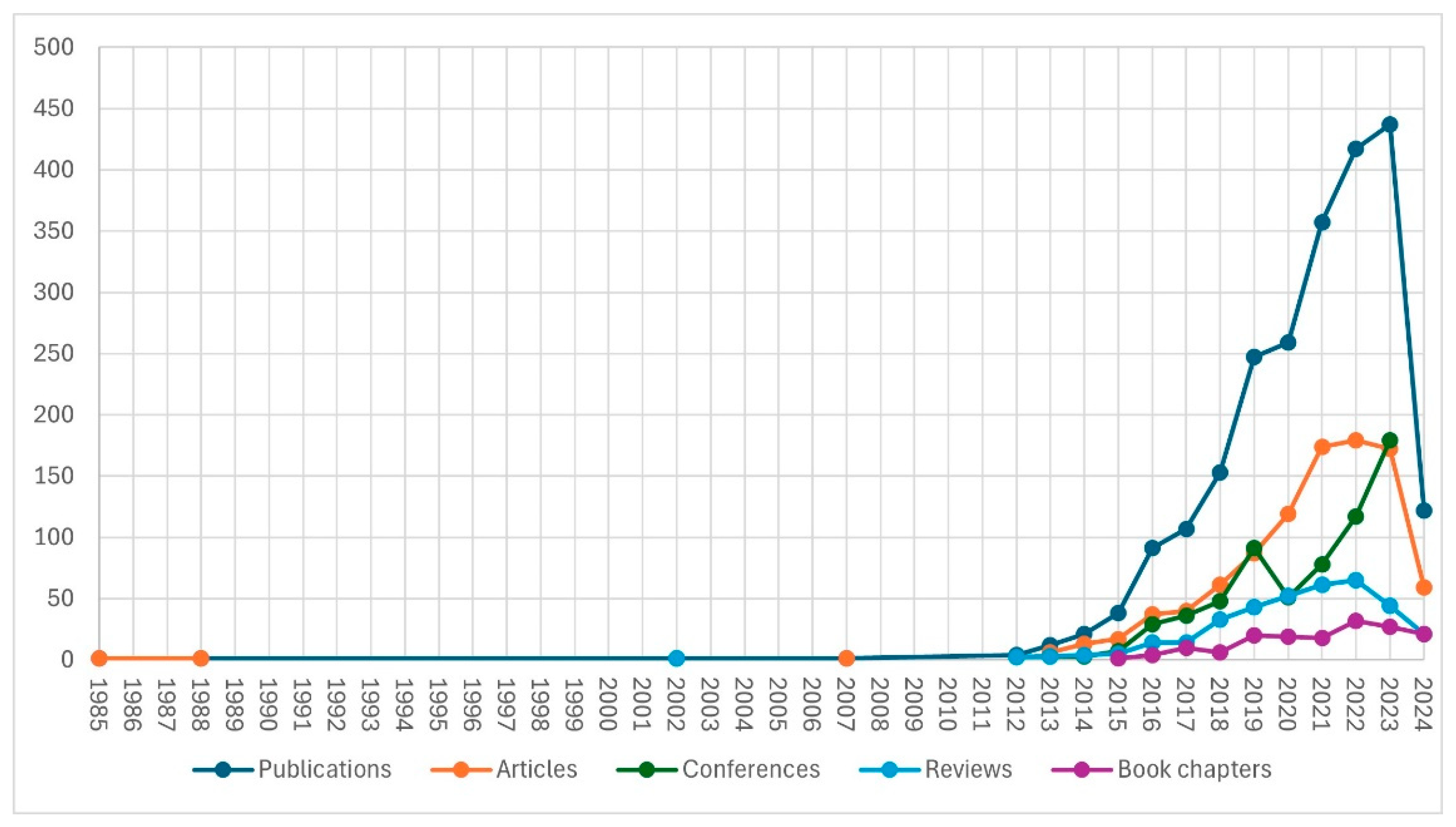
Figure 2.
Country co-operation network.
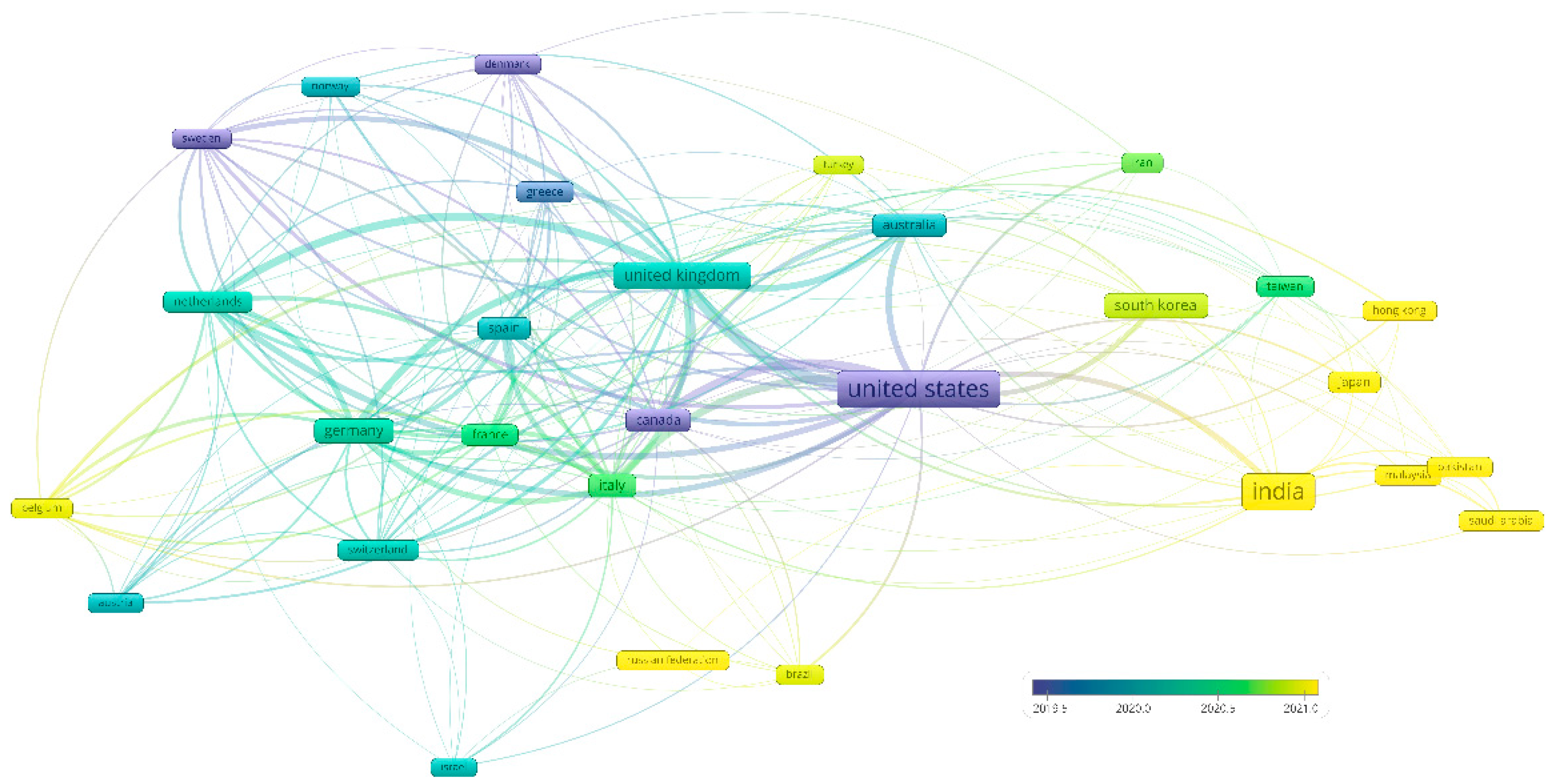
Figure 3.
Author keywords landscape, including author keywords occurring ten or more times. Each coloured cluster presents a theme.
Figure 3.
Author keywords landscape, including author keywords occurring ten or more times. Each coloured cluster presents a theme.
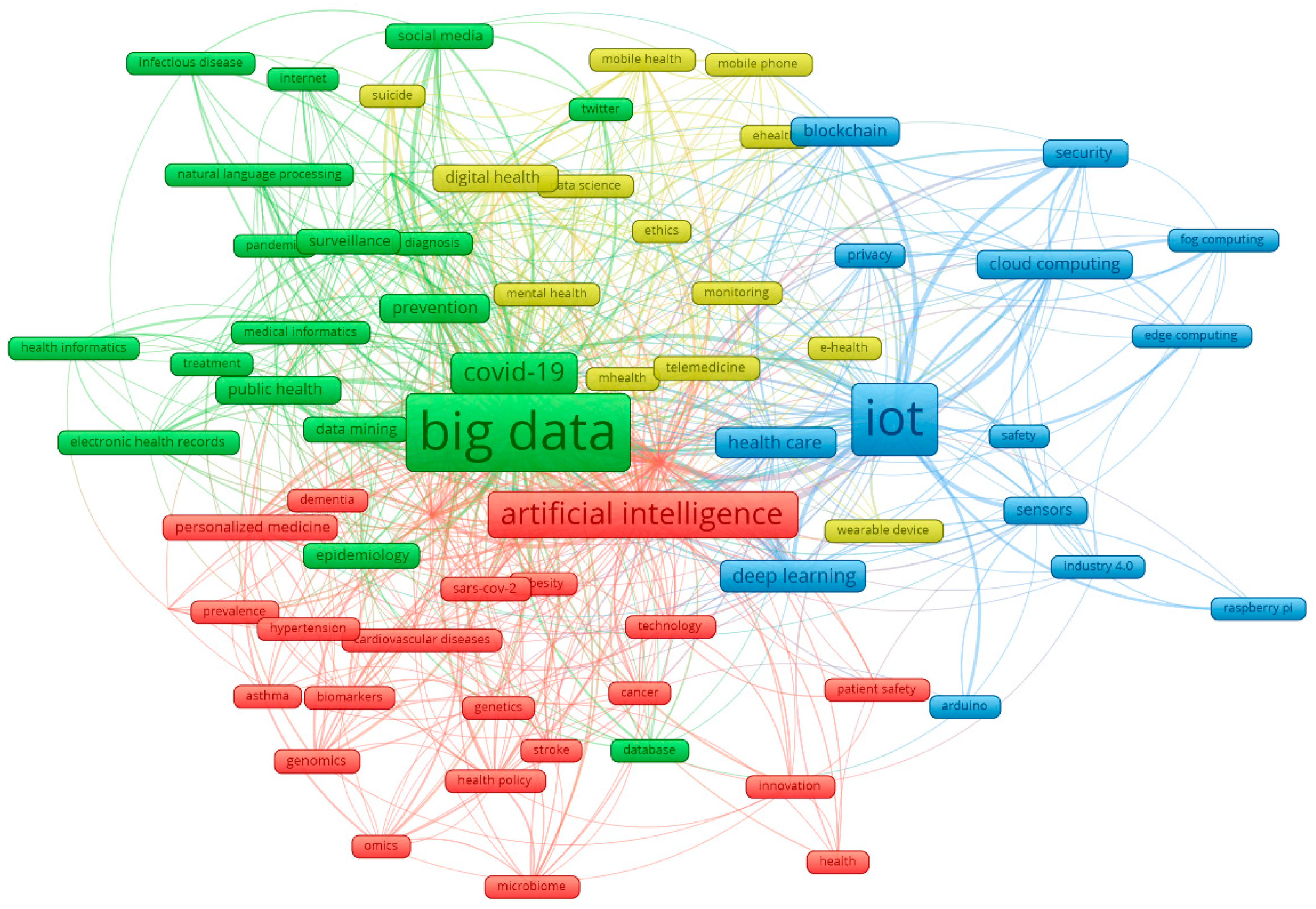
Figure 4.
Timeline keywords landscape, including authors' keywords occurring ten or more times.
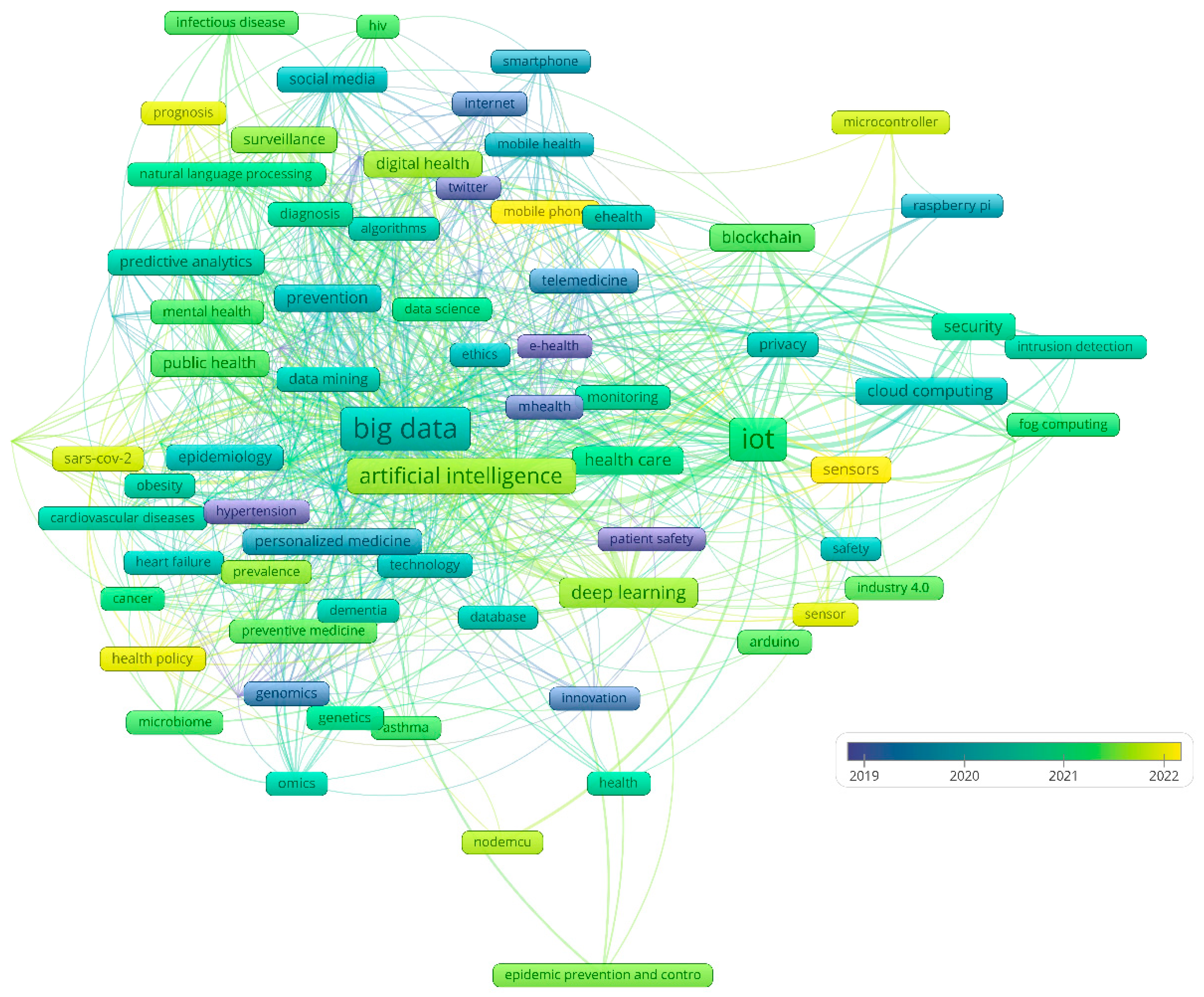

Table 1.
Most productive source titles.
| Source Title | Number of publications | H-Index in Scopus | Scopus SJR | Quarter |
| Eai Springer Innovations In Communication And Computing | 55 | 26 | 0.15 | Q4 |
| International Journal Of Environmental Research And Public Health | 54 | 198 | 0.81 | Q2 |
| Journal Of Medical Internet Research | 36 | 197 | 2.02 | Q1 |
| Studies In Health Technology And Informatics | 28 | 67 | 0.29 | Q3 |
| Frontiers In Public Health | 27 | 101 | 0.90 | Q1 |
| Journal Of Healthcare Engineering | 24 | 57 | 0.51 | Q2 |
| Safety Science | 20 | 154 | 1.28 | Q1 |
| Accident Analysis And Prevention | 17 | 188 | 1.90 | Q1 |
| BMC Public Health | 12 | 197 | 1.25 | Q1 |
| BMJ Open | 12 | 160 | 0.97 | Q1 |
Table 2.
Most cited papers.
| Authors | Title | Publication year | Source title | Cited by | SJR 2023 | Core journal |
| Tomczak K. et al. | The Cancer Genome Atlas (TCGA): An immeasurable source of knowledge | 2015 | Wspolczesna Onkologia | 1452 | 0.532 (Q2) | Yes |
| Peeri N.C. et al. | The SARS, MERS, and novel coronavirus (COVID-19) epidemics are the newest and biggest global health threats. What lessons have we learned? | 2021 | International Journal of Epidemiology | 987 | 2.663 (Q1) | Yes |
| Vaishya R.; et al. | Artificial Intelligence (AI) applications for the COVID-19 pandemic | 2020 | Diabetes and Metabolic Syndrome: Clinical Research and Reviews | 927 | 1.313 (Q1) | Yes |
| Dimitrov D.V. | Medical internet of things and big data in healthcare | 2016 | Healthcare Informatics Research | 645 | 1.628 Q1) | Yes |
| Brisimi T.S. et al. | Federated learning of predictive models from federated Electronic Health Records | 2018 | International Journal of Medical Informatics | 552 | 1,493 (Q1) | Yes |
Table 3.
The Concepts and Themes in IoT and BigD.
| Cluster color (number of keywords) | Representative author keywords (ICT viewpoint in upper cell / medical viewpoint in lower cell) | Concepts (ICT viewpoint in upper cell / medical viewpoint in lower cell) |
Theme (ICT viewpoint in upper cell / medical viewpoint in lower cell) |
|---|---|---|---|
| Red (n=26) | Artificial intelligence (n=206), Machine learning (n=205), Precision medicine (n=64), Personalised medicine (n=32), Risk prediction (n=31), Health policy (n=17), | -The use of artificial intelligence and Omics in personalized and precision medicine according to health policies; -The use of machine learning in risk prediction; -The role of personalized medicine in chronic disease management |
The role of artificial intelligence in personal, precision, and preventive medicine |
| Artificial intelligence (n=206), Personalised medicine (n=32), Sars-cov2 (n=23), Cardiovascular diseases (n=20), Genetics (n=17), Genomics (n=19), Obesity (n=15), Asthma (n=15), Cancer (n=12), Dementia (n=11), | -Use of AI in the genetics and genomics of cardiovascular diseases, cancer, dementia, obesity, asthma -Investigating an individual's risk for the most common chronic diseases -Use of AI in Sars-Cov2 management |
The role of AI in personalized medicine (genetics, genomics) in the field of the most common diseases of the modern population (cardiovascular diseases, dementia, obesity, asthma, sars-cov2, cancer) | |
| Green (n=20) | Big data (n=494), Covid-19 (n=153), Prevention (n=52), Social media (n=33), Public health (n=43), Predictive analytics (n=33), Epidemiology (n=32) | -Big data mining of social media and electronic health records used in epidemiology, predictive analysis, and prevention; -Big data analysis in public health surveillance |
The role of big data in public health |
| Big data (n=494), Covid-19 (n=153), Prevention (n=52), Public health (n=43), Surveillance (n=29) | -Use of big data and databases in the field of public health -Use of databases in epidemiology -Planning and researching prevention and survival in covid19 |
The role of big data and databases in public health, especially in the field of prevention, epidemiology, and surveillance | |
| Blue (n=14) | IoT (n=439), Deep learning (n=83), Health care (n=63), Cloud computing (n=49), Blokchain (n=48) | -IoT, Cloud Computing and deep learning, blockchain in secure and safe healthcare | The role of IoT, Cloud Computing, deep learning, and blockchain in secure and safe healthcare |
| IoT (n=439), Deep Learning (n=83), Health care (n=63), Security (n=49), Sensors (n=38), Privacy (n=24) | -Application of deep learning and IoT in healthcare -Security and privacy of IoT and deep learning -Sensitivity of the sensors for the acquisition of IoT -Importance of sensors for deep learning |
The role of IoT and deep learning in the security and privacy of health care | |
| Yellow (n=13) | Digital health (n=39), Telemedicine (n=39), Mobile health (n=30), Monitoring (n=17), suicide (n=16) | -Mobile health and wearable devices in monitoring mental health; -Digital health use in telemedicine |
The role of digital health in monitoring and Telemedicine |
| Telemedicine (n=39), Digital Health (n=39), Monitoring (n=26), Mental health (n=15), eHealth (n=14), Ethics (n=12), | -Ethical aspects of digital health and telemedicine -Data monitoring for eHealth -Ethical aspects of monitoring an individual's mental health |
The role of ethics in telemedicine and digital health |
Disclaimer/Publisher’s Note: The statements, opinions and data contained in all publications are solely those of the individual author(s) and contributor(s) and not of MDPI and/or the editor(s). MDPI and/or the editor(s) disclaim responsibility for any injury to people or property resulting from any ideas, methods, instructions or products referred to in the content. |
© 2024 by the authors. Licensee MDPI, Basel, Switzerland. This article is an open access article distributed under the terms and conditions of the Creative Commons Attribution (CC BY) license (http://creativecommons.org/licenses/by/4.0/).
Copyright: This open access article is published under a Creative Commons CC BY 4.0 license, which permit the free download, distribution, and reuse, provided that the author and preprint are cited in any reuse.


