

Submitted:
05 August 2024
Posted:
06 August 2024
You are already at the latest version
Preprints on COVID-19 and SARS-CoV-2
Abstract
The impact of scientific articles is often measured using metrics such as the Journal Impact Factor (JIF) and CiteScore, which rely on citation counts and publication volume. In this study, we aimed to identify the predictors of article impact in the leading solid organ transplantation journals from 2019 to 2020. Article impact was determined using its citation count in 2021 compared to the JIF. Statistical analysis was performed using IBM SPSS Statistics to identify significant predictors of positive impact on the JIF. A total of 2,461 articles and reviews were included, with variations observed among the top transplantation journals. Factors such as the number of authors, open access publishing, and authors from top affiliations were found to significantly influence the impact of articles. Articles discussing kidney transplantation and COVID-19 were associated with a positive impact on the JIF, while those discussing lung transplantation had a negative impact. The findings suggest that collaborative research with more authors and involvement of top institutions enhances impact. Open access publishing also correlated with increased citations and a positive impact on the JIF. Further research incorporating a broader range of journals and years would provide a more comprehensive understanding of factors influencing article impact.
Keywords:
solid organ transplantation
; impact factor
; transplantation journal
; open access
; citation analysis
; COVID-19
1. Introduction
Citations play a vital role in scientific publications by establishing durable connections to the referenced sources and attributing intellectual credit to the authors being cited [1,2]. They serve as tangible evidence of an article's reach within the scientific community, reflecting its dissemination and impact [3,4]. Furthermore, citations provide a quantitative measure of recognition, serving as a means for peers to evaluate the quality and significance of the cited work [4,5]. Consequently, being cited holds substantial value for scientists, as it serves as a motivating factor and plays a pivotal role in the assessment and evaluation of their research contributions [6].
In an effort to enhance their impact metrics, journals strive to improve their standing in the scientific community. Two widely recognized metrics, the Journal Impact Factor (JIF) developed by Clarivate®, and CiteScore developed by Elsevier®, are commonly used for this purpose [7,8,9,10]. Both metrics use similar calculation methodology, with citation on nominator and number of publications on the denominator, meaning that the more the publications or the lower the citation, the negative impact of these impact metrics. Traditionally, the impact factor (IF) of a journal has been used as an indicator of the quality of a journal and author’s scientific standing [11,12]. Several factors have been found to be correlated with the JIF, these include the country’s income level and the language of publishing, as well as variables such as study sample size and the publication year [13].
It is well known that articles published in top journals in each field receive higher citations, regardless of its topic [8,12,14]. However, if an article published in such journals received citations less than the journal’s impact factor, such articles will have a negative impact on its journal’s impact factor, meaning that it resulted in lowering this impact metric. The aim of this study was to assess factors that predict a positive impact for articles published in top five transplantation journals in their respective journals.
2. Materials and Methods
Journal Impact Factor Calculation:
The 2021 JIF for each journal was calculated by dividing the total number of citations received in 2021 for articles published in the years 2019 and 2020 by the total number of articles published during that two-year period. All data regarding citations and publications were sourced from the esteemed Web of Science database.
Identification of Top Transplantation Journals and Contributing Institutions:
The Journal Citation Report, which is connected with the Web of Science database, was utilized for our journals selection. Five solid organ transplant journals that are ranked in the first quartile (Q1) were identified and selected from this report. According to 2021 journal citation report, top solid organ transplantation journals were Journal of Heart and Lung Transplantation; American Journal of Transplantation; Nephrology Dialysis Transplantation; Liver Transplantation and Transplantation. The Web of Science classification was also used to find leading institutions that are top contributors in the field. The list included Harvard University, UDICE French Research Universities, University of London; University of California System; Pennsylvania Commonwealth System of Higher Education; exhibited more significant contributions compared to the subsequent institutions in the ranking.
Data Collection and Retrieval:
To conduct a comprehensive analysis, we retrieved all articles and reviews published in the aforementioned top transplantation journals during the years 2019 and 2020. The data retrieval process involved accessing the Web of Science database. From the journals' respective citation reports within the Web of Science platform, we obtained the total number of citations received by each article in 2021. To enrich our dataset, we collected additional data for each article, including its publication date, number of authors, number of pages, and open access status. The affiliations of the article's authors were thoroughly analyzed, and a point was attributed if any author was affiliated with one of the top 5 institutions contributing significantly to the transplantation field.
Topic Analysis and Abstract Screening:
A meticulous topic analysis of each article was conducted based on the content of its abstract. An Excel formula was employed to extract relevant keywords related to specific transplantation topics, such as Kidney, Liver, Pancreas, Heart, and Lung. Furthermore, articles discussing the impact of COVID-19 on transplantation were meticulously assessed.
Statistical Analysis:
The statistical analysis was carried out using IBM SPSS Statistics for Windows, version 26.0 (IBM Corp., Armonk, N.Y., USA). Continuous variables were described using mean (± standard deviation), while other nominal variables were presented as count (frequency). The relationship between different variables and their impact on JIF (positive or negative) was assessed through rigorous univariate analysis. For continuous variables, independent sample t-tests were employed, and for dichotomous variables, chi-square tests were utilized. Logistic regression models were applied to identify significant predictors for JIF impact among factors showing a significant relationship. A significance threshold of p-value < 0.05 was adopted, ensuring the statistical robustness and reliability of the findings.
3. Results
A total of 2,461 article and review were published by the top solid organ transplantation journals in the years 2019 and 2020, majority were published by American Journal of Transplantation (841, 34.2%), followed by Transplantation (633, 25.7%), Nephrology Dialysis Transplantation (472, 19.2%), Liver Transplantation (276, 11.2%), then Journal of Heart and Lung Transplantation (239, 9.7%).
Journals significantly differed in the percentage of articles that had positive impact (p< 0.001), with highest proportion for Transplantation (172, 27.2%), followed by Nephrology dialysis transplantation (108, 22.9%), American Journal of Transplantation (183, 21.8%), Journal of Heart and Lung Transplantation (32, 13.4%), then Liver transplantation (19, 6.9%). Figure 1
We performed univariate analysis to assess factors that are related to article’s positive or negative impact on JIF, Table 1.
Factors significant in the univariate analysis were tested in the logistic regression model Table 2.
On regression analysis, the model was significant at <0.001 with predictive accuracy of 79.1%. Nagelkerke R square was 0.053. Significant predictive factors related to article characteristics include:
- Number of authors (p= 0.006), with 1.3% (0.4% to 2.3%) increase in potential impact on JIF with increasing number of authors.
- Open access (p< 0.001), with 61.9% (28.5% to 103.9%) increase in potential impact on JIF with open access publishing.
- Author from top five affiliation (p= 0.014), with 53.8% (9% to 117%) increase in potential impact on JIF when authors from top affiliations.
Moreover, several topics were significantly predictive of JIP:
- Kidney (p< 0.001), with 63.2 % (32.1% to 101.7%) increase in potential impact on JIF for kidney related topics.
- Lung (p= 0.025), with 33.3 % (5% to 53.1%) decrease in potential impact on JIF for lung related topics
- In addition, an article that discusses COVID-19 also had a positive impact:
- COVID-19 (p< 0.001), with 1,449.8 % (886.5% to 2,371.1%) increase in potential impact on JIF for COVID-19 related topics.
4. Discussion
In this study, we assessed the factors that contributed to either a positive impact (high citation counts) or a negative impact (low citation counts) of articles published in top 5 solid organs transplantation journals. The analysis revealed significant differences in the proportion of articles with a positive impact across the transplantation journals. Notably, we found that discussing COVID-19 had the most prominent positive impact. Moreover, articles discussing kidney transplantation had a positive impact, while those discussing lung transplantation had a negative impact. This discrepancy could be attributed to the substantial effect of COVID-19 on organ transplantation, with kidney transplantation being the most affected among various specialties [15]. Kidney is the first and most frequently transplanted organ [16]. Additionally, the number of end stage kidney disease patients are growing exponentially [17]. These factors contribute to the extensive discussions and research surrounding kidney transplantation compared to topics such as liver, lung, and heart transplantation [18].
In regard to article authorship, articles with more authors or authors from top affiliations were generally more likely to have positive impact, which is consistent with previous studies that indicate a higher number of authors facilitate a wider range of expertise and a greater diversity of ideas and data types, particularly in interdisciplinary collaborations [19,20,21]. Additionally, our study revealed that open access articles had a higher chance of receiving citations and achieving a positive impact. This finding aligns with previous research conducted across a variety of disciplines including philosophy, political science, engineering, mathematics, physics, computer science and agriculture, which consistently demonstrated that open access publications exhibit greater research impact and citation rates compared to non-open access publications [22,23,24,25].
Despite the significant findings of this study, there are several limitations that should be acknowledged. Firstly, the study focused only on the top five transplantation journals, which may not be representative of the entire field. The findings may not be applicable to journals outside of this sample. Secondly, the study only considered articles published in 2019 and 2020, limiting the temporal scope of the analysis. Future research could incorporate a broader range of publication years to capture any potential trends or changes over time. Additionally, the study relied on citation counts as a measure of impact, which may not fully capture the influence or quality of an article. Other indicators could provide a more comprehensive assessment of impact.
5. Conclusions
This study explored the factors contributing to the impact of articles published in top transplantation journals. The findings suggest that discussing COVID-19 and kidney transplantation are associated with a positive impact, while lung transplantation has a negative impact. The substantial effect of COVID-19 on organ transplantation and the increased research focus on this topic likely contribute to these findings. Furthermore, articles with more authors or authors from top affiliations are more likely to have a positive impact, highlighting the value of collaboration and diverse expertise. Additionally, open access articles have a higher likelihood of receiving citations and achieving a positive impact.
These findings offer valuable insights into the drivers of impact in transplantation research, providing guidance for authors and journals aiming to enhance their scientific standing. Collaborative efforts with multiple authors can foster interdisciplinary perspectives and elevate the quality and impact of publications. Additionally, open access publishing can broaden the accessibility of research findings, facilitating knowledge dissemination and potentially boosting citations.
Author Contributions
Conceptualization: Badi Rawashdeh. Methodology and Validation: Badi Rawashdeh and Saif Aldeen Alryalat. Formal Analysis: Saif Aldeen Alryalat. Writing – Original Draft Preparation: Badi Rawashdeh, Saif Aldeen Alryalat, Raj Prasad. Writing – Review & Editing: Badi Rawashdeh, Ty Dunn, Matthew Cooper, Haneen Al-Abdallat, Yasser Al-Rayyan. Supervision: Ty Dunn, Matthew Cooper, Yasser Al-Rayyan.
Funding
This research received no external funding.
Data Availability Statement
Data is available upon request.
Conflicts of Interest
None.
References
- Hagstrom, W. 1965 The scientific community. New York, Basic Books. 1965.
- Kaplan, N. The norms of citation behavior: Prolegomena to the footnote. American documentation. 1965;16(3):179-84. [CrossRef]
- Garfield, E. Citation indexes for science: A new dimension in documentation through association of ideas. Science. 1955;122(3159):108-11. [CrossRef]
- Cronin, B. The citation process. The role and significance of citations in scientific communication. 1984;103.
- Merton, RK. The Matthew effect in science, II: Cumulative advantage and the symbolism of intellectual property. isis. 1988;79(4):606-23.
- Cole JR, Cole S. Social Stratification in Science [by] Jonathan R. Cole & Stephen Cole: University of Chicago Press; 1973.
- Time to remodel the journal impact factor. Nature. 2016;535(7613):466. [CrossRef]
- Brown T, Gutman SA. Impact factor, eigenfactor, article influence, scopus SNIP, and SCImage journal rank of occupational therapy journals. Scand J Occup Ther. 2019;26(7):475-83. [CrossRef]
- Callaway, E. Beat it, impact factor! Publishing elite turns against controversial metric. Nature. 2016;535(7611):210-1. [CrossRef]
- Baker, DW. Introducing CiteScore, Our Journal's Preferred Citation Index: Moving Beyond the Impact Factor. Jt Comm J Qual Patient Saf. 2020;46(6):309-10. [CrossRef]
- Wang YX, Arora R, Choi Y, Chung HW, Egorov VI, Frahm J, et al. Implications of Web of Science journal impact factor for scientific output evaluation in 16 institutions and investigators' opinion. Quant Imaging Med Surg. 2014;4(6):453-61. [CrossRef]
- Villasenor-Almaraz M, Islas-Serrano J, Murata C, Roldan-Valadez E. Impact factor correlations with Scimago Journal Rank, Source Normalized Impact per Paper, Eigenfactor Score, and the CiteScore in Radiology, Nuclear Medicine & Medical Imaging journals. Radiol Med. 2019;124(6):495-504. [CrossRef]
- Yousefi-Nooraie R, Shakiba B, Mortaz-Hejri S. Country development and manuscript selection bias: a review of published studies. BMC Med Res Methodol. 2006;6:37. [CrossRef]
- Nielsen MB, Seitz K. Impact Factors and Prediction of Popular Topics in a Journal. Ultraschall Med. 2016;37(4):343-5. [CrossRef]
- Rawashdeh B, AlRyalat SA, Abuassi M, Syaj S, Jeyyab MA, Pearson T, et al. Impact of COVID-19 on abdominal organ transplantation: A bibliometric analysis. Transpl Infect Dis. 2023:e14027. [CrossRef]
- Hatzinger M, Stastny M, Grutzmacher P, Sohn M. [The history of kidney transplantation]. Urologe A. 2016;55(10):1353-9. [CrossRef]
- Thurlow JS, Joshi M, Yan G, Norris KC, Agodoa LY, Yuan CM, et al. Global Epidemiology of End-Stage Kidney Disease and Disparities in Kidney Replacement Therapy. Am J Nephrol. 2021;52(2):98-107. [CrossRef]
- Lentine KL, Smith JM, Hart A, Miller J, Skeans MA, Larkin L, et al. OPTN/SRTR 2020 Annual Data Report: Kidney. Am J Transplant. 2022;22 Suppl 2:21-136. [CrossRef]
- Fox CW, Paine CET, Sauterey B. Citations increase with manuscript length, author number, and references cited in ecology journals. Ecol Evol. 2016;6(21):7717-26. [CrossRef]
- Scully, C. The positive and negative impacts, and dangers of the impact factor. Community Dent Health. 2007;24(3):130-4.
- J.Sylvan Katz BRM. What is research collaboration? 1997;26(1):1-18. [CrossRef]
- Lawrence, S. Free online availability substantially increases a paper's impact. Nature. 2001;411(6837):521. [CrossRef]
- AlRyalat SA, Saleh M, Alaqraa M, Alfukaha A, Alkayed Y, Abaza M, et al. The impact of the open-access status on journal indices: a review of medical journals. F1000Res. 2019;8:266. [CrossRef]
- MacCallum CJ, Parthasarathy H. Open access increases citation rate. PLoS Biol. 2006;4(5):e176. [CrossRef]
- Riera M, Aibar E. [Does open access publishing increase the impact of scientific articles? An empirical study in the field of intensive care medicine]. Med Intensiva. 2013;37(4):232-40. [CrossRef]
Figure 1.
Distribution of articles with positive and negative impact across top transplantation journals.
Figure 1.
Distribution of articles with positive and negative impact across top transplantation journals.
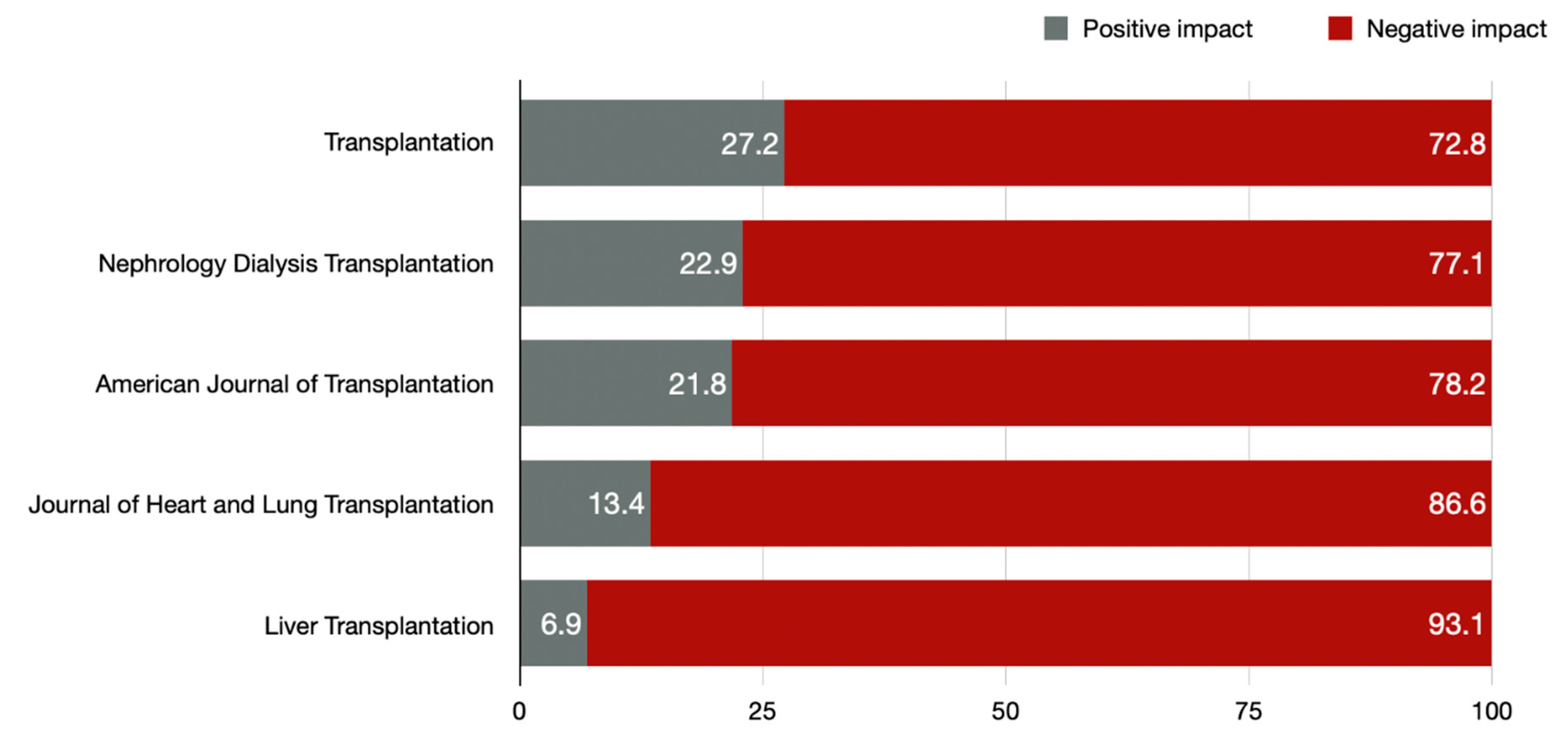

Table 1.
Univariate analysis of different variables and their relation to impact on JIF.
| Negative | Positive | |||||||
|---|---|---|---|---|---|---|---|---|
| Mean (±SD) | Count | Column N % | Mean (±SD) | Count | Column N % | p value | ||
| Pages | 8 (±3) | 9 (±3) | 0.12 | |||||
| Number of authors | 10.36 (±10.25) | 12.3 (±11.46) | 0.001 | |||||
| Year | 2019 | 860 | 44.2% | 242 | 47.1% | 0.129 | ||
| 2020 | 1087 | 55.8% | 272 | 52.9% | ||||
| Open Access | No | 752 | 38.60% | 125 | 24.30% | <0.001 | ||
| Yes | 1195 | 61.40% | 389 | 75.70% | ||||
| Top Affiliation | No | 1787 | 91.80% | 459 | 89.30% | 0.048 | ||
| Yes | 160 | 8.20% | 55 | 10.70% | ||||
| Kidney | No | 1118 | 57.40% | 221 | 43.00% | <0.001 | ||
| Yes | 829 | 42.60% | 293 | 57.00% | ||||
| Liver | No | 1363 | 70.00% | 366 | 71.20% | 0.318 | ||
| Yes | 584 | 30.00% | 148 | 28.80% | ||||
| Pancreas | No | 1885 | 96.80% | 497 | 96.70% | 0.49 | ||
| Yes | 62 | 3.20% | 17 | 3.30% | ||||
| Heart | No | 1548 | 79.50% | 431 | 83.90% | 0.015 | ||
| Yes | 399 | 20.50% | 83 | 16.10% | ||||
| Lung | No | 1574 | 80.80% | 440 | 85.60% | 0.007 | ||
| Yes | 373 | 19.20% | 74 | 14.40% | ||||
| COVID-19 | No | 1924 | 98.80% | 436 | 84.80% | <0.001 | ||
| Yes | 23 | 1.20% | 78 | 15.20% | ||||
Table 2.
Regression analysis of different variables and their relation to impact on journal impact factor (JIF).
Table 2.
Regression analysis of different variables and their relation to impact on journal impact factor (JIF).
| B value | Standard error | p value | Confidence interval (CI) | 95% CI | |||
|---|---|---|---|---|---|---|---|
| Lower | Upper | ||||||
| Step 1a | Number of authors | 0.013 | 0.005 | 0.006 | 1.013 | 1.004 | 1.023 |
| Open access | 0.482 | 0.118 | 0.000 | 1.619 | 1.285 | 2.039 | |
| Author from top affiliation | 0.431 | 0.176 | 0.014 | 1.538 | 1.090 | 2.170 | |
| Topic: Kidney | 0.490 | 0.108 | 0.000 | 1.632 | 1.321 | 2.017 | |
| Topic: Lung | -0.405 | 0.180 | 0.025 | 0.667 | 0.469 | 0.950 | |
| Topic: Heart | -0.105 | 0.165 | 0.522 | 0.900 | 0.652 | 1.243 | |
| Topic: COVID-19 | 2.674 | 0.251 | 0.000 | 14.498 | 8.865 | 23.711 | |
| Constant | -2.157 | 0.129 | 0.000 | 0.116 | |||
Disclaimer/Publisher’s Note: The statements, opinions and data contained in all publications are solely those of the individual author(s) and contributor(s) and not of MDPI and/or the editor(s). MDPI and/or the editor(s) disclaim responsibility for any injury to people or property resulting from any ideas, methods, instructions or products referred to in the content. |
© 2024 by the authors. Licensee MDPI, Basel, Switzerland. This article is an open access article distributed under the terms and conditions of the Creative Commons Attribution (CC BY) license (https://creativecommons.org/licenses/by/4.0/).
Copyright: This open access article is published under a Creative Commons CC BY 4.0 license, which permit the free download, distribution, and reuse, provided that the author and preprint are cited in any reuse.