
Submitted:
31 July 2024
Posted:
01 August 2024
Read the latest preprint version here
Abstract
This paper explores the geometric impossibility of angle trisection within Euclidean geometry, with a particular focus on the 90° angle. It presents a rigorous proof that highlights the fundamental limitations of various approaches to angle trisection, highlighting their failure to achieve universality. The paper critiques modern proofs that allow for the trisection of certain angles while dismissing others, arguing that such methods are inherently flawed due to their lack of geometric consistency. The paper introduces a new perspective through a new property named “inconsistent property”, a concept derived from geometric operations involving proportional magnitudes. This property reveals contradictions within the framework of Euclidean geometry, paralleling the logical challenges faced in proving the impossibility of trisecting an arbitrary angle. By drawing comparisons between traditional and contemporary proofs, the paper demonstrates that inconsistencies arise not only from specific cases but also from broader geometric principles. The findings reaffirm the robustness of Euclidean geometry in addressing the trisection problem and challenge the validity of alternative proofs that do not adhere to universal geometric principles. This paper contributes to a clearer understanding of the limitations of angle trisection methods and encourages further investigation into the technical implications and broader impact of the angle impossibility proof.
Keywords:
Angle Trisection
; Euclidean Geometry
; Impossibility Proof
; Geometric Inconsistency
; Inconsistent Property
; Proof Validity
; Geometric Reasoning
; Incommensurability
1. Introduction
The quest to trisect an arbitrary angle has captured the imaginations of mathematicians and geometers for centuries. From ancient civilizations to modern scholars, attempts have been made to unveil the secrets that lie within angles and uncover the hidden possibilities of their division. Historical records from Greek, Indian, and Chinese mathematicians all indicate a rich tradition of exploring this geometric challenge, driven by the desire to expand the boundaries of mathematical knowledge [1,2,3,4]. However, despite the allure and persistence of this problem, a conclusive solution has eluded us. The angle trisection problem is deceptively simple yet profoundly complex, embodying the intricate relationship between geometric constructions and algebraic constraints [1]. Within the rich framework of Euclidean geometry, this paper aims to shed new light on the angle trisection impossibility by presenting a rigorous proof based on the foundational principles of this geometric system. Euclidean geometry, with its axiomatic structure and logical rigor, provides an ideal platform for exploring the inherent limitations of geometric constructions. The enduring nature of Euclidean principles underscores their robustness in addressing fundamental questions in geometry [1,5]. By focusing on the inherent geometric inconsistencies encountered in Euclidean operations, this paper aims to present a rigorous proof demonstrating the impossibility of trisecting an arbitrary angle using only a compass and straightedge. This approach not only honors the legacy of Euclidean methods but also aligns with modern mathematical practices that emphasize the importance of logical coherence and structural consistency [6,7]. The primary named author of this paper initially held the misconception that the angle trisection problem could be solved within the constraints of modern mathematics. Operating within the confines of Euclidean geometry, although with limited understanding of the problem’s complexities, the author developed methods yielding approximations of varying degrees of accuracy, as detailed in [8,9]. While these solutions demonstrated impressive precision, a subsequent reevaluation revealed their fundamental flaw: they would not be considered geometrically exact by Euclidean standards. Although these approximations might be valuable to certain audiences, this paper adopts a contrary geometric approach. The author posits that this new perspective aligns more closely with the expectations of the broader mathematical community, including those of Euclid himself. This initial belief was shared by many who explored algebraic and geometric avenues to solve the problem [10]. A comprehensive examination of historical and contemporary attempts, however, unveiled a pervasive misunderstanding of the angle trisection problem’s core requirement: an exact solution applicable to all angles. Numerous approaches, while effective for specific angles, ultimately failed to meet this criterion. The misconceptions prevalent in modern approaches often stem from a fragmented understanding of geometric constructions and their limitations. These approaches frequently employ advanced mathematical tools that diverge from the classical Euclidean framework, resulting in solutions that lack the generality required for a true resolution of the trisection problem [11,12]. The angle trisection problem does not seek distinct procedures that work for specific angles but rather a procedure that universally applies to all angles, regardless of their specific values. This paper addresses these misconceptions by emphasizing the logical structure of Euclidean geometry and the necessity of a unified approach to angle trisection. By rigorously examining the geometric inconsistencies inherent in proposed trisection methods, this paper aims to demonstrate the impossibility of trisecting an arbitrary angle, thereby providing a definitive answer grounded in the principles of Euclidean geometry [13]. The focus is not only to explore the profound beauty and elegance of Euclidean geometry but also to confront one of its deepest mysteries - the impossibility of angle trisection. It will be demonstrated that within the confines of Euclidean geometry, the very essence of its logical structure gives rise to the inescapable conclusion that trisecting an arbitrary angle using only a compass and straightedge is an unattainable feat. The approach to unraveling the secrets of angle trisection stems from a deep appreciation for the inherent power and limitations of Euclidean geometry. By exploiting the rich tapestry of axioms, theorems, and logical reasoning that underpin Euclidean geometry, a comprehensive proof is constructed that illuminates the impossibility of angle trisection. A key aspect of this analysis involves examining geometric operations that yield apparent inconsistencies, specifically when applying the notion of proportional magnitudes. For example, the geometric inconsistency arises when the length of the diagonal of a square is doubled and then this length is cubed. While both operations yield the same numerical result of , the ratios involved in these operations, when interpreted through Euclid's Proposition 3, reveal that they are not proportional. This kind of logical structure will be employed in establishing the typical Euclidean geometric requirement for a generic angle's non-trisectability impossibility. By focusing on specific angles, such as , the inherent limitations of trisecting angles are unveiled. Through a scrupulous and detailed impossibility proof, the power of Euclidean geometry to provide a definitive answer to the trisection problem is showcased. Establishing the impossibility of trisecting the angle lays the groundwork for extending this impossibility to all angles, encompassing the entirety of the trisection problem. The modern approaches to the angle trisection impossibility proof exhibit significant limitations. By translating the problem into an algebraic domain [10,14], these proofs narrowly focus on specific angle cases, thereby restricting their general applicability. Each unique angle necessitates a separate proof, resulting in a fragmented body of evidence rather than a cohesive framework. This lack of unification undermines the strength and universality of the claim that angle trisection is impossible. The absence of a comprehensive proof for the impossibility of trisecting any angle necessitates a thorough investigation. A fundamental implication of such a proof is its reliance on logically consistent mathematical principles. For example, it would be contradictory to assert that a angle cannot be precisely trisected while acknowledging the Euclidean construction of a angle. To rectify this inconsistency, this paper challenges the prevailing notion that the constructability of a specific angle does not imply the feasibility of trisection. It proposes that a universal geometric method capable of trisecting any angle would inherently enable the construction of any fractional part of a known angle. This paper contends that there is no inherent connection between the constructability of a specific angle and the general trisection problem. Consequently, building upon the demonstrated logical inconsistencies in geometry, the provided proof based on the trisection of a angle offers a more generalized solution. It effectively addresses the misconception central to the angle trisection problem by exposing the fallacy of selectively permitting the trisection of certain angles while denying it for others. Such an approach fails to meet the requisite standards of geometric generality. The provided proof tackles this misconception by demonstrating that the non-trisectability of the angle, which is representative of all angles, implies the impossibility of trisecting any angle. It is important to clarify here that angles in Euclidean geometry do not inherently possess a common shared characteristic. Rather, any trisection procedure proposed for angles inherently exhibits a shared characteristic that leads to a contradiction when viewed through the lens of Euclidean geometry. This contradicts the notion that angles possess a universal property hindering their trisection. Furthermore, the angle's trisection impossibility proof presented in this paper does not hinge on the specific characteristics or properties of the angles themselves. Instead, it focuses on the logical structure of any proposed angle trisection proof. Therefore, the impossibility proof, which centers on the trisection of a angle, establishes that no single procedure can successfully trisect any angle. This holds true regardless of the individual characteristics and properties of the angle in question. By establishing the Euclidean geometric requirements for a unified proof of the impossibility of angle trisection, this paper marks a significant departure from previous approaches to the problem. While others have turned to alternative geometries or advanced mathematical concepts, this paper firmly grounds its exploration within the domain of Euclidean geometry. The proof provided embraces the core principles of Euclidean geometry, demonstrating its strength, logical structure, and the profound insights it offers into the limits of geometric possibility. The objective is not only to provide a conclusive solution to the angle trisection problem but also to celebrate the elegance and power of Euclidean geometry as a robust mathematical framework capable of addressing complex challenges. This innovative and rigorous approach aims to inspire further investigations into geometric problems and open new avenues of research in the field. The impossibility of angle trisection within the Euclidean geometric system serves as a testament to the depth and richness of mathematical exploration, where even seemingly simple questions can lead to profound insights and discoveries. The following sections present the detailed proof of the trisection impossibility, highlighting each logical step and justifying the conclusions. Additionally, the implications of this result and its significance in the broader context of geometry and mathematical exploration are discussed.
1.1. A Characteristic Geometric Inconsistency-On Basepoint Operations
This section involves exploring a characteristic geometric inconsistency through basepoint operations, specifically focusing on two geometric problems: doubling the diagonal of a square and cubing a square diagonal. By analyzing these constructions, the section reveals how certain operations lead to inconsistencies when interpreted through Euclidean geometry's principles. The contradiction observed in the operations-where doubling a diagonal and cubing it lead to differing proportional results-mirrors the challenge faced in proving the universal impossibility of trisecting an arbitrary angle. While modern proofs may suggest that some angles, such as , could potentially be trisected, the geometric inconsistency highlights a deeper issue: any proposed trisection procedure that works for specific angles often fails to satisfy universal applicability.
1.1.1. Geometric Foundations
The foundation of this proof is built upon Euclid's definitions, axioms, and selected propositions as outlined below (Extracted from [6,15,16]).
Definition 1 (Point). A point is that which has no part.
Definition 2 (Line). A line is breadthless length.
Definition 3 (Line Segment). A line segment is a part of a line that is bounded by two distinct end points.
Axiom 1 (Transitivity of Equality). Things which are equal to the same thing are also equal to one another.
Axiom 2 (Additive Property). If equals be added to equals, the wholes are equal.
Proposition 1 (Square of a Line Segment). The area of a square is the product of its two sides.
Proposition 2 (Volume of a Cube). The volume of a cube is the product of its three dimensions.
Problem 1 (Doubling the Square Diagonal). Consider a geometric problem involving the doubling of the diagonal of a square denoted as . The problem is reduced to doubling the length of the diagonal of the square, with the following construction steps starting from basepoints and .
- Construct a line from the point to the point .
- Construct the square of side-lengths , and vertices , , and .
- Construct the diagonal , between the points vertices and .
- The result is depicted in Figure 1.
Doubling the Square. Doubling the square involves constructing a new square with a diagonal that is twice the length of the original square's diagonal. Starting with a square with side lengths , and diagonal , the construction entails extending the line segment from point to point doubling the length of the original side according to Lemma 1 and Lemma 2.
Lemma 1 (Transitivity of Equality). For the extension operation between the points , and , .
Proof.
- Construct a circle with radius , centered at the point .
- Construct a circle with radius , centered tat the point .
- Output .
- The circle intersects the line through the point .
Thus, by construction, the length is congruent to , leading to the conclusion that the new length (as illustrated in Figure 2).
Lemma 2 (Additive Property). Starting from the basepoints and , .
Lemma 2 allows for a construction of a new square starting from the baseline , that doubles the contents of the initial square .
Proof.
- Construct a square with side-lengths and vertices , , and .
- Construct the diagonal between the points and .
- Construct circle with radius , centered at the point .
- Construct circle with radius , centered at the point .
The circle intersects the circle through the point . Therefore, by construction, , implying that and hence, .
Definition 4 (Ratio). A ratio is a quantitative relation between two amounts showing the number of times one value is contained within the other.
Applying the notion of ratios on the squares contents;
Thus, the area of square is twice that of square . Consequently, the diagonal of the square has been effectively doubled.
Problem 2 (A Special Case of Cubing the Square Diagonal). Construct a cube whose volume is equal to twice the volume of a cube constructed with the diagonal of a square as its side length.
Consider the following of construction steps starting with the basepoints and , proceeding from problem 1.
- Construct a base square face ), with side-lengths .
- Construct the plane ) parallel to ).
- Construct the vertical to and perpendicular edges on ); , , and .
- Output the cube , ).
Claim 1. All the geometric points along the line segment , when collected, will completely fill the volume within the cube .
Proof.
The proof depends on the concept of ratios and proportional magnitudes as established in Euclidean theory.
Proposition 3 (Proportional Magnitudes). If four magnitudes are proportional, the first is to the second as the third is to the fourth. This proposition is also interpretable as follows;
Scenario Analysis
Let the hypotenuse length .
Scenario 1. Doubling the Lengths
The statement: has been constructed following Euclidean geometric rigor. This operation envisions two line segments, each with a length of , placed end-to-end, giving a total length of .
Scenario 2. Cubing the Side Length
From a geometric perspective, this scenario has been sought as follows:
A square with side length was constructed. The area of this square would be found as; . Extending this square into a three-dimensional cube by multiplying the area of the square by the side length gives a volume of .
To verify the consistency of this approach, the ratio for the cubed side length scenario is applied as follows.
Therefore, despite involving different types of geometric magnitudes, the ratio between the diagonal of a doubled square and the volume of a cube constructed using the diagonal of the original square consistently equals 1.
Proof of the Inconsistency
Applying the earlier established notion of proportional magnitudes:
Let, , , and .
Where;
.
.
.
.
Equation 2 can then be checked as follows:
According to Proposition 3, for the magnitudes to be proportional, the ratios should be equal. Here we see: . This result indicates that the operations are not proportional in the context of Proposition 3.
The inconsistency observed arises from the different geometric interpretations and operations:
Doubling the Lengths. This operation scales the original length linearly by a factor of 2.
Cubing the Side Length. This operation involves both squaring the length to get an area and then multiplying by the original length again, leading to a volume interpretation.
Analyzed within the Euclidean geometry, these different operations on the same initial length do not maintain the same ratios when interpreted through Proposition 3 (Proportional Magnitudes). This highlights that while both operations yield the same numerical result, the paths taken (and their geometric meanings) are fundamentally different, leading to non-proportional magnitudes. Though the subsequent sections of proofs, this geometric inconsistency will be referred to as the “inconsistent proportional property (inconsistent property)”. The provided logical structure of the inconsistent property will be shown to parallel the challenge faced in proving the impossibility of trisecting an arbitrary angle within Euclidean geometry. It will be established that when applied to the angle trisection problem, this approach reveals that any proposed method to trisect an angle-regardless of its success in specific cases-ultimately encounters contradictions or inconsistencies when generalized. The Euclidean geometric framework demands that any universal trisection procedure must be consistent across all cases, without leading to operational or magnitude inconsistencies. Thus, the exploration of proportional magnitudes and their inconsistencies serves as a foundation for demonstrating the generic impossibility of angle trisection. The inherent contradictions emerging from geometric operations underscore the broader difficulty in establishing a universally applicable trisection method within the Euclidean system.
2. Limitations of the Modern Angles Trisection Impossibility Proof
2.1. Non-Adherence to Euclidean Geometry. In objection to its Euclidean geometric validity, this paper assert that the modern angles non-trisectability impossibility proof does not adhere to Euclidean geometric structure.
1. The modern proof of angles trisection impossibility, often attributed to the work of Pierre Wantzel [17], utilizes techniques from non-Euclidean geometries, specifically algebraic methods involving field extensions. This approach attempts to demonstrate that the trisection problem cannot be solved using compass and straightedge constructions within the scope of Euclidean geometry. However, the proof suffers the following limitations.
Non-Euclidean Techniques. The non-Euclidean approach departs from the traditional framework of Euclidean geometry, introducing algebraic concepts and field extensions. This departure raises concerns about the compatibility and applicability of these techniques within the context of geometric constructions.
Lack of Intuitive Geometric Reasoning. The non-Euclidean approach may involve complex algebraic calculations and manipulations, making it less accessible to those with a foundational understanding of Euclidean geometry. It often lacks the geometric intuition and visual representation that are characteristic of traditional geometric proofs.
Limited Insights into Euclidean Geometry. By shifting the problem to a non-Euclidean context, the existing approach fails to fully explore and leverage the rich geometric principles and axioms of Euclidean geometry. It misses an opportunity to provide a deeper understanding of the inherent limitations and possibilities of classical compass and straightedge constructions.
Lack of Common Property. In Euclidean geometry, angles do not have a single common property that allows them to be universally trisected. Angles vary in their measures and properties, which makes it impossible to establish a single criterion that encompasses all angles. This lack of a common property contradicts the assumption that all angles can be treated uniformly. Genetically, this is a limitation of the logic employed when establishing the conclusion of the angles non-trisection proofs based on negating a universal statement to an existential statement.
2.2. Inadequate Euclidean Logical Structure. The primary limitation of the existing modern impossibility proof (the non-trisectability non-Euclidean impossibility proof [17]) lies in its lack of detailed understanding and equivalence to established impossibility proofs within the Euclidean geometric system [18]. A careful examination reveals that the modern angles trisection impossibility logical structure relies on negating a universal statement to an existential statement. This logical methodic approach pose one of the serious misconceptions exhibited in translating the angles trisection problem from its inherent geometric formulation to a anti-Euclid formulation; regarding what the geometric desires is, for the angles trisectionng problem. We assert that these misconceptions and the inherent logical structural flaws exhibited in the modern non-Euclidean proof of the angles non-trisctability impossibility is not permissible for a Euclidean geometric proof, at least.2.3. Contrasting Modern and Traditional Approaches to Angle Trisection Impossibility
The traditional Euclidean geometry [1,5], with its strict adherence to axioms and construction methods, seemed to face an insurmountable challenge when attempting to trisect angles using only a compass and straightedge. This led some researchers to explore alternative, non-Euclidean methods as potential solutions [1,10,19]. However, this paper takes a bold and innovative approach, capitalizing on the inherent incompatibility between these two approaches to unlock the definitive resolution to the angles trisectability problem within the Euclidean geometric framework. We project that if the desire was to demonstrate the angles trisection impossibility, then the Euclidean geometric system is sufficient enough to conceive the proof. To substantiate this approach, we draw upon the concept of incommensurability between the diagonal of a square and its side-length [20,21]. This classic example, which has been extensively explored in Euclidean geometry, provides a counter-typical interpretation that emphasizes the divergence between traditional norms and the non-Euclidean solutions employed to tackle Euclidean geometric problems. Typically, it is commonly assumed that the logical structure on the modern proof of the angles trisection impossibility is similar to the framework exhibited in the incommensurability between the diagonal of a square and its side-length [1,19]. We demonstrate that the logical structure of the incommensurability proof, a quintessential Euclidean method, is fundamentally incompatible with the logical structure required to prove angles’ non-trisectability with the use of the anti-Euclidean methods. In particular, we highlight that while the incommensurability proof establishes with certainty that the diagonal of a square is incommensurate with its side-length, the modern angles non-trisectability proof operates on a different logical framework. To achieve this, we rely on implicative, analogous to the logical conclusions of the modern angles trisection impossibilities, the operation of negating a universally quantified function [22,23]. So this section aims to bridge the gap between these conflicting approaches by offering a comprehensive analysis that combines the counter-typical Euclidean interpretation of incommensurability with the logical structure of the angles non-trisectability problem. Through this integration, we provide a definitive resolution to the angles trisectability problem within the Euclidean framework, firmly establishing the supremacy of traditional Euclidean geometric principles and rendering non-Euclidean methods unnecessary. The paper shows that by shifting the focus to the trisectability of specific angles, the modern impossibility proof fails to meet the traditional Euclidean commensurability logical test. Moreover, by narrowing the scope to specific angles, the modern angles trisection impossibility proof deviates from the universal perspectives inherent in classical Euclidean geometry [11,24]. This shift undermines the universality and generality of the impossibility statement, making it less applicable to the broader understanding of angles trisection within the Euclidean geometric system. Further, we establish the universality of the impossibility of trisecting the angle within the Euclidean geometric framework. By demonstrating that even the angle cannot be trisected using only a compass and straightedge, we establish the broader impossibility of trisecting arbitrary angles.
2.3.1. Universal Statement Negation in Angle Trisection Proofs
The relation between the negation of a universally quantified function and the angle trisection problem can be explored through a logical interpretation of the problem.
. The angle trisection problem asks whether it is possible to divide any angle into three equal parts using only straightedge and compass operations.
From modern perspective, we can formally denote the property “An angle can be trisected” as .
Assuming we have a domain of all possible angles, we can express the trisection problem as a universally quantified statement; .
This statement asserts that for every angle in the domain, the property holds, meaning every angle can be trisected.
To explore the negation of this statement, we apply the rule stated earlier; change the universal quantifier to an existential quantifier and negate the quantified formula. Therefore, the negation of the angle trisection problem would be; .
This statement asserts that there exists at least one angle for which the property does not hold, meaning there is at least one angle that cannot be trisected.
Thus, the negation of the universally quantified statement about the angle trisection problem reflects the possibility that not all angles can be trisected using a straightedge and compass. It suggests the existence of at least one angle that resists trisection with the given tools.
2.3.2. Universal Statement Negation in Incommensurability Proofs
The aim of this section is to employ the negation of the universally quantified functional approach to demonstrate that the ratio between the diagonal of a square and its side length is an irrational number (quantity from a geometric perspective), highlighting the incommensurability of the diagonal with the side length, as expressed in the usual Euclidean terminology.
2. In this section, we will slightly be concerned with terminology. We well apply the use of the terms; “commensurate” and “rational” and, “incommensurate” and “irrational” interchangeably, respectively, whenever they apply. We will also consider the genetic condition that the number zero is not permitted in the Euclidean geometric system. This condition ensures that there will be no deviation, when using numbers as a representation of geometric magnitudes. In Euclidean geometry, ratios play a fundamental role in comparing the magnitudes of different geometric quantities [25].
Let us denote the diagonal of a square as “” and its side length as “”.
The ratio between the diagonal and the side-length can be expressed as .
In Euclidean geometry [25], a ratio is a comparison of two quantities in terms of their relative sizes, often expressed as a fraction or a quotient. So, the initial assumption is based on the notion of ratios, and we will proceed to show a contradiction that arises from this assumption.
. The ratio is rational.
According to the negation of a universally quantified function, this assumption can be restated as the existence of an integer such that . Rearranging the equation;
Now, consider a square with a diagonal and a side-length . Using the Pythagorean theorem, it is possible to work out;
Substituting the Equation 6 to Equation 7, we have , which simplifies to;
Dividing both sides of Equation 8 by (since ), we get;
Equation 9 implies that is an even number, and therefore, must also be even (since the square of an odd number is odd).
Let’s substitute , where is an integer.
Equation 9 becomes; , which simplifies to , and further reduces to .
The equation implies that is an odd number, but the right-hand side is an even number, resulting in a contradiction.
Therefore, our initial assumption that the ratio is rational must be false. Thus, we conclude that the ratio between the diagonal of a square and its side-length is incommensurate.
2.3.3. Contrasting Universal Negation in Angle Trisection and Incommensurability Proofs
In both cases, these proofs start with universal statements asserting the impossibility of trisecting an arbitrary angle or the incommensurability between the diagonal of a square and its side-length.
To assess their validity, we can examine the implications of negating these statements and analyze the consequences.
Angles Non-Trisectability Proof. The proof of the non-trisectability of angles using straightedge and compass aims to demonstrate that it is impossible to trisect an arbitrary angle. The negation of the original statement introduces a probabilistic element. It suggests that there might be specific angles or exceptional cases where trisection is possible, even if it is not generally achievable. Therefore, the negation of the non-trisectability statement opens up the possibility for finding specific instances or conditions where angle trisection could be accomplished.
Irrationality of the ratio between the diagonal of a square and it side length Proof. The negation of the irrationality in the ratio between the diagonal of a square and its side-length does not introduce any probabilistic element or turn the problem into a probabilistic one. It simply challenges the initial claim by asserting the possibility of ratio being a rational. However, this assertion contradicts the established proof, which remains valid and unaffected by the negation.
Thus, the negation of the angles non-trisectability statement transforms the problem into a probabilistic one, suggesting the potential existence of specific instances where angle trisection is possible. This modern structural non-trisection logic significantly weakens the proof from being a universal impossibility conclusion. On the other hand, the negation operation leading to the incommensurability between the diagonal and side-length of the square does not change the nature of the problem or invalidate the original proof, as it merely challenges the claim without introducing any probabilistic element.
. The incompatibility between the irrationality proof of the diagonal-to-side-length ratio of a square and the angle trisection proof arises due to the different logical structures and mathematical techniques employed in each proof.
Irrationality Proof. The proof of the irrationality of the ratio between the diagonal and the side-length of a square is a deductive proof. It typically follows a proof by contradiction, assuming that the ratio is rational (expressible as a fraction with some mathematical requirements) and then demonstrating a contradiction. This proof relies on the properties of rational numbers, such as the ability to express them as fractions, and utilizes algebraic manipulations to reach the contradiction.
Angle Trisection Proof. By a geometric statement, the angle trisection proof aims to demonstrate the impossibility of trisecting an arbitrary angle using only a straightedge and compass. The angles trisection problem dates back to ancient Greece and has been a subject of mathematical investigation for centuries. The most significant limitation in the non-trisection impossibility proof is that trisecting an arbitrary angle using only a straightedge and compass is not always possible, as proved by the field of Galois theory. This result shows that trisecting an arbitrary angle cannot be achieved through a finite sequence of straightedge-and-compass constructions, since not all angles are trisectible.
The incompatibility between these two proofs lies in the different mathematical domains they address. The irrationality proof deals with the properties of rational (commensurate) and irrational (incommensurate) quantities and employs techniques in the interface between geometric and non-geometric approaches, while the angle trisection proof concerns substituting the inherent structure of the Euclidean geometric system by assuming the limitations of geometric constructions using a straightedge and compass. However, the modern angles trisection impossibility proof fails to take into account the geometric strengths of other structural Euclidean geometric limitations, besides the limitations of the stated two tools.
3. The Euclidean Approach to Angles Trisection Impossibility Proof
. In this proof, the employed approach does not involve a shift in focus or reliance on the trisection of a specific angles, as it is the case with the modern angles non-trisectability impossibility proofs [10,17,26]. Instead, we maintain a purely Euclidean perspective, consistent with the principles of classical geometry. The provided proof does not align with the principles of modern mathematical reasoning, which often incorporate existential quantifiers to examine specific instances within a problem domain as demonstrated in the previous section. Adhering to the foundations of Euclidean geometry, the provided proof remains faithful to the principles established by Euclid himself. We think that if we were able to travel back in time and present the provided proof to Euclid, he would likely find it in line with his own geometric reasoning and methods.
. Rather than seeking a universal method applicable to all angles, the provided proof delves into the inherent limitations of angles trisection within the Euclidean geometric framework. We establish that there is no specific property for any proposed geometric trisection procedure, that leads to the trisection of any given angle. To achieve this, we demonstrate that on the contrary, the trisection of some known angles such as is not achievable using only a compass and straightedge (in quest to establishing the impossibility as desired). This purely Euclidean approach highlights the boundaries of trisectability and establishes the impossibility of a general trisection method, without relying on the trisection of any specific angle. Therefore, the provided proof remains firmly rooted in Euclidean principles, and its findings would be compatible with the understanding and reasoning of Euclid himself.
3.1. The Main Result
Before delving into the formal proof of the angles trisection impossibility based on the angle, we first establish the context and rationale behind the use of the converse of the Euclid’s axiom “All right angles are congruent”. This step is crucial in clarifying the logic and reasoning that will be employed in the subsequent proof. In Euclidean geometry, axioms and established principles provide the foundation for deductive reasoning. One such axiom is that “All right angles are congruent”, meaning that if two angles are right angles, they are congruent to each other. However, it’s essential to note that the converse of this axiom-that all congruent angles are right angles-is not necessarily true. In the presented proof, we will be examining the trisection of angles using the angle as a key example. The goal is to rigorously demonstrate the impossibility of trisecting an arbitrary angle using compass and straightedge constructions within the realm of Euclidean geometry, if the impossibility proof is necessarily desired. To achieve this, we will analyze the implications of certain assumptions and their interaction with established geometric axioms. Specifically, we will focus on the concept of congruence between angles and its relationship with the assumption that an angle can be trisected. With the use of the converse of the “All right angles are congruent” axiom in a specific manner, we will uncover contradictions that arise when attempting to trisect angles. These contradictions will provide a clear indication of the inherent limitations within Euclidean geometry and the impossibility of the trisection process.
. It is imperative to keep in mind that the purpose of utilizing the converse of the axiom is not to assert that all congruent angles are right angles. Instead, it serves as a powerful tool to reveal inconsistencies within a given set of assumptions and axioms. Objectively, by highlighting these inconsistencies, we can arrive at a more profound understanding of the angles trisection problem and its inherent challenges.
. The cannot be trisected using campus and straightedge constructions.
Proof by Contradiction. We start off by assuming that it is possible to trisect an arbitrary angle using a compass and straightedge.
- a.
- A straight line segment can be drawn between any two points.
- b.
- A circle can be drawn with any center and radius.
- c.
- All right angles are congruent.
- d.
- Two lines intersect at a point, forming vertical angles that are congruent.
Given an arbitrary angle (we assume an initial diagram where Euclid’s axioms hold), we can construct a vertical angle with a right angle as one of its sides.
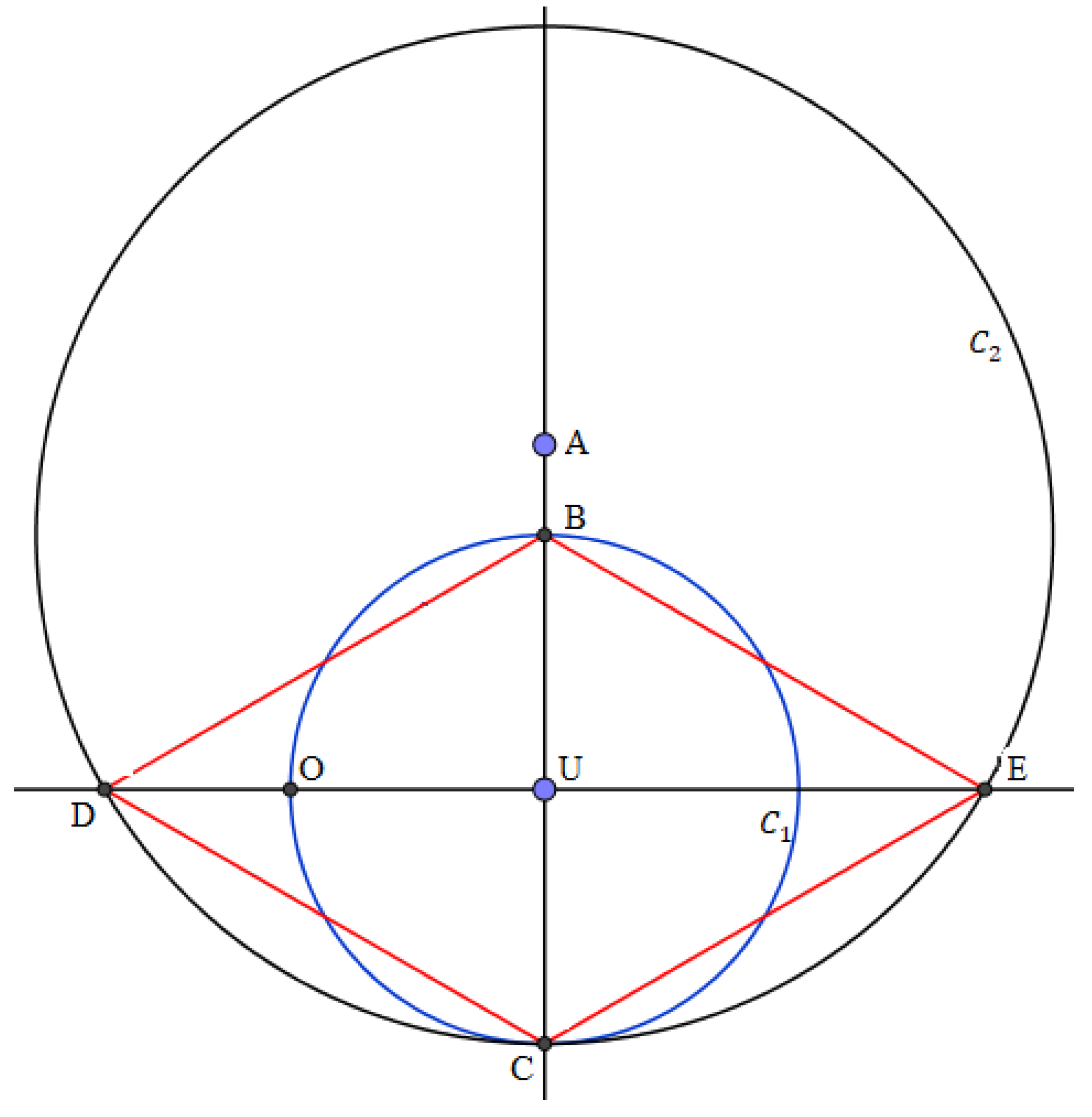
Now, let us assume we can trisect the right angle using a compass and straightedge according to the following steps:
- Start with a right angle formed by two intersecting lines, and , where is horizontal and , is vertical.
- Construct a circle centered at the point with radius .
- Mark the points of intersection of the circle with the vertical line as point and point .
- Construct a circle centered at the point with radius .
- Let the points of intersection of this circle with the horizontal line be the point and the point .
- Construct the extension of the straight line through the points and to form the trisection angle, as depicted in figure (1).
Definition (“Trisection Angle and Trisected Angle”). In the context of this paper, the term “trisection angle”, denoted as , signifies an angle achieved by employing a precise sequence of finite steps encompassing straightedge and compass constructions. This sequence is applied to a specified angle termed the “trisected angle” . The trisection angle is distinguished by the ratios and , reflecting the characteristic geometric divisions of into three equal parts.
Construction Results Analysis
Consider Figure 4;
- By construction, the angles; and are straight angles, which means and are congruent.
- The angles; and are right angle, and by , all right angles are congruent.
- Conversely, implies also that all congruent angles are right angles.
- This implies that the angles; and , and the angles; and are right angles.
Following the implication in result (4), we can conclude that the angle and the angle are congruent, and they are both one-third of the right angle. However, this leads to a contradiction of the trisection assumption. Consider:
If both angles; and are one-third of the right angle, and by , all right angles are congruent, then it implies that the angle and the angle are themselves right angles.
This observations contradicts the trisection assumption, as it suggests that the trisected angle contains two right angles instead of three equal angles. Thus, our assumption that it is possible to trisect an arbitrary angle using only a compass and straightedge leads to a contradiction. Therefore, it is proven that trisecting an arbitrary angle using only a compass and straightedge is impossible within the framework of Euclidean geometry.
. The contradiction arises when it is observed that both and are congruent to each other and are also one-third of the right angle. By the given axiom that all right angles are congruent, it implies that and are themselves right angles. This inconsistency directly opposes the assumption of angle trisection, implying that the trisected angle does not contain three equal angles as initially assumed but rather two right angles. Thus, the logic followed in the proof is to demonstrate that assuming the possibility of trisecting an arbitrary angle leads to a contradiction, which proves the impossibility of trisecting angles using only a compass and straightedge within the framework of Euclidean geometry.
Axiom c. All right angles are congruent. This axiom states that any two right angles are equal in measure. In other words, if we have two angles that both measure , they are considered congruent.
In the proof, is utilized to establish that the angle and , which is formed by the vertical line and the line segment and , is a right angle. Since guarantees that all right angles are congruent, we can conclude that the angle and is congruent to any other right angle.
Axiom d. Two lines intersect at a point, forming vertical angles that are congruent. This axiom states that when two lines intersect, they form four angles known as vertical angles. Vertical angles are opposite each other and are congruent, meaning they have the same measure.
In the proof, is applied to the vertical angles formed by the intersection of lines and . The angle and the angle are vertical angles, and according to , they are congruent. By using and , the proof establishes that the angles; and and the angles and are congruent, as they are right angles. This congruence leads to a contradiction, as it implies that the trisected angle contains two right angles, which contradicts the assumption that the angle can be trisected into three equal angles. Therefore, and play a crucial role in demonstrating the contradiction and proving the impossibility of trisecting angles using a compass and straightedge in Euclidean geometry. This proof validates . Further, the proof implies that if the angle cannot be trisected within the Euclidean geometric system, then no other angle can be trisected as any other trisectable angle should be a multiple of (this view is lightly skewed towards the modern notion of angles trisectability).
4. Discussions
Through the workflow, it has been technically established that the transformation of a universal statement to an existential statement in the modern angles trisection impossibility proof introduces a significant limitation. Negating the universal statement and focusing on specific cases where trisection is not feasible causes the proof to deviate from achieving its intended geometric universality. This approach restricts the analysis to particular angles, implying that some angles may be trisected while others cannot. In contrast, the provided proof of angles trisection impossibility using the angle avoids reliance on negation operations or existential statements. Instead, it demonstrates the impossibility of trisecting the angle with certainty, without suggesting the possibility of trisection for any angle. The focus is on the inherent geometric properties of the angle, which can be extended to all angles. This geometric proof transcends the limitations of the modern proof by providing a comprehensive and conclusive result. It establishes that the trisection of any angle, including the angle, is inherently impossible within the Euclidean geometric system. The reliance on geometric reasoning and properties allows for a more rigorous and robust analysis, providing a clear and definitive answer to the angles trisection problem. By demonstrating the limitations of negating universal statements and offering a geometrically grounded proof, this paper highlights the shortcomings of the modern impossibility proof. The provided proof offers a more solid foundation for understanding the angles trisection problem and addresses the skepticism surrounding the use of alternative geometries or non-geometric approaches. It reaffirms the integrity and richness of the Euclidean geometric system in providing the desired proof without resorting to ambiguous possibilities or contingent scenarios.
4.1. Consequential Inconsistencies within Euclidean Geometry, a Shared Perspective
The angle trisection impossibility proof, focusing on the trisection of a angle, and the new “inconsistent property” proof both reveal crucial limitations within Euclidean geometry. The goal of employing the converse of axioms in the provided proof is not to claim that all congruent angles are right angles but to uncover logical inconsistencies within the Euclidean system's assumptions and axioms. This approach aligns with the modern impossibility proof by aiming to reveal contradictions within the Euclidean framework. The inconsistency in the provided proof emerges from the assumption that an angle can be trisected, combined with the axioms of Euclidean geometry. This inconsistency parallels the geometric contradictions observed in the “inconsistent property” proof, which examines the inconsistencies arising from basepoint operations, such as doubling and cubing the diagonal of a square. The geometric issues identified-where doubling a diagonal and cubing it lead to different proportional results-mirror the challenge of proving the universal impossibility of trisecting an arbitrary angle. The modern impossibility proof often suggests that certain specific angles, such as the angle, might be trisected while others cannot. However, this paper considers such claims as geometric fallacies, as they fail to address the broader problem of universal applicability. The angle trisection problem requires a geometric property that ensures any proposed method for trisecting an angle works universally. In contrast, the modern proofs that focus on the constructability of specific angles do not adequately address this requirement, leading to potential inconsistencies. This paper highlights that the inability to trisect specific angles does not imply a general impossibility, thereby emphasizing the need for a proof that maintains consistency across all angles. The parallelism between the proofs lies in their shared objective of uncovering inherent inconsistencies within Euclidean geometry. Both the provided based impossibility proof and the “inconsistent property” proof demonstrate that attempts to establish universal trisection methods encounter contradictions when generalized. This reveals a fundamental issue in the modern proofs that assert the impossibility of trisecting certain angles, pointing out their failure to address the universal applicability of geometric procedures. Thus, the exploration of geometric inconsistencies underscores the broader difficulty in proving the universal impossibility of angle trisection within the Euclidean system.
4.2. Universal Perspective on Traditional vs. Modern Angle Trisection Proofs
From a broader perspective, both proofs address the angle trisection problem in a general sense. However, the modern proof introduces weaknesses by allowing some angles to be trisected while others are not. This approach diverges from the fundamental requirement for a universal procedure that applies to any angle. By focusing on specific angles, the modern proof contradicts the overarching goal of providing a general solution for all angles. This inconsistency highlights the modern proof’s limitations in addressing the angle trisection problem universally, revealing its failure to meet the geometric validity needed for a comprehensive solution.
4.3. Questioning the Need for a General Proof
The inconsistencies in both proofs suggest that a comprehensive, generalized proof of angle trisection impossibility might be unnecessary. The proof using the angle demonstrates that inconsistencies arise even with a single example, undermining the modern proof’s claim of addressing the problem with specificity. The discrepancies within both proofs challenge the belief that a universal solution to the angle trisection problem is essential. Instead, these inconsistencies highlight methodological flaws in the modern proof and suggest a different perspective grounded in rigorous Euclidean geometric reasoning.
4.4. Broader Implications
The implications of the findings in this paper extend beyond the trisection of the itself. By proving the impossibility of trisecting an arbitrary angle using only a compass and straightedge within the framework of Euclidean geometry, several important implications emerge.
Preservation of Euclidean Geometry. The proof reaffirms the integrity and richness of the Euclidean geometric system. It demonstrates that Euclidean geometry provides a robust framework capable of addressing complex geometric problems and establishing rigorous mathematical proofs whenever such proofs are required. This finding strengthens the position of Euclidean geometry as a foundational pillar in mathematics.
Clarification of Geometric Boundaries. The paper brings clarity to the boundaries and limitations of geometric constructions. It establishes that trisecting the angle is unachievable within the confines of Euclidean geometry. This understanding helps define the scope of what is geometrically possible and sets realistic expectations for geometric problem-solving.
Historical Relevance. The paper offers a historical perspective by presenting the first Euclidean geometric proof of the angles trisection impossibility. This achievement highlights the continuous development and advancement of mathematical knowledge over centuries. It contributes to the ongoing narrative of mathematical discoveries and adds to the legacy of Euclidean geometry.
Impact on Angle Trisection Debates. The proof directly impacts the ongoing debates surrounding angle trisection and the pursuit of general methods for trisecting arbitrary angles. It undermines the need for further discussions on trisectability and provides a definitive solution to the problem within the Euclidean geometric framework. This insight helps redirect scholarly focus towards other aspects of geometry and related mathematical endeavors.
Paradigm Shift in Approaching Trisection Problems. The paper challenges the prevailing approach of transforming the trisection problem into a non-Euclidean algebraic framework. By showcasing a purely Euclidean geometric proof, it calls into question the necessity and validity of alternative geometries for addressing angle trisection. This perspective encourages researchers to explore new avenues within the Euclidean framework for tackling geometric problems.
. The proof on the trisection impossibility of the angle carries significant broader implications for mathematics and geometry. It reinforces the value of Euclidean geometry, clarifies geometric boundaries, adds to the historical narrative of mathematical discoveries, influences angle trisection debates, and promotes a paradigm shift in approaching trisection problems.
4.5. Significance of the Provided Angles Trisection Impossibility Proof
The provided proof of the angles trisection impossibility, based on the trisection of theangle, offers several advantages over the modern angles trisection impossibility proof:
Geometric Integrity. The provided proof remains firmly rooted in the principles and foundations of Euclidean geometry. It relies on geometric constructions and properties, staying true to the essence of geometric problem-solving. This maintains the integrity and coherence of the Euclidean geometric system.
Universality of Proof. By demonstrating the non-trisectability of the angle, the provided proof establishes a universal result. It applies to all angles, as the angle serves as a representative example. This universality is crucial in the context of trisecting angles, as it addresses the requirement for a method that works for all angles, rather than specific cases.
Euclidean Richness. The provided proof showcases the richness and versatility of the Euclidean geometric system. It highlights that within this system, a comprehensive and rigorous solution to the angles trisection impossibility problem can be derived. This underscores the power and effectiveness of Euclidean geometry as a mathematical tool.
Historical Alignment. The provided proof aligns with the historical development of mathematical knowledge, particularly in Euclidean geometry. It draws upon the principles and methodologies employed by ancient mathematicians like Euclid, making it a testament to the enduring relevance and validity of Euclidean geometric reasoning.
Resolution of Skepticism. The provided proof addresses skepticism surrounding the modern proof of angles trisection impossibility. By providing a purely geometric solution that does not rely on non-Euclidean approaches, it offers a compelling alternative for those who question the fully geometric nature of the modern proof.
Thus, the provided proof of the angles trisection impossibility stands as an advantageous approach, emphasizing the geometric integrity, universality, Euclidean richness, historical alignment, and resolution of skepticism. It offers a robust and comprehensive perspective on the problem, contributing to the ongoing discourse in the field of geometry. In emphasizing Euclidean geometry and utilizing straightforward geometric reasoning, the provided proof offers a distinct approach that is more aligned with the traditional understanding of geometric constructions and carries advantages over the existing non-Euclidean approaches.
5. Conclusions
This paper presents a Euclidean geometric proof demonstrating the impossibility of trisecting an angle, specifically focusing on the angle. The proof emphasizes the importance of a robust geometric foundation in addressing the angle trisection problem and reveals the limitations of alternative approaches that have sought a trisection method. It challenges the necessity of a general impossibility proof by highlighting the inconsistencies within both traditional and modern proofs.
The modern approach, which allows some angles to be trisected while declaring others non-trisectable, is fundamentally flawed as it fails to maintain geometric universality. This inconsistency undermines its authority as a proof for angle trisection impossibility. In contrast, the provided proof, centered on the angle, underscores the inherent limitations of such methods and demonstrates that any proposed trisection procedure, regardless of specific angles, inevitably encounters contradictions when generalized. The proof illustrates a significant parallelism with the newly established “inconsistent property”, which reveals contradictions arising from proportional magnitudes in geometric operations. This parallelism highlights how both the angle trisection impossibility proof and the inconsistent property expose deeper inconsistencies within Euclidean geometry. These findings underscore the need for a consistent geometric framework and challenge the validity of proofs that rely on specific cases rather than universal principles. The paper not only addresses the long-standing problem of angle trisection but also reinforces the integrity and robustness of Euclidean geometry. It provides a solid foundation for future research and invites further exploration of the implications of the angle impossibility proof and its broader impact on geometric reasoning and alternative geometric systems.
Data Availability: The data used to support the findings of this study are available from the corresponding author upon request.
Conflicts of Interest
The author declared no conflicts of interest.
References
- Ostermann and G. Wanner, Geometry by Its History. in Undergraduate Texts in Mathematics. Berlin, Heidelberg: Springer Berlin Heidelberg, 2012. [CrossRef]
- S. Yadav and M. Mohan, Eds., Ancient Indian Leaps into Mathematics. Boston, MA: Birkhäuser Boston, 2011. [CrossRef]
- A History of Chinese Mathematics. Springer Berlin Heidelberg, 1997. [CrossRef]
- J. Scriba and P. Schreiber, 5000 Years of Geometry: Mathematics in History and Culture. Basel: Springer Basel, 2015. [CrossRef]
- Heath, Thomas L, The Thirteen Books of Euclid’s Elements, translated from the text of Heiberg, with introduction and commentary, 2nd ed., vol. 3 vols. Cambridge (available in Dover reprint): University Press, 1926.
- F. Borceux, “Euclid’s Elements,” in An Axiomatic Approach to Geometry, Cham: Springer International Publishing, 2014, pp. 43–110. [CrossRef]
- R. Trudeau, “Euclidean Geometry,” 2001, pp. 22–105. [CrossRef]
- K. M. Alex, “The Angle Trisection Solution (A Compass-Straightedge (Ruler) Construction),” J. Adv. Math., vol. 13, no. 4, pp. 7308–7332, Aug. 2017. [CrossRef]
- Kimuya M Alex, “The Possibility of Angle Trisection (A Compass-Straightedge Construction) Kimuya M Alex,” J. Math. Syst. Sci., vol. 7, no. 1, Jan. 2017. [CrossRef]
- M. Ben-Ari, “Trisection of an Angle,” in Mathematical Surprises, Cham: Springer International Publishing, 2022, pp. 11–28. [CrossRef]
- R. Hartshorne, “Teaching Geometry According to Euclid.,” 2000.
- M. Kimuya and S. M. Karanja, “The Incompatibility between Euclidean Geometry and the Algebraic Solutions of Geometric Problems,” Eur. J. Math. Stat., vol. 4, no. 4, Art. no. 4, Jul. 2023. [CrossRef]
- G. E. Martin, “Euclid’s Elements,” in The Foundations of Geometry and the Non-Euclidean Plane, in Undergraduate Texts in Mathematics., New York, NY: Springer New York, 1975, pp. 121–130. [CrossRef]
- M. H. P. Shad, “Angle Trisection:,” J. Adv. Math., vol. 17, pp. 165–231, Sep. 2019. [CrossRef]
- Ostermann and G. Wanner, “The Elements of Euclid,” in Geometry by Its History, A. Ostermann and G. Wanner, Eds., in Undergraduate Texts in Mathematics. , Berlin, Heidelberg: Springer, 2012, pp. 27–59. [CrossRef]
- J. Avigad, E. DEAN, and J. Mumma, “A Formal System for Euclid’S Elements,” Rev. Symb. Log., vol. 2, pp. 700–768, Dec. 2009. [CrossRef]
- Pierre Laurent Wantzel, “Recherches sur les moyens de reconnaitre si un problème de géométrie peut se résoudre avec la règle et le compass,” Journal de Mathematiques pures et appliques, vol. 2, pp. 366–372, 1837.
- M. Panza, “Rethinking geometrical exactness,” Hist. Math., vol. 38, no. 1, pp. 42–95, Feb. 2011. [CrossRef]
- Crippa, “IMPOSSIBILITY RESULTS: FROM GEOMETRY TO ANALYSIS,” phdthesis, Univeristé Paris Diderot Paris 7, 2014. Accessed: Feb. 02, 2021. [Online]. Available: https://hal.archives-ouvertes.fr/tel-01098493.
- J. Barbeau, “Incommensurability Proofs: A Pattern That Peters Out,” Math. Mag., vol. 56, no. 2, pp. 82–90, 1983. [CrossRef]
- “Euclid’s Elements, Book II, Proposition 10.” Accessed: Jun. 29, 2023. [Online]. Available: http://aleph0.clarku.edu/~djoyce/elements/bookII/propII10.html.
- B. Surányi, “Predicates, Negative Quantifiers and Focus: Specificity and Quantificationality of N-Words,” vol. 68, 2007, pp. 255–285. [CrossRef]
- S. Gennari and M. MacDonald, “Acquisition of Negation and Quantification: Insights From Adult Production and Comprehension,” Lang. Acquis. - LANG Acquis., vol. 13, Apr. 2006. [CrossRef]
- M. Beeson, J. Narboux, and F. Wiedijk, “Proof-checking Euclid,” Ann. Math. Artif. Intell., vol. 85, no. 2, pp. 213–257, Apr. 2019. [CrossRef]
- “Euclid’s Elements, Introduction.” Accessed: Jun. 29, 2023. [Online]. Available: https://mathcs.clarku.edu/~djoyce/elements/elements.html.
- D. Crippa, “IMPOSSIBILITY RESULTS: FROM GEOMETRY TO ANALYSIS,” phdthesis, Univeristé Paris Diderot Paris 7, 2014. Accessed: Sep. 05, 2020. [Online]. Available: https://hal.archives-ouvertes.fr/tel-01098493.
- Borceux, An Axiomatic Approach to Geometry: Geometric Trilogy I. Cham: Springer International Publishing, 2014. [CrossRef]
Figure 1.
The starting diagram for doubling the square diagonal.
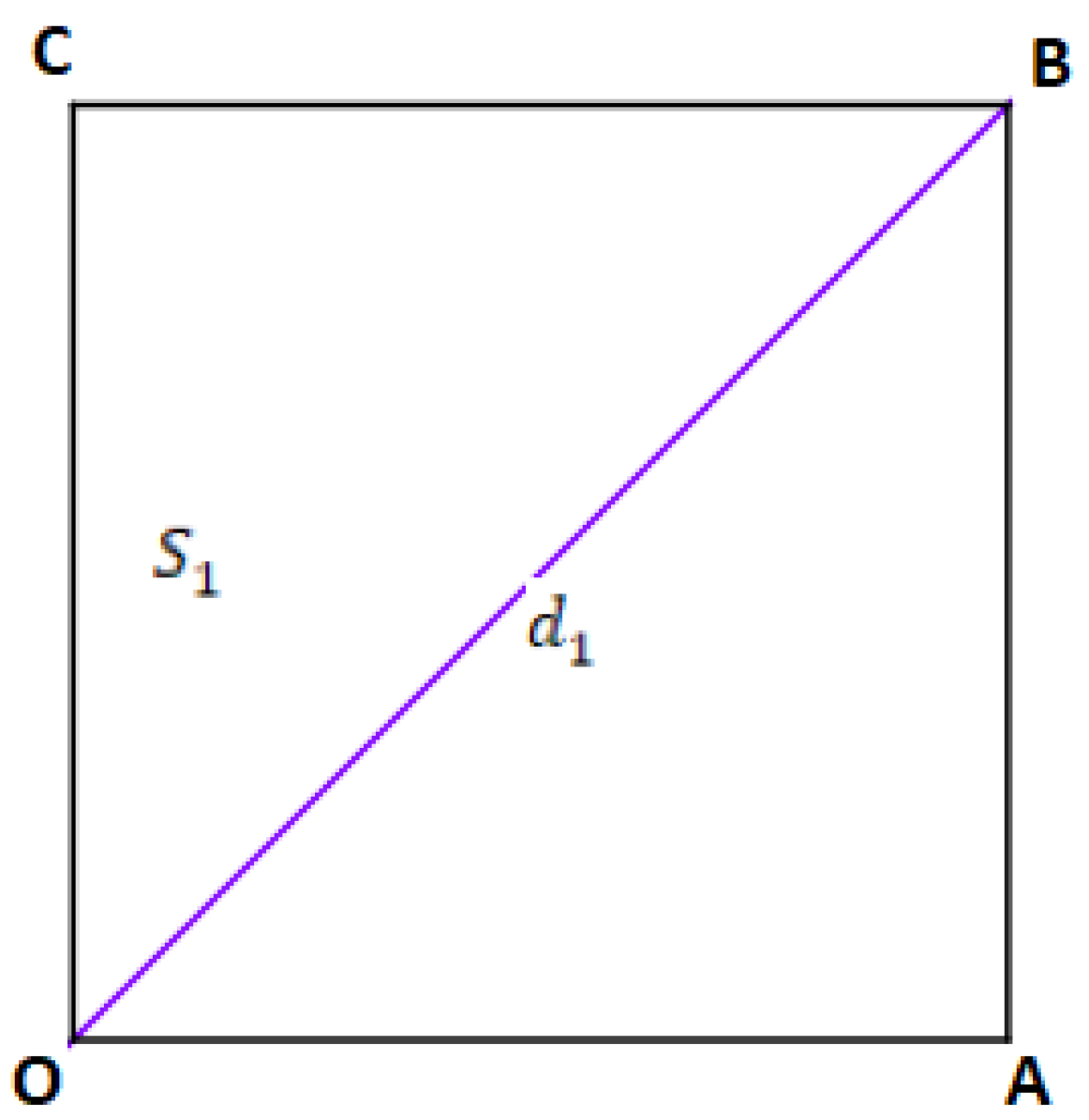
Figure 2.
Construction of a doubled square edge,
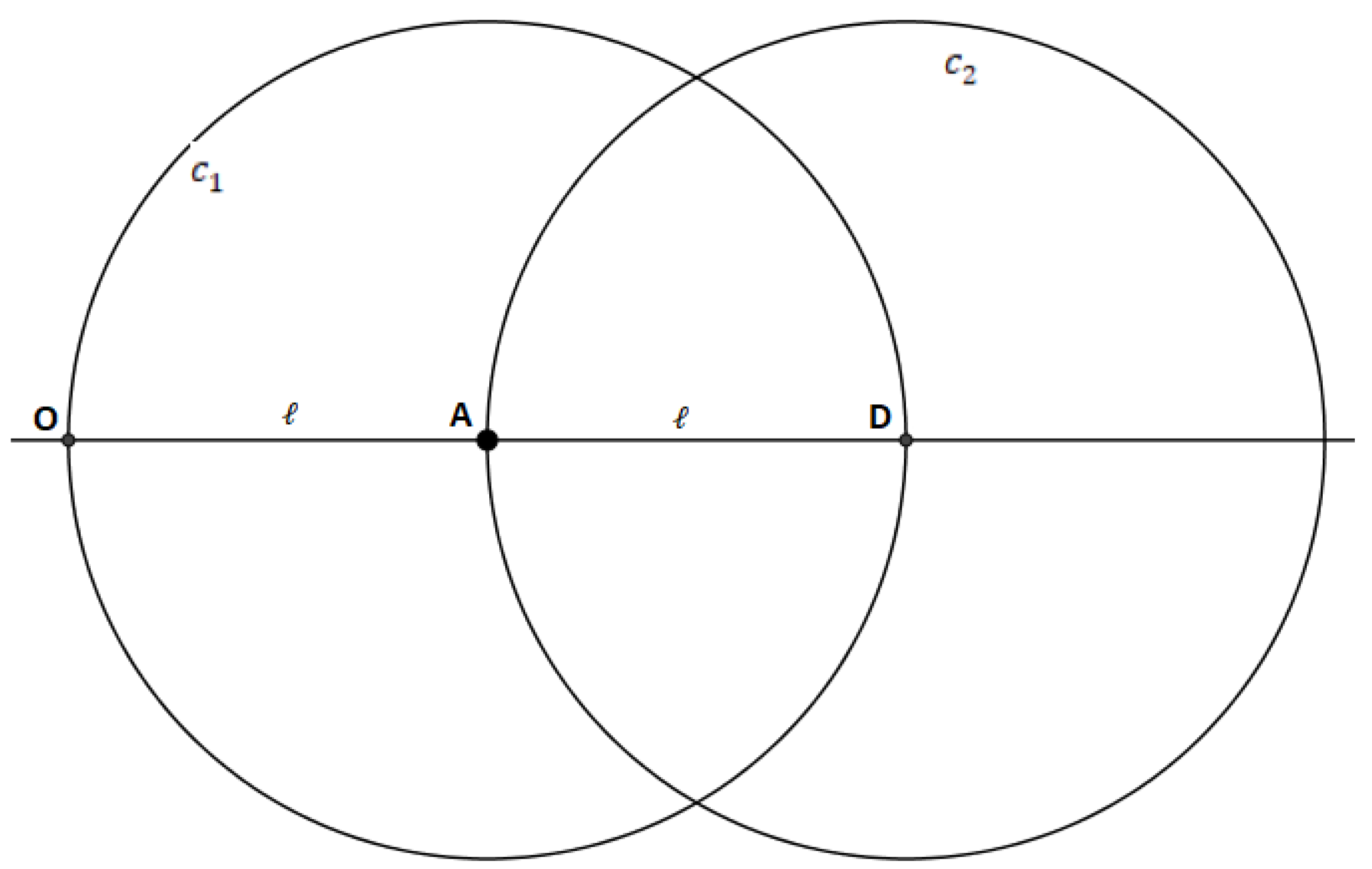
Figure 3.
Doubled square diagonal,
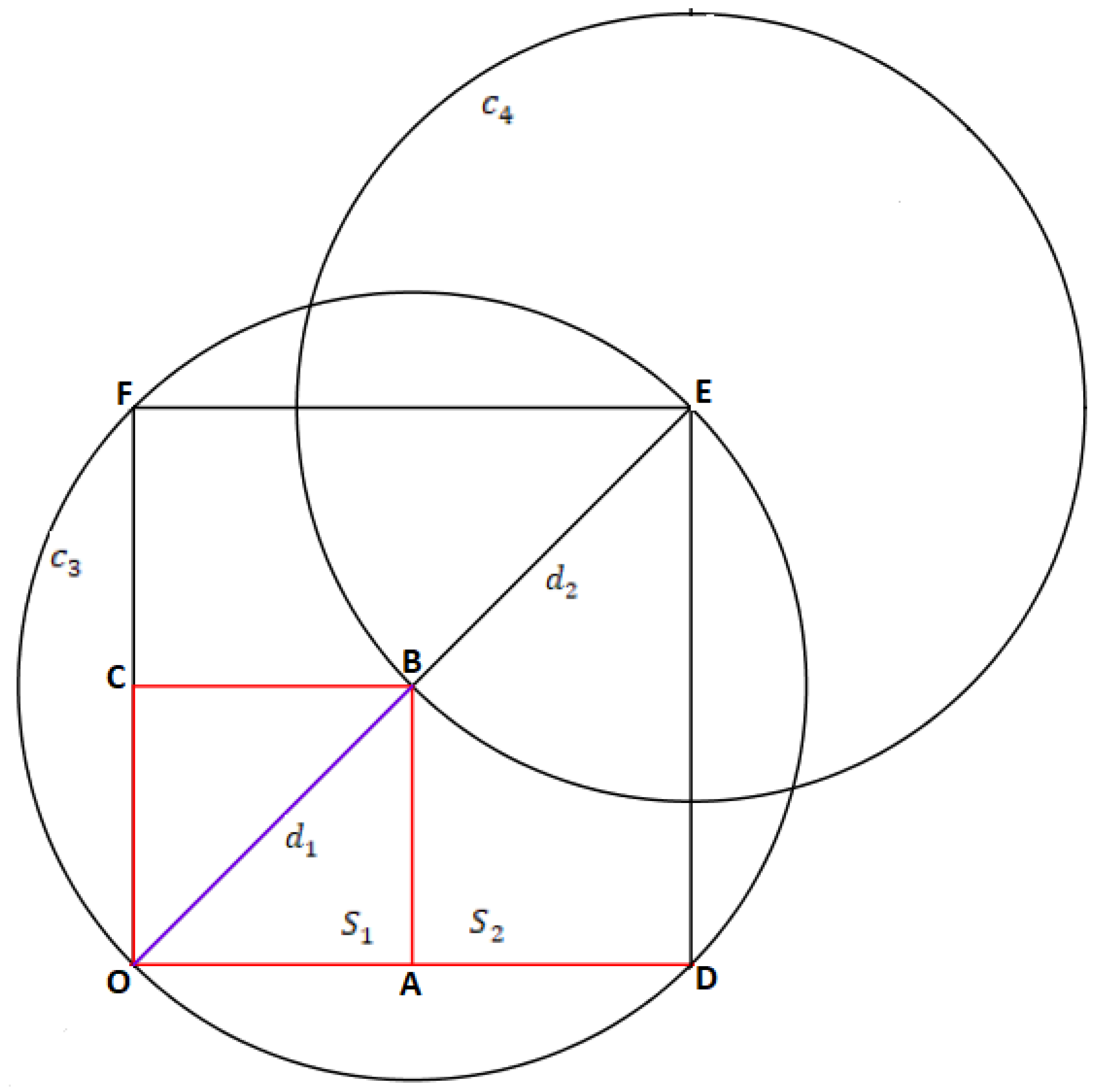
Figure 4.
Trisection of Angle Impossibility Result.
Disclaimer/Publisher’s Note: The statements, opinions and data contained in all publications are solely those of the individual author(s) and contributor(s) and not of MDPI and/or the editor(s). MDPI and/or the editor(s) disclaim responsibility for any injury to people or property resulting from any ideas, methods, instructions or products referred to in the content. |
© 2024 by the authors. Licensee MDPI, Basel, Switzerland. This article is an open access article distributed under the terms and conditions of the Creative Commons Attribution (CC BY) license (http://creativecommons.org/licenses/by/4.0/).
Copyright: This open access article is published under a Creative Commons CC BY 4.0 license, which permit the free download, distribution, and reuse, provided that the author and preprint are cited in any reuse.


