

Submitted:
25 July 2024
Posted:
29 July 2024
You are already at the latest version
Abstract
This article presents a novel analysis of Indus Seal M-282 [1] excavated from Mohenjo-Daro, a key Indus Valley Civilization site. Utilizing the proposed Sindhu Prakrit alphabet, the study investigates the relationship between the seal's iconography and the inscribed text. By examining the potential for a close correlation between these elements, the analysis aims to decipher the meaning embedded within the seal's motifs, potentially offering new insights into Indus Valley communication and symbolism.
Keywords:
Indus Seals
; decoded Indus Seals
; iconography in the Indus seals
; Seal:282
; Indus valley civilization
; Indus script
; the Indus Alphabet
; the Alphabet of Sindhu Prakrit
Introduction
The Indus script remains one of the undeciphered writing systems of the ancient world. This article explores a novel approach to its interpretation, treating it as an alphabet. The analysis is based on a comprehensive examination of Indus signs documented by scholars like Iravatham Mahadevan and Asko Parpola [2,3].
Through rigorous investigation, the study proposes an empirical model that analyses the compositional techniques and potential application of diacritics within the script. This model suggests that the Indus script might function with a core set of approximately 40 primary signs, supplemented by additional symbols representing vowels, diphthongs, and aspirated consonants derived from these base signs. These primary signs have been assigned phonetic values based on comparisons with ancient alphabetic scripts [4].
The concept of a decipherment, as noted by Iravatham Mahadevan, often relies on the self-evident nature of the process. In a successfully deciphered syllabic or alphabetic script, interlocking phonetic elements should provide clear evidence of the system's functionality [5].
Building upon this concept, this article presents an interpretation of the Indus script on iconographic seal M-282, adhering to the proposed alphabetic principles. The analysis examines how the seal's iconography potentially complements and enhances the interpretation of the inscribed text. It is important to acknowledge the ongoing debate surrounding the Indus script, and this interpretation is presented as a contribution to the field, inviting further scholarly evaluation and critique.
a) The Inscribed Texts on Seal M-282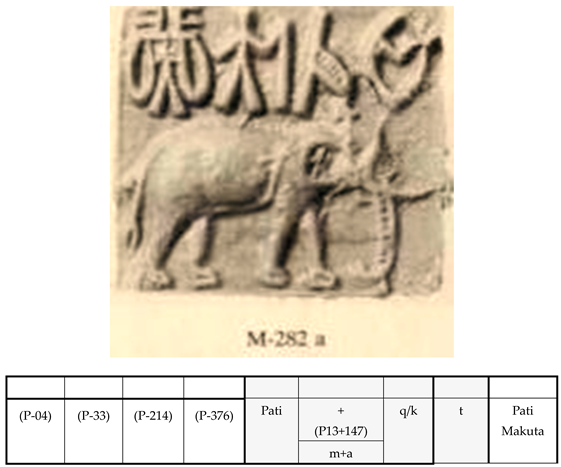
For detailed information about the first sign reading ‘Pati,’ it is important to note that the Indus Script, unlike Sanskrit and other Prakritic ancient alphabets, has distinct sounds for ‘k’ and ‘q.’ For further analysis concerning this variation and the representation of the sign ‘Pati’ and the ‘k’ sound, please refer to "The Alphabet of Sindhu Prakrit" [4]. This seal inscription demonstrates the flexibility in applying diacritical marks. To illustrate this point further, we can reference another example from Mahadevan's Concordance (1977) [2].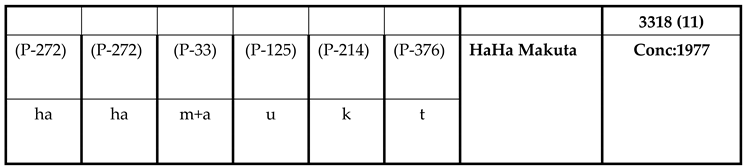
While a detailed analysis of the first two signs and the potential meaning of the "Ha Ha" expression might warrant further exploration.[5] this section will instead focus on a specific aspect of the inscription – the application of the vowel diacritic. This mark plays a crucial role in adhering to the proposed spelling rules of the Indus script, as deciphered through the Sindhu Prakrit alphabet. Examining the precise use of this diacritic P-125 offers a valuable insight into the potential vocalic system and sound structure of the Indus language that is missed in the seal M-282.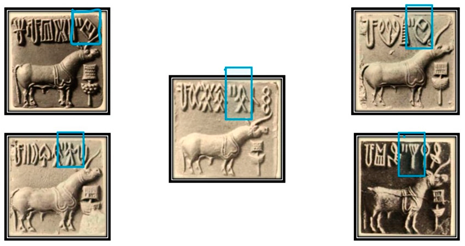
The inscription on the seal presents another interesting example of potential variability in diacritic placement. Sign P-127, characterized by its double strokes, is typically positioned at the upper left of sign P-376, as evidenced by numerous other Indus seals.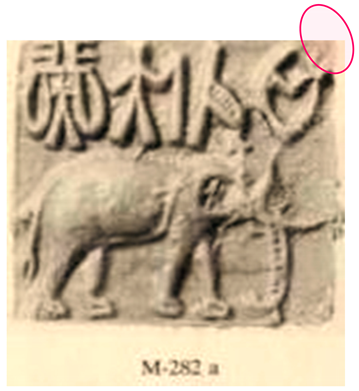
However, in this particular inscription, P-127 appears at the upper right of P-376.This deviation from the usual placement raises intriguing attention about the potential significance of diacritic location and application within the Indus script.
Note: Mahadevan and Parpola consider the circular and square signs the same but there are reasons not to categorize to same are already discussed in my previous paper [2,3].
b) Iconographic Elements Possess Symbolic Features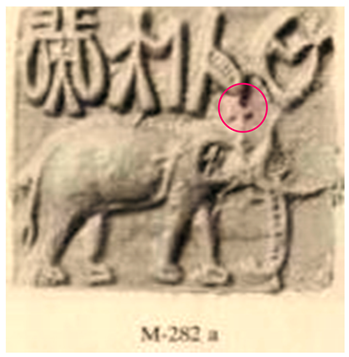
i) The Crown Having Three Points
mukuTa [Printed book page 0781-a [6]mukuTa mukuṭa, am, n. a tiara, diadem, crown (said to be crescent-shaped; the kirīṭa being
pointed, and the mauli having three points); a crest; a peak, point, head [cf. tri-m°]; N. of a
place; (as), m. a proper N. (contracted fr. Rāja-mukuṭa); (Dic: M.W)
DDSA: The practical Sanskrit-English dictionary [7]
Makuṭa (मकुट).—A crown;
Cologne Digital Sanskrit Dictionaries: Shabda-Sagara Sanskrit-English Dictionary [8]
Makuṭa (मकुट).—n.(-ṭaṃ) A crest, a head-dress, a crown, a tiara.
Cologne Digital Sanskrit Dictionaries: Yates Sanskrit-English Dictionary [9]
Makuṭa (मकुट):—(ṭaṃ) 1. n. A crest, a crown.
BuddhaSasana: Concise Pali-English Dictionary [10]
makuṭa : (m.; nt.) crest; crown; a coronet.
Sutta: The Pali Text Society's Pali-English Dictionary [11]
Makuṭa, (f.) (cp. BSk. makuṭa Divy 411) a crest Abhp 283 (kirīṭa+, i.e. adornment). (Page 511)
Shodhganga: Iconographical representations of Śiva [12]
Makuṭa (मकुट) or Makuṭāgama refers to one of the twenty-eight Siddhāntāgama: a classification of the Śaiva division of Śaivāgamas. The Śaivāgamas represent the wisdom that has come down from lord Śiva, received by Pārvatī and accepted by Viṣṇu.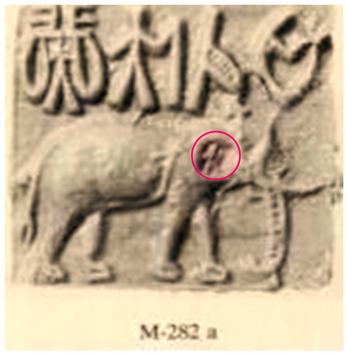
ii) The Intriguing Fish Sign (P-60)
A meticulous examination of the iconography on seal M-282 reveals a curious detail: a diminutive fish sign (P-60) inscribed where the elephant's eye would typically be located. Deciphering the meaning behind this unconventional substitution is of particular interest. Let's examine the meaning of this sign:
Source: DDSA: The practical Sanskrit-English dictionary [7]
Śa (श). —1) A cutter, destroyer. 2) A weapon. 3) Name of Śiva.
sha 2 . śa, as, m. (fr. rt. śo), a cutter, destroyer (Kirāt. XV. 45); a weapon; N. of Śiva, (in this sense probably connected with 2. śam); (am),n. or ind. happiness, &c., see 2. śam, p. 993. [ID=45931] (Dic: M.W) [6]
iii) Unconventional Trunk
The trunk in this motif does not display a conventional appearance; instead, it represents an ancient war weapon. This is further elucidated by the sign replaced with the eye of the elephant.
Discussion
According to the decipherment of the Indus Script as an alphabet, the texts reveal different classes according to the motif, with the elephant representing the ruling class or political system of the empire. The mentioned seal signifies the Crown Holder and his mightiness.
The iconography in the Indus seals conveys numerous symbolic messages with great skill and meticulousness, evident in all iconographic seals. This reveals not only the language and writing skills but also the mastery of artistic work by adding symbolic representations of different aspects and themes in relation to specific wordings of the texts.
An extraordinary aspect of the Indus texts is that they not only convey the language inscribed by the engraver but also frequently exhibit meticulous references to the names of Mahadev Shiva and Uma Parvati [13]. This demonstrates a remarkable devotion to the celestial couple.
Conclusions
The proposed alphabetic decipherment of the Indus script demonstrates a compelling correlation between the decoded text and the accompanying iconography. This is further corroborated by the existence of numerous iconographic seals that exhibit a similar level of concordance when interpreted through the lens of the suggested Sindhu Prakrit alphabet.
This work aims to bring the alphabetic approach to the forefront of Indus script research and encourage further scholarly engagement with this method. Constructive criticism and alternative perspectives would not be only welcome but actively sought. A re-evaluation of the Indus script's nature and consideration as an Alphabet, hold the potential to unlock the secrets of this enigmatic civilization and its rich history.
References
- Joshi, Jagat Pati, and Asko Parpola. "Corpus of Indus seals and inscriptions. I. Collections in India." Annales Academiae Scientiarum Fennicae. Series B. Vol. 239. 1987.
- Mahadevan I. The Indus script: texts, concordance, and tables. Archaeological Survey of India; 1977.
- Parpola AH. Deciphering the Indus script. Cambridge University Press; 1994.*.
- Muhammad M H. The Alphabet of the Sindhu Prakrit: The decipherment of the Indus Script, Eliva Press; 2023.
- Mahadevan, Iravatham. "SR RAO'S DECIPHERMENTOF THE INDUS SCRIPT." (1981).
- Cologne Digital Sanskrit Dictionaries: Monier-Williams Sanskrit-English Dictionary. https://www.wisdomlib.org.
- DDSA: The practical Sanskrit-English dictionary . https://www.wisdomlib.org.
- Cologne Digital Sanskrit Dictionaries: Shabda-Sagara Sanskrit-English Dictionary. https://www.wisdomlib.org.
- Cologne Digital Sanskrit Dictionaries: Yates Sanskrit-English Dictionary. https://www.wisdomlib.org.
- Buddhadatta, Ambalaṅgoḍa Polvattē. English-Pali Dictionary. Motilal Banarsidass Publ., 1989.
- Davids, TW Rhys, and William Stede. Pali-english dictionary. Motilal Banarsidass, 2015. https://dictionary.sutta.org/.
- S.Sridhar Swaminathan . Iconographical representations of Śiva, University of Madras. http://hdl.handle.net/10603/204382.
- H Muhammad, Mahaveer. "Sindhu Prakrit Unveils the Enigma: Revealing the Origins of Ayurveda." Sindhu Prakrit Unveils the Enigma: Revealing the Origins of Ayurveda (March 5, 2024) (2024).
Disclaimer/Publisher’s Note: The statements, opinions and data contained in all publications are solely those of the individual author(s) and contributor(s) and not of MDPI and/or the editor(s). MDPI and/or the editor(s) disclaim responsibility for any injury to people or property resulting from any ideas, methods, instructions or products referred to in the content. |
© 2024 by the authors. Licensee MDPI, Basel, Switzerland. This article is an open access article distributed under the terms and conditions of the Creative Commons Attribution (CC BY) license (http://creativecommons.org/licenses/by/4.0/).
Copyright: This open access article is published under a Creative Commons CC BY 4.0 license, which permit the free download, distribution, and reuse, provided that the author and preprint are cited in any reuse.


