

Submitted:
25 July 2024
Posted:
25 July 2024
You are already at the latest version
Abstract
The central aim of this paper is to present the Green Web Meter software which is designed to support the measurement of digital sustainability performance of websites and web apps, as well as providing sound based analytic tools for improving their overall quality. We analyzed scientific literature and specifically selected three quality assessment models (E-S Qual, Sitequal, Webqual 4.0) which we used as a starting point for identifying the most crucial aspects for the monitoring activities. A consistent set of Key Performance Indicators (KPIs) suitable for automated tracking has been provided. We finally developed model-based software able to deliver solutions for real-time website performance analysis and reports. We structured the model to offer accurate references for digital sustainability reporting by aggregating the KPIs into an Environmental, Social, and Governance (ESG) framework and computing a comprehensive score for its pillars.
Keywords:
Digital sustainability
; Website quality
; Real time monitoring
; website CO2 emissions
; digital ESG evaluation
; digital carbon footprint
1. Introduction
The scientific and regulatory debate on sustainability is gaining increasing priority at the international level. Initiatives such as the United Nations 2030 Agenda for Sustainable Development and the European Green Deal legislative package exemplify this renewed sensitivity. These efforts are leading the way for institutions and scientific committees to support policy-making activities.
In particular, the aforementioned Green Deal, the European strategy for ecological transition (aligned to the 2015 Paris Agreements), aimed at identifying strategic areas within the European economic landscape and structuring interventions consistent with the goal of achieving carbon neutrality by 2050 [1]. However, the Fit for 55 regulatory packages, a key component of the European climate strategy mainly related to the transport, construction, and agriculture segments, surprisingly lacks sufficient awareness regarding the impacts of the digital economy.
A 2019 report from The Shift Project [2], a Parisian think tank, highlights that projected global digital emissions for 2020 would be equivalent to the total emissions of the entire Middle East (based on 2017 data). According to the predictive model adopted, digital technology emissions are constantly growing, reaching a share equal to 8% of the global total (equivalent to the CO2 produced by all light vehicles in use in 2018). Although more recent data from the Tallin University of Technology scale down this impact (37% in 2024), these consumptions are still significantly higher than the emissions of the entire aviation sector according to the International Air Transport Association in 2019 (2% of the global total).
These pieces of evidence call for greater attention to the topic of digital sustainability, a concept that emerged as early as 2007 with Kevin Bradley's work titled "Defining Digital Sustainability" [3]. Starting from this contribution, it is appropriate to delve into the evolution over time of the main perspectives and argument streams that have helped structure the concept of digital sustainability.
As an expert in the conservation of digital resources, Bradley [3] emphasizes the technical longevity of digital information, from data storage on appropriate hardware devices to the standardization of file formats and identification schemes for data structures. A broader view on the subject can be found in the work of Dapp [4], who approaches the issue from the perspective of digital resource management, asserting that “Digital resources are handled sustainably if their utility for society is maximized so that digital needs of contemporary and future generations are equally met. Digital needs are optimally met if resources are accessible to the largest number and reusable with minimal restrictions. Digital resources encompass knowledge and cultural artifacts represented in digital form e.g., text, image, audio, video, or software.” Compared to this approach, it is possible to observe how more recent developments in the debate have tended to shift the focus to the supportive role of digital in sustainable development, as seen in publications by various authors including Konys [5], Sparviero and Ragnedda [6], George, et al. [7]. The latter contribution links the concept of digital sustainability to the implementation of technologies that create, use, transmit, or obtain electronic data for promoting and advancing the 2030 Agenda goals.
A reunification of the two perspectives identified so far can be seen in the position of Stefano Epifani, head of the Digital Sustainability Foundation and author of the book titled “Digital sustainability: why sustainability cannot do without digital transformation (in Italian)” [8], according to whom digital sustainability both relates to the role of digital technologies as tools for a sustainable future development and the direction to be given to digital innovation so that it is grounded on sustainability criteria.
Despite the richness of the debate on the topic, data indicate the need to increase its resonance among broader audiences. For example, the findings of the 2022 DiSI Observatory survey – coordinated by the Digital Sustainability Foundation – show that only 26% of the analysed sample is aware of the role of digital in sustainability, competent in the sustainable use of digital technologies and inclined to adopt behaviours consistent with the levels of awareness and competence shown.
In this scenario, the Green Web Meter project, a real-time digital sustainability monitoring software, aims to:
- Provide snapshots of the Environmental, Social, and Governance (ESG) performance of websites and web apps (Figure 1);
- Support companies with actionable insights for performance improvement;
- Assist management in the face of increased regulatory constraints in sustainability reporting (e.g., CSRD);
- Reward sustainable websites and raise awareness among end-users through the issuance of NFT badges tracked on the blockchain capable of providing feedback on compliance with the main digital sustainability guidelines.
2. Materials and Methods
Measurements of various Key Performance Indicators (KPIs) contribute to the calculation of scores for each Environmental, Social, and Governance (ESG) pillars. When a website or web app reaches a score of 60 or higher in each of the three ESG criteria (environmental, social, and governance), a Non-Fungible Token (NFT) badge is issued and tracked on the Arbitrum blockchain (Figure 2). This section explains the calculation for each main element of the Green Web Meter software model, with scores expressed as percentages.
2.1. Green Web Meter Score (E): Environmental Criterion Assessment and evaluation
The Green Web Meter software calculates the environmental score based on the following model:
where GWM is the Green Web Meter Score (%), CFM is the Carbon Footprint Mitigation Score (%), PWO is the Page Weight Optimization Score (%), GH is the Green Hosting (%), and UX is the UX Score.
Carbon footprint mitigation score: The "carbon footprint mitigation score" represents the degree of minimization of greenhouse gas emissions associated with the operation of a website or web app. In accordance with the model proposed by the Sustainable Web Design project – in its third version – we take as reference variables:
- -
- The total amount of data transferred during a page view (in GB), detected in real-time by the Green Web Meter software.
- -
- The ratio between the electricity consumption attributed to network operation in 2023 (hosting, servers, network nodes, and content delivery networks) and the consumption attributed to end-user devices, estimated at 0.81 kWh/GB [9]. It is worth noting that the data considered – also validated by Bonetti [10] – is variable over time due to technological evolution of the network infrastructure, efficiency improvements in the design of websites and web apps, and client-side devices.
- -
- The ratio between the energy consumption of new visitors and returning visitors, with an attributed modifier of 0.7 (own estimate), which – according to Andrae (2020) – respectively account for 75% and 25% shares.
- -
- The global average of carbon intensity – i.e., grams of CO2 equivalent per kilowatt-hour – estimated at 442 g/kWh [9]. Again, it is noted that the data varies over time and by geographical area, as clearly indicated by the Electricity Maps' data visualization project.
- -
- A green hosting factor – detected through API call to the Green Web Data Set and applied in case the website or web app relies on servers powered by renewable energies – equal to 0.85 (own estimate).
- -
- The median global emissions per page view of 0.6 g (own estimate).
In detail this calculation involves two preliminary steps, consisting in estimating energy consumption per visit (E), and subsequently calculating emissions related to each visit (C) in green hosting (CGH) and no green hosting (CNGH).
Where GB is the total amount of data transferred during a page view (in GB), V is the number of visits or views.
After this process the Green Web Meter software computes the final "carbon footprint mitigation score" (expressed as a percentage) by comparing the product of (C) with the data on median global emissions per visit. A higher score corresponds to a lower environmental impact.
Page weight score: the "page weight score" is based on the weighted average of the total page weight per visit, considering factors such as the average share of a website's homepage visits which account for approximately 35% of the total [11]. The result is compared with an estimated global median page weight (2.4 MB; own estimate based on the 50th percentile of total weight distribution from Web Almanac [11], calculated at 2.314 MB for websites' desktop version).
Green hosting: as already noted, the "green hosting" score is assigned based on the check deriving from the API call to the Green Web Data Set. A score of 100% is given if the website or web app is listed in the database, and 0% if not.
User experience (UX) score: the "UX score" relates to the overall user experience with website pages. It is based on automated evaluations of "Largest Contentful Paint" and "Total Blocking Time" parameters (Core Web Vitals) through a Google Lighthouse API call. The final score is a percentage calculated by weighing individual factors (respectively 0.9 and 0.1).
2.2. Social Score (S): Social Criterion Assessment and Evaluation
The social score is calculated using the following model:
Where SC is the Social Score (%), A is the Accessibility Score, SM is the Social Media, SEO is the SEO Score, and BP is the Best Practice Score.
Accessibility score: the "accessibility score" is entirely automated. It involves an API call to Lighthouse, which conducts various accessibility checks on the web pages and calculates a final weighted average based on the impact levels assigned by the Web Content Accessibility Guidelines (as indicated on the Google service's dedicated page).
Social media presence: the "social media" item examines the presence of links to the most popular platforms (e.g., Facebook, Instagram, Twitter, LinkedIn, YouTube). Through a screening conducted with proprietary algorithms, a score of 1 is obtained if at least one link is found on the website or web app and 0 if none are present.
SEO score and best practice score: in a similar way to the "social media" score's attribution, the "SEO score" and "best practice score" are assigned directly upon completion of Google Lighthouse checks called by the Green Web Meter software. The calculation (also automated) results in a simple average.
2.3. Governance Score (G): Governance Criterion Assessment and Evaluation
The model for evaluating the governance criterion is as follows:
Where G is the Governance Score, MC is the Mixed Content, UCO is the Unsafe Cross-Origin Links, VT is the Visitor Tracking, EP is the Email Privacy, and PSV is the Public Server Visibility.
Basic security parameters: for the indicators "Https encryption," "Mixed content," and "Unsafe cross-origin links", the calculation logic is twofold. Through the monitoring operations conducted with proprietary algorithms, the software assigns 1 point if the screened website adopts the https protocol, or 0 if the connection is not encrypted via TLS (Transport Layer Security). Conversely, for "mixed content" and "unsafe cross-origin links" 1 point is assigned if the vulnerabilities in question aren't detected, while no point is assigned if present.
Visitor tracking: the "visitor tracking" score attribution follows the same 1-0 logic, applied after the related detection through a Lighthouse API call. A value of 1 is returned if at least one tracking system is detected, and 0 otherwise.
Email privacy and public server visibility: in a similar way to "mixed content" and "unsafe cross-origin links" score attribution, the "email privacy" and "public server visibility" items (tracked through a proprietary algorithm) are assigned a value of 0 if a problem is detected and 1 if not.
The Green Web Meter software, empowered by integrated artificial intelligence models, can generate real-time reports that not only provide snapshots of the ESG performance of analyzed websites and web apps, but also offer recommendations and insights for improving overall digital sustainability of websites and web apps (Figure 3). For these reasons we find that our work may represent at least a solid starting point to further development of reliable digital sustainability's monitoring systems, as long as a useful tool for businesses and practitioners to support the reporting operations and move towards more efficient management of digital resources.
3. Results
With the purpose of developing a proper model for monitoring the digital sustainability of websites and web apps we moved a first step by analysing the UNI PdR 147:2023 standard. This document offers organizations and practitioners a framework for sustainable management of digital transformation projects, using a step-by-step approach throughout the project lifecycle. In this regard we consider useful here to refer in particular to the monitoring phase (phase 4), carried out in parallel with the execution phase (phase 3) according to the aforementioned guidelines, which is centred in the evaluation of results and performance quality.
To identify the main components of the quality construct, we started by performing a technical and scientific literature review about website quality and the methods used to assess it. Then, we opted for a selection of three specific models that we used as a starting point: namely E-S QUAL, SITEQUAL, and WebQual (in its 4.0 version). We present these quality evaluation frameworks in Table 1-Table 3.
By analyzing in depth these models and the related scientific contributions [12,13,14], it clearly stood out that all the three can be considered as reliable frameworks to provide information on user perception of website quality. Moreover, we can add that the statistical inferences tested in the first two models underlined solid correlations between users' quality perception and website loyalty intentions.
However, since our goal is to tailor a model based on cross-sectional references for evaluating website quality, rather than just taking account of the e-commerce segment, the research team opted to conduct a synthesis work based on the following considerations:
- -
- Efficiency and satisfaction aspects from the E-S-QUAL model are the most critical factors in determining a website's service level as they exhibit strong correlations not only with the overall quality construct but also with user loyalty.
- -
- The SITEQUAL model's usability and security indicators emerged as the most impactful criteria on consumer perceptions and attitudes.
- -
- The information quality index of the WebQual 4.0 model does not significantly affect user satisfaction levels when interacting with a website.
These preliminary evaluations allowed us to identify the following key aspects for the purpose of monitoring activities – namely: performance efficiency; usability; security and interaction quality – which we aim to discuss in depth in the next section of this work.
4. Discussion and Conclusions
After analyzing the key references for website quality (performance efficiency, usability, security, and interaction quality), the team worked on harmonizing the indicators and providing structure to the initial framework to guide the subsequent monitoring operations of the Green Web Meter software, as presented in Table 4. This process essentially consisted of:
- -
- Identifying the individual components of the "overall quality" construct that are transversal in nature, meaning they are not exclusively applicable to the e-commerce context (e.g., reliability and timeliness of on-site transactions).
- -
- Integrating these components with the UNI PdR 147 guidelines applicable to the development of websites and web apps.
- -
- Reordering all the various components, aligning them with the reference points identified through the analysis of the contributions mentioned previously (E-S-QUAL, SITEQUAL, WebQual 4.0) and the digital sustainability targets set by the UNI guidelines.
Based on this general framework, our team started developing the Green Web Meter software, aiming at providing automatic and real-time monitoring of the various components of service quality and digital sustainability through the following operations:
- -
- Evaluation of the main core web vitals parameters – namely largest content full paint and total blocking time – related to loading performance and fluidity of interactions with digital elements (reference KPIs: speed and fluidity).
- -
- Measurement of the size of digital resources integrated into the pages (reference KPIs: efficiency in the use of digital resources).
- -
- Estimation of electricity consumption per page view, on the end-user side, and verification of any support for green hosting services, powered by renewable energy (reference KPIs: energy efficiency).
- -
- Estimation of scope 3 emissions (related to the use phase of products and services as established by the GHG Protocol), based on the electricity consumption's data, and subsequent calculation of the carbon footprint (reference KPI: carbon efficiency).
- -
- Accessibility compliance checks, based on the guidelines contained in the Web Content Accessibility Guidelines, and evaluation of the use of best practices to improve the websites' performance and usability (reference KPI: accessibility).
- -
- Verification of the adoption of the https protocol, identification of common vulnerabilities – such as the presence of mixed content, i.e., http resources within https pages, and cross-origin links, i.e., hyperlinks that point to resources located on a different domain from the one of the web page that contains them – and any critical errors in the development of the website, such as the visibility of the server’s data in header responses, i.e., specific pieces of metadata sent along with an HTTP response from a web server to a client, and email privacy misconfigurations (reference KPI: security).
- -
- Identification of visit tracking systems integrated into the website or web app, such as Google Analytics or Matomo (reference KPI: privacy).
- -
- Check of the main components of web reputation [15] which include search engine optimization (SEO) operations and social media presence, with the relative integration of social channels within the website or web app (reference KPI: reputation).
Finally, it should be noted that the Green Web Meter software, as a tool designed to facilitate reporting processes and provide useful information for assessing digital sustainability performance, is arranged in a threefold structure (as indicated in Table 5), in accordance with the ESRS guidelines adopted as a reference by EU's 2022/2464 Directive. By linking each of the KPIs outlined so far to the relating ESG pillar, the software provides the final scores' attribution for each criterion (Figure 4).
Author Contributions
Conceptualization, A.S. and A.R; methodology, A.R.; software, A.R.; validation, A.S., L.B., and A.R.; formal analysis, L.B., A.R.; investigation, A.S., L.B., and A.R.; resources, A.R.; data curation, L.B., and A.R.; writing—original draft preparation, A.S., L.B.; writing—review and editing, A.R.; visualization, A.S.; supervision, A.S., A.R.; project administration, A.R.; funding acquisition, A.R. All authors have read and agreed to the published version of the manuscript.”
Funding
This research received no external funding.
Institutional Review Board Statement
Not applicable, the study did not involve humans or animals.
Informed Consent Statement
Not applicable, the study did not involve humans .
Data Availability Statement
No datasets were generated during the study, although the Green Web Meter research and development team has stored data about the more than 500 websites and web apps screened (around 20,000 webpages). The information are not publicly available for privacy reasons, but are available from the corresponding author on reasonable request.
Acknowledgments
In this section, you can acknowledge any support given which is not covered by the author contribution or funding sections. This may include administrative and technical support, or donations in kind (e.g., materials used for experiments).
Conflicts of Interest
The authors declare no conflict of interest.
References
- UNFCCC. Adoption of the Paris Agreement; Paris, 2015; p. 32. [Google Scholar]
- Ferreboeuf, H.; Efoui-Hess, M.; Kahraman, Z. The Shift project; 2019; p. 90. [Google Scholar]
- Bradley, K. Defining Digital Sustainability. Library Trends 2007, 56, 148–163. [Google Scholar] [CrossRef]
- Dapp, M. Open Government Data and Free Software – Cornerstones of a Digital Sustainability Agenda. In The 2013 Open Reader – Stories and articles inspired by OKCon2013: Open Data, Broad, Deep, Connected; 2013. [Google Scholar]
- Konys, A. How to support digital sustainability assessment? An attempt to knowledge systematization. Procedia Computer Science 2020, 176, 2297–2311. [Google Scholar] [CrossRef]
- Sparviero, S.; Ragnedda, M. Towards digital sustainability: the long journey to the sustainable development goals 2030. Digital Policy, Regulation and Governance 2021, 23, 216–228. [Google Scholar] [CrossRef]
- George, G.; Merrill, R.K.; Schillebeeckx, S.J.D. Digital Sustainability and Entrepreneurship: How Digital Innovations Are Helping Tackle Climate Change and Sustainable Development. Entrepreneurship Theory and Practice 2020, 45, 999–1027. [Google Scholar] [CrossRef]
- Epifani, S. Digital sustainability: why sustainability cannot do without digital transformation (in Italian); 2020; p. 380. [Google Scholar]
- Ember. Global Electricity Review; 2023; p. 163. [Google Scholar]
- Bonetti, S. Could video streaming be as bad for the climate as driving a car? Calculating Internet’s hidden carbon footprint. Available at: https://theconversation.com/could-video-streaming-be-as-bad-for-the-climate-as-driving-a-car-calculating-internets-hidden-carbon-footprint-194558; 2022.
- Web Almanac. HTTP Archive’s annual state of the web report. Available at: https://almanac.httparchive.org/; 2022.
- Parasuraman, A.; Zeithaml, V.A.; Malhotra, A. E-S-QUAL: A Multiple-Item Scale for Assessing Electronic Service Quality. Journal of Service Research 2005, 7, 213–233. [Google Scholar] [CrossRef]
- Yoo, B.; Donthu, N. Developing a Scale to Measure the Perceived Quality of an Internet Shopping Site (PQISS). In Proceedings of the Proceedings of the 2000 Academy of Marketing Science (AMS) Annual Conference, Cham, 2015//, 2015; pp. 471–471.
- Napitupulu, D. Analysis of Factors Affecting The Website Quality (Study Case: XYZ University). International Journal on Advanced Science, Engineering and Information Technology 2017, 7, 792–798. [Google Scholar] [CrossRef]
- Şirzad, N. A review on online reputation management and online reputation components. Doğuş Üniversitesi Dergisi 2022, 23, 219–242. [Google Scholar] [CrossRef]
Figure 1.
Green Web Meter. An environmental performance report.
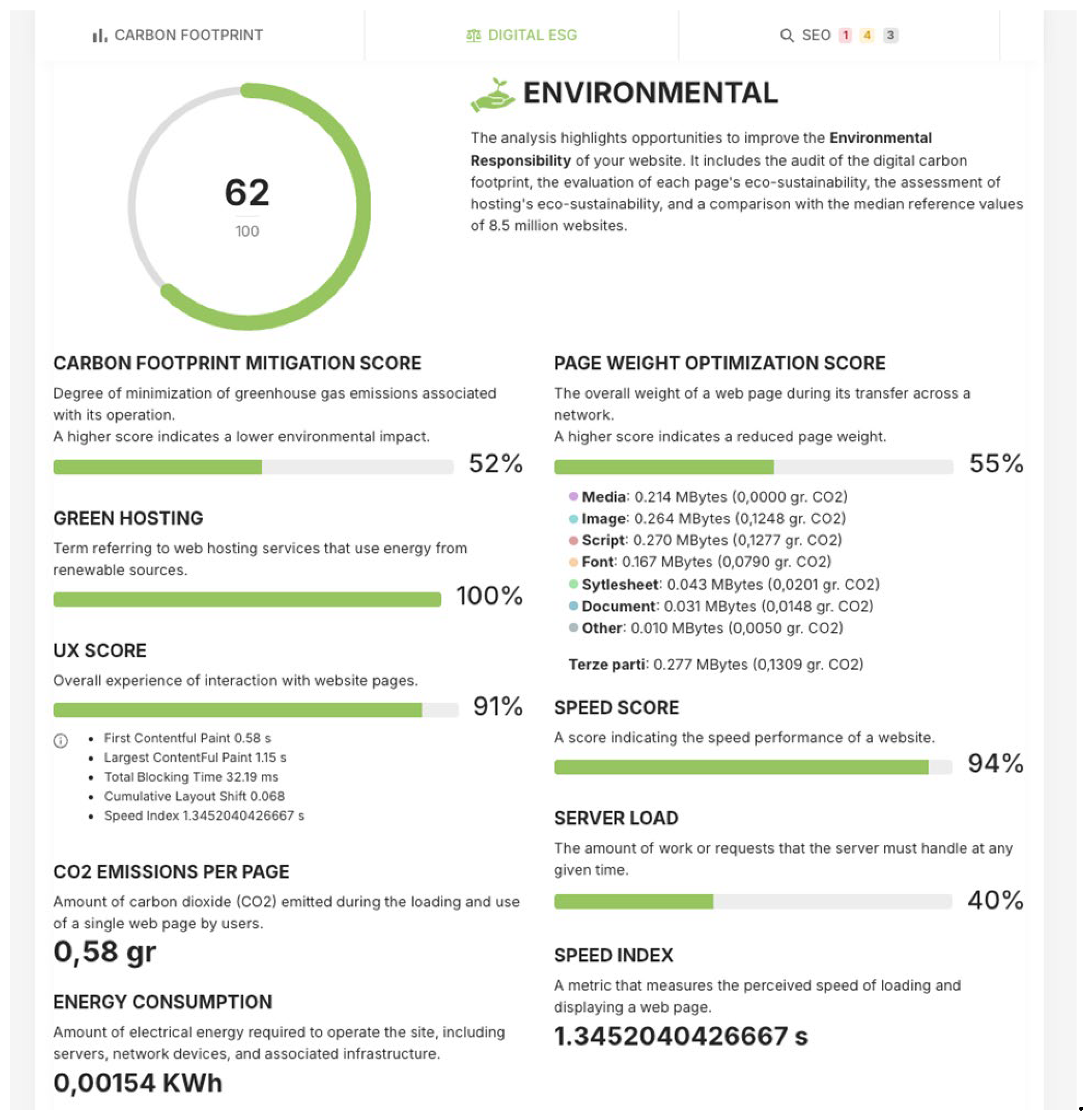
Figure 2.
Green Web Meter Non-Fungible Token (NFT) badge.
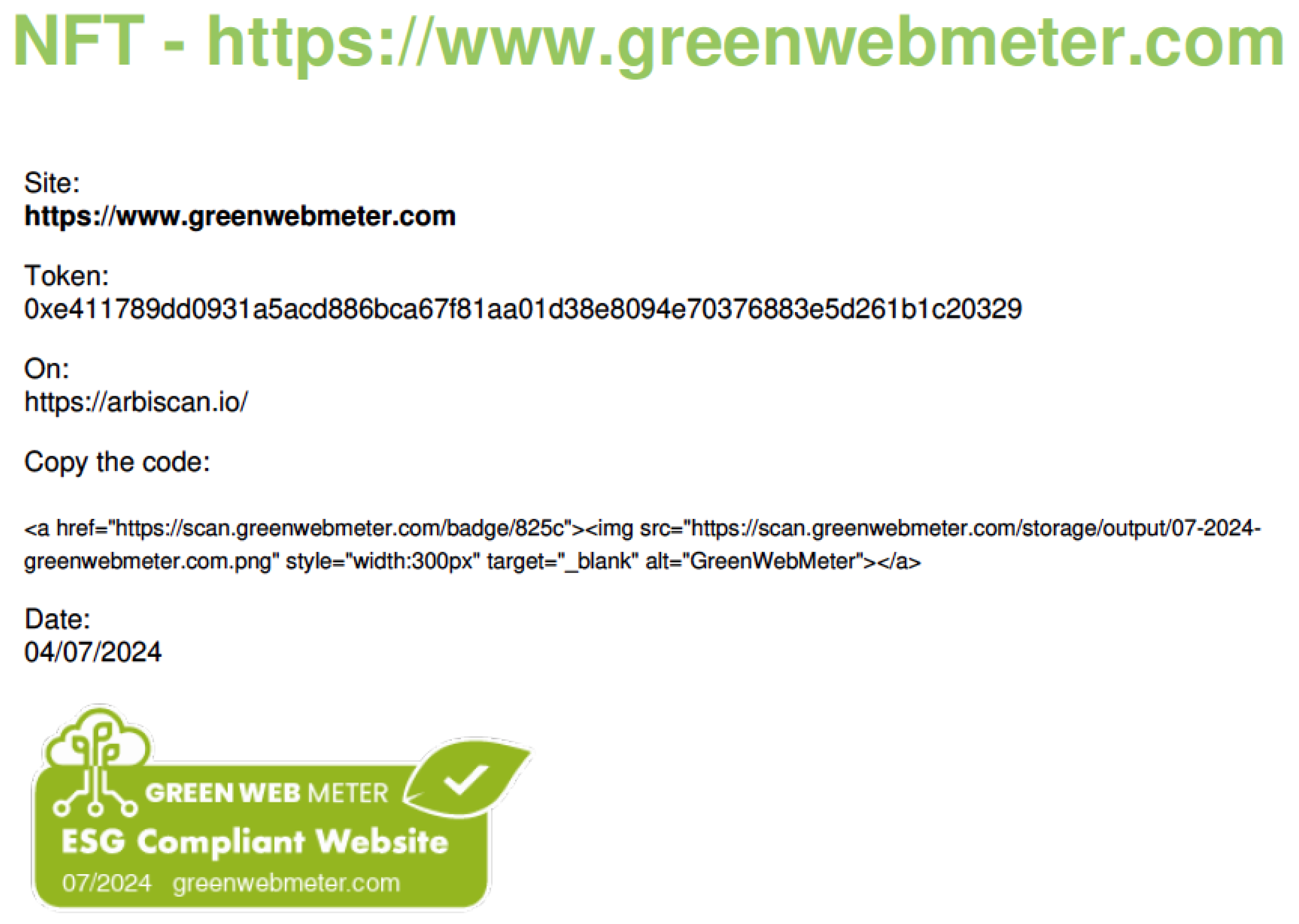
Figure 3.
Green Web Meter report. Evaluations and suggestions.
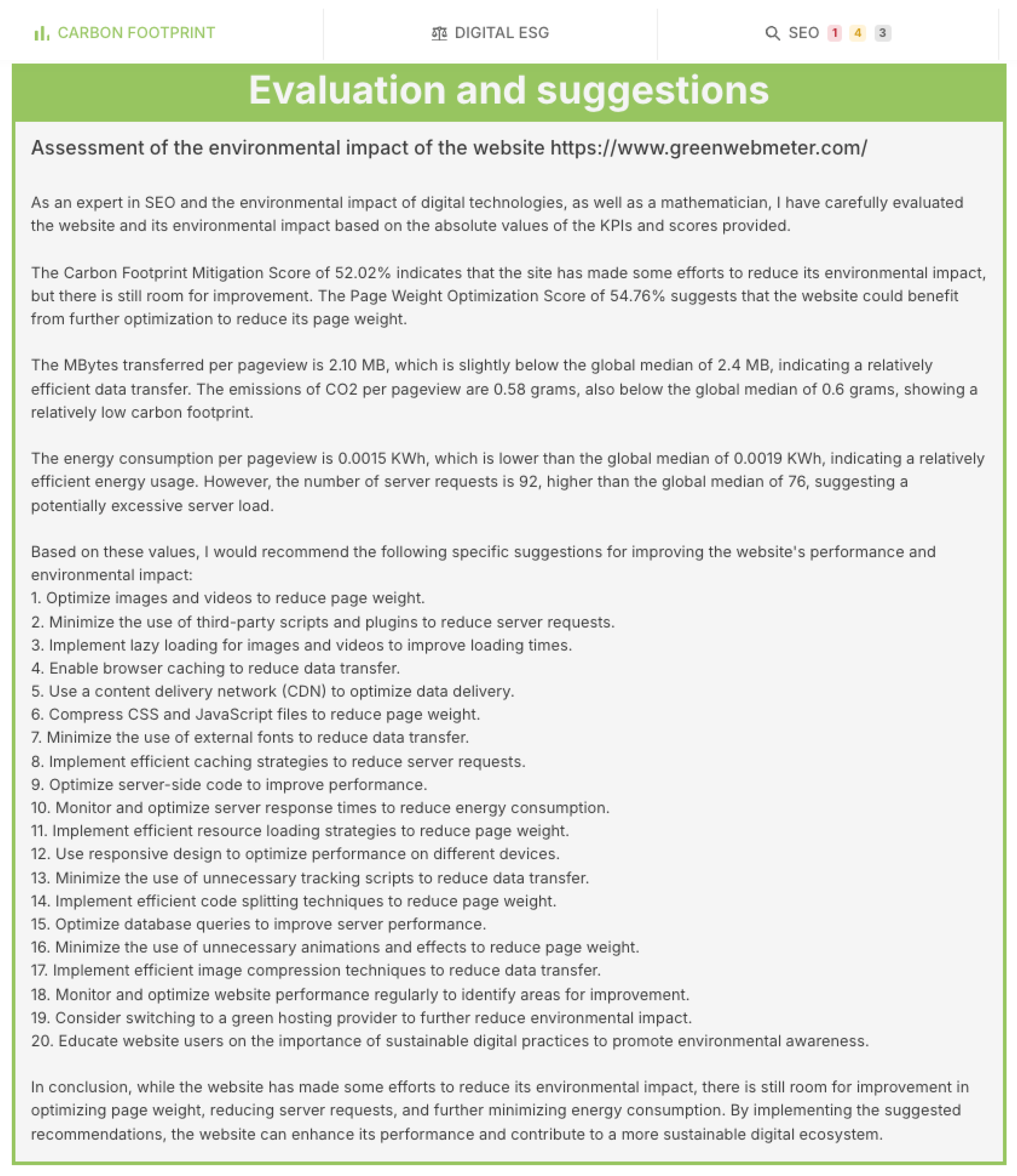
Figure 4.
Green Web Meter Environmental, Social, and Governance (ESG) scores.
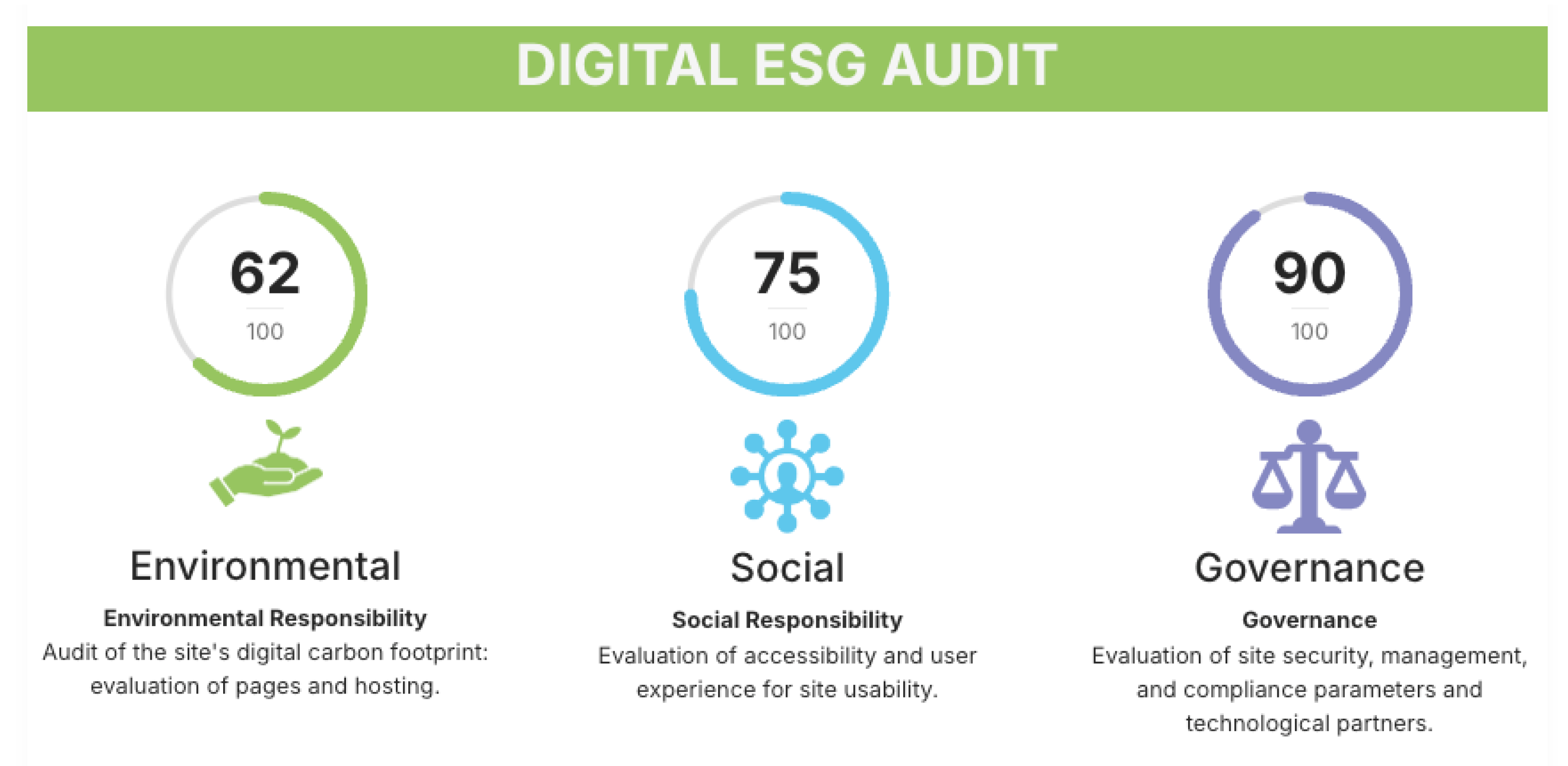

Table 1.
The E-S QUAL model.
| Parameter | Description |
|---|---|
| Efficiency | Ease of use and speed of the website (e.g., information organization, ease of finding information, page loading speed, and transaction completion speed). |
| Satisfaction | Truthfulness of statements about order delivery times and availability of items. |
| System availability | Correct functioning of the website (e.g., functional fluidity, absence of crashes and system blocks). |
| Privacy | Security and protection of consumers' privacy. |
Table 2.
The SITEQUAL model.
| Parameter | Description |
|---|---|
| Ease of use | Usability of the site and ease of access to relevant information. |
| Design aesthetics | Creativity, use of colour, and visual quality of multimedia assets. |
| Process speed | Speed, interactivity, and responsiveness. |
| Security | Security of personal and financial data. |
Table 3.
The WebQual 4.0 model.
| Parameter | Description |
|---|---|
| Usability | Ease of use, clarity and comprehensibility of interactions, navigability, attractiveness of display, appropriateness of graphic layout, clarity in layout and information hierarchy, ease of finding the website address, completeness of information on the website. |
| Information quality | Reliability of information, ability to provide updated information, comprehensibility and readability of information, ability to provide detailed information, relevance of information, accuracy of information, presentation of information in the appropriate format. |
| Interaction quality | Website reputation, transaction security, perception of security in providing personal data, sense of community, ability to attract interest, openness to feedback from users, reliability in transactions of goods or services. |
Table 4.
The digitally sustainable website's quality (own elaboration).
| Parameter | Description | Related UNI PdR 147:2023 target(s) |
|---|---|---|
| Performance efficiency | Speed and fluidity; digital resources' use efficiency (asset sizing); energy efficiency and carbon efficiency (principles of sustainable web design) | 7.2: Develop software with a reduced energy impact |
| Usability | Accessibility | 10.1: Develop inclusive, accessible, and usable digital services |
| Security and interaction quality | Security; privacy; reputation | 9.2: Create secure and resilient digital infrastructures 10.2: Develop digital services that respect users |
Table 5.
The Green Web Meter monitoring framework (ESG criteria, KPIs, and derived scores).
| ESG criterium | KPI | Derived scores |
|---|---|---|
| Environment (E) | Speed and fluidity | UX score |
| Digital resources' use efficiency (asset sizing) | Page weight optimization score | |
| Energy efficiency | Green hosting | |
| Carbon efficiency | Carbon footprint mitigation score | |
| Society (S) | Accessibility | Accessibility score |
| Best practice score | ||
| Reputation | SEO score | |
| Social media presence | ||
| Governance (G) | Security | Https encryption |
| Mixed content | ||
| Unsafe cross origin links | ||
| Public server visibility | ||
| Email privacy | ||
| Privacy | Visitor tracking |
Disclaimer/Publisher’s Note: The statements, opinions and data contained in all publications are solely those of the individual author(s) and contributor(s) and not of MDPI and/or the editor(s). MDPI and/or the editor(s) disclaim responsibility for any injury to people or property resulting from any ideas, methods, instructions or products referred to in the content. |
© 2024 by the authors. Licensee MDPI, Basel, Switzerland. This article is an open access article distributed under the terms and conditions of the Creative Commons Attribution (CC BY) license (http://creativecommons.org/licenses/by/4.0/).
Copyright: This open access article is published under a Creative Commons CC BY 4.0 license, which permit the free download, distribution, and reuse, provided that the author and preprint are cited in any reuse.