

Submitted:
22 July 2024
Posted:
24 July 2024
You are already at the latest version
Abstract
The term "sustainable urbanism" has been criticized over its inconsistent and imprecise definition, leading to challenges in implementing actionable reforms and achieving urban sustainability goals. A clearer approach may be to identify its opposite: specifically, forms of urbanism that cause an unacceptable buildup of toxic or climate-altering emissions, deplete resources beyond sustainable levels, progressively destroy critical ecologies, and cause other identifiable sources of potentially catastrophic harm to human and urban welfare. Here we present a model of such an “unsustainable urbanism,” and we observe further that it is in fact the dominant model of urban structure to this day. Its features include an over-reliance on low-occupancy vehicular transport; inefficient envelope, size, orientation and adaptability of buildings; ecologically destructive infrastructure systems for handling water, energy and other resources; and – under-appreciated but fundamentally important, as we will explore – decline of a well-connected, walkable, functionally and aesthetically appealing public realm. This model remains dominant in spite of the many goals, agenda and declarations on sustainable urbanism at the highest policy level. We observe that the lack of progress is in large part the result of system “lock-in” – economic and professional incentives and disincentives, standards, laws, codes, and other forms of feedback that reinforce “business as usual,” and create barriers to reform. Therefore, the agenda ahead must address the specific levers of change to overcome this systemic lock-in, drawing insights from economics, technology and the social sciences to do so. We present the outlines of this agenda, and make conclusions for needed steps ahead.
Keywords:
Sustainable urbanism
; unsustainable urbanism
; lock-in
; New Urban Agenda
1. Introduction
The word “sustainability,” and its related term, “sustainable development,” have both surged in usage since about 1980 [1]. This surge can be seen clearly in Google Books’ Ngram viewer, which charts the frequencies of terms found in printed sources published between 1500 and 2019 (Figure 1). Since the two terms first came into prominence around 1980, many authors have sought to clarify the terms and their application, and others have criticized their imprecision [2,3,4,5]. There have also been criticisms of the terms’ abuse in what is known as “greenwashing” [6,7]. Perhaps the most common accepted definition of sustainable development is that of the United Nations’ World Commission on Environment and Development, also known as the Brundtland Commission, whose 1987 report defined sustainable development as “development that meets the needs of the present without compromising the ability of future generations to meet their own needs” [8].
During the same period, there has been a surge in sustainability certifications programs in energy, forestry, product manufacturing, building construction, consumer products, and many other fields [9,10,11]. These programs typically have focused on reducing resource depletion to sustainable levels, promoting renewable resources, and reducing impacts on critical ecosystems. A more recent trend is to include social and economic factors in addition to impacts on natural resources – the so-called “triple bottom line” [12].
Meanwhile, criticisms of these programs have also proliferated, highlighting problems of measurement, unmet challenges of implementation, inability to “sustain” under the inherent limitations of a planet with finite resources, contradictions between the goals of “sustainability” and “development,” and other criticisms [13,14,15,16].
Perhaps the most trenchant criticism is the evident lack of effective implementation. One of the most prominent formulations of sustainable development goals was the United Nations’ 2030 Agenda for Sustainable Development, more commonly known as the Sustainable Development Goals, or SDGs for short, published in 2015 [17]. This policy document was adopted by acclamation by all 193 countries of the United Nations. Yet in its 2024 Sustainable Development Goals report, the UN called the SDGs “severely off track,” and noted that “among the assessable targets, only 17 percent display progress sufficient for achievement by 2030” [18]. The report noted that some of the targets could not even be assessed accurately. The report was made nine years after adoption, and only six years from the target date – fully 60% of the goal period. This lack of progress can be seen clearly in Figure 2.
2. Sustainability in Urbanism
The concept of “sustainable urbanism” has followed a similar path, also coming into view about 1990 and rising to prominence soon after 2000 (Figure 3). The related term of “sustainable community development” also arose about the same time, with similar prominence [19]. Both terms reflect the recognition that urban structures profoundly shape human movement, interaction, consumption, emissions, depletion, and ecological impacts, and therefore, there can be no overall sustainability without a sustainable urbanism at its core [20,21]. Here we will use the term “sustainable urbanism” to cover these and related concepts.
As with sustainability and sustainable development, many different certifications programs were developed to incentivize more sustainable urban development projects, including LEED-ND, BREEAM Communities, Green Star Communities, STARS, and DGNB Urban Districts, among many others [22,23].
These certifications, too, have been criticized for their complexity and cost, difficulty of implementation, over-emphasis on narrow quantitative factors, lack of incorporation of social factors, and arbitrary points-based metric valuations [24,25,26]. In addition, a number of building-scale certification systems – key components of sustainable urbanism ratings systems – have come in for similarly harsh criticism for their failure to perform as advertised [27].
Lurking behind all these problems is a lack of clarity in the definition of sustainable urbanism. To what degree is sustainable urbanism related to environmental impacts, and to what degree to social and economic factors? How can the different components be ranked in relation to one another? How can we assess interactive effects between factors? How can we actually make progress in achieving a sustainable form of urbanism and urbanization?
3. Modeling the Negative
One methodology to articulate a sustainable urbanism would be to identify its opposite, that is, UN-sustainable urbanism. After all, that which sustains is that which does not collapse, or move toward collapse, and the factors of collapse are often relatively easy to identify from the historical record. Such a model of un-sustainable urbanism would therefore include cities and societies that failed to sustain themselves, and collapsed over time as a result of depleted resources, buildup of pollutants, socioeconomic decline, and other unsustainable patterns. From those we can infer corollaries to our own condition, note any contemporary differences and additional factors, and formulate an agenda of needed alternative actions [28,29].
Such a comparison produces readily identifiable factors. For example, history has many examples of depletion of critical resources like forests, soil and water beyond a threshold of sustainability, leading to collapse. Some societies suffered from the accumulation of pollutants, to the point that human and/or ecological health were irrevocably damaged. Others saw impacts on natural habitats and their species, which in turn had devastating knock-on impacts on human well-being (e.g. depletion of fisheries, extinction of game animals, etc). Still others saw a decline of cultural vitality arising from political conflict or social decay, leading to economic decline and collapse.
These, then, are the four dimensions of UN-sustainable urbanism: resource depletion, pollution and contamination, habitat destruction, and socio-cultural disintegration. There is little doubt that all these challenges are still with us, although they often take new forms. For example, greenhouse gases are relatively new and unexpected forms of pollution, carrying an increasingly catastrophic impact on climate, and on human well-being; but they are in that sense also forms of pollution. Impacts on game animals and native flora have been replaced by threats to viable agriculture, including drought conditions, decline of pollinator species, and displacement of arable land by development impacts. To the depletion of resources like forests and fresh water, we can add depletion of oil, metals, and rarer minerals. To the extinction of critical species, we can now add the long list of species that could provide unknown benefit to humanity. More important, they may play key roles in critical ecosystems integrity, affecting human welfare in possibly catastrophic ways.
In turn, we can formulate a list of the urban factors that impact these four dimensions, either negatively, minimally (within sustainable limits) or even positively (as a form of regeneration). They are as follows:
- Rates of consumption of resources, including renewable and non-renewable ones. Consumption of renewable resources is sustainable if they are regenerated at a higher rate than their consumption (e.g. timber, fresh water), and if their consumption does not produce an accumulation of other toxic effects (e.g. waste products, air pollution). Consumption of non-renewable resources is sustainable if they are fully recycled, or if they can feasibly be replaced by other resources later – and also, if their consumption does not produce an accumulation of other toxic effects.
- Rates of accumulation of pollutants, contaminants, and other disruptive elements. Among these are chemicals that are toxic to the biosphere and/or to humans, substances that are disruptive of ecologies and animal health (like plastics and per- and polyfluoroalkyl substances, or PFAS), and invasive species. As noted, a relatively new class of pollutants includes greenhouse gases, ozone-depleting chemicals, and other substances with accumulating and possibly catastrophic impacts to human and planetary well-being.
- Rates of degradation of habitats and ecologies, including critical ecosystems (e.g. ocean, wetlands) and the species that depend on them.
- Rate of decay versus regeneration of critical cultural and socioeconomic systems, including socioeconomic systems that are essential to human development and cultural wealth, political and institutional systems needed to manage catastrophic effects from technologies (e.g. ecological catastrophes), wars (e.g. use of nuclear or biological weapons), natural threats (e.g. pandemics), and other threats to urban and human sustainability.
These factors are certainly impacted by many human systems apart from urban settlements. Yet they are affected disproportionately by urban settlements, since it is in cities, towns and suburbs that most human interaction, daily movement, creation, and consumption of resources occurs. It is in the variations of urban form – particularly sprawling versus compact – that a large percentage of per-capita greenhouse gas emissions originates, as research has shown [30]. It is here that we can observe UN-sustainable urbanism at its clearest.
The factors of this un-sustainable urbanism are, in turn, easy to identify in their contemporary forms. Together, they offer us a model by which we can consider concrete steps toward mitigating each of these factors. In the contemporary city, town or (especially) suburb, they are:
- Over-reliance on low-occupancy, high-consumption vehicular transport. This category includes passenger automobiles, which are much larger and heavier per passenger than other forms of transport, require significantly higher rates of fuel consumption per capita, contain greater embodied resources and energy, and in the case of internal combustion engines, produce more toxic emissions in air and water. These vehicles are often operated only by single individuals, further raising per-capita and overall consumption and depletion rates. To a lesser extent, this category also includes motorcycles, taxis, and transportation network companies, whose performance is only marginally better than personal low-occupancy vehicles.
- Inefficient envelope, size, orientation, and adaptability of buildings. Although progress has been made in recent years, many buildings are still poorly insulated and over-exposed to sun and wind, resulting in much higher consumption of resources for heating and cooling than necessary. Many buildings are also inefficiently organized, and therefore larger and more wasteful of energy and resources than necessary. Many buildings are also limited in their adaptability to new uses and to user needs and desires, resulting in excessive remodeling or even demolition. Finally, many buildings are inefficiently sited, resulting in greater land consumption and ecological impacts.
- Ecologically destructive systems for handling water and energy. Once again, progress has been made in recent years, but there is still too much reliance on non-renewable and toxic energy sources, in particular fossil fuels, and too much discharge of runoff water that is ecologically degraded in both quality and quantity.
- Decline of a well-ordered, walkable, functionally and visually appealing public realm. This is an under-appreciated factor, yet as research is demonstrating, one with profound consequences for the socioeconomic unsustainability of cities [31]. In many ways, this factor is a consequence of the other three factors (e.g. dominance of low-occupancy vehicles; large, inefficient and poorly connected buildings; and degraded resources in the public realm). In turn, however, this factor exacerbates the other three, and multiplies their effects. The lack of a walkable public realm creates a further incentive to utilize low-occupancy, high-consumption vehicular transport; there is a lower incentive and need to site buildings together within compact, mixed-use environments with closer proximity between daily destinations; there is a lower incentive to keep the buildings themselves compact and efficiently organized; and the resulting inefficient urban form and land use is itself more ecologically destructive.
The emerging research shows the fundamental importance of a city’s public realm as it affects all these other systems of the city, and its long-term socioeconomic health. The Secretary-General of Habitat III, Joan Clos, put it this way: “Everything in a city is related to the availability of public space: communication, traffic circulation, space for laying out infrastructure, common services… The principal question (is) the relationship in a city between public space and buildable space. This is the art and science of building cities – and until we recover this basic knowledge, we will continue to make huge mistakes” [32].
The research establishes that a city’s public realm, together with its complex interconnections with private spaces, is an essential “connective matrix” of the city, playing a key role in the formation of knowledge spillovers, economic value, social capital, ecological benefits, resilience, cultural vitality, and human development [33,34,35,36,37]. Its decline is therefore also associated with cultural and economic decline, as well as exacerbated impacts from vehicles, buildings, and resource systems [38,39].
The public realm is also a powerful driver of resident behaviors of consumption and depletion, through its neighborhood “choice architecture”—an observation from the relatively new field of behavioral economics [40]. Low-occupancy vehicles and poorly-oriented, inward-turning buildings also contribute to neighborhood choice architecture, and together these factors pre-define and accelerate higher-consumption choices by residents, resulting in higher rates of depletion, pollution, ecological disruptions, and sociocultural fragmentation. If it is easier to drive and inconvenient to walk, and if buildings are scattered, residents are more likely to choose to drive. Once in their cars, they are more likely to make choices of “drive through” and “drive-to” establishments with higher impacts on consumption, depletion and emissions. This interactive “multiplier effect” helps to explain the much greater impacts in many contemporary cities than the factors in isolation would suggest, in comparison to more compact, walkable city forms with functional public realms.
An additional consideration is the aesthetic attractiveness of the public realm. It is increasingly documented that a public realm that is regarded by users as unattractive is less likely to support walking, exercise, social interaction, formation of social capital, and all the other benefits of a functionally appealing public realm [41,42]. At the same time, new insights from environmental psychology, neuroaesthetics and other fields are deepening our understanding of the factors of functionally appealing public spaces, and their many additional benefits [43,44,45].
It is readily observable that contemporary cities do promote economic and cultural vitality, and they do raise some people out of poverty and promote human development. This is not a trivial achievement. It must be recognized, however, that they do so by injecting large and unsustainable magnitudes of resources into artificial connective systems, including roads and their low-occupancy vehicles, large inward-oriented and high-consumption buildings, and electronic forms of connectivity that tend to reinforce already-existing connections [46,47]. As discussed above, these forms of artificial connectivity also accelerate resource depletion, toxic emissions, and ecological impacts.
We note that many sustainability ratings systems include metrics for equitable economic opportunity and equitable access to urban resources – what has sometimes been referred to as socioeconomic justice, a “right to the city,”or more broadly, “cities for all.” It must be conceded that socioeconomic justice is not itself a sustainability metric, since many cities lacking socioeconomic justice sustained themselves for many centuries (sometimes up to the present day), while other cities with greater socioeconomic justice also suffered collapse. However, we can readily see that socioeconomic injustice restricts the full economic development of the city and its citizens, as resources must be diverted to attend to greater crime, violence, and health impacts, and the city is a less attractive trading partner to other cities and regions. Perhaps just as important, a city’s economic networks benefit from higher numbers of participants – a phenomenon documented by Metcalfe’s Law, first in digital networks and then broadened to model the behavior of social and economic networks [48] – and the deprivation of one group also deprives others of full socioeconomic network benefits [49].
In specific terms, this means that the public realm of a city must be accessible to all citizens, and that they in turn are able to take advantage of its connective benefits in order to achieve maximum benefit for all.
4. Summarizing the Model
We may then summarize these four categories of urban UN-sustainability factors more simply as:
- Inefficient vehicles (and their infrastructures);
- Inefficient buildings (and their placements);
- Inefficient resource systems (and their extended impacts); and
- Degraded public realm.
As this discussion suggests, all of these factors operate together within an interactive and expansive system, impacting many other aspects of resource consumption and depletion, pollution and contamination, habitat destruction, and social and cultural instability and decay. The degraded public realm plays an especially crucial role in interacting with and multiplying the effects of the other factors.
All of these factors together also carry a profound impact on behavior, particularly consumer behavior of consumption driving depletion and emissions.
This four-factor model is illustrated in Figure 4 (below). As discussed, inefficient vehicles, inefficient buildings, and inefficient resource systems all interact with each other, and magnify each other’s impacts. Furthermore, they are all nested within a larger public realm system, which creates a multiplier effect as it further impacts (or mitigates) consumption behaviors, extraction and depletion impacts, ecological impacts, emissions impacts, social conflicts, and at least in part, sociocultural decay.
This four-factor model could be developed into a mathematical model, which in turn could become the basis of a rating system (although development, refinement and verification would be necessary, which is beyond the scope of this paper). However, we can already see that such a model might be formulated as
s = (v + b + r) p
where s = urban sustainability, v = the measurement of inefficient vehicles, b = the measurement of inefficient buildings, and r = the measurement of inefficient resource systems. Each of the three variables, v, b and r, may be scored positively or negatively according to its impacts within the parameters of renewability or regeneration. The scores of these three variables would then be aggregated and the result would be multiplied by p, the public realm score, to produce an approximate predictive score of urban sustainability based on the model.
5. Lock-in of the Model
It can readily be observed in much new and existing urban pattern today that it is in fact overly reliant on low-occupancy vehicular transport; features inefficient envelope, size, orientation and adaptability of buildings; has ecologically destructive systems for handling water, energy and other resources; and manifests a marked decline of a walkable, functionally appealing public realm. Where counterexamples exist, they are too often fragmentary and expensive, and they thereby exclude the vast majority of citizens from their use and benefit.
As noted, this comes in spite of a range of declarations, goals and agendas, including the United Nations’ New Urban Agenda, adopted by acclamation in 2016 by all 193 countries of the United Nations [50] and the Sustainable Development Goals’ Goal 11 on cities, adopted in 2015 [51]. As the UN’s 2024 Sustainable Development Goals Report noted, progress on Goal 11 (its goal for sustainable cities) has been woefully inadequate, with less than 30% of the indicators “on track or target met,” and over 25% showing “stagnation” [18] (p. 4). The report also noted that “between 2000 and 2020, cities sprawled up to 3.7 times faster than they densified, resulting in negative impacts on the natural environment and land use,” while “only 40 per cent of city dwellers can easily reach open public spaces” [18] (p. 30). At the same time, the use of low-occupancy vehicles has increased significantly, with the global automobile fleet surpassing 1 billion vehicles for the first time in 2017. This growth is especially significant in emerging markets such as China and India, which have seen substantial increases in vehicle ownership and production [52]. Global energy use in buildings (including embodied energy of construction) also grew by about 20% from 2000 to 2018, according to the International Energy Agency (IEA) [53]. The consumption of resources in buildings, including embodied resources, has also grown significantly, in large part because of the rapid pace of urbanization [54]. Lastly, impacts to ecosystems and biodiversity from urban infrastructure impacts has also grown significantly since 2000 [55].
It therefore appears that our four-factor model of unsustainable urbanism accurately represents the dominant model of urbanism today. In spite of all the charters, agendas, declarations, certifications, grants and awards, the model persists, along with its unsustainable impacts.
This problem is a familiar one in economics and the social sciences, known as “lock-in”. The phenomenon was first described by the economist W. Brian Arthur, who noted that technological choices and network effects can lead to situations where one system becomes dominant and difficult to displace, thereby creating lock-in effects [56]. In this case, the global systems of urban development that are perpetuating these unsustainable factors are clearly “locked-in,” and it is therefore necessary to examine the causes and potential remedies of their lock-in condition.
A key insight of the literature around lock-in is that systems become “path-dependent” over time, as a result of a series of events or decisions that may seem insignificant at the time, but prove later to have profound consequences [57]. An often-cited example is the QUERTY keyboard, which was initially chosen to prevent jamming of early crude typewriters; when more reliable typewriters came on the scene, the QUERTY keyboard proved very difficult to revise.
That is not to say, however, that lock-in cannot be overcome. What is required, however, is an understanding of the where the levers of change might be, and how they might be operated.
In the case of unsustainable urbanism, there are many evident factors that perpetuate this lock-in condition. Among the most evident ones are:
- Depletion of resources (including building energy fuel, water, vehicle fuel, etc.) is financially rewarding, and this powerful incentive is not offset by payments of true externality costs (the costs to others or to the future).
- Policies and practices by government institutions become path-dependent when they create beneficiaries who oppose change, often because the beneficiaries are able to profit from the policies and practices, and they can divert some of these profits to lobbying, political support, and other forms of institutional reinforcement. These actions further reinforce the lock-in.
- Costs for institutions that must reconfigure their processes, standards and technologies (known as “switching costs”) are powerful disincentives to reform, and powerful incentives to maintain a more easily predicted, lower-risk form of “business as usual.”
- Perhaps least well recognized, and perhaps most promising, Cognitive and ideological models of normative urbanism also powerfully favor business as usual. Often they do so in ways that are obscured by rationalizations and hidden biases. This is a promising finding, because there is good research on effective ways to overcome biases and rationalizations in decision-making [58,59].
Among the strategies we might develop to overcome this lock-in:
- Use mechanisms to monetize externality costs and benefits, including tax policies, development charges, “feebates” (reduced or rebated regulatory fees for incentivized practices), and related financial tools. The mechanisms to allocate these costs must also be developed as reasonably accurate externality models, further requiring sophisticated Bayesian methodologies.
- Create political momentum to overcome entrenched policies of special interests, through educational and political campaigning, and through professional pressure for reform of policies and practices. In turn, this goal requires effective communication to the public to motivate them to press for reforms.
- Create institutional incentives for reform, which can include awards, certifications, grants, and model programs and ordinances.
- Advance new counter-models of sustainable urbanism, with a focus on their appealing qualities for citizens and policy-makers. These counter-models can create pathways for further implementation, bypassing locked-in constraints. The counter-models need to include actual built examples as well as persuasive evidence-based arguments.
Items one through three are already well under way, although much more can be done in each case. For example, there are ample opportunities for further land tax policy reforms [60] and for more sophisticated accounting of true externality costs.
Perhaps more promising – and with arguably more work to be done – are the further opportunities to develop the fourth category, the counter-models of a more sustainable urbanism. They are suggested as the opposites of the current entrenched models, which include:
- Transportation engineering models that prioritize mobility over access. These often take the form of context-insensitive street designs that are disruptive of pedestrian movement and visual quality, and moreover, can be deadly to pedestrians and bicyclists. The counter-model balances access with mobility, and creates an environment of transportation choice, context-sensitive design, and a pervasive low-impact mobility (including convenient walking, biking and public transit).
- Building models that sever their connections to the public realm, and to other buildings, defaulting to a stand-alone aesthetic as objects to be regarded rather than contexts to be inhabited. The alternative model is one of intimate connections between buildings, and between them and their public realm, including cognitive and aesthetic connections.
- Infrastructure and landscape models that destroy existing ecological systems, and replace them with destructive surface paving, piping, vegetation and other damaging structures. The alternative model embraces the existing ecology, and seeks to build in complementary patterns: recharging clean water, protecting or adding native vegetation, neutralizing and not discharging pollutants, and most especially, maintaining a compact footprint that minimizes regional land impacts.
- Public realm models that degrade the functionality and aesthetics of the public realm, and its system of connections to efficiently-distributed private spaces. The alternative model is all around us to see, in the compact, walkable, mixed-use communities of traditional city and town cores throughout human history.
The lock-in of the degraded public realm model is amply illustrated in a 1948 illustration by Adolf Bayer (Figure 5). This is a remarkably clear illustration of the cognitive model that now dominates, in which the traditional city at right, with all its supposed disorder, decay and disease, is replaced by the modern “orderly” city at left – but with a profoundly fragmented and degraded public realm.
A related source of lock-in can be seen in Figure 6, an advertisement by Shell Oil Company in 1937, showing a model built by designer Norman Bel Geddes on the “Ville Radieuse” model of the highly influential architect le Corbusier [61] (pp. 39-49). As the image shows, this was indeed a remarkably accurate blueprint for what was later actually built in cities like Dallas, Texas, shown to the right. It was also a powerfully effective cognitive tool of persuasion, promising a sleek future of mobility and modernity. Not present were the traffic jams, air and water pollution, social isolation, and other profound externality costs of this model, including the impacts of its profoundly degraded public realm.
What we see, then, is the entrenched lock-in of a cognitive and ideological model, the template of the “modern” (business as usual) city, which was established as the result of an interaction of historically contingent incentives, opportunities, theoretical rationales, and technological dynamics, and further locked in by technical specifications, economic protocols, public policies, educational standards, ideological doctrines, and other mutually reinforcing conditions.
The tools to overcome lock-in must therefore be deployed: not only single acts of persuasion or presentations of research evidence, but systemic approaches, not only to technological, economic and policy reforms, but equally to cognitive and ideological forms of persuasion, to counter (and in some ways mirror) the forms of persuasion that were deployed in the eary and mid 20th century.
Above all, we need new demonstrations on the ground that offer tangible evidence of the promise of more compact, walkable, mixed-use communities, drawing on the demonstrably successful patterns of traditional city and town cores throughout human history. It is critical that users and other stakeholders find these places to be promising and desirable alternatives – not only, or perhaps even, professionals.
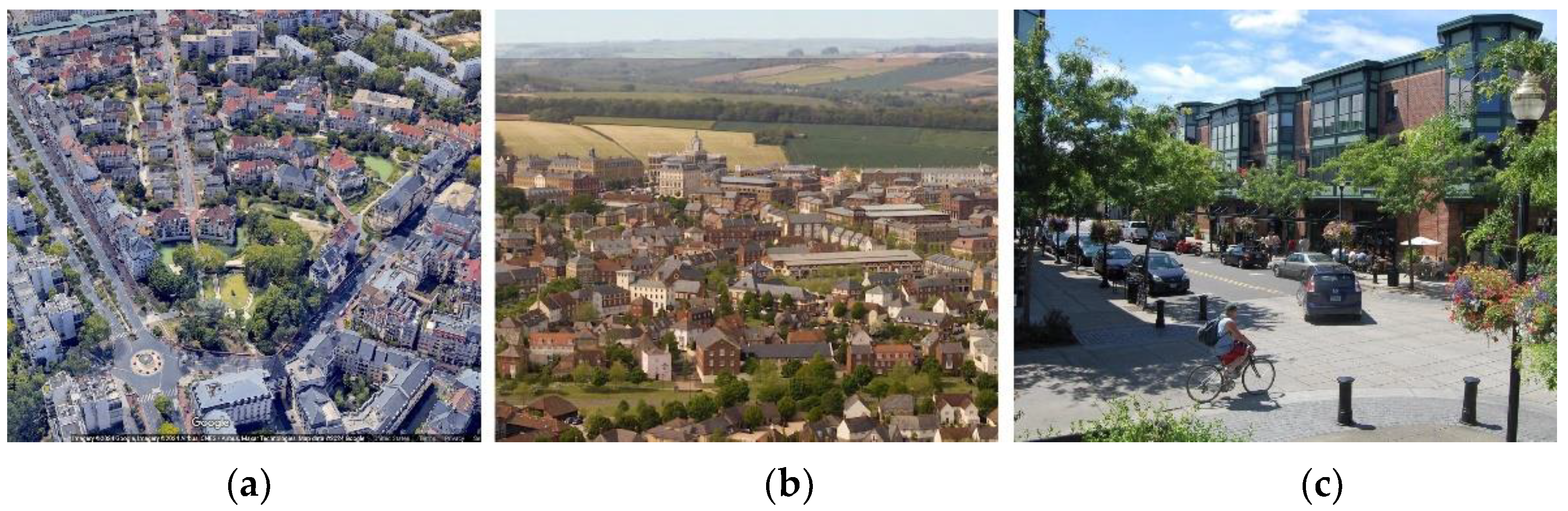
Some examples of these new places are shown in Figure 7. All of these examples are much more compact and mixed than comparable new projects; they feature greater walkability, bikability, and access to public transit, and reduced inpacts of low-occupancy vehicles; their buildings are all well-connected to the public realm, with edges that are functionally and aesthetically supportive of public life; they all feature ecological infrastructure and resource-conserving systems; and crucially, they all place primary emphasis on the public realm, and its fundamental role in a more connective urbanism.
It is notable that these places also include affordable housing, employment opportunities, gathering places, and other examples of public and private “social infrastructure.” They are also all notably popular and successful in their markets, often in spite of significant economic, technical and regulatory barriers, and often in spite of harsh attacks from pro-modernist authorities in academia, journalism and the professions [62]. While they all may represent partial progress on the path to a truly sustainable urbanism, their progress is measurable and significant.
5. Discussion
These and other pilot examples demonstrate the efficiacy and potential functionality of rebuilding on this last model (sometimes known as “new urbanism”), and the many social, environmental and economic benefits it can clearly deliver [63,64,65]. However, a powerful cognitive bias remains as another stubborn form of lock-in: what we will here call the “modernity bias.” It is an explicit (if unfounded) theory within portions of academia, and a tacit assumption within much of the general public, that “that was then and this is now, and we just can’t do that anymore.” Various rationales are given, each of which can be swatted down with empirical evidence and counter-examples – but meanwhile, another pops up, as in the child’s game, Whack-a-Mole. “It isn’t practical;” “it’s too expensive;” “people won’t like it;” “it doesn’t have artistic merit;” and so on.
A thoroughgoing new (or revived) urbanism, both functional and aesthetic, is indeed not practical if we are locked into a drive-through automobile culture (therefore such lock-in must be overcome). It will be comparatively too expensive if our economic returns on investment fail to properly account for the externality costs of business as usual, or fail to reward for externality benefits of reform (therfore we must reform our economic feedback systems). People will not like the reforms if they aren’t tried out in fair comparisons that address practical considerations (although when that is done, evidence shows that the response of consumers and the public is very positive indeed [66]).
One of the most powerful factors within this entrenched bias – if perhaps the least recognized – is the idea that the buidling aesthetics must be aggressively novel in a neo-modernist character if the project is to have any artistic merit. This idea is a reflection of a historically peculiar but remarkably poorly-examined conception of the relationship between urban art (and architecture) and urban life. It is in fact a dysfunctional approach to the place of art in the city, as the urban journalist Jane Jacobs famously observed [67] (pp. 372-391). We need art in cities, Jacobs argued, to illuminate our lives and enrich their meanings. But we must not allow art to substitute itself for urban life, and thereby to damage the life of the city and its citizens. We must not turn the city into a kind of scuplture garden of disconnected art-objects. The result, she said, is neither art nor life, but “taxidermy” [67] (p. 373).
A key consequence of this confusion between art and life, and this tendency to impose an aggressive form of abstract art as a pattern for the aesthetics of buildings, is a widespread dislike by the public of new sustainable urban projects that are not built on preferred traditional aesthetic patterns. This finding is documented by a large body of research [68,69,70]. At the same time, new research is documenting that this difference between users and professionals may have more to do with innate neuroaesthetic and cognitive needs than with the ideological or semiotic associations that are typically the focus of designers [71,72]. This is a fascinating and promising area of research, and although its full exploration is beyond the scope of this paper, it paints a damning picture of business as usual in the contemporary environmental design world.
Suffice it to say, however, that this is the ultimate manifestation of lock-in: not a professionally accountable assessment of users’ actual architectural and urban needs, but a stubbornly persistent cognitive bias, borne of the accidents of ideological and technological history. Recognizing this, we can develop strategies to challenge and overcome this and the other forms of lock-in.
5. Conclusion
This paper has sought to clarify the definition of sustainable urbanism by articulating its opposite, un-sustainable urbanism, and presenting a four-factor model of the latter. We then examined the specific alternatives of this model and its factors, with special attention to the role of public space systems. We examined the effects of “lock-in,” and strategies to overcome them. We noted in particular the importance of new demonstrations on the ground that offer tangible evidence of the promise of more sustainable urbanism, featuring more efficient vehicles, buildings and resource systems, and especially, a better-quality public realm. Much work remains to develop more on-the-ground projects, to document their benefits and lessons, and to use them to drive change at all levels of policy, education and practice.
Conflicts of Interest
The author declares no conflicts of interest.
References
- Google Books, Ngram Viewer, 2024. Available from: https://books.google.com/ngrams/graph?content=sustainability%2C+sustainable+development&year_start=1800&year_end=2019&corpus=en-2019&smoothing=3 (accessed 22 July 2024.).
- Brown, B.J.; Hanson, M.E.; Liverman, D.M.; Merideth, R.W., Jr. Global sustainability: Toward definition. Environ. Manag. 1987, 11, 713–719. [CrossRef]
- Allen TF, Hoekstra TW. Toward a definition of sustainability. In Sustainable ecological systems: implementing an ecological approach to land management. Rocky Mountain Forest and Range Experiment Station, Fort Collins, Colorado. 1993 Jul 12:98-107.
- Johnston P, Everard M, Santillo D, Robèrt KH. Reclaiming the definition of sustainability. Environmental Science and Pollution Research International. 2007 Jan 1;14(1):60-6.
- Newton JL, Freyfogle ET. Sustainability: A Dissent. Conservation Biology. 2005 Feb 1:23-32.
- Moodaley, W.; Telukdarie, A. Greenwashing, Sustainability Reporting, and Artificial Intelligence: A Systematic Literature Review. Sustainability 2023, 15, 1481. [CrossRef]
- He, Q.; Wang, Z.; Wang, G.; Xie, J.; Chen, Z. The Dark Side of Environmental Sustainability in Projects: Unraveling Greenwashing Behaviors. Proj. Manag. J. 2022, 53, 349–366. [CrossRef]
- The World Commission on Environment and Development (WCED). Our Common Future. 1987. Available online: https://sustainabledevelopment.un.org/content/documents/5987our-common-future.pdf (accessed on 14 January 2022).
- Blackman, A.; Rivera, J. Producer-Level Benefits of Sustainability Certification. Conserv. Biol. 2011, 25, 1176–1185. [CrossRef]
- Tröster, R.; Hiete, M. Success of voluntary sustainability certification schemes – A comprehensive review. J. Clean. Prod. 2018, 196, 1034–1043. [CrossRef]
- Blackman A, Rivera J. The evidence base for environmental and socioeconomic impacts of" sustainable" certification. SSRN 2010. Available from: https://papers.ssrn.com/sol3/papers.cfm?abstract_id=1579083 (accessed July 22, 2024).
- Alhaddi, H. Triple Bottom Line and Sustainability: A Literature Review. Bus. Manag. Stud. 2015, 1, 6. [CrossRef]
- Sridhar, K.; Jones, G. The three fundamental criticisms of the Triple Bottom Line approach: An empirical study to link sustainability reports in companies based in the Asia-Pacific region and TBL shortcomings. Asian J. Bus. Ethic- 2012, 2, 91–111. [CrossRef]
- Lippert I. An introduction to the criticism on sustainable development. Brandenburg University of Technology, Cottbus. 2004 Nov 10;51.
- Fiala, N. Measuring sustainability: Why the ecological footprint is bad economics and bad environmental science. Ecol. Econ. 2008, 67, 519–525. [CrossRef]
- Spaiser V, Ranganathan S, Swain RB, Sumpter DJ. The sustainable development oxymoron: quantifying and modelling the incompatibility of sustainable development goals. International Journal of Sustainable Development & World Ecology. 2017 Nov 2;24(6):457-70.
- United Nations. Transforming Our World: The 2030 Agenda for Sustainable Development. 2015. Available from: https://sdgs.un.org/sites/default/files/publications/21252030%20Agenda%20for%20Sustainable%20Development%20web.pdf. (accessed July 22, 2024.).
- United Nations. The Sustainable Development Goals Report 2024. Available from: https://unstats.un.org/sdgs/report/2024/The-Sustainable-Development-Goals-Report-2024.pdf (accessed July 22, 2024).
- Spiliotopoulou, M.; Roseland, M. Urban Sustainability: From Theory Influences to Practical Agendas. Sustainability 2020, 12, 7245. [CrossRef]
- Farr, D. Sustainable urbanism: Urban design with nature. New York: John Wiley & Sons 2011.
- Roggema, R. The Future of Sustainable Urbanism: Society-Based, Complexity-Led, and Landscape-Driven. Sustainability 2017, 9, 1442. [CrossRef]
- Hamedani AZ, Huber F. A comparative study of DGNB, LEED and BREEAM certificate systems in urban sustainability. WIT Transactions on Ecology and the Environment. 2012, 155, 121-32.
- Cohen, M. A Systematic Review of Urban Sustainability Assessment Literature. Sustainability 2017, 9, 2048. [CrossRef]
- Sharifi, A.; Murayama, A. A critical review of seven selected neighborhood sustainability assessment tools. Environ. Impact Assess. Rev. 2013, 38, 73–87. [CrossRef]
- Doan, D.T.; Naismith, N.; Zhang, T.; Ghaffarianhoseini, A.; Tookey, J. A critical comparison of green building rating systems. J. Affect. Disord. 2017, 123, 243–260. [CrossRef]
- Haapio, A.; Viitaniemi, P. A critical review of building environmental assessment tools. Environ. Impact Assess. Rev. 2008, 28, 469–482. [CrossRef]
- Scofield, J. H. (2009). "Do LEED-Certified Buildings Save Energy? Not Really…" Energy and Buildings. 2009 41(12), 1386-1390.
- Diamond J. Collapse: How societies choose to fail or succeed (Revised edition.) Penguin; 2011 Jan 4.
- Dentinho TP, Gil FS, Silveira P. Unsustainable cities, a tragedy of urban networks. Case Studies In Business, Industry And Government Statistics. 2011 4(2):101-7.
- Mehaffy MW. Urban form and greenhouse gas emissions: Findings, strategies, and design decision support technologies. Delft: A+ BE|Architecture and the Built Environment. 2015(14):1-92.
- Low, S.M. Why Public Space Matters. Oxford University Press; 2023.
- Clos, J. “We have lost the science of building cities.” (Interview by Mike Herd.) The Guardian, April 18, 2016. Available from https://www.theguardian.com/cities/2016/apr/18/lost-science-building-cities-joan-clos-un-habitat (accessed July 22, 2024).
- Roche, M.P. Taking Innovation to the Streets: Microgeography, Physical Structure, and Innovation. Rev. Econ. Stat. 2020, 102, 912–928. [CrossRef]
- Brain, D. Reconstituting the Urban Commons: Public Space, Social Capital and the Project of Urbanism. Urban Plan. 2019, 4, 169–182. [CrossRef]
- Ijla, A.M. Does public space create social capital?. International Journal of Sociology and Anthropology. 2012 Feb 1;4(2):48.
- Klinenberg E. Palaces for the people: How social infrastructure can help fight inequality, polarization, and the decline of civic life. Crown; 2018 Sep 11.
- Mehta V. The Street: A Quintessential Social Public Space. Routledge; 2013 Mar 5.
- Carmona M. Re-theorising contemporary public space: a new narrative and a new normative. Journal of Urbanism: International Research on Placemaking and Urban Sustainability. 2015 Oct 2;8(4):373-405.
- Banerjee T. The future of public space: Beyond invented streets and reinvented places. Journal of the American Planning Association. 2001 Mar 31;67(1):9-24.
- Mehaffy M.W. Neighborhood “choice architecture”: A new strategy for lower-emissions urban planning? Urban Planning. 2018 Apr 24;3(2):113-27.
- Humpel, N.; Marshall, A.L.; Leslie, E.; Bauman, A.; Owen, N. Changes in neighborhood walking are related to changes in perceptions of environmental attributes. Ann. Behav. Med. 2004, 27, 60–67. [CrossRef]
- Root, E.; Silbernagel, K.; Litt, J. Unpacking healthy landscapes: Empirical assessment of neighborhood aesthetic ratings in an urban setting. Landsc. Urban Plan. 2017, 168, 38–47. [CrossRef]
- Ulrich, R.S. View through a window may influence recovery from surgery. Science 1984, 224, 420–421. [CrossRef]
- Knöll, M.; Neuheuser, K.; Cleff, T.; Rudolph-Cleff, A. A tool to predict perceived urban stress in open public spaces. Environ. Plan. B: Urban Anal. City Sci. 2017, 45, 797–813. [CrossRef]
- Henderson, H.; Child, S.; Moore, S.; Moore, J.B.; Kaczynski, A.T. The Influence of Neighborhood Aesthetics, Safety, and Social Cohesion on Perceived Stress in Disadvantaged Communities. Am. J. Community Psychol. 2016, 58, 80–88. [CrossRef]
- Hogan DJ, Ojima R. Urban sprawl: A challenge for sustainability. The New Global Frontier. 2012 May 23:203-16.
- Andersson A, Andersson DE, Mellander C. Does Density Matter? In Handbook of Creative Cities. Andersson A, Andersson DE, Mellander C. (Eds.), Elgar. January 1, 2011.
- Sellens JT. Knowledge, networks and economic activity. Revisiting the network effects in the knowledge economy. e-Journal on the Knowledge Society. 2009 Apr;8.
- Tongia, Rahul and Wilson, Ernest, Turning Metcalfe on His Head: The Multiple Costs of Network Exclusion (August 15, 2007). TPRC 2007, Available at SSRN: https://ssrn.com/abstract=2117598 (accessed July 22, 2024).
- United Nations. New Urban Agenda. United Nations Conference on Housing and Sustainable Urban Development (Habitat III), Quito, Ecuador, 20 October 2016. Available from: https://documents.un.org/doc/undoc/gen/n16/466/55/pdf/n1646655.pdf?token=nYpoVyo55sV46IoOuh&fe=true (accessed July 22, 2024).
- United Nations. Transforming our world: the 2030 Agenda for Sustainable Development. New York: United Nations; 2015. Resolution A/RES/70/1. Available from: https://undocs.org/A/RES/70/1 (Accesed July 22, 2024).
- Rodriguez, J.P. The Geography of Transport Systems. 2024. New York: Routledge.
- The International Energy Agency (IEA). Global Energy & CO2 Status Report 2019—Analysis—IEA. 2019. Available online: https://www.iea.org/reports/global-energy-co2-status-report-2019 (accessed on 2 March 2022).
- UN; IEA. 2019 Global Status Report for Buildings and Construction. 2019. Available online: https://www.iea.org/reports/global-status-report-for-buildings-and-construction-2019 (accessed on).
- Behnisch, M.; Krüger, T.; Jaeger, J.A.G. Rapid rise in urban sprawl: Global hotspots and trends since 1990. PLOS Sustain. Transform. 2022, 1, e0000034. [CrossRef]
- Arthur, W.B. Competing technologies, increasing returns, and lock-in by historical events. Econ. J. 1989, 99, 116–131. [CrossRef]
- Mahoney, James; Schensul, Daniel. Historical Context and Path Dependence. Oxford University Press, 1996. pp. 454–471. ISBN 0199270430. [CrossRef]
- Morvan C, Jenkins WJ. An analysis of Amos Tversky and Daniel Kahneman's judgment under uncertainty: Heuristics and biases. Macat Library; 2017 Jul 5.
- Cristofaro, M. Reducing biases of decision-making processes in complex organizations. Manag. Res. Rev. 2017, 40, 270–291. [CrossRef]
- Condon PM. Broken City: Land Speculation, Inequality, and Urban Crisis. UBC Press; 2024 May 15.
- Mehaffy M and Salingaros NA. Design for a living planet: Settlement, science, & the human future. Sustasis Press; 2017 May 30.
- Mehaffy, M. Art vitiating life. In Landscape Urbanism and its Discontents, Talen, E. and Duany, A. (Eds.) Gabriola Island: New Society Publishers. 2013 Mar 1:187-98.
- Podobnik, B. Assessing the social and environmental achievements of New Urbanism: evidence from Portland, Oregon. J. Urban. Int. Res. Placemaking Urban Sustain. 2011, 4, 105–126. [CrossRef]
- Ewing, R.; Tian, G.; Park, K.; Sabouri, S.; Stinger, P.; Proffitt, D. Comparative case studies: trip and parking generation at Orenco Station TOD, Portland Region and Station Park TAD, Salt Lake City Region. Cities 2018, 87, 48–59. [CrossRef]
- Tu, C.C. Valuing New Urbanism: An empirical examination of traditional neighborhood developments. The George Washington University; 1999.
- National Association of Realtors. New NAR Survey Finds Americans Prefer Walkable Communities. June 27, 2023. Available from: https://www.nar.realtor/newsroom/new-nar-survey-finds-americans-prefer-walkable-communities (accessed July 22, 2024).
- Jacobs, J. The Death and Life of Great American Cities. The Failure of Town Planning; New York, 1961; p. 71.
- Gifford, R., Hine, D. W., Muller-Clemm, W., Reynolds, D. J., & Shaw, K. T. Decoding Modern Architecture: A Lens Model Approach for Understanding the Aesthetic Differences of Architects and Laypersons." Environment and Behavior. 2000 32(2), 163-187.
- Nasar, J. L. Urban Design Aesthetics: The Evaluative Qualities of Building Exteriors." Environment and Behavior. 1994 26(3), 377-401.
- Chesné, A.; Ioannidis, R. An Investigation of the Perception of Neoclassical, Eclectic, Modernist, and Postmodern Architecture within Different Urban Landscapes: Athens vs. Paris. Land 2024, 13, 340. [CrossRef]
- Chatterjee, A.; Coburn, A.; Weinberger, A. The neuroaesthetics of architectural spaces. Cogn. Process. 2021, 22, 115–120. [CrossRef]
- Sussman A, Hollander J. Cognitive architecture: Designing for how we respond to the built environment. Routledge; 2021 Jul 12.
- Salingaros NA. The biophilic healing index predicts effects of the built environment on our wellbeing. Architexturez.net, 2019. Available from: https://patterns.architexturez.net/doc/az-cf-218834 (accessed July 21, 2024.).
Figure 1.
Google Books’ Ngram Viewer of usage of the term “sustainability” (Google, 2024).
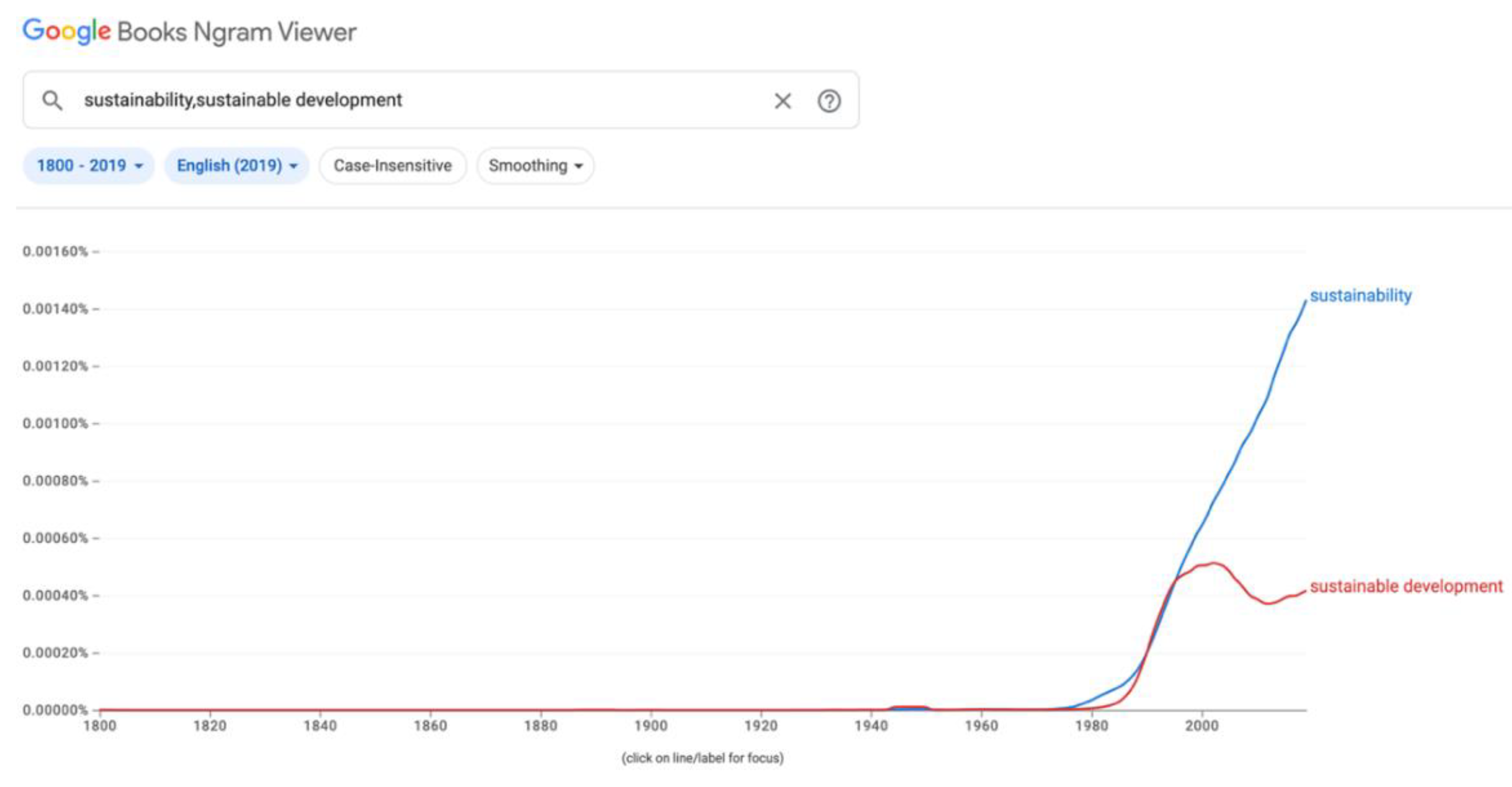
Figure 2.
The UN’s 2024 Sustainable Development Goals Report shows many goals in “stagnation” or “regression.” From https://unstats.un.org/sdgs/report/2024/The-Sustainable-Development-Goals-Report-2024.pdf (public domain).
Figure 2.
The UN’s 2024 Sustainable Development Goals Report shows many goals in “stagnation” or “regression.” From https://unstats.un.org/sdgs/report/2024/The-Sustainable-Development-Goals-Report-2024.pdf (public domain).
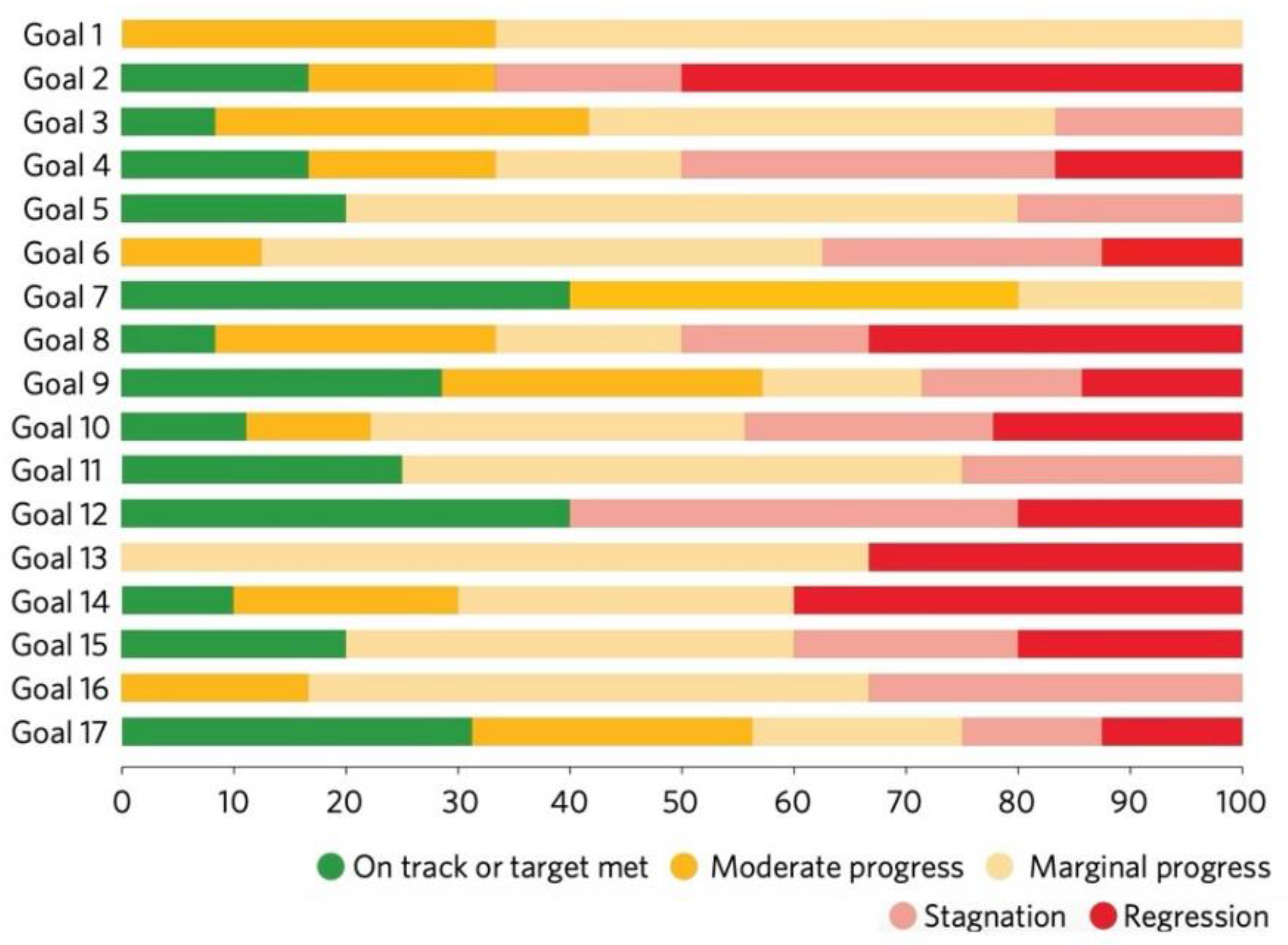
Figure 3.
Google Books’ Ngram Viewer of usage of the term “sustainable urbanism” (Google, 2024).
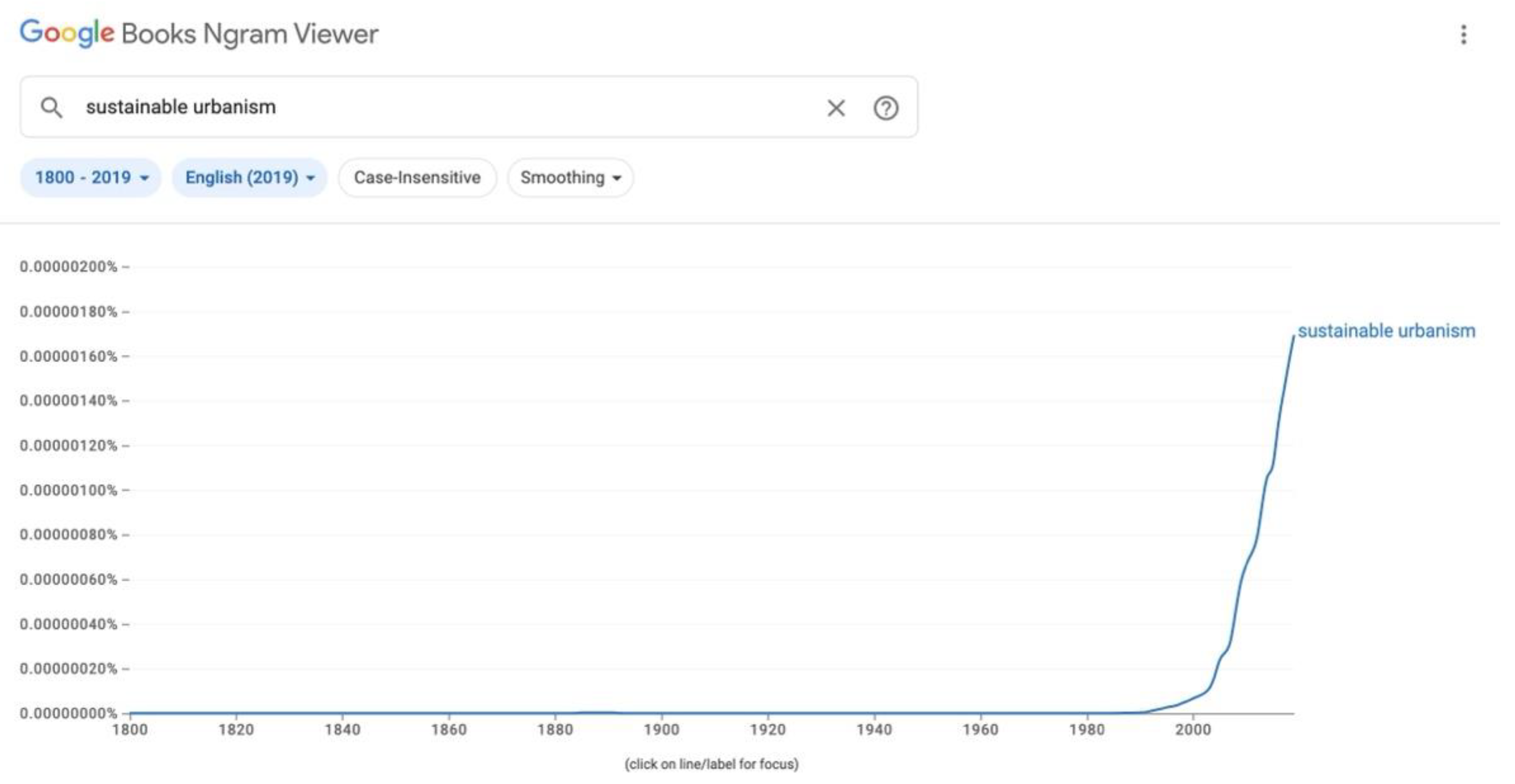
Figure 4.
A graphical representation of the four-factor model of unsustainable urbanism.
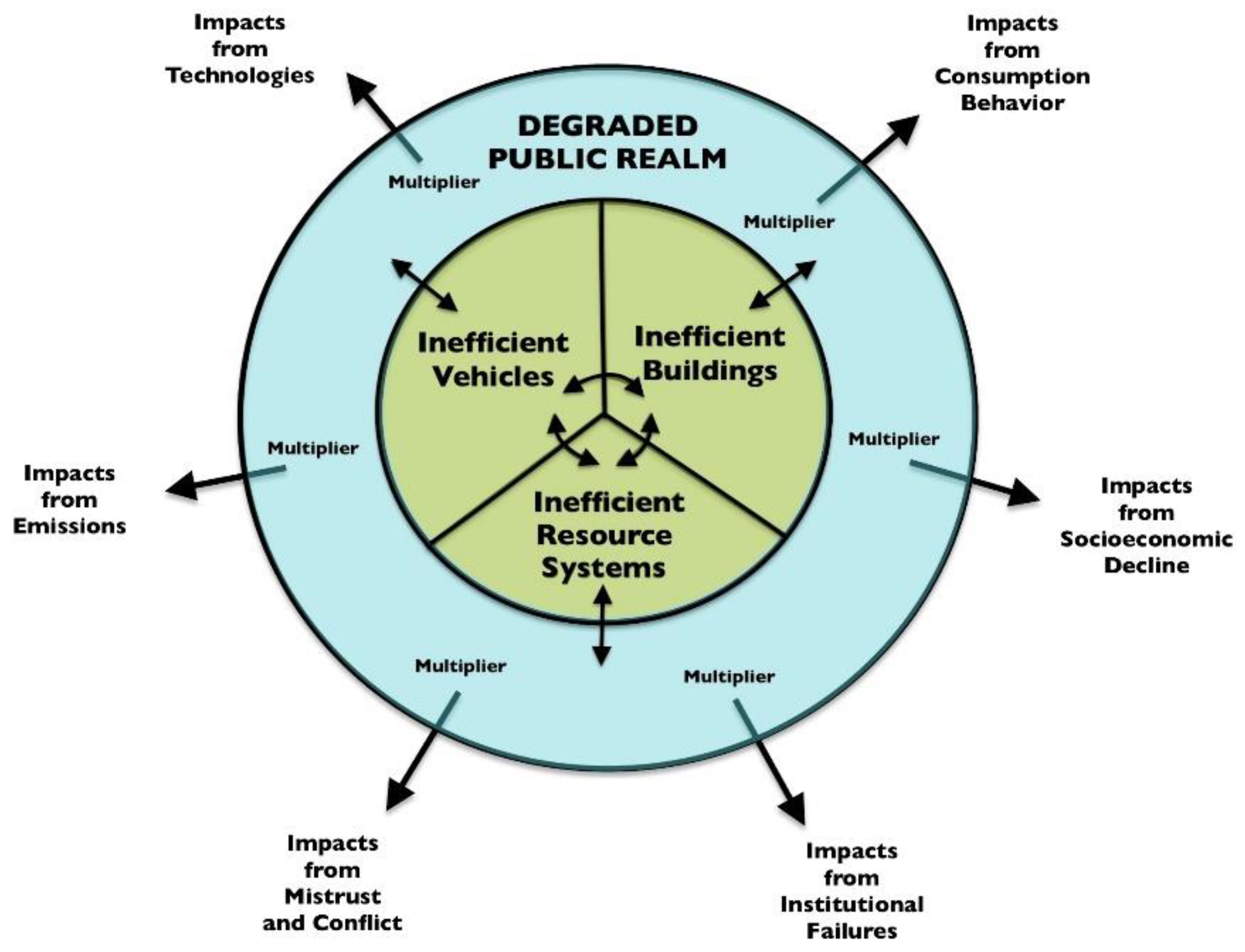
Figure 5.
“Order and Disorder,” by Adolf Bayer, 1948. (Public domain.).
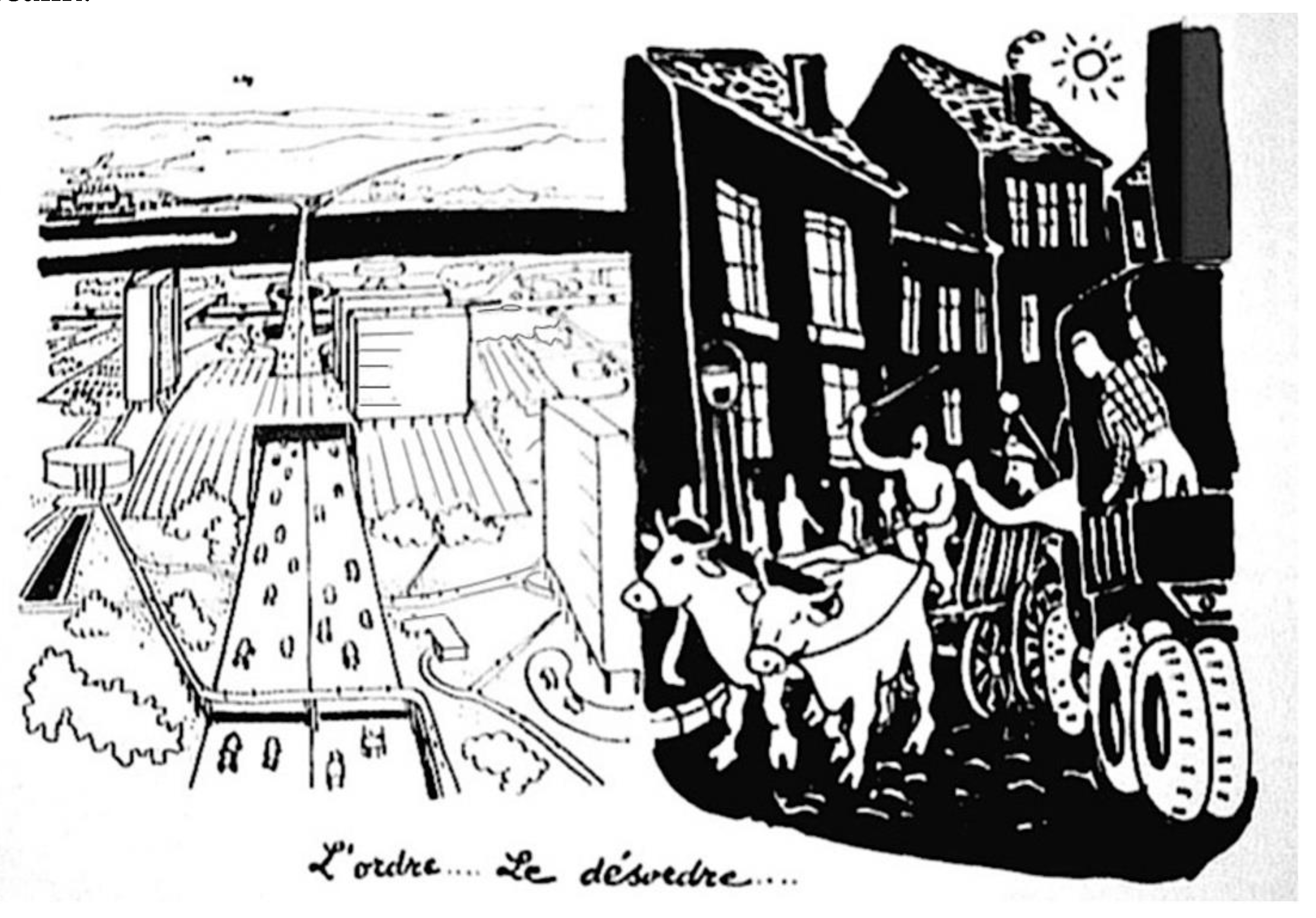
Figure 6.
The power of cognitive and ideological lock-in, established through concerted campaigns of marketing and persuasion: (a) Shell Oil Company advertisement in Life Magazine, 1937, and (b) a contemporary example of the result from Dallas, Texas. (Public domain.).
Figure 6.
The power of cognitive and ideological lock-in, established through concerted campaigns of marketing and persuasion: (a) Shell Oil Company advertisement in Life Magazine, 1937, and (b) a contemporary example of the result from Dallas, Texas. (Public domain.).
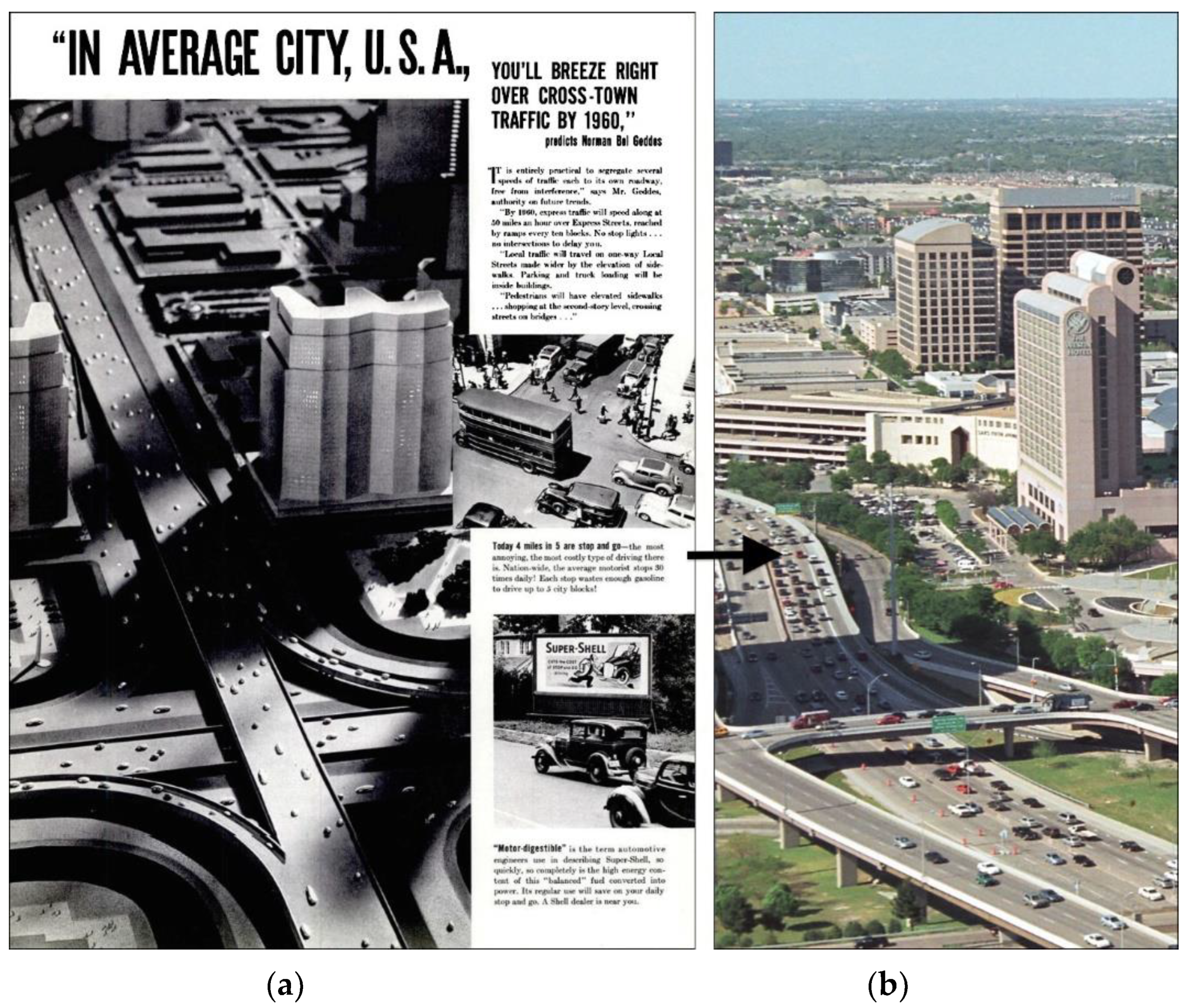
Figure 7.
Three examples of new compact, walkable, mixed-use communities that draw on the demonstrably successful functional and aesthetic patterns of traditional city and town cores throughout human history: (a) Le Plessis-Robinson, France; (b) Poundbury, UK; and (c) Orenco Station, Oregon USA.
Figure 7.
Three examples of new compact, walkable, mixed-use communities that draw on the demonstrably successful functional and aesthetic patterns of traditional city and town cores throughout human history: (a) Le Plessis-Robinson, France; (b) Poundbury, UK; and (c) Orenco Station, Oregon USA.
Disclaimer/Publisher’s Note: The statements, opinions and data contained in all publications are solely those of the individual author(s) and contributor(s) and not of MDPI and/or the editor(s). MDPI and/or the editor(s) disclaim responsibility for any injury to people or property resulting from any ideas, methods, instructions or products referred to in the content. |
© 2024 by the authors. Licensee MDPI, Basel, Switzerland. This article is an open access article distributed under the terms and conditions of the Creative Commons Attribution (CC BY) license (http://creativecommons.org/licenses/by/4.0/).
Copyright: This open access article is published under a Creative Commons CC BY 4.0 license, which permit the free download, distribution, and reuse, provided that the author and preprint are cited in any reuse.


