
Submitted:
22 July 2024
Posted:
24 July 2024
You are already at the latest version
Abstract
The whimsical Las Vegas/Monte Carlo cubic dice are generalized to construct the combinatorial problem of enumerating all n-dimensional hypercube dice, and dice of other shapes that exhibit cubic, icosahedral and higher symmetries. By utilizing powerful generating function techniques for various irreducible representations, we derive the combinatorial enumerations of all possible dice in n-dimensional space with hyperoctahedral symmetries. Likewise a number of shapes that exhibit icosahedral symmetries such as a truncated dodecahedron and a truncated icosahedron are considered for the combinatorial problem of dice enumerations with the corresponding shapes. We consider several dice with cubic symmetries such as truncated octahedron, dodecahedron and Rubik’s cube shapes. It is shown that all enumerated dice are chiral and we provide the counts of chiral pairs of dice in the n-dimension space. During the combinatorial enumeration, it was discovered that two different shapes of dice exist with the same chiral pair count culminating into the novel concept of isochiral polyhedra. The combinatorial problem of dice enumeration is generalized to multi-coloring partitions. Applications to chirality in n-dimension, molecular clusters, zeolites, mesoporous materials, cryptography and biology are also pointed out. Applications to nonlinear n-dimensional hypercube and other dicey encryptions are exemplified with romantic, clandestine messages; “I love U” and “V Elope at 2”.
Keywords:
Monte Carlo Enumeration of n-dimensional dice
; icosahedral and hypercubic symmetries
; buckminsterfullerene
; mesoporous and zeolite materials
; isochiral polyhedra
; cryptography
1. Introduction
The Monte Carlo/Las Vegas dice are special cases of face colorings of a cube with 6 different numbers/colors under cubic rotational symmetry action stipulating that the sum of numbers on the opposite sides of the cube add to 7. There are exactly 30 possible dice or 15 chiral pairs without any such constraints, and yet only one die is chosen for gambling. Even though a chiral pair of dice exist with the stipulation that the sum of opposite sides shall be 7, only the right-handed die is the favorite of the Las Vegas world of gambling. Yet stimulated by several applications, there are scholarly reasons to consider all possible dice enumerations not only in the 3D-space but also the dice and coloring enumerations in n-dimensions. Furthermore consideration of other shapes of dice such as a truncated octahedron, truncated icosahedron and so forth could have several applications in chemistry, material science, and biology including molecular structures arising from face cappings of such three-dimensional molecular structures to genetic regulatory networks [1,2,3,4,5,6,7,8,9,10,11,12,13,14,15,16,17,18,19,20,21,22,23,24,25,26,27,28,29,30,31,32,33]. The generalization of these combinatorial enumeration problems to n-dimensional hypercubes, polycubes, polytopes, molecular bodies, and databases [1,2,3,4,5,6,7,8,9,10,11,12,13,14,15,16,17,18,19,20,21,22,23,24,25,26,27,28,29,30,31,32,33] and the related combinatorics of hyperoctahedral or wreath product groups can have profound ramifications in several fields [34,35,36,37,38,39,40,41,42,43,44,45,46,47,48,49,50,51,52,53,54,55,56,57,58]. A phenomenal exemplification of such applications is to the cynosure of wreath product objects namely, the celebrated Rubik’s cube, which in general symmetry terms, is a quintessential element of dynamic symmetry and coloring under the wreath product symmetry action.
The n-dimensional hypercubes are ubiquitous in varied fields such as artificial intelligence, pattern recognition, visual image processing, electrical circuit theory, information science including Boolean logic, where the 2n possible Boolean strings become the vertices of an n-dimensional hypercube [34,35,36,37,38,39,40,41,42,43,44,45,46,47,48,49,50,51,52,53,54,55,56,57,58]. Furthermore hypercubes find applications in biology, chemistry, isomerization reactions, finite automata, enumeration of isomers, genetics, computer graphics, chirality, protein-protein interactions, intrinsically disordered proteins and their moonlighting functions, computational psychiatry, partitioning of big data, and parallel computing [34,35,36,37,38,39,40,41,42,43,44,45,46,47,48,49,50,51,52,53,54,55,56,57,58]. The recursive nature of symmetries of hypercubes can be molded into hyperoctahedral wreath products [1]. These recursive symmetries find numerous applications in isomerization reactions, enumerative combinatorics, nuclear spin statistics, water clusters, non-rigid molecules, proteomics, and spontaneous generation of chirality, a phenomenon made possible by chiral reaction pathways in isomerization graphs [1,34,35,36,37,38,39,40,41,42,43,44,45,46,47,48,49,50,51,52,53,54,55,56,57,58]. The nd-boolean hypercubes find their ways into novel representations of time measures, periodic table of elements, quantum similarity measures, and so forth [4,5,6,7,8,9], biochemical and multi-dimensional imaging [11], big data, Quantitative Shape-Activity Relations (QShAR), and so forth [12,13,14,15].
Combinatorial enumeration of face colorings of n-dimensional hypercubes has a direct bearing to the subject matter of this study, although the vertex-coloring of n-dimensional hypercubes has been the subject matter of numerous studies over the years. Pólya [22,23] alluded to the errors propagated in earlier works on the enumeration of colorings of vertices nD-hypercubes. The topic has attracted numerous researchers for decades culminating into a plethora of publications owing to their interest in multiple fields [20,21,22,23,24,25,26,27,28,29,30,31,32,33,34,35,36,37,38,39,40,41,42,43,44,45,46,47,48,49,50,51,52,53,54,55,56,57,58]. In the present study we apply the face colorings of hypercubes not only to the problem of dice enumerations in n-dimension but also point out several other applications with different color partitions. Furthermore several chemical and spectroscopic applications require generalized combinatorial/group theory enumeration techniques that include all the irreducible representations of the groups whereas Pólya’s theorem reduces to a special case, namely the one for the totally symmetric representation. In the present study, we consider the enumeration of dice and face colorings of not only objects of cubic symmetries but also icosahedral symmetries such as a truncated icosahedron and so on which find applications in the representation of the celebrated buckminsterfullerene. Consequently, these techniques would find natural applications to mesoporous materials, zeolites and large highly symmetric fullerene cages including the golden fullerenes and nanospheres. Furthermore, the enumeration of n-dimensional dice and colorings could have profound implications in cryptography in encrypting and decrypting messages through face-labeled packets of nd-hypercubes and icosahedral structures.
2. Combinatorial and Group Theoretical Techniques
The symmetry group of an nD-hypercube is an hyperoctahedral group which can be cast into the wreath product form Sn[S2] where Sn is the full permutation group of n objects with n! permutations. Consequently, the cardinality of the nD-hypercube group is 2n x n!. For example, the asymmetry group of a 10-rcube contains 210 x 10! permutations spanning 481 conjugacy classes, and 481 irreducible representations. Moreover, there are 10 hyperplanes for a 10-cube, and hence enumerating colorings of different hyperplanes of an nD-hypercube for all irreducible representations can be combinatorial a complex and daunting problem which provides a perfect platform for artificial intelligence. Coxeter [59] has carried out ground-breaking work on the characterization of hypercubes and several other regular polytopes. An nD-hypercube contains (n-q)-hyperplanes where q goes from 0 to n. The largest value of q = n represents the vertices, q=n-1 represents the edges, q=n-2 represents the faces, and so on. In the present study we focus on the face colorings and their combinatorial enumerations. The induced permutation arising from the action of the symmetry group of the nD-hypercube on each of these hyperplanes require complex mathematical techniques involving polynomial generators and Möbius inversion techniques both of which have been discussed extensively in previous studies. Hence we will not repeat these details and restrict ourselves to face colorings. Moreover we consider the enumerations that involve all irreducible representations which require the cycle types of each conjugacy class, which are constructed from matrices of the conjugacy classes of wreath product groups.
Consider a 7D-hypercube or briefly denoted as a 7-cube. The geometrical structure of a t-cube is characterized by a 7 x 7 configuration matrix in Coxeter’s notation [59] exemplified here where the rows are q values in reverse order, ( from 7 to 1) as they represent (n-q)-hyperplanes of the n-cube.
The number of (n-q)-hyperplanes for an n-hypercube is obtained as
In particular the number of faces for an n-cube is obtained as
When above formula is applied to the 7D-hypercube we obtain the number of faces as
Which is the diagonal element of the third row in the above configuration matrix.
In order to enumerate the n-cube dice or in general face colorings of the n-cube with a color partition we consider a set D of faces of the n-cube with set R as the various colors such as blue, red, green, white and so on. A face coloring is then a map from the set D to set R and the combinatorial enumeration of face colorings is tanatamount to enumerating the equivalence classes of such maps under the action of the symmetry cube of n-cube which is the wreath product Sn[S2]. For example, the ymmtery group of the 7-cube is isomorphic to the S7[S2] wreath product group which contains f 27 x 7! permutations. These permutations generate different actual orbit structures for each set of hyperplanes of the n-cube. In particular, for the faces of the n-cube the orbit length of the permutation acting on the faces is n(n-1)x2n-3, and hence the cycle types of the permutations and hence their cycle types would all be different from the cycle types and orbit structures of 2n vertices of the n-cube. We have previously demonstrated the Möbius inversion technique for the construction of cycle types and orbit structures for the various hyperplanes of the n-cube [1,3]. In summary, the Möbius inversion technique yields the orbit structure of every set of hyperplanes of the n-cube. The orbit structure is required in order to construct the generating functions for the colorings of the various hyperplanes of the n-cube.
We briefly discuss this with an illustration of the permutational cycle type of the S7[S2] group for each of the hyperplanes is obtained by using the Möbius inversion method. As a first step, the 2 x 7 cycle type matrices for each of the 110 conjugacy classes of the 7D-hypercube which also represent the permutations of the cycle types of the hexeracts (q=1) of the 7D-hypercube shown in Figure 1. The cycle index used in Pólya’s technique, can be generalized for all irreducible representations of the n-cube’s group. Consequently, one needs the cycle types for each conjugacy class of the Sn[S2] group and for each of hyperplanes (q = 1,n) of the n-cube. This requires the construction of the cycle types of q=1 or hexeracts of the 7D-hypercube shown in Figure 1, for example. This is accomplished through matrix generators functions yielding the 2xn matrices for the n-cube for all conjugacy classes. Subsequently, we invoke the Möbius generating function method is used to enumerate all cycle types for q=2 through n. as demonstrated in previous works for the 7-cube and 8-cube [1,39,40].
The character table of hyperoctahedral group containing all irreducible representations is required to construct the GCCIs of the irreducible representation Γ with character χ of the group. Let the set D of the faces of the hypercube with cardinality l. In general, the GCCI for the character χ of a group G’ is defined as
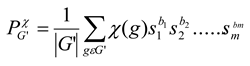 where the sum is over all permutation representations of g ∈ G’ that generate b1 cycles of length 1 , b2 cycles of length 2, ….., bm cycles of length m upon its action on the set D of the faces of the hypercube. The generalized Pólya substitution in the GCCIs for each representation of Sn[S2] with a multinomial expansion for coloring the faces of the hypercube with say r colors. Let [l] be an ordered partition, also called the composition of l into p parts such that n1≥0, n2≥0,..., np≥0, . A multinomial generating function in λs is obtained as
where are multinomials given by
where the sum is over all permutation representations of g ∈ G’ that generate b1 cycles of length 1 , b2 cycles of length 2, ….., bm cycles of length m upon its action on the set D of the faces of the hypercube. The generalized Pólya substitution in the GCCIs for each representation of Sn[S2] with a multinomial expansion for coloring the faces of the hypercube with say r colors. Let [l] be an ordered partition, also called the composition of l into p parts such that n1≥0, n2≥0,..., np≥0, . A multinomial generating function in λs is obtained as
where are multinomials given by
Let the set R which contains r different types of colors (for example, yellow, blue, green, red, white…) that can be used to color the faces of the n-cube. Let wi be the weight of each color r in R. Consequently, the weight of a function f from D to R is defined as
The generating function for each irreducible representation of the nD-hyperoctahedral group is obtained by the substitution as
The above GFs are computed for each irreducible representation of the n-cube hyperoctahedral group. The coefficient of each term generates the number of functions in the set RD that transform in accord with the irreducible representation Γ with character χ. For the totally symmetric irreducible representation A1, the GF reduces to the celebrated Pólya’s theorem, or the enumerative GF for the number of equivalence classes of colorings. Likewise the GF for a chiral representation which would have character value of +1 for proper rotations and -1 for improper rotations would enumerate the number of chiral face colorings for a given color partition in the GF.
As these GFs become combinatorially complex with numerous terms and a large number of irreducible representations in the n-cube, computations become quite intensive. Consequently, we have automated the iterative process with Fortran ‘95 codes that compute the cycle types for all hyperplanes using the Möbius inversion method, the character tables and then finally the generating functions for the face colorings of the n-cube. We note that the same codes could be used for other hyperplanes of the n-cube such as vertices, edges, cells, tesseracts, and so forth. All of the computations were carried out in quadruple precision (Real*16 ) arithmetic with an accuracy of up to 32 digits. We note that the needed multinomials for the colorings were computed recursively prior to constructing the GFs and stored in memory for subsequent computations of the GFs of each IR of the n-cube.
3. Results and Discussions
A. n-cube dice and chirality.
We start with the 4-cube or tesseract to illustrate the dice enumeration in fourth dimension and their chirality. The number of faces of the 4-cube and the order of the 4-cube hyperoctahedral group are 24 and 384, respectively. The generating functions can be derived from the cycle indices for the totally symmetric and chiral representations of the 4-cube which are shown below:
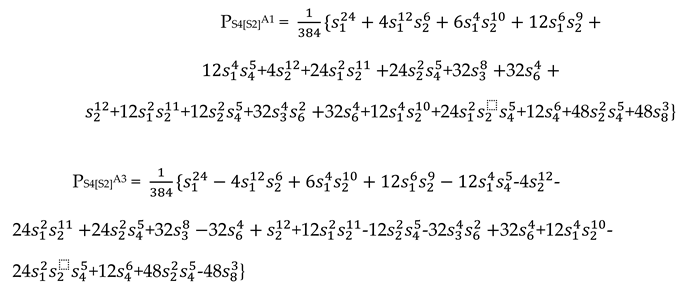
As the maximum of different colors that can be used to color the faces of the 4-cube is 24 the generating functions for the totally symmetric and chiral representations are obtained by replacing every sk by
Thus the GF contains all possible color distributions for coloring the faces of the 4-cube such that the coefficient of a typical term in the GF gives the number of irreducible representations that occur in the set of colorings with n1 colors of type 1, n2 colors of type 2, and so forth. In particular as every face of the 4-cube needs to be colored with a different color for the dice enumeration, the coefficient of in the GF enumerates the number of colorings that transform in accord with the irreducible representation. It can be seen for the 4-cube these numbers for the A1 and A3 IRs are given by
 suggesting that all 4-cube dice are chiral and there are pairs with the total number of 4-cube dice enumerated as 3.23150209236062208 × 10²¹.
Table 1 shows the number of dice for n-cube for n up to 7. As seen from Table 1 there are only 30 possible dice for the ordinary cube in 3-dimension all of which are chiral or equivalently there are 15 chiral pairs of cubic dice. These numbers increase in astronomical proportions as a function of n, as seen from Table 1. The number of dice in the fourth dimension already reaches 3.23150209236062208X 10²¹in comparison to molecular Avogadro number of 6.023 x 10²³. The number of dice reaches 2.8214838544319294796427515741969896X 101604 in the 7th dimension beyond which even in REAL*16 arithmetic precision the numbers become too large to be exactly listed although the mathematical expression for the number of chiral pairs of dice for any n-cube is derived from the GF of the n-cube as
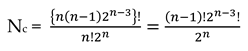
Although this number grows astronomically natural log of the above number can be simplified using Stirling’s approximation as
Given the large number of possible dice even in the fourth dimension (~1.616x10²¹ chiral pairs of dice) the n-cube dice offer a very good platform for cryptographic applications where for example 24 faces of the 4-cube can be used to label different fragments of messages or alphabets. Moreover several such 4-cube packets can be generated to encrypt and decrypt messages using artificial intelligence techniques as we discuss in a subsequent section. For several chemical and biological applications natural log of the enumerated numbers are relevant and these number are still under control for the n-cubes. For example, entropies and information content based on dice enumerations would be measured using natural logarithms of the combinatorial numbers enumerated above.
B. n-cube 4-color problem: dice enumeration with 4 colors for the n-cube and their chirality.
We consider the special case of a four-color dice as the four-color problem in combinatorics and topology is quite significant. For this special case, we take a n-cube dice with 4 different colors say, green, red, violet and blue. For such a case, the combinatorics results in a generating function involving partitions with 4 parts. This is exemplified in Table 4 for a 4-cube with 24 faces four-color problem for both achiral and chiral combinatorial enumerations.

Table 2.
The Four-Color problem of n-cube: Enumerations for the face-colorings of the 4-cube with 4 different colors. The color partition n1 n2 n3 n4 represents a coloring in which n1 red, n2 blue, n3 green and n4 yellow colors are used to color 24 faces of the 4-cube.
Table 2.
The Four-Color problem of n-cube: Enumerations for the face-colorings of the 4-cube with 4 different colors. The color partition n1 n2 n3 n4 represents a coloring in which n1 red, n2 blue, n3 green and n4 yellow colors are used to color 24 faces of the 4-cube.
| Color Partition |
No of A1 Coloringsa |
No of A3 Coloringsa |
| 24 0 0 0 | 1 | 0 |
| 23 1 0 0 | 1 | 0 |
| 22 2 0 0 | 5 | 1 |
| 21 3 0 0 | 16 | 6 |
| 20 4 0 0 | 57 | 27 |
| 19 5 0 0 | 169 | 105 |
| 18 6 0 0 | 475 | 335 |
| 17 7 0 0 | 1099 | 866 |
| 16 8 0 0 | 2234 | 1849 |
| 15 9 0 0 | 3843 | 3307 |
| 14 10 0 0 | 5669 | 4967 |
| 13 11 0 0 | 7132 | 6336 |
| 12 12 0 0 | 7725 | 6871 |
| 22 1 1 0 | 5 | 1 |
| 21 2 1 0 | 32 | 13 |
| 20 3 1 0 | 158 | 97 |
| 19 4 1 0 | 688 | 503 |
| 18 5 1 0 | 2396 | 1973 |
| 17 6 1 0 | 6893 | 6025 |
| 16 7 1 0 | 16303 | 14810 |
| 15 8 1 0 | 32156 | 29818 |
| 14 9 1 0 | 53118 | 49918 |
| 13 10 1 0 | 74020 | 70054 |
| 12 11 1 0 | 87278 | 82892 |
| 20 2 2 0 | 244 | 145 |
| 19 3 2 0 | 1331 | 1021 |
| 18 4 2 0 | 5871 | 4986 |
| 17 5 2 0 | 20208 | 18285 |
| 16 6 2 0 | 56090 | 52312 |
| 15 7 2 0 | 126548 | 120340 |
| 14 8 2 0 | 235721 | 226411 |
| 13 9 2 0 | 365096 | 353006 |
| 12 10 2 0 | 473741 | 459377 |
| 11 11 2 0 | 516370 | 501374 |
| 18 3 3 0 | 7674 | 6682 |
| 17 4 3 0 | 33276 | 30591 |
| 16 5 3 0 | 110825 | 105097 |
| 15 6 3 0 | 292629 | 281871 |
| 14 7 3 0 | 623256 | 606096 |
| 13 8 3 0 | 1087220 | 1062760 |
| 12 9 3 0 | 1567505 | 1536897 |
| 11 10 3 0 | 1879494 | 1845178 |
| 16 4 4 0 | 138453 | 131493 |
| 15 5 4 0 | 437694 | 423510 |
| 14 6 4 0 | 1087993 | 1062443 |
| 13 7 4 0 | 2168246 | 2129446 |
| 12 8 4 0 | 3517231 | 3464261 |
| 11 9 4 0 | 4684708 | 4622058 |
| 10 10 4 0 | 5152084 | 5085022 |
| 14 5 5 0 | 1303756 | 1275752 |
| 13 6 5 0 | 3031508 | 2983480 |
| 12 7 5 0 | 5618270 | 5548102 |
| 11 8 5 0 | 8418614 | 8328046 |
| 10 9 5 0 | 10284396 | 10182022 |
| 12 6 6 0 | 6553122 | 6474210 |
| 11 7 6 0 | 11217872 | 11108824 |
| 10 8 6 0 | 15415306 | 15281078 |
| 9 9 6 0 | 17123720 | 16981820 |
| 10 7 7 0 | 17611556 | 17467588 |
| 9 8 7 0 | 22006070 | 21840340 |
| 8 8 8 0 | 24753462 | 24573093 |
| 21 1 1 1 | 51 | 22 |
| 20 2 1 1 | 425 | 281 |
| 19 3 1 1 | 2510 | 2015 |
| 18 4 1 1 | 11325 | 9945 |
| 17 5 1 1 | 39621 | 36528 |
| 16 6 1 1 | 110649 | 104649 |
| 15 7 1 1 | 250736 | 240748 |
| 14 8 1 1 | 467930 | 453070 |
| 13 9 1 1 | 725780 | 706350 |
| 12 10 1 1 | 942226 | 919270 |
| 11 11 1 1 | 1027332 | 1003242 |
| 19 2 2 1 | 3756 | 3061 |
| 18 3 2 1 | 22360 | 20105 |
| 17 4 2 1 | 98101 | 92141 |
| 16 5 2 1 | 329008 | 316265 |
| 15 6 2 1 | 871348 | 847760 |
| 14 7 2 1 | 1859676 | 1822056 |
| 13 8 2 1 | 3247280 | 3194050 |
| 12 9 2 1 | 4684626 | 4618066 |
| 11 10 2 1 | 5618508 | 5544042 |
| 17 3 3 1 | 130170 | 123075 |
| 16 4 3 1 | 546260 | 528355 |
| 15 5 3 1 | 1736268 | 1699440 |
| 14 6 3 1 | 4325880 | 4260540 |
| 13 7 3 1 | 8634420 | 8534760 |
| 12 8 3 1 | 14016130 | 13881320 |
| 11 9 3 1 | 18677240 | 18517190 |
| 10 10 3 1 | 20541952 | 20371606 |
| 15 4 4 1 | 2169038 | 2125858 |
| 14 5 4 1 | 6481828 | 6396668 |
| 13 6 4 1 | 15094180 | 14950100 |
| 12 7 4 1 | 28000166 | 27789946 |
| 11 8 4 1 | 41975340 | 41705670 |
| 10 9 4 1 | 51289438 | 50984818 |
| 13 5 5 1 | 18105486 | 17944878 |
| 12 6 5 1 | 39180892 | 38920964 |
| 11 7 5 1 | 67120260 | 66760032 |
| 10 8 5 1 | 92260524 | 91821066 |
| 9 9 5 1 | 102499670 | 102032840 |
| 11 6 6 1 | 78296512 | 77897372 |
| 10 7 6 1 | 122981972 | 122455864 |
| 9 8 6 1 | 153698290 | 153094910 |
| 9 7 7 1 | 175633880 | 174981580 |
| 8 8 7 1 | 197572890 | 196868820 |
| 18 2 2 2 | 33487 | 30322 |
| 17 3 2 2 | 194912 | 185257 |
| 16 4 2 2 | 818481 | 794136 |
| 15 5 2 2 | 2602172 | 2552704 |
| 14 6 2 2 | 6484766 | 6397066 |
| 13 7 2 2 | 12945012 | 12811992 |
| 12 8 2 2 | 21015167 | 20835247 |
| 11 9 2 2 | 28004836 | 27791786 |
| 10 10 2 2 | 30801270 | 30574296 |
| 16 3 3 2 | 1088655 | 1059945 |
| 15 4 3 2 | 4328656 | 4259696 |
| 14 5 3 2 | 12944976 | 12809676 |
| 13 6 3 2 | 30156640 | 29928140 |
| 12 7 3 2 | 55953912 | 55621272 |
| 11 8 3 2 | 83891030 | 83464690 |
| 10 9 3 2 | 102511416 | 102030166 |
| 14 4 4 2 | 16176465 | 16017675 |
| 13 5 4 2 | 45209956 | 44913056 |
| 12 6 4 2 | 97864801 | 97385171 |
| 11 7 4 2 | 167678736 | 167016576 |
| 10 8 4 2 | 230502306 | 229694856 |
| 9 9 4 2 | 256090630 | 255234030 |
| 12 5 5 2 | 117411604 | 116879096 |
| 11 6 5 2 | 234687752 | 233871724 |
| 10 7 5 2 | 368679660 | 367606632 |
| 9 8 5 2 | 460789280 | 459559450 |
| 10 6 6 2 | 430095214 | 428905586 |
| 9 7 6 2 | 614294660 | 612823960 |
| 8 8 6 2 | 691047030 | 689459130 |
| 8 7 7 2 | 789709860 | 787996500 |
| 15 3 3 3 | 5765010 | 5682726 |
| 14 4 3 3 | 21553380 | 21364620 |
| 13 5 3 3 | 60252960 | 59898540 |
| 12 6 3 3 | 130442733 | 129871167 |
| 11 7 3 3 | 223512780 | 222722100 |
| 10 8 3 3 | 307264170 | 306301230 |
| 9 9 3 3 | 341378584 | 340355686 |
| 13 4 4 3 | 75302150 | 74889430 |
| 12 5 4 3 | 195601766 | 194861566 |
| 11 6 4 3 | 391016740 | 389884220 |
| 10 7 4 3 | 614296776 | 612807816 |
| 9 8 4 3 | 767787880 | 766082150 |
| 11 5 5 3 | 469162776 | 467900988 |
| 10 6 5 3 | 859878528 | 858043860 |
| 9 7 5 3 | 1228207740 | 1225936680 |
| 8 8 5 3 | 1381679430 | 1379231310 |
| 9 6 6 3 | 1432840398 | 1430330262 |
| 8 7 6 3 | 1842059400 | 1839135600 |
| 7 7 7 3 | 2105109000 | 2101948920 |
| 12 4 4 4 | 244472700 | 243610770 |
| 11 5 4 4 | 586400958 | 584936118 |
| 10 6 4 4 | 1074771633 | 1072641603 |
| 9 7 4 4 | 1535163270 | 1532530170 |
| 8 8 4 4 | 1726995915 | 1724156055 |
| 10 5 5 4 | 1289616636 | 1287246912 |
| 9 6 5 4 | 2148984460 | 2145744020 |
| 8 7 5 4 | 2762767590 | 2758994670 |
| 8 6 6 4 | 3223114485 | 3218943735 |
| 7 7 6 4 | 3683411640 | 3678907800 |
| 9 5 5 5 | 2578619766 | 2575009806 |
| 8 6 5 5 | 3867527364 | 3862884864 |
| 7 7 5 5 | 4419870336 | 4414853016 |
| 7 6 6 5 | 5156360952 | 5150820912 |
| 6 6 6 6 | 6015584844 | 6009464868 |
aN(A1)+ N(A3) yields the total number of colorings among which N(A3) enumerate chiral pairs.
C. Chess Board type Black and white dice enumeration in n dimension and their chirality.
In this section we consider a black-and-white dice combinatorics akin to that of a chess board. For this purpose, we take a 6-cube shown in Figure 2, although we consider the faces of the 7-cube. The generating functions were computed for both totally symmetric and chiral representations for the binomial distribution. The results were computed in quadruple precision and are shown in Table 3 for coloring 240 faces of the 6-cube with black and white colors. We have restricted listing the computed results only for the totally symmetric A1 irreducible representation. It is pointed out that almost all colorings become chiral when the colorings are evenly distributed culminating into a maximum for 120 black and 120 white colors for coloring 240 faces of a 6-cube.
D. Rubik’s Cube Enumerations and colorings.
Rubik’s cube [61] is an interesting case of hypercube and hyperoctahedral symmetry, as it has been a cynosure of puzzles and games over four decades. The symmetry operations of a Rubik’s cube can be rationalized by dividing the cubes to corner cubes and edge cubes. As seen from Figure 3, which shows a typical Rubik’s cube, the eight corner cubes carry three faces while the 12 edge cubes carry 2 faces each. The dynamics of the Rubik’s cube facilitates three fold rotations of each corner cube independent of other cubes while providing two fold flipping motions of the edge cubes. The eight corners of the overall cube can be permuted in all possible ways with each cube within each corner undergoing a three-fold rotation during various dynamical operations of the Rubik’s cube. Likewise the twelve edge cubes can be permuted in all possible ways with each cube within the edge exhibiting a two-fold flip. This results in the direct product of two hyperoctahedral groups, namely, the corner cubes generating the S8[C3] wreath product while the edge cubes give rise to the wreath product S12[S2]. Consequently, the overall group of the Rubik’s cube is the direct product S8[C3] x S12[S2]. The cubes within the Rubik’s cube are partitioned into three classes, 8 corner cubes, 12 edge cubes and 6 center cubes. Consequently, the 54 faces of the Rubik’s cube are partitioned into 24 corner square faces, 24 edge square faces and 6 central square faces. The overall order of Ribik’s cube group is obtained by multiplying the orders of comprising wreath product groups yielding 5.19024039293878272 x10²⁰ symmetry operations in the Rubik’s cube.
Hence we arrive at the result for the number of dice that can be obtained by using distinct numbers for each of the corner faces, edges faces and central faces, that is, treating the set of faces in the three partitions independent of each other as
In the above enumeration, analogous to previous enumerations considered in this study, we treat the faces that are not equivalent separately rather than all faces of the object collectively. This is made possible by the equivalence classes of face partitions generated by the overall group, and consequently, two faces in different classes are never permuted into each other by any of the symmetry operations.
E. Dice of different shapes with octahedral/cubic symmetries.
Next we consider dice that can be constructed with several shapes of octahedral or cubic symmetries and that which are not comprised of the regular cubes of normal dice. Such dice enumerations not only generalize the normal cubic dice shapes but also pave the way for several applications in a variety of fields. Stimulated by such applications and mathematically intriguing nature and aesthetics of these shapes, we have shown in Table 4, a collection of dice of varied shapes, a common feature being their symmetries are all described by the octahedral group Oh containing 48 operations with the exception of the snubcube which is chiral with the symmetry group O.
Table 4 considers several shapes of octahedral or cubic symmetries many of which are not only mathematically interesting but have several applications to materials such as zeolites and mesoporous molecular sieves. The combinatorial enumerations considered in Table 4 make use of face partitions. That is, faces of different shapes, for examples, squares and hexagons of a truncated octahedron are treated as different equivalence classes and thus they are not treated as a single entity in the combinatorial enumeration. This is the case in many practical applications as a hexagonal face capping is not equivalent to a square face capping in molecular structures. Thus eight hexagons and 6 squares are treated as separate equivalence classes in dice enumerations of a truncated octahedron dice shown in Table 4..
There are a few interesting findings that emerge from a critical analysis of Table 4. First all dice enumerated in Table 4 are chiral and hence we list the number of dice as chiral pairs of dice. We label the faces in different equivalence classes with numbers 1 through |C|, where |C| is the cardinality of the equivalence class C. Although with the exception of the sunbcube, the parent structures shown in Table 4 are not chiral, the dice originating from every shape are chiral. The sunbcube is an interesting case of octahedral symmetry as the structure itself is chiral as its symmetry group is O rather than Oh. All other structures in Table 4 conform to Oh symmetry.
As can be seen from Table 4, there exists two different structures with the same chiral pairs of dice. For example, truncated cuboctahedron exhibits the same number of chiral pairs of dice as rhombic cuboctahedron (See Table 4). We call such structures with different shapes with the same number of chiral pairs of dice as isochiral. In some cases isochirality arises from mapping the vertices of an octahedron with different shapes of faces while in other cases it is quite interesting in that the number of faces is not even the same. For example, the truncated cuboctahedron can be obtained by mapping the red squares of the rhombic cuboctahedron with decagons and triangles with hexagons. Thus isochirality can be readily explained for such direct topological transforms. On the other hand, the isochirality of a cuboctahedron and truncated octahedron is less obvious from a simple observation. These enumerations and the chirality aspects of the enumerated structures open up a plethora of applications to a number of fields as we discuss subsequently.
F. Enumeration of Dice and face colorings of different shapes with icosahedral symmetries.
Icosahedral symmetries are quite interesting as demonstrated earlier [3,65] in that the character values of the three dimensional irreducible representations of the Ih group are golden ratios or their reciprocals thus making them interesting candidates for symmetry studies. Furthermore icosahedral symmetries occur in the molecular structures of boranes, carboranes, and metallacarboranes as well as the celebrated buckminsterfullerene, C60 which became the subject matter of the Nobel prize winning work of Smalley and coworkers [66,67]. Hence we devote this subsection to different shapes of icosahedral symmetries.
Table 5 shows a number of structures with icosahedral symmetry (Ih) starting with the regular icosahedron itself which consists of 20 triangles. Many of the structures in Table 5 are Archimedean solids and share the same symmetry group. They differ in number of faces or the shapes of the faces. While the icosahedron contains 20 triangles the relative dodecahedron contains 12 pentagons (see Table 5). Consequently, the number of chiral pairs of dice for an icosahedron is considerably larger (20,274,183,401,472,000) compared to 3,991,680 chiral pairs for a dodecahedron. This can be envisaged by mapping the 12 vertices of the icosahedron into pentagons which generates the dodecahedron. Thus the dice enumeration of dodecahedron is equivalent to the vertex coloring problem of icosahedron with 12 different colors. As can be seen from Table 5, Icosododecahedron and truncated dodecahedron are isochiral as they both generate 9.7113662879985303552 x 1024 chiral pairs of dice. Likewise there are a number of isochiral pairs of structures in Table 5. For example, truncated icosododecahedron and rhombicosidodecahedron are isochiral. The truncated icosododecahedron has also been considered in molecular context as a candidate for the structure of C120 and it has been called archimedene [68]. The spectra, characteristic polynomials and other graph theoretical properties of archimedene and related clusters have been considered before [68]. The truncated icosahedron shown in Table 5 is of special interest in the context of fullerenes which are structures containing 12 pentagons and any number of hexagons. As seen from Table 5, the structure which is the molecular structure of C 60 Buckminsterfullerene exhibits 9.7113662879985303552 x 1024 chiral pairs of dice.
The last structure shown in Table 5, the grand 600-cell or grand polytetrahedron requires further discussion as it poses grand challenge for the dice enumeration. First it contains 1200 triangular faces with a symmetry group that contains 14,400 symmetry elements which is square of the order of the icosahedral group. Consequently, the number of chiral pairs of dice for the 600-cell in Table 5 is given by
Nc = 1200!/14400
As direct computation of such a large factorial is quite difficult, we invoked Stirling’s approximation for the factorial of large numbers as follows:
Using the above approximation for n! we could compute the number of grand-600 cell dice using Fortran ’95 software in quadruple precision as
1200! ~ 6.350789105488227095490281553037461 x 103175
And thus the number of grand cell-600 dice as
Nc = 6.350789105488227095490281553037461 x 103175/14400 =
4.4102702121446021496460288562760144 x 103171
4.4102702121446021496460288562760144 x 103171
The grand 600-cell is certainly a challenging object for the dice enumeration problem.
Among the structures shown in Table 5, the truncated icosahedron or the structure of buckminsterfullerene can be studied further, as it poses several interesting questions and it continues to be a subject matter of active investigation. Table 6 shows the face colorings of the faces of the buckyball for coloring the hexagons with 6 different colors (vibgyr) and pentagons with 10 different colors (vibgyorbwp). We show the computed combinatorial numbers for the Ag and Au irreducible representations for 20 hexagons and 12 pentagons, respectively. The sum of Ag and Au numbers give the total number of inequivalent face colorings while the Au numbers correspond to the chiral pairs. The difference between Ag and Au numbers yield the number of achiral colorings. As seen from Table 6, as the color partition gets distributed, for example, 4 4 3 3 3 3 for the hexagons almost every hexagonal face coloring is chiral. The same comment applies to the colorings of pentagons for a distributed color partition (See, Table 6).
4. Applications: Chirality, Zeolites, mesoporous, nanomaterials and Biological Networks
Combinatorial enumerations under symmetry action have several applications to chirality, materials and biological networks. In the context of chirality, as shown in the previous section the combinatorial numbers for the totally symmetric Ag representation for any given color partition enumerates the Pólya equivalence classes of face colorings under the full Oh or Ih group. The combinatorial numbers for the chiral Au IR yield the number of chiral pairs of face colorings while the difference between Ag and Au numbers yields the number of achiral face colorings. Consequently, the sum of Ag and Au numbers yields the total number of equivalence classes under the pure rotational operations or in O or I groups, respectively. As it is well known, chirality arises in a face coloring of the geometrical shapes considered here if the mirror image of the face coloring is not superimposable on the original coloring.
Another interesting application of the combinatorial enumeration scheme considered here is to spectroscopy in the context of nuclear spin statistics under symmetry [17,18,57,58]. In this context, the alternating irreducible representation, which is defined with +1 character values for even permutations and -1 for the odd permutations, plays a critical role in the case of fermion statistics. Consequently, the alternating representation is critical to the quantum chemical classification of the rovibronic wavefunctions of fermions, as the total wavefunction for fermions must be antisymmetric as stipulated by the Pauli Principle. Consequently, the direct product of the nuclear spin functions of the rovibronic and the IR of the rovibronic level of water clusters in the total nonrigid limit would have to transform according to the alternating representation of the hypercube cube. Consequently, the combinatorial enumerations considered here are extremely useful in the analysis of experimental spectroscopic properties of a number of weakly-bound van der waals clusters such as (H2O)n, (NH3)n and so forth [17,18].
A number of mesoporous materials and zeolite structures are networks of various shapes that we have considered in this study. For example, the structure of the tetragonal zeolite farneseite [64] shown in Figure 4, consists of several truncated octahedra. The combinatorics of a truncated octahedron was considered in Table 4 among several other structures of octahedral or cubic symmetries. Consequently, when dice enumerations are specialized to the case of a few chosen types of colors, the combinatorics considered reduces to face colorings of complex zeolite types of structures like the one shown in Figure 4. That is, face colorings would correspond to the enumeration of isomeric structures that would arise from face capping of zeolite structures, analogous to the one shown in Figure 4. It is hoped that the present work will stimulate such applications to novel nanomaterials in the future.
Cayley trees are recursive symmetry structures which find a number of applications in biological networks such as phylogenetic trees [51]. The symmetry groups of such structures are recursive wreath products and thus the colorings of vertices or edges of phylogenetic trees follow applications of the techniques considered in this study. These trees also find applications in pandemic trees as demonstrated in recent study on COVID-19 [52]. Moreover, in genetics the canalization or control of one genetic trait by another trait in the genetic regulatory networks is well described by the coloring of vertices of the hypercubes. Such genetic regulatory networks play important roles in evolutionary processes [53,54]. In this context, partitioning 2-colorings of the vertices of hypercubes into equivalence classes yield smaller clustering subsets for the statistical analysis of such networks. Consequently, the properties of any representative in an equivalence class contain the same genetic expression as any other function in the same equivalence class. The hypercubes have applications to the representations of DNA bases including DNA unnatural pairs [6].
5. Applications to Cryptography.
The combinatorial complexity of various shapes of dice considered here facilitates their applications to cryptography due to the enormous number of configurations rising from the face colorings and number of chiral dice generated from various shapes. As seen from previous Tables, the numbers grow in astronomical proportions culminating into 4.4102702121446021496460288562760144 x 103171 for the grand cell-600 dice. Such large combinatorial numbers relate to the combinatorial complexity of these shapes. Combinatorial complexity can be measured by the number of dice generated for each shape, as this could be one powerful measure of the complexity. The greater is this number the more complex is the structure. The large combinatorial complexity paves the way for powerful applications in cryptography for encrypting and decrypting messages through labeling the faces of the shapes with words or alphabets contained in a message. Once a mapping of the alphabets or other coded parts of a message are mapped to the faces of the shape considered here then the various permutations of the faces would result in enormous number of configurations allowing to scramble the codes message completely.
The Rubik’s cube in an excellent exemplification of the underlying combinatorial complexity and thus a great candidate for the puzzle that it is eminent for. As seen from the previous section on Rubik’s cube, there are 5.34018574959804633194496 x1029 possible dice suggesting astronomical number of ways to label the faces of the Rubik’s cube. This would indeed enable encryption of messages by labeling the faces of the cube with alphabets or codes. Then the various rotations of the larger faces would scramble the message completely and there are 5.34018574959804633194496 x1029 such possibilities in the most general case. Consider two romantic clandestine messages to illustrate the point using the Rubik’s cube namely, “I Love U” and “V Elope at 2”. The first message has 6 alphabets and 2 blank spaces. For example, if say a corner or edge square of each larger face of the Rubik’s cube is chosen to label with 6 alphabets in the message and the cube is scrambled by the various rotations. The receiver then would have to solve the Rubik’s cube puzzle to decrypt the message. The complexity of the encryption can be further enhanced by mapping alphabets to other characters, simplest would be to map the alphabets to 26 numbers or other characters including !,@,#,$,%,^,&,* and so on to make the message totally look like some sort of gibberish. The other message “V Elope at 2”, contains 12 characters, 2 repeating es, 3 blanks and a number 2. If these characters are intertwined with other characters or numbers and one uses say a grand cell-600, one would achieve a bit less than the maximum number of 4.4102702121446021496460288562760144 x 103171 chiral pairs of configurations. The numbers will be reduced by the repeating 3 blank spaces and two repeating es (assuming upper and lower cases are not differentiated) or by 3!x2! provided all other faces are labelled with other unique numbers or characters, we would then arrive at 3.67522517678717 x 103170 ways to scramble the message “V Elope at 2” using the faces of a grand cell-600 to encrypt the message. Just like the problem of Rubik’s cube, the larger encryption puzzles involving n-dimensional objects can be solved by a series of systematic algorithms. The other nuance that can be introduced in n-dimensional encryption algorithms is to use characters to code a message, for example, a simple message: V Elope at 2 becomes  in Wingding font. Note that with the increasing importance of artificial intelligence in the coming years, it is very clear that algorithms with machine learning and AI techniques can be developed to decrypt the messages sent through even such complex pockets of objects, for example, a grand cell-600. Indeed n-dimensional hypercubes and other combinatorially complex shapes considered here provide very compelling objects to generate packets of encrypted messages with face or edge or cell or tesseract or other complex p-dimensional hyperplanes for complex encryption that cannot be easily decrypted without invoking very complex AI algorithms that can unravel puzzles in n-dimensional spaces. Consequently, the present investigation on combinatorics of dice of various shapes in n dimensions indeed opens up such a plethora of applications in cryptography with potentials for defense and other applications.
in Wingding font. Note that with the increasing importance of artificial intelligence in the coming years, it is very clear that algorithms with machine learning and AI techniques can be developed to decrypt the messages sent through even such complex pockets of objects, for example, a grand cell-600. Indeed n-dimensional hypercubes and other combinatorially complex shapes considered here provide very compelling objects to generate packets of encrypted messages with face or edge or cell or tesseract or other complex p-dimensional hyperplanes for complex encryption that cannot be easily decrypted without invoking very complex AI algorithms that can unravel puzzles in n-dimensional spaces. Consequently, the present investigation on combinatorics of dice of various shapes in n dimensions indeed opens up such a plethora of applications in cryptography with potentials for defense and other applications.6. Conclusions
In the preset study we considered several geometrical forms of dice with octahedral, icosahedral and higher symmetries including the hyperoctahedral symmetries. Combinatorial enumeration of dice for these various shapes as well as the enumeration of dice in n-dimensions were considered. The results not only revealed substantial combinatorial complexities for higher order dice but also the existence of intriguing isochiral dice for some of the geometrical shapes. A number of applications to material science, biology, molecular clusters and cryptography were pointed out. It is clear that these n-dimensional and other complex objects considered here hold considerable promise as candidates for numerous applications going into the future.
Author Contributions
Funding
Conflicts of Interest
References
- Balasubramanian, K. Recursive Symmetries: Chemically Induced Combinatorics of Colorings of Hyperplanes of an 8-Cube for All Irreducible Representations. Symmetry 2023, 15, 1031. [CrossRef]
- Balasubramanian K. Topological Indices, Graph Spectra, Entropies, Laplacians, and Matching Polynomials of n-Dimensional Hypercubes. Symmetry. 2023; 15(2):557. [CrossRef]
- Balasubramanian, K. Symmetry, Combinatorics, Artificial Intelligence, Music and Spectroscopy. Symmetry 2021, 13, 1850. [CrossRef]
- Carbó-Dorca, R. Boolean hypercubes and the Structure of Vector Spaces, J. Math. Sci. & Model. 2018,1,1-14.
- Carbó-Dorca, R. N-Dimensional Boolean hypercubes and the Goldbach conjecture, J Math Chem. 2016, 54, 1213-1220. [CrossRef]
- Carbó-Dorca, R. DNA unnatural base pairs and hypercubes, J Math Chem. 2018, 56, 1353-1536. [CrossRef]
- Carbó-Dorca, R.; Chakraborty, T. Quantum similarity description of a unique classical and quantum QSPR algorithm in molecular spaces: the connection with Boolean hypercubes, algorithmic intelligence, and Gödel's incompleteness theorems. In Chemical Reactivity 2023, (pp. 505-572), Elsevier.
- Carbó-Dorca, R. Boolean Hypercubes as time representation holders, J Math Chem. 55(2018) 1349-1352. [CrossRef]
- Carbó-Dorca, R.; Chakraborty, T. Divagations about the periodic table: Boolean hypercube and quantum similarity connections. J. Comput. Chem. 2019, 40(30), 2653-2663.
- Kaatz, F.H.; Bultheel, A. Dimensionality of hypercube clusters. J. Math Chem. 2016, 54, 33–43.
- Gowen, A. A.; O’Donnella , C. P.; Cullenb , P. J.; Bell, S. J. Recent applications of chemical imaging to pharmaceutical process monitoring and quality control. European J. Pharmaceutics and Biopharmaceutics, 2008, 69, 10-22.
- Mezey, P. G. Similarity Analysis in two and three dimensions using lattice animals and ploycubes, J. Math. Chem. 1992, 11,27-45.
- Fralov, A.; Jako, E.; Mezey, P. G. Logical Models for Molecular Shapes and Families, J Math Chem. 2001, 30, 389-409.
- Mezey, P. G. Some Dimension Problems in Molecular Databases, J. Math. Chem. 2009, 45, 1.
- Mezey, P. G. Shape Similarity measures for Molecular Bodies: A Three-dimensional Topological Approach in Quantitative Shape-activity Relation, J. Chem. Inf. Comput. Sci. 1992, 32, 650.
- Balasubramanian, K. Combinatorial Multinomial Generators for colorings of 4D-hypercubes and their applications, J. Math. Chem. 2018, 56, 2707-2723.
- Balasubramanian, K. Nonrigid group theory, tunneling splittings, and nuclear spin statistics of water pentamer:(H2O)5." J. Phys. Chem. A 2004,108, 5527-5536.
- Balasubramanian, K. Group-Theory and Nuclear-Spin Statistics of Weakly-Bound (H2O)N, (NH3)N, (CH4)N, and NH4+(NH3)N. J. Chem. Phys. 1991, 95, 8273-8286.
- Clifford, W. K. On the types of compound statement involving four classes, Proc Manchester Literary and Philosophical Soc., 1877, 88-101,.
- Clifford, W. K., Mathematical Papers. Editor: R. Tucker, R.McMillan & Co, London, 1882, Introduction by H. J. Stephen Smith, Reprinted by Chelsea, NY 1968.
- M. A. Harrison and R.G. High, On the cycle index of a product of permutation group, J. Combin. Theory 4 (1968), 277-299.
- Pólya, G.; Read, R. C. Combinatorial Enumeration of Groups, Graphs and Chemical Compounds, Springer, New York 1987.
- Pólya, G. Sur les types des propositions composées, J. Symbolic Logic 1940, 5, 98-103.
- Banks, D. C.; Linton, S. A.; Stockmeyer, P. K. Counting Cases in Substitope Algorithms, IEEE Trans. Visualization & Computer Graphics, 2004, 371-384.
- Bhaniramka, P.; Wenger, R.; Crawfis, R. Isosurfacing in higher Dimension. Proc. of IEEE Visualization 2000, pp.267-270.
- Aichholzer, O. Extremal Properties of 0/1-Polytopes of Dimension 5. Polytopes - Combinatorics and Computation,. Editors: Ziegler, G. & Kalai, G. Birkhäuser, 2000, pp.11-130.
- Perez-Aguila, R. Enumerating the Configurations in the n-Dimensional Polytopes through Pólya’s counting and A Concise Representation, in, 2006, Third International Conference on Electrical and Electronics Engineering, pp1-4, IEEE.
- Banks, D. C.; Stockmeyer, P. K. De Bruijn Counting for visualization Algorithms, Math Found. Sci. Visualization, computer graphics and Massive data exploration, Springer, Berlin 2009, pp 69-88.
- Perez-Aguila, R. Towards a New Approach for volume datasets based on orthogonal polytopes in four-dimensional color space, Engineering Letters 2010, 18:4,326, EL_18_4_02.
- Chen, W. Y. C.; Guo, P. L. Equivalence Classes of Full-Dimensional 0/1-Polytopes with Many Vertices, Jan 2011, https://arxiv.org/pdf/1101.0410.pdf.
- Chen, W. Y. C. Induced cycle structures of the hyperoctahedral group, SIAM J. Disc. Math. 1993, 6, 353-362.
- Ziegler, G. M. Lectures on Polytopes. Graduate Texts in Mathematics, 52, Springer-Verlag, 1994.
- Lemmis, P. W. H. Pólya Theory of hypercubes Geometriae Dedicata 1997, 64,145–15.
- Harary, F.; Palmer, E. M. Graphical Enumeration (Academic press, New York, NY, 1973).
- Liu, M.; Bassler, K. E. Finite size effects and symmetry breaking in the evolution of networks of competing Boolean nodes. J. Phys. A: Mathematical and Theoretical 2010, 44, 045101.
- . Reichhardt, C. J. O; Bassler, K. E. Canalization and symmetry in Boolean models for genetic regulatory networks. J. Phys. A:: Mathematical and Theoretical 40 (2007) 4339.
- Balasubramanian, K. Applications of Combinatorics and Graph Theory to Quantum Chemistry and Spectroscopy, Chem. Rev. 1985, 85,599-618.
- Balasubramanian, K. Symmetry Groups of Nonrigid Molecules as Generalized Wreath-Products and Their Representations, J. Chem. Phys. 1980, 72, 665-677.
- Balasubramanian, K Nonrigid water octamer: Computations with the 8-cube. J. Comput Chem. 2020, 41, 2469- 2484.
- Balasubramanian, K. Computations of Colorings 7D-Hypercube's Hyperplanes for All Irreducible Representations. J. Comput Chem. 2020, 41, 653-686.
- Balasubramanian, K. Relativistic double group spinor representations of nonrigid molecules. J. Chem. Phys. 2004, 120,5524-5535.
- Balasubramanian, K. Generalization of De Bruijn’s Extension of Pólya’s Theorem to all characters, J. Math. Chem. 1993, 14,113-120.
- Balasubramanian, K. Generalization of the Harary-Palmer Power Group Theorem to all Irreducible Representations, J. Math. Chem. 2014,52,703-728.
- Balasubramanian, K., Enumeration of Internal-Rotation Reactions and Their Reaction Graphs. Theor. Chim. Acta. 1979, 53, (2), 129-146.
- Wallace, R. Spontaneous symmetry breaking in a non-rigid molecule approach to intrinsically disordered proteins. Molecular BioSystems, 2012, 8(1), 374-377.
- Wallace, R. Tools for the Future: Hidden Symmetries. In Computational Psychiatry 2017, (pp. 153-165). Springer, Cham.
- Darafsheh, M. R. ; Farjami, Y.; Ashrafi, A. R. Computing the Full Non-Rigid Group of Tetranitrocubane and Octanitrocubane Using Wreath Product. MATCH Commun. Math. Comput. Chem 2005, 54,53.
- Foote, R.; Mirchandani, G.; Rockmore, D. A two-dimensional Wreath Product Transforms. J. Symbolic Computation 2004, 37, 187–207.
- Balasubramanian, K. A Generalized Wreath Product Method for the Enumeration of Stereo and Position Isomers of Polysubstituted Organic Compounds. Theor. Chim. Acta. 1979,51, 37 -51.
- Balasubramanian, K. Symmetry Simplifications of Space Types in Configuration-Interaction Induced by Orbital Degeneracy, Int. J. Quantum Chem. 1981, 20,1255-1271.
- Balasubramanian, K.Nested wreath groups and their applications to phylogeny in biology and Cayley trees in chemistry and physics. J. Math. Chem. 2017, 55, 195-222.
- Nandini, G.K.; Rajan, R.S.; Shantrinal, A.A.; Rajalaxmi, T.M.; Rajasingh, I.; Balasubramanian, K. Topological and Thermodynamic Entropy Measures for COVID-19 Pandemic through Graph Theory. Symmetry 2020, 12, 1992. [CrossRef]
- Rousseau, R. On Certain Subgroups of a Wreath Product”, Match. 1982, 13, 3-6.
- Florek, W.; Lulek, T.; Mucha, M. Hyperoctahedral groups, wreath products, and a general Weyl's recipe. Zeitschrift für Kristallographie-Crystalline Materials, 1988, 184, 31-48.
- Balasubramanian, K. Generators of the Character Tables of Generalized Wreath Product Groups. Theor. Chim. Acta.. 1990, 78,31-43.
- Liu, X. Y.; Balasubramanian, K. Computer Generation of Character Tables of Generalized Wreath Product Groups J. Comput. Chem. 1990, 11, 589-602.
- Balasubramanian, K. A Method for Nuclear-Spin Statistics in Molecular Spectroscopy. J. Chem. Phys. 1981, 74,6824-6829.
- Balasubramanian, K. Operator and algebraic methods for NMR spectroscopy. I. Generation of NMR spin species. J. Chem. Phys. 1983, 78, 6358-6368.
- Coxeter, H. S. M. Regular Polytopes, Dover Publications, New York, 1973.
- T. Ruen, By self - Own work, free public domain work available to anyone to use for any purpose. https://commons.wikimedia.org/w/index.php?curid=11743942.
- Bandelow, C. Inside Rubik’s cube and beyond. 2012, Springer Science & Business Media.
- User: Imk3nnyma, CC BY-SA 4.0, https://commons.wikimedia.org/w/index.php?curid=79057596.
- Buck, D. K.; Collins, A. A., POV-RAY, https://en.wikipedia.org/wiki/User:Cyp/Poly.pov https://en.wikipedia.org/wiki/User:Cyp/Poly.povPublic Domain, CC BY-SA 3.0.
- Jacob,K.; Clement,J.; Micheal Arockiaraj,M.; Peter, P.; Balasubramanian, K. Distance-based topology and entropy analysis of tetragonal farneseite zeolites, Submitted for Publication, 2024.
- Balasubramanian, K. Double group of the icosahedral group (Ih) and its application to fullerenes. Chem. Phys. Lett. 1996, 260, (3-4), 476-484.
- Kroto, H. W., Heath, J. R.; O'Brien, S. C.; Curl, R. F.; Smalley, R. E. C60:Buckminsterfullerene. Nature 1985, 318, 162-163.
- Kroto, H. W., Heath, J. R.; O'Brien, S. C.; Curl, R. F.; Smalley, R. E. Long Carbon Chain Molecules in Circumstellar Shells, Astrophys. J. 1987, 314, 352–355.
- Balasubramanian, K.; Liu, X. Y. Spectra and Characteristic Polynomials of Polyhedral Clusters. Int. J. Quantum Chem. 1988, 22, (S), 319-328.
Figure 1.
A dual representation of the 7D-hypercube in which 14 hexeracts of the 7D-hypercube are the vertices and edges representing their neighborhood connectivity. The vertices of the graph can also represent the fourteen protons of the nonrigid water heptamer, (H2O)7 in its fully nonrigid limit. (reproduced from Ref. [60] ).
Figure 1.
A dual representation of the 7D-hypercube in which 14 hexeracts of the 7D-hypercube are the vertices and edges representing their neighborhood connectivity. The vertices of the graph can also represent the fourteen protons of the nonrigid water heptamer, (H2O)7 in its fully nonrigid limit. (reproduced from Ref. [60] ).
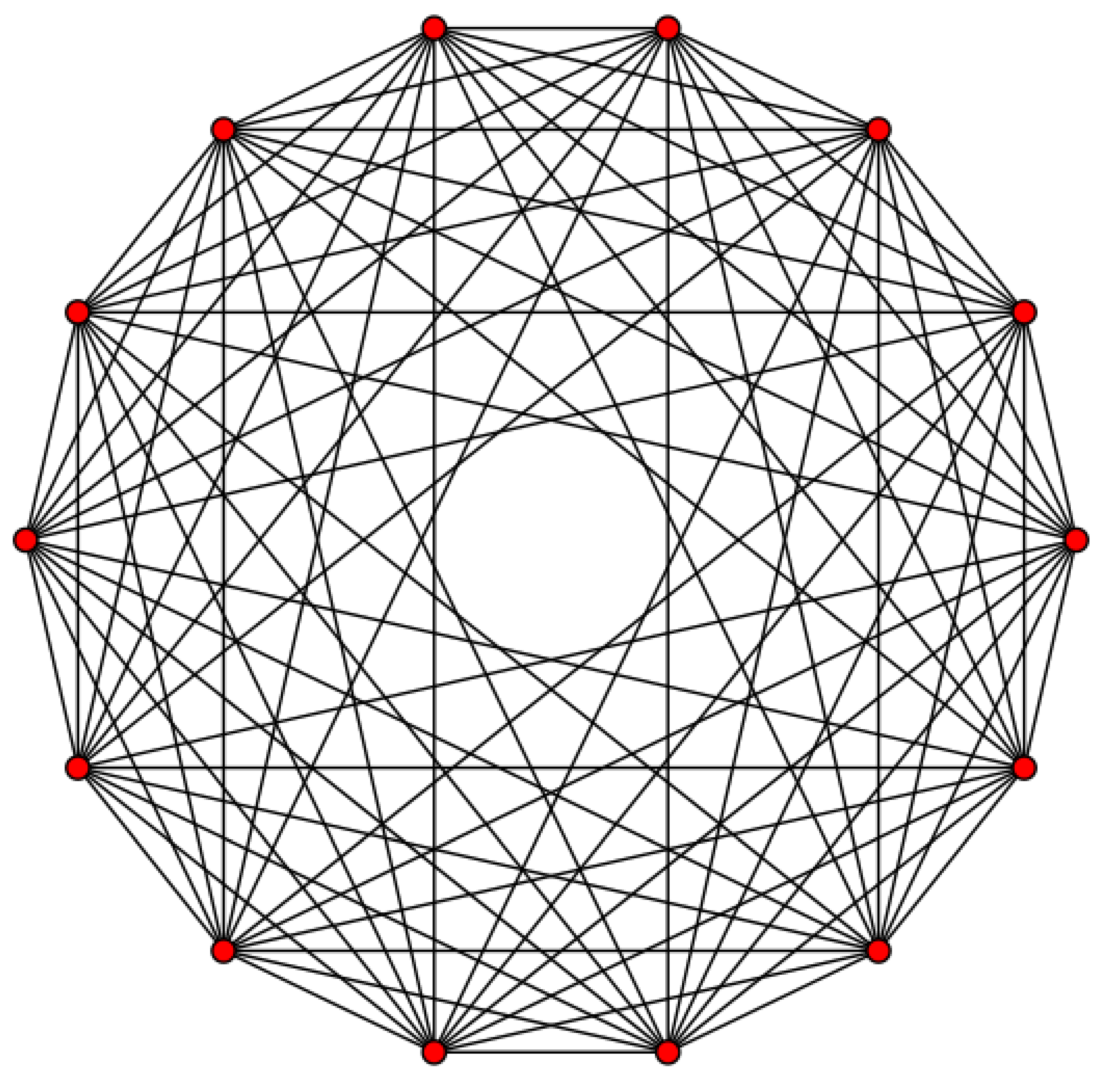
Figure 2.
Graphical representation of hexeract or 6-cube. Table 3 enumerates black & white face colorings of the 6-cube with varied number of black and white colors, Reproduced from [60].
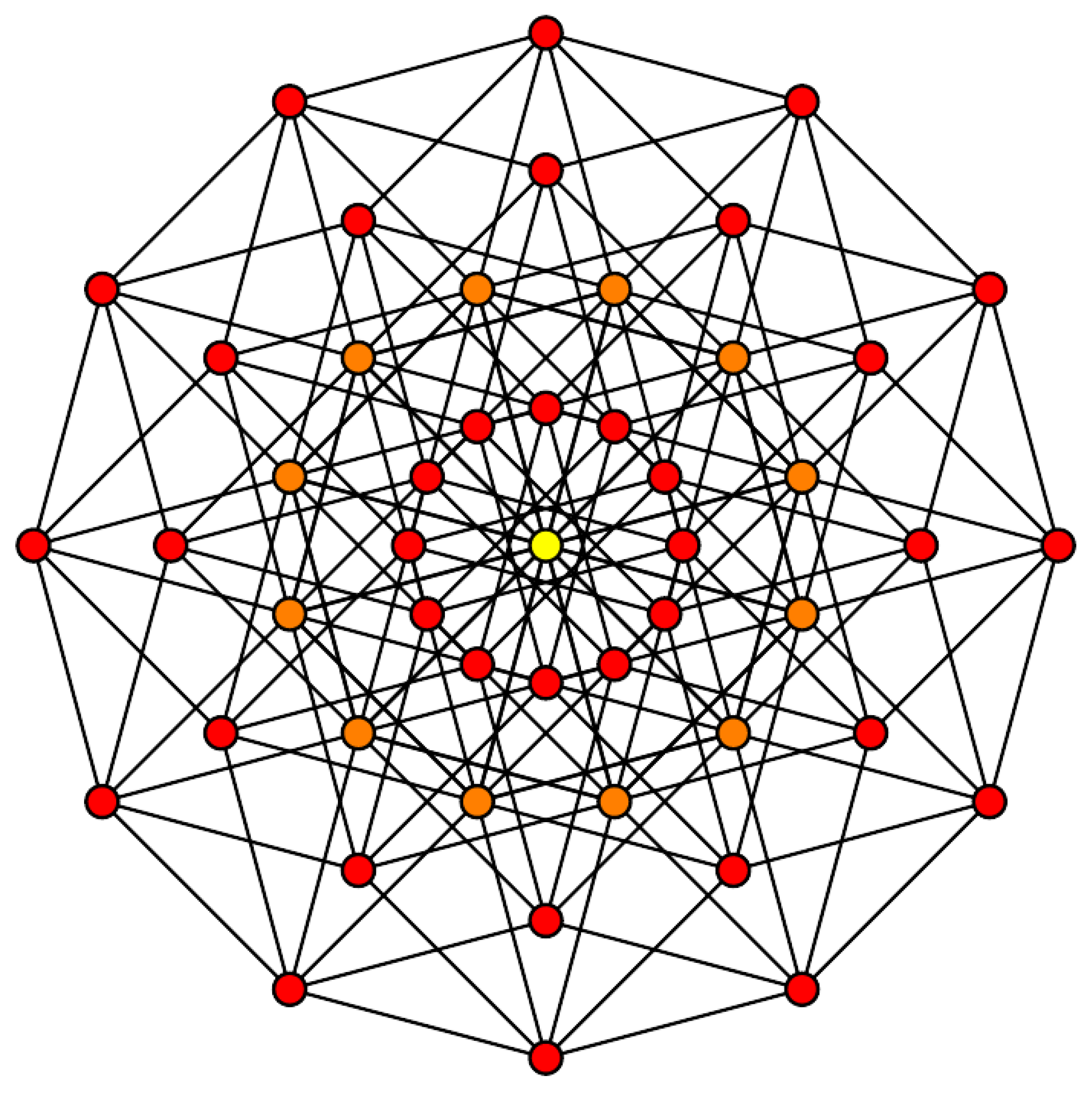
Figure 3.
Rubik’s Cube: There are 5.34018574959804633194496 x1029 possible dice for Rubik’s cube, see text for details of enumeration. Reproduced from [62].
Figure 3.
Rubik’s Cube: There are 5.34018574959804633194496 x1029 possible dice for Rubik’s cube, see text for details of enumeration. Reproduced from [62].
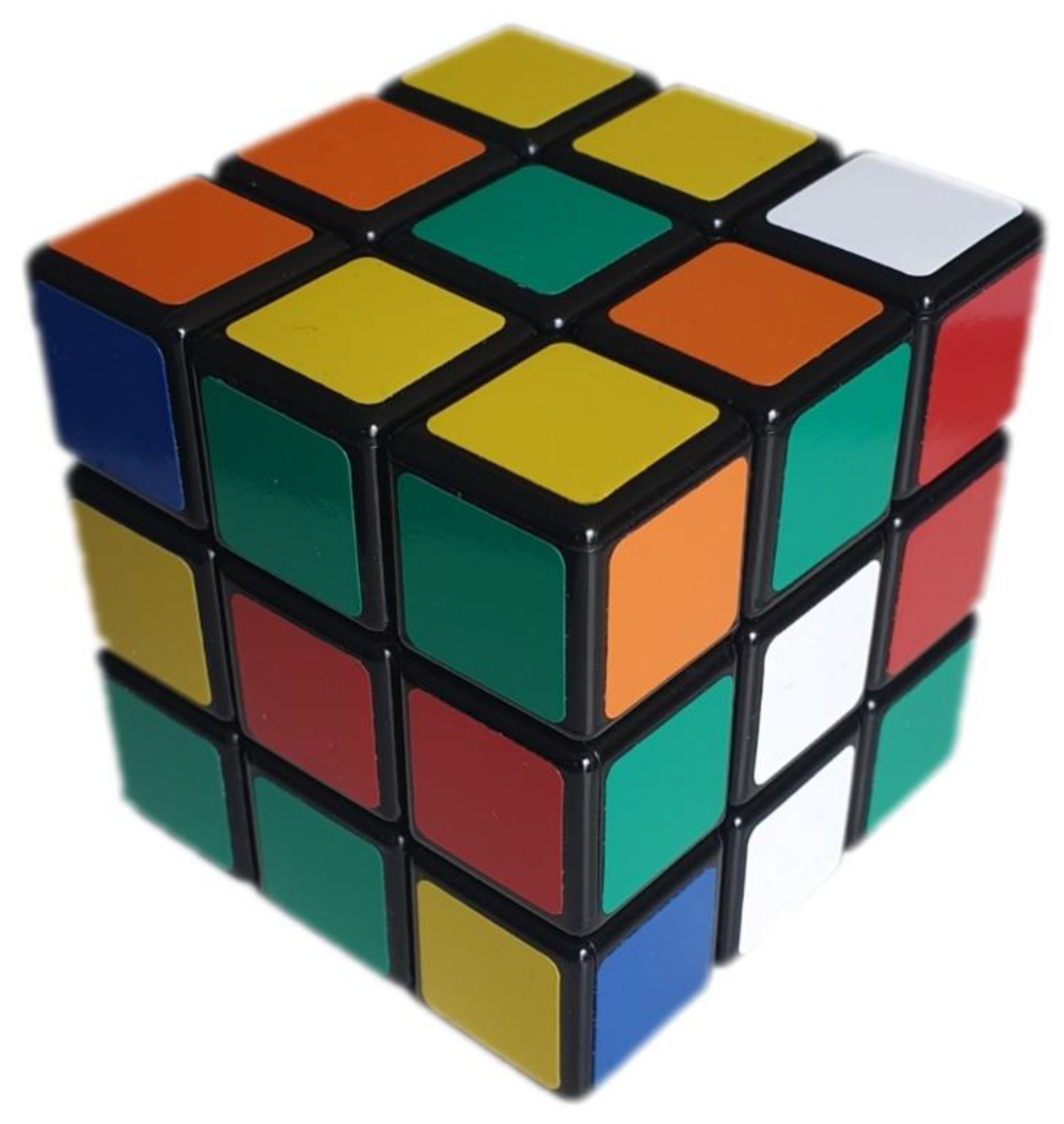
Figure 4.
The structure of the tetragonal zeolite farneseite comprising of several truncated octahedral. Figure reproduced with permission of authors [64]. The enumeration of structures obtained from face capping of such zeolites correspond to face color enumerations considered in the current study.
Figure 4.
The structure of the tetragonal zeolite farneseite comprising of several truncated octahedral. Figure reproduced with permission of authors [64]. The enumeration of structures obtained from face capping of such zeolites correspond to face color enumerations considered in the current study.
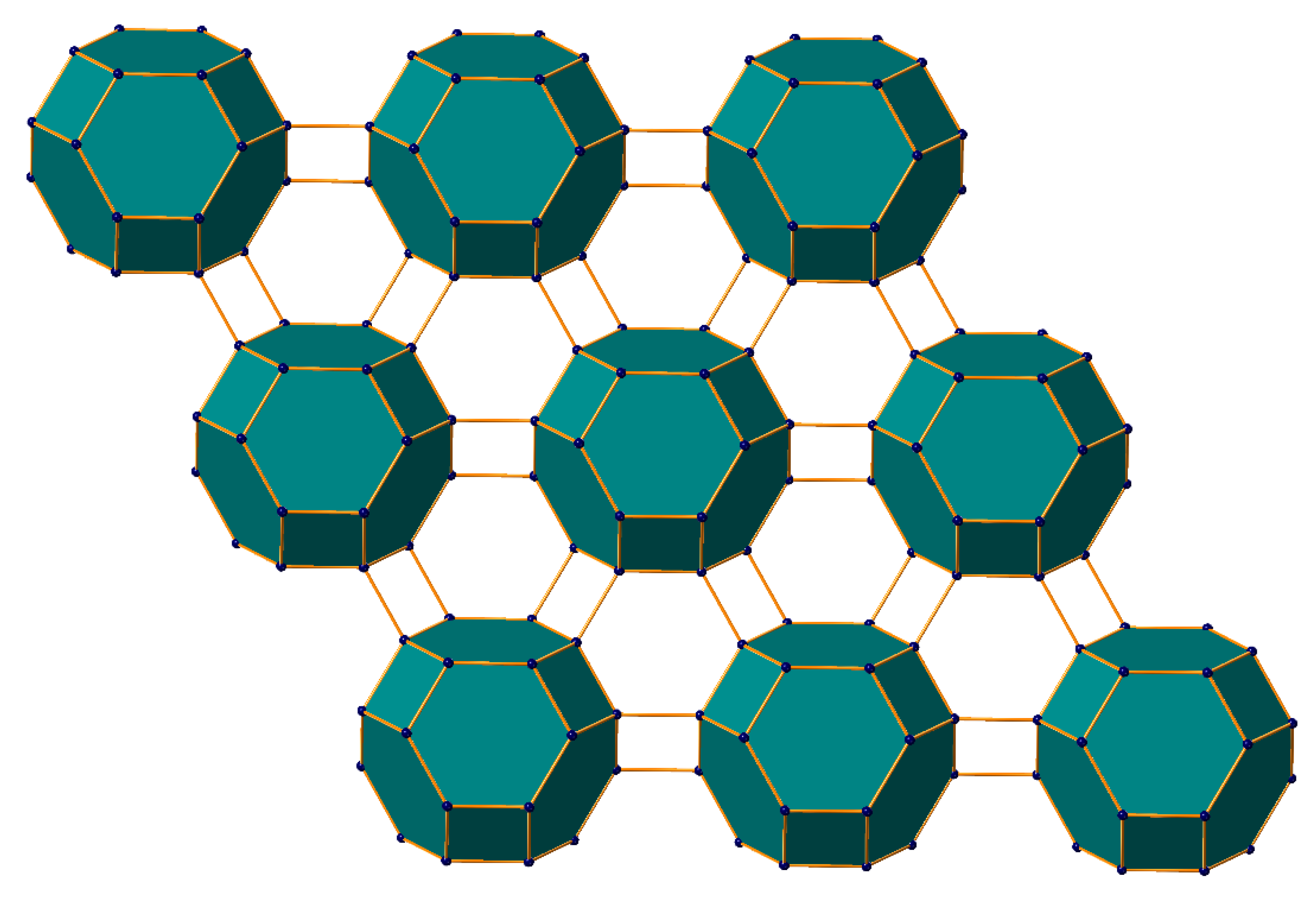
Table 1.
Number of possible dice in n-dimensions for n-cubes with all different numbers placed on the faces of the n-cube for n=3 to 7.
Table 1.
Number of possible dice in n-dimensions for n-cubes with all different numbers placed on the faces of the n-cube for n=3 to 7.
| n | Faces | No of dice | No of Chiral Pairs of dice |
| 3 | 6 | 30 | 15 |
| 4 | 24 | 3.23150209236062208 x 10²¹ | 1.61575104618031104 x 10²¹ |
| 5 | 80 | 3.7275758878262397028547673814159646 x 10115 | 1.8637879439131198514273836907079823 x 10115 |
| 6 | 240 | 1.7655752446384800870197812159231254 x 10464 | 8.827876223192400435098906079615627 x 10463 |
| 7 | 672 | 2.8214838544319294796427515741969896 x 101604 | 1.4107419272159647398213757870984948 x 101604 |
Table 3.
Black-and White dice of hypercube in the 6th dimension with 240 faces; nb stands for the number of black colors with 240-nb being the number of white colors.
Table 3.
Black-and White dice of hypercube in the 6th dimension with 240 faces; nb stands for the number of black colors with 240-nb being the number of white colors.
| nb | N(A1) |
| 0 | 1 |
| 1 | 1 |
| 2 | 11 |
| 3 | 139 |
| 4 | 4176 |
| 5 | 152635 |
| 6 | 5580266 |
| 7 | 182586993 |
| 8 | 5283117184 |
| 9 | 135891832431 |
| 10 | 3136801139463 |
| 11 | 65570741043751 |
| 12 | 1251192201334018 |
| 13 | 21943233858075034 |
| 14 | 355789263949855043 |
| 15 | 5360531557936453701 |
| 16 | 75382327861202736302 |
| 17 | 993272251366379046339 |
| 18 | 12305535660981459650639 |
| 19 | 143780450498062303705832 |
| 20 | 1588773890867771345864514 |
| 21 | 16644297515678879808798297 |
| 22 | 165686414507591622101552686 |
| 23 | 1570419052306115065132618723 |
| 24 | 14199205570066871577428871140 |
| 25 | 122681136017010754158309432703 |
| 26 | 1014478624347489084027884140426 |
| 27 | 8040682428518284564435181330429 |
| 28 | 61166619897340434689394786752894 |
| 29 | 447149083369066948751292268832796 |
| 30 | 3144948552967196406093283337735784 |
| 31 | 21304490197316629654279247580024508 |
| 32 | 139144951600574592746649080159671056 |
| 33 | 877034846450078628652128896100267264 |
| 34 | 5339594506322238375552079147434465280 |
| 35 | 31427327665763904958336467271605932032 |
| 36 | 178961171429990835258310915317808332800 |
| 37 | 986704837073310196335657862006172680192 |
| 38 | 5271081103312257287838648872443980546048 |
| 39 | 27301496996641809668910837171761665015808 |
| 40 | 137190022408121978237796878411228575170560 |
| 41 | 669219621503025866250112350741134231732224 |
| 42 | 3170826301883363428193286508672704248283136 |
| 43 | 14600549017974504078101835470726548970012672 |
| 44 | 65370639921385716211126737122035700519141376 |
| 45 | 284725453879813021523275240995846178515976192 |
| 46 | 1206988337099206608564703950062943154911313920 |
| 47 | 4982036965898851012606659737835556794489896960 |
| 48 | 20031940300384959298052361807805291335079952384 |
| 49 | 78492500768855341303876241965943810733935427584 |
| 50 | 299841352937027382765902773445578163675698561024 |
| 51 | 1117056020745788242590376169881100544777740353536 |
| 52 | 4060068998479884089705015623755515419238105874432 |
| 53 | 14401754183287135804246166953385408335748576313344 |
| 54 | 49872741338420266137322529195039577022891227611136 |
| 55 | 168660543435384899112410284701246690287995790032896 |
| 56 | 557182152420467968422421922547752056414106468483072 |
| 57 | 1798623088515194841712775021084035912510703835021312 |
| 58 | 5674965951694494062205410635512839112833661296181248 |
| 59 | 17505827173023693533563297554260934909613741294223360 |
| 60 | 52809245305288142132272869107153182169520534320054272 |
| 61 | 155830559917243698043653761141737793516691944388952064 |
| 62 | 449897906857848741029976049141268839915375321375834112 |
| 63 | 1271140117788842474479687792473475435071770769766744064 |
| 64 | 3515496888259767468163216556014840184143394537746726912 |
| 65 | 9518883882057216528608998367914143748380503439084355584 |
| 66 | 25239464838788074127879708050806830413286976339971145728 |
| 67 | 65547266894763058181097740456058221177846743153120378880 |
| 68 | 166759958423441309781250299599634334821117425640231927808 |
| 69 | 415691490562781235971341064888171821804599513259251335168 |
| 70 | 1015474926946222733578581339228367257143428701318056771584 |
| 71 | 2431418839167012178976836276667886688093053146703593472000 |
| 72 | 5707080330822570253408677742000332960960832242019794419712 |
| 73 | 13134102679153312363971846877730573818996158520436289699840 |
| 74 | 29640474965116258983498939796906579169557606545381706956800 |
| 75 | 65604251256123986550051347634863006077799034966669772455936 |
| 76 | 142430282332374444483519754796895120849199732824551463059456 |
| 77 | 303358003928693622016625857618977262242204533973550601601024 |
| 78 | 633940444107398210111331355025827016639517714599813255790592 |
| 79 | 1299979138549348228329063291451252319874543714414110345003008 |
| 80 | 2616208016330563309511496917583731993831663122674685994598400 |
| 81 | 5167818303862841105206809240136218974660614845481150429790208 |
| 82 | 10020525735538923606436025159797456261476584970542687191040000 |
| 83 | 19075217665242770238755496178613251023787049655038318777204736 |
| 84 | 35652490160037082470051758173077553030081498177735400332722176 |
| 85 | 65432805470185704297972943306063050464253178396461240116314112 |
| 86 | 117931219161381211234712613738006405558219054813035950984134656 |
| 87 | 208751813228192029082126716097532138898293814638576077423771648 |
| 88 | 362943493453561141472322840478800602327652562685480290771533824 |
| 89 | 619858550617317904536986031056340852095924421733185407357550592 |
| 90 | 1039984901591277817612034918976099698126465664356715106718973952 |
| 91 | 1714260826798809589470361996501267583138843705609748724712472576 |
| 92 | 2776357208619811182946532139254981696976848855712642666273439744 |
| 93 | 4418288891136903818022397130640910763680489058711583357765943296 |
| 94 | 6909451776565158098396675870686568083843531086171523326916165632 |
| 95 | 10618736414510664024904301130552081477721498205603021838987821056 |
| 96 | 16038716459417148787615793261697627570544461777441421000234237952 |
| 97 | 23810053300578035313573866471631103862233086767820943288313053184 |
| 98 | 34743241040639378059602569562006314113107754712353068755277840384 |
| 99 | 49833739674452441257207592441071504972429917631360631482888486912 |
| 100 | 70265572940977942172662549542368590308742746503025565569864695808 |
| 101 | 97397823878583286179928107075659666820641201605644990708709326848 |
| 102 | 132728407050226242931470451731079405476392486433062572665908232192 |
| 103 | 177830292941079820626630085054867470806112050016763218951307001856 |
| 104 | 234257212816614763710079762418248667308011746087552551552313982976 |
| 105 | 303418866124377217757817320211010493225990120075604352544075153408 |
| 106 | 386429687988593626389672704093941308509024324478124575046739427328 |
| 107 | 483939983088519120899215967419979205493870806825180030389467480064 |
| 108 | 595963127321972621107367481426572082532281766779222667980204670976 |
| 109 | 721716814738535651249288720668083207973311214195686476972126371840 |
| 110 | 859499115734074275578698042830041010298057135266173370496370868224 |
| 111 | 1006620585994861764191267638613753417255640297161311448121542180864 |
| 112 | 1159411210654796139113156147343784043908458958128856461986303574016 |
| 113 | 1313315353662069962889238509921566661821965008467180176968339423232 |
| 114 | 1463079385220025309534502263293078969347233893342480581579761516544 |
| 115 | 1603026109023679904359541354461619193561740429737992388679403831296 |
| 116 | 1727398824378965414180540034621696361312587920268799182661767659520 |
| 117 | 1830747471991382148362281571140508950236269928271495714066772525056 |
| 118 | 1908321517414745798716615408358714803655391352966327587613939073024 |
| 119 | 1956430463231924264230479584872704778184154074936145924234846142464 |
| 120 | 1972734050425523633099066888879877060171554196485690791403223777280 |
Table 4.
Combinatorial Enumeration of dice of different shapes with Octahedral/cubic Symmetriesa.
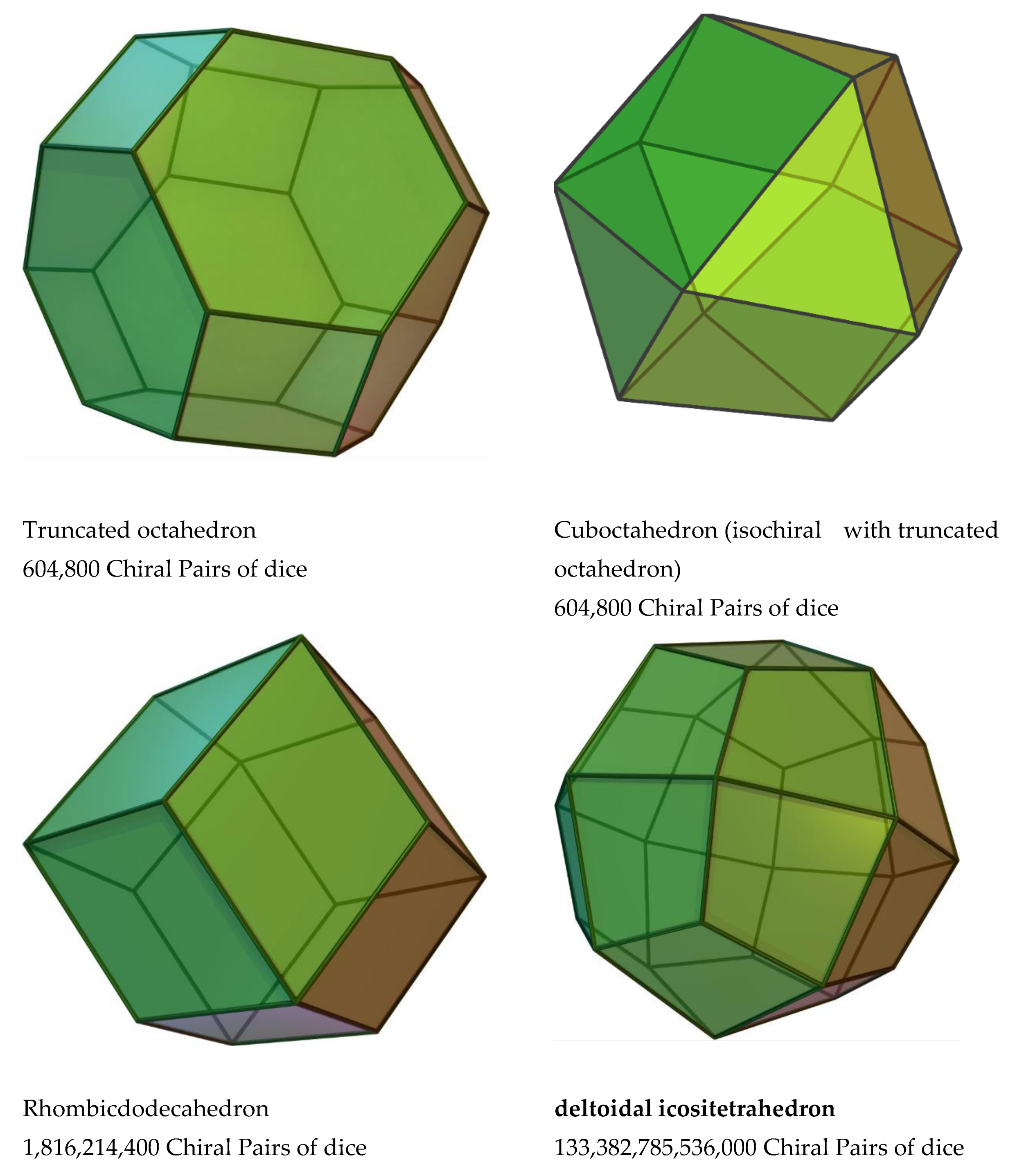
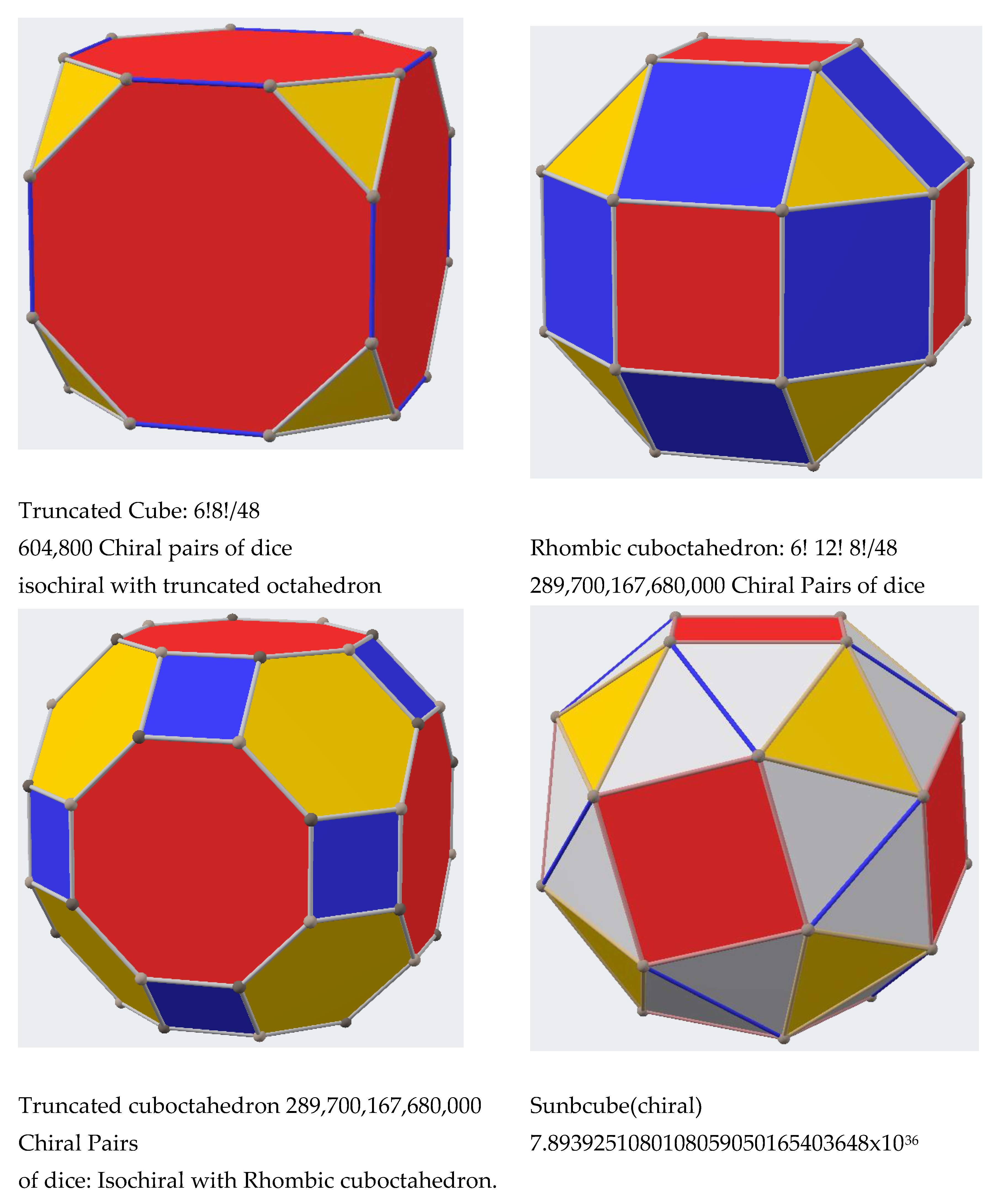
aAll Images were created by POV-RAY codes and are public domain open-access freely reproduced from ref [63].
Table 5.
Combinatorial Enumeration of dice with different shapes with Icosahedral Symmetry. a.
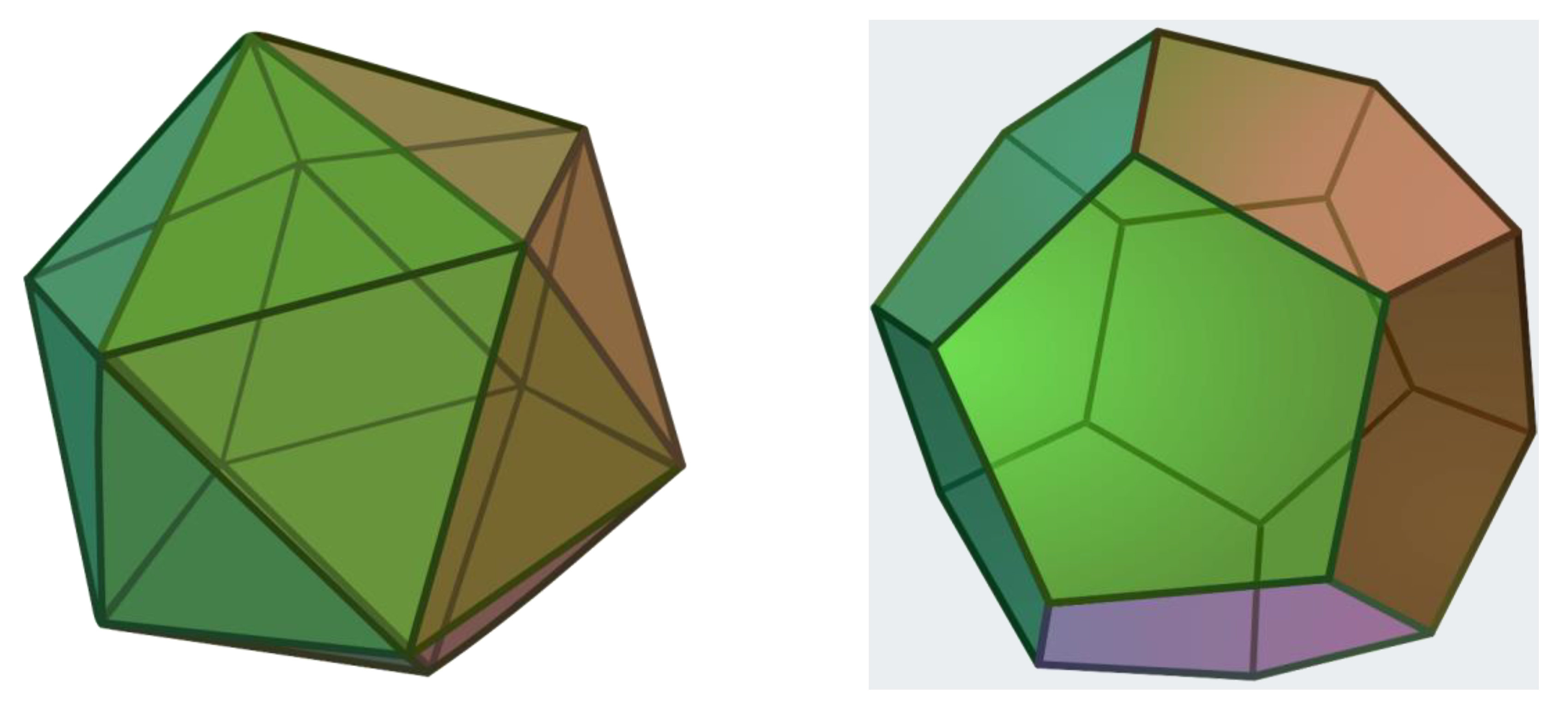
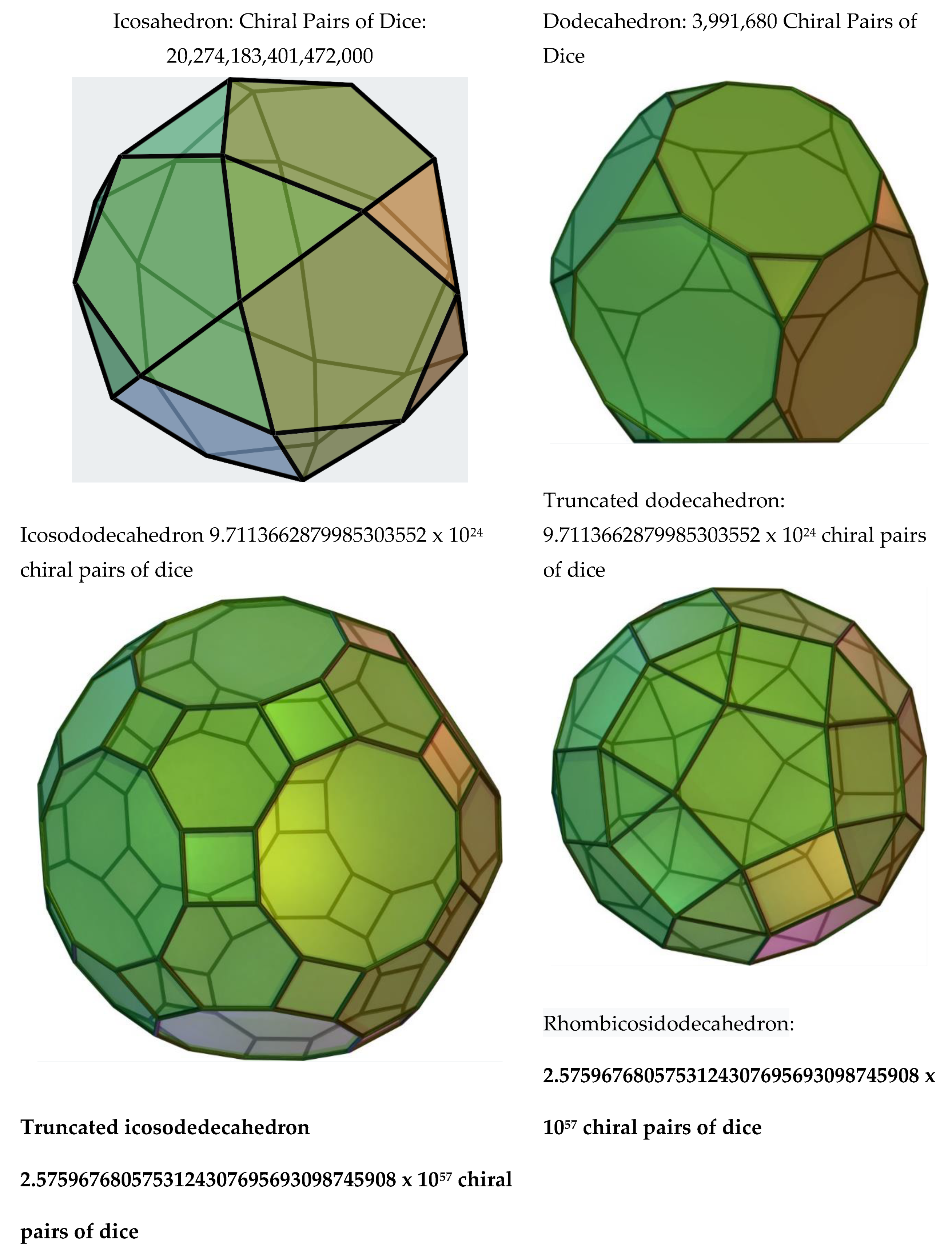
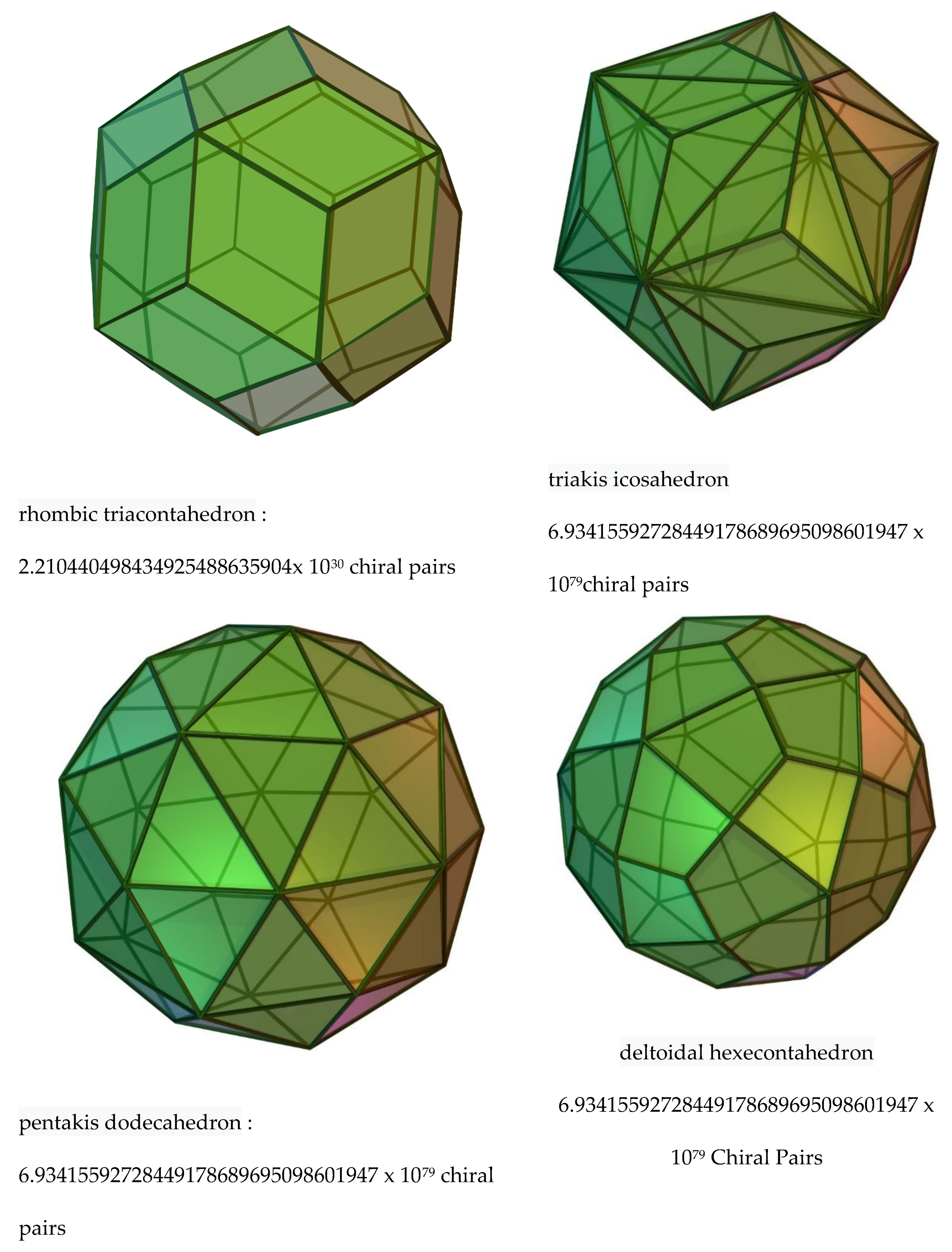
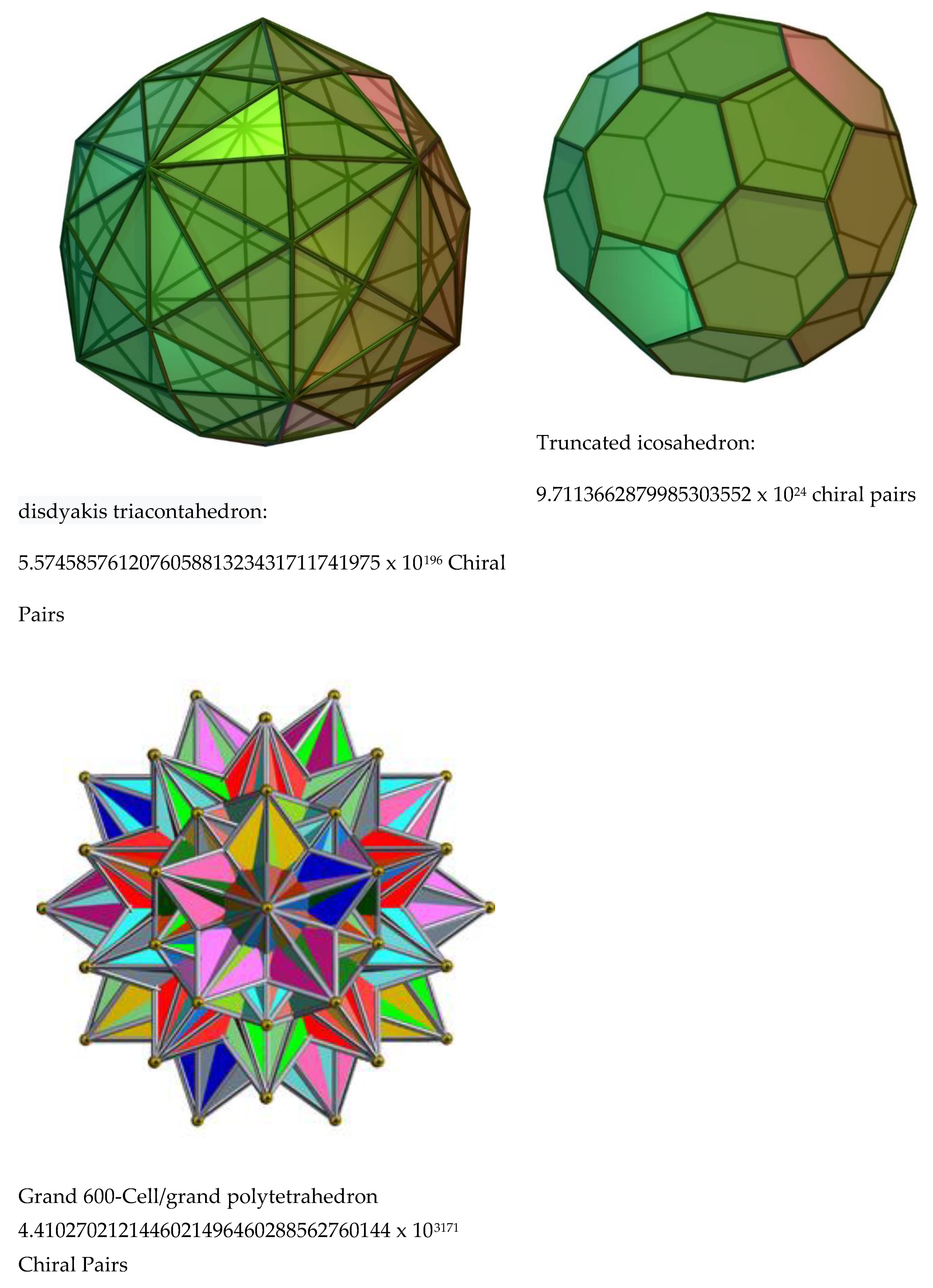
aAll Images were created by POV-RAY codes and are public domain freely reproduced from ref [63].
Table 6.
Six-color Enumeration for hexagons & Ten-color Enumeration for Pentagons of the Buckyball: Enumeration of Chiral and achiral colorings: For hexagons of the buckyball with 6 types of colors (vibgyr)a For pentagons 10- types of colors: vibgyorbwp (b:black, w:white, p:pink).
Table 6.
Six-color Enumeration for hexagons & Ten-color Enumeration for Pentagons of the Buckyball: Enumeration of Chiral and achiral colorings: For hexagons of the buckyball with 6 types of colors (vibgyr)a For pentagons 10- types of colors: vibgyorbwp (b:black, w:white, p:pink).
| Hexagons | Pentagons | ||||
| Color Partition | Ag | Au | Color Partition | Ag | Au |
| 20 0 0 0 0 0 | 1 | 0 | 12 0 0 0 0 0 0 0 0 0 | 1 | 0 |
| 19 1 0 0 0 0 | 1 | 0 | 11 1 0 0 0 0 0 0 0 0 | 1 | 0 |
| 18 2 0 0 0 0 | 5 | 1 | 10 2 0 0 0 0 0 0 0 0 | 3 | 0 |
| 17 3 0 0 0 0 | 5 | 2 | 9 3 0 0 0 0 0 0 0 0 | 3 | 0 |
| 16 4 0 0 0 0 | 15 | 6 | 8 4 0 0 0 0 0 0 0 0 | 5 | 0 |
| 18 1 1 0 0 0 | 34 | 23 | 10 1 1 0 0 0 0 0 0 0 | 9 | 2 |
| 17 2 1 0 0 0 | 60 | 54 | 9 2 1 0 0 0 0 0 0 0 | 14 | 8 |
| 16 3 1 0 0 0 | 58 | 38 | 8 3 1 0 0 0 0 0 0 0 | 10 | 2 |
| 16 2 2 0 0 0 | 176 | 151 | 8 2 2 0 0 0 0 0 0 0 | 23 | 10 |
| 17 1 1 1 0 0 | 274 | 233 | 9 1 1 1 0 0 0 0 0 0 | 37 | 20 |
| 16 2 1 1 0 0 | 498 | 471 | 8 2 1 1 0 0 0 0 0 0 | 57 | 42 |
| 16 1 1 1 1 0 | 972 | 966 | 8 1 1 1 1 0 0 0 0 0 | 102 | 96 |
| 15 5 0 0 0 0 | 149 | 113 | 7 5 0 0 0 0 0 0 0 0 | 12 | 2 |
| 14 6 0 0 0 0 | 674 | 622 | 6 6 0 0 0 0 0 0 0 0 | 42 | 24 |
| 15 4 1 0 0 0 | 1337 | 1249 | 7 4 1 0 0 0 0 0 0 0 | 80 | 52 |
| 14 5 1 0 0 0 | 2610 | 2562 | 6 5 1 0 0 0 0 0 0 0 | 144 | 120 |
| 15 3 2 0 0 0 | 3928 | 3824 | 7 3 2 0 0 0 0 0 0 0 | 216 | 180 |
| 14 4 2 0 0 0 | 7776 | 7728 | 6 4 2 0 0 0 0 0 0 0 | 408 | 384 |
| 14 3 3 0 0 0 | 15504 | 15504 | 6 3 3 0 0 0 0 0 0 0 | 792 | 792 |
| 15 3 1 1 0 0 | 371 | 310 | 7 3 1 1 0 0 0 0 0 0 | 18 | 6 |
| 14 4 1 1 0 0 | 1984 | 1892 | 6 4 1 1 0 0 0 0 0 0 | 58 | 36 |
| 15 2 2 1 0 0 | 4984 | 4796 | 7 2 2 1 0 0 0 0 0 0 | 142 | 104 |
| 14 3 2 1 0 0 | 9744 | 9636 | 6 3 2 1 0 0 0 0 0 0 | 246 | 216 |
| 14 2 2 2 0 0 | 6557 | 6373 | 6 2 2 2 0 0 0 0 0 0 | 178 | 134 |
| 15 2 1 1 1 0 | 19480 | 19280 | 7 2 1 1 1 0 0 0 0 0 | 488 | 436 |
| 14 3 1 1 1 0 | 38784 | 38736 | 6 3 1 1 1 0 0 0 0 0 | 936 | 912 |
| 14 2 2 1 1 0 | 29352 | 28968 | 6 2 2 1 1 0 0 0 0 0 | 748 | 668 |
| 14 2 1 1 1 1 | 58248 | 58032 | 6 2 1 1 1 1 0 0 0 0 | 1416 | 1356 |
| 13 7 0 0 0 0 | 116304 | 116256 | 5 5 2 0 0 0 0 0 0 0 | 2784 | 2760 |
| 12 8 0 0 0 0 | 693 | 609 | 5 4 3 0 0 0 0 0 0 0 | 5544 | 5544 |
| 13 6 1 0 0 0 | 4597 | 4457 | 4 4 4 0 0 0 0 0 0 0 | 160 | 118 |
| 12 7 1 0 0 0 | 13720 | 13412 | 5 5 1 1 0 0 0 0 0 0 | 296 | 260 |
| 13 5 2 0 0 0 | 27216 | 27048 | 5 4 2 1 0 0 0 0 0 0 | 258 | 204 |
| 12 6 2 0 0 0 | 22802 | 22438 | 4 4 3 1 0 0 0 0 0 0 | 726 | 660 |
| 13 4 3 0 0 0 | 68040 | 67620 | 4 4 2 2 0 0 0 0 0 0 | 1404 | 1368 |
| 12 5 3 0 0 0 | 135744 | 135576 | 5 4 1 1 1 0 0 0 0 0 | 960 | 888 |
| 12 4 4 0 0 0 | 90618 | 90282 | 4 4 2 1 1 0 0 0 0 0 | 1440 | 1332 |
| 13 5 1 1 0 0 | 136024 | 135296 | 4 4 1 1 1 1 0 0 0 0 | 2808 | 2736 |
| 12 6 1 1 0 0 | 271488 | 271152 | 5 3 3 1 0 0 0 0 0 0 | 5544 | 5544 |
| 13 4 2 1 0 0 | 542640 | 542640 | 5 3 2 2 0 0 0 0 0 0 | 4224 | 4092 |
| 12 5 2 1 0 0 | 407400 | 406560 | 4 3 3 2 0 0 0 0 0 0 | 8352 | 8280 |
| 12 4 3 1 0 0 | 814128 | 813792 | 5 3 2 1 1 0 0 0 0 0 | 16632 | 16632 |
| 12 4 2 2 0 0 | 1135 | 1022 | 4 3 3 1 1 0 0 0 0 0 | 33264 | 33264 |
| 13 4 1 1 1 0 | 8501 | 8305 | 5 2 2 2 1 0 0 0 0 0 | 330 | 270 |
| 12 5 1 1 1 0 | 29739 | 29262 | 4 3 2 2 1 0 0 0 0 0 | 1194 | 1116 |
| 12 4 2 1 1 0 | 58917 | 58665 | 4 2 2 2 2 0 0 0 0 0 | 1818 | 1692 |
| 12 4 1 1 1 1 | 59085 | 58497 | 5 2 2 1 1 1 0 0 0 0 | 3510 | 3420 |
| 11 9 0 0 0 0 | 176680 | 176036 | 4 3 2 1 1 1 0 0 0 0 | 6948 | 6912 |
| 10 10 0 0 0 0 | 352800 | 352632 | 4 2 2 2 1 1 0 0 0 0 | 2376 | 2244 |
| 11 8 1 0 0 0 | 74014 | 73286 | 4 2 2 1 1 1 1 0 0 0 | 4656 | 4584 |
| 10 9 1 0 0 0 | 294290 | 293590 | 3 3 3 3 0 0 0 0 0 0 | 7008 | 6852 |
| 11 7 2 0 0 0 | 441952 | 440468 | 3 3 3 2 1 0 0 0 0 0 | 13896 | 13824 |
| 10 8 2 0 0 0 | 882168 | 881412 | 3 3 2 2 2 0 0 0 0 0 | 27720 | 27720 |
| 11 6 3 0 0 0 | 1763664 | 1763496 | 3 3 2 2 1 1 0 0 0 0 | 10572 | 10308 |
| 10 7 3 0 0 0 | 588509 | 587221 | 3 2 2 2 2 1 0 0 0 0 | 20880 | 20700 |
| 10 6 4 0 0 0 | 1175898 | 1175562 | 2 2 2 2 2 2 0 0 0 0 | 41616 | 41544 |
| 11 7 1 1 0 0 | 1764280 | 1762880 | 3 2 2 2 1 1 1 0 0 0 | 83160 | 83160 |
| 10 8 1 1 0 0 | 3527328 | 3526992 | 2 2 2 2 2 1 1 0 0 0 | 166320 | 166320 |
| 11 6 2 1 0 0 | 2647512 | 2644488 | 2 2 2 2 1 1 1 1 0 0 | 3156 | 3012 |
| 10 7 2 1 0 0 | 5291496 | 5289984 | 2 2 2 2 2 2 0 0 0 0 | 9312 | 9168 |
| 10 6 3 1 0 0 | 1466 | 1340 | 3 3 3 1 1 1 0 0 0 0 | 18480 | 18480 |
| 10 6 2 2 0 0 | 12716 | 12478 | 3 3 2 2 2 0 0 0 0 0 | 13992 | 13728 |
| 11 6 1 1 1 0 | 50696 | 50080 | 3 3 2 2 1 1 0 0 0 0 | 27792 | 27648 |
| 10 7 1 1 1 0 | 100944 | 100608 | 3 3 2 1 1 1 1 0 0 0 | 55440 | 55440 |
| 10 6 2 1 1 0 | 118002 | 117162 | 3 3 1 1 1 1 1 1 0 0 | 110880 | 110880 |
| 10 6 1 1 1 1 | 353192 | 352240 | 3 2 2 2 2 1 0 0 0 0 | 41736 | 41424 |
| 9 9 2 0 0 0 | 705600 | 705264 | 3 2 2 2 1 1 1 0 0 0 | 83232 | 83088 |
| 9 8 3 0 0 0 | 176904 | 175812 | 3 2 2 1 1 1 1 1 0 0 | 166320 | 166320 |
| 8 8 4 0 0 0 | 705936 | 704928 | 3 2 1 1 1 1 1 1 1 0 | 332640 | 332640 |
| 9 9 1 1 0 0 | 1059240 | 1057056 | 3 1 1 1 1 1 1 1 1 1 | 665280 | 665280 |
| 9 8 2 1 0 0 | 2116800 | 2115792 | 2 2 2 2 2 2 0 0 0 0 | 62736 | 62184 |
| 8 8 3 1 0 0 | 4232592 | 4232592 | 2 2 2 2 2 1 1 0 0 0 | 124920 | 124560 |
| 8 8 2 2 0 0 | 882504 | 881076 | 2 2 2 2 1 1 1 1 0 0 | 249552 | 249408 |
| 9 8 1 1 1 0 | 1764840 | 1762320 | 2 2 2 1 1 1 1 1 1 0 | 498960 | 498960 |
| 8 8 2 1 1 0 | 3527664 | 3526656 | 2 2 1 1 1 1 1 1 1 1 | 997920 | 997920 |
| 8 8 1 1 1 1 | 5292168 | 5289312 | |||
| 13 3 3 1 0 0 | 10581984 | 10580976 | |||
| 13 3 2 2 0 0 | 2352468 | 2350452 | |||
| 12 3 3 2 0 0 | 7055328 | 7053312 | |||
| 13 3 2 1 1 0 | 14108640 | 14108640 | |||
| 12 3 3 1 1 0 | 10584000 | 10578960 | |||
| 13 2 2 2 1 0 | 21163968 | 21161952 | |||
| 12 3 2 2 1 0 | 31747296 | 31741584 | |||
| 12 2 2 2 2 0 | 1648 | 1510 | |||
| 13 2 2 1 1 1 | 15536 | 15270 | |||
| 12 3 2 1 1 1 | 69812 | 69070 | |||
| 12 2 2 2 1 1 | 138756 | 138378 | |||
| 11 5 4 0 0 0 | 185308 | 184244 | |||
| 10 5 5 0 0 0 | 554856 | 553680 | |||
| 11 5 3 1 0 0 | 1108704 | 1108368 | |||
| 11 4 4 1 0 0 | 324428 | 322888 | |||
| 10 5 4 1 0 0 | 1294012 | 1292612 | |||
| 11 5 2 2 0 0 | 1942136 | 1939000 | |||
| 11 4 3 2 0 0 | 3880632 | 3879120 | |||
| 10 5 3 2 0 0 | 7759920 | 7759584 | |||
| 10 4 4 2 0 0 | 388788 | 387192 | |||
| 10 4 3 3 0 0 | 1940904 | 1938972 | |||
| 11 5 2 1 1 0 | 3881640 | 3878112 | |||
| 11 4 3 1 1 0 | 7760256 | 7759248 | |||
| 10 5 3 1 1 0 | 11641560 | 11637696 | |||
| 10 4 4 1 1 0 | 23279760 | 23278752 | |||
| 11 4 2 2 1 0 | 4853184 | 4848396 | |||
| 10 5 2 2 1 0 | 9700824 | 9698556 | |||
| 10 4 3 2 1 0 | 6468432 | 6464568 | |||
| 10 4 2 2 2 0 | 19401480 | 19397280 | |||
| 11 4 2 1 1 1 | 38799264 | 38798256 | |||
| 10 5 2 1 1 1 | 29105832 | 29096088 | |||
| 10 4 3 1 1 1 | 58200408 | 58195872 | |||
| 10 4 2 2 1 1 | 25866888 | 25864872 | |||
| 9 7 4 0 0 0 | 38802624 | 38794896 | |||
| 9 6 5 0 0 0 | 77598528 | 77596512 | |||
| 8 7 5 0 0 0 | 116400480 | 116392080 | |||
| 8 6 6 0 0 0 | 174608112 | 174588288 | |||
| 9 7 3 1 0 0 | 77370 | 76600 | |||
| 9 6 4 1 0 0 | 154180 | 153760 | |||
| 8 7 4 1 0 0 | 231550 | 230360 | |||
| 8 6 5 1 0 0 | 693500 | 692170 | |||
| 9 7 2 2 0 0 | 1385880 | 1385460 | |||
| 9 6 3 2 0 0 | 462820 | 461000 | |||
| 8 7 3 2 0 0 | 1848420 | 1846740 | |||
| 8 6 4 2 0 0 | 2773160 | 2769520 | |||
| 8 6 3 3 0 0 | 5543520 | 5541840 | |||
| 9 7 2 1 1 0 | 11085360 | 11085360 | |||
| 9 6 3 1 1 0 | 647706 | 645606 | |||
| 8 7 3 1 1 0 | 3234580 | 3231920 | |||
| 8 6 4 1 1 0 | 6468850 | 6464090 | |||
| 9 6 2 2 1 0 | 12933780 | 12932100 | |||
| 8 7 2 2 1 0 | 19402040 | 19396720 | |||
| 8 6 3 2 1 0 | 38799600 | 38797920 | |||
| 8 6 2 2 2 0 | 3881136 | 3878616 | |||
| 9 6 2 1 1 1 | 9702840 | 9696540 | |||
| 8 7 2 1 1 1 | 19400640 | 19398120 | |||
| 8 6 3 1 1 1 | 12935460 | 12930420 | |||
| 8 6 2 2 1 1 | 38801280 | 38796240 | |||
| 9 5 5 1 0 0 | 77597520 | 77597520 | |||
| 9 5 4 2 0 0 | 58204440 | 58191840 | |||
| 8 5 5 2 0 0 | 116398800 | 116393760 | |||
| 9 4 4 3 0 0 | 16169760 | 16162620 | |||
| 8 5 4 3 0 0 | 48502440 | 48494460 | |||
| 8 4 4 4 0 0 | 96998160 | 96995640 | |||
| 9 5 4 1 1 0 | 64667160 | 64662120 | |||
| 8 5 5 1 1 0 | 97004040 | 96989760 | |||
| 9 4 4 2 1 0 | 193996320 | 193991280 | |||
| 8 5 4 2 1 0 | 290998680 | 290982720 | |||
| 8 4 4 3 1 0 | 129334260 | 129324180 | |||
| 8 4 4 2 2 0 | 258658440 | 258658440 | |||
| 9 4 4 1 1 1 | 387992640 | 387982560 | |||
| 8 5 4 1 1 1 | 581995680 | 581967120 | |||
| 8 4 4 2 1 1 | 521000 | 519040 | |||
| 7 7 6 0 0 0 | 2079380 | 2077630 | |||
| 7 7 5 1 0 0 | 3120540 | 3116550 | |||
| 7 6 6 1 0 0 | 6236460 | 6234570 | |||
| 7 7 4 2 0 0 | 12471240 | 12470820 | |||
| 7 6 5 2 0 0 | 832592 | 830212 | |||
| 6 6 6 2 0 0 | 4158480 | 4155540 | |||
| 7 6 4 3 0 0 | 8316680 | 8311360 | |||
| 6 6 5 3 0 0 | 16628880 | 16627200 | |||
| 6 6 4 4 0 0 | 24945000 | 24939120 | |||
| 7 7 4 1 1 0 | 49884960 | 49883280 | |||
| 7 6 5 1 1 0 | 971840 | 969178 | |||
| 6 6 6 1 1 0 | 5821424 | 5818204 | |||
| 7 6 4 2 1 0 | 14555240 | 14546980 | |||
| 6 6 5 2 1 0 | 29100960 | 29097180 | |||
| 6 6 4 3 1 0 | 19402630 | 19396190 | |||
| 6 6 4 2 2 0 | 58201640 | 58194640 | |||
| 7 6 4 1 1 1 | 116397120 | 116395440 | |||
| 6 6 5 1 1 1 | 87308760 | 87291960 | |||
| 6 6 4 2 1 1 | 174598200 | 174590640 | |||
| 11 3 3 3 0 0 | 17463432 | 17455452 | |||
| 11 3 3 2 1 0 | 34920144 | 34917624 | |||
| 10 3 3 3 1 0 | 29103480 | 29094660 | |||
| 11 3 2 2 2 0 | 87302040 | 87292380 | |||
| 10 3 3 2 2 0 | 174595680 | 174593160 | |||
| 11 3 2 2 1 1 | 116398800 | 116393760 | |||
| 10 3 3 2 1 1 | 174603240 | 174585600 | |||
| 11 2 2 2 2 1 | 349191360 | 349186320 | |||
| 10 3 2 2 2 1 | 523792920 | 523773600 | |||
| 10 2 2 2 2 2 | 36382500 | 36369900 | |||
| 9 5 3 3 0 0 | 145500600 | 145490100 | |||
| 9 5 3 2 1 0 | 218260560 | 218234940 | |||
| 9 4 3 3 1 0 | 436491720 | 436480380 | |||
| 8 5 3 3 1 0 | 291000360 | 290981040 | |||
| 9 5 2 2 2 0 | 581983920 | 581978880 | |||
| 9 4 3 2 2 0 | 872982600 | 872961600 | |||
| 8 5 3 2 2 0 | 1309493640 | 1309441560 | |||
| 8 4 3 3 2 0 | 387992700 | 387982620 | |||
| 9 5 2 2 1 1 | 1163967840 | 1163957760 | |||
| 9 4 3 2 1 1 | 1745963520 | 1745924880 | |||
| 8 5 3 2 1 1 | 1109966 | 1107166 | |||
| 8 4 3 3 1 1 | 6652896 | 6649536 | |||
| 9 4 2 2 2 1 | 16632240 | 16623840 | |||
| 8 5 2 2 2 1 | 33257760 | 33254400 | |||
| 8 4 3 2 2 1 | 22174140 | 22167420 | |||
| 8 4 2 2 2 2 | 66515520 | 66508800 | |||
| 7 7 3 3 0 0 | 133024320 | 133024320 | |||
| 7 7 3 2 1 0 | 99776640 | 99759840 | |||
| 7 6 3 3 1 0 | 199539840 | 199533120 | |||
| 7 7 2 2 2 0 | 7761742 | 7757822 | |||
| 7 6 3 2 2 0 | 23284016 | 23274496 | |||
| 6 6 3 3 2 0 | 46560192 | 46556832 | |||
| 7 7 2 2 1 1 | 38804140 | 38793500 | |||
| 7 6 3 2 1 1 | 116402160 | 116390400 | |||
| 6 6 3 3 1 1 | 232794240 | 232790880 | |||
| 7 6 2 2 2 1 | 155198460 | 155191740 | |||
| 6 6 3 2 2 1 | 232803200 | 232781920 | |||
| 6 6 2 2 2 2 | 465588480 | 465581760 | |||
| 7 5 5 3 0 0 | 698389440 | 698365920 | |||
| 7 5 4 4 0 0 | 46563552 | 46553472 | |||
| 6 5 5 4 0 0 | 139680576 | 139670496 | |||
| 7 5 5 2 1 0 | 279351072 | 279351072 | |||
| 7 5 4 3 1 0 | 58205280 | 58191000 | |||
| 6 5 5 3 1 0 | 232797600 | 232787520 | |||
| 7 4 4 4 1 0 | 349203120 | 349174560 | |||
| 6 5 4 4 1 0 | 698382720 | 698372640 | |||
| 7 5 4 2 2 0 | 465595200 | 465575040 | |||
| 6 5 5 2 2 0 | 931170240 | 931170240 | |||
| 7 4 4 3 2 0 | 1396765440 | 1396745280 | |||
| 6 5 4 3 2 0 | 2095161600 | 2095104480 | |||
| 6 4 4 4 2 0 | 290999520 | 290981880 | |||
| 6 4 4 3 3 0 | 581997360 | 581965440 | |||
| 7 5 4 2 1 1 | 1163967840 | 1163957760 | |||
| 6 5 5 2 1 1 | 1745961840 | 1745926560 | |||
| 7 4 4 3 1 1 | 775985400 | 775965240 | |||
| 6 5 4 3 1 1 | 2327935680 | 2327915520 | |||
| 6 4 4 4 1 1 | 3491920320 | 3491856480 | |||
| 7 4 4 2 2 1 | 3103900920 | 3103900920 | |||
| 6 5 4 2 2 1 | 4655871360 | 4655831040 | |||
| 6 4 4 3 2 1 | 27166848 | 27155646 | |||
| 6 4 4 2 2 2 | 54320814 | 54315774 | |||
| 5 5 5 5 0 0 | 54324174 | 54312414 | |||
| 5 5 5 4 1 0 | 162961232 | 162948352 | |||
| 5 5 4 4 2 0 | 325911264 | 325907904 | |||
| 5 4 4 4 3 0 | 67909580 | 67892500 | |||
| 4 4 4 4 4 0 | 271598380 | 271584380 | |||
| 5 5 4 4 1 1 | 407410640 | 407375920 | |||
| 5 4 4 4 2 1 | 814781520 | 814766400 | |||
| 4 4 4 4 3 1 | 543195550 | 543169790 | |||
| 4 4 4 4 2 2 | 1086368700 | 1086361980 | |||
| 9 3 3 3 2 0 | 1629561920 | 1629533920 | |||
| 8 3 3 3 3 0 | 2444369760 | 2444299200 | |||
| 9 3 3 2 2 1 | 81485376 | 81469416 | |||
| 8 3 3 3 2 1 | 325914624 | 325904544 | |||
| 9 3 2 2 2 2 | 488880336 | 488848416 | |||
| 8 3 3 2 2 2 | 977733792 | 977723712 | |||
| 7 5 3 3 2 0 | 407396640 | 407377320 | |||
| 7 4 3 3 3 0 | 814791600 | 814756320 | |||
| 6 5 3 3 3 0 | 1629552960 | 1629542880 | |||
| 7 5 3 2 2 1 | 2444341200 | 2444302560 | |||
| 7 4 3 3 2 1 | 1086375420 | 1086355260 | |||
| 6 5 3 3 2 1 | 3259105920 | 3259085760 | |||
| 6 4 3 3 3 1 | 4888679040 | 4888608480 | |||
| 7 5 2 2 2 2 | 1018503360 | 1018450440 | |||
| 7 4 3 2 2 2 | 2036946240 | 2036923560 | |||
| 6 5 3 2 2 2 | 1357976040 | 1357937400 | |||
| 6 4 3 3 2 2 | 4073890800 | 4073848800 | |||
| 5 5 5 3 2 0 | 6110877360 | 6110769840 | |||
| 5 5 4 3 3 0 | 5431836600 | 5431816440 | |||
| 5 5 5 2 2 1 | 8147778240 | 8147700960 | |||
| 5 5 4 3 2 1 | 10863673020 | 10863632700 | |||
| 5 4 4 3 3 1 | 97780440 | 97765320 | |||
| 5 5 4 2 2 2 | 488871936 | 488856816 | |||
| 5 4 4 3 2 2 | 977743872 | 977713632 | |||
| 4 4 4 3 3 2 | 1955457504 | 1955457504 | |||
| 7 3 3 3 2 2 | 2933201376 | 2933171136 | |||
| 6 3 3 3 3 2 | 1222184880 | 1222137000 | |||
| 5 5 3 3 2 2 | 2444329440 | 2444314320 | |||
| 5 4 3 3 3 2 | 1629563040 | 1629532800 | |||
| 4 4 3 3 3 3 | 4888658880 | 4888628640 | |||
| 4 4 4 4 2 2 | 7333013520 | 7332917760 | |||
| 5 5 3 3 3 1 | 6518191680 | 6518191680 | |||
| 5 5 3 3 2 2 | 9777317760 | 9777257280 | |||
| 5 4 4 4 3 0 | 2036961360 | 2036908440 | |||
| 5 4 4 4 2 1 | 6110833680 | 6110775720 | |||
| 5 4 4 3 3 1 | 8147754720 | 8147724480 | |||
| 5 4 4 3 2 2 | 12221662320 | 12221556480 | |||
| 5 4 3 3 3 2 | 16295509440 | 16295448960 | |||
| 5 3 3 3 3 3 | 21727305720 | 21727305720 | |||
| 4 4 4 4 4 0 | 2546223120 | 2546142480 | |||
| 4 4 4 4 3 1 | 10184706000 | 10184643000 | |||
| 4 4 4 4 2 2 | 15277122000 | 15276958200 | |||
| 4 4 4 3 3 2 | 20369406960 | 20369291040 | |||
| 4 4 3 3 3 3 | 27159162480 | 27159102000 | |||
anumber of hexagonal face colors: N(Ag)+N(Au); anumber of chiral pairs of hexagonal face colors: N(Au) anumber of achiral hexagonal face colors: N(Ag)-N(Au).
Disclaimer/Publisher’s Note: The statements, opinions and data contained in all publications are solely those of the individual author(s) and contributor(s) and not of MDPI and/or the editor(s). MDPI and/or the editor(s) disclaim responsibility for any injury to people or property resulting from any ideas, methods, instructions or products referred to in the content. |
© 2024 by the authors. Licensee MDPI, Basel, Switzerland. This article is an open access article distributed under the terms and conditions of the Creative Commons Attribution (CC BY) license (http://creativecommons.org/licenses/by/4.0/).
Copyright: This open access article is published under a Creative Commons CC BY 4.0 license, which permit the free download, distribution, and reuse, provided that the author and preprint are cited in any reuse.


