

Submitted:
22 July 2024
Posted:
22 July 2024
You are already at the latest version
Abstract
Swampy land in Banjarmasin has special characteristics for building house constructions. The foundation for very low soil bearing capacity requires special treatment as well. Many building collapses are caused by foundation failures due to mismatched building loads and foundation functions, as well as construction material errors. The need for house design follows the development of building functions. Nowadays, a one-story house is no longer sufficient due to limited land. The need to elevate houses to two stories or to develop houses (renovations) often leads to foundation construction errors. The commonly used foundation, wooden pile foundation, has limited load-bearing capacity, necessitating modification steps in the form of foundation reinforcement. Several steps, including material combinations or combinations of various types of foundations, can be implemented. Therefore, a specific model is required to obtain a foundation design that can accommodate construction needs. The aim of the research is to create a foundation design model capable of reinforcing wooden pile foundations for both house construction development and as a reference for building one-story and two-story houses. In this research, field observations will be conducted at various house construction sites in Banjarmasin, both residential and individual objects. Data will be presented descriptively and analyzed to obtain an applicable model as a reference for house construction on swampy land. The model will provide an applicable depiction and will be tested against foundation construction implementation methods.
Keywords:
model foundation
; wood pillar
; concrete foundation
; banjarmasin
; swampland
1. Introduction
Banjarmasin, with its swampy land, has special
characteristics for house construction. Swampy land with very low soil bearing
capacity, i.e., 0.2 kg/cm², uses foundation (Figure
1) construction with wooden or concrete piles (Agusniansyah &
Sarbini, 2024b). This swampy land condition leads to many building collapses
caused by foundation failures due to mismatched building loads and foundation
functions, as well as construction material errors (Agusniansyah, 2024c).
Besides the swampy land condition, house foundation construction in Banjarmasin
also follows the development of building functions. With limited land, small
houses that usually consist of one floor are no longer sufficient. Small house
designs are often made into two stories, even on small plots (Nurfansyah et
al., 2020). Additionally, house development requires renovations, which is
referred to as the growing house concept. However, there is a challenge
regarding the appropriate foundation design to enable house development (Agusniansyah
& Sarbini, 2024b). Foundations for swampy land are certainly very different
from those for hard soil (Sideri, 2017)(Makoond et al., 2024)(Russell &
Hons, 2015)(Kiakojouri et al., 2023)(Caredda et al., 2023), requiring a special
foundation design model(Tavakoli & Kiakojouri, 2013)(Ebie et al., 2013).
House development involves improving the building, such as for horizontal
(sideways) or even vertical (multi-story) renovations (Mahayuddin et al.,
2017)(Kiakojouri et al., 2024)(Katam et al., 2024)(Braun & Kropp, 2023).
The commonly used foundation in swampy land in Banjarmasin involves the type of
material used in the piles/columns of the building. There are two commonly used
materials, wooden pile foundations and concrete pile foundations (Agusniansyah
& Sarbini, 2024b). Wooden pile foundations are constructed using sunduk and
kalang piles. Another type of foundation used is kacapuri [5][6]. Both wooden and concrete pile foundations
are combined with galam pile driving to strengthen the soil bearing capacity [7][8]. This galam pile driving requires special
implementation methods during construction on this swampy land. Conditions of
dry land with high water or high water levels require careful attention during
implementation (Nurfansyah et al., 2020). These conditions are obstacles that
cause building collapses or failures with wooden piles. The strength of wooden
pile foundations is very limited, capable only of supporting light building
loads [9][10][11][12]. For the latest
foundation material type, concrete foundations or combinations are used (Agusniansyah
& Sarbini, 2024b). However, concrete foundations are very expensive and not
suitable for simple houses (Makoond et al., 2024)(Fu et al., 2023)(Canditone et
al., 2023). The steps that can be taken include making
improvements/reinforcements (Abdallah et al., 2024) to wooden pile foundations
with a combination of wood and concrete materials.
This method requires a special design pattern
related to combining foundation construction with house room design (Agusniansyah,
2024a). This forms the basis for creating a foundation design model (Agusniansyah,
2024b). The galam pile driving method is a construction technique using galam
wood as the main element for foundations or piles in building structures,
especially in swampy or moist soil areas. Galam is a type of wood native to
South Kalimantan, Indonesia, known for its strength and resistance to decay.
Let's discuss the galam pile driving method, its workings, and why it is used
in construction in swampy or moist soil areas. Galam pile driving is a
construction method where galam wood is used as piles or stakes to support
buildings. These piles are typically driven into swampy or soft soil to provide
structural support. The use of galam wood is chosen because of its resistance
to moisture and its ability to withstand pressure and building loads above it.
1.1. Benefits of the Galam Pile Driving Method
Resistance to Moisture: Galam is a type of wood
resistant to decay and insect attacks, making it suitable for moist or swampy
soil conditions (Figure 2). Strength and
Stability: Despite being lightweight, galam wood has sufficient strength to
support building structures, making it a good choice for foundations in
unstable soil. Affordable Cost: Compared to other construction materials, galam
wood is generally more affordable, making the galam pile driving method an economical
choice. Applications of Galam Pile Driving in Construction. The galam pile
driving method is often used in various types of construction, especially in
swampy or moist soil areas. Common applications include:
Stilt House Foundations: Galam piles are used to
support stilt houses in swampy areas, providing stability and lifting the
structure off the ground (Figure 3).
Bridges and Roads Over Swamps: Galam piles can be used as supports for small
bridges or roads in swampy areas. Other Structures: This method can also be
applied to other buildings such as warehouses, docks, or facilities requiring
strong support in moist soil.
The galam pile driving method is a construction
technique that relies on galam wood as piles or stakes to provide structural
support, especially in swampy or moist soil areas. With proper driving
processes and strong reinforcement, this method can provide stability and
robustness for various types of buildings. Galam, with its resistance to decay
and strength, is a suitable choice for challenging environmental conditions,
making the galam pile driving method a reliable and economical construction
solution.
1.2. Strength of Galam Piles
Galam wood, commonly found in South Kalimantan,
Indonesia, is known for its strength and resistance to swampy soil and moist
environmental conditions. These properties make it ideal for use as piles in
construction, especially in foundation methods and stilt house structures.
Let's explore the factors that influence the strength of galam piles and why
this type of wood is a popular choice for unstable soil conditions.
1.3. Strength Characteristics of Galam Wood
Mechanical Strength: Galam has high mechanical
strength, allowing it to withstand significant loads. Despite being lighter
than other types of wood, galam can support heavy structures such as stilt
houses and small bridges. Resistance to Moisture and Decay: Galam is resistant
to decay due to moisture and insect attacks, a crucial factor for piles used in
swampy soil or moist environments. Compressive and Bending Strength: Galam
piles have good compressive and bending strength, enabling these piles to
withstand pressure from the building above and other external loads.
1.4. Factors Influencing the Strength of Galam Piles
Wood Quality: The strength of galam piles depends
on the quality of the wood used. Galam wood with a uniform texture and free
from defects will be stronger and more durable. Driving Depth: The deeper the
galam piles are driven into the ground, the more stable and strong the
structure they support. Adequate depth is essential to prevent movement and
provide sufficient support. Joints and Reinforcements: Using strong joints and
additional reinforcements can enhance the strength of galam piles. Proper
joints ensure that the piles do not shift or crack under pressure.
Environmental Conditions: Soil and weather conditions can affect the strength
of galam piles. Very soft soil or frequently flooded areas may require special
driving techniques to ensure stability.
The strength of galam piles depends on several
factors, including wood quality, driving depth, construction techniques used,
and environmental conditions. Due to its mechanical strength, resistance to
moisture, and durability, galam is an ideal choice for foundations and
structures located in swampy or moist soil environments. With proper
reinforcement and driving, galam piles can provide strong and stable structural
support, making it a key element in various types of construction in swampy
areas and challenging environments.
1.5. Determining the Strength of Galam Pile Construction
Determining the strength of galam pile construction
requires technical analysis and specific calculations. Factors such as wood
quality, pile dimensions, driving depth, soil conditions, and supported load
significantly influence construction strength (Agusniansyah & Sarbini,
2024a). Additionally, the type of construction used, whether for stilt houses,
bridges, or other structures, also plays an important role in determining load
capacity.
1.6. Factors Influencing the Strength of Galam Piles
Wood Quality: Galam is known for its strength, but
the quality of the wood used is very important. Denser and defect-free wood
will have a higher load capacity. Pile Dimensions: The larger the diameter and
length of the pile, the greater the load capacity it can bear. Driving Depth:
Deeper driving usually results in more stable support, allowing the pile to
bear larger loads. Soil Conditions: Soil conditions are very important. Hard
soil will provide better support than soft or swampy soil. Joints and
Reinforcements: Strong joints and additional reinforcements can increase the
load capacity of the construction.
1.7. Load Capacity Estimation
There is no definite number on how many tons galam
piles can support, as this requires complex calculations usually conducted by
civil engineers or structural experts. However, as a rough estimate, some general
points that can be considered include:
Stilt House Load: For traditional stilt houses, the
load can vary from several tons to more, depending on the size and weight of
the house. Bridge and Road Load: For small bridges or roads, the load capacity
needs to be greater, and additional calculations are required to ensure
stability. In conclusion, to accurately determine the strength of galam pile
construction in tons, complex analysis and calculations are needed, involving
factors such as wood quality, pile dimensions, driving depth, soil conditions,
and supported load. This process usually requires input from civil engineers or
structural experts to ensure proper construction and stability.
1.8. Galam Pile Friction Strength
The friction strength of galam pile refers to the
pile's ability to withstand the frictional force between the pile and the
surrounding soil. This is an important aspect of construction using galam
piles, especially in swampy or moist soils where friction between wood and soil
greatly determines the stability and strength of the structure. Friction or
frictional force occurs when the surface of the pile interacts with the
surrounding soil. In the context of galam piles, friction is the force that
helps keep the pile stable and not shift after being driven into the ground.
The higher the friction strength, the more stable the pile and the greater the
load capacity it can withstand.
1.9. Calculation Methods of Friction Strength
The friction strength of galam piles can be
calculated using several approaches:
Soil Mechanics Theory: This method involves using
soil mechanics concepts to calculate friction based on soil type, pile depth,
and pressure. Several mathematical equations can be used to estimate frictional
force. Field Tests: Field tests such as pressure tests can be used to measure
friction strength empirically. These tests are usually conducted by civil
engineers or geotechnical experts. Friction Coefficient: Using specific
friction coefficients based on soil type and galam wood quality, friction can
be calculated as the product of normal force and friction coefficient. The
friction strength of galam piles is a key element in determining the stability
and load capacity of structures using these piles. Factors such as wood
quality, driving depth, soil conditions, and pressure affect friction. Friction
calculations are usually conducted by civil engineers or geotechnical experts
to ensure safe and stable structures. The friction strength of galam pile is a
key element in determining the stability and load capacity of structures using
these piles. Factors such as wood quality, driving depth, soil conditions, and
pressure affect friction. Friction calculations are usually conducted by civil
engineers or geotechnical experts to ensure the structure is safe and stable.
The presence of issues regarding how foundation
reinforcement is applied to house development design models and how application
steps require foundation design models as solutions for energy resistance,
advanced materials, and infrastructure as part of wetland technology. This
model is expected to solve building reinforcement problems on soft soil with
low bearing capacity.
This research continues with field observation
studies at various locations of simple house buildings, both 1 (one) and 2
(two) stories in Banjarmasin. Field data is sought as much as possible to
analyze and obtain several models. The models will be tested in design with
consideration of implementation methods applied in swampy soil. The aim of this
research is to obtain an initial model of house design with the application of
combined wooden and concrete pile foundations.
2. Methods
This study is qualitative research with a
descriptive method based on literature studies and data collection through
field surveys/observations. Field observation studies are emphasized more than
theoretical analysis. The focus of this research is to create several
foundation design models for houses based on analysis from literature study
data and field observations. The models obtained will be tested against
implementation methods specifically in swampy soil.
This research is a continuation of previous
research that has already collected data on foundation types in swampy soils
and their combinations, as well as several foundation reinforcement methods.
The research stages are: identification of foundations in wetland areas,
survey/field observation of foundations in Banjarmasin, analysis of foundation
implementation methods, application models of house foundations on swampy
soils, and finally, conclusions and recommendations.
In the initial stage, it involves a literature
review of foundations used on swampy soils in Banjarmasin, the use of
construction materials, connection systems, and construction implementation
methods. Literature data and results from previous research are used as initial
references in this study. Foundation types are identified starting from the use
of materials, whether wooden pile foundations, the use of other materials such
as concrete, or material combinations. Regarding the construction method, the
foundation used is driven galam piles. Field data collection surveys are
conducted in various housing development locations in Banjarmasin, both in
housing estates and individual buildings.
2.1. Analysis
Analysis is conducted on how foundations can
influence house design. The houses analyzed include both single-story and
two-story buildings related to the use of building materials and the building
loads borne by the foundation. Specific aspects in the analysis include:
building improvement/development either horizontally (one-story laterally if
there is still land) or vertically (becoming two-story). The design taken
includes case studies of several house space patterns (floor plans) in both
housing estates and individual buildings. Samples are chosen randomly and
considered representative for model making. It will be seen how the foundation
analysis is carried out with light building loads and heavy building loads.
Next, an analysis is carried out on the foundation design in the house building
development process (renovation) either horizontally or vertically.
Foundation design models will be created after the
analysis is conducted. The model creation is carried out in several stages
starting from the initial model to the model development. If the initial model
does not achieve good results, a re-survey will be conducted to obtain new data
and a new analysis will be performed. Models are created using a
three-dimensional (3D) method to facilitate the analysis of structural
(construction) shapes and designs. The 3D models used include study sketches
(miniatures) and computer animations. The goal of using study models is the
possibility of obtaining spontaneous and unexpected model shapes. From the
study models, 3D computer models will be created. Several models obtained from
the analysis will be identified and tested against construction implementation
methods. Models will be grouped based on foundation material combinations,
single-story house foundation models, two-story house foundation models, and
house development foundation models.
From the model results, conclusions from the
analysis and research results will answer foundation problems in swampy soils
in Banjarmasin. Unresolved issues will continue with recommendations for
further research.
2.2. Object Description
The object describes the current state based on
facts as they are. Surveys are needed to search for foundation objects in many
locations. Data from objects obtained from previous research are re-identified
and a comparative analysis will be conducted. To obtain foundation data, a
check of foundation conditions is necessary. Because the foundation is located
underground (built objects) and this condition is difficult, efforts are made
to condition the land (especially waterlogged positions), soil excavation, and
other necessary actions. If there are difficulties in data collection, object
data is estimated based on local conditions, supplemented by interviews with
owners and/or construction implementers. Surveys are conducted several times to
obtain the latest and relevant object data for this research.
Data collection techniques are done through direct
observation and surveys at observation locations and interviews. The data
obtained are analyzed qualitatively. Survey/observation results are disclosed
graphically and presented descriptively.
3. Result and Discussion
Wood Pile Foundation and Concrete Pile Foundation
in Swampy Soil, consict of: Galam Piling for Foundation, Initial Model of Wood
Pile Foundation and Concrete Foundation, Design Pattern of Combined Foundation.
Old buildings are difficult, new buildings are easier because with design, this
is the model in question.
3.1. Selection of the Use of Poles
The choice of using galam piles is closely related
to foundation's piling method of galam piles or screw piles (Figure 4). If you want to stick with a series
of evenly loaded galam piles, its recommend manual piling. This makes sense
when expanding or renovating a house. When building a new house with wooden
piles, you need to be careful when constructing it. Plan the system by
preparing concrete pillars, piles, machinery, etc.
The column spacing and load in residential
buildings, the concept of floors and walls, that is, the support system of a
row of wooden columns, is actually conceptually understood as a uniform load. However,
in the field application, there is a difference between the floor area of a
low-load room and the wall area of a high-load room. This results in a
difference in load. The load applied to the wall area increases, and the
supporting columns that support it become smaller. This situation needs to be
rectified by strengthening the supporting structure in this area.
There are several galam sizes that are commonly
used in field implementation (Figure 5). For
fences, galams with a length of 1 meter and a diameter of 10-15 centimeters are
usually used. Salt with a length of 3-5 m is used for column construction with
a first floor construction load made of semi-permanent materials (wood, upright
brick). Salt with a length of 6 to 9 meters is used for buildings with high
loads such as : B. For two-story buildings or three-story stores.
The selection of the use of wooden piles is closely
related to the piling method of the foundation, namely galam piles or piles. If
you still use a row of wooden piles with the concept of uniform load, it is
recommended to use manual piling. This is effective in the case of house
expansion or renovation. In the case of building a new house using wooden
piles, it is necessary to be precise in its implementation. The system is
planned with concrete column preparation, manual or machine piling.
The concept of column spacing and loading of the
house building, floor and wall areas, namely the wooden column structure system
in a row, is actually conceptually taken as an even load. However, in the field
application, there is a difference in the floor area of the room with a light
load in contrast to the wall area of the room that bears a heavier load. This
results in a difference in load. The load on the wall area is heavier, making
the columns that support it decrease. This condition must be corrected by
strengthening the column construction in this area.
3.2. Galam as Piling
In field implementation (Figure 6), there are several sizes of galam
that are often used considering the availability of galam in the market. Galam
with a length of 1 meter with a diameter of 10-15cm is usually used for fences.
Galam 3-5 m long is used for building columns, with the load of a
semi-permanent 1-story building (wood, standing brick). 6-9 meters long galam
is used for heavier load buildings such as 2-storey buildings and even 3-storey
shop houses.
3.3. Manual and Machine Piling
Manual Pile Driving Salt piling can be done
manually without using a machine (Figure 7)
by inserting the galam pile driving vertically into the ground. To put the
‘galam’ head on the ground, you can support it by setting the pole using man
body weight. Efficiency and economic factors are taken into consideration in
using this method. Even for small salt settings, a distance of 1 to 4 meters
can be achieved. It will certainly be more economical if the amount of
maintenance is small. Another advantage of this construction method is that the
space for pile driving is small and it is difficult to install pile drivers.
Galam piling work can be done manually without a
machine by sticking the galam into the ground vertically. To position the head
of the galam into the ground can be helped by pounding with the weight of the
human body. The consideration for using this method is the efficiency and
economic factor. For small size galam piling, from 1 meter to 4 meters can
still be done. With a small number of piles, it is of course more economical.
In addition, narrow piling location areas or difficult to place piling machines
are also an advantage of using this method.
In addition to the manual method, galam piling can
also be done using piling machine (Figure 8).
The main tool used is a weight or hummer (**pig's head - banjar language) with
a pounding load of 100 kg to 250 kg, driven by a steel rope lifted by a
load-driving machine. Mechanical methods use modern piling tools such as pile
drivers that are capable of exerting greater and more consistent pressure than
manual methods. This tool usually consists of a long pile mounted on a metal
frame and operated by a hydraulic or pneumatic engine. It can drive the pile
into the ground with adjustable force as needed.
3.4. 2-Storey Wooden House
In fact, in many cases, wooden pile structures can also be used for two-story residential buildings, but this should be avoided for technical implementers. The strength of wooden piles is very limited, and two-story wooden buildings will bear a large load. There is no technical guarantee that multi-storey wooden buildings will last long.
Actually and often also done is the construction of wooden piles can also be for 2 (two) storey houses, but this for technical implementers should be avoided. Because the strength of wooden poles is very limited, and 2 (two) storey timber frame buildings have a large load. There is no technical guarantee that multi-storey timber frame buildings can last long.
The models of wooden columns and concrete columns
There are the types of wooden columns (Figure 9 and Figure 10) and concrete columns. Detection of foundation development in the field is carried out using a combination of wooden and concrete columns (Figure 11). The concept of 1 meter spacing between rows of wooden columns is still used. This support system consists of a series of wooden columns conceptually designed to carry the load evenly. However, this charging concept is different from the actual application. It can be seen that the difference in load is that the floor area of the room is smaller than the wall area of the building. When the load on the wall increases, the columns supporting the wall become smaller. To improve this situation, the support system in this area needs to be strengthened.
The structural system consists of rows of wooden columns that are conceptually considered to have a uniform load. However, this charging concept is different from the actual application. There is a difference in load, i.e. the floor area of the room is lighter than the wall area of the building. The load acting on the wall surface becomes larger, so the columns supporting it become smaller. This situation needs to be corrected by strengthening the column structure in this area. The pillars supporting the wall need to be strengthened. The solution is to replace them with concrete pillars. The shortcomings of wooden columns in terms of material can certainly be overcome by using concrete columns. Concrete columns can be taller than wooden columns and are also sturdier. The advantage of prestressed concrete columns is that there is no limitation on column height and they are easily adapted to the height of wooden columns. Concrete columns are placed in certain locations, such as at the corners of building walls that receive greater loads. By adding and connecting these structures, the bearing capacity of the foundation is expected to increase. Although concrete columns are placed at specific locations, they are considered to have a unified structure. Therefore, the uniform load concept is always used and the total load carrying capacity of the building is increased.
The pillars supporting the wall need to be reinforced. The solution is to replace them with concrete columns. The lack of material for wooden columns can certainly be overcome by using concrete columns. The uniform load concept is used by combining the positions of concrete columns interspersed with wooden columns. Three rows of wooden columns are replaced with concrete columns. If the distance between rows of wooden columns is 1 m, the concrete column positions are 3 m apart.
The same load concept was used along with the location of concrete columns and wooden pillar columns in between (Figure 11). Three rows of wooden columns are replaced with concrete columns. If the distance between rows of wooden columns is 1 m, then the distance between concrete columns is 3 m, and salt columns are always used to make the foundation of wooden columns. The wooden pillar columns consist of four salt columns made of Sunduk Karan wood. This type of party arrangement uses a sequential arrangement.
Galam poles are always used to make wooden pole foundations. The wooden columns have 4 galam columns with a sunduk kalang wooden structure. The arrangement of this type of party uses a sequential arrangement. While the local galam slab foundation made of galam groups is used for concrete columns. With the condition of this group, concrete columns will certainly be able to withstand greater loads than wooden columns. This is the concept of reinforcing the columns by using concrete columns at the corners of the building. 25/25 cm concrete pillars and 90x90 cm concrete slab foundation. The idea of replacing the corner columns of a building is the same as "covering" the wooden columns with concrete columns.
Nowadays, the slab foundation of the local galam’s pile group is used for concrete columns. Naturally, in this group of conditions, concrete columns are able to withstand greater loads than wooden columns. The idea is to strengthen the pillars by using concrete pillars at the corners of the building. Concrete columns 25/25 cm, concrete slab foundation 90x90 cm. The idea of replacing the corner columns of a building is similar to "covering" wooden columns with concrete columns.
Concrete columns are treated the same as wooden columns. So the horizontal structural connections of the wooden beams will be supported and fixed to the concrete columns. The upper structure, including the floor, is designed to resemble a typical timber frame. The distance between rows of wooden columns is 1 meter, the same as the distance between rows of wooden columns commonly used in residential construction.This means that the horizontal structural connections of the wooden beams are supported and attached to concrete supports. The upper structure, such as the floor, is designed to resemble a typical timber frame. The distance between rows of wooden columns is 1 (one) meter and is the same as the distance between rows of wooden columns widely used in housing construction.
Concrete columns are taller and more stable than wooden columns. The advantage of prestressed concrete columns is that there is no limitation on column height and they are easy to adjust to match the height of wooden columns. Concrete columns are installed in certain locations that receive higher loads, such as at the corners of building walls. The purpose of adding and connecting these structures is to increase the bearing capacity of the foundation. Although concrete columns are installed at specific locations, they are assumed to have a uniform structure. Therefore, the concept of uniform loading is always applied so as to increase the load carrying capacity of the entire buiding.
4. Conclusions
From the research results, the use of galam piles as the main foundation shows advantages in terms of efficiency and economy, especially for home renovation or expansion. However, in new building construction, careful planning is required due to the different load distribution between floor and wall areas. In field implementation, the use of galam poles of various sizes depends on the load of the building. For two-storey buildings, although possible, the strength of wooden poles is limited so their use should be avoided.
Strengthening the structure can be achieved by replacing the timber posts with concrete posts at specific locations such as the corners of walls that receive greater loads. This combination of concrete and timber poles maintains the concept of uniform load by placing concrete poles at a distance of three meters, replacing every three rows of timber poles. Thus, the bearing capacity of the foundation is significantly increased. Concrete posts are taller and more stable than timber posts, and are easily adaptable to the height of timber posts, providing an additional advantage. The overall structure is designed to have a uniform load-bearing capacity, improving the overall stability and durability of the building.
References
- Abdallah, A. M., Badawi, M., Elsamak, G., Hu, J. W., Mlybari, E. A., & Ghalla, M. (2024). Strengthening of RC beams with inadequate lap splice length using cast-in-situ and anchored precast ECC ferrocement layers mitigating construction failure risk. Case Studies in Construction Materials, 20(November 2023), e02747. [CrossRef]
- Agusniansyah, N. (2024a). Innovation of Wooden Pile Foundation Model for Housing Development on Swampy Land. PrePrint. [CrossRef]
- Agusniansyah, N. (2024b). Study of House Building Failures on Swamp Land: Identifying Causes and Solutions with a Combination of Wood and Concrete Materials. OSF Preprint, https://osf.io/aw285.
- Agusniansyah, N. (2024c). Weakness Identification of Wood Pillar Foundation: Indication of Foundation Failure to Avoid House Collapse in Swampland. PrePrint. [CrossRef]
- Agusniansyah, N., & Sarbini, G. N. (2024a). Pancangan Galam pada Pondasi di Tanah Rawa Banjarmasin Galam Piling Foundations in Swampy Soil Banjarmasin. ARSIR, 8, 153–168. https://ojs.um-palembang.ac.id/index.php/arsir/article/view/141.
- Agusniansyah, N., & Sarbini, G. N. (2024b). Usaha Perkuatan Pondasi Rumah Untuk Tanah Rawa di Banjarmasin. G-Tech: Jurnal Teknologi Terapan, 8(2), 1320–1327. [CrossRef]
- Braun, K., & Kropp, C. (2023). Building a better world? Competing promises, visions, and imaginaries-in-the-making of the digitalization of architecture and construction. Futures, 154(June 2022), 103262. [CrossRef]
- Canditone, C., Diana, L., Formisano, A., Rodrigues, H., & Vicente, R. (2023). Failure mechanisms and behaviour of adobe masonry buildings: A case study. Engineering Failure Analysis, 150(March), 107343. [CrossRef]
- Caredda, G., Makoond, N., Buitrago, M., Sagaseta, J., Chryssanthopoulos, M., & Adam, J. M. (2023). Learning from the progressive collapse of buildings. Developments in the Built Environment, 15(June), 100194. [CrossRef]
- Ebie, Y., Towprayoon, S., Chiemchaisri, C., Mander, Ü., Furlan Nogueira, S., Jamsranjav, B., Gordon, C., & Rumyanova Petrova, D. (2013). Chapter 6: Constructed Wetlands for Wastewater Treatment 2013 Supplement to the 2006 IPCC Guidelines for National Greenhouse Gas Inventories: Wetlands 6.1 CONSTRUCTED WETLANDS FOR WASTEWATER TREATMENT Coordinating Lead Author s Lead Authors Cont ributing . 6.1-6.26. https://www.ipcc-nggip.iges.or.jp/public/wetlands/pdf/Wetlands_separate_files/WS_Chp6_Constructed_Wetlands.pdf.
- Fu, Q. L., Tan, L., Long, B., & Kang, S. B. (2023). Numerical Investigations of Progressive Collapse Behaviour of Multi-Storey Reinforced Concrete Frames. Buildings, 13(2). [CrossRef]
- Katam, R., Neridu, S., Sreerama, A. K., Pasupuleti, V. D. K., & Kalapatapu, P. (2024). Retrofitting and Strengthening of an RCC Building – A Case Study of Mixed Housing Typology. Procedia Structural Integrity, 52, 72–88. [CrossRef]
- Kiakojouri, F., De Biagi, V., Marchelli, M., & Chiaia, B. (2024). A conceptual note on the definition of initial failure in progressive collapse scenarios. Structures, 60(January), 105921. [CrossRef]
- Kiakojouri, F., Zeinali, E., Adam, J. M., & De Biagi, V. (2023). Experimental studies on the progressive collapse of building structures: A review and discussion on dynamic column removal techniques. Structures, 57(June), 105059. [CrossRef]
- Mahayuddin, S. A., Zaharuddin, W. A. Z. W., Harun, S. N., & Ismail, B. (2017). Assessment of Building Typology and Construction Method of Traditional Longhouse. Procedia Engineering, 180, 1015–1023. [CrossRef]
- Makoond, N., Setiawan, A., Buitrago, M., & Adam, J. M. (2024). Arresting failure propagation in buildings through collapse isolation. Nature, 629(8012), 592–596. [CrossRef]
- Nurfansyah, N., Saud, M. I., Wastuti, P. W., Aini, A. Q., & Agusniansyah, N. (2020). Perkembangan Pondasi Tiang Kayu Pada Rumah Tinggal Di Banjarmasin. Info-Teknik, 21(2), 199. [CrossRef]
- Russell, J., & Hons, M. (2015). Concrete Flat Slab Structures. July.
- Sideri, E. J. (2017). Distributed Damage Effect on Progressive Collapse of Structures & Variability Response Functions in Stochastic 2D Elasticity Problems.
- Tavakoli, H. R., & Kiakojouri, F. (2013). Numerical study of progressive collapse in framed structures: A new approach for dynamic column removal. International Journal of Engineering, Transactions A: Basics, 26(7), 685–692. [CrossRef]
Figure 1.
Combination of Wood Pillar Foundation and Concrete Foundation.
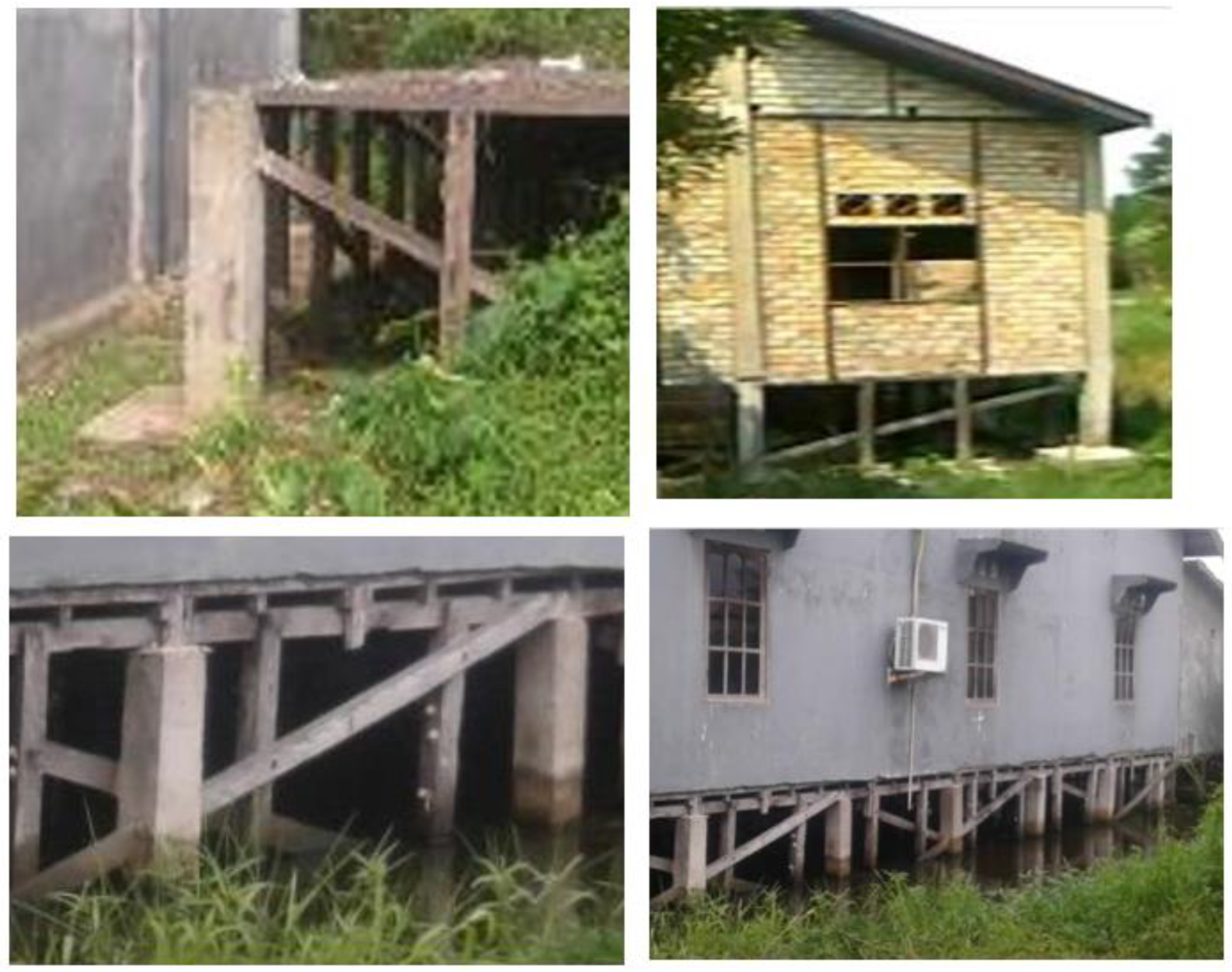
Figure 2.
Wooden Frame of House Building on Swamp.
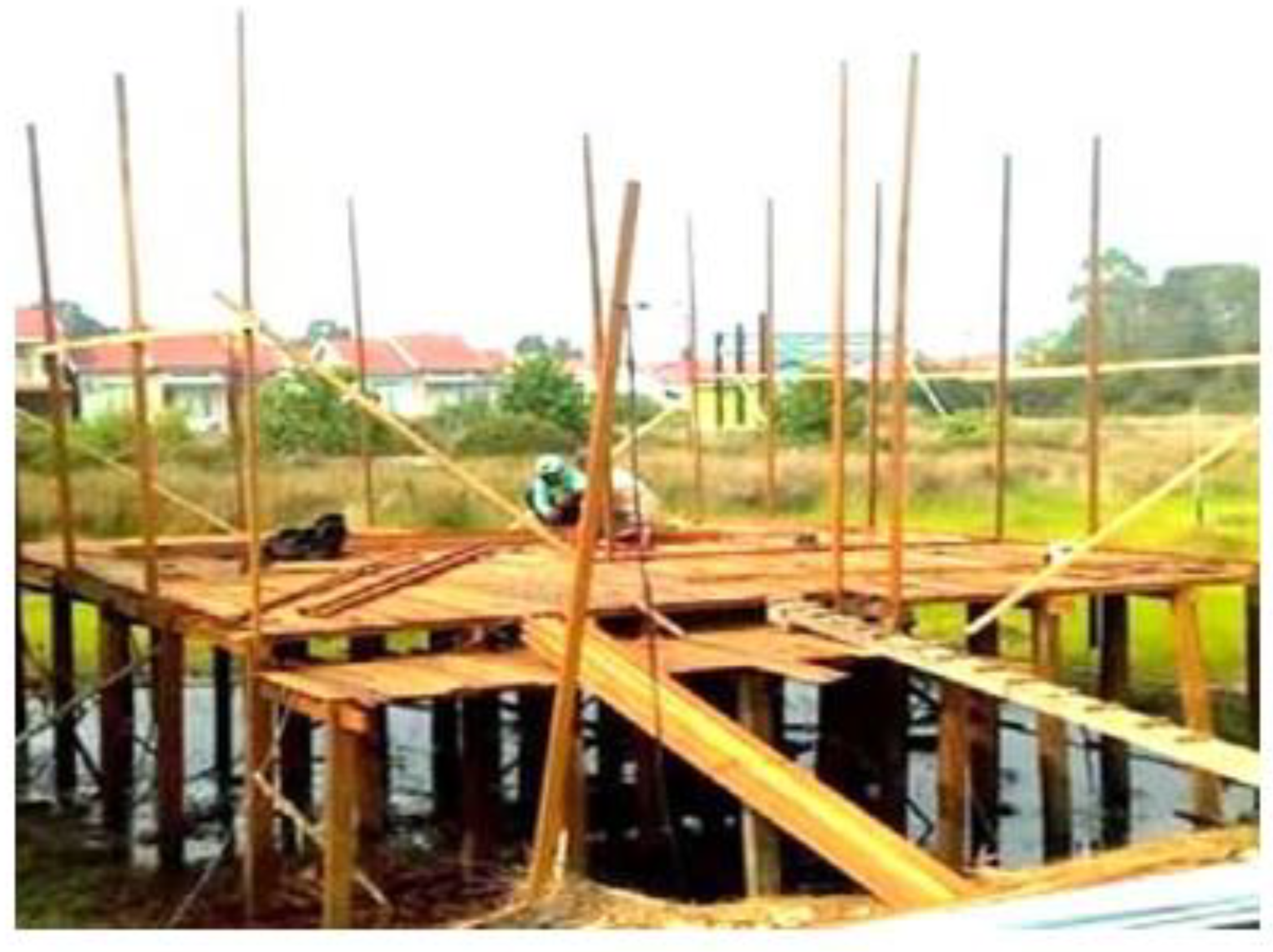
Figure 3.
Concrete foundation in swampland.
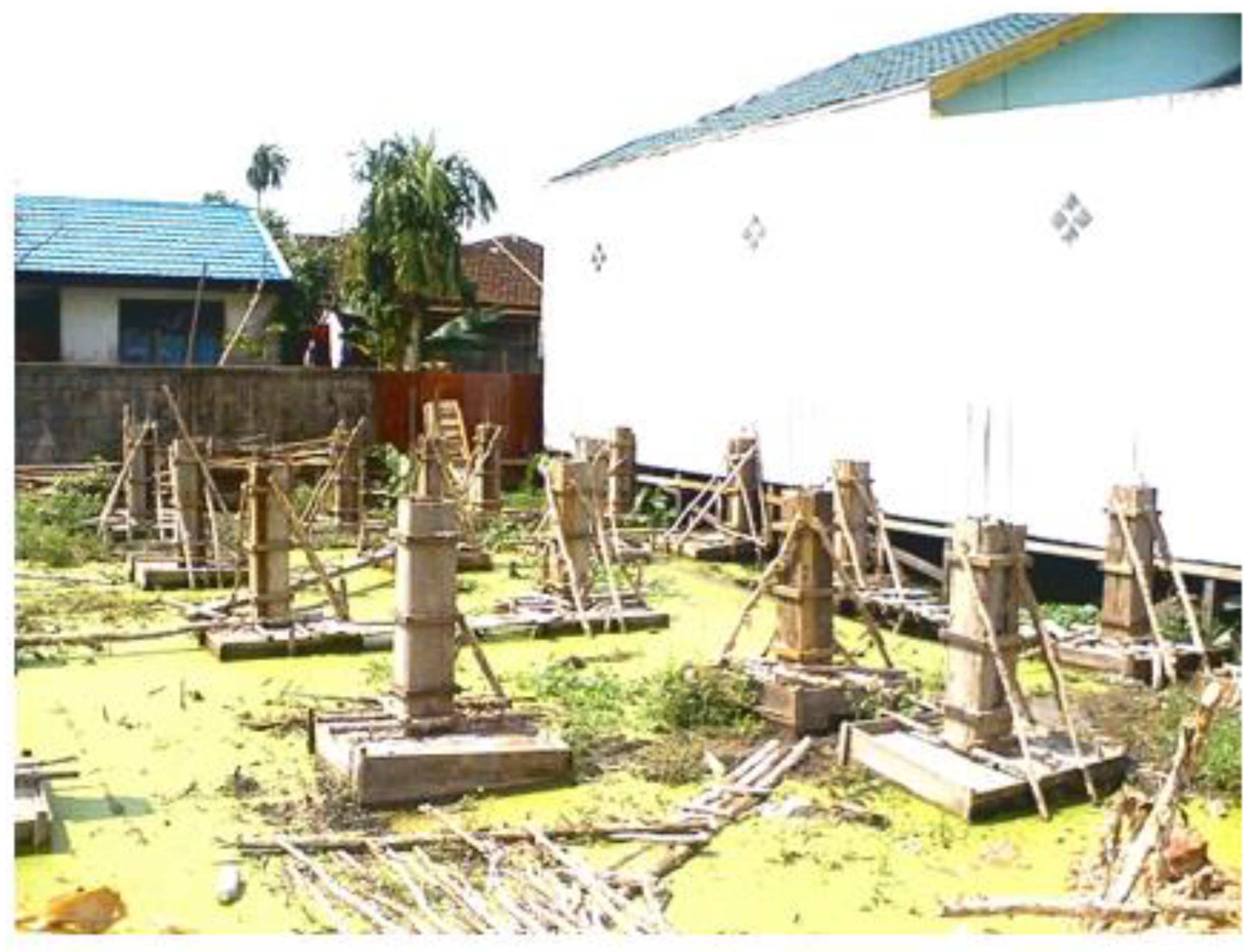
Figure 4.
Galam Piling for Foundation.
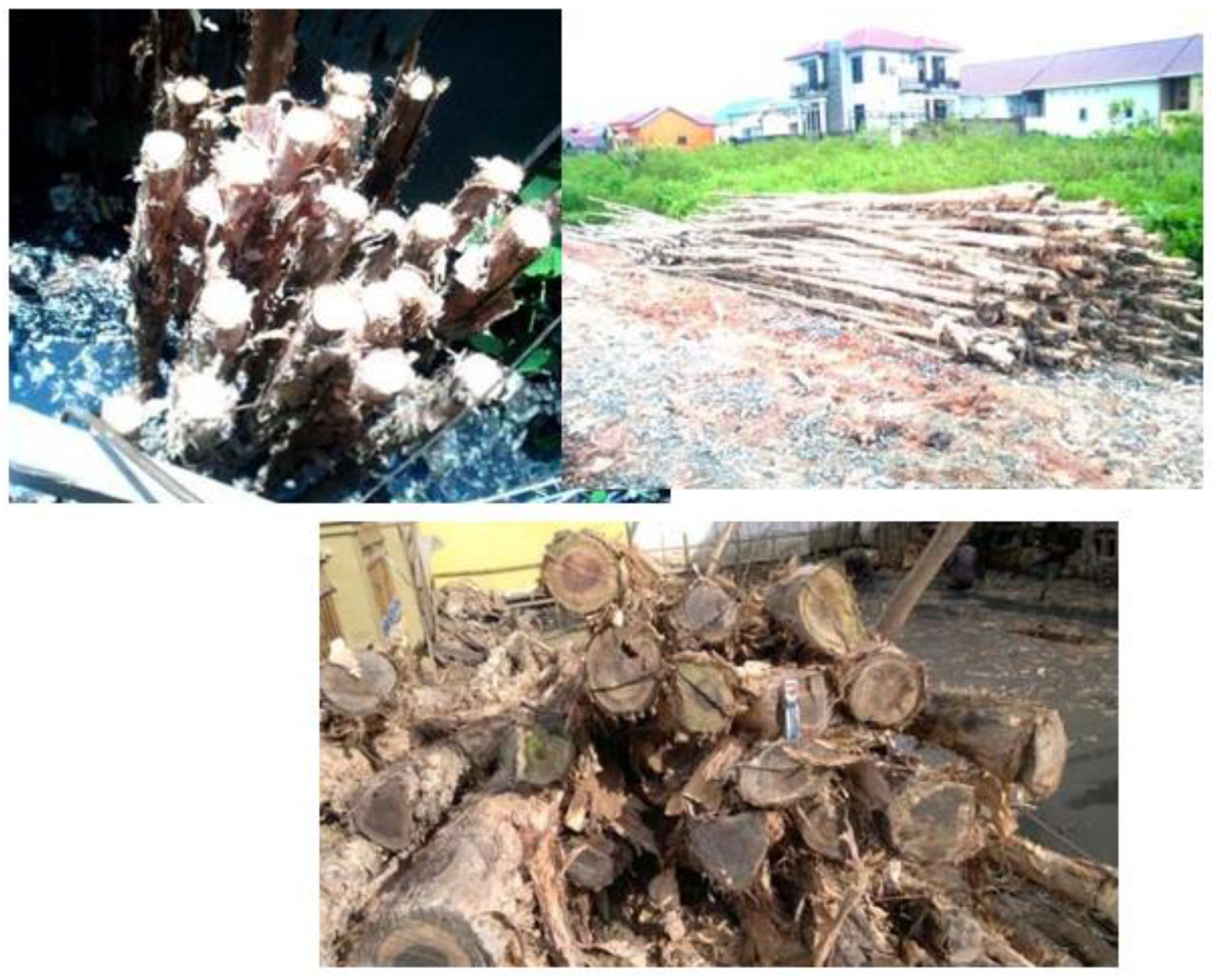
Figure 5.
Size of Galam Wood Pile for Foundation.
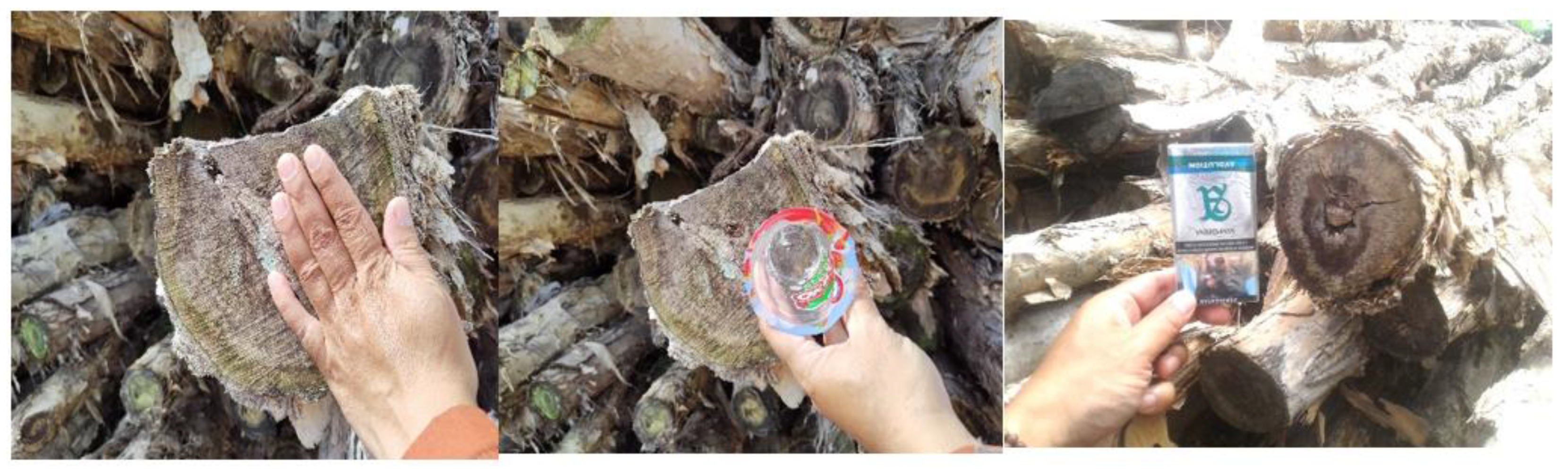
Figure 6.
Galam Pile Arrangement for Foundation.
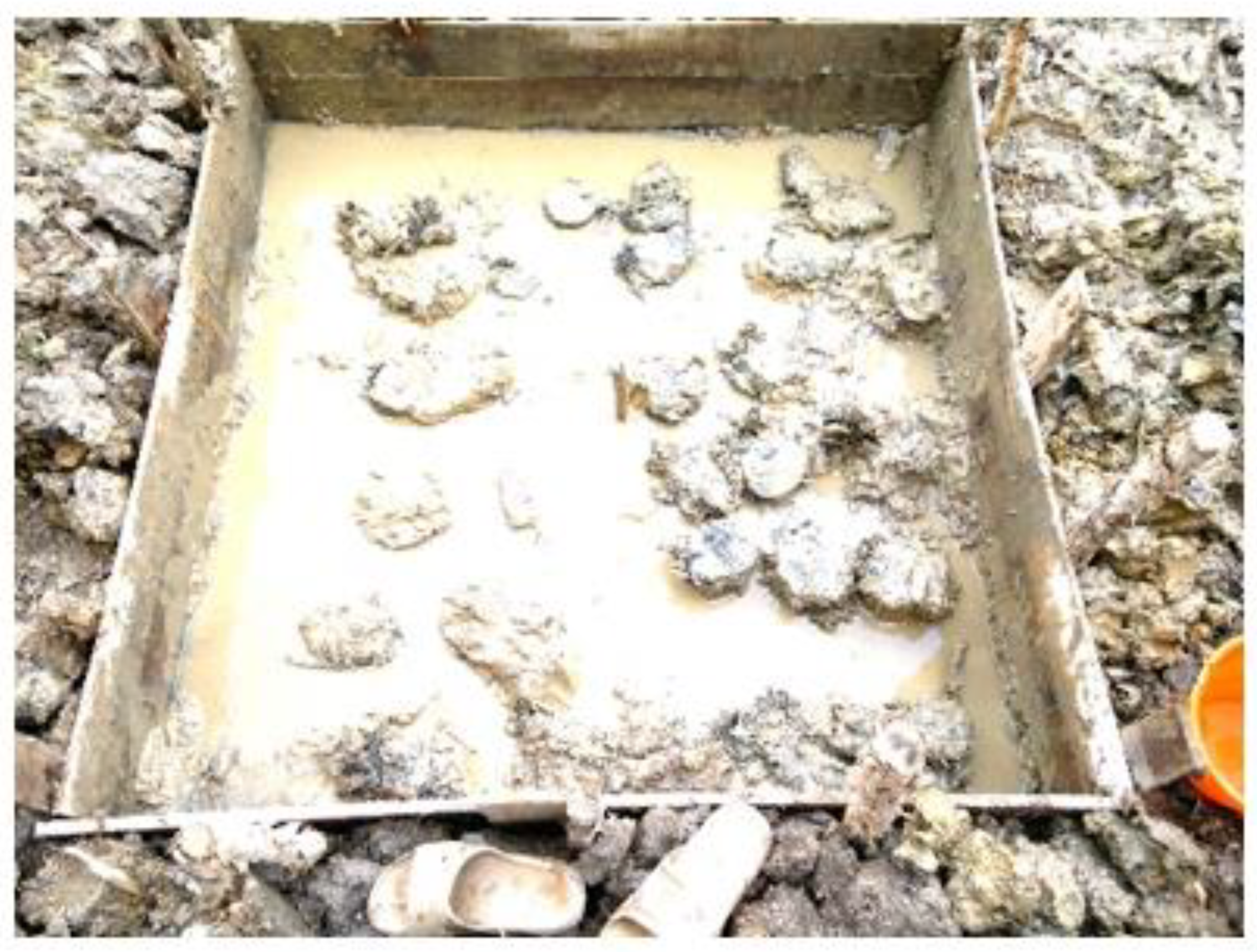
Figure 7.
Galam piling with manual method.
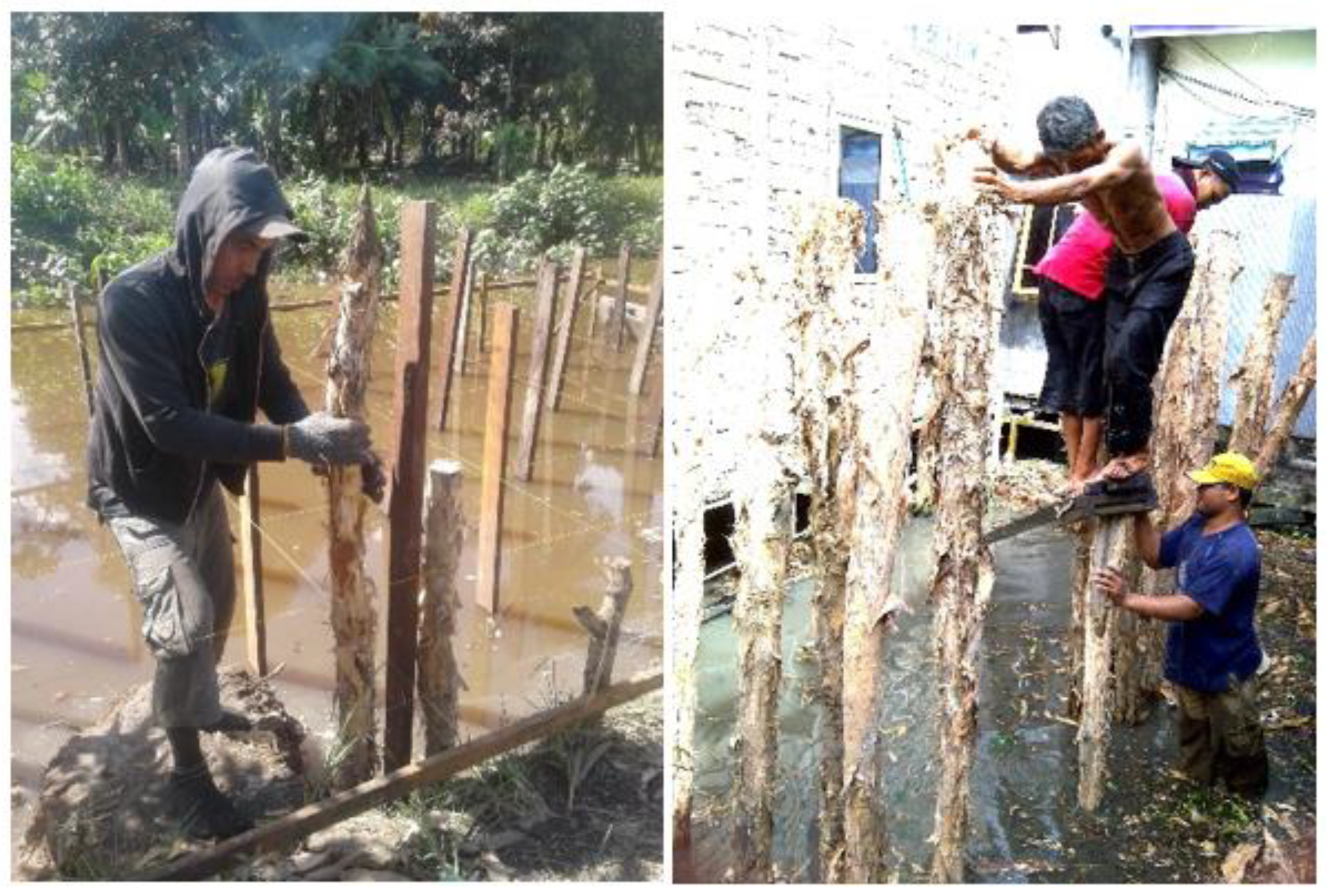
Figure 8.
Galam piling with machine method.
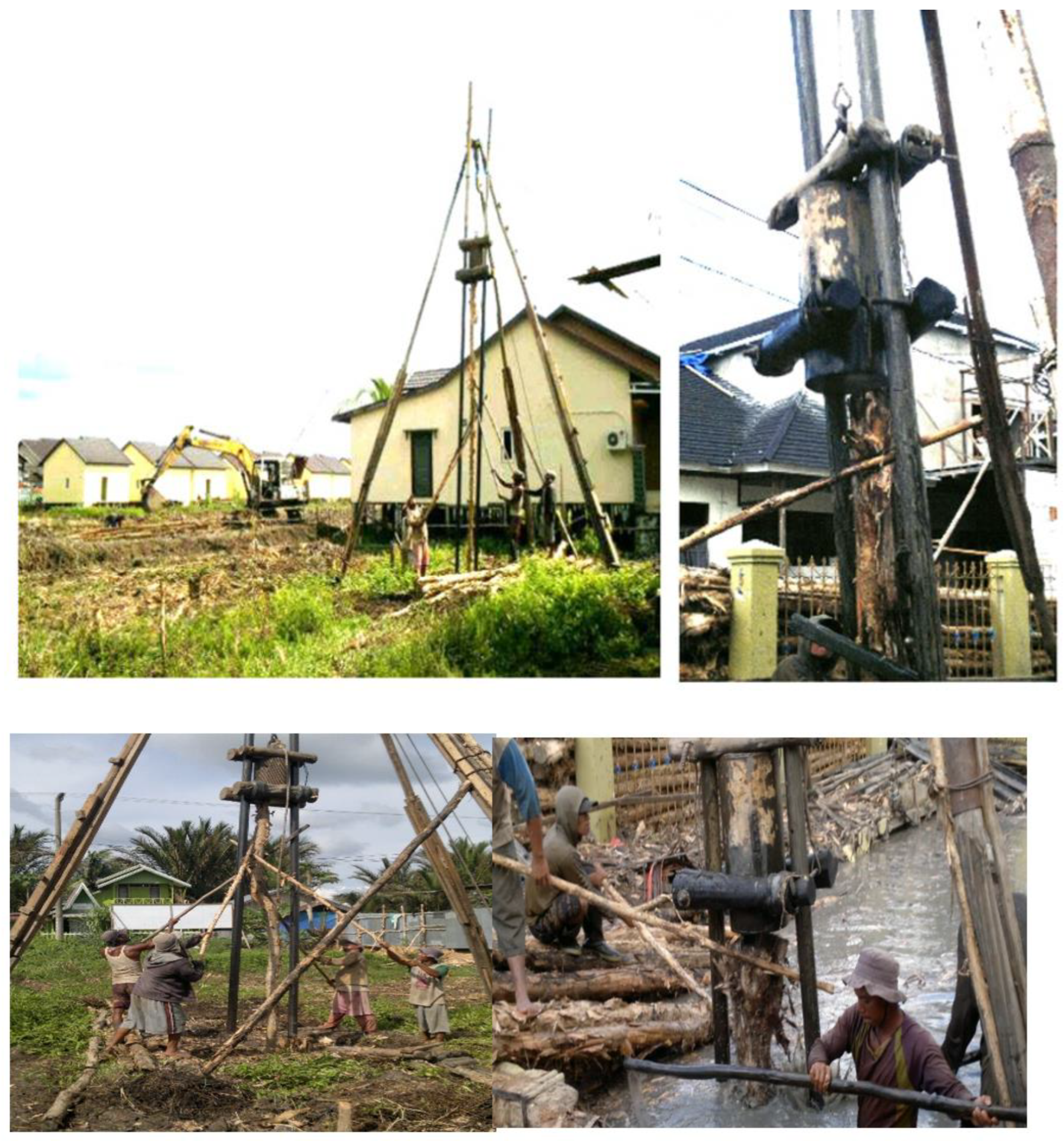
Figure 9.
Wooden Pillar Foundation in Swampland.
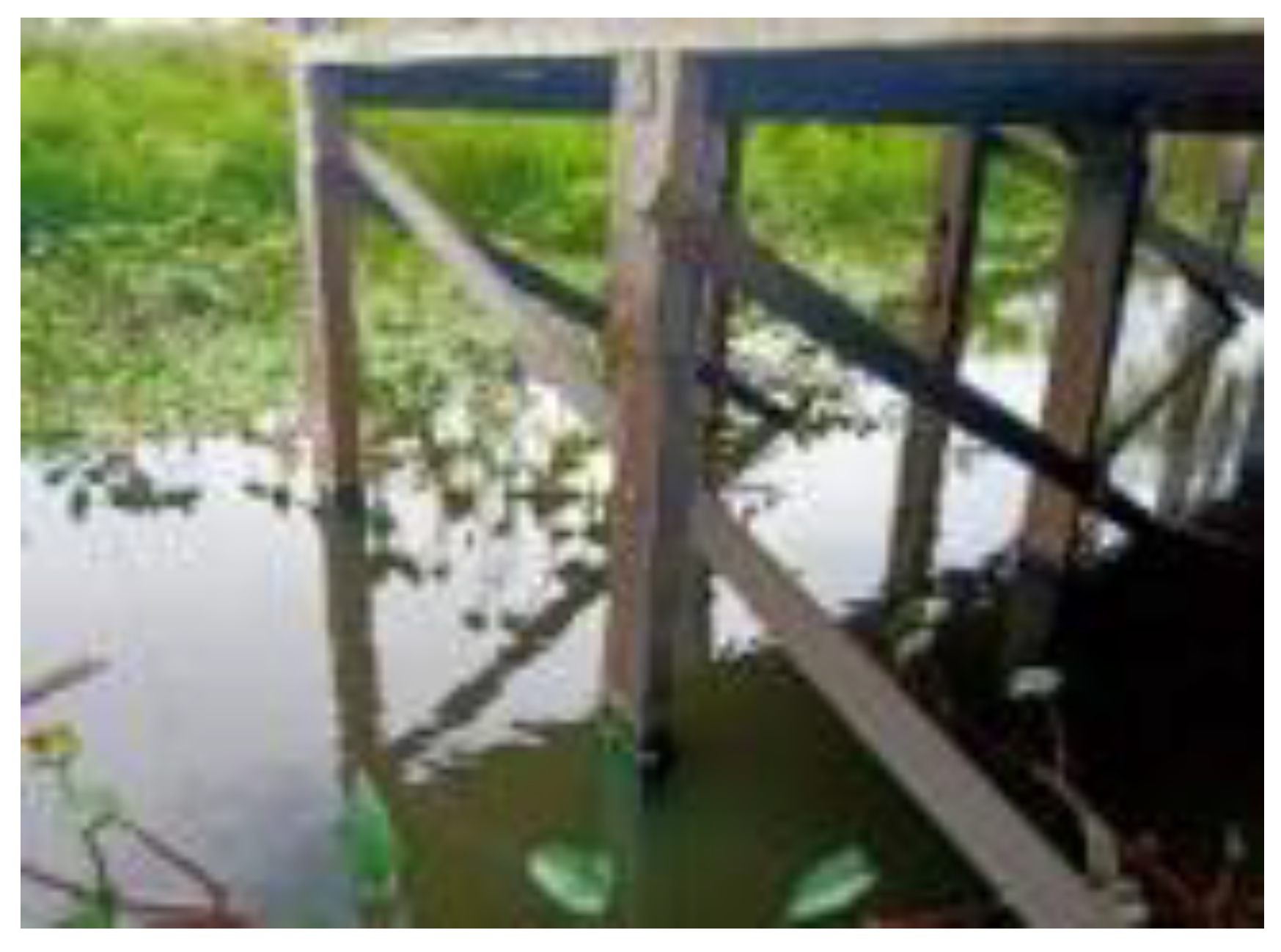
Figure 10.
Wood Pillar Foundation Model.
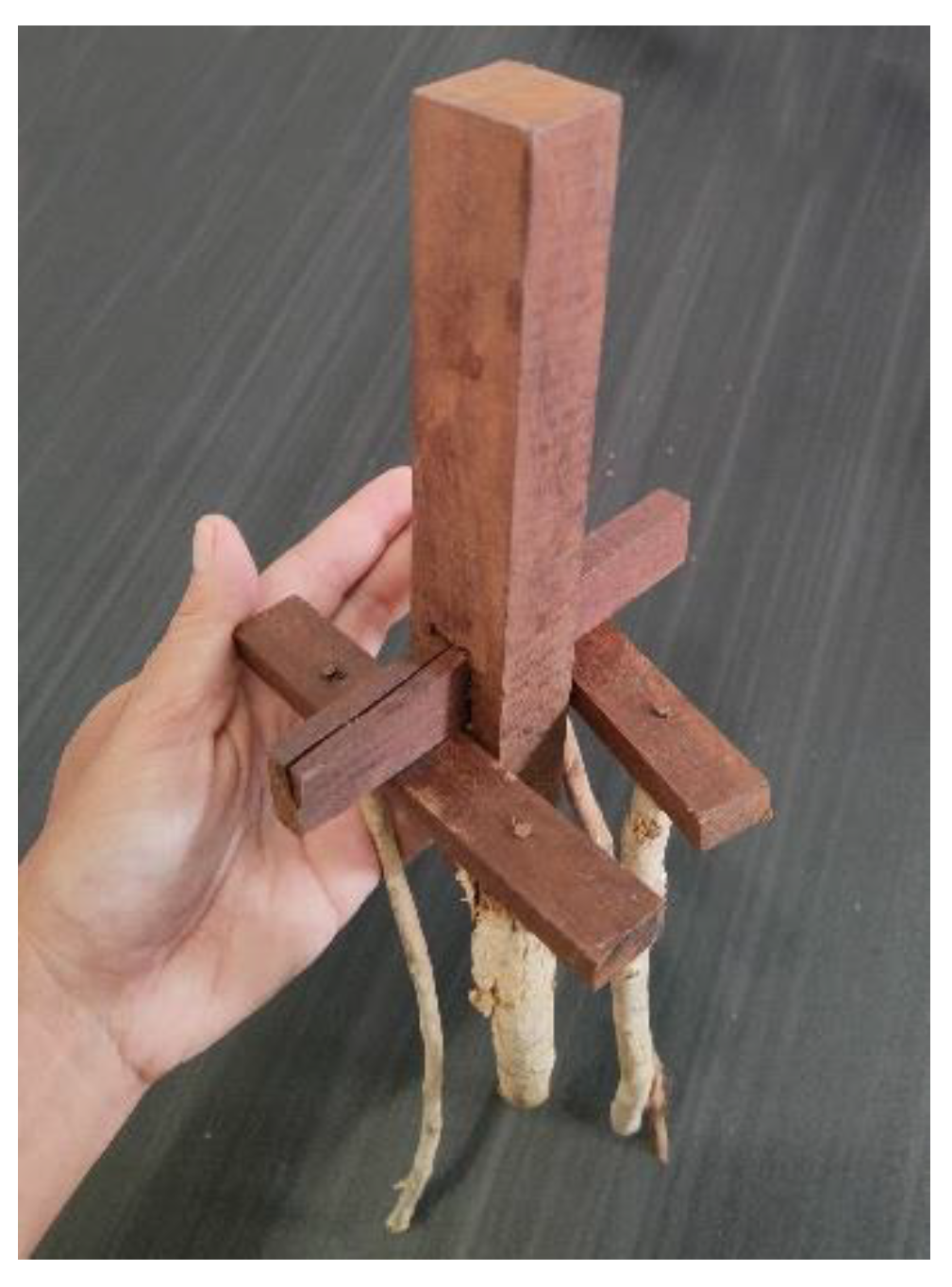
Figure 11.
Combination of Wood Pillar Foundation and Concrete Foundation.

Disclaimer/Publisher’s Note: The statements, opinions and data contained in all publications are solely those of the individual author(s) and contributor(s) and not of MDPI and/or the editor(s). MDPI and/or the editor(s) disclaim responsibility for any injury to people or property resulting from any ideas, methods, instructions or products referred to in the content. |
© 2024 by the authors. Licensee MDPI, Basel, Switzerland. This article is an open access article distributed under the terms and conditions of the Creative Commons Attribution (CC BY) license (http://creativecommons.org/licenses/by/4.0/).
Copyright: This open access article is published under a Creative Commons CC BY 4.0 license, which permit the free download, distribution, and reuse, provided that the author and preprint are cited in any reuse.


