

Submitted:
17 July 2024
Posted:
18 July 2024
You are already at the latest version
Abstract
The integration of Artificial Intelligence (AI) in predicting and managing risks for coastal port developments significantly enhances planning and operational efficiency. This paper presents a theoretical framework utilizing AI to predict future scenarios based on geological, hydrodynamic, and oceanographic factors. Focusing on the effective implementation of AI in ports, with a specific emphasis on Bulgarian Black Sea coastal areas such as Nesebur, Sarafovo, Sozopol, St. Anastasia Island, and the region of Karantinata in Varna, the study explores AI applications for site selection, risk assessment, and operational optimization to ensure resilient, efficient, and sustainable port infrastructure.
Keywords:
AI-Driven Port Development
; Predictive Analytics
; Cybersecurity
; Blockchain Technology
; Coastal Infrastructure Sustainability
1. Introduction
The effective development and management of coastal ports are critical for both economic growth and environmental sustainability. Coastal ports serve as essential hubs for global trade, impacting regional economies and facilitating the movement of goods and resources. However, these infrastructures face numerous challenges, including environmental hazards, operational inefficiencies, and the impacts of climate change. As a result, there is an increasing need for innovative solutions that can enhance the resilience and efficiency of port operations.
Integrating Artificial Intelligence (AI) into port management processes offers significant potential for improving risk prediction, operational efficiency, and decision-making. AI technologies provide advanced data analytics and predictive capabilities, enabling the identification and mitigation of potential risks before they become critical issues. For instance, AI can analyze vast datasets from various sources to predict weather patterns, sea-level rise, and geological shifts, allowing ports to prepare and adapt proactively.
AI also enhances operational efficiency by optimizing logistics, automating routine tasks, and improving maintenance schedules through predictive analytics. These improvements not only reduce costs but also minimize environmental impact by promoting more sustainable practices. Additionally, AI-driven insights can help design resilient port infrastructures capable of withstanding future environmental changes and disasters.
This paper aims to establish a theoretical framework leveraging AI to address the various challenges faced by coastal ports, particularly in the context of Bulgarian coastal regions. The focus will be on integrating AI to enhance site selection, risk assessment, and operational optimization, ensuring that ports remain resilient, efficient, and sustainable amidst evolving environmental and economic landscapes. Specifically, this study will explore the applications of AI in ports like Nesebur, Sarafovo, Sozopol, St. Anastasia Island, and the region of Karantinata in Varna, which face unique challenges such as coastal erosion, sediment deposition, and the need for efficient dredging and maintenance practices.
By establishing a comprehensive AI-driven framework, this paper seeks to provide a roadmap for integrating advanced technologies into coastal port management. This approach not only addresses current issues but also anticipates future challenges, ensuring long-term sustainability and operational excellence for Bulgarian ports. Through this framework, the paper contributes to the broader discourse on sustainable port development and the strategic role of AI in modernizing critical infrastructure.
2. Literature Review
The following literature review examines existing studies and research relevant to marine science and AI-driven technologies, focusing on their implications for enhancing operational efficiency, risk management, and sustainability in port infrastructure. By integrating insights from various academic and practical sources, the authors of the paper analyze and establish a comprehensive understanding of how AI technologies can transform port operations, address environmental and logistical challenges, and contribute to the development of resilient and sustainable port infrastructures.
Abu Ghazaleh [1] examines AI-driven digitalization in ports, focusing on AI's potential to boost efficiency, safety, and competitiveness. Key drivers include predictive maintenance, operational optimization, and enhanced customer satisfaction. The study highlights the importance of AI in managing big data and intelligent systems in dynamic maritime settings. Some of them are applicable to our AI-driven port development framework, which integrates AI for predictive analyses, risk assessment, and operational optimization.
Rather et al. [2] examines AI's potential in aquaculture, highlighting AI tools like IoT, machine learning, and algorithms to enhance productivity by reducing human intervention and optimizing operations. Challenges in data collection and integration exist, but AI's transformative potential is clear. This research aligns with our AI-driven port development paper, showing AI's role in optimizing operational efficiency and sustainability in port infrastructure, drawing parallels with AI applications in aquaculture.
Munim et al. [3] explore the utilization of Automated Machine Learning (AutoML) to predict maritime accident risks using 40 years of Norwegian historical data. They focus on five major accident categories and identify the Light Gradient Boosted Trees Classifier as the most effective algorithm, emphasizing factors like navigation waters and vessel tonnage. Advanced ML's role in maritime safety for real-time risk assessment and decision-making is covered in our AI-driven port development framework.
Guangnian Xiao et al. [4] conduct a bibliometric review of AI in the shipping industry, analyzing 476 articles from 2001 to 2022. The review highlights the rapid research growth, collaboration networks, and identifies key AI applications like AIS data analysis, ship trajectory prediction, and anomaly detection. This study is relevant to our AI-driven port development as it underscores AI's role in enhancing operational efficiency, safety, and predictive maintenance. Our framework integrates these AI capabilities into port infrastructure and leads to smarter, more resilient, sustainable operations, and port enhancements.
Chen, Ma, and Liu [5] examine AI in maritime transportation, focusing on its role in improving efficiency and safety in logistics and supply chain management. They highlight AI techniques like machine learning and deep learning for ship navigation, trajectory optimization, real-time monitoring, and predictive maintenance, which enhance fuel efficiency, operational effectiveness, and environmental compliance. Some of their findings have been modified and implemented into our framework for optimizing maritime operations, enhancing predictive capabilities for port infrastructure, and promoting resilient, efficient, and sustainable port management.
Xu et al. [6] analyze AI's impact on decision-making in competitive heterogeneous ports using a game-theoretic model. They highlight AI's role in enhancing efficiency and service quality but note challenges in competition and cost. Their findings show AI can boost port profits and operations. This study supports our AI-driven port development by emphasizing strategic AI implementation to balance competition and cooperation.
Al-Saffar et al. [7] critically analyze traditional and AI-based risk assessment frameworks in sustainable construction. They evaluate traditional methods like Analytical Hierarchy Process and Monte Carlo simulations against AI techniques such as Artificial Neural Networks and Bayesian Belief Networks. The study finds traditional methods suitable for small-scale projects due to cost-effectiveness, whereas AI-based frameworks offer superior accuracy and adaptability for large-scale, complex projects. This underscores AI's potential in enhancing risk assessment, highlighting its integration in managing risks in sustainable construction projects. This study aligns with our AI-driven port development, emphasizing AI's role in improving risk management and operational efficiency in port infrastructure projects.
Munim et al. [8] conducts a bibliometric review of big data and AI applications in the maritime industry, analyzing 279 studies across 214 academic outlets. They identify research clusters like digital transformation, big data applications, energy efficiency, and predictive analytics, highlighting AI's significant role in enhancing maritime operations. This study demonstrates AI's transformative potential in optimizing port operations, risk prediction, and improving efficiency and sustainability. Our AI-driven framework improves these insights, aiming to advance port development through precise geological, hydrodynamic, and operational assessments.
Taherdoost [9] reviews the integration of blockchain and AI, highlighting advancements and applications of their combination. The study shows how blockchain enhances AI by ensuring data integrity and secure interactions without central authority, with implications for sectors like healthcare, finance, and supply chain management. The review of 121 articles identifies key trends, applications, and challenges in AI-blockchain integration, providing a foundation for future research. Our paper presents blockchain, cybersecurity and AI applications in complex environments. Integrating blockchain ensures data integrity and precision in our geological, hydrodynamic, and risk assessments for port development.
Capetillo-Contreras et al. [10] review AI applications in optimizing water quality for aquaculture using sensors, machine learning, and image processing. Analyzing 753 studies from 2012 to 2023, they highlight AI methodologies, such as K-means clustering, for improved water quality monitoring and management. Our AI-driven port development framework, leverages complex data analysis, issue prediction, and solution recommendations. Integrating AI enhances port resilience and efficiency, building on principles demonstrated in aquaculture technology.
Channa et al. [11] explore optimizing small-scale aquaponics systems using AI and IoT, highlighting their role in improving efficiency, reliability, and management while addressing challenges such as high initial costs and complexity. They consolidate existing research, identifying critical parameters affecting growth and exploring advanced sensing and communication technologies. This study is crucial for enhancing AI integration in aquaponics. The findings on AI's capacity to optimize processes, enhance predictive maintenance, and improve decision-making provide valuable parallels to our study on AI-driven improvements in coastal port infrastructures.
The study by Du Xinke [12] highlights significant advancements in AI applications within port operations, discussing technologies like container electronic tags, unmanned driving, intelligent ship stowage, and intelligent port scheduling. These AI-driven enhancements optimize logistics, improve efficiency, and reduce manual intervention, transforming ports into automated, intelligent hubs. This research is relevant to our study, as it underscores the practical benefits of AI in port management.
Bačiulienė et al. [13] evaluate AI integration across the food value and supply chain, highlighting AI technologies like robotics, drones, and smart machines for productivity and efficiency in the agri-food industry. They address barriers to AI adoption, such as social, technological, and economic challenges, and propose solutions, including enhancing financial and digital literacy among farmers. This research is relevant to our AI-driven port development study, demonstrating how AI can optimize processes and enhance efficiency in complex systems, mirroring our goals for integrating AI in port infrastructure.
Sarsia et al. [14] examine the "Waning Intellect Theory" to ensure AI security, proposing that AI systems should have a finite lifespan to prevent unchecked evolution and superintelligence risks. They suggest a cyclical process where each AI generation is terminated after reaching specific knowledge levels, passing only favorable traits to new models. This approach aims to control AI evolution, addressing reliability, safety, and ethical concerns, and ensuring responsible AI development. This theory aligns with our AI-driven port development framework by emphasizing controlled and secure AI advancements for resilient infrastructure.
Filom, Amiri, and Razavi [15] conduct a systematic review of machine learning (ML) applications in port operations, analyzing research on application areas, ML methods, data types, and study locations. They find a growing trend in ML adoption for predictive, prescriptive, and autonomous applications in port operations. This study influences our research, highlighting AI potential in enhancing port operational efficiency, safety, and strategic decision-making. Our paper builds on this foundation by incorporating AI-driven models to assess geological, hydrodynamic, and environmental conditions, advancing resilient and efficient port infrastructures.
Dimitrov and Georgiev [16] assessed Primorsko Fishing Port's geological and hydrotechnical conditions, highlighting the significance of local geological factors and modern solutions for port stability. Their study underscores the value of precise geological and hydrotechnical assessments, which this paper framework uses to enhance prediction, construction optimization, and risk mitigation with AI technologies.
Dimitrov [17] examines St. Anastasia Island's engineering-geological conditions, focusing on geological structures and geomorphology. The research highlights volcanic rocks and marine sediments, stressing robust hydrotechnical solutions for risk mitigation. These insights are essential to our framework, particularly in geological and geomorphological assessments.
Dimitrov, Hristova, and Peychev [18] analyze the geological and geomorphological features of Miocene and Quaternary marine sediments in Varna Gulf's "Karantinata" region. They emphasize lithodynamic processes affecting sediment distribution and the challenges these sediments pose for hydrotechnical construction. This research is integrated in our study, which uses AI to evaluate geological stability and forecast sediment dynamics.
Georgiev, Peychev and Dimitrov [19] investigate the engineering geological, hydrodynamic, and lithodynamic conditions at Sarafovo Fishing Port, identifying critical factors such as sediment transport, wave action, and erosion. Their study highlights the need to address local geological conditions to enhance port stability and efficiency. Our AI-driven port development study improves geological and hydrodynamic assessments, providing accurate predictions and optimized construction and risk mitigation strategies.
Peychev and Dimitrov [20] analyze the geological and hydrogeological conditions of Marina Sozopol, focusing on geological structures, hydrogeological features, and environmental dynamics impacting the port. Their research underscores the importance of local geological understanding and modern hydrogeological solutions for port stability and efficiency and are integrated in our AI framework to enhance precision and effectiveness.
The study by Peychev and Dimitrov [21] present an engineering geological and hydrodynamic analysis of the Marina Nesebar area, detailing the geological structure and properties of bottom sediments, along with the area's hydrodynamic conditions. By examining wave transformation and modeling hydro-technical facility placements, they identify optimal configurations for marina protection. This foundational work is integral to our AI-driven port development research, underscoring the importance of geological and hydrodynamic assessments in infrastructure planning. Incorporating AI enhances precision in predicting and optimizing construction strategies, ensuring resilient and efficient port operations.
The literature that has been researched and analyzed underscores the transformative potential of AI technologies in port development. Studies highlight AI's capabilities in optimizing operational processes, predicting maintenance needs, and enhancing risk management through advanced data analytics and predictive modeling. By leveraging these insights, our research aims to integrate AI-driven methodologies to improve the resilience, efficiency, and sustainability of Bulgarian Black Sea coastal port infrastructures. This approach not only addresses current challenges but also anticipates future risks, ensuring that ports remain reliable and adaptable in a rapidly evolving global maritime landscape. Through this integration, we build upon existing research, advancing the strategic application of AI in modernizing port infrastructure and operations.
3. Framework for AI-Driven Port Development
The integration of Artificial Intelligence (AI) into port development inspires the authors of the paper to propose a comprehensive framework that addresses various critical aspects of port infrastructure. This framework includes geological and geomorphological assessments, hydrodynamic and oceanographic modeling, engineering geological evaluations, and risk mitigation strategies. By leveraging AI-driven predictions, ports optimize pre-construction phases and adapt to future changes effectively. Figure 1 presents the framework for AI-driven port development, highlighting its key components and their interconnections. The framework can be implemented either as a whole or by utilizing its separate elements.
3.1. AI-Driven Port Development
The elements of this component focusing on geological, geomorphological, hydrodynamic, and oceanographic characteristics collectively ensure the approach to the sustainable and resilient development of port infrastructure through AI technologies. The framework provides a structured method for integrating various AI-driven analyses and predictions, ultimately enhancing the efficiency and robustness of port operations. AI's potential in port development lies in its ability to analyze complex datasets and predict future scenarios.
3.1.1. Geological and Geomorphological Characteristics
AI assesses the geological structure, including the composition and stability of underlying rocks and sediments. It also evaluates geomorphological features such as coastal erosion patterns and sediment transport. By integrating data from geological surveys, remote sensing, and historical records, AI creates detailed models of coastal dynamics. These assessments inform the design and placement of port infrastructure to mitigate risks and enhance stability. For example, the study of Marina Nesebar highlights the importance of understanding sediment dynamics. AI predicts sediment transport patterns, allowing for the design of effective dredging schedules and the construction of protective structures like breakwaters and sea walls to prevent sediment accumulation and erosion.
3.1.2. Hydrodynamic and Oceanographic Conditions
AI models predict changes in wave and current patterns and the impact of rising sea levels on port operations. These predictions are crucial for designing resilient infrastructure capable of withstanding dynamic marine conditions and future climate scenarios. By analyzing historical wave data, current measurements, and climate projections, AI simulates future hydrodynamic conditions. In Sarafovo, AI forecasts the effects of hydrodynamic forces on soil stability and sediment dynamics. This enables the planning of engineering solutions that minimize erosion and maintain navigability.
3.1.3. Engineering Geological Conditions
Analyzing soil stability and foundation conditions using AI ensures optimal foundation designs. AI processes data on soil composition, load-bearing capacity, and groundwater levels to recommend suitable foundation types. Understanding the interaction between groundwater levels and coastal structures prevents issues such as subsidence and enhances overall stability. In Sozopol, AI-driven analysis of groundwater interactions provides insights into foundation stability, guiding the selection of construction materials and methods that ensure the longevity of port structures.
3.1.4. Geological Phenomena Prediction
AI predicts the rate and extent of marine abrasion and assesses seismic activity risks. These predictions guide the design modifications necessary to enhance the resilience of port infrastructure. AI models the impacts of wave action on coastal erosion and abrasion, helping to design protective measures. For St. Anastasia Island, AI predicts seismic risks based on geological data, suggesting structural designs that enhance resilience to earthquakes and other geological events.
3.1.5. Risk Assessment and Mitigation
AI uses historical data and current observations for predictive modeling, identifying critical vulnerabilities in port design and operations. This proactive approach allows for targeted interventions to enhance resilience. AI-driven risk assessment models integrate various risk factors, from extreme weather events to operational disruptions. By analyzing historical weather patterns and port operation data, AI develops comprehensive risk management strategies, ensuring that ports are prepared for potential hazards.
3.1.6. Site Selection and Optimization
AI recommends optimal locations for new port developments based on satellite images and geological data. By integrating economic models for cost-benefit analysis, AI ensures sustainable and financially viable site choices. AI analyzes land use patterns, environmental impacts, and logistical considerations to recommend the best sites for new ports. In the region of Karantinata, AI-driven site selection considers sediment dynamics and geological stability to identify the most suitable locations for port expansion.
The integration of AI into port operations promises to revolutionize the industry by enhancing efficiency, resilience, and sustainability. Leveraging AI's advanced data analytics and predictive capabilities, this framework aims to address key challenges in port development, particularly in the context of the Bulgarian Black Sea ports. Table 1 outlines various elements and their descriptions. This comprehensive framework ensures that port infrastructures remain robust, adaptive, and sustainable amidst evolving environmental and operational challenges.
By implementing the elements detailed in Table 1, the Black Sea Ports leverage AI to address and mitigate a wide range of environmental and operational challenges. This framework enhances the planning and construction of port infrastructures, ensuring their long-term resilience and sustainability. Through AI-driven analyses and predictive modeling, port authorities make informed decisions that safeguard critical maritime operations against evolving threats and environmental changes. Embracing this theoretical framework enables the Black Sea Ports to remain competitive and adaptive in an increasingly complex global trade landscape. The framework highlights AI's critical role in assessing and mitigating risks associated with port development. By leveraging AI's predictive capabilities, ports are designed and operated with greater efficiency and resilience. AI provides a comprehensive approach to understanding and managing the complex interactions between geological, hydrodynamic, and operational factors, ensuring the sustainable development of coastal port infrastructure.
3.2. AI-Based Predictions for Construction of Ports
Accurately predicting potential risks before constructing port infrastructure is crucial. AI-driven predictive analyses leverage geological, hydrodynamic, and environmental data to assess conditions across various coastal areas along the Bulgarian Black Sea coast. By integrating AI technologies, these predictive models identify vulnerabilities and optimize site selection, ensuring the resilience and stability of future port developments.
3.2.1. Sediment Transport Patterns
Sediment transport patterns are crucial for understanding the dynamic processes affecting coastal port areas. AI technologies significantly enhance the accuracy and efficiency of predicting sediment transport. By analyzing historical data, wave action, and current patterns, AI models forecast sediment movement and deposition. This allows for the optimization of dredging schedules and the design of effective sediment management strategies. For instance, in the Marina Nesebar case, AI predicts sediment transport patterns to design protective structures like breakwaters and sea walls, thus preventing sediment accumulation and coastal erosion.
3.2.2. Soil Stability and Sediment Dynamics
AI plays a vital role in assessing soil stability and sediment dynamics, which are essential for the construction and maintenance of port infrastructures. By integrating data from geological surveys, remote sensing, and real-time monitoring systems, AI evaluates the stability of soils and predict changes in sediment dynamics. This predictive capability helps in selecting appropriate construction methods and materials that ensure the longevity and safety of port structures. In the context of Bulgarian coastal ports, AI provides detailed insights into soil stability, guiding the engineering decisions for port development projects in Sozopol and similar areas.
3.2.3. Groundwater Interactions
The interaction between groundwater and port infrastructures is a significant factor affecting their stability and functionality. AI-driven models analyze groundwater levels, flow patterns, and their interactions with coastal structures. By processing extensive hydrological data, AI predicts the impacts of groundwater on soil stability and structural integrity. This information is crucial for designing effective drainage systems and foundation types that mitigate risks such as subsidence and waterlogging. In Sarafovo, AI analysis of groundwater interactions enhance the stability of port foundations, ensuring efficient and sustainable port operations.
3.2.4. Rock and Soil Stability
AI technologies are instrumental in evaluating the stability of rocks and soils in coastal regions. By utilizing machine learning algorithms and predictive analytics, AI assesses the physico-mechanical properties of geological formations and predict their behavior under various environmental conditions. This enables the identification of potential hazards such as landslides or collapses, allowing for preemptive mitigation measures. In the region of St. Anastasia Island, AI assesses rock and soil stability, providing recommendations for construction techniques that enhance the resilience of port infrastructures.
3.2.5. Impact of Sediment Dynamics
Understanding the impact of sediment dynamics is critical for the sustainable development of coastal ports. AI models the effects of sediment transport on coastal morphology, predicting areas of erosion and deposition. These insights help in designing infrastructure that adapts to sediment dynamics, reducing maintenance costs and environmental impact. For example, in the Karantinata region, AI analyzes sediment dynamics to optimize the placement of underwater barriers and sediment traps, ensuring the long-term stability and functionality of the port.
The integration of AI technologies into port development processes offers significant advantages in terms of efficiency, resilience, and sustainability. By leveraging AI for sediment transport patterns, soil stability, groundwater interactions, rock stability, and sediment dynamics, ports anticipate and mitigate potential risks, optimize construction strategies, and enhance overall operational efficiency. The proposed framework and methodologies highlighted how AI transforms port infrastructure in Table 2, ensuring that coastal ports remain competitive and sustainable in the face of evolving environmental and economic challenges.
By implementing these AI-driven elements, ports in the Black Sea region can significantly enhance their resilience and efficiency, ensuring sustainable development in the face of environmental and operational challenges. This comprehensive framework not only addresses current issues but also anticipates future risks, contributing to the strategic modernization of port infrastructures.
3.2.6. Site-Specific Analyses
- Marina Nesebar: Based on the study by Peychev and Dimitrov (2010), AI predicts sediment transport patterns and potential erosion risks. The data from 14 stations in the water area of Marina Nesebar, which includes geological and hydrodynamic conditions, suggest that sediment dynamics are crucial for planning dredging activities and constructing protective measures such as breakwaters and sea walls. The AI analysis also provides insights into seasonal variations in sediment deposition, helping to schedule maintenance more effectively and avoid disruptions to port operations.
- Fishing Port Sarafovo: AI forecasts soil stability and sediment dynamics in the Sarafovo fishing port area according to Dimitrov (2012). This information helps address coastal erosion and sediment deposition, ensuring that the port infrastructure remains stable and operationally efficient. The predictive models also identify the most vulnerable areas of the port that require immediate attention, allowing for the implementation of targeted reinforcement measures to prevent future structural failures.
- Marina Sozopol: AI utilizes the data from Dimitrov and Peychev (2011) to predict groundwater interactions and their implications for port infrastructure. This predictive analysis guides the selection of construction materials and methods to ensure stability and longevity of port structures. By assessing the hydrogeological conditions, AI recommends the best practices for managing groundwater flow and preventing issues such as waterlogging and soil liquefaction, which compromises the integrity of the port's foundation.
- St. Anastasia Island: AI analyzes geological data from Dimitrov, Hristova, and Peychev (2018) to predict rock and soil stability. This assessment, combined with seismic risk evaluation, informs the design of resilient coastal structures to withstand seismic activity. AI simulates various seismic scenarios, providing detailed risk assessments and recommending structural enhancements to improve earthquake resilience, ensuring the safety and durability of the port infrastructure.
- Karantinata, Varna: AI predicts the impact of sediment dynamics on port construction in the Karantinata region. The study by Dimitrov et al. (2018) provides insights into the geological and geomorphological characteristics of marine sediments, influencing construction and maintenance strategies. AI also optimizes the design and placement of underwater barriers and sediment traps to manage sediment flow and accumulation, reducing the need for frequent dredging and lowering maintenance costs.
This AI-driven predictive model provides valuable insights into geological, hydrodynamic, and environmental conditions, ensuring resilient, efficient, and sustainable port infrastructures. By leveraging AI, ports anticipate and mitigate potential risks, optimize construction and maintenance practices, and enhance their overall resilience to environmental changes and natural hazards. This proactive approach not only safeguards port operations but also contributes to long-term economic and environmental sustainability.
3.3. Future Development Research and Changes in Ports
This section explores the essential aspects of future development research and changes in ports, focusing on predictive models for future conditions, adaptive infrastructure design, resilience to climate change, and long-term environmental impact assessment. These elements form a comprehensive framework for integrating AI technologies to enhance port operations, ensuring resilience, efficiency, and sustainability.
3.3.1. Predictive Models for Future Conditions
AI significantly enhances predictive models for future conditions by analyzing vast datasets to forecast changes in weather, sea levels, and other critical environmental factors. By employing machine learning algorithms, ports anticipate and prepare for potential challenges, such as severe weather events or sea-level rise. This proactive approach enables ports to implement timely interventions, safeguarding infrastructure and operations.
3.3.2. Adaptive Infrastructure Design
Adaptive infrastructure design involves creating port facilities that adjust to changing environmental conditions and operational demands. AI plays a crucial role in this by simulating various scenarios and optimizing design parameters to ensure flexibility and resilience. For instance, AI recommends modifications in the design of breakwaters or sea walls to accommodate shifting wave patterns and sediment dynamics.
3.3.3. Resilience to Climate Change
Climate change poses significant risks to coastal ports, including increased frequency and severity of storms, sea-level rise, and coastal erosion. AI helps ports become more resilient to these changes by providing accurate predictions and effective mitigation strategies. By analyzing climate data and modeling potential impacts, AI guides the development of infrastructure that withstands extreme weather conditions and minimizes environmental damage.
3.3.4. Long-Term Environmental Impact Assessment
Long-term environmental impact assessment is critical for sustainable port development. AI streamlines this process by analyzing historical and real-time data to predict the environmental consequences of port operations. This includes assessing the impact on marine ecosystems, coastal erosion, and air and water quality. AI-driven assessments enable ports to adopt practices that reduce their environmental footprint and promote sustainability.
The following Table 3 outlines a comprehensive AI-driven framework specifically tailored for port development in the Black Sea region. This framework emphasizes the application of advanced AI technologies to enhance predictive modeling, adaptive infrastructure design, climate resilience, and long-term environmental impact assessment. By integrating these AI-driven methodologies, ports significantly improve their operational efficiency, resilience to environmental changes, and sustainability. This structured approach ensures that port infrastructures are better equipped to handle future challenges and maintain their critical role in global trade.
The implementation of AI-driven elements in port development is crucial for enhancing resilience, efficiency, and sustainability in the Black Sea region. This framework not only addresses current operational challenges but also anticipates future risks, ensuring that ports remain competitive and adaptable in an evolving global maritime landscape. By leveraging AI technologies, port authorities make informed decisions that safeguard critical maritime operations against environmental changes and operational disruptions. This framework underscores the strategic application of AI in modernizing port infrastructure, ensuring long-term sustainability and operational excellence.
3.3.5. Site-Specific Analyses
- St. Anastasia Island: AI predicts the need for robust seismic resilience due to moderate seismic activity. The geological investigation indicates that flexible and reinforced structural designs are necessary to mitigate earthquake impacts and ensure infrastructure stability. By simulating various seismic scenarios, AI recommends specific structural reinforcements, such as base isolators and flexible joints, to enhance the earthquake resilience of port facilities. Additionally, AI helps in monitoring seismic activity and providing early warnings, allowing for timely evacuation and emergency response.
- Marina Sozopol: AI models forecast significant interactions between groundwater and surface water levels, affecting foundation stability. Advanced waterproofing techniques and efficient drainage systems are recommended to prevent water-related structural damages and enhance port resilience. The integration of AI in managing groundwater optimizes drainage designs, ensuring that excess water is effectively diverted away from critical infrastructure. Moreover, AI predicts seasonal variations in groundwater levels, enabling proactive measures to protect the port's foundation from potential destabilization.
- Marina Nesebar: AI analysis indicates a high risk of coastal erosion in Marina Nesebar. Protective measures such as sea walls and breakwaters are recommended to shield the port from erosion and maintain navigability, ensuring long-term operational stability. AI optimizes the design and placement of these structures by analyzing wave patterns and sediment transport data. Furthermore, AI monitors coastal changes in real-time, allowing for the adjustment of erosion control measures as needed to maintain the integrity of the port's infrastructure.
- Primorsko Fishing Port: AI forecasts significant environmental impacts on Primorsko Fishing Port due to rising sea levels and increased storm frequency. Adaptive infrastructure, including elevated structures and climate-resilient materials, will be essential to sustain future operations and reduce vulnerability. AI models future sea-level rise scenarios and storm impacts, guiding the design of elevated platforms and flood-resistant building materials. Additionally, AI assists in the development of coastal buffer zones to absorb storm surges and reduce the impact on port facilities.
- Asparuhovo: AI-driven geotechnical analysis suggests potential soil stability issues in the Asparuhovo region. Future developments should prioritize deep foundation systems and soil stabilization techniques to ensure long-term structural integrity and safety. AI assesses the load-bearing capacity of various soil types and recommend appropriate foundation designs, such as pile foundations or geotextile reinforcements. These measures will enhance the stability and durability of port infrastructure, reducing the risk of subsidence and structural failures.
These AI-based predictions provide targeted insights into future developments, guiding strategic planning and risk mitigation efforts for each port. By leveraging AI's predictive capabilities, port authorities make informed decisions that enhance the resilience, efficiency, and sustainability of coastal infrastructure. This proactive approach ensures that ports are well-prepared to face future environmental and operational challenges, securing their role as critical hubs for global trade and regional development.
4. Recommendations for Future Coastal Reinforcement Measures
Safeguarding port infrastructure against natural hazards requires robust coastal reinforcement measures. This chapter provides AI-driven recommendations from the authors of the paper for coastal reinforcement structures and technologies, supported by insights from existing studies and reports.
- Sea Walls: AI-optimized design and placement ensure maximum protection with minimal environmental impact. Sea walls protect the shore from wave action and prevent erosion, essential for maintaining port stability and operational efficiency. AI models simulates various scenarios to determine the most effective height, thickness, and materials for sea walls to withstand specific wave conditions and storm surges. For example, the study in Marina Nesebar suggests using AI to design sea walls that accommodate local wave patterns and sediment dynamics.
- Breakwaters: AI models wave dynamics to determine optimal placement and dimensions of breakwaters. These structures reduce wave energy before it reaches the shore, protecting harbors and preventing erosion. AI analyzes historical wave data and simulate future wave patterns to recommend breakwater configurations that provide maximum protection while minimizing construction and maintenance costs. In Sarafovo, AI-driven breakwater designs mitigate the impact of strong currents and waves, ensuring the long-term stability of the port infrastructure.
- Groynes: AI helps strategically place groynes to maximize sediment retention and minimize downstream erosion. Groynes stabilize beaches and prevent sediment loss, crucial for protecting port infrastructure. AI optimizes the spacing, length, and orientation of groynes based on sediment transport models and erosion patterns. The implementation of AI-designed groynes in Sozopol helps maintain beach width and reduce the need for frequent beach nourishment.
- Revetments: AI assesses wave impact data to recommend suitable materials and construction techniques for revetments. These structures absorb and deflect the energy of incoming waves, protecting the shore from erosion. AI simulates the effects of different wave heights and angles on various revetment designs, helping to select the most effective solutions. In the Karantinata region, AI-driven revetment designs enhance coastal protection by effectively dissipating wave energy and preventing shoreline erosion.
- Beach Nourishment: AI predicts effective locations and schedules for beach nourishment projects. Adding sand or sediment to beaches combats erosion and increases beach width, essential for maintaining coastal protection and port functionality. AI analyzes sediment sources, transport pathways, and deposition rates to optimize nourishment efforts. For instance, AI-guided beach nourishment in Primorsko helps sustain beach width and protect coastal infrastructure from storm damage.
Outlined AI-driven recommendations for various coastal reinforcement structures and technologies are supported by insights from existing studies. AI-optimized designs for sea walls, breakwaters, groynes, revetments, and beach nourishment projects offer tailored solutions that maximize protection and minimize environmental impact. By leveraging AI's predictive capabilities, ports ensure long-term stability, operational efficiency, and resilience against dynamic marine conditions and future climate scenarios. These AI-enhanced approaches are crucial for maintaining the integrity and sustainability of coastal port infrastructures in the face of evolving environmental challenges.
5. AI in Scenario Generation for Possible Outcomes
The application of AI in scenario generation for coastal port operations provides a powerful tool for anticipating for various potential outcomes. By leveraging advanced data analytics and predictive modeling, AI simulates a range of scenarios, helping port authorities to make informed decisions and develop robust strategies to address future challenges. This chapter explores the role of AI in scenario generation, the methodologies involved, and practical examples of its application in port management.
5.1. The Role of AI in Scenario Generation
AI's potential in port development lies in its ability to analyze complex datasets and predict future scenarios. This chapter outlines AI-driven port development, focusing AI-driven scenario generation involves creating detailed simulations of potential future states based on current and historical data. These simulations encompass a wide range of variables, including environmental conditions, operational processes, and economic factors. AI's ability to process vast amounts of data and identify patterns makes it uniquely suited to generating accurate and comprehensive scenarios. Key benefits of AI-driven scenario generation include:
- Enhanced Predictive Accuracy: AI algorithms analyze complex datasets to identify trends and correlations that may not be apparent through traditional analysis methods. This leads to more accurate predictions of future outcomes.
- Real-Time Analysis: AI continuously update scenarios based on new data, providing real-time insights that help port authorities respond to changing conditions more effectively.
- Risk Mitigation: By exploring various scenarios, AI helps identify potential risks and develop mitigation strategies to address them before they become critical issues.
5.2. Methodologies for AI-Driven Scenario Generation
Several methodologies are employed to generate scenarios using AI, each with its unique strengths and applications. The following are some of the most commonly used approaches:
- Machine Learning Models: Machine learning algorithms, such as neural networks and decision trees, can be trained on historical data to predict future outcomes. These models simulate different scenarios by adjusting input variables and observing the resulting changes in outputs.
- Monte Carlo Simulations: This technique involves running numerous simulations with varying inputs to generate a distribution of possible outcomes. AI enhances Monte Carlo simulations by optimizing the selection of input variables and analyzing the results more efficiently.
- Agent-Based Modeling: In this approach, AI creates virtual agents representing different entities within the port ecosystem (e.g., ships, cranes, logistics operators). These agents interact according to predefined rules, allowing AI to simulate complex scenarios and emergent behaviors.
- System Dynamics Modeling: AI creates models that represent the dynamic interactions between different components of the port system. By simulating these interactions over time, AI predicts how changes in one component may impact the entire system.
5.3. Practical Applications of AI in Scenario Generation
AI-driven scenario generation is implemented to various aspects of port management, including by the authors of the paper:
- Environmental Impact Assessments: AI simulates the impact of different environmental conditions, such as rising sea levels, extreme weather events, and changes in sediment transport patterns. These simulations help port authorities develop strategies to mitigate environmental risks and ensure long-term sustainability.
- Operational Planning: AI generates scenarios that explore the effects of different operational strategies, such as changes in cargo handling procedures, introduction of new technologies, or modifications to port infrastructure. This helps in optimizing resource allocation and improving overall efficiency.
- Economic Forecasting: By analyzing economic data and market trends, AI predicts future demand for port services and identify potential economic risks. This information is crucial for strategic planning and investment decisions.
- Disaster Preparedness: AI simulates the impact of natural disasters, such as earthquakes, tsunamis, and hurricanes, on port operations. These scenarios help port authorities develop and test emergency response plans, ensuring they are prepared to handle potential crises.
AI-driven scenario generation is a powerful tool that enables port authorities to anticipate and prepare for a wide range of potential outcomes. By leveraging advanced data analytics and predictive modeling, AI provides valuable insights into environmental, operational, economic, and disaster-related scenarios. These insights support informed decision-making, risk mitigation, and strategic planning, ultimately enhancing the resilience, efficiency, and sustainability of coastal port operations. As AI technologies continue to evolve, their application in scenario generation will play an increasingly critical role in shaping the future of the maritime industry.
6. Smart Technology, Blockchain and Cybersecurity in AI-Driven Port Development
As ports evolve into complex, AI-driven ecosystems, incorporating smart technologies, blockchain, and cybersecurity measures becomes imperative to ensure efficiency, resilience, and security. This section delves into the integration of these technologies, highlighting their applications and importance in modern port operations.
6.1. Smart Technology in Port Optimization
The integration of advanced technologies, including IoT, big data analytics, blockchain, and robust cybersecurity measures, is essential for the modernization and resilience of AI-driven port development. The authors of the paper explore these technologies, highlighting their applications, benefits, and importance in ensuring secure and efficient port operations.
- IoT and Big Data Analytics: The deployment of IoT devices, such as sensors and automated systems, allows for continuous monitoring of environmental and operational conditions within ports. These sensors track critical parameters, including cargo conditions, equipment status, and environmental factors like weather and sea levels. For instance, IoT sensors from companies like Bosch monitors machinery conditions to detect wear and tear before it leads to breakdowns. These sensors feed vast amounts of data into big data analytics platforms, which process and analyze the information to provide actionable insights. This enables predictive maintenance, optimizing logistics, and reducing downtime. For example, in the Port of Rotterdam, IoT sensors monitor the structural health of quay walls, enabling predictive maintenance that reduces unexpected failures and extends the life of infrastructure.
- Machine Learning and Automation: Machine learning algorithms analyze historical and real-time data to forecast demand, optimize resource allocation, and enhance decision-making processes. Automated Guided Vehicles (AGVs) and drones are integral to this transformation. AGVs, used in ports like Hamburg, automate the movement of containers, enhancing precision and speed while reducing labor costs. Drones, employed by the Maritime and Port Authority in Singapore, perform aerial inspections and environmental monitoring, providing comprehensive data for AI analysis and contributing to efficient port management.
- Smart Infrastructure: Developing smart infrastructure involves using advanced materials and construction techniques informed by AI analytics. AI recommends the best materials and methods based on local environmental conditions, ensuring durability and resilience against natural and operational hazards. Structural Health Monitoring Systems (SHMS) from Siemens, for instance, continuously monitor the integrity of port structures, providing real-time data to inform maintenance and construction decisions.
6.2. Blockchain Technology in Port Operations
Blockchain technology ensures secure and transparent tracking of cargo shipments, enhancing security and transparency in logistics. By creating immutable records of all transactions, blockchain reduces the risk of fraud and errors, ensuring data integrity and improving trust among stakeholders. Smart contracts automate agreements, ensuring compliance and reducing processing times. For example, the Port of Antwerp uses blockchain to streamline document handling and reduce fraud, resulting in faster and more secure operations. This technology provides real-time visibility into the status and location of shipments, improving overall logistics efficiency.
- Supply Chain Transparency and Efficiency: Blockchain provides a single source of truth for all parties involved in the shipping process. This transparency ensures that every stakeholder has access to the same information, reducing disputes and enhancing cooperation. For instance, Maersk and IBM have developed TradeLens, a blockchain-based platform that digitizes the supply chain process, improving efficiency and reducing paperwork.
- Enhanced Security and Fraud Prevention: Blockchain's decentralized and immutable nature makes it highly resistant to tampering and fraud. Each transaction is recorded in a block and linked to the previous one, creating a chain that cannot be altered without consensus. This ensures that all data is accurate and verified. For example, blockchain prevents document fraud in the Bill of Lading process, a critical document in maritime trade, by ensuring that all copies are identical and verifiable.
- Smart Contracts for Automation: Smart contracts are self-executing contracts with the terms of the agreement directly written into code. These contracts automatically execute and enforce agreements, reducing the need for intermediaries and speeding up processes. In ports, smart contracts automate payments and customs clearance, significantly reducing processing times and costs. For instance, the Port of Rotterdam has experimented with smart contracts to automate the container release process, enhancing efficiency and reducing the risk of human error.
6.3. Cybersecurity for AI-Driven Ports
The integration of AI and digital technologies in port operations necessitates robust cybersecurity measures to protect against sophisticated cyber threats. AI-powered cybersecurity systems analyze network traffic, detect anomalies, and identify potential threats in real-time. These systems recognize patterns associated with cyberattacks and respond swiftly to mitigate risks. For instance, Darktrace's AI-driven cybersecurity solutions use machine learning to detect deviations from normal network behavior, indicating potential cyber threats.
- Automated Response Mechanisms: Automated response mechanisms are crucial in restricting access and alerting security personnel if unusual data access patterns are detected. These systems prevent potential breaches by isolating affected areas and initiating recovery protocols. For example, in a port setting, if AI detects unusual access to cargo handling systems, it can automatically restrict access and notify security teams, preventing unauthorized manipulation.
- Data Encryption and Access Control: Data encryption ensures that sensitive information remains inaccessible to unauthorized parties. AI aids in managing encryption keys, ensuring that only authorized personnel can access critical data. Multi-factor authentication (MFA) adds an extra layer of security by requiring multiple forms of verification before granting access. This combination of encryption and MFA protects data integrity and confidentiality.
- Regular Vulnerability Management: AI systems continuously scan for vulnerabilities in software and hardware, prioritizing them based on severity, and recommending or automatically applying patches. This proactive approach reduces the window of opportunity for cyber attackers. Regular security audits and penetration testing are essential to identify and address potential vulnerabilities, ensuring the security of AI-driven port systems.
- Incident Response and Recovery: In the event of a cyber incident, AI streamlines the response and recovery processes. Automated recovery systems restore normal operations with minimal downtime, ensuring a faster and more efficient recovery from cyber incidents. These systems isolate affected areas, initiate recovery protocols, and restore data from backups, minimizing operational disruptions and financial losses.
Incorporating smart technology, blockchain, and robust cybersecurity measures into port operations is crucial for modernizing port infrastructure and enhancing operational efficiency. IoT and big data analytics improve monitoring, predictive maintenance, and resource optimization. Blockchain ensures secure, transparent transactions and enhances supply chain visibility. Strong cybersecurity frameworks protect against sophisticated threats, ensuring the resilience and reliability of AI-driven port operations. Together, these technologies offer a comprehensive solution for developing resilient, and efficient port infrastructures, ensuring long-term sustainability and operational excellence.
7. Economic Analysis of AI Implementation: Quantifying the Value of AI in Ports
The integration of AI in coastal port operations presents substantial opportunities for enhancing efficiency, safety, and sustainability. However, it also necessitates a thorough analysis to ensure that these benefits are realized while mitigating potential risks. The authors of the paper propose an analysis of the key aspects of AI implementation discussed in the previous chapters, synthesizing insights to support strategic decision-making and future planning.
7.1. Economic Analysis
The economic advantages of adopting AI in ports are significant and multifaceted. Conducting a cost-benefit analysis reveals both the immediate and long-term financial impacts, offering a clear justification for AI investment.
- Initial Costs: Implementing AI requires significant upfront investment in technology acquisition, system integration, and personnel training. This includes costs associated with purchasing AI software, sensors, automated vehicles, drones, and necessary computing resources. Customizing these systems to integrate with existing port infrastructure further adds to the initial expenditure. Additionally, training port personnel to effectively use and manage AI systems is essential for maximizing benefits, involving comprehensive training programs and resources.
- Operational Efficiency: AI optimizes various port operations, from vessel traffic management and cargo handling to resource allocation. This leads to reduced waiting times, faster turnaround, and increased throughput, which translate into cost savings and higher revenue. For example, AI-driven predictive maintenance prevents equipment failures and extend the lifespan of port infrastructure, reducing repair costs and minimizing downtime.
- Risk Mitigation: AI enhances risk management by predicting and mitigating potential hazards such as accidents, natural disasters, and cyberattacks. This reduces the likelihood of costly incidents, ensuring the safety and security of port operations.
- Environmental Sustainability: AI promotes sustainable practices by optimizing energy consumption and reducing emissions. This not only benefits the environment but also leads to cost savings and improved compliance with environmental regulations.
- Enhanced Decision-Making: AI provides valuable insights through advanced analytics, enabling data-driven decision-making and strategic planning. This leads to better resource allocation, optimized pricing strategies, and enhanced competitiveness.
Quantifying these benefits involves estimating the costs associated with AI adoption and comparing them to the potential savings and revenue increases. This data-driven approach ensures that AI implementation is not only technologically feasible but also economically viable, supporting long-term sustainability and competitiveness.
7.2. Ethical Considerations
The ethical implications of AI in port management are critical to address, ensuring that the adoption of advanced technologies does not adversely impact workers or violate data privacy norms.
- Job Displacement: AI's ability to automate tasks traditionally performed by humans raises concerns about job losses. It is crucial to implement retraining and reskilling programs to help displaced workers transition to new roles within the AI-driven ecosystem. This approach ensures that the workforce adapts to technological advancements while maintaining employment levels.
- Data Privacy: AI systems in ports process vast amounts of sensitive data, including cargo information and vessel movements. Ensuring the confidentiality and integrity of this data is paramount to prevent unauthorized access and misuse. Implementing robust data protection measures and adhering to privacy regulations mitigate these concerns, fostering trust among stakeholders.
7.3. Future Trends
Emerging AI technologies continue to evolve, presenting new opportunities for port operations.
- Autonomous Vehicles: These streamlines cargo handling and transportation within port premises, enhancing efficiency and reducing labor costs.
- AI-Powered Robotics: Advanced robotics improve precision and efficiency in loading and unloading processes, reducing human error and enhancing safety.
- Machine Learning Algorithms: These algorithms enhance predictive analytics, enabling ports to anticipate and mitigate potential disruptions more effectively.
7.4. Regulatory Framework
A comprehensive regulatory framework is essential to govern the use of AI in ports, ensuring safe and responsible deployment of AI technologies. This framework should address issues such as data privacy, ethical AI usage, and cybersecurity. Establishing clear guidelines and standards help mitigate risks and ensure compliance with international regulations. Regulatory bodies should work closely with industry stakeholders to develop policies that balance innovation with safety and accountability.
7.5. Skills Development
The successful integration of AI in ports depends on a skilled workforce capable of managing and operating advanced technologies. Upskilling and reskilling programs are crucial to equip port workers with the necessary skills to adapt to AI-driven operations. Training initiatives should focus on areas such as AI system maintenance, data analysis, and cybersecurity. Investing in human capital ensures a smooth transition to AI-enhanced operations, maximizing the benefits of technological advancements.
7.6. Long-Term Sustainability
The long-term sustainability of AI-driven port development must consider factors such as energy consumption and resource depletion. AI technologies, while improving efficiency, it also increases energy demands. Ports should explore sustainable energy sources and implement energy-efficient AI solutions to minimize their environmental footprint. Additionally, responsible resource management practices should be adopted to ensure that the deployment of AI technologies does not lead to resource depletion.
8. Conclusions
Integrating Artificial Intelligence into coastal port development offers a transformative solution to the environmental, operational, and economic challenges these infrastructures face. This paper has presented an AI-driven framework that enhances site selection, risk assessment, and operational optimization for coastal ports, with a focus on the Bulgarian Black Sea region. Through case studies and scenario generation, the potential of AI to predict future conditions, optimize infrastructure, and improve resilience against environmental hazards has been demonstrated. The integration of smart technologies like IoT, big data analytics, blockchain, and cybersecurity measures ensures efficient, secure, and sustainable port operations.
The proposed framework provides actionable insights for current port operations while anticipating future challenges, ensuring long-term sustainability and excellence. Future research should refine this AI-driven framework by developing more sophisticated AI models, incorporating additional variables, and conducting extensive field tests. Integrating emerging technologies such as quantum computing and advanced robotics could further enhance the framework's capabilities, providing robust solutions for port management. By enchanting the AI framework, researchers and practitioners ensure that ports are prepared to handle future challenges, fostering resilience and efficiency in the global maritime industry.
Author Contributions
Conceptualization, M.S., V.P. and D.D.; methodology, M.S., V.P. and D.D.; software, M.S.; validation, D.D.; formal analysis, M.S., V.P. and D.D.; investigation, M.S., V.P. and D.D.; resources, M.S, V.P. and D.D.; data curation, M.S., V.P. and D.D. All authors have read and agreed to the published version of the manuscript.
Funding
Not applicable.
Institutional Review Board Statement
Not applicable.
Informed Consent Statement
Not applicable.
Data Availability Statement
The data presented in this study are based on the articles cited within the paper. These data are available upon request from the corresponding author. The data are not publicly available due to institutional restrictions.
Acknowledgments
We thank the authors of the cited papers that provided their research and results in journals and other sources.
Conflicts of Interest
The authors declare no conflict of interest.
References
- ABU GHAZALEH, M. Smartening up Ports Digitalization with Artificial Intelligence (AI): A Study of Artificial Intelligence Business Drivers of Smart Port Digitalization. MANAGEMENT AND ECONOMICS REVIEW 2023, 8, 78–97. [Google Scholar] [CrossRef]
- Ashraf Rather, M.; Ahmad, I.; Shah, A.; Ahmad Hajam, Y.; Amin, A.; Khursheed, S.; Ahmad, I.; Rasool, S. Exploring Opportunities of Artificial Intelligence in Aquaculture to Meet Increasing Food Demand. Food Chemistry: X. 2024, 22, 101309. [Google Scholar] [CrossRef]
- Munim, Z.H.; Sørli, M.A.; Kim, H.; Alon, I. Predicting Maritime Accident Risk Using Automated Machine Learning. Reliability Engineering & System Safety 2024, 248, 110148. [Google Scholar] [CrossRef]
- Xiao, G.; Yang, D.; Xu, L.; Li, J.; Jiang, Z.; Xiao, G.; Yang, D.; Xu, L.; Li, J.; Jiang, Z. The Application of Artificial Intelligence Technology in Shipping: A Bibliometric Review. Journal of Marine Science and Engineering. 2024, Vol. 12, Page 624 2024, 12, 624. [Google Scholar] [CrossRef]
- Chen, X.; Ma, D.; Liu, R.W.; Chen, X.; Ma, D.; Liu, R.W. Application of Artificial Intelligence in Maritime Transportation. Journal of Marine Science and Engineering. 2024, Vol. 12, Page 439 2024, 12, 439. [Google Scholar] [CrossRef]
- Xu, H.; Liu, J.; Xu, X.; Chen, J.; Yue, X. The Impact of AI Technology Adoption on Operational Decision-Making in Competitive Heterogeneous Ports☆. Transportation Research Part E: Logistics and Transportation Review. 2024, 183, 103428. [Google Scholar] [CrossRef]
- Al-Saffar, M.; Salam, A.; Darwish, K.; Farrell, P.; Saffar, N. A CRITICAL ANALYSIS OF TRADITIONAL AND AI-BASED RISK ASSESSMENT FRAMEWORKS FOR SUSTAINABLE CONSTRUCTION PROJECTS. Journal of Engineering Science and Technology 2024, 19, 35–54. [Google Scholar]
- Munim, Z.H.; Dushenko, M.; Jimenez, V.J.; Shakil, M.H.; Imset, M. Big Data and Artificial Intelligence in the Maritime Industry: A Bibliometric Review and Future Research Directions. Maritime Policy & Management 2020, 577–597. [Google Scholar] [CrossRef]
- Taherdoost, H. Blockchain Technology and Artificial Intelligence Together: A Critical Review on Applications. Applied Sciences 2022, 12, 12948. [Google Scholar] [CrossRef]
- Capetillo-Contreras, O.; Pérez-Reynoso, F.D.; Zamora-Antuñano, M.A.; Álvarez-Alvarado, J.M.; Rodríguez-Reséndiz, J. Artificial Intelligence-Based Aquaculture System for Optimizing the Quality of Water: A Systematic Analysis. Journal of Marine Science and Engineering 2024, 12, 161. [Google Scholar] [CrossRef]
- Aziz Channa, A.; Munir, K.; Hansen, M.; Fahim Tariq, M. Optimisation of Small-Scale Aquaponics Systems Using Artificial Intelligence and the IoT: Current Status, Challenges, and Opportunities. Encyclopedia 2024, 4, 313–336. [Google Scholar] [CrossRef]
- Du, X. Research on the Path of Artificial Intelligence to Empower Intelligent Port Upgrading and Transformation. E3S Web of Conferences 2023, 372. [Google Scholar] [CrossRef]
- Bačiulienė, V.; Bilan, Y.; Navickas, V.; Civín, L. The Aspects of Artificial Intelligence in Different Phases of the Food Value and Supply Chain. Foods 2023, 12, 1654. [Google Scholar] [CrossRef] [PubMed]
- Sarsia, P.; Munshi, A.; Joshi, A.; Pawar, V.; Shrivastava, A. The Waning Intellect Theory: A Theory on Ensuring Artificial Intelligence Security for the Future. Engineering Proceedings 2023, 59, 60. [Google Scholar] [CrossRef]
- Filom, S.; Amiri, A.M.; Razavi, S. Applications of Machine Learning Methods in Port Operations – A Systematic Literature Review. Transportation Research Part E: Logistics and Transportation Review 2022, 161, 102722. [Google Scholar] [CrossRef]
- Dimitrov, D.; Georgiev, G. Engineering Geological and Hydrotechnical Conditions of Primorsko Fishing Port, SE Bulgaria. Engineering Geology and Hydrogeology 2024, 38, 37–51. [Google Scholar] [CrossRef]
- Dimitrov, D. Engineering-Geological Investigation in the Coastal Zone of St. Anastasia Island. Engineering Geology and Hydrogeology 2019, 33, 67–76. [Google Scholar] [CrossRef]
- Dimitrov, D.; Hristova, R.; Paychev, V. GEOLOGICAL AND GEOMORPHOLOGICAL CHARACTERISTICS OF MIOCENE AND QUATERNARY MARINE SEDIMENTS IN COASTAL ZONE OF THE REGION “KARANTINATA” IN VARNA GULF. SocioBrains 2018, 169–173. [Google Scholar]
- Georgiev, G.; Peychev, V.; Dimitrov, D. Engineering-Geological, Hydrodynamic and Lithodynamic Conditions and Solutions for Fishing Port “Sarafovo.” Scientific Almanac of the Varna Free University “Chernorizets Hrabar”, series “Architecture and Construction” 2012, 269–280.
- Peychev, V.; Dimitrov, D. Engineering-Geological and Hydrological Conditions in the Water Area of Marina Sozopol Port. Scientific Almanac of the Varna Free University “Chernorizets Hrabar”, series “Architecture and Construction”, 2011. [Google Scholar]
- Peychev, V.; Dimitrov, D. ENGINEERING GEOLOGICAL AND HYDRODYNAMIC CONDITIONS IN THE WATER AREA OF MARINA NESEBAR. In Proceedings of the Civil Engineering Design and Construction and Application of Eurocodes (Science and Practice; Varna; 2010. [Google Scholar]
Figure 1.
Framework for AI-Driven Port Development.
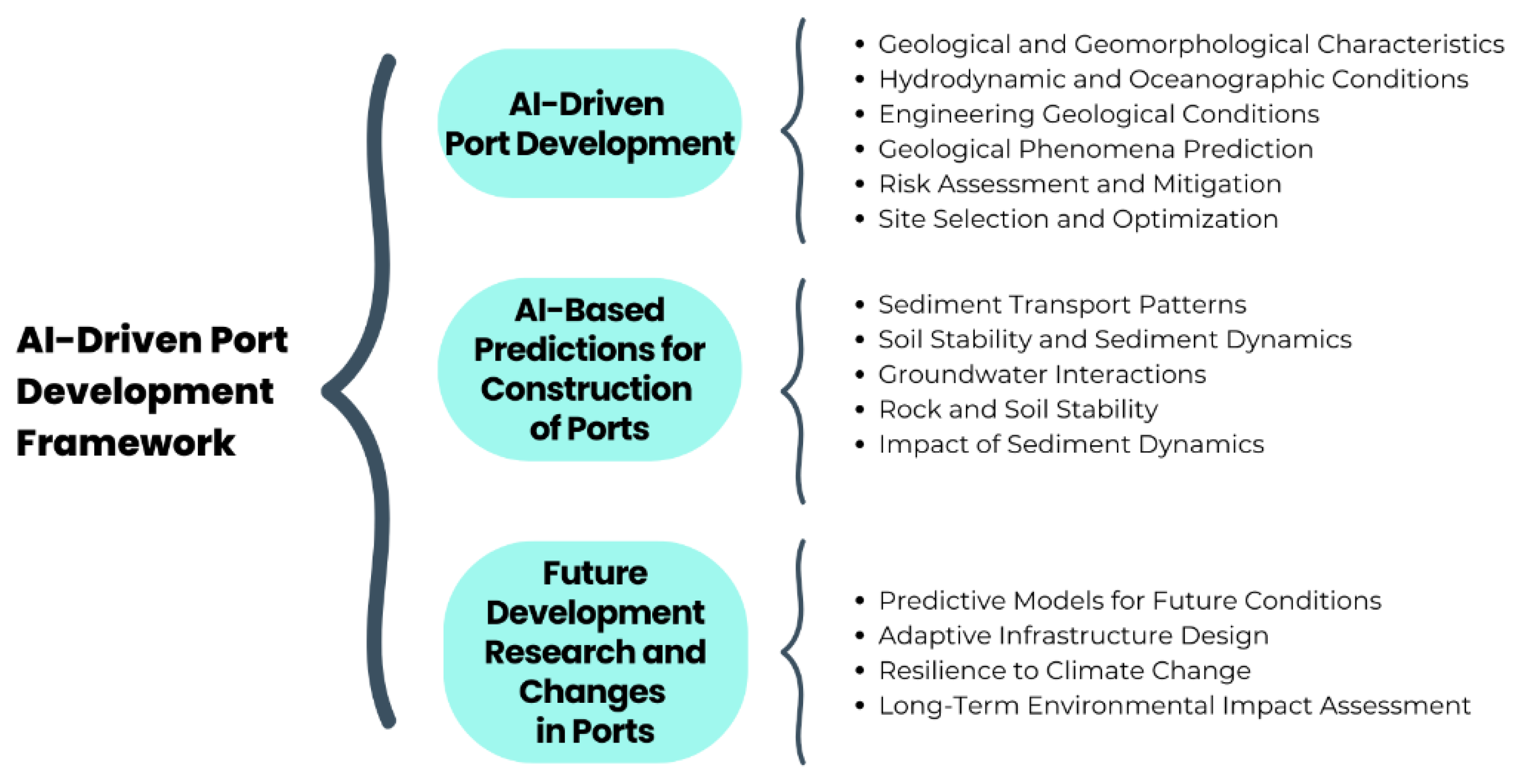

Table 1.
The elements of AI-Driven Port Development.
| Elements | Description | Implementation |
|---|---|---|
| Geological and Geomorphological Characteristics | AI evaluates geological structures, sediment composition, and coastal erosion patterns. | AI integrates geological surveys and remote sensing data to create models of coastal dynamics. AI predicts sediment transport patterns to design dredging schedules and protective structures like breakwaters. |
| Hydrodynamic and Oceanographic Conditions | AI predicts changes in wave and current patterns, and assesses the impact of sea level rise on port operations. | AI analyzes historical wave data, current measurements, and climate projections to simulate future conditions. AI forecasts hydrodynamic forces on soil stability and plan engineering solutions to minimize erosion. |
| Engineering Geological Conditions | AI analyzes soil stability and foundation conditions, considering soil composition, load-bearing capacity, and groundwater levels. | AI processes data on groundwater interactions to ensure foundation stability, guiding material selection and construction methods for longevity. |
| Geological Phenomena Prediction | AI predicts marine abrasion rates and assesses seismic activity risks. | AI models wave action impacts on coastal erosion and suggests structural enhancements. AI predicts seismic risks and recommend designs to enhance resilience to earthquakes and other geological events. |
| Risk Assessment and Mitigation | AI uses predictive modeling to identify vulnerabilities in port design and operations, integrating various risk factors. | By analyzing historical weather patterns and operational data, AI develops risk management strategies, ensuring preparedness for extreme weather events and operational disruptions. |
| Site Selection and Optimization | AI recommends optimal locations for new port developments, considering satellite images, geological data, and economic models. | AI-driven site selection considers sediment dynamics and geological stability to identify the most suitable expansion sites, integrating economic viability for sustainable development. |
Table 2.
The Elements of AI-Based Predictions for Construction of Ports.
| Elements | Description | Implementation |
|---|---|---|
| Sediment Transport Patterns | Predicts sediment movement and deposition. | AI models analyze wave action and current patterns to optimize dredging schedules. |
| Soil Stability and Sediment Dynamics | Evaluates soil stability and predicts sediment changes. | AI integrates geological surveys and real-time monitoring for better construction decisions. |
| Groundwater Interactions | Analyzes groundwater levels and interactions with structures. | AI-driven models predict impacts on soil stability and guide foundation design. |
| Rock and Soil Stability | Assesses physico-mechanical properties of geological formations | AI uses machine learning to predict geological behavior and recommend mitigation measures |
| Impact of Sediment Dynamics | Models effects of sediment transport on coastal morphology | AI predicts erosion and deposition to design adaptable infrastructure |
Table 3.
The Elements of the component: Future Development Research and Changes in Ports.
| Elements | Description | Implementation |
|---|---|---|
| Predictive Models for Future Conditions | Utilizes AI to forecast environmental and operational changes by analyzing large datasets. | AI predicts weather patterns and sea-level changes, enabling ports to prepare for severe weather and sea-level rise. |
| Adaptive Infrastructure Design | Designs port infrastructure to be flexible and responsive to changing conditions. | AI simulates scenarios and optimizes design parameters for resilient infrastructure. |
| Resilience to Climate Change | Enhances port resilience to climate-related risks through predictive modeling and strategic interventions. | AI provides accurate climate predictions and guides infrastructure modifications to withstand extreme weather. |
| Long-Term Environmental Impact Assessment | Assesses long-term environmental impacts of port operations using AI-driven data analysis. | AI predicts environmental impacts on marine ecosystems, coastal erosion, and air/water quality, promoting sustainable practices. |
Disclaimer/Publisher’s Note: The statements, opinions and data contained in all publications are solely those of the individual author(s) and contributor(s) and not of MDPI and/or the editor(s). MDPI and/or the editor(s) disclaim responsibility for any injury to people or property resulting from any ideas, methods, instructions or products referred to in the content. |
© 2024 by the authors. Licensee MDPI, Basel, Switzerland. This article is an open access article distributed under the terms and conditions of the Creative Commons Attribution (CC BY) license (http://creativecommons.org/licenses/by/4.0/).
Copyright: This open access article is published under a Creative Commons CC BY 4.0 license, which permit the free download, distribution, and reuse, provided that the author and preprint are cited in any reuse.


