

Submitted:
16 July 2024
Posted:
17 July 2024
You are already at the latest version
Abstract
The study examines the risk and protective factors in childhood for boys and girls who engage in unlawful behavior, through the lens of developmental criminology. This field explores the elements contributing to the emergence of antisocial and prosocial behaviors in childhood, which are linked to the increase or desistance of delinquency in later years. To enhance understanding in this domain, the study analyzes risk and protective factors associated with criminality in children across various levels: individual, family, and community. Utilizing a systematic review grounded in the PRISMA method, the study identifies and categorizes a range of factors, including conduct problems, socio-emotional competencies, biological determinants, social exclusion, interpersonal relationships, institutional governance, family adversity, caregiver characteristics, and family composition. This review underscores the significance of recognizing risk and protective factors in child development to design interventions at multiple levels, aiming to prevent antisocial behavior proactively.
Keywords:
developmental criminology
; childhood
; children
; protective factors
; risk factors
; criminality
; systematic review
1. Introduction
Understanding criminal behavior involves examining multiple factors related to antisocial, delinquent, and criminal activities, considering their duration, frequency, intensity, and severity [1,2]. Comprehensive approaches from a specialized field enable the prevention, prediction, and detection of antisocial behavior and personality [3]. One theoretical framework is developmental criminology, a branch built on evidence from various disciplines [4,5].
Developmental criminology encompasses crime throughout the life course, focusing particularly on childhood and adolescence [6,7,8,9,10]. From this perspective, law-breaking is viewed as part of a life trajectory that can begin early in childhood and continue into adolescence, with desistance or intensification of criminal behavior being common [11]. This approach seeks to explain the development of delinquency through an age-graded framework based on empirical observations from prospective longitudinal studies [5]. Research consistently views delinquency as part of a broader social phenomenon encompassing antisocial behavior that persists throughout the life cycle and across generations [12]. Consequently, the challenge lies in preventing and disrupting its persistence.
The literature delineates two general branches that complement and form a comprehensive view of the research field. Developmental theories, rooted in psychology, emphasize individual and psychological factors, the onset of delinquency, and the role of early risk and protective factors [12]. Conversely, life course theories, with a sociological orientation, focus on social structure and life events, investigating desistance and turning points [12].
Recent years have seen the development of various reviews of the theoretical body in this field [12,13,14]. McGee and Farrington [5] review and compare six of the most relevant theories: The Integrated Cognitive Antisocial Potential Theory [15]; The Social Development Model [16]; Life-Course Persistent and Adolescence-Limited Antisocial Behavior [8,17]; The Age-Graded Theory of Informal Social Control [18,19]; The Situational Action Theory of Crime Causation [20,21]; and The Interactional Theory [22,23].
From this analysis, the authors discuss various dimensions of the origin of delinquency. Researchers like Farrington, Wikström, Hawkins, and Catalano work from early socialization, positing that children learn practices from their parents and community during childhood [5].
Sampson and Laub [19] emphasize the desistance of antisocial behavior, while Moffitt and Thornberry concentrate on biological factors. Moffitt, in particular, explores early neuropsychological factors that result in two types of criminality: persistent and adolescence-limited [5].
In summary, current developmental criminology has succeeded in focusing on three perspectives of analysis: 1) the development of criminal and antisocial behavior, 2) risk and protective factors at different life stages, and 3) the effects of certain life events on development [24]. Consequently, life course and developmental criminology have established themselves as useful disciplines within criminology, contributing insights into various aspects of criminality that had not been previously considered [19].
Within developmental criminology, there has been a priority on studying risk and protective factors in adolescents, possibly due to their potential criminal responsibility. There has been less analysis of childhood, which, from a life course perspective, encompasses birth to 12 years [25]. Evidence indicates that persistent transgressive behaviors often begin early and increase at age 12. Farrington [26] warns that children exhibiting transgressive behaviors in childhood or adolescence tend to develop criminal behaviors in adulthood, making childhood a critical unit of analysis for timely intervention.
Delinquent behaviors in childhood are defined as actions that would be considered crimes if committed by an adult, as children are not criminally responsible [27].
In Chile, current legislation exempts persons under eighteen from criminal responsibility, referring to Law No. 20.084 on Adolescent Criminal Responsibility to delineate the responsibility of those under 18 but over 14 who have broken the law [28].
Scientific research and intervention programs have focused on youth who, as established by regulations, have criminal responsibility. However, the average age at which delinquency begins is 12 years [29]. Moreover, studies on Chilean youth observe distinctions between persistent, more complex delinquency and transitory, less complex delinquency in adolescents, with the age of onset (before age 13) being a significant factor [30]. This indicates that risk factors operate early, making it important to observe personal, relational, and contextual characteristics.
Few studies focus on illicit behaviors at early ages (between four and seven years), which is the period when these behaviors tend to begin [24]. Identifying early biopsychosocial mechanisms could place children on a trajectory of chronic antisocial behavior from early childhood to adulthood [31].
Therefore, it is crucial to understand the risk and protective factors underlying children’s social behaviors, as these could predict antisocial or prosocial behavior. These factors include individual characteristics and the social environment in which children develop, with the family being the primary reference, along with friends, school, and society [32,33].
Risk factors include a conflicting and disorganized bond between the child and caregivers, discipline techniques applied by caregivers, having friends involved in delinquency, and certain individual psychological and moral factors acquired and developed in childhood that may relate to social adaptation [33,34]. However, despite exposure to the same risk factors, some children do not develop criminal behavior due to individual and environmental variables that function as protective factors against severe cumulative events and stressful situations. These protective factors refer to individual characteristics and the family or community context that can mitigate the effect of risk factors, increasing resilience and preventing the development or persistence of such behaviors [33]. One such factor is guilt related to morality, which reinforces self-control in high-criminal temptation scenarios [34].
Given the above, focusing on children is crucial due to their greater capacity for change and flexibility. Most individuals with persistent criminal behavior began their activities at an early age, closely related to developmental contexts [33]. Observing developmental contexts is important to assess risk and protective factors and design interventions that prevent social adjustment problems in children from becoming complex, leading to norm-transgressing social relationships [8,35].
1.1. A Legal Approach to the Problem
In 2023, a parliamentary motion was introduced in Chile seeking to increase penalties for crimes committed by children: “judging crimes committed by minors with penalties equivalent to those contained in ordinary legislation” [36]. Legislators propose equalizing the legal treatment of adults and children who commit serious crimes. However, this initiative lacks empirical, statistical, or scientific support, suggesting that its origin lies in social perception, amplified by the press, of an increase in violent crimes perpetrated by minors.
While the repression and punishment of juvenile delinquency have been a historical constant in Chile, it was not until the 1960s that legal doctrine began to show greater concern for this issue. In 2007, this interest translated into concrete legislative measures with the promulgation of Law No. 20.084 on Adolescent Criminal Responsibility [37]. This law establishes a system that recognizes the need for differentiated treatment for minors who commit crimes, in line with the rights established by the Convention on the Rights of the Child.
However, the approval of the aforementioned legal initiative could lead to a dynamic similar to the "carrot and stick" law. A brief retrospective reveals this.
Before the law on adolescent criminal responsibility, children were not legally considered accountable for their illegal acts unless it was declared that they acted with discernment, determined by juvenile courts starting at the age of 16. Although this regulation aimed to remove adolescents from common prisons, it implied that from the age of 14, they would be considered criminally responsible for all crimes, albeit with mitigated penalties and special sanctions of internment in social reintegration centers. However, there were no guarantees that these safeguards would be effectively fulfilled by the State [38].
Seventeen years later, facing the apparent ineffectiveness of this law in both its sanctioning methods and crime prevention, legislative proposals like the one mentioned earlier arise. If approved, these would represent a shift towards more severe punitive methods aimed at deterring crime [39].
Criminological literature highlights two relevant points regarding these consequences. First, evidence suggests that increasing the severity of penalties is not an effective method to prevent crimes [40]. This is particularly true for children. Second, this discussion predicts that if the crime rate committed by adolescents increases, the severity of sanctions will also increase, causing a downward spiral phenomenon.
Studies have shown that incentives can work better than punitive measures. Therefore, timely detection of risk factors that facilitate children’s criminal behavior is essential for effective prevention [41,42].
Solutions to juvenile delinquency should focus on promoting research to deepen the understanding of this phenomenon and implementing preventive mechanisms based on such research findings, rather than toughening sanctions.
Given the complexity of addressing criminality in children, it is necessary to review the involved factors from longitudinal and cross-sectional studies in developmental criminology that cover childhood from birth to 12 years. The general objective is to analyze existing empirical studies on psychosocial factors in developmental criminology, such as risk and protective factors, in relation to criminality in children. The specific objectives are: 1. Describe the articles found according to the country, year of publication, and methodology; 2. Identify the protective and risk factors in the analyzed texts; 3. Categorize the protective and risk factors into systemic levels: individual, family, and community.
2. Materials and Methods
This research is a systematic review, which involves summarizing evidence by one or more experts on a specific topic, identifying, evaluating, and synthesizing it to answer a particular question and draw conclusions from the collected data [43]. In this study, an analysis is conducted on psychosocial factors related to criminality in children, selected under predefined inclusion and exclusion criteria.
To ensure the validity and quality of the systematic review, the PRISMA methodology was used (Preferred Reporting Items for Systematic Reviews and Meta-Analyses). Yepes-Núñez et al. [44] in “PRISMA 2020 Statement: An updated guideline for reporting systematic reviews,” indicate that the PRISMA Statement has been developed for systematic reviews to assess the effects of health interventions regardless of the design of the selected studies. It is noteworthy that PRISMA 2020 can be applied to original, updated, or continuously updated systematic reviews.
2.1. Study Selection
A bibliographic search was conducted during October and November 2023, selecting empirical quantitative and qualitative scientific articles from indexed journals that indicate psychosocial factors in children, as reported in the literature from 2017 to 2023. For the systematic review, the following elements were included:
(“Developmental criminology" OR "life course criminology") AND (‘’risk factors’’ OR ‘’protect factor’’ OR ‘’protective factors’’).
And, for EBSCOhost:
Developmental criminology OR life course criminology AND protective factors OR risk factors.
2.2. Inclusion and Exclusion Criteria
This systematic review includes articles published in scientific dissemination journals. Articles from the following databases are considered: SCIELO, SCOPUS, Web of Science, PubMed, and EBSCOhost, from those open-access repositories in English, Portuguese, and Spanish. Empirical methodology articles related to the theme and published between 2017 and 2023 were included due to the need for updated information regarding psychosocial factors. Exclusion criteria disregard articles unrelated to the theme, non-open-access articles in languages other than English, Portuguese, and Spanish, as well as books, press articles, essays, theses, reports, opinion columns, and conference papers.
Following the PRISMA model, the first step was searching for articles through the mentioned databases: SCIELO, SCOPUS, Web of Science, PubMed, and EBSCOhost. The obtained results were organized in Excel, and a sequential systematization of information was carried out according to the inclusion and exclusion criteria.
3. Results
The systematic review results can be seen in Figure 1. After applying the exclusion criteria, 24 articles were reviewed, allowing us to respond to our objectives.
3.1. Article Characterization
Regarding the methodology, 23 of the selected articles have a quantitative approach, and one article employs a mixed-method approach. Concerning the design, 22 articles are longitudinal, and two are cross-sectional. Among the analyzed articles, 50% use a database of male participants, 42% are mixed, and 8% are female only.
The geographical distribution of the reviewed studies shows that 13 are from North America, with 11 from the USA and 2 from Canada. Only one study is from Latin America (Brazil).
In terms of publication years, the distribution is as follows: 7 articles from 2021; 5 from 2020; 4 from 2019; 4 from 2017; and 1 each from 2018, 2022, and 2023.
3.2. Contents of the Selected Articles
3.2.1. Individual Risk Factors
The individual risk factors reported in the literature include schooling, biological determinants, conduct problems, cognitive factors, psychopathological disorders and symptoms, socio-emotional competencies, and adverse childhood experiences (see Figure 2).
Regarding schooling, studies like Koegl et al. [45] indicate that low academic performance is related to future antisocial behavior. Similarly, Basto-Pereira and Farrington [46] identify low academic achievement as a predictor. Whitten et al. [47] also highlight low performance and interrupted schooling trajectories, which are linked to chronic delinquency characterized by shorter criminal careers but with a higher number of crimes and convictions. Additionally, youths who repeated grades three times and/or dropped out of school are twice as likely to commit violent crimes [48]. School absenteeism in women also constitutes a risk factor [49].
In the category of biological determinants, Van Hazebroek et al. [50] mention that being male is associated with antisocial behaviors and higher recidivism in serious violent and chronic (SVC) crimes [51]. Herrera and Stuewig [52] also note that being male is a risk factor, especially when interrelated with other components such as witnessing spousal violence (for adolescent delinquency) or living in violent contexts with substance use. Regarding preterm birth, Givens and Reid [53] link it to early-onset delinquency. Additionally, temperament, specifically "hyperreactivity" and a "short temper," increases the likelihood of SVC infractions in adulthood [51]. Neuroticism is also identified as a risk factor for the development of chronic persistent delinquency, characterized by younger age at first conviction and longer criminal careers [47].
Conduct problems refer to early behaviors that are indicators of the possible development of the disorder in its entirety [54]. Gushue et al. [49] mention that running away from home before age 12 increases the likelihood of quickly engaging in and desisting from delinquency (Rapid Onset Rapid Desistance, RORD).
Early-onset delinquency is another critical factor. Authors like Han and Park [55] and Wolff [51] indicate that delinquent behaviors in childhood increase the risk of lifelong delinquency. Solomon et al. [56] identify bullying, mocking others, and disobedience as factors that can lead to antisocial behaviors in adulthood. Koegl et al. [45] and Solomon et al. [56] also mention that such behaviors in children are related to delinquency in adolescence and adulthood. Gang membership is linked to delinquent trajectories in incarcerated youth [57] and women in juvenile residences with SVC delinquency [51].
Cognitive factors include low aptitude, referring to low verbal and non-verbal IQ, which is an early risk characteristic for delinquency [46,47,58].
The category of disorders and symptoms refers to psychopathological indicators. Rosa et al. [59] mention that Attention Deficit Hyperactivity Disorder (ADHD) is linked to non-sexual crimes. Solomon et al. [56] and Whitten et al. [47] indicate that low concentration levels and hyperactivity are predictors of persistent delinquency, understood as those with older age at first conviction but longer criminal careers. Depression also influences serious crimes in both women and men [52].
The socio-emotional competencies category highlights low emotional independence from an incarcerated father and negative self-perception as risk factors. The former facilitates intergenerational continuities in crime [51] while the latter increases the likelihood of developing RORD and slow-rising chronic (SRC) delinquent trajectories [49]. Impulsivity, referring to low self-control, can lead to antisocial behaviors [58,60]. Low empathy is linked to sexual crimes in adolescence [59].
Finally, Adverse Childhood Experiences (ACEs) can act as risk factors according to Craig et al. [61].
. The study indicates that the more ACEs a child has, the more likely they are to commit crimes in late adulthood. However, the number of ACEs was not predictive in women with SVC crimes [51].
3.2.2. Individual Protective Factors
The factors are divided into socio-emotional competencies and schooling. Socio-emotional competencies include high emotional independence from incarcerated parents [51], low dishonesty [61], and intergenerational resilience in children. Intergenerational resilience refers to a reduction in crime across generations within the same family, mediated by various protective elements that manifest in each age group. However, since it is a recent concept, it lacks detailed factors mediating its appearance [62].
Regarding schooling, completing education, even with grade repetition, serves as a protective element by preventing the development of violent and non-violent criminal careers [48], predominantly in males [61]. School activities are also protective against substance use in children [55].
In terms of personality, Craig et al. [61] identify low troublesome behavior, described as "being unproblematic", as a protective factor against delinquency. Additional elements that significantly reduce the risk of committing a crime include low audacity, low impulsivity, low extraversion, high nervousness, and low neuroticism [61].
3.2.3. Family Risk Factors
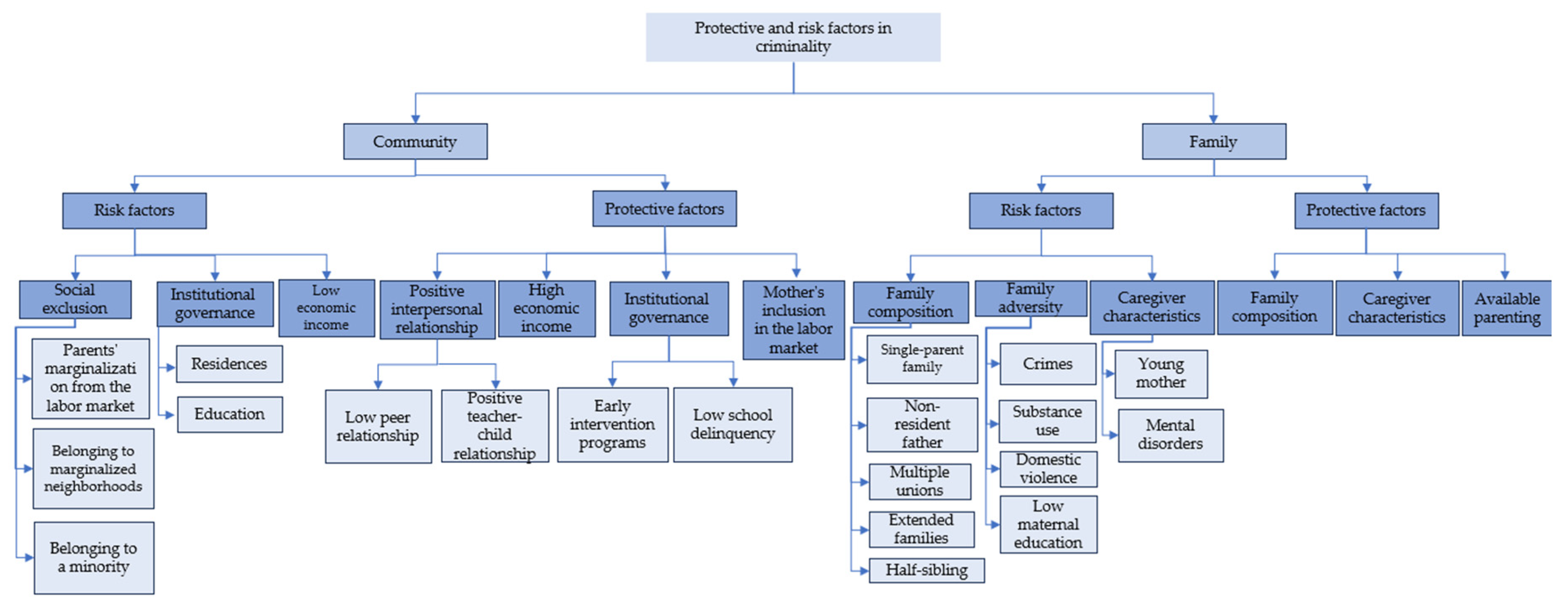
The authors report a set of situations related to family adversity (see Figure 3). Having a convicted father influences the appearance of chronic persistent delinquency [47]. Similarly, Han & Park [55] indicate that substance use by caregivers is a risk component related to early alcohol and drug use in children.
Family violence and spousal violence are significant factors. Herrera and Stuewig [52] indicate that both are related to delinquency in adolescence, as minors are socialized to imitate behaviors that transgress social limits. Low maternal education (less than nine years of completed schooling) [56], child maltreatment as corporal punishment [64,65], severe or authoritarian parenting, and discipline [65] are predictors of delinquency from childhood to adolescence. Farrington [65] also mentions that caregiver neglect, understood as low parental involvement in their children’s education, is an indicator for persistent delinquency. Similarly, Whitten et al. [47] indicate that low supervision over children’s whereabouts and actions predicts longer criminal careers. Martins et al. [48] report that low stimulation in children under four correlates with the manifestation of violent crimes.
Regarding sexual abuse, Rosa et al. [59] link childhood sexual abuse to the early onset of sexual delinquency.
Family composition factors identified as risk factors include single-parent families, non-resident fathers, having half-siblings, and multiple maternal unions before childbirth, with the most prevalent factor being a non-resident father [56]. Criminality increases with the number of these components in the family [56]. Basto-Pereira and Farrington [46] identify that extended family, along with other factors, can predict the criminal behaviors of the "serious and persistent versatile" group, characterized mainly by committing violent and, to a lesser extent, minor crimes. Finally, Whitten et al. [47] indicate that this risk element, along with high audacity, predicts chronic criminal behaviors.
3.2.4. Family Protective Factors
Family protective factors include family composition, which refers to reduced family sizes; caregiver characteristics, such as the older age of the mother; and available parenting, which points to high parental interest in education. Craig et al. [61] indicate that these elements are associated with a lower prevalence of committing crimes between the ages of 10 and 56. Reduced family sizes and/or older parents significantly reduce criminal behaviors [61].
3.2.5. Community Risk Factors
Community risk factors include social exclusion, comprising three aspects (see Figure 3): exclusion from the labor market for both parents [56] belonging to marginalized neighborhoods and minorities that may be racial, ethnic, or gender-based [50]; and low economic income, defined as situations where none of the child’s parents or caregivers receive a work income [56].
Regarding institutional governance, educational environments with high crime rates and the development of links with delinquent peers are mentioned [55], representing a short-term risk for criminal behavior. Authors like Yang et al. [57] and Valdivia-Devia et al. [66] indicate that attending residences reduces the possibility of experiencing positive turning points.
3.2.6. Community Protective Factors
Community protective factors include positive interpersonal relationships, such as low peer relationships [61]. Children exposed to higher risk factors who do not engage in delinquency tend to have few friends. A positive relationship between teacher and child is also significant, allowing for the development of positive affection and the construction of healthy interactions with peers [64]. High economic income, which includes the mother’s inclusion in the labor market, is another protective factor [61].
4. Discussion
This study aimed to analyze existing empirical studies on psychosocial factors in the field of developmental criminology, such as risk and protective factors related to criminality in children. As a result of the review, 24 updated articles were identified. The factors in each of the reviewed texts are categorized at different levels: community, individual, and family, which are visualized in Figure 2 and Figure 3.
The review shows that delinquency is a complex phenomenon, influenced by various factors throughout the life cycle [12]. Studies from developmental criminology highlight this complexity by providing a longitudinal view of various areas of children’s development, enabling the consideration of individual, relational, and contextual aspects for understanding criminal behavior. From this perspective, children who exhibit criminal behavior in childhood or adolescence are more likely to engage in delinquency in adulthood [26], making childhood an opportune moment to identify and intervene in these behaviors.
Risk factors often operate early, with some criminal behaviors manifesting before the age of seven [66]. Several studies highlight childhood and its care context as critical points for the possible development of delinquent behaviors in adolescence and/or adulthood [67,68,69,70,71,72].
Constructing the broader phenomenon of antisocial behavior involves establishing conducive care environments for children that adequately address behavioral problems in childhood. However, the child’s context is socially conditioned by a culture that does not emphasize care [73] Given that young people exhibiting delinquent behaviors often come from contexts of vulnerability and childhood victimization, it is understood that the cycle of violence does not occur in a vacuum [74,75,76,77].
A systemic analysis of the results reveals a dynamic link between various factors identified in the development of delinquent behaviors. At the community level, risk factors such as labor market exclusion and low economic income indicate material deprivation and vulnerability [56]. This connects to the family level, where parental crime [47] and family violence are primary elements within a vulnerability context. However, this vulnerability is not static, reflecting the possibility of intervention and prevention through economic, labor, and social opportunities that promote early development and inclusion contexts for children and their families.
Schooling constitutes both a protective and risk factor at individual and community levels. Situations of schooling at the individual level, such as repeating grades [48] and high school crime rates at the community level, relate to developing delinquent behaviors in children [55]. However, schooling can be a significant protective factor when individuals participate in school activities [64] and when there is a low school crime rate [61], as well as when children form meaningful bonds with their teachers. This reflects the importance of strengthening the individual educational experience from an early age while also promoting communication and inclusion of families in the school community.
From this perspective, protective and risk factors at different levels are dynamic conditions in the life history that can become more complex or resolved. To prevent early antisocial behaviors, it is essential to observe the available evidence, generate research from an evolutionary and systemic approach, and consider the experiences, learnings, and contexts in which children develop. It is also crucial for justice actors to prevent actions reported in the literature that could result in victimization and risk factors, such as institutionalization as a protection measure. Its application should be exceptional and not preferred, as living in residences or foster homes constitutes a significant risk factor for chronic crimes despite exposure to other risk factors [57].
The literature indicates that an important protective factor is working from early childhood to promote prosocial actions through activities that include the entire family unit. Parenting styles significantly influence the socio-emotional and moral development of children and, consequently, the behaviors they will exhibit throughout their lives [34,55]. Intervention and prevention strategies should focus on reducing risk multifacetedly, as risk factors are multiple and varied, depending on various situations framed in different systemic levels and the individual’s social position [60].
While preventive efforts are focused on adolescence, they could be more effective if it is recognized that the complexity of crime has its roots in childhood [78]. Addressing children’s experiences in their early stages is crucial, as adverse childhood experiences have a broad correlation with the deployment of criminal behaviors in later developmental stages [79].
Based on the characterization of the articles and samples, there is a lack of research with Latin American samples, except for a study with a Brazilian population emphasizing the protective role of completing schooling [48], where retention programs would be central to prevention. It is necessary to investigate the nuances for Latin America, considering that studies conducted on adolescents in Chile establish a more active role of family risk factors than in Anglo-Saxon studies [80,81,82]. Furthermore, samples are mainly focused on males, although social factors can act differently in girls and boys, a point that requires further study [51,52].
This systematic review covers studies from a limited time period and certain languages, excluding studies that do not fit the inclusion criteria.
Focusing on childhood when studying criminality from a complex and multilevel perspective is essential. Addressing it requires evidence-based actions and a collective commitment from various institutions and social actors to build a society that cares for and respects the rights of children and their families.
Funding
This research was funded by the Agencia Nacional de Investigación y Desarrollo (ANID) of the Chilean Government, FONDECYT Project N° 11240951 “factores criminológicos y victimológicos vinculados al comportamiento delictivo en la infancia y su relación con las prácticas del tribunal de familia”, with director Daniela Zúñiga Silva; and by FONDECYT Project N° 1221075 “Estudio histórico-jurídico sobre la ejecución de las pensiones de alimentos para niños, niñas y adolescentes, de cara a su adecuada compresión, aplicación y reforma en la justicia de familia chilena”, Director Francesco Carretta Muñoz.
Informed Consent Statement
Not applicable.
Data Availability Statement
Dataset available on request from the authors. The raw data supporting the conclusions of this article will be made available by the authors on request.
Conflicts of Interest
The authors declare no conflict of interest.
References
- De la Peña, M., & Gómez, J. Agresión y conducta antisocial en la adolescencia: una integración conceptual. Psicopatología Clínica Legal y Forense. 2006, 6, 9-24. ISSN 1576-9941.
- Milano, W. Entre la psicología criminal, la psicología forense y la psicología penitenciaria. Ciencia Digital, 2019, 3, 23-39. [CrossRef]
- Verde, M., & Roca, D. Psicología criminal; Cañizal, A. & Bazaco, E., Eds.; Pearson Prentice Hall: Madrid, España, 2006; ISBN 978-84-8322-306-2.
- Carreón, W. Criminología del Desarrollo: estudio del desarrollo en la formación de la conducta criminal. Ratio Juris UNAULA 2023, 18, 3–22. [Google Scholar] [CrossRef]
- McGee, T. & Farrington, D. Developmental and Life-Course Explanations of Offending. Psychology, Crime & Law. 2018; 25, 609–625. [CrossRef]
- Farrington, D., Ttofi, M. & Piquero, A. Risk, promotive, and protective factors in youth offending: Results from the Cambridge study in delinquent development. Journal of Criminal Justice. 2016; 45, 63–70. [CrossRef]
- Loeber, R., Farrington, D. & Waschbusch, D. Serious and violent juvenile offenders: Risk Factors and Successful Interventions, Loeber, R & Farrington, D., Ed.; Thousand Oaks: Washington, DC, USA, 1998; 313–345ISBN 978-14-5224-374-0.
- Moffitt, T. Adolescence limited and life-course-persistent antisocial behavior: A developmental taxonomy. Psychological Review 1993, 100, 674–701. [Google Scholar] [CrossRef] [PubMed]
- Farrington, D. The School Years: Current issues in the socialization of young people Chapter 6: Juvenile Delinquency, 2nd ed.; Coleman, J., Ed.; Routledge, London, UK, 1992a; pp. 123–163. ISBN: 9780415061704.
- Farrington, D. Criminal career research in the United Kingdom. British Journal of Criminology, 1992b; 32, 521– 536. [CrossRef]
- Le Blanc, M. & Trudeau Le Blanc, P. La réadaptation de l’adolescent antisocial: Un programme cognitivo-émotivo-comportemental. Presses de l’Université de Montréal, Montreal, Canada, 2014. ISBN: 9782760633537.
- Farrington, D., Kazemian, L. & Piquero, A. The Oxford handbook of developmental and life-course criminology. Oxford University Press, Oxford, UK, 2019, ISBN: 9780190201388.
- McAra, L., & McVie, S. Developmental and life-course criminology: innovations, impacts, and applications, 6th ed; Liebling, A., Maruna, S. & McAra, L., Eds.; Oxford University Press, Oxford, UK, 2017. ISBN: 9780190201371.
- McGee, T. & Farrington, D. Handbook of Criminological Theory. Piquero, A., Ed.; Wiley- Blackwell, Chinchester, UK, 2016, pp. 336-354, ISBN: 978-0190201371.
- Farrington, D. Integrated Developmental and Life-Course Theories of Offending: Advances in Criminological Theory. Farrington, D., Ed.; Transaction Publisher, New York, USA, 2005; Volume 4, pp. 73-92. ISBN: 9871412807999.
- Catalano, R., Hawkins, J., Kosterman, R., Bailey, J., Oesterle, S., Cambron, C. & Farrington, D. Applying the social development model in middle childhood to promote healthy development: Effects from primary school through the 30s and across generations. Journal of Developmental and Life-Course Criminology. 2021, 7, 66-86. [CrossRef]
- Moffitt, T. Life-course persistent versus adolescence limited antisocial behavior. In Developmental Psychopathology; Cicchetti, D. & Cohen, D, Wiley: USA, 2006; pp. 570–598. [Google Scholar] [CrossRef]
- Sampson, R. & Laub, J. Desistance from crime over the life course. In Handbook of the life course, Springer US: Boston, 2003, pp. 295-309. [CrossRef]
- Sampson, R. & Laub, J. Life-Course and Developmental Criminology: Looking back, moving forward. ASC Division of Developmental and Life-Course Criminology inaugural David P. Farrington lecture, 2017. Journal of Developmental and Life-Course Criminology. 2020, 6, 158-171. [CrossRef]
- Wikström, P., & Treiber, K. What drives persistent offending? The neglected and unexplored role of the social environment. In The development of persistent criminality; Savage, J, Ed.; Oxford University Press: United Kingdom, 2009, pp. 389-420. ISBN 9780190295004.
- Wikström, P., & Treiber, K. The Dynamics of Change: Criminogenic Interactions and Life-Course Patterns in Crime. In The Oxford handbook of developmental and life-course criminology. Farrington, D., Kazemian, L. & Piquero, A, Eds.; Oxford University Press: United Kingdom, 2019, pp. 272-294.
- 22. Thornberry, T., & Krohn, M. Applying Interactional Theory to the explanation of continuity and change in antisocial behaviour. In Integrated Developmental and Life-Course Theories of Offending; Farrington, D, Ed.; Transaction Publishers: USA, 2005, pp. 183-209.
- Thornberry, T., & Krohn, M. Interactional Theory. In The Oxford handbook of developmental and life-course criminology; Farrington, D., Kazemian, L. & Piquero, A, Eds.; Oxford University Press: United Kingdom, 2019, pp. 248-271.
- Requena, L. Principios generales de criminología del desarrollo y las carreras criminales; JM Bosch: España, 2014; pp. 11-104.
- Faas, A. E. Psicología del desarrollo de la niñez; Editorial Brujas: Córdoba, Argentina, 2018; pp. 13–417. [Google Scholar]
- Farrington, D. The Development of Offending and Antisocial Behavior from Childhood: Key Findings from the Cambridge Study in Delinquent Development. J. Child Psychol, psychiat. 1995, 360, 929-964.
- Schneider, F. Measuring the Size and Development of the Shadow Economy. Can the Causes be Found and the Obstacles be Overcome?. In Essays on Economic Psychology; Brandstätter, H &, Güth, W, Eds.; Springer: Alemania, 1994, pp. 193-212.
- Meza-Lopehandía, M. Niños, niñas y adolescentes: La nomenclatura en proyecto de ley que crea el Servicio de Reinserción Juvenil a la luz del derecho internacional y nacional, 2020, Biblioteca Congreso Nacional de Chile.
- Aedo, M. y Varela, P. Algunas reflexiones sobre las diferencias de género en las conductas infractoras de niñas y adolescentes en Chile. Oñati Socio-Legal Serie. 2020, 10, 218-242.
- Pérez-Luco, R., Alarcón, P., Zambrano, A., Alarcón, M., Chesta, S. & Wegner, L. Taxonomía de la delincuencia adolescente con base en evidencia chilena. In Psicología Jurídica, conocimiento y práctica; Bringas, C. & Novo, M, Ed.; Sociedad Española de Psicología Jurídica y Forense: España, 2017, pp. 259-268.
- Tremblay, R. Early development of physical aggression and early risk factors for chronic physical aggression in humans. In Neuroscience of aggression; Miczek, K & A. Meyer-Lindenberg, A, Eds.; Springer-Verlag Publishing: USA, 2014, pp. 315-327.
- Molinedo-Quílez, M. Factores de riesgo psicosociales en menores infractores. Revista española de sanidad penitenciaria. 2020, 22, 110–118. [Google Scholar]
- Vásquez, C. Predicción y prevención de la delincuencia juvenil según las teorías del desarrollo social (social development theories). Revista de Derecho. 2003, 14, 135–158. [Google Scholar]
- Maggi, S., Zaccaria, V., Breda, M., Romani, M., Aceti, F., Giacchetti, N., Ardizzone, I. y Sogos, C. A Narrative Review about Prosocial and Antisocial Behavior in Childhood: The Relationship with Shame and Moral Development. Children. 2022, 9, 1-14. [CrossRef]
- Morizot, J. The contribution of temperament and personality traits to criminal and antisocial behavior development and desistance. In The Development of Criminal and Antisocial Behavior; J. Morizot & L. Kazemian, Eds.; Springer International Publishing: USA, 2015, pp. 137–165. [CrossRef]
- Senado de Chile. Boletín N° 14.959-07. https://www.senado.cl/appsenado/templates/tramitacion/index.php?boletin_ini=14559-07.
- Cousiño, L. Delincuencia Juvenil. In Clásicos de la literatura penal en Chile. La Revista de Ciencias Penales en el siglo XX: 1935-1995; Londoño, F. & Maldonado, F., Tirant Lo Blanch: Chile, 2018, p. 932.
- Estrada, F. Principios del procedimiento de aplicación de medidas de protección de derechos de niños y niñas. Revista de Derecho. 2015, 8, 84–155. [Google Scholar] [CrossRef]
- Ríos Ortiz, L.T. La responsabilidad penal para adolescentes: un sistema entre la zanahoria y el garrote. Derecho Penal y Criminología. 2022, 43, 229-266. [CrossRef]
- Garland, D. Castigo y sociedad moderna., 2nd ed.; Editorial Siglo XXI: Mexico, 1999; pp. 321–339. [Google Scholar]
- De Geest, G. & Dari-Mattiacci, G. The Rise of Carrots and the Decline of Sticks. University of Chicago Law Review. 2013, 80, 341-393. http://www.jstor.org/stable/41825878.
- Cancian, M., Meyer D. & Wood R. Do Carrots Work Better than Sticks? Results from the National Child Support Noncustodial Parent Employment Demonstration. Journal of Policy Analysis and Managment. 2022; 41, 552–578. [CrossRef]
- Adolf, S. Utilidad y revisión de literatura. Revista de enfermería. 2015, 9, 2–13. [Google Scholar] [CrossRef]
- Yepes-Nuñez, J., Urrutia, G., Romero-García, M. & Alonso-Fernández, S. The PRISMA 2020 statement: an updated guideline for reporting systematic reviews. Rev Esp Cardiol. 2021, 74, 790-799. [CrossRef]
- Koegl, C., Farrington, D. & Augimeri, L. Predicting Future Criminal Convictions of Children Under Age 12 Using the Early Assessment Risk Lists. Journal of Developmental and Life-course criminology. 2021, 7, 17-40. [CrossRef]
- Basto-Pereira, M., & Farrington, D. Advancing knowledge about lifelong crime sequences. The British Journal of Criminology. 2019, 59, 354-377. [CrossRef]
- Whitten, T., McGee, T., Homel, R., Farrington, D. & Ttofi, M. Comparing The Criminal Careers and Childhood Risk Factors of Persistent, Chronic, and Persistent- Chronic Offenders. Australian & New Zealand Journal of Criminology. 2019, 52, 151-173. [CrossRef]
- Martins, R., Gonçalves, H., Blumenberg, C., Könsgen, B., Houvèssou, G., Carone, C. & Murray, J. School performance and young adult crime in a Brazilian birth cohort. Journal of developmental and life-course criminology. 2022, 8, 647-668. [CrossRef]
- Gushue, K., Mccuish, E. & Corrado, R. Developmental Offending Patterns: Female Offending Beyond the Reference Category. Criminal justice and Behavior. 2021, 48, 139-156. [CrossRef]
- Van Hazebroek, B., Blokland, A., Wermink, H., De Keijser, J., Popma, A., & Van Domburgh, L. Delinquent development among early-onset offenders: Identifying and characterizing trajectories based on frequency across types of offending. Criminal justice and behavior. 2019, 46, 1542-1565. [CrossRef]
- Wolff, K., Baglivio, M., Vaughn, M., DeLisi, M. & Piquero, A. For males only? The search for serious, violent, and chronic female juvenile offenders. Journal of developmental and life-course criminology. 2017, 3, 168-195. [CrossRef]
- Herrera, V. & Stuewig, J. Gender differences in pathways to delinquency: The impact of family relationships and adolescent depression. Journal of Developmental and Life- Course Criminology. 2017, 3, 221-240. [CrossRef]
- Givens, E., & Reid, J. Developmental Trajectories of Physical Aggression and Nonaggressive Rule-Breaking During Late Childhood and Early Adolescence. Criminal justice and Behavior. 2019, 46, 395-414. [CrossRef]
- American Psychological Association. Manual Diagnóstico y Estadístico de los Trastornos Mentales; Editorial Médica Panamericana: USA, 2013.
- Han, S. & Park, Y. Which risk factors plays the most critical role for delinquent behavior? Examining integrated cognitive antisocial potencial theory. Crime & Delinquency. 2023, 69, 1947-1972. [CrossRef]
- Solomon, S., Savolainen, J., Mason, W., Miettunen, J., January, S. & Järvelin, M. Does educational marginalization mediate the path from childhood cumulative risk to criminal offending?. Journal of developmental and life-course criminology. 2017, 3, 326-346. [CrossRef]
- Yang, J., McCuish, E. & Corrado, R. Is the Foster Care-Crime Relationship a Consequence of Exposure? Examining Potential Moderating Factors. Youth Violence and Juvenile Justice. 2021, 19, 94-112. [CrossRef]
- Basto-Pereira, M. & Farrington, D. Lifelong conviction pathways and self-reported offending: towards a Deeper comprehension of criminal career development. The British Journal of Criminology. 2020, 60, 285-302. [CrossRef]
- Rosa, M., Fox, B. and Jennings, W. Do Developmental and Life-Course Theory Risk Factors Equally Predict Age of Onset Among Juvenile Sexual and Nonsexual Offenders?. Sexual Abuse. 2020, 32, 55-78. [CrossRef]
- Fox, B., Kortright, K., Gill, L., Oramas, D., Moule, R. & Verona, E. Heterogeneity in the Continuity and Change of Early and Adult Risk factor Profiles of Incarcerated Individuals: A latent Transition Analysis. Youth Violence and Juvenile Justice. 2021, 19, 68-93. [CrossRef]
- Craig, J., Piquero, A., Farrington, D. & Ttofi, M. A little early risk goes a long bad way: Adverse childhood experiences and life-course offending in the Cambridge study. Journal of Criminal Justice. 2017, 53, 34- 45. [CrossRef]
- Thornberry, T. Intergenerational Patterns in Offending: Lessons from the Rochester Intergenerational study-ASC Division of Developmental and Life Course Criminology David P. Farrington Lecture, 2019. Journal of Developmental and Life- Course Criminology. 2020, 6, 381-397. [CrossRef]
- Capaldi, D., Wiesner, M., Kerr, D., Owen, L. & Tiberio, S. Intergenerational associations in crime for an at-risk sample of US men: Factors that may mitigate or exacerbate transmission. Journal of Developmental and Life-Course Criminology. 2021, 7, 331-358. [CrossRef]
- Neaverson, A., Murray, A., Ribeaud, D. & Eisner, M. Disrupting the Link Between Corporal Punishment Exposure and Adolescent Aggression: The Role of Teacher- child Relationships. Journal of youth and adolescence. 2022, 51, 2265-2280. [CrossRef]
- Farrington, D. Childhood Risk Factors for Criminal Career Duration: Comparisons with Prevalence, Onset, Frequency and Recidivism. Criminal behaviour and mental health. 2020, 30, 159-171. [CrossRef]
- Valdivia-Devia, M., Oyanedel, J. & Andrés-Pueyo, A. Trayectoria y reincidencia criminal. Revista Criminalidad. 2018, 60, 251-267. ISSN-e 1794-3108.
- Andolfi, M. El niño consultante. Cahiers critiques de therapie familial et des pratiques de reseaux. 2001, 2, 99-116.
- Barudy, J. Dolor invisible de la infancia, Paidós: España, 1998.
- Ortega, B., Jimeno, M. V., Topino, E., & Latorre, J. M. Direct and indirect childhood victimization and their influence on the development of adolescents antisocial behaviors. Psychological trauma: theory, research, practice, and policy. 2023, 16, 72–80. [CrossRef]
- Chopin, J., Fortin, F., & Paquette, S. Childhood victimization and poly-victimization of online sexual offenders: A developmental psychopathology perspective. Child Abuse & Neglect..2022, 129, 105-659. [CrossRef]
- Wolff, K. T., Cuevas, C., Intravia, J., Baglivio, M. T., & Epps, N. The effects of neighborhood context on exposure to adverse childhood experiences (ACE) among adolescents involved in the juvenile justice system: Latent classes and contextual effects. Journal of youth and adolescence. 2018, 47, 2279-2300. [CrossRef]
- Miley, L., Fox, B., Muniz, C., Perkins, R., & DeLisi, M. Does childhood victimization predict specific adolescent offending? An analysis of generality versus specificity in the victim-offender overlap. Child Abuse & Neglect. 2020, 101, 2–12. [CrossRef]
- Hein, A. Factores de riesgo y delincuencia juvenil: revisión de la literatura nacional e internacional. Fundación Paz Ciudadana. 2004, 1-21.
- Berg M. & Mulford C. Reappraising and redirecting research on the victim-offender overlap. Trauma, Violence & Abuse. 2020, 21, 16–30. [CrossRef]
- Kushner M., Botchkovar E., Antonaccio O., & Hughes L. Exploring vulnerability to deviant coping among victims of crime in two Post-Soviet cities. Justice Quarterly. 2020 38, 1182–1209. [CrossRef]
- Kushner, M. Betrayal Trauma and Gender: An Examination of the Victim-Offender Overlap. Journal of interpersonal violence. 2022, 37, NP3750–NP3778. [Google Scholar] [CrossRef] [PubMed]
- Da Costa, E., Faúndes, A., & Nunes, R. The association between victim-offender relationship and the age of children and adolescents who suffer sexual violence: a cross-sectional study. Jornal de pediatria. 2022, 98, 310–315. [CrossRef]
- Beckley, A., Caspi, A., Arseneault, L., Barnes, J., Fisher, H., Harrington, H., Moffitt, T. The Developmental Nature of the Victim-Offender Overlap. Journal of Developmental and Life-Course Criminology. 2017, 4, 24–49. [CrossRef]
- Silva, C., Moreira, P., Moreira, D., Rafael, F., Rodrigues, A., Leite, A., Lopes, S. y Moreira, D. Impact of adverse Childhood Experiences in Young Adults and Adults: A Systematic Literature Review. Pediatric Reports. 2024, 16, 461-481. [CrossRef]
- Alarcón, P., Luco, R., Chesta, S. & Wenger, L. Examinando factores de riesgo y recursos para la intervención con adolescentes infractores. In Psicología Jurídica, conocimiento y práctica; Bringas, C. & Novo, M, Ed.; Sociedad Española de Psicología Jurídica y Forense: España, 2017, pp. 425-442. ISBN 978-84-8408-326-9.
- Zambrano, V., Gemignani, M., Fernández-Pacheco, G., & Ergas, L. Resiliencia en adolescentes infractores con trayectorias en los sistemas chilenos de bienestar infantil y de justicia adolescente. Revista de Estudios Sociales. 2024, 88, 59–78. [CrossRef]
- Maldonado, J., Garrido, Á., & Henríquez, S. Trayectorias de vida de jóvenes infractores de ley internados y respuesta educativa en el servicio nacional de menores de Chile. Interciencia, 2022, 47, 191-198. ISSN 0378-1844.
Figure 1.
Search Identification Flow Diagram. Based on "The PRISMA Statement.".
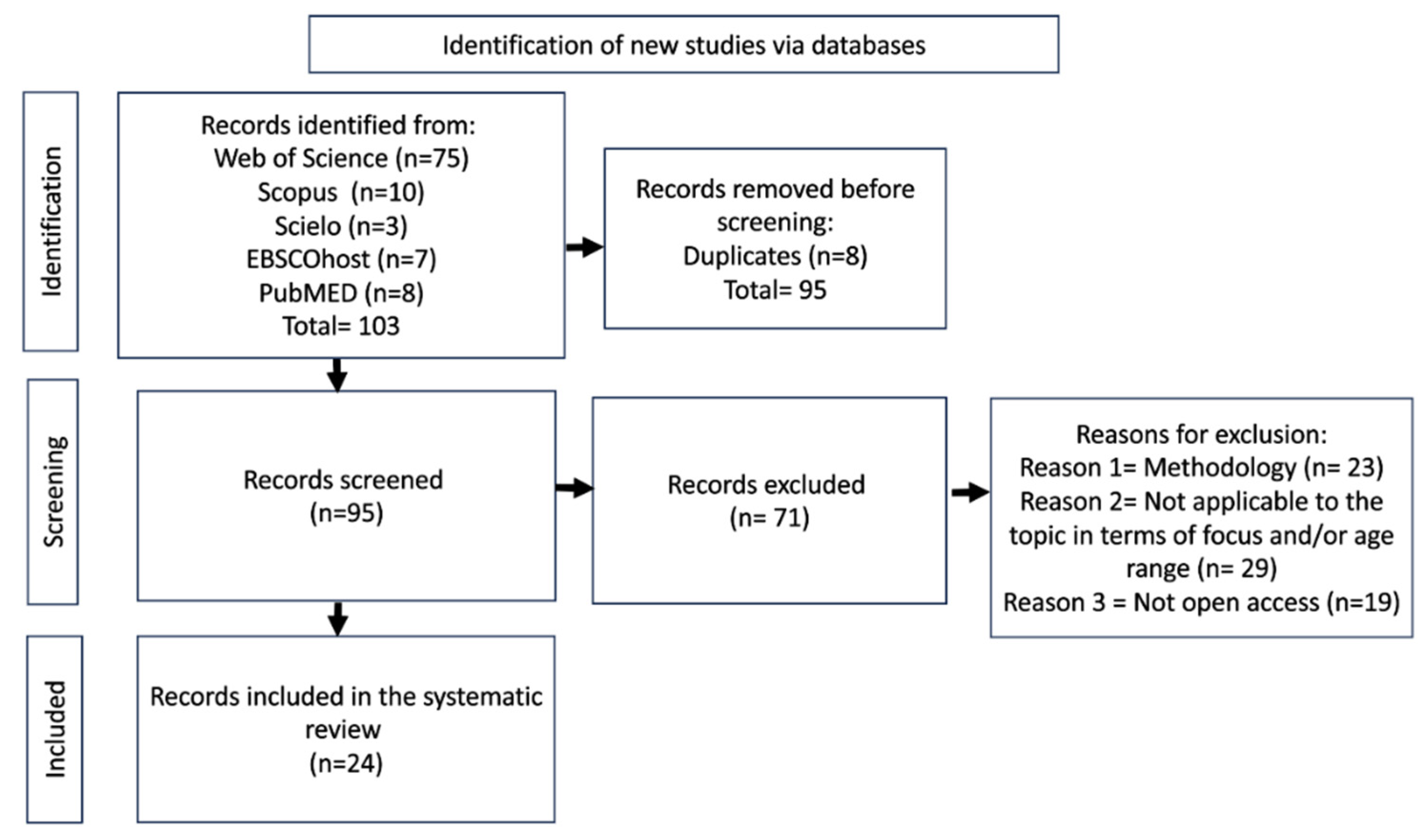
Figure 2.
Individual-level content.
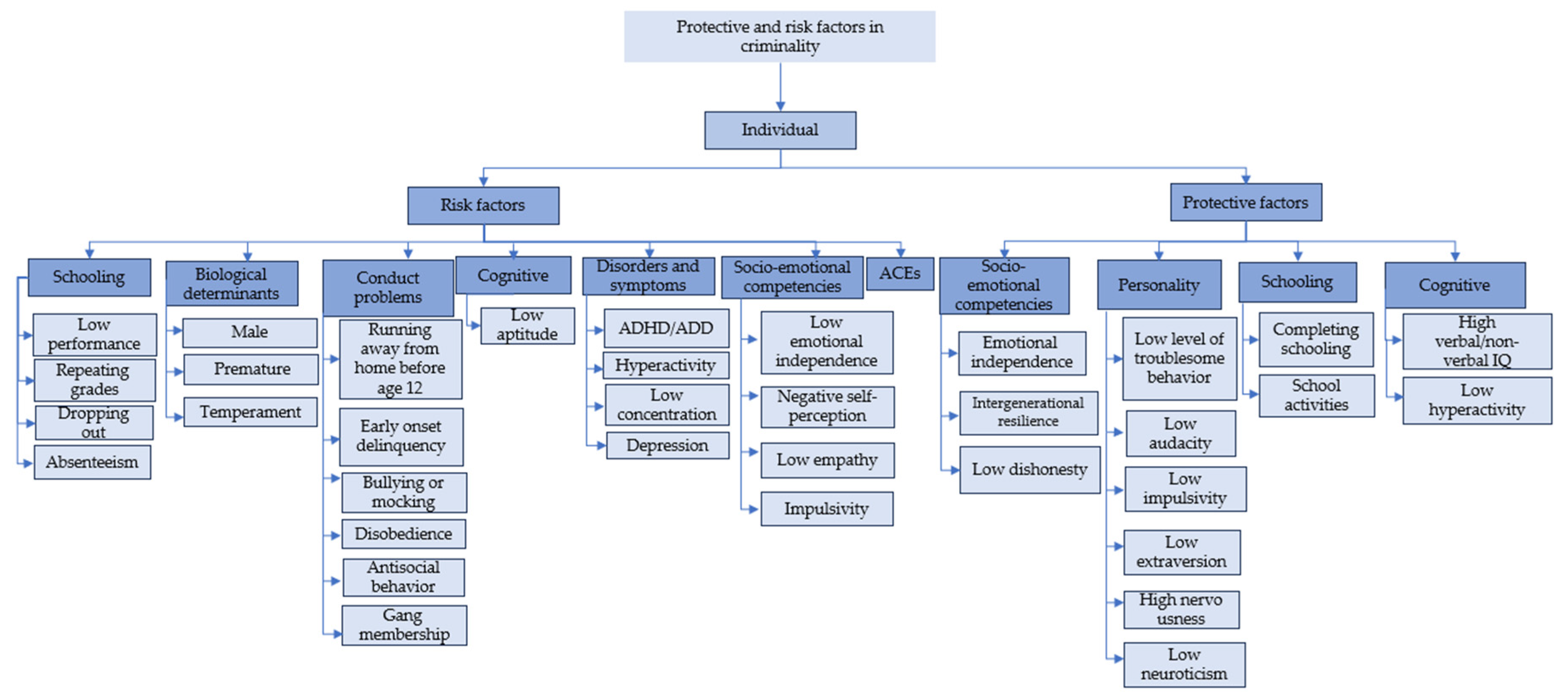
Figure 3.
Family and Community-Level Content.
Disclaimer/Publisher’s Note: The statements, opinions and data contained in all publications are solely those of the individual author(s) and contributor(s) and not of MDPI and/or the editor(s). MDPI and/or the editor(s) disclaim responsibility for any injury to people or property resulting from any ideas, methods, instructions or products referred to in the content. |
© 2024 by the authors. Licensee MDPI, Basel, Switzerland. This article is an open access article distributed under the terms and conditions of the Creative Commons Attribution (CC BY) license (http://creativecommons.org/licenses/by/4.0/).
Copyright: This open access article is published under a Creative Commons CC BY 4.0 license, which permit the free download, distribution, and reuse, provided that the author and preprint are cited in any reuse.


