

Submitted:
09 July 2024
Posted:
10 July 2024
You are already at the latest version
Abstract
The revolutionary idea of complementary intelligence involves a unique strategy in which artificial intelligence (AI) works with human cognitive abilities embodied by natural intelligence (NI), creating a harmonious partnership instead of engaging in a competitive relationship. This innovative concept can potentially revolutionize how we approach scientific research and discovery. This cutting-edge process capitalizes on pooling the vast information from various distinct and autonomous sources to generate forecasts that frequently outshine human perspectives by significant margins, leading to groundbreaking advancements in scientific development based on hybrid intelligence. Multilayer networks extend traditional network theory to adjacent layers linked through copula nodes. Artificial intelligence, with its retrieval capacity to collect and interpret big data, sharply increases the number of nodes and their linking interpretation. This process, amplified by multilayer networks, dramatically improves the scalability of the networked ecosystem. Multilayer networks can represent NI and AI in complementary hyperplanes, connecting them with copula nodes and edge properties. Thus, it is possible to measure the interaction of NI and AI, assessing their scalable value co-creation properties. This study examines the interaction of NI and AI with an innovative and multidisciplinary approach. A theoretical framework of these related concepts precedes practical insights for possible applications in future research.
Keywords:
network theory
; nodes
; edges
; scalability
; hybrid intelligence
; complementary intelligence
; value co-creation
; power laws
1. Introduction
The concept of complementary (hybrid) intelligence, a strategy where artificial intelligence (AI) augments human cognitive capabilities rather than competing with them, is gaining traction. This innovative approach harnesses the collective knowledge of diverse and independent sources to make predictions that often surpass human insights by years, marking significant milestones in scientific progress. The potential of AI to revolutionize scientific discovery is not just promising, but it is crucial for the future of scientific research. It also underscores the urgent need for collaboration between artificial and natural intelligence, an essential partnership for revolutionary discoveries and progressions that we, as a scientific community, are responsible for fostering. This collaboration is not just beneficial but necessary for the future of scientific research.
Moreover, information-theoretic methodologies unveil the inner workings of neural networks by simplifying them into more understandable forms devoid of hidden layers, thereby boosting overall performance and yielding weights akin to linear correlation coefficients between inputs and outputs.
A novel network-flow model for artificial neural networks (ANN) has emerged. Unlike traditional multilayer architectures, this model does not depend on a multilayer structure, providing a broader framework. It maintains the accomplishments of conventional multilayer ANNs while potentially revealing more universal characteristics. This model is not just a new development but an exciting one that ignites anticipation about the future of AI.
By amalgamating these diverse strategies, AI can sidestep the cognitive biases inherent in the scientific community, producing hypotheses that supplement human intelligence and enrich collective human knowledge. This pattern fosters innovative potential, empowering us as part of a larger scientific community. This comprehensive understanding of multilayer networks underscores the extraordinary capabilities of AI when it is engineered to collaborate harmoniously with natural intelligence, ultimately leading to revolutionary discoveries and progressions.
Artificial and organic intelligence complement each other by utilizing their strengths to solve intricate issues and amplify human skills. In natural intelligence, which manifests in the brains of animals and humans, proficiency is evident in rapid learning, broad generalization abilities, autonomy, and creativity owing to its highly organized structure and self-arranged network patterns known as net fragments. These net fragments facilitate swift learning and effective generalization from minimal examples. The structured regularity inherent in natural intelligence enables it to efficiently connect abstract objectives with real-world scenarios, bridging the gap seamlessly.
AI excels in handling vast amounts of data, pattern recognition, and process optimization, particularly valuable in domains like pharmaceutical discovery. AI's strengths in these areas reassure us of its potential to significantly impact scientific research and discovery. The potential of AI is not just promising, but it is crucial for the future of scientific research. AI models can swiftly produce replicable imitations of natural substances, enhancing molecular design efficiency and expediting the discovery of new medicinal applications.
However, AI's reliance on symbolic and verbal representations limits its adaptability in the unpredictable and complex real world, where natural intelligence's holistic perception and comprehension play a vital role. This awareness of AI's challenges is crucial for future research and development in complementary intelligence, and these challenges make the concept of complementary intelligence so important.
Moreover, despite AI's ability to boost speed and efficacy, it faces limitations inherent in digital technologies and often displays an overly reductionist approach. By merging the computational prowess of AI with the adaptive, creative, and holistic problem-solving capabilities of natural intelligence, we can forge more resilient and versatile systems capable of addressing a wider array of challenges.
This fusion enhances human capacities, empowering individuals to navigate and acclimate to rapidly evolving environments more efficiently. Furthermore, it leverages AI's strengths in data processing and optimization to bolster and enrich the decision-making processes of natural intelligence.
- Multilayer networks (Aleta & Moreno, 2019; Berlingerio et al., 2013; Kivelä et al., 2014), also known as multiplex networks or networks of networks, are complex systems where nodes connect following different types of interactions, represented as layers. This framework allows for a more nuanced representation of real-world systems than single-layer networks. This canvas enables connections between nodes across different layers and representing various interactions.
2. Literature Review
To consider the following references in a consistent pattern that illustrates the current literature, we can organize them into a structured framework. This review will highlight how each work contributes to understanding complementary intelligence systems using copula functions. Below is a possible framework for Complementary Intelligence Systems (AI + NI) Using Copula Functions:
- 1.
- Foundational Theories and Methods
Copula Theory: Nelsen (2006) provides a comprehensive introduction to copula functions, which are essential for modeling dependencies between variables in multivariate distributions. Joe (1997) explores multivariate models and the concepts of dependence, providing the mathematical foundation for linking NI and AI layers via copula nodes.
Explainable AI: Samek et al. (2017) discuss methods for making AI decisions transparent and interpretable, which is crucial for integrating human cognitive insights into AI systems. Montavon et al. (2018) review the techniques for interpreting deep neural networks, highlighting the approaches that enhance human-AI collaboration.
- 2.
- Neural Networks and Multilayer Networks
Goodfellow et al. (2016) illustrate a comprehensive guide to deep learning techniques, providing the theoretical and practical knowledge required to build multilayer AI networks. LeCun et al. (2015) overview deep learning advancements, underscoring AI's potential to learn complex patterns that human insights can complement.
- 3.
- Human-AI Collaboration
Dellermann et al. (2019) propose a taxonomy for designing hybrid intelligence systems, emphasizing the collaboration between humans and AI. Horvitz (2016) discusses AI's implications for the future of work, highlighting the importance of creating systems where AI and human intelligence complement each other.
- 4.
- Optimization Techniques
Bottou (2010) explores stochastic gradient descent (SGD) for large-scale machine learning, providing methods to optimize neural networks effectively. Kingma & Ba (2014) introduce the Adam optimization algorithm, widely used for training deep neural networks, including those in complementary intelligence systems.
- 5.
- Human Cognitive Processes and AI
Kahneman (2011) examines human cognitive processes, offering insights into how humans think and make decisions. These insights can inform the design of complementary AI systems. Anderson & Lebiere (1998) present a theory of human cognition to model the human layers in a complementary intelligence system.
The copula theory provides the mathematical foundation for linking NI and AI layers. Explainable AI techniques ensure that the AI decisions are interpretable, facilitating effective human-AI collaboration. Neural network and optimization techniques allow us to build and train sophisticated AI models, while insights from human cognitive processes ensure these models can work synergistically with human intelligence.
This structured approach highlights the interconnectedness of these diverse fields and illustrates the current literature's comprehensive and multidisciplinary nature.
This study represents an advancement in the current literature since it examines the links between NI and AI using a multilayer network ecosystem where copula nodes pollinate both layers, scaling them up and improving the overall value with win-win propositions.
3. Multilayer Networks and AI
Understanding the mathematical properties of these networks, such as degree distribution, clustering coefficient, modularity, inter-layer connectivity, path length, efficiency, robustness, and resilience, provides valuable insights into several features and practical applications. The formulation of these properties falls beyond the scope of this introductory paper and can be found in many quoted references, starting from Bianconi, 2018.
These properties inspire applications, according to which new nodes, extracted from big data/IoT, are collected and stored in the cloud, being validated – if necessary – by blockchains, eventually undergoing artificial intelligence (AI) interpretation (Abiodun et al., 2018) that adds value to the whole ecosystem, establishing new linking edges among the larger node datasets. Multilayer networks further improve the scalability of the connected ecosystems, already ignited by AI multiplication of nodes and edges (Wang et al., 2015).
AI can analyze multilayer networks more efficiently than traditional methods, identifying patterns and anomalies that may not be apparent to human analysts. For instance, machine learning algorithms (Chen et al., 2017) can predict the evolution of these networks or identify key influencers within them.
Kumar & Thakur (2012) have surveyed advanced applications of neural networks and artificial intelligence.
The interaction of AI with multilayer networks can lead to significant improvements in information gains:
- a)
- Advanced Analytics and Pattern Recognition: AI, particularly machine learning (ML) algorithms, can uncover complex patterns and interactions within and across the network layers that might not be apparent through traditional analysis methods.
- b)
- Enhanced Prediction Models: AI can improve the accuracy and efficiency of predictive models in multilayer networks by learning from large datasets, identifying significant features, and adapting to changes in the system dynamics (Boccaletti et al., 2014; De Domenico et al., 2021).
- c)
- Automated Network Optimization: AI techniques can automatically optimize network configurations for better performance, resilience, or efficiency, considering the multilayer nature of the network.
- d)
- Dynamic Network Adaptation: AI-driven systems can monitor multilayer networks in real-time and dynamically adapt to changes, optimizing network performance and mitigating potential issues before they become critical.
- e)
- Improved Data Integration and Processing: AI can enhance the capability to integrate and process data from different layers, enabling more effective decision-making and insights generation.
- f)
- Personalized Recommendations and Services: In multilayer networks representing social or economic systems (Dickison et al., 2016), AI can provide customized recommendations or services by analyzing interconnected data layers (e.g., user preferences, social relationships, and transaction histories).
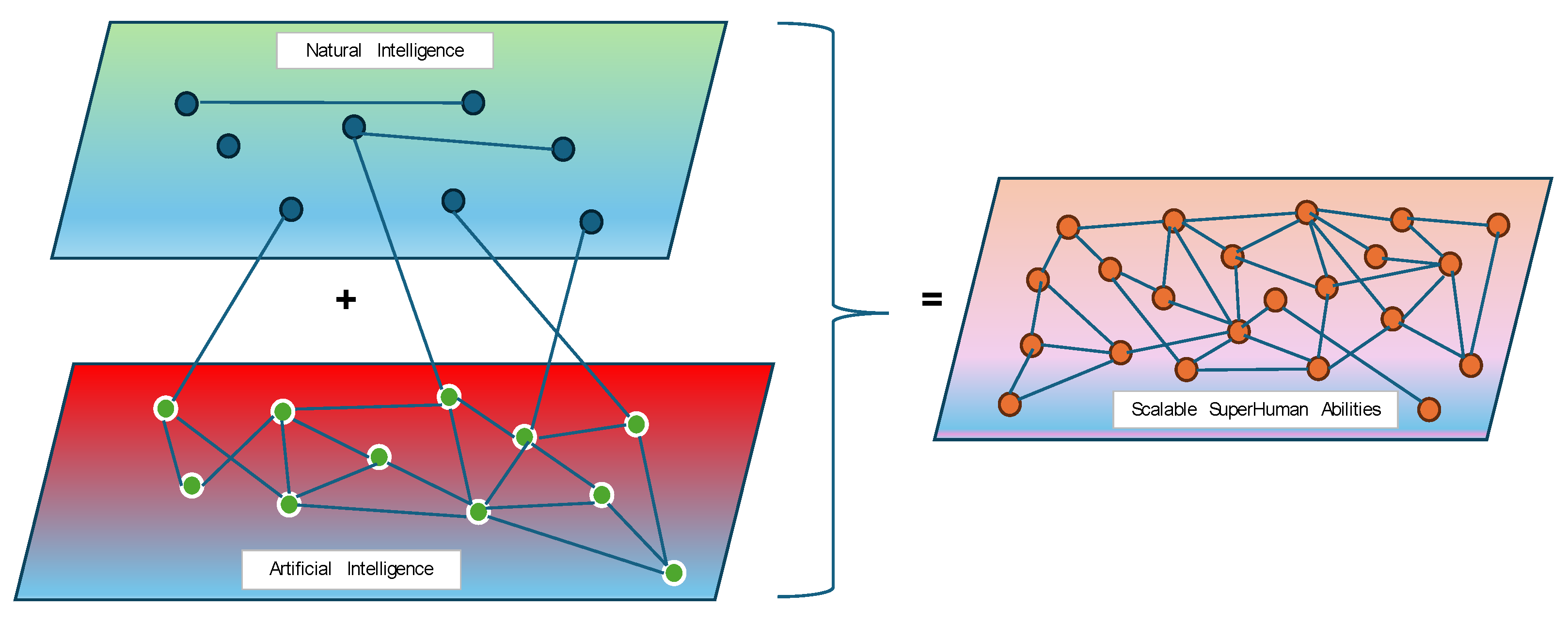
Within this framework, the research question of this study (synthetically represented in Figure 1) investigates how AI and NI interact with multilayer networks, igniting a scalable interpretation of the ecosystems linked by interlayer copula nodes. The purpose is to start a new research stream where on-field experts (physics, mathematicians, IT specialists, etc.) can investigate specific aspects of this broad and somewhat superficial presentation with mathematical models and practical solutions for different fields.
Multilayer networks (Bianconi, 2018) undergo several topographic and mathematical properties shortly recalled in this Section and linked to AI applications.
The literature on multilayer networks inspires the practical patterns illustrated in Table 1.
The following table represents the core part of this introductory paper, which aims to introduce some of the main properties of multilayer networks linked to AI interpretation. This somewhat holistic (but superficial) introduction seeks to provide more comprehensive insights backed by mathematical formulations (not introduced in this preliminary analysis, just for simplicity), graphs, and practical insights.
A synthetic representation of connected concepts, referring to networks and their multilayer extensions, is reported in Appendix A.
4. Enhancing Multilayer Networks with AI
The application of AI in analyzing and optimizing multilayer networks represents a powerful tool for enhancing their design and functionality. As AI techniques become more sophisticated, their ability to understand, predict, and influence the dynamics of complex networks will become increasingly vital across various domains, from technological and biological systems to social and economic networks.
This synergy between AI and multilayer networks advances our understanding of complex systems and opens new avenues for innovation in network-based applications.
In particular, AI links the intangible chain, schematically represented by sourcing information (IoT and big data, warehoused in fog or cloud databases, validated with blockchains, and eventually interpreted with natural intelligence, as briefly schematized in Figure 2.
With AI, the Hermeneutics in Augmented Multilayer Hyperplanes are enhanced by the connecting abilities of AI that introduce new nodes and additional edges, as synthetically shown in Figure 3.
5. Scalable Power Laws
The impact of scalable power laws, especially when ignited by AI within multilayer networks, presents a fascinating intersection of network theory, big data analytics, and AI. Scalable power laws in this context refer to the relationships between elements in a network that can expand or scale predictably, often described by a mathematical power law distribution. The integration of AI significantly amplifies the capabilities and potential applications of these networks, with impacts across various dimensions:
- A.
-
Enhanced Network Efficiency and Scalability
- Complex Network Management: AI's capability to interpret and manage big data allows for more efficient handling of complex, multilayer networks. As networks grow in size and complexity, AI can automate optimizing network paths and connections, leading to more efficient data flow and reduced bottlenecks.
- Scalability: Using scalable power laws, combined with AI, means that networks can grow more efficiently. AI algorithms can predict how networks expand and dynamically adjust resources to meet demand without compromising performance, ensuring that the network can scale up or down as needed.
- B.
-
Improved Data Analysis and Decision Making
- Data Interpretation: AI enhances the ability to analyze data across different network layers, uncovering patterns that may not be visible through traditional analysis methods. This can lead to better decision-making, as AI can provide insights based on a comprehensive view of the networked ecosystem.
- Predictive Analytics: Integrating AI with multilayer networks enables predictive analytics of future network states based on current data. This capability is crucial for anticipating and mitigating potential issues before they impact the network.
- C.
-
Broader Practical Applications
- Healthcare: In healthcare, multilayer networks combined with AI can improve patient outcomes by integrating and analyzing data across various healthcare providers, research databases, and patient records, allowing for personalized and timely medical interventions.
- Smart Cities: For smart cities, AI-driven multilayer networks can optimize traffic flow, energy distribution, and emergency services by analyzing and responding to data from many sensors and sources in real time.
- D.
-
Challenges and Considerations
- Privacy and Security: As networks become more interconnected and data-driven, the potential for privacy breaches and security threats increases. Ensuring the security of multilayer networks and the privacy of the data they handle is a significant challenge.
- Complexity and Governance: The increased complexity of AI-driven multilayer networks raises questions about governance, accountability, and control. Developing frameworks for the ethical and effective management of these networks is crucial.
The impact of scalable power laws, fueled by AI, on multilayer networks, is profound, offering enhanced efficiency, scalability, and a wide range of practical applications. However, these advancements also bring privacy, security, and governance challenges, which need careful consideration and management. Future research in this area will likely address these challenges while exploring new applications and ways to maximize the benefits of AI-driven multilayer networks.
6. How do Copula Functions Foster AI-NI Integration?
Copula functions play a crucial role in integrating artificial and natural intelligence. They serve as the bridge connecting the two, allowing for the seamless exchange of information and creating a unified intelligence system that leverages the strengths of both AI and NI.
They offer a robust framework for modeling and simulating the relationships between multiple variables, essential for making accurate predictions and informed decisions. Incorporating copulas enables linking multivariate distribution functions with their one-dimensional marginal distributions, eliminating the necessity to assume multivariate normality or independence across dimensions. This adaptability proves especially advantageous in AI applications dealing with intricate, high-dimensional datasets.
An example is the Neural Copula technique, which utilizes a hierarchical unsupervised neural network to estimate both the marginal and copula functions through the solution of differential equations. This approach creates smooth and analytically expressible copulas that surpass traditional methods in effectively fitting complex distributions. Moreover, models based on copulas, like the Khoudraji-Liebscher copula functions, have demonstrated superior performance in predicting phenomena such as rainfall interception, showcasing their practical value in environmental modeling by yielding lower root mean square error (RMSE) and mean absolute error (MAE) values.
Incorporating copulas into AI systems also enhances their capability to aggregate univariate uncertainty representations into a multivariate framework, accommodating diverse forms of imprecision and dependencies like belief functions and necessity functions. Additionally, copula-based universal integrals expand the scope of these functions to finite universes, thereby amplifying their usefulness in discrete data scenarios often encountered in AI applications. In summary, using copula functions within AI-NI integration furnishes a potent instrument for capturing and representing complex dependencies, ultimately leading to the development of more precise and dependable AI systems.
7. A Mathematical Interpretation of Copula Nodes
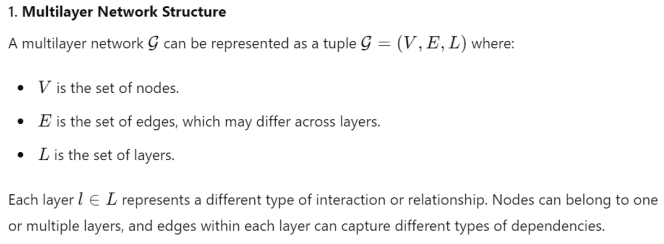
Copula functions are a potent instrument in statistics and machine learning. They capture the intricate web of relationships between various random variables. These Copula nodes, operating via Copula functions, present a sturdy foundation for depicting dependencies across numerous variables, ultimately facilitating the development of adaptable and robust statistical and machine-learning models.
This separation allows for a more nuanced and precise control over the interrelationships among variables, enhancing the overall understanding and manipulation of complex data patterns.
-
Copula Functions
- Copula Nodes in Multilayer Networks
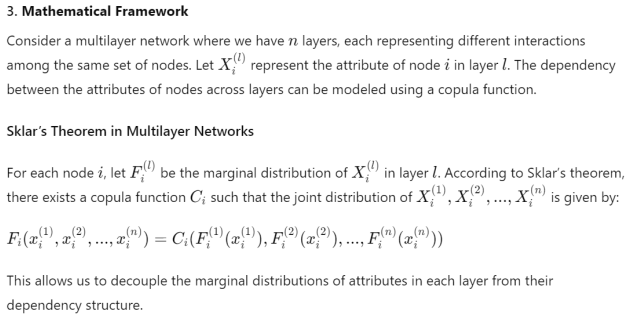
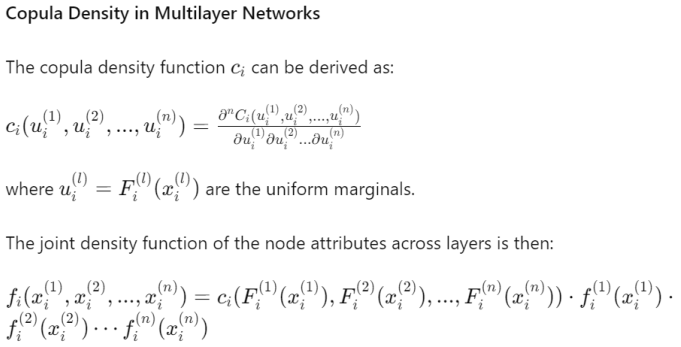
In this context, copula nodes illustrate the dependencies between the various network layers. Specifically, copula functions can link the distribution of node attributes or interactions across layers, allowing for a more holistic modeling of the network's structure.
- Applications to Natural Intelligence and AI
Each layer uniquely showcases diverse dimensions like cognitive functions, interpersonal dynamics, and AI decision-making mechanisms in the intricate web of a multilayer network that connects natural and artificial intelligence realms. Nestled within these layers are copula nodes that skillfully grasp the intricate dependencies between these facets, offering a profound understanding of the complicated dance between human intellect and the workings of AI systems.
An example scenario may consider a multilayer network with three layers:
- Layer 1: Cognitive processes of humans (e.g., problem-solving abilities).
- Layer 2: Social human interactions (e.g., communication patterns).
- Layer 3: AI system interactions (e.g., recommendations or decisions made by AI).

By implementing suitable copula models, we can delve into the intricate connections between an individual's cognitive functions and interpersonal dynamics, further exploring how interactions with artificial intelligence shape these dynamics. Unraveling these complex relationships can pave the way for a deeper understanding of how AI systems can be seamlessly integrated with human behavior, ultimately fostering a synergy that boosts collaborative intelligence to unprecedented levels of efficacy and innovation.
Copula nodes in multilayer networks provide a powerful mathematical framework for modeling and understanding complex dependencies across interactions and relationships. By applying copula functions, we can decouple marginal distributions from dependency structures, allowing for a more flexible and comprehensive analysis of how natural intelligence and AI interact within a multilayer network.
This approach illustrates integrating human cognitive and social processes with AI systems, fostering enhanced collaborative intelligence.
8. Adjacent Multilayer Networks with Copula Nodes That Link NI and AI Layers
To understand the properties and mathematical formulations of adjacent multilayer networks connected by copula nodes that link natural intelligence layers with AI layers, it is important first to detect the key components and then consider their mathematical representations.
The Key Components of Multilayer Networks are represented by:
- −
- Natural Intelligence (NI) Layers: These layers represent human cognitive processes and decision-making.
- −
- Artificial Intelligence (AI) Layers: These layers represent artificial neural networks or machine learning models.
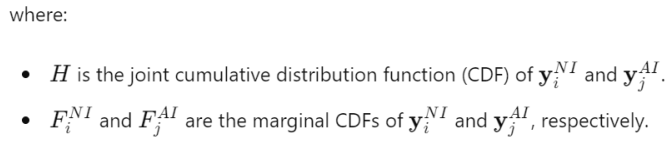
Copula Nodes are functions that couple multivariate distribution functions to their one-dimensional marginal distribution functions. In this context, copula nodes link the outputs of NI layers to AI layers, capturing the dependency structure between them.
The properties of multilayer networks linked through copula nodes include:
- a)
- Interconnectedness: The copula nodes facilitate the transfer of information between NI and AI layers, ensuring the integration of NI into AI processing and vice versa.
- b)
- Dependency Modeling: Copula nodes capture the dependency between the outputs of NI and AI layers, allowing for more nuanced and accurate modeling of joint distributions.
- c)
- Layer-wise Interactions: Each layer in NI can be connected to multiple layers in AI through copula nodes, allowing for complex interactions and information flow.
The mathematical formulations are:
1. Multilayer Network Representation:

- 2.
-
Copula Function:

- 3.
- Dependency Structure:
The copula function captures the dependency structure between the NI and AI layers. Common choices for copulas include Gaussian copulas, t-copulas, Clayton copulas, and Gumbel copulas, each modeling a different type of dependency structure.
- 4.
-
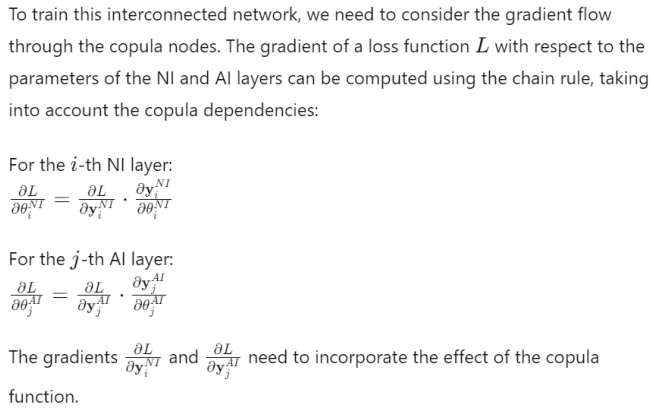
Layer-wise Backpropagation:
- 5.
- Optimization:
Such a network can be optimized using stochastic gradient descent (SGD) or variants. The copula-induced dependencies are considered during the gradient update steps, ensuring the optimization process's robustness. The properties of adjacent multilayer networks connected by copula nodes involve the ability to model dependencies between human cognitive processes and AI models, allowing for complementary intelligence. The mathematical formulation includes defining copula functions to link the outputs of NI and AI layers and incorporating these dependencies into the gradient-based training process of the network. This approach leverages the strengths of both natural and artificial intelligence, potentially leading to more robust and insightful predictive models.
A graphical representation of potential multilayer networks that connect NI and AI through copula nodes can be tentatively illustrated in Figure 4.
9. Hybrid (Complementary) Intelligence
Collaboratively merging AI and NI, referred to as Complementary Intelligence (CI), heralds a transformative paradigm shift in which AI and NI harmonize synergistically rather than engaging in competition. This harmonious and cooperative strategy has the potential to propel groundbreaking advancements in scientific research and problem-solving by harnessing the distinct strengths of both entities. AI's remarkable capability to analyze vast volumes of data complements human intuition and contextual comprehension, resulting in more precise predictions and profound insights.
This amalgamation, known as Hybrid Intelligence, merges AI's computational prowess with human ingenuity, intuition, and ethical discernment, elevating overall performance to new heights. The interaction between AI and NI in intricate multilayer networks is based on intermediary copula nodes and edge characteristics that facilitate dynamic collaboration and knowledge exchange.
This conceptual framework provides a more nuanced insight into how AI and NI can collaboratively create value on a scalable level, amplifying each other's contributions and engendering innovative perspectives. Moreover, delving into interdisciplinary realms that bridge disciplines such as cognitive science, computer science, and philosophy can yield fresh viewpoints on CI, nurturing a comprehensive and interconnected approach to integrating AI and NI.
Adhering to principles of responsible and ethical AI utilization in creative endeavors, as delineated in the proposed "fundamental laws of generative AI," ensures that this partnership upholds human values and moral principles, thereby averting the propagation of harmful content and fostering a promising future for creativity and AI.
While initial implementations of collaborative intelligence are predominantly in the prototyping phase, they have showcased the potential for enhancing efficiency, fostering creativity, and ensuring safety across diverse sectors, including healthcare, emergency response, and knowledge-based tasks.
By amalgamating insights from diverse origins and synthesizing AI-driven and human-generated data, we can attain a more thorough and precise comprehension of complex challenges, propelling the boundaries of scientific knowledge and problem-solving to unprecedented advancement.
10. Discussion and Conclusion
The study explores the win-win propositions for NI and AI in a multilayer network ecosystem, showing that copula nodes are crucial in scaling up and improving the overall value.
Copula functions bridge artificial and natural intelligence for seamless information exchange. The neural Copula technique uses an unsupervised neural network to estimate copula functions. Khoudraji-Liebscher copula functions show superior performance in predicting phenomena. Copulas in AI systems aggregate uncertainty representations into the multivariate framework.
Examining the links between NI and AI advances the existing literature. Future research can accurately model dependencies between variables in various fields using copula functions. Copula nodes allow researchers to create flexible statistical and ML models with a clear understanding of dependencies. Separating marginal behavior from dependencies provides a deeper understanding and manipulation of multivariate distributions. Using copula nodes gives researchers a robust framework for developing advanced statistical models.
The network layers provide a framework for understanding how human intelligence and AI systems interact. These nodes offer a way to study the interconnectedness of cognitive processes, social interactions, and AI decision-making. By examining these connections, a deeper understanding of how natural intelligence and AI can impact each other is achieved.
Fitting copula models can analyze relationships between cognitive processes, social interactions, and AI. Copula functions allow for a comprehensive analysis of how human and AI interactions intertwine. The integration of mental and social processes with AI fosters collaborative intelligence. The properties and formulations of networks linking natural intelligence and AI layers are explored.
The copula nodes are crucial in capturing the dependency structure between different layers. By connecting the outputs of various layers, copula nodes help understand the dependency relationships. Understanding the role of copula nodes is essential for analyzing the relationships within neural networks. Incorporating copula nodes enhances the modeling of intricate dependencies within the network architecture.
The copula nodes act as bridges, facilitating the transfer of insights between natural intelligence and artificial intelligence layers, enhancing the overall network's interconnectedness. Different copula choices, such as Gaussian, t-copulas, Clayton copulas, and Gumbel copulas, are utilized to model diverse dependency structures between the outputs of natural intelligence and artificial intelligence layers. The network's optimization process, including stochastic gradient descent, incorporates copula-induced dependencies between NI and AI layers, ensuring the robustness of the optimization process and enhancing the network's performance.
The interconnected multilayer networks, linked by copula nodes, enable the modeling of dependencies between human cognitive processes and AI models, leveraging the strengths of both natural and artificial intelligence for more insightful predictive models.
The interaction of AI with multilayer networks represents a pioneering approach to enhancing how we understand and leverage information gains within complex systems. By incorporating various types of interactions across different layers, multilayer networks provide a richer and more nuanced representation of real-world systems than traditional single-layer networks. While offering a more detailed view, this complexity requires advanced analytical methods to unlock its full potential.
AI, especially machine learning algorithms, plays a critical role in this context by offering the computational power and sophistication needed to analyze these complex networks efficiently. Here are several ways in which the interaction of AI with multilayer networks leads to significant improvements in information gains:
- a)
- Predictive Analytics: AI algorithms can process vast amounts of data from multilayer networks to predict future network evolution. This predictive capability is vital for various applications, from anticipating social media trends to forecasting the spread of diseases within interconnected populations.
- b)
- Anomaly Detection: AI is adept at identifying patterns and deviations from these patterns within data. In multilayer networks, this means being able to spot anomalies or unexpected behavior across different layers, which could indicate issues like system failures, fraud, or emerging social phenomena.
- c)
- Optimized Connectivity and Robustness: Through analyzing network properties such as inter-layer connectivity and path length, AI can suggest optimizations that improve the efficiency and resilience of these networks. This could lead to more robust telecommunications, transportation, and energy distribution infrastructures.
- d)
- Enhanced Interpretation and Decision-Making: AI's ability to interpret complex datasets from multilayer networks adds significant value by providing actionable insights. This can inform better decision-making in urban planning, environmental management, and public health, among other fields.
- e)
- Scalability and Dynamic Adaptation: As new nodes are added to the network, AI can help manage the increased complexity, ensuring the network scales effectively. This is particularly important in fast-evolving systems like IoT devices or large-scale social networks.
- f)
- Security and Trust: Integrating blockchain technologies for validating new nodes and transactions within multilayer networks introduces additional protection and trust. AI can enhance these aspects by detecting potential security breaches and ensuring the integrity of the blockchain.
- g)
- Interdisciplinary Innovation: The insights gained from AI analysis of multilayer networks can drive innovation across disciplines, from enhancing social network analysis to improving the efficiency of transportation systems and even advancing the study of neural networks in biology.
In conclusion, the under-investigated interaction between AI and multilayer networks opens new research and practical avenues for understanding complex and interrelated ecosystems. This synergy not only advances scientific and technical knowledge but also has interdisciplinary practical implications (see, for instance, Rawat et al., 2018; Rana et al., 2018).
Appendix A. Multilayer Network Properties and AI Interactions
| Multilayer networks – properties |
AI interactions |
| Architecture / Design / model complexity / random graphs / Small word and growing networks |
Architecture / Design AI impacts the architecture and design of multilayer networks by optimizing network structures for better performance and efficiency. For example, AI algorithms can suggest the optimal number of layers or connections needed to achieve desired outcomes, such as minimizing latency or maximizing throughput. In designing resilient networks, AI can simulate different failure scenarios to ensure robustness against attacks or malfunctions. Model Complexity AI helps in managing the complexity of models used to represent multilayer networks. These networks' sheer scale and intricacy can overwhelm traditional modeling techniques. Machine learning models, especially those involving deep learning, can handle high-dimensional data and uncover complex inter-layer interactions that simpler models cannot. This enables more accurate predictions and insights into network behavior. Random Graphs AI can provide new ways to analyze and interpret these models in the context of random graphs used to model the randomness in network connections. For instance, AI techniques can detect patterns or structures within random graphs that might signify underlying processes or influences affecting the network. This can be particularly useful in understanding the robustness and vulnerability of multilayer networks to various types of failures or attacks. Small-World Networks Small-world networks have high clustering and short path lengths. AI can play a significant role in identifying and analyzing these networks, which often appear in social networks, brain networks, and other biological systems. Machine learning algorithms can uncover the small-world properties in large datasets, helping researchers understand the efficiency of information transfer within these networks and the implications for dynamics like spreading processes. Growing Networks Growing networks, which evolve by adding new nodes and connections, are common in many real-world scenarios. AI techniques are essential for modeling and predicting the growth patterns of these networks. For example, AI can help understand how social networks expand or how new connections in a transportation system might affect overall network efficiency and resilience. |
| Complex networks / scale-free networks |
Complex Networks Complex networks have intricate connection patterns between nodes, including features like high clustering, small-world properties, and community structure. AI impacts the study and application of complex networks in several ways:
Scale-free networks are a type of complex network characterized by a power-law distribution of node connectivity, meaning a few nodes have a very high degree of connections while most have relatively few. This property emerges from many real-world networks, including the Internet, biological, and social networks. AI's impact on scale-free networks includes:
|
| Degree correlation, degree sequence, average degree, aggregated degree, and degree distribution / multilayer degree |
Degree Correlation Degree correlation refers to the tendency of nodes in a network to connect with other nodes with similar (or dissimilar) connections. AI, especially through predictive modeling and pattern recognition, can analyze degree correlations to uncover the underlying organizational principles of networks. This analysis helps understand how network structure influences its resilience and dynamics, such as the spread of information or diseases. Degree Sequence The degree sequence is a list of degrees of all nodes in the network, usually sorted in non-increasing order. AI can analyze degree sequences to classify networks, predict evolution, and understand network robustness. Machine learning models can identify patterns in degree sequences that are indicative of specific network types or properties, enabling more effective network design and intervention strategies. Average Degree The average degree of a network is a simple yet important metric indicating the average number of connections per node. AI techniques can help analyze how the average degree influences network dynamics, such as connectivity and the efficiency of information or epidemic spreading. AI can also predict changes in the average degree as networks grow or evolve, aiding in network planning and management. Aggregated Degree In multilayer networks, the aggregated degree combines the degrees of nodes across all layers, providing a holistic measure of node connectivity. AI can analyze aggregated degrees to understand the multifaceted nature of node importance and influence in multilayer networks. This insight is crucial for applications ranging from infrastructure resilience planning to targeted marketing strategies. Degree Distribution Degree distribution, the probability distribution of degrees over the entire network, helps characterize the network's structure (e.g., scale-free or random). AI models, which handle complex, high-dimensional data, can analyze degree distributions to infer network models and predict network behavior under various conditions. Multilayer Degree The multilayer degree extends the concept of degree to multilayer networks, considering the connections of a node across different layers. AI's role is pivotal in analyzing multilayer degrees to uncover the roles and influences of nodes in a more nuanced way than single-layer analyses allow. This capability is vital for understanding complex systems like social networks, where individuals engage in different interactions, or transportation systems, where various modes of transport are interconnected. |
| Overlaps, multi-links, and multi-degrees |
Overlaps Overlaps in multilayer networks refer to nodes or links present in multiple layers of the network, indicating a degree of redundancy or multiplexity in relationships. AI, especially machine learning techniques, can analyze these overlaps to uncover insights into the resilience and robustness of networks and the multifunctionality of certain nodes or links. For instance, overlaps might indicate strong ties between individuals in social networks, while in transportation networks, they could highlight critical infrastructure serving multiple functions. AI can help quantify and optimize these overlaps for better network performance and resilience. Multi-links Multi-links are connections between the same set of nodes across different layers of a multilayer network. These links can carry various interactions or relationships, adding to the network's complexity. AI methods are crucial for analyzing multi-links to understand how different types of relationships interact and influence overall network dynamics. This analysis can reveal how information or influence flows across different layers and how disruptions in one layer might affect others. By applying network analysis algorithms and machine learning models, AI can identify critical multi-links and suggest strategies to leverage or protect them. Multi-degrees The concept of multi-degree extends the node degree to multilayer networks by considering a node's connections across all layers. This measure provides a more comprehensive view of a node's importance or centrality in the network. AI techniques can analyze multi-degree distributions to identify key nodes that play crucial roles across multiple network layers. For example, nodes with high multi-degrees in biological networks might be essential genes or proteins that participate in multiple pathways. In social networks, they could represent influential individuals engaged in various social circles. AI's capability to handle complex, high-dimensional data makes it possible to efficiently analyze multi-degrees and their impact on network structure and dynamics. |
| Scalability / efficiency / modularity / performance |
Scalability
|
| Path length / Shortest distance / navigability |
Path Length
|
| Dynamics (Robustness / resilience / percolation / Epidemic Spreading versus Immunization / Diffusion / Random Walks / Synchroniza-tion) |
Robustness and Resilience
|
| Network Control / bias |
Network Control
|
| Data Learning and Generaliza-tion |
Data Learning
|
| Clustering coefficients, communities |
Clustering Coefficients
|
| Causality links (directed /undirected networks) |
Causality Detection and Analysis
|
| Centralities (Eigenvector; Katz; PageRank; betweenness; communica-bility; nodes versatility …) |
Eigenvector Centrality
|
| Inter-layer connectivity and interdependence / Replica nodes / Orphan (uncorrelated) Networks |
Inter-layer Connectivity and Interdependence
|
| Nodes and Edges Creation and loops |
Nodes and Edges Creation
|
| Temporal multilayer Networks /Synchroni-zation / Disconti-nuity / Pattern formation |
Temporal Multilayer Networks
|
| Multilayer Network Communities / consensus clustering |
Multilayer Network Communities
|
| Similarity Indexes (based on Information Theory) |
Enhanced Similarity Analysis
|
| Multilayer Network Modelling |
Enhanced Modeling Capabilities
|
| Game theoretical approaches |
Strategic Modeling and Optimization
|
| Inizio modulo. | |
References
- Abiodun, O. I., Jantan, A., Omolara, A. E., Dada, K. V., Mohamed, N. A., & Arshad, H. (2018). State-of-the-art in artificial neural network applications: A survey. Heliyon, 4(11).
- Aleta, A., & Moreno, Y. (2019). Multilayer networks in a nutshell. Annual Review of Condensed Matter Physics, 10, 45-62. [CrossRef]
- Anderson, J. R., & Lebiere, C. (1998). The Atomic Components of Thought. Lawrence Erlbaum Associates.
- Berlingerio, M., Coscia, M., Giannotti, F., Monreale, A., & Pedreschi, D. (2013). Multidimensional networks: foundations of structural analysis. World Wide Web, 16, 567-593. [CrossRef]
- Bianconi, G. (2018), Multilayer Networks. Structure and Function, Oxford University Press, Oxford.
- Boccaletti, S., Bianconi, G., Criado, R., Del Genio, C. I., Gómez-Gardenes, J., Romance, M.,... & Zanin, M. (2014). The structure and dynamics of multilayer networks. Physics reports, 544(1), 1-122. [CrossRef]
- Bottou, L. (2010). Large-scale machine learning with stochastic gradient descent. Proceedings of COMPSTAT'2010, 177-186.
- Chen, M., Challita, U., Saad, W., Yin, C., & Debbah, M. (2017). Machine learning for wireless networks with artificial intelligence: A tutorial on neural networks. arXiv preprint, arXiv:1710.02913, 9.
- De Domenico, M., Stella, M., Kiani, N. A., Gomez-Cabrero, D., & Bianconi, G. (2021). Dynamics on multilayer networks, Cambridge University Press, UK.
- Dellermann, D., Calma, A., Lipusch, N., Weber, T., Weigel, S., & Ebel, P. (2019). The future of human-AI collaboration: a taxonomy of design knowledge for hybrid intelligence systems. Proceedings of the 52nd Hawaii International Conference on System Sciences.
- Dellermann, D., Ebel, P., Söllner, M., & Leimeister, J. M. (2019). Hybrid intelligence. Business & Information Systems Engineering, 61(5), 637-643.
- Dickison, M. E., Magnani, M., & Rossi, L. (2016). Multilayer social networks. Cambridge University Press.
- Goodfellow, I., Bengio, Y., & Courville, A. (2016). Deep Learning. MIT Press.
- Hemmer, P., Schellhammer, S., Vössing, M., Jakubik, J., & Satzger, G. (2022). Forming effective human-AI teams: building machine learning models that complement the capabilities of multiple experts. arXiv preprint. arXiv:2206.07948.
- Horvitz, E. (2016). Artificial intelligence and the future of work. Communications of the ACM, 59(10), 5-7.
- Joe, H. (1997). Multivariate Models and Multivariate Dependence Concepts. CRC Press.
- Kahneman, D. (2011). Thinking, Fast and Slow. Farrar, Straus and Giroux.
- Kingma, D. P., & Ba, J. (2014). Adam: A method for stochastic optimization. arXiv preprint. arXiv:1412.6980.
- Kivelä, M., Arenas, A., Barthelemy, M., Gleeson, J. P., Moreno, Y., & Porter, M. A. (2014). Multilayer networks. Journal of complex networks, 2(3), 203-271. [CrossRef]
- Kumar, K., & Thakur, G. S. M. (2012). Advanced applications of neural networks and artificial intelligence: A review. International journal of information technology and computer science, 4(6), 57. [CrossRef]
- LeCun, Y., Bengio, Y., & Hinton, G. (2015). Deep learning. Nature, 521(7553), 436-444. [CrossRef]
- Mocanu, D. C., Mocanu, E., Stone, P., Nguyen, P. H., Gibescu, M., & Liotta, A. (2018). Scalable training of artificial neural networks with adaptive sparse connectivity inspired by network science. Nature communications, 9(1), 2383. [CrossRef]
- Montavon, G., Samek, W., & Müller, K. R. (2018). Methods for interpreting and understanding deep neural networks. Digital Signal Processing, 73, 1-15. [CrossRef]
- Moro-Visconti, R. (2024). Artificial Intelligence Valuation: The Impact on Automation, BioTech, ChatBots, FinTech, B2B2C, and Other Industries. Cham: Palgrave Macmillan.
- Moro-Visconti, R., Cruz Rambaud, S., & López Pascual, J. (2023). Artificial intelligence-driven scalability and its impact on the sustainability and valuation of traditional firms. Humanities and Social Sciences Communications, 10(1), 1-14. [CrossRef]
- Nelsen, R. B. (2006). An Introduction to Copulas. Springer.
- Ostheimer, J., Chowdhury, S., & Iqbal, S. (2021). An alliance of humans and machines for machine learning: Hybrid intelligent systems and their design principles. Technology in Society, 66, 101647. [CrossRef]
- Pang, S. P., Li, C., Fang, C., & Han, G. Z. (2019). Controlling edge dynamics in multilayer networks. Physica A: Statistical Mechanics and its Applications, 528, 121273.
- Rana, A., Rawat, A. S., Bijalwan, A., & Bahuguna, H. (2018, August). Application of multi layer (perceptron) artificial neural network in the diagnosis system: a systematic review. In 2018 International conference on research in intelligent and computing in engineering (RICE) (pp. 1-6). IEEE.
- Rawat, A. S., Rana, A., Kumar, A., & Bagwari, A. (2018). Application of multi layer artificial neural network in the diagnosis system: A systematic review. IAES International Journal of Artificial Intelligence, 7(3), 138.
- Samek, W., Wiegand, T., & Müller, K. R. (2017). Explainable artificial intelligence: Understanding, visualizing, and interpreting deep learning models. arXiv preprint. arXiv:1708.08296.
- Schleiger, E., Mason, C., Naughtin, C., Reeson, A., & Paris, C. (2024). Collaborative Intelligence: A scoping review of current applications. Applied Artificial Intelligence, 38(1), 2327890. [CrossRef]
- Sen, S., Singh, K. P., & Chakraborty, P. (2023). Dealing with imbalanced regression problem for large dataset using scalable Artificial Neural Network. New Astronomy, 99, 101959. [CrossRef]
- Sourati, J., & Evans, J. (2021). Accelerating science with human versus alien artificial intelligence. arXiv preprint. arXiv:2104.05188.
- Sourati, J., & Evans, J. (2022). Complementary artificial intelligence designed to augment human discovery. arXiv preprint. arXiv:2207.00902.
- Sourati, J., & Evans, J. A. (2023). Accelerating science with human-aware artificial intelligence. Nature human behavior, 7(10), 1682-1696. [CrossRef]
- Tsao, J. Y., Abbott, R. G., Crowder, D. C., Desai, S., Dingreville, R. P. M., Fowler, J. E.,... & Stracuzzi, D. J. (2024). AI for Technoscientific Discovery: A Human-Inspired Architecture. Journal of Creativity, 34(2), 100077. [CrossRef]
- Vinchon, F., Lubart, T., Bartolotta, S., Gironnay, V., Botella, M., Bourgeois-Bougrine, S.,... & Gaggioli, A. (2023). Artificial Intelligence & Creativity: A manifesto for collaboration. The Journal of Creative Behavior, 57(4), 472-484. [CrossRef]
- Wang, X., Li, X., & Leung, V. C. (2015). Artificial intelligence-based techniques for emerging heterogeneous network: State of the arts, opportunities, and challenges. IEEE Access, 3, 1379-1391. [CrossRef]
- Xu, W., & Gao, Z. (2023). Applying human-centered AI in developing effective human-AI teaming: A perspective of human-AI joint cognitive systems. arXiv preprint. arXiv:2307.03913.
- Yang, J., & Peng, Y. (2020). To Root Artificial Intelligence Deeply in Basic Science for a New Generation of AI. arXiv preprint. arXiv:2009.05678.
- Zeng, Z., & Wang, T. (2022). Neural Copula: A unified framework for estimating generic high-dimensional Copula functions. arXiv preprint. arXiv:2205.15031.
Figure 1.
Interaction of Multilayer Networks and AI to produce Scalable Interpretation of Adjacent Ecosystems.
Figure 1.
Interaction of Multilayer Networks and AI to produce Scalable Interpretation of Adjacent Ecosystems.
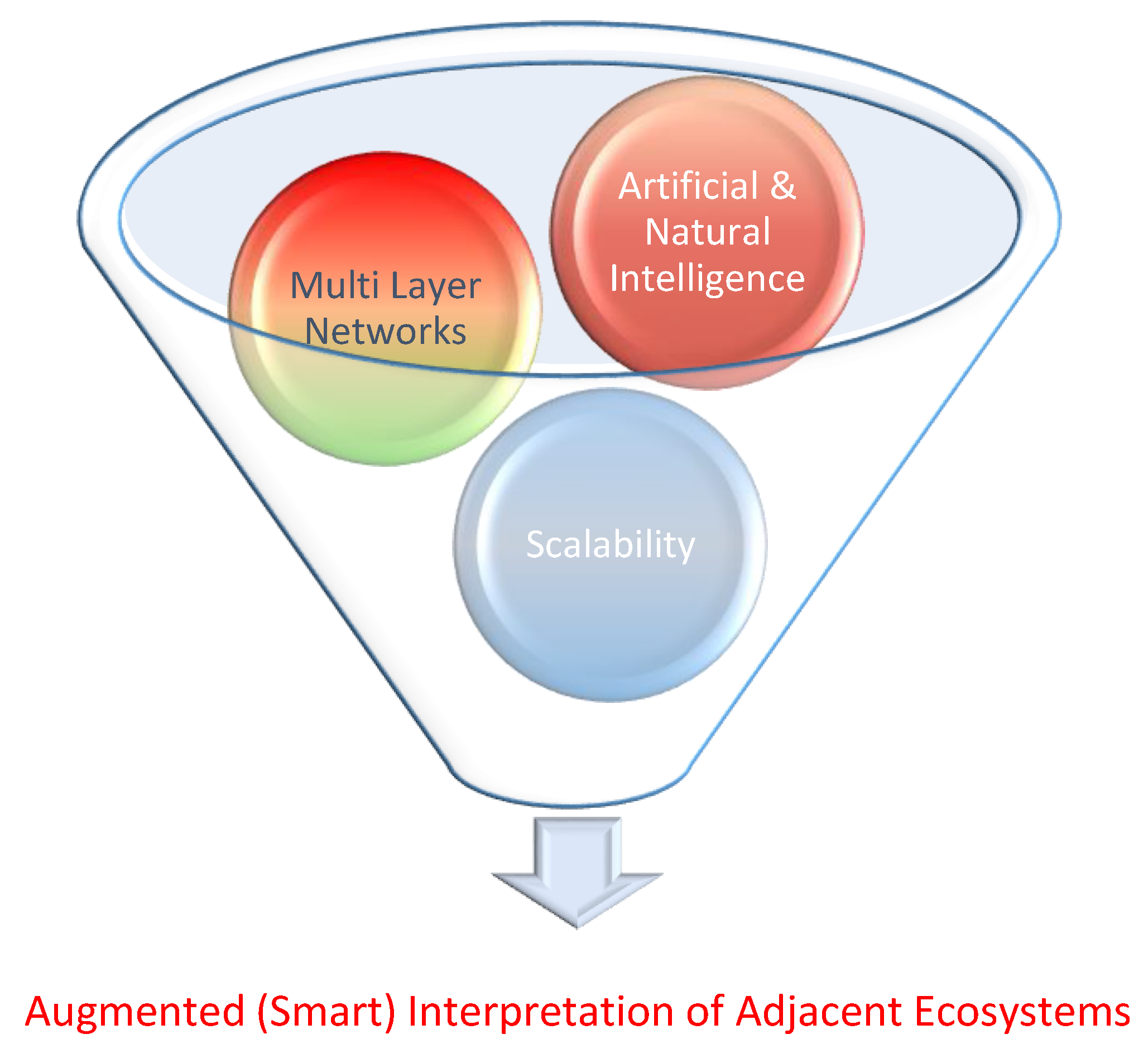
Figure 2.
Natural Intelligence Hermeneutics in Standard Networked Ecosystems.
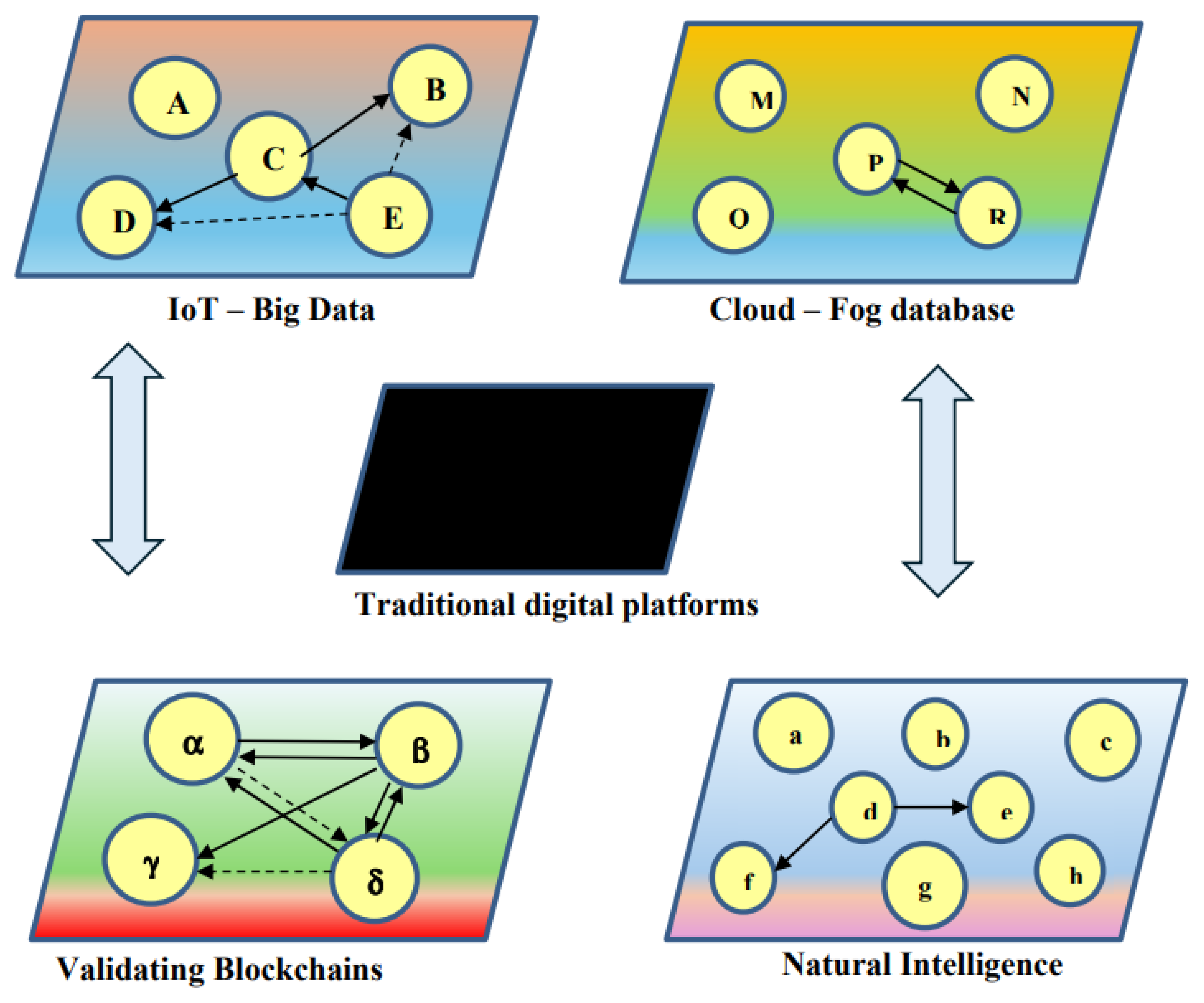
Figure 3.
Artificial Intelligence Hermeneutics in Augmented Multilayer Hyperplanes.
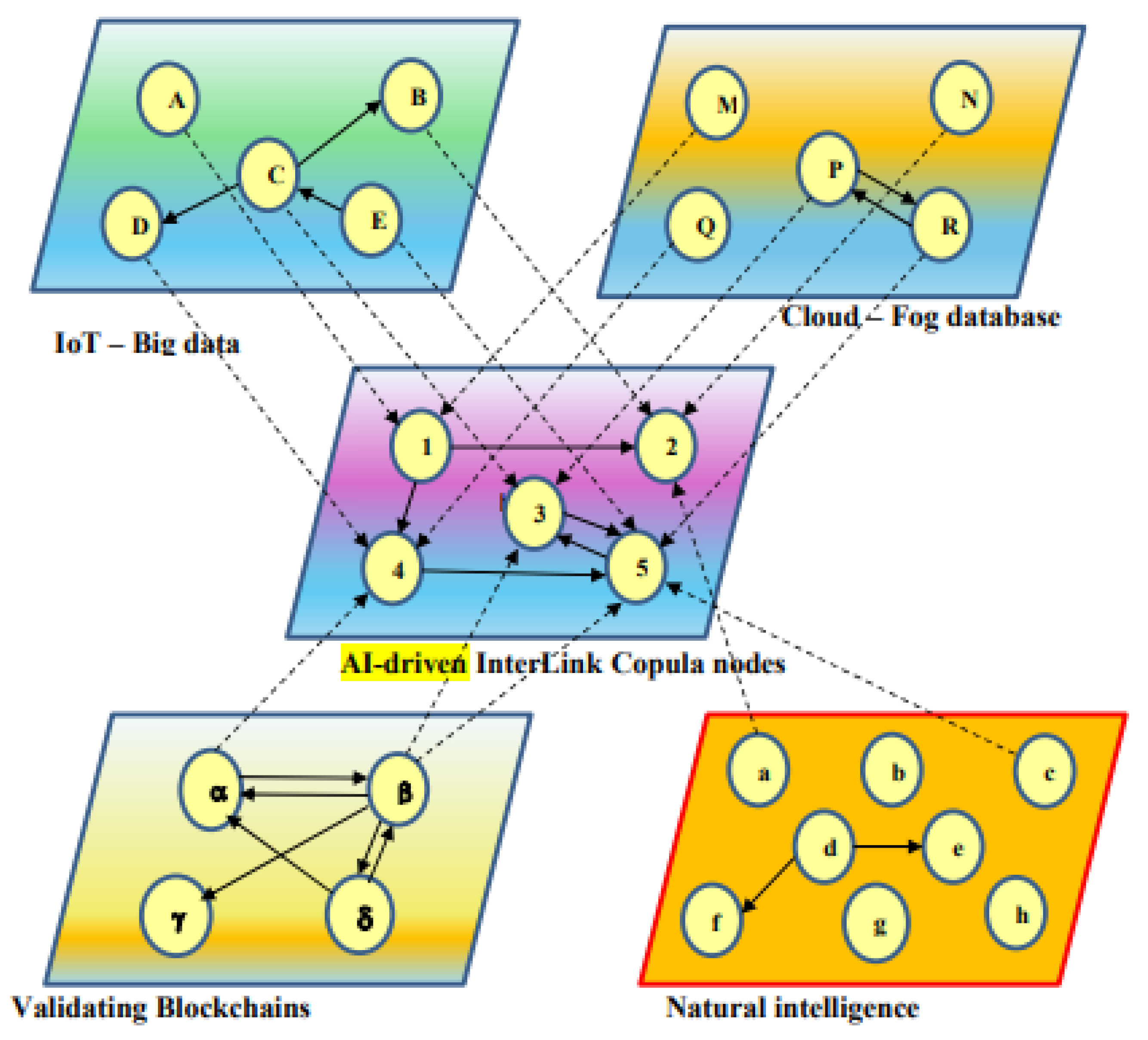
Figure 4.
Multilayer Networks Connecting Natural and Artificial Intelligence.
Disclaimer/Publisher’s Note: The statements, opinions and data contained in all publications are solely those of the individual author(s) and contributor(s) and not of MDPI and/or the editor(s). MDPI and/or the editor(s) disclaim responsibility for any injury to people or property resulting from any ideas, methods, instructions or products referred to in the content. |
© 2024 by the authors. Licensee MDPI, Basel, Switzerland. This article is an open access article distributed under the terms and conditions of the Creative Commons Attribution (CC BY) license (http://creativecommons.org/licenses/by/4.0/).
Copyright: This open access article is published under a Creative Commons CC BY 4.0 license, which permit the free download, distribution, and reuse, provided that the author and preprint are cited in any reuse.


