

Submitted:
03 July 2024
Posted:
05 July 2024
You are already at the latest version
Abstract
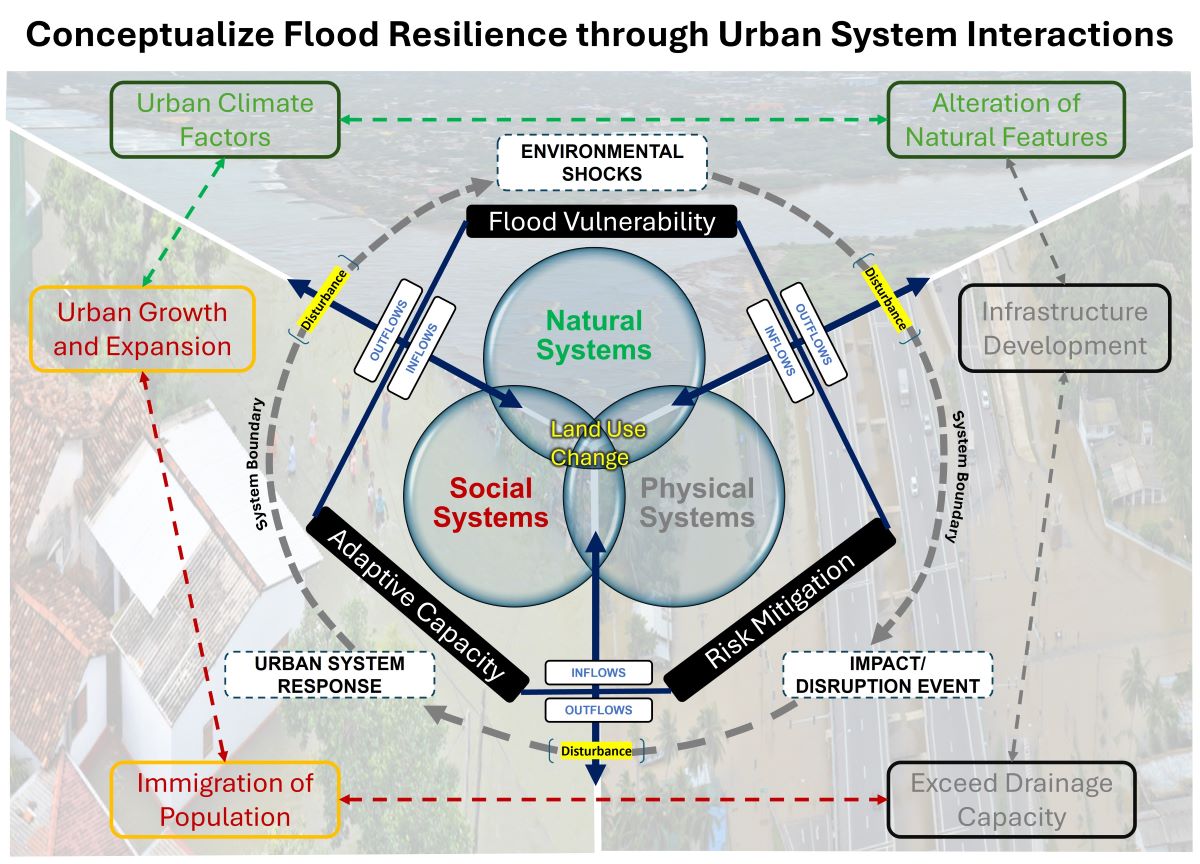
Urbanization-led economic growth has created cities to drive infrastructure investments and population accumulation and exploit natural resources at an extreme phase. While coastal cities become vulnerable to climate change-induced extreme weather events and human-made disasters in recent history, effective measures to improve the resilience of cities are pivotal to developing sustainable living environments. This study proposes a framework to assess urban resilience to natural disasters (floods) using bottom-up spatial interactions among natural, physical, and social systems within cities and regions. It is noted that studies focus on either the vulnerability or coping capacity of urban communities to assess resilience, where effective strategies to manage disaster risk demand adaptation and mitigation measures at a spatial scale. Quantified resilience at small spatial units assists urban planning and disaster management agencies in the timely allocation of resources to optimize the recovery process. Moreover, spatial planning agencies can adopt resilience mapping to identify the potential growth zones while minimizing the natural disaster risks in urban growth management. Urban resilience can be embodied in spatial strategies with the operational framework proposed here, and future urban growth scenarios can be tested in multiple disaster conditions.
Keywords:
Flood Resilience
; Urban Planning
; Land Use Change
; Vulnerability
; Coping Capacity
1. Introduction
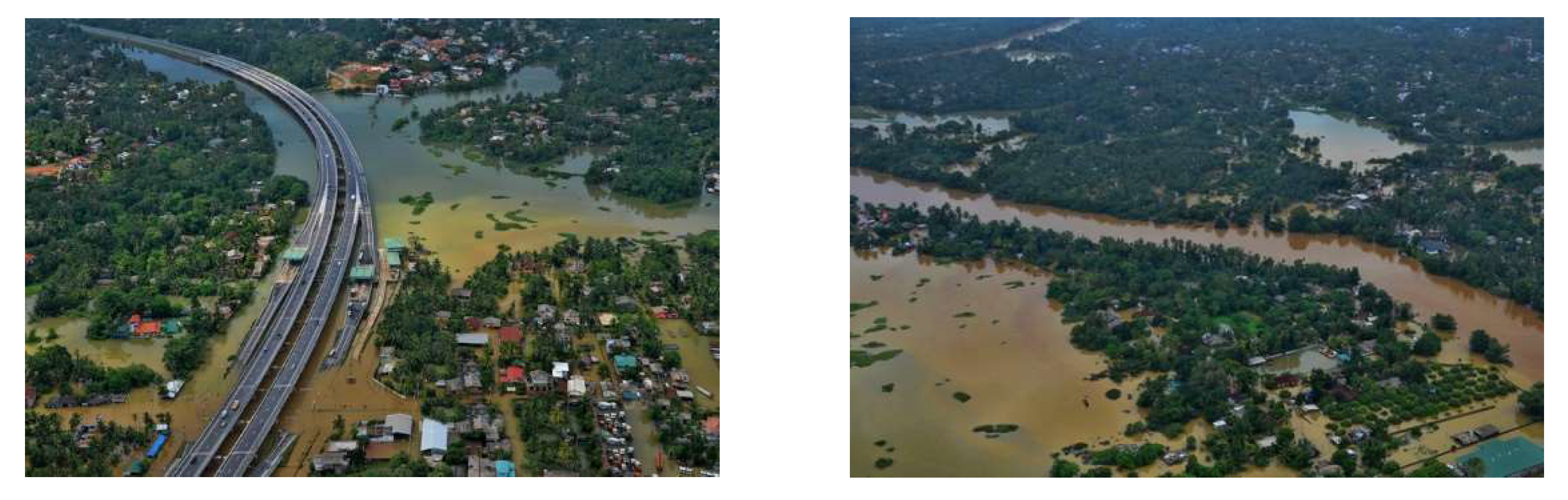
The rapid growth of technology and innovation in the last century has improved the quality of life of people. Most importantly, this has happened in cities where necessary infrastructure and services are available to facilitate creativity and human desires. Cities account for over 80% of the global Gross Domestic Product, are home to over 56% of the global population, and occupy only about 3% of the total land area globally (Liu et al., 2014; WorldBank, 2022). The concentration of economic activities encouraged rural-to-urban migration, and the urban population is expected to reach over 68% by 2050, as it is predicted that 7 out of 10 people will live in cities (U.N., 2019). Accumulating such a population in comparatively modest spatial entities can have economies of scale while increasing vulnerability to unforeseen natural and manufactured threats. Since the competition for limited resources in the world is growing, pressure on natural resources and ecosystems can induce the risk of cities to natural hazards (Wu, 2014). Floods are one of the most catastrophic disasters cities face, affecting millions of populations and damaging economies in an irreversible way (Re, 2021). Cities have invested in structural measures and adaptive strategies over the past to tackle the negative impacts of flood disasters on cities, yet the destruction and losses have continued consistently. In this context, managing the city’s vulnerability and coping capacity to floods caused by extreme weather events is paramount in promoting safe, inclusive, and sustainable human settlements as identified by Sustainable Development Goal 11 (Assembly, 2015). Colombo, the commercial capital of Sri Lanka, has experienced floods annually with significant damages to infrastructure, humans, and livelihoods. Rapidly responding to flood risk is essential by using timely coordinated adaptation and mitigation strategies. In 2016, riverine floods around Colombo City caused losses worth billions of dollars and affected millions of families (Error! Reference source not found.).
Figure 1.
Flood Impact on Colombo city and suburbs in Sri Lanka from heavy rainfall occurred in May 2016 (Source: Sri Lanka Air Force).
Figure 1.
Flood Impact on Colombo city and suburbs in Sri Lanka from heavy rainfall occurred in May 2016 (Source: Sri Lanka Air Force).
This study uses a novel framework to assess urban resilience to natural disasters, using pluvial floods as a common experience in many cities. Many scholars quantified urban resilience with a domain-specific perspective, which accounts for either vulnerability from physical terms or coping capacity from social terms in cities. However, urban planners and disaster management professionals require an integrated framework that accounts for both the risk factors and tolerance features of a community to make effective recovery plans and long-term strategies to improve resilience to disaster situations. Moreover, the resilience features can vary from spatially to temporally with urban growth and dynamic socio-economic conditions in cities, as well as the intensity of natural factors such as rainfall in flood situations. Therefore, the framework must be flexible enough to incorporate new factors and changing urban system components that can be sensitive to damage and resource availability during natural disasters. Therefore, this framework is expected to provide a comprehensive view of urban resilience for decision-makers to measure the spatial variation of resilience in the context of rapid urbanization or land use change at the micro-scale in cities.
2. Existing Research on Urban Resilience
Resilience is a concept introduced by Holling (1973) to explain the response of ecosystems to external shocks by absorbing changes and maintaining essential functions with persistence. It was introduced as a system property against the stability function, which demanded the return to equilibrium facing shock or stress. In a broad sense, resilience is the ability of a system, community, or society exposed to shocks or stresses to resist, absorb, and recover promptly and efficiently by preserving and restoring its essential basic structures and core functions (UNISDR, 2005). Seminal work applying the resilience concept accumulated in multiple sectors, including engineering, medicine, natural, and social sciences. Recently, the focus of resilience assessment has frequently been oriented on urban environments due to challenges posed by urbanization and related hazards (Borden et al., 2007; Cutter et al., 2003; Quarantelli, 2003; U.N., 2019). In the context of shocks and stresses, cities face multiple physical and socio-economic challenges to maintain their status, making resilience a vital focus area within the urban planning discipline. The scarcity of lands, diminished ecosystem services, the complexity of urban density, and service provisions are critical to targeting urban resilience through planning interventions (Sharma, 2022).
Scholars explained complex phenomena and the dynamic nature of urban problems in city environments using the concept of resilience. According to Sharifi (2020), the resilience research passed three distinct temporal stages, namely the initiation phase (1998-2010), the growth phase (2010-2015), and the rapid growth phase (2015-2020), with distinctive variations of research, focusing on risk mitigation and vulnerability assessments to adaptation based disaster resilience approaches. Therefore, urban resilience research has evolved into socio-ecological and adaptive capacity orientation from the traditional vulnerability-based engineering focus targeting ‘bounce-back-to-previous-state.’ This is vital in the context of resilience theory (Masten et al., 1990), as community responses to hazards are essential in disaster risk as much as the physical structures and spatial factors. Moreover, infrastructure, institutional, and environmental aspects were prioritized to explain the socio-economic dimensions of resilience.
The disciplinary focus of resilience in literature has two broad thematic applications. One is on return to equilibrium with efficiency and predictability focus (engineering focus), and the other is the transition into a different equilibrium by absorbing the change during stress (ecological focus) (Masnavi et al., 2019). Since socio-economic factors play a crucial role in city environments, ecological focus through adaptation and behavioral aspects are commonly seen in urban resilience research (Borden et al., 2007; Cutter et al., 2003; Zhang et al., 2020). However, community behavior during hazards and underlying socio-ecological factors are challenging to evaluate due to the complexity of behavior and context-specific spatial and temporal features. Nevertheless, understanding human behavior at natural hazards is essential to manage response strategies. Therefore, resilience measures need to incorporate interdependencies among natural, social, and physical entities within cities in the context of disasters. Neighborhood level (micro) changes and city or regional level impacts (macro) are necessary to explain urban resilience in the face of shocks, as relationships between each other have an explicit link to resilience assessment frameworks. Error! Reference source not found. shows the focus areas of urban resilience studies in the recent past.

Table 1.
Focus areas of urban resilience studies in the last decade.
| Source/ Author | Major Theme | Key focus areas | Application/ Framework |
|---|---|---|---|
| (Zhang et al., 2020) (Abdrabo & Hassaan, 2015) |
Climate Change Impacts | Urban Resilience Index to assess spatial vulnerability and adaptation. City as a combination of subsystems Socio-economic and physical aspects of cities at spatial scale. |
City Scale/ Conceptual |
| (Gu, 2019) (Gencer, 2013) |
Urban Hazards and Disaster Risk | Spatial assessment of vulnerability to natural hazards Cities are hotspots based on risk level using exposure and vulnerability. Multiple disaster risks based on available secondary data. |
Regional or Global (Cities)/ Empirical (Spatial) |
| (Li et al., 2020) (Mukherjee & Takara, 2018) |
Sustainability and Green Infrastructure | Green infrastructure as a countermeasure to manage the risk of natural disasters. Intra-city scale spatial assessment Ecosystem services for engineering resilience perspective. |
City Scale/ Conceptual Application |
| (Diržytė et al., 2017) (Shapiro & Verchick, 2017) |
Adaptative Capacity and Social Inequity | Inequity in resource allocation is a critical reason for the vulnerability of people in urban areas. Socio-economic vulnerability and resilience interaction within cities Personal values, governance, and education towards risk reduction. |
Community-scale (Non-Spatial)/ Conceptual |
| (Ammara et al., 2022) (Arafah et al., 2018) |
Smart Cities and Resilience Applications | Technology inclusion in city operations can contribute significantly to urban resilience. Limitations of urban models to incorporate human behavioral aspects as dynamic interactions. Hardware and software embedded in smart city operations are valuable tools for managing disaster impacts. |
City scale (Digital Twins)/ Conceptual framework |
| (Sharma, 2022) (Meerow et al., 2016) |
Urban Planning and Cities | Urban planning disciplinary focus on urban resilience in cities. Answering resilience of what, where, when, why, and who from the planner’s lens. Acknowledge complexity in urban systems and adaptive capacity as a natural process to bring open discourse to planning practice. |
City scale/ Conceptual framework |
3. Challenges of Urban Resilience Measurement
Since the inception of resilience as a concept in Ecology, it has been widely applied in multiple disciplines (Meerow et al., 2016). Sustainability and climate change-related environmental protection were at the forefront of resilience studies until the late 20th century due to global tensions on pollution and green growth focus (Sharifi, 2020). The same trend continued into urban planning research due to the vulnerability of cities and the need for resilience thinking to manage complex problems urban communities face. Masnavi et al. (2019) stated that resilience research on cities has undergone four unique phases. First, the ecological concept has been used as a theoretical base to explain natural phenomena (Holling, 1973). Second, conceptual applications were commonly used as frameworks to explain the problems in social-ecological systems (Walker et al., 2004). The third phase considered cities as open living systems to explain city structure related to the ecosystem view (Folke, 2006). In the fourth phase, the urban system’s resilience was assessed from temporal vulnerability changes (Chelleri et al., 2015). This flow shows the research direction on cities as vulnerable products of urbanization initiated by spatial assessments and temporal variations. However, a few research studies have focused on simplifying the complexity of city problems using single or multiple variables. The resilience concept itself has been vague and used by various researchers to explain different phenomena such as vulnerability, adaptive capacity, risks, and mitigation measures using physical and social aspects interchangeably (Masnavi et al., 2019; Meerow et al., 2016). Moreover, conceptual frameworks developed by many researchers needed to have the operational aspects at the city scale, which increased the concept’s ambiguity even further at the ground level (Datola et al., 2022; Du et al., 2020).
Existing challenges in urban resilience research can be classified under ‘urban’ and ‘resilience’ specific challenges. Measuring resilience in the urban environment has been a challenge due to the complexity of spatial boundaries. Unlike ecological systems, defining urban growth boundaries is challenging as several hypothetical boundaries interact in city spaces, ranging from administration to functional boundaries. Moreover, considering cities as ‘open’ systems causes complexities in assessments oriented towards vague definitions and limited focus. Therefore, defining urban areas is vital at the inception stage to clarify the interdependencies and complex nature of feedback in the assessment framework (Meerow et al., 2016). The use of empirical indices to explain resilience through vulnerability, risk, and adaptation perspectives has become popular in the recent past by integrating social dimensions into the assessment (Feldmeyer et al., 2021). However, challenges are evident between the spatial scales and underlying socio-economic drivers to determine the resilience of cities in the face of shocks and stresses. For example, many studies considered exogenous threats to cities, such as climate change or economic recessions, to analyze urban resilience. A few studies used internal features like community capacity and resource availability to explain the resilience parameters (See Error! Reference source not found.). Moreover, the traditional use of vulnerability assessments to explain the resilience of cities is insufficient to explain the endogenous characteristics of cities, causal factors to vulnerability, and required policy changes on time. This situation has become complex due to multiple definitions of adaptive capacity and resilience among scholars in the field. Therefore, current research needs a consistent framework to conceptualize and operationalize resilience using empirical evidence with a specific focus on the structure of cities.
Cities face multiple challenges caused by natural or artificial causes, including floods, landslides, droughts, famine, epidemics, and security threats such as wars. These disasters can affect city populations on multiple scales and timelines. Moreover, the physical and social capacities can determine the ability of communities to recover from disasters regardless of the scale of the damage. For example, a city with improved physical resources and mitigation measures can face a natural disaster in a better preparation than a city with poor economic strength to face extreme weather events. According to Béné (2013), a farmer who sells his oxen during a drought season to survive can be less resilient than a farmer who uses his savings to pass the same drought period. From a short-term perspective, both farmers have used available resources to recover from the stress, while the latter had more resources to be more resilient than the former. However, if we keep out the temporal variation of survival strategy (short-term versus long-term farming needs), both the farmers have recovered from the stress. Therefore, operational resilience measures must specify a comprehensive view of the problem rather than descriptors of resilience variables. Moreover, resilience measures must be stress-specific, whereas the same framework cannot be used for multiple stresses at multiple scales. Variables used for a flood event differ from a drought event, yet the causal linkages (excess or lack of water) and impact population could be the same (city population). Therefore, selecting the most appropriate tools to measure the spatial and temporal variation of resilience for specific disasters or stress is vital yet challenging in urban resilience research.
4. Current Spatial Modeling Frameworks
Measuring resilience at the city scale is essential to measure the ability of cities to maintain their critical functions during natural disasters such as floods. However, due to the complexity of urban systems and the non-linearity of disaster impacts, flood resilience measures demand a comprehensive spatial and temporal framework. Spatial vulnerability measures or index-based assessments alone are insufficient to capture the dynamics before and after flood events. Flood risk and assessment are commonly conducted using predictive models for flood hydraulic simulation, within which flow equations for flow variations (Khatooni et al., 2023; Yu et al., 2023). However, empirical urban flood models based on statistical approaches, machine learning, and Geographic Information Systems (GIS) based multicriteria techniques are becoming popular against watershed models, 1-dimensional river routing models, or 2-dimensional flood models in the recent past (Avila-Aceves et al., 2023). From an urban planning perspective, decision-makers focused on the critical infrastructure, flood retention periods, the socio-economic dynamics, and the length of the post-disaster recovery process in cities to initiate resilience strategies.
Systems thinking provides essential insights for cities to focus resilience planning to flood disasters. Cities comprise significant capital assets and urban populations who depend on them (such as water, energy, and food systems), posing significant risks and economic threats of disruption in a flood event (Cao et al., 2021). Complex interactions among critical infrastructure and economic activities demand a holistic view of resilience assessment in urban areas. Urban growth and land use changes are common causes of flood vulnerability (Liu & Shi, 2017; Nasiri et al., 2016; Wu, 2014). Collaboration, sustainable urban growth, and managing city vulnerability are critical in developing resilience in the urban context. Hyogo Framework for Action by the United Nations Office for Disaster Risk Reduction (UNISDR, 2005), 100 Resilient Cities by the Rockefeller Foundation (Rockefeller, 2013), and City Strength Diagnostics by the World Bank (WorldBank, 2018) are some of the frameworks targeted at managing disaster risk through city-scale strategies. Land use changes and their non-linear relationship with urban systems are vital in delivering useful strategies to manage flood resilience. GIS-based frameworks use multiple models to measure land use change and predict future city disaster risks. Error! Reference source not found. shows multiple analytical frameworks applied on an urban scale to measure urban growth in the disaster management domain.
Table 2.
Urban growth assessment frameworks used in disaster management literature.
| Model Type | Land Use Assessment Framework | Methods | Examples/ Authors |
|---|---|---|---|
| Inductive pattern-based models |
Use statistical and machine learning methods of past observations. (i.e., Artificial Neural Networks (ANN)) |
Use proximity, neighborhood, and physical factors to predict future land use | (Feldmeyer et al., 2021), (Al Rifat & Liu, 2022) |
| Cell-based simulation models | Change based on the neighborhood effects and state of the location or moving between equilibriums. (i.e., Cellular Automata (CA) Models) |
SLEUTH model, Combined Markov Chain models | (Tripathy & Kumar, 2019), (Wang et al., 2019), (Ulloa-Espíndola et al., 2023) |
| Sector-based economic models | Supply and demand change from economic and trade activities. (i.e., Statistical Regression (SR) Models) |
Logistic Regression, Generalized Linear models, Bayesian Statistics | (Tehrany et al., 2013), (Sugianto et al., 2022) |
| Spatially disaggregate models | Identify causal relationships affecting the equilibrium of land systems. (i.e., System dynamic (SD) Models) | Market and price-based models, temporal variation of decision-making | (Wu et al., 2011)A, (Bottero et al., 2020), (Datola et al., 2022; Sugianto et al., 2022) |
| Actor-based interaction models | Actors interact with each other to make land use changes. (i.e., Agent-based Models (ABM)) |
Agents, landscape, and interactions, human-nature interactions | (Liu & Shi, 2017), (Baqa et al., 2021), (D’Orazio et al., 2021) |
Sources: (Camacho Olmedo et al., 2018; Kelly et al., 2013; Yang & Li, 2015).
The application of land use change models depends on the purpose of the analysis, data availability, and context-specific determinants. Therefore, each model may have its pros and cons to apply in the context of urban areas. According to Yang and Li (2015), statistical regression models are easy to operate but cannot analyze complex interactions and dynamics. In contrast, ANN-based machine learning models are so complex that they lack the interpretation of land use change dynamics. Moreover, land use or urbanization prediction based on past trends or patterns can easily overlook the complexity of land use decisions and urban dynamics. Therefore, a combination of multiple modeling frameworks is adopted in urban growth research to avoid the limitations of each approach. However, complicated land use change models may provide abnormal results, which can be challenging to interpret with non-linearity in urbanization (Kelly et al., 2013).
Urbanization-induced land use change increases flood vulnerability in two ways. First, the competition for infrastructure facilities and the emergence of built-up areas will increase the impervious cover in cities where the space for infiltration within the topsoil layer diminishes significantly. Second, existing hydrologic networks can be disrupted by urban expansion and uncontrolled reclamations blocking the low-lying water retention areas and wetlands. With the increasing urbanization and compact development in cities, spatial planning interventions need not only the anticipated land use changes but also the risks and vulnerability to flood disasters as a common scenario. The relationship between vulnerability and resilience can be obtained from Equation 1.
Equation 1: Relationship between vulnerability and resilience to flood hazards
Source: (Avila-Aceves et al., 2023; Rehman et al., 2019)
According to Equation 1, flood vulnerability is associated with the probability of flood occurrence and physical factors involved in the land. Most importantly, resilience is inversely proportionate to vulnerability to floods, which accounts for spatial and non-spatial variables to counter. Physical growth dimensions can alter the urban run-off, and rainfall variations affect soil absorption and drainage network flow capacity. Therefore, rainfall and land use change affect the flood resilience of cities by reducing groundwater absorption and amplifying surface run-off (Liang et al., 2023). This can be even worse for cities located in low-lying coastal areas with high water tables. Therefore, urban growth assessment must be followed by a simulation of flood water run-off to evaluate the resilience to flood disasters in cities. Multiple geospatial modeling tools are used for run-off calculation and flood measurement scenarios.
River flooding is a stochastic phenomenon influenced by multiple non-linear factors, making urban flood prediction a complex task (Ellis et al., 2021). However, using geospatial tools improved the vulnerability assessment of urban infrastructure and communities to support decision-making and resource allocation productively (Membele et al., 2022; Rehman et al., 2019). Floods caused by a pluvial process, where persistent and intense rainfall exceeds the run-off capacity of cities, and fluvial flooding caused by overflow of channels exceeding the carrying capacity are essential to simulate as many cities in the world are located either at coastal low-lying areas or riverine regions (Avila-Aceves et al., 2023; Winderl, 2014). Geospatial flood models use hydro-meteorological factors (precipitation, water flow, temperature), topographical features (Digital Elevation Models, slope), soil features, texture, land use, distance to water bodies, and other spatial parameters to assess flood damage. According to Avila-Aceves et al. (2023), empirical geospatial flood models can be categorized into two key sectors based on the techniques used. First, GIS-based multicriteria analysis uses spatial weighting factors according to relative importance. Analytical Hierarchy Process (AHP) and Principal Component Analysis (PCA) are commonly used to assign weights in calculating flood vulnerability (Chan et al., 2022; Tehrany et al., 2013; Z. Zhang et al., 2023). Second, machine learning (ML) algorithms used pattern identification methods to simulate flood inundation and vulnerability. Artificial Neural Networks (ANN), Random Forest (RF), and Support Vector Regression (SVR) are commonly used ML models in flood assessment (Al Rifat & Liu, 2022; Gangrade et al., 2019; Krzhizhanovskaya et al., 2011). However, ML models are generally applied in short-term flood forecasting and applications in warning systems due to their metric relationship among input and output parameters, and the concept of ‘stationarity’ does not apply to complex urban interactions influenced by the flood impact (Yang & Li, 2015). Therefore, flood simulation needs simplified and practical models to support the decision-making process before, during, and after a flood event, which can capture the complexity of urban systems.
5. A Conceptual Framework for Urban Flood Resilience Assessment
The impact of land use changes on flood vulnerability is commonly studied in the literature. At the same time, many cities and countries focused on non-structural mitigation measures to manage future flood vulnerability (Davoudi et al., 2012; Hall & Penning-Rowsell, 2010; Liu & Shi, 2017). Based on the systems theory of cities, urban resilience can be assessed as the capacity of multiple urban systems, including structural interactions among natural, social, and physical entities, to manage natural disasters (Harrison & Williams, 2016; Meadows, 2008). In line with systems thinking, this study conceptualized urban flood resilience as a balance among natural, social, and physical entities within the urban fabric in cities. Error! Reference source not found. shows the graphical illustration of the integration of three subsystems to achieve urban flood resilience.
Figure 2.
Graphical Representation of Urban System Interactions during Flood Disaster in Cities (Source: Author).
Figure 2.
Graphical Representation of Urban System Interactions during Flood Disaster in Cities (Source: Author).
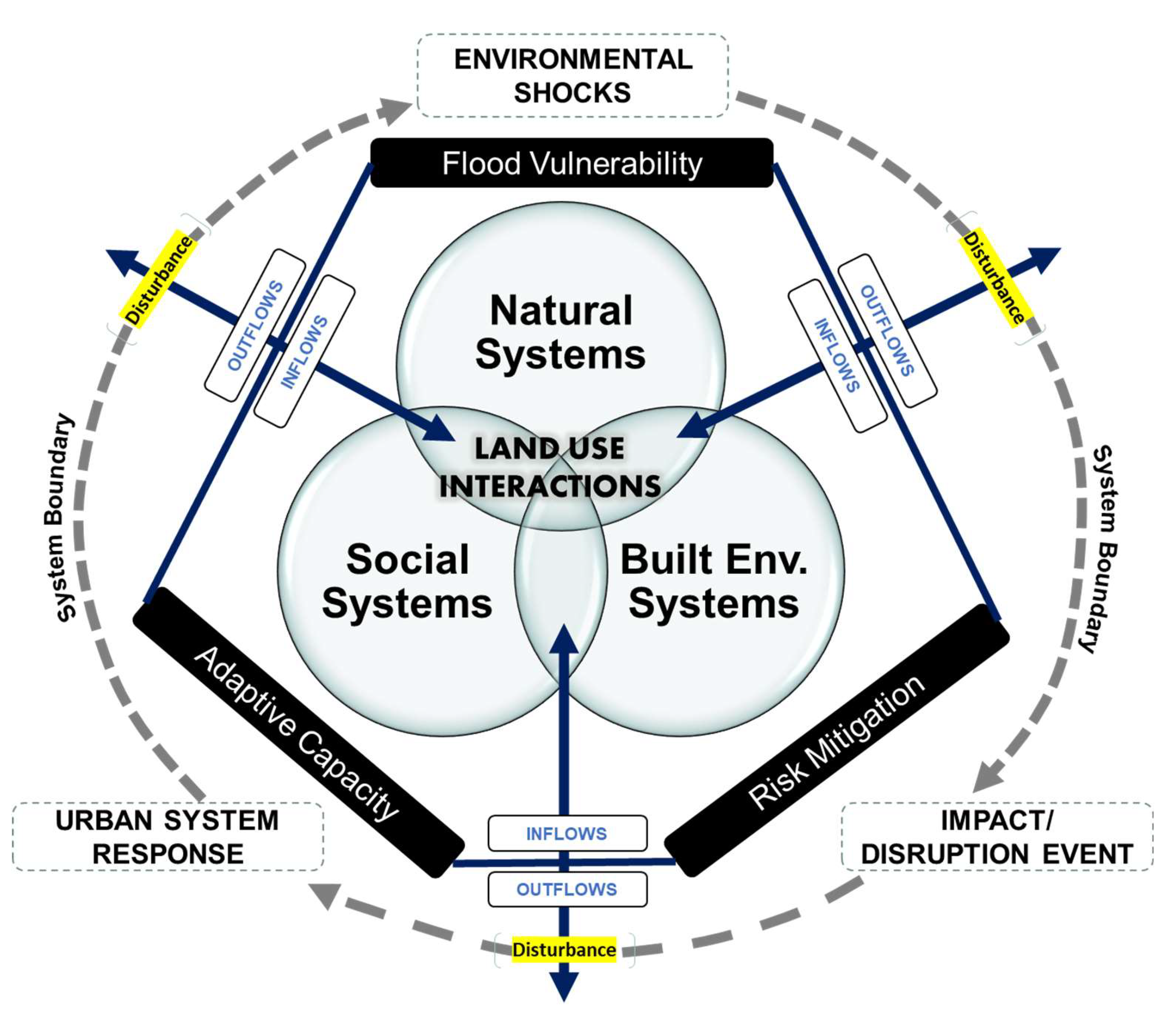
According to Error! Reference source not found., the urban system stays balanced with natural, social, and physical subsystems. The physical subsystem includes the built-up environment in cities, infrastructure, and utility networks. The infrastructure likely to be disrupted during a flood event and related structural components essential for the livelihood of communities during a pluvial flood event are included in the physical subsystem pillar. As the second pillar, the social system includes the people and socio-economic activities in the city, which co-exist with the physical subsystem. One of the critical measures to test the resilience of cities is to understand how well people in cities co-op with flood disasters while managing the core functions intact without being disrupted. Natural systems or environmental components are considered the third pillar, which plays a critical role in the vulnerability of urban systems to flood disasters or environmental shocks. Interactions between natural and physical systems are vital to determining the level of vulnerability in urban systems. The growth of physical systems or so-called urban expansion in cities has long disrupted natural systems’ impervious cover and water-absorbent qualities. The pervious cover increases the surface run-off and has been long identified as a factor in increasing pluvial flooding in cities. As engines of economic growth, cities show continued spatial dominance over natural systems, and socio-physical subsystems had conflicts with natural subsystems and elements to lose the balance of urban systems in flood disasters. However, these subsystems are challenging to study in isolation, where the impacts of floods and aftermath are cross-boundary in nature. However, the system boundary must be defined to understand the vulnerability levels within natural systems, the risk mitigation capabilities of physical systems, and the adaptive capacity of social systems in a city. Therefore, Error! Reference source not found. provides a circular pattern of urban resilience in an urban system, equated by land use interactions within natural, social, and physical subsystems. Flood events induced by excessive rainfall emerge within the natural system, while cities face disruption events within the physical system. The social system is represented by socio-economic, political, and demographic layers to initiate a response to the flood event, which eventually defines the resilience of a specific city for the immediate flood event and the preparation for the next disaster event.
The conceptual framework explains urban subsystems’ performance and role in flood disaster management. However, resilience is considered a long-term process where preparedness before a disaster and recovery and response after a disaster count for the land use and land cover interactions in facing extreme environmental shocks. Also, the recovery phase will convert into a preparedness phase for the next flood disaster, where planning decision-makers must impose land use reforms to tackle anticipated impacts. Therefore, it is necessary to simulate future land use changes to match flood risk management while continuing the spatial growth objectives. Temporal variation of spatial activities in cities can determine the long-term sustainability of urban systems to improve flood resilience. Therefore, applying system interactions to balance disaster resilience can provide insights into the level of impact of each subsystem on the recovery process in a non-linear process.
6. An Operational Model to Develop Urban Flood Resilience Index
Spatial representation of urban flood resilience is essential for future management of land use changes and the adoption of timely mitigation and adaptation measures. Resilience index measures are commonly used for multi-attribute decision-making, whereas the Urban Flood Resilience Index (UFRI) measures communities’ resilience to extreme weather events. Accordingly, with the conceptual framework, UFRI is developed based on the systems approach with the combination of Natural Systems Index (NSI), Physical Systems Index (PSI), and Social Systems Index (SSI) as shown in Equation 2.
Equation 2: Components of Urban Flood Resilience Index
represents the natural, physical, and social system resilience in the urban context. Each resilience index is a function of flood vulnerability and the adaptive capacity of cities located in each sub-catchment. Adaptive capacity influences positively, and flood vulnerability negatively influences urban resilience. With this basis, resilience attributes identified for each subsystem component are classified in Error! Reference source not found..
Table 3.
Urban Subsystems and indicators identified for resilience index.
| Natural System Attributes | Physical System Attributes | Social System Attributes | |
|---|---|---|---|
| Flood Vulnerability Factors | Run-off Retention/ Flood Volume | Building density | Population Density |
| Pervious cover reduction rate | Road density | Vulnerable population share (aged, unemployed, young) | |
| Rainfall intensity | Critical infrastructure stock (power, water, waste) | Social cost of past disasters | |
| Adaptation and Mitigation Factors | Vegetation cover | Permanent housing stock | Per capita income |
| Open space density | Expenses on flood mitigation infrastructure | Education level of people | |
| Wetland coverage | Budgetary allocation on disaster management | Local governance capacity | |
| Internet penetration rate |
Sources: (Banai, 2020; Berrebi et al., 2021; Feldman, 2017; Gu, 2019; Len et al., 2018; Serre & Heinzlef, 2018; Walker et al., 2004; Zuniga-Teran et al., 2020).
According to Error! Reference source not found., attributes or parameters are classified based on vulnerability and capacity factors. Each system’s index values are calculated for the smallest spatial units (administrative-based or pixel-based) in the local context. Each parameter can be spatially mapped using secondary data (Census data), calculated using classification techniques (land use and land cover), and modeled using spatial models (flood volume) before converting them into rasterized pixels or vector layers as necessary. Once the dataset of variables is collected, normalization methods can be applied to make a scaled, unit-independent dataset. After the scaling process is completed, variables will be ranked into four scales (1 to 4) based on quartile range to compare with each other. According to the influence on resilience, adaptation, and mitigation, capacity variables are ranked from 1 to 4, and flood vulnerability variables are ranked from 4 to 1 (Kadaverugu et al., 2021). Once the variables are ranked, the weight allocation is conducted by using the Analytical Hierarchy Process (AHP) as introduced by Saaty (2001). Weight assignment in the AHP method is conducted by using existing literature, government policy statements, domain knowledge, and consultation with experts in the field. Once the relative importance is obtained, the Consistency Ratio (CR) will be derived using the ratio between the Consistency Index (CI) and the Reference Index (RI). RI is a constant derived from randomized experiments, and CI is based on maximum Eigenvalues and a number of variables used in the system index calculations. Finally, NSI, PSI, and SSI are calculated using the Weighted Linear Combination (WLC) method in the Geographic Information Systems (GIS) environment. The WLC method uses the multiplication of scaled factors and weighted factors into system resilience index calculation. Finally, the addition of each system’s resilience index gives the urban resilience of each city at the micro spatial scale for flood disasters.
UFRI can be measured for temporal changes in an identified city or region for a selected period in the past to model future variations to support planning decision-makers. Key scenarios for future urban growth can be considered based on anticipated social, physical, and environmental changes proposed by planning agencies. Scenarios will consider land use changes or urban growth and rainfall intensity as options for future spatial decision-making. Error! Reference source not found. shows the potential scenarios that can be considered for urban planning and disaster management perspectives to identify future urban resilience. The proposed temporal variation of future scenarios can range from short-term to long-term depending on the planning horizons and development goals.
Table 4.
Proposed land use - rainfall-based scenarios considered for flood resilience assessment.
| No. | Urban Growth Scenario (U) | No. | Rainfall Intensity Scenario (R) |
|---|---|---|---|
| U1 | Business-As-Usual Scenario (Existing land use change patterns without planning intervention) | R1 | Actual extreme weather scenario (peak rainfall during extreme flood event) |
| U2 | Economic growth prioritized scenario (sprawling effect of urbanization) | R2 | 10-year return period based on peak rainfall |
| U3 | Environmental conservation-based scenario (strict land use regulation) | R3 | 50-year return period based peak rainfall |
| U4 | Compact development growth scenario (regulated vertical growth) | R4 | 100-year return period based peak rainfall |
Source: Developed by author.
7. Indicator Selection for Urban Flood Resilience Framework
According to Error! Reference source not found., scholarly journals and scientific research use multiple indices and spatial parameters to estimate urban flood resilience. Most of these indices are context-specific and focused on specific fields of study. However, developing universal indicators to assess urban resilience requires a comprehensive view of the existing parameters and their application. Since the resilience concept emerged from ecology, the social-ecological view of disaster impacts and recovery patterns explains the capacities of cities in the Global South (Bahadur & Tanner, 2021). It is clear that climate change-induced disasters could exacerbate the damage caused by extreme weather events, especially for coastal cities (Bahadur et al., 2016). According to the literature, disaster resilience is governed by two factors, namely coping capacity and vulnerability (Bakkensen et al., 2017; Béné, 2013; Revi et al., 2014). Coping capacity includes the mitigation and adaptation measures within the urban system, while vulnerability considers the exposure and sensitivity factors to the disaster impacts (See Equation 1). However, cities, as complex systems, rely on the equilibrium of multiple subsystems to manage the explicit challenges posed by natural disasters (Folke, 2006; Harrison & Williams, 2016; Meadows, 2008). Therefore, selected indicators for measuring the flood resilience of a city must incorporate the subsystems that govern city functions. City functions can be represented by the land use interactions composed of natural, built and social systems embedded within the spatial structure of cities. Equation 3 explains the relationship among multiple subsystems within a city to represent urban functions in flood-resilient cities.
Equation 3: Land use interactions as a function of multiple subsystems within the urban system in cities
Source: Author, derived from (Bai et al., 2016; Harrison & Williams, 2016; Holling, 1973)
Flood resilience parameters are selected assuming that natural subsystems, built subsystems and social subsystems explain the recovery from flood disasters in cities as a complex urban system. These parameters can be broadly classified under positive contributions to resilience (coping capacity oriented) and negative contributions (flood vulnerability oriented). Error! Reference source not found. shows indicators from the literature explaining flood resilience in cities with significance, as explained by the authors in the respective fields.
Table 5.
Indicators scholars use to measure urban resilience in the context of flood disasters.
| No | Indicator | Significance | Resilience Impact | Source |
|---|---|---|---|---|
| Natural Environment Subsystem | ||||
| 1 | Mean elevation or slope | Lower-elevation lands are more vulnerable to floods under fluvial or pluvial conditions | + | (Kadaverugu et al., 2022; Z. Zhang et al., 2023) |
| 2 | Green cover area/ pervious cover | Greenery determines the soil infiltration rates and acts as a barrier for surface run-off in flood conditions | + | (Cai et al., 2016) |
| 3 | Maximum rainfall depth/ Inflow for flood return period | Precipitation on urban areas to exceed the capacity of existing drains is the main reason for pluvial flooding | - | (Cai et al., 2016; Links et al., 2018) |
| 4 | Built-up area conversion rate/ wetland reduction rate | Conversion of pervious lands to impervious lands increase the surface runoff and pose flood risk in cities | - | (Cutter et al., 2008; Kesikoglu et al., 2019) |
| 5 | Runoff retention rate/ soil penetration | Runoff retention capacity of soil determines the impact of floods and soil water penetration in heavy rainfall | - | (Bose & Mazumdar, 2023; Kadaverugu et al., 2021) |
| 6 | Projects for nature conservation/ DRR | Conservation efforts to increase vegetation can reduce the future flood risk of cities in extreme weather events | + | (Links et al., 2018), (Zhang et al., 2020) |
| 7 | Area affected by the past flood events | Settlements located in flood risk region/ low lying areas pose significant risk of recurrent floods in a similar event | + | (Cai et al., 2016), (Zhang et al., 2023) |
| 8 | Distance from the existing streams/ coastal region | Proximity to waterbodies and low-lying coastal region pose flood risk during an inundation event | + | (Links et al., 2018), (Kadaverugu et al., 2022) |
| 9 | Per capita open space | Open spaces act as buffer zones for flood water flow and storage areas for excess run-off during rainfall | + | (Bakkensen et al., 2017), (Kadaverugu et al., 2022) |
| 10 | Damage caused by floods to existing utilities and infrastructure | Floods can damage potable water sources and transport infrastructure located in high flood risk zones | - | (Cutter et al., 2008) |
| No | Indicator | Significance | Resilience Impact | Source |
| Built Environment Subsystem | ||||
| 11 | Population with access to electricity, potable water and safe sanitation services | Access to utility services improves access to resources and limits disruption to daily livelihood | + | (Zhang et al., 2020) |
| 12 | Households with private vehicle ownership | Access to private vehicles facilitate fast mobility during pre-post-disaster events | + | (Cutter et al., 2008), (Cai et al., 2016) |
| 13 | Waste management rate | Availability of waste management systems reduce the risk of disasters following flood hazards | + | (Bakkensen et al., 2017), (Zhang et al., 2020) |
| 14 | Operational flood monitoring stations | Access to timely flood information and plan flood management strategies | + | (Bose & Mazumdar, 2023), (Kadaverugu et al., 2022) |
| 15 | Road density | Accessibility for relief services and fast response to communities in need during flood inundation | + | (Serre & Heinzlef, 2018), (Zhang et al., 2020) |
| 16 | Inundated infrastructure area in past events | The location of physical infrastructure at flood risk zones poses additional risks for the area-served communities | - | (Links et al., 2018), (Cai et al., 2016) |
| 17 | Labor force participation rate/ employment rate | Economic capacity to face flood disasters in timely manner with sufficient resources | + | (Cutter et al., 2008), (Cai et al., 2016), (Links et al., 2018) |
| 18 | Population with life insurance policies | Potential risk transfer mechanism for people and businesses in an unexpected loss due to flooding | + | (Links et al., 2018), (Cutter et al., 2003) |
| 19 | Building density in flood risk regions | Properties located in high-risk zones face increased vulnerability to flood impacts | - | (Cai et al., 2016), (Bakkensen et al., 2017) |
| 20 | Population with public assistance schemes | Population living in poverty has higher risk to flood damages due to limited resources & capacity | - | (Cutter et al., 2008), (Cai et al., 2016), (Links et al., 2018), |
| No | Indicator | Significance | Resilience Impact | Source |
| Socio Economic Subsystem | ||||
| 21 | Population over 65 years old | Dependents pose high risk for flood response | - | (Cai, Lam et al. 2016), (Cutter, Boruff et al. 2003) |
| 22 | Population under 5 years old | Vulnerability to respond and recover after floods | - | (Cai, Lam et al. 2016), (Zhang, Yang et al. 2020) |
| 23 | Education attainment to secondary level | Flood response related knowledge and preparedness | + | (Cai et al., 2016), (Links et al., 2018) |
| 24 | Population living in rental properties | High-risk groups during floods and limited mitigation actions | - | (Cai, Lam et al. 2016) |
| 25 | Population living in permanent houses | The structural capacity of buildings provides safe shelter during floods | + | (Cutter et al., 2008), (Cai et al., 2016) |
| 26 | Mean crime rates/ Areas with property theft | Fear of theft during flood events pose high risk for residents to move out of the property | - | (Zahnow et al., 2017), (Müller et al., 2011) |
| 27 | Population with access to internet services/ mobile phones | Communication of flood information and relief services before and after floods | + | (Cutter et al., 2008), (Links et al., 2018) |
| 28 | Density of religious institutions | Provision of immediate relief and shelter for flood affected communities | + | (Lwin et al., 2020), (Islam, 2012) |
| 29 | Expenditure on social safeguard measures | Capacity of local governance agencies to provide timely relief services | + | (Zhang et al., 2020), (Zhang et al., 2023), (Links et al., 2018) |
| 30 | Availability of healthcare services/ density of health services | Access to health services during flood emergency | + | (Links et al., 2018) |
Note: Some of the indicators are not specifically from studies aimed at flood resilience assessment whereas some scholars used sensitivity, vulnerability, and recovery process as interchanging terms denoting the resilience of cities or urban environments.
8. Implications for Urban Planners and Decision Makers on Adopting Spatial Resilience Framework
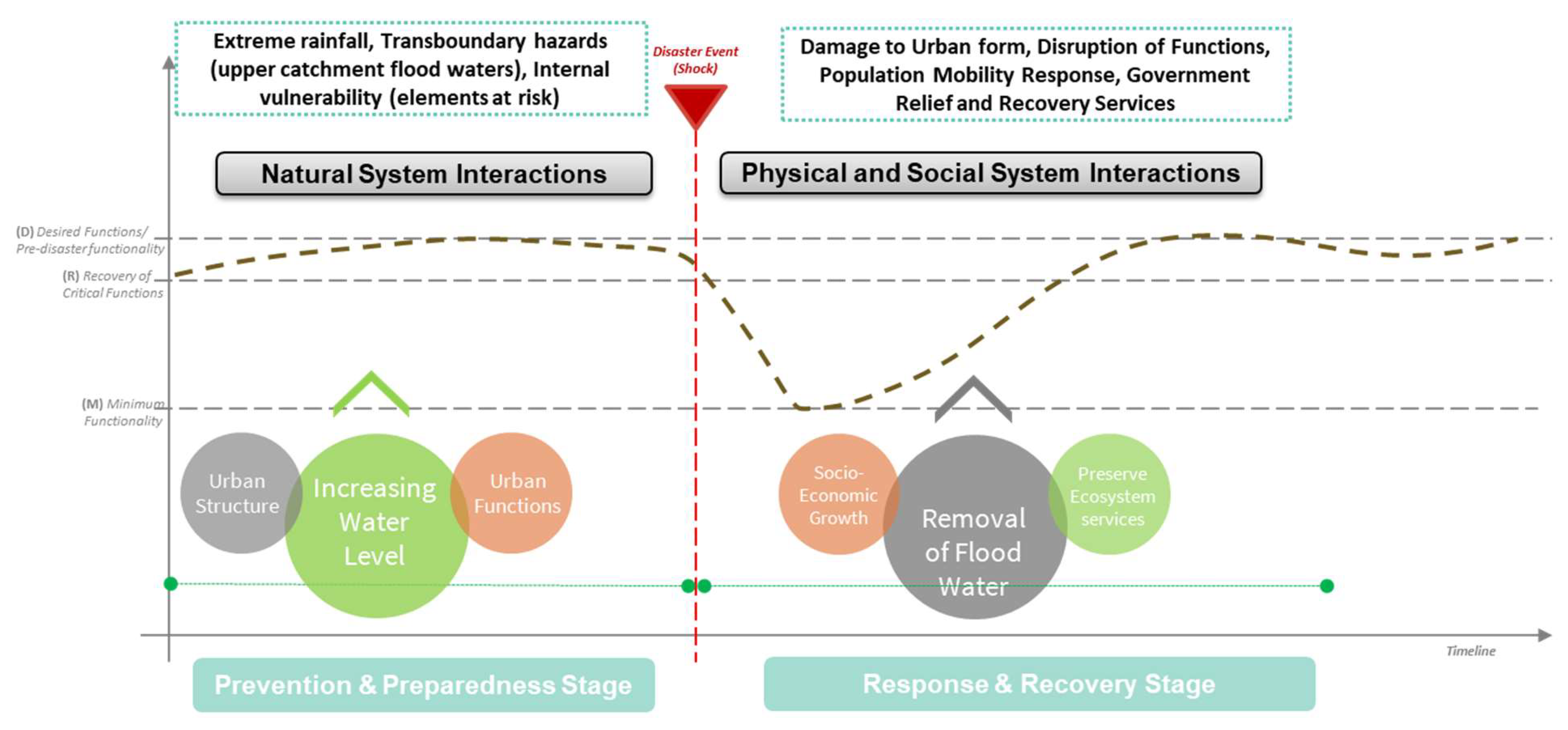
Resilience is a process where scholars cannot measure directly using measurement units (Cutter et al., 2003; Sharifi, 2020). Cities are inherently complex systems where resilience assessment poses significant challenges due to the interaction of multiple variables at multiple spatial and temporal scales. According to Cao et al. (2021), many existing resilience frameworks focus on physical infrastructure systems within a city whereas socio-ecological systems influencing the multiple subsystems are given limited attention. One reason could be the increasing complexity and uncertainty that emerged in urban systems due to social systems’ behavior. Another reason is the short-term focus of infrastructure recovery and safety. Human or social systems can generate unpredictable outcomes and long-term impacts due to flood damage where infrastructure systems need to return to disaster conditions to recover functions. However, in reality, cities do not recover from floods soon after flood water dissipates. Urban systems can shift from one stage (pre-disaster) to another (post-disaster), which can result in socio-demographic changes and land use processes (Error! Reference source not found.). The ability to understand and model such equilibrium shifts is essential to create flood-resilient cities. Therefore, indicator selection is a challenging task that needs a comprehensive understanding of a flood event’s context and possible outcomes. Policies and response actions can also depend on interactions among sub-systems influencing city flood risks.
Figure 3.
Conceptual Figuration of Resilience Variation and Urban System Interactions before and after a flood disaster. Source: Author.
Figure 3.
Conceptual Figuration of Resilience Variation and Urban System Interactions before and after a flood disaster. Source: Author.
Flood resilience can be focused on from multiple disciplines with a multitude of scopes and angles. However, it is vital to focus urban planning perspectives on resilience as urban growth policies shape the natural and built environment of cities. From the planning perspective, two key problems persist in evaluating urban flood resilience. First, it is necessary to recognize the spatial scale of analysis to support decision-makers. Country-level or regional resilience assessments are useful for understanding the effects of urban policies and preparation for critical urban functions during floods (Feldmeyer et al., 2021; Y. Zhang et al., 2023). However, these assessments lack the explanatory capability in micro-level community response and local government capacities to manage flood damage efficiently (Balica et al., 2009; Cutter et al., 2008). Importantly, socio-demographic and political factors significantly increase potential recovery patterns and risk factors. For example, Chelleri et al. (2015) and Masnavi et al. (2019) explained the impact of socio-ecological factors and societal indicators on resilience outcomes. In addition, urban planners overlook settlement strategies where demand for land and infrastructure is in place within flood risk zones. Since urban growth is dynamic, treating cities as rigid entities is challenging unless the growth is contained with severe regulations. Therefore, urban resilience frameworks have deviated from risk-based strategies into adaptive capacity-oriented strategies in the recent past (Sharma, 2022; Wang et al., 2022). Based on existing literature, the vulnerability parameters and coping capacity parameters can be incorporated to develop a comprehensive urban resilience framework as micro-level spatial units are vital to understanding the land use dynamics leading to change in urban flood resilience of cities as urban systems. Moreover, natural components, built form, and social components are within the planner’s purview, and the selection of necessary parameters to represent land use change is a vital task to avoid ambiguity and develop an explicit framework to measure urban flood resilience.
References
- Abdrabo, M., & Hassaan, M. A. (2015). An integrated framework for urban resilience to climate change–Case study: Sea level rise impacts on the Nile Delta coastal urban areas. Urban Climate, 14, 554-565. [CrossRef]
- Al Rifat, S. A., & Liu, W. (2022). Predicting future urban growth scenarios and potential urban flood exposure using Artificial Neural Network-Markov Chain model in Miami Metropolitan Area. Land use policy, 114>, 105994. [CrossRef]
- Ammara, U., Rasheed, K., Mansoor, A., Al-Fuqaha, A., & Qadir, J. (2022). Smart Cities from the Perspective of Systems. Systems, 10(3), 77. [CrossRef]
- Arafah, Y., Winarso, H., & Suroso, D. (2018). Towards smart and resilient city: a conceptual model. IOP Conference Series: Earth and Environmental Science.
- Assembly, G. (2015). Sustainable development goals. SDGs Transform Our World, 2030, 6-28.
- Avila-Aceves, E., Plata-Rocha, W., Monjandin-Armenta, S. A., & Rangel-Peraza, J. G. (2023). Geospatial modelling of floods: a literature review. Stochastic Environmental Research and Risk Assessment, 1-20. [CrossRef]
- Bahadur, A., Tanner, T., & Pichon, F. (2016). Enhancing urban climate change resilience: Seven entry points for action. A. D. Bank.
- Bahadur, A. V., & Tanner, T. (2021). Resilience reset: Creating resilient cities in the global South. Routledge.
- Bai, X., Surveyer, A., Elmqvist, T., Gatzweiler, F. W., Güneralp, B., Parnell, S., Prieur-Richard, A.-H., Shrivastava, P., Siri, J. G., Stafford-Smith, M., Toussaint, J.-P., & Webb, R. (2016). Defining and advancing a systems approach for sustainable cities. Current Opinion in Environmental Sustainability, 23, 69-78. [CrossRef]
- Bakkensen, L. A., Fox-Lent, C., Read, L. K., & Linkov, I. (2017). Validating resilience and vulnerability indices in the context of natural disasters. Risk analysis, 37(5), 982-1004. [CrossRef]
- Balica, S., Douben, N., & Wright, N. G. (2009). Flood vulnerability indices at varying spatial scales. Water science and Technology, 60(10), 2571-2580.
- Banai, R. (2020). Pandemic and the planning of resilient cities and regions. Cities, 106, 102929-102929. [CrossRef]
- Baqa, M. F., Chen, F., Lu, L., Qureshi, S., Tariq, A., Wang, S., Jing, L., Hamza, S., & Li, Q. (2021). Monitoring and modeling the patterns and trends of urban growth using urban sprawl matrix and CA-Markov model: A case study of Karachi, Pakistan. Land, 10(7), 700. [CrossRef]
- Béné, C. (2013). Towards a quantifiable measure of resilience. IDS Working Papers, 2013(434), 1-27.
- Berrebi, C., Karlinsky, A., & Yonah, H. (2021). Individual and community behavioral responses to natural disasters. Natural hazards, 105(2), 1541-1569. [CrossRef]
- Borden, K. A., Schmidtlein, M. C., Emrich, C. T., Piegorsch, W. W., & Cutter, S. L. (2007). Vulnerability of US cities to environmental hazards. Journal of Homeland Security and Emergency Management, 4(2).
- Bose, S., & Mazumdar, A. (2023). Urban flood risk assessment and mitigation with InVEST-UFRM model: a case study on Kolkata city, West Bengal state (India). Arabian Journal of Geosciences, 16(5), 320. [CrossRef]
- Bottero, M., Datola, G., & De Angelis, E. (2020). A system dynamics model and analytic network process: an integrated approach to investigate urban resilience. Land, 9(8), 242. [CrossRef]
- Cai, H., Lam, N. S.-N., Zou, L., Qiang, Y., & Li, K. (2016). Assessing community resilience to coastal hazards in the Lower Mississippi River Basin. Water, 8(2), 46. [CrossRef]
- Camacho Olmedo, M. T., Paegelow, M., Mas, J.-F., & Escobar, F. (2018). Geomatic approaches for modeling land change scenarios. An introduction. Springer. [CrossRef]
- Cao, Y., Wilkinson, E., Pettinotti, L., Colenbrander, S., & Lovell, E. (2021). An Analytical Review: A Decade of Urban Resilience. UNDP.
- Chan, S. W., Abid, S. K., Sulaiman, N., Nazir, U., & Azam, K. (2022). A systematic review of the flood vulnerability using geographic information system. Heliyon. [CrossRef]
- Chelleri, L., Waters, J. J., Olazabal, M., & Minucci, G. (2015). Resilience trade-offs: addressing multiple scales and temporal aspects of urban resilience. Environment and Urbanization, 27(1), 181-198.
- Cutter, S. L., Barnes, L., Berry, M., Burton, C., Evans, E., Tate, E., & Webb, J. (2008). Community and regional resilience: Perspectives from hazards, disasters, and emergency management. Geography, 1(7), 2301-2306.
- Cutter, S. L., Boruff, B. J., & Shirley, W. L. (2003). Social vulnerability to environmental hazards. Social science quarterly, 84(2), 242-261.
- D’Orazio, M., Bernardini, G., & Quagliarini, E. (2021). Sustainable and resilient strategies for touristic cities against COVID-19: An agent-based approach. Safety Science, 142, 105399. [CrossRef]
- Datola, G., Bottero, M., De Angelis, E., & Romagnoli, F. (2022). Operationalising resilience: A methodological framework for assessing urban resilience through System Dynamics Model. Ecological Modelling, 465, 109851.
- Davoudi, S., Shaw, K., Haider, L. J., Quinlan, A. E., Peterson, G. D., Wilkinson, C., Fünfgeld, H., McEvoy, D., Porter, L., & Davoudi, S. (2012). Resilience: a bridging concept or a dead end?“Reframing” resilience: challenges for planning theory and practice interacting traps: resilience assessment of a pasture management system in Northern Afghanistan urban resilience: what does it mean in planning practice? Resilience as a useful concept for climate change adaptation? The politics of resilience for planning: a cautionary note: edited by Simin Davoudi and Libby Porter. Planning theory & practice, 13(2), 299-333.
- Diržytė, A., Rakauskienė, O. G., & Servetkienė, V. (2017). Evaluation of resilience impact on socio-economic inequality. Entrepreneurship and sustainability issues, 4, 489-501.
- Du, M., Zhang, X., Wang, Y., Tao, L., & Li, H. (2020). An operationalizing model for measuring urban resilience on land expansion. Habitat International, 102, 102206.
- Ellis, N., Anderson, K., & Brazier, R. (2021). Mainstreaming natural flood management: A proposed research framework derived from a critical evaluation of current knowledge. Progress in Physical Geography: Earth and Environment, 45(6), 819-841. [CrossRef]
- Feldman, D. L. (2017). The Water-Sustainable City: Science, Policy and Practice. Cheltenham, Gloucestershire: Edward Elgar Publishing. [CrossRef]
- Feldmeyer, D., Nowak, W., Jamshed, A., & Birkmann, J. (2021). An open resilience index: Crowdsourced indicators empirically developed from natural hazard and climatic event data. Science of the Total Environment, 774, 145734.
- Folke, C. (2006). Resilience: The emergence of a perspective for social–ecological systems analyses. Global environmental change, 16(3), 253-267.
- Gangrade, S., Kao, S.-C., Dullo, T. T., Kalyanapu, A. J., & Preston, B. L. (2019). Ensemble-based flood vulnerability assessment for probable maximum flood in a changing environment. Journal of Hydrology, 576, 342-355.
- Gencer, E. A. (2013). Natural disasters, urban vulnerability, and risk management: a theoretical overview. The interplay between urban development, vulnerability, and risk management, 7-43.
- Gu, D. (2019). Exposure and vulnerability to natural disasters for world’s cities.
- Hall, J. W., & Penning-Rowsell, E. C. (2010). Setting the scene for flood risk management. Flood risk science and management, 1-16.
- Harrison, C. G., & Williams, P. R. (2016). A systems approach to natural disaster resilience. Simulation Modelling Practice and Theory, 65, 11-31. [CrossRef]
- Holling, C. S. (1973). Resilience and stability of ecological systems. Annual review of ecology and systematics, 4(1), 1-23.
- Kadaverugu, A., Kadaverugu, R., Chintala, N. R., & Gorthi, K. V. (2022). Flood vulnerability assessment of urban micro-watersheds using multi-criteria decision making and InVEST model: a case of Hyderabad City, India. Modeling earth systems and environment, 8(3), 3447-3459. [CrossRef]
- Kadaverugu, A., Nageshwar Rao, C., & Viswanadh, G. (2021). Quantification of flood mitigation services by urban green spaces using InVEST model: a case study of Hyderabad city, India. Modeling earth systems and environment, 7(1), 589-602. [CrossRef]
- Kelly, R. A., Jakeman, A. J., Barreteau, O., Borsuk, M. E., ElSawah, S., Hamilton, S. H., Henriksen, H. J., Kuikka, S., Maier, H. R., & Rizzoli, A. E. (2013). Selecting among five common modelling approaches for integrated environmental assessment and management. Environmental modelling & software, 47, 159-181. [CrossRef]
- Kesikoglu, M. H., Atasever, U. H., Dadaser-Celik, F., & Ozkan, C. (2019). Performance of ANN, SVM and MLH techniques for land use/cover change detection at Sultan Marshes wetland, Turkey. Water science and Technology, 80(3), 466-477. [CrossRef]
- Khatooni, K., Hooshyaripor, F., MalekMohammadi, B., & Noori, R. (2023). A combined qualitative–quantitative fuzzy method for urban flood resilience assessment in Karaj City, Iran. Scientific Reports, 13(1), 241.
- Krzhizhanovskaya, V. V., Shirshov, G., Melnikova, N. B., Belleman, R. G., Rusadi, F., Broekhuijsen, B., Gouldby, B. P., Lhomme, J., Balis, B., & Bubak, M. (2011). Flood early warning system: design, implementation and computational modules. Procedia Computer Science, 4, 106-115. [CrossRef]
- Len, N. L. S., Bolong, N., Roslee, R., Tongkul, F., Mirasa, A. K., & Ayog, J. L. (2018). Flood vulnerability of critical infrastructures-review. Malaysian Journal of Geosciences, 2(1), 31-34.
- Li, L., Uyttenhove, P., & Van Eetvelde, V. (2020). Planning green infrastructure to mitigate urban surface water flooding risk–A methodology to identify priority areas applied in the city of Ghent. Landscape and Urban Planning, 194, 103703. [CrossRef]
- Liang, L., Chen, M., & Cheng, J. (2023). Enhance China’s urban flood resilience. Science, 381(6664), 1295-1295. [CrossRef]
- Links, J. M., Schwartz, B. S., Lin, S., Kanarek, N., Mitrani-Reiser, J., Sell, T. K., Watson, C. R., Ward, D., Slemp, C., & Burhans, R. (2018). COPEWELL: a conceptual framework and system dynamics model for predicting community functioning and resilience after disasters. Disaster medicine and public health preparedness, 12(1), 127-137. [CrossRef]
- Liu, J., & Shi, Z.-w. (2017). Quantifying land-use change impacts on the dynamic evolution of flood vulnerability. Land use policy, 65, 198-210. [CrossRef]
- Liu, Z., He, C., Zhou, Y., & Wu, J. (2014). How much of the world’s land has been urbanized, really? A hierarchical framework for avoiding confusion. Landscape ecology, 29(5), 763-771. [CrossRef]
- Masnavi, M., Gharai, F., & Hajibandeh, M. (2019). Exploring urban resilience thinking for its application in urban planning: A review of literature. International journal of environmental science and technology, 16(1), 567-582. [CrossRef]
- Masten, A. S., Best, K. M., & Garmezy, N. (1990). Resilience and development: Contributions from the study of children who overcome adversity. Development and psychopathology, 2(4), 425-444.
- Meadows, D. H. (2008). Thinking in systems: A primer. chelsea green publishing.
- Meerow, S., Newell, J. P., & Stults, M. (2016). Defining urban resilience: A review. Landscape and Urban Planning, 147, 38-49. [CrossRef]
- Membele, G. M., Naidu, M., & Mutanga, O. (2022). Examining flood vulnerability mapping approaches in developing countries: A scoping review. International Journal of Disaster Risk Reduction, 69, 102766. [CrossRef]
- Mukherjee, M., & Takara, K. (2018). Urban green space as a countermeasure to increasing urban risk and the UGS-3CC resilience framework. International Journal of Disaster Risk Reduction, 28, 854-861. [CrossRef]
- Nasiri, H., Mohd Yusof, M. J., & Mohammad Ali, T. A. (2016). An overview to flood vulnerability assessment methods. Sustainable Water Resources Management, 2(3), 331-336.
- Quarantelli, E. (2003). Urban vulnerability to disasters in developing countries: managing risks. BUILDING safer cities: the future of disaster risk. Washington, DC, The World Bank, 211-232.
- Re, M. (2021). Risks from floods, storm surges and flash floods. Underestimated natural hazard.
- Rehman, S., Sahana, M., Hong, H., Sajjad, H., & Ahmed, B. B. (2019). A systematic review on approaches and methods used for flood vulnerability assessment: Framework for future research. Natural hazards, 96, 975-998. [CrossRef]
- Revi, A., Satterthwaite, D. E., Aragón-Durand, F., Corfee-Morlot, J., Kiunsi, R. B. R., Pelling, M., Roberts, D. C., & Solecki, W. (2014). Urban areas (Climate Change 2014: Impacts, Adaptation, and Vulnerability. Part A: Global and Sectoral Aspects. Contribution of Working Group II to the Fifth Assessment Report of the Intergovernmental Panel on Climate Change, Issue. C. U. Press.
- Rockefeller. (2013). 100 Resilient Cities. T. R. Foundation. https://www.rockefellerfoundation.org/wp-content/uploads/d631b84b1efe41685a_3gm6b18ip1.pdf.
- Saaty, T. L. (2001). Decision making for leaders: the analytic hierarchy process for decisions in a complex world. RWS publications.
- Serre, D., & Heinzlef, C. (2018). Assessing and mapping urban resilience to floods with respect to cascading effects through critical infrastructure networks. International Journal of Disaster Risk Reduction, 30, 235-243.
- Shapiro, S. A., & Verchick, R. R. (2017). Inequality, Social Resilience, and the Green Economy. UMKC L. Rev., 86, 963.
- Sharifi, A. (2020). Urban resilience assessment: Mapping knowledge structure and trends. Sustainability, 12(15), 5918. [CrossRef]
- Sharma, S. E. (2022). Urban flood resilience: Governing conflicting urbanism and climate action in Amsterdam. Review of International Political Economy, 1-23. [CrossRef]
- Sugianto, S., Deli, A., Miswar, E., Rusdi, M., & Irham, M. (2022). The effect of land use and land cover changes on flood occurrence in Teunom Watershed, Aceh Jaya. Land, 11(8), 1271. [CrossRef]
- Tehrany, M. S., Pradhan, B., & Jebur, M. N. (2013). Spatial prediction of flood susceptible areas using rule based decision tree (DT) and a novel ensemble bivariate and multivariate statistical models in GIS. Journal of Hydrology, 504, 69-79. [CrossRef]
- Tripathy, P., & Kumar, A. (2019). Monitoring and modelling spatio-temporal urban growth of Delhi using Cellular Automata and geoinformatics. Cities, 90, 52-63. [CrossRef]
- U.N. (2019). World Urbanization Prospects: The 2018 Revision. United Nations Department of Economic Social Affairs. [CrossRef]
- Ulloa-Espíndola, R., Cuyo-Cuyo, J., & Lalama-Noboa, E. (2023). Towards Rural Resilience: Assessing Future Spatial Urban Expansion and Population Growth in Quito as a Measure of Resilience. Land, 12(2), 335. [CrossRef]
- UNISDR. (2005). Hyogo Framework for Action 2005-2015: Building the Resilience of Nations and Communities to Disasters. https://www.unisdr.org/2005/wcdr/intergover/official-doc/L-docs/Hyogo-framework-for-action-english.pdf.
- Walker, B., Holling, C. S., Carpenter, S. R., & Kinzig, A. (2004). Resilience, adaptability and transformability in social–ecological systems. Ecology and society, 9(2).
- Wang, L., Cuia, S., Lid, Y., Huang, H., Manandhar, B., Nitivattananon, V., Fang, X., & Huang, W. (2022). A review of the flood management: from flood control to flood resilience. Heliyon, e11763. [CrossRef]
- Wang, Y., Meng, F., Liu, H., Zhang, C., & Fu, G. (2019). Assessing catchment scale flood resilience of urban areas using a grid cell based metric. Water Research, 163, 114852. [CrossRef]
- Winderl, T. (2014). Disaster resilience measurements: stocktaking of ongoing efforts in developing systems for measuring resilience. UNDP.
- WorldBank. (2018). CityStrength Diagnostic Methodological Guidebook. GFDRR. https://documents1.worldbank.org/curated/en/996471525721935888/pdf/125991-WP-P150083-PUBLIC-CityStrength-Guidebook-2018.pdf.
- WorldBank. (2022, October 06). Urban Development. World Bank group. Retrieved December 10 from https://www.worldbank.org/en/topic/urbandevelopment/overview#1.
- Wu, J. G. (2014). Urban ecology and sustainability: The state-of-the-science and future directions [Article]. Landscape and Urban Planning, 125, 209-221. [CrossRef]
- Wu, Y., Zhang, X., & Shen, L. (2011). The impact of urbanization policy on land use change: A scenario analysis. Cities, 28(2), 147-159.
- Yang, X., & Li, J. (2015). Monitoring and modeling of global changes: a geomatics perspective. Springer. [CrossRef]
- Yu, X., Wu, Y., Zhou, X., & Liu, S. (2023). Resilience evaluation for water distribution system based on partial nodes’ hydraulic information. Water Research, 120148. [CrossRef]
- Zhang, M., Yang, Y., Li, H., & van Dijk, M. P. (2020). Measuring urban resilience to climate change in three chinese cities. Sustainability, 12(22), 9735.
- Zhang, Y., Yue, W., Su, M., Teng, Y., Huang, Q., Lu, W., Rong, Q., & Xu, C. (2023). Assessment of urban flood resilience based on a systematic framework. Ecological Indicators, 150, 110230. [CrossRef]
- Zhang, Z., Zhang, J., Zhang, Y., Chen, Y., & Yan, J. (2023). Urban Flood Resilience Evaluation Based on GIS and Multi-Source Data: A Case Study of Changchun City. Remote Sensing, 15(7), 1872. [CrossRef]
- Zuniga-Teran, A. A., Gerlak, A. K., Mayer, B., Evans, T. P., & Lansey, K. E. (2020). Urban resilience and green infrastructure systems: Towards a multidimensional evaluation. Current Opinion in Environmental Sustainability, 44, 42-47.
Disclaimer/Publisher’s Note: The statements, opinions and data contained in all publications are solely those of the individual author(s) and contributor(s) and not of MDPI and/or the editor(s). MDPI and/or the editor(s) disclaim responsibility for any injury to people or property resulting from any ideas, methods, instructions or products referred to in the content. |
© 2024 by the authors. Licensee MDPI, Basel, Switzerland. This article is an open access article distributed under the terms and conditions of the Creative Commons Attribution (CC BY) license (http://creativecommons.org/licenses/by/4.0/).
Copyright: This open access article is published under a Creative Commons CC BY 4.0 license, which permit the free download, distribution, and reuse, provided that the author and preprint are cited in any reuse.


