

Submitted:
01 July 2024
Posted:
02 July 2024
You are already at the latest version
Abstract
The complexity of plastic polymers and even more so of additives has increased enormously in recent years. This makes the high-quality recycling of mixed plastic waste considerably more difficult. Some additives have now been strictly regulated or even completely banned for good reasons ('legacy additives'). Material or mechanical recycling generally utilises old plastics that still contain these substances. Consequently, products that are manufactured using such recyclates are contaminated with these harmful substances. We therefore recommend avoiding the use of these recyclates for products with intensive contact with consumers until further notice. We also show that the climate policy challenges for the plastics (and chemical) industry necessitate a defossilisation ('feedstock change'). This turnaround can only succeed if solely high-quality recycling takes place in future; recyclates should primarily replace virgin plastics. This can only work if used plastics with a high degree of homogeneity and known formulation are collected separately, as is already the case today with PET bottles. In this context, we would like to point out inconsistencies in the current legislation on the European emissions trading system.
Keywords:
moratorium on the use of recyclates
; legacy additives
; 'Risk Cycle'
; human biomonitoring
; closed-loop recycling
; feedstock change
1. Introduction
Global plastic production has increased exponentially since the Second World War. In 1950, annual global plastic production was still around 1.5 million tonnes (hereinafter referred to as Mg). In 2002, production reached 200 million Mg/a, in 2019 it was already 460 million Mg according to OECD [1] (including 29 million Mg secondary plastic, see GPO [1], p. 23. Investment in new plants for the production of plastics based on cheap gas or oil continues unabated. By 2040, we could be producing even 800 million Mg of plastics per year and more [2].
At the end of their service life, plastic products become waste. At the end of the 1980s, the increasing quantities of waste, especially packaging, caused considerable disposal problems e.g., in Germany. As a countermeasure, the German Packaging Ordinance (Ordinance on the Avoidance and Recycling of Packaging Waste) was passed in 1991. Ahead of the impending regulation, the Dual System Germany (DSD) was founded in 1990 by an association of companies from the food and packaging industry operating in Germany. This was intended as a second disposal system alongside the existing public waste disposal system (hence the term “dual”) to organise the collection and recycling of packaging waste, financed by the packaging manufacturers via the licence fee for the use of the “Green Dot”.
In order to counter the threat of government regulation of PVC, the manufacturing and processing industry in Germany also launched its own initiative. Behind the PVC industry’s “Plastics Cycle”, “PVC Cycle Guarantee” and “Global Recycling” concepts of 1988 and the AGPU (Arbeitsgemeinschaft PVC und Umwelt e.V., i.e., Working Group on PVC and Environment), which was founded for this purpose, lies the idea of recycling PVC waste and the chlorine it contains, and thus solving the respective waste and sustainability problem [3,4].
Since the 1980, two solution strategies, or rather visions at the time, for solving the plastics waste problem, were in competition with each other:
- technical recycling (waste plastics are replasticised into new plastic products),
- biological recycling (plastics must be naturally degradable and integrate into the metabolic cycle of nature).
It is ironic, that the protagonists of both solution strategies of that time used the same narrative: closing a cycle. The end of the story is well known. Technical recycling won the race, initially as an idea, later also in regulatory and practical terms. However, it is not only the polymers that end up in the recyclate and the products made from it in today’s plastics recycling process, but also the other components such as additives – including substances that are now banned or strictly regulated due to their harmfulness to humans and/or the environment (“legacy additives”).
When the decision was made to focus on material recycling, the variety of plastics was considered to be manageable. This has changed significantly over the last 50 years or so. Many plastics today are highly developed, unique materials for sophisticated technical applications, and the variety of additives is still growing. Recycling cycles are no longer limited to Europe, but are global. Problematic additives in used plastics are now returning to Europe in the form of products from plastics recycling in Asia, for example.
What could a solution to this problem look like? We will discuss this question in this paper (based on an earlier publication in German [5]).
2. Materials and Methods
2.1. Plastics
Currently, there are around 200,000 different types of plastic available on the market [6]. According to Pareto Securities [7], seven types of plastic account for a good 80% of European / global consumption. These are
- polypropylene (PP) ............................................................................................................ 20%
- low-density polyethylene (LDPE) ................................................................................... 17%
- high-density polyethylene (HDPE) ................................................................................. 13%
- polyvinyl chloride (PVC) .................................................................................................. 10%
- polyethylene terephthalate (PET/PETP) ........................................................................... 8%
- polyurethanes (PU) .............................................................................................................. 8%
- (expanded) polystyrene (PS/EPS) ...................................................................................... 6%
According to Plastics Europe [8], the demand for plastics in 2021 was mainly driven by the packaging sector (39.1%), followed by the construction (21.3%) and the automotive sector (8.6%). These data are built on estimations of quantities bought by European converters, including imports. (The demand for recycled plastics and bio-based/bio-attributed plastics and for polymers that are not used in the conversion of plastic parts and products (i.e., for textiles, adhesives, sealants, coatings, etc.) is not included in these data.) The polyethylene types were mainly in demand for packaging; propylene (PP) too, but also in most other sectors. The construction sector was the main consumer of PVC, but also of many other plastics (PE, PS, PUR, other thermoplastics).
2.2. Polymers
In modern plastic products, the polymer molecule is no longer uniform. Mixtures of two or more chemically different types of monomers are not uncommon, especially in engineering plastics. With these so-called copolymers, many properties of the plastic can be specifically adjusted by selecting the appropriate monomers and their mass ratio to each other. Examples of this include the plastic ABS (acrylonitrile butadiene styrene copolymer), which is used in the electrical, household appliance and automotive industries, or SAN (styrene acrylonitrile copolymer), which is used for light guides, glazing for industrial doors or shower cabin walls, among other things. A frequently used copolymer that is ‘transplanted’ into PVC, polycarbonates and polycarbonate/polybutyl terephthalate blends for stabilisation purposes, is MBS. However, this is not a single substance, but a mixture of methyl methacrylate, styrene and butadiene rubber.
Depending on requirements, so-called polymer blends, which are mixtures of two or more different polymers, are also used in plastic products. The cross-linking of polymer chains can significantly improve their mechanical performance. Composites made of plastic and other materials are also used in many areas, such as carbon (e.g., aircraft construction) or glass fiber-reinforced plastics (e.g., rotor blades of wind turbines, honeycomb sandwich panels in the construction sector) or fabric-reinforced plastics (e.g., mesh wire in PVC document pouches).
As shown, the homo-polymer is no longer the rule today. This alone makes recycling increasingly difficult. But there is also the issue of additives.
2.3. Additives
Plastics are compounds of polymers and additives, the process of mixing plastic granulate and additives is known as ‘compounding’.
“Plastics without additives are not viable. Additives are essential to make thermoplastics processable and to improve end-use properties” [9]. Depending on the application, the share of additives in a plastic compound can reach more than 50 weight-% (wt.%), as the example of PVC in Table 1, taken from [10], shows.
2.3.1. Plasticisers
Following the Council of the International Union of Pure and Applied Chemistry (IUPAC) in 1951, a plasticiser is defined as “a substance or material incorporated in a material (usually a plastic or elastomer) to increase its flexibility, workability, or distensibility” [11]. Plasticisers are still widely used today to improve plasticisation, especially for PVC, which consumes approximately 90% of all plasticisers [11].
To put it simply, plasticisers push themselves between the polymer molecules, increasing the distance between the polymers and allowing the “polymer chains” to slide past each other better – as if they were lubricated. Plastics thus become flexible or soft. This chemically loose incorporation of plasticisers is also the decisive reason why plasticisers have relatively high emissions from the plastic. The plasticisers are not firmly bound in the plastic and can therefore migrate in the plastic to the surface of the material, evaporate from there or be dissolved out. There are around one hundred different plasticisers in use. Following [12], they can be divided in
- Primary plasticisers: these “enhance elongation, softness and flexibility of the polymer. They are highly compatible with polymers and can be added in large quantities.” Examples are phthalic acid esters, trimellitic acid esters, phosphoric acid esters and polyesters.
- Secondary plasticisers are used e.g., for cost reduction, viscosity reduction, solvency enhancement, surface lubricity augmentation, or low temperature property improvement. Examples are adipic acid esters, azealic acid esters, sebacic acid esters.
- Extenders: “They are commonly employed with primary plasticizers to reduce costs in general purpose flexible PVC.” Examples are chlorinated paraffins, under others.
If plastic products are used for outdoor applications, not only the polymer molecule but also the plasticiser must be protected from UV rays or biodegradation. For this reason, the formulation of a material for outdoor use also includes additives that protect the plasticiser.
Typical amount of plasticisers in plastic products is 10–70 wt.% [13]. Among plasticisers, especially the phthalates are a problem regarding recycling of post-consumer plastic waste (see Section 3.2 and Section 3.5).
2.3.2. Flame Retardants
In order to increase fire protection, additives are added to plastics to delay the flammability of the respective product. These additives were and are regularly brought about by product standards that set requirements for delayed flammability (fire tests). The following groups of additives were used as flame retardants [14]:
- Halogen compounds such as polybrominated and polychlorinated compounds, halogenated organophosphoric acid esters, chlorinated paraffins (CP),
- Phosphorus-containing compounds,
- Melamines, chlorendic acid and others (magnesium hydroxide, alumina trihydrate).
Table 2 shows the commonly used flame retardants for specific plastics and their level in the referring resin. Synergists are antimony oxide (often used with many halogenated flame retardants), sodium antimonate, iron oxide, zinc borate, zinc phosphate and zinc stannate. “Small amounts of Teflon are often incorporated into the formulation to retard dripping” [14]. (Teflon is a registered trademark of DuPont & Co., Inc., and consists of polytetrafluoroethylene (PTFE).)
Among flame retardants, especially the brominated compounds are a problem regarding recycling of post-consumer plastic waste.
The situation is different for Dechlorane Plus, which was added to Annex A of the Stockholm Convention in May 2023 and is thus banned worldwide. In the EU, Annex I to the Regulation (EU) 2019/1021 on persistent organic pollutants will be amended to include Dechlorane Plus (including its syn-isomer and anti-isomer) as a substance subject to certain restrictions. Following the draft of the Delegated Regulation [16], concentrations of dechlorane plus equal to or below 1 mg/kg (0.0001 % by weight) in substances, mixtures or articles are regarded as “as an unintentional trace contaminant”.
Based on the confirmed uses of Dechlorane Plus (DP) in the EU, “the waste streams that will most likely be affected by a restriction of DP under REACH are ELVs (i.e., End-of-life Vehicles) and WEEE (i.e., Wastes from electrical and electronic equipment)” [15], p.13. The proposed limit for “unintentional trace contaminant” is high above level discussed within the public consultation process before by ECHA. “The Dossier Submitter notes that a comment received from the Plastics Recyclers Europe in the public consultation confirms that a concentration limit of 0.1% will not affect the recycling industry while preventing the intentional use of DP (#3398). This is related to the plastics containing DP and entering the recycling facilities already being sorted to fractions that are to be sent to destruction and only low DP concentrations in plastics from ELV and WEEE entering the recycling operation” [Annex to [15], p. 169]. If the new limit value of 0.0001% by weight really does come into force, this could present a greater challenge for recyclers.
2.3.3. Stabilisers and Antioxidants
Organic compounds can react with atmospheric oxygen leading to degradation. “Oxidation can occur in every stage of the life cycle of a polymer: during manufacture and storage of the polymer resin, as well as during processing and end use of the plastic article produced. Plastic materials are very different from each other in terms of their inherent sensitivity to oxidation” [17], p. 1]. Rubbers or copolymers from butadiene or isoprene are extremely sensitive to oxidation, polypropylene is at room temperature, while others like polystyrene or PMMA (poly(methyl methacrylate)) are “stable even at processing temperatures”.
When polymers oxidise, “they lose mechanical properties, e.g., tensile strength, and rougher surface appearance and discoloration of the plastic article may result” [17], p. 1. So called-photo-oxidation can happen after exposure of the plastic to UV radiation, e.g., in outdoor products. Degradation or the visible form – “aging” – can be inhibited or retarded by antioxidants. Photo-oxidation can be inhibited or retarded by light stabilisers (UV stabilisers). Some pigments (see Section 2.3.4) like e.g., titanium dioxide in PVC, serve as light stabiliser, too [18].
The ions of several metals are very active catalysts and can therefore increase the oxidation of polymers. “Therefore, stabilization of polyolefins that are used as insulation materials for communication wire and power cables, containing copper conductors requires specific stabilizers, so-called metal deactivators. These special stabilizers (metal deactivators, MD) form stable complexes with metal ions” [17], p. 61.
In 1997, the global consumption of antioxidants in plastic amounted to 206,500 Mg. Phenolic compounds were dominating (56%), followed by organophosphites (31%), thioesters (9%) and other (4%) [17], Table 1.1. Antioxidants are added to the plastics in concentrations up to 2 wt.%.
In 1996, the global consumption of UV stabilisers in thermoplastic amounted to 24,800 Mg. The most important classes were sterically hindered amines (HALS) (46%), followed by benzotriazoles (27%), benzophenones (20%) and others (e.g., organic nickel compounds) (7%). Nearly three quarters of the light stabilisers produced were used with polyolefins (PP: 45%, PE: 29%) [18]. UV stabilisers are added to the plastics in concentrations below 1 wt.%.
Among stabilisers, especially legacy substances like e.g., the ultraviolet filter 2-(2H-benzotriazol-2-yl)-4,6-di-tert-pentylphenol (UV-328 for short), a benzotriazole, used in plastics can pose a problem regarding recycling of post-consumer plastic waste. UV-328 was already placed on the SVHC candidate list in the EU in 2014 and added to Annex XIV in 2018. The placing on the market and use of UV-328 without prior authorization is prohibited in the EU from November 27, 2023 [19]. In May 2023, UV-238 was added to Annex A of the Stockholm Convention and is now banned worldwide [20].
2.3.4. Colorants
Plastics themselves are either transparent or slightly milky in color. They get their color from colorants. The concentration of the colorant in the plastic depends on many variables, e.g., the field of application of the plastic and the properties of the colorant, e.g., weather resistance, light-fastness, solubility, optical impression etc. Colorants for plastics differ as follows:
- Pigments are solids of inorganic or organic origin and are not soluble in water or organic solvents.
- Dyes are of organic origin and are soluble in water or organic solvents.
- The following pigments are used:
- Carbon black (CB) is a popular organic pigment for coloring products that incorporate recycled plastics. This applies in particular to the processing of waste plastics from the WEE sector (waste electrical and electronic equipment). CB is also conductive and can be used in parallel as an antistatic agent. CB, on the other hand, reduces the long term thermal stability (LTTS) of polypropylene [17], p. 59. Depending on its origin, CB has a high content of hazardous substances.
- Titanium dioxide is the dominant white pigment for plastics. On 18 February 2020, the classification of titanium dioxide in powder form (with at least 1% particles with aerodynamic diameter ≤10 μm) as probably carcinogenic by inhalation was published [21]. It is assigned to hazard category Carc. 2 with the hazard statement H351 (inhalation) “Suspected of causing cancer (inhalation)”.
- Other white pigments are zinc oxide, zinc sulfide and lead carbonate. The latter is no longer permitted but can still be found in old plastic products.
- Other inorganic heavy metal compounds were also used as pigments in the past. Cadmium sulfide was used as a pigment from the 1960s to the 1990s. Cadmium and other heavy metals (organically bound) were also used as stabilisers. Cobalt blue (CoAl2O4) and chromium oxide green (Cr2O3), which are still used today, used to be among the most important pigments. Other pigments have since been banned (lead, cadmium, mercury and hexavalent chromium). Today, there is still a whole range of inorganic pigments based on iron, molybdenum, bismuth, nickel, titanium and aluminum, some of them in complex mixtures. All relevant colors can therefore be covered on the basis of inorganic pigments.
Hundreds of dyes are available for the coloring of plastics. Chemical classes of organic colorants with very good characteristics for use in plastics are shown in Table 3.
Some of these dyes, such as azo dyes, pose risks. Therefore, according to the REACH Regulation [24], azo dyes that can release aromatic amines may not be used in the EU for coloring of textile and leather products, and products colored with them may not be placed on the market if exposure is possible.
Among colorants, especially Carbon Black and pigments with heavy metal compounds (e.g., lead, cadmium) and titanium dioxide are a problem regarding recycling of post-consumer plastic waste.
2.3.5. Fillers and Reinforcements
“Fillers can nearly affect every property of a polymer when incorporated: surface, color, density, shrinkage, expansion coefficient, conductivity, permeability, and mechanical and thermal properties” [25]. “Fillers and reinforcements are used in virtually all polymers, but the largest portion (over 90%) is restricted to a small number of plastic types, e.g., rubbers, PVC, and polyolefins” [25].
The filler most commonly used in the past is calcium carbonate (1999: 66%), followed by talc, kaolin, wollastonite (CaSiO3) and others. Carbon Black has been mainly used as reinforcing filler in rubber (90%) an only to a small extent (4%) in plastics. Some of the fillers used are fibers from inorganic material, e.g., crystal fibers (‘whiskers’) made from various raw materials (e.g., Al2O3) or glass fibers, and in the past even asbestos, a highly dangerous carcinogenic agent. Due to its fiber structure and resistance, asbestos was used as a building material in many areas in the last century, e.g., floorings:
- “Vinyl-asbestos tiles, also known as flex panels, were manufactured mostly as grey or brown-streaked square panels or beam coverings and contained about 15% asbestos. They were mostly laid on bitumen adhesives, which can also contain asbestos. Flex panels were laid on a large scale in public buildings, schools and the like, but also in private homes and offices.
- Cushion-vinyl coverings (‘CV coverings’) are foam PVC goods (cut from a role). They are coated on the underside with a white or light grey asbestos cardboard only a millimeter thick that consists of up to 90% asbestos (white asbestos)” [26].
The use of asbestos is prohibited in Europe since 2005 [27]. For all activities in which workers are exposed to asbestos fibers in asbestos extraction or production/processing of asbestos products, the exposure is strictly limited (0,1 fibers per cm3 as an 8-hour time-weighted average (TWA)) [28].
Among fillers and reinforcements, especially asbestos is a problem regarding recycling of post-consumer plastic waste.
2.3.6. Antimicrobials (Biocides)
Biocides are intended to protect plastic products not only against bacterial attacks, but also against fungi. There are currently around one hundred products available for biocidal treatment of plastics. As each individual substance generally has a defined specificity that varies even between different types of bacteria, mixtures of active ingredients are used. A formulation can contain up to five different active ingredients. The active ingredient concentrations range from 0.02–0.05 wt.% and can exceed 0.1 wt.%.
The biocide treatment should have a long-term and broad effect. Therefore, a biocide must be used in the plastic that is still effective decades later. The effect takes place on the product surface. Therefore, biocide molecules must migrate from the depot inside to the product surface in sufficient quantity and speed so that there is always enough active ingredient there.
In the early days of finishing plastics with biocides, inorganic arsenic, mercury and copper compounds were used. Later, when the biocidal effect of organic compounds was recognised, the range of biocides became broader. In particular, OBPA (10,10′-oxybisphenoxoarsine) – an organic arsenic compound – was subsequently used in plastics. OBPA is still the global market leader for plastics (especially soft PVC, PU).
Arsenic and inorganic arsenic compounds have been classified as carcinogenic to humans (Group 1) in 2009 by the International Agency for Research on Cancer (IARC) [29]. The use of OBPA as an additive for material protection is no longer permitted in the European Union, because it is highly toxic [30]. As OBPA is not listed in the European Biocidal Products Regulation (BPR, [31]), the import of OBPA-treated products in the European Union is prohibited since 2016.
Carbendazim has also been used for years as a fungicide to finish plastics (including silicone). In Europe, this substance is classified as both toxic to reproduction and mutagenic. Carbendazim therefore fulfils the REACH exclusion criteria and is considered a candidate for substitution. The use of Carbendazim is restricted to paints and plasters and expires on 31 January 2025 [32].
In the meantime, Arsenic-based substances and antimicrobials based on heavy metals have been replaced by less toxic substances like e.g., isothiazolinones [33]. Among antimicrobials, especially arsenic and carbendazim are a problem regarding recycling of post-consumer plastic waste.
2.3.7. Surface Treatment
“PFASs are a group of thousands of mainly man-made substances that are used in numerous applications in the EU. … polymeric PFASs (are) used as processing aids in the production of plastic film to improve flow behavior, speed up production rates, also enabling the production of thinner films” [34], pp. 1 and 89]. ECHA estimates the annual tonnages for PFAS manufacture and use in the food contact materials (FCM) and packaging sector at 24,185 Mg (range: 18,597–29,772 Mg) in 2020.
Because of the very high persistence of PFAS, their bioaccumulation potential, their mobility, their long-range transport potential (LRTP), their accumulation in plants, their global warming potential and their (eco)toxicological effects, five European countries (Germany, Denmark, Netherlands, Norway, Sweden) have initiated the procedure for a PFAS ban in the EU in July 2021. In March 2023, ECHA delivered the Restriction Report with the proposal for a group ban on PFAS [34] and – after having received a large number of comments during the public consultation – is currently taking the next steps for the restriction of PFAS [35]. And the packaging regulation adopted in March 2024 by the EU Parliament [36] also stipulates a ban on PFAS. It is unclear how all this will affect the recycling of post-consumer waste.
2.3.8. Lubricants
Moulding plastics above the melting temperature (in the extruder, for example) is a complex process for many types of plastic, which can lead to damage to the polymers. This can also lead to unpleasant odors from the product. “Rigid PVC processing, for example, is impossible without lubricants. … Polymer blends (alloys) – a rapidly growing segment of the plastics industry – require relatively high lubricant concentrations. The overall consumption of lubricants is estimated to have reached about 70,000 t in Western Europe in 1997” [37]. Substances used as lubricants include
- Fatty alcohols and their dicarboxylic acid esters
- Fatty acid esters, fatty acids and fatty acid amides
- Metal soaps (lead, calcium-zinc)
- Waxes (Montan waxes, polar and non-polar PE and PP waxes, natural and synthetic paraffin waxes)
- Fluoropolymers (e.g., PTFE)
- Others (ionomers, polysiloxane).
Following recommended formulations for different applications, lubricants are added to the compounding mixture in sizes of <1–1% per lubricant. Some special cases of rigid PVC need up to 4% lubricant [37], p. 542.
2.3.9. Further Additives
Other chemicals are used in the compounding of plastic products to optimise the processing of the compound or the properties of the product:
- Acid scavengers: They are so-called co-stabilisers, “commonly found in the base stabilization package for polyolefins” [38]. They are used to scavenge small amounts of acid or impurities that may be present in the plastic after polymerisation. Calcium stearate, zinc stearate, sodium stearate and various organic compounds are used as acid scavengers. Usually, they are added in concentrations of 0.05–0.3 wt.%.
- Optical brighteners (Fluorescent Whitening Agents): It is known from the textile sector that optical brighteners make the color white appear even brighter. Optical brighteners have now also found their way into the plastics sector as additives. Chemical classes for the whitening of plastics and fibers are bis-benzoxazoles, phenylcoumarins, or bis-(styryl)biphenyls. In practice, concentrations of 50 to 500 ppm (0.005–0.05 wt.%) are used in thermoplastics. “Only special applications, including processing recycled thermoplastics, may require concentrations exceeding 1,000 ppm” (0.1 wt.%) [39].
- Emulsifiers and release agents: Alkylphenols (APEO) are used here, among others. The most important representatives of APEOs in terms of production volume are nonylphenol ethoxylates (NPEOs). The degradation of NPEOs in the environment to nonylphenol compounds, which are toxic to water and very difficult to break down, is particularly problematic. Because of its endocrine disrupting properties, the EU included 4-nonylphenols (4-nonylphenol, branched and linear) in the REACH candidate list of substances of very high concern for authorisation in 2013 [40].
- Coating agents: These include siloxanes. The most widely used siloxanes include D 4 (octamethylcyclotetrasiloxane), D 5 (decamethylcyclopentasiloxane) and D 6 (dodecamethylcyclohexasiloxane). These three substances have been included in the REACH candidate list of substances of very high concern (SVHC) for authorisation in June 2018 as they are persistent, bioaccumulative, toxic (PBT) and very persistent, very bioaccumulative (vPvB) substances [41].
- Antifogging additives: “The term ‘fogging’ is used to describe the condensation of water vapor on a plastic film’s surface in the form of small, discrete water droplets. … This phenomenon is observed commonly when food in plastic packaging is stored in cold cabinets …” [42]. The following substances are used to overcome the fogging problem: glycerol esters, polyglycerol esters, sorbitan esters and their ethoxylates, alcohol ethoxylates, nonylphenol ethoxylates (NPEO). The concentration of the antifogging additives used is 1–3% [42]. The antifogging additive migrates out of the plastic surface and dissolves in the water, causing a decrease in surface tension of the water droplets. These then spread into a thin continuous film and either evaporate (food packaging) or run off (agricultural films).
- Antistatic additives: Many plastics have unfavorable electrical properties (high surface resistance, low dielectric constant). This results in the electrical charging of plastic workpieces, which leads to soiling due to the attraction of dust to the surface. The electrical charge can also lead to unpleasant electric shocks. Important substance groups that are used as antistatic agents include fatty acid esters, diethanolamides, alkyl sulphonates, ethoxylated alkylamines, ethoxylated alcohols and ionic surfactants. The concentration for the internal finishing of a plastic with antistatic additives is in the range of 0.1–3% [43].
- Substances to improve thermal conductivity: A new, very dynamic area of application for plastic finishing is the improvement of thermal conductivity. Inorganic aluminum compounds (oxides, hydroxides) are used as additives for this purpose.
3. Legacy Chemicals in Plastic Products
3.1. “Everything Must Go Somewhere”
The second law of ecology, formulated by Professor Barry Commoner, biologist, ecologist and one of the founders of the American environmental movement in the early 1970s, “restates a basic law of thermodynamics: in nature, there is no final waste, matter and energy are preserved, and the waste produced in one ecological process is recycled in another” [44]. At that time, it was more about the (non-)degradability of plastics. But the law of thermodynamics is valid for “legacy additives”, too. During recycling, all of the substances in the plastic compound end up in the recycled product [45]. In this context, we use the term ‘Risk Cycle’ [46] for the recycling of plastics contaminated with substances that are now banned (‘legacy chemicals’).
In addition, there are pollutants that are only formed during the service life phase of products [47,48] and during the recycling process itself (non-intentionally added substances – NIAS) [49,50,51,52]. It can also be assumed that the plastic is damaged during the second melting in the recycling process (high temperature, shear forces, presence of oxygen, carbonyl and peroxide compounds). Melting therefore leads to changes in the polymer molecule, which in turn causes an increase in the mobility of the additive molecules [53], cited in [54].
3.2. Hazardous Substances Associated with Plastics
Following Weber et al. [13], p. xii, “more than 13,000 chemicals are associated with plastics and plastic production across a wide range of applications, of which over 3,200 monomers, additives, processing aids and non-intentionally added substances are of potential concern due to their hazardous properties.”
Since the introduction of REACH [55], RoHS2 [56] and the POP Convention [57] in Europe, numerous bans and restrictions have been imposed on additives that come into direct or indirect contact with humans via plastic products [58], see Table 4 and [59].
This problem is also addressed in the European Chemicals Strategy for Sustainability (CSS). “To move towards toxic-free material cycles and clean recycling and ensure that “Recycled in the EU” becomes a benchmark worldwide, it is necessary to ensure that substances of concern in products and recycled materials are minimized” [60], p. 6.
3.3. Plastic Products Affected by Legacy Chemicals
3.3.1. Children’s Toys
The problem of risk cycling is particularly serious for recycled products that can come into intensive contact with humans, i.e., direct contact with mouths or skin. Particularly high requirements therefore apply to children’s toys, which must be observed [63], because in addition to direct contact, the special sensitivity of the developing child’s organism must also be assessed [64]. In 2023, the EU Commission presented a new regulation that once again significantly tightened the requirements for the absence of harmful substances in children’s toys [65,66]. In addition to substances with CMR properties, endocrine disruptors and substances with specific organ toxicity are also prohibited. Furthermore, a digital product passport has been introduced in which the absence of harmful substances must be documented.
3.3.2. Food Contact Material (FCM)
For plastic packaging that comes into close contact with food (food contact material, FCM), the EU has been imposing many restrictions and requirements for over ten years. There has been a positive list for the production of FCM for years [24]. Only substances on this list may be used as additives for plastic FCMs. Since 2022, the use of recyclates from post-consumer waste is explicitly no longer permitted [67,68,69]. An exception only applies to PET bottles from a “closed and controlled chain”.
Polyethylene (PE) is an important plastic for the FCM sector in terms of volume. In a recent meta-study on PE in the FCM sector, British scientists analysed 116 studies that investigated the migration of additives into food. They found 211 substances that migrated from PE food packaging into food. Only 25% of these substances are included in the EU positive list and are therefore authorised for the FCM sector [70].
The FCM regulation also covers packaging that may come into contact with food under normal or “foreseeable” conditions of use [71]. Therefore, our precautionary position is that packaging as a whole should fulfil the FCM standard.
3.3.3. Kitchen Tools
The European Human Biomonitoring Project (HBM4EU) reported in 2022 [72]: “Brominated flame retardants have been found … in black plastic kitchen utensils in the UK (Kuang et al., 2018), as well as in black thermo cups and selected kitchen utensils purchased on the European market (Samsonek et al., 2016). A study found hexabromocyclododecane (HBCDD) to be present in 90% of Irish and UK polystyrene packaging samples (Abdallah et al., 2018).”
3.3.4. Indoor Materials
In moderate climatic zones, people spend more than 90% of their lives indoors. Therefore, intensive consumer contact must be assumed for indoor materials. For example, banned substances (PBDEs) now find their way back to the consumer via recycling, e.g., in carpet backings [73]. Plastics that are used indoors as part of indoor consumer products (appliances [74], furniture, floor coverings [75,76], building materials) can contain high concentrations of chemical substances, which can leave the plastic via diffusion/evaporation and can be absorbed by the human body through the skin or taken up with food (see e.g., human biomonitoring on flame retardants [72] or phthalates (Section 3.2 and 3.5)). High concentrations of phthalates and phthalate substitutes have been and continue to be found in both house dust and children’s blood, even though many of these substances have been banned for years. The Federal Environment Agency recently issued a clear warning on the occasion of the publication of the results of a recent study of urine samples from kindergarten children in the German federal state North Rhine-Westphalia [77,78].
3.3.5. Textiles
Almost 70% of all textiles are made of synthetic fibers. There is probably no synthetic product that comes into closer contact with people than textiles. Of course, the intensity of the contact depends on the type of clothing (outerwear, underwear) and the respective wearing time.
Textiles are chemically finished – a number of the substances used for this are now banned. In the past, for example, textiles were frequently treated to make them flame-retardant [79,80,81]. Organotin additives were also incorporated into the fabric to reduce odors caused by perspiration. Perfluoro-alkylated substances (PFAS) were used for surface treatment. Triclosan and nano-silver can be found in textiles as a problematic biocide [82]. Particular attention should be paid to black textiles because the dye used (carbon black) can be chemically contaminated. Furthermore, individual azo dyes pose risks (amine cleavage). Dyes can also contain heavy metals [83].
3.4. Persistence in Recycling & Migration Risk
3.5. Human Exposure to Legacy Additives – Human Biomonitoring (HBM) Results
How alarming are these additives for humans? When evaluating chemical substances, it is not only the harmfulness (effect) of a substance (‘hazard’) that is decisive, but also the extent to which the respective substance can reach, i.e., affect, humans (‘risk’).
The European Human Biomonitoring Project (HBM4EU) reported in 2022 [72]: “A Swedish study investigated workers’ exposure to metals in three e-waste recycling plants, using biomarkers of exposure in urine and blood samples in combination with monitoring of personal air exposure (Julander et al., 2014). Workers involved in recycling activities, including dismantling activities, indoor work and outdoor work, were exposed to airborne concentrations of metals (chromium, cobalt, indium, lead, and mercury) 10 to 30 times higher than office workers.” Further studies, which also included flame retardants and plasticisers, show higher exposure of workers in e-waste recycling facilities (cited in [72]).
The European human biomonitoring data shows that quantitatively relevant additives such as plasticisers (see Section 2.3.1) or flame retardants (see Section 2.3.2) are present in humans as a “body burden” in worrying concentrations (e.g., [85]). For example, a recent study by the European Environment Agency [86] showed that most of the people examined in human biomonitoring in the EU had excessive levels of the plastic additive bisphenol A in their bodies or, more precisely, in their urine.
Overall, the human biomonitoring data clearly shows that the relevant additives can be detected in the human body. It also shows that the concentrations of the additives banned today have steadily decreased over the years, while the respective substitutes have emerged and increased in concentration [87]. It is also relevant for the risk cycle topic that health-related limit values are still being exceeded for a whole series of additives and that there are also clusters and outliers that can be explained by the special handling of plastic products.
Plasticisers are a revealing example of human exposure to plastic additives. In the last series of measurements by the German HBM (GerES V), the exposure levels for relevant plasticisers were only 20 to 30% of the values measured ten years before, when the health-related guideline values for several phthalates (in particular DnBP, DiBP, DEHP) were still quite frequently exceeded (GerES IV). This decrease is the result of the bans on these substances in the EU. It is a cause for concern that the levels have not decreased completely. It is also important for the Risk Cycle problem that in this study a clear correlation between the concentration in house dust and the blood values was also found [88]. In a few individual cases, values above the health-defined precautionary values were also found. Young children showed the highest levels of exposure [89]. Here, individual sources are likely to be the cause.
The HBM among children has revealed high levels of exposure to individual compounds from PFAS, which are used e.g., in the food contact materials (FCM) and packaging sectors (see Section 2.3.7), and health-based guideline values (HBM I) have even been exceeded [90]. This is one reason why a ban on this group of substances is in progress in the EU [34,35]. If this happens, plastics recycling will once again be confronted with a legacy issue.
4. Legacy Chemicals and Plastic Recycling
4.1. The Big Mess
Once abstracted from the issue of additives that are no longer permitted today, material recycling must also deal with the diversity of polymers and additives described here. If the origin of the plastic waste is unclear and heterogeneous, as is the case for the vast majority of mixed plastic waste, the recycled material will have to be based on an unmanageable mixture of different additives and the material properties will be inferior to virgin plastic, which is also due to damage to the polymer molecule [91,92,93]. This damage occurs during the use phase and is also caused by re-melting during recycling. This makes it impossible today to manufacture high-quality plastic products with defined properties. Often, the only solution is to look for niches for low-grade alternating recyclates or to mix them with virgin plastics (or pre-consumer waste).
There are also hygienic problems: recyclates generally have a foul odor (e.g., [94]). Microbial processes on food residues, for example, are responsible for this problem [95]. Vermin infestation is also not uncommon. The foul odors are a major problem that has made material recycling difficult to date. Therefore, material recycling can only be considered if these plastics are subjected to intensive cleaning at the end user before melting (multi-stage washing with surfactants).
4.2. Circular Economy needs a Paradigm Shift
In order to meet the Paris climate targets, the fossil basis of the chemical industry must be changed (‘feedstock change’) [96]. The raw material transition or ‘defossilisation’ of the plastics and chemical industry can be based on three options: increased use of biomass, plastics recycling and the increased use of regeneratively produced base chemicals [97].
The German Chemical Industry Association (VCI)and The Association of German Engineers (VDI) recently published their thoughts on the raw materials transition, emphasising the importance of plastics recycling for the raw materials transition in different scenarios (1: focus on maximum direct electricity use, 2: focus on hydrogen and PtX fuels and raw materials, 3: focus on secondary raw materials (plastic waste and biomass)) [98]. The report shows that the scenario for the raw materials transition focusing on secondary raw materials has the most advantages. The resulting need for resources (energy, hydrogen and CO2) is significantly below the respective needs, and the required investment volume is only 60% of that of the other scenarios. The authors of the study therefore propose developing the existing recycling quota into “substitution quota” as a measurable assessment for the replacement of primary raw materials with secondary raw materials of all kinds (residual materials and used materials without waste characteristics, by-products, recyclates and other waste materials, etc.), see [98], p. 78-79.
Recycling can only make the necessary contribution to the raw materials transition if it replaces virgin plastic as closed loop recycling. Downcycling (open loop recycling) leads to the replacement of other products and is not only disadvantageous in terms of the ecological balance, but also does nothing for the raw materials transition. However, we believe that chemical recycling will play a decisive role in the raw materials transition in the chemical industry. We believe it is illusory that the mechanical recycling of mixed plastic waste can fulfil today’s high demands on plastics for many new products. The separate collection of homogeneous waste products (such as PET bottles) with a known formulation in secure, pollutant-free cycles is the future of material recycling.
It remains to be seen which chemical recycling processes will become established on an industrial scale. The plastics industry, parts of the scientific community and the recycling sector are optimistic about the future of chemical recycling [99,100]. However, there are also technical challenges that need to be overcome [101,102,103,104], such as minimising the chlorine content in the plastic input.
Closed loop recycling works when products with the same recipe are recycled. One example of this is the recycling of PET bottles. In Germany, around 40% of used PET bottles are recycled into new bottles every year. A further 50% or so are also recycled into plastic products and also replace virgin plastics. Of course, these results are also possible because bottles are easier to recognise visually and the previous contents (water, juices) can be easily washed out. These results cannot be achieved if waste plastics are collected in mixed form. Mixed plastic is difficult to recycle. This is due to the variety of polymer molecules and additives.
The EU’s new packaging legislation is in line with the positions on closed-loop recycling represented here. It sets substitution quotas for packaging from 2050. Packaging should contain 35% recyclates (FCM: 10%) and from 2040 the quotas will rise to 65% (FCM: 25%). However, it will be a major challenge to meet these quotas without risk cycling.
4.3. Higher Limits for Legacy Additives in Products Containing Recyclates?
So, the NGO Health and Environment Alliance (HEAL) correctly demands: “Regulations on recycled materials should be the same as for virgin materials.” [105], p. 22]. The EU Commission agrees with this in principle [60], p. 6, but adds: “ However, there may be exceptional circumstances where a derogation to this principle may be necessary. This would be under the condition that the use of the recycled material is limited to clearly defined applications where there is no negative impact on consumer health and the environment, and where the use of recycled material compared to virgin material is justified on the basis of a case by case analysis.”
The EU Commission has issued several limit value increases for recyclates in recent years (e.g., for cadmium and DEHP [106]). A corresponding attempt by the Commission to enforce this for the additive lead (and its compounds) also failed in 2020 due to resistance from the European Parliament [107]. In 2023, a regulation was therefore issued limiting the lead content in PVC to 0.1% by weight. Recyclates containing higher concentrations of lead (up to 1.5% by weight) may only be used for outdoor applications or as an intermediate layer between lead-free plastics [108].
Intensive discussions are currently underway regarding flame retardants (PBDE) in recyclates from the electronic scrap sector [109]. While a limit value of 1,000 ppm currently still applies to new electrical and electronic products [56], the EU Commission (Directorate-General for the Environment) would like to introduce the same limit values for recyclates as in the POP Regulation for other waste (see Table 4) or even tighten the requirements. It has therefore put forward two options for PBDE limit values for discussion:
-
Option 1: Approach to create a PBDE-free market for consumer products
- -
- For products for the general public or products that can be used by the general public: 10 ppm
- -
- For other products: 500 ppm from the entry into force of the delegated act, 350 ppm from 30 December 2025 and 200 ppm from 30 December 2027 (i.e., in line with the limit values of Annex IV of the POPs Regulation)
-
Option 2: Approach to take recycling into account
- -
- For recyclate mixtures containing PBDEs: 500 ppm from entry into force, 350 ppm from 30 December 2025 and 200 ppm from 30 December 2027 (i.e., in accordance with the limit values of Annex IV of the POPs Regulation)
- -
- For mixtures and articles made from or containing PBDE-containing recyclate: 250 ppm from entry into force, 175 ppm from 30 December 2025 and 100 ppm from December 2027 (50% recyclate in mixtures or articles plus the same timeframe as in Annex IV)
- -
- For mixtures and articles: 10 ppm
Option 1 would be equivalent to not using contaminated recyclates for consumer-related products. The European Waste Management Association (FEAD), on the other hand, proposes the following limits [110]:
- For PBDE-containing recycled mixtures and articles made from them: 500 ppm after adoption, 200 ppm from 1 January 2030
- For non-recyclate-containing mixtures and articles: 10 ppm after adoption.
4.4. Moratorium on the Use of Recycled Post-Consumer Plastics for Consumer-Related Products
Due to the intensive consumer contact described above, we recommend that no more unsafe recyclates from post-consumer plastic waste be used for children’s toys, FCM/packaging, kitchen tools, indoor consumer products and textiles until further notice. Our recommendation is sure to provoke opposition. We therefore list here the studies we are aware of from recent years that have revealed high levels of hazardous or banned pollutants in recyclates e.g., [50,70,111,112]. Numerous other scientific publications are also documented in publications by IPEN [51,73,113,114,115,116] or GREENPEACE [52] in particular.
A recent study of consumer products and children’s toys containing black plastics from all continents of the world has produced very worrying results [117]. More than 60% of the products analysed had higher concentrations of dioxins and related substances than the provisional limit value for toxic waste contained in the Basel Convention (1 mg TEQ/Mg).
We therefore recommend stopping the use of unsafe recyclates, limited to an initial period of ten years. This moratorium may have to be extended if new substance bans for plastic additives have to be issued as a result of the upcoming reviews [118,119]. For example, some additives that have an endocrine effect are still permitted. The EU Commission states in its Chemicals Strategy CSS (Section 2.2.1): “Their use is on the rise, representing a serious risk to human health and wildlife as well as creating an economic cost for society” [60], p. 11.
This moratorium proposal is the transfer of the current FCM legal situation to the other sectors of products with intensive consumer contact. This legal situation also means that recyclates should continue to be permitted if they originate from controlled closed-loop recycling and are free from legacy additives.
If the Commission’s draft of the new Ecodesign Regulation is followed, information on the additives or substances of concern used, including the respective concentrations, will be passed on in the processing chain of products right through to the recycling stage [120]. The digital product passport is the key tool for this dissemination. With the digital product passport, it is hoped that the recommendation to stop using recyclate can be lifted in the medium term, at least for “fast-moving” consumer products such as packaging. Council and Parliament reached an agreement in December 2023 [121]. Formal legislation is expected in the first half of 2024.
4.5. Avoidance of ‘Regrettable Substitutions’
This described long “skid mark” of Risk Cycling also has to do with the fact that chemical regulation was too hesitant in the past and the substitutes were or are not always less problematic. In this case, there is much to be said in favor of regretting the substitution in the end (“regrettable substitution” [122,123]). It is regularly particularly problematic if the substitute substance was selected from the same chemical “group” (e.g., ortho-phthalates). The “single substance approach” implemented by the EU to date and the substitution of well-tested substances with related but hardly tested substances has therefore perpetuated the issue of “chemical legacy” and “risk cycling” to the present day [124].
Strategically, another approach would therefore be more effective, which is currently being called for by individual member states for the approximately 10,000 perfluorinated and polyfluorinated alkyl compounds (PFAS), which are also very important as plastic additives: to place the entire PFAS substance group under general suspicion and ban them as a group. This new approach is known as “grouping” and can of course also be applied to other substance groups. This approach has been called for by scientists [125,126,127] and NGOs [128] for many years. The EU Commission has now opened up to this approach as part of the aforementioned Chemicals Strategy for Sustainability (CSS) [60]. In 2022, the Commission presented a working paper according to which the group approach is to be applied to many relevant additives [129]. The European Chemicals Agency ECHA has already submitted a regulatory proposal for PFAS at the beginning of 2023 [130]. ECHA’s public consultation on this proposal ended on 25 September 2023 [131,132].
It would also be strategically effective to regulate one type of plastic as a whole under chemical law, as recently discussed by the European Chemicals Agency using PVC as an example [133].
4.5. The Myth of Plastic Recycling in Developing Countries
In the past, almost a third of the recycling of packaging plastics collected separately in Germany was carried out abroad, particularly in China [134]. Figure 1 shows the distribution of destination countries for legal German plastic waste exports for 2022.
China no longer appears here because imports of plastic waste for recycling were banned by the Chinese government in 2018 due to environmental and occupational safety problems. Currently, 28% of exports go to the four non-EU member states Turkey, Malaysia, Indonesia and Vietnam. The largest buyer of German plastic waste is the Netherlands. However, it can be assumed that the majority of this plastic waste will continue to be exported [136].
In many emerging and developing countries, uncontrolled landfills predominate. Thus Malaysia, for example, had 128 wild (non-sanitary) landfills in 2021 [137]. This means that it is primarily the plastic fractions from sorting that cannot be recycled in Germany for technical reasons (e.g., sorting residues and the film fraction) that are exported. Why should countries such as Malaysia, Indonesia or Turkey be able to solve this technical problem, which cannot be solved in Germany?
Due to many shortcomings in the recipient countries, the legal situation in the EU was tightened in 2021 [138]. This means that plastic waste may no longer be exported to non-OECD countries in future, unless it is clean plastic waste that is to be recycled. The export of hazardous plastic waste and plastic waste that is difficult to recycle would be prohibited. This should ensure that plastic waste is only exported to countries that have the technical requirements to manage the waste sustainably. The export of “clean” plastic waste to non-OECD countries is only permitted under defined conditions. The receiving countries must agree to the import with the EU Commission (prior written notification and consent) and inform the EU Commission which recycling rules are to be applied. However, even this tightening of the rules will not solve the problem of illegal practices. Fortunately, this regulation is meanwhile outdated. At the end of 2023, the EU Council and the European Parliament agreed to completely ban the export of plastic waste for recycling in non-OECD countries. Regulation (EU) 2024/1157 of the European Parliament and of the Council was promulgated on 30 April 2024 and entered into force on 20 May 2024 [139].
But the risk cycle also looms in the other direction: in 2023, imports of PET recyclates alone into the EU increased by 20 %. Today, this waste goes into products with consumer proximity such as the FCM sector to fulfill prescribed quotas, without these wastes being sufficiently controlled [140].
There is another reason why the complete export ban was a good decision: Legal exports make it more difficult to combat illegal exports. Many illegal practices are carried out by legal companies. Europol states: “Compared to other organised crime activities, waste criminals are among those who make the greatest use of legal business structures for the perpetration of criminal activities” [141]. To better understand the extent of these practices by Europe in developing countries, one can refer to the various reports on operations by Europol, Interpol and the World Customs Organization (WCO) [141,142,143,144]. Plastic waste in its various forms (sorted, unsorted, mixed, electronic waste, car scrap) is one of the dominant finds, year after year.
5. Conclusions
Plastic recyclates from post-consumer waste are often heavily contaminated with banned additives of concern. We therefore recommend that unsafe plastic recyclates should generally no longer be used for products that are very close to consumers (children’s toys, food contact material / packaging, kitchen tools, indoor products, textiles, etc.). The use of contaminated recyclates is counterproductive to the regulatory goal of banning POPs or SVHCs. For example, human biomonitoring in Europe shows that although exposure to banned plasticizers is decreasing, it still poses a health problem, especially for children [145].
The reality of recent years has shown that the production of new plastic articles has become increasingly sophisticated and demanding in terms of polymers and additive formulations. This goes hand in hand with the development of the chemical industry as a system provider (“solutions for customers”) and will continue to intensify, also because system solutions are among the most important business models of the future. The overall conceptual question therefore arises as to whether material recycling of mixed post-consumer plastic waste can even be capable of meeting the current and even more so the future requirements for system solutions in the plastics sector (high-tech plastics). We consider this to be illusory.
Downcycling is therefore not a technical shortcoming, but the consequence of the concept of collecting mixed plastic waste. In an overview, we show how diverse the “chemistry” has developed in the meantime. In the end, all that remains is downcycling of inferior quality, because the diversity of formulas does not permit the generation of high-quality materials, even with high-quality sorting.
But we have another problem with downcycling: Climate protection requirements are high, and the substitution of virgin plastic through recycling as part of the defossilization of the chemical and plastics industry is necessary. This will only be possible through high-quality closed-loop recycling. The EU substitution quotas for packaging plastics introduced from 2030 are therefore exactly the right way forward. It will be a challenge to meet these quotas by 2030 and at the same time put an end to risk cycling. In our opinion, there are only two solution strategies for this:
- chemical recycling also of mixed waste
- material recycling of separately collected homogeneous waste with known non-toxic recipes (e.g., PET bottles).
Closed loop recycling is also climate protection. The EU Commission’s proposal for a Delegated Act on European emissions trading [146] is therefore counterproductive and has not been thought through to the end [147]. According to this draft, only inorganic compounds should be suitable for permanently binding carbon. The raw material transition in the chemical industry is a challenge for the entire organic chemistry. It will only succeed if carbon is permanently kept in circulation.
Author Contributions
Conceptualization, writing—original draft preparation, U.L.; validation, writing—review and editing, B.Z.-L. All authors have read and agreed to the published version of the manuscript.
Funding
This research received no external funding.
Institutional Review Board Statement
Not applicable.
Informed Consent Statement
Not applicable.
Data Availability Statement
The original contributions presented in the study are included in the article, further inquiries can be directed to the corresponding author.
References
- OECD. Global Plastics Outlook. Economic Drivers, Environmental Impacts and Policy Options, 2022. https://www.oecd-ilibrary.org/environment/global-plastics-outlook_de747aef-en (18.10.2023).
- Rüth, C. Laws for the circular economy, 2023. https://www.krones.com/en/company/press/magazine/trend/laws-for-the-circular-economy.php (16.10.2023).
- Lahl, U.; Zeschmar-Lahl, B. More than 30 Years of PVC Recycling in Europe – A Critical Inventory. Sustainability 2024, 16 (9), 3854. https://doi.org/10.3390/su16093854 (9.5.2024).
- Lahl, U.; Zeschmar-Lahl, B. More than 30 Years of PVC Recycling in Europe – Need for Regulation. Sustainability 2024, 16 (12), 4891. https://doi.org/10.3390/su16124891 (7.6.2024).
- Lahl U., Lechtenberg D., Zeschmar-Lahl B. Kunststoffrecycling und gefährliche Stoffe – RISK CYCLE. Müll und Abfall 2024, 4, 195–204 https://muellundabfall.de/ce/kunststoffrecycling-und-gefaehrliche-stoffe-risk-cycle/detail.html (19.4.2024).
- European Commission, ENV.B.2 – Sustainable Chemicals. Bougas, K.; Corden, C.; Crookes, M.; Federici, G.; Fiskal, P.: Scientific and technical support for the development of criteria to identify and group polymers for registration/evaluation under REACH and their impact assessment – Final report, Publications Office, 2020. https://data.europa.eu/doi/10.2779/890644 (23.2.2022).
- Pareto Securities Equity Research. Plastic recycling: From waste to gold! Chemicals. PLASTIC RECYCLING | 14 SEP 2023.
- Plastics Europe: Plastics – the Facts 2022. October 2022 https://plasticseurope.org/wp-content/uploads/2023/03/PE-PLASTICS-THE-FACTS_FINAL_DIGITAL-1.pdf (14.1.2024).
- Meyer, F.K. Adding Value to Polymers. In: Plastics Additives Handbook, 5th ed.; Zweifel, H., Ed.; Carl Hanser Verlag, Munich, 2001, Foreword.
- European Commission: Life Cycle Assessment of PVC and of Principal Competing Materials. 2004. https://ec.europa.eu/docsroom/documents/13049/attachments/1/translations/en/renditions/pdf (24.4.2024).
- Krauskopf, L.G.: Plasticizers. In: Plastics Additives Handbook, 6th ed.; Zweifel, H.; Maier, R.D.; Schiller, M., Ed.; Carl Hanser Verlag, Munich, 2008, pp. 485–512.
- Daniels, P.: Comprehensive Guide on Plasticizers. SpecialChem, 2024 https://polymer-additives.specialchem.com/selection-guide/plasticizers# (2.6.2024).
- Weber, R.; Ashta, N. M.; Aurisano, N.; Wang, Z.; Outters, M.; De Miguel, K.; Schlummer M.; Blepp, M.; Wiesinger, H.; Andrade, H.; Scheringer, M.; Fantke, P. Chemicals in plastics: a technical report. United Nations Environment Programme and Secretariat of the Basel, Rotterdam and Stockholm Conventions. Geneva, 2023. https://www.unep.org/resources/report/chemicals-plastics-technical-report (20.5.2023).
- Ranken, P.F. Flame Retardants. In: Plastics Additives Handbook, 5th ed.; Zweifel, H., Ed.; Carl Hanser Verlag, Munich, 2001, pp. 681–698.
- European Chemicals Agency (ECHA). Committee for Risk Assessment (RAC), Committee for Socio-economic Analysis (SEAC). Background document to the Opinion on the Annex XV dossier proposing restrictions on 1,6,7,8,9,14,15,16,17,17,18,18-Dodecachloropentacyclo[12.2.1.16,9.02,13.05,10]octadeca-7,15-diene ("Dechlorane Plus"TM) [covering any of its individual anti- and syn-isomers or any combination thereof]. Revision 1, 21/01/2022 https://echa.europa.eu/documents/10162/7e20005d-b5b0-13c2-84f9-5ce47f849c09 (27.5.2024).
- EU Commission. Commission Delegated Regulation (EU) …/... of XXX amending Regulation (EU) 2019/1021 of the European Parliament and of the Council as regards dechlorane plus, and ANNEX to the Commission Delegated Regulation (EU).../ ... amending Regulation (EU) 2019/1021 of the European Parliament and of the Council as regards dechlorane plus. https://ec.europa.eu/info/law/better-regulation/have-your-say/initiatives/13888-Persistent-organic-pollutant-dechlorane-plus_en (27.5.2024).
- Schwarzenbach, K.; Gilg, B.; Müller, D.; Knobloch, G.; Pauquet, J.-R.; Rota-Graziosi, P.; Schmitter, A.; Zingg, J. Antioxidants. In: Plastics Additives Handbook, 5th ed.; Zweifel, H., Ed.; Carl Hanser Verlag, Munich, 2001, pp. 1–139.
- Gugumus, F. Light Stabilizers. In: Plastics Additives Handbook, 5th ed.; Zweifel, H., Ed.; Carl Hanser Verlag, Munich, 2001, pp. 141–425.
- COMMISSION REGULATION (EU) 2020/171 of 6 February 2020 amending Annex XIV to Regulation (EC) No 1907/2006 of the European Parliament and of the Council concerning the Registration, Evaluation, Authorisation and Restriction of Chemicals (REACH). OJ L 35, 7.2.2020, p. 1–5 https://eur-lex.europa.eu/legal-content/EN/TXT/?uri=CELEX%3A32020R0171#ntr2-L_2020035DE.01000401-E0002 (27.6.2024).
- International Institute for Sustainable Development (IISD). Earth Negotiations Bulletin Vol. 15 No. 304, 15 May 2023 https://enb.iisd.org/sites/default/files/2023-05/enb15304e.pdf (27.6.2024).
- Commission Delegated Regulation (EU) 2020/217 of 4 October 2019 amending, for the purposes of its adaptation to technical and scientific progress, Regulation (EC) No 1272/2008 of the European Parliament and of the Council on classification, labelling and packaging of substances and mixtures and correcting that Regulation. OJ L 44 vom 18.2.2020, p. 1–14 https://eur-lex.europa.eu/legal-content/EN/TXT/?uri=CELEX%3A32020R0217 (31.5.2024).
- Scherrer, R. Colorants. Part 1: Color, Pigment and Dyes. In: Plastics Additives Handbook, 5th ed.; Zweifel, H., Ed.; Carl Hanser Verlag, Munich, 2001, pp. 813–850.
- Society of Dyers and Colourists (SDC) & American Association of Textile Chemists and Colourists (AATCC) (2024): Definition of a Colour Index™ Generic Name (30.5.2024).
- Commission Regulation (EU) No 10/2011 of 14 January 2011 on plastic materials and articles intended to come into contact with food. OJ L 12, 15.1.2011, p. 1–89; last amended by Commission Regulation (EU) 2023/1627 of 10 August 2023 amending Annex I to Regulation (EU) No 10/2011 as regards the authorisation of the substance bis(2-ethylhexyl)cyclohexane-1,4-dicarboxylate (FCM No 1079). Consolidated text (31.08.2023) https://eur-lex.europa.eu/legal-content/EN/TXT/?uri=CELEX%3A02011R0010-20230831 (31.5.2024).
- Hohenberger, W. Fillers and Reinforcements / Coupling Agents. In: Plastics Additives Handbook, 5th ed.; Zweifel, H., Ed.; Carl Hanser Verlag, Munich, 2001, pp. 901–948.
- European Commission (2012): Practical Guidelines for the Information and Training of Workers involved with Asbestos Removal or Maintenance Work. https://ec.europa.eu/social/BlobServlet?docId=7478&langId=en (31.5.2024).
- Commission Directive 1999/77/EC of 26 July 1999 adapting to technical progress for the sixth time Annex I to Council Directive 76/769/EEC on the approximation of the laws, regulations and administrative provisions of the Member States relating to restrictions on the marketing and use of certain dangerous substances and preparations (asbestos). OJ L 207, 6.8.1999, p. 18–20 https://eur-lex.europa.eu/legal-content/EN/TXT/?uri=CELEX%3A31999L0077 (31.5.2024).
- Directive 2009/148/EC of the European Parliament and of the Council of 30 November 2009 on the protection of workers from the risks related to exposure to asbestos at work (Codified version). OJ L 330, 16.12.2009, p. 28–36 https://eur-lex.europa.eu/legal-content/EN/TXT/?uri=CELEX%3A32009L0148&qid=1717140481644 (31.5.2024).
- IARC (2009): A review of human carcinogens. Part C: Arsenic, metals, fibres, and dusts/ IARC Working Group on the Evaluation of Carcinogenic Risks to Humans, Lyon, France. IARC monographs on the evaluation of carcinogenic risks to humans; v. 100C https://publications.iarc.fr/_publications/media/download/6143/ef2dcba35d394362f6f5346d042bd48e5792ded3.pdf (31.5.2024).
- European Chemicals Agency (ECHA). Substance Infocard: Diphenoxarsin-10-yl oxide, 2024 https://echa.europa.eu/de/substance-information/-/substanceinfo/100.000.343 (31.5.2024).
- Regulation (EU) No 528/2012 of the European Parliament and of the Council of 22 May 2012 concerning the making available on the market and use of biocidal products. OJ L 167, 27.6.2012, p. 1–123 https://eur-lex.europa.eu/legal-content/EN/TXT/?uri=celex%3A32012R0528 (31.5.2024).
- Commission Implementing Regulation (EU) 2021/348 of 25 February 2021 approving carbendazim as an existing active substance for use in biocidal products of product-types 7 and 10. OJ L 68, 26.2.2021, p. 174–177 https://eur-lex.europa.eu/legal-content/EN/TXT/PDF/?uri=CELEX:32021R0348.
- Ochs, D. Antimicrobials. In: Plastics Additives Handbook, 5th ed.; Zweifel, H., Ed.; Carl Hanser Verlag, Munich, 2001, pp. 813–850.
- European Chemicals Agency (ECHA). Annex XV Restriction Report. Proposal for a restriction. Substance Name(s): Per- and polyfluoroalkyl substances (PFASs). Version number: 2, Date: 22.03.2023 https://echa.europa.eu/documents/10162/1c480180-ece9-1bdd-1eb8-0f3f8e7c0c49 (30.5.2024).
- European Chemicals Agency (ECHA). Next steps for PFAS restriction proposal. Helsinki, 13 March 2024 https://echa.europa.eu/de/-/next-steps-for-pfas-restriction-proposal (19.6.2024).
- Council of the European Union (2024): Letter to the Chair of the European Parliament Committee on the Environment, Public Health and Food Safety (ENVI). Subject: OUTCOME OF PROCEEDINGS. Proposal for a REGULATION OF THE EUROPEAN PARLIAMENT AND OF THE COUNCIL on packaging and packaging waste, amending Regulation (EU) 2019/1020 and Directive (EU) 2019/904, and repealing Directive 94/62/EC. Brussels, 15 March 2024 https://data.consilium.europa.eu/doc/document/ST-7859-2024-INIT/en/pdf (16.6.2024).
- Richter, E. Lubricants. In: Plastics Additives Handbook, 5th ed.; Zweifel, H., Ed.; Carl Hanser Verlag, Munich, 2001, pp. 511–552.
- Holzner, A.; Chmil, K. Acid Scavengers. In: Plastics Additives Handbook, 5th ed.; Zweifel, H., Ed.; Carl Hanser Verlag, Munich, 2001, pp. 485–509.
- Oertli, A.G. Fluorescent Whitening Agents. In: Plastics Additives Handbook, 5th ed.; Zweifel, H., Ed.; Carl Hanser Verlag, Munich, 2001, pp. 883–900.
- European Chemicals Agency (ECHA). Candidate List of substances of very high concern for Authorisation: 4-Nonylphenol, branched and linear, ethoxylated https://echa.europa.eu/candidate-list-table/-/dislist/details/0b0236e1807df0ea (31.5.2024).
- European Chemicals Agency (ECHA). Inclusion of substances of very high concern in the Candidate List for eventual inclusion in Annex XIV, Helsinki, 20.06.2018 https://echa.europa.eu/documents/10162/1b8ab766-b3ff-840f-a0bd-f1ade391745d (31.5.2024).
- Wylin, F. Antifogging Additives. In: Plastics Additives Handbook, 5th ed.; Zweifel, H., Ed.; Carl Hanser Verlag, Munich, 2001, pp. 813–850.
- Wylin, F. Antistatic Additives. In: Plastics Additives Handbook, 5th ed.; Zweifel, H., Ed.; Carl Hanser Verlag, Munich, 2001, pp. 627–645.
- Draycott, B. The Four Laws of Ecology, January 15, 2021 https://www.ecolandscaping.org/01/developing-healthy-landscapes/climate-change/the-four-laws-of-ecology/ (29.05.2024).
- Knapp, J.; Allesch, A.; Müller, W.; Bockreis, A. Methods to estimate the transfer of contaminants into recycling products – A case study from Austria. August 2017, Waste Management 69, 88-100 https://doi.org/10.1016/j.wasman.2017.08.035.
- Lahl, U.; Zeschmar-Lahl, B. Risk based management of chemicals and products in a circular economy at a global scale (risk cycle), extended producer responsibility and EU legislation. Environ Sci Eur 2013, 25, 3 https://doi.org/10.1186/2190-4715-25-3 https://enveurope.springeropen.com/counter/pdf/10.1186/2190-4715-25-3.pdf.
- Horst, D., Eltze, T. Ensuring Plastic Additives used in Sensitive Applications are Fit for Use, 2019, SPE International Polyolefins Conference https://na.eventscloud.com/eselectv2/backendfileapi/download/358894?id=e10b91cdfe25e9bc079344ff14363e7b-MjAxOS0wMiM1YzVjNGM1NTZkZGVj (17.05.2024).
- Liske, R.; Eltze, T.;Weyland, T.; Bertet, L. Risk Assessment of Non-Intentionally Added Substances (NIAS) in potable water. Plastic Pipes Conference Association # 2021 Amsterdam https://www.pe100plus.com/PPCA/Risk-Assessment-of-Non-Intentionally-Added-Substances-NIAS-in-potable-water-p1734.html (17.05.2024).
- Chacon, F. A.; Brouwer, M. T.; van Velzen, E.U.T. Effect of Recycled Content and rPET Quality on the Properties of PET Bottles, Part I: Optical and Mechanical Properties. Packaging Technology and Science 2022, 33(2): 347–357 https://doi.org/10.1002/pts.2490 (17.05.2024).
- Rung, C.; Welle, F.; Gruner, A.; Springer, A.; Steinmetz, Z.; Munoz, K. Identification and Evaluation of (Non-)Intentionally Added Substances in Post-Consumer Recyclates and Their Toxicological Classification. Recycling 2023, 8(1): 24 https://doi.org/10.3390/recycling8010024 (17.05.2024).
- Petrlík, J.; Beeler, B.; Straková, J. Hazardous Chemicals in Plastic Products. Brominated Flame Retardants (BFRs) in Consumer Products Made of Recycled Plastic from Eleven Arabic and African Countries. IPEN & Arnika, 2022. https://ipen.org/sites/default/files/documents/ipen-toxic-plastic-products-africa-v2_3w-en.pdf.
- Greenpeace. Forever toxic – The science of the Health Threats from Plastic Recycling. 2023. https://prod.greenpeaceusa.info/usa/wp-content/uploads/2023/05/GreenpeaceUSA_ForeverToxic_ENG.pdf.
- Lithner, D.; Larsson, Å.; Dave, G. Environmental and health hazard ranking and assessment of plastic polymers based on chemical composition. Sci Total Environ. 2011, 409(18), 3309-3324. https://doi:10.1016/j.scitotenv.2011.04.038.
- Fraunhofer Institut für Umwelt-, Sicherheits- und Energietechnik UMSICHT. Kunststoffe in der Umwelt: Mikro- und Makroplastik. Ursachen, Mengen, Umweltschicksale, Wirkungen, Lösungsansätze, Empfehlungen, 2018. https://doi.10.24406/UMSICHT-N-497117.
- Regulation (EC) No 1907/2006 of the European Parliament and of the Council of 18 December 2006 concerning the Registration, Evaluation, Authorisation and Restriction of Chemicals (REACH), establishing a European Chemicals Agency, amending Directive 1999/45/EC and repealing Council Regulation (EEC) No 793/93 and Commission Regulation (EC) No 1488/94 as well as Council Directive 76/769/EEC and Commission Directives 91/155/EEC, 93/67/EEC, 93/105/EC and 2000/21/EC https://eur-lex.europa.eu/eli/reg/2006/1907/oj?locale=en (29.05.2024).
- Directive 2011/65/EU of the European Parliament and of the Council of 8 June 2011 on the restriction of the use of certain hazardous substances in electrical and electronic equipment (recast). OJ L 174 of 1.7.2011, 88–110, last amended by Commission Delegated Directive (EU) 2023/1526 of 16 May 2023 amending Directive 2011/65/EU of the European Parliament and of the Council as regards an exemption for lead as a thermal stabilizer in polyvinyl chloride used as base material in sensors used in in vitro diagnostic medical devices. Consolidated text: https://eur-lex.europa.eu/legal-content/EN/TXT/?uri=CELEX%3A02023L1526-20230724.
- Regulation (EU) 2019/1021 of the European Parliament and of the Council of 20 June 2019 on persistent organic pollutants (recast). Last amended by Commission Delegated Regulation (EU) 2023/1608 of 30 May 2023 amending Annex I to Regulation (EU) 2019/1021 of the European Parliament and of the Council as regards the listing of perfluorohexane sulfonic acid (PFHxS), its salts and PFHxS-related compounds. Consolidated version: https://eur-lex.europa.eu/legal-content/EN/TXT/?uri=CELEX%3A02019R1021-20230828 (29.05.2024).
- Polcher, A.; Potrykus, A.; Schöpel, M.; Weißenbacher, J.; Zotz, F. Sachstand über die Schadstoffe in Kunststoffen und ihre Auswirkungen auf die Entsorgung. Forschungskennzahl UM19 34 5080, Schlussbericht, erstellt im Auftrag des Bundesministerium für Umwelt, Naturschutz und nukleare Sicherheit. 2020, ISSN 1862-4804. https://www.bmuv.de/fileadmin/Daten_BMU/Pools/Forschungsdatenbank/fkz_um19_34_5080_schadstoffe_kunststoffe_bf.pdf (16.10.2023).
- LUBW Landesanstalt für Umwelt Baden-Württemberg. Netwzwerk REACH Baden-Württemberg, 2024 https://www.reach.baden-wuerttemberg.de/svhc-in-erzeugnissen/svhc-in-materialien/-/asset_publisher/NmYzBPA5zN46/content/kunststo-1?inheritRedirect=false, (please scroll down to the bottom to 'Tabelle Materialuntergruppen Kunststoff') (29.5.2024).
- Communication from the Commission to the European Parliament, the Council, the European Economic and Social Committee and the Committee of the Regions. Chemicals Strategy for Sustainability – Towards a Toxic-Free Environment. COM(2020) 667 final. Brussels, 14.10.2020 https://eur-lex.europa.eu/legal-content/EN/TXT/?uri=CELEX:52020DC0667 (29.5.2024).
- Wagner, S.; Schlummer M. Legacy additives in a circular economy of plastics: Current dilemma, policy analysis, and emerging countermeasures. Resource, Conservation & Recycling 2020, Vol. 158, 104800 https://mediatum.ub.tum.de/doc/1578067/1578067.pdf (29.5.2024).
- Regulation (EU) 2022/2400 of the European Parliament and of the Council of 23 November 2022 amending Annexes IV and V to Regulation (EU) 2019/1021 on persistent organic pollutants. PE/39/2022/REV/1, OJ L 317, 9.12.2022, p. 24–31 https://eur-lex.europa.eu/legal-content/EN/TXT/PDF/?uri=CELEX:32022R2400 (29.5.2024).
- European Chemicals Agency (ECHA). Toy Safety Directive – Substances Restricted in Toys. Last updated 17 October 2023. Database contains 80 unique substances/entries. https://echa.europa.eu/de/substances-restricted-toys?p_p_id=eucleflegislationlist_WAR_euclefportlet&p_p_lifecycle=0&p_p_state=normal&p_p_mode=view&_eucleflegislationlist_WAR_euclefportlet_orderByCol=rmlName&_eucleflegislationlist_WAR_euclefportlet_substance_identifier_field_key=&_eucleflegislationlist_WAR_euclefportlet_delta=50&_eucleflegislationlist_WAR_euclefportlet_orderByType=asc&_eucleflegislationlist_WAR_euclefportlet_doSearch=&_eucleflegislationlist_WAR_euclefportlet_deltaParamValue=50&_eucleflegislationlist_WAR_euclefportlet_resetCur=false&_eucleflegislationlist_WAR_euclefportlet_cur=1 (17.10.2023).
- Directive 2009/48/EC of the European Parliament and of the Council of 18 June 2009 on the safety of toys https://eur-lex.europa.eu/legal-content/EN/ALL/?uri=CELEX%3A32009L0048 (29.5.2024).
- European Commission. Proposal for a Regulation of the European Parliament and of the Council on the safety of toys and repealing Directive 2009/48/EC. Brussels, 28.7.2023, COM(2023) 462 final, 2023/0290 (COD) https://single-market-economy.ec.europa.eu/publications/proposal-regulation-safety-toys_en.
- European Commission. Annexes to the Proposal for a Regulation of the European Parliament and of the Council on the safety of toys and repealing Directive 2009/48/EC. Brussels, 28.7.2023, COM(2023) 462 final https://single-market-economy.ec.europa.eu/system/files/2023-07/COM_2023_462_1_EN_annexe_proposition_part1_v5.pdf (29.5.2024).
- Commission Regulation (EU) 2022/1616 of 15 September 2022 on recycled plastic materials and articles intended to come into contact with foods, and repealing Regulation (EC) No 282/2008 https://eur-lex.europa.eu/legal-content/EN/TXT/PDF/?uri=CELEX:32022R1616 (23.10.2023).
- European Commission. Food Contact Materials. Plastic Recycling https://food.ec.europa.eu/safety/chemical-safety/food-contact-materials/plastic-recycling_de (23.10.2023).
- European Food Safety Authority – EFSA. Recycled plastic materials. https://www.efsa.europa.eu/en/topics/topic/plastics-and-plastic-recycling (23.10.2023).
- Gerassimidou, S.; Geueke, B.; Groh, K. J.; Muncke, J.; Hahladakis, J.N.; Martin, O. V.; Iacovidou, E. Unpacking the complexity of the polyethylene food contact articles value chain: A chemicals perspective. Journal of Hazardous Materials 2023, 454, 131422 https://pubmed.ncbi.nlm.nih.gov/37099905/.
- Regulation (EC) No 1935/2004 of the European Parliament and of the Council of 27 October 2004 on materials and articles intended to come into contact with food and repealing Directives 80/590/EEC and 89/109/EEC. https://eur-lex.europa.eu/legal-content/EN/ALL/?uri=celex%3A32004R1935 (29.05.2024).
- HBM4EU. Chemicals in a circular economy. Using human biomonitoring to understand potential new exposures, 2022. https://www.hbm4eu.eu/wp-content/uploads/2022/07/ChemicalsCircularEconomy.pdf (29.5.2024).
- IPEN. A Survey of PBDEs in Recycled Carpet Padding, 2011. https://ipen.org/sites/default/files/documents/A-survey-of-PBDEs-in-recylcled-carpet-padding.pdf.
- Potrykus, A.; Berlinghof, T.; Burgstaller, M.; Schramm, B.; Kühnl, M.; Castellani, F.; Haberstock, T.; Schlummer, M.; Arends, D. Stärkung des Recyclings technischer Kunststoffe vor dem Hintergrund steigender stoffrechtlicher Anforderungen am Beispiel Elektroaltgeräte und Altfahrzeuge – KUREA. Umweltbundesamt, Berlin, 2024, UBA-Texte 24/2024 https://www.umweltbundesamt.de/sites/default/files/medien/11850/publikationen/24_2024_texte_kurea.pdf.
- Changing Markets Foundation, Deutsche Umwelthilfe, HEAL, wecf France, Recycling Netwerk Benelux (Eds). Auf Schadstoffe getestet – Chemikalien in europäischen Teppichböden, 2018. https://www.duh.de/fileadmin/user_upload/download/Projektinformation/Kreislaufwirtschaft/Teppich-Recycling/181030_Bericht_Auf_Schadstoffe_getestet_FINAL.pdf.
- Wiesinger, H.; Bleuler, C.; Christen, V.; Favreau, P.; Hellweg, S.; Langer, M.; Pasquettaz, R.; Schönborn, A.; Wang, Z. Legacy and Emerging Plasticizers and Stabilizers in PVC Floorings and Implications for Recycling. Environ. Sci. Technol. 2024, 58, 1894−1907 https://pubs.acs.org/doi/10.1021/acs.est.3c04851.
- LANUV. Neue Funde von Weichmacher im Kinderurin. 31.01.2024 https://www.lanuv.nrw.de/landesamt/veroeffentlichungen/pressemitteilungen/details/4157-neue-funde-von-weichmacher-im-kinderurin.
- Anon. Ursache weiterhin unklar. Forscher entdecken giftigen Weichmacher in Urinproben. 03.02.2024, 09:19 Uhr https://www.n-tv.de/wissen/Forscher-entdecken-giftigen-Weichmacher-in-Urinproben-article24710087.html.
- Horrocks, A. R.; Kandola, B. K.; Davies, P. J.; Zhang, S.; Padbury, S. A. Developments in flame retardant textiles – a review. Polymer Degradation and Stability 2005, 88, 3-12 https://www.sciencedirect.com/science/article/abs/pii/S0141391004003258.
- Weber, R.; Fantke, P.; Ben Hamouda, A.; Mahjoub, B. 20 Case Studies on how to prevent the use of toxic chemicals frequently found in the Mediterranean Region, 2018. https://backend.orbit.dtu.dk/ws/portalfiles/portal/163013878/Weber_2018.pdf.
- Majcen-Le Marechal, A.; Križanec, B.; Vajnhandl, S.; Volmajer Valh, J. Textile Finishing Industry as an Important Source of Organic Pollutants. In: Puzyn, T.; Mostrag, A. (Eds.). Organic pollutants ten years after the Stockholm convention: environmental and analytical update, 2012, p. 29-54. https://doi.org/10.5772/1381.
- CHEMSEC. Textiles come with a toxic footprint, 2024. https://textileguide.chemsec.org/find/textiles-come-with-a-toxic-footprint/ (5.2.2024).
- Jungmichel, N.; Wick, K.; Nill, M. Fallstudie zur globalen Umweltinanspruchnahme durch die Herstellung unserer Kleidung, 2024. https://www.umweltbundesamt.de/sites/default/files/medien/479/publikationen/uba_kleider_mit_haken_bf.pdf.
- Office for Product Safety & Standards, UK. The use of recycled materials in consumer products and potential chemical safety concerns: Scoping study, March 2023 (Main report). https://assets.publishing.service.gov.uk/government/uploads/system/uploads/attachment_data/file/1142745/recycled-materials-in-consumer-products-main-report.pdf (29.5.2024).
- Govarts, E.; Gilles, L.; Martin, L.R.; Santonen, T.; Apel, P.; Alvito, P.; Anastasi, E.; Andersen, H.R.; Andersson, A.M.; Andryskova, L.; et al. Harmonized human biomonitoring in European children, teenagers and adults: EU-wide exposure data of 11 chemical substance groups from the HBM4EU Aligned Studies (2014–2021). Int. J. Hyg. Environ. Health 2023, 249, 114119. https://doi.org/10.1016/j.ijheh.2023.114119 (29.5.2024).
- EEA. Public exposure to widely used Bisphenol A exceeds acceptable health safety levels. Press release. Published 14 Sept 2023 https://www.eea.europa.eu/en/newsroom/news/public-exposure-to-bisphenol-a (29.5.2024).
- Vogel, N.; Schmidt, P.; Lange, R.; Gerofke, A.; Sakhi, A. K.; Haug, L. S.; Jensen, T. K.; Frederiksen, H.; Szigeti, T.; Csákó, Z. et al. Current Exposure to Phthalates and DINCH in European Children and Adolescents − Results from the HBM4EU Aligned Studies 2014 to 2021. Int. J. Hyg Environ. Health 2023, 249, 114101. https://doi.org/10.1016/j.ijheh.2022.114101 (29.5.2024).
- Schwedler, G.; Rucic, E.; Lange, R.; Conrad, A.; Koch, H.M.; Pälmke, C.; Brüning, T.; Schulz, C.; Schmied-Tobies, M.I.H.; Daniels, A.; Kolossa-Gehring, K. Phthalate metabolites in urine of children and adolescents in Germany. Human biomonitoring results of the German Environmental Survey GerES V, 2014–2017, International Journal of Hygiene and Environmental Health, 2020, Vol. 225, 113444, ISSN 1438-4639 https://doi.org/10.1016/j.ijheh.2019.113444 (30.5.2024).
- Lemke, N.; Murawski, A.; Lange, R.; Weber, T.; Apel, P.; Dębiak, M.; Koch, H.M.; Kolossa-Gehring, M. Substitutes mimic the exposure behaviour of REACH regulated phthalates – A review of the German HBM system on the example of plasticizers, International Journal of Hygiene and Environmental Health, 2021, Vol. 236, 113780, ISSN 1438-4639, https://doi.org/10.1016/j.ijheh.2021.113780 (30.5.2024).
- Duffek, A.; Conrad, A.; Kolossa-Gehring, M.; Lange, R.; Rucic, E.; Schulte, C.; Wellmitz, J. (2020): Per- and polyfluoroalkyl substances in blood plasma – Results of the German Environmental Survey for children and adolescents 2014–2017 (GerES V), International Journal of Hygiene and Environmental Health, 2020, Vol. 228, 113549, ISSN 1438-4639, https://doi.org/10.1016/j.ijheh.2020.113549 (30.5.2024).
- Zhang, J.; Hirschberg, V.; Rodrigue, D. Blending Recycled High-Density Polyethylene HDPE (rHDPE) with Virgin (vHDPE) as an Effective Approach to Improve the Mechanical Properties. Recycling 2023, 8, 2 https://doi.org/10.3390/recycling8010002 (2.6.2024).
- Alzerreca, M.; Michael, P.; Boyron, O.; Orditz, D.; Louarn, G.; Correc, O. Mechanical properties and molecular structures of virgin and recycled HDPE polymers used in gravity sewer systems. Polymer Testing 2015, 46 https://doi.org/10.1016/j.polymertesting.2015.06.012 (2.6.2024).
- Oblak, P.; Gonzalez-Gutierrez, J.; Zupančič, B.; Aulova, A.; Emri, I. Processability and mechanical properties of extensively recycled high density polyethylene, Polymer Degradation and Stability 2015,Volume 114, pp. 133–145, https://doi.org/10.1016/j.polymdegradstab.2015.01.012 (2.6.2024).
- Cimpan, C., Maul, A., Wenzel, H. and Pretz, T. Techno-economic assessment of central sorting at material recovery facilities – the case of lightweight packaging waste. Journal of Cleaner Production, 2016, 112 (5), 4387-4397 https://doi.org/10.1016/j.jclepro.2015.09.011 (2.6.2024).
- Cabanes, A., Strangl, M., Ortner, E., Fullana, A., Buettner, A. Odorant composition of post-consumer LDPE bags originating from different collection systems. Waste management (New York, N.Y.), 2020, 104, 228–238 https://doi.org/10.1016/j.wasman.2020.01.021 (2.6.2024).
- Lahl U., Zeschmar-Lahl B. Going Green: Chemicals. Fields of action for a resource efficient chemical industry. Commissioned and published by the Heinrich Böll Foundation (Ed.), Berlin, 2011, Ecology Vol. 19 https://www.bzl-gmbh.de/wp-content/uploads/2020/08/HBS-Chemicals_web.pdf (1.6.2024).
- SYSTEMIQ (2022). ReShaping Plastics: Pathways to a Circular, Climate Neutral Plastics System in Europe. https://plasticseurope.org/wp-content/uploads/2022/04/SYSTEMIQ-ReShapingPlastics-April2022.pdf (27.4.2023).
- VCI and VDI: Wie die Transformation der Chemie gelingen kann. Abschlussbericht 2023 https://www.vci.de/vci/downloads-vci/publikation/broschueren-und-faltblaetter/final-c4c-broschure-langfassung.pdf (8.5.2024).
- IN4climate.NRW (Ed.). Chemisches Kunststoffrecycling – Potenziale und Entwicklungsperspektiven. Ein Beitrag zur Defossilisierung der chemischen und kunststoffverarbeitenden Industrie in NRW. Ein Diskussionspapier der Arbeitsgruppe Circular Economy. Gelsenkirchen, 2020 https://epub.wupperinst.org/frontdoor/deliver/index/docId/7605/file/7605_Kunststoffrecycling.pdf (6.3.2024).
- Probst, T.; Guschall-Jaik, B. Wie sieht das Recycling der Zukunft aus? Abfallwirtschaft und Energie 2024, Vol.1, p.442-457 https://books.vivis.de/produkt/abfallwirtschaft-und-energie-band-1/ (8.2.2024).
- Yang, X.; Sun, L.; Xiang, J.; Hu, S.; Su, S. Pyrolysis and dehalogenation of plastics from waste electrical and electronic equipment (WEEE): A review. Waste Management 2013, 33 (2), 462–473 https://doi.org/10.1016/j.wasman.2012.07.025 (2.6.2024).
- Cook, E.; Velis, C.A.; Cottom, J.W. Scaling up resource recovery of plastics in the emergent circular economy to prevent plastic pollution: Assessment of risks to health and safety in the Global South. Waste Management & Research 2022, 40 (12), 1680-1707. https://doi:10.1177/0734242X221105415 (5.2.2024).
- Kusenberg, M.; Eschenbacher, A.; Djokic, M.R.; Zayoud, A.; Ragaert, K.; De Meester, S.; Van Geem, K.M. Opportunities and challenges for the application of post-consumer plastic waste pyrolysis oils as steam cracker feedstocks: To decontaminate or not to decontaminate? Waste Management 2022, 138, 83–115, https://doi.org/10.1016/j.wasman.2021.11.009 (2.6.2024).
- Quicker, P.; Seitz, M.; Vogel, J. Chemical recycling: A critical assessment of potential process approaches. Waste Management & Research 2022, 40 (10), 1494–1504 https://doi:10.1177/0734242X221084044 (5.2.2024).
- HEALTH AND ENVIRONMENT ALLIANCE – HEAL: The Chemicals in Plastic that put our Health at Risc. 2020 https://www.env-health.org/wp-content/uploads/2020/09/HEAL_Plastics_report_v5.pdf (2.6.2024).
- Summary of European Commission Decisions on authorisations for the use of substances listed in Annex XIV to Regulation (EC) No 1907/2006 of the European Parliament and of the Council concerning the Registration, Evaluation, Authorisation and Restriction of Chemicals (REACH) (Published pursuant to Article 64(9) of Regulation (EC) No 1907/2006 (1)). OJ C 225/3, 22.6.2016 https://eur-lex.europa.eu/legal-content/EN/TXT/PDF/?uri=CELEX:52016XC0622(01) (2.6.2024).
- European Parliament. Objection to an implementing act: Lead and its compounds European Parliament resolution of 12 February 2020 on the draft Commission regulation amending Annex XVII to Regulation (EC) No 1907/2006 of the European Parliament and of the Council on the Registration, Evaluation, Authorisation and Restriction of Chemicals (REACH) as regards lead and its compounds (D063675/03 — 2019/2949(RPS)), 12.2.2020, OJ C 294/2, 23.7.2021 https://eur-lex.europa.eu/legal-content/EN/TXT/PDF/?uri=CELEX:52020IP0030&from=EN (2.6.2024).
- European Commission. Commission Regulation (EU) 2023/923 of 3 May 2023 amending Annex XVII to Regulation (EC) No 1907/2006 of the European Parliament and of the Council as regards lead and its compounds in PVC https://eur-lex.europa.eu/legal-content/EN/TXT/PDF/?uri=CELEX:32023R0923#:~:text=(19)%20For%20enforcement%20purposes%20and,weight%20of%20the%20PVC%20material (2.6.2024).
- European Commission. 29th Meeting of the Competent Authorities for Regulation (EU) 2019/1021 on Persistent Organic Pollutants. 29 November 2023 (Item 4 of the agenda). Polybrominated diphenyl ethers (PBDEs): revision of the UTC in Annex I to the POPs Regulation, 2023 https://circabc.europa.eu/ui/group/464a2dd9-149d-47d7-bfe2-98bac9af5f06/library/044ae020-bd9c-47a9-99f2-7480cbd49c6e/details (5.2.2024).
- FEAD. EU POPs Regulation: Joint Statement on the Proposed UTC Value for PBDEs. February 1, 2024 https://fead.be/position/eu-pops-regulation/ (6.2.2024).
- IPEN. An Introduction to Plastics & Toxic Chemicals. November 2022. https://ipen.org/sites/default/files/documents/ipen-plastics_booklet-finalspreads.pdf (17.4.2023).
- Kajiwara, N.; Matsukami, H.; Malarvannan, G.; Chakraborty, P.: Covaci, A.; Takigami, H. Recycling plastics containing decabromodiphenyl ether into new consumer products including children's toys purchased in Japan and seventeen other countries. Chemosphere 2022, Vol. 289, 133179. https://doi.org/10.1016/j.chemosphere.2021.133179 (17.10.2023).
- Straková, J.; DiGangi, J.; Jensen, G. K. Toxic Loophole: Recycling Hazardous Waste into New Products. Recycling Hazardous Waste into New Products. Ed.: IPEN, 2018 https://ipen.org/sites/default/files/documents/TL_brochure_web_final.pdf (17.10.2023).
- Petrlík, J., Behnisch, P., DiGangi, J. Toxic Soup: Dioxins in Plastic Toys. IPEN, Arnika, HEAL, and BUND (Eds.), 2018. https://ipen.org/sites/default/files/documents/Toxic_Soup_brochure_en_web04.pdf (17.10.2023).
- Brosché, S.; Straková, J.; Bell, L.; Karlsson, T. Widespread Chemical Contamination of Recycled Plastic Pellets Globally. Ed.: IPEN, 2021. https://ipen.org/sites/default/files/documents/ipen-recycled-plastic-pellets-v1_2.pdf (17.10.2023).
- IPEN. How Plastics Poison the Circular Economy: Data from China, Indonesia and Russia and Others Reveal the Dangers, 2022. https://ipen.org/sites/default/files/documents/ipen-plastic-poison-circ-econ-v1_4w-en.pdf.
- Behnisch, P.; Petrlík, J.; Budin, C.; Besselink, H.; Felzel, E.; Straková, J.; Bell, L.; Kuepouo, G.; Gharbi, S.; Bejarano, F.; Jensen, G. K.; DiGangi, J.; Ismawati, Y.; Speranskaya, O.; Da, M.; Pulkrabova, J.; Gramblicka, T.; Brabcova, K.; Brouwer, A. (2023): Global survey of dioxin- and thyroid hormone-like activities in consumer products and toys. Environment International 2023, 178, 108079 https://doi.org/10.1016/j.envint.2023.108079.
- European Chemicals Agency (ECHA). ECHA identifies certain brominated flame retardants as candidates for restriction, 2023. ECHA/NR/23/07 https://echa.europa.eu/de/-/echa-identifies-certain-brominated-flame-retardants-as-candidates-for-restriction.
- European Chemicals Agency (ECHA). Substance evaluation – CoRAP (Community rolling action plan). Last updated 04 March 2024. Database contains 392 unique substances/entries. https://echa.europa.eu/information-on-chemicals/evaluation/community-rolling-action-plan/corap-table (6.3.2024).
- European Commission. Proposal for a Regulation of the European Parliament and of the Council establishing a framework for setting ecodesign requirements for sustainable products and repealing Directive 2009/125/EC and Annexes https://eur-lex.europa.eu/legal-content/EN/TXT/PDF/?uri=CELEX%3A52022PC0142 (17.10.2023).
- European Commission. Commission welcomes provisional agreement for more sustainable, repairable and circular products. Press release, 5 December 2023 https://ec.europa.eu/commission/presscorner/detail/en/ip_23_6257 (11.12.2023).
- Tickner, J.; Jacobs, M.M.; Mack, N.B. Alternatives Assessment and Informed Substitution: A Global Landscape Assessment of Drivers, Methods, Policies and Needs. Sustainable Chemistry and Pharmacy 2019, 13, 100161, DOI: 10.1016/j.scp.2019.100161 https://www.sciencedirect.com/science/article/pii/S235255411930052X.
- Maertens, A.; Golden, E.; Hartung, T. (2021): Avoiding Regrettable Substitutions: Green Toxicology for Sustainable Chemistry. ACS Sustainable Chemistry & Engineering 2021 9 (23), 7749-7758 https://pubs.acs.org/doi/10.1021/acssuschemeng.0c09435# (31.1.2024).
- Blum, A.; Behl, M.; Birnbaum, L. S.; Diamond, M. L.; Phillips, A.; Singla, V.; Sipes, N. S.; Stapleton, H. M.; Venier, M. Organophosphate Ester Flame Retardants: Are They a Regrettable Substitution for Polybrominated Diphenyl Ethers? Environmental Science & Technology Letters 2019, 6 (11), 638–649 https://pubs.acs.org/doi/10.1021/acs.estlett.9b00582 (2.6.2024).
- OECD. Environment Directorate, Joint Meeting of the Chemicals Committee and the Working Party on Chemicals, Pesticides and Biotechnology. Series on Testing and Assessment Number 80, 2007. Guidance on Grouping of Checimals. ENV/JM/MONO(2007)28 https://www.oecd-ilibrary.org/docserver/9789264085831-en.pdf (16.1.2024).
- Lahl, U.; Gundert-Remy, U. The Use of (Q)SAR Methods in the Context of REACH. Published 1 January 2008 https://www.semanticscholar.org/paper/The-Use-of-(Q)SAR-Methods-in-the-Context-of-REACH-Lahl-Gundert-Remy/6a2161faf31bd520003d61fc36e1f443da8907ef (17.10.2023).
- European Chemicals Agency (ECHA). Grouping speeds up regulatory action. Integrated Regulatory Strategy. Annual Report, May 2020 https://echa.europa.eu/documents/10162/5641810/irs_annual_report_2019_en.pdf (16.1.2024).
- EDC-Free Europe. Our eight demands for an EU EDC strategy, 2018. https://www.env-health.org/wp-content/uploads/2019/04/EDC-Free-statement-on-EU-EDC-Strategy-EN.pdf (2.6.2024).
- European Commission. Commission Staff Working Document. Restrictions Roadmap under the Chemicals Strategy for Sustainability. Brussels, 25.4.2022, SWD(2022) 128 final https://www.normachem.it/media/1235/d-1/t-file/SWD_2022_128_F1_STAFF_WORKING_PAPER_EN_V3_P1_1918809-1-.PDF-1-.pdf.
- European Chemicals Agency (ECHA) (2023): ECHA publishes PFAS restriction proposal. ECHA/NR/23/04 https://echa.europa.eu/de/-/echa-publishes-pfas-restriction-proposal.
- European Chemicals Agency (ECHA) (2023): Submitted restrictions under consideration. https://echa.europa.eu/restrictions-under-consideration/-/substance-rev/72301/term (17.10.2023).
- European Chemicals Agency (ECHA) (2024): Comments submitted to date on restriction report on PFAS. https://echa.europa.eu/comments-submitted-to-date-on-restriction-report-on-pfas (16.1.2024).
- European Chemicals Agency (ECHA) (2023). Investigation report – PVC and PVC Additives: Version Number: 1.0 (Final). Date: 22/11/2023 https://echa.europa.eu/documents/10162/17233/rest_pvc_investigation_report_en.pdf (5.2.2024).
- Burger, A.; Cayé, N.; Schüler, K. Aufkommen und Verwertung von Verpackungsabfällen in Deutschland im Jahr 2020. Umweltbundesamt (Ed.), 2022, UBA-Texte 109/2022 https://www.umweltbundesamt.de/sites/default/files/medien/11850/publikationen/109_2022_texte_aufkommen_und_verwertung_von_verpackungsabfaellen.pdf.
- NABU. (Export von Plastikabfällen. Undurchsichtige Praxis mit ökologischen und sozialen Folgen, 2023 https://www.nabu.de/umwelt-und-ressourcen/abfall-und-recycling/26205.html.
- EUROSTAT: Trade in waste by type of material and partner, 2023 [env_wastrdmp__custom_7912651.xlsx] (28.10.2023).
- Bundesministerium für Wirtschaft und Energie. Abfallwirtschaft in Malaysia. Zielmarktanalyse 2021 https://www.gtai-exportguide.de/resource/blob/768544/136aef2783bebd9e1bf7a3ff84ae4854/ZMA-GAB-Malaysia-2021-Abfallwirtschaft-ZMA_final.pdf.
- Commission Delegated Regulation (EU) 2020/2174 of 19 October 2020 amending Annexes IC, III, IIIA, IV, V, VII and VIII to Regulation (EC) No 1013/2006 of the European Parliament and of the Council on shipments of waste, OJ L 433/11, 22.12.2020 https://eur-lex.europa.eu/legal-content/EN/TXT/PDF/?uri=CELEX:32020R2174&from=EN.
- Regulation (EU) 2024/1157 of the European Parliament and of the Council of 11 April 2024 on shipments of waste, amending Regulations (EU) No 1257/2013 and (EU) 2020/1056 and repealing Regulation (EC) No 1013/2006. https://eur-lex.europa.eu/legal-content/EN/TXT/PDF/?uri=OJ:L_202401157 (2.6.2024).
- Plastic Recyclers Europe. Low demand and high imports endanger the European plastics recycling industry. 12 Oct 2023 https://www.plasticsrecyclers.eu/news/low-demand-and-high-imports-endanger-the-european-plastics-recycling-industry/ (6.3.2024).
- Europol: ENVIRONMENTAL CRIME. Threat assessment 2022 in the age of climate change; https://www.europol.europa.eu/cms/sites/default/files/documents/Environmental_Crime_in_the_Age_of_Climate_Change_threat_assessment_2022.pdf (26.1.2024).
- Interpol. The Nexus between Organized Crime and Pollution Crime. Strategic Report, June 2022 https://www.interpol.int/en/content/download/17946/file/INTERPOL%20Report%20OC-PC_Final.pdf (18.10.2023).
- World Customs Organization (WCO). Operation DEMETER VI thwarts transboundary shipments of illegal waste and ozone depleting substances. 29 October 2020 https://www.wcoomd.org/en/media/newsroom/2020/october/operation-demeter-vi-thwarts-transboundary-shipments-of-illegal-waste-and-ozone-depleting-substances.aspx.
- World Customs Organization (WCO). Operation DEMETER VII, 2022 https://www.unodc.org/res/environment-climate/asia-pacific/unwaste_html/Operation_Demeter_VII_ppt.pdf (18.10.2023).
- European Human Biomonitoring Initiative. HBM4EU POLICY BRIEF. Phthalates. JUNE 2022 https://www.hbm4eu.eu/wp-content/uploads/2022/07/HBM4EU_Policy-Brief-Phthalates-1.pdf (5.2.2024).
- COMMISSION DELEGATED REGULATION (EU) …/... of XXX supplementing Directive 2003/87/EC of the European Parliament and of the Council as regards the requirements for considering that greenhouse gases have become permanently chemically bound in a product https://ec.europa.eu/info/law/better-regulation/have-your-say/initiatives/14135-Emissions-trading-system-ETS-permanent-emissions-storage-through-carbon-capture-and-utilisation_en (19.6.2024).
- Lahl, U. Feedback to the Commission on its delegated regulation EU) …/... of XXX supplementing Directive 2003/87/EC of the European Parliament and of the Council as regards the requirements for considering that greenhouse gases have become permanently chemically bound in a product. https://ec.europa.eu/info/law/better-regulation/have-your-say/initiatives/14135-Emissions-trading-system-ETS-permanent-emissions-storage-through-carbon-capture-and-utilisation/F3470230_en (25.6.2024).
Figure 1.
Distribution of destination countries for German plastic waste exports in 2022, based on NABU data [135].
Figure 1.
Distribution of destination countries for German plastic waste exports in 2022, based on NABU data [135].
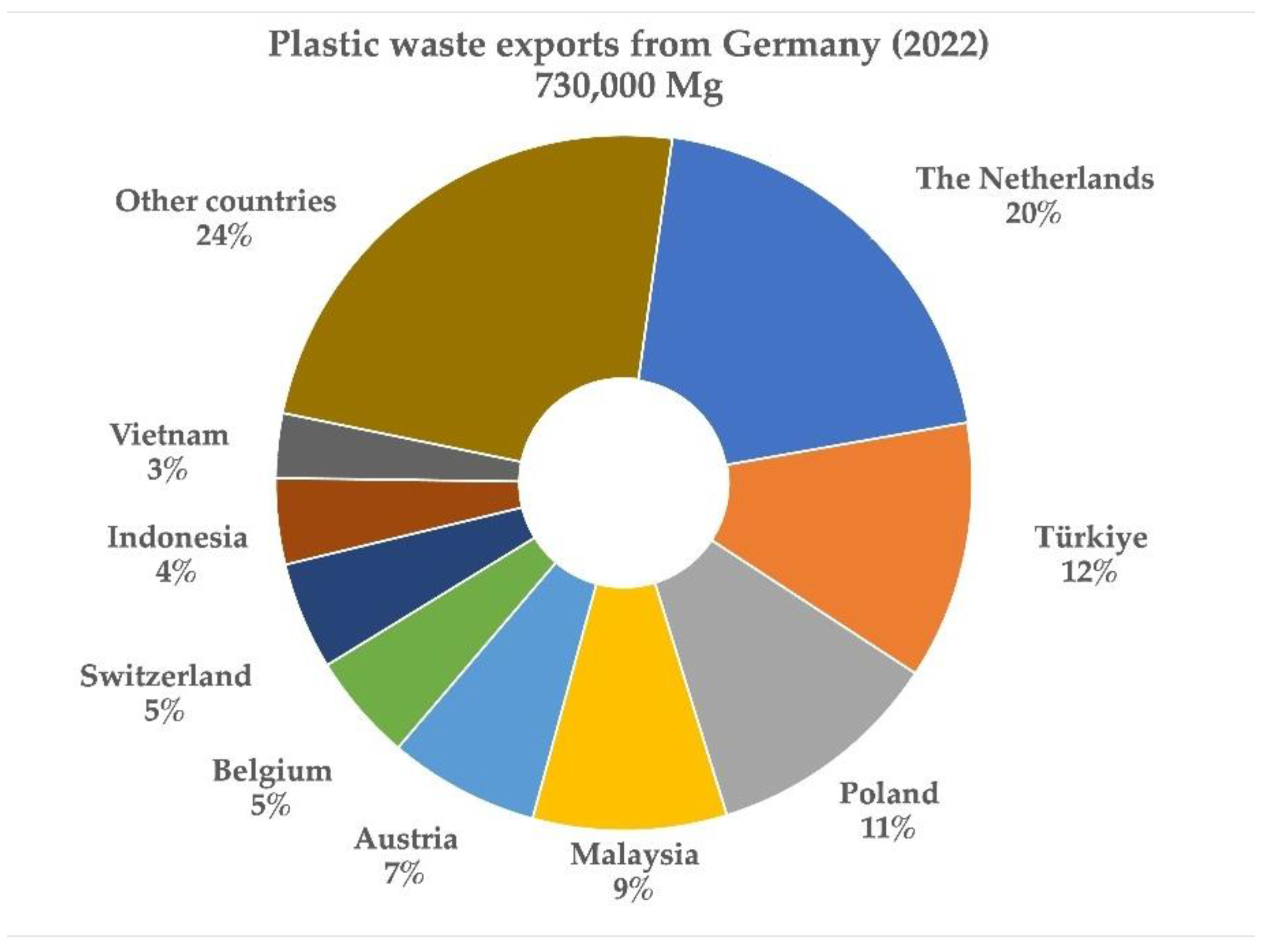

Table 1.
Applications of PVC and typical composition of PVC compounds (in wt.%) [10].
Table 1.
Applications of PVC and typical composition of PVC compounds (in wt.%) [10].
| Application | PVC Polymer | Plasticizer | Stabilizer | Filler | Others |
|---|---|---|---|---|---|
| Rigid PVC applications (PVC-U): | |||||
| Pipes | 98 | - | 1–2 | - | - |
| Window profiles (lead stabilized) | 85 | - | 3 | 4 | 8 |
| Other profiles | 90 | - | 3 | 6 | 1 |
| Rigid films | 95 | - | - | - | 5 1) |
| Flexible PVC applications (PVC-P): | |||||
| Cable insulation | 42 | 23 | 2 | 33 | - |
| Flooring (calendar) | 42 | 15 | 2 | 41 | - |
| Flooring (paste, upper layer) | 65 | 32 | 1 | - | 2 |
| Flooring (paste, inside material) | 35 | 25 | 1 | 40 | - |
| Synthetic leather | 53 | 40 | 1 | 5 | 1 |
1) incl. approx. 0.5 wt.% stabilizer.
Table 2.
Commonly used flame retardants for specific plastics [14].
Table 2.
Commonly used flame retardants for specific plastics [14].
| Resin 1) | Flame Retardant | FR Level (wt.%) | Synergist (wt.%) |
|---|---|---|---|
| ABS | Brominated compounds | 18–24 | 4–8 |
| EPS | Hexabromocyclododecane | 2–4 | |
| HIPS | Brominated compounds | 12 | 4 |
| Polyamides | Brominated compounds | 13–22 | 3–5 |
| Polyamides | Phosphorus-containing | 7–13 | |
| Polyamides | Chlorendic acid | 18 | 9 |
| Polyamides | Dechlorane Plus® 3) | 18 | 9 |
| Polyamides | Magnesium Hydroxide | 60 | |
| PBT | Brominated compounds | 10–19 | 4–5 |
| PBT | Chlorendic acid | 16 | 5 |
| PBT | Dechlorane Plus® 3) | 16 | 5 |
| PC | Tetrabromobisphenol-A, carbonate oligomers | 8–10 | |
| PC/ABS | Phosphate | 10–14 | |
| PE | Decabromodiphenyloxide | 21 | 7 |
| PP | Tetrabromobisphenol-A, bis(2,3-dibromopropylether) | 6–15 | 3–5 |
| PVC | Alumina trihydrate | 60 | |
| Epoxy 2) | Tetrabromobisphenol-A | 18 wt.% Br | |
| UP 2) | Tetrabromophthalic Anhydride | 10–22 wt.% Br | |
| UP 2) | Chlorendic acid/Anhydride | 15–19 wt.% Cl | |
| PUR 2) | Brominated compounds | 5–28 |
1) ABS = acrylonitrile-butadiene-styrene copolymer; EPS = expanded polystyrene; HIPS = high im-pact polystyrene; PBT = polybutylene terephthalate; PC = polycarbonate; PE = polyethylene; PP = polypropylene; PVC = polyvinyl chloride; XPS = extruded polystyrene; UP = Unsaturated Polyester PUR = polyurethane. 2) Thermoset 3) Dechlorane Plus® is a trademark of the Occidental Petroleum Corporation. The commercial substance consists of two isomers: 60–80% anti-Dechlorane Plus (CAS no. 135821-74-8) and 20–40% syn-Dechlorane Plus (CAS no. 135821-03-3) [15], p. 20].
Table 3.
Chemical classes of organic colorants with very good characteristics for use in plastics, based on [22,23].
| Chemical Class | Characteristics | Representatives (C.I. = Color Index) |
|---|---|---|
| Anthanthrone | See Anthraquinone | C.I. Pigment Red 168 C.I. Pigment Violet 31 |
| Anthraquinone | Relatively good heat resistance of 170-270°C. | C.I. Pigment Yellow 24, 108, 147, 199 C.I. Pigment Orange 40, 51 C.I. Pigment Red 83, 89, 177, 216, 226 C.I. Pigment Violet 5:1 C.I. Pigment Blue 60 |
| Benzimidazolone | Excellent fastness properties, heat stability of 200–300°C, good weather and light fastness, migration resistance | C.I. Pigment Yellow 120, 151, 154, 175, 180, 181, 194 C.I. Pigment Orange 36, P.Q., 60, 62 C.I. Pigment Red 171, 175, 176, 185, 208 C.I. Pigment Violet 32 C.I. Pigment Brown 25 |
| Diketo pyrrolo pyrrole | Excellent general fastness properties and brilliant shades | C.I. Pigment Red 254, 255, 264, 270, 272 C.I. Pigment Orange 71, 73 |
| Disazo Condensation | Good chemical and weather resistance, good heat stability | C.I. Pigment Yellow 93, 94, 95, 128, 155, 166 C.I. Pigment Orange 31 C.I. Pigment Red 144, 166, 214, 220, 221, 242 C.I. Pigment Brown 23 |
| Isoindolinone | Excellent in all fastness properties, excellent tinting strength. Relatively low alkaline resistance. Reactivity with basic polymer additives limits heat resistance. | Isoindolinone: C.I. Pigment Yellow 109, 110, 176 C.I. Pigment Orange 61 |
| Metal Complexes | Good heat stability, moderate light fastness. Use in polyamide and cellulose acetate fibers and in highly transparent applications. |
C.I. Pigment Yellow 150 Solvent Yellow 21 Solvent Red 214, 225 Solvent Violet 46 Solvent Blue 132 |
| Perinone 1) | Excellent heat resistance and transparency | C.I. Pigment Orange 43 C.I. Pigment Red 194 |
| Perylene 1) | Excellent heat resistance and transparency | C.I. Pigment Red 123, 149, 178, 179, 190, 224 C.I. Pigment Violet 29 C.I. Pigment Blue 31, 32 |
| Phthalocyanine | Very good heat stability in the range of 200–300°C, and excellent light fastness. May cause distortion in HDPE. |
C.I. Pigment Blue 15, 15 C.I. Pigment Green 7, 36 Solvent Blue 67 |
| Quinacridones | Excellent fastness properties and high color strength. Used for high performance plastics. | C.I. Pigment Orange 48, 49 C.I. Pigment Red 122, 192, 202, 206, 207, 209 C.I. Pigment Violet 19, 42 |
| Quinophthalone | Good heat stability up to 260–280°C, good light and weather fastness. | C.I. Pigment Yellow 138 |
1 Both are chemically related, having similar base skeletons.
Table 4.
Substances of very high concern (SVHC) used as plastic additives; POPs (Persistent Organic Pollutants) and their regulation, according to [61], modified; sources for concentrations there.X = applicable; ppm = mg/kg; 1,000 ppm = 0.1 wt.%.
Table 4.
Substances of very high concern (SVHC) used as plastic additives; POPs (Persistent Organic Pollutants) and their regulation, according to [61], modified; sources for concentrations there.X = applicable; ppm = mg/kg; 1,000 ppm = 0.1 wt.%.
| Additive | Purpose | Plastic, application | Conc. (wt.%) |
REACH [55] |
RoHS2 [56] | POP [57] |
|---|---|---|---|---|---|---|
| HBCD | Flame retardant | EPS, XPS in isolation material HIPS in EEE |
0.7–2.5% 1–7% |
X | – | Products: 100 ppm Waste: 1000 ppm |
| PBDEs | Flame retardant | Σ PBDEs:1000 ppm | Waste ([62], Annex IV): 500 ppm; 350 ppm from 30.12.2025 on; 200 ppm from 30.12.2027 on |
|||
| TetraBDE 1) | Flame retardant | as c-PentaBDE 2) in PUR, former PC boards | 0.5–5% | See PBDEs | See PBDEs | Substances (Annex I): 10 ppm per substance. Products (Annex I): 500 ppm for Σ PBDEs 4) (Annex I) |
| PentaBDE 1) | Flame retardant | See PBDEs | See PBDEs | |||
| HexaBDE 1) | Flame retardant | as c-OctaBDE 3) in: ABS, HIPS, PBT, PA | 12–18% | See PBDEs | See PBDEs | |
| HeptaBDE 1) | Flame retardant | See PBDEs | See PBDEs | |||
| DecaBDE | Flame retardant | HIPS, PA, PO | 5–16% | See PBDEs | See PBDEs | |
| PBBs | Flame retardant, plasticiser | ABS, foams, textiles, devices | 10% | Σ PBBs: 1000 ppm |
||
| DEHP | Plasticiser | PVC | 30% | X | ||
| BBP | Plasticiser | PVC | 5–30% | X | ||
| DBP | Plasticiser | PVC | 1.5% | X | ||
| DIBP | Plasticiser | PVC | like DBP | X |
1 Production of these fabrics was discontinued decades ago, but they can still be found in old stocks and in recycled products. 2 Commercial (c) mixture mainly of isomers of pentaBDE and tetraBDE. 3 Commercial (c) mixture mainly of isomers of isomers of HeptaBDE and OctaBDE as well as a lower proportion of Nona- and HexaBDE. 4 By way of derogation, the manufacture, placing on the market and use of electrical and electronic equipment covered by Directive 2011/65/EC is permitted. Further exemptions apply to DecaBDE (certain aircraft and motor vehicles and their spare parts). Additives: BBP = benzyl butyl phthalate; DBP = di butyl phthalate; DecaBDE = decabromo diphenyl ether; DEHP = di ethyl hexyl phthalate; DIBP = di iso butyl phthalate; HBCD = hexa bromo cyclo dodecane; HeptaBDE = hepta-bromo-diphenyl ether; HexaBDE = hexa-bromo-diphenyl ether; PBBs = polybrominated biphenyls; PentaBDE = penta-bromo-diphenyl ether; TetraBDE = tetra-bromo-diphenyl ether. Plastics: ABS = acrylonitrile-butadiene-styrene copolymer; EPS = expanded polystyrene; HIPS = high impact polystyrene; PA = polyamide; PBT = polybutylene terephthalate; PO = polyolefins; PVC = polyvinyl chloride; XPS = extruded polystyrene.
Table 5.
Migration risk and persistence in recycling, by analyte group, based on Danish EPA findings [84].
Table 5.
Migration risk and persistence in recycling, by analyte group, based on Danish EPA findings [84].
| Analyte Group | Persistence in Recycling | Migration Risk |
|---|---|---|
| Heavy metals | Due to strong binding, expected to persist through mechanical recycling process. Mercury typically found in polyurethane, which cannot be mechanically recycled. The fate of mercury in feedstock recycling isn’t known, but most mercury is expected to have evaporated by that point. | Typically strongly bound, therefore not expected to migrate. As a result, the “exposure to consumers must therefore be considered low”. Mercury an exception: not chemically bound, will migrate and evaporate, leading to some exposure risk. This risk is judged to be small. |
| Perfluorinated chemicals | Only used in certain types of plastics, and the fate of these substances by recycling is unknown. They suggest that “recycling is not normally practised”. | These substances are not chemically bound, meaning there is a risk of migration. |
| Flame retardants | The fate in recycling depends on the plastic. Plastics which can be mechanically recycled (including PVC, PP, PS) will retain flame retardants during recycling. Newer, alternative flame retardants are less studied, characterised by “a lack of knowledge regarding both applications and fate in the products as well as by subsequent recycling activities”. | Migration risk depends on the substance. Reactive flame retardants are chemically bound, and are considered of less risk. Additive flame retardants (such as most BFRs) are not chemically bound and will migrate easily, “and may thus result in significant exposure of consumers”. |
| Phthalates | The migration rate is low enough to assume the main part of the plasticiser added to the product will remain in it until end of life. If mechanically recycled, they will “also be present in recycled materials”. | Migration of plasticisers to food well studied. Generally, all plasticisers “must be anticipated to migrate and the use in plastics should thus be considered a source of exposure to consumers”. |
| Bisphenols | They judge that if Bisphenol A is present in mechanical recycling, it will remain in the plastic. | Based on its physical properties, it should be regarded as a semi-volatile compound, able to migrate out of plastics. With time, “the major part of the substance will probably be released by leaching to the surface followed by evaporation or removal by washing”. |
| Formaldehydes | In mechanical recycling, unreacted formaldehyde will likely evaporate due to its low boiling point and the high vapour pressure. As a result, “the substance will most likely not be present in recycled materials”. | Its physical properties suggest it should migrate strongly. This strong evaporation could lead to occupational exposure. |
Disclaimer/Publisher’s Note: The statements, opinions and data contained in all publications are solely those of the individual author(s) and contributor(s) and not of MDPI and/or the editor(s). MDPI and/or the editor(s) disclaim responsibility for any injury to people or property resulting from any ideas, methods, instructions or products referred to in the content. |
© 2024 by the authors. Licensee MDPI, Basel, Switzerland. This article is an open access article distributed under the terms and conditions of the Creative Commons Attribution (CC BY) license (http://creativecommons.org/licenses/by/4.0/).
Copyright: This open access article is published under a Creative Commons CC BY 4.0 license, which permit the free download, distribution, and reuse, provided that the author and preprint are cited in any reuse.