

Submitted:
28 June 2024
Posted:
01 July 2024
You are already at the latest version
Abstract
Sustainable development has become the aspiration of many developing countries, including Ecuador. The introduction of Bachelor of Tourism studies at the Technical University of Manabí aligns with this interest, implying a challenge for teachers regarding the application of integrative and innovative teaching methods that promote the training of professionals with high scientific rigor, both in technical and professional senses. To achieve this, the pedagogical group started from three fundamental principles based on the application of teaching work methods and pro-cedures, as well as the determination of interactions between the various factors that directly and indirectly influence the training process of professionals in the tourism sector. The results of comprehensive evaluation processes considering both the academic performance of the teachers and the level of satisfaction of students taking the course support the application of these teaching–learning methods, as well as highlighting the convenience of extending the experiences and re-search results of the pedagogical team to other vocational training centers for tourism activities.
Keywords:
pedagogical experiences
; educational innovation
; teaching methods
; open pedagogy
; sustainable tourism
1. Introduction
Contemporary society demands the application of a new social contract for education that addresses inequalities and guarantees a sustainable future for new generations [1]. Therefore, innovation in pedagogical processes and the sustainability of the educational process must be guaranteed [2]. The new social contract must be based on human rights and the principles of non-discrimination, social justice, respect for life, human dignity, and cultural diversity, instilled through open pedagogy and education that prioritizes soft skills and allows us to embrace an ethic of care, reciprocity, and solidarity among all human beings [3].
The vision referred to in the previous paragraph guides the pedagogical group that works with the Bachelor’s Degree in Tourism at the Technical University of Manabí in the Republic of Ecuador, in which 1616 students are currently carrying out their studies.
The transformative dynamics of Ecuador’s political and economic development in recent years have influenced the stability of the country’s educational process, especially with regard to higher education. The constant reductions and inefficient budget execution of universities starting in 2019 negatively impacted the development of research and connections with society, which has represented a setback in educational innovation in the context of Ecuadorian higher education [4].
In the 2030 Education Agenda, [5] the United Nations Educational, Scientific and Cultural Organization (UNESCO) proposes to guarantee inclusive, equitable, and quality education, as well as the promotion of lifelong learning opportunities for all.
As the document states, “Education for sustainable development can provide the knowledge, awareness and actions that empower people to transform themselves and transform societies” [5].
The content of education is not static and, by definition, includes a cognitive component of skill acquisition and a behavioral objective. Both evolve and are open to the integration of new content according to the needs of society [6,7,8].
The controversial term environmental education has given way to the concept of education for sustainable development [9,10,11,12,13,14]. In all cases, it is inferred that pedagogical projects must evaluate the context in which they are developed and adapt to the particular characteristics of each region or country [15,16].
Among the strategies followed to achieve sustainable education, the creation of capacities and training to improve skills and the development of training actions in the interest of communication between sectors, coordinated planning and management of the study programs and evaluation of the results, the design of materials, and the coordination of actions between the intervening actors should be considered [17,18,19]. Research and innovation are also considered to be key factors, and they involve the development of reference studies to establish progress indicators throughout the entire professional training process, as expressed previously [20,21,22,23,24,25,26,27].
The university, understood as a human group that shares a commitment to higher education, incorporates a human component that is committed to the comprehensive training of students not only in academic subjects but also in the social dimension, with the aspiration of forming citizens who are committed to society [28].
After the Industrial Revolution, education underwent a transformation and ceased to be a mechanism for the transmission of knowledge, instead becoming a system for preparing people to be part of the productive economy. Now, we have moved from a society based on the production of consumer goods to another, where the essential thing is the creation of new knowledge and the transfer of the results to society [21,29,30].
At present, the common denominator of pedagogical models in higher education is committed to the introduction of inductive methodologies, which range from understanding the teaching process as an exercise in the transmission of knowledge to a process of inducing student learning, requiring them to overcome challenges and answer questions asked by the teacher, thus inducing the need to search for information and learning with the aim of producing new knowledge [31,32,33]. The aim is for the student to acquire knowledge through confrontation with problematic situations that generate experiences through the induction of knowledge, which they must learn and transfer to other circumstances [34,35].
Problem-based learning establishes a break with the traditional education methodology. In this case, the teacher poses a problem to the students such that they must search for information, discuss it, apply new knowledge, and carry out tests and experiments, thus allowing them to reach precise conclusions related to the solution of the posed problem [36,37].
Despite the enrichment that research carried out in regions with different cultural contexts represents for knowledge related to tourism, as is the case in Latin American countries, the analysis and dissemination of studies carried out in other regions remain scarce [38]. The authors of [39,40,41,42] recognized that the quantity and quality of published research are decisive for the international recognition of universities and their educational programs.
Innovation becomes an unavoidable process if the aim is to achieve results that are significant in tourism studies [43]. It is important to identify the sources of knowledge utilized in ventures in the tourism sector, as well as their use as a safe platform to generate innovation [23].
According to the criteria of the authors of [24,25,26,27], innovation is a process related to tourism. It constitutes the introduction of new and improved products and services, and it is identified as the opportunity to generate creative ideas and take advantage of them, thus being considered a process of change.
The quintuple helix model constitutes a reference through which innovation in educational research processes can be included as a key element to promote innovation in tourist destinations based on the consideration of the educational, economic, natural environment, and political systems to guarantee the sustainability of tourism activities. It provides an opportunity that must be incorporated into the direction of the teaching–learning process, as it allows for interactions between the different nodes contemplated in the model to enhance the re-signification of learning experiences [44,45,46].
Educational innovation plays a key role in the materialization of changes that are manifested in the process and results derived from the correct inter-relation of the personal (teacher, student, group, family, community, and society) and non-personal components of the teaching and learning processes (objectives, contents, methods, means, procedures, forms of individual, frontal, group organization, and evaluation) [47]. In this context, the teacher becomes a tutor/supervisor and promotes greater student protagonism, achieving a balance between theory and practice of the teacher and student through technological advances in the field of education, including the internet, virtual learning environments, and various technological tools that are useful for study in higher education [48,49,50].
Social skills constitute an important component in the relationships that occur at any level in the student environment or at the level of personal relationships. In the university context, the treatment of topics that are binding based on professional careers usually occurs [51]. The act of sharing knowledge translates into a daily action, although it may not be channeled appropriately when based on a methodology that generates profitability in knowledge. It is necessary to apply methodologies that enable collective and participatory work that is of common benefit to the student group. The application of cooperative learning provides a way to generate these skills [52,53,54].
The objective of this article is to re-define the experiences of the pedagogical group that works to professionally train students studying the Bachelor’s Degree in Tourism at the Technical University of Manabí in terms of the application of innovative teaching work methods and procedures, with the aim of achieving comprehensive education enabling the sustainable development of the profession in which they will work in the future.
2. Materials and Methods
2.1. Contextualization of the Research
The research was developed in the context of the Tourism Career of the Faculty of Administrative and Economic Sciences of the Technical University of Manabí, with a graduation profile aimed at graduating professionals trained with knowledge, skills, abilities, and values for successful performance in activities related to the tourism system, hospitality, leisure, and travel, being responsible for the creation and management of tourism services and products with emphasis on supportive and sustainable tourism. In this way, less-favored host communities may be benefited through community-based and inclusive tourism with various modalities in tourist destinations, both in the public and private sectors and in the popular and solidarity economy. The graduates will be characterized by their professionalism, warmth, and quality, which contribute to the transformation of the productive matrix, in accordance with projections for the sustainable development of the territory [55].
The mission is to train graduates in the field of Tourism who are integral leaders, entrepreneurs, and innovators that are capable of promoting the country’s tourism development in an ethical and socially responsible manner, being hospitable, service-oriented, and customer-oriented, as well as committed to local development, endogenous tourism, and the 2030 Agenda for sustainable development [55].
The vision of the faculty consists of being leaders in the comprehensive training of professional and competent tourism graduates, who respond to territorial demands and the challenges that tourism imposes in the 21st century and who are capable of promoting the endogenous local development of tourism in community contexts according to the paradigm of sustainable development and the objectives declared in the 2030 Agenda for sustainable development [55].
2.2. Experiences Achieved in the Materialization of Teaching Innovation Methods
When considering previous analyses, it is essential that teachers develop practical organizational skills for the use of new technologies and the assertive management of their relationships with students, which implies consideration of the pedagogical process from an innovative perspective and the development of soft skills that occupy a prominent position [56,57,58]. To achieve success in this endeavor, the commitment to collaborative learning is essential, which implies achieving greater interaction between the teacher and students through new and varied ways of teaching and learning [59,60,61].
The main task of the pedagogues who carry out the Bachelor’s degree in Tourism at the Technical University of Manabí, highlighting the importance of this procedure, can be synthesized as a group of actions that are developed in three main directions towards a specific goal, as shown in Figure 1.
In [62], it was pointed out that, for materialization of the main work directions, the teachers of the Bachelor of Tourism put into practice permanent collaboration between all the teachers who make up the pedagogical group as a fundamental principle. This is achieved through consideration of the subject groups that were developed under the direction of the teachers who have authored the integrative subjects at each of the levels, as shown in Table 1.
In the subject groups, integration of the objectives, contents, and skills in the evaluation instruments of the subjects and between related subjects is considered, essentially at the interdisciplinary, disciplinary, multidisciplinary, and transdisciplinary levels. The integrative evaluation of the system of knowledge, skills, abilities, and values is analyzed, as well as the problems that will be investigated in each of the organizational units of curricular learning.
The close and permanent link between the teaching staff and the students under the principles of promoting soft skills, which constitutes a first-order requirement during the preparation of each subject and is promoted through social interaction with the components of the development zones of the territory, allow for updating of the state of students’ knowledge and skills continuously, thus enhancing the potential for professional development, in accordance with [63,64]
This interaction between teachers and students facilitates heteroevaluation [65], which consists of evaluation carried out by the students regarding the learning process utilized by the academic staff in each of the school periods, together with the self-evaluation (evaluations that the staff periodically carry out regarding their work and academic performance) and the co-evaluation (evaluations carried out by academic peers and directors) results, constituting the components for comprehensive evaluation of the academic performance of the teachers in the pedagogical group.
The establishment of collaborative agreements between the academy and various economic actors related to tourism activities in both the public and private sectors plays a determining role in achieving the desired quality of the educational teaching process [66,67]. These actors include those in the fields of accommodation, food and beverage services, tourist transportation (including air, sea, river, and land transportation and vehicle rental for this purpose), travel agencies, intermediation agencies (tourist services and organizers), events, congresses and conventions, casinos, game rooms (mechanical bingo), racetracks, and stable amusement parks.
In accordance with the criteria of [68], the curriculum of the Bachelor’s Degree in Tourism is methodologically based on the fulfillment of a broad field of study related to the provision of tourist services. It is impossible to form and develop knowledge, abilities, skills, values (competences), and attitudes based on the deployment of creative initiative, innovation, entrepreneurship, commitment, dynamism, respect, and solidarity necessary for the exercise of the good practices in tourism without there being a close link between the professional training center and the various companies and actors in both the public and private sectors.
The link between training centers and companies in the tourism sector is key to the proper development of academic material, which leads the pedagogical group to continuously search for teaching work methods and procedures that would contribute to the materialization of active methods for reflective and participatory teaching–learning that encourage participation, debate, searching for solutions, problem-solving, and decision-making by students [69,70,71].
The methodologies that are most useful include carrying out exploratory, descriptive, and correlational studies; explanatory or causal studies; participatory action research and case studies; the assessment of tourism data and statistical series as part of documentary research, market research, process modeling, methodologies, business strategies, and management systems; and exhibitions, discussion forums, seminars, and practical classes [72].
The most appropriate learning methodologies to guarantee the capabilities of exploration, construction, connectivity of knowledge and the development of critical and creative thinking in students are as follows [72]:
- Expository master classes that allow for the internalization of information and common teaching processes, which guarantee students’ knowledge of the necessary training, methodologies, and processes to know, apply, intervene, propose, and conclude direct interventions in their professional actions [73,74].
- Open, collaborative, and integrated teaching (collaborative teaching model) that, at professional and degree levels, allows the student and teacher to integrate with the knowledge society, with respect to not only the traditional methodologies that are applied but also those practiced in the various contexts of action through the use of the various media associated with the information society and globalization [79,80].
Open and collaborative teaching, as an essential element of education based on the development of soft and inclusive skills at the professional and degree levels, allows for the insertion of innovation processes into sustainable endogenous local development of tourism and the generation of entrepreneurship through practical applications in the various contexts of action, in the use of the various media from the information society, as well as knowledge management, innovation, and globalization. Teachers change and reduce their roles as transmitters of information to a minimum, which is achieved through the presentation and contextualization of topics, as well as the formulation of professional problems emphasizing important aspects or those that are difficult to understand, allowing students to more easily access all kinds of information [81].
In the training of professionals, the teacher becomes a counselor and facilitator of learning, a provider and advisor of the most appropriate educational resources, and a mediator of learning in the different scenarios of future professional performance. This is achieved through enhancement of the creativity, initiative, independence, and ability to solve of professional problems of students through various scenarios in which they interact with companies and ventures dedicated to tourism activities, as well as the integration of all components of the development process of teaching and learning [82]. Some teaching work procedures that are applicable to the collaborative teaching model are detailed in Table 2 [79,83].
2.3. Research Method, Techniques, and Tools
For research, interdisciplinarity implies the elements of contact between disciplines, in an environment where each contributes its research methods and concepts. Meanwhile, transdisciplinarity refers to the correspondences between disciplines from a simultaneous point of view, where the same research method is adopted [84,85].
The research presents an interdisciplinary and transdisciplinary approach related to teaching innovation and teaching–learning methods for sustainable tourism development in the Bachelor of Tourism degree, as well as its theoretical and methodological foundation that allows the experience of the pedagogical group that works in training to be redefined, thus enabling the professionalism of students pursuing a Bachelor’s degree in Tourism at the Technical University of Manabí. Innovative teaching work methods and procedures are applied with the aim of providing a comprehensive education to students for sustainable development of the profession in which they will work in the future.
The use of a deductive method allowed for examination of the research problem from a general standpoint, accompanied by analyses of the theories related to educational innovation and teaching–learning methods that guarantee professional training in the Bachelor’s degree in Tourism to ensure sustainable tourism development. The identification and development of the premises and objectives of the work to reach conclusions related the studied topic are also enabled [86,87]. Figure 2 shows a diagram of the methodology applied for the research.
The research is descriptive, analytical, and explanatory and uses a mixed approach, allowing for integration of the contributions of the analysis related to the treatment and processing of the survey results obtained from students of the Bachelor of Tourism degree at the Technical University of Manabí. This made it possible to explore the phenomena linked to educational innovation, new teaching–learning methods, and the requirements of professional education linked to sustainable tourism in the 21st century [88,89].
This approach made it possible to understand the importance of the academic contributions made by the teaching group of the Bachelor of Tourism degree at the Technical University of Manabí, related to the application of innovative teaching models aimed at the professional skills linked to the degree, in the interest of promoting sustainable tourism in accordance with the demands of the 21st century.
Direct and indirect observations [90] allowed for a contextual approach to the different methods and models of educational innovation applied in the Bachelor of Tourism degree at the Technical University of Manabí, focusing on the training of professionals who are capable of developing and managing tourism models that respond to demands associated with environmental respect, sustainability, and improvement of the living conditions of the host communities.
The techniques of historical–logical analysis [91], analysis–synthesis, systematic review of literature and documents from primary sources [86], transition from concrete to abstract [92], and the systemic approach [93] were applied. Furthermore, statistical analysis was conducted for the processing of survey results [94]. As research instruments, the observation guide and a structured survey questionnaire were applied in the student group.
The structured questionnaire of the survey was prepared with 15 items distributed in 3 groups with 5 questions each: the first (items 1 to 5) and is related to learning in contact with the teacher; the second (items 6 to 10) is related to autonomous learning; and the third (items 11 to 15) is related to experimental practical learning.
The survey was applied based on methodological requirements including anonymity of the participants, demand for collaboration, and ethical commitment when processing the information [95]. Taking advantage of new technologies, the questionnaires were sent to the students electronically.
The bibliographic review made an analysis of scientific articles, theses, books, and documents from primary sources related to the topic of study from its different conceptual denominations possible [96]. The selection of documents included a rigorous review of the related literature, with special attention to publications between the years 2019 and 2024.
The theoretical result consists of the contribution made by the academic group that teaches the Bachelor’s degree in Tourism at the Technical University of Manabí, which allows the professional training of the students to be re-defined through the application of innovative teaching methods and procedures, with a focus on comprehensive education for sustainable tourism development. This includes experiences that, due to their versatility, can be applied by other higher education centers in Latin American countries that have socioeconomic and environmental characteristics similar to those of Ecuador.
The study population was made up of 1616 students and 40 professors of the Bachelor’s Degree in Tourism at the Technical University of Manabí. Based on the characteristics and context of the population, sample selection was conducted using the intentional non-probabilistic method, comprising 102 students and 10 teachers.
The 102 students were distributed as follows: Four at first-level and 15 in each of the remaining levels (from 2nd to 8th) of the Bachelor of Tourism degree. This was based on the guideline established in the Academic Regime Regulations of the Technical University of Manabí [97] on learning activities that seek to achieve the objectives of the degree.
The sample of 10 professors was made up of those linked to the training of tourism professionals, who voluntarily agreed to consultation of the record of academic performance evaluations for the last five academic periods. For this purpose, an analysis of the results of the application of the Comprehensive Evaluation Regulation with respect to the performance of the academic staff of the Technical University of Manabí was carried out [98].
For evaluation of the structured survey, a Likert-type scale was applied to measure the students’ attitude towards their own learning during the process of their training as professionals.
The Likert scale is easy to construct and apply, and is used to measure or record complex information about respondents from the accumulation of responses on a topic. It is necessary to offer multiple-choice answers that are graded from positive to negative (or vice versa), but consistently in all questions. It is an ideal instrument to measure a person’s reactions, attitudes, and behaviors [99].
The used scale had four values: Agree (4 points); I have no opinion (3 points); disagree (2 points); and strongly disagree (1 point). With the objective of rating the reliability of the designed instrument, an alpha coefficient of 0.86 was obtained.
The Likert scale was validated by ten professionals selected as experts in research methodology, who gave positive valuations regarding the validity and reliability of both instruments.
In the analysis of the teacher evaluations, the results obtained in each of five competencies that were most significant for the purpose of the research were compared: the first is related to the mastery of the contents of the subject; the second is related to the teaching methodologies used; the third addresses the use of new information and communication techniques (NICT); the fourth deals with the exercise of tutoring and evaluation of learning; and, finally, the fifth analyzes their ethical attitudes and interpersonal relationships. As stated in the Academic Regime Regulations of the Technical University of Manabí, each of the competencies was rated on a scale of 0 to 5 points.
3. Results
Table 3 shows the results derived from the application of the Likert scale in groups of actors by each item.
The synthesis of the results for each group of items is shown in Table 4.
It was found that the majority of students showed an adequate attitude towards the learning process and positively valued the importance of the innovative processes and teaching work procedures developed for this purpose. Notably, seven students preferred not to give their opinion regarding the statement raised in item no. 3.
In general, students gave the lowest scores to items 3, 8, and 12, which were considered to state negative or incorrect aspects about the teaching–learning process.
The majority of respondents gave higher values to the items that affirmed aspects related to innovation in the teaching–learning process based on small planned improvements, the result of adaptation to improvements introduced from the external environment, and the use of new information and communication technologies. The lowest average scores corresponded to the statements about autonomous learning, which can be interpreted as an under-valuation of the students’ internal potential.
As limiting aspects of the research, it can be noted that the transversality in obtaining information disallows analysis to be carried out on the variation of the evaluations obtained over time; furthermore, the voluntary and non-probabilistic nature of the sample limits the ability to make inferences from the rest of the actors not involved in the study.
Table 5 shows the results of the evaluations of ten professors linked to teaching in the Bachelor of Tourism during the last five evaluation periods. It reflects the average of the points achieved by the teachers in each of the five competencies taken into consideration for the study and in each of the evaluated periods.
4. Discussion
The research results revealed that all teachers showed significant progress in the exercise of their teaching skills, which corroborates the importance of the work and control procedures carried out in the pedagogical group, as well as the joint search for new methods and procedures that stimulate the teaching and learning process through innovation, which enables the training of professionals for the sake of sustainability, in accordance with [1,2].
It was possible to demonstrate the importance of the new social contract in accordance with human rights, based on an open pedagogy and the prioritization of soft skills founded on an ethic of solidarity and reciprocity between teachers and students, in correspondence with the criteria addressed in [3].
The impact of the transformative dynamics of the policies outlined by the state in recent years was analyzed, including the limitations imposed by the reduction in higher education budgets. These affected the pace of research work and the connection with society, as well as the guarantee of inclusive, equitable, and quality education proposed in the 2030 Education Agenda, in accordance with the statements in [5] and the analysis results reported in [4].
In accordance with the criteria of [6,7], this research allowed us to verify that the content of education is not static, as it includes a cognitive component that is dynamic with respect to the acquisition of knowledge and skills focused on behavioral objectives, as well as the judgments expressed in the concept of sustainable development according to the characteristics of the territory, coinciding with the statements in [9,10,11,12,13,14,15,16].
The importance of the creation of new capabilities and the improvement of skills in the development of training actions that favor coordinated work between sectors in the interest of the management of vocational training was evident, in accordance with the analyses in [17,18,19].
In accordance with the criteria of the authors [20,21,43], it was possible to verify that research and innovation are key elements for the development of studies and the establishment of progress indicators in the training of professionals; where the identification of different sources of knowledge related to tourism ventures is in the same line as indicated in [23,24,25,26,27].
The eminently human character of the university and higher education was analyzed according to the comprehensive training function of the students, including the social dimension for the training of professionals with high social commitment, which maintains similarity to the analysis in [28].
The evolutionary character of the university as a training mechanism in the interest of the productive economy since the Industrial Revolution, as well as its current transformation based on the need for the creation of new knowledge through educational innovation and its transfer in the interest of social development, corresponds to the statements in [21,29,30].
At present, university pedagogical models focus on the articulation of methodological performance based on an inductive method promoting the induction of learning, overcoming research challenges, and the search for information aimed at the production of new knowledge, in line with the analyses kin [31,32,33,34,35].
In the innovative process of the current university training system, where educational innovation is promoted, problem-based learning must prevail to encourage students to be able to search for information, discuss it, apply new knowledge, and develop experimental work that makes it possible to reach precise conclusions linked with solutions to the problems raised for the benefit of society, in accordance with [36,37].
According to the results of the research carried out by [38], it was possible to verify that in-depth studies on educational innovation in the Bachelor of Tourism degree are scarce. The relevance of the studies and research that allow us to re-define the importance of educational innovation in the context of the considered Bachelor’s degree in Tourism is recognized, allowing for the introduction and improvement of new teaching methods, in the same direction as proposed in [39,40,41,42].
The re-signification of the methods linked to educational innovation and their consequent application for the professional training of Graduates in Tourism constitutes an essential process to achieve significant results in education, allowing for the identification of new sources of knowledge and the use of reliable platforms to promote and generate innovation, coherent with the criteria expressed in [23,43].
It is well-known that innovation is a process that is inherent to tourism for the generation of new and improved products and services. It constitutes an opportunity to generate ideas that are creative and promote their use as part of a transformative process, in a manner analogous to the indications in [24,25,26,27].
It was confirmed that educational innovation plays a significant role in enabling the materialization of changes for continuous improvement, favoring the inter-relationships between teachers, students, family, community, and society during the materialization of the teaching process. In learning, the teacher reconfigures their role as a tutor to enhance the student’s performance in the use and exploitation of new technological advances, in correspondence with [47,48,49,50].
In accordance with what was pointed out in [44,45,46], considering the quintuple helix model provides an important opportunity to enhance teaching and research processes, being a key element of innovation that integrates the educational system with the economic system, the Natural environment, and the political system in the interest of guaranteeing the sustainability of tourism.
Similar to what was expressed in [52,53,54], the importance of the application of methodologies that promote participatory work in the interest of the group was proven as a way to promote the generation of professional skills.
It was found that the Bachelor’s Degree in Tourism at the Technical University of Manabí emphasizes the mission and vision focused on the training of innovative and ethical tourism professionals who are societally responsible. These individuals are endowed with a vocation for customer-oriented services as well as a notable commitment to the endogenous development of tourism and the stipulations of the 2030 Agenda for sustainable development, in accordance with the Academic Regime Regulations of the Technical University of Manabí [97,98].
The experiences derived from the materialization of innovative methods in the training of Tourism Graduates from the Technical University of Manabí demonstrated the relevance of the development of organizational skills based on the use of technologies, as well as the relationships between teachers, students, family, and society, as inseparable parts of the innovative process in education. This is in agreement with the analyses in [56,57,58,59,60,61].
Similarly to [62], collaboration between teachers through the development of subject groups under the guidance of teachers who are authors of integrative subjects plays a determining role in the materialization of the main directions of the proposed work.
As analyzed in [63,64], the promotion of soft skills constitutes a first-order permanent objective during the preparation of subjects and prioritization of social connection with the actors playing roles in the development of tourism activities in the territory, which allows for continuous updating of students’ knowledge and development of their professional potential.
One of the experiences that deserves to be highlighted is related to the formal relationships established through collaboration agreements between the university, actors, and tourism entities in the territory, which allows for the enhancement of the quality of the educational teaching process and the professional training of students, in line with the analyses in [66,67].
According to the criteria of [69,70,71], the relationships between the university and tourism companies are key for promoting the adequate development of academic material and educational innovation. The utilization of active, reflective, and participatory methods during the teaching–learning process promotes a participatory nature, debates to find solutions, problem-solving, and decision-making by students.
According to the criteria of [72], there are different methodologies that facilitate the innovative process in teaching. Among them, we can mention exploratory, descriptive, and correlational studies; explanatory or causal studies; participatory action research and case studies; the evaluation of tourism data and statistical series; market research; process modeling; business strategies; the exhibitions; discussion forums; seminars; and practical classes.
The most important learning methodologies include expository master classes, the introduction of content (via an instructive teaching model), the active didactic model, and open teaching [73,74,75,76,77,78,79,80,81].
According to the criteria of [82], it can be noted out that creativity, initiative, independence, and the ability of teachers to solve students’ professional problems play a key role in the training of professionals. The teacher appears as a mediator of learning, a counselor, a facilitator, a provider, and an advisor regarding educational resources that are appropriate for the various scenarios faced by future professionals.
In the collaborative teaching model, some procedures can be used, such as panels; round tables; debates; forums; seminars; discussion groups; conversations; conferences; virtual tutoring; case studies; meetings with clients, familiarization groups, FAM, and travel agents; application of surveys and feedback systems; market studies and research; creation of businesses; and practical application of different tourism modalities, especially sustainable tourism, according to [79,83].
The theoretical and practical contributions and good practices of sustainable tourism must be transversal to all types and modalities of tourism. The theoretical contributions derived from this research, its results, and the discussion offer arguments that allow for re-signification of the experiences of the pedagogical group of the Bachelor of Tourism degree at the Technical University of Manabí, in the interest of the application of innovative teaching methods and procedures enabling the achievement of comprehensive professional education, thus responding to objectives for sustainable development of the tourism sector and allowing for the goals of the 2030 Agenda to be achieved.
The main limitations of this study include insufficient existing knowledge on teaching innovation methodologies and integrative teaching–learning methods in the training of tourism professionals, which encourages a tendency to maintain traditional teaching methods aimed at the application of a banking education model, in which the teacher transmits and ‘deposits’ information into the student, which can limit their cognitive potential, in terms of the development of independent thinking and creativity.
The little inter-relation that exists between teachers, students, families, and society makes the introduction of new teaching–learning methods difficult. Meanwhile, poor coordination and collaboration between universities and entities in the tourism sector leads to weak professional training for tourism graduates.
It is recommended that future research continues to delve deeper into the study of teaching innovation methodologies and teaching–learning methods integrated into the Bachelor’s Degree in Tourism, especially those related to the development of sustainable tourism and its socioeconomic, environmental, and social impacts in connection with the governance of tourist destinations.
The development of the research objectives allowed for contributions to be made regarding the importance of re-signifying the experiences of the pedagogical group of the Bachelor of Tourism degree at the Technical University of Manabí in terms of the application of innovative teaching work methods and procedures aimed at achieving the comprehensive education of students to ultimately promote the sustainable development of tourism.
The contextualization, deepening, and articulation of argued theories on the sustainability of the tourism sector in different modalities and destinations can contribute to the development of sustainable tourism by highlighting the endogenous wealth of less favored areas and achieving an equitable distribution of the obtained benefits, which will allow for a reduction in marginality and poverty in other places in the South American region with characteristics similar to those observed in Ecuador.
Author Contributions
Conceptualization, Norberto Pelegrín (N.P.), Antonio Vázquez (A.V.), and María R. Naranjo (M.R.N.); methodology, A.V. and N.P.; formal analysis, N.P., A.V., and M.R.; research, N.P., Sebastiana M. Ruiz (M.R.), and M.R.N.; data curation, N.P., A.V., and M.R.N.; writing—preparation of the original draft, A.V. and N.P.; writing—review and editing, A.V. and N.P.; visualization, N.P. and A.V.; supervision, N.P., M.R., and M.R.N.; administration, N.P. and M.R. All authors have read and accepted the published version of the manuscript.
Funding
The financing of the research and its publication was carried out with the authors’ own resources, for which they had their own budget of USD 4500.
Institutional Review Board Statement
Not applicable. The research does not involve specific studies of humans and animals.
Informed Consent Statement
Informed consent was obtained from all survey participants and teachers involved in the study.
Data Availability Statement
Data can be provided by the corresponding authors upon request.
Acknowledgments
The authors thank the authorities of the Technical University of Manabí, especially the teaching staff of the Bachelor of Tourism program, for their collaboration during the research that made the work possible.
Conflicts of Interest
The authors declare no conflicts of interest.
References
- Barrero-Barrero, David.; Fabio Baquero-Valdés. Objetivos de Desarrollo Sostenible: un contrato social posmoderno para la justicia, el desarrollo y la seguridad. Revista Científica General José María Córdova 18.29, 2020: 113-137. [CrossRef]
- Martínez, Juan Carlos Pila.; Wilson Gonzalo Andagoya Pazmiño.; María Elizabeth Fuertes Fuertes. El profesorado: Un factor clave en la innovación educativa. Revista EDUCARE-UPEL-IPB-Segunda Nueva Etapa 2.0 24.2, 2020: 212-232. [CrossRef]
- Céspedes, Lianet Goyas.; Georgina Marcia Soto Senra.; Liannet Sánchez Soto. La gestión de los procesos educativos universitarios enfocados a la educación ambiental. Magazine de las Ciencias: Revista de Investigación e Innovación 3.3, 2018: 89-102. https://revistas.utb.edu.ec/index.php/magazine/article/view/580. (Accessed on 16 February 2024).
- Gómez Ponce, Leonardo. El presupuesto de las universidades, ¿dinero bien gastado? Observatorio de gasto público de Ecuador. 2020. https://www.gastopublico.org/informes-del-observatorio/el-presupuesto-de-las-universidades-dinero-bien-gastado. (Accessed on 21 May 2024).
- ONU. Educación para el Desarrollo Sostenible. Hoja de Ruta. Repositorio UNESCO. Organización de las Naciones Unidas. 2020. http://es.unesco.org/open-access/terms-use-ccbysa-sp. (Accessed on 18 February 2024).
- Pinzón, Juan David. Educar para la sostenibilidad, como fomento de una cultura de desarrollo humano sostenible en el contexto rural. [Tesis doctorado]. Universidad Pedagógica Experimental Libertador. Venezuela. (2020). https://espacio.digital.upel.edu.ve/index.php/TD/article/view/896/750. (Accessed on 20 February 2024).
- Ciro Romero, Diana Libia. Evaluación de las intenciones ambientales de los estudiantes de la Universidad Nacional de Colombia-Sede Bogotá. [Tesis de maestría]. Universidad Nacional de Colombia. https://repositorio.unal.edu.co/handle/unal/80188. (Accessed on 10 February 2024).
- Delandshere, Ginette. From static and prescribed to dynamic and principled assessment of teaching. The Elementary School Journal 97.2, 1996: 105-120. https://www.journals.uchicago.edu/doi/abs/10.1086/461857. (Accessed on 3 May 2024).
- Huckle, John. Education for sustainability: evaluating paths to the future. Australian Journal of Environmental Education 7, 1991: 43-62.
- Tilbury, Daniella. Environmental education for sustainability: Defining the new focus of environmental education in the 1990s. Environmental education research 1.2, 2006. [CrossRef]
- Calvo, Seoanez. El medio ambiente en la opinión pública: Tendencias de opinión. Demanda social. Análisis y gestión de la opinión pública en materia de medio ambiente. Comunicación medioambiental en la Administración y en la empresa. Ediciones Mundi-Prensa, 1997. https://books.google.es/books?hl=es&lr=&id=-Ab7syu2PRQC&oi=fnd&pg=PA31&dq=Calvo,+S.+(1997)&ots=Lu0E7ebDXT&sig=HIfUACspztsCbmX_t0U7UJ4eR70. (Accessed on 11 February 2024).
- Huckle, John.; Stephen R. Sterling. Education for sustainability. Earth exploration,1996. https://books.google.es/books?hl=es&lr=&id=dNsTFPRFAZ4C&oi=fnd&pg=PP9&dq=Sterling,+S.+(1996).+Good+Earth-keeping:+Education,+Training+%26+Awareness+for+the+Sustainable+Future,+Londres,+UNEP&ots=c7SjnqYUdx&sig=wz5zRQLDQCJbHcBb2fXKK9JVlbM. (Accessed on 20 February 2024).
- Palmer, Joy. Environmental education in the 21st century: Theory, practice, progress and promise. Routledge, 2002. https://api.taylorfrancis.com/content/books/mono/download?identifierName=doi&identifierValue=10.4324/9780203012659&type=googlepdf. (Accessed on 21 February 2024).
- McNaughton, Marie Jeanne. El drama educativo en la educación para el desarrollo sostenible: Ecopedagogía en acción. Pedagogía, Cultura y Sociedad 18.3, 2010: 289-308. [CrossRef]
- O’Flaherty, Joanne.; Mags Liddy. The impact of development education and education for sustainable development interventions: a synthesis of the research. Environmental education research 24.7, 2018: 1031-1049. [CrossRef]
- Boeve-de Pauw, Jelle.; Niklas Gericke.; Daniel Olson.; Teresa Berglund. The effectiveness of education for sustainable development. Sostenibilidad 2015, 7 (11), 15693-15717; [CrossRef]
- Valdiviezo, Wilfredo Alva. Ecoeficiencia: Nueva estrategia para la educación ambiental en instituciones educativas. Investigación Valdizana 13.2, 2019: 77-84. https://dialnet.unirioja.es/servlet/articulo?codigo=7099924. (Accessed on 7 February 2024).
- Barajas, Leomary Niño. Estudio de caso: una estrategia para la enseñanza de la educación ambiental. Praxis & Saber 3.5, 2012: 53-78. https://www.redalyc.org/pdf/4772/477248389003.pdf. (Accessed on 5 March 2024).
- Huckle, John.; Arjen EJ Wals. The UN Decade of Education for Sustainable Development: business as usual in the end. Neoliberalism and Environmental Education, 2018: 203-218. https://www.taylorfrancis.com/chapters/edit/10.4324/9781315388786-17/un-decade-education-sustainable-development-business-usual-end-john-huckle-arjen-wals. (Accessed on 5 April 2024).
- Gutiérrez, José, Javier Benayas.; Susana Calvo. Educación para el desarrollo sostenible: evaluación de retos y oportunidades del decenio 2005-2014. Revista Iberoamericana de educación 40, 2006: 25-69.
- Asencio, Enrique Navarro.; Eva Jiménez García.; Soledad Rappoport Redondo.; Bianca Thoilliez Ruano. Fundamentos de la investigación y la innovación educativa. La Rioja, Spain: UNIR editorial, 2017. https://www.academia.edu/download/63914904/Investigacion_innovacion20200714-76954-16h68ce.pdf. (Accessed on 15 March 2024).
- Toker, Umut.; Denis O. Gray. Innovation spaces: Workspace planning and innovation in US university research centers. Research policy 37.2, 2008: 309-329. [CrossRef]
- Morales-Rubiano, María Eugenia.; Carolina Ortiz-Riaga.; Yenni Viviana Duque-Orozco.; Paola Andrea Plata-Pacheco. Fuentes de conocimiento e imágenes de la innovación en micro y pequeñas empresas de turismo: agencias de viajes y hoteles en Bogotá y Pereira. Revista de Investigación, Desarrollo e Innovación 7.2, 2017: 217-230. [CrossRef]
- Chica, J. C. La importancia de innovación en las actividades turísticas de recreación en las operadoras turísticas del puerto El Morro, de la provincia del Guayas en el año 2017. Tesis de grado. Repositorio de la Universidad Estatal de la Península de Santa Elena, Ecuador. 2017. https://repositorio.upse.edu.ec/bitstream/46000/4126/1/UPSE-THT-2017-0005.pdf. (Accessed on 20 February 2024).
- Pasaco, B.; Agudo, K. Análisis de la innovación en las Mipymes turísticas de la ciudad de cuenca en los años 2011 y 2012. Tesis de grado. Universidad de Cuenca Ecuador. 2014. Disponible en: http://dspace.ucuenca.edu.ec/bitstream/123456789/5604/1/Tesis.pdf. (Accessed on 18 January 2024).
- Morales, M.; León, A. Adiós a los mitos de la innovación. Una práctica para innovar en América Latina. Ed. Innovare. 2013. Disponible en: http://www.quieroinnovar.com/wp-content/uploads/2013/06/Capitulo1AdiosALosMitosDeLaInnovacion.pdf. (Accessed on 15 January 2024).
- González, M.; León, C. Turismo sostenible y bienestar social ¿cómo innovar esta industria global? Ed. Erasmus. Madrid. 2010. https://books.google.es/books?hl=es&lr=&id=EDAo6ThGYNUC&oi=fnd&pg=PA1&dq=Gonz%C3%A1lez,+M.%3B+Le%C3%B3n,+C.+Turismo+sostenible+y+bienestar+social+%C2%BFc%C3%B3mo+innovar+esta+industria+global%3F+Ed.+Erasmus.+Madrid.+2010&ots=wwPUvYMQ3g&sig=UQ7JSystuUWm5SkiwxvHYgDTPZs. (Accessed on 16 February 2024).
- Molina Ruiz, Enriqueta. Creación y desarrollo de comunidades de aprendizaje: hacia la mejora educativa. Revista de Educación, 337, 2005: 235-250. https://redined.educacion.gob.es/xmlui/bitstream/handle/11162/68041/00820053000214.pdf?sequence=1. (Accessed on 7 April 2024).
- Harrington, Denis.; Arthur Kearney. The business school in transition: New opportunities in management development, knowledge transfer and knowledge creation. Journal of European Industrial Training 35.2, 2011: 116-134. https://www.emerald.com/insight/content/doi/10.1108/03090591111109334/full/html. (Accessed on 16 April 2024).
- Karpov, Alexander O. Education for knowledge society: Learning and scientific innovation environment. Journal of Social Studies Education Research 8.3, 2017: 201-214. https://dergipark.org.tr/en/download/article-file/375096. (Accessed on 21 April 2024).
- Giorgou Tzampazi, Stella. The effects of deductive, inductive and a combination of both types of grammar instruction in pre-sessional classes in higher education. Doctoral thesis. University of Bedfordshire. 2019. https://uobrep.openrepository.com/handle/10547/624036. (Accessed on 10 April 2024).
- Figueiró, Paola Schmitt.; Daiane Mülling Neutzling.; Bruno Lessa. Education for sustainability in higher education institutions: A multi-perspective proposal with a focus on management education. Journal of Cleaner Production 339, 2022: 130539. [CrossRef]
- Azungah, Theophilus. Qualitative research: deductive and inductive approaches to data analysis. Qualitative research journal 18.4, 2018: 383-400. https://www.emerald.com/insight/content/doi/10.1108/QRJ-D-18-00035/full/html. (Accessed on 7 April 2024).
- Yom, Sean. From methodology to practice: Inductive iteration in comparative research. Comparative Political Studies 48.5, 2015: 616-644. [CrossRef]
- Schadewitz, Nicole.; Jachna, Timothy. Comparing inductive and deductive methodologies for design patterns identification and articulation. In: International Design Research Conference IADSR 2007 Emerging Trends in Design Research, 12-15 Nov 2007, Hong Kong. http://www.sd.polyu.edu.hk/iasdr/index.htm. (Accessed on 7 May 2024).
- Kilroy, D. A. Problem based learning. Emergency medicine journal 21.4, 2004: 411-413. [CrossRef]
- Hung, Woei, David H. Jonassen.; Rude Liu. Problem-based learning. Handbook of research on educational communications and technology. Routledge, 2008. 485-506. https://www.taylorfrancis.com/chapters/edit/10.4324/9780203880869-42/problem-based-learning-woei-hung-david-jonassen-rude-liu. (Accessed on 26 May 2024).
- Picazo, P.; Moreno, S. Difusión de la investigación científica en turismo. El caso de México. El Periplo Sustentable, núm. 24, enero-junio, 2013, pp. 7-40. https://accedacris.ulpgc.es/bitstream/10553/22732/2/Difusi%C3%B3n_investigaci%C3%B3n_M%C3%A9xico.pdf. (Accessed on 6 March 2024).
- Bowen, John T. Managing a research career. International journal of contemporary hospitality management 17.7, 2005: 633-637. [CrossRef]
- Jogaratnam, G., Chon, K., Mccleary, K., Mena, M. y Yoo, J. An Analysis of Institutional Contributors to Three Major Academic Tourism Journals: 1992-2001. En Tourism Management, vol. 26, 2005, núm. 5, pp. 641-648. [CrossRef]
- Zhao, W. y Ritchie, J. R. B. An Investigation of Academic Leadership in Tourism Research: 1985-2004. En Tourism Management, vol. 28, 2007, núm. 2, pp. 476-490. [CrossRef]
- Park, K., Phillips, W.J., Canter, D.; Abbott, J. Hospitality and Tourism Research Rankings by Author, University, and Country using Six Major Journals: The First Decade of the New Millennium. En Journal of Hospitality and Tourism Research, vol. 35, 2011, núm. 3, pp. 381-416. [CrossRef]
- Mullo Romero, Esther del Carmen.; Jenny Patricia Castro Salceso.; Samuel Ricardo Guillén Herrera. Innovación y desarrollo turístico. Reflexiones y desafíos. Revista Universidad y Sociedad 11.4, 2019: 394-399. http://scielo.sld.cu/scielo.php?pid=S2218-36202019000400394&script=sci_arttext&tlng=pt. (Accessed on 10 January 2024).
- Vergel, M; Vega, O; Bustos, V. J. Modelo de quíntuple hélice en la generación de ejes estratégicos durante y postpandemia 2020. Revista Boletín Redipe, 2022 vol. 9 (9):92-105. https://revista.redipe.org/index.php/1/article/view/1066. Consulted 30 june 2022.
- Carayannis, E.G; Barth, T. D; Campbell, D. The Quintuple Helix innovation model: global warming as a challenge and driver for innovation. Journal of Innovation and Entrepreneurship 2012 volume 1, number: 2. http://transicionsocioeconomica.blogspot.com/2020/01/modelos-de-quinduple-helice.html. Consulted 10 july 2022.
- Castillo-Vergara, M. La teoría de las N-hélices en los tiempos de hoy. Journal of technology management & innovation, 2020 Volumen 15(3), 3-5. https://www.scielo.cl/pdf/jotmi/v15n3/0718-2724-jotmi-15-03-3.pdf. Consulted 25 june 2022.
- Dooley, Kim E. Hacia un modelo holístico para la difusión de tecnologías educativas: una revisión integradora de los estudios de innovación educativa. Revista de Tecnología y Sociedad Educativa 2.4, 1999: 35-45. https://www.jstor.org/stable/jeductechsoci.2.4.35. (Accessed on 3 April 2024).
- Mosquera-Esparza, Z. A.; Mosquera-Esparza, M. E.; Suárez-Monzón, N. Estrategias para la mejora de la gestión de la innovación didáctica en los docentes de la Unidad Educativa “Los Andes”. Revista Metropolitana de Ciencias Aplicadas, 6(1), 2023: 168-177. https://remca.umet.edu.ec/index.php/REMCA/article/view/612/618. (Accessed on 19 February 2024).
- Juárez-Ibarra, Gerónimo. El rol del docente ante un ambiente innovador de aprendizaje en escuelas y facultades de negocios. El caso de la: Facultad de Administración y Contaduría. Fuentes 878.782, 2018: 56-65. https://educanew.com/wp-content/uploads/2021/08/LECTURA-2.-EL-ROL-DEL-DOCENTE-ANTE-UN-AMBIENTE-INNOVADOR-DE-APRENDIZAJE-EN-ESCUELAS-Y-FACULTADES-AUTOR-GERONIMO-JUAREZ.pdf. (Accessed on 21 May 2024).
- Orihuela Gallardo, Francisca.; Carmen Cristina Sierra Casanova. Una experiencia de innovación docente: el debate académico en Administración de Empresas. Revista de estudios socioeducativos Núm. 8, 2020. págs. 64-79. https://rodin.uca.es/bitstream/handle/10498/23860/RESED%20N8%20-64-79.pdf?sequence=1&isAllowed=y. (Accessed on 15 February 2024).
- Hillen S. A. ‘School Staff-centered School Development by Communicative Action: Working Methods for Creating Collective Responsibility - From the Idea to Action’. Journal on Efficiency and Responsibility in Education and Science, vol. 13, no. 4, 2020. pp. 189-203. http://dx.doi.org/10.7160/eriesj.2020.130403.
- Luque T.; Adriana M.; Pérez, I. R.; Aguilar, J. A.; Rozas, M. R. Aprendizaje cooperativo y habilidades sociales: Universidad Nacional Jorge Basadre Grohmann. Horizonte de la Ciencia, vol. 11, núm. 21, 2021, Julio-, pp. 239-254. [CrossRef]
- García-Almiñana, Daniel, and Beatriz Amante García. Algunas experiencias de aplicación del aprendizaje cooperativo y del aprendizaje basado en proyectos. I Jornadas de Innovación Educativa. Escuela Politécnica Superior de Zamora, 2006. https://upcommons.upc.edu/handle/2117/9489. (Accessed on 10 May 2024).
- Sánchez, Gerardo I.; Claudia M.; Concha.; Carolina A. Rojas. Hackathon social como metodología activo-participativa para el aprendizaje colaborativo e innovador en la formación universitaria. Información tecnológica 33.4, 2022: 161-170. http://dx.doi.org/10.4067/S0718-07642022000400161.
- Consejo Universitario de la Universidad Técnica de Manabí. Carrera de Turismo. Facultad de Ciencias Administrativas y Económicas. 2024. https://www.utm.edu.ec/turismo. (Accessed on 3 February 2024).
- Siu, Jenny Liliana Rodríguez. Las habilidades blandas como base del buen desempeño del docente universitario. Innova research journal 5.2, 2020: 186-199. [CrossRef]
- Sánchez, Odalys Marrero.; Rachida Mohamed Amar.; Jordi Xifra Triadú. Habilidades blandas: necesarias para la formación integral del estudiante universitario. Revista científica ECOCIENCIA 5, 2018: 1-18. [CrossRef]
- Noah, Joanna Bunga.; Azlina Abdul Aziz. A Systematic review on soft skills development among university graduates. EDUCATUM Journal of Social Sciences 6.1 (2020): 53-68.
- Pozo, Juan Ignacio.; Carles Monereo. Introducción: La nueva cultura del aprendizaje universitario o por qué cambian nuestras formas de enseñar y aprender. Psicología del aprendizaje universitario. Ediciones Morata. 2009: 9-28. https://www.torrossa.com/en/resources/an/2953088. (Accessed on 21 May 2024).
- Suárez-Escudero, Juan Camilo.; María Camila Posada-Jurado.; Lennis Jazmín Bedoya-muñoz.; Alejandro José Urbina-Sánchez.; Jorge Luis Ferreira-Morales.; César Alberto Bohórquez-Gutiérrez. Enseñar y aprender anatomía: Modelos pedagógicos, historia, presente y tendencias. Acta Médica Colombiana 45.4, 2020. [CrossRef]
- Coelho, Maria João.; Helena Martins. The future of soft skills development: a systematic review of the literature of the digital training practices for soft skills. Journal of E-learning and Knowledge Society 18.2, 2022: 78-85. [CrossRef]
- Álvarez Álvarez, María del Carmen.; Elia Fernández Díaz.; Gonzalo Silió Saiz. Planificación, colaboración, innovación: tres claves para conseguir una buena práctica docente universitaria. REDU: Revista de Docencia Universitaria, 10(1), 2012, 415-430. [CrossRef]
- Romillo, Antonio de J., and Cecilia J. Polaino. Aplicación del modelo de gestión pirámide del desarrollo universitario en la universidad de Otavalo, Ecuador. Formación universitaria 12.1, 2019: 3-12. http://dx.doi.org/10.4067/S0718-50062019000100003.
- Jayaram, S.; Musau, R. Habilidades blandas: qué son y cómo fomentarlas. En: Jayaram, S., Munge, W., Adamson, B., Sorrell, D., Jain, N. (eds) Bridging the Skills Gap. Educación y formación técnica y profesional: problemas, preocupaciones y perspectivas, vol 26. Springer, Cham. 2017. págs. 101-122. [CrossRef]
- Mendoza, Shirley Tanya Basurto.; Moreira-Cedeño, José Alexander.; Velásquez-Espinales, Angélica Narcisa.; Rodríguez-Gámez, María. Autoevaluación, Coevaluación y Heteroevaluación como enfoque innovador en la práctica pedagógica y su efecto en el proceso de enseñanza-aprendizaje.” Polo del Conocimiento: Revista científico-profesional 6.3 (2021): 828-845. https://dialnet.unirioja.es/servlet/articulo?codigo=7926891. (Accessed on 7 May 2024).
- Morales Páez, Marcela.; Rodolfo García-Galván. Colaboración tecnocientífica academia-empresa. Un análisis de la percepción de profesores-investigadores. Economía: teoría y práctica 52, 2020: 171-206. [CrossRef]
- Santos, José Lázaro Quintero.; Francisco Mena Galárraga.; Diego Alfredo Salazar Duque. Reflexiones Acerca Del Desarrollo Del Turismo: caso de estudio observatorio de turismo para la Provincia de Pichincha. Anais Brasileiros de Estudos Turísticos 2018: 100-110.
- Hasing Sánchez, Lila Pilar.; Víctor Manuel Vera Peña.; Samuel Ricardo Guillén Herrera. La práctica pre profesional en el currículum de la carrera Turismo. Conrado 14.64, 2018: 40-45. http://scielo.sld.cu/scielo.php?pid=S1990-86442018000400040&script=sci_arttext. (Accessed on 15 February 2024).
- Marín, Haideé Coromoto.; Soria Velasco, Román Eduardo.; Bravo Medina, Carlos Alfredo.; Reyes Vargas, María Victoria.; Gamboa Ríos, María Germania.; Manjarrez Fuentes, Nelly Narcisa.; del Corral Villaroel, Víctor Hugo. Evaluación del currículo ofertado por la Universidad Estatal Amazónica para la carrera de Ingeniería en Turismo. Revista Educación. vol. 42, núm. 2, 2018: 318-334. [CrossRef]
- Rosero, Cecilia Yacelga.; Hada Solórzano Robinson. La sustentabilidad en el currículo del profesional de turismo en la Universidad Politécnica Estatal del Carchi UPEC. Tierra Infinita 5.1, 2019: 189-200.
- Zaitseva, Natalia A.; Anna A. Larionova.; Olga V. Skrobotova.; Svetlana N. Trufanova.; Elena V. Dashkova. The Business Integration Mechanism and the Training System for the Tourism Industry. International Electronic Journal of Mathematics Education 11 no. 6, 2016: 1713-1722. https://www.iejme.com/article/the-mechanism-of-business-integration-and-the-training-system-for-the-tourism-industry. (Accessed on 7 May 2024).
- Pelegrín Entenza, Norberto.; María Rosa Naranjo Llupart.; Liliana Elvira López Báster.; Leonardo Ramón Marín Llaver. Perspectiva del currículo de la licenciatura en turismo de la Universidad Técnica de Manabí. Encuentros. Revista de Ciencias Humanas, Teoría Social y Pensamiento Crítico. 19 (septiembre-diciembre). 2023: 190-207.
- Tronchoni, H.; Izquierdo, C.; Anguera, M.T. Interacción participativa en las clases magistrales: fundamentación y construcción de un instrumento de observación. Publicaciones, 48(1), 2018. 81-108.
- Rogers, Draper D. “Enseñanza expositiva en grupos pequeños: capacitar a líderes de grupos pequeños sobre cómo desarrollar y enseñar lecciones expositivas”. Tesis y Proyectos Doctorales. 2022. 3697. https://digitalcommons.liberty.edu/doctoral/3697. (Accessed on 17 May 2024).
- Fernández, María José Mayorga; Dolores Madrid Vivar. Modelos didácticos y Estrategias de enseñanza en el Espacio Europeo de Educación Superior. Tendencias pedagógicas 15, 2010: 91-111. https://dialnet.unirioja.es/servlet/articulo?codigo=3221568. (Accessed on 18 February 2024).
- Ellis, Edwin S. An instructional model for teaching learning strategies. Focus on exceptional children 23.6, 1991: 1-24. https://simvilledev.ku.edu/sites/default/files/PD%20Resources/ArticleELlis1.pdf. (Accessed on 11 May 2024).
- Rodríguez, María Teresa.; Antonio Delgado Trujillo.; Enrique de Justo Moscardo. Un nuevo modelo didáctico para el aprendizaje activo de Estructuras. Jornadas sobre Innovación Docente en Arquitectura: JIDA: Jornades sobre Innovació Docent en Arquitectura: JIDA 5 (2017): 496-506.
- Gómez Carrasco, Cosme J.; Jorge Ortuño Molina.; Pedro Miralles Martínez. Enseñar Ciencias Sociales con métodos activos de aprendizaje. Ediciones Octaedro SL, 2018. http://hdl.handle.net/10201/137730. (Accessed on 18 May 2024).
- Roselli, Nestor Daniel. El aprendizaje colaborativo: Bases teóricas y estrategias aplicables en la enseñanza universitaria. Revista Propósitos y Representaciones; 4; 1; 4, 2016; 219-280.
- Díez Gutiérrez, Enrique Javier. Modelos socioconstructivistas y colaborativos en el uso de las TIC en la formación inicial del profesorado. Revista de Educación, 358. Mayo-agosto 2012, pp. 175-196. [CrossRef]
- Maldonado, Marisabel. Aprendizaje basado en proyectos colaborativos. Una experiencia en educación superior. Laurus 14.28. 2008: 158-180. https://www.redalyc.org/pdf/761/76111716009.pdf. (Accessed on 27 May 2024).
- Espinoza Freire, Eudaldo Enrique. El aprendizaje basado en problemas, un reto a la enseñanza superior. Conrado 17.80, 2021: 295-303. http://scielo.sld.cu/scielo.php?pid=S1990-86442021000300295&script=sci_arttext&tlng=pt. (Accessed on 5 February 2024).
- Oblitas De Las Casas, Karla Mariela. Modelo didáctico basado en el trabajo colaborativo para mejorar el aprendizaje del pensamiento lógico en estudiantes del nivel superior. Tesis doctoral. Universidad Cesar Vallejo Chiclayo Perú. 2020. https://repositorio.ucv.edu.pe/bitstream/handle/20.500.12692/40972/Oblitas_DLCKM.pdf?sequence=1&isAllowed=y. (Accessed on 21 February 2024).
- Grover, Rajiv. Multi-disciplinary and inter-disciplinary research. Journal of Market-Focused Management 1, 1996: 275-275. [CrossRef]
- Abeysekara, A. Multidisciplinary and interdisciplinary research. Journal of the National Science Foundation of Sri Lanka. Volumen: 49 Edición: 2, 2021. Página 135.
- Hernández-Sampieri, R.; Fernández-Collado, C.; Baptista-Lucio, P. Metodología de la Investigación, 5th ed.; McGraw-Hill: New York, NY, USA, 2010. Available online: https://www.ecotec.edu.ec/material/material_2017F_CSC244_11_80241.pdf. (accessed on 11 January 2024).
- Dahl, Per. Hypothetico-Deductive Method. Music and Knowledge: A Performer’s Perspective. Brill, 2017. 51-61. [CrossRef]
- Moisey, R. Neil.; Stephen F. McCool. Sustainable tourism in the 21st century: Lessons from the past; challenges to address. Tourism, recreation and sustainability: Linking culture and the environment. 2008: 283-291. https://books.google.es/books?hl=es&lr=&id=huoLBvVw0gkC&oi=fnd&pg=PA283&dq=Sustainable+tourism+for+the+21st+century&ots=Q2236W4rWz&sig=C-ud6iupn4rliPlS7dwnUvMFyJU. (Accessed on 7 May 2024).
- Farid, Hadi.; Fatemeh Hakimian.; Vikneswaran Nair.; Pradeep Kumar Nair.; Nazari Ismail. Trend of research on sustainable tourism and climate change in 21st century. Worldwide Hospitality and Tourism Themes 8.5, 2016: 516-533. [CrossRef]
- Anguera, M. Teresa.; Mariona Portell.; Salvador Chacón Moscoso, Salvador.; Susana Sanduvete-Chaves. Indirect observation in everyday contexts: concepts and methodological guidelines within a mixed methods framework. Frontiers in psychology 9, 2018: 254638. [CrossRef]
- Rivero, José Luis Lissabet. Research experiences in the application of the Historical-logical research method and the. Analysis of Content qualitative technique in educational research. Dilemas Contemporáneos: Educación, Política y Valore Año: V. Número: 1. Artículo no.23, 2017. https://www.proquest.com/openview/92d6ce69ca5fd44574315dac99c025e5/1?pq-origsite=gscholar&cbl=4400984. (Accessed on 17 April 2024).
- Iannone, Paola.; Elena Nardi. On the pedagogical insight of mathematicians: Interaction and ‘transition from the concrete to the abstract’. The Journal of Mathematical Behavior 24.2, 2005: 191-215. [CrossRef]
- Knight, Peter. A systemic approach to professional development: learning as practice. Teaching and teacher education 18.3, 2002: 229-241. [CrossRef]
- Myers, Jerome L.; Arnold D. Well.; Robert F. Lorch Jr. Research design and statistical analysis. Routledge, Nueva York, 2013. Pgs. 832. [CrossRef]
- Hassine, Jameleddine.; Daniel Amyot. A questionnaire-based survey methodology for systematically validating goal-oriented models. Requirements Engineering 21, 2016: 285-308. https://link.springer.com/article/10.1007/s00766-015-0221-7. (accessed on 21 January 2024).
- Snyder, Hannah. Literature review as a research methodology: An overview and guidelines. Journal of business research 104, 2019: 333-339. [CrossRef]
- Consejo Universitario de la Universidad Técnica de Manabí. Reglamento de Régimen Académico de la Universidad Técnica de Manabí. 2021. https://www.utm.edu.ec/la-universidad/nuestra-universidad/reglamentos?download=1977:reglamento-de-regimen-academico-de-la-universidad-tecnica-de-manabi&start=60. (Accessed on 25 February 2024).
- Consejo Universitario de la Universidad Técnica de Manabí. Reglamento de evaluación integral al desempeño del personal académico de la Universidad Técnica de Manabí. 2018. https://www.utm.edu.ec/la-universidad/nuestra-universidad/reglamentos?download=14:reglamento-de-evaluacion-integral-al-desempeno-del-personal-academico. (Accessed on 3 February 2024).
- Bisquerra Alzina, Rafael.; Núria Pérez Escoda. “ŋPueden las escalas Likert aumentar en sensibilidad?” REIRE. Revista d’Innovació i Recerca en Educació, vol. 8, 2015, num. 2, p. 129-147. [CrossRef]
Figure 1.
Main directions to follow in the actions of the pedagogical group. Source: self-made.
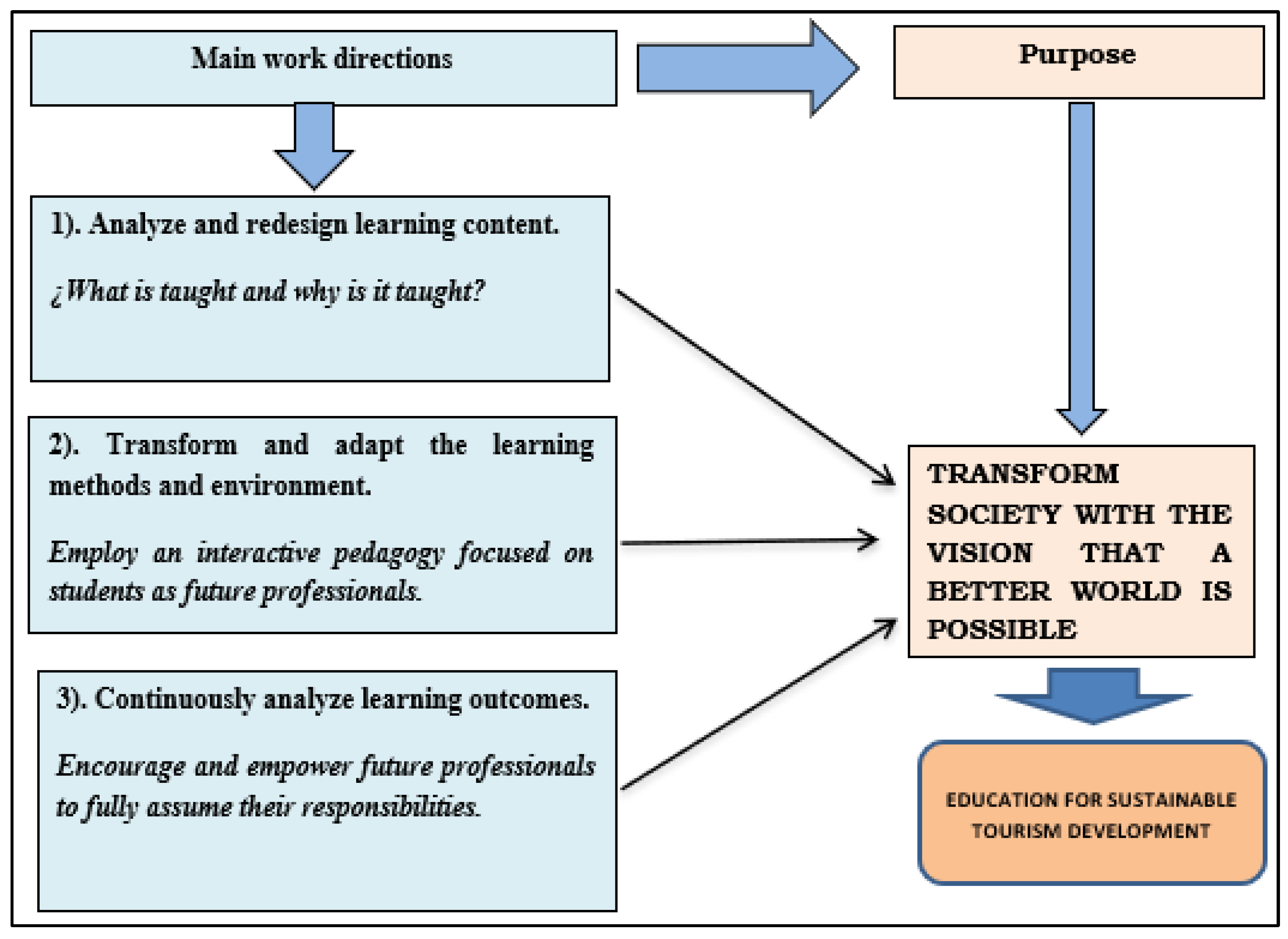
Figure 2.
Diagram of the applied methodology. Source: self-made.
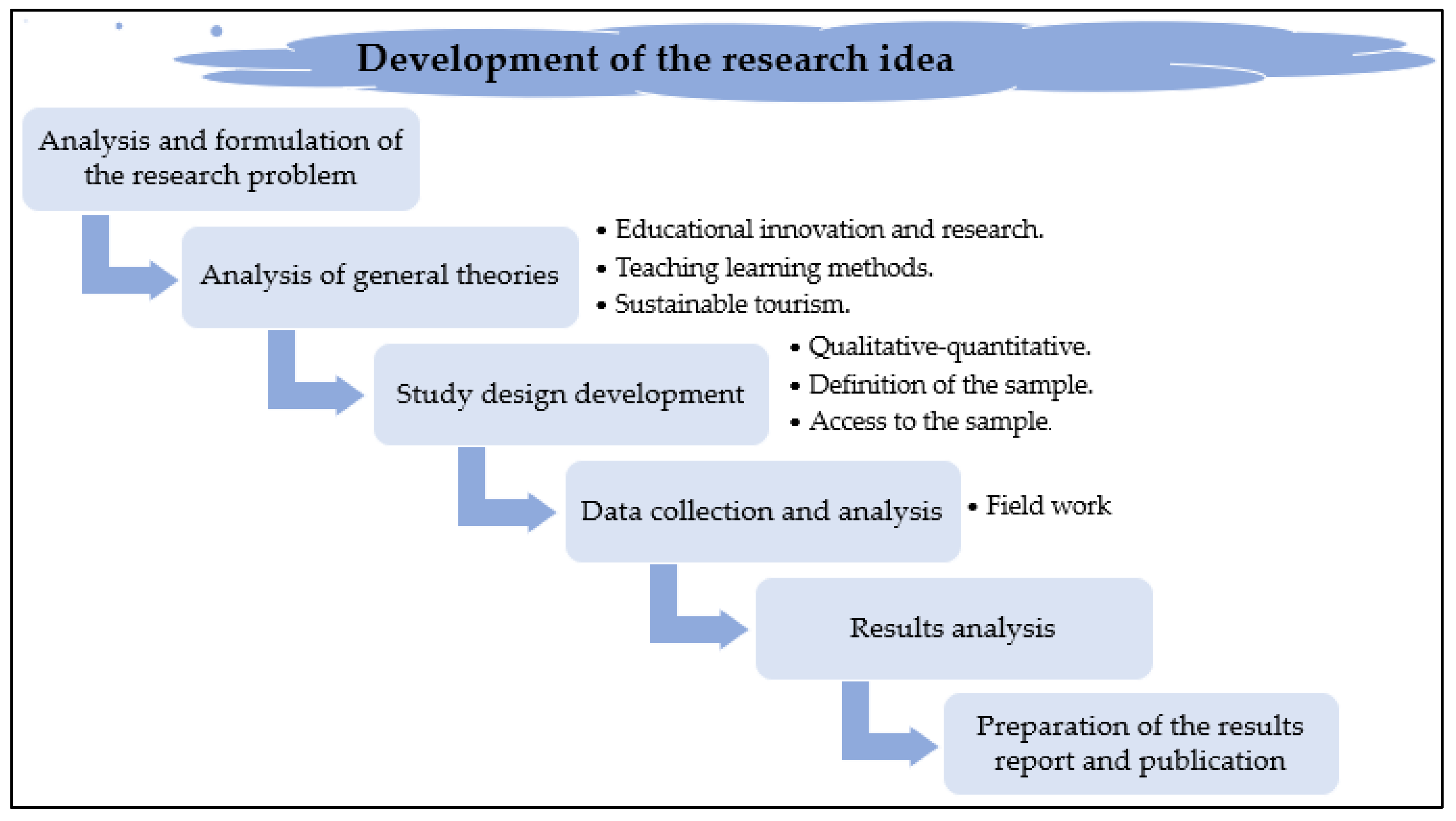

Table 1.
Integrative subjects at each level in the study plan.
| Level | Integrative subject | Significant elements resulting from the research |
| 1st | Introduction to the Tourism System | Argue, from theoretical, methodological, and epistemological assumptions, the relationship that exists between the components that are part of the tourism system for the establishment of cause–effect relationships. |
| 2nd | Tourist Geography of Ecuador | Compare differences and similarities of the regions and tourist destinations of Ecuador, emphasizing geographical location, resources, and attractions. |
| 3rd | Tourist Modalities I | Diagnose the processes and sub-processes of tourism exploitation related to accommodation, apartments, and restaurants based on case studies linked to the community in the tourism modalities studied. |
| 4th | Regional and Ecuadorian Cuisine | Apply basic food techniques and preparations associated with regional and Ecuadorian cuisine. |
| 5th | Tourist Modalities II | Diagnose, from case studies linked to the community, the tourism modalities that are studied, along with the processes and sub-processes of tourist operations related to recreation, tourist entertainment, and bar services. |
| 6th | Quality Management in Tourism | Apply the standards, tools, and techniques used for quality management in tourism companies and their statistical foundations. |
| 7th | Integrated Management of Tourist Destinations | Apply the main tools and good practices for the integrated strategic planning and management of sustainable tourist destinations. |
| 8th | Sustainable Tourism Ventures | Design and execute sustainable tourism ventures in the areas of social and community tourism. |
Source: self-made.
Table 2.
Teaching work procedures as alternatives for application of the collaborative teaching model.
Table 2.
Teaching work procedures as alternatives for application of the collaborative teaching model.
| Teaching work procedures | ||
| Types of procedure | Activities | Instruments |
| Panels. | Network meetings. | Study of tourist communities. |
| Round tables. | Problem-based learning. | Presentation and evaluation of tourist services and products. |
| Debates. | Interinstitutional scientific meetings. | Checklists and process audits. |
| Forums. | Pre-professional guided scientific visits. | Verification of standards and procedure manuals. |
| Seminars. | Link with the community. | Inventories of resources and tourist attractions. |
| Discussion groups. | Video filming. | Degree projects. |
| Conversations. | Competencies and display of skills of various operational processes. | Visits to museums and work centers, tourist routes, and guided tours of cultural and natural heritage. |
| Conferences. | Practical classes to develop skills. | Process monitoring. |
| Virtual tutorials. | Experimentation projects. | Presentation of papers. |
| Case studies. | Community linkage projects. | Participatory diagnoses. |
| Meetings with clients, familiarization groups, FAM, and travel agents. | Evaluation of satisfaction rates. | Monitoring and feedback in destinations, hotels and restaurants in tourist sites. |
| Application of survey systems and feedback systems. | Website design and monitoring. | Study of tourist image in social networks. |
| Market study and research. | Application of integrated project management tools. | Presentation of tourism projects. |
| Creation of ventures. | Application of SWOT matrix and other hotel management tools. | Evaluation of tourism sustainability indicators. |
| Practical application in different tourism modalities with emphasis on sustainable tourism. | Study of good international practices in sustainable tourism. | Poster presentation. |
Source: self-made.
Table 3.
Results of the Likert scale for groups of actors in each of the items.
| Items | Sample | La |
OK (4 points) |
I have no opinion (3 points) |
In disagreement (2 points) |
Strongly disagree (1 point) |
Total points | Arithmetic average |
| 1 | 102 | 85 | 15 | 0 | 2 | 0 | 489 | 4.79 |
| 2 | 102 | 78 | 10 | 2 | 8 | 4 | 454 | 4.45 |
| 3 | 102 | 4 | 13 | 7 | 20 | 58 | 191 | 1.87 |
| 4 | 102 | 84 | 10 | 2 | 4 | 2 | 476 | 4.66 |
| 5 | 102 | 79 | 15 | 1 | 4 | 3 | 469 | 4.59 |
| 6 | 102 | 80 | 12 | 2 | 5 | 3 | 467 | 4.57 |
| 7 | 102 | 75 | 16 | 2 | 5 | 4 | 459 | 4.50 |
| 8 | 102 | 0 | 3 | 3 | 8 | 88 | 125 | 1.22 |
| 9 | 102 | 86 | 10 | 2 | 3 | 1 | 483 | 4.73 |
| 10 | 102 | 83 | 15 | 0 | 3 | 1 | 482 | 4.72 |
| 11 | 102 | 84 | 14 | 0 | 2 | 2 | 482 | 4.72 |
| 12 | 102 | 3 | 1 | 0 | 15 | 83 | 132 | 1.29 |
| 13 | 102 | 81 | 10 | 3 | 4 | 4 | 466 | 4.56 |
| 14 | 102 | 88 | 10 | 0 | 2 | 2 | 486 | 4.76 |
| 15 | 102 | 80 | 11 | 3 | 5 | 3 | 466 | 4.56 |
Source: self-made.
Table 4.
Average values of the scores for each group of items.
| Items | Upper Score | Lower Score | Average of the scores of the five items |
| Items 1 to 5 (Learning in contact with the teacher) | 4.79 | 1.87 | 4.07 |
| Items 6 to 10 (Autonomous learning) | 4.73 | 1.22 | 3.94 |
| Items 11 to 15 (Experimental practical learning) | 4.76 | 1.29 | 3.97 |
Source: self-made.
Table 5.
Average of the grades obtained by ten teachers in the evaluated competencies for each of the periods.
Table 5.
Average of the grades obtained by ten teachers in the evaluated competencies for each of the periods.
|
Evaluated competencies |
Evaluated periods | ||||
| October 2021 to February 2022 |
May 2022 to September 2022 |
October 2022 to February 2023 |
May 2023 to September 2023 |
October 2023 to January 2024 |
|
| Mastery of the contents of the subject. | 4.0 | 4.1 | 4.1 | 4.3 | 4.5 |
| Teaching methodologies used. | 4.2 | 4.2 | 4.3 | 4.5 | 4.8 |
| Use of new information and communication technologies. | 4.2 | 4.2 | 4.3 | 4.3 | 4.4 |
| Exercise of tutoring and evaluation of learning. | 3.9 | 4.3 | 4.7 | 4.8 | 5.0 |
| Ethical attitudes and interpersonal relationships. | 4.3 | 4.6 | 4.8 | 4.8 | 5.0 |
Source: self-made.
Disclaimer/Publisher’s Note: The statements, opinions and data contained in all publications are solely those of the individual author(s) and contributor(s) and not of MDPI and/or the editor(s). MDPI and/or the editor(s) disclaim responsibility for any injury to people or property resulting from any ideas, methods, instructions or products referred to in the content. |
© 2024 by the authors. Licensee MDPI, Basel, Switzerland. This article is an open access article distributed under the terms and conditions of the Creative Commons Attribution (CC BY) license (http://creativecommons.org/licenses/by/4.0/).
Copyright: This open access article is published under a Creative Commons CC BY 4.0 license, which permit the free download, distribution, and reuse, provided that the author and preprint are cited in any reuse.


