

Submitted:
30 June 2024
Posted:
01 July 2024
You are already at the latest version
Abstract
The objective of this research was to study the drying kinetics of passion fruit seeds, which are a byproduct of the industrial processing of passion fruit, with the potential to produce byproducts such as oil and flour. After drying, the seeds were directed for cold-press oil extraction, and the quantification of fatty acids was performed. Following the oil extraction, the residues underwent a grinding process to produce flour, which was characterized in terms of its nutritional aspects. The drying process was conducted using an experimental forced convection dryer with controlled temperatures of 40, 50, 60, and 70 °C, and a drying air velocity of 1.5 m s-1. This work introduced a novel approach using mathematical models, all derived from Fick's equation. For each model, the activation energy and thermodynamic properties related to the drying procedure were determined. Fatty acids in the oils and physicochemical characteristics of the defatted residue's flour were also analyzed. The Cavalcanti Mata, Henderson & Pabis, and Page models modified by Cavalcanti Mata were found to best fit the experimental data. The highest proportions of unsaturated fatty acids in passion fruit oil were linoleic acid (Omega-6) at 68.8% and oleic acid (Omega-9) at 16.1%. The predominant saturated fatty acid was palmitic acid at 10.61%, with no significant differences observed in relation to the drying temperatures. It can be concluded that the composition of the flour from the residue of passion fruit grain oil extraction varies in terms of crude fiber content, ranging from 56.36% to 58.8%, and protein content, ranging from 15.6% to 18.26%, with significant differences observed concerning the drying temperatures. The lipid content varied from 13.5% to 13.76%, with no significant differences observed across the evaluated drying temperature variations.
Keywords:
Passiflora edulis f. flavicarpa
; fatty acids
; physicochemical characteristics
; flour production
; oil Extraction
; drying.
1. Introduction
Brazil is globally renowned for its rich biodiversity and has established itself as one of the leading producers and exporters of fruits. According to EMBRAPA (2022), the country ranks as the world's third-largest fruit producer, with an annual output of 58 million tons, representing 5.4% of the global production. Europe is responsible for 70% of Brazilian fruit exports, while the United States and England account for 15% and 12%, respectively. The remaining exports are directed to other countries worldwide (ABRASFRUTA, 2023).
The main fruits produced in Brazil in 2021, according to ABRASFRUTA (2023) with information from Agrofy News, in terms of volume, were: Orange (14.9 million tons), Banana (7.3 million tons), Grape (1.6 million tons), Apple (1.2 million tons), Pineapple (1.1 million tons), Mango (825,000 tons), Lemon (708,000 tons), Watermelon (668,000 tons), Papaya (585,000 tons), Guava (514,000 tons).
While passion fruit is not among the top 10 tropical fruits produced in Brazil in 2021, it stands out due to its distinctive flavor and various nutritional properties. Moreover, Brazil is the world's largest producer of passion fruit, with an estimated production of approximately 697.86 thousand tons in 2022. With this growth, it is now on track to be among the top 10 most produced fruits in the country. This production comes from cultivation on 45.6 thousand hectares and has generated revenue of 1.97 billion Brazilian reais (IBGE, 2023).
Three varieties of passion fruit are prominent in the Brazilian cultivation landscape: yellow passion fruit (Passiflora edulis f. flavicarpa), purple passion fruit (Passiflora edulis Sims), and sweet passion fruit (Passiflora alata). With proper irrigation, it is possible to cultivate this fruit year-round, thanks to its easy adaptability to the diverse climatic conditions in various regions of Brazil.
The country exports this fruit in various forms, including fresh fruit, preserves, and concentrated juice. Regarding the export of passion fruit juice, in 2021, Brazil sold approximately 891 tons, marking an increase of over 91% compared to the previous year (APEX, 2023).
In the specific case of passion fruit processing, it generates residues that can be differentiated into peels, pulp, and seeds. These residues allow for the assessment of the nutritional value of the seeds (GARCIA et al., 2014; SILVA et al., 2014a).
Passion fruit seeds contain 27.97% of biologically valuable lipids, including unsaturated fatty acids such as linoleic (69.23%), oleic (15.88%), palmitic (10.57%), stearic (3.05%), and linolenic (0.43%). The levels of linoleic and oleic acids are comparable to those found in sunflower, while the levels of palmitic and stearic acids are like those present in soybean oil. The low content of linolenic acid contributes to oxidative stability. According to Martin et al. (2006), linoleic acid is a nutrient of great importance to health, found in various plant and animal-based foods and widely used in human nutrition.
Passion fruit seeds, considered a residue from the processing of pulp and related products, have a high-water content (42 to 50% dry basis). To utilize them as raw material to produce other products, it is essential to achieve biological stability (MENDES, 2018). Dehydration is the method employed by industries since it reduces biological activities and physical-chemical variations that might occur during storage. This allows for the preservation of their quality largely during storage (NUNES et al., 2017).
Following dehydration, dried foods are shielded from deterioration because the microorganisms responsible for this process are unable to grow and multiply in the absence of water. Moreover, many of the enzymes that induce undesirable alterations in the chemical composition of foods cannot function in the absence of water (ARAÚJO, 2013).
The objective of this research was to investigate the drying kinetics of passion fruit seeds, analyze drying models involving novel concepts, determine their constituents, and manufacture a flour from the extraction residues that can be used in the preparation of various food products.
2. Materials and Methods
Conventionally, a portion of passion fruit waste comprises the seeds of the fruit. However, these seeds do not possess the characteristic of preserving their physiological quality; therefore, they can be referred to as passion fruit kernels. Consequently, the raw material used in this experiment consisted of these passion fruit kernels, which are residues resulting from the processing of passion fruit fruits to produce pulps and juices. This material was collected at the fruit processing facility of COOPEAGRO (Cooperative of Organized Small Farmers) located on North AL 101 Highway, No. 382, Santa Tereza Verzeri District, Maragogi, Alagoas.
After the passion fruit processing, the residues were placed in plastic bags and cooled to 3°C in the company's refrigeration chamber. Subsequently, they were transported over 25 km in thermal bags to the Food Laboratory of the Federal Institute of Pernambuco (IFPE) Campus-Barreiros, where they were stored in a freezer at 0°C, remaining there until they were transferred to the Food Engineering laboratory in the city of Campina Grande.
The passion fruit seeds were sanitized following the methodology described by Sarzi et al. (2002), which involved washing to remove adherent residues from the seeds and disinfection with a solution of potable water at 5°C containing 200 mg L-1 of chlorine for 5 minutes. After this procedure, the seeds were rinsed again with potable water to remove the chlorine, followed by a heat treatment in which the product was heated to 100°C for 30 seconds and cooled by the addition of ice water until reaching a temperature between 35 and 40°C. This procedure prevents the growth of filamentous fungi and yeasts. Following these treatments, the seeds were placed on a sieve to drain the remaining water and then transferred to the dryer. The remaining material was packed in plastic bags and stored in a freezer at -1°C until further processing, typically within one week.
The drying process was conducted at the Drying Laboratory of the Academic Unit of Food Engineering, located in the Center for Natural Resources Technology at the Federal University of Campina Grande (UFCG).
This experiment was conducted in three stages:
Stage I: The study of the drying kinetics of passion fruit seeds (residues from the agro-industrial processing of passion fruit) at temperatures of 40, 50, 60, and 70°C, along with the application of mathematical models to the experimental data. The models employed included the theoretical model (Fick), semi-theoretical models (Henderson & Pabis modified by Cavalcanti Mata, Page modified by Cavalcanti Mata, and Cavalcanti Mata).
Stage II: Extraction of oil from the dried passion fruit seeds, as well as the qualitative and quantitative identification of fatty acids as a function of the drying temperatures.
Stage III: Production of flour from the grinding of the residues from the extraction of oil from passion fruit seeds and physicochemical characterization (moisture content, crude protein, lipids, ash, crude fiber, carbohydrates, and energy) for each drying condition.
Initially, the moisture content on a dry basis (d.b.) of the seeds was determined using the AOAC (1995) method, as shown in Equation 1:
where Pi = initial mass (capsule + wet sample - capsule), g; Pf = final mass (capsule + dry sample - capsule), g.
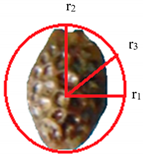
The drying of passion fruit residues (passion fruit seeds) was conducted using the decreasing drying rate in a spherical shape, following the considerations outlined by MOHSENIN (1986). In this approach, the three dimensions of the product were determined, and the equivalent radius was calculated, treating the seed as a sphere.
Considering the equation for the volume of an ellipsoid as: Ellipsoid = , the equivalent radius for the volume of a sphere can be given by:
where vSphere = volume of the sphere, mm³; , , = radii corresponding to the orthogonal axes, mm; = equivalent sphere radius.
The drying was carried out at temperatures of 40, 50, 60, and 70°C. Each product was distributed across four aluminum mesh trays (4 repetitions), each measuring 40.0mm x 40.0mm x 20mm, with a mesh size of 1.0mm. In these trays, the sanitized residues with known initial moisture content were exposed in a thin layer.
2.1. Mathematical Models
Based on the analysis of the drying data obtained, it was determined that the drying process occurs during the falling-rate period. The data were fitted using Fick's equation with four terms of the series and three other mathematical models derived from Fick's equation. For each of these models, a new approach was established to determine their respective effective diffusivity coefficients.
The theory of diffusion is based on Fick's second law, which describes the diffusion of water in a solid through a concentration gradient (Cavalcanti-Mata et al., 2006). This concept is expressed by Equation 3.
where ∇ f(x1, …, xn) = vector of partial derivatives; D = Diffusion coefficient , ; = Drying time, .
Equation 4 expresses the solution for spherical coordinates, considering the material with a certain homogeneity. This equation for a sphere or ellipsoid was considered one-dimensional, and it can be simplified to:
where r is the sphere's radius.
The analytical solution of the Fick's equation given by Crank (1980) is expressed by Equation 5.
where = effective diffusion coefficient, ; n = number of terms; re = sphere radius or equivalent sphere radius, m.
The data from weighing the samples during drying were used to calculate the moisture content ratios, RX, of passion fruit seeds according to the following relationship:
where RX = dimensionless moisture ratio of the product; X = moisture content, dry basis (decimal); X₀ = initial moisture content, dry basis (decimal); Xₑ = equilibrium moisture content, dry basis (decimal). The equilibrium moisture values (Xₑ) for each drying temperature were determined experimentally.
When considering only the first term of the series, the equation is given by Equation 7:
Considering t = 0 and RX = 1, instead of adopting as an initial term, this term could be considered as a coefficient A, which could be determined by nonlinear regression, and this value would be close to 1.0. Thus, the equation would be like the one proposed by Henderson & Pabis, modified by the authors, which also offers the possibility of obtaining the effective diffusivity of the product in the drying phenomenon. In this way, this new equation is described as Equation 8.
where:
Following the same approach, considering A=1 and introducing a potential time correction N, one can arrive at an equation like that of Page, which can be written as the equation modified by the authors, referred to as the Modified Page Equation, given by Equation 10.
The equation proposed by Cavalcanti-Mata (2018) for the sphere configuration uses 2 terms from the Fick's equation series. The considerations made were: The values for n=1 and n=2 was replaced by A1 and A2, which will be obtained through nonlinear regression analysis. Additionally, a potential order time correction was considered. The equation derived from Fick, with 2 modified series terms for grains and seeds resembling a sphere, is given by Equation 11.
where:
Based on the obtained effective diffusion coefficients, the activation energy was determined by linearizing the Arrhenius equation, as shown in Equation 14.
where is the pre-exponential factor; Ea is the activation energy, ; R is the universal gas constant, 8.134 ; T is the absolute temperature, .
From the determination of the activation energy, it is possible to calculate the enthalpy (∆H), entropy (∆S), and Gibbs free energy according to Equations 15, 16, and 17:
where = the y-intercept obtained from the regression analysis applied to the graph obtained in the activation energy calculation; = Boltzmann constant, ; = Planck constant, .
2.2. Statistical Data Processing
To ensure the robustness and validity of the results, all experimental data were subjected to rigorous statistical processing, described as follows:
Nonlinear Regression Analysis:
The mathematical models were fitted to the drying kinetics curves of passion fruit seeds through nonlinear regression using the Quasi-Newton and the Levenberg-Marquardt methods. The coefficients of the regressions were obtained using the computer program Statistica 7.0. To assess the quality of the model fits to the experimental data, the determination coefficients (R²), relative mean error (P), and estimated mean error (SE) were determined.
We used nonlinear regression analysis via the Levenberg-Marquardt method to fit the mathematical models to the drying data.
Number of Iterations and Convergence Criteria: The average number of iterations required for coefficient convergence ranged between 50 and 999, depending on the model and initial conditions. The convergence criteria were based on minimizing the squared errors and stabilizing the adjusted coefficients.
Statistical Significance of the Coefficients: The p-value in the performed regression analysis is automatically predetermined by the program at 1%, ensuring that all p-values are below 0.05 (5%), indicating the statistical significance of the coefficients.
Robustness Verification: To avoid instability issues in the regression of models with multiple coefficients, various initial guesses were tested. The robustness of the models was assessed by comparing the results obtained from different starting points.
Coefficient of Determination (R²): The coefficient of determination (R²) was used as a measure of the quality of fit for each model. Preliminary tests were conducted to determine the impact of including additional terms in the Fick model series, verifying that using the first four terms provided an adequate balance between accuracy and computational complexity.
For comparative analysis between the models, the theoretical Fick's equation with 4 terms from the series was used.
In Statistica 7 software, the p-value is preset at 1%. If the programmer wishes to change it, they can do so; however, this was not done in this study. When an initial value is given, iterations are automatically performed to achieve convergence; if convergence is not achieved, the user is notified. Once convergence is established, the experimental and calculated data are plotted, and it is possible to observe if the coefficient of determination is satisfactory. If it is not satisfactory, a new calculation is performed with a new initial value. However, the equations used in this study converged relatively easily. When this convergence does not occur, the program allows for the use of 6 other numerical methods.
2.3. Extraction of Passion Fruit Seed Oil
The extraction of passion fruit seed oil was performed using a Bovenau 30 ST hydraulic press, model P30000, with a compression capacity of 30 tons. Stainless steel accessories were used for the extraction process, including a cylinder with small lateral holes for oil outlet, a plunger, and an oil collector. Pressure was gradually increased until reaching a compression of 20 tons on the mass of the seeds.
2.4. Fatty Acid Analysis
The fatty acids were obtained according to Hartman & Lago (1973). The analysis was performed using an Agilent 7890 gas chromatograph with a flame ionization detector, employing a 60m fused silica capillary column with an internal diameter of 0.32mm and a stationary phase of 0.25µm cyanopropyl siloxane. The temperature program started at 100°C, with a heating rate of 50°C/min, reaching 150°C, then from 150 to 180°C at a rate of 1°C/min, and from 180 to 200°C at a rate of 25°C/min, holding at 200°C for 15 minutes. The injector was maintained at 250°C in split mode with a 50:1 split ratio. A 1µL volume of a 2% solution in dichloromethane was injected. The flame ionization detector temperature was set at 280°C, and the carrier gas (H2) flow rate was 2.5 mL/min (measured at 40°C). Identification of methyl esters of fatty acids was performed by comparing retention times with NU CHEK (Elysian, MN) standards numbers 62, 79, and 87, and quantification was carried out using internal normalization (Anna et al., 2001).
2.5. Flour Composition Analysis
The flours were produced from the residues of passion fruit seed oil extraction resulting from the products processed at different temperatures. To prepare the residue flours, the material was processed in a 7Lab 15 kg/h knife mill - Willye 920 Type - 4 fixed and 4 mobile knives - ½ HP - 930 rpm. The flours underwent physicochemical analyses to determine their nutritional composition.
Physicochemical Analysis: In the physicochemical analysis, the following parameters were determined in triplicate: moisture content (MC), crude protein (CP), ether extract (EE), ash content (AC), crude fiber (CF), carbohydrates (CHO), and gross energy (GE), as described below.
Moisture Content Determination: The moisture content was determined according to AOAC (1995).
Crude Protein Determination: The Kjeldahl method was used for determining crude protein, following AOAC (1995) standards.
Ether Extract Determination: The Soxhlet method was employed for lipid determination, following Brazilian regulations, Brasil (2009).
Crude Fiber Determination: Crude fiber determination was conducted using the TE-149 Fiber Determinator from TECNAL, which allows the simultaneous analysis of 30 samples. The analysis followed the Henneberg method as described in Ascar (1985), adapted for the equipment.
Ash Content Determination: Ash content was determined using the double incineration method as described by AOAC (1995).
Carbohydrates and Energy Determination: The total carbohydrate percentage was calculated by difference, as per Lima et al. (2017), using the following formula:
Carbohydrates (%) = 100% - (%MC + %lipids + %protein + %AC + %total fiber).
Metabolizable Energy (ME) was estimated using factors corresponding to standard physiological values according to Maynard et al. (1979) cited in Sá & Fracalossi (2002), which are: 4 kcal/g for digestible proteins and carbohydrates, and 9 kcal/g for lipids. Therefore, Metabolizable Energy (ME) was calculated by summing the products of the nutrient percentages, each multiplied by its corresponding factor, as follows:
where, ME = Metabolizable Energy, kcal per 100g of the food.
ME = (Protein x 4) + (Carbohydrates x 4) + (Lipid x 9)
3. Results and Discussion
Table 1 displays the physical dimensions related to the diameters of passion fruit seeds, the weight of one thousand seeds, and consequently the determination of the equivalent radius, assuming the seeds are spherical, which was 4.00 mm. The weight of one thousand seeds is an indicator of quality and potential yield.
The equivalent sphere radius was used in the mathematical models. In Figure 1, you can find the experimental data for the drying kinetics of passion fruit seeds, which are considered part of the byproducts from passion fruit processing. The data was collected at temperatures of 40, 50, 60, and 70°C, and it is presented as a function of the moisture content ratio over time. The experimental data show that the drying process occurs at a decreasing rate, and at the drying conditions of 40, 50, 60, and 70°C, the relative humidities were 25%, 15%, 9%, and 6%, respectively. The equilibrium moisture content of passion fruit seeds is reached when they contain 2.77%, 1.90%, 0.16%, and 0.14% moisture content on a dry basis, indicating a direct influence of temperature and air relative humidity on the drying process. During this period, the drying kinetics were studied, which involves the removal of water (mass) from the product from 30% wet basis (42.86% dry basis) to the respective hygroscopic equilibrium, determining the effective mass diffusion coefficient in m2s-1 for each temperature.
Another factor that is directly influenced by temperature is the drying time, which decreases as the drying temperature increases. It can be observed that at a drying temperature of 40°C, passion fruit seeds took 62,100 seconds (s) to reach equilibrium, while at 50°C, this time was 29,700 s. At 60°C, it was 22,500 s, and at a temperature of 70°C, the time required was 15,300 s.
Figure 2, Figure 3, Figure 4 and Figure 5 depict the kinetic behavior of thin-layer drying of industrial passion fruit byproducts for the Fick model with 4 terms of the series, Henderson & Pabis modified by Cavalcanti-Mata, Page modified by Cavalcanti Mata, and the Cavalcanti-Mata Model, respectively.
Table 2 presents the coefficients of effective mass diffusivity obtained from nonlinear regression fits for the Fick model, the Henderson & Pabis model modified by Cavalcanti-Mata, the Page model modified by Cavalcanti-Mata, and the Cavalcanti-Mata Model. These fits were applied to the drying of an elliptical geometry product during the decreasing rate period. In this table, the Fick Model was considered with four terms of the series, a decision based on the work of various authors, where it is observed that as the series term count increases, there is no significant alteration in mass diffusivity. However, the coefficient of determination (R2) does increase positively (Cavalcanti Mata et al. 2020). Furthermore, the table also indicates an increase in the mass transfer coefficient, in absolute terms, with increasing temperature, suggesting that as the drying temperature rises, the process occurs more rapidly.
When analyzing Table 2, which includes the modifications suggested by Cavalcanti-Mata (2018) to the Page and Henderson & Pabis models, using the first term of the Fick model series as a premise, with some considerations, it is evident that the coefficients of determination (R2) exceed those of the Fick model and are above 0.9990. This indicates a better relationship between the experimental data and the proposed models. The modified Page model by Cavalcanti Mata, the Henderson & Pabis model modified by Cavalcanti Mata, and the Cavalcanti-Mata model are almost equivalent, suggesting that these equations should be recommended for expressing the drying of industrial passion fruit residue (grains). The estimated mean error (SE) is also low, which is desirable. However, the mean relative error (P) values, for the most part, exceed 10%, which contrasts with several authors, including Alves et al. (2021) and Carvalho et al. (2018), who state that for an equation to be considered good, its mean relative error should be less than 10%.
In this research, only the first four terms of the Fick model series were used based on the following observations: The trend is that the higher the number of terms used in the series, the greater the precision or the attainment of an R² close to 100%. However, according to our previous work where 6 terms were used, it was observed that beyond 4 terms, there was little change in R² values. In these same previous works conducted by our team, it was found that approximately 400 terms would be necessary to achieve an R² close to 100%, making the equation impractical for use with minimal or insignificant change in obtaining diffusivity. This is the reason for proposing some other equations derived from Fick, where operational effectiveness can be achieved.
In Table 2, it is also observed that only in the Cavalcanti-Mata model at a temperature of 50°C, a mean relative error (P) below 10% was found. Furthermore, the Cavalcanti-Mata model has the highest coefficient of determination. However, the difference between these models only occurs in the fourth decimal place, making them practically equivalent.
In all four models, the effective diffusivity, Def, increases with temperature. This increase in effective diffusivity with temperature has been observed by several authors. For instance, França Silva et al. (2020), who studied flour-based products from agro-industrial residues, explained that higher temperatures lead to higher drying rates, reaching the equilibrium moisture content in less time. Similar findings were also made by Santos et al. (2018) when studying the drying of passion fruit seeds.
Effective diffusion coefficient is an indicator that allows the assessment of drying speed and its dependence on temperature (Botelho et al., 2015). Table 2 also presents the values of the effective diffusion coefficients according to each model. For the Fick model with 4 terms of the series, the effective diffusivity of passion fruit grain residue ranged from 1.4 x 10⁻¹⁰ to 3.12 x 10⁻¹⁰ m2s-1, corresponding to a temperature range from 40 to 70°C. In the Henderson & Pabis model modified by Cavalcanti Mata, the effective diffusivity for passion fruit grains ranged from 1.6918 10-10 a 3.6527 10-10 m2s-1 for the same temperature range. In the Page model modified by Cavalcanti Mata, there was a variation from 1.7253 10-10 to 2.8997 10-10 m2s-1. In the Cavalcanti-Mata model, the effective diffusivity ranged from 1.335 10-10 to 3.13 10-10 m2s-1. Therefore, the results obtained for passion fruit processing residues (grains) fall within the range cited in the literature, which states that effective diffusion coefficients for agricultural products are typically in the order of 10-9 a 10-11 m²s-1 (Madamba et al., 1996).
According to Nadi & Tzempelikos (2018), the dependency of diffusion on temperature is attributed to the level of water molecule vibration, which facilitates the diffusion of water vapor during the drying process. Several researchers have reported this phenomenon with various products. For instance, Araujo et al. (2017) obtained the following effective diffusivity values for dried peanuts at 40, 50, 60, and 70°C: 1.476 x 10⁻¹⁰, 2.2108 x 10⁻¹⁰, 3.5081 x 10⁻¹⁰, and 4.7062 x 10⁻¹⁰ m2s-1, respectively. For pigeon peas dried at temperatures of 40, 50, 60, and 70°C, the effective diffusivity coefficients were 2.1 x 10⁻¹⁰, 3.3 x 10⁻¹⁰, 4.6 x 10⁻¹⁰, and 6.8 x 10⁻¹⁰ m2s-1, respectively. Silva et al. (2014b) observed, in the drying of cowpea (Vigna unguiculata (L.)) at temperatures of 30, 40, and 50°C, effective mass diffusivity values of 5.047 x 10⁻¹¹, 6.047 x 10⁻¹¹, and 12.01 x 10⁻¹¹ m2s-1. Camicia et al. (2015), in the drying of annatto seeds at temperatures of 30, 40, 50, and 60°C, found effective diffusivity values of 3.86 x 10⁻¹¹, 3.79 x 10⁻¹¹, 4.83 x 10⁻¹¹, and 7.51 x 10⁻¹¹ m2s-1, respectively (SILVA NETO et al., 2018).
Using the data of effective mass diffusivity, the activation energy (Ea) and thermodynamic properties were determined for each proposed model through linear regression for temperatures ranging from 40 to 70°C. This was achieved by applying the linearization of the Arrhenius equation.
Activation energy can be described as the minimum energy required to initiate the mass transfer process of water from the interior of a solid to the surface. Figure 6 provides the values of activation energy for the different models.
In this research, the activation energy for passion fruit grains based on the proposed models is as follows:
23.14 kJ mol-1 for the Fick model using 4 terms of the series; 21.96 kJ mol-1 for the Henderson & Pabis model modified by Cavalcanti-Mata; 17.51 kJ mol-1 for the Page model modified by Cavalcanti-Mata; 23.11 kJ mol-1 for the Cavalcanti-Mata model.
These values were determined within the temperature range of 40 to 70°C and fall within the range typically reported in the literature for agricultural products.
Zogzas et al. (1996) reported that the activation energy for agricultural products varies between 12.7 to 110 kJ/mol. In this context, numerous studies can be mentioned that support this narrative. Here are some examples of studies on grains and agro-industrial residues: Silva et al. (2014b) studied the drying of pigeon pea seeds between 40 to 70°C and found an activation energy of 34.51 kJ/mol; Camicia et al. (2015) dried cowpea at temperatures ranging from 30 to 50°C and determined an activation energy of 35.04 kJ/mol; Moura et al. (2021) worked on drying the residues (husk and seeds) of trapia at temperatures between 50 to 80°C, finding an activation energy of 18 kJ/mol for trapia husk and 24.2 kJ/mol for the seeds; Wanderley et al. (2023) studied the drying of pomegranate husks and seeds at temperatures of 50, 60, and 70°C, determining effective diffusivities and thermodynamic properties. They found activation energies of 10.60 kJ/mol for pomegranate husks and 31.39 kJ/mol for the seeds; Gomes et al. (2018) investigated the drying kinetics of crushed jambu leaves at different temperatures (60, 70, and 80°C), layer thicknesses (5 and 10 cm), and drying air velocity of 1.0 m/s. The activation energy was found to be 16.61 kJ/mol for a thickness of 0.005 m and 16.97 kJ/mol for a thickness of 0.010 m; Gilago et al. (2023) dried carrot slices using indirect solar dryers with natural convection (configuration A) and forced convection (configuration B). In configuration A, the average temperature was 61.2°C, and in configuration B, it was 53.1°C. The authors obtained an activation energy of 42.71 kJ/mol for configuration A and 37.85 kJ/mol for configuration B.
Table 3 presents the thermodynamic parameters based on the Fick model using 4 terms of the series, the Henderson & Pabis model modified by Cavalcanti-Mata, the Page model modified by Cavalcanti-Mata, and the Cavalcanti-Mata model.
The decrease in enthalpy with increasing temperature is related to the increase in the partial vapor pressure of water in the product and the rise in the drying air temperature. This indicates that with increasing temperature, less energy is required to remove free water from the product, leading to an increase in the rate of water diffusion from the interior to the surface of the product, resulting in water loss through desorption (Oliveira et al., 2015).
Additionally, from the values in Table 4, it is evident that the Page model modified by Cavalcanti Mata has the lowest enthalpy, indicating that in the drying of passion fruit grains, 17.51 kJ mol-1 is required over the temperature range of 313.15 to 343.15 K (40 to 70°C). However, the enthalpy values closest to those of the Fick model with 4 terms of the series are obtained from the Cavalcanti-Mata model, which are approximately 23.14 and 23.11 kJ mol-1, respectively.
The entropy decreases with an increase in drying temperature, primarily because higher drying air temperatures lead to increased molecular excitation, which, in turn, accelerates the water diffusion process, requiring a lower entropy value for the process. Regarding the mathematical models, it is observed that the Page model modified by Cavalcanti Mata had the highest entropy value (-45.18 to -45.27 J mol-1 K-1) within the temperature range of 313.15 to 343.15 K, while the Fick model with 4 terms of the series generated the lowest entropy value (-43.08 to -43.17 J mol-1 K-1) over the same temperature range. The Page model behaves as if there were a higher degree of molecular excitation, resulting in a more extensive mass diffusion process with increasing temperature.
According to Martins (2015), negative entropy values are attributed to the existence of chemical adsorption and/or structural modifications of the adsorbent.
Gibbs free energy quantifies the total energy associated with a thermodynamic system. In Table 3, the highest values are linked to the Fick equation with four terms in the series (ranging from 34,077.04 to 35,156.71 J· mol-1, while the lowest values are observed in the Page model modified by Cavalcanti Mata (between 29,104.90 and 30,247.61 J·mol-1). Notably, within this temperature range, the Gibbs free energy escalates with increasing temperature, and these values remain positive throughout the temperature span examined. As per Oliveira et al. (2015), the positive value of Gibbs free energy characterizes an endergonic reaction, which is characteristic of endothermic reactions that involve energy absorption from the external environment. In such reactions, additional energy is required from the environment for the reaction involving the product to occur. However, in the context of drying, where no chemical reactions take place, this process is non-spontaneous. The positive Gibbs free energy in drying operations is elucidated by the energy input necessary for the phase change from the liquid phase to the gaseous phase.
The outcomes of this study align with the findings of other researchers, such as Araújo et al. (2017) in their study on peanut drying, Guimarães et al. (2018) exploring okara drying, Silva (2019) focusing on soybean grain drying, Quequeto et al. (2019) investigating noni seed drying, Almeida et al. (2020) examining adzuki bean drying, Gilago et al. (2023) researching carrot slice drying, and Wanderley et al. (2023) delving into pomegranate husk and seed drying. These researchers all observed an increase in Gibbs free energy with rising drying air temperature.
3.1. Oils Extracted from Passion Fruit Seeds
The extraction process was conducted due to the natural oil content found in passion fruit seeds, which ranges from 27.97% to 29.5% (Barbieri & Leimann, 2014). Conversely, an excess of fat could result in rapid rancidity, particularly when developing new products that require extended storage periods.
When examining the values of the oil constituents presented in Table 4, it becomes evident that there are no significant differences at a 5% probability level (P > 0.05) when the seeds are dried at various temperatures (40 to 70°C). The results for fatty acid content were as follows: linoleic acid (C18:2) ranged from 69.23% to 69.42%, while oleic acid (C18:1) ranged from 15.88% to 15.93% among the treatments. These findings align with results reported in the literature by other authors (FERRARI et al., 2004; LOPES et al., 2010; REGIS, 2010) for passion fruit seed oil (Passiflora edulis). Concerning other oils obtained from oilseeds, the levels of linoleic acid (C18:2) and oleic acid (C18:1) in passion fruit seed oil are like those found in sunflower oil, while the levels of palmitic acid (C16:0) and stearic acid (C18:0) are comparable to those obtained in soybean oil. The content of linolenic acid (C18:3) is low, which is favorable in terms of oxidative stability. Linoleic and linolenic acids are essential fatty acids, and passion fruit seed oil is rich in the former and deficient in the latter. Currently, this oil has been under evaluation for potential therapeutic applications, although no published results are available to date. Nevertheless, the primary demand still comes from the perfume and toiletry industries, and when it meets specific quality and stability criteria, this oil can be sold at prices reaching R$14.16 per kilogram (Juver et al., 2022).
After examining Table 4 it becomes evident that the content of saturated fatty acids ranges from 14.11% to 14.18%. These fatty acids lack double bonds and are typically in a solid state at room temperature. Specifically, in the case of oil extracted from passion fruit seeds, the primary saturated components include Palmitic Acid (ranging from 10.61% to 10.55%) and Stearic Acid (ranging from 3.11% to 3.10%). In smaller proportions, Myristic Acid and Palmitoleic Acid are also present, comprising 0.12% and 0.35%, respectively. According to the literature, saturated fatty acids do offer a degree of oxidative stability. However, as noted by Santos et al. (2013), the consumption of saturated and trans fats is traditionally associated with an increase in plasma LDL-c and a heightened cardiovascular risk. Substituting saturated fat in the diet with mono- and polyunsaturated fats is considered a strategy for better managing hypercholesterolemia and consequently reducing the risk of clinical events.
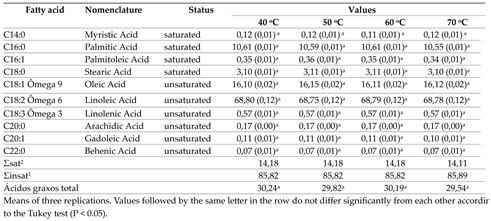

Table 4.
Fatty Acid Profile of Cold-Pressed Passion Fruit Seed Oil (g/100g) Extracted from Various Drying Temperatures (40, 50, 60, and 70°C).
Table 4.
Fatty Acid Profile of Cold-Pressed Passion Fruit Seed Oil (g/100g) Extracted from Various Drying Temperatures (40, 50, 60, and 70°C).
The values in this table also show that the largest quantity of passion fruit seed oil consists of unsaturated fatty acids, with one or more double bonds, including monounsaturated fatty acids with one double bond, such as oleic acid, and polyunsaturated fatty acids with two or more double bonds, like Linoleic Acid (Omega-6) and Linolenic Acid (Omega-3). These are typically liquid at room temperature. According to Silva et al. (2013), the role of the Omega-6/Omega-3 ratio in the diet in the pathogenesis of cardiovascular, inflammatory, and autoimmune diseases has been a subject of controversy in recent years. With the agricultural revolution, there has been an increase in the consumption of grains, oils, and foods rich in Omega-6 fatty acids, along with a parallel decrease in Omega-3 intake. The Omega-6/Omega-3 ratio, originally around 1:1 to 2:1, now ranges from 15:1 to 40:1 in the Western diet. In theory, increasing Omega-6 intake could raise the production of inflammatory mediators involved in various pathological processes, including atherosclerosis and its traditional risk factors like high blood pressure, diabetes, and obesity. However, the clinical relevance of this potential effect is the subject of intense discussion. Back in the 1990s, Lorgeril et al. (1994), studying the Mediterranean diet, pointed out that the Omega-6/Omega-3 ratio should be reduced to 4:1. Considering this, the passion fruit seed oil is not recommended, as its ratio is 120:1.
3.2. Physicochemical Analysis of Defatted Passion Fruit Seed Flour
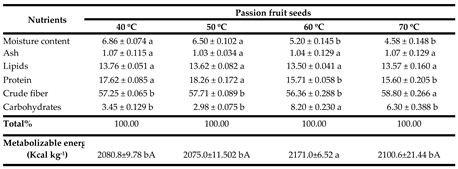
Table 5 presents the results of the physicochemical composition of passion fruit seed flours after the extraction of part of the originally present oil. As can be seen, only half of the oil was extracted using cold pressing, and it is likely that improved technology should be employed for a more thorough removal of lipids. Nevertheless, these values can be interesting for animal feed formulations, as lipids represent essential nutrients for maintaining animal health.
The flours produced from passion fruit seeds dried at four different temperatures (40, 50, 60, and 70°C) have moisture contents of 6.86%, 6.50%, 5.20%, and 4.58%, respectively. It can be observed that, like other experimental products analyzed, the water content decreased with an increase in the drying air temperature. The values determined at 40°C and 50°C were significantly like each other at a 5% probability level but differed from the values found at 60°C and 70°C.
Means of three repetitions ± standard error of the mean. Values followed by the same letter in the row do not differ statistically according to the Tukey test (P<0.05).
Amorim (2015) analyzed passion fruit residue to compose the diet for sheep and found a moisture content of 7.73%. Nascimento Filho & Franco (2015), researching the potential of agro-industrial residues, reported a moisture content of 6.89% for passion fruit seeds. Silva et al. (2014a) determined a moisture content of 12.15% in the Pérola passion fruit residue. The moisture content levels found in this study for passion fruit seed flours are in accordance with the literature mentioned above.
The ash content of the four experimental flours was 1.07%, 1.03%, 1.04%, and 1.07%, respectively, with no significant differences between the treatments conducted. According to Lemos et al. (2010), the ash content of a food represents the amount of minerals it contains. Therefore, foods produced from products of the same origin may not always undergo changes in mineral levels due to specific temperature limits. However, products from different sources may have different mineral quantities based on soil characteristics and cultivation conditions during production.
Ramos (2017) found an ash content of 9.4% when making flour using passion fruit peels and seeds. However, when the product was partially defatted, the ash percentage decreased to 2.1%. Therefore, these values are approximately in line with those found in the present study for passion fruit seed flour after partial oil extraction.
Oil extraction was carried out for each batch of dehydrated passion fruit seeds at temperatures of 40, 50, 60, and 70 °C, resulting in extraction yields of 30.24%, 29.82%, 30.19%, and 29.54%, respectively (Table 4). In the remaining cake from the partial oil extraction of passion fruit seeds, the residual lipid levels were 13.76%, 13.62%, 13.50%, and 13.57%, with no significant differences between the values found in Table 5. In this context, for each temperature, passion fruit seeds lost 16.48 percentage points at 40°C, 16.2 percentage points at 50°C, 16.7 percentage points at 60°C, and 16 percentage points at 70°C, corresponding to extraction rates of 54.5%, 54.3%, 55.3%, and 54.2%, respectively.
Regarding the crude protein content of dehydrated passion fruit flours, the values were 17.62% and 18.26% for drying at temperatures of 40°C and 50°C, respectively. These values were equal but significantly higher and different from the values of 15.71% and 15.60% corresponding to flours dried at temperatures of 60°C and 70°C, respectively.
The levels of crude protein determined in this study were higher than those found in the literature. Ramos (2017) studied two passion fruit seed and peel flours, one whole and the other partially defatted, and found protein levels of 6.3% and 6.2%, respectively. Amorim (2015) obtained 9.21% of crude protein in passion fruit residue flours, and Silva et al. (2014a) obtained 7.74%. For passion fruit seed flour, Nascimento Filho & Franco (2015) reported a value of 12.57%. Therefore, these differences can be attributed to the removal of oil and washing at the beginning of processing, which removed the aril from the seeds, maximizing the nutrient content that contributed to the desired protein level for feed formulation.
Regarding the crude protein content of dehydrated passion fruit flours, the values were 17.62% and 18.26% for drying at temperatures of 40°C and 50°C, respectively. These values were equal but significantly higher and different from the values of 15.71% and 15.60% corresponding to flours dried at temperatures of 60°C and 70°C, respectively.
The levels of crude protein determined in this study were higher than those found in the literature. Ramos (2017), as mentioned earlier, analyzed flour from both peels and seeds (whole) of passion fruit and obtained 55.0% crude fiber for the whole version and 38.4% for the partially defatted version.
Carbohydrate levels calculated by difference showed no significant differences between temperatures of 40°C, 50°C, and 70°C, while the carbohydrate content was significantly higher when drying was done at 60°C, exhibiting random values with no specific trend.
Carbohydrate content has been determined in both passion fruit residue and seeds (grains). For seeds, Nascimento Filho & Franco (2015) reported a value of 13.19%, and Ferrari et al. (2004) found a value of 12.39%. However, Jorge et al. (2009) found values of 13.19%. The results obtained in the present study are lower than those in previous studies, possibly influenced by the processing method used in this work, which involved not only oil extraction but also thorough washing to remove all residue and aril from the passion fruit seeds.
The calculated energy values for defatted passion fruit seed flour dried at temperatures of 40°C, 50°C, 60°C, and 70°C were 2080.8, 2075.0, 2171.0, and 2100.6 kcal kg-1, respectively. These data showed a similar trend to the carbohydrate values, where there was no clear trend with increasing temperature.
According to Togashi et al. (2008), passion fruit residues have an energy value of around 3311.65 kcal kg-1. However, Silva et al. (2014a) obtained a value of 2442.4 kcal kg-1. The energy levels of defatted passion fruit seed flours in this study differ from those reported in the literature by Togashi et al. (2008), but they are closer to the values found in the present work by Silva et al. (2014a). These differences may be associated with the processes used to obtain the flours. However, these differences do not necessarily preclude the use of the byproduct to produce new products for animal feed or other industrial applications.
4. Conclusions
In this study, which considers a new approach to mathematical models and the determination of effective mass diffusivity, activation energy, and thermodynamic properties during the drying process of passion fruit seeds under specific conditions (spherical-shaped grains; drying air velocity of 1.5 m min-1; initial moisture content of 30% on a wet basis (42.86% on a dry basis); drying temperatures of 40, 50, 60, and 70°C), the following conclusions were drawn:
In the drying process, where four mathematical models were studied, it is concluded that a significant number of terms in the Fick's model series are required, although for four terms, the diffusivity remains virtually unchanged. Among the other three proposed models (Modified Henderson & Pabis models by Cavalcanti Mata; Page model modified by Cavalcanti Mata; and Cavalcanti Mata model), they are equivalent, although the model proposed by Cavalcanti Mata better represents the thin-layer drying process of passion fruit seeds.
Effective diffusion coefficients vary with temperature, ranging from 1.335 x 10⁻¹⁰ to 3.6527 x 10⁻¹⁰ m²s-1, according to each model.
The activation energy varies depending on the models, with values of 23.14 kJ mol-1 for the Fick model using four terms of the series, 21.96 kJ mol-1 for the Henderson & Pabis model modified by Cavalcanti-Mata, 17.51 kJ kJ mol-1 for the Page model modified by Cavalcanti-Mata, and 23.11 kJ mol-1 for the Cavalcanti-Mata model in the temperature range of 40 to 70°C.
The enthalpy and entropy values decrease with increasing temperature, and Gibbs free energy is directly proportional to temperature. Drying is not spontaneous, and the input of energy is necessary for the process to occur.
Fatty acids in the processing of passion fruit seeds are approximately 85.8% unsaturated and approximately 14.2% saturated, with a predominance of 68.80% Linoleic Acid (Omega-6) and 16.1% Oleic Acid (Omega-9).
The physicochemical composition of passion fruit flours, resulting from the drying process at temperatures of 40, 50, 60, and 70°C, made with defatted residues of
Author Contributions
M.E.C.-M.: Methodology, Resources; M.E.M.D.: Conceptualization, Writing— Original Draft—Review and Editing; F.A.M.: Software; M.T.L.F.: Validation, Formal Analysis; Data Curation; R. D.A.: Investigation; A.S.R.R.M.C.: Investigation; RENATA D.A.: Investigation; Supervision; Funding Acquisition, Visualization. All authors have read and agreed to the published version of the manuscript.
Funding
This research received no external funding.
Data Availability Statement
The authors declare that the data supporting the conclusions of this study are available within the article. If any raw data files are needed in another format, they will be available from the corresponding author upon reasonable request.
Conflicts of Interest
The authors declare no conflicts of interest.
References
- EMBRAPA. (2022). Ciência e tecnologia tornaram o Brasil um dos maiores produtores mundiais de alimentos. Recuperado de https://www.embrapa.br/busca-de-noticias/-/noticia/75085849/ciencia-e-tecnologia-tornaram-o-brasil-um-dos-maiores-produtores-mundiais-de-alimentos.
- ABRAFRUTAS - Associação Brasileira dos Produtores Exportadores de Frutas e Derivados. (2023, setembro 29). Quais são as frutas mais produzidas no Brasil? Recuperado de https://abrafrutas.org/2023/04/quais-sao-as-frutas-mais-produzidas-no-brasil/.
- IBGE – Instituto Brasileiro de Geografia e Estatística. (2022). Produção de Maracujá. Recuperado de https://www.ibge.gov.br/explica/producao-agropecuaria/maracuja/br.
- APEX. (2023, outubro 1). Brasil se destaca como líder mundial na produção de maracujá. Recuperado de https://apexbrasil.com.br/br/pt/conteudo/noticias/brasil-se-destaca-como-lider-mundial-na-producao-de-maracuja.html#:~:text=Para%20se%20ter%20uma%20ideia,produzidas%20690.364%20toneladas%20de%20maracuja%C3%A1.
- García, P., Romero, C., & Brenes, M. (2014). Influence of olive tree irrigation and the preservation system on the fruit characteristics of Hojiblanca black ripe olives. LWT - Food Science and Technology, 55(1), 403-407. [CrossRef]
- Silva, A. M., Oliveira, R. L., Ribeiro, O. L., Bagaldo, A. R., Bezerra, L. R., Carvalho, S. T., ... Leão, A. G. (2014a). Valor nutricional de resíduos da agroindústria para alimentação de ruminantes. Comunicação em Ciências, 5(4), 370-379. [CrossRef]
- Martin, C. A., Almeida, V. V., Ruiz, M. R., Visentainer, J. E. L., Matshushita, M., Souza, N. E., & Visentainer, J. V. (2006). Ácidos graxos poliinsaturados ômega-3 e ômega-6: importância e ocorrência em alimentos. Revista Nutrição, 19(6), 761-770. [CrossRef]
- Mendes, F. D. A. (2018). Aproveitamento de resíduos agroindustriais na produção de rações para peixes onívoros (Master's thesis). Universidade Federal do Amazonas, Itacoatiara, AM.
- Nunes, J. S., Lins, A. D. F., Gomes, J. P., Silva, W. P., & Silva, F. B. (2017). Influência da temperatura de secagem nas propriedades físico-química de resíduos de abacaxi. Revista Agropecuária Técnica, 1(1), 41-46. [CrossRef]
- Araújo, C. D. M. (2013). Eficiência energética em sistema de secagem [Dissertação de Mestrado, Universidade Federal de Itajubá].
- Sarzi, B., Durigan, J. F., & Rossi Júnior, O. D. (2002). Temperatura e tipo de preparo na conservação de produto minimamente processado de abacaxi - ‘pérola’. Revista Brasileira de Fruticultura, 24(2), 376-380. [CrossRef]
- Association of Official Chemists. (1995). Official methods of analysis (2 vols.). Washington: AOAC.
- Mohsenin, N. N. (1986). Physical Properties of Plant and Animal Materials. New York: Taylor and Francis.
- Cavalcanti Mata, M. E. R., Duarte, M. E. M., & Almeida, F. A. C. (2006). Secagem de sementes. Em F. A. C. Almeida, M. E. M. Duarte & M. E. R. Cavalcanti Mata (Eds.), Tecnologia de armazenamento em sementes (pp. 271-370). Campina Grande: Área de Armazenamento e Processamento de Produtos Agrícolas da Universidade Federal de Campina Grande.
- Crank, J. (1980). The mathematics of diffusion (2nd ed.). Oxford University Press.
- Cavalcanti-Mata, M.E.R.M. (2018). Teoria e simulação de secagem de grãos e sementes. Pesquisa Institucional. Universidade Federal de Campina Grande, Campina Grande. [CrossRef]
- Hartman, L., & Lago, R. C. (1973). Rapid preparation of fatty acid methyl esters from lipids. Laboratory practice, 22(6), 475-476.
- Anna, E. S. S., Tôrres, R. C. O., & Porto, A. C. S. (2001). Avaliação de diferentes métodos cromatográficos na determinação de ácidos graxos em sementes de maracujá (Passiflora edulis f. flavicarpa). Boletim do Centro de Pesquisa de Processamento de Alimentos, 19(1). Recuperado de. [CrossRef]
- Brasil. Ministério da Agricultura, Pecuária e Abastecimento. (2009). Regras para análise de sementes. Brasília: Departamento Nacional de Produção Vegetal.
- Ascar, J. M. (1985). Análise percentual. Em Alimentos: aspectos bromatológicos e legais (pp. 243-252). Editora.
- Lima, P. C. C., Souza, B. S., Santini, A. T., & Oliveira, D. C. (2017). Aproveitamento Agroindustrial de Resíduos Provenientes do Abacaxi 'Pérola' Minimamente Processado. Holos, 33(2), 122-136. [CrossRef]
- Maynard, L. A., Loosli, J. K., Hintz, H. F., et al. (1979). Animal nutrition (7th ed.). New York: McGraw-Hill. (apud Sá, M. V. C., & Fracalossi, D. M. (2002). Exigência protéica e relação energia/proteína para alevinos de piracanjuba (Brycon orbignyanus). Revista Brasileira de Zootecnia, 31(1), 1-10).
- Alves, N., Arruda-Silva, T. A., Santos, S. B. D., Galle, N. B., Silva, I. D., & da Silva, M. I. (2021). Drying kinetics and thermodynamic properties of ‘baru’almond flours. Revista Brasileira de Engenharia Agrícola e Ambiental, 25, 30-36. [CrossRef]
- Sá, M. V. D. C., & Fracalossi, D. M. (2002). Exigência protéica e relação energia/proteína para alevinos de piracanjuba (Brycon orbignyanus). Revista Brasileira de Zootecnia, 31(1), 1-10. [CrossRef]
- Cavalcanti-Mata, M. E. R. M., Duarte, M. E. M., Lira, V. V., de Oliveira, R. F., Costa, N. L., & Oliveira, H. M. L. (2020). A new approach to the traditional drying models for the thin-layer drying kinetics of chickpeas. Journal of Food Process Engineering, 43(12), e13569. [CrossRef]
- Carvalho, J. M. G., Bueno, S. G. S., de Oliveira, D. E. C., & Resende, O. (2018). Modelagem matemática e propriedades termodinâmicas da secagem do grão de girassol. Global Science and Technology, 11(2), 36-149.
- França Silva, A. P., de Sousa, A. P. M., de Macedo, A. D. B., Dantas, D. L., Costa, J. D., de Almeida, A. F., ... & Campos, A. R. N. (2020). Obtenção de produto farináceo a partir de resíduos agroindustriais por diferentes métodos de Secagem. Research, Society and Development, 9(9), e405997334-e405997334. [CrossRef]
- Santos, R. D., Gagliardi, A. C. M., Xavier, H. T., Magnoni, C. D., Cassani, R., Lottenberg, A. M. P., ... Ramos, S. (2013). I Diretriz sobre o consumo de gorduras e saúde cardiovascular. Arquivos Brasileiros de Cardiologia, 100, 1-40. [https://www.scielo.br/j/abc/a/3TLGLy5 VWGfTZfvZr8DxBHf].
- Botelho, F. M., Hoscher, R. H., Hauth, M. R., & Botelho, S. D. C. C. (2018). Cinética de secagem de grãos de soja: influência varietal. Revista Engenharia na Agricultura, 26(6), 13-25. http://www.seer.ufv.br.
- Madamba, P. S., Driscoll, R. H., & Buckle, K. A. (1996). The thin-layer drying characteristics of garlic slices. Journal of Food Engineering, 29(1), 75-97. [CrossRef]
- Nadi, F., & Tzempelikos, D. (2018). Vacuum drying of apples (cv. Golden Delicious): drying characteristics, thermodynamic properties, and mass transfer parameters. Heat and Mass Transfer, 54(7), 1853-1866. [CrossRef]
- Araújo, W. D., Goneli, A. L. D., Corrêa, P. C., Hartmann Filho, C. P., & Martins, E. A. S. (2017). Modelagem matemática da secagem dos frutos de amendoim em camada delgada. Revista Ciência Agronômica, 48(3), 448-457. https://doi.org/10.5935/1806-6690.20170052 Camicia, R. G. D. M., Christ, D., Coelho, S. R., & Camicia, R. F. D. M. (2015). Modelagem do processo de secagem de sementes de feijão-caupi. Revista Caatinga, 28, 206-214. http://dx.doi.org/10.1590/1983-21252015v28n323rc.
- Silva Neto, H. C., Silva, I. L., Silva, D. P., Rodovalho, R. S., Sousa, C. M., & Alves, J. J. L. (2018). Modelagem matemática dos grãos de urucum. Revista Agrotecnologia, 9(1), 34-45. https://www.cabdirect.org/cabdirect/abstract/20183326942.
- Zogzas, N. P., Mauroulis, Z. B., & Marinos-Kouris, D. (1996). Moisture diffusivity data compilation in foodstuffs. Drying Technology, 14(10), 2225-2253. https://www.tandfonline.com/doi/abs/10.1080/07373939608917205. [CrossRef]
- Silva, L. M. M., Sousa, F. C., Sousa, E. P., Cavalcanti Mata, M. E. R. M., & Duarte, M. E. M. (2014b). Modelos de predição da cinética de secagem dos grãos de guandu. Brazilian Journal of Food Technology, 17(4), 310-318. [CrossRef]
- Moura, H. V., de Figueirêdo, R. M. F., de Melo Queiroz, A. J., de Vilela Silva, E. T., Esmero, J. A. D., & Lisbôa, J. F. (2021). Mathematical modeling and thermodynamic properties of the drying kinetics of trapiá residues. Journal of Food Process Engineering, 44(8), e13768. [CrossRef]
- Wanderley, R. D. O. S., de Figueirêdo, R. M. F., Queiroz, A. J. D. M., Dos Santos, F. S., Paiva, Y. F., Ferreira, J. P. D. L., ... Maracajá, P. B. (2023). The Temperature Influence on Drying Kinetics and Physico-Chemical Properties of Pomegranate Peels and Seeds. Foods, 12(2), 286. [CrossRef]
- Gomes, F. P., Resende, O., Sousa, E. P., Oliveira, D. E. C., & Araújo Neto, F. R. de. (2018). Drying kinetics of crushed mass of ‘jambu’: Effective diffusivity and activation energy. Revista Brasileira de Engenharia Agrícola e Ambiental, 22(7), 499-505. [CrossRef]
- Oliveira, D. E. C., Resende, O., Bessa, J. F. V., Kester, A. N., & Smaniotto, T. A. S. (2015). Mathematical modeling and thermodynamic properties for drying soybean grains. African Journal of Agricultural Research, 10(1), 31-38. [CrossRef]
- Gilago, M. C., Mugi, V. R., & Chandramohan, V. P. (2023). Evaluation of drying kinetics of carrot and thermal characteristics of natural and forced convection indirect solar dryer. Results in Engineering, 18, 101196. [CrossRef]
- Martins, E. A., Lage, E. Z., Goneli, A. L., Hartmann Filho, C. P., & Lopes, J. G. (2015). Cinética de secagem de folhas de timbó (Serjania marginata Casar). Revista Brasileira de Engenharia Agrícola e Ambiental, 19(3), 238-244. [CrossRef]
- Guimarães, R. M., de Oliveira, D. E., Resende, O., Silva, J. D. S., de Rezende, T. A., & Egea, M. B. (2018). Thermodynamic properties and drying kinetics of ‘okara’. Revista Brasileira de Engenharia Agrícola e Ambiental, 22(6), 418-423. [CrossRef]
- Silva, L. P. (2019). Cinética de secagem e propriedades termodinâmicas dos grãos de soja (Bachelor's thesis). Instituto Federal Goiano, Ceres. https://repositorio.ifgoiano.edu.br/handle/prefix/449.
- Almeida, R. L. J., Santos, N. C., dos Santos Pereira, T., de Queiroga, A. P. R., de Alcântara Silva, V. M., de Alcântara Ribeiro, V. H., Borges, E. M. E. S. (2020). Cinética de secagem do feijão azuki: modelagem matemática e propriedades termodinâmicas. Research, Society and Development, 9(3), 3. [CrossRef]
- Quequeto, W. D., Resende, O., Silva, P. C., Silva, F. A. Z., & Silva, L. D. M. (2019). Drying kinetics of noni seeds. Journal of Agricultural Science, 11(5), 250-258. [CrossRef]
- Barbieri, J. C., & Leimann, F. V. (2014). Extraction of passion fruit seed oil and microencapsulation in poly (ε-caprolactone). Brazilian Journal of Food Research, 5(2), 1-9. [CrossRef]
- Ferrari, R. A., Colussi, F., & Ayub, R. A. (2004). Caracterização de subprodutos da industrialização do maracujá-aproveitamento das sementes. Revista Brasileira de Fruticultura, 26, 101-102. Recuperado de [inserir o link correto aqui].
- Lopes, R. M. A., Sevilha, C. A., Faleiro, F. G., Silva, D. B., Vieira, R. F., & Agostini-Costa, T. S. (2010). Estudo comparativo do perfil de ácidos graxos em semente de passifloras nativas do cerrado brasileiro. Revista Brasileira de Fruticultura, 32(2), 498-506. [CrossRef]
- Regis, S. A. (2010). Rendimento e qualidade do óleo das sementes em função dos estádios de maturação dos frutos e do processo de purificação do resíduo de maracujá (Master's thesis, Universidade Estadual do Norte Fluminense).
- 48. Juver, A. P. F., Weissheimer, F. L., Silveira, L. G., & Lima Júnior, S. P. D. (2022). Avaliação de processo https://repositorio.ufsm.br/handle/1/26088.
- Santos, H. H., Rodovalho, R. S., da Silva, D. P., & de Moraes Morgado, V. N. (2018). Drying kinetics of passion fruit seeds. Científica, 46(1), 49-56. [CrossRef]
- Lorgeril, M. de, Renaud, S., Mamelle, N., Salen, P., Martin, J. L., Monjaud, I., ... & Delaye, J. (1994). Mediterranean alpha-linolenic acid-rich diet in secondary prevention of coronary heart disease. Lancet, 343(8911), 1454-1459. [CrossRef]
- Amorim, R. N. D. L. (2015). Consumo, digestibilidade, desempenho e características da carcaça de ovinos alimentados com resíduo do maracujá (Passiflora edulis L.) em substituição ao milho [Dissertação de Mestrado, Universidade Federal Rural do Semiárido].
- Lemos, D. M., Oliveira, E. N. A., Santos, D. C. S., Sousa, E. P., & Matias, M. L. (2010). Composição físico-química de resíduos de abacaxi in natura e desidratado. Tecnologia & Ciência Agropecuária, 4(2), 53-56.
- Ramos, B. C. Z. (2017). Desenvolvimento e caracterização física, química e nutricional de farinhas de cascas e sementes de Passiflora edulis Sims e utilização na elaboração de cookies (Master's thesis). Faculdade de Ciências da Saúde, Universidade de Brasília, Brasília.
- Nascimento Filho do, W. B., & Franco, C. R. (2015). Potential assessment of waste produced through agro-industrial processing in Brazil. Revista Virtual de Química, 7(6), 1968-1987. [CrossRef]
- Togashi, C. K., Fonseca, J. B., Soares, R. T. R. N., Costa, A. P. D., Silveira, K. F., & Detmann, E. (2008). Subprodutos do maracujá em dietas para frangos de corte. Acta Scientiarum. Animal Sciences, 30(4), 395-400. http://www.redalyc.org/articulo.oa?id=303126494012.
Figure 1.
Drying curves of a portion of passion fruit processing byproducts – seeds
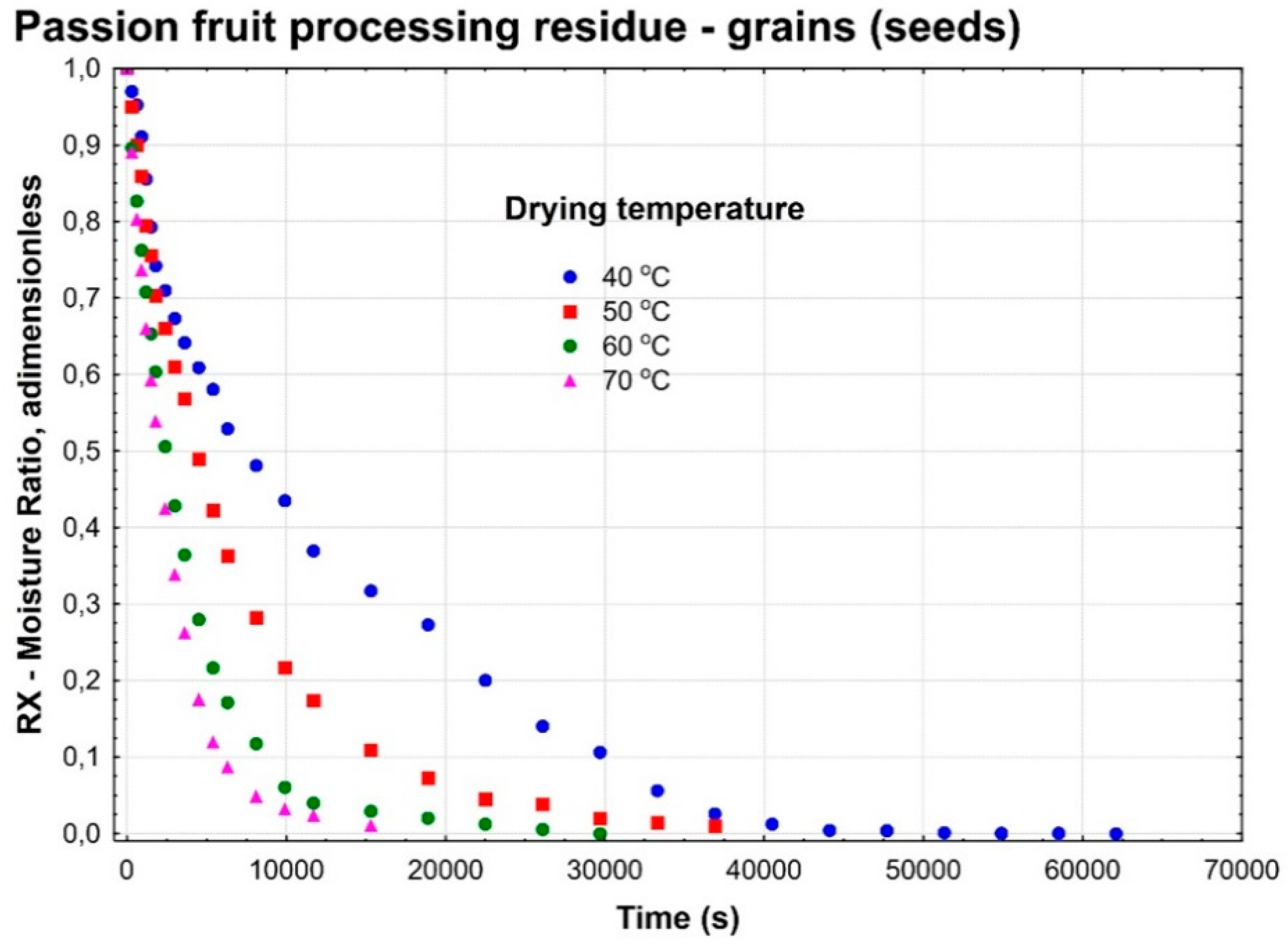
Figure 2.
Drying kinetics of passion fruit seeds - Fick model with 4 terms of the series
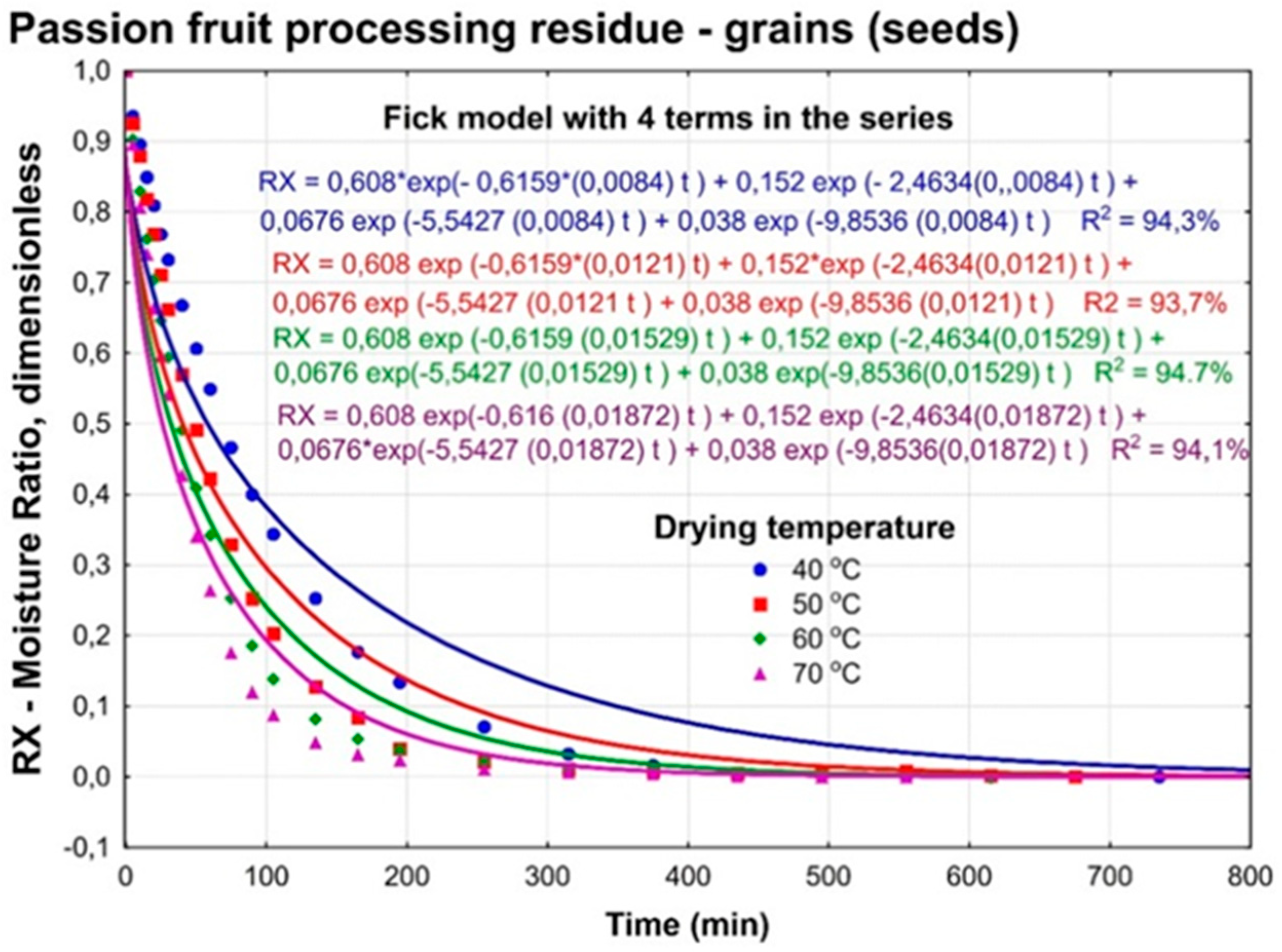
Figure 3.
Drying kinetics of passion fruit seeds - Henderson & Pabis model modified by Cavalcanti-Mata.
Figure 3.
Drying kinetics of passion fruit seeds - Henderson & Pabis model modified by Cavalcanti-Mata.
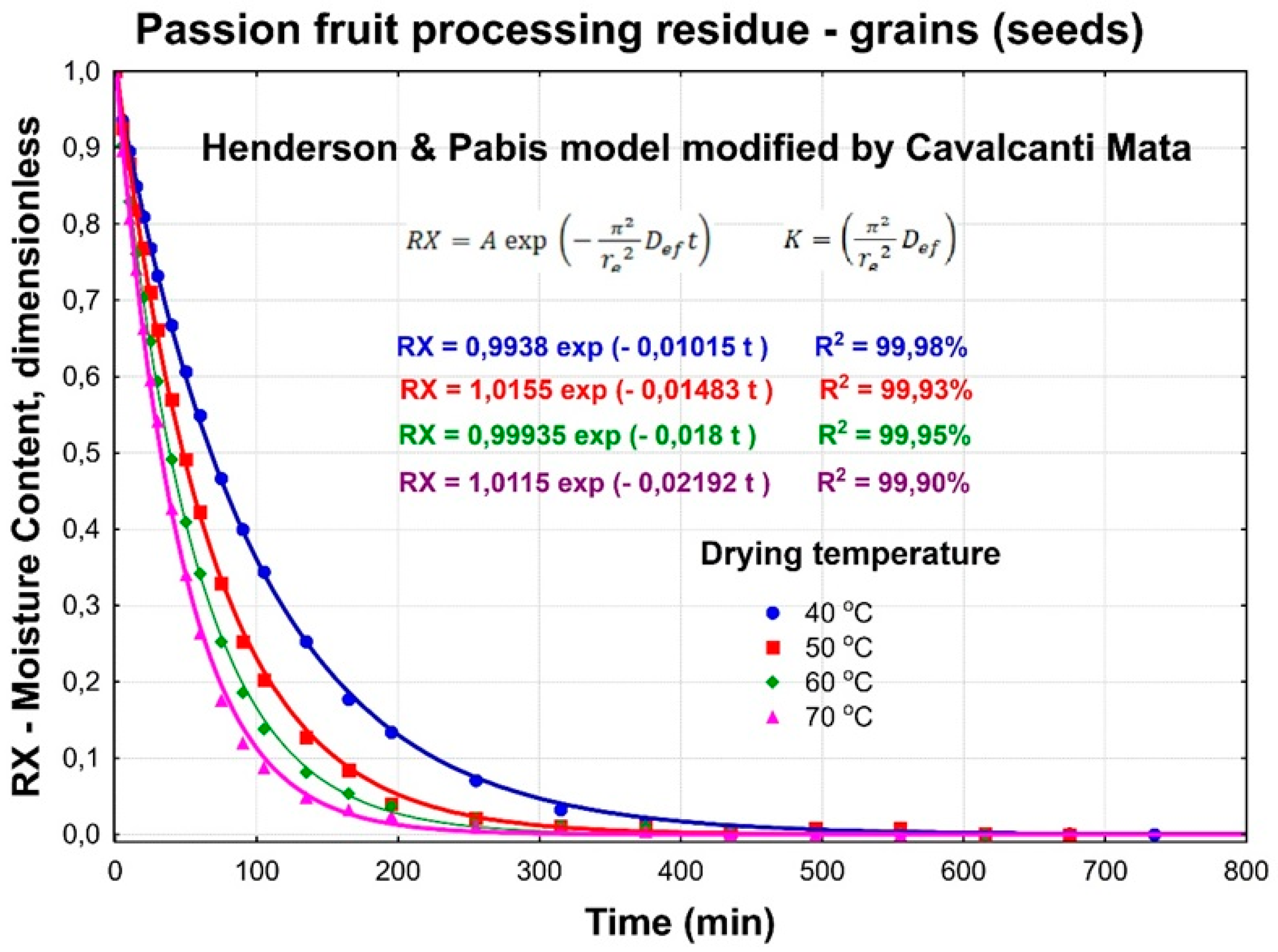
Figure 4.
Drying Kinetics of Passion Fruit Grains – Modified Page Model by Cavalcanti-Mata.
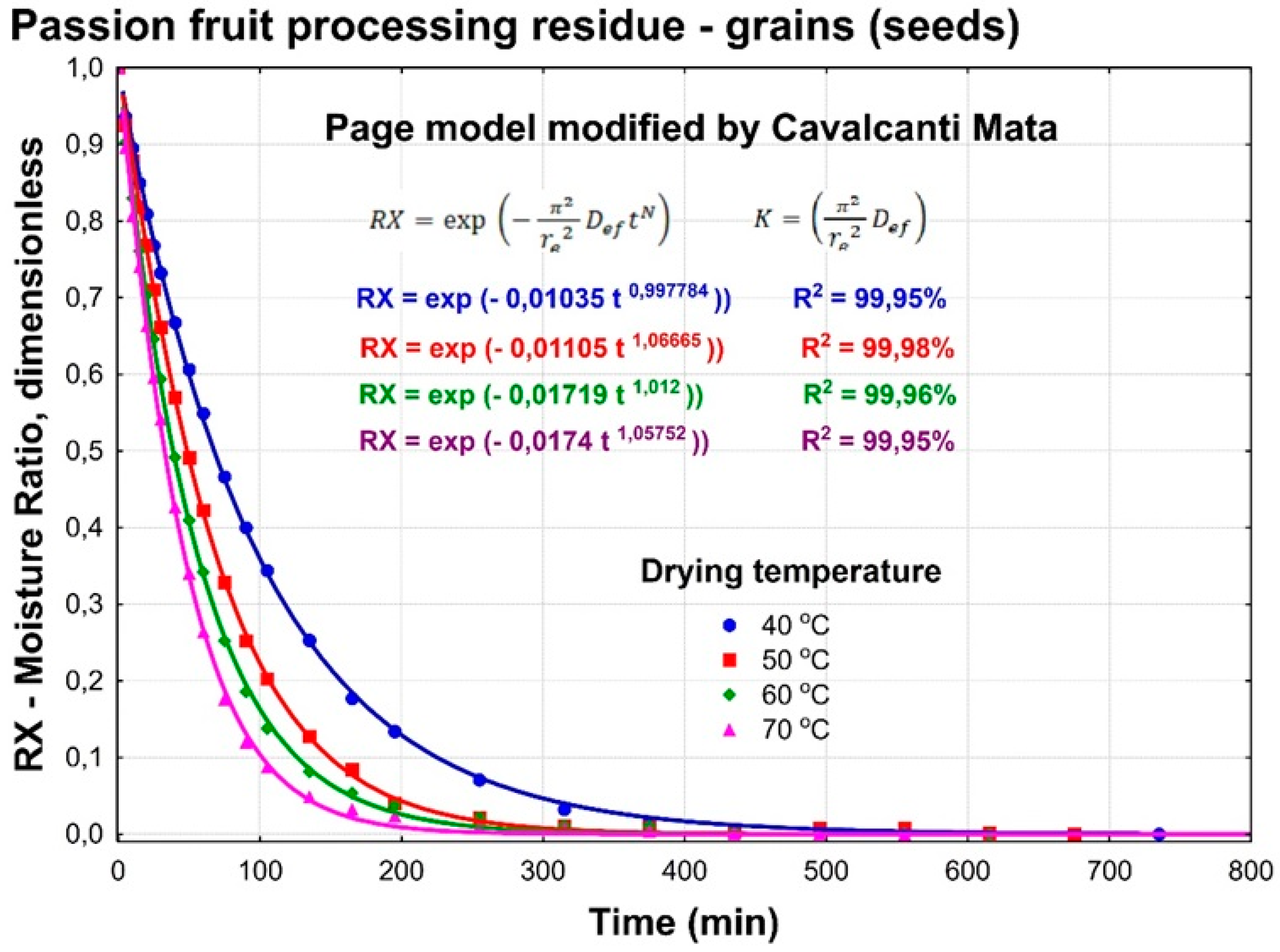
Figure 5.
Drying Kinetics of Passion Fruit Grains – Cavalcanti-Mata Model.
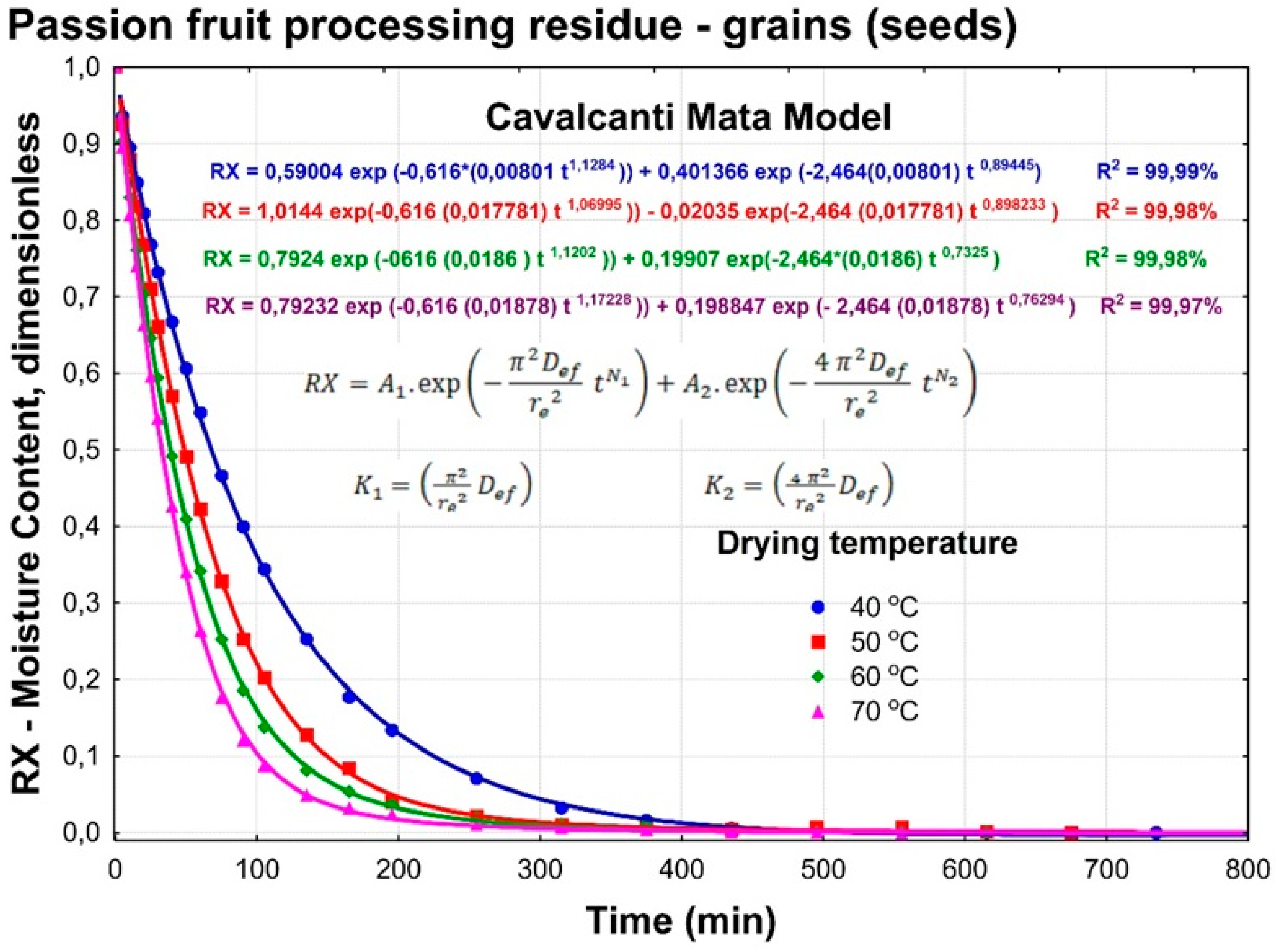
Figure 6.
Activation Energy of the Passion Fruit Grain Drying Process.
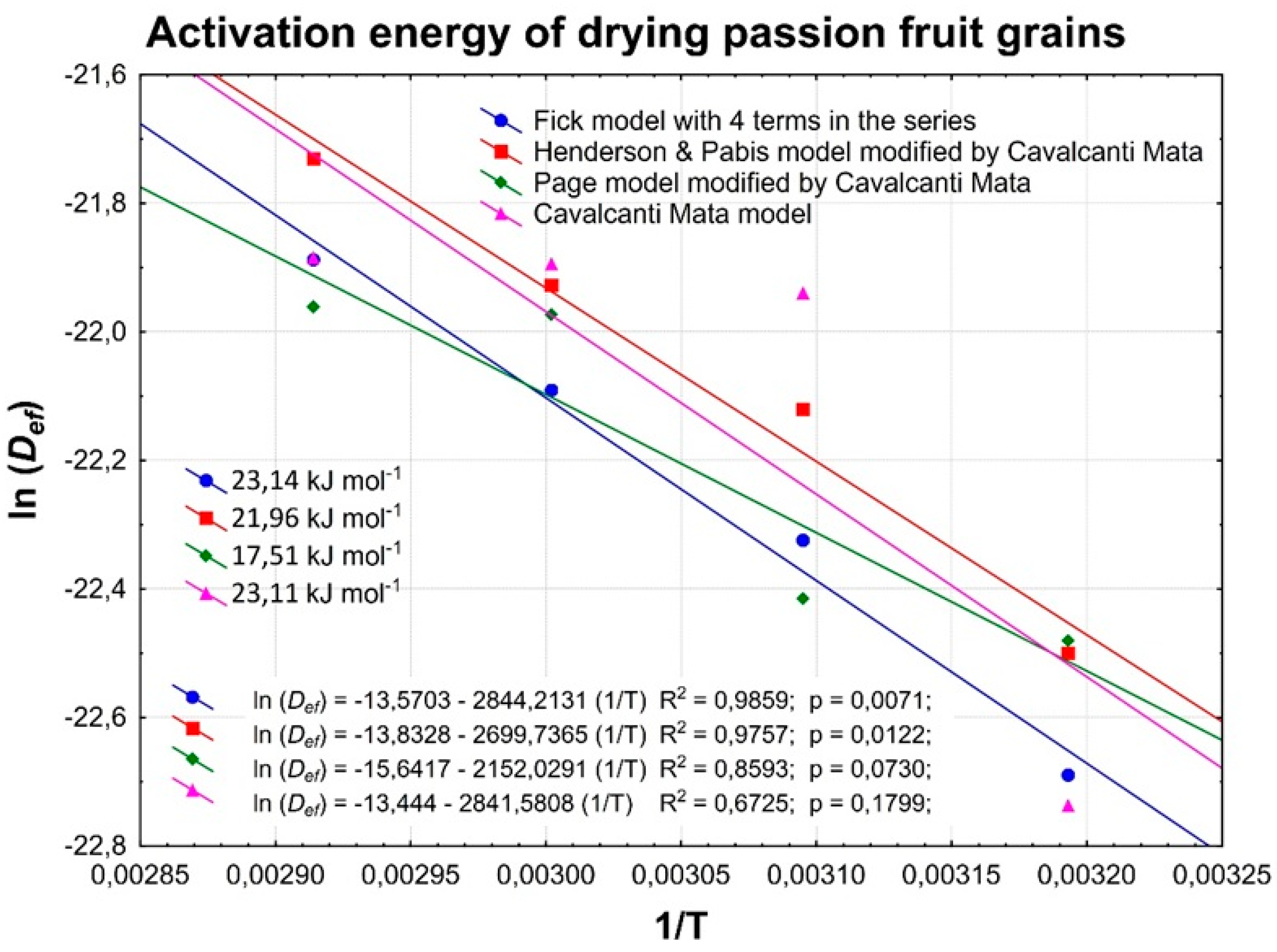
Table 1.
Physical Dimensions of Passion Fruit Seeds.
 |
Diameter 1 (mm) | Diameter 2 (mm) | Diameter 3 (mm) | Weight of 1000 grains (g) |
| 5,84 | 3,68 | 2,42 | 25,9 | |
| SD = 0.10 | SD = 0.07 | SD = 0.05 | SD = 1.78 | |
| Radius 1 | Radius 2 | Radius 3 | ||
| 2.92 mm | 1.84 mm | 1.21 mm | ||
| vSphere 27.22 mm |
req 4.003 mm |
Table 2.
Data from the fitting of mathematical models to the experimental drying data.
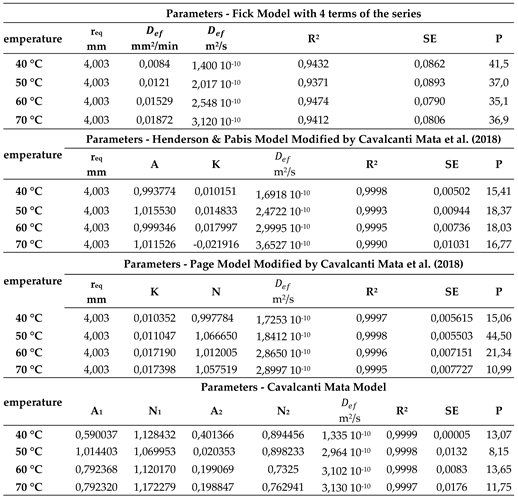
Table 3.
Values of the thermodynamic parameters for the drying equations of passion fruit grains.
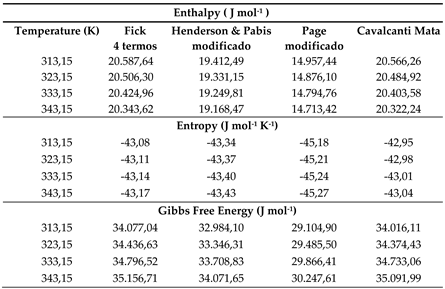
Table 5.
Physicochemical composition of passion fruit flours produced from the cold-pressed oil extraction residue of the seeds, because of the drying process at temperatures of 40, 50, 60, and 70 ºC.
Table 5.
Physicochemical composition of passion fruit flours produced from the cold-pressed oil extraction residue of the seeds, because of the drying process at temperatures of 40, 50, 60, and 70 ºC.
Disclaimer/Publisher’s Note: The statements, opinions and data contained in all publications are solely those of the individual author(s) and contributor(s) and not of MDPI and/or the editor(s). MDPI and/or the editor(s) disclaim responsibility for any injury to people or property resulting from any ideas, methods, instructions or products referred to in the content. |
© 2024 by the authors. Licensee MDPI, Basel, Switzerland. This article is an open access article distributed under the terms and conditions of the Creative Commons Attribution (CC BY) license (http://creativecommons.org/licenses/by/4.0/).
Copyright: This open access article is published under a Creative Commons CC BY 4.0 license, which permit the free download, distribution, and reuse, provided that the author and preprint are cited in any reuse.


