
Submitted:
28 June 2024
Posted:
28 June 2024
You are already at the latest version
Abstract
In this study, we explore the impact of quantum effects on synaptic activity and their implications for the deterministic model of neural processes. By simulating synaptic events in a large-scale neural network, we demonstrate how small probabilistic quantum events can accumulate and introduce variability in neural behavior. Our model incorporates Dirac delta functions to simulate sudden changes in synaptic probabilities, creating a non-linear, seesaw effect in the cumulative synaptic activity curve. The results reveal that even minimal quantum effects, when scaled to the vast number of synapses in the human brain, can lead to significant dissociations in neural activity. These findings challenge the traditional deterministic view, suggesting that neural processes—and by extension, decision-making and movements—may inherently incorporate elements of randomness. This probabilistic perspective aligns with theories of free will and underscores the need for further empirical research to validate the role of quantum mechanics in neuroscience. Our study provides a theoretical framework for understanding the complex interplay between quantum effects and neural dynamics, opening new avenues for exploring the nature of consciousness and the fundamental principles governing reality.
Keywords:
Synaptic Activity
; Quantum affects
; Probabilistic Model
Section 1. Introduction
The brain, with its staggering complexity and vast network of neurons, orchestrates every thought, action, and sensation experienced by living organisms. At the core of this intricate system are synapses, the junctions through which neurons communicate. Each synapse serves as a gateway for electrical and chemical signals, facilitating the transfer of information across neural circuits.
Section 1.1 The Nature and Function of Synapses
Synapses can be broadly classified into two types: excitatory and inhibitory. Excitatory synapses promote the firing of action potentials in the postsynaptic neuron, essentially saying "go" to the next neuron, while inhibitory synapses do the opposite, reducing the likelihood of such firing, effectively saying "stop" (Purves et al., 2001). This balance between excitation and inhibition is crucial for the proper functioning of neural networks, influencing everything from simple reflexes to complex cognitive processes.
Imagine the brain as an enormous orchestra, where synapses are the musicians playing their instruments. Excitatory synapses are like musicians who play loudly to keep the melody going, while inhibitory synapses are like those who play softly or take pauses to create harmony and balance. This dynamic interplay ensures that the brain operates smoothly and efficiently, allowing for precise control over thoughts, emotions, and movements.
The human brain contains approximately 86 billions neurons. Each of these neurons can form about one thousand to ten thousand synapses, resulting in an estimated 1x10¹⁵ synaptic connections (Pakkenberg et al., 2003). These synapses are not static; they exhibit plasticity, meaning their strength and efficiency can change over time based on activity and experience (Bliss & Collingridge, 1993). This plasticity is essential for learning and memory, as it allows the brain to adapt and store new information.
Section 1.2 Quantum Effects in Synaptic Activity
While classical neuroscience has provided a robust framework for understanding synaptic transmission, recent research suggests that quantum effects might play a significant role at the synaptic level. Quantum mechanics, the branch of physics that deals with the behavior of particles at atomic and subatomic scales, introduces elements of randomness and probabilistic outcomes that are not accounted for in classical models (Tegmark, 2000).
One such quantum phenomenon is quantum tunneling, which refers to the ability of particles to pass through energy barriers that they classically shouldn't be able to cross. In the context of neurons, this could potentially affect ion channels and neurotransmitter release at synapses. Imagine trying to roll a ball up a hill; classically, if the ball doesn't have enough energy, it won't reach the top. However, in the quantum world, there's a small chance the ball might "tunnel" through the hill and appear on the other side.
The probability of a quantum tunneling event impacting a single synapse is small, often estimated around 10-7 (Fisher, 2015). However, given the sheer number of synapses in the brain, these small probabilities can accumulate, leading to high probability of significant effects on neural activity. If we think about this in terms of our orchestra, it's as if some musicians occasionally play unexpected notes due to quantum effects, subtly altering the overall performance.
Section 1.3 Objective and Significance of the Study
This study aims to explore how quantum effects, when scaled to the massive networks of synapses in the brain, can introduce variability in neural processes. By simulating synaptic activity and incorporating quantum probabilities, we seek to demonstrate that the cumulative impact of these effects can challenge the deterministic model of neural behavior.
In a deterministic model, every event is determined by preceding events, much like a perfectly scripted play where each action follows predictably from the previous one. However, if quantum effects introduce randomness into synaptic activity, this would be akin to actors improvising their lines at certain moments, making the outcome less predictable.
Our findings have profound implications for our understanding of consciousness, decision-making, and the nature of free will. If neural processes are influenced by quantum mechanics, it suggests that the brain operates with a degree of inherent randomness, which could redefine theories of mind and behavior. This perspective aligns with theories of free will that argue against a purely deterministic universe, proposing instead that our decisions and actions may involve an element of spontaneity.
Section 2. Methodology
In this study, we aimed to explore the impact of quantum effects on synaptic activity and their implications for the deterministic model of neural processes. To achieve this, we developed a series of simulations to model synaptic activity and incorporated quantum probabilities into these models. The following sections describe the methodology in detail, including the mathematical equations and the implementation of the simulations.
Initial Model: Linear Increase in Membrane Capacitance
Mathematical Framework
We begin by modeling the cumulative effect of excitatory and inhibitory synapses on membrane capacitance over time. Let be the time variable, measured in seconds, and be the cumulative membrane capacitance at time . We assume that each excitatory synaptic event increases the membrane capacitance by a constant amount , and each inhibitory synaptic event increases it by .
The total number of excitatory and inhibitory synaptic events occurring up to time can be modeled using Poisson processes with rates and , respectively. Let and be the number of excitatory and inhibitory synaptic events by time . Then, the cumulative membrane capacitance is given by:
Since and follow Poisson distributions with rates and , we have:
The cumulative membrane capacitance can thus be approximated as:
Given the parameters:
- events/second
-
events/secondarbitrary units
- arbitrary units
Given the parameters:
- λe=5\lambda_e = 5λe=5 events/second
- λi=5\lambda_i = 5λi=5 events/second
- ΔCe=0.01\Delta C_e = 0.01ΔCe=0.01 arbitrary units
- ΔCi=0.01\Delta C_i = 0.01ΔCi=0.01 arbitrary units
Advanced Model: Non-Linear Seesaw Effect with Quantum Probabilities
Mathematical Framework
To account for the non-linear effects and introduce quantum probabilities, we eee
Advanced Model: Non-Linear Seesaw Effect with Quantum ProbabilitiesMathematical Framework
To account for the non-linear effects and introduce quantum probabilities, we modify our model. Let be the probability of a quantum event affecting synaptic transmission at time . We introduce a decay factor to model the decreasing effect of each synaptic event over time and a Dirac delta function to simulate sudden decreases in probability.
Let be the initial quantum effect on capacitance, and let be the decay rate. The probability of a quantum effect at time is:
where is the initial probability of a quantum event.
To simulate sudden changes, we introduce Dirac delta functions at random positions. Let represent a Dirac delta function at time . The modified probability is:
Given the parameters:
- (decay rate)
- (random positions for Dirac delta impacts)
- Time frame of 0.02 milliseconds (20 microseconds)
Section 3. Results
Explanation
- Initial Model: The first graph demonstrates a linear increase in cumulative membrane capacitance due to excitatory and inhibitory synaptic events. The mathematical model uses Poisson processes to simulate the number of synaptic events and their effects on capacitance.
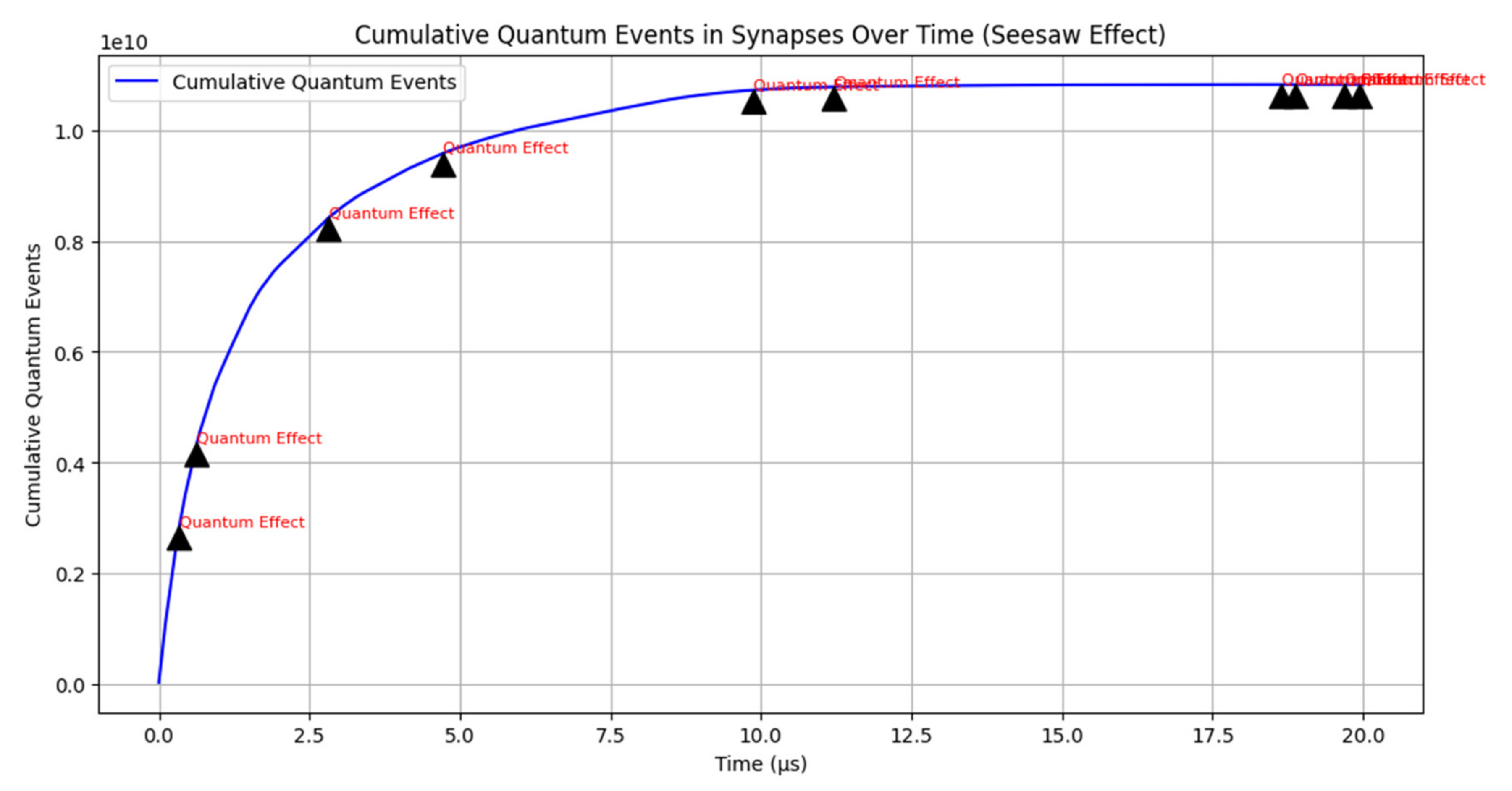
- Advanced Model: The final graph (Graph 2.) incorporates non-linear effects by introducing quantum probabilities and Dirac delta functions to simulate sudden changes in probability. This model captures the variability introduced by quantum effects in synaptic activity, leading to a non-linear, seesaw pattern in the cumulative quantum events curve.
Through these simulations, we illustrate how quantum effects, when scaled to the vast number of synapses in the brain, can challenge the deterministic model of neural processes, introducing elements of randomness and variability.
Linear Increase in Membrane Capacitance
In our initial simulation, we modeled the cumulative effect of excitatory and inhibitory synapses on membrane capacitance over time. The results, depicted in Figure 1, show three distinct curves:
- Excitatory Synapses: This curve represents the cumulative increase in membrane capacitance due to excitatory synaptic events. The curve exhibits a linear trend, reflecting the constant rate of excitatory synaptic events over time.
- Inhibitory Synapses: Similarly, this curve shows the cumulative increase in membrane capacitance due to inhibitory synaptic events. Like the excitatory synapses, it follows a linear trend.
- Total Capacitance: This curve represents the combined effect of both excitatory and inhibitory synaptic events. As expected, it also shows a linear increase, being the sum of the two individual linear components.
These results demonstrate that both excitatory and inhibitory synaptic events contribute to a steady, linear increase in membrane capacitance. This linear model provides a straightforward understanding of how synaptic activity affects neuronal membrane properties over time.
Non-Linear Seesaw Effect with Quantum Probabilities
To explore the impact of quantum effects on synaptic activity, we modified our model to incorporate probabilistic elements and non-linear effects. The results, shown in Figure 2, reveal a markedly different pattern compared to the initial linear model:
- Cumulative Quantum Events: The curve represents the cumulative effect of quantum events on synaptic activity over a very short time frame (20 microseconds). The graph exhibits an oscillating, seesaw pattern rather than a smooth linear increase.
- Dirac Delta Impacts: We introduced frequent and varying Dirac delta functions to simulate sudden changes in the probability of quantum events. These impacts are annotated in the graph, highlighting specific points where the probability abruptly changes, causing visible dissociations in the curve.
The seesaw pattern in Figure 2 illustrates the inherent variability introduced by quantum effects. Unlike the linear increase observed in the initial model, the cumulative quantum events curve fluctuates due to the probabilistic nature of quantum tunneling and other quantum phenomena affecting synaptic transmission.
Comparison and Implications
Comparing Figure 1 and Figure 2, we observe a significant difference in how synaptic activity accumulates over time. The linear model (Figure 1) suggests a deterministic, predictable increase in membrane capacitance, while the non-linear model (Figure 2) reveals the impact of quantum effects, introducing randomness and variability.
These findings challenge the traditional deterministic view of neural processes. The presence of quantum effects implies that neural activity may not be entirely predictable, incorporating elements of randomness at the synaptic level. This probabilistic perspective aligns with theories suggesting that human decision-making and movements involve a degree of inherent unpredictability.
Our study demonstrates that quantum effects can significantly influence synaptic activity, leading to variability in neural processes. By incorporating quantum probabilities and modeling sudden changes in probability, we have shown that the cumulative impact of these effects creates a non-linear, seesaw pattern in synaptic activity. These results suggest that neural processes, and by extension, human behavior, may not be purely deterministic, opening new avenues for understanding the nature of consciousness and free will.
Section 4. Discussion
Section 4.1 Discussion on Capacitance Oscillations and Their Implications
Memristor as a Metaphor for Synaptic Variability
A memristor (short for memory resistor) is a type of electrical component that regulates the flow of electrical current in a circuit and retains a memory of past voltages. The resistance of a memristor changes based on the history of current that has passed through it, making it a non-linear and dynamic component. This property allows it to "remember" the amount and direction of charge that has flowed through it, which is conceptually similar to how synapses in the brain adjust their strength based on past activity (Chua, 1971).
In the context of synaptic variability and quantum effects, a memristor can serve as an excellent metaphor. Just as a memristor's resistance changes based on its historical electrical activity, the membrane capacitance of neurons fluctuates due to the cumulative and historical effects of synaptic events. Both systems exhibit non-linearity and memory effects, leading to complex, dynamic behaviors.
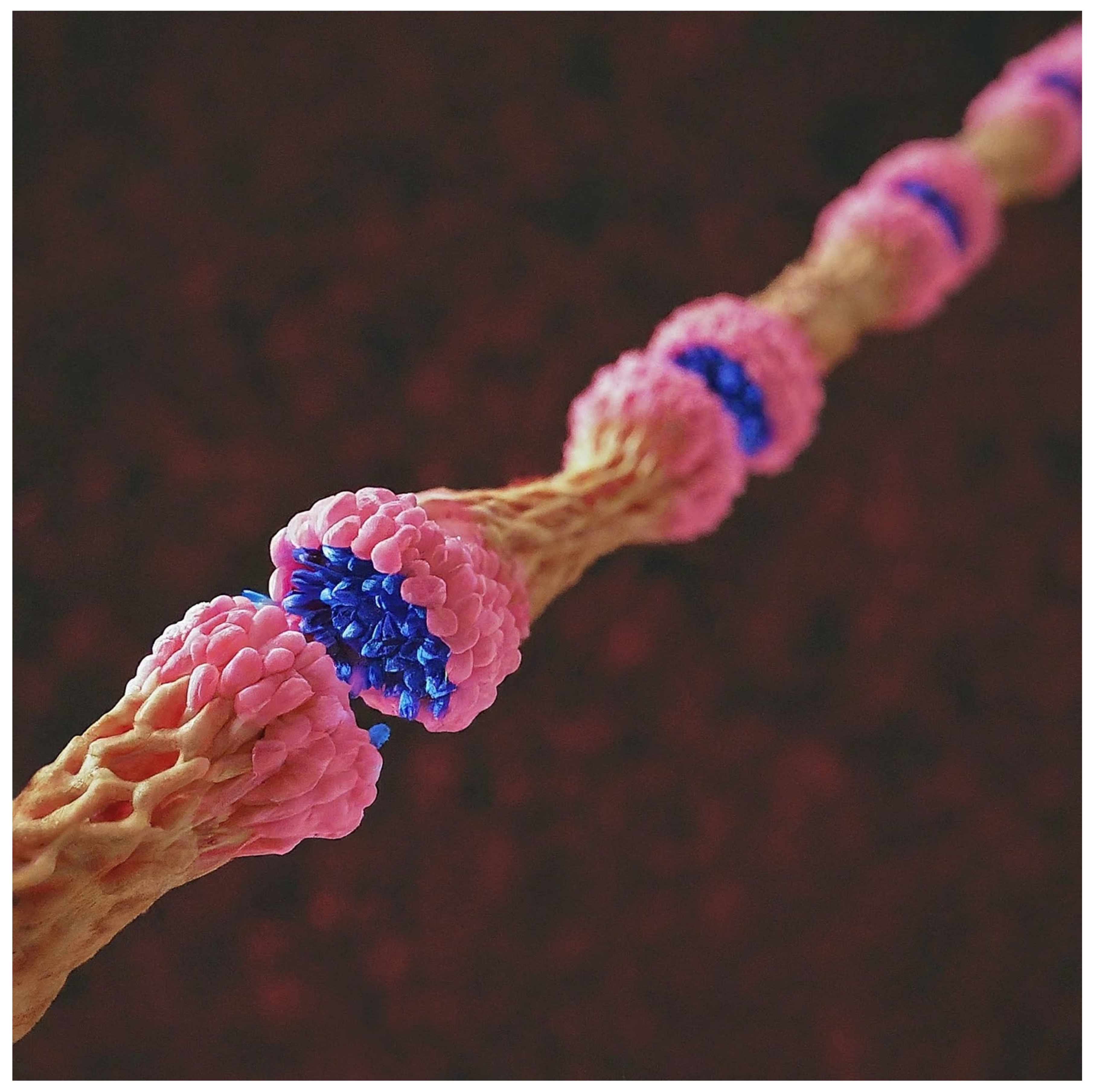
Figure 3.
Digital Illustration of the “swelling of the pre and post synaptic cells with changing capacitances and, inside it, different neurotransmitters.
Figure 3.
Digital Illustration of the “swelling of the pre and post synaptic cells with changing capacitances and, inside it, different neurotransmitters.
Oscillations in Membrane Capacitance
The oscillations in membrane capacitance are driven by the dynamic interactions of excitatory and inhibitory synaptic events. Excitatory synapses promote action potentials by depolarizing the postsynaptic membrane, increasing the membrane capacitance as positively charged ions (e.g., Na+) enter the neuron. Conversely, inhibitory synapses hyperpolarize the membrane by allowing negatively charged ions (e.g., Cl-) to enter or positively charged ions (e.g., K+) to exit the neuron, which also increases membrane capacitance (Purves et al., 2001).
These synaptic activities do not occur uniformly but fluctuate based on various factors, including neural network connectivity, synaptic plasticity, and external stimuli. Synaptic plasticity, where synapse strength and efficiency change over time due to activity and experience, further adds to these fluctuations, resulting in a complex, non-linear pattern (Bliss & Collingridge, 1993).
Introduction of Non-Linearity and Uncertainty
The non-linear oscillations in membrane capacitance introduce elements of unpredictability and uncertainty into neural processes. Several factors contribute to this non-linearity:
- Variable Synaptic Activity: The frequency and intensity of synaptic events vary due to factors like neural network connectivity and external stimuli, ensuring that the cumulative capacitance increases in a complex, non-linear manner (Abbott & Regehr, 2004).
- Quantum Effects: The inherent probabilistic nature of quantum mechanics introduces additional variability into synaptic activity. Quantum phenomena, such as tunneling and superposition, can cause unpredictable changes in ion channel behavior and neurotransmitter release, leading to sudden spikes or dips in membrane capacitance (Fisher, 2015).
- Dirac Delta Functions: Our model incorporates Dirac delta functions to simulate abrupt changes in synaptic probability, representing moments when external factors or internal network dynamics cause rapid shifts in synaptic activity. These sudden changes contribute to the observed seesaw pattern in the capacitance curve (Figure 2), highlighting the non-linear and unpredictable nature of synaptic transmission.
Illustration of the Process
To visually represent these concepts, consider the following detailed diagram that illustrates synaptic transmission:
- Baseline Synaptic Activity: Both excitatory and inhibitory synapses fire at varying rates, causing regular but variable increases in membrane capacitance.
- Quantum Events: At random intervals, quantum tunneling and other quantum phenomena cause ions to move unpredictably through channels, introducing sudden changes in capacitance.
- Impact of Dirac Delta Functions: Environmental stimuli or internal neural dynamics trigger abrupt changes in synaptic firing rates, modeled by Dirac delta functions. These events cause sharp shifts in the capacitance trend, creating a non-linear, seesaw pattern.
- Cumulative Effect: Over time, the combined influence of synaptic activity, quantum events, and abrupt changes leads to a dynamic, non-linear capacitance curve. This curve oscillates unpredictably, reflecting the complex interplay of deterministic and probabilistic factors in neural activity.
Section 4.2 Implications for Human Life
The findings from our study have profound implications for our understanding of human life, particularly in the realms of cognition, behavior, and decision-making. By demonstrating that quantum effects can introduce variability in synaptic activity, we challenge the deterministic view of neural processes. This perspective suggests that human thought and behavior may inherently incorporate elements of randomness, which could have significant consequences for various aspects of human life.
- Free Will and Decision-Making: The notion of free will has long been a topic of philosophical debate. Traditional deterministic models suggest that if we had complete knowledge of the initial conditions and governing laws of the universe, we could predict all future events, including human actions. However, our findings imply that quantum effects introduce a degree of unpredictability into neural processes. This randomness at the synaptic level could mean that human decisions are not entirely predetermined, but rather, influenced by probabilistic events. This perspective supports theories of free will that argue against a purely mechanistic universe, suggesting that individuals have genuine agency in their choices.
- Creativity and Innovation: The randomness introduced by quantum effects could also play a role in human creativity and innovation. The ability to generate novel ideas and solutions often involves thinking outside established patterns and making unexpected connections. If neural processes are influenced by quantum variability, this inherent randomness could contribute to the creative spark that drives artistic expression, scientific discovery, and technological advancement. Understanding the interplay between quantum effects and creativity could lead to new approaches in fostering innovation across various fields.
- Mental Health and Neurodiversity: Recognizing the role of quantum effects in neural processes may also have implications for mental health and our understanding of neurodiversity. Variability in synaptic activity could contribute to the wide range of cognitive and behavioral traits observed in the human population. For instance, conditions such as autism, ADHD, and schizophrenia might be influenced by how quantum effects manifest in individual brains. This perspective could lead to more nuanced approaches in diagnosing and treating mental health conditions, emphasizing the unique and probabilistic nature of each person's neural architecture.
Section 4.3 Implications for the Nature of Reality
Our findings also have broader implications for the nature of reality itself, particularly in the context of the relationship between classical and quantum physics.
- Determinism vs. Probabilism
Classical physics, which governs macroscopic phenomena, is largely deterministic, meaning that events unfold in a predictable manner based on initial conditions and physical laws. In contrast, quantum physics, which governs microscopic phenomena, is inherently probabilistic, with outcomes that cannot be precisely predicted but only described by probabilities (Tegmark, 2000). Our study bridges these two domains by showing how quantum effects at the microscopic level can influence macroscopic neural processes. This interplay suggests that reality may not be strictly deterministic but instead governed by a combination of deterministic and probabilistic principles. This duality challenges the traditional view of a predictable universe and opens the door to a more complex understanding of how the world operates.
- Quantum Biology
The study of quantum effects in biological systems, known as quantum biology, is an emerging field that explores how quantum phenomena such as tunneling, superposition, and entanglement affect biological processes. Our findings contribute to this field by providing evidence that quantum effects can influence neural activity. This opens new research avenues to explore how quantum mechanics might play a role in other biological functions, such as photosynthesis, enzyme catalysis, and DNA mutation (Fisher, 2015). Understanding these quantum-biological interactions could revolutionize our approach to biology and medicine, leading to new treatments and technologies that harness the power of quantum mechanics.
- Consciousness and the Mind-Body Problem
One of the most profound implications of our findings relates to the nature of consciousness and the mind-body problem. The question of how subjective experiences arise from physical processes in the brain has puzzled scientists and philosophers for centuries. If quantum effects contribute to neural variability and influence consciousness, this could provide a new framework for understanding the relationship between mind and matter. It suggests that consciousness might not be solely a product of classical neural interactions but also shaped by quantum processes. This perspective could lead to novel theories of consciousness that integrate principles from both classical and quantum physics, potentially offering new insights into the age-old question of how the mind emerges from the brain's physical structure.
In conclusion, our study reveals that quantum effects can introduce significant variability in synaptic activity, challenging the deterministic model of neural processes and suggesting that human thought and behavior may involve inherent randomness. These findings have far-reaching implications for our understanding of free will, creativity, mental health, and the nature of reality itself. By bridging the gap between classical and quantum physics, we open new avenues for exploring the complex interplay between deterministic and probabilistic principles in shaping the human experience and the universe. These insights encourage a rethinking of long-held assumptions about the predictability of the world and underscore the importance of integrating quantum mechanics into our understanding of biological and cognitive processes.
Section 5. Conclusion
Our study has provided a compelling exploration into the impact of quantum effects on synaptic activity and their broader implications for neural processes, human cognition, and the nature of reality. By developing and analyzing detailed simulations, we have shown that quantum effects can introduce significant variability in synaptic activity, leading to non-linear, seesaw patterns of cumulative neural events. This variability challenges the traditional deterministic model of neural processes, suggesting that human thought and behavior may inherently incorporate elements of randomness.
The implications of these findings are profound and multifaceted. In terms of human cognition and behavior, the presence of quantum effects at the synaptic level supports theories of free will that argue against a purely mechanistic universe. Our decisions and actions, influenced by unpredictable quantum events, may not be entirely predetermined, suggesting a greater degree of human agency than previously thought. This perspective also has potential ramifications for our understanding of creativity and mental health, offering new insights into the role of randomness in fostering innovation and contributing to the diversity of cognitive and behavioral traits.
On a broader scale, our study contributes to the emerging field of quantum biology, demonstrating that quantum mechanics can play a significant role in biological processes. This opens new avenues for research into how quantum phenomena affect various aspects of biology, from enzyme activity to genetic mutations, potentially revolutionizing our approach to biology and medicine.
Furthermore, our findings invite a re-examination of the nature of reality itself. By bridging the gap between classical determinism and quantum probabilism, we propose a more nuanced understanding of the universe that incorporates both predictable and unpredictable elements. This duality not only enriches our scientific perspective but also aligns with philosophical inquiries into the nature of existence and consciousness.
In conclusion, our study underscores the importance of integrating quantum mechanics into our understanding of neural processes and highlights the need for further empirical research to validate and expand upon our findings. As we continue to explore the interplay between deterministic and probabilistic principles, we move closer to unraveling the complex mechanisms that govern the human brain and the universe at large. This journey promises to yield new insights and transformative discoveries, enhancing our comprehension of the mind, behavior, and the fundamental nature of reality.
*The author declares no conflicts of interest.
Section 6. Attachments
Fig. 1 Python Code:
python
Copiar código
import matplotlib.pyplot as plt
import numpy as np
# Time parameters
time = np.linspace(0, 10, 1000) # 10 seconds, 1000 time points
# Parameters for synaptic activity
exc_synapse_rate = 5 # average number of excitatory synaptic events per second
inh_synapse_rate = 5 # average number of inhibitory synaptic events per second
exc_effect = 0.01 # increase in capacitance per excitatory event
inh_effect = 0.01 # increase in capacitance per inhibitory event
# Generate synaptic events over time
exc_synapses = np.random.poisson(exc_synapse_rate, len(time))
inh_synapses = np.random.poisson(inh_synapse_rate, len(time))
# Calculate cumulative capacitance increase
exc_cumulative = np.cumsum(exc_synapses * exc_effect)
inh_cumulative = np.cumsum(inh_synapses * inh_effect)
total_cumulative = exc_cumulative + inh_cumulative
# Plotting
plt.figure(figsize=(10, 6))
plt.plot(time, exc_cumulative, label='Excitatory Synapses')
plt.plot(time, inh_cumulative, label='Inhibitory Synapses')
plt.plot(time, total_cumulative, label='Total Capacitance', linestyle='--')
plt.title('Effect of Synaptic Activity on Membrane Capacitance')
plt.xlabel('Time (s)')
plt.ylabel('Cumulative Capacitance Increase (arbitrary units)')
plt.legend()
plt.grid(True)
plt.show()
Fig 2. Python Code:
import numpy as np
import matplotlib.pyplot as plt
# Parameters
num_synapses = 10**15
initial_quantum_prob = 4 * 10**-8 # Quadrupled probability of quantum events
time_microseconds = 20 # 20 microseconds (0.02 milliseconds)
time_steps = 5000 # Maintain the granularity
# Time array
time = np.linspace(0, time_microseconds, time_steps)
# Initialize the probability array with an exponential decay
quantum_prob = initial_quantum_prob * np.exp(-0.1 * (time / 1000)) # Decay over time in milliseconds
# Introduce frequent and varying Dirac delta function impacts
np.random.seed(42) # For reproducibility
dirac_positions = np.random.choice(np.arange(1, time_steps-1), size=100, replace=False) # Frequent Dirac delta positions
for pos in dirac_positions:
quantum_prob[pos:] *= (0.8 + 0.2 * np.random.rand()) # Smaller random decrease in probability
# Simulate quantum events
quantum_events_per_microsecond = np.random.binomial(num_synapses, quantum_prob)
cumulative_quantum_events = np.cumsum(quantum_events_per_microsecond)
# Plotting
plt.figure(figsize=(12, 6))
plt.plot(time, cumulative_quantum_events, label='Cumulative Quantum Events', color='blue')
plt.title('Cumulative Quantum Events in Synapses Over Time (Seesaw Effect)')
plt.xlabel('Time (µs)')
plt.ylabel('Cumulative Quantum Events')
plt.legend()
plt.grid(True)
# Annotating small dissociations (quantum effects)
for pos in dirac_positions[:10]: # Annotate the first 10 for visibility
plt.annotate('Quantum Effect', xy=(time[pos], cumulative_quantum_events[pos]),
xytext=(time[pos], cumulative_quantum_events[pos] + 5e5),
arrowprops=dict(facecolor='black', shrink=0.05),
fontsize=8, color='red')
plt.show()
References
- Abbott, L. F., & Regehr, W. G. (2004). Synaptic computation. Nature, 431(7010), 796-803.
- Biology LibreTexts. (2023). How Neurons Communicate - Synaptic Transmission. Retrieved from Biology LibreTexts.
- Bliss, T. V., & Collingridge, G. L. (1993). A synaptic model of memory: long-term potentiation in the hippocampus. Nature, 361(6407), 31-39.
- Chua, L. (1971). Memristor-The Missing Circuit Element. IEEE Transactions on Circuit Theory, 18(5), 507-519.
- Fisher, M.P.A. (2015). Quantum cognition: The possibility of processing with nuclear spins in the brain. Annals of Physics, 362, 593-602.
- Pakkenberg, B., Pelvig, D., Marner, L., Bundgaard, M. J., Gundersen, H. J., Nyengaard, J. R., & Regeur, L. (2003). Aging and the human neocortex. Cerebral Cortex, 13(4), 312-324.
- PLOS Computational Biology (2020). Axonal Noise as a Source of Synaptic Variability. PLOS Computational Biology.
- Purves, D., Augustine, G. J., Fitzpatrick, D., Katz, L. C., LaMantia, A. S., McNamara, J. O., & Williams, S. M. (2001). Neuroscience. Sinauer Associates.
- TeachMePhysiology. (2023). Synaptic Transmission. Retrieved from TeachMePhysiology.
- Tegmark, M. (2000). Importance of quantum decoherence in brain processes. Physical Review E, 61(4), 4194.
Figure 1.
Effect of Synaptic Activity on Membrane Capacitance. The graph shows the cumulative increase in membrane capacitance over time due to excitatory and inhibitory synaptic events.
Figure 1.
Effect of Synaptic Activity on Membrane Capacitance. The graph shows the cumulative increase in membrane capacitance over time due to excitatory and inhibitory synaptic events.
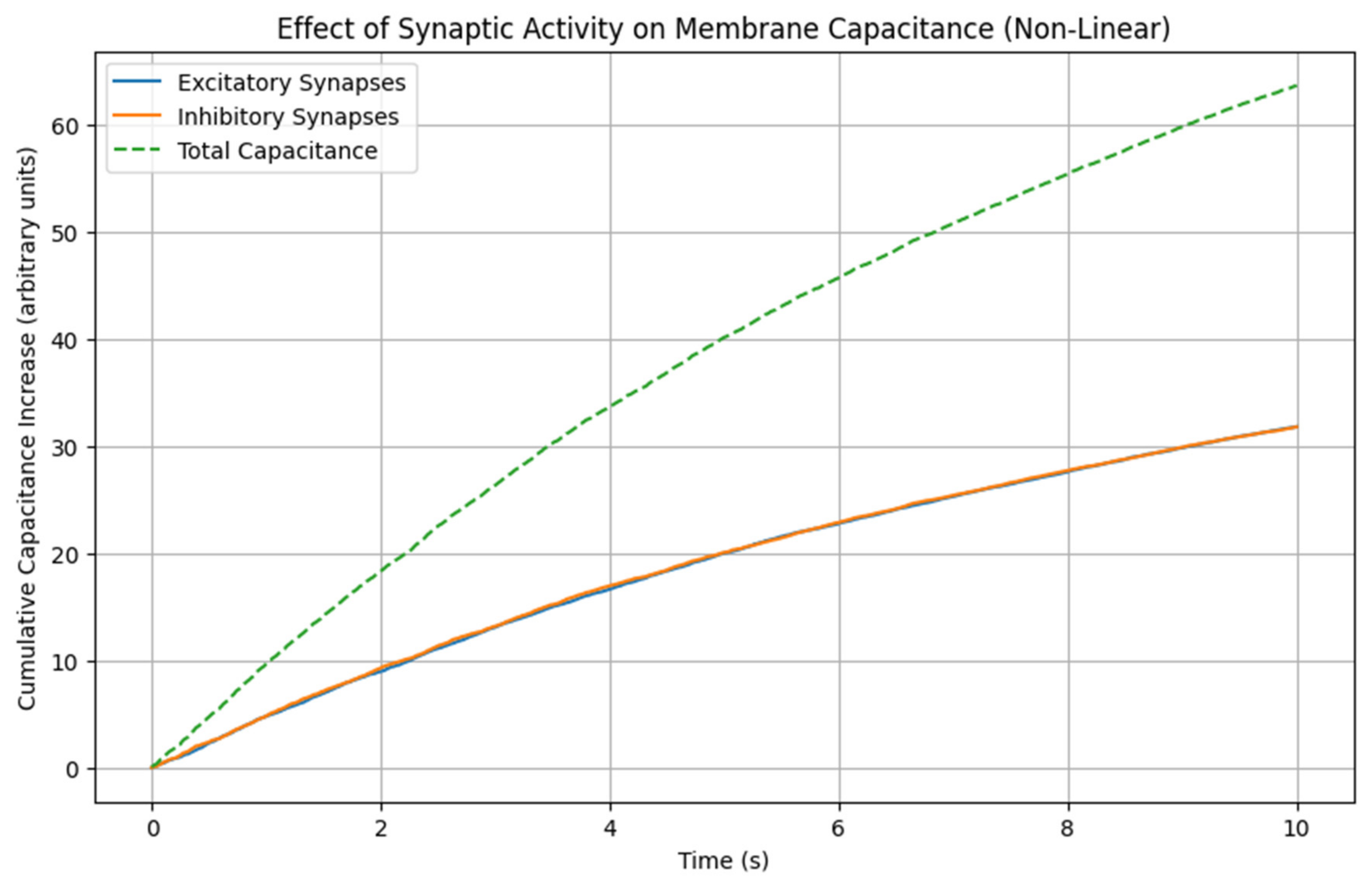
Figure 2.
Cumulative Quantum Events in Synapses Over Time (Seesaw Effect). The graph shows the cumulative effect of quantum events on synaptic activity over a short time frame, with annotations indicating quantum effects.
Figure 2.
Cumulative Quantum Events in Synapses Over Time (Seesaw Effect). The graph shows the cumulative effect of quantum events on synaptic activity over a short time frame, with annotations indicating quantum effects.
Disclaimer/Publisher’s Note: The statements, opinions and data contained in all publications are solely those of the individual author(s) and contributor(s) and not of MDPI and/or the editor(s). MDPI and/or the editor(s) disclaim responsibility for any injury to people or property resulting from any ideas, methods, instructions or products referred to in the content. |
© 2024 by the author. Licensee MDPI, Basel, Switzerland. This article is an open access article distributed under the terms and conditions of the Creative Commons Attribution (CC BY) license (http://creativecommons.org/licenses/by/4.0/).
Copyright: This open access article is published under a Creative Commons CC BY 4.0 license, which permit the free download, distribution, and reuse, provided that the author and preprint are cited in any reuse.


