

Submitted:
13 September 2024
Posted:
13 September 2024
You are already at the latest version
Abstract
This article advances the discourse on sustainable and energy-efficient software by examining the performance and energy efficiency of intelligent algorithms within the framework of green and sustainable computing. Building on previous research, it explores the theoretical implications of Bremermann's Limit on efforts to enhance computer performance through more extensive methods. The study presents an empirical investigation into heuristic methods for search and optimisation, demonstrating the energy efficiency of various algorithms in both simple and complex tasks. It also identifies key factors influencing the energy consumption of algorithms and their potential impact on computational processes. Furthermore, the article discusses cognitive concepts and their interplay with computational intelligence, highlighting the role of cognition in the evolution of intelligent algorithms. The conclusion offers insights into the future directions of research in this area, emphasising the need for continued exploration of energy-efficient computing methodologies.
Keywords:
1. Introduction
2. Survey of Related Literature
2. Materials, Tools and Methods
- The tests must involve problems with unknown optimal solutions.
- The tests should be scalable to multidimensional formats.
- The tests should feature heterogeneous landscapes.
- Griewank Test: A global optimisation problem with an optimal value of 0 [43].
- Michalewicz Test: A global test with an unknown optimum that varies depending on the number of dimensions [44].
- Norwegian Test: Another global test with an unknown optimum influenced by dimensionality [45].
- Rastrigin Test: A global optimisation problem with an optimal value of 0 [46].
- Rosenbrock Test: A smooth, flat test with a single solution and an optimal value of 0 [47].
- Schwefel Test: A global optimisation problem with an optimal value of 0 [48].
- Step Test: A test that introduces plateaus into the topology, which prevents reliance on local correlation in the search process. Its optimal value depends on the number of dimensions and may be unknown for various dimensions [49].
- Particle Swarm Optimisation (PSO): A swarm-based algorithm for real-coded tasks over continuous spaces [50].
- Differential Evolution (DE): A heuristic algorithm designed for optimising nonlinear and non-differentiable functions in continuous spaces [51].
- Free Search (FS): An adaptive heuristic algorithm for search and optimisation within continuous spaces [52].
Methodology
- Duration (min): Time taken for each experiment.
- Number of iterations (integer): The count of repeated cycles for each algorithm.
- Mean system power (W): Average power consumption of the entire system.
- System energy (Wh): Total energy consumption over time.
- CPU usage (%): The percentage of CPU utilization during algorithm execution.
- CPU power (W): Power consumption specific to the CPU.
- CPU cores (1 core - 1 thread): Number of active cores and threads during processing.
3. Results
- Time for Objective Function Evaluation: This represents the duration required to understand and assess the search space.
- Time for Algorithm Execution: This refers to the time taken for the interpretation and assessment of the search space by the algorithm.
- Time for Algorithm Decision Making: This is the duration needed for the algorithm to make decisions and select subsequent actions.
4. Discussion
- Intuitive cognition involves the immediate apprehension that allows the intellect to make evident judgments about the existence or qualities of an object.
- Abstractive cognition, on the other hand, is an act of cognition where such judgments cannot be evidently made.
5. Conclusions
- The overall growth in energy consumption by computational systems poses significant challenges, especially considering the fundamental physical limitations that, if left unaddressed, could lead to global negative consequences.
- Although there have been positive changes in hardware energy efficiency, the sustainability of software, particularly the energy efficiency of intelligent algorithms, plays a critical role.
- Our empirical evaluation demonstrates the variation in time and energy consumption of intelligent, adaptive algorithms applied to heterogeneous numerical tests, revealing substantial differences in energy efficiency and speed when different algorithms are used for the same tasks.
- The study identifies potential benefits of time- and energy-efficient software, underscoring the importance of optimising computational processes to reduce their environmental impact.
- The discussion on the interrelationship between concepts, computational intelligence, and the role of cognition in advancing intelligent algorithms further elucidates the complexities involved in this area of study.
Author Contributions
Funding
Conflicts of Interest
References
- Paul, S.G.; Saha, A.; Arefin, M.S.; Bhuiyan, T.; Biswas, A.A.; Reza, A.W.; Alotaibi, N.M.; Alyami, S.A.; Moni, M.A. A Comprehensive Review of Green Computing: Past, Present, and Future Research. IEEE Access. 2023, 11, 87445–87494. [Google Scholar] [CrossRef]
- Cheng, L.; Varshney, K.R.; Liu, H. Socially responsible AI algorithms: Issues, purposes, and challenges. Journal of Artificial Intelligence Research. 2021, 71, 1137–1181. [Google Scholar] [CrossRef]
- Lee, S.U.; Fernando, N.; Lee, K.; Schneider, J. A survey of energy concerns for software engineering. Journal of Systems and Software. 2024, 210, 111944. [Google Scholar] [CrossRef]
- Naumann, S.; Dick, M.; Kern, E.; Johann, T. The GREENSOFT Model: A reference model for green and sustainable software and its engineering. Sustainable Computing: Informatics and Systems. 2011, 1, 294–304. [Google Scholar] [CrossRef]
- Raimi, D.; Zhu, Y.; Newell, R.G.; Prest, B.C. Global Energy Outlook 2024: Peaks or Plateaus? 2024. Available online: https://www.rff.org/publications/reports/global-energy-outlook-2024/ (accessed on 10 June 2024).
- IEA, GlobalEnergyReview2021. Available online: https://www.iea.org/reports/global-energy-review-2021 (accessed on 10 June 2024).
- Bremermann, H.J. Optimization through Evolution and Recombination. Self-organizing Systems, M.C. Yovits, G.T. Jacobi and G.D. Goldstein, Eds. Washington, DC: Spartan Books. 1962, 93-106.
- Bremermann, H.J. Quantum noise and information. Proceedings of the fifth Berkeley symposium on mathematical statistics and probability, University of California Press Berkeley, CA. 1967, 4, 15–20. [Google Scholar]
- Gorelik, G. Bremermann’s Limit and cGh-physics. arXiv: General Relativity and Quantum Cosmology, arXiv:General Relativity and Quantum Cosmology. 2009. [CrossRef]
- Top500A 2024, FRONTIER - HPE CRAY EX235A, AMD OPTIMIZED 3RD GENERATION EPYC 64C 2GHZ, AMD INSTINCT MI250X, SLINGSHOT-11. Available online: https://top500.org/system/180047/ (accessed on 15 May 2024).
- Top500B, 2024, BLUEGENE/L - ESERVER BLUE GENE SOLUTION. Available online: https://top500.org/system/174210/ (accessed on 15 May 2024).
- Top500C, 2024, JEDI - BULLSEQUANA XH3000, GRACE HOPPER SUPERCHIP 72C 3GHZ, NVIDIA GH200 SUPERCHIP, QUAD-RAIL NVIDIA INFINIBAND NDR200. Available online: https://top500.org/system/180269/ (accessed on 15 May 2024).
- Dongarra, J. 2007, Frequently Asked Questions on the Linpack Benchmark and Top500. Available online: https://www.netlib.org/utk/people/JackDongarra/faq-linpack.html (accessed on 19 January 2024).
- JVA Initiative Committee and Iowa State University, 2011, ATANASOFF BERRY COMPUTER. Available online: https://jva.cs.iastate.edu/operation.php (accessed on 12 June 2024).
- Freiberger, Paul A. and Swaine, Michael R.. “Atanasoff-Berry Computer”. Encyclopedia Britannica, 20 Mar. 2023. Available online: https://www.britannica.com/technology/Atanasoff-Berry-Computer (accessed on 11 June 2024).
- Calero, C.; Mancebo, J.; Garcia, F.; Moraga, M.A.; Berna, J.A.G.; Fernandez-Aleman, J.L.; Toval, A. 5Ws of green and sustainable software. Tsinghua Science and Technology. 2020, 25, 401–414. [Google Scholar] [CrossRef]
- Gottschalk, M.; Jelschen, J.; Winter, A. Energy-Efficient Code by Refactoring. Softwaretechnik-Trends. 2013, 33. [Google Scholar] [CrossRef]
- Sanlıalp, İ.; Öztürk, M.M.; Yiğit, T. Energy Efficiency Analysis of Code Refactoring Techniques for Green and Sustainable Software in Portable Devices. Electronics. 2022, 11, 442. [Google Scholar] [CrossRef]
- Anwar, H.; Pfahl, D.; Srirama, S.N. Evaluating the impact of code smell refactoring on the energy consumption of Android applications. 2019 45th Euromicro Conference on Software Engineering and Advanced Applications (SEAA), Kallithea, Greece, 2019, 82-86. [CrossRef]
- Noman, H.; Mahoto, N.; Bhatti, S.; Rajab, A.; Shaikh, A. Towards sustainable software systems: A software sustainability analysis framework. Information and Software Technology. 2024, 169, 107411. [Google Scholar] [CrossRef]
- Heldal, R.; Nguyen, N.; Moreira, A.; Lago, P.; Duboc, L.; Betz, S.; Coroamă, V.C.; Penzenstadler, B.; Porras, J.; Capilla, R.; Brooks, I.; Oyedeji, S.; Venters, C.C. Sustainability competencies and skills in software engineering: An industry perspective. Journal of Systems and Software. 2024, 211, 111978. [Google Scholar] [CrossRef]
- Venters, C.C.; Capilla, R.; Nakagawa, E.Y.; Betz, S.; Penzenstadler, B.; Crick, T.; Brooks, I. Sustainable software engineering: Reflections on advances in research and practice. Information and Software Technology. 2023, 164, 107316. [Google Scholar] [CrossRef]
- Martínez-Fernández, S.; Franch, X.; Durán, F. Towards green AI-based software systems: an architecture-centric approach (GAISSA). 2023 49th Euromicro Conference on Software Engineering and Advanced Applications (SEAA), Durres, Albania. [CrossRef]
- Penev, K.; Littlefair, G. Free Search—a comparative analysis. Information Sciences. 2005, 172, 173–193. [Google Scholar] [CrossRef]
- Penev, K.; Gegov, A. (Eds.) Free Search of real value or how to make computers think. St. Qu. 0955. [Google Scholar]
- Vasileva, V.; Penev, K. Free search of global value. 2012 6th IEEE International Conference Intelligent Systems, Sofia, Bulgaria. 1109. [Google Scholar]
- Penev, K. Free Search in Multidimensional Space M. Lirkov, I., Margenov, S. (eds) Large-Scale Scientific Computing. LSSC 2017. Lecture Notes in Computer Science, 2018, 10665. 399-407. 10. 1007. [Google Scholar]
- Penev, K. 2022, An optimal value for 100 000-dimensional Michalewicz test. Available online: https://pure.solent.ac.uk/files/33733992/100_000_dimensional_Michalewicz_test_2.pdf (accessed on 12 June 2024).
- Washizaki, H.; Khomh, F.; Gueheneuc, Y.; Takeuchi, H.; Natori, N.; Doi, T.; Okuda, S. Software-Engineering Design Patterns for Machine Learning Applications. Computer. 2022, 55, 30–39. [Google Scholar] [CrossRef]
- Guldner, A.; Bender, R.; Calero, C.; Fernando, G.S.; Funke, M.; Gröger, J.; Hilty, L.M.; Hörnschemeyer, J.; Hoffmann, G.; Junger, D.; Kennes, T.; Kreten, S.; Lago, P.; Mai, F.; Malavolta, I.; Murach, J.; Obergöker, K.; Schmidt, B.; Tarara, A.; De Veaugh-Geiss, J.P.; Weber, S.; Westing, M.; Wohlgemuth, V.; Naumann, S. Development and evaluation of a reference measurement model for assessing the resource and energy efficiency of software products and components—Green Software Measurement Model (GSMM). Future Generation Computer Systems. 2024, 155, 402–418. [Google Scholar] [CrossRef]
- Koedijk, L.; Oprescu, A. Finding Significant Differences in the Energy Consumption when Comparing Programming Languages and Programs. 2022 International Conference on ICT for Sustainability (ICT4S), Plovdiv, Bulgaria, 2022, 1-12. [CrossRef]
- Wu, C.; Raghavendra, R.; Gupta, U.; Acun, B.; Ardalani, N.; Maeng, K.; Chang, G.; Behram, F.A.; Huang, J.; Bai, C.; Gschwind, M.; Gupta, A.; Ott, M.; Melnikov, A.; Candido, S.; Brooks, D.; Chauhan, G.; Lee, B.; Lee, H.S.; Akyildiz, B.; Balandat, M.; Spisak, J.; Jain, R.; Rabbat, M.; Hazelwood, K. Sustainable AI: Environmental Implications, Challenges and Opportunities. ArXiv preprint arXiv:2111.00364, arXiv:2111.00364. 2021. [CrossRef]
- Patterson, D.; Gonzalez, J.; Le, Q.; Liang, C.; Munguia, L.; Rothchild, D.; So, D.; Texier, M.; Dean, J. Carbon Emissions and Large Neural Network Training. arXiv, 2021; arXiv:2104.10350. [Google Scholar] [CrossRef]
- EU, “Regulation (EU) 2020/852 of the european parliament and of the council of 18 june 2020 on the establishment of a framework to facilitate sustainable investment, and amending regulation (EU) 2019/2088 (Text with EEA relevance),” Official Journal of the European Communities, vol. 198, pp. 13–43, 2020. Available online: https://eur-lex.europa.eu/legal-content/EN/TXT/PDF/?uri=CELEX:32020R0852&from=EN (accessed on 13 June 2024).
- EU, AI Act, 2024. Available online: https://digital-strategy.ec.europa.eu/en/policies/regulatory-framework-ai (accessed on 13 June 2024).
- Darwin, C., On the Origin of Species by Means of Natural Selection. New York: D. Appleton and Company, 443 & 445 Broadway. MDCCCLXI. Available online: https://darwin-online.org.uk/converted/pdf/1861_OriginNY_F382.pdf (accessed on 13 June 2024).
- Pinto, P.; Bispo, J.; Cardoso, J.M.P.; Barbosa, J.G.; Gadioli, D.; Palermo, G.; Martinovic, J.; Golasowski, M.; Slaninova, K.; Cmar, R.; Silvano, C. Pegasus: Performance Engineering for Software Applications Targeting HPC Systems. IEEE Transactions on Software Engineering. 2022, 48, 732–754. [Google Scholar] [CrossRef]
- GG, 2024, Sorting Algorithms. Available online: https://www.geeksforgeeks.org/sorting-algorithms/ (accessed on 13 June 2024).
- Penev, K. Free Search – comparative analysis 100. International Journal of Metaheuristics. 2014, 3, 118–132. [Google Scholar] [CrossRef]
- Jain, S.; Saha, A. Improving and comparing performance of machine learning classifiers optimized by swarm intelligent algorithms for code smell detection. Science of Computer Programming. 2024, 237, 103140. [Google Scholar] [CrossRef]
- Deng, L. Artificial Intelligence in the Rising Wave of Deep Learning: The Historical Path and Future Outlook [Perspectives]. IEEE Signal Processing Magazine. 2018, 35, 180–177. [Google Scholar] [CrossRef]
- Legg, S.; Hutter, M.A. A Collection of Definitions of Intelligence. Proceedings of the 2007 conference on Advances in Artificial General Intelligence: Concepts, Architectures and Algorithms: Proceedings of the AGI Workshop 2006. 2007, 17–24. [CrossRef]
- Griewank, A.O. Generalized Decent for Global Optimization. Journal of Optimization Theory and Applications. 1981, 34, 11–39. [Google Scholar] [CrossRef]
- Michalewicz, Z. Genetic Algorithms + Data Structures = Evolution Programs. Springer Berlin, Heidelberg. [CrossRef]
- Penev, K. Free Search in Multidimensional Space II. Dimov, I., Fidanova, S., Lirkov, I. (eds) Numerical Methods and Applications. NMA 2014, Lecture Notes in Computer Science, Springer. 2015, 8962, 103–111. [Google Scholar] [CrossRef]
- Mühlenbein, H.; Schomisch, M.; Born, J. The Parallel Genetic Algorithm as Function Optimizer. Parallel Computing. 1991, 17, 619–632. [Google Scholar] [CrossRef]
- Rosenbrock, H. An automate method for finding the greatest or least value of a function. The Computer Journal. 1960, 3, 175–184. [Google Scholar] [CrossRef]
- Schwefel, H.P. Numerical Optimization of Computer Models. John Wiley & Sons, 1981. [Google Scholar]
- De Jong, K. An Analysis of the Behaviour of a Class of Genetic Adaptive Systems. PhD Thesis, University of Michigan.
- Kennedy, J.; Eberhart, R. Particle Swarm Optimisation. Proceedings of the IEEE International Conference on Neural Networks. 1995, 4, 1942–1948. [Google Scholar] [CrossRef]
- Storn, R.; Price, K. Differential Evolution – A Simple and Efficient Heuristic for global Optimization over Continuous Spaces. Journal of Global Optimization. 1997, 11, 341–359. [Google Scholar] [CrossRef]
- Penev, K. Adaptive Heuristic Applied to Large Constraint Optimisation Problem. Lirkov, I., Margenov, S., Waśniewski, J. (eds) Large-Scale Scientific Computing. LSSC 2007. Lecture Notes in Computer Science, Springer, Berlin, Heidelberg. 2008, 4818. [CrossRef]
- GMM-DDS108 (KWE-PM01) Digital Power Consumption Energy Meter UK Plug Socket, 2024. Available online: https://testmeter.sg/webshaper/pcm/files/Data%20Sheet/GMM-DDS108-KWE-PM01-UK.pdf (accessed on 17 June 2024).
- CUPID, 2024, CPU-Z for Windows® x86/x64. Available online: https://www.cpuid.com/softwares/cpu-z.html (accessed on 17 June 2024).
- CoreTemp, 2024, Core Temp 1.18.1. Available online: https://www.alcpu.com/CoreTemp/ (accessed on 17 June 2024).
- Stroll, Avrum and Martinich, A.P.. “epistemology”. Encyclopedia Britannica, 19 Apr. 2024. Available online: https://www.britannica.com/topic/epistemology (accessed on 18 June 2024).
- Steup, M.; Neta, R. Epistemology. The Stanford Encyclopedia of Philosophy (Spring 2024 Edition), Edward N. Zalta & Uri Nodelman (eds.), Metaphysics Research Lab, Stanford University. 2024. Available online: https://plato.stanford.edu/archives/spr2024/entries/epistemology/ (accessed on 18 June 2024).
- Zins, C. Conceptual approaches for defining data, information, and knowledge. Journal of the American Society for Information Science and Technology. 2007, 58, 479–493. [Google Scholar] [CrossRef]
- Rowley, J. The wisdom hierarchy: representations of the DIKW hierarchy. Journal of Information Science. 2007, 33, 163–180. [Google Scholar] [CrossRef]
- Locke, J., 1689, An Essay Concerning Human Understanding, 1689, ISBN 0-87220-217-8.
- Nonaka, I.; Takeuchi, H. The Knowledge – Creating Company: How Japanese Companies Create the Dynamics of Information. Oxford University Press, 5092. [Google Scholar]
- Davenport, T.H.; Prusak, L. Working Knowledge: how organisations manage what they know. Boston, MA: Harvard Business School Press. 8758. [Google Scholar] [CrossRef]
- Tommaso Campanella (1568-1639), Encyclopaedia of Philosophy, Macmillan, New York, Vol.2, p. 12.
- William of Ockham (1285 – 1349), Encyclopaedia of Philosophy, Macmillan, New York, Vol.8, p. 308.
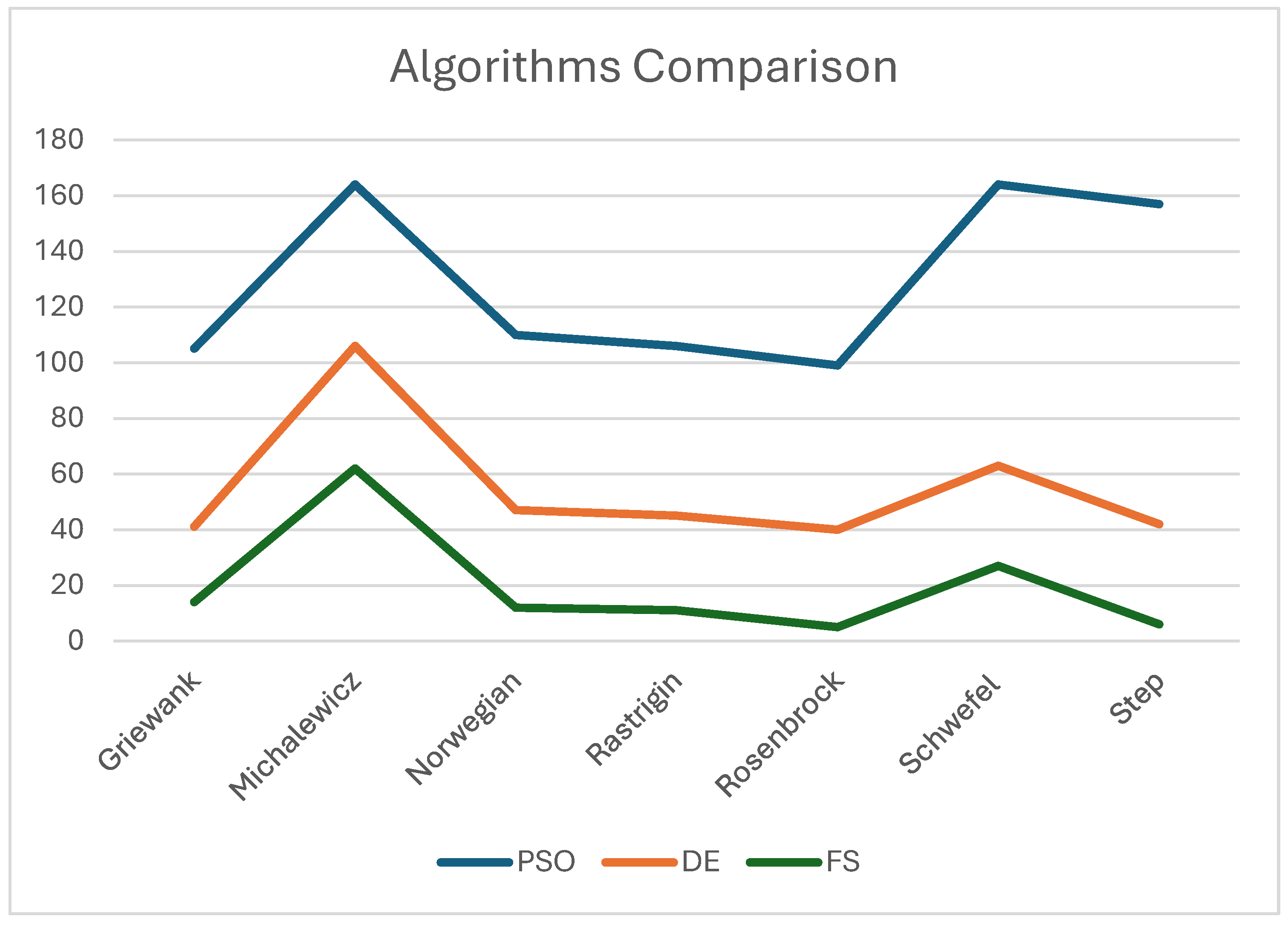
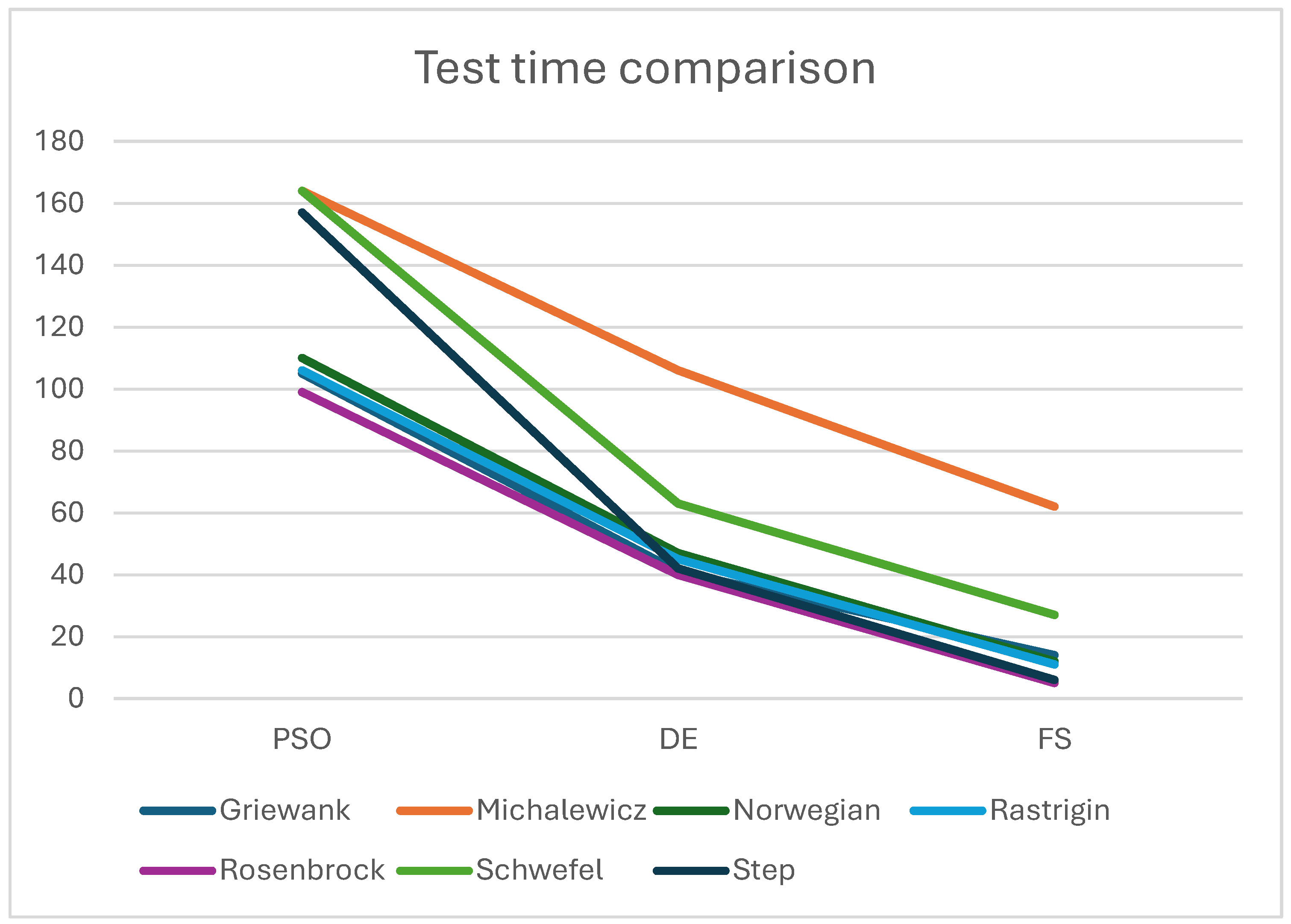

| Test | PSO | DE | FS |
|---|---|---|---|
| Time | Time | Time | |
| Griewank | 01:45:00 | 00:41:00 | 00:14:00 |
| Michalewicz | 02:44:00 | 01:46:00 | 01:02:00 |
| Norwegian | 01:50:00 | 00:47:00 | 00:12:00 |
| Rastrigin | 01:46:00 | 00:45:00 | 00:11:00 |
| Rosenbrock | 01:39:00 | 00:40:00 | 00:05:00 |
| Schwefel | 02:44:00 | 01:03:00 | 00:27:00 |
| Step | 02:37:00 | 00:42:00 | 00:06:00 |
| Test | PSO | DE | FS |
|---|---|---|---|
| Wh | Wh | Wh | |
| Griewank | 33.25 | 12.98 | 4.43 |
| Michalewicz | 51.93 | 33.57 | 19.63 |
| Norwegian | 34.83 | 14.88 | 3.80 |
| Rastrigin | 33.57 | 14.25 | 3.48 |
| Rosenbrock | 31.35 | 12.67 | 1.58 |
| Schwefel | 51.93 | 19.95 | 8.55 |
| Step | 49.72 | 13.30 | 1.90 |
| Test | DE/PSO | FS/PSO | FS/DE |
|---|---|---|---|
| % | % | % | |
| Griewank | 39% | 13% | 34% |
| Michalewicz | 65% | 38% | 58% |
| Norwegian | 43% | 11% | 26% |
| Rastrigin | 42% | 10% | 24% |
| Rosenbrock | 40% | 5% | 13% |
| Schwefel | 38% | 16% | 43% |
| Step | 27% | 4% | 14% |
Disclaimer/Publisher’s Note: The statements, opinions and data contained in all publications are solely those of the individual author(s) and contributor(s) and not of MDPI and/or the editor(s). MDPI and/or the editor(s) disclaim responsibility for any injury to people or property resulting from any ideas, methods, instructions or products referred to in the content. |
© 2024 by the authors. Licensee MDPI, Basel, Switzerland. This article is an open access article distributed under the terms and conditions of the Creative Commons Attribution (CC BY) license (http://creativecommons.org/licenses/by/4.0/).


