

Submitted:
21 June 2024
Posted:
24 June 2024
You are already at the latest version
Abstract
In recent years, 360o videos have gained the attention of researchers investigating their educational potential. Given the ongoing debate about their impact on learning, particularly with young students where existing research is minimal, a comprehensive study was conducted to evaluate their effectiveness relative to other media forms. The study involved 44 kindergarten students learning about wild animals over nine sessions. The 360o videos were compared to printed materials and conventional videos to measure knowledge acquisition, motivation, enjoyment/positive feelings, immersion, and ease of use. The findings suggest that, compared to printed materials, 360o videos enhance knowledge acquisition. However, this advantage does not extend to comparisons with conventional videos. Similarly, while enjoyment and motivation were higher for 360o videos compared to printed materials, they did not surpass those associated with conventional videos. Despite their potential, 360o videos were deemed the least easy to use, likely due to the employment of low-cost HMDs. Immersion emerged as the only factor where 360o videos excelled, demonstrating a notable influence on learning outcomes. The implications of the study are also discussed.
Keywords:
360o videos
; kindergarten students
; teaching of wild animals
1. Introduction
Children exhibit an inherent interest in animals from an early age. Nevertheless, most acquire their preliminary knowledge through interactions with pets, stories, books, and media, which frequently provide incorrect or incomplete information (Geerdts, 2016; Mateos Jiménez, 1998; Murat et al., 2011). Furthermore, children residing in urban areas encounter limited opportunities to engage with nature (Gray et al., 2016). These factors result in young children harboring numerous misconceptions and erroneous ideas about animals. For instance, they often struggle to classify animals correctly, misidentifying them based on stereotypes related to eating habits or perceived danger (Franquesa-Soler & Serio-Silva, 2017), and frequently making arbitrary assignments (Allen, 2015). Additionally, reproduction methods present significant challenges (Murat et al., 2011). Negative perceptions of unpopular animals are widespread, leading to strong feelings of fear and disgust (Tepekuyu & Topsakal, 2015). Conversely, children tend to overestimate the importance of certain animals, favoring higher-order species and domestic animals (Snaddon et al., 2008). Furthermore, kindergarten children often project human emotions and needs onto animals (Bowd, 1982). These misconceptions are persistent and can coexist with new information in complex and confusing ways, underscoring the necessity of addressing them early in childhood (Prokop et al., 2009; Snaddon et al., 2008). Thus, schools play a pivotal role in enriching children's understanding by elucidating the significance of animals in nature and human life.
Videos are one of the primary building blocks of multimedia, along with texts, sounds, graphics, and animations. Their main advantage lies in their ability to visualize information in an attractive and realistic way (Yousef et al., 2014), thus, offering a more motivational (Gaudin & Chaliès, 2015) and authentic way of learning (Noetel et al., 2021). In the context of preschool education, the use of videos appears to enhance children's brain development and preparation for primary school (Shilpa & Sunita, 2013). Sablić et al. (2021), in their literature review on learning through videos, documented significant benefits, including increased concentration and motivation, heightened interest, and improved practical skills among students. These benefits enable students to better understand and retain knowledge for extended periods. Videos also serve as the foundation for various teaching methodologies, such as collaborative learning, micro-teaching, hybrid learning, and learner-centered learning, while facilitating interaction between learners.
However, it is important to acknowledge that videos in their current form have several limitations. The primary limitation is that the viewer sees only what the director or cameraman has chosen, rather than selecting their view. To enable viewers to see a scene from their chosen angle, multiple cameras would need to be used for simultaneous recording of the same scene (Fokides et al., 2021). This gap is effectively addressed by 360° videos, which provide a spherical view with unlimited viewing angles and perspectives. They are recorded using multiple wide-angle cameras, with the images "stitched" together using software to create a fully spherical shot. Devices capable of displaying these videos are computers, smartphones, and head-mounted displays (HMDs). In the case of computers, the direction or angle of view can be adjusted using the mouse, while in the other devices, gyroscopes and position sensors enable this functionality. Additionally, interactive elements can be integrated and activated via the mouse, or controller, or by focusing on them for a few seconds.
In recent years, the public availability of ready-made 360° videos on social media platforms has contributed to their dissemination and widespread use. Another factor driving their increased use is the relatively lower technical skill and equipment requirements compared to other technologies like Virtual Reality (Ranieri et al., 2022). It is also noteworthy that extremely low-cost HMDs (approximately €5) are commercially available, such as Google Cardboard. These devices, made of cardboard or plastic and devoid of electronic components except for a pair of lenses and a space to attach a smartphone, allow users to view 360° videos in a manner that closely resembles real-world vision. Although the picture quality of these HMDs depends on the smartphone used, they offer a valuable opportunity to experience 360° videos affordably.
Despite these advancements, the educational use of 360° videos appears to be more prevalent in higher education compared to other educational levels (Ranieri et al., 2022). Specifically, research on their application in preschool education is virtually nonexistent.
Taking these considerations into account, a project was designed and implemented to explore the learning outcomes of presenting educational content using 360° videos. Kindergarten students (4-6 years old) were selected as the target group due to the limited research on young students. Animals, specifically wild animals, were chosen as the learning subject because it is a topic that not only captivates children's interest but is also a source of problems and misconceptions. The project was implemented in two phases, where, in both, the results from using 360° videos were compared to other media. This article presents the results of the second phase, which involved a comparison with printed materials and conventional videos. Detailed information on the organization and outcomes of the project are presented in the following sections.
2. Young Students' Misconceptions and Problems Related to Animals
Children develop an interest in animals from infancy, acquiring some knowledge even before attending school. For many, however, their primary source of information is their pets, as these are often the only animals they encounter directly (Trowbridge & Mintzes, 1988). Additionally, children residing in urban areas have fewer opportunities to explore nature, leading to limited knowledge, reduced environmental stimuli, and diminished positive environmental attitudes compared to their rural counterparts (Gray et al., 2016). School plays a crucial role in broadening this knowledge and elucidating the importance of animals in both nature and human life.
Nevertheless, young students often harbor a multitude of wrong ideas and misconceptions about animals, influenced by factors such as age, gender, cultural background, traditions, academic qualifications, and ecological literacy (Almeida et al., 2017). They also receive incorrect or incomplete information from sources such as fables and tales (Mateos Jiménez, 1998). Media sources contribute to these misconceptions by not always providing accurate scientific explanations (Murat et al., 2011). Storybooks that anthropomorphize animals further complicate the situation, making it difficult for children to generalize knowledge from these stories to real animals (Geerdts, 2016).
Students tend to be more aware of mammals compared to other types of animals, indicating a limited understanding of the full diversity of the animal kingdom (Patrick et al., 2013). Children often struggle with classifying animals, frequently misidentifying mammals and other species due to a limited understanding of biological concepts. Their ideas about animal classification are often based on stereotypes regarding their eating habits or the danger they present to humans (Franquesa-Soler & Serio-Silva, 2017). Preschool children, in particular, often misclassify animals on the basis of their ideas rather than on the basis of accepted scientific criteria. They even tend to randomly choose the species an animal belongs to without clear patterns or reasons (Allen, 2015). In fact, children create mental models to categorize animals based on their most striking anatomical features, such as whether they fly, live in water or on land, and do not focus on details or the habitat in which they live (Shepardson, 2002; Tunnicliffe & Reiss, 1999). For example, a significant number of children in a study mistook a flying squirrel for a bird (Kubiatko & Prokop, 2018). Furthermore, children have incorrect ideas about how different animals are related to each other and how they are grouped. Many students struggle to understand that some animals with seemingly common characteristics or qualities may belong to entirely different species (e.g., insects and birds) or, conversely, find it difficult to grasp that some animals, despite having completely different characteristics, may belong to the same species (e.g., cats and whales) (Braund, 1998). Children up to the age of ten often misclassify invertebrates, mistakenly believing they have internal skeletons, and generally lack knowledge about invertebrates due to fewer experiences with these animals compared to vertebrates (Prokop et al., 2008).
Reproduction methods and how the offspring are raised also pose significant challenges. For instance, many seventh-grade students believe that small animals reproduce only by laying eggs, that only land mammals give birth to live young (ignoring aquatic mammals), and that the development of young animals always occurs outside the mother's body, not realizing that in many species, development happens inside the mother's body until birth. Another misconception is that animals with fewer offspring are the only ones that care for their young. Some students incorrectly believe that only mammals feed their young, not understanding that some non-mammalian species also have unique ways of feeding their young (Murat et al., 2011).
Moreover, many children and even adults harbor negative perceptions of unpopular animals, believing them to be inherently dangerous, unprovoked attackers, dirty, disease carriers, and devoid of any beneficial roles in nature, leading to fear and avoidance. This is particularly true for animals like bats and spiders, which many primary school students, especially girls, perceive as dangerous and harmful (Prokop & Tunnicliffe, 2008). Insects also evoke strong feelings of fear and disgust due to a lack of understanding of their behavior, habitat, and ecological roles (Tepekuyu & Topsakal, 2015). There is a prevalent misconception that venom is the primary factor that makes an animal dangerous. Some students also believe that the size of an animal correlates directly with its danger, assuming that larger animals are always more perilous. Additionally, there is a misconception that all wild animals are vicious and dangerous (Çardak, 2009).
Children also tend to overestimate the importance of certain animals. They show distinct preferences for higher-order species and domestic animals over wild ones from as young as three years old (Snaddon et al., 2008). Some children believe that animals are valuable only for their practical and material uses, such as food, clothing, or other resources, overlooking their intrinsic worth and ecological roles. Furthermore, they often perceive animals as existing primarily for human control and sport (Eagles & Muffitt, 1990).
Many primary school students believe that wild animals live peacefully without problems and can be kept as pets, not understanding that wild animals have specific needs and behaviors that make them unsuitable for domestic life. There is also a common misconception that animals do not have feelings or emotions and are unaffected by environmental issues like pollution and habitat destruction (Kellert & Westervelt, 1984). Then again, kindergarten children often believe that animals have the same needs, feelings, and thoughts as humans, can perform human-like tasks, or have human-like abilities. This egocentric view leads them to project their own experiences and emotions onto animals. For example, they might think a dog feels sad when left alone because they would feel sad in a similar situation, not recognizing that animals may have different emotional responses (Bowd, 1982).
These misconceptions and incorrect ideas are difficult to change and can persist even after children learn new information, often mixing both in confusing ways (Prokop et al., 2009). Therefore, it is imperative to address these misconceptions early in childhood, as early experiences significantly influence perceptions and preferences later in life (Snaddon et al., 2008).
3. 360o Videos in Education
The theoretical framework supporting the educational use of 360° videos appears to be linked to two distinct technologies. Primarily, they are (basically) videos, allowing the application of established theoretical frameworks related to conventional videos. Mayer's (2009) cognitive theory of multimedia learning is particularly relevant. This theory rests on three foundational assumptions: dual-channel, limited capacity, and active processing. The dual-channel assumption posits that there are two separate channels in working memory (visual and auditory) that process information. The visual channel manages static and dynamic images as well as written words, while the auditory channel handles narrations and other sounds. The limited capacity assumption proposes that each channel has a finite capacity for processing information at any given moment; when these limits are exceeded, learning is impeded or halted. The active processing assumption underscores the necessity for learners to actively engage with the material they are watching and hearing. When videos are actively processed mentally (by making sense of the content, organizing it, and integrating it with prior knowledge) learning is enhanced. This dual-channel process can reduce cognitive load and facilitate the integration of related visual and auditory information. Additionally, researchers attribute the positive learning effects of 360° videos to their capacity to enable situated learning. According to situated learning theory, effective learning occurs within the context in which the knowledge is applied (Lave & Wenger, 1991). This contextual grounding provided by 360° videos can significantly enhance the learning process by immersing learners in environments that closely mimic real-world settings.
On the other hand, several studies characterized 360° videos as virtual reality (VR) experiences. In this respect, some scholars have argued that 360° videos can combine the benefits of both conventional videos and VR (e.g., Rosendahl & Wagner, 2024). Indeed, although VR is predominantly based on 3D graphics, 360° videos and VR applications share some similarities. In both cases, users can immerse themselves in the media experience, with immersion being strongly linked to improved conceptual understanding and learning outcomes (Dede et al., 2017). It should be noted that 360° videos enable multiple levels of immersion depending on whether users choose to view them on a computer or through HMDs. The playback medium significantly influences the perceived immersion, which in turn affects perceived reality and authenticity (Pirker & Dengel, 2021). HMDs offer higher levels of immersion (Barnidge et al., 2022; Ferdig & Kosko, 2020), which has been correlated with better learning achievements (Dhimolea et al., 2022; Fokides et al., 2021). However, other scholars argue that compared to VR, 360° videos exhibit significantly lower levels of immersion and quality of experience, leading to more limited learning outcomes (Dede et al., 2017; Rupp et al., 2019). Moreover, because immersion is influenced by the quality of the devices used, low-cost HMDs, such as Google Cardboard, cannot achieve high levels of immersion, resulting in a significantly weaker impact on learning (Fokides & Kefalinou, 2020; Rupp et al., 2019).
360° videos are progressively integrating into educational research and practice, despite the current lack of a robust research foundation (Evens et al., 2022) and the frequent calls from researchers for further studies in this domain (Snelson & Hsu, 2020). An inhibiting factor is the lack of availability of 360o videos with educational content. Indeed, existing ones are mainly for recreational purposes and few have been created purely for educational use (Ranieri et al., 2022). Nonetheless, there is evidence that these videos facilitate discovery learning across various disciplines. For instance, their application is increasing in the fields of health studies, history, social studies, and STEM subjects (Pirker & Dengel, 2021). Additionally, they have proven effective in teaching an array of subjects, including Ecology, Physics, Physical Education, Religious Education, and language learning (Fokides, 2023a).
Based on the findings from literature reviews and meta-analyses, it is evident that 360o videos generally exhibited a positive, though moderate, impact on learning, particularly in enhancing both declarative and procedural knowledge (Li et al., 2022; Ranieri et al., 2022; Shadiev et al., 2022), though neutral and negative were also reported (Rosendahl & Wagner, 2024). Furthermore, the use of HMDs, in comparison to other display modes, significantly improved learning outcomes (Ranieri et al., 2022). However, it is crucial to recognize that the overall impact of 360o videos on learning remains a topic of debate. That is because many of these interventions were one-time, short-term studies potentially influenced by the novelty effect (Li et al., 2022). Additionally, many studies were predominantly exploratory and provided limited commentary on learning outcomes, which were observed to vary significantly in terms of effectiveness (Snelson & Hsu, 2020).
Positive effects have been observed regarding user experience, learning outcomes, and motivation, with the latter being directly correlated to the level of immersion provided (Rosendahl & Wagner, 2024; Snelson & Hsu, 2020). Positive effects were also reported on attitudes toward 360o videos (Shadiev et al., 2022), along with enhanced enjoyment and positive emotions (Fokides et al., 2021; Snelson & Hsu, 2020). Furthermore, increased engagement was also documented (Ranieri et al., 2022; Snelson & Hsu, 2020). An additional advantage of 360o videos is the provision of independent, repeatable practice time, which further enriches the learning experience (Mohd Adnan et al., 2020).
On the other hand, there is no shortage of problems. For instance, the use of low-cost HMDs may negatively impact the learning experience (Rupp et al., 2019). The wide field of view can make it challenging for viewers to identify the correct point of interest at the appropriate time. Consequently, students may miss crucial information, as they may focus their attention on some unrelated part of the scene and miss something important that happens in another place. (Kavanagh et al., 2016). Moreover, they may become disoriented and distracted (Fokides & Arvaniti, 2020). 360o videos can induce what is known as the "novelty effect," wherein the introduction of a new "gadget" in educational settings results in the overstimulation of students. This phenomenon serves as a significant distraction that can undermine the learning process and diminish educational outcomes (Li et al., 2022). Something similar was pointed out by Rupp et al. (2016), as the results of their research showed that users focused on the experience rather than on learning content. However, the above seems to be avoided by using visual stimuli such as arrow keys or annotations that direct the gaze to the right point (Fokides, 2023a). Simulator sickness is another pertinent issue. This term encapsulates symptoms of intense discomfort, disorientation, vertigo, and nausea associated with the use of HMDs, and it has a negative impact on the learning experience (e.g., Rupp et al., 2019). Regarding ease of use, studies have shown that users report no significant difficulties (Shadiev et al., 2022), although some usability issues persist with low-tech HMDs (Fokides et al., 2020). Finally, instances of increased cognitive load and technical problems have been observed (Shadiev et al., 2022).
After conducting an extensive review of the relevant literature, it was noted that no studies specifically examined the impact of 360o videos on preschool-age students when animals were the primary learning subject. This identifies a significant gap in the current body of research. Nevertheless, there are a few studies that have explored the effects of 360o videos with animal or nature-related content, but they focused on older students or adults. For example, two studies (Fokides & Arvaniti, 2020; Fokides & Kefalinou, 2020) compared the impact of printed materials, web pages, and 360o videos on primary school students aged 9-10, specifically in the context of teaching about endangered species. The results demonstrated that 360o videos led to better learning outcomes, higher levels of enjoyment, motivation, and immersion, with no usability issues reported. Another study by Filter et al. (2020) targeted university students and explored the life of wolves under two conditions: immersive and non-immersive presentations of 360o videos. Although this study was not explicitly designed as an educational experience, the authors concluded that HMDs allowed participants to feel more present in the virtual environment and reported higher levels of interest in the nature experience involving wolves. The study suggested that HMDs can facilitate nature experiences with positive emotional and learning outcomes. Interestingly, the non-immersive screen setting was associated with more favorable attitudes toward wolves. Furthermore, Breves and Heber (2019) found that immersive nature videos foster stronger feelings of spatial presence and environmental commitment compared to regular nature videos in a study involving adults.
4. Method
Summarizing the findings presented in the previous sections, it can be argued that 360o videos hold significant educational potential. However, existing research has produced mixed results regarding their impact on learning outcomes. Particularly concerning very young learners, the volume of studies is very small, rendering any conclusions about their effectiveness unreliable. The body of the literature on the use of 360o videos for teaching subjects related to animals or the environment is also very limited. In light of these considerations, and building upon the experiences gained from a previous pilot study, the study at hand aimed to determine whether 360o videos have a measurable impact on the knowledge acquisition of kindergarten students in subjects related to animals and to compare these outcomes with those derived from printed materials and conventional videos. Additionally, it sought to evaluate the influence of 360o videos on various factors cited in the literature presented in the previous sections, such as enjoyment, immersion, ease of use, and motivation, as well as how these factors, in turn, affect learning outcomes. Therefore, the following research questions were examined:
- ▪
- RQ1. Does the viewing of 360° videos result in a better understanding of subjects related to animals, compared to printed materials and conventional videos? To what extent do students' gender and previous knowledge influence learning outcomes?
- ▪
- RQ2a-d. Do 360° videos offer a more enjoyable (a), immersive (b), and motivational (c) experience compared to printed materials and conventional videos? Furthermore, do students find them easier to use (d) relative to the aforementioned media? Does students' gender play a role?
- ▪
- RQ3: Do the above factors (enjoyment, immersion, motivation, and ease of use) significantly impact learning outcomes?
To examine the RQs, a within-subjects research design was employed, incorporating three distinct conditions/treatments: printed materials, conventional videos, and 360o videos. This design was selected for several compelling reasons: first, it necessitates smaller sample sizes without undermining the validity of the results; second, it has increased statistical power; third, it eliminates the effects of individual differences since the same participants are used in all conditions; and fourth, it has the potential for reduced error variance (Montoya, 2023; Vuorre & Bolger, 2018). To address the inherent limitations of a within-subjects design, three key measures were implemented. To mitigate the risk of fatigue (such as a loss of student interest due to other school activities) all sessions were scheduled on the same days of the week and during consistent teaching hours. To prevent the effects of transfer and context, the order of media usage was randomized. The most significant limitation, however, is the potential for practice effects. If identical learning material were used in all conditions, participation in the first condition could positively affect the learning outcomes in the second, while the learning outcomes in the third condition could positively be affected by the participation in the previous two, as students may already be familiar with the material. To counteract this, the learning materials were not identical but were carefully designed to be comparable and equivalent, as will be further elaborated in section "4.2 Materials and apparatus." Furthermore, for enhanced data reliability, each medium was tested across three separate sessions. This systematic approach ensured that the results were robust, reliable, and reflective of genuine differences between the three media.
4.1. Participants
An a priori power analysis was conducted to estimate the desired sample size using G*Power software (Faul et al., 2007). Based on Cohen's (2013) guidelines, having a within-subjects design with three conditions, a between-subjects interaction factor with two levels (boys/girls), an effect size (fCohen) of 0.25, a power of 0.95, and a significance level of 0.05, the desired sample size was 28, 44, and 60 subjects, depending on the correlation between the repeated measurements (the values 0.3, 0.5, and 0.7 were considered). In light of these parameters, kindergarten teachers in a city in Greece were approached and invited to participate in the study. A key criterion for inclusion was that their students must not have previously been taught subjects related to the ones included in the study. Consequently, three classes comprising a total of 44 students were selected, four to six years of age. The parents and guardians of these students were informed about the study's objectives and provided their written consent. Additionally, the research obtained approval from the Research and Ethics Committee of the Department of Primary Education of the University of (the name is omitted for the review process).
4.2. Materials and Apparatus
As previously mentioned, the study centered on subjects related to animals. Wild animals were specifically chosen as the subject matter, due to their ability to captivate the interest of children in this age group, despite their limited direct interaction with these animals in daily life. This choice of topic aligned well with the kindergarten curriculum (Natural Sciences area, Biology, and the study of living organisms within their environments). Given that the study implemented three sessions within each medium, three mammals, three birds, and three reptiles were selected. For the printed materials treatment, the heron, iguana, and leopard were selected. For the conventional videos, the chameleon, stork, and tiger were chosen. For the 360o videos, the Komodo dragon, flamingo, and lion were featured. Sea animals were deliberately omitted from the selection. This decision was informed by the pilot study which revealed that children experienced fear when viewing 360o videos using HDMs, as they perceived themselves to be in the sea. This insight was crucial in ensuring that the selected content would be both engaging and comfortable for the children.
The within-subject research design necessitated that the educational material be equivalent across all media, rather than identical. This equivalence is defined by maintaining the same cognitive load, an equal number of terms and concepts, and an identical level of difficulty. Given the very young age of students, it was decided to focus on declarative knowledge. Furthermore, to ensure material equivalence, the information on the animals presented in all media was structured around ten common axes: categorization, morphology, kinesiology, reproduction, habitat, nutrition, sociability, main predators/dangers, endangered status, and a unique fact (e.g., flamingos feed with their heads upside down in the water because their beaks function like colanders). These specific content axes, along with the selected information, were meticulously chosen to ensure that students' prior knowledge would not influence the study's outcomes, although it was considered a factor (see RQ1). Additionally, it was determined that all videos should have a duration of 3.5 to 4 minutes to prevent fatigue amongst the children and to allow for repeated viewing if desired within a session.
Suitable information, texts, and images were sourced from the Internet, while both conventional and 360o videos were sourced from platforms such as YouTube. Most photos in the printed materials were edited and annotated with arrows and other symbols to direct students' attention to critical details and establish a connection between the visual content and the auditory information, as the texts were read aloud by the teachers (see the "Procedure" section). As for the videos of both types, initial modifications included adjusting the video lengths, trimming scenes, and removing their original audio tracks. These soundtracks were replaced with narratives encompassing information related to the previously mentioned ten axes. The next phase involved utilizing 3D Vista Virtual Tour software (https://www.3dvista.com/en/products/virtualtour), which permits the embedding of interactive hot spots within videos. These hotspots activated elements such as images and other videos, redirected to different video segments, and allowed the restart of the videos. For instance, hotspots displayed photos detailing the animals' morphology or very short clips illustrating their movements. In conventional videos, users activated hotspots by clicking with the mouse on them, whereas in 360o videos, users activated them by focusing their gaze for approximately two seconds. Each hotspot's appearance was accompanied by an audio prompt ("Click on the icon to find out more about...") to guide the students. Moreover, in the 360o videos, directional arrows indicated where students should focus their attention. The conventional videos were exported as stand-alone applications, while the 360o videos were exported as Android applications and installed on mobile phones used for the sessions (Figure 1). For displaying the 360o videos, the mobile phones were adapted to HMDs similar to Google Cardboard, made out of plastic. Laptops were employed to view the conventional videos.
4.3. Instruments
For data collection purposes, a pre-test (to assess students' prior knowledge), nine evaluation tests (3 media X 3 sessions per medium), and a questionnaire were utilized. The pre-test was administered before the beginning of the project, while the evaluation tests were administered at the end of each session. The questionnaire was administered three times, specifically during the last session in which a given medium was used. The young age of the students, coupled with their nascent reading and writing abilities, necessitated the adaptation of data collection tools to be age-appropriate. However, particular measures were taken to ensure the integrity and validity of the collected data remained unscathed. Firstly, tablets were employed so that, instead of writing, students could "tap" their chosen answers. Secondly, all potential answers in the evaluation tests were accompanied by illustrative images to facilitate comprehension; while in the questionnaires, emoticons substituted the five-point Likert-type scale (Figure 2). Thirdly, both the evaluation tests and questionnaires were completed individually, with kindergarten teachers reading the questions aloud before the students responded. Considering the young age of the participants, no predetermined time limit for completion was set. Finally, even though the questions were phrased simply, the tests and questionnaires were administered to a small sample of non-participating students. This was essential to ensure the questions were understandable and to make necessary adjustments prior to the main study.
Each evaluation test consisted of 15 multiple-choice questions, with one or two questions dedicated to each category of information presented in the session materials, as outlined in the "Materials and Apparatus" section. Each question had at least three possible answers. The pre-test had a similar structure, but as it examined students; prior knowledge of all the animals included in the study, it had 35 questions. The questionnaire incorporated items from a validated, open-access modular scale designed to investigate factors influencing the learning experience in Metaverse's educational applications, including 360o videos (Fokides, 2023b). For the purposes of this study, four factors were selected: motivation (six items), enjoyment/positive feelings (four items), ease of use (three items), and immersion (six items).
4.4. Procedure
Prior to the commencement of the main sessions, a familiarization session was conducted to introduce students to the use of HMDs and 360o videos. During this session, an animal not included in the main research material was presented. Students received instructions on how to properly adjust the HMDs to their heads and were informed about what they would encounter while watching the videos. Detailed guidelines on how to activate the hotspots were also provided. Furthermore, it was emphasized that they needed to follow the arrows embedded in the videos to avoid missing important information. It became apparent that in many cases, students required support or confirmation that everything was functioning correctly. Consequently, it was decided that teachers would attend the sessions to offer the necessary support (Figure 3). This was deemed unnecessary for sessions involving conventional videos, as students were already familiar with the use of computers.
Each session lasted for two teaching hours and each student was equipped with their own set of printed material, laptop, or HMD. There was no teaching involved because the study aimed to examine the intrinsic effect of the media on learning. Incorporating any form of teaching could have confounded the results, making it unclear whether the outcomes were attributable to the medium, the teaching method, or the teacher's skills. Students were allowed to view the videos (of both types) as many times as they wished during a session. In practice, given the short duration of the videos, all students watched them at least three times. For the printed materials treatment, students were instructed to sit at their tables, and a package of printed material was distributed to them. Due to the students' limited reading abilities, all texts were read aloud, with appropriate pauses for comprehension and page-turning. Following the presentation of the materials, time was allotted for students to freely observe the images and engage in discussions.
5. Results
5.1. Initial Data Processing
Since none of the students (20 boys and 24 girls) missed any session, all data were deemed suitable for the subsequent analyses. Grading for both the pre-test and the evaluation tests was conducted using a 100-point scale. Three new variables were calculated to represent the average student's score in the evaluation tests for each medium. The internal consistency of the questionnaires was assessed using Cronbach's α, revealing an acceptable range from .78 to .85, with no instances where α fell below the recommended minimum value of .70 (Taber, 2018). Following this, 12 new variables were computed (four for each medium) representing the average score per factor, per participant. All analyses described in the subsequent sections were conducted using SPSS 29. Descriptive statistics for the study's variables can be found in Table 1.
5.2. Analysis of the Evaluation Tests
To analyze the results from the evaluation tests and address RQ1, a repeated measures Analysis of Covariance (rANCOVA) was deemed the most suitable method. The primary objective was to investigate whether differences existed in the learning outcomes across the three media types while controlling for students' prior knowledge. The results from the pre-tests were employed as a covariate. Additionally, gender was introduced as a between-subjects factor to determine if any differences emerged between girls and boys. The data demonstrated a fairly normal distribution, as indicated by the skewness values. Further, the assumptions regarding the homogeneity of variance were confirmed through Levene's Tests of Equality of Error Variances and the equality of the covariance matrices among groups was validated using Box's Tests of Equality of Covariance Matrices. Moreover, the assumption of sphericity was not violated, as confirmed by Mauchly's Test of Sphericity.
The rANCOVA analysis (Table 2) revealed that the main effect of the re-test was significant, indicating that students' prior knowledge explained a significant amount of the variance in the scores of the evaluation tests across all three media. On the other hand, gender was not a contributing factor. The main effect of the within-subjects factor was not significant, indicating that there were no differences in the results of the evaluation tests. Furthermore, the interaction effects between students' prior knowledge and the within-subjects factor, as well as between gender and the within-subjects factor, were not significant. This indicated that the results in the evaluation tests were consistent regardless of students' gender and prior knowledge. However, despite the lack of significance in the main effect of the within-subjects factor, the pairwise comparisons identified a statistically significant difference in evaluation test results between printed materials and 360o videos in favor of the latter (Table 3). As a result, and for addressing RQ1, it is evident that students' learning outcomes were superior when using 360° videos only when compared to printed materials.
5.3. Analysis of the Questionnaires
For examining the results in the questionnaires (RQ2a-d), four repeated measures Analysis of Variance (rANOVA) tests were conducted (equal to the number of factors), using gender as a between-subjects factor. There were no issues regarding the assumptions for conducting these tests, though there were two exceptions in which the sphericity assumption was violated. In these cases, the results of the Greenhouse-Geisser tests are reported.
Regarding enjoyment/positive feelings, the influence of gender on the averaged enjoyment/positive feelings scores was found to be insignificant, indicating that gender did not account for a significant proportion of the variance in enjoyment/positive feelings across all tools (Table 4). There were substantial differences in enjoyment/positive feelings between the three types of media, with a large effect size observed. Furthermore, there was no interaction effect between gender and enjoyment/positive feelings, suggesting that gender did not differentially impact enjoyment/positive feelings across the various media formats (printed materials, conventional videos, and 360° videos). The pairwise comparisons revealed a statistically significant difference in enjoyment/positive feelings between printed materials and 360° videos, favoring the latter (Table 5). Consequently, in addressing RQ2a, it is clear that students derived significantly greater enjoyment/positive feelings from 360° videos compared to printed materials.
Gender did not have a significant effect on the averaged scores of immersion; thus, gender did not account for a significant proportion of the variance in immersion across all tools (Table 6). There were significant differences between the three media regarding immersion and the effect size was large. There was no interaction effect between gender and immersion, suggesting that gender did not have a differential effect on immersion across the various media formats. The pairwise comparisons revealed that, in all cases, there was a statistically significant difference in immersion in favor of 360° videos (Table 7). Consequently, in addressing RQ2b, it is evident that 360° videos offered a more immersive experience compared to both the other media.
The effect of gender on the averaged scores of motivation was not significant, meaning that gender did not contribute meaningfully to the variance in motivation across all tools. There were significant differences between the three media regarding motivation and the effect size was large. There was no interaction effect between gender and motivation, suggesting that gender did not have a differential effect on motivation across its different levels (Table 8). The pairwise comparisons revealed a statistically significant difference in motivation between printed materials and 360° videos, favoring the latter (Table 9). Consequently, in addressing RQ2c, it can be concluded that students were more motivated when viewing 360° videos compared to printed materials.
The impact of gender on the average scores for ease of use was not significant, indicating that gender did not contribute meaningfully to the variance in ease of use across all tools (Table 10). Additionally, there was no interaction effect between gender and ease of use. Then again, significant differences were observed among the three types of media with respect to ease of use, with a very large effect size. Specifically, pairwise comparisons demonstrated statistically significant differences when comparing 360° videos to both printed materials and conventional videos, with the former lacking behind (Table 11). Consequently, in response to RQ2d, it is conclusive that 360° videos were the least easy-to-use medium.
5.4. Factors Impacting the Learning Outcomes
Finally, for answering RQ3, three multiple linear regression analyses were run (using the Enter method), to examine which of the factors included in the questionnaires had an impact on the learning outcomes the three media produced. As presented in Table 12 none of them played a statistically significant role in the printed materials and conventional videos treatments. As far as the 360o videos treatment is concerned, only immersion had a positive impact on students' learning outcomes.
6. Discussion
Summarizing the study's results, as presented in the previous section, the following key points can be noted:
- ▪
- Regarding learning effectiveness, 360o videos were found to be superior only in comparison to printed materials, with no significant differences observed between printed materials and conventional videos. While students' prior knowledge influenced evaluation test results across all media, the absence of an interaction effect indicates that prior knowledge did not impact the relative learning outcomes among the three media types. Gender did not influence the results in any capacity.
- ▪
- In terms of enjoyment/positive feelings, 360o videos provided a more positive and enjoyable experience only when compared to printed materials. Conventional videos were similarly found to be more enjoyable than printed materials.
- ▪
- ▪ Predictably, the sense of immersion was significantly stronger in 360o videos compared to both other media types, with no differences between printed materials and conventional videos.
- ▪
- Printed materials were identified as the least motivating medium, whereas conventional videos and 360o videos were equally motivating.
- ▪
- However, 360o videos were perceived as the least easy to use among the media evaluated, with no ease-of-use differences between printed materials and conventional videos.
- ▪
- Gender did not influence any of the aforementioned factors.
- ▪
- Importantly, only the immersion experienced in 360o videos had a noticeable impact on learning outcomes. For the other media, none of the examined factors significantly influenced learning outcomes.
A statistically significant difference was observed in learning outcomes, indicating that 360o videos are more effective than printed materials, at least for the selected age group and subject matter. However, the difference was not remarkable (p = .014). This finding aligns with previous research that highlighted the moderate positive impact of 360o videos on learning, especially in enhancing declarative and procedural knowledge (Li et al., 2022; Ranieri et al., 2022; Shadiev et al., 2022), as was the case in this study. Yet, due to the absence of substantial statistical significance between 360o and conventional videos, it appears that videos, regardless of type (360o/conventional) or presentation method (HMDs/monitors), exhibit minimal variation in effectiveness. This observation contradicts other studies that have demonstrated that the use of HMDs, when compared to other display modes, significantly enhanced learning outcomes (e.g., Fokides, 2023a; Ranieri et al., 2022). Another contradiction observed was the lack of noticeable differences between printed materials and conventional videos, despite existing literature emphasizing the significant benefits of videos (Sablić et al., 2021). This suggests that the variations among the three media types were minimal. The descriptive statistical data, as presented in Table 1, substantiates this conclusion.
In light of the above, skeptics may question the necessity of using 360o videos and HMDs for presenting learning material, given the very young age of kindergarten students, the associated costs, the effort required to create them, and potential drawbacks (notably with low-cost HMDs). Nevertheless, others might argue that even minor improvements are significant in the pursuit of quality education. This dichotomy in perspectives underscores broader discussions concerning the integration of ICT tools in education.
What needs to be done is to provide a plausible explanation for the differences (or absence of differences) in the learning outcomes. The factors examined in the questionnaires might provide the basis for this. The analysis of learner motivation revealed no statistically significant differences between the two video formats. However, it is important to note that both video formats outperformed printed materials, although in the case of conventional videos, the difference was borderline (p = .046). The positive effect on motivation is a well-documented characteristic of both conventional videos (Sablić et al., 2021) and 360o videos (Fokides, 2023a; Rosendahl & Wagner, 2024; Snelson & Hsu, 2020). Indeed, the descriptive statistics (see Table 1) indicate that motivation to learn was notably high in both video types, with mean scores exceeding 4.35 in each case. Yet, contrary to earlier studies that suggested a heightened motivation to learn with 360o videos using HMDs compared to conventional videos (e.g., Fokides, 2023a), this research did not substantiate such a trend. Furthermore, motivation alone cannot be considered a plausible explanation for the learning outcomes. Although existing research suggests a link between motivation and learning in the context of digital tools (e.g., Krasnova et al., 2023; Lin et al., 2017) and specifically in the context of 360o videos (e.g., Fokides, 2023a), the linear regression analysis demonstrated that this factor did not have a significant effect on learning outcomes in all media types (see Table 12).
The analysis revealed that both video formats significantly surpassed printed materials in terms of generating enjoyment and positive feelings among participants. Notably, no discernible differences in enjoyment/positive feelings were observed between the two video formats. The literature supports the notion that 360o videos provide an engaging and enjoyable learning experience (Fokides et al., 2021; Snelson & Hsu, 2020). However, this study did not find evidence to suggest that 360o videos have a comparative advantage over conventional videos in this regard. Additionally, enjoyment/positive feelings did not appear to impact learning outcomes, as indicated in Table 12. This finding contradicts previous research that has suggested otherwise (e.g., Mourtou & Fokides, 2022).
The outcomes related to motivation and enjoyment/positive emotions, appear to diverge significantly from those documented in prior studies. This discrepancy may be attributed to the negative impact of ease of use. Indeed, 360o videos were perceived as more challenging to use compared to the other two media. The difference and the magnitude of the effect size were substantial (p < 0.001, η2partial = .231). This was the case even though a preliminary session was conducted to acquaint children with HMDs and despite the presence of arrows and audio messages within the 360o videos to direct students on where to focus their attention. Such difficulties in navigation, particularly with low-cost HMDs, have been documented (Fokides et al., 2020). It is, therefore, reasonable to infer that these usability issues contributed to students experiencing less enjoyment and decreased motivation to learn. Fortunately, the linear regression analysis results indicated that ease of use did not adversely affect students' learning outcomes (see Table 12). This finding underscores a significant divergence between user experience and educational effectiveness, suggesting that while usability challenges may dampen enthusiasm and motivation, they do not necessarily impede learning progress.
Among the four factors evaluated, immersion emerged as the only one distinctly favoring 360o videos, demonstrating a significantly higher level compared to both conventional videos and printed materials. The significance and magnitude of this difference were noteworthy (p < 0.001, η2partial = 0.48). This finding aligns with the majority of existing studies that have consistently drawn similar conclusions (e.g., Barnidge et al., 2022; Breves & Heber, 2019; Filter et al., 2020; Fokides & Arvaniti, 2020; Fokides & Kefalinou, 2020; Pirker & Dengel, 2021). Moreover, it is reasonable to assert that the variance in immersion offers a satisfactory explanation for the differences in learning outcomes as reported by other researchers (e.g., Chang et al., 2019; Dede et al., 2017; Fokides et al., 2021). This assertion is substantiated by the linear regression analysis (see Table 12), which revealed that immersion in 360o videos was the sole factor positively influencing learning. The importance of this finding is further amplified by the use of low-cost HMDs in this study. While the image quality in these devices is low as it depends largely on the smartphones employed and the lenses used (that tend to be of inferior quality), the positive impact of immersion remained evident. Prior research suggested that immersion is affected by the quality of the devices used, with low-cost HMDs, such as Google Cardboard, failing to achieve high levels of immersion, which, in turn, results in a significantly diminished impact on learning (Fokides & Kefalinou, 2020; Rupp et al., 2019). Nevertheless, even with reduced immersion levels due to the use of low-cost HMDs, the immersion provided was sufficient to positively influence learning outcomes. Thus, this study affirms that 360o videos, even when delivered through budget-friendly devices, substantiate the crucial role of immersion in enhancing learning experiences.
6.1. Implications for Research and Practice
The project discussed in the preceding sections extends the existing literature by focusing on very young students and comparing the impacts of 360o videos on learning outcomes relative to other media. Notably, the project quantified these differences and provided valuable data concerning student perceptions and emotions. Consequently, the findings have interesting implications for researchers, professionals specializing in 360o video technology, and educators. One key finding was the lack of significant differences in learning outcomes when 360o videos were compared to conventional videos. This observation calls into question the practical value of both low-cost HMDs and 360o videos. Additionally, as noted by Rupp et al. (2019), users of low-cost HMDs are more susceptible to simulator sickness compared to those using more advanced HMD models. This underscores the necessity for further exploration of the affordances and limitations of various HMDs to identify solutions that strike an optimal balance between quality, cost, and educational effectiveness. Moreover, the study indicated that the 360o videos were perceived as the least user-friendly medium, likely due to the use of low-cost HMDs and the rather cumbersome method for triggering interactive hotspots (i.e., by focusing the gaze on a hotspot). This again highlights the trade-off between cost and usability. While employing more advanced HMDs and handheld controllers would have probably alleviated usability issues, it would have also significantly increased costs. The same consideration applies to the level of immersion. Although using more advanced HMDs might have enhanced the immersive experience, as suggested by Rupp et al. (2019), it would have come at a considerably higher financial cost.
As anticipated, students demonstrated a notably high level of enjoyment when engaging with 360o videos. However, this enjoyment did not translate to a correspondingly heightened motivation to learn, as conventional videos were found to be equally motivating. Recognizing the established link between enjoyment and motivation to learn, researchers and experts in the field of 360o video technology should explore strategies to enhance both simultaneously. One potential approach is to integrate 360o videos into applications that feature gamification elements (Fokides et al., 2021). Nonetheless, this method warrants careful consideration. As mentioned earlier, students may be susceptible to distractions when viewing 360o videos, which, in turn, might derail the learning process. The increased levels of enjoyment could worsen these distractions.
In the context of education, it was observed during the project's planning stages that there is a scarcity of freely available 360o videos suited for instructional purposes. Consequently, the videos selected for the project underwent various degrees of editing and had additional instructional material appended. This process required significant time and expertise, involving tasks such as sourcing supplemental content and employing video editing and audio recording software. While these tasks are manageable for an average user, it is questionable whether educators possess the requisite time, resources, and willingness to undertake them, given their existing workload. Therefore, it is imperative for educational administrators to provide educators with a repository of ready-to-use 360o educational videos. Moreover, educators must thoughtfully plan and reflect on how to effectively incorporate 360o videos into their teaching. During the project, each session spanned two teaching hours to accommodate students' need to view the videos multiple times and account for potential delays due to their young age. If actual teaching were included, session durations would likely need to be extended to allow for the implementation of chosen instructional frameworks. Hence, it is crucial for education policymakers to consider revising current school timetables and curricula, as they are often rigid and inflexible. Finally, infrastructure remains a concern, even in the case of low-cost HMDs. While acquiring these HMDs is not a substantial issue, schools also need to obtain a sufficient number of smartphones, which represents a significant financial investment.
6.2. Limitations and Future Work
The study identifies several limitations that necessitate attention in future research endeavors. A primary constraint is the sample size; expanding the number of participants would significantly bolster the confidence and reliability of the findings. Another crucial factor is the trustworthiness of the respondents, particularly given their young age. This study's concentration on kindergarten students and a specific educational subject questions the generalizability of its results. Furthermore, the duration allotted for each participant to view the videos might have been insufficient. The research focused on comparing 360° videos, conventional videos, and printed materials, but it did not examine other media or technologies, thus leaving unanswered the question of whether 360° videos outperform these alternatives. To advance this line of inquiry, future research must address these limitations, to ensure comprehensive and reliable insights. By incorporating more diverse target populations that vary in age and educational backgrounds and employing larger sample sizes, researchers can obtain more robust insights into emerging similarities or differences when using 360o videos. This approach is equally applicable to investigating various learning domains and types of applications. Moreover, longitudinal studies offer a promising avenue for exploring the educational potential of 360° videos in far greater depth. As previously noted, studies restricted to a limited number of sessions are susceptible to the "novelty effect," which could skew results. Addressing these limitations will be instrumental in fully realizing the educational benefits of 360° videos.
7. Conclusions
In recent years, 360o videos have garnered significant attention from researchers interested in exploring their educational potential. While their impact on learning remains a subject of ongoing debate, particularly when very young students are involved in which case sparse research exists, a project was implemented to gain a clearer understanding of how 360o videos compare to other media types in educational settings. This study involved 44 kindergarten students and focused on learning about wild animals. The performance of 360o videos was evaluated against printed materials and conventional videos over nine sessions. Key factors such as motivation, enjoyment, immersion, and ease of use were also examined, as existing literature suggests these elements play a crucial role in the effectiveness of 360o videos.
The findings indicated that 360o videos are expected to yield better results in terms of knowledge acquisition when compared to printed materials. However, this advantage does not extend to a comparison with conventional videos. Similarly, 360o videos outperformed printed materials in terms of enjoyment/positive feelings and motivation but did not surpass conventional videos in these areas. The study also found that 360o videos were perceived as the least user-friendly medium, likely due to low-cost HMDs used for viewing. As anticipated, immersion was the only factor where 360o videos excelled over other media, and it emerged as the sole factor that had a significant impact on learning outcomes.
These results suggest that, up to a point, educators could benefit from integrating 360o videos into their everyday teaching practices for kindergarten students. However, several challenges must be addressed, foremost among them being the scarcity of 360o videos specifically designed for educational purposes. Additionally, modifications to school timetables may be necessary to accommodate the implementation of modern teaching methods that incorporate 360o videos.
In conclusion, the study provides insights into the effectiveness of 360o videos for educating very young students, particularly highlighting their immersive quality and their positive effect on learning outcomes. Nevertheless, further research is essential to fully understand and optimize the use of this promising educational tool.
Author Contributions
All authors contributed equally to the study. All authors have read and agreed to the published version of the manuscript.
Funding
The study received no funding.
Institutional Review Board Statement
The research was conducted in accordance with all pertinent legislation and institutional protocols. The Research Ethics Committee of the Department of Primary Education, University of the XXXX (omitted for the review process) reviewed and approved the methodologies and practices of this study (protocol code 3144/11-15-2022).
Informed Consent Statement
All participants were briefed and their informed consent was obtained; they retained the right to withdraw at any point. The privacy and rights of the individuals involved were protected; no personal data were collected and/or processed.
Data Availability Statement
Data will be made available on reasonable request.
Conflicts of Interest
The authors declare that have no conflict of interest.
References
- Allen, M. (2015). Preschool children's taxonomic knowledge of animal species. Journal of Research in Science Teaching, 52(1), 107-134. [CrossRef]
- Almeida, A., García Fernández, B., & Silva, T. (2017). Changing negative perceptions of animals through teaching practice: A research in primary education. Journal of Baltic Science Education, 16(4), 446-458. [CrossRef]
- Barnidge, M., Sherrill, L. A., Kim, B., Cooks, E., Deavours, D., Viehouser, M., Broussard, R., & Zhang, J. (2022). The effects of virtual reality news on learning about climate change. Mass Communication and Society, 25(1), 1-24. [CrossRef]
- Bowd, A. D. (1982). Young children's beliefs about animals. The Journal of Psychology, 110(2), 263-266. [CrossRef]
- Braund, M. (1998). Trends in children's concepts of vertebrate and invertebrate. Journal of Biological Education, 32, 112-118. [CrossRef]
- Breves, P., & Heber, V. (2019). Into the wild: The effects of 360° immersive nature videos on feelings of commitment to the environment. Environmental Communication, 14(3), 332–346. [CrossRef]
- Çardak, O. (2009). Students' ideas about dangerous animals. Asia-Pacific Forum on Science Learning & Teaching, 10(2), 1-15.
- Cohen, J. (2013). Statistical power analysis for the behavioral sciences. Academic Press. [CrossRef]
- Dede, C. J., Jacobson, J., & Richards, J. (2017). Introduction: virtual, augmented, and mixed realities in education. In Virtual, augmented, and mixed realities in education, 1-16. Springer. [CrossRef]
- Dhimolea, T. K., Kaplan-Rakowski, R., & Lin, L. (2022). A systematic review of research on high immersion virtual reality for language learning. TechTrends 66, 810-824. [CrossRef]
- Evens, M., Empsen, M. & Hustinx, W. (2022). A literature review on 360-degree video as an educational tool: towards design guidelines. Journal of Computers in Education, 10, 325-375. [CrossRef]
- Faul, F., Erdfelder, E., Lang, A. G., & Buchner, A. (2007). G* Power 3: A flexible statistical power analysis program for the social, behavioral, and biomedical sciences. Behavior Research Methods, 39(2), 175-191. [CrossRef]
- Ferdig, R. E., & Kosko, K. W. (2020). Implementing 360o video to increase immersion, perceptual capacity, and teacher noticing. TechTrends, 64(6),849-859. [CrossRef]
- Filter, E., Eckes, A., Fiebelkorn, F., & Büssing, A. G. (2020). Virtual reality nature experiences involving wolves on YouTube: Presence, emotions, and attitudes in immersive and nonimmersive settings. Sustainability, 12(9), 3823. [CrossRef]
- Fokides, E. (2023a). The educational uses of 360o videos and low-cost HMDs. Reflecting on the results of seven projects. Technology, Knowledge and Learning, 2023, 1-23. [CrossRef]
- Fokides, E. (2023b). Development and testing of a scale for examining factors affecting the learning experience in the Metaverse. Computers & Education: X Reality, 2023(2), 100025. [CrossRef]
- Fokides, E., & Arvaniti, P. A. (2020). Evaluating the effectiveness of 360o videos when teaching primary school subjects related to environmental education. Journal of Pedagogical Research, 4(3), 203-222. [CrossRef]
- Fokides, E., Atsikpasi, P., & Arvaniti, P. (2021). Lessons learned from a project examining the learning outcomes and experiences in 360o videos. Journal of Educational Studies and Multidisciplinary Approaches (JESMA), 1(1), 50-70. [CrossRef]
- Fokides, E., & Kefalinou, M. (2020). Examining the impact of spherical videos in teaching endangered species/environmental education to primary school students. Journal of Information Technology Education: Research, 19, 427-450. [CrossRef]
- Fokides, E., Polydorou, E., και Mazarakis, P. (2020). Using Google Cardboard compatible HMDs and spherical videos for teaching history to High School students. International Journal of Smart Education and Urban Society, 11(4), 18–34. [CrossRef]
- Franquesa-Soler, M., & Serio-Silva, J. (2017). Through the eyes of children: Drawings as an evaluation tool for children's understanding about endangered Mexican primates. American Journal of Primatology, 79(12), e22723. [CrossRef]
- Gaudin, C., & Chaliès, S. (2015). Video viewing in teacher education and professional development: A literature review. Educational Research Review, 16, 41-67. [CrossRef]
- Geerdts, M. S. (2016). (Un) real animals: Anthropomorphism and early learning about animals. Child Development Perspectives, 10(1), 10-14. [CrossRef]
- Gray, P., Elser, C. F., Klein, J. L., & Rule, A. C. (2016). Literacy and arts-integrated science lessons engage urban elementary students in exploring environmental issues. Science Education International, 27(1), 151-175.
- Kavanagh, S., Luxton-Reilly, A., Wüensche, B., & Plimmer, B. (2016). Creating 360o educational video: A case study. Proceedings of the 28th Australian Conference on Computer-Human Interaction, 34-39. ACM. [CrossRef]
- Kellert, S. R., & Westervelt, M. O. (1984). Children's attitudes, knowledge and behaviors towards animals. Children's Environments Quarterly, 1(3), 8-11.
- Kos, M., Jerman, J., & Torkar, G. (2023). Preschool children’s attitude toward some unpopular animals and formation of a positive attitude toward them through hands-on activities. Journal of Biological Education, 57(1), 83-100. [CrossRef]
- Krasnova, E., Masalova, M., & Shelkovnikova, S. (2023). Motivation as a necessary condition for learning in the age of digitalization. Proceedings of the E3S Web of Conferences (Vol. 371, p. 05076). EDP Sciences. [CrossRef]
- Kubiatko, M., & Prokop, P. (2018). Pupils' understanding of mammals: an investigation of the cognitive dimension of misconceptions. Orbis Scholae, 3(2), 97-112. [CrossRef]
- Lampropoulos, G., Barkoukis, V., Burden, K., Theofylaktos, A. (2021). 360-degree video in education: An overview and a comparative social media data analysis of the last decade. Smart Learning Environments, 8(20), 1-24. [CrossRef]
- Lave, J., & Wenger, E. (1991). Situated learning: Legitimate peripheral participation. Cambridge University Press. [CrossRef]
- Li, W., Qian, L., Feng, Q., & Luo, H. (2023). Panoramic video in education: A systematic literature review from 2011 to 2021. Journal of Computer Assisted Learning, 39(1), 1-19. [CrossRef]
- Lin, M. H., Chen, H. C., & Liu, K. S. (2017). A study of the effects of digital learning on learning motivation and learning outcome. Eurasia Journal of Mathematics, Science and Technology Education, 13(7), 3553-3564. [CrossRef]
- Mateos Jiménez, A. (1998). Concepciones sobre algunas especies animales: ejemplificaciones del razonamiento por categorías: dificultades de aprendizaje asociadas. Enseñanza de las ciencias: revista de investigación y experiencias didácticas. Enseñanza de las Ciencias, 16(1), 147-157. [CrossRef]
- Mayer, R. E. (2009). Multimedia learning (2nd ed.). Cambridge University Press. [CrossRef]
- Mohd Adnan, A. H., Shak, Y., Karim, M. S. A., Mohd Tahir, R., & Mohamad Shah, D. S. (2020). 360-degree videos, VR experiences and the application of Education 4.0 technologies in Malaysia for exposure and immersion. Advances in Science Technology and Engineering Systems Journal, 5(1), 373–381. [CrossRef]
- Montoya, A. K. (2023). Selecting a within-or between-subject design for mediation: Validity, causality, and statistical power. Multivariate Behavioral Research, 58(3), 616-636. [CrossRef]
- Mourtou, S., & Fokides, E. (2022). Evaluating 360o video's learning effectiveness and experiences: Results of a comparative study. International Journal of Smart Education and Urban Society (IJSEUS), 13(1), 1-20. [CrossRef]
- Murat, M., Kanadli, S., & Ünişen, A. (2011). Seventh grade students’ misconceptions about animals’ reproduction, growth and development and their likely resources. Journal of Turkish Science Education, 8(1), 179-197.
- Noetel, M., Grifth, S., Delaney, O., Sanders, T., Parker, P., del Pozo Cruz, B., & Lonsdale, C. (2021). Video improves learning in higher education: A systematic review. Review of Educational Research, 91(2), 204-236. [CrossRef]
- Patrick, P., Byrne, J., Tinnucliffe, S. D., Asunta, T., Carvalho, G. S., Havu-Nuutinen, S., Sigurjónsdóttir, H., Óskarsdóttir, G., & Tracana, R. B. (2013). Students (ages 6, 10, and 15years) in six countries knowledge of animals. NorDiNa, 9(1), 18-32. [CrossRef]
- Pirker, J., & Dengel, A. (2021). The potential of 360° virtual reality videos and real VR for education-A literature review. IEEE Computer Graphics and Applications, 41(4), 76-89. [CrossRef]
- Prokop, P., Prokop, M., & Tunnicliffe, S. D. (2008). Effects of keeping animals as pets on children's concepts of vertebrates and invertebrates. International Journal of Science Education, 30(4), 431-449. [CrossRef]
- Prokop, P., & Tunnicliffe, S. D. (2008). "Disgusting" animals: Primary school children’s attitudes and myths of bats and spiders. Eurasia Journal of Mathematics, Science and Technology Education, 4(2), 87-97. [CrossRef]
- Prokop, P., Usak, M., Özel, M., & Fancovicová, J. (2009). Children's conceptions of animal breathing: a cross-age and cross-cultural comparison. Journal of Baltic Science Education, 8(3), 191-207.
- Ranieri, M., Luzzi, D., Cuomo, St., Bruni, I. (2022). If and how do 360° videos fit into education settings? Results from a scoping review of empirical research. Journal of Computer Assisted Learning, 38(5), 1199-1219. [CrossRef]
- Rosendahl, P., & Wagner, I. (2024). 360 videos in education–A systematic literature review on application areas and future potentials. Education and Information Technologies, 29(2), 1319-1355. [CrossRef]
- Rupp, M., Kozachuk, J., Michaelis, J., O., Smither, J., McConnell, D. (2016). The effects of immersiveness and future VR expectations on subjective-experiences during an educational 360o video. Proceedings of the Human Factors and Ergonomics Society Annual Meeting, 60, 2108-2112. [CrossRef]
- Rupp, M. A., Odette, K. L., Kozachuk, J., Michaelis, J. R., Smither, J. A., & McConnell, D. S. (2019). Investigating learning outcomes and subjective experiences in 360-degree videos. Computers & Education, 128, 256-268. [CrossRef]
- Sablić, M., Mirosavljević, A., & Škugor, A. (2021). Video-based learning (VBL)-past, present and future: An overview of the research published from 2008 to 2019. Technology, Knowledge and Learning, 26(4), 1061-1077. [CrossRef]
- Shadiev, R., Yang, L., & Huang, Y. M. (2022). A review of research on 360-degree video and its applications to education. Journal of Research on Technology in Education, 54(5), 784-799. [CrossRef]
- Shepardson, D. (2002). Bugs, butterflies, and spiders: Children's understandings about insects. International Journal of Science Education, 24, 627-643. [CrossRef]
- Shilpa, S., & Sunita, M. (2013). Impact of multimedia in early childhood education. Journal of Management and Science, 3(3), 430-435. [CrossRef]
- Snaddon, J. L., Turner, E. C., & Foster, W. A. (2008). Children's perceptions of rainforest biodiversity: which animals have the lion's share of environmental awareness? PLoS One, 3(7), e2579. [CrossRef]
- Snelson, C., & Hsu, Y. C. (2020). Educational 360-degree videos in virtual reality: A scoping review. TechTrends, 64, 404-412. [CrossRef]
- Taber, K. S. (2018). The use of Cronbach's alpha when developing and reporting research instruments in science education. Research in Science Education, 48(6), 1273-1296. [CrossRef]
- Tepekuyu, H. Z., & Topsakal, Ü. U. (2015). Turkish primary school students’ attitudes toward 'disgusting animals': Insects. International Journal for Innovation Education and Research, 3(3), 15-26. [CrossRef]
- Trowbridge, J., & Mintzes, J. (1988). Alternative conceptions in animal classification: A cross-age study. Journal of Research in Science Teaching, 25(7), 547-571. [CrossRef]
- Tunnicliffe, S., & Reiss, M. (1999). Building a model of the environment: how do children see animals? Journal of Biological Education, 33(3), 142-148. [CrossRef]
- Vuorre, M., & Bolger, N. (2018). Within-subject mediation analysis for experimental data in cognitive psychology and neuroscience. Behavior Research Methods, 50, 2125-2143. [CrossRef]
- Yousef, A. M. F., Chatti, M. A., & Schroeder, U. (2014). The state of video-based learning: A review and future perspectives. International Journal on Advances in Life Sciences, 6(3), 122-135.
Figure 1.
Screenshots from the printed materials and videos.
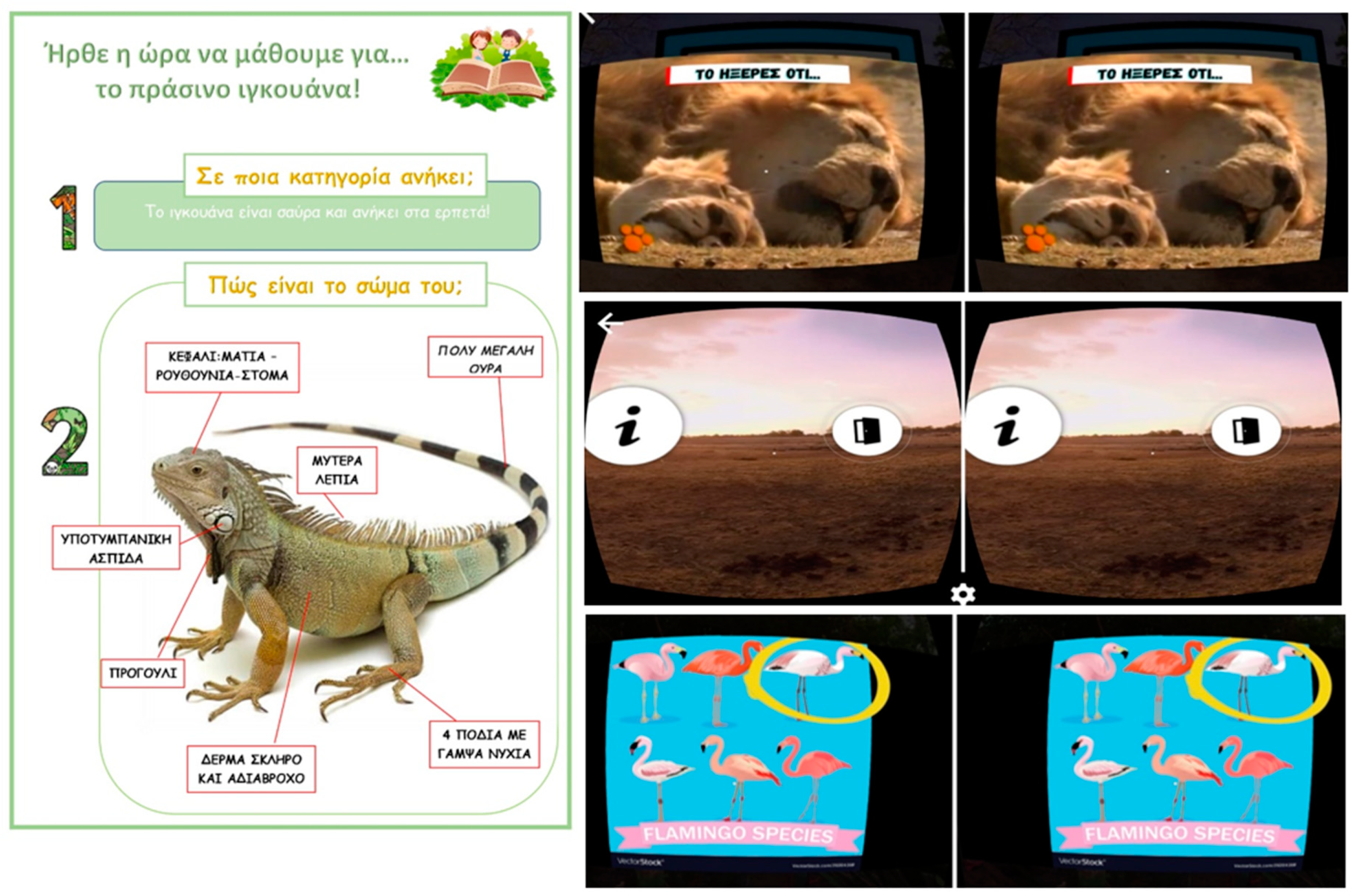
Figure 2.
Examples of questions from the evaluation tests and items from the questionnaire.
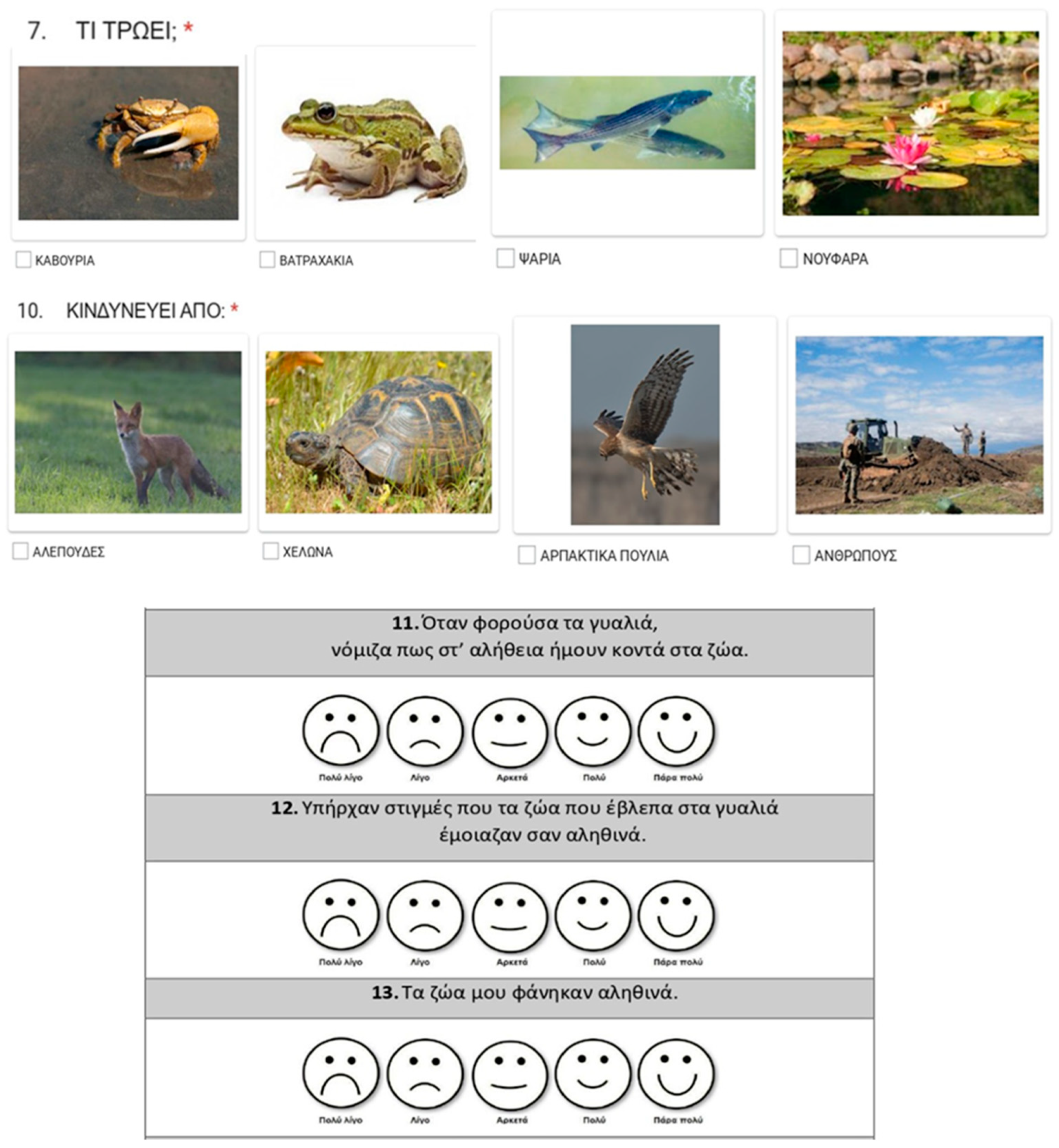
Figure 3.
Screenshots from the sessions.
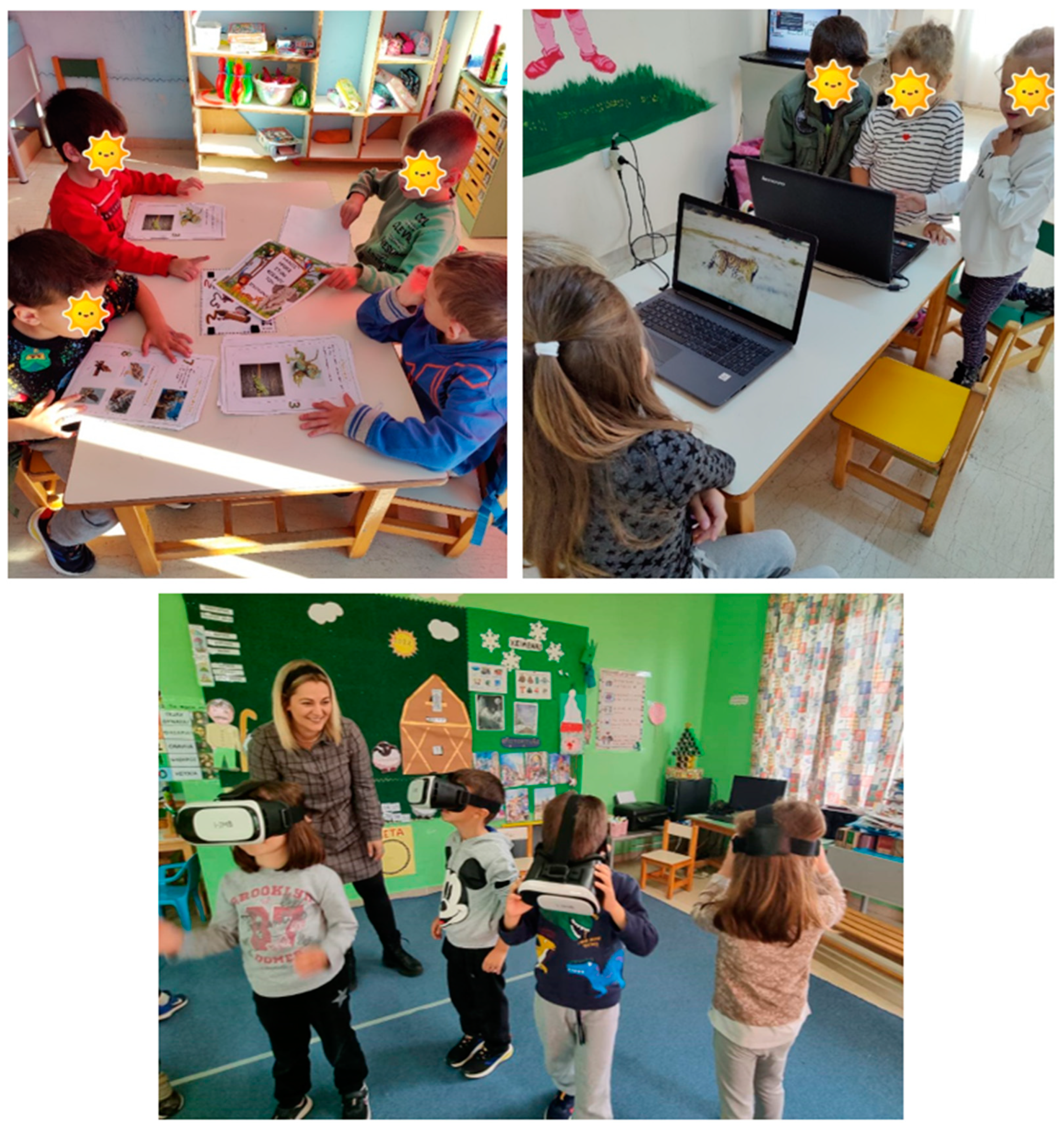

Table 1.
Descriptive statistics for the study's variables.
| Variable (N = 44) | min | max | M | SD |
|---|---|---|---|---|
| Pre-test | 33 | 86 | 59.32 | 11.01 |
| Evaluation tests printed materials | 38 | 90 | 69.55 | 11.76 |
| Evaluation tests conventional videos | 40 | 97 | 70.34 | 13.14 |
| Evaluation tests 360o videos | 35 | 97 | 73.80 | 14.36 |
| Enjoyment/positive feelings printed materials | 1.80 | 5.00 | 3.74 | 0.73 |
| Enjoyment/positive feelings conventional videos | 2.40 | 4.80 | 4.12 | 0.58 |
| Enjoyment/positive feelings 360o videos | 1.80 | 5.00 | 4.15 | 0.68 |
| Immersion printed materials | 1.25 | 5.00 | 3.55 | 0.87 |
| Immersion conventional videos | 2.00 | 5.00 | 3.80 | 0.68 |
| Immersion 360o videos | 3.25 | 5.00 | 4.56 | 0.48 |
| Motivation printed materials | 1.00 | 5.00 | 3.92 | 0.94 |
| Motivation conventional videos | 2.33 | 5.00 | 4.36 | 0.63 |
| Motivation 360o videos | 2.33 | 5.00 | 4.47 | 0.71 |
| Ease of use printed materials | 3.00 | 5.00 | 4.32 | 0.55 |
| Ease of use conventional videos | 3.00 | 5.00 | 4.20 | 0.60 |
| Ease of use 360o videos | 1.20 | 5.00 | 3.74 | 0.85 |
Table 2.
The rANCOVA results for the Evaluation tests.
| Source | SS | df | MS | F | p | ηp2 |
| Between-Subjects | ||||||
| Pre-test | 0.202 | 1 | 0.202 | 5.41 | .025 | .117 |
| Gender | 0.026 | 1 | 0.026 | 0.70 | .409 | .017 |
| Residuals | 1.534 | 41 | 0.037 | |||
| Within-Subjects | ||||||
| Evaluation tests | 0.004 | 2 | 0.002 | 0.40 | .671 | .010 |
| Pre-test*Evaluation tests | 0.011 | 2 | 0.006 | 0.99 | .376 | .024 |
| Gender*Evaluation tests | 0.009 | 2 | 0.004 | 0.80 | .452 | .019 |
| Residuals | 0.458 | 82 | 0.006 |
Notes. SS = sum of squares, MS = mean square, ηp2 = partial eta squared effect size. For the interpretation of the effect sizes, the following cutoff values apply: .010-small effect size, .059-medium effect size, .138 or higher-large effect size (Cohen, 2013).
Table 3.
Pairwise comparisons for the Evaluation tests.
| Factor | Factor |
Mean Difference |
Std. error |
p | |
|---|---|---|---|---|---|
| 1 | 2 | -0.903 | 1.595 | .999 | |
| 1 | 3 | -4.173 | 1.396 | .014 | |
| 2 | 3 | -3.270 | 1.784 | .222 |
Notes. Factor 1 = Evaluation tests printed materials, Factor 2 = Evaluation tests conventional videos, Factor 3 = Evaluation tests 360o videos.
Table 4.
The results of the repeated measures ANOVA test for Enjoyment/positive feelings.
| Source | SS | df | MS | F | p | ηp2 |
| Between-Subjects | ||||||
| Gender | .616 | 1 | .616 | 1.03 | .315 | .024 |
| Residuals | 25.023 | 42 | .596 | |||
| Within-subjects | ||||||
| Enjoyment/positive feelings | 4.900 | 2 | 2.450 | 6.64 | .002 | .137 |
| Gender*Enjoyment/positive feelings | .523 | 2 | .261 | 0.71 | .495 | .017 |
| Residuals | 30.975 | 84 | .369 |
Table 5.
Pairwise comparisons for Enjoyment/positive feelings.
| Factor | Factor |
Mean Difference |
Std. error |
p | |
|---|---|---|---|---|---|
| 1 | 2 | -0.391 | 0.128 | .012 | |
| 1 | 3 | -0.428 | 0.147 | .018 | |
| 2 | 3 | -0.037 | 0.113 | .999 |
Notes. Factor 1 = Enjoyment/positive feelings printed materials, Factor 2 = Enjoyment/positive feelings conventional videos, Factor 3 = Enjoyment/positive feelings 360o videos.
Table 6.
The results of the repeated measures ANOVA test for Immersion.
| Source | SS | df | MS | F | p | ηp2 |
| Between-Subjects | ||||||
| Gender | 0.336 | 1 | 0.336 | 0.41 | .525 | .010 |
| Residuals | 34.339 | 42 | 0.818 | |||
| Within-subjects | ||||||
| Immersion | 24.757 | 1.652 | 14.986 | 38.83 | <.001 | .480 |
| Gender*Immersion | 0.882 | 1.652 | 0.534 | 1.38 | .256 | .032 |
| Residuals | 26.782 | 69.386 | 0.386 |
Note. As the sphericity assumption was violated in the data related to Immersion, the results of the Greenhouse-Geisser test are reported.
Table 7.
Pairwise comparisons for Immersion.
| Factor | Factor |
Mean Difference |
Std. error |
p | |
|---|---|---|---|---|---|
| 1 | 2 | -0.247 | 0.141 | .263 | |
| 1 | 3 | -1.021 | 0.124 | <.001 | |
| 2 | 3 | -0.774 | 0.092 | <.001 |
Notes. Factor 1 = Immersion printed materials, Factor 2 = Immersion conventional videos, Factor 3 = Immersion 360o videos.
Table 8.
The results of the repeated measures ANOVA test for Motivation.
| Source | SS | df | MS | F | p | ηp2 |
| Between-Subjects | ||||||
| Gender | 0.070 | 1 | 0.070 | 0.10 | .756 | .002 |
| Residuals | 30.031 | 42 | 0.715 | |||
| Within-subjects | ||||||
| Motivation | 7.186 | 2 | 3.593 | 6.63 | .002 | .136 |
| Gender*Motivation | 0.613 | 2 | 0.307 | 0.57 | .570 | .013 |
| Residuals | 45.508 | 84 | 0.542 |
Table 9.
Pairwise comparisons for Motivation.
| Factor | Factor |
Mean Difference |
Std. error |
p | |
|---|---|---|---|---|---|
| 1 | 2 | -0.426 | .169 | .046 | |
| 1 | 3 | -0.546 | .168 | .007 | |
| 2 | 3 | -0.119 | .133 | .999 |
Notes. Factor 1 = Motivation printed materials, Factor 2 = Motivation conventional videos, Factor 3 = Motivation 360o videos.
Table 10.
The results of the repeated measures ANOVA test for Ease of use.
| Source | SS | df | MS | F | p | ηp2 |
| Between-Subjects | ||||||
| Gender | 0.029 | 1 | 0.029 | 0.04 | .847 | .001 |
| Residuals | 32.759 | 42 | 0.780 | |||
| Within-subjects | ||||||
| Ease of use | 7.817 | 1.521 | 5.140 | 12.63 | <.001 | .231 |
| Gender*Ease of use | .769 | 1.521 | 0.506 | 1.24 | .287 | .029 |
| Residuals | 25.985 | 84 | 0.309 |
Note. As the sphericity assumption was violated in the data related to Ease of use, the results of the Greenhouse-Geisser test are reported.
Table 11.
Pairwise comparisons for Ease of use.
| Factor | Factor |
Mean Difference |
Std. error |
p | |
|---|---|---|---|---|---|
| 1 | 2 | 0.135 | 0.079 | .285 | |
| 1 | 3 | 0.573 | 0.132 | <.001 | |
| 2 | 3 | 0.438 | 0.137 | .008 |
Notes. Factor 1 = Ease of use printed materials, Factor 2 = Ease of use conventional videos, Factor 3 = Ease of use 360o videos.
Table 12.
The results of the regression analyses.
| Printed materials | Model summary | F(4, 39) = 0.42, p = .797, R = .202, R2 = .041 | ||||
| Factors | B | SE B | β | t | p | |
| Enjoyment/positive feelings | -2.049 | 2.979 | -.128 | -0.688 | .496 | |
| Immersion | 0.429 | 2.580 | .032 | 0.166 | .869 | |
| Motivation | 0.577 | 2.543 | .046 | 0.227 | .822 | |
| Ease of use | 4.018 | 3.713 | .189 | 1.082 | .286 | |
| Conventional videos | Model summary | F(4, 39) = 4.17, p = .007, R = .547, R2 = .299 | ||||
| Factors | B | SE B | β | t | p | |
| Enjoyment/positive feelings | 3.479 | 3.762 | .153 | 0.925 | .361 | |
| Immersion | 4.912 | 3.082 | .253 | 1.594 | .119 | |
| Motivation | 0.118 | 3.333 | .006 | 0.035 | .972 | |
| Ease of use | 5.868 | 3.926 | .268 | 1.494 | .143 | |
| 360o videos | Model summary | F(4, 39) = 2.87, p = .035, R = .477, R2 = .228 | ||||
| Factors | B | SE B | β | t | p | |
| Enjoyment/positive feelings | 4.786 | 3.378 | .226 | 1.417 | .164 | |
| Immersion | 11.952 | 4.553 | .399 | 2.625 | .012 | |
| Motivation | -5.495 | 3.298 | -.270 | -1.666 | .104 | |
| Ease of use | 0.169 | 2.553 | .010 | 0.066 | .948 | |
Notes. B = unstandardized beta coefficient, SE B = standard errors for B, β = standardized error coefficient.
Disclaimer/Publisher’s Note: The statements, opinions and data contained in all publications are solely those of the individual author(s) and contributor(s) and not of MDPI and/or the editor(s). MDPI and/or the editor(s) disclaim responsibility for any injury to people or property resulting from any ideas, methods, instructions or products referred to in the content. |
© 2024 by the authors. Licensee MDPI, Basel, Switzerland. This article is an open access article distributed under the terms and conditions of the Creative Commons Attribution (CC BY) license (http://creativecommons.org/licenses/by/4.0/).
Copyright: This open access article is published under a Creative Commons CC BY 4.0 license, which permit the free download, distribution, and reuse, provided that the author and preprint are cited in any reuse.