

Submitted:
21 June 2024
Posted:
24 June 2024
You are already at the latest version
Abstract
Traditional Romanian food products are an integral part of local culture and spirituality. These food traditions have been formed over the centuries and represent a particularly important part for the development of a circular economy in rural areas. In order to contribute to the development of this sector of activity; we conducted a study on consumer perception of traditional Romanian food products. The purpose of this work was to identify the structure of the studies and the future directions of research related to the image of traditional food products through the bibliometric study as well as the identification of consumer trends of these products through a survey based on the questionnaire. The results obtained indicate that traditional Romanian food products are consumed by the majority of respondents participating in the survey and that this sector of activity has continuity in its development and presents a clear interest among citizens.
Keywords:
Danube Delta
; Biosphere Reserve
; tourist perception
; tourist attractions
; conservation and protection
; nature-based economy respondents
; questionnaire
; consumers
; traditional food products
1. Introduction
The Danube Delta, like other deltaic systems vulnerable to natural and anthropogenic changes, has come to the attention of the academic and research world and international non-governmental organizations. Thus, the Danube Delta obtained the status of World Heritage Site (like the PO Delta, Saloum Delta, and Okavango Delta), UNESCO Biosphere Reserve in 1991 [1], following which changes were made in the management policies applied to the Danube Delta. This situation occurred after the replacement of the political regime in 1989, when Romania (to which approximately 80% of the surface of the Danube Delta belongs, the rest belonging to Ukraine) [2], passed from a dictatorial political regime to a democratic and social one.
In this context, the traditional methods of exploiting the resources of the Danube Delta have become incompatible with the new environmental conservation and protection policies, by its new status. These traditional methods consist of the abusive exploitation of natural resources and the neglect of the effects of human activity on the environment, culminating in the years 1960 - 1990. During this period, agricultural, fisheries, forestry, and shrubbery facilities were excessively developed, hydrographic changes and sanitation were carried out, they expanded the areas of the localities etc. [3,4,5].
2. Literature Review
In general, the situation of excessive exploitation of resources is specific to deltaic systems in the world, saving them means measures to adapt to change in the face of the current anthropogenic impact and climate change. These measures follow the application of nature-based solutions to develop a nature-based economy and are complex; they take into account the specific characteristics of each area and the local population [6].
Thus, in the Danube Delta, the new management policies have led to the limitation of the practice of some traditional economic activities (such as fishing and animal husbandry) to regulations in various fields, especially in fishing by including the largest part of the lands with fish potential within the limits of the areas strictly protected [4,7,8], to the optimization of economic activities.
Like the population of the whole country, after 1989, the population of the Danube Delta had to adapt both to the economic conditions based on a market economy and, in addition to them, to the changes imposed by its new status; the change generated the emigration of the population with a change of residence (the situation was accentuated after 2016; the localities of Jurilovca, Mahmudia, Sarichioi were more affected according Romanian National Institute of Statistics [9], conflict situations regarding the use of land and local resources between the population and the management of the authorities, the appearance of unemployment, etc.
Among the economic activities, tourism was seen as an alternative to the complex and sustainable development of the Danube Delta. With the desire and support to increase the quality of life [10], the local population (multi-ethnic and mostly rural) has gradually realized the importance of tourism along with the application of environmental and sustainable tourism policies; a first strategy for the development of ecotourism at the Romanian level was for the period 2009-2020, followed by another, a strategic law for the period 2019-2029, both with direct reference to the DDBR [11], Danube Delta Biosphere Reserve) according Institute for Tourism Research and Development, National Ecotourism Development Strategy. The opportunities created also came in the face of difficulties [12], generated by population ageing and migration (especially from rural areas) to better employment offers as the main social challenges.
Thus, the Danube Delta is still today a favorite destination for tourists; its special natural setting made Romania known as the country at the mouth of the Danube in the interwar period [13].
Compared to the period before 1989, the situation has changed a lot today. At that time there were only a few large tourist establishments [14], (eg the Lebada Hotel and 50 tourist cottages in Crisan, the Salcia Hotel in Maliuc, the Pelican campsite in Murighiol, the Roșu youth holiday village in Caraorman, the Plaurul Hotel and tourist cottages in Mahmudia), the alternatives being accommodation in the houses of the locals. An example in this sense is the town of Sfantu Gheorghe, a particularly picturesque place, which can only be reached by water, and where tourist accommodation was possible at that time only in the houses of the locals, as there were no hotels. From the testimonies of the locals, I found out that during the summer (peak season), two boats filled with tourists sometimes arrived in the village (the usual route was provided by a boat with a capacity of 150 seats), a large part of which could not find accommodation in the village.
The tourism of the Danube Delta experienced a relatively slow development immediately after 1989, especially in the tourist infrastructure with accommodation functions [15], and then felt the impulse at certain moments by the measures applied by the government and by the accession of Romania to the EU (2007). In a difficult and harsh living environment like the Danube Delta, only some locals (but not all) managed to open and maintain their tourism businesses through the innate entrepreneurial spirit of using local resources for a better life.
Next, we will perform a brief presentation on the dynamic situation of tourist accommodation units and the tourist flow for the period 2001-2022. For this purpose, we processed the statistical data relating to the localities with tourist activity in the ”Danube Delta” Biosphere Reserve (DDBR), Sulina town and 15 villages (Murighiol, Sfântu Gheorghe, Jurilovca, Mahmudia, Crișan, Maliuc, Nufăru, Beștepe, Corbu, Somova, Sarichioi, C.A Rosetti, Ceamurlia de Jos, Chilia Veche, Pardina). The primary data were collected from the Romania National Institute of Statistics database [9].
After 2017, there was a substantial increase in the number of accommodation units (nearly five times in 2021) and accommodation places (nearly four times in 2023) (Figure 1. a), as well as the tourist flow (nearly four times in 2021) (Figure 2 a).
Figure 1 a/b Tourist infrastructure with tourist accommodation functions and tourists arriving in them in DDBR
Figure 1.
a) Time evolution of the touristic accommodation units(right) and of the existing touristic accommodation capacity (left). Source: Own design, using the data from http://statistici.insse.ro:8077/tempo-online/#/pages/tables/insse-table. b)The share of tourists staying in tourist reception structures in the localities of the DDBR. Source: Own design, using the data from http://statistici.insse.ro:8077/tempo-online/#/pages/tables/insse-table.
Figure 1.
a) Time evolution of the touristic accommodation units(right) and of the existing touristic accommodation capacity (left). Source: Own design, using the data from http://statistici.insse.ro:8077/tempo-online/#/pages/tables/insse-table. b)The share of tourists staying in tourist reception structures in the localities of the DDBR. Source: Own design, using the data from http://statistici.insse.ro:8077/tempo-online/#/pages/tables/insse-table.
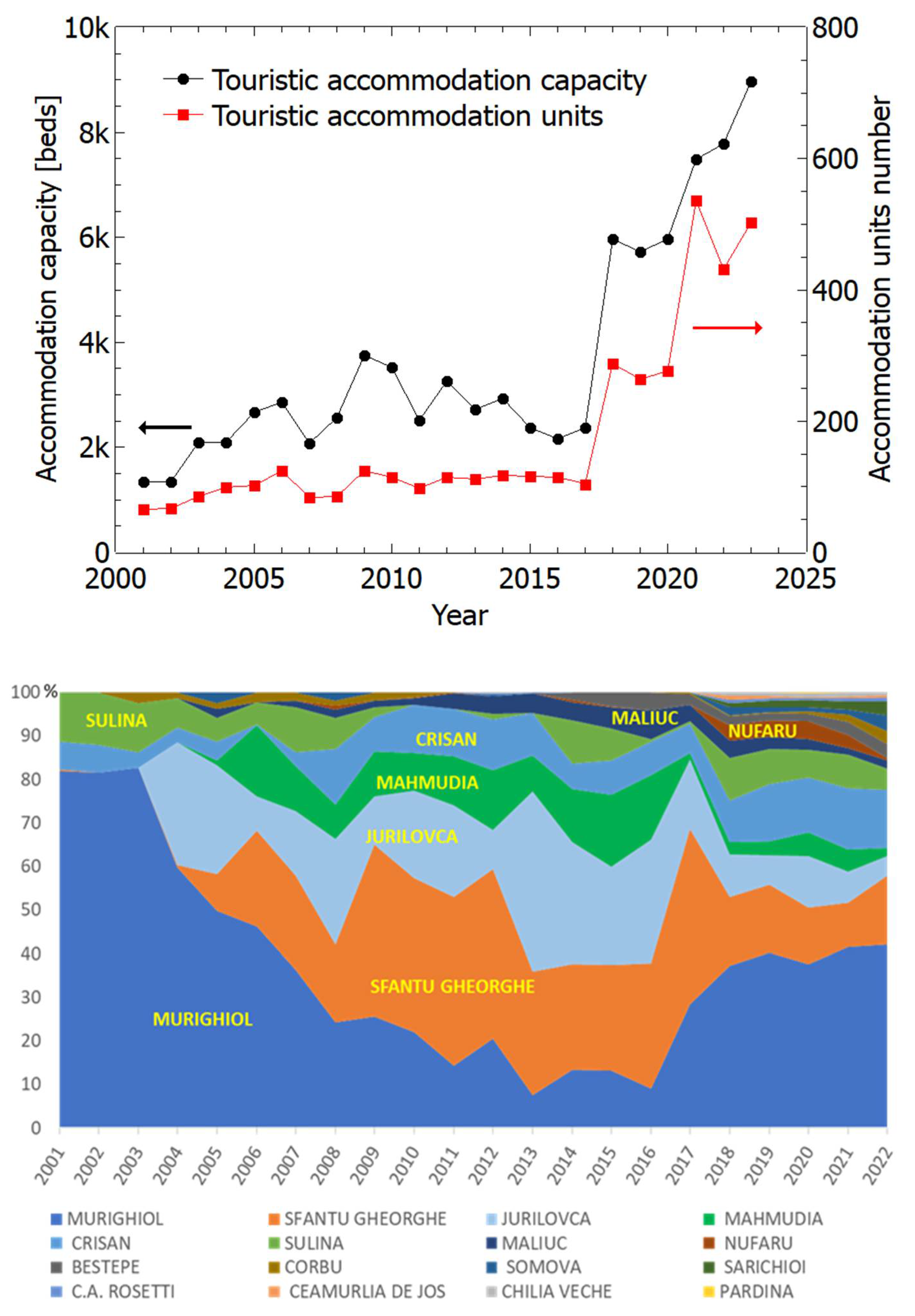
This reflects the direct impact of development policies, starting from 2018, holiday vouchers worth approximately 300 euro per year were granted, especially to employees in the budget sector. It is interesting to observe the immediate reaction of the tourism entrepreneurs who have adapted to this offer, creating new accommodation units and implicitly places to stay. It should be noted that starting from 2018 in the Danube Delta, the new accommodation units developed are of relatively small capacity (agritourism guesthouses and tourist villas) [15]. Also, the results of a study analysis of the tourists' opinion concerning the investments in the Danube Delta(Crețu et al. 2018)conducted in 2017-2018 indicated that only 15% of the surveyed tourists considered it appropriate to direct European funds to accommodation units in the coming years. It is also worth noting the positive attitude of tourists in 2017 regarding tourist accommodation in the Danube Delta, along with hospitality and accessibility [16].
Against the background of the increase in the number of tourists (Figure 1. b), the distribution of the share of tourists staying in tourist reception structures by localities and each year, in the period 2001-2022, indicates a gradual increase in the number of localities in the total share of tourists each year at the DDBR level. These results do not yet reflect a relatively balanced discharge of the tourist flow at the DDBR level, highlighting some localities with a high weight (e.g. Murighiol, Sfântu Gheorghe and Crișan). The situation still requires the application of sustainable development measures, some even with the direct involvement of the tourists themselves, also contributing to the initiation of the local population.
Figure 2 a/b Tourist flow and tourist concentration rate in DDBR
Figure 2.
a. Evolution in time for the entire DDBR: i) tourist arrivals in tourist accommodation units and local population (left) and ii) tourist concentration ratio for entire DDBR (right). Source: Own design, using the data from http://statistici.insse.ro:8077/tempo-online/#/pages/tables/insse-table. Source: Own design, using the data from http://statistici.insse.ro:8077/tempo-online/#/pages/tables/insse-table. b. Evolution in time of the tourist concentration ratio for different localities in respect with that for entire DDBR. Source: Own design, using the data from http://statistici.insse.ro:8077/tempo-online/#/pages/tables/insse-table
Figure 2.
a. Evolution in time for the entire DDBR: i) tourist arrivals in tourist accommodation units and local population (left) and ii) tourist concentration ratio for entire DDBR (right). Source: Own design, using the data from http://statistici.insse.ro:8077/tempo-online/#/pages/tables/insse-table. Source: Own design, using the data from http://statistici.insse.ro:8077/tempo-online/#/pages/tables/insse-table. b. Evolution in time of the tourist concentration ratio for different localities in respect with that for entire DDBR. Source: Own design, using the data from http://statistici.insse.ro:8077/tempo-online/#/pages/tables/insse-table
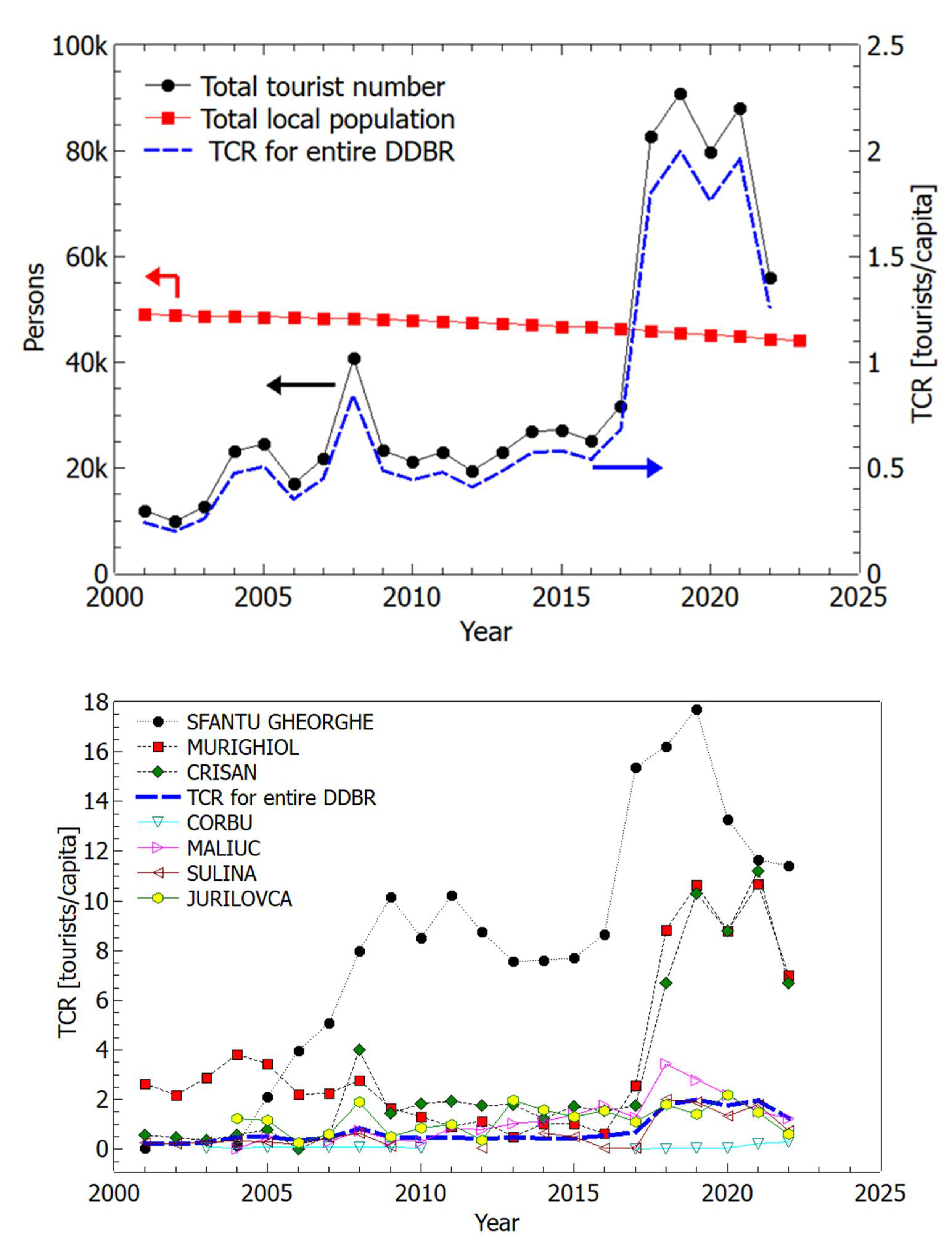
Figure 2 shows the evolution of the local population and the number of tourists starting with the year 2001, at the total level of the mentioned localities. It can be seen that since 2001, this area has brought together a local population that is decreasing annually (approx. 40,000 in 2023). In the same period, the number of tourists arriving at the tourist reception structures has increased constantly, substantially exceeding the number of the local population, starting from 2018. It is also noticeable, an increased number of tourists even during the Covid-19 pandemic; this is because the units in the Danube Delta were compatible with the imposed isolation conditions.
We observe a development of accommodation units and an increase in the number of tourists. From the specialized literature, it is well known the negative effect that excessive tourist activity can exert in certain areas [17,18] ?.
A primary representation of the tourist impact can be expressed by measuring the number of tourists in relation to the local population. This parameter (called touristic concentration ratio - CR) rather has a connotation of social pressure, it is in direct correlation with the economic impact of tourism in the respective area [19,20,21].
Figure 2 shows the evolution over time of the "tourist concentration ratio - CR" parameter for the entire DDBR. The values of the parameter are kept below 1 arrival/capita until 2017, and then increase, reaching a maximum of 2 arrivals capita in 2019, which draws attention to the fact that the tourist resources of the Delta must be judiciously used to avoid the negative effects of excessive tourism. Figure 2b shows the evolution in time of the tourist concentration ratio for different localities with respect to that for the entire DDBR. It should be noted that in the case of the locality of Sfantu Gheorghe, the values of this parameter started to increase constantly starting with the year 2005; this is the first year after the first edition of the ANONIMVL International Independent Film Festival according ANONIMVL foundation [3], organized annually. This is not a pure coincidence; the locals with whom we talked mentioned that at the first edition of the festival, there was not a single free place to stay in the entire locality. We can say that Sântu Gheorghe is one of the first towns in the Danube Delta where fishing (the main traditional activity) was successfully replaced by tourism. Fortunately, the situation is seen only as a takeover from the total flow of tourists. Starting with 2017 the rate of tourist concentration increases for other localities, such as Murighiol and Crișan, the rest of the localities - Maliuc, Sulina, Jurilovca - predict values at the level of the entire DDBR.
In some studies [22,23], attention is drawn to the state of the relationship between the environment and socio-economic activities, including tourism [24], in the area of the Danube Delta Biosphere Reserve (DDBR) with all the improvements brought gradually through the implementation of policies, legislation on the environment and the Danube Delta, of the recent strategy on the Danube Delta according Integrated Sustainable Development Strategy under the Technical Support Services contract on Danube Delta Integrated Sustainable Development Strategy between the Ministry of Regional Development and Public Administration and the International Bank for Reconstruction and Development [25], to achieve the objectives of the 2030 Agenda and Sustainable Development [26]. Even the statistical situation presented by us highlights several aspects of tourism in this sense. But, the ecological state of the Danube Delta strongly reflects the human pressure as a result of its geographical position, at the interface between the Danube hydrographic basin (19 connected countries) and the Black Sea (6 riparian countries).
Taking into account these considerations, we proposed through the study carried out to evaluate the perception of tourists on the Romanian space in the Danube Delta to identify the main tourist attractions, as the main advantages offered by the deltaic environment, as well as measures regarding the increase in the conservation and protection of the environment and the development of ecotourism.
The start of the research was given by the hypothesis that in a natural area, such as the Danube Delta Biosphere Reserve, the state of the quality of environmental elements is important and on which the safety and health of tourists and residents still depend, as well as the development of sustainable tourism.For this purpose, we chose a research methodology based on a questionnaire among tourists, which allowed us to approach this topic in depth. In the research approach, for the first phase, we started with a bibliometric analysis carried out with the help of the VOS viewer software.
3. Methodology
3.1. Bibliometric Analysis Methodology
Our research aims to identify the tourists' perception of the Danube Delta biosphere reserve and identify the best strategies to protect it through the development of a sustainable tourism that contributes to the conservation of resources. We started this research from the study of the literature indexed in WOS databases, in the field of protecting the natural resources of the Delta. This first phase of the research includes a qualitative approach to present the state of knowledge in the field and a quantitative one, represented by a bibliometric analysis using the VOSviewer software. This bibliometric study allows the identification of the evolution of the most important scientific concepts used in the field of tourist’s perception and conservation of Delta's bioresources. Once these scientific concepts are identified, they are validated in a second phase of the research through a methodology based on a questionnaire through which the perception of tourists regarding the bioresources of the Danube Delta is identified and also on the conservation strategies of all these bioresources.
Tourism in the Danube Delta offers the opportunity to raise awareness among tourists about the conservation of bioresources. Tourism in the Danube Delta offers a way to develop an economic relationship between them and the values associated with protected areas. Economic benefits of tourism in protected areas can be a strong argument in favor of conservation.
3.2. Tourist Survey and Data Analysis Methodology
A first role in determining the items of the study was the analysis of the bibliometric study on account of the scientific literature, the key words grouped by clusters and the relationships between the terms of the clusters. Also, the authors' discussions with friends and colleagues as tourists and scientific researchers on environmental and tourism issues, the authors' experience as tourists, the data collected by the authors from the field, the study of some documents (strategies, legislation) constituted ideas on how to choose the items. Data for the research was collected using a questionnaire-based survey. The research was conducted among the Romanian population (the questionnaire being written in Romanian), using a convenience sampling method. Through this method, using the filter question "Have you ever been a tourist or visitor in the Danube Delta Biosphere Reserve?"the criterion for inclusion or exclusion of study participants was established. Thus, out of the 405 forms filled out, based on social networks, between June and October 2023, 289 were validated in the end. Thus, by answering "yes" the representative answers were selected (71.3% of the total), the rest not being interested in the Danube Delta as a tourist destination; among those not interested (27.4%) did not exclude the possibility of being interested in the future. The questionnaire includes 2 parts. The first part includes socio-demographic characteristics (sex, age, current residence, completed studies, nature of studies – on sciences focused on nature/environments and other sciences). Part 2 includes a number of 27 items (ST1-ST27) regarding the importance of the preferences (Table 2) of the respondents as tourists and other multiple-choice questions related to the frequency of trips and the average length of stay. For the 27 items, the respondents evaluated on a Likert Scale the importance of preference related to tourist attractions, of possible measures related to the increase of conservation and protection of the environment and the development of ecotourism. The collected data were analyzed using descriptive and inferential statistics methods. Data normality was checked using the Shapiro-Wilk test, and the results showed that all significance levels were less than 0.05, resulting in all variables used in this study exhibiting a non-normal distribution. Thus, the non-parametric Mann–Whitney test was used to analyze whether there were significant differences in tourists' perception of the importance of criteria based on socio-demographic characteristics. Data were analyzed using SPSS Statistics for Windows, version 23.0.
4. Results
4.1. Results on Bibliometric Analysis
In the first stage of the bibliometric analysis, we make the co-occurrence analysis of the tourist’s perception. The co-occurrence matrix identified in this analysis is constructed to represent the frequency of occurrence of each key term and to identify trends in the field of tourists' perception of the Danube Delta biosphere reserve. The analysis of the main concepts encountered in the 1220 WOS articles related to tourists' perception of the Danube Delta biosphere reserve identified 3 distinct groups of major keywords, according to figure 1.
The relationships between the terms identified in these clusters are dynamic over time, which is reflected through the trends of the last 2 years through the spectrum of rainbow colors from blue to yellow (the newest trends):
- Cluster 1: variability, organic matter, sediments, nitrogen;
- Cluster 2: Danube Delta, evolutions, climate, model, diversity, fresh water;
- Cluster 3: gis, machine learning, prediction, risk assessment, quality, tourism.
It is noted the appearance of concepts related to artificial intelligence in the last cluster that corresponds to the last analysis period.
Figure 1.
The main concepts encountered in the 1220 WOS articles related to tourists' perception of the Danube Delta biosphere reserve.
Figure 1.
The main concepts encountered in the 1220 WOS articles related to tourists' perception of the Danube Delta biosphere reserve.
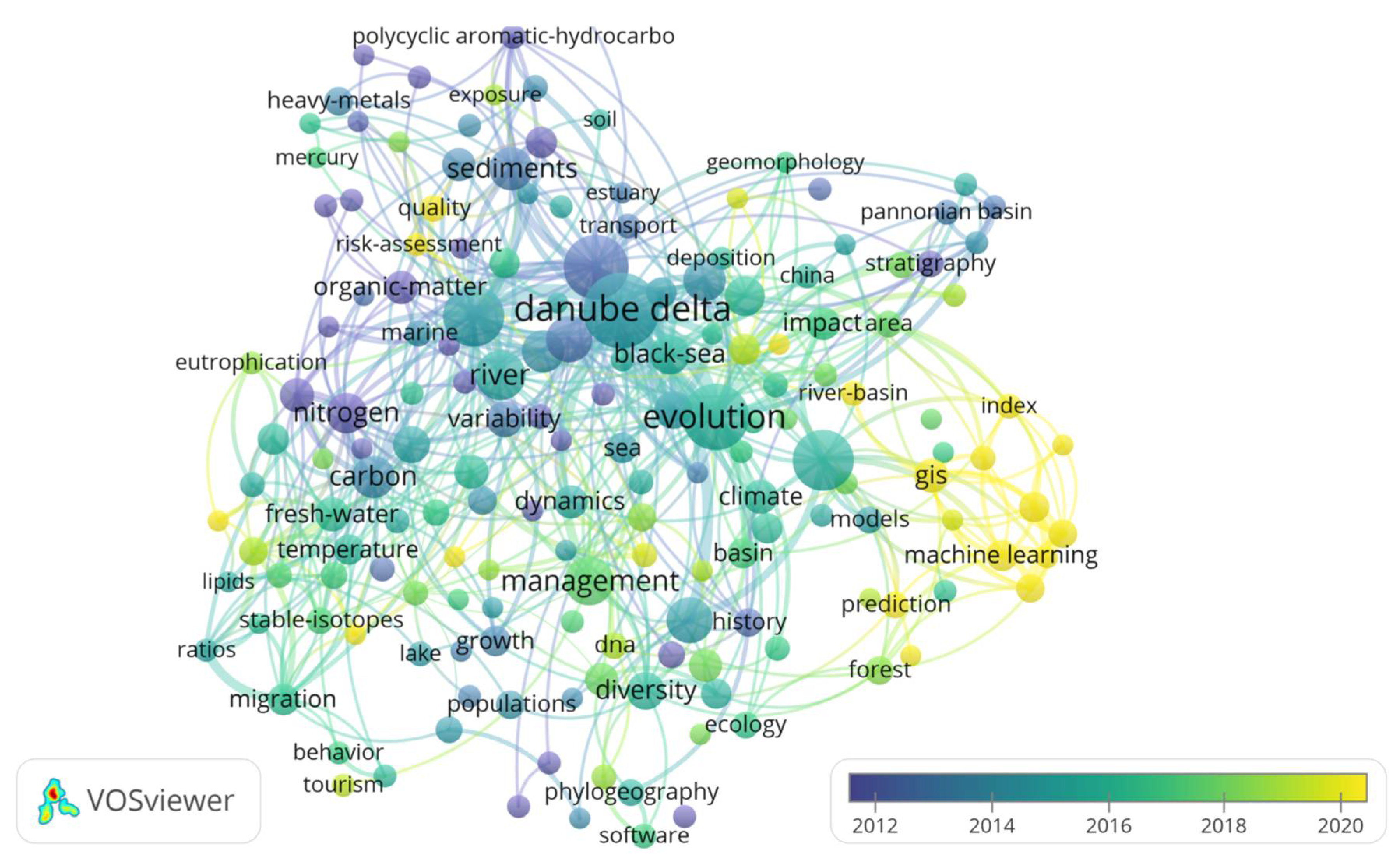
Figure 2.
The evolution of the relationships generated by the development of the concept of the Delta - protected area in the period 1990–2023.
Figure 2.
The evolution of the relationships generated by the development of the concept of the Delta - protected area in the period 1990–2023.
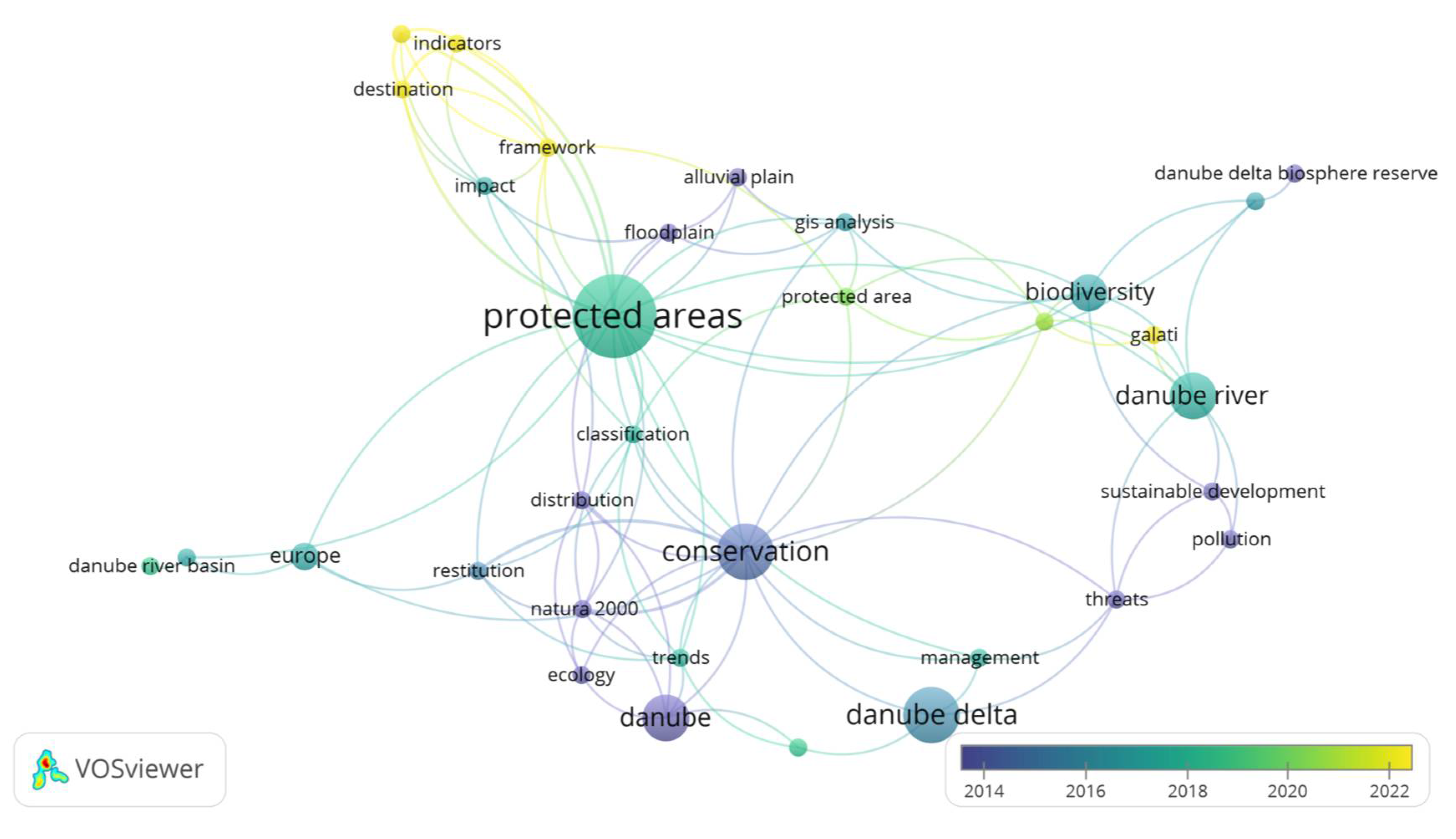
In the second stage of the bibliometric analysis, we make the co-occurrence analysis of the conservation of Delta's bioresources. The co-occurrence matrix identified in this analysis is constructed to represent the frequency of occurrence of each key term and to identify trends in the field of the concepts of the Delta - protected area in the period1990–2023.
Based on the linking of the bibliographic references of the 277 WOS articles analyzed, a map of the evolution of the relationships generated by the development of the concepts of the Delta - protected area in the period1990–2023. There are seven major keyword groups related to the database related to the Delta - protected area, which we determined based on seven thematic clusters which are corresponding to the intensity of the color density:
- Cluster 1: conservation, Danube Delta, distribution, ecology, management, natura 2000, river basin, trends;
- Cluster 2: biodiversity, Danube River, Galati, GIS, pollution, sustainable development. threats;
- Cluster 3: destination, framework, impact, indicators, protected areas, sustainable tourism development;
- Cluster 4: Danube River basin, Europe, restitution, spatial planning;
- Cluster 5: alluvial plain, floodplain, gis - analysis;
- Cluster6: Danube Delta Biosphere Recourse, wetlands;
- Cluster 7: classification, protected area.
4.2. Results on Consumer Survey
According to the attached table (Table 1), the situation of the answer is: the majority of the studies are owned by the female sex, by the group between 30 - 69 years old, those with superiors and of tea on natural/environmental sciences.
The respondents evaluated on a Likert scale the preferences related to the importance of tourist attractions, possible measures to protect and conserve the natural area and the involvement of actors in protection and conservation (Table 2).
The respondents had the following frequency of trips to the Danube Delta in the last 10 years:
- -
- once - 52.00%;
- -
- 2 times - 17.64%;
- -
- 3 times - 12.80%;
- -
- more than four times - 13.84%,
- -
- 4 times - the rest.
And the average length of stay was: 1-2 nights – 32.53%;3-4 nights – 35.98%;5 nights and over -16.95%;the rest at night.

Table 2.
The importance of tourist/visitor motivations related to tourist attractions and the protection and conservation of the environment in the "Danube Delta" Biosphere Reserve.
Table 2.
The importance of tourist/visitor motivations related to tourist attractions and the protection and conservation of the environment in the "Danube Delta" Biosphere Reserve.
| Statements | Scale (%) | |||||||
| 1 | 2 | 3 | 4 | 5 | MEAN | SD | ||
| The importance of the motivations of tourist attractions | Flora and fauna(ST1) | 0.00 | 0.00 | 2.08 | 21.80 | 76.12 | 4.74 | 0.48 |
| Traditional activities (fishing, hunting)(ST2) | 1.04 | 3.11 | 12.11 | 35.64 | 48.10 | 4.27 | 0.99 | |
| Local cuisine (ST3) | 0.00 | 0.69 | 9.34 | 36.33 | 53.63 | 4.43 | 0.76 | |
| Beach, sun and sea(ST4) | 1.73 | 2.08 | 15.57 | 35.99 | 44.64 | 4.20 | 1.05 | |
| Water rides(ST5) | 0.00 | 1.38 | 4.15 | 25.95 | 68.51 | 4.62 | 0.65 | |
| Outdoor walks(ST6) | 0.35 | 0.35 | 6.57 | 26.99 | 65.74 | 4.57 | 0.68 | |
| Rest and relaxation(ST7) | 0.35 | 0.35 | 5.54 | 19.72 | 74.05 | 4.67 | 0.63 | |
| Cultural heritage (ST8) | 0.35 | 2.08 | 9.34 | 31.49 | 56.75 | 4.42 | 0.84 | |
| Recreational sports and sports resources(ST9) | 4.15 | 7.27 | 28.72 | 33.56 | 26.30 | 3.71 | 1.48 | |
| The importance of possible measures in protection and conservation |
Stop overfishing/ban(ST10) | 0.00 | 1.38 | 3.46 | 23.88 | 71.28 | 4.65 | 0.63 |
| Compliance with the law ( ST11) | 0.69 | 1.04 | 2.77 | 12.80 | 82.70 | 4.76 | 0,.2 | |
| Greening and sanitation (ST12) | 0.35 | 0.35 | 2.08 | 14.53 | 82.70 | 4.79 | 0.52 | |
| Limitation by law of the use of plastic packaging (ST13) | 0.35 | 1.73 | 2.77 | 15.22 | 79.93 | 4.73 | 0.63 | |
| Promoting the use by tourists of products with non-polluting packaging(ST14) | 0.69 | 1.04 | 2.42 | 19.03 | 76.82 | 4.70 | 0.64 | |
| Commercialization of common products with the ecological label (ST15) | 0.69 | 3.46 | 5.88 | 22.15 | 67.82 | 4.53 | 0.85 | |
| Encouraging local producers/economic operators in the production of products with little waste generation (ST16) |
1.04 | 1.38 | 5.54 | 20.42 | 71.63 | 4.60 | 0.77 | |
| Encouraging traders towards low-waste products/services(ST17) | 0.35 | 1.38 | 4.15 | 24.22 | 69.90 | 4.62 | 0.69 | |
| Empowerment of Delta residents and tourists in the spirit of protecting flora and fauna (including fish population)(ST18) | 0.69 | 1.04 | 2.42 | 15.57 | 80.28 | 4.74 | 0.62 | |
| The importance of actors' involvement in the conservation of the Danube Delta | Government(ST19) | 14.53 | 5.88 | 12.46 | 16.26 | 50.87 | 3.83 | 1.47 |
| Non-governmental organizations/associations(ST20) | 13.15 | 9.69 | 17.65 | 26.99 | 32.53 | 356 | 1.40 | |
| Town halls and local councils(ST21) | 12.11 | 4.15 | 14.19 | 12.11 | 57.44 | 3.99 | 1.41 | |
| Environmental experts(ST22) | 14.19 | 4.50 | 10.38 | 19.03 | 51.90 | 3.90 | 1.44 | |
| University education institutions (ST23) | 9.00 | 14.88 | 19.72 | 22.84 | 33.56 | 3.57 | 1.35 | |
| Mass- media(ST24) | 12.11 | 6.92 | 16.96 | 20.76 | 43.25 | 3.76 | 1.38 | |
| Communities and volunteering(ST25) | 9.00 | 12.46 | 14.88 | 27.34 | 36.33 | 3.70 | 1.32 | |
| Tourists (ST26) | 10.73 | 7.61 | 16.96 | 18.69 | 46.02 | 3.82 | 1.37 | |
| Department of Tourist and Environmental Police(ST27) | 1.04 | 1.04 | 2.08 | 17.65 | 78.20 | 4.71 | 0.66 | |
- a)
- The analysis of the Likert Scale assessment of the importance of tourist attractions shows high importance scores (average > 4) for most of the statements (ST1-ST8) (Table 2).
Statistically significant values for p-values were obtained for certain socio-demographic characteristics (Table 3)
Thus, "cultural heritage" (ST8) on the age component (p= 0.046) was preferred more by responders over 40 years old, and on the level of studies (p= 0.026) and the nature of studies (p=0.037) stood out more those with university degrees and studies focused on nature/environment (with a score of 4.52); in the case of the last group, tourists had other preferences regarding the nature of the completed studies.
The results reflect the significance of the cultural heritage (material and immaterial) of the Danube Delta Biosphere Reserve and the sensitivity of these groups to the cultural environment. It seems that tourism motivations have diversified from situations where visitors' experiences in protected natural areas focused only on direct contact with nature and wildlife [27].
Some studies highlight the role of cultural tourism in protected natural areas, of progress in the theory of sustainable development due to the activation of socio-cultural values, as in Denmark [28], and the role of rural tourism/ecotourism development policies [11,29,30,31].
A special contribution among the communities of Ukrainians, of Russian-Lipovians, was brought by women, especially the elderly, considered protagonists in cultural tourism, engaging in such actions and the local young generation. Unlike in 1991, through the development of tourism, it was possible to wear popular costumes more often and participate frequently in tourist events (local, regional, national).
Thus the vocal groups / artistic formations from rural localities, such as the "Ciornee More" Women's Choir, [32] from Sfântu Gheorghe, the "Rusalka" Choir, [33] from Mila 23, the "Rebalka" vocal Group, [34] from Crișan, are models of adaptation to sustainable local development through depth expressed history and preparation of the young generation for change. In our discussions with the "Ciornee More" Group from Sfântu Gheorghe related to the way of involvement in tourist activities, the members emphasized: the existence of an increased interest in the defense and preservation of tradition; the activity represents an easy source of income, especially for elderly women; their activity is visible in the eyes of the community, receiving respect and appreciation.
Also, some studies have contributed to the continuous enrichment of the cultural tourist heritage through ideas for exploiting the potential of the entire cultural heritage, such as tourist exploitation of archaeological sites, [35] ecological reconstruction, [29,36], identification of tourist routes and tourist villages (with customs and traditions), [37,38].
Although in the case of the last group the respondents have other tourist preferences compared to the nature of the studies, they still do not deviate too much from them, keeping their attachment to nature as a supporting environment for cultural tourism, showing experience in the tourist destination, as a natural area protected. In this situation, it seems that tourist motivation mediates the effect of tourist experience on destination loyalty, as emphasized in some studies, [39,40].
Considering the statement "sports resources of agreement and sport" (ST9) each characteristic p-value has significant values. Thus, the values on the gender component (p=0.000) indicate a higher appreciation of male tourists (score 3.99), as well as on the residential environment component (p=0.015) from those from rural areas (score 4.00 versus 3.63 in the case of the urban group).
It is possible that the situation recorded by the rural group was due to the proximity to nature due to the residential environment and routine, the satisfaction of curiosity and pleasure through the variety of activities and resources.
Unlike the groups oriented towards cultural heritage, the respondents with high school and post-high school studies found the attraction in sports activities (ST9, p=0.012) as in the case of those with studies in other sciences (ST9, p=0.009); the latter found nature and sport to be more important, as a refuge to something else compared to the nature of studies. According to the age characteristic, touristic attractions with a sports character remain important for those under 40 years old (ST9, p=0.003), compared to those over 40 years old attracted by the cultural heritage components (ST8, p=0.046), where probably the physical condition and the influence cultural make their mark, as it appears in a study [41].
The Biosphere Reserve is registered as a destination where the relationship between tourism and sports is evident, allowing people to return to nature; to experience enjoying the fun of sports, as happens in other natural areas.
The high natural potential (Danube arms and canals, lakes, Black Sea) has generated the development of sports activities for relaxation and recreation, some of which are easy to practice, even with family and friends, such as sport fishing, kayaking, swimming/bathing in permitted areas.
However, the exploitation of recreational sports resources and the practice of sports tourism must always take into account scientific planning and the protection of the ecological environment [41,42].
In the case of the Danube Delta, for now, tourists are not seen by the communities as a threat to recreation opportunities and cultural identity, as has started to happen in some natural areas, such as in New Zealand, [43]. Here, the link between tourism and the resident population (through accommodation, ways to capitalize on cultural potential, boat trips, etc.) is seen as beneficial [44], tourism being a source of high income for those directly involved, women and men.
b) The Likert Scale analysis regarding the importance of the proposed measures in protecting and conserving the Danube Delta shows high importance scores (average > 4) for all statements (ST10-ST18, Table 2). Overfishing and prohibition on the one hand and pollution on the other are the major known problems for the Danube Delta Biosphere Reserve. For the statement "stopping excessive fishing/prohibition" (ST10) significant p-values are on the characteristics: gender, among the female group (p=0.008, score 4.75); age (p=0.006) by higher appreciations from those over 40; level of education (p=0.003) on account of those with higher education; the nature of the studies (p=0.020) where the group focused on nature/environmental sciences was highlighted (Table. 4).
This is explained by a better awareness and professional training of the respondents, but also probably by the specific characteristics of women to be more protective and caring, unlike the male sex. These groups showed a greater attachment to conservation and protection of biotic resources
The fishing practiced by the local population [45], although on a large scale, on the one hand, and tourism (agritourism, sport fishing) which is combined with fishing on the other hand [46], have influenced the preservation and stocks of fish [47,48,49], along with other factors disruptors [50,51]. This situation was concurrent with the application of various measures, such as attempts to introduce some species of fish in fresh waters and mechanisms to improve stocks [52], basic regulations (catch quota, closed seasons, etc.).
The Russian-Lipovian and Ukrainian communities, recognized by tourists for their rich and diverse local cuisine in fish dishes, were the ones that created conflicting situations through the desire to claim the "rights" to manage wetlands in the context of conservation policies [53]. Since 2015 the scientific literature has been calling attention to better legal and institutional support in the management of fisheries and tourism communities according legal and institutional framework for integrated governance in a biosphere reserve [54].
Tourism has become a business for the local population, which is forced to change its attitude towards tourists due to ecological restrictions.
Although it doesn't seem like it, there is a negative but also a positive perception, both of the tourist on the local, and of the local on the tourist.
The tourist sees the local as a born poacher who knows all the fishing spots and who does not give anything cheap or free, especially since in recent years he has radically changed his attitude, fish being a good source of income. The local sees the tourist as the one who expects, no matter where he is, to get more for as little money as possible.
Recently, tough legislative measures have been applied regarding the camping of tourists on the banks of the Danube and the canals, they are no longer allowed to stay and fish during the day, take all the catch with them and leave in the evening, leaving in their opinion an undisturbed environment and,also, to retain fish only of certain species and over a certain length. Even when a fishing permit is issued, the permit holder is sent an email, in which the species and their length are listed and the obligation to report the catch is specified. How many do this reporting? Here is a gray area where the tourist fisherman can suddenly become a poacher, disrupting the environment.
Moreover, in obeying the legislation (ST11) those over 40 are more aware and responsible for the environment (p=0.045; score 4.85), with higher education (p=0.018; score 4.84) and studies focused on nature/environment from characteristic of the nature of the studies (p=0.015).
It matters how the legislative measures are applied in order to achieve the goal, as I showed in the statement regarding overfishing, where only through the strict application of the legislation the effects can be seen.
Probably, the voices and proposals requested for legislative changes matter; for example, a scientific study indicates the requirement to change the environmental legislation on the part of some owners/administrators of accommodation units, especially guesthouses [55].
Greening and sanitation of areas affected by pollution (ST12) were appreciated as important and necessary for the protection and conservation of the Danube Delta Biosphere Reserve for over 40 years (p=0.044), regardless of the studies.
In this regard, the results of scientific research highlight various situations related to the ecological assessment of environmental factors, especially water (Danube, lakes, inland coastal waters), under human pressure, as well as permanent measures for their rehabilitation and improvement and maintaining human health [56,57,58]. Those respondents were probably more attentive to the quality of the water, to the sources and ways of supplying the locals with drinking water, because they were the same for them. At the same time, they were also good observatories and analysts in the field.
The statement "limitation by law of the use of plastic packaging" (ST13) has better appreciations from the female gender (p=0.044), and for the age characteristic from the over 40s (p=0.002) and for the education level characteristic of those with higher education (p=0.014).
Fluvial and marine waste in terms of quantity and content of plastic (at the micro, medium and macro level) are the alarming problems generated by the local and felt anthropogenic pressure, as a result of the geographical position of the Danube Delta Biosphere Reserve. They are scientific studies that highlight the distribution, abundance and composition of waste [59,60,61].
Before the Danube Delta became a Biosphere Reserve, piles of waste (light bulbs, bottles, etc., all with foreign inscriptions) were seen by the locals in the 80s more on the shore of the Black Sea, especially in the areas of concentration of sea currents, when blocking some canals that had an outlet to the sea. The period of the plastic explosion constituted one of the difficult problems in the Danube Delta. Local authorities and volunteers, represented even by children, are forced to get involved frequently in collecting waste, in preparing a cleaner environment after the departure of the tourists.
The substitution of polluting products with plastic for non-polluting ones (paper packaging) comes as a requirement, especially from those over 40, with higher education and studies focused on nature/environment. That's why the values for p-value in the case of the statement "Promoting the use of non-polluting products by tourists" (ST14) are significant on the following characteristics: age (p=0.002), studies (p=0.004) and nature of studies (p=0.004). Also, in order to minimize the impact on the environment, the sale of products with an ecological label can offer the consumer (tourist or resident) the alternative of purchasing at the points of sale. Endowed with environmentally perceived quality and at a lower price, the products can ensure satisfaction, increase confidence in this kind of products and respect for the environment.
A situation similar to the studies focused on consumers who have experienced the purchase of organic products can be recorded [62,63]. A high appreciation came from those over 40 years old in the case of the statement "Commercialization of common products with the ecological label for tourists (ST15" (p= 0.014; grade 4.65).
The statement "encouraging local producers/economic operators in the production of products with little waste generation" (ST16) sensitized the respondents in evaluating the requirement only by the age characteristic (p=0.010; score 4.73 for respondents over 40).
For the statement "encouraging the orientation of traders towards products/services with little waste generation (ST17)" the results by characteristics were: gender (p=0.027; high appreciation from women), age (p=0.003; also, over 40 years old),studies (p= 0.005; contribution from those with higher education), nature of studies (p=0.032; differences were given by those with studies focused on nature/environment). This situation would be the basis for stimulating and forming responsible behavior in order to reduce waste, especially plastic waste.
In the Danube Delta Biosphere Reserve both retailers who sell products containing plastic materials and manufacturers who sell their own products containing plastic should be obliged to collect an amount equal to approximately 90-100% by weight of plastic productsmarketed in a given year on the territory of the Danube Delta Biosphere Reserve in order to improve the efficiency of reducing the impact on the environment and waste management.So, it would be a larger amount than the legislation in force provides, taking into account that this territory has the status of a natural area.
Regarding the "responsibility of the inhabitants of the Delta and the tourists" in the spirit of protecting the flora and fauna (ST18), the appreciations came from those with higher education (p=0.019), they have the power to be more aware than the respondents with high school and professional education.
This is a difficult mission on the part of the local decision-makers, because the tourists in most of them are others, and the locals are hard to bend in many ways, for example to collect the waste that does not belong to them, but to others.
c) Respondents evaluated on a Likert Scale the importance of actors' involvement in the conservation of the Danube Delta. The analysis shows average scores between 3.57 -3.90 for all statements (ST19-ST27) Table 2).
The results of the research on the age statement indicate a very high appreciation from the respondents over 40 years old (Table 5.) for: Government (ST19, p=0.014), non-governmental organizations/associations (ST20, p=0.027) profile, university education institutions (ST23, p=0.008), communities and volunteering (ST25, p=0.044) and the Department of Tourist and Environmental Police (ST27, p=0.032).However, tourists focused on nature/environment than those on other studies, see the problem differently, the involvement must come from more actors: the Government (ST19, p=0.000), non-governmental organizations/associations (ST20) and university education institutions (ST23) (each with p=0.001), authorities local (ST21) and the Tourist and Environmental Police Department (ST 27) (each with p=0.004), environmental experts (ST22, p= 0.014) and mediaST24, p=0.049).
In addition, for the statement "non-governmental organizations/associations" the results indicate equal values both for the residence characteristic, where those from the urban environment come with a better appreciation (ST20 p=0.049), and for the education level characteristic, where those with degrees superiors had a better appreciation; for the statement Tourist and Environmental Police Department (ST27, p=0.032) all those with higher education gave a good assessment.
The need for an increased number of actors involved in the protection and conservation of the Danube Delta is indicated in the conditions where a good part of those surveyed have higher education, some of them with studies focused on nature/environment. However, their concerted and permanent action in the application of sustainable management policies is important, with the central authority remaining the main actor.
Along the lines of ecotourism, the strategy for its development at the level of Romania, for 2019-2030, refers this time to professional management, which should attract in the decision-making process all the factors involved in the development of tourism. A study on rural tourism in Europe, implicitly in Romania, identified government initiatives and local community involvement as powerful factors of change in the tourism sector [64].
Efforts are great to link socio-economic development with the environment, and the actors must find and apply the solutions.
The specialized literature came up with some suggestions for the Danube Delta Biosphere Reserve, against the background of the lack of effective policy coordination between government institutions and the different sectors of activity, such as:
-the establishment in the municipality of Tulcea of a regional center for sustainable mobility (of tourists and residents) in the Danube Delta in order to increase the mobility management capacity of the local and regional authorities [65];
- using tourism impact models as planning instruments in its management, such as the one for the town of Sfântu Gheorghe [66];
- development of cognitive maps based on scenarios for good management of visitor flows [67];
- approach to a sustainable model of architecture with contemporary living standards and preserving the specificity of the landscape and increasing the value of the built estate [68].
The decision-makers (especially the county and local administration) should keep in mind the best solutions presented in the scientific literature and apply them to the extent that they lend themselves to this space.
5. Conclusions
The results of the study based on the questionnaire, supplemented with statistical analyzes and information obtained from the field, highlight various aspects regarding the Danube Delta Biosphere Reserve, which is in a process of resettling on the principles of sustainable development and adapting the population to face change in order to achieve the requirements of the 2030 Agenda and the objectives of Sustainable Development.
In terms of tourist attractions, cultural heritage and sports resources of agreement and sport - were the most important for the respondents. A differentiated preference was recorded, especially according to the nature of studies and age.
Cultural heritage was preferred more by respondents over 40 years old, by those with university education and focused on nature/environment, and the agreement sports resources and water-related sports were preferred, more by tourists under 40 years old and with education high school and post-high school, by those from the male category and those from the rural environment and other sciences.
Corroborated with the data collected from the field, a contribution to the development of immaterial cultural tourism, as its protagonists, is attributed to local elders and women belonging to ethnic groups.
They made great efforts to increase their visibility on the intangible cultural tourism "scene", not only at the local level, but also regionally and nationally. On account of these tourism resources, tourism has accelerated local development and thus leaves a long-lasting positive legacy.
For the other 2 sets of statements, some groups of respondents made assessments for a clean deltaic environment through the application and observance of conservation and environmental protection measures and, at the same time, opted for the involvement of a greater number of actors in the development of tourism and environmental protection (especially answers with nature/environmental studies).
In the case of the set of statements as actions in the conservation and protection of the environment, on the part of legislation, fishing and pollution, the female sex, the respondents over 40 and the groups with higher education and focused on nature/environment created the differences compared to the other groups, being more aware the situation related to the quality of the environment; the over 40 group stood out with better ratings for most statements.
The quality of the environment and the development of tourism based on the protection and conservation of the environment will depend in the future on the involvement of all actors through professionalism and coherent action.
Tourists want to practice tourism in a clean and safe environment for their health and safety and are aware of the need to apply measures that contribute to the preservation and protection of the environment, preferring to put some of these into practice as future tourists. We recommend that the decision-makers (especially the county and local administration) take into account the best solutions based on impact assessment studies and sustainable planning found in the specialized literature, and this to contribute to the successful achievement of the requirements of the 2030 Agenda and the Sustainable Development Goals. Also, corroborated with our findings on the ground, we recommend taking into account in the management policy: the transition to low tourism especially for some localities, a better management in controlling the speed and movement of boats in the Danube Delta for the safety of tourists, increasing the quality of the general transport infrastructure between localities (eg between Sfantu Gheorghe and Sulina) both for a better dispersion of the tourist flow and better territorial mobility for the locals.
The study also has some limitations. The non-probabilistic method used for data collection is the main limitation of the study. Convenience sampling was applied in the present study, with the questionnaire being distributed randomly, the questionnaire being randomly distributed through social networks, mainly directed towards respondents with higher education. For these reasons, the results obtained in this study can be useful in scientific research and for those interested in such a problem.
Author Contributions
Conceptualization, I.S, R.D., and G.A.Z.; investigation, I.S and R.D..; methodology, I.S, C.L.Z.; formal analysis G.A.Z, validation, I.S.; writing—original draft I.S and R.D.; writing—review and editing, I.S., C.L.Z.; supervision, I.S., G.A.Z. All authors have read and agreed to the published version of the manuscript.
Funding
This research received no external funding.
Institutional Review Board Statement
Not applicable.
Informed Consent Statement
Not applicable.
Data Availability Statement
Data is contained within the article.
Acknowledgments
The authors would like to thank for the information provided: the women's choir "Ciornee More" from Sfântu Gheorghe, some locals from Sfântu Gheorghe and Crisan and some people who were born and lived for a while in Sfântu Gheorghe, they go to their birthplaces several times per year and frequently keep in touch with relatives and locals from Sfantu Gheorghe.
Conflicts of Interest
The authors declare no conflict of interest.
References
- “Danube Delta | Ramsar Sites Information Service.” https://rsis.ramsar.org/ris/521?language=en (accessed Mar. 17, 2024).
- “The Danube Delta - What Future For Europe’s Wetland Jewel?” https://www.icr.ro/pagini/the-danube-delta-what-future-for-europes-wetland-jewel (accessed Mar. 17, 2024).
- E. E. P. D. World Conservation Union, “Environmental status reports. Vol. 4 : Conservation status of the Danube Delta”.
- L. Badea, D. Bălteanu, O. Bogdan, and V. Cucu, Geografia României, vol. 5. 2005.
- Soare, Spațiul dunărean fluvio-maritim. Studiu de geografie umană și economică. Galați: Editura N’ERGO, 2004.
- T. Ghosh et al., “Adaptation for changing deltas,” One Earth, vol. 6, no. 3, pp. 185–189, Mar. 2023. [CrossRef]
- D. M. Leslie and A. Tissescu, “Beyond the Danube Delta: Forest Conservation and Research Opportunities in Romania,” Conserv. Biol., vol. 6, no. 2, pp. 165–167, 1992, [Online]. Available: http://www.jstor.org/stable/2386236.
- K. Van Assche, S. Bell, and P. Teampau, “Traumatic Natures of the Swamp: Concepts of Nature in the Romanian Danube Delta,” Environ. Values, vol. 21, no. 2, pp. 163–183, 2012, [Online]. Available: http://www.jstor.org/stable/23240360.
- “TEMPO Online.” http://statistici.insse.ro:8077/tempo-online/#/pages/tables/insse-table (accessed Mar. 17, 2024).
- C. Honţuş, I. N. Alecu, R. F. Creţu, and R. C. Creţu, “Studies on the involvement of local government in the Danube Delta in raising the living standards,” in Proceedings of the 27th International Business Information Management Association Conference - Innovation Management and Education Excellence Vision 2020: From Regional Development Sustainability to Global Economic Growth, IBIMA 2016, 2016.
- “STRATEGIE 30/05/2019 - Portal Legislativ.” https://legislatie.just.ro/Public/DetaliiDocumentAfis/219401 (accessed Mar. 17, 2024).
- A.-I. Petrisor, R. Petre, and V. Meiţă, “Difficulties in achieving social sustainability in a biosphere reserve,” Int. J. Conserv. Sci., vol. 7, no. 1, pp. 123–136, 2016, Accessed: Mar. 17, 2024. [Online]. Available: https://ijcs.ro/public/IJCS-16-11_Petrisor.pdf.
- F. Pațac, Istoria comerțului si turismului. Timișoara: Eurostampa, 2008.
- E. Panighianț, Delta Dunării și complexul lagunar Razelm. Bucuresti: Editura Sport -Turism, 1982.
- Soare, “Aspects Related to the Accommodation Tourist Infrastructure and the Tourist Flow from the Danube Delta and its Surroundings - Changes and Opportunities,” Ann. Dunarea Jos Univ. Galati. Fascicle I. Econ. Appl. Informatics, vol. 27, no. 2, pp. 110–118, Sep. 2021. [CrossRef]
- Pavel-Nedea and I. Dona, “Assessement of residents’ attitudes towards tourism and his impact on communities in the Danube delta,” Sci. Pap. Ser. Manag. Econ. Eng. Agric. Rural Dev., vol. 17, no. 2, 2017.
- M. Ramírez, CP (Perez Ramirez, Carlos) [1] ; Zizumbo, L (Zizumbo, Lilia) ; Vera, MG (Gonzalez Vera, “Environmental impact of Tourism in protected areas, procedure to carry out the analysis of the El Ocotal park in Mexico,” PERIPLO SUSTENTABLE, no. Issue16, pp. Page25-55.
- Soroka and J. Wojciechowska-Solis, “Expectations of the Polish society related to recreational and tourist activities in the forest environment,” Sylwan, vol. 164, no. 6, 2020. [CrossRef]
- R. M. Gogonea, A. A. Baltalunga, A. Nedelcu, and D. Dumitrescu, “Tourism pressure at the regional level in the context of sustainable development in Romania,” Sustain., vol. 9, no. 5, 2017. [CrossRef]
- Popescu and D.-M. Plesoianu, “Concentration of tourist arrivals in tourist guesthouses in the Covid-19 pandemic 2020 versus 2019 in Romania,” Sci. Pap. Ser. Manag. Econ. Eng. Agric. Rural Dev., vol. 21, no. 4, 2021.
- Popescu, “Analysis of agro-tourism concentration in Romania,” in Proceedings of the 32nd International Business Information Management Association Conference, IBIMA 2018 - Vision 2020: Sustainable Economic Development and Application of Innovation Management from Regional expansion to Global Growth, 2018.
- V. M. Starodubtsev, “Changes in the Danube delta according to remote sensing data by Landsat satellite,” Arid Ecosyst., vol. 3, no. 4, 2013. [CrossRef]
- L. Lazar et al., “Sustainable Development Scenarios in the Danube Delta—A Pilot Methodology for Decision Makers,” Water (Switzerland), vol. 14, no. 21, 2022. [CrossRef]
- Ianos, I. V. Stoica, C. Talanga, and N. Vaidianu, “Politics of tourism development in Danube Delta biosphere reserve,” in 12th International Multidisciplinary Scientific GeoConference and EXPO - Modern Management of Mine Producing, Geology and Environmental Protection, SGEM 2012, 2012, vol. 4.
- “Strategia Integrată de Dezvoltare Durabilă a Deltei Dunării,” Jun. 2016. Accessed: Mar. 17, 2024. [Online]. Available: https://www.mdlpa.ro/uploads/articole/attachments/5dc54f4615388605628193.pdf.
- Ianos, I.-V. Stoica, C. Talanga, and N. Vaidianu, “Politics of Tourism Development in Danube Delta Biosphere Reserve,” 2012, pp. 1067–1074. [CrossRef]
- M. Stoleriu, A. Brochado, A. Rusu, and C. Lupu, “Analyses of Visitors’ Experiences in a Natural World Heritage Site Based on TripAdvisor Reviews,” Visit. Stud., vol. 22, no. 2, pp. 192–212, Jul. 2019. [CrossRef]
- M. H. Esfehani and J. N. Albrecht, “Roles of intangible cultural heritage in tourism in natural protected areas,” J. Herit. Tour., vol. 13, no. 1, pp. 15–29, Jan. 2018. [CrossRef]
- Negrusa, S. Cosma, and O. Gica, “Analysis of the Main Romanian Cultural Tourism Products,” Proc. 2nd WSEAS Int. Conf. Cult. Herit. Tour., 2009.
- M. [1] Milin, IA (Milin, Ioana Anda) [1] ; Zombori, AM (Zombori, “Rural development - a priority of the Romanian policies,” Rural Dev., vol. VOL 2, no. BOOK 1, pp. Page24-26, 2005.
- R.-I. Popescu and A. Zamfir, “Strategic Role of Ecotourism for Romania’s Regional Development,” Scale Glob. Think Glob. Act Locally, Chang. Individ. 21st Century, pp. 250–258, 2011, Accessed: Mar. 18, 2024. [Online]. Available: In The Scale of Globalization. Think Globally, Act Locally, Change Individually in the 21st Century.
- “Corul ‘Ciornee More’ din Sfântu Gheorghe (partea I) - YouTube,” 2021. https://www.youtube.com/watch?v=ozG6Zd-gjQM (accessed Mar. 18, 2024).
- “Corul Corul Rusalka de la Mila 23 a participat la festivalul de la Chilia Veche - YouTube,” 2021. https://www.youtube.com/watch?v=I0I2PhJDB2I (accessed Mar. 17, 2024).
- “Grup vocal Rebalka | Facebook.” https://www.facebook.com/groups/720554597984445/?locale=ro_RO (accessed Mar. 17, 2024).
- G. Romanescu, “ Tourist exploitation of archaeological sites in the Danube delta biosphere reserve area (Romania),” Int. J. Conserv. Sci., vol. 7, no. 3, pp. 683–690, 2016.
- D. Turnock, “Alternative tourisms in Romania: The role of culture and ecology,” Geogr. Pannonica, no. 10, pp. 56–72, 2006. [CrossRef]
- M. Popescu, G. Cracu, C. Urdea, and Z. Prefac, “Aspects concerning for sustainable tourism development in rural space from Danube Delta,” in Public Recreation and Landscape Protection - Hand in Hand, 2012 Conference Proceeding, 2012.
- M.-N. Văidianu, O. Pavel, and I.-E. Călin, “Promoting Arts-based Activities for Local Sustainability: Danube Delta Case Study,” Procedia - Soc. Behav. Sci., vol. 122, 2014. [CrossRef]
- M. Carvache-Franco, W. Carvache-Franco, O. Carvache-Franco, and J. Borja-Morán, “Motivations as a predictor of satisfaction and loyalty in ecotourism,” J. Outdoor Recreat. Tour., vol. 37, 2022. [CrossRef]
- J. Zhang and J. Walsh, “Tourist experience, tourist motivation and destination loyalty for historic and cultural tourists,” Pertanika J. Soc. Sci. Humanit., vol. 28, no. 4, 2021. [CrossRef]
- J. Tuo et al., “Cultural factors and senior tourism: Evidence from the Chinese context,” Frontiers in Psychology, vol. 13. 2022. [CrossRef]
- J. Long-jun, “Strategies for Ecological Sports Tourism Economy Development in Yunnan,” in PROCEEDINGS OF THE 21ST PAN-ASIAN CONGRESS OF SPORTS AND PHYSICAL EDUCATION, VOL 2: EDUCATION AND MANAGEMENT IN SPORTS, 2010.
- K. Wray, S. Espiner, and H. C. Perkins, “Cultural clash: Interpreting established use and new tourism activities in protected natural areas,” Scand. J. Hosp. Tour., vol. 10, no. 3, 2010. [CrossRef]
- Pavel-Nedea and I. Dona, “Assessement of Residents’ Attitudes Towards Tourism and His Impact on Communities in the Danube Delta,” Scientific Papers-Series Management Economic Engineering in Agriculture and Rural Development, vol. 17, no. 2. 2017.
- V. Mitroi and J.-P. Billaud, “But what has become the fish from Danube Delta? The moral economies of fisheries degradation in a Biosphere Reserve,” Dev. DURABLE Territ., vol. 7, no. 3, 2016.
- D. Pleșoianu and V. Simionescu, “Tourism, economic activity with great potential but still insufficient valued in settlements of the Lagoon Complex Razim-Sinoe,” Sci. Pap. Ser. Manag. Econ. Eng. Agric. Rural Dev., vol. 16, no. 1, 2016.
- D. Bănăduc, S. Rey, T. Trichkova, M. Lenhardt, and A. Curtean-Bănăduc, “The Lower Danube River-Danube Delta-North West Black Sea: A pivotal area of major interest for the past, present and future of its fish fauna - A short review,” Science of the Total Environment, vol. 545–546. 2016. [CrossRef]
- Năvodaru and M. Staraş, “Conservation of fish stocks in the danube delta, romania: Present status, constraints, and recommendation,” Ital. J. Zool., vol. 65, 1998. [CrossRef]
- Navodaru, M. Staras, and I. Cernisencu, “The challenge of sustainable use of the Danube delta fisheries, Romania,” Fish. Manag. Ecol., vol. 8, no. 4–5, 2001. [CrossRef]
- J. Petre, L. Cruceru, M. Nicolau, G. Vasile, M. Mitriţǎ, and V. Iancu, “The spatial and temporal dynamics of the physico-chemical characteristics for the quality of aquatic ecosystems of the Danube Delta biosphere,” Rev. Chim., vol. 55, no. 4, 2004.
- Schvab et al., “TOURISM IMPACT MODELS AS SUSTAINABLE DEVELOPMENT PLANNING TOOLS FOR LOCAL AND REGIONAL AUTHORITIES,” J. Urban Reg. Anal., vol. 14, no. 2, 2022. [CrossRef]
- G. Cowx, “Introduction of fish species into european fresh waters: Economic successes or ecological disasters ?,” BFPP - Bull. Fr. la Pech. la Prot. des Milieux Aquat., no. 344–345, 1997. [CrossRef]
- M. Constantin, “On the Ethnographic Categorization of Biodiversity in the Danube Delta ‘Biosphere Reserve,’” eec, vol. 18, no. 2012, pp. 49–60, Jan. 2012. [CrossRef]
- N. Văidianu, M. Paraschiv, I. Saghin, and C. Braghină, “Social-ecological consequences of planning and development policies in the Danube Delta biosphere reserve, Romania,” Carpathian J. Earth Environ. Sci., vol. 10, no. 3, 2015.
- R. C. Creţu and P. Ştefan, “Study concerning the application of environmental legislation in the danube delta,” Qual. - Access to Success, vol. 18, 2017.
- L. Alexandrov, V. Smocov, D. Mircea, T. Zaharia, I. Cernisencu, and C. Popa, “Ecological Unbalance of Romanian Coast Inland Waters. Causes and Effects,” J. Environ. Prot. Ecol., vol. 7, no. 1, 2006.
- I. G. COWX, “L’introduction d’espèces de poissons dans les eaux douces européennes : succès économiques ou désastres écologiques ?,” Bull. Français la Pêche la Piscic., no. 344–345, pp. 57–77, 1997. [CrossRef]
- C. Despina et al., “Danube Delta Biosphere Reserve—Long-Term Assessment of Water Quality,” 2020, pp. 21–43. [CrossRef]
- I. Pojar, L. Tirondutu, C. I. Pop, and F. Dutu, “Hydrodynamic observations on microplastic abundances and morphologies in the Danube delta, Romania,” AgroLife Sci. J., vol. 10, no. 2, pp. 142–149, Dec. 2021. [CrossRef]
- I. Pojar, C. Kochleus, G. Dierkes, S. M. Ehlers, G. Reifferscheid, and F. Stock, “Quantitative and qualitative evaluation of plastic particles in surface waters of the Western Black Sea,” Environ. Pollut., vol. 268, p. 115724, Jan. 2021. [CrossRef]
- G. Suaria, M. C. Melinte-Dobrinescu, G. Ion, and S. Aliani, “First observations on the abundance and composition of floating debris in the North-western Black Sea,” Mar. Environ. Res., vol. 107, pp. 45–49, Jun. 2015. [CrossRef]
- N.-J. Chang and C.-M. Fong, “Green product quality, green corporate image, green customer satisfaction, and green customer loyalty,” African J. Bus. Manag., vol. 4, no. 13, pp. 2836–2844, 2010.
- Y.-S. Chen, C.-Y. Lin, and C.-S. Weng, “The Influence of Environmental Friendliness on Green Trust: The Mediation Effects of Green Satisfaction and Green Perceived Quality,” Sustainability, vol. 7, no. 8, pp. 10135–10152, Jul. 2015. [CrossRef]
- S. Joshi, S. Panzer-Krause, S. Zerbe, and M. Saurwein, “Rural tourism in Europe from a landscape perspective: A systematic review,” Eur. J. Tour. Res., vol. 36, p. 3616, Nov. 2023. [CrossRef]
- M. Sbarcea and M. Tudor, “Tradition and Modernity in Danube Delta Architecture Contemporary Intervention Towards Sustainable Settings,” J. Environ. Prot. Ecol., vol. 17, no. 3, 2016.
- A. Schvab et al., “Tourism impact models as sustainable development planning tools for local and regional authorities,” J. Urban Reg. Anal., vol. 14, no. 2, Jul. 2021. [CrossRef]
- M.-N. Văidianu, O. Pavel, and I.-E. Călin, “Promoting Arts-based Activities for Local Sustainability: Danube Delta Case Study,” Procedia - Soc. Behav. Sci., vol. 122, pp. 105–109, Mar. 2014. [CrossRef]
- M. Sbarcea, E. Bratfanof, C. Cononov, and M. Tudor, “Premises for Establishing a Regional Mobility Centre for the Danube Delta Area,” J. Environ. Prot. Ecol., vol. 19, no. 4, 2018.
Table 1.
Socio-demographic characteristics of respondents.
| Characteristic | Category | n | % |
|---|---|---|---|
| Gender | Female | 163 | 56.40 |
| Male | 126 | 43.60 | |
| Age | 18-29 years old | 139 | 48.09 |
| 30-69 years old | 150 | 51.91 | |
| Current residence | Urban | 227 | 78.54 |
| Rural | 62 | 21.46 | |
| Completed studies | High school and post-high school | 85 | 29.41 |
| University and postgraduate | 204 | 70,59 | |
| Nature of studies completed | Sciences focused on nature / environment | 168 | 58.13 |
| Other sciences (economics, social etc.) | 121 | 41.87 |
Table 3.
Results of the Mann–Whitney U test of socio-demographic characteristics and importance of the motivations of tourist attractions.
Table 3.
Results of the Mann–Whitney U test of socio-demographic characteristics and importance of the motivations of tourist attractions.
| Characteristic | Category | ST1 | ST2 | ST3 | ST4 | ST5 | ST6 | ST7 | ST8 | ST9 |
| Gender | Female | 4.72 | 4.19 | 4.42 | 4.15 | 4.58 | 4.55 | 4.60 | 4.39 | 3.48 |
| Male | 4.76 | 4.37 | 4,44 | 4.25 | 4.66 | 4.61 | 4.75 | 4.47 | 3.99 | |
| p-value | 0.549 | 0.285 | 0.741 | 0.276 | 0.435 | 0.617 | 0.147 | 0.704 | 0.000 | |
| Age | 18-39 years old | 4.70 | 4.32 | 4.37 | 4.22 | 4.58 | 4.62 | 4.69 | 4.32 | 3.91 |
| > 40 years old | 4.78 | 4.21 | 4.49 | 4.17 | 4.65 | 4.53 | 4.65 | 4.52 | 3.52 | |
| p-value | 0.190 | 0.638 | 0.303 | 0.582 | 0.373 | 0.285 | 0.509 | 0.046 | 0.003 | |
| Current residence | Urban | 4.72 | 4.23 | 4.40 | 4.15 | 4.60 | 4.56 | 4.65 | 4.38 | 3.63 |
| Rural | 4.81 | 4.40 | 4.53 | 4.35 | 4.66 | 4.63 | 4.74 | 4.56 | 4.00 | |
| p-value | 0.447 | 0.238 | 0.226 | 0.091 | 0.810 | 0.674 | 0.342 | 0.129 | 0.015 | |
| High and post-high schools | 4.67 | 4.38 | 4.36 | 4.20 | 4.56 | 4.58 | 4.65 | 4.22 | 3.93 | |
| Completed studies | Undergraduate and postgraduate | 4.77 | 4.22 | 4.46 | 4.20 | 4.64 | 4.57 | 4.68 | 4.50 | 3.61 |
| p-value | 0.208 | 0.230 | 0.562 | 0.728 | 0.674 | 0.764 | 0.873 | 0.026 | 0.012 | |
| Nature of studies | Nature/ environmental sciences | 4.76 | 4.21 | 4.45 | 4.15 | 4.63 | 4.54 | 4.66 | 4.52 | 3.57 |
| Other sciences | 4.71 | 4.34 | 4.40 | 4.26 | 4.60 | 4.63 | 4.68 | 4.29 | 3.89 | |
| p-value | 0.516 | 0.412 | 0788 | 0.294 | 0.696 | 0.271 | 0.728 | 0.037 | 0.009 | |
| Notes: | P<0.05 | P < 0.01 | ||||||||
Table 4.
Results of the Mann–Whitney U test of socio-demographic characteristics and the importance of possible measures in protecting and preserving the environment.
Table 4.
Results of the Mann–Whitney U test of socio-demographic characteristics and the importance of possible measures in protecting and preserving the environment.
| Characteristic | Category | ST10 | ST11 | ST12 | ST13 | ST14 | ST15 | ST16 | ST17 | ST18 |
| Gender | Female | 4.75 | 4.79 | 4.83 | 4.81 | 4.75 | 4.61 | 4.67 | 4.71 | 4.76 |
| Male | 4.52 | 4.72 | 4.73 | 4.62 | 4.63 | 4.43 | 4.52 | 4.50 | 4.71 | |
| p-value | 0.008 | 0.407 | 0.147 | 0.044 | 0.126 | 0.077 | 0,124 | 0.027 | 0.317 | |
| Age | 18-39 years old | 4.53 | 4.66 | 4.70 | 4.58 | 4.58 | 4.40 | 4.46 | 4.48 | 4.65 |
| > 40years old | 4.77 | 4.85 | 4.87 | 4.86 | 4.82 | 4.65 | 4.73 | 4.75 | 4.82 | |
| p-value | 0.006 | 0.045 | 0.044 | 0.002 | 0.002 | 0.014 | 0.010 | 0.003 | 0.084 | |
| Current residence | Urban | 4.64 | 4.79 | 4.80 | 4.75 | 4.72 | 4.53 | 4.61 | 4.62 | 4.76 |
| Rural | 4.69 | 4.65 | 4.76 | 4.63 | 4.65 | 4.52 | 4.56 | 4.61 | 4.66 | |
| p-value | 0.624 | 0.136 | 0.603 | 0.131 | 0.211 | 0.465 | 0.441 | 0.976 | 0.267 | |
| High and post-high schools | 4.44 | 4.55 | 4.66 | 4.54 | 4.53 | 4.41 | 4.45 | 4.39 | 4.53 | |
| Completed studies | Undergraduate and postgraduate | 4.74 | 4.84 | 4.84 | 4.80 | 4.77 | 4.58 | 4.67 | 4.72 | 4.82 |
| p-value | 0.003 | 0.018 | 0.090 | 0.014 | 0.004 | 0.184 | 0.067 | 0.005 | 0.019 | |
| Natura studiilor | Nature/environmental sciences | 4.73 | 4.84 | 4.84 | 4.79 | 4.77 | 4.58 | 4.67 | 4.70 | 4.80 |
| Other sciences | 4.54 | 4.64 | 4.72 | 4.64 | 4.60 | 4.46 | 4.51 | 4.50 | 4.64 | |
| p-value | 0.020 | 0.015 | 0.107 | 0.051 | 0.004 | 0.159 | 0.078 | 0.032 | 0.064 | |
| Notes: | P<0.05 | P < 0.01 | ||||||||
Table 5.
Results of the Mann–Whitney U test of socio-demographic characteristics and the importance of actors' involvement in the conservation of the Danube Delta.
Table 5.
Results of the Mann–Whitney U test of socio-demographic characteristics and the importance of actors' involvement in the conservation of the Danube Delta.
| Characteristic | Category | ST19 | ST20 | ST21 | ST22 | ST23 | ST24 | ST25 | ST26 | ST27 |
| Gender | Female | 3.88 | 3.56 | 3.98 | 3.93 | 3.59 | 3.79 | 3.72 | 3.89 | 4.77 |
| Male | 3.76 | 3.56 | 3.99 | 3.86 | 3.55 | 3.72 | 3.67 | 3.72 | 4.63 | |
| p-value | 0.280 | 0.904 | 0.757 | 0.478 | 0.826 | 0.352 | 0.453 | 0.258 | 0.095 | |
| Age | 18-29 years old | 3.67 | 3.40 | 3.91 | 3.87 | 3.38 | 3.65 | 3.58 | 3.67 | 4.62 |
| 30-69 years old | 3.98 | 3.71 | 4.05 | 3.93 | 3.75 | 3.86 | 3.81 | 3.95 | 4.79 | |
| p-value | 0.014 | 0.027 | 0.131 | 0.389 | 0.008 | 0.093 | 0.044 | 0.077 | 0.032 | |
| Current residence | Urban | 3.89 | 3.66 | 4.04 | 3.96 | 3.60 | 3.82 | 3.73 | 3.84 | 4.73 |
| Rural | 3.60 | 3.21 | 3.79 | 3.66 | 3.47 | 3.55 | 3.56 | 3.73 | 4.63 | |
| p-value | 0.134 | 0.049 | 0.271 | 0.289 | 0.555 | 0.230 | 0.575 | 0.881 | 0.204 | |
| High and post-high schools | 3.65 | 3.36 | 3.89 | 3.92 | 3.36 | 3.64 | 3.72 | 3.66 | 4.54 | |
| Completed studies | Undergraduate and postgraduate | 3.91 | 3.64 | 4.02 | 3.89 | 3.66 | 3.81 | 3.69 | 3.88 | 4.78 |
| p-value | 0.069 | 0.049 | 0.124 | 0.764 | 0.089 | 0.155 | 0.136 | 0.051 | 0.032 | |
| Nature of studies | Nature/environmental sciences | 4.08 | 3.77 | 4.15 | 4.06 | 3.79 | 3.88 | 3.79 | 3.96 | 4.80 |
| Other sciences | 3.48 | 3.26 | 3.75 | 3.68 | 3.26 | 3.60 | 3.57 | 3.62 | 4.59 | |
| p-value | 0.00 | 0.001 | 0.004 | 0.014 | 0.001 | 0.049 | 0.136 | 0.051 | 0.004 | |
| Notes: | P<0.05 | P < 0.01 | ||||||||
Disclaimer/Publisher’s Note: The statements, opinions and data contained in all publications are solely those of the individual author(s) and contributor(s) and not of MDPI and/or the editor(s). MDPI and/or the editor(s) disclaim responsibility for any injury to people or property resulting from any ideas, methods, instructions or products referred to in the content. |
© 2024 by the authors. Licensee MDPI, Basel, Switzerland. This article is an open access article distributed under the terms and conditions of the Creative Commons Attribution (CC BY) license (http://creativecommons.org/licenses/by/4.0/).
Copyright: This open access article is published under a Creative Commons CC BY 4.0 license, which permit the free download, distribution, and reuse, provided that the author and preprint are cited in any reuse.


