

Submitted:
22 June 2024
Posted:
24 June 2024
Read the latest preprint version here
Abstract
This research aims to enhance scholarly understanding Analysis of potential Value Creation research on managing transit oriented that may arise from Mass Rapid Transit resources through an extensive literature review, analyzing 235 papers from the Scopus database spanning 2011-2024, with a specific focus on value creation managing transit-oriented area. Data collection was conducted on January 1, 2024, using Harzing's Publish or Perish tool. The selected studies are associated with keywords such as 'managing transit orientation (154 papers), Value creation MRT (45 papers), Innovation MRT (36 papers)/ In the filtering process, 235 papers were assessed, excluding those unrelated to the research focus on the cash flow statement. The inclusion of 31 carefully selected articles reflects a targeted approach, ensuring alignment with the research focus on value creation in managing transit orientation a relevant dataset for analysis. This article was created by accessing several scientific articles regarding the application of identification in managing transit orientation using Vos viewer. Value creation research in managing transit oriented is needed to explore the following areas: Long-term sustainability of identified core competencies, Competitive Imitation, Organizational Adaptability, Industry Specific Applications, Performance Measurement, Dynamic Capability Development, Cross-Cultural Perspective. Potential areas for further research include Incorporate additional contingent factors into the model, such as environmental dynamism and competitiveness, to test the validity of the Resource-Based View (RBV) model. Extend the analysis to small and medium-sized businesses to examine how organizational structure and competitive strategy impact performance in this context.
Keywords:
Sustainable
; Value Creation
; VRIO
; Transit Oriented Development
; Mass Rapid Transport
; Systematic Literature Review
1. Introduction
One of the solution to overcome the problem of congestion is to encourage people to use public transportation to support their mobility (Budiawan 2023). This is also a major concern for the government which has developed a strategy to make integrated transportation development a priority. The presence of the transit-oriented area management concept with a number of facilities supporting passenger mobility and feeder transportation systems from buffer areas is also expected to increase the number of users of this rail-based transportation. The ultimate goal is that people have the choice not to use private vehicles for daily mobility. Transit oriented area management is an effort by MRT to diversify sources of income from ticket sales with the aim of keeping its services viable and sustainable. Transit oriented area management generates income from estate management of transit areas owned or managed by the company.
The management of transit oriented area (TOA) as a diversification of ticket revenue is the Hong Kong MTR. As one of the big cities in the world that has a mature metro network, Hong Kong MTR is diversifying its income from non-ticket revenue. Hong Kong MTR has a property development program called “R+P” or “Rail plus Property" where they integrate property development with subway or metro rail stations. This approach allows Hong Kong MTR to capitalize on the high property values around stations and metro train track. Based on the 2022 financial report, MTR Hong Kong generated around USD 1.5 billion from the non-ticket revenue sector. The composition of non-ticket income comes from the real estate development business (renting land use around train stations for commercial purposes), income from renting advertising space in station buildings, income from renting retail space, sponsorship, proper passenger flow planning when designing station layout, and allocating more space to unpaid areas where passenger stay times are longer.
Hong Kong MTR seeks to achieve better integration between public transportation, property development and local community needs through TOA management projects. In addition to supporting better mobility, TOA management can include elements such as housing, offices, retail and public facilities to create a diverse and sustainable environment. Throughout 2022, MRT Jakarta has carried out the construction of various facilities that are part of the TOA development which has a focus on improving pedestrian paths and improving green open spaces. The operation of the MRT is the basis for the company to start developing and managing property or business at the station as well as the Depot and the surrounding area. Ticket income from train operations is the main business (core business) of PT MRT which is a captive market. Meanwhile, non-ticket income from business development and management at stations and property in the area around the station is an extended business that must be developed by the corporation. Business development plans have been carried out in previous years, with a business model based on property management at the station as well as the depot and the surrounding area. The business schemes being developed include advertising cooperation including the provision of advertising space in the station area, station naming rights, partnerships in services to service users such as payment cards and telecommunications signaling, as well as retail business including management of regular tenants and Micro, Small and Medium Enterprise tenants (MSMEs). In the pursuit of advancing our comprehension of entrepreneurial dynamics on a global scale, we have formulated a key research question: RQ: Analysis of potential Value Creation research on managing transit oriented that may arise from Mass Rapid Transit resources?
The RBV principle is related to the notion of competitive advantage. Achieving sustainable competitive advantage requires companies to adopt profit-oriented economic policies or strategies (Barney et al. 2007; Grant 1991). Resources whose attributes are beneficial can be obtained if the resource has different statistics, is difficult to imitate, and is indeed challenging to replace. RBV is a smart choice for performance development and maximization. In recent decades, the RBV has exerted great influence in this domain of economic strategy and management. RBV is used to refine strategic management ideas. The theory of competitive advantage is the most significant contribution to resource-oriented business philosophy. The underlying assumption is that the outcome of company management goals is competitive advantage that can be achieved sustainably over time. Companies must be able to produce above average performance to gain a lasting competitive advantage.
The RBV concept involves competitive advantage through the possession of certain important resources, especially those that are unique, have more valuable features, are difficult to use, and are easy to use. When companies maximize resource potential well, they can generate profits. Optimizing the RBV to make strategic human resource decisions, management, identification, development and utilization of key resources is optimized to maximize company value. In the 1980s, such process-based perspectives were still very limited. The usefulness of this idea was underscored by the writings of Chamberlin and Robinson in the 1930s. (Bucher et al. 1933), Penrose was later developed in 1959. This economist argued that a company's unique assets and talents are significant contributors to imperfect competition and the achievement of average profitability. Day (1994) and Hall (1992) recognize a number of other important organizational qualities, including technical skills, reputation, brand awareness, the ability of managers to work collaboratively, and patents and trademarks, most of which are tightly controlled.
Value creation refers to giving something of value to receive something of higher value. In a work environment this may mean creating new products or services to meet customer needs or simplifying processes so that the company functions more smoothly and efficiently. There are many ways to create value in the workplace, and most organizations encourage this because it increases business success.
The notion of value has been discussed and debated in different contexts since Aristotle, later becoming central to Smith's (1776) research in The Wealth of Nations. Building on work proposed by Adam Smith, philosophers and economic scientists refined value under the rubric of ‘utility’ (Walras 1874) that continues to underlie contemporary business literature (Ng and Smith 2012). Although there is no universal definition of value, several attempts have been made to develop a holistic notion of value. From the pricing literature, Leszinski and Marn (1997) define value as a trade-off between customer perceptions of the benefits received and the sacrifices made.
In the literature, Porter defines Value (1985) as the amount buyers are willing to pay for a company to provide for them so that competitive advantage comes from offering lower prices than competitors to obtain equivalent benefits or providing unique benefits that compensate for higher prices. Normann and Ramirez (1994) also define value as customers' willingness to pay to access those services, resources that can lower costs or enable them to do things they would not otherwise be able to do.
Value from the customer perspective is identified variously, including “Consumer value is an overall assessment of the usefulness of a product based on perceptions of what is received and what is given (Zeithaml 1988)”; “Understanding current users, seeking future opportunities for buyers, and intelligently creating innovations for payers (Paananen and Seppänen 2013)”; “The concept captures service (and goods) outcomes (Babin and James 2010), allowing a company to measure its competitive advantage in the eyes of customers (Desarbo et al. 2001; Gummerus 2013)”; “Customers' perceived preferences and evaluations of those product attributes, performance attributes, and consequences arising from use that facilitate (or hinder) the achievement of customers' goals and objectives in use situations (Woodruff 1997).” Recently, research on value creation has become of increasing interest not only among business, economists and marketing scholars but also information systems and related disciplines. This is because the hybrid offering of physical and digital products accelerates digitalization, big data and automation which influences value creation strategies in organizations. Researchers are starting to consider technology attributes in the context of value creation activities.
2. Materials and Methods
This study used a Systematic Literature Review (SLR) method. SLR is a form of secondary study that uses a well-defined methodology to identify, analyze, and interpret facts and data related to research questions to produce unbiased conclusions that can be carried out and tested repeatedly. In contrast to conventional narrative reviews, systematic literature reviews (SLRs) use reproducible, transparent, and scientific producers. In order to address a particular research subject, it is helpful to compile all relevant articles and documents that meet our pre-established inclusion criteria. In order to reduce the likelihood of bias throughout the search, identification, appraisal, synthesis, analysis, and summary of research, it employs clear and methodical methods.
A well-executed technique with minimum mistake can yield dependable data and conclusions from the study, which in turn can assist scientists and decision-makers in taking appropriate action. A well-designed SLR procedure is crucial because it guarantees that the job is meticulously planned out before the review process really begins. However, statistical methods must be used to the resulting results in a meta-analysis. The sample used is purposive sample with several scientific article criteria.
The study delves into various dimensions of value creation in managing transit orientation covering definitions, influencing factors, outcomes, and recent research developments. To ensure the reliability and relevance of sources, an exhaustive search targeted scientific articles from reputable journals published between 2015 and 2024, in English, and readily accessible on online databases. The studies were retrieved through the Scopus database, with data collection conducted on January 1, 2024, using Harzing's Publish or Perish tool. The selected studies are associated with keywords such as 'managing transit orientation (154 papers),' 'Value creation MRT (45 papers),' 'Innovation MRT (36 papers)/ In the filtering process (Figure 1), 235 papers were assessed, excluding those unrelated to the research focus on the cash flow statement.
The inclusion of 31 carefully selected articles reflects a targeted approach, ensuring alignment with the research focus on value creation in managing transit orientation a relevant dataset for analysis. This article was created by accessing several scientific articles regarding the application of identification in managing transit orientation using VOS viewer. The selected scientific articles spanned six years, from 2011 to 2023. Search using a number of keywords: value creation MRT, managing transit orientation, sustainable bisnis, sustainable value business creation. The research range of six years and the large number of keywords in this research are based on the fact that there is not much research focusing on talent identification; therefore, the range of years and keywords must be expanded. Meanwhile, to maintain research quality, researchers only used scientific articles indexed by Scopus Q1 and Q2.
3. Results and Discussion
The findings derived from the systematic literature review have been meticulously compiled and are elucidated in detail in Table 2. This comprehensive tabulation encapsulates the diverse range of research studies, encompassing varying methodologies, respondent profiles, and geographical locations. The table serves as a valuable repository of insights, offering a nuanced understanding of the sustainable value creation in MRT landscape across different contexts. Each entry in Table 1 provides a snapshot of the research, including details such as the authors, respondent demographics, country of study, research methods employed, and key findings.
In order to get an initial picture regarding the latest scientific achievements (state of the art) in the field of sustainable food supply chain management, the author conducted a limited bibliometric analysis. Literature sources for this bibliometric analysis are still limited to the Scopus database. Network analysis is assisted by VOS viewer software to be able to describe the connections between keywords on the topic. Table 1. summarizes the bibliometric analysis protocol performed by the authors.

Table 3.
Author's bibliometric analysis protocol.
| Step | Description |
| Topic | Business Sustainability Model |
| Rationale | There is still a lack of initial description of the Jakarta MRT business model as manager of the TOA area and its development using a value creation approach. |
| Information Sources | Scopus |
| Keywords | Sustainable Business, Sustainable, or Sustainable Value Creation or Public Transportation |
| Inclusion Criteria | Subject categories: Business, Management, Accounting; English; Article type: Journal; Stage: Final |
In the first stage of the search, the author only entered keywords and the range of publication years 2018-2023. From this first stage, 177,520 articles, books and other written sources were obtained. Then the author continued the second stage of filtering by limiting the selection to only articles that fell into the business, management, accounting, English language categories, and the type was journals at the final stage. From this second stage of screening, the author obtained 88 articles that met the criteria. The third stage is the network analysis stage using VOS viewer software. The author chose to make a bibliometric analysis using RIS extension data from Scopus by looking for connections between keywords contained in the 88 articles. The results can be seen in Figure 1 below.
In the analysis using VOS viewer, the author uses a minimum limit of 3 occurrences of the same keyword from all selected articles which will appear as a description of the keyword network. Keywords that appear less than this minimum limit are not displayed. The purpose of this limitation is to obtain keywords that are quite commonly used in research on related topics. From Figure 4, it can be seen that 10 clusters and 874 links were formed with value creation, RBV and sustainability being the main keywords that appeared. It can be seen that this keyword has a close relationship with the words value, company, innovation, model, and industry.
Figure 2 depicts the network color-coded by year of publication. Keywords that are widely used in publications in 2022 and beyond are industry, value creation function, innovation ecosystem, customer, and dynamic performance management. Based on the year of publication, it can be understood that topics related to value creation in industry have been increasingly researched in recent years.
Based on the article's findings, additional potential for value creation that can be identified include:
1. Explore the impact of technological advances in digital media, applications, and different payment systems on customer value perceptions and behaviour.
2. Investigate the effectiveness of new media, such as social media and messaging apps, in disseminating marketing campaigns, promotions and customer engagement activities.
3. Examination of the relationship between quality and price, and its influence on customers' willingness to pay for higher quality products.
4. Study of the value of various forms of payment in terms of practicality, convenience, speed and time optimization for customers.
5. Analyze the influence of product-related attributes, such as quality, freshness, traceability and design, on customer value perceptions and purchasing behaviour.
Value creation research in managing transit oriented is needed to explore the following areas: Long-term sustainability of identified core competencies, Competitive Imitation, Organizational Adaptability, Industry Specific Applications, Performance Measurement, Dynamic Capability Development, Cross-Cultural Perspective. Potential areas for further research include Incorporate additional contingent factors into the model, such as environmental dynamism and competitiveness, to test the validity of the Resource-Based View (RBV) model. Extend the analysis to small and medium-sized businesses to examine how organizational structure and competitive strategy impact performance in this context.
Potential areas for value creation in managing transit oriented research include Evaluate unobservable sources of competitive advantage, evaluate systemic attributes or complex combinations of resources, assessment of the value generated by the resource versus the cost of the resource, exploring the possibility of creating or combining the VRIO framework with other frameworks in the form of Bricolage, Examining how individual cognitive preferences, motivations, and pressures from the organizational context influence responses to VRIO or other strategy frameworks, Field-based research to enhance understanding of how the use of VRIO plays out in the full context of strategy creation.
Based on the findings in the research, there are several things suggested for further research Qualitative methods that focus on certain industrial sectors, Generalization to other sectors,
Further research could aim to collect larger sample sizes to provide stronger insights into the relationship between firm resources and product innovation, Future research could address research limitations by exploring the nature of product innovation and firm resources in more depth. This research suggests that further research should seek to correlate value proposition elements with individual innovation success.
5. Conclusions
This research illuminates the contextual nuances and distinct factors influencing value creation across various regions, spanning from Indonesia and beyond. This also shows that a standard approach to data collection and analysis in innovation research is still lacking, so further quantitative research is needed so that this research can be more statistically generalized. Further research is needed to explore the following areas Validate the Value Proposition Patient Preference, Teleconsultation Readiness, Comparative Analysis, Probabilistic Choice Model. These areas of further research will contribute to increasing understanding of the value proposition in adult community hearing rehabilitation, ultimately leading to more patient-centered and effective rehabilitation practices. Based on the discussion regarding shifts in strategic management research, potential areas for further research could include Investigate the effectiveness of various diversification strategies based on resource linkages versus market linkages, How companies can effectively align human resource management practices with strategic management to maintain competitive advantage. Explore the complexity of imitation or resource acquisition. This research can provide insight into how companies can leverage their internal resources and capabilities to achieve sustainable competitive advantage in a dynamic business environment
Future research could contribute to a deeper understanding of value creation in business and its implications for stakeholders. The research suggests several areas for further research. The need for qualitative and quantitative data from a normative perspective on the value proposition. Systematic exploration of the origins of the value proposition concept and empirical research on its development process. Explore and assess alternative processes for developing value propositions. Investigate examples of value proposition misalignment and how stakeholder feedback occurs. Explore co-creation opportunities with other stakeholders.
6. Patents
This section is not mandatory but may be added if there are patents resulting from the work reported in this manuscript.
Author Contributions
Zulfadli Ardiansyah “Conceptualization, X.X. and Y.Y.; methodology, X.X.; software, X.X.; validation, X.X., Y.Y. and Z.Z.; formal analysis, X.X.; investigation, X.X.; resources, X.X.; data curation, X.X.; writing—original draft preparation, X.X.; writing—review and editing, X.X.; visualization, X.X.; supervision, X.X.; project administration, X.X.; funding acquisition, Y.Y. All authors have read and agreed to the published version of the manuscript.” Please turn to the CRediT taxonomy for the term explanation. Authorship must be limited to those who have contributed substantially to the work reported.
Funding
This research received no external funding.
Informed Consent Statement
Not applicable
Data Availability Statement
Not applicable
Acknowledgments
We would like to extend our gratitude to all parties for their support, which has significantly contributed to the publication of this article.
References
- Alvino, F., Di Vaio, A., Hassan, R., & Palladino, R. (2021). Intellectual capital and sustainable development: a systematic literature review. Journal of Intellectual Capital, 22 (1), 76–94. [CrossRef]
- Aldo A, Nurahma T. 2022. Pengaruh Keberadaan MRT Jakarta Terhadap Aktifitas Karyawan Perkantoran di SCBD. Jurnal Muara Sains, Teknologi, Kedokteran, dan Ilmu Kesehatan. 6(1): 1-6. [CrossRef]
- Andersen J. 2011. Resource-based competitiveness: managerial implications of the resource-based view. Strategic Direction. 26(5): 3-5. [CrossRef]
- Anderson JC, Narus JA, van Rossum W. 2006. Customer value propositions in business markets. Harvard Business Review. 84(3): 90-149.
- Ascarya. 2005. Analytic network process (ANP): Pendekatan baru studi kualitatif, Makalah pada Seminar Intern Program Magister Akuntansi Fakultas Ekonomi di Universitas Trisakti, Jakarta.
- Babin BJ, James KW. 2010. A brief retrospective and introspective on value. European Business Review. 22(5): 471–478. [CrossRef]
- Barnes C, Blake H, Pinder D. 2009. Creating & Delivering Your Value Proposition: Managing Customer Experience for Profit. London (UK): Kogan Page.
- Barney & Clark. 2007. Resource Based Theory. Creating and Sustaining Competitive Advantage. Oxford University Press, Oxford.
- BPTJ. 2020. Menuju Integrasi Transportasi di Wilayah Jabodetabek. bptj.dephub.go.id. Retrieved March 12, 2020. https://bptj.dephub.go.id/post/read/menuju-integrasi-transportasi-diwilayah-jabodetabek.
- BPTJ. 2021. Mengembangkan Transportasi Ramah Lingkungan dengan Jalan Kaki dan Bersepeda. bptj.dephub.go.id. Retrieved January 5, 2021, from https://bptj.dephub.go.id/post/read/mengembangkan-transportasi-ramah-lingkungan-dengan-jalan-kaki-dan-bersepeda?language=id.
- Bu Q, Jin Y, Li Z. 2020. How does a customer prefer community or brand? The impacts of customer experience on customer loyalty based on the perspective of value cocreation. The perspective of value co-creation Journal of Contemporary Marketing Science. 3(3): 281-302. [CrossRef]
- Budiawan S.A. 2023. Peningkatan Layanan Transportasi Umum Atasi Kemacetan Ibu Kota. Kompas.id. Retrieved August 17, 2023, from https://www.kompas.id/baca/riset/2023/08/17/peningkatan-layanan-transportasi-umum-atasi-kemacetan-ibu-kota.
- Checkland P, Poulter J. 2010. Systems Approaches to Managing Change: A Practical Guide. Soft Systems Methodology. London (UK): The Open University.
- CNN Indonesia. 2021. Kerugian Ekonomi Akibat Macet Jabodetabek Capai Rp71,4 T. cnnindonesia.com. Retrieved April 28, 2021, from.
- https://www.cnnindonesia.com/ekonomi/20210428120006-92-635840/kerugian-ekonomi-akibat-macet-jabodetabek-capai-rp714-t.
- de Oliviera M, Prest MA, Seabra RD. 2021. Usability evaluation model of an application with emphasis on collaborative security: An approach from social dimensions. Journal of the Brazilian Computer Society. 27(1). [CrossRef]
- Desarbo, W. S., Jedidi, K., & Sinha, I. 2001. Customer value analysis in a heterogeneous market. Strategic Management Journal, 22(9), 845–857. [CrossRef]
- Desarbo WS, Jedidi K, Sinha I. 2013. Customer value analysis in a heterogeneous market. Strategic Management Journal. 22(9): 845–857. [CrossRef]
- Eriyatno. 2012. Meningkatkan Mutu dan Efektifitas Manajemen. Ilmu Sistem. Bogor (ID): IPB Press.
- Gummerus J. 2013. Value creation processes and value outcomes in marketing theory. Marketing Theory. 13(1): 19–46. [CrossRef]
- Haksever C, Chaganti R, Cook RG. 2014. A model of value creation: strategic view. Journal of Business Ethics. 49: 291–305. [CrossRef]
- Hartmann PM, Zaki M, Feldmann N, Neely A. 2016. Capturing value from big data-a taxonomy of data-driven business models used by start-up firms. International Journal of Operations & Production Management. 36(10): 1382–1406. [CrossRef]
- Ibrahim I. 2010. Persiapan teknis pembangunan transportasi cepat masal di Jakarta. Jurnal Sains dan Teknologi Indonesia. 12(3): 197-204. [CrossRef]
- Julienti L, Bakar A, Hartini A. 2010. Assessing the relationship between.
- firm resources and product innovation performance (A resource-based view). Business Process Management Journal. 16(3): 420-435. [CrossRef]
- Klanac NG. 2013. An integrated approach to customer value: A comprehensive-practical approach. Journal of Business Market Management. 1: 22-37.
- Lindic J, da Silva CM. 2011. Value proposition as a catalyst for.
- a customer focused innovation. Management Decision. 49(10): 1694-1708. [CrossRef]
- Lindic J, da Silv, CM. 2011. Value proposition as a catalyst for a customer focused innovation. Management Decision. 49(10): 1694-1708. [CrossRef]
- Lund K, Ordonez R, Nielsen JB, Christiansen S, Houmoller SS, Schmid JH, Gaehede M, Hammershoi D. 2023. Value propositions of public adult hearing rehabilitation in Denmark. Audiol. Res. (13): 254–270. [CrossRef]
- Madhani PM. 2022. Effective marketing strategy with blockchain implementation: Enhancing customer value propositions. IUP Journal of Business Strategy. 19(1): 7-35.
- Marimin. 2009. Teori dan Aplikasi: Sistem Pakar dalam Teknologi Manajerial. Bogor (ID): IPB Press.
- Meirelles DS. e, D’Andrea D. 2021. From private label to co-branded credit card: An assessment of the impact of a change in value proposition over customer value perception and company value capture. Journal of Financial Services Marketin. 26(1): 52-65. [CrossRef]
- Mejtoft T. 2011. Internet of Things and Co-creation of Value. In IEEE International Conference on Internet of Things, and Cyber, Physical and Social Computing. [CrossRef]
- Ng ICL, Smith LA. 2012b. An integrative framework of value. Review of Marketing Research. 9: 207–243. [CrossRef]
- Nurnadhifa H, Latifah HN. 2021. Sistem Mass Rapid Transit (MRT) DKI Jakarta: studi kasus transfer kebijakan pendapatan non-farebox di Indonesia. Public Inspiration: Jurnal Administrasi Publik. 6(2): 97-106. [CrossRef]
- Ortega EMP, Azorin ZFM, Cortes RC. (2018). Competitive strategy, structure and firm performance (A comparison of the resource-based view and the contingency approach). Management Decision. 48(8): 1282-1303. [CrossRef]
- Osterwalder A, Pigneur Y. 2012. Business Model Generation: A Handbook For Visionaries, Game Changers, And Challengers. New Jersey (US): John Wiley & Sons, Inc.
- Osterwalder A, Pigneur. 2012. Business Model Generation. Jakarta (ID): PT Elex Media Komputindo.
- Paananen A, Seppänen, M. (2013). Reviewing customer value literature: Comparing and contrasting customer values perspectives. Intangible Capital. 9(3): 708–729. [CrossRef]
- Paul JK. 2016. Does VRIO help managers evaluate a firm’s resources? Management Decision. 53(8): 1806-1822. [CrossRef]
- Paulo R. Cond et al. (2018). Value proposition: application of value creation activities model in The Supermarket (Vcam-S). Revista de Administração Mackenzie. 19(4). [CrossRef]
- Payne A, Frow P. 2014. Developing superior value propositions: A strategic marketing imperative. Journal of Service Management. 25(2): 213-227. [CrossRef]
- Pemerintah Propinsi DKI Jakarta. 2017. Peraturan Gubernur Nomor 44 Tahun 2017 tentang Pengembangan Kawasan Transit Oriented Development. https://jdih.jakarta.go.id/dokumen/detail/6083.
- Pemerintah Propinsi DKI Jakarta. 2021. Peraturan Gubernur Nomor 65 Tahun 2021 tentang Perubahan Atas Peraturan Gubernur Nomor 15 Tahun 2020 tentang Penugasan Perseroan Terbatas Mass Rapid Transit Jakarta Sebagai Pengelola Kawasan Berorientasi Transit Koridor Utara-selatan Mass Rapid Transit Jakarta. https://jdih.jakarta.go.id/dokumen/detail/5894.
- Pemerintah Propinsi DKI Jakarta. 2021. Peraturan Gubernur Nomor 50 Tahun 2021 tentang Perubahan Atas Peraturan Gubernur Nomor 67 Tahun 2019 tentang Penyelenggaraan Kawasan Berorientasi Transit. https://jdih.jakarta.go.id/dokumen/detail/1772/peraturan-gubernur-nomor-50-tahun-2021-tentang-perubahan-atas-peraturan-gubernur-nomor-67-tahun-2019-tentang-penyelenggaraan-kawasan-berorientasi-transit.
- Pemerintah Propinsi DKI Jakarta. 2022. Peraturan Gubernur Nomor 31 Tahun 2022 tentang Rencana Detail Tata Ruang Wilayah Perencanaan Provinsi Daerah Khusus Ibukota Jakarta. https://jdih.jakarta.go.id/ dokumen/detail/4933/peraturan-gubernur-nomor-31-tahun-2022-tentang-rencana-detail-tata-ruang-wilayah-perencanaan-provinsi-daerah-khusus-ibukota-jakarta.
- Pennie F, Payne A. 2011. A stakeholder perspective of the value proposition concept. European Journal of Marketing. 45(1/2): 223-240. [CrossRef]
- PT MRT Jakarta. 2019. Together We Create More Value (Laporan Tahunan 2019) PT. MRT Jakarta (Perseroda)). https://jakartamrt.co.id/sites/default/ files/2020-09/Annual-Report-MRT-Jakarta-2019.pdf.
- PT MRT Jakarta. 2020. Growing In Sustainability (Laporan Keberlanjutan 2020 Sustainability Report). MRT Jakarta. https://jakartamrt.co.id/sites/ default/files/2021/08/MRT%20SR2020_Esig%20Dekom_290721.pdf.
- PT MRT Jakarta. 2021. Synergi and Innovation to Develop The Nation. (Laporan Keberlanjutan 2021 Sustainability Report). MRT Jakarta. https://jakartamrt.co.id/sites/default/files/2022-06/AR%20MRT%202021-L6-9jun-compressed.pdf.
- PT MRT Jakarta. 2022. Thriving Trough Transformation. (Laporan Keberlanjutan 2022 Sustainability Report). MRT Jakarta. https://jakartamrt.co.id/sites/default/files/2023-08/Annual%20Report%20 MRT%20Jakarta%202022.pdf.
- Rahardyan A. 2020. MRT Jakarta Siapkan 4 Skenario Bertahan dari Pandemi Covid-19. Ekonomi Bisnis.com. Retrieved November 25, 2021, from https://ekonomi.bisnis.com/read/20200429/98/1234683/mrt-jakarta-siapkan-4-skenario-bertahan-dari-pandemi-covid-19 R.
- Rusli C, Gusti AKS 2009. Penduduk dan Pembangunan Perumahan di Jabodetabek: Tantangan Pengembangan Megapolitan Jakarta. Jurnal Kependudukan Indonesia. 4(1): 55-72.
- Saaty TL, Vargas LG. 2012. Models, Methods, Concepts Applications of the Analytic Hierarchy Process: 175. Springer Science and Business Media.
- Sembiring LJ. 2021. Cek Guys! Daftar Wilayah Bisa Mudik, Ada Jakarta sampai Medan. CNBC Indonesia. Retrieved November 25, 2021, from https://www.cnbcindonesia.com/news/20210411131129-4-236918/cek-guys-daftar-wilayah-bisa-mudik-ada-jakarta-sampaimedan.
- TomTom. (n.d.). DKI Jakarta, Kota Termacet 10 Dunia. databoks. https://databoks.katadata.co.id/ datapublish/2020/02/20/dki-jakarta-kota-termacet-10-dunia.
- Turban E, McLean E, Wetherbe J. 2005. Information Technology for Management – Transforming Business in the Digital Economy. 3 rd Edition. New York (US): John Wiley & Son, Inc.
- Widyanto, U. (2018). MRT Jakarta Tiru Jepang, Genjot Pendapatan Non-Tiket | Tempo.co. LINE TODAY. Retrieved November 27, 2021, from https://today.line.me/id/v2/article/L2VJVG.
- Wiryono, S. (2021a,). Kasatpol PP DKI: Berangkat Kerja dari Bodetabek ke Jakarta Harus Ada Surat Tugas Kantor Halaman all - Kompas.com. Megapolitan Kompas.com. Retrieved November 25, 2021, from https://megapolitan.kompas.com/read/2021/05/07/14080621/kasatpol-pp-dki-berangkat-kerja-dari-bodetabek-ke-jakarta-harus-ada-surat?page=all W.
- Zikmund, William G. (1997). Business Research Methods, Fifth Ed., New York (US): The Dryden Press, Harcourt Brace College Publishers.
Figure 1.
Network analysis results using VOSviewer.
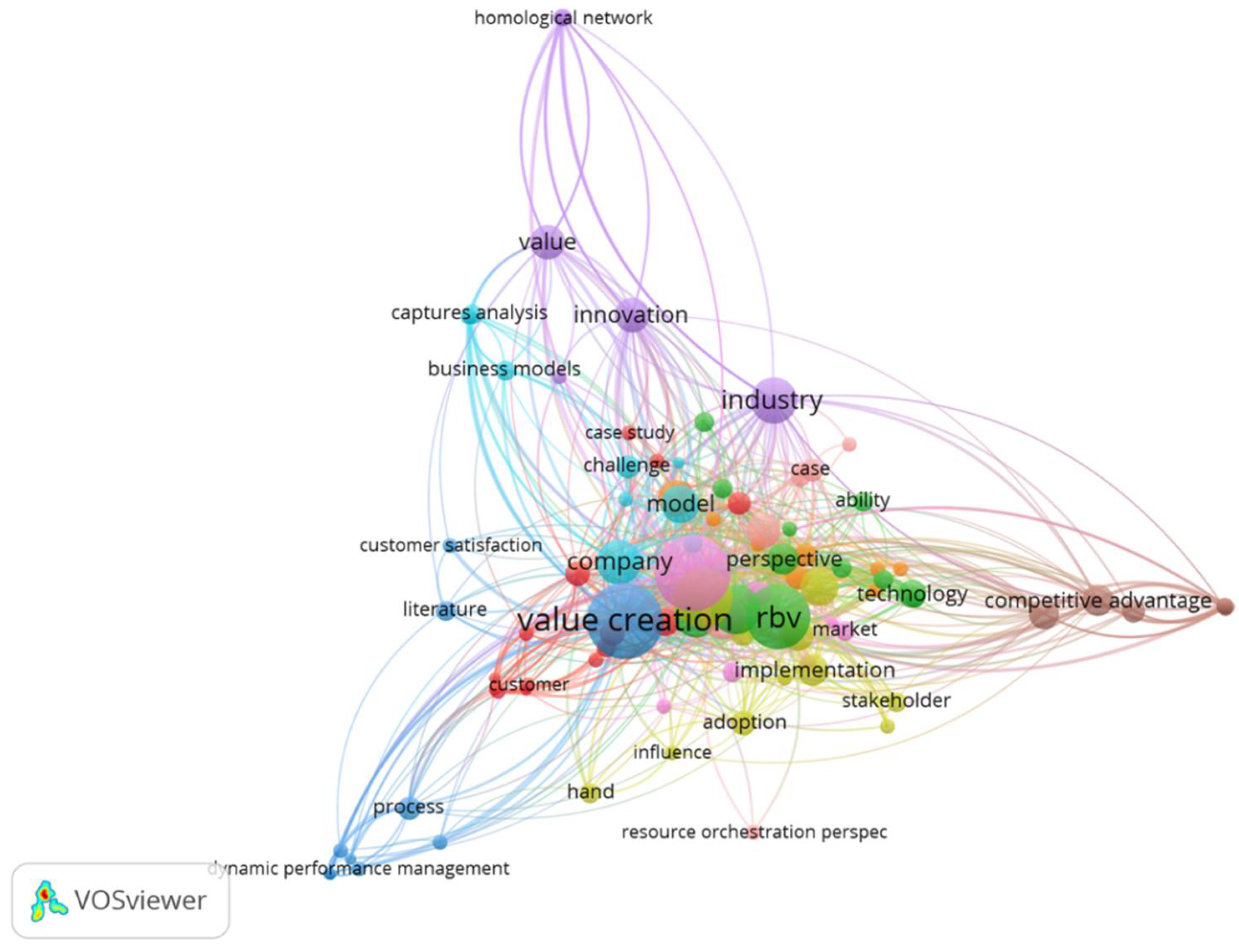
Figure 2.
Network by year of publication.
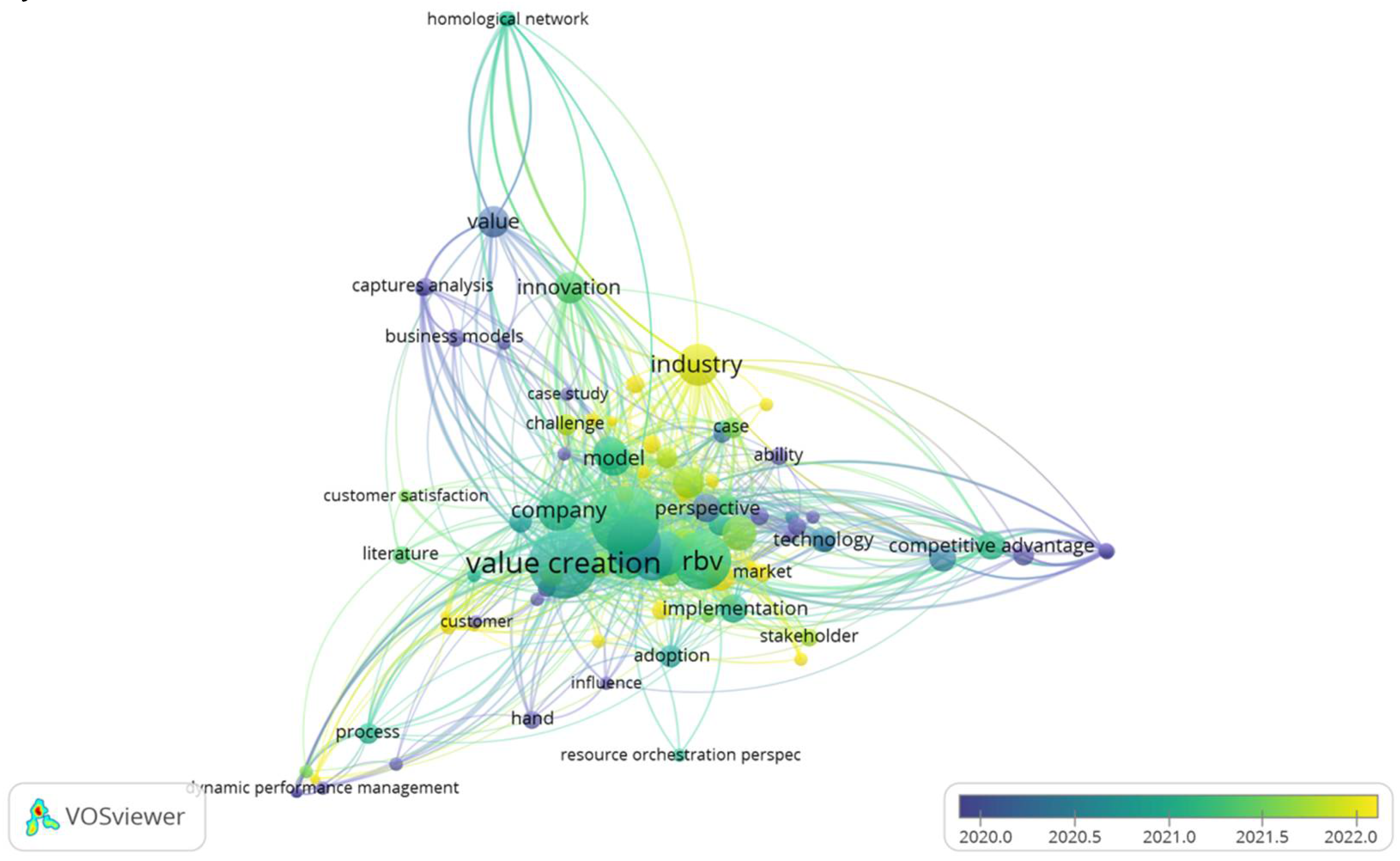
Table 2.
Findings of Sustainable Value creation managing transit orientation MRT.
| No. | Topic | Author | Objective | Findings | Theory | Method |
|---|---|---|---|---|---|---|
| 1. | A Model of ValueCreation: Strategic View. | Cengiz et al. (2014) | The main aim of the research is to propose a model of value creation in three dimensions: financial, non-financial and time. |
The research presents the following key findings: a. Stakeholder Values. b. Multidimensional Approach. c. Time Dimension. d. Value Creation Practices. e. The challenge of maintaining a broad value perspective during a crisis. |
The theoretical background used in this article mainly focuses on the concept of value creation and stakeholder theory. | The methodology used in the research involves a proposed value creation model in three dimensions: financial, nonfinancial, and time. |
| 2. | A stakeholder perspective of the value proposition concept. | Pennie and Adrian (2011) | The aim of this research is to explore the concept of value proposition (VP) and its role as a stakeholder alignment mechanism in marketing systems. | The main finding of this research is that value propositions play an important role in creating shared value between various stakeholders and act as a valuable alignment mechanism in marketing systems. | The theoretical background used is to integrate insights from the relationship marketing literature, which emphasizes the role of various stakeholders in creating and capturing value. |
The methodology used in this research is a literature review combined with conceptual analysis. The author critically analyzes existing literature and concepts related to value propositions from various sources to develop a comprehensive understanding of stakeholder perspectives on the value proposition concept. |
| 3. | Value Proposition: Application of Value Creation Activities Model In the Supermarket (Vcam-S). | Paulo et al. (2018) | The aim of this article is to explore the application of the Value Creation Activity Model in a supermarket context (VCAM-S). The author aims to investigate and present the value proposition in the supermarket industry, specifically focusing on the value creation activity model. | The main findings of this research are as follows: a. As a theoretical basis for value propositions, loyalty, innovation, expectations, strategies, and tendencies in identifying value activities and their respective value sources. b. Identify various value creation activities in the supermarket sector, such as providing convenience in finding products, offering a mix of products with welfare attributes, launching product novelties, and providing a product mix with practicality attributes. c. The Value Proposition Framework is based on research findings and provides a structure for understanding and applying value propositions in a supermarket context. |
The theoretical basis used in the research is to explore the concept of value proposition as a position statement that defines target customers, why customers buy, and what the company sells. | The methodology used in this research involves two main stages. a. The first stage consisted of a bibliographic review, where articles in the field of marketing and supermarket retail were researched and analyzed. b. The second stage involved collecting primary data through personal interviews with 12 professionals from the supermarket sector. |
| 4. | Modeling An Organizational Sustainable Competitive Advantage. | Sunje and Pasic (2011) |
The aim of this research is to develop a model that describes the process of building sustainable competitive advantage for organizations, including static and dynamic aspects. | The main finding of this research is the development of a model of sustainable competitive advantage in organizations. This model consists of static and dynamic aspects. | The theoretical background of this research revolves around developing a model for building sustainable competitive advantage in organizations. It is based on the VRIO (Value, Rareness, Imitability, Organization) strategic tool framework, which is an extension of internal analysis. | The methodology used in this research is the development of a model that describes the process of building sustainable competitive advantage, both static and dynamic aspects. The model developed is based on the strategic tool framework VRIO (Value, Rareness, Imitability, Organization). |
| 5. | Competitive strategy, structure and firm performance (A comparison of the resource-based view and the contingency approach). | Eva et al. (2018) | The purpose of this research is to examine the relationship between organizational structure, competitive strategy, and company performance. This research aims to contribute to the understanding of how these factors interact and impact company performance. | The main finding of this research is that the relationship between organizational structure and company performance is influenced by competitive strategy. This study emphasizes the importance of considering the fit between strategy, structure, and performance, and suggests that the Resource-Based View (RBV) model provides valuable insights in this context. |
The theoretical background of this research is mainly based on strategic management and organizational theory. This article draws on various theoretical frameworks such as the resource-based view of the firm, core competencies, strategic fit, environmental fit, and contingency theory. | The methodology used in this research involved collecting data from companies with 250 or more employees, using opinion scales to assess organizational structure and competitive strategy, and using subjective performance measures. |
| 6. | Does VRIO help managers evaluate a firm’s resources? | Paul (2016) | The aim of research on the VRIO method is to evaluate whether the method helps managers analyze company resources. | A key finding from research on VRIO methods and their impact on strategic actions and analysis of corporate resources is that although VRIO encourages users to evaluate resources relative to competitors and competitive dynamics, VRIO also has limitations. | The research focuses on the theoretical background of the VRIO (Value-Rarity-Imitability-Organization) method and its impact on strategic actions and corporate resource analysis. | Research papers on VRIO methods and their impact on strategic actions and enterprise resource analysis use experimental methods to directly evaluate user analyzes guided by VRIO relative to those that are not. |
| 7. | Assessing the relationship between firm resources and product innovation performance (A resource-based view). | Lily and Hartini (2018) | The aim of this research is to investigate the relationship between firm resources and product innovation performance in the context of manufacturing firms. | This research emphasizes the importance of intangible resources, especially product reputation, in driving product innovation performance in the context of manufacturing firms in Malaysia. | The theoretical background in this research is based on the Resource-Based View (RBV) of strategic management. The RBV focuses on the firm as a unique collection of resources and emphasizes that not all resources have the potential to provide a firm with a sustainable competitive advantage. | The methodology used in this research involved developing a questionnaire based on accepted scale development methods for business research. The questionnaire was then distributed via a mail survey to technology entrepreneurs. |
| 8. | Value proposition as a catalyst for a customer focused innovation. | Lindic and Marques (2011) | The aim of this research is to investigate the role of value propositions as innovation catalysts. This research focuses on identifying value proposition elements and their relationships in different contexts, such as product, industry, or customer life cycles. | The main findings of this article include a comprehensive list of novelties and general characteristics discovered through research. | This research draws on various theoretical backgrounds to support its research, including: a. Business Model Innovation. b. Value Proposition Theory. c. Innovation Theory. d. This research uses a case study approach. e. Interdisciplinary Perspective. |
The methodology used in this research involved an embedded design, which aims to reduce the limitations of single case studies by allowing for more in-depth analysis through examination of subunits. The unit of analysis chosen is individual novelty, making it possible to carry out systematic and detailed case analysis. |
| 9. | Value Propositions of Public Adult Hearing Rehabilitation in Denmark. | Katja (2023) | The aim of this article on adult community hearing rehabilitation in Denmark is to identify and evaluate the value proposition of the hearing rehabilitation process in the Danish public health system. | Key findings from this research include the following: 1. Identify the Value Proposition. 2. The Importance of the Diagnostic Process. 3. Involvement of Closest Family. 4. Characteristics of Human Practitioners. 5. Physical Presence. 6. Methodological Approach. 7. Research Population. These findings provide insight into the factors that patients consider important in the hearing rehabilitation process of Danish adults. |
The theoretical background used in research on adult community hearing rehabilitation in Denmark involves exploring value propositions in the context of the Danish public health system. This research applies 2-step inductive and deductive theme-based analysis to identify 21 value propositions relevant to the hearing rehabilitation process. | The methodology used in this research involves two main steps: 1. Harvesting Value Proposition. 2. 2-step inductive and deductive theme-based analysis was used to identify 21 value propositions deemed relevant for further assessment. |
| 10. | Resource-based competitiveness: managerial implications of the resource-based view. | Jim (2010) | The purpose of this research is to discuss the shift in strategic management research from focusing on company products to focusing on internal factors such as resources and capabilities. | The main finding of research discussing the shift in strategic management research is that there has been a transition from focusing on a company's products to concentrating on internal factors such as resources and capabilities. | This research discusses the shift in strategic management research from a focus on company products to internal factors such as resources and capabilities. This shift is based on the theoretical framework of the resource-based view, which emphasizes the importance of a company's internal resources and capabilities in achieving sustainable competitive advantage. |
The methodology used in the research addressing this shift in strategic management research is not mentioned explicitly in the context provided. This research primarily focuses on the practical implications of the resource-based view and discusses how companies can benefit from adopting a more resource-based approach in their strategic management practices. |
Disclaimer/Publisher’s Note: The statements, opinions and data contained in all publications are solely those of the individual author(s) and contributor(s) and not of MDPI and/or the editor(s). MDPI and/or the editor(s) disclaim responsibility for any injury to people or property resulting from any ideas, methods, instructions or products referred to in the content. |
© 2024 by the authors. Licensee MDPI, Basel, Switzerland. This article is an open access article distributed under the terms and conditions of the Creative Commons Attribution (CC BY) license (http://creativecommons.org/licenses/by/4.0/).
Copyright: This open access article is published under a Creative Commons CC BY 4.0 license, which permit the free download, distribution, and reuse, provided that the author and preprint are cited in any reuse.


