

Submitted:
15 June 2024
Posted:
17 June 2024
You are already at the latest version
Abstract
E-commerce is the general concept of using new technologies to establish chain communication between producers, sellers, suppliers, generally providers of goods and services on the one hand and buyers, consumers or customers in general on the other hand, in order to make a decision. The best ways are to optimize goods and services, reduce costs and open new channels. This article tried to propose an e-commerce model for fresh agricultural products, which can not only maximize producer and consumer satisfaction, but also reduce waste, increase marketing efficiency, and provide environmental protection and sustainable development. The proposed model is based on a coherent and real-time monitoring system, designed by managers and clarification for producers and consumers. The components of this system are manufacturers, retailers, banks, sales and purchase brokers, logistics systems, supervisors and management of the e-commerce system. This system manages information flow, money flow and goods flow accurately and transparently. In this presented model, the duties of each member and how they work were explained, and its implementation requirements were also specified. This model paves the way for the future of sustainable food and preserving the environment with two functions, reducing waste and increasing consumer satisfaction through the supply of unprocessed and fresh products.
Keywords:
E-Commerce
; Fresh Food
; Digital System
1. Introduction
Food is one of the faster-growing product categories in e-commerce, growing at a rate of 58.5% in 2020. The food industry will have a cash flow of approximately $30 billion in 2025. With great opportunities ahead, the food industry still faces several fundamental challenges in terms of storage, shelf life, food safety and various regulatory restrictions (Azizi, May 11, 2024). It is very important to have a thorough understanding of the latest trends in food and to deliver what customers want? Surveys and studies have shown that e-commerce, that is, the connection between ready-made food suppliers and customers, has grown significantly. So that in many cities, this part of business has found a dominant share compared to face-to-face shopping. Supplier units compete with each other in the field of food delivery speed (logistics), providing clear information to customers and obtaining feedback from customer satisfaction to improve marketing strategies (Benerji et al, 2018). But when we talk about raw (fresh) food, we mean food products produced in the farm, such as fruits and vegetables, milk and meat, which naturally have different conditions for entering e-commerce due to their perishability and special health conditions (Azizi, Jun 03, 2024). The optimal model for e-commerce of raw food products involves various aspects such as quality control, supply chain optimization, pricing strategies, and logistics efficiency. Leveraging game theory, a penalty-inspection-centered approach, and deep learning techniques can enhance the management of economically motivated adulteration (EMA) in online raw agricultural product sales (Zarei et al, 2024). Additionally, employing mixed-integer linear programming for supply chain optimization, considering carbon emissions, food waste reduction, and transportation costs, can significantly impact total distribution costs and emissions in the fresh food supply chain system. Furthermore, integrating deep learning and data mining technologies can optimize e-commerce marketing by creating new customer value evaluation models based on data mining and e-commerce agricultural product value characteristics. Implementing a dynamic pricing model that adapts to market fluctuations and total current supply can enhance the success of agro-sellers in digital markets. By combining insights from these research papers, a comprehensive e-commerce model for raw food products can be developed to ensure quality, efficiency, and profitability in online sales.
Utilizing robust optimization to handle uncertainty in online shopping with endorsement fees, and leveraging e-commerce platforms to optimize and reconfigure agricultural supply chains for rural revitalization. Additionally, the evolutionary game model emphasizes coordination in fresh products e-commerce supply chains to mitigate moral hazard risks, while considering consumer preferences for quality in agricultural products to determine optimal pricing and output strategies in the agricultural supply chain. By integrating these insights, an effective e-commerce model for raw food products can enhance quality control, profitability, and sustainability in the agricultural sector (Azizi, 2024).
This study has tried to examine the frontier of knowledge regarding e-commerce of food products by reviewing the studies done. It was found that most of the studies regarding the establishment of e-commerce are in the service sector, i.e. companies and hot and cold ready food supply units and customers or consumers who are mostly urban dwellers. Studies have shown that the development of this technology is more prosperous in industrial and large cities due to commuting costs, diverse activities of residents and other economic and social factors. But what has existed so far due to the wide range of issues involved in the system and the difficulty of establishing an effective marketing system in fresh food products, this sector has not benefited from the benefits of e-commerce (Azizi and Arefeshghi, 2011). Considering the importance of fresh food products due to the daily consumption of products, the desirability of fresh consumption, the problems of rapid spoilage and waste, special and hygienic transportation conditions, and other features that indicate high market risk. This study tries to propose a marketing model based on e-commerce to propose an efficient structure of using e-commerce in this important economic sector with high risk.
2. Theory and Literature Review
E-commerce means conducting business transactions through electronic tools such as the Internet, telephone, ATM, mobile and computer. E-commerce, like any other digital technology or consumer-driven shopping market, has evolved over the years and the ever-changing market provides a great opportunity for businesses to improve their customer relationships and market themselves in the world. Expand online. Now, this issue is taken into consideration, why raw food products have not been able to be included in the platform of electronic commerce, similar to other industrial goods?
To enter e-commerce, organizations must first justify EC-related projects within themselves. Economic justification, preparation and ability of the organization, financial justification and necessary infrastructure are among the things that organizations should consider when entering e-commerce to justify it (Azizi and Yazdani, 2007). Specifically, e-commerce capabilities promote sharing among agricultural firms, customers and business partners, eliminate barriers to information flow and reduce information asymmetry by providing more accurate and timely information, thus increasing efficiency and reducing costs (Zhu, 2004; Wuet al., 2019).
Ruyi and et al, (2024), investigated e-commerce in agriculture. Rapidly expanding studies investigate the effects of e-commerce on company operations in the retail market. However, the interaction between agro-food e-commerce (AEC) and the traditional agro-food wholesale industry (AWI) has not received enough attention in the existing literature. Based on the provincial panel data from 2013 to 2020 in China, this paper examines the effect of AEC on AWI, comprising three dimensions: digitalization (DIGITAL), agro-food e-commerce infrastructure and supporting services (AECI), and agro-food e-commerce economy (AECE). First, AWI and AEC are measured using an entropy-based combination of indicators. The results indicate that for China as a whole, AWI has remained practically unchanged, whereas AEC exhibits a significant rising trend. Second, the findings of the fixed-effect regression reveal that DIGITAL and AECE tend to raise AWI, whereas AECI negatively affects AWI. Third, threshold regression results indicate that AECI tends to diminish AWI with three-stage inhibitory intensity, which manifests as a first increase and then a drop in the inhibition degree. These results suggest that with the introduction of e-commerce for agricultural product circulation, digital development will have catfish effects that tend to stimulate the vitality of the conventional wholesale industry and promote technical progress. Furthermore, the traditional wholesale industry benefits financially from e-commerce even while it diverts part of the traditional wholesale circulation for agricultural products.
In their study, Zijiang Zhu et al.(2021), made several important points. Experiments show that the 5G Internet of Things can not only provide information on the quality and safety of agricultural products, but also improve the circulation efficiency of agricultural products. The organic combination of 5 Internet of Things and circulation of agricultural products has brought revolutionary changes to the circulation management of agricultural products, and has also highlighted the value of the Internet of Things. The use of Internet of Things technology to realize agricultural information management can effectively ensure the safe production of agricultural products.
Dariusz Strzębicki, (2015) in his research, told the development of information technology and the Internet make it, they are increasingly being used in agribusiness. Electronic commerce has had a tangible impact on the way business is conducted and the structure of markets. The aim of the study is to assess the development of electronic commerce in agribusiness. The analysis was conducted on the example of Poland, which is a country with a specific structure of the agricultural market. It is shown that the development of electronic commerce in Polish agribusiness is at an early stage of development and at the same time is a process of evolutionary changes. The article also pointed to examples of current areas of application of e-commerce in Polish agribusiness and the potential future directions of its development.
3. Discussion and Model Presentation
According to the conducted studies, it was found that raw (fresh) food products, on the one hand, due to the desire of consumers to eat fresh, daily and wide consumption of these products, on the other hand, from the point of view of the marketing system, due to fast perishability, special transport conditions and health, high volume and low value, long distance from production centers to consumption, sensitivity and interference of the government in the marketing system, and the lack of health and quality supervision on this category of goods, have caused the presentation of a marketing model based on knowledge and efficiency to be more important .
3.1. Major Problems of Marketing Raw and Fresh Agricultural Products
Food and agricultural products are naturally consumed in both fresh (raw) and processed forms. Consumer demand for fresh food products is much higher than processed products. Agricultural and food products are divided into three categories based on consumption:
1- Fresh (raw) food products: such as fruits, vegetables and summer vegetables, fish, meat and eggs that do not change the nature and texture of the product from the farm to the final consumer.
2- Semi-processed products with a limited shelf life: such as dried fruit, dairy products, grain products that have changes in their original texture and the marketing process has somehow changed the nature of the original product.
3- Fully processed products: such as paste, jam, oil, sausage and sausage, etc., the nature of the product has completely changed in the transformation industries and its relationship with the nature of the primary agricultural product is not very recognizable.
The subject of the article belongs to the first group of this category, that is, fresh (raw) food products. These food products have a high risk in production and marketing, and the basic problems of the agricultural products market belong to this category. The most important marketing problems of food products are:
1- Small production units and inability to enter the target market
2- Ignorance of consumer preferences and lack of market strategy
3- Lack of direct communication between producer and consumer
4- Lack of competition in the market and branding due to the nature of the goods
5- High marketing margin due to high risk and dissatisfaction of producer and consumer
6- Uncertainty of market supply and inventory and even its estimation by suppliers
7- Lack of transparency in the market price
Farmers, consumers and intermediaries benefit from a marketing system. For farmers, marketing is a way to bring the produced products to the consumer market in better ways. E-commerce systems provide them with information about the market demand for agricultural products and create the basis for more and stable incomes. For the consumer, the e-commerce system is a means to get the products they need faster, with higher quality and at a cheaper price. For intermediaries, who are actually effective factors in transferring information from consumers to farmers and vice versa, it creates significant employment and income.
The different interests of these three groups make the farmer look for a market with higher prices for his products on the one hand, and on the other hand, consumers benefit from speed, quality, and low prices while receiving the products they want. , and in the meantime, the middlemen should provide the means of earning their livelihood in the best way with the services they provide to the producer and the consumer. E-commerce is the general concept of using new technologies to establish chain communication between producers, sellers, suppliers, generally providers of goods and services on the one hand and buyers, consumers or customers in general on the other hand, in order to make a decision. Better ways are to optimize goods and services, reduce costs and open new channels.
3.2. Reforming the Market Structure of Fresh (Raw) Agricultural Products
The first step in reforming the market for fresh agricultural products is price discovery that is, finding the right price for buyers and sellers in terms of product ownership transfer.
The Price Discovery mechanism, not the Price Taker, is a mechanism to find the most appropriate price that buyers are willing to pay to buy a product.
Ways to discover the price are:
3.2.1. Individual Agreements Based on (Mutually Acceptable Process) Such As
1- Pre-sale contracts (advances)
2- Production contracts (contracts before the start of production)
3- Future contracts, which are concluded based on the prediction of the parties from the future market, and assistance in providing production inputs or other services to the producer may be part of the contract.
4- Vertical integration (Integration) or (Value Chain)
3.2.2. Price Discovery Group Actions, Including
1- Group bargaining (cooperatives)
2- Government intervention: determination of maximum or minimum prices, stabilization or control of official prices, facilitation of mutual relationship between future buyers and sellers.
3- Auction market (Auctions): which are perfect examples of a competitive market environment?
One of the most important requirements for the entry of e-commerce systems into the marketing of agricultural products, especially fresh food products, is:
1- Distributing the fair share of factors in the chain of production to consumption in accordance with their role in creating value, especially by increasing the share of human capital through the promotion of education, skills, creativity, entrepreneurship and experience
2- Satisfying the producer and consumer through the elimination of ineffective intermediaries
3- Fast transfer of consumer demand to producer and vice versa
4- Production of transparent information about inventory and price
5- Clarity and streamlining of the distribution and pricing system and updating
6- Market monitoring methods
7- Increasing standard coverage for all fresh food products and promoting it
8- Clarity and streamlining of the distribution and pricing system and updating
9- Market monitoring methods
10- Increasing standard coverage for all domestic products and promoting it
11- Clarity and streamlining of the distribution and pricing system and updating
12- Market monitoring methods
The expected positive results of implementing the e-commerce system for fresh food products include supporting producers and consumers through:
1- Minimizing the difference between the amount paid by the consumer and the amount received by the producer
2- Increasing production quality
3- Increasing the quality of supply
4- Transparency and increasing market efficiency
5- Modernization of product distribution
6- Reducing waste in different stages of the market and preventing wastage of resources
7- Removing unnecessary intermediaries from the market
8- Improving the employment situation due to the possibility of creating employment in structured activities related to logistics
9- Trying to bring order to the chaotic situation of production and market and the despair of farmers
The design of the system and the way of communication between producers, marketing service units (grading, packaging, etc.) with the agency to modify the production pattern is as follows.
3.3. Duties of E-Commerce System
Creation and management of a new distribution system for fresh (raw) food products:
1- Creation of logistics systems (facilities, transportation) and software needed for proper buying and selling and exchange
2- Determining agents (representatives of the production and supply sector) with the priority of cooperatives and unions of the agricultural sector
3- Management and funding of virtual auction hall (exchange)
4- Financial management of accounts of distribution agents
5- Managing, monitoring and policing distribution matters and increasing producer and consumer satisfaction
6- Training of retailers and manufacturers
7- Obtaining the required standards from competent authorities
8- Creating or managing an integrated marketing service system (transportation, warehousing, grading, packaging, processing and providing specific standards for food health
One of the active factors in the brokerage system is one or two private companies or cooperatives that provide the necessary services for providing goods to the virtual auction hall (exchange) for a fee.
3.3.1. How are Brokers Determined?
They are selected by the distribution management in the form of a public call and with the final approval of the monitoring commission from the cooperative and private sector (by meeting the technical and legal requirements, priority is given to cooperative networks).
3.3.2. Description of Duties of Brokers
1- Communicating with manufacturers, sorting and packaging units to provide manufactured goods to the virtual auction hall (exchange) and create a suitable and capable logistics system
2- Management and supply of expert forces to monitor the quality of goods supplied in the market.
3.4. System Setup Steps
1- All market factors, including small and large producers, unions, exhibitors, trading companies, marketing service units, and brokers are registered in the transaction system.
2- Access to the trading system is free for all market agents and to receive a user code
3- Using the brokerage system to guarantee product quality and create transparency in the market through audit
4- Acceptance of fresh agricultural products in the proposed distribution system in accordance with packaging and grading standards
5- Initial supply and pricing of goods in the auction hall (exchange)
6- Finding (discovering) wholesale and retail prices based on the specified price in the auction hall (exchange)
3.5. Executive Operation Defaults
3.5.1. Administrative and Political Support of the Government
1- Planning and action to create and strengthen supply, processing, logistics, distribution and marketing networks using the power of the cooperative and private sectors.
2- Policymaking and planning, support and supervision in the production and supply process to discover the price in the distribution system
3- Issuing licenses for the establishment and operation of marketing service units (sorting, packaging and cold storage, etc.) and supporting investment in them and predicting the required banking facilities in production areas.
4- Compilation of instructions related to supply (collection, grading, packaging and product standard) in compliance with relevant laws and regulations.
5- Allocation of a number of pioneering cooperatives to start the network (minimum demand)
6- Memorandum with the applicant bank to create an electronic banking platform
7- Attracting the opinions of government units, the private sector, trades and related unions and banks, as well as cooperating with related organizations in the matter of supply and distribution.
8- Supervising the entry and exit and supply of fresh agricultural products in the market with a plan to organize the supply
9- Responsible for the executive operations of the organization plan (brokerage, auction hall, etc.) according to the description of duties specified through distribution management and an investor company.
3.5.2. Support for Creating Infrastructure and Performing Necessary Services
1- Support and planning to create infrastructure such as software systems in appropriate places
Support for creating, equipping and improving workshops that perform marketing services (grading, packaging, labeling, etc.)
2- Financial support to provide educational and promotional services for agents active in the market to achieve the goals of the plan
4. Results
In today's world, e-commerce is growing and developing rapidly. Studies have shown that e-commerce in the food sector has been much more attractive than other sectors, especially in the context of the Covid-19 pandemic. But what has been the subject of this article; new agricultural products have not received much attention from this commercial technology. This article tried to propose an e-commerce model for fresh agricultural products, which can not only maximize producer and consumer satisfaction, but also reduce waste, increase marketing efficiency, and provide environmental protection and sustainable development. . The proposed model is based on a coherent and real-time monitoring system, designed by managers and clarification for producers and consumers. The components of this system are manufacturers, retailers, banks, sales and purchase brokers, logistics systems, supervisors and management of the e-commerce system. This system manages information flow, money flow and goods flow accurately and transparently. In this presented model, the duties of each member and how they work were explained, and its implementation requirements were also specified. This model paves the way for the future of sustainable food and preserving the environment with two functions, reducing waste and increasing consumer satisfaction through the supply of unprocessed and fresh products.
References
- Azizi, Jafar, the Prospect of Food Security with Artificial Intelligence (May 11, 2024). Available at SSRN: https://ssrn.com/abstract=4825112. [CrossRef]
- Azizi, J. (2024). A Review of Food Supply Chain and Food Security's Indicators. Available at SSRN: https://ssrn.com/abstract=4737374. [CrossRef]
- Azizi, Jafar, Supply Chain Management of Food Using Artificial Intelligence Technology (June 03, 2024). Available at SSRN: https://ssrn.com/abstract=4852056. [CrossRef]
- Azizi, Jafar and Rahmani, Seyed Mehdi Klateh, Analysis of the Data Flow Diagram in the Market of Agricultural Products (May 12, 2024). Available at SSRN: https://ssrn.com/abstract=4825687. [CrossRef]
- Azizi, Jafar, Application of Artificial Intelligence (AI) In-Farm (May 19, 2024). Available at SSRN: https://ssrn.com/abstract=4833664. [CrossRef]
- Azizi. J. (2018). Analysis of food consumption model and food insecurity border of rural households of Guilan province. Journal of Rural Economic Research. NO.8. VOL.4. Pages: 35-50. http://ruraleconomics.kiau.ac.ir/article_536261_en.html.
- Azizi, J. (2007). Economic evaluation of rice marketing strategies in guilan province. Journal of agricultural sciences, 12(4), 715-728. (In Persian).
- Azizi, J. and Yazdani, S. (2007). Investigation stability income of export date of Iran. Iranian Journal of Agricultural Science. 13(2):2-19.
- Azizi, J., and Aref Eshghi, T. (2011). The Role of Information and Communication Technology (ICT) in Iranian Olive Industrial Cluster. Journal of Agricultural Science. 3(1): 228-232. [CrossRef]
- 10. Azizi, J. and Yazdani, S. (2004). Determination of Comparative Advantage of the Main Horticultural Products in Iran. Journal of Agricultural Economics and Development 46(2): 41-72.
- 11. Azizi, J. and Yazdani, S. (2007). Investigation stability income of export date of Iran. Iranian Journal of Agricultural Science. 13(2):2-19.
- 12. Azizi, J., and Yazdani, S. (2006). Investigating Export market of Iran apple emphasized on the principle of comparative advantage export. Journal of Construction and Research in Agriculture and Horticulture, Vol 73, pp. 145-155.
- 13. Bannerjee, G., Sarkar, U., Das, S., & Ghosh, I. (2018). Artificial intelligence in agriculture: A literature survey. International Journal of Scientific Research in Computer Science Applications and Management Studies, 7(3), 1-6.
- 14. Dariusz Strzębicki, (2015). The Development of Electronic Commerce in Agribusiness – The Polish Example. Procedia Economics and Finance 23(2):1314-1320. [CrossRef]
- 15. Guixiang Zhu, Zhiang Wu, Youquan Wang, Shanshan Cao, Jie Cao, (2019). Online purchase decisions for tourism e-commerce. Online purchase decisions for tourism e-commerce, Volume 38, November–December 2019. [CrossRef]
- 16. Ruyi Yang, Jifang Liu, Shanshan Cao, Wei Sun, Fantao Kong. (2024). Impacts of agri-food e-commerce on traditional wholesale industry: Evidence from China. Journal of Integrative Agriculture, Volume 23, Issue 4, April 2024, Pages 1409-1428. [CrossRef]
- 17. Zarei, Nasibeh and Azizi, Jafar, Correlation between Food Security, Climate Change, and Women Role (February 24, 2024). Available at SSRN: https://ssrn.com/abstract=4737380. [CrossRef]
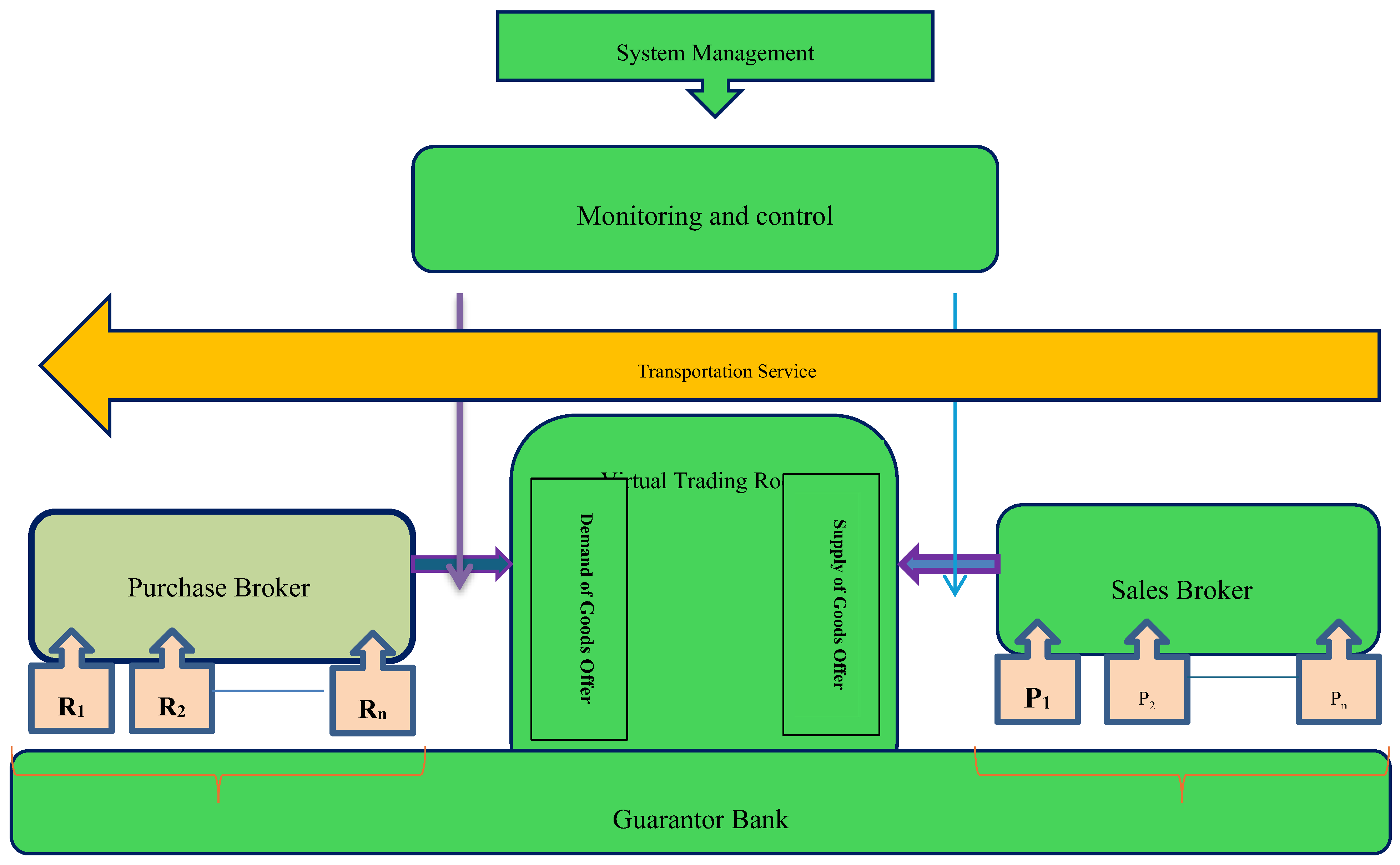
Figure 1.
How to operate in the e-commerce marketing system of fresh food products. P1….Pn: Producers , R1…..Rn: Retailer (Azizi and Rahmani, 2024).
Figure 1.
How to operate in the e-commerce marketing system of fresh food products. P1….Pn: Producers , R1…..Rn: Retailer (Azizi and Rahmani, 2024).
Disclaimer/Publisher’s Note: The statements, opinions and data contained in all publications are solely those of the individual author(s) and contributor(s) and not of MDPI and/or the editor(s). MDPI and/or the editor(s) disclaim responsibility for any injury to people or property resulting from any ideas, methods, instructions or products referred to in the content. |
© 2024 by the authors. Licensee MDPI, Basel, Switzerland. This article is an open access article distributed under the terms and conditions of the Creative Commons Attribution (CC BY) license (http://creativecommons.org/licenses/by/4.0/).
Copyright: This open access article is published under a Creative Commons CC BY 4.0 license, which permit the free download, distribution, and reuse, provided that the author and preprint are cited in any reuse.


