

Submitted:
09 June 2024
Posted:
11 June 2024
You are already at the latest version
Abstract
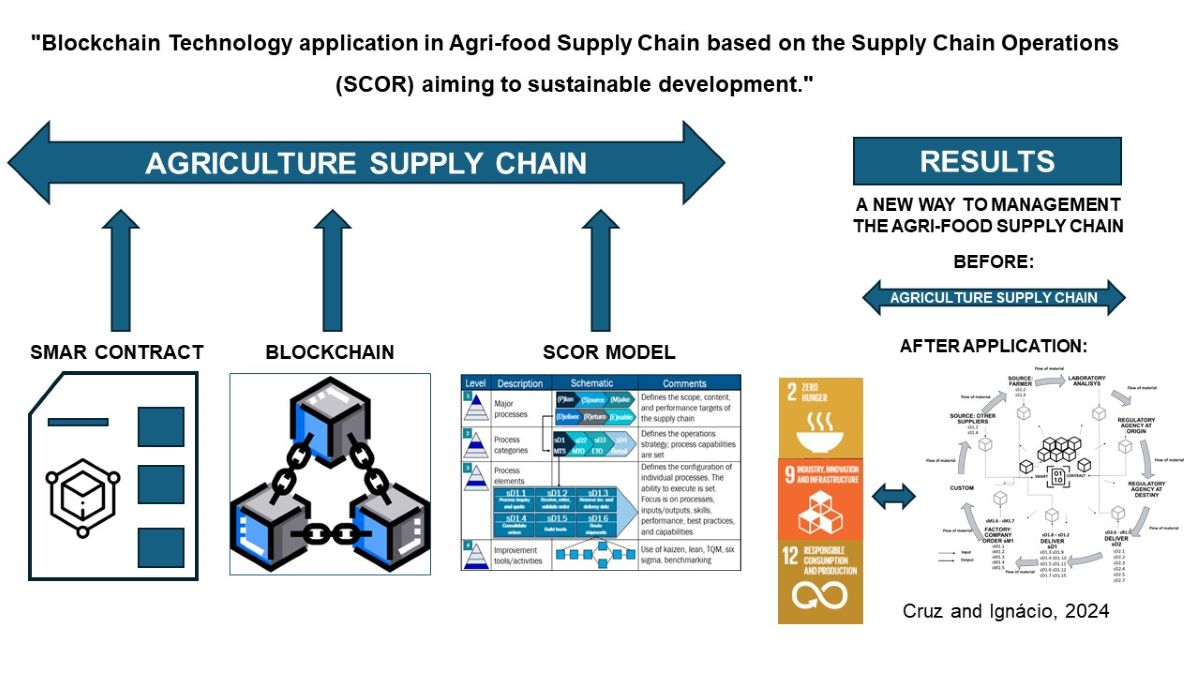
⦁ Introduction: The challenging context, resulting from a post-pandemic scenario, wars, and various natural disasters, does not allow for the ideal assurance of efficiency in the Agri-food supply chain.
⦁ Research significance
Currently, Agri-food supply chains and Reverse logistics show critical characteristics such as centralization, limited flexibility, distrust, bureaucratization, Border and Documentary Compliance and there are problems about efficiency, security, and safety Agri-Food. using the Supply Chain Operations Reference (SCOR) framework, with the purpose of achieving Sustainable Development Goals, promoting transparency, traceability, and non-linearization of the agri-food supply chain.
⦁ Methodology
The methodology is combined, the first part uses Preferred Reporting Items for Systematic Reviews and Meta-Analyses (PRISMA) identifying 72 articles with the principal contribution in the literature. The second part combines the application of Supply Chain Operations References (SCOR) and the Blockchain Technology aiming to decentralize the linear Agri-food Supply Chain and Reverse logistics.
⦁ Results/findings
The results revealed a transformation of the traditional Agri-food Supply Chain, transitioning from linear management to a circular one. Additionally, after application it is possible to know a new way to manage the Reverse Logistic with more decentralization, flexibility, traceability, and reducing the unnecessary activities, which include Border and Documentary Compliance. The originality of this research is the novel combination of SCOR Model and Blockchain showing a priority about the key activities that add value and come close to the Sustainable practices.
⦁ Conclusion / Implications
Based on the results is possible to conclude that the synergy between Blockchain and SCOR Model enables a new way to manage the Agri-food supply chain, improving efficiency and reducing activities without value. Also, it is possible to ensure that the practices of Reverse Logistics are improved based on terms of cost and time, and the reduction of the exposition on the Defective Product Risk.
⦁ Social Implications
This paper could enhance confidence in all operations of the Agri-food supply chain as there are numerous issues regarding the security and safety of food. Additionally, it will aid in diminishing unnecessary activities and inefficient resource consumption practices, thereby accomplishing objectives 2 "zero hunger", 9 "Industry, Innovation, and Infrastructure", and 12 "Responsible consumption and production", along with their respective indicators.
⦁ Practical implications
Regarding the practical implications, this research could contribute to analyses of the application of technology Blockchain in different sectors and identify the possible limitations when the main objective is to apply it on a big scale.
Keywords:
Agricultural
; SCOR Model
; Blockchain
; Supply Chain
; Sustainable Development Goals.
1. Introduction
Currently, many enterprises are looking for new ways to reduce waste, and to ensure food security and safety in the supply chain Agri-food. In this sense, those problems are a big challenge for different stakeholders (Kayikci et al., 2022) and more of 33 percent of the world Agro food production is wasted (S. Joshi et al., 2023). Additionally, the interruptions in the supply chain were studied inside the academy community due to the COVID 19, Wars, and lake of favourable wealth (Rashid et al., 2022; Rejeb et al., 2022).
Moreover, a number of food contamination incidents, such the cadmium-contaminated avocados, the horse meat, and the lead-contaminated noodles, raise doubts about the efficacy of controls and remedial actions (Hang et al., 2020; Niknejad et al., 2021; Zkik et al., 2022). With those appointments, there is a discussion based on the centralized information and the others insufficient methods for controlling the process in all supply chain, as a result, decentralizing information is the main obstacle facing traditional logistics (Mistry et al., 2020). Additionally, questions arise regarding the time taken to identify these defective products, given that many countries face security and safety issues with food. Unfortunately, tools and mechanisms alone are not the sole solution to this problem.
The logistics traditional maintenances common practices and some of which are insufficient for this time because there is food waste in each process of production and distribution. Nowadays, it exists a geometric growing, demand of many types of products, high levels of transportation, trends and buyers in every part of the world (Hilt et al., 2018). These references challenge the performance of the supply chain and with that other ways of to attend requirements.
In this sense, there are challenges for the Agri-food Supply Chain and the Reverse Logistics, the first one is to identify the defective products and the second one is to separate or recuperate those products. Based on that, this paper aims to apply Blockchain technology in the management of the agri-food chain, using the Supply Chain Operations Reference (SCOR) framework, with the purpose of identifying the defective products and improvement the performance of the Logistics Reverse achieving to Sustainable Development Goals like objective 2 “zero hunger”, objective 9 “Industry, Innovation and Infrastructure” and objective 12 “Responsible Consumption and Production”. Regarding specific objectives, they are to identify the main thematic axes in the literature, organize the identified articles according to categories and research focuses, and finally, simulate the smart contract for Reverse Logistics.
2. Literature Review
2.1. SCOR Model
Supply chain operations need a clear way for aiming to attend requirements, which are sent since different teams and any other stakeholder. Based on that, the Association for Supply Chain Management (APICS) providers education, research, and certification programs for improving all of activities development in the supply chain. Furthermore, there are different version of SCOR MODEL and now, the last version 12.0 is implemented.
On the other hand, SCOR MODEL shows around the six primary management processes known as Plan, Source, Make, Deliver, Return and Enable (APICS, 2017). Those processes allow to simplify the supply chains including their self-complexities, it is very important when the top management decides to know the customer’s demand. In this sense, the Figure 1 shows in detail each component of SCOR MODEL.
For the SCOR MODEL exists four levels, the first level includes the six major processes explained in the previous paragraph. The second level explains the four process categories, and these are “sD1- Make to Stock (MTS)”, “sD2 – Make to Order (MTO)”, “sD3 – Engineering to Order (ETO)” and “sD4 – Retail”, which define the operations strategy based on processes capabilities. The third level shows the configuration of individual processes, for instance in Figure 1, the process elements that have been shown, it belongs to Make to Stock. The fourth level is all activities for each process and in this level is applied other methodologies to improvement of performance of supply chain.
2.2. Agrifood Supply Chains, Reverse Logistic and Sustainability
The trend towards healthy eating and lifestyle has allowed consumers to incorporate fruits and vegetables into their daily diet (Chaudhary et al., 2024). In this regard, to achieve the, supply chain management is necessary, understood as "...the planning and management of all activities involved in the supply and acquisition, conversion, and all logistics management activities" (CSCMP, 2023). Furthermore, concerning Supply Chain Agriculture, it is understood as the management of the entire agri-food chain from seed production to product delivery to the end customer.
Currently, sustainable agri-food chains aim not only to reduce the negative impact generated by traditional supply chain activities but also to introduce pollution reduction initiatives at each stage of the supply chain (Prataviera et al., 2023). The shorter the supply chain, the less susceptible it is to external disruptions (Ribašauskienė et al., 2024). Conversely, unsustainable food supply chains can lead to an increase in the impacts of climate change (Cossu et al., 2024).
On a global scale, aspects related to food safety and security involve consideration throughout the farm-to-table process, taking into account the food supply chain (Raki et al., 2024). Additionally, there are theoretical models to ensure a solid foundation for sustainable practices in the supply chain (Siddh et al., 2024), and good practices in agri-food chain management can produce quality food, aiming for environmental sustainability (Untari & Satria, 2024).
On the other hand, there are many challenges present on the activities around of each step in the Agrifood Supply Chain, for instance to attend requirements of the population with a growth in geometric rate, to reduce the Ambiental impact in all operations, to develop sustainable practices (Lin et al., 2020). Furthermore, the Table 1 shows the most important compliance in the logic of the Supply Chains.
The Documentary and Border Compliance include many physical documents and authorizations for ensuring the transparency and authenticity of products that it will be sent for other countries. Based on before, there are a lot of unnecessary activities such as “send of documents for freeing the products, Certificates of origin for ensuring transparency, authorization for showing the auditability and sharing the responsibility and unnecessary logistics costs”, those activities could be changed with a new way to management of the supply chain. Currently, we observed that the current supply chain management is centralized in information and exists unnecessary costs and activities.
2.3. Disruptive Technology Blockchain
Regarding to Blockchain many authors concluded that it’s a disruptive technology (González-Puetate et al., 2022; S. Joshi et al., 2023; Sunar & Swaminathan, 2022; Vivek & Dalela, 2022). Blockchain offers a new way to management of supply chain and reduces the number of participants or intermediaries, which is important because reduces unnecessary costs and improves the performance of the supply chain. In this sense, others authors proposed and concluded that Blockchain offers advantages as like information decentralized, immutability, traceability and smart contracts (K. Dey & Shekhawat, 2021; R. Gupta & Shankar, 2023; Yontar, 2023). Additionally, each block contains a version number, Hash (Identified code), Time stamp (digital signature), Merkle root, Balance Code storage and List of transactions, Figure 2 shows the logic of Blockchain.
Additionally, this technology has many different consensus mechanisms, which allow to addition information in the Blockchain. Basically, those consensus mechanisms are different from each other, and the principal characteristic is the energy consumption. In this sense, some of consensus mechanisms are Ripple client-server based consensus, PBFT Practical Byzantine Fault Tolerance, PoW Proof of Work (PoW), PoS Proof of Stake (PoS), DPoS Delegated Proof of Stake (DPoS), PoB Proof of Burn (PoB), Proof of Luck (PoL), Proof of Activity (PoA), Proof of Elapsed Time (PoET) and Proof of Space (PoSp) (Vangala et al., 2021).
3. Materials and Methods
The design of this research was organized into four phases, Figure 3 illustrates the research design, considering replicability and transparency (Cruz & De Arruda Ignacio, 2023; Dabees et al., 2023).
The first step includes the introduction and both the general and specific objectives. The second step presents a literature background with the topics studied. The third step shows the method of the current study with its respective sequence based on the PRISMA Model, the processing information with Rstudio, the use and application of SCOR model and the development of Smart Contract. The fourth step describes the results, which are related with the objectives specifics. Additionally, the five step contains the discussion, conclusions, limitations, and future studies that will be proposed in this last step.
4. Development and Results
Regarding the bibliometric and systematic review, the PRISMA model was organized into 4 stages: Identification, Screening, Eligibility, and Inclusion.
In the first stage, the proposed keywords were “SCOR” or "Supply Chain" or "Reverse Logistics" and "Blockchain" and "Safety Food" or "Security Food" aiming to cover the largest number of articles to be addressed for the present research, all obtained from the Scopus and Web of Science databases. Next, in the second stage, exclusion criteria were established, including articles outside the 10-year range (2013-2023), those without Digital Object Identifier, and duplicate articles. Then, the third eligibility phase identified articles linked to the study's focus. Additionally, articles related with SCOR did not be identified with high precision, but some of them were includes in the last stage, in this sense, the last criterion allowed the addition of 9 articles, making the final "N" 72 articles to be studied and analyzed. Please refer to Figure 4 for details.
Subsequently, the identified articles were processed within the RStudio software using the Bibliometrix package.
Furthermore, in Figure 5, different thematic axes identified within the literature review are presented, organized into four quadrants. The first quadrant, Motor Themes, organizes the most frequent or relevant topics, such as Blockchain, Food security, and Supply chain. The second quadrant, Niche Themes, includes specific topics, for example, aquaculture and authentication. The third quadrant displays topics under discussion within the community that are of high interest, such as Sustainable Development, Food chains, and resilience. Finally, the fourth quadrant shows basic topics like scalability.
Next, Table 2 is presented, which provides information on the Research Category of all the identified and addressed articles in the study. It is observed that there is a higher concentration of conceptual research, which demonstrated solid knowledge of general topics. For example, the disruptive technology Blockchain and its benefits, advantages, improvement opportunities, and challenges were extensively covered. Additionally, topics related to food safety, food security, waste in agri-food chains, supply chain issues, challenges in the chains, and quality losses were addressed. Furthermore, topics such as the importance of Sustainable Development and proposals related to Sustainable Development Goals made a notable contribution.
On the other hand, research with empirical contributions, such as case studies, test models, interviews, and expert opinions, helped reinforce the enablers, drivers, and flexibility of proposed Blockchain applications. Subsequently, research involving the application of mathematical and technical models showed a lower concentration within the identified articles. Following this, Table 3 is presented, displaying the Research Approach, which allowed for the organization of all the identified research in this study.
Consequently, it was observed that many of the identified research studies reinforced the utility of Blockchain within agri-food chains at various points, such as quality, food safety, sustainable utilization, traceability, food provenance, recycling, and resilient infrastructure. In this sense, it was observed that there is a little concentration of research based on Prevention, Reduction, and Recycling. Furthermore, another observation is regarding to resilient infrastructure because many authors are developing architectural information based on Smart Contracts, which can help in other ways to contribute to the literature.
To identify processes which that could add value to final product is necessary. After identifying a Agrifood traditional chain, it was required to take the primary processes of SCOR MODEL, please to refer the Figure 6.
Before to describe the Figure 6, two of six processes of SCOR MODEL (Plan and Enable) have been considered like implicit. Continuing with the reasoning behind, it will be showing all of activities identified based on the Agrifood traditional chain, the first part has included “source” (green), in this component are presented all of suppliers like Farmer, Materials and Services suppliers, which add an input (sS1.4 – Transfer of product).
After, the second component received the input of the first component, for this example there are two fabrics, the first one produces to international selling and the second one produces to national selling. Here, it exists the next processes: sS1.2 – Receive Product, sS1.4 - Transfer Product, sM1.1 – Schedule Production Activities, sM1.2 – Issue Material, sM1.3 – Produce and Test, sM1.4 – Package, sM1.5 – Stage Product, sM1.6 – Release product to Deliver, sM1.7 – Waste Disposal.
Continuing, the third component is Deliver, which shows the following components: sD1.1 – Process Inquiry and Quote, sD1.2 – Receive, Enter and Validate Order, sD1.3 – Reserve Inventory and Determine Delivery Date, sD1.4 – Consolidate Orders, sD1.5 – Build Loads, sD1.6 – Route Shipments, sD1.7 – Select Carriers and Rate Shipments, sD1.8 – Receive Product from Source or Make, sD1.9 – Pick Product, SD1.10 – Pack Product, sD1.11 – Load Vehicle & Generate Shipping Docs, sD1.12 – Ship Product, sD1.13 – Receive and Verify Product by Customer, sD1.15 Invoice, sD2 – Deliver Make to Stock, sD2.1- Process Inquiry and Quote, sD2.2 - Receive, Enter and Validate Order, sD2.3 - Reserve Inventory and Determine Delivery Date, sD2.4 - Consolidate Orders, sD2.5 - Build Loads, sD2.6 - Route Shipments, sD2.7 - Select Carriers and Rate Shipments, sD2.8 - Receive Product from Source or Make, sD2.9 - Pick Product, sD2.10 - Pack Product, sD2.11 - Load Vehicle & Generate Shipping Docs, D2.12 - Ship Product, sD2.13 - Receive and Verify Product by Customer, sD2.15 - Invoice, SD4.1 – Generate Stocking Schedule, sD4.2 – Receive Product at Store, sD4.3 – Pick Product from backroom, sD4.4 – Stock Shelf, sD4.5 – Fill Shopping Cart, sD4.6 – Checkout, sD4.7 – Deliver and/or install, and sR1.5 – Return Defective Product.
Moreover, in the inferior part of Figure 6, it is observer that the physical products flow, which is linear and depends on the previous step. Furthermore, its observed the logic of each block of Blockchain based on the Smart Contract it means that for each block there is an information and successively there are many blocks with many information that in the final it will be see for all stakholders.
The red line, denoted as sR1.5 Return Defective Product, in Figure 6, is more conspicuous compared to traditional logistics management. Consequently, this logic will serve as input for the Smart Contract. Any alert in the Agri-food Supply Chain will prompt the identification of the red block, potentially mitigating the risk of exposure to Defective Products.
In consequence, it was necessary to construct a Smart Contract, which allows to observe all the functions based on the most critical processes. The Smart Contract was developed in REMIX IDE with the progradation’s language Solidity v.13. Next, there are ten functions, which are necessary for executing the Smart Contract and obtaining its performance. The name of the smart contract is “SUPPLYCHAINAGRIFOOD”, please refer to the Figure 7.
After applying and executing the smart contract on the Smart Chain Testnet with the support of Metamask, it is necessary to show that all information in the Blockchain is decentralized after to execute the transaction, Table 4 shows the cost and time for one operation for sending the alert for the stakeholders. The first part, “transaction hash” is the key part of the process, which contains all of the information of the block, and it enables auditability. The second part, “status” evidence if the process was or was not successful. The third part “Block” informs the number of Block, which contains the information. The fourth part, “Timestamp” shows the time of “execute” the operation and adding a digital signature of time, it is unmodified. The fifth part, “From and To” shows the digital address of each stakeholder. The sixth part, “Value and Transaction Fee” evidences the cost for that operation.
In this case, the alert sent for any participant of the Blockchain could help other participants. The time of the transaction is around 24 seconds for one alert and immediately every participant receives that message. It could help to stop the Agri-food supply chain flow, reducing the risk of contamination and improving the time of the reverse logistic.
The results of that contract indicate that the information of all operation in Agrifood supply chain is decentralized within a few seconds and the stakeholders are informed about any change into the Blockchain.
Activities such as “send of documents for freeing the products, Certificates of origin for ensuring transparency, authorization for showing the auditability and sharing the responsibility and unnecessary logistics costs” could be deleted or the way that those are did. It is important, activities that do not add value to supply chain management should be replaced.
Documentary and Border Compliance could be reduced in terms of cost, time and efficiency. Additionally, the documents sent by courier will be not viable in the future because a possible application of Blockchain aims to reduce the unnecessary displacement of documents or the consume of resources.
Additionally, under the proposed new decentralised logic, it is possible to issue alerts immediately. In other words, traditional procedures, which often involve excessive time and cost and expose consumers of agri-foods to risks, will not be relied upon. Therefore, the issuance of alerts on the blockchain network reduces the risk of food contamination and reinforces the identification of products and their return through the location of space carried out in logistics management. Please refer to Figure 8, which visually organises the new management approach based on the convergence of Blockchain and the SCOR Model.
The "Defective Product Identified" block can be issued from any level of the logistics chain, thus reducing and simplifying a significant number of processes. In this regard, the alert is subject to review, and if the alert is found to be accurate, the product or related products at all levels of the logistics chain are then frozen.
Besides, for each block added inside the Blockchain based on the Smart Contract, all of participants know in time real about this change. So, the integration of SCOR Model in the Agrifood Supply Chain enables clarification of the key activities that add value in each operation and those activities are input of the Smart Contract – Blockchain which ensure a new way to management the Agrifood Supply Chain. The highlight of this step is that the lineal operations are transformed for a circular management.
En relación con los Sustainable Development Goals (SDGs), la propuesta de investigacion presenta fuerte relación con algunos objetivos e indicadores específicos. La Tabla 5, muestra ese acercamiento entre la investigación y los objetivos, en este sentido, la primera columna muestra el objetivo que será abordado, en la segunda columna se identifica al indicador del SDGs (asignado por la ONU), la tercera columna describe las contribuciones de la convergencia entre Blockchain y SCOR Model y la cuarta columna muestra las ventajas pós aplicación de Blockchain, SCOR Model e Logistica Reversa.
5. Conclusions
Based on the results of this research is possible to affirm that Blockchain, Smart Contract and SCOR model can work together and offer a new way to manage the supply chain and reduce unnecessary activities and costs. Moreover, we can confirm through this research that the Border and Documentary compliance can be reduced aiming to develop sustainable. To pass for days or hours to seconds and the hundred dollars to less one dollar is attractive for the Supply Chain Industry, also decentralizing information is key for improving the efficiency and competitiveness of the supply chain. So, the cost for each operation is almost one dollar.
Additionally, the non-linear supply chain shows that each process can be traced and shared in real time with other participants of the network. In this sense, this proposal evidence that there is a priority about the key activities or activities that add value to supply chain, which were identified for the SCOR Model and decentralized for the Blockchain.
On the other hand, the first thing to keep in mind is that the subjects covered are convergent. The co-occurrence networks and clusters offered a preliminary justification of the study's applicability and significance. Thematic axes also revealed that there was a knowledge gap that needed to be filled, which has been filled with the findings covered in this article.
Furthermore, one must take into consideration the high level of existing and studied conceptual contributions. These contributions discussed the application of blockchain technology, which seems to have gained prominence in recent years, as well as the known advantages, benefits, and challenges of agri-food chains.
On the other hand, the limited number of application studies and tests means that the scientific community's learning curve has not reached a sufficiently high level of performance. As a result, this study sought to provide an innovative contribution by transitioning from theoretical and conceptual models to simulation research.
The second factor demonstrates that there is a contribution to understanding the benefits and advantages that blockchain technology provides after its application. Thus, such a contribution to supply chain management can be observed at different levels and with different outcomes, such as traceability, reliability, decentralization, and immutability.
The application of blockchain technology should be based on a minimal framework of technology, knowledge, and defined rule processing. As observed in the study, the SCOR model was able to provide clarification of processes, and Smart Contracts provided the automation of logic inserted into the blockchain network.
Next, the construction of the smart contract can change based on the requirements of agri-food chains and may differ in terms of response times and the central goal of decentralization. Consequently, our proposed smart contract meets the previously mentioned requirements in the development of this work.
The third consideration shows that the combination of Ethereum platforms, Remix IDE (interface), BscScan Testnet as a test network, and Metamask as a digital wallet offered controlled and reliable simulations. The virtual currencies provided to the network miners were obtained from BscScan Testnet, which is accessible and useful for assisting in future research.
Additionally, it was demonstrated that the SCOR model is highly useful for adopting blockchain technology in the agri-food chain. Furthermore, this contribution can be evaluated in the construction of smart contracts, as if a smart contract faithfully meets the time and resource reduction of a particular process, it can be considered that the convergence of the SCOR model and Smart Contract logic was successful.
Furthermore, three SDGs were addressed ("zero hunger", "Industry, Innovation and Infrastructure", and "Responsible consumption and production"), demonstrating that the proposed application of Blockchain can target specific indicators, bring organisations closer to sustainability, reduce the risk of food contamination, and exponentially improve the Reverse Logistics of contaminated products. Additionally, it should be noted that the decentralised identification of defective products within the new agri-food chain significantly reduces risks, costs, and time, thanks to immediate alerts within the blockchain network, as evidenced in the application.
A final consideration allows us to highlight that the convergence of the SCOR model, Blockchain, and the Agri-Food Chain is feasible, generating a new way of managing the supply chain, transforming the linear agri-food chain into a participatory and decentralized agri-food chain disruptively. As a result, the value of generation in this approach should be significant for the entire scientific community.
Finally, we observed that reducing unnecessary activities brings us closer to sustainable practices. Next, the objective of this article has been successfully achieved, offering the possibility of new approaches and discussions in the future.
5.1. Social Implications
This paper could ensure and reinforce confidence in all operations of the Agri-food supply chain because there are many problems about the security and safety of foods. Furthermore, it will help to reduce unnecessary activities and inefficient practices of the consumption of resources achieving objectives 2 “zero hunger”, 9 “Industry, Innovation and Infrastructure”, and 12 “Responsible consumption and production”.
5.2. Practical Implications
Regarding the practical implications, this research could contribute to analyses of the application of technology Blockchain in different sectors and identify the possible limitations when the main objective is to apply it on a big scale.
Limitations:
Regarding the limitations present in this study, researchers could take into account the following:
- Different agri-food chains may not be identical to those addressed in this case. However, they could consider many of the inputs presented in the study.
- The Smart Contract may be limited or not depending on the technical capabilities of different tools.
- Future Work:
- Agri-food chains and the current scenario offer constant changes; future studies could be oriented towards:
- Efficiency of the blockchain network in real-world scenarios.
- Conceptual and technical evaluation of the level of participation and willingness of each actor in the agri-food chain.
- The relationship between the application of blockchain technology in different processes and its connection to sustainable development goals.
References
- Abdulhussein, A.B.; Hadi, A.K.; Ilyas, M. (2020). Design a tracing system for a seed supply chain based on blockchain. 2020 3rd International Conference on Engineering Technology and Its Applications, IICETA 2020, 209–214. [CrossRef]
- Agnusdei, G.P.; Coluccia, B. Sustainable agrifood supply chains: Bibliometric, network and content analyses. Science of the Total Environment 2022, 824. [CrossRef] [PubMed]
- AlJemy, K. ; AlAnazi, M.; AlSofiry, M.; Baig, A.; IEEE. (2019). Improving IoT Security Using Blockchain. In 2019 IEEE 10TH GCC CONFERENCE & EXHIBITION (GCC) (Issue 10th IEEE GCC Conference and Exhibition (GCC)). [CrossRef]
- Andrade, A. F.; Costa, A.F.; da Poli, L.E.; Borelli, E.; Robles Junior, A. (2022). Custos de exportação e correlação com indicadores de desempenho. In Revista Eniac Pesquisa (Vol. 11, Issue 1). [CrossRef]
- Antonucci, F.; Figorilli, S.; Costa, C.; Pallottino, F.; Raso, L.; Menesatti, P. A review on blockchain applications in the agri-food sector. Journal of the Science of Food and Agriculture 2019, 99, 6129–6138. [CrossRef] [PubMed]
- APICS. Quick reference guide. Nursing Standard 2017, 13, 29–29. [CrossRef]
- Bansal, L.; Chaurasia, S.; Sabharwal, M.; Vij, M. (2022). Blockchain Integration with end-to-end traceability in the Food Supply Chain. 2022 2nd International Conference on Advance Computing and Innovative Technologies in Engineering, ICACITE 2022, 1152–1156. [CrossRef]
- Barbosa, M.W. Uncovering research streams on agri-food supply chain management: A bibliometric study. GLOBAL FOOD SECURITY-AGRICULTURE POLICY ECONOMICS AND ENVIRONMENT 2021, 28. [CrossRef]
- Bhatia, S.; Albarrak, A.S. A Blockchain-Driven Food Supply Chain Management Using QR Code and XAI-Faster RCNN Architecture. SUSTAINABILITY 2023, 15. [CrossRef]
- Chandan, A.; John, M.; Potdar, V. Achieving UN SDGs in Food Supply Chain Using Blockchain Technology. SUSTAINABILITY 2023, 15. [CrossRef]
- Chaudhary, S.; Kumar, S.; Kumar, V.; Singh, B.; Dhiman, A. Irradiation: A tool for the sustainability of fruit and vegetable supply chain-Advancements and future trends. Radiation Physics and Chemistry 2024, 217. [CrossRef]
- Collart, A.J.; Canales, E. (2022). How might broad adoption of blockchain-based traceability impact the <scp>U.S.</scp> fresh produce supply chain? Applied Economic Perspectives and Policy, 44, 219–236. [CrossRef]
- Cossu, D.; Zanchi, L.; Maranghi, S.; Zamagni, A.; Gaias, G.; Duce, P.; Vagnoni, E. Ecolabelling for improving sustainability of agri-food supply chain: An experimental implementation of the Made Green in Italy scheme on the hard sheep milk cheese. Cleaner Environmental Systems 2024, 12, 100153. [CrossRef]
- Cruz, L.; De Arruda Ignacio, P.S. Application of blockchain disruptive technology in agri-food chains for sustainable development, a systematic review. International Journal of Supply and Operations Management 2023, 10, 523–544. [CrossRef]
- CSCMP; //cscmp: (2023). Council for Supply Chain Management Professionals (CSCMP). https.
- Dabees, A.; Barakat, M.; Elbarky, S.S.; Lisec, A. A Framework for Adopting a Sustainable Reverse Logistics Service Quality for Reverse Logistics Service Providers: A Systematic Literature Review. Sustainability (Switzerland) 2023, 15. [CrossRef]
- Dey, K.; Shekhawat, U. Blockchain for sustainable e-agriculture: Literature review, architecture for data management, and implications. Journal of Cleaner Production 2021, 316. [CrossRef]
- Dey, S.; Saha, S.; Singh, A.K.; McDonald-Maier, K. SmartNoshWaste: Using Blockchain, Machine Learning, Cloud Computing and QR Code to Reduce Food Waste in Decentralized Web 3.0 Enabled Smart Cities. Smart Cities 2022, 5, 162–176. [CrossRef]
- Galanakis, C.M.; Rizou, M.; Aldawoud, T.M.S.; Ucak, I.; Rowan, N.J. Innovations and technology disruptions in the food sector within the COVID-19 pandemic and post-lockdown era. TRENDS IN FOOD SCIENCE & TECHNOLOGY 2021, 110, 193–200. [CrossRef] [PubMed]
- González-Puetate, I.; Marín-Tello, C.; Pineda, H.R. Agri-food safety optimized by blockchain technology: review. Revista Facultad Nacional de Agronomia Medellin 2022, 75, 9839–9851. [CrossRef]
- Gopi, K.; Mazumder, D.; Sammut, J.; Saintilan, N. Determining the provenance and authenticity of seafood: A review of current methodologies. TRENDS IN FOOD SCIENCE & TECHNOLOGY 2019, 91, 294–304. [CrossRef]
- Gupta, R.; Shankar, R. (2023). Managing food security using blockchain-enabled traceability system. Benchmarking-an international journal. [CrossRef]
- Gupta, S.; Berenji, H.R.; Shukla, M.; Murthy, N.N. (2023). Opportunities in farming research from an operations management perspective. Production And Operations Management. [CrossRef]
- Guruswamy, S.; Pojic, M.; Subramanian, J.; Mastilovic, J.; Sarang, S.; Subbanagounder, A.; Stojanovic, G.; Jeoti, V. Toward Better Food Security Using Concepts from Industry 5.0. SENSORS 2022, 22. [CrossRef] [PubMed]
- Hang, L.; Ullah, I.; Kim, D.-H. A secure fish farm platform based on blockchain for agriculture data integrity. Computers and Electronics in Agriculture 2020, 170. [CrossRef]
- Hassoun, A.; Boukid, F.; Pasqualone, A.; Bryant, C.J.; Garcia, G.G.; Parra-Lopez, C.; Jagtap, S.; Trollman, H.; Cropotova, J.; Barba, F.J. Emerging trends in the agri-food sector: Digitalisation and shift to plant-based diets. CURRENT RESEARCH IN FOOD SCIENCE 2022, 5, 2261–2269. [CrossRef] [PubMed]
- Hew, J.J.; Wong, L.W.; Tan, G.W.H.; Ooi, K.B.; Lin, B.S. (2020). The blockchain-based Halal traceability systems: a hype or reality? SUPPLY CHAIN MANAGEMENT-AN INTERNATIONAL JOURNAL, 25, 863–879. [CrossRef]
- Hilt, M. ; Shao, D.; Yang, B.J.; Machinery, A.C. (2018). RFID Security, Verification, and Blockchain: Vulnerabilities within the Supply Chain for Food Security. In SIGITE’ 18. [CrossRef]
- Hofman, W. J. (2019). A Methodological Approach for Development and Deployment of Data Sharing in Complex Organizational Supply and Logistics Networks with Blockchain Technology. In IFAC PAPERSONLINE (Vol. 52, Issues 15th International-Federation-of-Automatic-Control (IFAC) Symposium on Large Scale Complex Systems (IFAC LSS), pp. 55–60). [CrossRef]
- Joshi, P.; Tewari, V.; Kumar, S.; Singh, A. (2023). Blockchain technology for sustainable development: a systematic literature review. JOURNAL OF GLOBAL OPERATIONS AND STRATEGIC SOURCING. [CrossRef]
- Joshi, S.; Sharma, M.; Ekren, B.Y.; Kazancoglu, Y.; Luthra, S.; Prasad, M. Assessing Supply Chain Innovations for Building Resilient Food Supply Chains: An Emerging Economy Perspective. SUSTAINABILITY 2023, 15. [CrossRef]
- Kamble, S.S.; Gunasekaran, A.; Sharma, R. Modeling the blockchain enabled traceability in agriculture supply chain. International Journal of Information Management 2020, 52. [CrossRef]
- Kayikci, Y.; Subramanian, N.; Dora, M.; Bhatia, M.S. Food supply chain in the era of Industry 4.0: blockchain technology implementation opportunities and impediments from the perspective of people, process, performance, and technology. Production Planning & Control 2022, 33, 301–321. [CrossRef]
- Kazancoglu, I.; Ozbiltekin-Pala, M.; Mangla, S.K.; Kumar, A.; Kazancoglu, Y. (2022). Using emerging technologies to improve the sustainability and resilience of supply chains in a fuzzy environment in the context of COVID-19. Annals of Operations Research. [CrossRef] [PubMed]
- Khan, A.A.; Shaikh, Z.A.; Belinskaja, L.; Baitenova, L.; Vlasova, Y.; Gerzelieva, Z.; Laghari, A.A.; Abro, A.A.; Barykin, S. A Blockchain and Metaheuristic-Enabled Distributed Architecture for Smart Agricultural Analysis and Ledger Preservation Solution: A Collaborative Approach. Applied Sciences 2022, 12. [CrossRef]
- Kumar, D.; Rahman, Z.; Chan, F.T.S. A fuzzy AHP and fuzzy multi-objective linear programming model for order allocation in a sustainable supply chain: A case study. International Journal of Computer Integrated Manufacturing 2017, 30, 535–551. [CrossRef]
- Kumar, M.; Choubey, V.K.; Raut, R.D.; Jagtap, S. Enablers to achieve zero hunger through IoT and blockchain technology and transform the green food supply chain systems. Journal Of Cleaner Production 2023, 405. [CrossRef]
- Kumar, P.; Singh, R.K.; Shahgholian, A. (2022). Learnings from COVID-19 for managing humanitarian supply chains: systematic literature review and future research directions. Annals of Operations Research. [CrossRef] [PubMed]
- Lee, M. J.; Luo, J.T.; Shao, J.J.; Huang, N.F.; IEEE. (2021). A Trustworthy Food Resume Traceability System Based on Blockchain Technology. In 35TH INTERNATIONAL CONFERENCE ON INFORMATION NETWORKING (ICOIN 2021) (Issue 35th International Conference on Information Networking (ICOIN), pp. 546–552). [CrossRef]
- Li, Y.; Zhang, X.; Zhao, Z.; Xu, J.; Jiang, Z.; Yu, J.; Cui, X. Research on Grain Food Blockchain Traceability Information Management Model Based on Master-Slave Multichain. Genetics Research 2022, 2022. [CrossRef]
- Lin, W.J.; Huang, X.H.; Fang, H.; Wang, V.; Hua, Y.N.; Wang, J.J.; Yin, H.N.; Yi, D.W.; Yau, L.H. Blockchain Technology in Current Agricultural Systems: From Techniques to Applications. IEEE Access 2020, 8, 143920–143937. [CrossRef]
- Luo, Z.Y.; Zhu, J.Y.; Sun, T.T.; Liu, Y.R.; Ren, S.H.; Tong, H.H.; Yu, L.; Fei, X.C.; Yin, K. (2022). Application of the IoT in the Food Supply Chain-From the Perspective of Carbon Mitigation. Environmental Science & Technology. [CrossRef]
- Maity, M.; Tolooie, A.; Sinha, A.K.; Tiwari, M.K. Stochastic batch dispersion model to optimize traceability and enhance transparency using Blockchain. Computers & Industrial Engineering 2021, 154. [CrossRef]
- Majdalawieh, M.; Nizamuddin, N.; Alaraj, M.; Khan, S.; Bani-Hani, A. Blockchain-based solution for Secure and Transparent Food Supply Chain Network. Peer-To-Peer Networking And Applications 2021, 14, 3831–3850. [CrossRef]
- Makarov, E. I.; Polyansky, K.K.; Makarov, M.E.; Nikolaeva, Y.R.; Shubina, E.A. (2019). Conceptual approaches to the quality system of dairy products based on the blockchain technology. In Studies in Computational Intelligence (Vol. 826, pp. 1059–1069). Springer Verlag. [CrossRef]
- Mistry, I.; Tanwar, S.; Tyagi, S.; Kumar, N. Blockchain for 5G-enabled IoT for industrial automation: A systematic review, solutions, and challenges. Mechanical Systems and Signal Processing 2020, 135. [CrossRef]
- Mohammed, A.; Potdar, V.; Quaddus, M.; Hui, W.Y. Blockchain Adoption in Food Supply Chains: A Systematic Literature Review on Enablers, Benefits, and Barriers. IEEE ACCESS 2023, 11, 14236–14255. [CrossRef]
- Niknejad, N.; Ismail, W.; Bahari, M.; Hendradi, R.; Salleh, A.Z. Mapping the research trends on blockchain technology in food and agriculture industry: A bibliometric analysis. Environmental Technology and Innovation 2021, 21. [CrossRef]
- Patidar, A. ; Sharma, M.; Agrawal, R.; Sangwan, K.S. (2021). A Smart Contracts and Tokenization Enabled Permissioned Blockchain Framework for the Food Supply Chain. In A. Dolgui, A. Bernard, D. Lemoine, G. VonCieminski, & D. Romero (Eds.), ADVANCES IN PRODUCTION MANAGEMENT SYSTEMS: ARTIFICIAL INTELLIGENCE FOR SUSTAINABLE AND RESILIENT PRODUCTION SYSTEMS, APMS 2021, PT I (Vol. 630, Issue International-Federation-of-Information-Processing-Working-Group-5.7 (IFIP WG 5.7) International Conference on Advances in Production Management Systems (APMS), pp. 228–235). [CrossRef]
- Patidar, S.; Sukhwani, V.K.; Shukla, A.C. Modeling of Critical Food Supply Chain Drivers Using DEMATEL Method and Blockchain Technology. Journal of The Institution of Engineers (India): Series C 2023, 104, 541–552. [CrossRef]
- Patra, S. S.; Misra, C.; Singh, K.N.; Gourisaria, M.K.; Choudhury, S.; Sahu, S. (2021). qIoTAgriChain: IoT Blockchain Traceability Using Queueing Model in Smart Agriculture. In EAI/Springer Innovations in Communication and Computing (pp. 203–223). Springer Science and Business Media Deutschland GmbH. [CrossRef]
- Pearson, S.; May, D.; Leontidis, G.; Swainson, M.; Brewer, S.; Bidaut, L.; Frey, J.G.; Parr, G.; Maull, R.; Zisman, A. Are Distributed Ledger Technologies the panacea for food traceability? Global Food Security-Agriculture Policy Economics And Environment 2019, 20, 145–149. [CrossRef]
- Phua, C.; Andradi-Brown, D.A.; Mangubhai, S.; Ahmadia, G.N.; Mahajan, S.L.; Larsen, K.; Friel, S.; Reichelt, R.; Hockings, M.; Gill, D.; Veverka, L.; Anderson, R.; Augustave, L.C.; Awaludinnoer, Bervoets, T.; Brayne, K.; Djohani, R.; Kawaka, J.; Kyne, F., … Wells, S. Marine protected and conserved areas in the time of covid. Parks 2021, 27, 85–102. [CrossRef]
- Prashar, D.; Jha, N.; Jha, S.; Lee, Y.; Joshi, G.P. Blockchain-Based Traceability and Visibility for Agricultural Products: A Decentralized Way of Ensuring Food Safety in India. SUSTAINABILITY 2020, 12. [CrossRef]
- Prataviera, L.B.; Creazza, A.; Perotti, S.; Rodrigues, V.S. How to align logistics environmental sustainability with corporate strategy? An Italian perspective. International Journal of Logistics Research and Applications 2023, 1–23. [CrossRef]
- Rajput, S.; Jadhav, A.; Gadge, J.; Tilani, D.; Dalgade, V. (2023). Agricultural Food supply chain Traceability using Blockchain. 2023 International Conference on Innovative Trends in Information Technology, ICITIIT 2023. [CrossRef]
- Raki, H.; Aalaila, Y.; Taktour, A.; Peluffo-Ordóñez, D.H. Combining AI Tools with Non-Destructive Technologies for Crop-Based Food Safety: A Comprehensive Review. Foods 2024, 13. [CrossRef] [PubMed]
- Rashid, A.; Baber Ali, S.; Rasheed, R.; Amirah, N.A.; Ngah, A.H. (2022). A paradigm of blockchain and supply chain performance: a mediated model using structural equation modeling. Kybernetes. [CrossRef]
- Rejeb, A.; Rejeb, K.; Appolloni, A.; Iranmanesh, M.; Treiblmaier, H.; Jagtap, S. Exploring Food Supply Chain Trends in the COVID-19 Era: A Bibliometric Review. Sustainability 2022, 14. [CrossRef]
- Rezaei, L.; Babazadeh, R. An Overview of The Impact of Blockchain Technology on the Meat, Fruit and Vegetable Supply Chains. International Journal of Industrial Engineering and Production Research 2022, 33. [CrossRef]
- Ribašauskienė, E.; Volkov, A.; Morkūnas, M., Žičkienė, A.; Dabkiene, V.; Štreimikienė, D.; Baležentis, T. Strategies for increasing agricultural viability, resilience and sustainability amid disruptive events: An expert-based analysis of relevance. Journal of Business Research 2024, 170, 114328. doi:. [CrossRef]
- Rogerson, M.; Parry, G.C. Blockchain: case studies in food supply chain visibility. Supply Chain Management-An International Journal 2020, 25, 601–614. [CrossRef]
- Runzel, M.A.S.; Hassler, E.E.; Rogers, R.E.L.; Formato, G.; Cazier, J.A. Designing a Smart Honey Supply Chain for Sustainable Development. IEEE Consumer Electronics Magazine 2021, 10, 69–78. [CrossRef]
- Saha, A.S.; Raut, R.D.; Yadav, V.S.; Majumdar, A. Blockchain Changing the Outlook of the Sustainable Food Supply Chain to Achieve Net Zero? Sustainability 2022, 14. [CrossRef]
- Scuderi, A. ; Selvaggi, R.; Sturiale, L.; La Via, G.; Timpanaro, G. (2022). A Multicriteria Evaluation of Blockchain-Based Agrifood Chain in the New Scenario Post-Covid 19. In C. F.; D. S. L.; P. M. M.J. (Eds.), Lecture Notes in Networks and Systems: Vol. 482 LNNS (pp. 1384–1399). Springer Science and Business Media Deutschland GmbH. [CrossRef] [PubMed]
- Sharma, R.; Kamble, S.S.; Gunasekaran, A.; Kumar, V.; Kumar, A. A systematic literature review on machine learning applications for sustainable agriculture supply chain performance. Computers and Operations Research 2020, 119. [CrossRef]
- Siddh, M.M.; Soni, G.; Jain, R.; Sharma, M.K.; Yadav, V.; Shukla, O.J.; Tyagi, P. Agri-fresh food supply chain quality and organisational sustainability: an empirical investigation. International Journal of Logistics Systems and Management 2024, 47, 125–141. [CrossRef]
- Srhir, S.; Jaegler, A.; Montoya-Torres, J.R. (2023). Uncovering Industry 4.0 technology attributes in sustainable supply chain 4.0: A systematic literature review. Business Strategy and the Environment. [CrossRef]
- Sunar, N.; Swaminathan, J.M. Socially relevant and inclusive operations management. Production And Operations Management 2022, 31, 4379–4392. [CrossRef]
- Tanwar, S.; Parmar, A.; Kumari, A.; Jadav, N.K.; Hong, W.-C.; Sharma, R. Blockchain Adoption to Secure the Food Industry: Opportunities and Challenges. Sustainability 2022, 14. [CrossRef]
- Tsolakis, N.; Niedenzu, D.; Simonetto, M.; Dora, M.; Kumar, M. Supply network design to address United Nations Sustainable Development Goals: A case study of blockchain implementation in Thai fish industry. Journal Of Business Research 2021, 131, 495–519. [CrossRef]
- Untari, D.T.; Satria, B. The relationship between supply chain management and environmental sustainability: The mediating role of eco culinary product. Uncertain Supply Chain Management 2024, 12, 595–600. [CrossRef]
- Vangala, A.; Das, A.K.; Kumar, N.; Alazab, M. Smart Secure Sensing for IoT-Based Agriculture: Blockchain Perspective. IEEE Sensors Journal 2021, 21, 17591–17607. [CrossRef]
- Vivek, S.; Dalela, R. (2022). Blockchain Solutions for Covid - policy Enforcement versus Food Security: A Demonstration of Customizable Benefits of Blockchain for e-Governance and e-Business. 5th International Conference on Inventive Computation Technologies, ICICT 2022 - Proceedings, 12–15. [CrossRef]
- Vostriakova, V. ; Swarupa, M.L.; Rubanenko, O.; Gundebommu, S.L. (2022). Blockchain and Climate Smart Agriculture Technologies in Agri-Food Security System. In K. A.; F. J. I.; G. P.K.; D. J.; Z. Z.J.; U. M. (Eds.), Communications in Computer and Information Science: Vol. 1673 CCIS (pp. 490–504). Springer Science and Business Media Deutschland GmbH. [CrossRef] [PubMed]
- Wunsche, J.F.; Fernqvist, F.; Wünsche, J.F.; Fernqvist, F. The Potential of Blockchain Technology in the Transition Towards Sustainable Food Systems. Sustainability 2022, 14. [CrossRef]
- Yadav, S.; Singh, S.P. An integrated fuzzy-ANP and fuzzy-ISM approach using blockchain for sustainable supply chain. Journal of Enterprise Information Management 2020, 34, 54–78. [CrossRef]
- Yakubu, B.M.; Latif, R.; Yakubu, A.; Khan, M.I.; Magashi, A.I. RiceChain: secure and traceable rice supply chain framework using blockchain technology. Peerj Computer Science 2022, 8. [CrossRef] [PubMed]
- Yang, L. Q.; Liu, X.Y.; Kim, J.S.; IEEE. (2020). Cloud-based Livestock Monitoring System Using RFID and Blockchain Technology. In 2020 7th Ieee International Conference On Cyber Security And Cloud Computing (Cscloud 2020)/2020 6th Ieee International Conference On Edge Computing And Scalable Cloud (Edgecom 2020) (Issue 7th IEEE International Conference on Cyber Security and Cloud Computing (CSCloud) / 6th IEEE International Conference on Edge Computing and Scalable Cloud (EdgeCom), pp. 240–245). [CrossRef]
- Yontar, E. Critical success factor analysis of blockchain technology in agri-food supply chain management: A circular economy perspective. Journal Of Environmental Management 2023, 330. [CrossRef]
- Zkik, K.; Belhadi, A.; Rehman Khan, S.A.; Kamble, S.S.; Oudani, M.; Touriki, F.E. (2022). Exploration of barriers and enablers of blockchain adoption for sustainable performance: implications for e-enabled agriculture supply chains. International Journal of Logistics Research and Applications. [CrossRef]
Figure 1.
SCOR MODEL, APICS (2023).
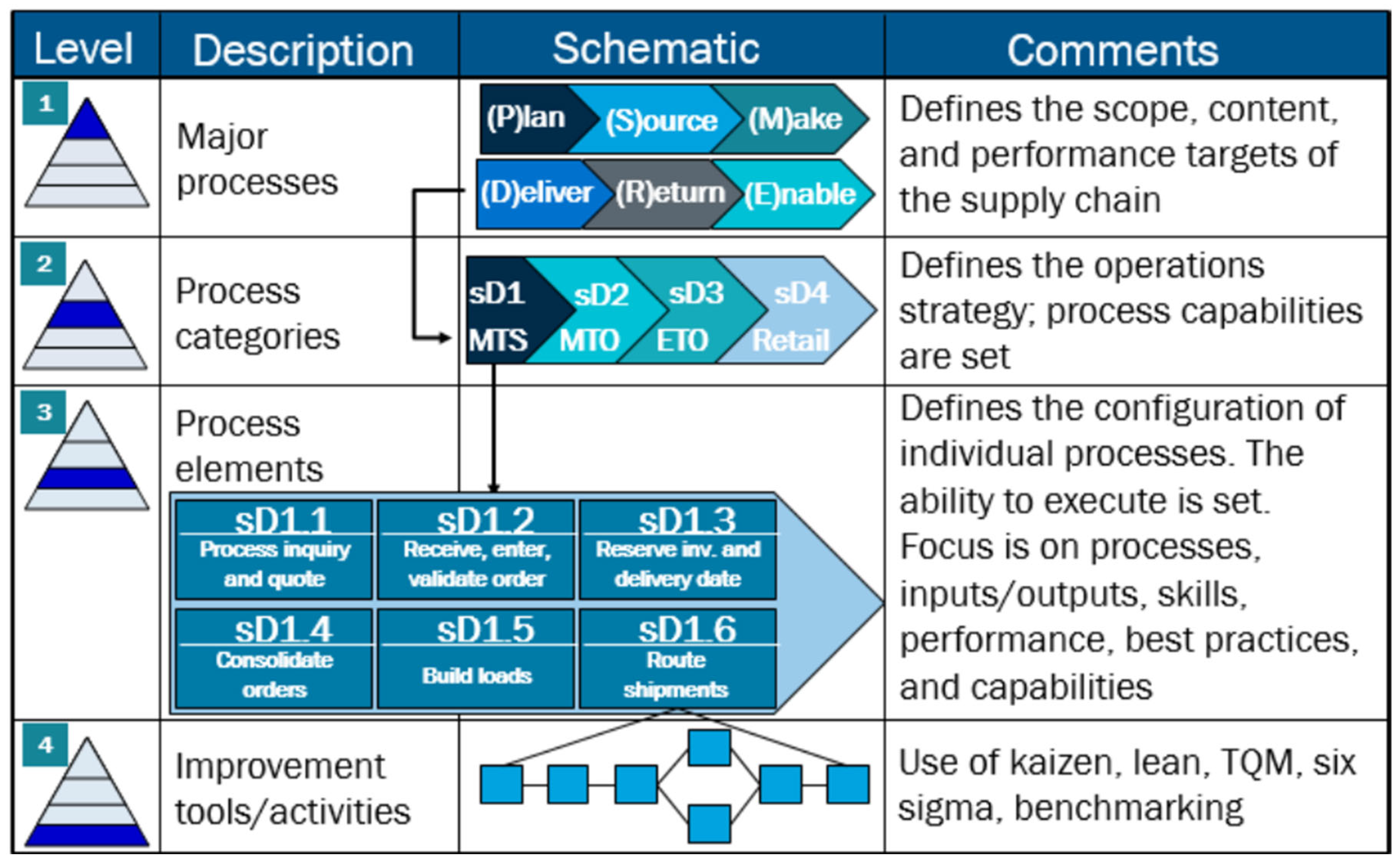
Figure 2.
Operation of Blockchain (Cruz & De Arruda Ignacio, 2023).
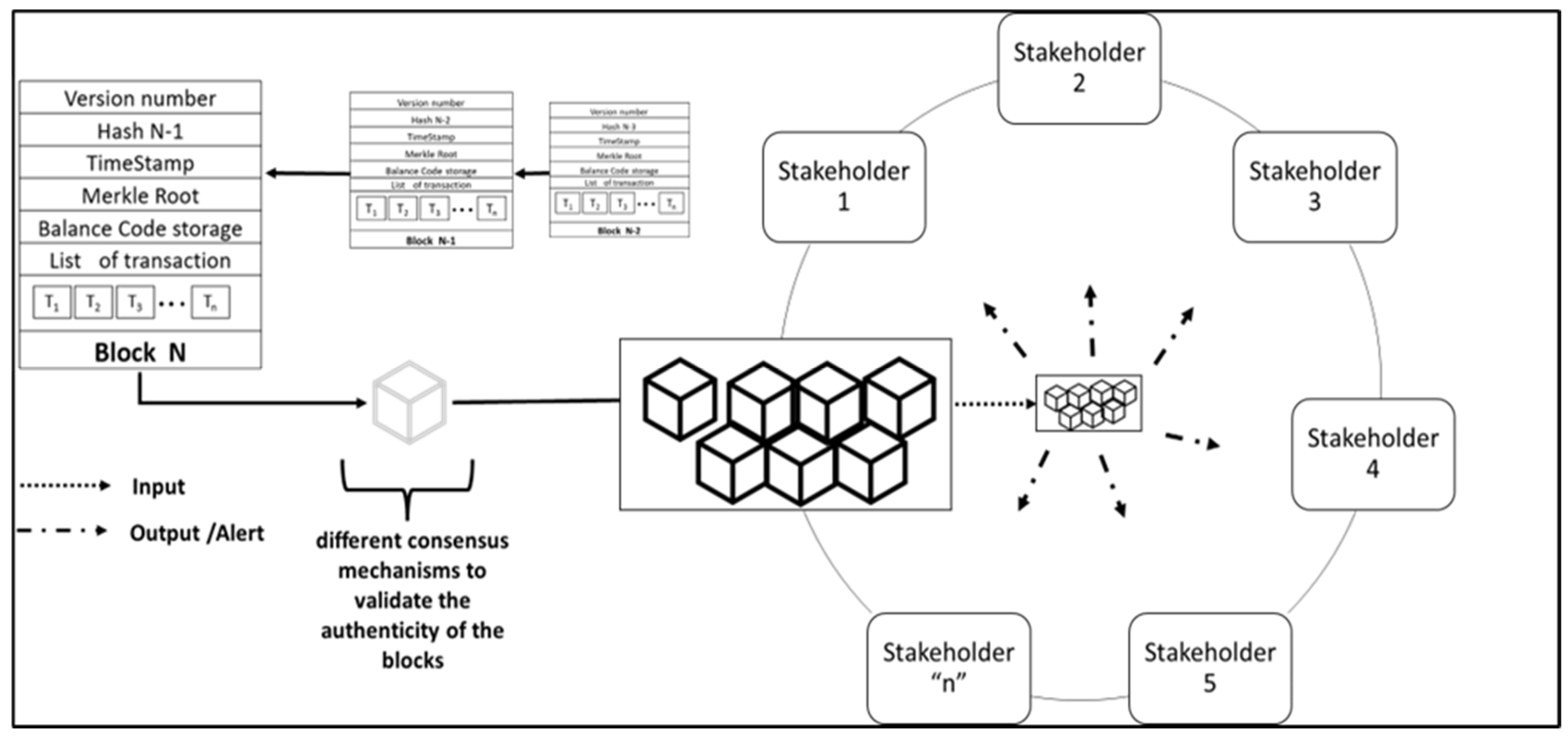
Figure 3.
Research Design.
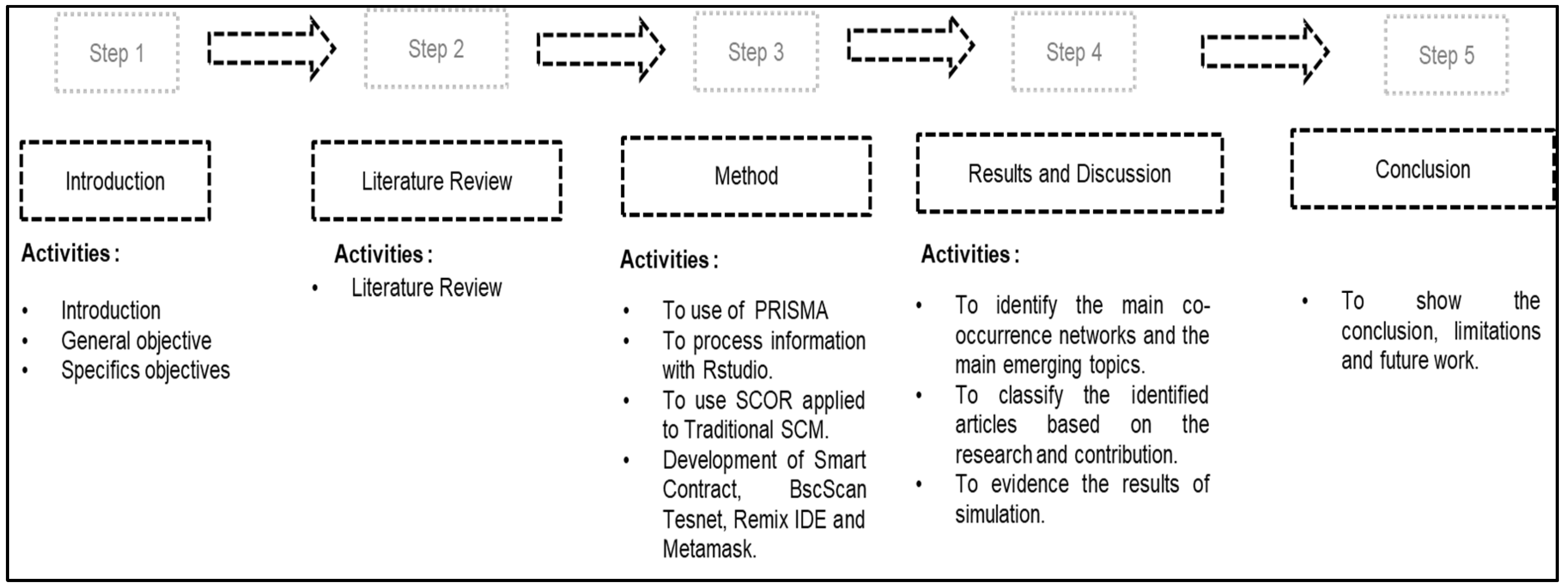
Figure 4.
PRISMA design.
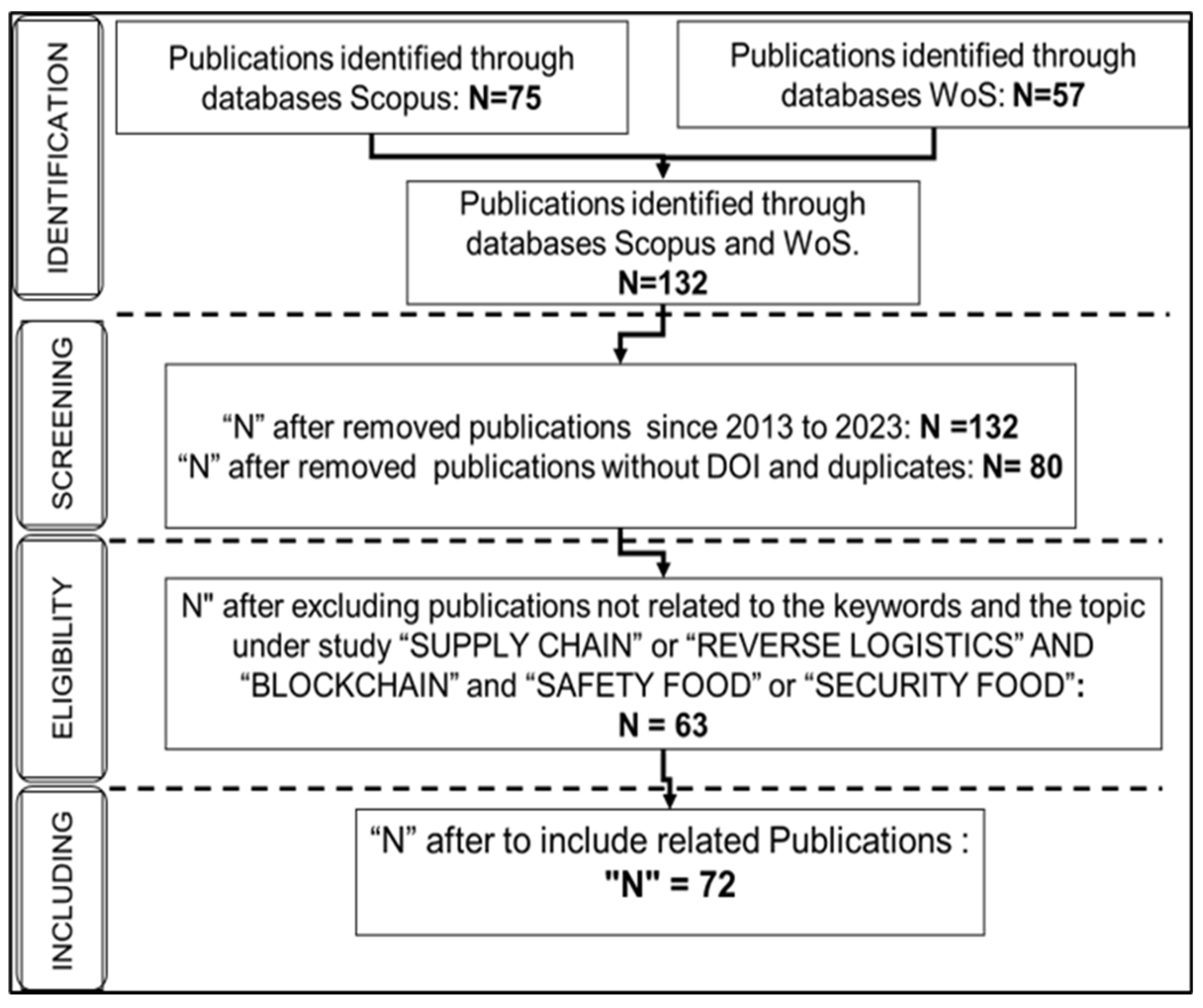
Figure 5.
Thematic Axes identified based on the literature.
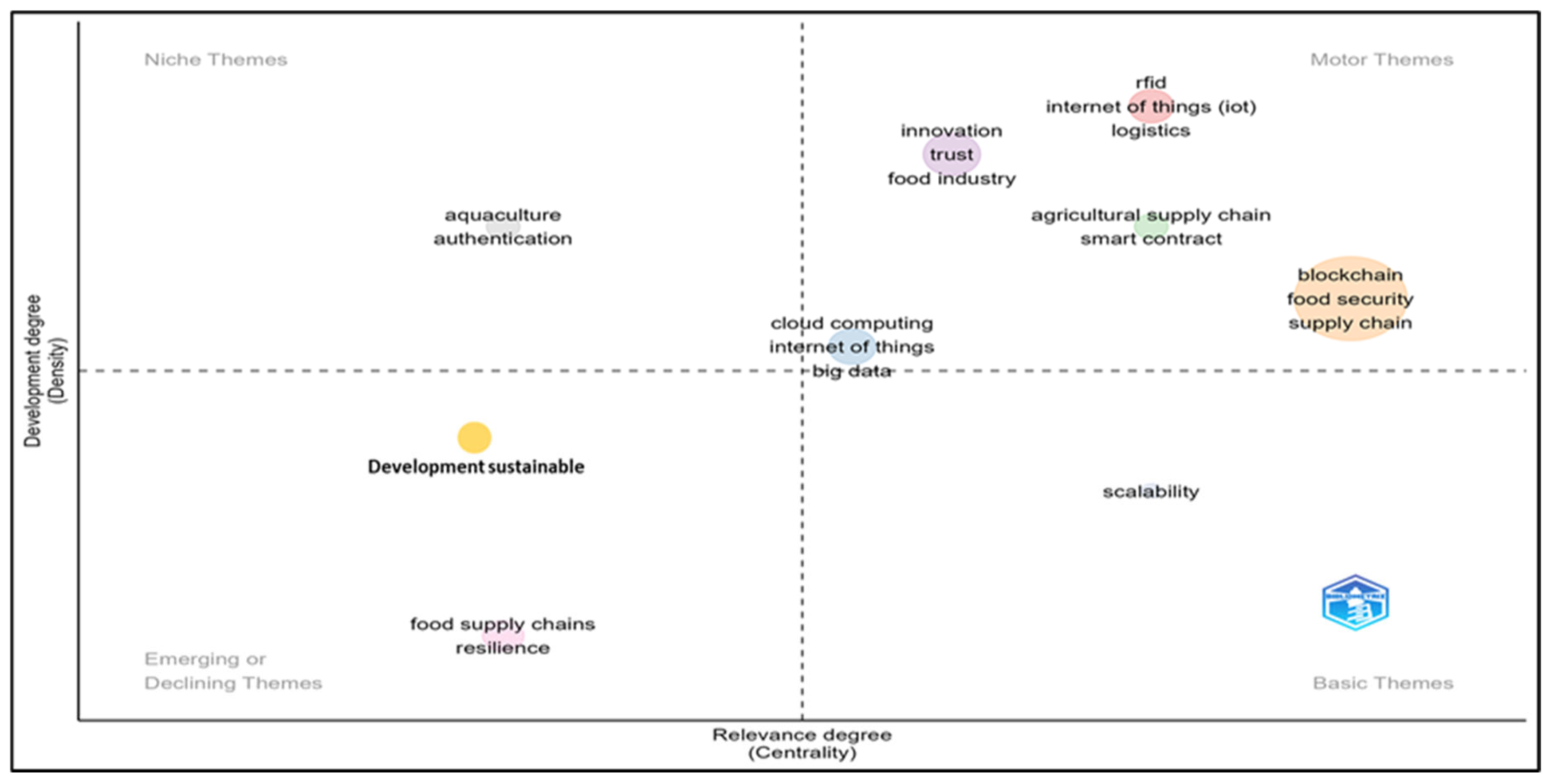
Figure 6.
Agri-food Supply Chain based on the Supply Chain Operations (SCOR).
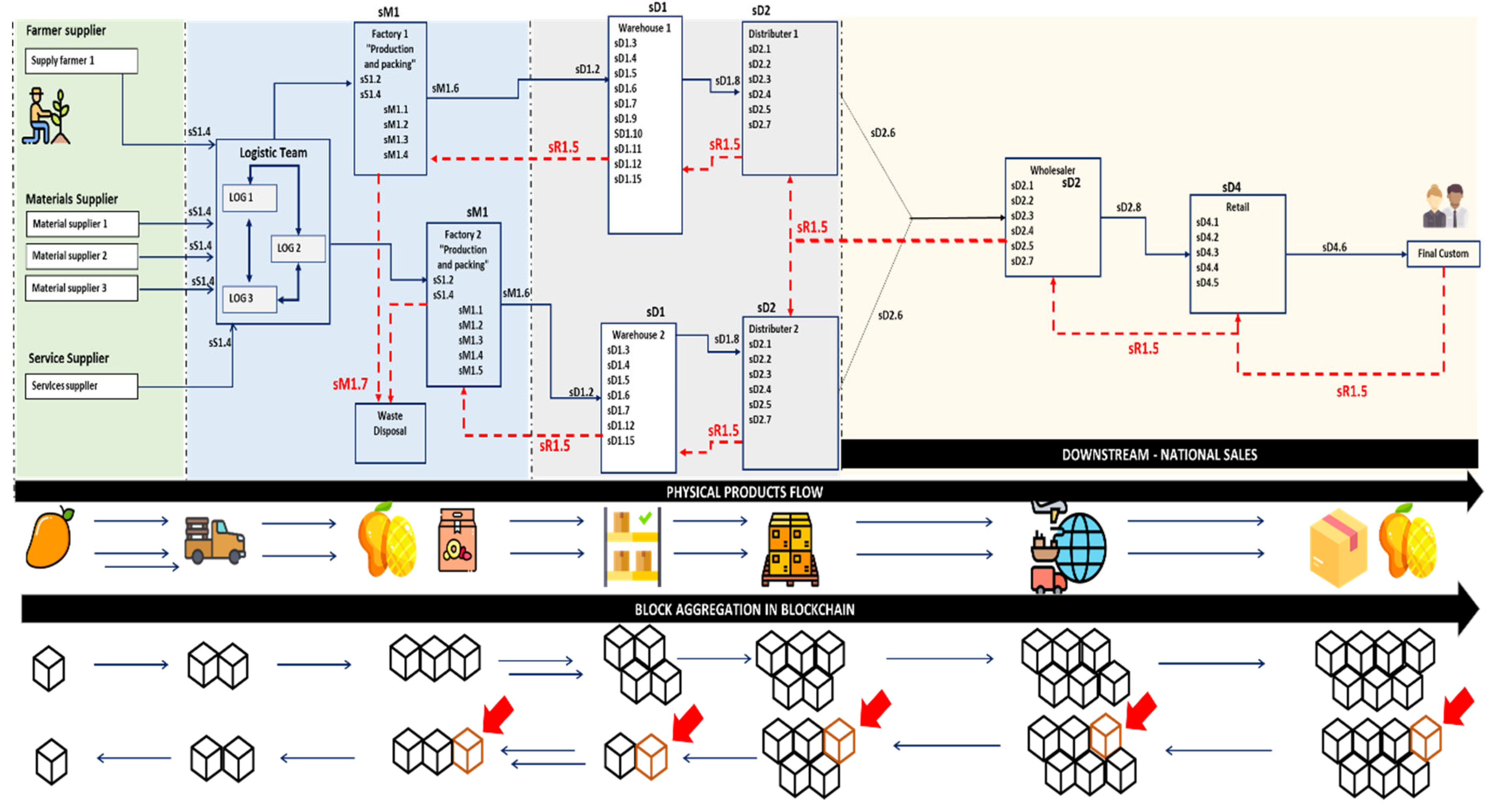
Figure 7.
Smart Contract.
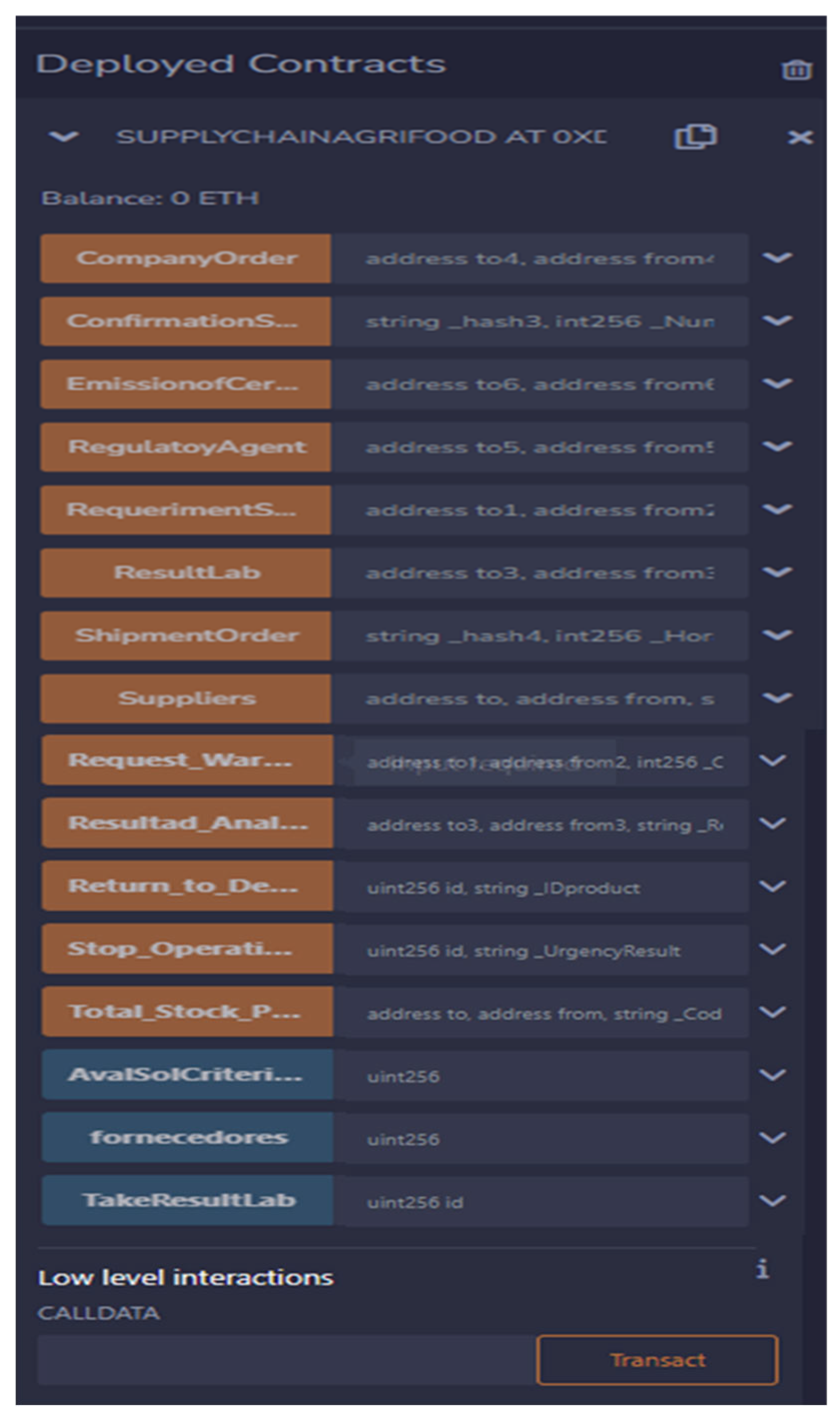
Figure 8.
A new way of managing Agri-food supply chain based on Blockchain.
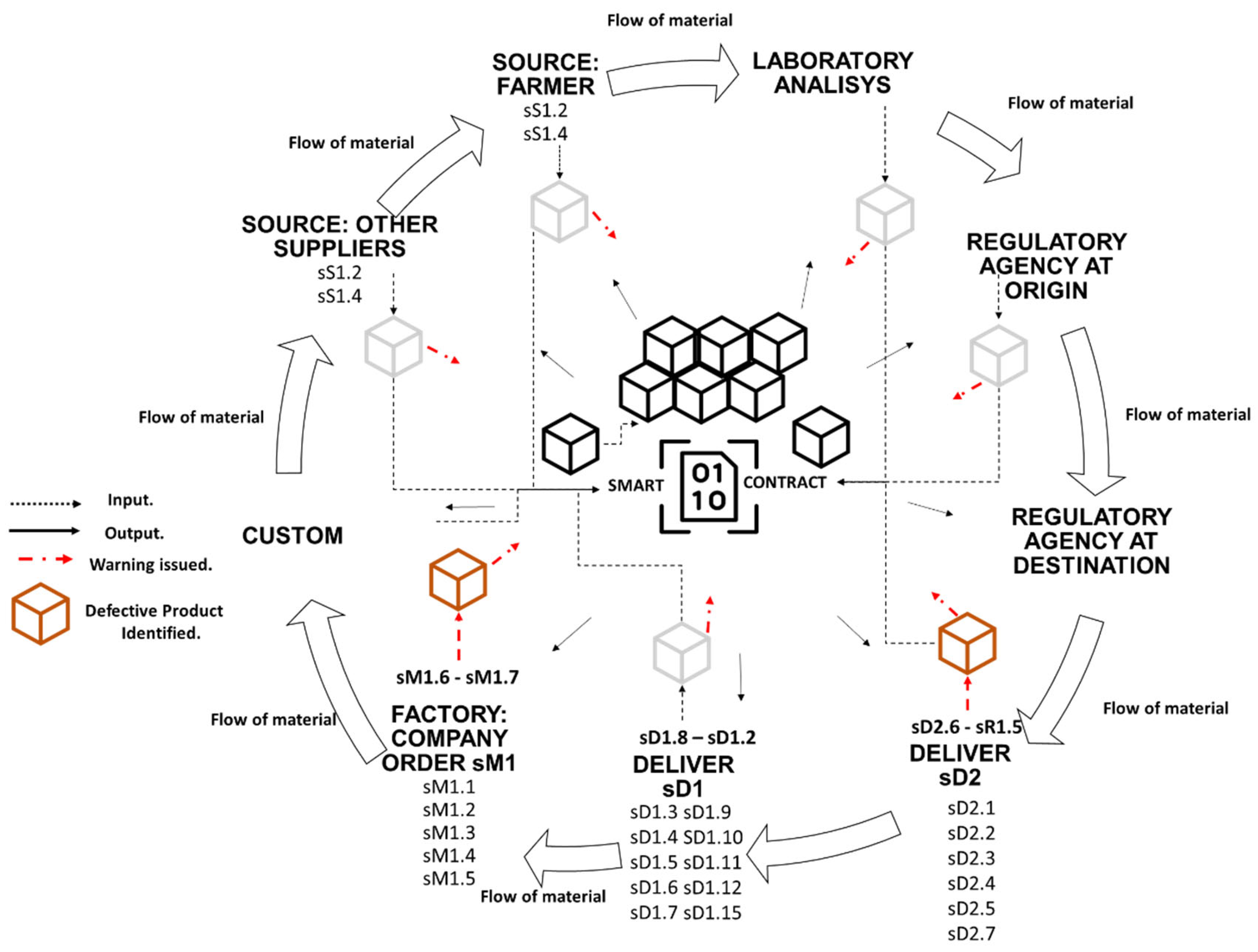

Table 1.
Documentary and Border Compliance (Andrade et al., 2022).
| Compliance | Description | Cost of Operation | Time Operation |
|---|---|---|---|
| Border compliance | The Border compliance includes:
|
US$862 | 49 Hours |
| Documentary Compliance | The Documentary Compliance includes:
|
US$226 | 12 Hours |
Table 2.
Research Categories.
| Conceptual | (Yontar, 2023); (S. Gupta et al., 2023); (S. Joshi et al., 2023); (R. Gupta & Shankar, 2023); (P. Joshi et al., 2023); (Chandan et al., 2023); (Mohammed et al., 2023); (S. Patidar et al., 2023); (Rajput et al., 2023); (Kayikci et al., 2022); (Rejeb et al., 2022); (Agnusdei & Coluccia, 2022); (Collart & Canales, 2022); (Khan et al., 2022); (Saha et al., 2022); (S. Dey et al., 2022); (Rejeb et al., 2022); (Yakubu et al., 2022); (Wunsche et al., 2022); (Hassoun et al., 2022); (P. Kumar et al., 2022); (Guruswamy et al., 2022); (Scuderi et al., 2022); (Bansal et al., 2022); (Vostriakova et al., 2022); (Rezaei & Babazadeh, 2022); (Sharma et al., 2020); (Galanakis et al., 2021); (Antonucci et al., 2019); (Pearson et al., 2019); (Tsolakis et al., 2021); (Gopi et al., 2019); (Barbosa, 2021); (Patra et al., 2021); (A. Patidar et al., 2021);(Cruz & De Arruda Ignacio, 2023); (Srhir et al., 2023);(Tanwar et al., 2022); |
| Empirical | (M. Kumar et al., 2023); (R. Gupta & Shankar, 2023); (S. Patidar et al., 2023); (Kayikci et al., 2022); (Wunsche et al., 2022); (Rogerson & Parry, 2020); (Hew et al., 2020); (Kazancoglu et al., 2022); (Maity et al., 2021); (Phua et al., 2021); |
| Modelling | (Yontar, 2023); (Bhatia & Albarrak, 2023); (M. Kumar et al., 2023); (S. Joshi et al., 2023); (S. Patidar et al., 2023); (Rajput et al., 2023); (Khan et al., 2022); (Lee et al., 2021); (Scuderi et al., 2022); (Bansal et al., 2022); (Luo et al., 2022); (Li et al., 2022); (Kamble et al., 2020); (Prashar et al., 2020); (Yadav & Singh, 2020); (Phua et al., 2021); (Runzel et al., 2021); (Yang et al., 2020); (Abdulhussein et al., 2020); (Patra et al., 2021); (AlJemy et al., 2019); (A. Patidar et al., 2021) |
| Technical | (Bhatia & Albarrak, 2023); (Khan et al., 2022); (D. Kumar et al., 2017); (Lee et al., 2021); (Bansal et al., 2022); (Prashar et al., 2020); (Majdalawieh et al., 2021); (Hilt et al., 2018); (Makarov et al., 2019); (Hofman, 2019); |
Table 3.
Research Approach.
| Food Safety and Food Security | (Bhatia & Albarrak, 2023); (M. Kumar et al., 2023); (S. Patidar et al., 2023); (Rajput et al., 2023); (Rajput et al., 2023); (Kayikci et al., 2022); (Collart & Canales, 2022); (Khan et al., 2022); (Saha et al., 2022); (Saha et al., 2022); (S. Dey et al., 2022); (Yakubu et al., 2022); (Wunsche et al., 2022); (Lee et al., 2021); (Scuderi et al., 2022); (Bansal et al., 2022); (Rogerson & Parry, 2020); (Tsolakis et al., 2021); (Prashar et al., 2020); (Abdulhussein et al., 2020); (Majdalawieh et al., 2021); (Patra et al., 2021); |
| Quality | (M. Kumar et al., 2023); (Khan et al., 2022); (Saha et al., 2022); (Yakubu et al., 2022); (Wunsche et al., 2022); (Scuderi et al., 2022); (Majdalawieh et al., 2021); (Patra et al., 2021); |
| Sustainable management and efficient use of natural resources | (Bhatia & Albarrak, 2023); (P. Joshi et al., 2023); (Chandan et al., 2023); (Kayikci et al., 2022); (Collart & Canales, 2022); (Khan et al., 2022); (Yakubu et al., 2022); (Wunsche et al., 2022); (Scuderi et al., 2022); (Bansal et al., 2022); (Vostriakova et al., 2022); (Prashar et al., 2020); (Cruz & De Arruda Ignacio, 2023) |
| Prevention, reduction, recycling | (S. Gupta et al., 2023); (Khan et al., 2022); (Wunsche et al., 2022); |
| Monitoring and Supervising | (Bhatia & Albarrak, 2023); (R. Gupta & Shankar, 2023); (Rajput et al., 2023); (Khan et al., 2022); (Yakubu et al., 2022); (Lee et al., 2021); (Scuderi et al., 2022); (Bansal et al., 2022); (Luo et al., 2022); (Kazancoglu et al., 2022); (Abdulhussein et al., 2020); (Patra et al., 2021); (AlJemy et al., 2019); |
| Food Provenance | (Bhatia & Albarrak, 2023); (Rajput et al., 2023); (Kayikci et al., 2022); (Collart & Canales, 2022); (Khan et al., 2022); (Yakubu et al., 2022); (Wunsche et al., 2022); (Lee et al., 2021); (Gopi et al., 2019); (Hew et al., 2020); (Kazancoglu et al., 2022); (Runzel et al., 2021); (Yang et al., 2020); (Majdalawieh et al., 2021); (Patra et al., 2021); |
| resilient infrastructure | (Yontar, 2023); (Bhatia & Albarrak, 2023); (S. Joshi et al., 2023); (Mohammed et al., 2023); (S. Patidar et al., 2023); (Rejeb et al., 2022); (Khan et al., 2022); (S. Dey et al., 2022); (Rejeb et al., 2022); (Yakubu et al., 2022); (Wunsche et al., 2022); (Kamble et al., 2020); (Sharma et al., 2020); (Antonucci et al., 2019); (Pearson et al., 2019); (Tsolakis et al., 2021); (Yadav & Singh, 2020); (Maity et al., 2021); (Hilt et al., 2018); (AlJemy et al., 2019); (Hofman, 2019); (A. Patidar et al., 2021); |
Table 4.
Overiew of the alert Blockchain.
| Item | Overview |
|---|---|
| Transaction Hash | 0xcef8f159f95d154833c0a3aae834cd4a92587647af310b03a618c0e796da19fd |
| Status | Success |
| Block | 30922185 (7 Block confirmation) |
| Timestamp | 24 seconds ago. (May-22-2024 07:53:31 PM +UTC) |
| From | 0c089f0bbdf0f2405bb26438bb0af3e8f735e42f4f |
| To | Contract 0x5c54711eae649da59a07690888294fe7217be884 |
| Value | 0 BNB |
| Transaction Fee | 0.00305299 BNB ($0,75) |
| Gas price | 0.0000000001 BNB (10 Gwwi) |
Table 5.
Perspective of study based on SDG 2.
| SDGs | Indicator | The convergence between Blockchain and SCOR Model ensures: | This application offers: | |||
|---|---|---|---|---|---|---|
 |
2.1.2 | Prevalence of moderate or severe food insecurity in the population, based on the Food Insecurity Experience Scale (FIES) | Security and safety of foods based on the verification and monitoring of each step in the Agri-food Chain. | Ensuring a high level of traceability for all operations and knowledge of product delocalizations. It is important when there is a possible agri-food contamination, so that in such an event, the flow of the Agri-food supply chain can be halted, and reverse logistics applied. | ||
| 2.3.1 | Volume of production per labour unit by classes of farming/pastoral/forestry enterprise size | Accurate localization of products at their origin and of each participant in the Agri-food Chain (Stakeholders). | Traceability of participants in the agri-food supply chain and their contributions to each process | |||
| 2.3.2 | Average income of small-scale food producers, by sex and indigenous status | Transparency in each sales operation within the Agri-food Chain, aiming for the correct distribution of profits or gains. | ||||
| 2.C.1 | Indicator of food price anomalies | Identification of market fluctuations and evaluation of those changes. | To understand the variability of costs for each step in the supply chain | |||
 |
9.3.1 | Proportion of small-scale industries in total industry value added | Adding new value to the Agri-food Chain and offering new consumption opportunities. | Added value by decentralizing and transforming the Agri-food Supply Chain, considering all stakeholders in each process. | ||
| 9.4.1 | CO2 emission per unit of value added | Identifying each process with a high footprint in the Agri-food Chain and sharing that risk. | With each step identified, it is possible to measure the CO2 emissions for each activity within the Agri-food Supply Chain, considering logistics activities through to the value and costs of each stage of the product. | |||
| 9.B.1 | Proportion of medium and high-tech industry value added in total value added | Taking advantage of the benefits of integrating Blockchain and the SCOR Model (traceability, decentralization of information, auditability, trust). | Easy access to traceability for each stakeholder. In this case, every actor can measure the impact of their activities and replicate that logic for their stakeholders. | |||
 |
12.2.1 | Material footprint, material footprint per capita, and material footprint per GDP | Measuring the foodprint at each step of the Agri-food Supply Chain | Traceability for each process and step, enabling the measurement of footprints and other impacts. | ||
| 12.2.2 | Domestic material consumption, domestic material consumption per capita, and domestic material consumption per GDP | Improving resource consumption based on decentralized information | Flexibility in decision-making based on historical information for each process and product. These data can be used to improve material consumption | |||
| 12.3.1 | (a) Food loss index and (b) food waste index | "Identifying and measuring these indices based on historical information. | A database with a higher level of precision because this information cannot be modified. | |||
Disclaimer/Publisher’s Note: The statements, opinions and data contained in all publications are solely those of the individual author(s) and contributor(s) and not of MDPI and/or the editor(s). MDPI and/or the editor(s) disclaim responsibility for any injury to people or property resulting from any ideas, methods, instructions or products referred to in the content. |
© 2024 by the authors. Licensee MDPI, Basel, Switzerland. This article is an open access article distributed under the terms and conditions of the Creative Commons Attribution (CC BY) license (http://creativecommons.org/licenses/by/4.0/).
Copyright: This open access article is published under a Creative Commons CC BY 4.0 license, which permit the free download, distribution, and reuse, provided that the author and preprint are cited in any reuse.