

Submitted:
11 June 2024
Posted:
12 June 2024
You are already at the latest version
Abstract
The article discusses issues related to the optimization of the operation of medium voltage networks, focusing on the optimization of network division points and the selection of the optimal network configuration aimed at reducing power and energy losses. The article provides a critical review of selected scientific works from recent years on the issue of network configuration optimization. The developed solution uses non-deterministic network models and statistical and probabilistic approaches. Optimization studies were carried out using heuristic optimization methods and proprietary algorithms for forecasting the load and power generated from renewable energy sources. The solution proposed in the article has many application possibilities. It can be used to optimize the location of network division points (reducing economic costs related to the modernization of network infrastructure) as well as to optimize the reconfiguration process in order to reduce power losses while maintaining voltage criteria.
Keywords:
optimization
; MV network configuration
; power losses
; forecasting
; renewable energy
1. Introduction
The issue of selecting the optimal configuration of medium voltage networks (mainly determining the optimal location of network division points) has been present in scientific research and publications for many years [1,2,3,4,5,6,7,8]. However, to the authors' knowledge, the solutions described in the literature on the subject have not found practical application. The issue of selecting the optimal location of network division points is sometimes marginalized by Distribution System Operators (DSO) and treated as a purely scientific problem with no practical significance. Therefore, the network division points remain unchanged in practice. Meanwhile, in addition to its original role, i.e. limiting the level of short-circuit power in the medium-voltage network, the proper location of network division points may also potentially reduce power and energy losses, improve the reliability of network operation, reduce the costs of electricity distribution and improve network operating parameters (voltage levels and power quality indicators) [9].
Initially, mathematical relationships based on derivatives of functions were used to solve the problem. Currently, various types of optimization algorithms based on heuristics are used.
In recent years, the issue of optimal network configuration has once again become a topic of interest for scientists and Distribution System Operators. Medium voltage distribution networks are expanded and modernized every year, they are characterized by numerous branches and often cooperate with various types of distributed generation sources. The functioning of the power system is non-deterministic. This is due to the high variability of load profiles and generation connected to the power grid. The increase in saturation of renewable energy sources or energy storage in MV networks causes a change in the nature of the operation of these networks. Therefore, working with an unchanged network layout for most of the year is not an optimal solution. A much more effective solution is to build distribution networks equipped in such a way as to enable frequent changes in their configuration.
The justification for undertaking this type of work is also the fact that DSO, in order to counteract the negative effects resulting from the continuous increase in the number and capacity of renewable energy sources in their networks, are gradually increasing financial resources for the modernization of their network resources. When planning modernization, they are increasingly willing to install remotely controlled switching equipment. This fact creates enormous potential for its use in the process of planning network modernization (optimization of network split points) and automatic network reconfiguration algorithms.
2. Literature Review
The issue of configuration changes in medium voltage networks has been an issue that has been studied for many decades, however, the latest research literature proves that the issue is still an important and current issue in the field of power engineering. Previous scientific research has focused on the main function of network configuration changes, i.e. minimizing power and energy losses [8,9,10,16,17,18,19].
Various optimization algorithms are used for the reconfiguration process of the medium voltage distribution network. The most frequently used ones include: the particle swarm algorithm (PSO) [11,12], the genetic algorithm (AG) [13,14] and the tabu search algorithm (TS) [15]. Due to the complexity of the issue of network configuration changes, heuristic optimization algorithms are often used, which are inspired by processes occurring in nature.
In [16], the Grasshopper optimization algorithm was used to optimize the network configuration, which uses an analogy to the natural behavior of a grasshopper. The aim of the research was to determine the optimal location of switches that can be used to change the network configuration in order to minimize power losses in the system. The simulation results showed that network reconfiguration reduces power losses in the system by approximately 38%.The conclusions from this publication indicate that the Grasshopper optimization algorithm achieves better results compared to other optimization methods (mentioned in publication [16]).However, the simulation studies were carried out on a relatively small, 33-node network model, so it is not certain whether the presented algorithm will also work on a larger network model. Moreover, the research did not take into account renewable energy sources, which have a significant impact on the operation of modern distribution networks.
The work [17] presents an effective way to improve the operating parameters of the distribution network. The network reconfiguration made it possible to change the network division points while maintaining the radial structure of the network and ensuring power supply to all connected loads. Multi-criteria particle swarm optimization (PSO) was used in the research. The goal was to minimize power losses in the network while improving the voltage profile of the system. The obtained results proved the effectiveness of the proposed solution, power losses were reduced by approximately 30% and a significant improvement in the voltage profile was achieved. For the proposed example, the authors obtained promising results, but also in this case the tested network model was relatively small and did not take into account cooperation with renewable energy sources.
Renewable energy sources in the context of the issue of changes in the configuration of the medium-voltage power grid were included in the research works described, among others, in [18,19].
The work [19] discusses the use of a genetic algorithm to optimize the network configuration in order to improve its efficiency. Simulation studies were carried out on a network model compatible with distributed generation. Improving network efficiency came down to reducing power losses in the network and improving the voltage profile. Simulation studies using a genetic algorithm have shown that there are possibilities to reduce power losses and improve the voltage profile. The work contains many shortcomings and unjustified generalizations. The paper does not present details on how to model power generated from renewable energy sources. Moreover, it was found that renewable energy sources connected to the grid have a positive effect on reducing power losses and improving the voltage profile. This statement is true only within a limited range of network operation and is a function of many variables, including: network configuration, RES saturation level or load variability profiles.
Another work [20] presented the possibilities of increasing the efficiency of the network by modifying its topology. Improving network efficiency came down to optimizing the configuration using the BPSO (binary PSO) optimization algorithm to minimize active power losses in the network. Simulation tests showed the possibility of reducing power losses in the network by approximately 34%, and an improvement in the voltage profile was observed. The presented approach to increasing network efficiency seems correct and effective. However, it is worth conducting similar research on a larger network model with a high concentration of renewable energy sources to confirm the effectiveness of the developed algorithm.
This work will present an original approach to the process of reconfiguring the medium-voltage power grid. In their considerations, the authors omitted the financial aspect resulting from the need to install and increase the wear and tear of circuit breakers. It was assumed that if network modernization is planned, it is worth developing a tool to support this process. The developed algorithm allows for optimization of the location of division points and the method of network reconfiguration. Obtaining optimal network configurations (the optimization criterion was minimization of power and energy losses). The presented algorithm was developed using optimization tools and a probabilistic approach to load and generation forecasting.
3. Methodology
The process of optimizing the operation of the medium voltage network was carried out using heuristic optimization methods. Heuristic optimization methods are an alternative to classical methods of solving optimization problems. They enable solving various types of problems that cannot be solved using classical methods or the use of these methods is too time-consuming or labor-intensive. Heuristic optimization methods are currently used more often than classical methods due to the high complexity of problems occurring in the field of power engineering. They are used to solve problems of optimal energy flow, minimize various types of costs as well as solve problems of shipping economy and multilateral systems [21,22,23].
The Cuckoo Search algorithm [24] was used in the optimization studies due to its relatively easy implementation and high effectiveness in solving problems in the field of power engineering. The Cuckoo Search algorithm mimics the aggressive reproductive strategy used by cuckoos, which involves laying their eggs in other birds' nests. In order to increase the efficiency of exploring the solution space, the Cuckoo Search algorithm has been extended with a jumping mechanism based on the Levy distribution. The Levy distribution is a continuous probability distribution for non-negative random variables. The step size in the Levy distribution is called the "Levy flight". Levy's flight has a random character of wandering in a discrete space, in which the step length is determined based on its distribution.
The cuckoo algorithm is based on three idealized principles:
- Each cuckoo lays one egg and drops it into a randomly selected nest;
- The best nests with high egg quality are passed on to the next generation;
- The number of available nests is constant and an egg dropped by a cuckoo is detected with a certain probability.
The general form of the Cuckoo Search algorithm [24] for the objective function f(x), x = (x1, ..., xn)T is presented in a block diagram in Figure 1.
Optimization studies were carried out on a network model that reproduces an actual fragment of the MV power grid constituting part of the energy region of one of the Polish DSOs. The basic data of the modeled network are presented in Table 1.
The network diagram adopted for the research is shown in Figure 2.
The research procedure was divided into two parts. In the first part of the research procedure, a model of the medium-voltage power grid was prepared and calculations of power flows were made as well as preliminary optimization of the network configuration, the main goal of which was to determine the optimal places for dividing the network. The optimized power grid model was used in the second part of the research procedure, where simulation tests were carried out in which changes were made to the network operating system in response to changes in its operating conditions. The simulation studies took into account the variability of demand and generation using historical measurement data and current weather data.
The course of the first part of the research procedure can be presented in the form of the following algorithm:
- Preparation of a power grid model;
- Power flow calculations for the base model;
- Update of power generated from renewable energy sources in the network model, which was determined for each source based on historical data;
- Update of power demand in the network model, which was determined for each MV/LV transformer based on historical data;
- Initialization of the optimization procedure;
- Determining the optimal solution.
The course of the second part of the research procedure is illustrated by the following algorithm:
- Loading the power grid model obtained in the first part of the research procedure;
- Performing power flow calculations;
- Initialization of the optimization procedure;
- Determining the optimal solution;
- Comparison of the results obtained in the research procedure with the results obtained from power flow calculations.
The following assumptions were made for the optimization studies:
- Varying load levels in the network;
- Varied level of power generated from renewable energy sources;
- Photovoltaic and wind sources are connected to the grid;
- Possibility of implementing network division in all sections;
- The optimization process was carried out taking into account the variability of the load and power generated from renewable energy sources;
- The power demand forecast was determined based on historical measurement data;
- The forecast of power generated from renewable energy sources was determined based on historical data and current weather data;
- The set of acceptable solutions included solutions that met the following criteria: maintaining the radial system of the network, maintaining voltages within the required range and lack of network overload.
The location of medium-voltage network division points, treated as an optimization problem, becomes more complicated in the case of extensive networks composed of many GPZ stations and cooperating with RES sources connected at different nodes. The randomness and unpredictability of generation, as well as variable load, further complicate system analysis. Of course, you can try to consider dozens, hundreds, or maybe even thousands of operating states, but this will not guarantee reaching the optimal point. However, full optimization of a given operating state of the power system takes place only when all operating conditions of the transmission network and the related limitations are taken into account [25,26,27]. By introducing the symbols of the three vectors:
- state x – containing node voltage modules and their arguments;
- forcing f containing the powers received at the nodes;
- control c containing the power generated in the nodes.
the optimization task can be written in general form:
under equality constraints:
and inequality:
Fobj(x,f,c) = Fobj(z) ─> min
g(x,f,c) = g(z) = 0
h(x,f,c) = h(z) ≥ 0
The above issue is classified as OPF (Optimal Power Flow) tasks. In order to determine the optimal cutting points, power losses are assumed as the objective function, according to the relationship:
Fobj = ∆P
The detailed form of equality and inequality constraints results from the provisions and formulas of the classic flow problem. The following limitations are considered in this work:
Inequality:
- for the elements of the control vector, i.e. active powers and passives generated in node (j=1…G), where G is the number of generators in the network;Pgmaxj – Pgj≥ 0Pgj– Pgminj ≥ 0Qgmaxj– Qgj ≥ 0Pgj – Pminj ≥ 0
- resulting from the permissible current carrying capacity of the lines (k, l = 1…N), where N is the number of network nodes;Imaxkl–Ikl≥0
- resulting from the permissible voltage values in network nodes (i = 1…N), where N is the number of network nodes;Umaxi–Ui≥0Ui–Umini≥ 0
Equality:
- resulting from the balance of active and reactive power generated and consumed
- Balancing equations that must be satisfied for each network node (i=1…N), where N is the number of network nodes, have the following form:
Pgi– Pli– fp (U,⸹) = 0
Qgi– Qli – fq (U,⸹) = 0
OPF and SCOPF tasks are relatively difficult to solve using methods similar to classical ones. Despite the simple form of the objective function (power loss), the need to take into account the above-mentioned limitations, which are the result of power flow calculations, is quite a big problem. The situation becomes even more complicated when the calculations diverge. Additionally, the analysis is made more difficult by the discrete nature of the decision variables (a finite set of possible division points).
The developed approach to the process of optimizing the configuration of medium voltage networks is multi-platform. Figure 3 shows the solution architecture diagram along with its components and interconnections. The above-mentioned solution architecture includes the following components:
- PowerWorld Simulator – software for simulating the operation of the power system, which enables visualization, simulation and analysis of the operation of the power system, which is based on the calculation of power flows in the system;
- Simulator Automation Server – an add-on to the PowerWorld Simulator software, which allows you to extend its functionality by allowing you to run and control PowerWorld Simulator from another application;
- OpenWeatherMap API – online service that provides access to global weather data via API as well as access to current weather data;
- Solcast API – online service that provides current and forecast data on solar radiation and photovoltaic energy worldwide;
- Weather API – a web application that is an adapter between the OpenWeatherMap API and Solcast API services and the MATLAB environment;
- MATLAB – a programming environment for numerical calculations in which the calculations for the research procedure were carried out.
Medium voltage power networks are characterized by significant load variability over time [28]. Various estimation methods are used to determine the load on transformer stations [29,30,31].The developed algorithm used historical measurement data for a period of one year to determine the active power demand forecast. Demand registrations were made with a 15-minute resolution. Historical measurement data were organized and subjected to statistical analysis. Incorrect measurements and measurements outside the pool of acceptable states have been omitted. It was also necessary to scale the values taking into account the rated power of the transformer. An algorithm was developed which, based on the prepared statistical data, determines the probability of a specific load value occurring at a given transformer station.
The level of power generated from photovoltaic sources depends on many factors, mainly: solar radiation intensity, ambient temperature and wind speed. The most useful value when estimating the power generated from photovoltaic sources is sunlight. The developed approach to determine the generation forecast from PV sources used measurement data for a period of one year and current data on the intensity of solar radiation obtained from API [32]. An algorithm has been developed that, based on historical data and current meteorological data obtained from API, determines the probability of occurrence of solar radiation intensity of a specific value.
The level of power generated from wind sources also depends on many different factors. A decisive factor, apart from the structural dimensions of a wind turbine, is the wind speed [33]. The developed approach to determine the generation forecast from PW sources used historical measurement data for a period of one year and current weather data obtained from API [34]. An algorithm has been developed that, based on historical data and current meteorological data obtained from API, determines the probability of generating power of a specific value.
The block diagram of the developed approach to the process of optimizing network configuration using proprietary algorithms for forecasting load and generation from renewable energy sources is shown in Figure 4.
4. Optimization of the operation of the MV network
Simulation tests were carried out on the prepared network model, which included:
- determining the basic network configuration and calculating power flows;
- initial optimization of the network configuration;
- daily reconfiguration of the network in response to changes in load and generation levels from renewable energy sources;
The medium voltage network model is built in a closed bus system with 12 permanent network division points. The number of split points corresponds to the actual number of remotely controlled switches installed in the modeled network area. The number of split points was not optimized. Only the places where the network was divided were subject to optimization.
A basic configuration was determined for the network model based on the developed load forecasting algorithms and generation forecasting algorithms from renewable energy sources. In its basic configuration, the network model works with all installed renewable energy sources. For the network configuration prepared in this way, power flow calculations were made and the basic network operating parameters were determined. Selected network operating parameters are illustrated in Table 2.
Then, a process of initial optimization of the network configuration was carried out, the main goal of which was to reduce power losses in the network. Optimization studies were carried out in the MATLAB environment using the Cuckoo Search optimization algorithm. Selected network operating parameters after optimization are presented in Table 3.
After initial optimization, a new network configuration was determined. The location of the optimal network division points turned out to be different from the one currently present in the tested network (as determined by the DSO). Initial optimization of the network configuration allowed for reducing power losses in the network by approximately 25%, and the voltage profile improved slightly.
Daily network operating conditions were also simulated on the network model for the following variants:
- a network without renewable energy sources;
- network cooperating with wind generation;
- network cooperating with photovoltaic generation;
- network cooperating with wind and photovoltaic generation.
Proprietary load forecasting algorithms and generation forecasting algorithms from renewable energy sources were used for simulation studies. The load forecast for individual transformer stations was made using a load forecasting algorithm based on historical data. The forecast of generation from photovoltaic sources was made using an algorithm for forecasting power from photovoltaic sources based on historical data and current weather data obtained from SOLCAST API. The forecast of generation from wind sources was made using an algorithm for forecasting power from wind sources based on historical data and current weather data obtained from the OpenWeatherMap API.
The study assumed that network reconfiguration is recommended when the difference in power losses exceeds 20%. This assumption was made arbitrarily and will affect the simulation results. The adoption of the final criterion value, in the case of implementing the proposed algorithm, can be agreed with the DSO. A list of selected parameters of the daily simulation is presented in Table 4.
Simulations were performed in the Windows 10 x64 environment, on a PC with an i5 class processor. The time of one simulation was 7 minutes 36 seconds.
Table 5 presents a list of selected network operating parameters for a daily simulation without renewable energy sources during the hours when, according to the assumptions, network reconfiguration is recommended.
The first simulation of daily network operating conditions includes a variant in which the power grid does not cooperate with renewable energy sources. The network configuration was optimized every hour of the day and opportunities to reduce power losses were presented. In this variant of network operation, the reconfiguration allowed for a reduction in power losses ranging from 9% to 30%. For the analyzed day, and for the adopted assumptions, the required number of reconfigurations of the modeled network system was 6 per day. The proposed method of network reconfiguration made it possible to reduce power losses by 1.85 MWh per day.
Table 6 presents a list of selected network operating parameters for a daily simulation with wind generation at hours when, according to the assumptions, network reconfiguration is recommended.
The second simulation of daily network operating conditions includes a variant in which the power grid cooperates with wind generation sources. In this variant of network operation, reconfiguration made it possible to reduce power losses ranging from 5% to 31%. For this configuration of network operation, in accordance with the adopted assumptions, it is recommended to switch the network division points 5 times a day. Daily reconfiguration of the network made it possible to reduce power losses by 1.75 MWh per day.
Table 7 presents a list of selected network operating parameters for a daily simulation with photovoltaic generation during the hours when, according to the assumptions, network reconfiguration is recommended.
The third simulation of daily network operating conditions includes a variant in which the power grid cooperates with photovoltaic generation sources. In this variant of network operation, reconfiguration made it possible to reduce power losses ranging from 8% to 31%. For this configuration of network operation, in accordance with the adopted assumptions, it is recommended to switch the network division points 4 times a day. Daily reconfiguration of the network allowed for reducing power losses by 1.55 MWh per day.
Table 8 presents a list of selected network operating parameters for a daily simulation with wind and photovoltaic generation during the hours when, according to the assumptions, network reconfiguration is recommended.
The last simulation of daily network operating conditions includes a variant in which the power grid cooperates with wind and photovoltaic generation sources. In this variant of network operation, the reconfiguration allowed for a reduction in power losses ranging from 4% to 34%. For this configuration of network operation, in accordance with the adopted assumptions, it is recommended to switch the network division points three times a day. Daily reconfiguration of the network allowed for reducing power losses by 1.69 MWh per day.
5. Results and Discussion
A MV network model was prepared to verify the operation of the developed research procedures. The correct operation of the medium-voltage network optimization process and the developed algorithms for forecasting load and generation from renewable energy sources were verified. A basic configuration was determined for the network model, for which power flows were calculated and the basic network operating parameters were determined. The initial optimization of the network configuration was carried out on the network model prepared in this way. Optimization studies have shown that the basic network configuration is not optimal and it is possible to reduce power losses by changing the location of network division points. Initial optimization of the network configuration made it possible to reduce power losses by approximately 25%. The network model in the new configuration was verified in the daily optimization process.
In the second part of the research procedure, a process of cyclical network reconfiguration was carried out for various variants of network operation in order to test the developed algorithms. The research was carried out in a daily cycle for four selected subjects network operation variants in accordance with the adopted assumptions.
First, a simulation of daily network operating conditions was performed for the variant without renewable energy sources. An optimization procedure was launched every hour of the day, in which the optimal network configuration was determined and its parameters were controlled. Optimization in the daily cycle made it possible to reduce the loss of active power in the network in the range from 9% to 30%. Daily reconfiguration made it possible to reduce power losses by 1.85 MWh per day. Assuming the average sales price of electricity on the competitive market calculated by the Energy Regulatory Office in 2023 at the level of EUR 177.27, we gain EUR 327.94 in savings related to power losses.
Then, a daily simulation was performed for a network cooperating with wind generation. Optimization in the daily cycle made it possible to reduce the loss of active power in the network in the range from 5% to 31%. Daily reconfiguration made it possible to reduce power losses by 1.75 MWh per day. Assuming the average sales price of electricity on the competitive market calculated by the Energy Regulatory Office in 2023 at the level of EUR 177.27, we gain EUR 310.22 in savings related to power losses.
Another simulation was performed for a network cooperating with photovoltaic generation. Optimization in the daily cycle made it possible to reduce the loss of active power in the network in the range from 8% to 31%. Daily reconfiguration made it possible to reduce power losses by 1.55 MWh per day. Assuming the average sales price of electricity on the competitive market calculated by the Energy Regulatory Office in 2023 at the level of EUR 177.27, we gain EUR 274.76 in savings related to power losses.
The last simulation was performed for a network cooperating with wind and photovoltaic generation. Optimization in the daily cycle made it possible to reduce the loss of active power in the network in the range from 4% to 34%. Daily reconfiguration made it possible to reduce power losses by 1.69MWh per day. Assuming the average sales price of electricity on the competitive market calculated by the Energy Regulatory Office in 2023 at the level of EUR 177.27, we gain EUR 299.75 in savings related to power losses.
By making certain simplifications, it is possible to estimate the financial benefits resulting from the use of the medium voltage distribution network reconfiguration algorithm presented in the article. The previous paragraphs contain estimated savings resulting from reducing power losses based on daily simulation. Assuming that not every day will be the same, and taking into account the fact that this approximate analysis has already shown the possibility of saving amounts ranging from EUR 150 to even EUR 300, assuming an average amount of savings of EUR 200, you can achieve approximately EUR 73,000 in annual savings.
Cost accounting should also include the costs associated with greater wear of the circuit breakers and the associated higher operating costs. The cost of one medium voltage circuit breaker is approximately EUR 3,500. Assuming that the circuit breaker should be replaced after 10,000 switch operations and taking into account the fact that each of them will potentially be able to perform 3 switches per day related to the discussed algorithm, the circuit breaker will perform approximately 1,100 operations per year. This means that the circuit breaker should be replaced after approximately 10 years of operation, so the balance of benefits and costs is rather favorable. This is an estimated value for one switch. The authors are currently working on a thorough cost-benefit analysis and the results of this analysis will be published in the next article.
However, regardless of whether the balance is more or less favorable, it is worth paying attention to the benefits resulting from significant increasing the flexibility of the medium-voltage network operation and consequently improving the quality of control.
Research conducted by the authors confirmed that a one-time optimization of the network configuration is not sufficient to ensure optimal operation of the power system. For the power system to function optimally, it requires constant supervision and regulatory activities. The research results confirmed that network reconfiguration including several changes in the location of network division points allows for reducing power losses while maintaining the required voltage levels and other network parameters.
6. Conclusions
The article discusses issues related to the optimization of the operation of medium voltage networks, focusing on the optimal network configuration and reducing power and energy losses. The article provides a critical review of selected scientific works from recent years on the issue of network configuration optimization. The analysis of the solutions proposed in the publications prompted the authors to develop a new approach to the process of reconfiguring the medium-voltage power grid. The algorithms presented in the article are based on statistical and probabilistic approaches and also use current weather data obtained from the API.A research procedure was developed and verified through simulation tests on a medium voltage power grid model. Simulation tests were carried out for four variants of network operation in order to check the correct operation of the developed approach to the network configuration optimization process. The performed simulations confirmed the effectiveness of the approach used and the developed algorithms.
The research results have shown that even a relatively small increase in the frequency of network reconfiguration leads to an improvement in the quality of operation of the medium-voltage network and, above all, to a reduction in power loss and, consequently, to a reduction in the costs associated with the distribution of electricity.
Taking into account the above, it can be concluded that the solution proposed in the article has considerable application possibilities. It can be used to optimize the location of network division points (reducing economic costs related to the modernization of network infrastructure) as well as to optimize the reconfiguration process in order to reduce power losses while maintaining voltage criteria.
The authors also see the possibility of using the discussed algorithm. Running it for a network model before modernization, assuming that the cut-off points can be located anywhere in the network, will allow you to indicate those places in the distribution network where the installation of circuit breakers, e.g. remotely controlled ones, should be a priority, taking into account the benefits of the process reconfiguration of the medium voltage network.
Author Contributions
Conceptualization, P.M., R.M.; methodology, P.M. and K.S.; software, K.S.; validation, P.M.; formal analysis, P.M.,R.M, M.I.; investigation, K.S.; resources, K.S.; data curation, K.S. and P.M.; writing—original draft preparation, P.M., R.M., M.I. and K.S.; writing—review and editing, P.M.,R.M, M.I.; visualization, K.S.; supervision, P.M.; project administration, P.M.; funding acquisition, P.M. All authors have read and agreed to the published version of the manuscript.
Funding
This research received no external funding.
Data Availability Statement
Data are contained within the article.
Conflicts of Interest
The authors declare no conflict of interest.
References
- Helt,P.;Zduńczyk, P. Możliwości optymalizacji konfiguracji rozległych sieci dystrybucyjnych SNinN. Acta Energetica, 2014, 79–85.
- Brożek, J.; Bąchorek, W. Optymalizacja struktur elektroenergetycznych sieci promieniowych.ElectricalEngeenering, 2014, 78, 35–42.
- Bąchorek, W.; Brożek, J. Zastosowanie algorytmu ewolucyjnego w rekonfiguracji sieci dystrybucyjnej.ElectricalEngeenerig, 2014, 78, 27–34.
- Helt, P.; Kołodziejczyk, K.; Zduńczyk, P.; Falkowski, D.; Noske, S. Wykorzystanie danych pomiarowych z systemów AMI do optymalizacji konfiguracji sieci rozdzielczych. Przegląd Elektrotechniczny, 2015, 11, 2010–213.
- Rekowski, R. Wpływ rekonfiguracji sieci dystrybucyjnej SN na poziom strat mocy czynnej. Acta Energetica, 2017, 4, 40–46.
- Rekowski, R. Problematyka doboru współczynnika czułości algorytmu rekonfiguracji sieci SN. Zeszyty Naukowe Wydziału Elektrotechniki i Automatyki Politechniki Gdańskiej, 2017, 53, 103–106.
- Naveen, S.; Kumar, K.; Rajalakshmi, K. Distribution system reconfiguration for loss minimization using modified bacterial foraging optimization algorithm. Electrical Power and Energy Systems, 2015, 69, 90–97. [CrossRef]
- Nematshahi, S.; Mashhadi, H. R. Distribution network reconfiguration with the application of DLMP using genetic algorithm. IEEE Electrical Power and Energy Conference, 2017.
- Pijarski, P.; Miller, P.; Sidor, K. Optimization of the selection of partition points in the MV network. Photonics Applications in Astronomy, Communications, Industry, and High-Energy Physics Experiments, 2018, 1688–1693.
- Raut, U.; Mishra, S. A Fast Heuristic Network Reconfiguration Algorithm to Minimize Loss and Improve Voltage Profile for a Smart Power Distribution System. International Conference on Information Technology, 2017, 85–90.
- Kąkol, A. Symulacja dobowych warunków pracy sieci SN przy zmiennych warunkach zapotrzebowania. Acta Energetica, 2018, 3, 51–57.
- Nasrollahi, S.;Sardarabadi, A.;Khoshian, Y. A novel hybrid algorithm for reconfiguration problem of the distribution networks. International Conference and Exhibition on Electricity Distribution, 2013.
- Zhu, J. Z. Optimal reconfiguration of electrical distribution network using the refined genetic algorithm. Electric Power Systems Research, 2002, 62, 37–42. [CrossRef]
- Liu, L.; Yu, H.; Li, L. Distribution network reconfiguration based on harmony search/genetic hybrid algorithm. China International Conference on Electricity Distribution, 2012.
- Abdelaziz, A.; Mohamed, F.;Mekhamer, S.; Badr, L. Distribution system reconfiguration using a modified Tabu Search algorithm, Electric Power System Research. 2010, 80, 943–953. [CrossRef]
- Hamour,H.;Kamel, S.; Abdel-Mawgoud, H.; Korashy, A.; Jurado, F. Distribution Network Reconfiguration Using Grasshopper optimization Algorithm for Power Loss Minimization. International Conference on Smart Energy Systems and Technologies (SEST), Seville, Spain, 2018, 1-5.
- Sellami, R.; Neji, R.; Bouktir, T. Enhancing Radial Distribution Network Performance by Optimal Reconfiguration with PSO Algorithm. 16th International Multi-Conference on Systems, Signals & Devices (SSD), Istanbul, Turkey, 2019, 180-186.
- Ramaswamy, P.; Deconinck, G. Impact of varing photovoltaic penetration on minimum loss reconfiguration. IECON 2013 – 39th Annual Conference of the IEEE Industrial Electronics Society, 2013, 2069–2074.
- Syahputra, R.;Soesanti, I. An Optimization of Power Distribution Network Configuration with Distributed Generator Integration Using Genetic Algorithm. International Conference on Electronic and Electrical Engineering and Intelligent System (ICE3IS), Yogyakarta, Indonesia, 2021, 44-48.
- Mehroliya, S.; Arya, A.; Sahu, A.; Mundra P.; Tomar, S. Bio Inspired Computing based Optimization of Power Loss in Radial Distribution Systems. IEEE 6th International Conference on Condition Assessment Techniques in Electrical Systems (CATCON), Durgapur, India, 2022, 62-66.
- Pijarski, P.; Kacejko, P. Voltage Optimization in MV Network with Distributed Generation Using Power Consumption Control in Electrolysis Installations. Energies 2021, 14, 993. [CrossRef]
- Kacejko, P; Pijarski, P. Optimal Voltage Control in MV Network with Distributed Generation. Energies 2021, 14, 469.
- Pijarski, P.; Kacejko, P; Miller, P. Advanced Optimisation and Forecasting Methods in Power Engineering—Introduction to the Special Issue. Energies 2023, 16, 2804. [CrossRef]
- Yang, X.; Deb, S. EngineeringOptimisation by Cuckoo Search. International Journal of Mathematical Modelling and Numerical Optimisation, 2010, 1, 4, 330–343.
- Dommel, H.; Tinney, W. Optimal power flow solution. IEEE Transactions On Power Apparatus And Systems, 1968, 1866–1876.
- Findeisen, W.; Szymanowski, J.; Wierzbicki A. Teoria i metody obliczeniowe optymalizacji. WNT, 1977.
- Seidler, J.; Badach, A.;Molisz, W. Metody rozwiązywania zadań optymalizacji. WNT, 1980.
- Makuch, A.;Bąchorek, W.; Benesz, M. Wpływ estymacji obciążeń na rozmieszczenie źródeł mocy biernej w sieciach dystrybucyjnych. Poznan University of Technology Academic Journals. Electrical Engineering, 2018, 94, 123–134.
- Wasilewski, J. Praktyczne aspekty statycznej estymacji stanu pracy elektroenergetycznych sieci dystrybucyjnych w warunkach krajowych. Rynek Energii, 2013, 2, 35–41.
- Marzecki, J.; Drab, M. Obciążenia i rozpływy mocy w sieci terenowej średniego napięcia – problem wybrane. Przegląd Elektrotechniczny, 2015, 2, 192–195.
- Marzecki, J. Metody prognozowania obciążeń terenowych stacji SN/nn. Przegląd Elektrotechniczny, 2017, 4, 26–29.
- Solcast API. Available online:https://docs.solcast.com.au (accessed on 3 April 2024).
- Popławski, T.;Dąsal, K.; Łyp, J. Problematyka prognozowania mocy i energii pozyskiwanych z wiatru. Polityka Energetyczna, 2009, 12, 511–523.
- Weather API. Available online: https://openweathermap.org/api (accessed on 3 April 2024).
Figure 1.
Block diagram of the Cuckoo Search algorithm.
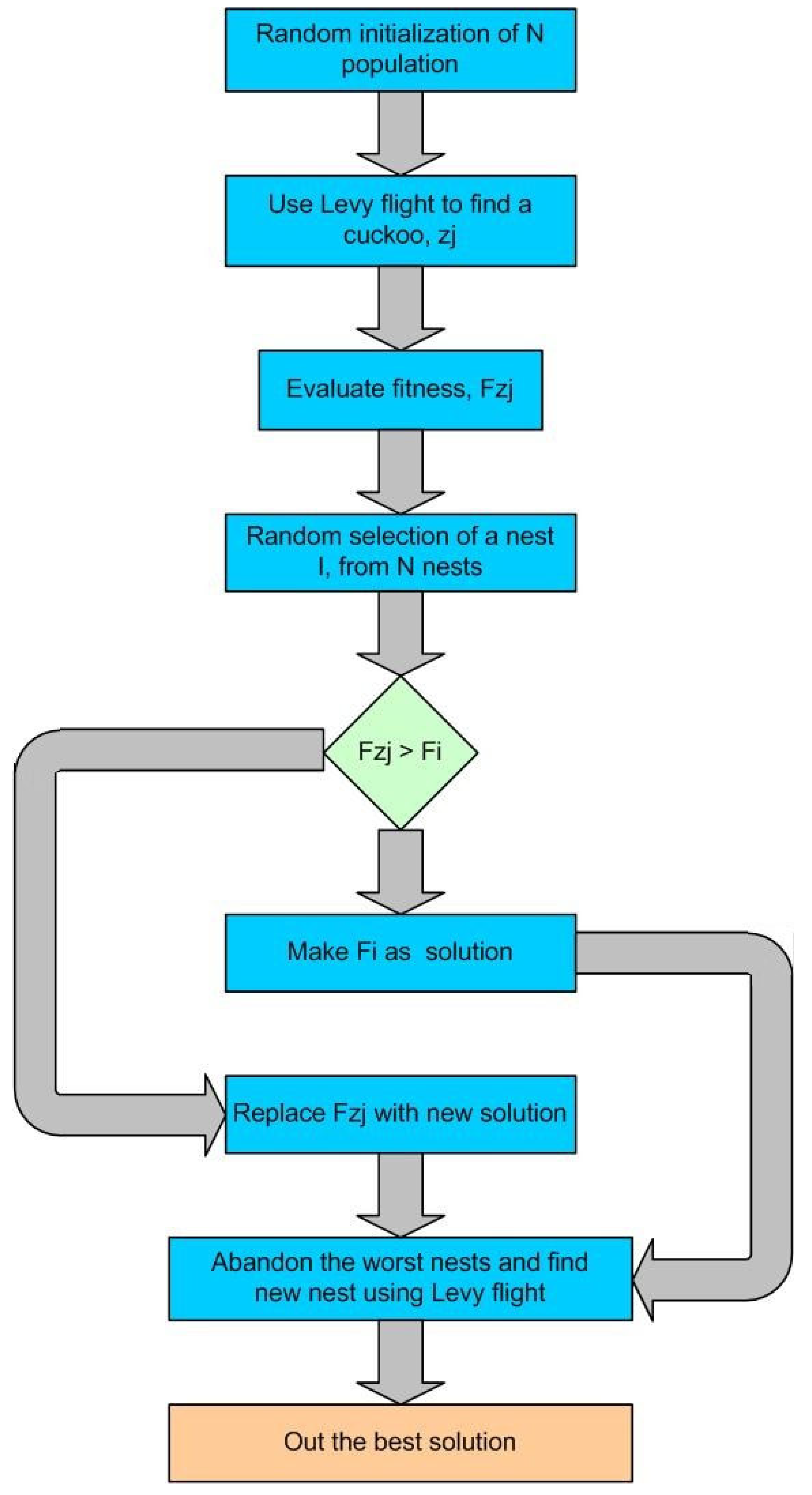
Figure 2.
The network model adopted for research.
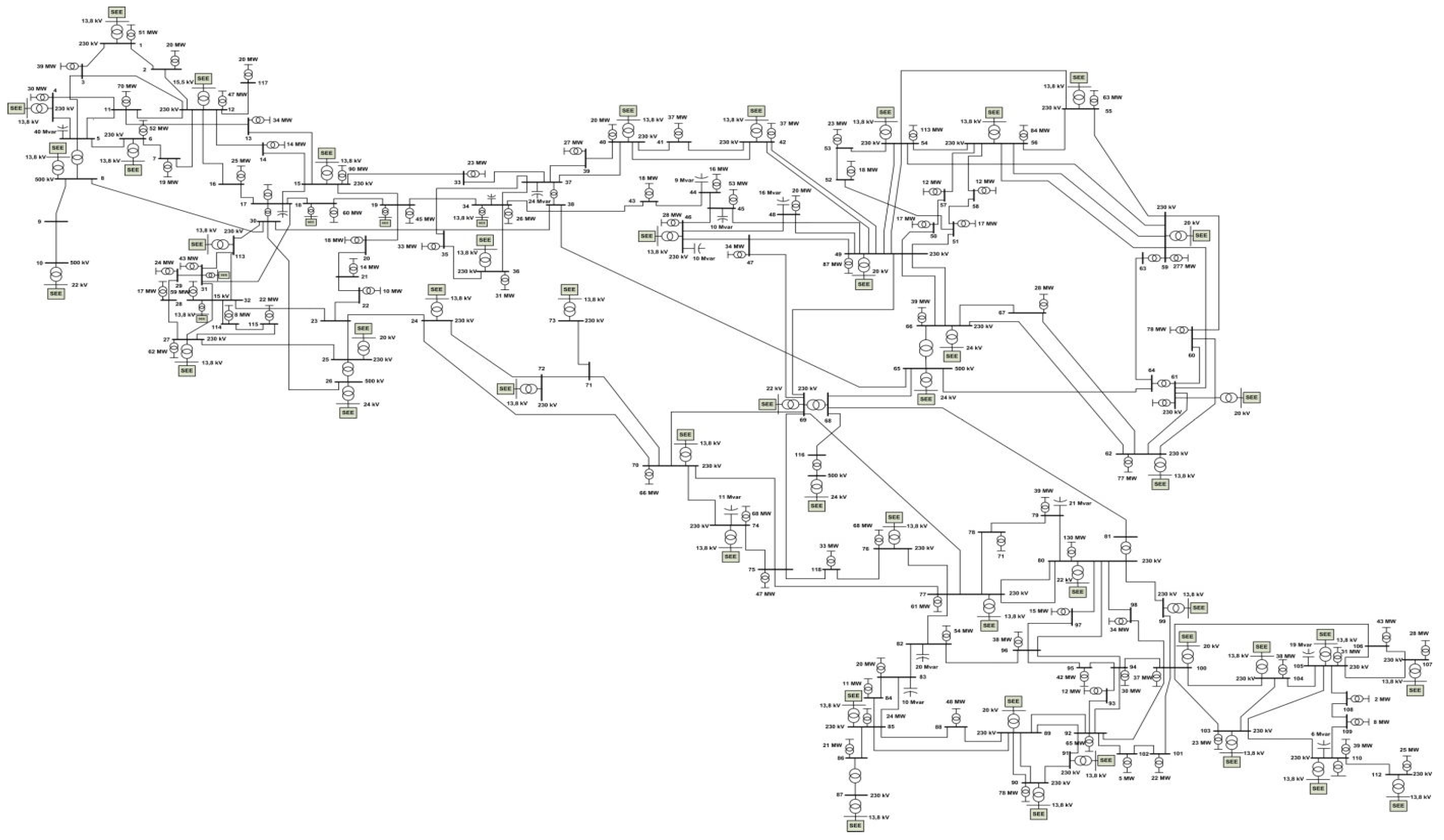
Figure 3.
Solution architecture diagram.
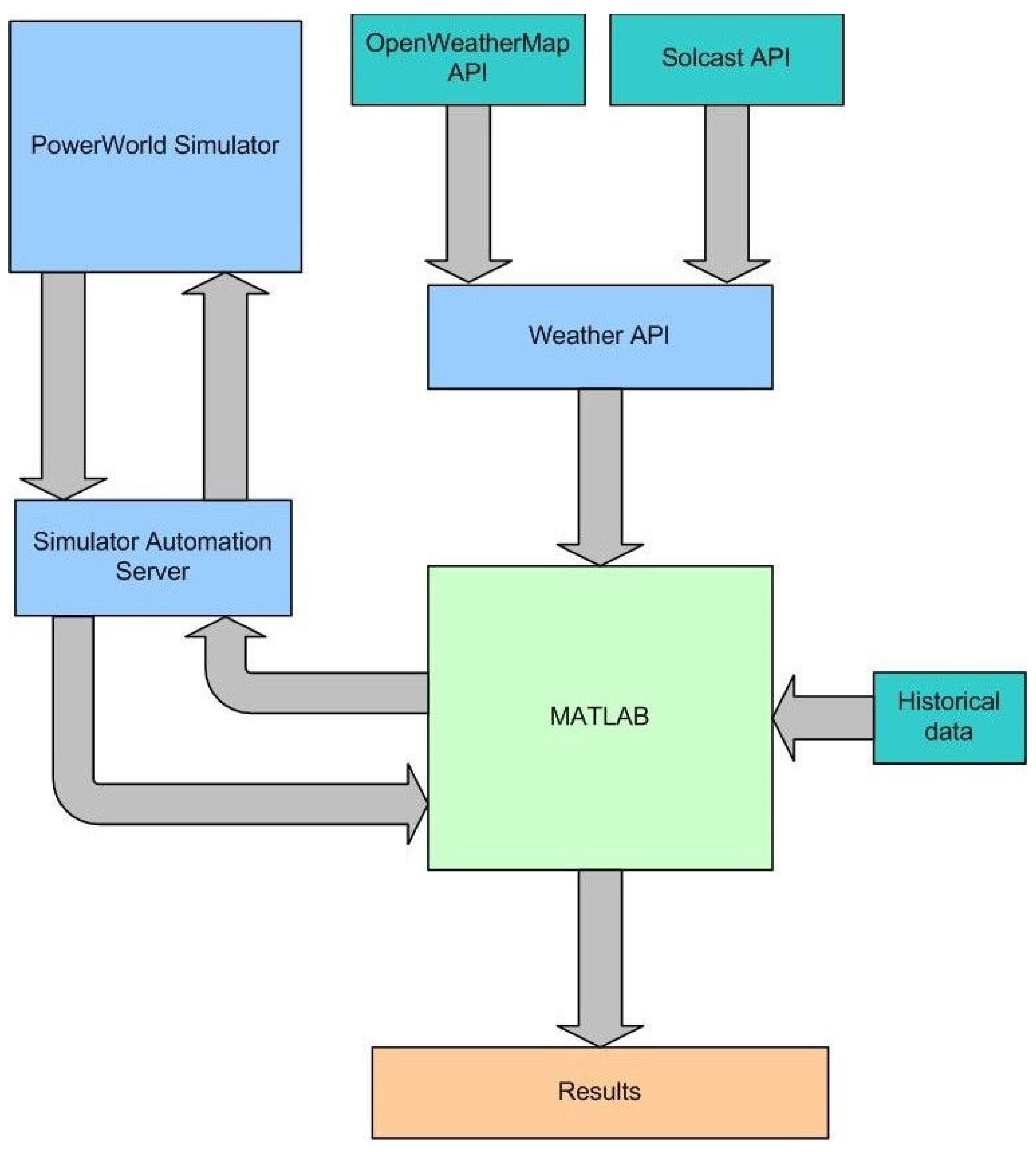
Figure 4.
Flowchart of the network configuration optimization process.
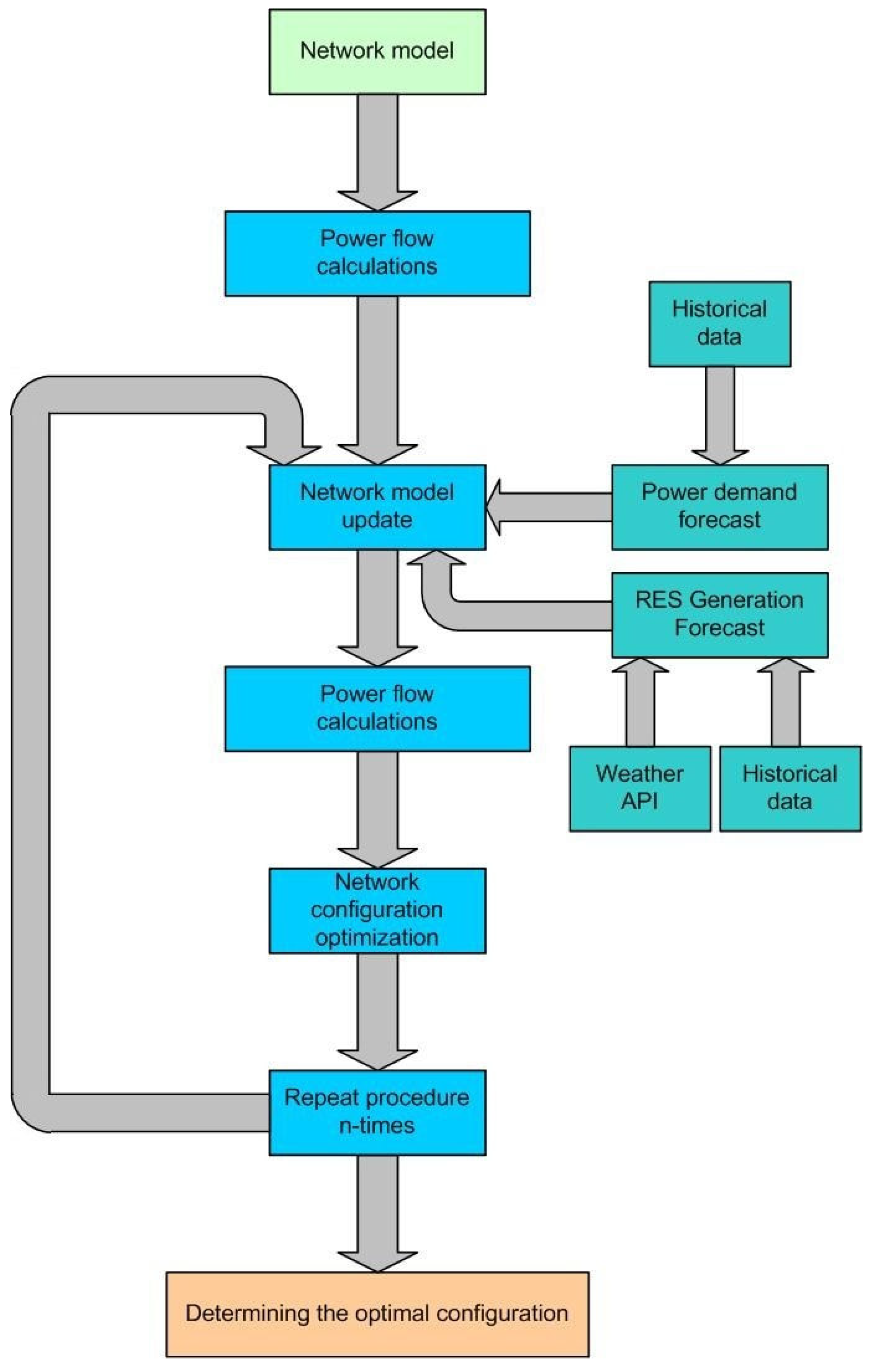

Table 1.
Selected parameters of the test network in the base configuration.
| Network element | Value |
|---|---|
| Power stations 110/15 kV | 4 |
| MV nodes Loads Power range: 10 kW- 630kW PV and FW Power range: 200 kW- 1MW |
783 732 48 |
Table 2.
Selected network operating parameters in the basic configuration.
| Parameter name | Value | Unit |
|---|---|---|
| Active power losses | 1.21 | MW |
| Load Power generated Voltage – min Voltage – max |
63.5 64.71 1.02 1.10 |
MW MW pu pu |
Table 3.
Selected network operating parameters after initial configuration optimization.
| Parameter name | Value | Unit |
|---|---|---|
| Active power losses | 0.91 | MW |
| Load Power generated Voltage – min Voltage – max |
63.5 64.41 1.05 1.10 |
MW MW pu pu |
Table 4.
List of selected simulation parameters.
| Parameter name | Value | |
|---|---|---|
| Optimization algorithm | Cuckoo Search | |
| Number of iterations Start time End time Simulation step |
|
200 00:00 23:00 1h |
Table 5.
List of selected network operating parameters for the first simulation variant.
| Time | Load level [MW] |
Power loss level [MW] |
Power loss difference [%] |
|---|---|---|---|
| 00:00 | 30.21 | 0.265 | 23.45 |
| 07:00 | 43.35 | 0.531 | 20.90 |
| 11:00 | 56.30 | 0.952 | 22.60 |
| 15:00 | 50.56 | 0.725 | 21.50 |
| 19:00 | 37.65 | 0.403 | 23.07 |
| 21:00 | 30.25 | 0.253 | 30.06 |
Table 6.
List of selected network operating parameters for the second simulation variant.
| Time | Load level [MW] |
Power loss level [MW] |
Power loss difference [%] |
|---|---|---|---|
| 00:00 | 34.50 | 0.249 | 24.50 |
| 08:00 | 36.54 | 0.280 | 20.55 |
| 12:00 | 62.48 | 1.017 | 31.20 |
| 16:00 | 40.14 | 0.355 | 21.80 |
| 21:00 | 32.12 | 0.213 | 23.70 |
Table 7.
List of selected network operating parameters for the third simulation variant.
| Time | Load level [MW] |
Power loss level [MW] |
Power loss difference [%] |
|---|---|---|---|
| 05:00 | 30.14 | 0.210 | 22.50 |
| 09:00 | 40.92 | 0.401 | 27.40 |
| 15:00 | 42.69 | 0.430 | 31.20 |
| 19:00 | 32.34 | 0.294 | 20.50 |
Table 8.
List of selected network operating parameters for the fourth simulation variant.
| Time | Load level [MW] |
Power loss level [MW] |
Power loss difference [%] |
|---|---|---|---|
| 00:00 | 24.48 | 0.259 | 34.74 |
| 09:00 | 45.73 | 0.651 | 20.55 |
| 19:00 | 29.20 | 0.465 | 23.07 |
Disclaimer/Publisher’s Note: The statements, opinions and data contained in all publications are solely those of the individual author(s) and contributor(s) and not of MDPI and/or the editor(s). MDPI and/or the editor(s) disclaim responsibility for any injury to people or property resulting from any ideas, methods, instructions or products referred to in the content. |
© 2024 by the authors. Licensee MDPI, Basel, Switzerland. This article is an open access article distributed under the terms and conditions of the Creative Commons Attribution (CC BY) license (http://creativecommons.org/licenses/by/4.0/).
Copyright: This open access article is published under a Creative Commons CC BY 4.0 license, which permit the free download, distribution, and reuse, provided that the author and preprint are cited in any reuse.


