

Submitted:
07 June 2024
Posted:
11 June 2024
You are already at the latest version
Abstract
The study investigated farmers’ perception on pests and diseases management strategies, agricultural practices, production constraints and selection criteria of elite varieties using a survey research design. A total of 700 questionnaires were administered to smallholder farmers who were farming for household consumption, those producing for sale and household consumption and those who were mainly producing for sale because their primary goal was to produce for the market. Findings revealed that the most prevalent pests identified were whiteflies (Bemisia tabaci), grasshoppers (Zonocerus variegatus), aphids (Aphis gossypii), mealybugs (Phenacoccus manihoti), termites (Isoptera), and grasscutters (Thryonomys swinderianus). The three most common diseases of cassava limiting growth and yield with mixed infection include viral, bacterial, and fungal. The study also revealed that only 12.5% of farmers cultivated improved cassava varieties. The management practices implemented encompassed field sanitation and the application of pesticides. Lack of capital and no availability of market were the most important production and marketing constraints faced by farmers in the study area, whereas poundability and high storage root yield are the most preferred traits farmers consider in selecting a new variety. Results suggest that smallholder farmers should endeavor to undergo various developmental programs to develop themselves to increase their competitive advantage in their locality and in the local and global agricultural sectors. In addition, governments and other policy makers should strategize plans and programs that would contribute to smallholder farmers’ agriculture, community and national development.
Keywords:
perception
; smallholder farmers
; biotic stress management strategies
; production constraints
; variety selection criteria
1. Introduction
Cassava (Manihot esculenta Crantz) is an important staple food crop utilized by more than 800 million individuals around the globe [1]. Among the agricultural crops, cassava holds significant importance due to its broad agro-ecological adaptability and the ability to store its roots in the ground, allowing flexible harvesting and ensuring year-round availability of food [2,3]. The crop is used in diverse food, feed and industrial applications thereby supporting many livelihoods around the world. In Sierra Leone, cassava is the most consumed storage root crop. Cassava fresh storage root is enriched in starch and other nutrients such as calcium (16 mg/100 g), phosphorus (27 mg/100 g), vitamin C (20.6 mg/100 g), minute quantities of protein and other nutrients [4]. Cassava leaves are also consumed in the country as vegetables since they contain protein such as lysine, but lack the amino acid methionine and possibly tryptophan [5]. Cassava products such as cassava pellets are used as animal feed, cassava starch for sweeteners, thickeners and textile paper industry [6].
Despite its importance, increased cassava productivity is limited by a number of biotic and abiotic factors [7,8]. The extended life cycle of the crop subjects it to susceptibility to various diseases (Cassava mosaic disease, cassava bacterial blight, anthracnose, root rot), and pests (green mites, and whiteflies). For instance, the cassava green mite biotic constraint causes about 15 and 73% yield losses in resistant and susceptible genotypes of crop, respectively [9]. The cassava mealy bug infestation caused about 88% yield loss in susceptible genotypes of cassava [10]. The most devastating disease within the West African region is the Cassava mosaic disease (CMD) [11,12,13]. These pests and diseases not only result in losses of fresh cassava roots but also impact planting materials. The reduction in root yields varies depending on the vulnerability of cassava cultivars, climate changes, and the pressure from disease-causing pathogens [7,14]. The spread of pests and diseases has been exacerbated by cross-border trade, population movements across countries, and the exchange of planting materials between producers and countries due to regional integration [15,16] [https://www.nature.com/articles/s41467-021-24720-6]. This increased movement of people and agricultural resources has facilitated the wider distribution of pests and diseases, posing significant challenges to cassava production in Sierra Leone and the entire West African region. The biotic constraints have led to the strong advocacy for host plant resistance for the control of pests and diseases than the continual use of pesticides due to its adverse environmental effects on the ecosystem and unsustainability for low-income small-scale farmers [9]. Climate change and/or variability as well as other environmental stress factors are also known to contribute to low yields of crops [8].
In the past, the focus of plant breeders was on developing high-yielding and improved crop varieties on their own conducive and controlled situations at their research trial sites [17]. Under conventional breeding, there was seemingly no provision for farmers preferences and specific traits attributes, farmers traditionally grown germplasm and the prevailing environments of small-scale farmers, as well as development of crop varieties that are adaptable to their ecologies [18]. This lack of incorporation of farmers’ constraints have been identified as the primary reason for the very low adoption of newly developed and improved crop cultivars and their production packages released by scientists, governments and NGOs [19,20].
For any successful breeding program, it is imperative to consider the information on existing production system and farmers’ preferences. This might help researchers to identify farmers’ constraints and thus permit their participation in the development process. Inclusion of farmers and other relevant stakeholders in the improvement of existing cultivars and selection of new varieties is a very crucial factor to be considered in any plant breeding system [21]. The integration of participatory approaches into conventional breeding programs exhibit great potentiality of reducing the timeframe for cultivar development. Crop varieties developed through farmers’ involvement have a greater chance of adoption and diffusion by farmers because they are developed to address farmers’ constraints and preferences [21]. According to Ceccarelli et al. [18], local farmers have the same ability as breeders in terms of selecting high yielding cultivars. Therefore, a good knowledge of farmer’s preferences, production constraints and farming system will enhance in developing appropriate interventions in helping smallholder farmers and selecting their target priorities.
In Sierra Leone, there is limited information on pests and diseases management, agricultural practices, production constraints and selection criteria of elite cassava varieties. This makes a study in this area very necessary because every successful breeding should be based on distinct identification of farmers’ constraints and preferences of end users. Farmers are mostly reluctant to accept technologies which are not in line with their preference and consumer expectation [19]. Participatory Rural Appraisal (PRA) allows the inclusion of farmers in research decision making, in planning the generation of new technologies, and also serve as a non-formal approach to collect detailed data as well as other relevant information of a system [22]. In this study, PRA is used as a platform that enhances interaction between farmers and researchers as a more effective way to get a detailed insight into the farming system in that ecology. Hence, the objectives of this study were to: (i) identify production constraints and selection criteria of elite cassava varieties; (ii) assess the current status of pests and diseases management, and agricultural practices.
2. Materials and Methods
2.1. Description of the Study Area
The Participatory Rural Appraisal (PRA) study was conducted in the northern, northwest, eastern and southern regions of Sierra Leone (Figure 1). The climate is tropical, hot all year round, with a dry season and a rainy season, due to the African monsoon, which runs from May to November in the north, from April to November in the east, and May to October in the south. The annual rainfall varies from 2,000 to 3,000 mm, with a maximum rainfall in the coastal area [24]. Two districts were covered in each of the four regions. Bonthe and Bo districts in the southern region, Kenema and Kailahun in the eastern region, Tonkolili and Bombali in the northern region, and Port Loko in the northwest region. These regions and districts were chosen based on their high quantum of cassava production.
The southern region is characterized by an area of 19,694 km² and a population of 1,830,881 people. It comprises four districts: Bo, Bonthe, Moyamba, and Pujehun. Bo serves as the capital and administrative center, being the second-largest city in Sierra Leone after Freetown. Most of the population in the southern province belongs to the Mende ethnic group.
The Eastern region, covering an area of 15,553 km², is one of the five regions of Sierra Leone. It has a population of 1,939,122 people. Kenema serves as the capital and administrative center. The Eastern region is known for its mountainous terrain, including the Gola Hills and the Loma Mountains. It shares borders with Guinea and the southern and northern regions of Sierra Leone.
The northern region, also known as the north, is in the Northern geographic region of Sierra Leone. It consists of four districts: Bombali, Falaba, Koinadugu, and Tonkolili. With an area of 35,936 km² and a population of 1,316,831 people, the region’s administrative and economic center is Makeni. It shares borders with the Western Area, Guinea, and the Eastern and Southern provinces of Sierra Leone.
The northwest region, established in 2017 from the northern province, encompasses three districts: Kambia, Karena, and Port Loko. With a population of 1,186,050 people, the region has 34 chiefdoms. Port Loko serves as the administrative capital. The northwest region is known for its economic activities such as farming, livestock, fishing, and the extraction of natural resources like rutile, gold, aluminum, bauxite, and diamonds. The largest ethnic group in the region is the Temne, with a significant Muslim population of 87% and a Christian population of 13%.
2.2. Research Design
The study utilized a non-experimental design that incorporated both quantitative and qualitative methods to ensure triangulation and establish the validity of the research findings. Qualitative methods were employed to examine social phenomena and understand their significance to the participants, while quantitative methods aimed to quantify and analysed variables using statistical methods. The study employed three approaches-deductive, inductive, and abductive- with the abductive approach being considered the most reliable and suitable for the mixed-method design due to its inclusion of the respondents’ experiences, knowledge, and personal insights.
2.3. Sampling Population of the Research
The sampling population considered the population of farmers involved in cassava production, and not farmers involved in other farming enterprises were not part of the study since the researcher wanted to have a manageable size of the research work and to satisfy the study objective. The population comprised both sexes with no exception to someone being disable or physically challenged.
2.4. Sampling Technique and Sample Size of Research
The study selected a sample size of 700 cassava farmers from seven districts. The sample size for each district was determined based on a fixed proportion (10%) of the total number of cassava farmers in that district. The distribution of the sample size was as follows: 110 farmers from Bo, 120 from Bonthe, 100 from Kenema, 90 from Kailahun, 100 from Tonkolili, 90 from Bombali, and 90 from Port Loko districts.
The study employed both probability and non-probability sampling techniques. For the non-probability sampling, a purposive approach was used to select cassava farmers in selected chiefdoms of the seven districts. In the probability sampling method, a systematic sampling technique was used to select communities within the chosen chiefdoms. The communities were then clustered, with separate clusters for males and females. Samples were selected from each stratum using a simple random sampling procedure.
In the focus group discussions (FGDs), farmers were grouped into clusters of ten. Smaller communities had five groups, while larger communities had more than five clusters. Two FGDs were conducted in smaller communities using a systematic sampling technique, selecting two groups from the five clusters formed. In larger communities, three FGDs were held using the same technique as in smaller communities. Overall, the study employed a combination of purposive, systematic, clustered, and simple random sampling techniques to select the sample of cassava farmers and conduct focus group discussions.
2.5. Research Instrument
Three research instruments were utilized for the study including a structured questionnaire, Focus Group Discussion (FGD) guide and personal observation. The questionnaire was designed to capture both quantitative and qualitative data, while the FGD was meant for capturing qualitative data only. The FGD targeted questions on farmers’ knowledge on pests and diseases management, cultivar preference/cassava cutting selection criteria, cassava marketing and production constraints and source of information on cassava pests and diseases. Personal observation involved recording the researchers’ field visits experiences using a camera, audio recorder and notebook.
2.6. Validity and Reliability of Research
The questionnaire underwent a process to ensure its validity and reliability. For validity, the instrument was developed under the supervision of research supervisors, considering both content and face validity protocols. Experts also provided feedback on the draft instrument, which was incorporated into the final questionnaire. Additionally, English and formatting were validated by individuals with knowledge and experience in the field. To ensure reliability, the instrument was pre-tested. Ten variables of the questionnaire were subjected to a Cronbach Alpha test using SPSS for reliability analysis. The results showed a reliability value of 0.762, indicating the consistency of the research instrument.
2.7. Data Collection
The data collection procedure involved three components: two primary data collection methods and one secondary data collection method. Data was collected using a structured questionnaire administered to the sampled respondents and the focus group discussion guide by trained enumerators with Diploma and BSc degree qualifications. The interviews took place at the respondents’ homes and lasted a maximum of 45 min. Enumerators explained the study’s purpose and questionnaire content, ensuring respondents of data confidentiality. Verbal consent was obtained from participants before starting the interview, and they had the option to terminate the interview if they felt uncomfortable. During the interview, questions about pest and disease encounters and management were repeated and clarified for accurate responses. Farmers’ responses were read back to them for confirmation, and contact details were collected for potential follow-up during analysis. Farmers’ reactions and knowledge of diseases and pests were assessed through the presentation of plants with symptoms or infestations.
In addition to primary data, secondary information was collected from archived data sources such as the Ministry of Agriculture and Food Security (MAFS), the National University (NU), and some Farmer-Based Organizations (FBOs) in the districts.
2.8. Ethical Consideration of Research
At the beginning of the data collection process, permission was sought from the relevant institution authorities who introduced the researcher and team to the cassava farmers. Each questionnaire included an introductory letter requesting for the respondents’ cooperation in providing the required information for the study. The farmers were assured that their information would be kept confidential and that the study findings are going to be used for academic purpose only. Cassava farmers were assured of their personal protection and that they have the mandate of accepting or rejecting the interview.
2.9. Data Analysis
The survey data were entered into the SPSS 25 software for analysis. The analysis involved the use of descriptive and inferential statistics. Descriptive statistics, such as frequencies, cross tabulations, charts, means, minimums, maximums, and standard deviations, were used to summarize the data. The attitudes of farmers were examined in relation to their use of behavioral control methods, such as the variety of crops cultivated, awareness of and willingness to cultivate improved varieties, cropping system, and choice of planting dates. The practices adopted by farmers to cope with issues related to pests and diseases were also investigated. The effectiveness of these practices was evaluated on a three-point scale, ranging from “not effective” to “very effective.”
Open-ended questions were analyzed by reading through the transcripts multiple times and identifying themes for textual analysis. The textual analysis involved examining the content and structure of the responses, combining both content and narrative analysis. Narrative analysis focused on evaluating farmers’ descriptions of pests, diseases, planting methods, and varietal characteristics.
The preferences identified were ranked using numerals, following the Likert scale (1, 2, 3, 4... N), from the most preferred to the least preferred. The mean rank score for each preferred character or constraint was computed, with the factor receiving the lowest score considered the most preferred or highest constraint. Conversely, the factor with the highest score was ranked as the least preferred.
Determination of the degree of agreement among the respondents was done using a technique proposed by Kendall [24]. The coefficient of concordance was estimated using the relation:
Ref. [25]. Where: W = Kendall’s value; N = total sample size; R = mean of the rank; T = sum of rank of factors being ranked; m = number of respondents (farmers); n = number of factors being ranked; W = coefficient of concordance. The W was tested for significance in terms of the F distribution.
The F-ratio is given by
Ref. [25] with numerator and denominator degrees of freedom being and , respectively.
3. Results
3.1. Demographic Characteristics of Surveyed Population
The demographic characteristics of respondents in the study regions are presented in Table 1. Results on the sex of farmers in farming communities revealed that, of the 700 respondents selected across the four regions, 72.4% were males and 27.6% were females. This indicates that there is a higher proportion of male farmers in the study area. Findings on educational level of farmers revealed that 66.6% of the respondents did not have formal education, while 33.4% had formal education at different levels (primary school, secondary school, and tertiary). Among those with formal education, 16.8% had completed secondary school, 12.8% had completed primary school, and 3.8% had tertiary education. It was established that most (71.1%) of the respondents were married, while 13.8% were single, 10.8% were widowed, and 4.4% were divorced. This indicates that majority of the respondents are stable and could command societal respect. Being married could mean that the respondents are responsible. In a farming household, all members of the household assist each other with farming activities and other household chores. This is more the reason why marriage is paramount among the farming communities, because most farmers depend on their families as primary source of labor. Most (90.5%) of the farmers were household heads, while 9.5% were not household heads but followed instructions and directions from their household heads. Findings revealed that 76.2% of the farmers did not belong to any agricultural organization, while only 23.8% were members of agricultural organizations, indicating their limitation in accessing current information on agriculture, pests, and diseases management.
The descriptive statistics of continuous variables of farmers across the studied regions is presented in Table 2. The age of farmers ranged from 20 years to 72 years with an average of 39.1 years and standard deviation of 10, suggesting a moderate skewness and a platykurtic distribution of ages. These findings indicate that both higher numbers of youth and older people were involved in farming. The results imply that agricultural knowledge could be transferred from the older generation to the younger generation since reasonable proportion of youth are also involved in farming in these communities. However, future interventions and planning in agriculture should strongly feature more youth. The household size ranged from 1 to 18 members with an average of 6.8 persons and standard deviation of 2.6, indicating a right-skewed distribution that followed a normal pattern. Findings also indicate that farmers in the study regions often practiced extended family arrangements, where they received support from their children and family relatives who resided with them for farming activities. The farm size ranged from 1.0 to 7.8 ha with an average of 3.2 ha and standard deviation of 1.7, suggesting a moderate skewness in farm sizes. The years of experience in cassava farming ranged from 2.0 to 40.0 years with an average of 10.1 years and standard deviation of 6.8, indicating a significant level of experience in cassava farming within the study regions. The number of females actively engaged in cassava farming ranged from 0 to 7 with an average of 2.4 and standard deviation of 1.4, indicating a normal distribution pattern and a significant presence and participation of women in cassava farming activities. Similarly, the number of males actively involved in cassava farming ranged from 0 to 6 with an average of 2.5 and standard deviation of 1.4, suggesting a platykurtic pattern. The estimated percentage of damage caused by pests on farmers’ cassava farms ranged from 5.0% to 50.0%, with a mean percentage damage of 26.4%. The variation in the percentage of pest damage was 11.1, suggesting a moderate skewness and a platykurtic distribution. Similarly, the estimated percentage of damage caused by diseases on farmers’ cassava farms ranged from 5.0% to 40.0%, with a mean percentage damage of 16.7%. The variation in the percentage of disease damage was 8.0, indicating a right-skewed distribution that followed a normal pattern.
3.2. Characteristics of Cassava Farms Including the Cropping System
The Farm level characteristics of respondents presented in Table 3. Findings revealed that, a greater percentage of farmers (73.5%) across the four regions practice intercropping, while 26.5% of them practice sole cropping. In the Eastern region, 95.4% of farmers utilize intercropping, while 75.0%, 63.2% and 6.0% of the farmers practice intercropping in the Southern, Northern and Northwest regions, respectively. Farmers in the Eastern region opined that they establish farms primarily for rice production and then plant cassava, vegetables, and other root and tuber crops. Farmers in the Southern, North, and Northwest regions also follow a similar practice, emphasizing that although they establish farms for rice production, they intercrop cassava with other crops. In terms of the crops associated with cassava, approximately 41.5% of farmers intercrop cassava with vegetable crops, while 40.5% associate cassava with cereal and leguminous crops. About 12.4% of farmers across the four regions intercrop cassava with tree crops, mainly in the North and Northwest regions where cassava is planted in association with cashew nut. The remaining 7.5% of farmers intercrop cassava with other root and tuber crops. The study also found variations in the methods and time of planting cassava among farmers in the four regions. In the North and Northwest regions, most farmers (96.0% and 100.0%, respectively) plant cassava by cutting the sticks into pieces and slanting them on mounds. In the Southern and Eastern regions, most farmers (89.0% and 100.0%, respectively) plant cassava by cutting the sticks into sizeable pieces and slanting them at about 45° in the hole and covering them with soil. Only a small percentage of farmers in the Northern region (4.0%) practice this method, while none of the farmers in the Northwest region do. Regarding the time of planting cassava, most farmers in the Southern (95.0%) and Eastern (97.2%) regions plant cassava from March to May every year. In contrast, most farmers in the North (92.0%) and Northwest (90.0%) regions plant cassava from November to January annually.
3.3. Knowledge of Farmers on Cassava Varieties Cultivated, Pests and Diseases, Control Strategies, Information Channels and Diseases Symptom Statements
Information on cassava varieties and characteristics are presented in Figure 2 and Table 4. Findings revealed that 45.0% of the farmers in the southern region cultivate local and improved genotypes, 42.5% cultivate only improved genotypes and 12.5% of them cultivate only local accessions. In the eastern region, most of the farmers (85.0%) cultivate local accessions, while 2.5% of them cultivate the improved genotypes only and 2.5% cultivate both local and improved accessions. Higher percent of farmers from the north (84.0%) and northwest (96.0%) regions cultivate local variety than 3.0% and 2.5% of them that cultivate the improved genotypes and 3.0% and 2.0% of them that cultivate both local and improved, respectively (Figure 2).
The list of most dominant cassava varieties cultivated by regions are presented in Table 4. In the southern region, Blue bolt/ SLICASS 4, Cooksoon, Coco cassada, Ndiamonymalo, Nikaneh, Pissay are the most dominant varieties cultivated by farmers, Butter cassava, Cooksoon, Tangagboi, Mende tangai are cultivated more in the Eastern region, Yaa kanu, Kendemeh, Munafa, Walima and IDA are cultivated in the North whilst in the Northwest, Roclass, Kendemeh are the most dominant varieties cultivated by farmers.
The distribution of farmers based on their awareness and willingness to cultivate improved varieties is presented in Figure 3. Majority of the farmers (60.0%) were not aware of improved varieties and therefore cultivate more of local landraces, while 40.0% of them reported that they are aware of improved variety but appreciate local varieties than the improved ones. However, higher percent of the farmers (98.0%) express their willingness to cultivate improved varieties provided they possess their desired traits such as high yielding, ability to cook, sweet and high dry matter content, while only (2.0%) of the farmers insisted that they are not willing to cultivate improved varieties even if they possess all the desired traits (Figure 3).
A higher proportion of farmers from the southern (89.0%), eastern (98.0%), northern (95.0%), and northwest (93.0%) regions have reported the occurrence of pests in their cassava farms (Table 5).
The key pests identified as infesting cassava farms included grasshoppers (Zonocerus variegatus), grasscutter (Thryonomys swinderianus), whiteflies (Bemisia tabaci), green mites (Mononychellus tanajoa), and termites (Isoptera). Among these, grasshoppers were perceived as the most troublesome insect pests by farmers in the southern (48.0%) and eastern (55.0%) regions. Cows were considered as the primary pest causing damage to cassava crops by 64.5% of farmers in the north and 55.0% of farmers in the northwest regions. Grasscutters were reported as the second most destructive pest by 39.0% of farmers in the eastern region and 40.0% of farmers in the southern region. In the northern and northwest regions, grasshoppers were reported as the second most devastating pest after cows by 35.0% and 20.5% of farmers, respectively. Other pests mentioned by farmers included whiteflies, cassava green mites, and termites. Most farmers from the southern (81.5%), eastern (83.0%), northern (83.0%), and northwest (85.0%) regions have also experienced diseases in their cassava farms. However, some farmers from these regions (southern 18.5%, eastern 17.0%, northern 17.0%, and northwest 15.0%) reported not experiencing any diseases in their farms (Table 5).
Farmers provided descriptions of the symptoms and damage caused by these diseases, including cassava mosaic disease, root rot, bacteria blight, leaf distortions, and stunting or yellowing of leaves. Cassava mosaic disease was considered the most devastating disease by 42.5% of farmers in the southern region, 90.5% in the eastern region, 77.0% in the northern region, and 80.0% in the northwest region. Leaf distortions, stunting, or yellowing of leaves were perceived as the second most detrimental cassava diseases by the farmers. Cassava bacteria blight and root rot were also mentioned as major diseases affecting cassava by some farmers. There was a lack of precise knowledge among farmers regarding the exact names of the diseases. However, they were able to provide descriptions of the symptoms and damage caused by these diseases.
Findings on pests and diseases management strategies utilized by farmers are presented in Table 6. Most (34.7%) of the farmers relied on farm sanitation practices, which involved cleaning their farms, brushing, and weeding. This method aimed to maintain a clean environment and reduce the presence of pests and diseases. The second most important pest management technique utilized by 34.4% of the farmers was the physical and cultural control methods. This included manual picking of grasshoppers, setting traps, hunting, and constructing fences to protect their crops from animals like grasscutters, squirrels, and cows. For example, farmers in the northern and northwest regions reported that cows were the most devastating pests for their cassava crop, so they build fences around their farms to prevent their destruction. Chemical pesticides were also used by 16.4% of the farmers to control pests on their cassava farms. Farmers in the eastern region mentioned a unique approach where they would apply chemicals to cassava storage roots and place them in the farm. This method was aimed at attracting squirrels and grasscutters to feed on the roots, resulting in the elimination or reduction of these pests. However, this approach has potential ecological implications. The lowest of 13.6% of the farmers employ no pest control measures on their farms possibly be due to limited resources, lack of awareness, or personal preferences. With regards disease management, most of farmers (77.2%) utilize no control measures, while only 17.6% and 5.2% of them utilized farm sanitation practices and chemical pesticides to mitigate diseases, respectively. Farmers relied on their own experiences and advice from fellow farmers, while extension officers provided little help. This indicates that extension services and training support for pest and disease management are inadequate.
The findings on diseases symptom statements revealed that farmers experience multiple infections in their farms (Table 7). The farmers’ responses on knowledge and experience of cassava diseases were validated through descriptions and photographs of common symptoms, including bacterial, fungal, and viral diseases. In addition to commonly reported diseases such as cassava mosaic disease, root rot, bacterial blight, leaf distortions, stunting, and yellowing, farmers also reported experiencing cassava brown leaf spot (52.6%), whitish substance/web-like strains on the leaves (19.5%), white spot (15.5%), scar on the cassava stem/node (8.8%), and progressive death of leaves and other parts of the cassava plants (3.6%). These findings indicate a high incidence and severity of multiple diseases in farmers’ fields across all four regions.
Rating of the level of pest and disease management practice is presented in Table 8. Most farmers (77.8%) opined that their pest management practices were moderately effective compared to 22.2% of farmers who indicated that their pest management practices were not effective. In terms of disease management, most farmers (89.1%) reported that their disease management practices were not effective, while 10.9% perceived their disease management practices as moderately effective. The mean score for the level of effectiveness of farmers’ pest management practices was 2.34, with a standard deviation of 0.478. This suggests that the overall level of effectiveness of the pest management strategies was perceived to be moderately effective. In contrast, the disease management measures were perceived as not effective, with a mean score of 1.7 and a standard deviation of 0.347.
Damage by pest ranged from 5.0 to 50.0% with a mean of 26.48% and standard deviation of 11.19, indicating a moderately skewed and flat curve that follows the normal distribution (Table 9). Damage by disease ranged from 5.0 to 40.0% with a mean of 16.72% and standard deviation of 8.02, indicating a highly skewed and followed normal distribution and flatness (Table 9). Most of the farmers (56.7%) opined that they do not receive information from anybody or institution on pest and disease, but noticed pest and disease damage from their personal observations in the field regarding symptom expression of the disease and the damage by pests to their plants (Figure 4). About 21.0% relied on the extension officers from Ministry of Agriculture and Forestry (MAF) for information on pests and diseases, while 16.3% of them depend on research institutions like Sierra Leone Agricultural research institute (SLARI), 5.2% of the farmers get information from their fellow farmers and 0.8% of them get information from radio program.
3.4. Constraints of Cassava Production and Marketing
Cassava production constraints were classified into eight categories in order to identify major production constraints faced by farmers. These constraints were ranked to identify the most important constraints to the least important ones. Findings from the survey research revealed that lack of capital was the most important constraint faced by farmers (Table 10). This was followed by no availability of market, and pests and diseases attack, whereas late maturity was ranked as the least important constraint. There was a higher level (70.6%) of agreement among the farmers across the study locations on the ranking of these constraints (Kendall’s W = 0.706). There was an agreement among farmers in Bo (16.0%) and Bonthe (10.0%) that no availability of market and lack of capital were the most important constraints faced by cassava farmers in the southern region (Kendall’s W = 0.16 and 0.10, respectively).
Availability of market and lack of capital were ranked as the most important constraints faced by cassava farmers in Bo and Bonthe districts, respectively. Lack of capital was ranked as the most important constraint faced by cassava farmers in Kailahun and Kenema districts in the eastern region (Kendall’s W = 0.10 and 0.11), whilst the least important constraints ranked by cassava farmers was late maturity in Kailahun, and pests and diseases attack in Kenema districts, respectively. For cassava farmers in Bombali and Tonkolili districts in the Northern region, pests and diseases attack were ranked the most important constraints, whilst late maturity and lack of transportation were ranked the least important constraints in Bombali and Tonkolili districts, respectively (Kendall’s W = 0.10, 0.10). In Port Loko district of the Northwest region, lack of capital was ranked as the most important constraint faced by cassava farmers, whilst late maturity was ranked as the least important constraint faced by farmers in that district.
3.5. Farmers Selection/Preference Criteria for Cassava Genotype
Results on mean rank of cultivar preference traits across studied communities revealed that the ability of the variety to cook well was the most preferred traits that farmers desired in a variety (Table 11). This was followed by high yielding, and sweetness. Whereas high dry matter content was ranked the least preferred traits. There was some level (23.0%) of agreement among the farmers across the study locations on the ranking of these preferred traits (Kendall’s W = 0.23).
At district and regional level, there was an agreement (Kendall’s W= 0.20) among farmers in Bo district of the Southern region that high yielding, ability to cook well early maturity and high dry matter content are the most preferred traits whereas sweetness was ranked as the least preferred traits by them. Farmers in Bonthe district of also Southern region agreed that high yielding, sweetness, early maturity and high dry matter content are the most preferred traits whereas ability to cook well was ranked as the least preferred traits (Kendall’s W=0.20). In Kailahun district of the Eastern region, there was an agreement (Kendall’s W= 0.16) among farmers that high yielding, ability to cook well and high dry matter content are the most preferred traits whereas early maturity was ranked the least preferred traits and in the Kenema district of the Eastern region, there was an agreement (Kendall’s W= 0.22) among farmers that ability to cook well and sweetness are the most preferred traits whilst high dry matter content was ranked as the least preferred trait. Ability to cook well and sweetness are the preferred traits agreed among farmers in Tonkolili district of the Northern region whereas high dry matter content was ranked the least preferred trait (Kendall’s W= 0.19). In Bombali district of the northern region, there was an agreement (Kendall’s W= 0.21) among farmers that high yielding and ability to cook well are the most preferred traits whereas early maturity was ranked as the least preferred trait. There was an agreement (Kendall’s W= 0.21) among farmers in Port Loko district of the Northwest region that sweetness is the most preferred trait whilst high dry matter content was ranked as the least preferred trait.
4. Discussion
Low level of education among smallholder farmers often hinders the adoption of new technologies and appropriate pest and disease management strategies. This is reminiscent with the situation in Sierra Leone similar with previous observations made by Asare-Bediako [26], but contradicts the findings of Frimpong et al. [27], who reported an improvement in the educational level among cassava farmers in Ghana. The introduction of the Free and Compulsory Universal Education (FCUBE) policy in 1995 in Ghana provided opportunities for people in rural areas, especially in Northern Ghana, to access education.
Moreover, the study revealed variations across the four regions in terms of the categorical variables, including sex, level of education, household headship, marital status, and membership in agricultural organizations. However, unlike Sierra Leone where most farmers do not belong to any agricultural organization, Frimpong et al. [27] found that most farmers in Ghana belonged to agricultural organizations and had access to current information on agriculture, including pests and diseases management.
According to Bloom’s taxonomy, knowledge is the primary step of perception, which generates attitudes and results in actions. Findings revealed that most farmers had knowledge and experience with cassava damaging pests in their farms. They were able to provide local names and descriptions of the pests they had encountered similar to reports in previous studies [15,27]. The pests mentioned by farmers were among the common devastating cassava pests documented in the literature. However, farmers relied on their own experiences, intuition, and farmer-to-farmer networks to acquire knowledge on different pests that pose serious threats to their crops. They were unaware of specific insect vectors and their multiple species, such as whiteflies and mealybugs, and classified them under a generic name. This lack of specific knowledge could affect the appropriate management strategies being employed [27,28].
The study found that farmers’ knowledge on diseases was limited, although they experienced diseases in their farms. Farmers noticed changes in plant tissues but could not associate them with any specific diseases. They were unable to give specific names of diseases but described their symptoms, such as twisting and yellowing of leaves, burning of leaves, rot of storage roots, and brown spots on leaves. These symptoms are associated with cassava mosaic disease, bacterial blight, root rot, and brown spot disease, respectively. This finding is consistent with the studies of Frimpong et al. [27] and Echodu et al. [15], but contrasts with the study of Appiah-Kubi et al. [29]. Farmers’ descriptions of disease symptoms indicated that pathogens attack foliar, stem, and root tissues, causing leaf spots, leaf dropping, wilting, dieback, and root rot. Farmers interchangeably used the terms pests, diseases, and related symptoms, demonstrating a knowledge gap in cassava diseases. Farmers need intensive training on simple skills and tools for the identification and management of pests and diseases. This finding is consistent with the study by Frimpong et al. [27].
Farmers employed cultural and physical practices, such as killing pests by hand, setting traps, removing infected plants, and farm sanitation, to improve crop vigor. However, some recommended practices, such as crop rotation, fallowing, and biological control, were rarely used by farmers. Pesticide application was also reported, which could pose health hazards and threaten the environment [28]. Intercropping was a common practice among farmers, but they were not aware of its pest and disease management capacity. Cassava was intercropped with both short and long-duration crops, such as cereals, legumes, vegetables, and root and tubers like yam. Intercropping with leguminous crops was found to improve soil properties. However, intercropping could have negative effects on disease spread if done with plants that are alternate hosts of certain diseases. Farmers also cultivated improved varieties that were resistant/tolerant to cassava mosaic disease, but the adoption rate was relatively low. Farmers preferred local varieties for their desirable traits, such as cooking ability and high dry matter content, even though these varieties were susceptible to cassava diseases. Findings generally indicate a need for more effective and efficient management strategies. Farmers need to be trained on integrated pest and disease management approaches, which could be done by agricultural institutions and research organizations.
5. Conclusions
This study identified farmers’ pests and diseases management strategies, agricultural practices, production constraints and selection criteria of elite varieties that could be considered for the genetic improvement, conservation and utilization of cassava. The study established that mix infections could occur in farmers field and integrated pest and disease management strategies are rarely applied by farmers due to lack of knowledge and recognition of pest and disease resistance trait in cassava. The farmers’ perceptions gathered in the present study can provide good guidance for designing breeding programs for improvement of cassava. Inclusion of an effective extension program for disseminating useful agricultural information and farmer education on pests and diseases management strategies, agricultural practices, existing production constraints and selection criteria of elite varieties of cassava. The present study did not plunge deeper to delineate the crop cycle stage attacked and the season of the cropping year in which these pests and diseases were prominent to affirm farmers’ responses. Further studies should incorporate these stages of the crop cycle and seasons as a means of validating farmers’ responses.
Author Contributions
Conceptualization, V.A. and A.E.S.; methodology, A.E.S., V.A. and P.E.N.; software, V.A. and P.E.N.; validation, V.A., P.E.N. and F.T. formal analysis, V.A. and P.E.N.; investigation, V.A., A.E.S., P.E.N., K.Y.K. and S.A.K.; resources, A.E.S. and J.S.P.; data curation, V.A. and P.E.N.; writing—original draft preparation, V.A. and P.E.N.; writing—review and editing, A.E.S., V.A., P.E.N. and F.T.; visualization, P.E.N.; supervision, A.E.S., P.E.N., K.Y.K. and S.A.K.; project administration, A.E.S., A.O.E. and J.S.P.; funding acquisition, A.E.S., A.O.E. and J.S.P. All authors have read and agreed to the published version of the manuscript.
Funding
This work was supported by the Bill and Melinda Gates Foundation and The United Kingdom Foreign, Commonwealth and Development Office (FCDO) under a grant number OPP1212988/INV-002969 to the Central and West African Virus Epidemiology (WAVE) Program for root and tuber crops—through a subgrant from the Université Félix Houphouët-Boigny (UFHB) to Njala University.
Data Availability Statement
Data from this survey can be made available on request from the corresponding author due to ethical reasons.
Acknowledgments
The authors are grateful to the crop protection and cassava breeding team at the Njala University, the Sierra Leone Agricultural Research Institute (SLARI) and WAVE Ivory Coast, for their technical support during the course of this study.
Conflicts of Interest
The authors declare no conflicts of interest.
References
- Esuma, W.; Nanyonjo, A.R.; Miiro, R.; Angudubo, S.; Kawuki, R.S. Men and women’s perception of yellow-root cassava among rural farmers in eastern Uganda. Agric. Food Secur. 2019, 8, 10. [CrossRef]
- Sanginga, N.; Mbabu, A. Root and tuber crops (cassava, yam potato and sweet potato) roots and tubers. Feeding Africa; 21-23, An Action Plan for Africa Agricultural Transformation. Abdou Diouf International Conference Center, Dakar, Senegal, 2015.
- Torkpo, S.K.; Gafni, Y.; Danquah, E.Y.; Gafni, Y. Farmers’ perception of cassava mosaic disease and cassava cultivar attributes preferences in Ghana. Innov. Tech. Agric. 2017, 2(1), 294–300.
- USDA United States Department of Agriculture. Basic Report: 11134, Cassava, raw. National Nutrient Database for Standard Reference Release 28. Agricultural Research Service, US Department of Agriculture. May 2016. Retrieved 7 December 2016.
- FAO. Food and Agricultural Organization. Preparation of cassava leaf products and their use as animal feeds. FAO Animal Production and Health Paper 95,111-125. Retrieved 13 August 2010.
- Mal, M.; Chipeta, M.M.; Bokosi, J.M.; Saka, V.W.; Benesi, I.R.M. Combining ability and mode of gene action in cassava for resistance to cassava green mite and cassava mealy bug in Malawi. J. Plant Breed. Crop. Sci. 2013, 5, 195–202. [CrossRef]
- Kintché, K.; Hauser, S.; Mahungu, N.; Ndonda, A.; Lukombo, S.; Nhamo, N.; Uzokwe, V.; Yomeni, M.; Ngamitshara, J.; Ekoko, B.; et al. Cassava yield loss in farmer fields was mainly caused by low soil fertility and suboptimal management practices in two provinces of the Democratic Republic of Congo. Eur. J. Agron. 2017, 89, 107–123. [CrossRef]
- Karim, K.Y.; Norman, P.E.; Dzidzienyo, D.; Ifie, B.; Kulakow, P.; Rabbi, I.; Omoigui, L.; Parkes, E. Gene action analysis studies for agronomic traits in cassava (Manihot esculenta Crantz) genotypes developed using line by tester mating design. African J. Agric. Res. 2020, 16(10), 1471–1479.
- Bellotti, A.C. Arthropod pests. In: R.J. Hillocks JM, Thresh AC, Bellotti (Eds.). Cassava: Biology, production and utilization. London, UK: CABI Publishing, 2002, pp. 209–235.
- Bellotti, A.C.; Hershey, C.H.; Vargas, O. Recent advances in resistance to insect and mite pests of cassava. In: Hershey, C.H. (ed.) cassava breeding: A multidisciplinary review, proceedings of a workshop held in Philippines, 4-7 March, 1985. CIAT, Cali, Colombia, 1987, pp. 117–146.
- Elegba, W.; Appiah, A.S.; Azu, E.; Afful, N.T.; Agbemavor, W.S.; Agye-Amponsah, J.; Owureku-Asare, M.; Quaye, B.; Danso, K.E. Effect of mosaic virus diseases on dry matter content and starch yield of five cassava (Manihot esculenta Crantz) accession in Ghana. African J. Biotech. 2013, 12(27), 4310-4316.
- Manu-Aduening, J.; Lamboll, R.; Mensah, G.A.; Gibson, R. Farmers? perceptions and knowledge of cassava pests and diseases and their approach to germplasm selection for resistance in Ghana. Ann. Appl. Biol. 2007, 151, 189–198. [CrossRef]
- Moses, E.; Oppong, A.; Lamptey, J.N.L. Reaction of local accessions of cassava to diseases in southern Ghana. African Crop Sci. J. 2015, 23(1), 27–34.
- Fondong, V.N.; Rey, C. Recent biotechnological advances in the improvement of cassava. In Cassava (Chapter 9, pp. 139-161). INTECH, 2018.
- Echodu, R.; Edema, H.; Wokorach, G.; Zawedde, C.; Otim, G.; Luambano, N.; Ateka, E.M.; Asiimwe, T. Farmers' practices and their knowledge of biotic constraints to sweetpotato production in East Africa. Physiol. Mol. Plant Pathol. 2019, 105, 3–16. [CrossRef]
- Delêtre, M.; Lett, J.-M.; Sulpice, R.; Spillane, C. Kinship networks of seed exchange shape spatial patterns of plant virus diversity. Nat. Commun. 2021, 12, 1–10. [CrossRef]
- Bänziger, M.; Cooper, M. Breeding for low input conditions and consequences for participatory plant breeding examples from tropical maize and wheat. Euphytica 2001, 122, 503–519. [CrossRef]
- Ceccarelli, S.; Grando, S.; Tutwiler, R.; Baha, J.; Martini, A.M.; Salahieh, H.; Goodchild, A.; Michael, M. A methodological study on participatory barley breeding I. Selection phase. Euphytica 2000, 111, 91–104. [CrossRef]
- Placide, R.; Shimelis, H.; Laing, M.; Gahakwa, D. Application of principal component analysis to yield and yield related traits to identify sweet potato breeding parents. J. Trop. Agric. 2015, 92(1), 1–15.
- Adesina, A.A.; Baidu-Forson, J. Farmers' perceptions and adoption of new agricultural technology: evidence from analysis in Burkina Faso and Guinea, West Africa. Agric. Econ. 1995, 13, 1–9. [CrossRef]
- Balde, B.S.; Kobayashi, H.; Nohmi, M.; Ishida, A.; Esham, M.; Tolno, E. An Analysis of Technical Efficiency of Mangrove Rice Production in the Guinean Coastal Area. J. Agric. Sci. 2014, 6, p179. [CrossRef]
- Uddin, M.; Anjuman, N. Participatory rural appraisal approaches: an overview and an exemplary application of focus group discussion in climate change adaptation and mitigation strategies. Int. J. Agric. Res. Innov. Technol. 2013, 3, 72–78. [CrossRef]
- Karim, K.Y.; Norman, P.E. Perceived Knowledge of Cassava Value Chain Actors on Varietal Preferences for Various End Uses. Trans. Networks Commun. 2023, 11, 1–21. [CrossRef]
- Kendall, M.G. THE TREATMENT OF TIES IN RANKING PROBLEMS. Biometrika 1945, 33, 239–251. [CrossRef]
- Kendall, M.G.; Smith, B.B. The Problem of $m$ Rankings. Ann. Math. Stat. 1939, 10, 275–287. [CrossRef]
- Asare-Bediako, E. The growth and development of free education in northern Ghana: 1951-1966. (MPhil History Degree Thesis). University of Ghana, Legon. 2014.
- Frimpong, E.B.; Agyemang, K.; Agyei, A.N. Farmers’ knowledge, attitudes, and practices of pests and diseases management in cassava cultivation in the Ashanti region of Ghana. Afr. J. Agric. Res. 2021, 16(3), 435–447. [CrossRef]
- Cudjoe, A., Gyamenah, J., James, B. Whiteflies as vectors of plant viruses in cassava and sweet potato in Africa—Ghana: In P.K. Anderson, F.J. Morales, A.L. Jones, & R.H. Markham (Eds.) Whitefly and whitefly-borne viruses in the tropics: Building a knowledge base on Global Action, CIAT, Colombia.” 2005, pp. 24–29.
- Appiah-Kubi, Z.; Apetorgbor, A.K.; Moses, E.; Appiah-Kubi, D. Farmers Knowledge of Anthracnose Disease of Cassava and Yam in Four Ecological Zones in Ghana. Greener J. Agric. Sci. 2015, 5, 204–209. [CrossRef]
Figure 1.
Map of Sierra Leone showing the study locations.
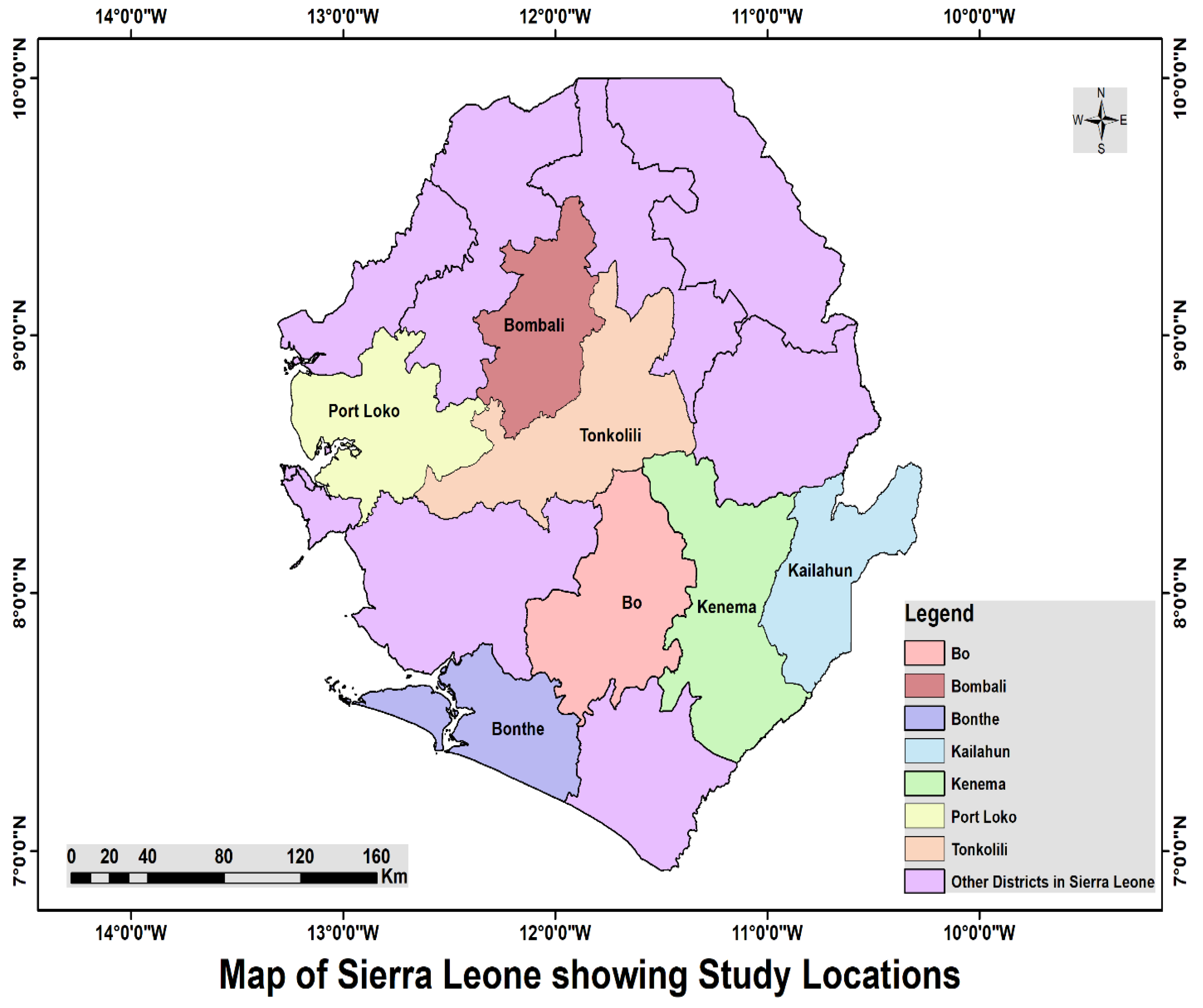
Figure 2.
Regional distribution of respondents based on the types of cassava varieties cultivated.
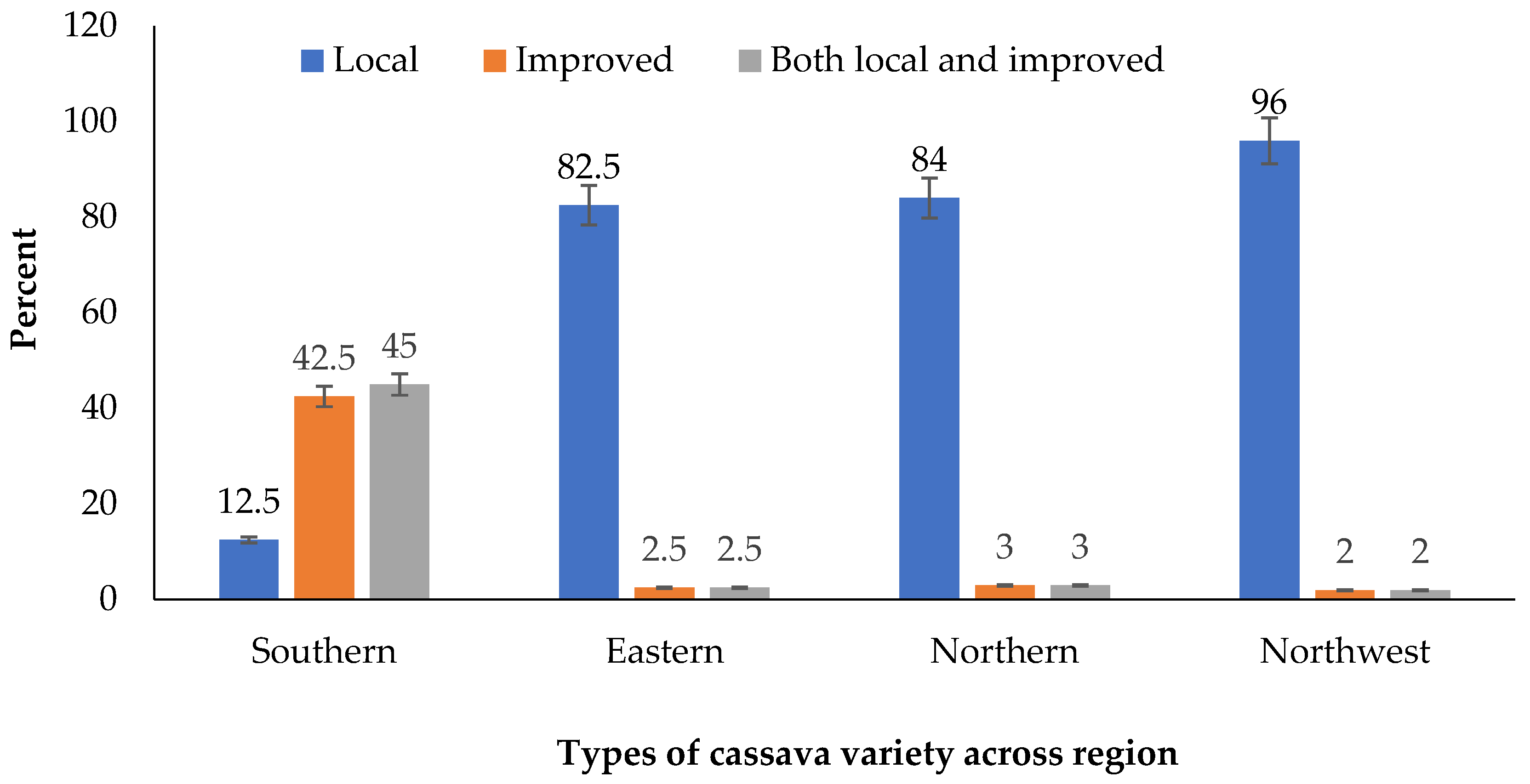
Figure 3.
Distribution of farmers based on their awareness and willingness to cultivate improved varieties.
Figure 3.
Distribution of farmers based on their awareness and willingness to cultivate improved varieties.
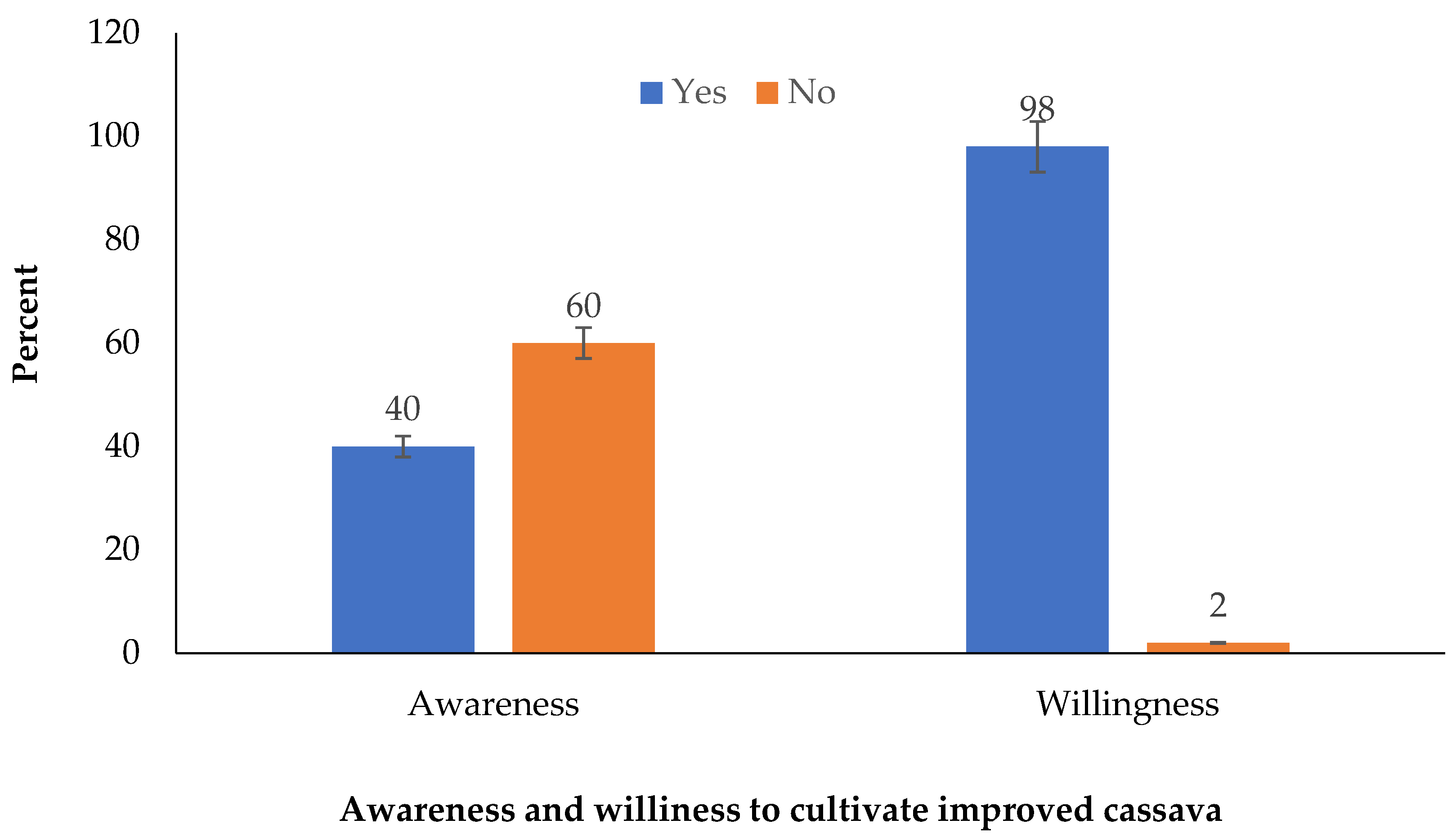
Figure 4.
Information channels of pests and diseases.
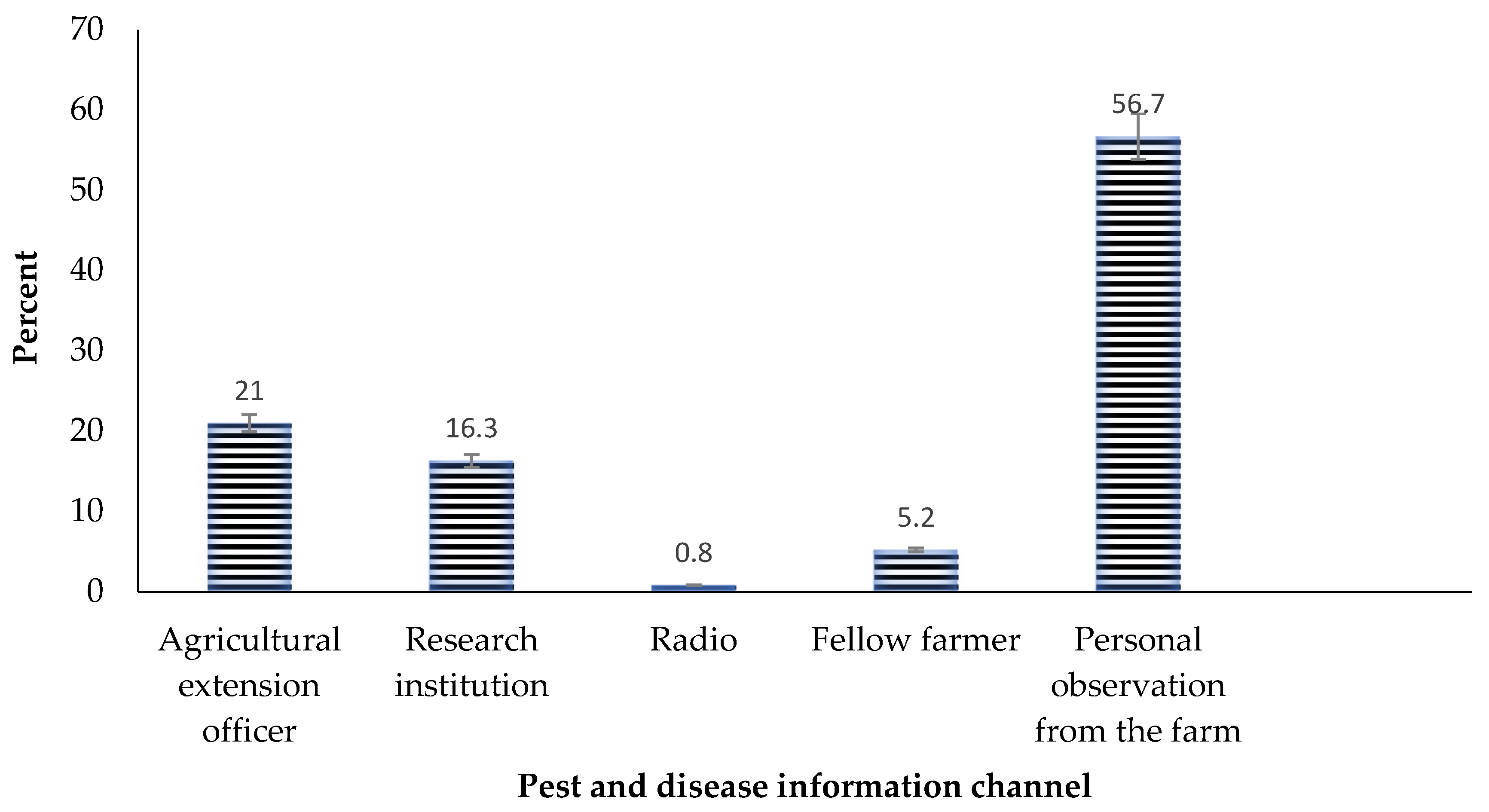

Table 1.
Demographic characteristics of respondents in the study regions.
| Variables | All Regions | South Region | East Region | North Region | Northwest Region |
|---|---|---|---|---|---|
|
Sex Male Female |
72.4 27.6 |
56.5 43.5 |
72.5 27.5 |
84.5 15.5 |
76.1 23.9 |
|
Educational level Nonformal (%) Primary education (%) Secondary education (%) Tertiary education (%) |
66.6 12.8 16.8 3.8 |
60.0 9.5 28.0 2.5 |
68.0 20.0 10.0 2.0 |
88.5 2.0 9.5 0.0 |
50.0 20.0 20.0 10.0 |
|
Marital status Single (%) Married (%) Widowed (%) Divorced (%) |
13.8 71.0 10.8 4.4 |
15.5 71.0 11.0 2.5 |
10.0 77.5 10.0 2.5 |
9.5 76.0 10.0 4.5 |
20.0 60.0 12.0 8.0 |
|
Household head Yes (%) No (%) |
90.8 9.2 |
81.0 19.0 |
95.0 5.0 |
97.0 3.0 |
90.0 10.0 |
|
Membership to agricultural organization Yes (%) No (%) |
23,8 76.2 |
34.3 65.7 |
31.6 68.4 |
16.2 83.8 |
13.0 87.0 |
Source: Survey data, 2022.
Table 2.
Descriptive statistic of the quantitative parameters.
| Variables | Range | Min | Max | Mean | Std.Dev | Skewness | Kurtosis |
|---|---|---|---|---|---|---|---|
| Age | 52.0 | 20.0 | 72.0 | 39.1 | 10.0 | 0.5 | 0.2 |
| Household size | 17.0 | 1.0 | 18.0 | 6.8 | 2.6 | 1.5 | 0.1 |
| Cassava farm size(ha) | 6.0 | 1.0 | 7.0 | 3.2 | 1.7 | 0.9 | -0.2 |
| Cassava farming experience in years | 38.0 | 2.0 | 40.0 | 10.1 | 6.8 | 1.3 | 1.6 |
| Female actively involved in cassava farming | 7.0 | 0 | 7 | 2.4 | 1.4 | 0.7 | 0.1 |
| Male actively involved in cassava farming | 6.0 | 0 | 6.0 | 2.5 | 1.4 | 0.4 | -0.4 |
| Percentage field damage by pests | 45.0 | 5.0 | 50.0 | 26.4 | 11.1 | 0.4 | -0.2 |
| Percentage field damage by disease | 35.0 | 5.0 | 40.0 | 16.7 | 8.0 | 0.9 | 0.4 |
Source: Survey data, 2022.
Table 3.
Farm level characteristics of respondents in the four regions.
| Variables | All | Southern | Eastern | Northern | Northwest |
|---|---|---|---|---|---|
|
Cropping system Intercropping (%) Sole cropping (%) |
73.5 26.5 |
75.0 25.0 |
95.6 4.4 |
63.2 36.8 |
60.0 40.0 |
|
Crops intercropped with Cereals and legumes Vegetables Root and tubers Cash crop (cashew nut, palm tree) |
40.5 41.5 7.5 12.4 |
45.0 50.0 5.0 2.1 |
51.2 33.5 15.3 3.4 |
30.5 40.1 5.4 25.0 |
35.4 41.0 4.5 19.1 |
|
Method of planting cassava Planting in a raised bed (%) Slanting in a hole (%) |
51.8 48.2 |
11.0 89.0 |
0.0 100.0 |
96.0 4.0 |
100.0 0.0 |
|
Time of planting cassava in a year March–May (%) November–January (%) |
52.5 47.5 |
95.0 5.0 |
97.2 2.8 |
8.0 92.0 |
10.0 90.0 |
Source: Survey data, 2022.
Table 4.
Dominant varieties of cassava cultivated by farmers by regions.
| South Region | East Region | North Region | Northwest Region |
| Blue bolt | Tapiyoka | Yaa Kanu | Roclass |
| Cooksoon | Cooksoon | Kendemeh | Kendemeh |
| Cocoa cassada | Tangaigboi | IDA | Pink lady |
| Ndiamonymalo | Tangaigboi | Walima | Munafa |
| Nikaneh | Munafa | ||
| Pissav | Tapiyoka |
Source: Field survey data, 2022.
Table 5.
Farmers knowledge of cassava pest and disease across the four regions.
| Variables | All | Southern | Eastern | Northern | Northwest |
|---|---|---|---|---|---|
|
Experience with pests Yes (%) No (%) |
93.7 6.3 |
89.0 11.0 |
98.0 2.0 |
95.0 5.0 |
93.0 7.0 |
|
Experience with disease Yes (%) No (%) |
83.0 17.0 |
81.5 18.5 |
83.0 17.0 |
83.0 17.0 |
85.0 15.0 |
|
Name of common pests Grasshopper (%) Grasscutter (%) Whiteflies (%) Cow (%) Green mite (%) Termite (%) |
39.6 23.6 3.2 29.9 1.8 1.9 |
48.0 39.0 5.0 0.0 5.0 2.5 |
55.0 40.0 5.0 0.0 0.0 0.0 |
20.5 10.5 2.0 64.5 1.0 2.0 |
35.0 5.0 1.0 55.0 1.0 3.0 |
|
Name of common diseases Cassava mosaic disease Root rot (%) Bacterial blight (%) Leaf distortions, stunting or yellowing (%) |
70.8 4.0 5.7 19.5 |
42.5 7.0 10.0 40.0 |
83.5 2.5 4.0 10.0 |
77.0 2.5 5.5 15.0 |
80.0 3.0 4.0 13.0 |
Source: Field survey data, 2022.
Table 6.
Distribution of immediate/control taken by farmers in pest and disease management.
| Pest infestation | Disease infection | |
| Variables | Immediate action/control | Immediate action/control |
| Farm sanitation (%) | 34.7 | 17.6 |
| No action/control (%) | 13.6 | 77.2 |
| Physical and cultural control | 34.4 | 0.0 |
| Use of chemical pesticides (%) | 16.4 | 5.2 |
Source: Field survey data, 2022.
Table 7.
Farmers response to diseases symptom statements.
| Disease symptoms statements | Percentage of farmers affected |
| Cassava brown leaf spot | 52.6 |
| White spot | 15.5 |
| Whitish substance/web-like strains on the leaves | 19.5 |
| Scar on the cassava stem/node | 8.8 |
| Progressive death of leaves and other part | 3.6 |
Source: Field survey data, 2022.
Table 8.
Rating of the level of pest and disease management practice.
| Variables | Pooled sample | Mean score | Standard deviation | |
| No | % | |||
| Effectiveness of pest management measures | ||||
| Moderately effective | 467 | 77.8 | 2.34 | 0.478 |
| Not effective | 133 | 22.2 | ||
| Effectiveness of diseases management measures | ||||
| Moderately effective | 65 | 10.9 | 1.7 | 0.347 |
| Not effective | 535 | 89.1 | ||
Source: Field survey data, 2022.
Table 9.
Distribution of pests and disease damage.
| Variables | Minimum | Maximum | Mean | Standard deviation | Skewness | Kurtosis |
| Damage by pest | 5.0 | 50.0 | 26.48 | 11.19 | 0.40(0.13) | 0.29(0.26) |
| Damage by diseases | 5.0 | 40.0 | 16.72 | 8.02 | 0.93(0.14) | 0.48(0.27) |
Source: Field survey data, 2022.
Table 10.
Farmers production and marketing constraints in seven districts of four regions of Sierra Leone.
Table 10.
Farmers production and marketing constraints in seven districts of four regions of Sierra Leone.
| Bo | Bonthe | Kailahun | Kenema | Tonkolili | Bombali | Port Loko | Combined | |||||||||
| Variables | Mean | Rank | Mean | Rank | Mean | Rank | Mean | Rank | Mean | Rank | Mean | Rank | Mean | Rank | Mean | Rank |
| Capital | 1.3 | 2 | 1.1 | 1 | 1.2 | 1 | 1.0 | 1 | 1.5 | 7 | 1.2 | 2 | 1.1 | 1 | 1.2 | 1 |
| Shortage of labour | 1.3 | 3 | 1.3 | 5 | 1.3 | 3 | 1.4 | 5 | 1.5 | 7 | 1.3 | 5 | 1.4 | 5 | 1.4 | 4 |
| Availability of market | 1.1 | 1 | 1.3 | 3 | 1.4 | 5 | 1.3 | 2 | 1.5 | 4 | 1.2 | 3 | 1.2 | 3 | 1.3 | 2 |
| Transportation | 1.4 | 4 | 1.3 | 5 | 1.3 | 4 | 1.3 | 3 | 1.5 | 8 | 1.6 | 7 | 1.3 | 4 | 1.4 | 4 |
| Implement | 1.5 | 6 | 1.7 | 7 | 1.6 | 7 | 1.4 | 6 | 1.3 | 2 | 1.3 | 4 | 1.6 | 6 | 1.5 | 6 |
| Pests and diseases | 1.5 | 6 | 1.7 | 7 | 1.3 | 2 | 1.5 | 8 | 1.1 | 1 | 1.2 | 1 | 1.2 | 3 | 1.3 | 3 |
| Late maturity | 1.6 | 7 | 1.5 | 6 | 1.8 | 8 | 1.5 | 7 | 1.5 | 4 | 1.7 | 8 | 1.7 | 8 | 1.6 | 8 |
| Lack of new varieties | 1.7 | 8 | 1.7 | 2 | 1.6 | 6 | 1.4 | 4 | 1.5 | 4 | 1.5 | 6 | 1.7 | 7 | 1.5 | 6 |
| Kendall’sW | 0.16 | 0.10 | 0.10 | 0.11 | 0.10 | 0.10 | 0.10 | 0.706 | ||||||||
Table 11.
Farmers cassava cultivar preference traits across seven districts of Sierra Leone.
| Bo | Bonthe | Kailahun | Kenema | Tonkolili | Bombali | Port Loko | Combined | |||||||||
| Traits | Mean | Rank | Mean | Rank | Mean | Rank | Mean | Rank | Mean | Rank | Mean | Rank | Mean | Rank | Mean | Rank |
| High yielding | 1.0 | 1 | 1.0 | 1 | 1.0 | 1 | 1.2 | 4 | 1.2 | 3 | 1.1 | 1 | 1.1 | 3 | 1.1 | 2 |
| Ability to cook well | 1.0 | 1 | 1.1 | 5 | 1.0 | 1 | 1.0 | 1 | 1.0 | 1 | 1.1 | 1 | 1.1 | 3 | 1.1 | 1 |
| Sweet | 1.3 | 5 | 1.0 | 1 | 1.2 | 4 | 1.0 | 1 | 1.0 | 1 | 1.3 | 3 | 1.0 | 1 | 1.1 | 3 |
| Early maturity | 1.0 | 1 | 1.0 | 1 | 1.4 | 5 | 1.1 | 3 | 1.3 | 4 | 1.6 | 5 | 1.0 | 2 | 1.2 | 4 |
| High dry matter content | 1.0 | 1 | 1.0 | 1 | 1.0 | 1 | 1.2 | 5 | 2.0 | 5 | 1.4 | 4 | 1.6 | 5 | 1.3 | 5 |
| Kendall’s W | 0.20 | 0.20 | 0.16 | 0.22 | 0.19 | 0.21 | 0.21 | 0.23 | ||||||||
Source: Field survey data, 2022.
Disclaimer/Publisher’s Note: The statements, opinions and data contained in all publications are solely those of the individual author(s) and contributor(s) and not of MDPI and/or the editor(s). MDPI and/or the editor(s) disclaim responsibility for any injury to people or property resulting from any ideas, methods, instructions or products referred to in the content. |
© 2024 by the authors. Licensee MDPI, Basel, Switzerland. This article is an open access article distributed under the terms and conditions of the Creative Commons Attribution (CC BY) license (http://creativecommons.org/licenses/by/4.0/).
Copyright: This open access article is published under a Creative Commons CC BY 4.0 license, which permit the free download, distribution, and reuse, provided that the author and preprint are cited in any reuse.


