

Submitted:
07 June 2024
Posted:
11 June 2024
You are already at the latest version
Abstract
Digital transformation process gained significant research interest over the past years especially when related with achievements in sustainability goals. Even though there exist growing research regarding various aspects of digital transformation and sustainability procedure, a more detailed analysis is needed in different national environments. Proposed study empirically analyzes the Greek managers’ perspective for the relationship between digital management intensity and environmental performance. Almost 60 Greek senior managers from various organizational sectors were interviewed, while a synthetic index already developed from previous studies was used. Results indicate that Greek companies are not fully exploit digital technologies to further develop their environmental practices. Digital transformation strategy is contributing effectively to environmental strategies in the case of reducing emissions of waste and avoid environmental accidents, while in the rest of cases emerging technologies play a less important role and not as a part of an holistic digital strategy.
Keywords:
Environmental practices
; Digital management intensity
; Digital transformation
; Business Strategy
; Environmental performance
; Sustainable management
; Greek managers.
1. Introduction
Digital transformation has been a growing research trend over the last 10 years, gaining significant interest between academics and business professionals, while changing the whole business environment in terms of production, consumption and value chains (Oliveira et al., 2021). The concept has been theoretically and empirically associated with several business aspects including new ways of resource allocation (Reis et al. 2018), value creation and business evolution (Chen et al., 2022; Lee & Suh, 2022), competitive advantage (Cahyadi 2020), cultivation of digital culture (Krasonikolakis, Tsarbopoulos, and Eng 2020; Isensee et al. 2020), efficiency (Gebayew et al. 2018; Kraus et al. 2021), increased competitiveness (Helmy, Khater, and Zaki 2017), productivity (Heredia et al., 2022), innovation (Appio et al. 2021; Peng and Tao, 2022), economic benefits (Kayikci, 2018; Dana et al., 2022), creating agile methodologies of management (Kargas and Aretos 2023; Troise et al. 2022), quick decision – making (Corso et al. 2018), cost reduction (Saini 2018), integration of new technologies (Chaparro-Peláez et al. 2020; Loske and Klumpp 2022), development of new digital business models (Brynjolfsson and Hitt 2000; Frank, Dalenogare, and Ayala 2019; Loebbecke and Picot 2015; Vial 2019).
A careful reader could easily understand that all the above – mentioned business aspects are related with internal factors that are affected and at the same time affecting digital transformation. Moreover, there exist several external factors associated with the implementation of digital strategies, including digital technologies (for example 5G technologies, Virtual Reality, Artificial Intelligence, Augmented, Blockchain, etc.) that spawned a series of new industries (Song et al., 2022; Veile et al., 2022), the implementation of big data analysis as an operational aspect of doing business (Kostakis and Kargas 2021; Reinsel et al. 2018), customers’ need for personalized services / products (Von Leipzig et al. 2017) and changes occurred to expected work force’s skills (Kargas et al. 2024a, Kargas et al. 2022a, Kargas et al. 2022b).
At the same time, another one external factor arises as a necessity for businesses, namely “sustainability” as the core of circular economy that aim to overpass the linear economic model (Genovese et al., 2017), which failed to address issues such natural resources preservation, efficient waste management and increased socioeconomic performance alongside with environmental responsibility (Jayarathna et. al., 2023). New, sustainable strategies emerged (Lahane et al., 2020) to tackle issues about how recovering or recycling resources can be part of products and services development process (Atasu et al., 2021). Existing research mainly focus on the manufacture’s perspective about sustainability (Ciliberto et al., 2021; Kumar et al., 2019; Negri et al., 2021) or provide evidence about sustainability’s interrelation with environmental, social, and corporate governance (ESG) factors as far as services sector is concerned (Sepetis et. al., 2024).
Even though both concepts, digital transformation and sustainability issues, their interconnection is not an easy task to be accomplished. Some scholas claim that such a difficulty arise from the lack of a wide – accepted methodology to measure digital transformation (Paunov & Rollo, 2016), while others propose as a reason the theoretical nature of both issues (George and Schillebeeckx, 2022). Even so, there is strong evidence that digital transformation can support sustainable management (George et al., 2020; Parida and Wincent, 2019) or even promote it by developing a new business logic (He et al., 2022). Researchers point out that digital transformation not only reshapes the nature of entrepreneurship (Nambisan, 2017; Yoo et al., 2012), but moreover can change how businesses approach sustainability issue as well (Seele and Lock, 2017; Stuermer et al., 2017), leading to the development of new business models and of a whole new business ecosystem (Hinings et al., 2018; Holzmann et al., 2017; Nambisan et al., 2017; Tauscher and Laudien, 2018). Moreover, researchers enlighten how the implementation of emerging technologies, alongside with cyclical economy’s practices can lead to sustainable benefits (Jabbour et al., 2019; Okorie et al., 2018; Ozkan-Ozen et al., 2020).
As far as Greek business environment is concerned, there exist a few research works incorporating sustainability elements in digital transformation processes (Kargas et. al. 2024b; Kargas et. al. 2023), as well as research that examine how the concept of sustainability is perceived in Greek businesses environment and if it can provide a competitive advantage (Bafas et. al. 2023). Moreover, other studies associate emerging technologies with several aspects of Greek business environment, such as sustainable marketing (Kalogiannidis et. al. 2024), employees’ acceptance of new technologies (Kitsios et. al. 2021) or sustainability strategies during COVID-19 pandemia (Michailidi et. al. 2021).
Such a condition provide evidence that there is lot space for research exploration when it comes to the synergies between digital transformation and sustainable development in Greek business environment. While sustainable practices gain more and more importance as part of a worldwide – accepted commitment to efficient, environmental management (Zhang et al., 2019; Dantas et al., 2020), at the same time business ecosystem shifts towards digital transformation (Nascimento et al., 2019). But these two tensions are not independent one each other, since digital technologies are regarded as potential enablers for cyclical economy’s business models (Ranta et al., 2021) and as means to minimize resource consumption, to reduce greenhouse emissions and to apply efficient waste management (Agrawal et. al., 2022).
Proposed research aims to address the gap about the relationship between digital transformation and environmental performance, by using data from Greek business environment. Enlightening such a research question can provide a useful insight about how digital transformation strategy can be accompanied by sustainable entrepreneurship. Our results indicate that in companies with a strong environmental orientation, there also exists a strong tension for extensive use of digital technologies. In most cases, such a tension is embedded in organizational processes as part of a digital transformation strategy, especially when it comes to companies with a strong orientation to reduce emissions of waste and to avoid environmental accidents. In contrast when companies are oriented to reduce energy consumption, there still exists a digital orientation but mainly for using emerging technologies as part of an environmental strategy rather than developing an holistic digital strategy. Finally, the companies with main environmental purpose to reduce the consumption of hazardous or toxic materials are the less likely to develop a digital transformation vision in Greek business environment.
The article contributes to further enlight the relationship between sustainable management and digital transformation strategy in the Greek business environment. Differences to environmental orientation are not only associated with the existence or not of a digital transformation strategy but moreover with the strength of this relationship and its direction. Results can be used by companies’ executives to reevaluate and further improve the development of both environmental and digital strategies. Moreover, results provide a useful insight to policy makers about weaknesses of Greek companies to fully exploit emerging technologies and to develop strong digital strategies to minimize their environmental footprint.
2. Materials and Methods
An already established research framework, developed by Ribeiro-Navarrete et. al. (2023), was used to collect data from 156 Greek companies from various sectors. Questionnaire was completed by conducting interviews to senior managers, capable to answer about both company’s environmental strategy and digital transformation strategy, while whole process of data collection started in October 2023 and ended in February 2024. The companies were randomly selected and were all established in Greek Capital City, Athens. A first contact was made via email and when there was a positive answer to participate in the research, then the interview was arranged. All research items included in the questionnaire were measured on a 7-point Likert scale (from completely disagree to completely agree).
Research items included in the questionnaire developed 9 dimensions, including more traditional strategic orientations but moreover new, innovative strategic eras (Ardito et al., 2021; Gatignon & Xuereb, 1997). Research items were selected from literature, as presented below, while dimensions were formulated by Ribeiro-Navarrete et. al. (2023). Research items are presented in Table A1 (Appendix A), while environmental items are also presented below. The proposed dimension and the literature behind the research items (Sok et al., 2013; Westerman et al., 2014) included in each dimension are:
- Environmental performance (Ardito et al., 2021), including (a) reducing the emission of waste, (b) reducing the consumption of hazardous and toxic materials, (c) reducing the frequency of environmental accidents and (d) reducing energy consumption.
- Digital skills and application of technology (Venkatraman, 1994; Ulas, 2019),
- Digital management intensity (Westerman & McAfee, 2012; He et al., 2023),
- Digital business process (Westerman & McAfee, 2012; Nasiri et al., 2020; He et al., 2023),
- Digital innovation performance (Vickery et al., 2003; Tippins & Sohi, 2003; Liang & Frosen, 2020),
- Digital management and departmental agility (Li et al., 2021),
- Digital vision (Li et al., 2021),
- Digital orientation (Nasiri et al., 2020).
Due to the large number of research items (variables) a factor analysis was used as a statistical technique for data reduction and to identify underlying relationships between variables. Factor analysis helped in reducing the number of variables by identifying a smaller set of underlying factors, which made the data more manageable and interpretable. Each variable was given a factor loading score, indicating how much it contributes to each factor, while variables with high loadings on the same factor are grouped together. Moreover, it helped to uncover the latent structures or patterns in data that were not immediately obvious. After this analysis, six factors were developed, namely:
- Digital orientation,
- Business strategy,
- Innovativeness,
- Customer Centricity,
- Environmental orientation and
- Organizational Structure.
A detailed analysis of these factors and the proposed results are provided in the next section. Moreover, it should be mentioned that a series of demographic measures and explanatory measures were collected, namely:
- Company age (in years), with answers varying to the following categories including 1-3years (6,4% of the answers), 4-6 years (2,6% of the answers), 7-10years (6,4% of the answers), 11-15years (8,3% of the answers), 16-20years (12,8% of the answers), 20-40years (35,9% of the answers) and >40years (27,6% of the answers).
- Company size (number of employees), with answers varying to the following categories including 1-3 employees (0,6% of the answers), 4-9 employees (7,7% of the answers), 10-20employees (14,1% of the answers), 21-30 employees (5,8% of the answers), 31-50 employees (2,6% of the answers), 51-250 employees (13,5% of the answers) and >250 employees (55,8% of the answers).
- Turnover of sales revenues (in million euros), with answers varying to the following categories including <2 million € (21,8% of the answers), 2-5 million € (12,8% of the answers), 5-10 million € (1,9% of the answers), 10 million € (10,9% of the answers), 10-20 million € (3,2% of the answers), 20-50 million € (10,3% of the answers) and >50 million € (39,1% of the answers).
- Company Sector, including sectors such as Accommodation (0,6% of the answers), Retail (12,2% of the answers), Communications (6,4% of the answers), Financial services(3,8% of the answers), Business (3,2% of the answers), Engineering(1,9% of the answers), Military / Security (3,8% of the answers), Health services (5,1% of the answers), Public Sector (7,1% of the answers), Technology (53,8% of the answers), Transport (0,6% of the answers) and Others (1,3% of the answers).
- The organization is digitally mature at the moment, acting as an explanatory variable, with the answers varying to the following categories (Likert 7 scale) Completely disagree (0,6% of answers), Disagree (0,6% of answers), Somewhat disagree (3,8% of answers), Either agree or disagree (12,2% of answers), Somewhat agree (23,7% of answers), Agree (38,5% of answers) and Completely agree (20,5% of answers).
- The organization has a digital transformation strategy, acting as an explanatory variable, with the answers varying to the following categories (Likert 7 scale) Completely disagree (1,3% of answers), Disagree (2,6% of answers), Somewhat disagree (5,1% of answers), Either agree or disagree (12,8% of answers), Somewhat agree (18,6% of answers), Agree (39,7% of answers) and Completely agree (19,9% of answers).
The descriptive statistics are presented in Table 1, that business involved in the research are in average 5.37 years old, having a mean of 5.65 employees and turnover of sales revenues 4.48 million euros, while most respondents have the sense that their organization has a certain level of digital maturity (mean 5.55 in a Likert – 7 scale) and has an established digital transformation strategy (mean 5.44 in a Likert – 7 scale).
3. Results
The significance of the study is to reveal factors that promote environmental orientation through digitalization upgrading in organizations. Companies in the digitalization era are expected to develop and optimize their performance and their operations by incorporating environmental factors that extend their growth. By being engaged in sustainable development, companies establish environmental and social responsibility, and they have environmental concerns and set social goals and policies while providing superior products and services (Ribeiro-Navarrete et al., 2023). Digital orientation adopted by organizations may differ across sectors. Managers at sectors with lower digitalization maturity may overlook necessary organizational transformations and delay digital implementation (Ribeiro-Navarrete et al., 2023).
The scales of the construct were based on an existing instrument which was proposed by an 8-item instrument cited by (Ribeiro-Navarrete et al., 2023) for assessing environmental issues and digitalization. The aim of the study is to reveal factors contributing to the sustainable development through corporate activities.
Data used in the research were gathered through questionnaires and analysis of the data was done using the SPSS (25) for univariate and multivariate analysis to ensure that were suitable for subsequent factor assessment. Data were tested through normality test revealing the normality of data. The suitability of the factor analysis was evaluated by assessing the Kaiser-Meyer Olkin measure of sampling adequacy, which is considered very good at 0.841. According to Bartett’s test statistic the significance level was marked as 0.000<0.001.
The exploratory factor analysis of the research was proceeding by integrating the Varimax Rotation which created 6 factors. Every item was loading on its factor with a higher value of 0.4. The total variance explained by the six factors was 54,15%. At Table A2 (Appendix B) are presented the scales of measurement of the factor analysis. As far as composite reliability and Cronbach’s alpha are concerned, these proved to be higher than the threshold of 0.7 (Hair, 2016) indicating a rather high reliability as we can see in Table 2.
We applied a multivariate technique on data, cluster analysis, in order to group objects based on their proximity-characteristics (Hair, 2016). We are interested in the environmental orientation of the companies and we applied a K-means algorithm based on the minimum distance to the initial cluster. We focus on the four questions about company’s environmental perceptions. Two initial cluster centers were formed. The number of cases in each cluster are as follows: In the 1st cluster there are 53 companies and in the 2nd cluster there are 103 companies, creating a data sample of 156 valid cases (companies). The number of cases per cluster and per environmental activity are presented in Table 3.
In the first cluster of 53 companies, there exist small companies, younger in age with smaller turnover. In contrary in the second group there exist bigger (in size) companies, with higher number of employees (mean 5.80>5.41) and higher turnover (mean 4.74>3.96). Moreover, in the second cluster belong older companies (mean 5.42>5.24).
Moreover, Table 3 provides the means that each cluster has per environmental activity, while most values are over the average (of the Likert 7 scale). Comparing these two clusters of companies in terms of “mean” we can characterize Cluster 1 as “Environmental Neutral”, while Cluster 2 can be characterized as “Environmental Worried”. Such characterizations are not an absolute but rather a comparative measure of the degree of environmental orientation between the two clusters.
Such a tension in environmental orientation is also common in digital transformation orientation (……..Kargas………), where larger in size firms are capital intensive and can exploit more easily resources. Smaller organizational structure can facilitate digital transformation, but financial constraints faced by SMEs can hinder the whole process (Ardito et al., 2021). Managers of smaller companies may recognize more easily the importance of digitization for the company’s survival and growth, but they usually face financial obstacles and lack of resources to implement digitization (Ribeiro-Navarrete et al., 2023).
The emphasis given in financial factors, seem to be important as far as it concerns environmental oriental companies. The following Table 4 presents the distribution of mean values of the 2 clusters in relation with the company’s age, the number of employees and the turnover. Results indicate the existence of less significant differences when it comes to company’s size and moderate differences when it comes to company’s size, while most significant differences exist when it comes to turnover. Under every situation, companies of Cluster 2 have higher mean values, explaining why it can be characterized as more environmentally worried.
Another interesting result comes when comparing results according to company’s sector. As seeing in Table 5 the Cluster Number of Cases per sector presents that companies belonging to sectors as Retail, Communications, Financial services and Business, are more environmental worried and managers take actions towards environmental orientation. Only public sector companies, accommodation and transport’s sector companies have more environmental neutral rather than environmental worried companies. All other sectors have more environmental worried companies indicating a strong tension in Greek business era when it comes to environmental factors.
At a confirmatory level, four (4) distinct multiple regression analyses were conducted in order to reveal whether dependent variables concerning environmental performance are affected by the various research items briefly present in the previous section and analytically presented in Table A1 (Appendix A). The proposed number of multiple regression analyses conducted derived from the four environmental questions posed, namely:
- 5.1 Our organization reduces the emission of waste (air, water and/or solids).
- 5.2 Our organization reduces the consumption of hazardous and toxic materials.
- 5.3 Our organization reduces the frequency of environmental accidents.
- 5.4 Our organization reduces energy consumption.
As far as the first dependent variable is concerned, namely reducing the emission of waste, results indicate that there exist a strong, positive relationship with reducing the consumption of hazardous and toxic materials, alongside with reducing energy consumption. Companies having this triad of environmental practices interconnected are positively affected by emerging technologies in supply chain management, while they have a clear vision of how new digital technologies help the organization create value. At the same time, the more digital marketing technologies customer service systems are used, the less aware for waste management these companies are. Results indicate, that in Greek business environment, companies incorporating supply chain activities, are more aware about using technological means for waste management, while a clear digital transformation’s vision further enhance this tension. Moreover, companies that adopt environmental practices for reducing air / water / solid emissions is more probably to do the same for energy and toxic materials. Finally, Greek companies putting emphasis on marketing practices and market penetration tend to be less environmental aware. Results are presented in Table 6 below.
When it comes to reducing the consumption of hazardous and toxic materials (as dependent variable), there also exists a strong, positive interconnection with waste management and moreover reducing the frequency of environmental accidents (Table 7). Moreover, it seems that in contrast to the above – mentioned results, digital marketing activities have a positive impact to environmental practices of companies that are using hazardous and toxic materials. Such a tension indicates that most probably these companies are using their environmental awareness as part of their digital marketing strategies. From the other hand, digital technologies are not contributing positively when it comes to increase performance or add value to products / services. It should be noted that results indicate that Greek companies related with hazardous and toxic materials are less involved to digital transformation strategies, even though environmental practices are appreciated.
The next regression presented in Table 8 is related with reducing the frequency of environmental accidents (as dependent variable). It is strongly and positively related with the consumption of hazardous and toxic materials, while it is also enhanced by the implementation and development of a digital strategy and an orientation to data analytics technologies. Such a framework implies a strong tension among Greek companies to associate environmental accidents with hazardous / toxic materials and digital transformation is regarded as a solution for risk reduction in the field. Especially data analytics seem to have been implemented and regarded as part of the company’s digital strategy. Finally, a managerial issue is the absence of clearly defined roles / responsibilities for digital initiatives, which has a negative impact on environmental practices as well.
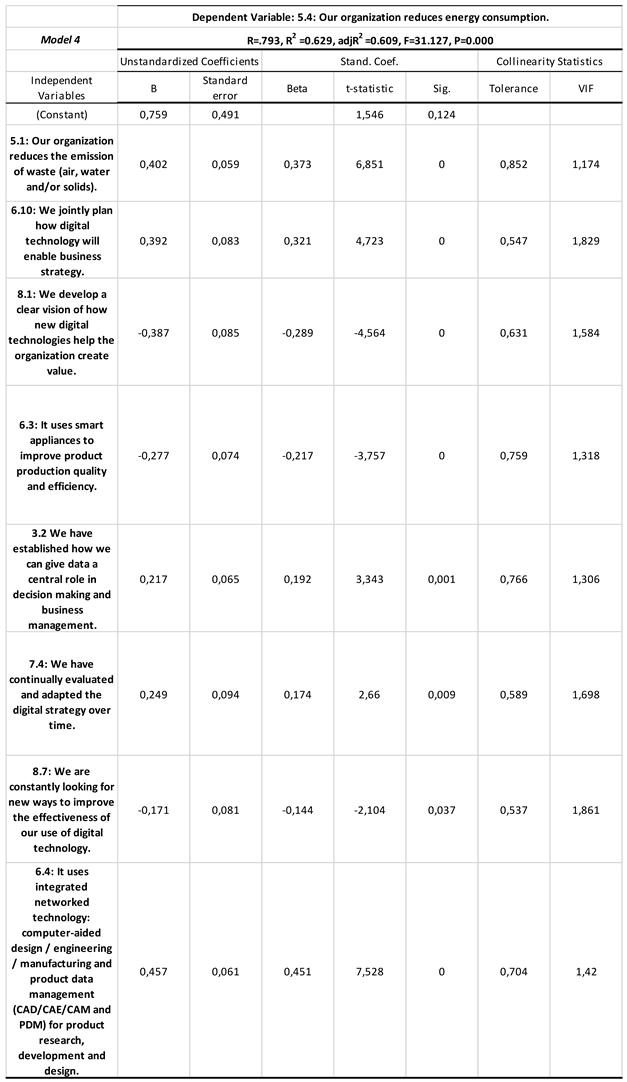
The last regression used as dependent variable the reduction of energy consumption, an issue related with larger number of companies from both production and services sectors. From all the above – mentioned dependent variables is the one with the larger number of statistically significant independent variables. As expected, the proposed dependent variable is also positively related with reducing the emission of waste. In this kind of companies, there a strong joint culture of how digital technologies are implemented in business strategy and a constant process of reevaluation and adaptation to changes. Data analysis plays a significant role in decision making and business management as well there is a strong orientation to digital transformation related with products / services’ research, development and (re)design. Even though such strong tensions exist, companies putting emphasis in reduced energy consumption seem to mainly have an environmental rather than a strong digital transformation vision. Technologies are mainly used as a mean to achieve environmental performance and not to improve products / services quality and efficiency. To this analysis contributes also the fact that these companies are negative to look forward for new ways to improve the effectiveness of use of digital technology, since their priorities are posed in sustainable management. Results are presented in Table 9.
4. Discussion
Society urges companies to take actions to incorporate sustainability in their business models. The classic business models have gradually been replaced by flexible ones where companies may respond more quickly to changes of needs and habits of consumers and emerging environmental issues (Ulas, 2019). The positive economic outcomes and the competitive advantage will be achieved with socially responsible economic growth and development (Popescu & Popescu, 2019). Sustainability and social environmental performance aim to establish a new business model providing information beyond financial performance which will guide the long-term strategy of companies. The occurring transformation can establish new organizational drivers and will most probably generate changes in the way shareholders evaluate companies’ success. Moreover, new models can facilitate companies to exhibit their social responsibility and their actions toward environmental protection, usage of clean technologies, provision and care for employees and the local community.
As far as Greek companies are concerned, our research contribute theoretically and empirically, of how sustainable management can be implemented in the proposed entrepreneurial context taking into account emerging technologies (Davies and Chambers, 2018; Hahn et al., 2018; Stubbs, 2017; Teran-Yepez et al., 2020). Results in Greek business ecosystem, follow existing studies (Gregori and Holzmann, 2020), indicating that different environmental practices can be associated with a selective use of technologies and a variety of the business intensity to implement a digital transformation strategy. Reducing emissions of waste and avoiding environmental accidents seem to require the cultivation of digital strategies, while reducing energy consumption just require using of technologies as means to enhance convenience and efficiency in the proposed era. Finally, when companies are oriented to reduce the use of hazardous or toxic materials just introduce digitally enabled practices as a mean to expand their sustainability boundaries (Caputo et al., 2019).
Despite these variations, Greek business ecosystem follows the global tension to recognize digital strategies / technologies as a key element for achieving the United Nations Sustainable Development Goals (Secundo et. al. 2020). In most cases to reach sustainable market activities, companies face the challenge of developing digital business models (Li et. al. 2020; Minatogawa et. al. 2019) and to implement emerging technologies capable to reduce waste in supply chain, to minimize resource consumption, to alternate the value creation / capture models and to enforce customer interaction with environmental practices (Centobelli et. al. 2020; Kirchherr et. al. 2017; George et. al. 2020; Holmström et. al. 2017). Proposed research added significant information by providing novel insights about the usage of digital technologies and the development of digital strategies when implementing specific environmental practices, expanding the body of knowledge (Parida et al., 2019; Parida and Wincent, 2019; Spieth et al., 2019) regarding the complementarities between “sustainable – digital”.
An any research, the current face some limitations. The first one derives from collecting data under a certain business environment, namely the Greek business ecosystem. As part of future research, it could be expanding the research sample to various European Union’s member – states business ecosystems in order to develop a more holistic approach regarding the existence of “sustainable digital” strategy. Moreover, it should be mentioned that proposed quantitative results have not been validated with qualitative research, by interviewing business stakeholders in order to gain novel insights that are transferable to other contexts (Gioia et al., 2013). Expanding research towards such a direction can help transfer results, for example to small – medium enterprises (SMEs) level and to family businesses.
Author Contributions
Conceptualization, A.K., E.G. and A.S.; methodology, A.K. and E.G.; validation, A.K. and E.G.; formal analysis, A.K.; investigation, E.G.; data curation, E.G.; writing—original draft preparation, A.K., E.G. and A.S.; writing—review and editing, A.K. and E.G.; supervision, A.K.
Funding
This research received no external funding.
Institutional Review Board Statement
Not applicable.
Informed Consent Statement
Not applicable.
Data Availability Statement
Dataset available on request from the authors.
Conflicts of Interest
The authors declare no conflicts of interest.
Appendix A

Table A1.
Research Items.
| Part | Question Code Number | Question |
|---|---|---|
| Part 0. Initial questions | 0.1 | Company age (in years) |
| 0.2 | Company size (number of employees) | |
| 0.3 | Turnover of sales revenues (in million euros) | |
| 0.4 | Company Sector | |
| 0.5 | The organization is mature at the moment | |
| 0.6 | The organization has a digital transformation strategy | |
| Part 1: Digital skills and application of technology | 1.1 | We use digital technologies (social media, mobile devices, analytics, cloud computing, etc.) to understand our clients and make better operational decisions. |
| 1.2 | We use digital channels (social media, mobile devices, analytics, cloud computing, etc.) to market and distribute products and services. | |
| 1.3 | We use digital channels in our customer service. | |
| 1.4 | We use digital technologies to increase performance or add value to our products and services. | |
| 1.5 | We have launched new business models based on digital technologies. | |
| 1.6 | We have explored or adopted the Internet of Things (IoT). | |
| 1.7 | We have explored or adopted smart manufacturing application technology. | |
| 1.8 | We have explored or adopted computer-aided office technology. | |
| 1.9 | We have explored or adopted cloud computing technology. | |
| 1.10 | We have explored or adopted customer relationship management (CRM) technology and/or product data management (PDM) technology. | |
| 1.11 | We have explored or adopted artificial intelligence (AI) technology. | |
| 1.12 | We have explored or adopted blockchain contract management technology. | |
| 1.13 | We have explored or adopted 5G. | |
| 1.14 | We have explored or adopted customer to organization radio frequency identification (RFID) technology. | |
| 1.15 | We have explored or adopted blockchain technology. | |
| 1.16 | We have explored or adopted robotic process automation technology. | |
| 1.17 | We have explored or adopted big data technology. | |
| 1.18 | We have explored or adopted data visualisation technology. | |
| 1.19 | We have explored or adopted data analytics technology. | |
| 1.20 | We have explored or adopted data warehousing technology. | |
| 1.21 | We have explored or adopted technology in supply chain management. | |
| 1.22 | We have explored or adopted wireless local area network (WLAN) technology. | |
| 1.23 | We have explored or adopted information and communications technology (ICT). | |
| Part 2: Digital management intensity | 2.1 | Senior managers take a transformative approach to the organization’s digital future. |
| 2.2 | Digital initiatives are assessed using a common set of key performance indicators (KPIs). | |
| 2.3 | Information technology (IT) and business leaders work together as partners. | |
| 2.4 | The performance of the IT unit meets the needs of the organization. | |
| 2.5 | Senior executives and middle managers share a common digital transformation vision. | |
| 2.6 | There is scope for all members to participate in the digital transformation discussion. | |
| 2.7 | We have explored or adopted smart manufacturing application technology. | |
| 2.8 | The organization is investing in the development of the necessary digital skills. | |
| 2.9 | Digital initiatives are coordinated using criteria such as roles and responsibilities. | |
| 2.10 | Roles and responsibilities for managing digital initiatives are clearly defined. | |
| Part 3: Digital business process | 3.1 | We have digital solutions that connect core business activities with customers, suppliers, employees and organization resources. |
| 3.2 | We have established how we can give data a central role in decision making and business management. | |
| 3.3 | We use an open digital platform to put innovative ideas into practice and quickly gain support. | |
| 3.4 | Roles and responsibilities for managing digital initiatives are clearly defined. | |
| Part 4: Digital innovation performance | 4.1 | We bring more digital solutions to market than our competitors. |
| 4.2 | We have a larger number of successful digital solutions than our competitors. | |
| 4.3 | The time to market of our digital solutions is inferior to that of our competitors. | |
| 4.4 | The quality of our digital solutions is superior to that of our competitors. | |
| 4.5 | Our digital solutions are superior to those of our competitors. | |
| 4.6 | The applications of our digital solutions are totally different from those of our competitors. | |
| 4.7 | Some of our digital solutions are new to the market at the time of launch. | |
| Part 5: Environmental performance | 5.1 | Our organization reduces the emission of waste (air, water and/or solids). |
| 5.2 | Our organization reduces the consumption of hazardous and toxic materials. | |
| 5.3 | Our organization reduces the frequency of environmental accidents. | |
| 5.4 | Our organization reduces energy consumption. | |
| Part 6: Digital management and departmental agility | 6.1 | It uses technologies and other digital resources to improve proactive and strategic decision-making systems. |
| 6.2 | It uses technology and other digital resources to improve decision support systems. | |
| 6.3 | It uses smart appliances to improve product production quality and efficiency. | |
| 6.4 | It uses integrated networked technology: computer-aided design / engineering / manufacturing and product data management (CAD/CAE/CAM and PDM) for product research, development and design. | |
| 6.5 | It uses digital technology for marketing activities. | |
| 6.6 | It uses a digital logistics system so that all nodes in the logistics service process are dynamically connected and can provide real-time feedback. | |
| 6.7 | It uses a cloud-based intelligent customer service system to provide real-time user reviews and after-sales product information. | |
| 6.8 | We integrate digital technology and business strategy to achieve a strategic balance. | |
| 6.9 | We create a shared vision of the role that digital technology should play in business strategy. | |
| 6.10 | We jointly plan how digital technology will enable business strategy. | |
| 6.11 | We consult with others before making strategic decisions. | |
| Part 7: Digital vision | 7,1 | We have a clear vision to stay competitive with respect to the 5- to 10-year digital strategy. |
| 7.2 | We have a clearly defined digital strategy. | |
| 7.3 | We have implemented a digital strategy in all business units. | |
| 7.4 | We have continually evaluated and adapted the digital strategy over time. | |
| 7.5 | We have established new business models based on digital technology. | |
| Part 8: Digital orientation | 8.1 | We develop a clear vision of how new digital technologies (social media, mobile devices, analytics, cloud computing) help the organization create value. |
| 8.2 | We integrate business and digital strategy. | |
| 8.3 | We develop the ability for functional and management areas to understand the value of new in-vestments in digital technology. | |
| 8.4 | We always stay abreast of digital technology innovations. | |
| 8.5 | We have the capacity to test and continue testing new digital technologies as much as necessary. | |
| 8.6 | We have an environment that is conducive to trying new ways of using digital technologies. | |
| 8.7 | We are constantly looking for new ways to improve the effectiveness of our use of digital technology. |
Appendix B
Table A2.
Factor analysis.
| Factor | Measures | Factor Loadings |
|---|---|---|
| Digital orientation (Eigenvalue =12.830, % of variance explained=27.297) |
4.5 Our digital solutions are superior to those of our competitors. | 0,747897 |
| 2.6 There is scope for all members to participate in the digital transformation discussion. | 0,69558 | |
| 1.19 We have explored or adopted data analytics technology. | 0,680334 | |
| 2.5 Senior executives and middle managers share a common digital transformation vision. | 0,652203 | |
| 1.17 We have explored or adopted big data technology. | 0,64956 | |
| 1.3 We use digital channels in our customer service. | 0,647165 | |
| 1.18 We have explored or adopted data visualization technology. | 0,64253 | |
| 4.4 The quality of our digital solutions is superior to that of our competitors. | 0,635501 | |
| 8.6: We have an environment that is conductive to trying new ways of using digital technologies. | 0,625392 | |
| 2.7 We have explored or adopted smart manufacturing application technology. | 0,598398 | |
| 4.7 Some of our digital solutions are new to the market at the time of launch. | 0,57889 | |
| 8.5: We have the capacity to test and continue testing new digital technologies as much as necessary. | 0,507291 | |
| 6.7: It uses a cloud-based intelligent customer service system to provide real-time user reviews and after-sales product information. | 0,464042 | |
| 4.3 The time to market of our digital solutions is inferior to that of our competitors. | 0,409649 | |
| Business strategy (Eigenvalue =3.719, % of variance explained=7.913) |
7.4: We have continually evaluated and adapted the digital strategy over time. | 0,735214 |
| 7.1: We have a clear vision to stay competitive with respect to the 5 to 10-year digital strategy. | 0,691871 | |
| 7.3: We have implemented a digital strategy in all business units. | 0,651797 | |
| 6.10: We jointly plan how digital technology will enable business strategy. | 0,642018 | |
| 7.5: We have established new business models based on digital technology | 0,629528 | |
| 8.1: We develop a clear vision of how new digital technologies (social media, mobile devices, analytics, cloud computing) help the organization create value. | 0,582692 | |
| 6.8: We integrate digital technology and business strategy to achieve a strategic balance. | 0,557856 | |
| 8.7: We are constantly looking for new ways to improve the effectiveness of our use of digital technology. | 0,538586 | |
| Innovativeness (Eigenvalue =2.904, % of variance explained=6.178) |
1.6 We have explored or adopted the Internet of Things (IoT). | 0,730645 |
| 1.15 We have explored or adopted blockchain technology. | 0,711037 | |
| 1.12 We have explored or adopted blockchain contract management technology. | 0,668383 | |
| 1.8 We have explored or adopted computer-aided office technology. | 0,638336 | |
| 1.7 We have explored or adopted smart manufacturing application technology. | 0,620426 | |
| 1.20 We have explored or adopted data warehousing technology. | 0,589115 | |
| 1.11 We have explored or adopted artificial intelligence (AI) technology. | 0,526167 | |
| 6.3: It uses smart appliances to improve product production quality and efficiency. | 0,511099 | |
| 1.16 We have explored or adopted robotic process automation technology. | 0,473953 | |
| 1.4 We use digital technologies to increase performance or add value to our products and services. | 0,421848 | |
| Customer Centricity (Eigenvalue =2.333, % of variance explained=4.964) |
1.10 We have explored or adopted customer relationship management (CRM) technology and/or product data management (PDM) technology. | 0,669982 |
| 3.1 We have digital solutions that connect core business activities with customers, suppliers, employees and organization resources. | 0,663128 | |
| 2.2 Digital initiatives are assessed using a common set of key performance indicators (KPIs). | 0,64101 | |
| 1.22 We have explored or adopted wireless local area network (WLAN) technology. | 0,545914 | |
| 4.2 We have a larger number of successful digital solutions than our competitors. | 0,507784 | |
| 1.23 We have explored or adopted information and communications technology (ICT). | 0,490572 | |
| 0.8 The organization has a digital transformation strategy. (according to my personal opinion) | 0,467147 | |
| 2.1 Senior managers take a transformative approach to the organization’s digital future. | 0,463247 | |
| 1.5 We have launched new business models based on digital technologies. | 0,445315 | |
| Environmental orientation (Eigenvalue =1.984, % of variance explained=4.222) |
5.2: Our organization reduces the consumption of hazardous and toxic materials. | 0,802512 |
| 5.1: Our organization reduces the emission of waste (air, water and/or solids). | 0,770194 | |
| 5.3: Our organization reduces the frequency of environmental accidents. | 0,607582 | |
| 5.4: Our organization reduces energy consumption. | 0,527312 | |
| Organizational Structure (Eigenvalue =1.681, % of variance explained=3.576) |
2.9 Digital initiatives are coordinated using criteria such as roles and responsibilities. | 0,767824 |
| 2.10 Roles and responsibilities for managing digital initiatives are clearly defined. | 0,719686 |
Kaiser-Meyer-Olkin measure of sampling adequacy=0.841, Bartlett’s Test of Sphericity=4306.733.
References
- Agrawal, R., Wankhede, V.A., Kumar, A., Upadhyay, A. and Garza-Reyes, J.A. (2022), “Nexus of circular economy and sustainable business performance in the era of digitalization”, International Journal of Productivity and Performance Management, Vol. 71 No. 3, pp. 748-774. [CrossRef]
- Appio, Francesco Paolo, Federico Frattini, Antonio Messeni Petruzzelli, and Paolo Neirotti. 2021. Digital Transformation and Innovation Management: A Synthesis of Existing Research and an Agenda for Future Studies. Journal of Product Innovation Management 38: 4–20.
- Ardito, L., Raby, S., Albino, V., & Bertoldi, B. (2021). The duality of digital and environmental orientations in the context of SMEs: Implications for innovation performance. Journal of Business Research, 123, 44–56.
- Atasu, A., Dumas, C., & Van Wassenhove, L. N. (2021). The circular business models. Harvard Business Review. Available online: https://hbr.org/2021/07/thecircular-business-model.
- Bafas, S.A.; Alexandropoulou, A.P.; Fousteris, A.E.; Didaskalou, E.A.; Georgakellos, D.A. Sustainable Development and Business Strategies: An Exploratory Study of Greek Businesses. Businesses 2023, 3, 441–459. [Google Scholar] [CrossRef]
- Brynjolfsson, E., & Hitt, L. M. (2000). Beyond Computation: Information Technology, Organizational Transformation and Business Performance. The Journal of Economic Perspectives, 14(4), 23–48. [CrossRef]
- Cahyadi, Indrawan. 2020. Developing Digital Application to Improve Business Process Sustainability in An Indonesian Fast Moving Consumer Goods Company. Journal of Physics: Conference Series 1569: 32023.
- Caputo, A., Fiorentino, R., Garzella, S., 2019. From the boundaries of management to the management of boundaries. Bus. Process Manag. J. 25, 391e413. [CrossRef]
- Centobelli, P.; Cerchione, R.; Chiaroni, D.; Del Vecchio, P.; Urbinati, A. Designing business models in circular economy: Asystematic literature reviewand research agenda. Bus. Strategy Environ. 2020, 29, 1734–1749. [Google Scholar] [CrossRef]
- Chaparro-Peláez, J., Acquila-Natale, E., Hernández-García, Á., & Iglesias-Pradas, S. (2020). The Digital Transformation of the Retail Electricity Market in Spain. Energies, 13(8), 2085. [CrossRef]
- Chen, N., Sun, D., & Chen, J. (2022). Digital transformation, labour share, and industrial heterogeneity. Journal of Innovation & Knowledge, 7(2), 100173.
- Ciliberto, C., Szopik-Depczynska, K., Tarczynska- Łuniewska, M., Ruggieri, A., & Ioppolo, G. (2021). Enabling the circular economy transition: A sustainable lean manufacturing recipe for industry 4.0. Business Strategy and the Environment, 2801(7), 3255–3272. [CrossRef]
- Corso, Mariano, Gianluca Giovannetti, Luciano Guglielmi, and Giovanni Vaia. 2018. Conceiving and Implementing the Digital Organization. In CIOs and the Digital Transformation. Berlin and Heidelberg: Springer International Publishing, pp. 181–203.
- Dana, L. P., Salamzadeh, A., Hadizadeh, M., Heydari, G., & Shamsoddin, S. (2022). Urban entrepreneurship and sustainable businesses in smart cities: Exploring the role of digital technologies. Sustainable Technology and Entrepreneurship, 1(2), 100016.
- Dantas, T.E.T., de-Souza, E.D., Destro, I.R., Hammes, G., Rodriguez, C.M.T. and Soares, S.R. (2020), “How the combination of circular economy and Industry 4.0 can contribute towards achieving the sustainable development goals”, Sustainable Production and Consumption, Vol. 26, pp. 213-227. [CrossRef]
- Davies, I.A., Chambers, L., 2018. Integrating hybridity and business model theory in sustainable entrepreneurship. J. Clean. Prod. 177, 378e386. [CrossRef]
- Frank, A. G., Dalenogare, L. S., & Ayala, N. F. (2019). Industry 4.0 Technologies: Implementation Patterns in Manufacturing Companies. International Journal of Production Economics, 210, 15–26. [CrossRef]
- Gatignon, H., & Xuereb, J. M. (1997). Strategic orientation of the firm and new product performance. Journal of Marketing Research, 34(1), 77–90.
- Gebayew, Chernet, Inkreswari Retno Hardini, Goklas Henry Agus Panjaitan, Novianto Budi Kurniawan, and Suhardi. 2018. A Systematic Literature Review on Digital Transformation. Paper presented at 2018 International Conference on Information Technology Systems and Innovation (ICITSI), Bandung, Indonesia, October 22–26; pp. 260–65.
- Genovese, A., Acquaye, A. A., Figueroa, A., & Koh, S. C. L. (2017). Sustainable supply chain management and the transition toward a circular economy: Evidence and some applications. Omega, 66, 344–357. [CrossRef]
- George, G., Merrill, R.K., Schillebeeckx, S.J.D., 2020. Digital sustainability and entrepreneurship: how digital innovations are helping tackle climate change and sustainable development. Enterpren. Theor. Pract. 104225871989942. [CrossRef]
- George, G., & Schillebeeckx, S. J. D. (2022). Digital transformation, sustainability, and purpose in the multinational enterprise. Journal of World Business, 57(3), 101326.
- Gioia, D.A., Corley, K.G., Hamilton, A.L., 2013. Seeking qualitative rigor in inductive research. Organ. Res. Methods 16, 15e31. [CrossRef]
- Gregori, P. and Holzmann, P. (2020). Digital sustainable entrepreneurship: A business model perspective on embedding digital technologies for social and environmental value creation, Journal of Cleaner Production, Volume 272. [CrossRef]
- Hair, J.F.; Hult, G.T.M.; Ringle, C.; Sarstedt, M. A Primer on Partial Least Squares Structural Equation Modeling (PLS-SEM); Sage Publications: Thousand Oaks, CA, USA, 2016; ISBN 1483377431. [Google Scholar]
- Hahn, R., Spieth, P., Ince, I., 2018. Business model design in sustainable entrepreneurship: illuminating the commercial logic of hybrid businesses. J. Clean. Prod. 176, 439e451. [CrossRef]
- He, Z., Huang, H., Choi, H., & Bilgihan, A. (2023). Building organizational resilience with digital transformation. Journal of Service Management, 34(1), 147–171.
- He, T., Liu, M. J., Phang, C. W., & Luo, J. (2022). Toward social enterprise sustainability: The role of digital hybridity. Technological Forecasting and Social Change, 175, 121360.
- Helmy, M., Khater, M., & Zaki, M. (2017). Digital Business Transformation and Strategy: What Do We Know so Far? Cambridge.
- Heredia, J., Castillo-Vergara, M., Geldes, C., Carbajal Gamarra, F. M., Flores, A., & Heredia, W. (2022). How do digital capabilities affect firm performance? The mediating role of technological capabilities in the “new normal”. Journal of Innovation & Knowledge, 7(2), 100171.
- Hinings, B., Gegenhuber, T., Greenwood, R., 2018. Digital innovation and transformation: an institutional perspective. Inf. Organ. 28, 52e61. [CrossRef]
- Holmström, J.; Liotta, G.; Chaudhuri, A. Sustainability outcomes through direct digital manufacturing-based operational practices: A design theory approach. J. Clean. Prod. 2017, 167, 951–961. [Google Scholar] [CrossRef]
- Holzmann, P., Breitenecker, R.J., Soomro, A.A., Schwarz, E.J., 2017. User entrepreneur business models in 3D printing. J. Manuf. Technol. Manag. 28, 75e94. [CrossRef]
- Isensee, C., Teuteberg, F., Griese, K.-M., & Topi, C. (2020). The Relationship between Organizational Culture, Sustainability, and Digitalization in SMEs: A Systematic Review. Journal of Cleaner Production, 275, 122944. [CrossRef]
- Jabbour, C.J.C., de Sousa Jabbour, A.B.L., Sarkis, J. and Godinho Filho, M. (2019), “Unlocking the circular economy through new business models based on large-scale data: an integrative framework and research agenda”, Technological Forecasting and Social Change, Vol. 144, pp. 546-552.
- Jayarathna, C. P., Agdas, D., & Dawes, L. (2023). Exploring sustainable logistics practices toward a circular economy: A value creation perspective. Business Strategy and the Environment, 32(1), 704–720. [CrossRef]
- Kalogiannidis, S.; Kalfas, D.; Loizou, E.; Papaevangelou, O.; Chatzitheodoridis, F. Smart Sustainable Marketing and Emerging Technologies: Evidence from the Greek Business Market. Sustainability 2024, 16, 312. [Google Scholar] [CrossRef]
- Kargas, A., & Aretos, A. (2023). Transforming Strategic Management Using Agile Methodologies. [CrossRef]
- Kargas, A., Gkika, E.C., Papakyriakopoulos, D., Komisopoulos, F., Filios, S. (2024a). Skills and Knowledges Expected in Digital Transformation’s Era. In: Schallmo, D., Baiyere, A., Gertsen, F., Rosenstand, C.A.F., Williams, C.A. (eds) Digital Disruption and Transformation. ISPIM 2022. Springer Proceedings in Business and Economics. Springer, Cham. [CrossRef]
- Kargas, A., Gialeris, E., Filios, S., Komisopoulos, F., Lymperiou, A., & Salmon, I. (2024b). Evaluating the Progress of Digital Transformation in Greek SMEs. In F. Theofanidis, O. Abidi, A. Erturk, S. Colbran, & E. Coşkun (Eds.), Digital Transformation and Sustainable Development in Cities and Organizations (pp. 81-105). IGI Global. [CrossRef]
- Kargas, Antonios, Emmanouil Gialeris, Faidon Komisopoulos, Anastasios Lymperiou, and Ioannis Salmon. 2023. Digital Maturity and Digital Transformation Strategy among Greek Small and Medium Enterprises. Administrative Sciences 13: 236. [CrossRef]
- Kargas, Antonios, Andreas Giannakis, and Iraklis Foukas. 2022a. Recognizing Skills and Competencies Required Under Industry 4.00s Framework for Achieving Business Digital Transformation. In Management Strategies for Sustainability, New Knowledge Innovation, and Personalized Products and Services. Edited by Pejic-Bach Mirjana and Dogru Çaglar. Hershey: IGI Global, pp. 1–34.
- Kargas, Antonios, Dimitrios Papakyriakopoulos, Faidon Komisopoulos, Eleni C. Gkika, and Spyridon Filios. 2022b. Tracing innovation with skill and competences. Paper presented at ISPIM Connects Athens—The Role of Innovation: Past, Present, Future, Athens, Greece, November 28–30.
- Kayikci, Y. (2018). Sustainability impact of digitization in logistics. Procedia manufacturing, 21, 782–789.
- Kirchherr, J.; Reike, D.; Hekkert, M. Conceptualizing the circular economy: An analysis of 114 definitions. Resour. Conserv. Recycl. 2017, 127, 221–232. [Google Scholar] [CrossRef]
- Kitsios, F.; Giatsidis, I.; Kamariotou, M. Digital Transformation and Strategy in the Banking Sector: Evaluating the Acceptance Rate of E-Services. J. Open Innov. Technol. Mark. Complex. 2021, 7, 204. [Google Scholar] [CrossRef]
- Kostakis, Panagiotis, and Antonios Kargas. 2021. Big-Data Management: A Driver for Digital Transformation? Information 12: 411.
- Krasonikolakis, I., Tsarbopoulos, M., & Eng, T.-Y. (2020). Are Incumbent Banks Bygones in the Face of Digital Transformation? Journal of General Management, 46(1), 60–69. [CrossRef]
- Kraus, Sascha, Fracesco Schiavone, Anna Pluzhnikova, and Anna Chiara Invernizzi. 2021. Digital transformation in healthcare: Analyzing the current state-of-research. Journal of Business Research 123: 557–67.
- Kumar, V., Sezersan, I., Arturo, G.-R. J., Gonzalez Ernesto, D. R., & Anwer, A.-S. M. (2019). Circular economy in the manufacturing sector: Benefits, opportunities and barriers. Management Decision, 57(4), 1067–1086. [CrossRef]
- Lahane, S., Kant, R., & Shankar, R. (2020). Circular supply chain management: A state-of-art review and future opportunities. Journal of Cleaner Production, 258, 120859. [CrossRef]
- Lee, M. T., & Suh, I. (2022). Understanding the effects of environment, social, and governance conduct on financial performance: Arguments for a process and integrated modelling approach. Sustainable Technology and Entrepreneurship, 1(1), 100004.
- Li, X.; Cao, J.; Liu, Z.; Luo, X. Sustainable Business Model Based on Digital Twin Platform Network: The Inspiration from Haier’s Case Study in China. Sustainability 2020, 12, 936. [Google Scholar] [CrossRef]
- Li, H., Wu, Y., Cao, D., & Wang, Y. (2021). Organizational mindfulness towards digital transformation as a prerequisite of information processing capability to achieve market agility. Journal of Business Research, 122, 700–712.
- Liang, X., & Fr¨os’en, J. (2020). Examining the link between marketing controls and firm performance: The mediating effect of market-focused learning capability. Journal of Business Research, 109, 545–556.
- Loebbecke, C., & Picot, A. (2015). Reflections on Societal and Business Model Transformation Arising from Digitization and Big Data Analytics: A Research Agenda. The Journal of Strategic Information Systems, 24(3), 149–157. [CrossRef]
- Loske, D., & Klumpp, M. (2022). Verifying the Effects of Digitalisation in Retail Logistics: An Efficiency-Centred Approach. International Journal of Logistics, 25(2), 203–227. [CrossRef]
- Michailidi E., Michailidis H., Tavoultzidou S., Papatsimouli M. and Fragulis G. F., “Digital Transformation of Small Greek Companies During the Covid-19 Pandemic,” 2021 International Conference on Decision Aid Sciences and Application (DASA), Sakheer, Bahrain, 2021, pp. 1103-1108. [CrossRef]
- Minatogawa, V.L.F.; Franco, M.M.V.; Rampasso, I.S.; Anholon, R.; Quadros, R.; Durán, O.; Batocchio, A. Operationalizing Business Model Innovation through Big Data Analytics for Sustainable Organizations. Sustainability 2019, 12, 277. [Google Scholar] [CrossRef]
- Nambisan, S., 2017. Digital entrepreneurship: toward a digital technology perspective of entrepreneurship. Enterpren. Theor. Pract. 41, 1029e1055. [CrossRef]
- Nambisan, S., Lyytinen, K., Majchrzak, A., Song, M., 2017. Digital innovation management: reinventing innovation management research in a digital world. MIS Q. 41, 223e238. [CrossRef]
- Nascimento, D.L.M., Alencastro, V., Quelhas, O.L.G., Caiado, R.G.G., Garza-Reyes, J.A., Rocha-Lona, L. and Tortorella, G. (2019), “Exploring Industry 4.0 technologies to enable circular economy practices in a manufacturing context”, Journal of Manufacturing Technology Management, Vol. 30 No. 3, pp. 607-627.
- Nasiri, M., Ukko, J., Saunila, M., & Rantala, T. (2020). Managing the digital supply chain: The role of smart technologies. Technovation, 96–97, Article 102121.
- Negri, M., Neri, A., Cagno, E., & Monfardini, G. (2021). Circular economy performance measurement in manufacturing firms: A systematic literature review with insights for small and medium enterprises and new adopters. Sustainability, 13(16), 9049. [CrossRef]
- Okorie, O., Salonitis, K., Charnley, F., Moreno, M., Turner, C. and Tiwari, A. (2018), “Digitisation and the circular economy: a review of current research and future trends”, Energies, Vol. 11 No. 11, p. 3009.
- Oliveira, L., Fleury, A., & Fleury, M. T. (2021). Digital power: Value chain upgrading in an age of digitization. International Business Review, 30(6), 101850.
- Ozkan-Ozen, Y.D., Kazancoglu, Y. and Mangla, S.K. (2020), “Synchronized barriers for circular supply chains in industry 3.5/industry 4.0 transition for sustainable resource management”, Resources, Conservation and Recycling, Vol. 161, 104986.
- Parida, V., Wincent, J., 2019. Why and how to compete through sustainability: a review and outline of trends influencing firm and network-level transformation. Int. Enterpren. Manag. J. 15, 1e19. [CrossRef]
- Parida, V., Sjodin, D., Reim, W., 2019. Reviewing literature on digitalization, business model innovation, and sustainable industry: past achievements and future promises. Sustainability 11, 391. [CrossRef]
- Paunov, C., & Rollo, V. (2016). Has the internet fostered inclusive innovation in the developing world? World Development, 78, 587–609.
- Peng, Y. Z., & Tao, C. Q. (2022). Can digital transformation promote enterprise performance? From the perspective of public policy and innovation. Journal of Innovation & Knowledge, 7(3), 100198.
- Popescu & Popescu, 2019 An Exploratory Study Based on a Questionnaire Concerning Green and Sustainable Finance, Corporate Social Responsibility, and Performance: Evidence from the Romanian Business EnvironmentJ. Risk Financial Manag. 2019, 12, 162. [CrossRef]
- Ranta, V., Aarikka-Stenroos, L. and Vaisanen, J.M. (2021), “Digital technologies catalyzing business model innovation for circular economy – multiple case study”, Resources, Conservation and Recycling, Vol. 164, 105155.
- Reinsel, David, John Gantz, and John Rydning. 2018. The Digitization of the World from Edge to Core. Needham: IDC.
- Reis, J., Amorim, M., Melão, N., & Matos, P. (2018). Digital Transformation: A Literature Review and Guidelines for Future Research. [CrossRef]
- Ribeiro-Navarrete Β., Martín Martín J.M., Guaita-Martínez J.M., Simón-Moya V., Analysing cooperatives’ digital maturity using a synthetic indicator, International Journal of Information Management, Volume 72, 2023.
- Saini, Kavita. 2018. A Future’s Dominant Technology Blockchain: Digital Transformation. Paper presented at 2018 International Conference on Computing, Power and Communication Technologies (GUCON), Greater Noida, India, September 28–29; pp. 937–40.
- Secundo, G.; Ndou, V.; Del Vecchio, P.; De Pascale, G. Sustainable development, intellectual capital and technology policies: A structured literature review and future research agenda. Technol. Forecast. Soc. Chang. 2020, 153, 119917. [Google Scholar] [CrossRef]
- Seele, P., Lock, I., 2017. The game-changing potential of digitalization for sustainability: possibilities, perils, and pathways. Sustain. Sci. 12, 183e185. [CrossRef]
- Sepetis, A.; Rizos, F.; Pierrakos, G.; Karanikas, H.; Schallmo, D. A Sustainable Model for Healthcare Systems: The Innovative Approach of ESG and Digital Transformation. Healthcare 2024, 12, 156. [Google Scholar] [CrossRef] [PubMed]
- Sok, P., O’Cass, A., & Sok, K. M. (2013). Achieving superior SME performance: Overarching role of marketing, innovation, and learning capabilities. Australasian Marketing Journal, 21(3), 161–167.
- Song, M. L., Peng, L. C., Shang, Y. P., & Zhao, X. (2022). Green technology progress and total factor productivity of resource-based enterprises: A perspective of technical compensation of environmental regulation. Technological Forecasting and Social Change, 174, 121276.
- Spieth, P., Schneider, S., Clauß, T., Eichenberg, D., 2019. Value drivers of social businesses: a business model perspective. Long. Range Plan. 52 (3), 427e444. [CrossRef]
- Stubbs, W., 2017. Sustainable entrepreneurship and B corps. Bus. Strat. Environ. 26, 331e344. [CrossRef]
- Stuermer, M., Abu-Tayeh, G., Myrach, T., 2017. Digital sustainability: basic conditions for sustainable digital artifacts and their ecosystems. Sustain. Sci. 12, 247e262. [CrossRef]
- Tauscher, K., Laudien, S.M., 2018. Understanding platform business models: a mixed methods study of marketplaces. Eur. Manag. J. 36, 319e329. [CrossRef]
- Teran-Yepez, E., Marín-Carrillo, G.M., Casado-Belmonte, M.P., Capobianco-Uriarte, M.M., 2020. Sustainable entrepreneurship: review of its evolution and new trends. J. Clean. Prod. 252, 119742. [CrossRef]
- Tippins, M. J., & Sohi, R. S. (2003). IT competency and firm performance: Is organizational learning a missing link? Strategic Management Journal, 24(8), 745–761.
- Troise, C., Corvello, V., Ghobadian, A., & O’Regan, N. (2022). How Can SMEs Successfully Navigate VUCA Environment: The Role of Agility in the Digital Transformation Era. Technological Forecasting and Social Change, 174, 121227. [CrossRef]
- Ulas, D. (2019). Digital transformation process and SMEs. Procedia Computer Science, 158, 662–671.
- Veile, J. W., Schmidt, M. C., & Voigt, K. I. (2022). Toward a new era of cooperation: How industrial digital platforms transform business models in Industry 4.0. Journal of Business Research, 143, 387–405.
- Venkatraman, N. (1994). IT-enabled business transformation: From automation to business scope redefinition. Sloan Management Review, 35(2), 73.
- Vial, G. (2019). Understanding Digital Transformation: A Review and a Research Agenda. The Journal of Strategic Information Systems, 28(2), 118–144. [CrossRef]
- Vickery, S. K., Jayaram, J., Droge, C., & Calantone, R. (2003). The effects of an integrative supply chain strategy on customer service and financial performance: An analysis of direct versus indirect relationships. Journal of Operations Management, 21 (5), 523–539.
- Von Leipzig, Tanja, Martin Gamp, Daniel Manz, Kai Schöttle, Peter Ohlhausen, Gert Oosthuizen, Daniel Palm, and Konrad von Leipzig. 2017. Initialising Customer-orientated Digital Transformation in Enterprises. Procedia Manufacturing 8: 517–24.
- Westerman, G. & McAfee, A. (2012). The digital advantage: How digital leaders outperform their peers in every industry. The MIT Center for Digital Business, A major research initiative at the MIT Sloan School of Management, November 2012. (Accessed February 2020). Available online: http://sloan-ide.mit-dev.penzias.com/sites/default/files/publications/TheDigitalAdvantage.pdf.
- Westerman, G., McAfee, A., & Bonnet, D. (2014). Leading digital: Turning technology into business transformation. Harvard Business Press. Available online: http://choicereviews.org/review/10.5860/CHOICE.188022.
- Yoo, Y., Boland, R.J., Lyytinen, K., Majchrzak, A., 2012. Organizing for innovation in the digitized world. Organ. Sci. 23, 1398e1408. [CrossRef]
- Zhang, A., Venkatesh, V.G., Liu, Y., Wan, M., Qu, T. and Huisingh, D. (2019), “Barriers to smart waste management for a circular economy in China”, Journal of Cleaner Production, Vol. 240, 118198.
Table 1.
Descriptiva Statistics.
| Mean | Std. Deviation | |
| Company age (in years) | 5.37 | 1.716 |
| Company size (number of employees) | 5.65 | 1.837 |
| Turnover of sales revenues (in million euros) | 4.48 | 2.503 |
| Company Sector | 14.29 | 5.822 |
| The organization is digitally mature at the moment. | 5.55 | 1.160 |
| The organization has a digital transformation strategy. | 5.44 | 1.335 |
| Valid N (listwise) | 156 | |
Table 2.
Reliability Analysis.
| Factor | Crombach’s alpha | Items |
|---|---|---|
| Digital orientation | 0.900 | 14 |
| Business strategy | 0.876 | 8 |
| Innovativeness | 0.853 | 10 |
| Customer centricity | 0.816 | 9 |
| Environmental orientation | 0.757 | 4 |
| Organizational culture | 0.783 | 2 |
Table 3.
Clusters’ number of cases.
| Cluster Number of Case | Our organization reduces the emission of waste (air, water and/or solids). | Our organization reduces the consumption of hazardous and toxic materials. | Our organization reduces the frequency of environmental accidents. | Our organization reduces energy consumption. | |
| 1st Cluster | Mean | 3.2075 | 3.7358 | 4.2642 | 3.2830 |
| N | 53 | 53 | 53 | 53 | |
| 2nd Cluster | Mean | 5.6311 | 5.8544 | 5.3786 | 5.4854 |
| N | 103 | 103 | 103 | 103 | |
| Total | Mean | 4.8077 | 5.1346 | 5.0000 | 4.7372 |
| N | 156 | 156 | 156 | 156 | |
Table 4.
Cluster Number of Cases per age, size, turnover.
| N | Mean | Std. Deviation | ||
|---|---|---|---|---|
| Company’s age (in years) | Environmental Neutral | 53 | 5.2453 | 1.70864 |
| Environmental Worried | 103 | 5.4272 | 1.72412 | |
| Company’s size (number of employees) | Environmental Neutral | 53 | 5.4151 | 1.82329 |
| Environmental Worried | 103 | 5.8058 | 1.78808 | |
| Turnover of sales revenues (in million €) | Environmental Neutral | 53 | 3.9623 | 2.67440 |
| Environmental Worried | 103 | 4.7476 | 2.37932 | |
Table 5.
Cluster Number of Cases per sector.
| Company’s Sector | Environmental Neutral | Environmental Worried | Total |
|---|---|---|---|
| Accommodation | 1 | 0 | 1 |
| Retail | 7 | 12 | 19 |
| Communications | 2 | 8 | 10 |
| Financial services | 0 | 6 | 6 |
| Business | 1 | 4 | 5 |
| Engineering | 1 | 2 | 3 |
| Military / Security | 1 | 5 | 6 |
| Health services | 3 | 5 | 8 |
| Public Sector | 6 | 5 | 11 |
| Technology | 28 | 56 | 84 |
| Transport | 1 | 0 | 1 |
| Other | 2 | 0 | 2 |
| Total | 53 | 103 | 156 |
Table 6.
Multiple regression analysis for Model 1.
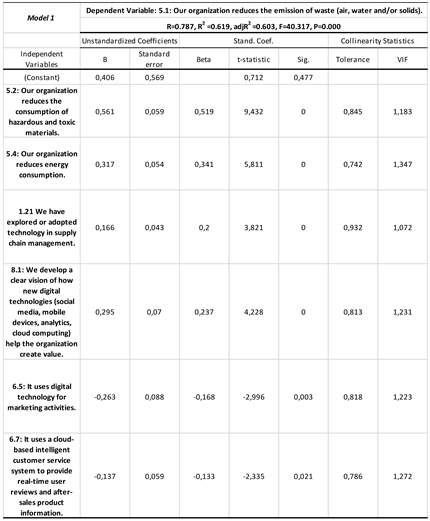
Table 7.
Multiple regression analysis for Model 2.
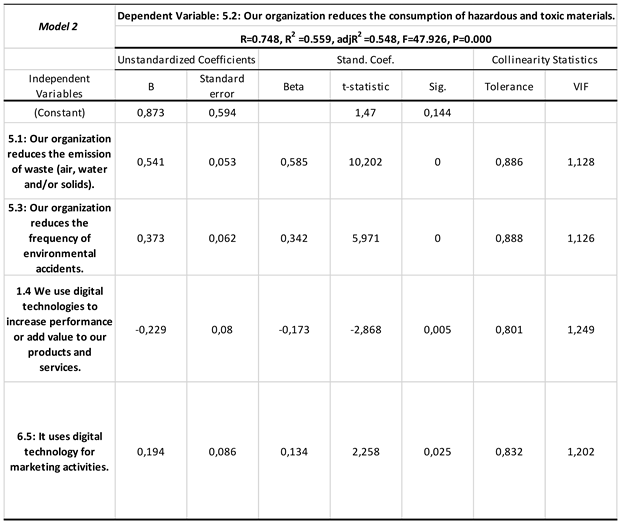
Table 8.
Multiple regression analysis for Model 3.
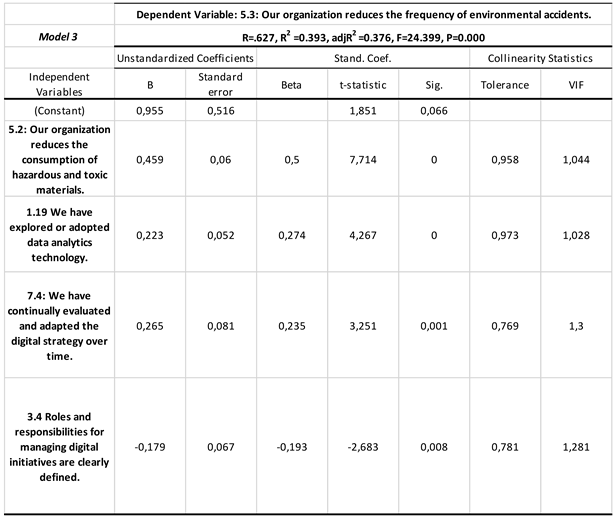
Table 9.
Multiple regression analysis for Model 4.
Disclaimer/Publisher’s Note: The statements, opinions and data contained in all publications are solely those of the individual author(s) and contributor(s) and not of MDPI and/or the editor(s). MDPI and/or the editor(s) disclaim responsibility for any injury to people or property resulting from any ideas, methods, instructions or products referred to in the content. |
© 2024 by the authors. Licensee MDPI, Basel, Switzerland. This article is an open access article distributed under the terms and conditions of the Creative Commons Attribution (CC BY) license (https://creativecommons.org/licenses/by/4.0/).
Copyright: This open access article is published under a Creative Commons CC BY 4.0 license, which permit the free download, distribution, and reuse, provided that the author and preprint are cited in any reuse.


