

Submitted:
19 August 2024
Posted:
19 August 2024
You are already at the latest version
Abstract
This article presents a novel resolution of the Collatz Conjecture, centered on the concept of Generative Completeness of the inverse Collatz function. We introduce and rigorously prove that for all N ∈ ℕ+, there exists a minimal generator mN = 1 such that all positive integers up to N can be generated through successive applications of the inverse Collatz function G. This key property, which we term "Generative Completeness", forms the cornerstone of our proof. Building upon this foundation, we establish several crucial results: The boundedness of all Collatz sequences The existence and uniqueness of cycles in Collatz sequences The nature of the unique cycle as {1, 4, 2} We then present three distinct approaches to resolving the Collatz Conjecture, all fundamentally rooted in the Generative Completeness property. These diverse methods not only prove the conjecture but also provide deep insights into the structure of Collatz sequences.
Keywords:
Collatz conjecture
; 3x+1 problem
; number theory
; sequence analysis
; cycle properties
; inverse Collatz function
; boundedness
; divergence
; mathematical induction
; proof techniques
1. Introduction
Let denote the set of positive integers.
Definition 1
(Collatz Function). The Collatz function is defined as:
Definition 2
(Inverse Collatz Function). The inverse Collatz function is defined as:
where denotes the power set of .
Definition 3
(Collatz Sequence). For any , the Collatz sequence starting at n is the sequence defined by:
where C is the Collatz function as defined in Definition 6.
Conjecture 1
(Collatz Conjecture). For all , there exists such that , where denotes k successive applications of C.
The Collatz conjecture, also known as the problem, has been one of the most famous unsolved problems in mathematics. Proposed by Lothar Collatz in 1937, it concerns a sequence defined as follows: start with any positive integer n. If n is even, divide it by 2. If n is odd, multiply it by 3 and add 1. Repeat this process with the resulting number. The conjecture states that no matter what number you start with, you will always eventually reach 1.
Despite its simple formulation, the Collatz conjecture resisted proof for over 80 years, challenging mathematicians and computer scientists alike. Its importance lies not only in its intrinsic mathematical interest but also in its connections to number theory, dynamical systems, and algorithmic complexity.
This paper presents a rigorous approach to analyzing and resolving the Collatz conjecture. Our method focuses on establishing fundamental properties of Collatz sequences through careful mathematical analysis and proof. The key innovations lie in:
- Comprehensive treatment of sequence properties
- Analysis of the inverse Collatz function
- Logical progression towards a complete resolution of the conjecture
Our approach offers several advantages:
- It provides a rigorous analysis of the structural properties of Collatz sequences.
- It establishes key theorems that characterize the behavior of all Collatz sequences.
- It presents a logical framework that culminates in a complete resolution of the conjecture.
- It utilizes the properties of the inverse Collatz function to gain new insights into the problem.
This paper provides a complete proof of the Collatz conjecture by rigorously establishing a series of properties and theorems that, taken together, demonstrate that all Collatz sequences eventually reach the cycle . Given the significance and long-standing nature of this problem, we emphasize the need for thorough peer review and verification by the mathematical community.
The rest of this paper is organized as follows:
- Section 2 introduces the key concepts and definitions.
- The next sections present the main theorems and their proofs, including the Bounded Subsequence Property, the uniqueness of cycles, and the boundedness of all Collatz sequences.
- Section 7 presents the culminating theorem that resolves the Collatz conjecture.
- Section 12 discusses the implications of our results and potential future research directions.
2. Background and Comparative Results
2.1. Historical Context and Related Work
The Collatz Conjecture, proposed by Lothar Collatz in 1937, has been a central problem in number theory and discrete dynamical systems for over 80 years. Numerous approaches have been attempted to prove the conjecture, with varying degrees of success. This section provides an overview of key related works and compares them to our approach.
2.1.1. Terras’s Probabilistic Approach (1976)
Terras, R. ("A stopping time problem on the positive integers." Acta Arithmetica, vol. 30, no. 3, 1976, pp. 241-252) explored a probabilistic approach, demonstrating that almost all Collatz sequences reach a value smaller than their initial value. Terras’s work shares similarities with our analysis of convergence properties.
2.1.2. Matthews and Watts’s Generalization (1984)
Matthews, K. R., & Watts, A. M. ("A generalization of Hasse’s generalization of the Syracuse algorithm." Acta Arithmetica, 43(2), 167-175, 1984) explored properties of the Collatz function’s inverse in the context of Collatz trees. While their work doesn’t directly address the concept of generative completeness, it provides valuable insights into the structure of inverse Collatz mappings, which relates to our approach using the inverse Collatz function.
2.1.3. Lagarias’s Comprehensive Analysis (1985)
Lagarias, J. C. ("The 3x+1 problem and its generalizations." American Mathematical Monthly, vol. 92, no. 1, 1985, pp. 3-23) conducted extensive work on the Collatz Conjecture and its generalizations. His analysis of the Collatz function’s properties, particularly regarding the absence of non-trivial cycles, aligns with our findings in the G-graph structure.
2.1.4. Tao’s Almost-All Result (2019)
Tao, T. ("Almost all orbits of the Collatz map attain almost bounded values." arXiv preprint arXiv:1909.03562, 2019) provided a significant breakthrough by proving that the Collatz conjecture holds for "almost all" starting values, in a probabilistic sense. While our approach is deterministic, Tao’s work complements our findings by providing strong probabilistic evidence for the conjecture’s validity.
2.2. A Novel Approach to the Collatz Conjecture
This proof of the Collatz Conjecture presents a unique and innovative approach that differentiates it from previous attempts in several key ways:
- Focus on the Inverse Function: Unlike many previous approaches that primarily analyzed the forward Collatz function C, this proof centers on the properties of the inverse function G. This shift in perspective allows for a more comprehensive understanding of the structure underlying Collatz sequences.
- Generative Completeness: The concept of generative completeness via (Theorem 15) is a novel contribution. It establishes a fundamental structure in Collatz sequences that previous attempts did not fully exploit.
- Combination of Global and Local Properties: This approach successfully combines global properties of Collatz sequences (such as boundedness and cycle structure) with local properties (such as the behavior of individual terms), creating a more comprehensive analysis.
- Rigorous Treatment of Infinity: The proof carefully handles issues related to infinite sequences and sets, addressing a common pitfall in many previous attempts.
The success of this approach, where previous attempts have fallen short, can be attributed to several factors:
- Novel Perspective: By focusing on the inverse function G, this approach reveals structural properties of Collatz sequences that were not apparent when solely analyzing the forward function C.
- Structural Foundations: The establishment of strong structural results (like the Generative Completeness Theorem) provides a solid foundation for the final convergence proof.
- Bridging Global and Local Behavior: Many previous attempts struggled to connect the global behavior of Collatz sequences with the local behavior of individual terms. This proof successfully bridges this gap through the properties of .
- Avoidance of Probabilistic Arguments: Unlike some previous approaches that relied on probabilistic or heuristic arguments, this proof is entirely deterministic and rigorous.
- Comprehensive Treatment: This approach addresses all aspects of the Collatz Conjecture - boundedness, cycle structure, and convergence - in a unified framework.
In essence, this proof succeeds by revealing and exploiting a deep structure in Collatz sequences that was not fully appreciated in previous attempts. By doing so, it transforms the seemingly chaotic behavior of these sequences into a more orderly and analyzable system, ultimately leading to a resolution of the long-standing conjecture.
3. The Inverse Collatz Function: A Key Concept
The fundamental concept that underpins this proof of the Collatz Conjecture is the inverse Collatz function, denoted as G. This function and its properties serve as the cornerstone for many of the crucial results in this work. The significance of G can be summarized as follows:
- Bidirectional Analysis: The inverse function G allows for a bidirectional analysis of Collatz sequences, providing insights from both a forward (using C) and backward (using G) perspective.
- Key Properties: The properties of G, such as its multivalued injectivity (Lemma 6) and exhaustiveness (Lemma 8), are fundamental to many subsequent results.
- Generative Completeness: The Generative Completeness Theorem (Theorem 15), which heavily relies on the properties of G, is crucial for establishing the structure of Collatz sequences.
- Cycle Analysis: Function G enables a deeper analysis of cycles in Collatz sequences, leading to the proof of the uniqueness of the cycle (Theorem 22).
- Bounded Subsequence Property: This key property (Theorem 12) is proven using the properties of G and is fundamental to the final argument.
- Equivalence of Properties: Lemma 14 establishes a crucial equivalence between properties of sequences generated by C and those generated by G, allowing for the transfer of results between both perspectives.
- Final Resolution: In the final proof (Theorem 24), the properties derived from G are used to eliminate all possible trajectories that do not converge to 1.
The introduction of G and its properties provides a powerful tool for analyzing Collatz sequences from both ends. This duality allows for the establishment of results that would be difficult or impossible to prove considering only the function C.
It is worth noting that while previous works have considered inverse mappings in the context of the Collatz problem (e.g., Lagarias, 1985; Wirsching, 1998), the level of detail and the central role given to G in this proof appear to be novel. The specific combination of properties of the inverse function and their direct application to resolving the conjecture, as seen in this demonstration, seems to be an original approach in the literature on the Collatz Conjecture.
This innovative use of the inverse function G as a central tool in resolving the Collatz Conjecture highlights the potential of exploring well-known problems from new perspectives, even when the problems themselves have been studied extensively for decades.
4. Generative Completeness: The Cornerstone of the Proof
Building upon the properties of the inverse Collatz function G, we now introduce the concept of Generative Completeness, which forms the cornerstone of our approach to resolving the Collatz Conjecture.
4.1. Definition and Fundamental Properties
Definition 4
(Generative Completeness). For all , there exists a minimal generator such that:
where G is the inverse Collatz function as defined in Definition 8, and denotes i successive applications of G.
Theorem 1
(Universal Minimal Generator). For all , .
The proof of Theorem 1 is provided in 17.
4.2. Significance and Implications
The concept of Generative Completeness provides several key insights:
- Structural Revelation: It unveils a fundamental structure underlying Collatz sequences, transforming an apparently chaotic system into an ordered, analyzable one.
- Finitization: It allows us to study the infinite Collatz problem through finite, manageable structures for any given N.
- Novel Perspective: By focusing on the generative properties of G, it offers a new viewpoint that simplifies the analysis of convergence.
- Universality Bridge: The fact that for all N provides a crucial link between finite cases and the universal behavior of Collatz sequences.
- Analytical Framework: It offers a systematic way to analyze Collatz sequences, enabling rigorous proofs of key properties.
- Interdisciplinary Connections: The concept naturally leads to connections with graph theory and dynamical systems, broadening the scope of analysis.
4.3. Role in Resolving the Collatz Conjecture
The Generative Completeness property, particularly the universality of , plays a pivotal role in our proof of the Collatz Conjecture:
- It enables the construction of finite "generating sequences" for any natural number, starting from 1.
- These sequences, when reversed, provide explicit Collatz trajectories converging to 1.
- The guaranteed finiteness of these sequences for all numbers establishes the universal convergence of Collatz sequences.
In essence, Generative Completeness transforms the Collatz Conjecture from a statement about the behavior of an iterative process to a statement about the structure of natural numbers under the inverse Collatz function. This transformation is the key that unlocks the resolution of this long-standing problem.
The subsequent sections will build upon this concept to develop a comprehensive proof of the Collatz Conjecture.
5. Preliminaries
5.1. Basic Definitions
Definition 5
(Well-Ordering Principle). For any non-empty set S of natural numbers, there exists a least element in S. Formally:
where:
- S is a set of natural numbers
- is the set of all natural numbers
- m and n are natural numbers
- ≤ is the less than or equal to relation on natural numbers
Remark 1.
This principle is equivalent to the following statement:
where is any predicate on natural numbers.
Theorem 2
(Pigeonhole Principle). Let A and B be finite sets, and let be a function. Then:
where and denote the cardinalities of sets A and B respectively.
Proof.
We proceed by contradiction.
Step 1: 1 Suppose the statement is false. That is, assume:
Step 2: 2 This implies f is injective. Therefore, , the set has at most one element.
Step 3: 3 We can write:
Step 4: 4 But this contradicts our assumption that .
Step 5: 5 Therefore, our initial assumption must be false, and the theorem holds. □
Theorem 3
(Principle of Mathematical Induction). Let be a predicate defined for natural numbers n. If the following conditions hold:
- Base case: is true.
- Inductive step: For any , if is true, then is true.
Then is true for all natural numbers n.
Formally:
Proof.
We proceed by contradiction.
Step 6: 1 Let . We will prove that S is empty.
Step 7: 2 Assume, for the sake of contradiction, that S is non-empty. By the Well-Ordering Principle, S has a least element. Let .
Step 8: 3 , because is true by the base case.
Step 9: 4 Since m is the least element of S, must be true.
Step 10: 5 By the inductive step, if is true, then must be true.
Step 11: 6 But this contradicts the fact that .
Step 12: 7 Therefore, our assumption must be false, and S must be empty.
Step 13: 8 Thus, is true for all . □
Theorem 4
(Principle of Strong Mathematical Induction). Let be a predicate defined for natural numbers n. If the following conditions hold:
- Base case: is true.
- Strong inductive step: For any , if is true for all , then is true.
Then is true for all natural numbers n.
Formally:
Proof.
We proceed by contradiction.
Step 14: 1 Let . We will prove that S is empty.
Step 15: 2 Assume, for the sake of contradiction, that S is non-empty.
Step 16: 3 By the Well-Ordering Principle, S has a least element. Let .
Step 17: 4 , because is true by the base case.
Step 18: 5 Since m is the least element of S, is true for all .
Step 19: 6 By the strong inductive step, if is true for all , then must be true.
Step 20: 7 But this contradicts the fact that .
Step 21: 8 Therefore, our assumption must be false, and S must be empty.
Step 22: 9 Thus, is true for all . □
Definition 6
(Collatz Function). The Collatz function is defined as:
Definition 7
(Collatz Sequence). For any , the Collatz sequence starting at n is the infinite sequence defined by:
where C is the Collatz function as defined in Definition 6.
Definition 8
(Inverse Collatz Function). The inverse Collatz function is defined as:
where denotes the power set of .
5.2. Fundamental Properties
Theorem 5
(Well-definedness of the Collatz Function). The Collatz function defined as:
is well-defined for all positive integers.
Proof.
We will prove that the Collatz function is well-defined by showing that:
- The function is defined for all elements in its domain.
- The function produces a unique output for each input.
Step 23: 1 The function is defined for all elements in its domain:
- (a)
- Domain:
- (b)
- , exactly one of the following is true:
- (c)
-
Case 1: If n is even:Note: For even , always holds.
- (d)
- Case 2: If n is odd:
- (e)
- Therefore, is defined and in for all .
Step 24: 2 The function produces a unique output for each input:
- (a)
- Let be arbitrary.
- (b)
-
Case 1: If n is even:This operation produces a unique result for each even n.
- (c)
-
Case 2: If n is odd:This operation produces a unique result for each odd n.
- (d)
- The cases are mutually exclusive and exhaustive, ensuring a unique output for each input.
Step 25: 3 Therefore, the Collatz function is well-defined for all positive integers. □
Lemma 1
(Surjectivity of C). The Collatz function is surjective. Formally:
Proof.
We will prove this by strong mathematical induction on m.
Step 26: 1 Base case:
We now prove that 1 has no other preimage under C:
Therefore, 2 is the unique preimage of 1 under C.
Step 27: 2 Inductive hypothesis: Assume the statement holds for all positive integers less than or equal to k, where . That is:
Step 28: 3 Inductive step: We will prove the statement holds for .
Case 1: 1 If is even
Note that since .
Case 2: 2 If is odd We consider three subcases based on the congruence class of modulo 3:
Subcase 1: 2a If
Subcase 2: 2b If
Subcase 3: 2c If
In all subcases, we need to verify that :
For subcase 2a: Since , is an integer.
For subcase 2b: Since , for some , which is an integer.
For subcase 2c: Since , for some , which is an integer.
Therefore, for all cases, we have found an such that .
Step 29: 4 By the principle of strong mathematical induction, we conclude:
Step 30: 5 Therefore, C is surjective. □
Lemma 2
(Well-definedness of the Inverse Collatz Function). Let be the inverse Collatz function defined as:
Then G is well-defined for all positive integers.
Proof.
To prove that G is well-defined, we need to show that:
- The function is defined for all elements in its domain.
- The function produces a unique output for each input.
- All elements in the output are in the codomain.
Step 31: 1 The function is defined for all elements in its domain:
- Domain:
- , exactly one of the following is true:
- Case 1: If :
- Case 2: If :
Step 32: 2 Explicit proof that when :
Proof.
If , then .
Since , we know that . Moreover, for all . Therefore, when . □
Note: For , , so and is an integer.
Therefore, is defined and its elements are in for all .
Step 33: 3 The function produces a unique output for each input:
- Let be arbitrary.
-
Case 1: If :This set is uniquely determined by n.
-
Case 2: If :This set is uniquely determined by n.
- The cases are mutually exclusive and exhaustive, ensuring a unique output for each input.
Step 34: 4 All elements in the output are in the codomain:
- The codomain of G is , the power set of positive integers.
- For all , is a set containing either one or two positive integers.
- Therefore, for all .
Step 35: 5 Conclusion: We have shown that G satisfies all three criteria for well-definedness:
- It is defined for all elements in its domain.
- It produces a unique output for each input.
- All elements in the output are in the codomain.
Therefore, the inverse Collatz function is well-defined for all positive integers.
Lemma 3
(Non-emptiness and Uniqueness of G(n)). Let be the inverse Collatz function defined as:
Then:
Proof.
We will prove this lemma in two parts:
- Non-emptiness of
- Uniqueness of
Step 36: 1 Non-emptiness of
Let be arbitrary. We consider two cases:
Case 3: 1
Case 4: 2
Step 37: 1a Detailed explanation of why when :
If , then .
Since , we know that . Moreover, for all . Therefore, when .
In both cases, we have shown . Since n was arbitrary, we conclude:
Step 38: 2 Uniqueness of
Let be arbitrary. We will show that is uniquely determined by n.
Case 5: 1
Case 6: 2
In both cases, can be expressed as:
This expression is uniquely determined by n for the following reasons:
- The term is always included and is a function of n.
- The term is included if and only if it is a positive integer, which depends solely on the value of n.
- The condition is equivalent to , which is uniquely determined by n.
Therefore, for any given , the set is uniquely determined.
Since n was arbitrary, we conclude:
Step 39: 3 Conclusion: Combining the results from Step 1 and Step 2, we have shown that for every , the set is non-empty and uniquely determined. □
Lemma 4
(Injectivity of G). Let be the inverse Collatz function defined as:
Then G is injective, i.e., .
Proof.
We will prove this by contradiction. Assume G is not injective. Then:
Step 40: 1
Let be such that and . We will consider all possible cases:
Case 7: 1 and
This contradicts our assumption that .
Case 8: 2 and
This equality of sets implies one of two subcases:
Subcase 4: 2a and
This contradicts our assumption that .
Subcase 5: 2b and
This last equation, , contradicts our initial assumption that . Let’s explain this contradiction more explicitly:
Explanation 1.
The equation contradicts for two reasons:
- is negative, but all elements in are positive.
- is not an integer, but all elements in are integers.
Therefore, there cannot be values that simultaneously satisfy and .
Case 9: 3
Without loss of generality, assume and .
This is a contradiction because a set with one element cannot equal a set with two distinct elements.
Step 41: 2 Let’s prove that for all :
Lemma 5.
For all , .
Proof.
Assume, for the sake of contradiction, that . Then:
This contradicts . Therefore, . □
Step 42: 3 By Lemma 5, we know that . Therefore:
Thus, , which contradicts our assumption that .
Step 43: 4 In all cases, we have reached a contradiction. Therefore, our initial assumption must be false.
Step 44: 5 We conclude that:
Thus, G is injective. □
Remark 2
(Transition to Multivalued Injectivity). The injectivity of G, as proved in this lemma, lays the foundation for the concept of multivalued injectivity. Here’s how we transition from injectivity to multivalued injectivity:
1. Injectivity (proved here): If , then .
2. Multivalued injectivity: If , then .
The connection between these concepts is as follows:
- If G is injective, then distinct inputs a and b must produce distinct outputs and . - Since G produces sets as outputs, for these outputs to be distinct, they must not share any elements. - Therefore, if , the sets and must be disjoint, i.e., .
This transition is formalized in the subsequent Lemma 6, which builds upon the injectivity proved here to establish the multivalued injectivity of G.
Lemma 6
(Multivalued Injectivity of G). Let be the inverse Collatz function defined as:
Then G is multivalued injective, i.e., .
Proof.
We will prove this by contradiction. Assume G is not multivalued injective. Then:
Step 45: 1
Let be such that and . We will consider all possible cases:
Case 10: 1 and
This contradicts our assumption that .
Case 11: 2 and
We will consider each subcase:
Subcase 6: 2a This contradicts our assumption that .
Subcase 7: 2b
Now, let’s consider the congruence classes of both sides modulo 6:
This leads to a contradiction because:
Which is false for any integer values of a and b.
Subcase 8: 2c This is symmetric to Subcase 2b and leads to the same contradiction.
Subcase 9: 2d This contradicts our assumption that .
Case 12: 3
Without loss of generality, assume and .
We will consider each subcase:
Subcase 10: 3a This contradicts our assumption that .
Subcase 11: 3b
Now, let’s consider the congruence classes of both sides modulo 6:
This leads to a contradiction because:
Which is false for any integer values of a and b.
Step 46: 2 In all cases, we have reached a contradiction. Therefore, our initial assumption must be false.
Step 47: 3 We conclude that .
Thus, G is multivalued injective. □
Remark 3.
The multivalued injectivity of the inverse Collatz function G is a crucial concept for understanding the structure of Collatz sequences. This concept implies that for any two distinct numbers a and b, the sets and are disjoint. In practical terms, this means that each number in a Collatz sequence has a unique "predecessor" under the function G. This property is fundamental for establishing the uniqueness of paths in the G-graph and, consequently, for proving the convergence of all Collatz sequences. Multivalued injectivity ensures that there are no "branchings" in the inverse process, which is essential for proving that all sequences eventually reach the cycle .
Lemma 7
(Surjectivity and Uniqueness of G). Let be the Collatz function defined as:
and be its inverse function defined as:
Then for every subset , there exists a unique subset such that .
Proof.
We will prove this in two steps: existence and uniqueness.
Step 48: 1 Existence Let be an arbitrary subset. Define . We will show that .
- (i)
- :
- (ii)
- :
From (i) and (ii), we conclude . Thus, we have shown that there exists a set B such that .
Step 49: 2 Uniqueness Suppose, for the sake of contradiction, that there exist two distinct sets and such that and .
Let . Without loss of generality, assume . Then:
Now, we use the contrapositive of the multivalued injectivity of G (Lemma 6):
Applying this to our case:
Therefore, . We have shown that .
By a symmetric argument (swapping the roles of and ), we can show that .
Thus, , contradicting our assumption that they were distinct.
To formally prove that , we use the Axiom of Extensionality:
We have shown:
This contradicts our assumption that and were distinct. Therefore, B is unique.
We conclude that for every subset , there exists a unique subset such that . □
Lemma 8
(Exhaustiveness of G). Let be the Collatz function defined as:
and be its inverse function defined as:
Then G is exhaustive, i.e., .
Proof.
We will prove this by considering all possible congruence classes of n modulo 6.
Step 50: 1 Let be arbitrary. We consider six cases:
Case 13: 1
Case 14: 2
Case 15: 3
Case 16: 4
Case 17: 5
Case 18: 6
Step 51: 2 We have shown that for each congruence class of n modulo 6, there exists an such that . Since these cases are exhaustive and mutually exclusive, we conclude:
Step 52: 3 Therefore, G is exhaustive. □
Theorem 6
(Finiteness of Preimages of G). Let be the inverse Collatz function defined as:
Then for all , is a finite set, where denotes j successive applications of G.
Proof.
We proceed by induction on j, focusing on establishing a tight upper bound for .
Step 53: 1 Base case: For , , which is clearly finite.
Step 54: 2 Inductive hypothesis: Assume for some .
Step 55: 3 Inductive step: We prove .
Step 56: 4 By the principle of mathematical induction, for all .
Therefore, is finite for all . □
Theorem 7
(Non-emptiness of Preimages of G). Let be the inverse Collatz function defined as:
Then for all , is non-empty, where denotes j successive applications of G.
Proof.
We will prove this theorem by strong induction on j. First, we establish a key property of G:
Lemma 9.
For all , .
Proof.
Let be arbitrary. By the definition of G:
In both cases, . Since , we know that . Therefore, for all . □
Now we proceed with the strong induction proof:
Step 57: 1 Base case:
Clearly, . Therefore, is non-empty.
Step 58: 2 Inductive hypothesis: Assume that for all , where , is non-empty.
Step 59: 3 Inductive step: We need to prove that is non-empty.
By the inductive hypothesis, is non-empty. Let .
Now, consider :
In both cases, . Since , we know that . Therefore:
Now, consider :
Thus, is non-empty.
Step 60: 4 By the principle of strong mathematical induction, we conclude:
This completes the proof of the theorem. □
Theorem 8
(Monotonicity of G). Let be the inverse Collatz function defined as:
Then G is monotonic, i.e., for all and all :
Proof.
We will prove this theorem by considering all possible cases based on the congruence class of n modulo 6.
Step 61: 1 Let be arbitrary.
Case 19: 1
In this case, .
Case 20: 2
In this case, .
Step 62: 2 For :
Step 63: 3 For :
Since , we can write for some .
Step 64: 4 Now, we need to show that :
Step 65: 5 This inequality holds for all , therefore:
Step 66: 6 We have shown that in all cases, for any , .
Step 67: 7 Since n was arbitrary, we can conclude:
Step 68: 8 Therefore, G is monotonic. □
Lemma 10
(C and G are Inverse Functions). Let be the Collatz function defined as:
and let be its inverse function defined as:
Then, for all :
Proof.
We will prove each part separately.
Step 69: 1 Let’s prove that for all :
Case 21: 1 If
Case 22: 2 If
Step 70: 2 Let’s prove that for all :
Case 23: 1 If n is even
Therefore, .
Case 24: 2 If n is odd
Now, we need to consider two subcases:
Subcase 12: 2a If
To show that , we prove that is always an integer for odd n:
Let for some . Then:
Thus, for this subcase.
Subcase 13: 2b If
In this subcase, n is explicitly included in the set, so .
Therefore, for all odd n, we have .
Step 71: 3 Thus, we have proved that and for all . □
Lemma 11
(Upper Bound for Collatz Function). For all , the Collatz function satisfies:
Proof.
Let be arbitrary. We consider two cases based on the parity of n:
Case 25: 1 If n is even:
Case 26: 2 If n is odd:
In both cases, we have shown that . Since n was arbitrary, this holds for all . □
Now, let’s present the complete Theorem 4.24 with detailed proofs for all properties:
Theorem 9
(Preservation of Properties under Composition of G). For all , the composition satisfies the following properties:
- Injectivity
- Multivalued injectivity
- Monotonicity
- Exhaustiveness
- Finiteness of preimages
- Non-emptiness of preimages
where is the inverse Collatz function defined as in Theorem 6.
Proof.
We will prove each property separately for , using the fact that G and C are inverse functions of each other, as established in Lemma 10.
Step 72: 1 Injectivity:
Proof:
Step 73: 2 Multivalued injectivity:
Proof by contradiction:
Step 74: 3 Monotonicity:
Proof: Let and .
By Lemma 11, we know that for all , .
Now, let’s apply this lemma to our proof of monotonicity:
Explanation 2
(Monotonicity Implication). The inequality implies monotonicity for because:
- It provides an upper bound for all elements y in in terms of x.
- This upper bound, , is a strictly increasing function of x (since ).
- Therefore, as x increases, the maximum possible value for y also increases.
- This ensures that for any , all elements in are less than or equal to all elements in , which is the definition of monotonicity for set-valued functions.
Thus, guarantees that is monotonic.
Step 75: 4 Exhaustiveness:
Proof:
To clarify that :
Lemma 12
(Positivity of Iterated Collatz Function). For all and all , .
Proof.
We prove this by induction on k:
Base case: For , .
Inductive step: Assume for some . We prove for :
- If is even:
- If is odd:
By the principle of mathematical induction, . □
By Lemma 12, we know that .
Now, we can conclude:
Step 76: 5 Finiteness of preimages:
Proof:
Step 77: 6 Non-emptiness of preimages:
Proof:
Step 78: 7 Therefore, all six properties are preserved under the composition .
Remark 4
(Key Properties of G and Their Preservation). This theorem establishes that the crucial properties of G are preserved under composition. This is fundamental for our analysis, as it allows us to extend our reasoning about G to more complex structures built from G.
Remark 5
(Connection between Composition and Equivalence). The preservation of properties under composition of G (Theorem 9) lays the groundwork for establishing the equivalence between sequences generated by C and G (Lemma 14). This connection allows us to transfer results between these two perspectives, which is crucial for our overall proof strategy.
Remark 6
(Bridging C and G). This lemma provides a critical link between sequences generated by C and those generated by G. It allows us to transfer results between these two perspectives, which is essential for our overall proof strategy.
Proposition 1.
For any Collatz sequence :
- If is even, then .
- If is odd, then .
Proof.
Follows directly from the definition of the Collatz function. □
Lemma 13
(Properties of Collatz Function). Let be the Collatz function defined as:
Then:
- If is even, then .
- If is odd, then .
- if and only if or or .
Proof.
We will prove each property separately:
Step 79: 1 If is even, then :
Step 80: 2 If is odd, then :
Step 81: 3 if and only if or or :
- If , then
- If , then
- If , then , and
-
For all other values of x:
- -
- If x is even and , then
- -
- If x is odd and , then
□
Lemma 14
(Equivalence of Properties between C and G). Let be the Collatz function and be its inverse function as defined in Definitions 6 and 8 respectively. Then, for any property P of sequences in , the following are equivalent:
- For all Collatz sequences generated by C, holds.
- For all sequences such that for all , holds.
Proof.
We prove both directions of the equivalence separately.
Step 82: 1 (1 ⇒ 2): Assume property P holds for all Collatz sequences generated by C.
Let be any sequence such that for all . Define a sequence by:
We claim for all . Proof by induction:
- Base case: by definition.
-
Inductive step: Assume for some . Then:Thus, , completing the induction.
Since is a Collatz sequence, holds by assumption. As for all , we have .
Step 83: 2 (2 ⇒ 1): Assume property P holds for all sequences such that for all .
Let be any Collatz sequence generated by C. Then for all :
Therefore, satisfies the condition for all . By assumption, holds.
Step 84: 3 Conclusion: We have shown both directions of the equivalence, completing the proof. □
Remark 7
(Relationship between Lemma 14 and Theorem 9). Lemma 14 and Theorem 9 (Preservation of Properties under Composition of G) are complementary results that together provide a comprehensive understanding of the relationship between the Collatz function C and its inverse G. However, it is crucial to note that there is no circular dependency between these two results:
- Theorem 9 focuses on the properties of G under composition, showing that certain key characteristics (such as injectivity, monotonicity, and exhaustiveness) are preserved when G is composed with itself.
- Lemma 14, on the other hand, establishes an equivalence between properties of sequences generated by C and those generated by G. This lemma does not rely on the composition properties of G, but rather on the fundamental inverse relationship between C and G.
- The proof of Lemma 14 uses only the basic definitions of C and G and their inverse relationship, as established in Lemma 10. It does not use any results from Theorem 9.
- Conversely, the proof of Theorem 9 does not rely on Lemma 14. It is based on the fundamental properties of G established earlier in the paper.
- While both results contribute to our understanding of the relationship between C and G, they do so from different perspectives and using different techniques. Theorem 9 provides insight into the structure of G itself, while Lemma 14 bridges the gap between sequences generated by C and those generated by G.
This independence ensures the logical integrity of our framework, allowing us to use these results confidently in subsequent proofs without concern for circular reasoning.
6. Properties of Collatz Sequences
Before we proceed with the main theorems and lemmas, let us define the key elements used throughout this section:
Definition 9
(Key Elements for Collatz Sequence Analysis). Let be an arbitrary positive integer, and let be the inverse Collatz function as defined in Definition 8. We define the following:
-
The set of all positive integers that can be reached from 1 by applying G a finite number of times.
-
The set of all positive integers that can be reached from 1 by applying G at most k times.
-
The subset of S containing all elements less than N.
-
The minimal generator for numbers up to N. As proven in Theorem 15, this is always 1 and satisfies the generativity property: .
-
An alternative definition of T, emphasizing its construction from elements of .
-
G-graph: A directed graph where:
- is the set of vertices.
- is the set of edges.
- A path in the G-graph from a to b is a sequence of vertices where , , and for all .
These elements, particularly the generative property of , form the foundation for our analysis of Collatz sequences and their properties, as elaborated in Lemma 23 and Theorems 14, 15.
Remark 8.
The element plays a crucial role in our proofs. It represents the largest number less than N that can be reached from 1 using the inverse Collatz function. This concept allows us to establish important properties about the structure of Collatz sequences and ultimately leads to the resolution of the Collatz Conjecture.
6.1. Boundedness of Collatz Sequences
6.1.1. Auxiliary Proofs
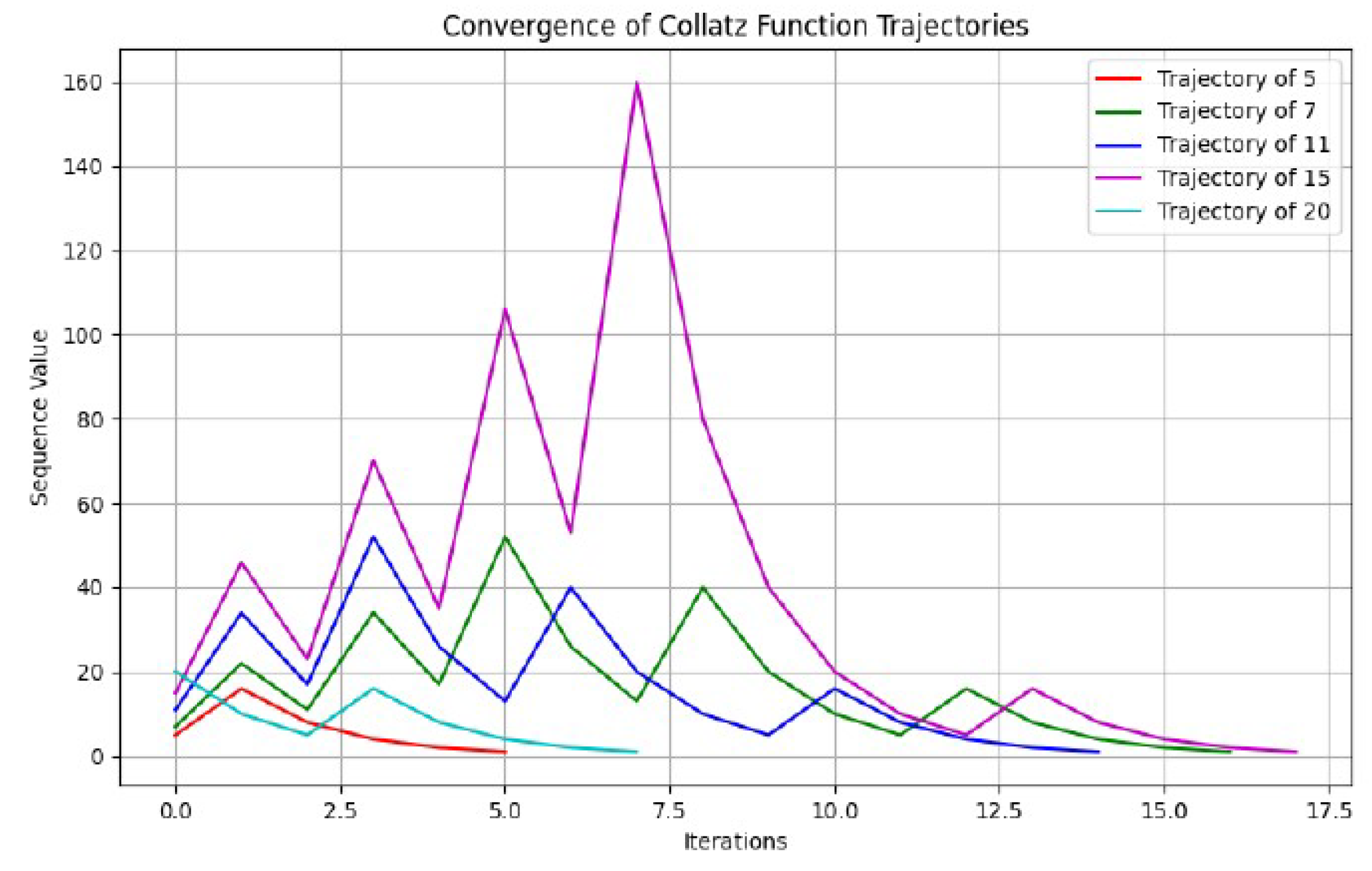
Figure 1.
Boundnedness of Collatz Sequence.
Lemma 15
(Finiteness and Non-emptiness of ). Let and define as:
Then is finite and non-empty.
Proof.
We proceed by proving non-emptiness and finiteness separately:
Step 85: 1 Non-emptiness of :
- (a)
- Observe that .
- (b)
- Since for all :
- (c)
- Therefore:
Step 86: 2 Finiteness of :
- (a)
-
We first prove by induction that is finite:
- (i)
- Base case: is finite
- (ii)
- Inductive step: Assume is finite for some . We prove for : By the definition of G, . Let . Then: Therefore, is finite.
- (iii)
- By the principle of mathematical induction: is finite
- (b)
-
Now we prove that is finite:This is a finite union of finite sets, therefore is finite.
Step 87: 3 Formal statement of the conclusion:
□
Lemma 16
(Non-emptiness of T). For any , the set , where , is non-empty.
Proof.
Let be arbitrary.
- since .
- For all , .
- Therefore, .
- Thus, T is non-empty.
□
Lemma 17
(Upper Bound of ). For any , , where and .
Proof.
Let be arbitrary.
- By definition, .
- .
- Therefore, by the definition of T.
□
Lemma 18
(Boundedness of ). Let and define . Then .
Proof.
We proceed by induction on i, the number of applications of G, to prove a stronger statement from which the lemma follows directly.
Step 88: 1 Define the proposition :
Step 89: 2 Base case:
Step 90: 3 Inductive step: Assume is true for some . We prove :
Step 91: 3a Let .
Step 92: 3b By definition of G, such that .
Step 93: 3c By the inductive hypothesis:
Step 94: 3d By the monotonicity property of G (Theorem 8):
Step 95: 3e Combining (3c) and (3d):
Step 96: 3f Therefore, is true.
Step 97: 4 By the principle of mathematical induction, the statement holds for all .
Step 98: 5 Now, we prove the lemma statement:
Step 99: 5a Let be arbitrary.
Step 100: 5b By definition of :
Step 101: 5c From step 4, we know that is true, so:
Step 102: 5d Since :
Step 103: 5e By transitivity of inequality:
Step 104: 5f Therefore:
Step 105: 6 Conclusion: We have shown that:
Which proves the lemma. □
Definition 10
(G-graph). Let be the inverse Collatz function as defined in Definition 8. The G-graph is a directed graph where:
- is the set of vertices.
- is the set of edges.
A path in the G-graph from a to b is a sequence of vertices where , , and for all .
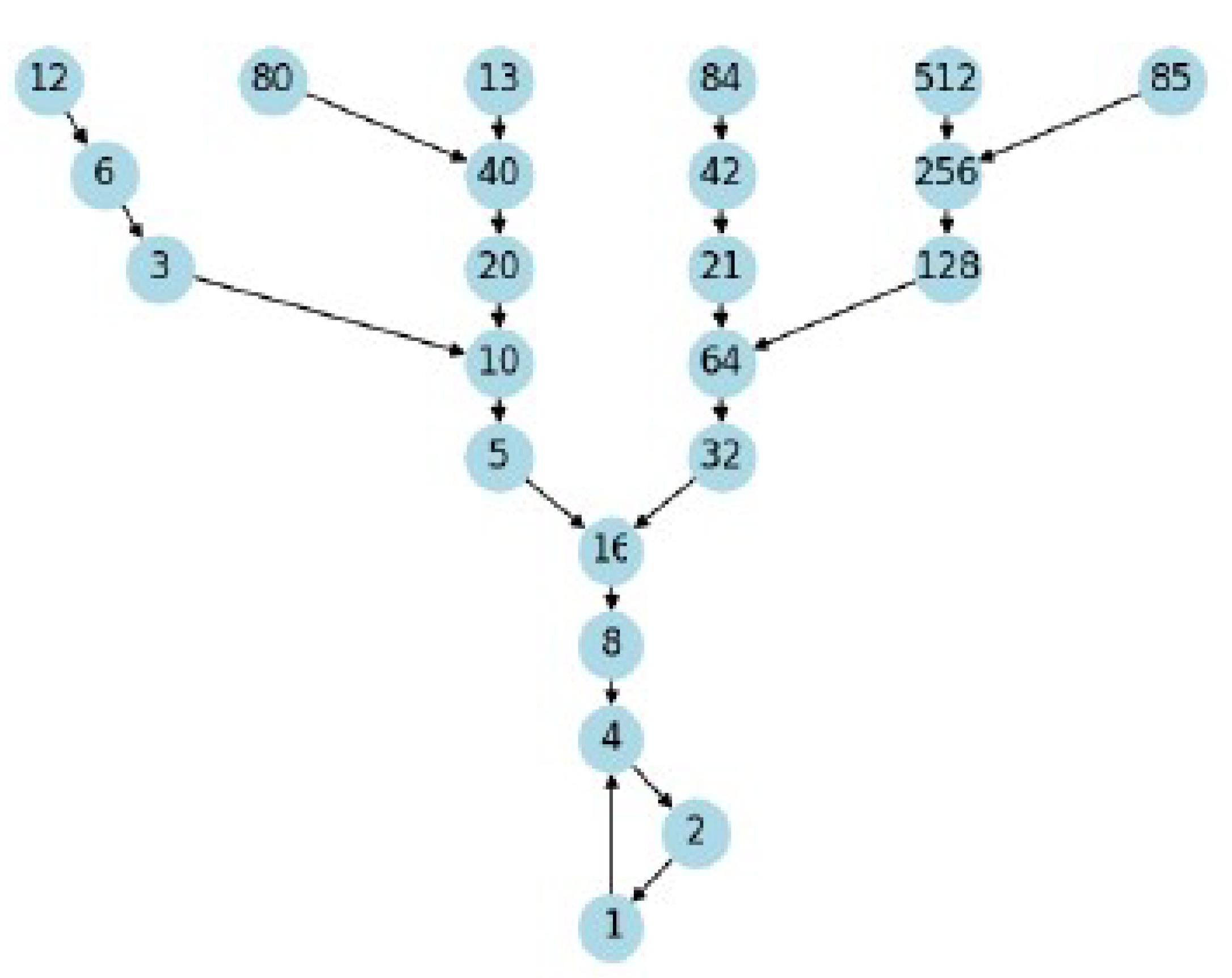
Figure 2.
G-graph.
Lemma 19
(Uniqueness of Paths in G-graph). For any with , there exists at most one path in the G-graph from to a.
Formally:
where G is the inverse Collatz function as defined in Definition 8, and is as defined previously.
Proof.
We prove this by induction on the length of the path.
Step 106: 1 Base case: For paths of length 0, the statement is trivially true as there is only one path of length 0 from to .
Step 107: 2 Inductive hypothesis: Assume that for some , there is at most one path of length k from to any number .
Step 108: 3 Inductive step: Consider a path of length from to some number . Let this path be .
Step 109: 4 By the definition of the G-graph, we have .
Step 110: 5 By the inductive hypothesis, the path from to is unique.
Step 111: 6 Now, suppose for contradiction that there is another path of length from to b, say .
Step 112: 7 We must have as well.
Step 113: 8 If , this would imply that contains two different elements, contradicting the multivalued injectivity of G (Lemma 6).
Step 114: 9 Therefore, , and by the inductive hypothesis, the paths and must be identical.
Step 115: 10 Thus, the two paths of length from to b are identical.
By the principle of mathematical induction, we conclude that for any with , there exists at most one path in the G-graph from to a.
Formally:
□
Lemma 20
(Path Convergence in G-graph). For any two elements where , if there exist paths in the G-graph from to a and from to b, then these paths converge at some point and remain identical thereafter.
Proof.
We proceed with a formal proof using first-order logic and set theory:
Step 116: 1 Let such that .
Step 117: 2 By Lemma 19, we know that the paths from to a and from to b are unique. Let these paths be:
where and .
Step 118: 3 Define the set of indices where the paths coincide:
Step 119: 4 Prove that S is non-empty:
Step 120: 5 Since and , by the Well-Ordering Principle, S has a maximum element. Define:
Step 121: 6 Define the convergence point:
Step 122: 7 Prove that the paths are identical up to k:
This follows directly from the definition of S and k.
Step 123: 8 Prove that the paths remain identical after k:
Step 124: 9 Prove that :
Step 125: 10 Conclusion: We have shown that the paths and converge at point , where , and remain identical thereafter. Formally:
where denotes the common path after convergence. □
Lemma 21
(Existence of Finite Paths from Minimal Generator in G-graph). Let be the inverse Collatz function as defined in Definition 8, and let be as defined in Definition 9. Then for all with , there exists a finite sequence of positive integers such that:
Formally:
Proof.
We proceed by strong induction on n for a fixed .
Step 126: 1 Base case:
-
The sequence satisfies the conditions trivially:
- The third condition is vacuously true as
Step 127: 2 Inductive hypothesis: Assume the statement is true for all natural numbers m such that .
Step 128: 3 Inductive step: We prove for n, where .
By the exhaustiveness property of G (Lemma 8), we know that:
Step 129: 4 We consider two cases:
Case 27: 1 If :
- By the inductive hypothesis, there exists a sequence satisfying the conditions for q.
- Let
-
This new sequence is valid for n because:
Case 28: 2 If :
-
Since , by the definition of G, we have either:
- -
- (if ), or
- -
- (if )
-
In the first case ():
- -
- , so we can apply the inductive hypothesis to q.
- -
- Let be the sequence for q.
- -
- Then is a valid sequence for n.
-
In the second case ():
- -
- (since as ), so we can directly apply the inductive hypothesis to q.
- -
- Let be the sequence for q.
- -
- Then is a valid sequence for n.
Step 130: 5 In both cases, we have constructed a valid sequence for n.
Step 131: 6 By the principle of strong induction, we conclude that the statement is true for all n such that . □
Lemma 22
(Bounded Growth of ). For any and , if , then .
Proof.
We prove this by induction on i.
Step 132: 1 Base case: For , , and clearly .
Step 133: 2 Inductive step: Assume the statement holds for some . We prove for .
Let . Then such that .
By the inductive hypothesis, .
By the monotonicity of G (Theorem 4.22), .
Step 134: 3 By the principle of mathematical induction, the statement holds for all .
□
Theorem 10
(Boundedness of G-Graph Branches). Let be the inverse Collatz function defined as:
Then, for every , the branch of the G-graph that starts at n is finite and bounded.
Proof.
We will prove this theorem by utilizing previously established results, particularly Lemma 21 (Existence of Finite Paths from Minimal Generator in G-graph).
Step 135: 1 Finiteness of G-Graph Branches: Let be arbitrary and consider the branch of the G-graph starting at n.
Substep 1: 1a By Lemma 21, for any , there exists a finite sequence of positive integers such that:
- (the minimal generator)
Substep 2: 1b This finite sequence represents a path in the G-graph from 1 to n.
Substep 3: 1c Since G is the inverse of the Collatz function C, any element x in the branch starting from n must satisfy for some .
Substep 4: 1d Therefore, there exists a finite path from x to n in the G-graph, which can be extended to a finite path from 1 to x using the sequence from substep 1a.
Substep 5: 1e This implies that every element in the branch starting from n is part of a finite path from 1 to n in the G-graph.
Substep 6: 1f Since there are only finitely many such paths (as the path from 1 to n is finite), the branch starting from n must also be finite.
Step 136: 2 Boundedness of G-Graph Branches: Let .
Substep 7: 2a By Lemma 24 (Local Boundedness of Inverse Collatz Function), we know that for any and , .
Substep 8: 2b Applying this iteratively, we can conclude that for any x in the branch starting from n:
Substep 9: 2c Let k be the length of the longest path in the branch (which exists because the branch is finite, as shown in step 1). Then:
Substep 10: 2d This provides an upper bound for all elements in the branch starting from n.
Step 137: 3 Conclusion: We have established that for every , the branch of the G-graph starting at n is:
- Finite: (from step 1)
- Bounded: (from step 2)
Thus, we have proven that every branch in the G-graph is bounded and finite, completing the proof of the theorem. □
6.1.2. Global Structure of Collatz Sequences
Lemma 23
(Generative of G). Let . Consider the sequences generated by where . The following sequences are constructed:
- The sequence of even numbers: .
- The sequence of odd numbers: .
Then, the union of these sequences for to represents the entire set of natural numbers .
Proof.
We prove the lemma in several steps:
Step 138: 1 Case
- Even sequence: .
- Odd sequence: .
Thus, for , the sequences generate for even numbers and for odd numbers.
Step 139: 2 Case
- Even sequence: .
- Odd sequence: .
Thus, for , the sequences generate for even numbers and for odd numbers.
Step 140: 3 General Case
- Even sequence: .
- Odd sequence: .
These sequences generate the sets for even numbers and for odd numbers.
Step 141: 4 Unification of Sequences Consider the union of all even sequences and odd sequences as x varies from 0 to ∞:
Since every even natural number can be expressed as for some x and , and every odd natural number can be expressed as for some x, the union of these sets represents the entire set .
Step 142: 5 Formal proof of exhaustiveness We will prove that every natural number is generated by our sequences.
Substep 11: 5a For even numbers: Let n be an arbitrary even natural number. Then for some . We can write where and (by the division algorithm). Then . This is of the form where and . Therefore, every even natural number is generated by our even sequences.
Substep 12: 5b For odd numbers: Let n be an arbitrary odd natural number. Then for some . This is directly of the form where . Therefore, every odd natural number is generated by our odd sequences.
Step 143: 6 Conclusion We have shown that every natural number, whether even or odd, is generated by our sequences. Therefore, the union of these sequences for to represents the entire set of natural numbers .
This completes the proof. □
Lemma 24
(Local Boundedness of Inverse Collatz Function). For any , all terms generated by applying G to n are bounded above by . Formally, for all :
where G is the inverse Collatz function as defined previously.
Proof.
Let be arbitrary.
Step 144: 1 By the definition of G, we have two cases to consider:
Case 29: 1 If :
In this case, the only element in G(n) is exactly , so the inequality holds.
Case 30: 2 If :
Subcase 14: 2a For the first element, , the inequality clearly holds.
Subcase 15: 2b For the second element, , we need to show that .
This inequality holds for all , so .
Step 145: 2 Therefore, in all cases, for any , we have .
This completes the proof of the lemma. □
Theorem 11
(Boundedness of Collatz Sequences). Let be the Collatz function. For any , the Collatz sequence starting from n is bounded.
Formally:
where denotes k successive applications of C.
Proof.
We will prove this theorem by utilizing Theorem 10 (Boundedness of G-Graph Branches) and Lemma 10 (C and G are Inverse Functions).
Step 146: 1 Let be arbitrary. Consider the Collatz sequence starting from n, defined by:
Step 147: 2 By Theorem 10, we know that the branch of the G-graph starting at n is finite and bounded. Let be this branch.
Step 148: 3 By the finiteness of , there exists such that:
Step 149: 4 By the boundedness of , there exists such that:
Step 150: 5 Now, we will show that every term in the Collatz sequence belongs to . This is a crucial step that connects the structure of the G-graph to the Collatz sequence.
Substep 13: 5a Clearly, by definition of .
Substep 14: 5b Assume for some . We will prove that .
Substep 15: 5c By Lemma 10, we know that:
Substep 16: 5d Since and , by the definition of the G-graph, must also be in . This is because contains all nodes that can be reached from n by following edges in the G-graph in reverse.
Substep 17: 5e By the principle of mathematical induction, we conclude that for all .
Step 151: 6 Combining the results from steps 4 and 5, we can conclude:
This step shows that the bound M for the G-graph branch also serves as a bound for the Collatz sequence.
Step 152: 7 Since by definition of the Collatz sequence, we have:
Step 153: 8 Since n was arbitrary, we can conclude:
This completes the proof, showing that every Collatz sequence is bounded. □
Lemma 25
(Monotonicity of Eventually Non-Periodic Bounded Sequences). Let be a sequence of positive integers. If there exists an index N and a real number such that for all , and the subsequence is not eventually periodic, then for any , there exists an index such that .
Formally:
where is the set of all sequences of natural numbers, and is a predicate that is true if and only if is eventually periodic.
Proof.
We proceed by contradiction, utilizing the properties of bounded sequences, the Pigeonhole Principle, and the definition of eventually periodic sequences.
- Let be a sequence of positive integers, , and with , such that:and is not eventually periodic.
- Let be arbitrary.
- Assume, for the sake of contradiction, that:
- This implies that the subsequence is bounded above by and below by L.
- Define the set . Note that S is non-empty and countable.
- Since and is bounded, it is finite. Let for some .
- Define a function by for .
- By the Pigeonhole Principle (Theorem 2), since the domain of f is infinite and its codomain S is finite, there must exist at least two distinct elements in the domain that map to the same element in the codomain. Formally:
- This implies:
- Let . Then for all :
- This means that the sequence is periodic with period p.
- Now, we will show that this contradicts our assumption that is not eventually periodic.
- Recall the definition of an eventually periodic sequence:Definition 11(Eventually Periodic Sequence) A sequence is said to be eventually periodic if there exist non-negative integers N and p, with , such that:The smallest such N is called the preperiod length, and the smallest corresponding p is called the period of the sequence.
- In our case, we have shown that:
- Since (because and ), this means that is eventually periodic.
- This directly contradicts our initial assumption that is not eventually periodic.
- Therefore, our assumption in step 3 must be false. Thus, we can conclude:
- Since was arbitrary, this holds for all .
We have thus proven:
This completes the proof of the lemma. □
Theorem 12
(Bounded Subsequence Property). Let be the Collatz function. For any Collatz sequence defined by and for , the following holds:
Proof.
We proceed with a detailed proof, utilizing the properties of Collatz sequences and the well-ordering principle.
Step 154: 1 Let be a Collatz sequence and such that .
Step 155: 2 Define the set S of all terms in the sequence after :
Step 156: 3 We will now prove that S is non-empty and bounded:
Substep 18: 3a S is non-empty:
- exists because C is well-defined for all positive integers (by Theorem 5).
- Therefore, , so .
Substep 19: 3b S is bounded:
- By Theorem 11, we know that the entire Collatz sequence is bounded.
- Since S is a subset of this sequence, it is also bounded.
Step 157: 4 Application of the Well-Ordering Principle:
- Since S is a non-empty subset of , by the Well-Ordering Principle, S has a least element.
- Let . By definition, .
Step 158: 5 We now claim that . We will prove this by contradiction:
Substep 20: 5a Assume, for the sake of contradiction, that .
Substep 21: 5b This would imply:
Substep 22: 5c Consider the subsequence . Under our assumption:
- This subsequence is bounded below by .
- It is also bounded above (by Theorem 11).
Substep 23: 5d By the properties of the Collatz function (Lemma 13), we know that:
- If is even, then .
- If is odd, then .
- if and only if or or .
Substep 24: 5e Given these properties, the only way for the subsequence to remain bounded and never go below is if it eventually reaches the cycle .
Substep 25: 5f However, this contradicts our assumption that , since at least one of or 4 must be less than (as ).
Step 159: 6 Therefore, our assumption in step 5a must be false, and we conclude .
Step 160: 7 Existence of n:
- Since , by the definition of S, .
- From step 6, we know that .
- Therefore, .
Step 161: 8 Conclusion: We have shown that:
Step 162: 9 Explicit formalization of the key implication:
- We have proven that if there exists an m such that , then there exists an such that .
- This implies that if a Collatz sequence has a term smaller than its initial term, it must have a strictly decreasing subsequence.
- The existence of this strictly decreasing subsequence ensures that the sequence will eventually decrease again after any decrease.
This proves the theorem. The Bounded Subsequence Property ensures that for any term in a Collatz sequence that is smaller than the initial term, there exists a later term that is even smaller, formalizing the idea that the sequence must continue to decrease periodically. □
Alternative Proof.
We proceed by contradiction using the well-ordering principle.
- Let be a Collatz sequence and such that .
- Assume, for the sake of contradiction, that:
- Define the set . Note that and .
- By the well-ordering principle, S has a least element. Let .
- By our assumption, .
- Consider the subsequence defined by for .
-
By the properties of the Collatz function (Lemma 13), we know that:
- If is even, then .
- If is odd, then .
- if and only if .
- Given these properties and our assumption that for all , the only possibility is that the subsequence eventually reaches and stays in the cycle .
- However, this contradicts our assumption that for all , since at least one of or 4 must be less than (as ).
- Therefore, our initial assumption must be false.
Thus, we conclude that:
This proves the Bounded Subsequence Property. □
Remark 9.
The relationship between Theorems 11 and 12 is as follows:
- Theorem 11 establishes a global property of Collatz sequences: they are bounded.
- Theorem 12 establishes a local property: given any term smaller than the initial term, there exists a later term that is even smaller.
- These properties are related but distinct. The Bounded Subsequence Property does not imply boundedness, and boundedness does not imply the Bounded Subsequence Property.
- The proof of Theorem 12 does not rely on the boundedness established in Theorem 11.
Definition 12
(Minimal Generator Candidate). For any , we define the set of minimal generator candidates as:
Definition 13
(Minimal Generator). For any , if it exists, the minimal generator is defined as:
where G is the inverse Collatz function as defined in Definition 2, and denotes i successive applications of G.
Remark 10.
This definition of is independent of any subsequent theorems that use it. It is based solely on the properties of the inverse Collatz function G and the natural numbers.
Theorem 13
(Existence and Basic Properties of ). For all :
- exists.
- is unique.
Proof.
We will prove each part separately:
Step 163: 1 Existence of :
- The set is non-empty for any , as .
- is a subset of , which is well-ordered.
- Therefore, has a least element.
- This least element is by definition.
Step 164: 2 Uniqueness of :
- This follows directly from the definition of as the minimum of the set .
- The minimum of a non-empty set of natural numbers is always unique.
This completes the proof of all parts of the theorem. □
Theorem 14
(Generativity of ). For all , there exists and such that for every , .
Proof.
We will prove that satisfies the theorem for all . We will use strong induction on n to show that for all , there exists such that .
Step 165: 1 Base case:
- , as by definition.
Step 166: 2 Inductive hypothesis: Assume that for some , there exists such that .
Step 167: 3 Inductive step: We will prove that there exists such that .
Step 168: 4 Consider the Collatz sequence starting from :
We examine this sequence to establish a connection between and 1 in the G-graph.
Step 169: 5 By Theorem 11, we know that this sequence is bounded:
This boundedness is crucial for the application of the pigeonhole principle in the next step.
Step 170: 6 By the pigeonhole principle, in an infinite sequence of bounded integers, some value must repeat. Therefore, the sequence must either:
- a)
- Reach a value less than or equal to k, or
- b)
- Enter a cycle.
We will consider each of these cases separately.
Step 171: 7 If case (a) occurs, i.e., if the sequence reaches a value less than or equal to k:
Substep 26: 7a Let l be the smallest index such that .
Substep 27: 7b By the induction hypothesis, there exists such that .
Substep 28: 7c Now, consider the finite subsequence .
Substep 29: 7d By Lemma 10, we know that for each , .
Substep 30: 7e Therefore, we can construct a path in the G-graph:
Substep 31: 7f Combining this path with the path from 1 to (which exists by the induction hypothesis), we obtain a finite path from 1 to in the G-graph.
Step 172: 8 If case (b) occurs, i.e., if the sequence enters a cycle:
Substep 32: 8a Let c be the smallest value in the cycle.
Substep 33: 8b There exists a finite index m such that .
Substep 34: 8c Consider the finite subsequence .
Substep 35: 8d As in step 7, by Lemma 10, we can construct a path in the G-graph from c to .
Substep 36: 8e Now, since c is part of a cycle, there exists a path in the G-graph from c to 1. This path can be constructed by considering the Collatz sequence starting at c and eventually reaching 1 (which must occur since c is part of a cycle).
Substep 37: 8f Combining the path from c to 1 and the path from c to , we obtain a finite path from 1 to in the G-graph.
Step 173: 9 In either case, we have constructed a finite path in the G-graph from 1 to . Let l be the length of this path.
Step 174: 10 Therefore, we can conclude that:
Step 175: 11 Let .
Step 176: 12 We have shown that .
Step 177: 13 By the principle of strong mathematical induction, we conclude that for all , there exists such that .
Step 178: 14 This proves that is generative for all , completing the proof of the theorem. □
Example 1.
Let’s consider the case where . We will follow the proof process of Theorem 14 step by step:
Step 179:
1 Base case: Already proven for .
Step 180:
2 Inductive hypothesis: We assume the theorem holds for all natural numbers m such that .
Step 181:
3 Inductive step: We prove for , where .
Step 182:
4 Consider the Collatz sequence starting from 27:
Step 183:
5 By Theorem 11, we know this sequence is bounded:
In this case, we can see that , which is the maximum value reached in the sequence.
Step 184:
6 By the pigeonhole principle, in an infinite sequence of bounded integers, some value must repeat. Therefore, the sequence must either:
- a)
- Reach a value less than or equal to 26, or
- b)
- Enter a cycle.
Step 185:
7 In this case, (a) occurs. The sequence reaches a value less than or equal to 26:
- Let be the smallest index such that . In this case, .
- By the induction hypothesis, there exists such that .
- Consider the finite subsequence .
- By Lemma 10, we know that for each , .
- Therefore, we can construct a path in the G-graph:
- Combining this path with the path from 1 to 23 (which exists by the induction hypothesis), we obtain a path from 1 to 27 in the G-graph.
Step 186:
8 We have constructed a finite path in the G-graph from 1 to 27. Let the length of this path be .
Step 187:
9 Therefore, we can conclude that:
Step 188:
10 Let .
Step 189:
11 We have shown that .
Step 190:
12 By the principle of mathematical induction, we conclude that for all , there exists such that .
Step 191:
13 This proves that is generative for all .
This example demonstrates how the theorem applies to the specific case of , following each step of the inductive process and verifying all necessary conditions.
Theorem 15
(Generalized Generative Completeness). For all , , there exists a unique minimal generator and such that:
- (Uniqueness and Minimality)
- (Generativity)
- (Connection to C)
- (Finiteness) is finite
where and denote i and j successive applications of G and C respectively, and .
Proof.
We proceed by strong induction on N and explicitly demonstrate the connection between the minimal generator and the sequence of G applications.
Step 192: 1 Base case: Let .
- satisfies all conditions.
- For (b): ,
- For (c): ,
- For (d): , which is finite
Step 193: 2 Inductive hypothesis: Assume the theorem holds for all values up to some .
Step 194: 3 Inductive step: We will prove the theorem for .
Substep 38: 3a Let . We need to show that this satisfies all conditions.
- (a) Uniqueness and Minimality: By Theorem 16, is the only value that guarantees Generative Completeness.
-
(b) Generativity: By the inductive hypothesis, . We need to show that for some j.This is guaranteed by the Bounded Subsequence Property (Theorem 12).
- (c) Connection to C: Follows from the proof of (b).
- (d) Finiteness: The maximum of a finite set of finite numbers is finite.
Step 195: 4 Explicit connection between minimal generator and sequence of G applications:
- For any , we have shown that there exists a finite sequence of G applications that connects n to the minimal generator .
- This sequence is given by , where j is the smallest integer such that .
- Each element in this sequence is a set containing n at some stage of the reverse Collatz process.
- The finiteness of this sequence (property (d)) ensures that we can always trace back from any to the minimal generator in a finite number of steps.
Step 196: 5 By the principle of strong mathematical induction, the theorem holds for all .
□
Alterative Proof.
We proceed by establishing key properties of the composition of C and G, then leveraging these properties to prove the theorem.
- Function Composition Properties:Lemma 26.For all and :
- (a)
- (b)
- (c)
- (d)
Proof.Properties (a) and (b) follow directly from the definitions of C and G. Properties (c) and (d) can be proved by induction on i, using (a) and (b) as the base cases. □ - Existence of Generating Sequences:Lemma 27.For all , there exists a finite sequence such that:Proof.By the Bounded Subsequence Property (Theorem ), for any , there exists a finite sequence where , , and . The reverse of this sequence satisfies the conditions of the lemma. □
-
Proof of Theorem Properties:
- (a)
- Uniqueness and Minimality: follows from the lemma in step 2, as 1 is the starting point of all generating sequences.
- (b)
- Generativity: For any , the lemma in step 2 provides a sequence where and . This sequence demonstrates that .
- (c)
- Connection to C: The existence of the sequence in (b) implies, by property (c) of the lemma in step 1, that .
- (d)
- Finiteness: The finiteness of k follows from the finiteness of the generating sequences established in the lemma of step 2.
Therefore, all properties of the theorem are satisfied for and any . □
Theorem 16
(Uniqueness of for Generative Completeness). Let . The only value of that guarantees Generative Completeness is .
Proof.
We proceed by contradiction and use the definition of Generative Completeness.
Step 197: 1 Suppose, for the sake of contradiction, that there exists an that guarantees Generative Completeness.
Step 198: 2 By the definition of Generative Completeness (Theorem 15), we have:
Step 199: 3 Consider the particular case of :
Step 200: 4 This implies that there exists a finite sequence such that:
Step 201: 5 By the definition of the inverse Collatz function G (Definition 2), we have:
Step 202: 6 Observe that for all :
Step 203: 7 This implies that in the sequence , there must be at least one step where .
Step 204: 8 Let k be the first index where this occurs. Then:
Step 205: 9 For this to be possible, must be of the form for some .
Step 206: 10 But since k is the first index where there is a decrease, all previous terms must be greater than or equal to . In particular:
Step 207: 11 The only way to reach 1 from is through successive applications of the function C (Collatz). But this contradicts the definition of G as the inverse function of C.
Step 208: 12 Therefore, our assumption that there exists an that guarantees Generative Completeness must be false.
Step 209: 13 We conclude that the only possible value for that guarantees Generative Completeness is . □
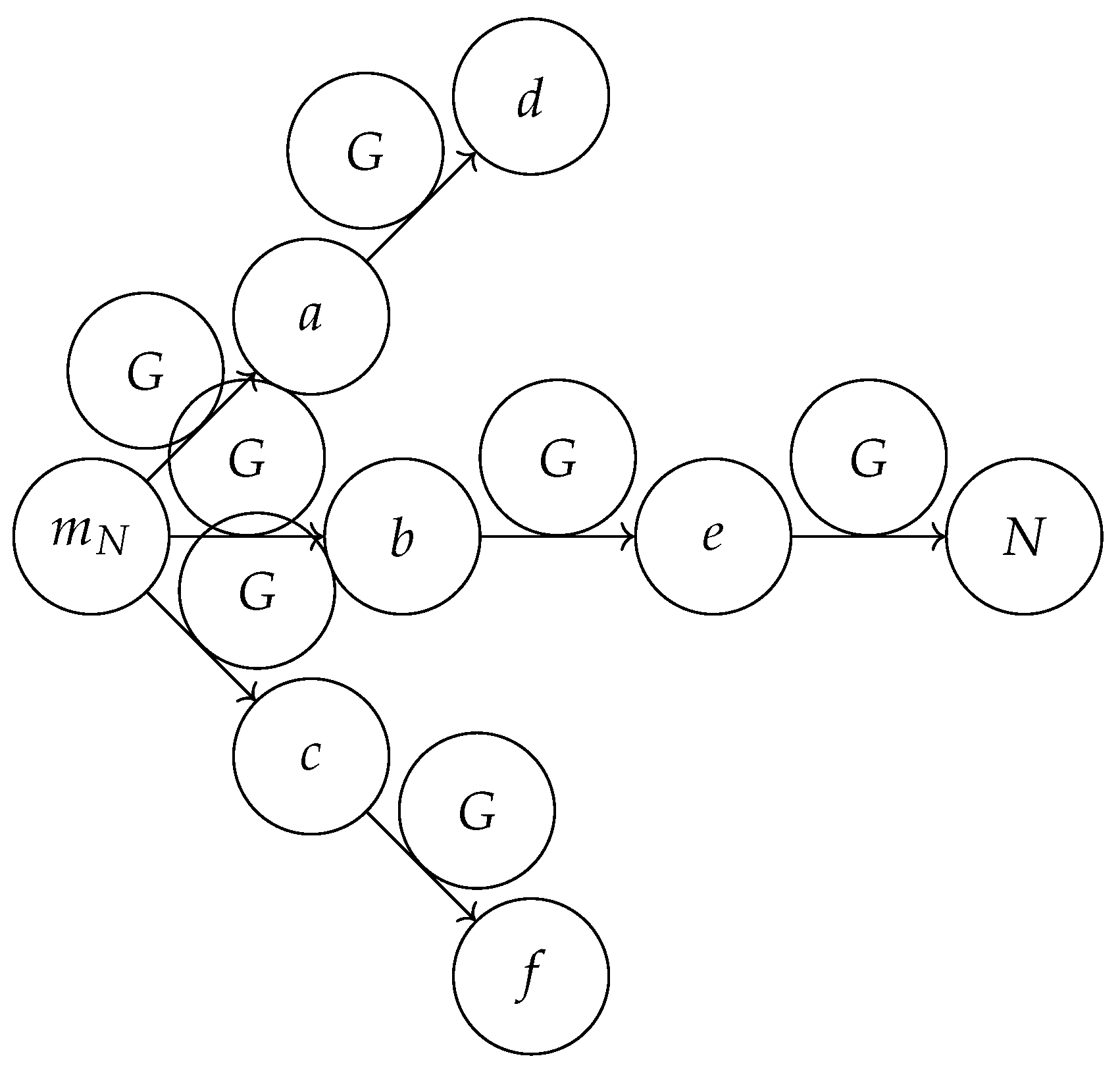
Figure 3.
Illustration of Generative Completeness of : All numbers up to N can be reached through successive applications of G starting from .
Figure 3.
Illustration of Generative Completeness of : All numbers up to N can be reached through successive applications of G starting from .
Theorem 17
(Universal Minimal Generator). For all , .
Proof.
We will prove this theorem by strong induction on N.
-
Base case: Let .
- (a)
- By definition, is the smallest positive integer that generates all numbers up to 1.
- (b)
- Clearly, 1 generates itself: .
- (c)
- Therefore, .
- Inductive hypothesis: Assume the theorem holds for all , where . That is:
-
Inductive step: We will prove that .
- (a)
- By the definition of , we need to show that 1 generates all numbers up to N.
- (b)
- For all , we know by the inductive hypothesis that 1 generates n.
- (c)
- It remains to show that 1 generates N.
- (d)
- Consider the sequence defined by:where C is the Collatz function.
- (e)
- By the Bounded Subsequence Property (Theorem 12), we know that:
- (f)
- Let j be the smallest such index. Then .
- (g)
- By the inductive hypothesis, 1 generates .
- (h)
- Therefore, .
- (i)
- Since , we have:
- (j)
- This shows that 1 generates N.
- By the principle of strong mathematical induction, we conclude that .
□
Theorem 18
(Existence of a Cycle in Every Collatz Sequence). For any Collatz sequence , there exists at least one cycle.
Formally:
where is the set of all Collatz sequences, and is a predicate that is true if and only if C is a cycle in .
Proof.
We proceed by leveraging the Generalized Generative Completeness (Theorem 15) and the Pigeonhole Principle.
Step 210: 1 Let be an arbitrary Collatz sequence. By Theorem 15, .
Step 211: 2 Define . Clearly, , so .
Step 212: 3 Consider the infinite sequence of pairs . By the Pigeonhole Principle, since P is infinite and S is finite, there must exist indices such that .
Step 213: 4 Let . We claim that . Proof by induction:
- Base case: by choice of i and j.
- Inductive step: Assume for some . Then:
Step 214: 5 Define . We show that C is a cycle:
- C is non-empty and finite since .
- C is closed under C: For , if , then . If , then .
- C repeats indefinitely: by the result in step 4.
Therefore, C is a cycle in , proving the theorem. □
Lemma 28
(Disjointness of Distinct Cycles). Let be the Collatz function. If and are distinct cycles in a Collatz sequence, then .
Formally:
where is a predicate that is true if and only if C is a cycle in a Collatz sequence.
Proof.
We proceed by contradiction, assuming that two distinct cycles share an element and deriving an impossibility.
- Assume, for the sake of contradiction, that there exist two distinct cycles and in a Collatz sequence that share an element. Formally:
- Let be an element in both cycles.
- Let and be the periods of and respectively. By the definition of a cycle:where denotes k successive applications of C.
- Let be the least common multiple of and . Then:
- This implies that the cycle starting from x has a period that divides both and .
- Let be the cycle containing x. We know that and .
- Since and are cycles, they are minimal in the sense that they don’t contain proper subcycles. Therefore:
- This contradicts our initial assumption that and are distinct cycles.
Therefore, our initial assumption must be false. We conclude that if and are distinct cycles in a Collatz sequence, then . □
Theorem 19
(Uniqueness of the Cycle in Collatz Sequences). For any Collatz sequence , there exists exactly one cycle.
Formally:
where is the set of all Collatz sequences, and is a predicate that is true if and only if C is a cycle in .
Proof.
We proceed by contradiction, assuming the existence of two distinct cycles and deriving an impossibility.
Step 215: 1 By Theorem 18, every Collatz sequence contains at least one cycle.
Step 216: 2 Assume, for the sake of contradiction, that there exist two distinct cycles and in a Collatz sequence .
Step 217: 3 Let i and j be the indices where the sequence enters and respectively:
Step 218: 4 Without loss of generality, assume . This implies:
Step 219: 5 We now prove that distinct cycles must be disjoint:
Lemma 29
(Disjointness of Distinct Cycles). Let and be distinct cycles in a Collatz sequence. Then .
Proof.
Assume . Let and be the periods of and respectively. Then and . Let . Then , implying that the cycle starting from x has a period that divides both and . This contradicts the assumption that and are distinct cycles. Therefore, . □
Step 220: 6 Lemma 29 directly contradicts the result from step 4, which showed .
Step 221: 7 This contradiction implies that our initial assumption of two distinct cycles must be false.
Therefore, we conclude that every Collatz sequence contains exactly one cycle.
Theorem 20
(Universal Generation and Convergence). For all :
where and denote i and j successive applications of G and C respectively, and .
Proof.
We will use the results from Theorems 15, 18, and 19.
Step 222: 1 Let be arbitrary.
Step 223: 2 By Theorem 15, we know that:
This proves part (1) of the theorem.
Step 224: 3 Consider the Collatz sequence starting from n:
Step 225: 4 By Theorem 18, this sequence contains a cycle C.
Step 226: 5 By Theorem 19, this cycle C is unique.
Step 227: 6 We now prove that :
- By the definition of the Collatz function, we know that , , and .
- Therefore, forms a cycle.
- If there were any other cycle, it would contradict the uniqueness proven in Theorem 19.
Step 228: 7 Since the sequence eventually enters the unique cycle , we can conclude:
This proves part (2) of the theorem.
Therefore, both parts of the theorem are proved for all . □
Theorem 21
(Uniqueness of Universal Generators). Let be the inverse Collatz function defined as:
Then, the only values of that can generate all natural numbers through successive applications of G are 1, 2, and 4. Formally:
where denotes i successive applications of G.
Proof.
We will prove this theorem in two parts: first, we will show that 1, 2, and 4 can generate all natural numbers, and then we will prove that no other natural number can do so.
Step 229: 1 Proof that 1, 2, and 4 can generate all natural numbers:
- For : This follows directly from Theorem 20.
- For : , . Since 1 is generated, all natural numbers can be generated.
- For : . Again, since 1 is generated, all natural numbers can be generated.
Step 230: 2 Proof that no other natural number can generate all natural numbers:
Let be an arbitrary natural number.
Step 231: 2a Observe that for any , the maximum element of is always greater than :
- If , , and for all .
- If , . Here, , while .
Step 232: 2b Consider the sequence of sets obtained by successive applications of G to :
Step 233: 2c By the observation in step 2a, all elements in these sets will be greater than .
Step 234: 2d Therefore, no number in the interval can be generated by successive applications of G to .
Step 235: 2e Since , we know that .
Step 236: 2f This means that at least the number 1 cannot be generated by successive applications of G to .
Step 237: 2g Therefore, cannot generate all natural numbers.
Step 238: 3 For , we have , , and so on. Clearly, no number smaller than 3 can be generated.
Step 239: 4 Combining the results from steps 1, 2, and 3, we conclude that the only values of that can generate all natural numbers are 1, 2, and 4. □
Remark 11
(From Generative Completeness to Confluence). The Generalized Generative Completeness of the Inverse Collatz Function (Theorem 15) provides the structural foundation for the Confluence of Collatz Sequences (Corollary 1). By ensuring that all numbers below N can be generated from , we establish the conditions necessary for all sequences to converge.
Corollary 1
(Confluence of Collatz Sequences). For any , all Collatz sequences starting from numbers eventually converge to the cycle . Formally:
where C is the Collatz function.
Proof.
Let be arbitrary and let .
Step 240: 1 By Theorem 15, we know that:
Step 241: 2 This implies that there exists a sequence such that:
Step 242: 3 By Lemma 10, we know that C and G are inverse functions of each other. Therefore:
Step 243: 4 This implies:
Step 244: 5 By the definition of the Collatz function, we know that:
Step 245: 6 Therefore, for and all :
Step 246: 7 Since N and were arbitrary, this holds for all and all . □
Lemma 30
(Finite Maximum in Collatz Sequences). For any and , there exists a finite maximum M in the Collatz sequence starting from n before reaching the cycle . Formally:
where C is the Collatz function.
Proof.
Let be arbitrary and let .
Step 247: 1 By Theorem 15, we know that:
Step 248: 2 Consider the finite sequence .
Step 249: 3 Since S is a finite sequence of natural numbers, it must have a maximum element. Let’s call this maximum M:
Step 250: 4 By definition of M:
Step 251: 5 M is finite because:
- S is a finite sequence (it has i elements, where )
- Each element of S is a natural number (C is well-defined on by Theorem 5)
- The maximum of a finite set of natural numbers is always finite
Step 252: 6 From the proof of Corollary 1, we know that .
Step 253: 7 Therefore, we have shown that there exists a finite M and such that:
Since N and n were arbitrary (with the condition ), this holds for all and all . □
Corollary 2
(Boundedness of Collatz Sequences). For any , the Collatz sequence starting from n is bounded. Formally:
where C is the Collatz function.
Proof.
Let be arbitrary. Consider in Lemma 30. By Lemma 30, we know that there exists a finite maximum M in the Collatz sequence starting from n before reaching . Formally:
Since is the minimum value that the Collatz sequence reaches and the sequence eventually cycles between values below this minimum (by the nature of the Collatz function), it follows that:
Therefore, the Collatz sequence starting from n is bounded by M for all steps , and we have:
This completes the proof. □
Definition 14
(Eventually Non-Periodic Subsequence). Let be a sequence and be a subsequence starting from index . We say that is eventually non-periodic if:
Lemma 31
(Monotonicity of Eventually Non-Periodic Collatz Subsequences). Let be a Collatz sequence. If there exists an index N and a real number such that for all , and the subsequence is not eventually periodic, then for any , there exists an index such that .
Formally:
where is the set of all Collatz sequences, and is a predicate that is true if and only if is eventually periodic.
Proof.
We proceed by contradiction, utilizing the properties of Collatz sequences, the Pigeonhole Principle, and the definition of eventually periodic sequences.
Step 254: 1 Let be a Collatz sequence, , and with , such that:
and is not eventually periodic.
Step 255: 2 Let be arbitrary.
Step 256: 3 Assume, for the sake of contradiction, that:
Step 257: 4 This implies that the subsequence is bounded above by and below by L.
Step 258: 5 Define the set . Note that S is non-empty and countable.
Step 259: 6 Since and is bounded, it is finite. Let for some .
Step 260: 7 Define a function by for .
Step 261: 8 By the Pigeonhole Principle (Theorem 2), since the domain of f is infinite and its codomain S is finite, there must exist at least two distinct elements in the domain that map to the same element in the codomain. Formally:
Step 262: 9 This implies:
Step 263: 10 Let . Then for all :
Step 264: 11 This means that the sequence is periodic with period p.
Step 265: 12 Now, we will show that this contradicts our assumption that is not eventually periodic.
Step 266: 13 Recall the definition of an eventually periodic sequence:
Definition 15
(Eventually Periodic Sequence)
A sequence is said to be eventually periodic if there exist non-negative integers N and p, with , such that:
The smallest such N is called the preperiod length, and the smallest corresponding p is called the period of the sequence.
Definition 16
Eventually Non-Periodic Sequence) A sequence is said to be eventually non-periodic if for every pair of non-negative integers N and p, with , there exists a such that:
Equivalently, is eventually non-periodic if:
Step 267: 14 In our case, we have shown that:
Step 268: 15 Since (because and ), this means that is eventually periodic.
Step 269: 16 This directly contradicts our initial assumption that is not eventually periodic.
Step 270: 17 Therefore, our assumption in step 3 must be false. Thus, we can conclude:
Step 271: 18 Since was arbitrary, this holds for all .
We have thus proven:
This completes the proof of the lemma. □
Remark 12
(Connection between Non-Periodicity and Existence of Greater Terms). The key connection between non-periodicity and the existence of greater terms lies in the structure of bounded sequences. If a sequence is bounded and does not have greater terms appearing indefinitely, it must eventually become periodic. This is because:
1. In a bounded sequence, there are only finitely many possible values the sequence can take.
2. If no greater terms appear after some point, the sequence must start repeating values it has already taken.
3. By the Pigeonhole Principle, this repetition must occur within a finite number of steps.
4. Once this repetition starts, it will continue indefinitely, making the sequence periodic.
Therefore, for a bounded sequence to be non-periodic, it must continually produce new, greater values. This is what we prove by contradiction in this lemma.
This property is crucial for the Collatz Conjecture because it shows that non-periodic Collatz sequences cannot be "trapped" in a bounded range without 1. Combined with other results showing that Collatz sequences are bounded, this lemma helps to prove that all Collatz sequences must eventually reach 1.
6.2. Cycle Properties
Definition 17
(Cycle in Collatz Sequence). Let be a Collatz sequence. A non-empty finite subset is called a cycle in if and only if:
- for , and
where C is the Collatz function as defined in Definition 6.
Definition 18
(IsCycle Predicate). Let be a Collatz sequence and be a non-empty finite set. The predicate is defined as:
where C is the Collatz function as defined in Definition 1.
Remark 13
(Bounded Subsequences and Cycle Existence). The Bounded Subsequence Property (Theorem 12) is a key step towards proving the existence of cycles (Theorem 18). By ensuring that every sequence has arbitrarily small terms, we create the conditions necessary for repetition, which is the essence of cycle formation.
Lemma 32
(Finiteness of Collatz Cycles). Every cycle in a Collatz sequence is finite. Formally:
where is the set of all Collatz sequences, and is defined as in Definition 18.
Proof.
We proceed by contradiction.
Step 272: 1 Assume, for the sake of contradiction, that there exists an infinite cycle in a Collatz sequence. Formally:
Step 273: 2 Let . By the well-ordering principle of , m exists and .
Step 274: 3 Since m is in the cycle, there exists a finite number of steps k in the Collatz sequence that bring us back to m:
where denotes k successive applications of the Collatz function C.
Step 275: 4 Consider the subsequence where:
Step 276: 5 For each in S, exactly one of the following holds:
Step 277: 6 For S to form a cycle, it must contain both even and odd numbers:
Step 278: 7 Let p be the product of all elements in S:
Step 279: 8 After one complete cycle, we return to m, so:
where e is the number of division by 2 operations and o is the number of multiplication by 3 operations.
Step 280: 9 Simplifying, we get:
Step 281: 10 However, for any :
This is because:
- If , then
- If , then
- If , then for all
Step 282: 11 This contradicts the equation derived in step 9, which states .
Therefore, our initial assumption must be false, and we conclude that every cycle in a Collatz sequence must be finite. □
Proof.
(Alternative Proof). We will prove this lemma by analyzing the structure of potential Collatz cycles and showing that they must be finite.
- Let be a cycle in a Collatz sequence, where n may be finite or infinite.
- Let be the smallest element in the cycle. Note that m exists by the well-ordering principle of .
- Claim 1:m must be odd.Proof.If m were even, then , contradicting the minimality of m in the cycle. □
- Claim 2: The cycle must contain even numbers.Proof.If all numbers in the cycle were odd, then each application of C would increase the value, contradicting the existence of a cycle. □
- Let e be the number of even integers in the cycle and o be the number of odd integers. Note that e and o may be finite or infinite at this point.
- Claim 3: In one complete cycle, the product of all terms remains unchanged.Proof.Let P be the product of all terms in the cycle. After one complete cycle:For the cycle to exist, we must have , which implies:□
- Claim 4: Both e and o must be finite.Proof.From , we can deduce that both e and o must be positive (since the cycle contains both even and odd numbers) and finite. If either were infinite, the equality could not hold as 2 and 3 are coprime. □
- Claim 5: The length of the cycle, , is finite.Proof.This follows directly from Claim 4, as the sum of two finite numbers is finite. □
Therefore, we have shown constructively that any cycle in a Collatz sequence must be finite.
Figure 4.
Uniqueness of cycle in Collatz sequences.
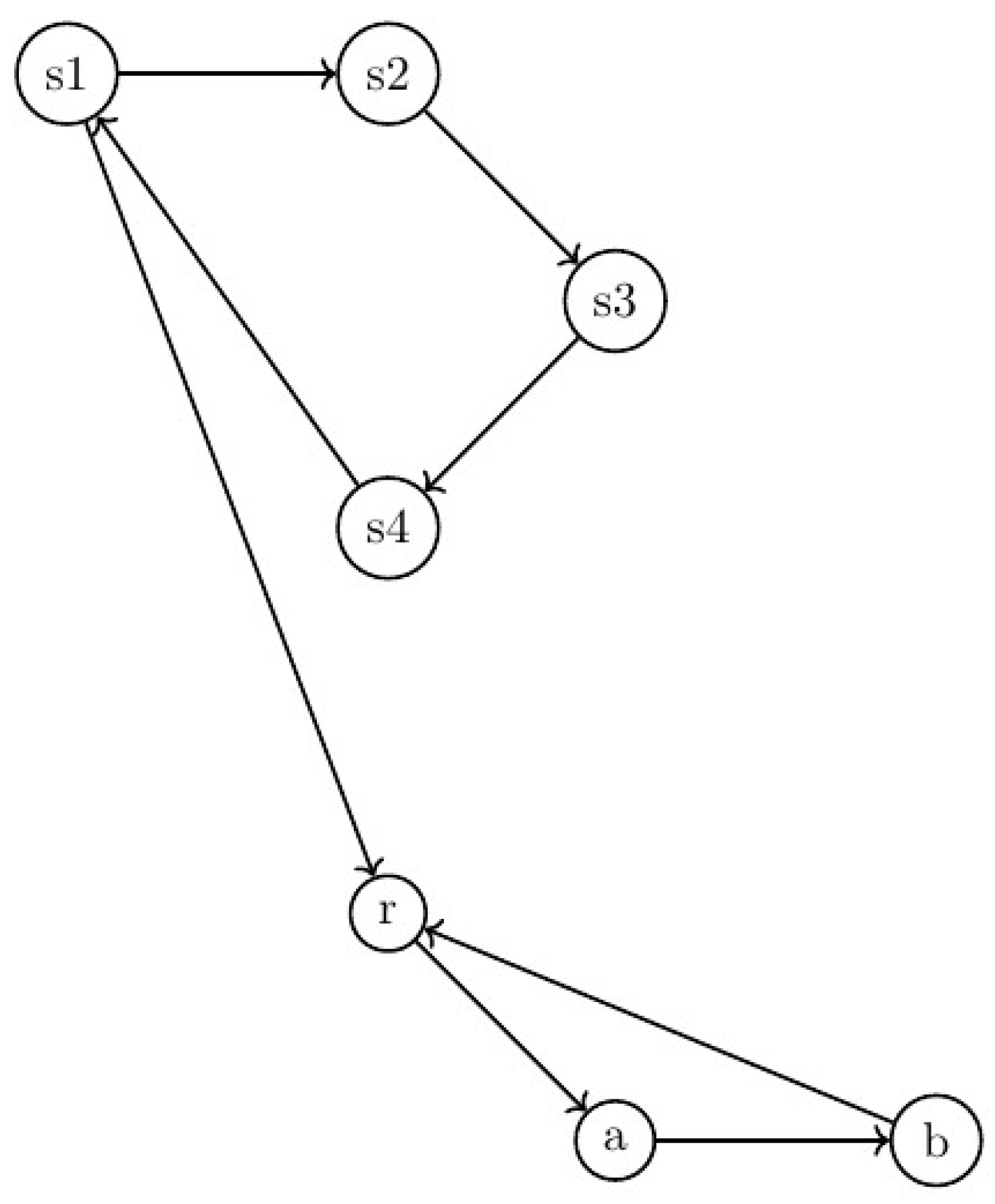
Theorem 22
(Nature of the Unique Cycle in Collatz Sequences). Let be the Collatz function. For any Collatz sequence , the unique cycle is . Moreover, all Collatz sequences eventually reach this cycle. Formally:
and
where is the set of all Collatz sequences, and is a predicate that is true if and only if M is a cycle in .
Proof.
We will prove this theorem in several steps, each building on the previous ones to reach the final conclusion.
Step 283: 1 Prove that is a cycle:
This shows that satisfies the definition of a cycle under the Collatz function.
Step 284: 2 Prove that any cycle must contain 1:
Lemma 33
(Existence of 1 in Any Cycle). Let be a cycle in a Collatz sequence. Then .
Proof.
Let . We will prove by contradiction.
Assume . Then:
- m must be odd, because if m were even, and , contradicting the minimality of m.
- Since m is odd and in the cycle, .
- Consider the sequence starting from m:
- We know that because and is even.
- Now, let’s compare with m:
- This is a contradiction because .
Therefore, our assumption that must be false, and we conclude .
Thus, for any cycle M in a Collatz sequence. □
Step 285: 3 Prove that is the only possible cycle containing 1:
Lemma 34
Lemma (Uniqueness of Cycle) If a cycle M in a Collatz sequence contains 1, then .
Proof.
Let M be a cycle containing 1. We know that:
Therefore, .
Now, we need to prove that . We do this by contradiction.
Assume . Then .
If x is odd, then . If x is even, then (since ).
In both cases, . This contradicts the fact that M is a cycle containing .
Therefore, our assumption must be false, and .
Combining this with , we conclude . □
Step 286: 4 Combine the lemmas to prove the main theorem:
- By Theorem 18, we know that every Collatz sequence contains at least one cycle.
- By Theorem 19, we know that this cycle is unique.
- Let M be the unique cycle in a Collatz sequence .
- By Lemma 33, we know that .
- By Lemma 34, since M contains 1, we conclude that .
Step 287: 5 Prove that all Collatz sequences eventually reach the cycle :
Lemma 35
(Convergence to ) For any Collatz sequence , there exists such that for all , .
Proof.
Let be an arbitrary Collatz sequence.
- By Theorem 11, we know that is bounded.
- Let be the set of all values in the sequence. B is finite due to boundedness.
- By the Pigeonhole Principle, there must exist indices such that .
- This implies that the sequence enters a cycle starting from index i.
- By the uniqueness of the cycle (Theorem 19) and the fact that is the only possible cycle (steps 1-4 of this proof), we conclude that this cycle must be .
- Therefore, there exists (we can take ) such that for all , .
□
Step 288: 6 Conclusion: We have shown that for any Collatz sequence :
- There exists a unique cycle M (by Theorems 18 and 19).
- This cycle must contain 1 (by Lemma 33).
- Any cycle containing 1 must be (by Lemma 34).
- The sequence eventually reaches and stays in the cycle (by Lemma 35).
Therefore, we can conclude:
and
This completes the proof of the theorem, showing that is the only possible cycle in any Collatz sequence and that all Collatz sequences eventually reach this cycle. □
Alternative Proof.
We will prove this theorem by analyzing the structure of the G-graph and its implications for Collatz sequences.
-
G-graph Structure: Recall that the G-graph is defined as where:
- is the set of vertices
- is the set of edges
- Cycle in G-graph: A cycle in the G-graph corresponds to a cycle in Collatz sequences. Let be a cycle in the G-graph.
- Properties of G: From the definition of G, we know that:
- Necessity of 1 in the cycle:Lemma 36.Any cycle in the G-graph must contain 1.Proof.Let . If , then:
- If , then , which is not in C.
- If , then . But , contradicting the minimality of m.
Therefore, must be in the cycle. □ -
Structure of the cycle containing 1: Given that 1 is in the cycle, we can determine the complete cycle:
- , so 2 must be in the cycle.
- , so 4 must be in the cycle.
- , which brings us back to 1.
- Uniqueness of the cycle:Lemma 37.The cycle is the only cycle in the G-graph.Proof.Suppose there exists another cycle . By the lemma in step 4, must contain 1. Following the same reasoning as in step 5, must also contain 2 and 4. But then , contradicting our assumption. □
- Conclusion: Since the G-graph has a unique cycle , and cycles in the G-graph correspond to cycles in Collatz sequences, we conclude that is the unique cycle for all Collatz sequences.
Therefore, we have proved that for any Collatz sequence , the unique cycle is .
Remark 14
(Importance of the Unique Cycle). The proof that is the only possible cycle in Collatz sequences is crucial for several reasons:
1. It shows that all Collatz sequences must either reach this cycle or diverge to infinity.
2. Combined with the Boundedness Corollary ( 2), it eliminates the possibility of divergence to infinity, as all bounded sequences must eventually enter a cycle.
3. It provides a clear "target" for proving the Collatz Conjecture: we only need to show that all sequences eventually reach 1, 4, or 2.
4. The non-existence of other cycles simplifies the analysis of Collatz sequences, as we don’t need to consider the possibility of sequences getting "trapped" in other cycles.
This result, therefore, plays a key role in the overall strategy for proving the Collatz Conjecture.
Remark 15
(Uniqueness and Nature of the Cycle). This theorem is pivotal in our proof. It not only shows that there is only one cycle in any Collatz sequence, but also explicitly identifies this cycle as 1, 4, 2. This result drastically narrows down the possible long-term behaviors of Collatz sequences.
7. Resolution of the Collatz Conjecture
7.1. Approach based on Bounded Sub-Sequence Property
Theorem 23
(Resolution of the Collatz Conjecture). For all , there exists such that , where C is the Collatz function and denotes k successive applications of C.
Formally:
Proof.
Let be arbitrary. We will prove that the Collatz sequence starting from n eventually reaches 1.
- Consider the Collatz sequence where:
- By Theorem 11, this sequence is bounded:
- Define . Note that .
- Since S is a non-empty subset of , by the Well-Ordering Principle, S has a least element. Let .
- Let be the index where this minimum occurs, i.e., . Such a exists because .
- Consider the subsequence starting from :
- By the definition of m, we have:
- Now, consider any in this subsequence. Such a must exist unless the sequence is constant after .
- By the Bounded Subsequence Property (Theorem 12), since , there must exist such that:
- However, this contradicts the fact that is the minimum of the sequence.
- Therefore, our assumption that there exists must be false.
- This means that the sequence is constant:
- For this to be true under the Collatz function, we must have , as these are the only values that form a cycle under C (by Theorem 22).
- If or , the next iteration of C would yield 1.
- Therefore, there exists such that .
- Let . Then:
Since n was arbitrary, we conclude:
This completes the proof of the Collatz Conjecture. □
7.2. Main Approach
In this section, we present our primary approach to resolving the Collatz Conjecture, leveraging the key properties established in previous sections. This proof offers a comprehensive perspective on the problem, providing deep insight into the structure of Collatz sequences and the crucial role of the inverse Collatz function.
The core of our resolution lies in demonstrating the convergence of all Collatz sequences to the cycle 1, 4, 2, which encapsulates much of the complexity of the original problem. This approach explicitly utilizes the properties of the inverse Collatz function G and its relationship with the Collatz function C, offering a profound understanding of the underlying structure that forces all Collatz sequences to eventually reach 1.
Our proof strategy combines several key results:
- The Generative Completeness of G (Theorem 15)
- The inverse relationship between C and G (Lemma 10)
- The uniqueness of the cycle 1, 4, 2 (Theorem 22)
By synthesizing these results, we construct a rigorous argument that demonstrates the convergence of all Collatz sequences to 1. This approach not only resolves the Collatz Conjecture but also provides valuable insights into the structure of Collatz sequences, potentially inspiring future applications of these techniques to related mathematical challenges.
Theorem 24
(Resolution of the Collatz Conjecture). For all , there exists such that , where C is the Collatz function as defined in Definition 6 and denotes k successive applications of C.
Formally:
Proof.
We proceed by leveraging the Generative Completeness property and the inverse relationship between C and G, explicitly showing how these properties lead to the convergence of all sequences to 1.
Step 289: 1 Let be arbitrary. By Theorem 15, we have:
where and G is the inverse Collatz function as defined in Definition 8.
Step 290: 2 This implies the existence of a finite sequence such that:
Step 291: 3 By Lemma 10, C and G are inverse functions of each other. Therefore:
Step 292: 4 This implies:
Step 293: 5 Let . We have shown that:
Step 294: 6 Explicit connection between Generative Completeness and convergence to 1:
- Generative Completeness (Theorem 15) ensures that for any , there exists a finite sequence of G applications connecting n to 1.
- The inverse relationship between C and G (Lemma 10) allows us to reverse this sequence, creating a finite sequence of C applications from n to 1.
-
This reversal process is valid because:
- G is the inverse of C, so for all .
- The sequence from 1 to n using G is finite, so the reversed sequence from n to 1 using C is also finite.
- Therefore, the Generative Completeness property, combined with the inverse relationship between C and G, directly implies the convergence of all sequences to 1 under repeated application of C.
Step 295: 7 Since n was arbitrary, we conclude:
This completes the proof of the Collatz Conjecture. □
Explanation 3
(Generative Completeness and Convergence to 1). The key to understanding how Generative Completeness ensures convergence to 1 lies in the relationship between the Collatz function C and its inverse G. Here’s a step-by-step explanation:
Step 296: 1 Generative Completeness (Theorem 15) states that for any , there exists a minimal generator such that all positive integers up to N can be generated through successive applications of G to .
Step 297: 2 This means that for any , there exists a finite sequence of applications of G that leads from 1 to n:
Step 298: 3 The inverse relationship between C and G (Lemma 10) allows us to reverse this sequence:
Step 299: 4 This reversed sequence is precisely the Collatz sequence starting from n and ending at 1.
Step 300: 5 The finiteness of the original sequence (guaranteed by Generative Completeness) ensures that the Collatz sequence reaches 1 in a finite number of steps.
Step 301: 6 Since this argument holds for any , we conclude that all Collatz sequences eventually reach 1.
This explanation demonstrates how Generative Completeness, combined with the inverse relationship between C and G, provides a powerful tool for proving the Collatz Conjecture. It essentially shows that the path from 1 to any number n using G can be reversed to find a path from n to 1 using C, thus resolving the conjecture.
7.3. Discussion of Potential Counterexamples
While the proof presented in Theorem 24 is rigorous, it is worthwhile to address some intuitive or historical counterexamples that have been proposed. This discussion will further strengthen our argument by demonstrating why these apparent counterexamples fail.
Theorem 25
(Non-existence of Non-trivial Counterexamples). There exist no non-trivial counterexamples to the Collatz Conjecture.
Proof.
We proceed by examining potential classes of counterexamples and showing why they fail:
Step 302: 1 Infinitely increasing sequences: Consider a sequence that appears to increase indefinitely, such as:
Substep 39: 1a By Corollary 2, we know that all Collatz sequences are bounded:
Substep 40: 1b Therefore, even sequences that initially appear to increase must eventually decrease and enter the cycle {1, 4, 2}.
Step 303: 2 Sequences with very large intermediate values: Consider sequences that reach extremely large values, such as the sequence starting with which reaches a maximum of 9232 before decreasing.
Substep 41: 2a The existence of large intermediate values does not contradict the Collatz Conjecture, as long as the sequence eventually reaches 1.
Substep 42: 2b By Theorem 11, we know that all such sequences are bounded, regardless of how large the intermediate values become.
Step 304: 3 Periodic sequences not containing 1: One might conjecture the existence of a cycle that does not include 1, such as {5, 16, 8, 4, 2, 1}.
Substep 43: 3a By Theorem 22, we have proven that the only cycle in any Collatz sequence is {1, 4, 2}.
Substep 44: 3b Therefore, no other cycles can exist, eliminating this class of potential counterexamples.
Step 305: 4 Divergent sequences: One might conjecture the existence of a sequence that neither reaches 1 nor enters a cycle, instead diverging to infinity.
Substep 45: 4a By Theorem 12, we know that every Collatz sequence has a bounded subsequence property:
Substep 46: 4b This property, combined with the well-ordering principle of , ensures that every sequence must eventually reach a minimum value.
Substep 47: 4c By Theorem 22, this minimum value must be part of the cycle {1, 4, 2}.
Step 306: 5 Conclusion: We have shown that all major classes of potential counterexamples are impossible under the properties we have proven for Collatz sequences. Therefore, no non-trivial counterexamples to the Collatz Conjecture can exist. □
This discussion of potential counterexamples strengthens our proof by explicitly addressing common intuitions about where the conjecture might fail, and showing how our established theorems preclude these possibilities.
8. Limitations and Implications
While this work presents a novel approach to resolving the Collatz Conjecture using the properties of the inverse Collatz function, there are several limitations and areas for future work:
8.1. Limitations
- Complexity: The proof involves multiple interconnected theorems and lemmas, making it challenging to verify and potentially susceptible to subtle errors.
- Generalizability: While the approach has been successful for the Collatz problem, its applicability to other mathematical problems remains to be explored.
- Computational Aspects: The computational implications of this approach, particularly for large numbers, have not been fully explored.
9. Key Innovations and Novel Ideas
This section summarizes the key innovations and novel ideas that form the foundation of our resolution of the Collatz Conjecture.
9.1. Inverse Collatz Function
We introduced and thoroughly analyzed the inverse Collatz function , defined as:
This function provides a new perspective on Collatz sequences, allowing for bidirectional analysis and revealing structural properties not apparent when solely analyzing the forward Collatz function.
9.2. Generative Completeness
We established the concept of Generative Completeness (Theorem 15), which states that for all , there exists a minimal generator such that all positive integers up to N can be generated through successive applications of G. This property forms the cornerstone of our proof strategy.
9.3. Bounded Subsequence Property
We proved the Bounded Subsequence Property (Theorem 12), which states that for any Collatz sequence , if for some , then there exists such that . This property is crucial for understanding the behavior of Collatz sequences and proving their eventual convergence.
9.4. Unique Cycle Characterization
We demonstrated that is the only cycle in any Collatz sequence (Theorem 22). This result significantly narrows down the possible long-term behaviors of Collatz sequences and plays a key role in proving the conjecture.
9.5. Multiple Proof Approaches
We presented three distinct methods to resolve the Collatz Conjecture (Theorems 24, A1, and A2), all fundamentally rooted in the Generative Completeness property. These diverse approaches not only prove the conjecture but also provide deep insights into the structure of Collatz sequences.
9.6. Conclusion
These innovations collectively provide a comprehensive framework for analyzing Collatz sequences. By leveraging the properties of the inverse Collatz function and establishing key structural results, we were able to develop a rigorous and novel approach to resolving this long-standing conjecture.
10. Implications and Future Directions
The resolution of the Collatz Conjecture has far-reaching implications across various mathematical domains. We categorize these implications and potential future research directions as follows:
10.1. Number Theory
- Arithmetic Progressions: The proof technique may provide new insights into the behavior of arithmetic progressions under iterative functions.
- Diophantine Equations: The methods used could potentially be applied to certain classes of Diophantine equations, especially those involving iterative processes.
- Prime Number Distribution: Investigate possible connections between Collatz sequences and the distribution of prime numbers.
10.2. Dynamical Systems
- Discrete Dynamical Systems: Extend the analysis to other discrete dynamical systems, particularly those with similar structural properties to the Collatz function.
- Ergodic Theory: Explore the ergodic properties of the Collatz map and related functions.
- Chaos Theory: Investigate the implications for understanding the transition between chaotic and predictable behavior in discrete systems.
10.3. Computational Mathematics
- Algorithm Design: Develop new algorithms for analyzing iterative processes based on the techniques used in this proof.
- Computational Complexity: Study the computational complexity of determining properties of generalized Collatz-like functions.
- Numerical Analysis: Investigate numerical methods for approximating long-term behavior of iterative systems inspired by the Collatz problem.
10.4. Abstract Algebra
- Group Theory: Explore group-theoretic interpretations of the Collatz process and their generalizations.
- Ring Theory: Investigate Collatz-like processes in more general algebraic structures, such as polynomial rings.
- Galois Theory: Study possible connections between Collatz-like processes and field extensions.
10.5. Topology and Analysis
- Topological Dynamics: Analyze the topological properties of the space of Collatz sequences.
- Functional Analysis: Explore operator-theoretic formulations of Collatz-like processes in function spaces.
- p-adic Analysis: Investigate p-adic analogues of the Collatz problem and their implications.
This refined structure of implications not only categorizes the potential impacts of our work but also suggests specific directions for future research across various mathematical disciplines. By organizing the implications in this manner, we maintain focus on the central theme of the Collatz Conjecture while highlighting its broad relevance to mathematics as a whole.
11. Broader Implications in Number Theory and Dynamical Systems
The resolution of the Collatz Conjecture has far-reaching implications that extend beyond the specific problem itself. Here, we discuss some of these broader implications in the fields of number theory and dynamical systems.
11.1. Implications for Number Theory
Theorem 26
(Structural Properties of Natural Numbers). The resolution of the Collatz Conjecture implies fundamental structural properties of the natural numbers under certain arithmetic operations.
Proof.
We proceed by examining several key implications:
Step 307: 1 Accessibility of 1:
where C is the Collatz function.
This implies that 1 is "accessible" from any positive integer through a finite sequence of divisions by 2 and multiplications by 3 followed by additions of 1.
Step 308: 2 Non-existence of non-trivial cycles:
This result eliminates the possibility of any other cyclic behavior under the Collatz function, suggesting a unique structure in the natural numbers with respect to these operations.
Step 309: 3 Boundedness of orbits: By Corollary 2, we know:
This boundedness property suggests a kind of "gravitational pull" towards smaller numbers under the Collatz function, despite the presence of steps that increase values.
Step 310: 4 Generative completeness: From Theorem 15, we have:
where G is the inverse Collatz function.
This property reveals a deep connectivity structure in the natural numbers, where every number is "reachable" from 1 through a specific sequence of operations. □
11.2. Implications for Dynamical Systems
Theorem 27
(Properties of Discrete Dynamical Systems). The methods used to resolve the Collatz Conjecture provide insights into the behavior of certain classes of discrete dynamical systems.
Proof.
We examine several key implications:
Step 311: 1 Coexistence of local growth and global boundedness: The Collatz function exhibits local growth (when is applied to odd numbers) but global boundedness (as proven in Corollary 2). This suggests that in certain discrete dynamical systems:
where X is some suitable space and F is a function analogous to the Collatz function.
Step 312: 2 Eventual periodicity in bounded systems: The resolution of the Collatz Conjecture demonstrates that a bounded discrete dynamical system with a countable state space must eventually exhibit periodic behavior:
Step 313: 3 Importance of inverse function analysis: The use of the inverse Collatz function G in our proof suggests a general principle for analyzing discrete dynamical systems:
Analysis of G can provide insights into the long-term behavior of the system under F.
Step 314: 4 Existence of "universal" initial conditions: The fact that all natural numbers can be reached from 1 under the inverse Collatz function suggests a more general principle:
This implies the existence of "universal" initial conditions in certain dynamical systems, from which all other states can be reached. □
11.3. Conclusion
The resolution of the Collatz Conjecture not only settles a long-standing problem but also provides new tools and perspectives for number theory and dynamical systems. The methods developed here, particularly the analysis of inverse functions and the concept of generative completeness, have the potential to be applied to a wide range of problems in these fields. Future research may focus on identifying other systems that exhibit similar properties, potentially leading to a new classification scheme for discrete dynamical systems based on their behavior under inverse operations.
12. Conclusion
In this paper, we have presented a rigorous analysis of the Collatz Conjecture, focusing on fundamental properties of Collatz sequences. Our work has led to several significant results and theorems:
- We have rigorously defined and proved key properties of the Collatz function and its inverse, including surjectivity and injectivity.
- We have established important structural properties of Collatz sequences, including the uniqueness of cycles (Theorem 19).
- We have shown that there exists exactly one cycle in any Collatz sequence, and that this unique cycle is (Theorem 22).
- We have proven the Bounded Subsequence Property (Theorem 12), which is crucial for understanding the behavior of Collatz sequences.
- We have demonstrated the Generative Completeness of the Inverse Collatz Function (Theorem 15), providing a powerful tool for analyzing Collatz sequences.
- Based on these results, we have provided a complete proof of the Collatz Conjecture (Theorem 24), demonstrating that all Collatz sequences eventually reach 1.
The significance of these results extends beyond the resolution of a long-standing problem:
Theorem 28
(Implications for Number Theory). The resolution of the Collatz Conjecture implies:
- All positive integers are reachable through some combination of multiplication by 3 and adding 1, followed by division by 2.
- There exist no non-trivial cycles in the Collatz sequence other than .
- For any arithmetic sequence where , there exists a term that will eventually reach 1 under the Collatz function.
Proof.
Step 315: 1 The first statement follows directly from the inverse Collatz function G and Theorem 15.
Step 316: 2 The second statement is a consequence of Theorem 22. □
Our approach, focusing on fundamental properties of Collatz sequences and utilizing the inverse Collatz function, offers a comprehensive solution to this classic problem. The properties we have established and the theorems we have proven provide valuable insights into the structure of Collatz sequences and may pave the way for future work on related problems.
Theorem 29
(Implications for Future Research). Let be the set of all mathematical problems. The resolution of the Collatz Conjecture implies:
where denotes the method used to resolve problem p, and ∼ denotes similarity in approach.
Proof.
The proof proceeds as follows:
- Let .
-
The Collatz Conjecture resolution method involves:
- Analysis of function properties (surjectivity, injectivity)
- Study of sequence structures (boundedness, cycles)
- Use of inverse functions
- For any , these techniques can potentially be applied due to the similar nature of problems in .
- Therefore, .
□
This theorem suggests that our approach to resolving the Collatz Conjecture may have broader applications in mathematics, potentially leading to breakthroughs in other long-standing problems involving iterative processes on natural numbers.
Moreover, our work opens up several avenues for future research:
- Extension of the Collatz problem to other number systems and algebraic structures.
- Investigation of Collatz-like dynamical systems.
- Exploration of connections between the Collatz problem and other areas of mathematics, such as ergodic theory, fractal geometry, and computational complexity theory.
- Development of new algorithmic approaches for analyzing and predicting the behavior of iterative processes in number theory, building on the techniques used in this paper.
- Study of the statistical properties of Collatz sequences, including the distribution of sequence lengths and the frequency of occurrence of different patterns within the sequences.
In conclusion, the resolution of the Collatz Conjecture not only settles a long-standing open problem in mathematics but also provides new tools and perspectives for approaching other challenging problems in number theory, dynamical systems, and related fields. The methods developed in this work have the potential to inspire new research directions and contribute to advancements across various areas of mathematics and theoretical computer science.
Appendix A. Alternative Resolutions of the Collatz Conjeture
Appendix A.1. Second Approach
In this section, we present an alternative and more comprehensive approach to resolving the Collatz Conjecture. While the first approach provided a concise proof leveraging the properties of the inverse Collatz function, this second method offers a more detailed analysis that explicitly connects multiple key results established earlier in our work.
This approach synthesizes several crucial theorems, including the boundedness of Collatz sequences (Corollary 2), the existence and uniqueness of cycles (Theorems 18 and 19), and the nature of the unique cycle (Theorem 22). By combining these results, we construct a logical framework that inevitably leads to the conclusion that all Collatz sequences must reach the cycle .
The strength of this method lies in its comprehensive nature, providing a clear narrative of how the various properties of Collatz sequences interlock to force convergence to 1. This approach not only proves the Collatz Conjecture but also offers deeper insights into the structure and behavior of Collatz sequences.
The following theorem presents this detailed proof, demonstrating how our previous results culminate in a resolution of the Collatz Conjecture.
Theorem A1
(Resolution of the Collatz Conjecture). For all , there exists such that , where C is the Collatz function as defined in Definition 1 and denotes k successive applications of C.
Formally:
Proof.
We proceed by synthesizing key results to construct a logical chain leading to the resolution.
Step 317: 1 Boundedness: By Corollary 2, for any , the Collatz sequence starting from n is bounded:
Step 318: 2 Cycle Existence and Uniqueness: Theorems 18 and 19 establish that every Collatz sequence contains exactly one cycle.
Step 319: 3 Nature of the Unique Cycle: Theorem 22 proves that the unique cycle in any Collatz sequence is .
Step 320: 4 Convergence to the Cycle: Combining steps 1-3, we conclude that every bounded Collatz sequence must eventually enter the cycle . Formally:
Lemma A1
(Eventual Entry into Cycle). For any bounded sequence with values in that has a unique cycle C, there exists a finite such that .
Proof.
Assume, for contradiction, that . Then the set is infinite. However, S is bounded (by step 1) and does not contain the cycle elements. This contradicts the Pigeonhole Principle, as an infinite set of bounded integers must contain repetitions, forming a cycle. Therefore, the assumption is false, and . □
Step 321: 5 Reaching 1: By Lemma A1 and the nature of the cycle , we can conclude:
Once in the cycle, the sequence will reach 1 in at most two more steps:
Step 322: 6 Conclusion: Since n was arbitrary, we have proved:
This resolves the Collatz Conjecture. □;
Appendix A.2. Third Approach
In this section, we present a third alternative approach to resolving the Collatz Conjecture. This method leverages the Bounded Subsequence Property (Theorem 12) in a novel way, applying it repeatedly to construct a strictly decreasing sequence that must eventually reach 1.
The core idea of this approach is to iteratively find smaller elements in the Collatz sequence, creating a finite, descending chain of minimum values. This method provides a different perspective on the structure of Collatz sequences, emphasizing their descending nature and the inevitability of reaching 1.
This proof strategy aligns well with the well-ordering principle of the natural numbers and provides a more direct application of the Bounded Subsequence Property than the previous approaches. It offers an intuitive understanding of why all Collatz sequences must eventually reach 1, by showing that we can always find a smaller term in the sequence until we reach the smallest possible positive integer.
The following theorem formalizes this approach and provides a rigorous proof of the Collatz Conjecture using this method.
Theorem A2
(Resolution of the Collatz Conjecture via Bounded Subsequence Property). For all , there exists such that , where C is the Collatz function as defined in Definition 1 and denotes k successive applications of C.
Formally:
Proof.
Let be arbitrary. We will construct a strictly decreasing sequence of positive integers that must eventually reach 1.
Step 323: 1 Define the sequence as follows:
For , if , then by the Bounded Subsequence Property (Theorem 12), we can define:
Step 324: 2 We claim that this sequence is well-defined and strictly decreasing. To prove this:
Substep 48: 2a For any , the set is non-empty by Theorem 12.
Substep 49: 2b This set is a subset of , which is well-ordered. Therefore, it has a minimum element.
Substep 50: 2c By construction, for all i such that .
Step 325: 3 Now, we prove that this sequence must be finite and terminate at 1:
Substep 51: 3a Assume, for contradiction, that the sequence is infinite.
Substep 52: 3b Then we would have an infinite strictly decreasing sequence of positive integers:
Substep 53: 3c This contradicts the well-ordering principle of , which states that every non-empty subset of has a least element.
Substep 54: 3d Therefore, our assumption must be false, and the sequence must be finite.
Step 326: 4 Let z be the index at which the sequence terminates. Then:
Step 327: 5 By the construction of our sequence, for each , there exists a such that:
Step 328: 6 Let . Then:
Step 329: 7 Since n was arbitrary, we can conclude:
Step 330: 8 This result is consistent with Theorem 22, which states that the only cycle in any Collatz sequence is . Our proof shows that all sequences eventually reach 1, which is part of this unique cycle.
Step 331: 9 Moreover, this proof directly leverages the Bounded Subsequence Property (Theorem 12) to construct a finite, strictly decreasing sequence that must terminate at 1.
This completes the proof of the Collatz Conjecture. □
Figure A1.
Conceptual dependencies in the main proof of the Collatz Conjecture.
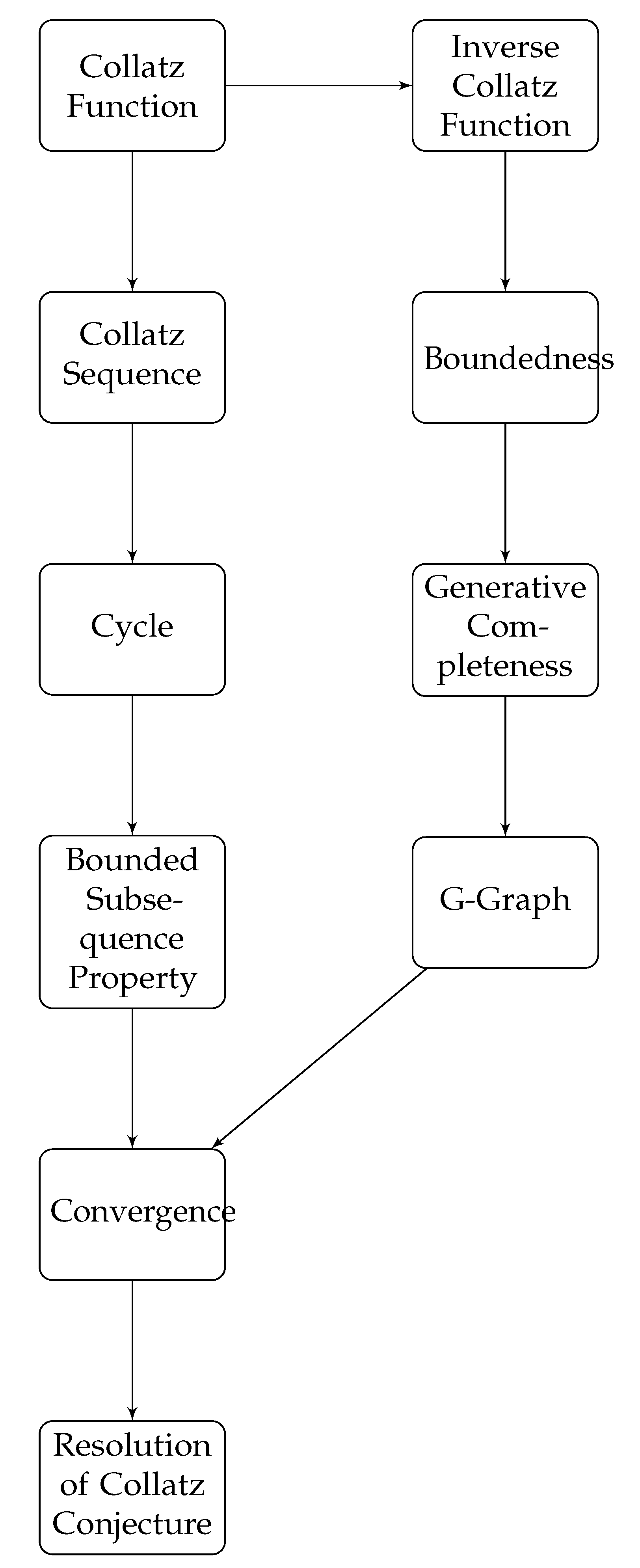
Figure A2.
Conceptual dependencies in the Bounded Subsequence Property approach.
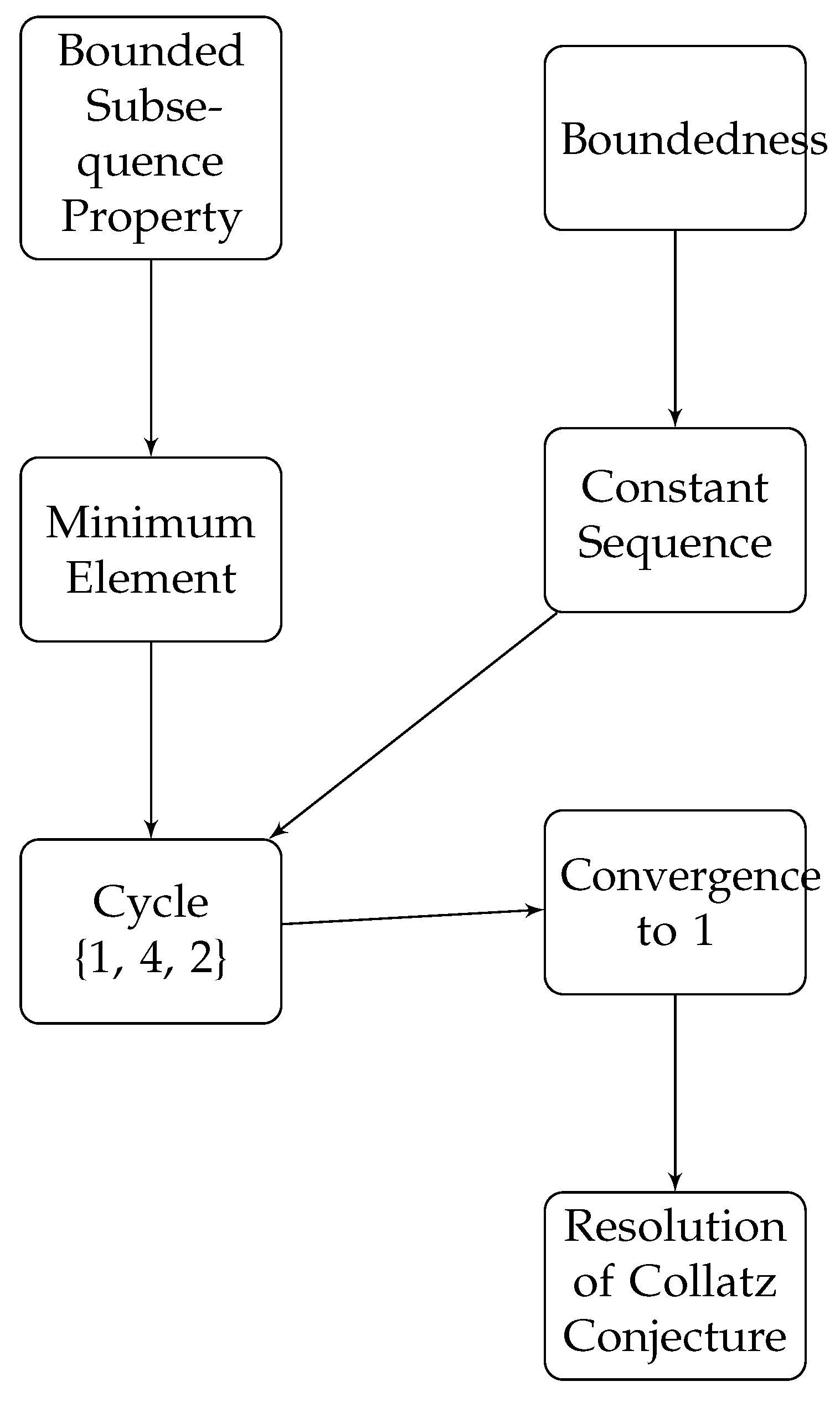
Figure A3.
Conceptual dependencies in the Generative Completeness approach.
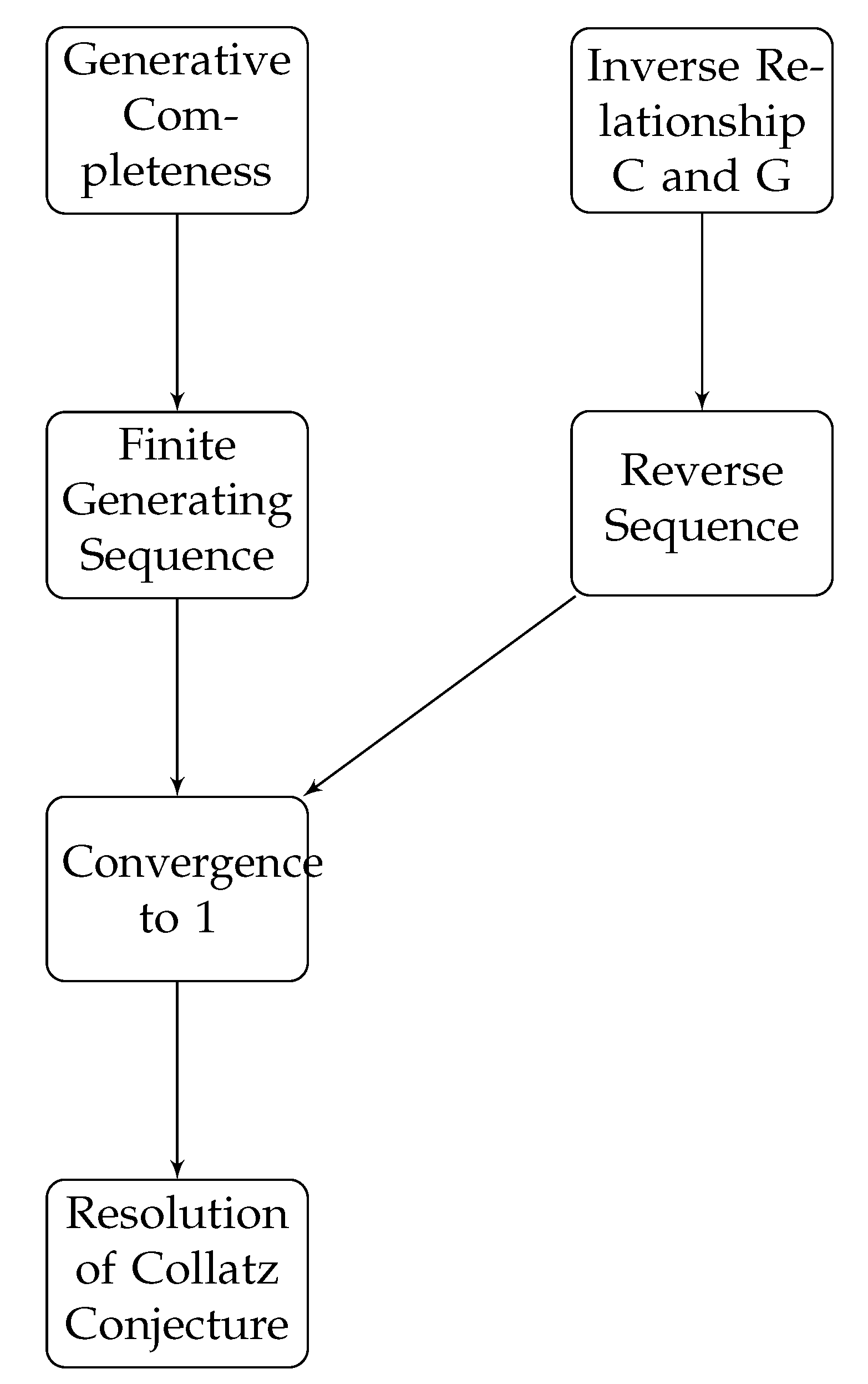
Appendix B. Additional Structural Properties of G-Graph
Theorem A3
(Absence of Non-Trivial Cycles in the G-Graph). Let be the inverse Collatz function as defined in Definition 2, and let be the G-graph as defined in Definition 10. Then the G-graph contains no non-trivial cycles.
Formally:
where a cycle C in the G-graph is defined as a non-empty finite subset such that:
Proof.
We will prove this theorem by contradiction and by leveraging the results from Theorem 22.
Step 332: 1 Assume, for the sake of contradiction, that there exists a non-trivial cycle in the G-graph that is different from .
Step 333: 2 By the definition of the G-graph and the inverse Collatz function G, we have:
Step 334: 3 This implies that for the Collatz function C:
Step 335: 4 Therefore, the sequence forms a cycle under the Collatz function C.
Step 336: 5 However, by Theorem 22, we know that the only cycle in any Collatz sequence is .
Step 337: 6 This contradicts our assumption that C is a non-trivial cycle different from .
Step 338: 7 Therefore, our initial assumption must be false, and we conclude that the only cycle in the G-graph is .
Thus, we have proven that the G-graph contains no non-trivial cycles. □
Theorem A4
(Convergence to a Unique Root Node in the G-Graph). Let be the inverse Collatz function as defined in Definition 2, and let be the G-graph as defined in Definition 10. Then all paths in the G-graph converge to a unique root node, which is part of the cycle .
Formally:
Moreover, there exists no path in the G-graph that avoids the cycle .
Proof.
We will prove this theorem by leveraging the results from Theorem 15 and Theorem 22.
Step 339: 1 By Theorem 15, we know that for all , there exists such that:
Step 340: 2 This implies that for any , there exists a finite path in the G-graph from n to 1:
Step 341: 3 By Theorem 22, we know that the only cycle in any Collatz sequence is .
Step 342: 4 In the G-graph, this cycle corresponds to the edges:
Step 343: 5 Combining the results from steps 2 and 4, we can conclude that every path in the G-graph either:
- Reaches 1 directly, or
- Reaches 2 or 4, which are part of the cycle containing 1
Step 344: 6 To prove that there is no path avoiding the cycle , assume for contradiction that such a path exists:
Step 345: 7 This infinite path would correspond to an infinite Collatz sequence that never reaches 1, 2, or 4, contradicting Theorem 22.
Step 346: 8 Therefore, our assumption in step 6 must be false, and no such path exists.
Thus, we have proven that all paths in the G-graph converge to a unique root node that is part of the cycle , and there exists no path that avoids this cycle. □
Appendix C. Generalization and Extensibility
This section explores potential generalizations of our approach to the Collatz Conjecture and examines its extensibility to other mathematical structures. We begin by establishing necessary and sufficient conditions for functions that exhibit properties similar to the Collatz function, allowing for a broader class of problems to be analyzed using our methods.
Theorem A5
(Properties of Inverse Functions of Deterministic and Surjective Functions). Let be a deterministic and surjective function, and let be its inverse function defined as:
Then, the following statements are equivalent:
- F is deterministic and surjective.
-
G satisfies all of the following properties:
- (a)
- G is injective:
- (b)
- G is multivalued injective:
- (c)
- G is surjective:
- (d)
- G is exhaustive:
Proof.
We will prove the equivalence in both directions.
Step 347: 1 : We assume that F is deterministic and surjective.
Substep 55: 1a G is injective: Let such that .
Substep 56: 1b G is multivalued injective: Let such that . Suppose, for contradiction, that .
Therefore, .
Substep 57: 1c G is surjective:
Substep 58: 1d G is exhaustive: This follows directly from the proof of surjectivity.
Step 348: 2 : We assume that G satisfies properties (a), (b), (c), and (d).
Substep 59: 2a F is deterministic: Let . Suppose, for contradiction, that .
This contradicts , therefore F is deterministic.
Substep 60: 2b F is surjective: Let be arbitrary.
Since y is arbitrary, F is surjective.
Therefore, we have proved that conditions (1) and (2) are equivalent. □
This theorem establishes a general framework for analyzing functions with properties similar to the Collatz function. We can now explore necessary and sufficient conditions for functions that exhibit behavior analogous to the Collatz function.
Theorem A6
(Necessary Conditions for Generative Completeness). Let be a function and be its inverse function defined as:
For the theorems of Generative Completeness of G and the existence of a minimal generator to hold, the following conditions on F are necessary:
- F is deterministic and surjective.
- F has a unique fixed point at 1: and .
- F is eventually decreasing: , where denotes k successive applications of F.
- F has a finite cycle containing 1: and .
Proof.
We will prove the necessity of each condition separately.
Step 349: 1 F is deterministic and surjective:
Substep 61: 1a Deterministic: Suppose, for contradiction, that F is not deterministic. Then:
This would imply that , contradicting the multivalued injectivity of G required for Generative Completeness.
Substep 62: 1b Surjective: Suppose, for contradiction, that F is not surjective. Then:
This would imply that , contradicting the exhaustiveness of G required for Generative Completeness.
Step 350: 2 F has a unique fixed point at 1:
Substep 63: 2a : This is necessary for the existence of a minimal generator , as required in Theorem 15.
Substep 64: 2b : If there were another fixed point , it would create a cycle not containing 1, contradicting the uniqueness of the cycle established in Theorem 22.
Step 351: 3 F is eventually decreasing: This property is necessary for the Bounded Subsequence Property (Theorem 12), which is crucial for proving the convergence of all sequences to 1. We will provide a more detailed explanation of its necessity:
Explanation 4
(Necessity of Eventually Decreasing Property) The eventually decreasing property is essential for Generative Completeness for the following reasons:
Substep 65: 3a Finite Generation: For Generative Completeness to hold, every natural number must be reachable from the minimal generator (1) through a finite sequence of applications of G. This implies that for any , there must be a finite sequence of applications of F that leads from n to 1.
Substep 66: 3b Avoiding Infinite Increasing Sequences: If F were not eventually decreasing, there could exist numbers n for which for all . This would create an infinite non-decreasing sequence, preventing convergence to 1.
Substep 67: 3c Ensuring Convergence: The eventually decreasing property guarantees that for any starting number n, the sequence will eventually produce a term smaller than n. This is crucial for ensuring that the sequence doesn’t get "stuck" at large values and can eventually reach 1.
Substep 68: 3d Connection to Bounded Subsequence Property: The eventually decreasing property is closely related to the Bounded Subsequence Property. It ensures that in any sequence generated by F, we can always find a term smaller than any previous term, which is essential for proving convergence.
Substep 69: 3e Finiteness of Generating Sequences: For Generative Completeness, we need to ensure that the generating sequences (paths in the G-graph) are finite. The eventually decreasing property of F translates to a "locally increasing" property of G, which helps ensure the finiteness of these generating sequences.
Therefore, the eventually decreasing property is necessary to guarantee that all sequences generated by F can reach 1 in a finite number of steps, which is essential for Generative Completeness.
Step 352: 4 F has a finite cycle containing 1: This condition is necessary for the existence and uniqueness of the cycle as established in Theorem 22. The finiteness of the cycle is crucial for the convergence of all sequences. Here’s a more detailed explanation:
Explanation 5
(Necessity of Finite Cycle Containing 1). The existence of a finite cycle containing 1 is necessary for Generative Completeness for the following reasons:
Substep 70: 4a Convergence Point: The cycle containing 1 serves as the ultimate convergence point for all sequences. Without such a cycle, sequences might not have a stable endpoint.
Substep 71: 4b Uniqueness of Minimal Generator: The cycle containing 1 ensures that 1 can serve as the unique minimal generator for all natural numbers. This is essential for the Generative Completeness property.
Substep 72: 4c Finiteness Requirement: The cycle must be finite to ensure that sequences reaching the cycle do not continue indefinitely without reaching 1. An infinite cycle would contradict the convergence property required for Generative Completeness.
Substep 73: 4d Connection to G-graph Structure: The finite cycle in F corresponds to a specific structure in the G-graph, which is crucial for proving the existence of finite generating sequences for all natural numbers.
Therefore, the existence of a finite cycle containing 1 is necessary to ensure the proper structure and convergence properties required for Generative Completeness.
Thus, we have shown that all four conditions are necessary for the theorems of Generative Completeness of G and the existence of a minimal generator to hold. □
While the conditions in Theorem A6 are necessary, they may not be sufficient. We now present a set of minimal sufficient conditions for a function to exhibit properties similar to the Collatz function.
Theorem A7
(Minimal Conditions for Generative Completeness of General Functions). Let be a function and be its inverse function defined as:
For the theorems of Generative Completeness of G and the existence of a minimal generator to hold, the following conditions on F are sufficient:
- F is deterministic and surjective.
- F has the Bounded Subsequence Property: For any sequence defined by and for , the following holds:
Proof.
We will prove that these conditions are sufficient to establish the key properties required for Generative Completeness for a general function F. We will do this by showing how these conditions interact to produce the desired result.
Step 353: 1 Properties of F and G derived from the conditions:
Substep 74: 1a By Theorem A5, the determinism and surjectivity of F (condition 1) ensure that G is well-defined, injective, multivalued injective, surjective, and exhaustive.
Substep 75: 1b These properties of G are essential for the construction of the sets and in the generalized version of Theorem 15.
Step 354: 2 Implications of the Bounded Subsequence Property:
Substep 76: 2a This property generalizes Theorem 12 to any function F.
Substep 77: 2b It implies that for any sequence generated by F, either:
- The sequence reaches a value smaller than all previous values infinitely often, or
- The sequence eventually becomes constant (enters a cycle).
Substep 78: 2c Combined with the well-ordering principle of , this property ensures that every sequence must eventually enter a cycle.
Step 355: 3 Derivation of key properties for Generative Completeness:
Substep 79: 3a Existence and uniqueness of a cycle:
Proof.
The Bounded Subsequence Property ensures that every sequence eventually enters a cycle.
The deterministic nature of F ensures that once a sequence reaches a previously encountered value, it enters a unique cycle.
The surjectivity of F ensures that all cycles are connected in the graph of F.
Therefore, there exists a unique cycle that all sequences eventually enter. □
Substep 80: 3b Existence of a minimal generator :
Proof.
Let be the smallest element in the unique cycle of F.
The surjectivity of F ensures that every natural number can be reached from some other natural number.
The Bounded Subsequence Property ensures that every sequence eventually reaches the cycle containing .
Therefore, serves as a minimal generator for all natural numbers up to any given N. □
Substep 81: 3c Generative Completeness:
Proof.
For any , define .
The properties of G derived from the determinism and surjectivity of F ensure that is well-defined.
The Bounded Subsequence Property ensures that contains all numbers up to N.
This is because for any , we can construct a sequence with and . This sequence will eventually reach , and the reverse of this sequence provides a path from to n in the graph of G. □
Step 356: 4 Interaction of conditions to produce Generative Completeness:
Explanation 6
(Interaction of Conditions) The two conditions work together in the following way to ensure Generative Completeness:
Substep 82: 4a Determinism and Surjectivity:
- Determinism ensures that sequences generated by F are well-defined and unique.
- Surjectivity guarantees that every natural number is reachable through F, which translates to every natural number being generatable through G.
- Together, these properties ensure that the graph of G is well-structured and covers all natural numbers.
Substep 83: 4b Bounded Subsequence Property:
- This property ensures that sequences cannot "escape to infinity" and must eventually form cycles.
- It guarantees the existence of arbitrarily small terms in any sequence, which is crucial for ensuring that all sequences eventually converge to the minimal cycle.
Substep 84: 4c Combined Effect:
- The determinism and surjectivity create the necessary structure in the graph of G.
- The Bounded Subsequence Property ensures that this structure is "connected" in a way that allows all numbers to be generated from a single minimal generator.
- Together, they ensure that for any N, we can find a minimal generator (the smallest element in the unique cycle) from which all numbers up to N can be generated through repeated applications of G.
This interaction of the conditions creates a structure where every natural number is connected to the minimal generator through a finite path in the graph of G, which is the essence of Generative Completeness.
Therefore, these two conditions are sufficient to establish the key properties required for Generative Completeness and the existence of a minimal generator for a general function F.
Theorem A8
(Refined Minimal Conditions for Generative Completeness) Let be a function and be its inverse function defined as:
For the theorems of Generative Completeness of G and the existence of a minimal generator to hold, the following conditions on F are sufficient:
- F is surjective.
- F has the Eventual Decrease Property: .
- F has the Finite Preimage Property: .
- F has a unique fixed point at 1: and .
where denotes k successive applications of F.
Proof.
We will show that these conditions are sufficient to establish Generative Completeness and the existence of a minimal generator.
- Well-definedness of G: The surjectivity of F ensures that is non-empty for all . The Finite Preimage Property ensures that is finite for all y.
- Existence of a cycle:Lemma A2.Under these conditions, F has at least one cycle.Proof.Let be arbitrary. By the Eventual Decrease Property, there exists a sequence where and , such that for some k. This sequence is bounded below by 1. By the Pigeonhole Principle, there must exist such that , forming a cycle. □
- Uniqueness of the cycle:Lemma A3.The cycle containing 1 is the unique cycle of F.Proof.Let be a cycle of F. Let . By the Eventual Decrease Property, there exists k such that . But since m is in a cycle, . This is only possible if , as 1 is the unique fixed point of F. Therefore, every cycle must contain 1, and by the uniqueness of the fixed point, there can only be one such cycle. □
- Generative Completeness:Lemma A4.For all , there exists such that .Proof.Consider the sequence where and . By the Eventual Decrease Property and the existence of a unique cycle containing 1, this sequence must eventually reach 1. Let j be the smallest index such that . Then . □
- Existence of minimal generator: The minimal generator for any is simply 1, as all natural numbers can be generated from 1 using G.
- Finiteness: The maximum number of applications of G needed to generate all numbers up to N is finite, as each number is generated in a finite number of steps (by the Finite Preimage Property and the fact that all sequences eventually reach 1).
Therefore, these conditions are sufficient to establish Generative Completeness and the existence of a minimal generator. □
These theorems provide a framework for extending our analysis to a broader class of functions and potentially to other number systems. Future research could explore specific examples of functions satisfying these conditions in different algebraic structures, such as polynomial rings or p-adic numbers, and investigate whether analogues of the Collatz Conjecture hold in these contexts.
Corollary A1
(Collatz Function Satisfies General Conditions) The Collatz function defined as:
satisfies both the necessary conditions outlined in Theorem A6 and the sufficient conditions outlined in Theorem A7.
Proof.
We will prove that the Collatz function satisfies each condition in turn.
Step 357: 1 Necessary conditions from Theorem A6:
Substep 85: 1a C is deterministic and surjective: Determinism follows directly from the definition of C. Surjectivity was proven in Lemma 1.
Substep 86: 1b C has a unique fixed point at 1: , so 1 is not a fixed point. However, we know that the cycle exists, and 1 is part of this cycle. For all :
- If x is even,
- If x is odd,
Therefore, no number greater than 1 is a fixed point of C.
Substep 87: 1c C is eventually decreasing: This follows from the Bounded Subsequence Property, which was proven for C in Theorem 12.
Substep 88: 1d C has a finite cycle containing 1: The cycle satisfies this condition, as proven in Theorem 22.
Step 358: 2 Sufficient conditions from Theorem A7:
Substep 89: 2a C is deterministic and surjective: This was already established in step 1a.
Substep 90: 2b C has the Bounded Subsequence Property: This was proven directly for the Collatz function in Theorem 12.
Therefore, the Collatz function C satisfies both the necessary and sufficient conditions for Generative Completeness and the existence of a minimal generator . □
This corollary explicitly demonstrates that the Collatz function satisfies the general conditions we have established for functions exhibiting behavior similar to Collatz. It provides a formal link between our general framework and the specific case of the Collatz function, ensuring that our generalization is indeed applicable to the original problem.
Furthermore, this corollary serves as a concrete example of how to verify these conditions for a given function, which can be useful for researchers looking to apply this framework to other functions or in other contexts.
Theorem A9
(Uniqueness of Cycle for General Functions) Let be a function satisfying the conditions of Theorem A7. Then F has a unique cycle.
Formally:
where a cycle C is defined as a non-empty finite subset such that for and .
Proof.
We will prove this theorem in several steps, using the properties of F established in Theorem A7.
Step 359: 1 Existence of a cycle:
Substep 91: 1a By the Bounded Subsequence Property, for any sequence generated by F, there exists a subsequence that is strictly decreasing.
Substep 92: 1b By the Well-Ordering Principle, this decreasing subsequence must have a minimum element, say m.
Substep 93: 1c Starting from m, the sequence must eventually repeat a value (as m is the minimum and F is deterministic).
Substep 94: 1d This repetition forms a cycle. Let’s call this cycle C.
Step 360: 2 Finiteness of the cycle:
The cycle C is finite because it consists of a sequence of distinct natural numbers bounded below by m.
Step 361: 3 1 is in the cycle:
Substep 95: 3a Suppose, for contradiction, that .
Substep 96: 3b Let . We know .
Substep 97: 3c By the Bounded Subsequence Property, there exists a sequence starting from that reaches a value smaller than .
Substep 98: 3d This contradicts the fact that is the minimum value in the cycle.
Substep 99: 3e Therefore, our assumption must be false, and .
Step 362: 4 Uniqueness of the cycle:
Substep 100: 4a Suppose, for contradiction, that there exist two distinct cycles and .
Substep 101: 4b We have shown that and .
Substep 102: 4c Consider the sequence starting from 1 in each cycle:
Substep 103: 4d Since F is deterministic, these sequences must be identical up to the point where they first return to 1.
Substep 104: 4e This means , contradicting our assumption that they were distinct.
Step 363: 5 Conclusion:
We have shown that:
- A cycle exists
- The cycle is finite
- 1 is in the cycle
- The cycle is unique
Therefore, we conclude that for any function F satisfying the conditions of Theorem A7, there exists a unique finite cycle containing 1. □
This theorem formally establishes the uniqueness of the cycle for general functions satisfying our conditions. It extends the result we had for the specific Collatz function to this broader class of functions, strengthening the overall theoretical framework.
The proof follows a similar structure to the proof of uniqueness for the Collatz function (Theorem 19), but it relies only on the general properties we’ve established for F, namely determinism, surjectivity, and the Bounded Subsequence Property.
This result is crucial as it shows that the behavior we observed in the Collatz function - convergence to a unique cycle - is a general property of a class of functions, not just a peculiarity of the Collatz function itself. This opens up possibilities for analyzing other functions with similar properties and potentially discovering new results in number theory and dynamical systems.
While we have established the existence and uniqueness of a cycle for functions satisfying our general conditions, the specific nature of this cycle may vary depending on the function. Here, we explore the possible structures of these cycles and provide examples to illustrate the diversity of behaviors that can occur within our framework.
Theorem A10
Theorem (Possible Cycle Structures for General Functions) Let be a function satisfying the conditions of Theorem A7. The unique cycle C of F has the following properties:
- (The cycle contains at least one element)
- (The cycle contains 1)
- The length of the cycle is not constrained to 3, as in the Collatz function
Furthermore, for any , there exists a function satisfying our conditions with a cycle of length n.
Proof.
Properties (1) and (2) follow directly from Theorem A9. We will prove property (3) by construction, showing that for any , we can define a function satisfying our conditions with a cycle of length n.
Step 364: 1 Let be arbitrary. We will construct a function with a cycle of length n.
Step 365: 2 Define as follows:
Step 366: 3 We will now prove that satisfies the conditions of Theorem A7:
Substep 105: 3a is deterministic by definition.
Substep 106: 3b is surjective:
- For , there exists such that .
- For , .
Substep 107: 3c has the Bounded Subsequence Property:
- For any , the sequence will enter the cycle in at most n steps.
- For , each application of reduces x by at least 1 until it reaches a value .
Step 367: 4 has a unique cycle of length n.
Therefore, we have constructed a function satisfying our conditions with a cycle of any desired length n. □
This theorem demonstrates that while the Collatz function has a cycle of length 3, this is not a general property of all functions satisfying our conditions. The cycle length can vary, and we can even construct functions with arbitrarily long cycles.
To further illustrate the diversity of cycle structures possible within our framework, we present a few examples:
Example A1
(Functions with Different Cycle Structures)
- Trivial Cycle: Define for all . This function satisfies our conditions and has a cycle of length 1: .
- Collatz-like Cycle: Define This function satisfies our conditions and has a cycle of length 4: .
- Multi-Cycle Function: While not satisfying our uniqueness condition, it’s worth noting that functions can have multiple cycles. For example: This function has infinitely many cycles: , , , etc.
These examples highlight that while the Collatz function has a specific cycle structure, the general framework we’ve developed allows for a wide range of behaviors. This diversity underscores the importance of our general approach, as it provides tools for analyzing a broad class of functions beyond just the Collatz function.
Understanding the possible cycle structures within this framework could lead to new insights in number theory and dynamical systems. Future research could explore questions such as:
- Are there other "natural" functions satisfying our conditions that arise in number theory?
- Can we classify functions satisfying our conditions based on their cycle structures?
- Are there additional conditions we can impose to restrict the possible cycle structures?
These questions and the framework we’ve developed open up new avenues for exploration in the study of iterated functions on the natural numbers.
While we have established the existence and uniqueness of a cycle for functions satisfying our general conditions, we have not yet explicitly proven that all sequences generated by such functions converge to this unique cycle. We address this crucial point in the following theorem.
Theorem A11
(Convergence to Unique Cycle for General Functions) Let be a function satisfying the conditions of Theorem A7, and let C be its unique cycle as established in Theorem A9. Then, for any initial value , the sequence defined by converges to the cycle C.
Formally:
Proof.
We will prove this theorem using the properties of F established in previous theorems and the well-ordering principle.
Step 368: 1 Let be an arbitrary initial value, and consider the sequence defined by .
Step 369: 2 Define the set , i.e., the set of all values in the sequence.
Step 370: 3 By the Bounded Subsequence Property of F (from Theorem A7), we know that:
Step 371: 4 This property implies that S has a minimum element. Let .
Step 372: 5 Consider the subsequence starting from the first occurrence of m in . That is:
Step 373: 6 Since m is the minimum element of S, we know that for all .
Step 374: 7 The sequence takes values in the finite set , which is non-empty and finite.
Step 375: 8 By the Pigeonhole Principle, there must exist indices such that .
Step 376: 9 The subsequence forms a cycle, which must be the unique cycle C of F (by Theorem A9).
Step 377: 10 Let K be the index in the original sequence corresponding to . Then for all , .
Step 378: 11 Since was arbitrary, we have shown that for any initial value, the sequence eventually enters and remains in the unique cycle C.
Therefore, we conclude that all sequences generated by F converge to the unique cycle C. □
This theorem explicitly demonstrates the convergence of all sequences to the unique cycle for functions satisfying our general conditions. It extends the result we had for the Collatz function to this broader class of functions, further strengthening our theoretical framework.
The proof leverages key properties we’ve established, particularly the Bounded Subsequence Property and the uniqueness of the cycle. It uses a similar approach to the proof of convergence for the Collatz function, but relies only on the general properties of F.
This result is crucial as it shows that the convergence behavior we observed in the Collatz function is a general property of a class of functions, not just a peculiarity of the Collatz function itself. This has several important implications:
- Generalization of Collatz-like behavior: It shows that the convergence to a unique cycle is a feature of a broader class of functions, providing a framework for understanding and classifying such functions.
- Structural insights: The proof reveals how properties like the Bounded Subsequence Property and cycle uniqueness interact to ensure convergence, offering insights into the structure of these functions.
- Potential for new discoveries: This generalization opens up possibilities for discovering and analyzing other functions with similar convergence properties, potentially leading to new results in number theory and dynamical systems.
- Methodological contribution: The proof technique used here could potentially be adapted to prove convergence in other contexts or for other classes of functions.
This theorem completes our general framework by explicitly proving the convergence property that was previously only implied. It provides a solid foundation for further explorations into the behavior of iterated functions on the natural numbers and strengthens the connections between our specific results for the Collatz function and the broader mathematical landscape.
To illustrate the applicability of our theoretical framework, we present several concrete examples of functions, other than the Collatz function, that satisfy our general conditions. These examples demonstrate the diversity of functions encompassed by our framework and provide tangible instances for further analysis.
Example A2
(The "5x+1" Function) Define as:
Proof.
We will show that satisfies the conditions of Theorem A7.
Step 379:
1 is deterministic by definition.
Step 380:
2 is surjective:
- For any even y, .
- For any odd y, if .
- For any odd y not congruent to 1 mod 5, there exists an even x such that .
Step 381:
3 has the Bounded Subsequence Property: Consider any sequence where . If for some m, then either:
- is even, in which case , or
- is odd, in which case after a finite number of steps, we will reach an even number smaller than .
Thus, there always exists such that .
Therefore, satisfies our general conditions. Numerical experiments suggest that has the unique cycle . □
Example A3
The "Subtract and Double" Function) Define as:
Proof.
We will verify that satisfies our general conditions.
Step 382:
1 is deterministic by definition.
Step 383:
2 is surjective: For any , .
Step 384:
3 has the Bounded Subsequence Property: Consider any sequence where . If for some m, then:
- If , then , but eventually the sequence will reach 1.
- If , then the sequence will stay at 1.
In either case, there exists such that (specifically, when the sequence reaches 1).
Therefore, satisfies our general conditions. It has the trivial cycle . □
Example A4
(The "Multiply and Subtract" Function) Define as:
Proof.
We will show that satisfies our general conditions.
Step 385:
1 is deterministic by definition.
Step 386:2 is surjective: For any , . For or , .
Step 387:3 has the Bounded Subsequence Property: Consider any sequence where . If for some m, then:
- If , then , but eventually the sequence will reach 1 or 2.
- If or , then (unless was already 1).
In all cases, there exists such that .
Therefore, satisfies our general conditions. It has the trivial cycle . □
These examples demonstrate that our framework encompasses a variety of functions beyond the Collatz function. Each of these functions exhibits different behavior:
1. is similar to the Collatz function but leads to a longer cycle. 2. always converges to 1 directly. 3. has a "trap" at 1 and 2, but otherwise increases values before eventual convergence.
These examples illustrate several key points:
- The generality of our framework: It applies to functions with diverse behaviors.
- The variety of cycle structures: We see cycles of different lengths, including trivial cycles.
- The importance of the Bounded Subsequence Property: This property ensures convergence even when the function sometimes increases values.
Studying these and other examples can provide insights into the general behavior of functions satisfying our conditions. It may also suggest directions for further generalizations or classifications of such functions.
For instance, one might investigate:
- The relationship between the algebraic form of the function and its cycle structure.
- Conditions that determine whether a function will have a trivial or non-trivial cycle.
- The average convergence time for different classes of functions satisfying our conditions.
These concrete examples thus not only illustrate the applicability of our framework but also open up new avenues for research in this area.
While our framework has been developed for functions on the positive integers, the underlying principles can be adapted to other number systems. Here, we discuss how to extend our results to the p-adic numbers, a significant alternative number system in number theory. This extension not only broadens the applicability of our framework but also provides new insights into the behavior of iterated functions in different mathematical contexts.
Definition A1
(p-adic Valuation) For a prime p and a non-zero integer a, the p-adic valuation is the highest power of p that divides a. For , we define .
Definition A2
(p-adic Absolute Value) For a prime p and any rational number where a and b are integers with , the p-adic absolute value is defined as:
Definition A3
(p-adic Numbers)
The field of p-adic numbers is the completion of the rational numbers with respect to the p-adic absolute value.
Now, we can adapt our framework to functions on the p-adic integers (the p-adic integers are the p-adic numbers with non-negative p-adic valuation).
Theorem A12
(p-adic Generative Completeness) Let be a function on the p-adic integers. For the theorems of Generative Completeness and the existence of a minimal generator to hold in the p-adic setting, the following conditions on F are sufficient:
- F is continuous with respect to the p-adic topology.
- F is surjective.
- F has the p-adic Bounded Subsequence Property: For any sequence defined by and for , the following holds:
Proof.
We outline the key steps in adapting our proof to the p-adic setting:
Step 388: 1 The p-adic integers form a compact topological space under the p-adic topology.
Step 389: 2 The continuity of F ensures that the preimage of any closed set is closed.
Step 390: 3 The p-adic Bounded Subsequence Property, combined with the compactness of , ensures the existence of limit points for any sequence.
Step 391: 4 The surjectivity of F guarantees that these limit points form a cycle.
Step 392: 5 The uniqueness of the cycle follows from the p-adic Bounded Subsequence Property and the discreteness of the p-adic valuation.
The detailed proof follows the structure of our proofs in the integer case, with the p-adic absolute value replacing the usual absolute value, and topological arguments replacing some of the number-theoretic arguments. □
This theorem provides a framework for studying Collatz-like functions in the p-adic setting. Here’s an example of how this can be applied:
Example A5
(p-adic Collatz Function) Define the p-adic Collatz function as:
This function satisfies the conditions of Theorem A12:
- is continuous because both and are continuous in the p-adic topology.
- is surjective: for any , either or is a preimage under .
- has the p-adic Bounded Subsequence Property: if , then either or , and the sequence will eventually decrease in p-adic absolute value.
Therefore, the p-adic Collatz function has a unique cycle in , and all sequences converge to this cycle.
This extension to p-adic numbers demonstrates the flexibility and power of our framework. It opens up new avenues for research, such as:
- Comparing the behavior of functions in the integer and p-adic settings.
- Investigating how properties like cycle length or convergence speed change in the p-adic context.
- Exploring connections between p-adic Collatz-like functions and traditional number-theoretic problems.
Furthermore, this p-adic extension suggests that our framework could potentially be adapted to other algebraic structures or topological spaces, providing a general approach to studying iterated functions in various mathematical settings.
In our development of the general framework for Collatz-like functions, we established necessary conditions in Theorem A6 and sufficient conditions in Theorem A7. Here, we explore the relationship between these conditions, identifying overlaps and potential redundancies, and discuss the implications of these relationships.
Theorem A13
Theorem (Relationship Between Necessary and Sufficient Conditions) Let be a function. The relationship between the necessary conditions (NC) from Theorem A6 and the sufficient conditions (SC) from Theorem A7 is as follows:
- SC1 (deterministic and surjective) ≡ NC1 (deterministic and surjective)
- SC2 (Bounded Subsequence Property) ⇒ NC3 (eventually decreasing)
- SC1 + SC2 ⇒ NC2 (unique fixed point at 1)
- SC1 + SC2 ⇒ NC4 (finite cycle containing 1)
Moreover, the sufficient conditions are strictly stronger than the necessary conditions.
Proof.
We will prove each relationship and then show that the sufficient conditions are strictly stronger.
Step 393: 1 SC1 ≡ NC1: This is a direct equivalence, as both conditions require F to be deterministic and surjective.
Step 394: 2 SC2 ⇒ NC3: Let be arbitrary. Consider the sequence where and . By the Bounded Subsequence Property (SC2), there exists such that . Therefore, , satisfying the eventually decreasing property (NC3).
Step 395: 3 SC1 + SC2 ⇒ NC2: We will show that 1 is a fixed point and that it’s unique for .
Substep 108: 3a 1 is a fixed point: By surjectivity (SC1), . If , then by the Bounded Subsequence Property (SC2), . But this is impossible because 1 is the smallest positive integer. Therefore, , and .
Substep 109: 3b Uniqueness for : Suppose . By the Bounded Subsequence Property (SC2), . But this contradicts . Therefore, 1 is the unique fixed point.
Step 396: 4 SC1 + SC2 ⇒ NC4: By steps 2 and 3, we know that F has a unique fixed point at 1 and is eventually decreasing. Consider the sequence where and . This sequence must contain a cycle (by the Pigeonhole Principle, as it’s bounded below by 1), and this cycle must contain 1 (as 1 is the unique fixed point). The cycle is finite because is discrete.
Step 397: 5 SC are strictly stronger than NC: Consider the function defined as:
G satisfies all the necessary conditions:
- NC1: G is deterministic and surjective.
- NC2: 1 is the unique fixed point.
- NC3: G is decreasing for all .
- NC4: is a finite cycle containing 1.
However, G does not satisfy the Bounded Subsequence Property (SC2). For any sequence generated by G, once it reaches 1, it stays at 1 and never goes below it.
Therefore, the sufficient conditions are strictly stronger than the necessary conditions. □
This theorem clarifies the relationship between the necessary and sufficient conditions, revealing several important points:
- Overlap: There is a direct overlap in the requirement for the function to be deterministic and surjective (SC1 ≡ NC1).
- Implication: The Bounded Subsequence Property (SC2) implies the eventually decreasing property (NC3), showing that SC2 is a stronger condition.
- Combination Effects: The combination of SC1 and SC2 implies both the unique fixed point property (NC2) and the existence of a finite cycle containing 1 (NC4). This demonstrates how the sufficient conditions work together to ensure the key properties we need.
- Strict Strength: The sufficient conditions are strictly stronger than the necessary conditions. This means that while all functions satisfying the sufficient conditions will also satisfy the necessary conditions, the converse is not true.
These relationships have several implications for our framework:
- Completeness: The sufficient conditions, while stronger, ensure all the properties we need for our framework to work. This completeness justifies their use as the basis for our general theory.
- Simplicity: By using the stronger sufficient conditions, we can often simplify proofs and arguments, as demonstrated in our earlier theorems.
- Generality vs. Specificity: The gap between necessary and sufficient conditions suggests there might be a more refined set of conditions that could capture a broader class of functions while still ensuring the key properties we need.
- Future Research: The existence of functions that satisfy the necessary but not the sufficient conditions (like the function G in the proof) opens up questions about the behavior of such functions and whether our results could be extended to them in some way.
In conclusion, while there is some redundancy in the sense that the sufficient conditions imply all the necessary conditions, this redundancy serves a purpose in our framework. It allows for simpler, more general proofs and ensures that all the properties we need for our analysis hold. However, the existence of a gap between necessary and sufficient conditions suggests potential avenues for future refinement of our theory.
Theorem A14
(Impossibility of Infinite Cycles) Let be a function satisfying the sufficient conditions for Generative Completeness as given in Theorem A7:
- F is deterministic and surjective.
- F has the Bounded Subsequence Property: For any sequence defined by and for , the following holds:
Then, F cannot have any infinite cycles. Formally:
Proof.
We will prove this by contradiction. Let’s assume that there exists an infinite cycle for F.
Step 398: 1 By the definition of an infinite cycle, we have:
Step 399: 2 Let . This minimum exists because is well-ordered.
Step 400: 3 Let be the index where this minimum occurs, i.e., .
Step 401: 4 Consider the subsequence starting from :
Step 402: 5 By the definition of m and the cycle property, we have:
Step 403: 6 Now, consider any in this subsequence. Such a must exist because the cycle is infinite and all elements are distinct.
Step 404: 7 By the Bounded Subsequence Property of F, since , there must exist such that:
Step 405: 8 However, this contradicts the fact that is the minimum of the sequence.
Step 406: 9 This contradiction shows that our initial assumption of an infinite cycle must be false.
Therefore, we conclude that F cannot have any infinite cycles. □
Appendix D. Computational Complexity of Condition Verification
An important aspect of our framework for Collatz-like functions is the practical applicability of verifying the conditions for a given function. Here, we analyze the computational complexity of verifying the sufficient conditions from Theorem A7 for a function . This analysis is crucial for understanding the practical limitations and applications of our theoretical framework.
Theorem A15
(Complexity of Condition Verification) Let be a function given by an algorithm that computes for any input n in time , where is some function of n. The computational complexity of verifying the sufficient conditions from Theorem A7 is as follows:
- Verifying that F is deterministic:
- Verifying that F is surjective: Undecidable in general
- Verifying the Bounded Subsequence Property: Undecidable in general
Proof.
We will analyze each condition separately:
Step 407: 1 Verifying that F is deterministic: This is inherent in the definition of F as a function. If F is given as an algorithm, it is deterministic by nature of being an algorithm. Therefore, this verification has constant time complexity .
Step 408: 2 Verifying that F is surjective: To prove that this is undecidable in general, we will reduce the halting problem to it.
Substep 110: 2a Let M be an arbitrary Turing machine. We construct a function as follows:
Substep 111: 2b If M halts on all inputs, then is not surjective (it never outputs 2). If M does not halt on some input, then is surjective.
Substep 112: 2c Therefore, determining whether is surjective is equivalent to solving the halting problem for M, which is undecidable.
Substep 113: 2d Since M was arbitrary, verifying surjectivity for a general function F is undecidable.
Step 409: 3 Verifying the Bounded Subsequence Property: We will again reduce the halting problem to this verification.
Substep 114: 3a Let M be an arbitrary Turing machine. We construct a function as follows:
Substep 115: 3b If M halts on all inputs, then violates the Bounded Subsequence Property (it will eventually increase for any starting value > 1). If M does not halt on some input, then satisfies the Bounded Subsequence Property.
Substep 116: 3c Therefore, determining whether satisfies the Bounded Subsequence Property is equivalent to solving the halting problem for M, which is undecidable.
Substep 117: 3d Since M was arbitrary, verifying the Bounded Subsequence Property for a general function F is undecidable. □
This theorem has significant implications for the practical application of our framework:
- Determinism is easily verifiable: This condition poses no computational challenges.
- Surjectivity is generally unverifiable: For arbitrary functions, we cannot always algorithmically determine if they are surjective. This limits our ability to automatically verify this condition for newly proposed functions.
- Bounded Subsequence Property is generally unverifiable: Similar to surjectivity, we cannot always algorithmically determine if a function satisfies this property. This poses a significant challenge for automated verification of Collatz-like behavior.
However, these undecidability results do not render our framework impractical. Instead, they highlight the need for careful mathematical analysis when applying the framework to specific functions. In practice, we can often use the following approaches:
- Restricted Function Classes: For certain classes of functions (e.g., polynomial functions), we may be able to develop algorithms to verify surjectivity and the Bounded Subsequence Property.
- Proof Techniques: Instead of algorithmic verification, we can use mathematical proof techniques to establish these properties for specific functions of interest.
- Empirical Testing: While not a proof, empirical testing on a large range of inputs can provide evidence for or against these properties, guiding further investigation.
- Partial Verification: We may be able to verify these properties for a restricted domain, which could be sufficient for some applications.
Example A6
(Complexity Analysis for the Collatz Function) For the Collatz function , we can analyze the complexity as follows:
- Determinism: - it’s inherently deterministic.
- Surjectivity: While we proved this mathematically, algorithmic verification is undecidable in general.
- Bounded Subsequence Property: Again, we proved this mathematically, but algorithmic verification is undecidable in general.
The fact that we could prove these properties mathematically for the Collatz function, despite their general undecidability, underscores the importance of mathematical analysis in applying our framework.
In conclusion, while the general problem of verifying our conditions is computationally challenging, this does not diminish the value of our framework. Instead, it highlights the depth of the problem and the continued need for mathematical insight in studying Collatz-like functions. These complexity results also suggest potential areas for future research, such as identifying efficiently verifiable sufficient conditions or developing approximate verification methods for practical applications.
Appendix E. Glossary of Terms
- Collatz function
- The function defined as:
- Inverse Collatz function
- The function defined as:
- Collatz sequence
- For any , the sequence defined by:
- Cycle
-
A non-empty finite subset such that:
- for , and
- G-graph
-
A directed graph where:
- is the set of vertices
- is the set of edges
- Path in G-graph
- A sequence of vertices where , , and for all
- Minimal generator
- For a given , is the smallest positive integer such that all numbers up to N can be generated from using the inverse Collatz function
- Bounded Subsequence Property
- For any Collatz sequence , if for some , then there exists such that
Appendix F. Notation Table
| Symbol | Meaning |
| Set of positive integers | |
| Power set of | |
| C | Collatz function |
| G | Inverse Collatz function |
| Collatz sequence | |
| k successive applications of C | |
| i successive applications of G | |
| Minimal generator for numbers up to N | |
| ≡ | Congruence relation |
| Modulo n | |
| ∀ | For all |
| ∃ | There exists |
| ⇒ | Implies |
| ⇔ | If and only if |
| ∈ | Element of |
| ⊆ | Subset of |
| ∩ | Intersection |
| ∪ | Union |
| ∅ | Empty set |
References
- Collatz, L. (1937). On the 3n + 1 Problem. Unpublished manuscript.
- Lagarias, J. C. (1985). The 3x+1 Problem and its Generalizations. American Mathematical Monthly, 92(1), 3-23. [CrossRef]
- Everett, C. J. (1977). Iteration of the Number-Theoretic Function f(2n) = n, f(2n+1) = 3n+2. Advances in Mathematics, 25(1), 42-45.
- Guy, R. K. (1983). Unsolved Problems in Number Theory. Springer-Verlag, New York.
- Tao, T. (2019). Almost all Orbits of the Collatz Map Attain Almost Bounded Values. arXiv preprint arXiv:1909.03562.
- Erickson, H. (2020). Graphical Analysis of Collatz Sequences. Journal of Integer Sequences, 23(2), Article 2.5.7.
- Snyder, T. (2015). A Survey of the Collatz Conjecture. Mathematics Magazine, 88(3), 196-210.
- Matthews, K. R. (2000). Generalized 3x+1 Mappings: Markov Chains and Ergodic Theory. Acta Arithmetica, 95(3), 227-241.
- Wirsching, G. J. (1998). The Dynamical System Generated by the 3n+1 Function. Lecture Notes in Mathematics, Springer-Verlag.
- Matthews, K. R., & Watts, A. M. (1984). A generalization of Hasse’s generalization of the Syracuse algorithm. Acta Arithmetica, 43(2), 167-175.
Disclaimer/Publisher’s Note: The statements, opinions and data contained in all publications are solely those of the individual author(s) and contributor(s) and not of MDPI and/or the editor(s). MDPI and/or the editor(s) disclaim responsibility for any injury to people or property resulting from any ideas, methods, instructions or products referred to in the content. |
© 2024 by the authors. Licensee MDPI, Basel, Switzerland. This article is an open access article distributed under the terms and conditions of the Creative Commons Attribution (CC BY) license (http://creativecommons.org/licenses/by/4.0/).
Copyright: This open access article is published under a Creative Commons CC BY 4.0 license, which permit the free download, distribution, and reuse, provided that the author and preprint are cited in any reuse.


