
Submitted:
29 May 2024
Posted:
03 June 2024
You are already at the latest version
Abstract
Decades of illegal hunting (poaching) have adversely affected wildlife populations and thereby limited sustainable wildlife conservation in the Luangwa Valley, Zambia. Despite intervention efforts to address the problem, illegal hunting of wildlife has persisted. Therefore, this study was conducted to understand the persistence of illegal hunting by investigating drivers of poaching and intervention measures using mixed-methods approach. Stratified random sampling was used to collect data from 346 respondents through structured questionnaires. Purposive sampling was used to collect data through nine (9) focus group discussions and three (3) in-depth interviews with experts. The study revealed that persistent illegal hunting was mainly driven by people’s critical needs for survival and sustaining livelihoods and not by inadequate law enforcement as presumed by resource managers. Although law enforcement was the most prevalent intervention measure, it did not deter local illegal hunters because the main motivations for poaching were not effectively addressed. The key implication of findings is that where illegal harvesting of natural resources in protected areas by local resource users is driven by people’s critical needs for survival and livelihoods which are ineffectively addressed, illegal harvesting may persist even with increased law enforcement. The study provides empirical evidence, novel conceptual knowledge and understanding on how prevalent drivers of poaching and other factors may have influenced persistent illegal hunting in the Luangwa Valley.
Keywords:
Drivers of illegal hunting
; intervention measures
; law enforcement
; local illegal hunters
; Luangwa Valley
; persistent illegal hunting
; poaching
; survival
; and sustaining livelihoods.
1. Introduction
Illegal hunting of wildlife is an important contributor to the global problems of biodiversity loss, environmental degradation, climate change and zoonotic pandemics [1,2,3,4,5]. Illegal hunting is generally defined as any extraction of wildlife that is not explicitly authorised by state or private owner of wildlife [6,7,8] and usually considered synonymous to poaching of wildlife [9]. Despite huge and increased investments in anti-poaching measures, illegal hunting has persisted and continued to increase, and it is increasingly being recognised that interventions are failing to effectively address the problem [10,11,12]. The failure to effectively address illegal hunting has generally been attributed to poor understanding of illegal hunting and what motivated people to hunt illegally [8,10]. In a recent study, a precursor to the current, Zyambo et al. [13] postulated that the persistence of illegal hunting by local hunters in Africa was associated with prevalence of drivers of poaching that relate to their need for survival and sustaining livelihoods and with the prevalence of ineffectively addressed drivers of poaching. They further suggested that the main anti-poaching measures in Africa were mostly designed to address poaching as an activity instead of the drivers of illegal hunting among local hunters. However, these assertions require to be tested in respective areas to ensure validity is based on empirical evidence.
Illegal hunting of wildlife is often conceptualised as a complex phenomenon with various variables that include economic, ecological, cultural, socio-psychological and socio-political perspectives [7,14]. Currently, there is no specific single theoretical underpinning for illegal hunting phenomenon that is robust enough to accommodate the complexity of illegal hunting process, despite the contemporary emphasis on instrumental economic theories in literature. However, there are different theories from different disciplines of science that explain illegal hunting phenomenon and may vary in focus depending on respective prevailing local situations. Based on the wide range and nature of drivers of illegal hunting identified in Africa [13,15], the theoretical framework which is probably relevant for this study comprises five theories from behavioural ecology, environmental criminology, socioeconomics, social psychology and socio-political disciplines of science. The first theory that underpins illegal hunting is the Optimal Foraging Theory (OFT) because hunters make decisions in hunting for bushmeat that are usually consistent with OFT [16,17]. The OFT predicts that the decisions that maximise energy per unit time and thus deliver the highest payoff will be selected for and persist [18]. Similarly, hunters make decisions in hunting for bushmeat or other material parts in accordance with the Rational Choice Theory (RCT), where people are expected to estimate the likely costs and benefits of an action before acting [19]. Both OFT and RCT focus on the consequences or outcomes of contemplated behaviour. The third theoretical underpinning of illegal hunting is the Situational Precipitator of Crime (SPC) or Situational Precipitator Framework (SPF) where any aspect of immediate environment continues to create, trigger or intensify the motivation to commit a crime [20]. Thus, the SPC or SPF focuses on incidents and stimuli or antecedents of contemplated illegal behaviour such as illegal hunting [21]. The fourth theory is the Defiance Theory (DT) which holds that ‘sanctions perceived as unfair by way of harsh and disrespectful treatment from the sanctioning agent or by lack of procedural fairness will result in a delegitimisation of authorities and furtherance of crime’ [7,22]. The prediction based on the DT is that environmental harm, which includes illegal hunting will increase (or persist) as the legitimacy of conservation policies, tactics and authority decline [23]. The fifth theoretical underpinning of illegal hunting phenomenon is the Theory of Planned Behaviour (TPB), which holds that attitude (behavioural beliefs), subjective norms (normative beliefs) and perceived control (control beliefs) are determinants of both intention and behaviour [24,25]. Thus, TPB connects beliefs to intentions and behaviour and implies that behavioural intention is the most immediate determinant of social behaviour [26], which includes illegal hunting. Despite having respective assumptions that are possibly inadequate and may not be always valid on illegal hunting phenomenon, the collective aforesaid theories provide complementary, broader perspectives and understanding of complex factors and processes of how individuals engage and persist in illegal hunting of wildlife.
In Zambia’s Luangwa Valley, the problem of illegal hunting of wildlife has persisted for decades despite increased anti-poaching measures such as law enforcement, community-based conservation approach and investments, technical and financial support from various stakeholders [27,28,29,30,31]. Consequently, populations of threatened species like elephants (Loxodonta africana), black rhinoceros (Diceros bicornis), lions (Panthera leo), African wild dogs (Lycaon pictus) and others have been adversely affected during the last four decades [27,30,31,32,33]. Illegal hunting in the landscape had by 1995 caused local extirpation of black rhinoceros from a population of about 4,000 in 1973 and reduction of elephant population by 75% to 20,200 animals between 1970 and 2012 [34,35]. The annual elephant mortalities due to illegal hunting in the Luangwa Valley have remained highest in the last two decades among wildlife landscapes in the country [31]. Furthermore, other studies in the Luangwa Valley have reported that high levels of illegal hunting by snaring had increased mortality rates and disturbed population structures of wild animals [28,29,30,36]. The pervasive and persistent illegal hunting by snaring is probably indicative of prevalent local community involvement in poaching, inadequate local community support for conservation and ineffective available measures for addressing poaching by snaring [28,37]. However, it is not clearly established why illegal hunting of wildlife has persisted despite increased law enforcement and other anti-poaching efforts in the Luangwa Valley.
Few and mainly not recent studies in the Luangwa Valley by Leader-Williams et al., [32], Milner-Gulland and Leader-Williams [38], Jackmann and Billiouw [33], Brown and Marks [39], Kings [40] and Nyirenda et al. [31] identified varied and non-comprehensive drivers of poaching which thereby indicate an equivocal understanding of the phenomenon in the landscape. Similarly, Gibson and Marks [27] and Brown and Marks [39] suggested that poor understanding of motivations for illegal hunting among local communities was the main reason for intervention measures that were ineffective and inappropriately targeted at poaching activities in the central Luangwa Valley. Therefore, the main objective of the study is to understand why the occurrence of illegal hunting has persisted among local communities despite increased intervention efforts in the Luangwa Valley. Specifically, the study (1) investigates and interprets how the drivers of illegal hunting influence persistence of illegal hunting by local hunters in the Luangwa Valley; and (2) investigates and interprets how intervention measures affect drivers and persistence of illegal hunting of wildlife by local hunters in the Luangwa Valley. Further, the study tests two hypotheses based on the conceptual view and postulation advanced by Zyambo et al. [13] that illegal hunting in Africa was mainly driven by the critical need for survival and sustaining livelihoods and was linked to prevalent and ineffectively addressed drivers of illegal hunting that relate to the survival and sustaining livelihoods. Therefore, the first hypothesis is: H1: persistent illegal hunting is associated with prevalence of drivers of illegal hunting that relate to survival and sustaining livelihoods of local communities in the Luangwa Valley. The second hypothesis is: H2: persistent illegal hunting is associated with prevalence of unsatisfactory performance of intervention measures in addressing prevalent drivers of illegal hunting in the Luangwa Valley. The study employs an explanatory sequential mixed-methods design where the findings from quantitative survey are clarified, confirmed and enhanced in providing deeper understanding by consequential use of qualitative study method.
This represents the first study to provide empirical evidence that persistence of illegal hunting in the Luangwa Valley was mainly driven by the prevalence of drivers of illegal hunting that were related to people’s critical needs for survival and sustaining livelihoods and that the same prevalent drivers were ineffectively addressed. This was contrary to the perspective by resource managers that weak law enforcement was the main driver of illegal hunting in the landscape. The study is also the first to underscore the significance of beliefs, behavioural intentions to hunt illegally and defiance as critical contributory factors driving illegal hunting in the Luangwa Valley. Consequently, a different and novel perspective is advanced for addressing the problem of illegal hunting in the Luangwa Valley by shifting the focus to interventions that are specifically targeted at drivers of illegal hunting instead of symptomatic poaching activities.
2. Materials and Methods
2.1. Study Area
The study area is located in the Game Management Areas (GMAs) that are adjacent to Luambe, Lukusuzi, North Luangwa and South Luangwa National Parks in the Luangwa Valley on the eastern part of Zambia (Figure 1). The GMAs are a category of wildlife protected areas in Zambia where human habitations of local communities, investors and other stakeholders are permitted to coexist with wildlife. The GMAs in the Luangwa Valley include Chisomo, Lupande, Lumimba, Mukungule, Munyamadzi, Musalangu, Sandwe and West Petauke.
The Luangwa Valley is characterised by riverine habitats along the Luangwa River which runs in the southeast direction from Nyika plateau to where it joins the Zambezi River in Luangwa District, and dissects the escarpment leaving recent alluvium with levees, point bar deposits, flood channels, abandoned channels, oxbow lakes and plains [41]. The landscape is mostly covered by mopane woodland which is dominated by Colophospermum mopane with other woodlands such as Combretum/Terminalia, Acacia/Combretum and Brachystegia/Julbenadia [42,43]. Its diverse wildlife is utilised through eco-tourism and sustainable hunting. The local communities in the GMAs are involved in the management of wildlife through Community Resource Boards (CRBs) who participate in protecting wildlife and benefit sharing from wildlife utilisation.
2.2. Survey Design
The survey design followed a stratified random sampling for quantitative survey part and stratified purposive sampling for qualitative survey as the mixed methods approach is adopted for the study. Stratified sampling was used in the study because the target population in the Luangwa Valley was expected to be heterogeneous. Stratification into sub-populations was adopted to ensure that representative samples are achieved from sub-populations which were as homogeneous as possible [44,45]. The study population of the Luangwa Valley was therefore stratified into four strata according to characteristics of target groups in the area as Reformed Illegal Hunters, Community Resource Board members, Wildlife Agency Staff and staff members of Conservation Interested Entities. This was done to facilitate determination of similarities and differences in experiences, views and perspectives of the four targeted groups on illegal hunting, drivers of illegal hunting and intervention measures being implemented.
2.3. Quantitative Approach
2.3.1. Study Population and Sample Size
The study targeted four sub-groups of wildlife stakeholders in the four strata which were spread in the eight GMAs that straddle nine districts within the Luangwa Valley. The sub-groups in the four strata were considered study targets because they resided within the Luangwa Valley and had deep understanding of illegal hunting and interventions through direct observations and experiences. The Reformed Illegal Hunters were direct wildlife resource users and were expected to provide credible information on the drivers or motivations for illegal hunting in the Luangwa Valley because they hunted illegally before they surrendered hunting gears, stopped poaching and consequently pardoned under an amnesty. Due to amnesty, they were not afraid to provide sensitive information on the poaching activities they had conducted.
The Conservation Interested Entities and Wildlife Agency Staff supported and implemented intervention measures in the area respectively and could provide appropriate information on poaching situation and performance of intervention measures. Wildlife Agency Staff were the official wildlife resource managers in the area. The Conservation Interested Entities comprised conservation non-governmental organisations, civil societies, government departments such as forestry and veterinary, and tourism agencies which supported wildlife conservation through advocacy, funding, provision of equipment and collaborative efforts. The Community Resource Boards were representatives of local communities in the Luangwa Valley that had interest in conservation of wildlife and wellbeing of communities and would therefore provide information on illegal hunting, conservation measures and community needs.
The total population (N) of the study area was 2,078 and comprise four population sub-groups as: Reformed Illegal Hunters = 955; Wildlife Agency Staff = 512; members of Community Resource Boards = 367 and staff members of Conservation Interested Entities = 244. The population information was obtained from the Department of National Parks and Wildlife, Conservation Interested Entities and tourism businesses in the study area. The population size for Reformed Illegal Hunters was provided as a cumulative figure of 1,069 (from 2007 to 2021) for valley area only. Consequently, 1,069 was corrected with average adult male mortality rate for ages between 15 and 50 years estimated at 7.59 per 1,000 for the country which was calculated by averaging mortality rates at five-year intervals provided by Zambia Statistics Agency et al., 2019. Therefore, using the average mortality rate to correct for cumulative populations for each year up to 2022 gives 955 as estimated available population for Reformed Illegal Hunters in the study area. The total sample size (n) for study was calculated using the Yamane formula (adopted from Yamane [47]) also referred to as Slovin formula [48] to ensure sample sizes were statistically valid and representative. The calculated total sample size was divided according to proportion of population of each sub-group to determine sample sizes for each respective stratum. The study area had heterogenous population, but its degree of variability was unknown. Therefore, the estimated conservative sample size of the study area was assumed to be within 95% confidence level with 5% margin of error and the population having a maximum degree of variability (at an estimate population proportion of 0.5). The sample size was calculated as follows:
n = N where N = Population size
1 + Nε2 n = sample size
ε = 5% margin of error
Therefore, the calculated total sample size (n) was 336 (16.2% of the study area population size N). Each stratum contributed proportionately to the total sample size as Reformed Illegal Hunters = 150; Wildlife Agency Staff = 84; Community Resource Boards = 61; and Conservation Interested Entities = 41.
2.3.2. Data Collection Methods and Tools
Data collection methods for quantitative surveys in the four strata included cluster random sampling and stratified random sampling. Cluster random sampling technique was used to survey in Reformed Illegal Hunters stratum from chiefdoms in the study area. The 18 chiefdoms in the study area were considered clusters and available Reformed Illegal Hunters in the randomly selected clusters were given opportunities to respond to the questionnaire administered by the researcher. The cluster random sampling in Reformed Illegal Hunters stratum made sampling easier and more efficient as respondents were dispersedly located. Stratified random sampling was used to survey in Community Resource Boards, Conservation Interested Entities and Wildlife Agency Staff strata as respondents were easily found after being randomly selected from respective lists using computer generated random numbers. Data collection for quantitative and subsequent qualitative surveys was conducted from March 2021 to October 2022.
2.3.2.1. Questionnaire
The questionnaire was designed to collect data that were focused on respondents’ experiences, views and perspectives on levels, trends and persistence of illegal hunting, drivers of illegal hunting, intervention measures implemented and impacts of intervention measures in addressing drivers of illegal hunting (see Supplementary Materials: Questionnaires S1 and S2). The questionnaire was structured with options for selecting applicable responses and where possible respondents could include other views. A structured questionnaire was useful as it facilitated collection of quantitative data to be compared between respondent groups but might have limited expression of different views and experiences by respondents [45]. The use of qualitative approach in the study helped capturing different views and experiences that were not collected in a quantitative approach through a questionnaire. Another challenge in the using structured questionnaire was that some participants especially Reformed Illegal Hunters were unable to read or write. This was addressed by having the researcher read in respective local language translations and record responses on questionnaires accordingly.
The questionnaire had four sections or constructs designed for data collection that addressed specific study objectives. The questions in the first section were aimed at collecting personal data such as participants’ age-group, gender/sex, wealth status, sources and levels of income and educational level. The second section targeted collection of data on participants’ observations, experiences and views on levels, trends and persistence of poaching activities in the study area. The section on drivers/motivators for poaching, required participants to choose any from a list of 23 drivers or motivations for illegal hunting that prevailed in the study area. To ensure the list of drivers of illegal hunting was as exhaustive as possible, the list was adopted from published literature [15,49]. In the fourth section, participants were requested to choose intervention measures that were employed to deal with the drivers of poaching selected in the previous section. Participants were asked to grade the performance of intervention measures implemented to tackle the selected drivers of illegal hunting. Further, the participants were also requested to indicate the preferred intervention measures to be implemented in the study area to deal with drivers of illegal hunting.
2.4. Qualitative Approach
The qualitative data collection from sampling strata was done by purposively selecting participant peers for focus group discussions (FGDs). The numbers of focus groups were determined by issues from quantitative survey that required clarification, conformation or deeper understanding. The participants during in-depth interviews (IDIs) were also purposively sampled based on the adequacy of individual expertise and vast experiences of at least 10 years in wildlife conservation in the Luangwa Valley.
2.4.1. Focus Group Discussions
The FGDs were be held in respective strata to collect qualitative data to confirm, clarify and provide deeper understanding on some aspects identified during quantitative data collection. The FGDs used semi-structured guide to ensure discussions focused on levels, trends, drivers of illegal hunting, intervention measures implemented in the area and their impacts in addressing drivers (see Supplementary Material: Guide S3). The objectives for holding FGDs in this study was to qualitatively obtain detailed explanations and understanding among peers in respective strata on illegal hunting phenomenon and as reference groups for confirming and clarifying issues that emerged from initial quantitative data collection and analysis. The FGDs were also used to collect data on behavioural intentions to hunt illegally and local beliefs on illegal hunting. Local beliefs on illegal hunting included aspects on whether poaching was acceptable in some situations (behavioural beliefs), whether immediate families and communities would accept, support or facilitate poaching in some situations (normative beliefs) and whether individuals themselves had the power to start or stop poaching (control beliefs).
Each FGD was held with about 10 people who were peers with similar social power and characteristics. Matthews and Ross [45] suggested that focus groups should have between five and 13 members who have something in common with the topic to ensure effective facilitation. Nyumba et al. [50] also found that median of participants in focus groups in 170 reviewed published papers on conservation was 10. Thus, the researcher guided each FGD comprising about 10 people with structured guide in thematic areas of the study objectives. The FGDs were flexible and concentrated on themes that had a lot of issues to discuss and clarify. The researcher took notes and recorded the proceedings.
2.4.2. In-Depth Interviews
The IDIs were conducted with three purposively selected experts who were experienced in matters relating to illegal hunting, intervention measures and conservation of wildlife in the Luangwa Valley for at least 10 years and were able to share their experiences, views, and perceptions. Three experts were purposively selected to collect respective perspectives from implementors of conservation strategies that support law enforcement and sustainable community livelihoods. The objective of holding IDIs was to provide further understanding on the persistent illegal hunting in the Luangwa Valley relating to levels, status, and persistence of illegal hunting, and performance of intervention measures. The researcher conducted IDIs in accordance with the guide (see Supplementary Material: Guide S4) and record the proceedings accordingly.
2.5. Validity and Reliability of Study Instruments
The content validity of the questionnaire, which is the degree to which the questionnaire measures what it was intended to measure [45], was enhanced by piloting or pre-testing it on 31 respondents (9.2% of the study sample size) to identify validity issues and other problems relating to questions, format and scale. The validity of each questionnaire item was tested using Pearson’s correlation coefficients during pilot or pre-test survey, where responses on each questionnaire item correlate with the overall responses. Furthermore, triangulation of methods (quantitative and qualitative) was used to confirm the validity and credibility of the study tools and findings. To ensure that the reliability or the ability of the questionnaire to reproduce consistent results if study was repeated or replicated using the same questionnaire [51], it was checked during the pilot or pre-test survey. The internal consistency of the study tool was tested using the coefficient of Cronbach’s Alpha as suggested by Heale and Twycross [52].
Trustworthiness of qualitative aspects of this study was concerned with the truth value of qualitative data, analysis and interpretation [53] from focus group discussions and in-depth interviews. The criteria for enhancing trustworthiness as proposed by Lincoln and Guba [54] and Guba and Lincoln [55] and elaborated on by Cope [56] and Nowell et al. [57] was adopted. Particularly, the researcher (first author) prolonged engagement with participants and conduct many visits to the study area for over six months during data collection. The researcher followed up the participants through member checking process with questions to clarify and confirm the data and interpretation of data. The researcher conducted peer and expert debriefing where colleagues and experts with related experiences on the study subject matter looked at data and verified interpretation. Triangulation of data collection and methods was done using surveys by questionnaires, focus discussion groups, in-depth interviews and review of literature. Credibility was also enhanced by conducting a negative-case analysis and reported accordingly when opposing and different data were identified in the study. The researchers also endeavoured to express participants’ feelings and emotions correctly by including quotes of participants in the descriptive approach. The interpretations and conclusions were drawn directly from data and from congruence of two or more FGDs and IDIs on the data accuracy, relevance and meaning.
2.6. Data Analyses
Data analyses were done to address the study objectives by generating descriptive and inferential statistics such as frequency distribution statistics, comparison of frequency distributions of variables between strata, tests of associations of variables, hypotheses testing, and prediction of high persistence of illegal hunting. For qualitative data, the audio recordings of FGDs and IDIs were transcribed. Related items were coded for each transcription, and generated themes from the grouping of codes. Thematic data analysis was done by using NVivo 12 software. The qualitative data analysis generated themes and sub-themes relating to drivers illegal hunting, intervention measures, law enforcement, local hunters’ beliefs, and behavioural intentions to hunt illegally as expressed in FGDs and IDIs. The total numbers of references made on the themes or sub-themes by participants in FGDs and IDIs indicated the prominence levels of themes and sub-themes. The number of FGDs and IDIs on particular themes and sub-themes indicate congruence level on those themes and sub-themes.
2.6.1. Response Frequencies on Drivers of Illegal Hunting and Intervention Measures
The number of responses confirming occurrences of drivers of illegal hunting, intervention measures, most satisfactory performance rating of intervention measures and unsatisfactory performance rating of intervention measures in the study area were calculated as percentages of total responses for each variable. These frequencies indicated the prevalence level of respective variables. The drivers of illegal hunting were further categorised under proximate, underlying or thematic as adapted from Geist and Lambin [58] and Jellason et al. [59] and redefined by Zyambo et al. [13]. Accordingly, proximate drivers of illegal hunting were considered as any immediate desires, feelings, lacking or needs by humans at a local level that directly induced them to hunt illegally. Likewise, underlying drivers were defined as factors that underpin, enhance, or enable proximate drivers, and might work at the local level or have an indirect influence from the national or global levels. Thematic drivers of illegal hunting referred to a category that best described the fundamental characteristics or attributes of either proximate or underlying driver.
2.6.2. Relationships between Drivers of Illegal Hunting and Intervention Measures
The frequencies of drivers of illegal hunting and frequencies of respective intervention measures were used to test the relationship between prevalence of drivers of illegal hunting and prevalence of intervention measures using the Spearman’s rank correlation coefficient. Similarly, correlations between the prevalence of drivers of illegal hunting and most satisfactory performance rating of respective intervention measures, and between the prevalence of drivers of illegal hunting and unsatisfactory performance rating of respective intervention measures were tested using the Spearman’s rank coefficients. The statistical tests were done with IBM SPSS Statistics version 27 software and considered P-values less than 0.05 as statistically significant.
2.6.3. Comparing Responses in Sampling Strata
To ascertain the differences in responses in the sampling strata, the proportion means of positive responses on prevalent drivers of illegal hunting in each stratum were compared and tested for differences using ANOVA F-Test for Proportions. A significant test among the sampling strata required post hoc comparisons with Tukey HSD Test to identify significant pairwise differences among the group proportion means. The response differences in the sampling strata were further determined by comparing the distribution of responses on prevalent drivers of illegal hunting in the strata with the distribution of strata population sizes. The Goodness of Fit test was used to compare the distributions. The statistical tests were done with IBM SPSS Statistics version 27 software and considered P-values less than 0.05 as statistically significant.
2.6.4. Hypotheses Testing
Hypotheses testing was done by testing the null hypotheses using statistical tests of independence (or association) between persistence of illegal hunting and prevalence of drivers of illegal hunting and prevalence of unsatisfactory performance of intervention measures. The association test procedure results in likelihood ratios (and χ2 values). The calculated P-values of the likelihood ratios or χ2 values for the associations were compared with the significance level () to determine the statistical significance of the associations. If P-value < , null hypothesis was rejected and the alternative hypothesis was accepted and if P-value was > or = , null hypothesis was accepted and the alternative hypothesis was rejected. The significance level () for rejection and acceptance of the null hypotheses was taken at 0.05 for two-tailed test for the two hypotheses.
H10: Persistent occurrence of illegal hunting in the Luangwa Valley is not associated with the prevalence of drivers of illegal hunting of wildlife that relate to survival and livelihoods of local illegal hunters.
H1A: Persistent occurrence of illegal hunting in the Luangwa Valley is associated with the prevalence of drivers of illegal hunting of wildlife that relate to survival and livelihoods of local illegal hunters.
H20: Persistent occurrence of illegal hunting is not associated with the prevalence of unsatisfactory performance of intervention measures for addressing drivers of illegal hunting of wildlife that relate to survival and livelihood of local illegal hunters.
H2A: The persistent occurrence of illegal hunting in the Luangwa Valley is associated with the prevalence of unsatisfactory performance of intervention measures for addressing drivers of illegal hunting of wildlife that relate to survival and livelihood of local illegal hunters.
2.6.5. Predicting the Likelihood of High Persistence of Illegal Hunting
The likelihood of high persistence of illegal hunting in the Luangwa Valley was determined by testing the contribution of predictor variables as prevalent drivers of illegal hunting, prevalent unsatisfactory intervention performances, prevalent most satisfactory intervention performances and enabling factors (income levels, education levels and illegal hunting levels and trends) using binary logistic regressions. Three binary logistic models were used to determine the likelihood of high persistence of illegal hunting as follows: i) by predictor variables (with enabling factors) expected to positively affect the likelihood of high persistence of illegal hunting, (ii) by predictor variables (with enabling factors) expected to negatively affect the likelihood of high persistence of illegal hunting, and (iii) by combination of significant predictor variables in models 1 and 2 (with enabling factors). Tests were done with IBM SPSS Statistics version 27 using binary logistic regression forward stepwise (likelihood ratio) method for models 1 and 2 and binary logistics regression enter method for model 3. The Likelihood Ratios with P-values less than 0.05 were considered statistically significant.
2.7. Ethical Considerations
The ethical issues in this study are considered critical to successful completion of the study. Consideration of ethical issues during the study were important to protect research participants, develop trust with participants, enhance integrity of research and avoid misconduct and impropriety [50]. Initially, researcher sought clearance from the Research Ethics Committee of the School of Postgraduate Studies at the University of Lusaka before commencing data collection (see Supplementary Material: Letter S5). The researcher also sought permission from relevant institutions which were directly responsible for the area, in that case, the Department of National Parks and Wildlife. Furthermore, during data collection, the researcher sought consent from all participants before they responded to questionnaires or participated in the interviews or discussions and before they had their proceedings recorded. Participants in the study expressed their consent to participate by signing an Informed Consent Form for participants (see Supplementary Material: Form S6). Informed consent involved consenting to participate after being informed of the identity of the researcher, purpose of the study, benefits and risks of the study to participants, anonymity of participants, guarantee of confidentiality to participants, and assurance that participants could withdraw from participating at any time they felt necessary.
3. Results
3.1. Validity, Reliability and Trustworthiness of Study Instruments and Process
Results from pre-testing of the questionnaire showed few items had responses with non-significant Pearson’s correlation coefficients and problems which respondents found difficulties to respond to. Conversely, most items were not wrongly responded to, responses were not mutually contradictory, and the coefficient of Cronbach’s Alpha was 0.9 (n = 86). The questionnaire items which were difficult to respond to or had non-significant Pearson’s correlation coefficients were corrected or left out before the study data collection begun. The internal consistency of the corrected questionnaire after the study data collection showed the coefficient of Cronbach’s Alpha as 0.8 (n = 68).
The trustworthiness of qualitative data collection, analysis and interpretation was enhanced by engaging participants for over six months to administer questionnaires, hold FGDs and IDIs, and conduct member checking to clarify and confirm data collected, the understanding and interpretation by the researcher. Recordings of nine FGDs and three IDIs with respective transcripts were made and secured for references, analysis and independent audit. Results from thematic data analysis indicate congruence was attained in 87.3% of combined themes and subthemes with at least two or more FGDs, or IDIs and between FGDs and IDIs. The FGDs and IDIs confirmed most results from quantitative survey on prevalent drivers of illegal hunting and prevalent intervention measures, and provided clarification or new understanding on law enforcement, defiance, local beliefs on illegal hunting of wildlife and behavioural intentions to hunt illegally. Interpretation was based on congruence and confirmability of data generated by quantitative, qualitative and literature review approaches. Data with negative, opposing or different perspectives were analysed, reported and considered in the interpretation. During discussions held by the researcher on this study’s qualitative data collection and interpretation, the peers and experts indicated that collected data and resulting interpretation were inclusive, remarkably insightful and most likely representative of the reality of persistent illegal hunting in the Luangwa Valley.
3.2. Quantitative Approach
3.2.1. Demographics and Socio-Economic Characteristics of Respondents
A total of 346 respondents were sampled from four strata (Reformed Illegal Hunters, Wildlife Agency Staff, Community Resource Boards and Conservation Interested Entities) representing 16.6% of the total study population of 2,078 in the Luangwa Valley. The respective stratified sample sizes were based on the proportion of population for each stratum. The distribution of stratified collected samples (142, 94, 65 and 45) were not significantly different from the distribution of the sub-populations in the strata (χ2 = 3.437, df = 3, p = 0.329). Most of the respondents were males (n = 310, 89.6%) and 52.3% (n = 181) of respondents considered themselves as poor. A total of 174 (50.3%) respondents indicated hunting of wildlife (n = 122, 35.3%) and farming (n = 52, 15.0%) as their major non-employed based sources of income. However, 150 (43.4%) respondents specified employment as their major source of income. The age group of most of respondents (n = 219, 63.3%) ranged from 30 to 50 years old. Few (n = 37, 10.7%) were below 30 years old and 89 respondents (27.7%) were older than 50 years old. A total of 174 (50.2%) respondents did not complete senior secondary education level, with 60.3% of these (n = 105) having only attained some primary school education level.
3.2.2. Illegal Hunting Drivers, Levels, Trends, and Persistence
Table 1 shows the results of the status of illegal hunting in the Luangwa Valley. A total of 189 (54.9%) respondents indicated that illegal hunting level was moderate to high with 78 (22.7%) indicating moderate to common use of firearm/snares as evidence of high illegal hunting level in the Luangwa Valley. Over 50% (n = 184, 53.6%) of respondents indicated illegal hunting had persisted for up to 14 years (short time), whereas a total of 153 (44.6%) indicated persistence period of 15 to over 30 years (long to very long time) in the landscape. Responses on illegal hunting persistence correlated positively with the age groups of respondents (rs = 0.108, df = 343, p = 0.046). Respondents indicated illegal hunting had persisted in the Luangwa Valley because of prevalent drivers of illegal hunting (n = 70, 20.7%) and ineffective intervention measures (n = 83, 24.6%). However, 61.2% (n = 210) of respondents indicated illegal hunting trends were decreasing with evidence of declining use of firearms/wire snares in illegal hunting (n = 79), decreasing numbers of people being arrested for illegal hunting (n = 52) and increasing populations of some wildlife species (n = 45).
Table 2 shows the identified drivers of illegal hunting in the Luangwa Valley categorised as either proximate or underlying and as thematic drivers. Twenty-three (23) drivers of illegal hunting were identified through a questionnaire survey in the Luangwa Valley. The eight most prevalent drivers of illegal hunting in the Luangwa Valley were lack of alternative sources of income/employment (n = 197, 56.9%), poverty (n = 195, 56.4%), need for bushmeat consumption (n = 183, 52.9%), need for income from bushmeat and animal products (n = 180, 52.0%), sponsorship to hunt illegally (n =132, 38.2%), lack of sources of meat/protein (n = 112, 32.4%), retaliatory killing (n = 96, 27.7%) and preventative killing (n = 84, 24.3%). Remarkably, among these eight most prevalent drivers, six were proximate drivers with five of these falling under a thematic driver categorised as need for survival and sustaining livelihoods. The moderately prevalent drivers of illegal hunting included human-wildlife conflicts (n = 79, 22.9%), demand for wildlife products (n = 70, 20.2%), inadequate conservation education/awareness (n = 70, 20.2%), inadequate tangible benefits from conservation (n = 52, 15.0%), human population influx/increase (n = 49, 14.2%), and inadequate community involvement in wildlife management (n = 47, 13.6%) and were categorised as underlying drivers. Surprisingly, weak/inadequate law enforcement (n = 39, 11.3%) was among the nine least prevalent drivers of illegal hunting in the Luangwa Valley, together with cultural/traditional needs (n = 20, 5.9%) and defiance/protesting unfairness (n = 10, 2.9%).
In summary these results showed that the most prevalent drivers of illegal hunting were mostly proximate that related to people’s needs for survival and sustaining livelihoods which contributed up to over 30 years of persistence and moderate-to-high levels of illegal hunting in the Luangwa Valley. Further, the results remarkably showed that weak/inadequate law enforcement was among the least prevalent drivers of illegal hunting identified by respondents in the study.
3.2.3. Relationship between Illegal Hunting Drivers and Intervention Measures
Table 3 and Figure 2 show the prevalence (indicated as percent frequency) and performances of intervention measures (unsatisfactory or most satisfactory) in addressing drivers of illegal hunting in the Luangwa Valley respectively. Respondents in a questionnaire survey identified 11 intervention measures that were being implemented in the Luangwa Valley. The most prevalent intervention measures for addressing drivers of illegal hunting were improving law enforcement (n = 213, 61.6%), conservation education/awareness (n = 207, 59.8%), provision of alternative livelihoods (n = 187, 54.0%) and provision of alternative sources of income/employment (n = 152, 43.9%). Among the most prevalent, the first two intervention measures addressed inadequate law enforcement and inadequate conservation education/awareness and were under the category of underlying drivers of illegal hunting whereas the last two tackled proximate drivers of illegal hunting as lack of alternative livelihoods and lack of alternative sources of income/employment. The moderately prevalent intervention measures included community involvement in wildlife management (n = 112, 32.4%), protecting communities from animal attacks and threats (n = 99, 28.6%) and revenue sharing from hunting (n = 80, 23.1%). The leading intervention measure among the moderately prevalent intervention measures addressed the inadequate community involvement in wildlife management which was categorised as underlying driver of illegal hunting. The second moderately prevalent intervention measure dealt with both underlying and proximate drivers of illegal hunting such as human-wildlife conflicts, preventative and retaliatory killings. The third moderately prevalent intervention measure addressed the lack of tangible benefit from conservation as an underlying driver of illegal hunting. Further, intervention measures with the least prevalence included land use planning (n = 62, 17.9%), provision of bushmeat from hunting (n = 49, 14.2%), provision of alternative to bushmeat (n = 27, 7.8%) and provision of access to wild resources (n = 26, 7.5%). Three of the four least prevalent intervention measures addressed both underlying and mostly proximate drivers of illegal hunting as inadequate tangible benefits from conservation, lack of sources of meat/protein and need for bushmeat consumption.
The intervention measures with prevalent most satisfactory performance in addressing the drivers of illegal hunting included law enforcement (n = 130, 48.9%), conservation education/awareness (n = 98, 41.0%) and community involvement in wildlife management (n = 49, 32.0%) and were categorised as underlying drivers. Conversely, intervention measures with prevalent unsatisfactory performance in addressing drivers of illegal hunting were provision of alternative sources of income/employment (n = 136, 53.3%), provision of alternative livelihoods (n = 129, 48.5%), land use planning (n = 72, 52.9%) and protection of communities from wildlife attacks/threats (n = 60, 32.4%). These prevalent unsatisfactory intervention performances were identified for intervention measures that mainly addressed proximate drivers of illegal hunting.
The prevalence of drivers of illegal hunting and the prevalence of respective intervention measures and intervention performances were tested to ascertain their relationships using Spearman’s rank correlation coefficient. The prevalence of drivers of illegal hunting showed a negative but not significant correlation with the prevalence of respective intervention measures (rs = - 0.24, df = 9, p = 0.485). The prevalence of drivers of illegal hunting was negatively correlated with the prevalence of respective intervention measures with most satisfactory performances (rs = - 0.81, df = 9, p = 0.003). Conversely, the prevalence of drivers of illegal hunting was positively correlated with the prevalence of respective intervention measures with unsatisfactory performances (rs = 0.62, df = 9, p = 0.040).
In summation, the results showed that most prevalent intervention measures mainly addressed underlying drivers and the least prevalent intervention measures mostly dealt with proximate drivers of illegal hunting. However, the prevalence of drivers of illegal hunting was not significantly correlated with prevalence of respective intervention measures (p > 0.05). Furthermore, intervention measures with most satisfactory performances were addressing underlying drivers whereas intervention measures with unsatisfactory performance were tackling proximate drivers of illegal hunting. Similarly, prevalence of drivers of illegal hunting was negatively and positively correlated with the prevalence of intervention measures with most satisfactory and unsatisfactory performances respectively (p < 0.05).
3.2.4. Comparisons of Responses in Strata on Prevalent Drivers of Illegal Hunting
The proportion means and distributions of responses on drivers of illegal hunting in each stratum were compared and tested for differences using the ANOVA F-Test for proportions and Chi-Square Goodness of Fit respectively. The proportion means of responses in identifying prevalent drivers of illegal hunting were significantly different among sampling strata (F(3,31) = 5.838, η2 = 0.645, p = 0.003). The post hoc comparisons using Tukey HSD Test showed significant pairwise differences among the group proportion means between the Reformed Illegal Hunters and the Community Resources Boards (p = 0.002) and between the Reformed Illegal Hunters and the Wildlife Agency Staff (p = 0.025).
Similarly, the distributions of responses that identified prevalent drivers of illegal hunting in the Luangwa Valley were significantly different when tested for Goodness of Fit to the distribution of strata population sizes. Responses by Reformed Illegal Hunters were significantly more than expected with the largest residuals (differences between expected and observed responses) in identifying the following drivers of illegal hunting: need for bushmeat consumption (χ2 = 53.598, df = 3, p < 0.001), need for income from bushmeat (χ2 = 40.041, df = 3, p < 0.001), lack of alternative sources of meat (χ2 = 20.741, df = 3, p < 0.001), preventative killing (χ2 = 33.742, df = 3, p < 0.001), retaliatory killing (χ2 = 19.841, df = 3, p < 0.001) and sponsorship to hunt illegally (χ2 = 25.368, df = 3, p < 0.001). These six drivers of illegal hunting that were identified by significantly more responses by Reformed Illegal Hunters, were all among the eight most prevalent drivers and five (83.3%) of them are classified as proximate drivers and thematically fell under the need for survival and sustaining livelihoods (see Table 2). Responses by Wildlife Agency Staff were significantly more than expected with the largest residuals in identifying the following drivers of the illegal hunting: lack of alternative income/employment (χ2 = 18.640, df = 3, p < 0.001), high market demand for wildlife products (χ2 = 12.079, df = 3, p = 0.007), lack of conservation education/awareness (χ2 = 77.985, df = 3, p = 0.001), human population increase/influx (χ2 = 87.779, df = 3, p < 0.001) and weak/inadequate law enforcement (χ2 = 37.282, df = 3, p < 0.001). Four (80.0%) of these drivers of illegal hunting were identified by Wildlife Agency Staff with significantly more than expected responses, categorised as underlying drivers and were not under the thematic driver of the need for survival and sustaining livelihoods. The responses by the Conservation Interested Entities were also significantly more than expected in identifying similar drivers of illegal hunting as those identified as by Wildlife Agency Staff. However, the differences between the expected and observed responses in Wildlife Agency Staff were larger than those in Conservation Interested Entities.
In summary, results showed that the group proportion mean for Reformed Illegal Hunters was significantly different from those of Community Resource Boards and Wildlife Agency Staff (p < 0.05). The distribution of responses by Reformed Illegal Hunters were significantly more than expected (p < 0.05) in identifying mostly prevalent proximate drivers of illegal hunting that related to people’s need for survival and sustaining livelihoods. The results also indicated that the distribution of responses by Wildlife Agency Staff and Conservation Interested Entities were significantly more than expected (p < 0.05) in identifying mainly underlying drivers of illegal hunting that were mostly not related to people’s need to survival and sustaining livelihoods in the Luangwa Valley. Furthermore, these results showed that response patterns by Reformed Illegal Hunters were significantly different (p < 0.05) from those of Wildlife Agency Staff and Conservation Interested Entities.
3.2.5. Hypotheses Testing
The association between persistence of illegal hunting and prevalence of illegal hunting drivers and prevalence of unsatisfactory performance of intervention measures in addressing drivers of illegal hunting were tested using the Chi-Square Test of Independence. The two hypotheses considered were H1: persistent illegal hunting is associated with prevalence of drivers of illegal hunting that relate to survival and sustaining livelihoods of local communities in the Luangwa Valley, and H2: persistent illegal hunting is associated with prevalence of unsatisfactory performance of intervention measures in addressing drivers of illegal hunting in the Luangwa Valley. The null hypotheses were tested for no associations between persistence and prevalent drivers of illegal hunting and intervention measures with unsatisfactory performance in addressing drivers of illegal hunting. Table 4 shows significant associations (p < 0.05) between persistence of illegal hunting and six drivers of illegal hunting (need for bushmeat consumption, need for income from bushmeat and other wildlife products, preventative killing, human-wildlife conflict, need for trophies for income/use, and lack of tangible benefits from wildlife conservation). These were directly related to people’s needs for survival and sustaining livelihoods. Except for the need for trophies for income/use, the five drivers of illegal hunting that were significantly associated with the persistence of illegal were among the 12 most prevalent drivers of illegal hunting identified in a questionnaire survey (Table 2). Surprisingly, four drivers of illegal hunting: poverty, lack of alternative income/employment, lack of alternative sources of meat and retaliatory killing were not significantly associated with the persistence of illegal hunting (p > 0.05).
Similarly, Table 5 shows moderate to strong significant associations (p < 0.05) between persistence of illegal hunting and five intervention measures with unsatisfactory performances in addressing drivers of illegal hunting that directly related to people’s need for survival and sustaining livelihoods. These intervention measures included provision of alternative livelihoods, provision of alternatives to bushmeat, provision of bushmeat from hunting, revenue sharing from hunting and provision of access to wild resources and were addressing drivers of illegal hunting identified among the 12 most prevalent in the Luangwa Valley. Surprisingly, unsatisfactory performances in three intervention measures: the provision of alternative employment/income, protection of communities from threats and attacks from wild animals were not significantly associated with the persistence of illegal hunting in the Luangwa Valley (p > 0.05).
In short, the results showed that there were more significant associations (p < 0.05) providing evidence that supported the hypothesis that persistent illegal hunting was associated with prevalence of drivers of illegal hunting that related to survival and sustaining livelihoods of local communities in the Luangwa Valley. Likewise, results show there were more significant associations (p < 0.05) that provided evidence supporting the hypothesis that persistent illegal hunting was associated with prevalence of unsatisfactory performance of intervention measures in addressing prevalent drivers of illegal hunting in the Luangwa Valley.
3.2.6. Likelihood of High Persistent Illegal Hunting in the Luangwa Valley
The first model for testing the likelihood of high persistence level from prevalent drivers of illegal hunting, prevalent unsatisfactory intervention performances and enabling factors was significant (Omnibus Test of Model Coefficient: χ2 = 37.404, df = 4, p < 0.001) after using the Forward Stepwise (Likelihood Ratio) method with IBM SPSS Statistics version 27 (see Table 6). The model’s Nagelkerke R2 (0.357) indicated 35.7% of the variance in the persistence of illegal hunting was explained by prevalent drivers of illegal hunting, prevalent unsatisfactory intervention performances and enabling factors. Illegal hunting levels, no alternative sources of meat and need for income from bushmeat contributed positively to the likelihood of high persistence of illegal hunting. The odds of having high persistence of illegal hunting were 15.293 (95% CI = 2.783, 84.057) times higher when illegal hunting level was high. However, when illegal hunting level was moderate, the odds of having high persistence of illegal hunting were 3.568 (95% CI = 1.449, 8.787).
When there was prevalence of no alternative meat sources, the odds for high persistence of illegal hunting were 2.890 (95% CI = 1.085, 7.696) times higher. When the need for income from bushmeat was prevalent, the odds for high persistence illegal hunting were 3.660 (95% CI = 1.536, 8.723) times higher. Conversely, the following did not affect the likelihood of high persistence of illegal hunting: income level, education level, illegal hunting trends, preventative killing, retaliatory killing, human-wildlife conflicts, no alternative income/employment, need for bushmeat consumption, poverty, no conservation education/awareness, high market demand for bushmeat/products, unsatisfactory performance in providing alternative employment/income, unsatisfactory performance in providing alternative to bushmeat, unsatisfactory performance in protecting communities from wildlife attacks/threats, unsatisfactory performance in providing alternative livelihoods and unsatisfactory performance in land-use planning.
The second binary logistic model showed the effects of prevalent most satisfactory intervention performances and enabling factors on the likelihood of high persistence illegal hunting. The Forward Stepwise (Likelihood Ratio) method with IBM SPSS Statistics version 27 software was used to model the relationship and yielded a significant model (Omnibus Test of Model Coefficient: χ2 = 23.640, df = 3, p < 0.001) with Nagelkerke R2 (0.222) (see Table 6). Thus, the 22.2% variance in the persistence illegal hunting was explained by prevalent most satisfactory intervention performance and enabling factors. Illegal hunting level and most satisfactory performance in providing conservation education/awareness had positive and negative effects respectively on the likelihood of high persistence of illegal hunting. The odds of having high persistence in illegal hunting were 18.689 (95% CI = 3.609, 96.771) times higher when there was high poaching level. Conversely, the odds for high persistence in illegal hunting were 0.342 (95% CI = 0.152, 0.768) times lower when most satisfactory performance in provision of conservation education/awareness was prevalent. However, income level, education level, illegal hunting trends, most satisfactory performance in increasing law enforcement and most satisfactory performance in involving communities in wildlife management did not affect the likelihood of high persistence of illegal hunting.
The third binary logistic model, where significant predictors from the first and second models were combined in testing the likelihood of high persistence of illegal hunting, was significant (Omnibus Test of Model Coefficient: χ2 = 30.389, df = 5, p < 0.001). The Nagelkerke R2 (0.191) showed that 19.1% of variance in persistence illegal hunting was explained by illegal hunting levels, no alternative sources of meat, need for income from bushmeat and most satisfactory performance in providing conservation education/awareness. The two predictors, illegal hunting levels and no alternative sources of meat, had positive effect on the likelihood of persistence of illegal hunting whereas most satisfactory performance in providing conservation education/awareness negatively affected it. The odds for high persistence of illegal hunting were 6.494 (95% CI = 2.212, 19.070) times higher with high illegal hunting level. When illegal hunting level was moderate, the odds for high persistence of illegal hunting were 2.323 (95% CI = 1.191, 4.532) times higher. When there was prevalence of no alternative meat sources, the odds for high persistence of illegal hunting were 2.091 (95% CI = 1.057, 4.138) times higher. However, the odds for high persistence of illegal hunting were 0.502 (95% CI = 0.266, 0.945) times lower when most satisfactory performance in providing conservation education/awareness was prevalent. In the third model, the need for income from bushmeat had no effect on the likelihood of persistence illegal hunting.
In short, the results showed that from the three significant binary logistic models (p < 0.05), a total of three predictors; illegal hunting levels, no alternative sources of meat and need for income from bushmeat had a positive effect on the likelihood of high persistence of illegal hunting in the Luangwa Valley. Only one predictor, most satisfactory intervention performance in providing conservation education/awareness, had a negative effect on the likelihood of high persistence of illegal hunting. The two drivers of illegal hunting and illegal hunting levels were predictors with positive effect on the likelihood of high persistence of illegal hunting whereas one intervention with satisfactory performance rating had a negative effect.
3.3. Qualitative Approach
The qualitative approach was adopted to confirm and clarify results obtained through quantitative approach and to provide deeper understanding on the illegal hunting phenomenon in the Luangwa Valley. Nine (9) FGDs with total of 93 participants and three (3) individual IDIs were held. Results showed that nine (9) broad themes emerged from thematic data analysis (Table 7) which included drivers of illegal hunting, intervention measures, unsatisfactory intervention performance, behavioural beliefs, normative beliefs, control beliefs, indications of behavioural intentions to hunt illegally, types of illegal hunters and limitations of law enforcement.
3.3.1. Drivers of Illegal Hunting in the Luangwa Valley
Results in Table 7 showed 17 subthemes and one (1) theme which represented drivers of illegal hunting discussed in FGDs and IDIs. The total of 18 drivers of illegal hunting which included 14 drivers of illegal hunting similar to those identified by the quantitative approach and four (4) others exclusively identified by qualitative approach (see Supplementary Material: Table S7). The four (4) drivers of illegal hunting which were exclusively identified by qualitative approach included poor partnerships/collaborations, human encroachment and development, non-ownership of wildlife by communities, and behavioural intentions to hunt illegally. The results also showed the prominent drivers of illegal hunting with at least nine cited references included defiance/protesting unfairness, behavioural intentions to hunt illegally, poverty, inadequate law enforcement, need for income from bushmeat, human-wildlife conflicts, lack of alternative livelihoods, limited tangible benefit from conservation and lack of employment. Six (6) of the nine (9) prominent drivers of illegal hunting were also among the 12 most prevalent drivers of illegal hunting identified by quantitative approach in this study (see Table 2). Surprisingly, despite being among the least prevalent in quantitative approach, defiance or protesting unfairness and inadequate law enforcement were among the most prominent with total 19 and 23 references respectively from FGDs and IDIs. The prominence of defiance or protesting unfairness was identified with total of 19 references from five of nine FGDs. However, prominence of inadequate law enforcement was identified with 23 references from only one FGD (Wildlife Agency Staff) and three participants in IDIs. The results showed that the prominence of defiance or protesting unfairness was more widespread among FGDs than that of inadequate law enforcement as this perspective was restricted to Wildlife Agency Staff and Conservation Interested Entities.
The participants in FGDs highlighted defiance/protest unfairness as a driver of illegal hunting and the reasons for defiance by hunting illegally. Six reasons for defiance were given by participants in FGDs and these included; 1. unfair responses when the wildlife agency acted more swiftly when an elephant or any species of wildlife was illegally killed than when a local person was killed or injured by a wild animal; 2. non availability of compensation when wildlife killed people or no mitigatory action taken to address human-wildlife conflicts; 3. when local community people were arrested for illegal hunting for bushmeat whereas Wildlife Agency Staff were tolerated when they hunted illegally; 4. when non-local people were employed to work in conservation in preference to local people; 5. when revenue generated from wildlife in the local area was used for development in other areas of the country; and 6. when limited or no hunting licenses for legalised bushmeat were made available to local community members. The following is an example of one of the reasons for defiance as expressed by a FGD participant:
“For instance, you will find that the elephant has killed someone, and then you hear that there is no compensation”. …. “So due to frustration, they will go and kill the animal”. …” they will kill the animal, and just leave it because of frustration”,participant #7, Kakumbi CRB FGD.
3.3.2. Limitations of Law Enforcement in Addressing Illegal Hunting
The results in Table 7 showed that the limitation of law enforcement theme was prominent with total of 24 references from six FGDs and three IDIs participants. The remarkable prominence of limitation of the law enforcement was highlighted by participants in FGDs and IDIs in response to whether improving law enforcement would deter illegal hunters or ultimately control illegal hunting effectively. The FGDs and IDIs participants indicated law enforcement could not deter local illegal hunters or control illegal hunting effectively because the critical motivations for illegal hunting were still prevailing among communities such as poverty, need for income, and lack of livelihoods.
“Another thing sir is that poaching cannot end here even though there are wildlife law enforcement staff. The reason is that there is so much poverty”,Reformed Illegal Hunter #4, Mwape FGD.
“So, no matter how many law enforcement scouts there will be, but if the poacher has got no other means, and there is no other way of getting him out of poaching, then poaching will not end to say the truth.” … ”They go for poaching due to having nothing to do. So, when they find what to do, they will stop poaching”,Reformed Illegal Hunter #3, Nyalugwe FGD.
One Reformed Illegal Hunter demonstrated how he could not be deterred from illegal hunting even with risks of being arrested by wildlife law enforcement staff, as shown by the frequency of being arrested for illegal hunting: “I had been arrested seven (7) times and at one time they (wildlife law enforcement officers) even shot me in my leg for poaching”, Reformed Illegal Hunter #6, Sandwe FGD.
The participants in IDIs also indicated law enforcement was limited in addressing illegal hunting because it was ineffective, inefficient, insufficient, and only evoked negative reactions from illegal hunters.
“And you know I think another factor is that when you fight them (illegal hunters), as the law enforcement tends to do, they get smarter. They don’t stop, they just get smarter. They know how to hide, they know where to move around, they figure out where to go hunting so they minimize their risk or how to, you know do things in a cleverer way. So, I don’t think fighting them necessarily can reduce poaching, but the problem is when you are unable to sustain your law enforcement, those people will be there waiting and then they will come back with a greater vengeance, with a greater aptitude for poaching”.
“… wildlife law enforcement is important, I just don’t think it is efficient…” and “… law enforcement is necessary but it’s not sufficient”,expert participant #1, IDI.
3.3.3. Unsatisfactory Performance of Intervention Measures
Results in Table 7 showed that under the theme, unsatisfactory intervention performance, there were five (5) prominent subthemes that had at least six (6) references each and these subthemes included provision of alternative livelihoods, provision of employment, improving law enforcement, mitigating human-wildlife conflicts and provision of tangible benefits from conservation. Except for improving law enforcement, these subthemes were also among the seven most prevalent intervention measures with unsatisfactory performances identified using quantitative survey approach and reported earlier in this study. The results from the qualitative survey approach were similar with those of quantitative survey on unsatisfactory performance ratings of intervention measures.
3.3.4. Beliefs and Behavioural Intentions to Hunt Illegally
The qualitative data analysis results in Table 7 show behavioural beliefs (altitudes), normative and control beliefs that participants in FGDs had on wildlife, illegal hunting and associated benefits with an overall total of 63 references. Specifically, the behavioural beliefs were the most prominent with 30 references, followed by control beliefs with 21 references and normative beliefs with 12 references. The subthemes under the behavioural beliefs depicted the belief that wildlife was God’s creation given to people for use, food, wealth, survival and livelihood support. The subthemes also showed the belief that although illegal hunting was bad in some ways, it was good and most critical option for people’s survival and was part of their tradition. The following are examples of behavioural beliefs on wildlife and illegal hunting as expressed by participants in FGDs:
“Let’s talk about the creation, where you asked us that why did God give us wildlife. Then there were answers that God gave wildlife to man so that he can help himself. So, if I have food, then my neighbour, not just my neighbour even my grandparents have no food not even tea, they cannot even manage to go and work on the farm. Then because of the animals that God has given us, I get up and go and kill one Common duiker and sell for (or barter with) three tins (of grain). I get one tin (of grain) and give them so that they are saved from hunger that means I have saved their lives from dying from hunger”,Reformed Illegal Hunter #5, Nyalugwe FGD.
The subthemes under the normative beliefs showed that illegal hunting was broadly believed to be helpful to communities and families of illegal hunters for survival and livelihood support. The subthemes also showed the belief that despite being not supported by some people, illegal hunting was mostly supported and facilitated by communities and families of illegal hunters.
“When the game guard is in a certain area, one just waits for two days as the game guard will move out”. … ”That is when you come out and poach from the area he has moved from”. ... “Sometimes you get information from people that game guards are in this area, so you go the other way to poach animals”,Reformed Illegal Hunter #2, Luembe FGD.
In response to whether family members supported and facilitated preparation for illegal hunting, the participant said, “yes, it’s just tradition. So, if your wife prepares you well and sees you off then it is well. It means you will go far and well as you go poaching”, Reformed Illegal Hunter #5, Luembe FGD.
The subthemes on control beliefs showed the common belief that it was easy to start and difficult to stop engaging in illegal hunting. However, it was less commonly believed that stopping illegal hunting was easy. Participants highlighted these beliefs in FGDs giving the reasons for the difficulty in stopping illegal hunting as not finding alternatives to illegal hunting.
“To stop poaching is difficult”. … “Yes, for you to stop poaching you have to find what to do in place of poaching”. … “Starting to poach is easier than stopping. One time a friend of mine poached and gave me some bushmeat and I didn’t have a firearm. The bushmeat was good so I also looked for a firearm and started poaching”,Reformed Illegal Hunter #8, Mwape FGD.
During member checking process to confirm if what was understood by the researcher from FGDs was correct that stopping illegal hunting was difficult and that law enforcement would not end poaching in the Luangwa Valley, one reformed illegal hunter in Chief Nyalugwe’s area confirmed that stopping illegal hunting was difficult. He also confirmed that increased law enforcement would not completely address illegal hunting in the Luangwa Valley. He gave a personal example that even as a reformed illegal hunter, he sometimes hunted illegally when he was hard-pressed due to lack of food and income for use in the family. He further indicated that engaging in alternative activities that could give him adequate food and income would completely keep him away from poaching wildlife.
Table 7 also showed the occurrence of behavioural intentions to hunt illegally among participants and was prominent with 17 references in six FGDs of mainly Reformed Illegal Hunters. Remarkably, in each cited reference for the theme, behavioural intentions to hunt illegally, there were features of beliefs (behavioural, normative or control) expressed by participants in the FGDs on wildlife, illegal hunting or benefits derived thereof. This showed the linkage between behavioural intentions to hunt illegally and beliefs of participants in FGDs.
“What causes poaching are the problems that we face in our homes. That is why we go poaching. We kill animals to get help in our homes”,Reformed Illegal Hunter #1, Jumbe FGD.
“… God gave wildlife to man so that he can help himself. … Then because of the animals that God has given us, I get up and go and kill one Common duiker and sell for (or barter with) three tins (of grain). I get one tin (of grain) and give them so that they are saved from hunger that means I have saved their lives from dying from hunger”,Reformed Illegal Hunter #5, Nyalugwe FGD.
4. Discussion
This study was undertaken to understand why illegal hunting had persisted in the Luangwa Valley despite various intervention measures being implemented. The study intended to achieve the main objective by determining, analysing and interpreting how drivers of illegal hunting and intervention measures affected persistence of illegal hunting in the Luangwa Valley. The binary logistic regression analysis to test the likelihood of high persistence of illegal hunting in the Luangwa Valley, confirmed the relevance of analysing the influences of drivers of illegal hunting and intervention measures on persistence illegal hunting. Three significant binary logistic models (p < 0.05) showed that two drivers of illegal hunting and illegal hunting levels were predictors with positive effect on the likelihood of high persistence of illegal hunting whereas one intervention with satisfactory performance rating had a negative effect (see Table 6). Thus, drivers of illegal hunting and intervention measure with satisfactory performance rating had expected opposite directions of effects on the likelihood of high persistence of illegal hunting. Using illegal hunting levels in predicting persistent illegal hunting was necessary because they are indicative of whether drivers of illegal hunting were prevalent or not, and whether prevalent drivers were being addressed effectively or not. Therefore, the analyses of drivers of illegal hunting, performances of intervention measures and illegal hunting levels for understanding the persistence of illegal hunting in the Luangwa Valley were pertinent to this study.
Here the study provides empirical evidence that illegal hunting had persisted because prevalent drivers of illegal hunting in the Luangwa Valley were critical need for people’s survival and sustaining livelihoods and that these drivers of illegal hunting had not been addressed effectively. The study also provides new understanding on how prevalent drivers of illegal hunting and other factors such as defiance, beliefs of local illegal hunters and limitations of law enforcement may have operated in influencing levels and persistence of illegal hunting in the Luangwa Valley.
4.1. Reliability, Validity and Trustworthiness of Study Instruments and Process
The reliability and validity of the questionnaire were deemed acceptable because the pre-tested questionnaire items showed only few items had problems (which were corrected before data collection), most items were not wrongly responded to, responses were not mutually contradictory, and the coefficient of Cronbach’s Alpha was 0.9, n = 86 (after study data collection the coefficient was 0.8, n = 68). Heale and Twycross [52] indicated that the reliability of the questionnaire is considered acceptable when the coefficient of Cronbach’s Alpha is at least 0.7. Additionally, the qualitative data collection, analysis and interpretation were considered trustworthy based on the congruence and confirmability of data among FGDs and between FGDs and IDIs, and long period (over six months) of engagement with participants as recommended by Lincoln and Guba [53]. Furthermore, reporting and interpreting negative-case analysis and recorded proof of evidence of data collected in this study also enhanced the credibility and dependability of data collected, data analysis and interpretation as guided by Guba and Lincoln [55], Cope [56] and Nowell et al. [57].
4.2. Drivers, Intervention Measures and Persistence of Illegal Hunting
The study here provides the first comprehensive list of drivers of illegal hunting, conceptualised as proximate, underlying and thematic for the Luangwa Valley landscape. A total of 27 drivers of illegal hunting identified by quantitative and qualitative approaches (see Table 2 and Supplementary Material: Table S7). The quantitative survey approach determined 23 drivers of illegal hunting whereas qualitative approach identified 18 drivers. Four (4) of the 18 drivers of illegal hunting were exclusively identified through qualitative methods and included behavioural intention to hunt illegally, non-ownership of wildlife by communities, human encroachment and development, and poor partnerships/collaborations. Most of the drivers of illegal hunting identified by quantitative survey approach were similar to those identified in a scoping review study in Africa by Zyambo et al. [13] although it had fewer drivers (17 in total). The quantitative approach of this study had more identified drivers of illegal hunting probably due to the survey method that included reformed local hunters and three other stakeholders as sample population which broadened the perspectives whereas a scoping review study in Africa only considered a sample population of local hunters. The study also identified slightly over double the number of drivers of illegal hunting determined in another study in Africa by Lindsey et al. [15]. Furthermore, this study identified more drivers of illegal hunting than earlier studies in the Luangwa Valley [31,32,33,38,39,40], implying that the current study identified the most comprehensive drivers of illegal hunting in the Luangwa Valley.
Here the study provides supporting evidence for the hypothesis that persistence illegal hunting was associated with the prevalent drivers of illegal hunting in the Luangwa Valley. Among the eight most prevalent drivers of illegal hunting identified in the Luangwa Valley, five of these were categorised under a thematic driver - need for survival and sustaining livelihoods (see Table 2). Despite being under a different thematic category, preventative killing and human-wildlife conflicts, as drivers of illegal hunting, also related directly to the people’s needs for survival and sustaining livelihoods. This implies that seven of eight prevalent drivers of illegal hunting related to people’s needs for survival and sustain livelihoods. The prevalence of five illegal hunting drivers that related to people’s continual needs for survival and sustaining livelihoods places a continuous demand for illegal extraction of wildlife in the Luangwa Valley. This is because survival and sustaining livelihoods are critical human motivations or needs based on the Maslow’s hierarchy of human needs and evolutionary pressure for successful reproduction and survival [60]. Further, among the first 12 prevalent drivers of illegal hunting, six were significantly associated with persistence of illegal hunting (p < 0.05) and five of them were related to people’s needs for survival and sustaining livelihoods. Thus, the prevalence of drivers of illegal hunting and their significant association with persistence of illegal hunting provide evidence that persistence of illegal hunting was linked to prevalent people’s needs for survival and sustaining livelihoods in the Luangwa Valley. The findings of this study are consistent with what other studies conducted elsewhere in Africa found that illegal hunting was used as a strategy for survival and supporting livelihoods [39,61,62,63,64].
The study also found supporting evidence for the hypothesis that persistence of illegal hunting was associated with prevalent drivers that were unsatisfactorily addressed by intervention measures. Firstly, the prevalence of drivers of illegal hunting was not significantly correlated with prevalence of respective intervention measures (rs = - 0.24, df = 9, p = 0.485). Ideally, there should be a significant positive correlation between prevalence of drivers of illegal hunting and prevalence of respective intervention measures to increase the likelihood of addressing the drivers effectively. However, the study found a non-significant negative correlation which implied that the prevalence of intervention measures did not commensurate or match with the prevalence of drivers of illegal hunting in the Luangwa Valley. Secondly, the prevalence of drivers of illegal hunting was negatively correlated with the prevalence of respective intervention measures with most satisfactory performances (rs = - 0.81, df = 9, p = 0.003) and positively correlated with the prevalence of respective intervention measures with unsatisfactory performances (rs = 0.62, df = 9, p = 0.040). These denote that intervention measures with most satisfactory performances addressed less prevalent drivers of illegal hunting whereas those with unsatisfactory performances dealt with more prevalent drivers. Thirdly, the persistence of illegal hunting was significantly associated (p < 0.05) with five of seven intervention measures with unsatisfactory performances in addressing drivers of illegal hunting that directly related to people’s need for survival and sustaining livelihoods. This suggests that the intervention measures did not match with nor satisfactorily address the most prevalent drivers of illegal hunting (the needs for people’s survival and sustaining livelihoods) in the Luangwa Valley. Therefore, persistent illegal hunting in the Luangwa Valley was mainly driven by prevalent people’s needs for survival and sustaining livelihoods which were not effectively addressed. Considering that the needs for survival and sustaining livelihoods are most critical, communities may engage or access whatever resource is readily available to survive and sustain their livelihoods. It implies that when prevalent drivers of illegal hunting relate to people’s critical needs for survival and sustaining livelihoods, and when these needs are not met, then illegal hunting of wildlife is likely to be high, pervasive, and persistent. Furthermore, any illegal hunting intervention strategy that is not addressing the poachers’ critical motivation for poaching, is likely to be ineffective and thereby unsustainable in tackling the illegal hunting problem.
4.3. Defiance/Protesting Unfairness
Defiance or protesting unfairness as a driver of illegal hunting is defined based on the Defiance Theory (DT) and its prediction that environmental harm, which includes illegal hunting, will increase (or persist) as the legitimacy of conservation policies, tactics and authority decline [23]. Therefore, defiance is usually done when local community members protest perceived unfairness or injustices by engaging in illegal hunting. The quantitative survey of this study identified defiance as one of the least prevalent drivers of illegal hunting (n = 10, 2.9%) in the Luangwa Valley. However, in the qualitative method of FGDs, defiance was found to be one of the most prominent subthemes with 19 references cited from five FGDs. The structured questionnaire in the quantitative survey probably restricted respondents from expressing their deeply rooted feelings and experiences related to defiance whereas participants in FGDs were able to express their resentments towards some injustices or unfairness by wildlife management regulations and practices. Thus, results from qualitative data analysis clarified and provided deeper understanding on the significance of defiance as one of drivers of illegal hunting in the FGDs. Importantly, participants in FGDs provided six reasons (as earlier reported herein) for defiance which were remarkably related to people’s needs for survival and sustaining livelihoods in the communities. The prominence and credence of defiance were supported because the reasons for poaching wildlife in protest for unfairness were directly related to prevalent proximate drivers of illegal hunting in the Luangwa Valley. This suggests that local communities are likely to protest any unfairness or injustices by hunting illegally when the perceived unfairness or injustices are related to critical needs for local communities that motivate them to poach wildlife. Therefore, defiance or protesting unfairness as the driver of illegal hunting augments the premise that illegal hunting had persisted in the Luangwa Valley mainly because of the prevalent people’s critical needs for survival and sustaining livelihoods which were not effectively addressed. This represents the first-time defiance or protesting unfairness is empirically identified as one of the drivers of illegal hunting in the Luangwa Valley landscape.
4.4. Beliefs and Behavioural Intentions to hunt Illegally
Participants in mostly Reformed Illegal Hunters FGDs expressed behavioural, normative and control beliefs about wildlife, illegal hunting and its benefits in 64 references cited from seven FGDs. The essence of the participants’ beliefs was that wildlife was given by God for people’s survival and illegal hunting was good and an important means for helping suffering people who have no alternative options which thereby made it difficult to stop poaching. The articulated beliefs by participants were linked to behavioural intentions to hunt illegally because these behavioural intentions were expressed in a consequential manner to beliefs during FGDs. According to the Theory of Planned Behaviour (TPB), behavioural, subjective norms (normative) and perceived control beliefs determine both intention and behaviour [25,26] and that behavioural intention is the most immediate determinant of social behaviour [26,65]. This suggests that behavioural intention to hunt illegally is the most proximate driver of illegal hunting behaviour. Thus, the behavioural intention to hunt illegally energises other drivers of illegal hunting in influencing or mediating illegal hunting behaviour in an individual. The concept of behavioural intention has been used to assess behavior change interventions and study potential predictors of illegal hunting [66,67]. Further, studies on behaviour change interventions and predicting behavioural intentions, provide empirical clues that behavioural intentions to hunt illegally or to conserve are critical factors that determine whether people in a community who may be affected by similar drivers of illegal hunting, end up hunting illegally or refraining from poaching respectively [66,67]. Therefore, behavioural intention to hunt illegally is considered the most immediate driver of illegal hunting behaviour as argued by Zyambo, et al. [13] in the conceptual framework on how underlying, proximate and most proximate drivers may sequentially influence illegal hunting behaviour. The prominence of the theme, behavioural intentions to hunt illegally, with 17 references in six FGDs, suggests that it could be pervasive among local illegal hunters and indicative of inadequate intervention measures in the area which strengthened beliefs of local communities that supported conservation, and those which weakened beliefs that encouraged illegal hunting behaviour. This study represents the first-time the behavioural intention to hunt illegally is investigated and described as a driver of illegal hunting at the landscape level in the Luangwa Valley.
4.5. Limitations of Law Enforcement in Addressing Illegal Hunting
Despite being the most prevalent intervention measure (n = 213, 61.6%) in the Luangwa Valley, improved law enforcement addressed one of the least prevalent drivers of illegal hunting, weak/ inadequate law enforcement (n = 39, 11.3%). The priority to improve law enforcement emanated from the perspective by Wildlife Agency Staff that inadequate law enforcement was the most important drivers of illegal hunting in the Luangwa Valley as shown from its high prominence during the Wildlife Agency Staff FGD and IDIs of conservation experts (see Table 7). However, this study found evidence that inadequate law enforcement was not the major motivation for illegal hunting among local illegal hunters and that law enforcement had limitations in addressing illegal hunting in the Luangwa Valley. Although law enforcement was the most prioritised intervention measure and had most satisfactory performance rating, the study found that illegal hunting levels in the Luangwa Valley were moderate to high and persisted for up to over 30 years. Results from FGDs and IDIs indicated that the theme, limitations of law enforcement, was prominent with a total of 24 references cited from six FGDs and three IDIs. Further, results from FGDs and IDIs also showed that the major limitation of law enforcement was that it did not effectively deter local illegal hunters from poaching wildlife mostly because local illegal hunters were mainly motivated by prevalent drivers like poverty, and needs for income, bushmeat and livelihoods and not by weak law enforcement. This is consistent with what Milner-Gulland and Leader Williams [38] suggested in a study in the Luangwa Valley that very high law enforcement was more unlikely to be effective in deterring local illegal hunters than non-local illegal hunters and that livelihood programmes were more successful deterrent measures to local illegal hunters. Likewise, Marks [29] reported that when law enforcement increased in the central Luangwa Valley, local hunters were not deterred from illegal hunting but changed hunting methods from using firearms to snaring to avoid detection by law enforcement staff. Therefore, improved law enforcement in the Luangwa Valley may have had little or no effect in deterring local illegal hunters who could be in larger numbers than non-local hunters as suggested by numbers of references cited on types of illegal hunters during FGDs and IDIs (see Table 7).
This implies that when law enforcement is the major intervention measure against illegal hunting that is mainly driven by the critical needs for survival and sustaining livelihoods, then illegal hunting by local hunters is likely to be high, pervasive and persistent. It underscores the importance of identifying drivers of illegal hunting and then targeting them with respective intervention measures, instead of assuming intervention measures for dealing with poaching activities of unidentified motivations. However, improved law enforcement could be more effective in deterring non-local illegal hunters as suggested by Milner-Gulland and Leader-Williams [38] probably because it increases the cost of illegal hunting to them especially that they travel long distances to usually vast and less familiar terrains for poaching wildlife. The increased cost of illegal hunting to non-local illegal hunters includes increased risks of being detected, increased risks of being arrested and increased risks of failing to achieve the objectives of the long-distance illegal hunting excursion.
4.6. Different Perspectives on Drivers of Illegal Hunting and Intervention Measures
Results from quantitative data analysis showed that the perspectives of stakeholders on drivers of illegal hunting and intervention measures were different based on the significant differences found in the proportion means and distribution patterns of responses by stakeholders in respective strata. Firstly, the distribution of responses by Reformed Illegal Hunters were significantly more than expected (p < 0.05) in identifying mostly prevalent proximate drivers of illegal hunting that related to people’s needs for survival and sustaining livelihoods. Secondly, the distribution of responses by Wildlife Agency Staff and Conservation Interested Entities were significantly more than expected (p < 0.05) in identifying mainly underlying drivers of illegal hunting that were mostly not related to people’s needs to survival and sustaining livelihoods in the Luangwa Valley. Thirdly, the response distribution patterns by Reformed Illegal Hunters were significantly different (p < 0.05) from those of Wildlife Agency Staff and Conservation Interested Entities. The propensity for identifying proximate drivers of illegal hunting was higher in Reformed Illegal Hunters whereas it was higher for identifying underlying drivers of illegal hunting in Wildlife Agency Staff and Conservation Interested Entities.
Qualitative data analysis in this study also highlighted the differences in perspectives on drivers of illegal hunting. The Wildlife Agency Staff FGD and three IDIs provided a total of 23 references that cited weak/inadequate law enforcement as a most prominent driver of illegal hunting among them. However, the Wildlife Agency Staff FGD did not contribute to references cited for the most prominent drivers of illegal hunting such as need for income, poverty, human-wildlife conflicts and lack of alternative livelihoods. The Wildlife Agency Staff and Conservation Interested Entities considered weak law enforcement as the most important driver of illegal hunting and prioritised improvement of law enforcement and hence it was the most prevalent intervention measure implemented, even though weak law enforcement was among the least prevalent drivers of illegal hunting in the Luangwa Valley.
Hence, the perspectives by the resource users (Reformed Illegal Hunters) in the Luangwa Valley were more inclined to proximate drivers of illegal hunting that concerned people’s critical needs for survival and sustaining livelihoods. However, the perspectives of resource managers (represented by Wildlife Agency Staff and Conservation Interested Entities) were more disposed to underlying drivers of illegal hunting that did not directly deal with people’s needs for survival and sustaining livelihoods, such as weak law enforcement, high market demand for wildlife products, lack of conservation education/awareness and human population increase/influx. This is consistent with what a study in Tanzania on factors contributing to illegal hunting found that resource managers’ perspectives concentrated on facilitating factors such inadequate patrol resources and impassable roads whereas those of resources users focused on motivating factors such as limited income-generating opportunities and facilitating factors [68]. Remarkably, the perspectives by Reformed Illegal Hunters (direct wildlife resource users) on drivers of illegal hunting also differed from those of Community Resource Boards who are local community members. Thus, the perspectives of community members in general may not adequately represent those of direct resource users (hunters) on what motivates hunters to engage in illegal hunting. Furthermore, this implies that when perspectives on drivers of illegal hunting by resource users and managers are different, and resources managers do not consider perspectives of resource users, it is most likely that anti-poaching strategies by resource managers would be biased and inadequate for holistic tackling of poaching problem and might consequently lead to persistent illegal hunting. This underscores the importance of understanding and considering perspectives of both resource users and managers on drivers of illegal extraction of natural resources in designing holistic and effective intervention strategies.
4.7. Proposed Postulation on Persistence of Illegal Hunting
Based on the evidence provided in this study, we postulate that in communities that surround or are adjacent to protected areas in the Luangwa Valley and elsewhere, (persistent) illegal hunting behaviour is a result of interactions of behavioural intentions to hunt illegally from local beliefs (behavioural, normative and perceived control) with prevalent drivers of illegal hunting and motivations for defiance. This postulation takes into consideration of possible dynamics in the prevalent drivers of illegal hunting and motivations for defiance and is based on the Theory of Planned Behaviour [24,25,26,64] and Defiance Theory [7,22,23]. Further, if there are prevalent drivers of illegal hunting in an area it implies that intervention measures for addressing them are ineffective. In the study, the behavioural intentions to hunt illegally were influenced by beliefs (behavioural, normative and control) that were related to the prevalent drivers of illegal hunting and motivations for defiance.
4.8. Limitations of the Study
The evidence provided in this study is based on associations and correlations of variables which may not imply causation in the relationships. However, associations may be due to direct or indirect causations [69] which were not determined in this study. Variables in the study were many and there was a possibility of having confounding variables and spurious associations. Furthermore, variables for associations and correlations in this study were largely based on views or perceptions which are prone to perception bias. Therefore, the study may not have provided proof of direct or indirect causation but provided evidence of the most likely relationships which are highlighted and supported by findings of both quantitative and qualitative study approaches in this study, and other studies done elsewhere in Africa.
4.9. Future Directions
We recommend that experimental studies be done to establish causation of associations of drivers of illegal hunting and intervention measures with persistence of illegal hunting. This will provide proof of either direct or indirect causations of persistent illegal hunting in the Luangwa Valley. Secondly, studies should be conducted in other landscapes to validate the postulation suggested in this study that in communities that surround or are adjacent to protected areas, (persistent) illegal hunting behaviour is a result of interactions of behavioural intentions to hunt illegally from local beliefs (behavioural, normative and perceived control) with prevalent drivers of illegal hunting and motivations for defiance. Furthermore, based on the findings of this study we propose the following new guidelines for addressing persistent illegal hunting in the Luangwa Valley: (i) design intervention measures for addressing drivers of illegal hunting instead of targeting symptomatic illegal hunting activities, (ii) prioritise addressing key prevalent drivers of illegal hunting which relate to people’s critical needs for survival and sustaining livelihoods, (iii) address local beliefs (behavioural, normative and perceived control) that influence behavioural intentions to hunt illegally, and (iv) address motivations for defiance which is expressed by local people in protesting perceived injustices or unfairness by hunting illegally, (v) improve and sustain law enforcement to deter non-local illegal hunters. We suggest that these proposed guidelines for addressing drivers of illegal hunting may adaptively be applied in tackling illegal harvesting of other natural resources in protected areas which are surrounded by local communities with similar socio-economic contexts.
5. Conclusions
Decades of persistent illegal hunting had resulted in severe wildlife population declines with evidence of extirpation of an endangered species in the Luangwa Valley. Despite various intervention measures, the problem of illegal hunting persisted and the reason for its persistence had not been clearly established. We analysed drivers of illegal hunting and intervention measures using quantitative and qualitative approaches to provide a deeper understanding on why illegal hunting persisted in the Luangwa Valley. We have empirically established that persistent illegal hunting was mostly driven by prevalent people’s critical needs for survival and sustaining livelihoods which were not effectively addressed, and that weak or inadequate law enforcement was not the main motivating factor as presumed by resource managers. In the study, we found the following problems that could be contributing to persistent illegal hunting of wildlife in the Luangwa Valley: (i) prevalent drivers of illegal hunting in the area were related to people’s critical need for survival and sustaining livelihoods, (ii) the perspective by resource managers that inadequate law enforcement was the main driver of the illegal hunting differed from that of direct resource users, (iii) prevalent intervention measures did not commensurate with prevalent drivers of illegal hunting, (iv) intervention measures with unsatisfactory performance ratings addressed the more prevalent drivers of illegal hunting, (v) prevalent law enforcement was ineffective in deterring local illegal hunters from poaching, because it did not address the critical drivers of illegal hunting, (vi) behavioural intentions to hunt illegally by local hunters were pervasive in the landscape due to their beliefs on wildlife, illegal hunting and its benefits, and (vii) the local illegal hunters also poached wildlife in sheer defiance in order to protest perceived unfairness or injustices by authorities. These represent empirically generated insights and focus areas for addressing the problem of persistent illegal hunting in the landscape. Therefore, this study has contributed to conceptual knowledge on how persistent illegal hunting may occur and hence to practical understanding on what could be helpful in addressing the poaching problem in African landscapes with protected areas that are surrounded by local communities. The profound implication of the findings is that where illegal harvesting of natural resources in protected areas by local resource users is driven by the critical needs for survival and livelihoods which are not effectively addressed, illegal harvesting may persist even with increased law enforcement. We hope the novel knowledge and understanding on persistent illegal hunting in the Luangwa Valley will provide valuable information to researchers, policy makers and resource managers for increased understanding and knowledge base, specific and sustainable policy directions, and effective wildlife resource management. However, if the status quo is maintained, then illegal hunting will persist further in the Luangwa Valley and continue to undermine wildlife and biodiversity conservation, tourism development and sustainable community livelihoods.
Supplementary Materials
The following supporting information can be downloaded at the website of this paper posted on Preprints.org., Questionnaire S1: Questionnaire for former/reformed poachers in the Luangwa Valley; Questionnaire S2: Questionnaire for Wildlife Agency Staff/Community Resource Boards/Conservation Interested Entities in the Luangwa Valley; Guide S3: Guide for focus group discussions for a study in the Luangwa Valley; Guide S4: Guide for in-depth interviews for a study in the Luangwa Valley; Letter S5: Approval letter by the Research Ethics Committee of the University of Lusaka; Form S6: Informed Consent Form for participants in a study in the Luangwa Valley; and Table S7: Drivers of illegal hunting identified through focus group discussions and in-depth interviews in the Luangwa Valley.
Author Contributions
P.Z. – Initial concept formulation, literature search, data analysis, interpretation of results, and writing up of draft manuscript. J.M. - Concept consolidation, supervision, providing advice on interpretation and making corrections to the draft. F.K.K. – Concept consolidation, supervision, providing advice on interpretation and making corrections to the draft. E.K. – providing guidance on statistical data analysis, providing advice on interpretation and making corrections to the draft. All authors have read and agreed to the published version of the manuscript.
Funding
The study did not receive any external funding; it was wholly funded by the first author.
Institutional Review Board Statement
The study was conducted in accordance with the declaration of Helsinki, and protocol was approved by the Research Ethics Committee of the University of Lusaka, School of Medicine and Health Sciences; Reference No: IORG0010092-0308/20; approved on 14th October 2020. See Supplementary Materials Letter S5 for the copy of the approval by the Research Ethics Committee of University of Lusaka.
Informed Consent Statement
Informed Consent was obtained for all subjects involved in this study. See the Supplementary Material Form S6 for Informed Consent Form used in obtaining informed consent from all subjects in this study.
Data Availability Statement
The data presented in this study are available on request from the corresponding author due to still being used in the PhD study by the first author of this article. This is to ensure that data critical to the PhD study are not published by others before the study is completed.
Acknowledgments
Special thanks to firstly Wildlife Wardens and Rangers who provided information on stakeholders and facilitated the smooth data collection in their areas of jurisdiction, secondly to COMACO staff in the study area for providing lists and locations of reformed illegal hunters, and Chaka Kaumba for producing the map of the study area. Finally, we acknowledge other anonymous individuals who assisted and encouraged the research in various ways that contributed to successful completion of data collection.
Conflicts of Interest
The authors declare no conflict of interest.
References
- Brodie, J.F. & Gibbs, H.K. 2009. Bushmeat hunting as climate threat. Science, 326:364-365.
- Ceballos, G., Ehrlich, P.R., Barnosky, A.D., García, A., Pringle, R.M. & Palmer, T.M. 2015. Accelerated modern human-induced species losses: Entering the sixth mass extinction. Science Advances. 1: e1400253.
- Ripple, W.J., Abernethy, K., Betts, M.G., Chapron, G., Dirzo, R., Galetti, M., Levi, T., Lindsey, P.A., MacDonald, D.W., Machovina, B., Newsome, T.M., Peres, C.A., Wallach, A.D., Wolf, C. & Young, H. 2016. Bushmeat hunting and extinction risk to the world’s mammals. Royal Society Open Science, 3:160498. [CrossRef]
- Halabowski, D. & Ryzmski, P. 2020. Taking a lesson from COVID-19 pandemic: Preventing the future outbreaks of viral zoonoses through multi-faceted approach. Science of the Total Environment, 757 (2021) 143723. [CrossRef]
- Bennet, E.L. & Robinson, J.G. 2023. To avoid carbon degradation in tropical forests, conserve wildlife. PLoS Biol 21(8): e3002262. [CrossRef]
- Kahler, S.J., Roloff, G. & Gore, L.G. 2013. Poaching risks in a Community-Based Natural Resource System. Journal of Conservation Biology, 27:177-186.
- von Essen, E., Hansen, H.P., Källström, H.N., Peterson, M.N. & Peterson T.R. 2014. Deconstructing the poaching phenomenon. British Journal of Criminology, 54:632-651.
- Duffy, R., St. John, F.A.V., Büscher, B. & Brockington, D. 2016. Towards a new understanding of the links between poverty and illegal hunting. Conservation Biology,. [CrossRef]
- Moreto, W.D. & Lemieux, A.M. 2015. Poaching in Uganda: Perspectives of Law enforcement Rangers. Deviant Behaviour, 36:853-873. [CrossRef]
- Challender, D.W.S. and MacMillan, D.C. 2014. Poaching is more than an enforcement problem. Conservation Letters, 7:484-494.
- Cooney, R., Roe, D., Dublin, H., Phelps, J., Wilkie, D., Keane, A., Travers, H., Skinner, D., Challender, D.W.S., Allan, J.R. & Biggs, D. 2017. From poachers to protectors: Engaging local communities in solutions to illegal wildlife trade. Conservation Letters 10(3), 367-374.
- Holden, M.H., Biggs, D., Brink, H., Bal, P., Rhodes, J. & McDonald-madden, E. 2019. Increasing anti-poaching law enforcement or reducing demand for wildlife products? A framework to guide strategic conservation investments. Conservation Letters. [CrossRef]
- Zyambo, P., Kalaba, FK., Nyirenda, VR. & Mwitwa, J. 2022. Conceptualising drivers of illegal hunting by local hunters living in or adjacent African protected areas: A scoping review. Sustainability, 14(18): 11204. [CrossRef]
- Carter, N.H., Lopez-Bao, J.V., Bruskotter, J.T., Gore, M., Chapron, G., Johnson, A., Epstein, Y., Shrestha, M., Frank, J., Ohrens, O. & Treves, A. 2017. A conceptual framework for understanding illegal killing of large carnivores. Ambio, 46:251-264.
- Lindsey, P.A., Balme, G., Becker, M., Begg, C., Bento, C., Bocchino, C., Dickman, A., Diggle, R.W., Eves, H., Henschel, P., Lewis, D., Marnewick, K., Mattheus, J., McNutt, J.W., McRobb, R., Midlane, N., Milanzi, J., Morley, R., Murphree, M., Opyene, V., Phadima, J., Purchase, G., Rentsch, D., Roche, C., Shaw, J., van der Westhuizen, H., Van Vliet, N., & Zisadza-Gandiwa, P. 2013. The bushmeat trade in African savannas: Impacts, drivers and possible solutions. Biological Conservation, 160:80-96.
- Alvard, M. 1993. Testing the ‘Ecologically Noble Savage’ Hypothesis: interspecific prey choice by Piro hunters of Amazon Peru. Human Ecology, 21:355-387.
- Alvard, M. 1995. Intraspecific prey choice by Amazonian hunters. Current Anthropology, 36:789-818.
- Stephens, D.W. & Krebs, J.R. 1987. Foraging Theory. Princeton University Press, Princeton, New Jersey.
- Scott, J. 2000. Rational choice theory. In: Garry Browning, Abigail Halcli and Frank Webster (eds), Understanding Contemporary Society: Theories of the Present. London, UK, Sage Publications Ltd. pp 126-138.
- Wortley, R. 2017. Situational precipitator of crime. In: R. Mortley and M. Townsley (Eds.), Environmental Criminology and Crime Analysis. 2nd ed., pp. 62-86. New York, NY: Routledge.
- Moreto, W.D. 2019. Provoked poachers? Applying a situational precipitator framework to examine the nexus between human-wildlife conflict, retaliatory killings, poaching. Criminal Justice Studies. [CrossRef]
- Sherman, L.W. 1993. Defiance, deterrence, and irrelevance: A theory of criminal sanction. Journal of research in Crime and Delinquency, 30 (4): 445-473.
- Witter, R. 2021. Why militarized conservation may be counter-productive: illegal wildlife hunting as defiance. Journal of Political Ecology, 28(1):175-192.
- Ajzen, I. 1985. From intentions to actions: A theory of planned behaviour. In J. Juhi & J. Beckmann (Eds), Action-Control: From Cognition to Behaviour, pp 11-39, Heidelberg, Germany: Springer.
- Ajzen, T. 1991. The theory of planned behaviour. Organisational Behaviour and Human Decision Process, 50(2):179-211.
- Ajzen, T. 2012. The Theory of Planned Behaviour. In P.A.M. Lange, A.W. Kruglanski & E.T. Higgins (Eds.), Handbook of theories of social psychology Vol. 1, pp 438-459. London, UK: Sage.
- Gibson, C.C. & Marks, S.A. 1995. Transforming rural hunters into conservationists: An assessment of Community Based Wildlife Management Program in Africa. World Development, 23:941-957.
- Lewis, D.M. & Phiri, A. 1998. Wildlife snaring – an indicator of community response to a community-based conservation project. Oryx, 32:111-121.
- Marks, S. 2001. Back to the future: Some unintended consequences of Zambia’s Community-Based Wildlife Program (ADMADE). Africa Today, 48:120-141.
- Becker, M.S., McRobb, R., Watson, F., Droge, E., Kanyembo, B. & Kakumbi, C. 2013. Evaluating wire-snare poaching trends and impacts of by-catch on elephants and large carnivores. Biological Conservation, 158:26-36.
- Nyirenda, V., Lindsey, P.A., Phiri, E., Stevenson, I., Chomba, C., Namukonde, N., Myburgh, W.J. & Reilly, B.K. 2015. Trends in illegal killing of elephants (Loxodonta Africana) in the Luangwa and Zambezi ecosystems of Zambia. Environment and Natural Resources Research, 5:24-36.
- Leader-Williams, N., Albon, S.D. & Berry, P.S.M. 1990. Illegal exploitation of black rhinoceros and elephant populations: patterns of decline, law enforcement and patrol effort in the Luangwa Valley, Zambia. Journal of Applied Ecology, 27:1055-1087.
- Jackmann, H. & Billiouw, M. 1997. Elephant poaching and law enforcement in the central Luangwa Valley, Zambia. Journal of Applied Ecology, 33:1241-1250.
- Chomba, C. and Matandiko, W. 2011. Population status of black and white rhinos in Zambia. Pachyderm, 50:50-55.
- Chomba, C., Simukonda, C., Nyirenda, V. & Chisangano, F. 2012. Population status of the African elephant in Zambia. Journal of Ecology and Natural Environment, 4(7): 186-193.
- White, P.A. and Van Valkenburgh, B. 2022. Low-cost forensics reveal high rates of non-lethal snaring and shotgun injuries in Zambia’s large carnivores. Front. Conserv. Sci. 3:803381. [CrossRef]
- Watson, F., Becker, M.S., McRobb, R. & Kanyembo, B. 2013. Spatial patterns of wires-snare poaching: implications for community conservation in the buffer zones around National Parks. Biological Conservation 168:1-9.
- Milner-Gulland, E.J. & Leader-Williams, N. 1992. A model of incentives for illegal exploitation of black rhinos and elephants – poaching pays in Luangwa-Valley, Zambia. Journal of Applied Ecology, 29:388-401.
- Brown, T. & Marks, S.A. 2007. Livelihood, hunting and the game meat trade in Northern Zambia. In: Glyn Davies and David Brown (eds), Bushmeat and Livelihoods: Wildlife Management and Poverty Reduction. Oxford, UK, Blackwell Publishing Ltd. pp 92-105.
- King, E.C.P. 2014. Hunting for a problem: An investigation into bushmeat use around North Luangwa National Park, Zambia. MSc Thesis, Imperial College London. pp 85.
- Astle, W.L., Webster, R. & Lawrence, C.J. 1969. Land classification for management planning in Luangwa Valley, Zambia. Journal of Applied Ecology, 6:143-169.
- Astle, W.L. 1989. Republic of Zambia, South Luangwa National Park Map: Landscape and Vegetation. Lowell Johns Ltd, Oxford.
- Caughley, G. & Goddard, J. 1975. Abundance and distribution of elephants in the Luangwa Valley, Zambia. East African Wildlife Journal, 13:39-48.
- Kothari, C.R. 2004. Research Methodology: Methods and Techniques. 2nd Revised Edition, New Age International Publishers, New Delhi. pp 401.
- Matthews, B. & Ross, L. 2010. Research Methods – A practical guide for the social sciences. Pearson Education Limited, Harlow, England. pp 490.
- Zambia Statistics Agency, Ministry of Health (MOH) Zambia & ICF. 2019. Zambia Demographic and Health Survey 2018, Lusaka, Zambia, and Rockville, Maryland, USA. pp 581.
- Yamane, T. 1967. Statistics: An Introductory Analysis. 2nd Ed. New York, Harper and Row.
- Adam, A.M. 2020. Sample size determination in survey research. Journal of Scientific Research and Reports, 26:90-97.
- Muth, R.M. & Bowe, J.F. 1998. Illegal harvest of renewable natural resources in north America: Toward a typology of the motivations for poaching. Society & Natural Resources, 11(1): 9-24.
- Nyumba, T.O., Wilson, K., Derrick, C.J. & Mukherjee, N. 2018. The use of focus group discussion methodology: Insights from two decades of application in conservation. Methods in Ecology and Evolution, 9:20-32.
- Cresswell, J.W. 2009. Research Design: Qualitative, Quantitative and Mixed Methods Approaches. 3rd Edition, SAGE, Los Angeles. pp 260.
- Heale, R. & Twycross, A. 2015. Validity and reliability in quantitative research. Evidence Based Nursing, 18:66-67.
- Lincoln, Y.S. & Guba, E.G. 1986. But Is It Rigorous? Trustworthiness and Authenticity in Naturalistic Evaluation. In: D.D. Williams (Ed), Naturalistic Evaluation: New Directions for Program Evaluation, no. 30. San Francisco, Jossey-Bass. pp 73 – 84.
- Lincoln, Y.S. & Guba, E.G. 1985. Naturalistic inquiry. Newburry Park, California: Sage.
- Guba, E.G. & Lincoln, Y.S. 1994. Competing paradigms in qualitative research. In N. Denzu and Y. Lincoln (eds). Handbook of Qualitative Research. Thousand Oaks, California, Sage, pp 105 – 117.
- Cope, D.G. 2014. Methods and Meanings: Credibility and Trustworthiness of Qualitative Research. Oncology Nursing Forum, 41:89-91.
- Nowell, L.S., Norris, J.M., White, D.E. & Moules, N.J. 2017. Thematic analysis: striving to meet the trustworthiness criteria. International Journal of Qualitative Methods, 16:1-13.
- Geist, H.J. & Lambin, E.F. 2002. Proximate causes and underlying driving forces of tropical deforestation. BioScience, 52:143-150.
- Jellason, N.P., Robinson, E.J.Z., Chapman, A.S.A., Neina, D., Devenish, A.J.M., Po, J.Y.T. & Adolph, B. 2021. A systematic review of drivers and constraints on agricultural expansion in sub-Saharan Africa. Land, 10:332. [CrossRef]
- Wagner, H. 2021. Introduction and overview. In: Hugh L. Wagner (ed), The psychobiology of human motivation. Classic Edition, Abingdon, Oxon, UK, Routledge. pp 1-21.
- Bennett, E.L., Blencowe, E., Brandon, K., Brown, D., Burn, R.W., Cowlishaw, G.U.Y., Davies, G., Dublin, H., Fa, J.E., Milner-Gulland, E.J., Robinson, J.G., Rowcliffe, J.M., Underwood, F.M. & Wilkie, D.S. 2007. Hunting for consensus: Reconciling bushmeat harvest, conservation and development policy in West and Central Africa. Conservation Biology 21(3), 884-887.
- Alexander, J.S., McNamara, J., Rowcliffe, M.J., Oppong, J., & Milner-Gulland, E.J. 2015. The role of bushmeat in a West African agricultural landscape. Oryx 49(4), 643-651.
- Hariohay, K.M., Ranke, P.S., Fyumagwa, R.D., Kideghesho, J.R. & Røskaft, E. 2019. Drivers of conservation crime in Rungwa-Kizigo-Muhesi Game Reserves, Central Tanzania. Global Ecology and Conservation 17, e00522. [CrossRef]
- Lubilo, R. & Hebinck, P. 2019. ‘Local hunting’ and community-based natural resources management in Namibia: contestations and livelihood. Geoforum, 101:62-75.
- Armitage, C.J. & Conner, M. 2001. Efficacy of the theory of planned behaviour: a meta-analytic review. British Journal of Social Psychology, 40, 471-499.
- Steinmetz, H., Knappstein, M., Ajzen, I., Schmidt, P. & Kabst, R. 2016. How effective are behavior change interventions based on the theory of planned behavior? Zeitschrift für Psychologie,. [CrossRef]
- Newth, J.L., McDonald, R.A., Wood, K.A., Rees, E.C., Semenov, I., Christyakov, A., Mikhaylova, G., Bearhop, S., Cromie, R.L., Belousova, A., Glazov, P. & Nuno, A. 2021. Predicting intention to hunt protected wildlife: a case study of Bewick’s swan in the European Russian Artic. Oryx 1-13. [CrossRef]
- Kisingo, A., Wilfred, P., Magige, F., Kayeye, H., Nahonyo, C. & Milner-Gulland, E. 2022. Resource managers’ and users’ perspectives on factors contributing to unauthorised hunting in western Tanzania. African Journal of Ecology, 00:1-12. [CrossRef]
- Altman, N. & Krzywinski, M. 2015. Association, correlation and causation. Nature Methods, 12, 899-900.
Figure 1.
Geographical location of the study area comprising eight Game Management Areas (GMAs) that are adjacent to four National Parks in the Luangwa Valley.
Figure 1.
Geographical location of the study area comprising eight Game Management Areas (GMAs) that are adjacent to four National Parks in the Luangwa Valley.
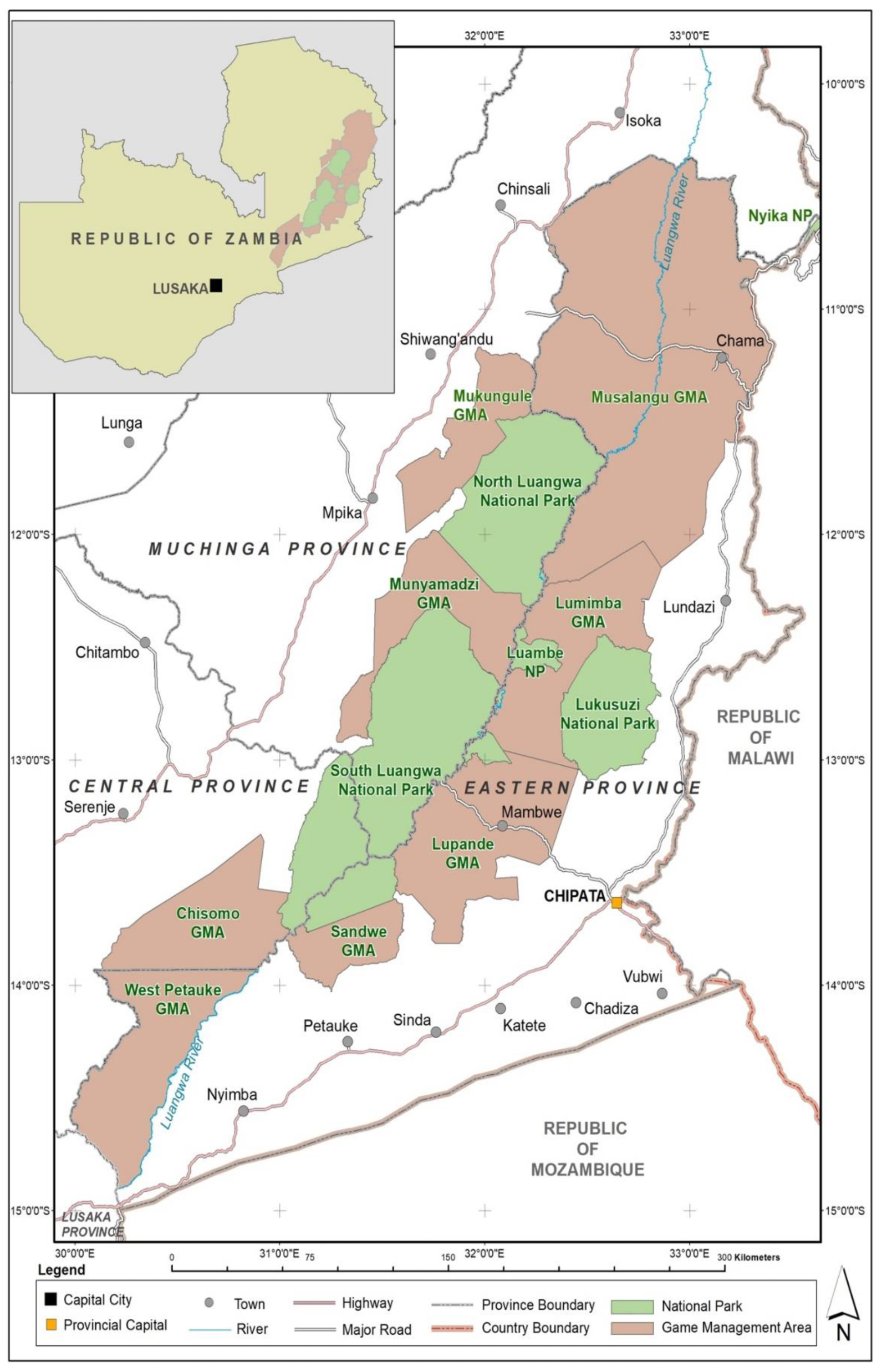
Figure 2.
Frequencies of perceived performances of intervention measures in addressing drivers of illegal hunting identified in a questionnaire survey in the Luangwa Valley.
Figure 2.
Frequencies of perceived performances of intervention measures in addressing drivers of illegal hunting identified in a questionnaire survey in the Luangwa Valley.
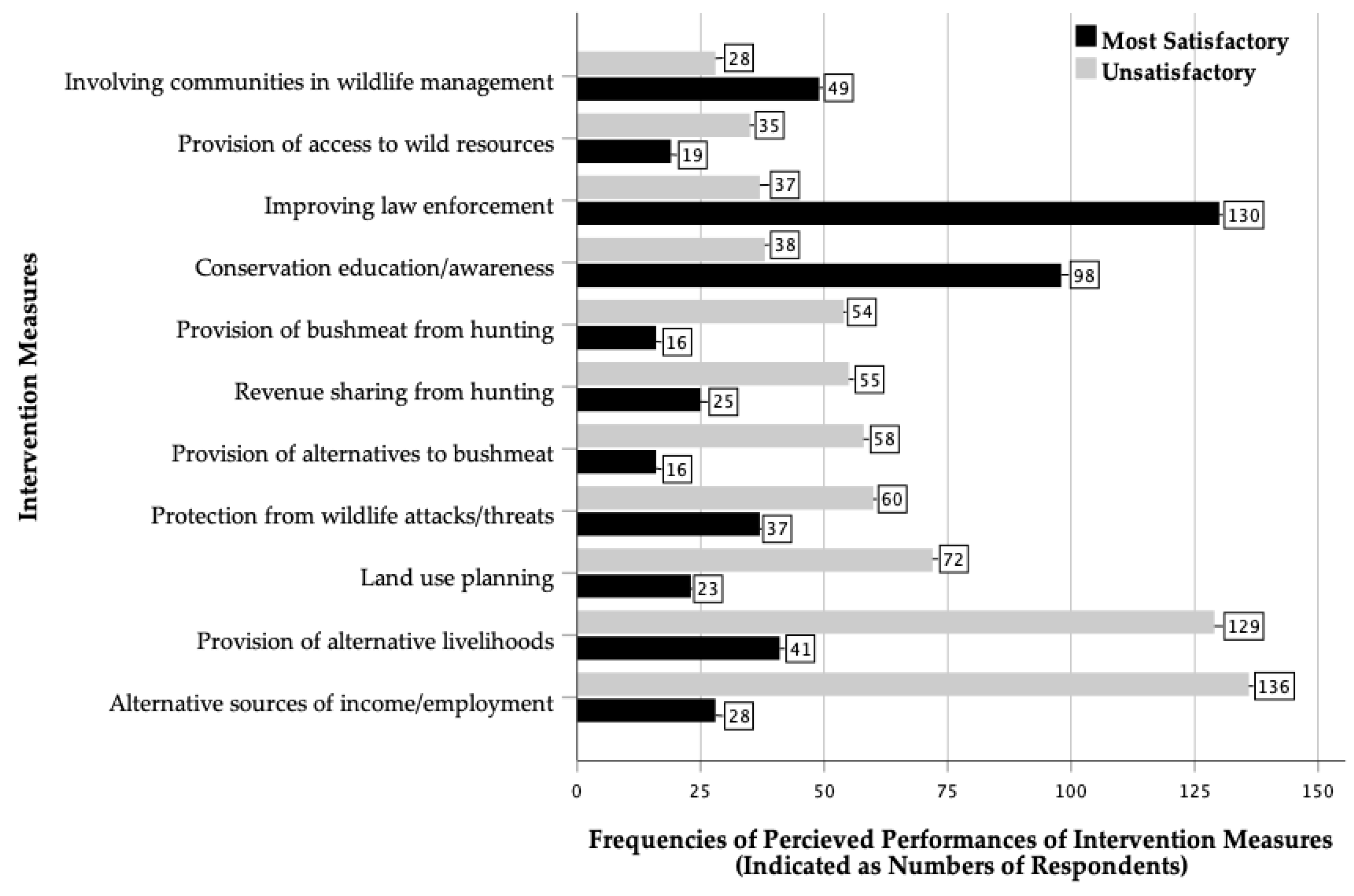

Table 1.
Number of Responses on Levels, Persistence and Trends of Illegal Hunting in a Questionnaire Survey in the Luangwa Valley.
Table 1.
Number of Responses on Levels, Persistence and Trends of Illegal Hunting in a Questionnaire Survey in the Luangwa Valley.
|
Sampling Strata |
Illegal Hunting Status in the Luangwa Valley | |||||||||
|---|---|---|---|---|---|---|---|---|---|---|
| Levels | Persistence | Trends | ||||||||
| Low | Moderate | High | < 1 year (Starting) |
1-14 years (Short) |
15-30 years (Long) |
>30 years Very long |
Decreased | Stable | Increased | |
| Reformed Illegal Hunters | 93 | 42 | 7 | 0 | 108 | 30 | 4 | 93 | 27 | 21 |
| Community Resource Boards |
40 | 20 | 3 | 1 | 32 | 11 | 18 | 49 | 13 | 1 |
| Wildlife Agency Staff | 9 | 55 | 30 | 5 | 33 | 26 | 30 | 48 | 29 | 17 |
| Conservation Interested Entities |
13 | 22 | 10 | 0 | 11 | 12 | 22 | 20 | 16 | 9 |
| Total | 155 (45.1%) | 139 (40.4%) | 50 (14.5%) | 6 (1.7%) |
184 (53.6%) | 79 (23.0%) | 74 (21.6%) | 210 (61.2%) |
85 (24.8%) | 48 (14.0%) |
Table 2.
Frequencies and Categories of Drivers of Illegal Hunting Identified in a Questionnaire Survey in the Luangwa Valley.
Table 2.
Frequencies and Categories of Drivers of Illegal Hunting Identified in a Questionnaire Survey in the Luangwa Valley.
| *Drivers of illegal hunting | No. of respondents identifying drivers (% in parentheses) |
Proximate/ underlying drivers |
Thematic drivers |
|---|---|---|---|
| Lack of alternative sources of income/employment | 197 (56.9%) | Proximate | Need for survival & sustaining livelihoods |
| Poverty | 195 (56.4%) | Underlying | Need for survival & sustaining livelihoods |
| Need for bushmeat consumption |
183 (52.9%) | Proximate | Need for survival & sustaining livelihoods |
| Need for income from bushmeat & animal products |
180 (52.0%) | Proximate | Need for survival & sustaining livelihoods |
| Sponsorship to hunt illegally | 132 (38.2%) | Underlying | External/internal sponsorship |
| Lack of sources of meat/ protein |
112 (32.4%) | Proximate | Need for survival & sustaining livelihoods |
| Retaliatory killing | 96 (27.7%) | Proximate | Human-wildlife conflicts |
| Preventative killing | 84 (24.3%) | Proximate | Human-wildlife conflicts |
| Human-wildlife conflicts | 79 (22.9%) | Underlying | Human-wildlife conflicts |
| Demand for wildlife products | 70 (20.2%) | Underlying | Market demand for wildlife products |
| Lack/inadequate conservation education/awareness | 70 (20.2%) | Underlying | Lack of conservation education/awareness |
| Lack/inadequate tangible benefits from conservation |
52 (15.0%) | Underlying | Need for survival & sustaining livelihoods |
| Population influx/increase | 49 (14.2%) | Underlying | Demographic growth |
| Inadequate community involvement in wildlife management |
47 (13.6%) | Underlying | Inadequate devolution of wildlife management |
| Weak/inadequate law enforcement |
39 (11.3%) | Underlying | Inadequate legislation/ enforcement |
| Need for trophies for income/use |
34 (9.8%) | Proximate | Need for survival & sustaining livelihoods |
| Cultural/traditional needs | 20 (5.9%) | Proximate | Cultural needs/ significance |
| Political influence | 15 (4.3%) | Underlying | Political influence |
| Defiance/protest | 10 (2.9%) | Proximate | Defiance/protesting unfairness |
| Recreational/sports needs | 5 (1.4%) | Proximate | Recreational need |
| Desire to outsmart law enforcement staff |
5 (1.4%) | Proximate | Desire to outsmart law enforcement staff |
* Drivers of illegal hunting with less than five respondents such as the need to practice shooting with firearm (n=2, 0.6%) and desire for pleasure in killing animals (n=2, 0.6%) are not included in the table.
Table 3.
Prevalence of Intervention Measures Implemented to Address Drivers of Illegal Hunting Identified in a Questionnaire Survey in the Luangwa Valley.
Table 3.
Prevalence of Intervention Measures Implemented to Address Drivers of Illegal Hunting Identified in a Questionnaire Survey in the Luangwa Valley.
| Intervention Measures | No. of Respondents Identifying Intervention Measures |
Percent (%) |
|---|---|---|
| Improving law enforcement |
213 | 61.6 |
| Providing conservation education/awareness |
207 | 59.8 |
| Provision of alternative livelihoods |
187 | 54.0 |
| Provision of alternative sources of income/ employment |
152 | 43.9 |
| Involving communities in wildlife management | 112 | 32.4 |
| Protecting communities from animal attacks & threats | 99 | 28.6 |
| Revenue sharing from hunting | 80 | 23.1 |
| Land use planning | 62 | 17.9 |
| Provision of bushmeat from hunting | 49 | 14.2 |
| Provision of alternative to bushmeat | 27 | 7.8 |
| Provision of access to wild resources |
26 | 7.5 |
Table 4.
The Association Between Persistence of Illegal Hunting and Drivers of Illegal Hunting that Related to People’s Needs for Survival and Sustaining Livelihoods in the Luangwa Valley.
Table 4.
The Association Between Persistence of Illegal Hunting and Drivers of Illegal Hunting that Related to People’s Needs for Survival and Sustaining Livelihoods in the Luangwa Valley.
| Driver of Illegal Hunting | *Likelihood Ratio | Degrees of freedom (df) | Cramer’s V | P-value | Decision | Comments |
|---|---|---|---|---|---|---|
| Need for bushmeat consumption | 23.209 | 3 | 0.243 (p < 0.001) |
< 0.001 | Reject null hypothesis | Evidence for a moderate association |
| Need for income from bushmeat | 8.019 | 3 | 0.152 (p = 0.047) |
= 0.046 | Reject null hypothesis | Evidence for a weak association |
| Preventative killing | 16.626 | 3 | 0.200 (p = 0.003) |
< 0.001 | Reject null hypothesis | Evidence for a moderate association |
| Human-wildlife conflicts | 20.129 | 3 | 0.243 (p < 0.001) |
< 0.001 | Reject null hypothesis | Evidence for a moderate association |
| Need for trophies for income/use | 13.745 | 3 | 0.206 (p = 0.002) |
= 0.003 | Reject null hypothesis | Evidence for a moderate association |
| Lack of tangible benefits from conservation |
14.296 | 3 | 0.202 (p < 0.001) |
= 0.003 | Reject null hypothesis | Evidence for a moderate association |
| Poverty | 2.651 | 3 | 0.087 (p = 0.451) | = 0.449 | Retain null hypothesis | No evidence for association |
| Lack of alternative income/ employment |
3.358 | 3 | 0.098 (p = 0.347) |
= 0.340 | Retain null hypothesis | No evidence for association |
| Lack of alternative source of meat | 3.374 | 3 | 0.096 (p = 0.360) |
= 0.338 | Retain null hypothesis | No evidence for association |
| Retaliatory killing | 5.154 | 3 | 0.161 (p = 0.169) |
= 0.169 | Retain null hypothesis | No evidence for association |
* The likelihood ratios were considered for testing association instead of the Pearson Chi-Square values as some cells of expected counts were less than five (5).
Table 5.
The Association Between Persistence of Illegal Hunting and Unsatisfactory Performance of Intervention Measures in Addressing Drivers of Illegal Hunting that Related to People’s Needs for Survival and Sustaining Livelihoods in the Luangwa Valley.
Table 5.
The Association Between Persistence of Illegal Hunting and Unsatisfactory Performance of Intervention Measures in Addressing Drivers of Illegal Hunting that Related to People’s Needs for Survival and Sustaining Livelihoods in the Luangwa Valley.
| Intervention Measures with Unsatisfactory Performance |
*Likelihood Ratio | Degrees of Freedom (df) | Cramer’s V | P-value | Decision | Comments |
|---|---|---|---|---|---|---|
| Provision of alternative livelihoods | 13.367 | 3 | 0.253 (p = 0.004) |
= 0.004 | Reject null hypothesis | Evidence for a moderate association |
| Provision of alternatives to bushmeat |
32.488 | 3 | 0.366 (p < 0.001) |
< 0.001 | Reject null hypothesis | Evidence for a strong association |
| Provision of bushmeat from hunting | 19.029 | 3 | 0.276 (p < 0.001) |
< 0.001 | Reject null hypothesis | Evidence for a moderate association |
| Revenue sharing from hunting | 34.533 | 3 | 0.372 (p < 0.001) |
< 0.001 | Reject null hypothesis | Evidence for a strong association |
| Provision of access to wild resources | 11.980 | 3 | 0.305 (p = 0.01) |
= 0.007 | Reject null hypothesis | Evidence for a strong association |
| Provision of alternative employment/ income |
5.476 | 3 | 0.156 (p = 0.136) | = 0.140 | Retain null hypothesis | No evidence for association |
| Protection of communities from attacks and threats of wild animals | 0.122 | 3 | 0.024 (p = 0.989) |
= 0.989 | Retain null hypothesis | No evidence for association |
* The likelihood ratios were considered for testing association instead of the Pearson Chi-Square values as some cells of expected counts were less than five (5).
Table 6.
Significant Predictors that Influenced the Likelihood of High Persistence of Illegal Hunting Based on the Responses During a Questionnaire Survey in the Luangwa Valley.
Table 6.
Significant Predictors that Influenced the Likelihood of High Persistence of Illegal Hunting Based on the Responses During a Questionnaire Survey in the Luangwa Valley.
| Model 1: Predictors include drivers of illegal hunting. Method: Forward Stepwise (Likelihood Ratio) | ||||||||
| Omnibus Test of Model Coefficient: χ2 = 37.404, df = 4, P < 0.001 | ||||||||
| Nagelkerke R2 = 0.357 = 35.7% | ||||||||
| Hosmer & Lemeshow Test: χ2 = 1.101, df = 6, P = 0.981 | ||||||||
| Percentage Accuracy in Classification (PAC) = 71.3% | ||||||||
| 95% CI for Exp(B) | ||||||||
| B | SE | Wald | df | Sig | Exp(B) | Lower | Upper | |
| Poaching level (low) Ref | 13.870 | 2 | < 0.001 | |||||
| Poaching level (moderate) | 1.272 | 0.460 | 7.650 | 1 | 0.006 | 3.568 | 1.449 | 8.787 |
| Poaching level (high) | 2.727 | 0.869 | 9.840 | 1 | 0.002 | 15.293 | 2.782 | 84.057 |
| No alternative meat | 1.061 | 0.500 | 4.507 | 1 | 0.034 | 2.890 | 1.085 | 7.696 |
| Need income from bushmeat | 1.296 | 0.443 | 8.577 | 1 | 0.003 | 3.660 | 1.536 | 8.723 |
| Constant | -2.591 | 0.564 | 21.665 | 1 | < 0.001 | 0.075 | ||
| Model 2: Predictors include intervention measures. Method: Forward Stepwise (Likelihood Ratio) | ||||||||
| Omnibus Test of Model Coefficient: χ2 = 23.640, df = 3, P < 0.001 | ||||||||
| Nagelkerke R2 = 0.222 = 22.2% | ||||||||
| Hosmer & Lemeshow Test: χ2 = 0.384, df = 3, P = 0.944 | ||||||||
| Percentage Accuracy in Classification (PAC) = 73.7% | ||||||||
| 95% CI for Exp(B) | ||||||||
| B | SE | Wald | df | Sig | Exp(B) | Lower | Upper | |
| Poaching level (low) Ref | 12.723 | 2 | 0.002 | |||||
| Poaching level (high) | 2.928 | 0.839 | 12.179 | 1 | < 0.001 | 18.689 | 3.609 | 96.771 |
| Most satisfactory performance: conservation education/awareness |
-1.073 | 0.413 | 6.754 | 1 | 0.009 | 0.342 | 0.152 | 0.768 |
| Constant | -0.687 | 0.299 | 5.291 | 1 | 0.021 | 0.503 | ||
| Model 3: Combined significant predictors from models 1 and 2. Method: Enter | ||||||||
| Omnibus Test of Model Coefficient: χ2 = 30.389, df = 5, P < 0.001 | ||||||||
| Nagelkerke R2 = 0.191 = 19.1% | ||||||||
| Hosmer & Lemeshow Test: χ2 = 4.229, df = 8, P = 0.836 | ||||||||
| Percentage Accuracy in Classification (PAC) = 71.7% | ||||||||
| 95% CI for Exp(B) | ||||||||
| B | SE | Wald | df | Sig | Exp(B) | Lower | Upper | |
| Poaching level (low) Ref | 14.229 | 2 | < 0.001 | |||||
| Poaching level (moderate) | 0.843 | 0.341 | 6.115 | 1 | 0.013 | 2.323 | 1.191 | 4.532 |
| Poaching level (high) | 1.871 | 0.550 | 11.587 | 1 | < 0.001 | 6.494 | 2.212 | 19.070 |
| Most satisfactory performance: conservation education/awareness |
-0.690 | 0.323 | 4.563 | 1 | 0.033 | 0.502 | 0.266 | 0.945 |
| No alternative meat | 0.738 | 0.348 | 4.491 | 1 | 0.034 | 2.091 | 1.057 | 4.138 |
| Constant | -1.459 | 0.382 | 14.583 | 1 | < 0.001 | 0.232 | ||
Table 7.
Thematic Data Analysis Results for Nine Focus Group Discussions (FGDs) and Three In-Depth Interviews (IDIs) Conducted in the Luangwa Valley. Figures Indicate Numbers of References for Themes or Subthemes and Figures in the Parentheses Show Numbers of FGDs and IDIs where Respective Themes were Discussed.
Table 7.
Thematic Data Analysis Results for Nine Focus Group Discussions (FGDs) and Three In-Depth Interviews (IDIs) Conducted in the Luangwa Valley. Figures Indicate Numbers of References for Themes or Subthemes and Figures in the Parentheses Show Numbers of FGDs and IDIs where Respective Themes were Discussed.
| Theme: Drivers of Illegal Hunting | |||||||||||||||||
| Protesting unfairness / injustices | Poverty | Inadequate law enforcement | Need for income |
Human wildlife conflicts |
Lack of alternative livelihood |
Limited tangible benefits | Lack of employment |
Inadequate community involvement | Demand/market for bushmeat or products |
Lack of alternative meat/food |
Limited access to bushmeat | Poor partnerships/ collaboration | Encroachment & development |
Inadequate awareness / sensitisation | Human pop/ influx increase |
Communities don’t own wildlife |
|
| FGDs | 19 (5) | 14 (6) | 11 (1) | 10 (4) | 10 (3) | 8 (3) | 7 (3) | 6 (3) | 4 (4) | 1 (1) | 1 (1) | 1 (1) | 1 (1) | 0 | 0 | 0 | 0 |
| IDIs | 0 | 2 (1) | 12 (3) | 3 (2) | 1 (1) | 2 (1) | 2 (2) | 3 (1) | 0 | 4 (3) | 1 (1) | 0 | 0 | 2 (2) | 1 (1) | 1 (1) | 2 (1) |
| Theme: Intervention Measures | |||||||||||||||||
| Provision of alternative livelihoods | Improve benefits from wildlife |
Provision of employment | Sensitisation awareness |
Improving law enforcement |
Involving Communities in conservation |
Stakeholders collaboration |
Human Wildlife Conflict mitigation |
Provision of bushmeat or alternatives |
Improving conservation funding |
||||||||
| FGDs | 21 (6) | 12 (6) | 9 (5) | 5 (4) | 5 (2) | 4 (4) | 4 (3) | 2 (1) | 2 (1) | 0 | |||||||
| IDIs | 4 (1) | 1 (1) | 0 | 3 (3) | 1 (1) | 2 (2) | 3 (2) | 0 | 0 | 1 (1) | |||||||
| Theme: Unsatisfactory Intervention Performance | |||||||||||||||||
| Provision of alternative livelihoods | Provision of employment | Improving law enforcement | HW conflict mitigation | Bushmeat/ alternative meat provision |
Provision/ access to tangible benefits |
Conservation sensitisation/ awareness | Community involvement conservation |
||||||||||
| FGDs | 14 (5) | 12 (4) | 12 (3) | 7 (3) | 5 (3) | 4 (3) | 1 (1) | 1 (1) | |||||||||
| IDIs | 1 (1) | 0 | 8 (3) | 0 | 0 | 2 (2) | 1 (1) | 4 (2) | |||||||||
| Theme: Behavioural Beliefs (attitude) | |||||||||||||||||
| Wildlife was given for use | Poaching is good for survival | Wildlife was given as food | Poaching is bad | God’s gift for livelihood & survival | Wildlife is God’s creation | Poaching, the only means for survival | Hunting is traditional | Wildlife brings wealth | |||||||||
| FGDs | 9 (4) | 5 (4) | 4 (3) | 3 (3) | 3 (2) | 2 (2) | 2 (1) | 1 (1) | 1 (1) | ||||||||
| Theme: Normative Beliefs | |||||||||||||||||
| Poaching helps people to survive | Some may not support poaching | People support poaching |
|||||||||||||||
| FGDs | 5 (3) | 4 (2) | 4 (1) | ||||||||||||||
| Theme: Control Beliefs | |||||||||||||||||
| Easy to start poaching | Difficult to stop poaching |
Easy to stop poaching | |||||||||||||||
| FGDs | 12 (5) | 6 (3) | 3 (2) | ||||||||||||||
| Theme: Types of Illegal Hunters | |||||||||||||||||
| Local illegal hunters | Non-local | ||||||||||||||||
| FGDs | 20 (7) | 2 (2) | |||||||||||||||
| IDIs | 2 (2) | 2 (2) | |||||||||||||||
| Theme: Limitations of Law Enforcement | |||||||||||||||||
| FGDs | 18 (6) | ||||||||||||||||
| IDIs | 6 (3) | ||||||||||||||||
| Theme: Behavioural Intentions to Hunt Illegally | |||||||||||||||||
| FGDs | 17 (6) | ||||||||||||||||
Disclaimer/Publisher’s Note: The statements, opinions and data contained in all publications are solely those of the individual author(s) and contributor(s) and not of MDPI and/or the editor(s). MDPI and/or the editor(s) disclaim responsibility for any injury to people or property resulting from any ideas, methods, instructions or products referred to in the content. |
© 2024 by the authors. Licensee MDPI, Basel, Switzerland. This article is an open access article distributed under the terms and conditions of the Creative Commons Attribution (CC BY) license (http://creativecommons.org/licenses/by/4.0/).
Copyright: This open access article is published under a Creative Commons CC BY 4.0 license, which permit the free download, distribution, and reuse, provided that the author and preprint are cited in any reuse.


