

Submitted:
30 May 2024
Posted:
31 May 2024
You are already at the latest version
Abstract
This research assessed the level of peer influences among the students of Ebonyi State University, Abakaliki and the existing policy framework in the University to control its negative impact. Objectives: To assess the knowledge, attitude and practice of peer pressure influence control among the students of the institution. Methodology: We used a cross-sectional design, a structured questionnaire of a five-point Likert scale as a veritable instrument for collecting the data from 30 student respondents. The questionnaire was made up of four key sections comprising student’s demographic parameters, knowledge, attitude and practice of students on the subject matter. Data collected was analyzed in a table of descriptive statistics to determine the total, range, mean and median, which were used to ascertain students’ level of knowledge, attitude, practice and countermeasures to overcome negative peer influences emanating from their peers. Results: The mean value outcome of knowledge of students fall between 2.7 to 3.3, the mean value for attitude of student falls between 2.4 to 3.6, while the practice of students falls between mean value 2.7 and 3.2. Most of these outcomes represents poor or weak weight factor which requires several levels of interventions. Conclusion: This study highlights the overriding importance of peer pressure management among the students of Ebonyi State University, Abakaliki to create a safe academic environment and guarantee higher academic performances. This research recommended that the University management should commission research on peer pressure among students, the causes, manifestations and possible remedies to enable them to develop a comprehensive framework for the University.
Keywords:
Peer Pressure
; University Students
; Ebonyi State University Abakaliki
1.1. Background:
Peer pressure is the influence that peers have on each other's behaviour (Harakeh et al., 2012). It is a normal part of growing up, but it can be both positive and negative. Positive peer pressure can encourage students to do well in school, join clubs and extracurricular activities, and make healthy choices. Negative peer pressure can encourage students to skip class, experiment with drugs and alcohol, and engage in other risky behaviours (Fulkerson et al., 2006).
Peer pressure is especially strong during adolescence when students are developing their own identities and trying to fit in. They may be more likely to go along with what their peers are doing, even if they know it is wrong. This is because they want to be accepted and liked by their peers.
Peer pressure can be a challenge for students in tertiary institutions, such as colleges and universities. Students in these settings may be exposed to a wider range of peer influences, both positive and negative. They may also be under more pressure to succeed academically and socially.
Peer pressure control on the other hand is the ability to resist negative peer pressure and make your own choices (Brechwald et al., 2011). It is an important skill to develop, especially for students in tertiary institutions.
To effectively control peer pressure, students should establish and maintain a strong support system. Surrounding oneself with like-minded individuals who share similar values and goals can provide a sense of belonging and reduce the influence of negative peer pressure. Additionally, seeking guidance from trusted mentors, such as professors or counsellors, can help students navigate challenging situations and make informed decisions.
Furthermore, developing assertiveness skills is crucial in managing peer pressure. Students need to be able to express their opinions and make their own choices without fear of judgment or rejection. Learning to say "no" and setting clear boundaries can empower students to resist the pressure to engage in activities that they are not comfortable with (Tatum et al., 1992).
2.0. Literature Review
Studies show that the influence of peer groups among students can boost their anxiety, especially about their education (Kadir, Atmowasdoyo and Salija 2018). The relationship within the group with its peers is co-related with each other, hence the direction of this particular relationship should be monitored where these relationships should go considering all possible factors correlated with the group's outcome. Peer pressure is faced by many teenagers in society, professionals understand the concept of peer influence that could affect teenagers in a negative way which can be prevented by educating and preparing teenagers to face the negative aspects caused by peer pressure (Temitope and Ogonsakin, 2015).
Similarly, peer influence among teenagers does not directly negatively affect them but it varies in how much and how the students receive the climate of the peers coming from the group (Mosha, 2017). When a student is influenced and motivated by peers he will perform excellently at school and get good grades in mathematics (Boechnke, 2018). Getting the support needed from the peer group, students tend to excel and exceed their capability concentrate more on their studies, and do good in academic tasks in school (Olalekan, 2016).
Adolescents gaining social support from their peers is an important factor in coping with different problems and illnesses by letting go of emotions by talking to someone. Social support plays an important role for teenagers to lessen the effects of stressful situations and stressors through the support of their peers in the group (Esen and Gundogdu, 2010). Despite the various studies conducted to understand the effects of peer groups on student’s academic performance, no one has yet understood the nature of peer effects among students (Zhang, 2010). Knowing how teenagers interact with their peers how they interact with each other and how the presence of peer groups affects students’ academic achievement in school plays an important role in various categories and even the whole educational system (Leka, 2015). Peer pressure is commonly described as peers encouraging other teenagers to do things (Santor, Messervey and Kusumakar, 2000). Peer pressure is also caused by a lack of supervision towards their children during adolescence, children tend to enjoy their peers' company and spend with their peers more during the adolescence period (Puligni, 1993). Different factors could affect students’ academic performance in school whether it’s their family giving proper guidance and motivation to their children with the healthy and harmonious interaction with their surroundings (Ezzarrooki, 2016). Students' interactions with their peers could help enhance their capability and increase their academic performance in school because they could seek help from their peers which could serve as a motivation to work alone (Sotinis, Mirco and Michael, 2013). Student peer group in school plays an in-socializing teenager with the peers socializing with each other to help the child adolescents (Uzezi and Deya, 2017). Interactions among peers are likely to influence the students and can be crucial for them to determine their choices which at the long rum could affect their performance.
Understanding peer influence on teenagers is important for developing and understanding how to improve socioeconomic policies (Carman and Zhang, 2011). Peer among youth plays a vital role during the adolescence of a teenager. This is the time when teenagers develop deep friendships among their peers and become permanent during their adolescence (Guzman, 2017). Peer pressure towards a person's behaviour is said to be a social phenomenon where the members of a particular society may not be influenced negatively but the majority are affected by the undesirable behaviour of those people who resist what others do (Gulati, 2017). Looking at the different groups of factors that influence adolescents in their completion of their academic excellence it is further hindered by developmental challenges (Chen, 2008). An individual seeks emotional support towards communicating publicly and showing his private objectives or goals. Indeed, by showing your emotions to others, individuals can get emotional benefits from it because it could help them to overcome temptation and could give them emotional benefits. (Borein and Boemont, 2013). Also, peer groups answer questions from teenagers with different concerns from the adolescence stage including physical appearance or changing bodies (Ademiyi and Kolawole, 2015).
Peer pressure could easily affect the self-esteem of students an important factor in adolescence. Individuals adapt attitudes towards a certain aspect that they encounter or they are aware of (Uslu, 2013). In many events, student fantasize and visualize what they dream to become through their colleagues' atmosphere. Eventually, they pursue their choices through the influence of peer pressure (Owoyele and Toyobo, 2008). The pressure among peer group members may engage to do undesired things or negative behaviour with the presence of a particular peer group leader who engages its members to do deviant acts or promote undesirable things to the group (Dumas, Ellis, and Wolfe, 2012).
The peer group is important in the social context that plays a vital role in society and determines academic achievement that affects development relatively with each other (Chen, 2008). Adaptive behaviour of the development increases becomes broader and more complex as age increases (Yonus, Mushtaq and Vaiser n.d.). The school that the students attend serves as an institution among students that determines their learning capacity based on the school environment that gives the learning experience toward students (Korir, 2014). Thus, choosing major courses within an institution are major choice a student intends to make but it is affected by their interactions with other students. Hence, the behaviour of an individual has seen similarities among the group due to the effect of their peers, it is still difficult to relate the consequences that the individuals within the group are similar with each other or social to be pursuing their intentions together to have similar outcomes (Kremer and Levy, 2008). Interactions between students with their agemates appeal to enhance their learning capacity under the guidance of an adult educator (Kinderman, 2016).
2.1. Why Peer Pressure among Students?
The academic performance of some students of Nigeria's Higher Institutions in recent times has been somewhat unremarkable. This is evidenced by their performances after graduation and the rate of their involvement in violent crimes. Parents, teachers, school administrators, and stakeholders have expressed varying concerns on this ugly issue.
Negative Peer pressures are being suspected as factors being responsible for luring students to engage in negative habits such as substance abuse, loss of individuality, joining of bad gangs, sexual-related activities, emotional and mental issues, and other socially unacceptable acts that distract them from their academic pursuits.
These maladaptive behaviours of adolescents which cause poor academic performance raise the question, of why the students are not concerned about the current state of their academic performance in internal and public examinations. Ebonyi State University, Abakaliki being one of the Tertiary Institutions in Nigeria is randomly chosen for this study.
2.2. Objectives of the Study
The objective of this study is to assess the knowledge, attitude, and practice of peer pressure control among the students of Ebonyi State University, Abakaliki. This will help in determining the student’s level of knowledge of peer pressure. How this has impacted their academic lives and the possible policy assistance needed to address the negative impacts and as well sustain the positive impacts on both the students and the management of the institution.
3.0. Materials and Methods
The methodology adopted in this research contributed greatly to achieving the aim and objectives of the study. This chapter, however, focused on the study design, study area, study population, method of data collection and analysis of the collected data.
3.1. The Study Design and Sample Size
The study was designed as a descriptive cross-sectional study with a structured questionnaire administered among students of Ebonyi State University Abakaliki. The students were drawn from across the three campuses of the University namely College of Agricultural Sciences (CAS), College of Health Sciences (CHS), and Main campus to reflect a fair representation of their participation. A sample size of thirty 30 students was randomly selected from the three campuses with students representing each campus.
3.2. The Study Area
The study was carried out between the Abakaliki and Ezzamgbo areas in Ebonyi State, incorporating the major campuses of Ebonyi State University, Abakaliki. This is because the CAS and CHS campuses are located in Abakaliki Town while the Main campus is located in the Ezzamgbo axis of Ebonyi State.
3.3. Instruments and Method of Data Collection
The researcher considered and used a structured questionnaire of five (5) point Likert scale as a veritable instrument for collecting the data. The instrument was made up of four (4) segments comprising the bio-demographic parameters, respondent’s knowledge, attitude and practice of the respondents to peer pressure and its impact on their study lives as students. A convenience random sampling technique was used to recruit thirty (30) student participants who willingly accepted to participate from their faculties of the university campuses where the questionnaire was administered to them. Those who declined responses due to lack of disposition to attend to them at the point of our visits were accordingly discarded.
3.4. Method of Data Analysis
Data collected was analyzed in a table of descriptive statistics, SPSS 23 to determine the total number of respondents per question, the range, mean and median of each question gathered from respondents across the three cognate sections of the questionnaire.
4.0. Results
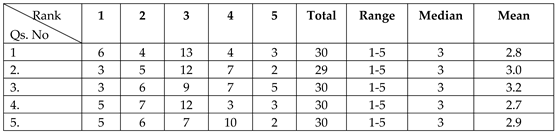
This study was based on thirty (30) questionnaires administered to students across the Ebonyi State University campuses. The responses of these respondents to the topical questions administered are shown in Table 1, Table 2, Table 3 and Table 4 representing sections A, B, C and D of the questionnaire.
- A.
- The Socio-Demographic Parameters of the Study
The result of the socio-demographic parameters contained in Table 1, showed that all the thirty (30) student respondents specified their gender in this study. The analysis indicated that the female gender outnumbered their male counterparts with 56.67% and 43.33% percentages respectively. This explained that the female genders were more willing to participate in the study than their male counterparts.
In terms of the spread of participants around the campus, most of the faculties were represented with at least three respondents and about fifty per cent (50%) of all the departments in Ebonyi State University were represented with at least one respondent. Note that the bulk population of the study participants fell within second, third and fourth-year students having 26.67%, 16.67% and 20% percentages respectively. This set of students is believed to have had a fair share of students-induced peer pressure in the institution.
- B.
- The Knowledge of Peer Pressure
Table 2 illustrates the weighting frequencies of respondents on the various questions presented in this section to ascertain the student’s level of knowledge of peer pressure. It shows that the mean result for all the questions 1 to 5 revolves around the fairly adequate point scale (i.e., between 2.7 to 3.3). This implies that students’ level of knowledge of peer pressure is fairly adequate. Accordingly, there is a need for more sensitization and the creation of awareness among EBSU students in other to draw their attention to the kind of impact peer pressure can have on them as students.
- C.
- The Attitude of Students Peer Pressure Influence
Table 3 display the outcome of weighting frequencies for attitude questions posed to students in this study touching on both negative and positive peer pressure attitudes. The analysis indicates some variations in the mean results ranging from the lowest value of 2.4 to the highest value of 3.6. Accordingly, most of the issues raised require intervention to curtail the negative attitudes orchestrated by negative peer pressure on responsible students.
A more elaborate explanation of the implications of the mean values for all the questions as they affect the attitude of both students and the management of the University on how to curtail negative peer influences on the students is presented in chapter four – the discussion section.
- D.
- The Practice of Peer Pressure by Students of EBSU
Table 4 is clearly showing the weighting frequencies of the results of practice of students of EBSU concerning their susceptibility to peer pressure. The mean value of respondents ranges from 2.7 to 2.9 and 3.2, which indicates different students of susceptibilities in the points it represents. Given these poor mean results of the practice questions, a comprehensive intervention package will be required to address the lapses.
Further discussions on the outcome of the analysis of the data obtained regarding the practice of peer pressure in EBSU are further presented in chapter four of this study.
5.0. Discussion
5.1. Discussion of Results
The result of this study is intended to guide recommendations that will be geared towards reaching out and sensitizing students of Ebonyi State University on how to peer pressure, its impacts on both academic and personal lives and how to control peer influences.
Generally, given the overall result of this study, it is evident that EBSU students have poor knowledge of peer pressure and its attendant negative impact on their both social and academic lives. They also lack good knowledge of how to manage it. This is well expressed in the mean values of the knowledge questions which revolve around fairly adequate weighting (2.7 – 3.3). This has affected their ability to think independently and make their own choices to resist negative peer pressures from their fellow-students as noted by (Brechwald et al., 2011). Moreover, the level at which the respondents acknowledged that they have had their fair share of peer pressures to perform actions which ordinary they should not have carried out in their normal sense (represented with mean value 3.3 in the knowledge question 1), truly alludes to the fact that peer pressure largely contributes to students’ behaviour and academic performance on campus. This is consistent with the findings of (Fulkerson et al., 2006). In other to address this knowledge gap, interventions for routine awareness/enlightenment campaigns are required to equip the students with the necessary knowledge they need to overcome the menace.
In terms of attitudes, students’ responses concurred with the fact that there is a need for a policy to checkmate peer pressure among students. This is not alluded to by the resultant adequate mean value of 3.6 of question 1 in the attitude section. Notwithstanding, the mean value weighting of the existing EBSU policy on checkmating anti-social behaviours among students is 2.7 (grossly inadequate). This could be the reason the majority of the students have had one or two experiences of negative peer influences while on campus as the mean value stood at 3.5 (inadequate/weak). The students according to (Tatum et al., 1992) are advised to develop assertive skills is very much required to manage peer pressure.
Student’s willingness to engage attitudes that will help them to manage peer pressure influences can be correlated with the attitudes of the Institution’s Management in checkmating and attending to students’ complaints. The University needs to institute a strong policy framework to sensitize, monitor and address every observed negative peer pressure influence(s) observed among students.
An account somewhat expressed in the mean value 2.7 (strongly agree) that unchecked peer pressure influence among students often lead them to join bad gangs on campus. So, interventions and policy research need to be commissioned to understand the various dimensions of peer pressure influences among students and the possible comprehensive policy design framework to checkmate it. This would have a positive influence on student’s academic performance, improve their social behaviour and make the campuses a haven for academic activities. This is consistent with the suggestion of (Chen, 2008) who emphasized the vital role of an educator in managing peer pressure among the students as a veritable tool for maintaining a conducive learning environment that can guarantee positive student performance
This study therefore proposes that there should be a standing policy to checkmate the impact of peer pressure influences among the students of the institution.
5.2. Conclusion
This study focused on assessing the knowledge, attitude and practice of peer pressure influences and control among the students of EBSU, Abakaliki. The study revealed that enacting a functional policy framework will guarantee better academic performances of the students, reduce violent crimes among students, and create a haven on the various campuses being operated by the institution. To achieve this, policy research should be commissioned to carry out a study on the various dimensions of peer pressures inherent among students. The outcome of this research will be used to generate a comprehensive policy framework to address the issue of negative peer pressure.
5.3. Study Limitations
- Difficulty in manual/ paper-based analysis of data.
- Time constraints due to compounded work schedules.
- Difficulty in getting students' attention to respond to questions due to the tight nature of their academic activities
5.4. Contributions to Knowledge
There have been worries about the rate of poor academic performance of students of tertiary institutions in Nigeria. This has resulted in some slogans of unemployable graduates being churned by some tertiary institutions in the country. This study explored the factors responsible for this menace, using Ebonyi state University, Abakaliki as a case study, and also suggested a possible solution that would permanently end the drama. This study also serves as an eye-opener to students on how to save themselves from unnecessary pressures from their peers and what to do when they are confronted with any undue peer pressure on campus.
5.5. Recommendations
From the outcome of this study, we recommend the following:
- Ebonyi State University Management should establish a special unit to checkmate peer pressure influences among their students.
- Ebonyi State University Management should also develop a policy that will create an avenue for periodical sensitization of students on the negative impacts of peer pressure and encourage students to speak out
- Students’ behaviours should be checkmated from time to time through their academic performances with those having declining academic records called for counselling with the special unit.
- Students’ mental health should be checkmated from time to time to ascertain when they are undergoing undue mental stress orchestrated by external factors.
- Students should be made to live on campus for proper checkmating
5.6. Policy Implication
This study proposes that as a knowledge industry, the University needs to churn out viable graduates. Since the essence of university education is character molding and knowledge impartation, the graduates must be able to fit into society instead of being a misfit. To achieve these two responsibilities, the students must be made to undertake their training in their sanest frame of mind in a conducive environment. To achieve this, a deliberate policy is needed to drive the initiative, hence, this research.
The study further proposes that Ebonyi State University, Abakaliki must commission research on peer pressure among students, the causes, manifestations and possible remedies to enable them to develop a comprehensive framework for the University.
References
- Kadir, H.; Atmowardoyo, H.; Salija, K. The influence of peer groups on students’ anxiety in efl Learning. ELT Worldwide 2018, 5, 78. Retrieved from: http://eprints.unm.ac.id/8893/1/ARTICLE.pdf.
- Temitope, B.; Ogunsakin, F. Influence of peer group on academic performance of secondary school students in ekiti state. International Journal of Innovative Research & Development 2015, 4, 324. Retrieved from: http://www.ijird.com/index.php/ijird/article/view/59780.
- Mosha, M. The influence of peer group on academic performance of adolescent studentsin secondary schools in Tanzania. Research Journal of Educational Studies and Review 2017, 3, 18-26. Retrieved from: http://pearlresearchjournals.org/journals/rjesr/index.htm.
- Boehnke, K. Peer pressure: a cause of scholastic underachievement? a cross-cultural study of mathematical achievement among german, canadian, and israeli middle school students. Soc Psychol Educ 2008, 11, 149-160. [CrossRef]
- Olalekan, A. Influence of peer group relationship on the academic performance of students in secondary school (a case study of selected secondary school in atiba local government area of oyo state). GLOBAL JOURNAL OF HUMAN SOCIAL SCIENCE: A ARTS & HUMANITIES PSYCHOLOGY 2016, 16, 35 Version 1.0. Retrieved from: https://socialscienceresearch.org/index.php/GJHSS/article/view/1826.
- Olalekan, A. Influence of peer group relationship on the academic performance of students in secondary school (a case study of selected secondary school in atiba local government area of oyo state). GLOBAL JOURNAL OF HUMAN SOCIAL SCIENCE: A ARTS & HUMANITIES PSYCHOLOGY 2016, 16, 35 Version 1.0. Retrieved from: https://socialscienceresearch.org/index.php/GJHSS/article/view/1826.
- Zhang, H. (2010).Peer effects on student achievement: an instrumental variable approach UsingSchool transition data. Department of Economics The Chinese University of Hong Kong. Retrieved from: http://www.wise.xmu.edu.cn/Labor2010/Files/Labor2010_HongliangZhang_Papr.pdf.
- Leka, I. The impact of peer relations in the academic process among adolescents. Mediterranean Journal of Social Sciences 2015, 6, 125 S1. [CrossRef]
- Santor, D.; Messervey, D.; Kusumakar, V. Measuring peer pressure, popularity, and conformity in adolescent boys and girls: predicting school performance, sexual attitudes, and substance abuse. Journal of Youth and Adolescence 2000, 29, 165. Retrieved from: https://link.springer.com/article/10.1023/A:1005152515264.
- Uzezi, J.; Deya, G. Relationship between peer group influence and students’ academic achievement in chemistry at secondary school level. American Journal of Educational Research 2017, 5, 350-356. [CrossRef] [PubMed]
- De Giorgi, G.; Pellizzari, M.; Redaelli, S. (n.d.) Identification of social interactions throughpartially overlapping peer groups. AMERICAN ECONOMIC JOURNAL. Retrieved from: https://www.aeaweb.org/articles?id=10.1257/app.2.2.241.
- Carman, K.; Zhang, L. Classroom peer effects and academic achievement: evidencefrom a chinese middle school. China Economic Review 2012, 23, 223-237. [CrossRef]
- Guzman, M.T. (2007). Friendship, peer influence, and peer pressure during the teen years.University of Nebraska-Lincoln Extension, Institute of Agriculture and Natural Resources. Retrievd from: http://extension.unl.edu/publications.
- Gulati, S. Impact of peer pressure on buying behaviour. International Journal of Research-GRANTHAALAYAH 2017, 5. [CrossRef]
- Chen, J. (2008). Grade-level differences: relations of parental, teacher, and peer support to academic engagement and achievement among hong Kong students. School Psychology International. Retrieved from: https://www.researchgate.net/publication/247718714.
- Bonein, A.; Denant-Boement, L. (2013). Self-control, commitment and peer pressure: a laboratory experiment. Center for Research in Economics and Management. Retrieved from: https://link.springer.com/article/10.1007/s10683 014-9419-7.
- Adeniyi, M.A.; Kolawole, V.A. The influence of peer pressure adolescents’social behaviour. UNIVERSITY OF MAURITUS RESEARCH JOURNAL 2015, 21. Retrieved from: https://www.ajol.info/index.php/umrj/article/view/122065.
- Uslu, M. (2013). Relationship between degrees of self-esteem and peer pressure in high schooladolescents. International Journal of Academic Research Part B; 117122. Retrieved from: https://www.researchgate.net/publication/314524207.
- Owoyele, J.W.; Toyobo, O.M. (2008). Parental will, peer pressure, academic ability and school subjects selection by students in senior secondary schools. The Social Sciences 2008, 3, 583-586. Retrieved from: http://docsdrive.com/pdfs/medwelljournals/sscience/2008/583-586.pdf.
- Dumas, T.; Ellis, W.; Wolfe, D. (2012). Identity development as a buffer of adolescent riskbehavior in the context of peer group pressure and control. Journal of Adolescence 2013, 917-927. [CrossRef]
- Yunus, A.; Mushtaq, S.; Qaiser, S. Peer pressure and adaptive behavior learning: a study of adolescents in gujrat city. International Journal of Asian Social Science 2, 18321841. Retrieved from: http://pakacademicsearch.com/pdffiles/art/1/ijass%20pp.1832-1841.pdf.
- Korir, D.; Kipkemboi, F. The impact of school environment and peer influences onstudents’ academic performance in vihiga county, kenya. Journal of Education and Practice 2014, 5, 1. Retrieved from: https://www.iiste.org/Journals/index.php/JEP/article/view/12362.
- Kinderman, T. (2016). Peer group influences on students’ academic motivation. Handbook of Social Influences in School Contexts. [CrossRef]
- Kremer, M.; Levy, D. Peer effects and alcohol use among college students. Journalof Economic Perspectives 2008, 22, 189-206. Retrieved from: https://www.aeaweb.org/articles?id=10.1257/jep.22.3.189.
- Harakeh, Z.; Vollebergh, W.A. The impact of active and passive peer influence on young adult smoking: An experimental study. <italic>Drug and alcohol dependence</italic> 2012, <italic>121</italic>, 220-223.
- Fulkerson, J.A.; Story, M.; Mellin, A.; Leffert, N.; Neumark-Sztainer, D.; French, S.A. Family dinner meal frequency and adolescent development: relationships with developmental assets and high-risk behaviors. <italic>Journal of Adolescent Health</italic> 2006, <italic>39</italic>, 337-345.
- Brechwald, W.A.; Prinstein, M.J. Beyond homophily: A decade of advances in understanding peer influence processes. Journal of research on adolescence 2011, 21, 179. [Google Scholar] [CrossRef] [PubMed]
- Tatum, B. Talking about race, learning about racism: The application of racial identitydevelopment theory in the classroom. Harvard educational review 1992, 62, 1–25. [Google Scholar] [CrossRef]

Table 1.
Result of the Socio-Demographic Parameters.
| Biodata: Gender | Frequency | Percentage |
|---|---|---|
| Male | 13 | 43.33% |
| Female | 17 | 56.67% |
| Total | Total = 30 | 100% |
| Age Category | Frequency | Percentage |
| >25 | 19 | 63.33% |
| 25-34 | 9 | 30% |
| 35-44 | 2 | 6.67% |
| ≥45 | - | - |
| Total | Total = 30 | 100% |
| Academic Parameter | Percentage | |
| Departments: | CSC- 3 IMAS - 1 IPH- 1 BTE-1 POL SC - 1 ECONS- 1 MASS COMM- 2 LAW- 3 AEM- 3 FAQ - 2 FST - 1 SEM - 1 NURSING- 6 MED LAB - 4 TOTAL = 30 |
10 3.33 3.33 3.33 3.33 3.33 6.67 10 10 6.67 3.33 3.33 20 13.33 100% |
| Faculty: | FS -6 FSS - 4 FLAW - 3 FARM - 7 FHST - 10 TOTAL =30 |
20 13.33% 10 23.33 33.33 100% |
| Level: | 100 - 6 200 - 8 300 -5 400- 6 500 - 5 Total = 30 |
20 26.67 16.67 20 16.67% |
| Total | 100% |
Table 2.
Result of Students Knowledge of Peer Pressure.
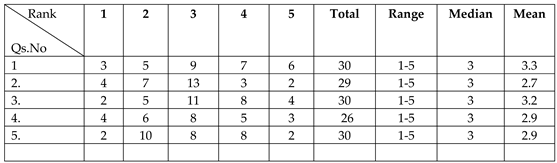
Table 3.
Result of Attitude.
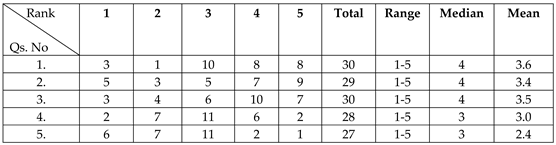
Table 4.
Result of Practice.
Disclaimer/Publisher’s Note: The statements, opinions and data contained in all publications are solely those of the individual author(s) and contributor(s) and not of MDPI and/or the editor(s). MDPI and/or the editor(s) disclaim responsibility for any injury to people or property resulting from any ideas, methods, instructions or products referred to in the content. |
© 2024 by the authors. Licensee MDPI, Basel, Switzerland. This article is an open access article distributed under the terms and conditions of the Creative Commons Attribution (CC BY) license (http://creativecommons.org/licenses/by/4.0/).
Copyright: This open access article is published under a Creative Commons CC BY 4.0 license, which permit the free download, distribution, and reuse, provided that the author and preprint are cited in any reuse.


