

Submitted:
30 May 2024
Posted:
31 May 2024
You are already at the latest version
Abstract
This study investigated the content of macro- and microelements in the lower reaches of the Ob River (Western Siberia). Seasonal sampling was performed over a four-year period (2020-2023) during the main hydrological seasons (winter low water, spring-summer floods, and early fall low water) at three river stations. Suspended and dissolved fractions were separated by filtration through 0.45-micron nitrocellulose filters. The results revealed significant seasonal variations in the elemental content of the Ob River water, associated with changes in catchment inputs, physical and chemical conditions of the aquatic environment, and the amount and composition of incoming suspended sediment. During high water flow events in the Ob River, the concentration of suspended solids increased substantially. These included significant quantities of sparingly soluble hydrolysates such as Al, Ti, Zr, Ga. During the winter period when the Ob River was ice-covered, a 2- to 3-fold rise was observed in the concentration of Na, Mg, Ca, K, Si, Mn. Having accounted for these seasonal variations in water chemistry, we were able to refine our estimates of elemental export to the Arctic Ocean. Compared to estimates from previous studies, we observed with 2.3-fold higher dissolved loads of Mn, 2.1-fold for Zn, 1.6-fold for Fe, and 1.4-fold for Pb.
Keywords:
Arctic basin
; Western Siberia
; climate change
; fluxes
; trace elements
; river suspended matter
; dissolved elements
1. Introduction
Over the past decade, researchers have shown a growing interest in identifying discharge parameters for rivers within the Polar Basin. This surge in interest stems from the impacts of global climate warming on both the hydrological regimes and the water chemistry of these rivers. Studies have documented significant changes, including an increase in the average discharge [1] and an earlier onset of spring flooding [2] in Arctic rivers. These changes have the potential to significantly affect the water composition of the Arctic Ocean, particularly the Kara Sea. The Ob and Yenisey Rivers, among the world’s largest, discharge into the Kara Sea, contributing a staggering 1.46% of its annual water volume [3]. This is 60 times higher than the ratio for the entire Arctic Ocean and 560 times higher than the global ocean ratio. Consequently, the ecological health of the Kara Sea, and by extension the entire Arctic basin, is intricately linked to the water composition of these influent rivers.
The Ob River, draining the West Siberian Plain, reigns as the world’s fifth-longest river and the largest in the region. On average, the Ob discharges a significant volume exceeding 400 km3 of water annually, contributing roughly 15% of the total freshwater entering the Arctic Ocean [4]. Global warming is causing significant changes in the Ob River’s discharge volume and hydrochemistry. Melting permafrost in the northern Ob catchment area has led to an increased volume of runoff at the end of winter [5]. Projections suggest a northward shift in permafrost zones could lead to a significant decrease in the content of dissolved organic carbon (DOC), P, N, Si, Fe, divalent heavy metals (Mn, Ni, Cu, Co, Pb), and trivalent/tetravalent metal hydrolysates within Ob River waters. Conversely, the content of dissolved inorganic carbon (DIC), Ca, SO4, Sr, Ba, Mo, and U is expected to increase [6,7]. In addition to climate change, the Ob River faces growing anthropogenic pressure from oil field development, particularly in the Middle Ob region. Oil extraction activities have resulted in river pollution with petroleum hydrocarbons, nitrogen compounds, phosphorus, and heavy metals [8,9].
To assess changes in elemental fluxes to the Arctic Basin, accurate characterization of the Ob estuary water chemistry is crucial. Estimates of the Ob's elemental fluxes to the Arctic Ocean have been ongoing for decades. The first river water chemistry data for the Ob basin were documented in the database of the Hydrological Service of the USSR [10]. Since the 1990s, the composition of the Ob waters has been regularly studied using modern analytical methods. The incorporation of new data has often led to substantial revisions of previous estimates. For example, the annual nitrate export from the Ob River to the Arctic Ocean was estimated at 9.4 ˟ 109 g in the mid-1990s [11], but this value was revised to 34.8 ˟ 109 g in the early 2000s [12], and further updated to 57 ˟ 109 g in the early 2010s [13]. Significant attention has been devoted to quantifying the export of dispersive elements, including heavy metals, by the Ob River. The results of the most influential studies have been compiled in a series of works by V. Gordeev et al. [11,14,15,16,17,18]. In addition, several review articles have evaluated the concentration of macro and diffuse elements in both dissolved and suspended forms in the Ob River water [16,19].
However, the accurate estimation of the Ob River elemental export remains a significant challenge. Current studies often lack comprehensive coverage across all hydrological seasons or rely on isolated data points, failing to capture the substantial seasonal variations in composition exhibited by the Ob River and other waterways in Western Siberia. Notably, the majority of organic carbon and associated metals are mobilized during the brief 2-3 week window of the spring flood [20].
Existing data on the dissolved and suspended chemical composition of the Ob River estuary waters primarily stem from studies conducted during the flood recession or, less frequently, during winter low water periods [11,14,16,19]. Crucially, the peak flood period, when the bulk of water and its constituents are discharged, have been largely overlooked due to the challenges posed by intense ice drift during peak discharge, which hampers fieldwork efforts [16].
To partially address this gap, researchers have turned to the Arctic Rivers Water Composition Database [21]. While this resource offers valuable insights, it primarily focuses on a limited set of trace elements (As, Ba, Li, Sr, U) and relies on single measurements, thus only partially bridging the data limitations. The State Hydrometeorological Service of Russia (Roshydromet) routinely conducts monthly assessments of the Ob River's water composition at various stations along its course. However, these assessments are limited to a few chemical elements (Fe, Mn, Cu, Ni) and do not differentiate between suspended and dissolved forms. This absence of comprehensive data during peak flow periods introduces significant uncertainties in estimating elemental fluxes from the Ob River into the Arctic Ocean.
Between 2020 and 2023, our research endeavored to characterize the water composition of the Ob River at stations situated in its lower reaches, including near the river mouth. Our investigations encompassed different hydrological seasons: the winter low flow period characterized by minimal river discharge and ice cover (March to early April), the flood peak (early June), and the transition to the autumn low flow period (late August to early September). The primary goal of our study was to quantify the transport of micro- and macroelements in both dissolved and suspended forms by the Ob River to the Arctic Ocean. Some specific objectives of the study included assessing seasonal variations in element transport, identifying the driving factors behind these changes, and determining the ratio between dissolved and suspended forms.
2. Materials and Methods
2.1. Study Area
The Ob River boasts an expansive catchment area spanning 2,570,000 km², making it one of the world's largest river systems. Its discharge contributes approximately 15% of the total riverine input into the Arctic Ocean [7]. Estimates of the Ob's average discharge vary, ranging from 402 km³/year [4] to 427 km³/year [3]. According to the Arctic Great Rivers Observatory [21], the average annual discharge of the Ob stood at 417 km³/year for the period 2000-2024.
The Ob River traverses diverse natural zones, originating in the arid steppe region at its headwaters, passing through the forest tundra zone near its estuary, and predominantly spanning the taiga zone across its main basin. The taiga zone, characterized by extensive bogs, encompasses the vast Vasyugan Bog within the Ob River basin. This mire complex, spanning 800 by 350 kilometers, holds the title of the world's largest [3]. Therefore, these extensive wetlands exert a substantial influence on the geochemical characteristics of the Ob River waters [6,15].
Geologically, the Ob watershed is composed of Quaternary sedimentary rocks of diverse origins: marine formations in the northern region, lacustrine-alluvial and alluvial deposits in the central area, water-glacial sediments in the western sector, and eolian deposits in the southern part [22]. In the northern part of Western Siberia, rocks and soils exhibit relatively low concentrations of most macro- and microelements [23]. In contrast, in the southern region of Western Siberia, the soil trace element content closely aligns with the average levels found in the upper continental crust, according to Syso [24]. Permafrost exerts a substantial influence on the hydrochemistry of rivers in the northern sector of Western Siberia, with almost half of the Ob basin situated within the permafrost zone [25]. The extensive permafrost coverage in the Ob River basin limits the influence of groundwater on the river's water composition, thereby reducing the influx of various elements from underlying rocks. However, the ongoing permafrost thawing under the influence of global warming, coupled with an expanding active layer, may enhance the influx of trivalent and tetravalent hydrolysates, particularly in the form of iron-organic colloids [20].
2.2. Sampling and Analyses
Our sampling and analyses were focused on the lower Ob River, encompassing three distinct sites. Two sites were located within the taiga zone, characterized by sporadic permafrost. Site 1 was situated on the Bolshaya Ob River near the village of Kazym-Mys (K), approximately 551 km upstream from the river mouth, while site 2 was positioned downstream near the village of Azovy (A). The third sampling site was located at the Ob River mouth, within the forest tundra zone, about 8 km upstream from the village of Salemal (S) at the entrance to the river delta (see Figure 1). This site falls within the discontinuous permafrost zone.
The fieldwork was conducted over multiple periods: August 25-29, 2020; March 29-April 10, 2022; June 05-15, 2022; March 23-29, 2023; and June 15-18, 2023. Water samples were collected using a Ruttner sampler from various depths, ranging from the surface to near-bottom levels. Concurrently, in situ measurements of dissolved oxygen (DO), pH, and total dissolved solids (TDS) were performed using a WTW Multi 34203420 instrument (Xylem Analytics, Germany).
Following collection, the water samples were promptly transferred to plastic bottles and dispatched to the laboratory. There, they underwent filtration using pre-weighed Millipore™ nitrocellulose filters with a diameter of 47 mm and a pore size of 0.45 μm. Approximately 1.5 liters of water were filtered to obtain an insoluble precipitate. Subsequently, the filters were dried in a desiccator at t = 80°C and then weighed using a laboratory analytical balance to obtain the total suspended solids (TSS).
A portion of the resultant filtrate was transferred to 15 mL polypropylene tubes for the analysis of dissolved forms. To each tube, 0.2 ml of concentrated suprapure grade nitric acid (HNO3 65% Suprapur, Merck) was added to facilitate the analysis process.
The micro- and macroelement content in both the filtrate and insoluble sediment samples was determined using inductively coupled plasma mass spectrometry (ICP-MC; Thermo Elemental - X7 spectrometer, USA) and inductively coupled plasma atomic emission spectroscopy (ICP-AS; Thermo Scientific iCAP-6500 spectrometer, USA) methods. We followed established sample preparation and analytical protocols as described previously [26].
To ensure the accuracy of our analysis, several elements (Li, Al, Mn, Cu, Zn, Sr, and Ba) were analyzed in the filtrate using both ICP-MC and ICP-AS methods. The differences in element concentrations determined by these two methods did not exceed 15% across all cases, validating the reliability of our analysis.
In addition, to further validate our analytical procedures, we utilized standard samples of drinking water from "Trace Metals in Drinking Water" by High-Purity Standards (USA), specifically using the standard sample Trapp ST-2a (GEO 8671-2005) for verification in insoluble suspensions. The variation in determination with the standard sample did not exceed 15%.
Comprehensive details regarding the methods, recoveries, detection limits, and analytical results of certified reference materials in water samples are provided in the Supplementary Materials.
To analyze the chemical characteristics of the Ob River water, we computed statistical indices for the chemical element content in both dissolved and suspended forms at each site and across each hydrological season. These statistical indices included the mean (M) and standard deviation (SD) for each element.
To pinpoint the sources of elemental inputs, we calculated the enrichment factor (EF), a widely-used metric for assessing material inputs to river water and bottom sediments [27]. The EF was determined using the formula:
where Cx (sample) is the measured concentration of the element of interest, Cx (soil) is the concentration of the same element in the regional soil, and CAl is the concentration of the reference element (aluminum) in the same sample and the regional soil.
EF=Cx/CAl(sample) /Cx/CAl(soil)
We chose aluminum as the reference element for normalizing EF values in the suspended load due to its conservative geochemical behavior and relatively stable abundance levels [28]. EF calculations are most informative when comparing the Cx/CAl ratio in the suspended load to the corresponding ratio in the rocks and soils that constitute the watershed [29]. To achieve this, we utilized a comprehensive dataset on average trace element concentrations in soils across the West Siberian Plain, derived from the analysis of over 800 soil samples representing different natural zones [24].
While the aluminum concentration data were not directly available from the Syso [24], we obtained this information from [30]. To assess the degree of enrichment, we applied the following classification: EF < 1 = no enrichment; 1 < EF < 3 = minor enrichment; 3 < EF < 5 = moderate enrichment; 5 < EF < 10 = moderately severe enrichment; 10 < EF < 25 = severe enrichment; 25 < EF < 50 = very severe enrichment; and EF > 50 = extremely severe enrichment [27,31].
The annual element runoff was computed through a stepwise approach. Initially, average water discharges were determined for the winter-spring low flow period (November-April), high flow season (May-August), and autumn low flow period (September-October). These averages were calculated using river flow data spanning from 2000 to 2024 [21]. Subsequently, based on the outcomes of chemical analyses, the mean concentrations of dissolved and suspended constituents during these designated seasons were established. The cumulative values across different hydrological seasons provided an estimate of the annual elemental runoff.
In the final step, the runoff per unit area of the catchment area (F) was derived by dividing the elemental runoff value by the catchment area (2.99 × 10⁶ km²). This normalization enabled a comparative analysis of runoff characteristics in various river catchments, facilitating comparisons with existing literature data [3,20].
3. Results
This section may be divided by subheadings. It should provide a concise and precise description of the experimental results, their interpretation, as well as the experimental conclusions that can be drawn.
3.1. Physico-Chemical Parameters
The Ob River's water maintains a neutral pH for the majority of the year. However, a shift towards the alkaline range is observed in late summer, with the average pH value rising to 8.0 units (Table 1). This increase in pH during the warm season is linked to a reduction in CO2 concentration, attributed to its decreased solubility at higher temperatures, coupled with increased phytoplankton activity. Phytoplankton, through photosynthesis, consumes CO2, contributing to this observed trend.
The dissolved oxygen (DO) content reaches its minimal level in winter, attributed to the limited gas exchange with the atmosphere during colder months. At Kazym Mys, DO levels were found to be below the minimum allowable threshold of 6.0 mg O2 L-1 established by the Russian Water Quality Standards [32] during this period.
During winter, the water appears relatively clear, but summer witnesses a significant increase in water color due to the leaching of humic and iron compounds from surrounding soils.
The total dissolved solids (TDS) content exhibits natural variability throughout the year, influenced by seasonal factors. During the ice season, when the river is primarily supplied by groundwater, the average TDS ranges between 145-168 mg L-1 at different sites. Conversely, during the flood period characterized by low-salinity meltwater inputs, the TDS value decreases notably to 60-70 mg L-1. Total Suspended Solids (TSS) in the river water also fluctuates seasonally. In winter, with minimal runoff, the content of insoluble particles ranges from 16-30 mg L-1. However, during the peak runoff period, the TSS value increases significantly to 40-86 mg L-1.
A comparison of the pH, TDS, color, and DO values obtained during the study period with literature data [33 - 35] reveals that these parameters closely align with the reported average annual values. In addition, according to [36], the average TSS value in Ob water is typically 10 mg L-1 during the ice period and 50 mg L-1 during the flood period. However, our measured TSS values were higher, particularly in winter at the Azovy and Kazym Mys sites, where they were 29 and 30 mg L-1, respectively.
Global warming-induced permafrost thawing is expected to significantly increase the amount of suspended sediment in the Ob River waters [37]. The increase in Ob River discharge towards the end of winter aligns with reports by [5,38]. Therefore, the elevated content of the insoluble fraction we observed is consistent with projections and likely stems from the intensified thawing of permafrost in Western Siberia over recent decades [39].
3.2. Elemental Composition of the Dissolved Fraction
The elemental composition of the dissolved fraction in different hydrological seasons at the lower Ob sites is detailed in the Supplementary Materials (Table SM 1). Notably, the concentration of easily soluble macroelements such as Na, Mg, Ca, K, and Si reaches its peak during the ice period, characterized by minimal discharge and groundwater-fed river flow. Conversely, during the flood period, the concentration of these elements decreases significantly by 2.5 to 3 times.
This phenomenon is consistent with the known inverse relationship between Ob water mineralization and major ion content, where maximum mineralization typically occurs at the end of the ice period when discharge is at its lowest [34].
Previous studies have indicated that the concentrations of most metals in Ob water are higher in winter compared to summer and autumn [16]. However, our data reveal that this statement holds true for only a limited range of metals, including Na, Mg, Ca, K, Li, Mn, Sr, Co, Ba, and Mo, which exhibit 1.5-3 times higher concentrations in winter than during floods.
Of particular note is the exceptionally high concentration of Mn, exceeding summer values by more than two orders of magnitude. This anomaly is attributed to the formation of a reducing environment in bottom sediments towards the end of the ice period, facilitating the reduction of Mn4+ to Mn2+ and leading to its intensive release into the water [40]. The decrease in Mn concentration during summer is attributed to the precipitation of hydroxides at higher pH levels, along with active uptake by living organisms [18].
Similar seasonal dynamics of micro- and macroelements have been observed in the Taz River (Western Siberia), which shares comparable landscape conditions. Data from [41] indicate that concentrations of Li, B, Na, Mg, Ca, Sc, Si, K, Mn, Co, Sr, Mo, Cs, Ba, and W peak towards the end of winter, with Mn runoff in winter accounting for 72% of the annual runoff.
We did not observe an increase in the concentration of the soluble form of Fe during winter, contrary to what was suggested in [16]. Instead, during the peak runoff period (June), the concentration of dissolved Fe was notably higher, ranging from 4-12 times the values observed in winter. In addition, the concentration of Al showed a substantial increase of 5-8 times during the flood period. Moreover, there was a notable rise in the concentration of lanthanoids, sometimes reaching an order of magnitude. Similarly, the content of Co, Ni, Cu, and Zn increased by 1.4 - 2.5 times.
The elevated Fe content observed during the flood period cannot be attributed to snow composition, as the average Fe content in snow is very low, averaging 14.6 µg L-1 [42], which is an order of magnitude lower than that found in Ob waters. It has been previously noted [41] that the content of dissolved organic matter (DOC) increases during floods. Therefore, we attribute the increase in Fe content to the input of organo-mineral complexes from inundated soils during the spring period. In addition, it is important to note that peat soils in northern West Siberia, which dominate the soil cover in the region, are characterized by extremely high Fe content [43].
3.3. Concentrations of Suspended Elements
Assessing the geochemical properties of suspended solids is critical because the majority of riverine material transported to the oceans is found within this insoluble fraction [44,45]. This study aims to estimate both the element concentrations within the Ob River water itself (measured in µg L-1) and the composition of the suspended fraction (measured in ppm). Analyzing these two aspects yields valuable insights: firstly, by determining the concentration in water, we can quantify the relative proportions of suspended and dissolved elements, thereby enabling us to estimate their total flux to the Arctic Ocean. Secondly, examining the geochemical signature of the suspended matter provides information about the sources of these materials entering the river.
The statistical indicators of the suspended form of chemical elements in the waters of the lower Ob River can be found in Supplementary Materials (Table SM 2). Interestingly, the content of nearly all elements transported by the river in suspended form was higher during floods compared to other hydrological seasons, except for Ca, Mn, and Sr. This trend can be attributed to the increased amount of insoluble particles, with the TSS value being 2.4 - 3 times higher during floods than in winter (Table 1).
This significant predominance of solid runoff during the warm season is a characteristic feature of rivers in the Arctic basin. Typically, seasonal variations in suspended matter flux in Arctic seas exhibit high values in the ice-free summer-autumn period and low values in winter [46].
During flood periods, there is a manifold increase in the suspended sediment load of poorly soluble hydrolysates such as Al, Ti, Zr, Ga, Y, and rare earth elements (REE), sourced from aluminosilicates present in rocks and soils. Therefore, the heightened suspended sediment content during floods is a result of intensified water transport processes involving rock and soil particles.
The limited removal of easily soluble elements such as Ca and Sr during floods can be attributed to a decrease in their content in sediments and their subsequent transfer into aqueous solutions. In addition, the transport of Mn is more pronounced during the winter period due to its accumulation in suspended sediment in winter.
By determining the content of elements in both dissolved and suspended forms, we were able to evaluate the ratio between them. Early studies suggested that Fe, V, Mn, and Ni are primarily transported by the Ob in suspended matter, whereas Cu and Zn are distributed in roughly equal proportions between suspended and dissolved forms [48]. Subsequent research clarified that a significant portion, ranging from 50-97%, of Mn, Zn, and Pb in Ob waters exists within insoluble particles, while Cu, Cd, and As are predominantly found in the dissolved state [16,18].
According to our findings, the ratio between suspended and soluble forms of elements varies significantly throughout the seasons. During winter, the majority of elements are primarily found in the dissolved form. Elements such as Na, Mg, Li, K, Mo, Sr, Ca, U, Rb, Sb, Mn, Ba, Tl, Ni, and Cu exhibit a predominance in their dissolved state over their suspended form (Figure 2). However, during the flood period, the proportion of elements such as Mn, K, Li, W, U, Cs, Ni, and Tl in their suspended form increases noticeably. Across all seasons, the content of Al, Fe, V, Zr, and REE in suspended form is notably higher, typically by 1-2 orders of magnitude, compared to their dissolved state.
An intriguing observation is the seasonal shift in the predominant migration form or manganese. While the dissolved form predominates in winter, the ratio shifts dramatically in summer, indicating a shift towards the suspended form during warmer periods. This contrasts with earlier assertions about the predominance of the suspended form of Mn migration, which seems valid only during warmer months [18].
Our data also highlight that the proportion of suspended aluminum ranges from 97-99% across different seasons. This contrasts with previous studies on small rivers in the north of Western Siberia, where the proportion of suspended Al was estimated to be lower, at 67-82% [48]. The lowered content of dissolved Al in cyted study is likely attributed to the runoff characteristics of small rivers in the cryolithozone of Western Siberia, which are mainly influenced by waterlogged catchments with acidic peat soils. These conditions make aluminum more mobile compared to soils with neutral or slightly acidic reactions prevalent in the southern part of the Ob basin.
3.4. Composition of Suspended Matter
The introduction of suspended matter into rivers is a consequence of natural erosion processes as well as anthropogenic disturbances. The study sites where our research was conducted are remote from anthropogenic sources of influence. Consequently, the concentration of elements in the insoluble fraction primarily reflects the geochemical properties of the rocks and soils within the catchment area. In addition, it is influenced by the physical and chemical conditions that govern the exchange of elements among suspended particles, water, and bottom sediments, such as pH and redox potential. Seasonal fluctuations in biota activity also play a role in shaping the composition of suspended sediment.
The findings regarding the composition of the insoluble fraction at three monitoring sites in the lower Ob River are detailed in the Supplementary Materials (Table SM 3). Previous investigations into sediment composition in the Ob River have noted enrichment with heavy metals (Fe, Zn, Cu, Cd, Pb, As) during the winter period, with concentrations 1.4-4.0 times higher than the annual average [16]. Our research confirms seasonal variability in suspended sediment composition; however, we did not observe an increase in the insoluble fraction's concentration of these elements during winter. On the contrary, Zn, Cu, Cd, Pb concentrations in the insoluble suspension during winter low water periods were 2-5 times lower than during summer high water periods.
Moreover, the suspended sediment exhibits higher concentrations of lithophilic elements (Al, K, Mg, Na, Li, Ti, V, Cr, Sc, W, Zr, Rb, REEs) during flood periods. This indicates not only an increase in suspended solids amount but also elevated concentrations of most elements within the suspended load during floods. The concentrations of Co, Ba, Mo, As remain consistent across seasons. In winter, a few elements such as P, Ca, Mn, Fe, As, Mo, Sb, U show increased concentrations in the insoluble fraction.
The seasonal concentration shifts in elements within the middle reaches of the Ob River were previously documented in [49], identifying three element groups: Na, K, Al, trivalent, and tetravalent hydrolysates that increased during floods; alkaline earth metals (Ca, Sr, Ba), and P, Mn that peaked during the ice period; and a third group (Cr, Ni, Co, Cu, Mo, Zn, Pb, Cd, Sb, Y, REEs, Ti, Zr, Hf, Th, U) showing higher concentrations in winter compared to summer, independent of water discharge.
To grasp the seasonal fluctuations in element concentrations, it's crucial to understand their origins. Indicator element ratios play a key role in estimating the contribution of various sources. For instance, a Ca/K ratio below 2.5 typically points to a lithogenic source [50]. In the Ob River, our data reveal a Ca/K ratio of 0.7 during floods across all sites, indicating a lithogenic material origin. However, during winter lows and late summer, the Ca/K ratio ranges from 26 to 228 across different sites, significantly surpassing the threshold and suggesting a minor impact from soil erosion.
Calculating the enrichment factor (EF) is another valuable method commonly used to assess the degree of element enrichment compared to average soil compositions in Western Siberia. Our EF calculations reveal the lowest enrichments during floods across most elements (Figure 3). These minimal enrichments, compared to average catchment soil compositions, suggest that the suspended matter during floods primarily originates from soil erosion. As we move into autumn, we observe stronger enrichments, likely due to reduced runoff intensity and a shift towards smaller water-borne particles. Smaller particles tend to have a higher surface area to volume ratio, which can concentrate certain elements compared to larger ones [51].
Certain elements, such as P, Fe, Sr, and Cd, exhibited moderately severe enrichment, while Mn, As, Zn, and Pb showed moderate enrichment. Similar EF value trends observed during floods and the transition to autumn low water periods suggest consistent element ratios and reinforce the lithogenic nature of suspended sediments during the low water period transition. Winter brings about significant changes in the character and intensity of enrichment patterns. The suspended sediment becomes markedly enriched in P, Mn, Fe, As, and very highly enriched in Sr, Zn. Notably, poorly soluble elements like Zr, Nb, and Ti do not show significant enrichment compared to soils.
The seasonal variations in calcium, iron, and manganese concentrations in the insoluble suspension during winter can be attributed to several processes. A significant factor contributing to the summer decrease in iron concentration is the uptake by organisms in biocommunities, which become more active in the warmer months. In addition, increased dissolved oxygen saturation in summer leads to the formation of (hydro)oxides of manganese and iron, causing precipitation [52].
When comparing the trace element and REE content in Ob sediment to global averages [53], most elements exhibit lower concentrations. The ratio of Ob sediment concentrations to global averages for heavy metals such as Cd, Cr, Co, Cu, Ni, Pb, and V falls within the range of 0.3 to 0.6 [26]. Moreover, extremely low concentrations are noted for elements such as Mo, Al, Zr, and Tl.
However, it should be noted that the sediment in the lower Ob in winter contains higher concentrations of Fe and Mn compared to global averages [53] and averages for rivers in the Arctic basin [16]. It is therefore necessary to consider the causes of sediment enrichment. According to [54], the possible processes of enrichment of the Ob sediment are physical processes of adsorption of metals on particles, formation of poorly soluble complex compounds under changing redox conditions, and pH.
One of the possible mechanisms of subglacial sediment enrichment, in our opinion, is the formation of iron and manganese hydroxide films on colloidal particles. Mn is a redox-sensitive element, and changes in DO may alter its degree of oxidation and affect its distribution [55,56]. The benthic anoxic region may have caused Mn in the bottom sediments to be reduced to a more soluble form, which subsequently diffused into the water column and deposited on the suspended particles.
An alternative explanation for the observed levels of Ca, Mn, and Fe could be attributed to biological accumulation. Studies of the hydrochemical characteristics of the Northern Dvina River [57], which shares similar landscape conditions, shedding light on this phenomenon. The research identified two distinct types of organic matter: 1) allochthonous large colloids resulting from soil leaching, and 2) autochthonous (aquatic) small-molecule substances linked to bacterial and phytoplankton exudates. Our observation of a non-lithogenic nature of the winter suspension suggests its association with the latter, biogenic pool.
Hence, during flood periods, the primary composition originates from the removal of soil particles by watercourses. In contrast, during winter periods, other processes become prominent, such as the influx of particles from bottom sediments, alterations in redox conditions leading to dissolution or precipitation, and the absorption of micronutrients by biota.
3.5. Element Transport
The element fluxes for different fractions during various hydrological seasons are outlined in Table 2. The findings highlight that the removal of hard hydrolysable elements (e.g., Al, Ti, Cr, V, Co, Rb, and lanthanoids) mainly occurs during the flood period as part of the suspension. In contrast, elements like Na, Mg, and Ca are removed in dissolved form, with approximately equal amounts during both winter and flood periods. Notably, manganese is predominantly transported in dissolved form during winter.
A comparative analysis with studies from the 1990s [58] has revealed significant differences. Our data show a substantial increase in the fluxe of lead, zinc, and iron in dissolved form—20 times, 8 times, and 5 times higher, respectively (Figure 4). This discrepancy is attributed to previous studies underestimating the high concentrations of these elements during flood periods. Conversely, no significant differences were observed for Ni, Cu, or Cd. The removal of metals in suspended forms closely aligns with previous estimates, with slight increases noted for Zn and Pb (1.6 and 1.4 times higher, respectively), and lower values obtained for Cd and Cu, approximately 70% of previous estimates.
Recent studies have focused on expanding the scope of elements analyzed and elucidating their transport within Ob River waters to the Arctic Basin. A comparison with data from [3] reveals elevated values of Mn (2.3-fold), Zn (2.1-fold), Fe (1.6-fold), Rb (1.8-fold), and Y (2.2-fold) dissolved per unit area of the basin (Table 3). The differences for the other elements are minimal. The increased Mn removal is associated with its heightened concentration during winter, while the increased removal of iron, zinc, rubidium, and yttrium is presumed to occur predominantly during flood periods.
Notably, data from [20] concerning element export from Ob River tributaries in the taiga zone also indicate higher levels of Mn, Fe, and Zn—elements that migrate as organic-mineral colloids from waterlogged, permafrost-free catchments. These observations suggest a potential link between the rise in Mn, Fe, and Zn transport and the increased inflow of bog water, likely caused by the expansion of the active layer and thawing of rocks within the cryolithozone.
4. Discussion
To ensure the reliability of our findings, a thorough assessment of the differences in elemental discharge compared to previous studies was necessary. We specifically focused on elements such as Fe, Mn, Zn, Rb, and Pb, where fluxes increases were observed. To evaluate our results, we compared the element concentrations obtained with a recent compilation of the average composition of Ob River waters, based on numerous studies since 1993 [19].
Our analysis highlighted notable differences. For instance, our data showed lower concentrations of Fe and Zn compared to the long-term average. Specifically, the dissolved iron content at the Salemal sampling site ranged from 14.5 to 186 µg L-1 across different seasons (SM Table 1), whereas the average concentration of dissolved Fe in Ob water according to [19] is 286 µg L-1. Similarly, the Zn content in our studies varied between 0.6 and 3.6 µg L-1, whereas the average concentration is 4.09 µg L-1 [19].Thus, the observed increase in Fe and Zn runoff is not attributable to our analytical errors or limited data. If we were to utilize the average annual data as presented in [19], it would yield even higher values of the elemental fluxes.
The differences with the data presented in [58], in our opinion, are due to a more complete accounting of seasonal differences in the content of elements Our calculations uniquely accounted for runoff across hydrological seasons, factoring in variations in water discharge. This approach is crucial for understanding seasonal patterns in water composition.
The comparisons with the previous studies highlight discrepancies that warrant further investigation to ensure the accuracy and reliability of our data. Our data underscores a significant concentration of Mn during winter, leading to heightened Mn runoff rates. This increase is likely due to increased inflow of manganese-rich groundwater resulting from permafrost thawing. Thawing ground ice augments the influx of dissolved substances and serves as a significant source for their introduction into the Ob River water, alongside mineral weathering and plant litter decomposition [59].
Building on prior research [41] that highlighted the role of smaller Western Siberian rivers in manganese export to the Arctic Ocean, our study reveals significant manganese removal by the Ob, the region's major river.
While snowmelt in Western Siberia contributes minimal iron, with average iron concentrations of only 14.6 µg L-1 [42], significantly lower than peak dissolved iron levels in the Ob River, the surge in iron during floods suggests its origin lies in interactions between meltwater, plant litter, and mineral rocks.
Earlier spring floods observed in the last decade [36] and increasing snowfall in Western Siberia's polar and subpolar regions [39] likely contribute to two key factors: enhanced water-rock interaction and a prolonged period of this interaction. These factors combined could lead to a heightened influx of organo-mineral colloids, known carriers of substantial iron and aluminum [57,60].
The observed rise in iron and manganese runoff from 2020 to 2023 likely reflects ongoing climate changes, including rising air temperatures and increased winter precipitation. This suggests that Fe and Mn concentrations in runoff could serve as potential indicators of climate change in the region.
5. Conclusions
Our studies revealed significant seasonal variations in the concentration of suspended particles and micro- and macroelements within the Ob River waters. Notably, during the ice period, the concentration of soluble macroelements (e.g., Na, Mg, Ca, K, Si) is 2.5-3 times higher compared to the flood period. In addition, Mn concentrations increase by two orders of magnitude in winter due to changes in redox conditions that promote its transition to a dissolved form.
Furthermore, the concentration of dissolved Fe, Al, Co, Ni, Cu, and Zn is higher during the warm season when the Ob River is free of ice. This coincides with a significant increase in the suspended material fraction, including both the number of insoluble particles and the concentration of many metals within them. Flood events further amplify this effect, with TSS content reaching 2.4-3 times higher values compared to winter. Interestingly, the fluxes of lithophilic elements such as Al, K, Mg, Na, Li, Ti, V, and Cr from these insoluble particles increases by several orders of magnitude during floods.
Calculations of Enrichment Factor suggest a slight enrichment of suspended sediment during floods compared to the catchment’s soil composition. This is further supported by the Ca/K ratio of 0.7, indicative of soil erosion as the primary source. Aluminosilicate minerals from rocks and soils appear to be the dominant elemental contributors. During winter, other processes such as resuspension of bottom sediments, mineral dissolution, and precipitation driven by changes in redox conditions play a more significant role in shaping the composition of suspended particles.
Accounting for seasonal variations facilitated a more nuanced understanding of the unique patterns of elemental export to the Arctic Ocean. Nevertheless, our current sampling regime of three times per year presents a limitation. To achieve a more accurate assessment of elemental fluxes, increased sampling frequency and a systematic approach are essential. Ideally, monthly measurements of key hydrochemical parameters would provide optimal data for such evaluations.
Our recent findings reveal significant changes in several hydrochemical indicators compared to data from studies conducted between 1990 and 2010. These changes likely stem from climate warming. Notably, suspended matter content in the lower Ob River, particularly during winter in the Kazym Mys and Azovy sections, reached higher levels in 2022-2023 compared to prior years. This observed increase aligns with the reported rise in winter runoff attributed to thawing permafrost.
Furthermore, our data indicate a substantial increase in the transport of dissolved Mn, Zn, Fe, and Pb by the Ob River. Concentrations of these elements have risen by 2.3, 2.1, 1.6, and 1.4 times, respectively. These elements are primarily transported as organic-mineral colloids originating from waterlogged permafrost-free catchments. The observed rise in their content is likely a consequence of permafrost thawing and increased water inflow from these waterlogged areas in the northern Ob Basin.
In conclusion, our study demonstrates that the changing composition of Ob River water serves as a sensitive indicator of ongoing alterations in biogeochemical processes within the catchment. These changes are strongly linked to climate warming.
Supplementary Materials
The following supporting information can be downloaded at the website of this paper posted on Preprints.org, Table SM1. Content of dissolved forms of elements in the waters of the lower Ob River ( Mean ± SD); Table SM2. Content of suspended forms of elements in the waters of the lower Ob River (Mean ± SD); Table SM3. Element concentrations (Mean ± SD) in the suspended fraction of Ob River waters (ppm dry weight, C, Al, Fe - %); Table SM4. Methods of analysis, detection limits, analytical results and recovery of certified reference material “Trace Metals in Drinking Water” (High–Purity Standards, USA). Table SM5. Methods of analysis, detection limits, analytical results and recovery of certified reference materials “Trapp ST–2a” (Russian standard GSO 8671–2005) and “BHVO–2”.
Author Contributions
A.S.: Methodology, and funding acquisition; D.M.: Formal analysis writing, Writing—original draft, Manuscript draft, Data curation; V.Kh.: Conceptualization, Data curation, Investigation; N.P.: Visualization; V.K.: Validation; M.K.:Data curation, Investigation; E.K.: Data curation, Investigation; A.K.: Data curation, Investigation; A.P.: Data curation, Investigation. All authors have read and agreed to the published version of the manuscript.
Funding
This research was funded by the Yamalo-Nenets Autonomous District Government (West-Siberian Interregional Science and Education Center’s (project № 2-3.4_2024). This research was also conducted with the support of the Tyumen Oblast Government as part of the West Siberian Interregional Scientific and Educational Center Project, No. 89-DON (1). Furthermore, this study was supported by the Ministry of Science and Higher Education of the Russian Federation (Project No. FWRZ-2021-0006).
Data Availability Statement
The datasets generated during and/or analyzed during the current study are available from the corresponding author on reasonable request.
Acknowledgments
The authors are especially grateful to Vasiliy Karandashev for the element determination.
Conflicts of Interest
The authors declare no conflict of interest.
References
- White, D.; Hinzman, L.; Alessa, L.; et al. The Arctic Freshwater System: Changes and Impacts. J. Geophys. Res. 2007, 112, G04S54. [Google Scholar] [CrossRef]
- Shiklomanov, A.I.; Lammers, R.B.; Rawlins, M.A.; Smith, L.C.; Pavelsky, T.M. Temporal and Spatial Variations in Maximum River Discharge From a Bew Russan Dataset J. Geophys. Res. 2007, 112. [Google Scholar] [CrossRef]
- Gordeev, V.V.; Pokrovsky, O.S.; Zhulidov, A.V.; Filippov, A.S.; Gurtovaya, T.Y.; Holmes, R.M.; Kosmenko, L.S.; McClelland, J.W.; Peterson, B.J.; Tank, S.E. Dissolved Major and Trace Elements in the Largest Eurasian Arctic Rivers: Ob, Yenisey, Lena, and Kolyma. Water 2024, 16, 316. [Google Scholar] [CrossRef]
- Shiklomanov, I.A.; Shiklomanov, A.I.; Lammers, R.B.; Peterson, B.J.; Vorosmarty, C.J. The Dynamics of River Water Inflow to the Arctic Ocean. In The Freshwater Budget of the Arctic Ocean. NATO Science Series (Series 2. Environment Security); Lewis, E.L., Jones, E.P., Lemke, P., Prowse, T.D., Wadhams, P., Eds.; Springer: Dordrecht, The Netherlands, 2000; Volume 70. [Google Scholar] [CrossRef]
- Melnikov, V.P.; Pikinerov, P.V.; Gennadinik, V.B.; Babushkin, A.G.; Moskovchenko, D.V. Runoff over Siberian river basins as an integrate proxy of permafrost state. Doklady Earth Sci. 2019, 487, 679–683. [Google Scholar] [CrossRef]
- Pokrovsky, O.S.; Manasypov, R.M.; Kopysov, S.; Krickov, I.V.; Shirokova, L.S.; Loiko, S.V.; Lim, A.G.; Kolesnichenko, L.G.; Vorobyev, S.N.; Kirpotin, S.N. Impact of permafrost thaw and climate warming on riverine export fluxes of carbon, nutrients and metals in western Siberia. Water 2020, 12, 1817. [Google Scholar] [CrossRef]
- Kolesnichenko, I.; Kolesnichenko, L.G.; Vorobyev, S.N.; Shirokova, L.S.; Semiletov, I.P.; Dudarev, O.V.; Vorobev, R.S.; Shavrina, U.; Kirpotin, S.N.; Pokrovsky, O.S. Landscape, soil, lithology, climate and permafrost control on dissolved carbon, major and trace elements in the Ob River, Western Siberia. Water 2021, 13, 3189. [Google Scholar] [CrossRef]
- Khoroshavin, V.Y.; Moiseenko, T.I. Petroleum hydrocarbon runoff in rivers flowing from oil and gas producing regions in Northwestern Siberia. Water Resour. 2014, 41, 532–542. [Google Scholar] [CrossRef]
- Moskovchenko, D.V.; Babushkin, A.G.; Yurtaev, A.A. The impact of the Russian oil industry on surface water quality (a case study of the Agan River catchment, West Siberia). Environ. Earth Sci., 2020, 79, 355. [Google Scholar] [CrossRef]
- Surface Water Resources of the USSR, Volume. 15; Altai and Western Siberia. Issue 2: Middle Ob. N.A. Panina, Ed., Leningrad: Gidrometeoizdat, 1972. (in Russian).
- Gordeev, V.V.; Martin, J.-M.; Sidorov, I.S.; Sidorova, M.V. A reassessment of the Eurasian river input of water, sediment, major elements, and nutrients to the Arctic Ocean. Am. J. Sci. 1996, 296, 664–691. [Google Scholar] [CrossRef]
- Holmes, R.M.; Peterson, B.J.; Gordeev, V.V.; Zhulidov, A.V.; Meybeck, M.; Lammers, R.B.; Vorosmarty, C. J. Flux of nutrients from Russian rivers to the Arctic Ocean: Can we establish a baseline against which to judge future changes? Water Resour. Res. 2000, 36, 2309–2320. [Google Scholar] [CrossRef]
- Holmes, R.M.; McClelland, J.W.; Peterson, B.J.; Tank, S.E.; Bulygina, E.; Eglinton, T.I.; Gordeev, V.V.; Gurtovaya, T.Y.; Raymond, P.A.; Repeta, D.J.; Staples, R.; Stiegl, R.G.; Zhulidov, A.V.; Zimov, S.A. Seasonal and Annual Fluxes of Nutrients and Organic Matter from Large Rivers to the Arctic Ocean and Surrounding Seas. Estuaries and Coasts 2012, 35, 369–382. [Google Scholar] [CrossRef]
- Gordeev, V.V. River Input of Water, Sediment, Major Ions, Nutrients and Trace Metals from Russian Territory to the Arctic Ocean. In The Freshwater Budget of the Arctic Ocean. NATO Science Series. Lewis, E.L., Jones, E.P., Lemke, P., Prowse, T.D., Wadhams, P.; Eds., Springer, Dordrecht, 2000, Volume 70, pp. 297–322. [CrossRef]
- Gordeev, V.V.; Rachold, V.; Vlasova, I.E. Geochemical Behaviour of Major and Trace Elements in Suspended Particulate Material of the Irtysh River, the Main Tributary of the Ob River, Siberia. J. Appl. Geochem. 2004, 19, 593–610. [Google Scholar] [CrossRef]
- Gordeev, V.V.; Beeskow, B.; Rachold, V. Geochemistry of the Ob and Yenisey estuaries: A comparative study. Ber. Polarforsch. Meeresforsch (Reports on Polar and Marine Research) 2007, 565, 235. [Google Scholar]
- Gordeev, V.V.; Pokrovsky, O.S.; Zhulidov, A.V.; Filippov, A.S.; Gurtovaya, T.Y.; Holmes, R.M.; Kosmenko, L.S.; McClelland, J.W.; Peterson, B.J.; Tank, S.E. Dissolved Major and Trace Elements in the Largest Eurasian Arctic Rivers: Ob, Yenisey, Lena, and Kolyma. Water 2024, 16, 316. [Google Scholar] [CrossRef]
- Demina, L.L.; Gordeev, V.V.; Galkin, S.V.; Kravchishina, M.D.; Aleksankina, S.P. The Biogeochemistry of Some Heavy Metals and Metalloids in the Ob River Estuary–Kara Sea Section. Oceanology 2010, 50, 729–742. [Google Scholar] [CrossRef]
- Savenko, A.V.; Savenko, V.S. Trace Element Composition of the Dissolved Matter Runoff of the Russian Arctic Rivers. Water 2024, 16, 565. [Google Scholar] [CrossRef]
- Pokrovsky, O.S.; Manasypov, R.M.; Loiko, S. V.; Krickov, I. A.; Kopysov, S. G.; Kolesnichenko, L. G.; Vorobyev, S. N.; and Kirpotin, S. N. Trace element transport in western Siberian rivers across a permafrost gradient. Biogeosciences 2016. 13, 1877–1900. [CrossRef]
- McClelland, J.W.; Tank, S.E.; Spencer, R.G.M.; Shiklomanov, A.I.; Zolkos, S.; Holmes, R.M. Arctic Great Rivers Observatory. Water Quality Dataset. Version 20230314. Available online: https://arcticgreatrivers.org/data (accessed on 18 April 2024).
- Syso, A.I. General regularities of the distribution of microelements in the surface deposits and soils of West Siberia. Contemporary Problems of Ecology 2004, 11, 273–287. [Google Scholar]
- Opekunova, M.G.; Opekunov, A.Y.; Kukushkin, S.Y.; Ganul, A.G. Background Contents of Heavy Metals in Soils and Bottom Sediments in the North of Western Siberia. Eurasian Soil Sci. 2019, 52, 380–395. [Google Scholar] [CrossRef]
- Syso, A.I. Patterns of Distribution of Chemical Elements in Soil-Forming Rocks and Soils of Western Siberia. Publishing House of SB RAS, Novosibirsk, 2007. (In Russian).
- Vinokurov, Y.I.; Tsymbaley, Y.M.; Zinchenko, G.S.; Stoyasheva, N.V. General Characteristics of the Ob basin. In The Current State of Water Resources and the Functioning of the Water Management Complex of the Ob and Irtysh Basin; Vinokurov, Y.I., Puzanov, A.V., Bezmaternykh, D.M., Eds.; Publishing House SB RAS, Novosibirsk, Russia, 2012; pp. 9–11. (In Russian).
- Soromotin, A.; Moskovchenko, D.; Khoroshavin, V.; Prikhodko, N.; Puzanov, A.; Kirillov, V.; Koveshnikov, M.; Krylova, E.; Krasnenko, A.; Pechkin, A. Major, Trace and Rare Earth Element Distribution in Water, Suspended Particulate Matter and Stream Sediments of the Ob River Mouth. Water 2022, 14, 2442. [Google Scholar] [CrossRef]
- Morales-García, S.S; Pérez-Escamilla, P.A.; Sujitha, S.B. ; Godwyn-Paulson, P,.;Zúñiga-Cabezas, A.F.; Jonathan, M.P. Geochemical elements in suspended particulate matter of Ensenada de La Paz Lagoon, Baja California Peninsula, Mexico: Sources, distribution, mass balance and ecotoxicological risks. J Environ Sci (China) 2024, 136, 422–436. [Google Scholar] [CrossRef] [PubMed]
- Xia, Z.; Zhang, J.; Yan, Y.; Zhang, W.; Zhao, Z. Heavy metals in suspended particulate matter in the Yarlung Tsangpo River, Southwest China. Geosystems and Geoenvironment 2024, 3, 100160. [Google Scholar] [CrossRef]
- Niencheski, L.F.; Baumgarten, M.G.Z. Distribution of particulate trace metal in the southern part of the Patos Lagoon estuary. Aquatic Ecosystem Health and Management 2000, 3, 515–520. [Google Scholar] [CrossRef]
- Moskovchenko, D.; Shamilishvilly., G.; Abakumov, E. Soil biogeochemical features of Nadym-Purovskiy province (Western Siberia), Russia. Ecologia Balkanica 2019, 11, 113–126. [Google Scholar]
- Sakan, S.M.; Dordević, D.S.; Manojlović, D.D.; Predrag, P.S. Assessment of heavy metal pollutants accumulation in the Tisza river sediments. J Environ Manage 2009, 90, 3382–90. [Google Scholar] [CrossRef] [PubMed]
- Water quality standards for water bodies of fishery importance (In Russian). Available online: https://base.garant.ru/71586774/53f89421bbdaf741eb2d1ecc4ddb4c33 (accessed on 18 April 2024).
- Uvarova, V.I. Contemporary Status of the Water Quality in the Ob River Within Tymen’ Oblast. Vestn. Ekologii, Lesovedeniya Landshaftovedeniya 2000, 1, 18–26. (In Russian) [Google Scholar]
- Babushkin, A.G.; Moskovchenko, D.V.; Pikunov, S.V. Hydrochemical Monitoring of the Surface Waters of the Khanty-Mansiisk Autonomous Okrug—Yugra. Nauka Publ: Novosib. Russ. 2007, 152 p. (In Russian).
- Papina, T.S.; Galakhov, V.P.; Tsymbaley, Y.M.; et al. Comprehensive Assessment of Water-Resource and Water-Ecological Potential. In The Current State of Water Resources and the Functioning of the Water Management Complex of the Ob and Irtysh Basin; Vinokurov, Y.I., Puzanov, A.V., Bezmaternykh, D.M., Eds.; Publishing House SB RAS: Novosibirsk, Russia, 2012; pp. 61–92. (In Russian) [Google Scholar]
- Magritsky, D.V.; Chalov, S.R.; Agafonova, S.A. Hydrological Regime of The Lower Ob in Modern Hydroclimatic Conditions and Under the Influence of Large-Scale Water Management. Sci. Bull. Yamalo-Nenets Auton. Okrug. 2019, 1, 106–115. (In Russian) [Google Scholar] [CrossRef]
- Krickov, I.V.; Pokrovsky, O.S.; Manasypov, R. M.; Lim, A.G.; Shirokova, L.S.; Viers, J. Colloidal transport of carbon and metals by western Siberian rivers during different seasons across a permafrost gradient. Geochim. Cosmochim. Acta 2019, 265, 221–241. [Google Scholar] [CrossRef]
- Magritsky, D.V.; Frolova, N.L.; Evstigneev, V.M.; Povalishnikova, E.S.; Kireeva, M.B.; Pakhomova, O.M. Long-Term Changes of River Water Inflow into the Seas of the Russian Arctic Sector. Polarforschung 2017, 87, 177–194. [Google Scholar] [CrossRef]
- Malkova, G.; Drozdov, D.; Vasiliev, A.; Gravis, A.; Kraev, G.; Korostelev, Y.; Nikitin, K.; Orekhov, P.; Ponomareva, O.; Romanovsky, V.; et al. Spatial and Temporal Variability of Permafrost in the Western Part of the Russian Arctic. Energies 2022, 15, 2311. [Google Scholar] [CrossRef]
- Papina, T.S.; Eirikh, A.N.; Serykh, T.G.; Dryupina, E.Y. Space and Time Regularities in the Distribution of Dissolved and Suspended Manganese Forms in Novosibirsk Reservoir Water. Water Resour. 2017, 44, 276–283. [Google Scholar] [CrossRef]
- Pokrovsky, O.S.; Manasypov, R.M.; Chupakov, A.V.; Kopysov, S. Element transport in the Taz River, Western Siberia. Chem. Geol. 2022, 614, 121180. [Google Scholar] [CrossRef]
- Shevchenko, V.P.; Pokrovsky, O.S.; Vorobyev, S.; Krickov, I.V.; Manasypov, R.M.; Politova, N.V.; Kopysov, S.G.; Dara, O.M.; Auda, Y.; Shirokova, L.S.; et al. Impact of snow deposition on major and trace element concentrations and elementary fluxes in surface waters of the Western Siberian Lowland across a 1700 km latitudinal gradient. Hydrol. Earth Syst. Sci. 2017, 21, 5725–5746. [Google Scholar] [CrossRef]
- Moskovchenko, D.V. Biogeochemical Properties of the High Bogs in Western Siberia. Geogr. Nat. Resour. 2006, 1, 63–70. (In Russian) [Google Scholar]
- Viers, J.; Dupre, B.; Gaillardet, J. Chemical Composition of Suspended Sediments in World Rivers: New Insights from A New Database. Sci. Total Environ. 2009, 407, 853–868. [Google Scholar] [CrossRef] [PubMed]
- Gordeev, V.V.; Lisitzin, A.P. Geochemical interaction between the freshwater and marine hydrospheres. Russ. Geol. Geophys. 2014, 55, 561–581. [Google Scholar] [CrossRef]
- Drits, A.V.; Kravchishina, M.D.; Sukhanova, I.N.; et al. Seasonal variability in the sedimentary matter flux on the shelf of the northern Kara Sea. Oceanology 2021, 61, 984–993. [Google Scholar] [CrossRef]
- Konovalov, G.S.; Ivanova, A.A.; Kolesnikov, T.H. Dissolved and Particulate Forms of Trace Elements in The Main Rivers of the USSR. In Geochemistry of Sedimentary Rocks and Ores; Strakhov, N.M., Ed.; Nauka Publishing: Moscow, Russia, 1968; Volume 5, pp. 72–87. (In Russian) [Google Scholar]
- Krickov, I.V.; Lim, A.G.; Manasypov, R.M.; Loiko, S.V.; Vorobyev, S.N.; Shevchenko, V.P.; Dara, O.M.; Gordeev, V.V.; Pokrovsky, O.S. Major and trace elements in suspended matter of Western Siberian rivers: first assessment across permafrost zones and landscape parameters of watersheds. Geochim. Cosmochim. Acta 2020, 269, 429–450. [Google Scholar] [CrossRef]
- Krickov, I.V.; Lim, A.G.; Shevchenko, V.P.; Starodymova, D.P.; Dara, O.M.; Kolesnichenko, Y.; Zinchenko, D.O.; Vorobyev, S.N.; Pokrovsky, O.S. Seasonal Variations of Mineralogical and Chemical Composition of Particulate Matter in a Large Boreal River and Its Tributaries. Water 2023, 15, 633. [Google Scholar] [CrossRef]
- Symader, W.; Strunk, N. Determining the source of suspended particulate material, erosion, debris flows and environment in mountain regions. In Proceedings of the Chengdu symposium, July 1992. IAHS Publ. no. 209. 1992.
- Lanzerstorfer, C. Heavy metals in the finest size fractions of road-deposited sediments. Environ. Pollut. 2018, 239, 522–531. [Google Scholar] [CrossRef]
- Chaudry, M.A.; Zwolsman, J.J.G. Seasonal dynamics of dissolved trace metals in the scheldt estuary: Relationship with redox conditions and phytoplankton activity. Estuaries and Coasts 2008, 31, 430–443. [Google Scholar] [CrossRef]
- Viers, J.; Dupre, B.; Gaillardet, J. Chemical Composition of Suspended Sediments in World Rivers: New Insights from A New Database. Sci. Total Environ. 2009, 407, 853–868. [Google Scholar] [CrossRef] [PubMed]
- Papina, T.S. Ecological–Analytical Studies of Heavy Metals in Water Ecosystems of Ob River Basin. Ph.D. Thesis, RUDN University, Moscow, Russia, 2004. (In Russian). [Google Scholar]
- Fang, T.H.; Lin, C.L. Dissolved and particulate trace metals and their partitioning in a hypoxic estuary: the Tanshui estuary in northern Taiwan. Estuaries 2002, 25(4), 598–607. [Google Scholar] [CrossRef]
- Fernandes, L.L.; Kessarkar, P.M.; Purnachandra Rao, V.; Suja, S.; Parthibana, G.; Kurian, S. Seasonal distribution of trace metals in suspended particulate and bottom sediments of four microtidal river estuaries, west coast of India. Hydrol Sci J. 2019, 64, 1519–1534. [Google Scholar] [CrossRef]
- Pokrovsky, O.S.; Viers, J.; Shirokova, L.S.; Shevchenko, V.P.; Filipov, A.S.; Dupr´e, B. Dissolved, suspended, and colloidal fuxes of organic carbon, major and trace elements in Severnaya Dvina River and its tributary. Chem. Geol. 2010, 273, 136–149. [Google Scholar] [CrossRef]
- AMAP Assessment 2002: Heavy Metals in the Arctic. Arctic Monitoring and Assessment Programme (AMAP), Oslo, Norway. 2005.
- Pokrovsky, O.S. Measuring and Estimating Fluxes of Carbon, Major and Trace Elements to the Arctic Ocean. In: Novel Methods for Monitoring and Managing Land and Water Resources in Siberia. Mueller L., Sheudshen A., Eulenstein F., Eds.; Springer, Cham. 2016, pp. 185–212. [CrossRef]
- Stepanova, V.A.; Pokrovsky, O.S.; Viers, J.; Mironycheva-Tokareva, N.P.; Kosykh, N.P.; Vishnyakova, E.K. Elemental Composition of Peat Profiles in Western Siberia: Effect of the Micro-Landscape, Latitude Position and Permafrost Coverage. Appl. Geochem. 2015, 53, 53–70. [Google Scholar] [CrossRef]
Figure 1.
Location of the study area.
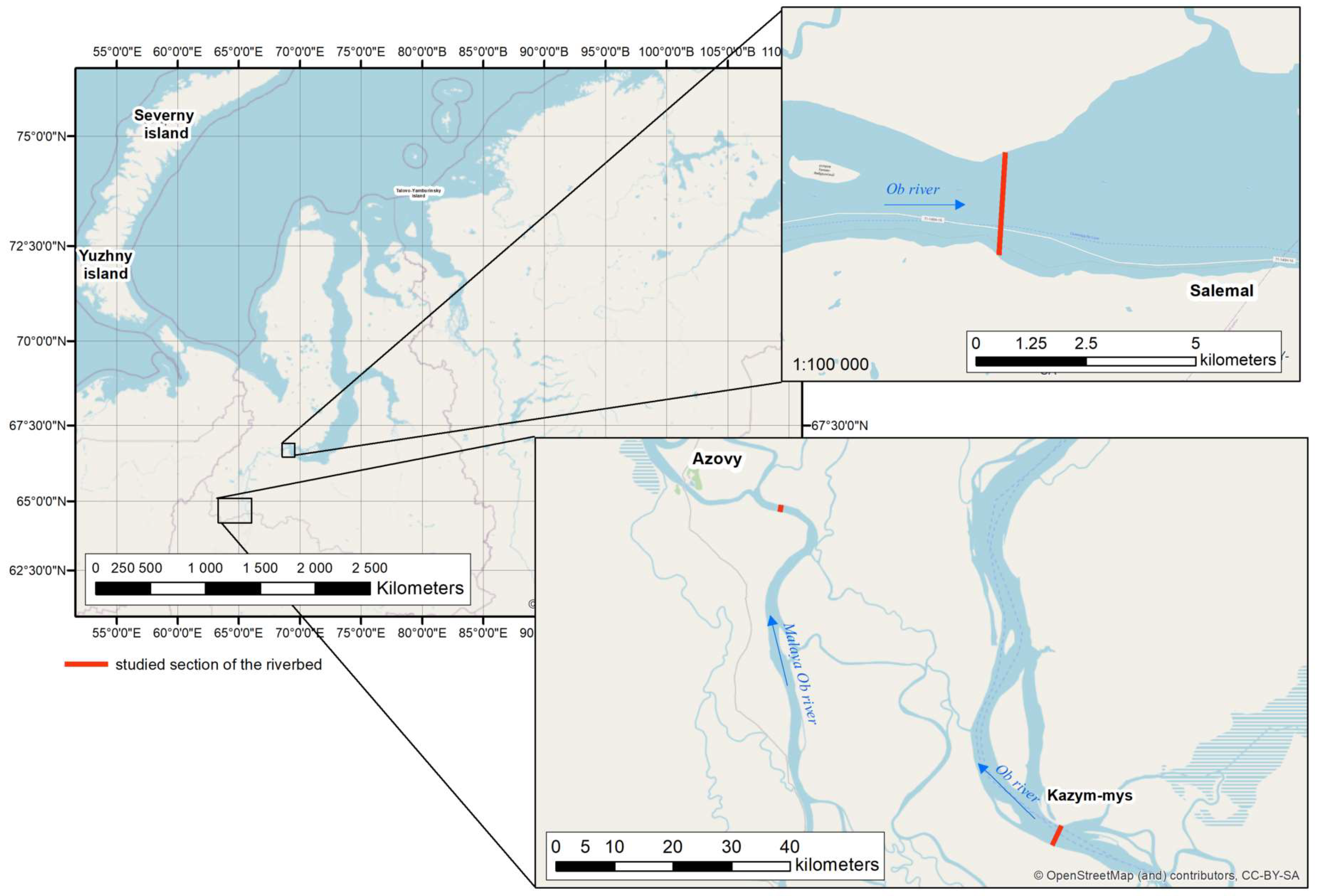
Figure 2.
Ratio of dissolved and suspended forms of elements in the waters of the lower Ob, Salemal section, 2022-2023.
Figure 2.
Ratio of dissolved and suspended forms of elements in the waters of the lower Ob, Salemal section, 2022-2023.
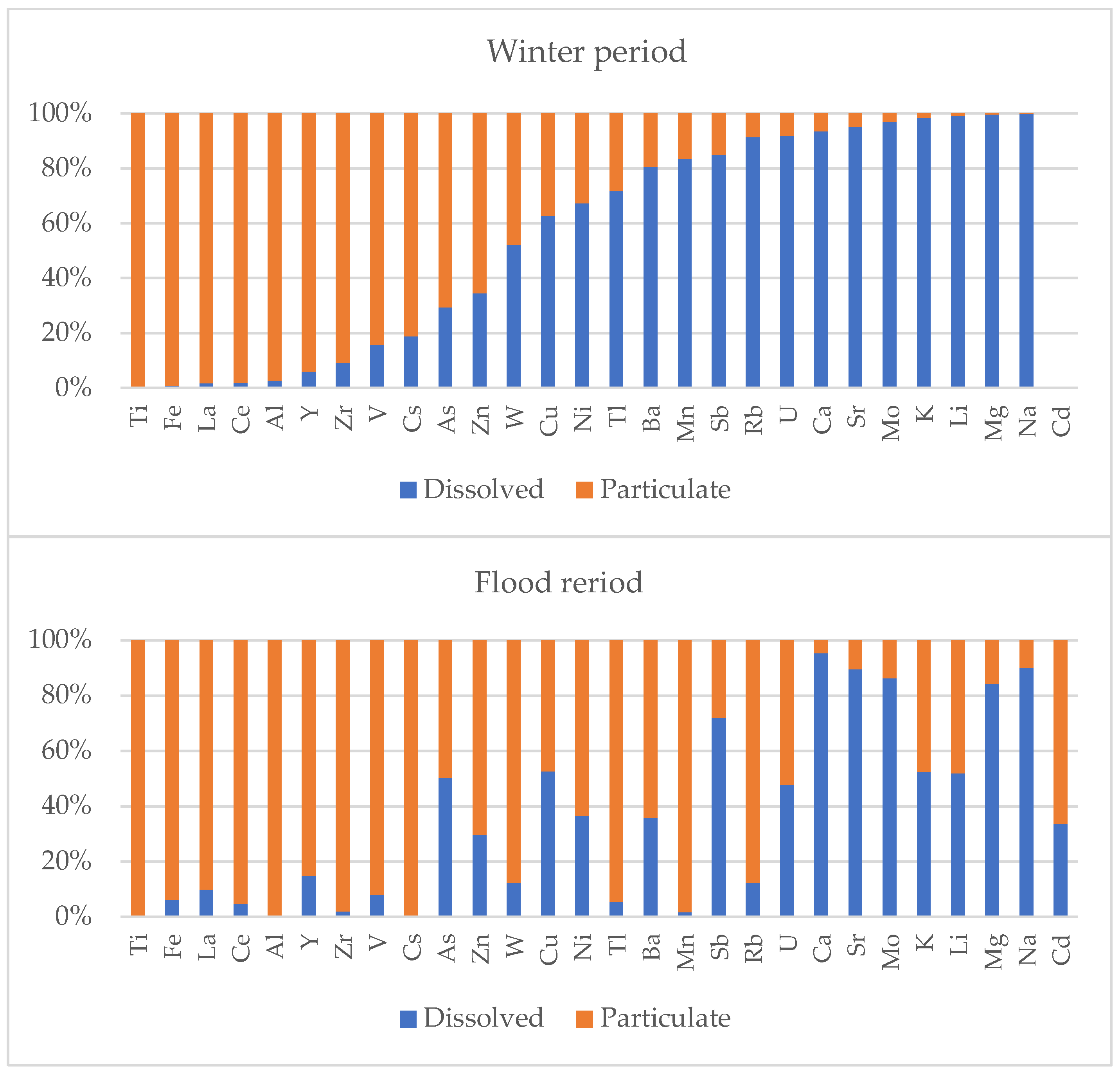
Figure 3.
Enrichment factor (EF) for major and trace elements in SPM of the Ob River. 1-Transition to autumn low flow; 2- Winter low flow; 3 – Flood. .
Figure 3.
Enrichment factor (EF) for major and trace elements in SPM of the Ob River. 1-Transition to autumn low flow; 2- Winter low flow; 3 – Flood. .
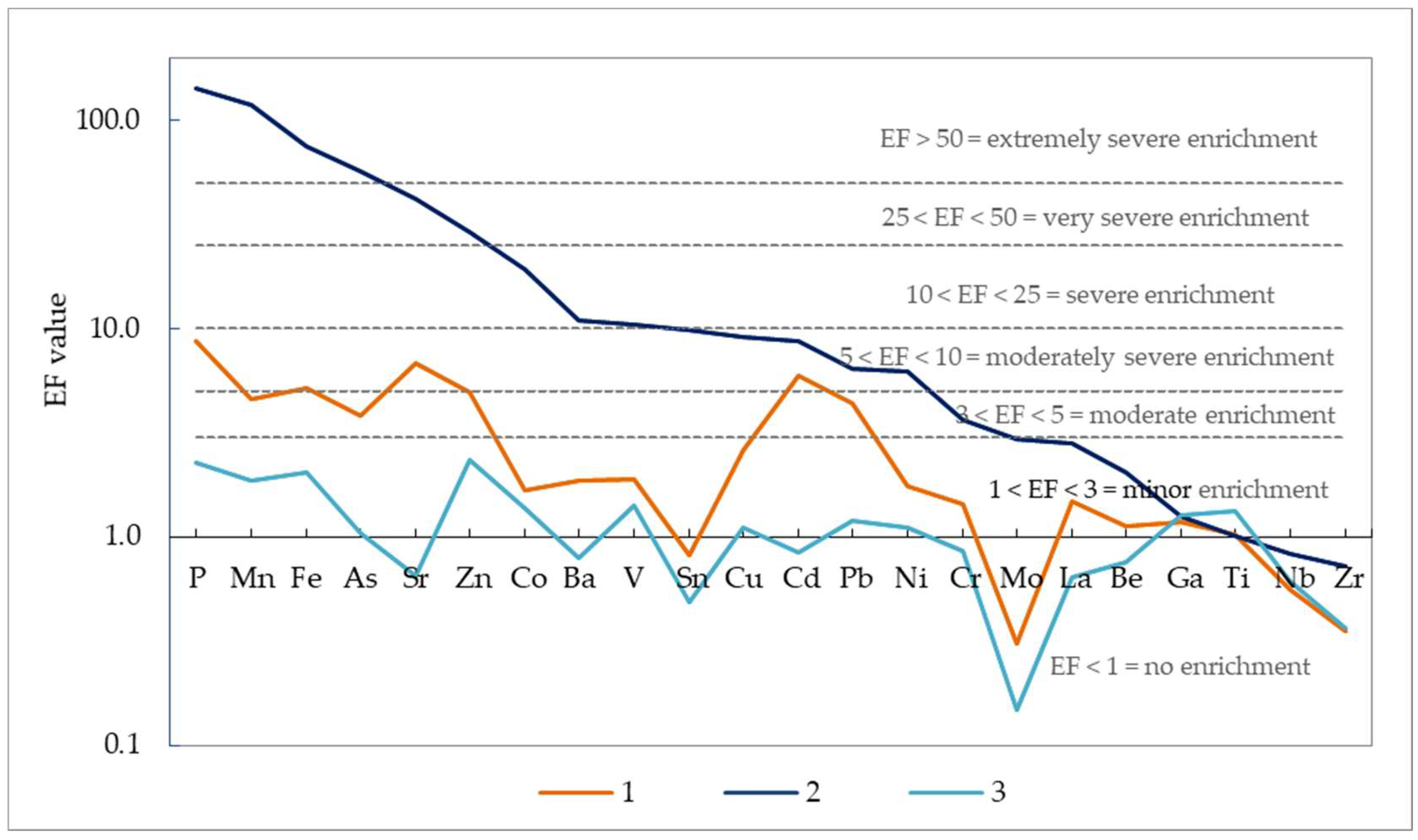
Figure 4.
The Ob River fluxes of dissolved and particulate heavy metals to the Arctic ocean (1 – [58]; 2 – present study).
Figure 4.
The Ob River fluxes of dissolved and particulate heavy metals to the Arctic ocean (1 – [58]; 2 – present study).
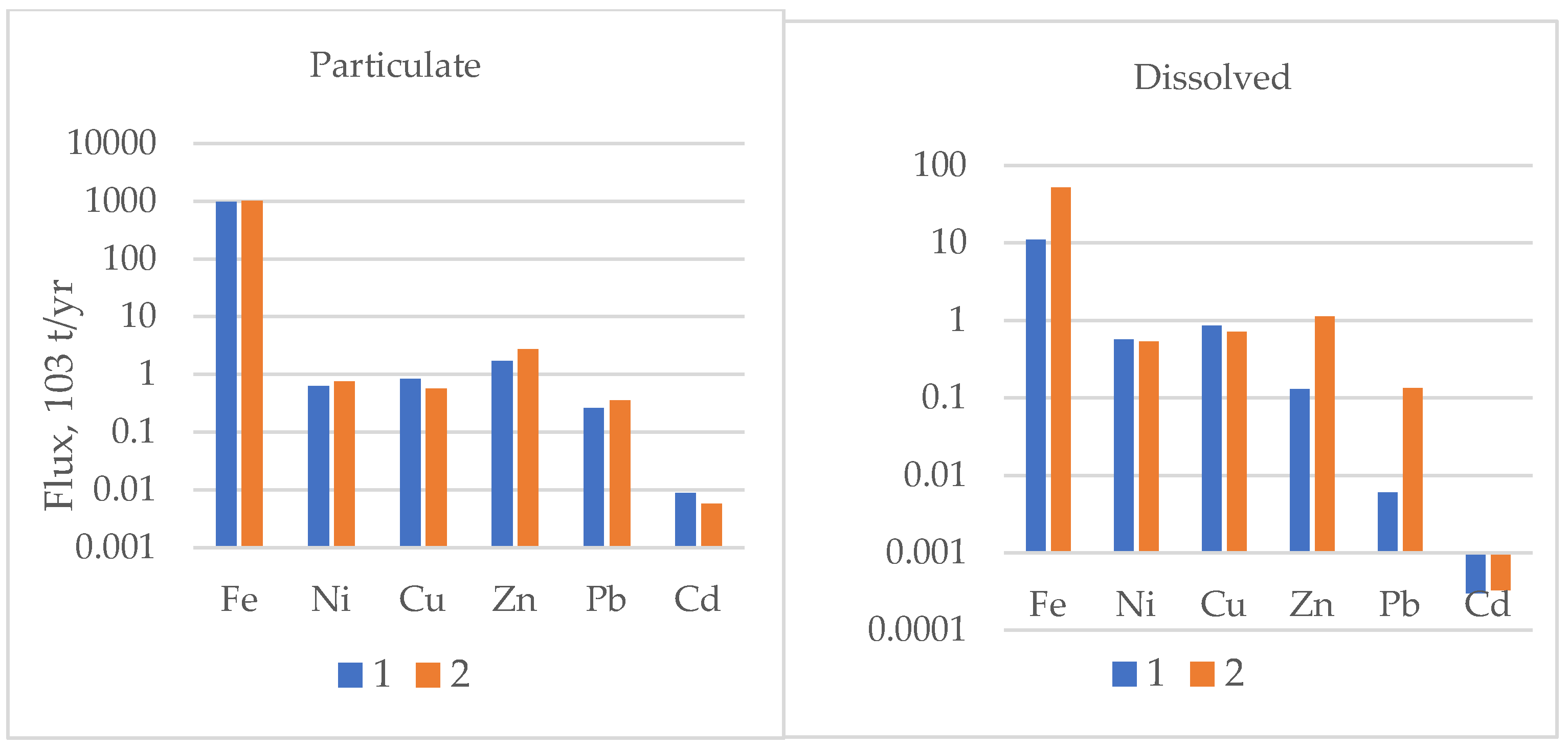

Table 1.
Physico-chemical parameters of the Ob River water.
| Indicator | 2020 | 2022 | 2023 | |||||||
|---|---|---|---|---|---|---|---|---|---|---|
| Transition to autumn low flow | Flooding | Winter low flow | Flooding | |||||||
| S | K | A | S | K | A | S | K | A | S | |
| pH | 8.01 | 7.09 | 7.04 | 7.19 | 7.19 | 6.92 | 7.15 | 7.76 | 7.68 | 7.69 |
| Color index | 87 | 91 | 85 | 83 | 13 | 11 | 14 | 43 | 45 | 44 |
| DO, mg O2 L-1 | 8.7 | 9.2 | 9.7 | 10.3 | 5.5 | 6.2 | 6.7 | 9.7 | 9.8 | 10.7 |
| TDS, mg L-1 | 116.0 | 62.5 | 58.4 | 60.7 | 145 | 151 | 168 | 70.3 | 70.5 | 74.0 |
| TSS, mg L-1 | 21.0 | 58 | 86 | 65 | 29 | 30 | 11 | 69 | 61 | 40.0 |
Notes: S, A, KM - study sites: S -Salemal, A- Azovy, K – Kazym-Mys.
Table 2.
Average element fluxes in the Ob River.
| Elements | Dissolved | Particulate | Total | ||||||||||||
| Summer –autumn, | Spring flood | Winter | Year | Yields, | Summer - autumn,10 3 tons | Spring flood,10 3 tons | Winter,10 3 tons | Year,10 3 tons | Yields,kg km−2 y−1 | Summer - autumn,10 3 tons | Spring flood kg km−2 y−1 | Winter kg km−2 y−1 | Year kg km−2 y−1 | Yields,kg km−2 y−1 | |
| 10 3 tons | kg km−2 y−1 | 10 3 tons | kg km−2 y−1 | 10 3 tons | kg km−2 y−1 | ||||||||||
| B | 1.4 | 4.6 | 2.6 | 8.6 | 2.9 | N/A | N/A | N/A | N/A | 44.7 | 1.4 | 4.6 | 2.6 | 8.6 | 2.9 |
| Na | 442 | 1122 | 1088 | 2652 | 887 | 4.9 | 126 | 3.0 | 134 | 49.4 | 447 | 1248 | 1091 | 2785 | 932 |
| Mg | 304 | 720 | 744 | 1768 | 591 | 9.5 | 135 | 3.5 | 148 | 334.8 | 314 | 855 | 747 | 1916 | 641 |
| Al | 0.8 | 2.9 | 0.2 | 3.9 | 1.3 | 36.5 | 958 | 6.7 | 1001 | N/A | 37 | 961 | 6.8 | 1005 | 336 |
| Si | 156 | 626 | 676 | 1458 | 488 | N/A | N/A | N/A | N/A | 11.8 | N/A | 626 | N/A | 626.0 | 209 |
| P | 1.2 | 4.2 | 0.0 | 5.4 | 1.8 | 3.2 | 21.4 | 10.7 | 35.3 | 5.6 | 4.4 | 26 | 11 | 41 | 13.6 |
| S | 145 | 571 | 376 | 1091 | 365 | 2.2 | 9.4 | 5.3 | 16.8 | 72.4 | 147 | 580 | 381 | 1108 | 371 |
| K | 58 | 229 | 109 | 396 | 132 | 7.1 | 208 | 1.8 | 216 | 176 | 65 | 437 | 110 | 612 | 205 |
| Ca | 955 | 2862 | 2910 | 6727 | 2250 | 188 | 138 | 201 | 527 | 22.9 | 1143 | 3000 | 3111 | 7254 | 2426 |
| Ti | 0.02 | 0.11 | N/A | 0.13 | 0.043 | 2.0 | 66.1 | 0.4 | 68.4 | 0.66 | 2.0 | 66.2 | 0.40 | 68.5 | 23.0 |
| V | 0.05 | 0.16 | 0.02 | 0.22 | 0.075 | 0.09 | 1.79 | 0.10 | 1.98 | 0.47 | 0.14 | 1.9 | 0.12 | 2.2 | 0.74 |
| Cr | N/A | N/A | N/A | N/A | N/A | 0.08 | 1.28 | 0.04 | 1.39 | 11.0 | 0.09 | 1.28 | 0.04 | 1.39 | 0.47 |
| Mn | 0.03 | 0.36 | 50 | 51 | 17.0 | 2.0 | 20.9 | 10.1 | 33.0 | 339 | 2.1 | 21 | 60 | 84 | 28.0 |
| Fe | 1.0 | 49 | 1.3 | 52 | 17.3 | 70 | 743 | 201 | 1014 | 0.10 | 71 | 792 | 203 | 1066 | 356 |
| Co | 0.002 | N/A | 0.042 | 0.044 | 0.015 | 0.01 | 0.27 | 0.03 | 0.31 | 0.25 | 0.015 | 0.27 | 0.068 | 0.31 | 0.10 |
| Ni | 0.082 | 0.40 | 0.06 | 0.54 | 0.18 | 0.04 | 0.69 | 0.03 | 0.76 | 0.19 | 0.12 | 1.1 | 0.08 | 1.3 | 0.43 |
| Cu | 0.11 | 0.55 | 0.05 | 0.71 | 0.24 | 0.04 | 0.49 | 0.03 | 0.56 | 0.90 | 0.15 | 1.0 | 0.08 | 1.3 | 0.43 |
| Zn | 0.038 | 0.96 | 0.12 | 1.1 | 0.38 | 0.19 | 2.28 | 0.23 | 2.70 | 0.10 | 0.23 | 3.2 | 0.4 | 3.8 | 1.3 |
| As | 0.068 | 0.19 | 0.03 | 0.29 | 0.10 | 0.03 | 0.19 | 0.08 | 0.29 | 1.3 | 0.09 | 0.38 | 0.11 | 0.58 | 0.2 |
| Sr | 6.3 | 18 | 18 | 42 | 14.2 | 0.85 | 2.12 | 0.96 | 3.93 | 2.6 | 7.2 | 20 | 19 | 46 | 15.5 |
| Ba | 0.8 | 3.7 | 2.7 | 7.2 | 2.4 | 0.57 | 6.61 | 0.64 | 7.82 | 0.12 | 1.4 | 10 | 3.3 | 15 | 5.0 |
| Pb | 0.072 | 0.062 | N/A | 0.133 | 0.04 | 0.04 | 0.30 | 0.01 | 0.35 | 0.15 | 0.11 | 0.36 | N/A | 0.49 | 0.19 |
| Li | 0.17 | 0.45 | 0.36 | 0.982 | 0.33 | 0.02 | 0.42 | 0.003 | 0.44 | 0.43 | 0.19 | 0.87 | 0.37 | 1.42 | 0.48 |
| Rb | 0.05 | 0.17 | 0.08 | 0.304 | 0.10 | 0.04 | 1.24 | 0.01 | 1.29 | 117 | 0.09 | 1.41 | 0.09 | 1.59 | 0.53 |
| tons | g km−2 y−1 | tons | g km−2 y−1 | tons | g km−2 y−1 | ||||||||||
| Y | 1.1 | 54.5 | 0.7 | 56.3 | 18.8 | 24.2 | 314 | 11.3 | 349 | 566 | 25 | 368 | 12 | 405 | 0.14 |
| Zr | 3.8 | 31.7 | 2.1 | 37.5 | 12.6 | 53.6 | 1618 | 20.5 | 1692 | 4.0 | 57 | 1650 | 23 | 1730 | 0.58 |
| Mo | 24.5 | 62.1 | 40.4 | 127.0 | 42.5 | 0.7 | 9.9 | 1.4 | 12 | 1.9 | 25 | 72 | 42 | 139 | 0.046 |
| Cd | 1.1 | 2.2 | N/A | 3.3 | 1.1 | 1.0 | 4.4 | 0.3 | 5.8 | 11 | 2.1 | 6.7 | 0.3 | 9.1 | 0.003 |
| Sb | 12.0 | 71.9 | 18.9 | 102.9 | 34.4 | 2.8 | 27.9 | 3.4 | 34.1 | 23 | 15 | 100 | 22 | 137 | 0.046 |
| Cs | 0.1 | 0.4 | 0.1 | 0.6 | 0.2 | 2.6 | 66.4 | 0.5 | 69.5 | 107 | 2.7 | 67 | 0.6 | 70 | 0.023 |
| La | 0.5 | 31.2 | 0.2 | 31.9 | 10.7 | 26.0 | 285 | 9.6 | 321.1 | 334 | 27 | 317 | 10 | 353 | 0.12 |
| Ce | 0.8 | 46.3 | 0.4 | 47.5 | 15.9 | 50.1 | 929 | 19.3 | 998 | 142 | 51 | 975 | 20 | 1045 | 0.35 |
| Nd | 0.4 | 37.8 | 0.3 | 38.5 | 12.9 | 25.5 | 391 | 9.4 | 426 | 30 | 26 | 429 | 10 | 464 | 0.16 |
| Sm | 0.1 | 8.9 | 0.1 | 9.1 | 3.0 | 5.6 | 82.5 | 2.2 | 90.2 | 25 | 5.7 | 91 | 2.3 | 99 | 0.033 |
| Gd | 0.1 | 10.3 | 0.2 | 10.6 | 3.5 | 5.3 | 66.6 | 2.2 | 74.1 | 20 | 5.4 | 77 | 2.3 | 85 | 0.028 |
| Dy | 0.1 | 9.0 | 0.2 | 9.3 | 3.1 | 4.3 | 54.8 | 1.8 | 60.9 | 11 | 4.5 | 64 | 2.0 | 70 | 0.023 |
| Er | 0.1 | 5.5 | 0.1 | 5.8 | 1.9 | 2.4 | 30.0 | 1.1 | 33.4 | 7.5 | 2.6 | 35 | 1.2 | 39 | 0.013 |
| W | 3.7 | 2.9 | 0.9 | 7.4 | 2.5 | 1.0 | 20.7 | 0.8 | 22.5 | 2.1 | 4.7 | 24 | 1.7 | 30 | 0.010 |
| Tl | 0.07 | 0.3 | 0.12 | 0.5 | 0.18 | 0.20 | 5.9 | 0.0 | 6.2 | 1.9 | 0.3 | 6.3 | 0.2 | 6.7 | 0.002 |
| Bi | 0.06 | 0.9 | N/A | 1.0 | 0.33 | 0.9 | 4.7 | 0.13 | 5.7 | 41.1 | 0.9 | 5.6 | 0.13 | 6.7 | 0.002 |
| Th | 0.11 | 4.3 | N/A | 4.5 | 1.5 | 5.5 | 116 | 1.6 | 123 | 12.3 | 5.6 | 120 | 1.6 | 127 | 0.043 |
| U | 17.3 | 28.0 | 49.8 | 95.1 | 31.8 | 1.6 | 30.7 | 4.4 | 36.7 | 44.7 | 19 | 59 | 54 | 132 | 0.044 |
Table 3.
Export fluxes of dissolved trace elements to the Arctic ocean by the Ob River and tributaries, kg km2 yr-1.
Table 3.
Export fluxes of dissolved trace elements to the Arctic ocean by the Ob River and tributaries, kg km2 yr-1.
| Elements | Data source and water body | ||
| Gordeev et al. (2024), Ob River [3] | Ob River tributaries [20] | 3 – present study, Ob River | |
| B | 2.5 | 4.3 | 2.88 |
| Al | 1.0 | 8.5 | 1.31 |
| Ti | 0.032 | 0.2 | 0.04 |
| V | 0.065 | 0.12 | 0.08 |
| Mn | 7.4 | 49 | 17.0 |
| Fe | 10.9 | 211 | 17.3 |
| Co | 0.019 | 0.17 | 0.015 |
| Ni | 0.15 | 0.26 | 0.18 |
| Cu | 0.20 | 0.12 | 0.24 |
| Zn | 0.175 | 4.2 | 0.38 |
| As | 0.1 | 0.19 | 0.10 |
| Sr | 12.2 | 14 | 14.2 |
| Rb | 0.056 | 0.14 | 0.10 |
| Y | 0.0084 | 0.019 | |
| Zr | 0.0096 | 0.033 | 0.013 |
Disclaimer/Publisher’s Note: The statements, opinions and data contained in all publications are solely those of the individual author(s) and contributor(s) and not of MDPI and/or the editor(s). MDPI and/or the editor(s) disclaim responsibility for any injury to people or property resulting from any ideas, methods, instructions or products referred to in the content. |
© 2024 by the authors. Licensee MDPI, Basel, Switzerland. This article is an open access article distributed under the terms and conditions of the Creative Commons Attribution (CC BY) license (http://creativecommons.org/licenses/by/4.0/).
Copyright: This open access article is published under a Creative Commons CC BY 4.0 license, which permit the free download, distribution, and reuse, provided that the author and preprint are cited in any reuse.


