
Submitted:
25 May 2024
Posted:
27 May 2024
You are already at the latest version
Abstract
Civic participation is of great significance to urban management decision-making. In order to facilitate citizens to participate in city management decision-making, this paper proposes a large-scale group decision-making (LSGDM) method based on multi-granular probabilistic linguistic preference relations (MG-PLPRs). First, each decision maker selects a language terms set from the multi-granularity language terms set to represent individual preference relations and the MG-PLPRs are obtained by statistical calculation to represent sub-group’s preferences information. Then, an optimization model based on the expected consistency of PLPR and consensus measure of groups is established to achieving consensus reaching processes, which can ensure satisfactory individual consistency and group consensus. Finally, the validity and applicability of the proposed method is verified by a case of a city "shared garden" site selection with the participation of citizens.
Keywords:
Large-scale group decision-making
; Public participation
; Multi-granular probabilistic linguistic preference relations
; Consensus reaching process
1. Introduction
Urban development and management cannot be separated from the participation of the masses. The people often have a unique insight into urban development and have a more personal experience. The opinions and suggestions of the people are the reference basis for decision-making. Previous studies have suggested that public projects should consider public participation, especially those that directly serve the public, such as education, health care, transportation, etc. [1,2]. Thomas [3] believed that the information transmitted by the participation of citizens or citizen groups is more practical for the decision-making of public projects, conducive to improving the quality of decision-making. As a consequence, the formulation and implementation of public project plans need the participation and interaction of stakeholders, especially the feedback of stakeholders on decision-making, which is an important condition for the effective promotion of public projects [4]. The decision-making of public participation can be regarded as the large-scale group decision-making (LSGDM) problems [5,6]. A number of LSGDM methods have been proposed and applied in various fields, for example mobile health applications app selection [7], water resource management [8], healthcare construction projects [9], etc. Existing related studies have made significant contributions to LGDM researches. However, in the existing studies, LSGDM method is rarely applied in people’s livelihood decision-making, which ignores the importance of public participation in decision-making in urban development and in-depth analysis of group heterogeneity. Consequently, this study establishes a LSGDM method with public participation.
Although the existing studies of LSGDM are very useful, there are still some problems that need to be addressed in solving practical decision problems.
- (1)
- The existing research on LSGDM rarely considers the large-scale contexts in which hundreds or thousands of decision-makers (DMs).
Previous studies consider just 20–50 DMs, whereas nowadays real-world decision situations may require much bigger groups (e.g., hundreds or thousands of DMs) [10]. Thus, in order to solve real-world problems, LSGDM methods that allow a large number of DMs to participate should be established. The first key question is what representation tools are available to a large number of DMs. In the existing LSGDM models, DMs use essentially three types of information to represent their preferences, namely, numeric, linguistic and heterogeneous [10]. For complex LSGDM problems, a large number of DMs are not convenient to provide accurate numerical evaluation information, and they prefer to provide verbal information (e.g., linguistic term sets) in line with human expression habits [11]. Considering the diversity and heterogeneity of the experience and knowledge of a large number of DMs, the use of multi-granular linguistic information is recommended [12,13,14,15,16]. Therefore, the solution to the first question is to provide the DMs with multiple granularity linguistic term sets.
On the other hand, most of the previous studies were based on the preference relations provided by DMs. However, for thousands of DMs, this method is very cumbersome and greatly reduces its feasibility in practical problems. What is more important, for a large number of DMs (such as city dwellers), or even thousands of decision makers, using PLPRs [17] is more feasible and manipulative. Thanks to PLPR, it can be used to characterize the preference relations of groups or subgroups [18]. Specifically, each decision maker gives the preference of pair comparison, and then obtains PLPR through statistical calculation to characterize the preference relationship of subgroups to alternatives. In contrast to the cluster analysis that has been studied, statistical calculation is more feasible for thousands of decision makers. Therefore, the multi-granularity probabilistic linguistic preference relations (MG-PLPRs) are used to represent the preference relations of various subgroups in this paper.
(2) From the perspective of preference information loss, there is currently no LSGDM framework specifically targeting consensus reaching process (CRP) in the context of multi-granular linguistic information.
CRP is an important issue that is widely considered in LSGDM problems, because some real-world situations require agreement among a large number of DMs. Previous studies have shown that feedback mechanism is effective in improving group consensus for a small number of participants [19,20,21,22]. In recent years, a large body of literature in decision-making research focuses on CRP of LSGDM problems. Rodríguez et al. [23] established a new cohesion measure for hesitant fuzzy linguistic term set (HFLTS) to measure the experts’ sub-group cohesiveness, based on which, a new cohesion-driven CRP approach to deal with LSGDM based on HFLTS. Gou et al. [24] developed a consensus reaching process with LSGDM based on double hierarchy hesitant fuzzy linguistic preference relations. Wan et al. [25] developed a personalized individual semantic based CRP with PLPRs in LSGDM and several minimum preference adjustment models were established to carry out CRP. Gai et al. [26] proposed a decentralized feedback based CRP with limited compromise behavior considering subgroups. Zhou et al. [27] proposed a three-level recognition and adjustment mechanism based on distribution linguistic preference relation. The trust relationship, consensus degree and reliability of individual judgment are dealt with comprehensively to narrow the differences of opinions. The most relevant literature in this study is the CRP studies in LSGDM based on multi-granularity linguistic information. Song and Li [28] constructed a automatic iteration CRP with MG-PLPRs. Liu et al. [29] proposed a two-stage CRP in LSGDM with MG-PLPRs, including both within-cluster and across-cluster CRP.
Depending on the implementation of different consensus rules, CRP models can be divided into two types, i.e., identification-direction consensus rules and optimization-based CRP models [30]. Despite the classical consensus model in which the facilitator assumes control of the CRP and provides advice to DMs [31,32], both facilitator and feedback mechanisms are obsolete in environments involving hundreds or thousands of DMs because they are too time-consuming and not feasible in practice. Therefore, in the context of LSGDM, the classical consensus model as an iterative discussion process should be replaced by automated algorithms that do not involve discussion rounds, moderators, or approval of DMs to change their opinions [10]. Considering the preference losses and consensus costs, automatic-optimization models [33,34,35] are presented to improve the consensus reaching efficiency. Moreover, Zhang et al. [36] conducted a comprehensive comparative study of existing consensus reaching models, showing that optimization-based CRP lead to less loss of preference information. Based on which, we establish an automatic-optimization model to carry out CRP in this study.
Based on the above inspirations, this study constructs a LSGDM method based on multi-granularity probabilistic linguistic preference relations to study the decision-making issues of people’s livelihood such as the formulation and implementation of public projects with public participation. First, each DM provides their opinions through the multi-granularity linguistic preference relations, and the subgroup’s preferences information based on the MG-PLPRs are obtained through statistical calculation. Then, we build an optimization model-based CRP with MG-PLPRs. Finally, a city “shared garden” location problem is solved based on our method, which further verifies the practicability of the established LSGDM method based on MG-PLPRs.
The rest of this paper is organized as follows. Section 2 reviews some basic knowledge about multi-granular linguistic information, LPR and PLPR. In Section 3, a LSGDM method with public participation based on MG-PLPRs is presented. In Section 4, a case study of urban management is solved and the method of this paper is compared with the previous studies. The concluding remarks are contained in section 5.
2. Preliminaries
In this section, multi-granular linguistic information, LPR and PLPR are reviewed.
2.1. Representation Model for Language and Multi-Granular Linguistic Information
2.1.1. Representation Model for Language
The set of widely used language terms has the following characteristics :1) the granularity of odd values; 2) membership functions are symmetrical and evenly distributed; 3) the median value of the language term set is “no difference”, and the remaining language terms are placed symmetrically and evenly on both sides of it. Let be a linguistic term set with odd granularity. Moreover, the term set should satisfy the following features [37]: 1) A negation operator: ; 2)An order: if .
In order to retain all the given information, Xu [38] further extended the discrete language item set to a continuous language item set as follows:
where is a sufficiently large positive integer. Besides, the operational laws for as follows:
Moreover, a subscript functionand its inverse function are defined as follows:
2.1.2. Multi-Granularity Language Representation Model
When a large number of decision makers participate in the decision-making process, decision makers show heterogeneity. In order to better facilitate the representation of preference information by heterogeneous decision makers, multi-granularity language term sets are used to provide their preference expression for alternatives. If the decision maker has the ability to provide precise information, he/she may use a more fine-grained set of language terms. Instead, decision makers may use a coarse-grained set of language terms [39,40]. For example be multi-granular linguistic term sets, where, is a linguistic term set with a granularity of .
2.2. Preference Relations: LPR and PLPR and Their Definitions of Consistency
Definition 1 [41]. is called an LPR if the following conditions hold
where is a given linguistic scale set and indicates the preference degree for the alternativeover. If indicates that is preferred to; otherwise, vice versa. Specially, indicates indifference betweenand.
Moreover, Jin et al. [41] proposed the definition of additive consistent of LPR as follows:
Definition 2. For an LPR , there exists a weight vector
with and satisfies the following equation,
then could be defined an additive consistent LPR.
PLPR was first proposed by Zhang et al. [42], as follows:
Definition 3. Let PLPR be represented by a matrix . are PLTSs based on the given linguistic scale set, where, and is the number of linguistic terms in . is expressed as the preference degrees of the alternative over and satisfies the following conditions:
where and are the linguistic term and the occurrence probability of the linguistic term in, respectively.
Remark 1: PLTS would be used to represent a group’s language assessment. Suppose the risk assessment of an investment project is assessed by five decision makers using a set of language terms. If the assessment results of the five decision makers are, then the group evaluation result can be expressed as a PLTS.
Definition 4 [18]. Letbe a PLTS, its expected value can be defined as follows:
whereis the number of possible elements in.
Based on the additive consistency of LPR, the expected additive consistency of PLPR is presented as follows:
Definition 5. Let be a PLPR for alternative based on the given linguistic term set, where is a PLTS expressed as the preference degrees of alternative over , then is the expected additive consistency if , which can be expressed as follows:
where and is the number of possible linguistic terms in.
3. LSGDM with Public Participation Based on MG-PLPRs
In this section, a LSGDM method with public participation based on MG-PLPRs is presented. First, the expected additive consistency of PLPR is introduced. Then, the weight vectors of alternatives from sub-groups are aggregated by means of weighted averaging (WA) operator to obtain collective priority weight vector and then group consensus degree is constructed. An optimized model-based CRP is established. Finally, a step by step procedure of the LSGDM with MG-PLPRs is presented.
In this paper, a LGDM method based on MG-PLPRs could be handled where DMs would give preference relationship to alternatives by means of multi-granular linguistic term sets. Let and be initial PLPRs and the adjusted PLPRs, respectively. Besides, let be the priority weights of alternativesbased on the adjusted PLPRsandbe the final priority weights of alternatives.
3.1. Consistency of PLPR
Assume that a PLPR is given based on the multi-granular linguistic term set. Then, based on the definition 5 given in Section 2, we can get the following equivalence relation
In GDM, the distance function is usually used to measure the information deviation between opinions. Euclidean distance and Manhattan distance are the most widely used and are the basis for many distance functions. In most consensus models [36], the Manhattan distance is widely used to measure information bias between preference relationships, so we also used the same distance measure in this study.
According to the Eq. (10), consistency level (CI) of PLPR is proposed as following
The larger the value of, the more consistent PLPR. Based on the Equation (11), the PLPR is perfectly consistent when. However, in the actual decision-making process, the PLPR provided by the decision maker is difficult to be completely consistent. So, a consistency threshold, denoted by, needs to be set at the beginning of the decision-making.
3.2. Determination of Subgroup Weight
In this paper, depending on the granularity of the linguistic term set used by the decision maker, it is automatically divided into different subgroups. That is, decision makers who use the same granular linguistic term set are grouped into a subgroup.
The importance of public involved in decision-making can be divided into two categories: equal importance and different equal importance. In the case of unequal weight of decision makers, it can be weighted according to factors such as the prestige, experience and position of decision makers, that is, those who have rich experience, high prestige and high position should have high weight. Below, we give a rule for determining the weight of subgroups as follows.
(1) It is assumed that decision makers have the same importance, in which case the weight of the subgroup from DMs who put to use the linguistic term set is
(2) Let’s say there aredecision makers with different levels of importance. Letrepresent the personal importance of the DMs, where, and. Then, the weight of the subgroup from DMs who use the linguistic term set is
Example 1. Suppose there are 100 members of the public participating in a LSGDM problem, of which 20, 50, and 30 use linguistic term set respectively to represent the evaluation information. Then, the sub-group’s PLPRs are obtained as and the weights of are 0.2, 0.5 and 0.3, respectively.
3.3. Group Consensus Degree
In GDM, collective preferences are obtained by fusing individual preferences with aggregation operators [43]. In this paper, weighted average (WA) operator is used to aggregate weight vectors of subgroups. Let be the weight vector of sub-group. Thus, the final collective weights of alternatives are obtained by the following WA operator:
According to the expected multiplicative consistency of PLPR (i.e., Eq. (9)), the following equivalence relation holds
Based on the Manhattan distance, the group consensus degree () is computed by
Moreover, the Eq. (16) can be converted to Eq. (17) according to Eq. (15)
The larger the, the higher the consensus level. In practice, a complete consensus is hard to come by. To deal with this issue, soft consensus [44] was used. A consensus threshold is given up front. If , the group consensus degree is acceptable.
3.4. An optimization Model-Based CRP with MG-PLPRs
In order to preserve the original preferences as much as possible during the process of reaching consensus, we want to minimize the adjustment distance between the initial opinion of the decision maker and the adjusted individual opinion. In order to minimize the gap before and after adjustment, the optimization model is as follows:
In model (18), the objective function minimizes the distance between the initial preference matrix and the modified preference matrix. The collective priority weight values of alternatives can be obtained by means of constraint (18-1). Constraints (18-3) and (18-4) guarantee that the individual consistency level and group consensus level are acceptable, respectively. Here,, , and are decision variables. Further, the above model can be represented as follows
In order to facilitate the solution of Model (19), we convert Model (19) into the following optimization model
Theorem 1. By introducing a set of variables , where,,, and , then Model (19) can be equivalent transformed into the following model:
Proof: Constraints and guarantee that. It is easy to see from the objective function that any feasible solution from constraint is not optimal. Thus, we have. Two constraints and guarantee that the inequality is true. Moreover, two constraints and ensure that is true. Therefore, the following inequality holds .
Therefore, Theorem 1 is proved.
3.5. A step by Step Procedure of the LSGDM with Public Participation Based on MG-PLPRs
The LSGDM method for public participation proposed in this paper is shown in Figure 1, and the specific steps are as follows:
Step 1: On the basis of a given set of multi-granular linguistic term set, each participant, based on their own experience and professional knowledge, gives the preference relationship of alternative solutions through pin-to-pair comparison, and obtains the preference information of subgroups through statistical calculation of the preferences of participants at each granularity, i.e., the PLPRs .
Step 2: Automatic-optimization CRP process and obtain final collective priority weight vector of alternatives.
Step 3: Sort the alternatives in descending order based on the final collective priority weight vector.
Step 4: End.
4. Case studies and Comparative Analysis
This section takes urban management decision-making as an example to verify the feasibility of the model proposed in this paper, and makes a comparative analysis with relevant literature.
4.1. The siting of “Shared garden”
The masses are not only participants in urban management, but also direct beneficiaries. Only by constantly paying attention to online public opinion and carefully listening to the people’s insights on urban management can we build and manage cities well. A city prepares to build a “Shared garden”. The starting point of “Shared garden” is to give the choice to the people, and the people build the city. Citizens recommend their favorite plots, decide the design direction, participate in the construction of green space, and maintain and update the green space according to their own ideas. Let the construction of green space better meet the needs of citizens, let the shared garden become a carrier to enhance neighborhood relations, communicate and solve problems, and enjoy a happy life.
The Municipal Housing and Construction Bureau organizes an expert group to conduct field visits and four alternative addresses are recommended for the public to choose from.
Step 1: Identify a representative participating public and get information about the public’s preferences
Each sub-district office announced the announcement of voluntary participation in the shared garden site selection in the community owner group, and finally selected 100 representative owners through selection. Alternative preference information is obtained from 100 participants by means of a questionnaire. Each participant provides her/his preference information over each pair of alternatives based on a paired comparison technology. Through statistical calculations, there are 20, 50, and 30 people who used respectively to characterize preference information. Then, the sub-group PLPRs of alternatives with multi-granularity linguistic term sets are obtained and shown in Table 1, Table 2 and Table 3, respectively. We assume that the participants involved in the decision are of equal importance, and according to the rule for determining the weights of the subgroups (i.e., Eq. (12)), the three subgroups correspond to multi-granularity linguistic term sets are, respectively.
Step 2: Implement the group consensus process
Based on the PLPRs of sub-groups from Table 1, Table 2 and Table 3, we build the optimization model according to Eq. (20) and then obtain the final priority weight values of alternatives by mean of MATLAB tool as follows:
Step 3: Ranking of alternate addresses
According to the final priority weight values of alternatives, the order of alternatives is obtained as. Therefore, alternative is the best location.
4.2. Comparative Analysis
(1) Compared with the methods based on Operator
Below, we use the traditional processing methods based on ELH method [45] and DAWA operators [46] to process the case problem from Section 4.1 as follows:
Step 1: the ELH approach is used to unify multi-granular linguistic information.
Step 2: The collective preference matrix is obtained by DAWA operator based on and then the expectation of collective decision matrix is obtained based on the Definition 5 [47], which is presented in Table 4.
Step 3: Computation of preference degree based on and ranking of alternative.
Step 4: Based on the Eq. (19), we get the preference degree of the four schemes:, , , and . Therefore, the ranking of alternatives is .
(2) Compared with the related CRP method [28]
Song and Li [28] proposed an automatic iteration-based CRP method with MG-PLPRs. Then the CRP method is applied to the above case and the ranking of alternatives is derived as. In addition, it can be seen that the above research is the same as the alternative scheme ranking obtained by the method in this paper, which further verifies the effectiveness of the method in this paper.
The differences between the method proposed in this paper and the above two related methods are summarized in Table 5. On the one hand, our method does not need uniform language granularity to deal with MG-PLPRs, which not only greatly reduces the computation amount, but also reduces the information loss as much as possible. On the other hand, our approach provides a fast, low-cost way to implement CRP for MG-PLPRs. Therefore, compared with the above two related studies, our proposed method is more scientific and reliable.
5. Conclusions
In this paper, a mathematical programming-based CRP mechanism with MG-PLPRs is proposed. An automatic-optimization model is presented to manage MG-PLPRs ensures satisfactory levels of both individual consistency and group consensus, which improves the consensus reaching efficiency and reduce the preference losses and consensus costs. Based on which, a city management decision-making problem with citizen participation is solved to demonstrate the effectiveness of the proposed method. The novel features of our approach are as follows.
·We propose a LSGDM method with public participation, which allows hundreds or thousands of DMs to participate, and is practical in practical applications.
·An optimization-based CRP with MG-PLPRs in LGDM problem is proposed, , which does not need to carry out uniform granularity processing on MG-PLPRs, and can directly obtain the priority weight vector of alternative schemes while ensuring satisfactory level of personality consistency and group consensus, which not only avoids information loss but also reduces computational complexity.
·A city “shared garden” site selection is solved through the LSGDM method of public participation established in this paper. 100 representative owners participated in the decision-making process, and the final site selection meets the views of the majority of the public and has good applicability.
In future, it is also interesting to analyze LSGDM problems based on MG-PLPRs with multi-granular unbalanced linguistic terms and the application of this research method to other decisions involving public participation.
Author Contributions
The ideas and conceptual models of this paper were proposed by X.N., and the data calculations and paper writing were carried out by Y.S. and Z.X. All authors have read and agreed to the published version of the manuscript.
Funding
This research was supported by the Social Science Foundation of Shandong Province under grant no. 22DGLJ23 and the Youth Innovation Team Plan for Institutions of Higher Learning in Shandong Province, China under grant no. 2022RW051.
Data Availability Statement
Data is contained within the article.
Conflicts of Interest
The authors declare no conflict of interest.
References
- Brombal D, Moriggi A, Marcomini A (2017) Evaluating public participation in Chinese EIA. An integrated Public Participation Index and its application to the case of the New Beijing Airport. Environmental Impact Assessment Review 62:49–60. [CrossRef]
- Liang H, Ren J, Lin R, Liu Y (2019) Alternative-fuel based vehicles for sustainable transportation: A fuzzy group decision supporting framework for sustainability prioritization. Technological Forecasting and Social Change140(3):33–43. [CrossRef]
- Thomas J (1995) Public participation in public decisions. Gov. Fin. Rev. 35(4): 689–694. [CrossRef]
- Tse H, Lam C, Gu J, Lin X (2018) Examining the interpersonal process and consequence of leader–member exchange comparison: The role of procedural justice climate. Journal of Organizational Behavior 39(8):922–940. [CrossRef]
- Mardani A, Zavadskas EK, Fujita H, Köppen M (2022) Big data-driven large-scale group decision-making under uncertainty (BiGDM-U). Applied Intelligence 52:13341–13344. [CrossRef]
- Li GX, Kou G, Peng Y (2022) Heterogeneous large-scale group decision making using fuzzy cluster analysis and its application to emergency response plan selection. IEEE Transactions on Systems, Man, and Cybernetics: Systems 52(6):3391–3403. [CrossRef]
- Zhang X, Meng F (2022) A large-scale group decision making method to select the ideal mobile health application for the hospital. Applied Intelligence 52:15844–15864. [CrossRef]
- Zhang HJ, Xiao J, Palomares I, Liang HM, Dong YC (2020) Linguistic distribution-based optimization approach for large-scale GDM with comparative linguistic information: An application on the selection of wastewater disinfection technology. IEEE Trans. Fuzzy Systems 28(2):376–389. [CrossRef]
- Mahmoudi A, Abbasi M, Yuan J, Li L (2022) Large-scale group decision-making (LSGDM) for performance measurement of healthcare construction projects: Ordinal Priority Approach. Applied Intelligence 52:13781–13802. [CrossRef]
- García-Zamora D, Labella Á, Ding W, Rodríguez RM, Martínez L (2022) Large-Scale Group Decision Making: A Systematic Review and a Critical Analysis. IEEE/CAA Journal of Automatica Sinica 9(6):949–966. [CrossRef]
- Liu P, Wang X, Teng F, Li Y, Wang F (2022) Distance education quality evaluation based on multigranularity probabilistic linguistic term sets and disappointment theory. Information Sciences 605:159–181. [CrossRef]
- Liang Y, Ju Y, Qin J, Pedrycz W (2021) Multi-granular linguistic distribution evidential reasoning method for renewable energy project risk assessment. Information Fusion 65:147–164. [CrossRef]
- Han YJ, Cao MM, Liu HC (2023) New approach for quality function deployment based on multi-granular unbalanced linguistic information and consensus reaching process. Applied Soft Computing 144:110490. [CrossRef]
- Song YM, Li GX (2019) A large-scale group decision making with incomplete multi-granular probabilistic linguistic term sets and its application in sustainable supplier selection. Journal of the Operational Research Society 70(5):827-841. [CrossRef]
- Morente-Molinera JA, Pérez IJ, Ureña MR and Herrera-Viedma E (2015). On multi-granular fuzzy linguistic modeling in group decision making problems: A systematic review and future trends. Knowledge Based Systems 74:49–60. [CrossRef]
- Zhang Z, Li Z, Gao Y (2021) Consensus reaching for group decision making with multi-granular unbalanced linguistic information: A bounded confidence and minimum adjustment-based approach. Information Fusion 74:96–110. [CrossRef]
- Pang Q, Wang H, Xu ZS (2016) Probabilistic linguistic term sets in multi-attribute group decision making. Information Sciences 369(10):128–143. [CrossRef]
- Song YM, Hu J (2019) Large-scale group decision making with multiple stakeholders based on probabilistic linguistic preference relation. Applied Soft Computing 80:712-722. [CrossRef]
- Palomares I, Martínez L, Herrera F (2014) A consensus model to detect and manage noncooperative behaviors in large-scale group decision making. IEEE Transactions on Fuzzy Systems 22(3):516–530. [CrossRef]
- Dong YC, Zha QB, Zhang HJ, Kou G, Fujita H, Chiclana F, Herrera-Viedma E (2018) Consensus reaching in social network group decision making: research paradigms and challenges. Knowledge-Based Systems 162:3–13. [CrossRef]
- Wang R, Chen ZS, Shuai B, Martínez L, Kong WT, Pedrycz W (2023) Revisiting the consistency improvement and consensus reaching processes of intuitionistic multiplicative preference relations. Engineering Applications of Artificial Intelligence 120:105931. [CrossRef]
- Wu G, Zhang W, Wu Z (2023) Local minimum adjustment for the consensus model with distribution linguistic preference relations considering preference reliability. Information Fusion 93:21–35. [CrossRef]
- Rodríguez RM, Labella A, Sesma-Sara M, Bustince H, Martínez L (2021) A cohesion-driven consensus reaching process for large scale group decision making under a hesitant fuzzy linguistic term sets environment. Computers & Industrial Engineering 155:107158. [CrossRef]
- Gou X, Xu Z, Herrera F (2018) Consensus reaching process for large-scale group decision making with double hierarchy hesitant fuzzy linguistic preference relations. Knowledge-Based Systems 157:20–33. [CrossRef]
- Wan S, Yan J, Dong J (2022) Personalized individual semantics based consensus reaching process for large-scale group decision making with probabilistic linguistic preference relations and application to COVID-19 surveillance. Expert Systems With Applications 191:116328. [CrossRef]
- Gai T, Cao M, Chiclana F, Wu J, Liang C, Herrera-Viedma E (2022) A decentralized feedback mechanism with compromise behavior for large-scale group consensus reaching process with application in smart logistics supplier selection. Expert Systems With Applications 204:117547. [CrossRef]
- Zhou M, Zheng YQ, Chen YW, Cheng BY, Herrera-Viedma E, Wu J (2023) A large-scale group consensus reaching approach considering self-confidence with two-tuple linguistic trust/distrust relationship and its application in life cycle sustainability assessment. Information Fusion 94:181–199. [CrossRef]
- Song YM, Li GX (2019) Consensus constructing in large-scale group decision making with multi-granular probabilistic 2-tuple fuzzy linguistic preference relations. IEEE Access 7: 56947–56959. [CrossRef]
- Liu Y, Yang Y, Sun L, Huang A (2023) Managing multi-granular probabilistic linguistic information in large-scale group decision making: A personalized individual semantics-based consensus model. Expert Systems With Applications 230:120645. [CrossRef]
- Zhang H, Dong Y, Chiclana F, Yu S (2019) Consensus efficiency in group decision making: A comprehensive comparative study and its optimal design. European Journal of Operational Research 275:580–598. [CrossRef]
- Liao H, Wu Z, Tang M, Wan Z (2022) An interactive consensus reaching model with updated weights of clusters in large-scale group decision making. Engineering Applications of Artificial Intelligence 107:104532. [CrossRef]
- Li Y, Kou G, Li G, Peng Y (2022) Consensus reaching process in large-scale group decision making based on bounded confidence and social network. European Journal of Operational Research 303(2):790-802. [CrossRef]
- Ben-Arieh D, Easton T (2007) Multi-criteria group consensus under linear cost opinion elasticity. Decision support systems 43:713–721. [CrossRef]
- Dong Y, Xu Y, Li H, Feng B (2010) The OWA-based consensus operator under lin- guistic representation models using position indexes. European Journal of Operational Research. 203:455–463. [CrossRef]
- Song YM, Li GX, Ergu D, Liu N (2022) An optimisation-based method to conduct consistency and consensus in group decision making under probabilistic uncertain linguistic preference relations. Journal of the Operational Research Society 73(4):840-854. [CrossRef]
- Zhang H, Zhao S, Kou G, Li CC, Dong Y, Herrera F (2020) An overview on feedback mechanisms with minimum adjustment or cost in consensus reaching in group decision making: Research paradigms and challenges. Information Fusion 60:65–79. [CrossRef]
- Herrera F, Martínez L (2000) A 2-tuple fuzzy linguistic representation model for computing with words. IEEE Transactions on fuzzy systems 8(6):746–752. [CrossRef]
- Xu ZS (2004) A method based on linguistic aggregation operators for group decision making with linguistic preference relations. Information sciences 166:19–30. [CrossRef]
- Song YM, Li GX (2019) A large-scale group decision making with incomplete multi-granular probabilistic linguistic term sets and its application in sustainable supplier selection. Journal of the Operational Research Society 70(5): 827-841. [CrossRef]
- Herrera-Viedma E, Martínez L, Mata F, Chiclana F (2005) A consensus support system model for group decision-making problems with multigranular linguistic preference relations. IEEE Transactions on fuzzy systems 13(5):644–658. [CrossRef]
- Jin F, Ni Z, Chen H, Li Y (2016) Approaches to decision making with linguistic preference relations based on additive consistency. Applied Soft Computing 49:71–80. [CrossRef]
- Zhang Y, Xu Z, Wang H, Liao HC (2016) Consistency-based risk assessment with probabilistic linguistic preference relation. Applied Soft Computing 49:817–833. [CrossRef]
- Liu PD, Gao H, Ma J (2019) Novel green supplier selection method by combining quality function deployment with partitioned Bonferroni mean operator in interval type-2 fuzzy environment. Information Sciences 490:292–316. [CrossRef]
- Herrera-Viedma E, Cabrerizo FJ, Kacprzyk J, Pedrycz W (2014) A review of soft consensus models in a fuzzy environment. Information Fusion 17:4–13. [CrossRef]
- Espinilla M, Liu J, Martínez L (2011) An extended hierarchical linguistic model for decision-making problems. Computational Intelligence 27:489–512. [CrossRef]
- Zhang G, Dong Y, Xu Y (2014) Consistency and consensus measures for linguistic preference relations based on distribution assessments. Information Fusion 17:46–55. [CrossRef]
- Zhang Z, Guo CH, Martínez L (2017) Managing multigranular linguistic distribution assessments in large-scale multiattribute group decision making. IEEE Transactions on Systems, Man, and Cybernetics: Systems 47(11):3063–3076. [CrossRef]
Figure 1.
Procedure of the LSGDM with MG-PLPRs.
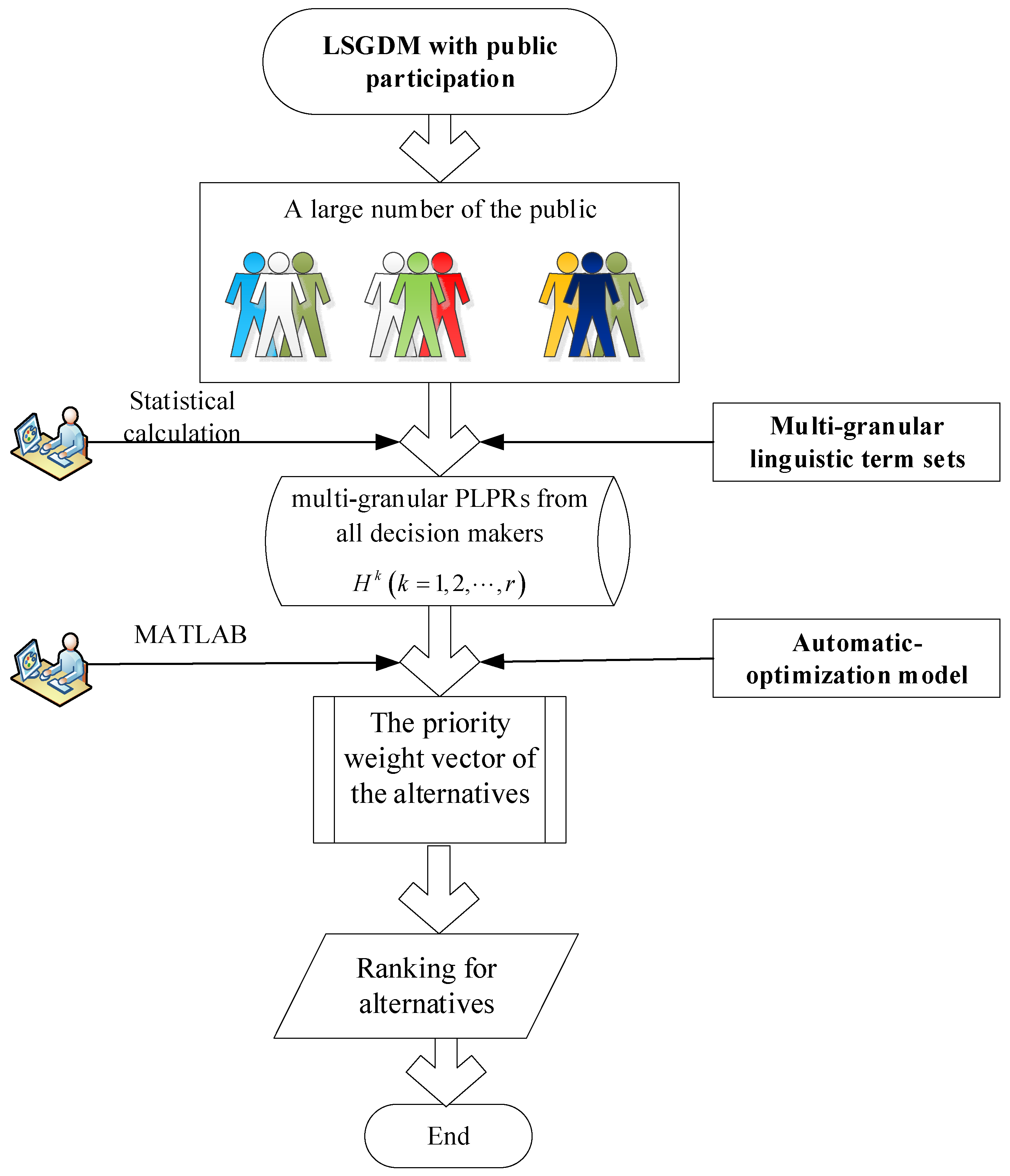

Table 1.
PLPRs based on .
| \ | ||||
| \ | \ | |||
| \ | \ | \ |
Table 2.
PLPRs based on .
| \ | ||||
| \ | \ | |||
| \ | \ | \ |
Table 3.
PLPRs based on .
| \ | ||||
| \ | \ | |||
| \ | \ | \ |
Table 4.
Collective expected decision matrix .
Table 5.
The method in this paper is compared with the previous studies.
| Studies | Whether to consider CRP | The method of CRP | Ranking |
| The proposed method | Yes | Optimization model-based CRP method | |
| Operator-based approach | No | / | |
| Song and Li [28] | Yes | an automatic iteration-based CRP method |
Disclaimer/Publisher’s Note: The statements, opinions and data contained in all publications are solely those of the individual author(s) and contributor(s) and not of MDPI and/or the editor(s). MDPI and/or the editor(s) disclaim responsibility for any injury to people or property resulting from any ideas, methods, instructions or products referred to in the content. |
© 2024 by the authors. Licensee MDPI, Basel, Switzerland. This article is an open access article distributed under the terms and conditions of the Creative Commons Attribution (CC BY) license (http://creativecommons.org/licenses/by/4.0/).
Copyright: This open access article is published under a Creative Commons CC BY 4.0 license, which permit the free download, distribution, and reuse, provided that the author and preprint are cited in any reuse.


