

Submitted:
20 May 2024
Posted:
21 May 2024
You are already at the latest version
Abstract
The rise in population density, vehicle ownership, and urban development has significantly influenced travel demand and altered travel patterns, leading to traffic congestion in rapidly growing urban centers like Accra, Ghana. The traditional approach of expanding roadways to accommodate rising traffic is no longer environmentally sustainable. Instead, emphasis has shifted towards travel demand management (TDM) strategies as a more sustainable solution. This study aimed to investigate a range of TDM strategies that can be adopted in Accra to improve traffic flow through the lenses of everyday road users. The study employed a questionnaire survey and a stratified sampling technique to gather data from 615 respondents for relative importance index (RII) ranking, and Chi-square statistical analysis. The findings reveal that the topmost preferred strategies were mass transit improvements, walking and cycling improvements, and alternative work schedules. Notably, mass transit improvements emerged as the most preferred strategy. The study also unveiled a statistically significant correlation between variables such as age, education level, marital status, income level, and mode of transportation with all selected TDM preferences. However, no significant relationship was found between gender and car ownership with all selected TDM preferences. The study provides valuable insights regarding road users’ preferences for TDM strategies that can aid in planning future urban mobility systems to proactively manage travel demand, alleviate congestion, and promote sustainable transportation options for the city’s residents.
Keywords:
Accra
; congestion
; mass transit improvements
; travel demand management strategies
; walking and cycling improvements
1. Introduction
Transportation planning is undergoing a paradigm shift, moving from a traffic-based analysis approach to an accessibility-based analysis paradigm. This transformation considers personal and freight travel speed and costs, as well as people’s and businesses' ability to reach desired services and activities. Accessibility to goods, services, and destinations plays a pivotal role in this new approach. By redefining the efficiency of transport systems, this approach aims to improve overall transportation planning [1]. With urbanization on the rise, there has been an increase in the frequency of journeys taking place within urban areas which has resulted in congestion. Traffic congestion has become an unavoidable challenge in large and growing metropolitan areas globally, as the travel demand exceeds the capacity of existing transportation infrastructure [2]. This problem is particularly severe in rapidly urbanizing cities, such as Accra, Ghana, where public transport struggles to meet the mobility needs of the urban population due to increasing demand [3]. Traditionally, cities have tackled this increased mobility demand by expanding transportation options, primarily by constructing new highways and transit lines. The focus has predominantly been on building more roads to accommodate the ever-increasing number of vehicles. As a result, various urban spatial structures have emerged, with the dependence on automobiles serving as the primary differentiating factor. The extent and growth of transportation infrastructure differ among cities globally, leading to diverse urban configurations and transportation systems. Consequently, urban sprawl becomes a prevalent phenomenon, manifesting differently in cities with distinct characteristics [4].
To tackle the issue of congestion and improve urban transportation, a viable solution is the implementation of travel demand management (TDM) strategies. TDM is defined as strategies aimed at optimizing the efficiency of urban transportation systems. Its core objective is to reduce reliance on private vehicles and promote the adoption of more efficient, health-conscious, and environmentally friendly modes of transportation, such as public transit and non-motorized options [5,6]. It comprises various approaches and techniques that influence travel behavior within the evolving landscape of transportation system performance, promoting sustainable mobility and improved overall system effectiveness [7]. TDM focuses on managing demand efficiently rather than simply expanding infrastructure to match demand. TDM strategies can also be classified based on their approach, either as pull or push strategies. Pull measures encourage travelers to use sustainable modes of transportation by providing attractive alternatives, such as improved public transport or vanpooling, etc. while the push measures, on the other hand, discourage the use of unsustainable modes of transportation by increasing fuel and road taxes, among other policies [8]. Babb and Smith (2014) classified TDM strategies into nine categories using a cumulative strategy matrix, ranging from pull to push strategies.
Table 1 below summarizes the best practices of TDM strategies. These strategies offer travelers choices to enhance travel reliability, such as work location, travel route, timing, and mode [9]. Amidst the COVID-19 pandemic, transportation patterns were significantly affected, however, businesses resorted to TDM strategies such as remote work and digital technologies to continue operations [10,11].
Accra, the capital city of Ghana, heavily relies on the traditional semi-formal “trotro” system as its primary mode of public transportation. However, this system is plagued by issues such as unreliability, low service standards, and frequent traffic congestion. Recognizing these challenges, the Aayalolo Bus Service (ABS) was introduced as a rudimentary bus rapid transit system. Unfortunately, it faced various obstacles, leading to its temporary suspension and the subsequent adoption of a “fill and go” service during peak hours [12]. Presently, alternative transportation options such as colored taxi cabs, motorcycles (known as Okada), private vehicles, and technology-based ride-hailing services have gained popularity among commuters in Accra. Autorickshaw transit is also an emerging mode of intra-city transit in urban cities in Ghana [13,14]. Nonetheless, save autorickshaws, these alternatives come at a higher cost. Each of these transportation choices caters for different consumers with diverse socioeconomic backgrounds [15,16]. To address the existing transportation issues and develop an efficient system that meets the city’s growing demands, this paper aims to explore the potential for implementing innovative TDM strategies in Accra, Ghana. Exploring TDM strategies in Accra, Ghana, holds the potential to address pressing transportation challenges while advancing broader social, economic, and environmental goals for sustainable urban development. Assessing best practices for adoption in Accra involves evaluating successful TDM initiatives from other similar contexts and tailoring them to suit the city’s specific needs, constraints, and priorities.
2. Materials and Methods
2.1. Study Area
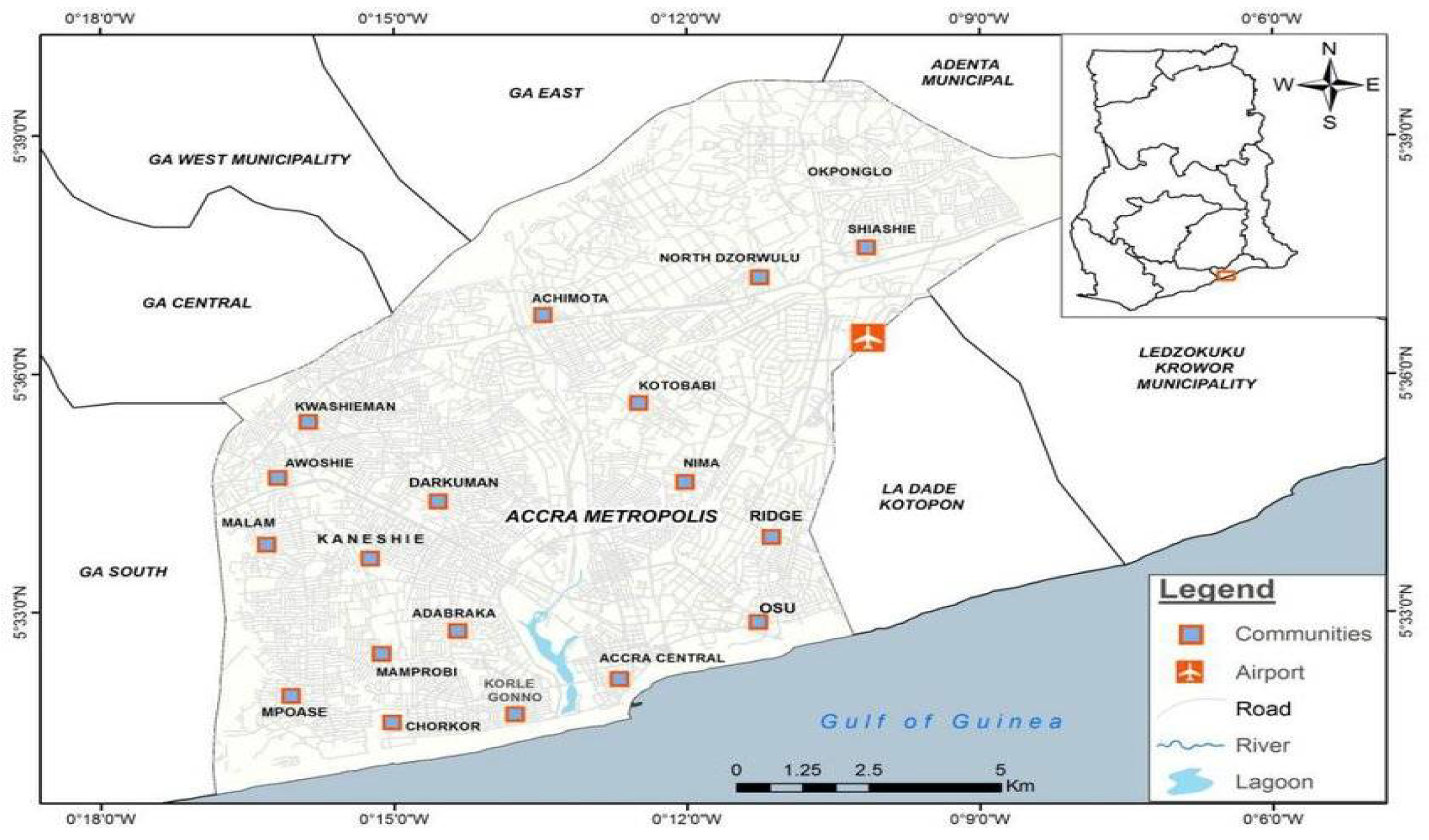
The study was conducted in the Accra Metropolis, one of the district assemblies within the Greater Accra Region of Ghana. This local government district covers the historical center and primary central business district (CBD) of Accra [17]. According to the Ghana Statistical Service (2021), the Accra Metropolis has a total population of 284,124 residents [18]. Road transportation is Ghana’s primary mode of travel, serving both freight and passengers. While train and waterway transport, particularly on the Volta Lake (the country’s only navigable water body), are in the early stages of development. Private car usage accounts for approximately 15% of the population, while the majority, 85%, rely on public transport or walking [19]. Public transportation in Ghana mainly comprises of taxis, trotro (minibus fleets), and commuter buses serving intra and inter-city routes. The railway system, established during the colonial era, has encountered challenges but is currently undergoing revitalization efforts. Furthermore, an emerging mode of transport, especially in rural and urban areas, is the two and three-wheeler motorcycles, locally known as “okada” and “pragya” respectively [14,20].
Figure 1.
Map of Accra Metropolis (source: Accra Metropolitan Assembly, 2019).
2.2 Questionnaire Design and Survey
The questionnaire was designed based on criteria carried out from literature review and expert discussions. The questionnaire was divided into two sections: Section A which focused on gathering demographic characteristics and Section B dedicated to assessing attitudes toward TDM strategies. Section B employed a 5-point Likert scale to measure agreement, with a scale ranging from 1 (strongly disagree) to 5 (strongly agree). The questionnaires were made up of only close-ended questions. Subsequently, the questionnaires were disseminated among respondents to ascertain their level of agreement with each TDM strategy through in-person interviews and an online database (Google Forms).
The questionnaire was designed to target potential road users from diverse groups which include private vehicle owners, public transportation users, pedestrians and cyclists of various age groups, gender, income range, education level, employment status, and different means of transport. The survey employed the stratified sampling technique enabling the researchers to select the groups mentioned above scattered all over the Accra Metropolis.
2.3. Data Collection
The research employed both primary and secondary sources of data collection. Primary data was obtained by employing a questionnaire survey. Also, the secondary data was acquired through a comprehensive examination of pertinent literature. The data collection process was conducted over a period of six (6) weeks, from April 12, 2023, to May 26, 2023.
To determine a suitable sample size for the population, the study adopted Tara Yamane’s method as described by Tepping, (1968) [21]. Based on the information available from the Ghana Statistical Service (GSS) in 2021, the total population of the Accra Metropolis was reported to be 284,124 residents [18]. Employing a confidence level of 95%, the calculated sample size (n) was established as 400. However, due to the importance of obtaining a comprehensive dataset, the researcher collected more data. In total, 615 questionnaires were distributed, which is significantly larger than the initially calculated sample size. This large sample size provided a broader range of responses and increased the statistical power of analysis. This sample size estimated for the study was deemed adequate to give a good representation of the population.
Mathematically, Yamane’s formula is expressed as:
where: n represents the sample size, N denotes the population of the study (284,124) and e signifies the margin error in the calculation (5%)
2.4. Data Analysis
Data processing and analysis were done using Microsoft Excel and SPSS statistical software. Descriptive statistical analyses in the form of frequencies and percentages were computed for all socio-demographic variables. The TDM strategies were all examined, and their attributes were ranked using the relative importance index (RII). This RII calculation allowed for a quantitative assessment of the preferences for different TDM strategies based on the responses gathered from the questionnaires. To calculate the RII for the preference of various TDM strategies, the formula outlined by Tawil et al. (2013) [22] in equation 2 was employed. The formula is expressed as follows:
Where: n1 represents respondents who strongly disagree, n2 represents those who disagree, n3 represents those who are neutral, n4 represents those who agree, and n5 represents those who strongly agree.
Additionally, the analysis included the application of Pearson’s Chi-square test of independence to examine the relationship between socio-demographic factors such as gender, age, income, education level, car ownership, and mode of transport, with some selected TDM strategies. The predictors in the Pearson’s Chi-square test were considered significant at a p-value of 0.05 or lower.
Mathematically, the Pearson’s Chi-square test formula is given as [23]:
Where: Oi stands for the observed value, Ei represents the expected value, χ2 denotes the Chi-square value.
3. Results
3.1. Descriptive Analysis
Table 2 illustrates the socio-demographic characteristics pertaining to the social status of the survey participants. Out of the total sample size, 62.3% of the population identified as male, while 37.7% identified as female. Additionally, in terms of age distribution, the majority fell between 36-40 years (18.5%) and 41-45 years (18.5%), with the smallest proportion being in the age group below 20 years (3.10%). Marital status reveals that 68.6% of individuals were married, while 18.4% were single. Divorced individuals comprised 7.60%, and 5.40% were widowed. Regarding education level, the highest proportion had undergone second-cycle education (50.4%), followed by bachelor’s degree holders (20.2%). Only a small percentage had no formal education (1.3%), while postgraduate degree holders constituted 3.3% of the population.
Furthermore, the employment status indicates that the majority were employed (90.7%), while 9.30% were unemployed. In terms of income, the largest percentage fell within the GH₵ 501 – 1500 bracket (61.5%), while only a small proportion had incomes above GH₵ 6500 (1.50%). Car ownership was relatively low, with only 13.0% of the population owning a car, while 87.0% did not. The mode of transport primarily consisted of bus/trotro (85.7%), followed by private car (11.1%), with foot mobile/walking and motorcycle/bicycle constituting smaller percentages (1.6% each) [19]. Lastly, a smaller fraction, 1.6%, used motorcycles/bicycles or chose to walk. Regarding traffic congestion in the Accra Metropolis, a significant 96.6% of respondents agreed that they regularly experienced traffic congestion in the area.
3.2. Preferential Rating for Different TDM Strategies
The preferences of road users toward different TDM strategies were analyzed based on their relative importance index ranking. The relative importance index and ranks of the different TDM strategies are presented in Table 3 below.
Respondents ranked mass transit improvements as the most preferred TDM strategy with an RII score of 0.921. This ranking aligns with the prevailing trend of prioritizing mass transit enhancement globally, exemplified by the ongoing construction of bus rapid transit (BRT) systems, aimed at bolstering bus service convenience, speed, and integration [24]. The second most preferred strategy was walking and cycling improvement with an RII score of 0.884. This outcome comes as no surprise, considering walking and cycling are widely recognized as the most sustainable modes of transportation [25]. Respondents also believe that alternative work schedules, and staggered school and work hours, can help reduce the number of employees arriving and leaving a worksite at a time. These strategies were ranked third and fourth with an RII score of 0.872 and 0.852 respectively, indicating their significant perceived importance and desirability among the respondents. These strategies aim to streamline travel demand by minimizing peak-hour traffic congestion and fostering a more efficient distribution of travel patterns. By adopting alternative work schedules and staggered hours, organizations can contribute to easing traffic congestion during peak periods [26].
The TDM strategy preference ranking list suggests that among the various TDM strategies, efficient parking pricing, congestion pricing, and increased fuel and road tax on private vehicles received relatively low preference scores. The RII scores for these strategies were 0.539, 0.504, and 0.492, respectively. The lower preference for these strategies can be explained by the fact that they involve the imposition of additional costs on travel. Efficient parking pricing implies charging more for parking, congestion pricing involves fees for using congested roads, and increased fuel and road taxes directly increase the financial burden on private vehicle owners. Respondents may be less supportive of these strategies because they perceive them as financially burdensome or may have concerns about the overall economic impact on their travel expenses. It's important to note that the RII scores are a measure of relative importance, and the lower scores for these strategies suggest that, compared to other TDM strategies, they are less favored among respondents.
3.3. Chi-Square Analysis between the Socio-Demographic Characteristics and Some Selected TDM Strategies
A further investigation was conducted to explore the connection between the socio-demographic factors of participants and some selected TDM strategies. This approach facilitated the application of the Chi-square test for independence, which aimed to establish whether a substantial association exists between the two categorical variables under scrutiny. The Chi-square tests were used to examine the relationship between the socio-demographic characteristics, and some selected TDM strategies such as mass transit improvements, walking and cycling improvements, efficient parking pricing, and increased fuel and road tax on private vehicles.
3.3.1. Relationship between Mass Transit Improvement Preference and Socio-Demographic Characteristics
The Chi-square (χ2) test results, as presented in Table 4 show the relationship between the mass transit improvement preference and the socio-demographic characteristics. The analysis indicates a significant association between mass transit improvement preference and the following variables: age (χ2 = 90.516, p-value = 0.000), education level (χ2 = 68.195, p-value = 0.000), marital status (χ2 = 51.655, p-value = 0.000), employment status (χ2 = 10.272, p-value = 0.016), income level (χ2 = 48.003, p-value = 0.001), and mode of transport (χ2 = 30.135, p-value = 0.000). Conversely, no statistically significant relationships were observed between mass transit preference and gender (χ2 = 4.293, p-value = 0.231), as well as car ownership (χ2 = 1.404, p-value = 0.702).
3.3.2. Relationship between Walking and Cycling Improvements Preference and Socio-Demographic Characteristics
Table 5 displays the results of the Chi-square tests, which investigate the correlation between preference for walking and cycling improvements and various socio-demographic characteristics. The analysis reveals a significant association between walking and cycling improvements preference and the following variables: age (χ2 = 192.583, p-value = 0.000), an education level (χ2 = 210.153, p-value = 0.000), marital status (χ2 = 140.074, p-value = 0.000), employment status (χ2 = 69.608, p-value = 0.000), income level (χ2 = 214.429, p-value = 0.000), and mode of transport (χ2 = 26.312, p-value = 0.010). Conversely, no statistically significant relationships were observed between mass transit preference and gender (χ2 = 6.059, p-value = 0.195), as well as car ownership (χ2 = 5.094, p-value = 0.278). These results indicate that various socio-demographic factors significantly impact preferences for increased fuel and road tax on private vehicles whereas other factors do not have a significant impact.
3.3.3. Relationship between Efficient Parking Pricing Preference and Socio-Demographic Characteristics
The results of the Chi-square (χ2) test, illustrated in Table 6, reveal a significant association between efficient parking pricing preference and various socio-demographic characteristics. Specifically, the analysis demonstrates significant associations with age (χ2 = 184.112, p-value = 0.000), education level (χ2 = 268.108, p-value = 0.000), marital status (χ2 = 60.753, p-value = 0.000), employment status (χ2 = 37.338, p-value = 0.000), income level (χ2 = 324.178, p-value = 0.001), mode of transport (χ2 = 44.903, p-value = 0.000), gender (χ2 = 14.419, p-value = 0.006), and car ownership (χ2 = 18.748, p-value = 0.001). These findings suggest that various socio-demographic factors significantly influence preferences for efficient parking pricing.
3.3.4. Relationship between Preference for Increased Fuel and Road Tax on Private Vehicles and Socio-Demographic Characteristics
The Chi-square (χ2) test results, depicted in Table 7, indicate a notable correlation between the preference for increased fuel and road tax on private vehicles and diverse socio-demographic characteristics. Specifically, the analysis reveals substantial correlations with age (χ2 = 234.238, p-value = 0.000), education level (χ2 = 267.757, p-value = 0.000), marital status (χ2 = 78.657, p-value = 0.000), employment status (χ2 = 22.744, p-value = 0.000), income level (χ2 = 235.613, p-value = 0.000), mode of transport (χ2 = 63.304, p-value = 0.000), gender (χ2 = 9.818, p-value = 0.044), and car ownership (χ2 = 30.345, p-value = 0.000). These results suggest that a range of socio-demographic factors significantly impacts preferences regarding increased fuel and road tax on private vehicles.
4. Discussion
Travel demand management strategies are designed to reduce the demand for private vehicle travel and encourage the use of alternative modes of transportation. These strategies aim to alleviate traffic congestion, reduce air pollution, conserve energy, and improve overall transportation efficiency. The preference for various TDM strategies was estimated using RII ranking. The respondents ranked mass transit improvements as the most preferred TDM strategy. This outcome was expected given that public transport is one of the most direct methods to reduce congestion when implemented correctly [27]. Improvements in mass transit systems may offer financial incentives, such as reduced fares or improved cost efficiency, attracting respondents seeking economic benefits. This finding supports a study conducted by Bhattacharjee et al. (1997) [28] in Bangkok. Weisbrod et al. (2017) [29] provide a comprehensive summary of the benefits associated with public transit, which can be categorized into two major groups. First, mobility benefits arise from increased travel opportunities for individuals who face economic, physical, or social disadvantages. Second, efficiency benefits stem from the decrease in vehicle traffic resulting from the transition from inefficient automobile travel to more efficient transit travel. Moreover, it is worth noting that the improvement of mass transit services has been shown to result in a significant increase of 20 to 50% in affected transit travel, accompanied by a reduction of 5 to 15% (and occasionally more) in automobile travel [30].
The second most preferred strategy was walking and cycling improvement. This is a predictable choice given the sustainability and associated health and social advantages of these modes [31]. This indicates a significant preference for initiatives that promote active modes of transportation and highlights the importance of Ghana investing in infrastructure and policies that facilitate walking and cycling. This suggests that if walking and cycling infrastructure and facilities are provided and improved in Ghana, then road users will highly prioritize them potentially reducing private vehicle usage and associated congestion. Zhou et al. (2020) [32] recognized that providing well-designed non-motorized transport (NMT) facilities effectively promotes bicycle usage, leading to improved physical health. The promotion of active modes of transportation such as walking and cycling can contribute to various benefits, including improved health, reduced congestion, and decreased environmental impact [33]. Communities centered on walking, cycling, and public transportation offer more than just environmental and health benefits, they also yield substantial cost savings for their inhabitants [34]. Improved walking and bicycling conditions tend to increase non-motorized and transit travel, and reduce automobile travel [35,36].
Respondents also believe that alternative work schedules, and staggered school and work hours, can help reduce the number of employees arriving and leaving a worksite at a time. These strategies were ranked third and fourth with an RII score of 0.872 and 0.852 respectively. The rationale behind these strategies lies in their potential to optimize travel demand. By introducing alternative work schedules and staggered hours, the goal is to mitigate peak-hour congestion and enhance the efficiency of travel patterns. This approach aligns with the idea of spreading out commuting times, thereby avoiding concentrated rushes of employees traveling to and from work simultaneously. The implementation of alternative work schedules and staggered hours is seen as a practical solution for alleviating traffic congestion during peak periods. This perspective is reinforced by insights from the Victoria Transport Policy Institute (VTPI) in 2016, suggesting that these strategies can positively impact traffic management and contribute to a more balanced and streamlined flow of commuter traffic.
According to the preference ranking list of the TDM strategy, the least favored approaches were efficient parking pricing, congestion pricing, and increased fuel and road tax on private. This outcome is expected as these strategies involve introducing additional costs for travel, which respondents generally oppose. Nilsson et al. (2016) [37] found that some individuals perceive congestion pricing as a violation of personal freedom, leading to low support for such measures. Consequently, the limited adoption of congestion pricing initiatives is attributed to the lack of public support [38]. Bhattacharjee et al. (1997) also reported that increased parking fees in government offices received the least favorable response from respondents. Despite potential overall benefits such as direct funding for roads, parking, and related expenses, road users tend to resist any price increases, viewing them negatively. This resistance poses a significant obstacle to the implementation of pricing reforms [39].
Regarding the demographics of participants, a Chi-square test of association was conducted to explore if there exists a noteworthy connection between socio-demographic factors and specific TDM strategies. A significance level of α ≤ 0.05 was employed to determine the presence of a significant association. The test of association between mass transit improvement preference and socio-demographic characteristics of gender and car ownership revealed non-significant values. At the same time, age, level of education, marital status, employment status, income, and mode of transport were found to be significant. This means that mass transit improvement preference had no association with gender and car ownership. The preferences of males and females, as well as car owners and non-car owners, do not differ significantly in terms of their interest in mass transit improvement. Additionally, unlike gender and car ownership, which was found to be statistically insignificant, a statistically significant association was found between walking and cycling improvements preference and age, level of education, marital status, employment status, income, and mode of transport. Consequently, the preferences of males and females as well as car owners and non-car owners, regarding walking and cycling improvements do not differ significantly. Furthermore, the analysis of efficient parking pricing preference and increased fuel and road tax on private vehicle preference revealed statistically significant associations across all demographics including gender, car ownership, age, level of education, marital status, employment status, income, and mode of transport. The influence of demographics is pivotal in molding the efficacy of TDM strategies. Therefore, tailoring TDM strategies to match the demographic profile of a specific region enhances the likelihood of successful implementation and widespread acceptance.
5. Implications of Findings
The implications of these findings for policy are significant and can inform targeted interventions aimed at reducing traffic congestion and promoting sustainable transportation methods. The study suggests potential policy implications as follows:
- Investment in mass transit infrastructure
Given that mass transit improvements emerged as the most preferred strategy, policymakers should prioritize investments in enhancing public transportation systems. This could involve expanding existing infrastructure, improving service frequency and reliability, and implementing measures to make public transit more attractive, accessible, and convenient for commuters.
- 2.
- Promotion of active transportation
The popularity of walking and cycling improvements suggests a growing interest in active transportation modes. Policymakers can promote walking and cycling by investing in infrastructure such as bike lanes, pedestrian pathways, and sidewalks. Additionally, public awareness campaigns can be launched to encourage individuals to choose walking or cycling for short trips instead of relying on motor vehicles.
- 3.
- Support for alternative work schedules
The preference for alternative work schedules indicates a willingness among individuals to adopt flexible work arrangements. Policymakers can work with employers to promote initiatives such as telecommuting, flexible hours, and compressed workweeks. These measures not only reduce congestion during peak hours but also offer benefits such as improved work-life balance and reduced stress for employees.
- 4.
- Implementation of staggered school and work hours
Staggering school and work hours can help alleviate congestion by spreading out peak travel times. Policymakers can collaborate with educational institutions and employers to implement staggered schedules where feasible. This could involve adjusting school start times, offering flexible arrival and departure times for employees, and coordinating transportation services to accommodate varied schedules.
- 5.
- Considering socio-demographic disparities
The significant correlations between demographic variables such as age, education level, marital status, income level, and transportation preferences highlight the need to consider socioeconomic factors in transportation planning. Policymakers should ensure that TDM strategies are equitable and accessible to all segments of the population. This may involve targeted outreach and support for disadvantaged communities, subsidies for low-income individuals to access public transit, and initiatives to improve transportation options in underserved areas.
6. Conclusions
This paper sought to assess road users’ understanding and willingness to adopt various TDM strategies. The study was conducted in Accra, Ghana, and involved the use of a structured questionnaire that was used to gather road user information and opinions. Prior to data collection, a comprehensive literature review was conducted to understand the mechanism of available TDM strategies and best practices worldwide, and how these contribute to achieving a sustainable transportation system. After data collection, robust statistical methods were employed to analyze the data.
The study findings showed a strong preference for strategies that focus on improving mass transit, promoting walking, and cycling, and implementing alternative work schedules. These strategies were regarded favorably due to their potential to enhance efficiency, and accessibility, and reduce private vehicle usage and congestion. On the other hand, strategies such as efficient parking pricing, congestion pricing, and increased fuel and road tax on private vehicles were ranked in the bottom three as they received lower preference levels. Furthermore, the Chi-square results, revealed that there is a significant relationship between all selected TDM strategies and factors such as age, education level, marital status, income level, and mode of transportation. However, it was observed that gender and car ownership did not exhibit a significant relationship with all the selected TDM preferences. The findings underscore the importance of considering demographics in the development and implementation of TDM strategies. Tailoring these strategies to align with the demographic profile of a specific region increases the likelihood of successful implementation and widespread acceptance. This nuanced understanding of how different demographic groups responded to various TDM measures can inform more targeted and effective transportation policies.
TDM provides a viable solution for addressing congestion compared to the traditional approach of building/expanding roads. Given the high preference for mass transit improvement in the survey results, it is recommended that Ghana’s Ministry of Transport, Ghanaian joint state, and privately-owned transport companies such as State Transport Corporation (STC), Omnibus Service Authority (OSA), City Express Services (CES) and Metro Mass Transit (MMT), and Ghana Private Road Transport Unions (GPRTU) should prioritize investments in enhancing public transportation systems in Accra. This may involve improving existing modes of public transit, such as buses and trains, and expanding the network to cover more areas of the city of Accra. Additionally, the stakeholders should ensure efforts are made to increase efficiency and accessibility, including reliable schedules, comfortable vehicles, and affordable fares. This study provides insights for policymakers aiming to enhance the sustainability, efficiency, and equity of transportation systems. Considering the outcomes of this study, future research can assess the economic and financial implications of implementing TDM strategies in Accra. This would provide valuable insights into the feasibility and cost-effectiveness of these strategies, helping policymakers and urban planners make informed decisions.
Author Contributions
Conceptualization, W.K.A. and E.K.A.; methodology, W.K.A., and E.K.A.; software, W.K.A.; validation, W.K.A., and E.K.A.; formal analysis, W.K.A.; investigation, W.K.A.; resources, WKA., E.K.A., and C.A.A.; data curation, W.K.A.; writing—original draft preparation, W.K.A.; writing—review and editing, EKA., C.A.A. and S.B.A; visualization, W.K.A.; supervision, E.K.A., and C.A.A.; All authors have read and agreed to the published version of the manuscript.
Funding
This research received no external funding.
Institutional Review Board Statement
Not applicable
Informed Consent Statement
Not applicable
Data Availability Statement
Data are contained within the article.
Acknowledgments
The authors gratefully acknowledge the support provided by the Regional Transport Research and Education Centre Kumasi (TRECK) of the Kwame Nkrumah University of Science and Technology Kumasi Ghana (KNUST), Mrs. Emma Mansa Agyeiwaa, Miss Mavis Kwafoa Amanor, and Francis Aduansah Mensah.
Conflicts of Interest
The authors declare no conflicts of interest.
References
- Litman, T. The New Transportation Planning Paradigm. Inst. Transp. Eng. J. 2013, 83, 20–27. [Google Scholar]
- Downs, A. Why Traffic Congestion Is Here to Stay... and Will Get Worse. Access Mag. 1 2004, 25, 19–25. [Google Scholar]
- Airy, A.; Chandiramani, J. The Good and Bad of ‘Odd-Even Formula’’: Case Study of Delhi and Alternative Measures towards Sustainable Transport. ’ Adv. Econ. Bus. Manag. 2016, 3, 31–35. [Google Scholar]
- Rodrigue, J.-P. The Geography of Transport Systems; Fifth.; Routledge: Abingdon, Oxon ; New York, NY : Routledge, 2020; ISBN 9780429346323.
- Toan, D.T. Managing Traffic Congestion in a City : A Study of Singapore’s Experiences. In Proceedings of the International Conference on Sustainability in Civil Engineering (ICSCE) 2018; The Transport Journal (ISSN 2354-0818): Vietnam, 2018; pp. 176–1820.
- Carran-Fletcher, A.; Joseph, C.; Thomas, F.; Philbin, S. Travel Demand Management : Strategies and Outcomes; New Zealand, 2020.
- Salleh, B.S.; Rahmat, R.A.O. .; Ismail, A. Expert System on Selection of Mobility Management Strategies towards Implementing Active Transport. Procedia - Soc. Behav. Sci. 2015, 195, 2896–2904. [Google Scholar] [CrossRef]
- Babb, C.; Smith, B. Congestion Abatement through Travel Demand Management. Phase 1: Review of Instruments and Tools. Report A: The Travel Demand Management Matrix: An International Review of TDM Instruments.; Australia, 2014.
- Federal Highway Administration (FHWA) Mitigating Traffic Congestion-The Role of Demand-Side Strategies; Washington, DC, US, 2004.
- Organisation for Economic Co-operation and Development (OECD) OECD Digital Economy Outlook 2020; OECD: Paris, 2020; ISBN 9789264424760.
- Sogbe, E. The Evolving Impact of Coronavirus (COVID-19) Pandemic on Public Transportation in Ghana. Case Stud. Transp. Policy 2021, 9, 1607–1614. [Google Scholar] [CrossRef] [PubMed]
- Abekah-Nkrumah, G.; Asuming, P.O.; Telli, H. The Effects of the Introduction of a Bus Rapid Transit System on Commuter Choices in Ghana; 2019.
- Adi, S.B.; Amoako, C.; Quartey, D. Users’ Satisfaction of Autorickshaw Transport Operations Towards Sustainable Intra-City Mobility, Cape Coast, Ghana. In Proceedings of the Sustainable Education and Development – Sustainable Industrialization and Innovation. ARCA 2022; Springer International Publishing: Cham, 2023; pp. 739–751. [Google Scholar]
- Obiri-Yeboah, A.A.; Ribeiro, J.F.X.; Asante, L.A.; Sarpong, A.A.; Pappoe, B. The New Players in Africa’s Public Transportation Sector: Characterization of Auto-Rickshaw Operators in Kumasi, Ghana. Case Stud. Transp. Policy 2021, 9, 324–335. [Google Scholar] [CrossRef]
- Pasquali, P.; Commenges, H.; Louail, T. “It’s a Three-Way Ring”: E-Hailing Platforms, Drivers and Riders Reshaping Accra’s Mobility Landscape. Case Stud. Transp. Policy 2022, 10, 1743–1753. [Google Scholar] [CrossRef]
- Boateng, F.G.; Appau, S.; Baako, K.T. The Rise of ‘Smart’ Solutions in Africa: A Review of the Socio-Environmental Cost of the Transportation and Employment Benefits of Ride-Hailing Technology in Ghana. Humanit. Soc. Sci. Commun. 2022, 9, 245. [Google Scholar] [CrossRef] [PubMed]
- Accra Metropolitan Assembly (AMA) The City of Accra 2020 Voluntary Local Review (VLR) Report on the Implementation of the 2030 Agenda for Sustainable Development and African Union Agenda 2063.; Accra, 2020.
- Ghana Statistical Service (GSS) 2021 PHC General Report Vol 3A_Population of Regions and Districts_181121; Accra, 2021.
- Abane, A.M. Travel Behaviour in Ghana: Empirical Observations from Four Metropolitan Areas. J. Transp. Geogr. 2011, 19, 313–322. [Google Scholar] [CrossRef]
- Tuffour, Y.A.; Appiagyei, D.K.N. Motorcycle Taxis in Public Transportation Services within the Accra Metropolis. Am. J. Civ. Eng. 2014, 2, 117–122. [Google Scholar] [CrossRef]
- Tepping, B.J. Elementary Sampling Theory, Taro Yamane. J. Am. Stat. Assoc. 1968, 63, 728–730. [Google Scholar] [CrossRef]
- Tawil, N.M.; Khoiry, M.A.; Arshad, I.; Hamzah, N.; Jasri, M.F.; Badaruzzaman, W.H.W. Factors Contribute to Delay Project Construction in Higher Learning Education Case Study UKM. Res. J. Appl. Sci. Eng. Technol. 2013, 5, 3112–3116. [Google Scholar]
- Amanor, W.K.; Awere, E.; Manso, I.; Opoku-Antwi, E. Assessing the Prevailing Driver Seatbelt Compliance at Madina Zongo Junction in Accra, Ghana: An Observational Study. Traffic Inj. Prev. 2024, 1–7. [Google Scholar] [CrossRef] [PubMed]
- Litman, T.; Pan, M. TDM Success Stories: Examples of Effective Transportation Demand Management Policies and Programs, and Keys to Their Success; British Columbia, Canada, 2023.
- Cavill, N.; Rutter, H.; Hill, A. Action on Cycling in Primary Care Trusts: Results of a Survey of Directors of Public Health. Public Health 2007, 121, 100–105. [Google Scholar] [CrossRef] [PubMed]
- Victoria Transport Policy Institute (VTPI) Alternative Work Schedules: Flextime, Compressed Work Week, Staggered Shifts. Available online: https://www.vtpi.org/tdm/tdm15.htm (accessed on 6 June 2023).
- Buchanan, M. The Benefits of Public Transport. Nat. Phys. 2019, 15, 876–876. [Google Scholar] [CrossRef]
- Bhattacharjee, D.; Haider, S.W.; Tanaboriboon, Y.; Sinha, K.C. Commuters’ Attitudes towards Travel Demand Management in Bangkok. Transp. Policy 1997, 4, 161–170. [Google Scholar] [CrossRef]
- Weisbrod, G.; Stein, N.; Duncan, C.; Blair, A. Practices for Evaluating the Economic Impacts and Benefits of Transit: A Synthesis of Transit Practice.; Transportation Research Board: Washington, D.C, 2017. [Google Scholar]
- Kuss, P.; Nicholas, K.A. A Dozen Effective Interventions to Reduce Car Use in European Cities: Lessons Learned from a Meta-Analysis and Transition Management. Case Stud. Transp. Policy 2022, 10, 1494–1513. [Google Scholar] [CrossRef]
- Timpabi, A.P.; Adams, C.A.; Osei, K.K. The Role of Infrastructure and Route Type Choices for Walking and Cycling in Some Cities in Ghana. Urban, Plan. Transp. Res. 2023, 11. [Google Scholar] [CrossRef]
- Zhou, Q.; Che, M.; Koh, P.P.; Wong, Y.D. Effects of Improvements in Non-Motorised Transport Facilities on Active Mobility Demand in a Residential Township. J. Transp. Heal. 2020, 16, 100835. [Google Scholar] [CrossRef]
- Bassett, D.R.; Pucher, J.; Buehler, R.; Thompson, D.L.; Crouter, S.E. Walking, Cycling, and Obesity Rates in Europe, North America and Australia. J. Phys. Act. Heal. 2008, 5, 795–814. [Google Scholar] [CrossRef]
- Institute for Transportation and Development Policy (ITDP) The High Cost of Transportation in the United States. Available online: https://www.itdp.org/2024/01/24/high-cost-transportation-united-states/ (accessed on 8 April 2024).
- Handy, S.; Tal, G.; Boarnet, M.G. Policy Brief on the Impacts of Bicycling Strategies Based on a Review of the Empirical Literature, for Research on Impacts of Transportation and Land Use-Related Policies; California, 2014.
- Blumenberg, E.; Brozen, M.; Bridges, K.; Voulgaris, C.T. Heightening Walking above Its Pedestrian Status: Walking and Travel Behavior in California; California, 2016.
- Nilsson, A.; Schuitema, G.; Jakobsson Bergstad, C.; Martinsson, J.; Thorson, M. The Road to Acceptance: Attitude Change before and after the Implementation of a Congestion Tax. J. Environ. Psychol. 2016, 46, 1–9. [Google Scholar] [CrossRef]
- Gu, Z.; Liu, Z.; Cheng, Q.; Saberi, M. Congestion Pricing Practices and Public Acceptance: A Review of Evidence. Case Stud. Transp. Policy 2018, 6, 94–101. [Google Scholar] [CrossRef]
- Victoria Transport Policy Institute Evaluating Pricing Strategies: Factors to Consider When Evaluating TDM Strategies That Change Transportation Prices. Available online: https://www.vtpi.org/tdm/tdm70.htm (accessed on 6 June 2023).

Table 1.
TDM Strategy matrix (Adapted from Babb & Smith, 2014).
| TDM Category | Examples of TDM Strategies | |
|---|---|---|
| Pull | Improvement in Alternative Modes | Cycling improvements, pedestrian improvements, shuttle service, non-motorized transport (NMT), public bike system, car sharing, transit improvements, complete streets |
| Planning- Integrated Land Use and Transport | New Urbanism. TOD, Car Free Planning, Land Use Density and Clustering, Location Efficient Development | |
| Workplace-based instruments | Alternative work schedules, flex-time, teleworking, commuter financial incentives | |
| Travel behaviors change programs | Transit, Walk, and Cycling Encouragement | |
| Information programs | Multi-modal navigation tools | |
| Push | Road space management | Traffic calming, road space reallocation |
| Governance | Smart growth reforms, institutional reforms, participatory planning, regulatory reform | |
| Parking | Park and Ride, Parking Pricing, Parking Management, Shared Parking | |
| Taxes and Charges | Road pricing, vehicle use restriction, carbon taxes, congestion pricing, fuel tax |
Table 2.
Socio-demographic characteristics of respondents.
| Variable | Category | Count | Percent (%) |
|---|---|---|---|
| Gender | Male | 383 | 62.3 |
| Female | 232 | 37.7 | |
| Age | Below 20 years | 19 | 3.10 |
| 21-25 years | 5 | 0.80 | |
| 26-30 years | 45 | 7.30 | |
| 31-35 years | 76 | 12.4 | |
| 36-40 years | 114 | 18.5 | |
| 41-45 years | 114 | 18.5 | |
| 46-50 years | 104 | 16.9 | |
| Above 50 years | 138 | 22.4 | |
| Marital status | Single | 113 | 18.4 |
| Married | 422 | 68.6 | |
| Divorced | 47 | 7.60 | |
| Widowed | 33 | 5.40 | |
| Education level | No formal education | 8 | 1.3 |
| Basic education | 60 | 9.8 | |
| Second cycle education | 310 | 50.4 | |
| Higher National Diploma | 93 | 15.1 | |
| Bachelor’s degree | 124 | 20.2 | |
| Postgraduate degree | 20 | 3.3 | |
| Employment status | Employed | 558 | 90.7 |
| Unemployed | 57 | 9.30 | |
| Income | Below GH₵ 500 | 41 | 6.70 |
| GH₵ 501 – 1500 | 378 | 61.5 | |
| GH₵ 1501 – 2500 | 109 | 17.7 | |
| GH₵ 2501 – 3500 | 56 | 9.10 | |
| GH₵ 3501 - 4500 | 13 | 2.10 | |
| GH₵ 4501 - 5500 | 7 | 1.10 | |
| GH₵ 5501 - 6500 | 2 | 0.30 | |
| Above GH₵ 6500 | 9 | 1.50 | |
| Car ownership | Yes | 80 | 13.0 |
| No | 535 | 87.0 | |
| Mode of transport | Foot mobile/Walking | 10 | 1.6 |
| Motorcycle/Bicycle | 10 | 1.6 | |
| Bus/Trotro | 527 | 85.7 | |
| Private car | 68 | 11.1 |
Note: 1 USD = GH₵ 11.33 at the time of the data collection
Table 3.
Preferential rankings of different TDM strategies.
| Item | Travel Demand Management Strategies | RII | Rank |
|---|---|---|---|
| a. | Mass transit improvements | 0.921 | 1 |
| b. | Walking and cycling improvements | 0.884 | 2 |
| c. | Alternative work schedules | 0.872 | 3 |
| d. | Staggered school and work hours | 0.852 | 4 |
| e. | Introducing school bus | 0.845 | 5 |
| f. | Ridesharing (car-pooling) | 0.836 | 6 |
| g. | Introducing staff bus | 0.828 | 7 |
| h. | Park and ride | 0.807 | 8 |
| i. | Parking management | 0.806 | 9 |
| j. | Teleworking (work from home) | 0.734 | 10 |
| k. | Private vehicles use restriction | 0.671 | 11 |
| l. | Car sharing | 0.612 | 12 |
| m. | High occupancy vehicle (HOV) lane priority | 0.570 | 13 |
| n. | Efficient parking pricing | 0.539 | 14 |
| o. | Congestion pricing | 0.504 | 15 |
| p. | Increased fuel and road tax on private vehicles | 0.492 | 16 |
Table 4.
Chi-square test for the relationship between mass transit improvement preference and socio-demographic characteristics .
Table 4.
Chi-square test for the relationship between mass transit improvement preference and socio-demographic characteristics .
| Socio-demographic variables | X2 values | df | p-values |
|---|---|---|---|
| Age | 90.516 | 21 | 0.000 |
| Gender | 4.293 | 3 | 0.231 |
| Education level | 68.195 | 15 | 0.000 |
| Marital status | 51.655 | 9 | 0.000 |
| Employment status | 10.272 | 3 | 0.016 |
| Income level | 48.003 | 21 | 0.001 |
| Mode of transportation | 30.135 | 9 | 0.000 |
| Car ownership | 1.404 | 3 | 0.705 |
Note: , df = degree of freedom
Table 5.
Chi-square test for the relationship between walking and cycling improvements preference and socio-demographic characteristics .
Table 5.
Chi-square test for the relationship between walking and cycling improvements preference and socio-demographic characteristics .
| Socio-demographic variables | X2 values | df | p-values |
|---|---|---|---|
| Age | 192.583 | 28 | 0.000 |
| Gender | 6.059 | 4 | 0.195 |
| Education level | 210.153 | 20 | 0.000 |
| Marital status | 140.074 | 12 | 0.000 |
| Employment status | 69.608 | 4 | 0.000 |
| Income level | 214.429 | 28 | 0.000 |
| Mode of transportation | 26.312 | 12 | 0.010 |
| Car ownership | 5.094 | 4 | 0.278 |
Note: , df = degree of freedom
Table 6.
Chi-square test for the relationship between efficient parking pricing preference and socio-demographic characteristics .
Table 6.
Chi-square test for the relationship between efficient parking pricing preference and socio-demographic characteristics .
| Socio-demographic variables | X2 values | df | p-values |
|---|---|---|---|
| Age | 194.112 | 28 | 0.000 |
| Gender | 14.419 | 4 | 0.006 |
| Education level | 268.108 | 20 | 0.000 |
| Marital status | 60.753 | 12 | 0.000 |
| Employment status | 37.338 | 4 | 0.000 |
| Income level | 324.178 | 28 | 0.000 |
| Mode of transportation | 44.903 | 12 | 0.000 |
| Car ownership | 18.748 | 4 | 0.001 |
Note: , df = degree of freedom
Table 7.
Chi-square test for the relationship between preference for increased fuel and road tax on private vehicles and socio-demographic characteristics .
Table 7.
Chi-square test for the relationship between preference for increased fuel and road tax on private vehicles and socio-demographic characteristics .
| Socio-demographic variables | X2 values | df | p-values |
|---|---|---|---|
| Age | 234.238 | 28 | 0.000 |
| Gender | 9.818 | 4 | 0.044 |
| Education level | 267.757 | 20 | 0.000 |
| Marital status | 78.657 | 12 | 0.000 |
| Employment status | 22.744 | 4 | 0.000 |
| Income level | 235.613 | 28 | 0.000 |
| Mode of transportation | 63.304 | 12 | 0.000 |
| Car ownership | 30.345 | 4 | 0.000 |
Note: , df = degree of freedom
Disclaimer/Publisher’s Note: The statements, opinions and data contained in all publications are solely those of the individual author(s) and contributor(s) and not of MDPI and/or the editor(s). MDPI and/or the editor(s) disclaim responsibility for any injury to people or property resulting from any ideas, methods, instructions or products referred to in the content. |
© 2024 by the authors. Licensee MDPI, Basel, Switzerland. This article is an open access article distributed under the terms and conditions of the Creative Commons Attribution (CC BY) license (http://creativecommons.org/licenses/by/4.0/).
Copyright: This open access article is published under a Creative Commons CC BY 4.0 license, which permit the free download, distribution, and reuse, provided that the author and preprint are cited in any reuse.