
Submitted:
18 May 2024
Posted:
20 May 2024
You are already at the latest version
Abstract
The paper is focused on researching the behavior of heating companies in connection with current developments in the electricity market and flexibility in the context of market behavior. The work assesses the increase in profitability through the creation of a technical-economic model using an objective function with profit maximization. The paper objective is presented the procedure and methodology for creating a model using the basic scheme of production processes integrated into the system platform. The result of the work is a comparative analysis of modelled cases of implemented operation deployment according to a defined period and modelling modes in selected time series. The description of individual outputs demonstrates the economic advantage of using combinations of modes of combined electricity and heat production, and non-combined electricity and heat production, including the use of the heat suppression mode because of overproduction of electricity.
Keywords:
heating industry
; techno-economic model
; profit maximizing objective function
; combined production of electricity and heat
; non-combined production of electricity and heat
1. Introduction
The rapid development of the energy market has led to fundamental changes in the behavior of heat and electricity market participants. The hitherto stable period was replaced by high volatility in the prices of energy inputs. This situation has forced energy companies to change their behavior in the market, as well as to change the strategies and approaches used so far. The use of new technologies has become a necessity for the existence of the producers themselves, which aim to obtain a necessary competitive advantage for the future. The mentioned changes also affect the heating industry, which, among the regulated network industries, has an important role from the point of view of ensuring the continuous supply of heat for the population.
The heating industry is linked with other network industries as a consumer of natural gas and a producer of electricity. The subject of this work is to focus on this interesting industry. Although the heating industry does not receive as much attention as the gas and electricity industries, the ongoing changes in the market are affecting these struggling companies and dynamiting them, which rightfully attracts attention. Today, heating plants are reflecting on the changes that are dynamically manifested especially in the electricity market and the growth in demand for flexibility services. The slow reaction and unpreparedness of regulatory mechanisms motivated energy entities to become an active participant in the electricity market and flexibility, which ultimately has an impact on the resulting management, production and sale of heat due to their interdependence. Energy companies balance between the power plant and heating cycle, or become heating plants with regard to the available technology of their production source. The input prices of commodities and the selling price of electricity, as well as flexibility in the daily market, have an effect on this combination of production methods. From this point of view, the dynamics of the electricity market indicated the direction, and the sale of heat remained statically in the background. Current in-formation technologies allow production entities to make decisions in real time and, using a purpose function, determine the combination of deployment of combined or non-combined production in such a ratio that the highest possible profit is achieved with the possibility of an immediate reaction to a new situation in the market.
The optimal possible production depends on the finding more efficient achievement of profit maximization [1] (Veselkova et al., 2017). Mathematical modelling consists of creating a simplified model of a real system or process using mathematical symbols, relationships and functions. Due to the widespread popularity of optimization tools in energy systems, several works can be found in scientific literature that provide comprehensive overviews of their use. Lahdelma and Hakonen (2003) see the goal in the use of optimization models in combined heat and power (CHP) systems to minimize production costs, including purchasing the amount of energy for production during a planning horizon, a defined time period. The canonical form of the problem in linear programming with upper bounds is defined using a linear objective function to be minimized [2]. The review study presents holistic overview of energy systems in the case of modelling, including analytical tools for planning [3]. Among the most important benefits that come with optimization is lower primary energy consumption and thus operating costs and emissions. Mancò et al. (2024) describe, on the basis of conducted studies, a reduction of costs from an economic point of view, usually in the range of 5% to 25%. Significant benefits can also be achieved when the optimization criterion is the reduction of primary energy or the reduction of CO2 emissions [4]. Optimizing operation design with a focus on achieving synergies and complementary benefits of subsystems, while maintaining high performance of individual systems, is addressed in the studies Intelligent Energy Systems: A Critical Review of Design and Operation Optimization, and compare different objectives, models and algorithms to optimize the design of a smart energy system [5]. In 2021, a case study was carried out that points to the ability to increase profitability through the implementation of a complex system of optimization and modelling using a methodology based on a generic formulation of mixed integer linear programming (MILP) [6].
In the case of a model that would cover the solution of the technological part of the combined production of electricity and heat, it is possible to distinguish two separate tasks. One of them is the creation of separate technological components for modelling the production process and the model that covers the trading of standardized energy products in energy markets [7]. The solution of the technical part is closely related to the ability to predict the heat consumption load for the next period [8] and [9]. Commonly available products such as Keras [10], xgboost [11] are used for this purpose. Keras [12] uses a high-level, deep learning API developed by Google to implement neural networks. Similarly, xgboost [13] is a robust machine learning algorithm that helps to under-stand the processed data. It supports solving both regression and classification predictive modelling problems. Both tools can achieve the desired results for the prediction of heat consumption. Other tools such as LpSolve [14] or Gurobi [15] can be used to find the optimal deployment of technological equipment. These instruments use a combination of inputs that may be static or may change dynamically over time due to market developments or changes. The interconnectedness of all components is key to building a functional unit. Gurobi [15] is a commercial software for solving large-scale linear programming and mixed-integer problems. It is known for its ability to use multi-core processors efficiently, thus achieving high computing power com-pared to the LpSolve tool [16]. Mathematical modelling has an essential role in quantifying and comparing the effects and various factors, constraints or objectives on the performance of a system or process. From a modelling point of view, it al-lows finding an optimal or suboptimal solution that meets the required criteria, maximizes or minimizes some objective function [17].
2. Materials and Methods
From the analysis of the current state at home and abroad in the addressed issue, it follows that the existing modelling tools can significantly improve the efficiency of independent production of heat and electricity as well as its distribution to places of consumption. By means of mathematical models, the optimal method of operating technological devices with the highest possible efficiency is sought, especially in the case of a combination of several technological units with different production characteristics of the operation. From the point of view of society-wide goals, which include the reduction of environmental impacts in the production of heat and electricity, we note an increasing share of planned and implemented projects to increase the share of renewable resources as well as pressure for more efficient operation of current facilities. By using regulatory frameworks, rules are set defining the conditions of both access to the energy market for new entities, as well as the conditions that determine the direction of existing resources from the point of view of the operation of current technology and the introduction of new technology into the production process. Among the largest sources of heat and electricity production in the Slovak Republic are heating plants, which ensure the supply of heat to the population. Changes in the electricity market bring new possibilities in the area of regulated flexibility and production of peak electricity, where the possibilities of increasing the usability of existing resources and revenues are opening up, which is extremely motivating for existing resources. Seizing new opportunities is closely linked to the use of a sophisticated approach using software tools and mathematical modelling and the interconnectedness of production and business functions. With the said synergy, it is possible to achieve positive economic results, not only by reducing operating costs, but also by maximizing profit by providing flexibility. In this case, I propose a technical-economic model for managing and determining alternative ways of managing the operation of a heating plant using a purpose function. The objective function of the model aims to maximize the profit of the heating company, including the use of flexibility services. Based on technical principles and market conditions (regulation, development of input prices and output prices), the model provides a tool for the production entity to make decisions about the operation of technological equipment with the motivation of achieving maximum profit. The subject of the research is the verification of the increase in the profitability of the company using modelling.
2.1. Defining the Technological Part of the Model
The production block of a heating plant composed of technological units for the production of electricity and heat, through a renewable energy source, such as a fully gasified biomass steam boiler with a steam counter-pressure turbine, was included in the research. The block includes four hot water boilers and three cogeneration units. An accumulation tank for heat storage is connected to the mentioned block. In order to establish technical connections, the basic technological scheme of the connection of production equipment and basic parameters were analyzed [18,19]. For the creation of the model, an extensive analysis of the technology was carried out in order to parameterize all production equipment that participates in the production process and has a primary impact on the economy of operation. The following approaches are used for the parameterization of technological devices to ensure the correct function of the technological part of the model:
- Record processing according to technical documentation (manufacturer's documentation, implementation project, operating regulations)
- Analysis of measured data (manually recorded data from electricity meters and heat meters, data export of available control systems.)
From the mentioned documentation, the key components of the model are de-fined, divided into basic balance groups. In the case of components, there are defined the inputs and outputs of the model. According to the mentioned analyses, the basic model is compiled through the balance display in Figure 1
The experimental model includes:
-
Autonomous production of heat, e.g.
- ■
- Steam boiler K
- -
- P2 - Output – Fuel – Natural gas
- -
- P3 - Output – Fuel – Chips
- -
- T2 - Input – Heat – High pressure steam
- -
- O5 - Output – Emissions, Motohours
- ■
- Hot-water boiler 1
- -
- P1 - Output – Fuel – Natural gas
- -
- T1 - Input – Heat – Hot water
- -
- O1 - Output – Emissions, Motohours
- ■
- Hot-water boiler 2
- -
- P2 - Output – Fuel – Natural gas
- -
- T2 - Input – Heat – Hot water
- -
- O2 - Output – Emissions, Motohours
- ■
- Hot-water boiler 3
- -
- P3 - Output – Fuel – Natural gas
- -
- T3 - Input – Heat – Hot water
- -
- O3 - Output – Emissions, Motohours
- ■
- Hot-water boiler 4
- -
- P4 - Output – Fuel – Natural gas
- -
- T4 - Input – Heat – Hot water
- -
- O4 - Output – Emissions, Motohours
-
Electricity production
- ■
- Turbo generator
- -
- T5 - Output – Heat – Para
- -
- E1 - Output – Electricity
- -
- T8 - Input – Heat – Para / Hot water
- -
- O5 - Output – Motohours
- Heat production and electricity production
-
Cogeneration unit 1
- -
- P7 - Output – Fuel – Natural gas
- -
- E2 - Output – Electricity
- -
- T9 - Input – Heat – Hot water
- -
- T13 - Output – Heat – Combustion gasses
- -
- O6 - Output – Emissions, Motohours
-
Cogeneration unit 2
- -
- P8 - Output – Fuel – Natural gas
- -
- E3 - Output – Electricity
- -
- T10 - Input – Heat – Hot water
- -
- T14 - Output – Heat – Combustion gasses
- -
- O7 - Output – Emissions, Motohours
-
Cogeneration unit 3
- -
- P9 - Output – Fuel – Natural gas
- -
- E4 - Output – Electricity
- -
- T11 - Input – Heat – Hot water
- -
- T15 - Output – Heat – Combustion gasses
- -
- O8 - Output – Emissions, Motohours
-
Heat consumption
- -
- T16 – Hot-water grid 1 – Input
- -
- T17 – Hot-water grid 2 – Input
- -
- T7- Technological heat consumption– Output – Para
- -
- T6 – Internal heat consumption – Input – Hot water
-
Electricity consumption
- -
- E4 – Technological electricity consumption– Output – Electricity
- -
- E5 – Internal electricity consumption – Input – Electricity
- Heat storage: T18 – Storage tank 1 – Input / Output – Hot water
The model contains functional links with input and output value determination according to the defined direction. The basic priority of the model is the fulfilment of the heat supply at the threshold of the heating plant according to the requirement of the economically demanded heat, i.e. the fulfilment of the energy consumption in the hot water network marked no. T16-17. From a technological point of view, it is a basic model of heat and electricity production in CHP mode, which achieves the highest efficiency from the point of view of energy conversion.
However, in the case of economic modelling, the requirements may change, which means the inclusion of additional deployment modes that are operationally feasible from a technological point of view and will have economic rationality. The model can take on these deployment modes from this point of view:
- CHP heating mode (shown in the picture),
- power plant mode with heat suppression (heat production above the amount of economically demandable heat, including excess electricity production),
- Non-CHP mode (exclusive heat supply without electricity production – non-combined production).
The mentioned modes can be alternated and combined based on the development of input and output parameters as a result of technical-economic modelling
2.2. Defining Market Links to Ensure the Economic Side of the Model
For the correct decision-making of the model, it is necessary to define comprehensively the market ties that influence the resulting method of deploying the operation of heating plants i.e. electricity market, fuel market, heat market, consumption taxes, production of emissions as well as other costs associated with the operation of heating companies.
Electricity Market
The secondary product of heat production in CHP mode is electricity, which is sold on the electricity market. The sale of electricity in the Slovak Republic is ensured by the Short-term Electricity Market Operator (hereinafter OKTE). The sale of electricity is regulated on the basis of Act no. 251/2012 Coll. on energy [20,21]. The Decree of the Office for Regulation of Network Industries no. 207/2023 Coll. [22] establishes the rules for the functioning of the internal electricity market and the rules for the functioning of the internal gas market. When selling electricity, heating entities use options according to applicable market rules and conditions. The periods of the field of defined electricity sale rules are set by the short-term market organizer and define the time schedule of the process that must be followed in the case of electricity sales. In connection with the sale of electricity, companies commonly use the basic methods for selling electricity in the form of OKTE [23]:
- Day market / DayAhead (closes by 1:30 p.m. for the next day).
- Intraday market (closing 30 minutes before the trading window).
We do not consider a long-term contract (month, quarter, year in products) due to the low usability of the model in the case of a stable electricity price. OKTE is the source of power electricity price data in the €/MWh market through the D2000 system module [24].
In addition to the sale of power electricity, the mentioned process affects the possibility of placing flexibility in the form of the sale of a guaranteed service for Slovak Electricity Transmission System (hereinafter SEPS) or a non-guaranteed service for regulation, according to the system deviation in connection with the billing of the deviation from OKTE. Support services (hereinafter PpS) are services that the transmission system operator of the Slovak Republic purchases to ensure the provision of sys-tem services necessary to maintain the quality of electricity supply and to ensure the operational reliability of the electrification system of the Slovak Republic, while the result of their activation is the supply of regulating electricity. PpS are procured on the basis of a tender procedure by fulfilling the conditions set out in the SEPS Technical Conditions for the types of services provided [25]. The model includes the parameters of the individual services based on the valid technical conditions.
Primary regulation of active power and frequency (Frequency Containment Re-serve - FCR) maintains the balance between production and consumption of electricity within the synchronous area, by means of speed regulation or active power of the device providing PpS. The goal of FCR is to ensure the operational security of the power system in the synchronous area and stabilize the system frequency at the equilibrium value after a fault, within a period of tens of seconds, but without restoring the desired value of the planned exchanges of active power (balance). FCR is an automatic change in the active power of devices providing PpS dependent only on frequency deviations in the system compared to the planned frequency value. The regulation must meet the following [25].
Secondary regulation of active power and frequency aFRR maintains the balance between production and consumption of electricity within each regulation area or of the control block, without disturbing the operation of the FCR, which works in the synchronous area. The aFRR service is activated from the PPS dispatching central controller, which determines the actual values of the active power of the PpS providing devices involved in this service, especially for the positive aFRR+ direction and especially for the negative aFRR- direction. It is an automatic remote control of the active power of the devices in a predefined regulatory range with an agreed rate of changes in the power of the devices, which must not be higher than the value found during the aFRR+ or aFRR- certification. This agreed rate of change, i.e. j. the speed of ramping in the relevant direction is set according to the value of the trend of the change in active power according to the annex to the Framework Agreement on the provision of PpS and RE.
The entire range of the device or only its available part can be used to provide mFRR+ positive regulation. The mFRR+ service is any required manual or automatic change in the active power of devices by moving their working points, which corresponds to the need in terms of size at a given time [25].
In connection with the purchase of support services, entities commonly use the basic methods for their purchase in the following form annual tender or monthly ten-der or daily tender.
From the point of view of modelling and defining the goals set in this work, we will assess the generation of additional revenues from support services, based on the assumptions of a significant impact on the modelling result, for functions with profit maximization.
The surcharge for electricity is calculated in the case of fulfilment of the conditions specified in Act 309/2009 for the electricity produced at the generator terminals, net of technological electricity consumption [26]. The surcharge for electricity is defined based on the decision of the ÚRSO for a specific technological device, namely a fixed price in €/MWh if the price of electricity is lower, i.e. below the level of the specified surcharge. The size of the surcharge in €/MWh is equal to the difference between the price based on the decision of the ÚRSO in €/MWh and the weighted average of the electricity prices of the daily market in €/MWh. The surcharge applies to the amount of electricity produced at the terminals of a particular generator of technological equipment, after deducting the technological own consumption of electricity according to ÚRSO decree no. 599/2009 Coll. [27]. If the specified conditions are met, then the amount of the surcharge is displayed in the output part of the model and added to the profit based on the deployed electricity production.
Fuel Market
In the case of purchasing fuel for the energy conversion process, we consider natural gas and biomass. The price of wood fuel is mostly fixed for the long term, in the form of a contractual agreement for a given volume for the annual period (in €/ton). Natural gas fuel is taken on the basis of standard gas products (PFPO, 2024), e.g. year (€/MWh), season (€/MWh), quarter (€/MWh), month (€/MWh), week (€/MWh), week-end (€/MWh), day (€/MWh).
Year and Quarter products are most often used by heating companies. Some companies are also starting to use products with a lower time series or a combination of them, i.e. long-term and short-term trade. Using short-term contracts can bring additional profit, but also increases the level of risk in terms of price increases. Conversely, in the case of long-term contracts, the risk is lower and the price is stable. If we look at the planning method from the point of view of heat producers as regulated entities, the subject of approval of the heat price proposal is the verifier and approver of the price proposal of regulator, which is based on the calculation of eligible costs for the next planning period. For this reason, manufacturing companies prefer long-term contracts. In the case of modelling, I will consider the static price of biomass and natural gas (in €/MWh).
Heat Market
The maximum heat prices are determined by the URSO Decision for the variable heat component in €/kWh and the fixed power component in €/kW. The decision is defined and specified for each entity separately according to the calculation of eligible costs. In the case of modelling, a variable component for heat will be used. This item has no impact on the modelling itself due to the static variable price for heat and the constant requirement for the supplied volume of demand heat during the unit period.
Consumption Tax
In the case of the use of non-combined heat production (non-CPH), according to Act 609/2007 on excise duty on electricity, coal and natural gas [28], the consumption of natural gas is charged with excise duty in (€/MWh). This tax will be added to the price of gas in the case of operation of hot water boilers.
Emissions
Heat producers are among the major sources of emissions. Fees for emissions from a large source, a medium source and a small source are defined based on Act 190/2023 Coll. on charges for air pollution [29]. Emissions charged by law include:
- solid pollutants (TZL),
- sulphur oxides expressed as sulphur dioxide (SO2),
- nitrogen oxides expressed as nitrogen dioxide (NOX),
- carbon monoxide (CO),
- ammonia (NH3),
- organic substances in the gas phase expressed as total organic carbon (TOC).
From the point of view of the economic impact, according to the analysis, these costs are negligible (less than 1.0% of costs). For this reason, the mentioned part of the fees will not be calculated. The calculation of emission costs also includes the purchase of permits for produced CO2, the market price of which is significant from the point of view of costs. The fee for CO2 emissions is the burdened burning of natural gas in co-generation units and hot water boilers with a static price (in €/ton). On the basis of implementing regulation 2018/2066 on the monitoring and reporting of greenhouse gas emissions, biomass whose emission factor CO2 = 0 t/TJ.
Maintenance and Other Factors
Other calculated costs include:
- fixed price of oil for cogeneration units (in €/Mth),
- fixed price of NOx Amid additives (in €/MWh of burned gas),
- fixed cost for equipment maintenance (in €/Mth of operated equipment),
- fees for electricity self-consumption of technological equipment,
- tariff for operating the system - TPS (v €/MWh),
- tariff for TSS system services (in €/MWh)
Defining of Limiting Conditions
In the case of conditions that have a fundamental influence on the behavior of the model, we speak of limiting conditions that we can characterize as non-market. We divide the stated conditions into two groups:
-
Technological or regulatory conditions in the context of the model, these are additional conditions that do not result directly from the market environment, but are intended to ensure the fulfilment of a legislative or other technological requirements. Legislative conditions, from the regulation point of view, are the following:
- -
- compliance with primary energy saving,
- -
- achieving the minimum efficiency of heat and electricity production.
- Simulation conditions of behavior for the purposes of inducing the desired behavior of the model, conditions are used that ensure the fulfilment of logical behavior in a strictly mathematical model. These conditions prevent unwanted behavior that is correct but undesirable from the point of view of mathematical notation, such as frequent cycling of starting and stopping equipment, maximizing performance at a low margin, and the like. The simulation conditions are solved through penalties, priorities or by defining boundaries.
2.3. Solution Scheme
To ensure the modelling process, a software scheme was designed, based on the basic integration platform from IPESOFT in the D2000 system [24]. The basic scheme is shown in Figure 2 set of modules was created and used for the functionality and parameterization of the model:
- OKTE module (ensures the integration of electricity market data). Communication is established within the D2000 system [24] via a native API for downloading market data published on OKTE portals.
- SEPS module (ensures the integration of market data with support services). The module provides communication to the Damas Energy system managed by SEPS. In the given system, currently valid support service contracts are downloaded to the D2000 system, including sending the daily PpS purchase and its evaluation. This module integrates the business functionality of the Damas Energy system for support services.
-
Prediction module (provides demand prediction based on meteorological data using the Keras model [12] and xgboost [13]). The resulting prediction enters Gurobi (2020) in the form of a clock vector.
- -
- Keras is a high-level, deep learning API developed by Google for implementing neural networks. It is written in Python and is used to facilitate the implementation of neural networks. This tool is compatible with libraries like JAX, TensorFlow and PyTorch [12].
- -
- xgboost is a robust machine learning algorithm that helps to understand the processed data. It supports solving both regression and classification predictive modelling problems. A parameterized model in a defined set-ting is used to search for dependencies between meteorological data and the development of heat consumption in the distribution network [13].
- Optimization model (uses the Gurobi system). Gurobi [15] is a commercial software for solving large-scale linear programming problems that falls under the category of solvers. The program supports solving integer problems. It automates and optimizes planning decisions using an easy-to-implement application-programming interface.
-
The parameterizations module of the D2000 system [24] allows you to define technological properties through:
- -
- static parameters (all device parameters),
- -
- curves (conversion curves, for example, efficiency).
- Vectors (archiving of all-time series with a step of 15 min.).
- Database (integrated PostgreSQL database).
The parameterization of the model is carried out on the basis of the identified requirements from the model functionality point of view. Parameterization is required by every technological as well as non-technological device. In this way, technical and physical properties or economic parameters employed by th e model are used. In the case of the realization of the model, 406 parameterization units were used. As an ex-ample, Table 1 presents the parameterization of the storage tank.
3. Results
In order to obtain correct outputs, it is used the constructed heating plant model to calculate production deployment variants in the context of the development of the market situation. In order to analyze deployment within the power ranges of the heating source, it is necessary to include the basic operating modes of heating production and its performance limits, which are defined as follows:
- summer operation (load up to 30% of power),
- operation during the transition period - beginning of the heating season (load from 30% to 60%),
- winter operation - heating season (load from 60% to 100%).
The mentioned regimes have an impact on the amount of deployed resources from the point of view of the amount of power used for the heat and electricity production, as well as the available power in the form of active or passive backup. For the mentioned modes, we define the testing modes included in the periods: Summer Operation, Transition Period Operation and Winter Operation. Deployments for the following modes are modelled in each period:
- Real Mode - Real deployment performed by the user according to defined requirements and degree of freedom (performed by an anonymized producer of heat and electricity). The parameterized model was put into real operation. In this mode, the user manually defined the requirement for the operation of the equipment, the size of the electrical diagram and the requirement for the supply of support services. In this way, the freedom of the model for finding the optimal solution was reduced to a minimum, which resulted in a significant limitation of the profit maximization function. The Real Mode generally covers the user's preference according to habits
- Max.Mode - The model's maximum degree of freedom. In this case, the model looks for the combination that achieves the highest profit.
- Max. without PpS Mode - Model high degree of freedom without providing sup-port services.
The specified periods and deployment modes are defined in the matrix of model inputs and parameters.

Table 2.
Matric of the specified periods.
| Period | Operation Mode | HW Load | Electricity Price | PpS Provision | Other Parameters |
|---|---|---|---|---|---|
| Summer Operation | Max. | Load curve - identical input for modes (range up to 30% power) | Course of ISOT prices - identically for the mentioned modes and time periods | Model optimisation | Same setting for all time periods and modes |
| Real | User request | ||||
| Max. without PpS | Without PpS | ||||
| Transition Period | Max. | Load curve - identical input for the mentioned modes (range from 30%÷60% power) | Model optimisation | ||
| Real | User request | ||||
| Max. without PpS | Without PpS | ||||
| Winter Operation | Max. | Load cycle - identical input for the mentioned modes (range from 60%÷100% power) | Model optimisation | ||
| Real | User request | ||||
| Max. without PpS | Without PpS |
All deployment time periods are based on the same configuration of inputs to the model, such as static parameters, curves and vectors of defined market links and limiting conditions according to the parameterization of the production resource model, except for the difference in the requirement of deployed heat according to the deployment time periods. In the results, I evaluated selected production indicators, the meaning of which is as follows:
- -
- Heat delivered to heating pipes according to the load: The supply of heat de-pends on consumption prediction based on meteorological data. The prediction is performed in hourly steps in [MWh].
- -
- Course of ISOT prices: electricity prices in the daily market in [€/MWh] are published for the previous day, downloaded from OKTE. A statistical method is used to predict prices for the day ahead.
- -
- Complete sales chart the resulting deployed diagram of electricity at the threshold of the production plant in [MWh], which will be traded on the daily market and the producer undertakes to produce and deliver it.
- -
- PpS range provided: the total amount of support services in [MW/h], which consists of existing long-term contracts, including the proposal of a model for the implementation of the daily purchase of support services.
- -
- Revenue for PpS availability: calculated revenue value in € based on the volume of the provided support service and the price for the support service. The price of the contract is set in [€/MWh] by a static parameter filled in by the user based on the market development.
- -
- Total fuel consumption in [MWh] calculated on the basis of efficiency curves ac-cording to heat or electricity production for each individual device.
- -
- The resulting profit in [€] after deducting variable costs from the total revenue for the sale of electricity and heat, including support services without regulating electricity.
- -
- Qmar – wasted heat calculated and deployed heat production, which is redundant from the point of view of the predicted amount of heat. This heat cannot be placed in the accumulator and is either released into the air or the parameters of the heat-carrying medium into the hot pipe are increased.
- -
- Absolute value of accumulation it expresses the total amount of energy charged and discharged by the accumulator in MWh.
- -
- Share of heat production CGU/K+TG/HK [%] it expresses the percentage of heat produced by technological units such as combined cogeneration units, a steam boiler including a steam turbine and hot water boilers. The percentage is calculated according to the total heat supply of technological equipment to the hot water network.
To perform the calculations in the proposed model, the input data of market prices, including their trends based on real prices for the year 2023, are used. The same size of the time series was used for the individual regimes in the relevant period of deployment.
We use comparative analysis to describe the deployment results. Comparative analysis is a research method that focuses on comparing different objects, systems, processes or groups in order to identify similarities and differences. In this article, we compare the modelling results according to defined periods and deployment modes. I process the results based on the evaluation of periods and modelling modes. In this case, the deployment result is evaluated in the form of a graphic comparison, the summary achievement of the result in the period and a percentage comparison between the individual deployment modes. The output from the modelling contains a number of parameters for the specified period. Among the compared and processed data are included the main markers presenting the essence of the resulting deployment of the model:
- overall heat delivered to heating pipes according to the load (MWh),
- average load power of the heating pipes (MW),
- minimal load power of the heating pipes (MW),
- maximum load power of the heating pipes (MW),
- course of ISOT prices (€/MWh),
- ISOT average price (€/MWh),
- overall sale diagram by model (MWh),
- average sale diagram – power (MW),
- minimal sale diagram – power (MW),
- maximum sale diagram – power (MW),
- overall PpS scope provided (MWh),
- overall fuel consumption (MWh),
- efficiency of electricity and heat production,
- total profit (MWh),
- the overall amount of heat produced by non-combined production of heat and electricity (MWh),
- Qmar – overall wasted heat (MWh).
The evaluated results are processed into overview tables and graphs with a corresponding comment on the differences, based on the comparison of the achieved results from the evaluation of periods and modelling modes.
To ensure a sufficient sample of data, deployment calculations were performed, according to defined periods and deployment modes, at least in the range of 2,760 operating hours (115 days of operation). During the modelled cases, the criterion for achieving a surcharge was not met, due to the low price of electricity defined based on the ÚRSO decision and the higher average market price of electricity.
In the context of data anonymization, only the necessary statistics and data for demonstrating differences in the calculation of the overall economy of production were presented in the results, due to the undesirable disclosure of real costs and revenues in the operation of the production resource. The following section presents the modelling results in individual periods and deployment modes according to de-fined criteria. Before the actual evaluation of the periods, the function of the model with heat suppression during summer operation was tested to confirm clearly the function of this mode, outside of the main modelled cases.
3.1. Time Segment: Summer Operation
The summer operation of heating sources is characterized by low performance in the supply of heat due to shut down heating and priority heat consumption for the treatment of domestic hot water or the production of cold. The low load of the hot water system is transferred to the height of the available range in the form of a power re-serve. The use of this reserve is conditioned by the ability to accumulate or dissipate heat, the overproduction of which would be reflected in significant overheating of the hot water network. The use of heat rejection means releasing the produced heat into the atmosphere by bypassing combustion gases, steam or cooling hot water in a cooling tower. An efficient method is the use of accumulation, which results in the postponement of heat for its later consumption. In the case of using accumulated heat, it is necessary to reduce the electricity production plan by an aliquot amount for the following hours or days, which enables the supply of heat by discharging the accumulator. The usability of the storage is related to the ratio between the thermal capacity of the storage and the minimum heat removal performance in the hot water network. During the summer months, the capacity of the accumulator significantly exceeds the actual heat consumption, which makes it difficult to discharge the accumulator.
The modelled period of summer operation is based on an average load of the hot pipe of 18.1 MW. The minimum load power is 8.5 MW with a maximum consumption of 29.2 MW. The course of the load of the hot pipe is shown in Figure 3. Heat deployment requirement. For clarity, we present a section of 240 hours. Meeting the heat requirement is a priority from the point of view of modelling the operation of the heating plant.
The supply of heat to the hot pipe can be produced and supplied by a different combination of equipment in the CHP or non-CHP mode, with different costs for the production of heat or electricity, which results in a different profit. In the following modelling, we focused on achieving the results of deploying the model in Max.mode and Max.withoutPpS mode, which I compare with a real deployment of Real mode. In the modelling, we used the same heat requirement in all modes of the Summer Operation period with different model freedom settings. A comparison of the basic outputs of the model is shown in the Table 3.
In the context of comparing real deployment Real and deployment with profit maximization Max., as well as profit maximization without providing support services Max.withoutPpS, I analyse the differences in the behavior of the model, according to the deployment results. Modelling is carried out based on the same requirement of heat to the hot pipe and the same selling price of electricity according to ISOT courses. In the Real mode, production is deployed according to the operator's request based on manual overload of values such as equipment operation, electrical power and a number of support services. In Max.mode there is the modelled deployment with the greatest freedom of the model without constraints. The Max.withoutPpS mode is based on a similar setting as the Max.mode, except for the manually entered requirement for zero supply of support services.
To cover the heat supply, there is a visible difference between the use of technology in the Real mode with a higher use of cogeneration units compared to the Max.mode and the Max.withoutPpS mode, which uses a more productive boiler block and a steam turbine. The said deployment causes a difference in the produced power electricity, which dominates in the Real mode at 553 MWh with an 80% increase com-pared to the other modes. As can be seen in the resulting profit, support services play a significant role for the mentioned deployment modes. This fact can be seen by a significant decrease in profit from €263,681 in the Max.withoutPpS mode to a zero value, where this mode did not deploy support services. On the contrary, a significant in-crease in profit is recorded in the Max.mode, which used the full power range of free availability for their purchase with a resulting yield of €536,943. In this context, it should be noted that the final realization of the purchase of support services depends on the total offer of services on the daily market. If we compare the market with electricity and the market with support services, we will find that the PpS market is less liquid depending on the type of support service.
In conclusion, it should be noted that the Max. or Max.withoutPpS was able to use technological equipment more efficiently, due to lower fuel consumption, higher utilization of planned heat accumulation. In both modes, fuel consumption decreased by more than 8%. In the case of placing the entire volume of PpS on the market, the modelled profit of the Max.mode compared to the Real mode, it is higher by 77.3%, which indicates a more efficient use of the free range for the purchase of PpS. In the above comparison, higher efficiency with lower fuel consumption and higher profitability by increasing revenue from the provision of support services is demonstrated through modelling.
3.2. Time Segment: Transitional Period
The transitional period is characterized by the start and stop of the heating during the alternation of cold and warm days. From the point of view of planning the production of a heating resource, this is the most difficult period. A typical course is the requirement for morning superheating during the morning peaks and increased heat consumption in the evening. Devices with a quick start-up, such as cogeneration units and hot water boilers, are used for such a supply of peak energy. Significant cutting of the morning and evening peak is ensured by means of an accumulator or accumulation in the hot water network. The mentioned nature of the operation causes a reduction in the availability of free power during peak times of equipment for the provision of support services.
The time period for the transitional period is based on the average load of the hot pipe of 39.8 MW, which is shown in Figure 4. Demand for heat deployment during the transition period. The minimum load power is 31.4 MW with a maximum consumption of 53.2 MW. For clarity, we present a section of 240 hours. Meeting the heat requirement is a priority from a modelling point of view. The supply of heat to the hot pipe can be produced and supplied by a different combination of equipment in the CHP or non-CHP mode, with different costs for the production of heat or electricity, which results in a different profit. In the context of comparing real deployment and deployment with profit maximization as well as profit maximization without the pro-vision of support services, we analyze the differences in the model behavior according to the deployment results.
In the following modelling, we focused on achieving the results of deploying the model in Max.mode and Max.withoutPpS mode, which we compare with the real deployment of the Real mode. In the modelling, we used the same heat demand in all deployment modes during the Transition period with different model freedom settings. A comparison of the basic outputs of the model is shown in Table 4.
In the context of comparing real deployment of the Real mode and deployment with profit maximization of Max.mode, as well as profit maximization without providing support services Max.without PpS mode, we compare the differences in model behavior from the deployment results. The modelling was carried out based on the same demand for heat to the hot pipe and the same selling price of electricity, according to ISOT courses in all simulated modes. In the Real mode, the production was deployed according to the user's request by means of manual overloading of values such as equipment operation, electrical power and a number of support services. Max.mode is modelled with the greatest model freedom compared to the other modes. The Max.without PpS mode is based on the Max.mode with a manually entered request for zero supply of support services.
To cover the heat supply, the CGU technology is used more in the Real mode compared to the Max.mode and the Max.without PpS mode, which preferred production only on the K+TG block (block washed boiler and steam turbine) due to lower fuel costs. The mentioned deployment causes a difference in the produced power electricity, which is 75% higher in the Real mode compared to the other modes with a total difference of 695 MWh compared to the other modes. From this point of view, one can see the user's effort to increase the production of power electricity, in case of an in-crease in its market price. Despite the higher production of electricity and its sale in the Real mode, production costs are not sufficiently covered compared to the Max.mode, which achieves an 83% increase in the calculated profit of €296,847, mainly by providing PpS. The Max.without PpS mode achieves a slightly lower level of profit compared to the Real mode, and this is due to the absence of support services. Deployment of Max.mode and Max.without PpS modes use more efficient deployment of resources, resulting in lower fuel consumption by almost 10%. In this period, we con-firm that in the Max.mode or Max.without PpS mode, a computationally more efficient deployment of technological equipment was implemented from the point of view of the resulting profit, mainly due to lower fuel consumption compared to the resulting sale of electricity with identical coverage of the required heat supply. Overall, it can be assessed that support services play an important role in the mentioned deployment modes. As in the previous cases, it should be noted that the resulting realization of the purchase of support services depends on the total offer of services on the daily market and their real realization on the market, which in the case of PpS has lower liquidity than the electricity market. The success of sales of support services can affect the final amount of profit for calculated modes.
3.3. Time Segment: Winter Period
During the Winter period, the highest performance in the production of heat and electricity is achieved. The supply of heat for heating is directly dependent on the meteorological situation and is carried out continuously. The time segment Winter period is based on the average load of the hot pipe of 45.9 MW. The minimum load power is 29.8 MW with a maximum consumption of 60.9 MW. In the case of the Winter period, a higher average temperature is reached above the long-term average, at the level of 2.9°C, which has a significant impact on the course of the heat supply load. For comparison with the Transition period mode, the average temperature reaches the level of 1.5°C. The course of the hot pipe heat supply is shown in Figure 5. The requirement for the deployment of heat during the Winter period. For clarity, we present a section of 240 hours.
The supply of heat to the hot pipe can be produced and supplied by a combination of equipment in CHP or non-CHP mode with different costs for the production of heat or electricity, which achieves a different profit. In the context of comparing real deployment and deployment with profit maximization as well as profit maximization without the provision of support services, we analyze the differences in model behavior according to the deployment results. In the following modelling, I focus on achieving the results of deploying the model in Max.mode and Max.without PpS, which I compare with the real deployment of the Real mode. In the modelling, we used the same heat requirement in all deployment modes during the Winter operation section with different model freedom settings. Defined criteria and modelling modes. A comparison of the basic outputs of the model is shown in Table 5.
In the context of comparing real deployment Real and deployment with profit maximization Max., as well as profit maximization without providing support services Max.without PpS, we analyze the differences in the behavior of the model according to the deployment results.
Real mode, Max.mode and Max.without PpS mode are analyzed in the winter period. Modelling is carried out because of the same demand for heat to the hot pipe and the same selling price of electricity according to ISOT courses in all simulated modes. In the Real mode, production is deployed according to the user's request, with the help of manual overloading of values such as equipment operation, electrical power and a number of support services. In this way, the function of the model is significantly limited by forcing the operation of the preferred heat and electricity production facilities through cogeneration units. The result of such a deployment is a profit that reaches negative values during the modelled period.
In Max.mode we model the deployment with the greatest freedom of the model, without restrictions. The Max.without PpS mode is based on the setting of the Max.mode with a manually entered request for zero supply of support services. As mentioned, CGU technology was used more in the Real mode to cover the heat supply compared to the Max.mode and the Max.without PpS mode, which preferred performance only on the K+TG unit (washed boiler and steam turbine unit) because of lower operating costs. The mentioned deployment in the Real mode causes a difference in the produced power electricity, which is higher by 310% with a total increase of 3,710 MWh compared to the other modes. The modelled period falls into the period of the beginning of the year, which is characterized by the low selling price of electricity during the first few days of the year, as well as the change in the costs of heat and electricity production, depending on the valid agreement contracts of the production entity. In such a situation, the production of electricity is not profitable and causing a significant loss of revenue in the production of electricity. I can attribute this particular situation to the complete absence of economic calculations by the manufacturer, due to the use of the manual mode of updating prices, which does not change the usual way of shifting the technology of heating production into real operation as often. Changes in the market are thus reflected on a change basis and on demand. Such a method of operation can generate significant costs for the production of electricity compared to low revenues from its sale. The stated fact can be read from the Max.mode and Max.without PpS mode, which preferred the deployment of a lower electricity production diagram with a drop of up to 60%. The main operating equipment in this case is the equipment with the lowest variable heat costs, which is supplied through the operation of a steam boiler and turbine, with the occasional use of hot water boilers. Hot water boilers, even though they use more expensive fuel for heat production and it is the same as for cogeneration units, achieve a high efficiency of heat production with-out the need to produce electricity, which means that no loss is achieved in covering the demand for heat in the model period.
In this period, we confirm that in the Max.without PpS modes, a more computationally efficient deployment of technological devices is implemented. In this mode, a profit for €333,322 is achieved during the same period. In Max.mode the highest profit is modelled through the use of CGU to provide PpS on standing devices ready for activation. In the case of Max.without PpS mode and Max.mode, a significant fuel saving is achieved by more efficient deployment of technology above the level of 17% com-pared to the Real mode. As in the previous cases, it should be noted that the resulting realization of the purchase of support services depends on the total offer of services on the daily market and their actual realization on the market, which in the case of PpS has lower liquidity than the electricity market. The success of sales of support services can affect the final amount of profit for calculated modes.
4. Discussion
The development of heating enterprises has come a long way in increasing the efficiency of heat production and distribution. The gradual transformation of the steam medium into a hot-water and later a warm-water network increased the ratio of electricity production to heat production. By reducing the temperature of the distribution network, the potential for the use of waste heat has increased due to the extensive distribution network system. For a long time, there has been a trend of increasing the efficiency of equipment in the thermal energy industry. From the experience so far, it can be concluded that a significant focus of technologists and technical workers is precisely on the search for sources of inefficiency or lower efficiency, which occur in the form of small condensate leaks, occasional steaming of valves, deteriorated condition of insulation, insufficiently designed exchange surfaces, etc. In some enterprises over the past ten years, a large number of shortcomings have been eliminated, which cost a lot of energy and effort in the continuous improvement of the existing technological process.
In the context of a wrong business decision, such as buying CO2 allowances at the wrong time, or making the wrong choice to buy natural gas, it is possible with one single decision to undo several years of effort by a team of people who diligently searched for and eliminated the shortcomings of heat production and electricity. In this way, the importance of increasing production efficiency should not be negated, but attention should be focused on the importance of the symbiosis between the technical and economic point of view. From this point of view comes the need to look for a suitable form of connection between production management itself, technology and economic efficiency of operation. In the case of a correct understanding of the mutual cooperation, there can be an increase in the income of the production resource through an adequate response to the current market setting, through an appropriate combination of the use of production resources. The results presented in this article were processed for the presentation of the stated claims. At the same time, consequences can be retroactively confirmed or refuted based on the correctness of implemented technical and economic decisions. The achieved outputs contribute to the understanding of the need to change behavior in the case of the planning and management process, which will help production companies in the field of energy to discover the potential and benefit of using sophisticated tools to support their management. It was the lack of information, which is based on the lack of retrospective analyses of the production and sale of electricity, which was the impetus for the creation of the methodology used in this work. The testing method used was preceded by the design and creation of a technical-economic model for calculating the optimal deployment of production resources, from the point of view of maximizing the heating company's profit and its active use. The proposed procedure uses both realistically created deployment plans, according to the user's preference, as well as modelling variant plans, according to defined modes. The user did not use the full capabilities of the model, due to the usual preference for the operation of technological devices. In this way, the model was created and used in a similar way as in manual planning, only with a slightly more effective result. This fact is proven by the way of entering user requests in Real modes in all periods. Such use of the model limited the freedom of the model to a minimum, and thus did not use the function of the model - profit maximization. Subsequently, the other modes were modelled, according to the defined criteria, with limited and complete freedom of the model.
In the comparison of the results, a lot of data was processed, which were extracted into basic technical and economic indicators in the results. The resulting published data serve to fulfil the goals defined in this work, and at the same time make it impossible to identify the exact unit costs and components of the reference entity.
5. Conclusions
This contribution was devoted to a technical-economic model for the optimization of the production process through an objective function formulated as maximizing the profit of the heating company. The purpose of the model is to use available technological devices for optimal deployment in the process of heat and electricity production. The current function of the model is to use the available performance ranges to provide flexibility in the form of support services. The goal of the model is to use market information and perform optimal deployment of available technology, with the aim of maximizing the resulting profit resulting from their operation. The creation of this model was preceded by an analysis of central heat supply systems and their legislative environment. From the point of view of the correct function of the model, it was necessary to define correctly the technological process as well as the technological devices themselves and their basic production links. The mentioned technological units had to be put into the context of the production function, which established the basic economic foundations within the principle of the activities of heating companies. The technical-economic model is compiled based on parameterization of production equipment, identification of conditions from the point of view of regulation as well as the establishment of defined market links. To solve similar tasks, several studies were carried out abroad and in this country, which dealt with the tasks of optimizing production processes, as well as using a combination of different types of production and renewable energy sources. The mentioned approach, however, lacked specific data based on the use of the required approach, with the use of production equipment in heating blocks. According to the available research, the most suitable tool for solving the optimization task was the use of linear programming through an objective function based on maximizing the profit of the heating company. Subsequently, a complex sys-tem was designed and assessed as part of the work, which could ensure the overall process of planning and trading of the electricity and heat producer with a connection to business functions. To handle extensive tasks, the solution scheme was designed using software tools using the D2000 system integration platform [24]. The foundations of the compiled model were based on technical knowledge of the functions of heating companies, which come from many years of experience in planning and managing the production and sale of heat and electricity. In order to perform the overall parameterization, it was necessary to analyze a lot of technical documentation, as well as the legislation itself and its impact from the point of view of valid regulation. In this context, limits were sought that would restrict the function of the model from the point of view of profit maximization. After researching the legislative situation, a condition for calculating the additional payment for electricity was incorporated into the model, which, if the conditions are met, plays an important role by changing part of the income from the production and sale of electricity. The condition for payment of the supplement is the fulfilment of the minimum efficiency of the source and the saving of primary energy, which was also included in the calculation. Despite performing a number of recalculations of the deployment of the model, there were no situations where the condition of payment of the surcharge was met, due to the higher price of ISOT electricity in 2023, which exceeded the specified maximum price of the surcharge.
The compiled model was able to show the results of the decision-making of the production subject in the context of the motivation of profit maximization. The deployment results were comparatively assessed according to the basic modes of operation classified into individual periods. With the help of defined periods, it was possible to capture the difference in the result from the optimization calculation through basic technical and economic indicators. From the point of view of profit maximization, it was possible to compare the real operation deployment according to the user's preferences (with minimum model clearance) and modes with profit maximization without restrictions (maximum model clearance) and with profit maximization without providing support services (high model clearance). In this way, it was possible to determine the difference between the resulting profits of the defined modes in time periods as well as cumulatively.
The result of the work is the determination of the size of the increase in profitability using software tools. The use of a mathematical model in the form of profit maximization has a significantly positive effect on increasing the final profit of heating companies resulting from the optimal deployment of production, sale of heat, electricity and maximization of the use of flexibility. Optimum deployment of resources has a significant impact on cost savings because of efficient use of technological equipment, resulting in fuel savings in the range of 9÷17.2% and resulting cost savings. The presented results demonstrate a significant economic motivation in selling electricity and providing flexibility. Optimal deployment of resources has a significant impact on cost savings because of efficient use of technological equipment. The use of modelling responds sensitively to dynamic changes in economic inputs and outputs, thus ensuring the achievement of the maximum level of profit resulting from the freedom of the model and the available performance of technological devices. In this way, there is a change in the use of standard heating production in the regime of combined production of electricity and heat with a transition to non-combined production, as well as the use of heat suppression due to the increase in income from the sale of electricity. Based on the results achieved by using the technical-economic model, an increase in profit from 49% was achieved, namely through the optimal deployment of technological equipment in the context of using market opportunities in the sale of electricity and flexibility.
Author Contributions
Conceptualization, M.G. and T.C.; methodology, M.G.; software, M.G.; validation, M.G.; formal analysis, T.C.; investigation, M.G.; resources, M.G.; data curation, M.G.; writing—original draft preparation, M.G. and T.C.; writing—review and editing, T.C.; visualization, T.C.; supervision, T.C.; project administration, T.C.; funding acquisition, T.C.
Funding
This research received no external funding.
Data Availability Statement
The data stated in this study are not publicly available. For further information regarding the da-ta, contact the authors of this article.
Acknowledgments
MŠVVŠ SR funded projects VEGA 1/0011/21 Research on the interactions among new emerging technologies, the performance of enterprises and industries based on network technology infra-structure, the application of new business models and VEGA 1/0333/24 Innovative business models in the urban circular economy.
Conflicts of Interest
The authors declare no conflicts of interest.
References
- Veselková, A. et al. Mikroekonómia, Bratislava: Sprint 2 Ltd. 2017, ISBN 978-80-89-710-34-8.
- Lahdelma, R.; Hakonen, H. An efficient linear programming algorithm for combined heat and power production, European Journal of Operational Research, 2003. Volume 148, Issue 1, Pages 141-151. [CrossRef]
- Palensky, P.; Mancarella, P.; Hardy, T. et al. Cosimulating Integrated Energy Systems with Heterogeneous Digital Twins: Matching a Connected World. IEEE Power and Energy Magazine, 2024, Volume 22. Available online: https://www.scopus.com/record/display.uri?eid=2-s2.0-85183612748&origin=inward&txGid=0286d2f89006e5d48e2905df71b92f3c. [CrossRef]
- Mancò, G.; Tesio, U.; Guelpa, E.; Verda, V. A review on multi energy systems model-ling and optimization. Applied Thermal Engineering, 2024, Volume 236, Part E, Number of articel 121871. [CrossRef]
- Xu, Y.; Yan, Ch.; Liu, H.; Wang, J.; Yang, Z.; Jiang, Y. Smart energy systems: A critical review on design and operation optimization. Sustainable Cities and Society. 2020, Volume 62. Available online: https://www.sciencedirect.com/science/article/abs/pii/S2210670720305916. [CrossRef]
- Modos, I. Mixed Integer Linear Programming: Formal definition and solution space. Towards Data Science. Available online: https://towardsdatascience.com/mixed-integer-linear-programming-formal-definition-and-solution-space-6b3286d54892 (accessed 21.01.2024).
- Mallier, L.; Hétreux, G.; Thery-Hétreux, R.; Baudet, P. A modelling framework for energy system planning: Application to CHP plants participating in the electricity market. Energy, 2021. Volume 214. Available online: https://www.sciencedirect.com/science/article/abs/pii/S0360544220320831. [CrossRef]
- Dvořák, M.; Havel, P. Combined heat and power production planning under liberalized market conditions. Applied Thermal Engineering. 2012, volume 43. [CrossRef]
- Xue, G.; Zhang, Y.; Yu, S.; Song, J.; Bian, T.; Gao, Y.; Yan, W.; Guo, Y. Daily residential heat load prediction based on a hybrid model of signal processing, econometric model, and support vector regression. Thermal Science and Engineering Progress. 2023. Volume 43. [CrossRef]
- Keras. Training & evaluation with the built-in methods (keras.io). Available online: https://keras.io/guides/training_with_built_in_methods/ (accessed 31. 01. 2024).
- xgboost developers. Prediction. Available online: https://xgboost.readthedocs.io/en/stable/prediction.html (accessed 06.02.2024).
- What Is Keras: The Best Introductory Guide To Keras. Available online: https://www.simplilearn.com/tutorials/deep-learning-tutorial/what-is-keras (accessed 06.02.2024).
- What is XGBoost? An Introduction to XGBoost Algorithm in Machine Learning. Available online: https://www.simplilearn.com/what-is-xgboost-algorithm-in-machine-learning-article. (accessed 10.02.2024).
- LpSolve Tutorial. 2011. Available online: https://www.scribd.com/document/98060513/LpSolve-Tutorial.
- Gurobi optimizer reference manual. Version 9.0, Copyright c 2020, Gurobi Optimization, LLC. Available online: https://www.gurobi.com/wp-content/plugins/hd_documentations/documentation/9.0/refman.pdf.
- Li, Wei; Guerrero-García, P.; Santos-Palomo, A. A basis-deficiency-allowing primal phase-I algorithm using the most-obtuse-angle column rule. Computers & Mathematics with Applications, 2006. Volume 51, Issues 6–7. Available online: https://www.sciencedirect.com/science/article/pii/S0898122106000460 (accessed 09.02.2024). [CrossRef]
- Bujna, M. Simulácia výrobných procesov. Slovenská poľnohospodárska univerzita v Nitre, Nitra, 2017, ISBN 978-80-552-1761-1.
- URSO. Povolenia č. 2006E 0197 - 7. zmena. Available online: https://www.urso.gov.sk/2006e019707/ (accessed 15.01.2024).
- URSO. Povolenia č. 2006T 0268 - 50. zmena. Available online: https://www.urso.gov.sk/2006t026850/ (accessed 15.01.2024).
- Act no. 251/2012 Coll. on energy.]. Available online: https://www.slov-lex.sk/pravne-predpisy/SK/ZZ/2012/251/ (accessed 06.02.2024).
- Act no. 250/2012 Coll. on regulation in network industries. Available online: https://www.slov-lex.sk/pravne-predpisy/SK/ZZ/2012/250/ (accessed 06.02.2024).
- The Decree of the Office for Regulation of Network Industries no. 207/2023 Coll. Available online: https://www.slov-lex.sk/pravne-predpisy/SK/ZZ/2023/207/ (accessed 15.01.2024).
- OKTE. Prevádzkový poriadok organizátora krátkodobého trhu s elektrinou OKTE, a.s. Available online: https://www.okte.sk/media/jdtjtlta/prev%C3%A1dzkov%C3%BD_poriadok_okte__a-s-_%C3%BA%C4%8Dinn%C3%BD_od_30-11-2022_.pdf (accessed 15.01.2024).
- IPESOFT 2020. D2000 Online referenčná príručka. Available online: https://doc.ipesoft.com/pages/viewpage.action?pageId=17272076.
- URSO. Technické podmienky prístupu a pripojenia, pravidlá prevádzkovania prenosovej sústavy, Dokument B. Available online: https://www.sepsas.sk/engine/wp-content/uploads/2023/10/Rozhodnutie-URSO-c.-0010_2023_E-TP.pdf (accessed 29.12.2022).
- Act no. 309/2009 Coll. on the support of renewable energy sources and highly efficient combined pro-duction and on the amendment of some laws. Available online: https://www.zakonypreludi.sk/zz/2009-309 (accessed 06.02.2024).
- Decree no. 599/2009 Coll. of the Ministry of Economy of the Slovak Republic implementing some pro-visions of the Act on the Support of Renewable Energy Sources and Highly Efficient Combined Production. Available online: https://www.zakonypreludi.sk/zz/2009-599 (accessed 06.02.2024).
- Act no. 609/2007 Coll. on excise duty on electricity, coal and natural gas. Available online: https://www.slov-lex.sk/pravne-predpisy/SK/ZZ/2007/609/ (accessed 12.02.2024).
- Act no. 190/2023 Coll. on charges for air pollution. Available online: https://www.slov-lex.sk/pravne-predpisy/SK/ZZ/2023/190/https://www.slov-lex.sk/pravne-predpisy/SK/ZZ/2011/189/ (accessed 17.02.2024).
Figure 1.
Experimental model scheme of production processes in the heating company.
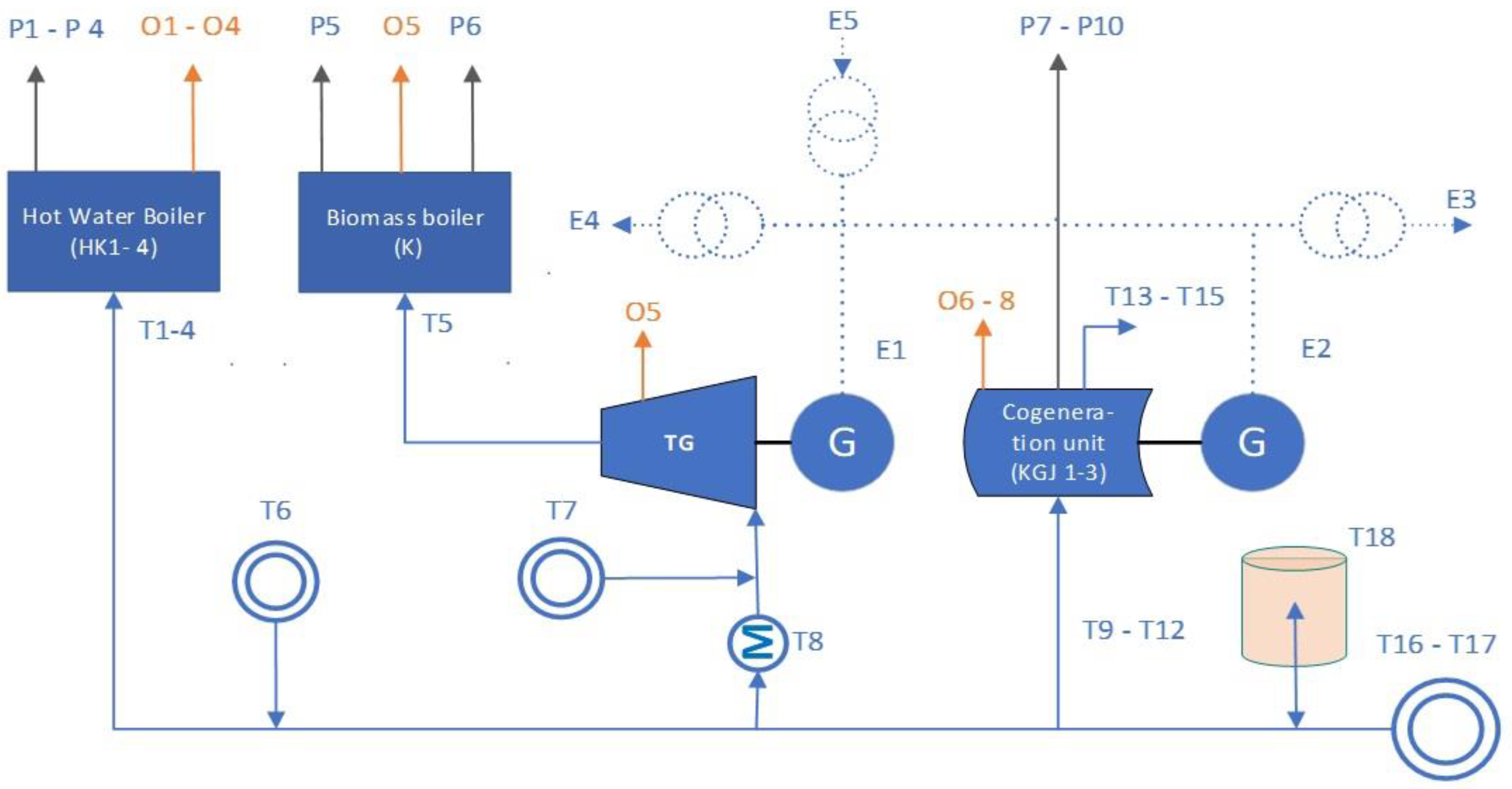
Figure 2.
Basic scheme for modeling production processes in a heating company.
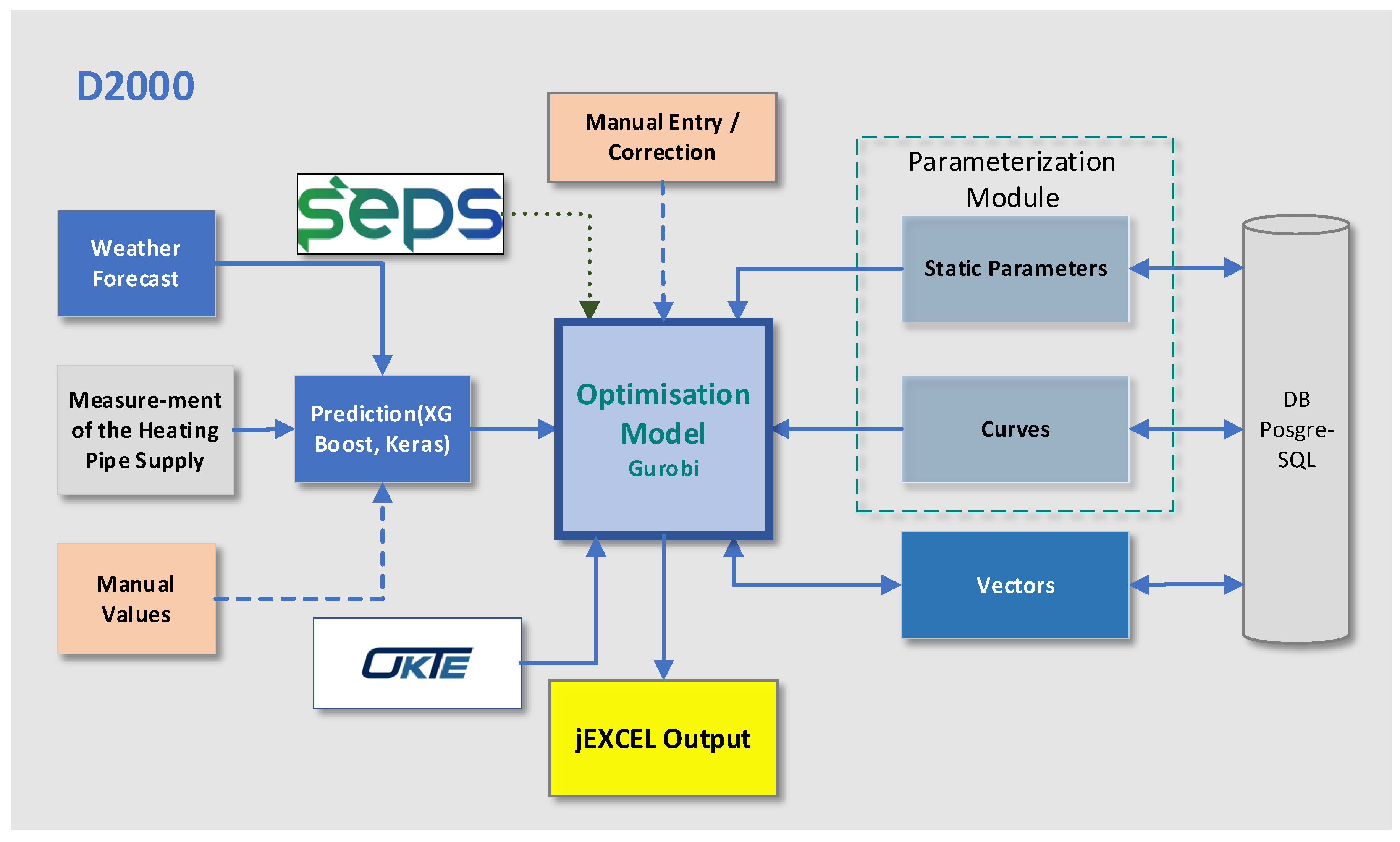
Figure 3.
Requirement to deployment heat during the Summer period.
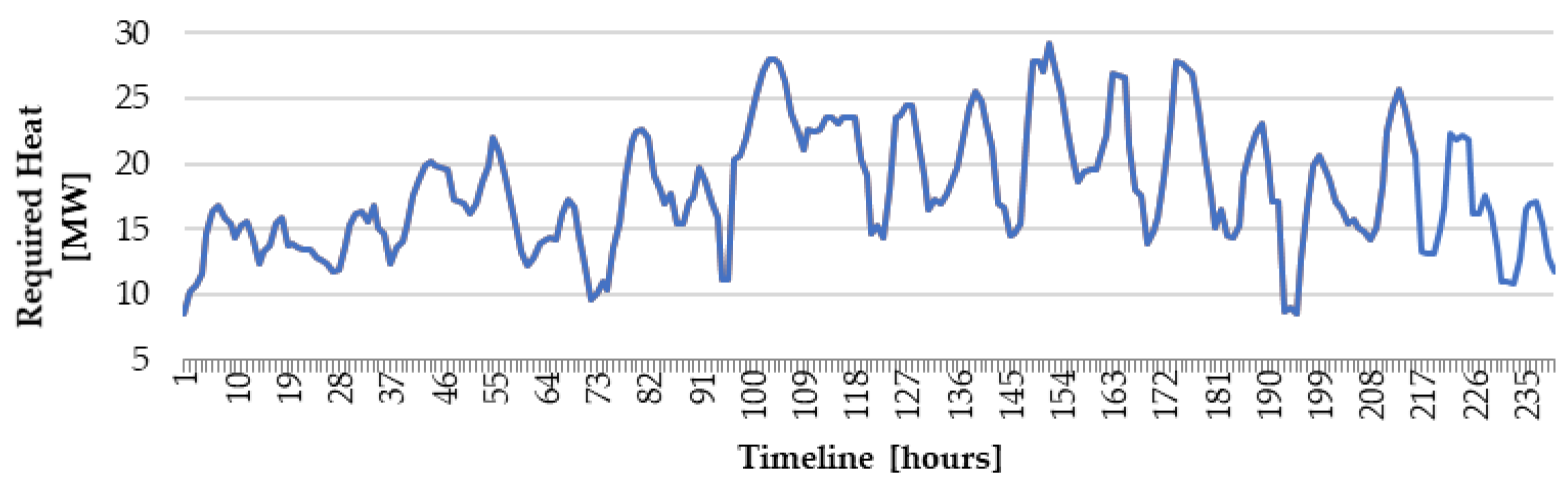
Figure 4.
Requirement to deployment heat during the Transition period.
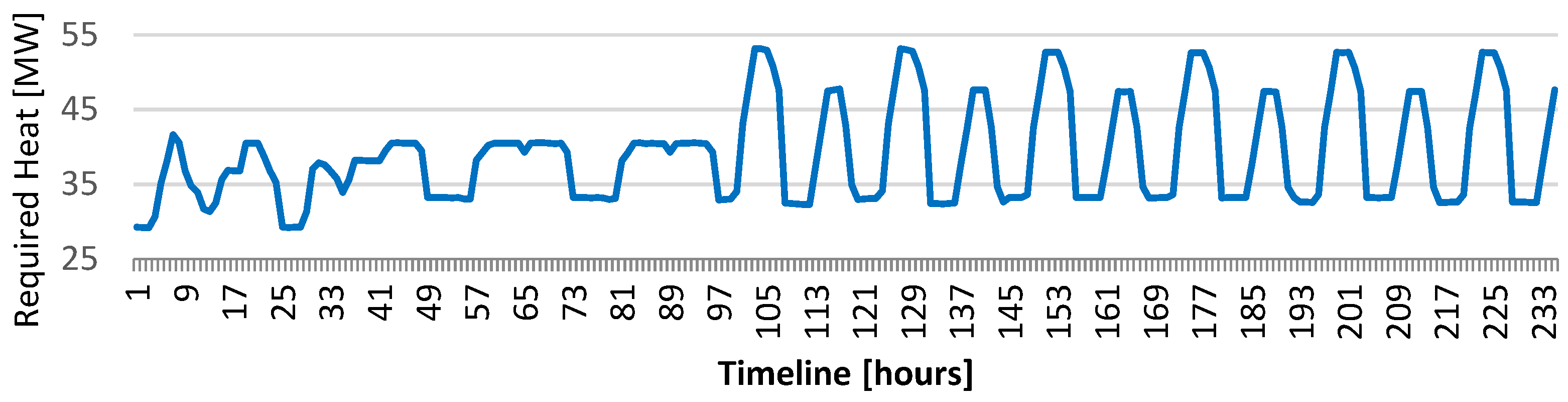
Figure 5.
Requirement for deployment of heat during the Winter period.
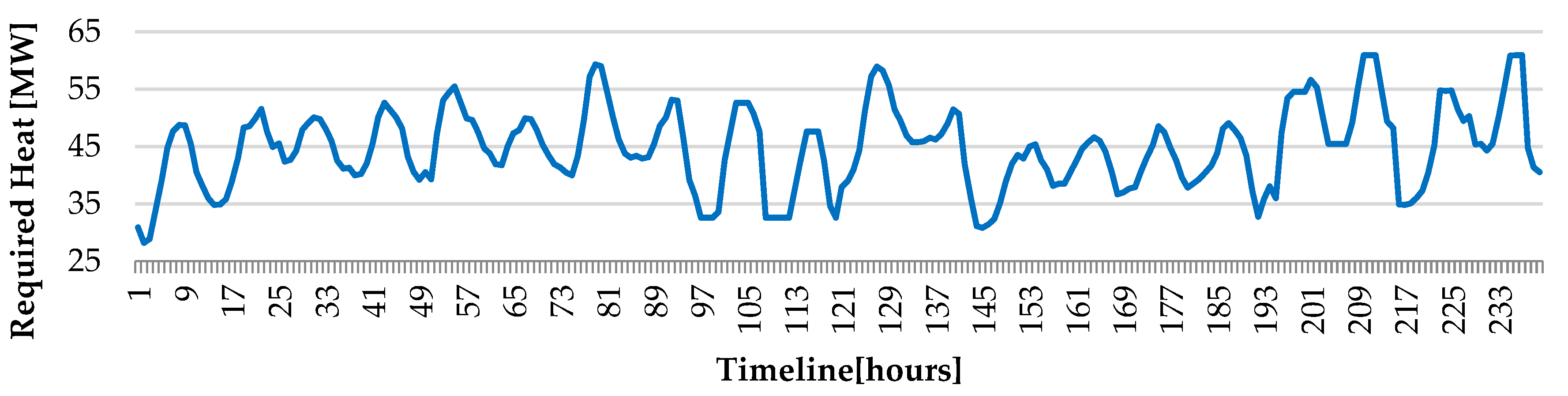
Table 1.
Parameterization units of the storage tank.
| Device | Input/Output | Parameter Description | Units | Type |
|---|---|---|---|---|
| AKU | Input | Accumulator heat losses (%/hour) | %/hod | Static. param. |
| AKU | Input | Amount of heat in the AKU | MWh | Vector |
| AKU | Input | Percentage of capacity utilisation | % | Static. param. |
| AKU | Input | Charging capacity MWt/hour | MWt/hour | Characteristics |
| AKU | Input | Discharge power MWt/hour | MWt/hour | Characteristics |
| AKU | Input | Heat exchanger efficiency | % | Static. param. |
| AKU | Input | Density of water in the accumulator | t/m3 | Vector |
| AKU | Input | Average accumulator water temperature | °C | Static. param. |
| AKU | Input | Current battery volume | t | Vector |
| AKU | Input | Current battery volume | m3 | Vector |
| AKU | Input | Available battery capacity | MWh | Vector |
| AKU | Input | Controlled available capacity of AKU | MWh | Vector |
| AKU | Input | Enthalpy input | GJ/t | Vector |
| AKU | Input | Enthalpy output | GJ/t | Vector |
| AKU | Input | Difference of enthalpies | GJ/t | Vector |
| AKU | Input | Return water temperature - HW IN | °C | Vector |
| AKU | Input | Max allowed temperature in AKU | °C | Static. param. |
| AKU | Input | Max. pump flow rate | t/h | Static. param. |
| AKU | Input | Min. pump flow rate | t/h | Static. param. |
| AKU | Input | Min. charging power | MW | Vector |
| AKU | Input | Max. charging power | MW | Vector |
| AKU | Input | Own consumption curve | MWt | Characteristics |
Table 3.
Summarisation of deployment modes in the Summer Operation period.
| Costing Items | Operating Modes | |||
|---|---|---|---|---|
| Real | Max.withoutPpS | Max. | Units | |
| Heat delivered to heating pipes according to the load: | 4 336 | MWh | ||
| Course of ISOT prices | 106,9 | €/MWh | ||
| Average sale diagram | 2,3 | 1,33 | 1,28 | MWh |
| Overall sale diagram | 553,02 | 319,81 | 306,92 | MWh |
| PpS scope provided | 4 167 | 0 | 7 386 | MWh |
| Revenue for PpS availability | 223 081 | 0 | 422 905 | € |
| Fuel consumption | 7 052 | 6 464 | 6 450 | MWh |
| Profit | 263 681 | 152 818 | 536 943 | € |
| Non-combined heat production | 0 | 0 | 0 | MWh |
| Qmar – Wasted heat | 0 | 1 | 1 | MWh |
| Absolute value of accumulation | 684 | 775 | 786 | MWh |
| Share of heat production K+TG/CGU/HK | 99/1/0 | 96/2/2 | 99/1/0 | % |
Table 4.
Summarisation of the modes of deployment in the Transition period.
| Costing Items | Operating Modes | |||
|---|---|---|---|---|
| Real | Max. without PpS | Max. | Units | |
| Heat delivered to heating pipes according to the load: | 8 442 | MWh | ||
| Course of ISOT prices | 111,5 | €/MWh | ||
| Average sale diagram | 7,6 | 4,6 | 4,4 | MWh |
| Overall sale diagram | 1 624 | 972 | 929 | MWh |
| PpS scope provided | 3 678 | 0 | 6 716 | MWh |
| Revenue for availability | 162 169 | 0 | 317 023 | € |
| Fuel Consumption | 14 977 | 13 518 | 13 468 | MWh |
| Profit | 357 357 | 340 459 | 654 204 | € |
| Non-combined heat production | 87 | 89 | 128 | MWh |
| Qmar – Wasted heat | 340 | 0 | 0 | MWh |
| Absolute value of accumulation | 945 | 819 | 894 | MWh |
| Share of heat production K+TG/CGU/HK | 95/4/1 | 99/0/1 | 98/0/2 | % |
Table 5.
Summarization of deployment modes in the winter operation period.
| Costing Items | Operating Modes | |||
|---|---|---|---|---|
| Real | Max.without PpS | Max. | Units | |
| Heat delivered to heating pipes according to the load: | 10 775 | MWh | ||
| Course of ISOT prices | 119,5 | €/MWh | ||
| Average electricity sale diagram | 20,4 | 8,1 | 5,0 | MWh |
| Overall electricity sale diagram | 4 904 | 1 956 | 1 194 | MWh |
| PpS scope provided | 3 256 | 0 | 7 525 | MWh |
| Revenue for availability | 60 665 | 0 | 344 898 | € |
| Fuel consumption | 21 573 | 17 873 | 16 898 | MWh |
| Profit | -230 060 | 333 322 | 692 142 | € |
| Qmar – wasted heat | 251 | 0 | 0 | MWh |
| Non-combined heat production | 0 | 237 | 980 | MWh |
| Absolute value of accumulation | 734 | 928 | 920 | MWh |
| Share of heat production K+TG/CGU/HK | 69/31/0 | 90/7/3 | 90/1/9 | % |
Disclaimer/Publisher’s Note: The statements, opinions and data contained in all publications are solely those of the individual author(s) and contributor(s) and not of MDPI and/or the editor(s). MDPI and/or the editor(s) disclaim responsibility for any injury to people or property resulting from any ideas, methods, instructions or products referred to in the content. |
© 2024 by the authors. Licensee MDPI, Basel, Switzerland. This article is an open access article distributed under the terms and conditions of the Creative Commons Attribution (CC BY) license (http://creativecommons.org/licenses/by/4.0/).
Copyright: This open access article is published under a Creative Commons CC BY 4.0 license, which permit the free download, distribution, and reuse, provided that the author and preprint are cited in any reuse.