

Submitted:
13 May 2024
Posted:
14 May 2024
You are already at the latest version
Abstract
Previous research has already examined the relationship between Future Anxiety, a construct recently introduced in Italy, and mental health in young adults, although possible mediating variables in this relationship have so far never been investigated. The present study attempts to fill this gap by exploring the incidence of Future Anxiety on psychological distress in a group of 302 young Italian adults (18 - 30 years; M = 21.9; SD = 2.6), presenting and evaluating the simultaneous mediating effect of Intolerance of Uncertainty and Non-Pathological Worry.Findings highlighted how Future Anxiety had a positive and significant direct effect on Stress and Depression, but not on Anxiety. In the three serial mediation models proposed, Intolerance of Uncertainty and Non-Pathological Worry mediated the relationship between Future Anxiety and mental health outcomes. The results also confirmed the hypothesized serial mediation effect by highlighting how young adults with greater Future Anxiety experienced more Intolerance of Uncertainty, which positively affected Non-Pathological Worry levels and, in turn, exacerbated psychological distress. Finally, results indicated that female participants experienced more Stress, Anxiety, and Depression in relation to Future Anxiety compared to males. Starting from the review of main references on this subject, the results discussed provide new insights for understanding youth psychological distress. Finally, practical implications for the design of supportive interventions for this study’s target group are proposed.
Keywords:
Young Adults
; Psychological Distress
; Future Anxiety
; Intolerance of Uncertainty
; Non-Pathological Worry
; Serial Mediation Analyses
; Mental Health
1. Introduction
For more than a decade, young adulthood has come to the forefront of psychological literature due to the complexity of its developmental tasks, exacerbated by economic and social difficulties as well as cultural characteristics that are typical of contemporary Western societies [1,2,3,4,5]. As an effect of this intertwining of factors, the time dilation of developmental tasks and acquisitions seems to have become the hallmark of this transitional phase [6]. In the Italian context, the specific subject of this research, procrastination is the central marker of the transition to adulthood, whether it concerns access to the world of work, a stable relationship, or parenthood [7,8]. Well beyond Italian borders, it has been highlighted that the tendency to procrastinate fuels experiences of frustration, bewilderment, and inadequacy [9,10,11], with negative repercussions on self-esteem, the representation of the future and, in general, on the mental health of young adults [12,13,14].
The worsening of psychological well-being and the growth of syndromes and symptoms of the internalizing and externalizing sphere occurs particularly in women [15,16], and has been exacerbated by the COVID-19 pandemic, which left deep marks on this developmental target, as reported in studies conducted in several countries [17,18,19,20,21]. If the pandemic trauma has slatentized and potentiated prior psychological distress [15,19,22,23,24], the ‘youth mental health emergency’ that is being talked about in Italy [25] urges psychological research to not only deal with it but to understand how to better cope with it, which in our opinion is a necessary step to investigate the risk and protective factors that may affect it.
Previous literature shows that maintaining a positive perspective of the future in the transition to adulthood is a protective factor that supports the process of identity definition, planning, emotional regulation, and the management of states of uncertainty [1,26,27,28,29]. The ability to preserve hope for the future, despite the inevitable uncertainties associated with potential obstacles and difficulties, helps young adults to maintain positive personal and professional expectations [30,31]. However, nowadays, the increasing difficulties in finding stable employment positions, reaching economic autonomy, and leaving one’s family home [7,32] have fueled a negative representation of the future in young people [33,34,35]. This socio-economic precariousness has been compounded by traumatic or potentially traumatic collective events such as the pandemic, wars, and the climate crisis, an interweaving of factors that has increased worries about the future of the world and one’s destiny, pessimism towards the future, and a deep sense of uncertainty, making it increasingly distressing to ‘think of oneself as an adult’ [36,37].
Recently, Jannini et al. [38] introduced the construct of Future Anxiety, originally defined as an attitude toward the future in which negative cognitive and emotional processes dominate over positive ones and where fear prevails over hope [39]. The negative time perspective and the consequent pessimism are not only powered by difficulties in the surrounding reality but also by a perceived personal inability to cope with them [38]. This construct stems from the need to investigate the impact that the worsening of global social, economic, and political conditions is having on mental health [40]. In a study by Mutia and Hargiana [41], Future Anxiety appears to apply specifically to young adulthood, and contextual factors have a greater role in facilitating or hindering the growth process. Previous research conducted on this developmental target has highlighted not only the association between Future Anxiety and psychological distress, in terms of Anxiety, Depression and Stress [42,43] but also its function as a risk factor in exacerbating the impact that collective traumatic events (e.g., pandemic, war) have on mental health [20,44,45,46].
States of apprehension and worry about the future that increase fear of the unknown and, at the same time, a negative attitude towards the future [40], facilitate the arising of experiences of uncertainty that risk enhancing the effect of a physiological instability that is typical of the transition to adulthood. Indeed, the construction of identity as a specific developmental task is linked to the exploration of the various possibilities that the present and future might offer, but which have not yet materialized [2]. Thus, while the ability to tolerate and manage uncertainty fosters exploration by acting as a protective factor for well-being [31], the inability to tolerate it constitutes a risk factor, increasing anxiety and reverberating negatively on developmental tasks [47].
Intolerance of Uncertainty is described as a dispositional component that, in the interplay between cognition, emotion, and behavior, expresses “the tendency to be bothered or upset by the (as yet) unknown elements of a situation, whether the possible outcome is negative or not” [48] (p. 6). Research has shown that this dispositional component can fuel anxiety, fear, and worry [49], influencing how individuals interpret the present and future [50] and facilitating the adoption of dysfunctional behaviors in service of an illusory desire for control [48]. Moreover, other studies have shown how it constitutes a trans-diagnostic factor for psychopathological frameworks of the internalizing sphere, including obsessive-compulsive disorder, generalized anxiety disorder, depression, and eating disorders [51]. More recently, it has been found that Intolerance of Uncertainty can not only be powered by stressful external events—such as a pandemic or war—but that it also enhances the impact of such events on mental health, as does Future Anxiety [45,52].
Within the Italian framework of the ‘youth mental health emergency’, a sharp increase in worries associated with both global collective phenomena such as the climate crisis and more generally the future, as well as strictly contextual issues related to unemployment, the economic crisis, and the rising cost of living have already been noted [36,53]. The relationship between worries and mental health has long been investigated in the literature [54] and concerns both pathological worries and non-pathological worries. Indeed, while the former are associated with lower psychological well-being [55,56], the latter—viz. daily worries triggered by everyday stressors [57,58]—are also capable of increasing loneliness, dissatisfaction with life, and forms of mental suffering such as anxiety and stress [59,60,61]. Thus, the Worry construct is significantly related to mental health outcomes, but it is also associated with Future Anxiety [39]. Despite their differences, the link between the two constructs is clearer insofar as the latter is described as the tendency to think about the future with particular worries, fears, and anxieties [38]. Furthermore, since the publication of Freeston et al. [62], the relationship between Intolerance of Uncertainty and Worry has also been extensively investigated, becoming an important constituent axis of the Intolerance of Uncertainty Model (IUM) [63]. In this vein, Koerner and Dugas’ study [64] showed that Intolerance of Uncertainty can be considered a cognitive vulnerability factor for Worry, as it can significantly predict increased levels of Worry both in a non-clinical sample [65] and in an experimental research setting [66]. To sum it up, scientific evidence suggests that Intolerance of Uncertainty is a risk factor that exacerbates overall Worry levels by reinforcing a negative problem orientation and fostering cognitive avoidance strategies [63].
Aim and Hypotheses of the Study
Based on the literature review, the present study explores the impact of Future Anxiety on psychological distress in a group of young Italian adults, taking into consideration the relationships evidenced therein between the previously described constructs [39,42,49,51,60,63,64] and the results of the reports on the mental health status of Italian youth [25,36,67]. Furthermore, it explores the possible joint mediating role of Intolerance of Uncertainty and Non-Pathological Worry. The research aim arises from the desire to fill a gap concerning the absence of mediation studies on the relationship between Future Anxiety and Psychological Distress. At the same time, this study was designed to explore the underlying factors of youth psychological distress—which is growing exponentially in Italy [25] –, trace its contours, and highlight potential risk and protection factors that may affect it. In our opinion, this goal can implement the understanding of the long-reported state of ‘youth psychological emergency’, providing potential evidence to support psychological interventions aimed at this age group.
From the previously mentioned literature, we hypothesized that Future Anxiety positively predicts Psychological Distress, in particular, Stress, Anxiety and Depression [H1] but also that it has an impact both on Intolerance of Uncertainty [H2] and Non-Pathological Worry [H3]. We further hypothesized that both Intolerance of Uncertainty [H4] and Non-Pathological Worry [H5] positively predict higher levels of Psychological Distress. Finally, we also assumed that the influence of Future Anxiety on Psychological Distress would be mediated by the joint effects of Intolerance of Uncertainty and Non-Pathological Worry [H6], and that women may show higher levels of Psychological Distress than men [H7]. The hypotheses are graphically represented in Figure 1.
2. Materials and Methods
2.1. Procedure and Participants
Participants involved in the study were recruited via social media through the snowball sampling method, in the period between November 2023 and January 2024. Data were collected through self-report questionnaires using the Google Forms platform.
Sampling was performed taking into consideration the following inclusion criteria: age between 18 and 30 years old, residence in Italy, Italian nationality, and acceptance of the informed consent on the first page of the survey. All participants were adequately informed of their right to privacy and anonymity, as well as the aims and procedures of the study.
The sampling process was preceded by two a priori analyses on the minimum sample size. Preliminarily, G*Power was used and a total of 164 participants were indicated for a medium-size effect (f2 = 0.15) with 99% power and an alpha of 0.01 using linear multiple regression, fixed model, and R2 increase. Having adopted the bootstrap method to assess the significance of indirect mediation effects, the MedPower program [68] was used and a minimum sample size of 214 was sufficient to achieve 80% power of detecting a significant effect at the 0.05 level. Thanks to the bootstrapping procedure and our sample size, there are no concerns about sampling power.
A sample of 302 young Italian adults was recruited for the present study, including 148 males (49.0%) and 154 females (51.0%) aged between 18 and 30 years (M = 21.96; SD = 2.61). Most participants lived in South Italy (87.1%) and, in particular, 127 young adults declared to live in the city (42.1%) and 175 in provincial areas (57.9%). Concerning marital status, 155 (51.3%) participants were single, 142 (47.0%) were in a non-cohabiting relationship, and 5 (1.7%) were cohabiting with their partners. Regarding their educational level, 8 participants stated that they received a lower secondary school diploma (2.6%), 229 a high school diploma (75.8%), 48 a bachelor’s degree (12.6%), and 27 a master’s degree (8.9%). As for the participants’ occupation, 190 were students (62.9%), 57 were working students (18.9%), 48 were workers (15.9%), and 7 were unemployed (2.3%).
2.2. Data Collection Tools
Personal information. An ad hoc questionnaire was created to assess participants’ socio-demographic characteristics. Information regarding age, gender, type of residence, region of residence, occupation, level of education, and relationship status were collected.
The Dark Future Scale (DFS) [38] is a 7-point Likert-type scale ranging from 0 (Definitely untrue) to 6 (Definitely true) and assessing Future Anxiety through 5 items. It is a construct that explores concern and anxiety toward the future and includes cognitive and emotional processes in which the fear of the future dominates hope. The scale has an overall range from 0 to 30 and higher scores reflect higher levels of Future Anxiety. The authors of the DFS reported good internal consistency [38], and in this study, Cronbach’s α was .88.
The Intolerance of Uncertainty Scale—Short Form (IUS-12) [50,69] is a 12-item self-report measure with a 5-point Likert-type scale, ranging from 1 (Strongly disagree) to 5 (Strongly agree), assessing one’s tendency to find uncertainty as distressing. The measure provides two different sub-dimensions of intolerance toward uncertainty, “Prospective Intolerance of Uncertainty” and “Inhibitory Intolerance of Uncertainty” [69,70] as well as a total score ranging from 12 to 60, in which a higher score corresponds to a higher Intolerance of Uncertainty. The total score was used in this study. The authors of the Italian adaptation of the IUS-12 reported good internal consistency [69], and in this study, Cronbach’s α for the overall scale was .88.
The Worry Domains Questionnaire (WDQ) [71,72] is a 25-item self-report instrument with a 5-point Likert-type scale ranging from 1 (Not at all) to 5 (Extremely), assessing Non-Pathological Worry across five general worry domains including Relationships, Lack of Confidence, Aimless Future, Work-Related, and Financial. This instrument also provides a global Non-Pathological Worry score, namely an indication of a widespread and generalized tendency to worry which is not a pathological condition per se, but rather a normal mental activity fueled by everyday stressors. In line with other studies [61,73], we considered the global score here. The authors of the Italian version of the WDQ reported good psychometric properties and good internal consistency [72]. In the present study, Cronbach’s α was .92.
The Depression, Anxiety and Stress Scale (DASS-21) [74,75] is a 21-item self-report instrument with a 4-point Likert-type scale, ranging from 0 (Did not apply to me at all) to 3 (Applied to me very much, or most of the time). The scale is composed of three subscales, consisting of 7 items each that assess Depression, Anxiety and Stress in the last 7 days. Concerning the Stress dimension, scores between 0 and 10 indicate normal levels, scores between 11 and 18 mild levels, scores between 19 and 26 moderate levels, scores between 27 and 34 severe levels, and scores between 35 and 42 extremely severe levels. As far as the Anxiety dimension is concerned, scores between 0 and 6 indicate normal levels, scores between 7 and 9 mild levels, scores between 10 and 14 moderate levels, scores between 15 and 19 severe levels, and scores between 20 and 42 extremely severe levels. Finally, scores of the Depression dimension between 0 and 9 indicate normal levels, those between 10 and 12 mild levels, those between 13 and 20 moderate levels, those between 21 and 27 severe levels, and those between 28 and 42 indicate extremely severe levels. The Italian version shows good psychometric properties and good internal consistency [75] and in the present study, Cronbach’s α was .82 for Stress, .88 for Anxiety, and .88 for Depression.
2.3. Data Analysis
All the analyses were conducted using IBM SPSS version 29.0 [76].
Descriptive analyses, mean, minimum and maximum response range and standard deviation were calculated for all psychological variables. Reliability analyses were conducted using Cronbach’s α, which was considered good when values were greater than 0.70. Skewness and Kurtosis were evaluated considering values ranging from—1.5 to + 1.5 [77].
To explore differences between groups—considering the socio-demographic variables—and highlight possible covariates to be added in the mediation models, t-test and ANOVA analyses were performed (p < 0.05). Cohen’s d and eta-square (η2) were used to measure effect sizes.
Correlation analyses were also performed using Pearson’s coefficient (0.10 < r > 0.29 = small association; 0.30 < r > 0.49 = medium association; r > 0.50 = large association; p < 0.05) to preliminarily explore the association between variables.
Before conducting the mediation analyses, preliminary statistical analyses were implemented. Harman’s single-factor test was used to evaluate the common method bias derived from self-reported data [78]. A check of multicollinearity between the independent variables and mediators was conducted considering values of tolerance greater than 0.1 and the Variance Inflation Factor (VIF) smaller than 5.0 as good. Finally, Durbin Watson values were explored to verify the absence of residual problems, and those close to the threshold value of 2 were considered adequate [79].
To evaluate the Hypotheses, several serial mediation models with four factors were fit to examine whether the association between Future Anxiety and Psychological Distress (Stress, Anxiety and Depression) was mediated by Intolerance of Uncertainty and Non-Pathological Worry. Model 6 of the PROCESS macro in SPSS [80] has been used to conduct three serial mediation models. In these serial mediation patterns, Stress, Anxiety and Depression were selected as dependent variables (Y), Future Anxiety as the independent variable (X), Intolerance of Uncertainty and Non-Pathological Worry as Mediators (M1 and M2), and Age and Gender were measured as potential covariates, based on literature review and results of correlations and t-tests. In all three serial models, mediation tests were performed simultaneously through two triangle pathways and one quadrangle pathway: Future Anxiety → Intolerance of Uncertainty → Psychological Distress (Ind1); Future Anxiety → Non-Pathological Worry → Psychological Distress (Ind2); Future Anxiety → Intolerance of Uncertainty → Non-Pathological Worry → Psychological Distress (Ind3). The statistical significance of mediation effects was examined using bootstrapping methods to estimate bias-corrected asymmetric confidence intervals (CIs) with 5000 resamples with replacement and verify the robustness of mediating effects (95% CIs not inclusive of zero indicate significant effects). Finally, sensitivity analyses were conducted to detect the effects of the opposing relationship between Intolerance of Uncertainty and Non-Pathological Worry.
3. Results
3.1. Descriptive Analyses and Group Differences
The mean of the DFS was 19.29 (SD = 6.78), that of the IUS-12 was 35.36 (SD = 9.81), and that of the WQD was 49.28 (SD = 19.45). Those for Stress, Anxiety, and Depression were, respectively, 25.60 (SD = 10.04), 17.57 (SD = 10.87), and 20.77 (SD = 10.78). All variables in this study were normally distributed, with values of Skewness and Kurtosis ranging from + 1.5 to − 1.5. All descriptive analyses, Cronbach’s α, Skewness and Kurtosis are shown in Table 1.
The T-tests showed significant gender differences. Female participants reported higher levels than male ones for the DFS (MF = 21.10 vs. MM = 17.40; t(300) = 4.74; p < 0.001; d = 0.55), the WDQ (MF = 52.88 vs. MM = 45.55; t(300) = 3.19; p = 0.002; d = 0.18), Stress (MF = 28.66 vs. MM = 22.40; t(300) = 5.36; p < 0.001; d = 0.65), Anxiety (MF = 20.40 vs. MM = 17.73; t(300) = 4.54; p < 0.001; d = 0.52) and Depression (MF = 22.51 vs. MM = 18.97; t(300) = 2.85; p = 0.005; d = 0.34).
ANOVA and post hoc tests also showed significant differences in relation to occupation. Indeed, students reported higher levels than working students for the DFS (MS = 20.08 vs. MWS = 17.14; F(3, 298) = 4.43; p = 0.005; η2 = 0.04) and for the WDQ (MS = 51.64 vs. MWS = 43.69; F(3, 298) = 6.17; p < 0.001; η2 = 0.06). No further significant group differences were found considering other socio-demographic variables.
3.2. Correlation Analyses
Pearson’s correlations between participants’ age, gender, and psychological variables highlighted a positive, significant, and strong correlation between Future Anxiety (DFS) Intolerance of Uncertainty (IUS-12), and Non-Pathological Worry (WDQ). At the same time, Future Anxiety was also positively and significantly associated with Stress, Anxiety and Depression (DASS-21). Age was significantly and negatively correlated with Stress, Anxiety and Depression while Gender was significantly and positively correlated with Future Anxiety, Intolerance of Uncertainty, and all outcomes of Psychological Distress. All correlation results are shown in Table 2.
3.3. Preliminary Analyses
Harman’s single-factor test extracted 12 factors with eigenvalues greater than 1. The first factor explained 29.55% of the total variance, which is below the recommended threshold of 50% [81]. This result indicated that common method bias does not hinder this study.
Multicollinearity diagnostics showed that the tolerance values varied between 0.43 and 0.63, and Variance Inflation Factor (VIF) values ranged from 1.57 to 2.34. Durbin–Watson Values, evaluated for the three models on mental health outcomes, were respectively 1.89, 2.10, and 2.08. These findings indicated that multicollinearity and residual problems were not present.
3.4. Serial Mediation Model on Stress
As seen in Figure 2, the results of serial mediation analysis showed that Future Anxiety had a significant direct effect on Intolerance of Uncertainty (a1 = .48; SE = .08; t = 9.07; p < .001) and on Non-Pathological Worry (a2= .51; SE = .13; t = 11.53; p < .001). Similarly, Intolerance of Uncertainty positively predicted Non-Pathological Worry (d21 = .36; SE = .08; t = 8.40; p < .001). Furthermore, Intolerance of Uncertainty (b1 = .18; SE = .06; t = 3.25; p < .01) and Non-Pathological Worry (b2 = .27; SE = .03; t = 3.94; p < .001) had a significant effect on Stress. The co-presence of a significant total effect between Future Anxiety and Stress (c = .69; SE = .07; t = 9.31; p < .01; CI [.55, .84]) and, at the same time, a significant direct effect of Future Anxiety on Stress (c’ = .28; SE = .09; t = 3.01; p < .01; CI [.10, .47])—despite the addition of the two mediators—was indicative of a partially mediated model.
The total indirect effect (i.e.,) of Future Anxiety through Intolerance of Uncertainty and Non-Pathological Worry on Stress was significant (total i.e., = .28; SE = .04; 95%; CI [.18, .36]). The indirect effect of Future Anxiety on Stress via Intolerance of Uncertainty was significant (Ind1 = .09; SE = .03; 95%; CI [.03, .14]), as was the indirect effect of Future Anxiety on Stress via Non-Pathological Worry (Ind2 = .14; SE = .03; 95%; CI [.07, .21]). As a result of a serial mediating effect, the indirect effect of Future Anxiety on Stress via Intolerance of Uncertainty and Non-Pathological Worry was significant (Ind3 = .05; SE = .01; 95%; CI [.02, .07]).
Regarding the covariates, age did not have a significant impact on the total effect model (βage = -.06; p = .22) while Gender was found to be statistically significant in the total effect model (βgender = .18; p < .000), indicating that women experienced more Stress levels about Future Anxiety compared to men.
3.5. Serial Mediation Model on Anxiety
As seen in Figure 3, the results of serial mediation analysis showed that Future Anxiety had a significant direct effect on the mediators, and Intolerance of Uncertainty positively predicted Non-Pathological Worry (see Figure 2 and Model 1). Intolerance of Uncertainty (b1 = .17; SE = .07; t = 2.77; p < .01) and Non-Pathological Worry (b2= .25; SE = .04; t = 3.37; p < .001) had a significant effect on Anxiety. The co-presence of a significant total effect between Future Anxiety and Anxiety (c = .58; SE = .09; t = 6.65; p < .001; CI [.41, .75]) and, at the same time, a non-significant direct effect of Future Anxiety on Anxiety (c’ = .16; SE = .11; t = 1.45; p < .15; CI [-.06, .38])—despite the addition of the two mediators—was indicative of a fully mediated model.
The total indirect effect of Future Anxiety through Intolerance of Uncertainty and Non-Pathological Worry on Anxiety was significant (total i.e., = .26; SE = .05; 95%; CI [.16, .35]). The indirect effect of Future Anxiety on Anxiety via Intolerance of Uncertainty was significant (Ind1 = .08; SE = .03; 95%; CI [.02, .15]), as was the indirect effect of Future Anxiety on Anxiety via Non-Pathological Worry (Ind2 = .13; SE = .04; 95%; CI [.06, .21]). As a result of a serial mediating effect, the indirect effect of Future Anxiety on Anxiety via Intolerance of Uncertainty and Non-Pathological Worry was significant (Ind3 = .08; SE = .01; 95%; CI [.02, .10]).
Regarding the covariates, Age did not have a significant impact on the total effect model (βage = -.08; p = .12) while Gender was found to be statistically significant in the total effect model (βgender = .16; p < .01), indicating that females experienced more Anxiety levels about Future Anxiety compared to males.
3.6. Serial Mediation Model on Depression
As seen in Figure 4, the results of serial mediation analysis showed that Future Anxiety had a significant direct effect on the mediators, and Intolerance of Uncertainty positively predicted Non-Pathological Worry (see Figure 2 and Model 1). Furthermore, Intolerance of Uncertainty (b1 = .19; SE = .06; t = 3.20; p < .01) and Non-Pathological Worry (b2 = .27; SE = .04; t = 3.88; p < .001) had a significant effect on Depression. The co-presence of a significant total effect between Future Anxiety and Depression (c = .84; SE = .08; t = 10.36; p < .000; CI [.68, .99]) and, at the same time, a significant direct effect of Future Anxiety on Depression (c’ = .40; SE = .10; t = 3.88; p < .000; CI [.20, .60])—despite the addition of the two mediators—was indicative of a partially mediated model.
The total indirect effect of Future Anxiety through Intolerance of Uncertainty and Non-Pathological Worry on Depression was significant (total i.e., = .27; SE = .04; 95%; CI [.19, .35]). The indirect effect of Future Anxiety on Depression via Intolerance of Uncertainty was significant (Ind1 = .10; SE = .03; 95%; CI [.03, .15]), as was the indirect effect of Future Anxiety on Depression via Non-Pathological Worry (Ind2 = .14; SE = .04; 95%; CI [.06, .21]). As a result of a serial mediating effect, the indirect effect of Future Anxiety on Depression via Intolerance of Uncertainty and Non-Pathological Worry was significant (Ind3 = .05; SE = .01; 95%; CI [.02, .08]).
Regarding the covariates, Age (βage = -.06; p = .22) and Gender (βgender = .02; p = .66) did not have a significant impact on the total effect model, indicating that there were no differences between females and males in Depression levels about Future Anxiety.
3.7. Sensitivity Analyses
The sensitivity analysis of serial mediation models is shown in Supplementary Material (Table 1B). The opposing direction effects of Intolerance of Uncertainty and Non-Pathological Worry on the association between Future Anxiety and Stress, Anxiety and Depression were presented in the sensitivity analyses (Future Anxiety → Non-Pathological Worry → Intolerance of Uncertainty → Stress, Anxiety, Depression). The variable of Non-Pathological Worry was included as the first mediator, while Intolerance of Uncertainty was considered as the second mediator. According to the sensitivity analysis and by reversing the mediators, we found that the effect of Future Anxiety on Intolerance of Uncertainty was not significant (a2 = 0.11, p = 0.07). At the same time, the indirect mediating effect of Intolerance of Uncertainty in the relationship between Future Anxiety and Stress (Ind2 = 0.02; SE = .01; CI [-0.005, 0.05]), Anxiety (Ind2 = 0.02; SE = .01; CI [-0.004, 0.05]) and Depression (Ind2 = 0.02; SE = .01; CI [-0.004, 0.05]) became not significant. Overall, this inversion reduced the total effect of all three models.
4. Discussion
The present study explored the relationship between Future Anxiety, Intolerance of Uncertainty, Non-Pathological Worry, and Psychological Distress in a group of young Italian adults. To our knowledge, such an investigation on Italian subjects is unprecedented, probably due to the recent introduction of the construct of ‘Future Anxiety’ [38]. In this investigation, three serial mediation models have been hypothesized and assessed to explore the impact of Future Anxiety on Stress, Anxiety and Depression levels, as well as the indirect effects that Intolerance of Uncertainty and Non-Pathological Worry (used here as joint mediators) have on this relationship. Our results are in line with the ‘youth mental health emergency’ that is characterizing the Italian post-COVID context [25,67], and highlight severe levels of Stress, Anxiety and Depression in the participants, which are particularly heightened in the female group. These results align with those obtained by Van Loo et al. [16], which recently identified an increase in internalizing problems, precisely in young people aged between 18 and 30 (namely the target of this study), but also with recent studies on the effects of COVID-19 on young adults [17,19,21]. Furthermore, they also share similarities with Awad et al. [42], and Torrado & Garcia-Castro [43], partially confirming our hypothesis H1 and shedding light on the significant direct effect of Future Anxiety on Stress and Depression. On the contrary, the results from our Anxiety model differ from previous studies, as Intolerance of Uncertainty and Non-Pathological Worry together completely mediate the impact of Future Anxiety on Anxiety.
If specific contextual factors that affect the representation of young people’s future and hinder the transition to adulthood have long been reported in the literature [7,9,12,14], more recently it has been highlighted that even collective events with traumatic potential—such as the COVID-19 pandemic, wars, and the climate crisis—are fueling the Dark Future time perspective [44,45,46].
We might say that, in addition to specific external factors, the increase in uncertainty, pessimism, and the consequent decrease in motivation to take action found among young Italian adults [37] are also having an impact on the perception of not having enough resources to face difficulties, viz. on the internal factor of Future Anxiety highlighted by Jannini et al. [38].
Considering the three serial mediation models conducted, the results confirm our hypotheses H2 and H3, suggesting that the higher the level of Future Anxiety, the more the probability of experiencing greater levels of Intolerance of Uncertainty and Non-Pathological Worry increases. We believe that the strong associations found in our report between these psychological variables (see Table 2), which had not yet been investigated in Italy before, are of significant importance for better understanding the contours of the widely reported psychological distress in young adults, and the risk factors that are triggering it.
At an age where instability is a distinctive trait [2], imagining the future requires tolerating moments of uncertainty and fear of the unknown. It is in these moments that the creative drive to explore life alternatives arises and allows the definition of new development trajectories in the construction of an authentic and coherent life plan [82] in different fields and starting from the objectives we intend to pursue [83]. From this perspective, Intolerance of Uncertainty appears to be an obstacle to this exploratory capacity, a risk factor that can alter the perception of the present and the future, fueling fears, anxieties, worries, and an anguished attitude towards the future in which an illusory desire for control can be activated as a defense [47,48,49].
Our results also highlight the relationship between Future Anxiety and Non-Pathological Worry, confirming the link between these variables and providing an empirical basis for the definition of the Dark Future time perspective as “a specific inclination to think about the future with worry” [38] (p. 86). In fact, they suggest that higher levels of Future Anxiety correspond to a higher likelihood of experiencing daily difficulties and stressors with great concern (e.g., economic autonomy, difficulties in the world of work, relational problems, and uncertainty about the future), which impacts the psychological well-being of young people.
In continuity with this, it emerges that both Intolerance of Uncertainty (see Ind1) and Non-Pathological Worry (see Ind2) are significant mediators in the relationship between Future Anxiety and Psychological Distress. Regarding the first mediator, our results suggest that the relationship between Future Anxiety and Psychological Distress could be mediated by the dispositional tendency to tolerate states of uncertainty (H4), in line with the study by Freeston et al. [48] on “Uncertainty Distress Model”. Regardless of the type of stressor, subjects who do not tolerate uncertainty or who experience it negatively are more at risk of experiencing forms of psychological distress, especially in the internalizing sphere [51]. Not only that, as revealed more recently, Intolerance of Uncertainty can also fuel the impact of collective traumatic events on psychological distress [45,52].
In all three mediation models explored, Non-Pathological Worry was also a significant mediator in the relationship between Future Anxiety and Psychological Distress (H5). This relationship had not yet been investigated in the Italian context, despite several reports stating an increase in pervasive and varied concerns in young adults [36,67]. In line with Kelly et al. [60,61], our results highlight that non-pathological worries are fueling Stress, Anxiety and Depression, acquiring a maladaptive function that fuels youthful malaise. As a starting point for future research, we wonder whether and to what extent the increase in daily worries and their impact on mental health are also connected to specific sources of contemporary malaise, including excessive pressure for perfection, urgency, performance, and competition [84,85].
Through the serial mediation models for Stress, Anxiety and Depression, our results also confirm the joint mediation effect of Intolerance of Uncertainty and Non-Pathological Worry (H6). In line with the contributions by Freeston et al. [62] and with the Intolerance of Uncertainty Model (IUM) [63], they emphasize that Intolerance of Uncertainty functions as a dispositional characteristic profoundly associated with Worry and, specifically, a risk factor that can predict greater levels of worry in young Italian adults. These results, confirmed by subsequent sensitivity analyses, agree with the studies by Koerner and Dugas [64] and confirm Intolerance of Uncertainty as a factor of cognitive vulnerability to Worry. Although both mediators, even if taken individually, were found to be risk factors for psychological well-being, it seems to us that the serial models offer an overall vision of the relationship between the variables investigated, providing a clearer understanding of the relation between Intolerance of Uncertainty and Non-Pathological Worry and their joint mediating effect on Future Anxiety and Psychological Distress. The significant serial link (see Ind3) integrates several factors that impact the relationship between Future Anxiety and Psychological Distress and offers a way to better understand why subjects with greater Future Anxiety also tend to have greater levels of Psychological Distress. Without the aim of saturating the field of investigation, these data could open new avenues in understanding the interaction between Future Anxiety and Psychological Distress, providing new food for thought to the psychological literature that is interested in these constructs.
To conclude, our results also highlighted greater psychological fragility in women, confirming the hypothesis we formulated based on the reference literature (H7). In all the serial models presented, in fact, women report greater levels of psychological distress in relation to Future Anxiety. These results, together with the higher levels of Future Anxiety and Non-Pathological Worry that emerged from the t-tests, are in line with studies reporting the greater risk of psychological distress in the internalizing sphere of women [86,87]. Furthermore, these findings reiterate those that emerged in studies on mental health concerning the COVID-19 pandemic [18,88,89,90] and the most recent data reported by Van Loo et al. [16], according to which the increase in internalizing problems in the target group to which this study refers particularly concerns women.
Limitations and Directions for Future Research
First of all, the limitations of the present study concern the web-based convenience sampling methodology, which implies specific biases such as the volunteer bias, related to the specific characteristics of subjects who voluntarily participate in a study. Another bias concerns the use of a mono-method, as the assessment of all variables using self-report instruments may have caused inflation in the observed associations. In addition, this is a cross-sectional study that does not allow for the establishment of causal/directional relationships among the variables explored, which future research could overcome by adopting a multi-method approach. Finally, the participants are mostly young adult students, thus future studies could make up for this shortcoming by considering a more diverse sampling (for instance, including more young working adults). Overall, the highlighted limitations do not allow the results obtained to be generalized to the entire population of young Italian adults, so we suggest that prospective research consider increasing the representativeness of the sample in the future.
5. Conclusion and Practical Implications
The present study investigated the indirect psychological impact of Intolerance of Uncertainty and Non-Pathological Worry on Future Anxiety and Italian young adults’ psychological distress. This is, to our knowledge, the first Italian study to explore mediating variables in the relationship between Future Anxiety and mental health, highlighting the joint mediating effect that Intolerance of Uncertainty and Non-Pathological Worry have in this relationship.
We believe that our research contributes to enriching innovatively the psychological literature that has long explored the connection between future perspective and youth mental health, delving into the contours of the ‘youth mental health emergency’ that is being talked about in Italy [25]. Furthermore, in our opinion, highlighting how Intolerance of Uncertainty and non-pathological daily worries constitute significant risk factors that increase the impact of Future Anxiety on the mental well-being of young adults offers important insights on how to design more targeted intervention projects aimed at supporting young people’s ability to deal more effectively with the developmental tasks of their transition to adulthood. Our results stress the importance of working on the implementation of tolerance of uncertainty connected not only to the age-specific tasks and difficulties encountered today but also to collective events with traumatic potential. Although Intolerance of Uncertainty is a dispositional factor, previous literature suggests that it is particularly influenced by external factors such as the amount and quality of information and tools available for understanding and managing a given event/difficulty, which can fuel or reduce uncertainty [50]. Without denying the importance of the reality on which daily worries and the uncertainty connected to them are grounded, we maintain that classifying them in the physiological tasks of the evolutionary transition, sharing them and, at the same time, receiving support to reappropriate oneself of the chance of having a positive impact in the world and on one’s future are important elements for a successful individual and group empowerment intervention. It is in the group space guided by an expert that the narration and sharing of worries, anxieties, uncertainties, and negative emotions can be represented and understood, an effort that is known to reduce their negative impact and support psychological well-being [91].
In our opinion, some things are pivotal in rediscovering a network of connections, reducing the sense of impotence and loneliness, and rekindling the hope of being able to co-build possible resources and alternatives together. These include the promotion of uncertainty as a growth factor that is not only physiological but also positive to the extent that its tolerance opens the way to the individual and creative exploration of one’s growth path, and the support to address shared and common concerns and rediscover oneself as an ‘agentive participant’ in the world [92]. The mediating role that Intolerance of Uncertainty and daily worries play on the impact that Future Anxiety has on Psychological Distress implies that working on the former could have a positive impact on Future Anxiety and, consequently, on the negative role that it performs on the mental well-being of young Italian adults.
Supplementary Materials
The following supporting information can be downloaded at: www.mdpi.com/xxx/s1, Figure S1: title; Table S1: title; Video S1: title.
Author Contributions
G.M.R.: research design, data collection, analysis, and interpretation of data; manuscript drafting and revising. G.T.: data collection, analysis, and interpretation of data; manuscript drafting and revising. B.D.R.: research design, data collection, analysis, and interpretation of data; manuscript drafting and revising. All authors have read and agreed to the published version of the manuscript.
Funding
The APC was funded by departmental research funds of the Department of Humanities, University of Naples Federico II.
Institutional Review Board Statement
The study was conducted in compliance with the Declaration of Helsinki and approved by the Ethics Committee of the University of Naples “Federico II” (Approval Code: protocol number 1-2023; Approval Date: 13 January 2023).
Informed Consent Statement
Informed consent was obtained from all subjects involved in the study and the data collected will remain anonymous. Privacy laws were observed, and participants could leave the study at any time.
Data Availability Statement
The data that support the findings of this study are available from the corresponding author (BDR), upon reasonable request.
Conflicts of Interest
The authors declare that the research was conducted in the absence of any potential conflict of interest.
References
- Aleni Sestito, L.; Sica, L.S. Dopo l’infanzia e l’adolescenza: Lo sviluppo psicologico negli anni della transizione verso l’età adulta, 1a ed.; Spaggiari edizioni: Parma, Italy, 2016. [Google Scholar]
- Arnett, J.J. Emerging adulthood: The winding road from the late teens through the twenties (2nd ed.). New York, NY: Oxford University Press, 2007. [CrossRef]
- Côté, J.; Bynner, J.M. Changes in the transition to adulthood in the UK and Canada: The role of structure and agency in emerging adulthood. Journal of Youth Studies 2008, 11(3), 251–268. [Google Scholar] [CrossRef]
- Crocetti, E.; Rabaglietti, E.; Sica, L.S. Personal identity in Italy. New Directions for Child and Adolescent Development 2012, 138, 87–102. [Google Scholar] [CrossRef] [PubMed]
- Schulenberg, J.; Schoon, I. The Transition to Adulthood across Time and Space: Overview of Special Section. Longit Life Course Stud 2012. 3(2), 164-172. Available online: https://www.ncbi.nlm.nih.gov/pmc/articles/PMC4603838/.
- Diatkine, R. (a cura di). «Adolescenza terminata, adolescenza interminabile» Borla: Roma, 1985.
- Livi Bacci, M. Avanti giovani, alla riscossa! Il Mulino: Bologna, Italy, 2008.
- Tagliabue, S.; Lanz, M.; Beyers, W. The transition to adulthood around the Mediterranean: Contributions of the special issue. Journal of Adolescence 2014, 37 (8) pp. 1405–1408. [CrossRef]
- Heinz, W.R. Youth Transition in a Age of Uncertainty. In Handbook of Youth and Young Adulthood: New Perspectives and Agendas. Furlong, A., Ed; London Routledge: London, England, 2009; pp. 19–29. [Google Scholar]
- Iacovou, M. Leaving home in the European Union. Institute for Social and Economic Research 2001, University of Essex: Essex, England.
- Reitzle, M. The connections between adulthood transitions and the self-perception of being adult in the changing contexts of East and West Germany. European Psychologist 2006, 11(1), 25– 38. [CrossRef]
- Liu, Y.; Wang, Z.; Zhou, C.; Li, T. Affect and self-esteem as mediators between trait resilience and psychological adjustment. Personality and Individual Differences 2014, 66, 92–97. [Google Scholar] [CrossRef]
- Michalak, J.; Teismann, T.; Heidenreich, T.; Ströhle, G.; Vocks, S. Buffering low self-esteem: The effect of mindful acceptance on the relationship between self-esteem and depression. Personality and Individual Differences 2011, 50(5), 751–754. [Google Scholar] [CrossRef]
- Moureena, A.A.J. Impact of Self Esteem on Anxiety among Young Adults. Suraj Punj Journal for Multidisciplinary Research. 2019, 9(4).
- Santangelo, O.E.; Provenzano, S.; Firenze, A. Anxiety, depression and risk consumption of alcohol in a sample of university students. Rivista di Psichiatria 2018, 53(2), 88–94. [Google Scholar] [CrossRef] [PubMed]
- Van Loo, H.M.; Beijers, L.; Wieling, M.; de Jong, T.R.; Schoevers, R.A.; Kendler, K.S. Prevalence of internalizing disorders, symptoms, and traits across age using advanced nonlinear models. Psych. Med. 2023, 53, 78–87. [Google Scholar] [CrossRef] [PubMed]
- Cao, W.; Fang, Z.; Hou, G.; Han, M.; Xu, X.; Dong, J.; Zheng, J. The Psychological Impact of the COVID-19 Epidemic on College Students in China. Psychiatry Research 2020, 287, 112934. [Google Scholar] [CrossRef] [PubMed]
- Parola, A.; Rossi, A.; Tessitore, F.; Troisi, G.; Mannarini, S. Mental health through the COVID-19 quarantine: A growth curve analysis on Italian young adults. Fron. in Psyc. 2020, 11, 567484. [Google Scholar] [CrossRef] [PubMed]
- Regnoli, G.M.; De Rosa, B.; Palombo, P. Voice to the youth”: An interpretative phenomenological analysis of pandemic experience in Italian young adults. Med. J. of Cl. Psyc. 2022, 10, 2282-1619. [Google Scholar] [CrossRef]
- Regnoli, G.M.; Tiano, G.; Sommantico, M.; De Rosa, B. Lockdown Young Adult Concerns Scale (LYACS): The Development and Validation Process. Med. J. of Cl. Psyc. 2023, 11, 1–26. [Google Scholar] [CrossRef]
- Zhen, R.; Zhou, X. Latent patterns of posttraumatic stress symptoms, depression, and posttraumatic growth among adolescents during the COVID-19 pandemic. Journal of Traumatic Stress 2022, 35(1), 197–209. [Google Scholar] [CrossRef] [PubMed]
- Aassve, A.; Arpino, B.; Billari, F.C. Age norms on leaving home: Multilevel evidence from the European Social Survey. Environment and Planning 2013, 45, 383–401. [Google Scholar] [CrossRef]
- De Rosa, B. L’incompiuto, l’umano e la crisi della relazione asimmetrica. Per un’introduzione impossibile (The unfinished, the human and the crisis of the asymmetrical relationship. For an impossible introduction). In Forme Del Malessere Nell’Orizzonte Contemporaneo, 1st ed.; De Rosa, B., Ed.; Alpes Italia: Roma, Italy, 2021; pp. 7–20. [Google Scholar]
- Nastro, P.F.; Armando, M.; Righetti, V.; Saba, R.; Dario, C.; Carnevali, R.; Girardi, P. Disagio mentale in un campione comunitario di giovani adulti: L’help-seeking in un modello generalista di salute mentale. Riv. di psich. 2013, 48, 60–66. [Google Scholar] [CrossRef] [PubMed]
- Ansa. Emergenza giovani, 46mila suicidi l’anno nel mondo. 2023. Available online: https://www.ansa.it/canale_saluteebenessere/notizie/sanita/2023/10/09/emergenza-giovani-46mila-suicidi-lanno-nel-mondo_ee1d6620-c215-4af7-a87e-b14ed697849c.html (accessed on 4 May 2024).
- Aspinwall, L.G.; Leaf, S.L. In Search of the Unique Aspects of Hope: Pinning Our Hopes on Positive Emotions, Future-Oriented Thinking, Hard Times, and Other People. Psychol. Inq. 2002, 13, 276–288. Available online: http://www.jstor.org/stable/1448868 (accessed on 2 February 2024).
- Bellare, Y.; Michael, R.; Gerstein, L.H.; Cinamon, R.G.; Hutchison, A.; Kim, T.; Choi, Y. Future perceptions of U.S. and Israeli young male adults. Journal of Career Development 2019, 46, 351–365. [Google Scholar] [CrossRef]
- Shipp, A.J.; Edwards, J.R.; Lamber, L.S. Conceptualization and measurement of temporal focus: The subjective experience of the past, present, and future. Organizational Behavior and Human Decision Processes 2009, 110, 1–22. [Google Scholar] [CrossRef]
- Zimbardo, P.G.; Boyd, J.N. Putting time in perspective: A valid, reliable individual-differences metric. Journal of Personality and Social Psychology 1999, 77, 1271–1288. [Google Scholar] [CrossRef]
- Fonseca, G.; da Silva, J.T.; Paixão, M.P.; Crespo, C.; Relvas, A.P. Future hopes and fears of Portuguese emerging adults in macroeconomic hard times: The role of economic strain and family functioning. Emerging Adulthood, 2020 8(6), 476-484. [CrossRef]
- Negru, O. The time of your life: Emerging adulthood characteristics in a sample of Romanian high-school and university students. Cognition, Brain, Behavior: An Interdisciplinary Journal 2012, 16, 357–367. [Google Scholar]
- Fingerman, K.L.; Cheng, Y.P.; Kim, K.; Fung, H.H.; Han, G.; Lang, F.R.; Lee, W.; Wagner, J. Parental involvement with college students in Germany, Hong Kong, Korea, and the United States. Journal of Family Issues 2016, 37, 1384–1411. [Google Scholar] [CrossRef] [PubMed]
- Bonanomi, A.; Rosina, A. Employment status and well-being: A longitudinal study on young Italian people. Soc. Indic. Res. 2022, 161, 581–598. [Google Scholar] [CrossRef]
- Dadaczynski, K.; Okan, O.; Messer, M.; Rathmann, K. University students’ sense of coherence, future worries and mental health: Findings from the German COVID-HL-survey. Health Promotion International. [CrossRef]
- Parrello, S. Scene dal Futuro. Adolescenza, educazione e distopia. FrancoAngeli: Milano, Italy, 2018.
- Deloitte. Millennial e GenZ vogliono più attenzione all’ambiente, work life balance e flessibilità. 2022. Available online: https://www2.deloitte.com/it/it/pages/about-deloitte/articles/deloitte-global-2022-gen-z-and-millennial-survey---deloitte-italy---about.html (accessed on 4 May 2024).
- Censis. 56° Rapporto sulla situazione sociale del paese/2022. 2022. Available online: https://www.censis.it/rapporto-annuale/56%C2%B0-rapporto-sulla-situazione-sociale-del-paese2022 (accessed on 4 May 2024).
- Jannini, T.B.; Rossi, R.; Socci, V.; Di Lorenzo, G. Validation of the Dark Future Scale (DFS) for future anxiety on an Italian sample. J. of Psych. 2022, 86–93. [Google Scholar] [CrossRef]
- Zaleski, Z. Future anxiety: Concept, measurement, and preliminary research. Pers. and Ind. Diff. 1996, 21, 165–174. [Google Scholar] [CrossRef]
- Zaleski, Z.; Sobol-Kwapinska, M.; Przepiorka, A.; Meisner, M. Development and validation of the Dark Future scale. Time & Society 2019, 28, 107–123. [Google Scholar] [CrossRef]
- Mutia, H.; Hargiana, G. Future Anxiety in students of communication and Islamic broadcasting program: The correlation with resilience. Journal of Public Health Research 2021, 10. [Google Scholar] [CrossRef]
- Awad, E.; Malaeb, D.; Fekih-Romdhane, F.; Hallit, S.; Obeid, S. The moderating effect of psychological distress in the association between temperaments and dark future among young adults. BMC psych. 2024, 24, 1–7. [Google Scholar] [CrossRef] [PubMed]
- Torrado, M.; Blanca, M.J.; García-Castro, F.J. Future Anxiety in Young Spanish Adults: Psychometric Properties of the Dark Future Scale. Anales de Psicología/Annals of Psychology 2024, 40, 31–37. [Google Scholar] [CrossRef]
- Duplaga, M.; Grysztar, M. The association between future anxiety, health literacy and the perception of the COVID-19 pandemic: A cross-sectional study. Healt. 2021, 9, 1–18. [Google Scholar] [CrossRef] [PubMed]
- Regnoli, G.M.; Tiano, G.; De Rosa, B. How Is the Fear of War Impacting Italian Young Adults’ Mental Health? The Mediating Role of Future Anxiety and Intolerance of Uncertainty. Eur. J. Investig. Health Psychol. Educ. 2024, 14, 838–855. [Google Scholar] [CrossRef]
- Regnoli, G.M.; Tiano, G.; De Rosa, B. Italian Adaptation and Validation of the Fear of War Scale and the Impact of the Fear of War on Young Italian Adults’ Mental Health. Soc. Sc. 2023, 12, 643. [Google Scholar] [CrossRef]
- Lanctot, J.; Poulin, F. Emerging adulthood features and adjustment. Emerging Adulthood 2017, 6, 91–103. [Google Scholar] [CrossRef]
- Freeston, M.; Tiplady, A.; Mawn, L.; Bottesi, G.; Thwaites, S. Towards a model of uncertainty distress in the context of coronavirus (COVID-19). The Cogn. Beh. Ther. 2020, 1–32. [Google Scholar] [CrossRef] [PubMed]
- Dar, K.A.; Iqbal, N.; Mushtaq, A. Intolerance of uncertainty, depression, and anxiety: Examining the indirect and moderating effects of worry. As. J. of Psych. 2017, 29, 129–133. [Google Scholar] [CrossRef] [PubMed]
- Carleton, R.N.; Norton, M.P.J.; Asmundson, G.J. Fearing the unknown: A short version of the Intolerance of Uncertainty Scale. J. of anx. Dis. 2007, 21, 105–117. [Google Scholar] [CrossRef] [PubMed]
- Bottesi, G.; Ghisi, M.; Carraro, E.; Barclay, N.; Payne, R.; Freeston, M.H. Revising the intolerance of uncertainty model of generalized anxiety disorder: Evidence from UK and Italian undergraduate samples. Front. Psychol. 2016, 7, 1723. [Google Scholar] [CrossRef] [PubMed]
- Gullo, S.; Gelo, O.C.G.; Bassi, G.; Lo Coco, G.; Lagetto, G.; Esposito, G.; Di Blasi, M. The role of emotion regulation and intolerance to uncertainty on the relationship between fear of COVID-19 and distress. Cur. Psych. 2023, 42, 19658–19669. [Google Scholar] [CrossRef] [PubMed]
- Istat. La soddisfazione dei cittadini per le condizioni di vita. 2022. Available online: https://www.istat.it/it/files//2023/05/REPORT_SODDISFAZIONE.pdf (accessed on 4 May 2024).
- Brosschot, J.F.; Gerin, W.; Thayer, J.F. The perseverative cognition hypothesis: A review of worry, prolonged stress-related physiological activation, and health. Journal of psychosomatic research 2006, 60, 113–124. [Google Scholar] [CrossRef] [PubMed]
- Goodwin, H.; Yiend, J.; Hirsch, C. Generalized Anxiety Disorder, worry and attention to threat: A systematic review. Clin. Psychol. Rev. 2017, 54, 107–122. [Google Scholar] [CrossRef] [PubMed]
- Kelly, W.E. Worry and sleep length revisited: Worry, sleep length, and sleep disturbance ascribed to worry. The Journal of genetic psychology 2002, 163, 296–304. [Google Scholar] [CrossRef] [PubMed]
- Barlow, D.H. Anxiety and Its Disorders: The Nature and Treatment of Anxiety and Panic. Guilford Press: New York, NY, USA, 2002; pp. 477–515.
- Davey, G.C. Worrying, social problem-solving abilities, and social problem-solving confidence. Behaviour Research and Therapy 1994, 32(3), 327–330. [Google Scholar] [CrossRef] [PubMed]
- Chang, E.C. Perfectionism as a predictor of positive and negative psychological outcomes: Examining a mediation model in younger and older adults. Journal of Counseling Psychology 2000, 47, 18–26. [Google Scholar] [CrossRef]
- Kelly, W.E.; Markos, P.A.; Ashley, L. An Investigation of the Relationship Between Worry and Alcohol Use. Journal of Worry & Affective Experience 2005, 1. [Google Scholar]
- Kelly, W.E. Anxiety and stress as contributory factors in pathological and nonpathological worry. Psychology Journal 2008, 5, 147–157. [Google Scholar]
- Freeston, M.H.; Rhéaume, J.; Letarte, H.; Dugas, M.J.; Ladouceur, R. Why do people worry? Personality and Individual Differences 1994, 17, 791–802. [Google Scholar] [CrossRef]
- Dugas, M.J.; Gagnon, F.; Ladouceur, R.; Freeston, M.H. Generalized anxiety disorder: A preliminary test of a conceptual model. Behaviour Research and Therapy 1998, 36, 215–226. [Google Scholar] [CrossRef]
- Koerner, N.; Dugas, M.J. An investigation of appraisals in individuals vulnerable to excessive worry: The role of intolerance of uncertainty. Cognitive therapy and research 2008, 32, 619–638. [Google Scholar] [CrossRef]
- Dugas, M.J.; Freeston, M.H.; Ladouceur, R. Intolerance of uncertainty and problem orientation in worry. Cognitive Therapy and Research 1997, 21, 593–606. Available online: https://link.springer.com/article/10.1023/A:1021890322153. [CrossRef]
- Ladouceur, R.; Gosselin, P.; Dugas, M.J. Experimental manipulation of intolerance of uncertainty: A study of a theoretical model of worry. Behaviour Research and Therapy 2000, 38, 933–941. [Google Scholar] [CrossRef] [PubMed]
- Ansa. Generazione Covid, per i ragazzi alle prese con la pandemia è emergenza psicologica. 2021. Available online: https://www.ansa.it/canale_lifestyle/notizie/teen/2021/01/26/generazione-covid-per-i-ragazzi-alle-prese-con-la-pandemia-e-emergenza-psicologica_83178e44-c7f7-4789-8f66-5b52b9631a27.html (accessed on 2 February 2024).
- Kenny, D.A. MedPower: An interactive tool for the estimation of power in tests of mediation [Computer software]. 2017. Available online: https://davidakenny.shinyapps.io/MedPower/.
- Bottesi, G.; Ghisi, M.; Novara, C.; Bertocchi, J.; Boido, M.; De Dominicis, I.; Freeston, M.H. Intolerance of uncertainty scale (IUS-27 e IUS-12): Due studi preliminari. Psicot. Cogn. e Comport. 2015b, 21. Available online: https://www.researchgate.net/profile/Mark-Freeston/publication/281899656_Intolerance_of_Uncertainty_Scale_IUS-27_and_IUS-12_Two_preliminary_studies/links/584683ba08ae61f75ddb7faa/Intolerance-of-Uncertainty-Scale-IUS-27-and-IUS-12-Two-preliminary-studies.pdf (accessed on 4 May 2024).
- Carleton, R.N. The intolerance of uncertainty construct in the context of anxiety disorders: Theoretical and practical perspectives. Exp. Rev. of Neuroth. 2012, 12, 937–947. [Google Scholar] [CrossRef] [PubMed]
- Tallis, F.; Davey, G.C.; Bond. The Worry Domains Questionnaire; John Wiley & Sons: Hoboken, 1994; pp. 285–297. [Google Scholar]
- Morani, S.; Pricci, D.; Sanavio, E. Penn State Worry Questionnaire e Worry Domains Questionnaire. Presentazione delle versioni italiane ed analisi della fedeltà. Psicoterapia cognitiva e comportamentale 1999, 5, 13–34. [Google Scholar]
- Dugas, M.J.; Letarte, H.; Rhéaume, J.; Freeston, M.H.; Ladouceur, R. Worry and problem solving: Evidence of a specific relationship. Cognitive Therapy and Research 1995, 19, 109–120. [Google Scholar] [CrossRef]
- Lovibond, P.F.; Lovibond, S.H. Manual for the Depression Anxiety Stress Scales. Psychological Assessment 1995. [CrossRef]
- Bottesi, G.; Ghisi, M.; Altoè, G.; Conforti, E.; Melli, G.; Sica, C. The Italian version of the Depression Anxiety Stress Scales-21: Factor structure and psychometric properties on community and clinical samples. Comp. Psych. 2015, 60, 170–181. [Google Scholar] [CrossRef] [PubMed]
- IBM Corp. Released. IBM SPSS Statistics for Windows, Version 28.0. IBM Corp: Armonk, NY, USA, 2021.
- Tabachnick, B.G.; Fidell, L.S.; Ullman, J.B. Using multivariate statistics 1a ed., Pearson: Boston, USA, 2013; pp. 497–516.
- Podsakoff, P.M.; MacKenzie, S.B.; Lee, J.Y.; Podsakoff, N.P. Common method biases in behavioral research: A critical review of the literature and recommended remedies. Journal of Applied Psychology 2003, 88, 879. Available online: https://psycnet.apa.org/doi/10.1037/0021-9010.88.5.879. [CrossRef] [PubMed]
- Field, A. Discovering statistics using IBM SPSS statistics. Sage: London, England, 2016.
- Hayes, A.F. Introduction to Mediation, Moderation, and Conditional Process Analysis: A Regression-Based Approach (Vol. 3). The Guilford Press: New York, USA, 2022.
- Shiau, W.L.; Luo, M.M. Factors affecting online group buying intention and satisfaction: A social exchange theory perspective. Computers in Human Behavior 2012, 28, 2431–2444. [Google Scholar] [CrossRef]
- Markus, H.; Nurius, P. Possible selves: The interface between motivation and the self-concept. In Self and identity: Psychosocial perspectives, Yardley, K.; Honess, T (Eds). John Wiley & Sons: Manhattan, USA, 1987; pp. 157–172. [Google Scholar]
- Cotton Bronk, K. Purpose in life. A critical component of optimal youth development. Springer: New York, NY, USA, 2014.
- Kaës, R. Le Malêtre; Dunod: Paris, France, 2012. [Google Scholar]
- Chicchi, F. Sintomatologia della società della prestazione. Lavoro e soggettività nel capitalismo contemporaneo [Symptomatology of the performance society. Labor and subjectivity in contemporary capitalism]. In Forme del malessere nell’orizzonte contemporaneo [Forms of malaise in the contemporary horizon]., 1st ed.; De Rosa, B., Ed.; Alpes Italia: Roma, Italy, 2021; pp. 71–81. [Google Scholar]
- Mauz, E.; Walther, L.; Junker, S.; Kersjes, C.; Damerow, S.; Eicher, S.; Holling, H.; Muteres, S.; Peitz, D.; Schnitzer, S.; et al. Time trends in mental health indicators in Germany’s adult population before and during the COVID-19 pandemic. Frontiers in public health 2023, 11, 1065938. [Google Scholar] [CrossRef] [PubMed]
- Rosenfield, S. Gender and dimensions of the self: Implications for internalizing and externalizing behavior. In Gender and its effects on psychopathology E. Frank Ed., American Psychiatric Press: Washington, DC, USA, 2000; pp. 23–36.
- Kupcova, I.; Danisovic, L.; Klein, M.; Harsanyi, S. Effects of the COVID-19 pandemic on mental health, anxiety, and depression. BMC Psychology 2023, 11, 108. [Google Scholar] [CrossRef] [PubMed]
- Stroud, I.; Gutman, L.M. Longitudinal changes in the mental health of UK young male and female adults during the COVID-19 pandemic. Psychiatry Research 2021, 303, 114074. [Google Scholar] [CrossRef] [PubMed]
- Sun, Y.; Wu, Y.; Fan, S.; Dal Santo, T.; Li, L.; Jiang, X.; … Thombs, B.D. Comparison of mental health symptoms before and during the covid-19 pandemic: Evidence from a systematic review and meta-analysis of 134 cohorts. BMJ 2023, 380. [CrossRef] [PubMed]
- Pennebaker, J.W.; Seagal, J.D. Forming a story: The health benefits of narrative. J. of Cl. Psych. 1999, 55, 1243–1254. [Google Scholar] [CrossRef]
- De Rosa, B. Reviving hope in a polytraumatic age. The applied psychoanalysis laboratory as a potential container for Kulturarbeit. In Proceedings of the Convegno Intercentri di Psicoanalisi Immaginare il Futuro: Il pensiero oltre le angosce catastrofiche e il diniego, Roma, Italy, 4 November 2023.
Figure 1.
Future Anxiety: predictor variable (X); Intolerance of Uncertainty: Mediator 1; Non-Pathological Worry: Mediator 2; Psychological Distress (Stress, Anxiety and Depression): outcome variables (Y); c’: direct effect of Future Anxiety on Psychological Distress (H1); a1: effect of Future Anxiety on Intolerance of Uncertainty (H2); a2: effect of Future Anxiety on Non-Pathological Worry (H3); b1: effect of Intolerance of Uncertainty on Psychological Distress (H4); b2: effect of Non-Pathological Worry on Psychological Distress (H5); d21: sequential double mediating effects on the relationship between Intolerance of Uncertainty and Non-Pathological Worry (H6); c: total effect of Future Anxiety and Mediators on Psychological Distress.
Figure 1.
Future Anxiety: predictor variable (X); Intolerance of Uncertainty: Mediator 1; Non-Pathological Worry: Mediator 2; Psychological Distress (Stress, Anxiety and Depression): outcome variables (Y); c’: direct effect of Future Anxiety on Psychological Distress (H1); a1: effect of Future Anxiety on Intolerance of Uncertainty (H2); a2: effect of Future Anxiety on Non-Pathological Worry (H3); b1: effect of Intolerance of Uncertainty on Psychological Distress (H4); b2: effect of Non-Pathological Worry on Psychological Distress (H5); d21: sequential double mediating effects on the relationship between Intolerance of Uncertainty and Non-Pathological Worry (H6); c: total effect of Future Anxiety and Mediators on Psychological Distress.
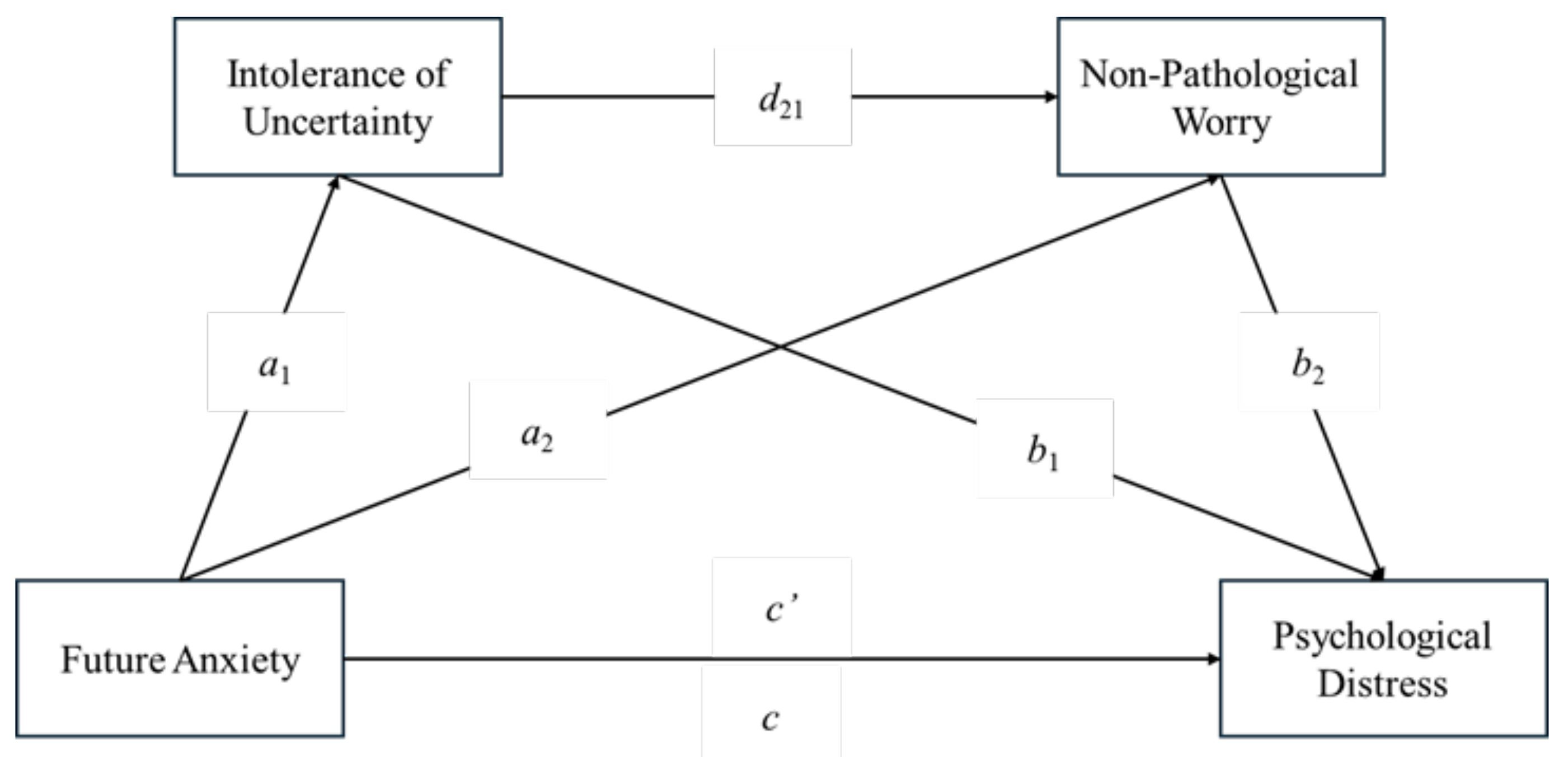
Figure 2.
Serial Mediating Effects of Intolerance of Uncertainty and Non-Pathological Worry between Future Anxiety and Stress. Notes: N = 302; ** p < 0.01; *** p < 0.001; All present effects are standardized (see Table 1A Supplementary Material for unstandardized coefficients); Control Variables: Age, Gender; a1 = effect of Future Anxiety on Intolerance of Uncertainty; a2 = effect of Future Anxiety on Non-Pathological Worry; d21 = effect of Intolerance of Uncertainty on Non-Pathological Worry; b1 = effect of Intolerance of Uncertainty on Stress; b2 = effect of Non-Pathological Worry on Stress; c’ = direct effect of Future Anxiety on Stress; c = total effect of Future Anxiety and Mediators on Stress.
Figure 2.
Serial Mediating Effects of Intolerance of Uncertainty and Non-Pathological Worry between Future Anxiety and Stress. Notes: N = 302; ** p < 0.01; *** p < 0.001; All present effects are standardized (see Table 1A Supplementary Material for unstandardized coefficients); Control Variables: Age, Gender; a1 = effect of Future Anxiety on Intolerance of Uncertainty; a2 = effect of Future Anxiety on Non-Pathological Worry; d21 = effect of Intolerance of Uncertainty on Non-Pathological Worry; b1 = effect of Intolerance of Uncertainty on Stress; b2 = effect of Non-Pathological Worry on Stress; c’ = direct effect of Future Anxiety on Stress; c = total effect of Future Anxiety and Mediators on Stress.
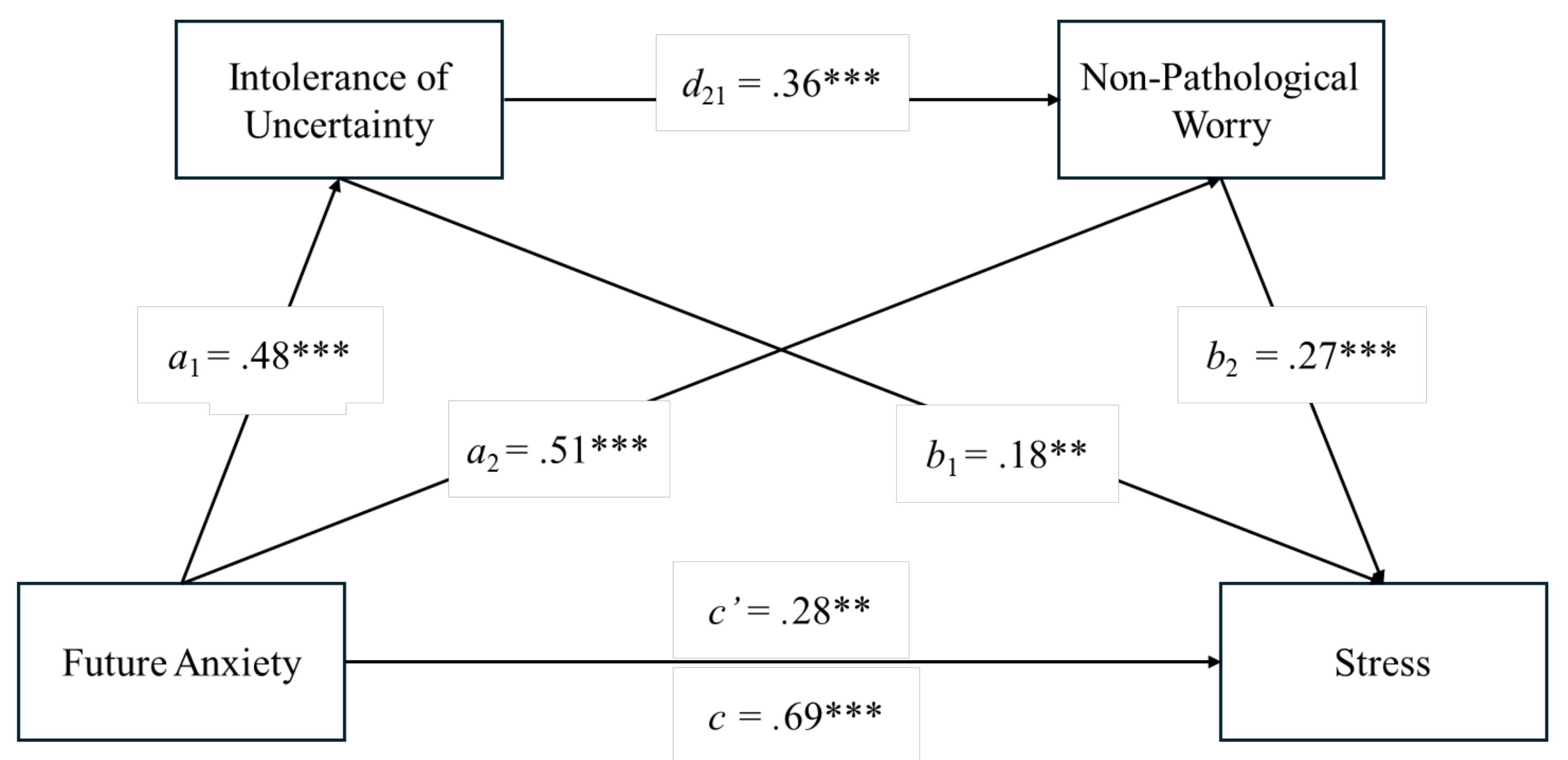
Figure 3.
Serial Mediating Effects of Intolerance of Uncertainty and Non-Pathological Worry between Future Anxiety and Anxiety. Notes: N = 302; ** p < 0.01; *** p < 0.001; All present effects are standardized (see Table 1A Supplementary Material for unstandardized coefficients); Control Variables: Age, Gender; a1 = effect of Future Anxiety on Intolerance of Uncertainty; a2 = effect of Future Anxiety on Non-Pathological Worry; d21 = effect of Intolerance of Uncertainty on Non-Pathological Worry; b1 = effect of Intolerance of Uncertainty on Anxiety; b2 = effect of Non-Pathological Worry on Anxiety; c’ = direct effect of Future Anxiety on Anxiety; c = total effect of Future Anxiety and Mediators on Future Anxiety.
Figure 3.
Serial Mediating Effects of Intolerance of Uncertainty and Non-Pathological Worry between Future Anxiety and Anxiety. Notes: N = 302; ** p < 0.01; *** p < 0.001; All present effects are standardized (see Table 1A Supplementary Material for unstandardized coefficients); Control Variables: Age, Gender; a1 = effect of Future Anxiety on Intolerance of Uncertainty; a2 = effect of Future Anxiety on Non-Pathological Worry; d21 = effect of Intolerance of Uncertainty on Non-Pathological Worry; b1 = effect of Intolerance of Uncertainty on Anxiety; b2 = effect of Non-Pathological Worry on Anxiety; c’ = direct effect of Future Anxiety on Anxiety; c = total effect of Future Anxiety and Mediators on Future Anxiety.

Figure 4.
Serial Mediating Effects of Intolerance of Uncertainty and Non-Pathological Worry between Future Anxiety and Depression. Notes: N = 302; ** p < 0.01; *** p < 0.001; All present effects are standardized (see Table 1A Supplementary Material for unstandardized coefficients); Control Variables: Age, Gender; a1 = effect of Future Anxiety on Intolerance of Uncertainty; a2 = effect of Future Anxiety on Non-Pathological Worry; d21 = effect of Intolerance of Uncertainty on Non-Pathological Worry; b1 = effect of Intolerance of Uncertainty on Depression; b2 = effect of Non-Pathological Worry on Depression; c’ = direct effect of Future Anxiety on Depression; c = total effect of Future Anxiety and Mediators on Depression.
Figure 4.
Serial Mediating Effects of Intolerance of Uncertainty and Non-Pathological Worry between Future Anxiety and Depression. Notes: N = 302; ** p < 0.01; *** p < 0.001; All present effects are standardized (see Table 1A Supplementary Material for unstandardized coefficients); Control Variables: Age, Gender; a1 = effect of Future Anxiety on Intolerance of Uncertainty; a2 = effect of Future Anxiety on Non-Pathological Worry; d21 = effect of Intolerance of Uncertainty on Non-Pathological Worry; b1 = effect of Intolerance of Uncertainty on Depression; b2 = effect of Non-Pathological Worry on Depression; c’ = direct effect of Future Anxiety on Depression; c = total effect of Future Anxiety and Mediators on Depression.
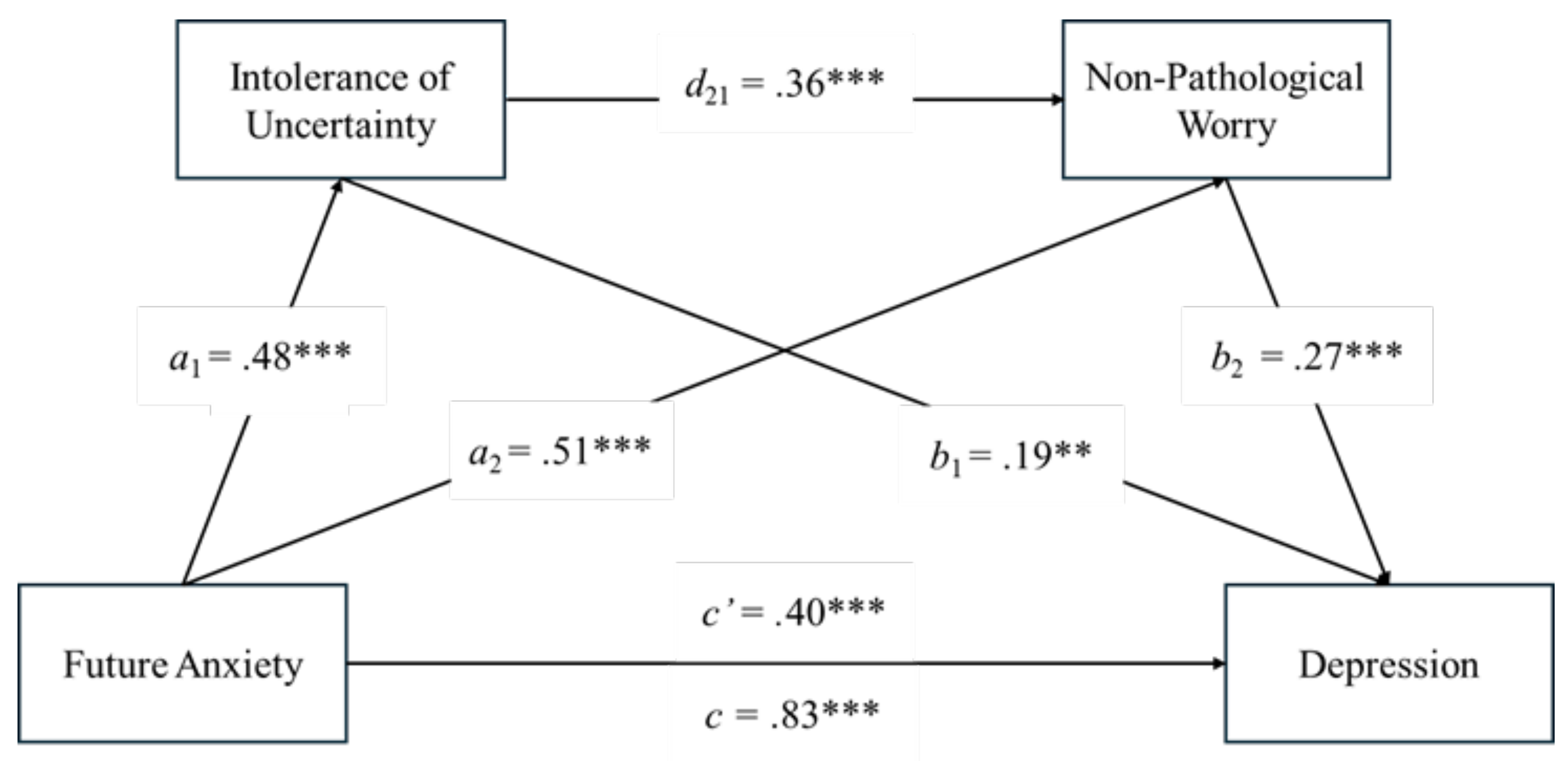

Table 1.
Means, Standard Deviations, Cronbach’s α, Skewness and Kurtosis.
| Males (N = 148) |
Females (N = 154) |
Total Sample (N = 302) | ||||||||
|---|---|---|---|---|---|---|---|---|---|---|
| M | SD | M | SD | M | SD | Min-Max | a | Skew. | Kurt. | |
| DFS | 17.40 | 7.28 | 21.10 | 5.73 | 19.29 | 6.78 | 0-30 | .88 | -.67 | .19 |
| IUS-12 | 34.32 | 9.31 | 36.36 | 10.20 | 35.36 | 9.81 | 15-60 | .88 | .24 | -.43 |
| WDQ | 45.55 | 19.94 | 52.88 | 18.32 | 49.29 | 19.45 | 3-96 | .92 | -.05 | -.51 |
| STRESS | 22.40 | 9.62 | 28.66 | 9.48 | 25.60 | 10.04 | 0-42 | .82 | -.19 | -.68 |
| ANXIETY | 14.72 | 9.60 | 20.32 | 11.33 | 17.58 | 10.87 | 0-42 | .88 | .26 | -.75 |
| DEPRES. | 18.97 | 10.47 | 22.51 | 10.84 | 20.77 | 10.79 | 0-42 | .88 | .07 | -.83 |
Notes: DFS: Dark Future Scale; IUS-12: Intolerance of Uncertainty Scale; WDQ: Worry Domains Questionnaire; Stress, Anxiety and Depression: dimensions of DASS-21.
Table 2.
Correlations between participants’ age and gender and psychological variables.
| 1 | 2 | 3 | 4 | 5 | 6 | 7 | 8 | |
|---|---|---|---|---|---|---|---|---|
| 1. Age | -- | |||||||
| 2. Gender | -- | -- | ||||||
| 3. DFS | -.09 | .27** | -- | |||||
| 4. IUS-12 | .03 | .10 | .47** | -- | ||||
| 5. WDQ | -.09 | .19** | .69** | .60** | -- | |||
| 6. STRESS | -.11 | .31** | .52** | .45** | .58** | -- | ||
| 7. ANXIETY | -.12* | .26** | .41** | .39** | .47** | .76** | -- | |
| 8. DEPRESSION | -.10 | .16** | .54** | .47** | .57** | .76** | .72** | -- |
Notes: N = 302; * p < 0.05; ** p < 0.01.
Disclaimer/Publisher’s Note: The statements, opinions and data contained in all publications are solely those of the individual author(s) and contributor(s) and not of MDPI and/or the editor(s). MDPI and/or the editor(s) disclaim responsibility for any injury to people or property resulting from any ideas, methods, instructions or products referred to in the content. |
© 2024 by the authors. Licensee MDPI, Basel, Switzerland. This article is an open access article distributed under the terms and conditions of the Creative Commons Attribution (CC BY) license (http://creativecommons.org/licenses/by/4.0/).
Copyright: This open access article is published under a Creative Commons CC BY 4.0 license, which permit the free download, distribution, and reuse, provided that the author and preprint are cited in any reuse.


