
Submitted:
12 May 2024
Posted:
13 May 2024
You are already at the latest version
Abstract
Cerebral cavernous malformation (CCM) is a collection of irregular small blood vessels that may be present in the brain or spinal cord. These vessels contain slow – moving blood that commonly clot. These malformations are frequently caused by mutations in one of the CCM genes. The CCM1 (also known as KRIT1) gene is essential for vascular morphogenesis however, its interactions with transcriptional regulators are unknown. Inhibitor of DNA-Binding/Differentiation-3 (ID3) has been recognized to be involved in different vascular/blood vessel diseases such as peripheral arterial disease, stroke, arteriovenous malformations, and atherosclerosis. We show interactions between ID3 and additional key differential expressed genes (DEGs) in microarray data of overexpressed CCM1 in endothelial cells through bioinformatic and data analytic tools. Improved understanding of how ID3, CCM1, and DEGs interact will play an important role in adding to the increasing knowledge for creating therapeutic targets for cerebral cavernous malformations.
Keywords:
cerebral cavernous malformations
; CCM1
; differential expressed genes
; gene networks
; ID3
Introduction
Cerebral cavernous malformations (CCMs) are a type of vascular lesion. CCMs are not a major underlying cause of cerebrovascular or neurovascular disease but their investigation has provided unexpected genetic and molecular insight into vascular disease and development [1,2]. Sporadic CCMs account for 80 – 85% frequently presented as isolated lesions, while familial CCMs account for 15 - 20% followed by autosomal dominant inheritance patterns and present with multiple lesions. Presently, it is widely known that the initial triggers of both sporadic and familial CCM formation have been accredited to genetic mutations [2,3]. The disease is caused by mutations in one of the three known CCM genes: CCM1 (also known as KRIT1), CCM2 (also known as OSM), or CCM3 (also known as PDC10) [3,4]. CCM1 is expressed in endothelial cells and astrocytes. Furthermore, it can be associated with membranes, adheres junctions, and the nucleus [3,4]. Inhibitor of DNA Binding/Differentiation – 3 (ID3), which is part of a group of genes (ID1, ID2, ID3, and ID4), has been known to be expressed in endothelial cells and important for endothelial cell activation and embryonic vasculogesis [5,6,7,8]. While known as a transcriptional regulator that prevents stem cell differentiation, ID3 has been identified to show overlapping functions such as gene knockout dependent on cellular context and can be activated from external environmental exposure [8,9,10,11,12,13,14,15,16]. While ID3 has been associated with vascular malformations such as Hereditary Hemorrhagic Telangiectasia [6,7], little is known about the association between ID3 and cerebral cavernous malformation. This study shows the interaction between ID3 and additional key genes in overexpressed CCM1 samples in cerebral cavernous malformation. Overall, this information can open up an avenue for further investigation toward diagnostic targets for CCM.
Methods
Data from the NCBI Gene Expression Omnibus (GEO) database, a public functional genomic data repository that supports minimum information about a microarray experiment (MIAME) - compliant data submissions, were used to demonstrate how DEGs and gene - network connections play a vital role in the interaction of overexpressed CCM1 in endothelial cells of cerebral cavernous malformations [17]. The results were supported by GSE18014 which was downloaded from GEO and used during our analysis. The original study information consisted of 4 patient samples (2 overexpressed CCM1 and 2 controls). We used the Limma-Voom R package to identify differentially expressed (DE) mRNAs from the featureCounts output. The Log2 fold change (log2FC) values for each mRNA were calculated by comparing the expression levels in patient samples to those in control samples. The threshold for statistical significance was set at p < 0.05 [18,19,20]. We further examined the interaction of the top 10 upregulated DEGs (log2 fold change > 2) and used GeneMania, a publicly available software that helps predict the function and interaction of genes [21].
Results
Microarray data from GSE18014 deposited in NCBI GEO database was used to investigate gene expression patterns. We performed a differential expressed gene analysis as shown in the volcano plot in Figure 1. Each dot signifies a gene with significant alterations based on their position relative to the fold change and p-value levels. The red dots denote upregulated genes and the blue dots denote downregulated genes. Additionally, we have listed the top 10 upregulated genes shown in Table 1 with genes that have a fold change > 2. These genes include: IGFBP3, CH25H, AQP5, CROT, VIPR1, CLEC3B, HIST1H2BD, TMEM100, ID3, and MOBP. The interaction between the top 10 upregulated DEGs is shown in Figure 2.
Discussion
Our research results add to the collective evidence that key DEGs are significant for future diagnostic and therapeutic targets toward cerebral cavernous malformations. By using NCBI GEO, the R package, and GeneMania; we discovered interactions between important genes within overexpressed CCM1 samples. This has provided valuable insight into the complex molecular and mechanistic processes involved in CCM. Previously, it has been demonstrated that ID3 has interactions with various vascular/blood vessel diseases [5,6,7,8,9,10,11,12,13,14,15,22,23] however; this new information can help to build the foundation for additional research within the focus of gene expression networks, bioinformatics, and data analytics. The small sample size in the GEO study for our analysis of DEGs might restrict statistical power, which increases the risk of type II errors and bias. In order to address this for future studies, larger sample sizes are warranted.
Conclusion
Our study demonstrates the interaction between overexpressed CCM1, ID3, and additional differential expressed genes. Through the integrative use of data analytics and bioinformatic tools; we have successfully mapped gene networks that show connections between these important genes including: IGFBP3, CH25H, AQP5, CROT, VIPR1, CLEC3B, HIST1H2BD, TMEM100, ID3, and MOBP. Further investigation should be focused on gene expression analysis and known transcriptional regulators such as ID3 in order to address the unmet need of targeted therapies for cerebral cavernous malformation. Better understanding of this data can lead to improved diagnostic tools for the future.
Author Contributions
V. A. conceptualized, designed, conducted, and wrote the manuscript.
Funding Sources
This study was not supported by any sponsor or funder.
Data Availability Statement
The data used for the analysis is deposited at NCBI GEO (GSE18014). Further inquiries can be directed to the corresponding author.
Conflicts of Interest
The author has no conflict of interest to declare.
Statement of Ethics
An ethics statement was not required because this study is based on publicly deposited and accessible data.
References
- Snellings, D. A., Hong, C. C., Ren, A. A., Lopez-Ramirez, M. A., Girard, R., Srinath, A., Marchuk, D. A., Ginsberg, M. H., Awad, I. A., & Kahn, M. L. (2021). Cerebral Cavernous Malformation: From Mechanism to Therapy. Circulation research, 129(1), 195–215. [CrossRef]
- Tu, T., Peng, Z., Ren, J., & Zhang, H. (2022). Cerebral Cavernous Malformation: Immune and Inflammatory Perspectives. Frontiers in immunology, 13, 922281. [CrossRef]
- Wei, S., Li, Y., Polster, S. P., Weber, C. R., Awad, I. A., & Shen, L. (2020). Cerebral Cavernous Malformation Proteins in Barrier Maintenance and Regulation. International journal of molecular sciences, 21(2), 675. [CrossRef] [PubMed]
- Wüstehube J, Bartol A, Liebler SS, Brütsch R et al. Cerebral cavernous malformation protein CCM1 inhibits sprouting angiogenesis by activating DELTA-NOTCH signaling. Proc Natl Acad Sci U S A 2010 Jul 13;107(28):12640-5. [PubMed]
- Felty, Q., Porther N. Estrogen-induced redox sensitive Id3 signaling controls the growth of vascular cells. Atherosclerosis. 2008;198(1):12–21. [CrossRef]
- Avecilla, V. Effect of Transcriptional Regulator ID3 on Pulmonary Arterial Hypertension and Hereditary Hemorrhagic Telangiectasia. Int J Vasc Med. 2019 Jul 11; 2019:2123906. [CrossRef] [PubMed]
- Avecilla, Vincent E., "ID3, Estrogenic Chemicals, and the Pathogenesis of Tumor-Like Proliferative Vascular Lesions" (2017). FIU Electronic Theses and Dissertations. 3519. https://digitalcommons.fiu.edu/etd/3519.
- Sakurai D., Tsuchiya N., Yamaguchi A. Crucial role of inhibitor of DNA binding/differentiation in the vascular endothelial growth factor-induced activation and angiogenic processes of human endothelial cells. The Journal of Immunology. 2004;173(9):5801–5809. [CrossRef]
- Lyden, D., Young A. Z., Zagzag D., et al. Id1 and Id3 are required for neurogenesis, angiogenesis and vascularization of tumour xenografts. Nature. 1999;401(6754):670–677. [CrossRef]
- Doke M, Avecilla V, Felty Q. Inhibitor of Differentiation-3 and Estrogenic Endocrine Disruptors: Implications for Susceptibility to Obesity and Metabolic Disorders. Biomed Res Int. 2018 Jan 8; 2018:6821601. [CrossRef] [PubMed]
- Avecilla V, Avecilla A. Inhibitor of DNA-Binding/Differentiation Proteins and Environmental Toxicants: Genomic Impact on the Onset of Depressive Dysfunction. Medical Sciences. 2019; 7(1):7. [CrossRef]
- Avecilla V, Doke M, Das M, Alcazar O, Appunni S, Rech Tondin A, Watts B, Ramamoorthy V, Rubens M, Das JK. Integrative Bioinformatics–Gene Network Approach Reveals Linkage between Estrogenic Endocrine Disruptors and Vascular Remodeling in Peripheral Arterial Disease. International Journal of Molecular Sciences. 2024; 25(8):4502. [CrossRef]
- Avecilla A, Doke M, Jovellanos J, Avecilla V. Contribution of Inhibitor of Differentiation and Estrogenic Endocrine Disruptors to Neurocognitive Disorders. Medical Sciences. 2018; 6(3):61. [CrossRef]
- Avecilla, V., Doke, M., & Felty, Q. (2017). Contribution of Inhibitor of DNA Binding/Differentiation-3 and Endocrine Disrupting Chemicals to Pathophysiological Aspects of Chronic Disease. BioMed research international, 2017, 6307109. [CrossRef]
- Avecilla, V.; Doke, M. Pathophysiological Aspects of Vascular Remodeling in Cardiopulmonary Lesions: Influence of ID3 & Estrogenic Endocrine Disruptors. Preprints 2018, 2018070334. [Google Scholar] [CrossRef]
- The Toxicologist, Supplement to Toxicological Sciences, 150 (1), Abstract #1208, 2018, Vascular Cell Dysfunction from Exposure to Polychlorinated Biphenyls Contributes to Lung Toxicity, M.A. Doke.
- Barrett T, Wilhite SE, Ledoux P, Evangelista C, Kim IF, Tomashevsky M, Marshall KA, Phillippy KH, Sherman PM, Holko M, Yefanov A, Lee H, Zhang N, Robertson CL, Serova N, Davis S, Soboleva A. NCBI GEO: archive for functional genomics data sets--update. Nucleic Acids Res. 2013 Jan;41(Database issue):D991-5.
- Law, C.W.; Chen, Y.; Shi, W.; Smyth, G.K. Voom: Precision Weights Unlock Linear Model Analysis Tools for RNA-Seq Read Counts. Genome Biol. 2014, 15, R29. [Google Scholar] [CrossRef] [PubMed]
- Phipson, B.; Lee, S.; Majewski, I.J.; Alexander, W.S.; Smyth, G.K. Robust Hyperparameter Estimation Protects against Hypervariable Genes and Improves Power to Detect Differential Expression. Ann. Appl. Stat. 2016, 10, 946–963. [Google Scholar] [CrossRef] [PubMed]
- Ritchie, M.E.; Phipson, B.; Wu, D.; Hu, Y.; Law, C.W.; Shi, W.; Smyth, G.K. Limma Powers Differential Expression Analyses for RNA-Sequencing and Microarray Studies. Nucleic Acids Res. 2015, 43, e47. [Google Scholar] [CrossRef] [PubMed]
- Warde-Farley, D., Donaldson, S. L., Comes, O., Zuberi, K., Badrawi, R., Chao, P., Franz, M., Grouios, C., Kazi, F., Lopes, C. T., Maitland, A., Mostafavi, S., Montojo, J., Shao, Q., Wright, G., Bader, G. D., & Morris, Q. (2010). The GeneMANIA prediction server: biological network integration for gene prioritization and predicting gene function. Nucleic acids research, 38(Web Server issue), W214–W220. [CrossRef]
- Das, J. K., Voelkel, N. F., & Felty, Q. (2015). ID3 contributes to the acquisition of molecular stem cell-like signature in microvascular endothelial cells: its implication for understanding microvascular diseases. Microvascular research, 98, 126–138. [CrossRef]
- Das, J. K., & Felty, Q. (2015). Microvascular lesions by estrogen-induced ID3: its implications in cerebral and cardiorenal vascular disease. Journal of molecular neuroscience: MN, 55(3), 618–631. [CrossRef]
Figure 1.
The volcano plot shows the differentially expressed genes in the overexpressed CCM1 cerebral cavernous malformation samples versus the control samples. Each dot represents a gene with significant changes based on their position comparative to the fold change and p-value levels.
Figure 1.
The volcano plot shows the differentially expressed genes in the overexpressed CCM1 cerebral cavernous malformation samples versus the control samples. Each dot represents a gene with significant changes based on their position comparative to the fold change and p-value levels.
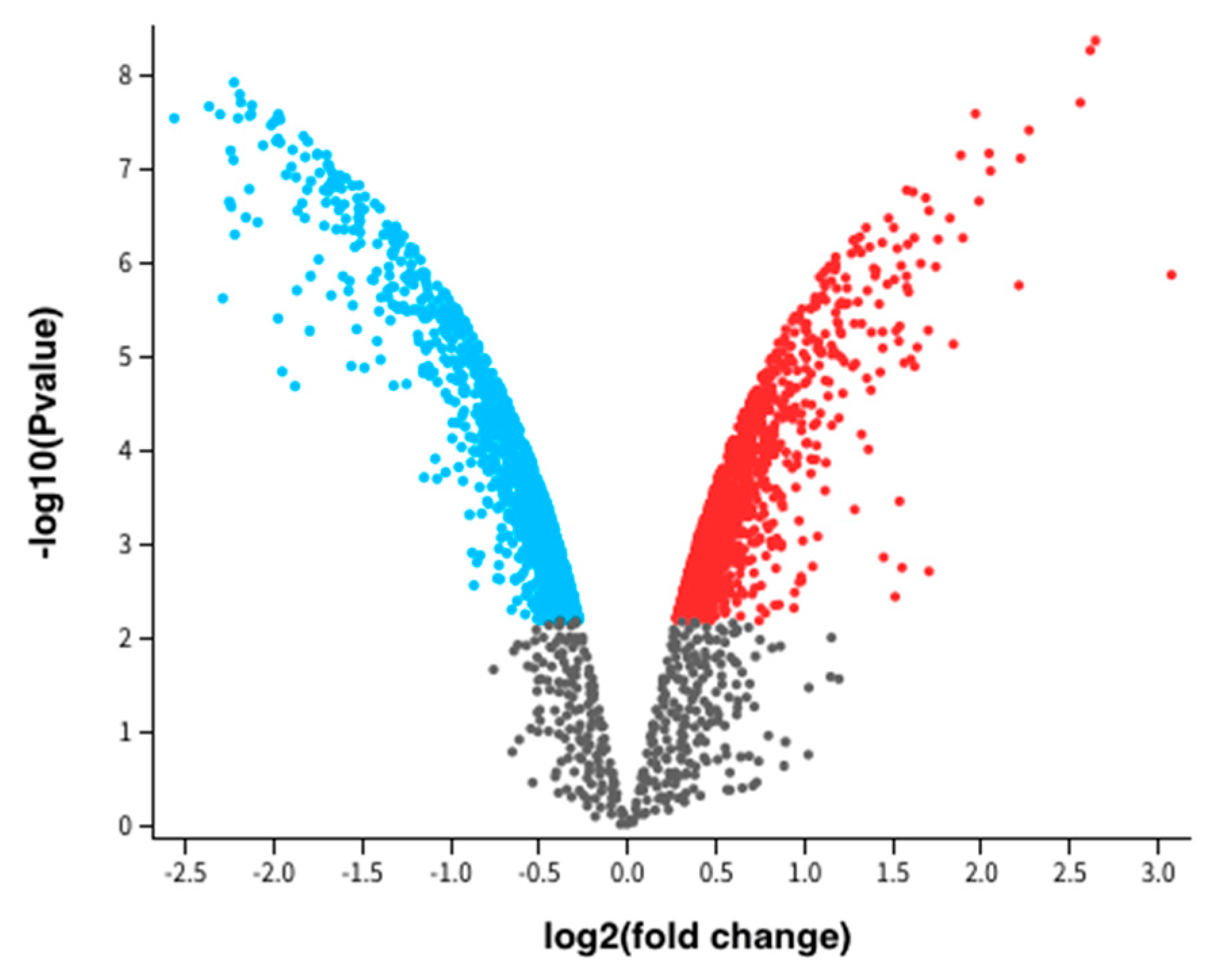
Figure 2.
GeneMania was used to show the gene-interaction and co-expression of the top 10 upregulated genes (fold change > 2). The gene networks show 20 related genes and co-expression (shown by the lines in purple), which accounts for 89.14% of the network.
Figure 2.
GeneMania was used to show the gene-interaction and co-expression of the top 10 upregulated genes (fold change > 2). The gene networks show 20 related genes and co-expression (shown by the lines in purple), which accounts for 89.14% of the network.
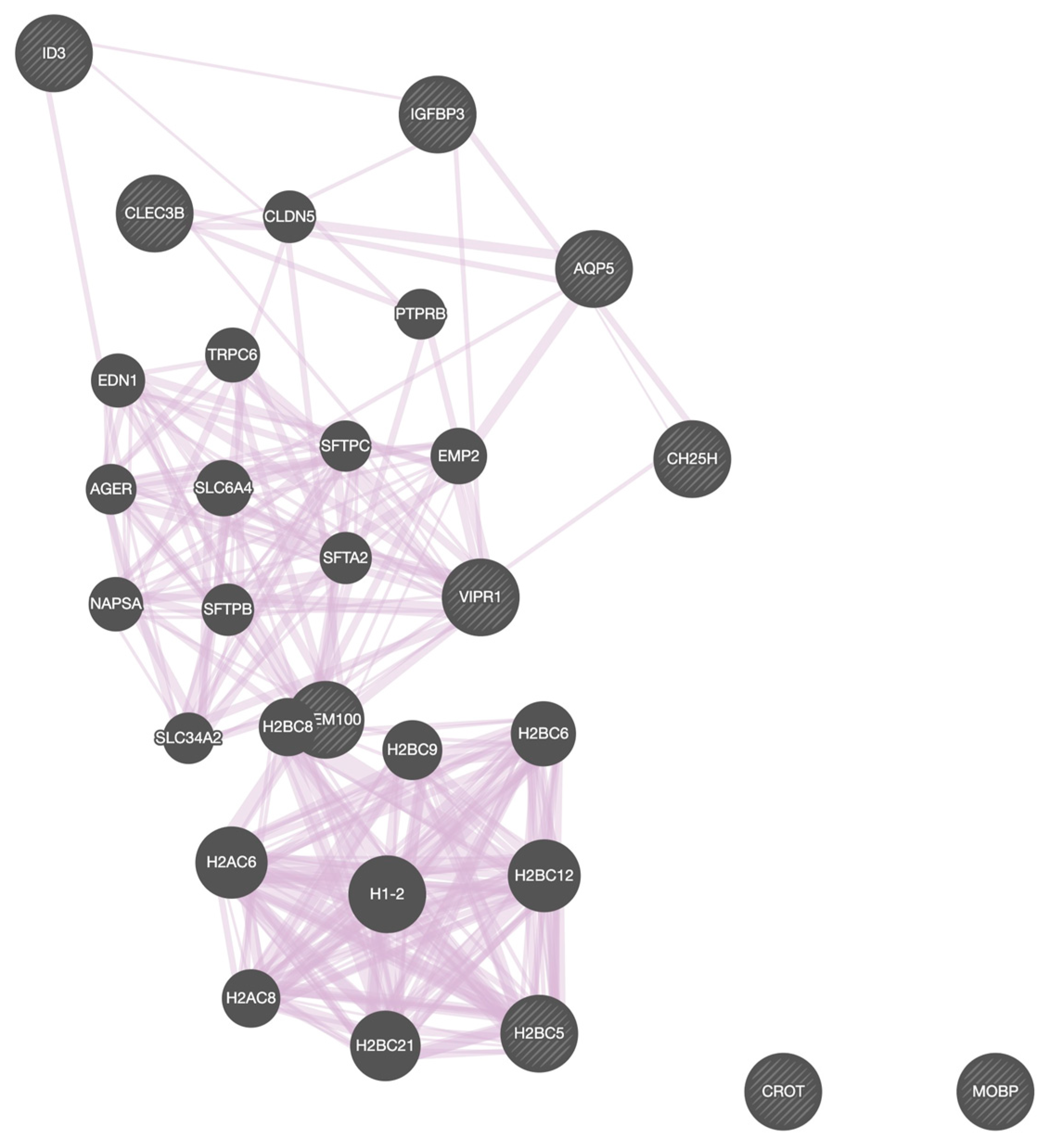

Table 1.
Top 10 upregulated genes (fold change > 2) in overexpressed CCM1 versus control samples.
| Gene Symbol | Gene Title | Log2 (Fold Change) |
|---|---|---|
| IGFBP3 | insulin like growth factor binding protein 3 | 3.074 |
| CH25H | cholesterol 25-hydroxylase | 2.644 |
| AQP5 | aquaporin 5 | 2.615 |
| CROT | carnitine O-octanoyltransferase | 2.559 |
| VIPR1 | vasoactive intestinal peptide receptor 1 | 2.269 |
| CLEC3B | C-type lectin domain family 3 member B | 2.221 |
| HIST1H2BD | histone cluster 1, H2bd | 2.212 |
| TMEM100 | transmembrane protein 100 | 2.051 |
| ID3 | inhibitor of differentiation 3 | 2.043 |
| MOBP | myelin-associated oligodendrocyte basic protein | 2.021 |
Disclaimer/Publisher’s Note: The statements, opinions and data contained in all publications are solely those of the individual author(s) and contributor(s) and not of MDPI and/or the editor(s). MDPI and/or the editor(s) disclaim responsibility for any injury to people or property resulting from any ideas, methods, instructions or products referred to in the content. |
© 2024 by the authors. Licensee MDPI, Basel, Switzerland. This article is an open access article distributed under the terms and conditions of the Creative Commons Attribution (CC BY) license (http://creativecommons.org/licenses/by/4.0/).
Copyright: This open access article is published under a Creative Commons CC BY 4.0 license, which permit the free download, distribution, and reuse, provided that the author and preprint are cited in any reuse.