
Submitted:
10 May 2024
Posted:
13 May 2024
You are already at the latest version
Abstract
Both soybean variety and processing affect product characteristics. This study’s objective was to characterize the effect of four extraction methods (variations of soaking and grinding) combined with cooking on the content and composition of phenolic substances, antioxidant and anti-DU145 prostate cancer cell proliferative properties of soymilk prepared from a yellow soybean of the ProSoy variety, which is a high protein variety. Results showed soymilk processing yield was the greatest by Method 4, but Method 2 gave the highest solids and protein yields by about 14 and 12%, respectively. Method 4, a two-step grinding also increased yields (8 and 7%, for solids and protein, respectively), and in all but one instance produced higher total phenolic content (TPC), total flavonoid content (TFC), condensed tannin content (CTC) and total isoflavone content in both raw and cooked soymilk as compared to Method 1. Cooking soymilk reduced 14-17% of total phenolic substances. Cooking reduced anticancer capacity of Method-4-prepared soymilk phenolic extract by increasing IC50 value from about 4.9 mg/mL to 6.8 mg/mL. The increases in phenolic compounds and antioxidants produced in Prosoy soymilk by Methods 2 and 4 with simultaneous increases in product solids yield are significant to benefit the soymilk industry and consumer health.
Keywords: ProSoy yellow soybean, soymilk processing, phenolics, isoflavones, antioxidant capacity, anti-DU145 prostate cancer proliferation
Keywords:
ProSoy yellow soybean
; soymilk processing methods
; phenolics and isoflavones
; antioxidant capacity
; anti-DU145 prostate cancer proliferation
1. Introduction
Soymilk is a traditional non-dairy beverage in the East Asian countries for thousands of years [1], is gaining popularity in the Western world due to the fact that soy has health benefits in the prevention of chronic diseases that may be related to isoflavones and phenolic antioxidant substances [2,3,4,5,6]. In addition, soy foods (non-ultra-processed formulated foods) provide nutritious plant proteins that are free of cholesterol that are heart-healthy with a FDA-approved heart-health claim [7,8], and are excellent choices for vegetarians. Soymilk has no lactose and are choices for people who are intolerant to lactose and dairy proteins. Soybeans commercially grown have special food and nutritional quality characteristics [9]. Poysa and Woodrow [10] reported that yield/kg seed dry matter and solids content of soymilk and tofu are significantly affected by genotype of soybean. There are basically two types of soybeans according to purposes of usage. Some varieties are genetically bred for high oil content, particularly with high oleic fatty acid to produce soy oil, defatted soy meal, or used for animal feed. The other type is high quality food-grade soybean, which is bred for making foods, such as soymilk, tofu, bean sprouts, fermented natto and tempeh, and others. Soymilk is also used as an intermediate product for tofu manufacturing [11], during which a coagulant is used to form tofu gels. High protein content is favorable for human nutrition and for gelation in tofu making. In the soymilk beverage industry, soybean genotypes with a high yield of soymilk, along with high solids and protein content are highly desired, and are the targets in breeding for food and nutritional quality enhancement. Soybeans for making soymilk and tofu need to be soaked in water prior to grinding. Therefore, easily hydrated seeds are preferred since well-soaked beans prior to grinding lead to higher product and solids yields. Black soymilk is made from specialty soybeans with black color testa that has long been considered a food and medicine in the Chinese Ben Cao Gang Mu – the Compendium of Materia Medica [12]. Black soymilk is traditionally regarded as a health beverage and more expensive than yellow soymilk. However, a vast majority of commercial soymilk is made from yellow soybeans since their planting yield is higher than black soybean, and therefore the price of yellow soybean is generally 2-3 time lower than black soybean. In addition to soaking, wet-grinding is a critical step in soymilk extraction process that can significantly affect product yield and retention of the bioactive components.
Cancer is the second leading cause of death in the United States, exceeded only by heart disease. Prostate cancer is the second most common cancers in men in the United States, and is the third cause of male cancer death worldwide. In the USA, prostate cancer ranked no. 1 among new cases of all cancer increases in men. In 2020, the latest available incidence data, 201,082 new cases of prostate cancer were reported among men, and 32,707 men died of the same cancer, representing 19% of death rate [13]. Epidemiological studies have shown that prostate cancer mortality is commonly lower in East Asian males than in Western males, and that is believed to be partly due to frequent consumption of soy products in their diet [14].
Isoflavones in soy have been demonstrated to contribute to the reduction of prostate cancer cells and in ovariectomized mice [15,16,17,18]. Studies [19,20,21] suggest that the degree of processing inversely affects the bioactivities of soy. Furthermore, Hsu and others [22] found whole soybean flour extract (similar to raw soymilk) was more potent and safer than individual isoflavones or their combinations for inhibiting prostate cancer growth. Recent research by Yu et al. [23] on compared oven drying soybean to wet soaking without drying as well as boiling slurry or not prior to filtration on soymilk phenolics and antioxidant activities of soybean made from 15 soybeans produced in China. The method concluded that wet soaking produced without prior oven drying of soybeans produced higher antioxidant profiles. However, the cooking conditions of 5 min at 100 C they used would retain at 30% of trypsin inhibitors in soybean that would not be desirable for optimizing protein nutritional values [24]. In addition, these above mentioned works related to soymilk processing and our recent research [25] using hot grinding to eliminate trypsin inhibitors and beany flavor have not considered soymilk yields, solids and protein recoveries, which are important to the economy of the food industries.
Our previous publication [26] has characterized the compositions of the phenolic extract, including isoflavones from black soybean soymilk and okara and their potential effect on the inhibition of prostate cancer cells in vitro. The selection of black soybean was based on our previous study, which showed that black soybean possessed significantly higher phenolic substances and antioxidant activity than yellow soybean [27]. However, we have discovered in subsequent study [28] that soymilks, raw or cooked, from two yellow soybean varieties (Proto and IA2032) have higher Oxygen Radical Absorbance Capacity (ORAC) than that of the soymilk from black soybean, despite having a lower total phenolic content. The results indicate that yellow soybean also have potential to be a healthy beverage as good as black soymilk and deserves further investigation.
Generally, four processing steps are involved in making soymilk: 1) soaking soybean, 2) grinding in water, 3) filtering to remove insoluble residues (okara), and 4) heating to destroy anti-nutrients and inactivate beany odor producing enzymes. Variations in the processing conditions of each of these steps may affect soymilk quality. We have reported how four specific preparation methods and cooking could affect the bioactive components and their potential health effects in black soymilk and proved a 2-step grinding method could produce soymilk with a higher antioxidant and anti-prostate cancer cell (DU145) properties [26].
Our earlier research studied showed heating method affects phenolics and antioxidant capacity of soymilk made by three different varieties and four heating practices [28]. The results showed that soymilk made from black soybean with green cotyledons has a higher total phenolic content, and a higher free benzoic acid content than that of Proto yellow soybean and a Iowa state released IA yellow soybean [28]. Cooking reduced total phenolic content and increased the total flavonoid content in soymilk, and the extent of reduction or increases were variety-dependent. However, the antioxidant capacity profiles indicated that the radical DPPH scavenging activity (DPPH) and FRAP (ferric reducing antioxidant power) of the black soymilk are higher than the yellow soymilk, but ORAC (oxygen radical absorbance capacity) is lower than that of the yellow soymilk. Poysa and Woodrow [10] found that genotype is highly related to soymilk yield and solids. These findings provided justification that separate research is needed for understanding the behavior of different varieties. ProSoy soybean is a food-grade, high protein soybean with a good planting yield that was released by our team at the North Dakota State University for making soymilk and tofu [29]. Its antioxidant capacity and anti-prostate cancer potential as affected soymilk making processes have not been characterized. Soymilk product yield and solids/protein yield are very important to the soymilk industry since a higher yield variety can use less soybean materials and reduced cost. On the other hand, a soymilk variety that produces a higher antioxidant patterns and disease prevention potential would benefit the consumers. Although the antioxidant properties of soy phenolics had been reported [9,11,20,30,31], the effects of grinding methods especially when in conjunction with product and solids yields and cooking on the phenolic composition and antioxidant profiles have only been characterized for a black soybean in our laboratory. This kind of research has never been reported for a yellow soybean.
The objective of this study was to identify which of the four different combinations of cold soaking and grinding methods as we designed previously [26] could be used to improve the product yields, solids and protein yield and simultaneously to improve the phenolic substance compositions, in vitro antioxidant profile and in vitro anti-prostate cancer DU145 cell proliferation properties of the soymilk made from ProSoy yellow soybean.
2. Materials and Methods
2.1. Soybean Material and Chemicals
Dry matured yellow soybean (Glycine max) of the ProSoy variety, a high protein food-grade soybean (45.7% protein and 22.3% lipids), was obtained from Sinner Brothers & Bresnahan (Casselton, ND). All analytical chemicals, phenolic and antioxidant standards are either obtained from VWR International (West Chester, PA) and Sigma-Aldrich Chemical Company (St. Louis, MO) or purchased from Wako Chemicals USA (Richmond, VA) per our reports of Xu and Chang [9,28] or Tan et al. [26].
Human prostate cancer cell line DU145 was purchased from American Type Culture Collection (ATCC, Manassas, VA). Other chemicals associated with cell culture experiments were either obtained from Cambrex Bio Science Walkersville, Inc. (Walkersville, MD) or from. from Mediatech, Inc. (Herndon, VA) as described in our previously reported article [26].
2.2. General Procedures for Preparing Soymilk
General stepwise procedures for manufacturing bench-scale soymilk according to our paper of Yuan and Chang [24]: 1) soaking 100 g of cleaned soybeans in cold water (4 ℃) overnight (16 h). Before soaking, soybeans were rinsed thoroughly with tap water for 5 min; 2) grinding the soaked soybeans at room temperature to form a slurry using a Warring blender at high speed for 3 min; 3) separating the soy slurry into soymilk and okara (insoluble soy residue) using a muslin cloth by hand-squeezing till no liquid flowing out; 4) cooking soymilk on an electrical stove at 100 ºC for 20 min. Soaking soybean at 4 ºC is a new concept in our study to inhibit microbial growth so that the soaking water may be used directly in the grinding step to help recover leached isoflavones and other phenolics in the soaking water, specifically for grinding Methods 3 and 4 as described below.
2.3. Specific Processing (Soaking and Grinding) Methods
Four different combinations of soaking and grinding methods were designed to produce soymilk and okara from soybeans with the objective to recover more phenolics in soymilk [26]. The details for soaking, grinding or re-grinding for the four methods (Supplemental Materials Table S1) had been presented in our previous publication [26]. To facilitate understanding by readers and ease of discussion, these (soaking + grinding) methods are referred to as ‘Methods 1 to 4’ throughout this manuscript. In each method, the total water-to-dry soybean ratio was 10 to 1 (w/w). Briefly, the four methods are as follows.
Method 1: Tap water was used to grind soaked soybean after draining (the traditional method served as control).
Method 2: Okara-washed water was used to grind soaked soybean.
Method 3: Soaked water was used to grind soaked soybean (water-to-bean ratio of 10:1, w/w).
Method 4: Soaked water was used for first grinding at 6:1 (w/w) water-to-bean ratio, filtered and then okara was re-ground with tap water at 4:1 (w/w) water-to-bean ratio, respectively.
All soymilk-making methods were carried out in three different times/dates (replicates). After cooling cooked soymilk to room temperature (around 20 ºC). Raw and cooked soymilk and okara were immediately frozen and freeze-dried. Yields of soymilk and recoveries of solid and protein from soybean were calculated and expressed on the basis of 100 g dry soybean used for processing.
2.4. Solvent Extraction of Phenolic Substances
Our published method of Xu and Chang [27] was followed for extraction from the soy materials. One gram of freeze-dried soymilk powder or okara was extracted with 10 mL of the extraction solvent [acetone/water, 50/50 (v/v)] at room temperature for 3 h. The mixture was centrifuged in an Allegra 21R centrifuge (Beckman Coulter Ltd., Palo Alto, Calif., USA) at 3000 rpm (1,100 g) for 10 min, and the supernatant was transferred to a new set of tubes. The residues were re-extracted once with 10 mL of solvent and centrifuged. Both supernatants were combined. Two milliliters were set aside for total phenolic substance analyses. The solvent in the rest of the extract was evaporated at 38 ºC with a rotary evaporator under vacuum. The concentrate was lyophilized to obtain the solvent extract powder (referred to as crude phenolic extract hereafter) and stored in dark containers at -20 ºC until further analyses of individual phenolic acids and isoflavones by HPLC, and anti-proliferation assay by cell cultures.
2.5. Determination of Total Phenolic Content (TPC)
The total phenolic content in the phenolic extract was determined by the Folin-Ciocalteu assay as described in Xu and Chang [27]. TPC was expressed as milligrams of gallic acid equivalents per gram of dry sample (mg of GAE/g).
2.6. Determination of Total Flavonoid Content (TFC)
Total flavonoid content was determined using a slightly modified colorimetric method described previously [32]. The absorbance was measured at 510 nm using a UV spectrophotometer (UV 160, Shimadzu, Japan). All values were expressed as milligrams of catechin equivalents per gram of dry sample (mg of CAE/g).
2.7. Determination of Condensed Tannin Content (CTC)
Condensed tannin was determined according to the method reported by Xu and Chang [27]. The absorption was measured at 500 nm against methanol as a blank. All values were expressed as milligrams of catechin equivalents per gram of dry sample (mg of CAE/g).
2.8. Quantification of Major Soy Phenolic Acids
Freeze-dried crude phenolic extract was dissolved in 1 mL of distilled water to obtain a concentration of 20 mg/mL, which was used to inject into the HPLC detector. Phenolic acids were analyzed on an Agilent 1200 series HPLC system equipped with a G13798 degasser, G1312A binary pump, G1329A autosampler, and G1315D diode array detector (Agilent Technologies, Santa Clara, CA). HPLC separation was achieved using a Zorbax Stablebond Analytical SB-C18 column (250×4.6 mm, 5 μm, Agilent Technologies, Santa Clara, CA) at 40 0C. Elution was performed using mobile phase A (0.1% trifluoroacetic acid aqueous solution) and mobile phase B (100% methanol); samples (20 μL) were eluted at a flow rate of 0.7 mL/min. The UV-Vis spectra were scanned from 220 to 600 nm on a DAD with a detection wavelength of 270 nm. The solvent gradient in volumetric ratios was as follows: 5-30% B over 50 min. The solvent gradient was held at 30% B for an additional 15 min and increased to 100% B for 66 min. The solvent gradient was held at 100% B for an additional 10 min to clean up the column, followed by re-equilibration of the column for 5 min with 95% A and 5% B before the next run. Identification of phenolic compounds was made by comparison of their retention time and UV spectra with those of the authentic standards. The phenolic acid contents were expressed as micrograms of phenolic acid per gram of soymilk (μg/g) on a dry basis.
2.9. Quantification of Isoflavones by High Performance Liquid Chromatography (HPLC) Analysis
Isoflavones in dried soymilk and okara samples were analyzed by an internal standard calibration method, according to our publications of Hou and Chang [33], and Xu and Chang [28]. Identification of isoflavones was made by comparison of their retention time and UV spectra with those of the authentic standards.
2.10. Chemical Antioxidant Assays
Oxygen radical absorbance capacity (ORAC), ferric reducing antioxidant power (FRAP), and radical DPPH scavenging activity (DPPH) were carried out to quantify the effects of processing on the antioxidant capabilities of soymilk. ORAC was determined according to Xu and Chang [27] and ORAC value was expressed as micromoles of trolox equivalents per gram of dry sample (μmol of TE/g). FRAP assay was carried out according to Benzie and Strain [34] (1996) and FRAP value was calculated and expressed as milli-moles of Fe2+ equivalents (FE) per 100 g of dry sample. The radical scavenging activity against DPPH free radicals was measured according to Xu and Chang [27] and the DPPH value was expressed as micromoles of trolox equivalents per gram of dry sample (µmol of TE/g).
2.11. Anti-Proliferation Assays
The DU145 human prostate cancer cell line was used to study the biological activity of the phenolic extract, which contained isoflavones and other phenolic compounds using the MTT assay as described in Tan et al. [26]. Cancer cells were maintained and sub-cultured in Eagle's Minimum Essential Medium supplemented with 10% (v/v) FBS and 1% antibiotics (penicillin/streptomycin) in 75 cm2 flasks at 37 0C under a constant humidified atmosphere of 5% carbon dioxide. Cell viability was measured using the MTT assay [35]. Briefly, DU145 cells were seeded into 96-well plates at a density of 5×10³ cells/well. After 24 h of incubation, water solutions of soymilk phenolic extracts at different concentrations (0 to 8 mg/mL) were added to the cell culture solution. Each treatment was conducted in triplicate. After 48 h of incubation, MTT solution was added to each well. The plates were incubated for 4 h at 37 0C with 5% CO2. The solution in each well was removed carefully, and then 150 μL of dimethyl sulfoxide (DMSO) was added to each well. The absorbance was measured at 570 nm using a microplate reader (Bio-Tech Instruments). The viability was obtained by calculating the difference in the absorbance values between the treated and control wells divided by the absorbance value of the control.
2.12. Statistical Analysis
All processing and analysis were conducted in triplicate. Data were expressed as mean ± standard deviation. One-way ANOVA and appropriate Post-hoc comparing (Tukey) test were used when more than two groups were compared. When correlations between factors were needed, Pearson correlation coefficients were analyzed. The significance level for all tests was set at P < 0.05. Various software packages (e.g. SigmaStat, Sigmaplot) were used to perform statistical analyses and to assess the significance of the data.
3. Results
3.1. Yield of Soymilk and Recoveries of Solids and Protein from Soybean
Results showed the soymilk (as is) recoveries (processing yields) from 100 g of soybean raw materials were 968, 979, 968 and 992 g for Methods 1, 2, 3 and 4, respectively. Method 4, a two-stage grinding technology, first grinding soaked soybean with soaked water (600 mL), and then the okara re-ground with tap water (400 mL) gave the highest yield (p<0.05) of soymilk (992 g) among the four manufacturing technologies. The second highest soymilk yield (significantly higher than Methods 1 and 4, p<0.05) was by Method 2, which gave 979 g by using okara-washed water to grind soaked soybean. Unlike soymilk processing yield, % yields of solids and protein were the highest by Method 2 (Figure 1) among the four methods. Method 2 gave about 72.6% solids yield versus 62.8% for the Method 1 (traditional method using tap water grinding of the soaked bean), and gave 80.4% protein recovery versus 72.1% by Method 1. These results represented a 15.6% and 11.6% increases of solids and protein recoveries from the soybean mass over the traditional method (Method 1). This is the first quantitative characterization of increases by using a single step of okara rewashing to improve solids and protein yields for yellow soybean. ProSoy variety also gave significantly higher soymilk yields and higher solids (increased by 7.5%) and protein (increased by 7.2%) recoveries when prepared by Method 4. However, Method 2 consistently gave the highest solids and protein recoveries for both ProSoy (yellow) soybean and black soybean [26].
3.2. Phenolic Processing Yield and Composition
3.2.1. Total phenolic content (TPC)
Results of TPC in raw, cooked soymilk and okara from ProSoy soybean from the four soymilk processing methods are shown in Table 1. TPC values in raw soymilk made by Method 1 (control), traditional grinding method by tap water was 1.94 mg GAE/g dried soymilk, which was lower than the TPC values of 2.34 and 2.79 mg GAE/g, respectively, in the raw soymilk Proto and IA 2032 yellow soybean made by the same processing method [28]. The other three grinding methods produced soymilk with higher TPC, particularly with Methods 3 and 4 with significant differences (p<0.05). Among all methods, Method 4 with two-step grinding had the highest TPC (p < 0.05) in raw soymilk with a TPC value of 2.61 mg GAE/g), which represented a 35% increase over the control method.
Cooking at 100 C for 20 min reduced the TPC by about 13-17% across the four methods. For cooked soymilk, the TPC values of the soymilk ground by Method 4 was significantly (P < 0.05) higher than that by Methods 1 and 2. No significant differences were observed among all the okara samples.
Table 2 shows % recoveries and losses of total phenolics from in ProSoy soybean during soymilk processing. When data were calculated based on % of soybean TPC that was retained in dried soymilk, greater recoveries of total phenolics were observed in raw soymilk (ranging from 43 to 63%) than cooked soymilk (ranging from 37-52%). Method 4 preserved much more TPC in raw (increased by 44.5% over control) and cooked soymilk (increased by 40.5% over control) than the other three methods.
3.2.2. Total Flavonoid Content (TFC)
Table 3 For the raw ProSoy soymilk, grinding Method 4 caused a significantly (P < 0.05) greater TFC value than the other three grinding methods. However, no significant differences were observed among raw soymilk produced by grinding Methods 1, 2 and 3. For cooked soymilks, no statistically significant differences were observed among all soymilks produced by the four grinding methods, even though Methods 4 and 2 produced higher values. Considering that Methods 4 and 2 had higher processing yields, solids and protein yields, the overall contribution to consumers are still more positive than the other two methods. The TFC value of the okara produced by the grinding Method 4 was higher (P < 0.05) than that of the other three grinding methods, indicating some flavonoids were preferentially retained in Method 4’s okara. Cooking increased the TFC values from the range of 0.25-0.37 mg of CAE/g to 0.38-0.43 mg of CAE/g, an average of approximately 31% increases.
3.2.3. Condensed Tannin Content (CTC) Determination
The CTC values of ProSoy soymilk are presented in Table 4. For the raw soymilk, Method 4 produced the highest (P < 0.05) CTC value among all grinding methods. The CTC values of the soymilk manufactured by Methods 2 and 3 were greater (P < 0.05) than that of Method 1. The CTC values of the cooked soymilk processed by grinding Methods 2 and 4 were greater (P < 0.05) than those of grinding Methods 1 and 3. The CTC value of the okara produced by Method 4 was greatest (P < 0.05) among the four grinding methods. Okara produced by Method 3 had a greater (P < 0.05) CTC value than that of Methods 1 and 2. We do not know why Method 4 produced okara with higher CTC and TFC than that by other three methods. A possibility is that different grinding methods may have influenced solvent extraction of these phenolic compounds from okara during analyses.
3.2.4. Free Phenolic Acid Composition
The phenolic acid contents of the soymilk produced from ProSoy soybean are presented in Table 5. Five phenolic acid components were detected in ProSoy soymilk at a range of 84-106 g/g soymilk (dry basis). Among the phenolic acids detected, gallic acid (GA), chlorogenic acid (CLA) and vanillic acid (VA) were the major ones. Method 4 and Method 3 retained more phenolic acids than the other three grinding methods. Similar to the above described phenolic substances, cooking had a negative effect on the retention of phenolic acids, and the damage was high by destroying approximately 50% of the phenolic acids in soymilk (p<0.05).
3.3. Isoflavone Compositions
The isoflavone contents of the ProSoy soymilk and okara produced by the four different processing methods are presented in Table 6. In general, within each grinding method, cooked soymilk had the highest isoflavone content among raw, cooked and okara samples. Cooking did not reduce, but slightly increased isoflavone content in the ProSoy soymilk, indicating that isoflavones are quite stable to the traditional heating conditions of 100 oC for 20 min. Among grinding methods, results showed that Method 4 and Method 3 retained more isoflavones (p < 0.05) in cooked soymilk than the other two grinding methods, with Method 4 gave about 11.5% higher total isoflavones than the control and Method 2.
It is well known that isoflavones may engage in interconversion between malonyl glucoside and glucoside conjugate forms. Within each form of isoflavones, thermal conversion occurred that malonyl-glucoside form was reduced with a concomitant increase in the glucoside conjugates. Aglycones did not change much by cooking at 100 C for 20 min. Okara retained a lower level of isoflavone as compared to soymilk and okara made by Method 4 had the lowest isoflavone. This was logical since a higher amount of isoflavone was extracted into soymilk by Method 4.
3.4. Antioxidant Activity Profiles
Antioxidant activity results are presented in Table 7. Significant (P < 0.05) differences in ORAC, FRAP, and DPPH values were found among most samples. For the raw soymilk, grinding Methods 2, 3, and 4, significantly (P < 0.05) increased ORAC, FRAP, and DPPH values compared to the traditional control Method 1. The soymilk produced by grinding Method 4 especially exhibited high (P < 0.05) antioxidant activity (FRAP and DPPH values) than the other three grinding methods. Cooking generally increased all antioxidant properties tested. For cooked soymilk, grinding Methods 3 and 4 produced significantly (P < 0.05) higher antioxidant activities (ORAC and FRAP values) than grinding Methods 1 and 2. The raw soymilk produced by grinding Method 4 exhibited the highest DPPH values among all soymilk samples with 150% higher value than that of the Method 1. The cooked soymilk made by Method 4 had 73% higher than the Method 1. Another distinct advantage of Method 4 was in ORAC values, which gave 47% higher antioxidant capacity than the Method 1. Overall, antioxidant properties were in the ranking order of Method 4 ≥ Method 3 > Methods 2 = Method 1.
For okara residues produced by all grinding methods, no significant differences were found in the antioxidant activities (ORAC and FRAP values); however, the DPPH value of the grinding Method 3 was significantly (P < 0.05) greater than that of the other three methods (Table 7).
3.5. Anti-Proliferative Properties of Soymilk against Human Prostate Cancer Cell Line
The anti-proliferative properties of ProSoy soymilk produced by the four processing methods against prostate cancer cells are summarized in Table 8. In this study with a focus on effect of grinding, among ProSoy soymilk and okara tested, the raw soymilk also exhibited the highest anti-proliferative capacities than the cooked soymilk and okara. In most cases, okara exhibited the lowest anti-proliferative capacity among all samples as indicated by the highest IC50 values. Raw ProSoy soymilk produced by the grinding Method 4 possessed the strongest (P < 0.05) anti-proliferative capacity against prostate cancer cells (4.9 mg/mL, lowest IC50) (Table 8), followed by the soymilk produced by grinding Methods 2 and 3.
4. Discussion
4.1. Processing Yields and Solids and Protein Recoveries
Soymilk is a popular non-dairy beverage and has potential health benefits that are derived from isoflavones and antioxidant phenolic substances. The health components and functions are affected by soybean variety, and most notably by soybean color, namely between yellow and black soybean. The results from this work in some parts is the first confirmation of our published work on black soymilk as extracted by the four soaking/grinding method. However, there are significant differences in processing yields and protein yields, in which, yellow ProSoybean had a clear advantage.
As stated in our previous publication on black soymilk [26], one of the major objectives to study variations of soaking, and grinding, and washing and regrinding of okara was to recover more yields and health-promoting materials from the soybean. We were able to accomplish the goals with black soymilk. However, the effect and significance of product yields was not fully discussed in our report [26]. Here we provide a full analysis of a higher yield benefits from these different soymilk-making methods.
When we compared to the soymilk yields of black soybean, we found that yields of ProSoy soymilk were consistently higher than the respective methods for black soybean extraction [26], which yielded 949, 958, 974 and 956 g/100 g bean, respectively. The ProSoy had higher yields that might be partically due to a higher water absorption during soaking at 4 C before grinding, since the ratios of soaked weight/raw dry weight were about 2.28 versus 2.15 for black soybean. In our previous research we found that soaked weight was related to total soluble solids and proteins that can be extracted into the aqueous soymilk systems [36].
As compared to Method 2 for black soymilk [26], ProSoy made by Method 2 gave higher solids and protein recoveries in soymilk since solids and protein recovery by Method 2 in black soymilk were approximately 10%, respectively. This is the first quantitative characterization of increases by using a single step of okara rewashing to improve solid and protein yield for yellow soybean.
However, the most striking differences between ProSoy and black soybeans were in Method 4, in which black soybean gave much lower soymilk solids and protein recoveries (61.5% and 70.1%, respectively, for black soybean as compared to 67.6 and 77.3% for ProSoya). These represent 9.92% and 10.3% higher in solids and protein yields, respectively over black soymilk, and are very important economically since less ProSoy yellow soybeans (approximately 10% dry bean weight) can achieve the same levels of soymilk concentration, therefore, benefiting yellow soybean manufacturers by comparatively lowering raw material cost. Not only for the sake of raw material cost, the solids yield results are particularly important since antioxidants and health promoting activities, reported in the following sections are based on per gram of soymilk solids. Therefore, when a processing technology gives higher solid yields in soymilk, it would have a more beneficial effect to the soymilk manufacturer and the consumers. Since yellow soybeans have higher planting yields than black soybean, and therefore, the net economic impact to the farmers is greater.
4.2. Phenolic Processing Yield and Composition
Components that have been widely reported in soybean materials consist of total phenolic content, flavonoids, phenolic acids, and condensed tannins, as they have been reported in many soybean varieties/sources in our study [9]. Anthocyanins do not exist in yellow soybean significantly. Most studies reported content in the materials study, and few reported the recoveries of phenolic compositions as affected by soymilk making.
Cooking effect on TPC was consistent with the % reduction by cooking in soymilk made from yellow soybean Proto and IA2032 [28]. We had reported substantially more losses (23-38%) by cooking soymilk made from black soybean by the same four grinding methods as used in this study [26]. This clearly showed the characteristic differences between yellow and black soybean.
The overall trend of the processing effect was similar to that we had observed in black soybean soymilk making [26]. However, the total TPC content in ProSoy soymilk was lower than that in black soybean, which is known to contain anthocyanins [31], whereas yellow soybeans do not have anthocyanins. It is well known that anthocyanins are sensitive to heat [37] can be easily destroyed particularly in near neutral pH as that in soymilk (pH around 6.5), and this may be partially responsible for greater losses of black soymilk by cooking.
Results from phenolic recovery studies suggested that the double-grinding practice facilitated more release of phenolics from soybean matrix. The findings are important since Method 4 had increases in yields of soymilk product, and solids (8%) and protein (7%) contents as discussed above. Method 2 also seemed to have a higher TPC recovery tendency than the control soymilk (20% TPC over the cooked control soymilk). Therefore, if together with the increases in production yields and solids/protein yields (15.6 and 11.6% over the control method, respectively), Method 2 also produced significantly more benefits than traditional method in the retention of phenolics from soybean raw materials.
Cooking generally reduced phenolic compounds. However, cooking increased total flavonoid values by approximately 31%. The reasons for the increases may be because some protein-bound flavonoids [38], were released and making them more extractable during the TFC determination [9,28]. Comparing to the TFC of the cooked Proto soymilk (0.16-0.17 mg CAE/g) [28], ProSoy soymilk had a much higher content of TFC.
Among the phenolic acids detected, gallic acid (GA), chlorogenic acid (CLA) and vanillic acid (VA) were the major ones. These phenolic acids were detected in our previous soymilk research [28] and have been reported to be among the major ones in the soy research of Yu et al., [23]. When ProSoy soybeans were made into soymilk, most of the free phenolic acids became undetectable. We do not know the reasons for this finding. Further studies are needed to understand this phenomenon. However, when we compared the values in soymilk made from the four grinding methods, we found Method 4 and Method 3 retained more phenolic acids than the other three grinding methods. As discovered in the previously discussed phenolic substances, cooking had a negative effect on the retention of phenolic acids, and the damage was high by destroying approximately 50% of the phenolic acids in soymilk (p<0.05).
4.3. Isoflavone Composition
There are four basic structures (dadzein, genistein, and glycitein) and 12 individual forms of isoflavones in soybean since each structure exist in aglycone, glucoside, acetyl glucoside and malonyl-glucoside forms. We did not determine acetyl-glucoside isoflavones since they are very minor as compared to the malonyl-glucoside, glucoside, and aglycone forms [9,28].
The isoflavone results in general are consistent with the increasing patterns of the TPC, TFC, and CTC contents by Method 4. This was also observed in our previous study of Tan et al. [26] with Black soybean. ProSoy soymilk exhibited higher (P < 0.05) total isoflavone content than the Black soymilk as reported in our previous study [26]. This might have significance in health promotion since isoflavones, particularly genistein and dadzein have been well known to be related to their potential abilities for the prevention of chronic diseases. Li and Sharkar [39] studied the effect of purified genistein and reported 70% inhibition of PC3 cell growth at 50 μmol/L (equivalent to 13.5 g/mL). A much higher concentration of genistein was reported by Yu and others [40] to be able to completely inhibit the expression of prostate androgen-regulated transcript-1 at 50 mmol/L (13.5 mg/mL). The large literature discrepancies in the effectiveness of isoflavones against cancer cell proliferation may be due to different cell lines and the sources of materials. Our testing materials were crude phenolic extracts, which contained a mixture of different types of polyphenolic compounds. Hsu and others [22] reported some synergistic effect of various types of compounds might exist in a whole soy extract in the inhibition of DU145 prostate cancer cell line.
4.4. Antioxidant Activity Profile
Oxidative stress has long been regarded as a major contributor to cancer generation, because oxidants have the ability to induce DNA damage and to stimulate cell division. Antioxidants help protect cells from uncontrolled cell division. Soy phenolics act as natural antioxidants to promote health. Three assay methods (ORAC, FRAP, and DPPH) with different anti-oxidative reaction mechanisms (based on single electron transfer and hydrogen atom transfer) were used to determine the profiles of the antioxidant properties of soymilk and okara from the four grinding methods. It is well-known that analyzing antioxidant patterns with multiple chemical assays with different reaction mechanisms would reflect better the potential of phenolics’ biological functions [41].
Antioxidant activity patterns of the ProSoy soymilk were consistent with our earlier findings [26] for black soymilk. It had been reported that thermal treatments could induce the formation of compounds with new antioxidant properties [42]. The increase in antioxidant activity by thermal treatment was also found in the pasteurization of tea extracts [43].
4.5. Anti-DU145 Prostate Cancer Cell Proliferation
In this study, we focused on effect of grinding, among ProSoy soymilk and okara tested, the raw soymilk also exhibited the highest anti-proliferative capacities than the cooked soymilk and okara. In most cases, okara exhibited the lowest anti-proliferative capacity among all samples as indicated by the highest IC50 values. Raw ProSoy soymilk produced by the grinding Method 4 possessed the strongest (P < 0.05) anti-proliferative capacity against prostate cancer cells (4.9 mg/mL, lowest IC50) (Table 8), followed by the soymilk produced by grinding Methods 2 and 3. Unfortunately, raw soymilk cannot be consumed since it contains antinutrients such as trypsin inhibitors and lectins [24]. Raw soymilk also must be cooked to improve flavor by destroying beany odor-producing lipoxygenases. The results showed cooking at 100 oC for 20 min decreased the anti-prostate cancer potential of soymilk made by Methods 3 and 4. However, the IC50 value of the cooked soymilk made by grinding Method 4 was the lowest one, even though no statistical differences with Methods 1 and 2. Cooking did not seem to affect the potential of soymilk made by Methods 1 and 2. We do not know why soymilk made by different grinding methods responded differently to cooking. This also seems to hold true for black soymilk [26]. Furthermore, in our previous study, we found that an industry process, a two stage heating consisting of 120 oC for 80 s + 140 oC for 4 s did not reduce the potency of anti-DU145 cell proliferation as compared to raw soymilk [44]. Presumably, the differential responses to various grinding and thermal processing methods might be related to the heat sensitivity of the structures of chemical compositions of the antioxidants or other extractable materials that contribute to the overall anti-cancer effect. The phenomenon deserves further research in the future. The IC50 values among all okara samples produced by the four grinding methods were not significantly different. This is consistent with that reported for okara in black soymilk processing [26].
Like that of the black soymilk extract, the crude phenolic extracts from all ProSoy samples exhibited abilities to inhibit the proliferation of the DU 145 prostate cancer cells in vitro, albeit that black soymilk was more effective with IC50 of 4-7 mg/mL as compared to ProSoy’s IC50 of 6.8-10.1 mg/mL (cooked soymilk). Interestingly, there was a similar trend in antiproliferation pattern in that Method 3 produced soymilk with the lowest anti-proliferation capacities for both black and ProSoy soymilk, and Method 4 produced the lowest values (higher capacities). Earlier we had reported that raw and processed soymilk made from the Proto variety inhibited growth of DU145 cancer cells in a dose-dependent manner, and IC50 was reduced by thermal processing and an industry 2-step heating method gave the lowest IC50 value [44]. Thermal processing in general lowers the inhibition capability of soymilk.
5. Conclusions
This study is the first report to quantitatively characterize soymilk produced from a food-grade yellow ProSoy soybean, including soymilk production yield, solids and protein yields in conjunction with phenolic components, antioxidant capacities and in vitro anti-prostate cancer cell properties as affected by four schemes of soymilk processing technologies. The results showed significant characteristic differences from our previous research on black soymilk, and may produce a positive impact to the soybean growers, soymilk food industry and the consumers. Overall, ProSoy soymilk had distinct differences in yields. Method 2 and Method 4 gave higher yields that can be used by the soymilk industry for reducing raw material cost. However, Method 4 consistently gave higher phenolic profiles and antioxidant capacity that may benefit consumer health. If considering both yields and health benefit, Method 4 would be the first choice since consumers can obtain more antioxidant phenolics and proteins in the same amount of soymilk. However, Method 2 also can partly achieve the same goals than the traditional soymilk processing method since solid yields and proteins are significantly higher. Yellow ProSoy soymilk made by processing methods described in this study has a higher content of isoflavone than black soymilk and a good potential to inhibit DU145-Prostate cancer cell proliferation. Future research should be conducted using animal or human clinical tests to further characterize the health functions of consuming soymilk, or the use of dried crude phenolic extracts to be used as a dietary supplement for health improvement. Black soymilk should be used for comparison. If yellow soymilk could achieve similar health benefits as black soymilk, there would be less incentive to consume more expensive black soymilk.
Supplementary Materials
The following supporting information can be downloaded at the website of this paper posted on Preprints.org.
Author Contributions
S.K.C. Chang devised the study, provided funding, guided the experiments, drafted and revised the manuscript. Y.Y. Tan conducted the experiments, analyzed data, and revised the manuscript.
Funding
North Dakota Soybean Council, USDA-CSREES (NIFA)-NRI CGP #2006-00907 and USDA-NIFA AFRI 2021-67017-33343 contributed funding for this research. Published under Project MIS 081710 at the Mississippi Agricultural and Forestry Experiment Station, Mississippi State University.
Acknowledgments
The technical support of Jodie Haring, Yiqun Ou, Yanping Zou and Yan Zhang is acknowledged.
References
- Chang, S.K. Science and technology of soymilk and tofu manufacturing. In Handbook of vegetable preservation and processing; CRC Press: Florida, United States, 2015; pp. 817–840. [Google Scholar]
- Nakai, S.; Fujita, M.; Kamei, Y. Health promotion effects of soy isoflavones. J. Nutr. Sci. Vitaminol. (Tokyo) 2020, 66, 502–507. [Google Scholar] [CrossRef] [PubMed]
- Nogueira-de-Almeida, C.A.; Ferraz, I.S.; Ued, F.d.V.; Almeida, A.C.F.; Ciampo, L.A.D. Impact of soy consumption on human health: Integrative review. Braz. J. Food Technol. 2020, 23, e2019129. [Google Scholar] [CrossRef]
- Douglas, C.C.; Johnson, S.A.; Arjmandi, B.H. Soy and its isoflavones: The truth behind the science in breast cancer. Anticancer Agents Med. Chem. 2013, 13, 1178–1187. [Google Scholar] [CrossRef] [PubMed]
- Liu, Z.M.; Ho, S.C.; Woo, J.; Chen, Y.M.; Wong, C. Randomized controlled trial of whole soy and isoflavone daidzein on menopausal symptoms in equol-producing Chinese postmenopausal women. Menopause 2014, 21, 653–660. [Google Scholar] [CrossRef] [PubMed]
- Raynal, N.J.; Momparler, L.; Charbonneau, M.; Momparler, R.L. Antileukemic activity of genistein, a major isoflavone present in soy products. J. Nat. Prod. 2008, 71, 3–7. [Google Scholar] [CrossRef] [PubMed]
- Jenkins, D.J.A.; Blanco Mejia, S.; Chiavaroli, L.; Viguiliouk, E.; Li, S.S.; Kendall, C.W.C.; Vuksan, V.; Sievenpiper, J.L. Cumulative meta-analysis of the soy effect over time. J. Am. Heart Assoc. 2019, 8, e012458. [Google Scholar] [CrossRef] [PubMed]
- Petersen, K.S. The dilemma with the soy protein health claim. J. Am. Heart Assoc. 2019, 8, e013202. [Google Scholar] [CrossRef] [PubMed]
- Xu, B.; Chang, S.K. Characterization of phenolic substances and antioxidant properties of food soybeans grown in the North Dakota-Minnesota region. J. Agric. Food Chem. 2008, 56, 9102–9113. [Google Scholar] [CrossRef] [PubMed]
- Poysa, V.; Woodrow, L. Stability of soybean seed composition and its effect on soymilk and tofu yield and quality. Food Res. Int. 2002, 35, 337–345. [Google Scholar] [CrossRef]
- Zhang, Y.; Chang, S.K.; Liu, Z. Isoflavone profile in soymilk as affected by soybean variety, grinding, and heat-processing methods. J. Food Sci. 2015, 80, C983–C988. [Google Scholar] [CrossRef]
- Li, S.Z. (Ming Dynasty). Soybean. In ‘Ben Cao Gang Mu’, 1’st ed.; People's Health Publishing House: Beijing, China, 1999; Volume 2, pp. 1344–1350. [Google Scholar]
- U.S. Cancer Statistics Working Group. US Cancer statistics data visualizations tool, based on 2022 submission data (1999-2020): US Department of Health and Human Services, Centers for Disease Control and Prevention and National Cancer Institute; Released in November 2023. Accessed on February 14, 2024. Available online: https://www.cdc.gov/cancer/dataviz.
- Messina, M. Soy and health update: Evaluation of the clinical and epidemiologic literature. Nutrients. 2016, 8, 754. [Google Scholar] [CrossRef] [PubMed]
- Mahmoud, A.M.; Yang, W.; Bosland, M.C. Soy isoflavones and prostate cancer: A review of molecular mechanisms. J. Steroid Biochem. Mol. Biol. 2014, 140, 116–132. [Google Scholar] [CrossRef] [PubMed]
- Kumi-Diaka, J.; Merchant, K.; Haces, A.; Hormann, V.; Johnson, M. Genistein-selenium combination induces growth arrest in prostate cancer cells. J. Med. Food 2010, 13, 842–850. [Google Scholar] [CrossRef] [PubMed]
- Park, C.E.; Yun, H.; Lee, E.B.; Min, B.I.; Bae, H.; Choe, W.; Kang, I.; Kim, S.S.; Ha, J. The antioxidant effects of genistein are associated with AMP-activated protein kinase activation and PTEN induction in prostate cancer cells. J. Med. Food 2010, 13, 815–820. [Google Scholar] [CrossRef]
- Vardi, A.; Bosviel, R.; Rabiau, N.; Adjakly, M.; Satih, S.; Dechelotte, P.; Boiteux, J.P.; Fontana, L.; Bignon, Y.J.; Guy, L.; Bernard-Gallon, D.J. Soy phytoestrogens modify DNA methylation of GSTP1, RASSF1A, EPH2 and BRCA1 promoter in prostate cancer cells. In Vivo 2010, 24, 393–400. [Google Scholar]
- Allred, C.D.; Twaddle, N.C.; Allred, K.F.; Goeppinger, T.S.; Churchwell, M.I.; Ju, Y.H.; Helferich, W.G.; Doerge, D.R. Soy processing affects metabolism and disposition of dietary isoflavones in ovariectomized BALB/c mice. J. Agric. Food Chem. 2005, 53, 8542–8550. [Google Scholar] [CrossRef]
- Kao, T.H.; Chen, B.H. Functional components in soybean cake and their effects on antioxidant activity. J. Agric. Food Chem. 2006, 54, 7544–7555. [Google Scholar] [CrossRef]
- Kim, H.A.; Jeong, K.S.; Kim, Y.K. Soy extract is more potent than genistein on tumor growth inhibition. Anticancer Res. 2008, 28, 2837–2841. [Google Scholar]
- Hsu, A.; Bray, T.M.; Helferich, W.G.; Doerge, D.R.; Ho, E. Differential effects of whole soy extract and soy isoflavones on apoptosis in prostate cancer cells. Exp. Biol. Med. (Maywood) 2010, 235, 90–97. [Google Scholar] [CrossRef]
- Yu, X.; Meenu, M.; Xu, B.; Yu, H. Impact of processing technologies on isoflavones, phenolic acids, and antioxidant capacities of soymilk prepared from 15 soybean varieties. Food Chem. 2021, 345, 128612. [Google Scholar] [CrossRef]
- Yuan, S.; Chang, S.K.; Liu, Z.; Xu, B. Elimination of trypsin inhibitor activity and beany flavor in soy milk by consecutive blanching and ultrahigh-temperature (UHT) processing. J. Agric. Food Chem. 2008, 56, 7957–7963. [Google Scholar] [CrossRef] [PubMed]
- Zhang, Y.; Chang, S.K.C. Trypsin inhibitor activity, phenolic content and antioxidant capacity of soymilk as affected by grinding temperatures, heating methods and soybean varieties. LWT 2022, 153, 112424. [Google Scholar] [CrossRef]
- Tan, Y.; Chang, S.K.; Zhang, Y. Innovative soaking and grinding methods and cooking affect the retention of isoflavones, antioxidant and antiproliferative properties in soymilk prepared from black soybean. J. Food Sci. 2016, 81, H1016–H1023. [Google Scholar] [CrossRef] [PubMed]
- Xu, B.J.; Chang, S.K. A comparative study on phenolic profiles and antioxidant activities of legumes as affected by extraction solvents. J. Food Sci. 2007, 72, S159–S166. [Google Scholar] [CrossRef] [PubMed]
- Xu, B.; Chang, S.K. Isoflavones, Flavan-3-ols, phenolic acids, total phenolic profiles, and antioxidant capacities of soy milk as affected by ultrahigh-temperature and traditional processing methods. J. Agric. Food Chem. 2009, 57, 4706–4717. [Google Scholar] [CrossRef] [PubMed]
- Helms, T.C.; Nelson, B.D.; Goos, R.J.; Chang, K.C. Registration of 'ProSoy' soybean. Crop Sci. 2006, 46, 470–471. [Google Scholar] [CrossRef]
- Georgetti, S.R.; Vicentini, F.T.; Yokoyama, C.Y.; Borin, M.F.; Spadaro, A.C.; Fonseca, M.J. Enhanced in vitro and in vivo antioxidant activity and mobilization of free phenolic compounds of soybean flour fermented with different beta-glucosidase-producing fungi. J. Appl. Microbiol. 2009, 106, 459–466. [Google Scholar] [CrossRef]
- Xu, B.; Chang, S.K. Antioxidant capacity of seed coat, dehulled bean, and whole black soybeans in relation to their distributions of total phenolics, phenolic acids, anthocyanins, and isoflavones. J. Agric. Food Chem. 2008, 56, 8365–8373. [Google Scholar] [CrossRef] [PubMed]
- Shin, Y.; Ryu, J.A.; Liu, R.H.; Nock, J.F.; Polar-Cabrera, K.; Watkins, C.B. Fruit quality, antioxidant contents and activity, and antiproliferative activity of strawberry fruit stored in elevated CO2 atmospheres. J. Food Sci. 2008, 73, S339–S344. [Google Scholar] [CrossRef]
- Hou, H.J.; Chang, K.C. Interconversions of isoflavones in soybeans as affected by storage. J. Food Sci. 2002, 67, 2083–2089. [Google Scholar] [CrossRef]
- Benzie, I.F.; Strain, J.J. The ferric reducing ability of plasma (FRAP) as a measure of "antioxidant power": The FRAP assay. Anal. Biochem. 1996, 239, 70–76. [Google Scholar] [CrossRef]
- Mosmann, T. Rapid colorimetric assay for cellular growth and survival: Application to proliferation and cytotoxicity assays. J. Immunol. Methods 1983, 65, 55–63. [Google Scholar] [CrossRef]
- Kong, F.; Chang, S.K.; Liu, Z.; Wilson, L.A. Changes of soybean quality during storage as related to soymilk and tofu making. J. Food Sci. 2008, 73, S134–S144. [Google Scholar] [CrossRef]
- Slavin, M.; Lu, Y.; Kaplan, N.; Yu, L.L. Effects of baking on cyanidin-3-glucoside content and antioxidant properties of black and yellow soybean crackers. Food Chem. 2013, 141, 1166–1174. [Google Scholar] [CrossRef] [PubMed]
- Boye, J. Protein-polyphenol interactions in fruit juices. Recent research developments in agricultural & food chemistry (Vol 3. Part I), 1999; 85–107. [Google Scholar]
- Li, Y.; Sarkar, F.H. Inhibition of nuclear factor kappaB activation in PC3 cells by genistein is mediated via Akt signaling pathway. Clin. Cancer Res. 2002, 8, 2369–2377. [Google Scholar]
- Yu, L.; Blackburn, G.L.; Zhou, J.R. Genistein and daidzein downregulate prostate androgen-regulated transcript-1 (PART-1) gene expression induced by dihydrotestosterone in human prostate LNCaP cancer cells. J. Nutr. 2003, 133, 389–392. [Google Scholar] [CrossRef]
- Prior, R.L.; Wu, X.; Schaich, K. Standardized methods for the determination of antioxidant capacity and phenolics in foods and dietary supplements. J. Agric. Food Chem. 2005, 53, 4290–4302. [Google Scholar] [CrossRef]
- Nicoli, M.C.; Anese, M.; Parpinel, M.T.; Franceschi, S.; Lerici, C.R. Loss and/or formation of antioxidants during food processing and storage. Cancer Lett. 1997, 114, 71–74. [Google Scholar] [CrossRef]
- Manzocco, L.; Anese, M.; Nicoli, M.C. Antioxidant properties of tea extracts as affected by processing. LWT - Food Sci. Technol. 1998, 31, 694–698. [Google Scholar] [CrossRef]
- Xu, B.; Chang, S.K.; Liu, Z.; Yuan, S.; Zou, Y.; Tan, Y. Comparative studies on the chemical and cell-based antioxidant activities and antitumor cell proliferation properties of soy milk manufactured by conventional and commercial UHT methods. J. Agric. Food Chem. 2010, 58, 3558–3566. [Google Scholar] [CrossRef]
Figure 1.
Soymilk solid yield and protein yield as affected by four processing methods.
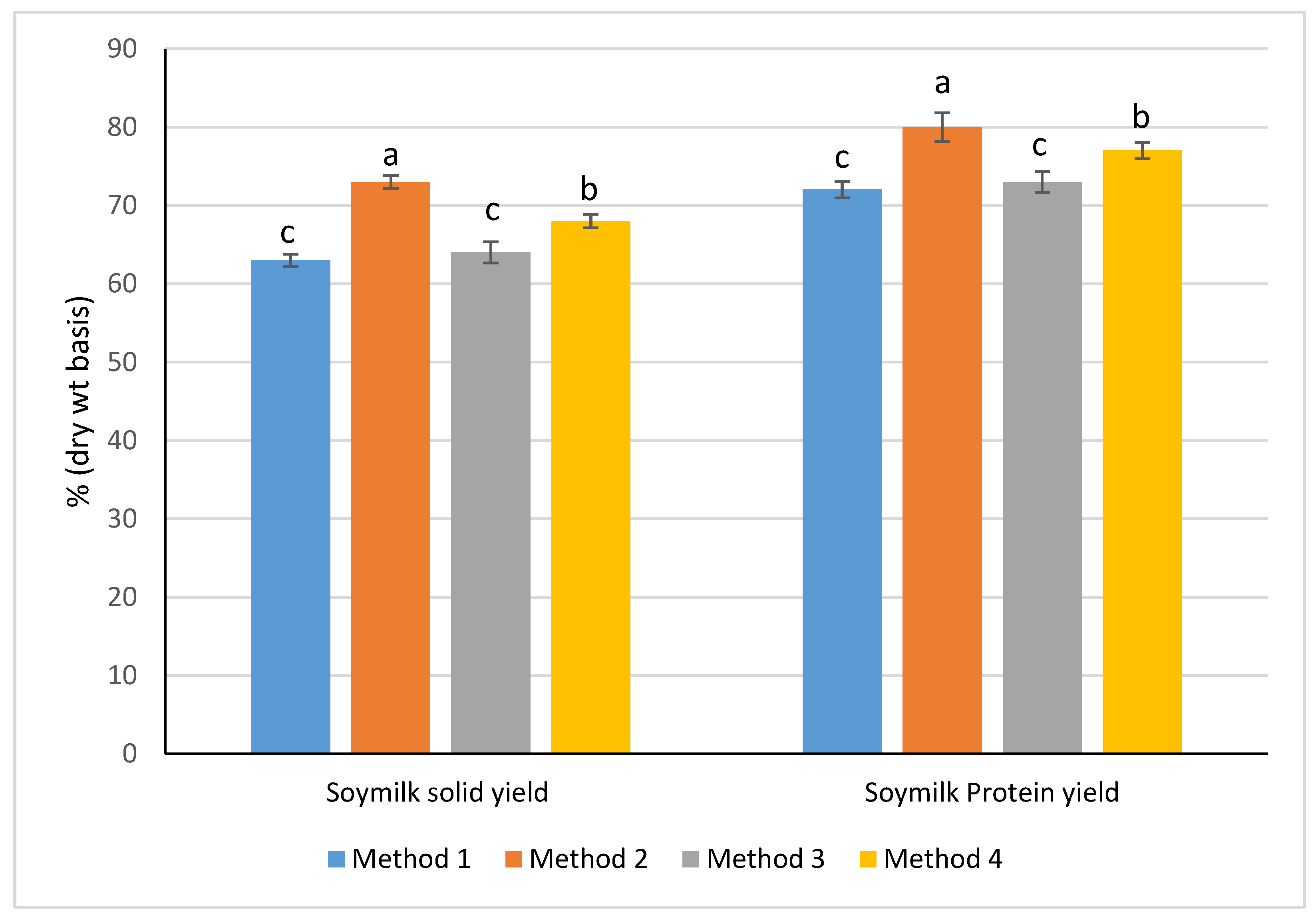

Table 1.
Total phenolic content (TPC) in ProSoy soymilk and Okara as affected by four soymilk making methods and cooking.1.
Table 1.
Total phenolic content (TPC) in ProSoy soymilk and Okara as affected by four soymilk making methods and cooking.1.
| TPC values (mg of GAE/g ) | |||
| Grinding | Raw soymilk | Cooked soymilk | Okara |
| Method 1 | 1.94±0.04cA | 1.68±0.14bB | 1.09±0.17aC |
| Method 2 | 2.09±0.03bcA | 1.74±0.04bB | 0.97±0.03aC |
| Method 3 | 2.11±0.04bA | 1.84±0.09abA | 1.02±0.22aC |
| Method 4 | 2.61±0.11aA | 2.17±0.25aB | 1.30±0.03aC |
1Data are calculated on a dry weight basis and expressed as mean ± standard deviation (n = 3). Values marked by the different lowercase letters within each column are significantly different (P < 0.05). Values marked by the same uppercase letter within same row are not significant different (P < 0.05).
Table 2.
Recovery of TPC (% of that in soybean) in raw and cooked ProSoy soymilk, and okara as affected by four soymilk-making methods.1.
Table 2.
Recovery of TPC (% of that in soybean) in raw and cooked ProSoy soymilk, and okara as affected by four soymilk-making methods.1.
| Grinding | Raw | Cooked | Okara | Total | Loss |
| Method 1 | 43.47±1.32cA | 37.14±3.39bB | 12.49±1.67aC | 55.95±2.86b | 44.05±2.86b |
| Method 2 | 54.03±1.20bA | 44.45±1.21abB | 10.90±0.67aC | 64.94±1.62ab | 35.06±1.62ab |
| Method 3 | 48.06±1.92cA | 41.63±1.16bB | 11.45±2.46aC | 59.51±3.15ab | 40.49±3.15ab |
| Method 4 | 62.90±2.81aA | 52.19±6.86aB | 12.47±0.48aC | 75.37±2.56a | 24.63±2.56a |
1The “Total” column represents the phenolic content from the raw soymilk and okara combined. The ‘Loss’ column represents the difference in total phenolic content between the raw soymilk and the ProSoy soybean powder. Data are calculated on a dry weight basis and expressed as mean ± standard deviation (n = 3). Values marked by the different lowercase letters within each column are significantly different (P < 0.05). Values marked by the same uppercase letter within same row are not significant different (P < 0.05).
Table 3.
TFC content in raw and cooked ProSoy soymilk, and okara as affected by four soymilk-making methods.1.
Table 3.
TFC content in raw and cooked ProSoy soymilk, and okara as affected by four soymilk-making methods.1.
| TFC values (mg of CAE/g) | |||
| Grinding | Raw | Cooked | Okara |
| Method 1 | 0.25±0.03bC | 0.38±0.03aB | 0.63±0.06bA |
| Method 2 | 0.35±0.03bB | 0.42±0.04aB | 0.65±0.10bA |
| Method 3 Method 4 |
0.26±0.05bB 0.37±0.04aB |
0.38±0.03aB 0.43±0.03aB |
0.76±0.10bA 0.89±0.05aA |
Data are calculated on a dry weight basis and expressed as mean ± standard deviation (n = 3). Values marked by the different lowercase letters within each column are significantly different (P < 0.05). Values marked by the same uppercase letter within same row are not significant different (P < 0.05).
Table 4.
Condensed tannin content (CTC) in raw and cooked ProSoy soymilk, and okara as affected by four soymilk-making methods.1.
Table 4.
Condensed tannin content (CTC) in raw and cooked ProSoy soymilk, and okara as affected by four soymilk-making methods.1.
| CTC values (mg of CE/g) | |||
| Grinding | Raw | Cooked | Okara |
| Method 1 | 0.21±0.02dBA | 0.14±0.02bB | 0.46±0.05cA |
| Method 2 | 0.37±0.05bC | 0.27±0.03aB | 0.49±0.01cA |
| Method 3 Method 4 |
0.29±0.05cC 0.48±0.02aC |
0.13±0.01bB 0.32±0.03aB |
0.60±0.03bA 0.70±0.07aA |
Data are calculated on a dry weight basis and expressed as mean ± standard deviation (n = 3). Values marked by the different lowercase letters within each column are significantly different (P < 0.05). Values marked by the same uppercase letter within same row are not significant different (P < 0.05).
Table 5.
Phenolic acid content (μg/g) in raw and cooked ProSoy soymilk, and okara as affected by four soymilk-making methods.
Table 5.
Phenolic acid content (μg/g) in raw and cooked ProSoy soymilk, and okara as affected by four soymilk-making methods.
| GA | VA | CA | CLA | p-HBA | Total | |
| Raw | ||||||
| M1 | 29.5±1.4b | 17.3±1.6ab | 1.5±0.1a | 35.9±4.0a | nd | 84.2±7.0b |
| M2 | 31.4±1.5b | 15.7±1.1ab | nd | 37.4±3.4a | nd | 84.5±6.0b |
| M3 | 37.1±1.2a | 20.2±1.3a | 1.3±0.1a | 42.9±5.5a | nd | 101.4±8.2a |
| M4 | 41.1±0.9a | 14.0±1.2b | 1.4±0.2a | 48.5±4.3a | 1.5±0.2 | 106.5±6.8a |
| Cooked | ||||||
| M1 | 22.0±2.0b | 12.7±0.6b | 0.9±0.1c | nd | nd | 35.7±2.7b |
| M2 | 23.3±1.1b | 12.3±1.3b | nd | nd | nd | 35.6±2.3b |
| M3 | 29.4±1.5a | 21.8±1.3a | 2.5±0.1a | nd | 2.1±0.1 | 55.8±3.0a |
| M4 | 30.4±1.1a | 24.6±1.3a | 1.4±0.1b | nd | nd | 56.4±2.5a |
| Okara | ||||||
| M1 | 18.0±0.9a | nd | nd | nd | nd | 18.0±0.9a |
| M2 | 17.2±1.3a | nd | nd | nd | nd | 17.2±1.3a |
| M3 | 16.9±1.3a | nd | nd | nd | nd | 16.9±1.3a |
| M4 | 13.5±1.4b | nd | nd | nd | nd | 13.5±1.4b |
The data were calculated on a dry weight basis and are expressed as the mean ± the standard deviation (n = 2). The phenolic acids analyzed by HPLC included: GA, gallic acid; VA, vanillic acid; CA, caffeic acid; CLA, chlorogenic acid; p-HBA, p-hydroxybenzoic acid. nd, not detectable. The “Total” represents the sum of the five phenolic acids listed in this table ± the standard deviation. Values marked by the different lowercase letters within four methods are significantly different (P < 0.05).
Table 6.
Isoflavone Content (μg/g) in raw and cooked ProSoy soymilk, and okara as affected by four soymilk making methods.1.
Table 6.
Isoflavone Content (μg/g) in raw and cooked ProSoy soymilk, and okara as affected by four soymilk making methods.1.
| Din | Gly | Gin | MDin | MGly | MGin | MGly | Dein | Gein | Total | |
|---|---|---|---|---|---|---|---|---|---|---|
| Raw | ||||||||||
| M1 | 274.7± 2.3c | 43.9± 4.1a | 314.7±17.1b | 625.4± 5.1d | 113.5±7.7a | 1743.4± 49.5a | 119.5± 2.2b | 49.7± 4.9a | 62.0± 2.5a | 3346.8±90.3b |
| M2 | 260.5± 1.9d | 42.8± 1.1a | 317.0± 3.6b | 790.3± 52.8c | 110.7±0.2a | 1705.9± 33.0a | 134.9± 6.7b | 53.6± 4.6a | 65.0± 3.3a | 3480.9±34.1b |
| M3 | 289.1± 3.8b | 48.3± 3.9a | 346.9± 6.9ab | 974.8± 3.7ab | 128.3±1.2a | 1818.8± 16.5a | 130.3± 8.8b | 57.3± 0.6a | 63.7± 7.1a | 3857.6±37.4a |
| M4 | 333.1± 1.9a | 48.9± 0.5a | 372.3± 15.5a | 985.9± 22.0a | 134.5±13.0a | 1812.5± 16.5a | 180.8± 5.3a | 62.9± 4.3a | 67.8± 5.9a | 3998.8±84.9a |
| Cooked | ||||||||||
| M1 | 540.5± 5.7b | 69.6± 6.9a | 648.5± 12.1b | 653.3± 22.0b | 111.9±5.0a | 1351.3± 18.1ab | 157.2± 4.8a | 39.9± 2.6b | 52.3± 2.2a | 3624.7±65.4b |
| M2 | 572.6± 24.5ab | 62.7± 6.9a | 636.5± 17.5b | 677.6± 22.4ab | 108.7±2.5a | 1337.9± 19.8b | 162.0± 5.0a | 44.7± 4.3ab | 58.4± 3.3a | 3666.1±42.7b |
| M3 | 610.0± 20.0ab | 79.2± 1.4a | 672.0± 9.0ab | 715.9± 21.2ab | 120.8±5.0a | 1384.2± 19.7ab | 173.3± 7.0a | 50.0± 3.9ab | 60.7± 2.2a | 3866.0±29.5a |
| M4 | 641.9± 12.6a | 78.1± 5.7a | 716.0± 3.1a | 754.5± 4.4a | 123.6±2.5a | 1429.4± 28.0a | 183.9±10.1a | 56.6± 2.9a | 58.5± 7.7a | 4042.5±46.7a |
| Okara | ||||||||||
| M1 | 49.7± 0.6b | 22.1± 1.2a | 103.7± 5.9a | 353.1± 22.0b | 62.5±2.5a | 749.8± 18.5a | 67.2± 6.6a | 124.3± 5.7a | 172.2± 12.0a | 1704.6±71.9a |
| M2 | 73.9± 3.7a | 24.6± 1.2a | 103.6± 3.1a | 352.8± 20.2b | 58.6±3.5a | 661.4± 16.5b | 59.1± 5.3a | 106.9± 5.0ab | 152.3± 4.3ab | 1593.4±12.1a |
| M3 | 71.7± 3.8a | 25.1± 2.5a | 112.7± 5.8a | 338.1± 12.0b | 59.3±1.5a | 714.3± 11.4ab | 62.6± 3.2a | 105.2± 1.4ab | 138.2± 7.6b | 1627.6±14.9a |
| M4 | 76.5±3.8a | 22.0± 2.2a | 78.5± 6.6b | 239.1± 19.8 | 47.8±0.7b | 477.3± 26.4c | 36.9± 5.4b | 101.5± 7.1b | 149.2± 4.3ab | 1229.1±39.5b |
Data (microgram/g) were calculated based on dried crude phenolic extract isolated from soymilk, and are expressed as the mean ± standard deviation (n = 2). Din, daidzin; Gin, genistin; Gly, glycitin; MDin, malonyldaidzin; MGin, malonylgenistin; MGly, malonylglycitin; MGly, malonylglycitin; Dein, daidzein; Gein, genistein; nd, not detectable. “Total” represents the mass (μg/g) sum of the nine different isoflavones detected by HPLC. Values marked by the different lowercase letters within four methods are significantly different (P < 0.05).
Table 7.
Antioxidant profiles of raw and cooked soymilk and okara from ProSoy soybean as affected by four processing methods.1.
Table 7.
Antioxidant profiles of raw and cooked soymilk and okara from ProSoy soybean as affected by four processing methods.1.
| ORAC values (µmol TE/g) | |||||||||
| Grinding | Raw | Cooked | Okara | ||||||
| Method 1 | 71.49±4.26bB | 89.89±1.68cA | 67.50±6.13aB | ||||||
| Method 2 | 75.36±3.92abC | 101.80±4.67bcB | 59.77±2.14aA | ||||||
| Method 3 | 88.25±7.96aC | 109.65±9.54bB | 56.40±3.31aA | ||||||
| Method 4 | 86.45±6.20abC | 132.56±4.26aB | 59.94±5.00aA | ||||||
| FRAP Values (mmol Fe2+ equivalents/100 g) | |||||||||
| Grinding | Raw | Cooked | Okara | ||||||
| Method 1 | 0.92±0.02dC | 1.08±0.04bB | 0.78±0.03aA | ||||||
| Method 2 | 1.07±0.04cB | 1.10±0.03bB | 0.79±0.02aA | ||||||
| Method 3 Method 4 |
1.01±0.01bC 1.13±0.04aC |
1.25±0.06aB 1.30±0.09aB |
0.77±0.04aA 0.71±0.03aA |
||||||
| DPPH Assay (µmol TE/g) | |||||||||
| Grinding | Raw | Cooked | Okara | ||||||
| Method 1 | 0.58±0.09cB | 1.13±0.04cA | 0.43±0.09bB | ||||||
| Method 2 | 0.83±0.03bC | 1.78±0.07baB | 0.37±0.04bA | ||||||
| Method 3 Method 4 |
0.77±0.08bB 1.45±0.12aC |
1.57±0.05bA 1.96±0.21aB |
0.73±0.09aB 0.47±0.07bA |
||||||
1Data are calculated on a dry weight basis and expressed as mean ± standard deviation (n = 3). Values marked by the different lowercase letters within each column within each antioxidant assay are significantly different (P < 0.05). Values marked by the same uppercase letter within same row are not significant different (P < 0.05).
Table 8.
Anti-DU145 prostate cancer cell proliferation IC50 values (mg/mL) in the crude phenolic extracts from raw soymilk, cooked soymilk and okara from ProSoy soybean.
Table 8.
Anti-DU145 prostate cancer cell proliferation IC50 values (mg/mL) in the crude phenolic extracts from raw soymilk, cooked soymilk and okara from ProSoy soybean.
| IC50 values (mg/mL) of MTT Assay | |||
| Grinding | Raw | Cooked | Okara |
| Method 1 | 8.5±0.7cA | 8.1±0.6bA | 9.6±0.7aA |
| Method 2 | 7.7±0.7bcA | 7.7±0.9bA | 8.4±0.3aA |
| Method 3 Method 4 |
7.0±0.6bB 4.9±0.2aB |
10.1±0.6aA 6.8±0.1bA |
9.5±1.2aA 9.4±0.7aA |
Data are calculated on a dry weight basis and expressed as mean ± standard deviation (n = 3). Values marked by the different lowercase letters within each column are significantly different (P < 0.05). Values marked by the same uppercase letter within same row are not significant different (P < 0.05).
Disclaimer/Publisher’s Note: The statements, opinions and data contained in all publications are solely those of the individual author(s) and contributor(s) and not of MDPI and/or the editor(s). MDPI and/or the editor(s) disclaim responsibility for any injury to people or property resulting from any ideas, methods, instructions or products referred to in the content. |
© 2024 by the authors. Licensee MDPI, Basel, Switzerland. This article is an open access article distributed under the terms and conditions of the Creative Commons Attribution (CC BY) license (http://creativecommons.org/licenses/by/4.0/).
Copyright: This open access article is published under a Creative Commons CC BY 4.0 license, which permit the free download, distribution, and reuse, provided that the author and preprint are cited in any reuse.