

Submitted:
10 May 2024
Posted:
10 May 2024
You are already at the latest version
Abstract
As the telecommunications landscape braces for the post-5G era, this paper embarks on delineating the foundational pillars and pioneering visions that define the trajectory towards 6G wireless communication systems. Recognizing the insatiable demand for higher data rates, enhanced connectivity, and broader network coverage, we unravel the evolution from the existing 5G infrastructure to the nascent 6G framework, setting the stage for transformative advancements anticipated in the 2030s. Our discourse navigates through the intricate architecture of 6G, highlighting the paradigm shifts towards super convergence, non-IP-based networking protocols, and information-centric net-works, all underpinned by a robust 360-degree cybersecurity and privacy-by-engineering design. Delving into the core of 6G, we articulate a systematic exploration of the key technologies earmarked to revolutionize wireless communication including terahertz (THz) waves, optical wireless technology, and dynamic spectrum management,while elucidating the intricate tradeoffs necessitated by the integration of such innovations. This paper not only lays out a comprehensive 6G vision accentuated by high security, affordability, and intelligence but also charts the course for addressing the pivotal challenges of spectrum efficiency, energy consumption, and the seamless integration of emerging technologies. In this study, our goal is to enrich the existing discussions and research efforts by providing comprehen-sive insights into the development of 6G technology, ultimately supporting the creation of a thoroughly connected future world that meets evolving demands.
Keywords:
6G wireless communication
; Terahertz (THz) waves
; Optical wireless technology
; Dynamic spectrum management
; Non-IP-based networking protocols
; Cyber-security
; Quantum communications
; Artificial Intelligence (AI)
; Network architecture
; Spectrum efficiency
; Energy consumption
; Reconfigurable intelligent surfaces
; Holographic communication
; Blockchain technology
; Tactile internet
1. Introduction
To lay the groundwork for our 6G vision, we first offer background information spanning the development of network technologies from the first to the fourth generation, detail the advancements achieved with 5G, and discuss the research efforts aimed at achieving 6G.(see Figure 1).
The journey of wireless communication began with Marconi’s wireless telegraphy in the 19th century, evolving into 1G analog networks for voice communication. The transition to 2G brought digitalization, enabling encrypted and data services. The 3G era introduced various data services like internet access and video calls, while 4G/LTE networks, initiated in 2009, achieved high-speed mobile data transmission. Technologically and commercially successful, 4G reshaped society with widespread smartphone usage and advanced information technologies.
The concept of 5G emerged in 2014, emphasizing network densification, millimeter-wave transmission, and massive MIMO architecture as key technologies. By 2020, major companies and operators began constructing 5G networks. Initial deployments focused on dense urban areas, operating in the 2–6 GHz spectrum. Millimeter-wave and massive MIMO technologies were integrated, while network slicing supported mission-critical solutions [1]. The 5G era prioritized services like high-definition video streaming, internet protocol television and enhanced data services. However, certain cutting-edge technologies were not incorporated due to experimental verification needs, high costs, and limited demand.
Looking towards the future, scholars are beginning to outline the contours of 6G, prioritizing factors such as battery life and categories of service rather than just data speed and response times. In the period following 5G, there’s a focus on the potentials of circuit and device production to establish a comprehensive research feedback cycle. Forecasts for the 2030s envision innovations such as holographic communication, airborne network systems, remote-controlled driving, and the tactile internet. The shift towards network decentralization using blockchain technology is highlighted as crucial for streamlining the management of 6G networks. Emphasizing a human-centric approach to services is suggested as a central theme [1]. Benchmarks for performance and a hypothetical comparison between 5G and 6G have been articulated.
Studies on tangible applications encompass diverse access methods, communication interfaces, and computational hubs for 6G networks. The designs for networking emphasize a non-cellular framework, distributed resources management, and extensive three-dimensional connectivity within 6G infrastructures. Investigations into machine-type communications (MTCs) and tailored wireless solutions for various industries propose that 6G has the potential to supplant current specialized standards in the industry [1].
Terahertz communications, AI, and reconfigurable intelligent surfaces stand out as revolutionary 6G technologies. Terahertz communication details technological overviews, practical demonstrations and transmitter–receiver designs. AI-driven 6G technology is anticipated to bring about capabilities such as autonomous aggregation, situational awareness, and spontaneous configuration. The concept of reconfigurable intelligent surfaces is seen as the next evolution of massive MIMO technology in 6G, integrating index modulation to enhance spectral efficiency.
Beyond theoretical discussions, several 6G projects worldwide have initiated to define and reshape the framework and business model of wireless communications. Global organizations, including IEEE and ITU-T, and industry giants like Google, LG Electronics, Samsung, and SK Telecom, are actively involved in 6G research. Countries worldwide have launched initiatives, showcasing the global interest and participation in the 6G research race [2,3,4,5,6].
In response to the rapid growth of the mobile communications industry, this paper aims to address the limitations of 5G and delve into the development of 6G. By analyzing progressive studies on 6G, we present a detailed overview.
Our contributions include:
- 6G Network Architecture Evolution and Trends:The paper delineates the anticipated evolution of 6G network architecture, emphasizing design principles like superconvergence, non-IP-based networking protocols, and a 360-degree cybersecurity and privacy-by-engineering design. It envisions a future where the integration of diverse technologies, including quantum communications and artificial intelligence, underpins the fabric of 6G networks.
- Crafting the Future: Unveiling 6G’s Pinnacle Features and Delicate Trade-offs: A detailed examination of the key features unique to 6G, such as high security, secrecy, privacy, affordability, and intelligence, is provided. It also discusses the trade-offs required to achieve these ambitious goals, balancing spectrum efficiency with energy consumption and customization with security.
- 6G Network Performance Parameters and Application Scenarios: This section outlines the technical requirements for 6G networks to support emerging application scenarios. It discusses the enhancement of connectivity density, the expansion of coverage to ubiquitous global service, and the integration of sensing and intelligence at an unprecedented scale.
- Key 6G Technologies: The paper introduces groundbreaking technologies essential for 6G, covering new spectrum opportunities, enhanced wireless interfaces, and advancements in communication paradigms. It highlights how technologies like terahertz communication, optical wireless technology, and dynamic spectrum management will drive 6G innovations.
- 6G Testbeds and Platforms: An overview of existing 6G testbeds is provided, shedding light on the practical aspects of implementing and testing 6G technologies. This section underscores the importance of real-world experimentation in the evolution of 6G standards and applications.
- Technical Challenges for 6G Development: The paper identifies and discusses the myriad technical hurdles that must be overcome to realize the vision of 6G. From the propagation challenges of terahertz waves to the integration of AI in network operations, it lays out a roadmap for addressing these complex issues.
- Critical Non-Technical Considerations for 6G Development: The paper extends its analysis to encompass non-technical obstacles and factors crucial for the effective implementation of 6G. This includes considerations related to regulations, societal impact, and market dynamics that are essential for the technology’s success.
Section II scrutinizes the development of the 6G network framework, proposing a novel framework, while Section III highlights the 6G’s key features. Section IV details KPIs and application scenarios. Section V covers key enabling technologies, and Section VI highlights 6G-style wireless test beds. Future research directions, technical and non-technical challenges are outlined in Section VII and VIII respectively, with conclusions presented in Section IX.
2. 6G Network Architecture, Evolution and Trends
In order to address the requirements of upcoming applications, 6G is anticipated to integrate and expand on the revolutionary ideas beyond 5G. The standardization efforts of 5G have facilitated the implementation of flexible network structures, disrupting the traditional centralized hierarchy. With cutting-edge technologies like control/user plane separation, network slicing, and mobile edge computing (MEC), key performance indicators (KPIs) may be customized for particular uses. The architecture focused on services, featuring fragmented and extensively API-enabled software components, currently raises a more open innovation community, accelerating deployment. However, 6G will bring forth entirely new paradigms, encompassing novel features, capabilities, and innovative approaches to the underlying transport architecture infrastructure. The design process will also see novel philosophies aimed at expediting design and deployment, as further discussed in the conversation that follows.
2.1. 6G Network Design Fundamentals:
Regarding innovative approaches to architecture and protocol, the following aspects will be significantly important.
2.1.1. Superconvergence
Wired and radio systems that are not 3GPP native will be essential parts of the 6G ecosystem. It would be impossible to implement many of the more radical changes that are covered below without a more seamless and scalable convergence between various technology families. For these convergent network segments, the emphasis will be on mutual or 3GPP-driven security and authentication. In order to protect the unified network, wireline and wireless technologies such as Wi-Fi, WiGig, Bluetooth, and others will adaptively integrate with 6G by utilizing the strong security and authentication techniques of 3GPP. This integration will make it easier to onboard and offload traffic between networks with different loads, which will greatly help with traffic balancing. Additionally, it will improve resilience because traffic delivery can be varied among many technology families.
2.1.2. Non-IP-Based Networking Protocols
The Internet Protocol version 6 (IPv6) has been in existence for several decades, and there is an increasing demand for the standardization of entirely new networking protocols. The research landscape on protocols beyond IP is extensive, and the European Telecommunications Standards Institute (ETSI)’s Next Generation Protocol (NGP) Working Group is actively exploring multiple solutions as potential candidates for a groundbreaking approach. At the wireless edge, more than 50% of networking traffic begins or ends, it is entirely reasonable to seek a solution specifically tailored to the wireless sector.
2.1.3. Information-Centric & Intent-Based Networks (ICNs)
Information-Centric and Intent-Based Networks (ICNs) are being intensively explored in the field of Next Generation Protocols (NGP) by organizations such as the Internet Engineering Task Force (IETF) and the Internet Research Task Force (IRTF). ICNs represent a significant departure from the current networking paradigm, which is TCP/IP-based [7]. This approach involves separating content from its location identifier, using an abstract naming convention instead of IP addressing. Various protocol proposals exist for implementing ICN. It was considered a candidate for 5G in the ITU-T Focus Group (FG) on IMT-2020 [8]. However, there are challenges with tunneling ICN traffic through mobile networks, as it contradicts the transparent and flat Internet topologies. The new ITU-T FG aims to set requirements for the network of 2030. Furthermore, to connect the most recent advancements in networking design and operational management, intent-based networking and service design have evolved. In order to achieve the desired results, 6G will heavily rely on this networking infrastructure lifecycle management approach, which calls for taking into account higher-level business and service policies, end-to-end softwarized infrastructure configuration, continuous network and service state monitoring, and real-time optimization.
2.1.4. 360-Cybersecurity & Privacy-By-Engineering Design
While 5G has prioritized security considerations in terms of protocols and architecture, there has been a gap in standardization efforts concerning the security of embedded code executing system components. This gap has resulted in various security vulnerabilities. Moving forward, there will be a comprehensive cybersecurity approach, addressing security holistically from end to end and considering both top-down perspectives (architecture and protocols) and embedded software. The design will incorporate Privacy-by-Engineering principles, integrating mechanisms into protocols and architecture to ensure inherent privacy features. For instance, devices such as security cameras will only be permitted to stream video footage if they meet specific privacy requirements at the networking and contextual levels, ensuring they undergo certified privacy evaluation.
2.1.5. Future-Proofing Emerging Technologies
As novel technologies like quantum, distributed ledger technologies (DLTs), and AI emerge, there is a need for more efficient and quicker integration into telecom architecture. 6G needs to include mechanisms that facilitate the integration of emerging technologies into the overarching functional architecture, even those technologies that have not yet been invented. There is further discussion on specific technology prospects such as quantum, DLT, and AI. For instance, quantum technology has the potential to render the 6G infrastructure tamper-proof and bolster security through cryptographic key exchanges.
Moreover, quantum computing has the capability NP-hard optimization issues can be resolved in linear time by allowing for the rapid execution of network optimization problems. Distributed Ledger Technologies (DLTs) facilitate data provenance by storing and distributing data, transactions, and contracts in an immutable manner. This proves beneficial in multiparty systems with limited trust among involved parties, a scenario mirrored in the telecom industry’s complex ecosystem involving suppliers, vendors, operators, and consumers. DLTs enhance the efficiency of relationships within this network, streamlining processes such as feature approval by one operator on a DLT, instilling trust among other operators without lengthy procurement procedures. As part of the telecom subscriber plan, users can also create their own market place to exchange data plans or other resources.
Additionally, while AI has long been employed in telecoms to optimize consumer-facing and network-related issues, new types of artificial intelligence are needed when networks become more dispersed and atomized. These must operate in a distributed manner, and as consumer-facing decisions become more critical, there is a need for instance AI (xAI) ideas that can abide by strict legal specifications.
2.2. Opportunities for Fundamental Change
The base infrastructure, which includes the transport networks, needs to be significantly redesigned in order to handle the much higher traffic volume that 6G networks are anticipated to carry. This forecasted traffic load is predicted to be orders of magnitude higher than what 5G networks are likely to generate in the next years. In reaction to these demands, we plan to make a number of significant adjustments.
2.2.1. Removal/Reduction of the Transport Network
Many are unaware that the transport network, including its core functionalities, is essentially a legacy element carried over from previous generations (4G, 3G, 2G). Originally introduced due to limitations in Internet capabilities, today’s well-developed transport fiber infrastructure renders maintaining private national-scale networks unnecessary for operators. The cellular community might focus entirely on the wireless edge (air interface + radio access network + control plane) and use a segmented Internet fiber infrastructure for cellular traffic if a thorough reevaluation is conducted. Although this technique requires adaptations to operations, the tools to support it are available.
2.2.2. Flattened Compute–Storage–Transport
A redesigned 6G architecture, propelled by a robust air interface and an updated core and transport network, facilitates a flattened transport-storage-compute model. Under this framework, transport is virtualized over existing fiber but segregated using contemporary SDN and virtualization techniques. Concurrently, core network functions adopt a microservices architecture, dynamically facilitated through containers or serverless computing structures. To accommodate innovative gaming applications, a more distinct segregation of central processing unit (CPU) and GPU instruction sets enables individual virtualization. For instance, GPU instructions can be processed locally on the phone, while CPU instructions are executed on a nearby virtual Mobile Edge Computing (MEC) platform.
2.2.3. Native Open-Source Support
Driven by economic, security, and innovation cycle considerations, open source becomes a growing element in the 6G ecosystem. Remarkably, tier-1 operators are adopting open source for portions of the radio access network in addition to their core network. This presents opportunities for contributions at scale from the communications and computer science community. Open data, in addition to open source, becomes crucial in unlocking 6G’s potential. Given that many decisions in 6G will involve algorithms, which require substantial training data, the traditionally conservative telco ecosystem needs to create automated mechanisms that grant access to critical data without compromising network security or customer privacy.
2.2.4. AI-Native Design Enabling Human–Machine Teaming
Even though self-organizing networking (SON) and machine learning (ML) have been a part of 3GPP since Release 8, the particular challenges of 6G, like high dynamics, spatial distribution requirements, low latency, and large data volumes, demand a fundamental rethinking of how AI is integrated into the telco ecosystem. Because of its strict design constraints, 6G offers the AI community an interesting new challenge.
Different techniques such as transfer learning and ensemble methods must seamlessly integrate into the overall telecom architecture. Crucially, AI-driven decisions that impact consumers need to align with global consumer-facing policies, similar to General Data Protection Regulation (GDPR) Article 13. Disclosure of relevant information regarding the reasoning behind and effects of data processing is required for compliance. Consequently, 6G needs to incorporate novel paradigms like Explainable AI (xAI). Traditional deep learning AI operates like a "black box," making it challenging to explain decisions, but xAI methods enable human understanding of solution results. xAI is essential not only for regulatory compliance but also for enhancing user trust in AI decision-making. Emerging xAI technology families, particularly those based on planning [9].
Furthermore, AI plays a part in the design process as well as operational elements. Even if 6G might not completely comprehend this, cutting-edge AI/ML systems may design networks in the future. A disruptive approach would be to envision a time when AI can take telecom-related innovation from the internet, turn it into code, self-validate, integrate it into a softwarized infrastructure, do beta testing, and push it out globally in minutes as opposed to decades. This has the potential to be the core technology underpinning the next generation of industry platforms, known as Industry 5.0. All of these developments will create new design and operational paradigms that will enable unparalleled human-machine cooperation to maximize the capabilities of each.
2.2.5. Human-Centric Networks
The telecommunications ecosystem has progressed from an initial cell-centric architecture in 2G and 3G, where designs were influenced by cell coverage and base station placements. In contrast, the current device-centric architecture of 4G and 5G is driven by capacity, directly correlated with the number of high-quality links perceived by terminals like smartphones or fixed wireless access modems. However, these designs are static and don’t effectively address important societal use cases, where multiple users’ user equipment (UE) simultaneously share radio resources with distinct Key Performance Indicators (KPIs) and Quality of Service (QoS) requirements. 6G presents an opportunity to adopt a human-centric approach, characterized by societal awareness and technological adaptability. This would enable more efficient and effective responses to significant societal needs or unforeseen events (Black Swan events). This change is essential because the networking infrastructures in place now are too diverse and fragmented to effectively address societal issues.
However, embracing a genuine Internet-centric approach, where endpoints can be affiliated with any operator, may lead to considerable latencies stemming from the extensive fiber infrastructure of the transport network. The intended signals would need to traverse one operator’s transport backhaul network and then traverse back through another operator’s network. Typically, multiple operator networks are interconnected at specific points of interconnect. Consequently, a call or data transmission from an endpoint of operator A to an endpoint of operator B must traverse these designated points of interconnect. Assuming a typical transport network backhaul spanning 300–500 km, this translates to an additional fiber distance of approximately 600–1000 km. Given the finite and reduced speed of light in fiber, this results in an additional latency of about 3–6 ms in an uncongested transport network. Furthermore, in a congested network without a sliced architecture, an even more substantial delay can occur. Therefore, in multi-operator environments, 5G fails to deliver the expected ultra-low latency Quality of Service (QoS) assurances for flexible network deployments involving endpoints from different operators.
The solution lies in minimizing or eliminating the transport network fiber infrastructure to reduce latency. However, realizing this objective necessitates the broader adaptation or “sliceability" of Internet service provider (ISP) infrastructure. In 6G, a comprehensive end-to-end orchestration strategy is crucial to enable such a deployment scenario. This orchestrator might be feasibly deployed on a distributed ledger to improve transparency among competing entities, as depicted in Figure 2.
3. Crafting the Future: Unveiling 6G’s Pinnacle Features, and Delicate Trade-Offs
Achieving the key features of 6G requires the application of multiple cutting-edge communication technologies. Let’s begin by qualitatively comparing 5G and 6G communications.Let’s begin by qualitatively comparing 5G and 6G communications.
Figure 3 provides a qualitative comparison, considering that 5G’s spectral efficiency is close to its limits. While 6G may not significantly improve spectral efficiency, it emphasizes enhancing privacy,security and secrecy. In 6G, improvements are anticipated in intelligence, affordability, energy efficiency and customization. The advancements will be driven by energy harvesting, artificial intelligence (AI), and novel networking architectures [1].
3.1. Key Features of 6G
3.1.1. Enhanced Security, Confidentiality, and Privacy
In 6G, traditional encryption faces challenges, and new solutions like quantum key distribution and PHY security technologies are proposed. Blockchain technology aims to ensure complete anonymization, decentralization, and untraceability, addressing data privacy concerns [10].
3.1.2. High Affordability and Full Customization
6G prioritizes affordability and customization to avoid increasing financial burdens on users. The goal is to provide cost-effective solutions without limiting users’ options. The focus is on delivering high affordability, allowing users to choose service modes and customize preferences [1].
3.1.3. Reduced Energy Usage and Extended Battery Duration
Overcoming daily charging constraints, 6G aims for low energy consumption and long battery life. Energy-efficient technologies include off-loading computing tasks to smart base stations, cooperative relay communications, and various energy harvesting methods [11].
3.1.4. High Intelligence
6G introduces high intelligence in three dimensions: operational intelligence for efficient network operations, environmental intelligence for adaptive wireless channels, and service intelligence for personalized communication services. AI, deep learning, and smart materials play crucial roles [12].
3.1.5. Extremely Large Bandwidth
6G targets an extremely large bandwidth compared to 5G, utilizing the terahertz band (0.1 THz to 10 THz). Hybrid terahertz/free-space-optical systems are envisioned, providing robust communication solutions. Terahertz transmission is anticipated to play a vital role, especially in uplink scenarios [13].
3.2. Trade-Offs and Solutions
3.2.1. Privacy versus Intelligence
A crucial trade-off exists between privacy and intelligence in 6G. Solutions involve introducing an intermediate agent to anonymize personal data, ensuring privacy is maintained while allowing AI algorithms to optimize network operations.
3.2.2. Affordability versus Intelligence
High intelligence may increase system complexity and costs. To balance this, technological breakthroughs and new commercial strategies are proposed. Users exchanging anonymized data for lower prices is suggested, similar to the smart grid model.
3.2.3. Customization versus Intelligence
6G emphasizes customization over intelligence to preserve user preferences. Fundamental protocols should include prohibitive clauses to ensure that intelligent services operate within permissible boundaries.
3.2.4. Security versus Spectral Effectiveness
The trade-off between security and spectral efficiency is challenging. Potential solutions include designing more efficient encryption algorithms, leveraging PHY security technologies, and using AI algorithms for early security warnings.
3.2.5. Energy Efficiency versus Spectral Efficiency
The trade-off between spectral and energy efficiency is addressed by introducing energy harvesting technologies. User devices can harvest ambient energy, and environmental intelligence helps adapt to radio propagation environments, mitigating the spectrum–energy trade-off. In summary, 6G envisions a future with enhanced security, affordability, intelligence, energy efficiency, and bandwidth, while carefully navigating trade-offs to deliver optimal user experiences [1].
4. 6G Network Performance Parameters and Application Scenarios
In the transition from 5G to 6G technology, it is important to acknowledge that the International Telecommunication Union Radiocommunication Sector (ITU-R) had previously established eight principal performance metrics for International Mobile Telecommunications 2020 (IMT-2020) [14]. Nevertheless, the swift evolution of mobile communication ecosystems calls for a reassessment. Although the initial eight performance metrics are still relevant, their benchmarks require revision to align with recent technological progress and the introduction of novel use cases. Furthermore, the advent of 6G introduces the need for new performance metrics that address location tracking, detection capabilities, security measures, and computational intelligence.
The objective of this paper is to put forth a set of more thorough and logically justified KPIs for 6G networks, establishing their reference values through extensive research and analysis. We present a total of 17 proposed KPIs for 6G networks, categorizing them into four distinct classes, which will be elaborated upon in the subsequent discussion.
4.1. Technical Requirements
When evaluating the capabilities of 6G wireless networks, essential metrics to consider are maximum data transmission speed, the data rate experienced by users, capacity for handling data traffic over a given area, efficiency in terms of spectrum usage and energy consumption, the density of connections within a network, response time, and the support for high-speed user movement. All the major KPIs are described below:
- Peak data rate Aiming for a peak data rate of no less than 1 Tb/s [15], represents a substantial advancement, surpassing the capabilities of 5G by a factor of 100. In specific scenarios like Terahertz (THz) wireless backhaul and fronthaul (x-haul), as highlighted in [15], there is an anticipation that the peak data rate could escalate to an impressive 10 Tb/s.
- User-experienced data rate The 5th percentile point in the user throughput cumulative distribution function represents the idea of a user-experienced data rate. Simply put, this represents the minimum data rate that a user can expect to receive at any given time or location with a 95% probability. This metric becomes particularly significant when evaluating perceived performance, especially at the periphery of cellular coverage. It serves as an indicator of network quality, influenced by factors like site density, architectural design, and inter-cell optimization. In the context of 5G implementation in highly populated metropolitan areas, 50 Mbps for uplink and 100 Mbps for downlink are the planned user-perceived rates. Considerable progress is anticipated toward 6G’s potential, with a tenfold improvement in speed over 5G—1 Gbps or faster—as the target. Moreover, 6G is poised to deliver user-experienced data rates reaching up to 10 Gb/s in specific scenarios, such as indoor hotspots. This advancement signifies a considerable leap in data transfer speeds and holds promise for enhanced connectivity experiences.
- Latency The time it takes for information to travel, known as latency, varies depending on the application. However, the minimum latency is currently 25 s, which is a significant improvement compared to 5G (40 times better). Latency is divided into two types: user plane and control plane latency [16]. The latency of the user plane refers to the time it takes for a packet to be sent from the source in a wireless network to its destination under the assumption that a mobile station is active. The minimum acceptable user plane latency in the context of 5G wireless technology is 4 ms for enhanced mobile broadband (eMBB) and 1 ms for ultra-reliable low latency communications (URLLC). The objective is to reduce latency to either 100 ms or 10 ms. Control plane latency refers to the duration it takes for a control plane to transition from an energy-efficient state, such as idle, to one where continuous data transmission commences, such as active. In 5G, the control plane has a minimum delay of 10 ms, which is expected to see significant enhancement in 6G. End-to-end (E2E) delay holds greater significance than over-the-air latency, serving as a comprehensive metric in 6G.
- Mobility The term `mobility’ describes the maximum speed a mobile station may reach while meeting the network’s acceptable Quality of Experience (QoE) requirements. The highest speed that 5G can enable for deployment scenarios involving high-speed trains is 500 km/h. However, 6G aims at a maximum speed of 1000 km/h in the context of systems used by commercial airlines [16].
- Connectivity density in the realm of massive Machine Type Communications (mMTC) serves as a crucial performance metric for assessment. In 5G, given constraints on radio resources, the minimum count of devices with a more lenient Quality of Service (QoS) per square kilometer (km2) is presently established at 106. There are plans to enhance this metric further, aiming for a tenfold improvement to reach 107 devices per km2 in the future [16].
- Energy efficiency Ensuring energy efficiency is crucial for cost-effective mobile networks and minimizing carbon emissions in the realm of green communication. This aspect plays a critical role in societal and economic considerations. Despite the significant improvement in energy efficiency per bit compared to previous generations, the early deployment of 5G networks has faced criticism for its high overall energy consumption. In the upcoming 6G networks, the goal is to increase KPI performance 10 to 100 times than 5G. The goal is to reduce the power consumption in communication while improving energy efficiency per bit [16].
- Peak spectral efficiency is an important KPI for measuring how well radio communication systems are getting better. The standard for peak bandwidth efficiency in 5G is set at 30 bits per second per hertz (bps/Hz) in the downlink and 15 bps/Hz in the upload. For example, using real-world data to guide the development of new 6G radio technologies could lead to three times better frequency efficiency than the 5G infrastructure [16].
- Area traffic capacity represents a metric assessing a network’s aggregate mobile traffic capacity within a defined area, considering elements such as available bandwidth, spectrum efficiency, and network densification. In 5G, the baseline criterion for area traffic capacity is established at 10 megabits per second per square meter (Mbps/(m2)). There are expectations that in certain deployment scenarios, such as indoor hotspots, this capacity could reach up to 1 gigabit per second per square meter (Gbps/(m2) [16].
- Over-the-air latency must fall within the range of 10 to 100 microseconds (s) to accommodate high mobility, equal to or exceeding 1,000 kilometers per hour (). This targeted latency range is essential to ensure acceptable Quality of Experience (QoE) in specific scenarios, such as hyper-High-Speed Rail (HSR) and airline systems [16].
- Reliability denotes the capacity to transmit a specified volume of traffic within a predetermined time frame with a high probability of success, particularly crucial in URLLC scenarios. In 5G networks, reliability is measured by a success probability spanning from 1 to 10−5 when sending a 32-byte data packet within 1 ms, factoring in the channel quality at the coverage edge in an urban macro environment deployment scenario. Expectations for the next-generation system include a significant improvement of at least two orders of magnitude, reaching a success probability of 1−10−7 or 99.99999% [16].
- Signal bandwidth The term Signal bandwidth denotes the highest total system bandwidth that can be accommodated through one or several Radio Frequency (RF) carriers. Within the 5G framework, the bandwidth’s minimum threshold is established at 100 megahertz (MHz). As we progress towards 6G, it is expected that the bandwidth capacity will expand to accommodate up to 1 gigahertz (GHz), particularly for functions within higher frequency ranges. Furthermore, there exists the possibility for even greater bandwidth capabilities in the realms of Terahertz (THz) communications or Optical Wireless Communications [16].
- Positioning accuracy offered by the 5G positioning service surpasses 10 meters. A rising demand for increased precision in positioning is observed, especially in diverse vertical and industrial applications, notably in indoor environments where satellite-based positioning systems may lack adequate coverage. The integration of Terahertz (THz) radio stations, renowned for their capability in high-precision positioning, is projected to elevate the accuracy supported by 6G networks to the centimeter level [16].
- Coverage In the context of 5G technology, Coverage refers to the integrity of radio signal reception within a single base station’s service area. The scope of this service area is gauged by the coupling loss metric, which accounts for the aggregate long-term channel loss between a terminal and a base station, factoring in elements like antenna gains, the attenuation of signal strength over distance, and shadowing from obstacles. As we transition to 6G networks, the concept of coverage is anticipated to expand considerably. This development is expected to achieve a level of coverage that is universally pervasive, transcending terrestrial-only networks to incorporate a three-dimensional (3D) coverage model that integrates terrestrial, satellite, and aerial network systems.
- Timeliness is identified as a critical time-based performance criterion for future communication systems. This concept is quantified through metrics such as the age of information (AoI) [18], as well as newer variations like age-of-task (AoT) [19] and age-of-synchronization (AoS) [20]. Diverging from the traditional metric of latency, which focuses on the total delay encountered by data packets or service sessions in transit, timeliness emphasizes the relevance of the most recently received data and services to the user. This approach inherently prioritizes newer data or services over older ones, incorporating a record of past states. As a result, this perspective significantly influences and complicates the process of task scheduling within system optimization strategies.
-
Security and privacy When evaluating a network’s resilience, security and privacy play a crucial role in protecting equipment, data, infrastructure and assets. Important things to do to keep mobile networks secure include:
- -
- Confidentiality: Ensuring the security of sensitive information and preventing unauthorised access.
- -
- Integrity: Ensuring the prevention of unauthorised modifications to information.
- -
- Authentication: Verifying the identities of the communication parties.
Dealing with concerns and adhering to privacy regulations like Europe’s General Data Protection Regulation has heightened the importance of privacy. Key Performance Indicators (KPIs), which are quantifiable measurements, offer a practical method for assessing both privacy and security. For instance, one KPI example is the count of security risks identified by algorithms. This metric is valuable for assessing the effectiveness of anomaly detection systems. -
Capital and operating expenditure has a significant impact on a mobile system’s potential to be commercially successful, making it a crucial aspect in determining how affordable mobile services are. There are two primary categories of expenses for a mobile operator:
- -
- Capital Expenditure (CAPEX): This covers the price paid for constructing the infrastructure needed for communication.
- -
- Operational expenditures (OPEX): These include upkeep and running costs.
The network densification has resulted in mobile operators facing pressure from high CAPEX. Additionally, issues such as cyber-attacks, system failures, and performance degradations require manual operations for troubleshooting in mobile networks [16]. As a consequence, mobile carriers must maintain an operational group with a large number of highly qualified network administrators, resulting in a high OPEX. OPEX is currently more than three times higher than CAPEX and continues to rise [21]. In the design of 6G, expenditure will be a key factor to consider.
4.2. Application Scenarios
Three primary application scenarios have emerged in the era of 5G: ultra-reliable low-latency communications (uRLLC), massive machine-type communications (mMTC), and enhanced mobile broadband (eMBB). These scenarios are designed to meet specific needs including large connection density, high data rates and capacity, and low latency and high dependability. Various papers have outlined expectations for 6G [22,23,24] application scenarios, as depicted in Figure 3. Notably, industry stakeholders and operators have envisioned diverse applications across different domains, such as immersive personal experiences, robotics, automation, and commercial activities like remote data collection. Since various application scenarios possess unique communication system KPIs, it is rational to classify them according to these metrics, mirroring the methodology employed in the 5G framework. However, many of these studies have primarily introduced potential application scenarios for 6G without delving into detailed specifics in Table 1.
In the evolution of 6G, there will be a continued enhancement and expansion of the existing application scenarios, aiming to achieve further enhancements in enhanced mobile broadband (feMBB), ultra-massive machine-type communications (umMTC), and enhanced ultra-reliable low-latency communications (euRLLC). In addition to meeting traditional KPIs similar to data throughput, delay in the communication system and connection density by 2030, these scenarios will also bring new KPIs such as intelligence levels, security capabilities, sensing, imaging, and location. Furthermore, new application scenarios for 6G are anticipated to emerge as technologies advance and integrate, combining elements of multiple scenarios. Apart from the three cases that 5G reinforced, 6G is expected to introduce new application scenarios: dense scene communications; mobile broadband reliable and low-latency communication (MBRLLC) for scenarios with high data rates, large bandwidth, low latency, and high reliability; and applications in smart transportation, smart factories, and industrial IoT. Massive enhanced mobile broadband (meMBB) for high data rates, large bandwidth, and connection density.
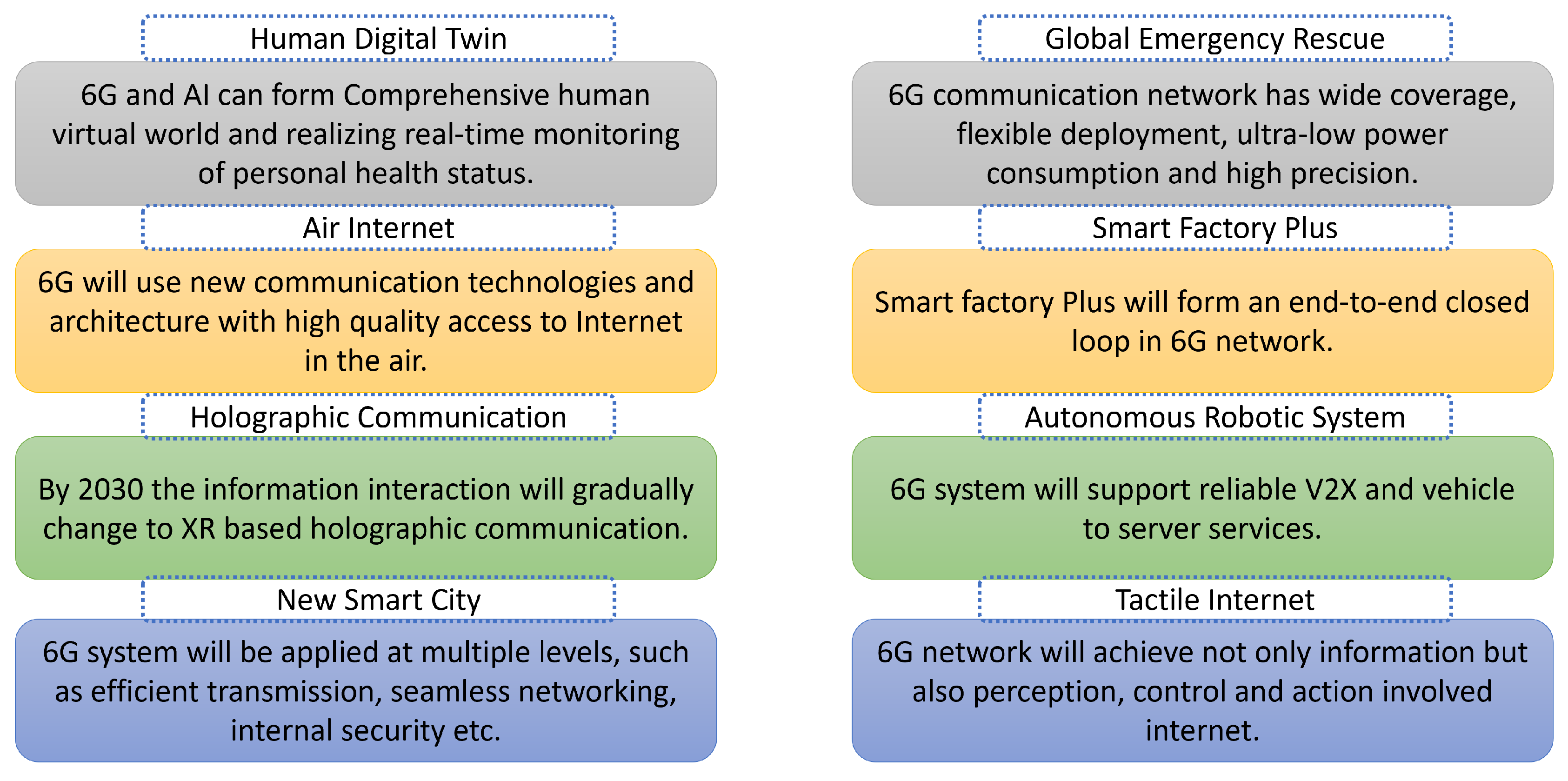
Furthermore, potential scenarios might include ultra-low-power communications, digital twin applications, integrated networks spanning space, air, ground, and sea, as well as long-distance and high-mobility communications. The envisioned 6G application scenarios are illustrated in Figure 4. The next generation will delve into novel application scenarios, service formats, and business models by integrating and fostering collaboration among individuals, machinery, objects, and environments. Anticipated compelling scenarios Figure 5 may encompass the human digital twin, air Internet, holographic communication, innovative smart cities, global emergency response, enhanced smart factories, cyber robots, autonomous systems, and the wireless tactile Internet, among various others.
Figure 4.
6G key performance indicators (KPIs). Adopted from [17].
Figure 4.
6G key performance indicators (KPIs). Adopted from [17].
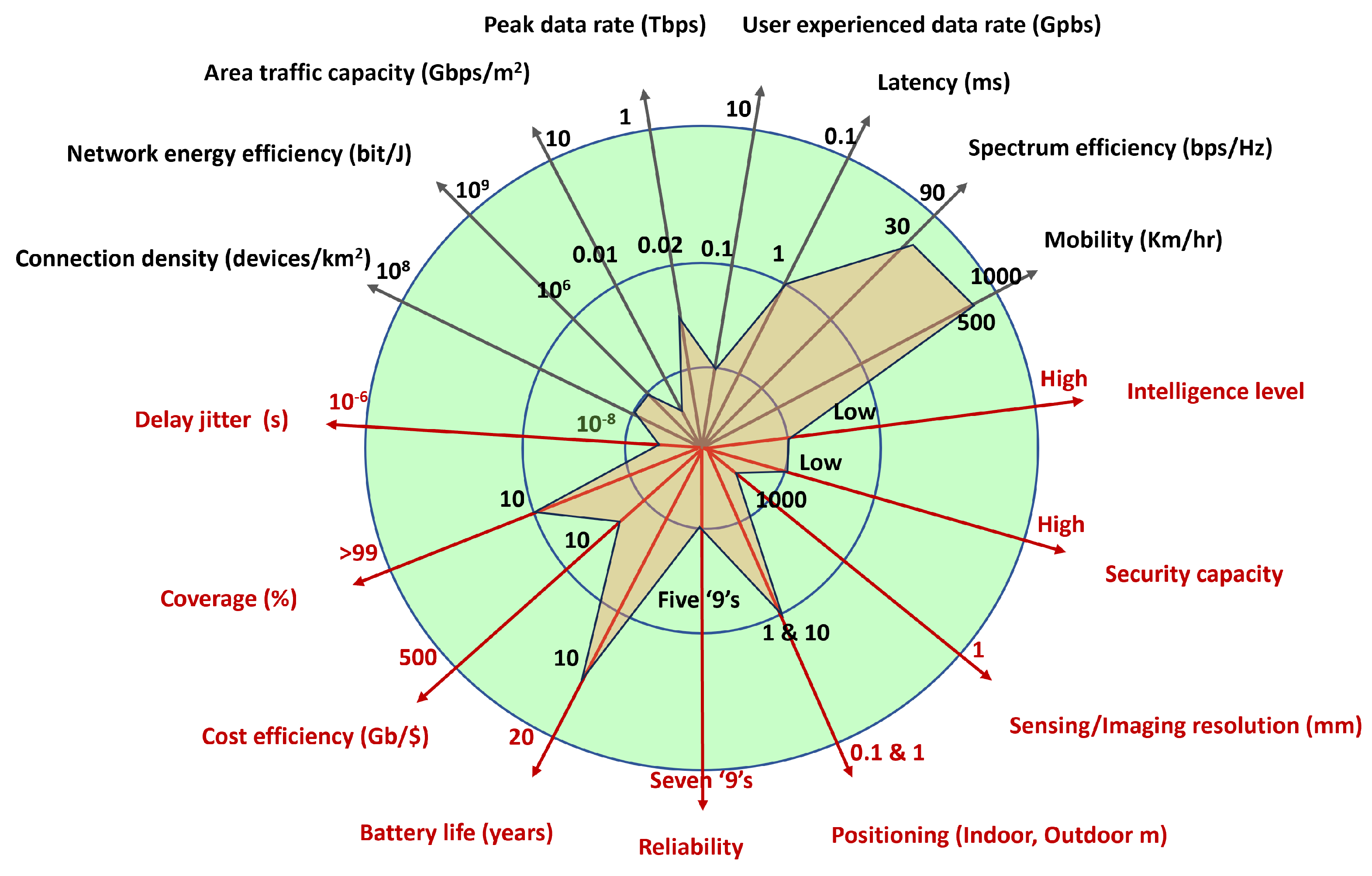
Figure 5.
6G overall features.
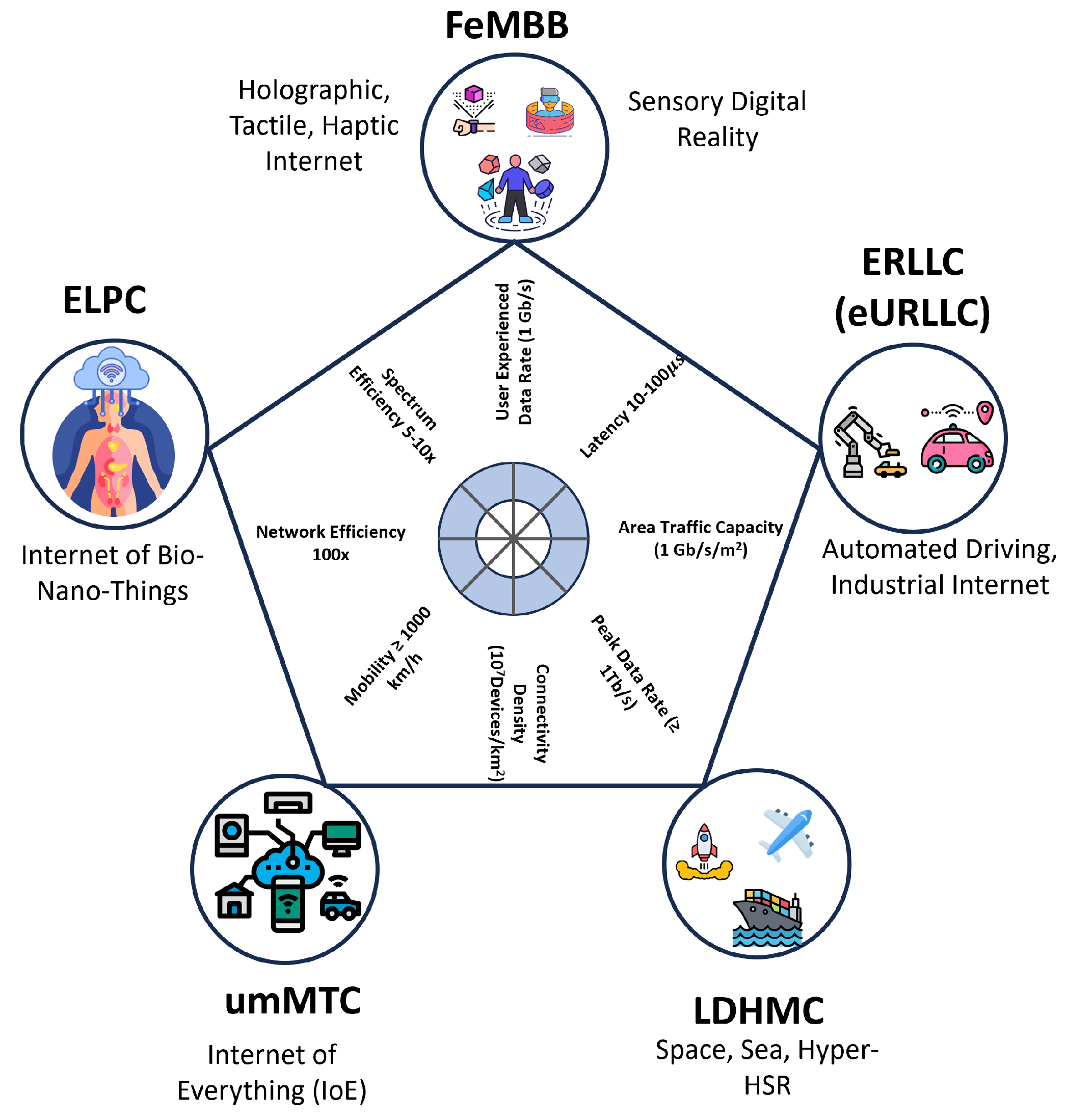
Figure 6.
Potential 6G application scenarios. Adopted from [17].
Figure 6.
Potential 6G application scenarios. Adopted from [17].
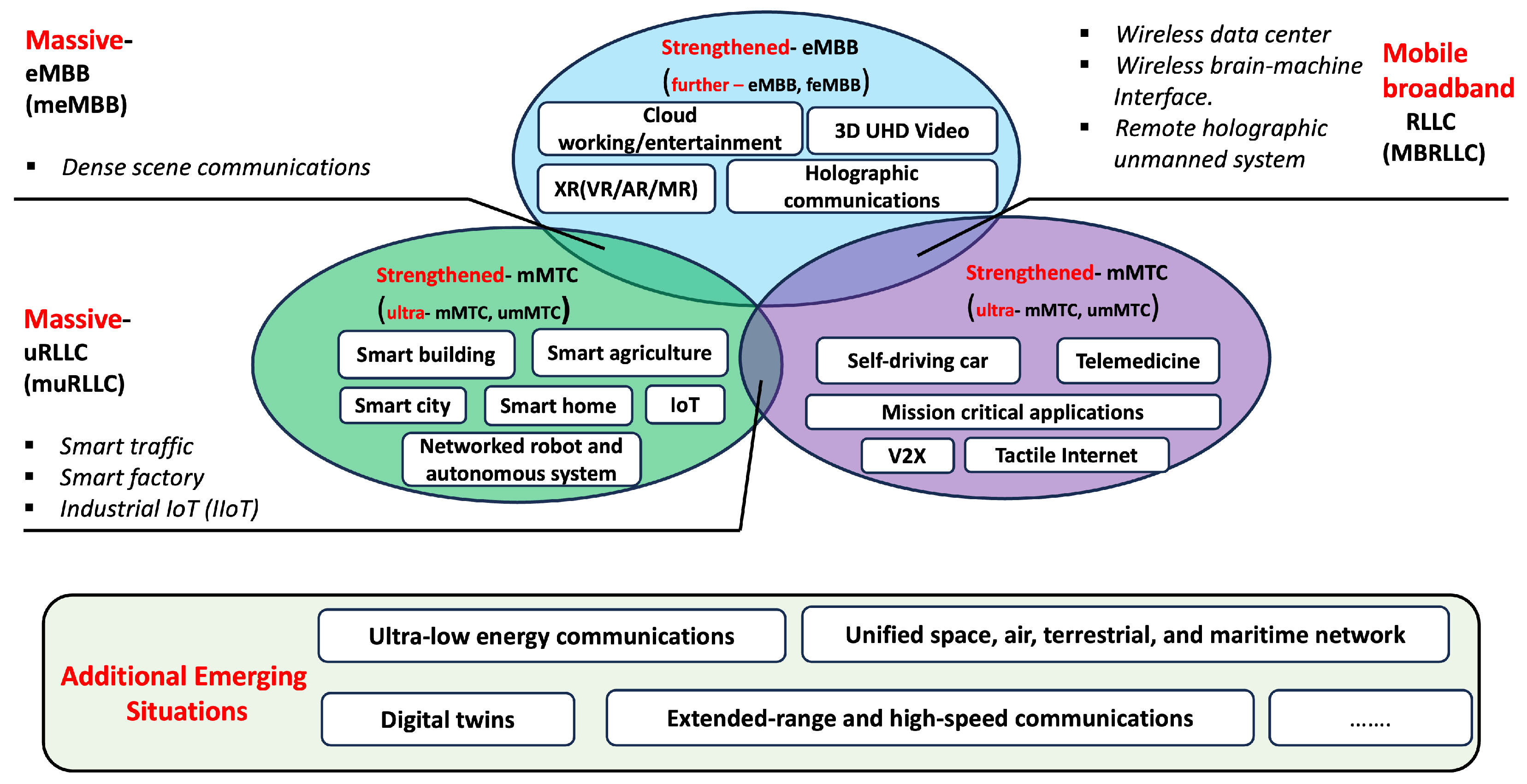
Figure 7.
Categories of potential 6G application scenarios. Adopted from [30].
Figure 7.
Categories of potential 6G application scenarios. Adopted from [30].
4.2.1. Human Digital Twin
Currently, digital technology is primarily employed in detecting common indicators and preventing major diseases through the analysis of human body structure. However, there is a need to enhance the real-time availability and accuracy of this process. As 6G technology progresses and interdisciplinary sciences like bioscience, materials science, and bioelectronic medicine converge, the prospect of generating digital twins of the human body becomes increasingly plausible. This endeavor aims to develop a holistic virtual model of the human body, facilitating real-time monitoring of personalized health metrics.
With more than 100 smart sensors per person, these digital twins will accurately and instantaneously represent the health of critical organs, the nervous system, the respiratory system, the urinary system, the musculoskeletal system, and the emotional state. These digital twins may also incorporate professional medical imaging methods like MRI, CT, color Doppler ultrasound, blood tests, and urine biochemistry by utilizing 6G capabilities. Individuals can obtain a precise evaluation of their health state and timely actions by integrating these data.
Furthermore, 6G will make it easier for professional medical facilities to integrate artificial intelligence (AI), enabling accurate diagnosis and providing recommendations for individualized surgical procedures.
4.2.2. XR (Extended Reality) Based on Holographic Communication
AR/VR is a crucial component of 5G technology that is distinguished by its mobility and independence from geographical restrictions, which are major factors driving the development of AR/VR technology and its applications. By 2030, information interaction will change from AR/VR to XR, including holographic communication systems, and wireless holographic communication will be a reality due to the rapid advancement of technology. Users will be able to take advantage of the improvements brought about by holographic communication and presentation at any time and from any location thanks to this advancement. By engaging their senses of sight, hearing, touch, smell, taste, and even emotion, XR will empower people and free them from the confines of space and time. This would allow users to fully immerse themselves in a variety of totally immersive holographic experiences, including games, concerts, sports, art, and educational activities.
4.2.3. New Smart City
Many sensors have been put in cars, buildings, industries, highways, residences, and other amenities in order to create a smart city. 6G is expected to function as a dependable wireless high-speed communication system, enabling application integration and cooperation for more efficient data-driven operations. Communication networks are becoming an essential part of the public infrastructure for smart cities in the rapidly changing digital world. However, most urban public infrastructure’s perception, transmission, analysis, and control remain fragmented without a single management platform since several administrative agencies handle the building and operation of the infrastructure.
By implementing a unified network design, presenting fresh business possibilities, and building a more effective and extensive network, 6G seeks to solve this. Physical and logical networks can be separated thanks to upcoming developments in network virtualization, software-defined networks, and network slicing. At many levels, including as effective transmission, smooth networking, internal security, large-scale deployment, and automated maintenance, AI integration into the 6G system will be crucial. A new smart city ecosystem is expected to develop with the help of 6G.
4.2.4. Emergency Rescue Communication
Since the advent of 1G through to the present 5G, terrestrial mobile communication systems have made substantial progress in achieving broader coverage, increased bandwidth, faster speeds, lower latency, and denser networks. Nonetheless, in the face of widespread natural disasters such as earthquakes, floods, mudslides, or severe human-induced accidents, the local terrestrial communication network could potentially become entirely incapacitated. This could result in individuals in need of assistance being unable to send distress signals promptly, impeding external rescue efforts. Moreover, certain scenarios, such as oceans and deserts, lack sufficient communication network coverage. The crucial first 72 hours following accidents and emergencies are pivotal for saving lives. The advent of 6G, with its realization of 3D full space coverage, will enable the rapid deployment of UAV and satellite communication networks on demand during crises. This deployment will facilitate emergency communications to aid in swift search and rescue operations. Given the urgency of rescue operations, it is imperative to swiftly deploy a high-bandwidth network with extensive coverage.
Furthermore, the 6G network can help with real-time dynamic monitoring of desert, ocean, and river regions that are vulnerable to natural disasters. By providing early warning services in reaction to events like sandstorms, typhoons, and floods, this capability helps to lower the amount of money lost as a result of disasters.
4.2.5. High Speed Internet Access in The Air
The digitization of visual and aural data was the main focus of communication services in previous generations. But with the advent of the 6G era, users’ tactile information may now be gathered, digitized, and transmitted across the network, resulting in the creation of the tactile Internet.
With 5G, achieving a high-quality aerial network infrastructure is difficult. There are two main ways that airborne network services can be provided: satellite transmission and ground-based stations. Due to the aircraft’s quick mobility, long cross-border range, and other issues including high maneuverability, Doppler frequency shift, frequent handovers, and restricted base station coverage, choosing the ground base station mode is challenging. On the other hand, satellite broadcasting comes at a prohibitive cost but guarantees a reasonably assured quality of the air network. In the context of 6G, cutting-edge network designs and communication technologies outside of cellular networks will be utilized to provide consumers with high-quality, high-speed Internet access services while also lowering network usage expenses.
4.2.6. Smart Factory Plus
The 6G system collects operating data in real time from machine tools, workshops, and accessory components by using ultra-high bandwidth, extremely low latency, and great dependability. Through the integration of edge computing and AI technology, the system enables the direct monitoring and transmission of data at the terminal level for real-time order execution. In 6G, blockchain technology facilitates the direct exchange of data among all terminals in a smart factory without the need for an intermediary transportation center. This decentralized approach enhances operational efficiency. The scope of 6G extends beyond the confines of the factory, ensuring seamless connectivity throughout the manufacturing cycle.
By utilizing the 6G network, the system may dynamically link any smart device or terminal within the plant, enabling quick deployment of device combinations according to the demands of the production line. The expectations of C2B (customer-to-business) interactions for personalization and customization are met by this flexibility. With the use of 6G and related technologies, the Smart Factory PLUS creates an end-to-end closed loop that links the factory’s ability to meet specific client requests to its delivery capabilities.
4.2.7. Cyber Robots and Autonomous Systems
6G technology may greatly improve the use of network robots and autonomous systems, such as UAV mail delivery systems. Self-driving automobiles that use 6G wireless connectivity have the potential to significantly alter daily life. The 6G system’s capabilities will drive the wider deployment and implementation of autonomous vehicles. Self-driving vehicles are equipped with a variety of sensors, including inertial measuring tools, light detection, LiDar, radar, GPS, sonar, and odometer. These sensors allow the automobiles to observe and understand their surroundings. Vehicle-to-server services and V2X connectivity will have strong support in the 6G system.
6G will help in the communication between unmanned aerial vehicles (UAVs) and ground controllers. Numerous industries, including the military, commerce, science, agriculture, entertainment, government, logistics, surveillance, aerial photography, emergency rescue, and disaster relief, are among the many that employ UAVs. Furthermore, UAVs can act as High Altitude Platform Stations (HAPS) in places lacking or unable to operate cellular base stations, providing broadcast and high-speed Internet services to local consumers.
4.2.8. Wireless Tactile Network
Perception and connection are the main areas of interest for the Internet of Things (IoT) in the current 5G network. In the future, the 6G network connection’s aim will change to a single, intelligent purpose. Rather than only focusing on perception, the 6G network’s connection and communication dynamic will also include real-time control and reaction, resulting in the "tactile Internet." This is the name given to a communication network that can send real-time control, touch, and sensing/driving data.
The tactile Internet is described as a real-time network or virtual object network intended for remote access, perception, or control by the IEEE P1918.1 standard working group. The tactile Internet has a larger function than the standard Internet, which mainly enables the exchange of data and information. Along with handling information transfer remotely, it also has mechanisms for remote control and reaction that are matched to the transmission of data and information. With this, there will be a major change from content distribution to remote skill delivery.
Three primary components define the tactile Internet: ultra-real-time response infrastructure and network for remote control, integration of control and communication, and physical real-time interaction (allowing real-time access to people and machines, operating and controlling objects in a sensed manner).
5. Key 6G Technologies
To effectively accommodate groundbreaking use cases and applications, the development and implementation of advanced transmission, networking, and computing technologies will be essential for the 6G system. This section offers an exhaustive overview of potential technological drivers for 6G, organized into various categories: innovative spectrum technologies including THz communications, mmWave, OWC, VLC, and DSM; novel networking approaches such as software-based networking and virtualization, O-RAN, network slicing in RAN, and post-quantum cybersecurity; new air interfaces featuring IRS, CoMP, extensive MIMO, fresh modulation strategies and cell-free massive MIMO; revolutionary architecture ensuring three-dimensional coverage through the integration of expansive satellite constellations, HAPs, and UAVs with conventional terrestrial networks; and a new approach fostered by merging communication, computation, and storage capabilities, along with incorporating AI, blockchain, digital twins, and mobile networks. For each technology identified, its principles, benefits, challenges, and areas requiring further research are discussed [16].
5.1. New Spectrum
Future mobile networks are expected to efficiently assist a diverse range of radio access technologies (RAT), allowing traditional RATs operating on lower radio frequencies to coexist seamlessly with line-of-sight (LOS)-based RATs such as VLC, THz, and OWC. These technologies, could form a new tier within the hierarchical radio access network (RAN) architecture, such as picocells, where cells utilizing various RATs are superimposed upon one another. This concept echoes the integration of mmWave technology into 5G networks [16].
5.1.1. Millimeter Wave
The introduction of mmWave technology by 5G new radio is expected to continue as a critical element in forthcoming 6G networks. In contrast to traditional RF technologies operating below 6GHz, mmWave substantially expands the bandwidth by offering new frequencies up to 300 GHz. According to Shannon’s theorem, this significant increase in bandwidth will enhance the capacity of radio channels, satisfying the growing demand for higher data rates. At the same time, the reduced wavelength results in more compact antenna sizes. This enhancement not only boosts the device’s portability and degree of integration but also facilitates the expansion of antenna array dimensions, consequently focusing the beams more narrowly. This aspect proves advantageous for particular uses, for example: radar identification and enhancing security [31]. Moreover, the characteristics of molecular and atmospheric absorption vary significantly within the mmWave band, offering opportunities for a variety of applications. Attenuation peaks, such as 60 GHz, 120 GHz, and 180 GHz, suffer significant propagation loss. In contrast, other frequencies, like as 35 GHz, 94 GHz, 140 GHz, and 220 GHz, have little attenuation and may be directly communicated across large distances. This feature can be utilized for short-distance confidential networks that have strict security demands [31,32].Presently, standardization initiatives in the mmWave domain are primarily concentrated on the 60 GHz band for indoor applications, as seen in standards such as ECMA-387 and IEEE 802.11ad [33,34]. Along with the advantages offered by mmWave technology, it introduces several new challenges. Firstly, the wide bandwidth available in the mmWave spectrum and the high power required for transmission can result in significant non-linear signal distortions, demanding more advanced technical specifications for integrated circuits compared to traditional RF devices. Furthermore, molecular and atmospheric absorption significantly reduces the optimum transmission distance of mmWave, especially in the 60 GHz range, thus strongly depending on line-of-sight (LOS) pathways for mmWave communication. Due to the poor diffraction qualities at such short wavelengths, this dependency becomes a severe constraint and causes substantial signal blockage in surroundings with plenty of small-scale barriers like cars, people, and even the user’s body [35]. The fading effects are substantially more noticeable than in RF bands because of the significant propagation loss and dependency on line-of-sight (LOS) associated with mmWave technology. This also significantly increases the channel state’s sensitivity to mobility. Consequently, there is an unparalleled need for excellent mobility management. Moreover, in situations where numerous links exist closely together, particularly indoors, the interference between different access points becomes substantial. Hence, there is a clear need for effective interference management strategies [36].
5.1.2. Terahertz (THz) Technology for 6G Communication Systems
In spite of the current abundance of spectral redundancy in mmWave, it falls short of meeting the escalating demand for bandwidth expected in the coming decade. We may anticipate that the next generation Radio Access Network (RAN) will function at higher frequencies, including Terahertz (THz) or optical frequency bands. It is believed that these technologies will outperform existing wireless options and have very high bandwidth.
A significant evolution from 5G involves the introduction of Terahertz (THz) technology, addressing the surge in mobile data traffic and low latency services and the demand for high data rate. Operating in the 0.1–3 THz range, THz exhibits characteristics like high frequency, large bandwidth, and a narrow beam, making it a promising solution for applications such as HD holographic video conferences, V2V communications, and nanoscale devices [37,38,39]. Despite challenges, including hardware development and propagation losses, recent advancements, such as the establishment of the THz Interest Group by IEEE 802.15 and breakthroughs in photonics-aided transparent fiber-THz-fiber transmission systems, signal steady progress toward harnessing THz’s transformative potential [37,38,40,41,42].
Moreover, as a part of new spectrum exploration, THz is anticipated to revolutionize communication, sensing, imaging, and positioning, presenting challenges that necessitate further research and development [37,41].
In conclusion, the pursuit of 6G involves pushing the boundaries of communication systems through innovations like THz technology, with ongoing research and breakthroughs paving the way for transformative changes in human life and social development.
5.1.3. Optical Wireless Technology
Optical Wireless Communications (OWCs), extending beyond the Terahertz spectrum, offer high-density broadband communication services, boasting advantages like inherent physical layer security, ultra-low latency, absence of electromagnetic interference, cost-effectiveness, access to abundant unlicensed spectrum, and simple deployment [43,44]. The optical band encompasses visible light, and Ultraviolet (UV),Infrared (IR) each with distinct applications and considerations.
IR communication, operating between 760 nm and 1mm wavelength, facilitates remote data transmission with simple structures but is susceptible to atmospheric effects like fog [43]. Visible light, within the 360–760 nm range, serves dual purposes of communication and illumination, additionally enabling energy harvesting using solar cells [45]. The concept of light-based IoT has been proposed, and innovative lighting devices based on blue lasers have entered the market, achieving an aggregate data rate of 26 Gbps [46,47].
UV, ranging from 10 to 400 nm, stands out for potential non-line-of-sight (NLoS) communications due to lower background noise and higher atmospheric scattering, though health and safety implications warrant thorough evaluation before practical application [48,49].
Optical wireless technologies, including LiFi, Visible Light Communication (VLC), Optical Camera Communications (OCC), Ranging (LiDAR), Light Detection, and Free-Space Optics (FSO), have gained prominence, catering to applications in indoor, underwater, vehicular, and long-distance communications [50,51].Although optical bands have three orders of magnitude more spectrum resources than RF bands, optoelectronic devices’ electrical bandwidth restricts their use. Advances in high-performance devices, such as fast organic light-emitting diodes (OLED) and silicon photomultipliers, have been instrumental in achieving data rates exceeding 1 Gbps [52,53].
Understanding Optical Wireless Communication (OWC) channels, characterized by non-isotropic properties, requires considerations for device orientation, leading to proposals like multi-directional transmitters with adaptive spatial modulation [54,55]. Innovations such as time-domain spatial modulation and Non-Orthogonal Multiple Access (NOMA) schemes contribute to optimizing the performance and security of OWC systems [56,57,58]. Extensive research in these areas reflects the increasing attention given to optical wireless as a promising technology for various communication scenarios [59,60].
5.1.4. Dynamic Spectrum Management
In tackling the scarcity of spectrum resources, addressing both unused higher frequency spectrums and optimizing the utilization of limited frequencies is crucial. Recognizing the dynamic nature of traffic demand, it is imperative to urgently address the underutilization of frequency bands. In the 6G realm, two strategies for bandwidth enhancement stand out: exploration of higher frequency spectra and the use of Dynamic Spectrum Management (DSM). DSM, originating from the listen-before-talk protocol, is crucial for efficient radio resource utilization. The ubiquity of ISM band access in mainstream cellular terminals underscores its importance. However, challenges, including broad spectrum hardware design and context-awareness, particularly in the face of dynamic environmental factors, highlight the imperative for 6G DSM [61,62,63]. Efficient spectrum management strategies, including symbiotic radio (SR) [64], dynamic spectrum sharing techniques [65], cognitive radio (CR) [66] emerge as vital methods to enhance the spectral and energy efficiency of 6G [16].
The Cognitive Radio (CR), introduced by Joseph Mitola in 1999 [67], emphasizes adaptive spectrum awareness. Expanding upon this, Haykin [68]’s brain-empowered CR technology describes a smart wireless system that can sense its surroundings and adapt. CR-based vehicular networks, as suggested by Zhang et al. [69], leverage deep Q-learning to navigate dynamic topology changes and available spectrum in response to shifts in vehicle distribution.
An advancement over cognitive radio (CR), symbiotic radio (SR) combines AmBC (ambient backscatter communication) with CR. Through this integration, information may be embedded into the background radio frequency stream, enabling advantageous spectrum sharing. SR technology is promising for energy-efficient and spectrum-efficient communication architecture, especially in passive Internet of Things applications [70,71].
Recent research emphasizes intelligent and dynamic spectrum sharing. Full-duplex wireless technology, proposed by Sharma et al. [72] enables concurrent sensing and transmission, enhancing spectrum utilization effectiveness through dynamic spectrum sharing(DPS). A deep Q-learning based distributed dynamic spectrum access method is presented by Naparstek and Cohen [73]. Dynamic spectrum sharing enabled by blockchain is emphasized as having the ability to increase automation, security, and distribution.Furthermore, the importance of AI is emphasized, as it is anticipated to improve pattern recognition and judgment in situations involving dynamic spectrum sharing [74,75].
5.2. Improved Wireless Interface
5.2.1. New Modulation
The need for different types and complex application settings becomes clear when considering 6G’s ambition of full applications, all spectra, global coverage, all senses, strong security, and all digital. To achieve Tbps-level data rates, dense connections, broader coverage, and secure services, different types of new challenges arise in the design of waveforms and modulation.
Waveform design, critical for communication system performance, must consider the unique characteristics and requirements of various application scenarios. While 5G standards primarily employed high spectral efficiency multi-carrier systems like OFDM, new waveforms tailored for specific 6G scenarios are essential. The heightened frequencies anticipated in prospective 6G scenarios pose formidable challenges, including amplified transmission path loss and the imperative for proficient high-frequency broadband power amplifiers. In addressing these issues, studies, like the one detailed in [76], explore single-carrier systems with low peak-to-average power ratio (PAPR). For scenarios with high mobility, transform domain waveforms, such as orthogonal time frequency space (OTFS), offer more accurate descriptions of delay and Doppler [77]. In scenarios requiring high throughput, techniques such as spectrally efficient frequency domain multiplexing [78] and overlapped x domain multiplexing [79] are instrumental in augmenting spectral efficiency. The introduction of ISAC technology, discussed later, imposes the need for waveforms enabling simultaneous communication and sensing [80].
Modulation significantly impacts communication system effectiveness and reliability. While quadrature amplitude modulation (QAM) is widely used in LTE and NR standards, recent years have seen attention shift to other modulation techniques like constellation interpolation, irregular QAM, multidimensional modulation, selected QAM, and IM. These alternatives are noted for their advantages in shaping PAPR, robustness and gains [81].
5.2.2. New Channel Coding Technologies
Efficient channel coding technology is pivotal for enhancing reliability, capacity and service quality in communication systems. Error-correcting codes (ECCs) is shifting from algebraic to probabilistic coding, significantly improving communication system performance [82]. LDPC codes [83], Turbo codes [84], and polar codes [85] are recognized as leading ECCs, utilized as standard codes for 4G data channels, 5G data channels, and 5G control channels, correspondingly. Despite differences in decoding algorithms and implementations [86], these ECCs share a foundation in Bayes’ theorem, making them competitive candidates for 6G requirements of ultra-low power consumption and ultra-high speed advocating for a unified decoding framework adaptable to complex scenarios [82] .
Being linear block codes, Turbo, LDPC, and polar codes can utilize a belief propagation (BP) decoder, employing the sum-product algorithm on a bipartite Tanner factor graph [87]. For LDPC codes, this is particularly beneficial due to their high sparsity. Turbo codes utilize the BCJR algorithm, adapting the sum-product algorithm to a trellis graph for decoding [87,88]. Polar codes use a special decoder called successive cancellation (SC), which is better than the BP decoder. This SC decoder works by pushing beliefs in a step-by-step message-passing process [89]. For finite code lengths, when channel polarization degrades, SC flip/list algorithms [90,91] and BP flip/list decoding algorithms [92,93] become necessary to expand the codeword search space.
Turbo [94], LDPC and polar codes [95] share similar decoding rules, but advancements in encoding techniques have resulted in simplified algorithms and factor graphs. These improvements include the generator polynomial for information set of polar codes and Turbo codes, which have led to better energy efficiency for decoders in 6G [82]. Implementing ECC decoders in circuits involves using various techniques in different communication technologies. For example, in 4G LTE Turbo codes [96], a windowed Max-log-BCJR decoder is used, while in 5G NR, an adaptive min-sum-BP decoder is used for LDPC codes [97]. In 5G NR polar codes, a node-based SC decoder [98] is used. Achieving a consistent ECC design at the circuit level is a crucial component of 6G technology, which includes LDPC/Polar decoders [99] and Turbo/LDPC decoders [100].
Driven by the ultra-reliability and ultra-low latency requirements of 6G, shorter code lengths are anticipated for ECCs, diminishing the effectiveness of decoding algorithms due to reduced randomness, sparsity, and channel polarization. Using near-maximum decoding techniques for traditional algebraic coding is an alternate strategy. This method, which includes decoding algorithms like ordered statistics decoding (OSD) [101] and the newly proposed guessing random additive noise decoding (GRAND) [102] guarantee uniformity for linear block codes. Newly discovered polarization-adjusted convolutional (PAC) codes [103], are another feasible approach for short-length circumstances. A 2-D spatiotemporal coding method that uses massive antennas in MIMO systems, resulting in improved transmission rate and reliability with minimal decoding delay [104].
5.2.3. Revolutionizing Access: NOMA
The transition from OFDMA in LTE to more optimized OFDM in 5G NR demonstrates the move towards orthogonal multiple access (OMA) approaches. With 6G anticipating a connection density increase of tens of times compared to 5G, Non-Orthogonal Multiple Access (NOMA) is a potential random access method, addressing requirements such as low latency, low costs, massive connectivity, high reliability, and high throughput in diverse cases [16,105].
First introduced by NTT DOCOMO in [106], NOMA fundamentally differs from OMA by encouraging multiple terminals to share the same radio resources in frequency, time, and/or code domains. NOMA introduces interference information at the transmitter, utilizing a successive interference cancellation receiver at the receiving end. Expected benefits include enhanced spectrum efficiency, increased system capacity, reduced latency, and reduced reliance on accurate Channel State Information (CSI) and feedback quality, albeit at the cost of added complexity [107,108].
NOMA techniques include code domain (like sparse code multiple access), power domain (like multi-user overlay coding), and interleave-based NOMA [109]. A thorough discussion of the integration of NOMA with cutting-edge wireless technologies, including mmWave, massive MIMO, VLC, energy harvesting, physical layer security, cognitive and collaborative communication, and wireless caching, can be found in [108]. The integration of NOMA with artificial noise to enhance secrecy rates and energy efficiency in massive MIMO-NOMA networks was explored in [110]. Additionally, NOMA-assisted Reconfigurable Intelligent Surface (RIS) frameworks were proposed to enhance deployment efficiency and passive beamforming design, contributing to improved energy efficiency [111]. The fusion of NOMA with ambient backscatter for the development of systems with enhanced spectral and energy efficiency, along with investigations into system reliability and security, was presented in [112].
While NOMA has demonstrated significant potential and gained attention from academia and industry [107], its adoption in 5G faced technical challenges and debates. To overcome these obstacles, it will be necessary to investigate low-complexity but high-performing, multi-user interference cancellation algorithms, improve security and trust concerns, and provide a uniform and standard NOMA framework for 6G [108].
5.2.4. Ultra-Massive MIMO: Enhancing 6G Network Capabilities
The concept of massive MIMO, initially introduced in 2009 by Marzetta [113], has been a pivotal technology for 5G due to its remarkable enhancement of spectral efficiency (SE). Ultra-massive MIMO is the next development in 6G, which is defined by the deployment of hundreds or thousands of antennas to achieve greater energy efficiency (EE) and SE, more flexible and wide-ranging network coverage, and improved positioning precision across a wide frequency range. This advancement holds promising applications, including improved multiplexing capability, interference suppression, energy efficiency, and non-terrestrial coverage. The unique spatial resolution of ultra-massive MIMO enables precise positioning in complex wireless communication environments, offering accurate 3D positioning capabilities.
Regarding near-field and wideband effects, which result in channel sparsity in the angle and delay domains, there are a number of important trends and issues in ultra-massive MIMO [114]. Research efforts have focused on estimation, channel modeling, codebook design, beam assignment, and beam training to address these effects [115,116,117]. As ultra-massive MIMO spreads into wider frequency bands like THz and mmWave, current research focuses on modulation strategies, channel characteristics, and integrated circuit design [118]. Implementation approaches are diversifying, with the exploration of reflective intelligent surfaces (RIS) as an alternative to traditional active antennas, contributing to enhanced multi-user capacity, network coverage, and signal strength [119,120,121]. Distributed ultra-massive antenna systems, deploying numerous antennas across a wide area, offer benefits such as high SE, consistent user experience, and reduced energy consumption [122,123,124].
Artificial intelligence (AI) brings intelligence to several areas of ultra-massive MIMO, such as beam management, sounding, channel estimation, and user identification. However, challenges remain in meeting real-time requirements and acquiring sufficient training data [125,126]. Furthermore, there is hope for improved performance in broader application scenarios including skywave communications [127], underwater acoustic communications [128], and satellite communications [129] when ultra-massive MIMO is considered with a combination of space, air, ground and sea networks.
5.2.5. Coordinated Multipoint and Cell-Free
Coordinated Multi-Point (CoMP) technology represents a category of solutions enabling multiple access points to collectively serve several mobile stations, thereby realizing network-layer Multiple Input Multiple Output (MIMO) and enhancing spatial diversity beyond traditional physical layer MIMO methods. CoMP, sometimes called cooperative MIMO or network MIMO, was first included in 3GPP Release 11 for LTE Advanced systems. CoMP is positioned as a critical role in 5G due to recent findings demonstrating its ability to mitigate downlink inter-cell interference and facilitate joint user identification in the uplink [130]. With the advent of 6G and new spectrum bands above 10 GHz, CoMP technologies—which use base station-level diversity—become essential to supplement spatial diversity achieved at the antenna level. This is especially true in light of the difficulties presented by high blockage situation in a high-frequency bands.
Furthermore, the concept of CoMP involves User equipment (UEs) establishing several simultaneous connections with different base stations within the same Radio Access Technology (RAT), thus paving the way for a groundbreaking `cell-free’ Radio Access Network (RAN) structure. This architecture cooperatively serves all UEs via coherent transmission in a CoMP approach [131] by connecting a central processing unit to many single-antenna access points dispersed across the coverage region. According to recent research, such cell-free massive MIMO systems may reduce fronthaul signaling [132] and perform better than conventional cellular massive MIMO configurations.
However, despite the performance gains from cooperative decoding, CoMP faces certain technical challenges. Firstly, the effectiveness of CoMP depends heavily on the clustering of collaborating base stations, necessitating the development of suitable clustering schemes, a subject of extensive research in recent years [133] . Secondly, achieving synchronization among cooperating base stations is crucial and must be done without causing inter-carrier and inter-symbol interference [134]. Additionally, channel equalization and estimation must be conducted in an inter-base-station coherent mode, significantly increasing computational complexity.
5.2.6. In-Band Full-Duplex (IBFD) Technology: Unlocking Enhanced Spectrum Efficiency in 6G
IBFD is a new wireless communication technology that differs from traditional frequency-division duplex (FDD) and time-division duplex (TDD) methods. With IBFD, radio can transmit and receive data simultaneously within the same frequency band. This groundbreaking approach can potentially double spectrum efficiency, expand wireless transmission capacity, and offer more adaptable network access. This innovative technology stands as a key focus in the exploration of future wireless communication systems [44].
While IBFD has historical roots in continuous wave radar systems [135], practical applications were limited due to technical constraints until recent years. Research on IBFD has been reignited, exploring various applications such as relaying [136], full-duplex techniques for simultaneous communication among multiple nodes [137], and radar-communication systems. The potential benefits of IBFD include improved throughput, wireless sensing capabilities, and joint communication opportunities.
However, the practical implementation of IBFD faces challenges, primarily in developing in-band self-interference cancellation (SIC) techniques with moderate complexity and cost. Electronic and optical SIC techniques are investigated, with a focus on sub-6 GHz applications [138]. Addressing the increasing difficulty with higher bandwidths, researchers have explored shared antenna structures [139], iterative estimation and cancellation techniques [140], and theoretical analyses for IBFD systems [141]. Challenges persist, particularly in extending IBFD to the terahertz (THz) and optical wireless communication (OWC) bands in 6G systems. Optical SIC (OSIC) has emerged as an area of interest, leveraging its large bandwidth and high accuracy to tackle the challenges associated with IBFD in these advanced frequency bands.
5.2.7. Orbital Angular Momentum (OAM)
OAM, an inherent property of electromagnetic (EM) waves, introduces a new modulation dimension in wireless communication, characterized by vortex EM waves with an angular momentum phase wavefront. Orthogonal OAM modes use distinct antennas to convey distinct data, enabling the coexistence of several modes and simultaneous data transmission over a single communication channel. This orthogonal characteristic enhances spectrum efficiency, increasing channel capacity without requiring additional frequency bands [144,145,146]. OAM technology, initially discovered in optical fields, has extended its applications to radio and acoustic domains, demonstrating potential in mmWave and THz regions [147].
OAM holds significant promise for providing high data rate services in free-space optical, optical fiber, radio, and acoustic communication systems [148,149]. The combination of OAM and MIMO (Multiple Input Multiple Output) communication is explored to achieve higher capacity and spectrum efficiency [144]. Two types of OAM-based MIMO systems are proposed [150], demonstrating improved throughput and capacity in various scenarios. Challenges, such as beam divergence and misalignment, remain to be addressed for practical implementation, especially in non-line-of-sight (NLoS) scenarios. Despite challenges, OAM technology has showcased its potential for radar applications and microwave-sensing systems [151], introducing new avenues for innovation in 6G communication.
5.2.8. Intelligent Reflecting Surfaces
Using frequencies over 10GHz to free up more capacity for faster data transfer introduces difficulties such as more signal loss, less ability to bend around obstacles, and higher interference. Massive MIMO utilizes active beamforming in the mmWave frequency band to efficiently mitigate channel loss. However, researchers are actively seeking alternate alternatives in pursuing the future 6G spectrum, and Intelligent Reflecting Surfaces (IRS) has emerged as an up-and-coming technology.
IRS, also known as reconfigurable intelligent surfaces (RIS) [154], consists of programmable sheets that can adaptively modify their radio-reflecting attributes. Applying IRS on walls and ceilings creates a smart radio environment (SRE) [155] by converting some areas of the wireless environment into smart reconfigurable reflectors. This passive beamforming enhances channel gain cost-effectively and with lower power consumption compared to active massive MIMO. Additionally, SREs, implemented on large surfaces away from user equipment, facilitate accurate beamforming with ultra-narrow beams. Unlike active mMIMO arrays tailored to specific Radio Access Technologies (RATs), IRS’s passive reflection mechanism works universally across RF and optical frequencies, a cost-effective advantage for 6G systems operating in an ultra-broad spectrum.
While IRS demonstrates technical competitiveness in the 6G spectrum, challenges include the need for accurate modeling and estimation of channels and surfaces, particularly in the near-field range. The successful implementation of commercial deployment is contingent upon the resolution of business problems, such as dependence on outside evaluations, such as buildings that are not owned by mobile network operators (MNOs). Therefore, to allow for the general access and use of IRS-equipped devices in both public and private domains [154], careful design and standardization of frameworks with necessary interfaces, agreements, and signaling protocols are important.
Unmanned Aerial Vehicles (UAVs) have become essential in developing sixth-generation (6G) wireless networks, offering uninterrupted connectivity and broad network coverage. Nonetheless, the variable movement of UAVs intensifies the existing difficulties associated with terahertz (THz) communications, including channel disturbances and obstacles. An AI model utilizing attention mechanisms has recently been applied to forecast the three-dimensional beam of Reflective Intelligent Surfaces (RIS) for UAV communications. The authors also investigated how this model is comparable with the baseline LSTM and GRU models. [156].
5.2.9. Holographic Radio for Intelligent EM Space in 6G
Holographic radio, employing holographic interference of electromagnetic waves, dynamically reconstructs EM space with precise real-time control. This innovative spatial multiplexing technique, using a spatially continuous microwave aperture, meets the demands for ultra-high spectral efficiency (SE), traffic density, and capacity. Holographic MIMO represents the ultimate form of a multi-antenna system with a finite aperture [144,157]. Contrary to viewing interference as a drawback, holographic radio leverages interference as a valuable resource, promising enhancements in energy efficiency (EE) [158]. Additionally, it can save overhead in channel state information (CSI) or channel estimations by obtaining RF spectral holograms of transmitting sources through holographic interference imaging.
Holographic radio is poised to play a vital role in a number of applications, including high-precision location, wireless power supply, smart manufacturing, and vast IoT device data transfer. Overcoming the technical challenge of realizing a continuous aperture antenna array is crucial for holographic radio. There are two main methods for achieving fast and efficient wireless communication. The first is through the use of re-configurable holographic surfaces (RHS) [159,160], which involve densely packing sub-wavelength unit cells. The second approach involves employing tightly coupled arrays of broadband active antennas [144] that are facilitated by high-power uni-traveling-carrier (UTC) photodetector-coupled antenna arrays. Both of these methods are designed to ensure low power and low costs consumption while achieving high performance [158,161].
Although there have been some advancements in the field of holographic radio communication, it still faces some challenges. One of the main issues is the lack of a strong theoretical foundation for this technology. Additionally, there is a need for dependable channel models that can be used in practice. Another challenge is processing the huge amounts of data produced by holographic radio systems with high reliability and low latency. All of these challenges must be overcome in order to fully realize the potential of holographic radio communication.
5.3. Other Perspectives
5.3.1. AI Integration in 6G Networks
Mobile networks are becoming increasingly intricate and heterogeneous, rendering optimization a formidable challenge. This is where AI steps in as a transformative force, brimming with potential to streamline 6G. Think of it as a versatile toolbox equipped with diverse learning approaches – supervised, unsupervised, and reinforcement learning – ready to tackle tasks spanning the entire network, from fundamental radio control to sophisticated network management [162,163]
Deep learning, inspired by the intricate workings of the brain, shines in all these learning paradigms [164]. It tackles critical wireless hurdles like dynamically adjusting transmission in massive MIMO systems, precisely predicting and forecasting fading channels, optimizing RF design for efficiency, and implementing intelligent network management strategies [165,166,167,168]. Its reach extends even further, orchestrating mobile edge computing, network slicing, and the adept management of virtual resources [169].
Beyond the prowess of deep learning, other state-of-the-art AI methods, such as transfer learning and federated learning, are showing tremendous promise. [162]. Federated learning safeguards data privacy by processing it locally on individual devices and sharing only masked results, enabling model training without compromising sensitive information [162]. While it crafts a universal model, transfer learning specializes in fine-tuning models for specific scenarios with minimal data requirements, enhancing their adaptability [162].
However, AI’s contribution to 6G transcends mere network operation. It unlocks the door to providing AI-as-a-service directly to users [170]. Imagine powerful edge resources empowering AI-driven applications like computer vision, speech recognition, or motion control on devices like robots, smart cars, and VR glasses – even with their limited onboard computing capabilities [170].
In essence, AI is poised to revolutionize 6G, not only optimizing its inner workings but also paving the way for a future where potent AI services are readily available at the network edge, transforming user experiences across the board.
5.3.2. Integration of Perception and Communication Networks in 6G: The Role of ISAC
As one of 6G’s key visions, "Full Applications" highlights the fusion of perceptual and communication networks. A comprehensive system that can perceive attributes and states across different services, networks, users, terminals, and environmental objects is what is meant by the perceptive network. Integrated Sensing and Communication (ISAC) stands out as a crucial technology supporting the realization of a unified 6G network. It facilitates the efficient utilization of wireless and hardware resources, creating a symbiotic relationship between perception and communication systems to enhance hardware, spectrum, time, and energy efficiency [171].
Historically, communication and perceptive technologies developed independently. However, the evolution of communication technologies has led to a more interconnected relationship between the two systems. Both systems now share similar high-frequency antennas and large-aperture designs, utilizing comparable data and signals processing techniques [172].
The idea for ISAC originated in the 1960s when information was transmitted from ground-based radars to spacecraft using coded pulses [173]. Recent technological advancements have revived interest in ISAC, prompting theoretical designs and system implementations by scholars worldwide. Researchers have delved into waveform design, signal processing, and the first practical ISAC system utilizing OFDM waveforms [174]. Information-theoretical analyses, applications in vehicle communication scenarios, and surveys of progress and challenges in ISAC design have also been conducted [171,175,176,177].
Challenges in ISAC research include the development of high-precision measurement equipment, the design of reasonable measurement scenarios, the selection of efficient transmission frequency bands, and the assessment of the relationship between communication channels and sensing. Additionally, determining precise ISAC channel models is essential. In order to overcome these obstacles, hardware architecture, system design, waveform design, and anti-jamming signal processing must integrate communication and sensing requirements, while avoiding interference and collisions. The growing attention to ISAC is evident, with the establishment of IEEE 802.11bf in 2020 and 3GPP SA1 initiating a study item on ISAC in March 2022.
5.3.3. Blockchain Technology in 6G Networks
Blockchain technology, propelled into the spotlight by the success of Bitcoin, garners significant focus in academia and industry [178]. Functioning as a distributed public ledger within a peer-to-peer network, a blockchain comprises a chain of blocks stemming from the genesis block. A hash value that is obtained from the contents of the parent block—which includes the block header and transaction data—is appended to every new block. Details such as block version are contained in the block header, parent block hash, timestamp, transaction count, and MerkelRoot concatenating transaction hash values. Miners record and bundle transactions through Proof of Work (PoW), solving a computational problem. The mined block undergoes network-wide broadcasting, engaging nodes in a consensus process to validate trust and update the chain.
Blockchain boasts technological advantages, including immutability, decentralization, transparency, and security [179]. The unchangeable nature of transaction data, decentralized consensus mechanisms, and shared replication across the network enhance data persistence, security, and flexibility. Despite these merits, scalability proves a crucial challenge in widespread blockchain application, particularly concerning throughput, storage, and networking [180].
The exploration of blockchain’s potential in 5G and beyond has gained attention, showcasing applications in edge computing, NFV, network slicing, and device-to-device communications [181]. In areas like smart cities, transportation, grid, healthcare, and unmanned aerial vehicles (UAVs), it improves services like spectrum and radio resource sharing, data storage, network virtualization, security, and privacy. Reciprocally, 5G network deployment can facilitate blockchain systems through mobile networks’ connectivity, computing, and storage resources. These can aid local processing for blockchain systems on mobile devices, facilitating PoW problem-solving, hashing, encryption, and consensus execution. The integration of blockchain into the forthcoming 6G system is envisioned to fortify the information infrastructure, offering enhanced flexibility, security, and efficiency [182].
5.3.4. Semantic Communication in 6G Networks
Semantic communication, a novel approach, involves extracting information from a source and encoding it for communication through crowded channels. Unlike traditional error-prone bit-level transmissions, it prioritizes building a pervasive and comprehensible semantic knowledge base among humans and machines. This method aims to revolutionize classical communication systems, liberating networks from rigid data protocols. Semantic communication is expected to greatly improve efficiency, reliability, and the seamless intelligent connection of diverse elements [183].
Shannon proposed classic information theory in 1948 [184], and Weaver emphasized the semantic problem, sparking research on how transmitted symbols convey precise meanings [185]. Semantic information theory, introduced in “The British Journal for the Philosophy of Science" and refined in [186,187,188] focuses on understanding content and logical deduction ability [189]. [190] demonstrated the uniqueness of semantic information representation. [183] identified limitations in classic point-to-point semantic communication and proposed a federated edge intelligence-based, resource-efficient architecture. Another contribution suggested a semantic representation framework for an intelligent communication network, aiming for lower bandwidth, decreased redundancy and improved intent detection.
In recent applications, semantic communication has addressed block communication system bottlenecks in end-to-end communication systems. Studies involving image and text transmission [191,192,193,194] and speech signal processing for automatic speech recognition [195] showcase its versatility.
Despite rapid development, semantic communication faces challenges. Firstly, the precision of semantic building blocks is crucial for practical reliability. Secondly, designing effective error-tolerant mechanisms remains a challenge. Additionally, a straightforward and adaptable method for quickly detecting semantic information in resource-limited devices is needed. Challenges include difficulties in sharing semantic information models between entities and new security requirements. Establishing censorship mechanisms to prevent malicious tampering and reliable storage for user privacy protection is crucial [183] .
5.3.5. Energy-Neutral Devices and Back-scattering Communication in 6G Networks
Passive or energy-neutral devices draw power from the ambient environment, particularly from RF signals, to sustain their operation. These devices, often equipped with capacitors charged by incoming RF fields, use backscattering for communication. Through load-modulated backscattering antennas, these devices alter the load impedance to modify the backscattered field, facilitating communication with network nodes [196,197,198,199,200,201].
Energy-neutral devices open avenues for various applications, such as widespread sensor telemetry and tracking of products and people in factories, hospitals, and smart cities. The allure lies in the ability to deploy electronics on a massive scale without the need for batteries, eliminating concerns about charging, replacement, and the use of toxic battery materials.
However, backscattering communication faces challenges, particularly in the link budget, where path gain scales as . At the network node or device side, directional antennas or antenna arrays might be required to combat high path loss. A key component of 5G and 6G networks, massive MIMO provides array gains proportional to the number of antennas, which makes it an essential tool for backscattering device communication. Projects like H2020-REINDEER are actively developing this technology [12]. Cost is another challenge, as deploying numerous devices at scale can amplify overall costs, necessitating cost-effective solutions [202,203,204].
5.3.6. FSO Fronthaul/Backhaul Network
In places where optical fiber connectivity is impractical, like remote areas, Free-Space Optics (FSO) networks emerge as a possible 6G solution for communication systems [205,206,207,208]. Offering characteristics similar to optical fiber networks, FSO ensures robust data transfer, making it a fantastic option for 6G fronthaul and backhaul connectivity. With the ability to support long-range communications over 10,000 km, FSO plays a critical role, particularly in 6G, where higher fronthaul/backhaul capacity and increased remote connectivity are vital [209].
5.3.7. 3D Networking
The evolution to 6G involves integrating ground and airborne networks, forming a three-dimensional (3D) landscape that extends vertically. Low orbit satellites and Unmanned Aerial Vehicles (UAVs) contribute to 3D base stations, providing coverage even in challenging terrains like oceans and mountains [210,211].
5.3.8. Quantum Communications
Unsupervised reinforcement learning and quantum technologies take center stage in 6G. Quantum computing, machine learning, and their synergy with communication networks enhance security against cyber-attacks [212]. Quantum communications leverage quantum principles for secure data transmission and improved throughput [213].
5.3.9. Unmanned Aerial Vehicles (UAVs)
UAVs or drones are integral to 6G wireless communications, especially in scenarios like natural disasters where terrestrial infrastructure is impractical. Equipped with base stations, UAVs offer high-data-rate wireless connectivity, enabling various applications such as emergency services, security, and surveillance [214].
5.3.10. Cell-Free Communications
6G moves away from conventional orthogonal and cellular communications, adopting non-orthogonal and cell-free approaches. Users seamlessly transition between networks without manual configurations, improving Quality of Service (QoS) and overcoming handover-related challenges [44].
5.3.11. Integration of Wireless Information and Energy Transfer (WIET)
WIET is a cutting-edge 6G technology that charges sensors and smartphones while in communication by leveraging the same fields as wireless communication. This technology supports devices without batteries and enables continuous physiological monitoring [215].
5.3.12. Integration of Sensing and Communication
Tightly integrating sensing with communication is essential for autonomous wireless networks in 6G. Overcoming challenges such as numerous sensing objects and complex resource management, this integration supports autonomous systems [216].
5.3.13. Dynamic Network Slicing
Software-defined networking and network function virtualization enable dynamic network slicing, which enables network operators to allocate virtual networks for optimal service delivery. This is crucial in managing large-scale heterogeneous networks in 6G [217].
5.3.14. Proactive Caching
To address downlink traffic overload, proactive caching becomes essential in 6G. Extensive research on optimizing content caching, interference management, and scheduling techniques is crucial for enhancing user experience [218].
5.3.15. Edge Computing
Enhancing network service performance, optimizing the use of physical and virtual resources, lowering mobile operator costs, and streamlining network complexity in both the control and user planes are all made possible by edge computing [219]. However, the diverse needs of numerous end users challenge network operators to explore alternative solutions, utilizing advanced AI tools and modern ML methods to overcome edge computing limitations. This results in the introduction of Edge Intelligence (EI), which introduces automation and intelligence at the edge of the mobile network by integrating AI and ML techniques. It is predicted that EI will play a key role in enabling networks that go beyond 5G and 6G, satisfying the need for automation in the rapidly changing fields of user equipment, smart devices, Internet of Intelligent Things (IoIT), and intelligent services [220].
With regard to the NG-RAN architecture, EI finds a major use in automating management and orchestration tasks pertaining to virtual resources, with a focus on the RAN network slice subnet management function (NSSMF) and network function management functions (NFMFs). Initiatives like ETSI’s ENI ISG are addressing this, investigating and recommending solutions to streamline management and orchestration complexity [221]. In a number of use cases, such as the previously stated one, EI comprises a network of connected devices that gather, organize, handle and evaluate data. The processed data is then relayed to assisted systems as recommendations and/or orders to execute tasks or functionalities, facilitating automation [221].
While EI has many benefits, there are still a number of unanswered research questions regarding its realization in mobile networks beyond 5G. Extensive research efforts are needed to identify and address these challenges, which include problems with data consistency, scarcity at the edge, adaptability of statically trained models, and data privacy and security. For EI in networks beyond 5G and 6G to be fully realized, these issues must be resolved [219].
6. 6G Testbedss and Platforms
As 6G strides towards reality, testbeds emerge as crucial proving grounds. These simulated environments bridge the gap between theoretical concepts and practical implementations, allowing us to prototype cutting-edge technologies, assess their performance, foster collaboration, and uncover challenges before they hinder real-world deployment. This section dives into the diverse landscape of 6G testbeds, illuminating their essential elements, deployments, and future directions, ultimately paving the path for a robust and insightful journey into the hyperconnected 6G era.
In this section, we explore the creation of testbeds intended for comprehending channel characteristics and confirming key technologies. Two primary types of testbeds are highlighted: those specifically crafted for 6G channels and those focused on 6G key technologies.
6.1. Experimental Platforms for Sixth-Generation (6G) Communication Channels
Channel characterization, modeling, and measurements are foundational for system design, performance evaluation, and theoretical analysis in communication systems. New frequency bands, scenarios, and technologies in 6G lead to novel channel characteristics. Small-scale fading (multipath fading) and large-scale fading (path loss and shadowing) play critical roles in wireless networking and transmission. The evolution of communication systems prompts the need for applicable channel testbeds. Current testbeds are categorized into hardware channel sounders and software channel simulators.
6.1.1. Widespread Simulator for 6G Communication Channels
Aiming to simulate real channel environments, this simulator considers the characteristics of channels covering all frequencies and situations in 6G. The pervasive 6G wireless channel modeling theory, proposed by Wang et al. [222], adopts a unified channel impulse responses (CIR) expression. The 6G pervasive channel model (6GPCM) based on the Geometry-Based Stochastic Model (GBSM) framework serves as a benchmark for standardized 6G channel models, accommodating various spectra and scenarios.
Guided by the 6G pervasive channel modeling theory, the 6GPCM is designed to be suitable for mmWave, sub-6 GHz, IR, THz, and VLC spectra. It covers global-coverage scenarios like UAV, maritime communication, low-earth-orbit (LEO) satellite, and full-application scenarios such as Reconfigurable Intelligent Surfaces (RIS) channels and ultra-massive MIMO [222].
6.1.2. Channel Sounders
These are crucial for establishing standardized channel models across global coverage, spectra, and full applications in 6G. Channel sounders, composed of a Rx, Tx, and a data acquisition unit, actively recognize channels by exploiting unknown propagation environments [223]. Key properties for evaluating channel sounders include delay range, bandwidth, channel snapshot (CS) repetition rate, and dynamic range [224]. Channel sounders are used to investigate properties of channels in various scenarios, spanning sub-6 GHz, mmWave, THz, and Optical Wireless Communication (OWC)frequency bands.
Channel sounders find applications in diverse scenarios such as outdoor mobile, urban macro, indoor office, mmWave path loss investigation, and maritime communication. Moreover, they cater to specific channel measurement frequencies and scenarios, including those for Unmanned Aerial Vehicles (UAV), maritime, and mine environments. These sounders also serve applications like massive MIMO, RIS, Intelligent Sensing and Access Control (ISAC) and Industrial Internet of Things (IIoT).
The exploration of 6G channels through testbeds, spanning simulation and active measurement, is vital for shaping the standardization and deployment of future communication systems. The establishment of these testbeds across various frequencies and scenarios ensures a robust foundation for 6G research and development [17].
6.2. 6G Technologies Testbeds
To develop and validate novel 6G technologies, numerous testbeds have been proposed by various organizations. This overview provides insights into representative testbeds, covering different aspects.
6.2.1. mmWave Testbeds
Constructing practical mmWave massive Multiple-Input, Multiple-Output (MIMO) testbeds is imperative. Organizations such as AT&T, HUAWEI, NTT DoCoMo, New York University, and Intel/Fraunhofer have extensively measured channel characteristics in the 30 GHz to 100 GHz range during the 5G research era. Noteworthy developments include the 28 GHz mm-Wave MIMO Prototypes by Samsung [225] and Qualcomm [226]. The University of Leuven introduced the Flexible Organization and Reconfiguration of Millimeter-wave Antenna Tiles (FORMAT) [227], a reconfigurable millimeter-wave tile-based antenna array platform. FORMAT demonstrated a 4.8-Gbps downlink speed with 64 QAM modulation at 28.5 GHz. Lund University’s real-time mmWave massive MIMO testbed, LuMaMi28, showcased performance in various scenarios [228]. Addressing mmWave’s limited coverage due to atmospheric attenuation, researchers presented a real-time photonics-assisted mm-Wave communication technology in [229]. This technology, operating at 26.5–29.5 GHz, demonstrated 1.5 Gbps real-time bi-directional uncompressed high-definition video transmissions.
6.2.2. THz Testbeds
To address 6G testing challenges with up to 10 GHz bandwidth, instrument manufacturers like Keysight and National Instruments introduced sub-THz testbed instruments. Northeast University’s TeraNova [230] is an integrated testbed for ultra-broadband wireless communications at true THz-band frequencies. Researchers characterized the THz channel and identified bottlenecks in physical layer research. Photonics-aided THz-wave has garnered attention, with Purple Mountain Laboratories presenting a 352-Gbps THz wired transmission experiment at 325 GHz [231]. Another real-time transparent fiber-THz-fiber 2×2 Multiple Input, Multiple Output (MIMO) transmission system showcased a 100 GbE (103.125 Gbps) streaming service platform at 370 GHz [232].
6.2.3. RIS Testbeds
Research has confirmed that Reconfigurable Intelligent Surfaces (RIS) are promising for improving communication performance. In [233], a field trial validated an RIS prototype with 1100 controllable elements operating at 5.8 GHz, achieving a 26dB power gain in indoor scenarios. Intelligent Omni-Surfaces (IOS) [234] support full-dimensional communications, presenting a reflective and refractive solution. The University of Surrey introduced an RIS testbed in the sub-6 GHz band [235], demonstrating successful configuration under different incident angles. Various RIS prototypes were proposed, including a 1-bit RIS testbed [236] and an mmWave frequency prototype [237], confirming their effectiveness in improving antenna gain under different conditions.
6.2.4. Integrated Sensing and Communication (ISAC) Testbeds
HUAWEI conducted the world’s first verification of 5G-advanced ISAC technology at the Huairou Outfield in Beijing. This verified ISAC’s capability to perceive vehicles and people in scenarios like smart transportation and campus intrusion detection. The integrated 5G ISAC sensor, utilizing the 3GPP 5G signal in the millimeter-wave band, demonstrated a detection distance of over 500 meters with 100% accuracy for vehicles and people. Additionally, HUAWEI proposed ISAC-OW technology for high-speed communication and precise sensing in medical and industrial settings. The prototype showcased precise sensing and location of mobile robots through visible and infrared optical wireless links, achieving centimeter-level indoor positioning and high-speed wireless optical communication.
To address the need for high-precision sensing, HUAWEI introduced a THz-ISAC prototype operating in the 100–300 GHz frequency band [238]. This prototype demonstrated millimeter-level resolution imaging of occluded objects and achieved high-speed over-the-air transmission. University College London developed an OFDM-based MIMO software-defined radio (SDR) testbed to show that dual-function radiation waveform can simultaneously perform radar sensing and communication functions [239].
6.2.5. Cell-Free Systems Testbeds
Cell-free systems, a strong candidate for 6G networking, are being rigorously tested. Ericsson introduced radio stripes, a distributed MIMO deployment, in 2019. Samsung presented a Distributed-Full Duplex-MIMO (D-FD-MIMO) system [240], and HUAWEI tested a user-centric 5G indoor distributed massive MIMO solution in 2021, enhancing user experience rates. The REINDEER project, launched in 2021, aims to design cell-free protocols and real-time real-space interactive application processing algorithms. As part of this project, an open 6G modular testbed called Techtile was proposed in 2022 [241]. Southeast University built a cloud-based cell-free distributed massive MIMO system, supporting scenarios up to 128 × 128 antenna scale [242].
6.2.6. Optical Wireless Communication (OWC) Testbeds
OWC offers a direct path for future 6G systems. Eindhoven University demonstrated a 40 Gbps user data rate in a multiuser LiFi scenario [243]. Fudan University showcased a LiFi testbed for a classroom, demonstrating real-time handover, multiuser access, and mobility support [244]. Mitsubishi Electric demonstrated a point-to-point Free-Space Optics (FSO) system transmitting 14 Tb/s over 220 m [245]. The German Aerospace Centre (DLR) achieved 13.16 Tb/s over 10.45 km with commercial coherent fiber optic transceivers [246]. Optical Camera Communication (OCC) utilizes embedded cameras, with Lain et al. developing a testbed using direct current optical orthogonal frequency division multiplexing (DCO-OFDM) [247].
7. Technical Challenges for 6G Development
Bridging the gap between 6G vision and reality demands addressing key technical bottlenecks. This discussion offers a glimpse into some pressing concerns that warrant focused research and development.
7.1. Terahertz Frequency
The terahertz frequency range offers unique advantages in mobile communications but presents several challenges [248,249,250,251,252]:
7.1.1. Significant transmission and absorption by the atmosphere at terahertz frequencies
Although terahertz frequencies provide substantial data transmission speeds, they encounter notable difficulties in maintaining these rates over extended distances, primarily because of considerable propagation losses and the nature of atmospheric absorption at these frequencies [253]. A redesigned transceiver architecture is necessary for THz communication systems, ensuring operation at high frequencies and maximizing the utilization of the available bandwidths. Addressing challenges such as minimal gain and effective area for distinct THz band antennas is crucial. Additionally, health and safety considerations related to THz band communications require attention.
7.1.2. Coverage and Directional Communication
The characteristics of electromagnetic wave propagation reveal that fading in free space increases with the frequency squared. Consequently, the lower part of the terahertz frequency band undergoes more significant free space loss. Communication over terahertz frequencies depends on the propagation of signals through highly focused beams, requiring the mechanisms involved in this direction-specific signal propagation to be rethought and optimized [30].
7.1.3. Broad-Scale Fading Characteristics
Terahertz signals are highly sensitive to shadows, significantly impacting coverage. For instance, the human body can cause a 20–35 dB signal attenuation with signal attenuation of this magnitude. However, humidity/rainfall fading has a relatively small effect on terahertz communication, particularly in frequency bands around 140 GHz, 220 GHz, and 340 GHz, which exhibit relatively low rain attenuation [30].
7.1.4. Rapid variations in the channel and sporadic connectivity
In the terahertz band, the channel coherence time is inversely proportional to the carrier frequency, resulting in a very small coherence time and a large doppler spread. This leads to faster fluctuations than current cellular networks, exacerbated by higher shadow attenuation. The spatially directional signal transmission of small cells in the terahertz system creates rapid changes in path strength, requiring a fast-adaptive mechanism to address the intermittent connection challenge [30].
7.1.5. Processing Power Consumption
Implementing very large antennas in terahertz systems introduces a complication regarding the power needed for analog-to-digital (A/D) conversion. The power required is directly proportional to the sampling rate and increases exponentially with the number of bits per sample. Due to the extensive bandwidth and the use of large antennas in the terahertz band, there’s a demand for high-resolution quantization, which poses a substantial hurdle in developing devices that are both low in power consumption and cost-effective [30].
7.1.6. Spectrum Regulation
The International Telecommunication Union (ITU) has designated frequencies at 0.12 THz and 0.2 THz for wireless communications, yet guidelines for using the spectrum beyond 0.3 THz are still undefined. It’s crucial to engage in joint endeavors both within the ITU framework and throughout World Radiocommunication Conference (WRC) sessions to foster agreement on these matters [30].
7.2. Implications of Expanding Carrier Bandwidths
In the realm of 6G, which operates across bandwidths of several tens of GHz, designing a radio that utilizes a single carrier across the entire spectrum is nearly unfeasible. This issue is particularly pronounced when attempting to achieve uniform high performance and energy efficiency throughout the bandwidth, all while maintaining the linearity of the RF front-end circuits. In the case of 5G systems that operate in mmWave bands, the maximum bandwidth permitted for a carrier is capped at 400 MHz. For services operating at close range, even within THz bands, the bandwidth doesn’t exceed 1 GHz [254]. This observation is significant because the shift towards mmWave and THz bands was initially driven by the prospect of accessing significantly more bandwidth than what traditional systems offer. Currently, mmWave frequency commercial devices combine four 100 MHz carriers, but the 3GPP standards cap the maximum bandwidth for a mmWave system carrier at 400 MHz. In practice, bandwidths greater than 100 MHz necessitate the use of carrier aggregation. For example, achieving a bandwidth of 10 GHz would require the aggregation of 100 such carriers. This introduces a substantial challenge, especially because calibrating radio hardware across these carriers is daunting at high frequencies where phase noise is a significant concern. With bandwidths this large, radio performance can vary greatly from the lower to the upper end of the band. The ultimate bandwidth and number of carriers that can be used are limited by the need for integrated antenna RF circuits and compliance with safety regulations concerning the effective isotropic radiated power. These constraints present a significant hurdle in design [254].
7.3. RF Transceiver Challenges and Opportunities
Figure 8 in [254] depicts a standard transceiver design for base stations (BS) operating at sub-6-GHz and mmWave frequencies, featuring integration of radio-over-fiber technology and active integrated antenna systems.
Figure 8.
Depiction of a standard base station (BS) design for millimeter-wave and sub-6-GHz frequencies featuring radio/fiber technology. To prevent confusion, only a single antenna element is displayed. This illustration is adapted from [254]. The abbreviations are power amplifier (PA), low-noise amplifier (LNA), intermediate frequency (IF), and microcontroller unit (MCU).
Figure 8.
Depiction of a standard base station (BS) design for millimeter-wave and sub-6-GHz frequencies featuring radio/fiber technology. To prevent confusion, only a single antenna element is displayed. This illustration is adapted from [254]. The abbreviations are power amplifier (PA), low-noise amplifier (LNA), intermediate frequency (IF), and microcontroller unit (MCU).
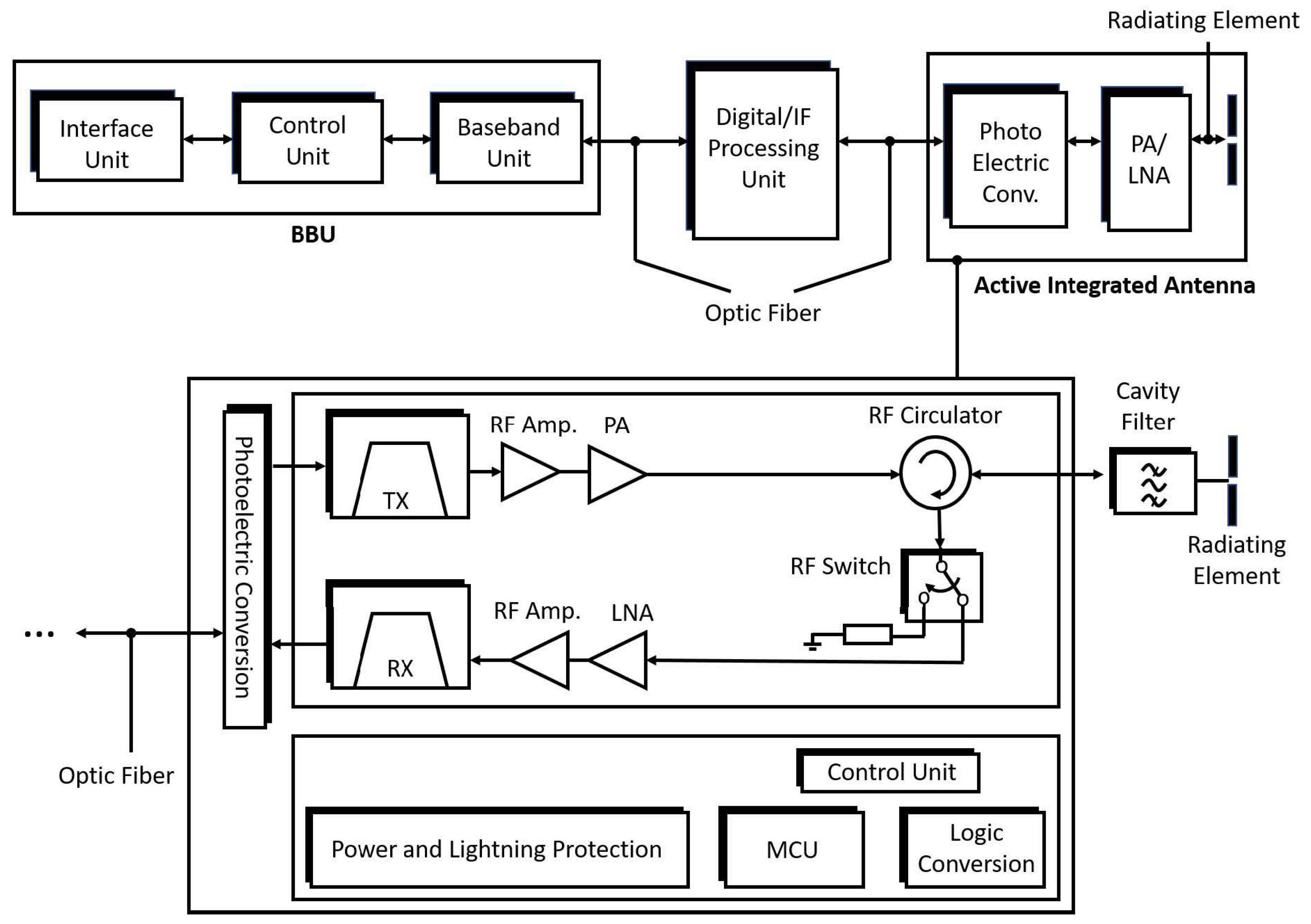
The diagram presents a single emitting component to simplify the visual. It includes real-time control systems and an RF circulator that are responsible for the upconversion and downconversion processes. The transmitting (TX) and receiving (RX) segments undertake the mixing and demixing tasks, employing a dual-stage amplifier series to enhance power during both transmission and reception. Essential filtering and control circuits crucial for the functioning of the transceiver are illustrated as well. Although such designs are practical at sub-6-GHz and mmWave frequencies owing to advancements in RF circuit technology, they are not directly applicable to THz frequencies. Operating at THz frequencies introduces complex hurdles for the design of transceiver hardware. To begin with, semiconductor technologies are under tight constraints at these elevated frequencies. Even with cutting-edge technology, the operational frequency might reach or surpass the semiconductor’s maximum frequency (fmax), resulting in a compromised noise figure for receivers and reduced efficiency for transmitters compared to operations at lower frequencies. Achieving high-frequency gain necessitates the use of smaller feature sizes in technology, which demands lower supply voltages for durability, thereby diminishing the potential transmitter output power. Along with a worse receiver noise figure, diminished antenna aperture, and broad signal bandwidth, these issues inherently restrict link distances unless a very large array of elements is used in conjunction with precise beamforming. THz base stations (BSs) might need from thousands up to tens of thousands of antenna elements. For instance, a 500 GHz operation with 10,000 antenna elements would need an array size of merely 3 cm by 3 cm, with elements placed at half-wavelength intervals. To reduce THz interconnect lengths, RF electronics should be compact, posing a significant challenge for research. Each chip ought to host multiple transceivers, and for a system with 10,000 transceivers, silicon-based technologies are essential. Silicon–germanium (SiGe) bipolar transistors are expected to achieve an fmax of nearly 2 THz with a 5-nm device. Nevertheless, heat dissipation becomes a problem due to the low efficiency of transceivers. If each transceiver utilizes 100 mW, the total power consumption for a 10,000-element array would reach 1 kW, constraining the system’s continuous operation. Sparse arrays could mitigate heat issues but may introduce side lobes, potentially complicating spectrum sharing with current or nearby services. High integration of 10,000 transceivers using silicon-based technologies like silicon–germanium is imperative. Challenges lie in producing coherent, low-noise local oscillator signals for many transceivers and tackling the frequency adjustment issues at THz frequencies. Significant research endeavors are essential to surmount these obstacles and achieve the anticipated systems for 6G networks [254].
7.4. Power Supply Issue
Addressing power supply challenges is crucial for the success of 6G, aiming to seamlessly connect an extensive number of autonomous, low-power mobile devices. The current limitation of smartphone battery life to just one day poses a bottleneck in the evolution of mobile communication. Therefore, innovative power supply methods and streamlined signal processing architectures are imperative for the efficiency and growth of the 6G network.
To tackle this issue, new architectures for mobile devices, particularly those utilizing wireless methods like energy harvesting and power transfer, can be developed. Simultaneously, adopting advanced energy-efficient wireless communication techniques is essential. For instance, designing low-complexity precoding and signal detection algorithms can enhance power efficiency, especially in ultrahigh-dimension scenarios such as UM-MIMO multi-user setups. Furthermore, strategically integrating power supply methods with wireless transmission techniques, tailored to the requirements of mobile devices, is a key approach to realizing a future 6G network powered by mobile devices and ensuring energy autonomy across diverse conditions.
7.5. Dynamic Network Integration Challenge
The communication fabric of 6G is envisioned as a self-aggregating system, dynamically integrating various networks in contrast to the static integration seen in 5G. While previous 3GPP standards aimed to incorporate multiple technical standards, they often resulted in self-contained systems. In the pursuit of achieving comprehensive interconnectivity, 6G is expected to address the challenge of integrating with diverse industry standards and technologies more effectively. With a focus on supporting the Internet of Everything and industry applications, 6G should possess the capability to intelligently and dynamically aggregate different types of networks and technologies. Unlike the relatively static or semi-static combination seen in 5G, 6G aims to implement smarter and more flexible network aggregation, catering to dynamic and adaptive scenarios and business requirements [255].
7.6. Challenges in Achieving Tactile Internet
A key obstacle in developing the tactile Internet is the smooth fusion of communication, control, and computing into a single framework. Utilizing the mobile communication system as a core wireless network, together with its software and virtual network components, aids in merging them into a bidirectional real-time control loop, combining immediate control with efficient computing capabilities. Although still in preliminary phases, the tactile Internet encounters numerous unresolved research issues. Beyond tackling basic layer issues such as choosing waveforms and developing sturdy modulation techniques, smart strategies for separating and coordinating the control and user planes are essential to reduce signaling clutter and delays in the air interface. For diminishing end-to-end latency, it’s crucial to delve into highly flexible network coding techniques and expandable routing protocols. Moreover, securing tactile Internet applications is critical, requiring robust mechanisms to bolster defenses against harmful activities. The guiding principle for the design of wireless tactile networks ought to enable human empowerment through authorization, rather than replacing human roles in innovation or service provision autonomously [212,256,257]
7.7. Network Security Challenges
Security emerges as a pivotal concern in the context of 6G wireless networks, particularly with the implementation of the STIN technique. In the 6G landscape, it is imperative to extend beyond traditional physical layer security and encompass diverse security aspects, including integrated network security. Hence, novel security methodologies, characterized by low complexity and high efficacy, warrant thorough investigation.
In pursuit of this objective, certain physical layer security techniques proposed for 5G can be extrapolated to suit 6G networks. Notable examples include low-density parity check (LDPC)-based secure massive MIMO and secure millimeter-wave (mmWave) techniques, which may find applicability in ultra-massive MIMO (UM-MIMO) and terahertz (THz) band applications. Addressing integrated network security involves establishing a robust management mechanism for different function keys across various security domains. A distributed key management mechanism, as proposed in [258], which considers both unicast and multicast communication key management, emerges as a promising solution for STIN. Efficiently managed and implemented, these physical-layer and network-layer security techniques can collectively constitute a well-integrated security solution, adept at safeguarding confidential and private information within 6G networks [258].
7.8. Difficulties in Managing Resources for Three-Dimensional Networking
The expansion of 3D networking into the vertical dimension introduces a new layer, and with this extension, various adversaries may compromise legitimate information, posing a substantial threat to overall system performance. Consequently, innovative approaches to resource management and optimization are imperative, encompassing mobility support, routing protocols, and multiple access. The design of scheduling processes necessitates a re-imagined network structure.
7.9. Device Capabilities in 6G
The forthcoming 6G system will introduce numerous novel features, demanding devices like smartphones to adapt to these advancements. Effectively supporting features such as Tbps throughput, AI, XR, and integrated sensing with communication functionalities poses a challenge for individual devices. Some 5G devices may not be equipped to handle certain 6G features, and enhancing the capabilities of 6G devices may come with increased costs. Considering that billions of devices are anticipated for 5G, ensuring the compatibility of these devices with 6G during the transition in communication infrastructure is a crucial concern. This compatibility facilitates user convenience and cost savings. Therefore, 6G should prioritize the development of integrated communication-computing devices and improvements in computing performance, ensuring technological compatibility with 5G.
7.10. Spectrum and Interference Administration
Given the limited availability of spectrum resources and the issues associated with interference, the effective administration of 6G spectra is of paramount importance. This necessitates the development of strategies for sharing spectrum and the adoption of novel approaches to spectrum management. Optimal management of the spectrum is crucial for enhancing the efficiency of resource use and ensuring the optimization of Quality of Service (QoS). Within the 6G framework, researchers are tasked with addressing the complexities of spectrum sharing and the governance of spectrum mechanisms across diverse networks that coordinate transmissions at the same frequency. Moreover, investigating ways to reduce interference, including established methods such as parallel interference cancellation and successive interference cancellation, is a key area of focus for those working in the 6G field [259].
8. Critical Non-Technical Considerations for 6G Development
While communication technologies play a vital role in shaping the future of 6G, it’s essential to consider broader issues for its successful implementation and societal impact. In this section, we’ll briefly explore key aspects beyond the technical realm.
8.1. Dependency on Basic Sciences
Advancements in wireless communications are heavily influenced by basic sciences, particularly mathematics and physics. Current mathematical tools, rooted in Shannon’s 1948 treatise on information theory, pose limitations on exact system performance analysis. Breakthroughs in mathematics have historically driven innovation in wireless communications. Thus, researchers should emphasize interdisciplinary collaboration with basic sciences to unlock the full potential of 6G networks [260].
8.2. Dependency on Upstream Industries
Efficient enhancements in wireless communication, such as expanding into high-frequency spectrums and network densification, must align with developments in upstream industries, like electronics manufacturing. Realistic electronic components must meet the requirements set by theoretical research. Ignoring this dependency could lead to impractical assumptions. It highlights the need to consider the capabilities of existing manufacturing levels [260].
8.3. Demand-Oriented Research Roadmap
There’s a noticeable disparity between physical layer (PHY) research in industry and academia. Establishing a closer connection between these realms is crucial to forming a positive feedback loop for adjusting the research roadmap. A demand-oriented research roadmap should prioritize the end beneficiaries of 6G. Introducing the concept of value engineering ensures that research activities focus on the value of implemented services, involving end beneficiaries in reshaping the 6G research roadmap [260,261].
8.4. Business Model and Commercialization
Previous research mainly concentrated on technology, overlooking the importance of business models and commercialization. Key questions arise, such as who bears the cost of network densification, and how to ensure backward compatibility with existing technologies. Evaluating the overall cost of updating infrastructures and studying the business model are essential for the commercial success of 6G. Considerations should extend beyond technological advancements to address real-world economic and user perspectives [262].
8.5. Health and Psychological Concerns
Addressing potential health issues due to increased network density and higher frequencies is crucial. Electromotive-force-aware transmission is proposed to mitigate health concerns. The psychological barrier, where users may feel uncomfortable in a highly monitored ’smart’ space, needs careful consideration. Studying these psychological issues before implementation is essential for ensuring the societal trustworthiness of 6G [263].
8.6. Social Factors in Worldwide Connectivity
In addition to economic and technical issues, societal issues might impede global communication. Language obstacles, computer illiteracy, and content relevance may all contribute to low motivation among people in poor nations. In order to convince disconnected people in remote locations and advance the idea of global connection in the 6G age, incentive programs and campaigns run by local governments and private businesses are essential. [264].
9. Conclusions
In this paper, we have explored the transformative landscape of 6G technology, setting the stage for a future where human-centric networking takes precedence. Our investigation underscores the importance of pushing the boundaries of security, privacy, and secrecy, recognizing these as cornerstone features of 6G to meet the ever-growing demands for wireless communication. By examining potential application scenarios, we have shed light on the diverse capabilities 6G promises to support, ranging from digital twinning to advanced immersive experiences. Furthermore, we have delved into the critical enabling technologies and architectural innovations poised to revolutionize wireless communication, including terahertz waves, intelligent reflecting surfaces, and quantum communications. As we conclude, it is clear that the path toward 6G is not just about enhancing communication technologies but also about reimagining their role in a globally connected, intelligent, and secure future. Our discourse sets a foundational blueprint for ongoing and future research efforts, emphasizing the need for a holistic approach that considers technical advancements alongside societal, regulatory, and environmental implications in the development of 6G.
References
- Dang, S.; Amin, O.; Shihada, B.; Alouini, M.S. What should 6G be? Nature Electronics 2020, 3, 20–29. [Google Scholar] [CrossRef]
- David, K.; Berndt, H. 6G vision and requirements: Is there any need for beyond 5G? IEEE vehicular technology magazine 2018, 13, 72–80. [Google Scholar] [CrossRef]
- Yastrebova, A.; Kirichek, R.; Koucheryavy, Y.; Borodin, A.; Koucheryavy, A. Future networks 2030: Architecture & requirements. In In Proceedings of the 2018 10th International Congress on Ultra Modern Telecommunications and Control Systems and Workshops (ICUMT); IEEE, 2018; pp. 1–8. [Google Scholar] [CrossRef]
- Andrews, J.G.; Buzzi, S.; Choi, W.; Hanly, S.V.; Lozano, A.; Soong, A.C.; Zhang, J.C. What will 5G be? IEEE Journal on selected areas in communications 2014, 32, 1065–1082. [Google Scholar] [CrossRef]
- Patzold, M. 5G is coming around the corner [mobile radio]. IEEE Vehicular Technology Magazine 2019, 14, 4–10. [Google Scholar] [CrossRef]
- Rommel, S.; Raddo, T.R.; Monroy, I.T. Data center connectivity by 6G wireless systems. 2018 photonics in switching and computing (PSC); IEEE, 2018; pp. 1–3. [Google Scholar] [CrossRef]
- Fang, C.; Yao, H.; Wang, Z.; Wu, W.; Jin, X.; Yu, F.R. A survey of mobile information-centric networking: Research issues and challenges. IEEE Communications Surveys & Tutorials 2018, 20, 2353–2371. [Google Scholar]
- Tataria, H.; Shafi, M.; Molisch, A.F.; Dohler, M.; Sjöland, H.; Tufvesson, F. 6G wireless systems: Vision, requirements, challenges, insights, and opportunities. Proceedings of the IEEE 2021, 109, 1166–1199. [Google Scholar] [CrossRef]
- Cashmore, M.; Collins, A.; Krarup, B.; Krivic, S.; Magazzeni, D.; Smith, D. Towards explainable AI planning as a service. arXiv 2019, arXiv:1908.05059. [Google Scholar]
- Chen, L.; Chen, L.; Jordan, S.; Liu, Y.K.; Moody, D.; Peralta, R.; Perlner, R.A.; Smith-Tone, D. Report on post-quantum cryptography; Vol. 12, US Department of Commerce, National Institute of Standards and Technology …, 2016.
- Van Huynh, N.; Hoang, D.T.; Lu, X.; Niyato, D.; Wang, P.; Kim, D.I. Ambient backscatter communications: A contemporary survey. IEEE Communications surveys & tutorials 2018, 20, 2889–2922. [Google Scholar]
- Mao, Q.; Hu, F.; Hao, Q. Deep learning for intelligent wireless networks: A comprehensive survey. IEEE Communications Surveys & Tutorials 2018, 20, 2595–2621. [Google Scholar]
- Elayan, H.; Amin, O.; Shihada, B.; Shubair, R.M.; Alouini, M.S. Terahertz band: The last piece of RF spectrum puzzle for communication systems. IEEE Open Journal of the Communications Society 2019, 1, 1–32. [Google Scholar] [CrossRef]
- ITU-R. Minimum Requirements Related to Technical Performance for IMT-2020 Radio Interface(s). Technical Report M.2410-0, 2017.
- Boulogeorgos, A.A.A.; Alexiou, A.; Merkle, T.; Schubert, C.; Elschner, R.; Katsiotis, A.; Stavrianos, P.; Kritharidis, D.; Chartsias, P.K.; Kokkoniemi, J.; et al. Terahertz technologies to deliver optical network quality of experience in wireless systems beyond 5G. IEEE Communications Magazine 2018, 56, 144–151. [Google Scholar] [CrossRef]
- Jiang, W.; Han, B.; Habibi, M.A.; Schotten, H.D. The road towards 6G: A comprehensive survey. IEEE Open Journal of the Communications Society 2021, 2, 334–366. [Google Scholar] [CrossRef]
- Wang, C.X.; You, X.; Gao, X.; Zhu, X.; Li, Z.; Zhang, C.; Wang, H.; Huang, Y.; Chen, Y.; Haas, H.; et al. On the road to 6G: Visions, requirements, key technologies and testbeds. IEEE Communications Surveys & Tutorials.
- Kosta, A.; Pappas, N.; Angelakis, V.; et al. Age of information: A new concept, metric, and tool. Foundations and Trends® in Networking 2017, 12, 162–259. [Google Scholar] [CrossRef]
- Song, X.; Qin, X.; Tao, Y.; Liu, B.; Zhang, P. Age based task scheduling and computation offloading in mobile-edge computing systems. 2019 IEEE Wireless Communications and Networking Conference Workshop (WCNCW). IEEE, 2019, pp. 1–6. [CrossRef]
- Tang, H.; Wang, J.; Tang, Z.; Song, J. Scheduling to minimize age of synchronization in wireless broadcast networks with random updates. IEEE Transactions on Wireless Communications 2020, 19, 4023–4037. [Google Scholar] [CrossRef]
- Jiang, W.; Strufe, M.; Schotten, H.D. Experimental results for artificial intelligence-based self-organized 5G networks. 2017 IEEE 28th Annual International Symposium on Personal, Indoor, and Mobile Radio Communications (PIMRC). IEEE, 2017, pp. 1–6. [CrossRef]
- Alablani, I.A.; Arafah, M.A. An adaptive cell selection scheme for 5G heterogeneous ultra-dense networks. IEEE Access 2021, 9, 64224–64240. [Google Scholar] [CrossRef]
- Sun, W.; Wang, L.; Liu, J.; Kato, N.; Zhang, Y. Movement aware CoMP handover in heterogeneous ultra-dense networks. IEEE Transactions on Communications 2020, 69, 340–352. [Google Scholar] [CrossRef]
- Sharma, S.K.; Wang, X. Toward massive machine type communications in ultra-dense cellular IoT networks: Current issues and machine learning-assisted solutions. IEEE Communications Surveys & Tutorials 2019, 22, 426–471. [Google Scholar]
- Series, M. IMT Vision–Framework and overall objectives of the future development of IMT for 2020 and beyond. Recommendation ITU 2015, 2083. [Google Scholar]
- Nasrallah, A.; Thyagaturu, A.S.; Alharbi, Z.; Wang, C.; Shao, X.; Reisslein, M.; ElBakoury, H. Ultra-low latency (ULL) networks: The IEEE TSN and IETF DetNet standards and related 5G ULL research. IEEE Communications Surveys & Tutorials 2018, 21, 88–145. [Google Scholar]
- Akyildiz, I.F.; Kak, A.; Nie, S. 6G and beyond: The future of wireless communications systems. IEEE access 2020, 8, 133995–134030. [Google Scholar] [CrossRef]
- Zhong, M.; Yang, Y.; Yao, H.; Fu, X.; Dobre, O.A.; Postolache, O. 5G and IoT: Towards a new era of communications and measurements. IEEE Instrumentation & Measurement Magazine 2019, 22, 18–26. [Google Scholar]
- Barneto, C.B.; Turunen, M.; Liyanaarachchi, S.D.; Anttila, L.; Brihuega, A.; Riihonen, T.; Valkama, M. High-accuracy radio sensing in 5G new radio networks: Prospects and self-interference challenge. 2019 53rd Asilomar Conference on Signals, Systems, and Computers. IEEE, 2019, pp. 1159–1163. [CrossRef]
- Lu, Y.; Zheng, X. 6G: A survey on technologies, scenarios, challenges, and the related issues. Journal of Industrial Information Integration 2020, 19, 100158. [Google Scholar] [CrossRef]
- Wang, X.; Kong, L.; Kong, F.; Qiu, F.; Xia, M.; Arnon, S.; Chen, G. Millimeter wave communication: A comprehensive survey. IEEE Communications Surveys & Tutorials 2018, 20, 1616–1653. [Google Scholar]
- Ippolito, L.J. Radio propagation for space communications systems. Proceedings of the IEEE 1981, 69, 697–727. [Google Scholar] [CrossRef]
- Ajorloo, H.; Manzuri-Shalmani, M.T. Modeling beacon period length of the UWB and 60-GHz mmWave WPANs based on ECMA-368 and ECMA-387 standards. IEEE Transactions on Mobile Computing 2012, 12, 1201–1213. [Google Scholar] [CrossRef]
- Nitsche, T.; Cordeiro, C.; Flores, A.B.; Knightly, E.W.; Perahia, E.; Widmer, J.C. IEEE 802.11 ad: directional 60 GHz communication for multi-Gigabit-per-second Wi-Fi. IEEE Communications Magazine 2014, 52, 132–141. [Google Scholar] [CrossRef]
- Han, B.; Wang, L.; Schotten, H.D. A 3D human body blockage model for outdoor millimeter-wave cellular communication. Physical Communication 2017, 25, 502–510. [Google Scholar] [CrossRef]
- Al-samman, A.M.; Azmi, M.H.; Rahman, T.A. A survey of millimeter wave (mm-Wave) communications for 5G: Channel measurement below and above 6 GHz. Recent Trends in Data Science and Soft Computing: Proceedings of the 3rd International Conference of Reliable Information and Communication Technology (IRICT 2018). Springer, 2019, pp. 451–463. [CrossRef]
- Huq, K.M.S.; Busari, S.A.; Rodriguez, J.; Frascolla, V.; Bazzi, W.; Sicker, D.C. Terahertz-enabled wireless system for beyond-5G ultra-fast networks: A brief survey. IEEE network 2019, 33, 89–95. [Google Scholar] [CrossRef]
- Elayan, H.; Amin, O.; Shihada, B.; Shubair, R.M.; Alouini, M.S. Terahertz band: The last piece of RF spectrum puzzle for communication systems. IEEE Open Journal of the Communications Society 2019, 1, 1–32. [Google Scholar] [CrossRef]
- Rappaport, T.S.; Xing, Y.; Kanhere, O.; Ju, S.; Madanayake, A.; Mandal, S.; Alkhateeb, A.; Trichopoulos, G.C. Wireless communications and applications above 100 GHz: Opportunities and challenges for 6G and beyond. IEEE access 2019, 7, 78729–78757. [Google Scholar] [CrossRef]
- Chen, Z.; Ma, X.; Zhang, B.; Zhang, Y.; Niu, Z.; Kuang, N.; Chen, W.; Li, L.; Li, S. A survey on terahertz communications. China Communications 2019, 16, 1–35. [Google Scholar] [CrossRef]
- Hadi Sarieddeen, N.S.; Al-Naffouri, T.Y.; Alouini, M.S. Next Generation Terahertz Communications: A Rendezvous of Sensing, Imaging, and Localization. IEEE Communications Magazine 2020, 58, 69–75. [Google Scholar] [CrossRef]
- Zhang, J.; Zhu, M.; Hua, B.; Lei, M.; Cai, Y.; Zou, Y.; Tian, L.; Li, A.; Huang, Y.; Yu, J.; et al. 6G oriented 100 GbE real-time demonstration of fiber-THz-fiber seamless communication enabled by photonics. 2022 Optical Fiber Communications Conference and Exhibition (OFC). IEEE, 2022, pp. 1–3.
- Bariah, L.; Mohjazi, L.; Muhaidat, S.; Sofotasios, P.C.; Kurt, G.K.; Yanikomeroglu, H.; Dobre, O.A. A prospective look: Key enabling technologies, applications and open research topics in 6G networks. IEEE access 2020, 8, 174792–174820. [Google Scholar] [CrossRef]
- Giordani, M.; Polese, M.; Mezzavilla, M.; Rangan, S.; Zorzi, M. Toward 6G networks: Use cases and technologies. IEEE Communications Magazine 2020, 58, 55–61. [Google Scholar] [CrossRef]
- Tavakkolnia, I.; Jagadamma, L.K.; Bian, R.; Manousiadis, P.P.; Videv, S.; Turnbull, G.A.; Samuel, I.D.; Haas, H. Organic photovoltaics for simultaneous energy harvesting and high-speed MIMO optical wireless communications. Light: Science & Applications 2021, 10, 41. [Google Scholar]
- Xu, W.; Zhang, J.; Kim, J.Y.; Huang, W.; Kanhere, S.S.; Jha, S.K.; Hu, W. The design, implementation, and deployment of a smart lighting system for smart buildings. IEEE Internet of Things Journal 2019, 6, 7266–7281. [Google Scholar] [CrossRef]
- Perera, A.; Katz, M.; Godaliyadda, R.; Häkkinen, J.; Strömmer, E. Light-based Internet of Things: Implementation of an optically connected energy-autonomous node. 2021 IEEE Wireless Communications and Networking Conference (WCNC). IEEE, 2021, pp. 1–7. [CrossRef]
- He, X.; Xie, E.; Islim, M.S.; Purwita, A.A.; McKendry, J.J.; Gu, E.; Haas, H.; Dawson, M.D. 1 Gbps free-space deep-ultraviolet communications based on III-nitride micro-LEDs emitting at 262 nm. Photonics Research 2019, 7, B41–B47. [Google Scholar] [CrossRef]
- Soltani, M.D.; Sarbazi, E.; Bamiedakis, N.; De Souza, P.; Kazemi, H.; Elmirghani, J.M.; White, I.H.; Penty, R.V.; Haas, H.; Safari, M. Safety analysis for laser-based optical wireless communications: A tutorial. Proceedings of the IEEE 2022. [Google Scholar]
- Hamza, A.S.; Deogun, J.S.; Alexander, D.R. Classification framework for free space optical communication links and systems. IEEE Communications Surveys & Tutorials 2018, 21, 1346–1382. [Google Scholar]
- Kazemi, H.; Sarbazi, E.; Soltani, M.D.; Safari, M.; Haas, H. A Tb/s indoor optical wireless backhaul system using VCSEL arrays. 2020 IEEE 31st Annual International Symposium on Personal, Indoor and Mobile Radio Communications. IEEE, 2020, pp. 1–6. [CrossRef]
- Yoshida, K.; Manousiadis, P.P.; Bian, R.; Chen, Z.; Murawski, C.; Gather, M.C.; Haas, H.; Turnbull, G.A.; Samuel, I.D. 245 MHz bandwidth organic light-emitting diodes used in a gigabit optical wireless data link. Nature Communications 2020, 11, 1171. [Google Scholar] [CrossRef]
- Matthews, W.; Ahmed, Z.; Ali, W.; Collins, S. A 3.45 Gigabits/s SiPM-based OOK VLC receiver. IEEE Photonics Technology Letters 2021, 33, 487–490. [Google Scholar] [CrossRef]
- Soltani, M.D.; Purwita, A.A.; Zeng, Z.; Haas, H.; Safari, M. Modeling the random orientation of mobile devices: Measurement, analysis and LiFi use case. IEEE Transactions on Communications 2018, 67, 2157–2172. [Google Scholar] [CrossRef]
- Arfaoui, M.A.; Soltani, M.D.; Tavakkolnia, I.; Ghrayeb, A.; Assi, C.M.; Safari, M.; Haas, H. Measurements-based channel models for indoor LiFi systems. IEEE Transactions on Wireless Communications 2020, 20, 827–842. [Google Scholar] [CrossRef]
- Yesilkaya, A.; Bian, R.; Tavakkolnia, I.; Haas, H. OFDM-based optical spatial modulation. IEEE Journal of Selected Topics in Signal Processing 2019, 13, 1433–1444. [Google Scholar] [CrossRef]
- Eroglu, Y.S.; Anjinappa, C.K.; Guvenc, I.; Pala, N. Slow beam steering and NOMA for indoor multi-user visible light communications. IEEE Transactions on Mobile Computing 2019, 20, 1627–1641. [Google Scholar] [CrossRef]
- Su, N.; Panayirci, E.; Koca, M.; Yesilkaya, A.; Poor, H.V.; Haas, H. Physical layer security for multi-user MIMO visible light communication systems with generalized space shift keying. IEEE Transactions on Communications 2021, 69, 2585–2598. [Google Scholar] [CrossRef]
- Chowdhury, M.Z.; Hossan, M.T.; Islam, A.; Jang, Y.M. A comparative survey of optical wireless technologies: Architectures and applications. ieee Access 2018, 6, 9819–9840. [Google Scholar] [CrossRef]
- Al-Kinani, A.; Wang, C.X.; Zhou, L.; Zhang, W. Optical wireless communication channel measurements and models. IEEE Communications Surveys & Tutorials 2018, 20, 1939–1962. [Google Scholar]
- Marcus, M.; Burtle, J.; Franca, B.; Lahjouji, A.; McNeil, N. Federal communications commission spectrum policy task force. Report of the unlicensed devices and experimental licenses working group 2002. [Google Scholar]
- Akyildiz, I.F.; Kak, A.; Nie, S. 6G and beyond: The future of wireless communications systems. IEEE access 2020, 8, 133995–134030. [Google Scholar] [CrossRef]
- Kliks, A.; Kulacz, L.; Kryszkiewicz, P.; Bogucka, H.; Dryjanski, M.; Isaksson, M.; Koudouridis, G.P.; Tengkvist, P. Beyond 5G: Big data processing for better spectrum utilization. IEEE Vehicular Technology Magazine 2020, 15, 40–50. [Google Scholar] [CrossRef]
- Liang, Y.C.; Zhang, Q.; Larsson, E.G.; Li, G.Y. Symbiotic radio: Cognitive backscattering communications for future wireless networks. IEEE Transactions on Cognitive Communications and Networking 2020, 6, 1242–1255. [Google Scholar] [CrossRef]
- Bhattarai, S.; Park, J.M.J.; Gao, B.; Bian, K.; Lehr, W. An overview of dynamic spectrum sharing: Ongoing initiatives, challenges, and a roadmap for future research. IEEE Transactions on Cognitive Communications and Networking 2016, 2, 110–128. [Google Scholar] [CrossRef]
- Wang, B.; Liu, K.R. Advances in cognitive radio networks: A survey. IEEE Journal of selected topics in signal processing 2010, 5, 5–23. [Google Scholar] [CrossRef]
- Mitola, J. Cognitive radio for flexible mobile multimedia communications. 1999 IEEE International Workshop on Mobile Multimedia Communications (MoMuC’99)(Cat. No. 99EX384). IEEE, 1999, pp. 3–10. [CrossRef]
- Haykin, S. Cognitive radio: brain-empowered wireless communications. IEEE journal on selected areas in communications 2005, 23, 201–220. [Google Scholar] [CrossRef]
- Zhang, K.; Leng, S.; Peng, X.; Pan, L.; Maharjan, S.; Zhang, Y. Artificial intelligence inspired transmission scheduling in cognitive vehicular communications and networks. IEEE internet of Things Journal 2018, 6, 1987–1997. [Google Scholar] [CrossRef]
- Zhang, Q.; Zhang, L.; Liang, Y.C.; Kam, P.Y. Backscatter-NOMA: A symbiotic system of cellular and Internet-of-Things networks. IEEE Access 2019, 7, 20000–20013. [Google Scholar] [CrossRef]
- Long, R.; Liang, Y.C.; Guo, H.; Yang, G.; Zhang, R. Symbiotic radio: A new communication paradigm for passive Internet of Things. IEEE Internet of Things Journal 2019, 7, 1350–1363. [Google Scholar] [CrossRef]
- Sharma, S.K.; Bogale, T.E.; Le, L.B.; Chatzinotas, S.; Wang, X.; Ottersten, B. Dynamic spectrum sharing in 5G wireless networks with full-duplex technology: Recent advances and research challenges. IEEE Communications Surveys & Tutorials 2017, 20, 674–707. [Google Scholar]
- Naparstek, O.; Cohen, K. Deep multi-user reinforcement learning for distributed dynamic spectrum access. IEEE transactions on wireless communications 2018, 18, 310–323. [Google Scholar] [CrossRef]
- Jacob, S.; Menon, V.G.; Joseph, S.; Vinoj, P.; Jolfaei, A.; Lukose, J.; Raja, G. A novel spectrum sharing scheme using dynamic long short-term memory with CP-OFDMA in 5G networks. IEEE Transactions on Cognitive Communications and Networking 2020, 6, 926–934. [Google Scholar] [CrossRef]
- Hu, S.; Liang, Y.C.; Xiong, Z.; Niyato, D. Blockchain and artificial intelligence for dynamic resource sharing in 6G and beyond. IEEE Wireless Communications 2021, 28, 145–151. [Google Scholar] [CrossRef]
- Nitsche, T.; Cordeiro, C.; Flores, A.B.; Knightly, E.W.; Perahia, E.; Widmer, J.C. IEEE 802.11 ad: directional 60 GHz communication for multi-Gigabit-per-second Wi-Fi. IEEE Communications Magazine 2014, 52, 132–141. [Google Scholar] [CrossRef]
- Wei, Z.; Yuan, W.; Li, S.; Yuan, J.; Bharatula, G.; Hadani, R.; Hanzo, L. Orthogonal time-frequency space modulation: A promising next-generation waveform. IEEE wireless communications 2021, 28, 136–144. [Google Scholar] [CrossRef]
- Darwazeh, I.; Ghannam, H.; Xu, T. The first 15 years of SEFDM: A brief survey. 2018 11th International Symposium on Communication Systems, Networks & Digital Signal Processing (CSNDSP). IEEE, 2018, pp. 1–7. [CrossRef]
- Li, D. Overlapped multiplexing principle and an improved capacity on additive white Gaussian noise channel. IEEE Access 2017, 6, 6840–6848. [Google Scholar] [CrossRef]
- Liu, F.; Masouros, C.; Petropulu, A.P.; Griffiths, H.; Hanzo, L. Joint radar and communication design: Applications, state-of-the-art, and the road ahead. IEEE Transactions on Communications 2020, 68, 3834–3862. [Google Scholar] [CrossRef]
- Basar, E.; Wen, M.; Mesleh, R.; Di Renzo, M.; Xiao, Y.; Haas, H. Index modulation techniques for next-generation wireless networks. IEEE access 2017, 5, 16693–16746. [Google Scholar] [CrossRef]
- Costello, D.J.; Forney, G.D. Channel coding: The road to channel capacity. Proceedings of the IEEE 2007, 95, 1150–1177. [Google Scholar] [CrossRef]
- Gallager, R. Low-density parity-check codes. IRE Transactions on information theory 1962, 8, 21–28. [Google Scholar] [CrossRef]
- Berrou, C.; Glavieux, A.; Thitimajshima, P. Near Shannon limit error-correcting coding and decoding: Turbo-codes. 1. Proceedings of ICC’93-IEEE International Conference on Communications. IEEE, 1993, Vol. 2, pp. 1064–1070. [CrossRef]
- Arikan, E. Channel polarization: A method for constructing capacity-achieving codes for symmetric binary-input memoryless channels. IEEE Transactions on information Theory 2009, 55, 3051–3073. [Google Scholar] [CrossRef]
- Shao, S.; Hailes, P.; Wang, T.Y.; Wu, J.Y.; Maunder, R.G.; Al-Hashimi, B.M.; Hanzo, L. Survey of turbo, LDPC, and polar decoder ASIC implementations. IEEE Communications Surveys & Tutorials 2019, 21, 2309–2333. [Google Scholar]
- Kschischang, F.R.; Frey, B.J.; Loeliger, H.A. Factor graphs and the sum-product algorithm. IEEE Transactions on information theory 2001, 47, 498–519. [Google Scholar] [CrossRef]
- Wiberg, N.; Loeliger, H.A.; Kotter, R. Codes and iterative decoding on general graphs. European Transactions on telecommunications 1995, 6, 513–525. [Google Scholar] [CrossRef]
- Fayyaz, U.U.; Barry, J.R. Low-complexity soft-output decoding of polar codes. IEEE Journal on Selected Areas in Communications 2014, 32, 958–966. [Google Scholar] [CrossRef]
- Tal, I.; Vardy, A. List Decoding of Polar Codes. IEEE Trans. Inf. Theory 2015, 1, 2213–2226. [Google Scholar] [CrossRef]
- Afisiadis, O.; Balatsoukas-Stimming, A.; Burg, A. A low-complexity improved successive cancellation decoder for polar codes. 2014 48th Asilomar Conference on Signals, Systems and Computers. IEEE, 2014, pp. 2116–2120. [CrossRef]
- Elkelesh, A.; Ebada, M.; Cammerer, S.; Ten Brink, S. Belief propagation list decoding of polar codes. IEEE Communications Letters 2018, 22, 1536–1539. [Google Scholar] [CrossRef]
- Shen, Y.; Song, W.; Ren, Y.; Ji, H.; You, X.; Zhang, C. Enhanced belief propagation decoder for 5G polar codes with bit-flipping. IEEE Transactions on Circuits and Systems II: Express Briefs 2020, 67, 901–905. [Google Scholar] [CrossRef]
- Bas, J. Defining turbo codes as irregular LDPC codes. ISWCS 2013; The Tenth International Symposium on Wireless Communication Systems. VDE, 2013, pp. 1–2.
- Tong, J.; Wang, X.; Zhang, Q.; Zhang, H.; Wang, J.; Tong, W. Fast polar codes for terabits-per-second throughput communications. 2023 IEEE 34th Annual International Symposium on Personal, Indoor and Mobile Radio Communications (PIMRC). IEEE, 2023, pp. 1–6. [CrossRef]
- Studer, C.; Benkeser, C.; Belfanti, S.; Huang, Q. Design and implementation of a parallel turbo-decoder ASIC for 3GPP-LTE. IEEE Journal of Solid-State Circuits 2010, 46, 8–17. [Google Scholar] [CrossRef]
- Cui, H.; Ghaffari, F.; Le, K.; Declercq, D.; Lin, J.; Wang, Z. Design of high-performance and area-efficient decoder for 5G LDPC codes. IEEE Transactions on Circuits and Systems I: Regular Papers 2020, 68, 879–891. [Google Scholar] [CrossRef]
- Ren, Y.; Kristensen, A.T.; Shen, Y.; Balatsoukas-Stimming, A.; Zhang, C.; Burg, A. A sequence repetition node-based successive cancellation list decoder for 5G polar codes: Algorithm and implementation. IEEE Transactions on Signal Processing 2022, 70, 5592–5607. [Google Scholar] [CrossRef]
- Cao, S.; Lin, T.; Zhang, S.; Xu, S.; Zhang, C. A reconfigurable and pipelined architecture for standard-compatible LDPC and polar decoding. IEEE Transactions on Vehicular Technology 2021, 70, 5431–5444. [Google Scholar] [CrossRef]
- Condo, C.; Martina, M.; Masera, G. VLSI implementation of a multi-mode turbo/LDPC decoder architecture. IEEE Transactions on Circuits and Systems I: Regular Papers 2012, 60, 1441–1454. [Google Scholar] [CrossRef]
- Fossorier, M.P.; Lin, S. Soft-decision decoding of linear block codes based on ordered statistics. IEEE Transactions on Information Theory 1995, 41, 1379–1396. [Google Scholar] [CrossRef]
- Duffy, K.R.; Li, J.; Médard, M. Capacity-achieving guessing random additive noise decoding. IEEE Transactions on Information Theory 2019, 65, 4023–4040. [Google Scholar] [CrossRef]
- Arıkan, E. From sequential decoding to channel polarization and back again. arXiv 2019, arXiv:1908.09594. [Google Scholar]
- You, X.; Zhang, C.; Sheng, B.; Huang, Y.; Ji, C.; Shen, Y.; Zhou, W.; Liu, J. Spatiotemporal 2-D channel coding for very low latency reliable MIMO transmission. 2022 IEEE Globecom Workshops (GC Wkshps). IEEE, 2022, pp. 473–479.
- You, X.; Wang, C.X.; Huang, J.; Gao, X.; Zhang, Z.; Wang, M.; Huang, Y.; Zhang, C.; Jiang, Y.; Wang, J.; et al. Towards 6G wireless communication networks: Vision, enabling technologies, and new paradigm shifts. Science China Information Sciences 2021, 64, 1–74. [Google Scholar]
- Saito, Y.; Kishiyama, Y.; Benjebbour, A.; Nakamura, T.; Li, A.; Higuchi, K. Non-orthogonal multiple access (NOMA) for cellular future radio access. 2013 IEEE 77th vehicular technology conference (VTC Spring). IEEE, 2013, pp. 1–5. [CrossRef]
- Chen, Y.; Bayesteh, A.; Wu, Y.; Ren, B.; Kang, S.; Sun, S.; Xiong, Q.; Qian, C.; Yu, B.; Ding, Z.; et al. Toward the standardization of non-orthogonal multiple access for next generation wireless networks. IEEE Communications Magazine 2018, 56, 19–27. [Google Scholar] [CrossRef]
- Makki, B.; Chitti, K.; Behravan, A.; Alouini, M.S. A survey of NOMA: Current status and open research challenges. IEEE Open Journal of the Communications Society 2020, 1, 179–189. [Google Scholar] [CrossRef]
- Ding, Z.; Lei, X.; Karagiannidis, G.K.; Schober, R.; Yuan, J.; Bhargava, V.K. A survey on non-orthogonal multiple access for 5G networks: Research challenges and future trends. IEEE Journal on Selected Areas in Communications 2017, 35, 2181–2195. [Google Scholar] [CrossRef]
- Zeng, M.; Nguyen, N.P.; Dobre, O.A.; Poor, H.V. Securing downlink massive MIMO-NOMA networks with artificial noise. IEEE Journal of Selected Topics in Signal Processing 2019, 13, 685–699. [Google Scholar] [CrossRef]
- Liu, X.; Liu, Y.; Chen, Y.; Poor, H.V. RIS enhanced massive non-orthogonal multiple access networks: Deployment and passive beamforming design. IEEE Journal on Selected Areas in Communications 2020, 39, 1057–1071. [Google Scholar] [CrossRef]
- Li, X.; Zhao, M.; Zeng, M.; Mumtaz, S.; Menon, V.G.; Ding, Z.; Dobre, O.A. Hardware impaired ambient backscatter NOMA systems: Reliability and security. IEEE Transactions on Communications 2021, 69, 2723–2736. [Google Scholar] [CrossRef]
- Marzetta, T.L. Noncooperative cellular wireless with unlimited numbers of base station antennas. IEEE transactions on wireless communications 2010, 9, 3590–3600. [Google Scholar] [CrossRef]
- Wang, B.; Gao, F.; Jin, S.; Lin, H.; Li, G.Y. Spatial-and frequency-wideband effects in millimeter-wave massive MIMO systems. IEEE Transactions on Signal Processing 2018, 66, 3393–3406. [Google Scholar] [CrossRef]
- Yu, X.; Shen, J.C.; Zhang, J.; Letaief, K.B. Alternating minimization algorithms for hybrid precoding in millimeter wave MIMO systems. IEEE Journal of Selected Topics in Signal Processing 2016, 10, 485–500. [Google Scholar] [CrossRef]
- Myers, N.J.; Heath, R.W. InFocus: A spatial coding technique to mitigate misfocus in near-field LoS beamforming. IEEE Transactions on Wireless Communications 2021, 21, 2193–2209. [Google Scholar] [CrossRef]
- Wei, X.; Dai, L. Channel estimation for extremely large-scale massive MIMO: Far-field, near-field, or hybrid-field? IEEE Communications Letters 2021, 26, 177–181. [Google Scholar] [CrossRef]
- Huang, J.; Wang, C.X.; Chang, H.; Sun, J.; Gao, X. Multi-frequency multi-scenario millimeter wave MIMO channel measurements and modeling for B5G wireless communication systems. IEEE Journal on Selected Areas in Communications 2020, 38, 2010–2025. [Google Scholar] [CrossRef]
- He, Z.Q.; Yuan, X. Cascaded channel estimation for large intelligent metasurface assisted massive MIMO. IEEE Wireless Communications Letters 2019, 9, 210–214. [Google Scholar] [CrossRef]
- Jamali, V.; Tulino, A.M.; Fischer, G.; Müller, R.R.; Schober, R. Intelligent surface-aided transmitter architectures for millimeter-wave ultra massive MIMO systems. IEEE open journal of the communications society 2020, 2, 144–167. [Google Scholar] [CrossRef]
- Wang, Y.; Chen, X.; Cai, Y.; Hanzo, L. RIS-aided hybrid massive MIMO systems relying on adaptive-resolution ADCs: Robust beamforming design and resource allocation. IEEE Transactions on Vehicular Technology 2021, 71, 3281–3286. [Google Scholar] [CrossRef]
- Zhang, J.; Chen, S.; Lin, Y.; Zheng, J.; Ai, B.; Hanzo, L. Cell-free massive MIMO: A new next-generation paradigm. IEEE Access 2019, 7, 99878–99888. [Google Scholar] [CrossRef]
- Ammar, H.A.; Adve, R.; Shahbazpanahi, S.; Boudreau, G.; Srinivas, K.V. User-centric cell-free massive MIMO networks: A survey of opportunities, challenges and solutions. IEEE Communications Surveys & Tutorials 2021, 24, 611–652. [Google Scholar]
- Chen, Z.; Björnson, E. Channel hardening and favorable propagation in cell-free massive MIMO with stochastic geometry. IEEE Transactions on Communications 2018, 66, 5205–5219. [Google Scholar] [CrossRef]
- Wei, X.; Hu, C.; Dai, L. Deep learning for beamspace channel estimation in millimeter-wave massive MIMO systems. IEEE Transactions on Communications 2020, 69, 182–193. [Google Scholar] [CrossRef]
- Albreem, M.A.; Alhabbash, A.H.; Shahabuddin, S.; Juntti, M. Deep learning for massive MIMO uplink detectors. IEEE Communications Surveys & Tutorials 2021, 24, 741–766. [Google Scholar]
- Yu, X.; Lu, A.A.; Gao, X.; Li, G.Y.; Ding, G.; Wang, C.X. HF skywave massive MIMO communication. IEEE Transactions on Wireless Communications 2021, 21, 2769–2785. [Google Scholar] [CrossRef]
- Wu, W.; Gao, X.; Sun, C.; Li, G.Y. Shallow underwater acoustic massive MIMO communications. IEEE Transactions on Signal Processing 2021, 69, 1124–1139. [Google Scholar] [CrossRef]
- You, L.; Li, K.X.; Wang, J.; Gao, X.; Xia, X.G.; Ottersten, B. Massive MIMO transmission for LEO satellite communications. IEEE Journal on Selected Areas in Communications 2020, 38, 1851–1865. [Google Scholar] [CrossRef]
- Li, Q.C.; Niu, H.; Papathanassiou, A.T.; Wu, G. 5G network capacity: Key elements and technologies. IEEE Vehicular Technology Magazine 2014, 9, 71–78. [Google Scholar] [CrossRef]
- Ngo, H.Q.; Ashikhmin, A.; Yang, H.; Larsson, E.G.; Marzetta, T.L. Cell-free massive MIMO versus small cells. IEEE Transactions on Wireless Communications 2017, 16, 1834–1850. [Google Scholar] [CrossRef]
- Björnson, E.; Sanguinetti, L. Cell-free versus cellular massive MIMO: What processing is needed for cell-free to win? 2019 IEEE 20th International Workshop on Signal Processing Advances in Wireless Communications (SPAWC). IEEE, 2019, pp. 1–5. [CrossRef]
- Bassoy, S.; Farooq, H.; Imran, M.A.; Imran, A. Coordinated multi-point clustering schemes: A survey. IEEE Communications Surveys & Tutorials 2017, 19, 743–764. [Google Scholar]
- Kotzsch, V.; Fettweis, G. Interference analysis in time and frequency asynchronous network MIMO OFDM systems. 2010 IEEE Wireless Communication and Networking Conference. IEEE, 2010, pp. 1–6. [CrossRef]
- O’hara, F.; Moore, G. A high performance CW receiver using feedthru nulling. Microwave Journal 1963, 6, 63–71. [Google Scholar]
- Liu, G.; Yu, F.R.; Ji, H.; Leung, V.C.; Li, X. In-band full-duplex relaying: A survey, research issues and challenges. IEEE Communications Surveys & Tutorials 2015, 17, 500–524. [Google Scholar]
- Liu, W.; Huang, K.; Zhou, X.; Durrani, S. Full-duplex backscatter interference networks based on time-hopping spread spectrum. IEEE Transactions on Wireless Communications 2017, 16, 4361–4377. [Google Scholar] [CrossRef]
- Kolodziej, K.E.; Perry, B.T.; Herd, J.S. In-band full-duplex technology: Techniques and systems survey. IEEE Transactions on Microwave Theory and Techniques 2019, 67, 3025–3041. [Google Scholar] [CrossRef]
- Nawaz, H.; Tekin, I. Double-differential-fed, dual-polarized patch antenna with 90 dB interport RF isolation for a 2.4 GHz in-band full-duplex transceiver. IEEE Antennas and Wireless Propagation Letters 2017, 17, 287–290. [Google Scholar] [CrossRef]
- Komatsu, K.; Miyaji, Y.; Uehara, H. Iterative nonlinear self-interference cancellation for in-band full-duplex wireless communications under mixer imbalance and amplifier nonlinearity. IEEE Transactions on Wireless Communications 2020, 19, 4424–4438. [Google Scholar] [CrossRef]
- Komatsu, K.; Miyaji, Y.; Uehara, H. Theoretical analysis of in-band full-duplex radios with parallel hammerstein self-interference cancellers. IEEE Transactions on Wireless Communications 2021, 20, 6772–6786. [Google Scholar] [CrossRef]
- Chang, M.P.; Blow, E.C.; Lu, M.Z.; Sun, J.J.; Prucnal, P.R. RF characterization of an integrated microwave photonic circuit for self-interference cancellation. IEEE Transactions on Microwave Theory and Techniques 2017, 66, 596–605. [Google Scholar] [CrossRef]
- Wang, D.; Li, P.; Wang, Y.; Li, T.; Yang, F.; Zhou, T.; Rong, L. Photonics-assisted frequency conversion and self-interference cancellation for in-band full-duplex communication. Journal of Lightwave Technology 2021, 40, 607–614. [Google Scholar] [CrossRef]
- Rong, B. 6G: The next horizon: From connected people and things to connected intelligence. IEEE Wireless Communications 2021, 28, 8. [Google Scholar] [CrossRef]
- Chen, S.; Liang, Y.C.; Sun, S.; Kang, S.; Cheng, W.; Peng, M. Vision, requirements, and technology trend of 6G: How to tackle the challenges of system coverage, capacity, user data-rate and movement speed. IEEE Wireless Communications 2020, 27, 218–228. [Google Scholar] [CrossRef]
- You, X.; Wang, C.X.; Huang, J.; Gao, X.; Zhang, Z.; Wang, M.; Huang, Y.; Zhang, C.; Jiang, Y.; Wang, J.; et al. Towards 6G wireless communication networks: Vision, enabling technologies, and new paradigm shifts. Science China Information Sciences 2021, 64, 1–74. [Google Scholar] [CrossRef]
- Yang, H.; Zheng, S.; He, W.; Yu, X.; Zhang, X. Terahertz orbital angular momentum: Generation, detection and communication. China Communications 2021, 18, 131–152. [Google Scholar] [CrossRef]
- Chen, R.; Zhou, H.; Moretti, M.; Wang, X.; Li, J. Orbital angular momentum waves: Generation, detection, and emerging applications. IEEE Communications Surveys & Tutorials 2019, 22, 840–868. [Google Scholar]
- Yousif, B.B.; Elsayed, E.E. Performance enhancement of an orbital-angular-momentum-multiplexed free-space optical link under atmospheric turbulence effects using spatial-mode multiplexing and hybrid diversity based on adaptive MIMO equalization. IEEE access 2019, 7, 84401–84412. [Google Scholar] [CrossRef]
- Werner, D.H.; Jiang, Z.H. Electromagnetic vortices: wave phenomena and engineering applications; John Wiley & Sons, 2021. [Google Scholar]
- Liu, K.; Cheng, Y.; Li, X.; Gao, Y. Microwave-sensing technology using orbital angular momentum: Overview of its advantages. IEEE Vehicular Technology Magazine 2019, 14, 112–118. [Google Scholar] [CrossRef]
- Lei, Y.; Yang, Y.; Wang, Y.; Guo, K.; Gong, Y.; Guo, Z. Throughput performance of wireless multiple-input multiple-output systems using OAM antennas. IEEE Wireless Communications Letters 2020, 10, 261–265. [Google Scholar] [CrossRef]
- Liang, L.; Cheng, W.; Zhang, W.; Zhang, H. Joint OAM multiplexing and OFDM in sparse multipath environments. IEEE Transactions on Vehicular Technology 2020, 69, 3864–3878. [Google Scholar] [CrossRef]
- ElMossallamy, M.A.; Zhang, H.; Song, L.; Seddik, K.G.; Han, Z.; Li, G.Y. Reconfigurable intelligent surfaces for wireless communications: Principles, challenges, and opportunities. IEEE Transactions on Cognitive Communications and Networking 2020, 6, 990–1002. [Google Scholar] [CrossRef]
- Di Renzo, M.; Zappone, A.; Debbah, M.; Alouini, M.S.; Yuen, C.; De Rosny, J.; Tretyakov, S. Smart radio environments empowered by reconfigurable intelligent surfaces: How it works, state of research, and the road ahead. IEEE journal on selected areas in communications 2020, 38, 2450–2525. [Google Scholar] [CrossRef]
- Rahman, M.E.; Munir, M.S.; Shetty, S. An Attention-based AI Model for 3D Beam Prediction in THz Unmanned Aerial Vehicle Communication. Proceedings of the International Conference on Computing, Networking and Communications (ICNC 2024); IEEE,, 2024; pp. 761–766.
- Björnson, E.; Sanguinetti, L.; Wymeersch, H.; Hoydis, J.; Marzetta, T.L. Massive MIMO is a reality—What is next?: Five promising research directions for antenna arrays. Digital Signal Processing 2019, 94, 3–20. [Google Scholar] [CrossRef]
- Zong, B.; Fan, C.; Wang, X.; Duan, X.; Wang, B.; Wang, J. 6G technologies: Key drivers, core requirements, system architectures, and enabling technologies. IEEE Vehicular Technology Magazine 2019, 14, 18–27. [Google Scholar] [CrossRef]
- Deng, R.; Di, B.; Zhang, H.; Tan, Y.; Song, L. Reconfigurable holographic surface: Holographic beamforming for metasurface-aided wireless communications. IEEE Transactions on Vehicular Technology 2021, 70, 6255–6259. [Google Scholar] [CrossRef]
- Wan, Z.; Gao, Z.; Gao, F.; Di Renzo, M.; Alouini, M.S. Terahertz massive MIMO with holographic reconfigurable intelligent surfaces. IEEE Transactions on Communications 2021, 69, 4732–4750. [Google Scholar] [CrossRef]
- Konkol, M.R.; Ross, D.D.; Shi, S.; Harrity, C.E.; Wright, A.A.; Schuetz, C.A.; Prather, D.W. High-power photodiode-integrated-connected array antenna. Journal of Lightwave Technology 2017, 35, 2010–2016. [Google Scholar] [CrossRef]
- Jiang, W.; Schotten, H.D. Multi-antenna fading channel prediction empowered by artificial intelligence. 2018 IEEE 88th Vehicular Technology Conference (VTC-Fall). IEEE, 2018, pp. 1–6. [CrossRef]
- Jiang, W.; Strufe, M.; Schotten, H.D. A SON decision-making framework for intelligent management in 5G mobile networks. 2017 3rd IEEE International Conference on Computer and Communications (ICCC). IEEE, 2017, pp. 1158–1162. [CrossRef]
- Jiang, W.; Schotten, H.D. Deep learning for fading channel prediction. IEEE Open Journal of the Communications Society 2020, 1, 320–332. [Google Scholar] [CrossRef]
- Jiang, W.; Strufe, M.; Schotten, H.D. Experimental results for artificial intelligence-based self-organized 5G networks. 2017 IEEE 28th Annual International Symposium on Personal, Indoor, and Mobile Radio Communications (PIMRC). IEEE, 2017, pp. 1–6. [CrossRef]
- Huang, H.; Song, Y.; Yang, J.; Gui, G.; Adachi, F. Deep-learning-based millimeter-wave massive MIMO for hybrid precoding. IEEE Transactions on Vehicular Technology 2019, 68, 3027–3032. [Google Scholar] [CrossRef]
- Jiang, W.; Schotten, H.D. Neural network-based fading channel prediction: A comprehensive overview. IEEE Access 2019, 7, 118112–118124. [Google Scholar] [CrossRef]
- Jiang, W.; Schotten, H.D. Recurrent neural networks with long short-term memory for fading channel prediction. 2020 IEEE 91st Vehicular Technology Conference (VTC2020-Spring). IEEE, 2020, pp. 1–5. [CrossRef]
- Jiang, W.; Strufe, M.; Schotten, H.D. Intelligent network management for 5G systems: The SELFNET approach. 2017 European conference on networks and communications (EuCNC). IEEE, 2017, pp. 1–5. [CrossRef]
- Letaief, K.B.; Chen, W.; Shi, Y.; Zhang, J.; Zhang, Y.J.A. The roadmap to 6G: AI empowered wireless networks. IEEE communications magazine 2019, 57, 84–90. [Google Scholar] [CrossRef]
- Cui, Y.; Liu, F.; Jing, X.; Mu, J. Integrating sensing and communications for ubiquitous IoT: Applications, trends, and challenges. IEEE Network 2021, 35, 158–167. [Google Scholar] [CrossRef]
- Zhang, J.A.; Rahman, M.L.; Wu, K.; Huang, X.; Guo, Y.J.; Chen, S.; Yuan, J. Enabling joint communication and radar sensing in mobile networks—A survey. IEEE Communications Surveys & Tutorials 2021, 24, 306–345. [Google Scholar]
- Mealey, R.M. A method for calculating error probabilities in a radar communication system. IEEE Transactions on Space Electronics and Telemetry 1963, 9, 37–42. [Google Scholar] [CrossRef]
- Sturm, C.; Wiesbeck, W. Waveform design and signal processing aspects for fusion of wireless communications and radar sensing. Proceedings of the IEEE 2011, 99, 1236–1259. [Google Scholar] [CrossRef]
- Zhang, J.A.; Liu, F.; Masouros, C.; Heath, R.W.; Feng, Z.; Zheng, L.; Petropulu, A. An overview of signal processing techniques for joint communication and radar sensing. IEEE Journal of Selected Topics in Signal Processing 2021, 15, 1295–1315. [Google Scholar] [CrossRef]
- Chiriyath, A.R.; Paul, B.; Jacyna, G.M.; Bliss, D.W. Inner bounds on performance of radar and communications co-existence. IEEE Transactions on Signal Processing 2015, 64, 464–474. [Google Scholar] [CrossRef]
- Kumari, P.; Choi, J.; González-Prelcic, N.; Heath, R.W. IEEE 802.11 ad-based radar: An approach to joint vehicular communication-radar system. IEEE Transactions on Vehicular Technology 2017, 67, 3012–3027. [Google Scholar] [CrossRef]
- Tschorsch, F.; Scheuermann, B. Bitcoin and beyond: A technical survey on decentralized digital currencies. IEEE Communications Surveys & Tutorials 2016, 18, 2084–2123. [Google Scholar]
- Dai, H.N.; Zheng, Z.; Zhang, Y. Blockchain for Internet of Things: A survey. IEEE Internet of Things Journal 2019, 6, 8076–8094. [Google Scholar] [CrossRef]
- Xie, J.; Yu, F.R.; Huang, T.; Xie, R.; Liu, J.; Liu, Y. A survey on the scalability of blockchain systems. IEEE network 2019, 33, 166–173. [Google Scholar] [CrossRef]
- Nguyen, D.C.; Pathirana, P.N.; Ding, M.; Seneviratne, A. Blockchain for 5G and beyond networks: A state of the art survey. Journal of Network and Computer Applications 2020, 166, 102693. [Google Scholar] [CrossRef]
- Xiong, Z.; Zhang, Y.; Niyato, D.; Wang, P.; Han, Z. When mobile blockchain meets edge computing. IEEE Communications Magazine 2018, 56, 33–39. [Google Scholar] [CrossRef]
- Shi, G.; Xiao, Y.; Li, Y.; Xie, X. From semantic communication to semantic-aware networking: Model, architecture, and open problems. IEEE Communications Magazine 2021, 59, 44–50. [Google Scholar] [CrossRef]
- Shannon, C.E. A mathematical theory of communication. The Bell system technical journal 1948, 27, 379–423. [Google Scholar] [CrossRef]
- Shannon, C.E.; Weaver, W. A mathematical model of communication. Urbana, IL: University of Illinois Press 1949, 11, 11–20. [Google Scholar]
- Barwise, J.; Perry, J. Situations and attitudes. The Journal of Philosophy 1981, 78, 668–691. [Google Scholar] [CrossRef]
- Floridi, L. Outline of a theory of strongly semantic information. Minds and machines 2004, 14, 197–221. [Google Scholar] [CrossRef]
- Bao, J.; Basu, P.; Dean, M.; Partridge, C.; Swami, A.; Leland, W.; Hendler, J.A. Towards a theory of semantic communication. 2011 IEEE Network Science Workshop. IEEE, 2011, pp. 110–117. [CrossRef]
- Zhong, Y.; Zhang, R. Information ecology and semantic information theory. Documentation, information & knowledge 2017, 6, 4–11. [Google Scholar]
- Zhong, Y. A theory of semantic information. China communications 2017, 14, 1–17. [Google Scholar] [CrossRef]
- O’shea, T.; Hoydis, J. An introduction to deep learning for the physical layer. IEEE Transactions on Cognitive Communications and Networking 2017, 3, 563–575. [Google Scholar] [CrossRef]
- Güler, B.; Yener, A.; Swami, A. The semantic communication game. IEEE Transactions on Cognitive Communications and Networking 2018, 4, 787–802. [Google Scholar] [CrossRef]
- Xie, H.; Qin, Z.; Li, G.Y.; Juang, B.H. Deep learning enabled semantic communication systems. IEEE Transactions on Signal Processing 2021, 69, 2663–2675. [Google Scholar] [CrossRef]
- Xie, H.; Qin, Z. A lite distributed semantic communication system for Internet of Things. IEEE Journal on Selected Areas in Communications 2020, 39, 142–153. [Google Scholar] [CrossRef]
- Dahl, G.E.; Yu, D.; Deng, L.; Acero, A. Context-dependent pre-trained deep neural networks for large-vocabulary speech recognition. IEEE Transactions on audio, speech, and language processing 2011, 20, 30–42. [Google Scholar] [CrossRef]
- Kimionis, J.; Bletsas, A.; Sahalos, J.N. Increased range bistatic scatter radio. IEEE Transactions on Communications 2014, 62, 1091–1104. [Google Scholar] [CrossRef]
- Stockman, H. Communication by means of reflected power. Proceedings of the IRE 1948, 36, 1196–1204. [Google Scholar] [CrossRef]
- Kimionis, J.; Georgiadis, A.; Daskalakis, S.N.; Tentzeris, M.M. A printed millimetre-wave modulator and antenna array for backscatter communications at gigabit data rates. Nature Electronics 2021, 4, 439–446. [Google Scholar] [CrossRef]
- Zawawi, Z.B.; Huang, Y.; Clerckx, B. Multiuser wirelessly powered backscatter communications: Nonlinearity, waveform design, and SINR-energy tradeoff. IEEE Transactions on Wireless Communications 2018, 18, 241–253. [Google Scholar] [CrossRef]
- Duan, R.; Jäntti, R.; Yiğitler, H.; Ruttik, K. On the achievable rate of bistatic modulated rescatter systems. IEEE Transactions on Vehicular Technology 2017, 66, 9609–9613. [Google Scholar] [CrossRef]
- Fasarakis-Hilliard, N.; Alevizos, P.N.; Bletsas, A. Coherent detection and channel coding for bistatic scatter radio sensor networking. IEEE Transactions on Communications 2015, 63, 1798–1810. [Google Scholar] [CrossRef]
- Kashyap, S.; Björnson, E.; Larsson, E.G. On the feasibility of wireless energy transfer using massive antenna arrays. IEEE Transactions on Wireless Communications 2016, 15, 3466–3480. [Google Scholar] [CrossRef]
- Yang, G.; Ho, C.K.; Guan, Y.L. Multi-antenna wireless energy transfer for backscatter communication systems. IEEE Journal on Selected Areas in Communications 2015, 33, 2974–2987. [Google Scholar] [CrossRef]
- Mishra, D.; Larsson, E.G. Optimal channel estimation for reciprocity-based backscattering with a full-duplex MIMO reader. IEEE Transactions on Signal Processing 2019, 67, 1662–1677. [Google Scholar] [CrossRef]
- Gu, Z.; Zhang, J.; Ji, Y.; Bai, L.; Sun, X. Network topology reconfiguration for FSO-based fronthaul/backhaul in 5G+ wireless networks. IEEE Access 2018, 6, 69426–69437. [Google Scholar] [CrossRef]
- Douik, A.; Dahrouj, H.; Al-Naffouri, T.Y.; Alouini, M.S. Hybrid radio/free-space optical design for next generation backhaul systems. IEEE Transactions on Communications 2016, 64, 2563–2577. [Google Scholar] [CrossRef]
- Bag, B.; Das, A.; Ansari, I.S.; Prokeš, A.; Bose, C.; Chandra, A. Performance analysis of hybrid FSO systems using FSO/RF-FSO link adaptation. IEEE Photonics Journal 2018, 10, 1–17. [Google Scholar] [CrossRef]
- Zhang, H.; Dong, Y.; Cheng, J.; Hossain, M.J.; Leung, V.C. Fronthauling for 5G LTE-U ultra dense cloud small cell networks. IEEE Wireless Communications 2016, 23, 48–53. [Google Scholar] [CrossRef]
- Chowdhury, M.Z.; Hasan, M.K.; Shahjalal, M.; Hossan, M.T.; Jang, Y.M. Optical wireless hybrid networks: Trends, opportunities, challenges, and research directions. IEEE Communications Surveys & Tutorials 2020, 22, 930–966. [Google Scholar]
- Pan, C.; Yi, J.; Yin, C.; Yu, J.; Li, X. Joint 3D UAV placement and resource allocation in software-defined cellular networks with wireless backhaul. IEEE Access 2019, 7, 104279–104293. [Google Scholar] [CrossRef]
- Mozaffari, M.; Kasgari, A.T.Z.; Saad, W.; Bennis, M.; Debbah, M. Beyond 5G with UAVs: Foundations of a 3D wireless cellular network. IEEE Transactions on Wireless Communications 2018, 18, 357–372. [Google Scholar] [CrossRef]
- Dang, S.; Amin, O.; Shihada, B.; Alouini, M.S. What should 6G be? Nature Electronics 2020, 3, 20–29. [Google Scholar] [CrossRef]
- Huang, T.; Yang, W.; Wu, J.; Ma, J.; Zhang, X.; Zhang, D. A survey on green 6G network: Architecture and technologies. IEEE access 2019, 7, 175758–175768. [Google Scholar] [CrossRef]
- Tariq, F.; Khandaker, M.R.; Wong, K.K.; Imran, M.A.; Bennis, M.; Debbah, M. A speculative study on 6G. IEEE Wireless Communications 2020, 27, 118–125. [Google Scholar] [CrossRef]
- Wang, H.; Wang, W.; Chen, X.; Zhang, Z. Wireless information and energy transfer in interference aware massive MIMO systems. 2014 IEEE Global Communications Conference. IEEE, 2014, pp. 2556–2561. [CrossRef]
- Kobayashi, M.; Caire, G.; Kramer, G. Joint state sensing and communication: Optimal tradeoff for a memoryless case. 2018 IEEE International Symposium on Information Theory (ISIT). IEEE, 2018, pp. 111–115. [CrossRef]
- Shen, X.; Gao, J.; Wu, W.; Lyu, K.; Li, M.; Zhuang, W.; Li, X.; Rao, J. AI-assisted network-slicing based next-generation wireless networks. IEEE Open Journal of Vehicular Technology 2020, 1, 45–66. [Google Scholar] [CrossRef]
- Yi, C.; Huang, S.; Cai, J. An incentive mechanism integrating joint power, channel and link management for social-aware D2D content sharing and proactive caching. IEEE Transactions on Mobile Computing 2017, 17, 789–802. [Google Scholar] [CrossRef]
- Nasimi, M.; Habibi, M.A.; Han, B.; Schotten, H.D. Edge-assisted congestion control mechanism for 5G network using software-defined networking. 2018 15th International symposium on wireless communication systems (ISWCS). IEEE, 2018, pp. 1–5. [CrossRef]
- Habibi, M.A.; Han, B.; Nasimi, M.; Kuruvatti, N.P.; Fellan, A.; Schotten, H.D. Towards a fully virtualized, cloudified, and slicing-aware RAN for 6G mobile networks. In 6G Mobile Wireless Networks; Springer, 2021; pp. 327–358. [Google Scholar]
- ENI, E.G. Experiential Networked Intelligence (ENI) Requirements, version 2.1. 1; ETSI: Sophia Antipolis, France, 2019. [Google Scholar]
- Wang, C.X.; Lv, Z.; Gao, X.; You, X.; Hao, Y.; Haas, H. Pervasive wireless channel modeling theory and applications to 6G GBSMs for all frequency bands and all scenarios. IEEE Transactions on Vehicular Technology 2022, 71, 9159–9173. [Google Scholar] [CrossRef]
- Huang, J.; Liu, Y.; Wang, C.X.; Sun, J.; Xiao, H. 5G millimeter wave channel sounders, measurements, and models: Recent developments and future challenges. IEEE Communications Magazine 2018, 57, 138–145. [Google Scholar] [CrossRef]
- Nielsen, J.O.; Fan, W.; Eggers, P.C.; Pedersen, G.F. A channel sounder for massive MIMO and mmWave channels. IEEE Communications Magazine 2018, 56, 67–73. [Google Scholar] [CrossRef]
- Roh, W.; Seol, J.Y.; Park, J.; Lee, B.; Lee, J.; Kim, Y.; Cho, J.; Cheun, K.; Aryanfar, F. Millimeter-wave beamforming as an enabling technology for 5G cellular communications: Theoretical feasibility and prototype results. IEEE communications magazine 2014, 52, 106–113. [Google Scholar] [CrossRef]
- Raghavan, V.; Partyka, A.; Sampath, A.; Subramanian, S.; Koymen, O.H.; Ravid, K.; Cezanne, J.; Mukkavilli, K.; Li, J. Millimeter-wave MIMO prototype: Measurements and experimental results. IEEE Communications Magazine 2018, 56, 202–209. [Google Scholar] [CrossRef]
- Anjos, E.V.; SalarRahimi, M.; Bressner, T.A.; Takhighani, P.; Lahuerta-Lavieja, A.; Elsakka, A.; Siebenga, J.S.; Volski, V.; Fager, C.; Schreurs, D.; et al. FORMAT: A reconfigurable tile-based antenna array system for 5G and 6G millimeter-wave testbeds. IEEE Systems Journal 2022, 16, 4489–4500. [Google Scholar] [CrossRef]
- Chung, M.; Liu, L.; Johansson, A.; Gunnarsson, S.; Nilsson, M.; Ying, Z.; Zander, O.; Samanta, K.; Clifton, C.; Koimori, T.; et al. LuMaMi28: Real-time millimeter-wave massive MIMO systems with antenna selection. arXiv 2021, arXiv:2109.03273. [Google Scholar]
- Cai, Y.; Zhu, M.; Liang, S.; Zhang, J.; Lei, M.; Hua, B.; Wang, P.; Tian, L.; Zou, Y.; Li, A.; et al. Demonstration of real-time photonics-assisted mm-wave communication based on Ka-band large-scale phased-array antenna and automatic beam tracking technique. Optical Fiber Communication Conference. Optica Publishing Group, 2022, pp. M3Z–12.
- Sen, P.; Pados, D.A.; Batalama, S.N.; Einarsson, E.; Bird, J.P.; Jornet, J.M. The TeraNova platform: An integrated testbed for ultra-broadband wireless communications at true Terahertz frequencies. Computer Networks 2020, 179, 107370. [Google Scholar] [CrossRef]
- Zhu, M.; Zhang, J.; Yu, J.; You, X. Demonstration of record-high 352-Gbps terahertz wired transmission over hollow-core fiber at 325 GHz, 2022.
- Zhang, J.; Zhu, M.; Hua, B.; Lei, M.; Cai, Y.; Zou, Y.; Tian, L.; Li, A.; Huang, Y.; Yu, J.; et al. 6G oriented 100 GbE real-time demonstration of fiber-THz-fiber seamless communication enabled by photonics. 2022 Optical Fiber Communications Conference and Exhibition (OFC). IEEE, 2022, pp. 1–3.
- Boulogeorgos, A.A.A.; Alexiou, A.; Merkle, T.; Schubert, C.; Elschner, R.; Katsiotis, A.; Stavrianos, P.; Kritharidis, D.; Chartsias, P.K.; Kokkoniemi, J.; Juntti, M.; Lehtomaki, J.; Teixeira, A.; Rodrigues, F. Terahertz Technologies to Deliver Optical Network Quality of Experience in Wireless Systems Beyond 5G. IEEE Communications Magazine 2018, 56, 144–151. [Google Scholar] [CrossRef]
- Zhang, H.; Zeng, S.; Di, B.; Tan, Y.; Di Renzo, M.; Debbah, M.; Han, Z.; Poor, H.V.; Song, L. Intelligent omni-surfaces for full-dimensional wireless communications: Principles, technology, and implementation. IEEE Communications Magazine 2022, 60, 39–45. [Google Scholar] [CrossRef]
- Araghi, A.; Khalily, M.; Safaei, M.; Bagheri, A.; Singh, V.; Wang, F.; Tafazolli, R. Reconfigurable intelligent surface (RIS) in the sub-6 GHz band: Design, implementation, and real-world demonstration. IEEE Access 2022, 10, 2646–2655. [Google Scholar] [CrossRef]
- Amri, M.M.; Tran, N.M.; Choi, K.W. Reconfigurable intelligent surface-aided wireless communications: Adaptive beamforming and experimental validations. IEEE Access 2021, 9, 147442–147457. [Google Scholar] [CrossRef]
- Dai, L.; Wang, B.; Wang, M.; Yang, X.; Tan, J.; Bi, S.; Xu, S.; Yang, F.; Chen, Z.; Di Renzo, M.; et al. Reconfigurable intelligent surface-based wireless communications: Antenna design, prototyping, and experimental results. IEEE access 2020, 8, 45913–45923. [Google Scholar] [CrossRef]
- Li, O.; He, J.; Zeng, K.; Yu, Z.; Du, X.; Liang, Y.; Wang, G.; Chen, Y.; Zhu, P.; Tong, W.; et al. Integrated sensing and communication in 6G a prototype of high resolution THz sensing on portable device. 2021 Joint European Conference on Networks and Communications & 6G Summit (EuCNC/6G Summit). IEEE, 2021, pp. 544–549. [CrossRef]
- Xu, T.; Liu, F.; Masouros, C.; Darwazeh, I. An experimental proof of concept for integrated sensing and communications waveform design. IEEE Open Journal of the Communications Society 2022, 3, 1643–1655. [Google Scholar] [CrossRef]
- Yuan, J.; Liu, Y.; Hu, Y.; Xu, G.; Zhang, J.C. Distributed FD-MIMO (D-FD-MIMO): from concept to field test. 2022 IEEE Radio and Wireless Symposium (RWS). IEEE, 2022, pp. 86–89. [CrossRef]
- Callebaut, G.; Van Mulders, J.; Ottoy, G.; Delabie, D.; Cox, B.; Stevens, N.; Van der Perre, L. Techtile–open 6g r&d testbed for communication, positioning, sensing, wpt and federated learning. 2022 Joint European Conference on Networks and Communications & 6G Summit (EuCNC/6G Summit). IEEE, 2022, pp. 417–422. [CrossRef]
- Wang, D.; Zhang, C.; Du, Y.; Zhao, J.; Jiang, M.; You, X. Implementation of a cloud-based cell-free distributed massive MIMO system. IEEE Communications Magazine 2020, 58, 61–67. [Google Scholar] [CrossRef]
- Zhang, X.; Cao, Z.; Li, J.; Ge, D.; Chen, Z.; Vellekoop, I.M.; Koonen, A. Wide-coverage beam-steered 40-Gbit/s non-line-of-sight optical wireless connectivity for Industry 4.0. Journal of Lightwave technology 2020, 38, 6801–6806. [Google Scholar] [CrossRef]
- Haas, H.; Yin, L.; Chen, C.; Videv, S.; Parol, D.; Poves, E.; Alshaer, H.; Islim, M.S. Introduction to indoor networking concepts and challenges in LiFi. Journal of Optical Communications and Networking 2020, 12, A190–A203. [Google Scholar] [CrossRef]
- Matsuda, K.; Binkai, M.; Koshikawa, S.; Yoshida, T.; Sano, H.; Konishi, Y.; Suzuki, N. Field demonstration of real-time 14 Tb/s 220 m FSO transmission with class 1 eye-safe 9-aperture transmitter. Optical Fiber Communication Conference. Optica Publishing Group, 2021, pp. F3C–2. [CrossRef]
- Dochhan, A.; Poliak, J.; Surof, J.; Richerzhagen, M.; Kelemu, H.F.; Calvo, R.M. 13.16 Tbit/s free-space optical transmission over 10.45 km for geostationary satellite feeder-links. Photonic Networks; 20th ITG-Symposium. VDE, 2019, pp. 1–3.
- Lain, J.K.; Yang, Z.D.; Xu, T.W. Experimental DCO-OFDM optical camera communication systems with a commercial smartphone camera. IEEE Photonics Journal 2019, 11, 1–13. [Google Scholar] [CrossRef]
- Huang, C.; Hu, S.; Alexandropoulos, G.C.; Zappone, A.; Yuen, C.; Zhang, R.; Di Renzo, M.; Debbah, M. Holographic MIMO surfaces for 6G wireless networks: Opportunities, challenges, and trends. IEEE Wireless Communications 2020, 27, 118–125. [Google Scholar] [CrossRef]
- Kato, N.; Mao, B.; Tang, F.; Kawamoto, Y.; Liu, J. Ten challenges in advancing machine learning technologies toward 6G. IEEE Wireless Communications 2020, 27, 96–103. [Google Scholar] [CrossRef]
- Katz, M.; Pirinen, P.; Posti, H. Towards 6G: Getting ready for the next decade. 2019 16th international symposium on wireless communication systems (ISWCS). IEEE, 2019, pp. 714–718.
- Nayak, S.; Patgiri, R. 6G communication: Envisioning the key issues and challenges. arXiv 2020, arXiv:2004.04024. [Google Scholar] [CrossRef]
- Yan, L.; Han, C.; Yuan, J. Hybrid precoding for 6G terahertz communications: Performance evaluation and open problems. 2020 2nd 6G Wireless Summit (6G SUMMIT). IEEE, 2020, pp. 1–5. [CrossRef]
- Mumtaz, S.; Jornet, J.M.; Aulin, J.; Gerstacker, W.H.; Dong, X.; Ai, B. Terahertz communication for vehicular networks. IEEE Transactions on Vehicular Technology 2017, 66. [Google Scholar]
- Series, M. Passive and active antenna systems for base stations of IMT systems 2015.
- Elmeadawy, S.; Shubair, R.M. 6G wireless communications: Future technologies and research challenges. 2019 international conference on electrical and computing technologies and applications (ICECTA). IEEE, 2019, pp. 1–5. [CrossRef]
- Gui, G.; Liu, M.; Tang, F.; Kato, N.; Adachi, F. 6G: Opening new horizons for integration of comfort, security, and intelligence. IEEE Wireless Communications 2020, 27, 126–132. [Google Scholar] [CrossRef]
- Yang, P.; Xiao, Y.; Xiao, M.; Li, S. 6G wireless communications: Vision and potential techniques. IEEE network 2019, 33, 70–75. [Google Scholar] [CrossRef]
- Yao, H.; Wang, L.; Wang, X.; Lu, Z.; Liu, Y. The space-terrestrial integrated network: An overview. IEEE Communications Magazine 2018, 56, 178–185. [Google Scholar] [CrossRef]
- Chowdhury, M.Z.; Shahjalal, M.; Ahmed, S.; Jang, Y.M. 6G wireless communication systems: Applications, requirements, technologies, challenges, and research directions. IEEE Open Journal of the Communications Society 2020, 1, 957–975. [Google Scholar] [CrossRef]
- Dohler, M.; Heath, R.W.; Lozano, A.; Papadias, C.B.; Valenzuela, R.A. Is the PHY layer dead? IEEE Communications Magazine 2011, 49, 159–165. [Google Scholar] [CrossRef]
- Raghavan, V.; Li, J. Evolution of physical-layer communications research in the post-5G era. IEEE access 2019, 7, 10392–10401. [Google Scholar] [CrossRef]
- David, K.; Berndt, H. 6G vision and requirements: Is there any need for beyond 5G? IEEE vehicular technology magazine 2018, 13, 72–80. [Google Scholar] [CrossRef]
- Drake, F. Mobile phone masts: protesting the scientific evidence. Public understanding of science 2006, 15, 387–410. [Google Scholar] [CrossRef]
- Philbeck, I. Connecting the unconnected: Working together to achieve connect 2020 agenda targets. Special session of the Broadband Commission and the World Economic Forum at Davos Annual Meeting, 2017.
Figure 1.
Communication networks evolution: 1G to a speculative 6G is observed through the lens of user experience. Initially, 1G and 2G networks facilitated basic voice and text services. With the advent of 3G and 4G, users gained access to images and videos, integrating richer forms of media into communication. The 5G era introduces the use of live ultra-high-definition 3D data, significantly enhancing the quality and depth of information exchange. Anticipations for 6G suggest the possibility of achieving a pervasive virtual presence, marking a profound shift in how we perceive and interact with digital environments. [1] It is noted that the timeline’s spacing is deliberately adjusted to illustrate the progressively expanding capabilities of these networks over time.
Figure 1.
Communication networks evolution: 1G to a speculative 6G is observed through the lens of user experience. Initially, 1G and 2G networks facilitated basic voice and text services. With the advent of 3G and 4G, users gained access to images and videos, integrating richer forms of media into communication. The 5G era introduces the use of live ultra-high-definition 3D data, significantly enhancing the quality and depth of information exchange. Anticipations for 6G suggest the possibility of achieving a pervasive virtual presence, marking a profound shift in how we perceive and interact with digital environments. [1] It is noted that the timeline’s spacing is deliberately adjusted to illustrate the progressively expanding capabilities of these networks over time.
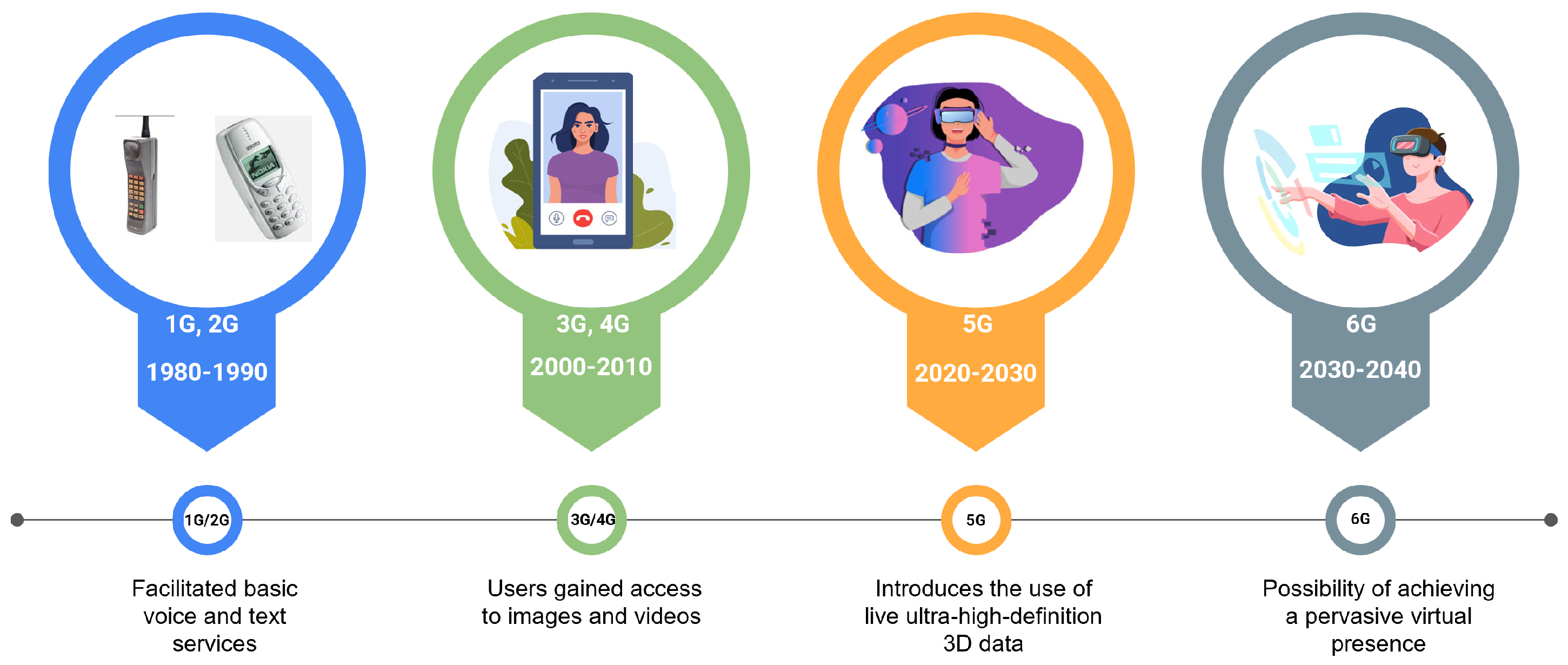
Figure 2.
6G architecture overview: Apart from the user and control planes, the AI-Plane (A-Plane) is added. Adopted from [8], Networking, storage, and computation have all become more simplified. The network of transportation is condensed. Moreover, cloud-centric lambda functions are progressively disaggregating the 3GPP logical network elements.
Figure 2.
6G architecture overview: Apart from the user and control planes, the AI-Plane (A-Plane) is added. Adopted from [8], Networking, storage, and computation have all become more simplified. The network of transportation is condensed. Moreover, cloud-centric lambda functions are progressively disaggregating the 3GPP logical network elements.
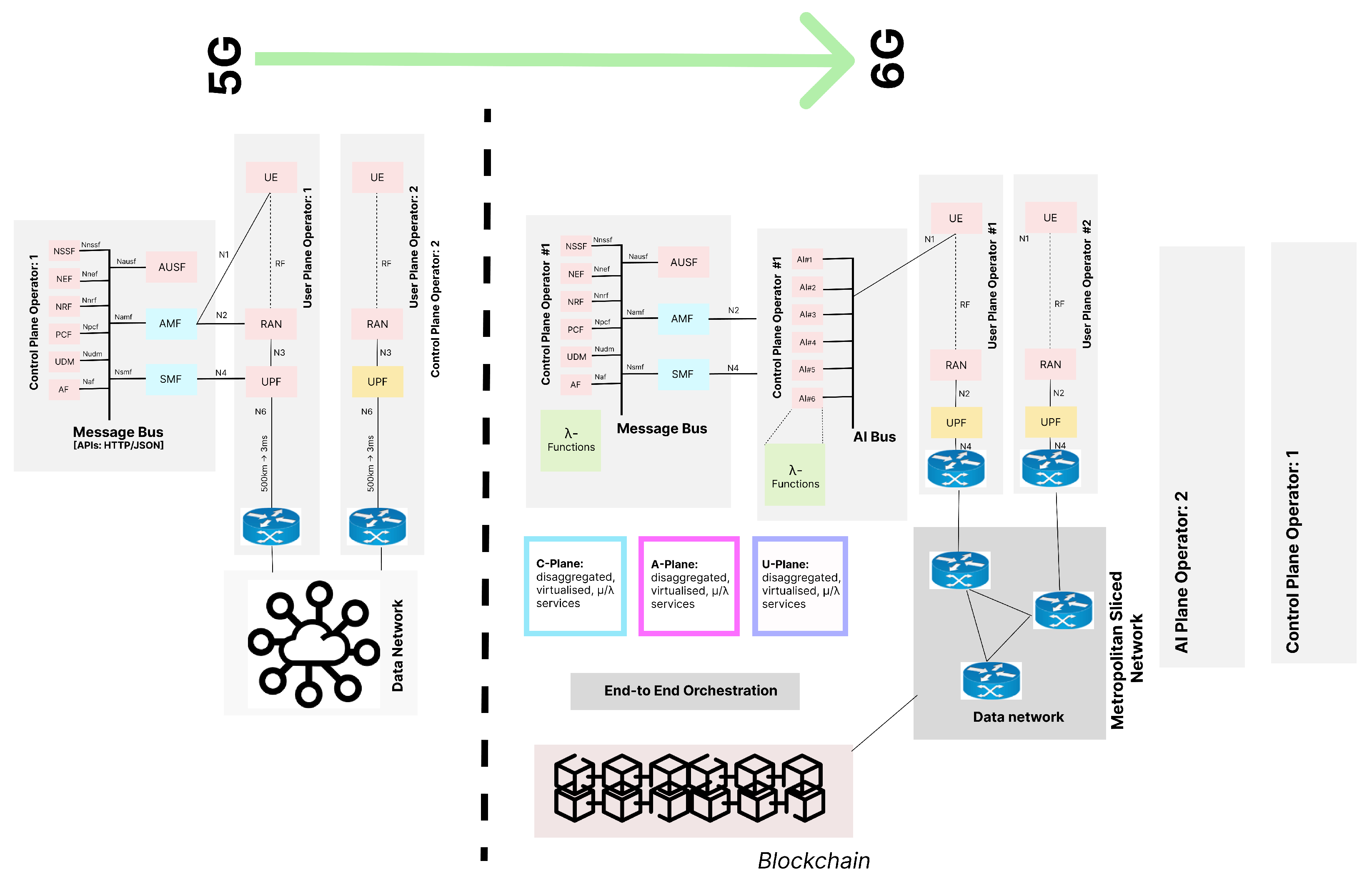
Figure 3.
Comparative analysis of 5G versus 6G communications in terms of quality. This hypothetical comparison is conducted across several dimensions: security, confidentiality, and privacy; spectral utilization; smart capabilities; energy conservation; as well as cost-effectiveness and personalization. [1] Credit: Ivan Gromicho, KAUST.
Figure 3.
Comparative analysis of 5G versus 6G communications in terms of quality. This hypothetical comparison is conducted across several dimensions: security, confidentiality, and privacy; spectral utilization; smart capabilities; energy conservation; as well as cost-effectiveness and personalization. [1] Credit: Ivan Gromicho, KAUST.
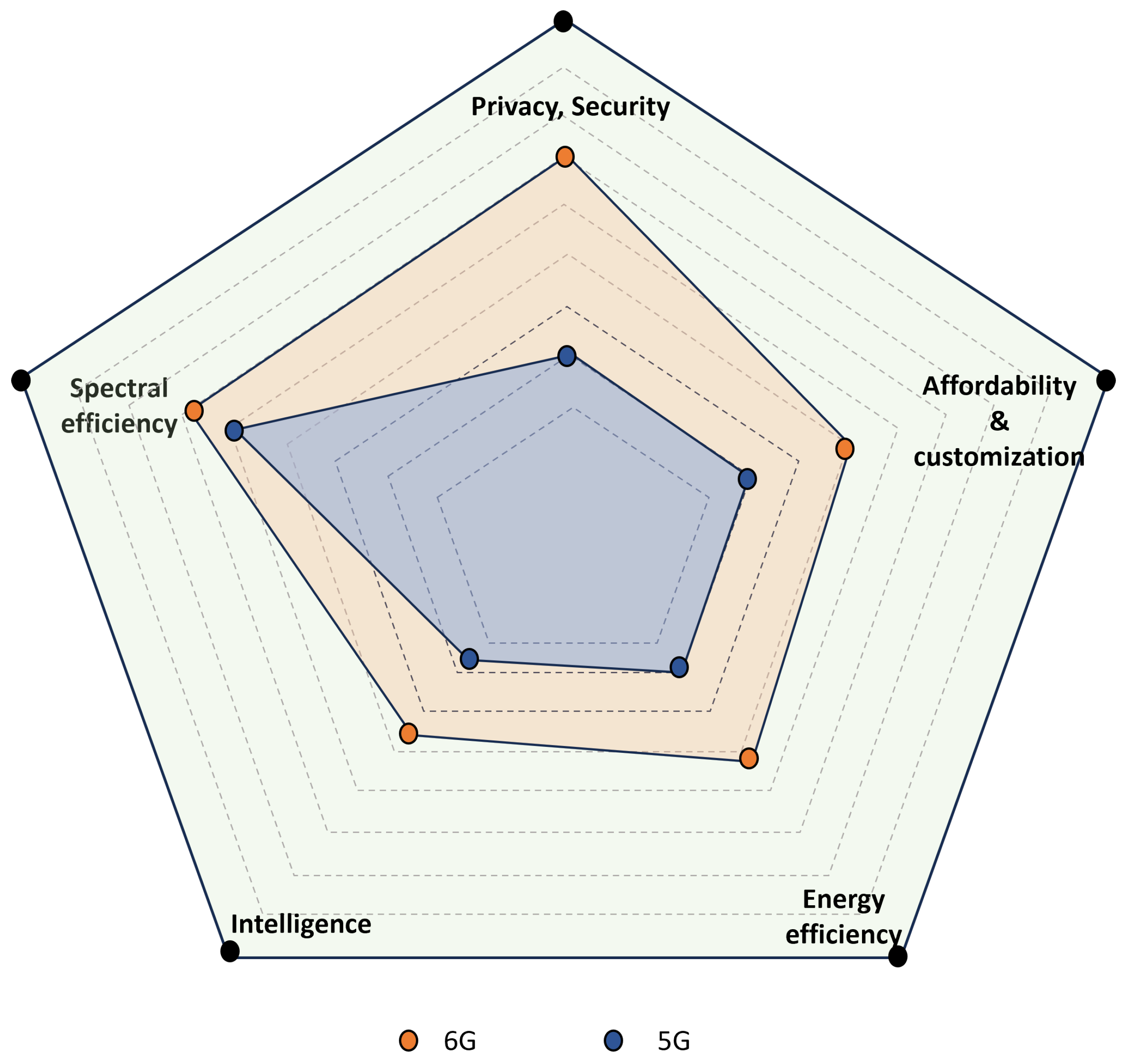

Table 1.
Comparison of key performance indicators (KPIs) for 5G - 6G technologies.
| KPI Name | Definition and Context | 5G | 6G | Improvement (Times) |
|---|---|---|---|---|
| Peak data rate | The highest attainable data transfer rate per user or, device under optimal circumstances. | 20 Gbps [25] | 1 Tbps | 50 Times |
| User perceived data rate | User-perceived data rate refers to the speed at which data is sent and may be accessed by a mobile user or device throughout the whole service area. | 100 Mbps [25] | 10 Gbps | 100 Times |
| Latency | The amount of time a packet takes to go from its source to its destination is known as its latency. | 1 ms [25] | 0.1 ms | 10 Times |
| Delay jitter | Variability in the time it takes for packets to reach the destination, causing fluctuations in transmission delay. | 1 ms [26] | 1 μs | 1000 Times |
| Area traffic capacity | Aggregate data transfer capacity provided within a specified geographical region. | 10 Mbps/m2 | 10 Gbps/m2 | 1000 Times |
| Connection density | The collective count of connected and/or reachable devices within a defined area. | 106 devices/km2 [25] | 108 devices/km2 | 100 Times |
| Coverage | The proportion of network service availability across a given area. | 10% | 99% | 10 Times |
| Spectrum efficiency | The mean data transfer rate per spectrum allocation and per cellular unit. | 30 bps/Hz [27] | ≥90 bps/Hz | ≥3 Times |
| Network energy efficiency | Refers to the ratio of data bits delivered or received by users to the quantity of energy used per unit. | 107 bit/J | 109 bit/J | 100 Times |
| Cost efficiency | Refers to the relationship between the value obtained from a user’s data use and the cost of the data traffic involved. | 10 Gb/$ | 500 Gb/$ | 50 Times |
| Mobility | Refers to the maximum attainable velocity at which a certain level of service quality (QoS) can be maintained, while ensuring smooth transitions between different radio nodes. | 500 km/h [25] | 1000 km/h | 2 Times |
| Battery life | The amount of time an IoT device’s battery will last. | 10 years [28] | 20 years | 2 Times |
| Reliability | The rate of successful packet reception within a defined upper delay threshold. | 99.999% | >99.99999% | >100 Times |
| Positioning | The precision of positioning for both indoor and outdoor environments. | 1 m & 10 m | 10 cm & 1 m | 10 Times |
| Sensing/Imaging resolution | The process of sensing and capturing visual information at a high level of detail. | 1 m [29] | 1 mm | 1000 Times |
| Security capacity | The transmission rate of reliable data under the risk of being intercepted by other parties. | Low | High | – |
| Intelligence level | The smart level of the information method. | Low | High | – |
Disclaimer/Publisher’s Note: The statements, opinions and data contained in all publications are solely those of the individual author(s) and contributor(s) and not of MDPI and/or the editor(s). MDPI and/or the editor(s) disclaim responsibility for any injury to people or property resulting from any ideas, methods, instructions or products referred to in the content. |
© 2024 by the authors. Licensee MDPI, Basel, Switzerland. This article is an open access article distributed under the terms and conditions of the Creative Commons Attribution (CC BY) license (http://creativecommons.org/licenses/by/4.0/).
Copyright: This open access article is published under a Creative Commons CC BY 4.0 license, which permit the free download, distribution, and reuse, provided that the author and preprint are cited in any reuse.