
Submitted:
09 May 2024
Posted:
10 May 2024
You are already at the latest version
Abstract
Keywords: standing water bodies, glacial lakes, freshwater biodiversity, eutrophication; nature conservation network
Keywords:
standing watre bodies
; glacial lakes
; freshwater biodiversity
; eutrophication
; nature conservation network
1. Introduction
Significant climate-driven changes are expected during the coming decades [1,2], placing Mediterranean freshwater ecosystems at the top for vulnerability [3,4]. Despite the attempts and objectives of international strategies to halt the biodiversity decline [5,6], the task is increasingly challenging [7], thus a scientific and technical management support is more than required. Being located at very specific altitudes, the glacial lake ecosystems are facing rapid changes due to the lack of snow cover and rapid increase of temperature. The plant and animal biota of alpine regions are influenced by the amount, rates, and dynamics of snow cover [8,9], and the hydrological cycle of high altitude basins is regulated by the availability of freshwater from the cryosphere in the spring and summer [10]. Thus, the rapid deglaciation of the European Alps is one of the main indicators of shifting geomorphic process speeds and global warming [11,12]. Since the end of the Little Ice Age (LIA), the area covered by glaciers has declined by more than 50% [12,13]. Several ecosystems in Albania attest to this phenomenon, and new landscapes have emerged where there once was a water-covered area. To analyze the state, connectivity, climate change-driven impacts, and bias with conservation approaches covering mountain environments, detailed data on lake evolution, spatial distribution and lake characteristics are required. In order to contribute to the regional picture of glacial lake distribution, we consequently created an inventory of glacial lakes for the Albanian upland areas (over 1450 m above sea level). With the help of publicly accessible high-resolution picture data, lakes were manually mapped. Furthermore, we followed the current network of conservation designations where a considerable number of lakes are an integral part of the protection. The original designation was based on geological and biodiversity values of both terrestrial ecosystems. The objectives of our study are: (1) to compile a list of the high alpine lakes in the uplands of Albania; (2) to investigate lake characteristics, distribution, and highlight the biodiversity values of selected animal and vegetation components; (3) to assess the snow-cover (cm) and low-temperature days (-0°C) and hypothesize the impacts caused by both climate change and anthropogenic interventions; and (4) to discuss state of conservation and bias with protected areas designation in Albanian Alps National Park, Korab-Koritnik Nature Park, Shebenik-Jabllanica National Park, etc.
The glacial chronology and glaciations found in the mountains of Albania are related to those found in the Mediterranean and Dinaric arc regions, where the phenomena is thought to be related to certain known glaciations that occurred in the Late Pleistocene [14,15,16,17]. Furthermore, besides different interpretations, it is hypothetically assumed that the maximum of Albanian Alps (and the rest of the mountains where the glacial lakes are situated), the glaciations took place in Early or Middle Pleistocene (0.781-0.126 million years ago).
Freshwater biotic communities are important components of lake functioning. Besides altitudes and origin of glacial bodies, both vegetation and fauna groups are of high interest and amongst the least studied. One of the most significant components is zooplankton, composed of invertebrates from several taxonomic categories, the principal ones being copepods, cladocerans, and rotifers. Zooplankton serves as a vital component of the food web and plays a role in the self-purification processes of aquatic ecosystems, as it is consumed by fish and other invertebrates [18,19,20]. Additionally, aquatic plants are also good indicators of the ecological state and eutrophication process [21]. They are linked directly linked to the biotic integrity of aquatic ecosystems [22] and are hence incorporated in monitoring of surface water by the Water Framework Directive [23]. Presently, there are records of deterioration in the water quality of both running and standing water bodies [24].
2. Materials and Methods
Study area: A literature search for high altitude aquatic habitats and for particular glacier lakes was part of the data collection process. The dimensional limits of lentic water bodies that are shallow (less than 20 meters) and have a surface area of a few hectares (less than 10 hectares) allowed us to locate our target ecosystems and distinguish them from bigger lentic aquatic ecosystems (including large and middle size natural lakes of other-than-glacial origin and reservoirs established for different purposes as energy production, agriculture or recreation).
Geographic coverage and lakes surface data analysed: The rivers of Albania are included in the 420-Southeast Adriatic Drainage on the worldwide ecoregion map [25,26]. To the best of our knowledge, the distribution and species composition of freshwater fish species serve as the basis for this map of freshwater ecoregions, which also includes important ecological and evolutionary features [27]. Albania is home to multiple major, currently autonomous river and lake systems (Figure 1). They are listed below, north to south: The rivers Mat (B), Ishëm (C), Erzen (D), Shkumbin (E), Seman (made up of two major inflows—Devoll and Osum) (F) and Vjosë (Aoos in Greece) (G) are part of the Ohrid-Drin-Skadar system (which includes the river Buna). Several other short rivers flow from the Cika mountain to the southernmost Adriatic Sea and the northernmost Ionian Sea (H), the area surrounding Butrint Lagoon (rivers Bistrica and Pavllo) (I). The majority of the lakes and rivers listed above (A–G) are located on the Adriatic slope, while the southernmost portion (I) is located on the Ionian Sea slope. Although the Prespa Lakes do not have a surface outflow of water, there are subterranean connections with Lake Ohrid (Amataj et al., 2007). The Danube basin includes only a very minor portion of the Albanian Alps in the country’s northernmost region [27]. All Albanian rivers have extremely varying seasonal discharges; in certain cases, summer discharges might be more than ten times lower than winter discharges. Since a lot of gravel and stones are deposited along the main rivers, their beds are typically very wide [27]. The topography of the region is very varied, with mountains in the east and flat plains in the west.
The approach followed for calculating the surfaces of glacial lakes and lakes level annual oscillations is based on the commands used in the Google Earth Pro program. In this program, the base map is constantly updated, showing any changes in the topography over the years, but in this particular case, the most recent images were used - October 2023. To measure a polygon (in this case, the glacial lakes) in this program it is followed the sequence of commands: In the toolbar located at the top of the page, were selected “Show Ruler” and then clicked “Polygon”. After that, were outlined the surface we were interested in the base map. During this process, in the small table that we had displayed on the screen, the Perimeter and the Surface appear, next to which the unit of measurement is also given, which we could change as needed. Once the data such as the area and perimeter have been obtained, we were choosing to save it as a polygon or not. To understand which lake surface we have measured or not, in this case the feature has been saved by clicking “save”. Then a new window opens where we were able to mark the name of this new polygon, in this case with the name of the corresponding lake. And finally were clicked “Save” again. This whole process is repeated until all the surfaces we had planned have been measured.
Evaluation of management effectiveness and variable selection: Based on the Assessment of Management Plan Implementation, which was modified from Tool 9 of the Enhancing our Heritage toolbox [28], surveys were carried out throughout the designated protected areas of Albania. Within the limits of these protected regions are found more than 90% of glacial lakes. The purpose of this tool is to evaluate how well the protected area management plan is being implemented. The tool makes it possible to evaluate the management plan’s implementation at both the overall and specific goal levels, including aquatic environments. Going over each plan action and assigning it a status category (such as “action has not commenced” to “action has been completed”) was one of the adjustments made to this review. “Use of resources as lakes for recreational purposes,” “glacial lakes,” and “water ecosystem management” were also added.
The selected variables for monitoring and assessment of management capacities are presented in Table 1. These variables are classified into two groups and three levels, according to their status and assumed importance. So, group I, include variables representing the foundation for manager’s functioning: existence of legal acts further stipulating acts to be adopted by the manager; manager’s human resource capacity and group II is based variables representing the implementation of legally prescribed obligations in the field.
Empirical analyses: The aggregate function S (scoring) has been introduced, allocating to each observed protected area a numerical value from 0 to 100. The assessment model was built through combination of the following variables: a1-1-if the Protected area management plan existed; 0—otherwise; a2:1 -if Professional staff consisted of at least three employees; 0—otherwise; a3-1-if the Ranger service consisted of at least three employees; 0—otherwise; b1- number of yearly management plans in 2017–2023 period, divided by five; b2-1-if the Rulebook of charges existed; 0—otherwise; b3-1-if Daily operational and guidance book existed; 0—otherwise; c1- number of projects classified into categories (values 0–4); c-2-1- f Monitoring of glacial lakes was performed; 0—otherwise; c3-1-if participation in the integration projects in the field of nature conservation was performed; 0—otherwise, etc.
Zooplankton collections and identification: For the rotifers survey 13 glacial lakes in Albania were covered and 7 field works were completed in 2013–2020. Most of the sites under study are often covered in snow and ice for eight to nine months of the year due to their high altitude; ice-free periods only happen during the warm months of June through August. Using typical plankton net with a mesh size of 55 μm, samples of zooplankton were gathered both horizontally and vertically and then fixed in 4% formaldehyde. Additionally, a plankton hand net with a mesh size of 55 μm was used to collect samples from the littoral zone. The specimens were taxonomically identified using the keys found in [29,30,31,32,33].
Aquatic machrophytes evaluation: During the period of 2017-2023 numerous glacial lakes site visits were conducted covering mostly the seasons of spring, summer, and autumn. 83 glacial lakes were subject of this survey. Therefore, different plant guides were used for species and habitats determination [34,35,36,37]. A five-degree scale was used to quantify the abundance of the observed and recognized macrophyte species along transects and in the deep zone of each lake: 1 represents very rare, 2 represents rare, 3 represents common, 4 represents frequent, and 5 represents abundant [38,39]. By analyzing photos captured with a drone, the MAVIC 2 Pro, the plant covering in the body of water was assessed. The results were computed by projecting the vegetation cover in the water column above the surface of the lake. There are five levels of macrophyte cover based on how much of each lake’s surface is covered by it. There are four types of cover: none (no plants), sparse (1–25% cover), moderate (26–50%), dense (51–75% cover), and very dense (76–100% cover).
All the data were analyzed with the statistical program SPSS 29.00. Descriptive statistics, one way ANOVA, Pearson correlation (2-tailed), and relationship map were performed to examine the association between different variables. The independent variables are lakes latitude, lakes surface, water level oscillation of lakes. The dependent variables are the vegetation cover of the lakes and the total number of observed rotifer species in the Albania lakes included in the study.
3. Results
3.1. Inventory of High Alpine Lakes in the Albanian Upland Areas
Albania’s elevation increases gradually from west to east. Plains comprise about 15% of the area, primarily in the West of the nation, with hills reaching up to 200 meters above sea level (Table 2). In certain places, the mountains are arranged radially, like the Albanian Alps, or they form regularly oriented chains, primarily oriented from the South-East to the North-West (Miho et al., 2013). The Western section of the mountains has sharper slopes than the Eastern section, with flat crests and steep slopes being common features. Deep valleys are regularly squeezed by narrow gorges to create canyons such as Kelcyra (Permeti), one of the largest in Albania.
Most of the country experiences a high humidity, Mediterranean subtropical climate, which gradually shifts to a moderate continental climate in the north and east. Summers are lengthy, hot, and very dry, whereas winters are usually moderate, moist, and relatively short. There is a lot of precipitation; it increases from west to east, from roughly 1300 mm in Saranda to 2000 mm in Shkodra. When intense rainstorms occur suddenly, brooks and torrents frequently form with a high potential for erosion. Tirana receives more than 330 sunny days annually, which results in more than 2100 kWh m-2 year-1 [40].
Approximately 8% of Albanian territory, or more over 2300 km2, was covered by wetlands before 1960. Since then, significant agricultural reclamation projects have drastically decreased the wetlands’ overall size to less than half [40]. However, there are still more than 1300 aquatic locations spread out across the nation, including rivers, lakes, ponds, coastal lagoons, marine habitats, and fluvial deltas (Table 2). The overall surface area of wetlands is 970 km2, or roughly 3% of the entire country. The majority of these aquatic environments are made up of lakes, coastal lagoons, and reservoirs. These are all characterized by a great diversity of biological species and sensitive environments that are still heavily impacted by human activity and are not well understood.
The lake inventory contains 85 lakes above 1415ma.s.l. in Albania covering a total area of 2.4 km2. The lakes spread from the border to Montengro in the North to the Gramozi Lake at the South-East bordering with Greece.. Lake density, i.e., the lake area (in m2) in relation to the surface area above 1415m (in km2), varies significantly between the mountain ranges (Table 3). Highest lake density is observed in the Albanian Alps, Korabi massif and Pas Deje Lura area, while lower one can be identified in Gramozi and Jabllanica Mountains.
Of the lakes under investigation, all have an alpine regime and a surface area over 0.5 hectares. Of them, 42 are glacial lakes with a surface area exceeding 4 ha, while only 6 are greater than 10 ha (Table 2). This table excludes 16 glacial lakes that are discovered to be dry in the summer and fall or that only have a very little amount of water on them in the winter and spring. The dried or temporary glacial lakes are found in the most northern region of the country, in Seferçe, with the dried Lake of Seferçe standing at an altitude of 1710 meters. The glacial lakes of Albania extend from the south, where there are two temporary lakes at 1850 meters above sea level in Ostrovica Mountain, to the northeast, where there is a temporary lake at 2150 meters above sea level in the Panairi area. From the geo-morphological point of view, 60 glacial lakes occur in ultramafic, twelve in granitic, twelve in calcareous geo-ecosystems and only three in mixture of geo-morphological composition.
3.2. Particularities of Glacial Lakes, Distribution and Specific Biodiversity Values of Selected Animal and Vegetation Components
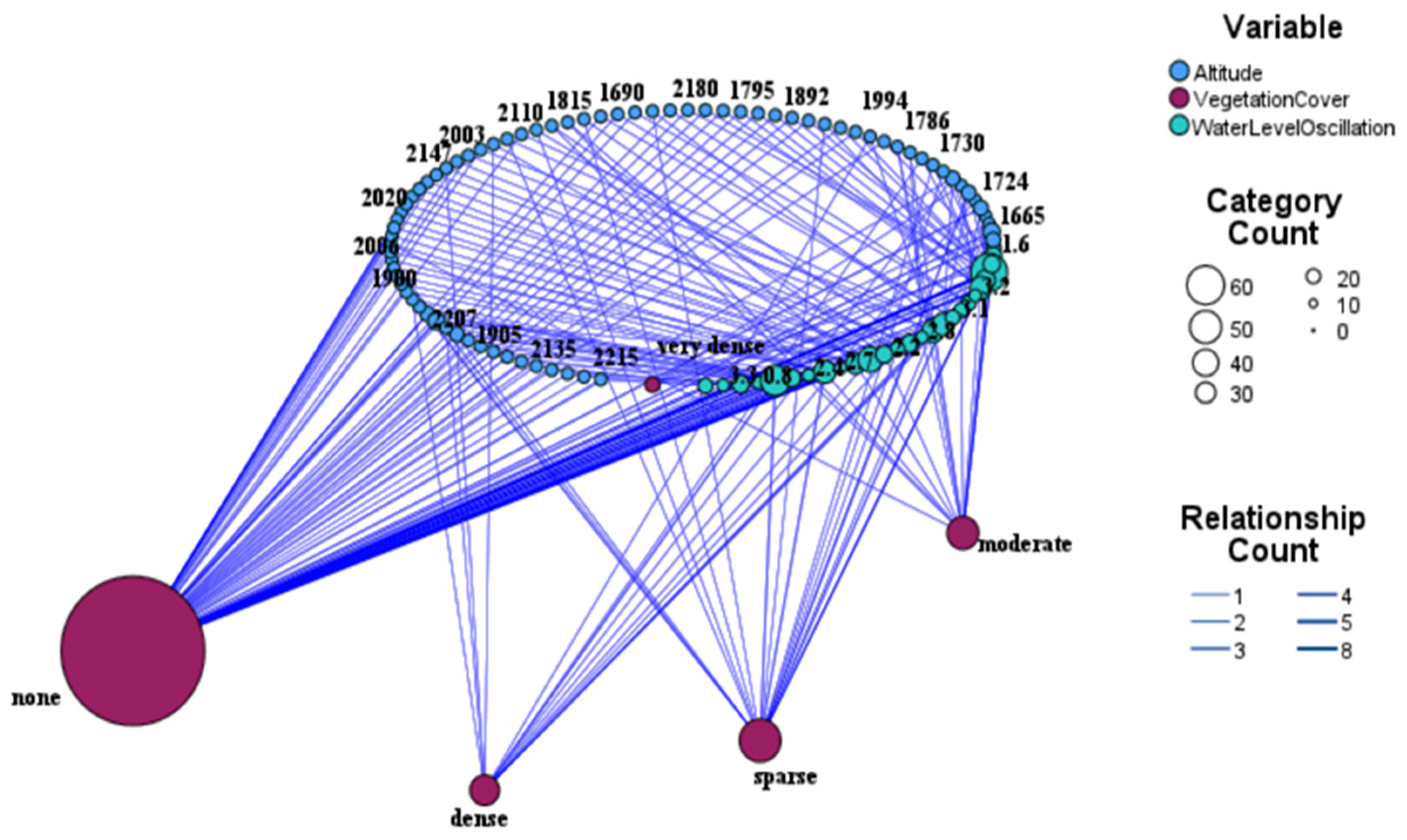
A total of N=87 lakes were observed. The mean of lakes altitude is 1813.94±184.074 and the mean of water oscillation level is 2.0138±.61269. Table 4 displays general characteristics of the surveyed lakes in Albania in the frame of vegetation cover in correlation of lakes altitude, water level oscillations and geomorphology watershed of the lakes.
To understand if vegetation cover differs between lakes altitudes, water level oscillation of lakes and geomorphology watershed of lakes a one-way ANOVA and a Pearson (2-tailed) correlation coefficient was calculated. The data displayed in Table 5 show statistically no difference in the mean between vegetation cover of the lakes and the geomorphology watershed of the lakes (F(4,82) = .554, p=.696). We found a statistically significant difference in the mean of the vegetation cover of the lakes and water level oscillation (F(4,82) = 3.610 p=.009).Moreover, we found a statistically significant difference (F(4,82) = 5.013 p=.001) in the mean of vegetation cover of lakes and the altitude of lakes.
There is a statistically significant correlation between vegetation cover of lakes and the water level oscillation as displayed in Table 6 (Pearson correlation 2-tailed: R2 = -.666, α=99%, p<0.001).
Figure 2.
Relationship Map analyses.
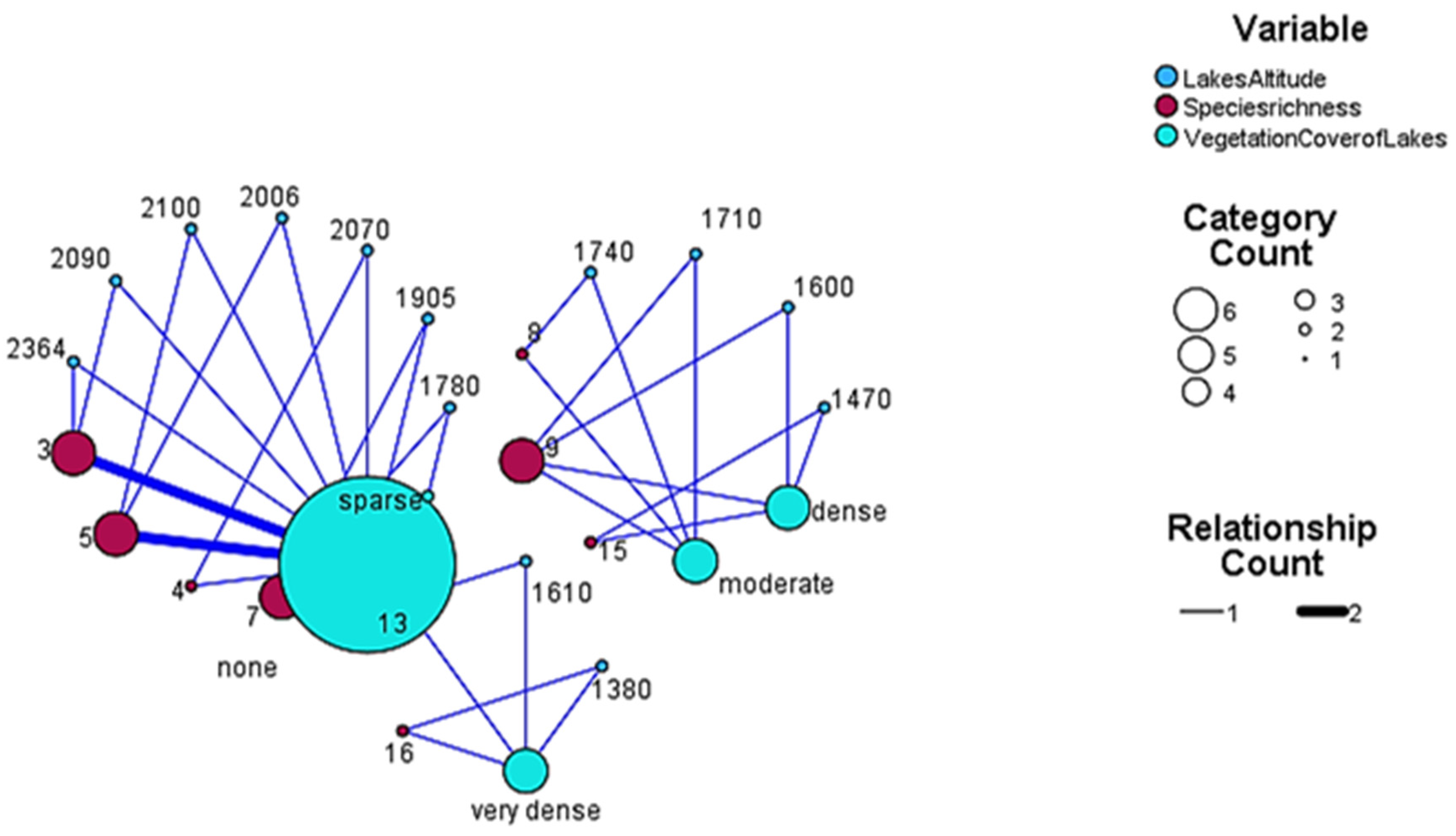
Glacial lakes Rotifer biodiversity: In 2021, a checklist of Rotifera species found in Albanian inland waters and nearby areas was released [41]. There are 140 species of bdelloids and monogononts on the list, representing 38 genera. The genera that have been recorded as having the highest number of rotifers in Albanian inland waters are Lecane (16 species), Trichocerca (15 species), Brachionus (15 species), Keratella (7 species), Polyarthra (7 species), and Lepadella (6 species). Along with other types of ecosystems, small-standing water ecosystems, including those of glacial origin that are the focus of this work, are thought to be particularly important for biodiversity conservation, and proper management is desperately needed [42]. There are very few publications dedicated to rotifers of glacial lakes [43,44] and the particular features noted by [45] are also the case for the Albanian glacial lakes. i.e., most of these lakes are found on mountains, above the forest line (Figure 3).
With regard to rotifers a total of N=13 lakes were observed. The mean of lakes altitude is 1832.69±285.506and the mean of Rotifer species observed is 8.00±4.340. Table 7 displays general characteristics of the surveyed lakes in Albania in the frame of rotifer species number observed in lakes in correlation to lakes altitude and vegetation cover.
The data displayed in Table 8 show a statistically significant difference in the mean between vegetation cover of the lakes and the number of rotifer species identified in the lakes (F(4,8) = 15.115, p=.010). We found a statistically significant difference in the mean of the lakes altitude and the number of rotifer species identified in the lakes (F(4,8) = 8.262, p=.029).
Figure 3.
Relationship Map analyses of rotifers and other selected variables.
Presently the data one macrophytes of glacial lakes of Albania are very scarce. 11 macrophyte species are reported for Lake of Dushku, while the checklist of vascular plants of Albania [35] and a limited number of specimens deposited in National Herbaria in Tirana (TIR) provide the only knowledge of these ecosystems. The TIR collection includes specimens of Nymphaea alba, collected by K. Paparisto in Black Lake of Lura (18.08.1949) and B. Ruci in the White Lake (12.10.1999), Eleocharis palustris collected by B. Ruci in the White Lake and Sopoti Lake (12.10.1999), Juncus articulatus collected by X. Qosja, (01.08.1956) in Black Lake of Radomira and Myriophyllum spicatum from Lura Lakes [46].
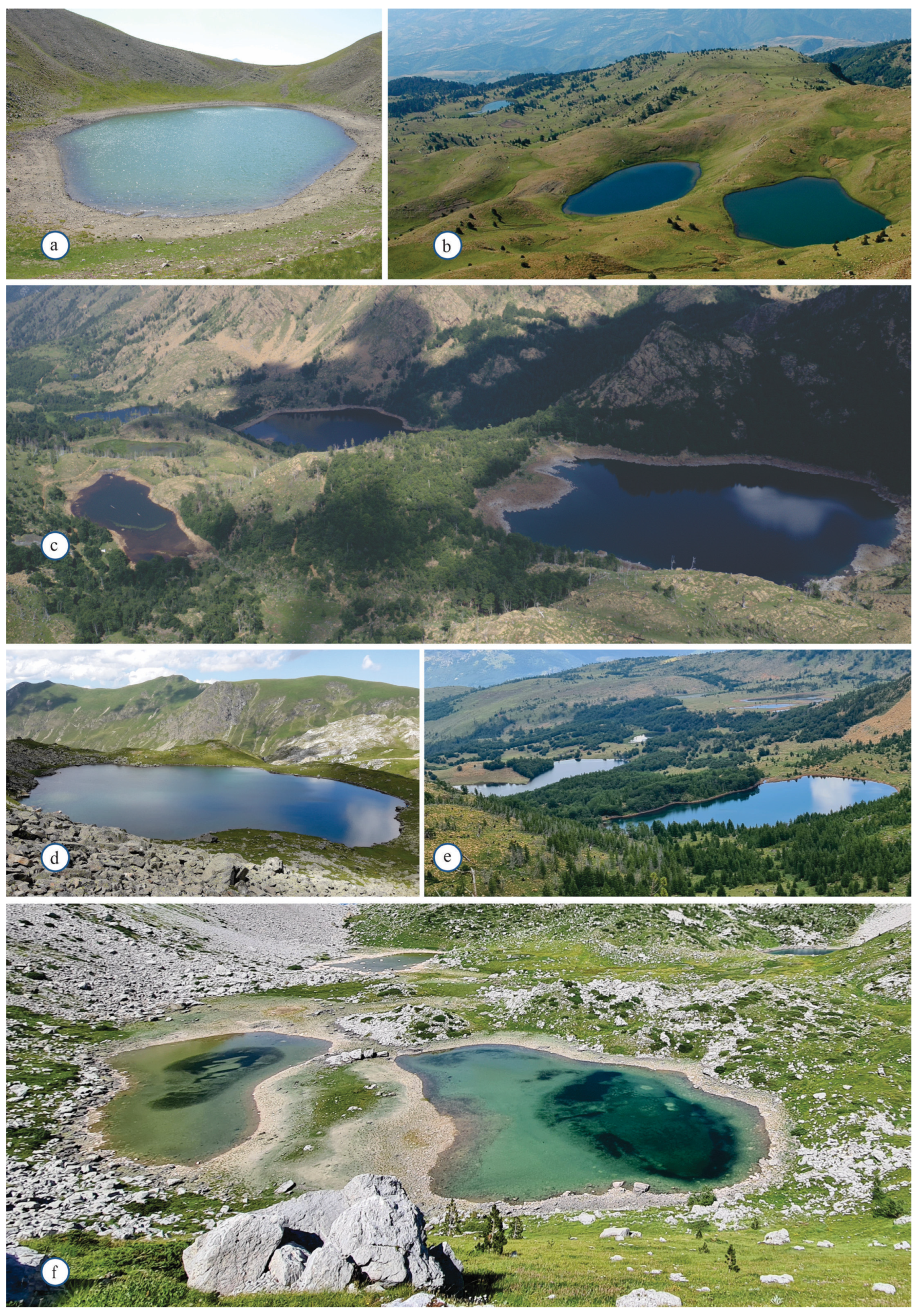
Figure 4.
Selected Glacial lakes, a) Lake of Gramozi, b) Lakes on Valmara, c) Lakes of Kacnia in Balgjaj, d) Lake of Dashi in Sylbica-Doberdol and f) Lakes of Jezerca. (Author of photos: L.Shuka).
Figure 4.
Selected Glacial lakes, a) Lake of Gramozi, b) Lakes on Valmara, c) Lakes of Kacnia in Balgjaj, d) Lake of Dashi in Sylbica-Doberdol and f) Lakes of Jezerca. (Author of photos: L.Shuka).
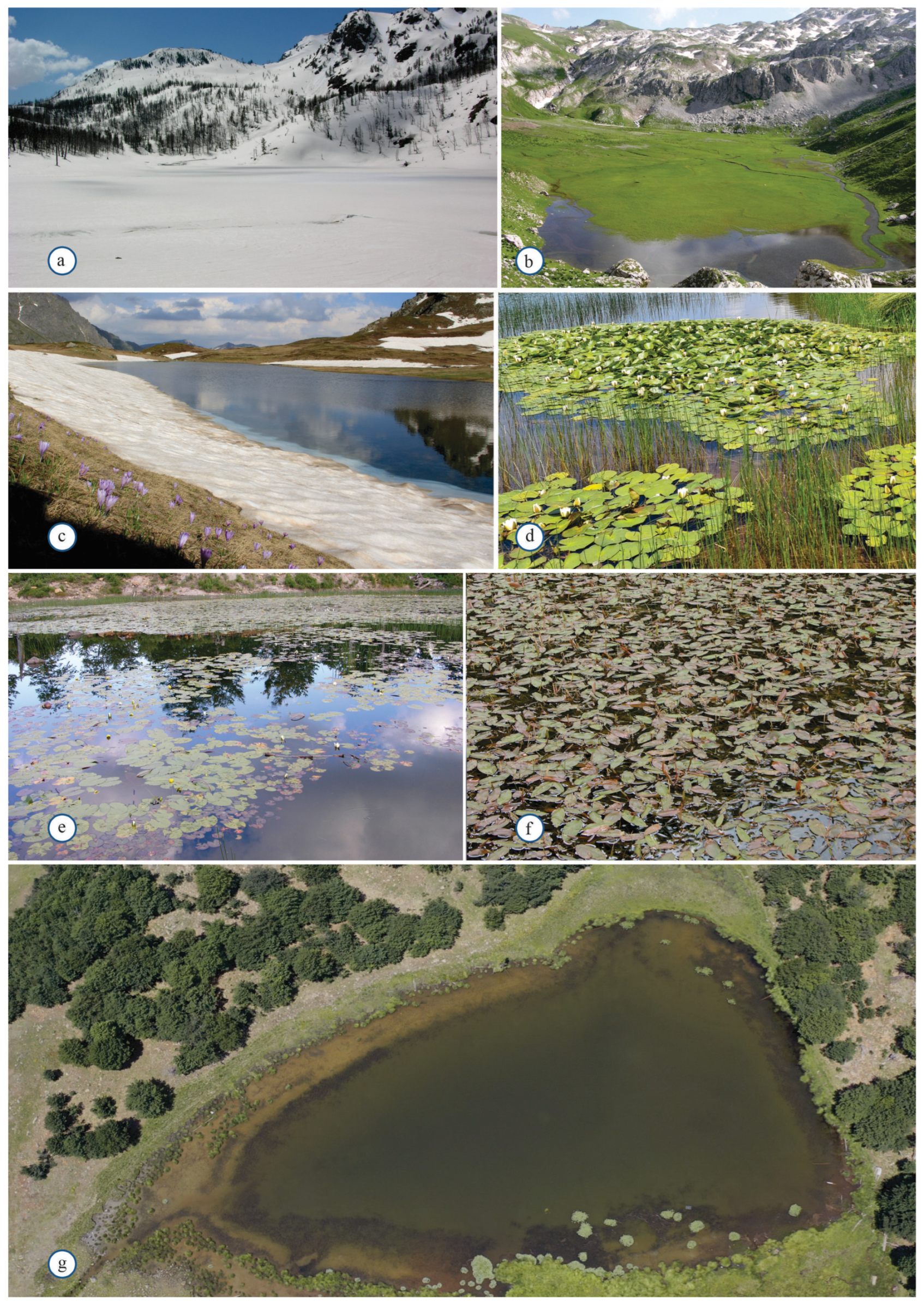
The results of study show that in 53-glacial lakes there is no presence of aquatic macrophytes, and they are distinguished for their high transparency and low level of nutrients [46,47]. In the other 15 lakes a cover of macrophytes was found along the peripheral areas of the lakes with shallow waters less than 20 cm, often influenced by the fluctuation of the water level during the spring-summer season, so the macrophyte coverage of these lakes is evaluated as Sparse. The higher coverage of macrophytes was estimated in the other 11 glacial lakes; those are evaluated as Dense and Very Dense coverage, respectively in 8 and 3 glacial lakes (Figure 5, Table 9).
Figure 5.
a) Great Lake covered by snow in Lura b) Dried Lake of Panairi in Korab, c) Yellow Lake and endemic Saffron (Crocus bertiscensis) during early spring, d) Floating-leaved vegetation dominated from Nymphaea alba in Lake of lilies (Valamara), e) Floating-leaved vegetation dominated from Nymphaea alba and Nuphar lutea in Lake of Bruçi (Lura), f) Vegetation of submersed benthic hydrophytes dominated from Potamogetonnatansinin Lake of Dragani (Shebenik-Jabllanica and g) Sparse cover vegetation in Goat Lake (Allamani) (Author of photos: L.Shuka).
Figure 5.
a) Great Lake covered by snow in Lura b) Dried Lake of Panairi in Korab, c) Yellow Lake and endemic Saffron (Crocus bertiscensis) during early spring, d) Floating-leaved vegetation dominated from Nymphaea alba in Lake of lilies (Valamara), e) Floating-leaved vegetation dominated from Nymphaea alba and Nuphar lutea in Lake of Bruçi (Lura), f) Vegetation of submersed benthic hydrophytes dominated from Potamogetonnatansinin Lake of Dragani (Shebenik-Jabllanica and g) Sparse cover vegetation in Goat Lake (Allamani) (Author of photos: L.Shuka).
Regardless of the high number of the investigated lakes, the number of identified aquatic plant species is low, 27 macrophytes in 34 lakes have been recorded. The aquatic plant species belongs to 18 genera where Potamogeton and Carex are represented by three species and the genus Eleocharis, Myriophyllum, Ranunculus and Typhaareis represented by two species each. The genus Nymphaea, Nuphar, Ceratophyllum, Chara, Utricularia, Juncus, Polygonum, Alisma, Iris, Sparganium, Rorippa, Barbarea and Sagittaria contribute to the floristic richness of the glacial lakes of Albania with one species each. Following Table 9, Lakes of Valamara and Dragani hosts the lower number of species, respectively 3 and 4.
The species richness of the glacial lakes in Albania is very low, ranging from 3 to 7 species in each of the observed lakes, excluding Lake Dushku, where the macrophyte richness is higher, 16 species.
The following Lakes: Kacni, Goat, Allaman, Bruçi and Kurti are characterize by low species riches (5 species), while other lakes presented in Table 3 were showing 6-7 macrophyte species.
The highest abundance was evaluated for White lily (Nymphaea alba) in Lake of Dushku, Lake of lilies (Valamara), Lake of flowers (Allaman), Lake of flowers (Kacni), Lake of flowers (Lurë), Lake of Bruçi, Kurti Lake and very low abundance in White Lake of Martaneshi. The most abundant species in the lakes with ultramafic bedrock is Eleocharis acicularis and Eleocharis palustris. Both water lilies (Nymphaea alba and Nymphaea. lutea) occur only in the Lake of flowers, and lakes of Bruçi, Kurti and Cows, altogether in the ultramafic geo-ecosystem of Lura. Broad-leaved pond weeds (Potamogeton natans) cover about 85 % of the water surface of Dragani Lake.
3.3. Rapid Changes within Snow-Cover and Low-Temperature Days (-0°C), Predicting Further Degradation Due to Climate Changes and Anthropogenic Interventions
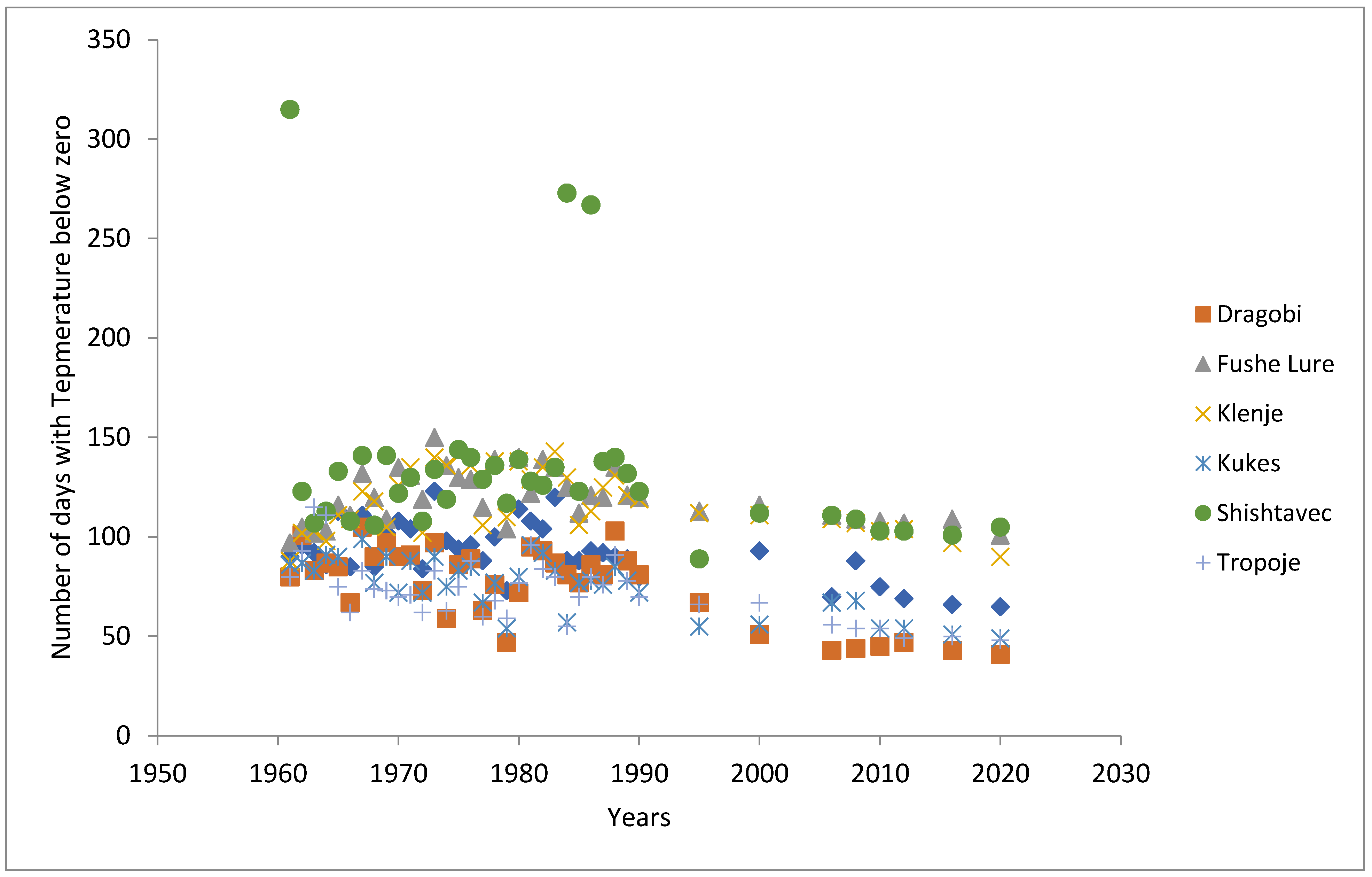
Following different scenarios, Albania will continue to experience a high degree of inter-annual rainfall variability [48]. A decrease in precipitation is expected (<10%), with the largest decreases occurring from June to September [49]. Further on it is predicted that there may also be a change in the type of precipitation, as precipitation which would normally fall as snow, is likely to fall as rain given the higher temperatures; with potential to reduce the country’s snowpack as well as reduce the size of Albania’s ‘small glaciers’ of Albanian Alps [50]. Among the other ecosystems those of glacial lakes are the first to be affected. Figure 5, shows the historical and expected number of days with Tmin< 0°C.
The field observations recorded different historical and current threats to the glacial lakes and that includes: deforestation and overuse of natural resources use of water for irrigation purposes, intervention for increasing water storage, extremely threatening use of water for energy production under small scale hydropower plants, etc.
Figure 6.
Number of days with negative temperature lower than 0°C (Data sources: Institute of Geosciences, Environment and Meteorology, Tirana).
Figure 6.
Number of days with negative temperature lower than 0°C (Data sources: Institute of Geosciences, Environment and Meteorology, Tirana).
3.4. The State of Conservation and Bias with Protected Areas Designation
Recent analyses [26] reveal that the Government of Albania has approved a System of Environmentally Protected Areas. Currently the area of the Network of Protected Areas of Albania reaches 504,826.3 ha, or 21% of the total area of the country. Of the total area, the Coastal and Marine Protected Areas constitute 119,224.7ha, or 23.6% of the total surface of the NPAs of the country, of which 13,261.2ha is only marine area. Moreover, 98,180.6 ha are with the status of Ramsar areas, which cover 3.42% of the total area of the country. Secured conservation connection offers prospects for species survival and life cycle performance, whereas efficient conservation management of protected areas is a precondition for their connectivity performance [51]. Moreover, large-scale ecological and evolutionary processes including gene flow, migration, and species range shifts depend on the connectivity of protected area systems.
These processes are all essential for the persistence of viable populations, especially when facing climatic and environmental changes in increasingly transformed and fragmented landscapes [52]. Improving or sustaining protected areas connectivity is, therefore, a primary concern for the effective conservation and management of biodiversity [53].
The foundation for the creation of the Albanian Ecological Network, or NPAs, is the networks of interconnected regions that have served as the basis for the establishment of corridors that span transboundary and regional contexts as well as even larger national ones. The managerial approach considered here relates to companies (in our case protected areas authorities) and non-governmental organization whose goal is to effectively preserve and advance their values and functions, and the informational resources, in order to achieve ecological sustainability of protected areas (in this case glacial lakes ecosystems) through ground based activities.
The correlation among the effectiveness management score and certain numeric properties of protected areas (surface area, percent of professional staff within the total number of employees, number of rangers per surface unit, level of conservation according to legal requirements) is examined with Spearman’s rank correlation coefficient, in accordance with non-parametric nature of the majority of properties. Results are provided in Table 10, which contains five pairs of correlated variables. Statistical significance of the calculated Spearman’s rank correlation coefficients has been confirmed with the corresponding t-test and shown with the value of t-statistics with N-2 degrees of freedom, and the corresponding p-value.
Following data of the analyses presented in Table 10, there is a statistically significant positive correlation between the measured degree of effectiveness and the following properties: the surface of the protected area where glacial lakes are located, the percentage of trained staff in the entire number of employees and the level of preservation. There is no statistically significant correlation was found between the score of effectiveness and the number of rangers per area.
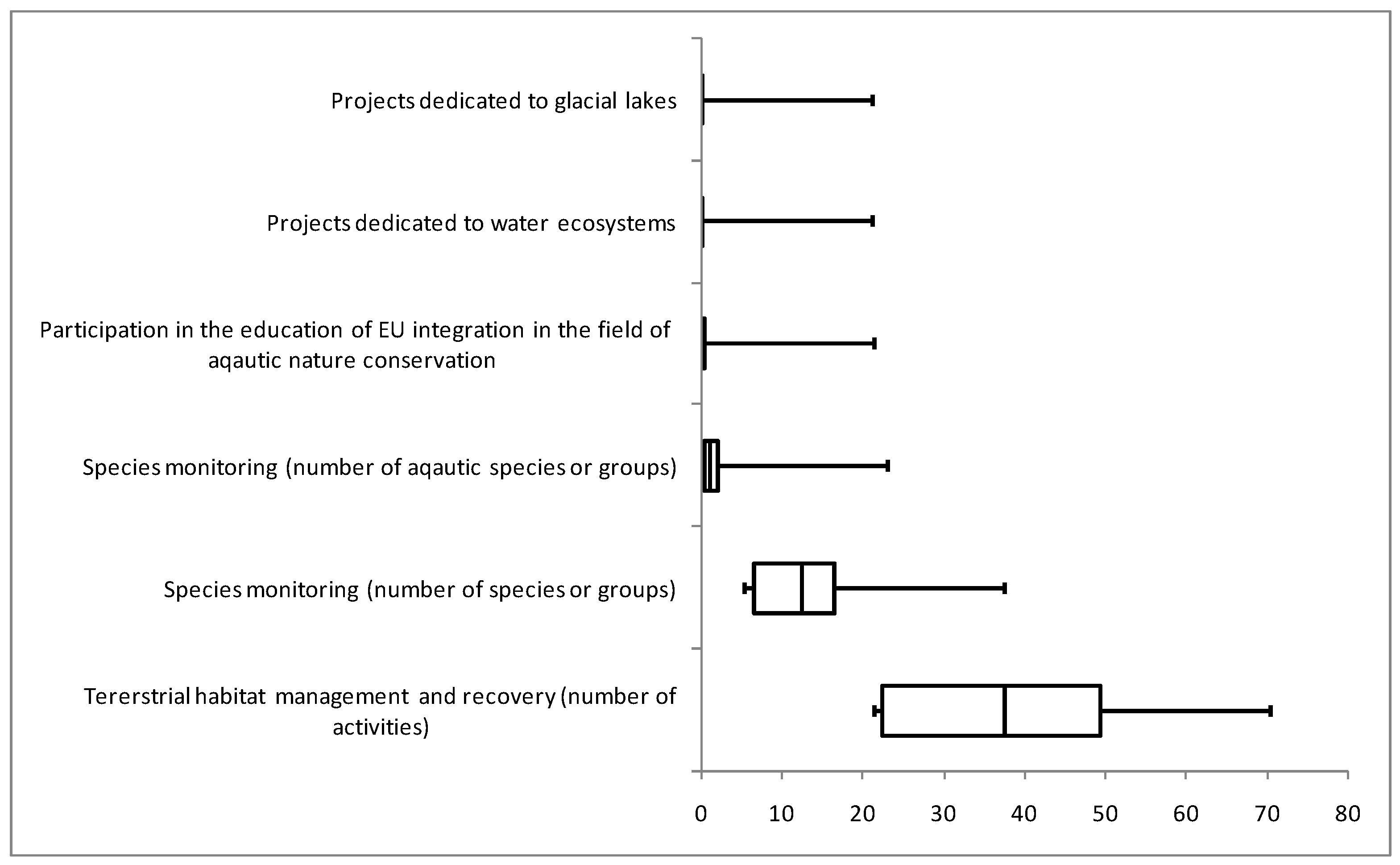
Even fragmented, the analysis of threats conducted using different approaches such as the Management Effectiveness Tracking Tool, World Heritage Outlook Assessment [26] or BirdLife International’s Important Bird and Biodiversity Area have identified a range of threats affecting the integrity of the considered protected areas. In the following figure (Figure 7) the rate of considerations with management plans and attention for preserving fragile aquatic ecosystems and associated biodiversity are presented. This was based on analyses of different projects implemented by protected areas authority and civil society and focused on areas were glacial lake sare located, as: EU Natura 2000 project, Balkan Lynx Recovery Program, etc.
Figure 7.
Box plot “Box and whiskers” showing the conservation efforts and investments for preservation of glacial lake ecosystems and associated biodiversity.
Figure 7.
Box plot “Box and whiskers” showing the conservation efforts and investments for preservation of glacial lake ecosystems and associated biodiversity.
Referring specifically to important habitats for the rare, threatened and plants of community interest, there is also almost no ground conservation measures. The following plant species, Carex davalliana Sm., Carex echinate, Carex flacca Schreb., Carex Vesicaria L., Eriophorum latifolium Hoppe, Geum coccineum Sibth. & Sm., Juncus effusus L., J. rticulates L., Parnassia palustris L., Polygonum bistorta L., Potentilla erecta (L.) Raeusch, Veratrum album L. or threatened species of Centaurea vlachorum Hart, Silene parnassica subsp. pindicola (Hausskn.) Greuter, Narthecium scardicum Košanin, Pinguicula balcanica Casper, Ranunculus degenii Kümmerle&Jáv., Scilla albanica Turrill, Soldanella dimoniei Vierh. And S. pindicola Hausskn., have been most abundant around Valamara, Shebenik, Balgjaj and Lura lakes. The lake shores, water courses and the rocky cervices of the lakes in Korabi and Sylbicë-Doberdoli area [36,37,38] are inhabited from important endemic and subendemic species as Barbarea balcana Pančić, Caltha palustris L., Crocus bertiscensis Raca, Harpke, Shuka & V. Randjel., Galanthus elwesii Hook. F., Heliospermum pusillum subsp. albanicum (Malý) Niketić & Stevanović, Heliospermum oliverae Niketić & Stevanović, Ranunculus degenii Kümmerle & Jáv., that confirms sites conservation interest.
4. Discussion
The attempt to if the vegetation cover varies with lake elevation, lake water level fluctuations, and lake geomorphology watershed performed through analyses presented in Table 5 there is statistically no difference in the mean between the lakes’ vegetation cover and their geomorphology watershed (F(4,82) =.554, p =.696). The mean plant cover of the lakes and the water level oscillation were found to differ statistically significantly (F(4,82) = 3.610 p=.009).Furthermore, we discovered a statistically significant difference between the height of lakes and their mean vegetation cover (F(4,82) = 5.013 p=.001).
According to different scenarios the Mediterranean region including Albania will continue to see a significant level of inter-annual rainfall variability under many scenarios [48]. Precipitation is predicted to decrease (by less than 10%), with the biggest reductions taking place between June and September [49]. Furthermore, given the higher temperatures, it is predicted that there may be a change in the type of precipitation as well. Precipitation that would typically fall as snow is more likely to fall as rain, which could reduce the amount of snow in the nation and the size of Albania’s “small glaciers” in the Albanian Alps [50]. So, the ehe ecosystems of glacial lakes are the first to be impacted among the others.
The large number of high-alpine lake area and the number of lakes over elevation in Albania, as part of protected areas, provide an advantage for an increased attention and conservation. Despite efforts and implemented projects, management of the protected areas remains a challenging issue, connected with broad national and global public implications. The goal of current protected area management approaches is to determine which of these approaches are most appropriate and successful. In our circumstances, it is crucial to first examine if the legal requirements which the protected area managers are required to carry outare met, as this constitutes the fundamental and necessary minimum before any other analysis. The considered protected areas (and their management plans) within this analysis also paid attention to minimal conditions, i.e., standards in operating in this field of work (in our case aquatic ecosystem) which should be completed and fulfilled. This represents an initial baseline of good management, and measuring the effectiveness and creation of the best possible management model is the upgraded superstructure of previously set standards. As highlighted in Figure 6, the considerations and driven results following the Management Effectiveness Tracking Tool, show very limited attention towards preservation and increased resilience of the small water bodies.
The importance of rotifer biodiversity is linked with presence of a total of 31 rotifer taxa (Brachionidae 8 taxa, Euchlanidae 2 taxa, Mytilinidae 1 taxa, Lepadellidae 3 taxa, Lecanidae 6 taxa, Notommatidae 1 taxa, Trichocercidae 2 taxa, Synchaetidae 3 taxa, Asplanchnidae 1 taxa, Gastropodidae 1 taxa, Testudinellidae 1 taxa, Filiniidae 2 taxa). According to theanalyzed data, there is a linkage among rotifer species richness along different altitudinal distributions of lakes, where Lake of Dushku (1380 m) is distinguished by 16 taxa, while Lake of Valamare (2070 m) with four taxa. All taxa identified are new records for their localities [41,42]. In regard to the studies of high mountain lakes in Albania, 31 taxa of rotifers are reported among the zooplankton of analyzed mountain lakes, mostly at the north-eastern range, the elevation of which ranges from 1470 to 2200 m. Among them, the taxa Brachionus quadridentatus, Keratella cochlearis, K. quadrata, Notholca squamula, Euchlanis dilatata, E. incisa, Mytilina ventralis, M. ventralis brevispina, Trichotria tetractis, Colurella uncinata, Lepadella patella, L. patella similis, Lecane flexilis, L. luna, L. lunaris, L. quadrientata, Cephalodella gibba, Trichocerca longiseta, T. rattus, T. similis, T. vernalis, Synchaeta pectinata, Asplanchna priodonta, A. girodi, Testudinella patina, Conochilus unicornis, Hexarthra fennica, and Filinia longiseta were found in the present study.
Similar destruction patterns were found [44], revealing that in the high mountain lakes in Turkey, 69 taxa of rotifers were reported among the zooplankton of 16 mountain lakes in the Taurus mountain range, the elevation of which ranges from 1500 to 2660 m. Among them, the taxa of genus Brachionus, Keratella, Notholca, Euchlanis, Mytilina ventralis, Trichotria, Colurella, Lepadella, Lecane, Cephalodella, Trichocerca, Synchaeta, Asplanchna priodonta, Testudinella, Conochilus, Hexarthra and Filinia were found do dominate.
Rotifer species richness exhibits a monotonic decline with altitude, independent of scale effects, according to a survey carried out in the Alps region [43]. In addition, the species richness may be further elucidated by considering the following: water temperature as a proxy for energy, nitrate as a proxy for human influence—discussed in our instance under vegetation cover and habitat diversity—lake area as a proxy for habitat diversity, reactive silica and total phosphorus as proxies for productivity, and so on. Altitude therefore had no further impact on species richness, and the predictors fully explained the species richness–altitude pattern (Figure 2 and Figure 3).
Low species richness and macrophyte coverage in the glacial lakes of Albania show a strong correlation with their small surface area, in accordance withprevious studies for the other Balkan lentic systems [46,55]. Following the results on high species richness in the Lake of Dushku compared with the lower species richness of the higher altitudinal location of the other glacial lakes, e.g., Lake of lilies in Valamara, Lake of Dragani or Lake of Flowers in Lura, Kacnia and Allamani range, they are in full accordance with the impact of climatic factors and altitudes [56], but not in accordance with other references [57,58], who connect the predominant anthropogenic pressures in lowland lakes of the Mediterranean with species loss and with decrease of species richness. Despite higher anthropogenic impact observed in Lake Dushku (maximum depth of 18 m), it is distinguished for the higher species richness and types of vegetation, unlike other glacial lakes with dense and very dense cover vegetation. The macrophyte vegetation of Dragani Lake cover 90 % and is composed only from submersed benthic hydrophytes dominated from Potamogeton natans that, which have not been found elsewhere in glacial lakes of Albania. The macrophyte vegetation of Lake of flowers (94 %), Kurti Lake (55%) and Lake of Bruçi (65%) in Lura geo-ecosystem is dominated from floating-leaved vegetation of N. alba and N. lutea. Yellow lily was not found in other glacial lakes of the country.
Submersed benthic hydrophytes vegetation of Nymphaea alba accompanied with other helophytes such as Eleocharis acicularis or E. palustris and Carex spp., dominate in Lake of lilies (Valamara), Lake of flowers (Allamani and Kacni area) and Lake of Kacnia 1. All the above lakes are characterized by a depth of less than 2 m and high biomass accumulation of helophytes species, contributing to primary productivity, sediment accumulation and stabilization, storage and cycling of nutrients according to [22], which accelerate their deterioration. The relict, endemic and subendemic species such as Barbarea balcana, Caltha vlachorum, Crocus bertiscensis, Heliospermum pusillum subsp. albanicum and Heliospermum. oliverae, S. parnassica subsp. subsp. pindicola, Narthecium scardicum, Pinguicula balcanica, Ranunculus degenii, Scilla albanica, Soldanella dimoniei and Soldanella pindicola, recorded in the shores and the belt around glacial lakes in Albania [36,37,54] might be considered as good indicators for the water quality and habitat integrity.
The historical and current threats to the glacial lakes and their basins, such as deforestation and overuse of natural resources, use of water for irrigation purposes, intervention for increasing water storage, and the extremely threatening use of water for energy production under small scale hydropower plants, seem to accelerate the deterioration of integrity.
The relationship between the management effectiveness scores and a few external factors—such as surface area, the proportion of staff with training, the number of rangers per surface unit, and the national protected area classification—has been studied in relation to the management effectiveness along the protected areas that include glacial lakes. The results of the analysis show that there is a substantial relationship between the management effectiveness score and the classification of national protected areas, surface area, and the proportion of trained personnel among all employees. It is evident that more work and ground-based methods are required in light of the lack of a statistically significant association between the effectiveness of the protected area and the number of rangers stationed there. More analysis is required to take this and related factors into account. In terms of other components, the outcomes are anticipated because professional staff is primarily responsible for managing protected areas; that is, higher conservation levels are predicted to result in stricter conservation implementation measures within specific protected areas.
5. Conclusions
This paper has set four basic objectives: - to create an inventory of high alpine lakes in the Albanian upland areas; - to investigate lake characteristics, distribution and highlight the biodiversity values of selected animal and vegetation components; - to assess the snow-cover and low-temperature days (-0°C) and hypothesize the impacts caused by both climate changes and anthropogenic interventions; and -to discuss state of conservation and bias with protected areas designation in Albanian Alps National Park, Korrab-Koritnik Nature Park, ShebenikJabllanica National Park, etc.
The authorsconclude that current management plans of the considered protected do not meet minimum requirements for adequate management in terms of the legally prescribed management criteria. Following the analysis of additional issues, they conclude that aquatic ecosystems lie under category of most vulnerable ecosystems.
The results indicate that the effectiveness management of the protected areas needs to be employed within standard practices of management of protected areas, including all types of ecosystems. Further measures building resilience of aquatic ecosystems are vital for preserving entire biodiversity values.
Author Contributions
Conceptualization S.S. and L.Sh.; methodology, S.S. and L.S.; validation, S.S, L.S., L.Sh. and M.S.; formal analysis, S.S.; investigation, S.S. and L.S.; resources, S.S.; data curation, L.S.; writing-original draft preparation, S.S and L.S.; writing-review and editing, S.S.; visualization, L.S. and S.S.; Supervision, S.S.; project administration, M.S.. All authors have read and agreed to the published version of the manuscript
Funding
This research received no external funding.
Institutional Review Board Statement
Not applicable.
Informed Consent Statement
Not applicable.
Data Availability Statement
Readers can contact authors for availability of data and materials.
Conflicts of Interest
The authors declare no conflicts of interest
References
- Cowie, R.; H., Bouchet, P.; Fontaine, B. The Sixth Mass Extinction: Fact, fiction or speculation? Biological Reviews 2022, 97(2), 640–663. [CrossRef]
- WWF. In: R. E. A. Almond, M. Grooten, D. Juffe Bignoli, & T. Petersen (Eds.), Living planet report 2022 – Building a naturepositive society. WWF. P. 134.
- Markovic, D.; Carrizo, S.; Carcher, O.; Walz, A.; David, J. Vulnerability of European freshwater catchments to climate change. Global Change Biology 2017, 23, 3567–3580. [Google Scholar] [CrossRef] [PubMed]
- Shumka, L.; Papastefani, A.; Shumka, S.; Mali, S. The Potentials for the Ecological Management of Landscape Connectivity Including Aquatic Ecosystems in Northeast Albania. Hydrobiology 2023, 2, 44–54. [Google Scholar] [CrossRef]
- European Commission, Directorate-General for Environment. EU biodiversity strategy for 2030 – Bringing nature back into our lives. Publications Office of the European Union, 2021. [CrossRef]
- UN Environment Programme. Monitoring framework for the Kunming-Montreal Global Biodiversity Framework, 2022. CBD/COP/DEC/15/5 Decision 15/5.
- da Silva, J.P.; Hermoso, V.; Lopes-Lima, M.; Miranda, R.; Filipe, A.F.; Sousa, R. Therole of connectivity in conservation planning for species with obligatory interactions: Prospects for future climate scenarios. Global Change Biology 2024, 30, e17169. [Google Scholar] [CrossRef]
- Bocchiola, D.; Guglielmina, D. Evidence of climate change within the Adamello Glacier of Italy. Theoretical Applied Climatology 2010, 100: 351–369. [CrossRef]
- Theurillat, J.P.; Guisan, A. Potential impact of climate change on vegetation in the European Alps: a review. Climate Change 2001, 50:77– 109. [CrossRef]
- Beniston, M.; Keller, F.; Goyette, S. Snow pack in the Swiss Alps under changing climatic conditions: an empirical approach for climate impacts studies. Theoretical Applied Climatology 2003, l 74:19–31. [CrossRef]
- Paul, F.; Kääb, A.; Haeberli, W. Recent glacier changes in the Alps observed by satellite: consequences for future monitoring strategies. Global Planetary Change 2007, 56 (1–2), 111–122. [CrossRef]
- Buckel, J.; Otto, J.C.; Prasicek, G.; Keuschnig, M. Glacial lakes in Austria - Distribution and formation since the Little Ice Age. Global and Planetary Change 2018, 164: 39–51. [CrossRef]
- Zemp, M.; Hoelzle, M.; Haeberli, W. Distributed modelling of the regional climatic equilibrium line altitude of glaciers in the European Alps. Global Planetary Change 2007, 56(1), 83–100. [Google Scholar] [CrossRef]
- Hughes, P.D.; Woodward, J.C.; Gibbard, P.L. Relict rock glaciers as indicators of Mediterranean palaeoclimate during the Last Glacial Maximum (Late Wu¨rmian) in northwest Greece. Journal of Quaternary Science 2003, 18, 431–440. [Google Scholar] [CrossRef]
- Reuther, A.U.; Urdea, P.; Geiger, C.; Ivy-Ochs, S.; Niller, H.P.; Kubik, P.W.; Heine, K. Late Pleistocene glacial chronology of the Pietrele valley, Retezat mountains, southern Carpathians, constrained by 10Be exposure ages and pedological investigations. Quaternary International 2007, 164/165, 151–169. [CrossRef]
- Milivojević, M.; Menković, L.; Calić, C. Pleistocene glacial relief of the central part of Mt. Prokletije (Albanian Alps). Quaternary International 2008, 190 (2008) 112–122. [CrossRef]
- Frasheri, A;, Bushati, S.; Bare, V. Geophysical outlook on structure of the Albanides. Journal of the Balkan geophysical society 2009, Vol. 12 (1):.9-30.
- Wetzel RG (2001) Limnology: lake and river ecosystems. 3rd Edition. Academic, San Diego, 1006 pp. [ISBN 9780127447605].
- Sharma, R.C. Habitat ecology and diversity of freshwater zooplankton of Uttarakhand Himalaya, India. Biodiversity International Journal 2020, 5: 188-196.
- Gavrilko, D.; Zhikharev, V.; Zolotareva, T.; Kudrin, I.; Yakimov, B.; Erlashova, A. Biodiversity of zooplankton (Rotifera, Cladocera and Copepoda) in the tributaries of Cheboksary Reservoir (Middle Volga, Russia). Biodiversity Data Journal 2024, 12: e116330. [CrossRef]
- Søndergaard, M.; Johansson, L.S.; Lauridsen, T.L.; Jørgensen, T.B.; Liboriussen, L.; Jeppesen, E. Submerged macrophytes as indicators of the ecological quality of lakes. Freshwater Biology 2010, 55(4), 893–908. [Google Scholar] [CrossRef]
- Steffenhagen, P.; Zak, D.; Schulz, K.; Timmermann, T.; Zerbe, S. Biomass and nutrient stock of submersed and floating macrophytes in shallow lakes formed by rewetting of degraded fens. Hydrobiologia 2012, 692, 99–109. [Google Scholar] [CrossRef]
- EC (European Commission). Directive 2000/60/EC of the European Parliament and of the Council of 23rd October 2000 establishing a framework for Community action in the field of water policy. Official Journal of the European Communities 2020, L327/1. European Commission, Brussels.
- Rigó, A.; Barina, Z. The Floristic Composition of Irrigation Ponds and Water Reservoirs in Albania after the Long Persistent Drought of 2016–2017. 1st International Electronic Conference on Biological Diversity, Ecology and Evolution. Proceedings 2021, p:132-140. [CrossRef]
- Abell, R.; Thieme, M.L.; Revenga, C.; Bryer, M.; Kottelat, M.; Bogutskaya, N.; Coad, B.; Mandrak, N.; Balderas, S.C.; Bussing, W.; Stiassny, M.L.J.; Skelton, P.; Allen, G.R.; Unmack, P.; Naseka, A.; Ng, R.; Sindorf, N.; Robertson, J.; Armijo, E.; Higgins, J.V.; Heibel, T.J.; Wikramanayake, E. Freshwater Ecoregions of the World: A New Map of Biogeographic Units for Freshwater Biodiversity Conservation. BioScience 2008, 58 (5): 403-414. [CrossRef]
- Shumka, S., Berberi, E., Kulici, M. Mucaj, S., Vladi, F. 2022. Assessing the relationship between biodiversity conservation and slow food culture in selected protected areas in Albania. BIODIVERSITAS, 2022: 1319-1326. [CrossRef]
- Shumka, S.; Lalaj, S.; Šanda, R.; Shumka, L.; Meulenbroek, P. Recent data on the distribution of freshwater ichthyofauna in Albania. Croatian Journal of Fisheries 2023, 2023, 81, 33-44. [CrossRef]
- UNESCO. Enhancing our Heritage Toolkit Assessing management effectiveness of natural World Heritage sites. UNESCO World Heritage Centre, 2008, p. 1-134.
- Nogrady T, Segers H (2002). Rotifera. Guides to the Identification of the Microinvertebrates of the Continental Waters of the World. Vol. 6. Asplanchnidae, Gastropodidae, Lindiidae, Microcodidae, Synchaetidae, Trochosphaeridae and Filinia. Leiden, the Netherlands: Backhuys Publishers.
- Ruttner-Kolisko, A. Plankton Rotifers, Biology and Taxonomy. Die Binnengenwasser 1974, Volume XXVI/I, Supplement. Stuttgart, Germany: E. Schweizerbart’sche Verlagsbuchhandlung.
- Koste, W. Rotatoria, Die Radertiere Mitteleuropas. Ein Bestimmungswerk, begrundet von Max Voigt. Uberordnung Monogononta 1978, Berlin, Germany: Gebruder Borntraeger (in German).
- Collin, A. Rotatoria und Gastrotricha. Die Susswasserfauna Deutschlands 1961,. Heft: 14. Lehre, Germany: Verlag Von J. Cramer Hafner (in German).
- Nogrady, T.; Pourriot, R.; Segers, H. Rotifera. Guides to the Identification of the Microinvertebrates of the Continental Waters of the World 1995,. Vol. 3. The Notommatidae and the Scaridiidae. The Hague, the Netherlands: SPB Academic Publishing.
- Tutin, T.G.; Heywood, V.H.; Burges, N.A.; Moroor, D.H.; Walters, S.M.; Webb, D.A. (eds) 1964–1980. Flora Europeae. I–V. Cambridge University Press. Cambridge.
- Barina, Z.; Somogyi, G.; Pifko, D.; Rakaj, M. Checklist of vascular plants of Albania. Phytotaxa 2018, 378(1): 1–339. [CrossRef]
- Raca, I.; Harpke, D.; Shuka, L.; Ranđelović, V. A new species of Crocus ser. Verni (Iridaceae) with 2n = 12 chromosomes from the Balkans, Plant Biosystems-An International Journal Dealing with all Aspects of Plant Biology 2020, 156.1. [CrossRef]
- Shuka, D.; Tan, K.; Hallaçi, B.; Shuka, L. Additions to the flora of North Albania. PhytologiaBalcanica 2020, 26 (3): 517–522.
- Kohler, A. Methoden der Kartierung von Flora und Vegetation von Suswasserbiotopen. Landschaft + Stadt 1978, 10(2): 73–85.
- Trajanovska, S.; Talevska, M.; Schneider, S. Assessment of littoral eutrophication in Lake Ohrid by submerged macrophytes, Biologia 2014, 69 (6): 756—764. [CrossRef]
- Miho, A.; Kashta, L.; Beqiraj, S. Between the Land and the Sea - Ecoguide to discover the transitional waters of Albania. Julvin 2, 2013, Tirana, 1-462. ISBN 978-9928-137-27-2.
- Shumka, S. Checklist of rotifer species from Albania (phylum Rotifera). OPUSCULA ZOOLOGICA (BUDAPEST) 2021, 52 (1): 99-109. [CrossRef]
- Špoljar, M.; Shumka, S.; Tasevska, O.; Tomljanovic, T.; Otoic, A.; Galir Balkic, A.; Lajtner, J.; Pepa, B.; Dražina, T.; Ternjej, I. Small Standing-Water Ecosystems in the Transitional Temperate Climate of the Western Balkans, 2021, Springer. p: 21-51. [CrossRef]
- Obertegger, U.; Thaler, B.; Flaim, G. Rotifer species richness along an altitudinal gradient in the Alps. Global Ecol Biogeogr. 2010, 19: 895-904. [CrossRef]
- Özdemir, M.D.; Ustaoğlu, M.R. Distribution of rotifers of high mountain lakes in the Eastern Black Sea Range of Turkey. Turk J Zool. 2017, 41: 674-685. [CrossRef]
- Sturm, R. Freshwater molluscs in mountain lakes of the Eastern Alps (Austria): relationship between environmental variables and lake colonization. Journal of Limnology 2007, 66: 160-169. [CrossRef]
- Schneider, S.; Trajanovska, S.; Biberdžić, V.; Marković, A.; Talevska, M.; Imeri, A.; Cara, M. The Balkan macrophyte index (BMI) for assessment of eutrophication in lakes. Acta Zoologica Bulgarica 2020, 72(3), 439–454. [Google Scholar]
- Mancinelli, G.; Mali, S.; Belmonte, G. Species richness and taxonomic distinctness of zooplankton in ponds and small lakes from Albania and North Macedonia: The role of bioclimatic factors. Water 2019, 11(11), 2384. [Google Scholar] [CrossRef]
- WB. Climate Risk Profile: Albania (2021): The World Bank Group, p.34.
- Hodenbrog, L.; Marelle, L.; Alterskjær, K.; Wood, R.R.; Ludwig, R.; Fischer, E.M.; Richardson, T.B.; Forster, P.M.; Sillman, J.; Myhre, G. Intensification of summer precipitation with shorter time-scales in Europe. Environmental Research Letters 2019, 14. 124050. [CrossRef]
- Grunewald, K; Scheithauer, J. Europe’s southernmost glaciers: response and adaptation to climate change. Journal of Glaciology 2010, 56(195). [CrossRef]
- Saura, S.; Bertzky, B.; Bastin, L.; Battistella, L.; Mandrici, A.; Dubois, A. Protected area connectivity: Shortfalls in global targets and country-level Priorities. Biological Conservation 2018, 219 (2018) 53–67. [CrossRef]
- Beale, C.M.; Baker, N.E.; Brewer, M.J.; Lennon, J.J. Protected area networks and savannah bird biodiversity in the face of climate change and land degradation. Ecol. Lett. 2013, 16, 1061–1068. [Google Scholar] [CrossRef] [PubMed]
- Juffe-Bignoli, D.; Burgess, N.D.; Bingham, H.; Belle, E.M.S.; de Lima, M.G. Protected Planet Report, 2014. UNEP-WCMC, Cambridge, UK.
- Miszczak, S.; Shuka, D.; Shuka, L.; Migdalek, G.; Słomka, A. Low and high elevation Heliospermaspecies (Caryophyllaceae) -insight based on chromosome number, pollen characters and seed micromorphology. Phytotaxa 2022, 554 (1): 032–046. [CrossRef]
- Oikonomou, A.; Stefanidis, K. α-and β-diversity patterns of macrophytes and freshwater fishes are driven by different factors and processes in lakes of the unexplored southern Balkan biodiversity hotspot. Water 2020, 12(7), 1984. [Google Scholar] [CrossRef]
- Chappuis, E.; Gacia, E.; Ballesteros, E. Environmental factors explaining the distribution and diversity of vascular aquatic macrophytes in a highly heterogeneous Mediterranean region. Aquat. Bot. 2014, 113, 72–82. [Google Scholar] [CrossRef]
- Fernández-Aláez, C.; Fernández-Aláez, M.; García-Criado, F.; García-Girón, J. Environmental drivers of aquatic macrophyte assemblages in ponds along an altitudinal gradient. Hydrobiologia 2016, 812, 79–98. [Google Scholar] [CrossRef]
- Shuka, L.; Çullaj, A.; Shumka, S.; Miho, A.; Duka, S.; Bachofen, R. Response of Drinking-Water Reservoir Ecosystems to Anthropogenic Impacts in Albania: Trends of Interrelationship. J. Int. Environmental Application & Science 2009, Vol. 4 (4): 478-486.
Figure 1.
Albania’s water basin systems:, the Ohrid-Drin-Skadar system (including River Buna) (A), Mat (B), Ishëm (C), Erzen (D), Shkumbin (E), Seman (F) and Vjosa (G), the region surrounding Butrint Lagoon (rivers Bistrica and Pavllo) (I)and the tributaries of the Ionian Sea (H).
Figure 1.
Albania’s water basin systems:, the Ohrid-Drin-Skadar system (including River Buna) (A), Mat (B), Ishëm (C), Erzen (D), Shkumbin (E), Seman (F) and Vjosa (G), the region surrounding Butrint Lagoon (rivers Bistrica and Pavllo) (I)and the tributaries of the Ionian Sea (H).
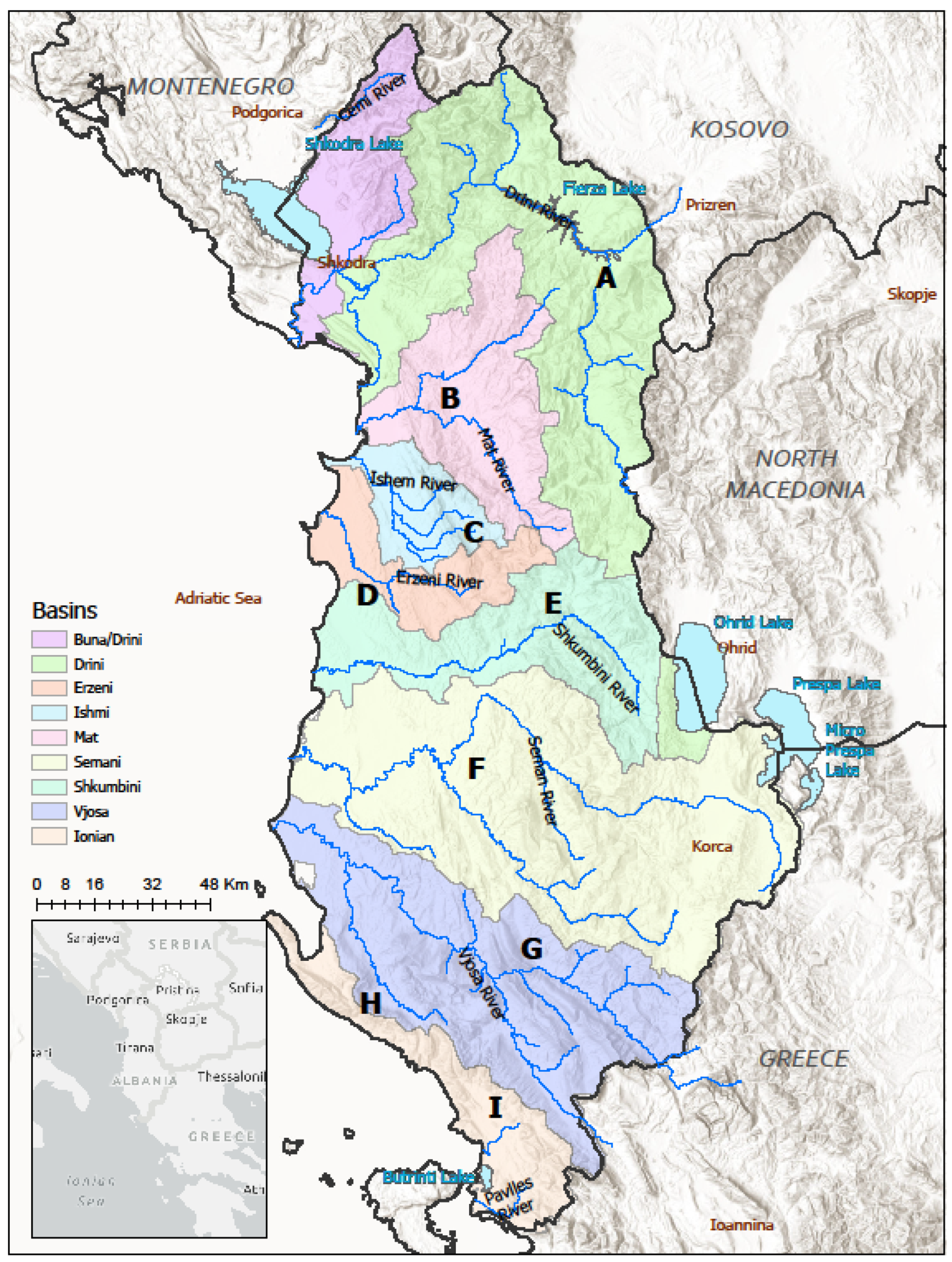

Table 1.
Variables selected for analyze.
| Group I | Group II | |
| Level 1 | Level 2 | Level 3 |
| Management Plan | Yearly revision of management plan | Number of implemented projects for 2017–2023 |
| Trained staff | Database of performance | Glacial lakes monitoring |
| Service of rangers | Daily operational and guidance book | Education programs |
| Biodiversity inventory database | ||
| Hiking trails | ||
| Visitor center and guided tours | ||
Table 2.
Number of water bodies and their surface area.
| Type of water bodies | Surface in km2 | Number of water bodies |
|---|---|---|
| Natural | ||
| Estuaries | 88 | 9 |
| Brackish lakes | 24.2 | 2 |
| Brackish marshes | 8.6 | 2 |
| Freshwater marshes | 6.4 | 6 |
| Freshwater springs | 6 | 110 |
| Glacier lakes | 2.4 | 87 |
| Lagoons | 252.4 | 9 |
| Lakes | 335.7 | 228 |
| Rivers and streams | 27.1 | 152 |
| Salt marshes | 0.3 | 1 |
| Sea bays | 17.8 | 1 |
| Wetland forests | 4.8 | 1 |
| Total Natural water bodies | 773.7 | 617 |
| Artificial water bodies | ||
| Reservoirs | 178.8 | 700 |
| Aquaculture ponds | 6.4 | 3 |
| Excavations | 0.3 | 3 |
| Temporary wetlands | 9.1 | 1 |
| Total artificial water bodies | 194.6 | 707 |
| Total water bodies | 968.3 | 1324 |
Table 3.
Main characteristics of 87 glacial lakes.
| No. | Lake name | Coordinates | Altitude (m) | Geomorphology of watershed | Vegetation cover | Surface (km2) | Yearly water level oscillation (m) |
|
|---|---|---|---|---|---|---|---|---|
| 1 | Gramozi Lake | 40°21′52.17”N | 20°47′25.62”E | 2364 | Flysch alevrolitic | None | 0.48 | 1.5 |
| 2 | Lake of Dushku | 40°47′59.29”N | 20°19′44.98”E | 1415 | Ultramafic rocks | Very dense | 36.2 | 3.2 |
| Jabllanica Mt | ||||||||
| 3 | Lake of Dragani | 41°16′54.71”N | 20°27′2.33”E | 1660 | Calcareous | Very dense | 7.1 | 3.5 |
| 4 | Lake of Kusar | 41°16′38.32”N | 20°30′1.77”E | 1862 | Mix Calcareous and Granitic | None | 1.15 | 2 |
| 5 | Lake of Sal Xhyra | 41°15′56.87”N | 20°29′59.60”E | 1850 | Mix Calcareous and Granitic | None | 0.77 | 2.1 |
| Shebeniku Mt | ||||||||
| 6 | Big lake of Dragostunja | 41°12′43.50”N | 20°27′43.20”E | 2054 | Ultramafic rocks | None | 1.56 | 1.75 |
| 7 | Great lake of Dragostunja | 41°12′45.73”N | 20°27′31.28”E | 2005 | Ultramafic rocks | None | 1.15 | 1.5 |
| 8 | Shebenik Lake | 41°12′49.81”N | 20°28′4.00”E | 2006 | Ultramafic rocks | None | 1.52 | 1.4 |
| 9 | Great Lake of Likopatra, Rrajcë | 41°11′21.78”N | 20°29′22.42”E | 1905 | Ultramafic rocks | None | 3.54 | 1.2 |
| 10 | Small Lake of Likopatra, Rrajcë | 41°11′30.98”N | 20°29′5.86”E | 2007 | Ultramafic rocks | None | 1.54 | 1.2 |
| Valamara Mts | ||||||||
| 11 | Black Lake (Lenia) | 40°45′39.98”N | 20°25′50.26”E | 1698 | Ultramafic rocks | None | 3.25 | 2.3 |
| 12 | Black Lake of Valamara | 40°46′40.10”N | 20°28′0.16”E | 2003 | Ultramafic rocks | None | 1.93 | 1.7 |
| 13 | Lake in Valamara | 40°46′20.70”N | 20°28′17.99”E | 1950 | Ultramafic rocks | None | 0.8 | 1.8 |
| 14 | Lake of lilies (Valamara) | 40°46′55.44”N | 20°29′24.71”E | 1865 | Ultramafic rocks | Dense | 2 | 1.75 |
| 15 | Lake in Valamara 3 | 40°46′51.03”N | 20°29′4.37”E | 1910 | Ultramafic rocks | None | 3.9 | 2 |
| 16 | Lake of Lenia | 40°47′17.35”N | 20°28′16.41”E | 2110 | Ultramafic rocks | None | 2.9 | 2.1 |
| 17 | Lake in Valamara 4 | 40°47′20.00”N | 20°28′05.06”E | 2121 | Ultramafic rocks | None | 2.37 | 1.4 |
| 18 | The Lake of the spring foShkumbin | 40°47′48.40”N | 20°28′6.32”E | 2147 | Ultramafic rocks | None | 2 | 1.3 |
| 19 | Lake in Valamara 5 | 40°47′36.96”N | 20°28′38.06”E | 2020 | Ultramafic rocks | None | 0.4 | 1.4 |
| 20 | Lake of Lukova 1 | 40°54′21.62”N | 20°23′43.29”E | 1855 | Ultramafic rocks | None | 6.53 | 1.9 |
| 21 | Lake of Lukova 2 | 40°53′53.80”N | 20°24′21.60”E | 1750 | Ultramafic rocks | None | 4.07 | 1.3 |
| Martanesh area | ||||||||
| 22 | Lake of Sopa | 41°26′5.87”N | 20°17′16.73”E | 1722 | Ultramafic rocks | Sparse | 32.2 | 1.35 |
| 23 | Lake of Hardha | 41°26′26.12”N | 20°18′38.71”E | 1725 | Ultramafic rocks | None | 7.3 | 1.9 |
| 24 | Lake of Sopoti | 41°27′6.15”N | 20°18′51.51”E | 1632 | Ultramafic rocks | Sparse | 7 | 2.1 |
| 25 | Black Lake (Bulqiza) | 41°27′15.16”N | 20°18′7.29”E | 1687 | Ultramafic rocks | None | 20 | 3 |
| 26 | White Lake | 41°27′41.28”N | 20°17′43.43”E | 1650 | Ultramafic rocks | Sparse | 7.4 | 3 |
| 27 | Lake Kocebse | 41°28′25.10”N | 20°15′39.01”E | 1798 | Ultramafic rocks | Sparse | 2.13 | 2.1 |
| 28 | Dry Lake | 41°28′15.67”N | 20°15′10.82”E | 1798 | Ultramafic rocks | Sparse | 3.8 | 2 |
| 29 | Skënderi Lake | 41°28′27.02”N | 20°14′45.74”E | 1725 | Ultramafic rocks | Sparse | 3.2 | 1.8 |
| 30 | Lake without tracks | 41°28′4.39”N | 20°14′42.34”E | 1860 | Ultramafic rocks | None | 1.2 | 1.6 |
| 31 | Gatelli Lakes | 41°28′4.39”N | 20°14′42.34”E | 1810 | Ultramafic rocks | Sparse | 2.3 | 1.7 |
| 32 | Balgjai Lake | 41°33′16.53”N | 20°12′49.33”E | 1775 | Ultramafic rocks | None | 1 | 1.75 |
| 33 | Balgjai Lake 2 | 41°33′11.06”N | 20°12′28.41”E | 1808 | Ultramafic rocks | None | 4.5 | 1.8 |
| 34 | Lake of flowers (Kacni) | 41°33′37.55”N | 20°13′25.69”E | 1900 | Ultramafic rocks | Dense | 6.1 | 1.8 |
| 35 | Lake of Ksnika | 41°33′58.10”N | 20°14′28.84”E | 1855 | Ultramafic rocks | None | 1.44 | 1.75 |
| 36 | Black Lake of Kacnia | 41°34′6.51”N | 20°13′55.42”E | 1855 | Ultramafic rocks | None | 10 | 1.8 |
| 37 | Lake of Shtrunga | 41°34′23.00”N | 20°14′17.30”E | 1690 | Ultramafic rocks | None | 6 | 3.1 |
| 38 | Lake of Barzana | 41°34′23.75”N | 20°13′52.16”E | 1800 | Ultramafic rocks | Sparse | 2 | 1.5 |
| 39 | Lake of Kacnia 1 | 41°34′29.70”N | 20°14′5.70”E | 1740 | Ultramafic rocks | Dense | 1.72 | 1.7 |
| 40 | Lake of Kacnia 2 | 41°34′37.37”N | 20°14′19.53”E | 1665 | Ultramafic rocks | Sparse | 2 | 3.5 |
| 41 | Lake of Bruce | 41°34′18.16”N | 20°15′15.14”E | 1665 | Ultramafic rocks | None | 1.9 | 3 |
| 42 | Lake of Milloshi | 41°34′35.29”N | 20°15′20.05”E | 1636 | Ultramafic rocks | None | 2.5 | 2.4 |
| 43 | Lake of Kalia | 41°34′43.66”N | 20°15′17.02”E | 1655 | Ultramafic rocks | None | 2 | 2.2 |
| 44 | Lake of Batakëve 1 | 41°34′29.00”N | 20°15′5.14”E | 1686 | Ultramafic rocks | Sparse | 1.2 | 1.8 |
| 45 | Lake of Batakëve 2 | 41°34′19.41”N | 20°15′0.57”E | 1715 | Ultramafic rocks | Moderate | 1 | 1.6 |
| 46 | Lake of Batakëve 3 | 41°34′9.58”N | 20°15′3.87”E | 1773 | Ultramafic rocks | Sparse | 2.5 | 1.5 |
| Allamani Lakes | ||||||||
| 47 | Lake of Micekut | 41°34′10.54”N | 20°13′2.00”E | 1860 | Ultramafic rocks | None | 4.1 | 1.7 |
| 48 | Lake of Allamani | 41°34′27.30”N | 20°12′46.85”E | 1784 | Ultramafic rocks | None | 5.34 | 1.6 |
| 49 | Goat Lake | 41°34′41.09”N | 20°12′49.19”E | 1780 | Ultramafic rocks | Sparse | 1.7 | 1.3 |
| 50 | Lake of the Lords | 41°34′45.99”N | 20°13′7.14”E | 1815 | Ultramafic rocks | Moderate | 10.23 | 1.4 |
| 51 | Lake of flowers (Allaman) | 41°34′58.98”N | 20°12′49.46”E | 1805 | Ultramafic rocks | Dense | 1.22 | 1.35 |
| 52 | Lake of KolëMadhi | 41°35′14.77”N | 20°13′40.09”E | 1715 | Ultramafic rocks | Moderate | 3 | 2.6 |
| Pas Deja-Lura | ||||||||
| 53 | The stone of Virgo | 41°40′40.82”N | 20°12′22.27”E | 1555 | Ultramafic rocks | None | 3.15 | 3 |
| 54 | Lake of Pas Deja | 41°41′15.32”N | 20°10′48.81”E | 1892 | Ultramafic rocks | None | 0.44 | 2 |
| 55 | Lake of flowers (Lura) | 41°44′23.01”N | 20°11′55.45”E | 1588 | Ultramafic rocks | None | 1.44 | 2.3 |
| 56 | Kallaba Lake | 41°44′32.19”N | 20°11′49.31”E | 1594 | Ultramafic rocks | Moderate | 4.16 | 2.2 |
| 57 | The Dryed Lake | 41°45′5.52”N | 20°11′55.41”E | 1636 | Ultramafic rocks | None | 2.64 | 1.9 |
| 58 | Black Lake, Lurë | 41°45′8.89”N | 20°11′35.56”E | 1743 | Ultramafic rocks | None | 2.56 | 2.2 |
| 59 | Hoti Lake | 41°45′51.55”N | 20°11′36.86”E | 1683 | Ultramafic rocks | None | 1.84 | 2.5 |
| 60 | Great Lake of Lura | 41°47′23.20”N | 20°11′35.24”E | 1716 | Ultramafic rocks | None | 11.7 | 2 |
| 61 | Lake of Bruçi | 41°47′17.97”N | 20°11’46.25”E | 1724 | Ultramafic rocks | Dense | 0.7 | 2 |
| 62 | Kurti Lake | 41°47’17.89”N | 20°12’0.08”E | 1683 | Ultramafic rocks | Dense | 1.1 | 2.1 |
| 63 | Lake of Rrasave | 41°47’33.47”N | 20°11’42.88”E | 1710 | Ultramafic rocks | Sparse | 4 | 2. |
| 64 | Lake in Lura | 41°47’31.59”N | 20°11’31.77”E | 1730 | Ultramafic rocks | Sparse | 0.4 | 2.5 |
| 65 | Lake of Cows | 41°47′58.60”N | 20°11′20.81”E | 1620 | Ultramafic rocks | Dense | 1.5 | 2.5 |
| Korabi Mts | ||||||||
| 66 | Lake of Ladys | 41°45′22.79”N | 20°30′29.15”E | 1884 | Granitic rocks | Dense | 1.7 | 1.8 |
| 67 | Grama Lake | 41°45′34.20”N | 20°29′35.71”E | 1754 | Granitic rocks | None | 5 | 1.75 |
| 68 | Lakes of Steps | 41°47′58.12”N | 20°30′4.53”E | 1786 | Calcareous | Moderate | 0.7 | 1.7 |
| 69 | Black Lake, Radomira | 41°49′12.26”N | 20°29′13.54”E | 1470 | Granitic rocks | Moderate | 0.8 | 2.8 |
| Sylbicë-Doberdol | ||||||||
| 70 | Lake of Zanave | 42°30′59.12”N | 20° 5′4.61”E | 2207 | Granitic rocks | None | 0.9 | 0.8 |
| 71 | Lake of Black Peak | 42°31′9.03”N | 20° 5′0.44”E | 2215 | Granitic rocks | None | 0.7 | 1.1 |
| 72 | Sylbica Lake | 42°31′34.13”N | 20° 5′23.25”E | 2090 | Granitic rocks | Sparse | 3 | 1.5 |
| 73 | Yellow Lake | 42°31′15.59”N | 20° 5′20.66”E | 2087 | Granitic rocks | None | 1.1 | 1.1 |
| 74 | Lake of Dogs | 42°31′21.56”N | 20° 5′6.77”E | 2135 | Granitic rocks | None | 1.1 | 1.2 |
| 75 | Southern Lake | 42°30′29.75”N | 20° 5′47.21”E | 2000 | Granitic rocks | None | 0.5 | 1.75 |
| 76 | Lake of Sheeps | 42°30′16.59”N | 20° 6′4.01”E | 2010 | Granitic rocks | None | 1 | 1.8 |
| 77 | Lake of Dashi | 42°31′47.24”N | 20° 4′36.82”E | 2180 | Granitic rocks | None | 3.5 | 2 |
| 78 | Beri Lake | 42°32′21.87”N | 20° 4′25.22”E | 1994 | Granitic rocks | Moderate | 0.7 | 2 |
| Albanian Alps | ||||||||
| 79 | Lake of Lulashi | 42°28′5.23”N | 19°49′0.61”E | 1665 | Calcareous | None | 1.3 | 1.9 |
| 80 | Lake of Shalë | 42°28′11.16”N | 19°48′44.75”E | 1755 | Calcareous | None | 1.47 | 2.5 |
| 81 | Lake of Lohjanit | 42°28′4.94”N | 19°48′40.08”E | 1757 | Calcareous | None | 2.63 | 2.6 |
| 82 | Lake of Mjelsave | 42°27′55.40”N | 19°48′31.38”E | 1806 | Calcareous | None | 1.2 | 2.7 |
| 83 | Great Lake of Jezerca | 42°27′39.34”N | 19°48′23.68”E | 1795 | Calcareous | None | 4.3 | 2.8 |
| 84 | Lake of Sheu i Bardhë | 42°27′27.42”N | 19°46′22.64”E | 1672 | Calcareous | None | 0.7 | 2.9 |
| 85 | Lake of Peshkeqes | 42°26′51.13”N | 19°46′14.50”E | 1616 | Calcareous | None | 0.7 | 3.1 |
| 86 | Ponari Lake | 42°22′12.03”N | 22°00′50.08”E | 1363 | Calcareous | Moderate | 2.2 | 2.8 |
| 87 | Lake of Kelmendi fortress | 42°27′5.22”N | 19°42′45.38”E | 1757 | Calcareous | None | 1.2 | 1.8 |
Table 4.
Descriptive statistics for different variables performed with SPSS 29.00.
| Variables | Vegetation cover | Frequency (N) | Mean*± SD |
| Lakes Altitude | None*1 | 55 | 1867.09±187.060 |
| Sparse | 13 | 1761.85±113.593 | |
| Moderate | 9 | 1658.11±155.808 | |
| Dense | 8 | 1777.63±101.956 | |
| Very dense | 2 | 1537.50±173.241 | |
| Total | 87 | 1813.94±184.074 | |
| Water Level Oscillation of the Lakes | None | 55 | 1.9645±.58331 |
| Sparse | 13 | 1.8962±.47542 | |
| Moderate | 9 | 2.3111±.83133 | |
| Dense | 8 | 1.8750±.33594 | |
| Very dense | 2 | 3.3500±.21213 | |
| Total | 87 | 2.0138±.61269 | |
| Geomorphology Watershed | None | 55 | 2.69±1.153 |
| Sparse | 13 | 2.23±.832 | |
| Moderate | 9 | 2.56±1.014 | |
| Dense | 8 | 2.38±1.061 | |
| Very dense | 2 | 2.50±.707 | |
| Total | 87 | 2.57±1.074 |
* 95% Confidence Interval for Mean. *1 Level of distribution of vegetation cover in observed lakes.
Table 5.
Performing a one-way ANOVA to analyze the difference between vegetation cover and other variables (Lake’s altitude, water level oscillation and geomorphology of watershed of lakes).
Table 5.
Performing a one-way ANOVA to analyze the difference between vegetation cover and other variables (Lake’s altitude, water level oscillation and geomorphology of watershed of lakes).
| Sum of Squares | df | Mean Square | F | Sig. | ||
| Lakes Altitude | Between Groups | 572587.211 | 4 | 143146.803 | 5.013 | .001 |
| Within Groups | 2341369.502 | 82 | 28553.287 | |||
| Total | 2913956.713 | 86 | ||||
| Water Level Oscillation | Between Groups | 4.834 | 4 | 1.208 | 3.610 | .009 |
| Within Groups | 27.450 | 82 | .335 | |||
| Total | 32.283 | 86 | ||||
| Geomorphology Watershed | Between Groups | 2.614 | 4 | .653 | .554 | .696 |
| Within Groups | 96.650 | 82 | 1.179 | |||
| Total | 99.264 | 86 | ||||
Table 6.
Pearsons correlation between vegetation cover and water level oscillations.
| Water Level Oscillation | Lakes Altitude | ||
| Water Level Oscillation | Pearson Correlation | 1 | -.666** |
| Sig. (2-tailed) | <.001 | ||
| N | 87 | 87 | |
| Lakes Altitude | Pearson Correlation | -.666** | 1 |
| Sig. (2-tailed) | <.001 | ||
| N | 87 | 87 | |
| **Correlation is significant at the 0.01 level (2-tailed). | |||
Table 7.
Descriptive rotifers relationship statistics for different variables performed with SPSS 29.00.
Table 7.
Descriptive rotifers relationship statistics for different variables performed with SPSS 29.00.
| Variables | Rotifer species (N) | Frequency (N) | Mean* |
| Lakes Altitude | 3 | 2 | 2227.00±193.747 |
| 4 | 1 | 2070.00±.000 | |
| 5 | 2 | 2053.00±66.468 | |
| 7 | 2 | 1842.50±88.388 | |
| 8 | 1 | 1740.00±.000 | |
| 9 | 2 | 1655.00±77.782 | |
| 13 | 1 | 1610.00±.000 | |
| 15 | 1 | 1470.00±.000 | |
| 16 | 1 | 1380.00±.000 | |
| Total | 13 | 1832.69±285.506 | |
| Vegetation Cover of Lakes | 3 | 2 | .00±.000 |
| 4 | 1 | .00±.000 | |
| 5 | 2 | .00±.000 | |
| 7 | 2 | .50±.707 | |
| 8 | 1 | 2.00±.000 | |
| 9 | 2 | 2.50 ±.707 | |
| 13 | 1 | 4.00±.000 | |
| 15 | 1 | 3.00±.000 | |
| 16 | 1 | 4.00±.000 | |
| Total | 13 | 1.46±1.613 |
* 95% Confidence Interval for Mean.
Table 8.
Performing a one-way ANOVA to analyze the difference between vegetation cover and other variables.
Table 8.
Performing a one-way ANOVA to analyze the difference between vegetation cover and other variables.
| Sum of Squares | df | Mean Square | F | Sig. | ||
| Lakes Altitude | Between Groups | 922344.269 | 8 | 115293.034 | 8.262 | .029 |
| Within Groups | 55818.500 | 4 | 13954.625 | |||
| Total | 978162.769 | 12 | ||||
| Vegetation Cover of Lakes | Between Groups | 30.231 | 8 | 3.779 | 15.115 | .010 |
| Within Groups | 1.000 | 4 | .250 | |||
| Total | 31.231 | 12 | ||||
Table 9.
Species richness and macrophytes cover in most vegetated glacial lakes.
| Name of the Lake | Altitude (m) | Geomorphology of watershed | Vegetation cover | Surface (ha) | Species richness |
| Lake of Dushku | 1115 | Ultramafic rocks | Very dense | 36.2 | 16 |
| Lake of Dragani | 1660 | Calcareous | Very dense | 7.1 | 4 |
| Lake of lilies (Valamara) | 1865 | Ultramafic rocks | Dense | 2 | 3 |
| Lake of flowers (Kacni) | 1900 | Ultramafic rocks | Dense | 6.1 | 5 |
| Goat Lake | 1780 | Ultramafic rocks | Sparse | 1.7 | 5 |
| Lake of Kacnia 1 | 1740 | Ultramafic rocks | Dense | 1.72 | 6 |
| Lake of flowers (Allaman) | 1805 | Ultramafic rocks | Dense | 1.22 | 5 |
| Lake of flowers (Lurë) | 1588 | Ultramafic rocks | Very dense | 1.44 | 7 |
| Lake of Bruçi | 1724 | Ultramafic rocks | Dense | 0.7 | 5 |
| Kurti Lake | 1683 | Ultramafic rocks | Dense | 1.1 | 5 |
| Lake of Cows | 1620 | Ultramafic rocks | Dense | 1.5 | 6 |
| Lake of Ladies | 1884 | Granitic rocks | Dense | 1.7 | 6 |
Table 10.
Correlation between effectiveness score S and numeric properties of protected areas.
| Variable pairs | N valid sample | Spearman coefficient R | t(N-2) Statistics | p-Value |
| S and area | 14 | 0.2341* | 1.6543 | 0.0154 |
| S and % of trained staff | 14 | 0.3323* | 2.1234 | 0.0321 |
| S and rangers number per ha | 14 | 0.0110 | 0.7654 | 0.4321 |
| S and national category | 14 | 0.2876* | 2.212 | 0.0245 |
* significance at the 0.05 level.
Disclaimer/Publisher’s Note: The statements, opinions and data contained in all publications are solely those of the individual author(s) and contributor(s) and not of MDPI and/or the editor(s). MDPI and/or the editor(s) disclaim responsibility for any injury to people or property resulting from any ideas, methods, instructions or products referred to in the content. |
© 2024 by the authors. Licensee MDPI, Basel, Switzerland. This article is an open access article distributed under the terms and conditions of the Creative Commons Attribution (CC BY) license (https://creativecommons.org/licenses/by/4.0/).
Copyright: This open access article is published under a Creative Commons CC BY 4.0 license, which permit the free download, distribution, and reuse, provided that the author and preprint are cited in any reuse.


