

Submitted:
06 May 2024
Posted:
09 May 2024
You are already at the latest version
Abstract
Nitrogen is one of the most important macronutrients for crops, and in conjunction with artificial intelligence algorithms, it is possible to estimate it with the aid of vegetation indices through remote sensing. Various indices were calculated and those with a correlation ≥ 0.7 were selected for subsequent use in Random Forest, Gradient Boosting, and Artificial Neural Networks to determine their relationship with nitrogen levels measured in the laboratory. Random Forest showed no relationship, yielding an R2 of zero, whereas Artificial Neural Networks yielded the best results with an R2 of 0.93. Thus, it is reliable to estimate nitrogen levels using this algorithm by feeding it with data from TCARI, MCARI, TCARI/OSAVI, and MCARI/OSAVI, assisted by technological tools.
Keywords:
Gradient Boosting
; Random Forest
; Artificial Neural Networks
; Vegetation Index
1. Introduction
Nitrogen in plants is the most important macronutrient in agroecosystems, as it participates in crucial biochemical reactions involved in plant physiology, development, growth, and yield, as well as in the nutritional contribution to crop fruit [1,2]. Visually, nitrogen deficiencies are characterized by leaf chlorosis, flower drop, growth stunting, and plant senescence [3], although these deficiencies manifest late.
Remote sensing is a technique that allows for the acquisition of information about terrestrial objects from a distance [4]; in agriculture, it enables the classification of crops and aids in understanding the phenological state of each crop through spectral signatures and vegetation indices [5].
Vegetation spectral indices allow for the timely identification of nitrogen deficiencies based on chlorophyll reflectance, as more than 50% of nitrogen is utilized in the photosynthetic apparatus; thus, photosynthesis is affected by nitrogen availability [6,7].
Vegetation indices are a tool that provides rapid, relevant, and non-destructive information resulting from combinations of spectral bands recorded by remote sensing satellites. Their function is to measure various variables such as chlorophyll, biomass, leaf area index, among others [8,9].
Artificial Intelligence (AI) is a discipline within computer science concerned with the design and construction of systems capable of performing tasks related to human intelligence, thus focusing on the use of machine learning techniques [10,11].
Machine Learning (ML) is a subset of artificial intelligence methods that enables machines to learn from experience [12]. Within machine learning algorithms, three predominant learning methods are stacking, bagging, and boosting [13].
Stacking combines heterogeneous weak learners through a meta-learning model to enhance prediction accuracy through two phases: first, different models are learned from an original training dataset using first-level learners, and then these models are combined to constitute the training data for meta-learning, creating a new dataset to obtain the final result [14,15,16].
Bagging reduces variance in prediction through random sampling by combining multiple estimates from different models, providing a more stable result and helping to overcome limited sample size issues [13,14].
Boosting provides sequential learning: the first learner is trained with the initial dataset, while subsequent learners aim to improve upon previous errors, meaning it seeks to reduce bias by sequentially adjusting multiple homogeneous weak learners [14,16].
These AI techniques have gained momentum in agriculture in recent years, particularly when combined with satellite imagery, as they expedite various methodologies with predictive outcomes. In recent years, there have been advancements in land use and vegetation classification [17], biomass estimation [18], as well as pest and nutrient detection in soil and plants [19]. Additionally, there has been progress in nitrogen prediction for agricultural production [20]. Therefore, the objective of the present study was to estimate nitrogen content in figs using remote sensing and Machine Learning algorithms during their phenological development.
2. Materials and Methods
2.1. Study Area
The study area is located in northern Mexico, in the region known as "La Comarca Lagunera" in the state of Durango, with extreme coordinates of 25°34'12" north latitude and 103°29'47" west longitude, at an altitude ranging between 1,100 and 1,800 meters above sea level. The climate in the region is very dry and semi-warm, with a summer rainfall regime averaging around 250 mm of precipitation, while the annual average temperature ranges between 18°C and 22°C [21,22].
2.2. Field Work
The work was carried out in the agricultural area of Ana's Farm, in the El Vergel community, with coordinates 25°39'16" north latitude and 103°29'55" west longitude (Figure 1). Two plots were selected, one of them with 15-year-old fig trees under drip irrigation (Plot 1), and the second plot with 10-year-old trees under gravity irrigation (Plot 2). Two sampling points were selected from each plot, and within each point, six sub-samples were randomly selected to consider repetitions. Agricultural management, such as tree pruning, irrigation, fertilization, was carried out by the farm.
For soil characterization of the site, three samplings were performed at the beginning, middle, and end of the 2022 production cycle. Analyses were determined in the soil laboratory of the Technological Institute of Torreón, following the protocols of NOM-021-SEMART-2000, with results presented in Table 1.
Foliar sampling was conducted every 10 days, coinciding with the passage of the Sentinel-2 satellite. From each sampling point (selected trees), the actively photosynthesizing leaf (young and fully expanded) corresponding to each cardinal point was taken and stored in a cooler to be later transported to the Technological Institute of Torreón for chlorophyll determination. This was carried out using the method proposed by Lichtenthaler (1987) [23] through spectroscopy, which utilizes fresh samples. For the determination of foliar nitrogen, the Kjeldahl method was employed.
2.3. Data Analysis
Satellite images corresponding to each of the sampled days (Julian days 107, 117, 130, 137, 147, 157, 177, 201, 217, 228, 257, 272, 287, 297) were downloaded from the Copernicus Open Access Hub platform (https://scihub.copernicus.eu/dhus/#/home), discarding those with a high percentage of cloud cover. The selected images were standardized in size and pixel number. According to various authors such as Salvador-Castillo et al. (2021) and Feng et al. (2022) [24,25], various spectral indices can be used to estimate nitrogen, which for the present study were calculated using ArcGIS software ver. 10.8 [26]. Additionally, indices from the VICAL platform (https://inifapcenidraspa.users.earthengine.app/view/vical) developed by Jiménez-Jiménez et al. (2022) [27] were included.
2.4. Index Selected
The data of the obtained indices (Table 2) were extracted from each sampling point, and through Pearson correlation analysis (P ≤ 0.05), the relationship between these indices and the nitrogen value calculated through laboratory analysis was visualized. Using R software ver. 4.0, indices with a correlation coefficient ≥ 0.7 with nitrogen were selected.
2.5. Artificial Intelligence Models
Artificial Neural Networks (ANNs) are based on biological neural networks, mimicking the functioning of neurons in the human brain [33,34]. They consist of a series of units called nodes or artificial neurons, arranged in layers; each neuron is connected to others through communication links, and each is assigned a value that the network uses to solve a specific problem [35].
The most basic ANN is the perceptron or single-layer network, but it has limitations, such as the inability to separate regions that are not linearly separable [35]. The Multi-Layer Perceptron (MLP), known as a multi-layer perceptron network, is widely preferred within the family of neural networks because of its ability to represent both simple and complex functional relationships [36]. Its key features include its high nonlinearity, fault tolerance, ability to establish relationships between data sets, and suitability for hardware implementations [37].
Random Forest (RF) is a more complex version of bagging, introduced by Breiman in 2001, being a supervised learning technique that generates multiple decision trees on a training data set [38,39]. This methodology uses two essential parameters, the number of trees and the number of predictors to use in each split of each tree, with the advantage of being a simpler model to train compared to others, but with similar results, as well as maintaining its accuracy even with large portions of missing data; however, it is more difficult to interpret [38,40].
Gradient Boosting, Gradient Tree Boosting, or Gradient Boosted Regression Trees (GBRT), is a family of algorithms used for classification and regression based on the combination of weak predictive models (weak learners), which are individual decision trees that are adjusted to the negative gradient of the binomial or multinomial deviance loss function, where numerical predictors are handled as categorical without having to create indicator variables; in other words, each new tree tries to improve errors from the previous trees [13,41].
2.6. Data Validation
To improve non-parametric regression methods, it is necessary to carry out a learning process using training data. These data are used to build a model in which parameters are adjusted to minimize estimation error.
In this case, the K-Fold cross-validation method with five subsets was employed to evaluate the performance of predictive models. This method has been used to validate various learning models, such as random forest, neural networks, and gradient boosting. The technique involves dividing the data set into two subsets, one for training and the other for validation. In this study, 70% of the data was allocated for training or fitting, and the remaining 30% for validation [42].
To optimize model performance, it's essential to adjust key hyperparameters such as n_estimators and max_features. During the training phase, different combinations of these hyperparameters are tested to achieve the best possible performance. However, there is a risk of overfitting the data, so K-Fold cross-validation is used [43]. In this process, the data set is divided into two subsets: training and validation. Then, in the K-Fold method, the training set is divided into five subsets, using only the training set for this purpose. This means that five independent training models are created to validate the model, and the average of these five accuracies will be the final accuracy.
2.7. Model Performance Eevaluation
To evaluate the performance in nitrogen estimation, the coefficient of determination (R2), root mean squared error (RMSE), and mean squared error (MSE) were used, with the following formulas:
where, Oi, Si, , , y n they represent the observed data, the estimated data, the mean value of the observed data, the mean value of the estimated data, and the number of samples, respectively.
3. Results
3.1. Lab-Estimated Nitrogen and Index Selection
The nitrogen values obtained in the laboratory range from 1.49% to 2.45%, with a mean of 2.00% and a median of 1.49%. Figure 2 shows the relationship between vegetation indices and nitrogen, evaluated through Pearson correlation. It is observed that the TCARI, MCARI, TCARI/OSAVI, and MCARI/OSAVI indices show a correlation equal to or greater than 0.7 with the nitrogen content.
3.2. Nitrogen Estimation with Artificial Intelligence Algorithms
The classic multiple linear regression model (Figure 3a), which incorporates the four variables, exhibits an explained variance of 75.11%, a mean squared error (MSE) of 0.0162, and a root mean squared error (RMSE) of 0.1271. On the other hand, when using the Random Forest model (Figure 3b), a coefficient of determination (R2) of zero, an MSE of 0.0649, and an RMSE of 0.2548 are observed.
Using Gradient Boosting (Figure 4a), 78.77% of the variance is explained, with an MSE of 0.0138 and an RMSE of 0.1174. In this model, it is observed that the TCARI index has a lower relevance, while the MCARI/OSAVI stands out as the most influential for the estimation of nitrogen content (Figure 4b).
Artificial Neural Networks (Figure 5a), with a hidden layer arrangement of 5,3 (Figure 5b), shows a variance of 93.74%, MSE of 0.0041, and RMSE of 0.0637.
The above demonstrates that the best model for estimating foliar nitrogen content is artificial neural networks, statistically presenting the most significant values related to the laboratory-calculated nitrogen content.
4. Discussion
The spectral indices were initially evaluated through Pearson correlation, selecting those with values greater than 0.7. Then, four analysis methodologies were applied: the classic multiple linear regression model, Random Forest, Gradient Boosting, and Artificial Neural Networks. A better variance was found when using Artificial Neural Networks. The results indicate that the TCARI and MCARI indices showed the highest correlations for determining chlorophyll content in banana cultivation. Therefore, by associating these vegetation indices with nitrogen content and using artificial intelligence algorithms, it is possible to determine this relationship.
Xiong et al. (2019) [45], in their study on the nitrogen nutrition index for the cultivation of Brassica Campestris ssp. Chinensis L., concluded that plants with excess nitrogen reflect less visible light than nitrogen-deficient plants. Additionally, they noted that the Random Forest method provided better predictions during the seedling and harvest stages.
In the study conducted by Abdel-Rahman et al. (2013) [42], emphasis is placed on the importance of crop leaf color, as it reflects various indices. Using Random Forest, they identified the most relevant ranges of the visible spectrum for nitrogen content estimation, which encompassed visible light (400-700 nm), the red edge (670-780 nm), and the mid-infrared (1300-2500 nm) of the electromagnetic spectrum. These findings complement the results obtained by Ramalho-de-Oliveira et al. (2017) [46], who also highlighted the importance of wavelength ranges between 400 and 900 nm for nitrogen estimation.
In particular, they observed lower reflectance intensity in the range of 400 to 700 nm, while higher reflectance was recorded between 740 and 900 nm. The results obtained in this study differ slightly from those mentioned earlier, as the selected spectral indices for the best estimation of nitrogen content are in a more specific range, between 705 and 750 nm of the electromagnetic spectrum. It is important to consider that the fig tree is a crop native to the Mediterranean [44], while the experiment was carried out in northern Mexico. On the other hand, the eucalyptus [45] is native to Australia and Tasmania, and the research was conducted in central-northern Brazil. These differences may be related to the specific characteristics of the crops and environmental conditions in the different geographical regions.
The vegetation indices MCARI, TCARI, MCARI/OSAVI, and TCARI/OSAVI align with the findings of Wang et al. (2016) [47], who found that the MCARI and MCARI/OSAVI indices, calculated using wavelengths of 750 and 705 nm, had better accuracy in estimating nitrogen content in their study conducted in a temperate forest. However, in the study by De Sousa et al. (2020) [48], it was found that the best index for nitrogen determination in the vegetative phase of chili cultivation was GNDVI. Additionally, they mentioned that for early fruit growth, the best index was GVI. These discrepancies highlight the importance of considering the specific characteristics of each crop and growth stage when selecting the most appropriate vegetation indices for estimating parameters such as nitrogen content.
It is highly likely that the difference between optimal vegetation indices for different crops, such as chili and fig, is due to variations in leaf area and other specific characteristics of each plant. For example, chili, being a vegetable, generally has a smaller leaf area compared to a tree like the fig tree. The results suggest that the TCARI and MCARI vegetation indices show the highest correlation coefficients for determining chlorophyll content in banana cultivation. This suggests that there is a relationship between these vegetation indices and nitrogen content, indicating the possibility of using artificial intelligence algorithms to determine this association more accurately.
5. Conclusions
Currently, there are research efforts for various crops and spectral indices aiming to establish a close relationship between these indices and nitrogen content in the field. However, artificial intelligence algorithms have emerged to help improve or dismiss certain relationships among all these variables. In the present study, the most important vegetation indices for nitrogen estimation in fig cultivation were TCARI, MCARI, TCARI/OSAVI, and MCARI/OSAVI, all in the range of 705 nm to 750 nm, with artificial neural networks improving the model with these four indices. To enhance prediction models, it is important to continue conducting experiments of this nature to identify the indices that best fit for nitrogen estimation in different crops. This optimization can facilitate the detection of deficiencies and enable timely actions for the proper development of the crop.
Author Contributions
Conceptualization, A.R.M.-S., K.J.M.-M. and S.Y.M.-G.; methodology, A.R.M.-S., R.T.-C.; software, A.R.M.-S., K.J.M.-M. and A.R.-G.; formal analysis, A.R.M.-S. and K.J.M.M; resources, R.T.-C., A.R.-G., P.P.-R. and P.Y.-C.; writing—original draft preparation, K.J.M-M; writing—review and editing, A.R.M.-S., S.Y.M.-G. and A.R.-G; project administration, A.R.M.-S. and S.Y.M.-G. All authors have read and agreed to the published version of the manuscript.
Funding
This research received no external funding.
Conflicts of Interest
The authors declare no conflict of interest.
References
- Córdoba-Domínguez, A.; Delgado-García, M.; Hernández-Castillo, F.D.; González, V. Microorganismos fijadores de nitrógeno: esenciales para la vida. CienAcie. 2013. 9(36), 29-32.
- Sosa-Rodrigues, B.A.; García-Vivas, Y.S. Eficiencia de uso del nitrógeno en maíz fertilizado de forma orgánica y mineral. Agron. Mesoam. 2018, 29(1), 207-219. https://doi.org/10.15517/ma.v29i1.27127.
- Zelia-Silva, A.; Wamser-Nowaki, F.; Hiyoshi, R.; Filho, C.; Bernardes, A.; Mendoza-Cortez, J.W. Síntomas de deficiencia de macronutrientes en pimiento (Capsicum annuum L.). Agrocie. Uy. 2017, 21(2), 31-43.
- Nasa Arset. Fundamentos de la Teledetección (Persepción Remota). 2023. Available in: https://appliedsciences.nasa.gov/sites/default/files/2023-03/Fundamentals_of_RS_Span.pdf.
- Copernicus. Fundamentos de Teledetección aplicada. 2018. El programa Copernicus aplicado a la producción y gestión de la información geoespacial. Proyecto cofinanciado por la Comisión Europea mediante acuerdo 2018/SI2.810140/04.
- Bonnaire-Rivera, L.; Montoya-Bonilla, B.; Obando-Vidal, F. Procesamiento de imágenes multiespectrales captadas con drones para evaluar el índice de vegetación de diferencia normalizada en plantaciones de café variedad Castillo. Cie. Tec. Agro. 2021, 22(1), 1-16. DOI: https://doi.org/10.21930/rcta.vol22_num1_art:1578.
- Corrales-González, M.; Rada, F.; Jaimez, R. Efecto del nitrógeno en los parámetros fotosintéticos y de producción del cultivo de la gerbera (Gerbera jamesonii H. Bolus ex Hook. f.). Ac. Agro. 2016. 65(3), 255-260. https://doi.org/10.15446/acag.v65n3.49555.
- Salva, M.;, Campo S.; Romo, A.; Salvador, F.; Cortés, A.; Padrón, P.A.; Boratyński, A. Análisis de índices de vegetación de los sabinares de el hierro con imágenes de satélite de muy alta resolución. In La Naturaleza Atlántica: hábitats, patrimonio y vulnerabilidad. II Congreso Iberoamericano y XII Congreso Español de Biogeografía. De la llama Editorial. 2022. 167-173. ISBN: 978-84-124632-9-3.
- Buzzi, M. A.; Rueter, B. L.; Ghermandi, L. Múltiples índices espectrales para predecir la variabilidad de atributos estructurales y funcionales en zonas áridas. Eco. Aust. 2017, 27(1), 55-62.
- Alvarado-Salazar, R.; Llerena-Izquierdo, J. Revisión de la literatura sobre el uso de Inteligencia Artificial enfocada a la atención de la discapacidad visual. InGen. Jour. 2022, 5(1), 10-21. DOI: https://doi.org/10.18779/ingenio.v5i1.472.
- FCCyT (Foro Constitutivo Científico y Tecnológico). Inteligencia Artificial. INCyTU. 2018, 12, 1-6.
- Mena, A.; de Oliveira-Cardoso, N.; Xavier, C.E.; de Lina-Argimon, I. Técnicas de Machine Learning utilizadas en estudios psicológicos con adolescentes: una revisión sistemática. Rev. Psico. Edu. 2022, 20(3), 23-37. ISSN: 1579-0207.
- Ordóñez-Erazo, H.A.; Ordoñez-Quintero, C.C.; Bucheli-Guerrero, V.A. Un modelo basado gradient boosting regressor para predecir tendencias de razón de residencia en relación a la edad de los habitantes de la calle en Colombia. Inv. Inn. Ing. 2023, 11 (1), 145-157, DOI: https://doi.org/10.17081/invinno.11.1.6572.
- Das, B.; Rathore, P.; Roy, D.; Chakraborty, D.; Jatav, R.S.; Sethi, D.; Kumar, P. 2022. Comparison of bagging, boosting and stacking algorithms for surface soil moisture mapping using optical-thermal-microwave remote sensing synergies. Catena. 2022, 217, 106485. https://doi.org/10.1016/j.catena.2022.106485.
- Odegua, R. An empirical study of ensemble techniques (bagging, boosting and stacking). In Proc. Conf.: Deep Learn. IndabaXAt. March, 2019. DOI: https://doi.org/10.13140/RG.2.2.35180.10882.
- Graczyk, M.; Lasota, T.; Trawiński, B.; Trawiński, K. Comparison of bagging, boosting and stacking ensembles applied to real estate appraisal. In Intelligent Information and Database Systems: Second International Conference, ACIIDS, Hue City, Vietnam, March 24-26, 2010.
- Montiel-González, R.; Bolaños-González, M.A.; Macedo-Cruz, A.; Rodríguez-González, A.; López-Pérez, A. Clasificación de uso del suelo y vegetación con redes neuronales convolucionales. Rev. Mex. Cie. Forest. 2022, 13(74), 97-119. DOI: https://doi.org/10.29298/rmcf.v13i74.1269.
- Estrada-Zúñiga, A.C.; Cárdenas-Rodríguez, J.; Bejar-Saya, J.V.; Ñaupari-Vásquez, J. Estimación de la biomasa de una comunidad vegetal altoandina utilizando imágenes multiespectrales adquiridas con sensores remotos UAV y modelos de Regresión Lineal Múltiple, Máquina de Vectores Soporte y Bosques Aleatorios. Sci. Agro. 2022, 13(3), 301-310. DOI: https://dx.doi.org/10.17268/sci.agropecu.2022.027.
- Guerrero-Meza, J.R.; Villanueva-Mejía, J.A.; Renteros-Parra, B.E.; Castañeda-Valdivieso, R. E. Detección de nutrientes del suelo y planta, y pestes en campos de cultivo de banano orgánico con Machine Learning. Universidad de Piura. 2021. https://hdl.handle.net/11042/5204.
- de Lara, A.; Mieno, T.; Luck, J.D.; Puntel, L. Predicting site-specific economic optimal nitrogen rate using machine learning methods and on-farm precision experimentation. Prec. Agri. 2023, 24, 1792–1812. DOI: https://doi.org/10.1007/s11119-023-10018-8.
- INEGI [Instituto Nacional de Estadística y Geografía]. Compendio de información geográ fica municipal 2010. Gómez Palacio, Durango. Conociendo México. 2010, 45 p.
- INEGI [Instituto Nacional de Estadística y Geografía]. Aspectos geográficos Durango. 2021.
- Lichtenthaler, H.K. Chlorophylls and Carotenoids: Pigments of Photosynthetic Biomembranes. Met. Enz. 1987, 148, 350-382. http://dx.doi.org/10.1016/0076-6879(87)48036-1.
- Salvador-Castillo, J. M.; Bolaños-González, M. A.; Palacios-Vélez, E.; Palacios-Sánchez, L. A.; López-Pérez, A.; Muñoz-Pérez, J. M. Estimación de la fracción de cobertura vegetal y contenido de nitrógeno del dosel en maíz mediante sensores remotos. Ter. Lat. 2021, 39, e899. https://doi.org/10.28940/terra.v39i0.899.
- Feng, L.; Zhang, Z.; Ma, Y.; Du, Q.; Williams, P.; Drewry, J.; Luck, B. Alfalfa yield prediction using UAV-based hyperspectral imagery and ensemble learning. Rem. Sens. 2020, 12(12), 2028. https://doi.org/10.3390/rs12122028.
- 26. ESRI (Environmental Systems Research Institute). ArcGIS Desktop: Redlands, CA, USA, 2019. Release 10.8.
- Jiménez-Jiménez, S. I.; Marcial-Pablo, M. D. J.; Ojeda-Bustamante, W.; Sifuentes-Ibarra, E.; Inzunza-Ibarra, M. A.; Sánchez-Cohen, I. VICAL: global calculator to estimate vegetation indices for agricultural areas with landsat and sentinel-2 data. Agron. 2022, 12(7), 1518. https://doi.org/10.3390/agronomy12071518.
- Gitelson A. A., Gritz Y. y Merzlyak M. N. 2003. Relationships between leaf chlorophyll content and spectral reflectance and algorithms for non-destructive chlorophyll assessment in higher plant leaves. Journal of Plant Physiology. 160, 271–282. doi: https://doi.org/10.1078/0176-1617-00887.
- Wu, C.; Niu, Z.; Tang, Q.; Huang, W. Estimating chlorophyll content from hyperspectral vegetation indices: Modeling and validation. Agri. For. Met. 2008, 148, 1230–1241. https://doi.org/10.1016/j.agrformet.2008.03.005.
- Gitelson A.A. y Merzlyak M.N. 1994. Quantitative estimation of chlorophylla using reflectance spectra: Experiments with autumn chestnut and mapleleaves. Journal of Photochemistry and Photobiology B: Biology. 22:247–252.
- Rouse J.W., Haas R.H., Schell J.A. y Deering D.W. 1974. Monitoring vegetation systems in the Great Plains with ERTS, third ERTS symposium. NASA SP-351, 1: 309-351.
- Rondeaux G., Steven M. y Baret F. 1996. Optimization of soil-adjusted vegetation indices. Remote Sensing of Environment. 55: 95-107. DOI: https://doi.org/10.1016/0034-4257(95)00186-7.
- Basoalgin-Olabe, X. Introducción a la computación neuronal. In Redes Neuronales Artificiales y sus aplicaciones. Xavier Basoalgin Olabe. Escuela Superior de Ingeniería de Bilbao. 2006, 1-12.
- Perdigón-Llanes, R.; González-Benítez, N. Redes neuronales artificiales en el pronóstico de la producción de leche bovina. Rev. Col. Comp. 2022, 23(1), 20-33. DOI: https://doi.org/10.29375/25392115.4209.
- Ríos-Ríos B. Diagnóstico del dengue utilizando redes neuronales artificiales. Cie. Lat. Rev. Cien. Mult. 2022, 6(4), 5636-5651. DOI: https://doi.org/10.37811/cl_rcm.v6i4.3037.
- Saldaña, C.A.; Kuonquí-Gaínza, F.I.; Malave-Vivar, C.A.; Tumbaco-Reyes, A.R.; Pasmay-Bohórquez, P.I. Cie. Lat. Rev. Cien. Mult. 2023, 7(4), 3849-3865. DOI: https://doi.org/10.37811/cl_rcm.v7i4.7234.
- Mercado-Polo, D.; Pedraza-Caballero, L.; Martínez-Gómez, E. Comparación de Redes Neuronales aplicadas a la predicción de Series de Tiempo. Pros. 2015, 13(2), 88-95. DOI: https://doi.org/10.15665/rp.v13i2.491.
- Espinosa-Zúñiga, J.J. Aplicación de algoritmos Random Forest y XGBoost en una base de solicitudes de tarjetas de crédito. Ing. Inv. Tec. 2020, 21(3), 1-16. DOI: https://doi.org/10.22201/fi.25940732e.2020.21.3.022.
- Cimarra-Muñoz D. Experimentos de predicción con Gradient Boosting y Random Forest. Trabajo de fin de grado. Universidad Politécnica de Madrid. 2018.
- Cánovas-García, F.; Alonso-Sarría, F.; Gomariz-Castillo, F. 2016. Modificación del algoritmo Random Forest para su empleo en clasificación de imágenes de teledetección. In Aplicaciones de las Tecnologías de la Información Geográfica (TIG) para el desarrollo económico sostenible. XVII Congreso Nacional de Tecnologías de Información Geográfica. 2016, 359-368.
- Blanco-Murillo, D.M.; García-Domínguez, A-; Galván-Tejada, C.E.; Celaya-Padilla, J.M. Comparación del nivel de precisión de los clasificadores Support Vector Machines, k Nearest Neighbors, Random Forests, Extra Trees y Gradient Boosting en el reconocimiento de actividades infantiles utilizando sonido ambiental. Res. Comput. Sci. 2018, 147(5),281-290. DOI: https://doi.org/10.13053/rcs-147-5-21.
- Abdel-Rahman, E.M.; Ahmed, F.B.; Ismail, R. Random forest regression and spectral band selection for estimating sugarcane leaf nitrogen concentration using EO-1 Hyperion hyperspectral data. Int. J. Remote Sens. 2013, 34, 712–728. https://doi.org/10.1080/01431161.2012.713142.
- Prado Osco, L.; Marquez, A.P.; Roberto, D.; Akemi, É.; Nobuhiro, N.; Takashi, E.; Estrabis, N.; de Souza, M.; Junior, J.M.; Gonçalves, W.N.; et al. Predicting Canopy Nitrogen Content in Citrus-Trees Using Random Forest Algorithm Associated to Spectral Vegetation Indices from UAV-Imagery. Remote Sens. 2019, 11, 2925. DOI: https://doi.org/10.3390/rs11242925 .
- 44. Solís-Pino, A. F.; Revelo-Luna, D. A.; Campo-Ceballos, D. A.; Gaviria-López, C. A. Correlación del contenido de clorofila foliar de la especie Coffea arabica con índices espectrales en imágenes. Biotec. Sec. Agrop. Agroin. 2021, 19(2), 57-68. [CrossRef]
- 45. Xiong, X.; Zhang, J.; Guo, D.; Chang, L.; Huang, D. Non-Invasive Sensing of Nitrogen in Plant Using Digital Images and Machine Learning for Brassica Campestris ssp. Chinensis L. Sensors. 2019, 19(11), 2448; [CrossRef]
- Ramalho-de-Oliveira, L.F.; Ramalco-de-Oliveira, M.L.; Sergio-Gomes, F.; Campos-Santana, R. Estimating foliar nitrogen in Eucalyptus using vegetation indexes. Sci. Agri. 2017, 74, 142-147. [CrossRef]
- 47. Wang, Z.; Wang, T.; Darvishzadeh, R.; Skidmore, A. K.; Jones, S.; Suarez, L.; Woodgate, W.; Heiden, U.; Heurich, M.; Hearne, J. Vegetation indices for mapping canopy foliar nitrogen in a mixed temperate forest. Remote Sens. 2016, 8(6), 491; [CrossRef]
- 48. De-Souza, R.; Peña-Fleitas, M. T.; Thompson, R. B.; Gallardo, M.; Padilla, F. M. Assessing performance of vegetation indices to estimate nitrogen nutrition index in pepper. Remote Sens. 2020, 12(5), 763. DOI: . [CrossRef]
Figure 1.
Geographical Location of Ana's Farm in Northern Mexico.
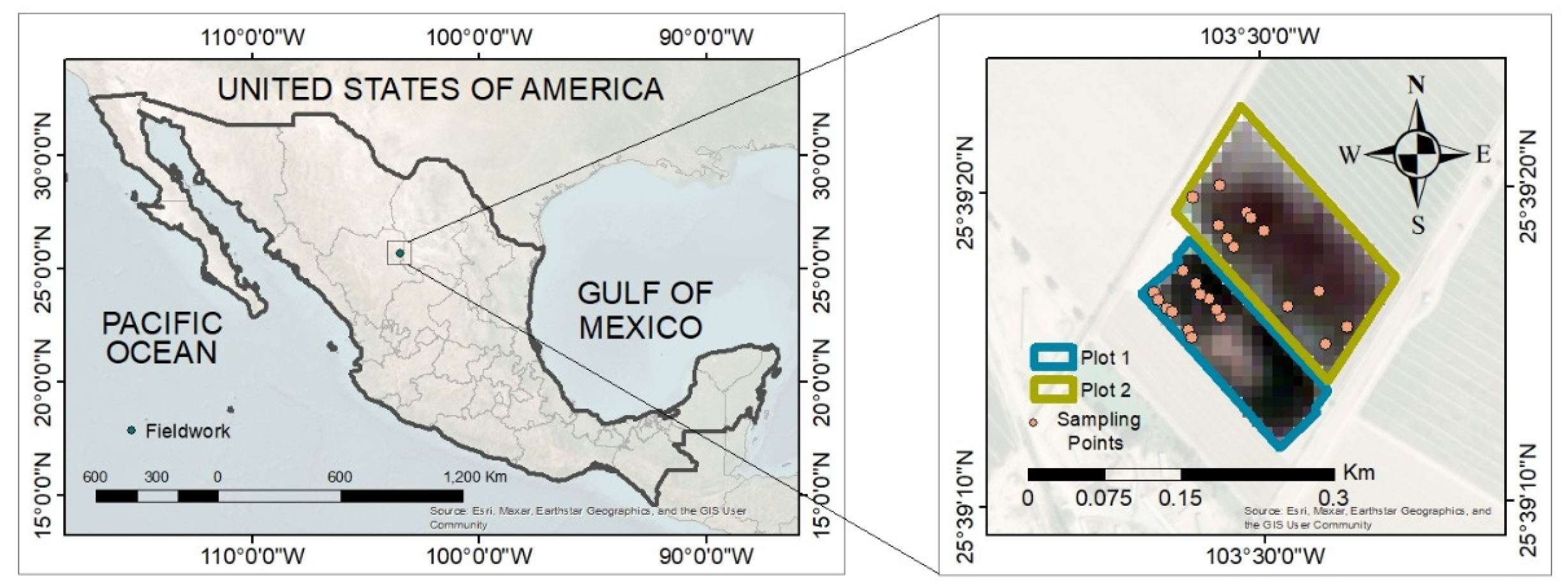
Figure 2.
Pearson correlation matrix with different vegetation indices.
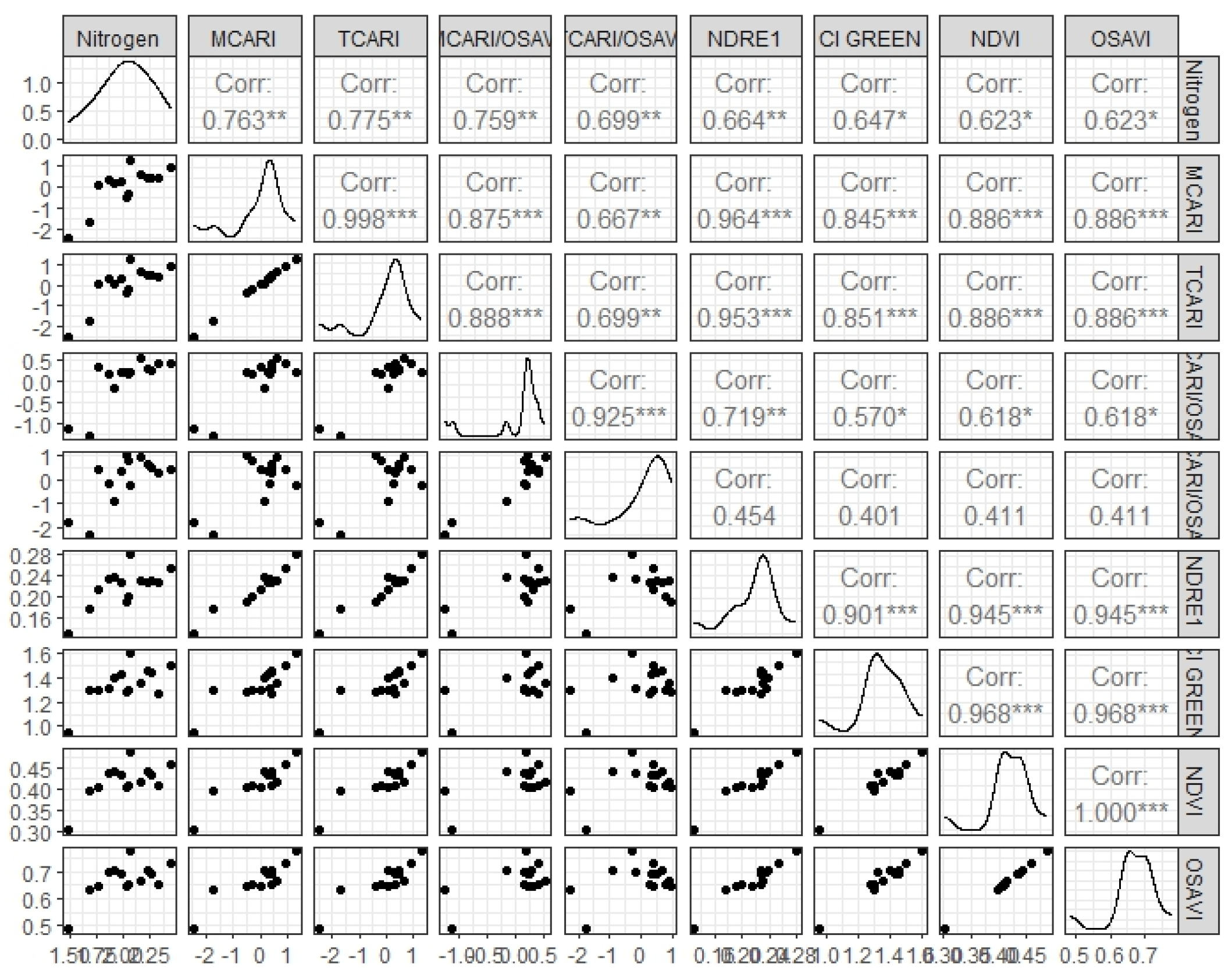
Figure 3.
Classic multiple linear regression model for nitrogen estimate (a). Random Forest for nitrogen estimate (b).
Figure 3.
Classic multiple linear regression model for nitrogen estimate (a). Random Forest for nitrogen estimate (b).

Figure 4.
Gradient boosting model for Nitrogen estimation (a). Relative influence of the indices (b).
Figure 4.
Gradient boosting model for Nitrogen estimation (a). Relative influence of the indices (b).
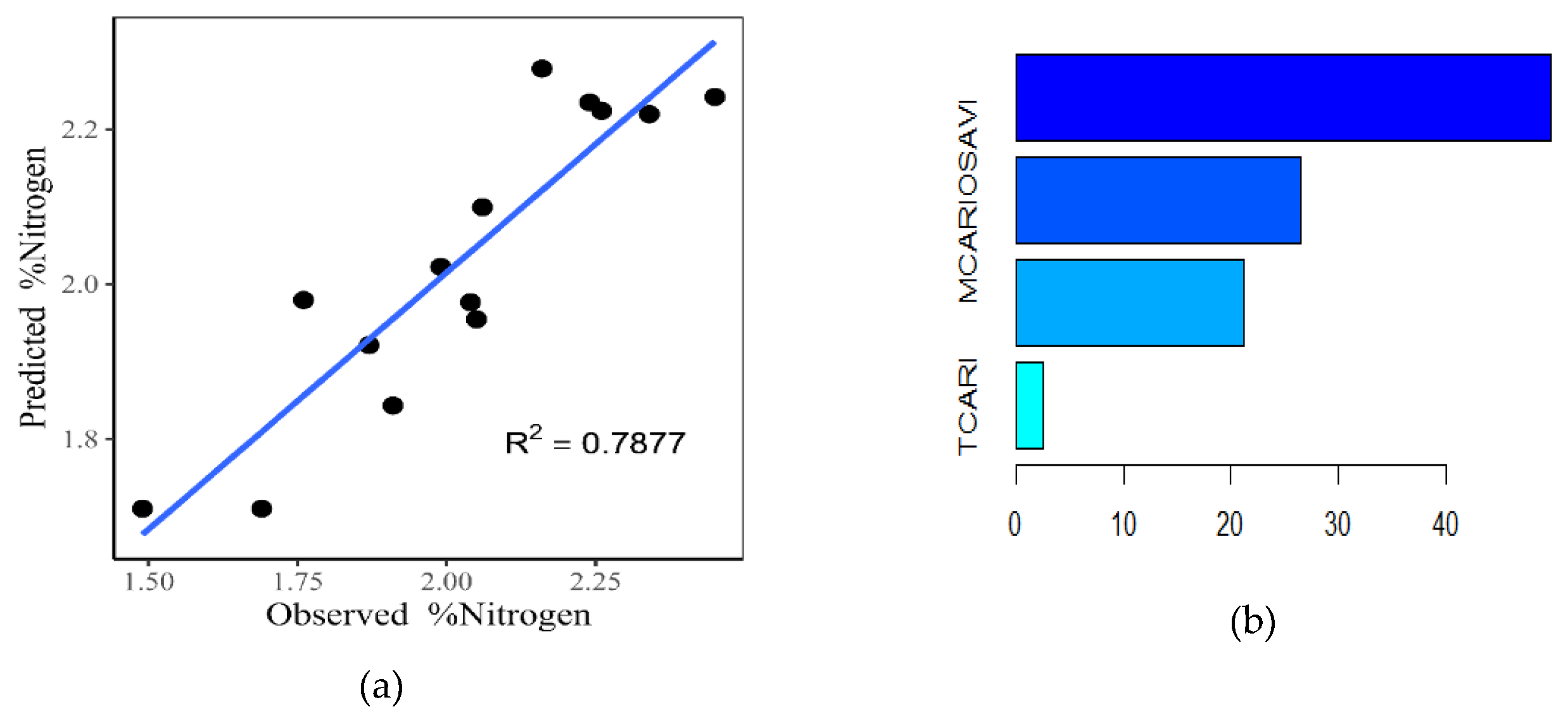
Figure 6.
Scatterplot of the Neural Network Model for Nitrogen Estimation (a). Conceptualization of Artificial Neural Networks with the selected vegetation indices (b).
Figure 6.
Scatterplot of the Neural Network Model for Nitrogen Estimation (a). Conceptualization of Artificial Neural Networks with the selected vegetation indices (b).
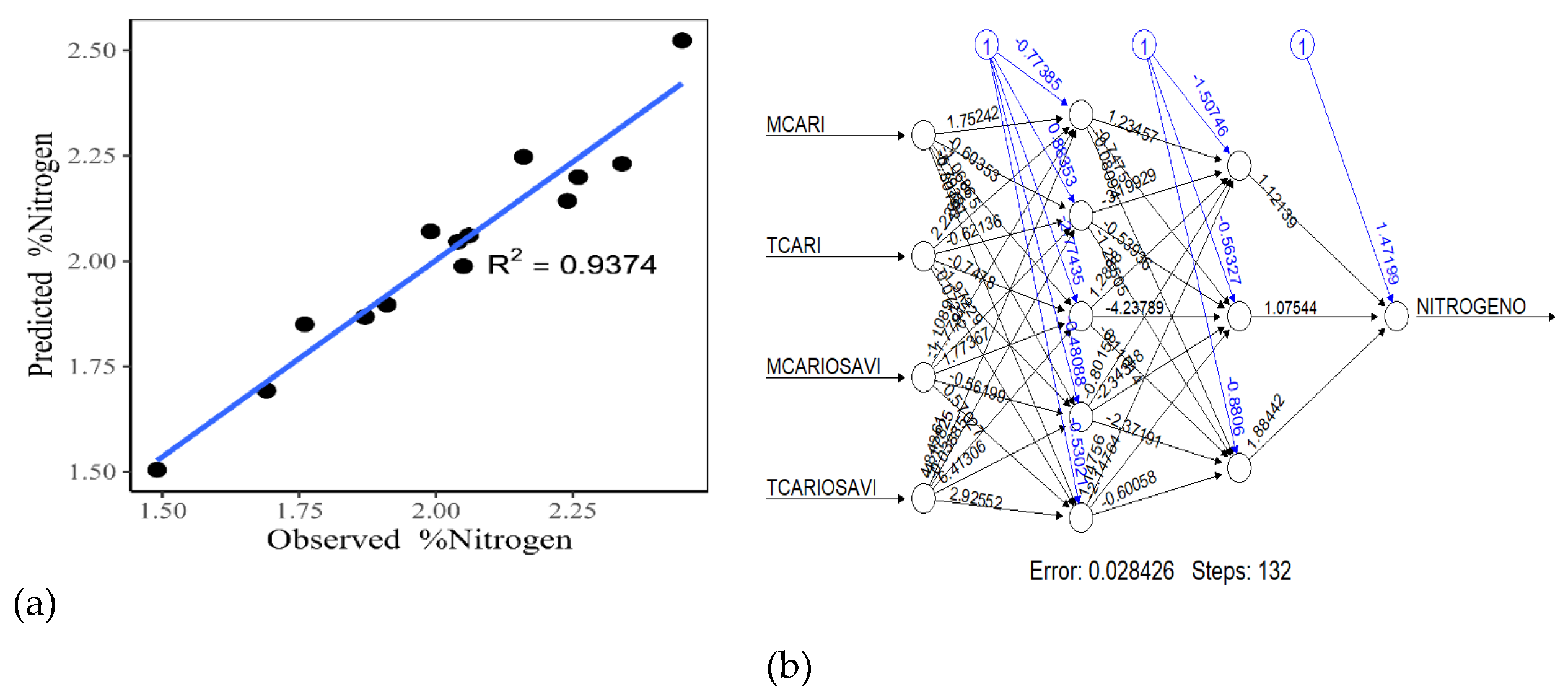

Table 1.
Soil characterization of the study area at the beginning, middle, and end of the 2022 production cycle.
Table 1.
Soil characterization of the study area at the beginning, middle, and end of the 2022 production cycle.
| Beginning | Middle | End | ||||
| P1 | P2 | P1 | P2 | P1 | P2 | |
| Texture | Clay | Clay | Clay | Clay | Clay | Clay |
| Bulk density | 1.54 | 1.61 | 1.62 | 1.69 | 1.46 | 1.52 |
| pH | 8.2 | 8.0 | 8.2 | 7.8 | 8.3 | 8.1 |
| Electrical conductivity | 9.8 | 12.06 | 7.29 | 14.58 | 5.01 | 15.11 |
| Organic matter | 0.532 | 0.359 | 1.48 | 1.485 | 1.668 | 2.152 |
| %N | 0.082 | 0.069 | 0.123 | 0.134 | 0.165 | 0.143 |
| P (mg kg-1) | 38.88 | 31.59 | 29.47 | 25.64 | 44.79 | 33.77 |
Table 2.
Selected spectral indices for Nitrogen determination.
| Index | Model | Reference | |
|---|---|---|---|
| CI green | Chlorophyll index green | [28] | |
| MCARI 750,705 | Modified Chlorophyll Absorption in Reflectance Index 750,705 | [29] | |
| MCARI /OSAVI 750,705 | (MCARI/OSAVI) 750,705 | [29] | |
| NDRE 1 | Normalized difference red-edge 1 | [30] | |
| NDVI | Normalize difference vegetation index | [31] | |
| OSAVI | Optimized Soil Adjusted Vegetation Index | [32] | |
| TCARI 750,705 | Transformed Chlorophyll Absorption in Reflectance Index | [29] | |
| TCARI/OSAVI 750,705 | (TCARI/OSAVI) 750,705 | [29] |
Disclaimer/Publisher’s Note: The statements, opinions and data contained in all publications are solely those of the individual author(s) and contributor(s) and not of MDPI and/or the editor(s). MDPI and/or the editor(s) disclaim responsibility for any injury to people or property resulting from any ideas, methods, instructions or products referred to in the content. |
© 2024 by the authors. Licensee MDPI, Basel, Switzerland. This article is an open access article distributed under the terms and conditions of the Creative Commons Attribution (CC BY) license (http://creativecommons.org/licenses/by/4.0/).
Copyright: This open access article is published under a Creative Commons CC BY 4.0 license, which permit the free download, distribution, and reuse, provided that the author and preprint are cited in any reuse.


