

Submitted:
02 May 2024
Posted:
06 May 2024
You are already at the latest version
Abstract
The study of innovation in the public sector has attracted increasing interest in the last decade. Contributions of the literature concerning its possible innovation drivers and inhibitors have primarily had a theoretical or documentary perspective; empirical studies are scarce, as are work-team studies in organizations of this sector. The present study therefore focuses on identifying and understanding those variables or factors that induce or inhibit innovative activity in work teams in public organizations in a developing country. The research focus is qualitative, and 16 directors of 13 public Costa Rican institutions were interviewed for the study. A set of coding methods allowed to identify 19 thematic categories of variables linked to the capacity to generate innovations in these work teams.
Keywords:
innovation
; determinants
; public institutions
; work teams
1. Introduction
The relevance of innovation in the public sector (IPS) has been recognized in the literature. Mulgan and Albury (2003) consider that IPS is a core activity in increasing the responsiveness of state services to local and individual needs; helping to contain cost pressures by improving efficiency in the provision of public services; and improving the results of public services. For their part, De Vries, Bekkers and Tummers (2015) identified studies that emphasize the achievement of efficiency and effectiveness objectives thanks to the implementation of IPS.
Given the foregoing, it is not surprising that interest in IPS has increased in the last decade. Thus, for example, Matthews, Lewis, and Cook (2009) have found that 52% of the total number of articles related to this topic published between 1971 and 2008 in the Thomson-Reuters database correspond to the period 2006-2008. The increasing attention paid to this topic has led to the incorporation of special sections dedicated to the subject in books, and the publication of scientific articles in specialized journals (Van Duivenboden & Thaens, 2008). Despite the increase in absolute numbers of IPS-related publications, they still represent only a small subset of the total number of publications on innovation (Gow, 2014).
As part of this boom, studies have been carried out to identify the factors that inhibit or promote the generation of IPS from a theoretical or documentary perspective (De Vries et al., 2015; Kamal, 2006, Glor, 2001). However, the contribution of empirical evidence to the study of this phenomenon has been not enough (Potts & Kastelle, 2010; Pärna& von Tunzelmann, 2007; Vigoda-Gadot, et al., 2008; Damanpour & Schneider 2008). In addition, most of these studies have been carried out in the United States and England, giving them an Anglo-American perspective (De Vries et al., 2015).
On the other hand, research on IPS has focused mainly on the factors that promote innovative behavior in individuals (Borins, 2001;Damanpour& Schneider, 2008; Fernández & Moldogaziev, 2012; Yu et al, 2013; Nijenhuis, 2015), or on the generation of innovation at an organizational level (Riivari et al., 2012; Shoham et al., 2012; Bugge et al., 2011; European Commission, 2010; Hughes, Moore, Katarina, 2011; APSII, 2011), and less attention has been paid to innovation in work teams (Caldwell & O'Reilly III, 2003).
Although these three levels of analysis overlap – that is, the factors that affect the individual and the organization can affect the generation of innovation in work teams (Sears & Baba, 2011; Woodman, Sawywer & Griffin, 1993) – it has also been pointed out that the factors that promote innovation at one level can inhibit it at another, so each level must be explored to better understand the network of relationships that encourage innovative activity in the organization (Anderson, De Dreu & Nijstad, 2004).
Taking these points into account, this study focuses on identifying and understanding those variables or factors that induce or inhibit innovative activity in work teams of public organizations, in a developing country. To this aim the study has been organized into four sections. The first presents essential concepts of the study and the determinants of innovative activity in work teams that have been discussed in the literature, to provide a reference for the analysis of results. The second describes the method, while the third section presents the main findings of the study. The fourth section presents conclusions and suggests further lines of research.
2. Literature Review
Innovation in the Public Sector
In general, the conceptualization of IPS has focused on two generic features: a) the development or introduction of ideas, practices, services, processes and novel solutions (Rogers, 1983, Klein et al., 2010); and b) the introduction of adaptations of innovative ideas developed in other organizations or contexts (NAO, 2009, Newman, 2001). In addition, the literature has recognized that the utility, functionality and capacity of an innovative idea to solve problems for target users are essential elements for recognizing innovation (Freeman, 1975; Amabile et al., 1996). Therefore, an important attribute of innovation is that a practice that is "new" or "readapted in another context" is transformed into something that is accepted and useful, or has a practical use; consequently, it is more than an aspiration or a planned initiative (Newman, 2001).
IPSs can lead to new services, new forms of organization, process improvements, articulation and coordination of inter-institutional efforts (Moore & Hartley, 2008), re-conceptualization of visions that challenge assumptions upon which public services are based, or processes and organization of public institutions (Windrum & Koch, 2008), as well as the way in which political instruments are designed to achieve objectives (Windrum & Koch, 2008). They can be oriented towards influencing the efficiency, effectiveness and quality of services, as well as generating benefits for populations and communities (Albury, 2005).
Work Teams
Based on various authors, Kozlowski and Ilgen (2006, p.79) take into account seven distinctive features when conceptualizing work teams. These are teams made up of two or more individuals; they involve social interaction (face to face or virtually); they maintain one or more common objectives; they cooperate to carry out tasks relevant to the organization; they express an interdependence related to work flow, goals and results; they have different roles and responsibilities; and they are integrated into a comprehensive organizational system, with limits and links to the broader context of the system and the environment of tasks.
In addition, work groups are formal or permanent teams of individuals, whose fundamental purpose is centered on the production of a good or service designed for internal or external customers (Rousseau, Aubé & Savoie, 2006, p. 540-541). Furthermore, a) they have the authority, autonomy and resources necessary to achieve their objectives; b) their work significantly affects others within the organization; and c) they are recognized as a team by their members and by others in the organization (West, 2004, p.18).
Innovation in Work Teams
One of the generally accepted definitions of innovation in work sites or environments is provided by West and Farr (cited by Anderson, De Dreu & Nijstad, 2004, p.148), who conceive of it as the deliberate introduction and application of novel ideas, processes, products or procedures within a job, a group or an organization, which are designed to improve a job, a team, an organization, or society in general.
Two elements have been clearly distinguished in innovation in work teams. On the one hand, creativity, the phase of the innovative process that nurtures the generation of ideas, and on the other, innovation, the phase in which ideas are implemented. However, Anderson, Potočnik and Zhou (2014) consider that these two components are interrelated and are the process, result, and product of efforts to achieve the development and introduction of new and improved ways of doing things at work.
Determinants of Innovation in Work Teams
The literature reviewed on innovation in work teams shows that its drivers are organized in a multidimensional and complex structure because of the broad diversity of innovation drivers, in which variables of four major dimensions are intertwined: the external environment, the organizational context, the context within the team and characteristics of the members that make up the team. Table 1 gathers and conceptualizes the different subdimensions associated with possible innovation drivers in work teams based on the West and Hirst model (2003), and contributions by Caldwell and O'Reilly III (2003), Janssen, Van de Vliert and West (2004), Hülsheger, Anderson and Salgado (2009).
As can be seen in Table 1, these drivers can be classified in four dimensions. The first one corresponds to the variables external to the organization such as the demands by external actors, or the culture of the society where the organization is immersed. In second place are the diverse structural characteristics and those of its team members. In the third place, reference is made to the internal processes of the team, such as the degree of cohesion, capacity for conflict resolution, strategic orientation, among others. Finally, the attributes of the individuals that make up the team, such as the traits of the team leader, the innovative behavior of the employee, among others are determined.
This compendium of innovation drivers is consistent with the heuristic developed by Kozlowski and Ilgen (2006) to explain the effectiveness of work teams. In their scheme, the actions of teams are influenced by factors occurring at multiple levels – of the individual, the team, and the organization (see Figure 1) – because these teams are integrated within an open but organizationally limited system with various nested levels.
The team generates products that solve demands of tasks that arise from the surrounding system and change the state of the system in some way. The way in which the team manages to align its processes to requirements of the system can determine its level of effectiveness or responsiveness. Team processes are states or ways to coordinate efforts of team members and their cognitive, motivational/affective, and behavioral resources. Learning, acquisition of skills, and development of skills are variables that affect the ability to align team processes. These can be improved as team members accumulate experience and learn how to work together.
This scheme for innovation drivers is also theoretically supported by the model of innovation in work teams proposed by West and Hirst (2003), using an input-process-product structure. As shown in Figure 2, these authors propose three possible categories of variables that influence the generation of innovation. The first of these is the organizational context, in which culture, the climate for innovation, and the external demands that are imposed on the work teams are considered as external variables that induce innovation. The other two categories have to do with variables within the team context, such as task requirements and diversity of team members, and team process variables, including leadership and participation of collaborators. Their model assumes that team leaders play a decisive role in moderating the effects of organizational contexts and teams on processes.
3. Method
Sample
Qualitative data sources were obtained through interviews with work team´s Supervisors in public organizations. The theoretical sampling was used (Eisenhardt, 1989) seeking to understand a construct and its variations, specifically, to identify the expressions or traits of the construct being studied (Patton, 2002). The sampling was designed to include informants from: a) various types of public institutions, according to their economic nature, capacity in the management of public resources, and political-administrative capacity, categorized according to the institutional classification system (Ministerio de Hacienda, 2011): Central Government (CG), Decentralized Body (DB), Non-Business Decentralized Institution (NBDI) and Non-Financial Public Company (NFPC); b) institutions in different sectors, and c) institutions with different organizational functions (with activities mainly oriented towards either internal or external users). An attempt was made to arrive at a number of data considering the saturation criterion, defined by Bowen (2008) as the point that "is reached when the researcher gathers data up to the point of diminishing returns, when nothing new is being added” (p.140).
As shown in Table 2, 16 Supervisors from 13 Costa Rican public institutions were interviewed: 5 from NBDIs, 3 from NFPCs, 3 from CGs, and 2 from DBs. In three institutions two interviewed worked in different departments. The main activities of these thirteen institutions were diverse (See column 4). It should be noted that the main function of 43.8% of the teams was internal – mostly administrative activities affecting internal users – while the remaining 56.2% were primarily functionally oriented towards attention to, or contact with, external users.
Procedures for Collection and Analysis of Information
A semistructured face-to-face interview was conducted, using a few number of open-ended questions to elicit opinions and views from the participants (Creswell, 2014). Interviewees were asked to describe the types of innovations implemented by their department during the last two years; as well as, to provide information on the incidence of: a) factors that promoted or hindered the development of the innovations that were implemented, b) factors that limited the implementation of innovative ideas and, finally, c) current factors that can positively or negatively influence innovation in their department. Finally, each interviewee was asked to comment on factors not mentioned during the interview that could be related to the introduction of innovations in their work teams.
The interviews were recorded on audio, with permission of the respondent. Their average duration was 40 minutes and they were transcribed verbatim. Subsequently, NVIVO 10.0 software was used to process qualitative data. In a first coding cycle, relevant text or citations were identified; provisional coding enables to have a start list of codes obtained from previous review of literature; then, subcoding and structural coding methods were used to organize citations into initial preliminary categories, and to gather topics lists; subsequently themeing the data was carried on searching for themes in the verbal data (Saldaña, 2013). In a second coding cycle, and elaborative coding method was conducted to refine the grouping of themes and thematic subcategories and categories (Saldaña, 2013). The dimension represents the last thematic level of each grouping of citations. Likewise, for large qualitative data sets, analytical techniques such as structural coding, frequencies of words or phrases and co-occurrence of codes were used for their reduction or synthesis, as suggested by Namey, Guest, Thairu and Johnson (2008) and Guest, MacQueen and Namey (2012). Relative frequencies were generated for each subcategory, category and dimension, after which they were summarized in a graphic format. The presentation and synthesis format recommended by Vargas-Halabi, Mora-Esquivel, and Acuña (2015) was used as a reference.
4. Results
The analysis enables the extraction of 213 citations from the transcribed documents, whose content refers to drivers or inhibitors of innovative initiatives in interviewee work teams. These texts were assigned to subcategories based on thematic affinity, which were then grouped into analogous thematic categories that, finally, shared a thematic dimension. Table 3 summarizes the two levels of greatest grouping of all these texts. Based on thematic contents, the citations were distributed into 19 different thematic categories. The relative frequency of each dimension with respect to the total number of textual citations mentioned above is indicated in parentheses.
The largest number of citations corresponded to four thematic categories addressing topics related to innovation determinants in work teams which come from agents external to the organization (29%). A second block was made up of 7 thematic categories, which emphasized verbal expressions related to team's internal dynamics which could have an impact on its innovative activity; these accounted for 29.1% of the total citations. The third group of 55 texts (25.8%) was divided into 5 categories with a common theme of innovation drivers related to the organization in which the work teams do not have a direct influence. Finally, 33 citations (15.5%) were assigned to 3 categories, whose texts referred to aspects of the profiles of coworkers in the work team which could be related to the generation of innovations.
Figure 3, Figure 4, Figure 5 and Figure 6 show the categories developed in each dimension, the subcategories that make up each category, and the themes that give rise to the subcategories. By reading the themes it can be understand what each subcategory consists of. Besides, for each category and subcategory, the figures show the relative frequency of textual citations related to external subjects with respect to the total of comments expressed by the interviewees, and the proportion of the 16 interviewees who provided textual citations.
5. Discussion and Conclusion
The purpose of this research was to identify and understand variables that promote or inhibit innovative activity in work teams of public organizations in the context of a developing country. The analysis of 213 citations allowed the identification of 19 categories of variables linked to the capacity to generate innovations in work teams. This set of innovation drivers are multidimensional and multilevel, as suggested by heuristics in the literature (Kozlowski & Ilgen, 2006, West & Hirst, 2003). The thematic contents of these categories, as expressed by the interviewees, allowed grouping them into four levels: external to the organization, organizational context, dynamics of the team, and characteristics related to team members.
The present study also reveals diverse mechanisms that underlie these categories. In the first level, a greater portion of verbal expression was found to be related to the exposure of public organizations to different actors that become sources of external pressure to promote or inhibit innovation, as suggested by other authors (Rogers-Dillon, 1999, Lonti & Verma, 2003). For example, the media promote innovation when they publish news that emphasize the search for novel solutions to problems, but they also inhibit it when they report errors or failures of innovative projects. Exposure of public organizations to media scrutiny can therefore increase the fear of taking risks (Mulgan and Albury, 2003). It can also inhibit the wish of high-ranking politicians to promote changes, since the failure of an innovative project could detract from their other efforts or have negative consequences on their political careers (Mulgan & Albury, 2003, Koch & Hauknes, 2005).
Politicians who come to occupy high positions are also external actors with the ability to promote innovative projects in work teams, or to curb them, especially when existing authorities are replaced with others who do not wish to continue with innovative ideas promoted by their predecessors, as stated by two interviewees. Private external agents can become an inhibiting factor when an innovative project threatens their economic interests, leading them to apply pressure to stop its implementation. On the other hand, users of public services are a source of pressure for innovation when they demand changes, but are also a source of valuable information for organizations without waiting for users to generate pressure to know what areas to innovate in. There are organizations that develop the necessary means to obtain user feedback through surveys, suggestion boxes, or other mechanisms. In these cases, it is the internal dynamics of the department rather than external pressure that allows them to obtain innovative ideas.
Another aspect of the external context which was perceived to exert an influence on the ability to generate innovation in work teams is the regulatory framework. Comments of interviewees emphasized that regulations, which the public sector is subject to, can cause a good idea to not even reach the stage of implementation, due to difficulties with changing rules or laws. This is in line with reports in the literature that a regulatory framework within a centralized and hierarchical institutional framework affects the degree of authority and availability of resources that can enable work teams to initiate innovations on their own (Micheli et al, 2012; Kovács, 2012). However, an idea that is supported by regulatory or legal frameworks has a great potential to be implemented
On the other hand, the qualitative data collected points to positive contributions of inter-institutional relations in the generation of innovation by work teams. These links are useful in discovering practices and innovations that other teams (in similar local or international public organizations) have implemented, and also allow access to knowledge and resources that other organizations have. This is in agreement with what was reported by several researchers who have found that it is not possible to promote and sustain innovation when organizations are self-centered (Osborne & Brown, 2011). All this seems to point to the conclusion that to promote innovation in work teams, it is essential to create open systems of collaboration between organizations and society. De la Maza (2003) states that collaboration of different social agents is required to achieve radical innovations, and that it is therefore vital to improve connections and links between organizations and society. In turn, the joint participation of diverse actors contributes to reflecting the diversity of visions of the population, which creates legitimacy in what is done (Van Buuren & Loorbach, 2009).
In the organizational context level, the study confirms variables identified in the literature that affect the ability of teams to innovate, such as: having a unit or program dedicated to research and innovation (ARC Fund, 2013); having the financial, human or other necessities required by an innovative project (Mulgan and Albury, 2003, Koch and Hauknes, 2005, ARC Fund, 2013, Maranto & Wolf, 2013); and having the support of high-level authorities in the development of new projects, especially those with a wide scope (ARC Fund, 2013, Vigoda-Gadot et al., 2008). In addition, this study highlights the negative effect on the development of innovative projects in work teams of a lack of technical knowledge on the part of managers with the power to allocate budget or support it. As a result, the ability of a work team to easily explain the technical details of a project and to clarify the costs/ benefits of the project to authorities becomes relevant.
Another essential element recognized by some interviewees in successful innovation is that the organization has a clear direction and a well-defined strategy to achieve its objectives and goals, which not only helps to visualize what types of innovation are needed, but also leads the team towards a goal that allows to trigger and justify innovative solutions to higher authorities. This view is in accordance with evidence provided by Abdullah et al., (2014), who found that a clear strategic direction in the organization –in terms of vision, objectives and goals – correlates with product innovation in the private sphere. In addition, according to Moon (1999), clarity in the mission of the organization promotes internal entrepreneurship, because it generates the flexibility necessary to take risks, as well as motivation and a better understanding of the organization's strategies.
Another factor that could influence the generation of innovation is the effect that a labor union can have on discouraging an innovative project that contrasts with their interests. This highlights the fact that innovative projects in work teams require not only the support of high-level authorities, but must also deal with other internal powers.
In team's own dynamics level, it was found that innovation drivers mentioned in the literature on ISP such as: teamwork, willingness to learn, employee empowerment, openness to team change, commitment to continuous improvement, and recognition and incentives for good work (Nijenhuis 2015, Alsos, Clausen, Isaksen, 2015, Lonti &Verma, 2003, Mulgan & Albury, 2003, Koch and Hauknes, 2005, Fernández and Moldogasiev 2012 ), are also found in the private sphere (Hogan and Coote, 2013, McLaughlin, Bessant and Smart, 2008, Liu, 2009, Dombrowski et al, 2007, Caldwell and O'Reilly III, 2003, Hulsheger, Anderson and Salgado, 2009 ).
However, this study offers interesting findings about how and why these factors promote innovation. In the public sector, teamwork is not only necessary to promote the communication of ideas that facilitate creativity and cooperation during the implementation of an innovation, but can also be decisive in determining if an innovation process that has already been implemented will work properly. With reference to the latter point, effective integration and trust between work teams are necessary to arrive at a consensus, and legitimize a possible innovative idea.
The relevance of promoting learning and the acquisition of knowledge is known to stimulate creativity and empowerment through innovation (Yu, Yu & Yu, 2013; Fernández & Moldogasiev, 2012; Fierro, Mercado & Cernas, 2013). According to Townsend (2013), the public sector must develop a culture of accumulation and communication of experiences to improve its capacity for innovation. However, both successful and unsuccessful experiences should be shared to build a better understanding of how innovation can be achieved. In the qualitative interviews carried out in this study, various means are proposed to promote institutional learning and the flow of knowledge. Some highlight the proactive search for information and knowledge as part of work dynamics, through consultation with experts, searching websites, and investigating what other institutions do, while others emphasize the importance of transmitting internal knowledge.
Empowerment helps to promote innovative behavior of coworkers (Bysted & Rosenberg Hansen, 2013; Lonti &Verma, 2003). To achieve this, it is necessary that the work dynamic gives team members autonomy in how to carry out their work, allows them to participate in decision-making, and gives them the confidence to express their ideas. With regard to this last point, it is notable that one interviewee stated that making fun of new ideas can cause people to avoid expressing them, thus becoming a possible inhibitor of innovation within the team.
Another underlaying factor is commitment to continuous improvement by team work. This could be encouraged by legitimizing values and norms that highlight the relevance of day-to-day improvement and promoting self-criticism as a mechanism for self-evaluation. Elements external to the work team can promote the development of such commitment. For example, instances such as institutional auditing or regulatory bodies can become sources external to the team that drive the development of continuous improvement.
Some authors have argued that the absence of economic incentives that motivate employees to become involved in innovation is a barrier to innovation in the public sector (Mulgan & Albury, 2003, Koch & Hauknes, 2005, Kovács, 2012). However, the comments of interviewees show that non-monetary incentives can also contribute to the involvement of coworkers. Verbal recognition of good work by the supervisor of the work team and/or their own colleagues is a mechanism that can encourage involvement.
Eliminating the time needed for daily tasks can remove an important inhibiting factor, allowing teams to dedicate themselves to the search for improvements and changes (Mulgan & Albury, 2003, Koch and Hauknes, 2005). According to the interviewees, staff members are frequently dedicated to "putting out fires", or routine work that leaves them less opportunities to think about what can be improved, or to spend time implementing an idea. One tool against this problem is the development of software and new systems that allow people to reduce the time they dedicate to operational tasks. Training on the effective use of time can also be useful in this regard. However, for this to take place, the organization must place a strong emphasis on the development of innovation.
Several authors have stated that the degree of specialization and knowledge of collaborators is an essential element for the development of innovation (Alsos et al, 2015, Jaskyte, 2011, Gurova & Kurilov, 2015). This is totally consistent with statements made by interviewees about the need to have highly trained professionals with extensive experience within the organization to detect feasible new ideas to be implemented and to overcome barriers encountered during the process of project execution.
At the individual level, another aspect highlighted by interviewees is the relevance of having young people in the team, because they are favorably disposed to change. This is supported by studies which have shown a positive association between the youth of members and the innovative behavior of the team (Hite, Williams, Hilton & Baugh, 2006; Young, Charns & Shortell et al., 2001). Although the youth of team members is an advantageous element for innovation, these sources also note that it is ideal to combine youth and experience in work teams, with youth providing openness and drive, experience providing discernment, and both providing knowledge.
In keeping with the literature, this study reveals that combining various skills and knowledge in a work team favors innovation. Diversity in teams helps in making better decisions in solving problems, because diversity of thought contributes to more realistic and complex analysis of contexts (Milliken & Martins, 1996). In addition, combining diverse knowledge and skills generates greater creativity and innovative ideas (Milliken & Martins, 1996; Shore et al., 2009). According to some interviewees in this study, diversity of professions and multidisciplinary work is one of the factors that has allowed them to innovate.
Finally, the results of this investigation suggest a link between the commitment of collaborators and positive attitudes. Having committed members who stimulate the willingness of others to become involved with innovation and assume the responsibilities required by a project was highly valued by interviewees. However, this commitment must be accompanied by a positive attitude to maintain perseverance and resilience in the face of difficulties. Even if there is creativity, without a positive attitude there will be no push towards implementation.
Lines for Future Research
Since this is a qualitative study, it would be valuable to continue with a quantitative study based on data from a sample of work teams in public organizations, which allows testing the effects of factors with possible positive and negative impacts on innovation suggested in this investigation. This would make it possible to concentrate efforts on providing explanatory models using the variables of different dimensions presented here to provide a generalizable systemic explanation of the phenomenon of innovation in work teams in the public sector.
Another interesting aspect to be investigated is the interrelationships between the four dimensions presented here, as the variables of one level can mediate the effect of the variables of another level, or there may be a circulating effect between variables at different levels. It is also necessary to determine the roles of each level and the different variables in the different stages of the process of innovation, that is, in the exploration of ideas, generation of ideas, promotion of ideas, and their implementation.
References
- Abdullah, N.H.; Shamsuddin, A.; Wahab, E.; Hamid, N.A.A. The Relationship between Organizational Culture and Product Innovativeness. Procedia - Soc. Behav. Sci. 2014, 129, 140–147. [CrossRef]
- Albury, D. Fostering innovation in public services. Public money and management, v.25, n.1, p.51-56, 2005.
- Alsos G.A., Clausen T.H., Isaksen E.J, Innovation Among Public-Sector Organizations: Push and Pull Factors. In: Leitão J., Alves H. (eds) Entrepreneurial and Innovative Practices in Public Institutions. Applying Quality of Life Research (Best Practices). Springer, 2016.
- Amabile, T., Conti, R., Coon, H., Lazenby, J., & Herron, M. Assessing the work environment for creativy. Academy of Management Journal, v.39 n.5, p.1154-1184,1996.
- Anderson, N., De Dreu, C., & Nijstad, B. The routinization of innovation research: A constructively critical review of the state-of-the-science. Journal of Organizational Behavior, v.25, n.2, p.147-173, 2004.
- Anderson, N., Potočnik, K., & Zhou, J. Innovation and creativity in organizations: A state-of-the-science review, prospective commentary, and guiding framework. Journal of Management, v.40, n.5, p.1297-1333, 2014.
- APSII. Working towards a measurement framework for public sector innovation in Australia, 2013, Retrieved from https://innovation.govspace.gov.au/sites/g/files/net1566/f/files/2011/08/APSII-Draft-Discussion-Paper.pdf.
- ARC Fund. Innovation in the Public Sector State-of-the-Art Report. Sofia: Bulgaria, 2013, Retrieved from http://www.ccic-project.eu/wp-content/uploads/2013/10/CCIC-State-of-the-art-report-SotAreport.pdf.
- Bugge M., Mortensen P., Bloch C, Measuring Public Innovation in Nordic Countries, NIFU, Norway, 2013, Retrieved from http://www.nordicinnovation.org/Publications/measuring-public-innovation-in-the-nordic-countries-mepin/.
- Borins, S. Encouraging innovation in the public sector. J. Intellect. Cap. 2001, 2, 310–319. [CrossRef]
- Caldwell, D., & O'Reilly III, C. The determinants of team-based innovation in organizations: The role of social influence. Small Group Research, v.34, n.4, p.497-517, 2003.
- Creswell, J. Research design: Qualitative, quantitative and mixed method approaches (Fourth ed.). California: Sage Publications, 2014.
- De la Maza, G.Innovaciones ciudadanas y políticas públicas locales en Chile. Reforma y Democracia, v.26, p.137-164, 2003.
- DE Vries, H.; Bekkers, V.; Tummers, L. Innovation in the public sector: a systematic review and future research agenda. Public Adm. 2015, 94, 146–166. [CrossRef]
- Damanpour, F.; Schneider, M. Characteristics of Innovation and Innovation Adoption in Public Organizations: Assessing the Role of Managers. J. Public Adm. Res. Theory 2008, 19, 495–522. [CrossRef]
- Dombrowski, C., Kim, J. Y., Desouza, K. C., Braganza, A., Papagari, S., Baloh, P., & Jha, S. Elements of innovative cultures. Knowledge and Process Management, v.14, n.3, p.190-202, 2007.
- European Commission. Innobarometer 2010. Flash EB Series #305, 2010, Retrieved from http://ec.europa.eu/commfrontoffice/publicopinion/flash/fl_305_en.pdf.
- Fernandez, S.; Moldogaziev, T. Using Employee Empowerment to Encourage Innovative Behavior in the Public Sector. J. Public Adm. Res. Theory 2012, 23, 155–187. [CrossRef]
- Fierro, E., Mercado, P. and Cernas, D.A. The effect of knowledge–centered culture and social interaction on organizational innovation: the mediating effect of Knowledge management. Esic Market Economics and Business Journal, v.44, n.2, p.67-86, 2013.
- Freeman, C. La teoría económica de la innovación industrial. Madrid: Alianza Editorial, S.A, 1975.
- Glor, E. D. Key factors influencing innovation in government. The Innovation Journal, v.6, n.2, p.1-20, 2001.
- Gow, J. Public Sector Innovation Theory Revisited. The Innovation Journal, v.19, n.2, p.1-22, 2014.
- Guest, G., MacQueen, K.M. & Namey, E. Applied thematic analysis. California: SAGE Publications, Inc, 2012.
- Gurova, A., & Kurilov, M. Employee-driven innovation in the public sector. Unpublished Masters Thesis. University of Nordland, Norway, 2015.
- Hite, J.M.; Williams, E.J.; Hilton, S.C.; Baugh, S.C. The Role of Administrator Characteristics on Perceptions of Innovativeness among Public School Administrators. Educ. Urban Soc. 2006, 38, 160–187. [CrossRef]
- Hogan, S. J., & Coote, L. V. Organizational culture, innovation, and performance: A test of Schein's model. Journal of Business Research, v.67, n.8, p.1609-1621, 2014.
- Hughes, A., Moore, K., & Kataria, N. Innovation in Public Sector Organizations: A pilot survey for measuring innovation across the public sector. London: NESTA, 2011, Retrieved from https://www.bl.uk/collection-items/innovation-in-public-sector-organisations-a-pilot-survey-for-measuring-innovation-across-the-public-sector.
- Hülsheger, U.R.; Anderson, N.; Salgado, J.F. Team-level predictors of innovation at work: A comprehensive meta-analysis spanning three decades of research.. J. Appl. Psychol. 2009, 94, 1128–1145. [CrossRef]
- Janssen, O.; van de Vliert, E.; West, M. The bright and dark sides of individual and group innovation: a Special Issue introduction. J. Organ. Behav. 2004, 25, 129–145. [CrossRef]
- Jaskyte, K. Transformational leadership, organizational culture, and innovativeness in nonprofit organizations. Nonprofit Manag. Leadersh. 2004, 15, 153–168. [CrossRef]
- Kamal, M. IT innovation adoption in the government sector: identifying the critical success factors. J. Enterp. Inf. Manag. 2006, 19, 192–222. [CrossRef]
- Klein, P.G.; Mahoney, J.T.; McGahan, A.M.; Pitelis, C.N. Toward a theory of public entrepreneurship. Eur. Manag. Rev. 2010, 7, 1–15. [CrossRef]
- Koch, P., Hauknes, J.On Innovation in the Public Sector. Public Report No. D20. NIFU STEP, Oslo, 2005, Retrieved from http://www.step.no/publin/.
- Kovács, O. Policies Supporting Innovation in Public Service Provision. DG Enterprise and Industry, PRO INNO Europe® INNO-Grips II, 2012.
- Kozlowski, S.W.; Ilgen, D.R. Enhancing the Effectiveness of Work Groups and Teams. Psychol. Sci. Public Interes. 2006, 7, 77–124. [CrossRef]
- Liu, S. Organizational culture and new service development performance: insights from knowledge intensive business service. Int. J. Innov. Manag. 2009, 13, 371–392. [CrossRef]
- Lonti, Z., & Verma, A.The determinants of flexibility and innovation in the government workplace: Recent evidence from Canada. Journal of Public Administration Research and Theory, v.13, n.3, p.283-309, 2003.
- McLaughlin, P., Bessant, J., & Smart, P. Developing an organizational culture that facilitates radical innovation in a mature small to medium sized company: emergent findings, Cranfield: Cranfield School of Management, Working Paper SWP-04, 2005.
- Matthews, M., Lewis, C., & Cook, G. Public sector innovation: a review of the literature. Australian National Audit Office, Canberra, 2009, Retrieved from https://marklmatthews.files.wordpress.com/2014/02/suppl_literature_review.pdf.
- Micheli, P.; Schoeman, M.; Baxter, D.; Goffin, K. New Business Models for Public-Sector Innovation: Successful Technological Innovation for Government. Res. Manag. 2012, 55, 51–57. [CrossRef]
- Maranto, R.; Wolf, P.J. Cops, Teachers, and the Art of the Impossible: Explaining the Lack of Diffusion of Innovations That Make Impossible Jobs Possible. Public Adm. Rev. 2012, 73, 230–240. [CrossRef]
- Milliken, F. J., & Martins, L. L. Searching for common threads: Understanding the multiple effects of diversity in organizational groups. Academy of Management Review, v.21, n.2, p.402-433, 1996.
- Ministerio de Hacienda. Clasificador institucional del sector público, 2011, Retreived http://www.hacienda.go.cr/docs/51dedd6dcf55c_CLASIFICADORINSTITUCIONALDELSECTORPUBLICO2011.pdf.
- Moon, M. J. The pursuit of managerial entrepreneurship: Does organization matter? Public Administration Review, v.59, n.1, p.31-43, 1999.
- Moore, M., & Hartley, J. Innovations in governance. Public management review, v.10, n.1, p.3-20, 2008.
- Mulgan, G. & Albury, D. Innovation in the Public Sector, v.1, n.9, p.1–40, 2003.
- Namey, E., Guest, G., Thairu, L. & Johnson, L.Data reduction techniques for large qualitative data sets. In: Greg, G. & Kathleen, M. Handbook for team-based qualitative research (p.137-161). New York: AltaMira Press, 2008.
- Newman, J. Modernizing Governance: New Labour, Policy and Society. London: Sage, 2001.
- Nijenhuis, K. Impact Factors For Innovative Work Behavior in The Public Sector: The case of the Dutch Fire Department. Unpublished Masters Thesis. School of Management & Governance, University of Twente, Netherlands, 2015.
- Osborne, S.P.; Brown, L. Innovation, public policy and public services delivery in the uk. the word that would be king?. Public Adm. 2011, 89, 1335–1350. [CrossRef]
- Pärna, O., & von Tunzelmann, N. Innovation in the public sector: Key features influencing the development and implementation of technologically innovative public sector services in the UK, Denmark, Finland and Estonia. Information Polity, v.12, n.3, p.109-125, 2007.
- Potts, J.; Kastelle, T. Public sector innovation research: What’s next?. Innovation 2010, 12, 122–137. [CrossRef]
- Riivari, E.; Lämsä, A.; Kujala, J.; Heiskanen, E. The ethical culture of organisations and organisational innovativeness. Eur. J. Innov. Manag. 2012, 15, 310–331. [CrossRef]
- Rogers, E.M. Diffusion of Innovation. New York: The Free Press, 1983.
- Rogers-Dillon, R. H. Federal constraints and state innovation: Lessons from Florida's family transition program. Journal of Policy Analysis and Management, p.327-332, 1999.
- Rousseau, V., Aubé, C., & Savoie, A.Teamwork behaviors a review and an integration of frameworks. Small Group Research, v.37 n.5, p.540-570, 2006.
- Saldaña, J. The coding manual for qualitative researchers. (Second ed.), California: Sage Publications, Inc, 2013.
- Sears, G. J., & Baba, V. V. Toward a multistage, multilevel theory of innovation. Canadian Journal of Administrative Sciences/Revue, v.28 n.4, p.357-372, 2011.
- Shoham, A.; Vigoda-Gadot, E.; Ruvio, A.; Schwabsky, N. Testing an organizational innovativeness integrative model across cultures. J. Eng. Technol. Manag. 2012, 29, 226–240. [CrossRef]
- Shore, L. M., Chung-Herrera, B. G., Dean, M. A., Ehrhart, K. H., Jung, D. I., Randel, A. E. and Singh, G. Diversity in organizations: Where are we now and where are we going? Human Resource Management Review, v.19, n. 2, p. 117-133, 2009.
- Townsend, W. Innovation and the perception of risk in the public sector. International Journal of Organizational Innovation (Online), v.5, n.3, 21, 2013.
- Vargas-Halabi, T., Mora-Esquivel, R., & Acuña, C. Cultura organizativa e innovación: un análisis temático en empresas de Costa Rica. Tec Empresarial, v.9, n.2, p.7-18, 2015.
- Van Buuren, A., & Loorbach, D. Policy innovation in isolation? Conditions for policy renewal by transition arenas and pilot projects. Public Management Review, v.11, n.3, p.375-392, 2009.
- Van Duivenboden, H., & Thaens, M. ICT-driven innovation and the culture of public administration: a contradiction in terms?. Information polity, v.13, n.4, p.213-232, 2008.
- Vigoda-Gadot, E.; Shoham, A.; Schwabsky, N.; Ruvio, A. Public sector innovation for europe: a multinational eight-country exploration of citizens’ perspectives. Public Adm. 2008, 86, 307–329. [CrossRef]
- West, M. Effective Teamwork: Practical lessons from organizational research. Oxford: Blackwell Publishing, 2004.
- West, M., & Hirst, G. Cooperation and teamwork for innovation. In M. West, D. Tjosvold, & K. Smith, International handbook of teamwork and cooperative working (pp. 297–319). Chichester: John Wiley & Sons Ltd, 2003.
- Windrum, P., & Koch, P. M. Innovation in public sector services: entrepreneurship, creativity and management. Edward Elgar Publishing, 2008.
- Woodman, R. W., Sawyer, J. E., & Griffin, R. W. Toward a theory of organizational creativity. Academy of management review, v.18, n.2, p.293-321, 1993.
- Young, G.J.; Charns, M.P.; Shortell, S.M. Top manager and network effects on the adoption of innovative management practices: a study of TQM in a public hospital system. Strat. Manag. J. 2001, 22, 935–951. [CrossRef]
- Yu, C., Yu, T.F., & Yu, C.C. Knowledge sharing, organizational climate, and innovative behavior: A cross-level analysis of effects. Social Behavior and Personality, v.41, n.1, p.143–156, 2013.
Figure 1.
Heuristic conceptual framework of Kozlowski & Ilgen. Source: Kozlowski & Ilgen (2006, p.79).
Figure 1.
Heuristic conceptual framework of Kozlowski & Ilgen. Source: Kozlowski & Ilgen (2006, p.79).
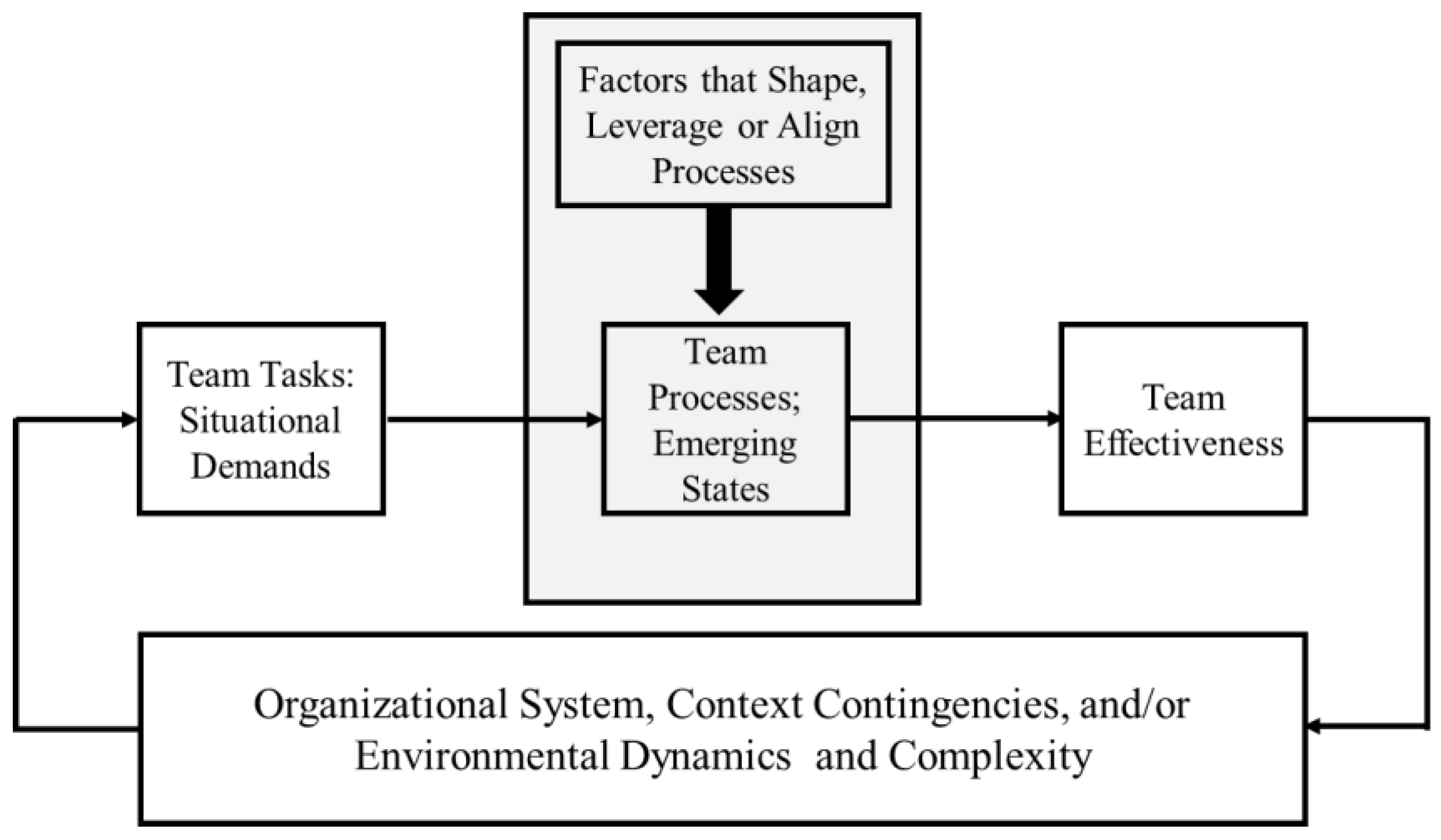
Figure 2.
An input–process–output model of work group innovation. Source: West & Hirst (2003, page 298).
Figure 2.
An input–process–output model of work group innovation. Source: West & Hirst (2003, page 298).
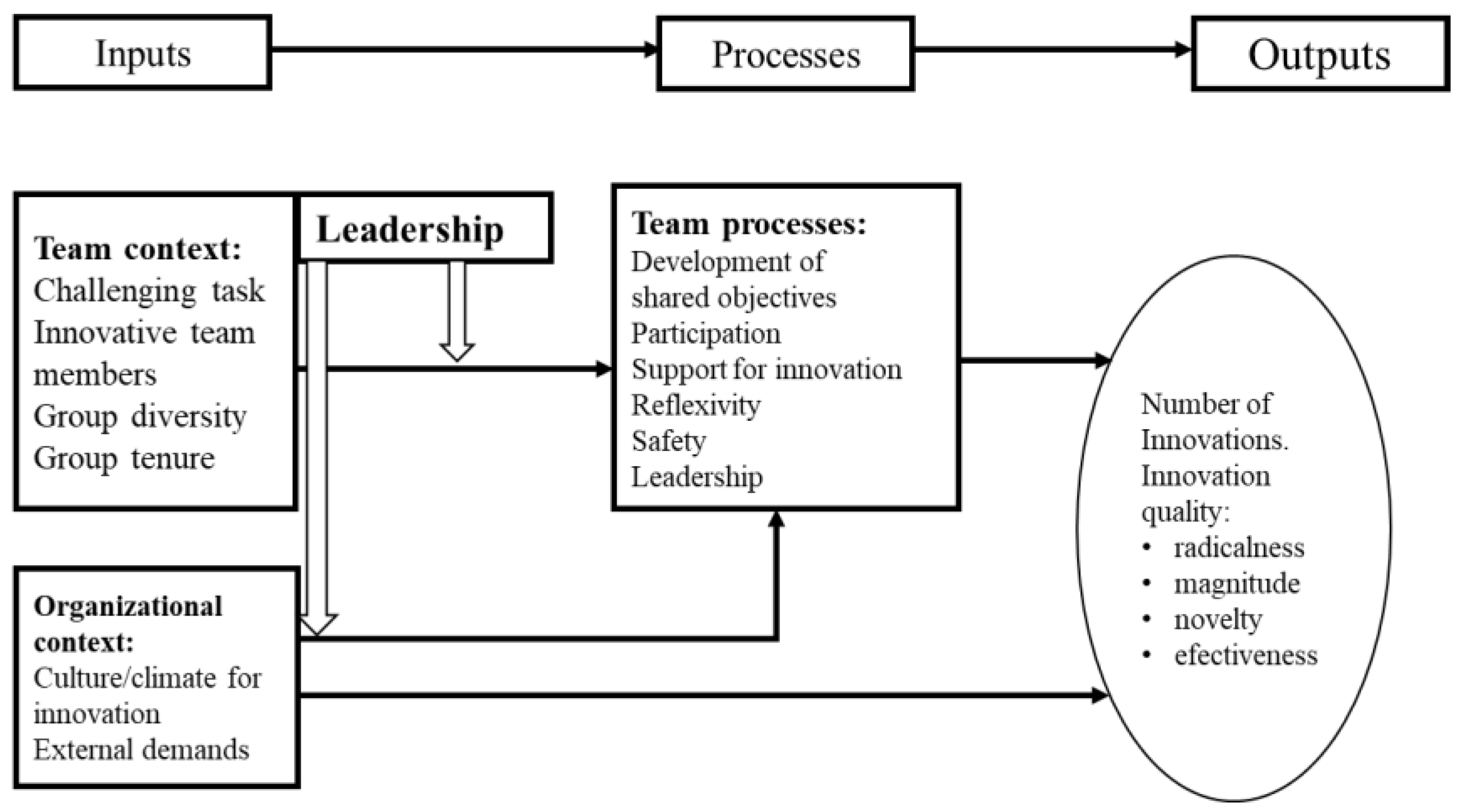
Figure 3.
Innovation drivers in work teams according to thematic subcategories and categories related to external dimension. Source: Authors’ elaboration adapting synthesis format recommended by Vargas-Halabi, et al. (2015). Note: aRelative frequency of textual citations related to external subjects with respect to the total of comments expressed by the interviewees;b Proportion of the 16 interviewees who provided textual citations.
Figure 3.
Innovation drivers in work teams according to thematic subcategories and categories related to external dimension. Source: Authors’ elaboration adapting synthesis format recommended by Vargas-Halabi, et al. (2015). Note: aRelative frequency of textual citations related to external subjects with respect to the total of comments expressed by the interviewees;b Proportion of the 16 interviewees who provided textual citations.
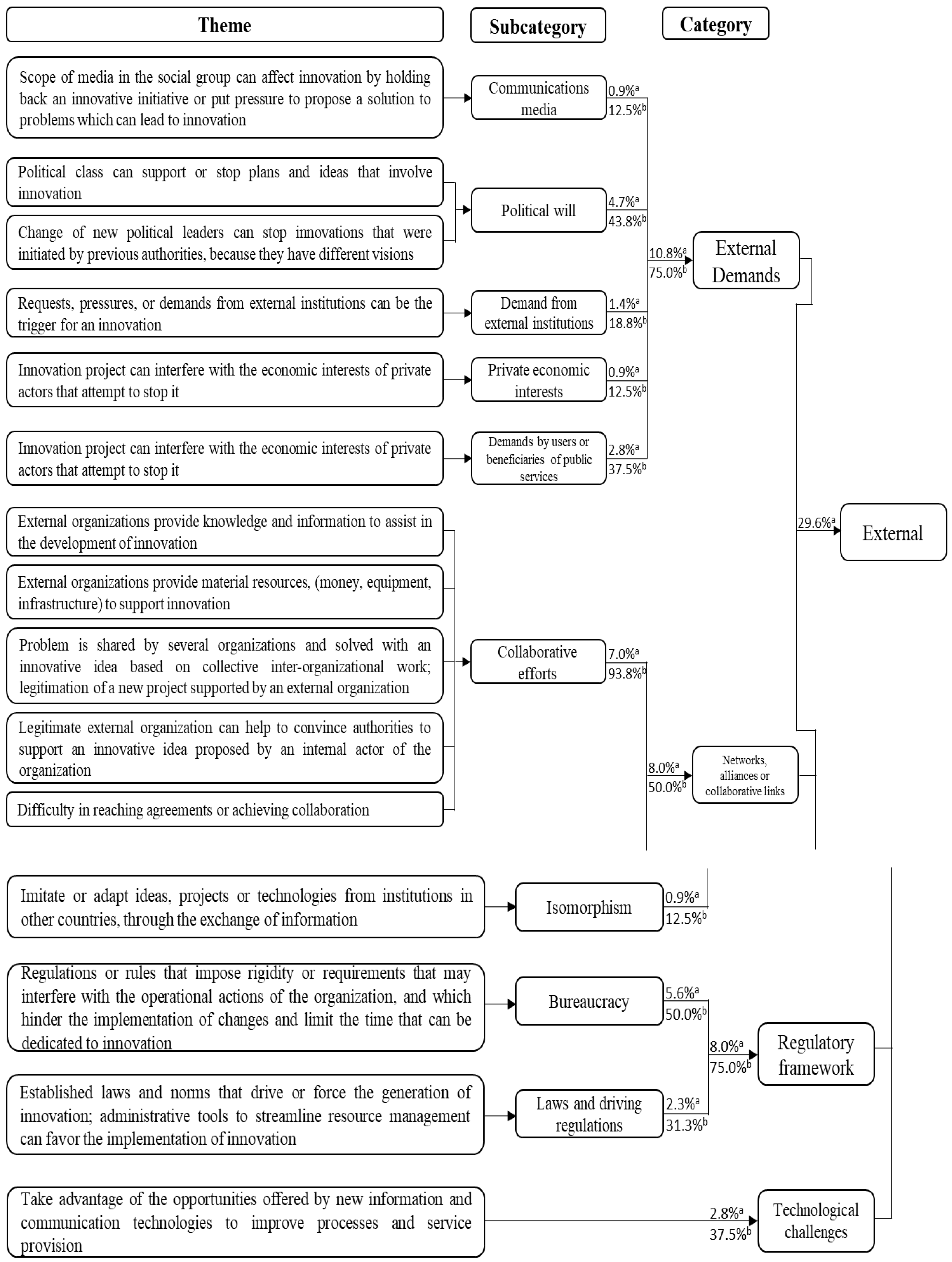
Figure 4.
Innovation drivers in work teams according to thematic subcategories and categories related to the dimension of organizational context. Source: Authors’ elaboration adapting synthesis format recommended by Vargas-Halabi, et al. (2015). Note: aRelative frequency of textual citations related to external subjects with respect to the total of comments expressed by the interviewees;b Proportion of the 16 interviewees who provided textual citations.
Figure 4.
Innovation drivers in work teams according to thematic subcategories and categories related to the dimension of organizational context. Source: Authors’ elaboration adapting synthesis format recommended by Vargas-Halabi, et al. (2015). Note: aRelative frequency of textual citations related to external subjects with respect to the total of comments expressed by the interviewees;b Proportion of the 16 interviewees who provided textual citations.
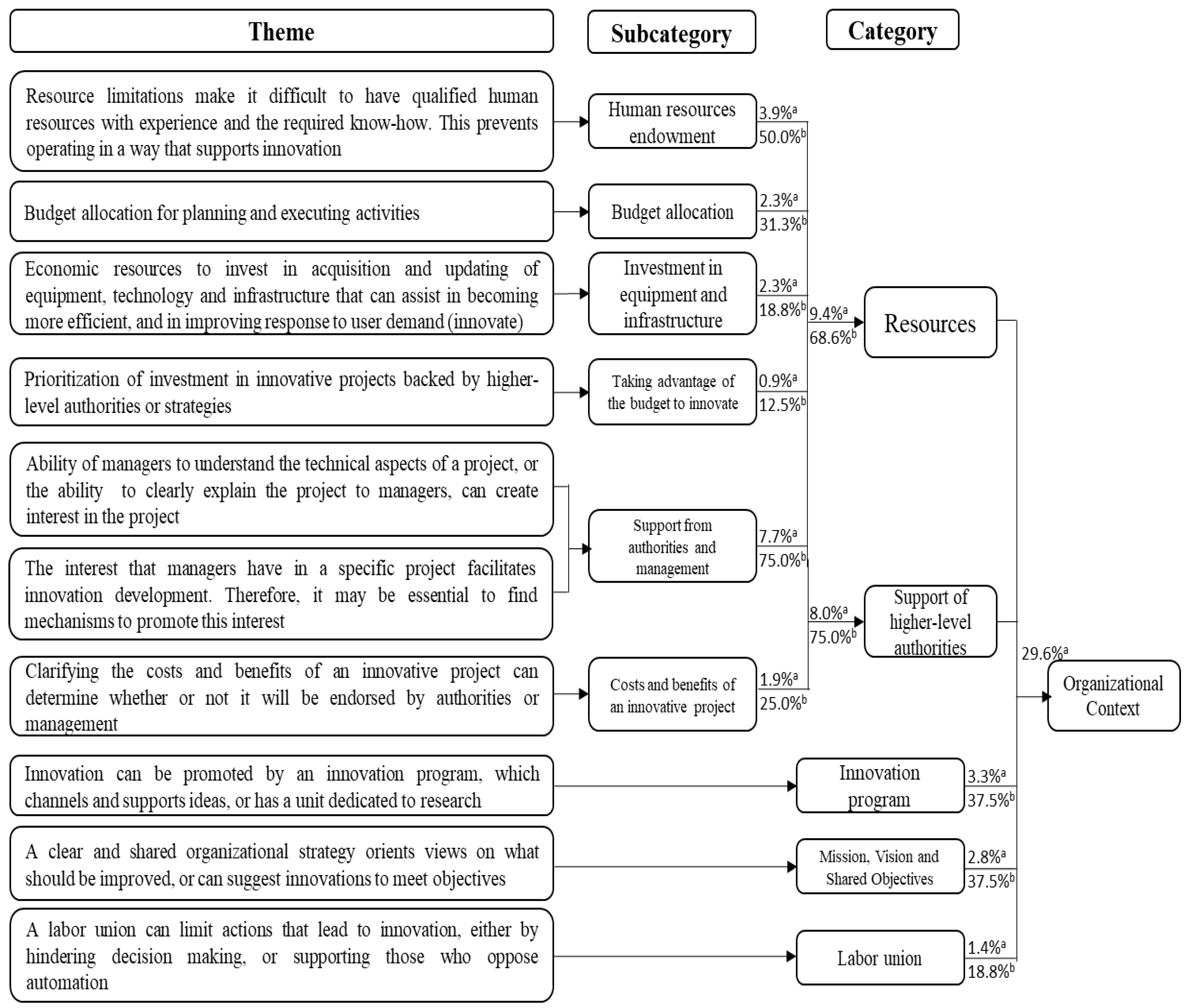
Figure 5.
Innovation drivers in work teams by thematic subcategories and categories related to external dimension of departmental dynamics. Source: Authors’ elaboration adapting synthesis format recommended by Vargas-Halabi, et al. (2015). Note: aRelative frequency of textual citations related to external subjects with respect to the total of comments expressed by the interviewees;b Proportion of the 16 interviewees who provided textual citations.
Figure 5.
Innovation drivers in work teams by thematic subcategories and categories related to external dimension of departmental dynamics. Source: Authors’ elaboration adapting synthesis format recommended by Vargas-Halabi, et al. (2015). Note: aRelative frequency of textual citations related to external subjects with respect to the total of comments expressed by the interviewees;b Proportion of the 16 interviewees who provided textual citations.
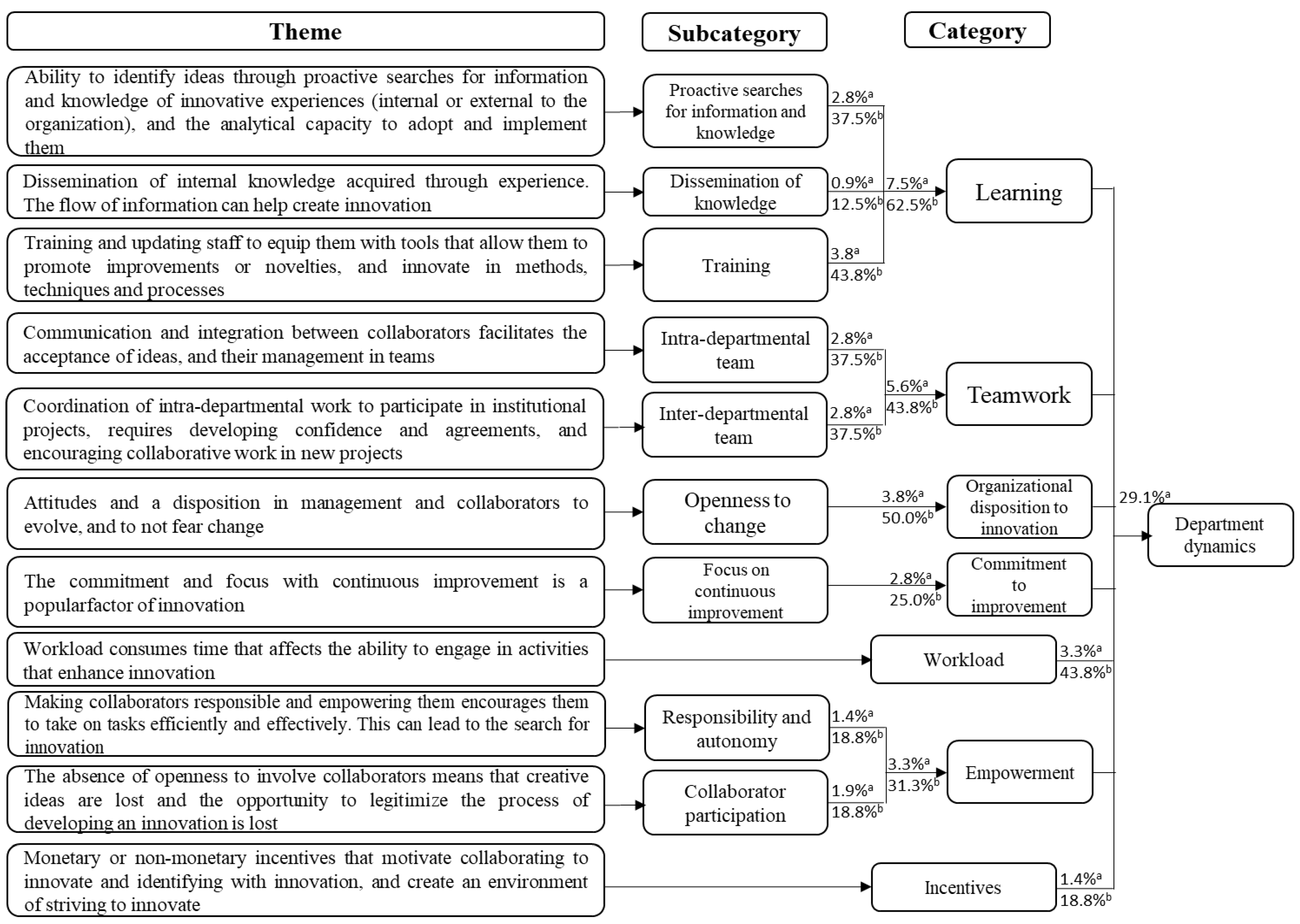
Figure 6.
Innovation drivers in work teams according to thematic subcategories and categories related to the dimension of characteristics of team members. Source: Authors’ elaboration adapting synthesis format recommended by Vargas-Halabi, et al. (2015). Note: aRelative frequency of textual citations related to external subjects with respect to the total of comments expressed by the interviewees;b Proportion of the 16 interviewees who provided textual citations.
Figure 6.
Innovation drivers in work teams according to thematic subcategories and categories related to the dimension of characteristics of team members. Source: Authors’ elaboration adapting synthesis format recommended by Vargas-Halabi, et al. (2015). Note: aRelative frequency of textual citations related to external subjects with respect to the total of comments expressed by the interviewees;b Proportion of the 16 interviewees who provided textual citations.
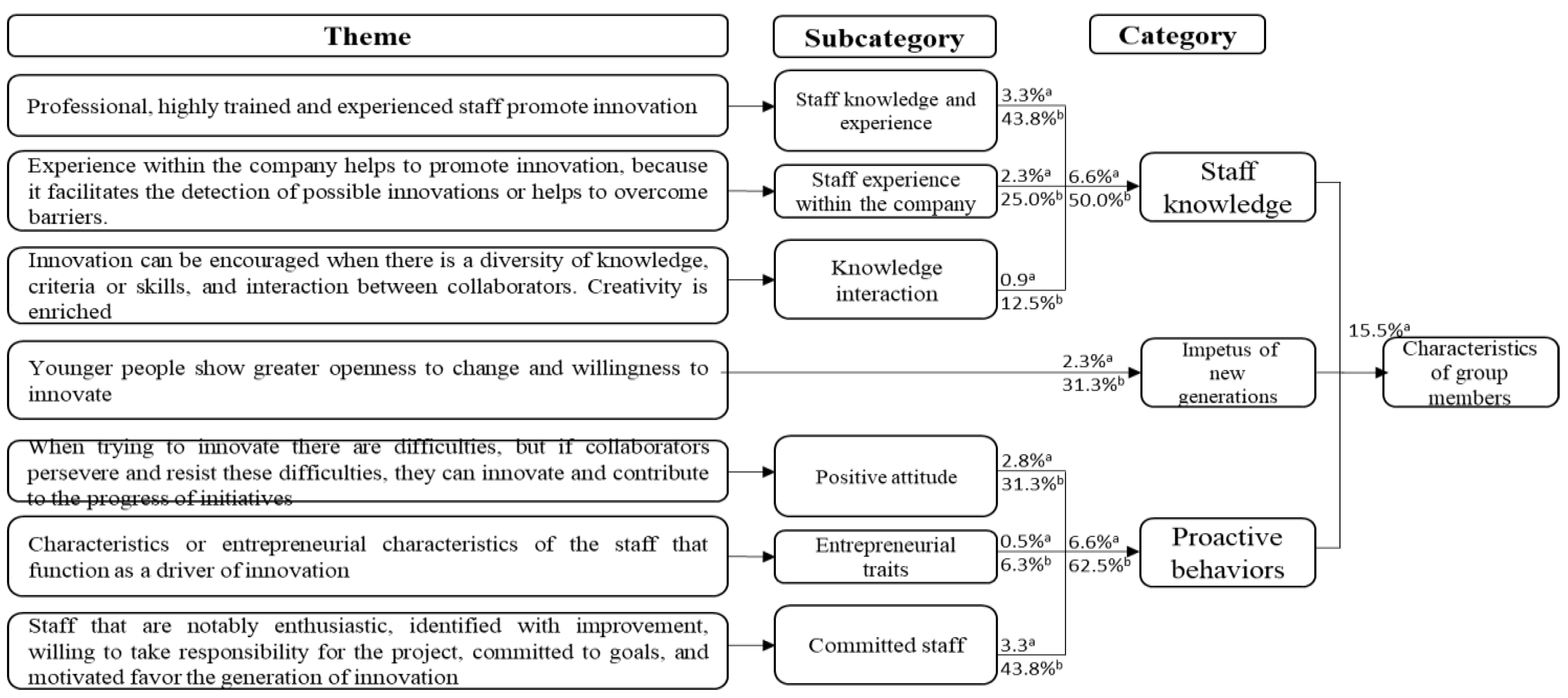

Table 1.
Dimensions and sub-dimensions of possible innovation drivers in work teams encountered in literature reviews.
Table 1.
Dimensions and sub-dimensions of possible innovation drivers in work teams encountered in literature reviews.
| Dimension | Sub-dimension | Concept |
| Context external to the organization | External demands c | Environmental demands that can promote future innovation |
| National culture c | This refers to the culture of a country, with a weak or strong inclination to avoid uncertainty | |
| Organizational context | Type of organizationc | This refers to the types of organization proposed by Mintzberg. For example, mechanical organizations are designed to protect predictable courses of action, while organic organizations have employees who are stimulated to adapt innovatively to situations of rapid change and unusual circumstances |
| Composition and structure of work teams | Diversity relevant to the workplace a,c | Heterogeneity of team members with respect to attributes related to the job or task, such as: position, profession, educational level, knowledge, skills, time worked, knowledge a |
| Diversity of history a,c | Differences not related to the task, such as age, gender or ethnicity a | |
| Task interdependence a | The extent to which team members are dependent on each other to carry out their tasks and perform effectively | |
| Goal interdependence a | The extent to which the goals of and rewards for team members are related in such a way that a team member can only achieve his or her goal if the other members achieve their goals | |
| Team size a | Number of members that make up the team | |
| Seniority a,c | Amount of time working in the organization a | |
| Team processes | Vision a,b,c | The degree to which team members have a common understanding of objectives and show a strong commitment to achieving goals a |
| Meaning of involvement a,b,c | The degree to which team members participate in decision-making processes, share information, and listen to the ideas of others | |
| Support for innovation a | This refers to the expectation, approval, and practical support for attempts to introduce new and better ways of doing things in the workplace | |
| Orientation to tasks or climate for excellence a,b | This refers to a shared concern for excellence in task performance quality with respect to the vision or shared results a | |
| Cohesion a,c | Commitment and desire of team members to maintain group membership (Lott & Lott, 1965) a | |
| Internal and external communication a | Exchange of information and ideas, both within and outside the unit | |
| Task-related conflictsa,c | This refers to disagreements among team members regarding the content of the tasks that are performed, including differences in views, ideas and opinions a | |
| Conflicts in relationships a,c | Socio-emotional conflicts arising from interpersonal disagreements a | |
| Individual attributes | Conduct of group leaders c | This refers to the possible opposition or agreement of the leader regarding innovations proposed by member(s) of the group |
| Workload c | This refers to the uncertainty that could be caused by the introduction of innovation in the unit's usual workload | |
| Innovative employee behavior c | Willingness to promote innovative ideas for change, even challenging elements of the established framework of work goals | |
| Stimulus to change c | Impulse in the worker to adapt himself or herself to changes or to modify work elements through innovation | |
| Ability to manage conflict c | The ability of employees to deal with elements of conflict with actors resistant to change, including willingness to discuss and solve disagreements, and ways of integrating different perspectives | |
| Supervisor support style c | The style of an immediate superior with a coworker, according to the type of goals that the former adopts in his of her work unit, can influence the approach, interpretation, and response to innovative ideas expressed by his or her coworkers | |
| Source: Autors’ elaboration based on a Hülsheger, Anderson and Salgado (2009), b Caldwell and O'Reilly III (2003), and c Janssen, Van de Vliert and West 2004) | ||
Table 2.
Interviewee profiles.
| Codea | Type of institution b | Functional nature of the department c | Principal activity sector of the institution |
| Int-1 | NBDI | Internal | Science |
| Int-2d | DB | Internal | Information and documentation |
| Int-3 | NBDI | Internal | Health |
| Int-4 | NFPC | Internal | Information and documentation |
| Int-5 | NBDI | Internal | Education |
| Int-6 | NBDI | Internal | Social |
| Int-7 | NBDI | Internal | Information and documentation |
| Int-8 | DB | External | Agriculture |
| Int-9 | NFPC | Internal | Transport |
| Int-10e | CG | External | Economy |
| Int-11e | CG | External | Economy |
| Int-12 | CG | External | Transport |
| Int-13f | NFPC | External | Energy |
| Int-14f | NFPC | External | Energy |
| Int-15d | DB | External | Information and documentation |
| Int-16 | CG | External | Information and documentation |
|
aAlphanumeric code assigned to the interviewee, bClassification according to the Ministry of Finance (2011) – (NBDI) Non-Business Decentralized Institution, (DB) Decentralized Body, (NFPC) Non-Financial Public Company, (CG) Central Government; cInternal = Work teams for institutional planning, financial, accounting, ICT solutions for managing internal users; External = Work teams providing certifications to the public or companies, ICT solutions for attention to external users; issuance of public regulations, interinstitutional coordination, d,e,f interviewees from different work teams in the same public institution. Source: Prepared by the authors. | |||
Table 3.
Relative frequencies of thematic dimensions and categories.
| Dimensions | Categories | Number of texts | Relative frequency |
| Environment = 63 (29.6%) |
E-External demands | 23 | 10.8% |
| E-Networks, alliances | 17 | 8.0% | |
| E-Regulatory framework | 17 | 8.0% | |
| E-Technological challenges | 6 | 2.8% | |
| Organizational level 55 (25.8%) |
OL-Resources for innovation | 20 | 9.4% |
| OL-Higher-level authority | 19 | 8.9% | |
| OL-Innovation program | 7 | 3.3% | |
| OL-Mission | 6 | 2.8% | |
| OL-Labor unions | 3 | 1.4% | |
| Internal team dynamics = 62 (29.1%) |
TD-Learning | 16 | 7.5% |
| TD-Teamwork | 12 | 5.6% | |
| TD-Willingness to change | 8 | 3.8% | |
| TD-Commitment to improvement | 6 | 2.8% | |
| TD-Workload | 7 | 3.3% | |
| TD-Empowerment | 7 | 3.3% | |
| TD-Incentives | 6 | 2.8% | |
| Coworkers = 33 (15.5%) |
C-Staff knowledge | 14 | 6.6% |
| C-Proactive behaviors | 14 | 6.6% | |
| C-Impetus from new generations | 5 | 2.3% | |
| Total | 213 | 100.0% | |
| Source: Authors’ elaboration | |||
Disclaimer/Publisher’s Note: The statements, opinions and data contained in all publications are solely those of the individual author(s) and contributor(s) and not of MDPI and/or the editor(s). MDPI and/or the editor(s) disclaim responsibility for any injury to people or property resulting from any ideas, methods, instructions or products referred to in the content. |
© 2024 by the authors. Licensee MDPI, Basel, Switzerland. This article is an open access article distributed under the terms and conditions of the Creative Commons Attribution (CC BY) license (http://creativecommons.org/licenses/by/4.0/).
Copyright: This open access article is published under a Creative Commons CC BY 4.0 license, which permit the free download, distribution, and reuse, provided that the author and preprint are cited in any reuse.