
Submitted:
24 April 2024
Posted:
26 April 2024
You are already at the latest version
Abstract
The performance of Yttrium-Barium Copper Oxide (YBCO) high-temperature superconductors in high-frequency applications is significantly affected by the microwave surface resistance (Rs). The paper delves into the basics, measuring methods and factors affecting the resistance (Rs) in YBCO, highlighting its high critical temperature (Tc) and low resistance, positioning it as a promising material. YBCO's compatibility with epitaxial growth and microstructure engineering offers opportunities to reduce grain boundary effects and improve Rs, making it advantageous for high-frequency electronics, communication systems, and MRI coils. This is due to its high critical current density (Jc) and exceptional Rs at practical temperatures.
Challenges remain in comprehending and managing Rs in YBCO, despite its favorable characteristics. Utilizing advanced fabrication methods and incorporating nanotechnology allow for customization of YBCO-based devices. Multi-scale modeling and simulation are essential for guiding experimental work and understanding YBCO's performance in high-frequency settings. This study highlights the promise of YBCO for future high-frequency technologies and stresses the importance of more research to overcome hurdles and fully exploit its capabilities, potentially transforming superconducting devices for practical use.
Keywords:
YBCO
; Microwave surface resistance
; Critical temperature
; Critical current density
1. Introduction
General Overview
Superconductivity is a phenomenon that occurs in some materials when they are cooled below a critical temperature, resulting in the total elimination of electrical resistance[1]. This exceptional characteristic allows the material to transmit electricity without any loss, resulting in a variety of groundbreaking applications such as high-speed magnetic levitation trains and very sensitive magnetic resonance imaging devices[2,3]. Traditional superconductors, known as low temperature superconductors (LTS), were first found in the early 20th century and function at very low temperatures, usually close to absolute zero. The finding of high temperature superconductors (HTS) in the late 20th century generated significant enthusiasm and conjecture among scientists[4]. HTS materials display superconducting properties at much greater temperatures compared to traditional materials, even surpassing the boiling point of liquid nitrogen. This presents the exciting possibility of practical use under more convenient and cost-effective cooling conditions[5]. High temperature superconductors are typically defined by intricate phase diagrams that illustrate the relationship between temperature, pressure, and material composition[6]. Phase diagrams offer significant information on the superconducting areas, critical temperatures for superconductivity, and phase transitions in materials. The specific mechanisms responsible for high-temperature superconductivity have not been fully understood after years of research, posing a significant challenge to physicists and materials scientists. Researchers worldwide are captivated by the quest to uncover the mysteries of HTS, motivated by the potential for significant technology improvements and a more profound comprehension of fundamental physics[7].
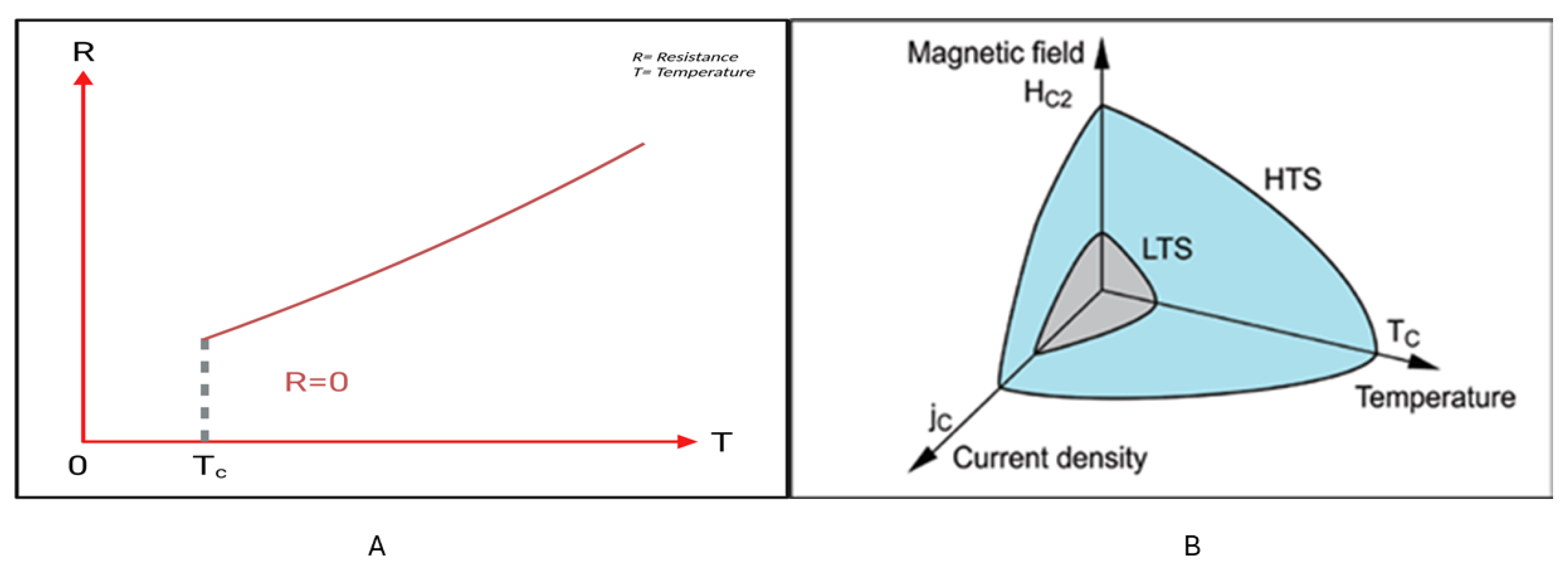
The schematic graph illustrates the exceptional characteristic of superconductors: their resistance to electrical current. As the temperature decreases, the material's resistance decreases. There is a significant change at a particular crucial temperature. At this point, resistance decreases to zero, indicating the material has transitioned into the superconducting state. Superconductors exhibit zero resistance at extremely low temperatures, unlike conventional conductors which still have decreasing resistance as they cool down. The second schematic diagram illustrates the behavior of a high-temperature superconductor in varying temperatures and magnetic fields. Each color symbolizes distinct behaviors. The outer region,"HTS," exhibits excellent conductivity even at elevated temperatures, making it unique.
Figure 1.
Figure 1. (Left figure)This is Temperature (T) (x-axis) vs Resistance (R) (y-axis) plot showing superconductivity at T<Tc with R=0, at T>Tc material acts as normal conductor. (Right figure) Schematic diagram showing critical parameters (critical temperature Tc, critical current density jc and upper critical magnetic field Hc) of a superconductor[8].
Figure 1.
Figure 1. (Left figure)This is Temperature (T) (x-axis) vs Resistance (R) (y-axis) plot showing superconductivity at T<Tc with R=0, at T>Tc material acts as normal conductor. (Right figure) Schematic diagram showing critical parameters (critical temperature Tc, critical current density jc and upper critical magnetic field Hc) of a superconductor[8].
YBCO as a Potential Cuprate Superconductor
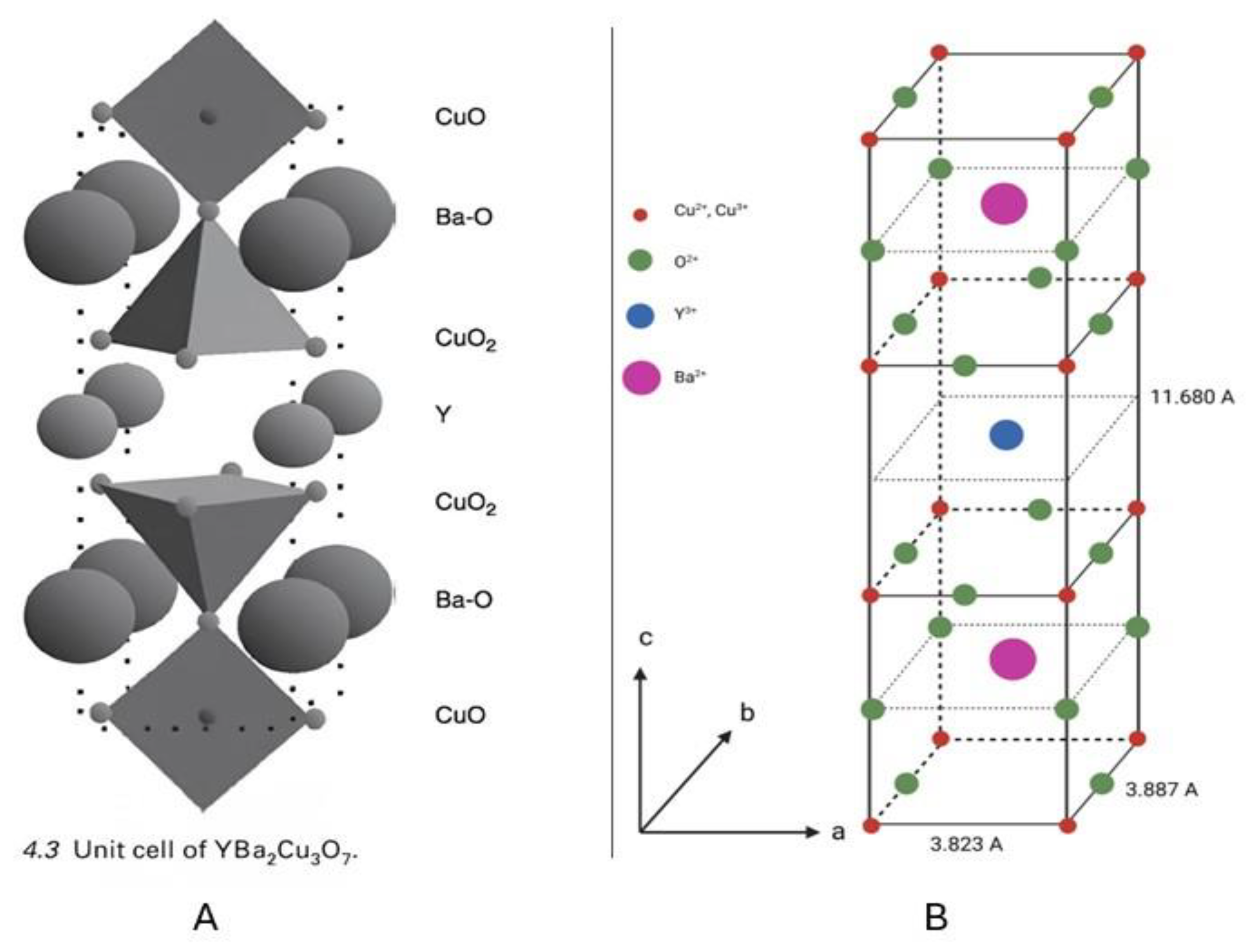
Yttrium Barium Copper Oxide (YBCO), a compound that was discovered in the late 1980s, is considered one of the most promising high-temperature superconductors[5,9]. This material, made up of yttrium, barium, copper, and oxygen atoms arranged in layers, demonstrates superconductivity at elevated temperatures when cooled below its critical temperature. YBCO superconductors have critical temperatures far higher than the boiling point of liquid nitrogen, making them appropriate for several practical applications such as power transmission, magnetic resonance imaging (MRI), and particle accelerators. YBCO's crystal structure features a perovskite-like arrangement, with copper oxide (CuO2) planes interspersed with layers of barium and yttrium atoms. The layered structure is essential in influencing the material's superconducting properties, where the copper oxide planes are key locations for electron pairing and movement[10]. Research is ongoing to investigate the complex mechanisms that control superconductivity in YBCO, with the goal of improving its performance and maximizing its potential for different technological uses.
Figure 2.
Figure 2. (left) Unit cell YBCO superconductor showing double layer of copper-oxygen (CuO2) plane which plays a crucial role of superconductivity. (Right) Crystal structure of YBCO in which Yttrium lies at the center and two barium atom lies on its either side along with copper and oxygen atoms at its corner[8,11].
Figure 2.
Figure 2. (left) Unit cell YBCO superconductor showing double layer of copper-oxygen (CuO2) plane which plays a crucial role of superconductivity. (Right) Crystal structure of YBCO in which Yttrium lies at the center and two barium atom lies on its either side along with copper and oxygen atoms at its corner[8,11].
Evolution of YBCO Research across Time
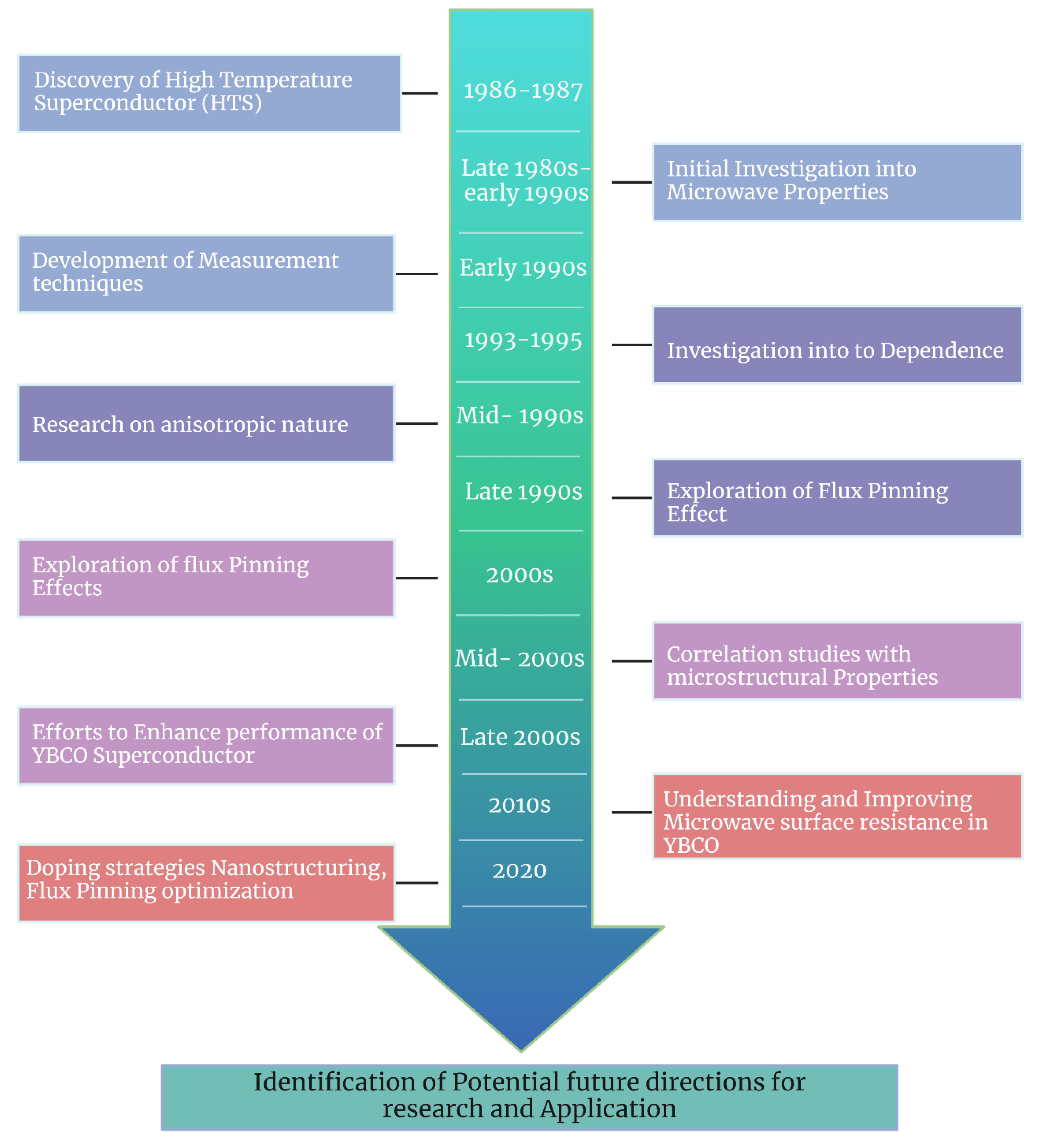
The discovery of high-temperature superconductivity in YBa2Cu3O7-δ(YBCO) in 1986-1987 sparked increased research interest in its possible uses in microwaves[12]. Studies conducted in the late 1980s and early 1990s initially examined its permittivity and dielectric constant, suggesting its potential for use in filters and resonators[13]. During this time, important measuring techniques including cavity perturbation and coplanar waveguides were developed, allowing for accurate quantification of microwave surface resistance (Rs)[14]. In the mid-1990s, studies began to explore the strong relationship between Rs and Tc, highlighting its potential in cryogenic applications[15]. Furthermore, the anisotropic nature of Rs, in which resistance changed based on the orientation of the microwave field in relation to the crystal structure, became a key focus for enhancing device designs [16].
In the late 1990s, investigations were conducted on how flux pinning in YBCO affected Rs to improve performance for high-frequency uses[17]. This set the foundation for the early 2000s, when advancements in fabrication methods like pulsed laser deposition allowed for the creation of high-quality YBCO films with enhanced property regulation[18]. In the mid-2000s, research linked microstructural characteristics such as grain size and defect density to Rs values, enabling the tailoring of manufacturing methods to achieve certain microwave performance goals [19]. In the late 2000s, there were efforts to enhance performance with new doping techniques and nanostructuring methods[20].
Current research in the 2010s focuses on gaining a better understanding of the basic principles behind superconductivity in YBCO at the atomic and electronic levels using computational modeling and improved characterization techniques[21]. In the future, advancements will focus on using cutting-edge fabrication techniques like 3D printing and combining with other materials to create more advanced microwave devices[22]. This investigation aims to fully utilize YBCO for innovative applications in microwave technology. Research continues to explore new doping tactics, improved nanostructuring techniques, and computational modeling to enhance performance and discover new capabilities. YBCO became a leading contender due to its comparatively high critical temperature and current density. During this stage, there were concentrated attempts to enhance its efficiency by utilizing techniques such as doping, nanostructuring, and enhanced flux pinning, with the goal of expanding the limits of material characteristics[23]. The progression of microwave surface resistance in YBCO is depicted in the flow chart:
Figure 3.
Figure 3. Chronological advancement in YBCO research focusing its microwave properties.
2. Theoretical Challenges
The BCS theory effectively describes superconductivity in conventional materials at low temperatures but encounters notable obstacles when applied to high-temperature superconductors (HTS). The main constraints are:
Elevated Critical Temperatures (Tc)
The BCS theory is based on the formation of Cooper pairs via electron-phonon interactions. HTS materials display superconductivity at temperatures much surpassing those anticipated by BCS theory. The processes involved in the formation of Cooper pairs in high-temperature superconductors are not completely comprehended using traditional electron-phonon coupling theories [24].
Unconventional Pairing Symmetry
YBCO and other cuprate superconductors display atypical pairing symmetries, particularly D-wave symmetry. Deviation from S-wave symmetry in BCS superconductors results in distinct characteristics, including the presence of nodes in the superconducting gap. D-wave symmetry is a distinctive superconducting order parameter that describes how electrons couple up in specific high-temperature superconductors. Conventional superconductors, as per the BCS theory, usually display S-wave symmetry in their superconducting order parameter. In certain high-temperature superconductors, especially in the cuprate family, the order parameter is thought to exhibit D-wave symmetry[25].
Strong Electron-Electron Correlations
High-temperature superconductors have another theoretical hurdle due to the significant electron-electron interactions. The strong Coulomb repulsion among electrons requires an expansion beyond the weak-coupling region explained by BCS theory[26].
The Hubbard model is frequently used to explain the electron-electron repulsion hypothesis in high-temperature superconductivity, focusing on strong electron-electron interactions.
Hubbard Model
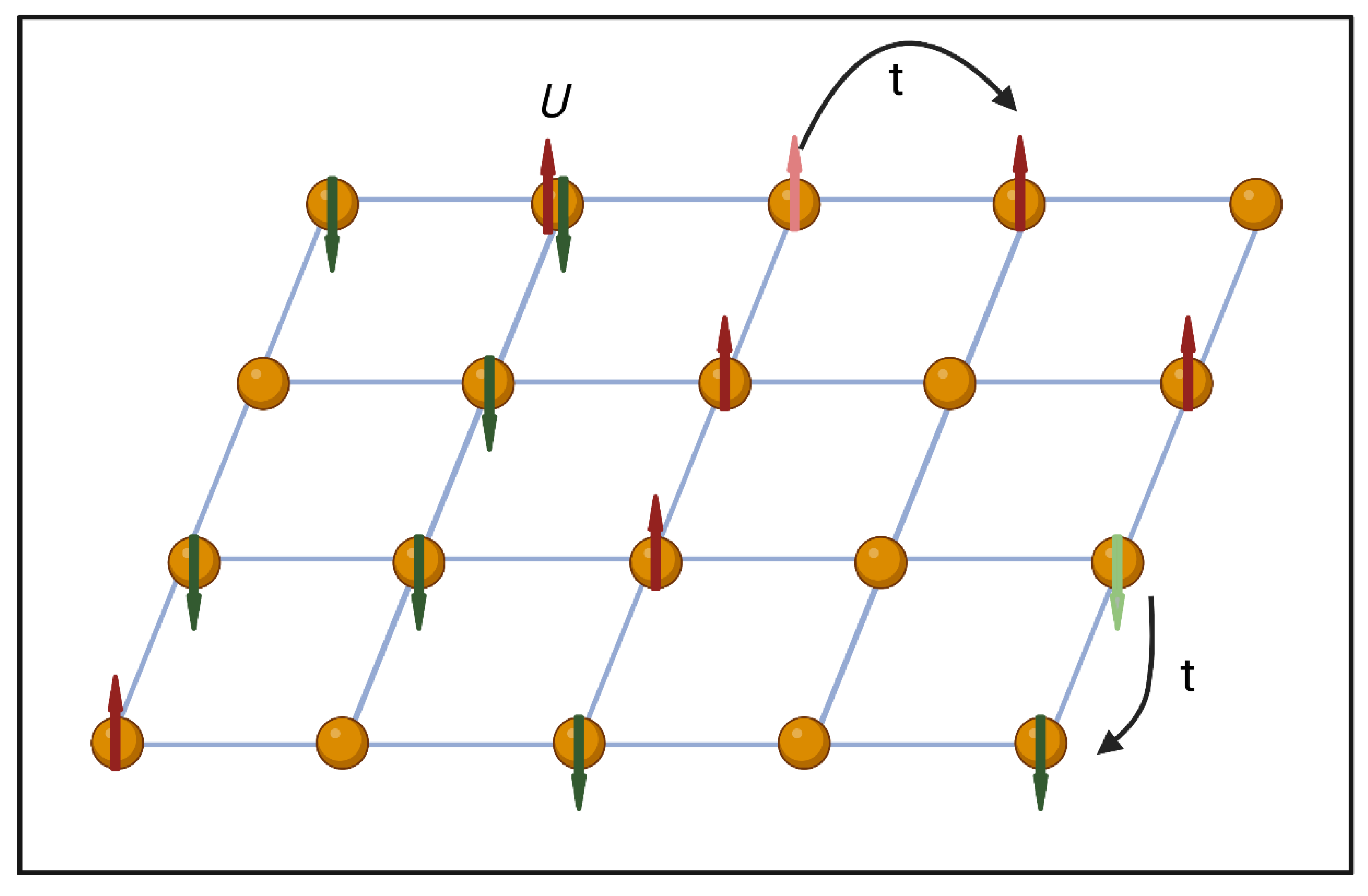
The Hubbard model is a simplified model of electrons in a solid that interact through short-range repulsive (Coulomb) forces. It is often employed to explain the interaction between electron movement and on-site repulsion in cuprate superconductors. This model is designed to accurately represent the significant electron-electron correlations found in high-temperature superconductors. It is based on the concept that each electron is subject to competing forces: one that encourages it to tunnel to adjacent atoms, and another that repels it from its nearby atoms[27].
Figure 4.
Figure 4. A schematic figure of the 2-dimensional Hubbard model, where t is the hopping parameter and U is the repulsive energy for double occupation of a site. Up arrows and down arrows correspond to up-spin and down-spin electrons, respectively.
Figure 4.
Figure 4. A schematic figure of the 2-dimensional Hubbard model, where t is the hopping parameter and U is the repulsive energy for double occupation of a site. Up arrows and down arrows correspond to up-spin and down-spin electrons, respectively.
The Hubbard model and its extensions are commonly addressed through theoretical methods like mean-field theory, dynamical mean-field theory (DMFT), and numerical simulations such as quantum Monte Carlo methods. These methods aid researchers in comprehending the complex interaction of electronic correlations and their significance in high-temperature superconductivity[28]. Research has primarily focused on the ground state features of the system on various lattices in two spatial dimensions, with some consideration given to lower and higher dimensions. Various solvable models have been devised for interacting particles, encompassing spin systems and fermionic systems. The Hubbard model is commonly presented through the Fock space representation and is a key idea in contemporary condensed matter physics.
The Hubbard Hamiltonian characterizes the interactions of highly correlated electrons inside a lattice structure, specifically within the field of solid-state physics. The Hubbard Hamiltonian consists of two terms: one representing the system's kinetic energy and the other denoting the on-site interaction strength that accounts for electron repulsion. The Hubbard Hamiltonian expressed in second quantization notation is as follows[29,30]:
where:
- t is the electron hopping parameter between neighboring sites.
- c†iσ and ciσ are the creation and annihilation operators for an electron with spin σ at site i.
- U is the on-site Coulomb repulsion term.
- niσ = c†iσ ciσ is the number operator.
Strong Correlations and Mott Insulator Transition
Increased on-site Coulomb repulsion (U) leads to strong correlations and can cause a Mott insulator transition in the system. According to the Hubbard model, when U is big, electrons localize, causing the material to transition from a metal to an insulator.
The Mott transition can be described by the variation of the charge gap (∆c) with U[31]
Unconventional Pairing and Superconductivity
The Hubbard model is crucial for comprehending atypical pairing mechanisms and superconductivity. One method includes include attractive interactions among electrons in addition to the repulsive term. The expanded Hubbard model can be expressed as[32]:
Where V represents the attractive interaction.
H = −t∑t〈i,j〉,σ (c†iσcjσ+ h.c) + Ս∑ini↑ni↓- V ∑〈i,j〉ninj
Fundamentals of Microwave Surface Resistance
Microwave surface resistance, represented by Rs, is a key characteristic that describes how high-frequency electromagnetic waves interact with superconducting materials. Understanding the factors that contribute to microwave surface resistance is essential for optimizing the performance of Yttrium-Barium Copper Oxide (YBCO) high-temperature superconductors in real-life applications.
Surface resistance, Rs, is the resistance that a superconductor's surface provides to the flow of microwave currents at a specific frequency. The efficiency of energy transmission and dissipation at high frequencies is quantified, affecting the overall performance of superconducting devices operating in the microwave and radio frequency ranges. Understanding microwave surface resistance is crucial for designing and optimizing devices with lowest energy losses, especially for high-temperature superconductors such as YBCO, which show great potential for many technological applications[9].
Physical Mechanisms Contributing to Microwave Surface Resistance in YBCO
The microwave surface resistance in YBCO is a complex phenomenon affected by different physical causes, each with a significant role in defining its strength and impacts the performance of superconducting devices at microwave frequencies. This section will explore the complexities of these systems and explain how each one contributes to microwave surface resistance in YBCO.
Electron Scattering
The flow of free electrons in YBCO superconducting material is significantly influenced by the oscillating electromagnetic field produced by microwaves at high frequencies. This interaction can result in electron scattering, which is a primary cause of microwave surface resistance. Electron scattering in YBCO material happens when free electrons collide or interact with impurities, lattice defects, or other electrons[33].
The collisions interfere with the orderly movement of electrons in the superconducting condensate, leading to a disruption of phase coherence. The YBCO material's capacity to conduct microwave currents without resistance is diminished, resulting in a rise in surface resistance. Electron scattering is influenced by elements like material purity, temperature, and microwave field strength. Researchers and engineers aim for high-purity YBCO materials and precise operating conditions to minimize electron scattering effects[34].
Vortex Motion
YBCO exhibits vortex motion when subjected to external magnetic fields, adding complexity to the microwave surface resistance. YBCO can form vortex formations when exposed to a magnetic field higher than its critical magnetic field, which is the point at which superconductivity is no longer present. The vortices are quantized magnetic flux quanta that enter the superconductor because the Meissner effect is restricted by the critical magnetic field[35].
When microwave radiation is directed at the YBCO sample, the fluctuating electromagnetic field causes vortices to move by applying forces on them. The swirling movement can cause energy loss in the material, mainly through interactions with pinning centers, lattice flaws, or other vortices. Vortex motion in YBCO generates a substantial amount of energy dissipation, which greatly impacts its microwave surface resistance, especially under high magnetic field conditions. Controlling and limiting vortex motion is crucial for decreasing microwave surface resistance in practical uses of YBCO superconductors[36].
Grain Boundaries
Grain boundaries are commonly found in YBCO samples, particularly in polycrystalline materials. Grain boundaries are interfaces that separate distinct crystallographic orientations in a material. The boundaries cause disruptions in the ideal crystalline structure and can function as scattering points for Microwave currents[37].
Microwaves passing through YBCO sample with grain boundaries may interact with these interfaces, causing scattering or reflection. When microwaves interact with grain boundaries, it creates extra microwave surface resistance. This contribution's magnitude is directly linked to the quality and density of grain boundaries in the material. YBCO materials having a high density of grain boundaries, such certain thin films, exhibit a significant effect of grain boundary scattering on microwave surface resistance[38]. Researchers frequently concentrate on enhancing the grain boundary structure to reduce its negative impact on microwave performance.
3. Experimental Techniques for Measuring Microwave Surface Resistance
It is crucial to precisely measure the microwave surface resistance (Rs) in Yttrium-Barium Copper Oxide (YBCO) samples to properly understand the material's characteristics and enhance its efficiency in real-world uses. Over time, different experimental methods have been created to evaluate the resistance in YBCO, each with unique benefits and drawbacks.
Cavity Perturbation Techniques
Cavity perturbation techniques are commonly utilized to determine the microwave surface resistance (Rs) of superconductors, as demonstrated in multiple research studies[39,40]. These methods entail inserting a sample, such as Yttrium Barium Copper Oxide (YBCO), into an existing microwave cavity. The alterations in the resonant frequency and quality factor (Q) of the cavity following sample insertion provide an insight into Rs.
This method has numerous benefits. It is non-invasive and contactless, making it ideal for fragile materials. The device is versatile since it can analyze both thin films and bulk samples, offering significant information on how superconductors react to microwave fields. Accurate measurements depend on exact understanding of the cavity's properties and are influenced by the sample's placement within the cavity, which may cause mistakes.
Resonant Methods
Resonant techniques are useful for determining the microwave surface resistance (Rs) of Yttrium Barium Copper Oxide (YBCO) superconductors, as demonstrated in multiple studies [41,42]. The methods entail incorporating a YBCO sample into various microwave resonators, such as dielectric resonators or open-ended coaxial resonators. Researchers can analyze Rs by monitoring the variations in the resonator's resonant frequency and quality factor (Q) upon sample insertion, enabling them to comprehend the material's reaction to microwave fields.
The approach is versatile in examining both bulk and thin film samples, however it does have limitations. Calibrating with reference samples may be necessary for precise measurements, and the selection of resonator geometry can impact the outcomes. Hence, meticulous thought during experimental planning and data analysis is essential.
Quasioptical Techniques
Quasioptical approaches, such as the quasi-optical cavity perturbation method (QOCPM), provide a unique method for measuring the microwave surface resistance (Rs) of superconducting materials. QOCPM allows for spatially resolved measurements, offering useful insights into fluctuations of Rs within the sample, unlike resonant techniques[43]. This is especially valuable for analyzing non-uniform or anisotropic YBCO samples, where the surface resistance varies according on the orientation of the microwave field.
Although QOCPM has evident benefits, it also comes with drawbacks. QOCPM requires specialized and complex experimental setups, which may restrict its accessibility as compared to other Rs measurement approaches. Furthermore, although providing spatial resolution, this method may not consistently reach the appropriate level of resolution for certain applications[44]. Thorough experimental design and awareness of these constraints are essential for effective use of QOCPM.
Transmission Line Techniques
Transmission line techniques are proven methods used to assess the microwave surface resistance (Rs) of Yttrium Barium Copper Oxide (YBCO) superconductors, as shown in multiple investigations[45]. These methods entail incorporating YBCO samples into various transmission line configurations, such as microstrip lines or coplanar waveguides. Researchers can extract information on the material's response to microwave fields by analyzing changes in the line's properties such as insertion loss and phase shift following sample incorporation, which reveals details about Rs.
This method is versatile as it may be used with both bulk and thin film samples. It is particularly suitable for investigating the behavior of YBCO under applied magnetic fields, making it applicable to a range of uses[46]. The approach is sensitive to sample location and contact resistance, necessitating precise experimental setup and possibly complex calibration processes to guarantee correct readings.
It is crucial to consider that each approach of measuring Rs has unique advantages and constraints, and the best appropriate strategy varies based on the particular research objectives and sample attributes. Advancements in measurement techniques are refining the accuracy and resolution of Rs measurements in YBCO and other high-temperature superconductors as research advances.
4. Factors Affecting Microwave Surface Resistance in YBCO
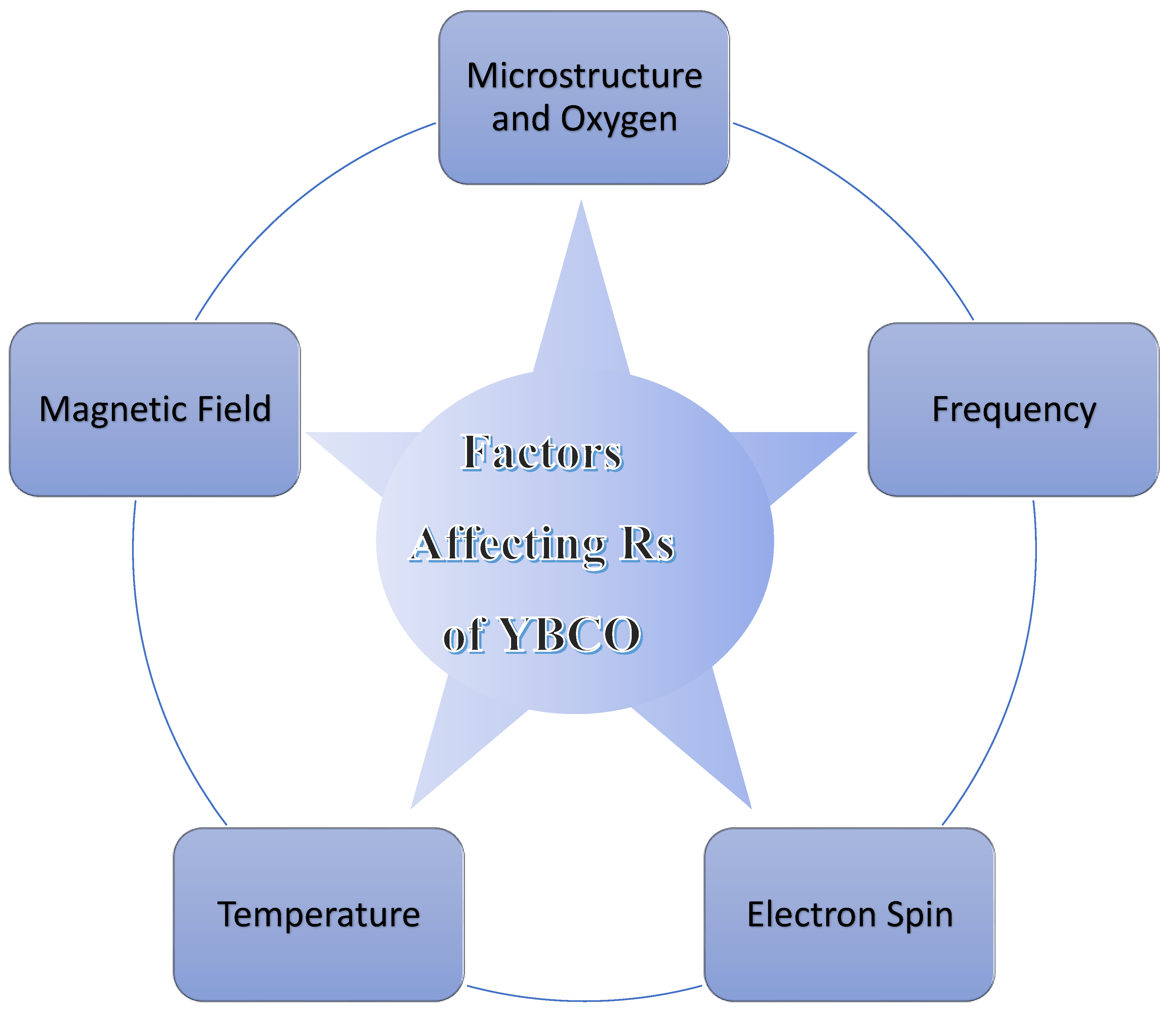
The microwave surface resistance (Rs) in Yttrium-Barium Copper Oxide (YBCO) is affected by multiple parameters, each of which is essential in determining its performance at high frequencies. Comprehending these characteristics is crucial for enhancing the performance of YBCO in real-world applications and customizing the material for particular purposes.
Figure 5.
Figure 5. Different key factors that affect the microwave surface resistance of YBCO superconductors.
Figure 5.
Figure 5. Different key factors that affect the microwave surface resistance of YBCO superconductors.
Temperature Dependence of Microwave Surface Resistance
The temperature dependence of Rs is a notable feature of YBCO and other high-temperature superconductors. As the temperature nears the critical temperature (Tc), the superconducting energy gap reduces resulting in increased quasiparticle excitations. These excitations cause a rise in resistance (Rs) at the critical temperature (Tc), resulting in a of perfect conductivity at and above this temperature.
Understanding how Rs changes with temperature is crucial for developing superconducting devices at various temperature ranges[47]. Engineers can enhance the performance of YBCO-based devices under various operating situations by comprehending and managing the temperature dependency of Rs.
Magnetic Field Effects on Microwave Surface Resistance
External magnetic fields applied to YBCO can greatly impact microwave surface resistance. Magnetic fields cause vortices to develop in the superconducting material, resulting in energy loss and higher Rs. Vortices' behavior and their interaction with microwave fields are determined by the critical current density (Jc) of the material, which is regulated by the microstructure and composition of the sample. Comprehending the intricate relationship among magnetic fields, vortices, and microwave surface resistance is crucial for developing superconducting devices that can function consistently under magnetic fields or in situations with changing magnetic flux densities[48].
Frequency Dependence of Microwave Surface Resistance
The variation of Rs in YBCO with frequency is crucial for applications that operate across a wide range of frequencies. Rs behavior at various frequencies is affected by the superconducting energy gap and the relaxation duration of quasiparticles. At higher frequencies, the superconducting energy gap's ability to inhibit quasiparticle excitations diminishes, resulting in a rise in Rs[49].
To develop YBCO-based devices with consistent and low Rs over a broad frequency spectrum, a deep comprehension of its frequency-dependent characteristics and meticulous attention to the operational frequency are essential.
Microstructure and Oxygen Content
The microwave surface resistance of YBCO is greatly influenced by its microstructure and oxygen content. Grain boundaries in polycrystalline YBCO samples can serve as scattering sites for microwave currents, resulting in enhanced Rs. Epitaxial YBCO films with a well-aligned crystalline structure can have lower Rs because of decreased scattering effects[49,50].
Managing the microstructure and oxygen levels in YBCO materials is crucial for enhancing microwave surface resistance and overall superconducting performance[51].
Spins effects on Microwave Surface Resistance
The electrical characteristics of high-temperature superconductors such as YBCO are affected by the spin of the electrons[52]. Electron spin is an inherent characteristic that has a substantial impact on the superconducting properties of materials. When a superconductor interacts with microwaves, the electron spins can produce different impacts on its behavior. Quantum spin fluctuations are involved in certain theoretical models for high-temperature superconductors[53]. The variations have a role in electron pairing, providing a different view compared to the traditional BCS pairing mechanism involving phonons.
Further research is needed to fully comprehend the unique effect of electron spin on the microwave surface resistance of YBCO. Spin can influence the size and characteristics of the superconducting gap, which in turn affects surface resistance[54]. Spin dynamics can impact the interaction with microwave radiation by affecting quasiparticle relaxation periods[55]. The relationship between spin and microwave behavior is essential for applications that use microwave-superconductor interaction, like high-frequency devices and resonators[49,54]. Specific aspects vary significantly according on experimental settings and sample characteristics, requiring additional research for a thorough understanding.
5. Microwave Surface Resistance in YBCO vs Other Superconducting Materials
Comparing the microwave surface resistance (Rs) of Yttrium-Barium Copper Oxide (YBCO) with other superconducting materials, both high-temperature and low-temperature, offers useful insights into its distinct features and benefits for high-frequency applications.
YBCO vs. Other High-Temperature Superconductors
YBCO is distinguished from other high-temperature superconductors by its comparatively high critical temperature (Tc) and exceptional superconducting characteristics at temperatures beyond the boiling point of liquid nitrogen (77 K). YBCO generally has lower Rs values compared to other high-temperature superconductors such as Bi-based and Tl-based compounds, making it attractive for high-frequency devices [3,5,26].
The exceptional microwave surface resistance of YBCO is due to its crystalline structure, which provides fewer scattering sites for microwave currents, and its high critical current density (Jc), allowing efficient energy transmission at high frequencies. YBCO's compatibility with epitaxial growth processes leads to fewer grain boundaries and improved superconducting performance [56-58].
YBCO vs. Low-Temperature Superconductors
YBCO shows clear benefits over common low-temperature superconductors such as Nb-Ti and Nb3Sn in terms of microwave surface resistance. Low-temperature superconductors necessitate extremely low operating temperatures, which increases the complexity and cost of their implementation in practical applications. YBCO's high critical temperature allows for operation at greater temperatures, which simplifies cryogenic requirements and improves cost-effectiveness[7,59].
YBCO's superior critical current density and improved microwave surface resistance at high temperatures provide significant advantages for high-frequency applications, making it the ideal option for devices that operate above the temperature of liquid helium.
YBCO's Potential Advantages in High-Frequency Applications
YBCO shows outstanding microwave surface resistance, making it a very promising option for several high-frequency uses. YBCO-based superconducting microelectronics in high-frequency electronics have the potential for ultra-fast signal processing and communication systems with minimum energy dissipation, making them very efficient for high-speed data transmission and digital logic circuits[60]. YBCO's low microwave surface resistance in communication systems allows for the creation of high-performance components like low-noise and high-power amplifiers, essential for satellite communication and wireless networks[61]. YBCO's exceptional microwave surface resistance is beneficial for high-field MRI coils, improving the sensitivity and resolution of MRI pictures for enhanced medical diagnostics and research[62].
The distinctive blend of YBCO's high-temperature superconductivity and exceptional microwave surface resistance creates new possibilities for innovative and sophisticated applications in high-frequency technology.
6. Applications of YBCO with Respect to Microwave Surface Resistance
The microwave surface resistance (Rs) is crucial in influencing the performance of Yttrium-Barium Copper Oxide (YBCO) high-temperature superconductors in many practical uses. Comprehending the influence of Rs is crucial for developing and enhancing YBCO-based devices, particularly those functioning at high frequencies and in demanding conditions.
Figure 6.
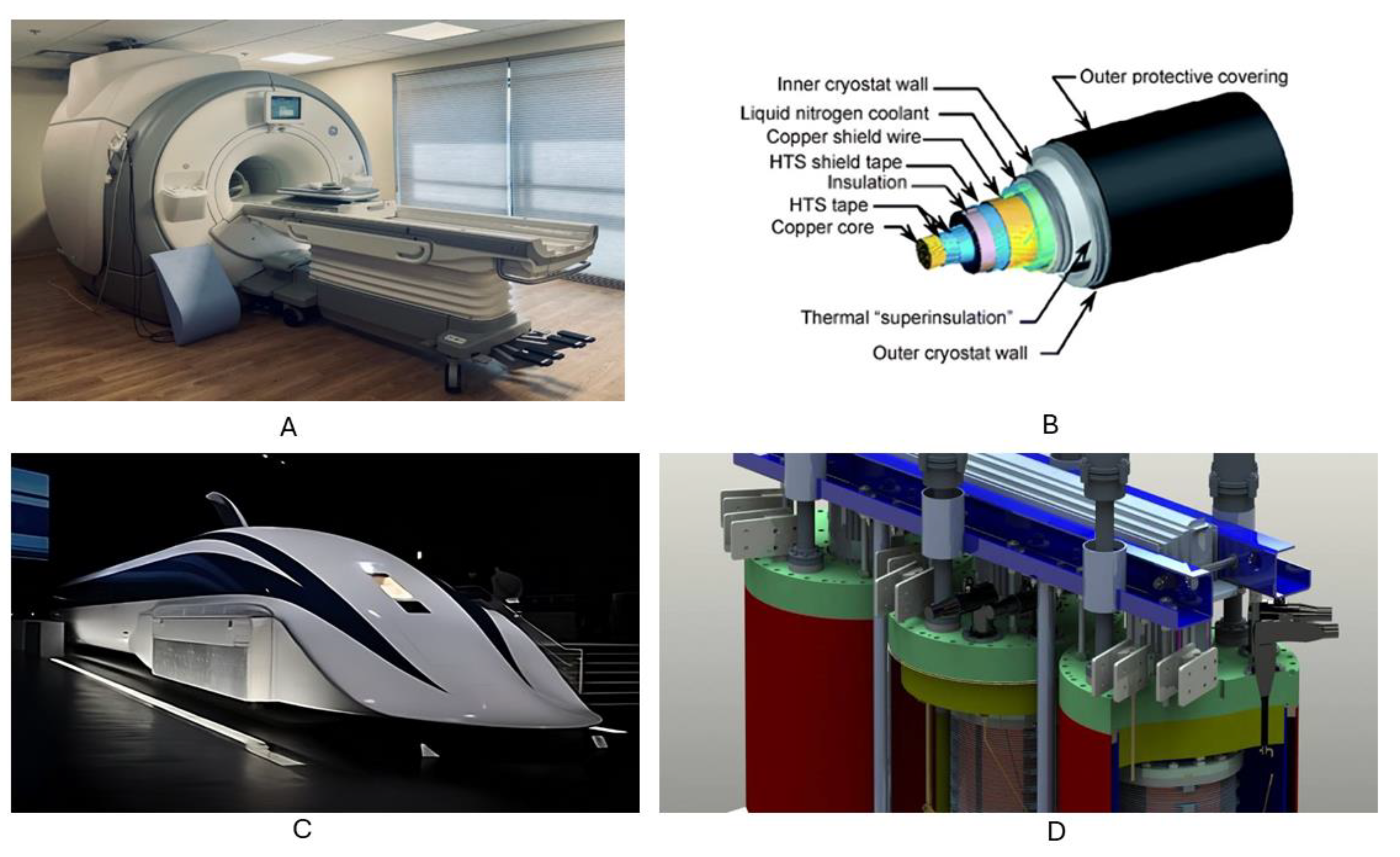
(A) 3 Tesla superconducting MRI machine which can provide basic to advanced examine such as breast MRI provides advanced 3D and dynamic contrast images. (B) YBCO coated superconductor wire showing its different outer and inner layers of typical configurations[63]. (C) Maglev technology also known as magnetic levitation using YBCO superconducting technology, is basically working as floating train a short distance off its tracks that and powering it by using magnetic fields. (D) High-temperature superconducting (HTS) transformers for power grid applications in which superconductor coated tapes offer a high throughput with much higher current-carrying capacity and lower electric losses compared with the conventional conductors, and have the potential to transform the electric power grid.
Figure 6.
(A) 3 Tesla superconducting MRI machine which can provide basic to advanced examine such as breast MRI provides advanced 3D and dynamic contrast images. (B) YBCO coated superconductor wire showing its different outer and inner layers of typical configurations[63]. (C) Maglev technology also known as magnetic levitation using YBCO superconducting technology, is basically working as floating train a short distance off its tracks that and powering it by using magnetic fields. (D) High-temperature superconducting (HTS) transformers for power grid applications in which superconductor coated tapes offer a high throughput with much higher current-carrying capacity and lower electric losses compared with the conventional conductors, and have the potential to transform the electric power grid.
- High-Frequency Electronics: High-frequency electronics require materials with low energy losses to ensure effective signal processing and communication. YBCO's low microwave surface resistance makes it ideal for high-speed data transmission, as it reduces signal attenuation and energy dissipation that might hinder performance. YBCO-based superconducting microelectronics, like rapid single flux quantum (RSFQ) circuits, show potential for high-speed computing and signal processing, providing quick data transfer and wide bandwidth[64].
- Communication System: Wireless communication systems depend on high-quality components like low-noise amplifiers and filters. YBCO's exceptional microwave surface resistance facilitates the creation of top-notch resonators and filters, enhancing signal amplification and filtering efficiency at microwave frequencies[65]. The progress improves the performance of communication systems, leading to improved signal reception, decreased interference, and enhanced overall efficiency.
- Magnetic Resonance Imaging (MRI) coils: Magnetic resonance imaging (MRI) relies on highly sensitive and efficient radiofrequency (RF) coils as a crucial medical diagnostic tool. YBCO's low microwave surface resistance enables the development of high-field MRI coils with decreased energy losses, enhancing the signal-to-noise ratio and image quality[15,66]. Increased sensitivity and resolution allow physicians and researchers to capture precise and detailed images, resulting in enhanced diagnosis and improved patient care.
- Other High-Frequency Applications: YBCO's exceptional microwave surface resistance broadens its possibilities for use in diverse high-frequency applications. Examples include of wireless power transfer systems, radar technologies, and high-frequency sensing devices[67]. YBCO's low energy dissipation in many applications enhances efficiency and minimizes heat production, making it a desirable option for new technologies.
- Superconducting Quantum Devices: The new area of superconducting quantum devices, such superconducting qubits used in quantum computing relies on materials with minimal microwave surface resistance[68,69]. YBCO's potential in low-loss microwave circuits and high coherence times positions it as a contender for advancements in quantum information processing.
- The successful incorporation of YBCO into these high-frequency applications demonstrates its outstanding microwave surface resistance and its potential to influence several technological fields. Yet, there are still obstacles to overcome in enhancing its efficiency and expanding its range of applications.
7. Challenges and Future Directions
Yttrium-Barium Copper Oxide (YBCO) high-temperature superconductors have great potential in high-frequency applications, but there are still hurdles in understanding and optimizing microwave surface resistance (Rs). It is crucial to tackle these issues and investigate future research paths to fully utilize YBCO's strengths and enable its broad adoption in advanced technologies.
Microstructure Engineering: The YBCO's microstructure significantly influences its microwave surface resistance. Grain boundaries and imperfections can provide dispersion centers for microwave currents, resulting in higher Rs[70]. Exploring innovative microstructure engineering methods like grain boundary engineering and nanostructuring shows potential for minimizing the negative impacts of grain boundaries and enhancing the overall efficiency of YBCO in high-frequency devices.
Understanding Vortex Dynamics: Vortices, created by external magnetic fields, can greatly affect the microwave surface resistance in YBCO. Enhancing YBCO's reaction to different magnetic flux densities requires a thorough comprehension of vortex dynamics and their interactions with microwave fields[71,72]. This understanding will facilitate the development of superconducting devices with improved stability and performance in magnetic fields.
Interface Engineering: The interfaces between YBCO and other materials can impact the superconductor's properties, such as microwave surface resistance. It is essential to optimize the interfaces by selecting appropriate materials and deposition processes to achieve high-performance YBCO devices[73].
Advanced Fabrication Techniques: Integrating YBCO into high-frequency devices typically necessitates intricate fabrication procedures. Progress in epitaxial growth methods, lithography, and nanofabrication will facilitate the manufacturing of top-notch YBCO components with accurate dimensions and lower defect concentrations, ultimately improving their microwave surface resistance and overall efficiency[74].
Loss Mechanisms and Damping: It is essential to have a thorough understanding of the several factors causing microwave surface resistance in YBCO in order to develop methods to reduce losses and enhance efficiency[75]. Studying new dampening methods and materials that decrease quasiparticle recombination rates can reduce energy loss and improve the feasibility of YBCO-based devices.
Integration with Nanotechnology: The combination of YBCO and nanotechnology presents promising prospects for high-frequency applications. Utilizing nanomaterials like carbon nanotubes and graphene can create distinctive hybrid structures that exhibit improved superconducting characteristics and decreased microwave surface resistance[76].
Multi-scale Modeling and Simulation: Developing computer models that cover a wide range of length scales, from nano- to macroscopic, is crucial for precisely predicting and comprehending the behavior of YBCO in high-frequency settings[77,78]. These models can offer useful insights into the fundamental principles and help in designing YBCO-based devices with enhanced performance.
By addressing these problems and investigating novel research paths, scientists and engineers can unleash the complete capabilities of YBCO as a top material for high-frequency uses. Improving its microwave surface resistance will lead to more efficient, compact, and sophisticated superconducting technologies, benefiting various practical applications in communication, medical imaging, and other fields.
8. Conclusion
The microwave surface resistance (Rs) of Yttrium-Barium Copper Oxide (YBCO) high-temperature superconductors is essential for their performance in different high-frequency applications. This review analyzes the basic principles, measurement methods, and factors that impact the resistance in YBCO. YBCO, with its high critical temperature (Tc) and low microwave surface resistance, holds potential for applications that demand effective signal processing and improved communication.
YBCO's outstanding characteristics, such as its high critical current density (Jc) and compatibility with epitaxial growth methods, position it as a favorable option for applications in high-frequency electronics, MRI coils, and other areas. However, there are still obstacles in comprehending and managing Rs in YBCO despite its benefits. Exploring microstructure, vortex dynamics, and damping processes, as well as utilizing modern production techniques and integrating nanotechnology, depict potential for enhancing YBCO's performance in real-world applications.
References
- van Delft, D.; Kes, P. The discovery of superconductivity. Phys. Today 2010, 63, 38–43. [CrossRef]
- Koblischka, M.R.; Naik, S.P.K.; Koblischka-Veneva, A.; Murakami, M.; Gokhfeld, D.; Reddy, E.S.; Schmitz, G.J. Superconducting YBCO Foams as Trapped Field Magnets. Materials 2019, 12, 853. [CrossRef]
- Nakaoka, K.; Yoshizumi, M.; Usui, Y.; Izumi, T.; Shiohara, Y. Improvement of Production Rate of YBCO Coated Conductors Fabricated by TFA-MOD Method. Phys. Procedia 2014, 58, 134–137. [CrossRef]
- Koblischka-Veneva, A.; Koblischka, M.R. High-T c Cuprate Superconductors: Materials, Structures and Properties. In Superconducting Materials: Fundamentals, Synthesis and Applications; Springer: 2022; pp. 181-209.
- Schlachter, S.I.; Bagrets, N.; Branco, M.B.C.; Collier-Wright, M.; Dherbécourt, D.; Drechsler, A.; Duval, J.-M.; Erbe, M.; Fink, S.; Genswein, K.; et al. Development and Test of High-Temperature Superconductor Harness for Cryogenic Instruments on Satellites. IEEE Trans. Appl. Supercond. 2023, 33, 1–5. [CrossRef]
- Savchenko, M.; Stefanovich, A. Phase diagram of high-temperature superconductors. Fizika Nizkikh Temperatur 1991, 17, 1263-1267.
- Kitazawa, K. Superconductivity: 100th Anniversary of Its Discovery and Its Future. Jpn. J. Appl. Phys. 2011, 51. [CrossRef]
- Bussmann-Holder, A.; Keller, H. High-temperature superconductors: underlying physics and applications. 2019, 75, 3–14. [CrossRef]
- Hasan, M.; Ali, S. High Temperature Superconductors: Materials and Applications. Superconductors: Materials and Applications 2022, 132, 179-193.
- Jang, W.-J.; Mori, H.; Watahiki, M.; Unoki, H.; Koshizuka, N. Crystal Growth and Structure of YBCO Single Crystal. In Proceedings of the Advances in Superconductivity VII: Proceedings of the 7th International Symposium on Superconductivity (ISS’94), November 8–11, 1994, Kitakyushu. Volume 1 & 2, 1995; pp. 645-648.
- Xiong, J.; Tao, B.; Li, Y. Sputter deposition of large-area double-sided YBCO superconducting films. High-Temperature Superconductors 2011, 149-174e.
- Bednorz, J.G.; Müller, K.A. Possible high T c superconductivity in the Ba− La− Cu− O system. Zeitschrift für Physik B Condensed Matter 1986, 64, 189-193.
- Anlage, S.; Snortland, H.; Beasley, M. A current controlled variable delay superconducting transmission line. IEEE Trans. Magn. 1989, 25, 1388–1391. [CrossRef]
- Atikian, H.A.; Ghamsari, B.G.; Majedi, A.H. Experimental Characterization of Optically Tunable High-Temperature Superconducting Microwave Resonators and Delay Lines. IEEE Trans. Microw. Theory Tech. 2010, 58, 3320–3326. [CrossRef]
- Parkinson, B.J.; Slade, R.; Mallett, M.J.; Chamritski, V. Development of a cryogen free 1.5 T YBCO HTS magnet for MRI. IEEE transactions on applied superconductivity 2012, 23, 4400405-4400405.
- Jha, A.K.; Matsumoto, K.; Horide, T.; Saini, S.; Mele, P.; Ichinose, A.; Yoshida, Y.; Awaji, S. Controlling the Critical Current Anisotropy of YBCO Superconducting Films by Incorporating Hybrid Artificial Pinning Centers. IEEE Trans. Appl. Supercond. 2016, 26, 1–4. [CrossRef]
- Chen, C.; Cai, C.; Peng, L.; Gao, B.; Fan, F.; Liu, Z.; Lu, Y.; Zeng, R.; Dou, S. Flux pinning of stress-induced magnetic inhomogeneity in the bilayers of YBa2Cu3O7− δ/La0. 67Sr0. 33MnO3− δ. Journal of Applied Physics 2009, 106.
- Schey, B. Pulsed Laser Deposition of High-Temperature Superconducting. Pulsed Laser Deposition of Thin Films: Applications-Led Growth of Functional Materials 2007, 313.
- Sahoo, M. Study of structure and electrical transport property in composite and doped systems of YBa2Cu3O7-δ superconductor. 2015.
- Jin, L.; Zhang, S.; Yu, Z.; Li, C.; Feng, J.; Sulpice, A.; Wang, Y.; Zhang, P. Influences of BaZrO3 particles on the microstructure and flux pinning of YBCO film prepared by using modified TFA-MOD approach. Mater. Chem. Phys. 2015, 149-150, 188–192. [CrossRef]
- Zhang, W.; Deringer, V.L.; Dronskowski, R.; Mazzarello, R.; Ma, E.; Wuttig, M. Density-functional theory guided advances in phase-change materials and memories. MRS Bull. 2015, 40, 856–869. [CrossRef]
- Yaxin, Z.; Hongxin, Z.; Wei, K.; Lan, W.; Mittleman, D.M.; Ziqiang, Y. Terahertz smart dynamic and active functional electromagnetic metasurfaces and their applications. Philos. Trans. R. Soc. A: Math. Phys. Eng. Sci. 2020, 378, 20190609. [CrossRef]
- Bühlmann, S. Patterned and self-assembled ferroelectric nano-structures obtained by epitaxial growth and e-beam lithography; EPFL: 2004.
- Grant, P.M. Challenges Confronting High Temperature Superconducting Materials: From Nanoscale Theories to Exascale Energy Applications. MRS Proc. 2014, 1684. [CrossRef]
- Menke, H. Superconductivity in strongly spin-orbit coupled systems. University of Otago, 2020.
- Malik, M.; Malik, B. High Temperature Superconductivity: Materials, Mechanism and Applications. Bulgarian Journal of Physics 2014, 41.
- Dahm, T.; Tewordt, L. Physical quantities in nearly antiferromagnetic and superconducting states of the two-dimensional Hubbard model and comparison with cuprate superconductors. Phys. Rev. B 1995, 52, 1297–1308. [CrossRef]
- Wermbter, S.; Tewordt, L. Self-consistent calculation of physical properties for 2D Hubbard model and comparison with cuprate superconductors. Phys. C: Supercond. its Appl. 1993, 211, 132–146. [CrossRef]
- Tasaki, H. The Hubbard model - an introduction and selected rigorous results. J. Physics: Condens. Matter 1998, 10, 4353–4378. [CrossRef]
- Scalettar, R.T. An introduction to the Hubbard Hamiltonian. quantum materials: experiments and theory 2016, 6.
- Lee, H.S.; Choi, S.G.; Park, H.-H.; Rozenberg, M.J. A new route to the Mott-Hubbard metal-insulator transition: Strong correlations effects in Pr0.7Ca0.3MnO3. Sci. Rep. 2013, 3, srep01704–5. [CrossRef]
- Calegari, E.; Magalhaes, S.; Gomes, A. Superconductivity in a two dimensional extended Hubbard model. The European Physical Journal B-Condensed Matter and Complex Systems 2005, 45, 485-496.
- Fink, H.J. Residual and intrinsic surface resistance of YBa 2 Cu 3 O 7− δ. Physical Review B 1998, 58, 9415.
- Kastner, G.; Schafer, C.; Senz, S.; Hesse, D.; Lorenz, M.; Hochmuth, H.; Getta, M.; Hein, M.; Kaiser, T.; Muller, G. Microstructure and microwave surface resistance of YBaCuO thin films. IEEE Trans. Appl. Supercond. 1999, 9, 2171–2174. [CrossRef]
- Li, Z.; Coll, M.; Mundet, B.; Chamorro, N.; Vallès, F.; Palau, A.; Gazquez, J.; Ricart, S.; Puig, T.; Obradors, X. Control of nanostructure and pinning properties in solution deposited YBa2Cu3O7−x nanocomposites with preformed perovskite nanoparticles. Sci. Rep. 2019, 9, 1–14. [CrossRef]
- Ivan, I.; Ionescu, A.M.; Sandu, V.C.; Crisan, A.; Miu, L. Vortex dynamics driven by AC magnetic field in YBCO thin films with complex pinning structures. Supercond. Sci. Technol. 2018, 31, 105012. [CrossRef]
- Habib, Y.M. Microwave frequency power dependence in high-Tc thin films, grain boundaries, and Josephson junctions. Massachusetts Institute of Technology, 1999.
- Moeckly, B.; Lathrop, D.; Buhrman, R. Electromigration study of oxygen disorder and grain-boundary effects in YBa 2 Cu 3 O 7− δ thin films. Physical Review B 1993, 47, 400.
- Dressel, M.; Klein, O.; Donovan, S.; Grüner, G. Microwave cavity perturbation technique: Part III: Applications. Int. J. Infrared Millim. Waves 1993, 14, 2489–2517. [CrossRef]
- Bonn, D.A.; Morgan, D.C.; Hardy, W.N. Split-ring resonators for measuring microwave surface resistance of oxide superconductors. Rev. Sci. Instruments 1991, 62, 1819–1823. [CrossRef]
- Hefford, S.; Clark, N.; Gumbleton, R.; Porch, A. Liftoff Dielectric Resonator for the Microwave Surface Resistance Measurement of Metal Plates. IEEE Trans. Instrum. Meas. 2020, 70, 1–8. [CrossRef]
- Zhang, Y.; Wang, X.; Zhou, W.; Han, M. Experimental Investigation on Calculation for Unloaded Quality Factor of Single-Port Resonant Cavity. In Proceedings of the 2021 IEEE 5th Advanced Information Technology, Electronic and Automation Control Conference (IAEAC), 12-14 March 2021, 2021; pp. 904-908.
- Barannik, A.A.; Cherpak, N.T.; Filipov, Y.F. MM wave sapphire quasi-optical resonator with conducting and superconducting endplates. In Proceedings of the Fourth International Kharkov Symposium 'Physics and Engineering of Millimeter and Sub-Millimeter Waves'. Symposium Proceedings (Cat. No.01EX429), 4-9 June 2001, 2001; pp. 360-362 vol.361.
- Cherpak, N.; Barannik, A.; Filipov, Y.; Prokopenko, Y.; Vitusevich, S. Accurate microwave technique of surface resistance measurement of large-area HTS films using sapphire quasi-optical resonator. IEEE Trans. Appl. Supercond. 2003, 13, 3570–3573. [CrossRef]
- A Kalenyuk, A.; Kasatkin, A.L.; I Futimsky, S.; O Pokusinskiy, A.; A Prikhna, T.; Shapovalov, A.P.; E Shaternik, V.; Akhmadaliev, S. Improvement of microwave characteristics for high-T c superconductor (YBCO) films by ion irradiation treatment. Supercond. Sci. Technol. 2023, 36, 035009. [CrossRef]
- Torokhtii, K.; Pompeo, N.; Rizzo, F.; Augieri, A.; Celentano, G.; Mancini, A.; Silva, E. Measurement of Vortex Pinning in YBCO and YBCO/BZO Coated Conductors Using a Microwave Technique. IEEE Trans. Appl. Supercond. 2016, 26, 1–5. [CrossRef]
- Honma, T.; Sato, S.; Sato, K.; Watanabe, M.; Saito, A.; Koike, K.; Kato, H.; Ohshima, S. Microwave surface resistance of YBCO superconducting thin films under high DC magnetic field. Phys. C: Supercond. its Appl. 2013, 484, 46–48. [CrossRef]
- Aghabagheri, S.; Rasti, M.; Mohammadizadeh, M.; Kameli, P.; Salamati, H.; Mohammadpour-Aghdam, K.; Faraji-Dana, R. High temperature superconducting YBCO microwave filters. Phys. C: Supercond. its Appl. 2018, 549, 22–26. [CrossRef]
- Nakagawa, K.; Honma, T.; Takeda, K.; Ono, S.; Kai, H.; Saito, A.; Mukaida, M.; Nakajima, K.; Ohshima, S. Intrinsic Surface Resistance of YBCO Thin Films Under DC Magnetic Field. IEEE Trans. Appl. Supercond. 2010, 21, 587–590. [CrossRef]
- Yi, Q.-R.; Xiong, P.-Y.; Wang, H.-H.; Li, G.; Wang, Y.-K.; Dong, E.-Y.; Chen, Y.; Shen, Z.-B.; Wu, Y.; Yuan, J. Microstructure study of YBa2Cu3O7-? thin film withsynchrotron-based three-dimensionalreciprocal space mapping br. ACTA PHYSICA SINICA 2023, 72.
- Schäfer, H.; Banko, F.; Nordmann, J.; Voss, B.; Steinhart, M.; Walder, L.; Rathmann, D. Oxygen Plasma Effects on Zero Resistance Behavior of Yb,Er-doped YBCO (123) Based Superconductors. 2014, 640, 1900–1906. [CrossRef]
- Prokhorov, V.; Lee, Y.; Kaminsky, G. Peculiarity of surface microwave resistance in overdoped YBCO films. IEEE Trans. Magn. 1999, 35, 3166–3168. [CrossRef]
- Velichko, A.; Huish, D.; Lancaster, M.; Porch, A. Anomalies in nonlinear microwave surface impedance of YBCO thin films on MgO: superconductor versus substrate effects. IEEE Trans. Appl. Supercond. 2003, 13, 3598–3601. [CrossRef]
- Willemsen, B.A.; Sridhar, S.; Derov, J.S.; Silva, J.H. Vortex dynamics at microwave frequencies in patterned YBa2Cu3O7− δ thin films. Applied physics letters 1995, 67, 551-553.
- Pompeo, N.; Alimenti, A.; Torokhtii, K.; Bartolomé, E.; Palau, A.; Puig, T.; Augieri, A.; Galluzzi, V.; Mancini, A.; Celentano, G. Intrinsic anisotropy and pinning anisotropy in nanostructured YBa2Cu3O7− δ from microwave measurements. Superconductor Science and Technology 2020, 33, 044017.
- Mizuguchi, Y.; Hara, Y.; Deguchi, K.; Tsuda, S.; Yamaguchi, T.; Takeda, K.; Kotegawa, H.; Tou, H.; Takano, Y. Anion height dependence of Tc for the Fe-based superconductor. Superconductor Science and Technology 2010, 23, 054013.
- Zhao, Y.; Zhu, J.-M.; Jiang, G.-Y.; Chen, C.-S.; Wu, W.; Zhang, Z.-W.; Chen, S.K.; Hong, Y.M.; Hong, Z.-Y.; Jin, Z.-J.; et al. Progress in fabrication of second generation high temperature superconducting tape at Shanghai Superconductor Technology. Supercond. Sci. Technol. 2019, 32, 044004. [CrossRef]
- Srinivasu, V.; Jesudasan, J.; Kaur, D.; Pinto, R.; Vijayaraghavan, R. Thickness dependence of microwave surface resistance and critical current density in Ag–YBa2Cu3O7−x thin films. Appl. Supercond. 1998, 6, 45–48. [CrossRef]
- Muller, K.; Bednorz, J. The discovery of high temperature superconductivity. Recherche (Paris) 1988, 195.
- Piel, H.; Chaloupka, H.; Müller, G. High Temperature Superconductors in High Frequency Fields—Fundamentals and Applications. In Proceedings of the Advances in Superconductivity IV: Proceedings of the 4th International Symposium on Superconductivity (ISS’91), October 14–17, 1991, Tokyo, 1992; pp. 925-930.
- Lee, S.Y.; Kang, K.Y.; Ahn, D. Fabrication of YBCO superconducting dual mode resonator for satellite communication. IEEE Trans. Appl. Supercond. 1995, 5, 2563–2566. [CrossRef]
- Kim, W.-S.; Park, C.; Park, S.H.; Lee, J.; Song, J.-B.; Lee, H.; Lee, H.-G.; Hong, G.-W.; Choi, K. Magnetic Field Stability of a Small YBCO Magnet in Persistent Current Mode. IEEE Trans. Appl. Supercond. 2009, 19, 2194–2197. [CrossRef]
- Albiss, B.A.; Obaidat, I.M. Applications of YBCO-coated conductors: a focus on the chemical solution deposition method. J. Mater. Chem. 2009, 20, 1836–1845. [CrossRef]
- Abbas, F.; Davis, L.; Gallop, J.; Langham, C. Microwave properties of high temperature superconductors. 1996.
- Ali, M.; Ehata, K.; Ohshima, S. Superconducting patch array antenna on both-side YBCO thin film for satellite communication. IEEE Trans. Appl. Supercond. 1999, 9, 3077–3080. [CrossRef]
- Slade, R.A.; Parkinson, B.J.; Walsh, R.M. Test Results for a 1.5 T MRI System Utilizing a Cryogen-free YBCO Magnet. IEEE Trans. Appl. Supercond. 2013, 24, 1–5. [CrossRef]
- Van Mulders, J.; Delabie, D.; Lecluyse, C.; Buyle, C.; Callebaut, G.; Van der Perre, L.; De Strycker, L. Wireless Power Transfer: Systems, Circuits, Standards, and Use Cases. Sensors 2022, 22, 5573.
- Stangl, A.; Palau, A.; Deutscher, G.; Obradors, X.; Puig, T. Ultra-high critical current densities of superconducting YBa2Cu3O7-δ thin films in the overdoped state. Sci. Rep. 2021, 11, 1–12. [CrossRef]
- Gao, Y.Y.; Rol, M.A.; Touzard, S.; Wang, C. Practical Guide for Building Superconducting Quantum Devices. PRX Quantum 2021, 2, 040202. [CrossRef]
- Tafuri, F.; Nadgorny, B.; Shokhor, S.; Gurvitch, M.; Lombardi, F.; Carillo, F.; Di Chiara, A.; Sarnelli, E. Barrier properties in YBa 2 Cu 3 O 7− x grain-boundary Josephson junctions using electron-beam irradiation. Physical Review B 1998, 57, R14076.
- Sadovskyy, I.; Koshelev, A.; Glatz, A.; Ortalan, V.; Rupich, M.; Leroux, M. Simulation of the vortex dynamics in a real pinning landscape of YBa 2 Cu 3 O 7− δ coated conductors. Physical Review Applied 2016, 5, 014011.
- Kalenyuk, A.; Kasatkin, A.; Futimsky, S.; Moskalyuk, V.; Flis, V. Microwave vortex response in the mixed state of HTS YBCO thin films. In Proceedings of the 2013 International Kharkov Symposium on Physics and Engineering of Microwaves, Millimeter and Submillimeter Waves, 2013; pp. 670-672.
- Holesinger, T.G.; Civale, L.; Maiorov, B.; Feldmann, D.M.; Coulter, J.Y.; Miller, D.J.; Maroni, V.A.; Chen, Z.; Larbalestier, D.C.; Feenstra, R. Progress in Nanoengineered Microstructures for Tunable High-Current, High-Temperature Superconducting Wires. Advanced Materials 2008, 20, 391-407.
- Chen, Y.; Wu, C.; Zhao, G.; You, C. An advanced low-fluorine solution route for fabrication of high-performance YBCO superconducting films. Superconductor Science and Technology 2012, 25, 062001.
- Orbach, S.; Hensen, S.; Müller, G.; Piel, H.; Lippert, M.; Saemann-Ischenko, G.; Wolf, S. Effect of oxygen deficiency and disorder on microwave losses of epitaxially grown YBa2Cu3O7−δ films. J. Alloy. Compd. 1993, 195, 555–558. [CrossRef]
- Dang, V.-S. Nanotechnology of pinning centres in high temperature superconducting YBa2Cu3O7 films. University of Birmingham, 2011.
- Wang, L.; Zheng, J.; Song, Y.; Wan, Y. Multiscale Model for Simulation of Large-Scale YBCO Solenoid Coils With J Infinite-Turn. IEEE Trans. Appl. Supercond. 2018, 29, 1–5. [CrossRef]
- Wang, Y.; Jing, Z. Multiscale modelling and numerical homogenization of the coupled multiphysical behaviors of high-field high temperature superconducting magnets. Compos. Struct. 2023, 313. [CrossRef]
Disclaimer/Publisher’s Note: The statements, opinions and data contained in all publications are solely those of the individual author(s) and contributor(s) and not of MDPI and/or the editor(s). MDPI and/or the editor(s) disclaim responsibility for any injury to people or property resulting from any ideas, methods, instructions or products referred to in the content. |
© 2024 by the authors. Licensee MDPI, Basel, Switzerland. This article is an open access article distributed under the terms and conditions of the Creative Commons Attribution (CC BY) license (http://creativecommons.org/licenses/by/4.0/).
Copyright: This open access article is published under a Creative Commons CC BY 4.0 license, which permit the free download, distribution, and reuse, provided that the author and preprint are cited in any reuse.


