

Submitted:
05 April 2024
Posted:
23 April 2024
You are already at the latest version
Abstract
Improving the capabilities of faculty members, including competencies of emotional intelligence in professors, can play a major role in various education levels of success and achievement, adjustment, and mental health in students, and is a fundamental solution to the promotion of higher education quality. For accurate examination of the issue, the present study aimed to determine the association between basic science professors' emotional intelligence and the ability to teach at the School of Medicine of Iran University of Medical Sciences. The present descriptive-analytical study was conducted at the School of Medicine of Iran University of Medical Sciences by census sampling of faculty members of the basic sciences. We included 98 faculty members in the study. The research tools included Dr. Haghani's "Emotional Intelligence in Teaching" questionnaire and Dr. Akbari's "Teaching Ability" questionnaire. We analyzed data through descriptive statistics and analytical tests, including Spearman's correlation test, Pearson test, t-test, and two-way analysis of variance. The mean score of faculty members' emotional intelligence was 111.51±9.3 equal to 89.93±7.5 percent, and the median score of total teaching ability of the questionnaire was 101.89±8.59 equal to 87.84±7.4 percent. There was a positive correlation between faculty members' emotional intelligence and teaching ability. (p= 0.0001, r= 0.71). The faculty members' emotional intelligence can be a determinant in their teaching ability. Their emotional intelligence was evaluated as good and there was a positive relationship between emotional intelligence and teaching ability.
Keywords:
Emotional Intelligence
; Teaching Ability
; Faculty
1. Introduction
Promoting the capabilities of faculty members, who are in charge of training the health human force, will improve the education of medical science students and promote the health system [1]. Teaching capabilities refer to the conscious and constant use of communication skills, knowledge, reasoning, emotions, and values in the educational setting that requires technical skills and understanding, whereby the instructor can aid the students’ intellectual, social, and spiritual growth [2]. Teaching includes the perception of the emotion management quality to facilitate and improve inter-personal relationships and conflict management [3]. Teaching requires capabilities besides scientific mastery and a knowledge of psychology. Establishing effective communication will direct the learners towards useful interaction [4].
Emotional intelligence is a popular topic in education and psychology. Scholars believe that emotional intelligence is responsible for success in many domains [5]; competencies related to emotional intelligence can promote one’s leadership and group participation ability, stress management, and communication, and greatly contribute to academic achievement and role adjustment [6]. It is correlated with other skills and characteristics such as happiness, motivation, and establishing social relationships [7]. According to Bar-On (1980), emotional intelligence is a wide spectrum of non-cognitive capabilities, competencies, and skills that influence people’s ability to cope with environmental pressures [8]. Daniel Goleman 1 (1995) believes that emotional intelligence is the main factor contributing to a wide spectrum of emotional competencies that lead to one’s excellent professional performance [7]. In his theory, Goleman considers five key components of self-awareness, self-regulation, self-motivation, social awareness, and relationship management for emotional intelligence [6]. Later, in his theory of multiple intelligences, Gardner (2014) notes personal intelligences, including intra- and inter-personal components. Intra-personal intelligence refers to an integrated intrinsic capability for creating an accurate model of oneself, e.g., self-knowledge and self-confidence. Inter-personal intelligence refers to the ability to understand others in terms of different moods, tastes, motivations, and goals; interest in others; and empathy [9]. Emotional intelligence is dynamic and can be promoted through purposive education and training. It distinguishes individuals and groups who have prominent and excellent performance [10]. In addition to strengthening positive characteristics in themselves and their students, instructors with a high emotional intelligence teach with a high degree of motivation and interest, and have superior social and cooperative skills. Promotion of emotional intelligence skills in teaching needs the evaluation of these skills in instructors and finding the areas that require improvement [5]. Attitudes and skills are trainable [11]. Research shows that those with poor emotional intelligence and occupational performance can reach those who have superior capabilities only through improving their emotional intelligence [12]. Emotional intelligence is positively correlated with the achievements of the components of students’ progress objectives [13]. According to education experts, teaching is a job that demands higher emotional intelligence. In fact, the effectiveness of teaching requires coordination between the teacher's and learners’ activities in a cooperative, intimate, and motivating classroom environment [14]. Today, several features such as simulation, designing virtual learning environments, attractiveness, and lack of time and place barriers have been very popular in education. To teach in such environments, professors should have specific technical and managerial competencies to respond to the learners’ needs in practical situations [15]. The tendency towards educational management promotion has greatly accelerated in the 21st century [16]. The critical duties of the education decision-making system at universities to promote educational performance include designing new educational strategies and taking measures to improve the quality of teaching; to this end, teaching quality indicators at the current and expected levels should be identified, and the gap between these two levels should be determined [17]. Based on the previous studies, assessment of professors’ emotional intelligence as well as teaching skills and competencies can provide suitable information for analysis of educational problems and strategic planning. It can also help professors at medical schools to identify their weaker capabilities and look for ways to improve these skills. Thus, the present study mainly aimed to examine the relationship between emotional intelligence and teaching competencies among faculty members at the school of medicine, Iran University of Medical Sciences (IUMS). The general hypothesis was:
There is a relationship between emotional intelligence in teaching and the teaching competency of faculty members at the IUMS school of medicine.
2. Materials and Methods
This descriptive-analytical study was conducted in the school of medicine (IUMS) by sampling among the basic sciences faculty members. A census sampling with a sample size of 98 was performed. The research instruments were distributed to all the 11 educational departments of basic sciences at said school during in-person visits. A from explaining the objectives of the study and instructions for filling out the questionnaires was also provided to the participants. Moreover, due to the COVID-19 pandemic, the instruments were emailed to 54 faculty members. The Emotional Intelligence in Teaching questionnaire was employed to assess emotional intelligence. This 31-item questionnaire was developed and its psychometrics were assessed by Haqhani et al. (2014) who provided consent to its use in this study. The Cronbach's alpha indicating the reliability of this questionnaire is 0.9 [5]. The items are based on Goleman's five domains of emotional intelligence, i.e., self-awareness, emotion regulation, motivation, empathy, and social skills. The questionnaire includes a demographic information section and 31 statements about emotional intelligence in teaching. Each statement is scored on a five-point scale from 0 to 4, and the maximum score of the questionnaire is 124.
Teaching ability was assessed by using a self-report teaching ability measure, adapted from the statements of the University of Alabama Teaching Ability Self-Assessment Questionnaire. This questionnaire includes a demographic information section and 29 statements about teaching ability. It was developed and its psychometrics were analyzed by Akbari et al. (2012). The reliability of the questionnaire was confirmed with a Cronbach’s alpha of 0.86 [2]. In this questionnaire, teaching abilities are classified into eight domains, and the score of each domain is calculated separately: Preparedness (planning) before teaching (3 items), teaching based on an organized syllabus (6 items), student performance assessment before, during, and after teaching (4 items), class management (2 items), conductive learning atmosphere (4 items), communication (2 items), leadership and professional development (3 items), and the performance of professional responsibilities (5 items).
In total, 58 filled-out questionnaires were collected. The data were analyzed in SPSS by using inferential statistics. Descriptive statistics were used to calculate the central tendency and dispersion indicators, and to plot the diagrams. Then, the normality of data distribution was assessed by the Kolmogorov-Smirnov Test. Spearman correlation test was performed to examine the relationship between emotional intelligence and teaching ability. A two-way analysis of variance was used to control the effect of a confounding variable. The significance level was set at < 0.05 in all the tests.
3. Results
The mean percentage of the total scores of the Emotional Intelligence in Teaching questionnaire was 89.93 ± 7.5%. The mean percentage of the total scores of the Emotional intelligence in Teaching questionnaire was 89.93 ± 7.5%, which is moderate. Table 1 presents the demographic characteristics variables.
For the Emotional Intelligence in Teaching questionnaire, the minimum score was 87, the maximum score was 124, and the mean score was 111.51 ± 9.3 (Table 2).
Using t-test and ANOVA analysis of variance, it was found that there is no statistically significant difference between the mean scores obtained from the Teaching Emotional Intelligence Questionnaire with some demographic and occupational characteristics (P> 0.05) (Table 3).
The mean percentage of the scores of the teaching ability questionnaire was 87.84 ± 7.4%. communication, performance of professional responsibilities, conducive learning atmosphere, planning before teaching, professional development and leadership, and assessing students’ performance, in descending order of score (Table 4).
No significant difference was observed between the mean scores of the teaching ability questionnaire and some demographic and occupational characteristics (all p > 0.05).
Based on Spearman’s rho, a positive correlation was found between the scores of each domain of the teaching ability questionnaire and the scores of the emotional intelligence in teaching questionnaire (all p < 0.05; Table 5).
The results of Pearson test showed a positive relationship between emotional intelligence in teaching and faculty members' teaching ability. This relationship can be seen in Figure 1. (rs = 0/31, p <0/001)
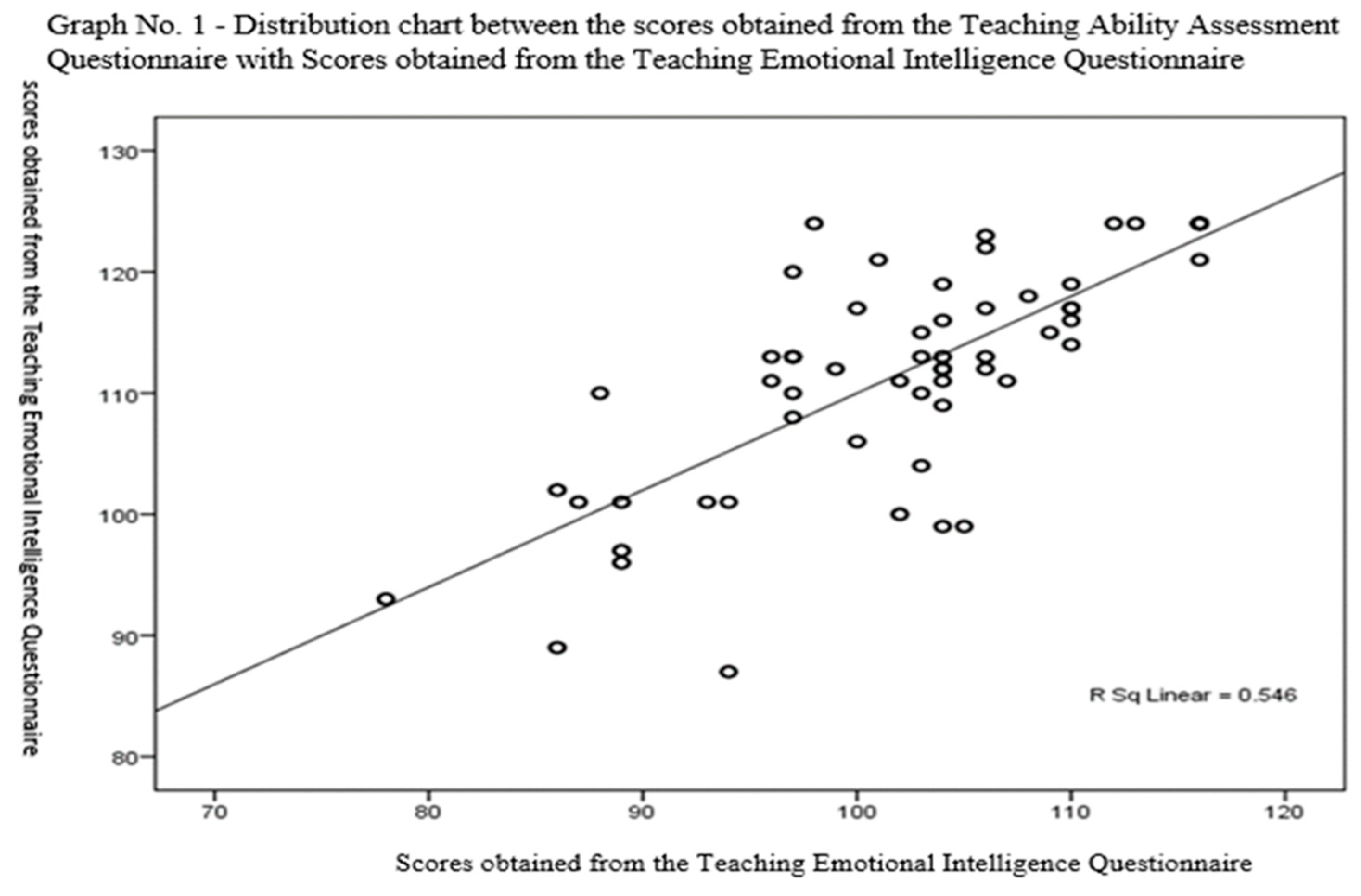
Based on Spearman's rho, the correlation between the scores of each domain of the teaching ability questionnaire and the scores of the emotional intelligence in teaching questionnaire was examined in terms of some demographic and occupational characteristics (at p < 0.05; Table 6).
No positive correlation was observed between the scores of the teaching ability and the emotional intelligence in teaching questionnaires with being single, being a full professor, and graduating from a foreign country, but a positive correlation was found with other demographic and occupational characteristics.
4. Discussion
The findings of this study indicated that the basic sciences faculty members at IUMS have a moderate emotional intelligence. Emotional intelligence has an undeniable effect on health, personality development, strengthening intra- and interpersonal relationships, learning, teaching, occupational achievement, and organizational management [12]. It promotes organizational performance, teaching skills, and adjustment [18]. Bar-On showed that emotional intelligence can be developed and improved through training, and that training the skills related to interaction development should be included in in-service training programs [19]. Emotional intelligence can be taught by training attentive listening, respecting one’s and others’ feelings, and empathy in intra- and interpersonal relationships. One way to train emotional intelligence is through an intervention based on the Mayer-Salovey-Caruso Emotional Intelligence Test (MSCEIT). In the educational sessions, the topics related to emotional intelligence promotion are presented in theory, through role-playing, and free discussions [20]. Maleki Avarsin (2008) showed that many skills constituting emotional intelligence can be promoted through psychotherapy, counseling, preparation, and instruction of life skills [21]. Training clinical teaching indicators based on emotional intelligence can positively change the professors’ attitudes and cognition, but long-term interventions are required to modify their skills [22]. Soleiman Gheisar (2018) suggests that, to have students with high emotional intelligence, curriculum developers should include emotional intelligence promotion in the curricula. Programs and seminars on emotional intelligence should be offered to professors at all levels to provide them with the information necessary to enhance their students’ emotional intelligence [6].
Eight domains of teaching ability were evaluated in the present study. Effective teaching is a set of skills in the instructor that help the students achieve the educational objectives, ensure learning, and help attain the general goals of the university [23]. The process of empowerment leads to intrinsic motivation in the instructors, thereby promoting creativity to look for ways to correct the mistakes and reconstruct the work processes [24]. Results of a study by Alimohammadi et al. (2019) in Golestan Province (Iran) revealed that teachers’ professional skills development is a component of teacher empowerment; based on the existing challenges and the society’s diverse needs, this study recommends updating the resources, improving the human force, and the teachers’ professional empowerment [25].
Learning “change” is a new objective of education. Acquisition of knowledge, development of intelligence, achievement of self-knowledge, promotion of mental faculties, overcoming undesirable motivations are among the goals of modern education [26].
In the present study, a significant positive correlation was found between emotional intelligence in teaching and the teaching abilities of the basic sciences faculty members at the IUMS school of medicine. No significant difference was found between the mean emotional intelligence of these faculty members and their demographic information.
These results are consistent with the findings of the study by Eslamian et al. at Mazandaran University of Medical Sciences [27] and by Haqhani et al. at Isfahan University of Medical Sciences [5]. The present study also examined the relationship between emotional intelligence and the components of effective teaching. The findings revealed a significant correlation between the emotional intelligence of the professors at the school of medicine and their use of all domains of effective teaching. This result is in line with the findings of Narehan Hassan at the University Tecknology MARA, Malaysia [28].
Note that scoring can be affected by the participants’ personality on a self-assessment measure, especially measures of emotional intelligence; those with a higher level of assertiveness score themselves higher on self-evaluations [27]. Therefore, future studies can repeat this evaluation by using other tests. To improve the teaching ability and emotional intelligence of the professors at universities of medical sciences, it is recommended that in-service training, emotional intelligence skills workshops, and teaching ability promotion workshops be held.
5. Conclusions
The results of this study indicated that emotional intelligence can predict the professors' teaching abilities. Having a high emotional intelligence can determine professors’ teaching abilities, which will eventually improve the students’ optimal learning, further realize the educational objectives, and promote organizational performance. Thus, higher education planners should pay attention to this factor.
Author Contributions
This article is extracted from a master's thesis, which was guided by " Z.S (corresponding author) and advised by K. S and Sh. B. The main manuscript was written by N.R and M. G." All authors were involved in revising the manuscript critically for important intellectual content, and have read and approved the final manuscript.
Funding
This research received no external funding.
Institutional Review Board Statement
The study was approved by the Iran University of Medical Sciences ethics review committee (IR.IUMS.FMD.REC.1398.334). The research was carried out in accordance with guidelines and regulations stipulated in the Declaration of Helsinki. For participants’ consent, we inserted written consent in the introductory page of the questionnaire, and all participants gave informed consent before answering the questions. Participation in this study was voluntary.
Informed Consent Statement
Informed consent was obtained from all subjects involved in the study.
Data Availability Statement
The datasets used and/or analyzed during the current study are available from the corresponding author in response to reasonable requests.
Acknowledgments
The authors would like to thank all the participants who collaborated in the study.
Conflicts of Interest
The authors declare no conflicts of interest.
References
- Sadri, D. and R. Hasanzadeh, Assessment of Spiritual Intelligence and its Association with Teaching Ability in the Faculty Members of the School of Dentistry. Journal of Mashhad Dental School, 2018. 42(2): p. 159-166.
- karimi mounaghi, H. , et al., The Relationship between Spiritual Intelligence / Quotient (SQ) and Teaching Competency in Medical Faculty Members. Iranian Journal of Medical Education, 2012. 12(8): p. 554-563.
- Valente, S. and A.A. Lourenço, Conflict in the Classroom: How Teachers’ Emotional Intelligence Influences Conflict Management. Frontiers in Education, 2020. 5(5).
- Asrar-ul-Haq, M., S. Anwar, and M. Hassan, Impact of emotional intelligence on teacher׳s performance in higher education institutions of Pakistan. Future Business Journal, 2017. 3(2): p. 87-97.
- Haghani, F. , et al., Development and Psychometric Evaluation of a Tool for Assessing Emotional Intelligence in Teaching. Iranian Journal of Medical Education, 2014. 13(12): p. 1127-1137.
- Suleman, Q. , et al., Association between emotional intelligence and academic success among undergraduates: A cross-sectional study in KUST, Pakistan. PLOS ONE, 2019. 14(7): p. e0219468.
- Haghani, F., B. Aminian, and T. Changiz, Do the Teachers Who Are Selected by Students Have a Higher Emotional Intelligence? Strides in Development of Medical Education, 2012. 8(2): p. 132-140.
- Bar-On, R. , The Bar-On Model of Emotional-Social Intelligence. Psicothema, 2006. 18 Suppl: p. 13-25.
- Petrides, K., A. Furnham, and N. Frederickson, Emotional intelligence. Psychologist, 2004. 17: p. 574-577.
- McEnrue, M. and K. Groves, Choosing among tests of emotional intelligence: What is the evidence? Human Resource Development Quarterly, 2006. 17: p. 9-42.
- Sohrabi, Z. , et al., The effects of group blogging on the attitude towards virtual education in nursing students. Medical Journal of the Islamic Republic Of Iran, 2017. 31(1): p. 877-881.
- Darkivandi, R.M. , Emotional Intelligence, Its History and Approaches in the View of Religion and Psychology %J Ravanshenasi Va Din. 2012. 4(3): p. 97-.
- Ashrafi, K. , Kavousian, J., Kadivar, P., karimi, K. The role of emotional intelligence and five personality factors in Predicting Components of goal achievement. Knowledge & Research in Applied Psychology, 2019; 20(4): 101-112. [CrossRef]
- Qualter, P., K. Gardner, and H. Whiteley, Emotional Intelligence: Review of Research and Educational Implications. Pastoral Care in Education, 2007. 25: p. 11-20.
- Moosapoor,N, (STRIDES IN DEVELOPMENT OF MEDICAL EDUCATION). 1383 [cited 2021August03];1(1):48-56. Available from: https://www.sid.ir/fa/journal/ViewPaper.aspx? 5448.
- Bagheri, R., Z. Sohrabi, and E.h. Moradi, Psychometric properties of Persian version of the multifactor leadership questionnaire (MLQ). Medical journal of the Islamic Republic of Iran, 2016. 29: p. 256.
- Amin Khandaghi M, Saifi G A. Effective capabilities and skills needed for college teaching. IRPHE. 2013; 19 (3) :121-147 URL: http://journal.irphe.ac.ir/article-1-2052-fa.
- Adib-Hajbaghery, M. and M.S. Lotfi, The Association of Emotional Intelligence with Academic Achievement and Characteristics of Students of Kashan University of Medical Sciences. Iranian Journal of Medical Education, 2013. 13(9): p. 703-710.
- Ayiro, L.P. , An Analysis of Emotional Intelligence and the Performance of Principals in Selected Schools in Kenya. 2009. 11(6): p. 719-746.
- Malekmohammadi,M.Noori,H.Ebnesharie,M Emotional intelligence, dimensions, features and models, The Second International Conference on New Research in Management, Economics and Accounting. Available from: https://civilica.com/doc/439944 https://scholar.conference.ac:443/index.
- Sadegh Maleki Avarsin, Mirmohammad Siedkalan, (2008). A survey on the relationship between Emotional Intelligence and Effectiveness among academic staff in Islamic Azad university of Parsabad Moghan, Quarterly Journal Of Educational Leadership & Administration, 2(2), 115. magiran. 8714.
- Omid, A., F. Haghani, and P. Adibi, Clinical teaching with emotional intelligence: A teaching toolbox. J Res Med Sci, 2016. 21: p. 27.
- cherniss, C.G., Daniel Bringing Emotional Intelligence to the Workplace: A Technical Report Issued by the Consortium for Research on Emotional Intelligence in Organizations. 1998, Fetzer Institute.: The Consortium for Research on Emotional Intelligence in Organizations (CREIO).
- Bates, A.W. , Teaching in a digital age, in Open Educational Resources Collection. 2015, Tony Bates Associates Ltd: Porterfield, Michael David - EDTECH 5340.
- Golamali, A., j. negin, and n. kioumars, Professional empowerment of teachers in the future perspective along with a model. Quarterly Journal of Educational Innovations, 2019. 18(69): p. 7-32.
- Unnikrishnan, B. , et al., Association of emotional intelligence with academic performance among medical students in South India. Asian J Pharm Clin Res, 2015. 8: p. 300-302.
- Eslamian, H. , et al., Study the relationship between emotional intelligence and how to apply the standards of effective teaching by faculty Medical Sciences. Iranian Journal of Medical Education, 2014. 14(8): p. 685-694.
- Hassan, N. , et al., The Relationship between Emotional Intelligence and Teaching Effectiveness among Lecturers at Universiti Teknologi MARA, Puncak Alam, Malaysia. International Journal of Social Science and Humanity, 2015. 5: p. 1-5.

Table 1.
Frequency distribution of demographic characteristics of faculty members of Iran University of Medical Sciences participating in the study.
Table 1.
Frequency distribution of demographic characteristics of faculty members of Iran University of Medical Sciences participating in the study.
| Variable | Condition | Percentage |
|---|---|---|
| Gender | female | 56.9 |
| male | 43.1 | |
| marital status | Married | 84.5 |
| Single | 15.5 | |
| age ( year ) Mean ± SD ( min- max ) | ( 68 – 31)9.3± 45.75 | |
| teaching experience | Up to 10 years | 58.6 |
| 20-10 | 15.5 | |
| More than 20 years | 25.9 | |
| teaching experience ( year )( Mean ± SD ( min- max | (31 –1) 9.8± 12.31 | |
| Scientific degree | Instructor | 1.7 |
| Assistant Professor | 67.2 | |
| Associate Professor | 16.8 | |
| Professor | 17.2 | |
| University of study | State university | 93.1 |
| Overseas University | 6.9 | |
| Passing a training course on teaching to adults | Yes | 72.4 |
| No | 27.6 | |
Table 2.
Assessing the status of the Teaching Emotional Intelligence Questionnaire in the faculty members of Iran University of Medical Sciences participating in the study.
Table 2.
Assessing the status of the Teaching Emotional Intelligence Questionnaire in the faculty members of Iran University of Medical Sciences participating in the study.
| questionnaire | Number of questions | Points earned Mean ±SD | Scope range obtained | Range of achievable scores | Percentage of points earned Mean ±SD |
|---|---|---|---|---|---|
| Emotional intelligence in teaching | 31 | 9.3± 111.51 | 124-87 | 124-0 | 7.5± 89.93 |
Table 3.
Comparison of the average scores obtained from the Teaching Emotional Intelligence Questionnaire by the faculty members under study according to some personal and professional characteristics.
Table 3.
Comparison of the average scores obtained from the Teaching Emotional Intelligence Questionnaire by the faculty members under study according to some personal and professional characteristics.
| Variable | Condition | Number | Scores obtained from the questionnaire Mean ± SD | Statistical estimation |
|---|---|---|---|---|
| Gender | female | 33 | 9.57± 112.15 | P=0.556 |
| male | 25 | 9.06± 110.68 | ||
| marital status | Married | 49 | 10.04 ±111.36 | P=0.778 |
| Single | 9 | 3.24 ± 112.33 | ||
| age ( year) | less than 40 years | 22 | 9.53± 111.81 | P=0.178 |
| 50-41 | 17 | 10.88± 108.29 | ||
| More than 50 years | 19 | 6.81± 114.05 | ||
| teaching experience(year) | Up to 10 years | 34 | 10.42± 109.64 | P=0.19 |
| 20-10 | 9 | 5.87± 113.77 | ||
| More than 20 years | 16 | 7.54± 114.4 | ||
| Scientific degree | Instructor | 1 | 113 | P=0.396 |
| Assistant Professor | 39 | 9.44± 110.61 | ||
| Associate Professor | 8 | 10.25± 110 | ||
| Professor | 10 | 7.82± 116.1 | ||
| University of study | State university | 54 | 9.39± 111.11 | P=0.225 |
| Overseas University | 4 | 68/6 ± 117 | ||
| Passing a training course on teaching to adults | Yes | 42 | 44/9 ± 111.57 | P=0.943 |
| No | 16 | 23/9 ± 11.37 |
Table 4.
Comparison of the average scores obtained from the areas of the teaching competency assessment questionnaire by the faculty members surveyed according to some personal and job characteristics.
Table 4.
Comparison of the average scores obtained from the areas of the teaching competency assessment questionnaire by the faculty members surveyed according to some personal and job characteristics.
| The maximum teaching abilities were teaching based on an organized syllabus, class managementArea | number of questions |
Points earned Mean ±SD | Scope range obtained | Range of achievable scores | Percentage of points earned Mean ±SD |
|---|---|---|---|---|---|
| Pre-teaching planning | 3 | 1.61± 10.29 | 12-6 | 12-0 | 13.42 ± 85.77 |
| Curriculum teaching | 6 | 1.94± 21.94 | 24-16 | 24-0 | 7.97 ± 91.45 |
| Measuring student performance | 4 | 2.34± 13.3 | 16-7 | 16-0 | 14.66 ± 81.46 |
| class management | 2 | 1.04± 7.29 | 8-3 | 8-0 | 13.03± 91.16 |
| Favorable learning atmosphere | 4 | 1.52±14.29 | 16-11 | 16-0 | 9.51 ± 89.33 |
| Relationship | 2 | 0.89± 7.27 | 8-5 | 8-0 | 11.17± 90.94 |
| Professional development and leadership | 3 | 1.68 ± 9.79 | 12-6 | 12-0 | 14.02 ± 81.60 |
| Performance of professional responsibilities | 5 | 1.69± 17.96 | 20-11 | 20-0 | 8.47± 89.82 |
| The whole questionnaire of teaching ability | 29 | 8.59± 101.89 | 116-78 | 116-0 | 7.4± 87.84 |
Table 5.
Assessing the correlation between the scores obtained in each of the areas of the teaching competency assessment questionnaire with the scores obtained from the teaching emotional intelligence questionnaire by the faculty members under study.
Table 5.
Assessing the correlation between the scores obtained in each of the areas of the teaching competency assessment questionnaire with the scores obtained from the teaching emotional intelligence questionnaire by the faculty members under study.
| Areas of Teaching Ability Questionnaire | Scores obtained from the Teaching Emotional Intelligence Questionnaire | |
|---|---|---|
| Pre-teaching planning | Spearman’s Rho | 0.544 |
| P-value | P=0.0001 | |
| Type of correlation | Positive correlation | |
| Curriculum teaching | Spearman’s Rho | 0.542 |
| P-value | P=0.0001 | |
| Type of correlation | Positive correlation | |
| Measuring student performance | Spearman’s Rho | 0.587 |
| P-value | P=0.0001 | |
| Type of correlation | Positive correlation | |
| class management | Spearman’s Rho | 0.393 |
| P-value | P=0.0001 | |
| Type of correlation | Positive correlation | |
| Favorable learning atmosphere | Spearman’s Rho | 0.302 |
| P-value | P=0.0001 | |
| Type of correlation | Positive correlation | |
| Relationship | Spearman’s Rho | 0.510 |
| P-value | P=0.0001 | |
| Type of correlation | Positive correlation | |
| Professional development and leadership | Spearman’s Rho | 0.413 |
| P-value | P=0.0001 | |
| Type of correlation | Positive correlation | |
| Performance of professional responsibilities | Spearman’s Rho | 0.602 |
| P-value | P=0.0001 | |
| Type of correlation | Positive correlation |
Table 6.
Assessing the correlation between the scores obtained from the Teaching Ability Assessment Questionnaire with the scores obtained from the Teaching Emotional Intelligence Questionnaire by the faculty members surveyed according to some personal and job characteristics.
Table 6.
Assessing the correlation between the scores obtained from the Teaching Ability Assessment Questionnaire with the scores obtained from the Teaching Emotional Intelligence Questionnaire by the faculty members surveyed according to some personal and job characteristics.
| Variable | Condition | The correlation coefficient Spearman’s Rho | Statistical estimation | Type of correlation |
|---|---|---|---|---|
| marital status | female | 0.634 | P=0.0001 | Positive correlation |
| male | 0.832 | P=0.0001 | Positive correlation | |
| marital status | Married | 0.773 | P=0.0001 | Positive correlation |
| Single | 0.374- | P=0.364 | No correlation | |
| age ( year ) | less than 40 years | 0.627 | P=0.002 | Positive correlation |
| 50-41 | 759 | P=0.0001 | Positive correlation | |
| More than 50 years | 657 | P=0.002 | Positive correlation | |
| teaching experience(year) | Up to 10 years | 0.751 | P=0.0001 | Positive correlation |
| 20-10 | 0.462 | P=0.21 | No correlation | |
| More than 20 years | 0.684 | P=0.005 | Positive correlation | |
| Scientific degree | Assistant Professor | 0.716 | P=0.0001 | Positive correlation |
| Associate Professor | 0.898 | P=0.002 | Positive correlation | |
| Professor | 0.423 | P=0.223 | No correlation | |
| University of study | State university | 0.746 | P=0.0001 | Positive correlation |
| Overseas University | 0.2 | P=0.8 | No correlation | |
| Passing a training course on teaching to adults | Yes | 0.57 | P=0.0001 | Positive correlation |
| No | 0.874 | P=0.0001 | Positive correlation |
Disclaimer/Publisher’s Note: The statements, opinions and data contained in all publications are solely those of the individual author(s) and contributor(s) and not of MDPI and/or the editor(s). MDPI and/or the editor(s) disclaim responsibility for any injury to people or property resulting from any ideas, methods, instructions or products referred to in the content. |
© 2024 by the authors. Licensee MDPI, Basel, Switzerland. This article is an open access article distributed under the terms and conditions of the Creative Commons Attribution (CC BY) license (http://creativecommons.org/licenses/by/4.0/).
Copyright: This open access article is published under a Creative Commons CC BY 4.0 license, which permit the free download, distribution, and reuse, provided that the author and preprint are cited in any reuse.


