

Submitted:
18 April 2024
Posted:
19 April 2024
You are already at the latest version
Abstract
Green and low-carbon development has become an important embodiment of China's path to becoming a strong agricultural country. How to enable agricultural enterprises to better adopt green technologies and conduct production and operation with the concept of sustainable development has become a key link. This article utilizes a structural equation model (SEM) to analyze the role paths and mediating effects of organizational learning ability and policy orientation in agricultural enterprises' market orientation and willingness to adopt green technologies[ The definition of green technology in this paper refers to Guo Kesha, Tian Xiaoxiao. Green technology and green transformation of industrial development mode [J]. Tianjin Social Sciences, 2024 (02) :99-107, including green manufacturing (production) technology and green service technology.]. The results show that market orientation, organizational learning ability, and policy effectiveness have significant direct positive impacts on the willingness to adopt; market orientation has a significant positive impact on agricultural enterprises' organizational learning ability, organizational learning ability has a significant positive impact on policy orientation, and market orientation has a significant positive impact on policy effectiveness; the results of mediation analysis also indicate that learning ability has a significant mediating effect between market orientation and willingness to adopt, and policy effectiveness has a significant mediating effect between market orientation and willingness to adopt. Through difference analysis, it is believed that the mediating effects of the three paths are equally important, and organizational learning ability and policy effectiveness play a partial mediating role in agricultural enterprises' willingness to adopt green technologies. Based on this, policy suggestions are proposed to improve enterprises' own organizational learning ability, increase the promotion of policies related to green technologies, improve relevant policies for the application of green technologies, and increase research and development efforts for green technologies.
Keywords:
market orientation
; green technology
; willingness to adopt
; organizational learning
; policy effectiveness
1. Introduction
With the accelerated advancement of agricultural modernization in China, green and efficient agriculture has become the focus of attention for the government and various sectors of society. In response to this trend, China is actively pursuing a green revolution in agricultural sustainable development (Guo Yan et al., 2024) [1]. However, the processes of industrialization and modernization have inevitably brought about environmental pollution issues, posing significant challenges to the green transformation of agriculture. The long-term pattern of high consumption and high pollution in traditional agricultural business models has further exacerbated the environmental burden. Therefore, the 2023 No. 1 Central Document clearly states the need to vigorously promote green and sustainable agricultural development and accelerate the promotion and application of green efficiency-enhancing technologies. Future agricultural development must not only address existing environmental pollution issues but also accelerate the integrated promotion of green and efficient technological models, while comprehensively promoting the green transformation of agricultural methods (Wang Jianhua, 2024) [2].As an important force in achieving the goal of a strong agricultural country, agricultural enterprises play a crucial role in promoting the green transformation of agriculture. At the same time, they are also the main contributors to agricultural environmental pollution and significant players in environmental governance (Ma Junjie, 2023) [3]. The green transformation of enterprises is a strategic transformation that needs to match the needs of their own sustainable development with the external environment, and a top-down comprehensive transformation that promotes green technology change under the guidance of the concept of green development(Li Guolan, 2024) [4]. Therefore, exploring in depth how agricultural enterprises can achieve green transformation, improve economic and ecological efficiency, holds significant theoretical value and practical significance (Zhang Xiue, 2023) [5].
The research on the theory of technology adoption has always been a focus of attention for scholars both domestically and internationally, often used to analyze the influencing factors of individuals or organizations adopting new technologies (Lv Fen et al., 2021) [6]. For instance, scholars such as Venkatesh proposed the Unified Theory of Acceptance and Use of Technology (UTAUT) to explain organizations’ acceptance of new technologies at the enterprise level. However, according to organizational behavior theory, organizational willingness is the prerequisite and fundamental condition for organizational behavior to occur (Sinkula J M, 1994) [7]. For enterprises to continuously adopt a certain technology, they need to overcome the gap in adoption willingness and transition it to a stage of routine rather than one-time technology adoption (Pei Xudong et al., 2020) [8].However, the process from market orientation to enterprises’ response in technology acceptance faces various difficulties such as environmental awareness and the level of green technology (Zhang Yanlong et al., 2021) [9]. These challenges require enterprises to continuously learn and adapt to the internal and external environment, acquiring the necessary knowledge and capabilities to address them. A higher level of organizational green learning can enhance the heterogeneity of knowledge within enterprises and promote their green technology innovation capabilities (Braum E et al.) [10].
Existing studies have shown that the behavior of enterprises in green management is influenced by various factors such as government, market, law, and consumers (Klassen R et al., 1996) [11]. While factors like government, policy, and law have a direct impact on enterprises’ green management behavior, with the continuous improvement of the market economy system, their mechanism of action has gradually shifted towards indirect influence through market intervention (Wu Chunyou et al., 2009) [12]. Therefore, it is necessary to construct an analytical framework to explore the influence path and effect of enterprises’ willingness to adopt green technology under market orientation.
Scholars at home and abroad have made considerable research achievements on the willingness to adopt green technology, mainly focusing on the following four aspects. Firstly, differences in resource endowments among agricultural individual producers, such as educational level, farming experience, livelihood capital, and risk preference, significantly affect the willingness to adopt green technology (Zhao Heping et al., 2022; Gao Xin, 2019; Yu Lifan, 2024) [13,14,15]. However, farmers’ age can have a negative impact on the willingness to adopt green technology, especially for capital-intensive green production behaviors (Shi Zhiheng, 2020) [16]. Some scholars have also found that individuals’ cognitive level of ecology can significantly promote farmers’ adoption of green production technology and the degree of adoption (Zhang Junbiao, 2024; Yu Lifan, 2024) [15,17].Secondly, research on the characteristics of the technology itself. González, X. and Pazó, C. (2008) argue that the willingness of enterprises to adopt green technology is influenced not only by the technology itself but also by internal and external conditions [18]. Kevin K.Y et al. (2001) used the TOE (Technology, Organization, Environment) theory [19], while Turner M et al. (2010) discussed the impact of the external environment on technology adoption from the perspectives of relative advantage, compatibility, and complexity of the technology [20]. Pei Xudong (2020) explained the driving mechanism of enterprises’ willingness to continuously adopt breakthrough technology from the perspective of purchase motivation [8]. Gao Tianzhi et al. (2022) argue that the promotion services of digital agricultural technology can accelerate farmers’ application and selection of green technology [21].Thirdly, policy and institutional factors. Zhang Junbiao et al. (2024) found that incentive-based market systems have a positive and significant impact on farmers’ adoption of green production technology and the degree of adoption, while the impact of constraint-based market systems is less obvious [17]. Liu Di et al. (2019) [22] and Liu Jie et al. (2022) [23] believe that government constraints and market supervision can significantly affect farmers’ willingness to adopt technology. Li Fenni et al. (2019) found that both informal institutions and environmental regulations can promote farmers’ green production behavior [24]. Chen Zhuanqing (2021) argues that proactive market orientation has a stronger positive reinforcing effect on policy orientation and green production behavior choices than reactive market orientation [25].Fourthly, the degree of organization. Guo Yan’s (2024) research found that farmers’ participation in cooperative organizations can significantly enhance their green production behavior, and the supervision and incentive mechanisms within the cooperatives can strengthen the stability of their green production behavior [1]. Therefore, the higher the degree of organization, the more it can promote the application and diffusion of agricultural technologies. Cooperatives, as a special form of organization, can further enhance farmers’ willingness to engage in green technologies (Luo L, 2022; Gao Jing, 2023) [26,27].
Through a review of the literature, it is found that existing research has provided rich theoretical support for this study, but there are also several shortcomings. First, most research on willingness to adopt green technologies focuses on individual farmers, while research on enterprises, especially agricultural enterprises, is relatively insufficient. Second, existing literature indicates that there are many factors that influence agricultural enterprises’ willingness to adopt technologies under market orientation, but current research tends to focus on the effects of single variables, ignoring the comprehensive impact and path analysis among multiple variables. Based on survey data, this paper aims to promote the application of green technologies in agricultural enterprises, exploring the relationships and mediating effects between market orientation, organizational learning capability, policy effectiveness, and agricultural enterprises’ willingness to adopt green technologies.
2. Theoretical Analysis and Research Hypotheses
2.1. Market Orientation and Agricultural Enterprises’ Willingness to Adopt Green Technologies
The "economic man" hypothesis of neoclassical economics assumes that decision-making entities in business operations are rational and can allocate their production factors according to the principle of Pareto optimality to achieve profit maximization (Schultz T., 1964) [28]. Market orientation is a corporate culture that can effectively prompt enterprises to implement actions that generate higher customer value (Narver J. C., 1990) [29]. It is also an external driving force for enterprises’ green management behavior (Wu Chunyou, Wu Di, 2009) [12], addressing issues such as agricultural enterprises’ insensitive response to market changes and the lack of customer value transmission (Sher et al., 2019) [30]. As China’s economy is undergoing a market-oriented transformation, the trend of a green market has emerged. Regardless of whether it is in the short or long term, market orientation has always been a crucial factor determining the development of enterprises (Hu Jing et al., 2020) [31]. With the increase in income, green and safe agricultural products have become favored by market consumers. Consumers are willing to pay a higher cost for green organic agricultural products when purchasing them. By adopting green production practices, enterprises can improve product quality and safety, thereby obtaining excess market profits (Liu Wei et al., 2024) [32]. Therefore, this paper proposes the following research hypothesis:
H1:Market orientation helps promote the application
of green technologies in agricultural enterprises.
2.2. Organizational Learning Capability and Agricultural Enterprises’ Willingness to Adopt Green Technologies
Organizational learning theory helps enterprises discover, develop, and utilize organizational traits that can generate better performance, enhancing their "hidden" competitiveness (Wang Yong’an, 2019) [33]. If an organization undertakes learning behavior as a whole, it must complete four corresponding stages: discovery, invention, implementation, and promotion. When agricultural enterprises discover valuable green demands in the market, they will reconstruct their organizational "use theory" (Chris Argyris & Donald Schon, 2003) [34]. Zeng Ping (2011) believes that dynamic capabilities of enterprises, such as enterprise restructuring and transformation capabilities, are important factors in the process of organizational learning promoting knowledge innovation. This is because organizational learning itself cannot directly affect enterprise innovation performance. It usually needs to rely on the mediating role of dynamic capabilities such as restructuring and transformation capabilities to promote the improvement of enterprise performance levels [35]. A higher level of organizational green learning can not only enhance agricultural enterprises’ environmental awareness and recognition of the unsustainability of environmental pollution, but also help them acquire a large amount of environmental knowledge, such as green agricultural product market information and green technologies (Yang Zhiqing, 2019) [36]. This can effectively address the obstacles faced by agricultural green production and increase the possibility of implementing green production behaviors such as the use of green technologies, the recycling of agricultural waste such as straw and manure, and water-saving irrigation in agricultural enterprises (Ying Ruiyao, Zhu Yong, 2015) [37]. Therefore, as the degree of organizational green learning deepens, agricultural enterprises’ environmental knowledge, skills, and cognitive levels continue to improve, thereby better translating green strategic goals into green production practices (Zhang Xiue, 2023) [5]. Therefore, this paper proposes the following research hypotheses:
H2a:Organizational learning capability has a significant positive impact on agricultural enterprises’ willingness to adopt green production technologies.
H2b:Organizational learning capability plays a mediating role in the relationship between market orientation and agricultural enterprises’ willingness to adopt green production technologies.
2.3. Policy Effectiveness and Agricultural Enterprises’ Willingness to Adopt Green Technologies
Theories related to agricultural development suggest that policies have a significant impact on agricultural development. Although policies do not directly increase agricultural production processes, they can improve the direction, efficiency, and speed of agricultural development by altering the allocation mechanisms of production resources and market supply and demand prices (Chen Zhuanqing, 2021) [25]. Therefore, to encourage agricultural enterprises to shift their production activities towards greenness, general supportive policies such as green subsidies and tax relief can, to a certain extent, compensate for the loss of profits in their green production transformation, enhance their willingness and efficiency in green production, and generate green performance (Zhang Minglin and Wen Liqian, 2016) [38]. Green agricultural development is not only a market behavior but also carries a certain degree of publicness. It is difficult to rely solely on the market to address environmental issues such as the "tragedy of the commons." This necessitates the government’s indirect participation in market activities through the formulation of relevant regulations and policies to compensate for the negative externalities of environmental issues caused by market failures (Hao Aimin et al., 2024) [39]. China’s agricultural modernization requires the guidance of green development concepts and the safeguarding of green policies. While aiming to achieve green supply, it should also effectively promote the sustainable development of modern agriculture (Yang Jiudong, 2018) [40]. This will enable agricultural producers to produce with green technologies that not only have advantages in output prices but also yield good economic returns (Trujillo B A, et al., 2016) [41]. Therefore, this paper proposes the following research hypotheses:
H3a:Policy effectiveness has a significant positive impact on agricultural enterprises’ willingness to adopt green technologies.
H3b:Policy effectiveness plays a mediating role in the relationship between market orientation and agricultural enterprises’ willingness to adopt green technologies.
2.4. The Chain-Mediating Role of Organizational Learning Capability and Policy Effectivenes
Agricultural enterprises strive to maximize profits by satisfying market demand during their production and operation processes. Due to the uniqueness of agricultural production, which not only meets people’s needs for production and living but also relates to national food security strategies and the development of agricultural modernization, policy regulation becomes a necessary means. Policies influence agricultural enterprises’ willingness to adopt green technologies, but this willingness is also driven by market demands and profit incentives. Orientation theory and information behavior perspectives suggest that agricultural enterprises collect policy information and adjust their business practices accordingly (Chen Qijie et al., 2010) [42]. The dissemination of policy information within enterprises determines the achieveme-nt of enterprise activity goals (Hu Jing, 2020) [31]. This dissemination, however, needs to be transformed into institutional knowledge through standardized learning channels and integrated with policy knowledge, guiding and constraining organizational behavior and providing the basis for policy innovation and application (M. Alavi & D. E. Leidner, 2001) [43]. Promoting policy innovation and application requires establishing issue learning networks and utilizing differentiated learning forms to facilitate policy knowledge transformation at different stages (Yang Hongshan & Li Wu, 2023) [44], ultimately determining the extent of enterprise technology adoption. The higher the degree of policy effectiveness within an enterprise, the stronger its organizational learning capability tends to be. If enterprises can promptly adjust their production and operation directions based on policy information, they can not only address key technological issues such as high production and operation costs and technological instability but also enhance their organizational learning capabilities (Hu Jing, 2020) [31]. Therefore, this paper proposes the following research hypotheses:
H4a:Market orientation promotes the improvement of agricultural enterprises’ organizational learning capabilities.
H4b:The enhancement of organizational learning capabilities positively affects the role of policy effectiveness.
H4c: Market orientation positively affects the role of policy effectiveness.
H4d:Organizational learning capabilities and policy effectiveness play a chain-media-ting role in the relationship between market orientation and agricultural enterprises’ willingness to adopt green technologies.
Based on the above analysis, a chain-mediating model is constructed to explain the relationship between market orientation and agricultural enterprises’ willingness to adopt green technologies, as shown in Figure 1.
3. Research Design
3.1. Sample Selection and Data Sources
This study collected data through questionnaire surveys, targeting agricultural-related enterprises in Henan Province. From May to August 2023, a random sampling of agricultural enterprises in Henan Province was conducted in collaboration with the Base for High-Quality Farmers’ Entrepreneurial and Innovative Competition in Henan Province. To ensure the high content validity of the questionnaire, the following measures were taken: 1) During the questionnaire design stage, a draft was repeatedly revised based on existing literature and consultation with experts in the relevant research field. 2) During the finalization stage, a small number of agricultural enterprises were randomly selected for a pre-survey through an online platform, and feedback was collected to make modifications before finalizing the questionnaire. 3) During the formal survey, to reduce sample homogeneity, only one questionnaire was collected from each enterprise. Since these enterprises had participated in entrepreneurial and innovative competitions, they had a certain level of understandi-ng of the market, policies, organizational management, and green technologies, effectively ensuring the validity and reliability of the collected data. A total of 300 questionnaires were distributed, with 283 returned. After excluding invalid questionn-aires, 265 valid questionnaires were retained. The sample enterprises had a wide range of primary business activities, including traditional planting industries and modern agricultural service industries. Among them, planting accounted for approximately 84.4%, followed by fruit and vegetable industries, modern agricultural service industries, aquaculture, and agricultural product processing industries, accounting for approximately 26.95%, 24.82%, 22.7%, and 21.99%2 respectively. The nature of the sample enterprises was distributed as follows: state-owned enterprises accounted for approximately 19.2%, private enterprises accounted for approximately 38.2%, collective enterprises accounted for approximately 27.6%, and other enterprises accounted for approximately 15%. This indicated that the sample enterprises represented a diverse range of industries, ensuring the applicability of the research results.
3.2. Variable Measurement
The measurement items for this study’s scales were formed based on existing research in related fields. The questionnaire used a Likert 5-point scale (1=strongly disagree, 5=strongly agree), and the specific measurements of the variables are shown in the table.
- (1)
- (2)
- The measurement indicators for the organizational learning ability (LEA) variable were based on the green organizational learning measurement scale developed by Atuahene et al. (2007) [46], and combined with the research findings of Dai Wanliang and Lu Wenling (2020) [47] and Zhang Xiue (2023) [5]. It included a total of 7 items, measuring both exploratory and exploitative learning.
- (3)
- The measurement indicators for the policy effectiveness (POL) variable were based on the research findings of Chen Qijie et al. (2010) [42] and Chen Zhuanqing (2021) [25]. It consisted of 4 items, focusing on the behavioral principles adopted by enterprises in response to green development-related policies.
- (4)
- The measurement indicators for the willingness to adopt green technologies (ADO) were based on the research findings of Wu Chunyou and Wu Di (2009) [12]. After consulting with agricultural enterprise management experts, a total of 3 items were developed for measurement, mainly focusing on pre-production green technologies purchasing behavior, in-production green technologies production behavior, and post-production green technologies sales behavior.
3.3. Descriptive Statistics and Correlation Analysis of Variables
This article utilizes SPSS 24.0 to conduct descriptive statistics and correlation analysis on the variables. The results are presented in Table 1. The results indicate that market orientation has a significant positive correlation with agricultural enterprises’ willingness to adopt green technology (P<0.01). Additionally, there is a significant positive correlation between market orientation, organizational learning, and agricultural enterprises’ willingness to adopt green technology (P<0.01). Furthermore, market orientation and policy effectiveness also demonstrate a significant positive correlation with agricultural enterprises’ willingness to adopt green technology (P<0.01). Moreover, market orientation is significantly positively correlated with organizational learning and policy effectiveness, as well as with agricultural enterprises’ willingness to adopt green technology (P<0.01). Therefore, there is a significant correlation among the variables studied in this article, which initially validates some of the hypotheses proposed earlier and lays a foundation for subsequent analysis.
3.4. Reliability and Validity Tests
In this section, the KMO and Bartlett tests were conducted on the questionnaire data using SPSS24.0. The overall KMO value was 0.947, and the Bartlett’s test of sphericity statistic was significant at the 0.001% level, indicating that the questionnaire data was suitable for factor analysis. The reliability test results of the questionnaire data showed (see Table 3) that the overall Cronbach’s alpha value was 0.9353, indicating good internal consistency of the overall scale. The results of the confirmatory factor analysis showed that the factor loadings of each observation item ranged from 0.722 to 0.894, all greater than 0.5, indicating a high level of reliability for the items in the research model. The composite reliability (C.R.) ranged from 0.884 to 0.956, all above the threshold value of 0.7, indicating a high degree of internal consistency for each variable and basically meeting the requirements of research analysis. Additionally, the average variance extracted (AVE) for each latent variable ranged from 0.661 to 0.758, all greater than 0.5, indicating good composite reliability and convergent validity of the questionnaire scale. At the same time, as shown in Table 3, the square root of AVE is greater than the correlation coefficient between the variable and other variables, indicating that there are no significant differences among latent variables, and thus the discriminant validity of the scale is good. Therefore, the measurement scale used in this study has good reliability and validity.
3.5. Common Method Bias
To minimize the potential common method bias, the questionnaires were collected through various methods, including field visits and online platforms, while ensuring anonymity. After data collection, the Harman’s single-factor method was used to perform factor analysis on the measurement items in all valid questionnaires. The results showed that, without rotation, the variance contribution rate of the first factor was 33.412%, which was lower than the recommended critical value of 40%. Subsequently, all measurement items were placed on the same latent variable, and a single-factor model was constructed through confirmatory factor analysis. The results indicated poor model fit (χ2/df=7.694; RMSEA=0.185; NFI=0.776; CFI=0.798; RFI=0.728; TLI=0.755), far below the critical values of various indicators. Additionally, the VIF values for all factors were calculated to be less than 2, below the threshold of 10. Therefore, there were no significant issues of common method bias or multicollinearity in the results of this study.
4. Results Analysis
4.1. Path Analysis
Using Amos 24.0, a five-factor structural equation model was constructed to analyze the influence paths among variables. The fit indices indicated good model adaptability (χ2/df=2.853; RMSEA=0.05; IFI=0.920; CFI=0.919; RFI=0.912; TLI=0.903). The specific results are shown in Table 4. It can be observed that the standardized path coefficient for the impact of market orientation on adoption intention is 0.288, with P<0.001, indicating a significant positive impact. Therefore, H1 is supported. The standardized path coefficient for the impact of organizational learning capability on adoption intention is 0.289, with P<0.001, indicating a significant positive impact. Thus, H2a is supported. The standardized path coefficient for the impact of policy effectiveness on adoption intention is 0.457, with P<0.001, indicating a significant positive impact. Therefore, H3a is supported. The standardized path coefficient for the impact of market orientation on organizational learning capability in agricultural enterprises is 0.774, with P<0.001, indicating a significant positive impact. Hence, H4a is supported. The standardized path coefficient for the impact of organizational learning capability on policy effectiveness is 0.347, with P<0.001, indicating a significant positive impact. Therefore, H4b is supported. The standardized path coefficient for the impact of market orientation on policy effectiveness is 0.564, with P<0.001, indicating a significant positive impact. Hence, H4c is supported.
Additionally, the results in Table 3 indicate that for every unit increase in market orientation, organizational learning capability, policy effectiveness, and the willingness to adopt green technology in agricultural enterprises increase directly by 0.856, 0.590, and 0.288 units, respectively. For every unit increase in organizational learning capability, policy effectiveness and willingness to adopt green technology increase directly by 0.328 and 0.289 units, respectively. And for every unit increase in policy effectiveness, the willingness to adopt green technology increases directly by 0.457 units.
4.2. Testing of Mediating Effects
Utilizing the Bootstrap method in AMOS 24.0, the total effect, direct effect, and significance of mediating effects on the willingness to adopt green technology in agricultural enterprises were analyzed. The results are presented in Table 5. Additionally, a visual representation of the mediating effects was generated through syntactical editing, as shown in Figure 2. It can be observed that the total effect of the willingness to adopt green technology in agricultural enterprises is 0.934 (P<0.01), with a 95% bias-corrected confidence interval of [0.861, 0.976], excluding 0. Therefore, the total effect of the model is significant. The total indirect effect is 0.645 (P<0.01), with a 95% bias-corrected confidence interval of [0.394, 0.863], also excluding 0, indicating a significant total indirect effect. Moreover, the total mediating effect is 0.804 (P<0.01), with a 95% bias-corrected confidence interval of [0.691, 0.903], excluding 0, demonstrating a significant total mediating effect. This signifies that market orientation has a significant positive impact on the willingness to adopt green technology in agricultural enterprises.
4.2.1. Testing of Mediating Effects of Learning Capability and Policy Effectiveness
As evident from Table 5 and Figure 2, the mediating effect coefficient of the path from market orientation to learning capability and then to adoption intention (ind1) is 0.213 (P<0.01), with a 95% bias-corrected confidence interval of [0.078, 0.426], excluding 0. This indicates a significant mediating effect of learning capability in this path, supporting Hypothesis H2b. This suggests that under the influence of market orientation, agricultural enterprises consciously collect, learn, and absorb information related to green technology. Moreover, the stronger the organization’s learning capability, the more beneficial it is for the enterprise’s profitability in understanding and applying this information, subsequently enhancing the willingness to adopt green technology. The mediating effect coefficient of the path from market orientation to policy effectiveness and then to adoption intention (ind2) is 0.232 (P<0.01), with a 95% bias-corrected confidence interval of [0.097, 0.469], excluding 0. This indicates a significant mediating effect of policy effectiveness in this path, supporting Hypothesis H3b. This implies that under the influence of market orientation, more evident policy effectiveness, such as incentive policies for the application of green technology, can enhance the willingness of agricultural enterprises to adopt green technology.
4.2.2. Testing of the Chain Mediating Effect of Learning Capability and Policy Effectiveness
Similarly, the Bootstrap method in AMOS 24.0 was utilized to test the chain mediating effect of learning capability and policy effectiveness. The results are presented in Table 4 and Figure 2. It can be observed that the mediating effect coefficient of the path from market orientation to learning capability, then to policy effectiveness, and finally to adoption intention (ind3) is 0.110 (P<0.05), with a 95% bias-corrected confidence interval of [0.005, 0.261], excluding 0. This indicates a significant chain mediating effect of learning capability and policy effectiveness, supporting Hypothesis H3d. The underlying logic can be explained as follows: on one hand, the market environment is constantly changing, and under the new situation of green demand, agricultural enterprises must continuously improve their learning capabilities, combined with policy regulations and guidance, to promptly capture and utilize green technology conditions beneficial to their business objectives, thereby enhancing their willingness to adopt green technology. On the other hand, under the influence of market orientation, enterprises with strong learning capabilities are often better able to leverage policy advantages, efficiently integrate green demand in the market with their own resource characteristics to achieve business objectives, subsequently increasing their willingness to adopt green technology in agricultural enterprises.
4.2.3. Analysis of Differences
To further analyze the difference in mediation effect strength between learning capacity and policy effectiveness on the willingness to adopt, we employed the mediation analysis method used previously. Utilizing the New User-defined Estimand (VB) function in Amos, we conducted 5000 bootstrap samples for testing. The results are presented in Table 4. It can be observed that the comparisons of diff1, diff2, and diff3 reveal that the 95% bias-corrected confidence intervals all include the value of 0. Therefore, the differences in mediation effects among the three paths are not significant. This indicates that the mediation effects of the paths "market orientation → learning capacity→ willingness to adopt," "market orientation → policy effectiveness → willingness to adopt," and "market orientation → learning capacity → policy effectiveness → willingness to adopt" are equally important. Combined with the significant tests of the total effect and total direct effect, it can also be concluded that learning capacity and policy effectiveness serve as partial mediating roles in the willingness of agricultural enterprises to adopt green technology.
4.3. Robustness Test of the Mediation Effec
To further validate the robustness of the mediation effect, this study excluded enterprises owned by the state from the sample and re-examined the mediation effect using the same methods as described above. The results are presented in Table5. It can be seen that market orientation has a significant positive impact on the willingness of agricultural enterprises to adopt green technology. The mediation effect of learning capacity is significant in the relationship between market orientation and willingness to adopt. Similarly, the mediation effect of policy effectiveness is also significant in this relationship. Furthermore, learning capacity and policy effectiveness exhibit a significant chained mediation effect in the relationship between market orientation and willingness to adopt. These results are consistent with the previous empirical findings, indicating that the conclusions of this study possess good robustness.

Table 6.
Robustness Testing of Total Effects, Direct Effects, and Mediating Effects of Agricultural Enterprises’ Willingness to Adopt Green Technologies.
Table 6.
Robustness Testing of Total Effects, Direct Effects, and Mediating Effects of Agricultural Enterprises’ Willingness to Adopt Green Technologies.
| Path | Estimate | Bias-corrected | Bias-corrected 95% CI |
Mean | P | Test results | |
| Lower | Upper | ||||||
| MAR→LEA→ADO (ind1) | 0.183 | 0.085 | 0.078 | 0.426 | 0.062 | 0.004 | H2b is established. |
| MAR→POL→ADO (ind2) | 0.260 | 0.095 | 0.097 | 0.469 | 0.091 | 0.010 | H23 is established. |
| MAR→LEA→POL→ADO (ind3) | 0.032 | 0.064 | 0.005 | 0.261 | 0.036 | 0.043 | H4d is established. |
| Total Mediating Effect | 0.877 | 0.062 | 0.691 | 0.936 | 0.058 | 0.000 | |
| Total effect MAR→ADO |
0.961 | 0.029 | 0.915 | 0.995 | - | 0.000 | |
| Total indirect effect MAR→ADO |
0.713 | 0.123 | 0.225 | 0.713 | - | 0.002 | |
| diff1 | 0.116 | 0.139 | -0.303 | 0.155 | 0.116 | 0.516 | |
| diff2 | 0.069 | 0.107 | -0.027 | 0.302 | 0.069 | 0.261 | |
| diff3 | 0.100 | 0.133 | -0.075 | 0.476 | 0.100 | 0.223 | |
Note: Same as Table 4.
5. Research Conclusions and Policy Implications
5.1. Research Conclusions
This study analyzed the role of learning capacity and policy effectiveness in the relationship between market orientation and willingness to adopt green technology in agricultural enterprises, as well as their mediating effects. The results indicate the following:
Market orientation, organizational learning capacity, and policy effectiveness have significant direct positive impacts on the willingness to adopt. Additionally, market orientation has a significant positive effect on the organizational learning capacity of agricultural enterprises, and organizational learning capacity has a significant positive impact on policy effectiveness. Furthermore, market orientation also has a significant positive impact on policy effectiveness.
The mediation analysis reveals that learning capacity plays a significant mediating role in the relationship between market orientation and willingness to adopt, as well as in the relationship between market orientation and policy effectiveness. Similarly, policy effectiveness mediates the relationship between market orientation and willingness to adopt. Moreover, there is a significant chained mediation effect of learning capacity and policy effectiveness in the relationship between market orientation and willingness to adopt green technology.
Through differential analysis, it is concluded that the mediating effects of the three paths are equally important, indicating that learning capacity and policy effectiveness serve as partial mediating roles in the willingness of agricultural enterprises to adopt green technology.
5.2. Policy Suggestions
Based on the above research conclusions, the following policy recommendations are proposed:
Enhance the organizational learning capacity of enterprises to continuously adapt to changing market conditions. In the context of green market transformation, enterprises must learn to apply green technology to achieve sustainable and innovative development. In particular, the learning capacity of enterprise leaders has a significant positive impact on the adoption of new technologies (Zhang Lixia, 2018). Simultaneously, enterprises can build learning organizations, increase technical training and learning efforts for employees, enhance their understanding and recognition of green new technologies, and improve enterprise production and operation performance by combining policy guidance.
Intensify the promotion of policies related to green technology. Given the current status of agricultural development in China, agricultural green technology has been applied and promoted to a certain extent, but it has not yet achieved universal adoption. Government functional departments can adopt various methods such as government guidance and market operations to encourage agricultural enterprise managers to improve traditional technology applications, respond to green market demands, and guide enterprises to pursue economic benefits while also paying attention to ecological and social benefits, thereby increasing social responsibility.
Continuously improve policies related to the application of green technology. Based on the resource utilization characteristics and market demand changes of agricultural production and operation, government departments should follow the principles of scientific development, coordinate the interests of all parties, and design and improve reasonable laws and regulations for the application of green technology. This will further stimulate and enhance the willingness of agricultural enterprises to adopt green technology, ultimately improving their overall performance.
Technological research and development departments or enterprise institutions should increase their efforts in green technology research and development, developing easy-to-learn and easy-to-use new technologies. This will reduce the cost of technology learning and application, thereby increasing enterprises’ willingness to adopt green technology and guiding the rapid development of green technology in China’s agricultural sector.
References
- Guo Yan, Wang Xingdong, Nie Zhiping.(2024). Can Participating in Cooperatives Enhance Farmers’ Green Production Behaviors? Analysis Based on the Mediating Role of Technical Services and the Regulatory Effect of Social Norms [J]. Ecological Economy, 40(02): 133-141.
- Wang Jianhua, Zhou Jin, Ren Minhui.(2024). The Income Effect of Agricultural Producers’ Investment in Green Production Factors [J]. Journal of Northwest A&F University (Social Sciences Edition), 24(01): 110-123.
- Ma Junjie, Liu Qiang, Qin Wenshan. (2023). Green Certification and Improvement of Technical Efficiency - An Empirical Study Based on Agricultural Enterprises [J]. Journal of Yunnan Agricultural University (Social Sciences), 17(06): 54-62.
- Li Guolan, Zhou Yuxin, Chen Jing. (2024). The Impact of Two-way FDI on the Green Transformation of Enterprises: Promotion or Inhibition [J]. Journal of Finance and Accounting, 45(03): 33-40.
- Zhang Xiue. (2023). The Impact of Dual Green Strategy Orientation on Agricultural Enterprise Performance: A Moderated Mediation Model [J]. Science of Science and Management of S&T, 44(08): 148-163.
- Lv Fen. (2021).Research on the Impact of External Environment on the Adoption of Digital Technologies by Small and Medium-sized Enterprises [J]. Studies in Science of Science, 39(12): 2232-2240.
- SINKULA J M. (1994).Market information processing and organization learning [J]. Journal of Marketing, 58(1): 35-45. [CrossRef]
- Pei Xudong. (2020).Research on the Driving Mechanism of Enterprises’ Willingness to Continuously Adopt Breakthrough Technologies [J]. Science & Technology Progress and Policy, 22(11): 81-89.
- Zhang Yanlong, Wang Mingzhe, Qian Jingfei, et al. (2021).Development Characteristics, Issues, and Development Ideas of China’s Agricultural Industrialization Leading Enterprises [J]. Issues in Agricultural Economy, (08): 135-144.
- BRAUM E, WIELD D. (1994).Regulation as a means for the social control of technology [J]. Technology Analysis and Strategic Management, 1994, 6(3): 259-272. [CrossRef]
- Klassen R.D., Mclaughlin C.P.. (1996).The Impact of Environmental Management on Firm Performance [J]. Management Science, 42(8): 1199-1214. [CrossRef]
- Wu Chunyou, Wu Di. (2009). Research on the Formation Path of Green Management Behavior of Enterprises under Market Orientation [J]. Nankai Business Review, 12(06): 111-120.
- Zhao Heping, Su Xianghui, Ma Ying, et al. (2022).Research on Farmers’ Willingness to Adopt Green and Ecological Agricultural Technologies under the Vision of Carbon Neutrality - A Comparative Analysis Based on Typical Agricultural and Pastoral Areas in Western China [J]. Chinese Journal of Agricultural Mechanization, 43(8): 216-223.
- Gao Xin. (2019). Empirical Research on Internal Influencing Factors of Farmers’ Green Production Behaviors under the Background of Rural Revitalization Strategy [J]. Journal of Economic Survey, (3): 41-48.
- Yu Lifan, Cao Dayu, Liao Bing. (2024). A Study on the Impact of Livelihood Capital and Ecological Cognition on Farmers’ Willingness to Adopt Green Production Technologies [J/OL]. Chinese Journal of Agricultural Resources and Regional Planning, (02):1-15.
- Shi Zhiheng, Cui Min. (2020).Heterogeneous Impacts of Individual Differences on Farmers’ Different Green Production Behaviors: A Comparison of the Impacts of Age and Risk Preference on Labor-intensive and Capital-intensive Green Production Behav-iors [J]. Western Forum, 30(01): 111-119.
- Zhang Junbiao, Xie Tianren, Liang Zhihui. (2024).Ecological Cognition, Market Regulation, and Farmers’ Adoption Behaviors of Green Production Technologies: An Analysis Based on Survey Data from the Main Rice-producing Areas of Hubei Province [J]. Journal of China Agricultural University, 29(03): 204-216.
- González X., Pazó C. (2008).Do Public Subsidies Stimulate Private R&D Spending? [J]. Research Policy, 37(3): 371-389. [CrossRef]
- Kevin K.Y. Kuan, Patrick Y.K. Chau. (2001).A perception-based model for EDI adoption in small businesses using a technology organization environment framew-ork [J]. Information & Management, 38(8): 507-521. [CrossRef]
- Turner M, Kintchenham B, Brereton P, et al. (2010). Does the Technology Acceptance Model Predict Actual Use? A Systematic Literature Review [J]. Information and Software Technology, 52(5): 463-479. [CrossRef]
- Gao Tianzhi. (2023).A Study on Farmers’ Choice Behavior and Adoption Effects of Digital Agricultural Technology Promotion Services [D]. Northwest A&F University, 2023. DOI: 10.27409/d.cnki.gxbnu.2023.002387.
- Liu Di, Sun Jian, Huang Mengsi, et al. (2019).Analysis of the Synergistic Effect of Markets and Governments on Farmers’ Adoption of Green Prevention and Control Technologies [J]. Resources and Environment in the Yangtze Basin, 28(5): 1154-1163.
- Liu Jie, Li Cong, Wang Gangyi. (2022). Does Farmers’ Organization Promote the Adoption of Green Technologies? [J]. Rural Economy, (1): 69-78.
- Li Fenni, Zhang Junbiao, He Ke. (2019).The Impact of Informal Institutions and Environmental Regulations on Farmers’ Green Production Behaviors: Based on Survey Data from 1105 Farmers in Hubei Province [J]. Resources Science, 41(07): 1227-1239.
- Chen Zhuanqing. (2021).The Impact of Policy Orientation and Market Orientation on Farmers’ Green Production: An Empirical Analysis Based on 865 Farmers in Henan Province [J]. Journal of Management Science, 34(05): 109-125.
- Luo L, et al. (2022). Training of Farmers’ Cooperatives, Value Perception and Members’ Willingness of Green Production [J]. Agriculture, 12(8): 1145. [CrossRef]
- Gao Jing, Zhou Ji. (2023)The Mechanism and Effectiveness of Cooperatives’ HighQuality Development in Promoting the Improvement of Agricultural Green Productivity [J/OL]. Chinese Journal of Agricultural Resources and Regional Planning: (09):1-12.
- Schultz, T. (1964)Transforming Traditional Agriculture [M]. New Haven: Yale University Press.
- Narver J. C., Slater S. F. (1990).The Effect of a Market Orientation on Business Profitability [J]. Journal of Marketing, 54(4): 20-35. [CrossRef]
- Sher A, Mazhar S, Zulfiqar F, et al. (2019).Green Entrepreneurial Farming: A Dream or Reality [J]. Journal of Cleaner Production, 220(20): 1131-1142. [CrossRef]
- Hu Jing, Wen Ya, Chen Kai. (2020).Research on the Impact of Market Orientation and Policy Orientation on the Performance of Biomass Energy Enterprises: Based on the Mediating Effect of Organizational Learning [J]. Forestry Economics, 40(01): 72-79.
- Liu Wei, Nong Fengpian, Wei Jingnan, et al. (2024).Research on the Performance Differences of Green Production Behaviors Among Different Types of Chinese Herbal Medicine Farmers: An Empirical Analysis Based on Survey Data from Herbal Medicine Farmers in Chifeng City [J/OL]. Chinese Journal of Eco-Agriculture (Chinese and English): (02)1-13.
- Wang Yong’an. (2019).A Study on the Impact of Organizational Learning Capability on Product Upgrading in OEM Enterprises [D].Donghua University.
- Crossan, M. Chris Argyris and Donald Schon’s,(2003). "Organizational Learning": There is no Silver Bullet [J]. Academy of Management Executive, (2): 37-39.
- Zeng Ping. (2011).Learning, Innovation, and Dynamic Capabilities: An Empirical Study of Enterprises in South China [J]. Management Review, 23(1): 85-95.
- Yang Zhiqing. (2019).How Does Education Affect Agricultural Green Productivity? An Empirical Analysis Based on Different Forms of Rural Education in China [J]. China Soft Science, (08): 52-65.
- Ying Ruiyao, Zhu Yong. (2015).The Impact of Agricultural Technical Training Methods on Farmers’ Use of Agricultural Chemical Inputs: Evidence from Experimental Economics [J]. China Rural Survey, (01): 50-58+83+95.
- Zhang Minglin, Wen Lijian.(2016). Empirical Analysis of the Impact of Support Policies on the Relative Performance of Leading Green Food Agricultural Enterprises: Based on DEA-Tobit Analysis Method [J]. Journal of Agro-Forestry Economics and Management, (5): 524-531.
- Hao Aimin, Liu Yuting, Xie Menghan. (2024).The Impact of Digital and Intelligent Productive Services on Agricultural Green Total Factor Productivity: With a Discussion on the Regulatory Role of Government Environmental Regulations [J]. Science and Technology Management Research, 44(02): 163-171.
- Yang Jiudong. (2018).Green Development Is a Major Mission for Modern Agricultural Construction [N]. Guangming Daily, 07-11.
- Trujillo B A, Pennings J M E, Hofenk D.(2016). Understanding Producers’ Motives for Adopting Sustainable Practices: The Role of Expected Rewards, Risk Perception and Risk Tolerance [J]. European Review of Agricultural Economics, 43(3): 359-382. [CrossRef]
- Chen Qijie, Jiang Ruochen, Cao Guangming.(2024). Research on the Impact Mechanism of the "Market-Policy" Dual Orientation on the Performance of Agricultural Enterprises: Taking the Agricultural Leading Enterprises in the Pan-Yangtze River Delta Region as an Example [J]. Nankai Business Review, 44(02): 163-171.
- M. Alavi and D.E. Leidner,(2001). “Review: Knowledge Management and Knowledge Management Systems: Conceptual Foundations and Research Issues,” [J]. MIS Quarterly, 25(1): 107-136. [CrossRef]
- Yang Hongshan, Li Wu. (2023).Organizational Learning in Policy Experiments: A Process Framework [J]. Xuehai, (05): 25-32+50.
- Fatoki O. (2019).Green Marketing Orientation and Environmental and Social Performance of Hospitality Firms in South Africa [J]. Foundations of Management, 11(1): 277-290. [CrossRef]
- Atuahene-Gima, K., and Janet Murray.(2007). “Exploratory and Exploitative Learning in New Product Development: A Social Capital Perspective in New Technology Ventures in China”, [J]. Journal of International Marketing, 15(2): 1-29. [CrossRef]
- Dai Wanliang, Lu Wenling. (2020).The Impact of Environmental Protection Public Opinion Pressure on the Green Innovation Capability of Manufacturing Enterprises: The Chain Mediating Effect of Leadership’s Environmental Awareness and Organizational Green Learning [J]. Science & Technology Progress and Policy,37(09): 131-137.
- Zhang Lixia, Lyu Guoqing, Jia Lei. (2018).Technology Introduction, Technology Absorptive Capacity, and Innovation Performance - An Empirical Analysis Based on Shanghai Agricultural Enterprises [J]. Journal of Agricultural Technological Economics, (09): 80-87.
| 1 | The definition of green technology in this paper refers to Guo Kesha, Tian Xiaoxiao. Green technology and green transformation of industrial development mode [J]. Tianjin Social Sciences, 2024 (02) :99-107, including green manufacturing (production) technology and green service technology. |
| 2 | Some enterprises have multiple business portfolios, and the sum of the percentages may not equal 100%. |
| 3 | Cronbach’s alpha value of 0.6 or above is generally acceptable, Rong Taisheng. AMOS and Research Methods [M]. Chongqing: Chongqing University Press, 2009. |
Figure 1.
Theoretical model.
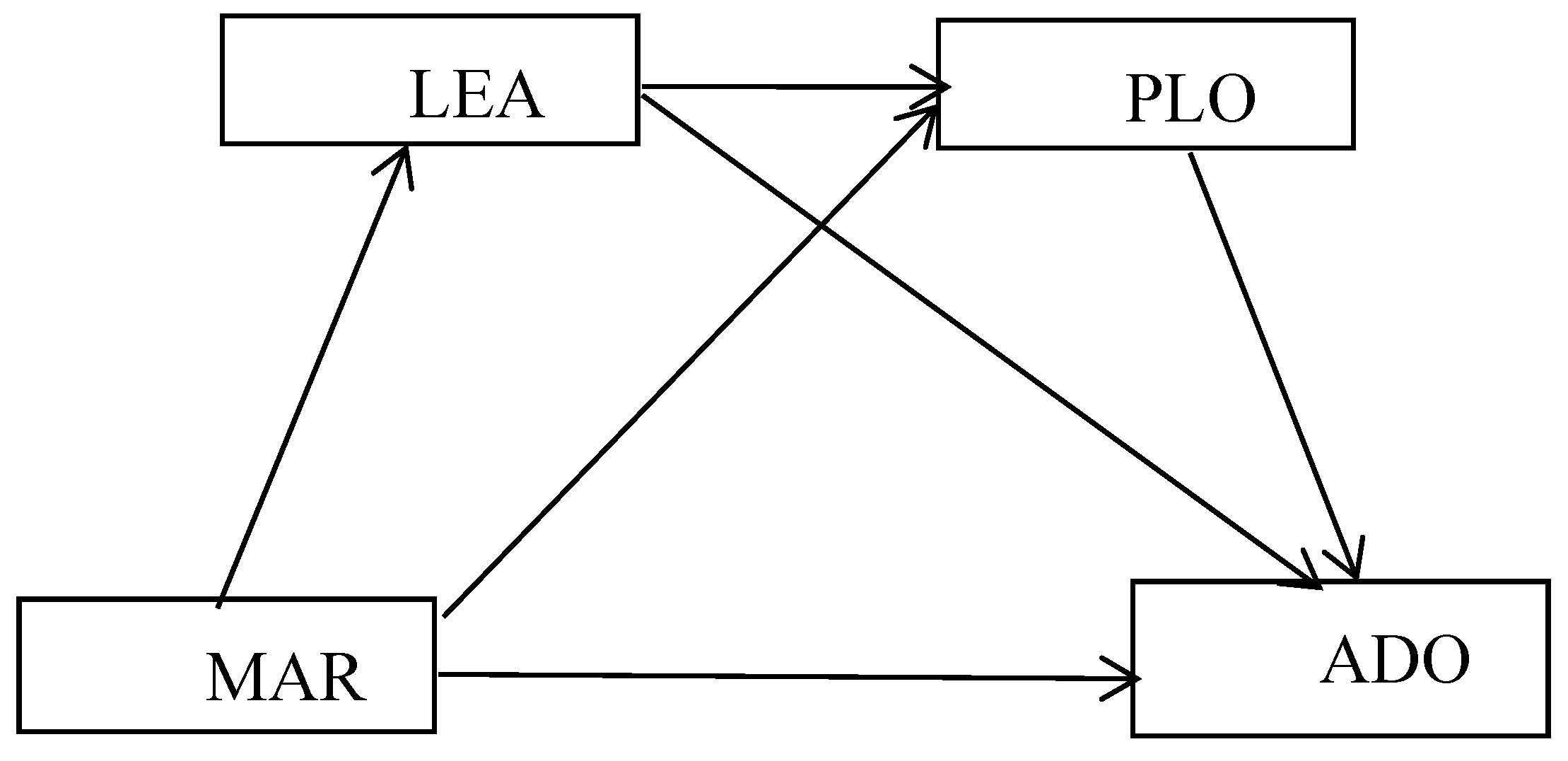
Figure 2.
Visualization of Mediating Effects. Note: The values in parentheses are non-standardized path coefficients; *** indicates a significance level of 1%.
Figure 2.
Visualization of Mediating Effects. Note: The values in parentheses are non-standardized path coefficients; *** indicates a significance level of 1%.
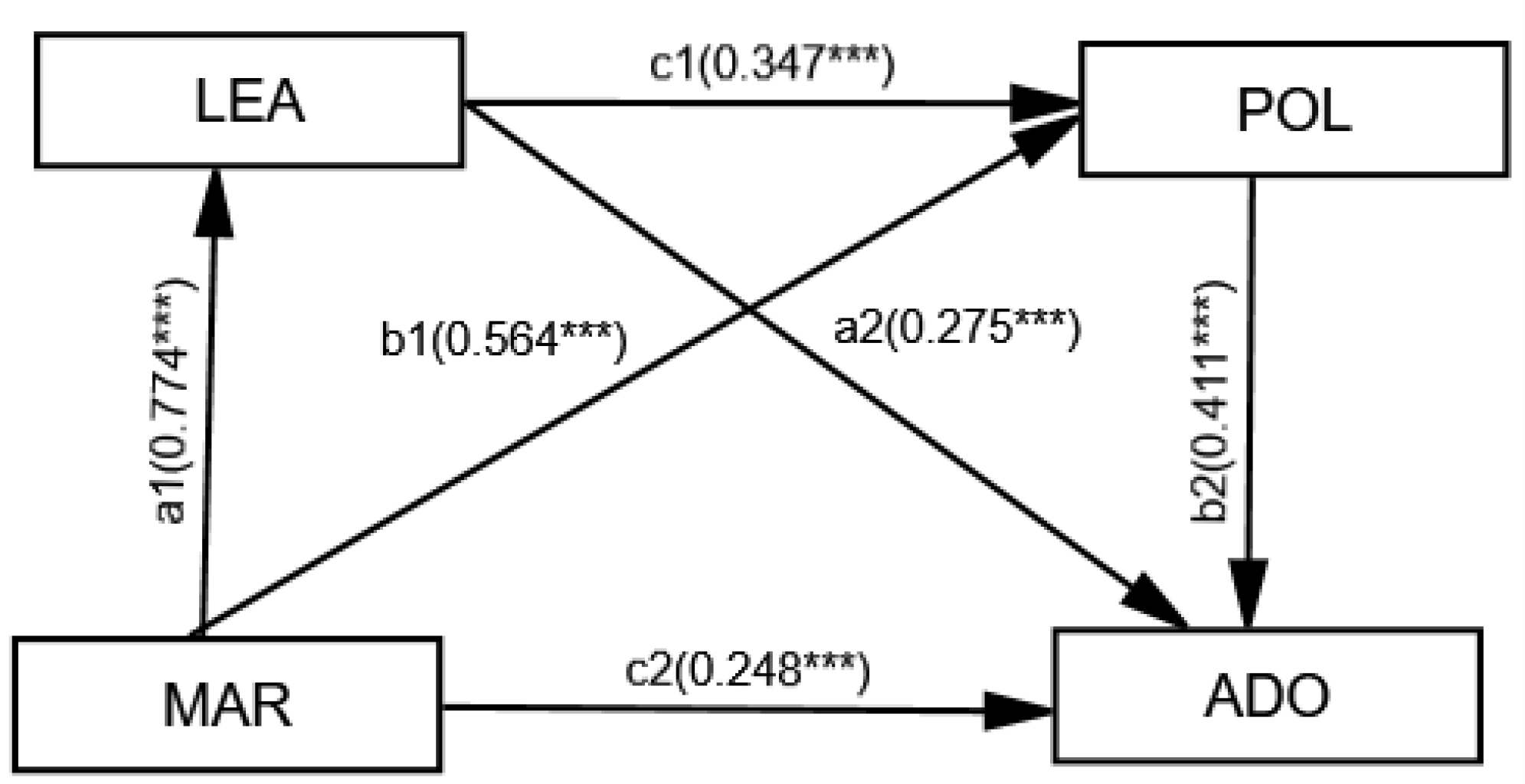
Table 1.
Descriptive Statistics and Correlation Analysis of Variables.
| Variable | Mean | S.d | MAR | LEA | POL | ADO |
| MAR | 2.531 | 1.038 | 0.813 | |||
| LEA | 2.957 | 1.286 | 0.241** | 0.870 | ||
| POL | 3.201 | 1.311 | 0.148** | 0.237** | 0.810 | |
| ADO | 2.977 | 1.302 | 0.136** | 0.141** | 0.260** | 0.860 |
Note :** is significantly correlated at the 0.01 level, where the diagonal is the square root of AVE
Table 3.
Reliability, Validity, and Factor Analysis of the Sample.
| Variables | Items | factor loading | Cronbach’ s a | C.R | AVE |
| MAR | The green business objectives of our enterprise are mainly driven by consumer satisfaction. | 0.866 | 0.967 | 0.951 | 0.661 |
| Our enterprise continuously monitors its commitment level and direction in meeting consumers’ green needs. | 0.781 | ||||
| Our enterprise freely communicates with consumers and employees about its green products and services. | 0.830 | ||||
| Our enterprise’s competitive advantage strategy is based on understanding consumers’ green needs. | 0.845 | ||||
| We frequently measure consumer satisfaction with our enterprise’s green products and services. | 0.810 | ||||
| Our enterprise has routine consumer service initiatives. | 0.808 | ||||
| Our enterprise invests more in green products and services that meet consumer needs compared to competitors. | 0.780 | ||||
| Our enterprise believes that the main purpose of business is to serve consumers (including green consumers). | 0.839 | ||||
| Our enterprise surveys consumers at least once a year to assess the quality of our green products and services. | 0.770 | ||||
| Data on consumer satisfaction with our enterprise’s products and services (including green products) is regularly published at all levels of this business unit. | 0.793 | ||||
| LEA | One of our purposes in searching for information is to find more energy-efficient solutions to problems. | 0.874 | 0.936 | 0.956 | 0.758 |
| One of our purposes in searching for information is to ensure energy conservation and emission reduction, and reduce environmental pollution. | 0.819 | ||||
| We pay attention to more environmentally friendly production processes when developing new products. | 0.899 | ||||
| We tend to use environmental protection knowledge related to existing projects. | 0.892 | ||||
| One of our purposes in searching for information is to learn more about environmental protection knowledge. | 0.873 | ||||
| One of our purposes in searching for information is to develop new green projects and enter new markets (LEA3). | 0.894 | ||||
| We collect information that is more environmentally friendly and green than the technical experience in the existing market. | 0.842 | ||||
| POL | Every year, we spend time studying the impact of environmental policies on agricultural production. | 0.856 | 0.817 | 0.884 | 0.657 |
| We often conduct many market surveys on environmental policies. | 0.722 | ||||
| We collect environmental policy information through various informal channels. | 0.792 | ||||
| We regularly collect documents on environmental protection policies. | 0.865 | ||||
| ADO | We are willing to use green procurement behavior before production. | 0.855 | 0.788 | 0.895 | 0.741 |
| We are willing to use green production behavior during production. | 0.862 | ||||
| We are willing to use green sales behavior after production. | 0.864 |
Note: 1. KMO is used to test the degree of difference between variables, and a value greater than 0.5 indicates suitability for factor analysis; 2. Cronbach’s α is the coefficient of internal consistency reliability; 3. C.R. refers to the composite reliability or combined reliability value.
Table 4.
Model Path Coefficient Testing.
| Research hypothesis | Standardized Regression Weights | S.E. | C.R. | P | Test result | |||
| H1a | ADO | <--- | MAK | 0.288 | 0.076 | 3.276 | *** | T |
| H2a | ADO | <--- | LEA | 0.289 | 0.078 | 3.531 | *** | T |
| H3a | ADO | <--- | POL | 0.457 | 0.074 | 5.541 | *** | T |
| H4a | LEA | <--- | MAK | 0.856 | 0.061 | 12.629 | *** | T |
| H4b | POL | <--- | LEA | 0.328 | 0.107 | 3.240 | *** | T |
| H4c | POL | <--- | MAK | 0.590 | 0.096 | 5.873 | *** | T |
Note: *** Significant at the 0.001 level.
Table 5.
Significance Testing of Total Effects, Indirect Effects, and Mediating Effects of Agricultural Enterprises’ Willingness to Adopt Green Technologies.
Table 5.
Significance Testing of Total Effects, Indirect Effects, and Mediating Effects of Agricultural Enterprises’ Willingness to Adopt Green Technologies.
| Path | Estimate | Bias-corrected | Bias-corrected 95% CI |
Mean | P | Test results | |
| Lower | Upper | ||||||
| MAR→LEA→ADO (ind1) | 0.213 | 0.085 | 0.078 | 0.426 | 0.206 | 0.005 | H2b is T |
| MAR→POL→ADO (ind2) | 0.232 | 0.095 | 0.097 | 0.469 | 0.241 | 0.003 | H23 is T. |
| MAR→LEA→POL→ADO (ind3) | 0.110 | 0.064 | 0.005 | 0.261 | 0.107 | 0.040 | H4d is T. |
| Total Mediating Effect | 0.804 | 0.062 | 0.691 | 0.936 | 0.807 | 0.000 | |
| Total effectMAR→ADO | 0.934 | 0.029 | 0.861 | 0.976 | - | 0.001 | |
| Total indirect effect MAR→ADO |
0.645 | 0.120 | 0.394 | 0.863 | - | 0.002 | |
| diff1 | -0.019 | 0.139 | -0.271 | 0.277 | -0.035 | 0.987 | |
| diff2 | 0.103 | 0.107 | -0.112 | 0.315 | 0.099 | 0.297 | |
| diff3 | 0.122 | 0.133 | -0.105 | 0.422 | 0.134 | 0.277 | |
Note: 1. Bootstrapping was performed with 5,000 replications; 2. S.E. refers to the standard error of the bootstrap sample.3.ind1=a1*a2;ind2=b1*b2;ind3=a1*c1*b2; diff1=m1-m2,diff2=m1-m3,diff3=m2-m3;4.5.m=ind1+ind2+ind3+c2
Disclaimer/Publisher’s Note: The statements, opinions and data contained in all publications are solely those of the individual author(s) and contributor(s) and not of MDPI and/or the editor(s). MDPI and/or the editor(s) disclaim responsibility for any injury to people or property resulting from any ideas, methods, instructions or products referred to in the content. |
© 2024 by the authors. Licensee MDPI, Basel, Switzerland. This article is an open access article distributed under the terms and conditions of the Creative Commons Attribution (CC BY) license (http://creativecommons.org/licenses/by/4.0/).
Copyright: This open access article is published under a Creative Commons CC BY 4.0 license, which permit the free download, distribution, and reuse, provided that the author and preprint are cited in any reuse.


