

Submitted:
08 April 2024
Posted:
09 April 2024
You are already at the latest version
Abstract
We have carried out a systematic review of the scientific literature published on PM and, more specifically, on its presence in fish and seafood of interest to the population from Mediterranean area. Given its preference and wide acceptability in the scientific community, we followed the PRISMA. The potential functional and clinical toxicity in humans due to MP in fish must be considered by the chemical composition of the microplastics the presence of PM and its additives, associated contaminants and pathogens in fish and shellfish, as well as the possible effects on human health, requires improving legislation on evaluation and providing a basis for consumer protection.
Keywords:
Microplastics
; endocrine disruptors
; endocrine exposure
; plastics
; Mediterranean Sea
; human health.
1. Introduction
Plastic has been an indispensable material in all aspects of human life as it is practical, durable, resistant to degradation, inert and easy to mold, with very low production costs. However, it is unfortunately difficult to reuse or recycle, and is thrown away as waste, incinerated or disposed of in landfills. Plastic once in the environment starts to degrade to very small sizes, this biodegradation is a very slow process in which sunlight, wind and waves continuously break down the plastic into smaller and smaller particles. Microplastics (MP) are these < 5 mm long pieces of plastic that are divided into primary and secondary. Primary MP can be found in personal care products (microspheres) or in the form of plastic granules used in industrial manufacturing and secondary MP is the result of the degradation of these (fibres and fragments) [1,2,3,4]. There are thousands of different types of these plastic polymers, but the market, and the litter found in the marine environment, is dominated by several substances: polypropylene (PP), polyethylene (PE), polycarbonate (PC), polyvinyl chloride (PVC), polyurethane (PUR), polyethylene terephthalate (PET) and polystyrene (PS), which together comprise approximately 80% of the total production of plastics [5].
The impact of pollution from toxic metals, industrial chemicals and plastic waste in Europe is at problematic levels in 87% of the Mediterranean Sea and 75% of the Northeast Atlantic Ocean [6]. Ingestion of MP has been widely accepted as the common pathway for a wide variety of aquatic organisms to absorb them, causing adverse health effects to marine organisms and move into the food chain. These can impact human health, with effects primarily related to the toxicity of the chemical from the environment or the additives used in plastic materials [7]. MP and their additives affect our health, they are endocrine disruptors, which can act as obesogenic compounds and alter metabolism. Several of the component monomers of microplastics have estrogenic activity in the case of BPA and other derivatives [8]. In addition, some of the monomers have been associated with an obesogenic effect in humans. Evidence suggests that MP < 20 µm in size can penetrate organs and MP < 10 µm can penetrate cell membranes and cross the placental barrier in exposed cells or laboratory animals [9]. MP can cause oxidative stress, cytotoxicity and translocation to other tissues, while their persistent nature limits their elimination from the body, leading to chronic inflammation and increasing the risk of cancer. The epigenetic effects of environmental chemicals such as plasticizers, including bisphenol A and phthalates, on DNA methylation and gene expression have provided evidence of their carcinogenicity in vitro and in vivo. Moreover, MP, as part of particulate matter, may also be implicated in the increased incidence of immunological or neurodegenerative diseases. In addition, MP may release chemicals, from their matrices or adsorbed from the environment, or act as vectors for dangerous microorganisms [10,11]. The aim of this work was to review the existing literature on the current status of MP in commercial fish and seafood in the Mediterranean and North-East Atlantic and their current relationship with functional and clinical endocrine exposure to human health.
2. Materials and Methods
In this work we have carried out a systematic review of the scientific literature published on PM and, more specifically, on its presence in fish and seafood of interest to the population from Mediterranean area. Given its preference and wide acceptability in the scientific community, we followed the PRISMA standards (Preferred Reporting Items for Systematic Reviews and Meta-Analyses) guidelines [12].
Initial search. The search in Web of Science (WOS) and Scopus was started on january 2023 with broader search criteria such as [13] AND (fish) AND (consume OR ingest OR eat). This review was registered in PROSPERO with code ref. 407024, and an evaluation of the quality or risk of bias assessment was performed by J.C.-P using the blinded Cochrane risk of bias tool.
These keywords resulted in 1705 studies in the Scopus database and 1817 studies in WOS. However, due to the large number of articles, the search was progressively narrowed down. Thus, the broader search approach was changed to an abstract search. In relation to the observed data, the use of more generic keywords with respect to fish species was resumed, adding health and threat terms. We used (AB = microplastic OR nanoplastic OR nanoplastics OR microplastics OR nanoplastics) AND TS = (fish OR dietary fish OR seafood) AND AB = (health OR human health OR human OR damage OR threat) resulting in 707 articles in WOS.
Systematic search. The final literature search was conducted on december 2023, using the WOS and Scopus scientific citation databases. Keywords were searched using the following search criteria in the abstract: (plastic OR microplastic) AND (fish OR dietary fish) AND (health OR threat). These keywords resulted in 297 studies in the Scopus database and 276 studies in the Web of Science database (Figure 1), which, once duplicates were removed, represented a total of 369 studies that were investigated.
The combination of terms that yielded the best results in both search engines was as follows, differentiated for each search engine: WOS= plastic OR microplastic (Abstract) and fish OR dietary fish (Abstract) and health OR threat (Abstract) and 2023 or 2022 or 2021 or 2020 or 2019 or 2018 (Publication Years) SCOPUS= (ABS (plastic OR microplastic) AND ABS (fish OR dietary AND fish) AND ABS (health OR threat) AND (LIMIT TO (PUBYEAR, 2023) OR (LIMIT TO (PUBYEAR, 2022) OR LIMIT TO (PUBYEAR, 2021) OR LIMIT TO (PUBYEAR, 2020) OR LIMIT TO (PUBYEAR, 2019) OR LIMIT TO (PUBYEAR, 2018).
Inclusion criteria. It must be empirical research and not books, manuals, seminars. It must be on the subject of the presence of PM in fish or other seafood of interest to focus on human.
Exclusion criteria: Studies that have been published before 2018. Focus on the food trophic chain, on how MP affects fish or seafood of interest, on MP in the environment. Research on the presence of MP in organisms other than those of interest health.
3. Results
We begin by compiling the articles selected after applying the methodology explained above (Figure 1).
The Table 1 summarize the main characteristics of the articles under review, including data such as title, authors, year of publication, impact index, as well as a summary of the objectives, methodology, results and conclusions reached by these authors.
In this review, the locations of the studies focus on the seas analyzed within or adjacent to the Mediterranean Sea, including the Adriatic Sea, North Ionian Sea, Tyrrhenian Sea, North-Eastern Mediterranean, Central Mediterranean (Tunisian coasts), Aegean Sea and Marmara Sea. It is also worth mentioning the study of other oceans, such as the Atlantic, in which the coastal waters of the northwest of Portugal and the Northeast Atlantic have been considered. It would also be important to extend these studies to the international maritime fishing areas from which the most in-demand fish is imported. For example, the study of MP of fish in fishing grounds of great fishing importance off the Norwegian coast. A wide variety of fish have been analyzed, including sole (Solea solea), sardines (Sardina pilchardus), bream (Pagellus erythrinus), sea bream (Pagellus bogaraveo), sand steenbras (Lithognathus mormyrus), red mullet (Mullus barbatus, Mullus surmuletus, Chelon saliens), gilthead seabream (Sparus aurata), mullet (Mugil cephalus), lizardfish (Saurida undosquamis), Atlantic and Mediterranean horse mackerel (Trachurus trachurus, Trachurus mediterraneus), anchovies (Engraulis encrasicolus) and mussels (Mytilus galloprovincialis); Sea bass (Dicentrarchus labrax), Atlantic horse mackerel (T. trachurus) and Atlantic mackerel (Scomber colias).
4. Discussion
This section focuses on the reviewed articles considered to be of particular relevance. Firstly, aquatic food products (such as fish, crustaceans and bivalves) appear to be the most studied sources of dietary intakes of MP, and publications have shown that MP are widely found in commercial fish in most regions of the world [30,31,32].
The number of publications on the presence of MP in edible muscle is very limited compared to the number of articles investigating the presence in fish TGI. One possible explanation is that, after ingestion, only the smallest MP particles (< 20 µm), which may be difficult to detect, can move to different organs such as edible muscle. However, MP are generally detected in different tissues of aquatic organisms, including stomach, gut, muscle, skin, gills and liver, of which in this Atlantic Ocean study the focus has been on GIT, muscle and gills. As can be seen, there is a higher concentration of MP in the GIT (Gastro Intestinal Tract) than in the gills and muscle, the latter of which will be of greater interest with respect to human exposure, especially in species where the GIT is not consumed [33].
Chemical composition of components of MP.
Raman and FTIR spectroscopies are the most widely used for experimental studies, allowing a non-invasive characterization of MP providing chemical structure information combined with high lateral resolution when combined with a microscope was examined microscopically and through µ-Raman analysis [14]. The infrared spectrum of the measured MP shows characteristic peaks corresponding to specific chemical bonds. The spectrum obtained can be used to identify chemical compositions [15,16]. However, it is difficult to identify small MP with spectroscopic techniques. Other potential methods for MP identification, such as pyrolysis gas chromatography/mass spectrometry (PY-GC/MS) [34], scanning electron microscopy-energy dispersive X-ray (SEM-EDAX) [17] and environmental scanning electron microscopy-energy dispersive spectroscopy (ESEM- EDS), have also been investigated and shown to be very sensitive and accurate and capable of detecting MP at the nanoscale [18].
The type of polymer found coincides with those most abundant in their manufacture in Europe with MP fragments consisting mainly of polypropylene (PP), polyethylene (PE), polyvinyl chloride (PVC), polyester (PET) and polyamide (PA), while MP filaments were identified mainly as nylon 6, acrylic and polyester. The majority of 60.9% of the 2020 plastic demand, 49.1 million tonnes of plastic, is for packaging and building and construction materials [13].
The physical appearance of MP, is also important, both the color and the form of fibers. The colour of the polymers is mostly blue, black or off-white. The predominance of blue over other colours found may be due to an increased abundance of blue MP in seawater, increased contamination of fish by blue MP and/or active preferential ingestion of blue MP by fish because they mistake it for food. Indicative of this may be Atlantic horse mackerel from the central Mediterranean because there is a large amount of MP found exclusively in the TGI of the largest subset of specimens. As for the black colour, the youngest fish as it is the most similar to their food, and finally, most plankton and algal species are transparent and white in colour, leading to the accidental ingestion of these plastic particles as food [16].
The predominance of fibers over fragments in the gills of all species suggests that fibers are more abundant in the seawater of the fish habitat, and that the MP present in the gills were absorbed through passive filtration of the water. However, the relative percentage of fibers and fragments in the TGI reveals differences between species and suggests the contribution of active and preferential ingestion of particularly shaped MP by fish [35].
In addition to colour, shape is also important for the perception of prey by visual predatory fish. Thus, fish that feed on smaller, elongated fish, such as sea bass, may mistake fibres for food rather than fragments, whereas the opposite is true for Atlantic horse mackerel and Atlantic mackerel, which feed mainly on zooplankton species and several of these are spherical.
Toxicity. The potential functional and clinical toxicity in humans due to MP in fish must be considered by the chemical composition of the microplastics, already mentioned previously, and also by the size of the particles (MP and NP). The particles are not attacked by gastric juices and the passage of the intestinal barrier occurs when there are previous. The composition of the MP has shown the hormonal disrupting effect made manifest by the production of vitellogenin in various types of fish Adverse effect of plastics occurrence on T. Trachurus health were also assessed quantifying the liver expression of vitellogenin (VTG), a biomarker for endocrine disruption [19]. Lipid oxidation processes and neurotoxic effects have been shown. Fish with MP had significantly (p ≤ 0.05) higher lipid peroxidation levels in the brain, gills and dorsal muscle, and increased brain acetylcholinesterase activity than fish where no MP were found. These results suggest lipid oxidative damage in gills and muscle, and neurotoxicity through lipid oxidative damage and acetylcholinesterase induction in relation to MP and/or MP-associated chemicals exposure. EFSA recommends an exposure of no more than 842 items/year for adults, from fish consumption [20]. The data from fillets of Mediterranean seafood should be carefully considered in view of the direct exposure of humans to plastic particles under 3 μm through seafood consumption to better manage the related risks [17] MP have been shown to be highly resistant to artificial digestive juices, and breakdown or modification of their shapes and sizes cannot occur in the GIT, so they can be excreted in the faeces without causing any adverse effects [36]. This is an exception in digestive pathologies such as peptic ulcer, ulcerative colitis or Crohn's disease, which may make their ingestion a risk. The systemic availability of MP is considered to be very limited, less than 0.3%, and only particles smaller than 150 nanometers can potentially pass through the intestinal epithelium. Therefore, one route of entry may be direct penetration into the intestinal mucosa during mixing with other intestinal contents. In this context, it has been observed that exposure to MP in humans resulted in inflammation and reduced intestinal mucus secretion, intestinal barrier dysfunction, increased intestinal mucosal permeability, imbalance of the intestinal microbiota, altered lipogenesis and triglyceride synthesis [20]. There is an urgent need for further research on the absorption and bioavailability of consumed MP and in vivo studies on chronic exposure. Policymakers should also consider the implementation of novel legislation related to MP presence in food [21].
Summary of MP in fish consumed in the Mediterranean Sea. Information on PM found in different types of fish for human consumption found in the Mediterranean basin. Some comments of interest lead us, for example, to consider that in the Tyrrhenian Sea, taking into account that mussels are consumed whole and that small pelagic fish, such as anchovy, can be eaten without removing the TGI, microfiber contamination can lead to human exposure. Considering a 225 g portion of mussel, the consumer may ingest 299.25 plastic microfiber and natural microfibers, while in the worst case, exposure reaches 1,012 microfibres/portion of mussel. For anchovies, a 150 g serving of individuals consumed as a whole may contain 135.6 synthetic and natural microfibers, and in the worst case, the amount of fibers reaches 393.7 units/serving [22]. Based on the total mean of MP found in fish muscle (0.054 PM units/g of tissue) and the weekly fish intake recommended for different human population groups by the EFSA, the estimated intake of MP by human consumers per year ranged from 112 items of MP/year (1 year old children) to 842 items of MP/year (adults or general population). one of the highest in the EU after Portugal [20]; a study carried out in the southern Mediterranean, with the edible portion of mullet, sardines, mussels, sole and sea bream, suggests that the EDI (estimated daily intake) for adults and children despite the abundant presence of MP, daily exposure to MP It is much lower due to the intake of fish products than due to the intake of PET in mineral water packaged in plastic bottles or in fruits [17].
Number of MP elements according to different regions of the Mediterranean Sea In mussels, in the North Ionian Sea the abundance of MP ranged between 1.7 and 2 elements per individual while in the Tyrrhenian Sea they contained 7.66 pieces/individual. In both red mullet and mud mullet there is a higher number of MP particles per specimen in Samandag (Turkey), being higher in red mullet, unlike in the Sea of Marmara where they are much lower. This may be due to higher microplastic contamination in the different seas or to the fact that fewer or more specimens have been examined in the latter. In terms of number of fish, the smallest sample size belongs to the Central Mediterranean red mullet (5 specimens), followed by the Mediterranean horse mackerel from Iskenderum (Turkey) (9 specimens). On the contrary, the largest sample size belongs to the sole from the Adriatic Sea (553 specimens), followed by the mussels from the northern Ionian Sea (80 specimens). The high occurrence of MP in the Adriatic Sea sole is therefore remarkable, since, although the number of particles per specimen is not as high (1.64 ± 0.1) as, for example, Samandag (Turkey) mullets (46.4 ± 11.9), their frequency of occurrence is 95%. That is, out of 533 specimens which is a high sample size, they found this number of particles in the TGI of about 506 of them. In this case, if a global comparison is made, the average plastic load worldwide was 3.5 ± 0.8 pieces of MP per fish of the observed species which is more or less double that of the sole. That said, most values are below this figure. In this context North America had the highest mean values compared to all other regions, except Africa with 5.9 pieces per fish [37]. Within the Mediterranean Sea, the bay of Iskenderum is highly polluted by MP, which is why two of the studies focus on this focus on the Turkish coasts, and one of them compares it with another commercially important port such as Samandag, which exceeds Iskenderum in the TGI of the species studied. The Aegean Sea stands out for coastal MP pollution directly associated with high amounts of MP in Aegean fish relative to fish from other Mediterranean regions. In fact, marine MP concentrations reported for the Sea of Marmara and the north-eastern Mediterranean were both lower than those reported for the Aegean Sea [14]. In view of the above and taking into account that approximately half of the seafood is farmed and the other half is caught in the wild, it may be possible to control environmental conditions in aquaculture by rearing animals in ponds, tanks or selected bodies of water. Marine organisms generally have a shorter lifespan in aquaculture than in nature, which may provide less opportunity and time for MP exposure and uptake.
Therefore, aquaculture is proposed in several studies because of the shorter exposure time in tanks to plastic waste but mainly because of the wear and tear of the products in the tanks themselves, of the filters of the water treatment plants, of the plastic packaging of the feed and finally of the MP content of the feed itself due to the concentration of PM in the dried fish tissue used for its production, so far reported also for other pollutants.
Thus, the EDI of farmed sea bream and sardine were the highest for both adults and children, while the lowest EDI was due to the ingestion of mussels for both. The EDIs of children are higher than those of adults for all species studied, which depends on the lower body weight of children. The data show that children should avoid frequent consumption of both farmed and wild pelagic species [38].
The EU has also stressed the need to take measures to preserve the Mediterranean Sea, a partially enclosed sea with a high contribution of land-based pollution (80% of the total). Therefore, in 1975, the European Community launched the first Mediterranean Action Plan (MAP), followed by the Protocol on Integrated Coastal Zone Management in the Mediterranean (MAP Phase II), adopted during the 1995 Barcelona Convention. At present, the Barcelona Convention and the MAP, in which 22 countries participate, are dedicated to protecting the marine environment and the coastal zones of the Mediterranean Sea in order to achieve their sustainable development. Apart from this there are no specific measures with regard to MP. Removing them from the marine environment is not a realistic option because they are widespread in all marine matrices. Moreover, the measures taken are clearly insufficient to mitigate the amount of MP entering the Mediterranean Sea on a daily basis, which is currently expected to increase [23].
Type of exposure and risks to human health. Humans are orally exposed to MP and NP, via two main routes, ingestion and inhalation, which present potential risks to the pulmonary tract and GIT.
The prevalence of MP in drinking water is an important route into the human body and a potential source of health risks, as has been observed in fruits and vegetables and salt. Among these, drinking water (tap water and bottled water) was the largest contributor. 33 Overall, it was estimated that humans may ingest 0.1 to 5 g MP through various exposure pathways each week. The main routes of human exposure to MP are through consumption of bottled water and fish or fishery products (e.g. fishmeal, fish oil, canned fish). In addition, the consumption of canned sardines and sprats was considered to represent products with low exposure to MP compared to other sources such as breathing air [25]. According to current knowledge on MP in fish, these seafood products should be considered safe for consumption, and, although they are widely distributed in food webs, MP in the same type of food exhibits a substantial difference in particle size and number, ranging from zero to several hundred to several thousand MP/kg of food. Therefore, their intake (food consumption, drinking and inhalation) is very different among humans and is affected by dietary habit, food types, countries or regions [26].
In the selected articles, the MP found in the fish analysed (PP, PE, PVC) can cause, above all, oxidative stress, neurotoxicity, altered metabolism, impaired cell viability and cytotoxicity. In addition to mood changes, impaired thinking, judgement, coordination, etc. Due to the prolonged stay of heavy metals and ions absorbed by MP and NP that can enter the digestive tract [25,27,28].
A major challenge with regard to this point is that we do not know the amounts of very small MP, including those with a size capable of entering cells, in water, sediments, organisms and air; therefore, assessment of biota and human exposure is not possible. It should be noted that the MP found in commercial species in all of the studies mentioned in the above were limited to particles in the micro size range. From these studies, it can be concluded that, in general, the prevalence of MP in seafood products is generally low, suggesting that dietary exposure is likely to be low [21,24].
Exposure to MP from ingestion of fish and shellfish could be low compared to other products such as waters packaged in plastic bottles (PET). Potential toxicity to humans after oral exposure is controversial as many studies suggest rather low toxicity, although prolonged exposure may be dangerous for consumers. Aquaculture may not be the best solution unless all rearing conditions can be controlled. An effective measure would be to reduce plastic globally with both governments and industry [29].
Most of the fish analyzed in either the Mediterranean Sea or the Atlantic Ocean had MP in varying proportions. It was highest in the north-eastern Mediterranean, Aegean Sea, Atlantic Ocean and Adriatic Sea [20].
There is a large discrepancy between current evidence-based scientific knowledge about the actual implications for human health and the magnitude of the problem [17]. Researchers face several challenges that need to be explored and clarified, and more research is needed to understand the effects of these particles on the body. Therefore, knowledge about the real effects of PM on human health is an area of research that should be explored in the coming years; there is still much to investigate on this topic, whether it is health or methodology.
5. Conclusions
In conclusion the presence of PM and its additives, associated contaminants and pathogens in fish and shellfish, as well as the possible effects functional and clinical endocrine exposure to human health, requires improving legislation on evaluation and providing a basis for consumer protection. In addition, research on the toxic effects of ingested PM particles is still limited.
Author Contributions
The study was designed by N.O., F.O-S and M.M.-A.; data were collected and analyzed by J.A.L., J.C.-P., A.D., A.L-M., N.G-B. and M.M.-A.; data interpretation and manuscript preparation were undertaken by J.A.L., N.G.-B., J.C-P., N.O., F.O-S and M.M.-A.; evaluation of the quality or risk of bias was per-formed by J.C.-P. All authors have read and agreed to the published version of the manuscript.
Funding
The funding sponsors had no role in the design of the study; the collection, analyses, or interpretation of the data; the writing of the manuscript; or the decision to publish the results. This study was funded by the High Council for Sports (CSD), Spanish Ministry of Culture and Sport, through the NESA NETWORK “Spanish Network of Sports Care at Altitude (RADA)” Ref. 19/UPB/23. This research was supported by an FPU grant from the Spanish Ministry of Universities to Alejandro Lopez-Moro (FPU20/00210).
Institutional Review Board Statement
Not applicable.
Informed Consent Statement
Not applicable.
Data Availability Statement
There are restrictions on the availability of data for this trial due to the signed consent agreements around data sharing, which only allow access to external researchers for studies following the project’s purposes. Requestors wishing to access the trial data used in this study can make a re-quest to mariscal@ugr.es.
Conflicts of Interest
The authors declare no conflict of interest.
References
- Lehel J, Murphy S. Microplastics in the Food Chain: Food Safety and Environmental Aspects. In: De Voogt P, editor. Reviews of Environmental Contamination and Toxicology Volume 259. Cham: Springer International Publishing; 2021. p. 1-49.
- Bajt O. From plastics to microplastics and organisms. FEBS Open Bio. 2021 Apr;11(4):954-966. [CrossRef]
- Matjašič T, Simčič T, Medvešček N, Bajt O, Dreo T, Mori N. Critical evaluation of biodegradation studies on synthetic plastics through a systematic literature review. Sci Total Environ. 2021 Jan 15;752:141959. [CrossRef]
- Ter Halle A, Ladirat L, Gendre X, Goudouneche D, Pusineri C, Routaboul C, Tenailleau C, Duployer B, Perez E. Understanding the Fragmentation Pattern of Marine Plastic Debris. Environ Sci Technol. 2016 Jun 7;50(11):5668-75. [CrossRef]
- Almroth BC, Eggert H. Marine Plastic Pollution: Sources, Impacts, and Policy Issues. Review of Environmental Economics and Policy. 2019;13(2):317-26.
- Agency EE. Contaminants in Europe’s Seas Moving Towards a Clean, Non-Toxic Marine Environment. 2019.
- Karbalaei S, Hanachi P, Walker TR, Cole M. Occurrence, sources, human health impacts and mitigation of microplastic pollution. Environ Sci Pollut Res Int. 2018 Dec;25(36):36046-36063. [CrossRef]
- Soto AM, Sonnenschein C, Chung KL, Fernandez MF, Olea N, Serrano FO. The E-SCREEN assay as a tool to identify estrogens: An update on estrogenic environmental pollutants. Environ Health Perspect. 1995 Oct;103 Suppl 7(Suppl 7):113-22. [CrossRef]
- Kannan K, Vimalkumar K. A Review of Human Exposure to Microplastics and Insights Into Microplastics as Obesogens. Front Endocrinol (Lausanne). 2021 Aug 18;12:724989. [CrossRef]
- Ferrante M, Cristaldi A, Oliveri Conti G. Oncogenic Role of miRNA in Environmental Exposure to Plasticizers: A Systematic Review. J Pers Med. 2021 Jun 2;11(6):500. [CrossRef]
- Prata JC, da Costa JP, Lopes I, Duarte AC, Rocha-Santos T. Environmental exposure to microplastics: An overview on possible human health effects. Sci Total Environ. 2020 Feb 1;702:134455. [CrossRef]
- Moher D, Liberati A, Tetzlaff J, Altman DG; PRISMA Group. Preferred reporting items for systematic reviews and meta-analyses: The PRISMA statement. Int J Surg. 2010;8(5):336-41. [CrossRef]
- Europe P. Plásticos –https://plasticseurope.org/es/knowledge-hub/plasticos-situacion-en-2020/.
- Gundogdu S, Cevik C, Atas NT. Occurrence of microplastics in the gastrointestinal tracts of some edible fish species along the Turkish coast. Turkish Journal of Zoology. 2020;44(4):312-23. [CrossRef]
- Digka N, Tsangaris C, Torre M, Anastasopoulou A, Zeri C. Microplastics in mussels and fish from the Northern Ionian Sea. Mar Pollut Bull. 2018 Oct;135:30-40. [CrossRef]
- Kılıç E, Yücel N. Microplastic occurrence in the gastrointestinal tract and gill of bioindicator fish species in the northeastern Mediterranean. Mar Pollut Bull. 2022 Apr;177:113556. [CrossRef]
- Ferrante M, Pietro Z, Allegui C, Maria F, Antonio C, Pulvirenti E, Favara C, Chiara C, Grasso A, Omayma M, Gea OC, Banni M. Microplastics in fillets of Mediterranean seafood. A risk assessment study. Environ Res. 2022 Mar;204(Pt C):112247. [CrossRef]
- Savoca S, Capillo G, Mancuso M, Bottari T, Crupi R, Branca C, Romano V, Faggio C, D'Angelo G, Spanò N. Microplastics occurrence in the Tyrrhenian waters and in the gastrointestinal tract of two congener species of seabreams. Environ Toxicol Pharmacol. 2019 Apr;67:35-41. [CrossRef]
- Chenet T, Mancia A, Bono G, Falsone F, Scannella D, Vaccaro C, Baldi A, Catani M, Cavazzini A, Pasti L. Plastic ingestion by Atlantic horse mackerel (Trachurus trachurus) from central Mediterranean Sea: A potential cause for endocrine disruption. Environ Pollut. 2021 Sep 1;284:117449. [CrossRef]
- Barboza LGA, Lopes C, Oliveira P, Bessa F, Otero V, Henriques B, Raimundo J, Caetano M, Vale C, Guilhermino L. Microplastics in wild fish from North East Atlantic Ocean and its potential for causing neurotoxic effects, lipid oxidative damage, and human health risks associated with ingestion exposure. Sci Total Environ. 2020 May 15;717:134625. [CrossRef]
- Gündogdu S, Rathod N, Hassoun A, Jamroz E, Kulawik P, Gokbulut C, Aït-Kaddour A, Özogul F. The impact of nano/micro-plastics toxicity on seafood quality and human health: Facts and gaps. Crit Rev Food Sci Nutr. 2023;63(23):6445-6463. [CrossRef]
- Santonicola S, Volgare M, Di Pace E, Cocca M, Mercogliano R, Colavita G. Occurrence of potential plastic microfibers in mussels and anchovies sold for human consumption: Preliminary results. Ital J Food Saf. 2021 Dec 22;10(4):9962. [CrossRef]
- Llorca M, Álvarez-Muñoz D, Ábalos M, Rodríguez-Mozaz S, Santos LHMLM, León VM; et al. Microplastics in Mediterranean coastal area: Toxicity and impact for the environment and human health. Trends in Environmental Analytical Chemistry. 2020;27:e00090. [CrossRef]
- Garrido Gamarro E, Ryder J, Elvevoll EO, Olsen RL. Microplastics in Fish and Shellfish–A Threat to Seafood Safety? Journal of Aquatic Food Product Technology. 2020;29(4):417-25. [CrossRef]
- Smith M, Love DC, Rochman CM, Neff RA. Microplastics in Seafood and the Implications for Human Health. Curr Environ Health Rep. 2018 Sep;5(3):375-386. [CrossRef]
- Jin M, Wang X, Ren T, Wang J, Shan J. Microplastics contamination in food and beverages: Direct exposure to humans. J Food Sci. 2021 Jul;86(7):2816-2837. [CrossRef]
- Barboza LGA, Dick Vethaak A, Lavorante BRBO, Lundebye AK, Guilhermino L. Marine microplastic debris: An emerging issue for food security, food safety and human health. Mar Pollut Bull. 2018 Aug;133:336-348. [CrossRef]
- Kumar R, Manna C, Padha S, Verma A, Sharma P, Dhar A, Ghosh A, Bhattacharya P. Micro(nano)plastics pollution and human health: How plastics can induce carcinogenesis to humans? Chemosphere. 2022 Jul;298:134267. [CrossRef]
- Pellini G, Gomiero A, Fortibuoni T, Ferrà C, Grati F, Tassetti AN, Polidori P, Fabi G, Scarcella G. Characterization of microplastic litter in the gastrointestinal tract of Solea solea from the Adriatic Sea. Environ Pollut. 2018 Mar;234:943-952. [CrossRef]
- Carrillo-Barragán P, Fitzsimmons C, Lloyd-Hartley H, Tinlin-Mackenzie A, Scott C, Sugden H. Fifty-year study of microplastics ingested by brachyuran and fish larvae in the central English North Sea. Environ Pollut. 2024 Feb 1;342:123060. [CrossRef]
- Mosconi G, Panseri S, Magni S, Malandra R, D'Amato A, Carini M, Chiesa L, Della Torre C. Plastic Contamination in Seabass and Seabream from Off-Shore Aquaculture Facilities from the Mediterranean Sea. J Xenobiot. 2023 Oct 25;13(4):625-640. [CrossRef]
- Simionov IA, Călmuc M, Iticescu C, Călmuc V, Georgescu PL, Faggio C, Petrea ŞM. Human health risk assessment of potentially toxic elements and microplastics accumulation in products from the Danube River Basin fish market. Environ Toxicol Pharmacol. 2023 Nov;104:104307. [CrossRef]
- Piskuła P, Astel AM. Microplastics in Commercial Fishes and By-Catch from Selected FAO Major Fishing Areas of the Southern Baltic Sea. Animals (Basel). 2023 Jan 28;13(3):458. [CrossRef]
- Yue Z, Liu X, Mei T, Zhang Y, Pi F, Dai H, Zhou Y, Wang J. Reducing microplastics in tea infusions released from filter bags by pre-washing method: Quantitative evidences based on Raman imaging and Py-GC/MS. Food Chem. 2024 Jul 1;445:138740. [CrossRef]
- Jalaudin Basha NN, Adzuan Hafiz NB, Osman MS, Abu Bakar NF. Unveiling the noxious effect of polystyrene microplastics in aquatic ecosystems and their toxicological behavior on fishes and microalgae. Front Toxicol. 2023 May 4;5:1135081. [CrossRef]
- Chen Y, Williams AM, Gordon EB, Rudolph SE, Longo BN, Li G, Kaplan DL. Biological effects of polystyrene micro- and nano-plastics on human intestinal organoid-derived epithelial tissue models without and with M cells. Nanomedicine. 2023 Jun;50:102680. [CrossRef]
- Wootton N, Reis-Santos P, Gillanders BM. Microplastic in fish A global synthesis. Reviews in Fish Biology and Fisheries. 2021;31(4):753-71. [CrossRef]
- Wu H, Hou J, Wang X. A review of microplastic pollution in aquaculture: Sources, effects, removal strategies and prospects. Ecotoxicol Environ Saf. 2023 Mar 1;252:114567. [CrossRef]
Figure 1.
Flowchart of the procedure followed when conducting the systematic review.
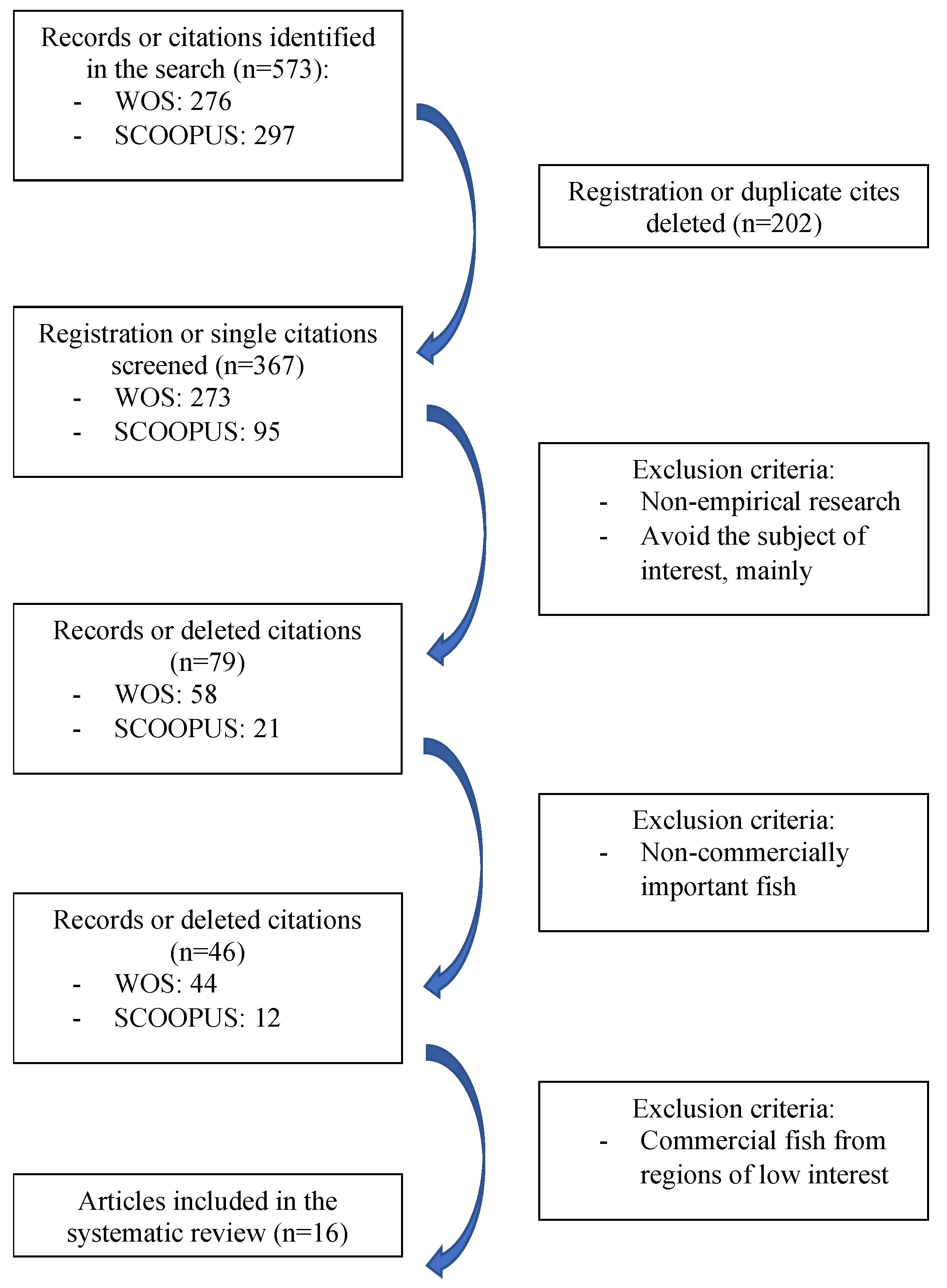

Table 1.
List of experimental articles used in the systematic review.
| Authors | Year | Impact Factor | Quartile | Objective | Method | Results | Conclusions |
|---|---|---|---|---|---|---|---|
| Gundogdu et al. [14] | 2020 | 0.673 | Q4 | Documenting the presence of MP in fish, especially edible fish in the Aegean, Marmara and Eastern Mediterranean Seas. | N=243. Raman μ-analysis. Pearson correlation analysis. | Approximately 39.2% of fish in the north-eastern Mediterranean, 40.5% in the Sea of Marmara and 61.6% in the Aegean Sea had MP. | The entry of plastics into the food chain means that they can become more concentrated at higher trophic levels and therefore for humans. |
| Digka et al. [15] | 2018 | 5.553 | Q1 | To assess the ingestion of MP in four highly commercial marine species from the Ionian Sea. | FT-IR | MP was found in 37 mussels, 17 sardines, 8 sea bream and 8 red mullets. The fragments were larger. | Filter feeding and pelagic species are more prone to MP contamination. |
| Kılıç et al. [16] | 2022 | 5.553 | Q1 | To test the existence in the MP present in the GIT and gills of fish from Iskenderun Bay and Samandağ. | N=153.FT-IR | MP abundance in the GIT was higher than in gills. A negative correlation was observed between body weight and gill MP abundance. | The abundance of MP in the gills depends mainly on the MP contamination in the surrounding environment. |
| Ferrante et al. [17] | 2022 | 6.498 | Q1 | To quantify the presence of MP in various edible seafood products from the southern coast of the Mediterranean Sea. | Estimated Dose in Humans (EDI) | MP has been found in all samples of all species studied. | Quantification and characterisation in the muscle tissue of marine organisms reflects the presence of MP in the aquatic environment. |
| Savoca et al. [18] | 2019 | 4.86 | Q1 | Add new data on the occurrence and diffusion of MP in marine waters and commercial teleosts in the Tyrrhenian Sea. | Ramany FT-IR spectroscopies | 39 specimens of Pagellus spp. were examined, analyses revealed that there were stomach remains in 4 specimens. (9,1%). | MP in the Mediterranean Sea and in marine biota underlined. |
| Chenet et al. [19] | 2021 | 8.071 | Q1 | To assess the presence of plastics in the GIT content of Atlantic horse mackerel and their adverse health effects. | N=92 | MP was found in 90.6% of all specimens. Almost all plastic products have been found to leach disruptive chemicals. | The southern central Mediterranean region is heavily affected by the presence of anthropogenic waste. |
| Barboza et al. [20] | 2020 | 7.963 | Q1 | To investigate the presence of MP in commercially important fish in the North-East Atlantic Ocean and to estimate human exposure to MP through fish consumption. | N= 150 FTIR and ATR-FTIR. | MP was found in 49 % of the fish examined. The estimated human intake of MP through consumption ranged from 518 MP items/year/capita (Brazil) to 3078 MP items/year/capita (Portugal). | The presence of MP in edible fish tissues, highlights the need for further assessment of contamination of human food. Exposure is higher in countries where fish consumption is high. |
| Gündogdu et al. [21] | 2022 | 11.176 | Q1 | Review the different sources of MP, their characterisation, as well as new estimation methods. | Review | Mussels may be an important route of human exposure to MP. MP concentrations are highest in the TGI of small fish. | Environmental contamination and the resulting contamination of seafood with MP pose a potential threat to consumers. |
| Santonicola et al. [22] | 2021 | 0.34 | Q4 | To assess the presence of plastic microfibres in mussels and anchovies from the Tyrrhenian Sea. | N=30 | Santonicola et al. [22] | |
| Llorca et al. [23] | 2020 | 9.6 | Q1 | It focuses on the Mediterranean Sea and summarises the main problems and shortcomings associated with MP and NP analyses. | Review | The average concentration of floating plastics was 175 elements/km2, and for floating MP it was 127,000 particles/km2. | The risks to the environment and human health due to the presence of MP associated with complex mixtures of pollutants need to be assessed. |
| Garrido Gamarro et al. [24] | 2020 | 1.767 | Q4 | Assess the knowledge on MP in seafood in relation to a potential threat to seafood safety. | Review | MP have been reported in products such as table and sea salt, beer, honey and sugar. Drinking water and seafood products seem to be more studied. | Bivalves, which are most often eaten whole, may contribute to the amount of MP ingested. Small pelagic fish appear to make a limited contribution. Concern about PM containing hazardous POPs. |
| Smith et al. [25] | 2018 | 7.122 | Q1 | Describe the evidence on human exposure to MP through seafood and discuss possible health effects. | Systematic review, PubMed, Google Scholar. | Human health effects depend on exposure concentrations. Chemical additives in plastic can cause toxic effects. | Smith et al. [25] |
| Jin et al. [26] | 2021 | 3.167 | Q2 | To examine our current knowledge on human exposure to MP through daily intake of food and beverages. | WOS Systematic Review | Fish is the main route of human exposure to MP through the consumption of fish or fishery products. | Aquatic foodstuffs, salt and drinking water, sources of MP come from the marine and contaminated freshwater system. |
| Barboza et al. [27] | 2018 | 5.553 | Q1 | Review the evidence of contamination of seafood by MP and the consequences of its presence in the marine environment. | Review | In the marine environment, MP can act as a vehicle for chemicals. | No information is available on the fate of MP in the human body after ingestion. |
| Kumar et al. [28] | 2022 | 7.086 | Q1 | To highlight the pathways of MP and NP into food chains and how these plastic particles can cause risks to human health. | Review | The high accumulation of MP in marine organisms at lower trophic levels poses potential risks to human health. | PS and PVC can cause cancer, through inhalation and dermal exposure. The health consequences in different organisms from ingestion of MP and NP are alarming. |
| Pellini et al. [29] | 2018 | 8.071 | Q1 | To address the occurrence and characterisation of MP in the contents of the gastrointestinal tract (GIT) of common sole. | N=423. FT-IR. | MP was recorded in 95 % of the 533 fish sampled in 2014 and 2015, and more than one element of MP was found in 80 % of the specimens. | The main reason for the presence or absence of MP in the GIT is the spatial distribution and abundance of MP. |
Disclaimer/Publisher’s Note: The statements, opinions and data contained in all publications are solely those of the individual author(s) and contributor(s) and not of MDPI and/or the editor(s). MDPI and/or the editor(s) disclaim responsibility for any injury to people or property resulting from any ideas, methods, instructions or products referred to in the content. |
© 2024 by the authors. Licensee MDPI, Basel, Switzerland. This article is an open access article distributed under the terms and conditions of the Creative Commons Attribution (CC BY) license (http://creativecommons.org/licenses/by/4.0/).
Copyright: This open access article is published under a Creative Commons CC BY 4.0 license, which permit the free download, distribution, and reuse, provided that the author and preprint are cited in any reuse.