

Submitted:
26 March 2024
Posted:
28 March 2024
Read the latest preprint version here
Abstract
Knowledge is not merely the characteristic of certain pieces of information being deemed true and justifiable, but rather a process. Within an axiomatic system, the set of information that reaches the status of knowledge forms a universe that provides an interpretation of the reality one aims to describe. Language exchanges information through communication and the process of justification (exchange of information), if it consistently justifies a particular piece of information, it elevates it to knowledge. In this paper, we provide a framework for knowledge within an axiomatic model where we define the fundamental elements of communication and grammar. As a result, the structure dictates that knowledge, to be considered as such, must be investigateable by anyone who utilizes it in its entirety, both in form and content. Ultimately, the development of knowledge processing, referred to as \emph{knowmatics}, represents a clear evolution of the computer science that processes information (subset of knowledge).
Keywords:
Knowledge
; information
; axiomatic system
; informatics
; computer science
1. Introduction
The problem of knowledge is anything but recent: philosophy (particularly gnosiology and epistemology) [1], economics and logic [2] faces its own declination of the problem of knowledge. Among the most notable examples of knowledge is the Gettier problem posed in his most famous 1963 article [3]. It highlights situations where justified true belief fails to constitute knowledge. Gettier’s famous counterexamples illustrate instances where someone may hold a belief that is both justified and true, yet it seems insufficient to claim knowledge. This dilemma prompts philosophers to refine their understanding of knowledge, emphasizing the importance of additional criteria beyond mere justification and truth. The ongoing debate surrounding the Gettier problem continues to shape contemporary epistemology, probing the nature and boundaries of what constitutes genuine knowledge. The problem has been analyzed from many different points of view and the literature on the subject is more extensive than we could present in this paper. Some interesting online reviews are “The Analysis of Knowledge” in [PLA], “The Problem of Knowledge” [4], “History of the Problem of Knowledge” [5] and the review in [6]. (Almost) every civilization describes knowledge within its own culture by providing its own interpretation and our “digital era” is no different [5].
In the first section we provide the axiomatic model of knowledge from the fundamental elements of communication such as the alphabet and dictionary up to defining language and sentence, communication, facts, information, knowledge and research. Our objective is to provide a complete framework within which not only the objective and interdisciplinary, formal and rigorous aspects can be traced back, but also subjective aspects as we believe that the knowledge model can equally be applied. We are aware that the debate on knowledge is extensive and that many peculiarities have been demonstrated (i.e. a priori or a posteriori knowledge), but to avoid confusion, we will not review every aspect, except for those that directly concern us.
In the second part we want to apply the results to a highly debated topic, namely that of the diffusion and dissemination of knowledge in all its forms. In particular, knowledge disseminated through scientific articles (since it is, to date, the preferred form of dissemination) [7,8]. There are also significant issues associated with the massive publication of knowledge, and the enormous amount of information prevents deserving new research from emerging (or even simply being found among the countless other publications) [9]. This problem leads us to the third part of the article, where we outline a model of informatics that is not based on the generic processing of information (hence the name “automatic information”) [10], but on the processing of knowledge.
We shall introduce the concept of “automatic knowledge”, from which the name knowmatics. It is the systematic study and management of knowledge. Similar to informatics being the study of information through automation, knowmatics refer to the study or processing of knowledge, perhaps through computational or systematic methods. It is the systematic analysis, organization, and management of knowledge. It encompass methodologies, techniques, and frameworks for understanding knowledge structures, acquisition, representation, and utilization. Unlike informatics, which primarily focuses on the processing of information, knowmatics delve deeper into the complexities of knowledge itself, exploring its origins, forms, validation, dissemination, and application. This term is particularly relevant in fields such as epistemology, cognitive science, and knowledge management, where the emphasis is on understanding the nature and dynamics of knowledge rather than just its informational content.
2. Structure for knowledge
To define the following terms, we have carried out extensive research in the major and most authoritative dictionaries and encyclopedias. In particular, we found C. Guastella [11] and F. Masci [12] work particularly enlightening. Although inherently indefinable, knowledge can be described as expressing a unique relationship between the mind and any object, whereby the object exists not only in itself but also for consciousness. It is therefore an active operation of the spirit, occurring under certain conditions and presupposing three elements: a subject that knows, an object known, and a specific relationship between the two (author’s translation of "Conoscenza" in [13]). The definition provided by the resources sometimes refers to other terms that need definition but is not within our scope or belongs to specific contexts for which it is not adequate. In this regard, we considered it appropriate to depart slightly from the original text of the definition reported by the resource to adapt it to our needs. We would like to clarify, however, that the coherence of meaning was solidly maintained so that there was a hierarchical dependence between the definitions: each term is used only after it has been defined and each use of a defined term has been highlighted to show the dependence between one definition and another.
We use [MWE] for Merriam-Webster Dictionary [14], [CAM] for Cambridge Dictionary [15], [COL] for Collins Dictionary [16], [BRI] for Encyclopædia Britannica [17], [PLA] for The Stanford Encyclopedia of Philosophy [18] and [IEP] for the Internet Encyclopedia of Philosophy [19].
2.1. Language and communication
Definition 1.
An alphabet is a finite set of symbols [MWE] [CAM] [COL] [BRI].
Consider, for example, the alphabet made up of the English alphabet, consisting of 26 symbols from A to Z, plus the space symbol .
Definition 2.
A string is a contatenation of a finite set of symbols from an alphabet[MWE] [CAM] [COL] [BRI].
From the alphabet, GJWQTUT, TILE, EYVLY, KEYBOARD are examples of strings. The concatenation of strings is a string.
Definition 3.
A dictionary is a finite set of string s, called word s [MWE] [COL].
Definition 4.
An expression is a concatenations of finite set of word s.
[MWE] and [COL] defines an expression as “something that manifests, embodies, or symbolizes something else”. To avoid clutter, we shall no longer indicate the character with its explicit representation but with the graphic symbol of space-between-words as usual. Then, TILE GJWQTUT KEYBOARD TILE is an example of expression, this is simply string concatenation without any constraint.
Definition 5.
A grammar is a finite set of rules of concatenation of symbols, word s and expression s to form clause s [MWE] [CAM] [COL] [BRI].
In particular, [BRI] defines grammar as “rules of a language governing the sounds, words, sentences, and other elements, as well as their combination and interpretation” where we have not yet introduced the concepts of sentences and interpretation (which evidently the dictionary can use). The expression TILE GJWQTUT GJWQTUT is not a clause while KEYBOARD IS A TILE is (given that IS and A are within the dictionary and play the correct role in accordance with the rules of the given grammar).
Clause are generally defined as “a group of words containing a subject and predicate and functioning as a member of a complex”[MWE] or “the part of sentence with a subject and a verb”[CAM]. This allows us to use clauses as the building blocks for the construction of sentences. Now we can build clauses but we cannot yet guarantee that their content is meaningful as there are no constraints to not construct strings like THE THREADY CHAIR IS HEALED.
Definition 6.
A language is a pair formed by analphabet and a grammar[MWE] [CAM].
Given an alphabet it is possible to generate multiple languages by modifying the grammar and vice versa.
Definition 7.
A sentence is a concatenations of finite set of clause s according to the rules of grammar
.
In [MWE] a sentence is “a word, clause, or phrase or a group of clauses or phrases forming a syntactic unit which expresses an assertion, a question, a command, a wish, an exclamation, or the performance of an action, that in writing usually begins with a capital letter and concludes with appropriate end punctuation, and that in speaking is distinguished by characteristic patterns of stress, pitch, and pauses” and in [COL] is “a sentence is a group of words which, when they are written down, begin with a capital letter and end with a full stop, question mark, or exclamation mark”. Basically it is a complete construction contained between distinctive signs that mark the beginning and the end making it significant and complete. We cannot absolutely establish whether the sentence THE THREADY CHAIR IS HEALED is significant (i.e. whether all the information that was intended to be transmitted has actually been codified), but we can define, with respect to a frame of reference, how informative it is that is (i.e. how much information content has actually been encoded).
Definition 8.
information is the meaning of a sentence[MWE] [CAM] [COL] [BRI].
Definition 9.
communication is a process by which information s is exchanged [MWE] [CAM] [COL] [BRI].
In a purely linguistic study, we would have to engage in semantic analysis. However, in a more general context, we aim to gauge the “measure” of information encoded within a sentence so that, between a maximum (which we could assume as 1) and a minimum (which we could assume as 0), if the information in the sentence is 0, no meaningful communication has taken place. The term meaningful is added to distinguish the absence of communication from the absence of meaningful communication, indicating even the mere attempt at communication is itself an information, contributing to the overall measure of information. The lack of meaningful communication does not imply a lack of communication in general, while the vice versa holds true.
The structure that emerges from the definitions is depicted in Figure 1, illustrating a content-form plane. Conventionally positioned at the origin of the axes, the alphabet, by definition, has no content and no form since symbols do not represent anything on their own and lack any substructure. The sole form operation conducted is concatenation, which, by acting on symbols, generates strings that acquire content through the constraint of the dictionary, distinguishing between words and non-words. Once again, concatenation produces expressions that, constrained by grammar, result in clauses. Concatenated clauses give rise to sentences, and they generate communication as an exchange of their informational content.
2.2. Fact
Definition 10.
A fact is an elementary truth referring to a subject [MWE] [CAM] [COL]. The truth is established by a finite set of criteria of truth.
Criteria of truth refers to the standards or principles by which the truth or falsity of a statement or belief is assessed. If a statement is true, then it is a fact. Then, statement is the generalization of fact but to avoid clutter we will not define it formally. A specific set of criteria of truth establishes the truth or falsehood of statements, elevating true statements to facts.
2.3. Knowledge
Defining knowledge is a very complex task, however, among the many definitions proposed, there are common and more widespread elements that we will synthesize. Knowledge can be innate, acquired by observation, thinking or thinking-plus-observing and through different sources [IEP]. A widespread but not universally accepted definition states that knowledge is the justification of true beliefs (also known as JTB) [20]. So knowledge is characterized by 3 features: it is a belief, it is true and it is justified. This concept is known as the tripartite theory of knowledge, which is often attributed to philosopher Edmund Gettier [3]. The theory proposes that for a belief to qualify as knowledge, it must satisfy three conditions: belief, truth, and justification. At its core, knowledge involves holding a belief about something. This means that an individual must accept or affirm a proposition. In addition to being a belief, knowledge requires that the belief is true. A belief might be sincere and strongly held, but if it does not correspond to reality, it does not qualify as knowledge. The belief not only needs to be true but also justified. Justification refers to having good reasons or evidence that support the belief. In other words, there should be a rational basis for holding the belief. This criterion helps distinguish knowledge from mere lucky guesses.
Knowledge is something that is believed from the moment of acquiring knowledge for which such knowledge is believed to be true. Indeed, the most consensus feature about knowledge is the truth: one can believe in something false (one can have false information according to definition 8), yet one cannot have false knowledge (know something false) [21]. Definition 8 of a sentence imposes no constraint on the truth of the sentence itself because the fact is not involved in the process of creating a sentence, nor in the overall communicative process. Ultimately, the main controversy is related to the third feature of knowledge, justification. In particular all those cases where justification is subjective or the true belief is not part of knowledge such as luck or superstition, scenarios that are not deterministically reproducible or based on some random pattern [PLA][20,21,22,23]. The disagreement on the exact definition of knowledge develops in different strands. In particular, JTB is a necessary but not a sufficient condition. Then, there must be an unknown feature X (which leads to the definition of knowledge as JTB+X) where X is a condition or list of conditions logically independent from justification, truth, and belief [22]. Or, justification feature is replaced with an other feature F such as reliability or other, leading to JTF. In any case, it is possible to relate condition F to condition J+X, where X is logically independent from J, T, and B, thus reducing the definition to the previous case, making FTB the more general definition. To distinguish from mere justification, we shall use the term argumentation with the intention of representing a broader process.
Formally, we shall define knowledge as follows.
Definition 11.
Let a finite set of fact s and a language able to encode fact s into communicable sentence s. Then, knowledge is the argumentation of true beliefs by means of that set of fact s in the given language
.
From definition 11, knowledge is a believed and true fact (or finite set of facts) based on criteria of truth around which arguments, evidence, and demonstrations can be presented in a given language. Let a language and a finite set of facts, than finite knowledge is obtained by argumentation of true beliefs on given facts and can be incorporated into another set of facts to produce new knowledge1. Hence, new knowledge proceeds by extension of the previous one. When it is not possible to extend the previous knowledge, then new knowledge stand alongside the previous one with no intersection
In Figure 2 there are 2 sets of facts (solid line). The set contains 4 facts and the set contains 2 facts and . Given a language, a finite set of true beliefs can be argued by using only facts and to produce knowledge (dotted line). Adding fact , new knowledge can be argued by and (or directly by , and ) and when is also added, than is produced the whole knowledge that can argued. Using , and (belonging to differents sets to point out that facts do not need to belong to the same set) knowledge is produced. Just as before, it is possible to extend with to produce just as it is possible to produce by facts . This can be extended arbitrarily and applied to all configurations of sets of facts, languages and knowledge.
2.4. Research
[CAM] employs a definition in line with the convention of terms used. It defines research as “a detailed study of a subject, especially in order to discover (new) information or reach a (new) understanding”. The definition (rightly) makes no reference to the choice of criteria of truth because research is a process of study, exploration, discovery, much like communication. In fact, research can take various forms such as scientific, personal, spiritual, and can involve different phases. We need to take a step further and narrow down the definition in the scientific context to assert that scientific research is “a method of investigation in which a problem is first identified and observations, experiments, or other relevant data are then used to construct or test hypotheses that purport to solve it”[COL]. Let the set of all known facts through observation and measurement of nature, then the process of arguing true belief through these known facts is undoubtedly science. In our convention, science, is commonly defined as “the finite set of knowledge obtained through a methodical and rigorous research activity that organizes knowledge in such a way as to provide verifiable explanations and predictions about nature” [CAM][COL][BRI].
Definition 12.
Let a language and a finite set of information s. researchfor a given language and a finite set of information s, is the process of arguing (using that language) true beliefs by means of that set of fact s[MWE][CAM][PLA].
Hence, knowledge is produced through research. The process of arguing precedes knowledge itself, in the sense that the success of the argumentation marks the birth of new knowledge. In the event of a failure in the process, no knowledge has been produced.
Definition 13.
universe is a triad formed by a finite set of information s, a research and knowledge s.
In Figure 3 there is a finite set of 4 informations . From definition 12, research is the process that uses facts (encoded in informations by a language) to argue true beliefs and produce knowledge in set, according to definition 11. A finite set of informations, a research and a knowledge produced by that research, completely identify a universe. Equivalently, universe can also be defined by a quadruplet formed by a finite set of facts, a language, a research and the knowledge produced. Or, stating all the key ingredients, a finite set of facts, an alphabet, a grammar, a research and the knowledge produced. Once again, we want to point out that the definition of research is not limited to scientific research (it is a particular type of research, scientific in nature). It is a process (provided it is defined) during which the facts are argued through language in an attempt to concatenate them and raise them to knowledge. Given the finitude of information and the research process, producible knowledge is also finite. However, new knowledge is added to previous knowledge expanding the universe. It might be useful to provide a definition for the universe composed of the knowledge actually produced and the universe composed of all the knowledge that can be produced (having unlimited time to argue). The parallelism with cosmology is interesting: the observable universe (universe composed of the knowledge actually produced) is defined as “the region of space that humans can actually or theoretically observe [...]. [...] Unlike the observable universe, the universe is possibly infinite and without spatial edges.”[BRI]. We shall denote the observable universe as o-universe.
3. Constraints for knowledge
Given a finite set of facts, research is the process of producing (arguing) the facts (informations) themselves to elevate them to knowledge. It is human who decides their own language, so they decides how to encode the facts in their own language and produce informations. Likewise, humanity creates the research and then, the knowledge. Knowledge produces a partial description of the universe (an o-universe). This is why there are so many descriptions of the same universe (so many different o-universes in the same universe): when there is just one finite set of facts, the research may change from person to person, from era to era or from one historical-social context to another and when there is just one research, the starting facts may change producing different knowledge and therefore different o-universes. To have one and only one o-universe, it is necessary to fix the facts, research, and knowledge. Every degree of freedom alters the knowledge and therefore the o-universe. It is possible that o-universes composed by different facts and research could intersect. Hence, it is possible to produce same knowledge from different facts and research.
This is the most general and comprehensive interpretation of knowledge that we have been able to produce. We believe it is plausible to suppose that every empirical, sensory, spiritual and cognitive process, whether random or causal, can be traced back to its particular case; even the interpretation itself. Now let’s move on to consider the constraints through which knowledge can proceed in production. We do not exclude that other constraints may be imposed to ensure compliance with certain particular properties or that the proposed constraints are interdependent; however, finding no evidence of either possibility, we assert that there are 3 constraints. Knowledge must be an Open, Free and Tidy.
3.1. Open
The first constraint aims to focus on accessibility to knowledge. In today’s digital age, ensuring accessibility to knowledge is paramount. The term open directly aligns with the widely embraced concept of open access (OA), which advocates for literature that is “digital, online, free of charge, and largely unrestricted by copyright and licensing restrictions” [24]. This approach democratizes information, making it readily available to anyone with an internet connection. OA promotes inclusivity and equity, allowing individuals from diverse backgrounds to participate in the exchange of ideas and contribute to the production of knowledge. Moreover, OA facilitates collaboration among researchers, educators, and learners worldwide, fostering innovation and accelerating progress in various fields.
OA refers to the practice of accessing previously produced knowledge with the aim of sharing and disseminating it. There are various types of OA depending on the degree of accessibility to knowledge [7]: gold, green [24], hybrid [25], bronze, diamond [26], and black [27]. Figure 4 represents a Venn’s four-set diagram using rectangles inspired by [28] in which are shown different types of OA. The openness conditions applies to the knowledge that is in the “Free for readers” set. That is, the set in which there is freedom to read the knowledge.
Axiom 1.
universe must be open, that is always and continuously readable.
3.2. Free
Free represents the condition in which there is freedom to write knowledge. From Figure 4, the freeness condition applies to knowledge that is included in the “Free for authors” set.
Axiom 2.
universe must be free, that is always and continuously writable.
3.3. Tidy
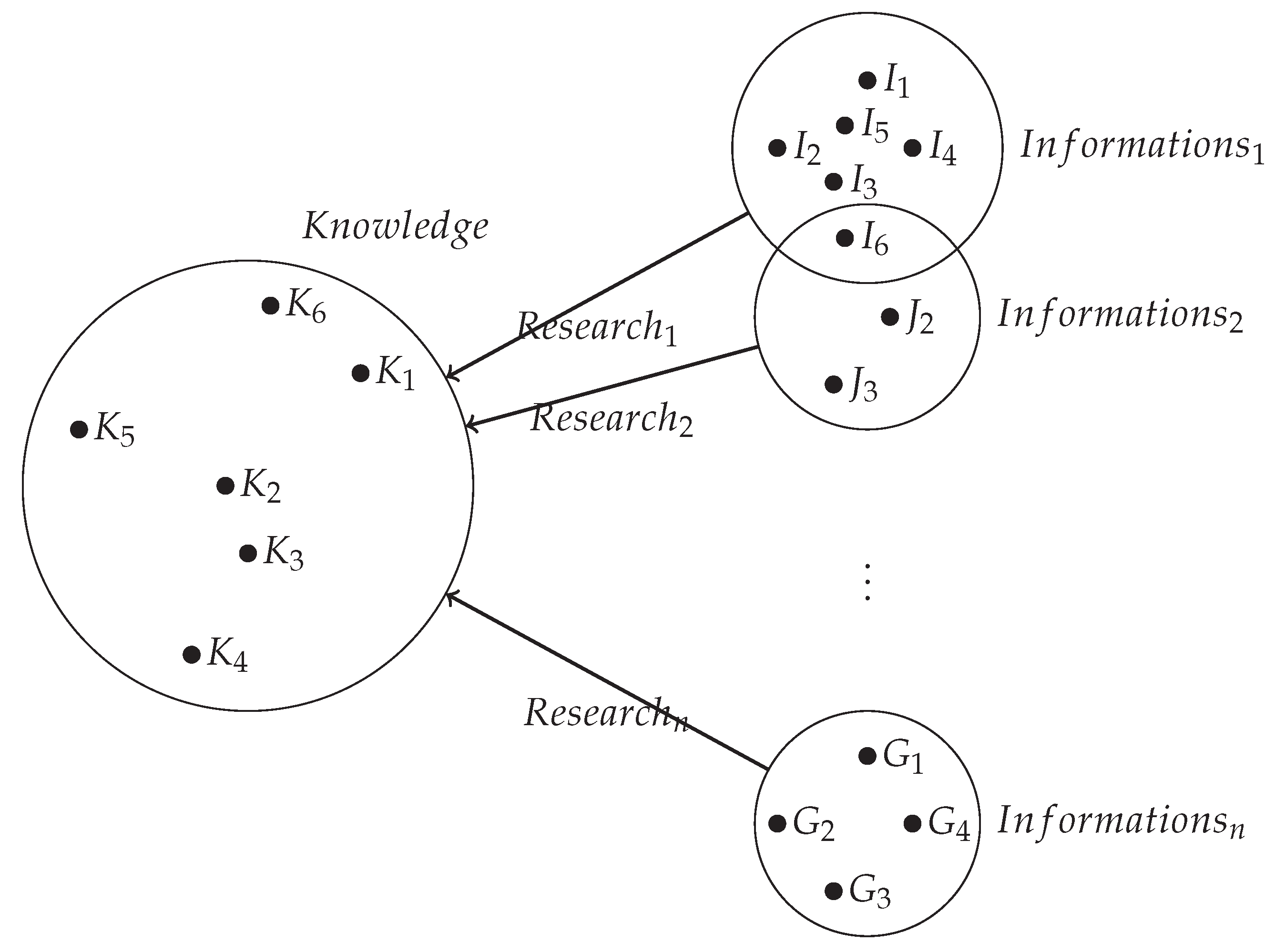
Tidy means methodical, precise, well ordered and cared for [MWE]. Given a finite set of informations and a research, one and only one knowledge is obtained (Figure 3). But from a knowledge it is possible to go back to several sets of informations and/or more researches. Also, from definition 8, it is possible to go back to more languages and/or more facts, as well as more researches (Figure 5). Hence, it is necessary to explicitly declare from which information and with which research a given knowledge was produced. Tidy specifically points to the structured and ordered nature of the knowledge. This implies that the relationships between knowledge, informations and researches have a structure and are well organized. Tidiness ensures a clear and well-defined flow of information and dependencies within the knowledge network. Research proceeds from information to knowledge, so knowledge cannot be used by research to generate information (unless that information is itself knowledge). This implies that the knowledge graph (which is a particular type of network) does not present loops and necessarily directed from one node to another (research goes from information to knowledge and not vice versa). Therefore knowledge can be expressed through a directed graph also know as digraph which is also loopless [29] and the absence of loops prevents circular dependencies, promoting efficiency and predictability in the graph’s functioning.
Axiom 3.
universe must be tidy, that is make explicit in an open and free way its structure. From what information and with what research the knowledge was produces, as well as from what facts and with what language the informations was encoded.
4. Future researches
This research marks the beginning of an extensive series of inquiries we are currently pursuing. In particular, the practical implementation of this axiomatic system has led to the development of a knowledge-based search engine. The service, named NREEY, derives its name from the acronym of the phrase “opeN fREE and tidY knowledge”, as mentioned earlier. At present, NREEY is a PoC (Proof of Concept) of a processing engine capable of structuring information and the process of justifying facts in order to produce knowledge automatically. It processes information and implements a justification process, thereby transmitting knowledge to the user (and as such, justifiable). Unlike conventional search engine structures or even artificial intelligence, NREEY does not merely relay information but also conveys its justification to the user, making it a knowledge processor. This is because the justification is implicit in the interaction with the search engine.
References
- Machuca, D.; Reed, B. Skepticism: from antiquity to the present; Bloomsbury Publishing, 2018.
- Russell, B. The problems of philosophy; OUP Oxford, 2001.
- Gettier, E.L. Is justified true belief knowledge? analysis 1963, 23, 121–123. [Google Scholar]
- Alston, W.P.; et al. The problem of knowledge, Accessed 2024. https://www.informationphilosopher.com/knowledge/problem/.
- Alston, W.P.; et al. History of the problem of knowledge, Accessed 2024. https://www.informationphilosopher.com/knowledge/history/.
- Alston, W.P.; et al. Knowledge, Accessed 2024. https://www.informationphilosopher.com/knowledge/.
- Ware, M.; Mabe, M. The STM report: An overview of scientific and scholarly journal publishing. International Association of Scientific, Technical and Medical Publishers 2015.
- White, K. Publication Output by Country, Region, or Economy and Scientific Field. https://ncses.nsf.gov/pubs/nsb20214/publication-output-by-country-region-or-economy-and-scientific-field, 2021. Accessed on February 19, 2024.
- Meho, L.I. The rise and rise of citation analysis. Physics World 2007, 20, 32. [Google Scholar]
- Wang, Y. On cognitive informatics. Proceedings First IEEE International Conference on Cognitive Informatics. IEEE, 2002, pp. 34–42.
- Schmidt, N. The Philosophical Review 1907, 16, 91–94.
- Masci. Elementi di filosofia logica. https://archive.org/details/masci-elementi-di-filosofia-logica, 1901. Accessed on March 13, 2024.
- Ranzoli, C. Dizionario di scienze filosofiche; U. Hoepli, 1926.
- Dictionary, M.W. Merriam-Webster.com; Merriam-Webster, 2022. https://www.merriam-webster.com.
- dictionary.cambridge.org Dictionary. dictionary.cambridge.org; Cambridge Dictionary, 2022. https://dictionary.cambridge.org.
- comminsdictionary.com Dictionary. comminsdictionary.com; Collins Dictionary, 2022. https://www.collinsdictionary.com.
- britannica.com Dictionary. britannica.com; Encyclopædia Britannica, 2022. https://www.britannica.com.
- plato.standford.edu Encyclopedia. The Stanford Encyclopedia of Philosophy; The Metaphysics Research Lab, 2022. https://plato.stanford.edu/.
- iep.utm.edu Encyclopedia. Internet Encyclopedia of Philosophy; Internet Encyclopedia of Philosophy, 2022. https://iep.utm.edu/.
- Hannon, M. Knowledge, concept of. Routledge Encyclopedia of Philosophy 2021. https://www.rep.routledge.com/articles/thematic/knowledge-concept-of/v-2. [CrossRef]
- Hetherington, S. Knowledge. Internet Encyclopedia of Philosophy 2021. https://iep.utm.edu/knowledg/.
- Ichikawa, J.J.; Steup, M. The Analysis of Knowledge. In The Stanford Encyclopedia of Philosophy, Summer 2018 ed.; Zalta, E.N., Ed.; Metaphysics Research Lab, Stanford University, 2018. https://plato.stanford.edu/entries/knowledge-analysis/.
- Lehrer, K. Theory Of Knowledge: Second Edition; Taylor & Francis, 2018. https://books.google.it/books?id=ScJKDwAAQBAJ.
- Suber, P. Open access overview. https://dash.harvard.edu/bitstream/handle/1/4729737/Peter%20Suber%2C%20Open%20Access%20Overview%20%28definition%2C%20introduction%29.htm?sequence=6, 2012, Accessed 2024.
- IOP Publishing Support. What is a hybrid open access journal? https://publishingsupport.iopscience.iop.org/questions/what-is-a-hybrid-open-access-journal/, Accessed 2024.
- Costello, E. Bronze, free, or fourrée: An open access commentary. Science Editing 2019, 6, 69–72. [Google Scholar]
- Gdansk University of Technology. Black open access, Accessed 2024. https://pg.edu.pl/en/openscience/open-access/black-open-access-0.
- Farquharson, J. Diamond open access venn diagram [en SVG] 2022. https://figshare.com/articles/figure/Diamond_open_access_venn_diagram_en_SVG_/21598179. [CrossRef]
- Bondy, J.A.; Murty, U.S.R.; others. Graph theory with applications; Vol. 290, Macmillan London, 1976.
| 1 | We chose the term producing knowledge to avoid the debate over “a priori” or “a posteriori” knowledge. In any case, with respect to a subject, whether knowledge is a priori or a posteriori, it is produced by some process. In the case of a priori, the process can be understood as the birth of the subject itself. |
Figure 1.
The relationships between elements, from the alphabet to communication.
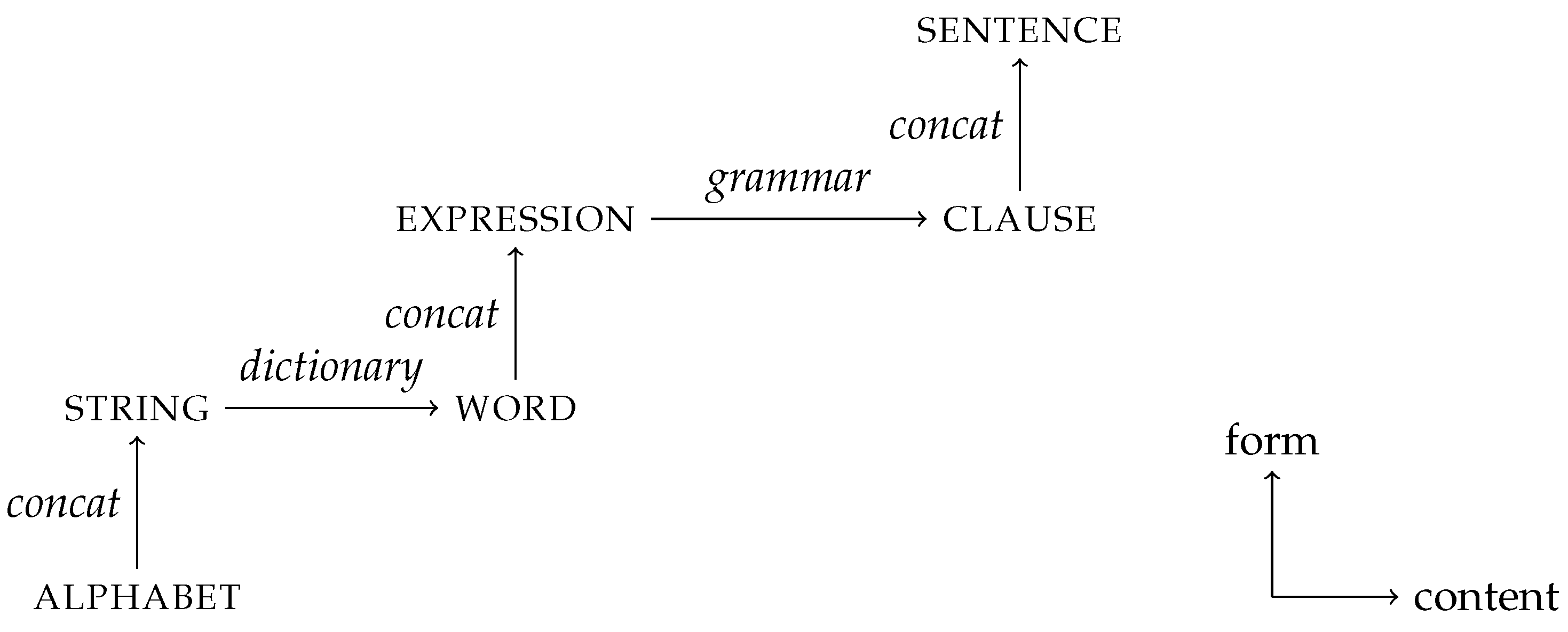
Figure 2.
Knowledge production based on facts that argues about true beliefs.
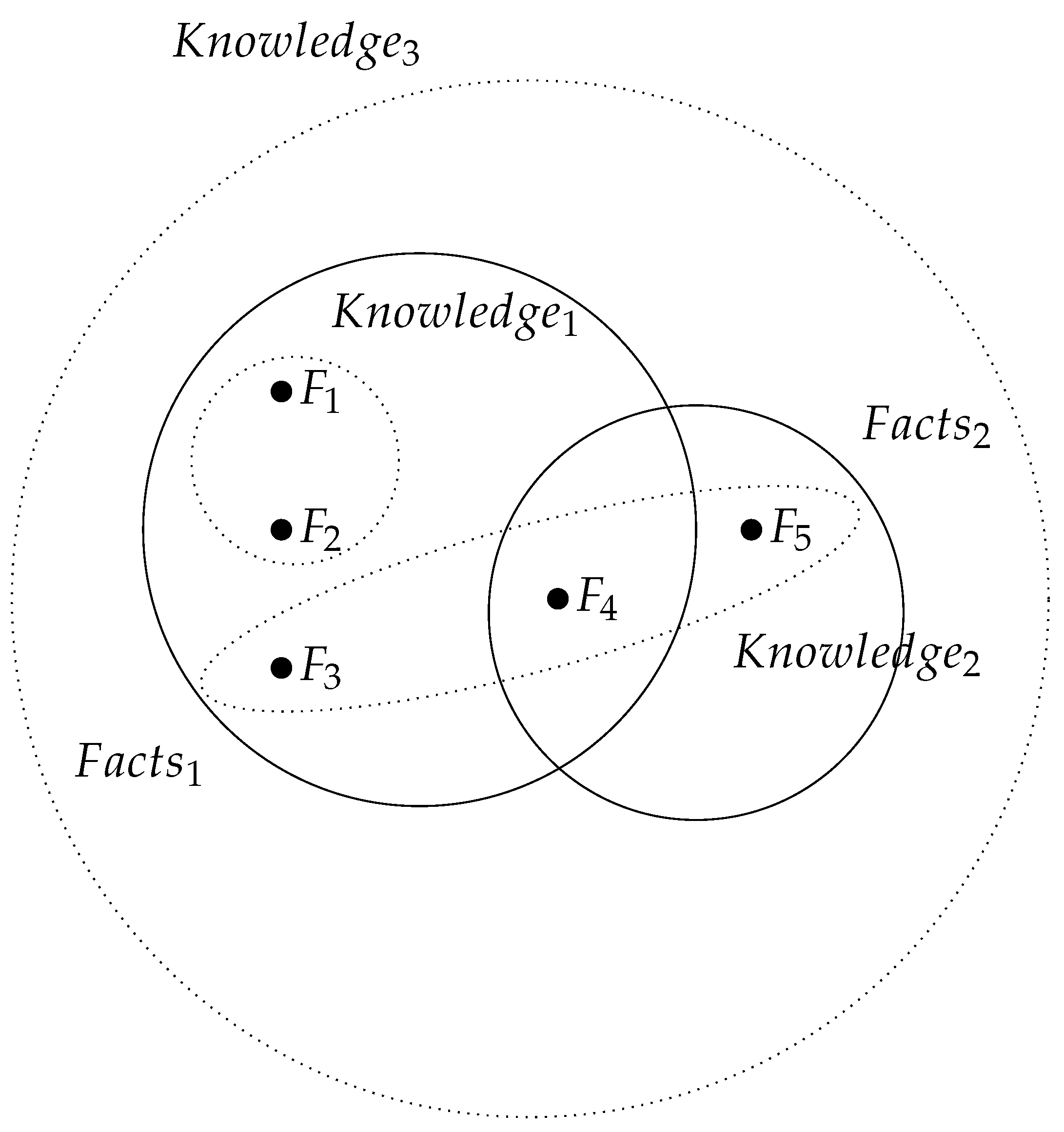
Figure 3.
Research argues true beliefs through facts encoded in informations by a language and produces knowledge.
Figure 3.
Research argues true beliefs through facts encoded in informations by a language and produces knowledge.
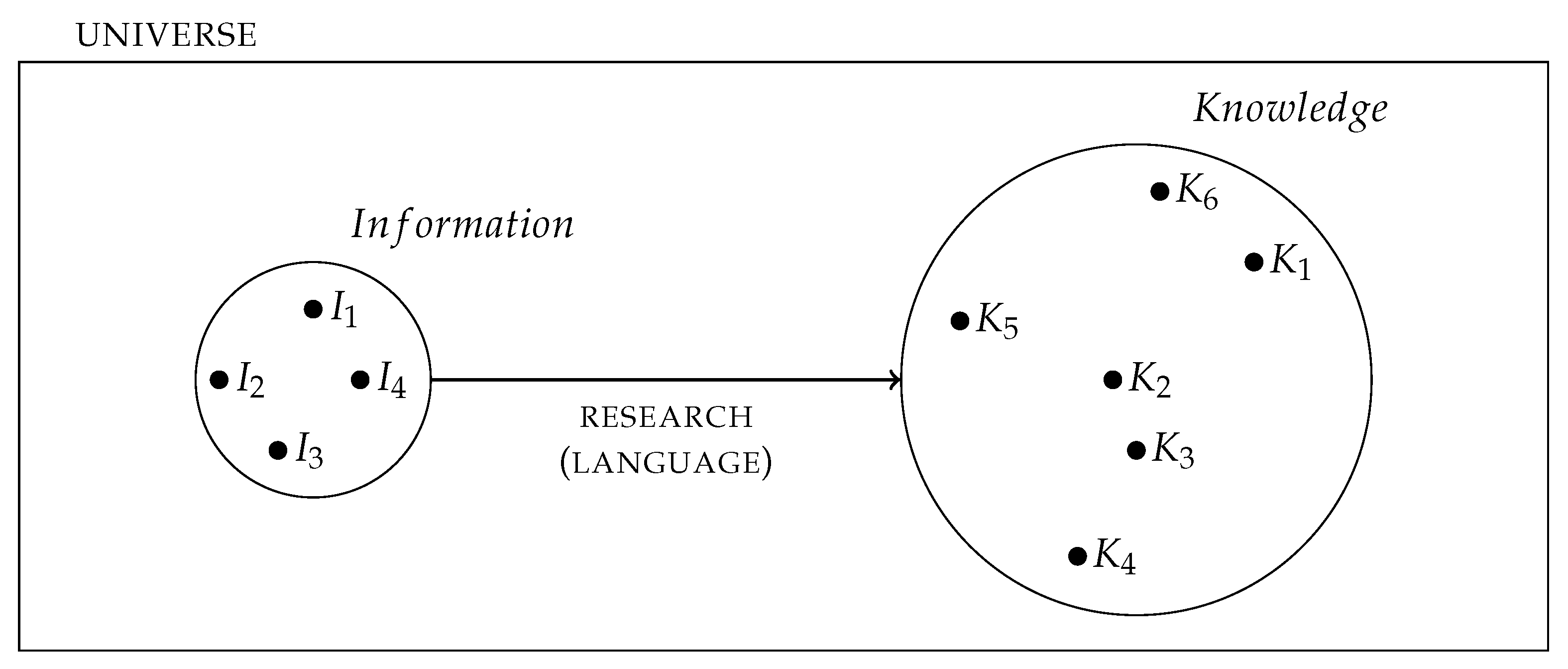
Figure 4.
OA Venn’s four-set diagram using rectangles.
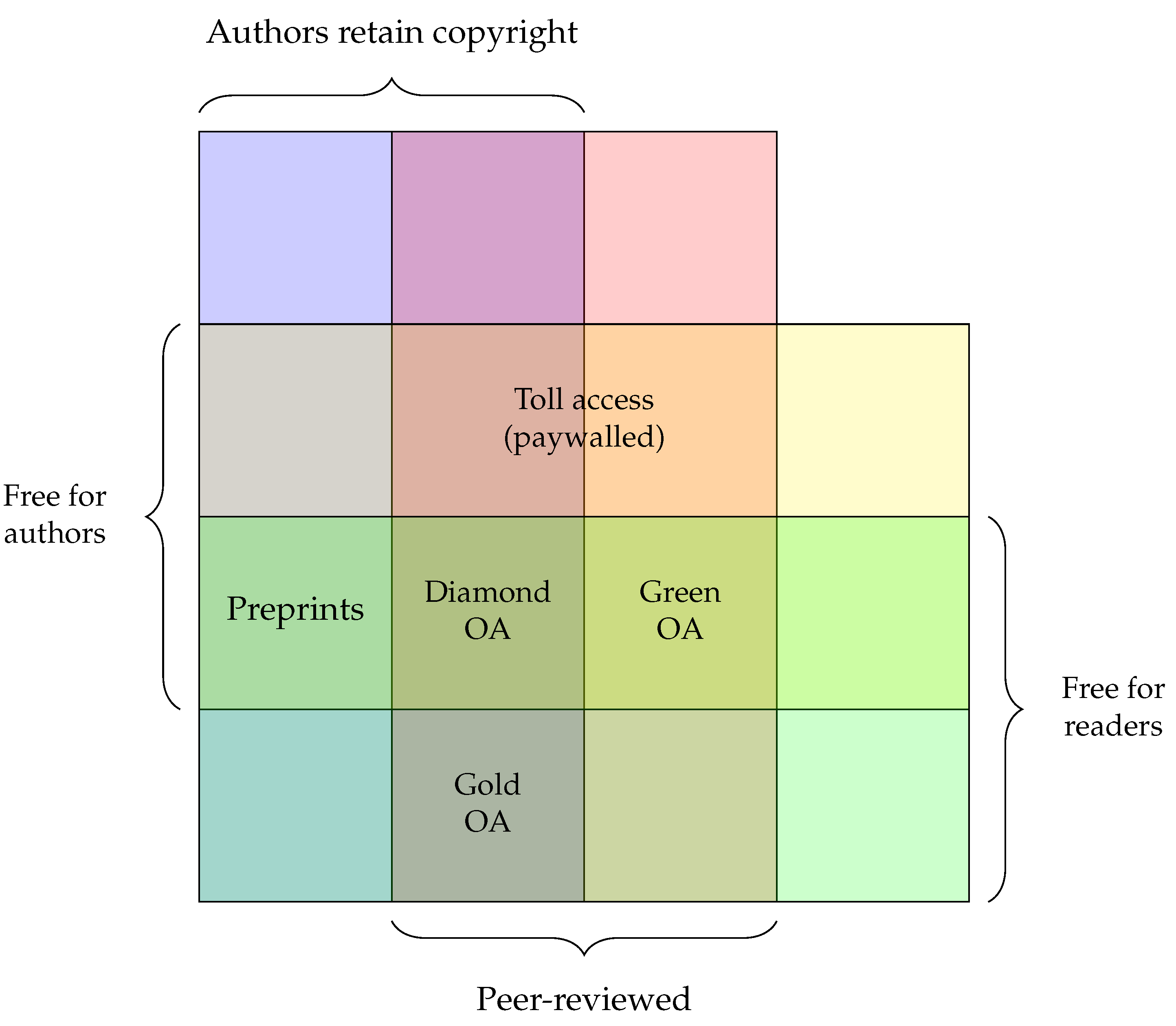
Figure 5.
The opposite of Figure 3, given a knowledge it is possible to trace back a lot of research and many different facts.
Figure 5.
The opposite of Figure 3, given a knowledge it is possible to trace back a lot of research and many different facts.
Disclaimer/Publisher’s Note: The statements, opinions and data contained in all publications are solely those of the individual author(s) and contributor(s) and not of MDPI and/or the editor(s). MDPI and/or the editor(s) disclaim responsibility for any injury to people or property resulting from any ideas, methods, instructions or products referred to in the content. |
© 2024 by the authors. Licensee MDPI, Basel, Switzerland. This article is an open access article distributed under the terms and conditions of the Creative Commons Attribution (CC BY) license (http://creativecommons.org/licenses/by/4.0/).
Copyright: This open access article is published under a Creative Commons CC BY 4.0 license, which permit the free download, distribution, and reuse, provided that the author and preprint are cited in any reuse.


