

Submitted:
27 March 2024
Posted:
27 March 2024
You are already at the latest version
Abstract
Badminton is one of the most popular racket sports played by children up to the elderly worldwide. Everyone can practice and play badminton as a leisure or competitive sport, regardless of age, experience, or skill level. It does not require physical contact among players and expensive equipment. Compared with closed-skill exercise (e.g., running, swimming), open-skill exercise (e.g., badminton, table tennis) has been reported to intervene more with cognitive function and prevent cognitive decline. In this review, we outline the characteristics of badminton’s beneficial effects on physical and cognitive aspects. The characteristics presented here indicate that intervention with regular badminton exercise could effectively improve cognitive function and prevent cognitive decline in the elderly.
Keywords:
badminton
; physical activity
; open-skill sport
; cognitive function
1. Introduction
Although badminton is a racket sport that is one of the most popular sports requiring mass fitness and entertainment worldwide [1,2,3], competitive badminton is the fastest racket sport in terms of shuttlecock velocity as fast as 426 km/h and requirement for agility, endurance, technique, psychological stability, physical fitness, and visuomotor integration [1,4,5].
The world population is rapidly growing and reached 7 billion in 2012, with 562 million (8%) aged ≥ 65 years. In 2015, the number of older people increased by 55 million (8.5% of the total population). The older population is estimated to reach approximately 1.6 billion from 2025 to 2050 [6]. Currently, approximately 55 million individuals experience dementia, and this number is predicted to increase to 78 million by 2030 and 139 million by 2050 [7].
Although there are 12 modifiable risk factors to prevent and intervene with dementia, such as physical inactivity, obesity, depression, social isolation, diabetes, hypertension, head injury, smoking, air pollution, alcohol, hearing loss, and low educational level [8], previous studies reported the benefits of badminton in intervening for physical, social, and psychological health [9,10,11,12]. Considering physical health, several studies and reviews demonstrated the effect of badminton on cardiac and respiratory function, including increasing maximal oxygen uptake (VO2max) and decreasing asthma, optic function, body shape, increasing bone mineral density, lower risk of coronary heart disease, and physical abilities (e.g., speed, flexibility, endurance, strength, vertical jump, muscle coordination, manipulation, and motor skills). Considering social health, badminton has a good impact on social relationships, personal development, mood regulation, and intrinsic motivation, following increasing fun and social engagement motives, besides psychological benefits on improving cognitive function, alertness, concentration, attention, depressive symptoms, and general motivation [9,10,11].
Therefore, the present review reports an overview of previous studies on the benefits of badminton to prevent and intervene with dementia to aim attention at the aforementioned modifiable factors, particularly physical activity, and depression, because they are crucial risk factors for dementia [13].
2. Search Strategy
We conducted comprehensive electronic searches for studies and information on badminton by using PubMed and Google Scholar. We used the following keyword combinations: “badminton,” “dementia,” “cognitive function,” “physical activity,” and “depression.” We decided whether a study is included based on the title and abstract, as well as the website content.
3. Characteristics of Badminton
3.1. The History of Badminton
Badminton is a sport that can be traced back to ancient civilization. It was initially played in 1873 in England, and it originated from “poona” or “poona Badminton,” which was played by the British army in India in the mid-19th century [3]. This sport rapidly increased in popularity and became a national sport, particularly in Asian countries, such as Japan, China, South Korea, Indonesia, and Malaysia, and in some European countries, such as Denmark, the Netherlands, and the United Kingdom. Currently, badminton is one of the most popular racket sports worldwide and is played by more than 200 million followers across a range of ages and experiences since its inclusion in the Olympic Games [4,14]. Moreover, badminton was included in the Paralympics for the first time in the 2021 Paralympic Games in Tokyo. However, it was first played by people with disabilities in the 1990s [15]. In addition, apart from the Paralympics, deaf badminton has also been noticed since its first inclusion in the 1985 Deaflympics held in Los Angeles [16].
3.2. Match Characteristics of Badminton
Although badminton is a globally relished and inexpensive leisure sport played by individuals of various ages, it also requires mass fitness to jump, lunge, turn quickly, and rapid arm swing [1,2,3]. Badminton has five disciplines: men’s and women’s singles, men’s and women’s doubles, and mixed doubles [4]. Individual opposing players (singles) or pairs (doubles) play on opposite halves of a rectangular court measuring 5.2 × 13.4 m and divided by a 1.55 m high net [17] (Figure 1).
Badminton is the fastest racket sport in terms of shuttlecock velocity as fast as 426 km/h with rotation [5,17], characterized by a combination of agility, endurance, and repetitive efforts for actions of short duration and high intensity combined with short rest periods, and required technique, psychological stability, physical fitness and visuomotor integration [1,4,5].
In badminton, each rally begins with a long or short serve [18,19,20], and a rally ends once a player makes a mistake, or the shuttlecock hits the floor [17]. An elite badminton match lasts almost 30–40 min and is characterized by an average effective playing duration of 31% (10–15 m) [19,21], rally time of 3–9 s, and resting time of 6–15 s [4,19,21,22,23]. Players define various shots during the match depending on numerous tactile choices [4,23]: the smash (aggressive and downward from overhead shot), the clear (overhead shot with a flat or rising trajectory toward the back of the opposite court), the drop (a smooth and downward shot from above the head toward the front of the opposite court), hairpin net shot (an accurate shot from near the net), the lob (offensive and rising shot toward the back of the opposite court), the push shot (aggressive and downward shot), and the drive shot (the offensive powerful and a flat shot from middle body height).
Because shuttlecocks are made of goose feathers weighing 5 g (or plastic feathers in leisure games) planted into a cork, the wind easily affects projectile flight [17], and the trajectories vary by 0.2 s for short-range smash and 1.5 s for the clear or lob [22]. Because badminton players must choose several kinds of shots depending on the opponent(s) and shuttle positions [17] to hit the shuttlecock from various heights, angles, and speeds with a badminton racket, which is relatively flexible compared with other racket sports [14], they require not only agility, speed, strength, flexibility, precision, and stamina but also sophisticated motor coordination and skills to track the opponent(s), racket, and shuttlecock [4,5].
3.3. Physiological Characteristics of a Badminton Match
Badminton requires a mean heart rate (HRmean) of >90% of the singles player’s maximum HR (HRmax) or a high percentage of their maximal oxygen uptake (VO2max) or relatively low lactic value during a match [4,23,24]. Table 1 shows physiological characteristics of elite male and female badminton players [4,23]. In elite male badminton players, the HRmean was 166 ± 6 bpm, HRmax was 188.0 bpm, %HRmax was 90.3% ± 3.7%, mean VO2 (VO2mean) was 46.0 ± 4.5 mL/kg/min, VO2max was 56.3 mL/kg/min, and percentage of VO2max (%VO2max) was 74.8% ± 5.3% [4,23]. In elite female players, the HRmean was 170 ± 10 bpm, HRmax was 193.4 bpm, %HRmax was 88.4% ± 5.1%, VO2mean was 36.4 ± 2.8 mL/kg/min, VO2max was 45.8 mL/kg/min, and %VO2max was 72.6% ± 7.2% [4,23]. Furthermore, the maximum serum lactate concentration during the male and female matches was 5.87 and 5.4 mmol/L, respectively [4], whereas other previous studies reported that the maximum lactate values of elite players were between 2 and 5 mmol/L on average [22,23]. These relatively low lactic values indicate that the aerobic system is active during a match [4,7]. The intermittent actions during a badminton match are demanding on both the aerobic (60%–70%) and anaerobic (approximately 30%) systems, where the anaerobic alactic system known as adenosine triphosphate creatinine phosphate (ATP-CP) system contributes more than the anaerobic lactic (glycolytic) system [4,22,23].
Because singles male players showed greater predicted VO2max than doubles players (50.6 vs 45.5 mL/kg/min, respectively), singles players significantly require greater aerobic capacity [24]. After the match starts, HR increases quickly and remains at a relatively steady state with significantly greater HRmean (88.8 ± 5.2% of HRmax) in singles, whereas HR plateaus earlier and fluctuates during the match (HRmean, 75.5% ± 8.8% of HRmax) in doubles [23,24]. Singles players showed HR >90% of HRmax during more than half the playing time, whereas the HR in doubles showed greater variability with values between 70% and 80% of HRmax during the majority of the playing time [24]. In addition, singles players reached high intensity of 80%–90% HRmax for twice the duration induced by doubles [25]. Moreover, singles players also require more steps and flexibility during a match with approximately 90% of shots being extreme fore and rear court shots (i.e., clear, drop, hairpin net, and lob) and more overhead shots (i.e., smash, clear and drop) than doubles players, whereas doubles players choose more kinds of faster shots [24,25].
Regarding injuries to badminton players, most players get injuries during a match (72%) [1]. The incidence was significantly lower in the players under 18 years old than those between 18 and 25 years old and over 25 years old (28, 45, 42/1000 players/year, respectively) [1]. The mean incidence rate in senior amateur players was 0.134/1000 h [26]. The accidents occur most frequently in badminton clubs (55%), followed by in companies’ sports (15%), recreational sports (15%), and in school sports (12%) [1]. According to the Abbreviated Injury Scale, moderate injuries were found in more than 50%, with 56% of the severe injuries being found in the over 25 years old group [1]. The injuries are most commonly found in the lower extremities, with 22.4% to the knee followed by 18.3% to the leg [1,26], with the shoulder being most frequently injured in the upper extremities (11.8%) [26]. Sprain injuries were most common (56%), followed by 13% of Achilles tendon ruptures, 10% of torn ankle ligaments, and 5% of fractures [1]. In contrast, in amateur players, muscle injuries were most common to the muscles (39.1%), followed by sprains, ligament, and tendon injuries (30.9%) [26]. More serious accidents were found among players who were longer apart from badminton [1]. After the injuries, 12% of players gave up badminton, and 28% gave up regular badminton for more than 8 weeks [1,26]. Although acute injuries to limbs may frequently occur, and badminton injuries occur in 1%–5% of all sports injuries, the incidence was significantly lower compared with soccer [1,26]. Considering amateur senior badminton players, adequate warming up and stretching before playing badminton may prevent injuries and allow them to continue regular badminton.
3.4. Physical Activity as an Open-Skill Exercise
Physical exercises are categorized into open-skill exercise (OSE) and closed-skill exercise (CSE) [12,27,28]. OSE requires performing in dynamic, more unpredictable, and externally paced environments, whereas CSE requires performing in relatively consistent, controllable, self-adjustable, and more predictable environment conditions [12,28]. The performance properties of badminton are complex. This fast-paced and unpredictable sport requires visual focus, sustained attention, rapid decision-making, working memory to track and forecast opponent(s) motions, and quick high intensity reaction to the constantly changing trajectory [4,12]. Thus, badminton is classified as an OSE [12,28,29]. Singles players train strategies focused on movement in the court and quick return to the center after each shot. In contrast, doubles players train strategies to improve reactions to fast shuttles in faster games [24]. In comparison with singles players, doubles players require faster reactions and forecast the opponents’ tactics, motions, and the shuttle’s trajectory since it is unpredictable which opposite player will hit the shuttle except for the serve, and doubles matches are more complicated, with choosing more kinds of tactics and faster shots [24]. So, doubles players may require more effort to acquire the cognitive demands, active decision-making, and ongoing adaptability and adapt to the externally paced environment characterized by OSE.
4. Benefits of Badminton for Cognitive Function
Physical activity and physical exercise enhance cognitive performance in children to the elderly [12,30,31,32]. Concerning the elderly, previous reviews suggested that physical activity improves immediate memory and cognitive flexibility in addition to enhancing and maintaining brain and cognitive function and reducing cognitive decline in late life [30,31]. A previous review based on neuroimaging studies in children and elderly reported that physical activity influences brain structure characterized by greater gray matter volumes in the hippocampus, prefrontal cortex, and basal ganglia, and greater white matter integrity in the elderly [30]. Another review referencing several imaging modalities (functional magnetic resonance imaging [fMRI], functional near-infrared spectroscopy [fNIRS], and electroencephalography [EEG]) showed that physical exercise regardless of the type reinforced cognitive function, which was attributed to increasing hippocampal and basal ganglia volume and greater white matter integrity and enhancing cerebral blood flow and alternations in neurotransmitter release in the central nervous system in children to the elderly [32]. Furthermore, physical activity and exercise are effective for intervention in functional ability and improving cognition of elderly patients with Alzheimer’s dementia (AD) [33,34,35].
OSE (e.g., badminton, table tennis, and tennis) has demonstrated greater corticospinal excitability, motor cortex function, and faster reaction times with better accuracy compared with CSE (e.g., swimming, running, cycling, and resistance training); however, OSE has more advantage in enhancing inhibitory control of cognition, namely suppressing activities in the current situation compared with CSE [12,28,32]. Compared with CSE, OSE has been reported to have superior effects in improving cognitive function, particularly inhibition and cognitive flexibility, which are important for executive function in children to older adults [27,31].
Concerning badminton exercise, both acute and chronic (i.e., regular) badminton exercises are effective for many kinds of cognitive function (Table 2). Based on a study performing the Stroop task test in young adults, acute OSE (a single bout of badminton match) can intervene in inhibitory function more effectively than CSE (running) [36]. Furthermore, based on a fNIRS study in young adults, OSE induces neural efficacy of the prefrontal cortex because a single bout of badminton match reinforces inhibitory control without increased hemodynamics in the prefrontal cortex [29]. Moreover, acute exercise (30 min badminton) showed higher serum brain-derived neurotrophic factor (BDNF) and executive function compared with running exercise in young men [37]. Furthermore, although both acute physical exercises (30-min badminton or cycling) can effectively increase serum BDNF, insulin-like growth factor 1 (IGF-1), and interleukin-6 (IL-6) promptly in healthy older people, acute badminton exercise elevated serum IL-6 compared with bicycle exercise, mediating some positive effects for brain health and cognitive functions [38].
Regarding chronic training (40-min training once weekly for 12 weeks), because both OSE (badminton, table tennis, hockey) and CSE (strength-endurance training) can effectively increase basal serum BDNF levels and IL-6 with statistical significance on OSE, regular OSE training was superior in improving some aspects of structural/ functional brain integrity compared with CSE [38]. Several observational studies and a review also revealed the effects of regular OSE on cognitive flexibility, visuospatial working memory, visuospatial attention, and inhibitory control in the elderly [31,39,40]. Previous studies supported the effects of longer badminton exercises on cognitive function. In adults with mild intellectual disability, badminton exercise training for 12 weeks affected executive function in improving inhibitory control and working memory [41]. In elite young adult badminton players, years of badminton training were associated with greater visuomotor integration, indicating badminton training may elevate sports-related skills in eye–hand coordination [5]. Furthermore, habitual badminton participation in the elderly showed significantly faster reaction in the Stroop task, and greater improvement in Trail making test compared with sedentary controls, indicating greater executive function [42].
Considering the 12 modifiable risk factors, except for depression [8], several effects of badminton were pointed out to prevent and intervene with dementia. Although total cholesterol, high-density lipoprotein cholesterol (HDL), low-density cholesterol (LDL), and triglycerides were not altered after badminton or submaximal running (1 h, thrice weekly for 8 weeks) in adult women [9], both longer badminton and CSE (e.g., jogging, swimming, and biking) were positively associated with HDL, with badminton exercise (lasting 30 min, at least thrice weekly in 3 months) increasing HDL levels more significantly in adults and elderly [43]. Additionally, systolic and diastolic blood pressures and HR also reduced after 8-week recreational badminton and submaximal running intervention in adult women [9], with decreased HR also in young men and women after the inclusive badminton intervention designed by the Badminton World Federation (BWF) (the BWF shuttle time; 50 min, twice weekly for 5 weeks) [11]. Habitual badminton exercise in the elderly showed better blood pressure [44], whereas longer badminton exercise in the elderly showed better body fat percentage than the shorter and elderly control in addition to lower fasting serum glucose than the elderly control [45].

Table 2.
An overview of studies examining the effect of badminton on brain health in adults.
| Authors | Participant and study (1. Study design; 2. Participants; 3. Exercise experience or intervention; 4. Main outcome measures and/or 5. Cognitive function) |
Main findings |
|---|---|---|
| Chen et.al., 2022 [5] |
1. Observational study 2. Elite badminton players (n = 28; F:M = 14:14; age: 21.35 ± 2.65 years) 3. Badminton training for years 4. Compensatory tracking task, time/movement, and estimation task 5. Visuomotor integration and temporal prediction |
(Compensatory tracking task)
|
| Patterson et.al., 2017 [9] |
1. Intervention study 2. Healthy untrained premenopausal women (n = 36; age: 34.3 ± 6.9 years), badminton, n = 13; Running, n = 12; Control, n = 8) 3. Badminton match or running; intervention: 1 h/session; thrice weekly for 8weeks. 4. Resting BP, HR, TChol, HDL, LDL, T, and psychological well-being questionnaires (Exercise Motives Inventory-II) |
(BP)
|
| Chen et.al., 2022 [11] |
1. Intervention study 2. Young adults with ID (n = 18; F:M = 4:14; age: 22.28 ± 1.84) 3. Shuttle time badminton starter lessons; intervention: 50 min/session, twice weekly for 5 weeks. 4. BP, Resting HR, EEG, 6MWT, badminton skills assessment, and SDS |
(BP)
|
| Takahashi et. al., 2023 [29] | 1. Intervention study 2. Healthy students (n = 24; F:M = 9:15; age: 20.4 ± 0.2) 3. A singles badminton game or running; 10 min; 3 times separated by an average interval, 6.1 ± 1.8 days 4. Color–word Stroop task, fNIRS, and TDMS 5. Inhibitory control, hemodynamics in the prefrontal cortex during the Stroop task, and pleasure and arousal states |
(Color–word Stroop task)
|
| Takahashi et. al., 2019 [36] | 1. Intervention study 2. Healthy students (n = 20; F:M = 12:8; age: 20.9 ± 0.2) 3. A singles badminton game or running; 10 min; 3 times separated by an average interval, 5.8 ± 1.4 days. 4. Stroop/reverse Stroop test 5. Inhibitory function and information processing speed |
(Stroop task)
|
| Hung et.al., 2018 [37] |
1. Intervention study 2. Young adult males (n = 20; age: 23.15 ± 2.48) 3. Badminton match or running; 30 min/session; 2 times with a 7-day interval. 4. Serum BDNF and task-switching paradigm 5. Executive function |
(Serum BDNF)
|
| Behrendt et. al., 2021 [38] |
1. Intervention study 2. Healthy older adults, acute intervention group; n = 24; F:M = 12:12; age: 65.83 ± 5.98 years, cOSE; n = 6; age: F:M = 4:2; age: 64.50 ± 6.32 years, cCSE; n = 9; age: F:M = 6:3; age: 64.89 ± 3.51 years 3. Acute intervention; badminton or bicycling; 30 min/session, chronic intervention; cOSE (badminton/hockey/table tennis) or cCSE (strength training/endurance training); 40 min/session; once weekly for 12 weeks 4. Serum and plasma BDNF, IGF-1, and IL-6 |
(Acute effect)
|
| Wang et.al., 2023 [41] | 1. Intervention study 2. Adults with mild ID (n = 15; F:M = 5:10; age: 36.0 ± 3.64 years) 3. Badminton intervention protocol; 10 min/warm-up; 40 min/training; 10 min/cool down; 12 weeks 4. The Stroop test, n-back test, and task-switching test 5. Inhibitory control, working memory, and cognitive flexibility |
(Stroop test)
|
| Zubir et.al., 2021 [42] | 1. Observational study 2. Sedentary elderly participants (n = 36; F:M = 15:21; age: 55–69 years) 3. Regular players; badminton/running/cycling/swimming 4. Sternberg working memory task, Trail making test, Stroop test, and MoCA 5. Working memory, executive function, and cognitive aging |
(Sternberg working memory)
|
| Nassef et. al., 2020 [43] | 1. Observational study 2. Taiwanese aged 30–70 years, aerobic exercise group (n = 2461; F:M = 1310:1151), badminton group (n = 29; F:M = 8:21) 3. Regularly, badminton; 30 min/session; at least thrice weekly for 3 weeks 4. HDL |
(HDL)
|
| Zubir et. al., 2022 [44] | 1. Observational study 2. Healthy badminton players aged >55 years, high- (n = 18; age: 64.2 ± 2.81 years) and low-playing time groups (n = 18; age: 63.3 ± 2.59 years) 3. High- (9.72 ± 2.16 h/week) and low-playing time groups (3.34 ± 1.53 h/week) 4. Resting BP, mean arterial BP, Sternberg working memory task |
(BP)
|
| Zubir et. al., 2022 [45] | 1. Observational study 2. Healthy elderly badminton players, high (n = 18; age: 64.2 ± 2.81 years) and low-playing time groups (n = 18; age: 63.3 ± 2.59 years) 3. High- (9.72 ± 2.16 h/week) and low-playing time groups (3.34 ± 1.53 h/week) 4. Body fat percentage, lean body mass, fasting serum glucose |
(Body fat percentage)
|
1 Abbreviation: BP, blood pressure; HR; heart rate; TChol, total cholesterol; HDL, high-density lipoprotein; LDL, Low-density lipoprotein; TG, triglyceride; ID, intellectual disabilities; EEG, electroencephalographic recording; 6MWT, 6-min walk test; SDS, Self-Rating Depression Scale; fNIRS, functional near-infrared spectroscopy; TDMS, Two-Dimensional Mood Scale; BDNF, brain-derived neurotrophic factor; IGF-1, insulin-like growth factor 1; IL-6, interleukin-6; MoCA, the Montreal Cognitive Assessment
5. Benefits of Badminton for Depression
Depression is a risk factor that can be modified to prevent and intervene with dementia [8], and earlier-life depression has become a crucial risk factor for dementia [13]. Because depressive symptoms are a major risk factor influencing subjective cognitive impairment in middle-aged (50–64 years) and older individuals (≥65 years), depressive symptoms should be managed from middle age to prevent cognitive decline and dementia [46]. A previous study identified that an inclusive badminton program designed by BWF reduced depressive symptoms in young adults (19–26 years) with intellectual disabilities [11]. Badminton is beneficial to social health, social relationships, personal development, mood regulation, and intrinsic motivation, besides increasing fun and social engagement motives [9,11]. Therefore, badminton may prevent depression because loneliness directly contributes to the depressive state [47].
6. Conclusion
We report that the intervention of badminton is beneficial to improve cognitive function and prevent cognitive decline. Furthermore, badminton players had a 6.2-year longer life expectancy, which was associated with the second highest life expectancy benefit following tennis in sedentary individuals ranging from young to elderly [48]. Badminton requires extreme steps, quick changes of direction jumps, and rapid arm swings from wide-range body positions. Although the incidence of badminton injuries increases with age [1], it is significantly lower than other OSE (e.g., soccer) [1]. Considering elderly individuals, a previous study revealed that amateur senior badminton players were injured with a mean rate of 0.134/1000 h, with the highest affected lesions occurring in the knee and shoulder in approximately 20% and 12% in the lower and upper extremities, respectively [26]. Additionally, osteoarthritis is one of the causes of the most common disabilities in the elderly, with high prevalence in the spine, followed by the hand, knee, shoulder, and hip [49]. Singles players require greater aerobic capacity and more extreme steps and overhead shots than doubles players [24,25]. Compared to singles players, doubles players require more tasks characterized by OSE in more complicated environments. A significant correlation was found between the severity of injuries and time absent from badminton [1]. Thus, playing habitual doubles games for leisure might be sufficient and safer in intervening cognitive function and higher life expectancy in the elderly.
Author Contributions
Conceptualization, A.O. and T.Y.; methodology, A.O.; investigation, A.O.; writing—original draft preparation, A.O.; writing—review and editing, A.O. and T.Y.; visualization, A.O.; supervision, T.Y. All authors have read and agreed to the published version of the manuscript.
Funding
This research received no external funding.
Institutional Review Board Statement
Not applicable.
Informed Consent Statement
Not applicable.
Data Availability Statement
Not applicable.
Conflicts of Interest
The authors declare no conflicts of interest.
References
- Høy, K.; Lindblad, B.E.; Terkelsen, C.J.; Helleland, H.E.; Terkelsen, C.J. Badminton injuries-a prospective epidemiological and socioeconomic study. Br. J. Sp. Med. 1994, 28, 276–279. [Google Scholar] [CrossRef] [PubMed]
- Ting, H.Y. , Sim, K.S., Abas, F.S. Kinect-Based Badminton Movement Recognition and Analysis System. Int. J. Comput. Sci. Sport. 2015, 14, 25–41. [Google Scholar]
- Kumari, V. Social and Economic Impact of Badminton in India. IJRRMF. 2022, 1, 61–67. [Google Scholar]
- Phomsoupha, M.; Laffaye, G. The Science of Badminton: Game Characteristics, Anthropometry, Physiology, Visual Fitness and Biomechanics. Sports Med. 2015, 45, 473–495. [Google Scholar] [CrossRef] [PubMed]
- Chen, Y.-L.; Hsu, J.-H.; Tai, D.H.-L.; Yao, Z.-Y. Training-Associated Superior Visuomotor Integration Performance in Elite Badminton Players after Adjusting for Cardiovascular Fitness. Int. J. Environ. Res. Public Health 2022, 19, 468. [Google Scholar] [CrossRef] [PubMed]
- He, W.; Goodkind, D.; Kowal, P. An Aging World: 2015; United States Census Bureau: Washington, DC, USA, 2016. [Google Scholar]
- Yamasaki, T. Benefits of table tennis for brain health maintenance and prevention of dementia. Encyclopedia 2022, 2, 1577–1589. [Google Scholar] [CrossRef]
- Livingston, G.; Huntley, J.; Sommerlad, A.; Ames, D.; Ballard, C.; Banerjee, S.; Brayne, C.; Burns, A.; Cohen-Mansfield, J.; Cooper, C.; Costafreda, S.G.; Dias, A.; Fox, N.; Gitlin, L.N.; Howard, R.; Kales, H.C.; Kivimäki, M.; Larson, E.B.; Ogunniyi, A.; Orgeta, V.; Ritchie, K.; Rockwood, K.; Sampson, E.L.; Samus, Q.; Schneider, L.S.; Selbæk, G.; Teri, L.; Mukadam, N. Dementia prevention, intervention, and care: 2020 report of the Lancet Commission. Lancet 2020, 396, 413–446. [Google Scholar] [CrossRef] [PubMed]
- Patterson, S.; Pattison, J.; Legg, H.; Gibson, A.M.; Brown, N. The Impact of Badminton on Health Markers in Untrained Females. J. Sports Sci. 2017, 35, 1098–1106. [Google Scholar] [CrossRef] [PubMed]
- Cabello-Manrique, D.; Lorente, J.A.; Padial-Ruz, R.; Esther Puga-González, E. Play Badminton Forever: A Systematic Review of Health Benefits. Int. J. Environ. Res. Public Health 2022, 19, 9077. [Google Scholar] [CrossRef]
- Chen, C.-C. (JJ).; Ryuh, Y.-J.; Donald, M.; Rayner, M. The impact of badminton lessons on health and wellness of young adults with intellectual disabilities: a pilot study. Int. J. Dev. Disabil. 2022, 68, 703–711. [Google Scholar] [CrossRef] [PubMed]
- Yamasaki, T. Preventive Strategies for Cognitive Decline and Dementia: Benefits of Aerobic Physical Activity, Especially Open-Skill Exercise. Brain Sci. 2023, 13, 521. [Google Scholar] [CrossRef] [PubMed]
- Byers, A.L.; Yaffe, K. Depression and Risk of Developing Dementia. Nat. Rev. Neurol. 2011, 7, 323–331. [Google Scholar] [CrossRef] [PubMed]
- Kwan, M.; Cheng, C.-L.; Tang, W.-T.; Rasmussen, J. Measurement of badminton racket deflection during a stroke. Sports Eng. 2010, 12, 143–153. [Google Scholar] [CrossRef]
- Alberca, I.; Chénier, F.; Astier, M.; Combet, M.; Bakatchina, S.; Brassart, F.; Vallier, J.-M.; Pradon, D.; Watier, B.; Faupin, A. Impact of Holding a Badminton Racket on Spatio-Temporal and Kinetic Parameters During Manual Wheelchair Propulsion. Front. Sports Act. Living 2022, 4, 862760. [Google Scholar] [CrossRef] [PubMed]
- Deaflympics. Available online: https://www.deaflympics.com/sports/bd (accessed on 12 February 2024).
- Cohen, C.; Texier, B.D.; Quéré, D.; Clanet, C. The physics of badminton. New J. Phys. 2015, 17, 063001. [Google Scholar] [CrossRef]
- Vial, S.; Cochrane, J.; Blazevich, A.J.; Croft, J.L. Using the trajectory of the shuttlecock as a measure of performance accuracy in the badminton short serve. Int. J. Sports Sci. Coach. 2019, 14, 91–96. [Google Scholar] [CrossRef]
- Gómez-Ruano, M.-Á.; Cid, A.; Rivas, F.; Ruiz, L.-M. Serving Patterns of Women’s Badminton Medalists in the Rio 2016 Olympic Games. Front. Psychol. 2020, 11, 136. [Google Scholar] [CrossRef] [PubMed]
- Rasmussen, J.; de Zee, M. A Simulation of the Effects of Badminton Serve Release Height. Appl. Sci. 2021, 11, 2903. [Google Scholar] [CrossRef]
- Chen, H.-L.; Chen, T.C. Temporal structure comparison of the new and conventional scoring systems for men’s badminton singles in Taiwan. J. Exerc. Sci. Fit. 2008, 6, 34–43. [Google Scholar]
- Manrique, D.C.; González-Badillo, J.J. Analysis of the characteristics of competitive badminton. Br. J. Sports Med. 2003, 37, 62–66. [Google Scholar] [CrossRef] [PubMed]
- Faude, O.; Meyer, T.; Rosenberger, F.; Fries, M.; Huber, G.; Kindermann, W. Physiological characteristics of badminton match play. Eur. J. Appl. Physiol. 2007, 100, 479–485. [Google Scholar] [CrossRef] [PubMed]
- Alcock, A.; Cable, N.T. A comparison of singles and doubles badminton: heart rate response, player profiles and game characteristics. Int. J. Perform. Anal. Sport 2009, 9, 228–37. [Google Scholar] [CrossRef]
- Liddle, S.D.; Murphy, M.H.; Bleakley, W. A comparison of the physiological demands of singles and doubles badminton: a heart rate and time/motion analysis. J. Hum. Movement Stud. 1996, 30, 159–176. [Google Scholar]
- Marchena-Rodriguez, A.; Gijon-Nogueron, G.; Cabello-Manrique, D.; Ortega-Avila, A.B. Incidence of injuries among amateur badminton players: A cross sectional study. Medicine 2020, 99, e19785. [Google Scholar] [CrossRef]
- Zhu, H.; Chen, A.; Guo, W.; Zhu, F.; Wang, B. Which Type of Exercise Is More Beneficial for Cognitive Function? A Meta-Analysis of the Effects of Open-Skill Exercise versus Closed-Skill Exercise among Children, Adults, and Elderly Populations. Appl. Sci. 2020, 10, 2737. [Google Scholar] [CrossRef]
- Heilmann, F.; Weinberg, H.; Wollny, R. The Impact of Practicing Open- vs. Closed-Skill Sports on Executive Functions—A Meta-Analytic and Systematic Review with a Focus on Characteristics of Sports. Brain Sci. 2022, 12, 1071. [Google Scholar] [CrossRef] [PubMed]
- Takahashi, S.; Grove, P.M. Impact of acute open-skill exercise on inhibitory control and brain activation: A functional near-infrared spectroscopy study. PLoS ONE 2023, 18, e0276148. [Google Scholar] [CrossRef] [PubMed]
- Erickson, K.I.; Hillman, C.H.; Kramer, A.F. Physical activity, brain, and cognition. Behav. Sci. 2015, 4, 27–32. [Google Scholar] [CrossRef]
- Gu, Q.; Zou, L.; Loprinzi, P.D. Effects of Open Versus Closed Skill Exercise on Cognitive Function: A Systematic Review. Front. Psychol. 2019, 10, 1707. [Google Scholar] [CrossRef] [PubMed]
- Srinivas, N.S.; Vimalan, V.; Padmanabhan, P.; Gulyás, B. An Overview on Cognitive Function Enhancement through Physical Exercises. Brain Sci. 2021, 11, 1289. [Google Scholar] [CrossRef] [PubMed]
- Bowes, A.; Dawson, A.; Jepson, R.; McCabe, L. Physical activity for people with dementia a scoping study. BMC Geriatr. 2013, 13, 129. [Google Scholar] [CrossRef] [PubMed]
- Morris, J.K.; Vidoni, E.D.; Johnson, D.K.; Van Sciver, A.; Mahnken, J.D.; Honea, R.A.; Wilkins, H.M.; Brooks, W.M.; Billinger, S.A.; Swerdlow, R.H.; Burns, J.M. Aerobic exercise for Alzheimer’s disease: A randomized controlled pilot trial. PLoS ONE 2017, 12, e0170547. [Google Scholar] [CrossRef] [PubMed]
- Jia, R.-X.; Liang, J.-H.; Xu, Y.; Wang, Y.-Q. Effects of physical activity and exercise on the cognitive function of patients with Alzheimer disease: a meta-analysis. BMC Geriatr. 2019, 19, 181. [Google Scholar] [CrossRef] [PubMed]
- Takahashi, S.; Grove, P.M. Comparison of the effects of running and badminton on executive function: A within-subjects design. PLoS ONE 2019, 14, e0216842. [Google Scholar] [CrossRef] [PubMed]
- Hung, C.-L.; Tseng, J.-W.; Chao, H.-H.; Hung, T.-M.; Wang, H.-S. Effect of Acute Exercise Mode on Serum Brain-Derived Neurotrophic Factor (BDNF) and Task Switching Performance. J. Clin. Med. 2018, 7, 301. [Google Scholar] [CrossRef] [PubMed]
- Behrendt, T.; Kirschnick, F.; Kröger, L.; Beileke, P.; Rezepin, M.; Brigadski, T.; Leßmann, V.; Schega, L. Comparison of the effects of open vs. closed skill exercise on the acute and chronic BDNF, IGF-1 and IL-6 response in older healthy adults. BMC Neurosci. 2021, 22, 71. [Google Scholar] [CrossRef] [PubMed]
- Tsai, C.-L.; Wang, W.-L. Exercise-mode-related changes in task-switching performance in the elderly. Front. Behav. Neurosci. 2015, 9, 56. [Google Scholar] [CrossRef] [PubMed]
- Tsai, C.-L; Pan, C.-Y.; Chen, F.-C.; Tseng, Y.-T. Open- and Closed-Skill Exercise Interventions Produce Different Neurocognitive Effects on Executive Functions in the Elderly: A 6-Month Randomized, Controlled Trial. Front. Aging Neurosci. 2017, 9, 294. [Google Scholar] [CrossRef] [PubMed]
- Wang, Y.; Wu, X.; Chen, H. Badminton Improves Executive Function in Adults Living with Mild Intellectual Disability. Int. J. Environ. Res. Public Health 2023, 20, 3673. [Google Scholar] [CrossRef]
- Zubir, S.M.S.; Linoby, A.; Hussain, R.N.J.R.; Zulkhairi, A.; Lamat, S.A.; Felder, H. Retrospective Comparision of Regular Badminton and Closed-Skills Sports Participation on Cognitive Function in the Elderly: A Preminilary Analysis. Available online: https://ispesh.upi.edu/file/ppt/ABS-ISPESH-23069.pdf (accessed on 22 February 2024).
- Nassef, Y.; Lee, K.-J.; Nfor, O.N.; Tantoh, D.M.; Chou,M. -C.; Liaw, Y.-P. The Impact of Aerobic Exercise and Badminton on HDL Cholesterol Levels in Taiwanese Adults. Nutrients 2020, 12, 1204. [Google Scholar] [CrossRef] [PubMed]
- Zubir, S.M.S.; Linoby, A.; Hussain, R.N.J.R.; Lamat, S.A.; Norhamzi, I.; Zulkhairi, A.; Noor, M.A.M.; Felder, H. Influence of recreational badminton playing on blood pressure and cognitive function in the elderly: a cross-sectional analysis with playing time-stratified sampling. J. Phys. Educ. Sport 2022, 22, 2076–2082. [Google Scholar]
- Zubir, S.M.S.; Linoby, A.; Hussain, R.N.J.R.; Lamat, S.A.; Norhamzi, I.; Zulkhairi, A.; Noor, M.A.M.; Felder, H. A Cross-sectional analysis of recreational badminton playing and its influence on body composition and cardiometabolic health in healthy older adults. J. Phys. Educ. Sport. 2022, 22, 2134–2140. [Google Scholar]
- Roh, M.; Dan, H.; Kim, O. Influencing Factors of Subjective Cognitive Impairment in Middle Aged and Older Adults. Int. J. Environ. Res. Public Health 2021, 18, 11488. [Google Scholar] [CrossRef] [PubMed]
- Adams, K.B.; Sanders, S.; Auth, E.A. Loneliness and depression in independent living retirement communities: risk and resilience factors. Aging Ment. Health 2004, 8, 475–485. [Google Scholar] [CrossRef] [PubMed]
- Schnohr, P.; O’Keefe, J.H.; Holtermann, A.; Lavie, C.J.; Lange, P.; Jensen, G.B.; Marott, J.L. Various leisure-time physical activities associated with widely divergent life expectancies: The Copenhagen city heart study. Mayo Clin. Proc. 2018, 93, 1775–1785. [Google Scholar] [CrossRef] [PubMed]
- Cho, H.J.; Morey, V.; Kang, Y.K.; Kim, K.W.; Kim, T.K. Prevalence and Risk Factors of Spine, Shoulder, Hand, Hip, and Knee Osteoarthritis in Community-dwelling Koreans Older Than Age 65 Years. Cli. Orthop. Relat. Res. 2015, 473, 307–3314. [Google Scholar] [CrossRef] [PubMed]
Figure 1.
A Badminton racket and a shuttle (a), adapted from photo AC (https:/ /www.photo-ac.com/, accessed on March 1, 2024), and three players ranging from adolescent to elderly engaged in a recreational rally with a shuttle about to hit by a singles player on the back court, while doubles players tried to predict its trajectory and move to the front court (b).
Figure 1.
A Badminton racket and a shuttle (a), adapted from photo AC (https:/ /www.photo-ac.com/, accessed on March 1, 2024), and three players ranging from adolescent to elderly engaged in a recreational rally with a shuttle about to hit by a singles player on the back court, while doubles players tried to predict its trajectory and move to the front court (b).
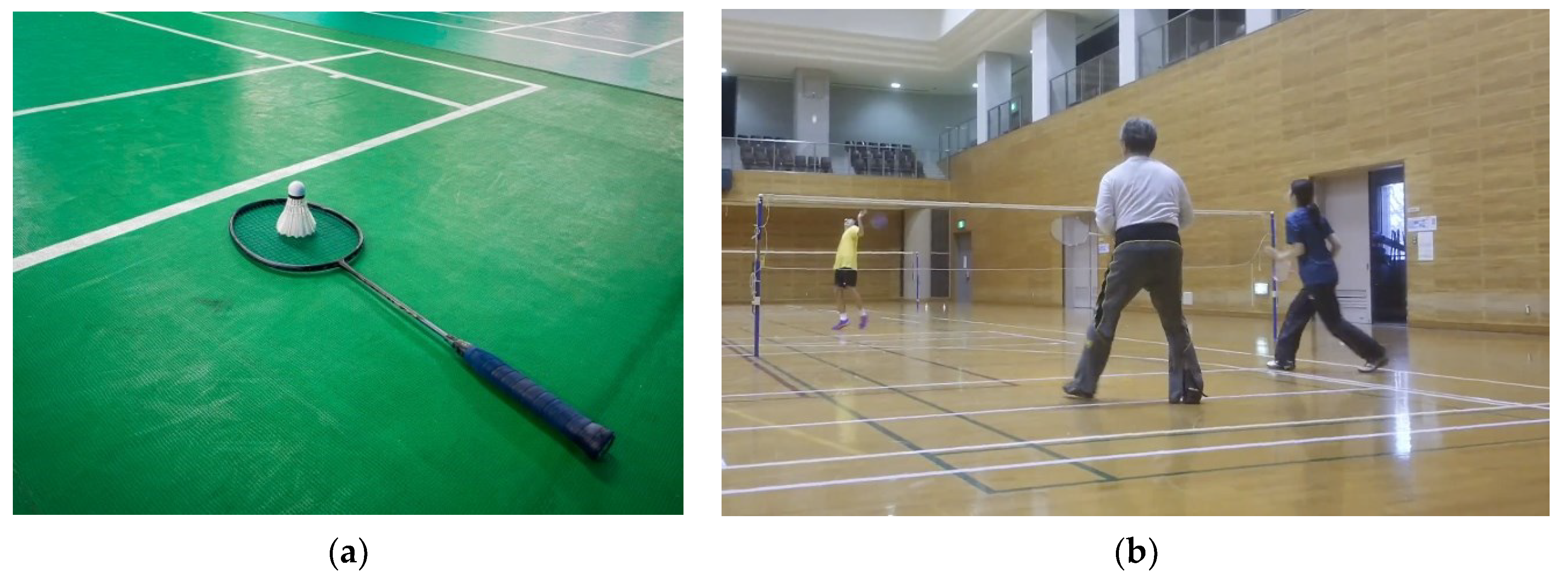
Table 1.
Average of physical values during a badminton match. Adapted from Phomsoupha et al. [4] and Faude et al. [23].
| Elite male players | Elite female players | |
|---|---|---|
| HRmean (bpm) [23] | 166 ± 6 | 170 ± 10 |
| HR max [4] | 188.0 | 193.4 |
| %HRmax (%) [23] | 90.3 ± 3.7 | 88.4% ± 5.1 |
| VO2mean (mL/kg/min) [23] | 46.0 ± 4.5 | 36.4 ± 2.8 |
| VO2max (mL/kg/min) [4] | 56.3 | 45.8 |
| %VO2max (%) [23] | 74.8 ± 5.3 | 72.6 ± 7.2 |
Abbreviation: HRmean, mean HR; HR max, maximum HR; %HRmax, percentage of HRmax; VO2mean, mean VO2; VO2max, maximum VO2; %VO2max, percentage of VO2max
Disclaimer/Publisher’s Note: The statements, opinions and data contained in all publications are solely those of the individual author(s) and contributor(s) and not of MDPI and/or the editor(s). MDPI and/or the editor(s) disclaim responsibility for any injury to people or property resulting from any ideas, methods, instructions or products referred to in the content. |
© 2024 by the authors. Licensee MDPI, Basel, Switzerland. This article is an open access article distributed under the terms and conditions of the Creative Commons Attribution (CC BY) license (http://creativecommons.org/licenses/by/4.0/).
Copyright: This open access article is published under a Creative Commons CC BY 4.0 license, which permit the free download, distribution, and reuse, provided that the author and preprint are cited in any reuse.


