
Submitted:
22 March 2024
Posted:
22 March 2024
You are already at the latest version
Abstract
In this paper we introduce an ODE system to model the interaction between nature resources and human exploitation in a rich consumeristic society. In this model the rate of change of population depends on wealth per capita, and the rate of consumption has a quadratic growth with respect to population and wealth. As in our previous work \cite{BaCra_1}, we distinguish between renewable and non renewable resources, and we introduce a replenishment term for non renewable resources. We first get some information on the asymptotic behaviour of wealth and population, then we compute all the equilibria of the system and we study their stability when the parameter of exploitation of resources is small. Some numerical simulations confirm the theoretical results, and give suggestions for future research.
Keywords:
Human and nature dynamics
; ODE systems for society dynamics
; Ecological- Economic Modeling
1. Introduction
In this paper we study a model of interactions between society and nature, inspired by the HANDY model introduced in [7] (see also [8]). The original HANDY model is a set of four differential equations whose variables are natural resources, wealth produced by human work, and the population, splitted in the two classes of Commoner and Elite. Using computer simulations, the paper [7] shows different possibilities for the evolution of society, including collapse. It is a simple model that seems to allow a rich panel of behaviour, so it attracted attention, and several papers have been devoted to its exploration, see [1,2,4,9,10,11]. In [2] various developments of the original model are introduced, among others the division of natural resources between renewable and non renewable. This idea has been developped in the paper [10], where some general results are obtained and again numerical simulations show different possibilities for the evolution of society. In [10] the dynamics of nonrenewable resources is given by the following equation
where are the nonrenewable resources, is the Commoner population and a parameter. Clearly, this equation translates the idea of a given amount and an irreversible depletion of . In our previous work [3] we have pursued this idea but we have introduced a replenishment term for nonrenewable resources. This is due to the optimistic argument, that is often used in public debate on these subjects, that human ingenuity and scientific progress can substitute depleted resources with new ones. The term of replenishment that we have added is given by
depending on , where x is population and w is wealth, while z is the level of non renewables and k a constant. Hence, the dynamics of non renewable resources z in [3] is given by
The replenishment term is obtained from a function which, in population dynamics, is a Holling II type function (see [6], page 25 and passim), used to model saturation effects. The equation above states that the replenishment is possible but cannot be above a level k, and we can call this an hypothesis of “moderate optimism”. Another characteristic of [3] is that we dropped the distinction between Commoner and Elite, so we obtained a four variable model, which is as follows
Here, as we said above, x is the population, indicate respectively renewable and nonrenewable resources, w is the wealth. An interesting result in [3] is that it cannot happen that go to infinity as t goes to infinity. This means that, even assuming “moderate optimism”, there cannot be an indefinite growth in population and wealth. In [3] we also obtained all the critical points of the system, and we studied their stability. In the final section of [3] numerical simulations support the theoretical results and also suggest the possibility, not yet treated in a rigorous way, of periodic orbits and chaotic dynamics.
The present paper originated from the attempt to adapt the HANDY model to contemporary, rich, consumeristic societies (like contemporary western countries). Indeed, the HANDY model seems to be a very nice and simple way to treat the interaction of nature and society for a large class of historical societies, but, in our opinion, it has some serious flaws when dealing with contemporary, rich, consumeristic societies. The main one is probably the fact that in the original model the birth rate is constant and the death rate decays when wealth increases, leading to the conclusion that a wealthy society should show sustained population growth. This is definitely not true in contemporary western societies, and the reason is due to the fact that birth rate is not constant, and indeed, in most of contemporary rich societies, it is falling. Hence, in the present paper we introduce an equation for population dynamics which is different from that of HANDY model, and it is as follows
Here we have a negative term which is contrasted by the term
depending on the wealth per capita via a constant . When is very small or very large, the positive term is small and the population falls. In an intermediate region, the population grows. This seems fitting better with the recent history of rich countries.
Another difference compared to the HANDY model (and to [3]) is that there the depletion of natural resources depend on the population, while it seems reasonable that in a consumeristic society it should depend more on wealth than on population. Hence, a first idea should be to substitute populations with wealth (x with w) in the depletion terms, giving rise to quadratic terms . We will pursue this idea in a forthcoming paper. In the present paper, however, we are interested to preserve some influence of population on consumption of natural resources, so we introduce the function and we substitute x with m in the depletion terms. We notice also that the consumption term in the equation for in [3], which is given by by has a linear growth, while here, to model a consumeristic society, we use a quadratic term , where the consumption is led mostly by wealth. In this way, we can put together the negative terms in the equation for in (1). Summing up all this ideas, we introduce the model that we are going to study. We apply some standard rescaling setting , and we assume , that is, we assume that the rate of depletion is the same for renewable and nonrenewable resources. This is a simplifying assumption, that we hope to drop in future research. In our previous paper [3], some simulations seemed to suggest that the dynamics do not change too much taking different values for and . In section 7 of the present paper, some simulations show a different dependence of the dynamics on and , and this seems an interesting topic for future research. In conclusion our model is as follows.
where, as we said above, . . We assume , which is necessary to have a positive growth of x for some range of . We also assume , which means that the negative effect on the population growth of the increasing wealth becomes relevant only for large values of wealth per capita. We also assume , which is just a technical assumption that we hope to drop in future work.
The paper is organized as follows: after the introduction, in section 2 we obtain general results of existence and positivity of the solutions, and also some results on their asymptotic behavior. In particular, we prove that it can’t happen or or as .
In sections 3, 4, 5, 6 we compute all the equilibrium points of system (2), and we study their stability properties. We distinguish the cases , , , while the case is excluded by our hypotheses. There is a rich variety of such equilibria. We are able to give a complete description of the stability properties for some of them, but it seems very difficult to do the same for all of them. So we decided to study the stability in the limit of , which is reasonable, in our opinion, because is a parameter depending on human choices. Using standard linearization techniques and asymptotic developments, we are able to describe the stability properties of all the equilibria when (and the other parameters are fixed).
In sections 7 we give some numerical simulations, both for corroborate the theoretical results of the preceding sections and to try to get some hint on the cases for which we don’t have such results. It is interesting to see that in some simulations the conditions stated by our results for small ’s (stability or instability) are preserved for larger ’s, while they are not in other cases: so this seems to be an interesting subject of future research.
We end this introduction by indicating, for the reader’s sake, some of the results obtained in the present paper.
- In section 2 we obtain that it cannot be or or as . We got a similar result in [3] and, as in that case, the result does not necessarily mean that are bounded, but that, if they grow above a critical level, then they will start to oscillate.
- The critical points with are all unstable.
- Most of the equilibria are unstable as , but for some ranges of the parameters, there are asymptotically stable equilibrium points, and also someone with positive values for populations and wealth: see below cases ii8) and iii3). See also Figure 13 in section 7.
2. General Results on the Solutions
We set and
where
We are interested in non negative solutions, so we work the cone
or possibly in its closure
It is obvious that F is locally Lipschitz at any point of , so the standard theory of ODE gives the following result:
Proposition 1.
For any , there exists a unique maximal solution to the Cauchy problem
defined in , with .
In the following, we will set and
As first thing we prove that, if is as above, the solution stays in for any .
Proposition 2.
Proof.
It’s straightforward to derive that for any , because the zero constant is a solution in the three equations for , so it can’t be crossed, and . As for w, we first observe that there exists a such that : this is obvious if , due to continuity, whereas if we have , and the thesis follows. Now let us then define
If , we easily conclude that in . If , it’s easy to see that and for any , so . But from the equation we get
and the contradiction proves that and thus . □
Proposition 3.
Under the same assumptions as in Proposition 2 it holds .
Proof.
We argue by contradiction, so we assume . From the first equation we easily get for some , hence
As for , using the same argument as in [3], we get that y is bounded in and, more precisely, we have . Notice that this holds also when .
From the equation for we get , hence
and thus,
From this it follows that if . Therefore, if we get that is bounded in , which is impossible due to known theorems. Hence, .
□
We now prove some asymptotic results on x and w.
Proposition 4.
It cannot be .
Proof.
We argue by contradiction, so we assume . For the sake of simplicity, let us set . As , of course we have also . To get the result, we have to study the asymptotic behavior of , in the hypothesis .
Claim 1: . We have
Given that is bounded and , is decreasing as . Hence, there exists a limit . If , then , which is a contradiction with known theorems. Therefore .
Claim 2: . We have
as . Thus, there exists a limit
If , then , which is, as above, a contradiction.
Claim 3: is bounded on .
Let be such that for all , . We distinguish two cases:
- Suppose for all . In this case, we havewhich means that is decreasing on and thus it is bounded in .
- Suppose now that there exists such that . Let . If , then . Otherwise, if , defineWe have that . Because of continuity we also have and . Hence we have in implying that is decreasing in and thus . In conclusion, for every , and therefore w is bounded on .
End of the proof: from the previous claims, we obtain, as w is bounded and , that as , and thus . This implies on a half-line , and therefore we get a contradiction with the hypothesis that .
□
Proposition 5.
It cannot be .
Proof.
Since we can repeat the previous arguments and obtain . From this we deduce, again as above, that is bounded, and this is a contradiction. □
Proposition 6.
It cannot be .
Proof.
Also in this case we argue by contradiction. We will show that, if , then it holds also , and this impossible by Proposition 5. So, let us assume . As a consequence, for any we can fix such that for all , .
Claim: it cannot be for all . Indeed, in this case it would be for all , implying w is increasing on . Thus, there would be a limit . By Proposition 5 it cannot be , so it must be , hence would go to , leading to for some in a half-line . This of course implies contradicting the assumption . The contradiction proves the claim.
Thanks to the previous claim, we can state that there exists such that
Let us now prove that for all . Fix . If , then (since ). Otherwise, if , define
By continuity, for all s in . Hence w is increasing in , implying . Furthermore, by standard continuity arguments, . Thus, for all . Since this holds for any , we conclude that . However, Proposition 5 states that this is not possible, and the contradiction proves that cannot tend to as t tends to .
□
3. Steady States if
We are now going to compute all the steady states of the system (2) in , and to study their stability. As we said in the introduction, in most cases we will be able to get an answer about the stability only for . In this section we deal with the case . In this subset the equilibrium points are the solutions of the following system
We can consider the following cases:
- i)
-
. In this case we get , and from (4b) we have two possibilities: either or . There are no conditions on z, so we have two families of critical points:
- ii)
-
. In this situation we haveand we can count 8 different cases.Notice that the hypothesis rules out the case .If then, from (4b), , i.e.Finally, if thenWe can now write down a complete list of equilibrium points, in the half-space , when .
- ii.1)
- First, we observe that if , then from (4d) we get , and thus we exclude this possibility, because we have already dealt with it (see above the case ).
- ii.2)
- ii.3)
- ii.4)
-
If , , we obtain , hence from (4d) we deduceWe then get two equilibrium points
- ii.5)
- If and , from (4d) we obtain and we exclude this case because we are assuming .
- ii.6)
- ii.7)
- ii.8)
In the two next sections we are going to discuss the stability of these equilibrium points. In the case we will obtain a complete result. For all the other equilibria above, we will study the stability as .
4. Instability of Equilibria in the Case
In this section we study the stability of the two families of equilibria (5a), (5b). We will obtain that they all are unstable.
Proposition 7.
Let and . Then P is an unstable equilibrium point.
Proof.
Let and let be the ball with center P and radius . Let be in , where is the positive cone defined above. Let be the trajectory starting from Q, so that . We want to prove that there exists such that . By contradiction, assume for every . Then and for every , thus and , hence
in . From this, we obtain
and it easily follows that
This contradicts the assumption and the contradiction proves our thesis, which in turn implies the instability of P.
□
Proposition 8.
Let and . Then P is an unstable equilibrium point.
Proof.
Let be such that . This implies
Let be the ball centered at P with radius and let . As in the previous proposition, we argue by contradiction. Let be the trajectory starting from Q. If it were for any we would have and for every , hence
thus
Therefore, we obtain
for every and thus , contradicting the hypothesis for every . The contradiction proves that there exists such that and since this holds for every , it follows that P is unstable.
□
5. Stability of Equilibria in the Case
In this section we study the stability of equilibrium points with and . These are the equilibria listed above from ii2) to ii8), recalling that we have ruled out the cases ii1) and ii5). We will limit our study to what happens as , assuming that the other parameters remain fixed. We will analyze the Jacobian matrix at equilibria, and this is not possible if an equilibrium lies on the hyperplane , because there the vector field F is not differentiable. So let us prove, as first thing, the following proposition.
Proposition 9.
If is an equilibrium point and , then .
Proof.
We argue by contradiction. If P is an equilibrium point and , then by (4a) we obtain
that is, or . Our hypotheses on rule out both these possibilities.
□
To study the stability of the problem, we introduce the Jacobian matrix of the differential model (2). Recall that we are studying the case , , and by the previous proposition we can assume . We obtain
As we can see, is always an eigenvalue of the Jacobian calculated at the critical points. In cases from ii.2) to ii.4), as , we get . In cases ii.6) to ii.8) we note that
where , so
since we are in the case in which . When we have
and when we have
Thus, in cases from ii.6) to ii.8), the points corresponding to are always unstable, for any value of the parameters, while for equilibrium points corresponding to a more detailed analysis will be carried on.
Let’s now study the various cases previously determined.
- ii.2)
-
As we just said an eigenvalue of the Jacobian matrix is given by . So we have to study the eigenvalues of the submatrixWe need to distinguish the two cases and . Due to the continuous dependence of the eigenvalues on the coefficients of the matrix, we can conclude that the point is unstable as because has the eigenvalue , given that . We have then proved the following proposition.Proposition 10.As to we notice that for , and therefore we must take in account the sign of . If we have that the matrix has an eigenvalue which, by continuous dependance of the eigenvalues of a matrix on the entries, tends to the value as . We then obtain, in this case, the instability for the point as . Let us now assume . We consider the submatrix defined as followsWe easily get that, as , the trace of the matrix becomes negative and its determinant positive. This implies that the eigenvalues of have strictly negative real parts. Now, the eigenvalues of the matrix are given by and by the two eigenvalues of . Hence, we have proved the following proposition.Proposition 11.As , the point , with as in (9), is an unstable equilibrium point if , and it is an asymptotically stable equilibrium point if .
- ii.3)
-
With some lengthy but standard computations we obtain the following eigenvaluesAs a consequence, we have the following result.Proposition 12.The point is an unstable equilibrium point if and is an asymptotically stable equilibrium point if as .
- ii.4)
-
The Jacobian matrix calculated at the points is as followsWe use the Routh-Hurwitz criterion (see [5]) . As is an eigenvalue, we can write the characteristic polynomial of , in the following formwith . According to the Routh-Hurwitz criterion. the necessary and sufficient conditions for all roots of to have a strictly negative real part are the followingLet’s study the stability of the point obtained by setting as in (9). After some lengthy but standard computations we getHence, we get instability when , stability when . However, the asymptotic development of the z component of giveshence, in the case of stability, the equilibrium is not in , as . We conclude that the following proposition holds true.We now study the point with as in (9). After some computations, we obtain the following results for the coefficients of :Hence, by applying the Routh-Hurwitz criterion again, we get that, as , the critical point is stable when , unstable when . But in we haveHence, in the instability case , we have as , and is not in . We have then proved the following proposition.
- ii.6)
-
In this case we have 4 critical point as in (14) with given in (6), (9) respectively. For sake of simplicity, we report the expression of the Jacobian matrix calculated at these points.Based on what is established in (17), the following proposition holds.Let’s now begin the study in the case where as seen in (18).Let’s then analyze the eigenvalue . We haveTherefore, the Jacobian calculated at point has a positive eigenvalue for and thus the equilibrium is unstable. As for point , we must distinguish between two cases. If then this equilibrium will also be unstable, so let us see what happens if . In this case the eigenvalues of are as follows. A first one is given by as in (18), a second one is . The last two are the eigenvalues of the following matrix :As this matrix has strictly negative trace and strictly positive determinant, so its eigenvalues have strictly negative real parts. Thus we have proved that, in this case, the point is a stable equilibrium. Let’s summarize everything in the following proposition.
- ii.7)
-
Based on what is established in (17), the following proposition holds.Proposition 17.The point is an unstable equilibrium point.Let’s then analyze the behavior of the Jacobian matrix calculated at point In this case, the Jacobian matrix is almost the same one computed at point P in case ii.3). Indeed, the two points differ only for their first entry, and the two Jacobian matrices only for the entries (first row, first column). Hence, the two matrices have different eigenvalues ( in case ii.3), in the present case), but both are negative, while the other three eigenvalues are the same as in the case ii.3). Using the results we have obtained in that case, we get the following propositionProposition 18.The point is an unstable equilibrium if and is an asymptotically stable equilibrium if as .
- ii.8)
-
In this case we have 4 critical point as in (16) with given in (6), (9) respectively. Based on what is established in (17), the following proposition holds.Regarding the points () we argue as we have just done for the previous case ii.7). Indeed, in this case, the Jacobian matrix is almost the same one computed at point in case ii.4): the two points differ only for their first entry, and the two Jacobian matrices only for the entries , hence the two matrices have different eigenvalues, which are both negative, while the other three eigenvalues are the same in the two cases. Using the arguments and the results of case ii.4), we get the following proposition
6. Fixed points and stability if
We are now going to look for the equilibria, and their stability, in the case . To compute the equilibria we need to consider the system
We note that x cannot be zero since . Therefore, as equation (4a) coincides with (25a), we will always have the relation
with given by (6). Moreover, it cannot be because this would lead, from (25d), to and, as just stated, .
We distinguish the following cases:
- iii.1)
- iii.2)
-
Then we have two equilibrium points
- iii.3)
Let us now study the stability of these equilibria. For this, we compute the Jacobian matrix of the differential model (2) with . Recalling that and considering (26) we obtain
so that . Since and we have that if then , and vice versa for .
- iii.1)
-
As , in this case the entry is an eigenvalue (with ). Let us call this eigenvalue. Considering the asymptotic for we obtainand we can stateTherefore, the Jacobian matrix calculated at the points for has at least one positive eigenvalue, and therefore the equilibria are unstable. We thus state the following proposition.The behavior of the points depends instead on the sign of . If these equilibria are unstable. We then study the behavior of such points under the assumption We examine the asymptotic behavior for . The asymptotic of the Jacobian matrix becomesWe use the Routh-Hurwitz criterion. We introduce the characteristic polynomial ofThrough some lengthy but standard computations we getLet us recall that the necessary and sufficient condition for the roots of the polynomial to have strictly negative real parts is that e . We recall that and as given in (6). Therefore, and if making unstable. Conversely, and if withWe can therefore summarize in the following proposition.
- iii.2)
-
In this case, we have two critical points as in (30). By doing the asymptotic expansion of the variables, for , we obtainand the asymptotic Jacobian matrix calculated at these points becomeswith . For , this matrix reduces to a diagonal matrix with an eigenvalue given byWe have repeatedly noted that if and if . Due to the continuity of eigenvalues with respect to the elements of the matrix, in the case for there is an eigenvalue of the Jacobian matrix that tends to a positive value, and therefore the critical point is unstable. If , we obtain instead , hence we must apply the Routh-Hurwitz criterion to the characteristic polynomial . The criterion states, in this case, that the necessary and sufficient conditions for all roots of characteristic polynomial to have a strictly negative real part are the followingAfter lengthy computations we obtain the following asymptotic developments of the coefficients of the polynomial asRecalling that , we have that for . Also, we have if . Analyzing the orders of magnitude of the coefficients, the last two conditions are definitely met when the leading terms of the coefficients of the characteristic polynomial are positive. On the other hand obviously has a positive root if . We can therefore conclude with the following proposition
- iii.3)
-
In this case, we have four equilibrium points varying with the values of see (27) and , see (6). We start with for . Considering the asymptotic expansions of the variables for , we obtainNotice that, when , we obtain as , hence in this case the points are not in the cone .The developments above, when substituted into the Jacobian matrix, lead toWe now argue as in the previous case, noticing that, when , this matrix reduces to a diagonal matrix with an eigenvalueAs we know, this value satisfies if and if Therefore, when , due to the continuity of eigenvalues with respect to the elements of the matrix, there exists at least one positive eigenvalue as , and thus the equilibrium point is unstable.We now proceed by studying the stability of the point . We apply again Routh-Hurwitz criterion, and we study the characteristic polynomial of the matrix and its coefficients , . We want to study what happens for , so we look at the asymptotic behavior of the ’s. We start noticing thatWe have that for and for and Under these conditions, the and are also positive, as .We recall that the equilibria are not in when . We collect our results in the following proposition:Proposition 24.is an unstable equilibrium. If the equilibrium is asymptotically stable but is not in , together with , as . If the two equilibria are in and are unstable, as .We now proceed with the study of the stability of the points The asymptotic developments in this case arewhich lead to the Jacobian matrix calculated atWe now apply the Routh-Hurwitz criterion to the characteristic polynomial withIf we assume and we have , while if it holds , and in both cases we obtain that there is an eigenvalue with strictly positive real part. Hence, in this case, the two equilibrium points we are dealing with are unstable. Notice also that from we derive as , so in this case the two points are not in the positive cone.Let us now assume . If we obtain and the equilibrium is unstable. If all the coefficients are positive. For the stability we have then to verify that, at least for , it holdsWe have that is led by a term of the type , with , while , so the first inequality above is verified for small ’s. Regarding the last condition, that is , we notice that while and Therefore, the last condition is simplified by requiring With simple calculations, we obtainso the second condition is verified for and . We summarize in the following propositionProposition 25.If the two points are both unstable equilibria of the system (2), but are not in , as . If and , the point is an unstable equilibrium, while the point is an asymptotically stable equilibrium (and both are in ).
7. Simulation results
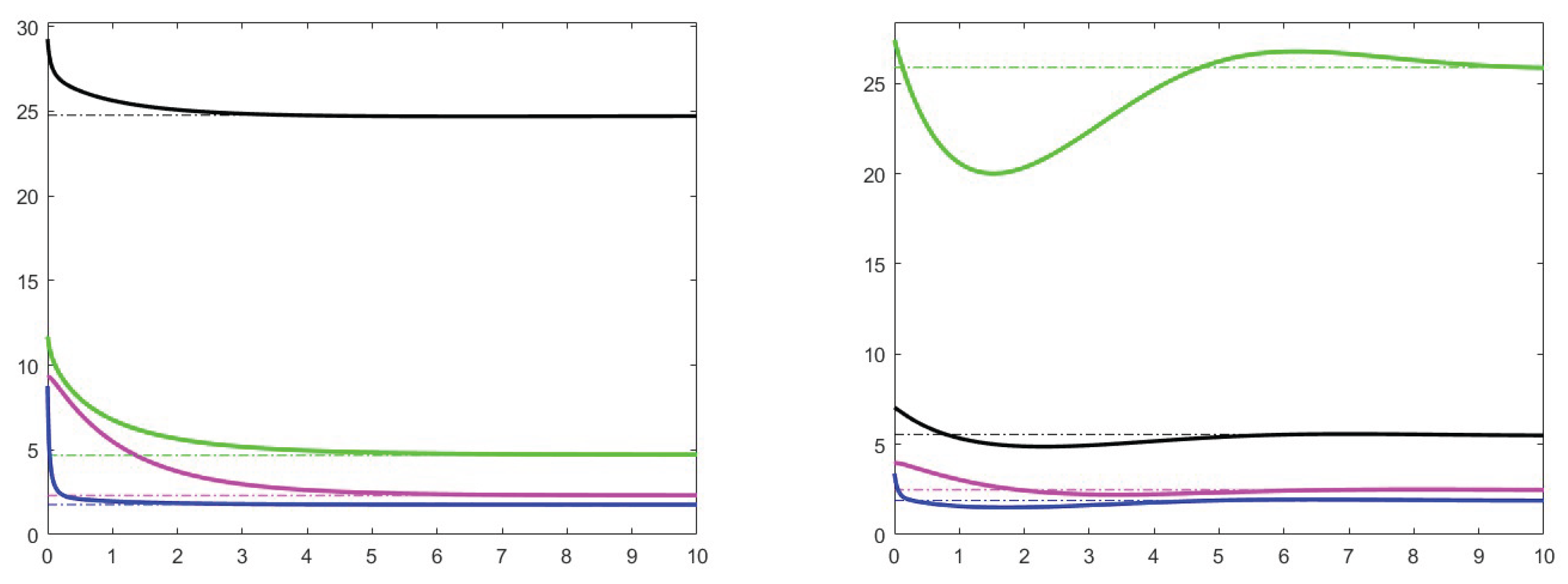
We now introduce the results derived from simulations conducted with Matlab’s ode45 solver, which applies an explicit adaptive Runge-Kutta method. In all depicted graphs, the evolution of variables is illustrated using distinct colors: the population in magenta, renewable resources in green, non-renewable resources in black, and accumulated wealth in blue. Dashed lines indicate the coordinates of the equilibrium point under consideration, with matching colors for corresponding components (i.e., magenta for the population, and so forth).
In these simulations, we first wanted to test our theoretical analyses, and therefore we have depicted in each chart the dashed line that represents the equilibrium point and the curve obtained by uniformly perturbing the the initial value with respect to the equilibrium point. Alongside these verifications, we analyzed the behavior of the solution curves as the depletion coefficient of both renewable and non-renewable resources increases, sometimes obtaining results different from those achieved for a small (in the literature small ’s are usually considered). We also analyzed the behavior of the solutions obtained by considering different depletion factors between renewable and non-renewable resources. Finally, we tested the stability of some equilibrium points supporting positive values for all the variables. On the x-axis, we consider a generic unit for time which does not necessarily translate into days, months, or years. It’s a generic unit that doesn’t necessarily span too long intervals. Indeed, we suspend our simulation when the behavior appears to be identified. In the captions, we have included the data related to the equilibrium point examined and, in particular, the value assumed and the eigenvalues of the Jacobian matrix calculated at that point. In these experiments, we kept certain parameter values constant, setting them to the values generally found in the literature (see [10,11]). However, we deliberately altered other parameters to study their behavior. In particular, if not stated otherwise in the comment of the individual figure, we consider the natures carrying capacity , the natures regeneration factor , the wealth consumption , the factor that regulates the possible increase of non-renewable resources and finally, the factors that govern the dynamics of populations . Our simulations, on the other hand, were conducted by varying the parameter .
7.1. Analysis of theoretical results and increase effects
In analyzing the correctness of our theoretical studies, we started from the case , that is when wealth is greater than the current population. When the critical points are given by two families of points that we have denoted by Q and R, representing the desert state and the nature state, respectively. These are two families of unstable points that in Figure 1 we have represented in the case of . For better readability of the chart, achieved with variable values of the same order of magnitude, we have set .
We then analyzed the situation near the critical points of case ii.2) both to verify the correctness of our analyses and to see the possible scenario near such points. The behavior was confirmed in both the case of a small and the case of a possible large value. We have illustrated in Figure 2 the case with . In case ii.2), we also analyzed the behavior of with a large delta value, specifically , by setting . We obtained results aligned with what was predicted by our analyses for small , both in the case of and in the case of .
We recall that, as for case ii.3), we have a single stable critical point for and unstable in the opposite case. These results were confirmed by numerous simulations with small . It should be noted that, in the case of stability, we had to reduce the perturbation applied to P to achieve convergence to this equilibrium point. With the usual perturbation , convergence occurs towards point of case ii.7), which differs from P only in the value assumed by the population. In Figure 3, we report the results obtained about the analysis of point P in case ii.3) for large . This point is stable regardless of the value assumed by . However, we note that the basin of attraction of this point is extremely small. As in the case mentioned above for small , we had to reduce the usual perturbation to a value equal to to achieve convergence to point P and not to point of case ii.7). In the case of Figure 3, however, the point P is close to zero in each of its components, therefore, a perturbation of the order of seems to us to be quite reasonable; a situation different is, for example, if , obtained with and for which and the perturbation must be equally small.
In Figure 4, we report the analysis of point of ii.6), as varies, always unstable according to the theory.
In Figure 5, Figure 6, and Figure 7, we have reported some of our experiments regarding the critical points indicated in case ii.7). Specifically, in Figure 5 and Figure 6, we analyzed point , as varies, unstable if , stable otherwise. For the sake of greater readability of the graphs, these figures refer to . While stability can occur as varies, see Figure 6, the instability of the point is not obtained for large values of , differently from what our theoretical results state for , see Figure 5. Finally, in Figure 7, we report the analysis of point , always unstable as varies.
We now report some experiments conducted in the case .
Specifically, in Figure 8, we analyze, as varies, the behavior of solutions starting nearby the equilibrium point, predicted to be unstable if and indicated as in the situation iii.1). In the case of , for which we have stability for small values of , we obtained a situation of instability by pushing to the maximum value allowed while keeping fixed. Finally, in Figure 9 and Figure 10, we have reported some of our studies on point of case iii.2). Here too, we are in a situation in which we have instability for small ’s, while the simulations suggest a change to stability for larger ’s.
7.2. Analysis of the case
We wanted to explore situations similar to those seen in Figure 3 and Figure 9, but considering . We have presented some results of these analyses in the Figure 11 and Figure 12.
For the case ii.3), we examine the point P for , in the case unstable for small ’s, from theoretical results. The simulations suggest a change to stability for large values of . The critical point depends only on but it seems that the behavior is dictated by as can be seen in Figure 11.
In case iii.2), the analysis of point with when , gives a situation of stability for . Referring to Figure 9, we had seen that instability was verified for small , while the simulations suggested stability for large . The equilibrium points do not depend on , and indeed we obtain the same equilibrium points as in Figure 9 for cases . Even in this case, it would seem that controls the behavior of the equilibrium point, whose coordinates depend only on .
We would have liked to further analyze the scenario presented in ii.4), because the critical point depends on both and , but studies for significantly different values of the two parameters are not possible because, as they increase, the point exits the cone.
7.3. Stability for
A situation of stability with a positive population is represented in Figure 13. We analyzed the scenario indicated in cases ii.8) and iii.3) in the predicted cases of stability as .
References
- Akhavan, N.; Yorke, A. Population collapse in Elite-dominated societies: a differential model without differential equations. SIAM J. Appl. Dyn. Syst. 2020, 19, 1736–1757. [Google Scholar] [CrossRef]
- T. A. K. A. Al-Khawaja, Mathematical Models, Analysis and Simulations of the HANDY Model with Middle Class, Doctoral dissertation, Oakland University, 2021. https://our.oakland.edu/handle/10323/11946.
- Badiale, M.; Cravero, I. A HANDY type model with non renewable resources. Nonlinear Anal. RWA 2024, 77. [Google Scholar] [CrossRef]
- B. Grammaticos, R. Willox, J. Satsuma: Revisiting the Human and Nature Dynamics Model. Regular and Chaotic Dynamics, 2020, Vol. 25, No. 2, pp.178-198.
- F. R: Gantmacher: The theory of matrices 2, AMS Chelsea Publishing, 2000.
- M. Iannelli, A. Pugliese, An Introduction to Mathematical Population Dynamics, Springer, 2014.
- Motesharrei, S.; Rivas, J.; Kalnay, E. Human and nature dynamics (HANDY): Modeling inequality and use of resource in the collapse or sustainability of societies. Ecological Economics 2014, 101, 90–102. [Google Scholar] [CrossRef]
- Motesharrei, S.; Rivas, J.; Kalnay, E.; et al. Modeling sustainability: population, inequality, consumption, and bidirectional coupling of the Earth and Human Systems. National Science Review 2016, 3(4), 470–494. [Google Scholar] [CrossRef] [PubMed]
- Sendera, M. Data adaptation in handy economy-ideology model. arXiv 2019, arXiv:1904.04309. [Google Scholar]
- Shillor, M.; Ali Kadhim, T. Analysis and simulation of tha HANDY model with social mobility, renewables and nonrenewables. Electronic JDE URL: https://ejde.math.txstate.edu, https://ejde.math.unt.edu. 2023, 59, 1–22. [Google Scholar] [CrossRef]
- Tonnelier, A. Sustainability or societal collapse, dynamics and bifurcations of the handy model. SIAM J. Appl. Dyn. Syst. 2023, 22(3). [Google Scholar] [CrossRef]
Figure 1.
Case i) with . Scenario around the unstable critical points. On the left: . On the right: .
Figure 1.
Case i) with . Scenario around the unstable critical points. On the left: . On the right: .
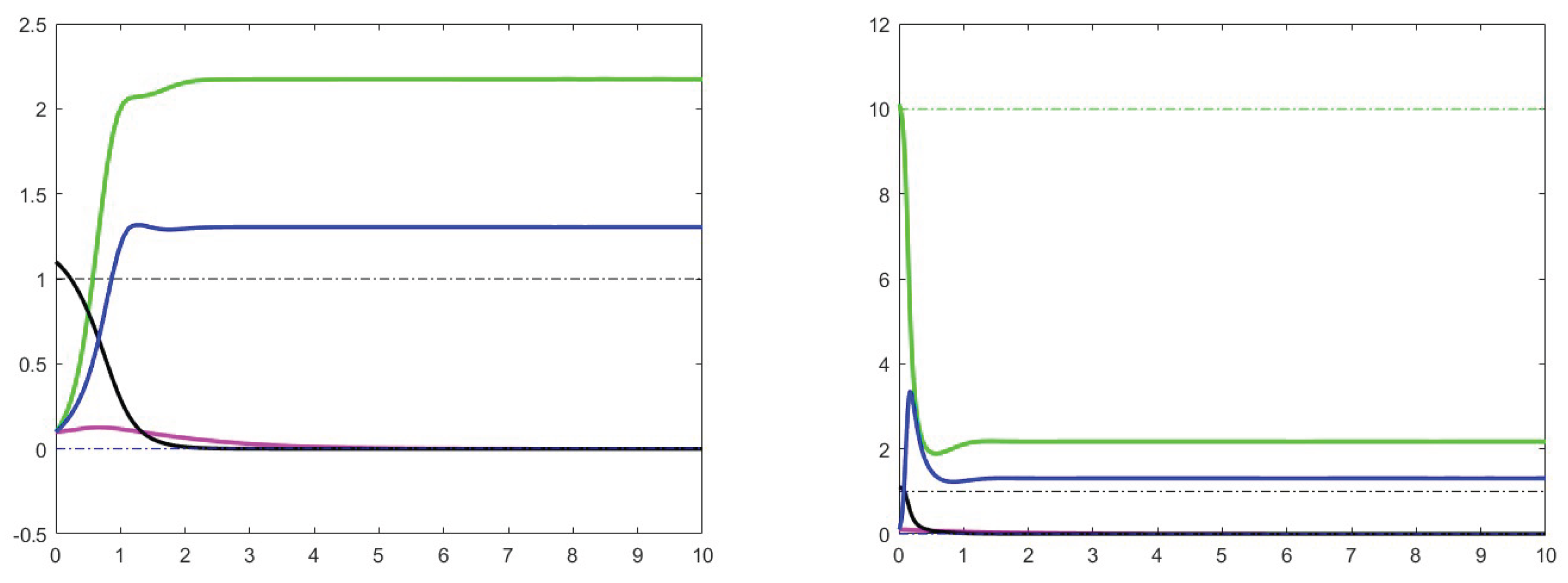
Figure 2.
Case ii.2), analysis of the points and , with small . On the left: , with . The eigenvalues of are , unstable according to the theory. On the right: with so that . The eigenvalues of are , stable according to the theory.
Figure 2.
Case ii.2), analysis of the points and , with small . On the left: , with . The eigenvalues of are , unstable according to the theory. On the right: with so that . The eigenvalues of are , stable according to the theory.
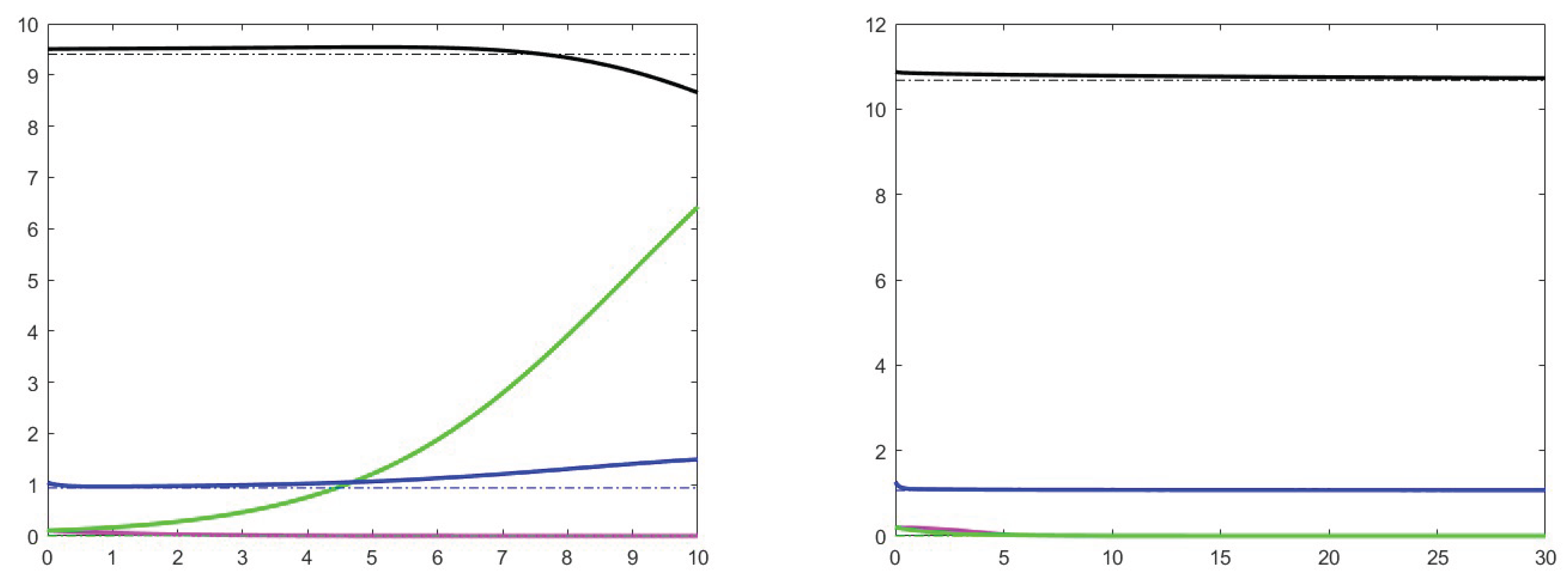
Figure 3.
Case ii.3), analysis of the point P with . On the left: when , stable, contrary the theory for . The eigenvalues of are . With a perturbation the point converges to of case ii.7) with the same convergence conditions for . On the right: , , so that . The eigenvalues of are . Stability is observed over very long intervals. With a perturbation , we have convergence to of case ii.7).
Figure 3.
Case ii.3), analysis of the point P with . On the left: when , stable, contrary the theory for . The eigenvalues of are . With a perturbation the point converges to of case ii.7) with the same convergence conditions for . On the right: , , so that . The eigenvalues of are . Stability is observed over very long intervals. With a perturbation , we have convergence to of case ii.7).
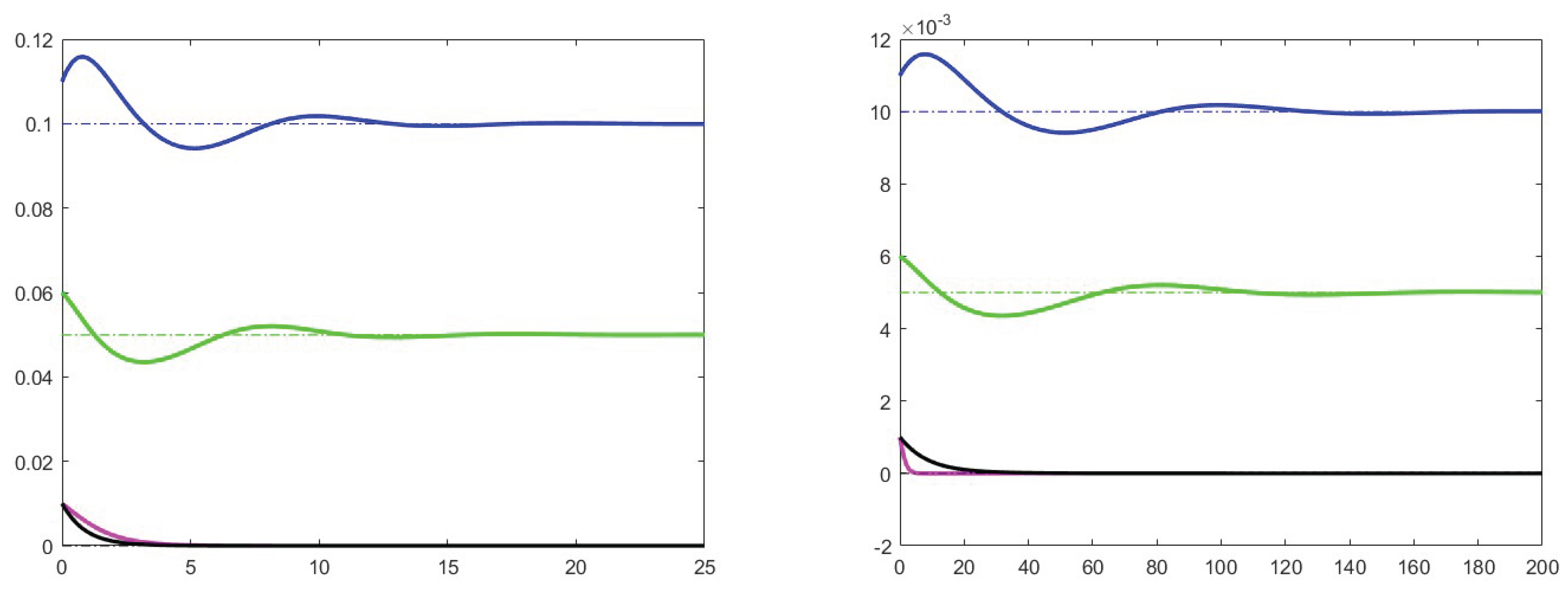
Figure 4.
Case ii.6), analysis of the point as varies, always unstable as . On the left: with . Eigenvalues of : . On the right: with . Eigenvalues of : .
Figure 4.
Case ii.6), analysis of the point as varies, always unstable as . On the left: with . Eigenvalues of : . On the right: with . Eigenvalues of : .
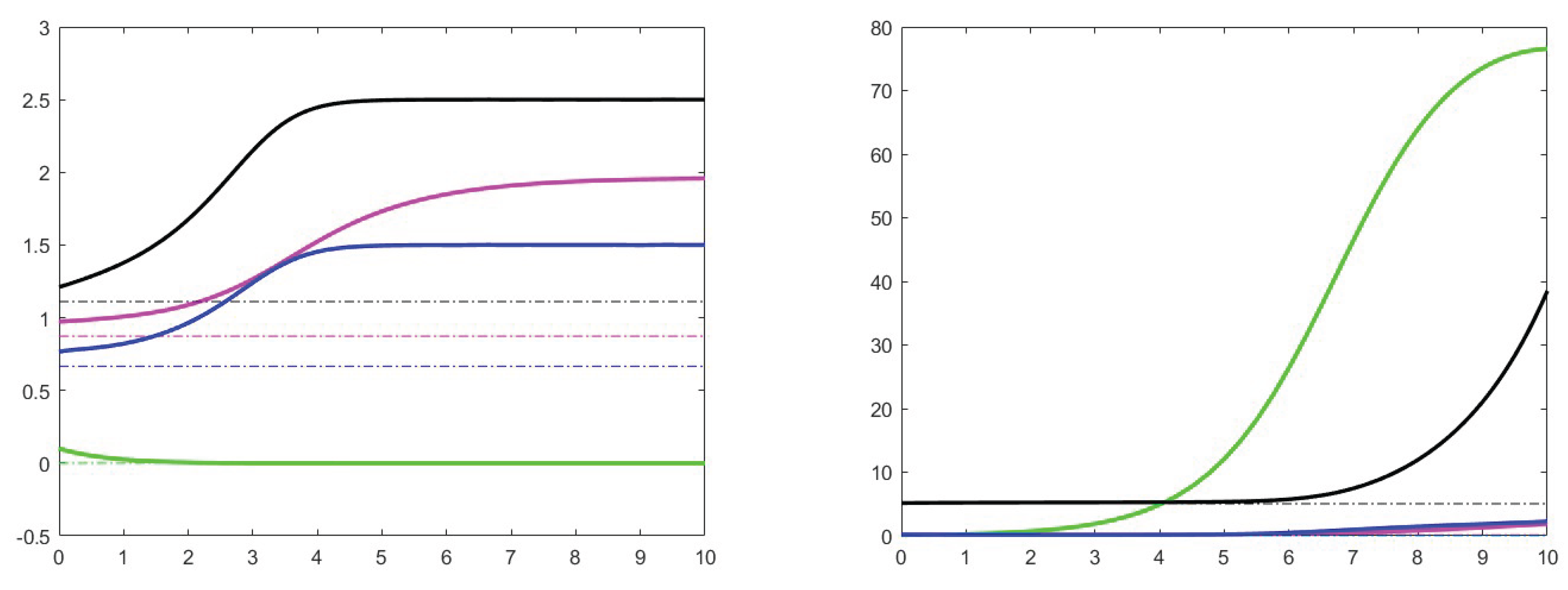
Figure 5.
Case ii.7), analysis of the point as varies with , unstable case. On the left: with . Eigenvalues of : . On the right: stable point with , differently from the case of small . Eigenvalues of : .
Figure 5.
Case ii.7), analysis of the point as varies with , unstable case. On the left: with . Eigenvalues of : . On the right: stable point with , differently from the case of small . Eigenvalues of : .
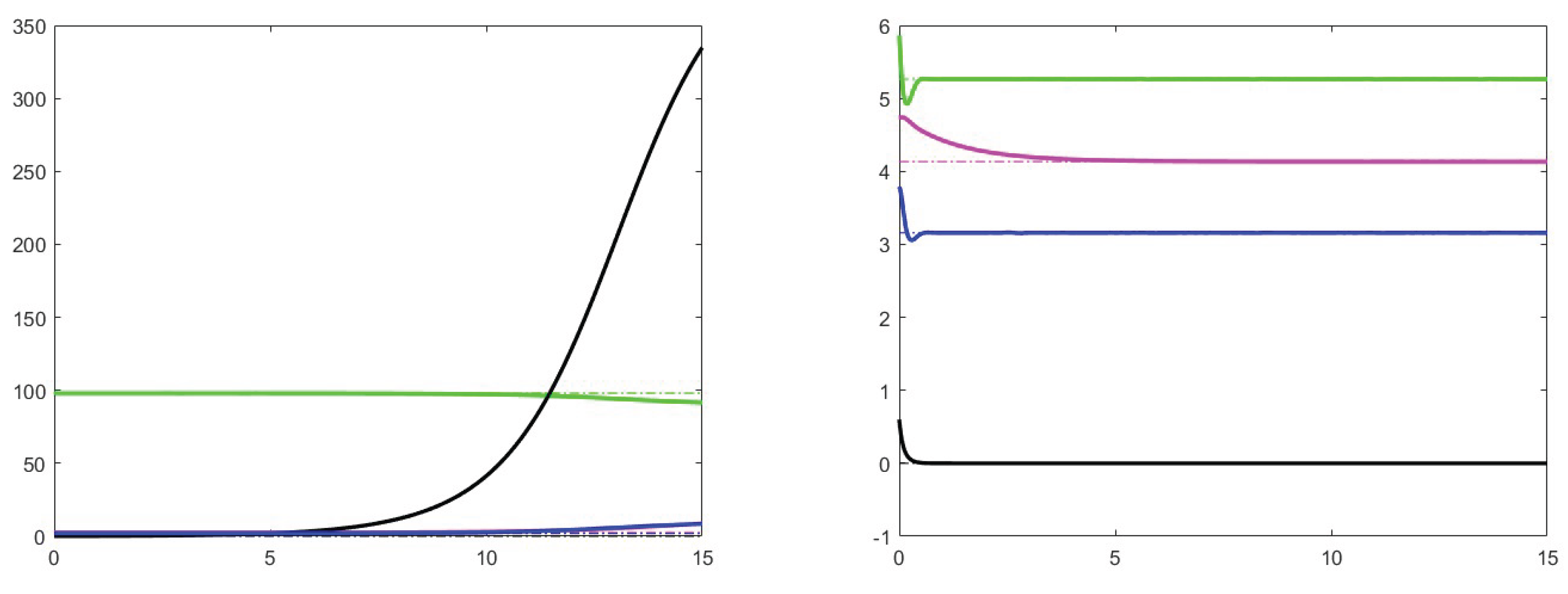
Figure 6.
Case ii.7), analysis of the point with , stable case, obtained by changing . The simulations are in accordance with the theory as varies. On the left: with . Eigenvalues of : . On the right: with . Eigenvalues of : .
Figure 6.
Case ii.7), analysis of the point with , stable case, obtained by changing . The simulations are in accordance with the theory as varies. On the left: with . Eigenvalues of : . On the right: with . Eigenvalues of : .
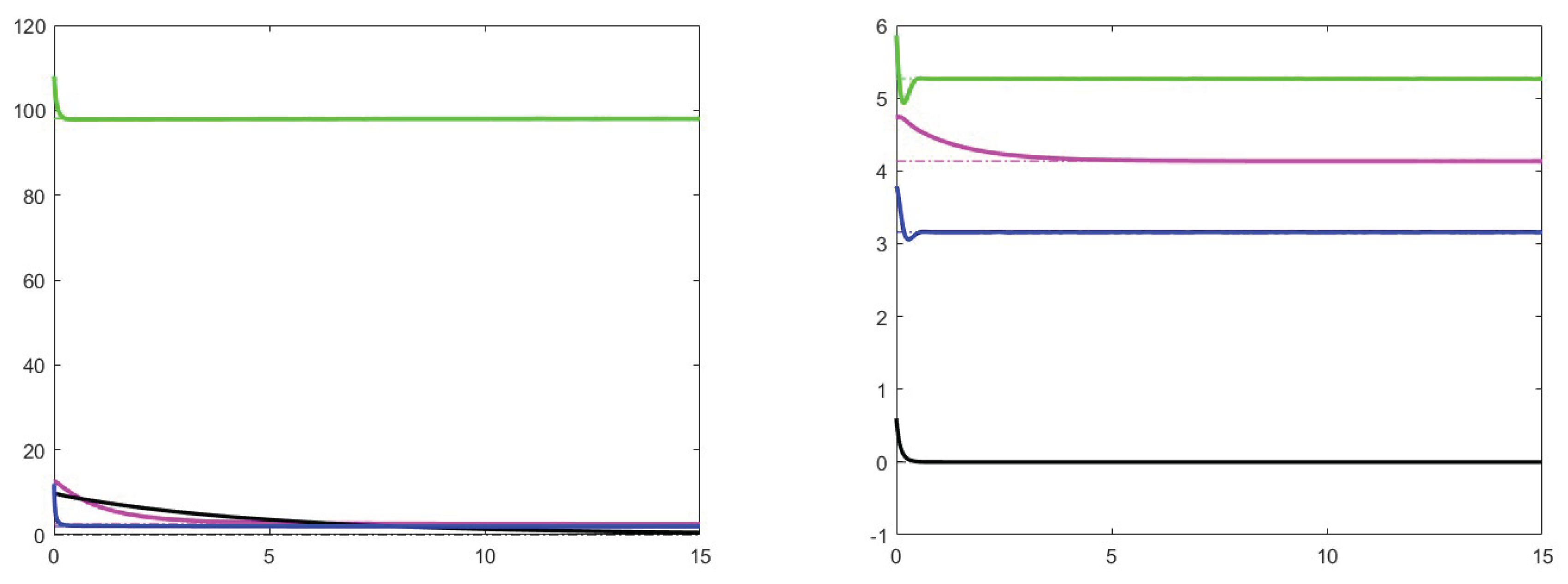
Figure 7.
Case ii.7), analysis of the point always unstable as varies. On the left: with . Eigenvalues of : . On the right: with . Eigenvalues of : .
Figure 7.
Case ii.7), analysis of the point always unstable as varies. On the left: with . Eigenvalues of : . On the right: with . Eigenvalues of : .
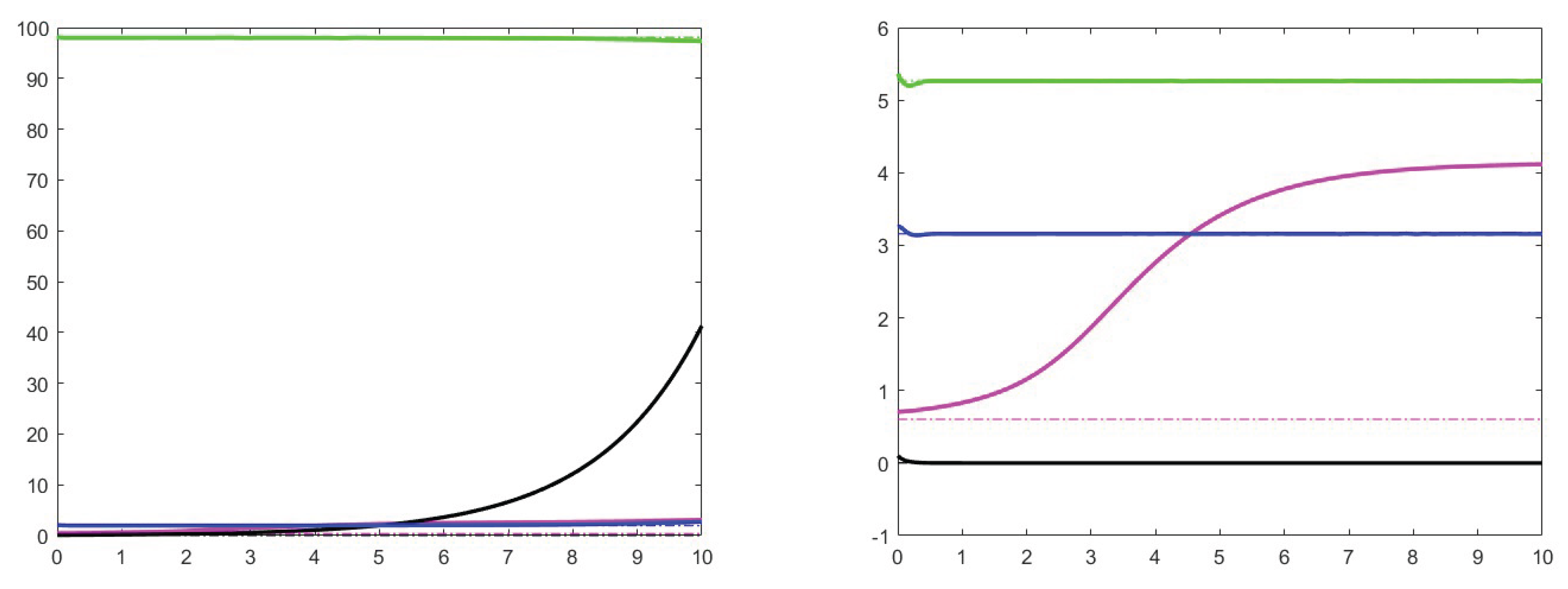
Figure 8.
Case iii.1) analysis of the point unstable if , with . On the left: case , . Eigenvalues of : . On the right: , . Eigenvalues of : .
Figure 8.
Case iii.1) analysis of the point unstable if , with . On the left: case , . Eigenvalues of : . On the right: , . Eigenvalues of : .
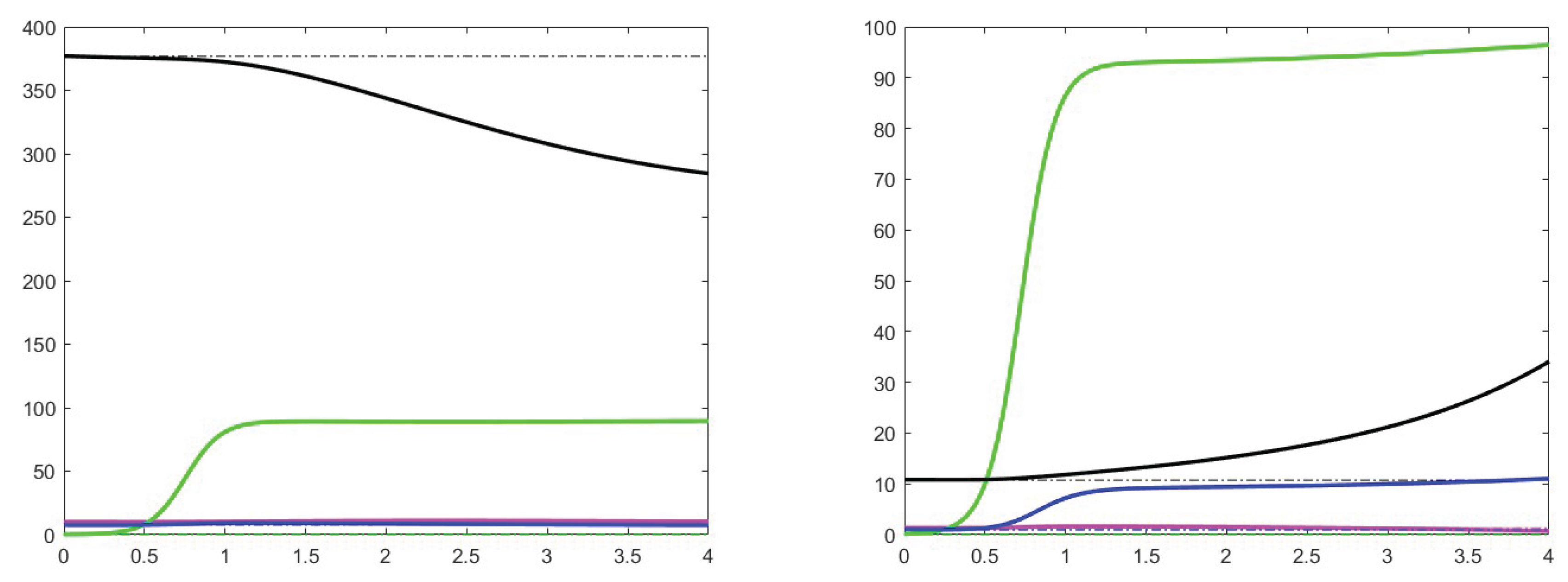
Figure 9.
Case iii.2), analysis of the point , unstable if for . On the left: , , eigenvalues . On the right: , , eigenvalues then a stability situation,differently from the case of small .
Figure 9.
Case iii.2), analysis of the point , unstable if for . On the left: , , eigenvalues . On the right: , , eigenvalues then a stability situation,differently from the case of small .
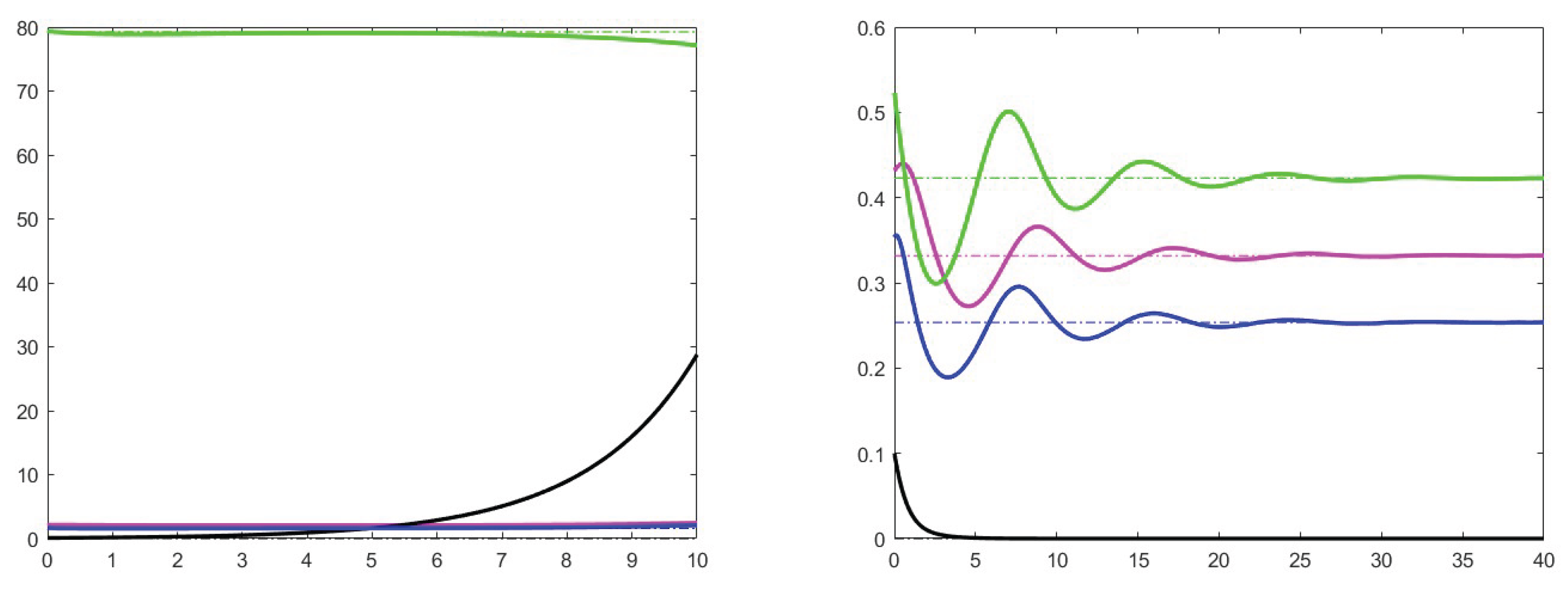
Figure 10.
Case iii.2), analysis of the point when obtained with , stability situation for , confirmed also for large . On the left: , , eigenvalues . On the right: , , eigenvalues .
Figure 10.
Case iii.2), analysis of the point when obtained with , stability situation for , confirmed also for large . On the left: , , eigenvalues . On the right: , , eigenvalues .
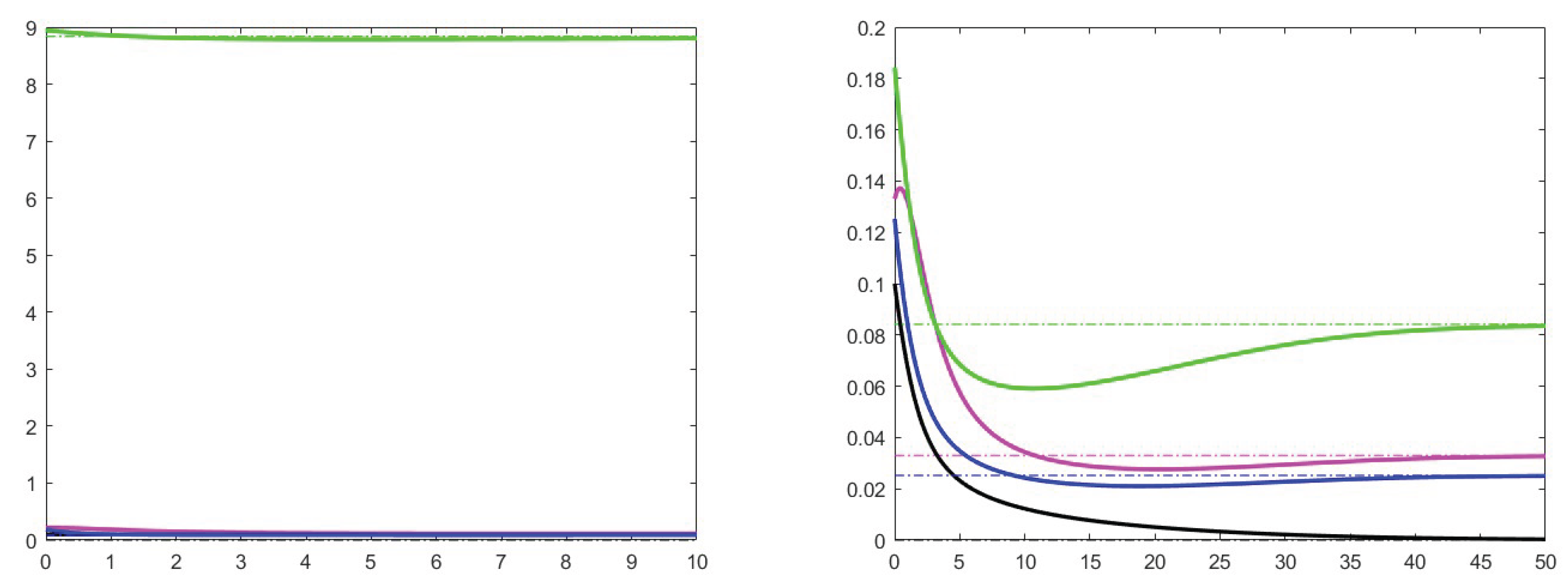
Figure 11.
Case ii.3). Analysis of point P for , in the case unstable from theoretical results. The critical point depends only on . On the left: with unstable, according to the theory. Eigenvalues: . On the right: and . Eigenvalues: . The point is stable according to the behavior observed for large .
Figure 11.
Case ii.3). Analysis of point P for , in the case unstable from theoretical results. The critical point depends only on . On the left: with unstable, according to the theory. Eigenvalues: . On the right: and . Eigenvalues: . The point is stable according to the behavior observed for large .
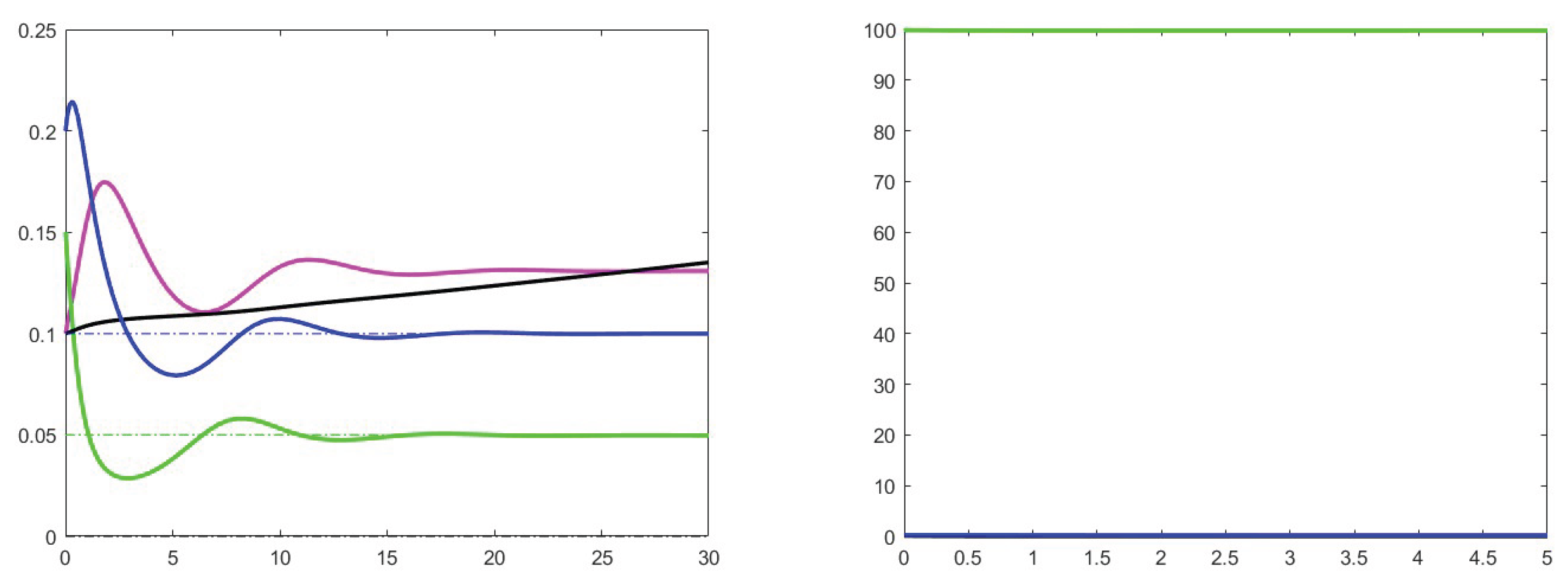
Figure 12.
Case iii.2), analysis of point with in the case , instability situation as . On the left: with , eigenvalues , unstable. On the right: with , eigenvalues , stable.
Figure 12.
Case iii.2), analysis of point with in the case , instability situation as . On the left: with , eigenvalues , unstable. On the right: with , eigenvalues , stable.
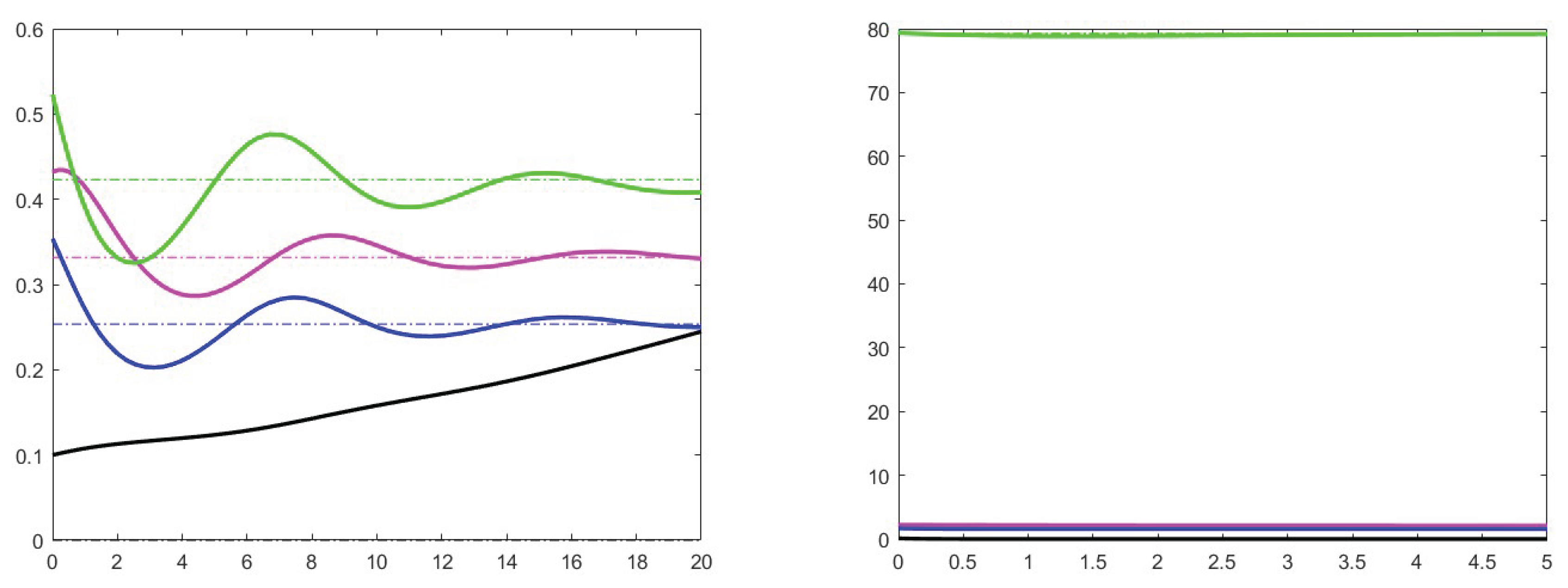
Figure 13.
Stable critical points with positive population, . On the left: case ii.8) with stable and within the cone for obtained with , eigenvalues: . On the right: case iii.3) with , stable and within the cone for obtained with . Eigenvalues: .
Figure 13.
Stable critical points with positive population, . On the left: case ii.8) with stable and within the cone for obtained with , eigenvalues: . On the right: case iii.3) with , stable and within the cone for obtained with . Eigenvalues: .
Disclaimer/Publisher’s Note: The statements, opinions and data contained in all publications are solely those of the individual author(s) and contributor(s) and not of MDPI and/or the editor(s). MDPI and/or the editor(s) disclaim responsibility for any injury to people or property resulting from any ideas, methods, instructions or products referred to in the content. |
© 2024 by the authors. Licensee MDPI, Basel, Switzerland. This article is an open access article distributed under the terms and conditions of the Creative Commons Attribution (CC BY) license (http://creativecommons.org/licenses/by/4.0/).
Copyright: This open access article is published under a Creative Commons CC BY 4.0 license, which permit the free download, distribution, and reuse, provided that the author and preprint are cited in any reuse.


