

Submitted:
21 March 2024
Posted:
21 March 2024
You are already at the latest version
Abstract
This paper investigates the theoretical foundation for developing renewable geothermal resources locally. For this reason, we pay attention to the role of communities in geothermal development. This study presents arguments for a framework that approaches the geothermal resources as an endogenous factor of community development. To analyse it, we create a model that explains the local economic characters of the geothermal exploitation beyond its geological conditions. It aims to conceptualise a community based geothermal development standard referring to the endogeneity principle. Geothermal energy is given attention since the characteristics of this resource determine its use locally. We argue that the role of communities in geothermal exploitation is pivotal in the process of green growth for further expansion of geothermal energy use.
Keywords:
geothermal energy
; endogenous growth
; green transition
; energy based local economic system
; geothermal community
1. Introduction to the Geothermal Communities Concept
This paper investigates the specifics of geothermal resources among other renewables because of its particular provision of both heat and power for the growing green energy demand worldwide. In opposite to popular renewable resources like solar and wind, geothermal is specified to a local exploitation [73]. The underground processes happening in the geothermal reservoirs limit the use of the geothermal resources to the area of accessing [54]. This condition indicates the endogenous character of the geothermal resources [20,39]. A concept of endogeneity in relation to natural resources refers to a structuring factor of a location. Open sources define endogenous as having an internal origin or confined within a group or society.1 This reference is very popular in the study of development in, for example, African countries, where endogenous resources (i.e. human resources, natural or physical resources) are considered to be economically linked to communities or localities. The idea of Endogenous Development (ED) often used in the African studies point to the coupled relation called development from within, where communities are prime the producers and consumers of locally available resources [97,98]. Importantly, in the methodological framework of endogenous development communities are centric. They are encouraged to use local resources and distribute the benefits. On the other hand, the role of natural resources is evidenced in the endogenous driven growth [10]. This endogenous defined approach corresponds to changes initiated within a given economic system, changes ascribed to innovation using own resources including energy ones.
Renewable energy resources are argued to be a part of the economic system by international organizations [108, 59, 75]. Therefore, the renewable based economy is discussed to create new, green market sectors [62,168,171]. In case of the geothermal energy, the resource is considered as an integral part of the environmental system [53,57,67]. The expansion of renewable energies is driven by the concept of green growth. It is associated with the economic growth and development based on the sustainable use of natural resources. Green growth in particular addresses the renewable energies driver role in the economy. A positive relationship between the development of renewable energies is affirmed enhancing technological innovation and green growth [146]. Renewables are considered to help decoupling the economic growth and the GDP from energy overuse and environmental impacts, thereby creating a new economic value [51,94]. The principles of the green growth pay attention to the energy end-users [167]. They are considered as enablers of the sustainable energy transition. It refers to the expansion of energy prosumers practices as well as to joint community projects. A similar approach is represented in the studies of communities’ role in the energy decarbonization processes [61]. Communities absorb new technologies and often take economic advantage of new opportunities created by the renewables. Involvement of communities in the decarbonization processes is its perquisite condition according to [83,85,117].
Technologies based in geosciences are paths to decarbonization [115,151]. In case of geothermal, the technology sector observes the fastest adaptation to the extraction of the resources by upgrading the existing infrastructure of oil and gas [44,50,103]. Therefore, expansion of technology is expected to facilitate the geothermal energy development.
This paper looks into the degree of communities role in the development of geothermal resources. As a follow up of a dedicated geothermal study [77], we pay here a particular attention to the community-ownership model, discussed in the geothermal exploitation practices [23, 74, 86, 110]. A link between geothermal resources use and local communities development is established in the literature [77,92, 142, 163]. These studies display the benefits of the local utilization and importantly communities initiatives in developing and managing the geothermal projects.
The community ownership model in the energy transition context is defined as a form of decentralization of energy production and management. It results in energy empowerment for many communities including affordability that was absent before [12,81]. The system of community owned energy project is practiced for most of the renewable energy resources [49,95,150,157]. The concepts is found particularly suitable for geothermal resources applied in heating, cooling and energy production [33,63,90,132]. IRENA [60] underlines the benefits of the community owned geothermal district heating. It is argued that the level of democratic governance over the resource system determines the scale of its benefits. A community frame is therefore necessary for the viability of geothermal projects. For this reason, the social acceptance studies are typically conducted in the communities in the vicinity of the geothermal installations [149]. Moreover, a local permission for the geothermal projects takes part of the LCA (Life Cycle Analysis) procedures [118] and communities crowdfunding initiatives emerge [25, 40]. Therefore, next to technical implications of the geothermal endogenous features [1,177], this resource displays tide relations to the endogenous development. Our research problem is oriented to understand better the dependencies between the development of geothermal resources in a community frame. We base this work in the assumption of an endogenous character of the geothermal energy and therefore a role of communities for its development. For this reasons we ask what characterises a local economic system to develop the exploitation of its geothermal resources. The purpose of this study is to provide arguments to broad a societal discussion on community involvement in the geothermal energy development.
The research question of this study comes as well from the development theories that focus on communities’ roles in the natural resources management. The literature sources put more emphasis on the communities in the energy dedicated policies context than on theoretical interpretation, creating a knowledge gap. We attempt to review selected development theories that contribute to establishing a link between geothermal resources and community economic growth. This is our proposed way to argue about an endogenous character of the geothermal resources.
After an introduction to the research problem, Section 2 reviews some theories that place communities’ role focal to geothermal development leading to the formation of geothermal communities in the EU policies discourse. Furthermore, to investigate what characterises a local economic system to develop the exploitation of its geothermal resources in Section 3 we present two development frameworks based in exogenous and endogenous energy type provided. This section aims to illustrate the principles of endogenous and exogenous factors driven economic growth in the context of green energies transition. In-depth analysis of endogenous geothermal potential in presented by Section 4. There, we specify an energy based local economic system model depending on the endogeneity or exogeneity of energy resources using a purposely developed model to visualise these relations. The last Section 5 collects research conclusions attempting some policy recommendations for fostering the green transition.
2. Some Theoretical Foundation for the Role of Communities in the Development of Geothermal Resources
The primary recipients of the geothermal resources are the communities located around the geothermal reservoirs [101]. Unlike the solar or wind, community is historically a pivotal point of the geothermal energy use. Primitive forms of the resource use date back to the ancient Greek and Roman times, where the hot thermal waters served for heating, bathing and health purposes [156]. Practice of applying geothermal to local energy models is known to the indigenous people from Africa, New Zealand, Canada or China. It is argued that the availability of geothermal resources determined the human settlements next to the resource estuaries since early times [18]. Geothermal localities offering various geothermal by-products including fertile volcanic soil and water sources attracted primitive forms of urbanization. Therefore, the formation of a man-geothermal energy relationship is of a historic evidence.
The history of mankind and energy use is conjugated. Use of natural energy resources to generate energy and human development repeats throughout the history. However, fossil fuels are the factors of industrial revolutions, when the economy demands an excessive amount of energy. Man is historically most closely connected with renewable energy resources such as hot water, sun, wind or biomass. However, global energy demand increased dramatically during the 20th century, but the efficiency with which energy services were produced increased even more rapidly [144]. Deployment of locally available renewables diversifies the energy sources and cuts on oil and gas dependency. Therefore the transition to renewable energy use is inevitable but as a long-term plan [144] but the technological gap, transformation of the energy technology has to be firstly addressed. As most of the energy sources are directly or indirectly sun dependent, geothermal energy is an exception [144]. Next to sun, geothermal energy is considered a prime energy source i.e. the most suitable for human use.
2.1. Geothermal Energy as a Commons
The community discourse with respect to the natural resources management is carefully studied by Elinor Ostrom; and crowned in 2009 with the Nobel Prize for her discoveries in this matter. The core of Ostrom’s work is the concept of locality, a system that dictates how the resources are managed. She undermines the dominant role of national governments in imposing a central system for management of the resources. Instead, a horizontal relationship between institutions is proposed, where the local government has a leading role in policymaking. Ostrom [112] finds three key elements that determine empowerment of communities which are: the commons (ability to manage own resources, sustainable communities competitiveness), self-governance (controlling of own resources develops local services and facilities), and poly centricity (local resilience raises from the bottom-up approach, instead of centralized solutions).
The concept of Ostrom’s analysis of commons (i.e. resources) is applied to the renewable energies sustainable use [2,8,78,113,176]. The community based resources sharing Ostrom’s concept is best fitted for naturally occurring resources [8]. The study of Ostrom [113] pays attention to the role of natural resources in climate change actions with a leading function of communities in emission reduction. The key is in rescaling the global environmental policies to the capacities of local institutions. Interpretations of Ostrom’s concept of energy for all address as well barriers of the geothermal energy development. The social acceptance and engagement of public institutions as significant obstacles for the use of geothermal energy can be solved in the principle of Ostrom’s cross-scale institutions linkage [121]. Enhancement of geothermal technologies providing cheaper energy for local mini-grids is a policy principle [14] and dedicated geothermal policies as a reference for Ostrom’s energy for all concept are found. The democratization of geothermal resources exploitation according to the Ostrom’s schemes is exploited by scholars [29, 32, 41, 69, 89, 131,175]. Geothermal energy development is there discussed as dependent on the decentralized socio-technical networks. In details, the Ostrom’s socio-ecological framework is adopted to analyse the sustainable geothermal resources exploitation [24]. On the example of Reykjavik, an urban nexus of water-energy-food is presented. Geothermal hot water generates energy for the city and the surplus is used for sustainable food production. Therefore, the nature of this renewable resource creates interconnections in the urban functions and operations. The fact that the geothermal infrastructure is multifunctional helps achieving synergy towards the sustainable development. Ostrom [111] introduces a different approach to the common resources. The dichotomy between public or private governance is overcome by combinations of public and private instruments. In her view, either public or private exploitation of resources is under risk of a mismanagement or even depletion, whereas, collective actions lead to the beneficial use of a resource. It is observed on the example of the geothermal water resources. The geothermal water is considered as a commons. A function of geothermal spas and bathing centres from the Ostrom’s commons perspective is as well elaborated [41]. Next to delivering a functional value, the geothermal baths activate some local identity. Within a territory new mechanisms occur based on the relation between public and private investment and ownership. It is claimed that geothermal spas address the importance of geothermal water as a resource that is not to be wasted. They as well induce new relationships between what is natural and what had to be built. The resource is managed according to the sustainable principle, especially in situations, where the geothermal bathing establishments emerge to deploy the surplus of the geothermal hot water extracted for heat purpose. The context of commons ownership [141] can be applied to the system of geothermal royalties. Basing on the Ostrom classification of property rights local communities can gain fairer access to the geothermal resources and a system of geothermal royalties reoriented towards broader participation of stakeholders increases the legitimacy of a resource management regime [65]. The concept of geothermal royalties opens a discussion about sustainable local development using common pool resources. Moreover, the system of revised geothermal royalties ignites the local energy transition. Examples of geothermal projects that replaced the fossil fuels infrastructure using the royalties are discussed by scholars [80,169].
Discussions about democratization of energy underline a change taking place in decentralization of energy supply. It implies a decision about consumers having a greater input into their energy choices [162]. Therefore, this choice provides opportunities to increase the use of renewable resources on a local level [31,159]. The concept of energy democratization places communities in the centre of energy transition [21]. Moreover, the energy demand is better recognized at the local level which drives the choice of the most effective types of renewables to use. The governance of the energy resources is represented in the primary choice of the renewable energy [174]. Different resources are geographically specific to locations, hence the available resources should be mainly considered in the efficient energy democratization processes. The energy transition according to an economist and social theorist Jeremy Rifkin [130] should run under the principle of power for everyone i.e. based on democratization of decarbonized energy production. The essence of this approach lies in the decentralized sources of energy. Therefore, local communities in available renewables become producers of the green energy according to their own needs. It adapts energy production according to the local demand argues Rifkin, in addition to transition from centralized fossil energy production and distribution. He points as well to the job creation and local economy benefits following the transition towards the green energies. The local production of geothermal energy fits into the concept of Rifkin’s zero emission economy. He repeatedly mentions geothermal energy as one of the future sources of energy and encourages to invest in its technologies [127,129]. Moreover, the geothermal energy development is as well referred to in the Rifkin’s pillars of the Third Industrial Revolution [128]. Among the five pillars Rifkin introduces, the geothermal resources features correspond with three. They address the demand for the non-intermittent renewable energy shift, securing energy production at the micro-level (local) and providing the technologies for hydrogen generation and individual energy storage. Rifkin’s analysis highlights the need of expansion of the geothermal power production, which is yet limited by the current technologies and geothermal exploitation costs.
2.2. Cultural Ecology and Geothermal Culture
The cultural ecology concept offers another angle of the man-energy relationship analysis. It examines the specifics of local resources that create the local identification, and so, the local culture. Relaying on the endogenous character of environment and resources available cultural ecology explains the range of policy and decision making, economy, technology and social integrations regarding transitions. The relation between the form of environment and society is coined by Julian Steward [155], who attempted to describe the adaptation of culture to the environmental factors associated with the territory. Although his concept of cultural ecology is rooted in anthropological paradigm it reminds that human rely on natural resources and ecosystems. Steward recognized the interaction of social organization with the local resources utilization processes. As far as the trend of cultural adaptation to the environment was already known by the anthropologists, he formulated regularities in which people organize themselves adopting to the local environment and use technology. This process of adaptation evolves into a local culture, determined by how the local resources are exploited. The evolution of Steward's concept of cultural ecology initiates discussions about the cultural identification with the local environment [116,154]. Local communities grow new cultural habits while stewarding the available resources. It manifests in ways of nature conservation and new environmental practices [11].
The assumptions of Steward's work [47,104,126] continue the consideration of cultural ecology in the context of the relationship between man and energy resources. A positive function of culture in the process of accepting transition into renewable resources economy is evidenced [96]. Cultural ecology is reasoned for a dialog facilitation between a local community energy use and environmental protection and acceptance for renewables is not always related to the high countries GDP or technological advancement [79]. A cultural impact on a choice of household heating sources is discovered [47]; a household energy use is exampled as a result of local socio-cultural system developed to use the materials and new technologies. On the other hand, local communities manage to develop an internal culture of the energy resources use throughout local knowledge and experience [152]. The socio-ecological system that emerges between community and local energy resources is considered an indicator of adaptation to the ecology. Specifics of the geothermal energy allow to embed it in the concept of cultural ecology. The endogenous character of the geothermal resources forms not only the landscape (e.g. geysers, hot springs, creeks) but also a character of community that lives around the reservoir. Geothermal resources are already known to link local communities with the environment, since the communities’ practice is to actively use the forms of geothermal resources. Identification with the geothermal energy constituting a part of a local culture is already discussed for Indonesia [92], for Kenya [72], for New Zealand [99] or Peru [26]. Role of a community culture is also a crucial element for the geothermal infrastructure development. One of the concerns related to the geothermal projects is the i.e. the social acceptance. It is practically a prerequisite for the promotion and successful implementation of geothermal energy plans. Majority of geothermal projects due to the hazardous processes of development require consultations and acceptance by a local community. Next to accepting the geothermal project as a green technology solution for a community, a social acceptance is better achieved by the established culture of co-habiting with the geothermal landscape. This phenomenon is further explained [55,105,140,161], where communities exposed to the natural geothermal occurrences e.g. in Kenya or Indonesia have an increased acceptance for geothermal projects and infrastructure. The spiritual and cultural significance of the geothermal resources for the Maori community in New Zealand [161] evidence that communing with these resources as is a collective value for the Maori. It is also likely to impact the acceptance of potential externalities linked with the geothermal exploitation. These are better internalized since the geothermal energy represents cultural sustainability for this community. Geothermal resources are as well placed within the concept of “green energy landscape” [6,43,48]. It means that e.g. for Kenya or Iceland communities geothermal infrastructure becomes a strong local value. Moreover, with consideration of the limited land availability for energy projects but intense energy use in e.g. agriculture, geothermal resources unlock local energy potentials when using energy landscapes for a decentralized energy provision.
Geothermal resources display important cultural references. Next to creating a geothermal use culture, another cultural form is the anthropological indications for community forming. It is argued that the availability of geothermal resources determined building of human settlements since early times [18]. Geothermal localities offering various geothermal by-products including fertile volcanic soil and hot water sources attracted forms of urbanization. Formation of a man-geothermal energy relationship is observed since historic evidence shows that nomadic tribes of the Middle East began to settle down in the geothermal areas. For centuries they inspired myths and religious practices since temples were built devoted to the hot springs and their believed gods including pilgriming practices. The hot water outlets were used for instance for public baths, as feasting centers and social gatherings places during the Greek and Roman empires. This specific relation between man and energy and historical evidences indicate the role of the geothermal for communities. It is well observed in the countries where the geothermal energy manifests in the volcanic creations and processes of hot water extraction are familiar to the public from decades. Such geographic determinants add to the cultural ecology aspect in studying geothermal. This anthropologically derived features of the geothermal are to be considered an advantage for the resources’ development; furthermore, an argument in adopting the geothermal policies to the needs of local communities. Whereas, the exogenous energy resources are less integrated in the cultural ecosystem of a community. This refers as well to the renewables with imported technologies. Evolution of Steward's concept indicate that local environmental conditions determine the community economy and culture. It is based on the use of local resources that create local identification, introducing ecological culture. Contemporary interpretations of cultural ecology lay foundations for local energy clusters and cultural ecology principles was looked at while construction the United Nations 17 Sustainable Development Goals [15,17,19,123]. Regarding to Steward’s idea of adaptation, environmental problems can be addressed by the transfer of knowledge from science to culture i.e. society and integration of the new knowledge, technologies, norms and ideas into culture. For this reason, transformation of environmental practices does not lie in the technology solely. Communities that adapt to ecological factors belonging to their location, and by so base in using water and land resources develop the ecological culture in the Steward’s paradigm.
2.3. Geothermal Communities in the EU Energy Polices Discourse
Attention to local resources and local ownership, including energy resources, as part of local resilience strategy is the latest direction of the EU policies [122]. A message is developed that strong communitarian approach to define problems and develop policies, and policy implementation should rely upon local resources. Efficient use of local resources is indicated to be a part of national stability strategies and EU challenges such as political and economic instability. Furthermore, the local resilience is introduced as a part of endogenous capacities especially for addressing the climate-related technology issues [122]. Renewable Energy Directive II [28] promotes the decentralized energy production. Decentralized and demonopolized renewable energy production is encouraged throughout the document. Communities as beneficiaries of the energy transition are specifically underlined (Article 1 § 65). The community-owned energy projects incentives are discussed in the Article 1 (§ 71) of the document. Article 2 (§ 16) introduces the renewable community concept, where the energy production and distribution is recognized as endogenous development factor. Geothermal energy is listed as one of the renewable applicable to the renewable community resources. Furthermore, shift into decentralized energy supply is one the Green Deal pillars by empowering the local renewables use. Decentralized energy systems lead towards more affordable and reliable energy provision This approach interlinks the regionalization of energy production and the sustainability of energy provision. The Green Deal refers to the capacities of communities as the main inductor of such efficient energy multi governance scenario. Concept of endogenous capacities corresponds with adopting technologies to local conditions [166]. The focus of endogenous capacities and endogenous technologies should be the identification of local assets to develop technologies in order to respond to local needs and conditions.
Recent years’ energy policies put more emphasis on the communities as the important element in the expansion of renewables. On the European Union arena, the Renewable Energy Communities were first defined by the Renewable Energy Directive I (2009/28/EC) and then by the 2019 Internal Electricity Market Directive [122]. The documents set the overarching European target for energy from renewable sources and contain provisions ensuring the use of RES in the transport sector and in heating and cooling, as well as rules and regulations regarding the rights to produce and use renewable energy locally by establishing renewable energy communities. The strong element of decentralization of energy production that appears with renewable energy communities is primarily an opportunity to use local sources. This is illustrated in the studies, some claim that the geothermal energy has the technical capacity to replace fossil fuels [70]; whereas other [179] study the technological possibilities utilizing the existing oil infrastructure, which significantly lowers the cost of geothermal harness. As well, the demand from the energy consumers is coalesced around the most reliable, affordable, and environmentally responsible energy sources. These consumers e.g. cities are integrating renewables into their smart city plans or communities oriented at sustainable energy procurement or emerging markets that declare their development dependent on the deployment of renewables. The geothermal energy has the competitive features (against e.g. wind or solar) for supplying the demands of city networks and community energy projects [30, 37]. It fits the Renewable Energy Community concept imposed by the Clean Energy Package, where local stakeholders including municipalities are the primary beneficiaries of the resources [87]. Moreover, examples of the geothermal energy application showcase its significant role for the developing countries [5, 35, 68, 143, 178]. Therefore, the deployment of new geothermal technologies is likely to facilitate further decrease of its costs and accelerate national energy transitions across the world.
3. Exogenous vs Endogenous Energy Development Framework for Communities
Economic development is controlled by many ecological and environmental factors, energy among them. This section motivates the classification of the geothermal resources as the endogenous factors of growth. It compares the two frameworks of communities’ development when energy resources are of a determinant function. Such approach serves to address the research question in this study what characterises a local economic system to develop the exploitation of its geothermal resources, which is assumed to be of an endogenous characteristics.
3.1. Exogenous Factors of Energy Development
In terms of economic growth the role of energy is irreplaceable. The exogenous growth model stresses the role of technology as an independent factor for sustaining economic growth. It associates external factors to the economic system with national growth. This theory interprets exogenous factors as a technological progress, government policies, and well-functioning institutions to drive economic growth [148]. An exogenous factor is considered to be one independent of factors within a specific economic system. For instance, advancements in technology (in general terms) lead to savings and investment and therefore induce economic growth. Grounded in the neoclassical theory, the Solow-Swan model connects economic growth with macroeconomic variables of an exogenous nature. Since rooted in the macroeconomic theories it omits a local context of the economic growth, assuming the dominant role of national productivity outputs to the growth. Exogenous change originates outside of the economic systems [137].
The context of energy supply is traditionally analysed in the frame of exogenous growth approaches. Energy resources are usually representing stochastic trends of development caused by the seasonal demand. Stochasticity in the energy consumption is a wide- known phenomenon related to seasonality and forecasting methods. It is a recognizable element of analysing conventional energy resources especially for power production. Energy itself is constituted as a derived demand in the exogenous models, meaning that it is demanded for the output it produces [13]. An entire argument about the exogenous function of technology relation to imports of energy and energy consumption is built [71], with an example of the derived demand for the energy imports and related imported technologies contributing to the emerge of industrial clusters in Germany [139].
According to the exogenous economic theories, growth is determined by external factors to the economic system. A relation between the economic growth and factors of the green growth technologies is established [145], where the exogenous nature of energy technology is considered. Exogenous growth drivers include technological advancements introduced to the economy, diminishing returns of capital, saving rates and sectoral production with labour growth parameters. Conventional energy resources like oil or gas are primarily considered as an exogenous factor of economic growth inducing technological imports and productivity- GDP relation [7]. In the renewable energy context, an imported technology for the cases of the wind, sun, and hydro energy are considered as an exogenous factor for both the economy growth and CO2 reduction [36,147,173]. These renewable technologies introduce a radical change to the energy industry, itself manifesting as a factor of economic growth. Thus, technology developments paired with energy imports are considered main drivers of exogenous induced growth. This phenomenon is related to globalization and energy trade, both considered fundamental for shaping national policies [7,56]. National level discussions regarding the energy development usually refer to obtaining and distributing the resources. They result in a series of policies that are placed for the energy systems. Nevertheless, the exogenous energy systems depend on the global trends of trade and as well are vulnerable to energy supply shocks [109]. Exogenous factors stay behind the energy reforms aimed at preventing from energy shortages especially in the developing countries [22,84,100]. Impact of the exogenous factors is also perceived as a limited control of the energy resources management, for instance, the dependency on foreign energy labour and therefore lack of local human capital [100]. Personnel imports characterise exogenous factors of growth, but also the exports of local raw resources to be refined elsewhere. It impacts the access of local communities for local energy resources [4], at the same time limiting the local workforce involvement. Externally controlled energy technologies, as typical for exogenous systems, although responding to the increasing mass energy demand, have less impact on the local communities energy security [58]. In the context of the technological growth selected renewables are considered as the exogenous growth model characteristics. Wind or photovoltaic renewables represent the technical exogeneity, in addition to the seasonality of the weather conditions they depend on. This risk related to the economic feasibility of externally controlled resources and technological immaturity is one of the major barriers in the development of imported green energies [57]. Nevertheless, in the resources discourse, the exogeneity form is rather associated with growth rather than a development concept. It implies the macroscale nature of this approach, with references to growth of national economic indicators. This is in opposite to the development process using natural resources that usually refers to a region, locality, community as its beneficiaries [93,172]. In a specific context of the exogenous development using the resources, the process is oriented on market forces and institutions rather than local economic systems [170]. It reflects in focus on trade and transactions that involve imported technologies or knowledge. These patterns lead to modernising economy and market strategies according to the exogenous development principle.
3.2. Endogenous Energy Development
According to the endogenous growth theory the internal forces determine economic growth. Emerged in the 1980s as a theory of development economics, it shifts attention to endogenous factors of growth i.e. innovations, knowledge or human capital [134]. These endogenous features are the major contributors to a technological change according to Romer [133]. Whereas for Lucas [88] endogenous growth is determined by the market specialization and labour productivity. This view contrasts the neoclassical economics, where the economic growth bases in dynamics between market supply and demand. The neoclassical approach includes the models (i.e. the Solow-Swan model), where technological progress in the society is exogenous [148,158]. Yet, the endogenous growth theory argues that improvements in productivity can be tied directly to faster innovation and more investments in human capital from both governments and private sector. Endogenous growth models take into account key economic factors that are specific to a group, business or an industry. According to the endogenous growth theory, technological advances are specific, i.e. considered with respect to their likely impact within an industry. One angle of the endogenous growth model addresses issues of resources and environment, considering resources as endogenous public goods. Following some scholars [16,27,64,125] endogenous resources are a core element to regional specialization and are found to initiate growth in small size economies.
Endogenous growth theories consider the internal factors of growth, i.e. resources. Reflecting on the specifics of geothermal and its local potential for replacing fossil fuels at an cost efficient level [42], next to a stimulating role of the local development [77], this renewable is a considerable internal factor of local growth, fitting into the endogenous growth model. The endogenous growth model states in simple words that economic development is a function of human capital, knowledge, and innovation (including technology) of which none of these forces are of foreign origin to the economic system. The importance of the renewable energy sources to the endogenous growth model equilibrium is already measured [9,102], however without specifying the energy type.
Following the principles of the endogenous growth infrastructure enhancement is particular sought for sustaining growth. This relation is described in details [45], where an endogenously provisioned energy is a main growth factor for an economic system. Geothermal energy emerges from the local, geological conditions, therefore not imported resources. Its know-how is also built locally since the geothermal technology often bases in already locally practiced gas or coal mining infrastructure and science (geothermal exploitation occurs on territories previously exploited with fossils [38]. Geothermal resources combine the aspects of natural and human defined endogenous factors. This twofold endogeneity approach [165] indicates the character of a phenomenon relating it either to a place itself or a human intervention. The natural endogenous factors representing geothermal are the geological conditions including geothermal water springs and terrain topography that allows for the resources exploitation; whereas human induced endogenous factors related to the infrastructure are land use, economic activities emerging and community engagement and communication as a part of local geothermal development.
The endogenous resources are considered as an element to regional specialization and initiating growth in small size economies [3,16,27,124,125]. Since natural resources including the energy ones are considered as endogenous public goods, it applies as well to the geothermal resources. Few extensive studies [135,160] prove that developing renewable resources revitalizes and enhances the economic potential of a location. Moreover, complementary findings [66,138] point to the socioeconomic impact on local development. Geothermal energy classified as produced and used locally is argued to have an added value for local communities [20,52,119,120]. Furthermore, in-depth studies [77] open a discussion about the endogeneity of geothermal resources and a structural change of local economies they cause.
The following Section 4 conceptualizes the exogenous and endogenous energy development framework for communities. A visualisation of dynamics between a local economic system and energy function depending on its origin is developed.
4. Conceptualising Endogenous and Exogenous Energy Based Local Economic System
Deployment of renewable resources is one of the main local economic development factors [108]. Local and small-scale energy systems are said to reduce community energy dependencies and stimulate new business. Next to it, they potentially reduce energy consumption increasing energy self-sufficiency for communities [76,109,164]. Relatively small-scale energy systems provide integrated and sustainable energy use, especially practical for communities challenged with energy imports. The OECD [107] underlines the role of local ownership in a community’s energy system. In this section a simplified model of community energy based local economic system is proposed conceptualized from the perspective of endogenous and exogenous energy resources. The central point of this modelling is the community as a beneficiary of the energy based local economic system. The OECD [107] strategies for local development point for embedment of energy systems into the local economy, where local economic initiatives are based on local (renewable) energy systems. This approach evolves into the energy community concept, considered fundamental for energy policy reforms in the EU [34]. The basis for interpreting the energy based local economic system is as well referring to the energy as a commons. In such case, the community ownership provides a balance between the private and public energy provision [46].
Two simplified models at Figure 1 and Figure 2 display a role of energy in the local economic system assuming the endogeneity or exogeneity of resources. They serve to display the function of the energy in a local economic system where the dynamics of local economy, labour and technology depends on the origin of energy resources. For the endogenous resources the geothermal is analysed (Figure 1).
Geothermal energy based economic growth refers to the community activities of energy production and consumption. In case of an endogenous energy source that is harnessed within a local economic system a community becomes the prime user. As Figure 1 illustrates, endogenous energy source takes a part of the local economic system. This local economic system relies on the energy production from the endogenous resources, here the geothermal. There is an interrelationship between the geothermal resources, technology and workforce. Characteristics of geothermal exploitation imply the use of local land. Further endogeneity of exploitation concerns employment of a local labour that, in case of localities with previous fossils deployment provides workforce already experienced in drilling and exploitation. Basing geothermal operations in locally existing technologies (like gas or coal) limits the need of technology imports. This situation is particularly relevant for the energy transition in regions and locations, where costs of phasing out fossil fuels and introducing renewables instead is a public concern. Utilisation of an experienced labour pool and technological knowhow increases the sustainable resource use (since experienced labour is there and mining knowhow to be replaced with geothermal). Endogenic character of geothermal is therefore a solid argument in favour of its development. Moreover, the variability of the direct local use (see the Lindal Diagram Figure 3) provides the local economic system with geothermal based activities. This include as well energy products that can be interchanged outside of the local economic system. Therefore, this exchange of energy products represents a form of certain system self-dependence and self- growth. As evidenced [77] such geothermal dynamics causes a structural change within the local economic system and contributes to the community development. Since geothermal becomes a part of the economic system the energy and energy products are locally consumed. The structural change of the local system is caused by an internal factor i.e. the exploitation of geothermal resources. They get internalised into a labour market and related technologies creating an economic symbiosis within the local system and resources self-reliance in a community.
In the exogenous energy based economic system energy imports are basic economic activity (see Figure 2); they supply the local economy and industries while depending on the external energy products - in order to be generated. The fossil fuels characterize well such system [153]. Nevertheless the renewable sun and wind solutions heavily rely on imported technologies in order to yield energy output (e.g. PV installations or wind turbines). The community energy demand is therefore met by imported elements to the system. In the scenario of energy transition locations, a specialized labour to maintain the energy sources requires importing them along with the technology. This is also related with the character of the renewable enterprises that aren’t local but lease or supply the technologies at any location. Therefore, outside of the system no internalization of resources, labour, technology takes place. It results with an emerge of a new economic system in which communities participate to some degree. Activities where a relation between production and technology generate added value happen out of the system. Therefore, the community energy demand is supplied by the external resources and imports. The exogenous energy character in this context is the relation to external to the system factors; and these factors determine the economic growth.
The two concepts of endogenous and exogenous energies based local economic systems present a community development model. The reference to the energy based local economic system is inspired in the OECD [106] generic concept of a green growth framework, where natural resourced based growth model explains the productivity throughout resources with economic outputs for the society. For the purpose of this study and to answer the research question we ask what characterises a local economic system to develop the exploitation of its geothermal resources. The endogenous energy economic system refers specifically to the geothermal resources. Table 1 illustrates some central differences in both systems, complementary to the Figure 1 and Figure 2 visualisations of the systems’ dynamics.
Table 1 summarises two economic systems determined by the type of energy production. In case of endogenous energy resources they are considered as a part of a system, since they are produced inside one; whilst resources import dependent display an exogenous character. Endogeneity in reference to energy production is determined by a sufficiency of own, local system to generate energy for economy, whereas in the exogeneity scenario of energy production the resources are not domestic. It is illustrated by the exogeneous nature of e.g. fossil fuels that are depleted in nature and are a global trade commodity. Renewable resources identify with constant replenish processes and that in case of the geothermal is a fully local process.
a) System: For these reasons effects of the endogenous energy resources use, such as geothermal, in the economy are internalized by the system. It manifests in direct and indirect establishments that use the resources i.e. internationalization into the local economy. Geothermal energy is best internalized by the various forms of local use represented by the Figure 3 of the Lindal Diagram [82].
This diagram shows the temperature range suitable for various direct use activities. Typically, the agricultural uses require the lowest temperatures, with values from 25 to 90C. Geothermal water application for bathing and health involves low to mid temperatures (40 to 80C). Space heating requires temperatures in the range of 40 to 100C (including ground-source heat pumps). Cooling and industrial processing normally require temperatures of 100C and over. This scale activates the geothermal resources into various sectors of local economy, internally developed channels of producing and using the energy. Economic system that expands around the possibilities of geothermal resources use internalizes the direct benefits and commercial applications beyond the energy provision. The internalization of geothermal resources is observed as well as the market possibilities for local labour. Local workforce is absorbed by the new employment that is related directly or indirectly to the exploitation of geothermal. Internalization of energy production especially in the bottom up approach helps to eliminate the related externalities. In the endogenous energy system (such a geothermal based) it is the translates to the uncertainties of supply, shortage of workforce. In case of the exogenous system, energy products transform the local economic system upon the introduced factors of change. These factors refer to the intensive technologies that are implemented creating new consumption. Especially in case of the shift from carbon to green sources energy consumption faces the cost of the new energy technologies. Cost of the energy from transiting to renewables is charged to the final energy system element- i.e. the individual consumer. Therefore, a consumer bears the social cost of the energy transition in the exogenous energy system. Exogeneity of energy introduces as well the narrative of energy consumption savings and savings discourse since it often refers to fossil fuels systems.
b) Structure: Endogenous system uses foundational structures for energy resources since it focuses on spatial concentration of industrial sectors. Structural transformation takes place in the exogenous type of the economic system. An industry that develops by the exogenous factors of growth such as for instance imported energy resources requires dedicated infrastructure usually absent in the first place. Whereas, energy resources applied within the endogenous economic system- base on the existing infrastructure. As an example, the geothermal energy can develop from the fossil fuels technologies while wind or solar energy demand own structure of supply.
c) Scale: Since the endogenous system rather refers to a local market the scale of energy supplies mostly community needs. For this purpose it can be refereed as a small scale since domestic energy needs are addressed. The scale of energy provision in the exogenous systems corresponds usually with feeding the power grids and therefore aiming at a large scale supply. It refers to both fossil fuels but as well to the renewable resources commonly applied for power generation.
d) Energy source: Endogenous system looks into the locally available energy sources. It focuses on the accessibility to the domestic energy supply chain and therefore locally harnessed resources are the pillars of the endogenous economic system. Moreover, implementation of the Water-Food-Energy nexus using endogenous energy saving technologies impacts an economic system. The nexus is often used in the context of sustainable development based in the renewables application. Endogenous system addresses the type of energy resources that are specific to a location or community, for instance the geothermal energy which harnessing depends on the geologic characteristics in a location. Another endogenous energy type is for instance the hydropower since this energy generation takes place at a fixed location and the technology is specific to geographical conditions. Exogeneity of energy refers to the resources that are a subject to transportation in a bulk form as the fossils or as a final energy product i.e. the power via the grid. Therefore, they are importable energy sources since they are widely produced with no special local conditions needed. For this reason, some of the renewable resources that are independent of local conditions and not limited by the efficient transportation go under the edge of the exogenous energy category such as the biomass, solar or wind energies. Developed technologies to transport these resources and process them into the green power are little space dependent.
e) Energy demand: In accordance with the systematic characteristics they represent, the energy resources address the energy demand by a territorial scale. Resources of the endogenous nature occur locally and therefore are locally used. For this purpose they serve the domestic, small scale demand in the first place. Depending on the kind of the resource they can be sufficient for a community (e.g. geothermal) or a region (e.g. hydropower). The exogenous energy resources while relying on imports provide a large scale energy opportunities. Mainly the fossil fuels are traditionally used to satisfy the national energy demand.
f) System beneficiary: Following the assumptions of the endogenous factors of growth which results from internal system processes, the beneficiary of such economic structure are the local recipients. In case of the exogenous energies types they serve a broad societal interest. Hence, they are usually categorized as tradable commodities. Development of the economic system based in the exogenous energy resources feeds the market and national economy. The beneficiaries are therefore macroeconomic structures as e.g. related industries or a banking system. It is also reflected in the macroeconomic measures as GDP or financial statements. Whereas an economic system that incorporates endogenous resources is beneficial to the communities. Specifics of the geothermal resources impacting the local economic system illustrate that the beneficiaries are firstly the communities.
g) Factors: Endogenous factors which originate internally include location, topography, physical geography, built environment, infrastructure and socioeconomic characteristics. Endogenous economic system relies on the decisions on local economic growth and investment in local markets. Investment in local energy infrastructure is an example especially if public investment takes place. It creates measure of a local capital accumulation which is a sign of local economic stability. In case of geothermal energy capital accumulation displays in the local infrastructure investment since the energy and geothermal infrastructure is not transportable. Geothermal energy investment costs are susceptible to specific local characteristics and the accumulation process includes a locally adjusted technology. Moreover, considering the cascading use of the geothermal resources the accumulation of capital is determined by the broad use of the geothermal resources in various economic activities at a location.
Exogenous energy types are dependent on national and foreign investment. They are observed by the size of infrastructure investment and raw material imports into an economic system. One of the specifics of the exogenous system factors is a high dependency on the presence of trade tariffs – a factor absent in the endogenous energy systems. Exogenous factors are as well responsive to the state regulations regarding the foreign investment since an international funds and capital enters the economic system. The conventional energy sources are elements of the neoclassical factors of production and returns of capital. These on the other hand, are proven to be highly related with the national GDP rates and energy consumption per capita. Size of the economy is also a factor of the exogenous energies system. Usually national scales are the representative measures of exogenous growth interpretation. Factors leading to the development of the exogenous economic systems are foreign investment. It commonly requires a size of economy since small scale markets are usually disadvantaged from the perspective of investors.
h) Labour: Important element of an economic system is an access to labour. Endogenous growth factors include growing population and workforce locally. Labour is related to the human capital which is a core element in the endogenous growth theory. In case of energy resources, they require a qualified of labour, which has to be assured within the system. For this purpose the energy sector workforce is trained and invested in since the sectoral growth depends on the human capital productivity. Productivity of labour is the domain of endogenous market structures. It is related to costs reductions but moreover to the performance of an economic sector. The role of energy resources in the endogenous economic system is the human link between technical infrastructures and capital accumulation. Next to the value added of the energy materials human capital is being generated. This reveals in the specific know-how of the workforce, usually of local energy characteristics. The green growth that bases in the renewables exploitation is commonly associated with labour intensive practices. For the case of geothermal energy, the skilled labour is related to a structure of the employment market. Because of the mining character of the geothermal exploitation, it offers an easy solution for replacement of workers from the ‘brown’ economic sectors into the ‘green’ one. Especially if the coal mining sector labour is to be replaced. Parallelly, it facilitates the knock-on effect on employment in other sectors (considering the variety of local geothermal application explained by e.g. the Lindal diagram, see Figure 3). A labour market with the geothermal energy use reintegrates these workers that may lose their job because of the energy transition. Such form of labour continuity is a representation of endogenous economic growth enhancing variable.
Labour in the exogenous energy supplied economic system characterises with economies associated with the business cycle. Labour productivity in the exogenous energy market greatly depends on the specialised labour supply. It is measured in the exogenous ratio of output and capital per worker. International (private) capital is usually found to be the external factor of the exogenously stimulated economic system. Rate of investment in the energy infrastructure corresponds with the labour force growth. It attracts an influx of labour to a location that is to be employed in the energy sector. An illustration of such process are the fossil industries. Highly capitalized and depending on the international supply chains, the coal, oil and gas businesses are known for labour structure adopted to the type of energy source. Workforce productivity in this scenario is also sensitive to resources supply shocks. Lower productivity in case of fossil energies is assigned to climate deficiencies or costs of abatements. In the exogeneity of labour situation the role of governmental policies for employment is rather limited because of the energy supply volatility and wage dispersion reasons for workers migrations.
i) Sustainable development: The UN Sustainable Development Goals (SDG) [167] represent the global development strategy with the principle of economic growth convergence and preserving the natural resources. Renewable resources are given a significant importance within the SDG. Dedicated sustainable goals (e.g.: SDG no 7, no 9) address the role of renewable energies in setting off the principles of sustainable development and climate protection. The SGD aims to pursue the sustainable energy development from the lowest, local level. Therefore they refer to local knowledge, local resources or local markets. One of the main arguments is to sustain the energy resources for next generations is to practice controlled depletion, thereby preventing the overuse of natural resources. The controlled depletion is for instance a technical characteristic of the geothermal energy exploitation. Its exploitation takes place under the conditions of fluid control systems – securing a minimal damage to the ecosystem. The efficient deployment of the geothermal resources are based on the activities controlled under existing regulations developed for petroleum exploration or water resource use and protection. Since geothermal is considered a mining resource this approach is generally regarded by regulators as being adequate for managing potential environmental and operational impacts.
The externally provided energy resources like fossil fuels or importable renewable technologies consider depletion in the development strategies. The sustainable practices to preserve renewables from potential depletion is the industrial and technical development in the exogenous context. It refers for instance to maintaining the infrastructure or assuring the technological durability of solar panels or wind mills. Characteristics of energy efficiency for these renewable resources imply economics of scale, i.e. price element and energy supply is more favourable with increased number of installations. This specialized practices correspond with the exogenous technological component of an energy system. For the fossil fuels the depletion in scale translates into dedicated policies to preserve the environment and manage the externalities that result from the fossil fuels depletion. Such policies are particularly demanded to address the energy needs of people without access to modern energy carriers, including renewables, to accelerate the development of clean and safe advanced fossil fuel technologies. Energy policies constitute the framework of exogenously stimulated sustainable development.
j) Expected benefit: To set up an energy based economic system the market principles prevail. Benefits are sought in the advantages of the system that is related to the type of energy introduced. Introduction of an endogenous energy type e.g. the geothermal is expected to vitalize the local energy resources potential. Considering the fact of a cascade character of the geothermal resources, an investment into the geothermal resources provides with green heat and power generation possibilities. The cascade use refers to comprehensive scenarios for integrating low-temperature sub-networks in existing district heating networks. Furthermore, opportunities from geothermal cascading use go beyond energy supply. Water provision and food production being a part of the geothermal cascade use contribute to the water resilience practices locally. This form of circularity of the geothermal waters create a critical input for resource intensive industries like for instance agriculture or energy production. As a representation of the water-energy-food nexus, geothermal use locally contributes to the self-sustaining system creation. On the other hand, the energy resources that are less available for cascade use are driven by economic goals. The benefits are expected to address the returns from the energy infrastructure investment. It refers to both renewable and fossil resources of exogenous nature, usually observed as an imported infrastructure system and an international, large scale investment type.
k) Ownership: The investment type of energy resource is related to the status of its ownership. The policy planning for the endogenously defined geothermal resources need to consider aspects of mining sectors (petroleum and mining), but also of (regulated) electricity markets. Such ownership construction has to be acknowledged in the energy policies and sustainable development plans. Regulating the ownership status is especially important for the geothermal developers since projects are constituted of two large stages i.e. exploration and exploitation. Each one includes particular risks related to geological conditions of the geothermal reservoir, technologies used and social acceptance of potential externalities. The ownership of endogenous type of energies concerns local, regional or national rights, which in this case apply to the mining resources regulations (since the geothermal resources are underground). A specific condition of the geothermal ownership that distinguishes this energy from others is the relation to the indigenous communities. Since the geothermal resources are often located on indigenous territories for instance mountains, creeks or volcanos these areas have special economic and emotional significance for these groups of residents, (see e.g. Section 2). For this purpose geothermal projects at the indigenous territories are compensated in a form of royalties share or even geothermal co-ownership of geothermal infrastructure. This form of preferential arrangements for the indigenous people is found for both heating and power geothermal installations; another particularity of the geothermal ownership. Community owned geothermal structure is nevertheless limited to the national regulations that classify geothermal as a renewable energy with the adherent regulations for environmental tax incentives. Co-ownership or royalties depend if the land with geothermal resources belongs to the communities or a state. The indigenous communities are in such cases involved in decision making for licensing for instance private companies to operate the geothermal infrastructure.
The energy investments decisions in the exogenously stimulated economic system aim to minimize related risks. The trajectory of such investment bases in the ownership structure. As per universal rule, the state regulates the transmission of heat and power at the national level. Depending on the preferred form, both public or private corporate governance structures comply. Ownership refers to the rights of transmission of the energy products assigned to whom complies with the obtaining of the licenses or permits of operations. Licenses and permits systems are transforming to reach the targets of decarbonization of energy targets. Energy based communities are placed among others for permits (or licenses to operate) granting with no preferences. Nevertheless, in case of the energy communities looking at green energy generation, the EU laws exclude them from profit gaining for energy transmission and commercialized energy sales.
l) Policy intervention: Policy instruments play a major role in supporting the development of endogenously characterized energy resources local. Among the group of renewables the geothermal energy requires additional policymaking activities to successfully compete with popular solar and wind resources that lead the energy policies. Policy interventions for the geothermal energy aim at correcting the barriers in increasing the renewables market share. Most of them are identified as risks of technical (exploration and drilling) and economic (capital) failure in the phases of setting up the infrastructure. These types of risks are specific to local geothermal development. For this purpose, the role of dedicated policies is to attempt mitigating the risks, especially from the perspective of the most vulnerable to the geothermal risks- the local stakeholders. As far as the power generation from the geothermal resources is addressed in the renewable energy policies, the geothermal heat production still requires more policymaking actions. The EU energy policies recognize the geothermal resources as a fossil equivalent especially for heating purposes, nevertheless they do not yet take fully into account the specifics of complex geothermal technologies and corresponding risks. The policy challenge lies in finding a balance between supporting geothermal as the renewable baseload, acknowledging its endogeneity and at the same time attracting private and public investment. The most practiced form of policy support is in this case a scope of fiscal instruments. Direct and indirect subsidies define the governments’ geothermal development plans. Complimentary policies and tax incentives aim to encourage the investment in geothermal, mainly for the local developers that will have to manage the varying degrees of project success. Public geothermal development funds are the most found tools for the geothermal projects. With this solution, the state takes over the risks associated with local geothermal system such as geophysical exploration and drilling, the major financial constrains for the success of the geothermal development.
Exogenous types of energies are subject to feed-in tariffs policies and carbon markets transactions. Since this type of energy is rather represented by corporate structures, risks are concentrated on the operational side. Transmission to peripheral areas is one of them regardless the renewable power type. What jeopardises the fossil fuels are the burdens of the CO2 emission trading and shocks of connected global energy financial systems. That is why, the price sensitive element is one of the main subjects for policies and regulations. However, for the case of exogeneity of energy resources effective regulatory measures are to establish closer ties between multilateral trade and environmental protection, and more effective international cooperation. Regulations of fuel prices and trade are the main underlying principles of state interventions. Moreover, the exogenous types of energy resources policies focus on the greenhouses emissions and environmental incentives for introducing solar, biogas or wind installations. Usually national energy policies comply with the exogenous policies that set the CO2 thresholds on an international scale.
m) Economic theory relevance: The example of economic theories are given that associate the type of energy with economic development. Endogenous growth theories and their modern interpretations (e.g. Ostrom’s theory of self-governance) place communities as a focal element of economic development and relate the local resources use to the development dynamics. Considering the characteristics of geothermal resources the theoretical foundation of Schumpeter’s Theory of Innovation can interpret the role of geothermal in a local economic systems. Due to its mining character and a broad application (see Figure 3) the innovation does not mean invention but it refers to the commercial applications of associated technology, new material, new methods and new sources of energy.
Following the specifics of the exogenous type of energies, they correspond better with economic theories focused on exogenous factors of growth as the resources of production/ commodities (e.g. Solow-Swan exogenous growth model, Theory of Production).
5. Conclusions and Recommendations
This paper attempts to present a selection of development concepts that place local communities in the centre of energy transition using geothermal energy. We approach the research question what characterises a local economic system to develop the exploitation of its geothermal resources, assuming the endogenous character of the geothermal development, by studying the endogenous and exogenous energy factors of local economic growth. Throughout the paper it is argued that the geothermal development should be referred to the community discourse. This approach is yet not enough scientifically discussed regardless a broad technical literature availability on the endogenous and local character of this resource. We search in this paper for a suited theoretical interpretation for a role of communities in the geothermal development. We have zoomed into a selection of social theories that establish an understanding of energy resources development in a community frame. We have used this analogy for the analysis of geothermal energy finding relevance to endogenous growth concept and local development. We argue that a community setting is necessary for a geothermal resources utilisation not from a technical perspective only but from a resource management view. This is also an indication for dedicated green energy policies that have been documented to focus on localities as a prime carter of energy supply but also a prime user.
After an overview of a role of energy for local economic system, we reverse this framework and propose one i.e. local energy development based on endogenous resources (such as geothermal energy). We select development concepts in which local the exploitation of geothermal resources can be explained. This approach fits into the concept of several theoretical threads that put the local community at the centre of social-economy development based on locally available energy resources. We build an endogenous character argumentation for the geothermal resources with a proposed model of energy based economic growth. The two models of endogenous and exogenous energy based local economic systems are elaborated in order to establish a relation between specify communities and the geothermal resources management. We observe a phenomenon of a community transformation into a self-sustained system when geothermal resources are deployed locally.
This study deliver a series of arguments for local community’s involvement in the development of the geothermal energy. From the observations of its endogenous character it is argued that the role of communities is centric. When the geothermal resources are introduced to the local economic system, they activate interdependencies between the local workforce and technology use. It can result in generating the energy and its products for the own community purposes. This samples a form of a self-sufficient local economic system, one of the main characteristics of a local economic system depended on the geothermal exploitation. Further features refer to a degree of community involvement in various, local geothermal activities (presented by the Lindal Diagram [82]), described as internalization. Moreover, this study aims to support the argument of energy democratization, taking the example of geothermal energy, and further encourages its technological expansion. An argument of geothermal culture is used explaining the important role of communities in geothermal development. Moreover, an framework of the geothermal resources as a commons is applied with the references to the role of communities in managing and liberating local energy markets from centralised systems. The analysed case of geothermal energy provides some new contribution to the concept of communities role in energy transformation in general. The proposed model encompasses the principle of Rifkin or Ostrom’s energy norms based in endogenous growth and sustainable economics of regional resources.
Since the local geothermal development displays potential risks of technical challenge (exploration and drilling) and economic (capital) the role of dedicated policies is to attempt mitigating these risks, especially from the perspective of the most vulnerable to the geothermal risk- the local stakeholders. The findings of this study suggest involving communities further in renewable policies design. Following on the geothermal endogenous character analysis we argue that this renewable is a considerable answer to the energy transformation policies. Because of its local character it creates resources independences and incorporates local economic conditions for the energy system change (such as discussed internalisation of resources, restructuring of a local system and local ownership). Furthermore, geothermal energy more than other renewable resources impact communities’ engagement and emotional connection. Geothermal, as the endogenous resource, unlike other renewable, contributes to the redefinition of energy based development. Communities and a local economic system are to be central beneficiaries of this development dynamics. We argue that the local economic system benefits from the geothermal energy exploitation not only in terms of environment and climate but importantly by gains that geothermal sector is able to provide to a local economic system. We show the geothermal example for underlining the importance of communities in sustaining the local sources of energy. Using geothermal as a local economic system element helps internalizing existing infrastructure in addition to creating a local identification i.e. the green energy culture. Implementation of geothermal technology has therefore high chances to economically enable local communities first. This is to be encouraged by adequate policies on national and international level.
Author Contributions
Conceptualization, KA.K., J.S., JvO; methodology, KA.K and JvO.; formal analysis, KA.K, J.S., JvO; investigation, K.A.K.; writing—original draft preparation, KA.K.; writing—review and editing, KA.K and JvO.; visualization, KA.K; supervision, JvO and J.S. All authors have read and agreed to the published version of the manuscript.
Funding
This research received no external funding.
Conflicts of Interest
The authors declare no conflicts of interest.
References
- Aali, A.; Pourmahmood, N.; Zare, V. Exergy analysis of a new proposed cycle for power generation from sabalan geothermal wells. J. Mech. Eng. Tabriz Univ. 2018, 48(1), 251–260. [Google Scholar]
- Acosta, C.; Ortega, M.; Bunsen, T.; Koirala, B.P.; Ghorbani, A. Facilitating energy transition through energy commons: An application of socio-ecological systems framework for integrated community energy systems. Sustainability 2018, 10(2), 366. [Google Scholar] [CrossRef]
- Acs, Z.J.; Armington, C. Endogenous growth and entrepreneurial activity in cities. Citeseer 2003.
- Ahuja, D.; Tatsutani, M. Sustainable energy for developing countries. SAPI EN. S. Surveys Perspect. Integr. Environ. Soc. 2009, 2(1).
- Alemán-Nava, G.S.; Casiano-Flores, V.H.; Cárdenas-Chavez, D.L.; Díaz-Chavez, R.; Scarlat, N.; Mahlknecht, J.; Parra, R. Renewable energy research progress in Mexico: A review. Renew. Sustain. Energy Rev. 2014, 32, 140–153. [Google Scholar] [CrossRef]
- Apostol, D.; Palmer, J.; Pasqualetti, M.; Smardon, R.; Sullivan, R. The renewable energy landscape: Preserving scenic values in our sustainable future. Taylor & Francis 2016.
- Ayres, R.U.; Warr, B. The economic growth engine: How energy and work drive material prosperity. Edward Elgar Publishing 2010.
- Azergun, N. Resource allocation at an income-sharing community: An application of Elinor Ostrom's commons framework. Econ. Aff. 2020, 40(3), 367–384. [Google Scholar] [CrossRef]
- Aznar-Marquez, J.; Ruiz-Tamarit, J.R. Renewable natural resources and endogenous growth. Macroecon. Dyn. 2005, 9(2), 170–197. [Google Scholar] [CrossRef]
- Barbier, E.B. Endogenous growth and natural resource scarcity. Environ. Resource. Econ. 1999, 14(1), 51–74. [Google Scholar] [CrossRef]
- Bennett, N.J.; Whitty, T. S.; Finkbeiner, E.; Pittman, J.; Bassett, H.; Gelcich, S.; Allison, E.H. Environmental stewardship: a conceptual review and analytical framework. Environ. Management. 2018, 61, 597–614. [Google Scholar] [CrossRef] [PubMed]
- Berka, A.L.; Creamer, E. Taking stock of the local impacts of community owned renewable energy: A review and research agenda. Renew. Sustain. Energy Rev. 2018, 82, 3400–3419. [Google Scholar] [CrossRef]
- Berndt, E. R.; Wood, D.O. Technology, prices, and the derived demand for energy. Rev. Econ. Stat. 1975, 259–268. [Google Scholar] [CrossRef]
- Berthélemy, J.-C. Mini-grids as an Application of Elinor Ostrom's Theses on Polycentric Governance as a Way to Cope with the Tragedy of the Commons. Rev. Econ. Développ. 2016, 24(3), 85-106. [CrossRef]
- Blessinger, P.; Sengupta, E.; Yamin, T.S. Human creativity as a renewable resource. Int. J. Talent Dev. Creat. 2018, 6, 17–26. [Google Scholar]
- Brander, J.A.; Taylor, M.S. The simple economics of Easter Island: A Ricardo-Malthus model of renewable resource use. Am. Econ. Rev. 1998, 119–138. [Google Scholar]
- Broström, T.; Svanström, K. Solar energy and cultural-heritage values. In Proceedings of the World Renewable Energy Conference, Linköping, May 2011. [Google Scholar]
- Cataldi, R.; Chiellini, P. Geothermal energy in the Mediterranean area before the Middle Ages. Stories from a Heated Earth. GRC Geothermal Library 1995, 373–380. [Google Scholar]
- Cervera Alonso de Medina, M. A Landscape Architectural Guide to the United Nations 17 Sustainable Development Goals; International Federation of Landscape Architects IFLA: Barcelona, 2022; p. 115. [Google Scholar]
- Chakravorty, U.; Roumasset, J.; Tse, K. Endogenous substitution among energy resources and global warming. J. Political Econ. 1997, 105(6), 1201–1234. [Google Scholar] [CrossRef]
- Chilvers, J.; Pallett, H. Energy democracies and publics in the making: a relational agenda for research and practice. Front. Commun. 2018, 3, 14. [Google Scholar] [CrossRef]
- Chirwa, T.G.; Odhiambo, N.M. Exogenous and endogenous growth models: A critical review. Comp. Econ. Res. Cent. East. Euro. 2018, 21(4), 63–84. [Google Scholar] [CrossRef]
- Christensen, D. T.; Becker, W.L.; Speake, A.; McCabe, K.; Bench Reese, S.R.; Maguire, J.B.; Dorsey, C. Geothermal-Enabled Zero Energy Electric Community-An Integrated System Design Study. National Renewable Energy Lab.(NREL), Golden, CO, USA, 2019.
- Covarrubias, M. The nexus between water, energy and food in cities: towards conceptualizing socio-material interconnections. Sustainability Sci. 2019, 14(2), 277–287. [Google Scholar] [CrossRef]
- CrowdThermal. (2020). Available online: https://www.crowdthermalproject.eu/ (accessed on 19 May 2023).
- Cruz Pauccara, V.; Reyes, J.; Alfaro Olivera, G.; Farfán Meza, J.C.; Mendoza, M.; Vega, L. Geothermal energy: an opportunity of dialogue in the pursuit of sustainable development in Peru. Paper presented at the World Geothermal Congress 2015, Melbourne, Australia, 2015., April 19-25.
- Dalton, T. R.; Coats, R. M.; Asrabadi, B.R. Renewable resources, property-rights regimes and endogenous growth. Ecol. Econ. 2005, 52(1), 31–41. [Google Scholar] [CrossRef]
- Directive (EU) 2018/2001 of the European Parliament and of the Council of 11 December 2018 on the promotion of the use of energy from renewable sources, L 328/82 C.F.R.
- Dornan, M.; Shah, K.U. Energy policy, aid, and the development of renewable energy resources in Small Island Developing States. Energy Policy 2016, 98, 759–767. [Google Scholar] [CrossRef]
- Dumas, P. A European perspective of the development of deep geothermal in urban areas: Smart thermal grids, geothermal integration into smart cities. Geomech. Tunnel. 2016, 9(5), 447–450. [Google Scholar] [CrossRef]
- Dunec, J.L. Global Climate Change and US Law. Nat. Resource. Environ. 2014, 29(2), 60. [Google Scholar]
- Dwivedi, K. Dissection on the Current Sustainability Concepts. Euro. J. Sustain. Dev. 2018, 7(1), 342–342. [Google Scholar] [CrossRef]
- Eadson, W.; Foden, M. Critical perspectives on community energy. People Place Policy Online 2014, 8(3), 145–148. [Google Scholar] [CrossRef]
- EBRD. Energy Sector Strategy 2024-2028. European Bank Reconstruction Development 2023.
- Echavarria, F.R. Geothermal Energy Development in Africa-A Status Report. Distrib. Gener. Altern. Energy J. 2008, 1(1), 5–7. [Google Scholar]
- Edziah, B.K.; Sun, H.; Adom, P.K.; Wang, F.; Agyemang, A.O. The role of exogenous technological factors and renewable energy in carbon dioxide emission reduction in Sub-Saharan Africa. Renew. Energy 2022, 196, 1418–1428. [Google Scholar] [CrossRef]
- EGEC. Report on Competitiveness of the geothermal industry. Brussels ETIP-DG 2019.
- Falcone, G.; Teodoriu, C. Oil and gas expertise for geothermal exploitation: The need for technology transfer. Paper presented at the SPE Europec featured at EAGE Conference and Exhibition; 2008. [Google Scholar]
- Fazlollahi, S.; Becker, G.; Ashouri, A.; Maréchal, F. Multi-objective, multi-period optimization of district energy systems: IV–A case study. Energy 2015, 84, 365–381. [Google Scholar] [CrossRef]
- Fernandez Fuentes, I.; Barich, A.; Baisch, C.; Bodo, B.; Elíasson, O.; Falcone, G.; Ioannou, A. The CROWDTHERMAL Project: Creating Public Acceptance of Geothermal Energy and Opportunities for Community Financing. Energies 2022, 15(21), 8310. [Google Scholar] [CrossRef]
- Fiorentino, E.; Curioni, S.; Pisano, C. The common ground of thermal baths. WIT Trans. Ecol. Environ. 2017, 216, 287–297. [Google Scholar]
- Fridleifsson, I.B. Geothermal energy for the benefit of the people. Renew. Sustain. Energy Rev. 2001, 5(3), 299–312. [Google Scholar] [CrossRef]
- Frolova, M.; Centeri, C.; Benediktsson, K.; Hunziker, M.; Kabai, R.; Scognamiglio, A.; Muñoz-Cerón, E. Effects of renewable energy on landscape in Europe: Comparison of hydro, wind, solar, bio-, geothermal and infrastructure energy landscapes. Hung. Geogr. Bull. 2019, 68(4), 317–339. [Google Scholar] [CrossRef]
- Galbraith, K. Geothermal Industry Grows With Help From Oil and Gas Drilling. New York Times, Business Day, Green Column 2014.
- Gbadebo, O. O.; Okonkwo, C. Does energy consumption contribute to economic performance? Empirical evidence from Nigeria. J.Econ. Int. Fin. 2009, 1(2), 44. [Google Scholar]
- Giotitsas, C.; Nardelli, P.H.; Kostakis, V.; Narayanan, A. From private to public governance: The case for reconfiguring energy systems as a commons. Energy Res. Soc. Sci. 2020, 70, 101737. [Google Scholar] [CrossRef]
- Goggins, G.; Rau, H.; Moran, P.; Fahy, F.; Goggins, J. The role of culture in advancing sustainable energy policy and practice. Energy Policy 2022, 167, 113055. [Google Scholar] [CrossRef]
- Greiner, C.; Klagge, B.; Owino, E.A. The political ecology of geothermal development: Green sacrifice zones or energy landscapes of value? Energy Res. Soc. Sci. 2023, 99, 103063. [Google Scholar] [CrossRef]
- Gubbins, N. Community energy in practice. Local Economy 2007, 22(1), 80–84. [Google Scholar] [CrossRef]
- Hamilton, T.; Geothermal industry reaches out to out-of-work oil drillers. Corporate Knights 2015. Available online: https://www.corporateknights.com/clean-technology/geothermal-industry-reaches-work-oil-drillers/ (accessed on 11 October 2023).
- Hickel, J.; Kallis, G. Is green growth possible? New political economy 2020, 25(4), 469–486. [Google Scholar] [CrossRef]
- Hübler, M.; Baumstark, L.; Leimbach, M.; Edenhofer, O.; Bauer, N. An integrated assessment model with endogenous growth. Ecol. Econ. 2012, 83, 118–131. [Google Scholar] [CrossRef]
- Hunt, T.M. Geothermal Resources, Environmental Aspects of. In Renewable Energy Systems; Kaltschmitt, T.N.J., Bronicki, M., Söder, L., Vega, L.A., Eds.; Springer: New York, 2013. [Google Scholar]
- Hurter, S.; Schellschmidt, R. Atlas of geothermal resources in Europe. Geothermics 2003, 32(4-6), 779-787.
- Ibrohim, A.; Prasetyo, R.M.; Sharknagara, I.H. Understanding social acceptance of geothermal energy: A case study from Mt. Lawu, Indonesia. IOP Conf. Ser. EarthEnviron. Sci. 2019, 254(1), 012009.
- IEA. Global Energy and Climate Model. Available online: https://www.iea.org/reports/global-energy-and-climate-model, 2022 (accessed on 14 June 2023).
- IPCC. IPCC Special Report on Renewable Energy Sources and Climate Change Mitigation. Working Group III of the Intergovernmental Panel on Climate Change. United Kingdom and New York, NY, USA, 2011a.
- IPCC. Summary for Policymakers. In: IPCC Special Report on Renewable Energy Sources and Climate Change Mitigation; Edenhofer, O., Pichs-Madruga, R., Sokona, Y., Seyboth, K., Kadner, S., Zwickel, T., Eickemeier, P., Hansen, G., Schlömer, S., von Stechow, C., Eds.; Cambridge University Press: United Kingdom and New York, NY, USA, 2011b.
- IRENA. Renewable Energy Benefits: Measuring The Economics. Retrieved from Abu Dhabi, 2016.
- IRENA. Innovation landscape brief: Community-ownership models. International Renewable Energy Agency. Abu Dhabi, 2020.
- IRENA. World Energy Transitions Outlook: 1.5°C Pathway. International Renewable Energy Agency. Abu Dhabi, 2021.
- Isik, C.; Dogru, T.; Turk, E.S. A nexus of linear and non-linear relationships between tourism demand, renewable energy consumption, and economic growth: Theory and evidence. Int. J. Tourism Res. 2018, 20(1), 38–49. [Google Scholar] [CrossRef]
- Jocić, N.; Müller, J.; Požar, T.; Bertermann, D. Renewable Energy Sources in a Post-Socialist Transitional Environment: The Influence of Social Geographic Factors on Potential Utilization of Very Shallow Geothermal Energy within Heating Systems in Small Serbian Town of Ub. Applied Sciences 2020, 10(8), 2739. [Google Scholar] [CrossRef]
- Johansson, B.; Karlsson, C.; Stough, R. (2011). Theories of endogenous regional growth—lessons for regional policies. In Theories of endogenous regional growth; Springer: pp. 406-414.
- Johnson, J. (2017). Creating Accidental Environmentalists in America: Reconsidering Why Green Initiatives Have Fallen Flat. Geo. Wash. J.Energy & Envtl. L., 8, 175.
- Kagel, A. (2006). A handbook on the externalities, employment, and economics of geothermal energy. Washington DC: Geothermal Energy Association.
- Kagel, A.; Bates, D.; Gawell, K. (2005). A guide to geothermal energy and the environment. Washington, DC. USA.
- Kırlı, M. S.; Fahrioğlu, M. (2019). Sustainable development of Turkey: Deployment of geothermal resources for carbon capture, utilization, and storage. Energy Sources, Part A: Recovery, Utilization, and Environmental Effects, 41(14), 1739-1751. [CrossRef]
- Klagge, B.; Greiner, C.; Greven, D.; Nweke-Eze, C. (2020). Cross-scale links of centralized electricity generation: Geothermal development and investor–community relations in Kenya. Politics and Governance, 8(3), 211-222.
- Klenner, R.; Gosnold, W. (2009). Can Geothermal Power Replace Fossil Fuels? AGUFM, 2009, H53F-1004.
- Kohli, U. (1983). Technology and the Demand for Imports. Southern Economic Journal, 137-150. [CrossRef]
- Koissaba, B. R. O. (2018). Geothermal Energy and Indigenous Communities: The Olkaria Projects in Kenya. The Road from Paris to Sustainable Development: Effectively Integrating Human Rights and Gender Equality into EU Climate Actions. Report for Heinrich Böll Stiftung. Brussels.
- Kosenius, A.-K.; Ollikainen, M. (2013). Valuation of environmental and societal trade-offs of renewable energy sources. Energy Policy, 62, 1148-1156. [CrossRef]
- Kubo, B. M.; Were, J. O.; Wetang'ula, G. N. (2009). Environmental baseline studies for geothermal developments. Short Course IV on Exploration for Geothermal Resources, organized by UNU-GTP, KenGen and GDC, at Lake Naivasha, Kenya.
- Kumar, M. (2020). Social, economic, and environmental impacts of renewable energy resources. In Wind Solar Hybrid Renewable Energy System; Okedu, K.E., Ed.; IntechOpen.
- Kunze, C.; Becker, S. (2015). Collective ownership in renewable energy and opportunities for sustainable degrowth. Sustainability Science, 10, 425-437. [CrossRef]
- Kurek, K. A. (2021). Geothermal resources and local development in Poland. Wageningen University. [CrossRef]
- Lammers, I.; Hoppe, T. (2018). Analyzing the institutional setting of local renewable energy planning and implementation in the EU: A systematic literature review. Sustainability, 10(9), 3212. [CrossRef]
- Lapka, M.; Vávra, J.; Sokolíčková, Z. (2012). Cultural ecology: contemporary understanding of the relationship between humans and the environment. Journal of Landscape Ecology, 5(2), 12-24. [CrossRef]
- Leitch, A.; Haley, B.; Hastings-Simon, S. (2019). Can the oil and gas sector enable geothermal technologies? Socio-technical opportunities and complementarity failures in Alberta, Canada. Energy Policy, 125, 384-395. [CrossRef]
- Li, L.W.; Birmele, J.; Schaich, H.; Konold, W. (2013). Transitioning to community-owned renewable energy: Lessons from Germany. Procedia Environmental Sciences, 17, 719-728. [CrossRef]
- Lindal, B. (1973). Industrial and other applications of geothermal energy. Geothermal Energy, 135-148.
- Linton, S.; Clarke, A.; Tozer, L. (2021). Strategies and Governance for Implementing Deep Decarbonization Plans at the Local Level. Sustainability, 13(1), 154. [CrossRef]
- Liu, T.; Zhou, N.; Wu, Q.; Wang, D.; Hu, X. (2022). Toward a sustainable energy system in China: Status and influencing factors. Energy exploration & exploitation, 40(2), 580-598. [CrossRef]
- Loftus, P.J.; Cohen, A. M.; Long, J.C.; Jenkins, J. D. (2015). A critical review of global decarbonization scenarios: what do they tell us about feasibility? Wiley Interdisciplinary Reviews: Climate Change, 6(1), 93-112. [CrossRef]
- Louie, E. P. (2015). Writing a community guidebook for evaluating low-grade geothermal energy from flooded underground mines for heating and cooling buildings Master's report, Michigan Technological University. [CrossRef]
- Lowitzsch, J.; Hoicka, C.; Van Tulder, F. (2020). Renewable energy communities under the 2019 European Clean Energy Package–Governance model for the energy clusters of the future? Renewable and Sustainable Energy Reviews, 122, 109489. [CrossRef]
- Lucas Jr, R. E. (1988). On the mechanics of economic development. Journal of Monetary Economics, 22(1), 3-42. [CrossRef]
- Luketina, K.; Parson, P. (2019). New Zealand's Public Participation in Geothermal Resource Development. In Geothermal Energy and Society; Springer: pp. 193-216. [CrossRef]
- Majorowicz, J.A.; Grasby, S. E. (2020). Heat transition for major communities supported by geothermal energy development of the Alberta Basin, Canada. Geothermics, 88, 101883. [CrossRef]
- Malafeh, S.; Sharp, B. (2015). Role of royalties in sustainable geothermal energy development. Energy Policy, 85, 235-242. [CrossRef]
- Malau, H.; Fajri, H.; Yuanjaya, P.; Saputra, B.; Maani, K. (2020). Knowledge of Local Communities Affected by the Development of Geothermal Energy. IOP Conference Series: Earth and Environmental Science, 448(1), 012112.
- Mansell, R. (2014). Power and interests in information and communication and development: exogenous and endogenous discourses in content. Journal of international development, 26(1), 109-127. [CrossRef]
- McKinsey &, Co. (2019). The decoupling of GDP and energy growth: A CEO guide. McKinsey Quarterly.
- Mey, F.; Hicks, J. (2019). Community Owned Renewable Energy: Enabling the Transition Towards Renewable Energy? In Decarbonising the Built Environment; Springer: pp. 65-82. [CrossRef]
- Mikalauskas, A., & Mikalauskienė, A. (2017). Cultural acceptance differences of renewable energy technologies. Int. J. Cult. Hist, 3, 270-274. [CrossRef]
- Millar, D. (2014). Endogenous development: Some issues of concern. Development in practice, 24(5-6), 637-647. [CrossRef]
- Millar, D. , Apusigah, A. A., & Boonzaaijer, C. (2008). Endogenous development in Africa (Towards a Systemization of Experiences). Barneveld, the Netherlands: COMPAS/UDS.
- Mizuno, E. (2013). Geothermal Power Development in New Zealand: Lessons for Japan: Japan Renewable Energy Foundation Tokyo.
- Mngomezulu, B. R. (2016). Endogenous and Exogenous Factors Affecting Energy Reforms in Africa: A Critical Analysis. Journal of Social Sciences, 49(3-1), 195-204. [CrossRef]
- Moriarty, P., & Honnery, D. (2009). Renewable energy in a warming world. Int J Energy Environ Econ, 16(4), 343-369. 4).
- Nguyen, M.-H. , & Nguyen-Van, P. (2016). Optimal endogenous growth with natural resources: Theory and evidence. Macroeconomic Dynamics, 20(8), 2173. [CrossRef]
- Noorollahi, Y. , Pourarshad, M., & Veisi, A. (2017). Solar-assisted geothermal power generation hybrid system from abandoned oil/gas wells. IET Renewable Power Generation, 11(6), 771-777. [CrossRef]
- Odum, H. T. (1973). Energy, ecology, and economics Ecological Vignettes (Vol. Ambio 2(6), pp. 220-227): Routledge.
- Oduor, J. (2010). Environmental and social considerations in geothermal development. Paper presented at the FIG Congress.
- OECD. (2011). Towards Green Growth: Monitoring Progress. OECD Indicators. Paris.
- OECD. (2012). Linking renewable energy to rural development. OECD Green Growth Studies Brief for Policy Makers. Paris: OECD Publishing.
- OECD. (2017). OECD Economic Outlook: Better, But Not Good Enough. Paris: OECD.
- OECD. (2020). Fostering economic resilience in a world of open and integrated markets. Risks, vulnerabilities and areas for policy action Report prepared for the 2021 UK presidency of the G7. Paris: OECD.
- Onyango, S. (2020). New Approach for ESIA-ESMP for Community-based Geothermal Projects along the EARS. Paper presented at the 8th African Rift Geothermal Conference, Nairobi, Kenya.
- Ostrom, E. (1990). Governing the commons: The evolution of institutions for collective action: Cambridge University Press.
- Ostrom, E. (2002). Common-pool resources and institutions: Toward a revised theory. Handbook of Agricultural Economics, 2, 1315-1339. [CrossRef]
- Ostrom, E. (2009). A polycentric approach for coping with climate change. Washington: The World Bank.
- Oxford Languages Dictionary. Available online: https://www.oed.com/dictionary/endogenous (accessed on 12.02.2024).
- Pacala, S. , & Socolow, R. (2004). Stabilization wedges: solving the climate problem for the next 50 years with current technologies. science, 305(5686), 968-972. [CrossRef]
- Palmer, C. T. (2020). Culture and sustainability: environmental anthropology in the anthropocene. In N. Brown, T. McIlwraith, & L. T. de González (Eds.), Perspectives: An Open Introduction to Cultural Anthropology, 2nd Edition (Vol. 2300, pp. 486): The American Anthropological Association.
- Papadis, E. , & Tsatsaronis, G. ( 2020). Challenges in the decarbonization of the energy sector. Energy, 118025. [CrossRef]
- Parisi, M. L., Douziech, M., Tosti, L., Perez-Lopez, P., Mendecka, B., Ulgiati, S., . . . Blanc, I. (2020). Definition of LCA guidelines in the geothermal sector to enhance result comparability. Energies, 13(14), 3534. 14). [CrossRef]
- Parpairis, D. A. , & Lagos, D. (2013). Endogenous Tourism Development Through Renewable Energy Governance: A Questionable Challenge Renewable Energy Governance (pp. 81-100): Springer.
- Pedamallu, L. R. , Nelson, E., & Ramiro, J. (2017). Onshore and Offshore Geothermal Energy Resource Potential of Portugal-A Case Study. GRC Transactions, 41.
- Pellizzone, A. , Allansdottir, A., & Manzella, A. (2019). Geothermal Resources in Italy: Tracing a Path Towards Public Engagement Geothermal Energy and Society (pp. 159-178): Springer.
- Petrova, I. , & Delcour, L. (2020). From principle to practice? The resilience–local ownership nexus in the EU Eastern Partnership policy. Contemporary Security Policy, 41(2), 336-360. [CrossRef]
- Piccardo, C. , & Canepa, M. (2021). Cultural Ecology: Paradigm for a Sustainable Man-Nature Relationship Partnerships for the Goals (pp. 248-258): Springer.
- Picchi, A. (1994). Powers as Context for Endogenous Development. Born from within: Practice and perspectives of endogenous rural development, 195.
- Plummer, P. , Tonts, M., & Martinus, K. (2014). Endogenous growth, local competitiveness and regional development: Western Australia's Regional Cities, 2001-2011. Journal of Economic & Social Policy, 16(1), 146.
- Richtsmeier, J. T. (1978). Cultural Ecology: Historical Development and Contemporary Issues. Department of Anthropology, University of Nebraska-Lincoln. Lincoln NE.
- Rifkin, J. (2011a) Jeremy Rifkin's Third Industrial Revolution/Interviewer: T. Waghorn. Forbes. Available online: https://www.forbes.com/sites/terrywaghorn/2011/12/12/jeremy-rifkins-third-industrial-revolution/?sh=ea6b80946f12 (accessed on: 03.04.2023).
- Rifkin, J. (2011b). The third industrial revolution: how lateral power is transforming energy, the economy, and the world: Macmillan.
- Rifkin, J.; (2012). The Third Industrial Revolution: How the Internet, Green Electricity, and 3-D Printing are Ushering in a Sustainable Era of Distributed Capitalism. The World Financial Review. March - April 2012. Available online: https://www.feelingeurope.eu/Pages/third%20industrial%20revolution%20j%20rifkin.pdf (accessed on: 03.04.2023).
- Rifkin, J. (2019). The Green New Deal: Why the Fossil Fuel Civilization Will Collapse by 2028, and the Bold Economic Plan to Save Life on Earth: St. Martin's Press.
- Rizzi, F. , & Borzoni, M. (2010). An evolutionary Triple Helix to strengthen energy regulation: implications for management. Paper presented at the 21st World Energy Congress (WEC), Quebec Canada.
- Roberts, R. , Brent, A., & Hinkley, J. (2021). Reviewing the impacts of community energy initiatives in New Zealand. Kōtuitui: New Zealand Journal of Social Sciences Online, 16(1), 45-60. [CrossRef]
- Romer, P. M. (1990). Endogenous technological change. Journal of Political Economy, 98(5, Part 2), S71-S102. [CrossRef]
- Romer, P. M. (1994). The origins of endogenous growth. Journal of Economic Perspectives, 8(1), 3-22. [CrossRef]
- Rybach, L. (2010). The future of geothermal energy and its challenges. Paper presented at the Proceedings World Geothermal Congress. Bali, 2010, Indonesia April 25-29.
- Sacco, P. L. , & Segre, G. (2009). Creativity, cultural investment and local development: a new theoretical framework for endogenous growth Growth and innovation of competitive regions (pp. 281-294): Springer.
- Sah, R. K. , & Stiglitz, J. E. (1986). The architecture of economic systems: Hierarchies and polyarchies. American Economic Review, 76, 716-727. [CrossRef]
- Sánchez-Velasco, R. , López-Díaz, M., Mendoza, H., & Tello, R. (2003). New CFE Geothermal Village Power Plant in Mexico Bestows Local Residents with Prosperity—and Children with Ice Cream. Comisión Federal de Electricidad, Mexico.
- Santner, D. , & Fornahl, D. (2014). From here, from there, and from beyond: endogenous and exogenous factors triggering change along the cluster life cycle in a multi-scalar environment. Philipps-University Marburg, Department of Geography, Marburg. Working papers on Innovation and Space, No. 02/14.
- Santoso, P. F., & Kusumasari, B. (2019). Key elements of environmental justice in the geothermal power plant resistance movement. Jurnal Politik, 5(1), 2. 1). [CrossRef]
- Schlager, E. , & Ostrom, E. (1993). Property-rights regimes and coastal fisheries-An empirical analysis. In T. Anderson & R. Simmons (Eds.), The Political Economy of Customs and Culture-Informal Solutions to the Commons Problem (pp. 13-42). Lanham MD: Rowman & Littlefield.
- Shortall, R. , & Kharrazi, A. (2017). Cultural factors of sustainable energy development: A case study of geothermal energy in Iceland and Japan. Renewable and Sustainable Energy Reviews, 79, 101-109. [CrossRef]
- Singh, H. K. , Chandrasekharam, D., Trupti, G., Mohite, P., Singh, B., Varun, C., & Sinha, S. K. (2016). Potential geothermal energy resources of India: a review. Current Sustainable/Renewable Energy Reports, 3(3-4), 80-91. [CrossRef]
- Smil, V. (2003). Energy at the crossroads: global perspectives and uncertainties: Cambridge, Mass.: MIT Press.
- Smulders, S. , Toman, M., & Withagen, C. (2014). Growth theory and 'green growth'. Oxford review of economic policy, 30(3), 423-446. [CrossRef]
- Sohag, K., Husain, S., Hammoudeh, S., & Omar, N. (2021). Innovation, militarization, and renewable energy and green growth in OECD countries. Environmental Science and Pollution Research, 1-14. [CrossRef]
- Solarin, S. A. , Bello, M. O., & Tiwari, A. K. (2022). The impact of technological innovation on renewable energy production: accounting for the roles of economic and environmental factors using a method of moments quantile regression. Heliyon, 8(7). [CrossRef]
- Solow, R. M. (1956). A contribution to the theory of economic growth. Quarterly Journal of Economics, 70, 65-94. [CrossRef]
- Soltani, M., Kashkooli, F. M., Souri, M., Rafiei, B., Jabarifar, M., Gharali, K., & Nathwani, J. S. (2021). Environmental, economic, and social impacts of geothermal energy systems. Renewable and Sustainable Energy Reviews, 140, 110750. [CrossRef]
- Stephens, J. C. Energy democracy: Redistributing power to the people through renewable transformation. Environment: Science and Policy for Sustainable Development 2019, 61(2), 4-13. [CrossRef]
- Stephenson, M.H.; Ringrose, P.; Geiger, S.; Bridden, M.; Schofield, D. Geoscience and decarbonization: current status and future directions. Petroleum Geoscience 2019, 25(4), 501–508. [Google Scholar] [CrossRef]
- Sterling, E.; Ticktin, T.; Morgan, T. K. K.; Cullman, G.; Alvira, D.; Andrade, P. ;... Caillon, S. Culturally grounded indicators of resilience in social-ecological systems. Environment and Society 2017, 8(1), 63-95. [CrossRef]
- Stern, D. I. The role of energy in economic growth. Annals of the New York Academy of Sciences 2011, 1219(1), 26–51. [Google Scholar] [CrossRef] [PubMed]
- Stevens, N. E.; Shields, O. What Steward Got Right: Technology, Work Organization, and Cultural Evolution. In Lithic Technological Systems and Evolutionary Theory; 2015; pp. 253-266.
- Steward, J. The concept and method of cultural ecology. Theory of culture change; University of Illinois Press: Urbana, 1955. [Google Scholar]
- Stober, I.; Bucher, K. History of geothermal energy use. In Geothermal Energy; Springer: 2013; pp. 15-24.
- Strachan, P.A.; Cowell, R.; Ellis, G.; Sherry-Brennan, F.; Toke, D. Promoting community renewable energy in a corporate energy world. Sustainable Development 2015, 23(2), 96–109. [Google Scholar] [CrossRef]
- Swan, T. W. Economic growth and capital accumulation. Economic Record 1956, 32, 334–361 [. [Google Scholar] [CrossRef]
- Szulecki, K.; Overland, I. Energy democracy as a process, an outcome and a goal: A conceptual review. Energy Research & Social Science 2020, 69, 101768 [. [Google Scholar] [CrossRef]
- Szymańska, D.; Chodkowska-Miszczuk, J. Endogenous resources utilization of rural areas in shaping sustainable development in Poland. Renewable and Sustainable Energy Reviews 2011, 15(3), 1497–1501. [Google Scholar] [CrossRef]
- Taute, N.; Morgan, K.; Ingham, J.; Archer, R.; Fa'aui, T. Māori values in geothermal management and development. AlterNative: An International Journal of Indigenous Peoples 2022, 18(4), 548-555. [CrossRef]
- Tomain, J. P. The Democratization of Energy. Vand. J. Transnat'l L. 2015, 48, 1125. [Google Scholar]
- Topliceanu, L.; Puiu, G. P. Contribution of geothermal resources to energy autonomy: evaluation and management methodology. Energies 2016, 9(8), 612. [Google Scholar] [CrossRef]
- Tsagkari, M.; Roca, J.; Kallis, G. From local island energy to degrowth? Exploring democracy, self-sufficiency, and renewable energy production in Greece and Spain. Energy Research & Social Science 2021, 81, 102288 [. [Google Scholar] [CrossRef]
- UNESCO. Domination or sharing?: endogenous development and the transfer of knowledge. UNESCO Press: Paris, 1981.
- UNFCCC. Developing and enhancing endogenous capacities and technologies. In Technology Stakeholders' Perspectives; United Nations Framework Convention on Climate Change: Bonn, Germany, 2018; Available online: http://unfccc.int/ttclear/endogenous (accessed on 19 September 2023).
- UNIDO. Sustainable Energy in a Green Economy. Policy Brief. United Nations Industrial Development Organization: Vienna, 2011.
- Uribe-Toril, J.; Ruiz-Real, J.L.; Milán-García, J.; de Pablo Valenciano, J. Energy, economy, and environment: A worldwide research update. Energies 2019, 12(6), 1120. [Google Scholar] [CrossRef]
- Van Campen, B.; Archer, R. Geothermal Resource Management and Reporting: learning from (NZ) petroleum regulator experience. Paper presented at the Proc. European Geothermal Congress; 2016. [Google Scholar]
- Van der Ploeg, J.D. & Long, A. (1994). Born from within: practice and perspectives of endogenous rural development, V: Netherlands.
- Vivien, F.-D. Sustainable development: An overview of economic proposals. S.A.P.I.E.N.S. Surveys Perspective. Integr. Environ. Soc. 2008, (1.2).
- Weckroth, M.; Moisio, S. Integrative Mechanisms for Addressing Spatial Justice and Territorial Inequalities in Europe D1.2 Review of Discourses of Territorial Inequalities in EU policies. European Commission, Directorate-General for Budget, 2018. [CrossRef]
- Wiebe, K.S.; Lutz, C. Endogenous technological change and the policy mix in renewable power generation. Renew. Sustainable Energy Rev. 2016, 60, 739–751 [. [Google Scholar] [CrossRef]
- Wiseman, H.J. Urban energy. Fordham Urb. LJ 2012, 40, 1793. [Google Scholar]
- Wolsink, M. The research agenda on social acceptance of distributed generation in smart grids: Renewable as common pool resources. Renew. Sustainable Energy Rev. 2012, 16(1), 822–835. [Google Scholar] [CrossRef]
- Wolsink, M. Distributed energy systems as common goods: Socio-political acceptance of renewables in intelligent microgrids. Renew. Sustainable Energy Rev. 2020, 127, 109841 [. [Google Scholar] [CrossRef]
- Wunderlich, H.G. Geothermal resources and present orogenic activity. Geothermics 1970, 2, 1226–1230 [. [Google Scholar] [CrossRef]
- Zhu, J.; Hu, K.; Lu, X.; Huang, X.; Liu, K.; Wu, X. A review of geothermal energy resources, development, and applications in China: Current status and prospects. Energy 2015, 93, 466–483 [. [Google Scholar] [CrossRef]
- Ziabakhsh-Ganji, Z.; Nick, H. M.; Donselaar, M.E.; Bruhn, D.F. Synergy potential for oil and geothermal energy exploitation. Appl. Energy 2018, 212, 1433–1447 [. [Google Scholar] [CrossRef]
Figure 1.
Endogenous geothermal energy based local economic system. Own elaboration.
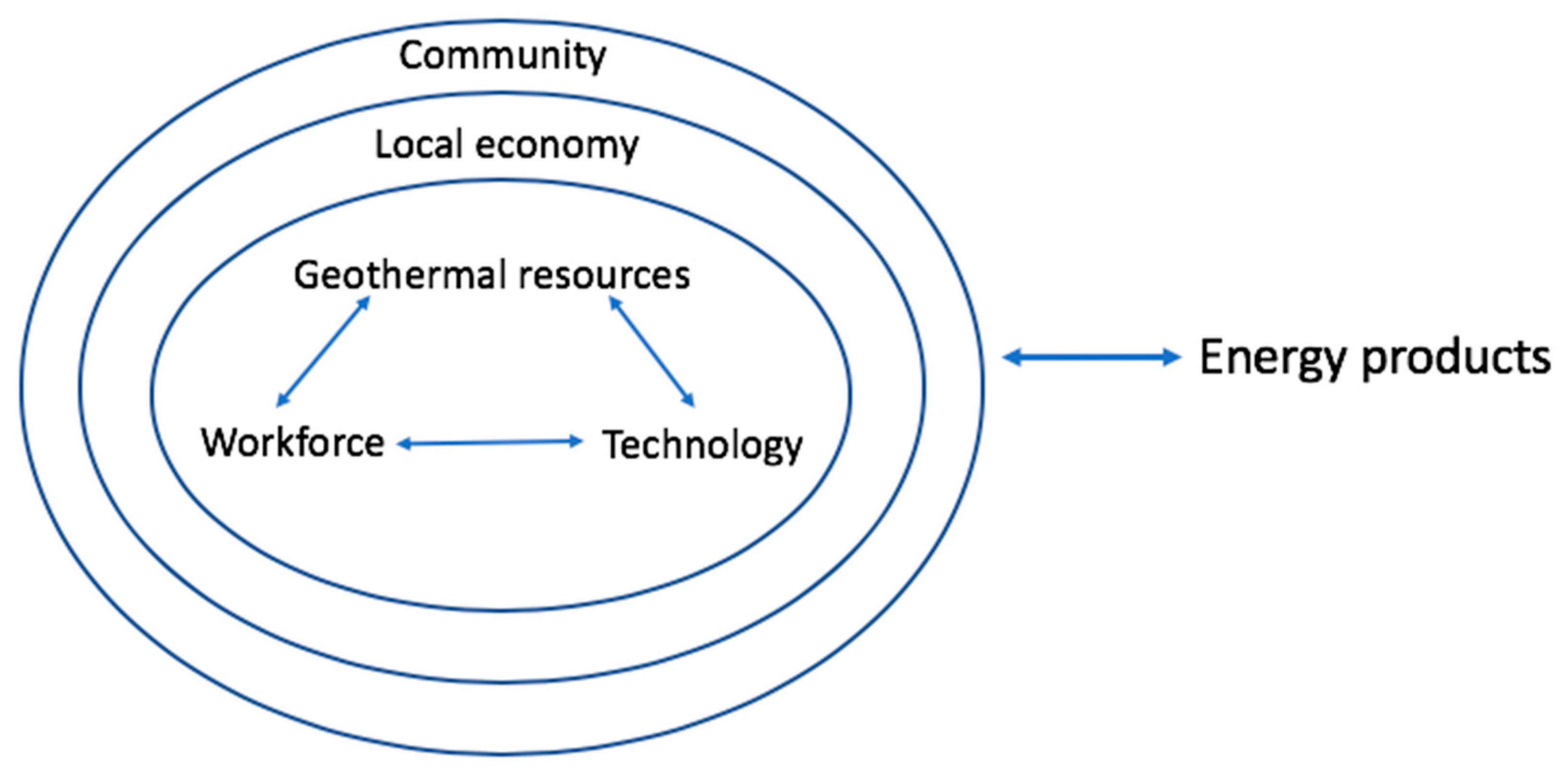
Figure 2.
Exogenous energy based local economic system. Own elaboration.
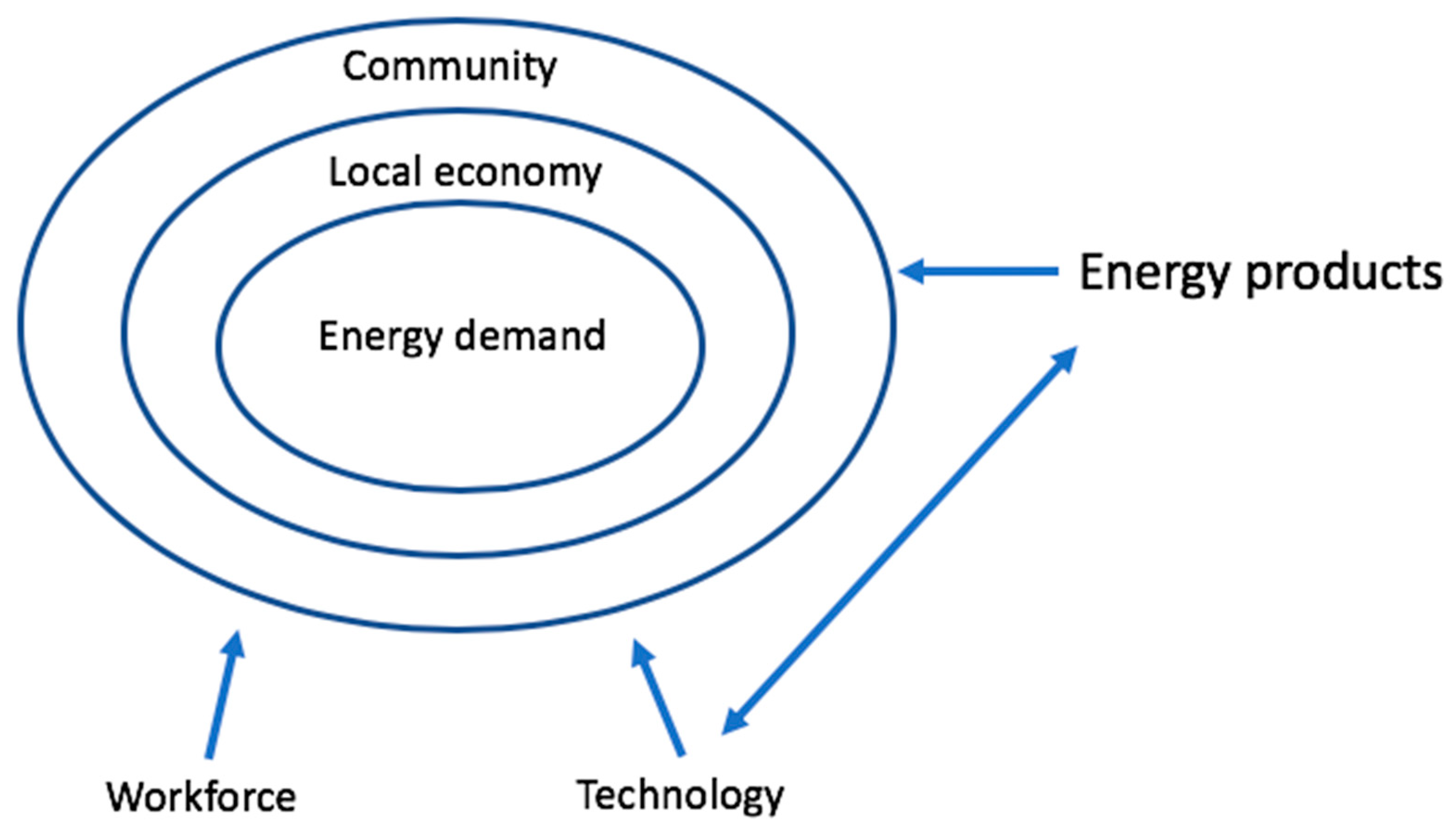
Figure 3.
The Lindal Diagram of geothermal energy utilisation, source: [82].
Figure 3.
The Lindal Diagram of geothermal energy utilisation, source: [82].
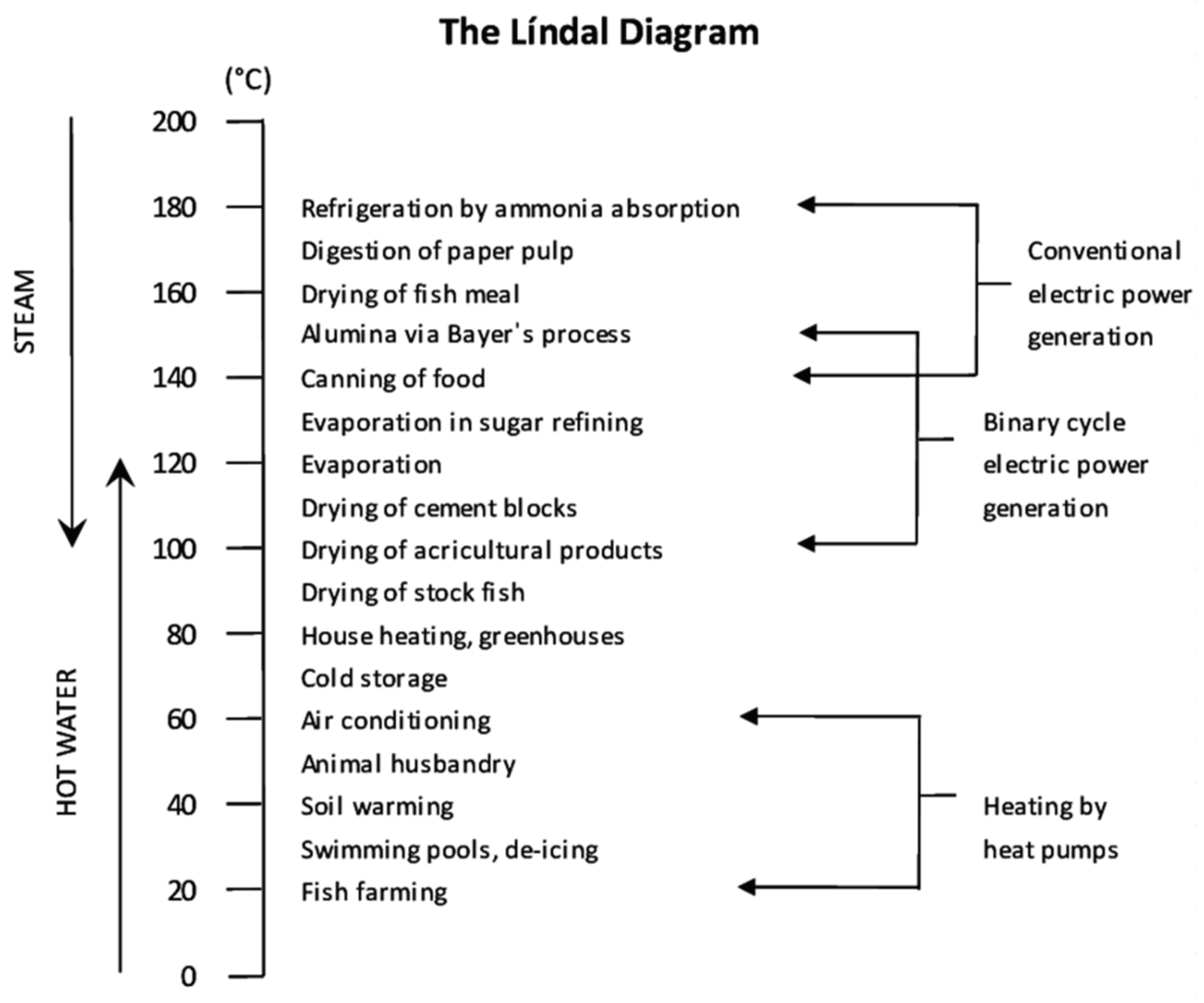

Table 1.
Energy based economic system according to the exogeneity and endogeneity of energy resources. Own elaboration.
Table 1.
Energy based economic system according to the exogeneity and endogeneity of energy resources. Own elaboration.
| Subject | Endogenous System | Exogenous System | |
|---|---|---|---|
| a | System | Internalization based | Transformation based |
| b | Structure | Existing infrastructure | Adding infrastructure |
| c | Scale | Small scale | Large scale |
| d | Energy source | Renewables / Geothermal | Fossil / Renewables |
| e | Energy demand | Internal (local, regional) | External (national) |
| f | System beneficiary | Community | Market |
| g | Factors | Capital accumulation | Foreign investment |
| h | Labour | Domestic | Imported |
| i | Sustainable development | Development with controlled depletion | Depletion in scale |
| j | Expected benefit | Self-sufficient system | Economic returns of energy projects |
| k | Ownership | Royalties | Land use regulations (licences, permits) |
| l | Policy intervention | Fiscal instruments | Regulatory instruments (price component) |
| m | Economic theory relevance | Schumpeter’s Theory of Innovation, Ostrom’s Theory of Self-Governance | Solow-Swan exogenous growth model, Theory of Production |
Legend: The categories (a-m), in which the systems are analysed, are sourced from the OECD model of local green growth indicators [106].
| 1 | [114]. |
Disclaimer/Publisher’s Note: The statements, opinions and data contained in all publications are solely those of the individual author(s) and contributor(s) and not of MDPI and/or the editor(s). MDPI and/or the editor(s) disclaim responsibility for any injury to people or property resulting from any ideas, methods, instructions or products referred to in the content. |
© 2024 by the authors. Licensee MDPI, Basel, Switzerland. This article is an open access article distributed under the terms and conditions of the Creative Commons Attribution (CC BY) license (https://creativecommons.org/licenses/by/4.0/).
Copyright: This open access article is published under a Creative Commons CC BY 4.0 license, which permit the free download, distribution, and reuse, provided that the author and preprint are cited in any reuse.