

Submitted:
06 March 2024
Posted:
07 March 2024
Read the latest preprint version here
Abstract
In this paper the one-to-one correspondences and equivalences between ideals, primals, filters and grills are introduced. It is shown the local functions and the topological spaces induced by them are the same. From this point of view, the topological properties with respect to one topology can be derived from topological properties valid in the corresponding topology.
Keywords:
ideal
; prima
; grill
; filter
; local function
; finer topology
; compatibility
; codense system
1. Introduction
Many topologies with important applications in mathematics have been defined using some additional mathematical structure. For example, if a topological space and an ideal on X are given, a new topology (called an ideal topology) can be obtained by an ideal-associated local function. The ideal topological spaces are extensively studied, see [4,5,7,8,10]. A similar concept was used for a grill [9,13,14,15,16,17], a filter [3,11,12] and a primal [1,2,6].
In general, we can consider four systems, namely an ideal , a primal , a filter and a grill on a topological space , see Definition 1. A derivation of a new topology that is finer than the original topology is as follows: The local function , , , , see Definition 1, derived from and defines the Kuratowski closure operator , , , , see Definition 3. In the final step, a new topology on X is defined, denoted by , , , , respectively, see Theorem 9. If we look at the achieved results, we can see a striking similarity. In fact, the local functions and topologies generated by this way are equivalent.
The main concept of the article is as follows: Using correspondence between two systems (Theorem 1–6), it is possible to define their equivalence, see Definition 2. Two equivalent systems generate the same topology (Theorem 10), and the results achieved in one topology can be used in a topology determined by an equivalent system. In the last part, we will show the application of this equivalence on examples of compatibility and codense topologies.
Definition 1.
Let X be a nonempty set. A nonempty system , , , of subsets of X is said be an ideal, a primal, a filter, a grill on X if it satisfies the following conditions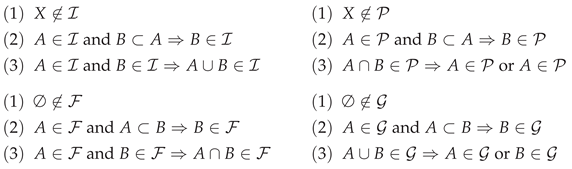
respectively. Furthermore, if τ is a topology on X, for we define four local functions
An ideal topological space, a primal topological space, a filter topological space, a grill topological space is a topological space with an ideal , a primal , a filter , a grill and it is denoted by , , , , respectively. Let be a family of all ideals, primals, filters, grills on X, respectively. Put . If , then is called a -topological space.
2. Main Results
In the following two parts we present sixteen operators (Theorem 1–6) between pairs of systems and their properties and compositions are studied. Next, the equivalence between is defined (Definotion 2). The equality of local functions and the equality of generated topologies are proved, provided that and and equivalent.
Define four identity operators
In the next six theorems the proofs of items (1)–(10) are left to the reader. The rest will be proven.
Theorem 1.
Let , be an ideal, a primal on X, respectively. Define
by ,
by .
Then , is a primal, an ideal on X, respectively and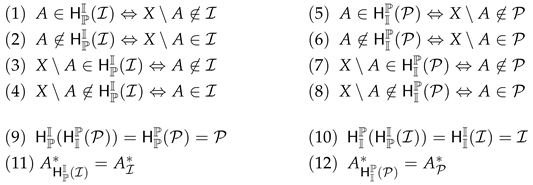
Proof.
We prove is a primal. Since , .
Let and . Then . Since and is an ideal, , so . Let . Then . Since is an ideal, or is not from . So or . That means is a primal.
We prove is an ideal. Since , .
Let and . Then . Since and is a primal, , so . Let . Then , and . So . That means is an ideal.
(11): if and only if for any nbhd U of x if and only if if and only if .
(12): if and only if for any nbhd U of x if and only if if and only if . □
Theorem 2.
Let , be an ideal, a grill on X, respectively. Define
by ,
by .
Then , is a grill, an ideal on X, respectively and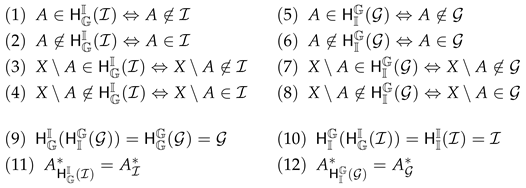
Proof.
We prove is a grill. Since , .
Let and . Then . Since is an ideal, , so . Let . Then . Since is an ideal, A or B is not from . So or . That means is a grill.
We prove is an ideal. Since , .
Let and . Then . Since is a grill, , so . Let . Then . Since is a grill, . So . That means is an ideal.
(11): if and only if for any nbhd U of x if and only if if and only if .
(12): if and only if for any nbhd U of x if and only if if and only if . □
Theorem 3.
Let , be a filter, a grill on X, respectively. Define
by ,
by .
Then , is a grill, a filter on X, respectively and
Proof.
We prove is a grill. Since , .
Let and . Then . Since is a filter and , , so . Let . Then . Since is an filter, or is not from . So or . That means is a grill.
We prove is a filter. Since , .
Let and . Then . Since is a grill and , , so . Let . Then , . Then . So, . That means is a filter.
(11): if and only if for any nbhd U of x if and only if if and only if .
(12): if and only if for any nbhd U of x if and only if if and only if . □
Theorem 4.
Let , be a filter, a primal on X, respectively. Define
by ,
by .
Then , is a primal, a filter on X, respectively and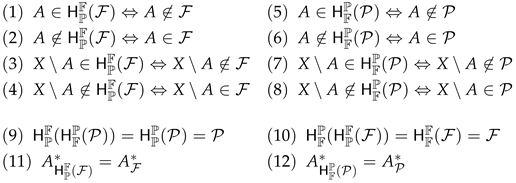
Proof.
We prove is a primal. Since , .
Let and . Then . Since is a filter, , so . Let . Then . Since is a filter, A or B is not from . So or . That means is a primal.
We prove is a filter. Since , .
Let and . Then . Since is a primal, , so . Let . Then . Since is a primal, . So . That means is a filter.
(11): if and only if for any nbhd U of x if and only if if and only if .
(12): if and only if for any nbhd U of x if and only if if and only if . □
Theorem 5.
Let , be a grill, a primal on X, respectively. Define
by ,
by .
Then , is a primal, a grill on X, respectively and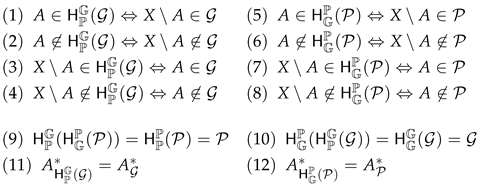
Proof.
We prove is a primal. Since , .
Let and . Then . Since is a grill and , , so . Let . Then . Since is a grill, or is from . So or . That means is a primal.
We prove is a grill. Since , .
Let and . Then . Since is a primal and , , so . Let . Then . Since is a primal, or is from . So or . That means is a grill.
(11): if and only if for any nbhd U of x if and only if if and only if .
(12): if and only if for any nbhd U of x if and only if if and only if . □
Theorem 6.
Let , be a filter, a ideal on X, respectively. Define
by ,
by .
Then , is an ideal, a filter on X, respectively and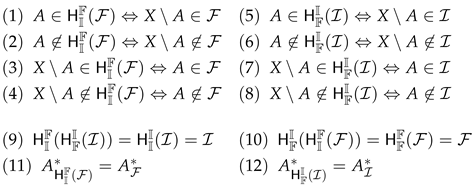
Proof.
We prove is an ideal. Since , .
Let and . Then . Since and is a filter, , so . Let . Then . Since is a filter, . So . That means is an ideal.
We prove is a filter. Since , .
Let and . Then . Since and is an ideal, , so . Let . Then . Since is an ideal, . So . That means is a filter.
(11): if and only if for any nbhd U of x if and only if if and only if .
(12): if and only if for any nbhd U of x if and only if if and only if . □
Proposition 1.
Let . If , then each of the twelve operators from Theorem 1-6 is bijective and , consequently and are mutually inverse, so .
Proof.
It follows from Theorem 1-6 items (9) and (10). □
Proposition 2.
, , , .
Proof.
, , ⇔, respectively. So, , .
, , , respectively. So, , . □
Proposition 3.
Let . The next conditions are equivalent
- (1)
- (2)
- (3)
- (4)
- (5)
- (6)
Proof.
:
⇔⇔
:
⇔
:
⇔⇔
:
⇔
:
⇔⇔□
Proposition 4.
Let . Then for 64 possibilities the equation holds.
Proof.
By Proposition 2 and Proposition 3, the equation holds for 24 possibilities ( are mutually different):
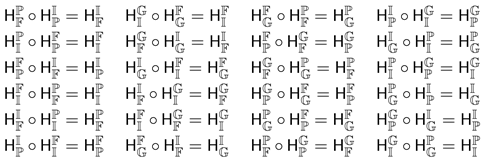
Other cases for are trivial:
(12 possibilities), (12 possibilities),
(12 possibilities), (4 possibilities).
□
For a composition of finitely many operators, the domain (the codomain) of the resulting operator is equal to the domain (codomain) of the first (last) operator and the value of local function is independent on the operators as the following theorem states.
Theorem 7.
Let , and . Then
Consequently,
- (1)
- (2)
- (3)
- (4)
Proof.
For the first equation we use the mathematical induction. If , it follows from Proposition 4. Suppose the equation holds for . Then
, by Proposition 4. The second equation follows from the first one and from Theorem 1–6. □
The set consisting of 16 operators is enclosed under composition. The results can be interpreted by the next diagram.
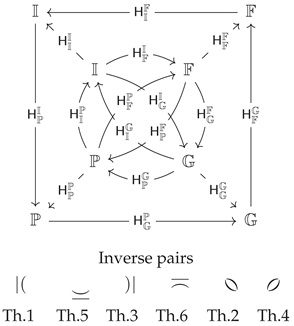
3. Applications
We have defined 16 operators, which can be expressed by one notation where . Between the members of and the members of we can define an equivalence as the next definition states. Note if , then for some .
Definition 2.
Let . is equivalent to if and where , and . This relation is denoted by .
Lemma 1.
For any , where and . Moreover, ∼ is an equivalence relation.
Proof.
Since and , . It is clear ∼ is reflexive and symmetric. Let . Then and and , so . □
In the next definition we define a dual operator (see [5]) to the operator and a closure and an interior operator.
Definition 3.
Let . Define the next operators
Lemma 2.
Let . If , then , , , . Consequently, if , then .
Proof.
Suppose . Then . By Theorem 7, . Other equalities are obvious. □
Remark 1.
It is well known (see for example [7]) that an ideal topology derived from a topology τ on a set X and an ideal on X is defined by a Kuratowski closure operator and is finer then τ. A base for is described as and .
In the literature we can find many properties of local functions. Designation of operators is different. For example, , in [1] or , in [15]. We will list some of them below regardless of what system they apply to.
Theorem 8.
Let . Then
- (1)
- ,
- (2)
- If , then ,
- (3)
- ,
- (4)
- ,
- (5)
- ,
- (6)
- If , then ,
- (7)
- ,
- (8)
- .
Proof.
Let . Then , by Theorem 7. Since all items hold for (see for example [7]), they hold for . □
Similarly, the next theorem holds for , so it holds for any .
Theorem 9.
Let . A family is a topology finer then τ and the next conditions are equivalent.
- (1)
- ,
- (2)
- ,
- (3)
- ,
- (4)
- ,
- (5)
- ,
- (6)
- ,
- (7)
- .
Theorem 10.
Let . If , then . Consequently, if , then . A simple base for the open sets of is described as follows:
,
,
,
, respectively.
Proof.
The equality follows from Lemma 2.
By Remark 1, is a base for . if and only if where and if and only if where and (by Theorem 1 (4)), so if and only if where and (by Theorem 4 (5)), so if and only if where and (by Theorem 3 (4)), so . □
Definition 4.
A set A is -small (-small, -small, -small) if (, , ) and A is locally -small (-small, -small, -small) if for any there is a set containing a such that is -small (-small, -small, -small). Let . is said to be compatible with τ if any locally -small set is -small, denoted by .
Remark 2.
Let . Then , . So, . That means if and , a set A is -small (locally -small) if and only if A is -small (locally -small) and if and only if . Consequently,
- (1)
- If , then .
- (2)
- If , then .
- (3)
- If , then .
- (4)
- If , then .
In the theory of ideal topological spaces there are several characterizations of compatibility. For the most common equivalent conditions are as follows (see for example [5,7]).
Theorem 11.
The next are equivalent
- (1)
- ,
- (2)
- for every , if , then ,
- (3)
- for every , ,
- (4)
- for every , if , then ,
- (5)
- for every , .
Regardless of a concept we work in, a compatibility of can be characterized by another equivalent system and by operators and .
Theorem 12.
Let . If , then the next are equivalent
- (1)
- ,
- (2)
- for every , if , then A is -small,
- (3)
- for every , is -small,
- (4)
- for every , if , then A is -small,
- (5)
- for every , is -small.
Proof.
Let where . Since , if and only if (by Remark 2), A is -small if and only if A is -small (by Remark 2), , (by Lemma 2). Then the next are equivalent (note )
- (1)
- ,
- (i)
- ,
- (ii)
- for every , if , then A is -small,
- (iii)
- for every , is -small,
- (iv)
- for every , if , then A is -small,
- (v)
- for every , is -small.
- (2)
- for every , if , then A is -small,
- (3)
- for every , is -small,
- (4)
- for every , if , then A is -small,
- (5)
- for every , is -small.
□
Remark 3.
Note, in a primal case (see for example [1]) a compatibility is called "a topology suitable for a primal". More precisely, we prove τ is suitable for a primal if and only if is compatible with τ. Proof: τ is suitable for a primal if and only if whenever (see [1] Theorem 4.2) if and only if whenever if and only if A is -small whenever if and only if A is -small whenever if and only if is compatible with τ.
Definition 5.
A set A is -big (-big, -big, -big) if A is not -small (-small, -small, -small), equivalently (, , ). Let . A topology τ is -codense, if any nonempty open set is -big.
Remark 4.
Let . Then , , . So, . That means if and , a set A is -big if and only if A is -big and τ is -codense if and only if τ is -codense.
From the theory of ideal topological spaces we have the next characterization.
Theorem 13.
τ is -codense if and only if .
The property of being -codense can be characterized by the operators and with respect to another equivalent system .
Theorem 14.
Let . If , then the next are equivalent
- (1)
- τ is -codense,
- (2)
- ,
- (3)
- .
Proof.
Let where . Then . By Remark 4 and Theorem 13, is -codense if and only if is -codense if and only if is -codense if and only if (by Theorem 7), so . The equivalence follows from equation . □
4. Conclusions
The main result of the work is based on the unification of approaches to the creation of new topologies derived from ideals, primals, filters and grills. Each approach has its equivalent counterparts in other approaches, and results valid in one approach can be used in others according to the following scheme: Definitions, theorems and proof methods in a space , , are valid and usable in the other three spaces where and , . From this point of view, many proofs do not need to be done, and it is enough to do them only once in one space. On the other hand, such diversity, even if equivalent, can be a stimulus for further research and applications.
This article does not contain any studies with human participants or animals performed by the author.
Funding
This research received no external funding.
Data Availability Statement
No data has been used in the manuscript.
Acknowledgments
The article was supported by the Slovak Research and Development Agency, Grant No. APVV-20-0045.
Conflicts of Interest
The author declares that he has no conflict of interest.
References
- Al-Omari, A.; Acharjee, S.; Özkoç, M. A new operator of primal topological space. Mathematica 2023, 65, 175–183. [Google Scholar] [CrossRef]
- Acharjee, S.; Özkoç, M.; Issaka, F.Y. Primal topological spaces. arXiv 2022, arXiv:2209.12676. [Google Scholar] [CrossRef]
- Choquet, G. Sur les notions de filtre et grille. C. R. Acad. Sci. Paris 1947, 224, 171–173. [Google Scholar]
- Hamlett, T. R.; Jankovic, D. Ideals in general topology. General Topology and Applications 1988, 115–125. [Google Scholar]
- Hamlett, T. R.; Jankovic, D. Ideals in topological spaces and the set operator ψ. Bollettino dell’ Unione Matematica Italiana 1990, 7, 863–874. [Google Scholar]
- Al-Saadi, H.; Al-Malki, H. Generalized primal topological spaces. AIMS Math. 2023, 8, 24162–24175. [Google Scholar] [CrossRef]
- Jankovic, D.; Hamlett, T. R. New topologies from old via ideals. Am. Math. Mon. 1990, 97, 295–310. [Google Scholar] [CrossRef]
- Jankovic, D.; Hamlett, T. R. Compatible extensions of ideals. Bollettino dell’ Unione Matematica Italiana 1992, 6, 453–465. [Google Scholar]
- Mandal, D. On separation axioms weaker and stronger than regularity and normality via grill. Jour. Pure Math. 2014, 31, 89–100. [Google Scholar]
- Mandal, D.; Mukherjee, M. N. Certain new classes of generalized closed sets and their applications in ideal topological spaces. Filomat 2015, 29, 1113–1120. [Google Scholar] [CrossRef]
- Modak, S. Topology on grill-filter space and continuity. Bol. Soc. Paran. Mat. 2013, 2013 31, 219–230. [Google Scholar] [CrossRef]
- Modak, S. Grill-filter space. J. Indian Math. Soc. 2013, 80, 313–320. [Google Scholar]
- Roy, B.; Mukherjee, M. N. On a typical topology induced by a grill. Soochow J. Math. 2007, 33, 771–786. [Google Scholar]
- Roy, B.; Mukherjee, M. N. On a type of compactness via grills. Mat. Ves. 2007, 59, 113–120. [Google Scholar]
- Roy, B.; Mukherjee, M. N.; Ghosh, S. K. (2008) On a new operator based on grill and its associated topology. Arab. J. Math. Sci. 2007, 14, 21–32. [Google Scholar]
- Roy, B.; Mukherjee, M. N. Concerning topologies induced by principal grills. An. Stiint. Univ. AL. I. Cuza Iasi. Mat.(N. S.) 2009, 55, 285–294. [Google Scholar]
- Thron, W. J. Proximity structure and grill. Math. Ann. 1973, 206, 35–62. [Google Scholar] [CrossRef]
Disclaimer/Publisher’s Note: The statements, opinions and data contained in all publications are solely those of the individual author(s) and contributor(s) and not of MDPI and/or the editor(s). MDPI and/or the editor(s) disclaim responsibility for any injury to people or property resulting from any ideas, methods, instructions or products referred to in the content. |
© 2024 by the authors. Licensee MDPI, Basel, Switzerland. This article is an open access article distributed under the terms and conditions of the Creative Commons Attribution (CC BY) license (http://creativecommons.org/licenses/by/4.0/).
Copyright: This open access article is published under a Creative Commons CC BY 4.0 license, which permit the free download, distribution, and reuse, provided that the author and preprint are cited in any reuse.


